Style

Streets of San Francisco: ICP goes for inner city phame

0

If you live in San Francisco and pay attention to public art, you might already be familiar with the work of longstanding Bay Area graffiti crew Inner City Phame (ICP). Their prolific murals – diverse in style and magnetic in form – grace walls across the city. There’s a tribute to Malcolm X on Third and Kirkwood in Bayview-Hunters Point, featuring intricately crafted aliases free floating among inspired quotes. On a vibrant wall on the corner of 19th and Mission, comic book characters from Ironman to Dr. Evil swing between stylized names forged in cracked stone. An Azteca-themed mural up the street on 25th has a jaguar warrior getting down with the gods. And ICP also curates the street level walls of the Defenestration building on 6th and Howard (that old tenement hotel with furniture flying out of the windows), making a dynamic open-air gallery out of abandoned space. Wait, who said graffiti wasn’t art?

The first graffiti I saw when I was a kid growing up in the Mission was the Chicano writing on our walls,” says Twick, ICP veteran and original member of the group of close-knit friends, founded by Il Charo (then named Jes 446) back in 1988. “We called it Cholo writing, because that’s what it was. The walls decorated the names of the gang members of the neighborhood.” Surprisingly little of San Francisco’s Cholo writing has been documented, although street art researches have traced the origins of its Los Angeles cousin back to eastside barrios in the 1930s. What we do know is that today’s hip-hop tradition of graffiti didn’t take off in the Bay until ’83, a year that marked the momentous PBS broadcast of Henry Chalfant’s and Tony Silver’s Style Wars. After watching the stunning documentary about New York’s burgeoning youth culture, thousands of kids around the world racked some aerosol cans and took to the streets. A thirteen-year-old Twick, who had already tried to his hand at Cholo graffiti, was one of them.

I fell in love with the art form right away and wanted to duplicate what the writers in New York were doing,” Twick recalls. Along the way Twick found a mentor in Antie 67, who introduced to him the values and elements of hip-hop culture – from the craft of lettering to break dancing and emceeing. It was an apprenticeship. Like many other kids, Twick felt pulled into an exciting and creative underground world, one that for the most part, kept him out of the real trouble. “I didn’t choose my destiny my destiny chose me,” he says.

Soon enough more and more crews popped up, a unique Bay Area style developed and an ever-evolving ICP made a name for itself on the walls across the city. “We dubbed the style we do Phunk,” Twick explains, “meaning, knowing the foundation of a letter and creating from that: stretching it here and there, adding connections – some arrows and a few bends in the right places with a shadow or a 3d.” Funkified calligraphy is readable, unlike widlstyle, which has helped ICP garner a large audience of appreciators and street notoriety.

In recent years San Francisco has taken an active role on trying to eliminate graffiti. City policies have enforced strict regulations on private property owners to buff vandalism and enacted tougher surveillance and punishments on the writers. Graffiti is known as a quality of life crime, but it seems easy enough make just the opposite case. “We don’t destroy neighborhoods and communities – we beautify them,” Twick says. While ICP now paints many legal murals and members sell canvases in galleries, Twick still highlights that the practice is fundamentally rooted in both an unsanctioned approach and the aesthetics of the tag. So, ICP maintains a balance between two worlds. “The most important thing we stand for is our family and our cultures, inspiring young minds through art – not violence – and blessing our community with colorful murals,” says Twick. “And we will continue to be one of the top crews in the Bay Area.”


The sound of the city

3

STREETS OF SAN FRANCISCO Do you have a favorite musician who plays outside in San Francisco? I’d name many, if I knew their names. There’s the kid no older than 10 who led a two-piece rock band (himself on voice-guitar) through a great show to a growing crowd at Dolores Park, then played soccer immediately after. There’s the guy at 24th Street BART who sounds like Johnny Cash. There’s the man with the white guitar by San Francisco Center, and the guy who used to sing opera by Macy’s. It’s all too easy to miss the sound of life when your ears are plugged by little headphones. With that in mind, and with Heddy Honigmann’s great 1998 documentary The Underground Orchestra as one inspiration, it seemed right to talk to some of the people who make music for those who listen. Thanks to Elise-Marie Brown, Nicole Gluckstern, D. Scot Miller and Amber Schadewald for their contributions to this piece. (Johnny Ray Huston)


Name: Antone Lee

What styles of music do you play? I play a mix of folk and modern country on my guitar. Most of my music is original.

Where are your favorite places to play? I usually like to play down here (Civic Center BART station) because of the great sound and acoustics in the hallway.

How long have you been gigging on the streets or underground? I’ve been playing on the streets since I quit my job 3 years ago. This is what I do for a living. It’s pure joy.

What do you like about it and why do you do it? I like vibing off of people as they come and go. It’s nice to play whatever I’m feeling at the moment.

What don’t you like about it? Sometimes the people walking by can be sort of distracting. I usually just close my eyes and sink into the song.

Do you have recordings or a Web site? I have a MySpace (www.myspace.com/antoneleemusic) where some of my songs are, but I have about thirty songs that I’m waiting to record.

What street musicians and other musicians do you admire? I really like Fiddle Dave. He’s got a great original bluegrass sound. I also like Federico who plays more gypsy-styled café music.(Elise-Marie Brown)

Name: Ilya Kreymer

What styles of music do you play? I play eastern European music. A lot of Klezmer, Russian and Balkan music.

Where are your favorite sites to play? My favorite places to busk are the BART stations in the Mission, and also farmers’ markets. I usually like to busk two or three times a week.

How long have you been playing on the streets or underground? For five months.

What do you like about it, and why do you do it? I like the fact that it gives me a chance to practice and I get to see how people react to the music. The acoustics in the 16th and 24th BART stations are especially good. It’s also a good way to meet other musicians.

What don’t you like about it? Obviously there’s a lot of outside noise. You never know when you might be interrupted. Sometimes I might be doing really well and no one will be there to listen, but when I mess up more people might be around.

Do you have recordings or a Web site? I’ve actually got some recordings on reverbnation (www.reverbnation.com). But I’m hoping to update it soon with more songs. I’m also working on having a band that plays Russian music, too.

What street musicians or other musicians do you admire? There’s an accordion player that plays down at Civic Center. I think during morning rush hour. He also does magic tricks and wears outfits that match his accordion. He’s a longtime busker who I really admire.

What’s been your best experience playing? I had a really good experience at the Alemany market recently. A friend of mine was working at the farmers’ market. I was busking next to her booth while she danced. People were stopping by and taking notice, so that was really nice. (Brown)


Names: The Haight Street Vagabonds: Peter, Bucky, Crisp and Jack

Where do you play? Fisherman’s Wharf, on the sidewalk next to Cold Stone Creamery.

What styles of music do you play? Gypsy music, folk, Russian Folk. We jam. That’s like asking what kind of music the Grateful Dead play.

What are your usual instruments? Broken mandolin, harmonica, pots and pans, guitar, hand drums, children’s toys, hands, feet.

Why do you play? For fun, to entertain, and to keep our spirits up. I don’t want the money — then I feel like I’m whoring myself out to capitalism. I want food, beer, weed, cigarettes, and the best thing — instruments!

When do you play? Everyday. Sometimes the members change. Sometimes people walking by will join for a few minutes, hours or days.

How many years have you been playing on the street? Crisp has been playing for a year, Bucky since he left home four years ago at age 14.

What’s your philosophy about music? The best music has never been recorded. The best music is played for family and friends, at night, around a campfire. Or when you’re alone. (Amber Schadewald)

Name: Benjamin Barnes

What styles of music do you play? I play guitar and viola, but violin projects better and I know a lot of repertory. I’ve got maybe 3 hours of Bach memorized. It’s a meditative thing. There are six sonatas and six cello suites, and I play the cello suites on viola and violin. They’re nice profound pieces and sometimes people will stop and listen. I was playing Bach’s Chaconne and this guy stopped and listened to the whole piece and tipped me afterward.

Where are your favorite places to play? The Mission BART stations. The acoustics aren’t bad — you get a little reverb like you would in a hall. The first place I played was Powell Street station. It was 1989. I put my can down and basically practiced and made 15 dollars. I packed it all up and went home and threw the money on my bed and laughed. I was working at a coffee shop and putting myself through school.

I had a string quartet (the Rilke String Quartet) and we used to play at Montgomery and Embarcadero. We called it guerrilla musicianship.

What do you like about it, and why do you do it? It’s fulfilling to play these great pieces. I’ve been working on memorizing all these pieces and finding new ways to interpret them.

I was just in NY and saw people busking in Central Park and Greenwich Village. There’s a famous violinist, Joshua Bell, who played in the NY subway for a couple hours, and no one recognized him or that he was playing on a Stradivarius. Most people walked by or gave him a dollar, and one kid played air violin. He made 26 dollars.

Do you have recordings or a Web site? I have a lot of songs and string quartet and solo viola stuff that I’ve written and played on my website (www.benjaminbarnes.com). You can download it for free. There’s a spot where you can make a donation. I’ve gotten about 26 dollars. (Laughs)

I’m playing a free show at Caffeinated Comics on May 16th. We’re going to play an acoustic show, with songs I wrote and Bowie covers, Beatles covers, Led Zep and “The Devil Went Down to Georgia.” (Huston)

Name: Anthony

Where are your favorite places to play? Montgomery Bart Station, sometimes Fisherman’s Wharf.

What styles of music do you play? Love songs.

What are your favorite songs? “All The Woman I Need” by Luther Vandross, and anything Barry White.

How many years have you been playing on the street? 10.

What are your necessary accessories? Sparkly blue nail polish, mini Bible, Newports.

How long do you play? I stay until my dick gets hard and then probably longer.

Why do you do it? To entertain people and make some money. I don’t play for my health. (Schadewald)

Name: Brass Liberation Orchestra

When was the BLO founded? 2002-ish

How many members are there? Probably about 20 at the moment. 50 or more for the life of the band.

Where are your favorite spots to play? How do you get the word out? We play for change: picket lines, street marches, demonstrations. Wherever people want to dance in the street. We mostly play at events that other people are publicizing, (but) when we do our own shows, we use email and word of mouth.

What’s been your most memorable performance? Depends on who you ask! Demos at the start of the Iraq War where the band was arrested en masse? Oakland Oscar Grant marches? Whole Foods “Hey Mackey” pro-healthcare protest?

Are there other street bands you admire? There are many street bands whose music we admire. Some bands with similar political orientation include Rude Mechanical Orchestra (NYC), Chaotic Insurrection Ensemble (Montreal), Cackalack Thunder (Greensboro, NC). We also respect the youth work of Loco Bloco in the Mission, who are currently facing a budget crisis and could use some fundraising support.

What’s your favorite song to play together? A lot of us love New Orleans Second Line, and also Balkan brass music. One song we play at almost every gig is “Roma Rama,” a simplified Balkan-style tune written for us by Axel Hererra. (Nicole Gluckstern)

Name: Federico Petrozzino

What styles of music do you play? I play mostly folk and Beatles covers.

Where are your favorite places to play? I’ve played at Mills College and Ireland’s 32. But I make my living as a street musician playing around here (Powell BART station).

How long have you been playing on the streets or underground? I’ve been out here for about 3 months since I got in to town from Argentina.

What do you like about it, and why do you do it? It’s nice when you feeling like you’re doing good and people will walk by and smile or give you a wink.

What don’t you like about it? To be honest, I love the bums. But sometimes they can be crazy, which can turn some people away. It’s a distraction, but we try to be respectful.

Do you have recordings or a Web site? I have some of my stuff at purevolume (www.purevolume.com/fefon). The next step is to play at more places in the area.

What street musicians and other musicians do you admire? Frank Lynn. He’s been down here for over 30 years and is kind of a father to all of us street musicians. He’s an amazing musician and only plays on two strings. He has such a deep voice and everyone respects him.

What’s been your best experience playing? Just watching parents teach their children to appreciate music and give money. It’s great to see them learn how to be humble and respectful of the arts. (Brown)


Name: Larry “Bucketman” Hunt

How long have you been playing music? I’ve playing drums for 49 years. My first kit was a set of buckets when I was three years old.

I’m not from here. I’m from Kansas and I’ve had the chance to play with some of the greats all across the United States — Jimmy Smith, Pearl Bailey, The Drifters. I played with John Lee Hooker when he opened up the Boom Boom Room. This is what I do.

Where are your favorite places to play? 4th and Market, Powell and Geary (with New Funk Generation).

What don’t you like about playing music on the streets or underground? Old Navy, the Flood Building, their security is chasing me off now. I’ve been out here for fourteen years, was in Pursuit Of Happyness with Will Smith, and now they’re trying to get rid of me. They call the cops. The cops don’t want to do it, but they have to. (D. Scot Miller)


Street stars

3

rebeccab@sfbg.com

A few crafty, courageous souls have learned to live off of San Francisco’s streets, supporting themselves with tips from random strangers at high-traffic destinations.

Fisherman’s Wharf is such a popular spot that the Port of San Francisco has a map dividing the sidewalk turf into specified performance locations. Between Piers 39 to 41, crowds may encounter break-dancers, spray-paint artists, musicians, or balloon sculptors. Then there are strutters and statues, clad in head-to-toe silver or gold, dancing to tunes blasting out of boom boxes, or frozen still until a tip lands in their tin.

Across the city, a writer has carved out his own street niche. Lynn Gentry pecks away at his Olivetti Lettera 22 typewriter, peering through cat-eyed spectacles at the unevenly inked text. A young black poet sporting an inch or two of vertical hair, seated upon a fold-up wooden chair before a makeshift miniature desk, his gig is summed up in a hand-written sign: “Pick a subject and price then get a poem.”

Gentry isn’t the city’s only busker hocking poems off an old-fashioned typewriter, but he is a regular fixture at the famous corner of Haight and Ashbury. Rather than tailoring his work to a specific style, he spins out spontaneous, lightly punctuated poems and prose, emulating the Beats. Tourists stop often and tip generously, but the locals seem to like him too. One has dubbed him “Professor.” Another seemed excited to pick up a poem he previously ordered, about Libras.

“I chose the Haight because you’ve got a lot of different things going on right here,” Gentry explains. “The longer you sit here, the more you meet the people who live right here, and who were part of the neighborhood’s history.” When not writing, he offers tales and odd historic tidbits. He talks about the 1966 Trips Festival, acid tests, the CIA, and the Summer of Love.

A trio of skinny young women approach, dressed as if they have stepped directly out of that era, and request a poem about “Supercute.” Turns out, it’s their band name.

Gentry first encountered a busking poet when he saw Jacqueline Suskin at the Oregon Country Fair. The son of a poet, he’d written mostly song lyrics before. Now, he says, he’s making ends meet with the street gig. The toughest customer request yet? “Ode to a Menstrual Cycle,” he admits. “It’s the only one that’s taken me three tries.”

Meanwhile, back at Fisherman’s Wharf, a crowd gathers to watch the masked street performer clad in head-to-toe gold. Poised atop a gold milk crate, he shimmies forward, hips swinging, shoulders rolling, and the milk crate shimmies too. He turns a 360-degree spin, and the milk crate spins too. He pauses for a photo with two wide-eyed blond children. Vacationers pause to snap pictures and tip. They might never guess that the man behind the mask is 51 years old.

At Fisherman’s Wharf, everybody sitting on the benches nearby seems to know Shaba, a spry black man who introduces himself as Shabadaba the Gold Man. He wears a gold top hat and an enormous gold clock around his neck. He does his street strutting right across the way from the Bubba Gump Shrimp Co., and says he’s been entertaining at Fisherman’s Wharf since 1977.

“I even beat the Bush Man out here,” he says. (The Bush Man may have the most bizarre self-made gig of all. He conceals himself behind a cluster of bush-like boughs, and then shakes them around, hollering, to scare unsuspecting passersby. It works every time.)

Shaba wasn’t always gold. He used to be silver, but too many others followed suit, so he switched colors. There’s another Gold Man, too, who rolls his tip can up and down his arms, and a few silver performers. One, who calls himself Silver Man, paints his entire head silver — except for an off-center star, which traces across his eyes and down his cheeks — and dances to Michael Jackson tunes wearing star-print pants, a red shirt with wings painted down the back, and one white glove.

“I’m kinda like Father Time out here,” Shaba says. He notes that things have changed over time, and that some performers are now paying the city for permits to be guaranteed a slot, though it isn’t mandated. He springs up suddenly, mumbling something about being unable to sit still.

Back at Haight and Ashbury, Gentry plucks a poem from the typewriter, proofreads it carefully, and hands it over. Here’s an excerpt: “San Francisco keeps trying as I hear the accents of the old neighborhoods that left them behind years ago to start a new life as writers still praise them from afar and the locals hold dying history confused to where they are….”

Secret agent “homme”

0

NEW-OLD MOVIE The Cold War heated up a public appetite for spy adventures well before James Bond became a pop phenomenon. In fact, Ian Fleming hadn’t yet created 007 in 1949, when Jean Bruce commenced writing novels about Hubert Bonisseur de La Bath, a.k.a. Agent OSS 117 — eventually more than 90 of them. When Bruce died (crashing his Jaguar — what a man!) in 1963, just as the screen Bond was taking off, his widow wrote another 143. Then her children wrote two dozen more, as recently as 1992.

Needless to say, this French superspy was ready-made to join the ranks of umpteen 007 wannabes, appearing in somewhere between six and 11 films (it’s unclear whether all involved de La Bath, or were just Bruce-based) through 1970, played by at least four actors. The series remained well-known enough to get a new life in 2006 when director Michel Hazanavicius and top French comedy star Jean Dujardin sought to spoof 1960s espionage flicks a la Austin Powers: International Man of Mystery (1997).

That was a big hit, so now we’ve got a sequel. OSS 117: Lost in Rio isn’t as fresh or funny as the preceding Cairo, Nest of Spies. But it’s still a whole lot fresher and funnier than Austin Powers Nos. two (1999) and three (2002). Dujardin’s de La Bath is the very model of jet-set masculinity, twisting the night away at a ski chalet with umpteen soon-to-be-machine gunned “Oriental” lovelies in the opening sequence, flashing a pearly, superconfident smirk at the neverending stream of multinational babes elsewhere, wowing them poolside with his top-of-the-mid-1960s-line male physique (nice, but don’t expect visible abs). Of course such pleasure pursuits take place strictly between car chases, shootouts, and karate fights.

Posing (badly) as a reporter to root out Hitlerites hiding in Brazil, our lone-gun hero is distressed to discover he has help from Israeli Mossad agents, one a mere chick. “Hunt down a Nazi with Jews?” he exclaims, complaining the target villain “will recognize them … their noses, obviously.” Beyond its pitch-perfect recreation of swinging ’60s cinema clichés (Naugahyde-lounge muzak, slightly feverish Technicolor, etc.), these films’ main joke is how cluelessly, casually racist, sexist, and xenophobic de La Bath is. The joke is on him, but his charm is remaining blissfully unaware.

Agreeably silly, Lost in Rio doesn’t go for Hollywood-style slapstick and grossout yuks. Instead, its biggest laughs are usually droll throwaways, as when 117 explains a shocking sudden costume change with the unlikely declaration “I sew,” or during an LSD-dosed hippie orgy proves quite willing to go with the flow — even when that involves another guy’s groovy finger breaching security up the pride of French intelligence’s derriere.

OSS 117: LOST IN RIO opens Fri/14 in Bay Area theaters.


Event Listings

0

Event Listings are compiled by Paula Connelly. Submit items for the listings at listings@sfbg.com.

WEDNESDAY 12

Bike-In Movie Parking lot across from the Good Hotel, SF; www.disposablefilmfest.com. Good Hotel, 112 7th St, SF; (415) 621-7001. 4pm, free. Celebrate SF Bike Week starting at 4pm with Forage SF’s Underground Market, followed by a raffle at 7pm for cool bike gear, stays at the Good Hotel, and more, culminating in a screening of the Disposable Film Festival 2010 competitive shorts at 8pm. Valet bike parking available from the SFBC.

Write/Walk Meet at Mission High School, 3750 18th St., SF; (415) 252-4655. 6pm, free. Reading at Modern Times Bookstore, 888 Valencia, SF. 7pm, free. Enjoy a walking tour of poems by young poets from WritersCorps workshops at Mission High School that will be displayed in Mission storefronts for the month of May. Participating merchants include Candy Store Collective, Adobe Book Shop, Bombay Ice Cream, Borderlands Books, Dog Eared Bookstore, 826 Valencia, and more. Maps available at participating merchants.

Zhang Huan Sculpture Joseph L. Alioto Performing Arts Piazza, Civic Center Plaza, Larkin between the Main Library and the Asian Art Museum, SF; www.sfartscommission.org. 10am, free. Attend the dedication of internationally-acclaimed Chinese artist Zhang Huan’s Three Heads Six Arms copper sculpture that will be located in Civic Center Plaza through 2011.

THURSDAY 13

Bike Away From Work Party Rickshaw Stop, 155 Fell, SF; www.sfbike.org/btwd. 6pm; free for SFBC members, $10 for non-members. Get the skinny [jeans] on cycling fashion and style at this runway show and Bike to Work Day after party featuring tips on functional finery, complimentary bike valet, DJs, and raffle prizes.

Radical Women on Asian American Heritage New Valencia Hall, Suite 202, 625 Larkin, SF; (415) 864-1278. 7pm, free. Asian vegetarian buffet available at 6:15pm, $7.50. Hear artists Mia Nakano, Lenore Chinn and Nellie Wong discuss turning art into a collective voice for social change and the importance of the visibility of Asian American queers and women to the movements.

Rock the Bike California Academy of Sciences, 55 Music Concourse Dr., SF; www.calacademy.org. 7pm, $12. Celebrate one of San Francisco’s favorite method of transportation at this cycling themed NightLife featuring fun sustainable displays, including a bike-powered blender, a bike-powered DJ stage where you can take a turn pedaling, a performance by “the bike rapper” Fossil Fuel, bike-powered and inspired art, and more.

FRIDAY 14

BAY AREA

Ferment Change Humanist Hall, 390 27th St., Oak.; www.fermentchange.org. 7pm, $10-30 sliding scale. Support a more equitable food system at this fermented foods, culture, and urban agriculture series event where you can taste over a hundred different homemade fermented foods and beverages. Proceeds to benefit for urban agriculture heroes, City Slicker Farms. Bring your own fermented food to share and be entered in a raffle.

SATURDAY 15

Asian Heritage Street Celebration Larkin between Ellis and Grove, SF; www.asianfairsf.com. 11am-6pm, free. Celebrate Asian heritage at this street fair featuring two stages with over 100 music, dance, and other performance acts, an Anime area, a mah jong court, food and drink vendors, a cultural procession, an 8-foot high replica of a human colon, and much more.

Dawn Festival 2010 California Academy of Sciences, 55 Music Concourse Dr., Golden Gate Park, SF; www.dawnfestival.org. 7:30pm, $20. Reboot and Tablet Magazine host this celebration of the Jewish holiday of Shavuot, with Sandra Bernhard, Daniel Handler (aka Lemony Snicket), and more.

Inner Sunset Street Fair Irving at 10th Ave., SF; www.sfpix.com. 10am-8:30pm, free. Celebrate the Inner Sunset at this inaugural street fair set to feature sidewalk sales throughout the neighborhood, live music performances, dance lessons, art, crafts, food, yoga and tai chi lessons, and more.

MASS Good Vibrations Polk Street Gallery, 1620 Polk, SF; (415) 345-0400. 7pm, free. Enjoy this multimedia exhibit by poet and musician Kevin Simmonds called MASS (Making All Saints Sebastian), where he uses photographs, music, and poetry to recast male sexuality by having a diverse range of men pose as St. Sebastian.

SUNDAY 16

Alameda Backyard Chicken Coop Bicycling Tour Meet at 488 Lincoln, Alameda. 1pm, free. Take a self-guided bike tour of the many chicken coops of Alameda and check out a wide range of chicken coops while learning about urban chicken farming, ecological issues, and slow food on this 4.5 mile route. Maps will be provided at the start location and refreshment will be available along the route.

Bay to Breakers Start lines on Mission between Beale and Steuart, SF; (415) 359-2800, www.ingbaytobreakers.com. 8am; registration $48, group discounts available, free to be a spectator. Enjoy this authentic San Francisco marathon, complete with competitive runners and Mardi Gras style revelers, who follow athletes through the city in themed costumes and floats. Call or visit their website for rules and restrictions on alcohol consumption. Don’t forget to dispose of your own trash.


Lookin’ hot in the bike lane: Two-wheel tips from Meli of ‘Bikes And The City’

2

Meli Burgueno is the woman pedaling hard behind the killer San Francisco blog, Bikes And The City and after catching a glimpse of her always adorable road-friendly attire, it was time to get behind the chains and cranks to get a few style fashion-dos from the bicycle lover herself. Poking in and out of her favorite stores on Polk Street, Meli shows ladies the rules for hot cruisin’…of which she says there are none.

She rolls up on her companion of choice, “Frenchie” and parks her next to the coffee shop. Meli is sporting her usual cute; a flirty spring dress, black cardigan, gray tights and low black heels; the epitome of fearless femininity on wheels. As a biker myself, Meli and I agreed that looking lady-like in the bike lane often attracts glances from the other riders and drivers alike– there seems to be an assumption that biking requires spandex, jeans or some other bike ‘intended’ fabric. This is not true. 

“The key to bike fashion is finding stylishly comfortable pieces, which is basically anything,” says Meli with a shrug. “If you can walk comfortably in that shirt, dress or pants, you can bike comfortably in it, too.”

Meli30510

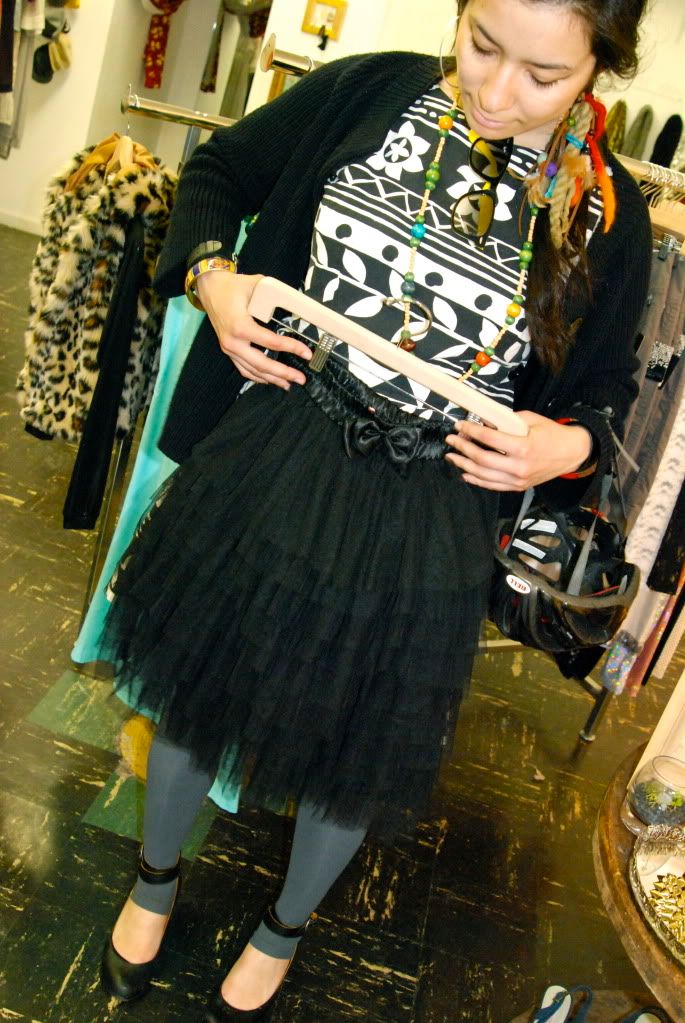
We step into Tedda Hughes and Meli’s grin goes ear to ear. “I’m a terrible shopper, but I love this store,” she says while flipping through the racks. Meli has been biking since 2003, making cycling her main mode of transportation and a huge part of her life. She encourages other women to hop on wheels and quit fussing over the details. 

“You have to get over your questions and just try it. Sometimes my shoes get dirty, but they can always be washed. And yes, sometimes I get sweaty– but isn’t that what bodies are for?” 

She picks out a frilly black skirt, made by store owner Tedda Hughes herself. Meli never wears jeans. “I have a pair, yes, but I haven’t worn them for about four years. I can’t believe people bike in jeans…but then again, I don’t think they’re comfortable to walk in.”

Meli40510

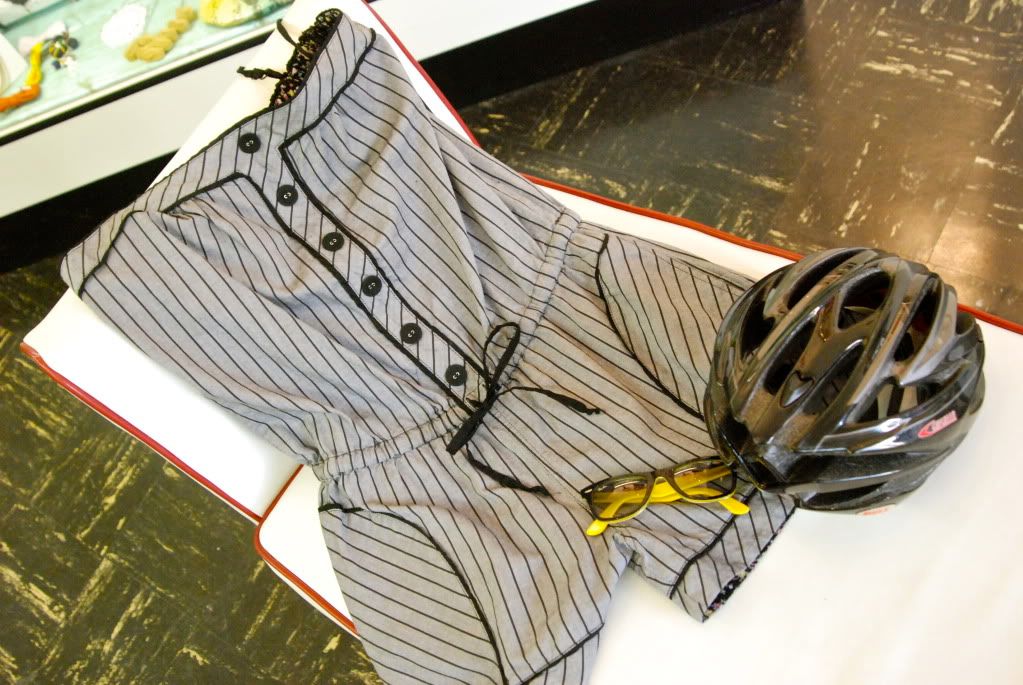
We spot this lovely Gentle Fawn jumper, which is perfect for riding around town on a summer day– comfy, sweet and ideal for modest girls won’t have to worry about flashing their panties. 

Meli60510

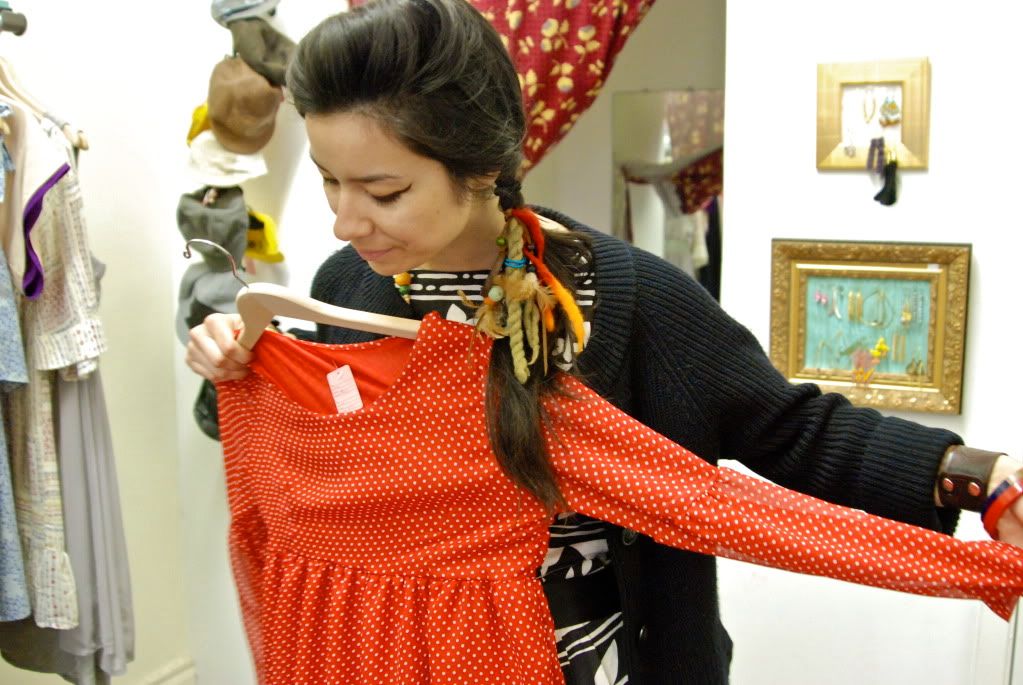
Meli loves bright colors, which not only look stellar, but they’re great for visibility reasons; get attention from sexy bike lane buddies and angry taxi drivers alike. This red, polka dot baby doll adaptation is another Tedda Hughes creation and Meli was drawn to the light, breathable fabric. 

“I also really like wool. It’s a great fabric for absorbing sweat and it dries fast.”

meli70510

These marine blue, suede pumps by Charlotte Ronson may look a bit freaky compared to the average bike sneaks, but Meli assures that heels are totally cool for cycling, as long as you can stand on them at the stoplight. The heel hooks around the pedal and acts like a clip, making them surprisingly ok for riding. The heels on Meli’s toes have rubber soles, which are also complimentary for her pedal style and help with grip. 

meli80510

meli90510

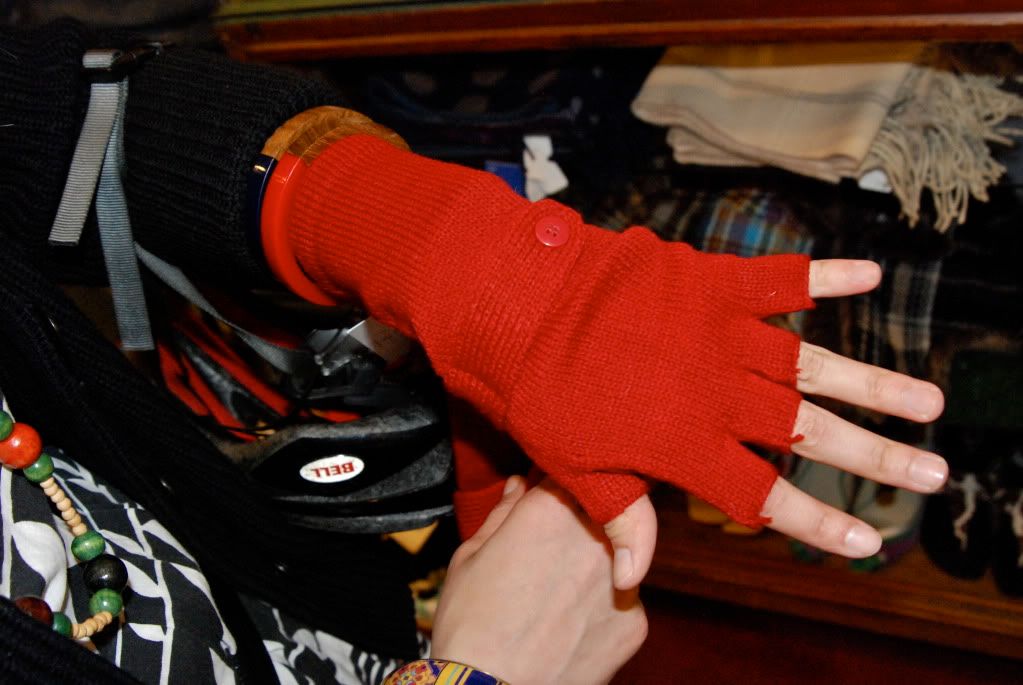
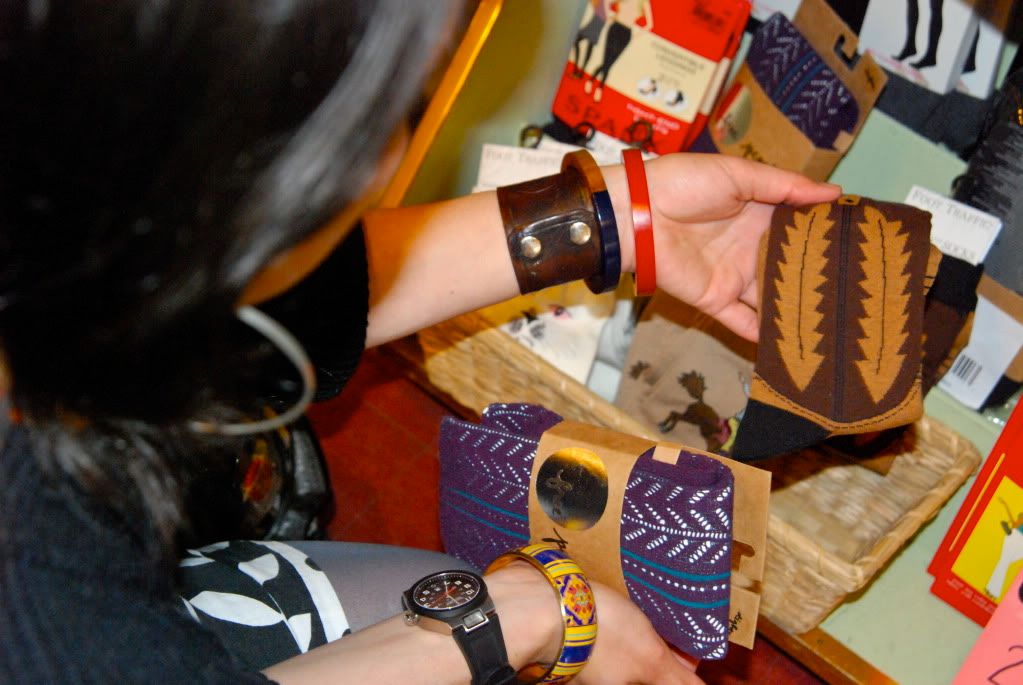
We walk down the block and browse through another of Meli’s must-visit shops, Picnic, which is filled with fun wares, gifts and chunky accessories. Meli is all about layers and being prepared for the various micro-climates in the city. These Tullette finger-less mitts are an ideal friend for evening rides. And then she spots the basket of tights. 

“I’m a tights whore,” she says digging through the pack and making comments about each gem she finds.

meli100510

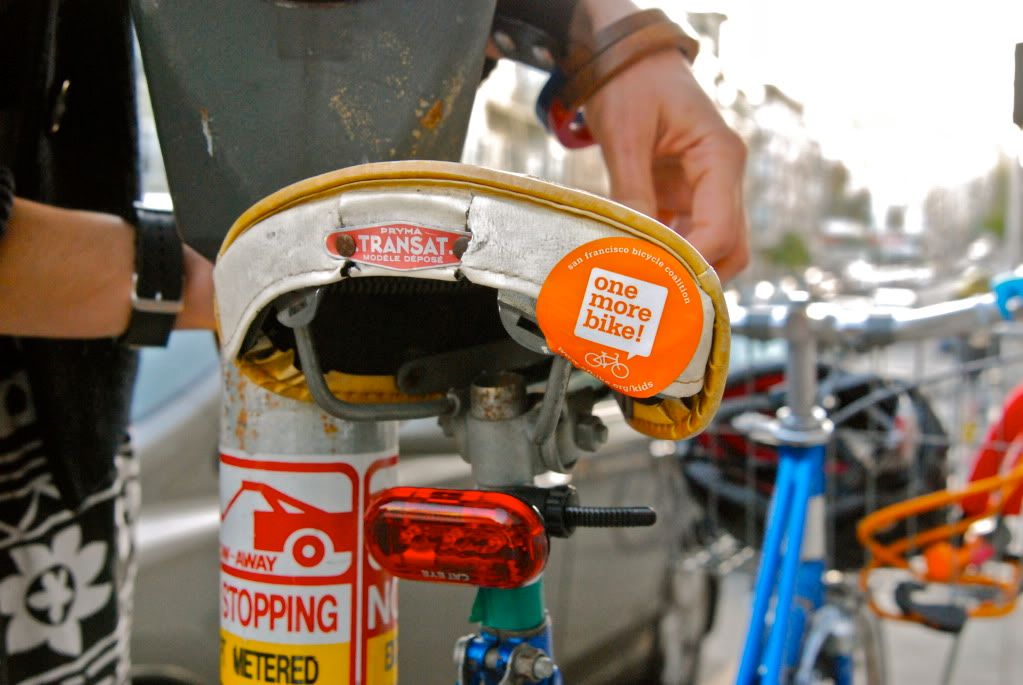
A fine day of shopping and it’s time to hit the road. Unlocking her bike, Meli has one final bit of advice to tote before jetting off into the sunset.

“Basically I think you should just wear it– no hesitations, no questions. If you like pants or whatever you feel good in, you should wear it and just ride.”


Catch more of Meli @www.BikesAndTheCity.blogspot.com

The Daily Blurgh: What should I do next, Edith Wharton?

Curiosities, quirks, oddites, and items from around the Bay and beyond

Today in fashion: Oakland lifts century-old ban on cross-dressing, Parisian women can now legally wear pants, and persons of any gender can express their displeasure at the state of Arizona with a t-shirt (American flag shirts, however, can get you into hot water).

*****
 
You’re never too young to violate California labor laws.

*****

Oil-sucking “brooms” made from stray pet hair help save the environment, resemble rotting salami.


*****

Is this MTV original series not child porn-by-proxy because someday its nerdy and extraordinarily hung protagonist will grow up to be a character in a Judd Apatow film? (Thanks WoW Report and Slog)

*****

This is why “No Substitutions” is totally fair game in a restaurant.

*****

Edith Wharton meets Choose Your Own Adventure

*****

Boob tube still bringing folks together, one couch potato at a time: “Like all social activities, television-watching demands compromise. People may have strong ideas about what they want to watch, but what they really want to do is watch together.”

*****
Scopitone Week continues! Click here to learn more about Scopitones. Continuing with our survey of the ladies of Scopitone, today’s clip returns us to France. Here’s the boysih Stella, with “Le Vampire,” one of her send-ups of the ye-ye style popularized by such other Scopitone cuties as France Gall. You know MJ totally bit this for the Thriller video. (Just like he bit another French classic.)

http://www.youtube.com/watch?v=E5in8MdBTgI

Appetite: 3 culinary gifts for mom

Last minute Mother’s Day gifts needed? Here are a few delectable possibilities:

WINE OF THE MONTH CLUB
There’s nothing like having Mom reminded of your thoughtfulness and love all year… no, not a Christmas Vacation disappointment like the Jelly of the Month Club. Something better: wine. This is the “original” (family-owned since 1972) Wine of the Month Club with a slew of gift options from 1 red/1 white per month for four months to one year of reds or whites only. The club averages $29 a month for the Classic Series or upgrade your wine selections to Vintners Series ($39) or Limited Series ($49). With hand-selected wines from literally all over the globe, the biggest plus if Mom doesn’t like one of the wines is that they promise to send out another selection, no questions asked. In trying out the club for a short time, I can say the Classic level is not for the wine expert as the red in any given month might be a 2007 Frosted Cake Merlot from Napa or a 2006 Gerard Bertrand Syrah/Mourvedre from France. So upgrade your membership if Mom is a wine snob, or if not, she’ll enjoy a broad cross-section of solid wines for every day imbibement, with descriptions, tasting notes and stories behind each region, winery and wine itself. All gift memberships come nicely wrapped so your Mother will feel like it’s Mother’s Day all over again every month.

CLARINE’S FLORENTINES
First trying local (Berkeley) Clarine’s Florentines at the Chocolate Salon, I was impressed… trying them again later, I was hooked. I think your Mom will be, too. This buttery, crispy, golden Almond Brittle on Guittard bittersweet chocolate, is a recipe from Clarine and her Mother, so even the roots of the product have special meaning for Mother’s Day. You can buy a bag at shops around town like Bi-Rite or order directly from Clarine’s to have it shipped.

KUSMI TEA
A favorite of late has been Kusmi’s luxurious teas. Founded in St. Petersburg in 1867, these Russian-style teas have been Paris-based since 1917, so there’s an Old World elegance and refinement with modern sensibilities (even Lady Gaga is a big fan, though that may not be as much of a selling point for Mom!) They’re offering Mother’s Day blends, like Rose Green Tea, though there are crowd-pleasers everywhere, from a lovely Moroccan Spearmint to Sweet Love, a blend of Black China tea, pink pepper, licorice roots, guarana seeds and spices. If Mom’s on a health kick, their Detox mate/green tea with lemongrass is particularly popular… and a rich antioxidant.

“Cell” out

Tom Clancy’s Splinter Cell: Conviction

(Ubisoft/Ubisoft Montreal) PC, Xbox360

GAMER Sometimes you play a game like Tom Clancy’s Splinter Cell: Conviction and think, “Did the people who made this even bother to play it?” Questions begin to boil over. Why would you make a game in which you can skip some cutscenes and not others? If it’s really necessary to include unskippable cutscenes, why must they precede the three parts of the game most likely to cause the player to die and reload? My fingers got tired while playing the game, but not from the controller — from scratching my head in angry confusion.

Conviction has its satisfying moments, to be sure, nice visuals, and a distinguished pedigree of stealth-based, third-person titles. But the overall impression it leaves is of a game that is frustrating, uneven, and short. For every ambitious step that Ubisoft Montreal takes forward, it takes two in the opposite direction, mimicking the actions of the game’s protagonist, grizzled superspy Sam Fisher as he tries to creep up on a unsuspecting henchman. Clever set-pieces, like the one in which Fisher must eavesdrop on two villains with a remote-control surveillance array, are quickly overshadowed by the game’s profusion of sour notes, including a truly wretched take on the timeless “dodge the laser beam of instant death” mechanic.

The Splinter Cell series has always been about sneaking around in the shadows, and Conviction mostly hews to this dogma. Except when it doesn’t, and you’re suddenly expected to gun down enemies by the bushel while running at a full sprint. The developers seem to take a perverse pride in forcing you to unlearn the lessons of completed gameplay. Getting used shooting enemies in the head? Wait until you come up against their magical, bulletproof helmets as the game limps toward a conclusion.

Michael Ironside is a gem as the voice of Fisher, and he growls his way doggedly through a plot full of Clancyite conspiracy gibberish. Another amusing touch is the Zombieland-style floating text that shows up on the walls when the game is trying to get you to do its bidding. Less appealing, as far as pop culture goes, are the creepy, 24-style “torture is cool” minigames. We all play video games to be empowered. But if your idea of fun is bashing an unarmed prisoner’s face into the wall using the B button, please, seek help. At the very least, I can hope to avoid partnering you in the Conviction‘s entertaining co-op modes.

All the young Turks

1

arts@sfbg.com

HAIRY EYEBALL Welcome to Hairy Eyeball, a bimonthly rundown of visual art. We don’t aim to be comprehensive, just opinionated. First Thursday is tomorrow, so enough with the introductions. On with the shows.

CCA is unleashing a new batch of Fine Arts MFA students into the wild Thursday night. With 66 artists total, this year’s MFA show (which runs at the San Francisco campus through May 15) is one of the largest in recent memory. The cream from CCA tends to rise to the top pretty quickly, so here are some names worth looking out for in white cubes, near and far, in the future.

Llewelynn Fletcher’s interactive sculptures aren’t aiming to take a particular pulse, but will probably slow yours down. For Please Lie Down, she has created several enclosures of lead, ceramic, wood, and felt that completely cover the head, forcing you, per the piece’s title, to lie down on the floor (thankfully, she’s also constructed camping-style palettes for comfort). The mini-meditation huts, evocative of beehives as well as certain medieval torture implements, have the additional effect of transforming the wearer into something of a sculpture.

Maggie Haas’ mixed-media pieces could easily be mistaken for installations-in-progress. But her arrangements and treatment of construction site detritus — sawhorses, wooden slats — cannily gut minimalism, This Old House-style, by preferring to hang out in the workshop with Donald Judd et al., turning the means of production into the piece itself. Endless Escape in particular performs a neat rope trick that yokes Robert Smithson and Yayoi Kusama with the ease of an Eagle Scout.

Hilary Wiedemann’s installations, which frequently combine sculptures and projection, are far more elusive — and unsettling. In Untitled, a plaster cast of what looks to be a bullet hole-riddled surface (glass, perhaps?) leans against the wall; on the floor, laminated sheet glass has been contorted to resemble discarded tissue. Both components record the violence of the transformational processes that have brought them to their current states. It’s not comfortable viewing — as if you’ve stumbled on a crime scene before the police tape has gone up.

Someone put Doron Fishman in touch with a textiles manufacturer, stat. His gorgeous ink-on-paper works, all black tendrils of liquid smoke, let it bleed. They’re begging to be transferred to chiffon. The witchy Mulleavy sisters, of Rodarte fame, would be smart to look him up.

Well worth the trek to the other side of Potrero Hill is Ping Pong Gallery, which is currently showing Gwenael Rattke’s dark, hypnogogic collages (through May 14). The collection’s title, “Oktogon,” refers to a street intersection in Budapest and also to the Ottoman-style “Kiraly” baths built during the Turkish occupation in the 16th century. These layers of history, architecture, exposed flesh, and power are not wholly self-evident in the psychedelic grandeur of Rattke’s straight-razor wizardry — which recalls, among many associations, the graphic punch of Tadanori Yokoo and Keiichi Tanami’s 1960s poster designs, the homo-plagiarism of Jess’ massive Narkissos (1978/91), and the profondo rosso beloved by Dario Argento. Rather, they form the deep structures to these mandala-like works in which Op-Art geometrics collide with Art Nouveau scrollwork and leather daddies are refracted into Busby Berkeley chorines. The corner in which 14 of these pieces have been hung draws you in, like some black hole. Proceed with caution, and awe.

Also closing toward the end of the month (May 22 to be exact) is Beverly Rayner’s “Accretion” at Braunstein/Quay, an elongated housecoat covered in the day-to-day paper ephemera — greeting cards, bills, receipts, inspirational quotes, correspondences — that one accumulates over the course of a lifetime. “Go paperless” is one takeaway. That such a load is too much to bear — psychically as much as environmentally — is another. *

CCA GRADUATE THESIS EVENTS

Through May 14, free

California College of the Arts

1111 Eighth St., SF

(415) 703-9500

www,cca.edu

GWENAEL RATTKE: OKTOGON

Through May 14, free

Ping Pong Gallery

1240 22nd St., SF

(415) 550-7483

www.pingponggallery.com

BEVERLY RAYNER: ACCRETION

Through May 22, free

Braunstein/Quay Gallery

430 Clementina, SF

(415) 278-9850

www.bquayartgallery.com

Big package in the Castro

0

While walking through the Castro I was pleasently surpised (well, sort of surprised) to catch a glimpse of this big, hard package chillin’ in the middle of the street. There are numerous sex toy havens within a few blocks of one another and somebody picked up a big, fat treat this afternoon. Apparently the new owner couldn’t wait until reaching home to unwrap this Wildfire “Real Man Bangin’ Boner”, skipping the ‘Try Me’ test material on the side and undressing that bad boy right there on the 18th Street sidewalk. I wish I could’ve seen their face as the plastic ripped open– I’m imaging a huge goofy smile, Christmas-morning, under-the-tree style.

Instead, I was treated with a look of shock and confusion from a passing tourist and his wife as they watched me take a photo of the cock casing. I giggled awkwardly and hoped he too would snap a shot with the camera hanging from his neck– he did not.

Wild Fire

My curiousity burned and as soon as I got to a computer I googled the missing man shape. Mystery solved: This is the boner who previously inhabited the massive plastic shell. Standing tall with eight and a quarter insertable inches, he vibrates and dances, meaning someone in the neighborhood had or is still having, a superb afternoon with their new friend. Jealous?

Welcome to Elm Street (and Crystal Lake): Part Eight

0

In honor(?) of the new A Nightmare on Elm Street, we’re recapping all of the Elms so far. Find more on the Pixel Vision blog.

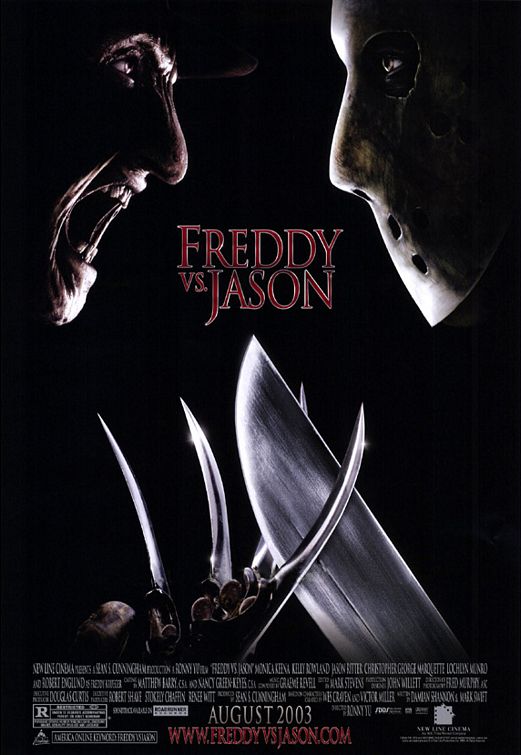
The stage was set for Freddy vs. Jason (2003) long before Freddy’s glove made a cameo at the end of Jason Goes to Hell: The Final Friday (1993) — yet another in a long line of misleadingly-titled films promising the last stand of the boogeyman in question (lest ye forget, Jason X came out in 2001). Who didn’t want to see the wisecracking scourge of Springwood go glove-to-machete with Camp Crystal Lake’s burly maniac? Truly, it would be a grudge match for the ages, with two of the most franchise-able movie monsters (combined total in 2003: 17 films) poised to lure both long-standing loyalists and new blood into the theaters. (And even if the entire film was simply a canny marketing tactic, it worked — Freddy vs. Jason was a huge hit, earning $82 million in the United States alone.)

It goes without saying that all viewers must choose a side. And I don’t mean choosing the side of the generic teen actors (Monica Keena, Jason Ritter, Destiny’s Child-er Kelly Rowland)  — after all, it’s only fun when the bodies start dropping, so that ain’t even an option. I remember attending the Freddy vs. Jason press screening and being outraged that the promotional giveaway item was a paper Jason mask. Hold the (tongue-twisting) phone! No glove bedecked with cardboard razors? No disposable fedora? Clearly, favoritism was being displayed! UNFAIR TO FREDDY!

Um, anyway. Nearly 10 years later, I still have that paper hockey mask, but I hadn’t re-watched the movie since its release. Looking at it again last night, I remembered why: it’s just sort of blah. A huge amount of exposition — wherein we learn that the powers of Freddy (Robert Englund) have been nullified because Springwood grown-ups have taken drastic steps to make all the wee ones forget about him, and if nobody remembers him, they can’t fear him, and if they don’t fear him, he has no strength to sweeten anyone’s sleepytime, etc. etc. — leads to Freddy rousing his fellow hell-dweller, Jason (Ken Kirzinger), from whatever stasis the superhuman killing machine happens to be in this year. (For the record, I kinda liked Jason X. Jason in outer space was such an awesome idea, I didn’t really mind that the movie was so insanely formulaic otherwise.)

Anyway, Jason rises, again, lumbers over to Elm Street, and starts taking out the local under-18 population. Word gets out, thanks to some indiscreet cops and a couple of kids who’ve been institutionalized and medicated for the sole purpose of silencing the Ballad of Freddy Krueger. Oops. There are slicings, dicings, a rave in a corn field (wait — a rave? With glow sticks? In 2003? I hope this is a sign of the sense of humor that enabled director Ronny Yu to helm 1998’s Bride of Chucky), and all manner of bloodshed; at a certain point, Freddy gets pissed at Jason (“That hockey puck!”) for killing wide-awake kids he was hoping to slaughter in their dreams. Important lesson, everyone: it’s hard to reason with a voiceless, soulless, heavily armed killing machine.

SO. One thing leads to another, and Jason gets tranquilized. Freddy goes into his dream, and pretends to be Jason’s nagging-from-the-grave mother, kind of a Mrs. Bates in a turtleneck. Despite all efforts, Jason won’t die, of course. (Is it possible Freddy never saw a Friday movie? That’s Jason’s magic power! He is evil immortal! Like, duh!) The kids intervene by driving Jason’s snoozing body to Camp Crystal Lake. (All this time it was terrifyingly close to Springwood — who knew?)

Elm Street dweller Lori (Keena, whose character’s name may or may not be a reference to Laurie Strode from the Halloween movies) has the bright idea of bringing Freddy into the real world, which is exactly what happened in Freddy’s Dead (1991) and probably a few other Nightmares as well, but at this point, I’m having trouble keeping track. Pretty much, it’s breasty Lori’s only contribution to the film, even though she’s positioned as a Nancy Thompson-style last girl standing. Oh, how times have changed … and gotten worse.

Anyway, at last, Freddy and Jason have it out on the shores of Crystal Lake. There is fire, there are explosions, there’s a beheading, and if you really want to know, neither guy wins. There’s no winner! Haha, sucker! Argh. But, I suppose, the end result was convincing enough to pave the way for another clash of horror titans, Alien vs. Predator (2004), which in turn brought us Aliens vs. Predator: Requiem (2007), which in turn probably helped this summer’s Predators get made, and Predators looks awesome, so I’m not complaining. However, the success of Freddy vs. Jason also no doubt inspired last year’s Friday the 13th remake, which was utter shit (in 3-D), and the brand-new A Nightmare on Elm Street, which opens tomorrow, featuring Jackie Earle Haley instead of Robert Englund in the striped-sweater hot seat. How will Freddy fare? Stay tuned for Louis Peitzman’s review!

Welcome to Elm Street: Part Six

0

In honor(?) of the new A Nightmare on Elm Street, we’re recapping all of the Elms so far. Find more on the Pixel Vision blog.

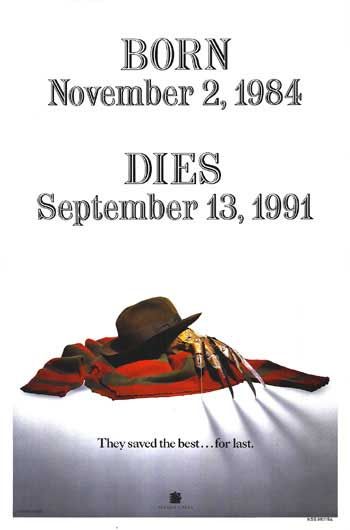
By 1991, when the optimistically-titled Freddy’s Dead: The Final Nightmare rolled around, the Elm Street series was still making money, but delivering few scares. Not like the series’ beloved hero cared, really — Freddy Krueger was as popular as ever. Just look at the opening credits of Freddy’s Dead, which equate Krueger and Nietzsche as quotable icons (“Welcome to prime time, bitch!” remains a phrase of note among philosophers, I’m sure.)

The only Nightmare film directed by a woman (Rachel Talalay, who made her directing debut; she later made 1995’s Tank Girl and has since helmed a shit-ton of TV shows), and the only to utilize 3-D (more on that later), Freddy’s Dead is set ten years in the future (so, 2001?) Freddy has slaughtered every kid in Springwood; the adults who remain are bonkers. The sole survivor is a height-phobic teen (Shon Greenblatt) we only ever know as John Doe; the film’s opening sequence pays homage to both The Twilight Zone and The Wizard of Oz (1939) as John ejects from a freaky airplane ride into a house spinning through a wind storm. Do I really have to tell you Freddy sails by on a broom stick? “I’ll get you, my pretty — and your little soul, too!”

John lives, but barely — battered and with no memory, he’s picked up by cops in Depressed Americatown, USA, and taken to a run-down shelter for troubled teens staffed by Maggie (Lisa Zane — yes, Billy’s sister!) and Doc (the Yaphet Kotto). In short order, we’re introduced to a ragtag crew of Dream Warriors 2.0: dope-smoking video game addict Spencer (future movie and TV semi-star Breckin Meyer); tough bitch Tracy (Lezlie Deane); and hearing aid-wearing Carlos (Ricky Dean Logan). In keeping with a series theme that’s especially pronounced here, all three have abusive parents.

The fact that John Doe has violent, vivid nightmares is intriguing to both Doc — who specializes in “dream therapy” — and Maggie, who suffers her own disturbing dreams. When it becomes apparent that Maggie and John are having variations on the same dream (though Maggie’s play out more like flashbacks, or sinister home movies), she hustles him into the youth center’s comically beat-up van for a visit to Springwood. Hey, maybe it’ll jog his memory — or hers.

OF COURSE, the three reckless youths with obviously identifiable weaknesses happen to stow along for the ride. Bad move. Springwood proves to be empty, save for a few insane adults (including Roseanne and Tom Arnold, at the height of their tabloid fame). While Maggie and John search for clues to their dark pasts, Spencer, Tracy, and Carlos explore an abandoned house — on Elm Street. Freddy appears and immediately begins fucking with all involved: for example, the deaf kid gets a Freddy-style hearing aid that makes everything painfully loud, and is then subjected to the sound of Freddy gleefully scratching his claws along a chalkboard. Needless to say, Carlos’ head explodes; needless to add, Freddy’s kiss-off is “Nice hearin’ from ya!”

Spencer’s death is far more humorous, and is probably the best example of how un-terrifying Freddy has become by now. As the stoner dozes, a busted TV comes to life. Johnny Depp does a rememberin’-my-roots cameo in a fake TV commercial, which is interrupted by Freddy. “Hey Spence — let’s trip out!” Droopy-eyed Spence grins as Iron Butterfly plays and psychedelic waves suck him into the set. Suddenly, he’s a character in a video game, being pounded first by his domineering father (“Be like me!”) and then Freddy himself, who’s also manning the joystick in some alternate reality to this alternate reality. As Maggie and Tracy watch in horror (and, presumably, the audience howls in delight), Spence sleepwalks all over the house, punching walls and bouncing into the ceiling. “Great graphics,” gamer Freddy murmurs in approval.

Anyway. Spence dies, and a sleeping John Doe can’t be roused to prevent his own untimely end (it involves a parachute and a bed of nails). Earlier, he and Maggie had learned from Springwood’s orphanage that Freddy Krueger’d had a kid, current whereabouts unknown. John had thought he was Krueger Jr., safe from Freddy’s wrath. But no! His last words, to Maggie: “It’s not a boy!”

So, Maggie the nightmare-having doctor realizes what we’ve known all along: Freddy Krueger is her father! ZOMG! Freddy’s Dead takes the opportunity to sketch in a backstory for our favorite child killer: he’s seen pulverizing a hamster as his eight-year-old classmates chant “Son of a hundred maniacs!”; he’s seen enjoying a beating from his stepfather (the Alice Cooper); he’s seen, through Maggie’s eyes, murdering his wife after she discovers a secret room in their Springwood house (contents: gloves, weird things in jars, cookies). Young Maggie, or Katherine, or whatever her birth name was, was sent to the orphanage soon after, giving Freddy further motivation to kill every kid in town. Or something. Apparently he was a devoted father.

Meanwhile, back at the shelter, Doc immediately understands the situation, unlike every other authority figure in the series EVER: “He’s fucking with the line between dreams and reality!” Seems Freddy is also trying to get Maggie to bring him more victims, allowing for this crowd-pleasing exchange:  “But this isn’t Springwood!” “Every town [dramatic pause] has an Elm Street!”

It is soon decided that Maggie, being Freddy’s spawn, is the only one who can enter his thoughts, get ahold of him in dreamville, and bring him into the real world, where he can be killed the fuck dead. “You’ll use these,” Doc says, pulling out a pair of 3-D glasses. While it might’ve been easier for the filmmakers to just insert a title card reading “PUT ON THE GLASSES NOW Y’ALL,” I suppose this was a somewhat more subtle way to issue the same orders.

Anyway, there’s an extended tussle in shoddy 3-D. Freddy finally dies (Maggie spears him with his own glove, for maximum irony). The end credits, which offer a memorializing highlight reel of Freddy’s greatest kills, unspool over what has to be Iggy Pop’s least-popular song of all time, “Why Was I Born? (Freddy’s Dead).” And horror fans finally know the answer to the question that’d gripped their dreams for nearly a decade: how do you kill Freddy Krueger? You could believe the movie’s harebrained plot. Or you could believe the evidence presented by the movie itself: kill the monster by transforming him into a campy, cackling, comedian.

Don’t worry — there are two more Freddy movies, plus the new flick, to go on our series. Grab a cup of coffee, kids!

http://www.youtube.com/watch?v=YmdityGT-R8&feature=related

Whitman and Goldman should be rich fodder for Democrats

12

Democrats are now benefiting from the confluence of the public’s outrage over reckless self-dealing on Wall Street, debate over a Democratic bill to regulate such casino-style financial practices, and prosecution of Goldman Sachs for profiting from an economic collapse it helped cause. But the bigger question is whether top Democrats are willing to make the sustained case that it’s the rich who have screwed over the vast majority of Americans, and it’s time to recover that plundered wealth to deal with pressing problems like poverty, global warming, and infrastructure needs.

Central to that question is Meg Whitman, the Republican gubernatorial candidate who should be a poster child for a campaign against the predatory rich, whose increasing wealth has come at the expense of the working class and public institutions. As the Sacramento Bee reports today, Whitman is a former Goldman Sachs board member who profited from insider trading deals that are now illegal. And now she’s using her ridiculously over-inflated net worth to try to buy the governor’s office with unprecedented spending, something that should profoundly offend our basic democratic values.

Presumptive Democratic gubernatorial nominee Jerry Brown and some union officials have tried to highlight Whitman’s extensive Wall Street connections, but Brown has been way too tepid. Maybe that’s because he has his own Goldman Sachs ties, as the Los Angeles Times reported this week, although they pale in comparison to Whitman’s, which continue to this day and help pay for her takeover of California airways with her deceptive yet poll-tested propaganda.

As we wrote in our endorsement of Brown this week, it’s frustrating that Brown has been so unwilling to go after the rich, whether it be raising income taxes on millionaires (who have weathered the Great Recession far better than working stiffs) or letting commercial property be assessed at fair market value (since Prop. 13 passed, corporations that used to pay about two-thirds of the property taxes in California now pay about one-third, with individual property owners now paying two-thirds).

This is fertile ground for some long-overdue class warfare on behalf of the vast majority of people whose livelihoods have been threatened by the greedy, self-dealing rich. Anger at Wall Street for destroying the economy and then being bailed out by the federal government cuts across traditional ideological lines. It is felt by progressives, by conservative members of the Tea Party movement, and even by many political moderates.

At this point, few people trust the Democratic Party to lead the way toward a real accounting for the financial collapse, a recovery of the money from those who profited from the disaster, and an application of that money toward the most pressing public problems.

That’s a shame, but it’s also a real opportunity for a Democrat-led populist movement that unites disaffected factions on the left and right. After all, the problem only lies with about the richest 5 percent of Americans, those who have used elaborate financial ruses and tax shelters to hoard the wealth this country needs, even as the rest of us have lost financial ground. If there is any real democracy left in this country, it shouldn’t be that difficult for 95 percent of Americans to act in their own best interests.

After all, just this afternoon, even the most stubborn Republican leaders relented on allowing debate on the Democrats’ financial regulatory legislation, bowing to the very political pressures that I’m talking about. But if the Democrats want to try to regain their status as the party of the people, and begin to finally deal with this country’s long-neglected needs, they’ll need to see this as just the first small step down a path they should have taken decades ago.

ENDORSEMENTS: State ballot measures

8

PROPOSITION 13

LIMITS ON PROPERTY TAX ASSESSMENT FOR SEISMIC RETROFITS

YES

The primary sponsor of Prop. 13 is Republican Sen. Roy Ashburn, who dominated the news for several days after he was arrested for drunk driving on his way home from a Sacramento gay bar. Needless to say, Ashburn’s dramatic coming out has whipped up far more attention than his noncontroversial ballot initiative.

We’re generally opposed to anything that gives tax cuts or tax deferrals to property owners; thanks to a 1978 measure also called Prop. 13, much of the commercial and residential property in California is badly under assessed. And Prop. 13, 2010 style, is indeed a tax break. But it’s probably justified.

Buildings in this state are typically reassessed for property taxes after they’ve been modified with new construction, except in cases where the modifications are made to comply with earthquake-safety standards. While most buildings that undergo seismic retrofitting are exempt from reassessment until the property is transferred to a new owner, the exemption for unreinforced masonry buildings is limited to 15 years. Prop 13 would remove that 15-year cap.

The fiscal impact on cities is likely to be pretty minor, and the measure might encourage both commercial and residential landlords to bring their buildings up to standard. Vote yes.


PROPOSITION 14

OPEN PRIMARIES

NO

At the height of a royal mess last year when the state budget was long overdue and the two-thirds majority needed to pass it was still out of reach by one vote, Republican Sen. Abel Maldonado struck a deal with Democrats. He said he’d support the budget — if the majority party would meet a few of his demands. One thing he insisted on was Prop. 14 — a ballot measure that would effectively remove political parties from the primary elections process, allowing all voters to cast ballots for any candidate regardless of party affiliation.

Under Maldonado’s plan, all candidates would run on a single primary ballot, and the top two vote-getters would face off in the general election. Heavily funded by the California Chamber of Commerce and marketed by the same spin doctors and corporate lawyers who are rolling in Yes on 16 campaign money, Prop. 14’s backers say it will result in more centrist elected officials.

There are plenty of pitfalls here, the most worrisome being that it would drive up the cost of elections and give more moneyed (and corporate-allied) candidates a sharper competitive edge while elbowing out progressives. It would allow Republicans to play a role in what would normally be Democratic primaries (and vice versa.) The measure would also make it nearly impossible for smaller parties — the Green Party, for example — to offer candidates in the November elections.

Bad idea, bad process, Vote no.


PROPOSITION 15

FAIR ELECTIONS ACT

YES

California desperately needs electoral reform. Corporate campaign spending and lobbyists have poisoned the decision-making process and muzzled the voice of the people. Something radical needs to be done — and while this measure is only a small, measured step in the right direction, it’s an important and promising experiment.

Prop. 15 would create a pilot public financing program for the 2014 and 2018 races for California Secretary of State — and the program would be funded by a tax on lobbyists. Right now lobbyists pay only $12.50 per year to register with the state. This measure would increase that fee to $350 annually and use the money to create a fund of about $6 million that candidates for the crucial office overseeing elections in the state could tap after demonstrating their popular support by gathering a number of small contributions. All candidates who qualify would be given the same amount of money and left to compete on the issues. Ideally this public financing program would prove successful and eventually be expanded to other offices. Public financing of election campaigns, which is currently working well in Arizona and Maine, is certainly worth a try in California. Vote yes.


PROPOSITION 16

MONOPOLY PROTECTION FOR PG&E

NO! NO! NO!

The deceptively titled “Taxpayer’s Right to Vote Act” was dreamed up and funded entirely by Pacific Gas and Electric Co., the monopolistic utility that is worried it could face actual competition here in San Francisco (and elsewhere) from municipal electricity programs that would offer customers a greener energy mix and more accountability than PG&E executives will ever demonstrate.

Rather than accept some healthy competition, this sleazy corporation has opted to spend some $35 million to exterminate all possibilities of municipal electricity programs cropping up anywhere in the state in a bid to preserve its octopus-like grip on the energy market in Northern California. Prop. 16 would require a two-thirds majority vote at the ballot before any community choice aggregation (CCA) program — or any attempt at creating or expanding a public-power system — could move forward. That’s an extreme hurdle — -and PG&E knows it.

In effect, PG&E is trying to buy public policy here, trying to pass a law that will protect its own monopoly interests.

In San Francisco, the CCA being proposed would offer customers 51 percent renewable power by 2017, which means it would blow PG&E out of the water in the green arena and mark S.F. as taking greater strides toward combating climate change than any other major U.S. city. This example could set a precedent for others, which, in turn, could create favorable market conditions for green energy startups that want to harness wind, solar, biomass, geothermal, tidal, and energy efficiency alternatives.

The very existence of Prop. 16 is already threatening the San Francisco CCA; the city’s Public Utilities Commission is trying to delay a final contract until after the June 8 vote on the measure (see editorial, page 5)

Vote no on Prop 16. Not just because it’s an example of a big business single-handedly trying to alter the state constitution for its own economic benefit by pouring millions of dollars into a deceptive advertising campaign. Not just because a two-thirds majority vote requirement is anti-democratic. Not just because there were reports that the signature gatherers who got people to sign on in support of placing Prop. 16 on the ballot were telling people that its purpose was to limit PG&E expansion or encourage solar power. Not just because Senate Pro Tem Darrell Steinberg and a half dozen members of the Legislature sent a letter rebuking PG&E CEO Peter Darbee for disrespecting the democratic process by going straight to the ballot to undermine legislation it initially supported that enabled the creation of CCA programs. Not just because PG&E is using $35 million of ratepayer dollars (that’s the check you wrote them for your electricity bill!) to put out slick TV ads for this campaign when it should have been repairing the pipelines under those manholes that keep exploding and messing up your morning commute. Not even just because with CCA, you already have the right to vote whether or not you want to be part of it, a choice PG&E will never give you. And not just because PG&E keeps trying to raise rates, which is much more difficult for municipal energy agencies to do.

If for no other reason, vote no because Prop. 16 flies in the face of everything environmentalists stand for. It’s a measure that will thwart progress on fighting climate change, brought to you by the company that practically invented green-washing. PG&E is a huge nuclear power player; it purchases coal from mountaintop-removal coal mines in West Virginia that are completely devastating biodiverse landscapes in Southern Appalachia and screwing over poor people by tainting their drinking water; and it’s in the process of building fossil fuel-fired power plants in poor communities of color in California. The CCA programs at least represent a glimmer of hope for an alternative model; Prop. 16 kills off that possibility with one fell swoop motivated by pure greed. For the love of justice, democracy, and the planet, vote no on Prop 16.


PROPOSITION 17

CAR INSURANCE SCHEME

NO, NO, NO!

Mercury Insurance sponsored this measure and is campaigning for it with tens of millions of dollars, betting it can fool voters and make hundreds of millions of dollars in profits by doing so. And if the company is right, insurance rates will skyrocket for new drivers and those who haven’t had continuous insurance coverage, which experts say will increase the number of uninsured drivers on the roadways and end up increasing insurance rates for everyone.

Mercury and its founder George Joseph have been truly malevolent players in California, exploiting their customers to make billions of dollars in profits, attacking California’s landmark insurance reform measure Prop. 103 with lawsuits and corrupting campaign contributions over more than 20 years, and flouting insurance regulators in such brazen fashion that even Insurance Commissioner Steve Poizner, a conservative Republican, recently chastised the company for its “lengthy history of serious misconduct” (see “Buying power,” March 17).

Now, however, the company is hoping its promise to cut the insurance premiums of drivers who have maintained continuous coverage by “as much as $250 per year” will buy their votes and that they’ll overlook the myriad negative impacts of increasing everyone else’s premiums by $1,000 per year or more, based on Mercury’s own estimates.

Think about that. If you’re a driver who missed an insurance payment by even one day, or a soldier returning from boot camp, or someone with a low-income getting insurance for the first time or after ditching your car for a while, what are you going to do when you discover already-expensive car insurance comes with a $1,000 annual surcharge?

Many Californians, those who share our roads, will choose to drive without insurance. Then they’ll be more likely to leave the scene of accidents or declare bankruptcy rather than paying out-of-pocket for their accidents, both of which increase the cost of insurance for everyone else.

That’s how insurance works. If someone pays less, someone else pays more; and the only entity guaranteed to really make money over the long term is the insurance company. Don’t fall for this scam. Vote no on 17.

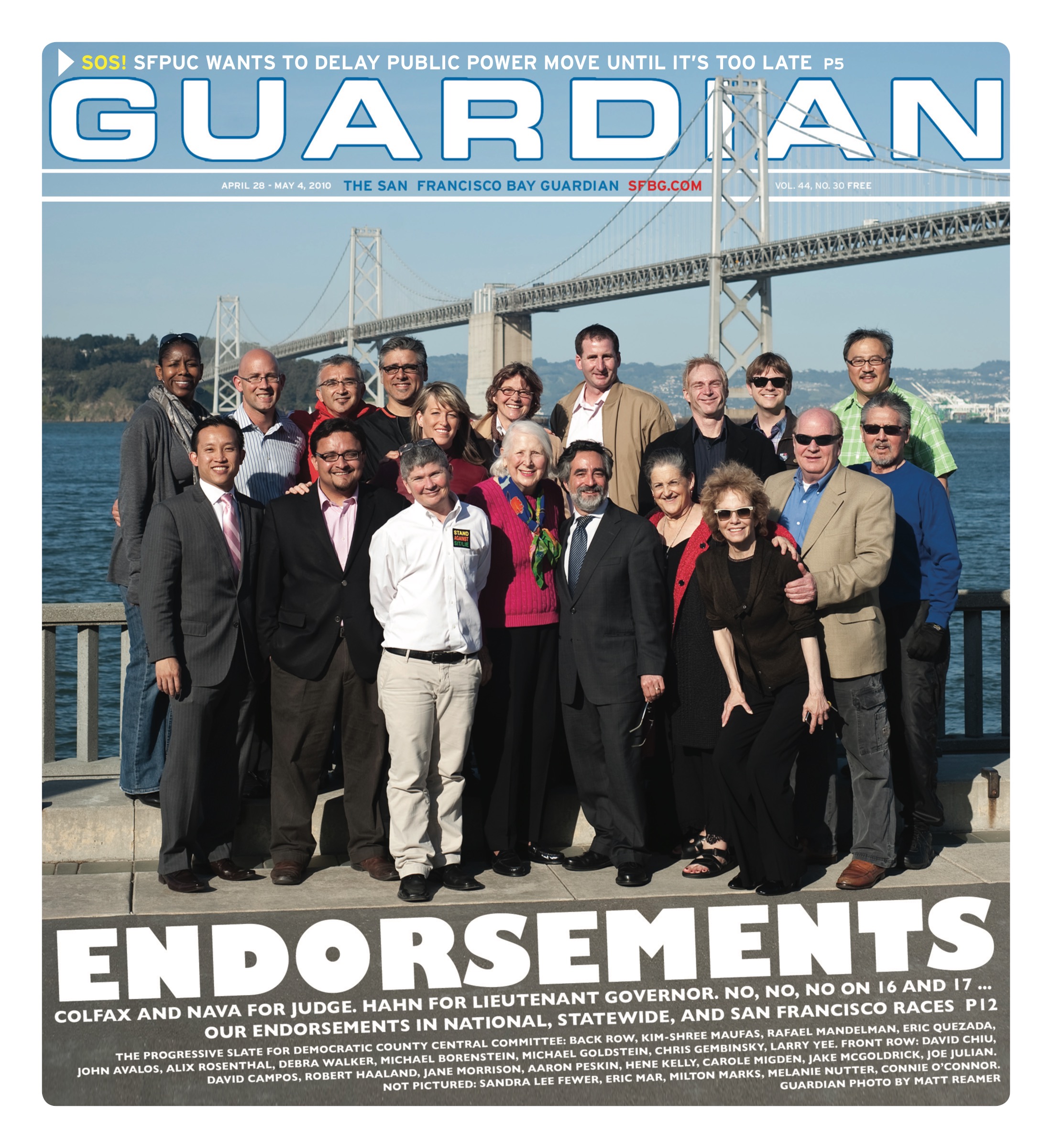
ENDORSEMENTS: National and state races

15

Editor’s note: the file below contains a correction, updated May 5 2010. 


National races


U.S. SENATE, DEMOCRAT


BARBARA BOXER


The Republican Party is targeting this race as one of its top national priorities, and if the GOP can dislodge a three-term senator from California, it will be a major blow for the party (and agenda) of President Obama. The pundits are happily talking about how much danger Barbara Boxer faces, how the country’s mood is swinging against big-government liberals.


But it’s always a mistake to count out Boxer. In 1982, as a Marin County supervisor with little name recognition in San Francisco, she trounced then-SF Sup. Louise Renne for an open Congressional seat. Ten years later, she beat the odds and won a hotly contested primary and tough general election to move into the Senate. She’s a fierce campaigner, and with no primary opposition, will have a united party behind her.


Boxer is one of the most progressive members of the not-terribly progressive U.S. Senate. She’s been one of the strongest, most consistent supporters of reproductive rights in Washington and a friend of labor (with 100 percent ratings from the AFL-CIO and National Education Association). We’ve had our disagreements: Boxer supported No Child Left Behind, wrote the law allowing airline pilots to carry guns in the cockpit, and was weak on same-sex marriage when San Francisco sought to legalize it (although she’s come around). But she was an early and stalwart foe of the war in Iraq, split with her own party to oppose a crackdown on illegal immigration, and is leading the way on accountability for Wall Street. She richly deserves reelection, and we’re happy to endorse her.


CONGRESS, 6TH DISTRICT, DEMOCRAT


LYNN WOOLSEY


It’s odd that the representative from Marin and Sonoma counties is more progressive by far than her colleague to the south, San Francisco’s Nancy Pelosi. But over the years, Lynn Woolsey has been one of the strongest opponents of the war, a voice against bailouts for the big Wall Street banks, and a foe of cuts in the social safety net. We’re proud to endorse her for another term.


CONGRESS, 7TH DISTRICT, DEMOCRAT


GEORGE MILLER


George Miller has been representing this East Bay district since 1974, and is now the chair of the Education and Labor Committee and a powerhouse in Congress. He’s too prone to compromise (with George W. Bush on education policy) but is taking the right line on California water (while Sen. Dianne Feinstein is on the wrong side). We’ll endorse him for another term.


CONGRESS, 8TH DISTRICT, DEMOCRAT


NANCY PELOSI


We’ve never been terribly pleased with San Francisco’s most prominent Congressional representative. Nancy Pelosi was the author of the bill that created the first privatized national park at the Presidio, setting a horrible standard that parks ought to be about making money. She was weak on opposing the war, ducked same-sex marriage, and has used her clout locally for all the wrong candidates and issues. But we have to give her credit for resurrecting and pushing through the health care bill (bad as it was — and it’s pretty bad — it’s better than doing nothing). And, at a time when the Republicans are trying to derail the Obama presidency, she’s become a pretty effective partner for the president.


Her fate as speaker (and her future in this seat) probably depends on how the Democrats fare in the midterm Congressional elections this fall. But if she and the party survive in decent shape, she needs to take the opportunity to undo the damage she did at the Presidio.


CONGRESS, 9TH DISTRICT, DEMOCRAT


BARBARA LEE


Barbara Lee, who represents Berkeley and Oakland, is co-chair of the Progressive Caucus in the House, one of the most consistent liberal votes in Congress, and a hero to the antiwar movement. In 2001, she was the only member of either house to oppose the Bush administration’s Use of Force resolution following the 9/11 attacks, and she’s never let up on her opposition to foolish military entanglements. We’re glad she’s doing what Nancy Pelosi won’t — represent the progressive politics of her district in Washington.


CONGRESS, 13TH DISTRICT, DEMOCRAT


PETE STARK


Most politicians mellow and get more moderate as they age; Stark is the opposite. He announced a couple of years ago that he’s an atheist (the only one in Congress), opposed the Iraq war early, called one of his colleagues a whore for the insurance industry, and insulted President Bush and refused to apologize, saying: “I may have dishonored the commander-in-chief, but I think he’s done pretty well to dishonor himself without any help from me.” He served as chair of the House Ways and Means Committee for exactly one day — March 3 — before the Democratic membership overruled Speaker Pelosi and chucked him out on the grounds that he was too inflammatory. The 78-year-old may not be in office much longer, but he’s good on all the major issues. He’s also fearless. If he wants another term, he deserves one.


State races


GOVERNOR, DEMOCRAT


EDMUND G. BROWN


Jerry Brown? Which Jerry Brown? The small-is-beautiful environmentalist from the 1970s who opposed Pacific Gas and Electric Co.’s Diablo Canyon nuke and created the California Conservation Corps, the Office of Appropriate Technology, and the Farm Labor Relations Board (all while running a huge budget surplus in Sacramento)? The angry populist who lashed out at corporate power on a KPFA radio talk show and ran against Bill Clinton for president? The pro-development mayor of Oakland who sided with the cops on crime issues and opened a military academy? Or the tough-on-crime attorney general who refuses to even talk about tax increases to solve the state’s gargantuan budget problems?


We don’t know. That’s the problem with Brown — you never know what he’ll do or say next. For now, he’s been a terribly disappointing candidate, running to the right, rambling on about preserving Proposition 13, making awful statements about immigration and sanctuary laws, and even sounding soft on environmental issues. He’s started to hit his stride lately, though, attacking likely GOP contender Meg Whitman over her ties to Wall Street and we’re seeing a few flashes of the populist Brown. But he’s got to step it up if he wants to win — and he’s got to get serious about taxes and show some budget leadership, if he wants to make a difference as governor.


LIEUTENANT GOVERNOR, DEMOCRAT


JANICE HAHN


Not an easy choice, by any means.


Mayor Gavin Newsom jumped into this race only after it became clear that he wouldn’t get elected governor. He sees it as a temporary perch, someplace to park his political ambitions until a better office opens up. He’s got the money, the statewide name recognition, and the endorsement of some of the state’s major power players, including both U.S. Senators and House Speaker Nancy Pelosi. He’s also been a terrible mayor of San Francisco — and some progressives (like Sup. Chris Daly) argue, persuasively, that the best way to get a better person in Room 200 is to ship Newsom off to an office in Sacramento where he can’t do much harm and let the supervisors pick the next mayor.


But it’s hard to endorse Newsom for any higher office. He’s ducked on public power, allowing PG&E to come very close to blocking the city’s community choice aggregation program (See editorial, page 5). His policies have promoted deporting kids and breaking up families. He’s taken an approach to the city budget — no new revenue, just cuts — that’s similar to what the Republican governor has done. He didn’t even bother to come down and talk to us about this race. There’s really no good argument for supporting the advancement of his political career.


Then there’s Janice Hahn. She’s a Los Angeles City Council member, the daughter of a former county supervisor, and the sister of a former mayor. She got in this race way before Newsom, and her nightmare campaign consultant, Garry South, acts as if she has some divine right to be the only Democrat running.


Hahn in not overly impressive as a candidate. When we met her, she seemed confused about some issues and scrambled to duck others. She told us she’s not sure she’s in favor of legalizing pot, but she isn’t sure why she’s not sure since she has no arguments against it. She won’t take a position on a new peripheral canal, although she can’t defend building one and says that protecting San Francisco Bay has to be a priority. She won’t rule out offshore oil drilling, although she said she has yet to see a proposal she can support. Her main economic development proposal was to bring more film industry work to California, even if that means cutting taxes for the studios or locating the shoots on Indian land where there are fewer regulations.


On the other hand, she told us she wants to get rid of the two-thirds threshold in the state Legislature for passing a budget or raising taxes. She supports reinstating the car tax at pre-Gov. Arnold Schwarzenegger levels. She supports a split-roll measure to reform Prop. 13. She wants to see an oil-severance tax to fund education. She’s one of the few statewide candidates who openly advocates higher taxes on the wealthy as part of the solution to the budget crisis.


We are under no illusions that Hahn will be able to use the weak office of lieutenant governor to move on any of these issues, and we’re not at all sure she’s ready to take over the top spot. But on the issues, she’s clearly better than Newsom, so she gets our endorsements.


SECRETARY OF STATE, DEMOCRAT


DEBRA BOWEN


Debra Bowen is the only Democrat running, a sign that pretty much everyone in the party thinks she’s doing a fine job as Secretary of State. She’s run a clean office and we see no reason to replace her.


CONTROLLER, DEMOCRAT


JOHN CHIANG


Like Bowen, John Chiang has no opposition in the primary, and he’s been a perfectly adequate controller. In fact, when Gov. Schwarzenegger tried two years ago to cut the pay of thousands of state employees to the minimum wage level, Chiang defied him and refused to change the paychecks — a move that forced the governor to back down. We just wish he’d play a more visible role in talking about the need for more tax revenue to balance the state’s books.


TREASURER, DEMOCRAT


BILL LOCKYER


Bill Lockyer keeps bouncing around Sacramento, waiting, perhaps, for his chance to be governor. He was attorney general. Now he’s treasurer seeking a second term, which he will almost certainly win. He’s done some good things, including trying to use state bonds to promote alternative energy, and has spoken out forcefully about the governor’s efforts to defer deficit problems through dubious borrowing. He hasn’t, however, come out in favor of higher taxes for the rich or a change in Prop. 13.


ATTORNEY GENERAL, DEMOCRAT


KAMALA HARRIS


There are really only two serious candidates in this race, Kamala Harris, the San Francisco district attorney, and Rocky Delgadillo, the former Los Angeles city attorney. Harris has a comfortable lead, with Delgadillo in second and the others far behind.


Delgadillo is on his second try for this office. He ran against Jerry Brown four years ago and got nowhere. And in the meantime, he’s come under fire for, among other things, using city employees to run personal errands for him (picking up his dry-cleaning, babysitting his kids) and driving his car without insurance. On a more significant level, he made his reputation with gang injunctions that smacked of ethnic profiling and infuriated Latino and civil liberties groups. It’s amazing he’s still a factor in this race; he can’t possibly win the general election with all his baggage.


Harris has a lot going for her. She was among the first California elected officials to endorse Barack Obama for president, and remains close to the administration. She’s a smart, articulate prosecutor and could be one of the few women atop the Democratic ticket this year. We were never comfortable with her ties to Willie Brown, but he’s no longer a factor in state or local politics. These days, she’s more closely allied with the likes of State Sen. Mark Leno.


That said, we have some serious problems with Harris. She’s been up in Sacramento pushing Republican-style tough-on-crime bills (like a measure that would bar registered sex offenders from ever using social networking sites on the Internet) and forcing sane Democrats like Assembly Member and Public Safety Committee Chair Tom Ammiano to try to tone down or kill them (and then take the political heat). If she didn’t know about the problems in the SFPD crime lab, she should have, and should have made a bigger fuss, earlier.


But Harris has kept her principled position against the death penalty, even when it meant taking immense flak from the cops for refusing to seek capital punishment for the killer of a San Francisco police officer. She’s clearly the best choice for the Democrats.


INSURANCE COMMISSIONER, DEMOCRAT


DAVE JONES


Two credible progressives are vying to run for this powerful and important position regulating the massive — and massively corrupt — California insurance industry. Dave Jones and Hector De La Torre are both in the state Assembly, with Jones representing Sacramento and De La Torre hailing from Los Angeles. Both have a record opposing insurance industry initiatives; both are outspoken foes of Prop. 17; and either would do a fine job as insurance commissioner. But Jones has more experience on consumer issues and health care reform, and we prefer his background as a Legal Aid lawyer to De La Torre’s history as a Southern California Edison executive. So we’ll give Jones the nod.


BOARD OF EQUALIZATION, DISTRICT 1, DEMOCRAT


BETTY T. YEE


Betty Yee has taken over a job that’s been a stronghold of progressive tax policy since the days of the late Bill Bennett. She’s done well in the position, supporting progressive financial measures and even coming down, as a top tax official, in favor of legalizing (and taxing) marijuana. We’re happy to endorse her for another term.


SUPERINTENDENT OF PUBLIC INSTRUCTION


TOM TORLAKSON


Two prominent Democratic legislators are running for this nonpartisan post, state Sen. Gloria Romero of Los Angeles and Assembly Member Tom Torlakson of Martinez. It’s a pretty clear choice: Romero is a big supporter of charter schools who thinks parents should be able to move their kids out of one school district and into another (allowing wealthier white parents, for example, to abandon Los Angeles or San Francisco for the suburban districts). She’s been supported in the past by Don and Doris Fisher, who put a chunk of their GAP Inc. fortune into school privatization efforts. Torlakson wants more accountability for charters, opposes the Romero district-option bill, and has the support of every major teachers union in the state. Vote for Torlakson.


STATE SENATE, DISTRICT 8, DEMOCRAT


LELAND YEE


Sen. Leland Yee can be infuriating. Two years ago, he was hell-bent on selling the Cow Palace as surplus state property and allowing private developers to take it over. In the recent budget crisis, he pissed off his Democratic colleagues by refusing to vote for cuts that everyone else knew were inevitable (while never making a strong stand in favor of, say, repealing Prop. 13 or raising other taxes). But he’s always been good on open-government issues and has made headlines lately for busting California State University, Stanislaus over a secret contract to bring Sarah Palin in for a fundraiser — and has raised the larger point that public universities shouldn’t hide their finances behind private foundations.


Yee will have no serious opposition for reelection, and his campaign for a second term in Sacramento is really the start of the Leland Yee for Mayor effort. With reservations over the Cow Palace deal and a few other issues, we’ll endorse him for reelection.


 Correction update: Yee’s office informs us that the senator suports an oil-severance tax and a tax on high-income earners and “believes that Prop. 13 should be reformed,” although he hasn’t taken a position on Assemblymember Tom Ammiano’s reform bill. 


STATE ASSEMBLY, DISTRICT 12, DEMOCRAT


FIONA MA


Fiona Ma’s a mixed bag (at best). She doesn’t like Pacific Gas and Electric Co. and supports public power, but comes up with strange bills that make no sense, like a 2009 measure to limit rent control in trailer parks. Why does Ma, who has no trailer parks in her district, care? Maybe because the landlords who control the mobile home facilities gave her some campaign cash. She faces no opposition, and we’re not thrilled with her record, but we’ll reluctantly back her for another term.


STATE ASSEMBLY, DISTRICT 13, DEMOCRAT


TOM AMMIANO


When the history of progressive politics in modern San Francisco is written, Tom Ammiano will be a central figure. His long-shot 1999 mayoral campaign against Willie Brown brought the left to life in town, and his leadership helped bring back district elections and put a progressive Board of Supervisors in place in 2000. As a supervisor, he authored the city’s landmark health care bill (which Newsom constantly tries to take credit for) and the rainy day fund (which saved the public schools from debilitating cuts). He uses his local influence to promote the right causes, issues, and candidates.


And he’s turned out to be an excellent member of the state Assembly. He forced BART to take seriously civilian oversight of the transit police force. He put the battle to reform Prop. 13 with a split-role measure back on the state agenda. And his efforts to legalize and tax marijuana are close to making California the first state to toss the insane pot laws. As chair of the Public Safety Committee, he routinely defies the police lobbies and the right-wing Republicans and defuses truly awful legislation. We’re glad Ammiano’s still fighting in the good fight, and we’re pleased to endorse him for another term.


STATE ASSEMBLY, DISTRICT 14, DEMOCRAT


NANCY SKINNER


Nancy Skinner has taken on one of the toughest, and for small businesses, most important, battles in Sacramento. She wants to make out-of-state companies that sell products to Californians collect and remit sales tax. If you buy a book at your local bookstore, you have to pay sales tax; if you buy it from Amazon, it’s tax-free. That not only hurts the state, which loses hundreds of millions of dollars in tax revenue, it’s a competitive disadvantage to local shops. Skinner’s a good progressive vote and an ally for Ammiano on the Public Safety Committee. We’re happy to endorse her for another term.


STATE ASSEMBLY, DISTRICT 16, DEMOCRAT


SANDRE SWANSON


Sandre Swanson represents the district where BART police killed Oscar Grant, but he wasn’t the one out front pushing for more civilian accountability; that was left to SF’s Ammiano. And while Swanson was generally supportive of Ammiano’s bill, he was hardly a leader in the campaign to pass it. This is too bad, because Swanson’s almost always a progressive vote and has been good on issues like whistleblower protection (a Swanson bill that passed this year protects local government workers who want to report problems confidentially). We’ll endorse him for another term, but he needs to get tougher on the BART police.

St. Elvis?

0

TV BIOPIC The John Carpenter-directed biopic Elvis hit network TV airwaves in 1979, ironically enough in the same time slot as that slice of Deep South Americana Gone With the Wind (1939). The Big E had expired just two years previously, and Elvis worship was in full flower. The TV movie thus squeezed out the Gable-Leigh epic to take top spot in the nation’s hearts, for that night anyway.

Released in March on DVD in its full three-hour glory, Elvis was put together by Dick Clark’s production company, which apparently wanted a fairly by-the-numbers hagiography. Kurt Russell does a credible job of capturing the curled lip and intonation of the humble country boy who wore flashy clothes and mixed white country, black blues, and various pop influences until he hit the big time.

Screenwriter Anthony Lawrence worked on several of Elvis’ less than groundbreaking Hollywood vehicles, including Roustabout (1964) and Paradise, Hawaiian Style (1966). Lawrence also penned scripts for both The Outer Limits and Medical Center, which might be even better qualifications for writing about someone who had as many problems with impulse control as Presley.

But, alas, the life we see is oddly squeaky clean. We see nary a caffeine tablet eaten. Lawrence depicts Elvis remaining fairly chaste while waiting to find his true love Priscilla (Season Hubley), not to mention during the additional time spent waiting for her to mature to legal marrying age. (For those jaded souls who need something a bit more salacious, e.g. the skinny on the King’s thing with Tura Satana, check out Alanna Nash’s recent Baby, Let’s Play House: Elvis Presley and the Women Who Loved Him.)

We see Elvis the seeker reading a passage from Khalil Gibran’s The Prophet aloud to Priscilla, but nowhere is there a shot of his other favorite bedside reading, The Physicians’ Desk Reference. According to Elvis biographer Bobbie Ann Mason, he used said volume “like a shopping catalog.”

We do get Shelley Winters as Elvis’ beloved mother Gladys, surely one of the oddest casting choices in the Carpenter ouevre. The black wig Winters sports made me think of Divine, which in turn reminded me of how much more fun I had watching the 1950s rock ‘n’ roll cutting up in John Waters’ Cry-Baby (1990).

Carpenter’s thumping synthesizer soundtrack tunes, so key to the addictive pleasures of his horror pictures — including They Live (1988) and Halloween (1978) — are sadly absent. There are decent versions of early Sun numbers with some guy named Ronnie McDowell doing credible vocals. Maybe the creepy synth would be more appropriate for a follow-up biopic on the final years (this one ends in 1969; Presley’s ended in 1977), including a recreation of Elvis’ legendary 1970 White House meeting with Richard Nixon.

Sweet Georgia Beyonce

0

Caitlin@sfbg.com

SPORTS You’d be hard-pressed not to like Handles Franklin. The spunky Harlem Globetrotter and I stood in a basement hallway of UC Berkeley’s Haas Pavilion on April 24, shortly before his team took on the Washington Generals. (The Globetrotters beat them handily, just like they’ve beaten almost every other team they’ve gone up against since 1926.)

“This is what I want to do in life. Everything prior to this was working my way to the Globetrotters,” said Franklin, holding his head up like the noble star of an action film. “When I was a kid I saw the Globetrotters on Scooby-Doo, and I knew I either wanted to solve mysteries or play basketball,” he told me, smiling. This is how the Globetrotters enter many of our lives, a fond childhood memory of red, white, blue, and orange blurs.

Jewish B-ball enthusiast Abe Saperstein created the team in Chicago more than 80 years ago. He chose the Harlem moniker to invoke the epicenter of African American culture, and for the Globetrotters to appear worldly. The all-black Globetrotters adopted a more dynamic style of play than acceptable in the NBA, which was gripped by Jim Crow segregation at the time. The team played exhibition games all over the country, often scheduled in double- headers with NBA teams to give the professional league’s ticket sales a boost. In 1948 and ’49, the all-black Trotters defeated the all-white Minneapolis Lakers, commonly assumed to be the best basketball team in the world. Two years later, the first black players were drafted into the NBA. Nat “Sweetwater” Clifton, a two-year Globetrotter alum, was one. Although continuing, unofficial racial quotas in the league meant that some players still Globetrotted while waiting to be called up (Wilt Chamberlin among them) the gradual dissolution of the color line led to the exodus of many of “Harlem’s” stars.

Which, in a way, freed the Globetrooters to do their thing. To date, they’ve played more than 20,000 games in more than 120 countries. “We’ve been able to cross generations using the international language of basketball, in regard to race, nationality, everything,” Handles said. “It’s important that we travel the globe spreading smiles.”

Off-court, community service is a big deal for the Trotters. Despite playing roughly 269 games a year, the players regularly carve out time for hospital visits and other charitable forays. During this last Bay appearance, the team dribbled across the Golden Gate Bridge, and Moo Moo Evans handed out free game passes to Earth Day volunteers in the Presidio. “It’s hectic,” Handles told me. “But there’s nothing like doing something you love. You sticking around for the game?”

Who misses the Globetrotters? Only suckers, I decided, watching the pregame show in which Globie, “the world’s most famous mascot,” slapped giant stunna shades onto his Earth-shaped head for a musical turn as Kanye, then donned a blonde wig to become Taylor Swift, and finally ripped off his Trotter uniform to reveal a black dress that left little of his blue-limbed body to the imagination. Globie had become Beyonce! The crowd goes wild for “Single Ladies.”

Then came the “magic circle,” the team’s traditional spinning and passing ritual done to the whistling strains of “Sweet Georgia Brown.” It soon became clear that it is Handles who will be running things tonight. As the Globetrotter showman, he was miked throughout the game, wandering off court to heckle late arrivals, sit in the laps of men’s wives, and jokingly steal purses — to the absolute delight of all those selected for harassment.

On the court, playfulness and showmanship were in ever-revolving focus. Most of the Globetrotters have competed in the upper echelons of the game. Current team member Hi Lite Bruton, before he started making appearances in ball-handling contests against trained sea lions, played for the Chicago Bulls. And through the clowning, they still ran plays that thrill, even in their occasional predictability. Dunks abound, as do no-look passes and — a Globetrotter specialty — a braided passing play in which the hapless Generals were forced to run behind the Globetrotters as they exchanged the ball in an endless figure eight.

Around me, children’s eyes lit up. “How many laughs do you have in your belly?” one tow-headed tyke squeezed out to his dad between chuckles. Handles is in the thick of it all, living his dream. He busts out a Fonz-like thumbs-up and hip waggle to punctuate his jibes and baskets. Sure, there wasn’t any doubt about the outcome. But forget tension, forget winning, it’s all about reliving that fuzzy, fleet-footed feeling.

Big kids appreciating little movies — “Celestial Navigations” explores the work of Al Jarnow

0

It was science disguised by fun, flashy animation, and people everywhere ate that stuff up like it was a bowl of chocolate-covered bran. Filmmaker Al Jarnow is a dude who managed to make learning fun on Sesame Street and far more intersting than the overbearing bird and crabby monster in a can. Most people had no idea who was creating the incredible shorts that appeared on that show, but if you were a kid or parented one in the past 50 years, you’re bound to recognize his work. And now with an escavation of over 45 films, Celestial Navigations — playing Thurs/22 at Red Vic Movie House — brings Jarnow’s magic back for some instant reminiscing.

Colors flashed, stop motion and time-lapse techniques mystified, and simple, beautiful cartoons turned every day objects and topics into a beautiful experiment gone right. Jarnow’s films played for years and expanded minds in the wee morning hours prior to the school bell’s ring and the punch of the time card. Jarnow educated through psychadelic hypnosis, the eyes of eager audiences glazed over while the fast-paced, brightly-colored animations whizzed across the television screen. I was an ’80s tyke who rolled out of bed excited to watch Sesame Street’s “cool” movies (and Kermit, of course) and when I found them years later on You Tube, the situation is nearly identical: bowl of cereal, blanket, couch and eyes glued to the flashing screen.

Celestial Navigations is the Numero Group‘s first foray into the world of cinema and they’ve collected, color corrected and remastered a flashy bunch of classic Jarnow. The film also includes a 30-minute documentary on Jarnow’s creative process, which I’m hoping boils down his steps in a 3-2-1 Contact Style.


Celestial Navigations: The Short Films of Al Jarnow

Thurs/22, 7:15pm, 9:30pm, $6-9

Red Vic Movie House

1727 Haight, SF

www.redvicmoviehouse.com


John Ross: Time travelling down the Mississippi

1

 Editors note: John Ross is wandering the country on a book tour, sharing his observations of Obamalandia, 2010. You can read his previous dispatches here and here  

I. Role models


When I finally made Chicago, they were all waiting for me down there two blocks south of the end of the Blue Line, through the wrought-iron gates of Forest Home Cemetery, past the ostentatious mausoleums of fabulous gypsies and clustered around the heroic monument to the Haymarket Martyrs: Red Emma, looking a little dingy these days; Elizabeth Gurley Flynn, the Rebel Girl; William Z. Foster, the CPUSA’s most rigid ideologue and the leaders of its black sector Henry Winston and William Patterson; the anarchist femme fatal Voltairine de Cleyres; hobo-ologist Ben Reitman; and, of course my personal role model, Lucy Parsons, who outlived her Albert (hung by the State for the Haymarket frame-up) by 50 years, traveling this poisoned landscape from sea to stinking sea speechifying to the masses and hawking her incendiary pamphlets to make ends meet. A single wilted rose adorned the soft granite pillow that bears her name and dates.


Scattered amidst the tombstones of the 70-plus anarchists and communists, radicals and rabble-rousers that Irving Abrams and the Pioneer Aid Society planted here are the DNAs of Joe Hill and Big Bill Haywood and Eddie Balchowsky, the one-winged barrelhouse piano player who gave up his arm to Franco’s fascists in the Spanish Civil War. Irving himself has a box seat at the foot of the Haymarket marker, now a National Historical Landmark managed by the government that these brave souls in residence once sought to overthrow.

Emma Goldman and her condescending epitaph (“a people must rise up to liberty”) was unquestionably Irving’s greatest steal, having won the bidding war for her cadaver after she croaked up in Toronto, to bring her home to the country from which she had been deported decades before for counseling young men not to sign up for the First Imperialist War. But despite the old-time luminaries in repose, I had journeyed down to Forest Home to visit with a recent implant, Franklin Rosemont, the anarchist writer and majordomo of Charles Kerr, the oldest radical publishing house in the U.S., now being sustained by his widow Penelope.  

“Surrealism Forever!” reads Franklin’s slab, in keeping with the celebratory tone of this section of the old boneyard. Franklin, who passed abruptly last year, is buried within the arc of the Haymarket monument.  The Cottons, Clara and Warren (not known to be subversives), keep him company.    

I doubt that our current president, whose adopted city Chicago is, has ever communed with these noble spirits, but it would be an educational experience if ever he should make his way down to Forest Home. Enveloped by deal-making devotees of Chicago’s backroom Democratic Party politics like Rahm Emmanuel, Valerie Jarrett, and Education Secretary Arne Duncan (now neck-deep in a hometown scandal for A-listing the scions of the influential in Chicago’s elite public schools), the examples set by Lucy Parsons and Emma Goldman might have stiffened Obama’s shaky backbone and taught him to stand up for the principles he has abandoned as the CEO of the planet’s longest-running criminal conspiracy.

Michael James rules the venerable Heartland Café in Rogers Park in the extreme northwest of this windy metropolis, a schmooze and booze venue for the left side of the local Democratic Party machine for the past three decades.  Both Obama and Bill Ayers have crossed its threshold occasionally at the same time, and Michael, the facilitator of “Rising Up Angry,” a militant Uptown youth group at the tail end of the turbulent ’60s, is now the chairperson of the local Demo ward committee. Although he will never concede that Baracko has squandered the faith that millions invested in him, I sense growing disappointment with Hope Man’s wishy-washy performance 15 months into his tainted term in office.  

As always, I bunked with the James Gang — Paige, the kids, and the estimable Che, a Labrador with a most dignified demeanor — and plunged into Chicago’s stimulating cultural mix. Also in residence: the foot-stomping Irish fiddler Paddy Jones, just in from Tralee — three years ago, Mike dragged Paddy and I off to the Korean baths where the local political class conspires. We sat buck naked in the sauna and Paddy insisted I regale him with the cautionary tale of El Che (the revolutionary martyr not the mutt).  

This time around, Michael escorted me to the late Nelson Algren’s birthday party in a church close by this quintessential Chicago scribbler’s beloved Division Street neighborhood, during which mash notes from his lover Simone de Beuvoir were read, lending credence to Frankie Lyman’s pointed inquiry “Why Do Fools Fall In Love?”

Yet another highpoint of my weeklong pilgrimage to the Hog Butcher of the World were a pair of meetings in Pilsen, an industrial enclave where the U.S. Communist Party first convened hard by Blue Island Avenue back in 1919 and now the most pertinent barrio in Mexico’s second U.S. city. More than a hundred Latino activists showed up to hear me rant and rave about the prospects for a new Mexican revolution and plot this year’s May 1st march in a city where immigrant workers first took to the streets 124 years ago to demand redress for crimes inflicted upon the working class by the bosses of industry and commerce. Four years ago, a half million immigrant workers marched here to demand recognition of their rights and despite the broken promises encapsulated in the Schumer-Graham proposed Immigration “Reform” bill, Chicago’s Mexican community is warming up for another red-hot May Day.  

II.  Resurrection

I followed the contours of the mighty Mississippi from Chicago to St. Louis through rich bottomland that is now the domain of Archer Daniels Midland. St. Louis is an urban hub that features wide, well-kept lawns and bushels of dirty money — Monsanto, Boeing, Peabody Energy, and Talx, which counsels greedy congloms on unemployment compensation, are all headquartered here.  

Yet, despite the capitalist connivance, the city has its own sui generis radical history. The 1877 railroad strike spread from the east to St. Louis and set the style for labor strife in the west, and the anarchist Flores Magon brothers published “Regeneracion,” the bible of the 100 year-old Mexican revolution, here before they were run out of town in the teens of the past century.

My days in St. Louis were well spent. I preached an Easter Sunday sermon at the Mid Rivers Ethical Society, sharing my vision of resurrection and insurrection in the aforementioned Forest Home boneyard, and offered up my palaver at a Black Green Party forum in a soul food parlor off Delmar, spreading the news of the Mexican government’s execrable persecution of  electrical workers pushed out of their workplaces last October at bayonet point by the military and police in a scheme to privatize electricity generation south of the border.  

I walked the St Louis Walk of Fame, stepping over the stars of the likes of William Burroughs, Chuck Berry, Walker Evans, and Fontella Bass, all of whom had to leave town to achieve a modicum of notoriety. I even encountered my very first St. Louie Cardinal, a crimson-hued bird perched in a sapling, spring zephyrs ruffling its crest, from which the Anheuser Busch dynasty drew the logo for the local nine in this beisbol-intoxicated town (they were previously dubbed the “Perfectos” after a popular cigar.)

III. Black & Brown

Further down river, the scrublands of Mississippi spread into the horizon beneath the cramped commuter flight in from Memphis. I had not touched down in the state since Freedom Summer 1964, when I arrived on the very day that the bodies of three civil rights workers (Michael Schwerner, Andrew Goodman, and James Chaney) were unearthed beneath a dam in Philadelphia, Miss.  

Although Black and White speak more cordially to each other these days and there are few black bodies swinging from the poplar trees, Mississippi God Damn (dixit Nina Simone) is still moldering down below. I could feel the heat at my hotel just off the Millsaps College campus in Jackson, where a statewide PTA meeting was in progress. In the conference rooms, black parents squared off against white school administrators over curriculums and the unequal quality of education. This is a commemoration year for black activism, the 40th anniversary of the killings at Jackson (and Kent) State and the 50th for SNCC — and old grievances burn long and deep.

The old civil rights movement achieved only token parity in this the poorest state in the union. Now a new civil rights movement is focusing on the flood of Mexican and Latino workers who poured into Mississippi in the wake of Katrina, and brown people are today’s niggers down at the bottom of the food chain.

Only 34,000 “Hispanics” were officially counted in the 2000 state census but Bill Chandler, a veteran of the Texas farm workers union and spokes for the Mississippi Immigrant Rights Alliance (MIRA), thinks that three times as many undocumented workers, lured to the state by casino construction, were overlooked back then. In 2010, Chandler calculates that the immigrant numbers have swelled to 200,000, nearly 10% of the state population, and taken together with close to a 40% Afro-American share, Mississippi now verges on becoming a majority People of Color entity. A similar equation is at work throughout the Deep South with Alabama and South Carolina and Georgia also hanging in the balance. Such changing demographics help to explain the vitriol the Teabaggers and White Citizen Council types shower upon the newcomers.

Back in August 2008, Immigration Control and Enforcement broke its own despicable workplace raid record by imprisoning (in Jena La., the site of other racist outrages) and deporting 595 Mexican and Latino workers who had been employed by Howard Industries down in Laurel. Chandler thinks the pogram was accomplished with the complicity of the company which was intent on cheating workers out of their wages. MIRA eventually won checks for most of those detained and deported.

An even more outrageous incidence of lingering Mississippi bigotry was the treatment of Cirila Balthazar Cruz, a mono-lingual Chatino indigena from Oaxaca who was picked up by police as she stumbled along the highway shoulder trying to get to a local hospital to give birth. Her baby daughter Ruby was subsequently stolen from her by child welfare authorities who deemed her an unfit mother because she couldn’t speak English and given to a well-appointed childless white couple. As might be anticipated, such blatant racism struck a tender nerve south of the border and a year later, Ruby was returned to her birth mother.  

Justice in Mississippi, as in much of Obamalandia, remains elusive but every once in a while the push of the people from down below captures such small prizes.

On their East Coast swing, John Ross & “El Monstruo” will visit Washington/Baltimore (Red Emma’s April 19th/ University of Maryland – Baltimore on the 20th/ Institute for Policy Studies the 21st); New York (NYU the 22nd/ Sixth Street Community Center the 23rd/Bluestockings the 25th); and Boston (Harvard Coop the 27th/David Rockefeller Center for Latin American Studies the 28th/Mass Global Action the 29th/IPS-Jamaica Plains the 30th/ topped of by a May 1st rally on the Boston Commons between Noon & Two.) All events are all free.