Scene

Clubs: Honey Soundsystem looks to ‘Dancer from the Dance’

0

honey1.bmp
Honey! All photos by Joshua Rotter.

By Joshua Rotter

It’s a story as old as disco. Attractive “straight” Midwesterner moves to the big city to find himself, only to get blindsided by a barrage of drugs, sex, and tea dances. True, dancing became a major component of gay life in the post-Stonewall ’70s, when the dance floor served as both a place of expression and escape for many gay men. It’s this defining period in gay history that novelist Andrew Holleran highlighted in his 1978 novel, Dancer from the Dance.

honey2.bmp

Taking his title from poet William Butler Yeats’s 50 year-old line, “How can we know the dancer from the dance?” Holleran attempted to examine this brain-twister in his chronicle of gays looking for companionship and understanding in pre-AIDS New York City and Fire Island, by focusing on the misadventures of his beautiful yet provincial protagonist Anthony Malone, who loses himself in the shuffle and shag club scene.

Thirty years later, the Honey Soundsystem collective – DJs Pee Play, KenVulsion, Robot Hustle, Jason Kendig, and Josh Cheon – took cues from this groundbreaking work for their most recent theme party.

SXSW: Scoping out Daryl Hall, Darondo, Bonnie Bramlett, Justin Townes Earle, David Garza, and more

0

londonsoulscolor.jpg
A little bit o’ London Souls.

By Kandia Crazy Horse

A SXSW diary concludes…

SATURDAY, MARCH 15

As mentioned before, other than an in-and-out at Brush Square Park for a Japanese lineup, I simply did not make it to day parties, including the Frank 151 one where I had hoped to catch Game Rebellion again on Friday since they’d so courteously invited Kimberly and I en route to the Ironworks for ‘cue (did catch them rush the stage during N.E.R.D.’s disappointing non-starter of a late-night set at Stubb’s). Thus I missed Harp’s own shindig at the French Legation (and thus the chance to commiserate with my fellow contributors), the ‘ting of NYC-based Kemado Records for which I actually had a lam, and my annual Sunday trip down South Congress for western wear and eats (sorry Andy!).

Last minute, I did make the scene at Jelly NYC’s rooftop thang down West Fifth in the vicinity of Town Lake. And I am glad I did, as this foot-hobbling sojourn off the beaten track enabled me to let some ghosts go while hip-switching through the sequential, heavy volume-dealing sets of London Souls (actually from Brooklyn also, and fronted by a palpably Hendrix-loving brer) and Earl Greyhound. Before a rickshaw took me back to the Hilton, I made and re-met some friends, was hailed by some cool new folks (like sometime Rolling Stone lensman Michael Weintrob) and finally scored a decent drink.

The afternoon was enjoyable due to a very satisfying morning during which I arose early, 9 a.m., from the groggy swamp to breakfast at the soon-to-be-defunct Las Manitas on Congress with NYC friend Tim Broun and his Oaktown musician bud Paul Manousos – all in order to see Daryl Hall’s official SXSW interview at noon. Not only were Tim and I first in line, but we had a great front row view of Brother Hall being interviewed by my colleague Ann Powers of the LA Times. Seeming to be aloof behind shades, seated next to his compadre T-Bone Wolk and their six strings, the sometime 50 percent of Hall and Oates was actually very engaging and sharp, and it was clear from his responses that he never suffers fools gladly.

darylkandia sml.jpg
“Engaging and sharp”: Daryl Hall and Kandia Crazy Horse.

Superlist: One buck shuck

0

› superlists@sfbg.com

Oyster fanatics, rejoice: you can fulfill your fresh-Kumamoto cravings on a canned-tuna budget, thanks to a slough of restaurants in the city that offer an early-evening happy hour of one-dollar oysters. Show up early because the suckers go fast. And if you can’t do shooters without a chaser, keep in mind that most places offer house wines, well cocktails, and domestic beers at happy-hour discounts, so you can also catch a buzz without breaking the bank.

The Marina’s Cafe Maritime (2417 Lombard, SF; 415-885-2530, www.cafemaritimesf.com) gets an honorable mention for serving up a dozen oysters for $13. Mon.–Fri., 5:30-7 p.m.

The cozy lounge atmosphere of Circolo (500 Florida, SF; 415-553-8560, www.circolosf.com) features a cascading waterfall, and the restaurant transforms into a club after 11 p.m. Bamboo walls and low lighting offer the right ambience for an evening of aphrodisiacs. Tues.-Fri., 5-7 p.m.

Do not think that the bar at Bacar (448 Brannan, SF; 415-904-4100, www.bacarsf.com) is awash in bright lights and starchy white linens like the main dining area is. The candlelit front area offers a casual environment where you can feast on dollar half-shells and slingback martinis. Fri., 4:30–6 p.m.

The Pier 33 Asian-fusion restaurant Butterfly (Embarcadero and Bay, SF; 415-864-8999, www.butterflysf.com) can nurse that hangover with dollar oyster shooters, sans the vodka. But with a happy-hour menu of $3 bottle beers, $5 selected appetizers, and such $5 libations as the Cherry Blossom and the Sake Sangria, you can shoot your shuck and sip your way to nirvana. Mon.-Fri., 4-7 p.m.

Minutes from the Golden Gate Bridge, Eastside West Restaurant & Raw Bar (3154 Fillmore, SF; 415-885-4000, eastsidewest.ypguides.net) is well known for its 30-something bar scene, American seafood cuisine, and outside patio. Mon.-Fri., 5-7 p.m.

The quaint wine-bar experience at EOS (901 Cole, SF; 415-566-3063, www.eossf.com) — with sake and wine specials, sexy low lighting, and rotating art exhibits — offers the Cole Valley locals a prime date spot, casual elegance, and floor-to-ceiling windows for optimal people watching. Sun., 4:30-7 p.m.; Mon.–Thurs., 5:30–7 p.m.

Tourists and business crowds alike favor the famous Hog Island Oyster Company (1 Ferry Plaza, SF; 415-391-7117, www.hogislandoysters.com), situated in the backside of the Ferry Building. Its shucksters offer dollar Pacific oysters from the restaurant’s own sustainable aqua farm, a view of the bay, and the option to buy unshucked oysters to go. On a sunny day, grab a spot outside on the heated waterfront deck. Mon.-Thurs., 5-7 p.m.

Step inside the Hyde Street Seafood House and Raw Bar (1509 Hyde, SF; 415-931-3474. hydeseafoodhouserawbar.prodigybiz.com), tucked into a quiet Nob Hill neighborhood, and the white tablecloths, captain’s wheel, marine life decor, and fresh-cut flowers will have you feeling as though you’re in a waterfront restaurant on the wharf — even if your wallet doesn’t. Nightly, 5-7 p.m.

Central and casual, O’Reilly’s Holy Grail (1233 Polk, SF; 415-928-1233, www.oreillysholygrail.com) makes rustic European fare a Civic Center treat. Long velvet curtains and a welcoming bar give a reason to stay for the live music long after you’ve thrown back a few on the half-shells or a pint. Nightly, 4:30-7 p.m.

The Castro’s candlelit Mecca (2029 Market, SF; 415-621-7000, www.sfmecca.com) sets the mood for your belle or beau while you cozy up to the oval bar for a slurp of a Beau Soleil or Marin Miyagi. Some nights offer a resident DJ, and Thursdays are ladies’ nights. Tues.-Sat., 5-7 p.m.

Yabbies Coastal Kitchen (2237 Polk, SF; 415-474-4088, www.yabbiesrestaurant.com) in Russian Hill has both a wine and raw bar, casual elegance, and minimal wait time. The crowd is full of urban folk, from families to date-night couples. Sun.-Wed., 6-7 p.m.

Battle scarred

0

› kimberly@sfbg.com

TV, I: Battlestar Galactica — what the frak happened? But let’s back that Viper up: as a drooling, antsy constituent of the 12 colonies, a.k.a., a total BSG dweeb, I have to confess that I’m filled with both moist-eyed, fangirl anticipation and been-burned, skeptical trepidation, awaiting the Peabody- and Emmy–winning series’s final, fourth season, which starts April 4 on the Sci-Fi channel. This from a full-on hater of the original 1978 TV series, who scorned it for its cheap-knockoff-Star Wars patina, lousy writing, and stale characterization — with the exception of Dirk Benedict’s caffeinated Starbuck. It took plenty of intelligent storytelling, compelling character-building, and thoughtful crafting of a thoroughly re-envisioned mise-en-scène — one that pointedly reflects post–Sept. 11 political, philosophical, and spiritual issues — to pull me in. So why, at the closing moments of the last episode of season three, did I find myself sneering, "Battlestar Galactica has totally jumped the shark"?

The series set the bar high, filling out the original series’s cartoonish outlines into a shadowy, visceral war for survival between polytheistic, politicking, and imperfect humans and their creations: the genocidal and monotheistic Cylon robots who eventually evolved from tin cans into perpetually reincarnating and replicating, superhumanlike Frankensteins, intent, at the series’s start, on destroying their onetime masters. BSG played satisfyingly to a viewer’s desire for both soapy, emotional involvement and more cerebral brain-teasing, spinning its narratives around topical "War on Terror" issues and deeper ideas about belief, fundamentalist or otherwise, and wartime ethics concerning terrorism, torture, prejudice, and human and reproductive rights — in addition to such questions as: What does it mean to be human? Where does artificial intelligence end and consciousness begin? And what is life itself? Viewers could enter at all levels: one can enjoy the brash, frak-it-all sass of the new Starbuck (played with cigar-chomping machisma by Katee Sackhoff), or toy with notions of whether Dr. Gaius Balthar (portrayed by the deliciously anguished James Callis) is insane or in love or has found God or has been implanted with a Cylon chip because he sees and hears his Cylon seductress/guardian angel-devil, Number Six (gratifyingly complicated in the hands of Tricia Helfer), everywhere. Or one can wonder, sudsily, whether Sharon "Boomer" Valerii (Korean Canadian Maxim hottie Grace Park) — the beloved fighter pilot turned sleeper Cylon assassin turned Cylon/human baby-maker turned officer once more — will ever overcome the "species-ist," snarky "toaster" cracks to happily rear her bi-species hapa infant? Will the humans discover their new home, the mythical 13th colony of Earth, before the Cylons do? When they get to Terra Firma, will apes or apocalyptic scenes greet the chariots of the gods?

Sure, BSG fans have undergone moments of taste-testing hamminess: is Michael Hogan — who plays the Galactica’s alcoholic Colonel Saul Tigh — an intriguing actor because he plays his character three or four different ways, or is he simply awful? Then BSG allays your fears by forging into such thought-provoking turf as suicide bombings, which the humans resorted to during last season’s Cylon occupation. Let’s see the other humans-vs.-robots series, the faltering Sarah Connor Chronicles, top that viewer-challenging gambit.

That said, the third season managed to step up the show with both the occupation and Balthar’s transformation into a Cylon mascot aboard the machines’ hallucinatory base ship — a stylishly sleek, organic-metallic metadisco of a craft that Daft Punk would surely be glad to dock into. The final bombshell: the revelation of four of the five final sleeper Cylon agents (three of whom ironically led the suicide-bombing arm of the humans’ insurrection). But much like those would-be terrorists, that final episode undermined itself as the sleeper Cylons were awakened by the thread of a song that only they can hear — a few lines that turned into a few lyrics, then blossomed into a startlingly wretched rendition of Bob Dylan’s "All along the Watchtower." A presumed-dead Starbuck reappeared, and the scene fast-forwarded to a glistening Earth.

The tone was so drastically off — the winking, boomer-centric reference to our earthly plane was so in-jokey — that I felt like I had been kicked in my Wonder Con by a guffawing Luke Skywalker look-alike in a tie-dyed ‘fro wig, flipping me the finger. It made about that much sense. The Sopranos can leave the bad taste of "Don’t Stop Believin’<0x2009>" in your mouth because AOR rock is the soundtrack to Tony Soprano’s life. But the dark, generally straight-faced BSG has been aurally embellished only by title sequence’s version of the Rig Veda’s Gayatri mantra, reworked by composer Richard Gibbs with Enya-esque new age vocals and tribal drums, as well as archetypally Hollywood orchestral fare and the odd, let’s-get-jiggy-wit’-it Irish tin-flute. Somewhere a shark is whimpering from a severe head wound created by a misfiring motorcycle, and one can only hope season four doesn’t injure more sea creatures.

Edging toward the edge

0

› a&eletters@sfbg.com

A title like Tragedy: a tragedy has, you might think, promises to keep. But what exactly are they? The repetition already flags, and flogs the futility in the gesture, announcing amusingly this post-tragic age. Instead, a sardonic scene suggests itself, nothing summing up the post-tragic like the daily litany of tragic stories on the news. And still, according to New York playwright Will Eno, whose previous works include 2004’s Thom Pain (based on nothing), tragedy will out, even in the tragedy business.

Scattered over the Thrust Stage at the Berkeley Rep, where Tragedy is enjoying its sharp American premiere, stand three garrulous TV reporters. In one granite-lined corner is legal expert Michael (Max Gordon Moore); in another, home front correspondent Constance (Marguerite Stimpson) perches, just as dependably, in front of a home; and out on a jutting bit of lawn in the enveloping night is John in the Field (Thomas Jay Ryan). The three are arrayed, out on location, around the central and imposing studio-lighted, half-circle desk of anchorman Frank (a quietly impressive David Cromwell, looking and presenting very much the part of a slowly crumbling John Chancellor). One unnamed Witness (Danny Wolohan) stands by, in street clothes with a knapsack slung snug over both shoulders, more or less mute until nearly the end of the 70-minute single act.

As the scene unfolds, it’s clear this is a special news day, in fact one long day’s journey into perpetual night. The sun is missingoverdue or something — and apparently not coming back. It’s the kind of catastrophic event unfolding in real-time that musters all the energies, ego, and élan of the news professionals. It’s what they train for: the unending crisis that calls for unending comment, a filibustering of fate.

A substitute family, a set of everyday heroes, a security blanket of authoritative remarks and assurances — god knows just what we see in them. Weighing in with weightless commentary and heavy-handed air, the reporters pass the feed, the buck, the potato, and the cliché as the earth settles into darkness.

"Is the sense of tragedy palpable?" asks our anchor. "Absolutely, Frank," a reporter assures him. "You can feel it!" Constance, in charge of empathy, dutifully sympathizes in all directions, sometimes in phrases so convoluted and meandering they are all but incomprehensible, and further undermined by her own invading guilty preoccupations. Michael, erect and rapid-fire, relays the governor’s increasingly inept and despairing statements ("Let the looting begin!"). Meantime, adds John in the Field, the neighborhood dogs are doing what they, in the face of overwhelming tragedy, can be counted on to do, including "making their tags and collars jingle."

If improvising reporters have a knack for somehow coining clichés, Eno’s generally inspired dialogue succeeds partly by trading hilariously on just this cursed gift. But the barrage of verbiage, the real blanket of night over us all, slowly unravels as the play moves through its short, sure arc toward a somewhat predictable but nevertheless gently moving anticlimax. Sputtering empty phrases, our reporters begin steadily edging toward the edge (to coin a representative phrase), teetering over into the void on the precipice of some personal point of view, some secret feeling, impression or memory; something actually felt, if not fully understood.

As the reporters spend themselves over the course of an hour like guttering candles, all but flickering out by the end, our Witness finds his voice. Angling fairly nimbly past one or two well-worn conceits, Eno’s play reaches a not-unsatisfying end in a little night-blooming flower of an image, no more than a precise rendering of a mundane detail. Nothing really, but more than enough to awaken a sense of evanescence. And it’s that gentle pinprick that lets the blood flow at last.

If playwright Eno began Tragedy: a tragedy in 1999, as the program indicates, it surely picked up some thematic momentum after 2001, when principal televised upheaval gave way to an unending worldwide war against terror — just the kind of tragedy (in capital letters) that serves all the better to lull those on the home front into a dull, deflated night of everyday horrors. But Eno’s very funny play — featuring an enjoyable, expert ensemble and deftly directed by Les Waters — is no political tract. It instead remains, like his babbling newscasters, precisely vague about everything — all the better in the play’s case to sneak up on the sensation and insight hiding behind the minutely, fleetingly particular. Maybe tragedy, it suggests, is already tautology, since we’re born into it, and every peaceful little moment that brushes us so lovingly also whispers demise.

TRAGEDY: A TRAGEDY

Through April 13

Wed.and Sun., 7 p.m. (also Sun, 2 p.m.)

Tues. and Thurs.–Sat., 8 p.m. (also Sat., 2 p.m.), $13.50–$69

Berkeley Repertory Theatre

Thrust Stage

2025 Addison, Berk.

(510) 647-2949, www.berkleyrep.org

Stop the Cow Palace land grab

0

EDITORIAL Technically, the Cow Palace isn’t in San Francisco, but it’s part of the larger city’s history. It was the site of two historic political conventions, a string of historic concerts, and lots of less memorable smaller events. It’s home to the Grand National Rodeo. For a lot of people who care about links to the city’s past, it’s a treasure. For the half-million or so folks who pass through the doors every year, and the dozens of promoters who use the cavernous hall for expositions, shows, and performances that don’t fit anywhere else, it’s an invaluable part of the local cultural scene.

For people who worry about earthquakes and catastrophes, it has immense appeal — the place could serve as a gigantic shelter, with beds, showers, a huge parking lot for staging, and room to land helicopters in the event of a disaster.

To real estate developers, it’s a potential gold mine. And to Daly City, where the Cow Palace sits, it’s an opportunity to create a huge new complex of condos and retail stores that would bring in millions in new taxes.

So when state Sen. Leland Yee introduced a bill that would force the state to declare the Cow Palace surplus property and sell it to Daly City, the battle lines were drawn. A front-page story in the San Francisco Chronicle suggested that the venerable place could be razed for redevelopment. Supporters have come forward to talk about its role in the community and its value as a venue. The Daly City manager, Pat Martel, argued that the place gives her city nothing whatsoever in terms of taxes and hosts some events — like a gun show and the Exotic Erotic Ball — that her constituents find offensive.

What’s missing from most of this debate is the fact that this is 68 acres of prime real estate that’s still publicly owned. Declaring it surplus would almost certainly lead to the privatization of an immense block of potentially priceless urban land.

Yee’s bill, SB 1527, is just the latest chapter in a battle over the Cow Palace that goes back several years. The board that oversees the facility, which reports to the state Department of Agriculture, has been negotiating with Daly City to lease 13 acres of parking lot and underused land for development. That would allow the city to build some new housing, seek a supermarket that the neighborhood badly needs, and add to the local tax base. But the talks have stalled — and after Daly City hired powerhouse lobbyist and former assemblymember Bill Duplissea to take the case to the Legislature, and Daly City’s council asked for help, Yee stepped up.

SB 1527 mandates that the state sell the property to Daly City, with the proceeds going to pay off some of the debt the state incurred through the governor’s misguided deficit-recovery bonds. Yee argues that the state needs the money in this brutal year to save public education, and we understand how powerful that message can be — but selling off public land to cover budget shortfalls is almost always a terrible idea.

There’s little doubt what the endgame is here: Daly City doesn’t have the cash to buy 68 acres that will be worth hundreds of millions of dollars at fair market value. All the small municipality will be is a conduit — the land will be quickly flipped and sold (or leased for very long terms) to private developers.

The Yee bill is designated an "urgency measure," which means it could be approved as early as April. That’s ridiculous; there is no urgency here. This is a huge decision, and needs a lot more public discussion and debate.

We suspect that there’s a way to meet Daly City’s needs for development without turning over the entire 68 acres. There’s almost certainly a way for the Cow Palace to remain and for some of its land to be used for housing and retail.

But we haven’t even seen a template for what sort of project would go on the site. How much of the housing would be affordable? How much of the retail would serve the community? Would this become another chain-store-and-luxury-condo site with gated homes in an economically depressed area? What will the San Francisco neighborhoods that border on the site get out of it? Will there be any new parkland or open space? How will a large commercial complex there affect traffic, noise, pollution, displacement, and other environmental factors in the surrounding areas?

How on earth can you talk about selling off such a huge chunk of public land without even talking about how it will be used?

This is nuts. Yee’s bill needs to be defeated, and all the parties (including the San Francisco city planners and supervisors) need to start cautious, long-term discussions about the Cow Palace, its land, and the needs of the public. Otherwise this will appear — with justification — to be nothing but a sellout of gargantuan proportions.

Murder, revisited

0

Editor’s note: The Chauncey Bailey Project just won a major national award, the Renner Award from Investigative Reporters and Editors. The award honors “outstanding reporting covering organized crime or other criminal acts” According to the IRE press release, tho award went to A.C. Thompson, Thomas Peele, Josh Richman, Angela Hill, Mary Fricker, G.W. Schulz, Cecily Burt, Bob Butler, Paul T. Rosynsky and Harry Harris for “The Chauncey Bailey Project.” Thompson works with New American Media, Peele, Richan, Burt, Rosynsky, Hill and Harris are from the Bay Area News Group. Fricker is a retired reporter from the Santa Rosa Press Democrat. Bob Butler is a freelance radio reporter. Schulz works for the Bay Guardian. The coordinator of the project is Robert Rosenthal, director of the Center for Investigative Reporting. “These stories would have been difficult to pursue under any circumstances,” the organization noted, “but it took extreme dedication to get at the truth following the assassination of Oakland Post Editor Chauncey Bailey. In the tradition of the Arizona Project, this coalition of Bay area journalists delved into questionable real estate deals and contracts involving the owners of Your Muslim Bakery in Oakland. The reporters raised questions about the thoroughness of a police investigation into the group before Bailey’s murder. They probed the interrogation and confession of Bailey’s alleged killer. And they carried on the work that Bailey intended to pursue before his death. (IRE is providing data analysis and computer services for the project). “ —————————————————————- SANTA BARBARA – Police here, responding to inquiries by the Chauncey Bailey Project, have re-opened an investigation into the unsolved 1968 shooting deaths of a couple affiliated with a mosque that was the forerunner to Your Black Muslim Bakery. Detectives could arrive in Oakland as early as this week to question Abdul Raab Mohammad, 71, formerly known as Billy X Stephens. He is the brother of late Your Black Muslim Bakery patriarch Yusuf Ali Bey, who was born Joseph H. Stephens. In the mid-1960s, the brothers converted to Islam in this seaside city 90 miles north of Los Angeles and founded a now-defunct mosque, planting the seeds of what eventually became the Bey organization, its Oakland bakery and a culture of African-American defiance and self-reliance. But just as those aspects of the bakery began in Southern California, so too did allegations of intimidation and crimes ranging from fraud to murder. On Aug. 17, 1968, two members of the Santa Barbara mosque, Birdie Mae Scott, 33, and her husband, Wendell Scott, 30, were slain with a 30.30 rifle as they slept in an apartment they shared with her two children, ages 13 and 10. Though he was never named as a suspect, records show the police investigation at the time focused largely on Billy X Stephens, who was the organization’s top leader as minister. Joseph Stephens served as its secretary. No arrests were made in the case. Police reports were copied to microfilm, archived and remained untouched for decades. Nearly 200 pages of documents about the Scott killings released by Santa Barbara police to the Chauncey Bailey Project show that detectives in 1968 focused on internal mosque disputes as the motive in the Scott killings. Wendell Scott, according to police documents, had written a letter to Nation of Islam leaders in Chicago complaining that he had been forced to burn two cars belonging to the Stephens brothers’ mother so insurance money could be collected. Billy Stevens learned of the letter and suspended the Scotts from the mosque, the documents said. The couple was killed weeks later. Documents also show similarities to the Aug. 2 killing of Oakland Post editor Chauncey Bailey, who was investigating the bakery’s finances and internal disputes. A handyman at the bakery has been arrested and charged with murder in connection with the shooting. The handyman, Devaughndre Broussard, 20, told authorities he shot Bailey because he wanted to be a “good soldier” for bakery leaders; he has since recanted that confession. In both the Scott and Bailey cases, police have theorized the slayings were carried out to silence critics of the Stephens/Bey family and their organizations. Another look Santa Barbara police said they will investigate the Scott killing again. “There has been some recent information from some cases up in Oakland that have some similarities,” said Santa Barbara Police Lt. Amando Martel. Detectives will “see maybe if there are any connections with the case in Oakland and the one here in 1968.” Billy X Stephens, in a telephone interview from his home in Oakland, denied last week having anything to do with the double slaying in Santa Barbara. “I didn’t do it. I don’t know who did it, nor did I know beforehand that it was going to happen,” he said. “I don’t have anything to hide.” He said the shooting had nothing to do with the mosque and that “outsiders” committed the crime. In their 1968 reports, Santa Barbara police wrote they suspected Wendell Scott was targeted because of his complaints about Billy and Joseph Stephens. Police noted that Birdie Scott’s brother, Toby Jackson, told them Wendell Scott was “trying to drop out” of the organization. “In those days … the only way you left the Black Muslims was feet first because you were privy to information that may have involved possible criminal activity,” said retired Santa Barbara officer Keene Grand, who worked on the case. In investigating the Scotts’ killing, police found a pattern of intimidation and fear within the mosque’s members. The mosque was a closed group that resolved its own problems and had little contact with outsiders, especially police, records show. “There were a lot of discussions and rumors (in 1968) of the potential of a connection (between the killings and) the mosque and some of (its) leaders,” Martel said. “People were reluctant to talk.” Detectives also ran into a tangle of family intrigue – Birdie Scott was the sister of Billy X Stephens’ former wife, Mary. Documents show that detectives believed Mary Stephens, who still lives in Santa Barbara, may have known more about the killings than she said at the time. In a brief telephone interview last week, Mary Stephens said she would welcome justice for her late sister but declined to discuss the slaying. “It’s been 40 years and I’ve put it out my mind and I don’t want to put my mind back on it,” she said. Five weeks after the killings, Billy and Mary Stephens married for a second time. Police reports note that several people told detectives the couple remarried because Billy X Stephens believed Mary could not be forced to testify against him if she was his wife. The couple divorced again in 1976. The early investigation Much of the investigation in 1968 focused on Billy X Stephens and a phone call he made to police the night of the shooting – a call that other mosque members told police was in direct violation of Stephens’ stringent policy against bringing outsiders into mosque affairs, according to police reports. Stephens, however, said no such policy existed. “There was no rule about not calling the police,” he said last week. “You wouldn’t do it if it was a family disturbance. Any time I hear a gunshot I call the police.” Documents show that Stephens phoned police at 2:30 a.m. Aug. 17, 1968, but didn’t report hearing gunshots from the Scotts’ apartment, which was directly above his in a shoebox-shaped complex Stephens managed just yards from U.S. Highway 101. Stephens “said he just finished a business phone call and had gone to bed and was just in ‘twilight’ sleep when he heard what sounded like a door slam,” a detective wrote. Stephens told police he called the Scotts’ phone several times to inquire about their welfare and became worried when no one answered, records show. Police found the Scotts’ apartment door kicked in and the couple dead in their bed. Each was shot twice. The children in the next room were unharmed. Police began an aggressive canvas of the neighborhood at dawn. At least six people interviewed said they’d heard four gun shots roughly 20 minutes earlier than Stephens’ call to police, the reports said. One man, who lived about 75 yards away, told detectives the shots came during the climactic scene of a movie he was watching on television. The detectives contacted the Los Angeles television station that broadcast the movie and found the scene the man described aired about 2:10 a.m. Other people who lived nearby told police they also heard the shots, followed by a more dull, cracking sound, and police speculated that the gunman may have entered the apartment with a key and kicked in the door when leaving to make it look as if entry was forced, according to documents. Police noted that Stephens managed the apartment complex. Stephens said he never heard any shots and suggested the killer used a rifle with a silencer attached. “I didn’t hear any shots,” he told the Chauncey Bailey Project. “I heard them rumbling down the stairs.” There is no reference in the police reports to Stephens telling police he heard anyone on the stairs. When detectives confronted Stevens with the time discrepancy and other questions, he became angry and refused their request to take a lie detector test, according to reports. Last week, Stephens said he didn’t take the lie detector test because a woman phoned him anonymously and told him police would use the results to arrest him. “They were trying to build a case against me,” he said. Another person named in police reports in 1968 was a former U.S Army soldier named Ermond Givens. He is a retired school janitor, now 70, who changed his name to Ali Omar and lives in Alameda. He served as the mosque’s lieutenant and was responsible for what he described in a recent interview as “training the Muslim soldier.” In an interview at his Alameda home, Omar first said there were never any problems at the Santa Barbara mosque during his tenure there. When reminded of the double killing, he remembered that police had never solved the case but said he knew little about it. Police reports show that a woman named Ida Hamilton, who was also a member of the mosque, told detectives that Omar was among those closest to Billy X Stephens. Omar said last week he had no information about the shooting. Birdie Scott’s daughter, Audrey Hazelwood, who was 13 the night of the killing and in the next bedroom, cannot recall hearing the fatal shots. She said her family deserves to know who killed her mother and stepfather. “Of course we do,” said Hazelwood, now 53 and living in Santa Barbara, “My (late grandmother) always said that she would live to see the day” when the case would be investigated again. “But I guess it’ll be in my lifetime.” Investigation hits a dead end Police continued to investigate through the end of 1968, documents show, but hit a dead-end when 30.30 shell casings found in the Scott’s bedroom didn’t have any fingerprints on them. In the days before DNA testing, police were left with little physical evidence. Martel, the Santa Barbara police lieutenant, said any breaks in the case will have to come from someone with knowledge of it who talks to detectives. Detectives, he said, will question people in both Santa Barbara and Oakland, where the Stephens brothers moved in 1970 with orders from a Nation of Islam leader to open another mosque. A year later, the brothers split – Billy X became Abdul Raab Mohammad and stayed with the Nation of Islam. He served as a minister in the organization for 44 years and is now living in Oakland. Joseph Stephens took the name Yusuf Bey and broke away from the Nation of Islam. He started his own organization, which became Your Black Muslim Bakery and served as a center of empowerment and employment for African Americans in Oakland. It was one of the few places where ex-convicts could find work. Cracks in the bakery’s respectability began to appear in 1994 when four of its associates were charged with assaulting and torturing a man over a real estate deal. Bey died in 2003 while awaiting trial on statutory rape charges, and the bakery soon descended into chaos. Yusuf Bey’s hand-picked successor, Waajid Aliawwaad, 51, soon disappeared and was found five months later in a shallow grave. Another of Bey’s protégés left town after several men opened fire on him as he left his house for work. Police suspected other members of the organization were involved in both crimes, which remain unsolved, largely because police have found no one willing to provide them with information, a decades long pattern of silence that apparently began in Santa Barbara. Bob Butler is a freelance journalist. Thomas Peele is an investigative reporter for the Bay Area News Group. Contact Butler at bobbutler7@comcast.net and Peele at tpeele@bayareanewsgroup.com. The Chauncey Bailey Project is a consortium of news organizations dedicated to continuing the reporting that Bailey, editor of the Oakland Post, was pursuing when he was killed Aug. 2. For information, contact Dori J. Maynard of the Robert C. Maynard Institute for Journalism Education at 510-684-3071. E-mail tips to gwschulz@sfbg.com.

SXSW: Kimya baby sighting no. 1, meathead hair-tossing at RTX, She and Him hrumphed

0

kimya dawson sml.jpg
Saw your baby, lady: Kimya Dawson.

By Kandia Crazy Horse

A SXSW night-and-day diary continues…

THURSDAY, MARCH 13, AND FRIDAY, MARCH 14

The day began with my first IHOP run, and the late rising set me permanently behind on the day-party trail. In fact, I ultimately only made the scene at one on Sixth with our fearless leader/SX roomie Kimberly Chun, wherein we were irritated by “free” drink tickets that only provided low-shelf liquor.

It was fun to make the scene in the upper reaches of the Convention Center, catching up with such friends and colleagues as Manhattan cultural instigator Jim Fouratt, NC-born upstater Holly George-Warren at her trade show book signing for Punk 365 and her fine Gene Autry bio, Perfect Sound Forever honcho Jason Gross, veteran esteemed rock critic Dave Marsh, and (erstwhile) Harp editors Fred Mills and Randy Harward who, alas, came bearing bad tidings about the music magazine’s demise. I also met rock scribe/wife Laurie Lindeen, rockbiz vet Danny Goldberg (whose account of apprenticing to Led Zeppelin’s famed manager Peter Grant was thrilling), Hanson vox Taylor, rockwrite/rock orbit luminaries Jaan Uhelszki and Danny Fields, and played text tag with some other folks before and after dropping too many ducats at Flatstock for posters of the Black Crowes, Stevie Wonder, and the great Alejandro Escovedo (who I was saturated with in ’07 but very sadly missed this year).

The Day Stage tended to be dull or between bursts when I breezed through from the trade show, but I did see Kimya Dawson and her man keeping up with their toddling baby girl. That’s not to say there were no good-to-great performances provided within the Convention Center’s walls: in succession, I saw Hanson, the Noisettes, and (an amazing set by) X, all mercifully recorded for DirectTV.

SXSW: This ain’t another fear and loathing praisesong

0

earl_greyhound.jpg
The race is on: Earl Greyhound made an appearance at the Afro-Punk/Matrix showcase at SXSW.

By Kandia Crazy Horse

In the wake of my man John Edwards’s withdrawal from the current presidential race and subsequent taking up the torch for our fair music editor’s fellow Punahou alumnus Obama as Negro First, I officially became old. So I lacked sufficient energy and brain cells to take on SXSW 2008 – but, music ‘ho that I am, I did it anyway.

Clearly, Barack Obama’s sustained ascent as the most dissected American presidential candidate has by now confirmed his superfly rock-star status, crowding and overshadowing the field pursued by artists with recent/forthcoming new releases such as Jack White of the Raconteurs, the brers of Gnarls Barkley, Union Jack black singing cowboy Lightspeed Champion, and Saul Williams, a.k.a., Niggy Tardust – the latter two made the South By scene all around hip Austin (and Gnarls appeared via tacked-up Odd Couple lampoons, courtesy of Atlantic). I hesitated to fly down into Bush Country, considering the volatile political climate at present and the specter of terrorism making every airport visit unpleasant at best.

And, too, I had personal reservations: at the last three South By festivals, my life has fallen apart by degrees: in 2006, with the diagnosis of my late Mother’s pancreatic cancer and decision to divorce being the absolute worst. Still, I was invited to speak about press and, whether SXSW has completely devolved into “hipster spring break with bands” in recent years, the festival retains the possibility to offer exposure to unheard-of music and/or reconnect with rarely seen friends from the Left Coast and abroad.

WEDNESDAY, MARCH 12

Rising before cockcrow at 3 a.m., I saddled up in bespoke hat, denim and black leather to hit a too-early flight out of NY LaGuardia and made it to Austin’s Bergstrom already dazed and confused via Houston connection from George Bush Airport. After a swift check-in at the Hilton Garden Inn downtown where I happened to run into my panel mate, Nick Baily of Shorefire Media, and we concurred that we were in the dark about how to express ourselves (one of last year’s highlights was meeting O.G. Expressor Charles Wright), it was off to run the Convention Center gauntlet in pursuit of festival badges, assorted data, schwag and making it to the panelists’ green room on time. No surreys nor press satoris available. So Nick and I jes’ winged it (wung it?) before a surprisingly full room, and tried our best to respond to the artists trailing in our wake all the way back to the hotel.

Cops clash with protestors: video

0

Thanks to Bob Brigham, I have some video of the Market Street protests this afternoon.

The Chron describes the scene this way: ” As officers encircled the group, they briefly pushed other protesters onto the sidewalk and confiscated at least one bicycle and a sign.”

But the video suggests a lot less restraint on the part of the cops.

Alone again, or

0

› a&eletters@sfbg.com

In memoriam: Ike Turner, Buddy Miles, Teo Macero, and Arthur Lee

"Music won’t have no race, only space…." — an eternal lyric sung by that titanic philosopher Marvin Gaye, echoing many other dusky voices, from that of pioneer Afronaut Estevanico the Black, whose exploits across the sixteenth century, proto–American West supersede words, to the United Kingdom’s newest alt-country composer Lightspeed Champion. This sensibility is at the core of the Afro-Baroque aesthetic currently being revived as Arthurian legend — King Arthur Lee, that is. From punk-haired black girls in East New York City digging his hybrid soul on the subway through their iPods, to the foremost articulators of the genre’s lush, neoclassical Afropean clash — his Los Angelean heir Stew and the Houston-born boy-king Devonte Hynes, aka Lightspeed Champion — the Arthurly is wrecked no mo’. And it’s way past prime time for the original Love man to be honored on the black-hand side.

PASSING PHASES AND STAGES


The lure of fair Europa held sway over Arthur Lee’s next-gen singer-songwriter from Crenshaw-Adams in South Central Los Angeles: Stew. No more "California Dreamin’" or uneasy rock for this brer who eschewed his colored cloister for liberation abroad. Only Stew’s Negro Problem followed him to Western Europe and then to Gotham, where he’s brought it to the Great White Way in the format of Passing Strange (2007). What makes this choreo-poem Afro-Baroque is that at this play’s core it’s a conjure of sacrifice — lush and hybridized sonic bleeding for those Negro chillun who are nominally free but not weightless enough to swing a ride on ancient Kemet’s Ark of a Million Years.

Akin to Lightspeed Champion, Stew is the product of a God-fearing background and is prone to vanguard aesthetic allusions in parallel to his younger counterpart’s preoccupations with a blend of meditation, country, gospel, punk, Rocky Horror, French minimalist composer Alain Goraguer, and my friend Galt MacDermot’s Afro-fusionist musical score for Hair. The elder art-punk Stew can go head-to-head with the Afro-punk whippersnapper over Arthurly’s thorny crown, and nothing goes over so well during Passing Strange as the first act sequence when two costars, Daniel Breaker’s Youth and Eisa Davis’s Mother, enact their tense separation in homage to European avant-garde cinema.

Yass y’all, Passing Strange, which was incubated at the Berkeley Repertory Theater and Sundance Institute, is a bona fide masterpiece, yet not without flaw. On the structural tip, even with the move from downtown to midtown requiring a tightening up of the boho flow, the second "abroad" act still lacks a satisfying resolution and includes less of Stew’s meta-Pentecostal exhortations and fourth wall–smashing. And some aspects of the play are problematic, mostly on the score of gender politricks. On Broadway, Davis’s embodiment of her Mother role seems whittled down somehow — but I ain’t gon’ get into the thick of what goes on between black men and they mamas. Then there’s the grumbling from my historian sibling and others about the play’s valorizing of the second act’s European muses above the sacred black feminine. The title is derived from Shakespeare’s Othello, and after almost two decades of experience observing America’s black rock scene, it has struck me repeatedly the degree to which many black male rockers feel they can only truly rock by acquiring a baby mama who resembles Joni Mitchell circa 1970 or, nowadays, Feist. This, even when these black Atlantic boys believe Monika Danneman murdered their beloved Saint Jimi!

Still, Stew’s genius doesn’t make me want to put the hoodoo on him or Passing Strange. Rather, when he exhorts freedom from the podium with Arthur’s Little Red Book, Stew makes me wanna holler in Little Richard’s whoo-hoo! and reach back to my Baptist pastor granddaddy’s church in Georgia for my pious MLK Jr. hand fan with the wavy popsicle stick handle.

To wit: I have seen Passing Strange several times since being taken to see it for my birthday last spring at the Public Theatre (Mayday! Mayday!). While I applaud its leap to Broadway as a lifelong supporter of black difference and arts, my obsession with it is purely personal. Aside from Stevie Wonder at a distance, whose mother died a month before mine in 2006, no one feels my pain nor comes as close to articuutf8g the loss as Stew’s play. A mid-Atlantic chile from the opposite coast, I, like Stew, come from a restrictive Christian background — A.M.E. partisans on the maternal side and preaching as virtual family biniss on the paternal — that would condemn and cast me out for my atheism. Like me at an Allmans concert, Passing Strange is a spook in the Broadway buttermilk, probing the deep history of rock ‘n’ roll incubation and conservatism in the black church.

Although Stew’s a decade older than I, I also spent my youth in the ’70s plotting how to dance my way out of the constrictions of the black bourgeoisie horrorshow. And I loved punk and other subcultural provocations for the anarchic possibilities they presented in terms of society and style. Above all, I, too, long mistook songs for love — until now, when I’m in the grips of a hurt that music ultimately cannot heal. But while I appreciate my education abroad, I differ from Stew on the Europa-as-Utopia tip. Nothing breeds contempt like familiarity.

MR. MIDDLE PASSAGE


Stew’s alter-ego, Youth, comments that, "America can’t deal with freaky Negroes!" So there’s always been black in the Union Jack, leastways when it comes to rock ‘n’ roll — from Brian Jones’s ace boon Jimi Hendrix through to today’s new eccentric Lightspeed Champion. The UK has been perennially more hospitable to creative Africans who would be free, despite Ruth Owen of Mama Shamone’s faintly damning radio doc of last year, which took the pulse of the black rock orbit on both sides of the Atlantic.

Lightspeed Champion reminds me less of this ‘n’ that name-checked Britpopper than Modesto’s recently retired armchair critic of freeway flight and exurban strip-mall anomie: Granddaddy’s Jason Lytle. Perhaps this cracked Americana element stole into the proceedings since Hynes recorded his solo debut in Omaha amongst the cabal of Bright Eyes’ Saddle Creek-dippers, but it seems such wry "from inside the scene looking out" songs as "Everyone I Know Is Listening to Crunk" suggest the subjectivity of a disaffected young man looking for a room of his own far from the urban, madding crowd of druggies, chavs, and black authenticity dealers that surround its narrator. Like Lytle’s renovation of country and western — with an emphasis on restoring the western part of the early twentieth century modern genre from the perspective of what happens when America’s run out of room for expansion — Lightspeed Champion’s brand of high lonesome is borne out of England’s dreaming during the insular nation’s nightmarish era of being "overrun" by immigrants, urban blight, and various forms of terrorism.

It is rather fascinating that Texas-born Hynes should have escaped parochial black American life due to his itinerant parents’ lifestyle only to seek out Omaha-as-omphalos for requisite head space to craft his new opus, Falling Off the Lavender Bridge (Domino). Why? Precisely because it’s his attaining maturity in England that permitted Hynes to become the swooning, anxious, vulnerable almost to the point of fey version of black manhood that pervades his finely wrought songs. His brand of Afro iconoclasm — which got him signed as a Test Icicle at 19 and now gets him fêted for sepia twang in his early 20s — would have encountered far more roadblocks on American shores where young black males are required to be consistently hard and never punks (catch the final season of The Wire). Plus ça change, eh, Josephine et Jimmy? Of course, Hynes’s will-to-flight was telegraphed from childhood when he penned a comic about a superhero from Planet Voltarz whose power derived from wielding mathematical equations. The superhero’s moniker? Lightspeed Champion, whose power in maturity will likely rest on "touring until I die."

When he performed at that East Village hip cloister Mercury Lounge before a small fawning audience sporting about — a record — six Negroes, the fur-helmeted Champion in David Ruffin’s black glasses, a self-willed superhero and Urkel-in-Little Richard’s hairpiece, seemed to be signaling that the secret power propelling him out of the dystopic urban milieu he described was not merely blowing up in America but striving to refine a hyperliterate and well-enunciated language to get his Romantic apologias across. And don’t let the widescreen alt-country symphony "Galaxy of the Lost" fool you — our Devonte’s still black enough for ya, with his disc being inspired by a lot of hip-hop and by closing his debut with an ode to his Mama: "No Surprise (For Wendela)." If Falling Off the Lavender Bridge does the biniss projected, this postmodern Professor Longhair is on his way. Watch his space.

Despite the decades of separation, Stew and his fellow black Atlantic jumper Lightspeed Champion are both still seeking newer sonic horizons, even as that campaigning purveyor of "Them Changes," B-rack Obama, is traveling electric miles to paint the White House black.

Resistance is futile — or is it?

0

It was a time without precedent in American history. The commander-in-chief voiced his intention to take the country to war — a voluntary, preemptive war with no clear catalyst, no faraway invasion or Pearl Harbor or sinking of the Maine and millions of people shouted their opposition. With plenty of time to avert war, the protesters warned the invasion would be a costly disaster.

They were right. And it didn’t matter.

The war in Iraq was a test of our democratic ideals. It was a test that this country failed, a failure that has been felt by the people of the United States, Iraq, and elsewhere for the last five years. For many, the refusal of the US government to heed the demands of its citizens left them disillusioned and disempowered.

But others say it sparked a political change that woke up an apathetic citizenry, pulled the Democratic Party back to the left, and may have averted war with Iran.

It’s certainly arguable that the presidential campaign of Barack Obama owes its energy and success in part to the antiwar movement — and if Obama wins, he will be the first president in a long time who took office thanks to the support of a strong grassroots progressive movement.

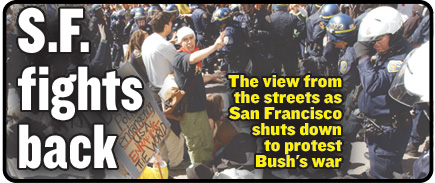
Nowhere was the clash of people power and government will more acute than on the streets of San Francisco, where a series of massive marches, some drawing nearly 100,000 people, filled the streets prior to the invasion of Iraq on March 19, 2003. The onset of war led protesters to effectively shut down the city, resulting in about 2,300 arrests and millions of dollars in costs to the city.

President George W. Bush dismissed the protests, of course, but he wasn’t the only one. Political leaders such as Rep. Nancy Pelosi, then-Mayor Willie Brown and soon-to-be Mayor Gavin Newsom (who didn’t attend any of the marches, unlike progressives on the Board of Supervisors) condemned the peace movement for hurting an innocent city. But with the “battle for San Francisco” making international news, the protesters were more concerned with the global audience.

A month earlier, on the weekend of Feb. 15 and 16, there were coordinated protests against the impending war in about 800 cities around the world, drawing around 10 million people. The peace march in Rome included about 3 million people, earning a listing in the Guinness Book of World Records as the largest anti-war rally in history. People have never made such a loud and clear statement against an incipient war.

Beyond the numbers, the antiwar movement was also right. On every major issue and prediction, the messages from the street proved correct while those from the White House were wrong. The US wasn’t welcomed as liberators. There were no weapons of mass destruction. Iraq after the invasion isn’t a stable democracy or shining beacon to anyone but the new generation of jihadis Bush created.

We can blame a hard-headed president, ineffectual opposition party, failure of the national media, or the national climate of fear following Sept. 11. But rather than refighting that lost battle, now is the time to gain perspective on the events of five years ago and determine what it means for democracy and the post-Bush national agenda.


TO THE STREETS

There were two main umbrella groups organizing protests before the war: Direct Action to Stop the War (DASW) and International ANSWER (Act Now to Stop War and End Racism). ANSWER has remained active and DASW has recently been reconstituted for the fifth anniversary of the war, using direct action in San Francisco as well as other urban centers and outposts like Chevron’s refinery in Richmond, which has reportedly been processing Iraqi oil.

“With the fifth anniversary coming up, we’re going back to direct action on the streets,” said Henry Norr of DASW. “But I don’t have any illusions that it’s going to be like it was five years ago.”

The maddening march to an ill-advised war created a political dynamic in which a broad cross-section of Americans was willing to hit the streets.

“We had a wonderfully diverse group of people, from soccer moms to anarchists,” said Mary Bull, who cofounded DASW, a collective of various affinity groups and concerned individuals formed in October of 2002 as Bush started beating the drums of war.

It was a group fiercely determined to prevent the war — and really believed that was possible. In fact, Bull recalls how she and other members of the group burst out crying at one meeting when a key activist said the war was going to happen.

Richard Becker, who cofounded ANSWER and serves as its West Coast coordinator, said that in the summer of 2002, “we came to the conclusion that [the war] was going to happen.” The group called its first big protest for Sept. 15, 2002, and another one two weeks later. But the movement really exploded on Oct. 26 when almost 100,000 people took to Market Street, much of it a spontaneous popular uprising.

“We were overwhelmed,” Becker said. “We were in a perpetual state of mobilization to keep up with what was going on. But then it didn’t stop the war.”

Did he think they could?

“I think a lot of people thought maybe it was possible to stop it. And we thought maybe it was possible to stop it,” Becker said.

The high point, according to Becker and Norr, was Feb. 17, 2003, when the New York Times ran a front page analysis piece entitled “A new power in the streets” that claimed “the huge anti-war demonstrations around the world this weekend are reminders that there may still be two superpowers on the planet: the United States and world public opinion.” But then Colin Powell went to the United Nations to argue for the invasion, and the Democrats in Congress did nothing, and it became clear war was coming.

Norr stayed out there protesting, being arrested several times and even shot in the leg by Oakland police with a rubber bullet during a protest at the Oakland docks. And he thinks some good came from the experience.

“The lesson for people is the political and economic elites are committed to preserving and extending empire. And they basically say as much in their own writing,” Norr said. “Wars are not anomalies.”

Despite being a frustrating and depressing exercise, most saw benefits to the failed movement. “People got an incredible education about how the system really worked,” Becker said. “Building a movement is mostly about a series of setbacks.”

Medea Benjamin, cofounder of both Global Exchange and CodePink and fixture of the anti-establishment peace movement for years, was upbeat about the protests. “We did our job as citizens. We did what we were supposed to do: organize, get people to take action, get people onto the streets,” she said. “We did everything we could think of.

“What you take from it is we don’t have a very well-developed democracy because the people spoke and the government didn’t listen.”

25war2_Lars1.jpg The ever-evolving “Democracy Wall” on Valencia Street, March 2003, helped stir up debate (Photo by Lars Howlett)


FACING ARREST

The collective action of five years ago starts with a series of personal stories — tens of thousands of them — so let me briefly begin with mine.

My arrival in San Francisco was closely tied to the march to war. I was living in Sacramento and working as the news editor of the Sacramento News & Review when Bush began his saber rattling against Saddam Hussein, but by the end of 2002 I had a falling out with my boss and found myself jobless.

Like most Northern Californians who opposed the war, I came to San Francisco on Jan. 18 to make my voice heard and experienced a bit of serendipity on my way to Justin Herman Plaza: while reading the Guardian on Muni, I saw their advertisement for a city editor, a job that was ideal for me at a paper I’ve always loved. Needless to say, it was a great day, empowering and full of possibilities.

Less than two months later I was on the job, and on the second week of that job I was back on the turbulent streets of San Francisco, part of a Guardian team covering the eruption of this city on the first full day of war. When I stepped off the cable car just after 7 a.m., people were streaming up Market Street and I joined them.

When a large group stopped at the intersection of Market and Beale, I stopped too, taking notes and bearing witness to this historic, exciting event. I had a press pass issued by the California Highway Patrol that allowed me to cross police lines, so when police in riot gear surrounded us and threatened arrest, I held my ground with 100 or so protesters.

After interviewing about a dozen people about why they were there and that they hoped to accomplish (see “On the bus: Journalists, lawyers, four-year-olds — the cops were ready to bust anyone Thursday morning“), I was arrested with the others and taken to a makeshift jail and processing center at Pier 27 (no charges were filed in my case, and charges against all of the 2,300 people arrested here in those first few days of the war were later dropped).

I recently tracked down a few of the people who appeared in my article, including Daphne and Ross Miller, who were at the center of the most interesting drama to play out during our standoff with the police. She’s a family practice physician, he’s an architect, and they live in Diamond Heights with their two children, Emet, who is almost 9, and Arlen, 12, who was away on vacation when the war began.

“We were genuinely shocked that the war started,” Ross told me. “We were at some of the earlier protests and really thought there was no way [Bush] could do it.”

They woke up March 20, 2003, to news that the war had begun and immediately walked to the BART station with Emet and rode to the Embarcadero station, not really planning for the day ahead but just knowing that they had to make themselves heard.

“We were pissed as hell. I don’t think I’ve ever been so angry in my life,” Daphne said.

They quickly came up with a plan. “We basically decided that if anyone was going to be arrested, it was going to be Ross and I’d stay with Emet. But it didn’t end up that way and I ended up in the arrest circle.”

Daphne had their house keys and threw them over the police line to Ross at one point. A photographer in the circle had gotten shots of a man named Roman Fliegel being roughed up by police as they pulled him off his bicycle, which was towing a trailer with a sound system, and decided to throw his backpack with camera gear out as well. When Ross — who had four-year-old Emet on his shoulders — caught it and refused police orders to give it to them, police grabbed Emet and roughly arrested Ross, leaving a gash on his forehead.

“Rage surged through the crowd, and it seemed as if things might get ugly, but the police kept a tight lid on the situation, using their clubs to shove back protesters who had moved forward,” I wrote at the time.

Emet was delivered into the circle with Daphne as the arrests continued, many quite rough. “At that point, as a mom, I had to exercise the most restraint ever,” said Daphne, who was angry about the situation but fearful about what she was exposing her son to. “Please, don’t let any violence happen here,” she pleaded with the crowd. Eventually, commanders on the scene let the mother and child go.

“The officer who let me go said that if he saw me again out there, he would call Child Protective Services on me,” Daphne said. But two days later, still brimming with outrage at her country’s actions, she ditched a downtown medical conference to rejoin the street protests, this time solo.

The couple say they’ve lost friendships over the war and have become more engaged with politics, coming to believe that Bush and the neocons are malevolent figures who knew how badly the war would go and did it anyway to establish a large, permanent military base in Iraq.

“Since that day, we’ve been far more active,” Ross said. “We realized you can’t just trust the system. You have to push.”

But that determination was mixed with feelings of disempowerment and depression. They attended some of the protests that following year, but the couple — like most people — just stopped going at some point because they seemed so futile.

“There was a horrible sense of resignation and a genuine depression that followed,” Ross told me.

The nadir was when Bush was reelected and they considered leaving the country. But then, Ross said, “we decided we’re not just going to run away and we’re not going to accept this.” Looking back, even with the scare over Emet, they express no regrets.

“It was the right thing to do because it was the wrong war to have. I’d do it again and again and again if I had to,” Ross said

They’re guardedly hopeful that Barack Obama could begin to turn things around if he’s elected. “I think the right president can at least start to dismantle this,” Daphne said. “I think thousands of people marching in the streets is something he would listen to.”

25war3_Charles1.jpg A die-in on the streets of San Francisco in March 2007 marked the fourth anniversary of the invasion (Photo by Charles Russo)


WITNESS TO HISTORY

Covering the peace movement in those early days was a heady experience, like reporting on a revolutionary uprising or working in a foreign country where the people are organized and active enough to be able to shut down society and brave enough to risk bodily injury for their beliefs.

I was at the founding meeting of CodePink — which became the most effective group at personally confronting the warmongers and keeping the war in the public eye — one evening at Muddy Waters in the Mission District shortly after the war started.

Looking back, Benjamin rattled off a long list of the alliances the group built — with labor, churches, businesses, and a wide array of social movements — and creative actions intended to build and demonstrate popular support for ending the war.

“We’ve done so many things and what did we get? We got a surge,” she said. “It shows the crisis in our democracy, the crisis of the two-party system, the crisis of a dysfunctional opposition party.”

Yet she said the peace movement has been remarkably successful in convincing the public that the war was a mistake and that it’s time for the troops to come home, even if the Democrats have been slow to respond to that shift.

“The progress we’ve made is turning around public opinion and that’s going to play a big role in the upcoming elections,” she said. For Norr, the role of the news media is a particular sore spot. He was a technology reporter for the San Francisco Chronicle who called in sick on the first full day of war and was arrested on Market Street with his wife and daughter, resulting in suspension by editor Phil Bronstein for his actions.

I wrote several stories on the issue, which culminated in Norr being fired and Bronstein unilaterally banning Chron employees from peace protests. I even borrowed CodePink’s guerilla tactics when Bronstein repeatedly refused to return my calls or address why he had singled out antiwar protesters for uniquely punitive treatment. I confronted him during a speech he gave at the Commonwealth Club (see “Lies and half-truths,” 5/7/03). That was the tenor of the times: we were all tired of being lied to and we decided to push back.

Norr was particularly frustrated with his own paper’s reporting of the war and started sending articles by the foreign press to his paper’s news desk, trying to wake his colleagues up to the pro-war propaganda being passed off as journalism in this country.

He was also disappointed with the country and with the Chronicle — both the management and his fellow reporters, who did little to support him — but the experience caused him to return to his roots as a progressive activist.

“The war and losing the job and everything brought an abrupt end to my consumerist phase and dumped me back into the world of being an activist,” said Norr, who serves on the KPFA 94.1 FM local station board and has made three recent trips to the Palestinian territories while working with the International Solidarity Movement.

Benjamin said Americans shouldn’t expect the next president to end the war — not without lots of pressure from a renewed and vocal peace movement. “This is the time to set the stage for the post-Bush agenda,” Benjamin said. “Don’t put your hopes in Barack Obama in getting us out of Iraq. Put your hopes in the people.”

25war4_Lane1.jpg A rally and nonviolent direct action at the Richmond refinery targeted Chevron on March 15 (Photo by Lane Hartwell)


THE AFTERMATH

The San Francisco Police Department, which spent more than $2 million on overtime costs responding to peace protests between March 15 and April 16, 2003, generally behaved with restraint and professionalism, but there were several exceptions.

The most costly and disturbing incident came when Officer Anthony Nelson began aggressively swinging his long riot baton at protesters, badly shattering the arm of peaceful protester Linda K. Vaccarezza, who suffered a permanent disability in her career as a court reporter.

Nelson’s incident report falsely stated that Vaccarezza had threatened him with a sign attached to a solid pole, but video of the incident later clearly showed there was no pole and that she was retreating when he teed off on her (see “The home front,” 05/19/04).

Vaccarezza received an $835,000 settlement from the city in November of 2004. On Oct. 5, 2005, two and a half years after the incident, SFPD fired Nelson for lying about what happened that day, and the City Attorney’s Office has been successfully fighting Nelson’s appeals in court ever since, putting in more than $100,000 in attorney time and costs into the Nelson and Vaccarezza cases.

The other significant ongoing litigation from the antiwar protests involved Mary Bull, who was arrested during an early protest for pouring fake blood in front of the entrance to Chevron’s San Francisco office before being allegedly strip searched and left naked in her San Francisco Jail cell for 36 hours.

Ironically, Bull was among those who brought a successful class action lawsuit against Sacramento County after she and others protesting a logging plan were strip searched, setting a precedent and led most counties to reform their strip-search policies. She used her share of the $15 million judgment to buy an organic permaculture farm in Sebastopol.

Her San Francisco case, in which Bull won a multimillion-dollar judgment, is still under appeal and now in mediation. Bull said the protests five years ago did make a difference, something she tells those who fret about its apparent failure. “I tell them to look at what issues the candidates are talking about now and I thank them for protesting then.”

“Even though we had millions throughout the world, we were sort of blocked, but now we’re regaining that momentum,” Melodie Barclay, a massage therapist who was also arrested with me on the first day of the war, told me recently. “We can’t judge it by the fact that we didn’t get the momentum we wanted.”

Norr started his antiwar activism working with Students for a Democratic Society in Boston, protesting the Vietnam War, which he said shares many similarities with the current situation, for good or for ill. He said that people tend to forget that while the protests then were huge and helped end the war, the movement did wane after Nixon ended the draft and substituted massive aerial bombardment for boots on the ground.

“The protests dropped off considerably,” he said. “A lot of the things that drove people to take risks in the late ’60s had faded by the early ’70s.”

He thinks the current administration learned a lesson from those days: it’s easier to maintain a war effort if the average citizen isn’t affected.

But there are other factors as well keeping a lid on the antiwar outrage.

“The culture has changed too. Young people are oversaddled with debt. People in schools seem to be docile. The culture as a whole seems to be more individualist and consumerist,” Norr said.

Yet some young people have woken up and many of them are funneling their energies into a peace group that was formed in the summer of 2005: World Can’t Wait, as in: the world can’t wait for the end of Bush’s second term before we change our direction and leadership.

“We don’t just want them gone, we need to repudiate their program,” said Giovanni Jackson, a 26-year-old WCW student organizer. “If we’re going to change anything, we need the youth.”

Jackson was at WCW’s founding convention in New York City, which came just as New Orleans was being flooded and then essentially abandoned by the federal government.

“When [Kerry] lost, people felt demoralized and World Can’t Wait kind of stepped into that situation,” Jackson said. “There was a lot of demoralization in the antiwar movement at that time.”

The group organized protests and student walkouts on Nov. 2, 2005.

“Everyone has their moments of doubt,” he said, “but I’m motivated by the crimes we see everyday.”


THE LESSONS

One of the biggest barriers to galvanizing people and turning the fifth anniversary of the war into something that might make a difference is the presidential election, which is diverting the energy of many potential protesters — and at the same time, offering some hope that a new president may lead to peace.

After all, every single one of the Democratic presidential candidates has promised to withdraw troops from Iraq, with varying timelines and numbers of US personnel left behind. And with enough encouragement, they might be willing to help change the status quo.

Many of the activists who volunteered their time and money to help move the Obama campaign into its front-runner position came out of the antiwar movement, and Obama’s strong stand against the war has been a key factor in his popularity.

Becker and some other activists don’t have much faith that a change in presidents will change the course in Iraq, although he agrees that much of the energy now surrounding Barack Obama derives directly from the antiwar movement.

“There’s been a huge upsurge of hope for Obama and that he might bring about the kind of change we need,” Bull said, adding that she doesn’t share that hope, believing the only path to peace is to pressure Obama and other leaders to commit to more progressive positions.

Norr said, “On one level, people have illusions about the power of peaceful protests. People believe in democracy, as well they should. We feel like the rulers should be paying attention to public opinion.

“It’s a remarkable story how broadly and quickly the American people have turned against the war. Public opinion was certainly ahead of the Democrats.”

And people will only grow more disenchanted with Iraq and its multitude of costs. “The people here are paying for this war, and everyday we have new stories about health clinics being shut down,” Becker said.

Becker was amazed last March as massive demonstrations for immigrant rights seemed to explode out of nowhere. “We think there will be more things like that,” he said.

Because after five years of organizing communities to resist the military-industrial complex’s plans, Becker thinks there’s been some visible progress.

“There isn’t a town or hamlet in the US that doesn’t have activism going on, but you wouldn’t know it from the corporate media,” Becker said. “It’s a mistake for people to feel discouraged.”


Where to buy

0

ICONIC CLONES pages 16–17


Clothing from:

American Apparel (1615 Haight, SF. 415-431-4028, www.americanapparel.net), Azalea (411 Hayes, SF. 415-861-9888, www.azaleasf.com), FLOC (www.teamflocouture.com), Huf (816 Sutter, SF. 415-614-9449, www.hufsf.com), Upper Playground (220 Fillmore, SF. 415-861-1960, www.upperplayground.com), Urban Outfitters (80 Powell, SF. 415-989-1515, www.urbanoutfitters.com), Villains (1672 Haight, SF. 415-626-5939, www.villainssf.com)

(Pictured from left to right)

Dexter1: Livity hat, Spitfire sunglasses, 22 Vontage shirt, James Pearse tank, and Cheap Mondays jeans, all from Azalea

Feelmore1: Livity hat, 2 Percent jacket, and Diesel jeans, from Azalea; BDG T-shirt from Urban Outfitters; and necklace by FLOC

Dexter2: T-shirt from American Apparel

Feelmore2: 5024 SF hoodie and Superfishal T-shirt from Upper Playground; Cheap Mondays jeans from Azalea; Adidas shoes from Huf

Dexter3: Hoodie and Superfishal T from Upper Playground; New Era cap and Adidas shoes from Huf; Cheap Mondays jeans from Azalea

Feelmore3: Dress, necklace, and eye feathers by FLOC; Ophelia belt and cuff from Azalea

Feelmore4: Vest, necklace, and eye feathers by FLOC; Diesel jeans from Azalea; Minnetonka boots from Villains

Dexter4: Shirt and necklace by FLOC; J Brand jeans from Azalea; Minnetonka boots from Villains

BYOB pages 13-14


Items from:

Kenneth Wingard, 2319 Market, SF. 415-431-6900, www.kennethwingard.com), The Other Shop (327 Divisadero, SF. 415-621-5424), Wishbone (601 Irving, SF. 415-242-5540, www.wishbonesf.com)

SCENE MAKERS


Clothing from

FLOC (www.teamflocouture.com), Five and Diamond (510 Valencia, SF. 415-255-9747), www.fiveanddiamond.com), Karis (www.myspace.com/karis_karis), Mingle (1815 Union, SF. 415-674-8811, www.mingleshop.com), Nicacelly (www.nicacelly.com), Seventh Heart, (1592 Market, SF. 415-431-1755, www.myspace.com/theseventhheart), Wasteland (1660 Haight, SF. 415-863-3150, thewasteland.com)

Cover and page 4


Karis: Necklace, pants, leather armwarmers, and feather vest by Karis; Horseface skull pendant from Seventh Heart

Page 25


Jennifer Johns: Dress by Nicacelly; shoes by Naughty Monkey

Page 26


La Malamaña (pictured from left to right)

Raul (guitar): Goorin hat, Venom jacket, and Brave belt from Mingle; Skingraft chain and holster from Five and Diamond

Karlangas (accordion): Skingraft feather tassle from Five and Diamond

Gaston (stilts): Brave belt from Mingle

Joeliño (maracas): Wildcard aviator cap and Steam Trunk vest from Five and Diamond

Emilio (trumpet): Heathen hat from Five and Diamond

La Tere (on hood): Industry shirt from Mingle; Shawna Hofman wrist cuff, Steam trunk skirt, and Wildcard bloomers from Five and Diamond; boots from Wasteland

Vinicio (in truck): Bréaux alpaca armwarmers from Mingle; Shawna Hofman wrist cuff from Five and Diamond

page 28


Parker Day: Dress, gloves, spats, shoulder fur, and eye feathers by FLOC

Brand spankin’

0

› superego@sfbg.com

Ah, spring. Strange birds are chirping, cherry trees are blossoming, pretty but misguided girls are puking on their Luichiny strappies outside North Beach bars, and adorable elderly gentlemen are grabbing my unmentionables on the Muni. Time for a couple of pomegranate liqueur shots and some neon butterfly nail decals. Or fuck it, just hand me the Chivas and let’s go dancing. Party time.

In my fondest dreams, the floors always hop, the clubbers look fierce, the jams never stop, and last call’s just past dawn. (Also: butch unicorns.) But dreams are for sleepers, gorgeous, and who would ever admit to being one of those? It’s almost worse than saying you’re tired and want to go home. Quel tragique. If you want it, you’ve got to stay up for it, we say, and for a year now, Scene has been toasting the amazing people, places, and parties that give their very all to make those dreams a reality, however creatively (wink).

Cosmic local nightlife, cocktails, fashion, music, art, expression — not necessarily in that order, and preferably all at once with a little kiss-kiss afterward — that’s what spurred us to launch this thing. And sometimes we put down our caipirinha glasses and stop twirling long enough to actually put out another issue. Thus, welcome to the spring 2008 Scene! From fresh drinks to fab threads to hot freaks, it’s positively aching with enjoyment. Much like spring itself.

Refill!

Marke B.

Martial bliss

0

TAKE ACTION Hey, Donnie Yen fans! Director Wilson Yip’s Flash Point — in which the charismatic martial arts star (2002’s Hero, 1993’s Iron Monkey) plays an aggro cop on gangster-beatdown detail — is actually getting a local theatrical release. Currently, Yen is in Shanghai shooting Yip Man, which he describes as "the story of Bruce Lee’s teacher, a master of the Wing Chun kung fu style." He’s a busy guy, and he could probably flatten any fool with a flick of his pinky finger. Fortunately, he typed up some answers to my e-mailed questions instead.

SFBG On Flash Point — among other films — you’re credited as the "action director." How does that role differ from "fight choreographer," which you’ve served as on films like 2002’s Blade II and 2005’s SPL (a.k.a. Kill Zone)? Is it difficult to direct yourself when you’re also acting in the scene?

DONNIE YEN I think it’s a difference between the way action is treated in Hong Kong and in Hollywood. [In Hong Kong,] my job is to "direct" the action, and when I’m shooting the fight sequences, I take over the set. I choose the camera angles and see how the drama intercuts with the action. In Hollywood, you "choreograph" working with the main director. In the old days of Hong Kong action cinema, when the action director worked, the "drama" director went home!

SFBG Which fight scene are you most proud of?

DY Of my own stuff? I’d have to say the final fight in Flash Point, between Collin Chou and myself. That was definitely the toughest action scene of my career, and I think it shows! I really like the way we managed to apply MMA [mixed martial arts] techniques on-screen, especially some of the dynamic takedowns, which we haven’t really seen before.

SFBG You’ve worked on both Chinese and American films. What’s the biggest difference between the two industries? Are you interested in having a Hollywood breakthrough like Jackie Chan or Jet Li?

DY As I mentioned earlier, I have much more control over the final product in Hong Kong. I mean, on Flash Point, I’m the producer, the star, the action director…. Of course, I have to give credit to [director] Wilson Yip, who I have a great relationship with. This is our third film together. However, I would still like to work in Hollywood, providing it’s the right role in the right project.

SFBG Flash Point is a "modern" film, but you’re best known for period films like Hero. Which do you prefer?

DY Honestly, I just like to keep challenging myself. For example, Flash Point has a really raw action style, very MMA influenced, but now I’m starting Yip Man, which is about Bruce Lee’s teacher, and so it’s all classical kung fu movements but presented, hopefully, in a new and dynamic way. I would say that, technically, period films are more challenging, because, like with Hero, you’re performing in traditional Chinese clothing, and the movements tend to be more complicated. The modern films, like Kill Zone and Flash Point, are tough because of the degree of real contact when you get slammed about during a fight scene. They’re both challenging in different ways.

SFBG What are your thoughts on CGI-enhanced fight scenes versus the old-fashioned kind?

DY We used a lot of CGI in [2006’s] Dragon Tiger Gate, because the story and the style of action demanded it. I think it’s probably been overused in some films to compensate for the fact that the stars of the films can’t actually do their own action! In my own films, I tend towards keeping it as real as possible, and we only use CGI for shots that would really be impossible to do live on the set. There’s definitely very little CGI in Flash Point!

Flash Point opens Fri/14 in Bay Area theaters

Beautiful losers

0

Great movies stay with you in the oddest ways. In the days after I first saw Gus Van Sant’s Paranoid Park, I was preternaturally attuned to the sound of skateboards dragging the street outside my bedroom window—the slow tug of concrete, the bumping waves of wheels. This ambient strain surrounds Paranoid Park‘s cherubic point of focus: Alex (Gabe Nevins), a sleepy-eyed skater waiting out his parents’ divorce in a Portland, Ore., suburb. He occupies most of the film’s exquisitely composed frames, though he’s more a figure etched in light than a proper protagonist.

Figure-eight narrations and slow-moving Steadicam tracks have underpinned Van Sant’s last couple of films (2003’s Elephant, 2005’s Last Days), though they’re more artfully embedded in Paranoid Park‘s fragrant sprawl, not least because of the visual equivalencies provided by the film’s skateboarding footage. Blake Nelson’s airless young-adult novel presents Alex’s story as an extended confessional letter. Van Sant dissembles chronology and inflects the narration with associative freedom.

Most immediately, Van Sant folds Nelson’s plot to delay the central trauma, which first enters our vision peripherally through a detective’s investigation and a local news report. With that said, narrowing the effect of this organizing principle is a little like trying to get a fix on Phil Spector’s reverb or Gerhard Richter’s gray — Van Sant’s placid puzzling is a textural aesthetic before it’s a device. Where Nelson’s moral tale is a streamlined account, Van Sant’s adaptation aims for something more transparent and sublime. His Alex is at once layered and laid bare.

This channeling begins with a slow-creeping tracking shot as Alex is interviewed by a detective. What begins as a conversation eventually lands as a full-frame portrait of the adolescent, the detective’s words ("What’s your parental situation?") left hanging in the air, irrelevant. As Nevins garbles his lines, the boundary between the nonprofessional actor and his character becomes palpably blurred. Does Van Sant’s MySpace casting call automatically qualify as tawdriness? Not when Paranoid Park maintains its enigmatic distance. Indeed, Van Sant renders the film’s MacBook surfaces — the subdued luminescence, boxy 4:3 aspect ratio, and soundtrack shuffle from Elliot Smith to the Juliet of the Spirits score all evoke a MacBook — as something unique and refined.

Like so many high school boys, Alex is essentially passive (see the film’s hilarious sex scene, with talky girlfriend Jennifer’s blond wisps dissolving Alex’s face like something from Maya Deren’s 1943 Meshes of the Afternoon). Van Sant captures this state via formal permeability, rigorously designing Paranoid Park‘s memory machine as a head trip. Strips of slow motion, a narrow-depth-of-field, ping-ponging sound, a mumbled voice-over — all these elements serve to cover the largely amateur cast but also to project Alex’s environmental interiority. This tendency reaches a swollen apex during a posttraumatic shower. The camera again draws in, and Christopher Doyle’s typically luscious lensing isolates every droplet; the lighting darkens, and the blistering sheets of water-noise are overlaid with thick forest sounds as Alex drops his head, revealing the bathroom wallpaper’s bird motif.

There’s no buried logic to Paranoid Park, and even though it’s shaped as much like a jigsaw as Donnie Darko (2001) and Rian Johnson’s underappreciated Brick (2005), it doesn’t invite solutions. Whether or not Alex’s withholding aura is read as a symbolic closeting, Van Sant’s direction is some kind of sorcery, especially in those B-roll streams of easy riders through which the film’s story expands to encompass all breathless teenage riots. Paranoid Park ends with these images after cutting from Alex asleep in biology class, dreaming of flying. He never touches the ground, always hovering between idyll and responsibility, the dream and his place in it. (Max Goldberg)

PARANOID PARK

Opens March 21 at Bay Area theaters
www.myspace.com/gusvansant

Diamonds are harder than gym bodies

0

Black Lizard made me gay. Or, at the very least, Kenji Fukasaku’s 1968 jewel-toned mod noir opened my quasicloseted 16-year-old eyes to a certain queer aesthetic — one which foregrounds its own artifice by using Aubrey Beardsley’s illustrations for Oscar Wilde’s Salome as wallpaper; one which dresses deviance in a gown with a 25-foot-long feathered train; and one which knows that the flipside of fabulousness is utter ridiculousness. It certainly wasn’t something I was seeing in the twink-filled issues of XY foisted upon me by my Pride ring–wearing, secret community college beau, but something closer to what I later found in John Waters’s films with Divine, James Bidgood’s diaphanous beefcake photography, and Ronald Firbank’s deeply purple prose.

However, unlike the above artists, Fukasaku was heterosexual, and Black Lizard represents an anomaly within a career that included much macho studio boilerplate. Even at his finest, Fukasaku had a flair for rough stuff: he directed some of the best yakuza films ever made (Battles Without Honor and Humanity [1973–74]) and ended his career with 2000’s controversial adolescent bloodbath and political fable Battle Royale. Yet, as with Joseph L. Mankiewicz’s practically flaming 1959 adaptation of Tennessee Williams’s Suddenly, Last Summer, there was just the right combination of elements (and most importantly, the right combination of peacocks involved) to make Black Lizard one of queer cinema’s unsung gems. Which is precisely why freelance curator T. Crandall chose the film to kick off his rep series, "The Revival House: Classic Queer Cinema," at Artists’ Television Access.

As clichéd as such a phrase may be, Black Lizard is awash in precious stones and glittering surfaces — but none shine with as much brilliance as the transvestite Akihiro Miwa (credited as Maruyama), who plays the titular jewel connoisseur and criminal mastermind that kidnaps specimens of human beauty to freeze them in eternal tableaux vivant on her island lair. The film is completely Akihiro’s: her entrances stop time, her song is a siren call which causes men to become her slaves, her lavish outfits become more so with each new scene. "The face of Garbo is an Idea, that of Hepburn, an Event," quipped Roland Barthes (referring to Audrey, not Kate). Miwa’s face, whose mouth morphs rubber band–like from a sour moue into the devouring O of a deep cackle unleashed, is a gloss on Barthesian idealness.

Prior to Fukasaku’s film, Miwa had appeared in the same role in Yukio Mishima’s long-running stage adaptation of pre-World War II mystery and suspense novelist Edogawa Rampo’s 1934 short story "Black Lizard." Rampo’s tale was one of many starring his Sherlock Holmes, the brilliant detective Gogoro Akechi, who in Mishima and Fukaaku’s retelling falls heart-first into a dangerous pas de deux with his androgynous quarry. Miwa was a successful nightclub entertainer active in avant-garde theater (and she still is: last year, she starred in a Tokyo production of Jean Genet’s The Eagle Has Two Heads) when she met Mishima — our second of the aforementioned peacocks — who was haunting Tokyo gay bars to "research" his 1953 novel Forbidden Colors.

It’s not hard to see why Rampo’s story of a moribund ice queen obsessed with changeless beauty appealed to Mishima. By 1968, Mishima was that queen, fully immersed in his own homoerotic brand of aestheticized Emperor worship, which would reach its grisly apogee in his ritual suicide four years later. Prior to Black Lizard, his muscular body had already been given the coffee table book treatment in Ba-ra-kei: Ordeal by Roses (Aperture, 1971), where Hosoe Eiko’s photographs present the author posed as a martyred St. Sebastian or as a snowbound samurai. Appropriately, he makes his cameo in Fukasaku’s film as one of Black Lizard’s frozen exemplars of aesthetic perfection— a brawny sailor, no less.

In the end, though, diamonds are harder than gym-wrought muscle, and it was Miwa’s flash, not Mishima’s flesh, that held my attention — at least consciously — upon my first adolescent exposure to Black Lizard. Many viewings later, Mishima seems pathetically unaware of the self-parody he’s partaking in. But Miwa’s exquisite luminescence remains untarnished.

THE REVIVAL HOUSE: BLACK LIZARD

March 19, 8 p.m.; $6

Artists’ Television Access

992 Valencia, SF

(415) 824-3890

www.myspace.com/therevivalhouse

Killing in the dark

0

› gwschulz@sfbg.com

The San Francisco Police Department doesn’t want people to know about Asa B. Sullivan, a case that illustrates how difficult it is to get even basic information about law enforcement, which leaves the public in the dark about a public agency that makes life-and-death decisions.

Officers filled Sullivan with 16 bullets nearly two years ago on June 6, 2006. Sullivan was unarmed and hiding in the cramped attic of a townhouse at the Parkmerced complex near San Francisco State University when the shooting occurred.

The Guardian has spent the intervening time trying fruitlessly to obtain public records and other information from the department about what happened to Sullivan and about the officers involved, including the results of now-completed investigations.

Sullivan’s death briefly grabbed headlines, but beyond what police told the press at the time, the department has rejected several requests for reports and other documents related to the shooting. The department in February of this year rejected another records request, one of four rebuffed since Sullivan’s death.

Police initially claimed Sullivan’s gun was found at the scene, but that story changed significantly within a short period of time. Police later said the officers who shot him believed an eyeglasses case held by Sullivan was a gun.

It all started when the neighbors of 2 Garces Drive called police believing squatters had taken over the townhouse, but Sullivan was helping the tenants clean up so they could get their security deposit before moving out.

When police arrived, they ordered Sullivan’s friend, Jason Martin, to the floor after the officers aimed their weapons at him without explanation while Sullivan fled into an attic, according to allegations that later appeared in a federal civil suit filed by Sullivan’s family.

Sullivan was on probation for pot and any contact with police would surely have caused him more problems, but as we reported shortly after Sullivan was killed, the department’s General Orders instruct that when a suspect is barricaded, the responding officers should call in a negotiator. A K-9 unit was called that night, according to the suit, but it doesn’t appear the officers waited for it to show up.

Two officers tried to call Sullivan down before pursuing him into the attic. The rest is unclear except that the officers, John Keesor and Michelle Alvis, shot Sullivan to death believing he was armed and intended to shoot them first. But no gun was ever found. The 25-year-old Sullivan, a San Francisco native, was working for Goodwill Industries at the time and had a young son named Asa Isaiah Sullivan.

We first sent a public records request to the SFPD shortly after Sullivan’s death asking for "any and all documentation" related to the shooting including e-mails, notes, and witness statements. The department’s legal division responded that the material was exempt from disclosure laws because they were part of an ongoing law-enforcement investigation, a common response when reporters seek such documents.

After learning at a September 2006 San Francisco Police Commission meeting that some elements of the investigation were complete, we filed another request. The department’s rulebook requires that two divisions in the department — the homicide detail and internal affairs — complete their examinations of deadly officer-involved shootings within two months of the incident.

But again, citing the state’s Government Code, which allows them to withhold material considered part of an ongoing probe, the department responded that an investigation by the district attorney and an analysis of Sullivan’s body by the medical examiner were not complete.

Two months later, we confirmed through Sullivan’s autopsy that he’d been shot 16 times, so we filed another request for documents related to the shooting. But again the department’s legal division claimed the investigation was still open and disclosure would endanger its successful completion.

The alternative by then was to wait for the federal civil suit filed against the city by Sullivan’s family to unfold slowly: through that, perhaps we could determine if new evidence from the shooting would appear in the public record. No success there either. The parties requested a protective order in August 2006 that made crucial information in the case confidential, including personnel records of the officers involved as well as audiotapes, videotapes, photographs, and transcripts related to the investigation.

Through the suit, however, we did learn last November that the Office of Citizen Complaints and the police department’s Management Control Division, a.k.a. internal affairs, had completed their investigations of the shooting.

So we filed another request in February of this year. Yet again, however, the department’s legal division responded that the records were protected under the state’s Penal Code, which grants special exemptions for information related to the conduct of law-enforcement personnel. The OCC responded the same way in its denial of our request.

Making matters worse, California’s State Supreme Court ruled in an unrelated case in August of 2006 that citizens and the press would no longer be able to access most public information about why individual officers are charged with misconduct or even possibly breaking the law.

Records of misconduct charges filed by the OCC or the police chief against officers had largely been open to the public until then through summaries that appeared on the agenda of the police commission. The public could also attend misconduct hearings at the Hall of Justice which included testimony from officers.

But the Supreme Court ruling — known as the Copley decision — put a stop to it by broadening the scope of privacy laws that exclusively protected cops from the disclosure of disciplinary records. Since then, stories from Bay Area media outlets about police misconduct have been few and far between despite a steady stream of cases.

Of course, there’s a way around it all. Sometimes documents show up at the Guardian building in Potrero Hill without a return address, and literally dozens of people with potential access to records related to Sullivan’s death could plausibly deny knowing how they were accidentally sent to G.W. Schulz, San Francisco Bay Guardian, 135 Mississippi St., San Francisco, Calif., 94107.

Maybe by the June anniversary of Sullivan’s shooting, a fuller story of what happened that day (from any number of perspectives — we’re interested in talking to anyone) could land in front of readers. Maybe.

Kewl Tun3: Santogold gets LES Artistic

0

I’ve made no secret of my audiolust for Brooklyn grime-pop chanteuse (and former punk band Stiffed frontwoman) Santogold, but the new vid for her “LES Artistes,” directed by Nima Nourizadeh, is blowing me away:

Santogold’s heavily related to the stripper-loving Spank Rock scene, sharing some producers, remixers, track appearances, and party bills, although on a much higher intel tip (everyone kind of over “bitches and ho’s” DJ Assault circa 2002 ripoffs say “He-eyyy!”) — and look for many, many tired comparisons to MIA to follow in the wake of the release of her self-titled album Santogold (Downtown), which drops on April 22, and her performance at Coachella this year — because, you know, freaky women artists of color sure are similar. Still, her already-legendary bass-heavy ragga crawler club jam “Creator” has swept people onto the same global-hop dancehall dancefloors as Ms. MIA, and the more like that (and the above) the merrier, say I …

And this quote from a recent NYT article on her is priceless: “You get these images of women in sexy clothes, walking around in, like, panties,” she said. “Even Beyoncé — that’s what it is to be a woman and make music. But now there are all these other women doing cool, interesting things, wearing styles they came up with, and it’s not about being naked.”

Santogold, “Creator” (live at Fader 51 party)

What does Alpine jazz sound like? Nik Bärtsch’s Ronin comes to Yerba Buena

0

nikb sml.bmp

By Erik Morse

What was Orson Welles’ scene stealing line in The Third Man? Oh yes, it goes like this: “In Italy, for 30 years under the Borgias, they had warfare, terror, murder, bloodshed – they produced Michelangelo, Leonardo da Vinci, and the Renaissance. In Switzerland, they had brotherly love, they had 500 years of democracy and peace, and what did that produce? The cuckoo clock.” Never mind that the contraption in question was actually invented in the Black Forest of Baden-Württemberg or that Welles egregiously absented the Zurich-based dada movement from his glib verdict. But this bitch slap at the Swiss’ expense has now become an ecumenical platitude: nothing cool has ever come from the land of Helvetica.

Well, burn down the chalet and throw out the flugelhorn! Composer-pianist Nik Bärtsch and acoustic quintet Ronin have departed from the craggly bluffs of Switzerland and landed on the snobbish jazz shores of America. Despite establishing themselves in the ’90s, Bärtsch and Ronin only came to prominent attention in 2006 with Stoa, their first release for experimental jazz label ECM.

No doubt playing on the architectural definition of its title, Stoa was a magnificently open affair with tinkling melodies underpinned by floating, Can-style grooves and large swathes of quiet space. In order to christen Ronin’s new direction, Bärtsch dubbed his sound “zen-funk” with tongue most likely placed firmly in cheek. Reviews at the time compared Stoa’s compositional structures to those of Steve Reich and James Brown, and one critic noted it was “digital-age music performed with analog sensibility.” And, in fact, you can hear within the precise bass ostinatos and repetitive keyboard figures the postmodern electro-jazz of Jaga Jazzist or Squarepusher. No small feat for a cadre of musicians reigning from Alpine country.

Clubs: Gem sweaters, buenos Zizeks, grimy Rupture, divas

0

Too too much going on this Saturday March 8, kids, and these are just the above-ground parties! I don’t know how I’m gonna make ‘em all, but we just finished work on the next issue of Scene, our nightlife mag which drops next wednesday in the guardian (look for it!) and I’m ready to party my pumps off. Good thing I always carry an extra pair of bedazzled flats in my Safeway paper bag purse …

Leslie and the Lys, spaz-hop queens straight outta Iowa (via Boston) who recorded the immortal line “Wearing gold spandex pants/ I made a hip-hop album” will be rocking their goddam GEM SWEATERS at an early set (9pm) at the lezbo-rock heavenly Cockblock at Rickshaw Stop for only 10 stinkin’ bucks, which lets you stay the whole evening to hear the adorable DJ Nuxx and friends throw down.

Then it’s off to Kafana Balkan at 12 Galaxies (more info here), the city’s premier Romany dance party, with awesome, way-deeper-than-Balkan-Beatbox DJ Zejlko and friends. If it’s anything like the last one (with crazy pics we featured in the last Scene nightlife magazine) then we may not be able to tear ourselves away ….

kafana2.jpg

Brass Menazerie at Kafana Balkan

to hit up one of the best-sounding parties at Mezzanine in, like, a week – Zizek featuring DJ/Rupture and Tormenta Tropical.

Say hello to my little Ferrari

0

Every time I hear a Giorgio Moroder track, I am transported back to an exclusive Miami disco in the early ’80s. I’m Cuban drug lord Tony Montana, in my white polyester suit, disco dancing with the robotic, all-bangs, ultrablond Elvira Hancock. Her heavily stylized and mechanical moves are only bolstered by her last three nose-powdering bathroom trips.

Fast-forward to a recent Saturday night at sleek Italo-disco night Ferrari, a monthly fundraiser for volunteer-based, DIY station 93.7 FM West Add Radio at Deco Lounge. While drug cartel members, big-name celebrities, and models were noticeably absent, the club — still in its infancy and more baby powder than coca powder — is still very insider-y, attracting a notable crew of local DJs, promoters, and scene makers.

Hitting the dance floor, I was surrounded by a who’s who of San Francisco party throwers like Parker Day (Stiletto), Rchrd Oh?! (Hold Yr Horses, Lights down Low), and Juanita More (Trannyshack, Booty Call) among a mixed crowd of Mission kids, gay Tenderloin hipsters, and drag queens, all bumping on the dance floor to every conceivable disco subgenre — whether it was Italo, Euro, or Hi-NRG from assorted decades.

DJs Christopher Vick (Gemini, Paradise), Jordan (House Parties), Nicky B (Electric Boogie), and Connor and Primo (Night Beat), who mix more obscure ’80s dance artists Klein and MBO with innovator Donna Summer, describe their records simply as "robot rock."

As I passed a couple of girls dancing like automatons — with blond, heavy-on-the-bangs hair — I prepared to mourn the day this club is discovered by Bridgette and Tunnel. Maybe promoters can hire a machine gun–wielding security team to keep out the riffraff. But disco’s inherent inclusivity, bringing everyone together for an orgy of music and revelry, means biting the bullet and passing on the ammunition.

FERRARI

Second Saturdays, 10 p.m.–2 a.m., $5

Deco Lounge

510 Larkin, SF

(415) 346-2025, www.decosf.com