San Francisco

A fine dilemma

3

Police have heavily increased sweeps of homeless campers in Golden Gate and Buena Vista parks since January as city officials discuss the next 10-year homeless plan, targeting a specific population of the city’s homeless: youth 25 years old and under, kids who often make those parks their homes.

Officials estimate there are as many as 1,902 homeless unaccompanied children and transitional age youth (ages 18-24) in San Francisco. The Haight’s young homeless often identify themselves colloquially as “street kids.” Although not all street kids desire to stop roaming, those striving to stabilize their lives find camping citations a major barrier in escaping homelessness.

“There’s been a big step up in police force in the Haight,” Jefferson Fellows, a manager of outreach at Larkin Street Youth Services, told us. On the early morning of Jan. 24, Park Station police officers cited over 30 campers in Buena Vista and Golden Gate parks, according to police records. The numbers are higher than usual, but month-by-month comparisons are difficult due to the seasonal changes in homeless populations.

At its satellite office, Fellows works with Haight street youth to reduce their citations and maintain court dates. “There’s a real struggle our youth are facing, and a lack of options,” he said.

The youth and police both verify that enforcement has increased lately.

Capt. Greg Corrales of Park Station told the Guardian he’s increased sweeps of campers in the two parks in response to increased community complaints. When we asked him to produce email copies of those complaints, he said many of them were made in person at community meetings.

A recently formed petition, “Restore and Improve Buena Vista Park,” specifically calls on local police to step up patrols, increase enforcement of no camping laws, and to place police at key points around Buena Vista Park at 5pm to prevent campers from setting up in the evening. It has 748 signatures.

The neighbors view increased police action as the solution to dissolving campsites, but the citations issued to those campers can be a barrier for these youth to find permanent housing.

Walking into Larkin Street Youth’s satellite office on Haight Street is akin to stumbling into a Thanksgiving dinner. Teenagers and 20-somethings gather around a table brimming with food: strawberries, pastries, cheese, and more. Many know each other, and rejoice in their reunions after spending months apart on the road. As we walked in, a girl named Stormy shouted “Ace!” happily and wrapped her arms around a dreadlocked friend.

They may or may not have homes, but it’s clear many consider each other family. Among their many common bonds (a love of dogs is a popular one), they all have one thing in common they don’t celebrate: an abundance of citations for sleeping or camping in parks.

One of them is Skye David Chase, 23, a tan and bearded native San Franciscan. He has “blood family” out in the Presidio. “My mom was a black sheep, she hung out with the hippies and the Deadheads down here (in the Haight),” he said. “My soul is here.”

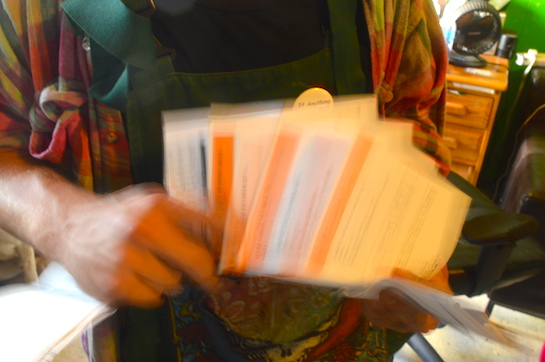
Chase pulled out a stack of citations an inch thick. They’re mostly from camping in Golden Gate Park, but other citations are peppered in as well, he said. Altogether they tally about $2,000.

“Now I have a lot of fines built up, I might have jail time, I don’t know. That’s just for four months of sleeping here,” he said. “In that time, I was coming [to Larkin] for services, I was going to counseling, getting my medical stuff. The cops would show me respect, shake my hand sometimes, but they’d still give me the ticket.”

Not all street kids want out, but Chase is tired of roaming. He says he kicked his heroin habit, and now spends his time educating himself in libraries and looking for a steady job. He dreams of becoming a librarian.

Most importantly, he’s seeking a permanent place to call home. But he’s in a hole he can’t dig out of: if he doesn’t find housing he’ll keep accruing camping citations, and finding housing is difficult as long as the citations burden him financially. Applying for certain types of housing can be difficult with the specter of criminal history hovering over you.

“Many programs turn people away who have warrants,” Jennifer Friedenbach, the executive director of the Coalition on Homelessness said. As citations go unpaid, youth are issued arrest warrants. And although some programs work to clear records of offenders, like the Public Defender’s Office’s Clean Slate program, camping violations are often infractions — Clean Slate advertises helping offenders reduce felonies to misdemeanors.

A San Francisco Civil Grand Jury report last year put the problem succinctly: “The current system of issuing citations for nighttime sleeping and camping in the Park has not been effective in reducing the number of park dwellers.”

Bevan Dufty, the director of the mayor’s homeless program, HOPE, said he understands the need to enforce the law, but that perhaps that enforcement is detrimental to permanent housing solutions.

“Citations more often than not result in a barrier to housing people,” he said. But camping citations are just one of many types of citations harrying the homeless, he said. Dufty told us of a young woman who is now 23, but has been homeless since she was 15. He went with her to court to try to minimize her many citations, which made her ineligible for some services.

“The fundamental goal,” he said, “should be trying to get people housed.”

Dufty said he would try to help Chase personally, and we’re now in efforts to connect them.

Chase may have many fines built up, but a pro bono attorney he met through Project Homeless Connect is helping him navigate the legal system. Recently, his effort to find housing and get a job have taken on a dangerous edge of necessity. Chase recently learned he is HIV-positive.

“I just found out six months ago,” he said. It’s forced him to make decisions about where to camp, based on his energy levels and proximity to services. “If I walk too much I’m not utilizing my food and energy properly.”

Many of the street kids are roamers, but for those like Chase who want to find permanency and stability, it can almost seem like the city is giving them a help up with one hand and pushing them back out onto the street with another.

But Chase maintains positivity about life.

“I was here a few months ago and someone had a telescope out here, we could see the nine moons of Jupiter lined up. It was powerful,” Chase said. “I have an empathetic viewpoint now that I’ve been through all this. I don’t have a choice.”

San Francisco’s untouchables

64

Rebecca@sfbg.com

In one sense, San Francisco’s homeless residents have never been more visible than they are in this moment in the city’s history, marked by rapid construction, accelerated gentrification, and rising income inequality. But being seen doesn’t mean they’re getting the help they need.

Not long ago, Lydia Bransten, who heads security at the St. Anthony’s Foundation on 150 Golden Gate, happened upon a group of teenagers clustered on the street near the entrance of her soup kitchen. They had video cameras, and were filming a homeless man lying on the sidewalk.

“They were putting themselves in the shot,” she said.

Giggling, the kids had decided to cast this unconscious man as a prop in a film, starring them. She told them it was time to leave. Bransten read it as yet another example of widespread dehumanization of the homeless.

“I feel like we’re creating a society of untouchables,” she said. “People are lying on the street, and nobody cares whether they’re dead or breathing.”

Condominium dwellers and other District 6 residents of SoMa and the Tenderloin are constantly bombarding Sup. Jane Kim about homelessness via email — not to express concern about the health or condition of street dwellers, but to vent their deep disgust.

“This encampment has been here almost every night for several weeks running. Each night the structure is more elaborate. Why is it allowed to remain up?” one resident wrote in an email addressed to Kim. “Another man can be found mid block, sprawled across the sidewalk … He should be removed ASAP.”

In a different email, a resident wrote: “The police non-emergency number is on my quick dial because we have to call so often to have homeless camps removed.”

It’s within this fractious context that the city is embarking on the most comprehensive policy discussions to take place on homelessness in a decade.

In 2004, city officials and community advocates released a 10-Year Plan to Abolish Chronic Homelessness. One only needs to walk down the street to understand that this lofty objective ultimately failed; people suffering from mental illness, addiction, and poverty continue to live on the streets.

Most everyone agrees that something should be done. But while some want to see homelessness tackled because they wish undesirable people would vanish from view, others perceive a tragic byproduct of economic inequality and a dismantled social safety net, and believe the main goal should be helping homeless people recover.

“The people living in poverty are a byproduct of the system,” said Karl Robillard, a spokesperson for St. Anthony’s. “We will always have to help the less fortunate. That’s not going to go away. But we’re now blaming those very same people for being in that situation.”

sabrina

Sabrina: “The streets can be mean.”

Guardian photo by Rebecca Bowe


HOMELESS MAGNET?

A common framing of San Francisco’s “homeless problem” might be called the magnet theory.

The city has allocated $165 million to homeless services. Over time, it has succeeded in offering 6,355 permanent supportive housing units to the formerly homeless. Nevertheless, the number of homeless people accounted for on the streets has remained stubbornly flat. The city estimates there are about 7,350 homeless people now living in San Francisco.

Since the city has invested so much with such disappointing results, the story goes, there can only be one explanation: Offering robust services has drawn homeless people from elsewhere, like a magnet. By demonstrating kindness, the city has unwittingly converted itself into a Mecca for the homeless, spoiling an otherwise lovely place for all the hardworking, law-abiding citizens who contribute and pay taxes.

That theory was thoroughly debunked in a Board of Supervisors committee hearing on Feb. 5.

“The idea of services as a magnet, … we haven’t seen any empirical data to support that,” noted Peter Connery of Applied Survey Research, a consultant that conducted the city’s most recent homeless count. “The numbers in San Francisco are very consistent with the other communities.”

He went on to address the question on everyone’s mind: Why haven’t the numbers decreased? “Even in this environment where there have obviously been a tremendous number of successes in various departments and programs,” Connery said, “this has been a very tough economic period. Just to stay flat represents a huge success in this environment.”

As former President Bill Clinton’s campaign team used to say: It’s the economy, stupid.


LIFE OUTSIDE

For Sabrina, it started with mental health problems and drug addiction. She grew up in Oakland, the daughter of a single mom who worked as a housecleaner.

“Drugs led me the wrong way, and eventually caught up with me,” she explained at the soup kitchen while cradling Lily, her Chihuahua-terrier mix.

“I had nothing, at first. You have to learn to pick things up. Eventually, I got some blankets,” she said. But she was vulnerable. “It can get kind of mean. The streets can be mean — especially to the ladies.”

She found her way to A Woman’s Place, a shelter. Then she completed a five-month drug rehab program and now she has housing at a single room occupancy hotel on Sixth Street.

“You don’t realize how important those places are,” she said, crediting entry into the shelter and the drug-rehab program with her recovery.

Since the 10-year plan went into effect, Coalition on Homelessness Director Jennifer Friedenbach told us, emergency services for homeless people have been dramatically scaled back. Since 2004, “We lost about a third of our shelter beds,” she explained. About half of the city’s drop-in center capacity was also slashed.

“Between 2007 to 2011, we had about $40 million in direct cuts to behavioral health,” she said at the Feb. 5 hearing, seizing on the lack of mental health care, one of the key challenges to reducing homelessness.

“The result of all three of these things, I can’t really put into words. It’s been very dramatically negative. The increase in acuity, impact on health,” she said, “those cannot be overstated.”

The need for shelters is pressing. The city has provided funding for a new shelter for LGBT homeless people and a second one in the Bayview, but it hasn’t kept up with demand. And for those who lack shelter, life is about navigating one dilemma after another, trying to prevent little problems from snowballing into something heinous.

Consider recent skirmishes that have arisen around the criminalization of homelessness. Department of Public Works street cleaning crews have sprayed homeless people trying to rest on Market Street. Sitting or lying on the sidewalk can result in a ticket. There are few public restrooms, but urinating on the street can result in a ticket. There are no showers, but anyone caught washing up in the library bathroom could be banned from the premises. Sleeping in a park overnight is illegal.

“The bad things that happen are when people don’t see homeless people as people,” said Bevan Dufty, the mayor’s point person on homelessness. “That’s the core of it — to be moved away, to be pushed away, citing people, arresting people.”

Friedenbach said the tickets and criminalization can ultimately amount to a barrier to ending homelessness: “You’re homeless, so you get a ticket, so they won’t give you housing, because you wouldn’t pay the ticket. And so, you’re stuck on the streets.”


ORDINARY EMERGENCIES

A man slumped over his lunch tray and fell to the floor. Within minutes, a medical crew had arrived on the scene, set up a powder-blue privacy screen, and cleared away a table and chairs to administer emergency care.

Throughout the dining hall, most continued lifting forkfuls of mashed potatoes, broccoli, and shredded meat to their mouths, unfazed. Volunteers clad in aprons continued to set down heaping lunch trays in front of diners who held up laminated food tickets. At St. Anthony’s, where between 2,500 and 3,000 hot meals are served daily to needy San Franciscans, this sort of thing happens all the time.

“A lot of our guests are subject to seizures, for one reason or another,” Robillard told me by way of explanation. Behind him, a pair of medics hovered over the man’s outstretched body, his face invisible behind the screen. “In almost all cases, they’re fine.”

Seizures are just one common ailment plaguing the St. Anthony’s clientele, a mix of homeless people, folks living on the economic margins, and tenants housed in nearby single room occupancy hotels.

Jack, an elderly gentleman with a gray beard and stubs on one hand where fingers used to be, told me he’d spent years in prison, battled a heroin addiction, and sustained his hand injury while serving in the military. He previously held jobs as a rigger and a train operator, and said he became homeless after his mother passed away.

St. Anthony’s staff members mentioned that Jack had recently awoken to being beaten in the head by a random attacker after he’d fallen asleep on the sidewalk near a transit station.

A petite woman with a warm demeanor, who introduced herself as Kookie, said she’d been homeless last August when she faced her own medical emergency. “I was in the street,” she said. “I didn’t know I was having a stroke.”

She’d been spending nights on the sidewalk on Turk Street, curled up in a sleeping bag. When she had the stroke, someone called an ambulance. Her emergency had brought her unwittingly into the system. At first, “They couldn’t find out who I was.”

She said she’d stayed in the hospital for six months. Once she’d regained some strength, care providers connected her with homeless services. Now Kookie stays at a shelter on a night-by-night basis, crossing her fingers she’ll get a 90-day bed. She’s on a wait-list to be placed in supportive housing.

Kookie unzipped a tiny pouch and withdrew her late husband’s driver’s license as she talked about him. Originally from Buffalo, NY, she lived in Richmond while in her early 20s and took the train to San Francisco, where she worked as a bartender. She’s now 60.

“When I was not homeless, I used to see people on the ground, and I never knew I would live like that,” she said. “Now I know how it is.”

kookie

Kookie: “I used to see people on the ground, and I never know I would live like that.”

Guardian photo by Rebecca Bowe

HOUSING, HOUSING, HOUSING

Way back in 2003, DPH issued an in-depth report, firing off a list of policy recommendations to end homelessness in San Francisco once and for all. The product of extensive research, the agency identified the most important policy fix: “Expand housing options.”

“Ultimately, people will continue to be threatened with instability until the supply of affordable housing is adequate, incomes of the poor are sufficient to pay for basic necessities, and disadvantaged people can receive the services they need,” DPH wrote. “Attempts to change the homeless assistance system must take place within the context of larger efforts to help the very poor.”

Fast forward more than a decade, and many who work within the city’s homeless services system echo this refrain. The pervasive lack of access to permanent, affordable housing is the city’s toughest nut to crack, but it doesn’t need to be this way.

At the committee hearing, Friedenbach, who has been working as a homeless advocate for 19 years, spelled out the myriad funding losses that have eviscerated affordable housing programs over time.

“We’ve had really huge losses over the last 10 years in housing,” she said. “We’ve lost construction for senior and disability housing. Section 8 [federal housing vouchers] has been seriously cut away at. We’ve lost federal funding for public housing. There were funding losses in redevelopment.”

A comprehensive analysis by Budget and Legislative Analyst Harvey Rose found the city — with some outside funding help — has spent $81.5 million on permanent supportive housing for the formerly homeless.

That money has placed thousands of people in housing. Nevertheless, a massive unmet need persists.


WAITING GAME

Following the hard-hitting economic downturn of 2008 and 2009, San Francisco saw a spike in families becoming homeless for the first time. Although a new Bayview development is expected to bring 70 homeless families indoors, Dufty said 175 homeless families remain on a wait-list for housing.

Yet the wait-list for Housing Authority units has long since been closed. And many public housing units continue to sit vacant, boarded up. Sup. London Breed said at a March 19 committee hearing that fixing those units and opening them to homeless residents should be a priority.

DPH’s Direct Access to Housing program, which provides subsidized housing in SROs and apartments, was also too overwhelmed to accept new enrollees until just recently. Since the applicant pool opened up again in January, 342 homeless people have already signed up in search of units, according to DPH. But only about a third of them will be placed, the results of our public records request showed.

Meanwhile, the city lacks a pathway for moving those initially placed in SROs into more permanent digs, which would free up space for new waves of homeless people brought in off the street.

City officials have conceptualized the need for a “housing ladder” — but if one applies that analogy to San Francisco’s current housing market, it’s a ladder with rungs missing from the very bottom all the way to the very top.

In the last fiscal year, HSA allocated $25 million toward subsidized housing for people enrolled in the SRO master-lease program. “It’s often talked about as supportive housing,” Friedenbach notes. “But supportive housing under a federal definition is affordable, permanent, and supportive.”

In SROs, which are notoriously rundown — sometimes with busted elevators in buildings where residents use canes and wheelchairs to get around — people can fork over 80 percent of their fixed incomes on rent.

“An individual entering our housing system should have an opportunity to move into other different types of housing,” Dufty told the supervisors. “It’s really important that people not feel that they’re stuck.”

Amanda Fried, who works in Dufty’s office, echoed this idea. “Our focus has to be on this ladder,” she told us. “If people move in, then they have options to move on. What happens now is, we build the housing, people move in, and they stay.”


START OF THE CYCLE

Homelessness does begin somewhere. For Joseph, a third-generation San Franciscan who grew up in the Mission and once lived in an apartment a block from the Pacific Ocean, the downward spiral began with an Ellis Act eviction.

After losing his place, he stayed with friends and family members, sometimes on the streets, and occasionally using the shelter system (he hated that, telling us, “I felt safer in Vietnam”). He now receives Social Security benefits and lives in an SRO.

Homelessness is often a direct consequence of eviction. Last year, the city allocated an additional $1 million for eviction defense services. Advocates hope to increase this support in the current round of budget talks. The boost in funding yielded measurable results, Friedenbach pointed out, doubling the number of tenants who managed to stave off eviction once they sought legal defense.

There’s also a trend of formerly homeless residents getting evicted from publicly subsidized housing. Since 2009, the Eviction Defense Collaborative has counted 1,128 evictions from housing provided through HSA programs. Since most came from being homeless, they are likely returning to homelessness.

Dufty said more could be done to help people stay housed. “Yes, we’re housing incredibly challenged individuals. And we have to recognize that allowing those individuals to be evicted, without the city using all of our resources to intervene to help that person, that’s not productive,” he said. “It’s debilitating to the person. It’s just not good.”

Fried said the city could do more to provide financial services to people who were newly housed. “You were homeless on the street — you know you didn’t pay some bill for a long time. Really that’s the time, once you’re housed and stable, to say, ‘let’s go back and pull your credit.’ Once we have people in housing, how are we increasing their income?”

Gary

Gary: “If I knew how to fix it, I would.”

Guardian photo by Mike Koozmin

SEARCH FOR SOLUTIONS

The reopening of [freespace], a community space at Sixth and Market temporarily funded by a city-administered grant, attracted a young, hip crowd, including many tech workers. A girl in a short white dress played DJ on her laptop, against a backdrop where people had scrawled their visions for positive improvements in the city. Some of the same organizers are helping to organize HACKtivation for the Homeless, an event that will be held at the tech headquarters of Yammer on March 28. The event will bring together software developers and homeless service providers to talk about how to more effectively address homelessness.

“The approach we’re talking about is working with organizations and helping them build capacity,” organizer Ilana Lipsett told us. The idea is to help providers boost their tech capacity to become more effective. And according to Kyle Stewart of ReAllocate, an organization that is partnering on the initiative, “The hope is that it’s an opportunity to bridge these communities.”

Other out-of-the box ideas have come from City Hall. Sup. Kim, who stayed at a homeless shelter in 2012 during a brief stint as acting mayor, said she was partially struck by how boring that experience was — once a person is locked into a shelter, there is nothing to do, for 12 hours.

She wondered: Why aren’t there services in the shelters? Why isn’t there access to job training, counseling, or medical care in those facilities? Why are the staffers all paid minimum wage, ill-equipped to deal with the stressful scenarios they are routinely placed in? Her office has allocated some discretionary funding to facilitate a yoga program at Next Door shelter, in hopes of providing a restorative activity for clients and staff.

More recently, Sup. Mark Farrell has focused on expanding the Homeless Outreach Team as an attempt to address homelessness. Farrell recently initiated a citywide dialogue on addressing homelessness with a series of intensive hearings on the issue. He proposed a budgetary supplemental of $1.3 million to double the staff of the HOT team, and to add more staff members with medical and psychiatric certification to the mix.

But the debate at the March 19 Budget and Finance Committee hearing grew heated, because Sup. John Avalos wanted to see a more comprehensive plan for addressing homelessness. “I’m interested in people exiting homelessness,” he said. “I’d like there to be a plan that’s more baked that has a sense of where we’re going.”

Farrell was adamant that the vote was not about addressing homelessness in the broader sense, but expanding outreach. “We have to vote on: do we believe, as supervisors, that we need more outreach on our streets to the homeless population or do we not?” he said.

Sup. Scott Wiener defined it as an issue affecting neighborhoods. “When we’re actually looking at what is happening on our streets, it is an emergency right now,” he said. “It’s not enough just to rely on police officers.”

When other members of the board said homeless advocates should be integrated into the solution, Wiener said, “The stakeholders here are not just the organizations that are doing work around homelessness, they are the 830,000 residents of San Francisco … It impacts their neighborhoods every day.”

Asked what she thought about it, Kim told us she believed sending more nurses and mental-health service providers into the city’s streets was a good plan — but she emphasized that it had to be part of a larger effort.

“If you’re just going to increase the HOT team, but not services,” she said, “then you’re just sending people out to harass homeless people.”


STILL OUT THERE

Mike is 53, and he’s lived on the streets of San Francisco for five years. He was born in Massachusetts, and his brothers and sisters live in Napa. We encountered him sitting on the sidewalk in the Tenderloin. “I don’t like shelters,” he explained. “I got beat up a couple times, there were arguments.” So he sleeps under a blanket outside. “It’s rough,” he said. “I do it how I can.”

A few blocks away we encountered Gary, who said he’s been homeless in San Francisco for 17 years. He was homeless when he arrived from Los Angeles. He said he’d overdosed “a bunch of times,” he’s gone through detox five times, and he’s been hospitalized time and again. “Call 911, and they’ll take care of you pretty good.”

Gary is an addict. “If I knew how to fix it, I would,” he said. “Do yourself a favor, and lose everything. It’s like acting like you’re blind.”

Gary and Mike, chronically homeless people who have been on the streets for years, are HOT’s target clientele. “My slice of the pie is the sickest, the high-mortality, they’re often the ones that are laid out in the street,” said Maria Martinez, a senior staff member at DPH who started the HOT program.

“I went through years of the 10-Year plan,” she added. “Do I feel like I could take this money [the HOT team supplemental] and do something effective with it? Yes. Do I think there’s a lot of other things that we could address? Yes.”

Pressed on what broader solutions would look like, she said, “There has to be an exit into permanent housing. I’ve seen that we’ve been creative around that. We can make lives better. I say that vehemently. And permanent housing is critical to exiting out of homelessness.”

Mike

Guardian photo by Mike Koozmin

Draining the tank

0

rebecca@sfbg.com

When University of California Berkeley students Ophir Bruck and Victoria Fernandez first made contact with the University of California Board of Regents, it was a far cry from the genial hobnobbing they engaged in over lunch at the March 19 Regents meeting in San Francisco, as special guests called Student Advocates to the Regents.

About a year ago, they were outside a Regents meeting in Sacramento and, joined by about 60 other students, symbolically locked to a pair of handmade, 10-foot-tall models of oil rigs they’d set up outside the conference center.

“The idea was the symbolism of us being chained to an extractive economy that’s not sustainable,” Bruck explained to us. The message they hoped to impart to the Regents was: “They have the keys to our fossil freedom.”

Taking advantage of the public comment session to get their point across, the students were there to call on the Regents to withdraw UC investment holdings in companies such as Exxon, Chevron, BP, and other leading fossil fuel companies. The campaign, Fossil Free Cal, is just one of dozens of student-led efforts nationwide seeking to convince campus administrations to withdraw funds from oil and gas companies as a way of curbing greenhouse gas emissions and fighting climate change.

Some local institutions of higher education have already committed to divestment from fossil fuels. Oakland’s Peralta Community College District, the Foothill-DeAnza Community College Foundation, and the San Francisco State University Foundation have made commitments to divest.

But other prominent schools have declined. Last October, Harvard University announced that it would not honor students’ request to withdraw investment holdings from the fossil fuel sector, saying such a move would “position the university as a political actor rather than an academic institution,” and could “come at a substantial economic cost.” A student effort to have Brown University divest from fossil fuels also went down the tubes.

Divestment by California’s flagship public university system would have a significant impact. UC Berkeley’s endowment is $3 billion, while the total UC system endowment is $11 billion. Fossil Free Cal organizers estimate that about 5 percent of that money is tied up in the fossil fuel sector.

Beginning with the kickoff to their divestment campaign at that first Regents’ meeting in Sacramento, the students’ message seems to have resonated. In the time since, they’ve attended every Regents meeting, met individually with certain board members, submitted reports in support of divestment, and earned an official endorsement from the UC Students’ Association, a student government that spans all UC campuses. Some individual regents have been receptive — but so far, the powerful UC governing board has not seriously taken up the question of divestment.

“We’re worried about what our future looks like, and what they are doing with our money,” Fernandez said. “We’re saying, if we’re invested in fossil fuels, we’re inherently invested in the destruction of students’ future.”

Nationwide, the campaign to divest from fossil fuels is a proactive, youth-led movement hinged on a moral argument: Since climate scientists have said it is dangerous to continue burning fossil fuels at current rates, universities have an ethical obligation to withdraw support from those corporations sticking to existing business models for extracting and burning fossil fuels.

To argue their case, the students are highlighting a quandary. There’s global scientific consensus that burning fossil fuels is the reason climate change is occurring, and this has led the international community to take action. In 2010, members of the United Nations agreed to take steps to prevent an average global temperature increase above 2 degrees Celsius.

But according to a 2012 report issued by the Carbon Tracker Institute, a London-based think tank, the amount of carbon stored in reserves by the world’s leading 200 leading fossil fuel companies is enough to trigger that temperature increase five times over, if all the reserves were extracted and burned. That would severely alter the global climate with dangerous and irreversible impacts, according to climate modeling scenarios.

To lessen that damage, students are advising their campus administrators to withdraw from fossil fuels, arguing that it makes good business sense. Internationally, some economists have begun referring to a “carbon bubble,” with Green Party members of the European Parliament releasing a study last month to warn of the effect it could have on the pension funds, banks, and insurance companies in the European Union.

Even with the dawning realization that fossil fuel companies’ holdings can’t be burned if the international community is to meet its goals to fight climate change, the UC Regents have yet to make any clear indication on whether they will continue to keep millions of dollars tied up in that sector.

“All successful student movements took sit-ins and mass mobilizations,” Bruck said during an interview at UC Berkeley’s Free Speech Café, named for the historic campus movement.

It may well go there, but at this stage, organizers are still hoping the Regents will take leadership in response to their campaign. Specifically, they’re pushing for UC to drop all existing investments in fossil fuel companies over the next five years, and roll out a climate change investment strategy.

On April 4, organizers behind this effort will host 300 students representing 100 schools from across the United States and Canada, for a conference on the fossil fuel divestment movement. The two-day strategy session, which will be held at San Francisco State University, aims to strengthen the youth-led movement to fight climate change by getting at the economic root of the problem, through divestment.

“Our goal is divesting in the next two semesters,” Fernandez said. But since students cycle out of the universities over four years, and Regents are appointed for terms lasting 12 years, she realizes accomplishing this goal might mean relying on newly engaged students: “Maybe our freshmen right now will have to bring it home.”

SFPD to answer questions on fatal shooting of Alejandro Nieto

San Francisco Police Chief Greg Suhr will be on hand this evening [Tue/25] for a town hall meeting to discuss last week’s officer-involved shooting in Bernal Heights Park. The shooting victim, 28-year-old Alejandro Nieto, was a City College of San Francisco student, a Latino, and Bernal Heights resident who had hoped to become a youth probation officer.

Just before sunset last night [Mon/24], a group of about 150 friends, family members, and community supporters gathered for a vigil at the spot where he was gunned down by multiple police officers.

The community members lit candles, sang, burned incense, and conducted Buddhist chants in honor of his spiritual practice. Those who knew Nieto, whom they called Alex, described him as caring, ambitious, and committed to nonviolence.

“He was such a bright person,” said Ben Bac Sierra, an author and instructor at City College who knew Nieto through shared ties in the neighborhood. Nieto had been helping Bacsierra organize community events and book readings, he said. They’d rolled down Mission Street together in a classic low-rider for a parade, shouting “si se puede!” while onlookers cheered them on.

Torrance Bynum, former dean at City College’s Evans and Southeast Center campus and a former instructor of Administration of Justice, described himself to the Bay Guardian as Nieto’s mentor. “I would give him rides home from class,” he said. Nieto would stop by to visit him, and “if I was in a meeting, he would wait for me.” Bynum said he’d phoned Nieto on his birthday just a few weeks ago, March 4.

On Monday night, major questions still lingered about the events leading up to Nieto’s death.

A statement issued by the SFPD on March 21, about three hours after the shooting, said officers had arrived at the park in response to “911 calls of a male subject with a gun.” Police “encountered a male subject with a weapon,” the statement went on. “The male subject pointed a weapon at the officers, and multiple officers discharged their firearms.” (In an interview with the San Francisco Chronicle, Deputy Police Chief Lyn Tomioka indicated that he “appeared to draw a weapon.”) He was pronounced dead, the statement noted, “and an additional weapon was found.”

In the days following the shooting, however, friends and family members told reporters that Nieto had a stun gun, not a firearm, because he worked as a security guard at a nightclub. They also said Nieto was peacefully eating a burrito just before the shooting occurred.

According to California Bureau of Security and Investigative Services records, Nieto obtained registration to work as a guard/patrolperson in June of 2007, and obtained a permit to carry a baton in September of 2013. Security guards must complete a 40-hour course of required training before registering with the state.

A report in the San Francisco Chronicle suggested that just before the shooting, Nieto was “acting erratically and threatening passersby,” quoting an unnamed witness who said a man had threatened his dog with a “pistol-type stun gun” and yelled profanities. It also referenced a past incident involving Nieto’s alleged use of a stun gun.

A person who declined to be named told the Bay Guardian that about half an hour before the shooting occurred, two men who were walking down the pedestrian pathway on the north slope of Bernal Heights Park alerted a jogger that there was a man ahead wearing a gun on his hip.

They told the jogger that they had called the police. The jogger, who was about 50 feet from the man and started moving away from him after receiving the warning, was too far away to see whether he had a weapon but noticed that he was “pacing back and forth” and “air boxing.”

When the Bay Guardian phoned the SFPD to ask what sort of weapon had been discovered, Sgt. Danielle Newman said she could not release that information.

“He was never arrested in his life,” Bac Sierra said of Nieto during the vigil. “He wanted to be a good person – and he was.”

Bac Sierra later told the Bay Guardian he’d first heard the news Saturday night, and spoke with members of Nieto’s family the following day. The family was not notified of what happened until 3pm the day after the shooting, he said. The report was that Nieto had been shot 14 times.

Sup. John Avalos, who represents the Excelsior District, said he had worked with Nieto in the past and knew him from Coleman Advocates for Children & Youth. “I was making sure that his life was going in a positive direction, and what we saw in Alejandro was that he had a really big heart,” Avalos said at last night’s vigil. “He gave it to a lot of people, and often probably didn’t give it enough to himself.”

He added, “Blood’s been shed, in this case, by people we’re supposed to trust. But … we have a lot of difficulty trusting our police, because from time to time these things happen.”

Avalos also mentioned that when it comes to dealing with subjects who are mentally ill, SFPD has an established protocol. Under a program that began in 2011, specially trained officers with the department’s Crisis Intervention Team are to be dispatched to the scene when calls involve a mentally ill individual.

At tonight’s meeting, Suhr is expected to answer questions from community members. Friends and supporters of Nieto are still in shock from the news.

“I don’t know what it’s going to take, but I think all of us here should call on the Office of Citizen Complaints, and make sure they do an investigation,” Avalos said. “We need to make sure that the officer who – I really hope, despite all the shots that were fired, are having trouble with their consciences right now. Because taking anybody’s life, or hurting anyone in such a way, is unconscionable. This young man, he deserves that from all of us, to make sure the senseless taking of his life was not done in vain, that it leads to something better.”

Avalos said he was also there on behalf of Mission District Sup. David Campos, who was unable to attend because he was in a hearing.

The SFPD town hall is scheduled for 6pm at Leonard Flynn Elementary School, located at 3125 Cesar Chavez Street.

Bac Sierra urged everyone gathered at the vigil to attend the town hall meeting. “Those cops have to feel this,” he said. “This neighborhood has to feel this.”

Uber’s secret, “proprietary” insurance policy leaked

182

An anonymous leaker emailed Uber’s previously secreted, hidden insurance plans to the Bay Guardian and a number of taxi industry advocates over the weekend, and who is and who is not insured by Uber may give riders cause for worry.

The insurance policy describes exclusions, limits, and explicit descriptions of who is insured, all details that evaded the public, the taxi industry, and some regulatory bodies trying to investigate Uber and its insurance coverage.

Uber confirmed with the Guardian that the leaked policy was legitimate, but did not directly answer our questions about the consequences of it being leaked.

William Rouse, general manager of Los Angeles Yellow Cab and a former president of the Taxicab Association, said the insurance document raised some troubling questions.

The first problem lies in a semantics game the company may use to distance itself from paying out insurance, he said. “Uber is insuring through Rasier LLC, but contractually drivers contract with Uber. They state in the policy that it kicks in only when Raiser is liable. What we have here is a shell game. Who is Rasier?”

Uber is the parent company of Rasier, Andrew Noyes, an Uber spokesperson, told us. But how listing Rasier versus Uber as the main insurance carrier will affect insurance claims down the road remains to be seen. 

Exclusions in the policy are many, such as one for the “movement of property by mechanical device.”

It states: “‘Bodily injury’ or ‘property damage’ resulting from the movement of property by a mechanical device (other than a hand truck) unless the device is attached to the covered ‘auto’” is excluded from coverage. Spokesperson Andrew Noyes said this exclusion deals with unloading and offloading of material from a vehicle via a pallet jack or forklift.

One wonders what exclusion Uber used to argue against insurance payment in an incident last year, when a driver using Uber drove into a fire hydrant, which flew 81 feet down Divisadero and landed on a woman named Claire Fahrbach. The resulting geyser flooded several nearby businesses. Fahrbach is suing Uber for medical coverage, litigation that is still ongoing. 

Many revelations from the document are sure to come, and the Guardian will seek analysis from insurance industry experts on the leaked document.

hydrant

Uber’s insurance practices came under sharp investigation after the New Year’s Eve death of six year old Sofia Liu, who died after a collision with a car driven by a driver who had been using the Uber app.

“We have not made the policy — in its entirety — public,” Noyes wrote to us. But now that Uber’s insurance policy is released, advocates and the public can openly discuss the legitimacy and reach of Uber’s insurance. 

San Francisco. New York. Seattle. Cities and states across the country are grappling to regulate the so called rideshare companies, known legally as Transportation Network Companies, such as Uber, Sidecar and Lyft.

The municipalities grappled with many questions: who pays the medical bills, the fees to repair or replace damaged autos, or pay for the damage to property in an car accidents with Uber vehicles? A number of lawsuits filed against Uber so far show that the company has been unwilling to pick up the tab.

At a state insurance hearing in Sacramento last week, the personal automobile insurance industry blasted Uber for shifting some insurance liability onto its drivers’ personal insurance policies.

“It is well documented and publicized that the business model does attempt to shift the cost and the risk to the drivers personal auto insurance,” said Armand Feliciano, the vice president of the Association of California Insurance Companies. But personal insurance is not for people driving what is essentially a taxi cab, he said.

“The risks are fundamentally different,” Feliciano said to the state insurance commissioner. Rideshare companies need to “step up and be the insurers of their drivers. That’s the right policy decision.”

Uber has repeatedly stated they do not want their insurance policy revealed to the public.

“We have spent a great deal of time and effort acquiring this policy and do not share it publicly for competitive reasons,” Noyes told the Seattle Times earlier this month.

When we repeatedly asked him if it was troubling to Uber that their insurance policy was leaked, despite public affirmations that it remain private, Noyes wrote to us “not sure what you mean.” 

The California Public Utilities Commission directly regulates rideshares, or Transportation Network Companies, is one of the few regulatory bodies to have a copy of the policy, but so far it has declined to distribute it openly.

We contacted the CPUC for clarification as to why they withheld the documents, but they asked for more time to get back to us, and did not reply before press time. 

Now that’s changed. We’re embedding Uber’s insurance policy below. If you have any analysis, tips or concerns, please email us at news@sfbg.com

Leaked Uber Insurance Policy by FitztheReporter


The sordid saga of Airbnb — a $10 billion “outlaw middleman” — continues

103

SF-based Airbnb is making news again this week, from the San Francisco Chronicle following up our stories about how landlords are sending eviction notices to tenants who are breaking their leases and local laws in using the short-term rental services to national outlets trumpeting Airbnb’s estimated $10 billion in valuation, which is more than some of the biggest hotel chains.

But nobody seems to be calling out how those two things are connected, except perhaps in ValleyWag’s passing but spot-on reference to the SF-based company as an “outlaw middleman.” That’s a good label for a scofflaw company that is making buckets of money by openly flouting tenant and tax laws in San Francisco, New York City, and other cities around the world.

Meanwhile, as the City Attorney’s Office continues preparing to take legal action against Airbnb, new companies are popping up to make it even easier for residents to illegally monetize their rent-controlled apartments, such as AirEnvy.com, which encourage people to “profit from your home or apartment by renting out unused space through a full service management marketplace.”

The company charges people 18 percent to manage their Airbnb rentals, checking guests in and out, cleaning up, and whatnot. And most of its testimonials are from San Franciscans, such as Rob, who writes, “I used to spend hours managing my Airbnb, exchanging keys with guests, and cleaning. Now, Airenvy does all that for me.”

Breaking local laws against short-term rentals has never been easier! All this infuriates Janan New of the San Francisco Apartment Association, who tells the Guardian that more than 1,100 rent-control apartments are listed on Airbnb at any time, and she’s been working with landlords to identify and evict such tenants.

Yet she denies that many landlords are using Airbnb to get around rent-control laws — such short-term rentals are also usually illegal, even for owners — and told us, “If people are breaking the law on our side, I want to know who it is.”

And as this highly lucrative clusterfuck continues, Board of Supervisors President David Chiu is still mired in his year-long efforts to create a legislative remedy for all of this. But Airbnb seems to be taking its local political problems seriously, this week hiring David Owen — a well-connected former legislative aide to Chiu’s predecessor, Aaron Peskin — away from Platinum Advisors to work on public policy for the company.

Stay tuned, folks, there’s lots more to come on an issue that the Guardian started covering years ago when few were paying attention to how an illegal business model was being used to create a multi-billion-dollar company.   

“These stories are ours, too” — South Asian women’s collective celebrates a decade of ‘Yoni Ki Baat’

20

Growing up in San Francisco, I was never sheltered from sexuality. Whether it was the naked runners at Bay to Breakers or the same-sex lovebirds kissing on street corners, there has always been an honest dialogue about love, sex, and gender in my hometown. But that makes it easy to take for granted.

For over a decade, the South Asian Sisters, a Bay Area arts collective, has been cultivating a community of diverse and progressive women of South Asian origin who want to talk openly about sex. While to many outsiders India is the land of Kama Sutra and tantric sex, to those who grew up in South Asian communities, the openness just isn’t there. Talk of sexuality comes in the form of rumors, whispers, and shameful glances, explains Vandana Makker, a member of the South Asian Sisters.

In a grassroots effort to build a candid conversation about these taboo issues, South Asian Sisters has grown into a national movement inviting an open discussion of gender and sexuality — empowering women of South Asian descent across the country. Their efforts come to a head with the yearly rendition of Yoni Ki Baat, a live performance of Vagina Monologues-inspired sketches. The show is comprised of a dozen or so performances by South Asian Sisters, all aimed at bringing light to the silent oppression that’s been going on in South Asian culture for centuries.

This weekend’s shows, on March 22 and 23, will mark Yoni Ki Baat’s 10th Anniversary with three special performances at the iconic and historic Women’s Building in the Mission. Whether painful, funny, disturbing, or powerful, each performance furthers the honesty so vital to these women. I reached out to the diverse women from the South Asian Sisters collective to better understand what this project means to them. 

SF Bay Guardian Why is Yoni Ki Baat important to you?
 

Creatrix Tiara: Born and raised in Malaysia, I found it difficult to find a community of people who were willing to talk about issues like gender, sexuality, and race openly and freely — especially as a Bangladeshi, a much-maligned racial minority in Malaysia. Joining YKB was really refreshing and helpful in finding people who could relate to feeling liminal in those areas — having to navigate cultural norms versus wider societal taboos and stereotypes, never quite fitting in one world or another. People don’t tend to associate South Asians with a lot of issues around gender and sexuality. How can South Asians be kinky? Queer? Into masturbation in strange places? Unthinkable. YKB shows that hey, these stories are ours too, no matter what anyone says.

Micropixie: Growing up in London at the time that I did, and then later moving to Paris, and then back to the UK, I did not have a community of progressive, feminist, radical South Asian women around me. In fact I did not know such a type of woman even existed until I moved to San Francisco 10 years ago. It was wonderful to see my first Yoni Ki Baat 7 years ago and then later join the team of organizers. I love the stories and relate to all of them even those that do not pertain to my personal experience. But I especially love the women in the show, both the performers and the writers…talking about sex, sexuality, and actually so much more. It’s a brave thing we are doing, and for some of the girls it’s the first time they are on stage; personally, my own family was horrified!

ykb

Indira Chakrabarti: The show is especially important to me since I wrote for the first show a decade ago! Then, I wrote and performed for the second one. It is so meaningful to me to be back. I fell out of touch for a variety of reasons but have always believed in the importance of providing this space for women, especially South Asian Women, to have their true voices heard.

Anjali Verma Ruvalcaba: When I first auditioned for YKB I was a 20-year-old college student at UC Berkeley with a newly shaved head. I was already facing stigma and criticisms from both family and friends for wanting to experiment and “discover myself,” so to say that I was nervous going in to it is definitely putting it mildly. Once I got there I was welcomed by such open, kind, genuine, friendly, and loving faces that I knew I had found a very sacred place to call my own, finally, and I haven’t looked back since as this will be my 9th year performing. YKB gave me my first and only set of older sisters to look up to, who understood me, accepted me, inspired me, and kept challenging me to strive for my goals, and whether near or far now, they have all helped mold me into the stronger more honest and more grounded version of my self that I am today, for which I’ll be eternally grateful.

Amruta: There are not many spaces where we, as women, are free to speak within and from our cultural context—where we are best understood, especially if this context involves one or more terribly different cultures. Within this rich diversity, each of us represents an intersection of colors, cultures, places and languages. To have this opportunity, to be yourself amidst this diversity, and at the same time to once a year slip into another’s skin and extend our empathy, is rare. YKB is an invaluable space where we have this opportunity to present, from a woman’s perspective, the multiplicity of the South Asian diaspora.

Barnali Ghosh: The pieces in YKB challenged my assumptions of who South Asian women are as well as assumptions I had about myself and what I was capable of when it came to speaking about these taboo issues. I have met and become friends with so many brave women through being part of the production. Performers are both amateurs and professionals and often women for whom it is the first time doing any kind of performance. There is no director and the cast provides the feedback, support and guidance that allow all of us to find our voice. This kind of non-hierarchical process is not something most of us are used to. But if we trust in it, it works out most of the time and in the case of YKB, in mind-blowing ways.

Neha Shah: I was thrilled to discover YKB about five years ago. I was in Washington, D.C. then, brought my mom to the show where I performed someone else’s piece. Her attending the show was a turning point in our evolving relationship and her realization that I am being an independent young woman. I think it broke the awkward barriers that are typical of Indian parent-child relationships where you just don’t discuss dating and sex.

ykb

SFBG What are you most excited about for the 10th anniversary performance of Yoni Ki Baat?

Creatrix Tiara: The piece I’m performing [The Word of Violence] is one of the earliest pieces in YKB’s history, but the writer has never been able to see it performed live. She’ll be attending this show and will see it performed for the first time. It’s nerve-racking but I hope I am able to give her piece the love and justice it deserves!

Anjali Verma Ruvalcaba: I am excited to simply be celebrating this with everyone who’s written, performed, and witnessed the show. There’s a lot of heart, blood, sweat, and tears that goes into this year after year. It’s all 110 percent volunteer-driven and based, which I can’t even begin to express how thankful I am because without that drive, or passion, we cannot build the emotional space needed to support one another through this process and then convince folks of our stories, be they ours or someone else’s, on stage for the world to see.

Bernali Ghosh: For me personally, I am excited about reprising a funny piece I did 2 years ago. Before I performed it for YKB I didn’t know that I could do humor as a performer. Humor can be really important to healing and way to balance some of our more serious topics, so I am looking forward to sharing laughs with the audience again!

Vandana Makker: Each piece holds a special memory for me, and it’s like looking through an old family photo album and reminiscing about all the things we’ve been through. I’m so proud of the show and what it’s grown to become and can’t wait to give it a proper birthday party.

Amruta: Yoni Ki Baat is the simple message emerging from this dizzying diversity. I am excited to be part of this established tradition that has repeatedly brought to the fore an array of experiences with which we can all empathize

Indira Chakrabarti: I’m anxious and nervous to perform my piece after a decade-long hiatus but am so cozy in a warm hug of support and encouragement from my sisters.

Neha Shah: This an amazing milestone for the movement. Social change via the arts is a necessary and effective way to bridge disparate ideologies—the diversity of voices that YKB has brought together is not a small feat. It reminds me of my favorite quote: “Never doubt that a small group of thoughtful, committed citizens can change the world. Indeed, it is the only thing that ever has.”

Yoni Ki Baat 10th anniversary shows

Sat/22, 6:30pm; Sun/23, 12:30pm (this show open to those who self-identify as female) and 5pm
$15 advance, $20 at the door
Women’s Building
3543 18th St, SF
Yoni Ki Baat online


Seeking technology and economic/social justice columnists

78

The Bay Guardian is looking for a pair of new freelance writers to do separate monthly columns covering the technology industry and economic/social justice issues. The two new columns would go into a rotation we’re tentatively calling Soul of the City, along with Jason Henderson’s Street Fight column and a new environmental column by News Editor Rebecca Bowe that we’ll debut in our Earth Day issue.

For the technology column, we want someone with a deep understanding of this industry, its economic and personality drivers, and the role it could and should play in the civic life of San Francisco and nearby communities. We aren’t looking for gadget reviews or TechCrunch-style evangelizing or fetishizing of the tech sector, but someone with an illuminating, populist perspective that appeals to a broad base of Guardian readers. 

The other column, on economic and social justice issues, would cover everything from housing rights to labor to police accountability issues, with an eye toward how San Francisco can maintain its diversity and cultural vibrancy. We want someone steeped in Bay Area political activism and advocacy, but with an independent streak and fearless desire to speak truth to power.

We envision the columns running on a monthly rotation at around 1,100-1,400 words each, with the potential to sometimes run longer and to even be featured on our cover when circumstances warrant. Columns can focus on a single issue or multiple items. Pay is 10-15-cents per word depending on the depth of reporting required. We strongly encourage candidates of color, young people, and those representing communities that need a stronger voice in the local political discourse to apply.

If you’re interested, please sent your qualifications and concepts, along with one sample column and ideas for future columns, to Editor-in-Chief Steven T. Jones at steve@sfbg.com. Help us escalate this fight for the soul of the city by adding your voice to the Guardian’s mix.    

Bicycling and equity: Heed the call, expand the movement

87

STREET FIGHT In the face of increased gasoline prices and congestion, more public awareness of the relationship between greenhouse gas emissions and driving, and interest in physical activity, bicycling has experienced a mini-boom throughout the US. Chicago, Minneapolis, New York, Pittsburgh, Portland, Seattle, Washington, DC, and many smaller university cities, such as Boulder and Madison, have seen impressive increases in utilitarian bicycling.

In San Francisco, 3.5 to 6 percent of all trips are made by bicycle, amounting to roughly 150,000 bicycle trips in the city each day, a jump from around 1 percent of trips in the 1990s. The majority of these trips are for utilitarian purposes such as shopping and commuting, not recreation. Stand on Market and 10th streets on any weekday and you’ll see that bicycling has surged in San Francisco. In parts of Hayes Valley, the Mission, and Upper Market, over 10 percent of commuting is by bicycle. The city’s official goal — 9 percent of all citywide trips by 2018 and 20 percent in the next decade — is important for making San Francisco more livable.

But it’s also fundamental for making San Francisco more equitable. That’s right, equitable.

In many respects, bicycling is among the most equitable forms of urban transportation because it is affordable and accessible to almost everyone. Bicycling is far cheaper, safer, healthier, and cleaner than driving, and when considering global equity, far saner for a national climate policy. And for many low income workers, bicycling is also an affordable conveyance that enables not just physical mobility but also financial stability.

Indeed, US Transportation Secretary Anthony Foxx points out that nationally, a third of all bike trips are made by adults making under $30,000 and that the bicycle can have a substantial role in reducing the overall cost of living for the working class. But unfortunately lower class, non-white cyclists are also more likely to be in fatal collisions.

Speaking at the annual National Bicycle Summit in Washington, DC, earlier this month, Foxx, an African American former mayor of Charlotte, N.C., said that the federal government needs to devote more attention to making bicycling part of everyday life for the working class. Emphasizing the need for safety and convenience, Foxx was especially enthused about cycletracks — bikeways that are fully separated from automobiles and offer space for women, children, and older Americans to safely navigate cities by bike.

Foxx’s address followed a day of equity-themed panels and plenaries attended by more than 700 people. The League of American Bicyclists, focused on lobbying Congress and the White House, announced a new equity agenda to reach out to women, people of color, and to focus on reinvigorating a more progressive and egalitarian tone for bicycle advocacy.

Social justice advocates and community organizers had a strong presence at the summit, which has historically reflected a whiter, upper-middle-class male constituency. One presenter discussed bicycling and women’s prison rehabilitation, sharing how women who suffered from abuse, drug addiction, and imprisonment found bicycle riding to be normalizing and helpful for personal growth and for managing depression and anxiety.

A panel session titled “Learning from Los Angeles” showed how advocacy for bicycling can also come from community-based organizations, not just bicycle groups. Social justice issues are fundamental to LA’s inner city bicycle movement; over a third of South Central Los Angeles households are car free, and community organizers there have made a clearer connection between economic inequity and environmental problems.

Advocates from New York City chimed in that it was time for a “minority bicycle coalition” to advocate for women, minorities, and immigrant bicycle delivery workers. They pointed out that New York’s new and much-vaunted bike infrastructure has mainly spread in more affluent, white parts of Manhattan and Brooklyn, while Queens is overlooked. A speaker from the NAACP put obesity and public health at the center of the civil rights agenda and remarked on how the bike lifestyle should be brought to African American neighborhoods.

A discussion of emerging bike share systems asked how to expand to minority populations, and provided examples of how Boston subsidizes bike share membership for low income members. Boston also relaxes the charges for exceeding 30-minute rides and is figuring out ways to enable those without credit cards to participate.

Once a cynic about bike share, I experienced firsthand the benefits of a truly extensive, practical bike share system in Washington, DC (note to San Francisco — it was NOT covered in Wells Fargo or Google corporate logos). If bike share is extended to the Excelsior, Bayview, Balboa Park, Daly City, and SF State, it will work for the working class and students.

One of the most inspiring personas at the Bike Summit was Terry O’Neill, director of the National Organization for Women, who asked that bicycle advocates get beyond simply advocating for bikes. O’Neill prodded cyclists to ask: What do we need to do to make bicycling useful to women? And then she laid it out eloquently. Build affordable housing — lots of it — in areas where it is most needed, such as affluent Montgomery County, a suburb of DC, or in places like Hayes Valley and Silicon Valley. By creating the spatial proximity that makes cycling practical, women (and men) can incorporate cycling while balancing jobs, household chores, and children. This would do more to increase bicycling (and equity) than simply striping new bike lanes.

Her point is that for cycling to be logical for women, especially in complex metropolitan areas like DC or the Bay Area, well-planned and centrally located affordable housing is key. Perhaps it is time for the San Francisco Bike Coalition and Silicon Valley Bike Coalition, with their wealth of talent and donors, to create staff positions focusing on the bicycle-housing nexus and build strong partnerships with those who are fighting to build and preserve affordable housing in job- and amenity-rich areas.

Dovetailing from that, the newly elected mayor of Pittsburgh, Bill Peduto, himself a convert to bicycling, urged bicycle advocates to be an active partner in local progressive political coalitions and to work with non-bike groups such as labor unions and housing advocates. Peduto was among a handful of prominent politicians, mostly mayors and members of Congress, espousing the wisdom of linking bicycling and equity as part of the urban agenda.

The overall message is clear. Cities need to move beyond the neoliberal creative class storyline about bicycling, which says that a successful city is one that has a youthful, fit, but affluent stratum for bicycles. We need to be careful about praising the bicycle as a profitable economic development strategy for Realtors who up the rent as part of a commodified package of livability.

Sure, it’s great to see a bike lane on mid-Market, and there should definitely be more. But a successful city is not one where developers and Realtors see bike lanes and gentrify the neighborhood. A successful city is one where working class women feel safe to bike, where teachers, construction workers, and nurses can use the bicycle for many local trips, where African Americans and Latinos feel included in the bicycling movement, and where service workers and immigrants can safely maneuver the city and region by bicycle without fear of being hit by a car or truck. And the true mark of success is when all of these people can afford to live in the city and travel by bicycle.

No charges filed against City College student protesters

19

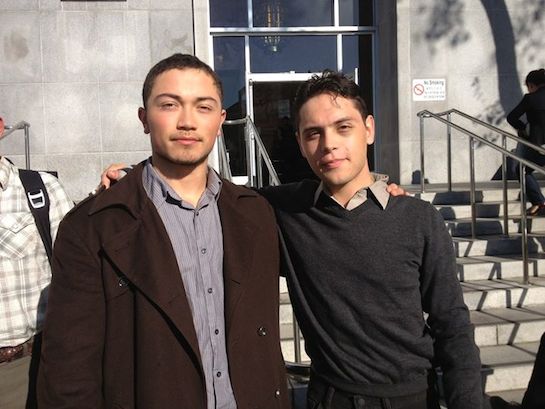
The two formerly jailed City College student protesters can now breathe a sigh of relief, as this morning they learned that the District Attorney’s Office won’t be filing criminal charges against them.

Otto Pippenger, 20, and Dimitrios Philliou, 21, were detained by SFPD following a violent clash during a City College protest last Thursday. Their ideological and physical fight for democracy at their school is also the subject of one of our print articles in this week’s Guardian. Philliou’s attorney confirmed to the Guardian that charges were not pursued by the District Attorney’s Office.

“The charges have been dropped for now, in terms of the criminal case,” said Rachel Lederman, president of the San Francisco chapter of the National Lawyers Guild, which is representing Philliou. 

But, she noted, they’re not out of the fire yet. 

“The fight is not over for them,” she said, “as it’s possible they’ll face school discipline.”

Heidi Alletzhauser, Pippenger’s mother, told the Guardian that Vice Chancellor Faye Naples indicated the two would face some sort of disciplinary hearing, though Naples told Alletzhauser that Pippenger would not be expelled.

We called Napes to confirm, but did not hear back from her, and we’ll update this post if and when we do. 

Alletzhauser was concerned that the Chancellor Arthur Q. Tyler publicly pointed a finger at the two boys, shaming them for their actions in a letter he penned to the community and to the press. “I am saddened to see students engaging in violent outbursts,” he wrote. The letter as a whole seems to cast a shadow of blame on the protesters. 

“It sounded to me like they were sure Otto and Dimitrios were guilty,” Alletzhauser said.

The school hearing has not yet been confirmed. Alletzhauser was happy to see her son and Dimitrios get back to school.

“They both had classes at 10, so they went to school,” she said. “Which is adorable, I think.”

Theater Listings: March 19 – 25, 2014

0

Stage listings are compiled by Guardian staff. Performance times may change; call venues to confirm. Reviewers are Robert Avila, Rita Felciano, and Nicole Gluckstern. Submit items for the listings at listings@sfbg.com.

THEATER

OPENING

Lottie’s Ghosts Brava Theater Center, 2781 24th St, SF; www.brava.org. $20. Previews Thu/20, 8pm. Opens Fri/21, 8pm. Runs Thu-Sat, 8pm (no show March 28); Sun, 3pm. Through April 6. Dancer, storyteller, and Brava artist-in-residence Shakiri presents a new work based on her novel of the same name.

Pearls Over Shanghai Hypnodrome Theatre, 575 10th St, SF; www.thrillpeddlers.com. $30-35. Opens Thu/20, 8pm. Runs Thu-Sat, 8pm. Through May 31. Thrillpeddlers present the fifth anniversary revival production of its enormously popular take on the 1971 Cockettes musical.

She Rode Horses Like the Stock Exchange Thick House, 1695 18th St, SF; www.crowdedfire.org. $15-35. Previews Thu/20-Sat/22, 8pm. Opens Mon/24, 8pm. Runs Wed-Sat, 8pm. Through April 12. Crowded Fire kicks off its 2014 season with the world premiere of Amelia Roper’s dry comedy about financial disaster.

The Two Chairs Bindlestiff Studios, 185 Sixth St, SF; www.performersunderstress.com. $10-30. Previews Thu/20-Fri/21, 8pm. Opens Sat/22, 8pm. Runs Thu-Sat, 8pm; Sun, 2pm. Through April 13. Performers Under Stress performs Charles Pike’s new play, described as “No Exit as a love story set in Napa on the Silverado Trail.”

Venus in Fur Geary Theater, 415 Geary, SF; www.act-sf.org. $20-120. Previews Wed/19-Sat/22 and Tue/25, 8pm (also Sat/22, 2pm); Sun/23, 7pm. Opens March 26, 8pm. Runs Wed-Sat and Tue, 8pm (also Sat, 2pm; April 1, show at 7pm); Sun, 7pm. Through April 13. American Conservatory Theater performs a new production of David Ives’ 2012 Tony-nominated play.

BAY AREA

The Coast of Utopia Ashby Stage, 1901 Ashby, Berk; www.shotgunplayers.org. $20-35 (three-show marathon days, $100-125). Previews March 20-28. Opens March 29. Part Three: Salvage runs March 20-April 27; Part One: Voyage runs March 26-April 17; Part Two: Shipwreck runs March 27-April 19. Three-play marathon, April 5 and 26. Through April 27. Check website for showtime info. Shotgun Players performs Tom Stoppard’s epic The Coast of Utopia trilogy, with all three plays performed in repertory.

ONGOING

Bauer San Francisco Playhouse, 450 Post, SF; www.sfplayhouse.org. Previews Wed/19-Fri/21, 8pm. Opens Sat/22, 8pm. Runs Tue-Thu, 7pm; Fri-Sat, 8pm (also Sat, 3pm); Sun/23 and April 13, 2pm. Through April 19. San Francisco Playhouse presents the world premiere of Lauren Gunderson’s drama about artist Rudolf Bauer.

Children Are Forever (All Sales are Final!) Stage Werx Theatre, 446 Valencia, SF; www.brownpapertickets.com. $15. Fri/21-Sat/22, 8pm. Writer-performer and comedian Julia Jackson’s well acted and consistently funny autobiographical solo show details her and her female partner’s attempt to adopt a newborn girl from a young African American mother in Florida. Along the way, Jackson’s smart script details the trials, red tape, and unexpected market incentives in the field of adoption for a same-sex, interracial couple. If the generally involving story nevertheless attenuates a little across its two-act structure, Coke Nakamoto’s precise direction (which builds on original direction by W. Kamau Bell) offers a lively framework for Jackson’s excellent characterizations as well as her frank and interesting commentary on the social, political messiness of certain natural urges. (Avila)

Crystal Springs Eureka Theatre, 215 Jackson, SF; www.crystalspringstheplay.com. $20-65. Fri/21-Sat/22, 8pm; Sun/23, 2pm. Eureka Theatre presents Kathy Rucker’s world-premiere drama about parenting in the digital age.

Feisty Old Jew Marsh San Francisco Main Stage, 1062 Valencia, SF; www.themarsh.org. $25-100. Sat, 8pm; Sun, 7pm (March 30 show at 2pm). Extended through May 4. Charlie Varon performs his latest solo show, a fictional comedy about “a 20th century man living in a 21st century city.”

Foodies! The Musical Shelton Theater, 533 Sutter, SF; www.foodiesthemusical.com. $32-34. Fri-Sat, 8pm. Open-ended. AWAT Productions presents Morris Bobrow’s musical comedy revue all about food.

Hundred Days Z Space, 450 Florida, SF; www.zspace.org. $10-100. Wed and Sun, 7pm; Thu-Sat, 8pm. Through April 6. Married musical duo the Bengsons (Abigail and Shaun) provide the real-life inspiration and guiding rock ‘n’ roll heart for this uneven but at times genuinely rousing indie musical drama, a self-referential meta-theater piece relating the story of a young couple in 1940s America who fall madly in love only to discover one of them is terminally ill. As an exploration of love, mortality, and the nature of time, the story of Sarah and Will (doubled by the Bengsons and, in movement sequences and more dramatically detailed scenes, by chorus members Amy Lizardo and Reggie D. White) draws force from the potent musical performances and songwriting of composer-creators Abigail and Shaun Bengson (augmented here by the appealing acting-singing chorus and backup band that also feature El Beh, Melissa Kaitlyn Carter, Geneva Harrison, Kate Kilbane, Jo Lampert, Delane Mason, Joshua Pollock). Playwright Kate E. Ryan’s book, however, proves too straightforward, implausible, and sentimental to feel like an adequate vessel for the music’s exuberant, urgent emotion and lilting, longing introspection. Other trappings of director Anne Kauffman’s elaborate production (including an inspired set design by Kris Stone that echoes the raw industrial shell of the theater; and less-than-inspired choreography by the otherwise endlessly inventive Joe Goode) can add texture at times but also prove either neutral figures or distracting minuses in conveying what truth and heft there is in the material. Ultimately, this still evolving world premiere has a strong musical beat at its core, which has a palpable force of its own, even if it’s yet to settle into the right combination of story and staging. (Avila)

Lovebirds Marsh San Francisco Studio, 1062 Valencia, SF; www.themarsh.org. $15-50. Thu-Fri, 8pm; Sat, 8:30pm. Extended through April 12. Theater artist and comedian Marga Gomez presents the world premiere of her 10th solo show, described as “a rollicking tale of incurable romantics.”

Mommy Queerest Exit Studio, 156 Eddy, SF; www.divafest.info. $15-25. Fri-Sat, 8pm. Through March 29. Sex scenes in solo shows might sound a little onanistic, but in the right circumstances a door jam or a love seat can serve as a fine co-star. Stand-up comic and actor Kat Evasco demonstrates as much in this raunchy and high-spirited story of her sexual awakening as a lesbian-identifying bisexual, coming out in a household dominated by her closeted mother, a Filipina American drama queen with a long-term female companion she insists is the “gay” one. Presented by Guerrilla Rep and the Exit Theatre’s DIVAfest, and directed by Guerrilla Rep’s John Caldon (who co-wrote the play with Evasco), the story follows a familiar and predictable arc in some ways — familial hypocrisy giving way to inspirational cross-generational understanding — and the characterizations and set-ups (including a family feud on Jerry Springer) come with not always inspired choices. Moreover not all the jokes land where they should in a performance that starts as stand-up but immediately shifts into the style of a solo-play confessional. (A more thoroughgoing subversion of the stand-up format might have produced more complex, less foreseeable results.) At the same time, there’s no denying Evasco’s charm and energy, or her buoyant comedic talent, which makes it easier to forgive the play’s structural shortcomings. (Avila)

“Risk Is This … The Cutting Ball New Experimental Plays Festival” Exit on Taylor, 277 Taylor, SF; www.cuttingball.com. Free ($20 donation for reserved seating). Fri-Sat, 8pm. Through March 29. Five new works in staged readings, including two from Cutting Ball resident playwright Andrew Saito.

The Scion Marsh San Francisco, 1062 Valencia, SF; www.themarsh.org. $15-60. Thu-Fri, 8pm; Sat, 5pm. Through April 18. In his latest solo show, Brian Copeland (Not a Genuine Black ManThe Waiting Period) explores an infamous crime in his hometown of San Leandro: the 2000 murder of three government meat inspectors by Stuart Alexander, owner of the Santos Linguisa Factory. The story is personal history for Copeland, at least indirectly, as the successful comedian and TV host recounts growing up nearby under the common stricture that “rules are rules,” despite evidence all around that equity, fairness, and justice are in fact deeply skewed by privilege. Developed with director David Ford, the multiple-character monologue (delivered with fitful humor on a bare-bones stage with supportive sound design by David Hines) contrasts Copeland’s own youthful experiences as a target of racial profiling with the way wealthy and white neighbor Stuart Alexander, a serial bully and thug, consistently evaded punishment and even police attention along his path to becoming the “Sausage King,” a mayoral candidate, and a multiple murderer (Alexander died in 2005 at San Quentin). The story takes some meandering turns in making its points, and not all of Copeland’s characterizations are equally compelling. The subject matter is timely enough, however, though ironically it is government that seems to set itself further than ever above the law as much as wealthy individuals or the bogus “legal persons” of the corporate world. The results of such concentrated power are indeed unhealthy, and literally so — Copeland’s grandmother (one of his more persuasive characterizations) harbors a deep distrust of processed food that is nothing if not prescient —but The Scion’s tale of two San Leandrans leaves one hungry for more complexity. (Avila)

Shit & Champagne Rebel, 1772 Market, SF; shitandchampagne.eventbrite.com. $25. Fri-Sat, 8pm. Open-ended. D’Arcy Drollinger is Champagne White, bodacious blond innocent with a wicked left hook in this cross-dressing ’70s-style white-sploitation flick, played out live on Rebel’s intimate but action-packed barroom stage. Written by Drollinger and co-directed with Laurie Bushman (with high-flying choreography by John Paolillo, Drollinger, and Matthew Martin), this high-octane camp send-up of a favored formula comes dependably stocked with stock characters and delightfully protracted by a convoluted plot (involving, among other things, a certain street drug that’s triggered an epidemic of poopy pants) — all of it played to the hilt by an excellent cast that includes Martin as Dixie Stampede, an evil corporate dominatrix at the head of some sinister front for world domination called Mal*Wart; Alex Brown as Detective Jack Hammer, rough-hewn cop on the case and ambivalent love interest; Rotimi Agbabiaka as Sergio, gay Puerto Rican impresario and confidante; Steven Lemay as Brandy, high-end calf model and Champagne’s (much) beloved roommate; and Nancy French as Rod, Champagne’s doomed fiancé. Sprawling often literally across two buxom acts, the show maintains admirable consistency: The energy never flags and the brow stays decidedly low. (Avila)

The Speakeasy Undisclosed location (ticket buyers receive a text with directions), SF; www.thespeakeasysf.com. $70 (gambling chips, $5-10 extra; after-hours admission, $10). Thu-Sat, 7:40, 7:50, and 8pm admittance times. Extended through May 24. Boxcar Theater’s most ambitious project to date is also one of the more involved and impressively orchestrated theatrical experiences on any Bay Area stage just now. An immersive time-tripping environmental work, The Speakeasy takes place in an “undisclosed location” (in fact, a wonderfully redesigned version of the company’s Hyde Street theater complex) amid a period-specific cocktail lounge, cabaret, and gambling den inhabited by dozens of Prohibition-era characters and scenarios that unfold around an audience ultimately invited to wander around at will. At one level, this is an invitation to pure dress-up social entertainment. But there are artistic aims here too. Intentionally designed (by co-director and creator Nick A. Olivero with co-director Peter Ruocco) as a fractured super-narrative — in which audiences perceive snatches of overheard stories rather than complete arcs, and can follow those of their own choosing — there’s a way the piece becomes specifically and ever more subtly about time itself. This is most pointedly demonstrated in the opening vignettes in the cocktail lounge, where even the ticking of Joe’s Clock Shop (the “cover” storefront for the illicit 1920s den inside) can be heard underscoring conversations (deeply ironic in historical hindsight) about war, loss, and regained hope for the future. For a San Francisco currently gripped by a kind of historical double-recurrence of the roaring Twenties and dire Thirties at once, The Speakeasy is not a bad place to sit and ponder the simulacra of our elusive moment. (Avila)

Tipped & Tipsy Marsh Studio Theater, 1062 Valencia, SF; www.themarsh.org. $15-50. Sat, 5pm; Sun, 7pm. Through April 6. Last fall’s San Francisco Fringe Festival began on a high note with Jill Vice’s witty and deft solo, Tipped & Tipsy, and the Best of Fringe winner is now enjoying another round at solo theater outpost the Marsh. Without set or costume changes, Vice (who developed the piece with Dave Dennison and David Ford) brings the querulous regulars of a skid-row bar to life both vividly and with real quasi–Depression-Era charm. She’s a protean physical performer, seamlessly inhabiting the series of oddball outcasts lined up each day at Happy’s before bartender Candy — two names as loaded as the clientele. After some hilarious expert summarizing of the do’s and don’ts of bar culture, a story unfolds around a battered former boxer and his avuncular relationship with Candy, who tries to cut him off in light of his clearly deteriorating health. Her stance causes much consternation, and even fear, in his barfly associates, while provoking a dangerous showdown with the bar’s self-aggrandizing sleaze-ball owner, Rico. With a love of the underdog and strong writing and acting at its core, Tipsy breezes by, leaving a superlative buzz. (Avila)

Twisted Fairy Tales Shelton Theater, 533 Sutter, SF; www.leftcoasttheatreco.org. $15-25. Thu-Sat, 8pm. Through April 5. Left Coast Theatre Co. performs the world premiere of seven one-act LGBT-themed plays based on classic children’s stories.

The World of Paradox Garage, 715 Bryant, SF; www.paradoxmagic.com. $12-15. Mon, 8pm. Through April 7. Footloose presents David Facer in his solo show, a mix of magic and theater.

Wrestling Jerusalem Intersection for the Arts, 925 Mission, SF; www.theintersection.org. $20-30. Thu-Sat, 7:30pm; Sun, 2pm. Through April 6. Intersection for the Arts presents Aaron Davidman in his multicharacter solo performance piece about Israel and Palestine.

Yellow New Conservatory Theatre Center, 25 Van Ness, SF; www.nctcsf.org. $25-45. Wed/19-Sat/22, 8pm; Sun/23, 2pm. Playwright Del Shores (Sordid Lives, Southern Baptist Sissies) returns to his native South — while detouring from previous camp-comedy treatments — with this affirming family drama set in Vicksburg, Miss., about a progressive white couple whose marriage and family are rocked in the wake of their son’s illness. Kate (Dana Zook) and Bobby (Andrew Nance) are celebrating 19 years together. Their oldest son, Dayne (Damion Matthews), is a handsome high school senior and football star; their daughter, Gracie (Ali Haas), is his high-strung younger sister, a drama devotee in more ways than one with plans to be the next Meryl Streep. Gracie’s best friend, Kendall (Maurice André San-Chez), is an effeminate young man with a golden singing voice but a strict fundamentalist mother (Linsay Rousseau) from whom he must hide his plan to join Gracie in the school’s production of Oklahoma! Kendall’s fractured family encourages his tight orbit around Gracie’s — including Dayne, on whom Kendall has an impossible-to-disguise crush — all of whom accept the closeted, innocent youth unequivocally. But when Dayne comes down with a rare liver disease (the title has nothing to do with race, which is not explored here, but references, at a literal level, the sickly color that overcomes Dayne at one point), the seemingly ideal family itself fractures along lines of a deeply buried secret regarding his paternity. Amid their worry for Dayne’s future, and the painful dynamic opened between Kate and Bobby, Kendall’s mother moves in with proselyting zeal, alienating her son to the point of total rejection, but also adding to an already volatile tension between his adoptive parents. Helmed by New Conservatory Theatre Center’s founding artistic director, Ed Decker, the production achieves (after some initial warming up) decent performances across the cast, which, along with Shores’ careful plotting and consistent humor, helps keep this sentimental, somewhat too neat story involving until the end. (Avila)

BAY AREA

Accidental Death of an Anarchist Berkeley Repertory Theatre, Roda Theatre, 2015 Addison, Berk; www.berkeleyrep.org. $29-99. Tue and Thu-Sat, 8pm (no show April 18; additional 2pm shows Thu/20 and April 17; also Sat, 2pm, but no matinee Sat/22); Sun, 2 and 7pm. Through April 20. Berkeley Rep presents comic actor Steven Epp in Dario Fo’s explosive political farce, directed by Christopher Bayes,

Arms and the Man Barn Theatre, 30 Sir Francis Drake, Ross; www.rossvalleyplayers.com. $13-26. Thu, 7:30pm; Fri-Sat, 8pm; Sun, 2pm. Through April 13. Ross Valley Players perform George Bernard Shaw’s romantic comedy.

Bread and Circuses La Val’s Subterranean, 1834 Euclid, Berk; www.impacttheatre.com. $20-25. Thu-Sat, 8pm; Sun, 7pm. Through April 6. Impact Theatre performs “a cavalcade of brutal and bloody new short plays” by various contemporary playwrights.

Fool For Love Pear Avenue Theatre, 1220 Pear, Mtn View; www.thepear.org. $10-35. Thu-Sat, 8pm; Sun, 2pm. Through April 6. Pear Avenue Theatre performs Sam Shepard’s iconic play, about a pair of former lovers who reunite at a lonely desert motel.

Geezer Marsh Berkeley, 2120 Allston, Berk; www.themarsh.org. $25-50. Thu, 8pm; Sat, 5pm. Through April 26. Geoff Hoyle moves his hit comedy about aging to the East Bay.

The Lion and the Fox Berkeley City Club, 2315 Durant, Berk; www.centralworks.org. $15-28. Thu-Sat, 8pm; Sun, 5pm. Through March 30. Central Works performs a prequel to its 2009 hit, Machiavelli’s The Prince, which depicts a face-off between Niccolo Machiavelli and Cesare Borgia.

The Music Man Julia Morgan Theater, 2640 College, Berk; www.berkeleyplayhouse.org. $17-60. Thu/20-Fri/21, 7pm; Sat/22, 1 and 6pm; Sun/23, noon and 5pm. There’s trouble in River City! See it unfold amid all those trombones at Berkeley Playhouse.

Once On This Island Lucie Stern Theatre, 1305 Middlefield, Palo Alto; www.theatreworks.org. $19-73. Tue-Wed, 7:30pm; Thu-Sat, 8pm (also Sat, 2pm); Sun, 2 and 7pm. Through March 30. TheatreWorks performs the Tony-nominated musical about a star-crossed love affair in the tropics, inspired by Hans Christian Andersen’s The Little Mermaid.

PERFORMANCE/DANCE

“Attractive Camp” Lost Weekend Video, 1034 Valencia, SF; www.eventbrite.com. Sun/23, 8pm. $10. Stand-up comedy, sketch comedy, and short films with Greg Edwards, Sean Keane, Lydia Popovich, and others.

“Awaiting Dawn” Dennis Gallagher Arts Pavilion, 66 Page, SF; internationalsf.org/awaiting_dawn. Thu/20-Sat/22 and March 27-28, 7pm; March 29, 2pm. $10-30. The French-American International School presents this series of performances exploring the intersections of art, education, and democracy.

Caroline Lugo and Carolé Acuña’s Ballet Flamenco Peña Pachamama, 1630 Powell, SF; www.carolinalugo.com. Sat/22, March 30, April 6, 12, 19, and 30, 6:15pm. $15-19. Flamenco performance by the mother-daughter dance company, featuring live musicians.

“Comedy Returns to El Rio” El Rio, 3158 Mission, SF; www.brownpapertickets.com. Thu/20, 8pm. $7-20. Stand-up with Steve Lee, Bob McIntyre, Johan Miranda, Kat Evasco, and Lisa Geduldig.

Feinstein’s at the Nikko Hotel Nikko, 222 Mason, SF; www.feinsteinssf.com. This week: Jason Grae’s “49 1/2 Shades of Grae,” Thu/20, 8pm, $25-35; Vonda Shepard, Fri/21, 8pm, $40-55.

Flamenco Del Oro Emerald Tablet, 80 Fresno, SF; www.emtab.org. Fri/21, 8pm. $15 suggested donation. Flamenco dance and music.

“Izzies Dance Awards” Brava Theater Center, 2781 24th St, SF; www.brava.org. Mon/24, 6-8pm. Free. The 28th annual Isadora Duncan Dance Awards honors achievements by members of the Bay Area dance community, with awards for choreography, performance, visual design, and other categories.

Richard Lewis Cobb’s Comedy Club, 915 Columbus, SF; www.cobbscomedyclub.com. Fri/21, 8pm; Sat/22-Sun/23, 7pm (also Sat/22, 9:15pm). $25. The comedian performs.

“Luster: An American Songbook” Davies Symphony Hall, 201 Van Ness, SF; www.sfgmc.org. March 25-26, 8pm. $25-75. San Francisco Gay Men’s Chorus performs works by Gershwin, Porter, Ellington, and Berlin, as well as the world premiere of a tribute to Tyler Clementi.

“Magic at the Rex” Hotel Rex, 562 Sutter, SF; www.magicattherex.com. Sat, 8pm. Ongoing. $25. Magic and mystery with Adam Sachs and mentalist Sebastian Boswell III.

Mona Khan Company Garage, 715 Bryant, SF; ticketfly.com/event/475517. Sun/23 and March 30, 7:30pm (also March 30, 5:30pm). $20. The Indian contemporary dance company presents Soch, a night of vignettes.

“The Naked Stage” Bayfront Theater, B350 Fort Mason Center, SF; www.improv.org. Sat, 8pm. Through March 29. $20. BATS Improv performs a completely improvised play.

“ODC/Dance Downtown” Yerba Buena Center for the Arts Theater, 700 Howard, SF; www.ybca.org. Thu/20-Sat/22 and March 28-29, 8pm; Sun/23 and March 30, 4pm; March 26-27, 7:30pm. $20-75. The acclaimed contemporary dance company marks its 43rd season with world premiere boulders and bones, inspired by the work of artist Andy Goldsworthy, among other works.

“Paper Wing” NOHspace, 2840 Mariposa, SF; www.theatreofyugen.org. Fri/21-Sat/22, 8pm. $15-35. Sculptural costume artist Sha Sha Higby presents a new solo performance.

“Point Break Live!” DNA Lounge, 373 11th St, SF; www.dnalounge.com. April 4, 7:30 and 11pm. $25-50. Dude, Point Break Live! is like dropping into a monster wave, or holding up a bank, like, just a pure adrenaline rush, man. Ahem. Sorry, but I really can’t help but channel Keanu Reeves and his Johnny Utah character when thinking about the awesomely bad 1991 movie Point Break or its equally yummily cheesy stage adaptation. And if you do an even better Keanu impression than me — the trick is in the vacant stare and stoner drawl — then you can play his starring role amid a cast of solid actors, reading from cue cards from a hilarious production assistant in order to more closely approximate Keanu’s acting ability. This play is just so much fun, even better now at DNA Lounge than it was a couple years ago at CELLspace. But definitely buy the poncho pack and wear it, because the blood, spit, and surf spray really do make this a fully immersive experience. (Steven T. Jones)

“Sausage Fest Comedy Show” Club OMG, 43 Sixth St, SF; www.clubomgsf.com. Tue/25, 8pm. $10. Charlie Ballard hosts this night of shirtless comedy, with Mark Smalls, Hayden Greif-Neill, Mark Burg, Noah Gain, and others.

Sidra Bell Dance New York Dance Mission Theater, 3316 24th St, SF; www.dancemission.com. Fri/21-Sun/23, 8pm. $12-20. The NYC-based movement arts company performs garment and STELLA as part of its San Francisco season.

“Silenced” and “The CONTACT Project” CounterPULSE, 1310 Mission, SF; www.counterpulse.org. Thu/20-Sat/22, 8pm; Sun/23, 2pm. Counterpulse’s Artist Residency Commissioning Program presents a double bill by its winter residents. Dancer-choreographer Charya Burt’s Silenced blends traditional and modern dance as well as live music in a pointed homage to Cambodian pop star Ros Sereysothea, an iconic face and voice of the swinging Cambodian Sixties who ended up among the two million Cambodians murdered during the genocide under Pol Pot and the Khmer Rouge (1975–1979). Backed by dancers Sandra Ruano and Ravy Mey and guitarist Nahuel Bronzini, Burt creates charming moments within a limited narrative arc, embodying in dance and song the artistry and resilience of her subject, who brought Cambodian sensibilities to Western popular musical forms. An enveloping montage of archival images by video designer Olivia Ting and a period score of Sereysothea’s hits supplemented by composer Alexis Alrich add further context and atmosphere. Choreographer Krista DeNio’s The CONTACT project reconfigures the theater space in an intimate exploration of the experiences and perspectives of male and female American military veterans. Created in collaboration with the performers (Daniel Bear Davis, Sonia Decker, Katarina Eriksson, Remi Frazier, Stephen Funk, Hope Hutman, Daniel Lippel, William McQueen, Utam Moses, Susan Pfeffer, Misty Rose Snyder, and Tina Taylor), some of whom are actual veterans, the piece is perhaps necessarily jagged in shape and execution, but DeNio offers connective tissue in the form of group movement and staging. Some of this brings audience members into the fold and even literally following in the steps of the vets, here the subjects and agents of an artificial and unraveling conformity. The emphasis on validating the personal experience of veterans is a political act in itself, and can make for some emotionally potent moments, although the rough balance strived for here can also inhibit a more rigorous political understanding and critique of ever-expanding American militarism. (Avila)

“Sister Spit 2014” Elbo Room, 647 Valencia, SF; www.radarproductions.org. Wed/19, 8pm. $10. Also Thu/20, 8pm, free, Mills College, Student Union, 5000 MacArthur, Oakl. Also Fri/21, 8pm, $10, Rock Paper Scissors Collective, 2278 Telegraph, Oakl. Michelle Tea hosts the 2014 “spring fling” performances by the groundbreaking queer and feminist literature series. Performers include Rhiannon Argo, Dia Felix, Chinaka Hodge, Beth Lisick, Jerry Lee Abram, and Virgie Tovar, plus special guests.

“Sorya! 2014: We Are Still At It” NOHspace, 2840 Mariposa, SF: www.brownpapertickets.com. Sat/22-Sun/23, 2pm; Mon/24, 7pm. Theatre of Yugen presents its 35th anniversary season with a performance by founder Yuriko Doi in the kyogen play Kawakami.

BAY AREA

“Fleetwood Mask: The Ultimate Tribute to Fleetwood Mac” Live Oak Theatre, 1301 Shattuck, Berk; www.theatrefirst.com. Sat/22, 8pm; Sun/23, 2pm. $30. Theatrical tribute to the iconic rock band.

“MarshJam Improv Comedy Show” Marsh Berkeley, 2120 Allston, Berk; www.themarsh.org. Fri, 8pm. Ongoing. $10. Improv comedy with local legends and drop-in guests.

Pilobolus Marin Veterans’ Memorial Auditorium, 10 Avenue of the Flags, San Rafael; www.marincenter.org. Sat/22, 8pm. $20-75. The dance company performs an eclectic program of past work and three Bay Area premieres.

“Poetry Express” Himalayan Flavors, 1585 University, Berk; poetryexpressberkeley.blogspot.com. Mon, 7pm. Free. Ongoing. This week: Ambrose Mohler, plus open mic. *


Film Listings: March 19 – 25, 2014

0

Film listings are edited by Cheryl Eddy. Reviewers are Kimberly Chun, Dennis Harvey, Lynn Rapoport, Sam Stander, and Sara Maria Vizcarrondo. For rep house showtimes, see Rep Clock.

OPENING

Afternoon of a Faun: Tanaquil Le Clercq Writer-director Nancy Buirski’s documentary follows the short, brilliant career of a young dancer named Tanaquil Le Clercq, who came up in the New York City ballet world of the 1940s and ’50s. Le Clercq was discovered by George Balanchine, married him (as three other dancers had done before her), sparked a paradigm shift in the ballet world regarding what was considered the quintessential dancer’s body, had numerous ballets set on her by Balanchine and Jerome Robbins, and then, at the peak of her career, at age 27, was stricken by polio and left paralyzed in both legs. The film takes its time moving toward this catastrophe, recounting Le Clercq’s early adult life through interviews with her contemporaries and tracking her professional progress through gorgeous archival footage of her performances. Equally moving archival material are the letters from a longtime correspondence between Le Clercq and Robbins that documented two very different periods of her life: the first, when Robbins was choreographing ballets for her, including Afternoon of a Faun, and professing his love; the second, after her paralysis, when she wrote him a series of poignant communications describing her impressions of her illness and her new, circumscribed world. The film has some trouble holding on to its center — as in life, Balanchine proves a magnetic force, and Afternoon of a Faun feels inexorably drawn to his professional and personal details. We don’t get enough of Le Clercq, which you could say is the tragedy of her story — nobody did. But the letters do provide a sense of someone resourceful and responsive to life’s richness and joys, someone who would get past this crisis and find a way to reshape her life. (1:31) Opera Plaza. (Rapoport)

Anita In 1991, Anita Hill found herself at the center of a political firestorm when she testified about being sexually harassed by US Supreme Court nominee Clarence Thomas. “The issue became my character as opposed to the character of the nominee,” she recalls in Anita, a revealing new documentary from Academy Award-winning filmmaker Freida Mock (1994’s Maya Lin: A Strong Clear Vision). Twenty years after she first made headlines, Hill recounts her story in the same eloquent voice familiar to anyone who watched her testimony; her first-person narrative, paired with accounts by her supporters, stresses the consequences many women suffer from daring to speak out. The documentary, which shows how one woman’s forthrightness about sexual harassment can upturn her life, also explores the ways in which Hill’s Bush-era notoriety laid the foundation for a prolific career dedicated to battling sexual harassment and women’s oppression. She became an unlikely icon, and a role model for women battling similar circumstances. On the other hand, Thomas still sits on the bench. (1:17) Embarcadero, Shattuck. (Laura B. Childs)

Bad Words Settling a grudge score whose precise origin remains unclear until late in the game, world-class misanthrope Guy Trilby (Jason Bateman) is celebrating his 40th birthday by competing in a national spelling bee. Yes, spelling bees are generally for children, and so is this one. But Guy has found a legal loophole permitting his participation, and the general hate wending his way from contest staff (Allison Janney, Philip Baker Hall) — let alone the tiger-mom-and-dad parents ready to form a lynch mob — is just icing on the cake where he’s concerned. What’s more, as some sort of majorly underachieving near-genius, he’s in fact well equipped to whup the bejesus out of overachieving eight-year-olds when it comes to saying the right letters out loud. The only people on his side, sorta, are the online journalist (Kathryn Hahn) reporting on his perverse quest, and the insidiously cute Indian American competitor (Rohan Chand) who wants to be besties, or perhaps just to psych him out. (Note: The tyke’s admitted favorite word is “subjugate.”) Written by Andrew Dodge, this comedy in the tradition (a little too obviously) of 2003’s Bad Santa and such provides the always enjoyable Bateman with not only a tailor-made lead role, but a directorial debut as well. He does just fine by both. Yet as nicely crafted and frequently-pretty-funny Bad Words is, at core it’s a rather petty movie — small, derivative, and cynically mean-spirited without the courage of genuine biliousness. It’s at once not-half-bad, and not half as badass as it pretends to be. (1:29) Shattuck. (Harvey)

Child’s Pose See “Smotherly Love.” (1:52) Opera Plaza, Shattuck.

Dark House Nick (Luke Kleintank) has the most depressing superpower since X-Men‘s Rogue: whenever he touches someone destined for a violent death, he has a vision of his or her terrible demise. On a rare visit to his institutionalized mother (Lesley-Anne Down), amid her ravings about “things in the walls,” she confesses that Nick’s father is still alive. After she dies, he inherits a folder stuffed with wrinkled papers — including the deed to an old mansion that’s been haunting his dreams since childhood. With his best friend and pregnant girlfriend in tow, Nick sets out to find the apparently cursed dwelling (wide-eyed locals refer to it as “Wormwood”). What they find is best not revealed here, though it does involve Tobin “Jigsaw from the Saw movies” Bell. This latest from controversial director Victor Salva borrows multiple elements from his 2001 horror breakout Jeepers Creepers (backwoods locations and folklore, murderous fellows in duster coats, superstition vis-à-vis the number 23, etc.) but sprawls beyond that film’s taut road-trip-from-hell structure, and has far more characters prone to making stupid decisions. There’s also the issue of having a certain, uh, monster intone orders to its followers via any available furnace vent — it’s funny every time, and it sure ain’t intended to be. (1:42) Presidio. (Eddy)

Divergent Shailene Woodley stars as a post-apocalyptic hero in this sci-fi action film based on the popular YA novel by Veronica Roth. (2:20) Balboa, Marina.

Enemy Adam (Jake Gyllenhaal) is an associate history professor living the usual life of quiet desperation in a very smoggy, beige, vaguely dystopian Toronto when he makes a startling discovery: glimpsed in the background of an otherwise forgettable movie rental is someone who is his complete doppelganger. Intrigued, he discovers the identity of actor Anthony (Jake again), and pokes around in the latter’s life enough to discover that they both have blonde partners (Adam’s girlfriend Mélanie Laurent, the other dude’s pregnant wife Sarah Gadon), though beyond that and the eerie physical-vocal resemblances, they’re near-opposites — Anthony is more confident, successful, assertive, and belligerent by far. Their paths-crossing isn’t going to be a good thing. Just how bad it will get depends on how you read a mysterious, perverse opening sequence and some increasingly surreal imagery scattered throughout. The second of director Denis Villeneuve’s back-to-back Gyllenhaal collaborations is very different from last year’s long, intricate, real-world thriller Prisoners. Based on a José Saramago novel (The Double), it sports the same ominous, metaphorical fantasticism that was previously translated to the screen in the widely disliked (but faithful) 2008 Blindness — another movie that played better if you know where its source material is coming from. This intriguing Kafkaesque paranoid puzzle is not to be confused with Richard Ayoade’s forthcoming Dostoevsky-derived The Double, starring Jesse Eisenberg. Actually, go ahead and confuse them — they’re stylistically distinct but otherwise practically the same fable-nightmare. (1:30) Marina, Vogue. (Harvey)

Le Week-End Director Roger Michell and writer Hanif Kureishi first collaborated two decades ago on The Buddha of Suburbia, when the latter was still in the business of being Britain’s brashest multiculti hipster voice. But in the last 10 years they’ve made a habit of slowing down to sketching portraits of older lives — and providing great roles for the nation’s bottomless well of remarkable veteran actors. Here Lindsay Duncan and Jim Broadbent play a pair of English academics trying to re-create their long-ago honeymoon’s magic on an anniversary weekend in Paris. They love each other, but their relationship is thorny and complicated in ways that time has done nothing to smooth over. This beautifully observed duet goes way beyond the usual adorable-old-coot terrain of such stories on screen; it has charm and humor, but these are unpredictable, fully rounded characters, not comforting caricatures. Briefly turning this into a seriocomedy three-way is Most Valuable Berserker Jeff Goldblum as an old friend encountered by chance. It’s not his story, but damned if he doesn’t just about steal the movie anyway. (1:33) Embarcadero, Smith Rafael. (Harvey)

Muppets Most Wanted On a European tour, the Muppets get caught up in a comedic criminal caper (as they do), with human supporting characters played by Tina Fey, Ricky Gervais, and Ty Burrell. (1:46) Balboa, Presidio.

Nymphomaniac: Volume I Found battered and unconscious in a back alley, Joe (Charlotte Gainsbourg) is taken in by good Samaritan Seligman (Stellan Skarsgaard), to whom she explains “It’s all my fault — I’m just a bad human being.” But he doesn’t believe there are such things. She seeks to enlighten him by narrating the story of her life so far, from carnally curious childhood to sexually voracious adulthood. Stacy Martin plays her younger self through a guided tour of excesses variously involving Christian Slater and Connie Nielsen as her parents; a buncha guys fucked on a train, on a teenage dare; Uma Thurman as one histrionically scorned woman; and Shai LaBeouf as a first love who’s a cipher either because he’s written that way, or because this particular actor can’t make sense out of him. For all its intended provocation, including some graphic but unsurprisingly (coming from this director) unerotic XXX action, von Trier’s latest is actually less offensive than much of his prior output: He’s regained his sense of humor here, and annoying as its “Look at me, I’m an unpredictable artist” crap can be (notably all the stuff about fly-fishing, cake forks, numerology, etc. that seems randomly drawn from some Great Big Book of Useless Trivia), the film’s episodic progress is divertingly colorful enough. But is Joe going to turn out to be more than a two-dimensional authorial device from a director who’s never exactly sussed women (or liked people in general)? Will Nymphomaniac arrive at some pointed whole greater than the sum of its naughty bits? The answer to both is probably “Nah.” But we won’t know for sure until the two-hour second half arrives (April 4) of a movie that, in fairness, was never really intended to be split up like this. (1:50) Embarcadero, Shattuck. (Harvey)

Shirin in Love This blandly TV-ready romantic comedy stars Nazanin Boniadi as a ditzy child of privilege in Beverly Hills’ Iranian-American community. Sent by her aggressively shallow magazine-editor mother (Anita Khalatbari) to find an elusive best-selling novelist for an interview, she not only stumbles upon that author (Amy Madigan) but discovers she’s already had a meet-cute with the latter’s hunky son (Riley Smith) under embarrassing circumstances. Will Shirin be able to shrug off the future her family has planned for her (including Maz Jobrani as a plastic-surgeon fiancé ) in order to, y’know, find herself? The very obvious answer takes its sweet time arriving in writer-director Ramin Niami’s innocuous film, which hews to a stale lineup of formulaic genre conventions even when relying on whopping coincidences to advance its predictable plot. The novelty of its particular social milieu goes unexplored in a movie that reveals even less about assimilated modern US Persian culture than My Big Fat Greek Wedding (2002) did about Greek Americans. (1:45) AMC Bay Street 16. (Harvey)

Tiger and Bunny: The Rising Based on the Japanese anime series (and a 2012 film, Tiger and Bunny: The Beginning), this lighthearted look at superheroes with human problems imagines a world in which the blaring Hero TV channel tracks the movements of various caped crusaders, who compete against each other for points as they race to defeat random villains. All of the heroes, who we meet both in and out of costume, work for the same parent company, and each has a corporate sponsor whose logo is a prominent part of his or her ensemble. (Heroes are big business, after all.) In the first film, we met “Wild Tiger,” a bumbling single dad, who’s reluctantly paired with talented new kid “Bunny.” They clash at first, but eventually prove a powerful team. In The Rising, a douchey new boss relegates Tiger to the junior-varsity Second League, while Bunny gets an annoying new partner, “Golden Ryan.” Meanwhile, a mysterious trio of baddies menaces the city, forcing all of the heroes to work together whether they want to or not. The most surprising part of The Rising is its sensitive development of the “Fire Emblem” character. Presented as a mincing gay stereotype in the first film, here he’s given a sympathetic back story via dream sequences that detail his youthful exploration of cross-dressing and personal identity struggles. Encouraging, to say the least. (1:48) New People. (Eddy)

ONGOING

About Last Night (1:40) Metreon.

American Hustle David O. Russell’s American Hustle is like a lot of things you’ve seen before — put in a blender, so the results are too smooth to feel blatantly derivative, though here and there you taste a little Boogie Nights (1997), Goodfellas (1990), or whatever. Loosely based on the Abscam FBI sting-scandal of the late 1970s and early ’80s (an opening title snarks “Some of this actually happened”), Hustle is a screwball crime caper almost entirely populated by petty schemers with big ideas almost certain to blow up in their faces. It’s love, or something, at first sight for Irving Rosenfeld (Christian Bale) and Sydney Prosser (Amy Adams), who meet at a Long Island party circa 1977 and instantly fall for each other — or rather for the idealized selves they’ve both strained to concoct. He’s a none-too-classy but savvy operator who’s built up a mini-empire of variably legal businesses; she’s a nobody from nowhere who crawled upward and gave herself a bombshell makeover. The hiccup in this slightly tacky yet perfect match is Irving’s neglected, crazy wife Rosalyn (Jennifer Lawrence), who’s not about to let him go. She’s their main problem until they meet Richie DiMaso (Bradley Cooper), an ambitious FBI agent who entraps the two while posing as a client. Their only way out of a long prison haul, he says, is to cooperate in an elaborate Atlantic City redevelopment scheme he’s concocted to bring down a slew of Mafioso and presumably corrupt politicians, hustling a beloved Jersey mayor (Jeremy Renner) in the process. Russell’s filmmaking is at a peak of populist confidence it would have been hard to imagine before 2010’s The Fighter, and the casting here is perfect down to the smallest roles. But beyond all clever plotting, amusing period trappings, and general high energy, the film’s ace is its four leads, who ingeniously juggle the caricatured surfaces and pathetic depths of self-identified “winners” primarily driven by profound insecurity. (2:17) Metreon, 1000 Van Ness, Piedmont, Sundance Kabuki. (Harvey)

Better Living Through Chemistry (1:31) Metreon.

Dallas Buyers Club Dallas Buyers Club is the first all-US feature from Jean-Marc Vallée. He first made a splash in 2005 with C.R.A.Z.Y., which seemed an archetype of the flashy, coming-of-age themed debut feature. Vallée has evolved beyond flashiness, or maybe since C.R.A.Z.Y. he just hasn’t had a subject that seemed to call for it. Which is not to say Dallas is entirely sober — its characters partake from the gamut of altering substances, over-the-counter and otherwise. But this is a movie about AIDS, so the purely recreational good times must eventually crash to an end. Which they do pretty quickly. We first meet Ron Woodroof (Matthew McConaughey) in 1986, a Texas good ol’ boy endlessly chasing skirts and partying nonstop. Not feeling quite right, he visits a doctor, who informs him that he is HIV-positive. His response is “I ain’t no faggot, motherfucker” — and increased partying that he barely survives. Afterward, he pulls himself together enough to research his options, and bribes a hospital attendant into raiding its trial supply of AZT for him. But Ron also discovers the hard way what many first-generation AIDS patients did — that AZT is itself toxic. He ends up in a Mexican clinic run by a disgraced American physician (Griffin Dunne) who recommends a regime consisting mostly of vitamins and herbal treatments. Ron realizes a commercial opportunity, and finds a business partner in willowy cross-dresser Rayon (Jared Leto). When the authorities keep cracking down on their trade, savvy Ron takes a cue from gay activists in Manhattan and creates a law evading “buyers club” in which members pay monthly dues rather than paying directly for pharmaceutical goods. It’s a tale that the scenarists (Craig Borten and Melisa Wallack) and director steep in deep Texan atmospherics, and while it takes itself seriously when and where it ought, Dallas Buyers Club is a movie whose frequent, entertaining jauntiness is based in that most American value: get-rich-quick entrepreneurship. (1:58) Embarcadero. (Harvey)

Elaine Stritch: Shoot Me The last time Elaine Stritch was in San Francisco was in 2003 for the Tony-winning Elaine Stritch: At Liberty. Then in her mid-70s, the legendary actress and singer appeared on a bare stage for a revealing song-studded solo confessional about love, ambition, alcoholism, and the jumble of a career in a theatrical golden age. It was an irresistible look back at (and behind) a brilliant and rocky career that began in 1946, and continues. She advances and expands that conversation in director and producer Chiemi Karasawa’s 80-minute portrait, Elaine Stritch: Shoot Me. Arguably still more fascinating and frank in her mid-80s, Stritch proves once again an undeniable presence — uncensored, irascible, charming, and witty — but it’s all now balanced with a more pronounced vulnerability, captured in disarmingly honest moments of reflection, struggle, and even crisis. Made over the course of two years of intimate observation, the film chronicles Stritch as she prepares for a number of returns. One is to the stage, to sing Stephen Sondheim again, the composer with whom she is indelibly identified; the other is her relocation back to Michigan, where she grew up in the 1930s. The two years spent shooting the life of a living legend, an elderly yet very active one with a well-earned reputation for being difficult, could not have been a walk in the park. Shoot Me (whose playful title might be thought to run in two directions at once) makes a virtue of that at times, no doubt, exasperating bargain; the camera, there every step of the way, seems thoroughly mesmerized. (1:21) Opera Plaza. (Robert Avila)

Frozen (1:48) Metreon, 1000 Van Ness.

The Grand Budapest Hotel Is this the first Wes Anderson movie to feature a shootout? It’s definitely the first Anderson flick to include a severed head. That’s not to say The Grand Budapest Hotel, “inspired by” the works of Austrian novelist Stefan Zweig, represents too much of a shift for the director — his intricate approach to art direction is still very much in place, as are the deadpan line deliveries and a cast stuffed with Anderson regulars. But there’s a slightly more serious vibe here, a welcome change from 2012’s tooth-achingly twee Moonrise Kingdom. Thank Ralph Fiennes’ performance as liberally perfumed concierge extraordinaire M. Gustave, which mixes a shot of melancholy into the whimsy, and newcomer Tony Revolori as Zero, his loyal lobby boy, who provides gravitas despite only being a teenager. (Being played by F. Murray Abraham as an older adult probably helps in that department.) Hotel‘s early 20th century Europe setting proves an ideal canvas for Anderson’s love of detail — the titular creation rivals Stanley Kubrick’s rendering of the Overlook Hotel — and his supporting cast, as always, looks to be enjoying the hell out of being a part of Anderson’s universe, with Willem Dafoe, Jeff Goldblum, and Adrien Brody having particularly oversized fun. Is this the best Wes Anderson movie since 2001’s The Royal Tenenbaums? Yes. (1:40) SF Center, Sundance Kabuki. (Eddy)

Gravity “Life in space is impossible,” begins Gravity, the latest from Alfonso Cuarón (2006’s Children of Men). Egghead Dr. Ryan Stone (Sandra Bullock) is well aware of her precarious situation after a mangled satellite slams into her ship, then proceeds to demolition-derby everything (including the International Space Station) in its path. It’s not long before she’s utterly, terrifyingly alone, and forced to unearth near-superhuman reserves of physical and mental strength to survive. Bullock’s performance would be enough to recommend Gravity, but there’s more to praise, like the film’s tense pacing, spare-yet-layered script (Cuarón co-wrote with his son, Jonás), and spectacular 3D photography — not to mention George Clooney’s warm supporting turn as a career astronaut who loves country music almost as much as he loves telling stories about his misadventures. (1:31) Castro, Metreon, 1000 Van Ness. (Eddy)

The Great Beauty The latest from Paolo Sorrentino (2008’s Il Divo) arrives as a high-profile contender for the Best Foreign Language Film Oscar, already annointed a masterpiece in some quarters, and duly announcing itself as such in nearly every grandiose, aesthetically engorged moment. Yes, it seems to say, you are in the presence of this auteur’s masterpiece. But it’s somebody else’s, too. The problem isn’t just that Fellini got there first, but that there’s room for doubt whether Sorrentino’s homage actually builds on or simply imitates its model. La Dolce Vita (1960) and 8 1/2 (1963) are themselves swaying, jerry-built monuments, exhileratingly messy and debatably profound. But nothing quite like them had been seen before, and they did define a time of cultural upheaval — when traditional ways of life were being plowed under by a loud, moneyed, heedless modernity that for a while chose Rome as its global capital. Sorrentino announces his intention to out-Fellini Fellini in an opening sequence so strenuously flamboyant it’s like a never-ending pirouette performed by a prima dancer with a hernia. There’s statuary, a women’s choral ensemble, an on-screen audience applauding the director’s baffled muse Toni Servillo, standing in for Marcello Mastroianni — all this and more in manic tracking shots and frantic intercutting, as if sheer speed alone could supply contemporary relevancy. Eventually The Great Beauty calms down a bit, but still its reason for being remains vague behind the heavy curtain of “style.” (2:22) Four Star, Opera Plaza. (Harvey)

Her Morose and lonely after a failed marriage, Theodore (Joaquin Phoenix) drifts through an appealingly futuristic Los Angeles (more skyscrapers, less smog) to his job at a place so hipster-twee it probably will exist someday: beautifulhandwrittenletters.com, where he dictates flowery missives to a computer program that scrawls them onto paper for paying customers. Theodore’s scripting of dialogue between happy couples, as most of his clients seem to be, only enhances his sadness, though he’s got friends who care about him (in particular, Amy Adams as Amy, a frumpy college chum) and he appears to have zero money woes, since his letter-writing gig funds a fancy apartment equipped with a sweet video-game system. Anyway, women are what gives Theodore trouble — and maybe by extension, writer-director Spike Jonze? — so he seeks out the ultimate gal pal: Samantha, an operating system voiced by Scarlett Johansson in the year’s best disembodied performance. Thus begins a most unusual relationship, but not so unusual; Theodore’s friends don’t take any issue with the fact that his new love is a machine. Hey, in Her‘s world, everyone’s deeply involved with their chatty, helpful, caring, always-available OS — why wouldn’t Theo take it to the next level? Inevitably, of course, complications arise. If Her‘s romantic arc feels rather predictable, the film acquits itself in other ways, including boundlessly clever production-design touches that imagine a world with technology that’s (mostly) believably evolved from what exists today. Also, the pants they wear in the future? Must be seen to be believed. (2:00) Sundance Kabuki. (Eddy)

The Lego Movie (1:41) 1000 Van Ness, SF Center.

Love and Demons A man (Chris Pfleuger) in the midst of a midlife crisis, a woman (Lucia Frangione) starting to realize she’s completely dissatisfied with her life — does this relationship have a chance? Enter each partner’s personal demon, eager to have a hand in shaping events in what turns into a not-so-friendly competition. At first, the intervention seems helpful; the male demon encourages the man, a wannabe screenwriter, to get a better job, clean up the apartment, and blurt out feel-good-isms like “I want to build something together.” But what’s this about murder? Meanwhile, the female demon (Arnica Skulstad Brown) appears to be the ultimate gal pal, stroking the woman’s ego by telling her she could do so much better, going on shopping sprees with her, and sharing her stay-skinny coke stash. Temptations ahoy! Written, directed by, and costarring local filmmaker JP Allen (as the male demon, he’s the cast’s cigarette-smoking, smirking high point) this intriguing look at modern love earns bonus points for its excellent use of SF locations — and creative editing that helps break up the film’s many voice-overs and fourth-wall-breaking moments. (1:24) Roxie. (Eddy)

The Lunchbox Ila (Nimrat Kaur) is a self-possessed housewife and a great cook, whose husband confuses her for another piece of furniture. She tries to arouse his affections with elaborate lunches she makes and sends through the city’s lunchbox delivery service. Like marriage in India, lunchbox delivery has a failure rate of zero, which is what makes aberrations seem like magical occurrences. So when widow Saajan (Irrfan Khan) receives her adoring food, he humbly receives the magical lunches like a revival of the senses. Once Ila realizes her lunchbox is feeding the wrong man she writes a note and Saajan replies — tersely, like a man who hasn’t held a conversation in a decade — and the impossible circumstances lend their exchanges a romance that challenges her emotional fidelity and his retreat from society. She confides her husband is cheating. He confides his sympathy for men of lower castes. It’s a May/December affair if it’s an affair at all — but the chemistry we expect the actors to have in the same room is what fuels our urge to see it; that’s a rare and haunting dynamic. Newcomer Kaur is perfect as Ila, a beauty unmarked by her rigorous distaff; her soft features and exhausted expression lend a richness to the troubles she can’t share with her similarly stoic mother (Lillete Dubey). Everyone is sacrificing something and poverty seeps into every crack, every life, without exception — their inner lives are their richness. (1:44) Clay, Smith Rafael. (Vizcarrondo)

The Monuments Men The phrase “never judge a book by its cover” goes both ways. On paper, The Monuments Men — inspired by the men who recovered art stolen by the Nazis during World War II, and directed by George Clooney, who co-wrote and stars alongside a sparkling ensemble cast (Cate Blanchett, Matt Damon, John Goodman, Jean Dujardin, Bob Balaban, Hugh “Earl of Grantham” Bonneville, and Bill Fucking Murray) — rules. Onscreen, not so much. After they’re recruited to join the cause, the characters fan out across France and Germany following various leads, a structural choice that results in the film’s number one problem: it can’t settle on a tone. Men can’t decide if it wants to be a sentimental war movie (as in an overlong sequence in which Murray’s character weeps at the sound of his daughter’s recorded voice singing “White Christmas”); a tragic war movie (some of those marquee names die, y’all); a suspenseful war movie (as the men sneak into dangerous territory with Michelangelo on their minds); or a slapstick war comedy (look out for that land mine!) The only consistent element is that the villains are all one-note — and didn’t Inglourious Basterds (2009) teach us that nothing elevates a 21st century-made World War II flick like an eccentric bad guy? There’s one perfectly executed scene, when reluctant partners Balaban and Murray discover a trove of priceless paintings hidden in plain sight. One scene, out of a two-hour movie, that really works. The rest is a stitched-together pile of earnest intentions that suggests a complete lack of coherent vision. Still love you, Clooney, but you can do better — and this incredible true story deserved way better. (1:58) Four Star, Metreon, 1000 Van Ness, Piedmont. (Eddy)

Mr. Peabody and Sherman Mr. P. (voiced by Ty Burrell) is a Nobel Prize-winning genius dog, Sherman (Max Charles) his adopted human son. When the latter attends his first day of school, his extremely precocious knowledge of history attracts jealous interest from bratty classmate Penny (Ariel Winter), with the eventual result that all three end up being transported in Peabody’s WABAC time machine to various fabled moments — involving Marie Antoinette, King Tut, the Trojan Horse, etc. — where Penny invariably gets them in deep trouble. Rob Minkoff’s first all-animation feature since The Lion King 20 years ago is spun off from the same-named segments in Jay Ward’s TV Rocky and Bullwinkle Show some decades earlier. It’s a very busy (sometimes to the brink of clutter), often witty, imaginatively constructed, visually impressive, and for the most part highly enjoyable comic adventure. The only minuses are some perfunctory “It’s about family”-type sentimentality — and scenarist Craig Wright’s determination to draw from history the “lesson” that nearly all women are pains in the ass who create problems they must then be rescued from. (1:30) Four Star, 1000 Van Ness, Presidio, SF Center. (Harvey)

Need for Speed Speed kills, in quite a different way than it might in Breaking Bad, in Aaron Paul’s big-screen Need for Speed. “Big” nonetheless signals “B” here, in this stunt-filled challenge to the Fast and the Furious franchise, though there’s no shame in that — the drive-in is paved with standouts and stinkers alike. Tobey (Paul) is an ace driver who’s in danger of losing his auto shop, also the hangout for his pals (Scott Mescudi, Rami Malek, Ramon Rodriguez) and young sidekick Pete (Harrison Gilbertson), when archrival Dino (Dominic Cooper) arrives with a historic Mustang in need of restoration. Tragedy strikes, and Tobey must hook up with that fateful auto once more to win a mysterious winner-takes-all race, staged by eccentric, rich racing-fiend Monarch (Michael Keaton). Along for the ride are the (big) eyes and ears for the Mustang’s new owner — gearhead Julia (Imogen Poots). All beside the point, since the racing stunts, including a showy helicopter canyon save, are the real stars of Speed, while the touchstone for stuntman-turned-director Scott Waugh — considering the car and the final SF and Northern California race settings — is, of course, Bullitt (1968), which is given an overt nod in the opening drive-in scene. The overall larky effect, however, tends toward Smokey and the Bandit (1977), especially with Keaton’s camp efforts at Wolfman Jack verbiage-slanging roaring in the background. And despite the efforts of the multicultural gallery of wisecracking side guys, this script-challenged popcorn-er tends to blur what little chemistry these characters have with each other, skip the residual car culture insights of the more specific, more urban Fast series, and leave character development, in particular Tobey’s, in the dust in its haste to get from point A to B. (2:10) Metreon, 1000 Van Ness. (Chun)

Non-Stop You don’t want to get between Liam Neeson and his human shield duties. The Taken franchise has restyled the once-gentle acting giant into the type of weather-beaten, all-business action hero that Harrison Ford once had a lock on. Throw in a bit of the flying-while-addled antihero high jinks last seen in Flight (2012) and that pressured, packed-sardine anxiety that we all suffer during long-distance air travel, and we have a somewhat ludicrous but nonetheless entertaining hybrid that may have you believing that those salty snacks and the seat-kicking kids are the least of your troubles. Neeson’s Bill Marks signals the level of his freestyle alcoholism by giving his booze a stir with a toothbrush shortly before putting on his big-boy air marshal pants and boarding his fateful flight. Marks is soon contacted by a psycho who promises, via text, to kill one person at a time on the flight unless $150 million is deposited into a bank account that — surprise — is under the bad-good air marshal’s name. The twists and turns — and questions of who to trust, whether it’s Marks’ vaguely likeable seatmate (Julianne Moore) or his business class flight attendant (Michelle Dockery) — keep the audience on edge and busily guessing, though director Jaume Collet-Serra doesn’t quite dispel all the questions that arise as the diabolical scheme plays out and ultimately taxes believability. The fun is all in the getting there, even if the denouement on the tarmac deflates. (1:50) 1000 Van Ness, Presidio, SF Center. (Chun)

Particle Fever “We are hearing nature talk to us,” a physicist remarks in awe near the end of Particle Fever, Mark Levinson’s intriguing doc about the 2012 discovery of the Higgs boson particle. Earlier, another scientist says, “I’ve never heard of a moment like this in [science] history, where an entire field is hinging on a single event.” The event, of course, is the launch of the Large Hardon Collider, the enormous machine that enabled the discovery. Though some interest in physics is probably necessary to enjoy Particle Fever, extensive knowledge of quarks and such is not, since the film uses elegant animation to refresh the basics for anyone whose eyes glazed over during high-school science. But though he offers plenty of context, Levinson wisely focuses his film on a handful of genial eggheads who are involved in the project, either hands-on at the European Organization for Nuclear Research (CERN), or watching from afar as the mighty LHC comes to life. Their excitement brings a welcome warmth to the proceedings — and their “fever” becomes contagious. (1:39) Embarcadero. (Eddy)

RoboCop Truly, there was no need to remake 1987’s RoboCop, Paul Verhoeven’s smart, biting sci-fi classic that deploys heaps of stealth satire beneath its ultraviolent imagery. But the inevitable do-over is here, and while it doesn’t improve on what came before, it’s not a total lost cause, either. Thank Brazilian filmmaker José Padilha, whose thrilling Elite Squad films touch on similar themes of corruption (within police, political, and media realms), and some inspired casting, including Samuel L. Jackson as the uber-conservative host of a futuristic talk show. Though the suit that restores life to fallen Detroit cop Alex Murphy is, naturally, a CG wonder, the guy inside the armor — played by The Killing‘s Joel Kinnaman — is less dynamic. In fact, none of the characters, even those portrayed by actors far more lively than Kinnaman (Michael Keaton, Gary Oldman, Jackie Earle Haley), are developed beyond the bare minimum required to serve RoboCop‘s plot, a mixed-message glob of dirty cops, money-grubbing corporations, the military-industrial complex, and a few too many “Is he a man…or a machine?” moments. But in its favor: Though it’s PG-13 (boo), it’s also shot in 2D (yay). (1:50) Metreon, 1000 Van Ness. (Eddy)

Stalingrad Behold, Russia’s highest-grossing blockbuster of all time, which presents (in 3D IMAX) a very small story contained within the enormous titular World War II battle, previously dramatized by the West in 2001’s Enemy at the Gates. Stalingrad begins in the aftermath of the 2011 Japanese earthquake, in which an aid worker tells stories to a group of trapped German tourists as they await rescue. Seems the man’s mother, a Russian teenager during the Battle of Stalingrad, met five Red Army soldiers who bonded while fighting the invading Nazis, and helped her survive while all kinda, sorta, falling for her at the same time. There are plenty of lavish battle scenes for war-movie buffs — likely the only people who will seek out this film during its limited US run, and it is interesting to see a WW2 tale with zero American perspective or involvement — but the film is earnest to a fault, with plot holes that may or may not be a result of cultural and language barriers. And speaking of the plot: isn’t the bloody, epic tale of Stalingrad compelling enough without awkward romance(s) shoehorned in? Eliminate that, and you eliminate the need for that ham-fisted frame story, too. (2:15) Metreon. (Eddy)

3 Days to Kill (1:40) 1000 Van Ness.

300: Rise of An Empire We pick up the 300 franchise right where director Zack Snyder left off in 2006, with this prequel-sequel, which spins off an as-yet-unreleased Frank Miller graphic novel. In the hands of director Noam Murro, with Snyder still in the house as writer, 300: Rise of an Empire contorts itself, flipping back and forth in time, in an attempt to explain the making of Persian evil prince stereotype Xerxes (Rodrigo Santoro) —all purring androgyny, fashionable piercings, and Iran-baiting, Bush-era malevolence — before following through on avenging 300‘s romantically outnumbered, chesty Spartans. As told by the angry, mourning Spartan Queen Gorgo (Lena Headey of Game of Thrones), the whole mess apparently began during the Battle of Marathon, when Athenian General Themistokles (Sullivan Stapleton) killed Xerxes’s royal father with a well-aimed miracle arrow. That act ushers in Xerxes’s transformation into a “God King” bent on vengeance, aided and encouraged by his equally vengeful, elegantly mega-goth naval commander Artemisia (Eva Green), a Greek-hating Greek who likes to up the perversity quotient by making out with decapitated heads. In case you didn’t get it: know that vengeance is a prime mover for almost all the parties (except perhaps high-minded hottie Themistokles). Very loosely tethered to history and supplied with plenty of shirtless Greeks, taut thighs, wildly splintering ships, and even proto-suicide bombers, Rise skews toward a more naturalistic, less digitally waxy look than 300, as dust motes and fire sparks perpetually telegraph depth of field, shrieking, “See your 3D dollars hard at work!” Also working hard and making all that wrath look diabolically effortless is Green, who as the pitch-black counterpart to Gorga, turns out to be the real hero of the franchise, saving it from being yet another by-the-book sword-and-sandal war-game exercise populated by wholesome-looking, buff, blond jock-soldiers. Green’s feline line readings and languid camp attitude have a way of cutting through the sausage fest of the Greek pec-ing order, even during the Battle of, seriously, Salamis. (1:43) Metreon, 1000 Van Ness, Sundance Kabuki. (Chun)

12 Years a Slave Pop culture’s engagement with slavery has always been uneasy. Landmark 1977 miniseries Roots set ratings records, but the prestigious production capped off a decade that had seen some more questionable endeavors, including 1975 exploitation flick Mandingo — often cited by Quentin Tarantino as one of his favorite films; it was a clear influence on his 2012 revenge fantasy Django Unchained, which approached its subject matter in a manner that paid homage to the Westerns it riffed on: with guns blazing. By contrast, Steve McQueen’s 12 Years a Slave is nuanced and steeped in realism. Though it does contain scenes of violence (deliberately captured in long takes by regular McQueen collaborator Sean Bobbitt, whose cinematography is one of the film’s many stylistic achievements), the film emphasizes the horrors of “the peculiar institution” by repeatedly showing how accepted and ingrained it was. Slave is based on the true story of Solomon Northup, an African American man who was sold into slavery in 1841 and survived to pen a wrenching account of his experiences. He’s portrayed here by the powerful Chiwetel Ejiofor. Other standout performances come courtesy of McQueen favorite Michael Fassbender (as Epps, a plantation owner who exacerbates what’s clearly an unwell mind with copious amounts of booze) and newcomer Lupita Nyong’o, as a slave who attracts Epps’ cruel attentions. (2:14) 1000 Van Ness. (Eddy)

Veronica Mars Since the cult fave TV show Veronica Mars went off the air in 2007, fans of the series, about a smart, cynical teenager who solves mysteries and battles her high school’s 1 percenters — a sort of adolescent noir minus the ex nihilo patois of Rian Johnson’s 2005 Brick — have had their hopes raised and dashed several times regarding the possibility of a big-screen coda. While that sort of scenario usually involves a few of the five stages of grief, this one has a twist happy ending: a full-length film, directed by show creator Rob Thomas and cowritten by Thomas and show producer-writer Diane Ruggiero (with a budget aided by a crowdfunding campaign), that doesn’t suck. It’s been a decade since graduation, and Veronica Mars (Kristen Bell) has put a continent between herself and her creepy, class war–torn hometown of Neptune, Calif. — leaving behind her P.I. vocation and a track record of exposing lies, corruption, and the dark side of the human soul in favor of a Columbia law degree and a career of covering up same. But when Logan Echolls (Jason Dohring), her brooding, troubled ex, gets charged with the murder of his pop star girlfriend and asks Veronica for help, she can’t resist the pull of what she admits is a pathological impulse. Plus, it’s her 10-year reunion. And indeed, pretty much anyone who had a character arc during the show’s three seasons makes an appearance — plus (naturally) James Franco, Dax Shepard (Bell’s husband), and (oddly) Ira Glass. It could have been a cameo fusillade, but the writing here is as smart, tight, funny, and involving as it was on the TV series, and Thomas and Ruggiero for the most part manage to thread everyone in, taking pressure off a murder mystery that falls a little flat, updating the story to reflect current states of web surveillance and pop cultural mayhem, and keeping the focus on the joy of seeing Veronica back where she belongs. (1:43) Metreon, 1000 Van Ness. (Rapoport)

The Wind Rises Hayao Miyazaki announced that Oscar nominee The Wind Rises would be his final film before retiring — though he later amended that declaration, as he’s fond of doing, so who knows. At any rate, it’d be a shame if this was the Japanese animation master’s final film before retirement; not only does it lack the whimsy of his signature efforts (2001’s Spirited Away, 1997’s Princess Mononoke), it’s been overshadowed by controversy — not entirely surprising, since it’s about the life of Jiro Horikoshi, who designed war planes (built by slave labor) in World War II-era Japan. Surprisingly, a pacifist message is established early on; as a young boy, his mother tells him, “Fighting is never justified,” and in a dream, Italian engineer Giovanni Caproni assures him “Airplanes are not tools for war.” But that statement doesn’t last long; Caproni visits Jiro in his dreams as his career takes him from Japan to Germany, where he warns the owlish young designer that “aircraft are destined to become tools for slaughter and destruction.” You don’t say. A melodramatic romantic subplot injects itself into all the plane-talk on occasion, but — despite all that political hullabaloo — The Wind Rises is more tedious than anything else. (2:06) Embarcadero, Sundance Kabuki. (Eddy)

The Wolf of Wall Street Three hours long and breathless from start to finish, Martin Scorsese’s tale of greed, stock-market fraud, and epic drug consumption has a lot going on — and the whole thing hinges on a bravado, breakneck performance by latter-day Scorsese muse Leonardo DiCaprio. As real-life sleaze Jordan Belfort (upon whose memoir the film is based), he distills all of his golden DiCaprio-ness into a loathsome yet maddeningly likable character who figures out early in his career that being rich is way better than being poor, and that being fucked-up is, likewise, much preferable to being sober. The film also boasts keen supporting turns from Jonah Hill (as Belfort’s crass, corrupt second-in-command), Matthew McConaughey (who has what amounts to a cameo — albeit a supremely memorable one — as Belfort’s coke-worshiping mentor), Jean Dujardin (as a slick Swiss banker), and newcomer Margot Robbie (as Belfort’s cunning trophy wife). But this is primarily the Leo and Marty Show, and is easily their most entertaining episode to date. Still, don’t look for an Oscar sweep: Scorsese just hauled huge for 2011’s Hugo, and DiCaprio’s flashy turn will likely be passed over by voters more keen on honoring subtler work in a shorter film. (2:59) 1000 Van Ness, SF Center, Sundance Kabuki. (Eddy) *


 

On the Rise: Friction Quartet

0

Opening for infamously iconoclastic, 40-year-old Bay Area contemporary music heroes Kronos Quartet, as the young Friction Quartet did earlier this year, might launch even the most experienced string player into a bow-snapping fit of nerves. But the Friction foursome was built on determination and fearlessness. “I wanted to start a contemporary string quartet since I was in high school,” co-founder and violinist Kevin Rogers explained. “Doug [Machiz] and I decided that if he ever moved to San Francisco, that we would form one together. A year later, we founded Friction Quartet.”

Cellist Machiz, who hails from Washington, D.C., had his own contemporary music conversion high in the Italian Alps with Rogers, playing Philip Glass’s third string quartet with Rogers at the Zephyr Music Festival. (They opened for Kronos with an exhilarating take on Glass’s fifth string quartet). Friction’s other members — Alaskan violist Taija Warbelow and violinist Otis Harriel, from Arcata — joined for a breathless, edgy past two years, featuring a run of festival dates, 26 commissions, and 22 premieres. Highlights include Transmediation, “a ground-breaking exploration of composer-performer-audience interaction through technology”; Unmanned, a resonant, war-themed environmental-electronic piece by Ian Dicke; and the odd haunting Radiohead cover here and there.

“Initially, finding other like-minded musicians was difficult,” Rogers said, but now the quartet seems up for anything — including reaching a larger audience with their upcoming debut studio album EQM. “It stands for Electronic Quartet Music, a play on the Electronic Dance Music genre, and reflects our interest in all kinds of music.” In May, the quartet will perform “A Show of Hands” at ODC Theater with dance company Garrett-Moulton Productions, and June will see an appearance at the Switchboard presents series. Oh, and they’re also involved in “Little Opera,” an after-school program that guides children through the process of creating an opera, from music to story to costumes.

Rogers summarizes the friction between life and art that sparks creativity and draws many to contemporary music: “Despite, or possibly because of, growing up in the South, I was opposed to a lot of the ideas from the culture. Specifically the conservative ideas about how one should act, or what political party they should follow. I always stuck out a little bit, being this guy that played violin and wrote poetry and advocated for the rights of those who were different. What better place to move to than San Francisco?”

What musicians or works of music have inspired you?

Taija: March from The Love of Three Oranges by Prokofiev — I used to listen to it endlessly on repeat. The work ethic of Midori and Hilary Hahn. Cat Empire also makes me very happy.

Otis: Henryk Szeryng’s Bach Ciaccone, watching violinist Jascha Heifetz’s first movement of the Tchaikovsky violin concerto, Justice, and Ladysmith Black Mambazo.

Doug: Radiohead, Tortoise, and Bang on a Can All Stars are huge influences for me. Brahms’ “Academic Festival Overture” is the piece that inspired me to study the cello.

Kevin: My three major teachers; Nan Hudson, William Terwilliger, and Bettina Mussumeli; Radiohead, Johnny Greenwood, Gidon Kremer (violinist), Kronos Quartet, and eighth blackbird.

What’s the most underrated local act that people should know more about?

Kevin: The Living Earth Show, another post-classical group. They are an electric guitar and percussion duo that slides easily between the realms of the most esoteric contemporary art music and the dirtiest rock-influenced traditions. Check out “north pacific garbage patch” on Soundcloud.

www.frictionquartet.com

On the Rise: Rocky Rivera

0

Take it from this one: Most music journalists are not secretly very talented musicians, toiling away in writers’ clothes. Most emcees, of course, are not Rocky Rivera — a San Francisco-born rapper whose love of hip-hop first took the form of a journalism career, including covering the Bay Area’s hip-hop scene for this very publication, Rolling Stone, and others.

In 2008, “trading her Moleskines for microphones,” as she puts it, she became Rocky Rivera, cribbing her stage name from a fellow Filipina-American heroine in the 1996 novel Gangster of Love, by SF author Jessica Hagedorn. The book now also shares a title with Rivera’s second full-length album, which dropped in October 2013.

It’s an album that commands hip-hop fans to sit up and take notice — sharp but not overproduced, lyrical and gutteral, with beats that both pay homage to the ’80s and ’90s (when Rivera was a teenager going to Balboa High School, then SFSU, listening to Queen Latifah, Salt n’ Pepa, and MC Lyte) and showcase the emcee’s lightning-quick tongue and take-no-BS feminist message. Her devotees range from hardcore rap fans across the country to the East Oakland kids who are part of the after-school programs she helps coordinate in, yes, her other other life as a teacher. Suffice it to say, she’s a busy woman.

What were your inspirations for this record?

The new album was inspired by all the happenings in the world since my first album in 2010. So much had transpired politically across the globe, from the Arab Spring, to Oscar Grant, Pussy Riot — all of that affected my need to write something as a soundtrack to an uprising. I also got a ton of inspiration from reading the Hunger Games trilogy, which made me want to create something that would be a drumbeat to political and social change and have the perfect amount of agitation and aggression.

I also have the fun songs in there. “Jockin’ Me” was one where I just told my best friends and bandmates, DJ Roza, and Irie Eyez, to drink a bunch of whiskey and hop in the booth and talk shit.

What are you most proud of so far as a musician?

Providing people an alternative to the kind of hip-hop music that is damaging to the human psyche. There is no more introspection or social analysis in music anymore, and every song I write is a personal way to connect to my fans. I found myself complaining about the lack of this and that and saw it was more constructive to create what I found missing in hip-hop, not just as a woman, but as a progressive person of color who is proud of her history and of growing up in San Francisco.

Weirdest thing that’s happened at a show?

Someone heckled me about Breaking Bad not being progressive or something. They obviously have no idea what the hell they’re talking about. I almost kicked her out for not respecting the legacy of Walter White.

Bay Area food item you couldn’t (metaphorically) live without?

Roxie’s sandwiches!

www.rockyrivera.com

On the Rise: Annie Girl & the Flight

0

The first time I saw Annie Girl & the Flight play, I started thinking about what it is, exactly, that makes a frontwoman: Annie Girl’s voice is a disaffected sing-song (Mazzy Star meets Kathleen Hanna?) that belies a dark, jagged well of feeling at the heart of the music; that’s surely front and center, layered over bandmate Josh Pollock’s slow-building wall of guitar. But it’s her absolute lack of showiness, her refusal to be anything other than exactly what she is, and her tendency to attract the entire room’s focus and energy not in spite of but because of that quality that makes her someone to watch: She has all the specific makings of a star who doesn’t seem to give a shit that she’s a star.

A Colorado native, Annie moved to the Bay Area three years ago, at age 17, on something of a whim: “I’d been attending community college, getting ready to transfer to the state school, when the dean accidentally gave me the wrong date for the application deadline,” she says. “I missed it by a day, took that as a sign, and bought a one-way ticket to San Francisco.”

Having grown up playing in Denver punk bands, she found that Northern California brought out a different sound in her songwriting — what she now calls the band’s mix of “super slow, hypnotic folk and loud, trance-inducing, art-rock.”

Add in supporting players who are veteran musicians — Pollock’s played with psych-rock giants like Gong as well as SF bands like Foxtails Brigade and the one and only Bobb Saggeth; bassist Joe Lewis is a regular on the local folk circuit (Rupa and the April Fishes, Kacey Johansing, Fpodbod), drummer Nick Ott also plays with Emily Jane White and Vanish — and the result is magnetic. Their recently released single “Betray the Sea” is the first off their new EP, Pilot Electric, which they’ll debut May 2 at The Chapel.

https://www.youtube.com/watch?v=YJsZPwRfKx4

Best and worst thing about being a musician in the Bay Area?

Josh: The best thing is that it’s the Bay Area, which seems to be one of the better places to live on this Earth. Also, if you want to do something artistically, you can do just do it — you don’t need a Kickstarter campaign, or a board of directors, or investors, you can just do it. Maybe no one will care, but you don’t have to wait around for some higher power to give you the keys to the kingdom. The worst thing is that everyone knows this, so everyone wants to live here, so it’s laceratingly expensive.

Most underrated local act (other than you)?

Nick: Most underrated local act is probably Bronze. They are the best psychedelic art rock band since Silver Apples.

Annie: Ash Reiter, Everyone is Dirty, Li Xi, Yesway, FpodBpod, Lee Gallagher & The Hallelujah, Sugar Candy Mountain, Kelly McFarling, Michael Musika. The Bay Area is overflowing with incredible music, all you have to do is go out and find it.

First record you remember loving?

Annie: “Once In A Lifetime” by the Talking Heads. When I was a baby my parents discovered that playing the Talking Heads kept me from crying.

www.anniegirlmusic.com


On the Rise: Meklit Hadero

0

How to describe a Meklit Hadero performance? Warm, bluesy upright bass; bright trumpet and saxophone. Elements of classic ’60s folk by way of acoustic guitar, a lean toward R&B and soul, lyrics that blend personal and political, the intimate and the universal. The unmistakable influence of the music of Ethiopia — the singer’s country of birth — shapes her music as it darts between genres. But what sucks you in, what keeps your eyes and ears locked on Meklit, what makes an unselfconscious Damn start to grow at the back of your mouth is her voice: Lilting, sensuous, capable of the leap from staccato jazz-cat to honeyed songbird, she conveys both fragility and great strength in a single line.

Meklit, who often goes by her first name, grew up in Washington DC, Iowa, Brooklyn, and Florida after her family moved to the US when she was just shy of two years old. Throughout the moves, she was always singing. “As a kid I saw two paths…[one] that led to a kind of cult of fame, which wasn’t really my thing. The second path was a more academic approach to music, which I also didn’t like,” she says. “I was interested in music that engaged with the world around it, and artists who were cultural voices that mattered.”

She didn’t begin making music professionally until moving to San Francisco, however, post-Yale, at age 24. Here, she found an artists’ community that was “still reeling from the first dot-com bust,” with “artists picking up the slack and making noise with all sorts of street-level organizing.” The Red Poppy Art House and the Mission Arts and Performance Project both served as launching pads for her live performances, which led to recording. Ten years later, she’s been a TED Global Fellow, served as an artist-in-residence at NYU, and completed musical commissions for the San Francisco Foundation and the Brava Theatre.

Meklit’s second full-length album, We Are Alive, has her backed by Darren Johnston on trumpet, Lorca Hart on drums, and Sam Bevan on bass. The record is currently garnering critical praise from NPR, USA Today, and other national media hot-shots, and the year is shaping up to be a busy one — in addition to touring North America and traveling to Rio for a TED conference, Meklit will be working on an arts installation with YBCA called “Home (Away From) Home” with Ethiopian and Eritrean artists based in the Bay Area. We in the Bay Area also get her record release show, at Great American Music Hall on April 2.

Influences: Caetano Veloso taught me that you could write a song about anything, Aster Aweke taught me that the human voice can express absolutely any emotion if you lead it the right way. Michael Jackson taught me that you can create an entire dance style all on your own. Nina Simone taught me that the raw moments are what stay with people once the song is done. Miles Davis taught me to never sit still and sit on a sound that is bring you success. Keep moving! John Coltrane taught me that you can hear when sound comes from intense inner searching. David Byrne taught me that a little humor and absurdity goes along way.

The first album I ever loved was Michael Jackson’s Thriller. I remember being four years old and dancing to it in the living room of our tiny Iowa apartment. I really wore the entire record out. I even wrote a fan letter to MJ when I was five. It took more than a year but his fan club wrote back.

Weirdest/coolest thing that’s happened at a show? In 2011, I went on a tour of Ethiopia with my band. We were performing at the foot of the ancient castles in Gondar, with electricity borrowed from the local Red Cross. It had been storming all day long and the power in the whole city suddenly went down. Folks started driving their cars with the headlights on to light the stage. The sense of possibility was palpable. My cousin, emcee Gabriel Teodros, climbed on top of another car and begin rapping to the crowd from there. Suddenly, the electricity was back, the crowd went wild, and the band continued to play. That was pretty epic.

www.meklitmusic.com

On the Rise

1

>> MEKLIT HADERO
>> CATHEDRALS
>> USELESS EATERS
>> ANNIE GIRL & THE FLIGHT
>> TONY MOLINA
>> NU DEKADES
>> ASTRONAUTS, ETC.
>> FRICTION QUARTET
>> MAJOR POWERS & THE LO-FI SYMPHONY
>> AVALON EMERSON
>> ROCKY RIVERA

Have you heard the news? Bohemia is dying. All the musicians are leaving San Francisco. Our favorite venues and dingy little clubs are all closing up shop, and being replaced by artisan cocktail bars filled with Google Glasses and reclaimed wood toilet seats.

OK, so some of that is true. The music scene is changing, to be sure; how could it not, with the influx of wealth over the past few years? Yes, we’re sad about Cafe du Nord. Yes, we’re worried about the Elbo Room.

What’s also true: We still have one of the richest musical histories anywhere in the world, and artists aren’t going to stop flocking here anytime soon. One glance at our listings section will tell you there’s live music to be found every single night of the week, and San Francisco’s small size relative to its population — a major factor in the current wave of gentrification and the state of the real estate market — also means that the vast array of genres here, and the communities that exist around different music scenes, all hum along pretty much on top of each other.

In one night, you could take in a jazz jam session in the Haight, a hardcore band in the outer Mission, an Irish folk quartet in North Beach, a synthwave producer in SoMa, a hip-hop show in the Western Addition, and, um, Macaulay Culkin’s pizza-themed Velvet Underground tribute band in the Richmond. (I’ve done all of these recently, and I only regret that last one.) That’s not even touching on the East Bay, which — despite being pronounced almost like an epithet in the city lately, as in “Everyone’s having to move to the East Bay” — is arguably fostering some of the most interesting, nascent micro-scenes in music right now.

With that in mind, we at the Guardian set out to pick 10 artists that we thought deserved our attention in the coming year. We couldn’t narrow it past 11. (Click that first photo up there for a slideshow.) This year’s On the Rise acts come from so many different worlds, have been inspired by so many different artists — Freddie Mercury, MC Lyte, and the 19th century composer Hector Berlioz all make appearances, to give you a taste — and, unsurprisingly, they all make incredibly different kinds of music. Some of these artists are Bay Area natives; some were born on other continents. What they have in common (aside from talent) is a love of this place, its people, its weirdness, and yes, its challenges.

We love them back. And we don’t plan on letting them go anywhere else anytime soon.

Uber adjusts insurance policy in wake of fatal collision

0

Transportation Network Companies, more commonly known as “rideshares,” have operated in legal limbo regarding their insurance since their creation. This came to a head on New Year’s Eve with the death of six-year-old Sofia Liu, who was killed in a collision with an Uber car driven by a man named Syed Muzzafar. Uber claimed in a blog post that because Muzzafar was not ferrying a passenger at the time, and only using the app to search for fares, that he was not officially covered by their insurance.

That insurance gap left Muzzafar on the hook for the little girl’s death and the injuries of her family, the subject of a lawsuit that could end up seeking some $20 million in damages.

So far, Uber has not provided any compensation to Liu’s family. But it has revised its insurance policy, suggesting future collisions may be covered.

In a blog post, Uber announced that “in order to fully address any ambiguity or uncertainty around insurance coverage for ridesharing services,” it would expand drivers’ insurance “to cover any potential ‘insurance gap’ for accidents that occur while drivers are not providing transportation service for hire but are logged onto the Uber network and available to accept a ride.”

Uber’s new policy will cover up to $100,000 per incident for bodily injuries and $25,000 per incident for property damage. But the blog specifies that the money will not kick in if a driver’s personal insurance covers a collision, as appears to be the case with the New Year’s Eve incident.

In an interview with the San Francisco Chronicle, Uber CEO and co-founder Travis Kalanick said that the Syed Muzzafar’s personal insurance policy had offered to pay the claim, but had not yet followed through.

Uber’s spokesperson Andrew Noyes declined to comment when we asked him about this.

Notably, a coalition of rideshares including Lyft and Sidecar and a handful of insurance companies banded together to develop new insurance policies. The group’s work is ongoing, though the intent looks positive — new insurance policies specific to Transportation Network Companies developed by a coalition of industries would be a great step for driver, passenger and pedestrians alike.

But for now, commercial and personal insurance policies rarely, if ever, cover TNC drivers. And Uber’s new insurance? It’s great, as long as Uber follows through. (Joe Fitzgerald Rodriguez)

Indecisive Democrats let real-estate developers win

By a slim margin, the governing body of the San Francisco Democratic Party voted Wed/12 to oppose a controversial June ballot measure, Proposition B, concerning waterfront height limits.

The initiative would require city officials to get voter approval before approving new building projects that are taller than what’s legally sanctioned under a comprehensive waterfront land-use plan. Prop. B stems from an effort last November, authored by the same proponents, to reverse approval for a luxury waterfront development project called 8 Washington, which exceeded building height limits. In the run-up to that election, the DCCC sided against the 8 Washington developers, and aligned itself with those seeking to strike down the 8 Washington height-limit increase in order to kill the project.

But this time, under the leadership of chair Mary Jung — who is employed as a lobbyist for the San Francisco Association of Realtors — the DCCC came down on the side of powerful real-estate developers.

The vote was surprising to some longtime political observers, given that until recently the DCCC was known as a progressive stronghold in San Francisco politics. Its slate cards are distributed to Democrats throughout San Francisco, and Democrats make up the vast majority of city voters.

In a politically significant outcome, the DCCC’s opposition to Prop. B was decided by a slim 13 to 12 vote. The threshold for it to pass or fail was much lower than usual, because so many DCCC members simply refused to take a stand.

San Francisco Board of Supervisors President David Chiu — who not only opposed 8 Washington but helped gather signatures for the referendum to challenge it — was among those who abstained. Chiu’s decision to abstain sets him apart from Campos, his opponent in the upcoming Assembly race, who voted to endorse Prop. B. Had Chiu voted, Prop. B’s opponents would not have had the votes to get the upper hand.

When reached for comment, Chiu told the Bay Guardian he still hasn’t formed an opinion on the measure, and that he’s waiting on a pending city analysis and the outcome of a lawsuit challenging it.

“There’s been very little analysis and I could take money away from affordable housing and cost the city money fighting a lawsuit,” he said, citing the money that developers would be spending on political campaigns as the potential source of affordable housing money.

“I am open to supporting the measure, as someone who passionate about waterfront development,” he added, citing the lead role he took in opposing the 8 Washington project. (Rebecca Bowe)


Local support for national LGBT housing rights

At the Tue/11 Board of Supervisors meeting, Sup. David Campos introduced legislation to encourage large-scale developers to protect the housing rights of the LGBT community.

Same-sex couples nationwide are more likely to experience discrimination in their search for senior housing, a study by the Washington, D.C. based Equal Rights Center found.

To investigate, testers posed as gay or straight couples with otherwise nearly identical credentials, then submitted inquiries on senior housing in 10 different states. They discovered that in 96 out of 200 tests, those posing as lesbian, gay or bisexual residents experienced at least one type of adverse, differential treatment.

Meanwhile, according to the National Center for Transgender Equality, one in five transgender U.S. residents has been refused a home or apartment, and more than one in ten has been evicted, because of their gender identity.

Federal law does not expressly prohibit discrimination based on sexual orientation or gender identity. California law does, as do laws in 19 other states. Given these gaps in legal protection, real-estate providers can adopt their own policies to prohibit LGBT discrimination.

Campos’ proposal would require large-scale developers who wish to build in San Francisco to prove their commitment to equal housing opportunities.

“We want to know whether a developer hoping to build in San Francisco is protecting LGBT housing rights when they own or manage housing in states where legal protections don’t exist,” Campos explained. “By collecting this information, we can highlight best practices and urge those who do not have these policies to do the right thing.”

Cops on campus

0

Historic new protections are now in place for children facing police action in the San Francisco Unified School District.

Reforms include having a parent present when police question a child, tracking police presence in schools, and using a more lenient approach than simply dragging kids off to the police station or juvenile hall. All of these may be strengthened by a new memorandum of understanding (MOU) between the SFUSD and SFPD.

The MOU, passed by the Board of Education at its Feb. 25 meeting, places new restraints on police officers when they come into schools, with specific outlines for when schools should call police, board President Sandra Lee Fewer told the Guardian.

“It’s about changing student behavior, versus punishment,” she said. The agreement dovetails with the district’s new restorative practices initiative aimed to decrease reliance on suspensions to correct behavioral problems (see “Suspending judgment,” 12/3/13).

All sides say the MOU is strong, but one section was weakened shortly before it was voted on. In the final hour before the MOU was brought before the Board of Education, the police revised the language of the agreement.

One important word was changed in a section describing how police are to respond to student crime on school grounds: a “shall” became a “should.” Critics say that change transforms the contract from a legally binding agreement signed in goodwill to a mere suggestion of cooperation from the police.

“To a civilian, those are everyday words. To a police officer, they’re the difference between always and never,” Police Chief Greg Suhr told the Guardian.

At a Jan. 14 Board of Education meeting, members of Coleman Advocates for Children and Youth told the board that this contract was no mere suggestion: It is vital to the safety of children.

Kevine Boggess of Coleman Advocates worked on the agreement for over two years, explaining to the board why “shall” was so important: “We feel like this is something that’s necessary for this document to really stand true, to make sure students are treated with respect and not introduced to the criminal justice system.”

Boggess said cops need stringent rules. But to see why those rules are necessary, we need to revisit a dark day in San Francisco history, when police discretion turned a school brawl into a riot.


MELEE PROMPTS REFORMS

To those who remember, that day in 2002 is known as 10/11. Board of Education member Kim-Shree Maufus remembers that day well.

Maufus was sitting at work when her friend, a teacher, emailed her alarming news: Maufus’ daughter was in danger. She was a sophomore at Thurgood Marshall High School, and the entire school was under attack.

Barriers blockaded the streets around Thurgood Marshall and helicopters swarmed the skies. At least 100 armored officers stormed the school, weapons at the ready.

“They were beating them. When my daughter got on the phone, I couldn’t understand her. It wasn’t English. Later, I understood it was a nervous breakdown,” Maufus told the Guardian.

The book Lockdown High recounted the incident in which Maufus’ daughter and dozens of other students, as well as teacher Anthony Peebles, were batoned by police and injured.

The San Francisco Bay View’s article on the incident quoted a student who saw the violence escalate: “‘We were coming out of the office as the fight was going on, and an officer took his gun out at one of the students and told him, ‘Don’t make me use this,’ said Ely Guolio, a student. ‘I was shocked.'”

The police allege they responded to a riot, and although four students and a teacher were arrested, all charges were later dropped, according to a San Francisco Chronicle report from 2003.

In the incident’s wake, Coleman Advocates and other groups called for change. Proposition H was passed by San Francisco voters in 2003, reforming the Police Commission to provide better civilian oversight of the SFPD.

But negotiations around an MOU between the police and the school district stalled for years. The tensions between the two bodies were high.

“Police would come to schools and arrest students, saying the students were re-igniting incidents from Thurgood Marshall,” Maufus told us. “The Thurgood Marshall melee was absolutely the catalyst to get the conversation started on how to structure police on school property.”

In 2005, an MOU was crafted, but many viewed it as ineffectual. Although this new agreement between the SFPD and SFUSD has many strong new rules, one rule was weakened that pertains to the violence of 10/11.

The section in question reads: “Subject to the exception described below, when SFPD officers make a school based arrest they should (emphasis ours) use the graduated response system outlined below.”

The graduated response system sets rules for police officers when they enter a school to make arrests for low-level offenses. It’s a “three strikes” rule: the first offense warrants admonishment or counseling, the second offense asks for the same or a diversionary program, and the third recommends a juvenile be placed in probation or a community counseling program.

“It’s definitely less binding,” Fewer told the Guardian. “But the police chief would not sign it with more binding language.”

Suhr said he doesn’t want his officers restricted in an emergency. “You can’t take all discretion away from a police officer, and expect that officer to assume liability (for the situation),” Suhr said.

Some said the SFPD of today is easier on students than 12 years ago. Juvenile arrests are down, with just over 600 felony juvenile arrests in 2012 compared to 1,100 in 2003, according to SFUSD data.


COOPERATIVE APPROACH

Implementing a restorative justice model and new standards for police in the schools isn’t just a matter for the SFPD, but for individual school administrators as well, with Fewer noting that the SFUSD sometimes calls the police for routine disciplinary matters.

The Guardian profiled one such student in “Suspending Judgment,” telling the story of a school official who called on the police to discipline a kindergartner throwing a tantrum. Suhr agreed, “You can’t have police officers enforcing school discipline.”

The MOU now seeks to address that problem in a section directing school administrators to only call the police for public safety concerns and crimes. And though the MOU is not as ironclad as advocates may have wished, there are still many wins for reformers.

One of the authors of the agreement, Public Counsel’s Statewide Education Rights Director Laura Faer, said the new mandate for data collection is one of the key sections of this MOU. Now, the SFPD will report how many times officers have entered school grounds to arrest students.

“There will be a regular dialogue with the community about arrests,” she said. “It’s extraordinary.”

The agreement also has mandates for training with the SFPD on school policies. And, as Fewer reminded the Guardian, this is a living document. All parties now have new promises to live up to.

“This is the beginning,” Faer said, “this is not the end.”