San Francisco

Road rules

0

caitlin@sfbg.com

CULTURE Dear cars: I’m only doing my part to keep the air clean, and I promise you, I’m trying to stay in my lane when I have one. I’m looking as cute as I can astraddle my fly new ride, puffing up hills for health. Alas, your intermittent, unwarranted honk is a sorry companion to my bike high. “Get a car!” is a bummer too. Bicyclists sure enough have to put up with some shit.

Which is why we’re glad to have Eben Weiss, New York City’s outspoken Bike Snob. He’s won raves among the two-wheeled for his blog (www.bikesnobnyc.blogspot.com), which pointedly voices the frustrations of the biking masses. Sure, Weiss is opinionated — don’t get him started on brakeless bikes for civilian use — but in our recent phone interview, he articulated his ideas about transportation with an aplomb and wit I seldom hear elsewhere.

And by gosh, it’s only right he follow grand blogging tradition and put out a book. My chat with Weiss coincided with the start of his tour to promote Bike Snob: Systematically and Mercilessly Realigning the World of Cycling — he hits San Francisco Thursday, June 17 — a project that compelled him to shed the cloak of anonymity under which he had blogged for years. (Turns out he’s a looker.)

Right off the bat he told me, “There’s no such thing as ‘bike culture.'” Them’s fightin’ words in SF, which reveres the idea of a biking class that generates its own social mores, political convictions, and tasty microbrews. “As far as I’m concerned, I like to ride. So my ‘common cause’ is just to be happy. You have a lot of different kinds of cyclists. They do it for fitness, they’re into the environment … It’s like anything else: a lot of people doing a lot of things for a lot of reasons.”

Weiss is of the opinion that terms like “bike culture” have been used by the cycling industry to sell us things, a ploy that leads to the type of fashion victimology so snarkily snapped and captioned on his blog. “A decent bike and a good lock,” Weiss says. “And that’s really all you need. I think part of the reason the cycling media can drive you a little bit crazy is that there’s such an emphasis on equipment. You can spend hundreds or thousands on cycling-specific sneakers, on a bike that looks a certain way. I recommend that you get a bike, any bike. Spend as little money as possible — just you and the bike, that’s it.”

It’s refreshing advice, the kind you don’t usually hear from people who have been city-biking as long as Weiss has. I also asked him about traffic laws — he’s questioned their relevance to biking in the past. Do we obey the stop signs, Bike Snob?

“I think it’s important to remember that breaking a rule because it really doesn’t apply to you is different than breaking a rule because it’s exciting,” he tells me. “Anything that involves stopping is good. People who ride bikes think putting your foot down is an admission of defeat. I think they need to get over that. You have to be nice to pedestrians. You have to treat others with the same respect you want motorists to treat you with. Not riding on sidewalks is a good rule.”

Indeed. He’s also got words for nonbikers that they would do well to heed. Avoid referring to your cyclists friends as “Lance Armstrong,” groping on their top tubes without permission, and asking them whether they’re impotent.

And for God’s sake, quit asking if bike accident victims were wearing a helmet. Weiss, in the traffic safety chapter of his book entitled “Why is Everyone Trying to Kill Me?” has gone on record about his neutrality regarding society’s “all helmet, all the time” insistence, calling it something of a misguided fixation. This is not the politically correct line to walk for a bike activist. He’s caught flack for being seen at road races lacking the proper headgear.

But unlike other prominent figures in the bike world who rally fellow cyclists under one flag or another, Weiss doesn’t consider himself an activist so much as a curmudgeon. (Albeit a curmudgeon with a hot blog, a new book, and a heady slew of good ideas.) His popularity may be a result of his non-hectoring, yet still bitingly impish, attitude — an attitude that, whether he likes it or not, jibes well with the current bike culture. Ride on, Bike Snob, we’ll be reading.

BIKE SNOB BOOK SIGNING

Thurs/17 6:30–8 p.m., free

Sports Basement

1590 Bryant, SF

(415) 575-3000

www.chroniclebooks.com/bikesnob

From the Kamala Harris party

1

City Attorney Dennis Herrera, and Board President David Chiu, Criminal Justice Podcaster David Onek and other local luminaries floated around the Delancy Street Foundation where, oddly, the booze was free flowing, allegedly thanks to the largesse of Vanessa Getty.


The walls here are adorned with photos of Delancy Street Foundation founder Mimi Silbert, including an unusually unflattering photo of San Francisco’s mayor Gavin Newsom (with his name mispelled to include a final e). Among the crowd of supporters was Lateefah Simon, who works for the Lawyers Comittee for Civil Rights. She told me she was supporting Kamala Harris for AG based on her experience working for her for four years.


“I’ve never had a more difficult boss,” Simon said. “We would all shake before meetings because she demanded such a level of detail and excellence.


As of this time, Harriss has not put in an appearance, although she is rumored to be lurking in a back room in a building.

Cutting from the bottom

7

By Alex Emslie

news@sfbg.com

When Mayor Gavin Newsom unveiled his proposed city budget on June 1, he downplayed the severity of cuts to the city’s Department of Public Health, noting that they amounted to less than 2 percent. But if Newsom’s uneven program chopping becomes a reality, critical social services for some of San Francisco’s poorest and most vulnerable residents will be cut by almost one-third.

The DPH was able to shrink its budget by nearly $31 million, according to a budget proposal currently before the Board of Supervisors, in part by slashing community nonprofit clinics providing outpatient mental health services to some of San Francisco’s most difficult to treat mental health cases.

“It’s very possible you could see more people who are homeless, people who are homeless not getting as much care — they’ll be sicker,” said Dr. Eric Woodard, medical director of psychiatric emergency services at San Francisco General Hospital. “And you could reasonably expect more deaths on the street to occur.”

State and federal matching funding to the DPH dwarfs the amount of money the department receives from the city. What isn’t spelled out in Newsom’s budget is that every dollar cut by the city results in more than another dollar lost in federal funding for social services.

The DPH proposed a nearly 9 percent cut to outpatient community-based health services, and an 11 percent cut to residential inpatient services to meet the mayor’s request that all city departments submit a 30 percent budget reduction to his office. Newsom reversed the proposed cuts to residential services but kept the outpatient cuts.

“I believe in the efficacy of residential [treatment],” Newsom said during his budget unveiling. “I believe there are a lot of question marks around outpatient drug treatment.”

But the cuts affect more than just outpatient drug treatment. While many of the clinics that were cut focus on treating mental illnesses, they are funded through the DPH category that includes substance abuse treatment. Newsom’s office declined to answer our inquiries about the reasons for and implications of his cuts, referring us to DPH.

Walden House CEO Vitka Eisen, whose organization serves people suffering from mental illness and substance abuse in inpatient and outpatient clinics, said she was relieved that residential funding was added back. However, she is concerned about the proposed $4.1 million cut spread across several nonprofit outpatient services.

“There’s a very large cut to outpatient services citywide, and that’s obviously problematic because outpatient services are an important part of our system of care in the city,” she told the Guardian. “You can’t really cut one or the other.”

DPH Community Behavioral Health Services Director Dr. Robert Cabaj is hoping the Board of Supervisors will restore some of the cuts to outpatient clinics. “Unfortunately, they [the Mayor’s Office] left these in,” he told the Guardian. “I’m not sure why — I’m not sure what the mayor was thinking at the time.”

Citywide Case Management and Community Focus, an outpatient clinic serving some of San Francisco’s most severely mentally ill, is one of the hardest hit nonprofit clinics in the mayor’s proposed budget. The agency will lose $1.22 in federal funding for every $1 cut from the city, division director Dr. David Fariello said.

That’s how its 15 percent, $1.3 million cut proposed by the DPH and accepted by the mayor, ballooned into a 33 percent, $2.8 million loss for one of the city’s most comprehensive and best-performing community behavioral health services.

Citywide, at 982 Mission St., boasts the facilities, network, and location to serve one of San Francisco’s most vulnerable populations. The typical Citywide client suffers from schizophrenia, bipolar disorder, borderline personality disorder, or severe depression. They are likely homeless, grappling with substance abuse, and many have posttraumatic stress disorder.

Citywide employees, doctors, and administrators, as well as physicians from outside the clinic, speculate that cutting outpatient mental health services in a city with one of the highest per capita populations of mentally ill homeless people will ultimately cost the city more money than it saves now. Use of expensive city services like psychiatric emergency rooms, jails, police, and ambulance could all rise.

“Frankly, a lot of these budget cuts do not seem to be very well thought out in terms of what the real cost is going to be,” Woodard said. “If you look into the not very distant future, you’re going to incur costs that are probably much greater than your savings were initially by making the cuts.”

Cabaj said that past funding cuts haven’t resulted in higher use of psychiatric emergency services because the DPH prioritizes funding for the most severe cases and screens for those who could possibly be moved into cheaper services. Citywide clients are consistently high users of San Francisco General Hospital acute inpatient psychiatric care, at an average cost to the city of $1,200 per patient, per day, if they don’t have insurance or Medical benefits.

Many end up in costly in-patient psychiatric care facilities or are arrested and land in the city’s Behavioral Health Court, which hears cases in which defendants have been diagnosed with a mental illness that is suspected of being a factor in their crime. More than 70 percent of the Behavioral Health Court’s mandated treatment slots are at Citywide.

“We can manage behaviors that get people thrown out of every other clinic in the city,” Fariello said. “Where is that capacity going to be picked up? These are not clients who, if they don’t get treatment, maybe their doctor will give them some medicine and it’ll be OK. These are clients who are going to continue to be high users unless we intervene.”

Citywide figures show a 40 percent decrease in violent reoffenses for clients referred to their clinic from the Behavioral Health Court. Nearly three-quarters who were homeless are able to maintain housing, and more than 25 percent of clients who were frequent users of inpatient psychiatric services have stayed out of the hospital.

“Citywide really is one of the best,” said Woodard, who works with Citywide’s Linkage Team to stabilize patients from SFGH’s psychiatric emergency room. “They provide excellent care for these really fragile, very ill patients. I would say of the community programs, they’re really at the top of the list.”

Fariello estimates having to reduce the 1,035 clients receiving treatment at his clinic by 400 if the cuts are finalized. He may have to scale back some of his clinic’s innovative and successful categories of service — such as employment support and dialectical behavioral therapy, a highly specialized form of therapy with proven success in treating borderline personality disorder. Citywide has the largest DBT team in San Francisco.

Citywide administrators are baffled by DPH’s decision-making process, given that it serves the city’s sickest, poorest, and homeless — characteristics that should have reduced its cuts, according to the department’s priorities outlined in its budget reduction proposal.

Since founding the agency nearly 30 years ago, Fariello has worked with the city to implement innovative techniques in treating San Francisco’s highest users of expensive psychiatric emergency services. And it has been consistently successful. In a review last year of 15 similar programs conducted by the DPH, Citywide received an average 92.1 out of 100, the highest score. It scored a 4.0 out of 4.0 on another recent program review.

Several divisions within Citywide contribute to its inclusive approach to mental health services. Citywide’s forensics program works exclusively with clients involved in the criminal justice system. Community Focus provides culturally sensitive therapy in several languages. The Linkage Team stabilizes emergency psychiatric patients from SFGH.

Employment support for Citywide clients helps them get and retain jobs, emblematic of the entire agency’s goal of treating clients as complete people, not just mental health patients. “What we’ve found out is that people who have an investment in purposeful activity have an investment in getting better,” Fariello said. “A lot of clients have a notion that their career is being a mental health client. What we’re trying to do is change that.”

Citywide supported employment services supervisor Greg Jarasitis told a story of one client who said she liked her job as a bookkeeper because while she was at work she felt like a “normy,” then added: “These are people who have been marginalized for so long.” *

Get involved: The Board of Supervisors holds a public comment hearing on the deep proposed health cuts, as state law requires, June 15 at 3 p.m. in Board Chambers at City Hall. The board’s Budget and Finance Committee departmental hearings for the DPH are scheduled for June 21 and June 28.

Another bloody budget

6

rebeccab@sfbg.com

In the days since June 1, when Mayor Gavin Newsom unveiled his proposal for San Francisco’s $6.48 billion budget for the next fiscal year, public sector employees and community organizations have been poring over the hefty document to determine how their jobs, services, and programs survived cuts made to close a $483 million shortfall.

For police and firefighters, a key Newsom constituency, the news is good. There were no layoffs to San Francisco firefighters, and while members of the Police Officer’s Association gave up $9.3 million in wage concessions under the lucrative contract Newsom gave them a few years ago, police officers will still receive a 4 percent wage increase on July 1.

For others, the release of the mayor’s budget signified a tough fight looming before the Board of Supervisors, one with high stakes. Cuts to homeless services, mental health care, youth programs, and housing assistance, along with privatization proposals, have raised widespread concern among labor and liberal advocacy organizations. Public input on the budget will continue at the Board of Supervisors Budget and Finance Committee until July 15, when the amended document is considered by the full board.

At a June 1 announcement ceremony, Newsom asserted that the budget was balanced “without draconian cuts,” saying, “We were able to avoid the kind of cataclysmic devastation that some had argued was inevitable in this budget.”

Nearly a week later, Board President David Chiu told the Guardian that sort of cataclysm wouldn’t be staved off for long if the city continues on the course of repeatedly making deep budget cuts without proposing any significant new sources of revenue.

“Now that the smoke has cleared, it is clear that the mayor’s proposed budget is perfect for a mayor who is only going to be around for the short term, but it does not address the long-term fiscal crisis that our city is in,” Chiu said. “Next year, we’re looking at over a $700 million budget deficit. The year after that, we’re looking at almost an $800 million budget deficit. The budget proposal that Newsom put out balances the … deficit on many one-time tricks and assumptions of uncertain revenue.”

Meanwhile, advocates said even the cuts proposed this time would bring serious consequences, especially with unemployment on the rise, state programs being cut in Sacramento, and families feeling the pinch more than ever.

“Poor and working class families, and families of color in San Francisco, are facing kind of an assault on funding and on safety net services on multiple levels,” said Chelsea Boilard, family policy and communications associate for Coleman Advocates for Children and Youth. “I think a lot of it is that families are concerned about their ability to stay in the city and raise their kids here.”


“NO NEW TAXES”

During the budget announcement, Newsom emphasized the positive. He found $12 million in new revenue simply by closing a loophole that had allowed Internet-based companies to avoid paying that amount in hotel taxes. He said 350 currently occupied positions would be cut, but noted that it was less than a cap of 425 that public sector unions had agreed to. Cuts were inevitable since the ailing economy inflicted the city’s General Fund with significant losses, particularly from business and property tax revenues.

Nonetheless, Newsom’s budget is already coming under fire from progressive leaders. For one, there are no new revenue-generating measures in the form of general taxes, which could have averted the worst blows to critical safety-net services and might help remedy the city’s economic woes in the long-term.

“There are no new taxes in this budget,” Newsom declared. “I know some folks just prefer tax increases. I don’t.”

Yet Chiu said many of Newsom’s assumptions for revenue were on shaky ground, prompting City Controller Ben Rosenfield — Newsom’s former budget director — to place $142 million on reserve in case the projected revenues don’t pan out.

“These budget deficits continue as far as the eye can see,” Chiu noted. “Even if those amounts come in, something like 90 percent of them are one-time fixes. So even if the mayor is right, it doesn’t solve next year’s problem, or the year after. Which is why many of us at the board believe that we have to consider additional revenue proposals to think about the long-term fiscal health of the city.”

Sup. John Avalos, chair of the Budget and Finance Committee, described Newsom’s budget as “pretty much an all-cuts budget,” noting that he and Chiu planned to introduce revenue-generating measures. They were expected to introduce proposals — including an increase in the hotel tax and a change in the business tax — at the June 8 board meeting.

Because despite Newsom’s rosy assessment, many of his proposed cuts are deep and painful: the Recreation and Park Department would be cut by 42 percent (with its capital projects budget slashed by 90 percent), Economic and Workforce Development by 34 percent, Ethics Commission by 23 percent (basically eliminating public financing for candidates), Department of the Environment by 14 percent, Emergency Management by 10 percent, and the list goes on.


CUTS TO SOCIAL SERVICES

Progressives say Newsom’s budget reflects skewed priorities. While relatively little is asked of public safety departments, health and human services programs face major staffing and funding losses. “Poor people are being asked to shoulder the burden,” noted Jennifer Friedenbach, director of the Coalition on Homelessness.

Nearly $31 million would be slashed from the Department of Public Health, and more than $22 million would be cut from the Human Services Agency under Newsom’s proposed budget. While this reflects only 2–3 percent of the departmental budgets, there’s widespread concern that the cuts target programs designed to shield the most vulnerable residents.

Proposals that deal with housing are of special concern. “We have more and more families moving into SRO hotel rooms. We have families in garages. We have a really scary situation for many families,” Friedenbach said.

Affordable housing programs within the Mayor’s Office of Housing would get slashed from $16.8 million currently down to just $1.2 million, a 92 percent cut. Other cuts seem small, but will have big impacts of those affected. Newsom’s budget eliminates 42 housing subsidies, which boost rent payments for families on the brink of homelessness, for a savings of $264,000. Meanwhile, a locally funded program that subsidizes housing costs for people with AIDS would be cut, for a savings of $559,000.

Transitional housing would be affected, too, such as 59 beds at a homeless shelter on Otis Street, which Friedenbach says would be lost under Newsom’s budget proposal. “We’ve already lost more than 400 shelter beds since Newsom came to office, so that’d be a huge hit,” she said. Since the recession began, she added, the wait-list at shelters has tripled. The Ark House, a temporary housing facility that serves LGBT youth, would also be closed.

Overall, homeless services delivered by HSA would take a $12 million hit in Newsom’s budget, or about 13 percent, offset slightly by homeless services being increased by $2 million within the Mayor’s Office budget, a 71 percent increase.

Outpatient mental health services, such as Community Behavioral Health Services, would also be affected (See “Cutting from the bottom”), in violation of current city law. Several years ago, then-Sup. Tom Ammiano introduced legislation establishing a “single standard of care” to guarantee access to mental health services for indigent and uninsured residents.

“If timely, effective, and coordinated mental health treatment is not provided to indigent and uninsured residents who are not seriously mentally ill, those residents are at risk of becoming seriously mentally ill and hence requiring more expensive and comprehensive mental health care from San Francisco,” according to the ordinance, which was passed in June of 2005. Newsom’s budget proposes changing this legislation to enable cuts to those services, which would result in 1,600 people losing treatment, according to Friedenbach.

Unfortunately, advocates for the poor has gotten used to this ritual of trying to restore cuts made by Newsom. “There are some sacred cows that seem to survive year after year, and then we’re left fighting over what we can get,” said Randy Shaw, executive director of the Tenderloin Housing Clinic (THC).

The Central City SRO Collaborative, which supports tenants living in single-room occupancy hotels in the mid-Market Street area and is operated through THC, is slated to be cut by 40 percent along with three other similar programs — a replay from last year when the mayor proposed eliminating funding and the Board of Supervisors restored the cut.

“I think you’d see more fires, more people dying from overdoses. You’d see really bad conditions,” Jeff Buckley, director of the program, told us of the potential consequences of eliminating the inspections and resident training that is part of the program.

Funding was also eliminated for THC’s Ellis Eviction Defense Program, the city’s only free legal defense program with capacity to serve 55 low-income tenants facing eviction under the Ellis Act.


THREAT TO RENTERS

One of the most controversial proposals to emerge from Newsom’s budget is a way for property owners and real estate speculators to buy their way out of the city lottery that limits conversion of rental properties and tenants-in-common (TICs) to privately-owned condos if they pay between $4,000 and $20,000 (depending on how long they have waited for conversion), a proposal to raise about $8 million for the city.

“I went back and forth because I know the Board of Supervisors can’t stand this,” Newsom said as he broached the subject at the June 1 announcement. “I still don’t get this argument completely. Except it’s a big-time ideological discussion. It’s so darn ideological that I think it gets in the way of having a real discussion.”

Yet Ted Gullicksen, director of the San Francisco Tenants Union, said the argument is quite clear: making it easier to convert rental units into condos will accelerate the loss of rental housing in a city where two-thirds of residents are tenants, in the process encouraging real estate speculation and evictions.

“It will encourage TIC conversions and evictions because it makes the road to converting TICs to condos that much easier,” Gullicksen said. “It’s going to be a huge gift to real estate speculators.”

Newsom press secretary Tony Winnicker disputes that impact, saying that “these units were going to convert anyway, whether next year or six years. This merely accelerates that conversion without altering the lottery to protect jobs and services.”

But Gullicksen said the proposal obviously undermines the lottery system, which is the only tool tenant advocates have to preserve the finite supply of rent-controlled apartments, noting that even if the condos are later rented out, they will no longer to subject to rent control. That’s one reason why the Board of Supervisors has repeatedly rejected this idea, and why Newsom probably knows they will do so again.

Avalos said he and other progressive supervisors will oppose the proposal, despite the difficulties that will create in balancing the budget. “It’s kind of like putting a gun to our heads,” Avalos said of Newsom’s inclusion of that revenue in his budget.

To offset that revenue loss, Avalos has proposed a tax on alcohol sold in bars and Gullicksen is proposing the city legalize illegal housing units that are in habitable condition for property owners willing to pay an amnesty fee.

Some housing advocates were also struck by the timing of proposing condo conversion fees while also eliminating the Ellis Eviction Defense Program. “We’re really the only ones doing this,” Shaw noted. He said the program is crucial because it serves low-income tenants, many of whom are monolingual Chinese or Spanish speakers who lack the ability to pay for private attorneys to resist aggressive landlords.


PRIVATIZATION PROPOSALS RETURN

The Department of Children, Youth. and Families budget would be reduced by 20 percent under Newsom’s budget, with the greatest cuts affecting after school and youth leadership programs. Roughly a $3 million cut will result in the loss of around 300 subsidized slots for after school programs, said Boilard of Coleman Youth Advocates. Another $3 million is expected to come out of violence-prevention programs for troubled youth; an additional $1 million would affect youth jobs programs.

Patricia Davis, a Child Protective Services employee who lives in the Mission District with her two teenage sons, said she was concerned about the implications for losses to youth programs, particularly during the summer. “You can imagine what’s going to happen this summer,” she said. “I feel that a lot of kids are going to do a lot of things that they have no business doing.”

Davis, who says she’ll have to look for a new job come Sept. 30 because the federal stimulus package funding that supports her position will run out, said she was not happy to hear that police officers would be getting raises just as that summer school programs are being threatened with closure. “Couldn’t the 4 percent [raise] go somewhere else — like to the children?” she wondered.

Meanwhile, privatization proposals are causing anxiety for SEIU Local 1021 members, who recently gave millions in wage concessions and furloughs along with other public employees to help balance the budget. A proposal to contract out for jail health services cropped up last year and was shot down by the board, but it’s back again.

“When you make it a for-profit enterprise, the bottom line is the profit. It’s not about the health care,” SEIU Local 1021 organizer Gabriel Haaland told us. “It isn’t the same quality of care.”

Haaland said he believes the mayor’s assumption that the proposal could save $13 million should be closely examined. Other privatization schemes would contract out for security at city museums and hospitals.

Institutional police in the mental health ward at SF General Hospital and other sensitive facilities are well trained and experienced with difficult situations so, Haaland said, “the workers feel a lot safer” than they would with private contractors.

Regarding Newsom’s privatization proposal, Avalos said the board was “opposed last year and the year before, and we’ll oppose [them] this year.”

In the coming weeks, Avalos and other members of the Budget and Finance Committee will carefully go over Newsom’s proposed budget — which is now being sized up by Budget Analyst Harvey Rose’s office — and solicit input from the public. Chances are, they’ll get an earful.

“People are scared. They are scared to death right now,” Boilard said. “As it is, people’s hours are being reduced. And it’s getting harder and harder to find a job because so many people are out of work that the level of competition has gotten really fierce. This is the time that we need to invest in safety net services for young people and families more than ever — and all those services and programs and relationships that people depend on are disappearing.”

Steven T. Jones and Kaitlyn Paris contributed to this report.

Nail biters

0

Prop. 16 is going to be close. It’s wavering back and forth, with PG&E losing votes as Central Valley precincts report, but picking up votes in (gasp) L.A. That one’s going to go on a while. So will the San Francisco DCCC race — right now, some progressive incumbents, like Robert Gabriel Haaland, are missing the cut — but only very narrowly. Haaland has 5925 votes, and Joe Alioto Veronese has 5980. Eric Quezada, another progressive, has 5462. On such tiny margins does the future of the San Francisco Democratic Party hang.


An interesting note: If this race is a preview of the fall, District 8 is going to be very close. Scott Wiener and Rafael Mandelman, both incumbents, are going to get re-elected, and then run against each other for supervisor. Wiener has 7875 votes; Mandelman has 7216.

From the progressive DCCC party

2

Alex Emslie gives this report from the progressive DCCC victory party:


As of 9 p.m., close to 100 people have gathered at the Project 1 art gallery and DJ lounge to celebrate the progressive slate for Democratic County Central Committee.


At this point, candidates are beginning to trickle into the dimly lit gallery, chatting with the crowd over the quiet din from a DJ booth in the back.


“It’s a beautiful array of San Francisco progressives,” Assembly District 13 candidate Alix Rosenthal said of the partygoers. She said the most important part of her platform is getting more women elected locally. She also wants to preserve the nightlife culture in San Francisco.


“I’m getting distracted because I can’t believe I’m winning,” Rosenthal added after checking election results behind the DJ booth.


David Cutler, a San Francisco resident since 1987, stood by the bar waiting for more candidates to arrive. “It’s nice to have this much accessibility to our local politicians,” he said.


The real question on everyone’s mind, though, is how the election will turn out; the progressives currently control the commitee, but only narrowly. “Right now, we have about 16 or 17 votes, and we need 18,” Sup. John Avalos said. “I think we’re going to catch a couple more.”

San Francisco results — the absentees

2

The first results are in from San Francisco, and the typically conservative absentee votes include a few surprises. Linda Colfax, a lesbian public defender, is well ahead in the open judicial seat, with 47 percent of the vote. The next closest challenger, Harry Dorfman, has just 33 percent; I think it’s safe to say Linda’s going to win this one, quite possibly without a November runoff. The other judicial race is much closer — the incumbent, Richard Ulmer, has 46 percent and Michael Nava 41 percent. The third major candidate, Dan Dean, has 11 percent — so a majority of the voters are siding with the challengers, and since the absentees are probably the strongest pro-Ulmer votes out there, this one’s heading for a runoff.


PG&E and Mercury insurance are both getting hammered in San Francisco. PG&E is also losing badly in Sacramento. And since vote-rich Los Angeles is a public power city, PG&E’s in trouble.


The DCCC is still way too close to call, and it’s way too early to say who’s going to emerge on top. Stay tuned.

Prop. 17 — a bit futher ahead

0

Mercury Insurance, sad to say, is doing a bit better than PG&E; Prop. 17 has a 55-45 lead. But other than Marin, these are all fairly conservative counties reporting. In Marin, both PG&E and Mercury are getting hammered. If that pattern stays true in San Francisco, Los Angeles, San Jose and Sacramento, then these corporate scams may be in trouble.

Editorial: No matter who wins on Prop 16, full speed ahead with CCA

0

EDITORIAL Proposition 16 — Pacific Gas and Electric Co.’s monopoly power grab — has to rank as the most venal, corrupt abuse of the initiative system in California history. The utility spent nearly $50 million to pay for a misleading signature drive, mount a campaign of lies and distortions, create bogus front groups, and flood the airwaves with ads — all in an effort to convince Californians to vote against their own interests. It’s a case study in why the state needs initiative reform (a ban on paid signature gatherers and limits on corporate campaign contributions would be good places to start).

At press time, we didn’t know how the election would turn out — but this much is clear: San Francisco needs to move ahead with community choice aggregation and continue to push for public power anyway.


Prop. 16 was never about “taxpayer rights.” The whole point of the initiative was to block communities from replacing PG&E with public power. But it’s too late to stop San Francisco. Thanks to heroic efforts by Sup. Ross Mirkarimi, the city has already reached a deal with Power Choice LLC to create and operate a CCA system in town. Under state law, every resident and business in the city is automatically a customer of the CCA unless they opt out — so Prop. 16, which bars public-power agencies from signing up new customers, doesn’t apply.

It was a battle royal to get to this point. The PG&E-friendly San Francisco Public Utilities Commission, operating under a PG&E-friendly mayor, had more than a year to find a vendor and negotiate a contract. But PUC General Manager Ed Harrington dragged his feet at every turn. In fact, just a few weeks ago, Harrington tried to delay the contract until after the June election — thus giving PG&E a better shot at invalidating any contract. But with enough pressure from the supervisors, the basic terms of the deal were sealed in plenty of time.

Besides, San Francisco is in a unique position. Federal law (the Raker Act) requires the city to operate a public power system — and that act of Congress would trump any state law.

So the supervisors should move forward on finalizing the CCA, Mayor Gavin Newsom should sign off on it, and City Attorney Dennis Herrera should prepare to defend it vigorously if PG&E tries to sue.

Herrera has told us repeatedly that he thinks the city’s legal position is sound. In the past, he’s refused to use the Raker Act as a legal strategy — to go to court and force his own city to follow the law — but he needs to be ready to use that powerful weapon if PG&E tries to interfere with the implementation of CCA.
City officials at every level also have to make a concerted effort to counter PG&E’s lies — particularly the sort of misinformation that made it into the Matier and Ross column in the Chron June 7, the day before the election. Quoting unnamed sources, the reporters insisted that San Francisco CCA’s electricity rates would be higher than PG&E’s. That’s only true if you ignore the fact that PG&E’s rates are unstable and going up every year and that the cost of alternative energy is coming down every year — and if you don’t consider the costs of climate change, oil spills, coal mining disasters, nuclear waste storage, and all the other impacts of PG&E’s nonrenewable energy mix. And remember: San Francisco is asking the CCA to provide 51 percent renewables by 2019; PG&E’s portfolio doesn’t even meet the state’s weak 15 percent requirement. (There is also, of course, the multibillion dollar risk that San Francisco could lose the Hetch Hetchy dam if the city continues to violate the Raker Act.)

But the private utility that spent gobs of money on the Prop. 16 campaign will spend millions more in San Francisco to convince customers to opt out of the CCA. So the city needs its own campaign to explain why public power is not only much greener, but in the long run, much, much cheaper.

San Francisco has had a mandate for public power since 1913, nearly 100 years. The implementation of CCA would be a big step toward fulfilling that mandate. The supervisors should let  nothing stand in the way.

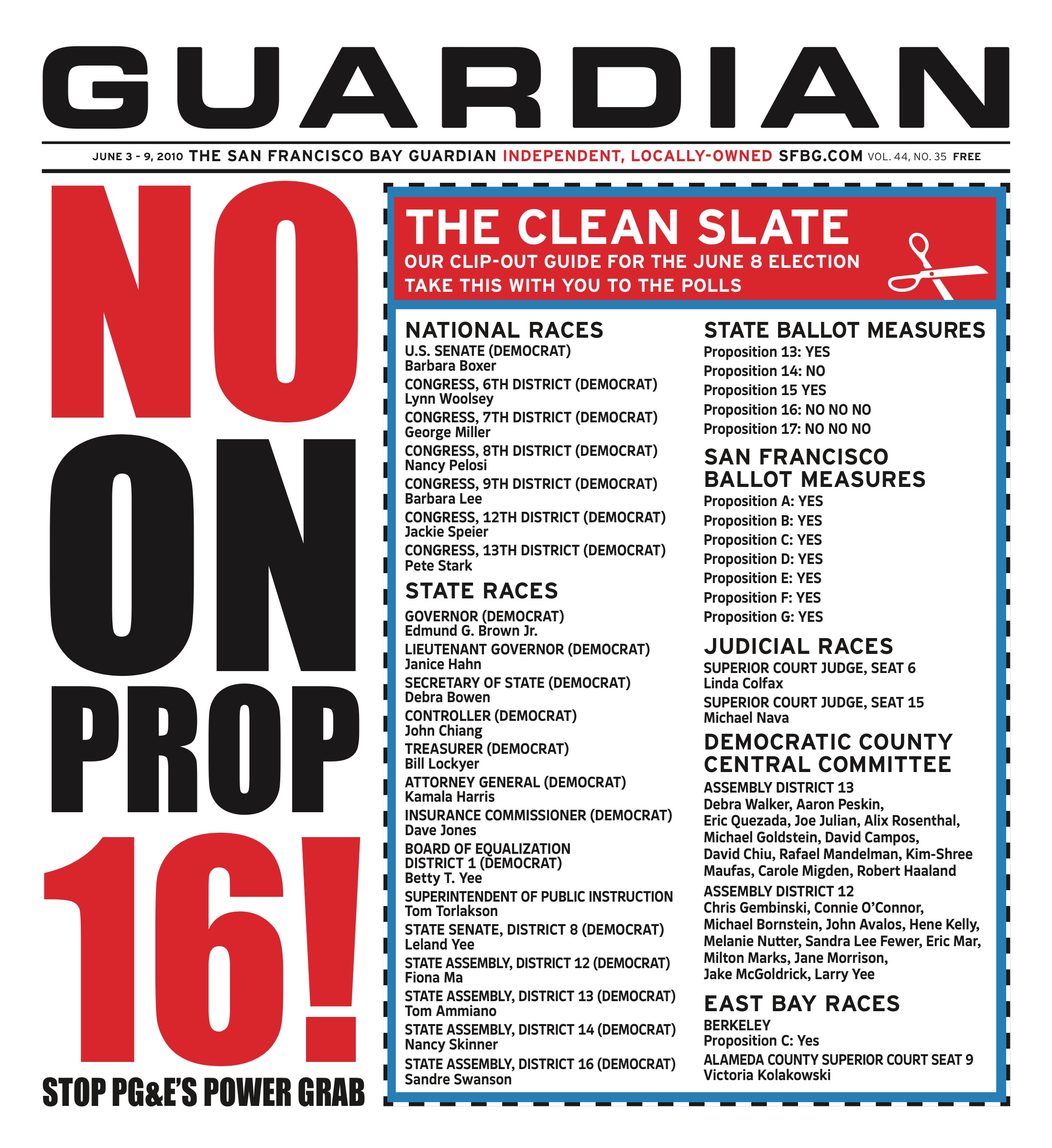
Three words: Vote June 8

1

The problem with the June 8th ballot is that the Democrats aren’t fighting with each other.


I mean, it’s great that Jerry Brown and Barbara Boxer will emerge from the primary season unscathed, flush with money and ready to go after opponents who have been battered and beaten mercilessly in their own primaries. It’s great that Steve Poizner drove down Meg Whitman’s positives and made her look so bad that she’s now behind Jerry Brown (who isn’t even campaigning yet) in the polls. It’s great that Carly Fiorina was forced so far to the right that she had to endorse allowing people on the no-fly list to buy handguns. The expensive and ugly GOP primary battles may have saved Boxer’s job and put Brown in the governor’s office.


But around the state, Democrats don’t have as much reason to vote. Fiorina, Poizner, Whitman — they’re all spending millions to bring Republicans to the polls. There’s no similar statewide GOTV operation on the Democratic side. So the electorate could wind up skewing considerably to the right — and that’s going to hurt us on the ballot propositions.


Johnny Angel and I were talking on our radio show today about the fact that Republicans — those who aren’t complete idiots — ought to oppose Prop. 16 and Prop. 17. Those aren’t partisan measures; they’re just corporate scams. And nobody from any political party likes Pacific Gas and Electric Co. these days.


But the reality is, PG&E has aimed its Prop. 16 campaign directly at the heart of the more conservative electorate, with its anti-government message. And Mercury insurance has aimed its campaign at the better-off consumers who aren’t likely to drop their car insurance any time soon. I don’t see Prop. 16 winning big in any constituency — but it will do better among Republicans.


So Democrats have to get to the polls — and get their friends to the polls, and their families to the polls, and their neighbors to the polls, and a few dead people, too, if they can find them (just kidding, Arthur Evans, lighten up).


And in San Francisco, where there are no races for mayor or supervisor, it’s easy to want to sit this one out — but that would be a major mistake. The election for Democratic County Central Commitee alone is worth a trip to the polling place, since the makeup of that body will have a significant impact on the fall supervisorial races.


So you have to vote, folks. Here’s our endorsements.


The best worst I’ve ever had

0

By Sam Stander

There are few fandoms so charmingly enthusiastic as the hordes of video-hounds who treasure Troll 2 (1990), by many accounts the worst movie ever made. This past Saturday night, the East Bay took its turn in the publicity blitz for Best Worst Movie, a documentary about the Troll 2 phenomenon, directed by the ridiculous horror flick’s then-child star Michael Paul Stephenson. Stephenson appeared with his costar George Hardy in San Francisco on Friday, but only Hardy was on hand for the Saturday night screenings at Berkeley’s Shattuck Cinemas.

The theater wasn’t full, but many of its seats were filled with Troll 2 diehards — the woman seated to my right sported a green shirt bearing the legend “GOBLIN.” The uninitiated might be wondering what such a shirt has to do with a movie named for trolls; well, Troll 2 doesn’t feature any trolls, but rather a town (called Nilbog) filled with sap-thirsty vegetarian goblins. About ten minutes before the lights went down for Best Worst Movie, one guy in the audience loudly paraphrased Stephenson’s revelatory line from the film, shouting, “Oh no, Nilbog is ‘goblin’ spelled backwards!”

VIDEO: http://www.youtube.com/watch?v=fTfjb8Fgiyg

These were, by and large, not Troll 2 virgins, and their reactions to the documentary were warm and joyful. Even some of Best Worst ‘s most uncomfortable or sad moments drew laughter — Stephenson’s movie impeccably balances the camp-informed following of the film with tenderly observed portraits of the ordinary, extraordinary, and occasionally mad participants in the original film fiasco.

As the credits for Best Worst Movie rolled, George Hardy, who plays Troll 2 ’s father figure, Michael Waits, took to the front of the theater, mic in hand. He’s 55 now, a well-established dentist in Alexander City, Alabama, and after a first wave of engaging with his cultish fans that began a few years ago, he’s back on the road to promote the documentary. On Saturday he gave numerous shout-outs to his cousins and dentist friends in the audience at Shattuck Cinemas, often speaking directly to them.

VIDEO: http://www.youtube.com/watch?v=5tFgZ6DmXmw

Hardy answered questions about the experience with the mostly Italian crew of Troll 2 — “pretty unprofessional, really” — as well as participating in the documentary. For one part of Best Worst, where the core cast returned to the house where much of Troll 2 takes place, he indicated they paid $1500 to clean up the house just so they could enter it.

Hardy spoke in awed tones of a dental patient from 12 years back who had come out of the woodwork for the San Francisco screening the night before — she lived just down the street from the Lumiere Theatre. But the real emotion came when he started to talk about Michael Paul Stephenson, for whom he seems to have a great deal of admiration and love. His light, scatterbrained yet sincere approach to answering the audience’s questions might have been due to tipsiness. “I did have a glass of wine before I came over here,” he admitted.

VIDEO: http://www.youtube.com/watch?v=_OiD6IlBmtk

I asked Hardy if he’s received any other offers for film roles since the resurgence of Troll 2. He pointed out that he has appeared in one other film, Street Team Massacre (2007), but volunteered the fact that he can’t memorize lines.

Hardy said this was something like theater number 78 on the Best Worst Movie tour, but declared Shattuck Cinemas one of the nicest venues. Then it was back to number 77 again, the Lumiere in SF, to do another Q&A and introduce a midnight screening of the offending film itself, Troll 2. That screening was similarly attended by a small knot of fans, but for those in the audience who hadn’t had the pleasure, Hardy offered, “It’s a religious experience, I promise.”

VIDEO: http://www.youtube.com/watch?v=9KCct4RwLNM

If crime in San Francisco was shown as peaks and valleys

1

…it would look like this.

And what a revealing landscape the city suddenly becomes.

If you scroll down through the many crime visualization images that are posted at doug mccune’s blog, you’ll find a visual for prostitution, along with the following comments:

“My favorite map is the one for prostitution (maybe “favorite” is the wrong choice of words there). Nearly all the arrests for prostitution in San Francisco occur along what I’m calling the “Mission Mountain Ridge”, which runs up Mission St between 24th and 16th. I love the way the mountain range casts a shadow over much of the city. There’s also a second peak in the Tenderloin (which I’m dubbing Mt. Loin).”


Ethics boss finally ousts Luby, a crusading public advocate

13

Oliver Luby has long been the most public-spirited employee of the San Francisco Ethics Commission, the one person in that office who repeatedly exposed powerful violators of campaign finance rules and blew the whistle on schemes to make the system less transparent and effective, drawing the ire of Director John St. Croix and Deputy Director Mabel Ng in the process.

St. Croix repeatedly tied to silence and punish Luby, who fell back on civil service and whistle-blower protections to save his job as a fines collection officer and continue doing it properly. But it appears St. Croix has finally succeeded in ousting Luby, who this week was notified that his last day will be June 11.

During budget season last year, at a time when St. Croix was trying to punish Luby for sounding the alarm about a new campaign finance database would effectively delete important data (something St. Croix defended but the vendor, NetFile, later corrected), St. Croix quietly removed a special condition for Luby’s job that required at least 12 months campaign finance experience.

So when Mayor Gavin Newsom ordered more than 400 layoffs of city employees to balance the budget, Luby’s job was just another 1840 level position, subjected to being taken by someone from another department with more seniority, which is what happened when Ernestine Braxton, a junior management assistant with the Department of Public Works, took the job.

When I asked St. Croix about why he removed the special condition from Luby’s job and whether it was retaliation for his battles with Luby, St. Croix told me, “You want me to talk about a personnel matter and I’m not going to talk about it.”

Yet Luby says its clear the St. Croix targeted him for removal. “Once that condition was removed, it was only a matter of time before I was bumped by someone in the same civil service job class but with greater seniority,” Luby wrote in a message to supporters, adding that he’s still figuring out what his options are.

Luby first got on the wrong side of Ethics Commission management back in early 2004 when he and fellow employee Kevin DeLiban accidentally were sent a memo from the office of campaign attorney Jim Sutton, treasurer for the Newsom for Mayor campaign, detailing a scheme to illegally pay off campaign debts with money laundered through Newsom’s inauguration committee.

Ng and then-director Ginny Vida ordered them to destroy the document, but they saved a copy and exposed the scheme, which Sutton then backed away from implementing (the pair was publicly honored for their efforts). But Luby continued to have professional differences with Vida’s replacement, St. Croix, often over the favorable treatment given the clients of Sutton, who runs the most expensive and deceptive campaigns on behalf of powerful downtown corporations and organizations (and whose hiding of a late PG&E contribution to defeat a 2002 public power measure resulted in a largest fine Ethics ever ordered).

For example, in 2007, Luby wrote a memo showing how enforcement actions by Ethics disproportionately targeted small campaigns (often by progressive candidates) and ignored serious violations by the most powerful interests in the city (which, if pursued, would have resulted in big fines, money the city desperately needs). We at the Guardian obtained the memo and wrote a story, causing St. Croix to order Luby to not longer write memos recommending way to improve operations at Ethics. And in November 2008, Luby wrote an op-ed in the Chronicle showing how St. Croix had ignored and covered up campaign finance law violations at City College of San Francisco that later led to the criminal indictment of former Chancellor Phil Day (whose trial is expected to begin later this year).

With each of these battles, Luby was threatened by St. Croix and had to seek support from his union, SEIU Local 1021, and the protection of civil service and whistleblower laws. But now, it appears that San Franciscans are losing the only person in the Ethics Commission that could be trusted to act in the interests of the city and the public.

Mandela Food Cooperative gets the Redford nod

0

The following is a sentence you wouldn’t be reading a year ago. Yesterday, I went grocery shopping in West Oakland. But, thanks to James Berk, and his fellow worker-owners at the Mandela Foods Cooperative, I did – and way more importantly, residents in an area that went without a source of produce and other healthy foods for years now have a place to buy the food they’ll need to make dinner. Berk’s being honored for his work by the Robert Redford Center’s “The Art of Activism” award (Wed/9), another fist pump from Bob for the Bay’s finest community leaders.

“Having been a resident of West Oakland,” the 19 year old Berk told me in a phone interview “I didn’t have a car. [If you’re] not going to go to Pack N Save, your options were Hungry Man dinners and Hot Pockets.” Berk was sick of it. He took his first steps towards addressing the problems that face Oakland’s low income neighborhoods in 2007, when the executive director of Mandela Marketplace (the food co-op’s umbrella organization), Dana Harvey, came to his high school looking for help with a survey that would address the area’s issues and needs.

Berk jumped on the project, and the survey confirmed what was already obvious to those that responded; corner stores weren’t cutting it when it came to the nutritional needs of families. Thus began a lengthy process to do something about it, a process that Berk was an integral part of. Two years later, on June 6th, 2009, Mandela Food Cooperative opened the doors to its 2,500 square foot storefront in the Mandela Marketplace complex, a colorful stand of buildings across the street from the West Oakland BART stop.

On my trip to see what the Cooperative was all about (and yes, buy groceries), I realized that the store’s aim was to improve more than just the contents of West Oakland’s refrigerators. Small placards near the stacks of fresh (a mix between organic and conventionally grown) veggies and fruits signal one of the place’s least heralded aspects; its purchasing practices don’t just support low income consumers, but producers as well.

Carrots where there once was none in West Oakland

Each card has a photo of one of the co-op’s produce suppliers, and a short note on how they run their farm. “Mandela Marketplace buys direct from small minority farmers, who in a lot of cases wouldn’t be able to provide enough of a harvest to sell to the bigger supermarkets,” Berk tells me. Black and Latino faces beam out from the pictures on the walls, proof that the co-op is working on the larger issue of an inequitable food system that provides no easy breaks for the little guys on the production end, either.

“There’s been a lot of positive feedback,” Berk says. “We have customers we see on a day to day basis, but we can still do more.” With zero storage space, there was initially problems keeping food on the shelves – demand can be difficult to predict, which has been part of the learning process for the store’s worker-owners.

But logistical issues haven’t slowed down the staff of Mandela Food Cooperative, which also runs pop-up markets at senior centers, where limited mobility would otherwise curtail residents’ ability to do their own shopping. Every Saturday in the store, a nutritionist holds an open health and disease prevention class, occasionally cooking with ingredients like quinoa to highlight their role in a healthy diet. The families that come through while I’m in the store can choose among two aisles of bulk foods, locally produced cheeses, soy products, and items from the butcher counter. Berk sees the neighborhood’s enthusiastic reaction to the market as proof it has the power to improve the way people eat.

Nowadays, Berk works a couple days a week at the co-op, does youth empowerment work with WYSE (West Oakland Youth Standing Empowered), and works on Mandela Marketplace’s program that focuses on getting nutritious food and positive businesses practices into convenience stores, the Healthy Neighborhood Stores Alliance. He’s a community leader who tends to minimize his own role in the change he’s helped to create and focus on what it means that his groups have found success.

Berk will share the stage at the Redford Center awards ceremony with co-honorees, actress Rosario Dawson (who in addition to being smokin’ hot, co-founded Vote Latino, and is active in a variety of social causes), and Martha Ryan, whose San Francisco Homeless Prenatal Program has provides medical care and support services to over 3,000 unhoused families a year. Berk’s hopeful that the recognition he and his program are receiving spreads the taste for change to others who are in the same place he was back in 2007.

“Residents who have no prior business experience were able to make this happen,” Berk says. “If we can do it, than others can too. In areas like West Oakland throughout the country, people don’t always have the power to get a loan from the bank. But they have the power to make something like this happen.”

“The Art of Activism”

Wed/9 7-9 p.m., $20

Sundance Kabuki Cinemas

1881 Post, SF

(510) 809-0790

www.redfordcenter.org

You down with ICP? The perils and wisdom of being just a Juggalo in 2010

1

By Zach Ritter

Do you remember the first time you heard of Insane Clown Posse? What was your reaction? Did you laugh? Recoil in horror? Or did you thank the trickster gods of pop culture for allowing such a band to exist?

Now, when confronted with a pair of sneering rappers in greasepaint who call themselves Violent J and Shaggy 2 Dope, most people are going to resort to mockery. It’s really the only reasonable response. At the same time, though, it’s beginning to seem as if the whole cottage industry of ridicule that’s sprung up around the band has jumped the shark. Yes, ICP are absurd. Yes, the elaborate “Dark Carnival” mythology that surrounds their albums is profoundly stupid. These are facts, and few non-Juggalos would dispute them. At this point, though, even SNL is doing ICP-themed sketches, which I think is a pretty good indication that the joke has run its course.

So instead of mocking ICP, I instead invite you to consider the implications of their fame. There are few American bands that can lay claim to a fanbase as dedicated as ICP’s Juggalos. It’s possible that this has something to do with misery loving company — the more critically scorned a band becomes, the more its fans close ranks, drawing defiant strength from their shared marginality. But I think there are other forces at work here. ICP can be justly accused of a lot of aesthetic sins, but insincerity isn’t one of them.

This is a bigger deal than it might seem. “Legitimacy” in music has become an increasingly fraught concept, especially in the irony-suffused world of indie rock. A lot of music fans seem to spend an inordinate amount of time trying to figure out whether or not their favorite bands are pulling one over on them. Juggalos don’t have that problem. Juggalos know that J and Shaggy mean, with all their hearts, every last word of the goofy shit they spout on their albums. Case in point: the following video. Either these guys are the most sincere lunatics ever to rock a mike, or they’re the greatest surrealist comics of our time.

So when ICP rolls into San Francisco on June 5, and the Juggalo legions descend upon the Warfield, you might want to actually check out their show. I’m not saying that you’ll have an unironic good time, but you might figure out something that everyone else has missed.

INSANE CLOWN POSSE
With Kottonmouth Kings, Coolio, Kittie, and Necro
Sat/5, 7 p.m. (doors 6 p.m.), $32.50-$35
The Warfield
982 Market, SF
(800) 745-3000
www.ticketmaster.com


Nevius family values

6

The Chron’s C.W. Nevius has made a big deal of moving back into town from the suburbs — and the offhand comment by Steve Jones in an email to Nevius has almost become a sticky nickname. In fact, his own newspaper’s website, sfgate, headlined his column “Suburban twit moves to city.”

But Chuck’s got some work to do before he starts to understand San Francisco values.

Take his latest column, about the Democratic County Central Commitee. Now, any Chron columnist (or anyone else) has the right to endorse and advocate for any candidates he or she wants. And Nevius is absolutely right to point out that the DCCC race is crucial, that control of the committee will have a significant impact on the fall supervisorial elections.

Here’s what made me want to scream:

“So, if you’re happy with the far-left agenda, check out the Bay Guardian. (Progs with name recognition like Peskin, David Campos, David Chiu, and John Avalos are probably shoo-ins. Daly is not running.) For those who’d like to see a swing to families, kids, and civility on the streets, here are some suggestions.”

 A swing to families and kids? You must be kidding.

The single greatest issue facing families and children in this city is the cost of housing. That’s why Coleman Advocates for Children and Youth, which almost everyone agrees is the premier family-advocate group in the city, has made affordable housing a huge priority.

Some of what a recent Coleman report says:

 “Two-thirds of all children in the city do not have a secure future in San Francisco

More families in San Francisco are low-income (43%) than middle-income (23%), and face economic hardship even when working full-time jobs.

Extreme racial disparities in family income and access to opportunity mean that the majority of children who do not have a secure future in SF are children  of color, and the majority of children who do have a secure future are white.”

Coleman’s recommendations: Build and preserve affordable housing for families — not market-rate condos, not condo conversions, but below-market-rate housing.

From the report:

“1. Prioritize the needs of 45,000 children growing up in 20,000 extremely-poor and low-wage working families.  trategies must combine investing in a stronger social safety-net for families now, and investing in anti-poverty strategies that will prepare today’s poor children to become economically secure San Franciscans of the future. The city’s housing and educational policies must focus on the children and families with the greatest need, and not get sidetracked by the demands of middle-income or upper-income families whose needs are legitimate but not as urgent.

 2. Invest in affordable homeownership programs for middle-income families, but focus the vast majority of limited housing resources on building permanently affordable family rental housing.”

That is exactly what the progressives — the “far left” folks that Nevius decries — have been talking about all these years. The candidates Nevius endorses are of the political camp that advocates more market-rate housing, more condo conversions, fewer tenant protections — more of the kind of things that drive lower-income families out of the city.

The next priority is education. Families that don’t have a lot of money have no option other than the public schools, and a lot of us who might be able to afford private schools still think public education is the way to go. What the schools need in San Francisco is pretty simple: They need more money. The “moderates: Nevius endorses — who actually count as fiscal conservatives, by San Francisco standards — are generally against raising taxes, as is our mayor. The San Francisco city government doesn’t oversee the schools, and most of the education money in California comes from the state — but San Francisco’s Rainy Day Fund, and the willingness of the supervisors to put money into the local schools, has saved hundreds of teacher layoffs and helped the quality of the local public schools.

 Where did that idea come from? Progressive leader Tom Ammiano.

I’m a San Francisco parent with two kids, and I have a lot of friends who are San Francisco families, and none of us see the Nevius agenda as family-friendly. That’s why we’re supporting the progressives.

The Daily Blurgh: Viral kittens, punking BP

0

Curiosities, quirks, oddites, and items from around the Bay and beyond

Asshole: “I’d do it again”

*****

Another asshole: “A man driving a crossover sport utility vehicle hit four bicyclists in the Mission District and Potrero Hill neighborhoods in a six-minute rampage Wednesday night before crashing the vehicle and running away, San Francisco police said.”

*****

Agitprop: An annotated guide to images from the anti-BP movement.

*****

Science: All your kittehs belong to the alien virus that makes cats (and the people who love them) do craaaazy things!

*****

Snark: “20 Young Writers Earn the Envy of Many Others”

*****

Fashion: Handbags, now with less lead.

*****

Environment: BYOB (as in non-single-use bag, not beer) is now California law.

*****

Bummers: RIP Rue McClanahan. Thank you for being a friend (to all the cats):

Bicycists don’t deserve hate or violence

42

Today’s Chronicle story about an SUV driver purposely running down four bicyclists in San Francisco last night is disturbing enough, but the neanderthals who commented on that story to support this murderous rampage and blame bicyclists’ behaviors for encouraging the attack are truly outrageous and should be universally condemned. Has civil society broken down to the point where advocating violence against innocents is acceptable?

I’ve been the target of such rhetorical attacks for promoting bicycling, but when someone deliberately runs over a series of unrelated bicyclists, it’s time for all of us to reevaluate our use of hateful rhetoric and consider its impact on the mentally unbalanced, as this driver clearly was. Words don’t hurt, but when those words condone and promote violence, it’s time for all public-spirited individuals to apply the brakes.

Most people have long since abandoned any sympathy for the position that the rape victim was asking for it because she wore a short skirt, or that the gay beating victim shouldn’t have been so flagrantly making out in public, or that the lynching victim was getting a little uppity.

Similarly, even the most obnoxious, red-light-running, Critical Mass-riding, pedestrian-threatening bicyclist doesn’t deserve to be intentionally run over by an SUV. And when people blame a heinous attack like this on how bicyclists ride, even if just making a joke, they validate a hatred that we all should be condemning, no matter how you feel about bikes.

Leno cell-phone bill faces crucial test

7

By Brittany Baguio


The State Senate is set to vote as soon as June 3rd on legislation that could require cell phone companies to disclose the level of radiation their devices emit. The bill, by Sen. Mark Leno, is the latest effort to expand consumer awareness of a potential problem that become the center of a heated scientific debate.


Leno’s measure, SB 1212, would mandate that manufacturers and phone providers disclose radiation levels, or Specific Absorption Rate (SAR), on their Internet websites and online user manuals. The SAR would be placed next to the purchasing price. They would also be required to state the maximum SAR value, and what it means.


“The federal government has set a standard for this type of radiation and already requires reporting,” Leno told us, “At the very least, consumers should have the right to know about the relative risks of the products they’re buying.”
       
There’s a similar measure in the works in San Francisco. The Board of Supervisors City Operations and Neighborhood Services Committee May 24th passed Mayor Gavin Newsom’s plan to require retailers in the city to reveal the amount of radiation released by cell phones. That would make San Francisco the only city in the United States mandating that retailers acknowledge radiation information.


Leno’s bill is a response to studies suggesting that radiation levels emitted from cell phones have potential to cause brain tumors and other health problems.


The most recent and largest study focusing on cell phone radiation, the Interphone Study, was released this year. Conducted by 21 scientists, with Australia, Canada, Denmark, Finland, France, Germany, Israel, Italy, Japan, New Zealand, Norway, Sweden, and the United Kingdom all participating, the study looked at the long-term risks of certain brain cancers.


The results are mixed and a bit confusing. The study found some results of increased risks of tumors, although the authors could not agree on how to interpret the results


The researchers surveyed 5,000 brain-cancer patients, and found that people who were “heavy” cell-phone users (defined as using the phone 30 minutes or more a day) had a slightly higher risk of some kinds of cancer. And, as an Environmental Working Group analysis of the study noted, “most of the people involved …. used their cell phones much less than is common today.”


Cell phones emit radio waves through their antennas, which in newer models are often embedded in the phone itself. The closer the distance from the antenna to a person’s head, the more exposed he or she is to radiofrequency energy.


However, as the distance between the antenna and a person’s body increases, the amount of radiofrequency energy decreases rapidly. Consumers who keep their phones away from their body by doing activities such as texting are absorbing less radiofrequency energy.


The Federal Communications Commission has set a safety level for Standard Absorption Rate —  a measure of radiation energy — at 1.6 watts per kilogram of bady mass. All cell phone manufacturers must produce phones at or below this level.


The intensity of radiofrequency energy also depends on signal strength. When a person makes a call, the antenna sends a signal to its closest base station antenna and is then transferred to another person’s cell phone. The further the distance between the cell phone and the base station, the more power it takes to keep the call going.


A study done by Joachim Schuz in Germany in 2006 found a 120% increased risk for a brain tumor, glioma, among people who had used cell phones for at least 10 years. In addition, a study done in 2005 by MJ Schoemaker in Sweden suggested an 80% increased risk of acoustic neuroma, an intracranial tumor, on the side of the head of people who continually used cell phones for at least 10 years.


A study done by Siegal Sadetzki in Israel in 2008 suggested that there was a 49 to 58% increased risk of salivary gland tumors among frequent cell phone users on the same side of the head where the phone is used.


But there are some studies that suggest that cell phones pose no significant health effects to its users. According to California’s Environmental Working Group director, Renee Sharp, those studies produced such results because they focused on acute and medium term effects rather than long term effects. “We aren’t trying to say that cell phones are dangerous because we don’t have definite answers yet and we need more research done,” Sharp told the Guardian, “But when you look at studies with long term use of 10 years of longer, you see increases in certain kinds of brain tumors. We are trying to give people as much information as we can to make informed decisions because it may or may not impact their health.”


Part of the reason consumers are unaware of the radiation levels emitted from their cell phones is that cell phone manufacturers aren’t required to disclose that information directely to phone buyers. Instead they send the data to the FCC. Although the FCC makes this information available on its website, the information is not easily locatable and some links direct visitors to a manufacturer’s website that contains no SAR information. A list of cell phone model SAR information compiled by the Environmental Working Group can be found here.


Based on the Environmental Working Group’s cell phone list, some of the most popular cell phones emit the most SAR. For example, the Apple iPhone 3G can emit from 0.24 W/kg to 1.04 W/kg. The HTC Droid Eris emits 1.19 W/kg. The T-Mobile Sidekick emits 1.34 W/kg. But the award for the cell phone that emits the most radiation goes to the Blackberry 8820, which emits 1.28 to 1.58 W/kg — just below the federal safety limit. The more power a cell phone requires to load extra features and applications, the more radiation the cell phone emits.


According to Sharp, another part of the problem is the FCC’s standards are not protective enough. “The FCC set SAR standards 14 years ago and has not updated them since then,” Sharp told us. “This was before we found out that children have thinner skulls and are more susceptible to radiation effects and before phones developed and exploded into what they are now.”


Other countries echo Sharp’s concern for public safety. Although no country in the world has officially adopted a law requiring a disclosure of cell phone radiation information, some countries have already taken steps make consumers more aware of the potential danger radiation can cause. Consumer advocates in France a pushing a law that would ban advertisements promoting the sale of cell phones to children younger than 14. Countries such as the United Kingdom, Canada, Israel, and Finland have all created recommendations to prohibit children from using cell phones, only use cell phones if necessary, and to use hands free devices to talk on the phone.


The cell phone industry is strongly opposing Leno’s bill. Representatives from Tech America, which represents the industry, and AT&T, a major political player in Sacramento, could not be reached for comment.

Should Antonini recuse himself from Lennar vote?

1

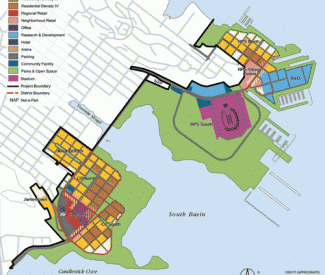
As a Newsom appointee, Planning Commissioner Michael Antonini is expected to be a key vote today in favor of Lennar’s massive redevelopment plan at Candlestick Point-Hunters Point Shipyard.

And then there’s the fact that he wrote an op-ed for the San Francisco Business Times in December 18, 2009, suggesting that business, civic, labor and government leaders can keep the 49ers in town by “joining forces to assist in needed repairs and improvements to Candlestick Park and to expedite development of the Candlestick Point Hunters Point Shipyard, a project that features a “state-of-the art,” 69,000-seat football stadium.”
(The full text of Antonini’s op-ed is included at the end of this post to put his words into full context.)

But Antonini’s cheerleading has got some folks questioning his impartiality when it comes to the decisions that members of the Planning and Redevelopment Commissions will make today around certifying the project’s Final Environmental Impact Report (FEIR) and adopting related environmental findings.

In a June 2 letter to Planning Commission president Ron Miguel, Arthur Feinstein of the Sierra Club, Mike Lynes of the Golden Gate Audubon Society, Jennifer Clary of San Francisco Tomorrow and Jaron Browne of POWER (People Organized to Win Employment Rights) claim that “Commissioner Antonini has clearly prejudged the proposed project and become a strong advocate for locating a football stadium for the 49ers at the Hunters Point site as part of this project.”

“He has publicly urged others to support that stadium and cannot impartially review the record before him to determine whether the EIR is adequate, accurate and objective and whether adequate measures are required to protect the environment,” the foursome continue.

 Noting that he could have chosen to sign the December 2009 op-ed as a Member of the Republican County Central Committee, Feinstein, Lynes, Clary and Browne observe that Antonini “ instead identified himself in the capacity where the law requires him to act impartially – as a Planning Commissioner.”

With others arguing that Antonini’s right to express his opinion is protected by the First Amendment, and Antonini planning to read a rebuttal into the record at 1 p.m. today, it sounds like there’ll be plenty of drama at today’s hearing.

Antonini’s Op Ed in San Francisco Business Times

Friday, December 18, 2009
Business leaders can save the Niners
San Francisco Business Times – by Michael J. Antonini

“The 49ers are deeply and historically identified with San Francisco. San Franciscans Vic and Tony Morabito founded the team in 1946, many years before the Giants moved from New York and the Warriors from Philadelphia.

Hence business, civic, labor and government leaders are joining forces to assist in needed repairs and improvements to Candlestick Park and to expedite development of the Candlestick Point Hunters Point Shipyard, a project that features a “state-of-the art,” 69,000-seat football stadium. Leaders from the Committee on Jobs, the San Francisco Chamber of Commerce, Recreation and Park and others are asking businesses and individuals to help with funding of improvements at Candlestick in return for advertising. These improvements could translate into increased revenue for the contributor, the city and the team. Replacement of aging seats and a highly visible new luxury section are two concepts being studied.

Naming rights to Candlestick Park is an attractive opportunity for a company or an entity to gain nationwide exposure and local acclaim — and, perhaps, position itself to be a key contributor when a new stadium is built at Hunters Point. No new stadium can be built anywhere without significant private investment, in addition to $100 million assured from Lennar Corp. as a precondition of development rights and the amount which the 49ers ownership would invest.

On Thursday, Dec. 17, the San Francisco Planning Commission was to hear comment on the Draft Environmental Impact Report for the Candlestick Point Hunters Point Shipyard Plan. Because this plan features many diverse uses, particularly huge amounts of housing, funding is being rapidly obtained for greatly improved transit and traffic access.

San Francisco must avoid the errors of the past, when we failed to build an arena for indoor sporting, major conventions and entertainment events. Such a facility could have brought huge amounts of revenue to San Francisco businesses.

Leaders have twice stepped up to save the San Francisco Giants. One would expect no less from our leaders when dealing with our home grown, five- time Super Bowl champion San Francisco 49ers!

Michael J. Antonini is a planning commissioner for the City and County of San Francisco.”


From freeway to favas

0

Perhaps you’ve noticed a fresh mountain of fava beans arising along Octavia Boulevard as you travel toward Market Street, in the spot where a freeway used to touch down. Don Wiepert certainly has. He’s a senior citizen who lives across the street from the rows of green sprouts, and even helped to raise the crop in his own living room.

Wiepert is one of 1,500 neighborhood volunteers who have taken part in the birth of Hayes Valley Farm, an exciting experiment in participatory urban agriculture. Started in January by three young permaculture activists, the project has converted into farmland a city block whose previous harvests were auto exhaust from the freeway on-ramp, and most recently, crime and vagrancy.

Farm organizer Jay Rosenberg explains the process as we tour the fields he helped to envision. Back in 1964, neighborhood activists from Hayes Valley Neighborhood Association and other groups organized to stop the progress of the Central Freeway that would connect Highway 101 to the Golden Gate Bridge. The show of community force was impressive, but it stranded the planned highway on- and off-ramps on a block of land between Octavia and Laguna streets. “They left them here standing like ruins,” Rosenberg said. “This was a 2.2-acre forgotten space.”

“It was a place for homeless living,” Wiepert said on a recent trip to the farm’s biweekly work party, while volunteers and a handful of paid staff buzzed about replanting seedlings and erecting a homemade greenhouse. “It was fenced off, ugly, inaccessible.” He looks around. Not to resort to a cliché, but there’s a discernible twinkle in his eyes as he says, “Now it’s wonderful.”

Although the block was in a desirable central location, its soil had been damaged from years of exposure to car emissions, which can leave behind lead and other heavy metals. But the team behind Hayes Valley Farm has a plan. The ivy that threatened to strangle the farm’s trees has been stripped, piled into heaps that are covered with cardboard and horse manure to begin a turbo-fertilization process that mimics what happens on forest floors. Once this new soil has been created, it is spread and implanted with fava seedlings, which were selected for their nitrogen-producing capabilities.

Rosenberg halts his tour of the process to pluck a bean plant from the ground and finger the white nitrogen nodule its roots have produced. “Look how well they’re doing,” he says over the nascent crop, proud as a papa. Once these plants are mature, half will be harvested as food, and half chopped at the root to speed the release of their nitrogen into the rest of the soil. Already young lettuces peek beneath the rows of beans, signs that the farm is ready to experiment with other foods.

San Francisco is a weather system unto itself, rendering the city’s ideal crops the subject of much conjecture. “This is a cool, Mediterranean-like, foggy desert,” Rosenberg says. “We’re doing lots of research on species that do well here, which will be knowledge the public can use.” The farm, like the Alameda County Master Gardeners (www.mastergardeners.org) who run a similar program, is serving as a test arena to see what urban gardeners can reasonably expect to thrive here.

The farm is now home to 1,500 plants, including 150 fruit trees, most sitting in pots on the old freeway on-ramp in what Rosenberg calls “the biggest patio garden in San Francisco.” So far, all the crops have gone into the bellies of the volunteers who raised them, putting in more than 4,000 person-hours during the four months the farm has been open.

But it’s not just the free groceries that keep neighbors returning to Hayes Valley Farm. In addition to the work parties, the site has been home to popular screenings of environmentally-themed films and a locus of outdoor learning. One group of students from the Crissy Field Center painted a mural for the farm that will soon occupy one wall of its planned on-site classroom. A weekly yoga class is planned, as are daily tours for farm newbies interested in learning more about the planting going on down the street.

In a time of uncertainty about what we’re supposed to eat, people are finding something to be sure about here. “I appreciate the opportunity to hang out with the younger people and their energy,” Wiepert says, moments before flinging a stick for one of the farm’s part-time dogs to chase after. “I think this place facilitates a feeling for a lot of people that they’re doing something meaningful.” *

HAYES VALLEY FARM

450 Laguna, SF

(415) 763-7645

www.hayesvalleyfarm.com

Newsom doesn’t read the Guardian!

13


Gav was on KQED this morning, talking about his run for Lite Guv, and he started right off by saying how he doesn’t ever — ever — read the Bay Guardian


Michael Krasny started off by asking why Newsom refused to appear on the radio in a debate with Janice Hahn. “She agreed, you didn’t.” Krasny asked. “Why?”


Newsom’s comment: Gee, I didn’t have time for a debate. Too busy running the city, and trying to balance a budget– “the most complex budget in city history.” He insisted that he’d solved a $522 million deficit without laying off police or firefighters, while protecting the soc sev safety net and investing in homeless service and universal health care.


Krasny: “So the Guardian can’t beat you up any more?”


Gav: “Honestly, I haven’t read it in years, with all due respect to Tim Redmond and Brugmann and whatever the team is over there.”


Krasny, politely, tried to bring up the idea that a no-new-taxes budget means fewer jobs, but Newsom had none of it: “They seem to have a tax first policy,” he said (although he doesn’t read us, so he doesn’t know. He complained that San Franciscans are already paying 10 percent in sales tax — “a regressive tax,” and that “they (presumably the Guardian) consistently support it, I don’t.”


Read our paper, Mr. Mayor. The Guardian has consistently, for many years, argued that sales taxes are regressive, and we’ve consistently, for years, argued that there are far better options, ways the city can reclaim money from the wealthy. And we’ve argued that Newsom’s no-new-taxes policy is bad for the economy.


Oh, and by the way: You talked over and over about universal health care in San Francisco, and how proud you were of that policy. But if you were reading the Bay Guardian, you might recall that it wasn’t your policy. That initiative came from then-Sup. Tom Ammiano, and you opposed the key employer mandates that fund it. Hey, you could even pick that up by reading the Chron: