San Francisco

The pummeling of SF Labor

18

Click to read sidebar, Brown or Whitman? No contest

With five supervisorial seats open and only one incumbent running, the Labor Council has had a tough time picking the right pro-labor candidates. The easy choices were incumbent Carmen Chu in District 4, with no opposition, and Raphael Mandelman, an exceptionally promising newcomer in District 8. But Janet Reilly in District 2 opposes the Labor Council’s revenue measures. In District 6, where long-time activist Deborah Walker has been endorsed, and in District 8, where Malia Cohen and Chris Jackson are #1 and #2, there are a multitude of candidates, many of them labor friendly.

It’s not an easy year.

Prop. B on San Francisco’s November election ballot confronts the city’s working people and their unions with an unprecedented challenge. The measure, sponsored by Public Defender Jeff Adachi, would severely weaken public employee unions and undoubtedly lead to other serious attacks on workers and unions in private as well as public employment nationwide.

The proposition is by no means the only dangerously anti-labor measure on the ballot, but it ‘s the worst from labor’s point of view, as it very well should be. It’s a prime example of the public-employee bashing that’s become a favorite theme in election campaigns everywhere and, if passed, would set a clear national precedent.

Actually, Prop. B might better be described as a pummeling rather than bashing – and one coming, furthermore, just a few months after city employees took a voluntary $250 million pay cut. Prop. B would steeply raise the employees’ contributions to their pensions unilaterally and prohibit bargaining on the issue in the future as well.

It would arbitrarily lower city contributions to the employees’ health plans, especially dependent care. What employees pay for health care coverage for children and other dependents would be as much as doubled.

The steep rise in the employees’ share of their health care coverage could quite possibly force families to drop city coverage and try to get cheaper coverage on their own. That, of course, is a primary goal of the corporate anti-labor forces and others who seek to balance the budgets of public entities on the backs of their employees.

So what if workers can’t afford to take the kids to the doctor.  Cutting taxes and balancing budgets is a lot more important. Besides, there’s always the emergency room and charity.

But wait! There are yet more major Prop. B flaws. For example: If city health care coverage is changed by increasing the premiums paid by employees, as the proposition requires, the city Health Service system (HSS) would have to forfeit new $23 million-a-year federal grants intended to reduce premiums for employees and retirees covered by the HSS. The system includes, not just city employees, but also school and community college district and SF court system employees and retirees.

There’s even more, much more than enough to energize labor’s troops. They are angry. Very angry. Unions citywide have at least temporarily set aside their sometimes considerable differences and feuding over tactics, jurisdictions and other matters. They’ve come together tightly along with a substantial number of labor’s Democratic Party allies to oppose Prop. B.

And watch out for Prop. G. It’s another favorite of the anti-union, anti-public employee crowd, led in this case by Sean Elsbernd, a very politically ambitious member of the SF Board of Supervisors.

Elsbernd and friends claim their intent is to “fix the Muni,” one of the nation’s most complex transit systems. The Municipal Railway, overseen by the Metropolitan Transit Authority (MTA), is indeed badly in need of fixing. But the principal blame for that does not rest with Muni’s bus and streetcar operators – most of them people of color – as proponents of Prop. G claim. Most of the blame rests with Muni’s overpaid managers, headed by $336,000-a-year executive director and CEO Nathaniel Ford.

As President Irwin Lum of the Muni operator’s union said in a Guardian interview,  “Muni needs to be changed from the top to the bottom.” He sees Muni’s problem as mainly a lack of resources and the political will to pursue them.  Muni officials might also avoid lots of problems if they’d deign to consult regularly with community groups and their leaders on their transit needs.

The public rightly complains of buses not arriving on time, of being passed up while waiting at bus stops, of grumpy drivers and of other certainly legitimate matters.  Naturally, they blame the drivers. But drivers do not make schedules. Under pressure to keep to the schedules made by others, they sometimes speed by waiting passengers. Sometimes they’re slowed by heavy traffic, sometimes by problems with faulty, broken-down down buses or slowed by having to deal with violent passengers. Sometimes, managers making out the schedules don’t properly anticipate such probable delays.

Oh, yes, those grumpy drivers.

Wouldn’t you be grumpy if you had to work a full shift without going to the bathroom? If you had to listen to loud complaints from unruly passengers who sometimes got rough with you and each other?  If you had to weave through heavy traffic for hours at a time? If you had to time your work to unrealistic schedules you had nothing to do with making?

It’s not the drivers who are in charge of replacing badly worn buses and streetcar tracks and equipment, not the drivers who are in charge of negotiating with Muni suppliers for a reduction in ever-escalating fuel prices and other costs. In short, it’s not the drivers who run Muni – though Muni, of course, could not run without them.

So, what do Elsbernd and his anti-labor cohorts want to do to the Muni’s invaluable workers? Here’s the deal:

The City Charter now requires that Muni operators be paid at least as much as the average salary of operators at the two highest paying similar transit systems in the country.  And if benefits granted Muni operators are worth less than those of operators at similar transit systems, the difference is paid to the operators from a trust fund established for that purpose.

Under Prop. G, operators’ pay and benefits would be set by bargaining between union and MTA representatives. If they couldn’t agree, the dispute would be submitted to an arbitrator, whose decision would be binding.

The arbitrator would be required to consider the possible impact of disputed proposals on Muni fares and services. But though all other city unions are also subject to arbitration, there’s no requirement that the arbitrator consider how their proposals would affect the services provided by the union’s members – an unusual requirement that’s virtually unheard of elsewhere.

Prop. G backers presumably see the proposition as a step toward their goal of being able to set, change or eliminate Muni work rules without bothering to consult workers or their unions. They are, you might say, “unilateralists.”

 Taking on Muni operators is only part of Supervisor Elsbernd’s anti-labor romp. He’s also sponsoring Prop.  F, a deceptively simple charter amendment that would seriously impact the 105,000 members of the Health Service System. It’s a stealth proposition, difficult to understand and explain, and thus often brushed aside as a minor ballot measure of no particular consequence.

But Prop. F is capable of doing major long-term damage to HSS members by weakening their position in negotiating with powerful health insurers such as Blue Shield on the size of the premiums HSS members have to pay for coverage and the benefits they receive.

All politicians stretch the truth. It’s part of their game. You needn’t look further than Elsbernd for evidence of that.  He actually claims he put Prop. F on the ballot strictly to save the Health Service System money by eliminating two of the four elections in which HSS members vote for representatives on the HSS Board. This seemingly small change would eliminate the overlapping terms that provide the continuity essential to successful negotiations with health insurers.

The savings would average a mere $30,000 a year, and would not even be available until 2016. Nor is there a guarantee that any of the money would go to the HSS. $30,000? What’s the real motive here?

As for the rest of San Francisco’s ballot measures and candidates, union supporters could hardly do better than to follow the recommendations of the AFL-CIO’s local Labor Council, which almost invariably backs the propositions most likely to be labor-friendly and opposes those that are not. This time, the Labor Council is saying “no” to those decidedly unfriendly Propositions B, G and F.

And don’t forget Props. J, K and N. Hotel workers and others are supporting Prop. J, which is meant to stop the travel industry practice of using online hotel booking to avoid paying SF’s hotel tax. Prop. J also would increase the city’s hotel tax for the first time in 14 years in order to raise some most welcome revenue for the city’s general fund.

However, Prop. K – introduced by Mayor Newsom – could stand in the way. Since Prop. K makes no change in the hotel tax rate, apparently it’s intended to confuse and distract the voters so they won’t approve Prop. J.

The other major revenue measure strongly supported by labor – Proposition N – would increase the city’s transfer tax rate on the sale of property worth more than $5 million from 1.5 percent now to a range of 2 to 2 ½ percent for a property worth $10 million or more. This would also generate millions for the city’s general fund.

Rarely has so much been at stake for San Francisco’s working people and their unions.

Dick Meister, former Labor Editor of the SF Chronicle and KQED-TV, has covered labor and politics for a half-century, Contact him through his website, www.dickmeister.com, which includes more than 250 of his columns.

NSFR(estaurant): My dinner with Dixie

0

All photos by Benjy Feen

I had a blind date with Dixie De La Tour, but I wasn’t nervous. If all else failed, at least she would bring stories to tell. And how – De La Tour is the founder and emcee of Bawdy Storytelling, a randy live series with two events next week (Wed/6 and Sat/9) that will bring writers, comedians, and normal folk-like to the stage to share corset-busting sexcapades with an audience of vicarious pervs.

“I don’t know how this got to be my life,” says Dixie, now installed across the restaurant table from me behind a glass of sweet tea, wearing a dashing fedora and magnetic waves of dyed red hair. Her blue eyes have the intent gaze in them that you can see on people that know how to hold the attention of the room. “I don’t have a degree in it like every other pervert in this town.”

It is true that De La Tour seems to have lucked out on the manner in which she makes her money. By day, she scouts scammers at Fling.com, a national dating site for casual hookups. Perhaps she’s a natural fraud-finder – the woman’s spent a life facilitating honest, fun sexual encounters. She’s also a contributor at She Loves Sex, a collection of blogs about all things sexual related to women, told in a knowledgeable women’s voice. For the site, De La Tour recently interviewed Rebecca, a soccer mom from Florida who has started a successful chain of swinger’s parties in between PTA meetings and classes towards her master’s in public relations. 

Bawdy Storytelling, started four years ago, runs through a different theme each month. Adderall Diaries writer Stephen Elliott and that webmaster savior of the perpetually broke gadabout, Johnny Funcheap will be spinning yarns at next week’s Litquake edition of Bawdy (Wed/6), which actually is not themed at all, but rather a collection of the all-star lineup’s “best true stories.”

Maybe she’s got no degree, but Dixie does have a history in the psychology of human sexual relations. Over her rum cake — and to the passing interest of our server — De La Tour tells me that she got the party started at the first Kinky Salon XXX edition. Well c’mon Dixie, story time. She obliges. 

Dixie De La Tour fires up the Bawdy crowd

Having transplanted from the Blue Ridge Mountains of Virginia and an unsatisfying heterosexual monogamous relationship with a bookie, De La Tour was in her element in late ’90s San Francisco. “You know that girl whose always down for the sex party? People would call me up and I’d be like, I’m there!” She became the doorperson for the original Kinky Salon parties at Mission Control, back in the days when the get-togethers were more “salon” and less “kinky” – there hadn’t been sex, at least as acknowledged by the party planners, for the first few Kinkys.

But one month, founders Polly and Scott decided to change the nature of their get-together. De La Tour recalls a woman arriving at the party who told her “I’m from New Hampshire and this is my first San Francisco sex party!” Well, by the time De La Tour had gotten off her shift and into the mix at Kinky, there was talking, there was certainly drinking, but at least explictly, no sex. 

“There was a bullhorn by the stage,” she remembers, fully in the swing of her tale. 

It is at this time that I should explain that Dixie has explained that she is herself, “not that big of an exhibitionist.” De La Tour is a facilitator, the person at the swinger’s party who loves nothing more to make introductions and get the fucking going… for others. That’s what she likes.

So back to the bullhorn. Having made the most of her time off door duty, she is a bit inebriated at this point. She takes the bullhorn and, having installed herself on stage in front of the party, booms to New Hampshire woman “Connecticut! Go have sex with that guy!” — or some such thing (having told me she is “much more interesting after two beers,” I am obliging her and my notes are a bit sparse from this point in the evening). She remembers them immediately going to have sex, although others from the night remember it differently. Good storytelling is all about the broad strokes.

But regardless, the rest is undisputed. Dixie soldiers on with the bullhorn, roaming about the club until she actually does encounter a couple copulating in the Pink Room and begins to shout very, very dirty things into the bullhorn at them. “Say my name, say you like my big dick” she shouts (“really, things that were not making very much sense,” she tells me, looking through that deadly scope of hindsight). Suddenly, couples rush into the Pink Room, and Dixie has officially started the orgy. Er, party. 

Later, she runs into the original fuckers in another room utilizing a fucking machine. She is stripped of her bullhorn, installed on said machine, and is chagrined (remember, not a big exhibitionist) when the tables are turned and the woman from this couple begins to yell her name into the bullhorn. “Yeah, you like my big dick, Dixie?” Partygoers rush into the room to see the performance, and aid in her enjoyment of machine. She is eventually brought to climax when a woman Eskimo kisses her. 

This is told with a smile, and by the end of it, we notice our server is frozen in her rounds of filling water glasses. “What on earth are you two talking about?” she says, giggling. But this is San Francisco, and as she is clearly intrigued, Dixie hands her a card that has all the Bawdy Storytelling events inscribed on its back. 

After our (professionally inclined) date, I feel as though I have met someone very special, someone who has the cojones to nurture a community that often stays behind closed doors. De La Tour tells me you can learn a lot from hearing a person talk for ten minutes, perhaps more than you can learn having a good time with them at a swinger’s party. 

And the connection is contagious. De La Tour started Bawdy Storytelling as a “coffee klatch for pervs,” where people would gather about the table and talk about how last night’s Kinky Salon went for them. Soon others wanted to sit in on the talks around the table, which led to Bawdy’s current public incarnation. And then everyone wanted to share a story, which led to Bawdy’s set program of four to six speakers a night, “so that people could see there was a set lineup and they weren’t on it,” De La Tour tells me. “Somebody’s always walking up to me and saying hey I got one for you!” This last line enunciated with a pointed finger and an intensification of that blue-eyed stare.

How nice to get sexuality out into the open. How nice to find meaning and simpatico in our sex. How nice to be Dixie De La Tour.


Bawdy Storytelling Graphic Confessions

Wed/6 8 p.m., $10

The Blue Macaw

2565 Mission, SF

www.bawdystorytelling.com

www.litquake.org


Lit Crawl: Bawdy in the Alley

Sat/9 8:30-9:30 p.m., free

Clarion Alley between 17th and 18th St., SF

www.bawdystorytelling.com

www.litquake.org


Flagging in the Park: the whirl story

0

“This is the gayest thing I’ve ever done in my life!” laughed my friend Ricky Strawberry as he twirled around and around, unfurling lengths of tie-dyed cloth to Hi-NRG dance tracks from a live DJ in the sunshine. If you know Ricky Strawberry, that’s pretty damn sparkly pink unicorn in a rainbow thong bathing under a Splenda waterfall gay. In fact, it was the gayest thing anyone in my pinko posse had ever done, as well, and we had a ball. It was gay, it was amazing, it was gaymazing, and you should do it too.

It? Flagging in the Park, the summertime monthly gathering of fluttering human butterflies in the AIDS Memorial Grove in Golden Gate Park. I wrote about it in this week’s Super Ego nightlife column — and it happens for the final time this year on Sat/2, 1 p.m.- 4p.m. 

Flagging — or flag dancing, wherein the dancer whirls around waving psychedelic-patterned, weighted pieces of fabric — has been around for several decades. I remember the first time I saw it was in the ’80s at a giant outdoor picnic in Detroit organized by Metra magazine, but it really took hold inside gay clubs during the ’90s, when circuit parties were on the rise. (Flag dancing of a non-gay-specific kind, using actual flags with poles, is an ancient art still practiced especially in Italy and New Orleans — and in Midwestern marching bands.) The exact gay origins are fuzzy — men dancing with giant fans at disco clubs were a common sight, and you will see lots of flaggers at the disco-celebrating Remember the Party event next weekend, for instance, which acts as a reunion for patrons of the classic Trocadero Transfer venue in the ’70s and ’80s.

Like many alternaqueers of my generation, flagging was a turnoff in the ’90s — it was too associated with annoyingly relentless circuit music, mainstream gym culture, and bad drugs in my mind. But that was a long time ago, and like a lot of things from that time, a rediscovery after old conflicts have died out puts things into a totally different perspective. (You don’t see much flagging in mainstream gay clubs these days, and the music at Flagging in the Park is a bit more fun and interesting than I thought it would be. For the October installment, the DJ is Steve Sherwood.) I was able to appreciate the art in a different context, and without prejudice. Flagging in the Park is a beautiful event, full of rich historical meaning. It welcomes everyone — there are also large contingents of hula-hoopers, poi-twirlers, and other talents — and has taken on a more spiritual aspect.

http://www.youtube.com/watch?v=Me3rZ99ArbU

When I went in August (I had heard about it for months, and was encouraged to finally attend by my friend Steven Satyricon’s lovely writeup over at The Juice Box site) I was lucky enough to see the organizer, Xavier Caylor, be sainted by the Sisters of Perpetual Indulgence for his community work. And Flagging in the Park (FITP) really does bring in a bunch of donations for community organizations, as well as provide community healing. “Without grief, you can’t have joy,” said Xavier, referencing the spirits around us in the AIDS Grove. Xavier took over FITP 10 years ago, and he teaches a flagging class at Gold’s Gym in the Castro every Wednesday, 6 p.m.-8 p.m. He’s also several thousand degrees of hotness, yowza. I wanted to know more about how he got involved, and some of the spiritual aspects of the art. His story is below — and you should drift on by this Saturday afternoon to see for yourself. Xavier provides plenty of free flags to borrow, and flagging really is a bit of good exercise, I discovered. 

XAVIER CAYLOR: “I picked up my first set of flags from a friend of a friend at a party on Will Rogers Beach in 1997. I was hooked and we proceeded to flag everywhere we could: at home, in clubs and circuit parties. I heard about FITP from a fellow that I met at a circuit party in Palm Springs; he told me of a community of good friends that met during the summer months at a park in SF. I managed to contact someone and planned a weekend getaway from So. Cal. to attend in July of 1998.

“In 1998 the recently dedicated National AIDS Memorial Grove was young, the flaggers met in the then newly planted fern grove and gravel circle on the far West side. Twenty people gathered on what was a truly magical day for me; I was amazed with the variety of people, flags, and energy there – like a kid in a candy store. I not only left my heart in San Francisco but gave it freely to a tie-dye artist that became the catalyst for me moving here in just three short months. For the next few years he and I co-produced the event, popularity soon crowded us out of the circle and into the meadow. I have been producing the event since 2001 less two years that a friend took it and moved it to Dolores Park. Originally the events were planned a few days in advance around a sunny weather forecast. In 2002 this changed, acquiring permits and making these outreach events for charity brought a whole new dimension to our gatherings.

“What does the event mean to me? It was and is a magical space where love was born and flourishes, where flaggers can come out of the clubs and into nature. Held in a place that was built out of grief, mourning, and reflection by something that devastated our community and for a few hours we pour color, love, celebration, and heritage carefully back while raising consciousness by giving back. It is the place that our tribes come together to socialize, bond, and strengthen community. It is also a place that people walking through the park can happen upon a surreal event, take it in for a minute, and leave having had the opportunity to try something new or just stop and take in the music and visuals before moving along to where ever it is they are going. I usually plan 3 or 4 FITPs per year between May and October — the last one was supposed to be the final one this year, but we had such a great crowd and great vibe that we decided to have one more.

http://www.youtube.com/watch?v=fd3pX-Ys1wI

“If you’ve picked up flags you’ve most likely been asked by someone to show them how to do “it.” I’ve been showing friends since day one, taught at workshops in SF, NY, SD, and Dallas. I’ve been involved with group and solo performances, led people in tie-dye, and given away hundreds of flags while traveling to parties in Brazil, Australia, Thailand, Spain and the UK ,not to mention many cities around the US.

“About my class at Gold’s Gym: When I moved to San Francisco Club Universe, 177 Townsend, on Sundays was known as Pleasuredome and was a venue with a huge stage that flaggers flocked to weekly to play and share their art. It was a beacon to flag dancers on the West coast and beyond, introducing a steady stream of club goers weekly to the glowing fabric twirling in the U.V. flooded stage. It’s close in 2002 was a blow to the dance and flag communities. In 2007 I approached the management at Gold’s and asked if I could hold a weekly space for flaggers to come and practice – I was envisioning a free space that I would hold for a year with the purpose of re-energizing my tribe and reviving that weekly space. Troy at Gold’s Gym enthusiastically offered me a position and added the class to their Group X fitness program – I’ve been teaching Wednesday nights since. It is a place that people that have never flagged can come and learn – I have flags for use and set up black lights to make them come to life. The community comes to practice, play and socialize. I support new and old flaggers at the gym and outside of the gym by leading tie-dye classes/open studios so people can make their own flags. Weekly pre class discussions are opportunities to share history, personal stories and current events. Other flow toys (like poi and fans) show up from time to time and I support them if and when I can.

http://www.youtube.com/watch?v=GC4qFjeSTvg

“The group of guys that started FITP in 1996 shared a common experience, they had all gone to a week long experience in consciousness building in San Diego called the Miracle of Love which used active meditation techniques developed by Osho Rajneesh. Those flaggers came together in 1998 to bring those techniques to the gay community through a weekend seminar that is still going strong called the ‘Men’s Inner Journey.’ It was through delving deep into the techniques of active meditation that I realized what a spiritual event flagging is. Though people don’t usually make the connection between flagging and meditation, there is a point when the body and mind are so engaged that in the exuberance of the dance the mind is set free to a place of stillness. I believe that meditation something lacking in our lives and something we need to recharge our spirit and connect with our soul.

“Flagging is a visually appealing dance that has lived primarily in the gay community for the past 40 years. It touches on spirituality by being an alternative form of meditation palatable for people on the go. I am proud to be one of the many that keeps this art form flourishing by holding the space to pass it to the next generation of artists. www.flaggercentral.com is a great resource for our community.”

Nevius pushes for another crackdown, but it’s not an agenda

28

At last week’s California Music and Culture Association forum on San Francisco’s war on fun, I was on a media panel with San Francisco Chronicle columnist CW Nevius that answered questions posed by the audience, and Nevius steadfastly denied that he has any kind of agenda in writing so regularly about the need to crackdown on nightlife and streetlife. But his column today is yet another example proactively pushing that very agenda.

Nevius (who didn’t respond to my inquiry on the issue this morning or a follow-up this afternoon) was a Chronicle sportswriter for 20 years before being given a Metro news column that consistently has a reactionary, politically unsophisticated take on San Francisco life, following in the mold of predecessor Ken Garcia. His recent crusades include calling for crackdowns on the homeless in Golden Gate Park, on young people on the streets of the Haight and downtown, and on nightclubs whose patrons have engaged in violence, trumpeting “public safety” as the political priority that trumps everything else.

On Sept. 19, Nevius published yet another column promoting the sit-lie ordinance that he has championed since even before its official inception, which Mayor Gavin Newsom placed on the November ballot as Measure L. In that column, “City citations show need for sit-lie,” Nevius detailed how those cited for quality-of-life infractions such a blocking sidewalks or public drinking or urination – mostly poor vagrants on the margins of society – rarely get significantly punished by the courts. Using painfully tortured logic that I still don’t understand, he used that situation as an argument for creating a new quality-of-life infraction – sitting or lying on sidewalks – that would probably be similarly ignored by both its targets and the courts.

“Only the most stubborn sidewalk sitter stays in place, daring the officer to write a citation. Sit/lie, by encouraging that kind of common sense compliance, should actually cut down on the number of cases coming through the court system, a system that is demonstrably ineffective,” Nevius wrote, making the argument that a new category of crimes will somehow lower the number of people headed into the court system. Again, I don’t understand the logic either, and Nevius hasn’t responded to my inquiries.

But today, Nevius follows up that column with the “news” that some city officials are now considering developing a pilot program for socking it to the top 40 “sidewalk scofflaws,” as Nevius labels them. Both columns feature the same cop, Officer Gary Buckner, who writes a lot of these quality-of-life tickets, and the same officials who share Nevius’ public safety priorities and love to score political points with conservatives and moderates by scapegoating the poor and homeless.

During the CMAC forum, I copped to the Guardian’s perspective and the fact that we do promote an agenda that seeks to make San Francisco a more progressive and tolerant place, acknowledging and sometimes celebrating urban realities, even when they are sometimes loud, stinky, and perhaps a little scary. Hey, that’s life the big city.

But Nevius and the Chronicle pretend that they aren’t pushing back with an agenda of their own, one that seeks to impose on this great city the conservative values of Walnut Creek, where Nevius lived until earlier this year, where everything is well-scrubbed and the poor are effectively policed into the shadows or edges of town. Nevius says that he’s just an objective journalist covering the news, something that most San Franciscans see as laughably dishonest.

Of course they’re pushing an agenda in collaboration with the cops, Mayor Gavin Newsom and reactionary politicians of his ilk, and the downtown interests who value tourist dollars more than the lives and rights of the poorest San Franciscans. And if they were more honest about that intention, and willing to publicly debate our respective positions in good faith, I’m confident that most San Franciscans would share the Guardian’s agenda for the city.

C’mon, Chuck, what do you say?

Arlington & Santa Clara join SF in requesting S-Comm opt-out

1

The County Board in Arlington, Virginia and the Santa Clara Board of Supervisors both voted unanimously September 28 to opt out of S-Comm, a controversial Immigration and Customs Enforcement (ICE) data-sharing program also known as Secure Communities.

This means San Francisco is no longer the only municipality requesting to opt out of ICE’s S-Comm program. (Washington, D.C’s metropolitan Police Department is the only jurisdiction to date to successfully terminate its S-Comm Memorandum of Agreement with ICE.) The program automatically shares fingerprints with ICE that are taken by local law enforcement immediately after individuals are arrested, even if criminal charges are eventually dismissed or were the result of an unlawful arrest.

The opt-out resolutions in Santa Clara and Arlington came a day before 578 national and local organizations delivered a letter to President Barack Obama condemning the merger of criminal justice and immigration systems and demanding an end to practices that harm diverse communities throughout the country.

S-Comm has already met with opposition from civil rights organizations, law enforcement, and city officials from Washington, D.C. to San Francisco, over concerns it is being forced on hundreds of counties without oversight or accountability.

As a result of this opposition, ICE issued a statement in August that confirmed that local jurisdictions have a right to opt out by sending a written request.

And recently, Homeland Security Secretary Janet Napolitano and U.S. Attorney General Eric Holder also confirmed in writing that local jurisdictions can opt of S-Comm by requesting to do so in writing.

San Francisco Sheriff Mike Hennessey has already submitted this request in writing on at least two occasions, most recently on August 31st. And on May 18, San Francisco’s Board of Supervisors passed a resolution to opt out of S-Comm.

And Angela Chan, staff attorney at the Asian Law Caucus in San Francisco, repeated her request that ICE comply with its own opt-out procedure for all requesting counties.

“SF has done everything required of us to opt out,” Chan said in a press release. “Sheriff Hennessey and our Board of Supervisors have voiced our request to opt out of S-Comm loud and clear. It’s now ICE’s turn to follow through on their word and allow counties to do what has been within our right all along. Only then will we be able to focus our local resources back on local law enforcement. S-Comm has no place in our counties because it makes immigrant victims and witnesses afraid to come forward and cooperate with local law enforcement.”

In response to Santa Clara’s opt-out request, ICE’s Assistant Director David Venturella sent a letter to Santa Clara’s legal counsel Miguel Marquez in which he sought to clarify how S-Comm works:

“Secure Communities is ICE’s comprehensive strategy to improve and modernize the identification and removal of criminal aliens from the United States,” Venturella wrote. “As part of this strategy, ICE uses a federal biometric information sharing capability to more quickly and accurately identify aliens when they are booked into local law enforcement custody.”

“ICE uses a risk-based approach that prioritizes immigration enforcement actions against criminal aliens based on the severity of their crimes, focusing first on criminal aliens convicted of serious crimes like murder, rape, drug trafficking, national security crimes, and other “aggravated felonies,” Venturella continued.

But critics of S-Comm have noted that the majority of folks identified by this program are not criminal aliens at all. These critics argue that the program is undermining community policing efforts, since a person who has not committed a serious crime can now be referred to ICE simply because they were arrested (perhaps falsely) of a crime—and ICE can initiative deportation proceedings before that person can prove that they aren’t a felon.

And as Venturella acknowledges in his letter to Santa Clara, “Under this strategy, ICE maintains the authority to enforce immigration law.”

But Venturella confirmed that local municipalities have the right to request that their jurisdictions S-Comm program not be activated. And he clarified that ICE won’t be requiring local jurisdictions to sign statements of intent, or any other document to participate in S-Comm.

He also explained that ICE defers to the California State Attorney General on how state, county and local law enforcement agencies within California will share biometric data.

Venturella clarified that the purpose of local law enforcement receiving a fingerprint “match message” is to provide any additional identity information about the subject, including aliases, from the Department of Homeland Security’s biometric database. This database stores over 100 million records that, according to Venturella’s letter, “may not have been available based only on a criminal history check.”

But he noted that “receiving a ‘match message’ does not authorize or require any action by local law enforcement.”

“ICE views an immigration detainer as a request that a local law enforcement agency maintain custody of an alien, who may otherwise be released, for up to 48 hours (excluding Saturdays, Sundays and holidays),” Venturella explained. “This provides ICE time to assume custody of the alien.”

Venturella noted that ICE is not responsible for the incarceration costs of such individuals and does not reimburse localities for detaining any individual until ICE assumes custody.

But he points out that there is no statutory requirement that localities notify ICE if a subject is to be released 30 days in advance of any release or transfer.
‘The notification of ICE of inmate transfer or release within 30 days is pursuant to ICE’s request for such information,” Venturella stated.

Venturella clarifies that there is a legal basis for requiring ICE officers to conduct inmate interviews “to determine alienage and any possibilities for relief or protection from removal.”

But he also points out that local officials are not required to assist the feds in acquiring information about detainees.
“Assisting ICE in acquiring detainee information is not a legal requirement,” Venturella states.

Crusader of the cables: Fannie Mae Barnes

0

Whoever said a cable car couldn’t be operated on woman power alone clearly had never met the steam engine on this grandmother. Fannie Mae Barnes of Oakland, California was the first woman ever to operate a cable car grip – not because it was a higher paying position, or an easier gig, but because she was told that women didn’t have the strength to do the job right.

Barnes started pumping iron, passed the 25-day grip operator training program notorious for its 80 percent drop out rate, and became a source of civic pride. She even drove the Olympic torch up the Hyde Street hill en route to the 2002 Winter Olympics. A documentary about her achievement, “Getting a Grip,” will be shown tonight at Lunafest, a traveling film festival that screens movies made by and about women to benefit the Breast Cancer Fund. We caught up with Barnes for a phone interview about knocking down one of the city’s diehard gender divisions of labor.


San Francisco Bay Guardian: What made you want to be a cable car operator?

Fannie Mae Barnes: It wasn’t about being a conductor, it was the grip up front, which is totally different from the conductor. In ’98 I went up front and became the first female ever to be certified as a grip. 


SFBG: What’s the difference?

FMB: The difference is this: on the cable car it takes two people to operate, you have the person in the rear that does the back break at any given time it’s needed and collect the fares. Up front you have the gripman that controls the cable car. There’s a huge device that weighs about 375 pounds and it’s called the grip and it grips the cable that’s underneath the ground that’s moving at nine and a half miles per cable speed. It’s a ITAL job. It’s very different from conducting.


SFBG: So you’re lifting a 375 pound weight to operate the cable car?

FMB: As far as pulling back, yeah. The cable car itself weighs eight tons, empty. It’s a miniature train. A lot of guys will try to muscle the grip, but it’s really more a finesse thing – you have to leverage it with your body weight. 


SFBG: How did you become the first woman to operate the grip?

FMB: Well they had said that they always need gripmen because it’s a difficult job. They had mentioned that it was a job that woman could not do because we lacked the upper body strength. So I said hey, come on now, you know, there’s absolutely nothing a woman can’t do. I mean if you can take care of a family, I mean, come on. This was in ’97 that this article came out. So in ’97 I decided I had to step up to the plate and be that woman, so I did it. I worked out extensively for six months to a year. I couldn’t let the year 2000 come into existence without a woman up front. So I did it, February 14th, 1997.


SFBG: What were you doing before you started working at the cable cars?

FMB: I was driving buses. I drove buses for 11 years. Some of my friends who had drove buses had left and were over in the cable cars division, so that’s what I did. And once I started working there I loved it. It’s a totally different scene, you know, you have a lot of tourists and they just want to ride and have fun.


SFBG: What kind of reaction did you get from the other cable car grips?

FMB: Well a lot of the guys were betting money against me that I would not make it. But then I had positive input too from some guys, so I went with the positive side. I knew that I was going to make it because I was training hard for it and it was something that I felt that I could do, and anytime you really apply yourself and it’s something that you want to do, you can do it.


SFBG: What gave you that conviction to know you could be that first woman? Is that something your family taught you?

FMB: Yeah, more or less. My mom always taught me growing up that whatever you want to do hon, you can do it, you just have to set your mind to it and go for it. 


SFBG: So what are you doing with your golden years of retirement?

FMB: I work with an organization, Ghana Women and Children of North America. We’ve only been existence for a year, we do non-profit work with organizations in Africa. We put electricity in a primary and secondary school, we bought them two computers, a printer, and we opened up the Internet for them. 


Lunafest

Featuring films Getting a Grip, Top Spin, and Tightly Knit

Thur/30 6 p.m., $20

Herbst Theater

401 Van Ness, SF

(415) 392-4400

www.lunafest.org


Whitman calls out SF and immigrants, and karma calls back

22

During last night’s gubernatorial debate, Republican nominee Meg Whitman bashed “illegal” immigrants and singled out San Francisco as the state’s worst coddler of those without proper immigration papers. But today, it was revealed that Whitman employed an undocumented Mexican immigrant as her housekeeper and nanny from 2000 until last year. Ah, karma, the great leveler.

After being asked what California should do about immigration issues, Democratic nominee Jerry Brown gave a reasonable answer that should have appeal to people of all political stripes, calling for halting illegal immigration by securing the border with fences and modern technology that electronically verifies the status of visitors, but bringing the state’s 2 million undocumented immigrants out of the shadows by creating a way for them to achieve legal residency status.

“We can’t just round them up and deport them like they did in Eastern Europe,” Brown said, an incendiary analogy that was nonetheless true, reminding voters of the police state implications of the right-wing approach to the immigration issue.

Yet Whitman then essentially called for doing just that with increased enforcement, albeit with a slightly more polished approach than most angry nativists, saying the presence of “illegal immigrants” was a serious threat to California. “We have got to eliminate sanctuary cities,” Whitman said, naming San Francisco as the worst culprit, and saying, “We have to hold employers accountable for hiring undocumented workers.”

So should Whitman be held accountable for employing Nicandra Diaz-Santillan for almost a decade? Maybe not to legal authorities, but certainly to voters who will now question her integrity and whether she has been hypocritically grandstanding on such a politically divisive issue.

Whitman’s excuse is that she didn’t know her housekeeper was undocumented because she was provided false paperwork, an excuse that most California employers could also offer, showing just how ridiculous Whitman is for pretending that being “tough” can solve this “problem.”

That was one of many Whitman forays into fantasyland, such as equating with “independence” a campaign funded almost entirely with her Wall Street windfalls, one she is using to advocate for aggressively cutting taxes on big business and the rich. And then pretending that’s somehow a plan to close the state’s massive budget deficit. Pure nonsense.

By contrast, Brown seemed firmly grounded in reality, leveling with viewers that the state faces difficult problems that will require hard work and experience fighting with the “sharks in Sacramento” and calling for “the powerful to sacrifice first.” On the whole, the debate made clear the stark differences between these two candidates, which is perhaps the best we can hope for during a dismal political year.

Our queer children are killing themselves: You can help UPDATED

35

Update: According to LGBTpov.com, Gov. Schwarzenegger yesterday “signed the Mental Health Services for At-Risk Youth Act (SB 543), which will expand access to essential mental health services for youth ages 12-17. The bill, authored by openly gay State Sen. Mark Leno and sponsored by Equality California, allows teens to obtain counseling without parental consent.” Unfortunately,  “Friday morning, Charles Robbins, Executive Director of The Trevor Project reported a fifth suicide — Raymond Chase, 19, a sophomore at Johnson and Wales University in Rhode Island took his own life on Wednesday.” Hopefully kids in California will at least have expanded access to mental health counseling services. Original post is below.

For the fourth time this month, a kid who was harassed by anti-gay bullies has taken his own life. Seth Walsh, an out gay 13-year-old in Tehachapi, in central California, had been transferred from middle school to an independent study program, reportedly because he had been teased relentlessly about his orientation. Ten days ago he was found unconscious at the base of a tree in his backyard, apparently after he had attempted to hang himself. His parents took him off life support yesterday in Bakersfield.   

Even though other kids admitted to harassing Seth — police reported that some of them “broke down in tears” because “they had never seen this outcome,” and wished they hadn’t participated in the bullying — no charges will be pressed against them: their actions do not constitute a crime

Horribly, this was no isolated incident.  

According to lgbtqnation.com:

 “On September 9, 15-year-old Billy Lucas of Greensburg, IN, hanged himself at his grandmother’s home. Friends of Lucas said that he had been tormented for years based on his perceived sexual orientation.

On September 23, 13-year old Asher Brown, a gay teen in Houston, TX, came home from school while his parents were at work. He shot himself in the head after enduring what his mother and stepfather say was constant harassment and bullying.

(Also, teen freshman Tyler Clementi at Rutgers University leaped off the George Washington bridge last Wednesday, after his roommate used a web cam to secretly and maliciously stream him “sharing a gay embrace.”) 

This month, as well, saw the acclaimed launch of queer advice columnist and activist Dan Savage’s “It Gets Better” campaign (in direct response to Billy Lucas’ death, as a commenter below points out). It invites LGBTQ people to record videos addressed to queer young ‘uns that tell their stories of surviving school bullies and leading full lives after they graduated. I’m not sure I agree that people need to just wait to get out of school in order to survive — many don’t exactly find gay adult life a catered picnic, either, and why can’t we elders make an effort to help change the world for children in school now? — but I definitely agree that reaching out to isolated young people and letting them know there’s an entire community on their side is absolutely essential. 

It’s infuriatingly sad that these instances seem to be on the rise, right when the country is making progress on most gay activists’ bigtime agendas: repealing DADT and legalizing same-sex marriage. Who cares about those things when our young people are in so much pain that they’re taking their own lives? Yes, ending all discrimination will help people envision a brighter future — let’s just not put all our eggs in one or two baskets, and forget entire segments of our community. 

And while making an “It Gets Better” video is great, there are many fantastic community organizations in San Francisco serving the immediate counseling and housing needs of queer kids, many of whom have run away to avoid anti-gay bullying. Ignoring them only perpetuates the suffering. In a time of reduced aid, these organizations could really use your donations or time. Here are a few standouts:

Larkin Street Youth Services

Lavender Youth Recreation and Information Center (LYRIC)

San Francisco LGBT Community Center 

Tenderloin Health

And if you know a queer or questioning young person who is dealing with depression, or seeks counseling, direct them (and donate!) to the great Trevor Project suicide prevention hotline: 1-866-488-7386

California is one of a handful of states that specifically protects kids against anti-gay harassment, but cases are still hard to prove — if you see someone being harassed or know of someone who is being bullied, encourage them to report it to their parents, school counselor, or other professional so that it will be documented. 

*ANOTHER DEATH: Commenter Aaron Baldwin below points to the recent suicide of 15-year-old Justin Aaberg in Minnesota, who was apparently a victim of anti-gay bullying, although I haven’t been able to find out much more than what’s in this Queerty story.

**ANOTHER RESOURCE: Commenter Liz below reminds me about SMAAC, serving queer and questioning youth in Oakland and the East Bay. Her comment raises several great points as well about helping youth now. 

Appetite: Highlights of SF Cocktail Week, part 2

0

That fizzy, magical week during which cocktails take over our fair city has just washed over us. Here are more highlights — check out part 1 here.

9/26 – Cocktail Cookout on the Island  

 Though it’s a toss-up between the Cocktail Carnival and the St. George/Hangar One cookout for best event of the week, sheer fun and beauty was unrivaled on the stunning Sunday boat cruise to and from Alameda (entire boat for Cocktail Week attendees only). None other than Scott Beattie served cocktails for the scenic boat ride. It was a hot, over 80 degree day so Beattie’s creations topped with Thai coconut foam and apple chip or dotted with edible flowers cooled us off in the most gourmet of ways. Massive navy ships in Alameda’s port made for a dramatic unloading point.

At the ever festive St. George/Hangar One distillery, there was BBQ (pulled pork from Fatted Calf), East Bay bartenders shaking up ice-cold cocktails, umbrellas and wading pools in the massive lot with views of the city across the Bay. Claire of Claire’s Squares served seductively lush dark chocolate squares which she hand-filled with St. George brandy in a caramel sauce and topped with sea salt. Damn. Tours of the distillery, a DJ spinning reggae and hip hop and bright sun made for a cookout to trump all cookouts.

But nothing could top that ferry ride home… pristine horizons, a rosy orange sunset illuminating our fair San Francisco with a gentle glow, warm air and rounds of Firelit Coffee liqueur. Amidst much laughter with friends, I leaned over the side of the boat letting the spray of the waves caress my face as city lights begin to ignite before me. I knew, once again, the grateful wonder and privilege of living in a place so magically stunning. 

9/25 – The Return of Absinthe at Comstock 

 Absinthe distillers Peter Schaf of Vieux Pontarlier, Lance Winters of St. George, and Ted Breaux of Lucid, formed the panel for two hours of all things absinthe. Their expertise and knowledge is dizzying. It was a crucial intro for those who dabble in the green fairy, clarifying the difference between real absinthe distilled from herbs and the unnaturally colored and flavored “absinthes” that flood the market.  Absinthe’s history, art and paraphernalia, as well as “terroir” and sourcing of herbs, were all discussed… with occasionally rowdy laughter from comments such as the one about syphilis (don’t ask).Comstock Saloon was the perfect setting, serving us three impeccably-prepared (and in gorgeous classic glassware) absinthe cocktails, including a Sazerac and Brunelle, as well as savory snacks from their kitchen.

9/26 – I-talian I-ranian Spaghetti Feed

Negronis, Sangiovese, antipasti, spaghetti and meatballs (traditional Italian from Long Bar chef Erik Hopfinger, as well as Hoss Zaré of Zaré at Fly Trap‘s – famed Iranian meatballs), ending with tiramisu and grappa. This was Sunday night (plus red-checkered tablecloths) at Reza Esmaili’s Long Bar for the I-talian I-ranian American Spaghetti Feed. Some took the tip, wearing velour tracksuits or elastic-waisted trousers: trashy and tacky, ready to fill up after a long day in the sun at St. George. It was all delicious – a special kudos to Hoss’ decadent surprise meatball stuffing of foie gras, duck, fig and date.


Lending art in the TL

0

Throughout the course of writing my feature story about the Tenderloin this week, which looks at the role art is playing in the gradually changing neighborhood, a couple of questions kept cycling back into the forefront of my mind. What should be the role of art in community-building? What kinds of art benefit the residents of a neighborhood? It’s tough to categorically define the answers, but Rick Darnell and the North of Market Community Benefit District‘s plans for a TL art lending library come damn close to a perfect score.

The Tenderloin Art Lending Library (TALL)’s planned role in the community is double-fold: one, it will provide a boost to “outsider” artists in the Tenderloin, people who have never had their art displayed in a studio and may lack the career know how to make that happen, and two, their pieces wind up in the homes of people who otherwise would have few touches of beauty there — at least not original works by creative minds. “A lot of artists never get discovered,” Darnell tells me, sitting in the basement room that the NOM-CBD has allocated to housing the library. Donated paintings lean against the walls around us, and a table is stacked with interesting metal sculptures behind my chair. 

His goal is to get this art into the homes of the Tenderloin’s recently housed residents. The neighborhood is well known as a drop-off spot for released convicts, Darnell tells me, and has a high percentae of residents on parole and probation. Between the recently incarcerated and the participants of the City’s “Care Not Cash” transitional housing program, you have a lot of people who need help making their new rooms homey. 

Paintings for and by the community line the walls at the Tenderloin Art Lending Library

Every three months TALL participants will be allowed to take a different piece of art for their space. Not everyone’s used to having nice things though. Darnell anticipates the challenges that this will entail, and tells me that those hurdles are kind of the point.

“It’s based on trust and sharing and a celebration of those two things,” he says. He’s got a system worked out for participants that mess up their given canvass or sculpture: six months probation from the library if they sold it or destroyed it, but leniency if the damage was due to carelessness or misfortune. “If it’s something like the dog eats it, we’ll work with them to find another place in their house that would be better for the painting,” he says, adding that program volunteers will be prepared to make house visits to make this happen, or to involve less mobile residents. “We want to make this a good experience for them.”

Some of the pieces around us, Darnell tells me, were done by artists afraid to leave their own house, elderly artists, recovering addicts, current addicts. Many artists have volunteered their art – he shows me one small canvass covered in dynamic swooshes of primary colors that came from an artist in Colombia that saw his call for admissions online – but he gives priority to Tenderloin artists, who seem to be the ones that are most connected to the mission anyway. “The people who have the least to give, I’ve found, are the most generous,” he says.

Rick P. Lion’s fantastical creations will soon be sitting in the living room of a recently housed, newly initiated art connoisseur 

Darnell knows what helps people get better: in addition to his years spent working with society’s forgotten communities, he’s been a part of them himself. “I’ve dealt with addiction, I’ve dealt with being homeless,” he tells me straight-forwardly. 

He’s got no issue with recounting his story. An MFA recipient in dance and design from the integrative learning-based Bennington College, he traveled the country after graduation dancing with a troupe that performed in non-traditional venues and focused on social issues in their productions. 

But he fell into drug use, and in1989 tested positive for HIV. He moved directly into the Tenderloin when he got to San Francisco and hasn’t left since, finding the expansive gay community “astounding.” He’s been clean for years, and seems inordinately enthused for a guy that’s been through a lot. “I’m just really happy to be here and doing this.”

Perhaps it was a no-brainer that someday Darnell connect his love of helping others in a tight spot with his love of art, given the role that it plays in his own mental clarity. “I draw something everyday,” he says. “I’ve drawn thousands of bullets, thousands of popper bottles. The shapes are really calming to me.” 

Until recently a long time employee of the Hospitality House, a resource center for homeless individuals around the corner from the NOM CBD that includes a drop-in arts studio, employment help, and a men’s shelter, Darnell was hired at the Community Benefit District initially as a janitor. But the organization invested $15,000 in seed money so that he could flesh out his vision of a community enhancing arts program. Now he’s in charge of outreach and general operations of the project. 

“It seems frivolous, like maybe I should be doing a food drive – but these are all sides of a well rounded person,” he reflects. Darnell initially considered starting a tool lending library, but changed his mind when he considered that the art exchange would give TL artists a chance to work on their craft, as well as gain some valuable artistic experience – pieces will be displayed in the gallery that gracefully inhabits the current lobby and front hallway of the NOM CBD. 

Community through art: Rick Darnell in front of the frame that will constitute an altar he and some veteran friends are completing for SomARTS Cultural Center’s Dia de los Muertos exhibit

He envisions the library as a place where people can come and connect using the language of art. “You might come to have a salon community,” he suggests regarding residents’ use of the future space. It’ll be open Fridays and Saturdays from 12-3 p.m., starting with a kick-off party on Oct. 30. 

We chat briefly about some of the other recent arts development in the neighborhood. I first met Darnell at a fairly informal meeting of TL art types convened by the Tenderloin Economic Development Project’s Elvin Padilla. In addition to the Darnell’s presentation of his library, a representative of a well known theater discussed plans for expansion, possibly in the Tenderloin. Another performing arts organization announced they were looking for a TL address, and various art galleries discussed openings and future collaborations with each other. 

“A lot of people put endeavors in the Tenderloin because rent is cheap, and it’s slowly changing the area,” Darnell tells me of people he refers to as “carpet baggers.” We talk about a comment he overheard from a gallery owner in the area after Rick announced his plans for the lending library to the group. The individual had muttered “I’d never lend anything to anyone in the Tenderloin.” “For good reason,” Rick continues “people are wary of homeless folk.”

But Darnell doesn’t seem to be wary of the recently homeless folk he’s passing out TALL fliers to and still collecting donations of art for. In fact, he seems stoked on his continuing role in their lives, and stoked for the day the library’s circulation begins at the end of next month, when they’ll eat light snacks and start making connections through art. 

“If there’s anyplace that’s open to this stuff,” he tell me “it’s the Tenderloin.”


Tenderloin Art Lending Library Kick-Off Party

Oct. 30, 12-3 p.m., free

North of Market Community Benefit District

134A Golden Gate, SF

tenderloincommunityartprojects@gmail.com


Getting our rocks off: a historical perspective

4

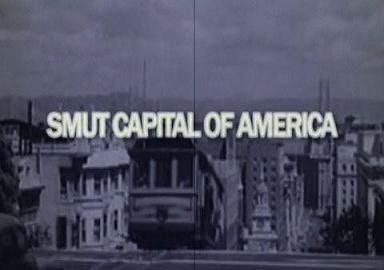
San Francisco is waiting for its Boogie Nights. Unbeknownst to Hollywood, our fair berg was the infant creche of hardcore pornography, spawning a subculture of porn theaters that thrived despite police harassment and political pressure.

We were number one! Luckily, a few brave men are resurrecting our porn golden age money shot – read on for a first look at documentary The Smut Capital of America and an interview with the director himself, Michael Stabile.


Smut Capital is by no means Stabile’s first porn rodeo. The co-editor of Gay Porn Blog, he and Smut Capital editor-cinematographer Ben Leon are both mainstays in the SF gay porn scene. The two were researching their upcoming doc on the life of gay smut powerhouse Falcon Studios founder Chuck Holmes when Stabile came across a New York Times article that inspired the title of their new project, which is a work in progress for which the team is fundraising in order to release the finished film in 2011.

“Until then I’d always thought of it as an industry that emerged from LA, but San Francisco was actually the city that birthed the porno theater. It was the beginning of the sexual revolution, and in a lot of ways these directors were documenting this newly found freedoms.” Stabile attributes the renaissance to hippie women “with really no hangups,” a progressive zeitgeist that had seized the city in the late sixties and early seventies, and film processing studios that were willing to develop sexually explicit material. By the era’s zenith in 1972, there were porno film theaters in neighborhoods across the city.

Not that everyone was down to get all that action on screen. Dianne Feinstein, first in her post as the city’s first female president of the Board of Supervisors and then as SF’s first female mayor, led a crusade focused on cleaning up the Tenderloin, which incidentally included sweeping the neighborhood free of its supply of adult movie houses. What ensued was an orchestrated harassment policy that different porn theaters dealt with in different ways.

Established theaters, Stabile says, actually benefited from the police and media persecution. “They’d come in with cameras, it’d be on the five o clock news and it would be great for them,” he says. “Advertising was very limited at the Chronicle. Feinstein would come in with her troops and would detail everything that was going on. Suddenly there was a way to talk about it, so people would flood into the theaters.” The Mitchell Brothers grew so adept at playing the cat and mouse game, he says, that they would post Feinstein’s office number on their marquee under the words “call for a good time.”

But not everyone prospered. Smaller theaters that depended on a few workers to operate, like Alex DeRenzy’s Screening Room, suffered when police would take key staffers on pointeless joyrides around town before booking them on charges of vice crime. Eventually factors like these, and more importantly the advent of video porn in the 1980s pulled the adult film business down to Los Angeles.

The move shifted the purpose of sex films away from their original role in the Sexual Revolution. Says Stabile “People were doing it here because they enjoyed it, because they wanted their own sexualities represented. It’s not like that in LA for the most part, where even a lot of the gay studios are owned by straight men looking to turn a profit.”

But don’t worry, the party’s not over. One of Stabile’s main goals with the film is not just to highlight good sex gone by, but that which cums and goes even today. When asked whether SF is still a presence in the world of porn, he had no equivocation. “Its one of the great untold stories in the local media – San Francisco has a huge porn presence. Raging Stallion, Falcon, Hot House – seven of the top ten gay porn studios are located up here, there’s Kink.com, porn writers like Violet Blue,” he says.

It appears that the tech savvy and sexual freedom that led to our capital crowning are still alive and well on these city streets. Phew! Now you may now go back to your regularly scheduled local porn browsing.

Our Weekly Picks: September 29-October 5, 2010

0

WEDNESDAY 29

MUSIC

Kylesa

The devil went down to Georgia, and sprinkled enough hoodoo in the water to cultivate quite a metal scene. But it ain’t just Mastodon and Baroness splitting ears in the town squares. Kylesa — you know, the band with the two drummers, the badass chick guitarist-vocalist (she’s one of two guitarists and one of three vocalists), and the coolest cover art in the biz — is about to drop its fifth full-length, Spiral Shadow. The title of lead track “Tired Climb” belies the album’s fierce riffs and heavy energy. But let’s stop pretending you weren’t going to this show anyway — local mighties High on Fire headlining the glorious Great American? With the added bonus of two ironclad openers? Can’t miss, hesher. (Cheryl Eddy)

With High On Fire and Torche

8 p.m., $20

Great American Music Hall

859 O’Farrell, SF

1-888-233-0449

www.gamhtickets.com


THURSDAY 30

DANCE

Mark Morris Dance Company

Just because his company has become a perennial audience favorite doesn’t mean we should ignore Mark Morris. After all, the acclaim is justified: there’s nobody else who — after 30 years of working — can still surprise and delight (and sometimes disappoint) us the way Morris can. This time he is bringing three West Coast premieres. If the buzz wafting in from the East Coast is any indication, the new Socrates set to Satie’s oratorio “Socrate” (piano and voice) should be outstanding. It will be performed with the stark Behemoth — Morris’ only no-music piece — and Looky, his bemused take on pretentious museum-going in which the inmates take over the show. (Rita Felciano)

Thurs/30–Sat/2, 8 p.m.;

Sun/3, 3 p.m., $34–$72

Zellerbach Hall

Bancroft at Telegraph, UC Berkeley, Berk.

(510) 642-9988

www.calperformances.org


DANCE

Lizz Roman and Dancers

San Francisco’s Gingerbread Danzhaus is the only venue in the city to provide dance studio space to professional companies while also serving as a nightclub in the after-hours. This weekend it will also be the seat of Lizz Roman and Dancers new site-specific work This Dance This Place, which aims to bring the architecture of Danzhaus to life through an interactive dance performance challenging viewers to really see the nooks and crannies of the space. With a live sound score, collaborative lighting and costume design, and dancers streaming from every danceable doorway, crevice, and ledge, this performance is sure to provoke thought on where and how dance is presented. (Emmaly Weiderholt)

Through Oct. 9

Thurs.–Sat., 8 p.m., $20

Danzhaus

1275 Connecticut, SF

www.lizzromananddancers.com


FRIDAY 1

DANCE

Nina Haft and Company

A few years ago, visitors to Zaccho Dance Theatre’s third-story performance space could look down onto San Francisco’s last working farm. The Bayside venue seems uniquely appropriate for Nina Haft’s site-specific Debris/Flows. Collaborating with German-born, Italian-trained Claudia Borna, the two women transformed this former warehouse space into a natural environment for 12 dancers to explore both outer and inner landscapes. In addition to watching the performance, audiences can contribute to Zaccho’s environment by planting seeds and eating food from local gardens. The dozen dancers will help you navigate the labyrinth. (Felciano)

Fri/1–Sat/2, 8 p.m. (also Sat/2, 6 p.m.);

Sun/3, 6 p.m., $12–>$18

Zaccho Dance Theatre

1777 Yosemite, Suite 330, SF

(510) 325-5646

www.brownpapertickets.com


MUSIC

Drums

A lot of the Drums’ music mines the sounds of the 1950s, smooshing it up with the more saccharine output of the Smiths and New Order, but there’s a lull halfway through the New York City band’s debut album where its intentions really become clear. A slower song than the rest of the album, “Down By The Water” mimics the believable earnestness of ’50s crooners completely without pretension. The Drums have been accused of lacking individualism, which is a fairly valid criticism considering you could drop some of their more upbeat tracks into a Smiths album and no one would bat an eye. But in latching onto eras where simplicity was something to be celebrated, the band succeeds by being sincere when tongue in cheek would have been way “cooler.” (Peter Galvin)

With the Young Friends

9 p.m., $15

Independent

628 Divisadero, SF

(415) 771-1421

www.theindependentsf.com


DANCE

SMUIN BALLET

Although the Smuin Ballet may be considered a relatively small ballet company, there’s nothing small about the renowned choreographers and kick-ass dancers Smuin attracts. Founded by Michael Smuin in 1994 and now under the artistic direction of Celia Fushille, the company presents classical ballet with a contemporary edge. It kicks off its 2010-11 home season with a fall program that includes the world premiere of Oh, Inverted World — set to the indie rock band the Shins and choreographed by the illustrious Trey McIntyre — as well as Michael Smuin’s twangy Bluegrass/Slyde and his more lyrical Brahms-Haydn Variations. (Katie Gaydos)

Through Oct. 9

8 p.m. (no show Mon/4);

Additional shows Sat/2–Sun/3, 2 p.m.), $20–$62

Palace of Fine Arts Theater

3301 Lyon, SF

(415) 978-2787

www.smuinballet.org


SATURDAY 2

FILM

The Incredible Shrinking Man

Ever get the feeling you’re being dwarfed by what’s going on around you in life? Well, that’s exactly what happens to the main character in the 1957 Jack Arnold sci-fi classic The Incredible Shrinking Man, in which a freak accident causes him to get smaller and smaller with every passing day. Featuring a host of inventive special effects and memorable scenes (among them his epic battle with a house spider), the movie screens tonight as part of the San Francisco Film Society’s annual “Film In The Fog” event. Let’s hope nature cooperates and offers up a little bit of a spooky mist to make for a cool and creepy early Halloween celebration. (Sean McCourt)

5 p.m. picnic, 7 p.m. film, free

Presidio, Moraga at Arguello, SF

www.sffs.org


MUSIC

The Sword

Austin, Texas, retro-metallers the Sword are in space. This summer, new album Warp Riders saw them rocket into full-fledged concept album territory, weaving a epic saga of interplanetary travel and mystical sci-fi warriors on a loom composed of Orange amplifiers. As fall descends, they’re taking the tunes and tales on the road, and their SF date marks the second stop on a grueling national run. Fans will be eager to bask in a bevy of new songs performed live, and the band’s adroit playing on the new record bodes extremely well for the experience. Prepare for blast-off! (Ben Richardson)

With Karma to Burn and Mount Carmel

8:30 p.m., $20

Regency Ballroom

1290 Sutter, SF

1-800-745-3000

www.theregencyballroom.com


FILM

American Splendor

Who is Cleveland’s most beloved figure? A few months ago the answer may have seemed obvious: superhuman baller LeBron James. At least until he got on the ESPN grandstand and announced he was going to Miami. Four days later Harvey Pekar died, and it put everything in perspective. A cranky file clerk who wrote wonderfully mundane comics about life’s pedestrian absurdities for more than 30 years, Pekar was an unlikely fit for the limelight (with legendary Letterman appearances to prove it). Fame found him nonetheless, culminating in this 2003 biopic featuring not only a suitable portrayal by the continually wincing Paul Giamatti, but also the inimitable figure himself. A fine entry into a persistent legacy. (Ryan Prendiville)

8:30 p.m., $5.50–$9.50

Pacific Film Archive

2575 Bancroft, Berk.

(510) 642-5249

www.bampfa.berkeley.edu


SUNDAY 3

EVENT

Estria Invitational Graffiti Battle

Graffiti’s outgrown furtive leaps over cyclone fencing and dark alley deployment. These days street art is a community builder, the old pros from the 1980s golden age having become teachers and respected figures in the art world. But that doesn’t mean it’s gotten stuffy. Case in point: Bay Area graff legend Estria Miyashiro’s free annual spray-off in the park. Names that are no strangers to the city’s bus stops, brick walls, and freight trains will be present to participate in and judge live painting: Nate1, Crayone TWS, and 2009’s champ Vogue TDK among them. Mix in stencil workshops, a youth sketchbook competition, and artist signings, and you’ve got a multi-generational homage to the art of aerosol. (Caitlin Donohue)

11 a.m.–5 p.m., free

DeFremery Park

1651 Adeline, Oakl.

(510) 895-5700

www.estriabattle.com


MONDAY 4

MUSIC

Guitar Wolf

In the future, anthropologists will study Guitar Wolf to calculate the speed of pop culture. The musical equivalent of Engrish, the trio channels Ramones-era punk rock (leather and all) to create Japanese “jet rock ‘n’ roll,” a louder, noisier, and enjoyably unintelligible hybrid. Tonight the band ends its first U.S. tour in five years, also the first since the death of bassist Billy. “However, it is not, not necessary to worry,” lead singer Seiji says on the band’s website. “New bassist player U.G.! U.G. is terrible! It is jet terrible! It fight! It fight rock! I will show Guitar Wolf is reborn to you!” (Prendiville)

With Hans Condor, Midnite Snaxxx, and DJ Classic Bar Music

9 p.m., $15

Bottom of the Hill

1233 17th St., SF

(415) 621-4455

www.bottomofthehill.com


TUESDAY 5

MUSIC

Guided By Voices

Ringleader Robert Pollard is rounding up the rest of indie rock giants Guided By Voices for a one-time reunion tour to commemorate Matador Records’ 21st anniversary. And this isn’t some half-ass reunion, either. This is the GBV lineup of the mid-1990s that spawned much-beloved albums such as Bee Thousand and Alien Lanes. Pollard’s been just as prolific on his own as he was before the group’s breakup in 2004, but there is just no comparing his solo work to GBV’s catalog. Don’t miss your chance to see one of the most influential indie rock bands of the past 20 years one last time. (Landon Moblad)

With Times New Viking

8 p.m., $24

Warfield

982 Market, SF

(415) 345-0900

www.thewarfieldtheatre.com 


The Guardian listings deadline is two weeks prior to our Wednesday publication date. To submit an item for consideration, please include the title of the event, a brief description of the event, date and time, venue name, street address (listing cross streets only isn’t sufficient), city, telephone number readers can call for more information, telephone number for media, and admission costs. Send information to Listings, the Guardian Building, 135 Mississippi St., SF, CA 94107; fax to (415) 487-2506; or e-mail (paste press release into e-mail body — no text attachments, please) to listings@sfbg.com. We cannot guarantee the return of photos, but enclosing an SASE helps. Digital photos may be submitted in jpeg format; the image must be at least 240 dpi and four inches by six inches in size. We regret we cannot accept listings over the phone.

Expansive roles

0

arts@sfbg.com

STAGE Ogun Size has shaped up into a complex, intriguing character across the first two plays staged so far in the Bay Area debut of Terrell Alvin McCraney’s The Brother/Sister Plays. The Magic Theater last week opened The Brothers Size, the second play in the celebrated trilogy, in an electric production sharply directed by Octavio Solis. Its choice minimalism (including a spare but evocative car garage set from scenic designer James Faerron and scenic/lighting designer Sarah Sidman) gives just the right lift to three fine, exuberant performances and full rein to the 20-something playwright’s delicate, volatile drama set in and around a Louisiana bayou housing project.

Ogun is an important but secondary character in the first play, In the Red and Brown Water (now up at Marin Theater Company, as part of an unprecedented three-company production that includes an offering by ACT in late October). That play focuses instead on his onetime love, Oya. Her dire fate gets alluded to in passing here, with understated pain, as Ogun (played by the impressively dynamic Joshua Elijah Reese) recounts neighborhood news to brother Oshoosi (a vital and wry Tobie Windham). Recently paroled, the excitable, silver-voiced, and perennially irresponsible Oshoosi is very reluctantly working alongside (and under the wary eye of) his older brother in the latter’s automotive repair shop.

Ogun’s wary eye soon also falls on Elegba (played with a magnetic, mercurial charm by a terrific Alex Ubokudom), the third and final character in a coiled little story of love, loyalty, jealousy, and desire that teases meaning from notions of brotherhood while brooding on the inevitable singularity and alienation at the heart of life. Elegba was already deemed complex by Oya in the first play, but here he is both more lifelike and ethereal, grounded in an almost preternatural obsession to have and control his former prison mate, Oshoosi. The jealous battle for Oshoosi that ensues is alternately boisterous, eerie, and wrenching. In the end, we watch Ogun Size grow larger — an expanse of feeling that increases the capacity of a heart bereft but open — as he finds himself, per force, alone again. Expanding like the universe itself, Ogun’s fate makes the infinity of his love still larger.

GOING OUT TO PLAY


A friend and I went to a restaurant the other day, and while it’s always a little like being in a play, this was ridiculous — also stimulating, and even quietly ecstatic. I won’t give you the intimate, somewhat bizarre details of our half-hour interaction. Not because it’s private, but because it’s up for grabs: you can have it yourself if you want, exactly as we did.

True, it was never going to be an ordinary lunch. We expected something unusual since, although we entered a real San Francisco eatery, it wasn’t a meal we were after but a performance, designed by the London-based experimental troupe Rotozaza. Etiquette, which runs through this weekend courtesy of Yerba Buena Center for the Arts, is participatory theater approaching some sort of outer limit: the audience goes Ark-like by twos (you can be paired up with another bewildered stranger or go with a friend) and performs the piece for one another. This takes place amid a roomful of unwitting patrons there strictly for the usual, namely a meal.

The first thing you notice is that this table doesn’t come with a menu, not even a bar list. There’s a glass of water, but you’ll hesitate to touch it. Instructions come via headsets. There are other intricacies best not revealed here, but as the encounter unfolds you find the lines between theater and "real life" dissolving, and your identity softening at the edges like a once-crusty crouton atop a bowl of soup. Meanwhile, the headphones, the concentration of your partner, the voice in your ear, the world of the tabletop, the knowledge that you are in a play, watching a play, and that, hell, you are the play — all this makes it surprisingly easy to shrug off any inhibition you might otherwise feel about making a "scene" in a restaurant.

The scene is your own in that you inhabit it, but then it is also dictated to you, bound by certain constraints. This tension is part of the delight generated by the piece. The audience-member-as-performer accepts, just as any actor does, the work of the playwright and instructions of the director. Within that there is room for individual choice and interpretation, but any action or decision comes circumscribed by the larger form. Day-to-day we all play our parts, of course, more or less self-consciously. But I never realized what a relief it might be to have your everyday encounters literally scripted for you. I suddenly thought I knew why pirates have parrots on their shoulders. I’d naively assumed it was the man feeding lines to the bird.

While Etiquette‘s parts are gender-specific, the participants might be of any sex, no matter the role. In fact, the idea of liberation from ascribed roles comes woven, in subtly layered fashion, into the very narratives unfolding and overlapping across the table. If the foundation of identity relies on the cultural and social forms we inherit, how liberating it is, even momentarily, to sit down in public and embrace play in all its forms.

THE BROTHERS SIZE

Through Oct. 17, $20–$60

Magic Theatre

Fort Mason Center, Bldg D, SF

(415) 441-8822

www.magictheatre.org

ETIQUETTE

Through Oct. 3, $8–$10

Yerba Buena Center for the Arts

701 Mission, SF

(415) 978-2787

www.ybca.org

Do it Clean

0

arts@sfbg.com

MUSIC For over 30 years now, the Clean have been at the forefront of the New Zealand rock scene. Despite some early lineup changes and temporary breakups, the core of the band — Robert Scott and brothers Hamish and David Kilgour — continue to tour together, work on solo or side projects, and occasionally release a new album. For special insight into Kiwi rock and all things Clean, I decided to get in touch with San Francisco expat Barbara Manning, who will be opening for the group at the Independent with her new band, the Rocket 69.

Welcoming me into her house in Chico, Manning pointed to a stack of vinyl and a couple dozen CDs she’d pulled out in a living room stocked full of records. She fancies herself as having one of the most thorough personal collections of New Zealand music around, and after just a quick glance it was easy to see why.

“We probably don’t have time for New Zealand Rock Music 101,” Manning said. “So I’ll just put some Clean stuff on.”

In Manning’s opinion, despite a well-developed and underrated rock music scene that has thrived since the late ’70s, New Zealand rock and roll can really be narrowed down to three essential contributors — the Bats, the Chills, and the Clean. While all three groups have enjoyed various degrees of success, the Clean’s appeal has extended far beyond the borders of their native home to impact everything from ’80s power pop to ’90s indie rock to contemporary garage sounds.

“People incorrectly think that the Clean started rock music in New Zealand,” Manning said. “But they were the first ones to make America notice.”

From the bouncy keyboard melody and chugging bass line of the 1981 hit “Tally Ho” to the more exploratory and expansive feel of some of their later work, the Clean have always excelled at combining a good pop song with a rough-around-the-edges “hypnotic groove,” as Manning put it. Pavement and Yo La Tengo have gone on record singing the group’s praises, and more recently, artists such as Kurt Vile and the late Jay Reatard have made Clean-like recordings.

“The Clean have an edge to them that was especially fresh in the ’80s, when there was a ton of crap out there,” said Manning. “It was great hearing good, urgent, jangly pop songs that cut away the fat.”

Despite loving their music for decades and recording songs for one of David Kilgour’s solo albums, Manning — who lived in San Francisco from 1986 to 1998 — has never seen the Clean perform live. When bassist Robert Scott called to make sure she was coming to the group’s Bay Area show, she jumped at the opportunity to get involved.

“I said, ‘I’ll be there,'<0x2009>” Manning remembered, “<0x2009>’and how ’bout I open for you?'<0x2009>”

Manning’s new project includes Maurice Spencer on guitar, Jonathan Stoyanoff on bass, and Marcel Deguerre on drums. She said that those in attendance can expect a “power pop-heavy” set made up of material from her songbook and a handful of covers. Both her band and the Clean inject a sinister irreverence into the sometimes cookie-cutter world of guitar-driven pop. As Manning put it, “It’s always nice to hear jangly pop music that’s not all paisley and flowery.”

THE CLEAN

With the Rocket 69

Mon/4, 8 p.m., $18–$20

The Independent

628 Divisadero, SF

(415) 771-1421

www.theindependentsf.com


Practiced distance

0

arts@sfbg.com

FILM The first time I met Paul Clipson, we quickly discovered that we shared an intense regard for Nicholas Ray’s On Dangerous Ground (1952). I had just seen material that would become Clipson’s short film Union at a San Francisco Cinematheque screening a few days prior and found that its psychically charged shift from rural to urban spaces reminded me of the Ray movie (specifically, a single dissolve as Robert Ryan’s character drives back into the city). Union belongs to a different species of cinema, of course. It’s shot on Super 8 and 16mm, wordless, with a narrative situation (a girl running) refracted as pure kinesis. As became apparent talking with Clipson, however, his deep knowledge of film history is attuned to texture rather than taxonomy. The second time I watched Union, I realized that On Dangerous Ground was just a convenient name for the deeper, more elusive sense of recognition it stirred in me.

Since that first meeting, I have seen Clipson project films on a billowing screen under the stars; in the squat confines of the Café Du Nord for the On Land music festival, where his work expanded several performances; and on the sides of a dome structure atop Yerba Buena Center for the Arts. There have been more traditional screenings as well, though Clipson’s eclectic live projections are drawing attention — he’s fresh back from a brief European tour and will be featured in New York’s Views from the Avant-Garde this weekend. Before then, he’ll present a ranging survey of his recent efforts at SFMOMA, where he works as head projectionist.

The shifting context of live collaborations and crystallized short subjects is crucial to understanding Clipson’s work, and so "The Elements" will feature both: a suite of finished films sandwiched between projections with frequent collaborator Jefre Cantu-Ledesma and an ensemble, Portraits. An open frame of performance is a crucial catalyst for the searching lyricism of Clipson’s cinematography. He shoots frequently, building long reels to run with the music. Clipson refers to these unrehearsed dives as his research.

The camera style is at once impressionistic in its technique and boldly graphic in its compositions, haunted by familiar visual forms that, loosed from conventional perspective, are revealed to carry unexpected resonances and rhythms. What do we see? A million suns, made multiple by the surface of water and the curve of the camera lens; neon signs; flitting vertical obstructions; telephone wires; vegetation; intimate, handheld disclosures of vast distances; architectural surfaces. As with Joris Ivens’ early shorts, Clipson’s films register the city in its minor variations. Within the frame, a storm of vision emerges of superimpositions, dissolves, rack focus, zooms, and the interlacing of color and black-and-white stocks. It often seems that the objects he films are bringing the camera into focus and not the other way around.

When I ask about this, Clipson says, "I’ve found that the pulpy intensity of the Super 8 film decides the subject matter in a way. It’s like the film is in your brain telling you to shoot this or that — you can just imagine the luster." The intuitive nature of his in-camera montage meshes well with the aural landscapes of the live performances; a floating minimalism prevails. As a former member of Tarantel and co-steward of the Root Strata label, Cantu-Ledesme has been Clipson’s primary point of entry to this musical world. Speaking over the phone, he notes their easy camaraderie: "Once Paul is in the moment of filming, he’s just really responding to what is happening on the other side of the lens … and at least when I’m playing by myself, I try to have that same attitude."

In concert, the physical waves of sound and Clipson’s disembodied images are rich soil for a trance. It’s only in the concentrated shorts, however, that one finds the full extension of Clipson’s lyricism. The elliptical Sphinx on the Seine (2008) is still my favorite. Only eight minutes long, its shots seem to trace a voyage. We see the golden gleam of the sun as reflected by criss-crossing railways and snaking waterways, the shadow-world of a sidewalk, a phantasmal vision of Mount Fuji. Each of these lucid views slides away just as it ripens. Clipson’s collation of different cities is formally embedded in his composited images, which here appear as the fragile clues of some unknown existence. Like Sans Soleil (1983) and Mr. Arkadin (1955), two similarly itinerant films, Sphinx on the Seine evokes a tantalizing sense of placelessness.

One afternoon, both of us a little scatterbrained from a long week, Clipson and I get hung up on CinemaScope. He expresses admiration for the anamorphic framings of Ben Rivers’ I Know Where I’m Going (2009), and then draws a zigzag of appreciation between George Cukor’s 1954 A Star is Born ("The first 20 minutes"), Vincent Minnelli’s 1958 Some Came Running ("When you see it in the theater, it’s so much darker than on a television. You see shadows under people’s eyes"), and Otto Preminger’s general mastery of the form ("To me, those aren’t even compositions; they’re movements of thought"). It strikes me again and again that Clipson’s acute observations regarding film aesthetics are very much part of his creative force — yet his filmmaking doesn’t feel overcooked. Ben Rivers’ films work in a similar way: betraying a cinephile’s intimate knowledge of the medium, but out in the world all the same.

"Sometimes a few seconds of a film can live with you your whole life," Clipson tells me later that same afternoon, locating one such epiphany in the opening of Orson Welles’ Macbeth (1948): "There are all these dissolves going through the witches’ cauldron. You see a smoke circle, a storm cloud, what maybe is the surface of clouds from above, the cauldron and hands … I could just make films entirely inspired by that for 10 years because it’s so intangible, with such a beautiful, dense logic of images that resists immediate understanding." Indeed, it sounds like a Paul Clipson film.

"PAUL CLIPSON PRESENTS THE ELEMENTS"

Thurs/30, 7 p.m., $5

San Francisco Museum of Modern Art

151 Third St., SF

(415) 357-4000

www.sfmoma.org

Visionary movement

0

DANCE Celine Schein, executive director of Chitresh Das Dance Company and its Chhandam School, was not born into Indian culture. But difficult Hindi words flow from her tongue with the ease of a native speaker. It’s a skill that should stand her in good stead during this weekend’s “Traditions Engaged: Dance, Drama, Rhythm,” which includes evening and daytime performances, lectures, panel discussions, and demonstrations of Indian classical dance.

Schein, a former ballet and modern dancer, has absorbed Indian dance into her very being. Yet it started almost by accident when she happened to fall into a Kathak class that classical dance master Pandit Chitresh Das was teaching at San Francisco State University. “I first loved the richness of its rhythms and movement patterns,” she recalls. “But then I was increasingly intrigued by [Das’] vision, even though it took me a long time to realize what exactly that was.”

Das is indeed a visionary. Committed to the rigor of exacting standards, he is also an innovator within the parameters of his art. He has, for instance, collaborated with tap virtuoso Jason Samuels Smith and Bharata Natyam dancer Mythili Kumar. His invention of Kathak yoga, which combines the two disciplines, is positively revolutionary. But other aspects of Das’ performances, like when he talks to the audience, are deeply traditional. “There is no fourth wall in Indian classical dance,” Schein explains. “Dancers interact with audiences and they are expected to respond. His own guru would comment during a performance, even criticize him.”

Indian classical dance gained a foothold in this country with the burgeoning interest in Eastern philosophy starting in the 1960’s, but grew stronger as Indian communities formed in Silicon Valley in the 1980s. Many families initially had little interest in Indian classical dance but wanted their children to grow up with the values it provided. Yet I once heard Das admonish the parents of his pupils that Kathak was a serious art, not just a spray-on for a young woman to look pretty on her wedding day.

A striving toward spirituality is deeply ingrained in Indian classical dance. Das’ mother told him “to dance from the gutter to the heaven.” He puts it into contemporary terms —the “vision” that so impressed Schein — by saying that dance allows you to become more yourself. Of course, none of this precludes enjoying Indian classical dance as a purely esthetic experience.

India has strong, highly diversified folkloric dance traditions, but “Traditions” focuses on classical dance forms: Bharata Natyam, originally a temple dance from southern India; Kathak, which blossomed at the Moslem Moghul courts of North India; Odissi, which was repressed by the British and revived after independence; Manipuri, a dramatic genre that deploys an expressive upper body; Kuchipudi, best known for a copper platter on whose rim the dancer performs; and Kathakali, which features spectacular masks and costumes. Also represented will be a new, recently recognized form, Gaudiya Bharati, from the Bengal region.

Unlike the scholar-oriented Kathak Festival in 2006, “Traditions” is solely devoted to practitioners. “We wanted to bring the best master artists together to talk about their work and perform — not just short snippets, but in depth,” Schein explains. Friday’s program will be focused on movement; Saturday’s on drama; and Sunday’s on rhythm. 

TRADITIONS ENGAGED

Thurs/30-Sun/3;

$25–$75 ($235–$295 for festival pass)

Yerba Buena Center for the Arts

701 Mission, SF

(415) 978-2787

www.ybca.org

It’s raining yuks

0

caitlin@sfbg.com

STAGE Ho there! You with the sad-face! Check out these whoop-whooping upcoming comedy events and turn that ;( onto a 🙂 right quick.


THE ENDGAMES

It’s no laughing matter. Twelve San Francisco improv teams will enter Kitchen Stadium — sorry, the Ninth Street Independent Film Center — but only one will rise to the top like clownin’ Mario Batalis. Not only does the winner score the honor of beating less funny peers in front of a crowd (and G-list celebrity judges — the author of this article included), but he or she also gets a four-week run at the venue. We hear the art of improv involves never saying “no” — how you gonna turn down the cutthroat crazy of The Endgames?

Thursdays through Nov. 11, 9 p.m., $10

Ninth Street Independent Film Center

145 Ninth St., SF

www.endgamesimprov.blogspot.com


KUNG PAO KOSHER PRESENTS: FUNNY GIRLZ

It ain’t easy being a woman in the stand-up biz. But you’ll never know it watching the four women who will be onstage for this long-running (11 years!) annual lineup from Kung Pao Kosher Comedy. Kung Pao began as a haven for Jews on Christmas and has expanded into a year-round lineup of multicultural, multi-hilarious events. This year’s Funny Girlz include Pakistani native Brit Shazia Mirza (“at least, that’s what it says on my pilot’s license,” she quips); San Franciscan Clara Clayy; Dhaya Lakshminarayanan, one of India’s rare female comedians; and Kung Pao founder Lisa Geduldig. Breaking boundaries, busting glass ceilings? Try being an intelligent, funny female stand-up. Unfortunately, that can be radical enough at times.

Weds/29, 8 p.m., $25

Brava Theater

2781 27th St., SF

(415) 522-3737

www.koshercomedy.com


WILL FRANKEN

So your stash ran out, or you’re detoxing, or you’re done with the hallucinogenics, or whatever. Page back through your neatly stacked Guardian Best of the Bay issues and there it is: “Best Alternative to Psychedelic Drugs”: comedian Will Franken. Shall we listen in on one of his absurdist rants? “Every 60 seconds in America, 60 seconds go by. For every one minute, there are 59 others just waiting to form an hour. By the time this sentence is over, I will have finished saying it.” Franken is one of SF’s glorious bizarros, spackling his acts with TV commercials that fold into dual-voiced skits that segue to celebrations of diversity … for profit! Just don’t freak when does his Antichrist voice.

Fri/1 and Sat/2 8 p.m., $20

The Purple Onion

140 Columbus, SF

(415) 956-1653

www.caffeemacaroni.com


IMPROVISED SHAKESPEARE

Improv is a strange beast. Improv comedians find more thrill from throwing body and soul into the dark abyss of audience suggestion and happenstance genius than they do from conventional stand-up’s hours in front of the mirror perfecting that ever-so-crucial eyebrow raise or purposefully awkward arm movement. But from the abyss, great rewards they reap. No company in San Francisco has learned this lesson more effectively than BATS Improv, which has been entertaining Bay Area audiences since 1986. This week’s offering? “Warp Speed” is an all-improvised take on Star Trek – no Kirk, no Spock but a flurry of new characters made up on the spot, as well as, we’re sure, some seriously kooky props and alien situations.

Fri/1 8 p.m., $17–$20

BATS Improv

B350 Fort Mason Center, SF

(415) 474-6776

www.improv.org


KRISTEN SCHAAL

It’s a tricky line, but one Kristen Schaal walks well: that fissure between cute and psycho. She’s gone and perfected the odd balance on TV’s “Flight of the Conchords” as Mel, the persistent stalker of the eponymous New Zealand folk-humor duo. But standup comedy is where she got her start and laid the groundwork for her nerdy suave. Her sets vary between dark and light — she wants to tell you about her dream! Her sex dream. Featuring Winston Churchill. (The sex wasn’t great.)

Thurs/7–Sun/10 8 p.m., $17.50–$20.50

Cobb’s Comedy Club

915 Columbus, SF

(415) 928-4320

www.cobbscomedyclub.com


OUT LOUD COMEDY & ARTS FESTIVAL

It may not be the first comedy mélange devoted to our hilarious homos — Assemblymember Tom Ammiano’s Valencia Rose Cabaret flounced off with that title in the 1980s — but the four-day Out Loud fest may be the brightest and most focused yet. Shall we lead with the high-wattage names? Castro Theatre will be packed for “An Evening with Sandra Bernhard,” whose Nancy Bartlett on Roseanne was the first recurring lesbian character on American TV. Film snark Frank Decaro from The Daily Show will also be out and about, sassing up a corner of The Lookout interviewing his fellow festivators and performing with a swath of TV feys at the Swedish-American Music Hall for an evening called “Rooftops and Bottoms.” But you don’t gotta be on TV to kick it. Local drag cutup Sasha Soprano has rousted six of the finest becoiffed and becoming spotlight stars for Saturday’s “The Drag Queens of Comedy” at the Castro Theater. How exactly will their shtick be different from the rest of the shows on our fall highlights list? We asked one of the night’s main acts, Miss Coco Peru, a classy redhead who has kept New York City audiences enthralled since the early 1990s with monologues that switch between the weighty and the witty. “Well, it takes us all a lot longer to get ready,” she said. Oh, and you don’t heckle a drag queen — unless you think a stiletto to the sacrum will straighten out your kinks down there.

Oct. 7–10

See website for times, locations, and prices

www.outloudcomedy.com

Who wants cheap beer?

5

culture@sfbg.com

Whether you’re unemployed, underemployed, or squirreling away your, ahem, nuts in terror of the post–American Empire Mad Max economapocalypse to come, these are hard times for beer lovers who like their pints out in public. You need cheap suds. Here’s a guide to staying within your meager budget while enjoying an oat soda or 10 to help you swallow the bitter pill that is the Bay Area economy. And cheer up, you ol’ bugger: it’s beer o’ clock!


THE HAPPIEST HOURS

Most bars have a happy hour, but when you’re looking out for numero uno, you notice that some are happier than others. Even among budget-friendly Mission bars (like, I don’t know, say, Mission Bar 2695 Mission, SF. 415-647-2300), the happy hour at Elbo Room (647 Valencia, SF. 415-552-7788, www.elbo.com) is generous, as far as duration goes. From 5 p.m. to 9 p.m., you’ll have plenty of opportunity to hit on a hipster hottie while sipping a Lost Coast Tangerine Wheat near the Ms. Pac-Man table top.

My blogger friend Jeff Diehl (spotsunknown.com) and I recently dove into North Beach, where we stumbled, literally, upon a real, cheap gem: International Sports Club (1000 Columbus, SF. 415-775-6036). Don’t let the name scare you. This place is as divey as a clean, well-lit place gets, with an interesting mix of tourists and scruffy locals. Bartender-cousins Mi and Emily serve up the ultimate poor man’s pour: tap drafts for $2.50, from 4 p.m. to 8 p.m. on weekdays — decent drafts like Stella and Widmer.

But possibly the happiest hour(s) for the frugal sud-guzzler can be found at Bean Bag Café (601 Divisadero, SF. 414-563-3634), near the Panhandle. There are no beanbags, but there’d be room for none, as the clarion call of $1.92 pints of hefeweizen brings the thirsty hordes. If you’re a bit work-shy at the moment, get there early and beat some of these beasts to the tap.


PBR NATION

Obviously, nothing beats a deal with no strings attached. If you’re a San Francisco beer lover and you don’t know about Toronado (547 Haight, SF. 415-863-2276, www.toronado.com), you’re just doing it wrong. For a place so renowned, the big T’s tap selection is diverse enough to accommodate the not-so-rich while avoiding the option of Pabst Blue Ribbon.

I say that with the full knowledge that PBR has become something of a cultural touchstone in the city. Why PBR and not Hamm’s or Oly? Who knows? I blame Blue Velvet. In any event, there’s no shortage of hipster dives that will crack a can for you. (I see no real point of PBR on tap.) For my money, the best is Bender’s (806 S. Van Ness, SF. 415-824-1800, www.bendersbar.com). Not only will you find the obligatory $2 can of Frank Booth’s favorite bev, but you’ll also find my personal favorite canned option, local brewery 21st Amendment’s Hell or High Watermelon Wheat, for a mere $2.50. Can’t beat that with a stick, not to mention Bender’s other assets, such as a tasty grill and a smoky patio.


CHEAP? HOW ABOUT FREE?

I talk to beer freaks who have never taken a tour of the amazing Anchor Brewery (1705 Mariposa, SF. 415-863-8350, www.anchorbrewing.com), in Potrero Hill, and all of a sudden it’s like they’re speaking another language. I just don’t understand. I’ve been taking this tour since my first visit to the city back in 1992, and I still go at least once or twice a year. When I got laid off, my second act, after filing for unemployment benefits, was to book a tour at Anchor.

The good folks there recommend that you call two to three weeks in advance. But this is a small price to pay, and the only price. The tour is free, and if you love beer, it’s like a guided tour of how God runs heaven (if heaven smells like Grape-Nuts). The coup de grâce is the unlimited tasting that ends your journey of discovery and sends you off in the middle of the day with a belly full of top-notch brew — and hopefully a fresh perspective on the simple pleasures of living in a beautiful city for drinking beer.

OTHER CHEAP BEER FAVES

The Bitter End 441 Clement, SF. (415) 221-9538.

Broken Record 1166 Geneva, SF. (415) 963-1713, www.brokenrecordsf.com.

Delirium 3139 16th St., SF. (415) 552-5525.

500 Club 500 Guerrero, SF. (415) 861-2500.

Greens Sports Bar 2239 Polk, SF. (415) 775-4287.

Horseshoe Tavern 2024 Chestnut, SF. (415) 346-1430, www.horseshoetavernsf.com.

The Page 298 Divisadero, SF. (415) 255-6101, www.thepagebar.com.

Thee Parkside 1600 17th St., SF. (415) 252-1330, www.theeparkside.com.

El Rio 3158 Mission, SF. (415) 282-3325, www.elriosf.com.


The test of the Tenderloin

16

caitlin@sfbg.com

This is a story about love and money. Or a story about love, money, and location. — Rebecca Solnit, Hollow City (Verso 2000)

It’s a sunny day in the most maligned neighborhood in San Francisco. I’m walking down a busy sidewalk with an excited Randy Shaw, long-time housing advocate. He’s giving me a tour of his Tenderloin.

“There’s history everywhere you look here,” he notes as we rush about the dingy blocks of one of the city’s most densely populated, economically bereft communities. In a half-untucked navy button-down and square-frame glasses, Shaw reels off evidence of this legacy faster than I can write it down and still maintain our walking pace.

To our left, Hyde Street Studios, where the Grateful Dead recorded its 1970 album American Beauty. Across the street, a ramshackle building that once housed Guido Caccienti’s Black Hawk nightclub, where the sounds of jam-fests by the likes of Billie Holiday and John Coltrane would echo out onto the streets during its heyday in the 1950s. Throughout its history, the Tenderloin has been renowned for its nightlife: music, theater, sex work — and the social space that occurs between them.

Shaw came to the Tenderloin 30 years ago as a young law student and founded and built the Tenderloin Housing Clinic, a nonprofit agency that is now one of the largest property owners in the neighborhood and employs more than 250 full-time workers. Shaw has spent the last few decades fighting to improve conditions in the single-room occupancy hotels, or SROs, once notorious for malfunctioning heating systems and mail rooms that would dump the letters for their hundreds of low-income residents into a pile on the floor rather than fit them into personal lock boxes (which now line the walls of THC’s lobbies).

But that activism isn’t the reason for this tour. No, today Shaw is showing me why tourism can work in the Tenderloin. The heavy iron gate of an SRO is quickly buzzed open as the doorman recognizes him. Inside, working-class seniors mill about aided by walkers — this particular property is an old folks’ home — but over our heads, affixed to a majestically high ceiling, looms a triple-tiered glass and metal chandelier, evidence of the area’s architecturally important past.

“When I show people this,” Shaw smiles at my amazement at this bling in a nonprofit apartment building, “they’re amazed at the quality of the housing.” Further down the road, we peep in at a vividly Moorish geometric vaulted ceiling and a lobby that once housed a boxing gym where Miles Davis and Muhammad Ali liked to spar. Both are now home to the inner city’s poorest residents.

Of course, it’s not just tours that we’re talking when it comes to Shaw’s plans for the future. Shaw has acquired a 6,400-square-foot storefront in the Cadillac Hotel on the corner of Eddy and Leavenworth streets, where he plans to open the Uptown Tenderloin Museum in 2012. He says it will showcase the hood’s historical legacy as well as house a nighttime music venue in the basement. The increased foot traffic, he says, will do good things for public safety (a problem that has been identified as a high priority by the resident-run Tenderloin Neighborhood Association) and bring business to the neighborhood’s impressive collection of small ethnic restaurants.

An increased focus on the Tenderloin’s heritage and public image, Shaw says, will translate to more jobs and a better quality of life for the people who live here. “My goal is to have this be the first area in an American city where low income people have a high quality of life,” he says.

If Shaw is correct, it will indeed be a first. Many cities have attempted to transform low income areas with arts districts — and the end result has typically been the displacement of the poorer residents. Coalition on Homelessness director Jennifer Friedenbach described the process: “Gentrification follows a very specific path. First come police sweeps, then the arts, then the displacement. That’s the path that we’re seeing. Hopefully we’ll be able to avoid the displacement part,” she says.

It’d be great if the Tenderloin took the road less traveled — but will it?

Shaw’s best-case scenario seems unlikely, according to Chester Hartman, a renowned urban planning scholar and author of the numerous studies of San Francisco history and the activist handbook Displacement: How to Fight It (National Housing Law Project 1982). Hartman doubts the Tenderloin will remain a housing option for the city’s poor, given its central location and market trends. “The question is, what proportion will move and what will stay?” he said in a phone interview.

Earlier this summer, the National Endowment of the Arts awarded the SF Arts Commission $250,000 toward an arts-based “revitalization of the mid-Market neighborhood.” The area, which is adjacent to the Tenderloin, is considered by many to be the more outwardly visible face of the TL. In truth, the two neighborhoods share many of the same issues and public characteristics, including high density living and prominent issues with drugs.

Amy Cohen, Mayor Gavin Newsom’s director of neighborhood business development, said the Newsom administration is using the money “to implement arts programming that would have an immediate impact on the street. These activities would then build momentum for the longer-term projects.” At this point, plans for that “immediate impact” have started with the installation of lights on Market Street between Sixth and Eighth streets. Two other projects are also in effect: a city-sponsored weekly arts market on United Nations Plaza and an al fresco public concert series.

It’s hard to distinguish these moves from a general trend toward rebranding the image of the Tenderloin. These streets have already seen Newsom announce a historic preservation initiative that put $15,000 worth of commemorative plaques on buildings; it was also announced they would be added to the National Register of Historic Places, a move that allows property owners deep tax cuts for building renovations.

Cohen said her office has spent time trying to attract a supermarket (something the neighborhood, although flush with corner stores, currently lacks), but efforts seem to be faltering. “Grocery store operators and other retailers perceive that the area is unsafe and have expressed concerns about the safety of their employees and customers,” Cohen said. “The arts strategy makes sense because it builds on the assets that are there. Cultivating the performing and visual arts uses that are already succeeding will ultimately enhance the neighborhood’s ability to attract restaurants, retail, and needed services like grocery stores.”

These days, many of the small businesses in the area have window signs hyping “Uptown Tenderloin: Walk, Dine, Enjoy” over graphics of jazzy, people-free high-rises. Looking skyward, one observes the recent deployment of tidy street banners funded by the North of Market/Tenderloin Community Benefit District that pay homage to the number of untouched historic buildings in the neighborhood. The banners read “409 historic buildings in 33 blocks. Yeah, we’re proud.”

Figuring out who benefits from these new bells and whistles can seem baffling at times. Even the museum plan, which Shaw says will draw inspiration in part from New York’s Tenement Museum, has drawn criticism. A July San Francisco Magazine blog post was subtitled “An indecent proposal that puzzled even the San Francisco Visitors Bureau” and likened Shaw’s attempts to the “reality tourism movement” that takes travelers through gang zones in L.A. and poverty-stricken townships in South Africa.

This seems to be a misconstruction of what he’s attempting. “You know what no one ever calls out? The Mission mural tours, the Chinatown tours,” Shaw says.

And Shaw scoffs when I bring up that PR bane of the urban renewer: gentrification. He takes me through a brief rundown of the strict zoning laws in the Tenderloin, adding that many people don’t believe that poor people have the right to live in a high-quality neighborhood: “I haven’t been down here for 30 years to create a neighborhood no one wants to live in.”

Indeed, thanks to the efforts of Shaw and others, it would be hard for even the most determined developers to get rid of the SRO housing in the Tenderloin.

In the 1980s, community activists struggled to change the zoning designation of the neighborhood, which lacked even a name on many city maps. The area was zoned for high-rise buildings and was being encroached on by the more expensive building projects of tourist-filled Union Square, Civic Center, and the wealthier Nob Hill neighborhood. Their success came in the form of 1990s Residential Hotel Anti-Conversion Ordinance, which placed strict limits on landlords flipping their SROs into more expensive housing.

Hartman remains unconvinced of the efficacy of the protective measures activists have won in years past; indeed, even SRO rental prices have soared. According to the Central City SRO Collaborative, in the decade after the Anti-Conversion Ordinance, rental prices increased by 150 percent, not only pricing residents out of the Tenderloin but out of the city. “Where do they move?” Hartman asked. “It’s probably the last bastion of low-income housing in the city. That changes the class composition of the city.”

“The neighborhood has been changing slowly but steadily,” says District Six Sup. Chris Daly when reached by e-mail for comment on the Tenderloin’s future. He writes that rents in the neighborhood have been consistently rising and that several condo development proposals have crossed his desk. Daly has been involved in negotiating “community benefits” and quotas for low income housing in past mid-Market housing projects, but has been disappointed by subsequent affordable housing levels in projects like Trinity Plaza on the corner of Sixth and Market streets. In terms of the Tenderloin, he said, “it is untrue to say that the neighborhood is immune from gentrifying forces. It is shielded, but not immune.”

But some see the influx of art-based attention to the area as a possible boon to residents. Debra Walker, a San Franciscan artist who is running for the District 6 supervisor post, said she believes arts can be used “organically to resolve some of the chronic problems in the Tenderloin, street safety being the primary one in my mind.”

Though most of her fellow candidates expressed similar views when contacted for this story, western SoMa neighborhood activist Jim Meko said he thinks artists in the area are being used to line the pockets of the real estate industry. “The idea of creating an arts district is an amenity that the real estate dealers want to see because it makes the neighborhood less scary for their upper class audience” he says.

The area clearly has a rich legacy of nightlife, arts, and theater. The Warfield is here, as is American Conservatory Theater, the Orpheum, and the Golden Gate. So is the unofficial center of SF’s “off-off Broadway district,” which includes Cutting Ball Theater and Exit Theater. The Exit has been located in the TL since its first performance in 1983, held in the lobby of the Cadillac Hotel, and sponsors the neighborhood’s yearly Fringe Festival. There are art galleries and soup kitchens, youth and age, and more shouted greetings on the streets than you’ll hear anywhere else in the city.

No one is more aware of this diversity of character than Machiko Saito, program director of Roaddawgz, a TL creative drop-in center and resource referral service for homeless youth. I met Saito in the Roaddawgz studio, which occupies a basement below Hospitality House, a homeless community center that also houses a drop-in self-help center, an employment program, men’s shelter and art studio for adults in transition.

Despite its being empty in the morning before the open hours that bring waves of youth to its stacks of paints and silk-screens, Roaddawgz is in a glorious state of bohemian dishevelment that implies a well-loved space. It could be a messy group studio if not for the load-bearing post in the center of the room covered with flyers for homelessness resource centers and a “missing” poster signed “your Mom loves you.”

We talk about how important it is that the kids Saito works with have a place like this, a spot where they can create “when all you want to do is your art and if you can’t you’ll die.” A career artist herself, she cuts a dramatic figure in black, safety pins, and deep red lipstick painted into a striking cupid’s bow. Her long fingernails tap the cluttered desk in front of her as she tells me stories from the high-risk lives that Roaddawgz youth come to escape: eviction, cop harassment, theft, rape.

The conversation moves to some of the recent developments in the area. Saito and I recently attended an arts advisory meeting convened by the Tenderloin Economic Development Corporation’s executive director, Elvin Padilla, who has received praise from many of the TL types I spoke with regarding his efforts to connect different factions of the community. Attendees ranged from a polished representative from ACT, which is considering building another theater, for students, in a space on Market and Mason streets, to heralded neighborhood newbies Grey Area Foundation, to Saito and longtime community art hub Luggage Store’s cofounder Darryl Smith. Talk centered on sweeping projects that could develop a more cohesive “identity” for the neighborhood.

I ask Saito how it felt for her to be involved with a group whose vision of the neighborhood might be focused on slightly different happenings than what she lives through Roaddawgz. She says she’s been to gatherings in the past where negative things about the Tenderloin were highlighted. Of Padilla’s arts advisory meeting, she says, “I think that one of the reasons I wanted to go was that it’s important [for attendees] to remember that there’s a community out there. Things can get really complicated. It’s hard to come up with decisions that affect everyone positively. If we’re going to say, ‘The homeless are bad; the drug addicts are bad; the business owners that don’t beautify their storefronts…” She trails off for a moment. “I don’t want to lose the heart of the Tenderloin.”

In yet another Tenderloin basement — this one housing the North of Market-Tenderloin CBD, an organization that is known for its work employing ex-addicts and adults in transition — Rick Darnell has created the Tenderloin Art Lending Library. The library accepts donated works from painters and makes them available for use by Tenderloin residents, many of whom have recently moved into their SRO housing and are in need of a homey touch.

Darnell is rightfully ecstatic at the inclusive nature of his library, but has been hurt over its reception at an arts advisory meeting he attended to publicize its creation. “Someone whispered under their breath ‘I would never lend anything to anyone in the Tenderloin,’ ” he tells me. The exclusion that Saito and Darnell sometimes feel highlights the reality that the definition of the Tenderloin might well vary, even among those who are set on making it “a better place.” The arts community appears to suffer from fractures that appear along the lines of where people live, their organizational affiliation, their housing status, and how they think art should play a role in community building.

Sammy Soun is one Tenderloin resident who would welcome an increased focus on art in the Tenderloin. Soun was born in a Thailand refugee camp to Cambodian parents fleeing the civil wars in their country. He grew up in the Tenderloin, where his family lived packed into small studios and apartments.

But he was part of a community, with plenty of support, and lives in the neighborhood to this day, as do one of his four siblings and his daughter. Soun paints, does graffiti, draws — he’s considering transferring from City College to the San Francisco Art Institute. He has worked at the Tenderloin Boys and Girls Club for nine years, giving back to the kids he says “are the future. They’re going to be the ones that promote this place or keep it going — if they want to.” His sister, cousins, and uncles still live in the neighborhood. You might say he has a vested interest in the area’s future.

He finds the incoming resources for the Tenderloin arts scene to be a mixed bag. Soun has never been to the Luggage Store, although it’s one of the longtime community art hubs in the area. He can’t relate to the kinds of art done at the neighborhood’s recent digital arts center, Grey Area Foundation for the Arts, though he says the space has contacted him and friends to visit. His disconnect from the arts scene implies that future arts projects need to work harder on their community outreach — or even better, planning — with artists who call the Tenderloin home.

But Soun loves the new Mona Caron mural the CBD sponsored on the corner of Jones Street and Golden Gate Avenue. Well-known for her panoramic bike path mural behind the Church Street Safeway, Caron painted “Windows into the Tenderloin” after dozens of interviews and tours of the neighborhood with community members. Its “before and after” panels are a dummies’ guide for anyone seeking input on ways to strengthen the Tenderloin community — though the “after” does show structural changes like roads converted into greenways and roof gardens sending tendrils down the sides of buildings, the focal point is the visibility of families. Where children were ushered through empty parking lots single-file in the “before” section, the second panel shows families strolling, children running, a space that belongs to them.

Our interview is probably the first time somebody has asked Soun where he thinks arts funding in the Tenderloin should go. “For projects by the kids in the community,he said.

Truth be told, more art of any kind can only make the Tenderloin a better place — but if you’re trying to improve quality life, focus needs to be on plans that positively affect residents of all ages — art can be a vital part of that, but it should be one part of a plan that ensures rent control, safe conditions, and access to services. After all, if you’re going to rebrand the Tenderloin, you might want to look at the painting on the wall.

Dollars or sense?

28

rebeccab@sfbg.com

It’s no secret that San Francisco is a particularly costly place to live. It consistently ranks in the top 10 most expensive cities nationwide, and it isn’t uncommon to see people renting out their walk-in closets as makeshift bedrooms to make ends meet.

There’s ample evidence that the city’s market-rate housing is out of reach for many families, middle-class workers, and low-income populations, particularly during the recession. Yet the shortage of affordable housing is a problem that is going largely unaddressed at City Hall.

The city’s General Plan estimates that a full 61 percent of new housing would have to be affordable to satisfy the housing needs of city residents, but even the most demanding development standards fall far short, producing only about half that amount. And while most new affordable housing is built for low-income people, a sizable portion is intended for first-time homebuyers with salaries at the highest threshold of affordability. In recent years, about one-third of new “affordable housing” was built to sell to people with “moderate” incomes.

So as big plans are mapped out for new residential developments composed of mostly market-rate units, what’s the strategy for addressing the underlying affordability gap? And will it ever be enough to keep from further turning San Francisco into a city of rich people while its workers are forced to live elsewhere?

This map, which appears in San Francisco’s Five-Year Consolidated Plan, charts concentrations of low- and moderate-income households in the city using HUD 2000 income data. Under federal guidelines, people with low and moderate income could be eligible for affordable housing.

A San Francisco Unified School District proposal to create new housing for San Francisco teachers underscores just how mismatched housing prices are to income. The National Low Income Housing Coalition (NLIHC) estimates that San Francisco renters paying market rate in 2010 would have to earn $56,240 to afford rent a one-bedroom apartment, $70,400 for a two-bedroom unit, and $94,000 for a three-bedroom unit, assuming they spend no more than about one-third of their income on housing.

A starting teacher’s salary in San Francisco is $50,000, so early-career educators may feel the squeeze. A survey of teachers conducted for the proposal found that 81 percent of respondents were renters, most living with unrelated roommates. More than half had plans to relocate in five years to a city where they could afford to be homeowners.

Housing was a hot-button issue at the Sept. 16 Planning Commission hearing on the environmental impact review for a hospital and housing complex that California Pacific Medical Center wants to build near Van Ness Avenue.

“The CPMC EIR fails miserably to analyze the income of the CPMC work force, and where it’s supposed to be housed,” affordable housing advocate Calvin Welch told the Guardian. “It’s a profoundly important question. If they are [providing] jobs that produce incomes that are insufficient to pay for average market-rate housing in San Francisco, who’s responsibility is it going to be to build housing for that workforce?”


WHO CAN AFFORD IT?

San Francisco has a reputation as a diverse, politically engaged hub that supports emerging artists, independent thinkers, and advocates for youth, workers’ rights, healthy ecosystems, protections for the most vulnerable segments of society, and hundreds of other causes. Without economic diversity — which is only possible when housing is available to people with a range of incomes — it might be a different place.

NLIHC estimates that 65 percent of San Francisco households are renters, and a significant number are what the Mayor’s Office of Housing (MOH) calls “cost-burdened,” shelling out more than a third of their incomes on rent. To get by, tenants have been known to cram roommates in like sardines, or cling tenaciously to a rent-controlled unit.

In a thick report outlining affordable housing goals for 2010–14, MOH and two other city agencies clearly articulate the housing challenges facing low-income renters. For one thing, the report says rents are going up despite the economic recession and declining home prices. And most people’s salaries don’t stretch far enough to cover those high prices. Even though there are 16 billionaires and some fabulously wealthy CEOs residing in San Francisco, the majority of people work in more mundane occupations like waiting tables, retail, office work, nonprofit jobs, teaching, health care, or public service.

The MOH report notes that despite the city’s relatively high median income, there’s a widening gap between top earners and people on the lower end of the spectrum, so few households actually wind up in that middle zone. “In fact, over a quarter of San Francisco’s population earns under 50 percent of [area median income],” the report states. For individuals in 2010, this translates to one in four people earning $34,800 or less. Compounding that problem are recent unemployment figures indicating that nearly one in 10 is jobless.

About one half of San Francisco’s population is considered low- or moderate-income, the housing report notes, using the standards used to formulate affordable housing prices. MOH uses a tiered income matrix, calculated using federal guidelines, to determine who could qualify for housing below the market rate. If you make $20,900 or less, you’re counted as “extremely low income.” You’re “very low income” if you make between $21,000 and $34,800, “low income” if you earn between $35,496 and $55,700, and if you make between $56,376 and $83,500, you count as “moderate income.” Even these figures are skewed higher because they include data from wealthy Marin County. As a point of comparison, U.S. Census data estimates that the median income for American workers was $29,530 over the last several years.

Most of the new affordable housing constructed in San Francisco is aimed toward people in the lowest ranges, but in recent years one-third was built for those with moderate incomes, which could gentrify some parts of the city. “Supervisorial Districts 3, 6 and 10 had rates of more than 40 percent extremely low and low-income,” the MOH report notes. “These three districts make up the entire eastern part of the city.”

A Guardian analysis of Bureau of Labor Statistics occupational and wage estimates for 2009 suggests that about 71 percent of people who work in San Francisco (many commute from less expensive places) earned less than that highest “moderate” salary limit of $83,500. It suggests that the vast majority of the workforce could not afford market-rate housing unless they sought it in pairs or groups.

“A big issue is the inability of San Francisco’s employment market to produce jobs that pay people enough to afford housing,” Welch says. “There’s a mismatch between market-rate income and market-rate housing costs. We’re housing somebody else’s workforce.”

Another stab at assessing the affordable housing need gazes into the future. The Housing Element of the San Francisco General Plan includes an estimate for the city’s future housing needs for the better part of the decade. The city should build 31,200 new housing units to meet its need, the General Plan says, and “at least 39 percent of these new units must be affordable to very low and low-income households. Another 22 percent should be affordable to households with moderate incomes.”

What this adds up to is a full 61 percent of new residential development in San Francisco ought to be dedicated to some form of affordable housing. The calculation reveals a lot about the condition San Francisco is in, but it might as well be chalked up as a hollow academic exercise. Indeed, the report deems this goal “unrealistic.” The reality of the market and chronic government deficits ensures that there will not even be an attempt to meet it.


IF YOU BUILD IT

The trouble with affordable housing is that developers won’t build it unless there is a financial incentive. “The only way it works is not in the marketplace,” Welch said. “There’s no such thing as affordable land, affordable sheetrock, affordable architects, or affordable engineers. The profound condition … is that the market cannot produce affordable housing.” As long as developers can make higher profits building market-rate, they will.

That’s why government steps in to subsidize or mandate new affordable housing construction or preserve existing stock. Under the Inclusionary Housing Ordinance, if developers decide not to build the required 15 percent of affordable units, they must pay an in-lieu fee that gets funneled into an affordable housing fund.

In a good year, MOH Executive Director Douglas Shoemaker told the Guardian, the city receives $10 to $15 million from these fees, which is used in partnership with developers to build affordable projects. That system hasn’t worked so well lately. Last year funds for affordable housing were depleted instead of bolstered. Developers who paid their fees in anticipation of building new projects requested refunds after their projects were stalled, Shoemaker told the Guardian, so MOH gave back up to $12 million to developers instead of using that money to build new affordable housing.

This year, Mayor Gavin Newsom introduced what he called an “economic stimulus” program that allowed developers to defer payment of in-lieu fees. This guarantees that it will be a long, long time before new affordable housing can be built using those funds. So as it stands, the inclusionary housing law isn’t so effective at producing new affordable housing.

Projects done in conjunction with the San Francisco Redevelopment Agency, meanwhile, do include higher portions of affordable housing. With all of the planned Redevelopment projects combined — Treasure Island, the Hunter’s Point shipyard, and others — the city can expect to see perhaps 7,000 new affordable housing units in coming years, a portion of which will be condos meant for people in the “moderate” income range. It may well be better than other cities have offered, but it doesn’t begin to address the true need for more than 19,000 units outlined in the General Plan.

Shoemaker noted that San Francisco is a cut above the rest when it comes to affordable-housing requirements. “I just don’t think you could find a city that has more aggressive goals,” he said, noting that in major redevelopment areas, “We’re getting like 30 percent of homes to be affordable on some level.” Yet Shoemaker acknowledged, “the need is intense,” and “there’s more people we would like to serve.”

Olson Lee, deputy executive director of the San Francisco Redevelopment Agency, also described San Francisco as taking a very aggressive stance on affordable housing. Redevelopment devotes 50 percent of its tax-increment financing to affordable housing, where the state requires just 20 percent, Lee said. And some Redevelopment project areas include twice as much affordable housing as is required by state law, he added. “The city has done a tremendous amount of affordable housing,” he said. However, “the fact of the matter is, there’s a greater demand for affordable housing than the number of units.”

From 2005 to 2009, there were 3,607 new affordable housing units constructed, mostly for people at the lowest end of the pay scale, MOH reports. But in that same time frame, 3,465 rental units were converted to condominiums. One could argue that the city essentially broke even with its affordable housing stock in a decade where housing prices almost doubled. As San Francisco housing prices skyrocketed, the city’s 170,000 rent-controlled units served as the saving grace for the majority who couldn’t afford market-rate, and condo conversions continue to threaten the erosion of that very significant housing stock.

Debra Walker, a candidate for District 6 and a tenant representative on the Building Inspection Commission, told the Guardian that she believes a new financing system is needed for affordable housing. “The argument for development is that we get affordable housing money out of it,” she said, but “the inclusionary doesn’t get us enough housing. We cannot include affordable in those high-rises, because they’re so expensive to build.”

She has talked up the idea of a real estate transfer tax that would create a dedicated fund that could then be used in partnerships with affordable-housing developers. Shoemaker, for his part, noted that having a dedicated revenue stream for affordable housing would be very helpful. A committee comprised of the San Francisco Planning and Urban Research Association, Welch, developer Oz Erickson, and Shoemaker was formed earlier this year and actually arrived at a deal, but Newsom ultimately rejected it. Other creative solutions, Walker says, might include reusing shuttered commercial properties or building cheaper by design using different building materials. “It’s about looking at what it is we need,” she said, “and realizing people are in a pinch.”

The greatest complicating factor of the current system, in which the city relies on market-rate development to get new affordable housing, is that even though there a some 40,000 new residential units in the pipeline, developers can’t secure financing to start building them. For now, in the down economy, they only exist on paper.

“They’ll never get built,” Welch predicts, and as long as Newsom continues to extend entitlements for those planned projects in hopes that the market will get a jump, “it’s freezing September 2008 conditions, evidently forever,” limiting opportunities to build something more reasonable.

“They’re zombies,” Welch added. “Who the fuck is going to pay $2 million for a new condo when they can buy a $4 million building for $1 million in foreclosure?” But if the need for affordable housing began to be addressed, he said, something might start to happen. “If you converted half the pipeline units to rental,” he theorized, “they might get built.”

Rep Clock

0

Schedules are for Wed/29–Tues/5 except where noted. Director and year are given when available. Double and triple features are marked with a •. All times are p.m. unless otherwise specified.

ARTISTS’ TELEVISION ACCESS 992 Valencia, SF; www.atasite.org. $6. Out of Our Minds (Stone and Auf der Mar, 2009), Sat, 4:30. “Other Cinema:” Mellodrama: The Mellotron Movie (Dilworth, 2010), Sat, 8:30.

CASTRO 429 Castro, SF; (415) 621-6120, www.castrotheatre.com. $7.50-10. Metropolis: The Complete Restoration (Lang, 1927), Wed, 2, 5, 8. “Grace Kelly: Grace and Style:” •To Catch a Thief (Hitchcock, 1955), Thurs, 2:40, 7, and High Society (Walters, 1956), Thurs, 4:40, 9; •Rear Window (Hitchcock, 1954), Fri, 2:45, 7, and Dial M For Murder (Hitchcock, 1954), Fri, 4:50, 9:15.

CHRISTOPHER B. SMITH RAFAEL FILM CENTER 1118 Fourth St, San Rafael; (415) 454-1222, www.cafilm.org. $6.50-10.25. Howl (Epstein and Friedman, 2010), call for dates and times. Capturing Reality: The Art of Documentary (Ferrari, 2009), Thurs, 7. Fresh (Joanes, 2010), Oct 1-6, call for times. Film Portraits By Christopher Felver: Ferlinghetti (Felver, 2009), Sun, 6:30.

EMBARCADERO One Embarcadero Center, promenade level, SF; www.sffs.org. $12.50. Earth Made of Glass (Scranton, 2010), Thurs, 7. Screening followed by a panel discussion about documentary film as a form of investigative journalism.

HERBST THEATRE 401 Van Ness, SF; (415) 392-4400, www.lunafest.org. $10-75. “Lunafest,” short films by, for, and about women, Thurs, 7:30. Benefits the Breast Cancer Fund.

MECHANICS’ INSTITUTE 57 Post, SF; (415) 393-0100 (reservations required). $10. “CinemaLit: Apocalypse Noir:” The Innocents (Clayton, 1961), Fri, 6.

ODDBALL FILMS 275 Capp, SF; (415) 558-8117, info@oddballfilm.com. $10 (RSVP required as seating is limited). “The Lit Show: Rare Cinema + Live Literary Song,” with Suzy Williams and Brad Kay, Sun, 8.

PACIFIC FILM ARCHIVE 2575 Bancroft, Berk; (510) 642-5249, www.bampfa.berkeley.edu. $5.50-9.50. “Radical Light: Alternative Film and Video in the San Francisco Bay Area:” “1946-53,” short films, Wed, 7:30. “Shakespeare on Screen:” Angelic Conversations (Jarman, 1985), Thurs, 7. “Days of Glory: Revisiting Italian Neorealism:” La Terra Trema (Visconti, 1948), Fri, 7; Teresa Venerdi (De Sica, 1941), Sat, 6:30; Paisan (Rossellini, 1946), Sun, 4.”Drawn From Life: Comic Books and Graphic Novels Adapted:” American Splendor (Berman and Pulcini, 2003), Sat, 8:30. “Elegant Perversions: The Cinema of João César Monteiro:” The Last Dive (1992), Sun, 6:30.

PRESIDIO Moraga at Arguello, SF; www.sffs.org. Free. “Film in the Fog:” The Incredible Shrinking Man (Arnold, 1957) with “The Skeleton Dance” (Disney, 1929), Sat, 5.

RED VIC 1727 Haight, SF; (415) 668-3994. $6-10. I Am Love (Guadagnino, 2009), Wed, 2, 7, 9:30. Sweethearts of the Prison Rodeo (Beesley, 2010), Thurs, 7:15, 9:30. Fresh (Joanes, 2010), Oct 1-7, 7:15, 9:15 (also Sat-Sun, 2, 4; Wed, 2).

ROXIE 3117 and 3125 16th St, SF; (415) 863-1087, www.roxie.com. $5-9.75. The Agony and the Ecstasy of Phil Spector (Jayanti, 2008), Wed-Thurs, 7. Exit Through the Gift Shop (Banksy, 2010), Wed-Thurs, 9. “McSweeney’s Presents:” “Wholphin Issue 12 Release Party,” Wed, 7; “I’m Here,” short films by Spike Jonze and more, Thurs, 7:30. Who Is Harry Nilsson (And Why Is Everybody Talkin’ About Him?) (Scheinfeld, 2010), Oct 1-7, call for times.

SAN FRANCISCO MUSEUM OF MODERN ART 151 Third St, SF; www.sfmoma.org. $5. “Paul Clipson presents the Elements,” films by Clipson with music by Jefre Cantu-Ledesma and Portraits, Thurs, 7.

SAN FRANCISCO PUBLIC LIBRARY Koret Auditorium, 100 Larkin, SF; www.sfpl.org. Free. “Amandla! South Africa During and After Apartheid:” District 9 (Blomkamp, 2009), Thurs, noon.

VIZ CINEMA New People, 1746 Post, SF; www.vizcinema.com. $10-15. Sayonara Itsuka — Goodbye, Someday (Lee, 2010), Oct 1-7, check website for times.

YERBA BUENA CENTER FOR THE ARTS 701 Mission, SF; (415) 978-2787, www.ybca.org. $6-8. “Others/Ourselves: The Cinema of Robert Gardner:” Forest of Bliss (1986), Thurs, 7:30. “Sesame Street: A Celebration:” “Sesame Street at 40: Milestones on the Street,” best-of compilation, Fri, 7:30; Sat, 2. “San Francisco Jewish Film Festival Presents: Tough Guys: Images of Jewish Gangsters in Film:” Eight Men Out (Sayles, 1988), Sun, 2.

On the Cheap listings

0

On the Cheap listings are compiled by Paula Connelly. Submit items for the listings at listings@sfbg.com.

FRIDAY 1

Litquake 2010 kickoff 111 Minna Gallery, 111 Minna, SF; www.litquake.org. 5pm, free. Grab you litquake program and enjoy music by "Diva Deluxe" Suzy Williams and Brad Kay as they perform songs based on the work of well-known authors Kurt Vonnegut, Raymond Chandler, and more. You can also sip cocktails while browsing the gallery’s latest exhibit "Everyday," showcasing new works by California tattoo artists. Litquake programming through Oct. 9.

SATURDAY 2

Arab Cultural Festival Union Square, Geary at Powell, SF; www.arabculturalcenter.org. Noon-6pm, $6 suggested donation. Celebrate Arab heritage as Union Square is transformed into a traditional open market place with live music performances including Moroccan gnawa music, Arabic classical, and popular music, Arabic food, entertainment, folkloric dance performances, live fairytale performances, and more.

Community Healing Garden Huntington Square Park, Sacramento at Taylor, SF; (415) 552-1105. 11am-3pm, free. Pack a picnic and bring your friends and family to this healing focused afternoon of dance, live music, onsite art-making, bodywork, children’s activities, and health resources.

MAPP Begin at Red Poppy Art House, 2698 Folsom, SF; (415) 826-2402. 7pm-Midnight, free. Every two months, the Mission Arts and Performance Project gives space and voice to the multiplicity of perspectives and experiences of our urban art community by transforming garages, cafes, studios, gardens, and street corners into makeshift venues artistic display and performance. Get your "MAPP" from the Red Poppy Art House and wander around the mission for some art, music, poetry, dance, and film.

World Veg Festival San Francisco County Fair Building, 9th Ave. at Lincoln, SF; (415) 273-5481. Sat.-Sun. 10am-6pm, $7 suggested donation. Spend the weekend with you fellow vegetarians and healthy food enthusiasts taking in informative lectures about the vegetarian movement, creative vegan cooking demos, veggie speed dating, an eco fashion show, entertainment, and vendors offering international cuisine and animal friendly merchandise. A vegan dinner, cooked or raw, will be available at 6:45pm for $20.

BAY AREA

Watershed Environmental Poetry Festival Civic Center Park, Martin Luther King, Jr. at Center, Berk.; www.poetryflash.org. Noon-4:30pm, free. Enjoy a stellar line-up of poets and environmental writers including Brenda Hillman, Robert Haas, Allison Hawthorne Deming, Al Young, David Meltzer, Camille T. Dungy, and more. Also featuring a poem installation by Arthur Okamura, live music, environmental updates and information, and more.

SUNDAY 3

Castro Street Fair Castro at Market, SF; www.castrostreetfair.org. 11am-6pm, free. The theme of this year’s street fair is "get your freak on" and attendees are encouraged to bring a little of their inner freak to enjoy this daytime costume party featuring live music and drag performances, Bay Area DJs, a country western dance pavilion, carnival performers, local artists, vendors, and craftspeople, and much more.

North Beach Literary Tour Meet at The Beat Museum, 540 Broadway, SF; www.litquake.org. 5:30pm, free. Learn more about the literary tradition of North Beach, from the Gold Rush, to the Beats, and into the modern era. The one mile tour concludes at Focus Gallery on 1534 Grant with readings by political satirists, socially savvy novelists, outlaw poets, and cultural historians Phil Bronstein, Will Durst, Ben Fong-Torres, Alan Kaufman, Ellen Sussman, and Jody Weiner.

BAY AREA

Nature of Art Stream Trail, Redwood Regional Park, 7867 Redwood, Oakl.; www.artinnaturefestival.com. Noon-4pm, free. Move through several site-specific interactive installations with ongoing performances organized by Shamavesha, an international multidisciplinary performing arts collective, and directed by Italian composer and artistic director Laura Inserra. and to both watch, listen, and/or participate. Events include storytelling, watching artists create work, dance, music, martial arts, circus, theater, and children’s activities.

MONDAY 4

Tao Lin The Booksmith, 1644 Haight, SF; (415) 863-8688. 7:30pm, free. Tao Lin takes his trademark minimalism in a different direction as he ponders the meaning of illicit sex for a generation with no rules in his new book, Richard Yates, named after the real-life writer. In Richard Yates, Lin narrates a tale about a young man dealing with the consequences of an affair with an underage, self-destructive girl.

TUESDAY 5

Feast of Words SOMArts Cultural Center, 934 Brannan, SF; www.litquake.org. 7pm; $10, or free with potluck dish. Part potluck, part inspiration, and part quick-write for foodies and writers, this literary potluck with the theme "healing" offers a chance to participate in the three sentence throw down, share a theme-based work of eight minutes or less, join in the open mic, or just sit back and enjoy the show. Featured guests are author Darren De Leon and the SF Food Adventure Club.

Stage listings

0

Stage listings are compiled by Guardian staff. Performance times may change; call venues to confirm. Reviewers are Robert Avila, Rita Felciano, and Nicole Gluckstern. Submit items for the listings at listings@sfbg.com.

THEATER

OPENING

Hamlet Alcatraz Island; 547-0189, www.weplayers.org. By donation. Opens Sat/2, call for time. Runs Sat-Sun, times vary. Through Nov 21. As part of an artistic residency, We Players presents an island-wide interactive performance of the Shakespeare play.

Kiss of Blood Hypnodrome Theatre, 575 10th; (800) 838-3006, www.brownpapertickets.com. $25-35. Opens Thurs/30, 8pm. Runs Thurs-Fri, 8pm. Through Nov 19. Thrillpeddlers presents its signature Halloween show, with three one-act Grand Guignol terror plays.

The Shining: Live The Dark Room, 2263 Mission; 401-77891, www.darkroomsf.com. $7-10. Opens Fr/1, 8pm. Runs Fri-Sat, 8pm. Through Oct 23. The Dark Room becomes the Overlook Hotel in this stage production of the horror classic.

ONGOING

Absolutely San Francisco Phoenix Theatre, Stage 2, 414 Mason; 433-1235, www.absolutelysanfrancisco.com. $20-25. Fri-Sat, 8pm. Through Oct 23. A one-woman musical starring Karen Hirst, with book and music by Anne Doherty.

Aida War Memorial Opera House, 301 Van Ness, 864-1330, www.sfopera.com. $25-320. Wed/29, 7:30pm; Sat/2, 8pm; Oct 6, 7:30pm. San Francisco Opera presents Verdi’s classic, a co-production with English National Opera and Houston Grand Opera.

And Then They Came for Me: Remembering the World of Anne Frank New Conservatory Theatre Center, 25 Van Ness; 861-8972, www.nctcsf.org. Call for reservations. Mon-Thurs, 10 and 11:45am. Through Oct 10. YouthAware Educational Theatre presents a multimedia play by James Still, directed by Sara Staley.

Anita Bryant Died For Your Sins New Conservatory Theatre Center, 25 Van Ness; 861-8972, www.nctcsf.org. $24-40. Wed-Sat, 8pm; Sun, 2pm. Through Oct 24. New Conservatory Theatre Center presents a show by Brian Christopher Williams.

The Brothers Size Magic Theatre, Bldg D, Fort Mason Center; 441-8822, www.magictheatre.org. $20-60. Dates and times vary. Through Oct 17. Magic Theatre presents the West Coast premiere of Tarell Alvin McCraney’s play, directed by Octavio Solis.

Cat on a Hot Tin Roof Actors Theatre, 855 Bush; 345-1287, www.actorstheatresf.org. $26-38. Wed-Sat, 8pm. Through Oct 22. Actors Theatre presents Tennessee Williams’ sultry, sweltering tale of a Mississippi family, directed by Keith Phillips.

*Etiquette Yerba Buena Center for the Arts, 701 Mission; 978-2787, www.ybca.org. $8-10. Thurs-Sat, noon, 1pm, 2pm, 3pm, 4pm, 5pm, 6pm, 7pm, 8pm; Sun, noon, 1pm, 2pm, 3pm, 4pm, 5pm, 6pm. Through Sun/3. Rotozaza presents a participatory performance piece for two people.

*Faux Real Climate Theater at TJT, 470 Florida; (800) 838-3006, www.brownpapertickets.com. $15-20. Wed-Sat, 8pm (also Sat/9, 10pm). Through Oct 9. A drag queen stripped bare? Not on your life. But in baring some soul and some truth (“two lies” per), Fauxnique (aka Monique Jenkinson; aka a woman as a man as a woman&ldots;) does some productive and fascinating (re)working of this sly semi-confessional form. In a show that begins by asking, via David Bowie, “whatchya gonna say to the real me?”, Fauxnique undresses drag by singing (very ably) as often as syncing and otherwise playing knowingly with the “reveals” inherent in the drag tradition, taking audiences back with her to high school in Denver in the 1980s for a herstory lesson like few others. Questions about identity and art mingle with hip, hilarious, wonderfully “haute,” and seriously hardworking solo cabaret (assisted by transgresser-dresser and prop boy Kegan Marling). Originally unveiled in 2009, and fresh from a London debut, Faux Real returns for an extended but still too-brief run courtesy of the mighty little Climate Theater, currently ensconced in the Jewish Theatre’s luxurious little space. (Avila)

Futurestyle ’79 Off-Market Theater, Studio 250, 965 Mission; (8008) 838-3006, www.brownpapertickets.com. $15-20. Wed, 8pm. Through Oct 27. A fully improvised episodic comedy played against the backdrop of SF in 1979.

IPH… Brava Theater, 2781 24th St, 647-2822, www.brava.org. $15-35. Thurs-Sat, 8pm; Sun, 3pm (also Mon/4, 8pm). Through Oct 16. Brava Theatre and African-American Shakespeare Company present the US premiere of an adaptation of Iphigenia at Aulis.

Jerry Springer the Opera Victoria Theatre, 2961 16th; www.jerrysf.com. $20-36. Wed-Sat, 8pm. Through Oct 16. Ray of Light Theatre presents the West Coast premiere of the operatic farce by Stewart Lee and Richard Thomas.

KML Holds the Mayo Zeum Theater, 221 4th St; www.killingmylobster.com. $10-20. Thurs-Fri, 8pm; Sat, 7 and 10pm; Sun, 7pm. Through Sun/3. Killing My Lobster presents its fall comedy show, directed by co-founder Paul Charney.

Last Days of Judas Iscariot Gough Street Playhouse, 1620 Gough; (510) 207-5774, www.CustomMade.org. $10-30. Thurs-Sat, 8pm; Sun, 7pm. Through Oct 30. Custom Made Theatre presents Stephen Adly Guirgis’ meditation on the meaning of forgiveness.

Olive Kitteridge Z Space at Theater Artaud, 450 Florida; (800) 838-3006, www.zspace.org. $20-40. Wed-Thurs, 7pm; Fri-Sat, 8pm; Sun, 5pm. Through Oct 10. Page-to-stage company Word for Word takes on two chapters’ worth of Elizabeth Strout’s celebrated 2008 novel, comprised of a loosely connected set of stories surrounding the title character (played with cunning subtlety by Patricia Silver) and her immediate circle in a coastal town in Maine. In “Tulips,” we find the thorny but shrewd Olive, a former math teacher, and her patient husband Henry (Paul Finocchiaro), the town’s longtime pharmacist, transitioning not so smoothly into their retirement years. Olive—itchy, cantankerous and vaguely at a loss despite her sharp wit—resents her grown son’s (Patrick Alparone) happily distant life in New York and battles with the neighbors until her husband’s stroke leaves her at sea, unexpectedly vulnerable and open to the kindness of neighbors and strangers alike (played by an ensemble that includes Jeri Lynn Cohen, Nancy Shelby, and Michelle Belaver). In “River,” Olive, now a widow, begins a gradual, unlikely and bumpy romance with a recently widowed former academic (Warren David Keith). Director Joel Mullennix grabs hold of colorful details along the way—like the summer influx of rollerbladers and bicyclists—to further enliven the verbatim staging of these stories, but the effort can feel a little forced at times, as if betraying a sense that these well-acted, gently poetical and thoughtful stories and their complex protagonist do not always make for the most stimulating drama. (Avila)

A Picasso Royce Gallery, 2901 Mariposa; (866) 811-4111, www.apicassoonstage.com. $12-28. Thurs-Sat, 8pm. Through Oct 9. Expression Productions presents Jeffery Hatcher’s drama about the authenticity of three Picasso paintings.

Pinocchio Young Performers Theatre, Fort Mason Center, Bldg C, Third Floor, Room 300; 346-5550, www.ypt.org. $7-10. Sat-Sun, 1 and 3:30pm. Through Oct 10. Young Performers Theatre presents a new production of Carlo Collodi’s puppet tale.

*The Real Americans The Marsh MainStage, 1062 Valencia; (800) 838-3006; www.themarsh.org. $20-50. Wed-Fri, 8pm; Sun, 5pm. Through Nov 6. The fifth extension of Dan Hoyle’s acclaimed show, directed by Charlie Varon.

*Scapin American Conservatory Theatre, 415 Geary; 749-2228, www.act-sf.org. $10-90. Tues-Sun, times vary. Through Oct 23. Bill Irwin, the innovative former Pickle Family clown and neo-vaudevillian turned Broadway star, makes a San Francisco return at the helm—and in the title role—of American Conservatory Theater’s production of Moliere’s classic farce. It’s an excuse for some arch meta-theatrical high jinx as well as expert clowning, a love fest really, with many fine moments amid a general font of fun whose heady purity seems like it should fall under some FDA regulation or other—clearly, somebody has paid someone to look the other way, and for once the corruption is unreservedly welcome. Joining the fun is Irwin’s old comrade-in-arms and, here, sacks, Geoff Hoyle, as miserly and dyspeptic daddy Geronte. Other ACT regulars and veterans flesh out a winning cast, among them the ever versatile and inimitable Gregory Wallace as Octave, a flouncing Steven Anthony Jones as put-out patriarch Argante, René Augesen as boisterously unlikely “virgin” Zerbinette, and a wonderfully adept and scene-stealing Jud Williford in the role of Scapin sidekick Sylvestre. As for Irwin, his comedic sensibility shows itself scrupulously apt and timeless at once, and his sure, lithesome performance intoxicating and age-defying. As a director, moreover, he gives as generously to each of his fellow performers as he does to his adoring, lovingly tousled audience. (Avila)

The Secretaries Boxcar Playhouse, 505 Natoma; 255-7846, www.crowdedfire.org. $15-25 (pay what you can previews). Wed-Sat, 8pm. Through Oct 9. Crowded Fire revives the 1994 black comedy by New York’s Five Lesbian Brothers, a gleefully inappropriate bit of feminist satire that feels like the love child of John Waters and Valerie Solanas. Set in the front offices of the Cooney Lumber Mill in Big Bone, Oregon (delightfully rendered in Nick A. Olivero’s scenic design with New Yorker-like illustrations of the surrounding environs), the story follows narrator Patty (Elissa Beth Stebbins) as she recounts her initiation into a snappy coven of office ladies who not-so-secretly fell (rather than fall for) the town’s lumberjacks as if they were so much old growth forest. The mayhem and humor amuse, but probably seemed a lot fresher 16 years ago, making the simple plot seem thinly stretched. Nevertheless, the play’s details are nicely taken care of in artistic director Marissa Wolf’s fluid staging, featuring lots of play with fluids and a robust ensemble. In addition to Stebbins’s well-wrought and raunchy innocent, Leticia Duarte rocks her power-suit commandingly as no-nonsense supervisor and pack/pact-leader Susan; Eleanor Mason Reinholdt proves scarily endearing as the deceptively mincing, food-obsessed Peaches; Khamara Pettus has Norma Desmond eyes as Susan’s jealous onetime favorite Ashley; and Marilee Talkington approaches comic perfection in lovingly crafted twin roles: the boundingly predatory butch Dawn; and Patty’s hetero love interest and sexual-harassment-workshop–graduate, Buzz. (Avila)

BAY AREA

Angels in America, Part One Pear Avenue Theatre, 1220 Pear, Mtn View; (650) 254-1148, www.thepear.org. $15-30. Thurs-Fri, 8pm; Sat, 2 and 8pm; Sun, 2pm. Through Oct 16. Pear Avenue Theatre kicks off its fall “Americana” program with the Tony Kushner play.

Bleacher Bums Contra Costa Civic Theatre, 951 Pomona, El Cerrito; (510) 524-9132, www.ccct.org. $18. Fri-Sat, 8pm; Sun, 2pm. Through Sun/3. A sports comedy conceived by Joe Mantegna, directed by Joel Roster.

La Cage Aux Folles San Mateo Performing Arts Center, 600 N. Delaware; (650) 579-5565, www.broadwaybythebay.org. $20-48. Dates and times vary. Through Sun/3. Broadway By the Bay presents the gay musical based on the play of the same title.

*Compulsion Berkeley Repertory Theatre, Thrust Stage, 2025 Addison; (510) 647-2949, www.berkeleyrep.org. $29-85. Dates and times vary. Through Oct 31. Director Oscar Eustis of New York’s Public Theater marks a Bay Area return with an imaginatively layered staging of Rinne Groff’s stimulating new play. Compulsion locates the momentous yet dauntingly complex cultural-political outcomes of the Holocaust in the career of a provocative Jewish American character, Sid Silver, driven by real horror, sometimes-specious paranoia, and unbounded ego in his battle for control over the staging of Anne Frank’s Diary. A commandingly intense and fascinatingly nuanced Mandy Patinkin plays the brash, litigious Silver, based on real-life writer Meyer Levin, a best-selling author who obsessively pursued rights to stage his own version of Anne Frank’s story. The forces competing for ownership of, and identification with, Anne Frank and her hugely influential diary extend far beyond her father Otto, Silver, or the diary’s publishers at Doubleday (represented here by a smooth Matte Osian in a variety of parts; and a vital Hannah Cabell, who doubles as Silver’s increasingly alarmed and alienated French wife). But the power of Groff’s play lies in grounding the deeply convoluted and compromised history of that text and, by extension, the memory and meanings of the Holocaust itself, in a small set of forceful characters—augmented by astute use of marionettes (designed by Matt Acheson) and the words of Anne Frank herself (partially projected in Jeff Sugg’s impressive video design). The productive dramatic tension doesn’t let up, even after the seeming grace of the last-line, which relieves Silver of worldly burdens but leaves us brooding on their shifting meanings and ends. (Avila)

*East 14th: True Tales of a Reluctant Player Marsh Berkeley, 2120 Allston, Berk; www.themarsh.org. $20-50. Dates and times vary. Through Nov 21. Don Reed’s solo play, making its Oakland debut after an acclaimed New York run, is truly a welcome homecoming twice over. (Avila)

In the Red and Brown Water Marin Theatre Company, 397 Miller, Mill Valley; 388-5208, www.marintheatre.org. $32-53. Tues, 8pm; Thurs-Sat, 8pm; Wed, 7:30pm, Sun, 7pm (also Sat/2, 2pm). Through Oct 10. Marin Theatre Company presents the West Coast premiere of Tarell Alvin McCraney’s play.

In the Wound John Hinkel Park, Berk; (510) 841-6500, www.shotgunplayers.org. $10 (no one turned away). Sat-Sun, 3pm. Through Sun/3. Shotgun Players’ annual free performance in Berkeley’s John Hinkel Park is this year an impressively staged large-cast reworking of the Illiad from playwright-director Jon Tracy. In the Wound is actually the first of two new and related works from Tracy collectively known as the Salt Plays (the second of which, Of the Earth will open at Shotgun’s Ashby stage in December). Its distinctly contemporary slant on the Trojan War includes re-imagining the epic’s Greek commanders as figures we’ve come to know and loath here in the belly of a beast once know by the quaint-sounding phrase, “military-industrial complex.” Hence, Odysseus (Daniel Bruno) as a devoted family man in a business suit with a briefcase full of bloody contradictions emanating from his 9-to-5 as a “social architect” for the empire; or Agamemnon (an irresistibly Patton-esque Michael Torres) as the ridiculously macho, creatively foul-mouthed redneck American four-star commander-clown ordering others into battle. While the alternately humorous and overly meaningful American inflections can feel too obvious and dramatically limiting, they’re delivered with panache, amid the not unmoving spectacle of the production’s energetic, drum-driven choreography and cleverly integrated mise-en-scène. (Avila)

*Loveland The Marsh Berkeley, 2120 Allston Way; (800) 838-3006, www.brownpapertickets.com. $20-50. Fri, 7pm; Sat, 5pm. Through Nov 13. Ann Randolph’s acclaimed one-woman comic show about grief returns for its sixth sold-out extension.

MilkMilkLemonade La Val’s Subterranean, 1834 Euclid, Berk; www.impacttheatre.com. $10-20. Thurs-Sat, 8pm. Through Sat/2. Impact Theatre presents Joshua Conkel’s off off Broadway play about a lonely gay man trapped in a chicken farm.

She Loves Me Lesher Center for the Arts, 1601 Civic Drive, Walnut Creek; (825) 943-7469, www.CenterREP.org. $36-45. Wed, 7:30pm; Thurs-Fri, 8pm; Sat, 2:30 and 8pm; Sun, 2:30pm. Through Oct 10. Center REPertory company presents a musical choreographed and directed by Robert Barry fleming.

Trouble in Mind Aurora Theatre, 2081 Addison, Berk; (510) 843-4822, www.auroratheatre.org. $10-55. Wed-Sat, 8pm; Sun, 2 and 7pm; Tues, 7pm. Through Sun/3. It’s old enough be considered a period piece, but at no time does Aurora Theatre’s production of Alice Childress’ 1955 comic drama Trouble in Mind feel dated. Set backstage on Broadway, Trouble depicts the rehearsals of a play entitled Chaos in Belleville—an anti-lynching melodrama penned by a white author. The often hilariously manic director, Al Manners (Tim Kniffin) alternately patronizes, bullies, and flatters the predominantly black cast into portraying the basest plantation stereotypes—right down to the names “Petunia” and “Ruby”—all the while touting the work as an important statement about race relations. But the real lessons in race relations and breaking through the color barriers occur as the rehearsals progress and the cast, middle-aged “character actress” Wiletta Mayer (Margo Hall) in particular, begin to question the veracity of the script and the directorial instincts of Manners. Trouble’s exceptional cast keeps the dialogue crackling and the pace urgent, save for a heart-breakingly deliberate reminiscence powerfully delivered by Rhonnie Washington. As for the timeliness of a piece which highlights among other things the dearth of strong theatrical roles for African-Americans, it’s interesting to note that actors Elizabeth Carter, Jon Joseph Gentry, Margo Hall, and Rhonnie Washington are all making their Aurora Theatre debut with this particular play. (Nicole Gluckstern)

PERFORMANCE/DANCE


“Best of the Fringe Encore Performances” EXIT Theatre, 156 Eddy; 673-3847, www.sffringe.org. Fri/1-Sat/2, 7 and 8:30pm; $20. Four highlights from this year’s SF Fringe Festival get repeat performances.

“Blue Room Comedy” Club 93, 93 9th St; 264-5489. Free. Tues/5, 10pm. A weekly series that takes comedy to new lows.

“Body and Sound Arts Festival Concert” Kunst-Stoff Arts, 929 Market; www.dancemonks.com. Fri/1, 7pm; $15-30. An interdisciplinary arts festival dedicated to improvisation.

“Clown Cabaret at the Climate” The Jewish Theater, 470 Florida; 704-3260, www.climatetheater.com. Mon/4, 7 and 9pm; $10-15. Rising star clowns and seasoned pro clowns perform.

“The Ethel Merman Experience” Martuni’s, 4 Valencia; 241-0205, www.dragatmartunis.com. Sun/3, 7pm; $5. Rock gets the brassy Merman treatment.

“Free Night of Theatre” Union Square; www.tixbayarea.com. Wed/29, 10-am-4pm and 6pm; free. A sixth anniversary kick-off performance celebration in which free theater tickets are distributed.

“Funny Girlz” Brava Theater, 2781 24th St; (800) 838-3006, www.brownpapertickets.com. Wed/29, 8pm; $25. Kung Pao Kosher Comedy presents a smorgasboard of female comedians.

Insides Out!/Indecision Collision Stage Werx, 533 Sutter; (800) 838-3006, wwwbrownpapertickets.com. Thurs-Fri, 8pm (Insides Out!); Sat, 8pm (Indecision Collision); $12-20. A pair of solo performances by Katie O’Brien.

“ODC/Dance: Architecture of Light” ODC Theater, 3153 17th St; www.odctheater.org. Thurs/30-Sat/2, 8pm; $20-500. ODC celebrates the opening of its new building with performances.

“Qcomedy Showcase” Martuni’s, 4 Valencia; www.Qcomedy.com. Mon/4, 8pm; $5-16. Karen Ripley, Zoe Dunning, Pippi Lovestocking, and others perform.

Lizz Roman and Dancers Danzhaus, 1275 Connecticut; 970-0222, wwwlizzromandancers.com. Thurs/30-Sat/2 (also Oct 7-9), 8pm; $20. A new performance by the local company, with lighting by Jenny B.

“The Romane Event” Make Out room, 3225 22nd; 647-2888, www.pacoromane.com.Wed/29, 7:30pm; $7. Paco Romane hosts Tim Lee, Harmon Leon, and others.

“Rotunda Dance Series” San Francisco City Hall; www.dancersgroup.org. Fri/1, noon; free. Performances by Joanna Haigood/ZACCHO Dance Theatre.

Smuin Ballet Palace of Fine Arts Theatre, 3301 Lyon; (415) 978-2787, www.smuinballet.org. Fri/1 (through Oct 9), 8pm; call for prices. The company kicks off a new season with two premieres by Trey McIntyre.

“Swan Lake: Ballet for the People By the People” CounterPULSE, 1310 Mission; (800) 838-3006, www.brownpapertickets.com. Fri/1-Sat/2, 8pm; $10-15. ArtFace Performance Group presents an unconventional take on a classic.

“Trine” The Garage, 975 Howard; 518-1517, www.975howard.com. Fri/1-Sat/2, 8pm; $10-20. RAW presents work by Paco Gomes and Dancers and Damage Control Dance Theater.

BAY AREA

Bay Area Playback Theatre Belrose Theatre, 1415 5th Ave, San Rafael; 499-8528, www.BayAreaPlayback.com. Sat/2, 7:30pm; $18. Stories told by audience members are turned into imrpov theater by a troupe.

“The Funniest Bubble Show on Earth” The Marsh Berkeley, 2120 Allston; (800) 838-3006, www.themarsh.org. Sun/3, 11am (through Nov 21); $8-11. The Amazing Bubble Man (aka Louis Pearl) returns with his show.

Mark Morris Dance Group Zellerbach Hall, UC campus, Berk; (510) 642-9988, www.calperfs.berkeley.edu. Thurs/20-Sat/2, 8pm; Sun/3, 3pm; $34-72. The acclimaed dance company returns with a triple-bill of premieres.