San Francisco

Rep Clock

0

Schedules are for Wed/6–Tues/12 except where noted. Director and year are given when available. Double features are marked with a •. All times are p.m. unless otherwise specified.

ARTISTS’ TELEVISION ACCESS 992 Valencia, SF; www.atasite.org. $6. Amreeka (Dabis, 2009), Thurs, 7:30. Woven (Vargas), Fri, 8. With live music by Ever Isles and Honeycomb. “Other Cinema:” “All-16mm, All Retro Music-on-Film Party,” Sat, 8:30.

BERKELEY FELLOWSHIP OF UNITARIAN UNIVERSALISTS 1924 Cedar, Berk; www.bfuu.org. $5-15. “A Quarter Century of Chernobyl:” Chernobyl4Ever, Sun, 4. With panel discussion featuring anti-nuclear activists.

CASTRO 429 Castro, SF; (415) 621-6120, www.castrotheatre.com. $7.50-10. The Fighter (Russell, 2010), Wed, 3, 5:30, 8. “Orson Welles Double Feature:” •The Lady From Shanghai (1947), Thurs, 3, 7, and Touch of Evil (1958/1998), Thurs, 4:45, 8:45. “Jane Russell Double Feature:” •The Outlaw (Hughes, 1943), Fri, 1, 5, 9, and Gentlemen Prefer Blondes (Hawks, 1953), Fri, 3:15, 7:15. “Justin Vivian Bond in Concert,” Sat, 8. This performance, $27-75; call (415) 863-0611 or visit www.ticketfly.com. Seven Samurai (Kurosawa, 1954), Sun, 2:30, 7.

CHRISTOPHER B. SMITH RAFAEL FILM CENTER 1118 Fourth St, San Rafael; (415) 454-1222, www.cafilm.org. $6.50-15. Certified Copy (Kiarostami, 2010), call for dates and times. Trophy Wife (Ozon, 2010), call for dates and times. Winter in Wartime (Koolhoven, 2009), call for dates and times. Fat, Sick & Nearly Dead (Cross, 2010), Wed, 7. Filmmaker Joe Cross in person. Poetry (Yun, 2010), April 8-14, call for times.

CITY COLLEGE OF SAN FRANCISCO Cloud Hall, Room 246, 50 Phelan, SF; (415) 23903580. Free. The Wild Parrots of Telegraph Hill (Irving, 2003), Wed, 7. With filmmaker Judy Irving in person.

HUMANIST HALL 390 27th St, Oakl; www.humanisthall.org. $5. Crude: The Real Price of Oil (Berlinger, 2009) Wed, 7.

MECHANICS’ INSTITUTE 57 Post, SF; (415) 393-0100, rsvp@milibrary.org. $10. “CinemaLit Film Series: French Twist:” Irma Vep (Assayas, 1996), Fri, 6.

PACIFIC FILM ARCHIVE 2575 Bancroft, Berk; (510) 642-5249, www.bampfa.berkeley.edu. $5.50-9.50. “Film 50: History of Cinema: Fantasy Films and Realms of Enchantment:” Dreamchild (Millar, 1985), Wed, 3:10. “Alternative Visions:” “The Chicago Survey Trilogy” (Cornerford, 2002-2010), Wed, 7:30. “Patricio Guzmán:” The Southern Cross (1992), Thurs, 7; The Battle of Chile (1975-1978), Sun, 1 (part one), 3 (part two), 5:30 (part three). “Under the Skin: The Films of Claire Denis:” The Intruder (2004), Fri, 6:30 and Sat, 8:30; •U.S. Go Home (Denis and Kahn, 1994) with Claire Denis: The Wanderer (Lifshitz, 1996), Fri, 9. “First Person Rural: The New Nonfiction:” Alamar (González-Rubio, 2009), Sat, 6:30.

RED VIC 1727 Haight, SF; (415) 668-3994; www.redvicmoviehouse.com. $6-10. The Housemaid (Im, 2010), Wed, 2, 7:15, 9:20. “An Evening with Les Blank,” Thurs, 7:30. Enter the Void (Noé, 2009), Fri-Sun, 8:30 (also Sat-Sun, 2, 5:15). Blue Valentine (Cianfrance, 2010), Mon-Tues, 7, 9:20.

ROXIE 3117 and 3125 16th St, SF; (415) 863-1087, www.roxie.com. $5-9.75. Orgasm, Inc. (Canner, 2009), Wed-Thurs, 6:45, 8:30, 10. “San Francisco International Women’s Film Festival,” Wed-Sun. Visit www.sfwfi.com for program info. “It’s the Paul Meinberg! Show:” All-American Co-Ed (Prinz, 1941), Tues, 7 and 9:45; Big Town Girl (Werker, 1937), Tues, 8.

SEBASTANI THEATER 476 First St East, Sonoma; www.sonomafilmfest.org. $15. “14th Annual Sonoma International Film Festival,” documentaries, world cinema, and more, including a Susan Sarandon tribute, Wed-Sun. YERBA BUENA CENTER FOR THE ARTS 701 Mission, SF; (415) 978-2787, www.ybca.org. $6-8. “Fearless: Chinese Independent Documentaries:” Tape (Li, 2010), Thurs, 7; Ghost Town (Zhao, 2008), Sun, 2.

Fist Fam hits the Bay

3

In the music video for rap collective Fist Fam‘s song “Posted,” emcee Philo stands on a Columbus Avenue median, the Transamerica Pyramid pointing into the sky behind the North Carolinan, traffic whizzing by on either side of him. “I’m posted in the middle of the street/And we don’t even look right/But I got that million dollar mouthpiece/So we gon’ be allright,” he sings, at home in his new city. 

It’s an apt portrayal of the group of back-home friends from Asheville who seem set on taking the music they grew up with to the ears of the Bay. Fist Fam’s latest album release, also called Posted, is straight up, laid back, “psychedelic country rap tunes,” so dubbed by Philo and producer Al Lover, who are sitting with me outside Farley’s on a gorgeous Potrero Hill morning.

The boys grew up in the embrace of early ’90s hip-hop: Goodie Mob, UGK. Their tunes still have that Southern feel, but the layering of soul samples and front porch hooks (see: the sunshine feel of “Drinkin’,” a track the group just shot a video for on Philo’s family’s Appalachian farm) betray a citified knowledge of sound. 

The group’s trickle west was led by Philo, who established connections with the SF music community that made everyone else feel at home upon their arrival. But. “I didn’t have a safety net!” Philo says. “I had a backpack and $400. Back in the Gold Rush of ’05…” he trails off in an old man voice, his San Francisco debut having already achieved mythic status. He’s urged to share more of the legend. “My first move? I went to a bar in the Sunset, got a quesadilla at Gordo’s and tried to fandangle a place to sleep.”

Did the crew run into any funny business? Hey, a lot of people have funny perceptions about Southerners out here. “But we have funny perceptions about West Coasters – and they’re all true, by the way,” Lover teases. 

But with a ready-made, tightly-knit clan like theirs, there’s really no need for Fist Fam to sweat whatever still exists of regional stereotypes. This is how they record an album: they’ll set up shop in someone’s house (Philo has been building studio space since he was a teenager and says with the techonology available today, he can do it pretty much anywhere — and besides “we’re not going for a super clean sound”). Alcohol is usually involved. Budweiser is the group’s beer of choice – the two have stories about earning the king of beers for catching fireflies when they were little, a story that sounds adorably Southern to this West Coaster. 

Back to recording: there’s usually a fair amount of bickering. “A lot of us have known each other since high school,” Philo says. “We really are the Fist Fam — and I think that’s why we work. A lot of people are afraid to hurt each other’s feelings — ” Lover picks up the thread: “but we like it.”

“You gotta be chaotic to produce something,” Lover continues, conceding that for Posted, the group took a slightly more structured approach – he produced all of the beats and told people which songs they’d be on. Lover got some attention earlier this year for an electronic remix he did of the recently departed blues surrealist Captain Beefheart, but his favorite palettes to work from are old R&B songs. He’s also been doing work with contemporary beats, mixing Fist Fam over the music of Ty Segall and Thee Oh Sees. “Why use the old stuff when you have all these things going on now?” Added bonus: by using the tracks, Lover can cross-promote and strengthen connections with the psychedelic garage scene where the group sometimes find itself in the city.

Talking about the range of sound that Posted is built on takes me back to the image of Philo swinging his arms around, un-fuckwithable despite the North Beach traffic dashing around him. Sure, they’ve still got their twang, but you can’t quite see these boys doing what they do if they were still in Asheville. South comes to San Fran, welcome y’all. 

Fist Fam-Boac album release concert

feat. Trunk Drank

Fri/8 9 p.m., $10

Rasselas Jazz Club 

(415) 346-8696

www.thefistfam.com

How to move 200,000 people around America’s Cup

3

I’ve been wondering how the city plans to move the thousands of spectators expected to show up for a series of regattas in 2012 and 2013, leading up to and including the 34th America’s Cup Final.

And today I had a chance to start perusing the city’s draft People Plan which aims to move up to 200,000 residents and visitors daily to the city’s waterfront and is promising to be “the most transit, bicycle and pedestrian-friendly major sporting event in history.”

(Note to compulsive printers of online government documents: thanks to some nifty maps in this document, your printer may experience replication difficulties. For instance, I had to print everything but the maps on pages 13 and 14 of the document.)

Anyways, my preliminary review revealed that there is a special section in the draft dedicated to the “special transportation needs” of America’s Cup “participants” and that these participants include teams, event staff and, ta da!, accredited media.

“Special transportation needs for the ‘participant” group include but are not limited to staff access to race-related areas and other constricted waterfront areas,” states the plan. “These activities may require unique and frequent vehicle access to various sites.”

[Note to self: Remember to check out what is required to qualify as “accredited media” for a seat in one of the vehicles frequently accessing the area.]

Just kidding, and now, back to the needs of regular people who want to see the event.

“Part of the appeal that brought the Events to San Francisco Bay was the opportunity to create a new kind of viewing experience for the highest level of competitive sailing, with races held in close proximity to urban areas and accessible shoreline instead of open seas,” states the plan’s “Strategic Adaptability” section.

“The novelty of this concept creates excitement but it also creates uncertainty, in that there are few instructive examples of how spectators will choose to attend an America’s Cup Final-level sailing event in the middle of a weekend day, or how a large event in San Francisco Bay during a weekday will affect the ability of Bay Area residents to commute to work or their other daytime destinations,” the section notes.

{This sounds like the city is trying to figure out how many of us will choose to be anywhere but San Francisco on the weekends in question, how many of us who work in San Francisco are planning to play hookey to attend week day events, and how many will show up even if the Bay is swathed in fog.]

Un its draft plan,  the city promises  “to seed the strategies set forth in the People Plan with a measure of adaptability to allow for the strategic deployment of a finite amount of transportation resources across the spectrum of transportation demands associated with the Events in accordance with the expected demands of each day.”

Beyond that, the document is divided into three main parts. One itemizes likely destinations, the next describes transportation strategies to serve these key destinations, and the final section describes “additional considerations and strategies.”

To learn a) which race facilities, waterfront locations, and race viewing locations will be accessible to the public, b) which bus, rail, cable car, bike, automobile and ferry routes will be modified, and c) which parking and special locations will be added, be sure to check out the plan. And then eave your comments at the city’s feedback site here.

For, as the city’s website warns, “The early draft of the People Plan is the product of analysis by city and SFMTA staff, with early input from stakeholder groups. The draft People Plan announced today will also undergo significant and further revisions, following input from members of the public, advocates, city and agency staff, the environmental community and other stakeholders in the coming months. Final approval and consideration will occur following the completion of environmental review.”

In other words, review the documents now and speak your piece soon, otherwise your ideas won’t have any chance of making it into the final plan.

Or at Mayor Ed Lee put it in a press release, “We are moving rapidly to meet our commitments to host a spectacular 34th America’s Cup in 2013 and set a new standard for sustainable event-planning. The America’s Cup is a unique opportunity to leverage our region’s transportation resources and our enthusiasm to deliver the most transit, bicycle and pedestrian-friendly international major sporting event in history for residents and visitors alike.”

And here’s hoping that we will all be “moving rapidly” when the regatta finally rolls into town…

Remembering Peter L. Petrakis, the pioneering Guardian investigative reporter who exposed the biggest urban scandal in U.S. history

2

Peter L. “Pete” Petrakis was the Guardian investigative reporter who developed the stories in the mid-1970s that became known to Guardian readers as the PG&E/Raker Act scandal.

Pete died Feb. 28 in Everett, Washington.

In story after story, Pete laid out the scandal that the local media had buried for generations: how PG&E had in effect stolen San Francisco’s electrical power supply from the Hetch Hetchy dam in violation of the public power mandates of the federal Raker Act of 1913. The act allowed the city an unprecedented concession, to build a dam in a national park (Yosemite), on condition that the city have a public water and public power system. Pete detailed how PG&E used its corporate and political muscle to keep the cheap, green, hydro power from city residents and businesses and instead forced them to buy PG&E’s expensive private power, at a cost through the years of billions of dollars.

Pete learned of the scandal in the mid-1960s as a student of Prof. J. B. Neilands, a biochemistry professor and citizen activist at the University of California-Berkeley.

Joe Neilands had in the late 1950s started the campaign in his living room in the Berkeley Hills that ended up stopping PG&E from building a nuclear power plant upwind of San Francisco at Bodega Bay.

This was a truly historic victory of citizens fighting the local private utility, as recent events have demonstrated with the nuclear disaster in Japan.

In the process of researching the Bodega Bay story, Joe came upon an even bigger scandal: the PG&E/Raker Act scandal. After winning at Bodega Bay, Joe did the research into the scandal and then brought it to me shortly after the Guardian began publication in 1966.

This was a huge story and I remember saying, “Joe, why are you bringing a big story like this to me?” He replied, “Nobody else will print it, because of PG&E. You’re my only hope. If you don’t print the story, nobody will.”

I was happy to publish Joe’s story and it appeared in our March 27, 1969 edition, pretty much as Joe wrote it. The story was solid, and created ripples, but it was only a start because PG&E had successfully managed to bury the scandal over the years, and had used its political muscle to keep San Francisco’s City Hall  as a virtual PG&E subsidiary. The story needed much more research and development on several levels.

A few weeks after Joe’s story appeared, Pete came to me at the Guardian with the big new angle. He had figured out that the city’s charter revision committee was about to gut quietly the provision in the 1932 charter that updated the Raker Act and mandated the city to “gradually acquire” and “ultimately own” its own power system.  Pete swung into action with a three page story on Sept. 30, 1969,  that detailed the capitulation to PG@E  under the headline: “The Charter Board–afraid to enforce the Raker Act and bring cheap public power to San Francisco.”

He added a timeline: “How to Hetch Hetchy the city charter.” And he explained that “to Hetch Hetchy” meant to “confuse and confound the public by adroit acts and deceptive words in order to turn to private corporate profit a trust set up for the people” This was a quote used by U.S. Interior Secretary Harold Ickes in a speech to the Commonwealth Club in 1941 in support of a bond issue to buy out PG&E. PG&E Hetch Hetchyed the bond campaign to death and it lost.

In short, Pete dug into the scandal  with gusto and research skill and wicked wit. He  produced several major stories over a five year period  with shocking new information on how  PG&E was systematically screwing the city by stealing its Hetch Hetchy power. Each year, we would turn Pete’s  stories over to the civil grand jury, with his documentation, and formally ask  the grand jury to investigate the Hetch Hetchy scandal and make a report and recommendation.

Finally, in 1974, the grand jury to our great surprise came out with a report that corroborated Pete’s reporting. As our editorial put it in our Jan. 17, 1974 edition, “In short, the grand jury has corroborated almost everything the Guardian has been saying about the Hetch Hetchy scandal for the past five years…
What the grand jury did was to independently review the history of the Raker Act and the performance of the city in fulfilling its conditions. The jury retraced our steps, read documentation we have read and some we haven’t, never once quoted us or cited us and still came to the same conclusion–that San Francisco is forbidden to transfer Hetch Hetchy power to private utilities.but is nonetheless doing so, and that PG&E must be replaced in San Francisco by a municipal power and light department.”

As it had for years, City Hall and the local media promptly buried the story. And PG&E quietly put its surrogates into succeeding grand juries to bury the report and see that it would never again see the light of day.

As Pete noted wryly, “Are San Franciscans too dumb to run their own electricity system? As the grand jury pointed out in the relevant point of comparison, our water bills are lower today than they were 40 years ago before the city acquired the Spring Valley Water Company. How high are our utility bills after seven PG&E rate increases just this last year?”

Pete was an editor’s dream, using his science training to be thorough, accurate, fair, and on point.  Not once did a story “bounce” and never did anyone catch him in a factual mistake. He put legs and muscle on the the PG&E/Raker Act story that helped inspire three public power campaigns and a  strong public power movement in the city with a passion to enforce the Raker Act, kick PG&E out of City Hall, and bring our own Hetch Hetchy power to our citizens and businesses in San Francisco.

Pete was born on July 9, 1928, in Sioux Falls, South Dakota, the second son of first generation Greek immigrants. Pete served in the U.S. Air Force during the Korean War at the military hospital in Rantoul, Illinois. He received a Bachelor of Science degree in Zoology from the University of South Dakota, a Master of Science in Biochemistry from the University of Oklahoma, a PHD in Biochemistry from the University of California, San Francisco Medical Center, and an MPH from the UC Berkeley School of Public Health. He taught biochemistry at San Francisco State University.

Pete married Lorraine (Mardie) Tecklenberg in 1953. They moved to San Francisco in l959 where they raised two daughters.

Pete left the Guardian in the mid-1970s and went to Washington, D.C. to use his new journalistic skills to start a new career as a technical writer and editor.

He worked first as the editor of AMINCO (American Instrument Company) News and later as a writer-editor for many U.S. government agencies. He was an award-winning science writer for the National Institutes of Health. Pete met and married his second wife, Julia, in 1982, and the couple lived in Annapolis, Maryland, before relocating to Camano, Island, Washington where they lived for 20 years. Using online technology, Pete continued the editorial work of his one-man company, Life Sciences Editorial Services. Earlier, Pete had purchased one of the first home computers a VectoGraphic, taught himself programming and in the 1990s wrote and distributed commercially a DOS software program, TimeSet.

Pete was something of a renaissance man. His formal education was in the sciences, but he was an enthusiastic self-learner and student of American culture, politics, and history. Most recently, he was researching climate change. He enjoyed taking his family traveling and camping throughout the U.S., working to ensure his daughters had outdoor survival skills and and an appreciation of national parks. He loved jazz and bluegrass music. With no formal musical training, he taught himself to play banjo, guitar, fiddle and mandolin, and he designed and hand-crafted 5-string banjos.

He was also an avid astronomer and built several reflecting telescopes and enjoyed participating in neighborhood “star” parties. In 1973, he took his family to Africa to witness and record on film one of the longest total solar eclipses of modern times.

Pete is survived by his wife Julia of Camano Island; daughters Sonya Lee Petrakis and her husband Bruce Couch of Lake Oswego, Oregon; Tina Petrakis and her son, Lorenzo of Pacifica; brother Nicholas and his wife Patricia of San Francisco; step-daughter, Elizabeth Stam, her husband, Randy Kinnunen, and their two daughters, Julia and Caitlin, all of Camano Island; step-son, Allan Stam, his wife Eileen, and their three sons of Saline, Michigan.

At Pete’s request, a Celebration of Life service was held privately at the family home on March 13. Pete requested memorial contributions be made to the American Red Cross. Condolences can be sent to Julia Petrakis at petrakisjw@yahoo.com.

So long, Pete, you left the Guardian and San Francisco with one helluva story. B3


Early Peter Petrakis articles, from 1969 to 1973

The Charter Board–afraid to enforce the Raker Act and bring cheap public power to San Francisco

Sept. 30, 1969

SF power — in the great tradition of Abe Ruef and Candlestick

Feb. 28, 1970

PG&E keeps public power out of UC-Berkeley

April 17, 1970

PG&E, staunch defender of private enterprise, is the biggest welfare recipient

Oct. 26, 1970

The great 1965 James K. Carr public power disaster

Dec. 23, 1970

PG&E steals $40 million a year from San Francisco

June 7, 1971

If they ration our gas and our heat, why not ration PG&E and Standar Oil Profits?

Nov. 28, 1973


Live Shots: Nrityagram Dance Ensemble at the Palace of Fine Arts, 3/31/11

1

You could hear the dancers before you could actually see them. The stage was dark, but there was a jingling of a hundred bells that encased the dancer’s ankles and jangled with each of their movements. When the lights went up, the audience came face to face with an array of brilliant colors as the dancers moved across the stage in dazzling Indian saris.

These performers have traveled all around the world to share dances that go back to dates that end in B.C. We’re talking ancient movements, ones that have been passed down for tens of generations. But what makes Nrityagram Dance Ensemble so unique is not the dances they perform, but the way in which they learn them.

The dancers live communally in India, in the Nrityagram dance village located on a rural farm. The dancers not only practice their performance pieces, but also yoga, meditation, and martial arts — to name just a few of their ongoing areas of study. The goal is not only to become great dancers but to become well-balanced human beings. Dance as a form of life. Ingenious, right?

The whole performance was strikingly beautiful, especially with the help of four live musicians, whose beats and rhythms could put anyone into a hypnotic trance. There were many movements that I’d seen in yoga class, from elegant hand mudras to precarious one-legged balancing acts. It was ancient and yet so modern — back in the B.C.’s, these kind of dance moves never would have made their mark on soil of San Francisco.


Dick Meister: More Than a Game

1

Baseball season again. That smell again. It overwhelms me — the incredibly fresh smell of newly cut grass and stale earthy odor of freshly watered basepaths, the very essence of baseball.

I’m up on the edge of some infield, somewhere, crouching. I’m up on my toes, leaning forward anxiously and peering intently at a batter, my stubby-fingered fielder’s glove skimming the dirt. Bits of damp grass cling to the paper-thin kangaroo leather of my black spiked shoes and those of my teammates. Our uniforms hang on us in folds, like baggy woolen sacks.

Is it 1942? 1945? 1950?

Is it a ballpark in San Francisco? We look like human billboards with that splashy lettering all over the front of our uniform shirts. What’s that it says? Leslie Salt, Bucher Asbestos, Ghiselli Meats, Farallon Cleaners? Molkenbuhr Jewelers? Johnnies Billiards?

It could be any one of the two dozen or so neighborhood parks in SF that I so clearly recall, parks that swarmed year-round with players – young kids, teenagers, twenty-year-olds, middle aged men. Baseball was the ladder the younger players hoped to climb to fame and fortune, the chief form of recreation for all.

Sunday was the big day. Three games on each of the parks’ diamonds, at ten in the morning, at noon and two o’clock, between the city’s hundreds of merchant-sponsored teams, well sprinkled with professionals during the winter.

But the field I recall could be in Boonville, California. Or in Coquille, Oregon. 
Or Medicine Hat, Alberta. Or in any of the other towns where I also once played – in tumble-down parks, you’d probably call them, though we hardly noticed.

Mingled with the moist smell of the grass and the dirt and the sourness of sweat-soaked flannel uniforms is the sweet and sour of freshly cut lumber. It wafts from the mills where summertime semi-professional ballplayers from the city earned their keep when not racing across lumpy, sun-blistered fields while entire towns watched, cheered and jeered.

I mean places like Boonville, a town of 700 people 120 miles north of San Francisco, where I played a half-century ago, a 17-year-old shortstop not yet out of high school in San Francisco certain he was making the first stop on the road to major league stardom.

The Boonville fans – farmers, sheepherders, lumbermen and their families – barreled into town at noontime on Saturdays and Sundays, straight down the highway that doubled as Main Street, climbed out of dented and dusty pickups and long fish-tailed sedans and hurried into the Boonville Lodge. They jostled good-naturedly as they yelled out their orders: Beer and chicken-fried steak, beer and hamburger steak, beer and fried chicken or, for those feeling flush, beer and the house special, T-bone steak.

Soon the laughing, noisy crowd, grasping bottles of beer and washtubs filled with ice and more beer, crossed the highway and jounced down a dirt road on the other side to a field a few hundred yards away. The heat rose in waves; you could see it through the thick clouds of dust kicked up by the infielders, warming up as the crowd clambered up into the bleachers, rattling the seats formed from sagging wooden planks, old, dry and smelling of resin.

The crowd of two, three-hundred people yelled out advice and encouragement full blast through the afternoon, and fans came down under the bleachers between innings to offer icy, dripping bottles of beer that we downed in quick, gasping gulps.

It didn’t end with the games. We walked, players and fans, the sweat-soaked lot of us, across the highway afterward, replaying the games as we made our way to the lodge, there to continue our talk, inside and in boisterous groups that spilled out onto the sidewalk. More beer, and the raucous, endlessly blasting jukebox sound of country boys singing country songs.

That was Boonville on just about any weekend in the summer of 1950. That could have been just about any small town anywhere.

But sometimes when I remember baseball, I’m not playing at all. I’m in Seals Stadium in San Francisco, and younger. It’s a Saturday afternoon in the summer of 1941.

We hear the haunting echo of bat against ball that fills the virtually empty stadium during pre-game practice, the shuffle of feet as the crowd begins filing in. We hear the thump of balls in gloves as the players warm up, performing one of the most effortlessly graceful of human activities, a simple game of catch between skilled ballplayers. We hear the sing-song chatter of the players.

Suddenly, the umpire-in-chief bellows, “Play ball!” The crowd cheers, and the San Francisco Seals stream out of the home team dugout just behind the square white pillow of third base, figures in loosely-fitting uniforms of white daubed with black and orange. They move with arrogant grace onto the emerald green of the outfield and rich deep brown of the infield. We leap up to join in a fresh round of cheers.

Half-stumbling with excitement, we bound down flights of concrete steps 
between rows of dark green wooden seats set apart by ornate arms of cast-iron. We reach over the low railing in left field and into the San Francisco Seals’ bullpen to pluck at the pinstriped sleeve of a hero’s garment.

It’s Pard Ballou, the great relief pitcher. He’s the best, we’re sure, in the whole Pacific Coast League – a friendly, fat-faced man who’s always there, and always, the grownups tell us, just a little “under the influence.” Well, his breath does smell kind of bad sometimes – but, boy, can Old Pard pitch.

“Hi ya, kids,” says Pard, squinting up through the bright sunlight as he turns sideways on the bullpen bench. “How ya today?” He winks, and grins in a funny, lopsided way. “Think we can beat the bums?”

Seals Stadium was a very special place, but so was the little ballpark in Boonville and the neighborhood parks of San Francisco. So are the parks and stadiums of today, whatever their size and wherever they are. Jim Lefebvre, who played long and well for the Los Angeles Dodgers, likens them to temples.

Temples? Well, it may be only a game, but think about it.

A baseball park is a place of myth, isn’t it, of tradition, and veneration and ritual and order, of wisdom being passed from generation to generation, from elder to younger.

A temple also is a place in which to pay reverence to beauty, and what’s more beautiful than the graceful motion and timing of baseball, its unique rhythm, the exquisite ebb and flow of action and anticipation, action and thought. That’s right, exquisite, and you know it, unless you’ve been watching exclusively on TV, with its commercials, instant replays and non-stop announcers.

A ballpark is a place, too, where you demonstrate faith. Everyone who enters a ballpark believes it’s always possible to “beat the bums,” that it isn’t over until the very last out of the very last inning, that the innings, the game can go on for as long as the players perform well.

The commandments in the rule book promise that. There are no clocks measuring off quarters and halves, no point during a game when there is not 
enough time left to win, no rule saying how long it should take to make three outs and complete an inning, or how long it should take to win or lose a game.

Yes, life outside the temple may not always offer quite so much hope. But if it did, who’d need religion? Who’d need baseball?

Dick Meister is a longtime San Francisco journalist. Contact him through his website www.dickmeister.com

WonderCon diaries: Chris Cosentino is… Wolverine’s new buddy!

0

I had seen chef Chris Cosentino (of Bay Area offal ground zero Incanto, also a The Next Iron Chef contestant and host of the Food Network’s Chef Vs. City) in person for the first time a few weeks ago – he’d just made an incredible multi-course meal for a bunch of beer journalists at Anchor Brewery and was racing around, saying hi to people and describing his thought process on the various beer-food pairings. My tablemates, friends of Cosentino, told me he had a comic coming out at WonderCon, or something. So I gave him a shout – hey, dope local angle on the convention, since I knew I was going anyway.

Maybe I should have known when I saw the massive poster of Cosentino in the Ferry Building at the stand of his other business, Boccolone Tasty Salted Pig Parts (signed by the man himself, “pork is the new vegetable,”), a few days later that this was going to be no mere small press comic release.  

Perhaps a nice interview about his project for some pre-event coverage? — I inquired of the king of offal. “You have to speak with Marvel first before anything can be written sorry it’s their protocol,” he replied. Marvel! At which point I embarked on the epic voyage that is reporting on Marvel Comics, much of which involves intriguing email exchanges with C.B. Cebulski, senior V.P. of “creator and content development.” Marvel, like most of the major comic labels, luxuriates in a cycle of suspense and sneak peeks. So are Cebulski’s emails: vague, then bombshell! Damn, they’re good at what they do. 

Which is to say, the convention approached and I still had no idea what the hell Chris Cosentino had to do with WonderCon, or Marvel at all for that matter. I dug out of C.B. that he was indeed, going to be the special guest at Marvel’s “Welcome to the X-Men” panel, so that at least I would be present for when the bomb was detonated. Still, Chris — are you going to be an X-Man? “No I’m not an X-Man,” is all his email in return said. So what the hell — ? Suspense!

On Friday Cebulski sent me the artwork of the upcoming Cosentino Marvel appearance, which was probably a big deal that I should have tweeted about immediately: Wolverine and the chef in a meat locker poised for battle, Wolverine with his metal alloy adamantium claws, Cosentino brandishing a pair of shiny butcher knives. Best friends! 

I was hooked. Thusly, I ferreted out said Marvel presentation on Saturday, the first WonderCon event I attended and the only time I would attend a major label event this weekend, I think. I saw Cebulski and Cosentino enter, was briefly and glancingly greeted by the two, watched Cebulski assume a spot at the panel table, Cosentino grab a seat towards the back of the conference room with a friend, and then the panel began discussing upcoming X-Men releases to a rapt audience, who cheered when individual series (there are many within the X-Men universe, of course): suspense, sneak peek!

“I can’t say a lot about what’s involved — but there are lots of giant robots involved,” said a much-loved Marvel artist on the panel. And on: “something drastic will be happening in the X-Men universe — I don’t think I can say much more about it.” Suspense, sneak peek! 

And then, the artwork I’d been sent earlier flashed on screen, with Cosentino’s figure replaced with a black shape with a question mark in the middle. And then, Cosentino! I think it’ll be bigger news on Chowhound, judging from the lukewarm  WonderCon entusiasm levels expressed upon his introduction. He arose from his seat towards the back of the room and assumed a spot at the panel table.  

“It’ll be very food centric, very San Francisco-located,” Cosentino announces of his impending dance with the X-Men universe. “We’re gonna have fun with this one.”

“I grew up being infatuated with Wolverine. As a little kid, I used to sit there and stare at my hands,” he says, the best line of the panel: the audience chuckles, remembering their own metal alloy adamantium dreams. Cebulski, panel moderating, asks what Wolverine’s favorite restaurant is. 

“He has so many food loves,” Cosentino replies, unwilling to pigeonhole his childhood hero. “Japan, Germany.” Which is to say: read the comic book! You can, it comes out in June exclusively in digital form. I for one, will be stoked to see where Cosentino takes Wolverine on whatever shredding and stabbing mayhem ensues – North Beach for cioppino? Nobu’s late night meaty buffet? 

Anyway, the audience members that surfaced for the post-panel Q&A was less intrigued with these culinary concerns. The closest ask came from a young man from the South Bay. When, he wondered, will the X-Men be spending some time on the peninsula? He sees them in San Francisco, Oakland, and Marin all the time, so he’d like to know. “I want to see X-Men on my street!”

“You want to see X-Men destroy your house and your street,” a panelist says, by way of very inconclusive response, albeit one that incites much enthusiasm from the questioner and the rest of the audience. Seeing one’s house destroyed by ones heroes being the ultimate honorific here in this crowd of Marvel enthusiasts, save becoming a character oneself. 

Anyways, now our chefs are cartoon characters. What’s next, the anime version of the Tamale Lady? Alice Waters vs. Godzilla? 

More WonderCon tidings are on their way, later this week. Ziggy Marley will be involved. How’s that for a tease, Marvel?

St. Stupid’s Day Parade mocks economic and religious institutions

0

The 33rd Annual St. Stupid’s Day Parade careened through the Financial District this afternoon, with hundreds of colorful self-styled idiots offering spirited and incisive send-ups of corporate and religious power and clearly having a great time in the process.

The always lively April 1 countercultural ritual was infused by fabulous weather and a nearby gathering of Burning Man regional representatives from around the world, a conference at the Bently Reserve where head honcho Larry Harvey will be giving a heavily touted speech this evening in which he’s expected to announce the formation of a nonprofit group that will eventually take over Burning Man from Black Rock City LLC.

But it’s tough to upstage the First Church of the Last Laugh on its holiest of days, and the crew led the parade of costumed followers through some of its regular rituals, including the tightening of the lug nuts that connect old San Francisco to the new landfill at Battery and Bush streets and throwing socks at the old Pacific Stock Exchange Building.

Along the way, they stopped to make noise and jokes directed at the Federal Reserve, Well Fargo, Bank of America, and other titans of capitalism and corruption, offering chants that included “Go back to work” and “No more chanting.” Lobbies were raided and icons mocked, but with such a good nature and self-deprecating style that even the initially nervous-looking suits and security guards ended up smiling.

Happy St. Stupid’s Day, everyone, now go have some fun.


Redmond traded for Nevius in mid-season shocker

4

Bay Guardian Executive Editor Tim Redmond has been traded to the San Francisco Chronicle for columnist C.W. Nevius and a right-wing associate editor to be named later, it was announced today.

As part of the deal, the Chronicle will pick up the remainder of Redmond’s $25.3 million contract. In addition to a future editor, the Chron will pay the Guardian an undisclosed amount of money “just to get Nevius the fuck out of here,” Chronicle Editor Ward Bushee said.

“We respect all that Chuck has done for us, but when we realized he couldn’t even get a hippie recycling center evicted by the deadline, we knew it was time to make a change. This is the big leagues, boyo.”

Former Sup. Michela Alioto-Pier, one of the many die-hard Nevius fans who has become disillusioned of late, was more harsh. “Nobody pays any attention to his shit anymore,” she said.

Nevius, a former sportswriter, has been struggling lately with the transition to a political position. His Column Effectiveness Percentage has dropped to .212 and his embarrassing play on the Haight Asbury Neighborhood Council Recycling Center and the Park Merced development have spurred calls for his removal.

Redmond has been struggling, too, and is widely considered to be grossly overpaid. His CEP fell below .300 for the first time this year, a problem he has blamed on age and brain damage. He recently cut his hair in an effort to clear some of the heat from his leftist political rhetoric, but his last four pieces on tax policy have been complete failures – not one politician has held a hearing, made a statement or done anything but quietly murmur that Redmond “has gone off the deep end.” He has refused repeated calls to open up his stance.

Redmond insists that none of his problems are his own fault, and suggested that his lack of effectiveness is due to some sort of shadowy “juice” at City Hall. “David Chiu and Jane Kim can’t possibly be throwing curve balls like that on their own,” he said.

Under the terms of the deal, Nevius will immediately take over Redmond’s job and Redmond will become the Chron’s Conservative Suburban Twit.

Redmond announced that he will be selling his house in Bernal Heights and moving to a gated community in the East Bay. “If I’m going to trash San Francisco every day, I need to be living in a place where there’s no music and the cops shoot homeless people on sight,” he said. “If I’m going to become a conservative, it’s important to eliminate any actual connection to the people I’m writing about.”

April Fool’s.

Wicked Grounds suspended in limbo

9

Coffee pots and spankings may soon cease to coexist at Wicked Grounds, San Francisco’s only kink café that announced plans to close last week due to crippling debt. Fans of the sexy space have since pleaded for a chance to help and offered up donations, but instead of accepting the cash with a hungry growl, owners have asked people to hold off and “think about it.”

No this isn’t a clever scheme to rake in even more moola with a big, slutty, pitty party — owners and husband and wife duo Ryan Galiotto and Rose White want their customers to contemplate other causes that need a boost. This from the Wicked Grounds website:

Please consider what is going on in our community, our country, our world: Bay Area’s Lyon Martin, who provide much needed health services to the queer community, is on the brink of closure; STI and HIV/Aids testing, prevention, and research is woefully underfunded; our community has yet to be awarded equal civil rights in so many areas; a series of natural disasters have made those that survived homeless and fighting for even the basics. Wicked Grounds might be an important part of our community, but so much money is needed in other places for even bare necessities.

Wicked Grounds isn’t quite refusing the money — by no means do they want to lock the doors. “We just want people’s emotions to calm down so they can think about it,” Galiotto says, noting how much they appreciate the community’s show of love. “We’re just trying to be responsible.”

wickedgrounds1

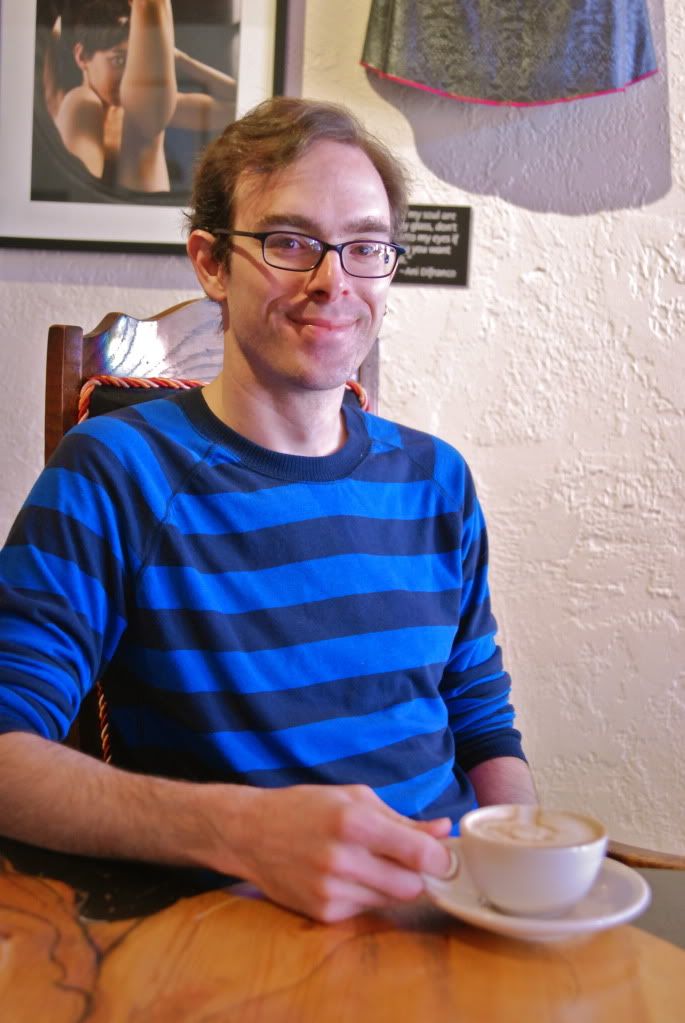
Galiotto getting his hands dirty

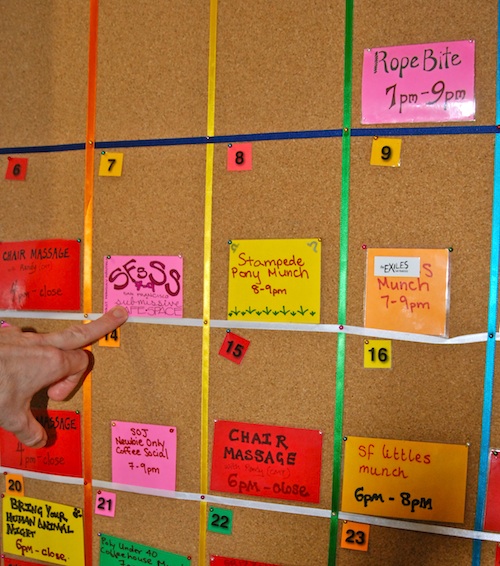
The shop has only been open since September 2009 but its honesty and openness has harnessed a whole lot of friends and connected a community of kinks that otherwise may not have mingled, teased and whipped. Over half the evenings in each month are reserved for special munches, themed play parties, and gatherings that welcome both veterans and newbies.

“At first I thought we would just be popular with the leather family,” Galiotto remembers. But their Folsom Street neighbors weren’t the only people who started showing up. Now customers bring in “littles” color pictures to post on the back refrigerator, a submissive group meets to chat and trade secrets; “ponies” stampede around the tables. All kinds of other fetish fans and even your average vanilla folks come in for sober conversation and the beverage of choice — coffee.

“When you come in here, you don’t have to worry about your neighboring table becoming upset over your topic of conversation. We’re not open for the ‘general’ public — just the public.”

And the patrons aren’t the only people having a good time. Steam milk, pull shot, get spanked — as witnessed on a Monday morning, baristas behind the counter at Wicked Grounds have lots of options for work-related benefits. Galiotto is even supportive of employee hook-ups. “Just sanitize as appropriate,” he laughs. “As long as everything is food safe. Like I always say, we’re all about team building.”

wickedgrounds2

Employees Xin Farrish and Zev Hoffman play at work

Manager Xin Farrish is broken-hearted about the possibility of closure and the elimination of a friendly third space for people to explore new ideas. Wicked Grounds has consistently been a space for education. Last week while Farrish was baking a batch of brownies she watched a visiting Norwegian couple get suspension bondage lessons. She casually comments that “it was cool.”

Farrish hopes to pull together a bake sale and is still brainstorming with the other employees and Grounds lovers for fundraising ideas. 

“It’s more of a safe space than a business. We’re not a dungeon, not a shop and not just coffee. And without this space, there will be a big hole in San Francisco.”

Galiotto is now battling a stress-induced cold and coming up with the $100k to save the place seems impossible — but so does the thought of saying goodbye. The money the couple put into the café could have bought a home and the means with which to start a family, but for him and Rose, a kink café seemed more important.  

wickedgrounds4

Galiotto taking a deserved break

“It would have been selfish for us to just build a cushy home. Yes, [Rose and I] could have made decisions that would have made our life easier,” he says with watery eyes. “But we built a home for a lot of other people.”

Galiotto and White will be making a decision on the future of their kinky love child by the end of the week. 

Roller derby: the San Francisco treat

4

Drizzly March was a slow time for San Fran sports fans — the last Super Bowl Sunday pig-in-a-blanket put to bed a month before, the NBA trade deadline past and playoffs a distant dream; and today’s April 1 major league baseball opening games an agonizing countdown away. Short of swimming through the dreary rains to San Jose’s Shark Tank, what’s a rowdy, rooting beer-guzzler to do?

Heading to Golden Gate Park to cheer on some equally rowdy rollers might not be the first thought that comes to mind, but it’s exactly what thousands of die-hard derby-goers did on March 19, when the storied San Francisco Bay Bombers elbowed past the Brooklyn Red Devils in the American Roller Skating Derby league’s world championship game.

Some may not consider a wet night in a packed Kezar Pavilion to be a legit answer to the pro-sports dry spell. But the Bay Area-based ARSD league is serious about its professional status, taking pride in everything from the team uniforms to the traditional banked track – a far cry, if you please, from the fishnets and flat floors of newer leagues

Bombers’ general manager Jim Fitzpatrick, who skated for the team from 1977 to 1987, has now delivered his third straight league title since rejoining as GM in 2007 (the ARSD doesn’t hold its championship game every year). For his efforts, he’s received three straight general manager of the year awards. But for him, the real thrill is keeping banked track derby – and its SF history – alive. 

“As a little kid growing up in San Francisco roller derby was huge,” Fitzpatrick said. “Everyone watched the Bombers on TV, everyone knew them. I dreamed about playing for them in Kezar. Now, I want to honor the tradition of the old derby.”

The venerable “old derby” is rooted in19th century roller marathons that lasted for days, sometimes caused deaths, and, on the whole, managed to acquire a reputation as less-than-legitimate. The sport was popularized as a Depression-era divertissement by Chicagoan Leo Seltzer, who in 1935 built a banked track and took it on the road, dubbing it the Transcontinental Roller Derby. At each stop, skaters would circle the wooden ring as many as 57,000 times, simulating a days-long journey from New York to California, with lit-up placeholders marking teams’ make-believe progress across a billboard-sized map of the U.S.. 

Derby historians credit crowds’ hunger for blood (not that 57,000 laps would be tedious otherwise, Nascar notwithstanding) with the spectacle’s increasing focus on physical contact and frightening pile-ups. The endurance element gave way to a derby more similar to that of today, where a “jammer” on each team gains points by bumping, jumping and jostling past opposing teams’ “blockers.” 

In 1949, Seltzer created the National Roller Derby League to showcase the scintillating sport, which was poised to become a television sensation. Echoing his earlier pilgrim’s progress, he packed up the whole shebang and moved it first to Los Angeles and then to the Bay, where the 1954 formation of the San Francisco Bay Bombers created a lasting sports legacy with some of the game’s most enduring stars. (Bomber Joanie Weston was even reputed to be the era’s highest-paid female athlete.) 

The iconic Bombers were the epitome of the banked track derby that aficionados like Fitzpatrick remember watching on their family room TV sets as youths. Dozens of games a year were taped in Kezar Pavilion, adjacent to then-home of both the Oakland Raiders and the San Francisco 49ers. From there, KTVU broadcast Bombers’ games to hundreds of cities nationwide, making roller derby the Rice-a-Roni of sports, synonymous with San Francisco. 

Seltzer eventually transferred ownership to his son, Jerry, who would later recall the glory of San Francisco’s skating days, when Kezar regularly sold out. And just for an added taste of legitimacy: the Bombers shared locker rooms with their NFL stadium-mates. 

“There were no dressing rooms in Kezar Stadium,” the younger Seltzer wrote in a blog he kept, “so when the 49ers played a home game they used the tacky dressing rooms in the Pavilion. Sometimes there was virtually no overlap between the time the players left and our teams arrived, to really scummy and wet dressing rooms.” 

Fitzpatrick affirmed that the dressing rooms still exist today, though Kezar Stadium has been knocked down and rebuilt. Under the parking lot, connected to a tunnel that once funneled the teams out to a roaring crowd, the rooms are a kind of shrine to days-gone-by – days when the 49ers and the Raiders would lace up roller skates and join the Bombers on the banked track, sometimes indulging in a bit of competitive action off the football field.

“Of course,” Fitzpatrick said, “That was before the NFL took off and salaries skyrocketed.  Once that happened, the guys couldn’t afford to be fooling around.”

Though their fun ended, there was still plenty of thrill left on the banked track. The ‘60s marked the height of television popularity for the Bombers who, across the nation, were considered the team to beat.

Seltzer’s league folded in 1973, a disaster attributed to everything from the rising cost of fuel to the diversification of televised sports and events. Since then, leagues have appeared, disappeared, fractured and gone defunct, the sport’s popularity waxing and waning, the focus shifting between skill and sensation. 

“Other games and jams have come along,” Fitzpatrick explained, applying the term “silly stuff,” to a whole array of roller sports, from L.A.-based Roller Games to CBS’ over the top show Roller Jam. Fitzpatrick even alluded to “midgets on skates” – and while that might be happening somewhere out there, it doesn’t take tiny rollers to get folks to think of derby as sports entertainment: the WWE on wheels, with sexpot women in the starring roles. 

Mixed-gender for-profit leagues like the Bombers’ league ARSD leave off the false eyelashes, but fans still debate whether the scores – and punches – are fake.

According Fitzpatrick, the Bombers’ aggression is all real.

“It’s a competitive sport,” he said, “based on contact and maneuverability. It’s like when someone cuts you off on the road – like road rage, tempers flare.”

Fitzpatrick’s sincerity never falters, and it’s clear he’s proud of his skaters when he describes how player coach Richard Brown scored the last point of the 43-40 game despite sweltering heat, or when he hails rookie Crista Chua as the female standout who learned under fire and performed under pressure, despite the championship being only her second real game.

And for their part, the players are just as serious. Chua said she trains hard for the team, staying in shape with running, weights, extra skating practices, and yoga sessions to stay flexible. 

Despite the sensationalism, Fitzpatrick’s goal is to keep roller derby on track – and so far, his efforts have resulting in a sterling record. Will it ever be as good as lacing up the ol’ skates for a game of his own? According to Fitzpatrick, it’s even better.

“To see something completely disappear, and then to be able to carry on – I’m that much more grateful,” he said.

As for the future: “I want to keep on the path, looking ahead to great skating and great ability. There’s always going to be showmanship in every sport, but I want to honor the athleticism.”


The Guardian endorses: Jello Biafra for Mayor!

On every level, the San Francisco mayor’s race is critical. San Franciscans will decide whether a fiscally conservative candidate backed by downtown interests will continue Gavin Newsom’s legacy of gutting critical services while refusing to raise taxes, or if a progressive will lead the city into a new era.

San Francisco needs a mayor who is motivated not by campaign donations from corporate fat cats, but by true San Francisco values. The city needs some one who is ready to fight the war on fun, by boldly having more fun than the warmongers can possibly stand.

What San Francisco needs is Jello Biafra. In a rare early endorsement, the Guardian has thrown its support behind Biafra for mayor. Formerly the lead singer of legendary punk rock group the Dead Kennedys, he is now the front man of Jello Biafra and the Guantanamo School of Medicine. In 1979, Biafra ran for mayor against former Mayor Dianne Feinstein and former state Sen. Quentin Kopp. His campaign motto was There’s Always Room for Jello.

“I am honored,” Biafra said when he was notified that he had received the Guardian’s endorsement for mayor. “After all, how could I be any worse than the last elected mayor, who turned out to be a horrible Frankenstein of Dianne Feinstein, Gray Davis and Tom Cruise?”

Biafra went on to talk about his campaign platform. “I would immediately reverse all [Newsom’s] mean-spirited, bigoted, anti-homeless laws, and instead hire all the panhandlers to work for the city on a 50 percent commission to help balance the budget,” he said.

Biafra said San Francisco could take a cue from Austin, Texas for another revenue-generating measure. “I would … declare the outlying strip on 11th and Folsom to be a music district, like they did on Sixth Street in Austin Texas, instead of having the police harass them and shut them down. This has brought in a huge amount of tax revenue for Austin, by the way.”

As part of this plan, the city could “use the revenue to buy back KUSF for the people of the city,” he added.

Biafra has a refreshing approach to ending police misconduct and promoting reform within the San Francisco Police Department. “Police officers should be an elected position,” he told the Guardian. “Every four years, you run for election, voted on by the district you patrol. You couldn’t just run off and hide in Novato after beating and shooting people anymore.”

An honest mayoral candidate, Biafra doesn’t pull any punches – not even when it comes to criticizing the Guardian, which has been the only publication to endorse his campaign so far. “I think the Guardian blew it when they came out against the initiative to rename our sewage plant after George W. Bush,” he said. “I think that would be a great idea. I’ll bring that one back, too.”
Rather than minimum wage, Biafra would like to implement a maximum wage, which has been proposed by the California Green Party.

“What should the wage be? Let’s be generous: Two hundred grand, and then you’re done,” Biafra decided. “You can live really well on that kind of money. Everything else goes back to the public purse, and you’ve got schools, you’ve got health care for everybody, transportation for everybody, people can even go to law school on the public’s dime – and why not? I mean, what about just giving some of that money back to people who didn’t make the $200,000 and guarantee people income, instead of talking about welfare cheats?”

When he ran for mayor in 1979, Biafra generated a great deal of attention with his proposal to require businessmen to wear clown suits between the hours of nine and five. But he said this required some explanation: “This is only in downtown,” he noted, “because this is a response to Feinstein’s campaign to clean up Market Street. She meant the Tenderloin, I meant downtown where Chevron and Bechtel and Bank of America and the other looters hold court.”

http://www.youtube.com/watch?v=bPhfUOsT71c&feature=related

Biafra said he also planned to bring back another proposal from his first mayoral bid: “Create a board of bribery, to set fair standards and public rates for liquor licenses, building code exemptions, police protection, and most importantly, protection from the police,” he explained.

As for the re-naming of Candlestick Park, Biafra had a flash of inspiration during his endorsement interview. “Isn’t there those little bags of junk food under the brand Emperor Norton for, you know, dried bread chips and stuff? How about, if they’re going to sell off the name Candlestick Park — or for that matter, finally name our baseball stadium after something other than a phone company — how about Emperor Norton Park?” Biafra suggested.

Vote for Jello Biafra for Mayor of San Francisco. After all, as he told us, “I would definitely be better than the last elected mayor. Then again, so would a cockroach.”

Vote early, vote often, and vote like your city depended on it!

P.S.: If Jello Biafra doesn’t win, we’ll kill ourselves.

Jello Biafra and the Guantanamo School of Medicine will launch their latest album, Enhanced Methods of Questioning, at Slim’s on June 4.

April Fool’s. Kinda.

Appetite: 3 ways to eat and drink for a better world this month

0

We are blessed with a city full of entrepreneurs and humanitarians who work to create a better world. It’s encouraging to know one can eat and drink well while also meeting a need. Here are three upcoming ways to make your food dollars stretch towards some crucial causes:

4/5 Umamimart’s The Gift of Food at Burritt Room for earthquake relief in Japan
Head to one our favorite cocktail bars, Burritt Room, for a fundraising party benefiting earthquake relief efforts in northern Japan. Many have contributed towards the cause, whether it’s Tommy Guerrero and DJ Toph One setting the mood with music or Peko Peko Japanese Catering and Sandbox Bakery serving bites. Plenty of booze has been donated ensuring fine sips throughout the evening: Yamazaki Whisky, Joto Sake, The Glenrothes Whisky, Brugal Rum, GlenGrant Scotch, Bulleit Bourbon + Rye. 100% of your ticket goes to Second Harvest Japan, the country’s first food bank.
Tuesday, 4/5, 8pm
$40
Burritt Room,
417 Stockton, SF. (at Sutter)
(415) 400-0500
umamimartjapanbenefit.eventbrite.com

4/7 22nd Annual Share Our Strength Taste of the Nation to fight childhood hunger
Taste of the Nation is annually one of our most meaningful events, fighting childhood hunger in America, where nearly 17 million children (almost one in four) face daily hunger. Every dollar donated buys $9 of groceries to feed children in need, while 100% of ticket sales go towards Share Our Strength’s No Kid Hungry in the Bay Area. Participating restaurants, chefs and mixologists all give of their time, talent and resources… the line-up is no less than stellar, including honorary chef co-chairs, Traci Des Jardins of Jardiniere and Incanto’s Chris Cosentino. Check out the impressive participator list here.
Thursday, 4/7, 6:30-9:30pm (VIP reception at 5:30pm)
The Bently Reserve, 301 Battery Street
1-877-26-TASTE
$95 for General Admission – This ticket will feed a child in need for 6 months
$165 for VIP Level access – This ticket will feed a child in need for 1 year
$500 for Executive Level access – This ticket will feed a child in need for 3 years
www.TasteOfTheNation.org

4/7 Toast of the Town at City Hall towards global poverty with San Francisco CARE
There’s a humble, little venue called City Hall (!) that will be overrun with food and wine on the night of April 7th for Wine Enthusiast’s annual Toast of the Town. Over 500 wines/65 wineries and food from more than 30 local restaurants (including Saison, Twenty Five Lusk, Bar Agricole, Alexander’s Steakhouse, Comstock Saloon), will keep you well satiated into the night in City Hall’s dramatic, elegant environs. A portion of the tickets goes towards San Francisco CARE, fighting global poverty with everything from education to economic development.
Thursday, April 7, 6pm (VIP), 7-10pm Grand Tasting
$109 Grand Tasting, $169 VIP
City Hall, 1 Dr Carlton B. Goodlett Place
http://www.toastofthetown.com

–Subscribe to Virgina’s twice monthly newsletter, The Perfect Spot

SF in top 38 counties nationwide that deport “non-criminal aliens”

38

So much for San Francisco being a sanctuary city. The National Day Laborer Organization (NDLON) and two other organizations have unearthed statistics that show San Francisco in the nation’s “top 38” counties, when it comes to deporting immigrants who had not been convicted of crimes.

The statistics, which the U.S. Immigration and Customs Enforcement Department provided as part of a public records request,  also show that California is the top state in the nation, when it comes to deporting “non-criminal aliens,” which is how federal authorities categorize immigrants who lack visas and green cards, since both are simply violation of civil administrative law, and not criminal acts.

These revelations come as internal documents, procured by the New York Times, suggest that federal immigration officers, facing resistance from Chicago and Cook County to join ICE’s controversial Secure-Communities program, pushed local officials to secure the participation of reluctant police departments.

Immigrant advocates say these newly released documents are fueling concerns that S-Comm is being used to circumvent due process for immigrants, and futher illustrate the need for reform, at the statewide level, to avoid abuse.

But ICE refutes charges that it is circumventing due process and primarily deporting immigrants who have not committed serious crimes.
“Secure Communities is a comprehensive initiative to modernize the criminal alien enforcement process,” an ICE spokesperson told the Guardian. “While ICE prioritizes the removal of convicted criminal aliens, the agency still enforces the law with regard to other aliens who are subject to removal. In addition to criminal aliens, ICE’s priorities include other individuals who pose a potential threat to public safety – such as those with known gang affiliations and prior drunk driving arrests – as well as immigration fugitives and individuals who have tried to game the immigration system.”

ICE officials also said that their review of the latest S-Comm statistics for San Francisco County show that “more than 60 percent of the aliens who’ve come into ICE custody since Secure Communities’ local activation are convicted criminals. What’s more, nearly one third of those cases involve individuals who’ve been convicted of Level 1 offenses [felony crimes].

But NDLON spokesperson B. Loewe said the newest data show that, several years into the S-Comm program, problems that immigrant advocates have been raising since S-Comm began, are continuing.
“There is no protection for the innocent, or even victims of crime, and the program appears to lend itself to circumventing due process,” Loewe said. “The latest numbers should raise concerns for anyone who cares not just fro civil rights but also for public safety for all.”

The S-Comm statistics emerged as part of a Freedom of Information Act request that NDLON, the Center for Constitutional Rights, and the Immigration Justice Clinic of the Benjamin N. Cardozo School of Law filed pertaining to ICE’s controversial Secure -Communities program.

Launched in Texas in March 2008, S-Comm involves state and local entities in the enforcement of federal immigration law by turning on a mechanism to run fingerprints through various databases when individuals are arrested, even if those individuals are brought in on minor charges or if their charges are subsequently dismissed.

“What’s most significant is that San Francisco is among the top 38 counties nationwide, and among the top 13 California counties,” said Jon Rodney, communications project coordinator at the California Immigrant Policy Center.

“The numbers speak for themselves,” said Angela Chan, a San Francisco Police Commissioner and Asian Law Caucus staff attorney. Chan noted that between October 2008, when California began implementing S-Comm, and February 2011, California has deported 35,643 local residents.
“That’s 10,000 more than Texas, which deported 24,152 residents,” Chan observed. She also noted that California is the state that deports the highest numbers of residents nationwide.
 
The top 13 counties in California deporting the highest percentage of non-criminal?  Merced, Fresno, Tulare, Solano, Monterey, Kern, San Luis Obispo, San Francisco San Joaquin, Contra Costa, Riverside, Sonoma, and Alameda, in that order.

This latest round of charges comes ten months after S-Comm was first activated in San Francisco, and fresh on the heels of Assemblymember Tom Ammiano’s announcement of AB 1081, a bill that would honor the right of local governments to opt out of the federal S-Comm and set basic safeguards for those municipalities that do decide to participate.

Chan notes that the Assembly’s Public Safety Committee will hold a hearing on AB 1081 on April 26.

“Ammiano’s bill is timely and crucial,” Chan said, noting  that California signed an S-Comm agreement without public input, notice or negotiations.

“That [process] raised concerns that California signed a boilerplate agreement that was dictated by ICE” Chan said. “And it’s part of the reason why we have such high numbers of deportations,” she continued, noting that Ammiano’s bill “connects to an existing clause,” in the memorandum of understanding  that the California Attorney General’s Office signed with ICE, back when Gov. Jerry Brown was still California Attorney General.

Ammiano’s bill would require the California Bureau of Criminal Identification and Information to modify the agreement it entered into with the US Department of Homeland Security in May 2009, regarding S-Communities. 

Meanwhile, in a March 7 memo (a copy was procured through NDLON’s public records request) ICE noted that its Secure-Comm program produced over 133,000 matches in the first five months of 2011, compared to 248,000 matches in 2010.

ICE also noted that since the program was first activated in Harris County, Texas, on Oct. 27, 2008, the agency has removed over 94,000 aliens and over 24,600 criminal aliens convicted of Level 1 (felony offenses) that were identified through the program.

“Deployment continues to be the primary driver for increased identifications,” ICE stated, observing that in the first five months of 2011, ICE will deploy S-Comm in 409 new jurisdictions. This means that by the end of May, 1,067 jurisdictions will be activated in 39 states, “covering 70 percent of the foreign non-citizen population.”

ICE’s goal is to deploy the program to an additional 488 jurisdictions by the end of 2011, bringing the total jurisdictions deployed by year’s end to 897.

But as Chan notes, Ammiano’s AB 1081 has implications for how and whether S-Comm gets activated in any more California counties,
“AB 1081 requires needed modifications to California’s S-Comm agreement, which was signed in April 2009 by California,” Chan said. “ It was one of the first, if not the first, agreement signed by a state to enter into S-Comm.  AB 1081 taps into this contract term, which allows modification and termination of the agreement, to allow counties to opt in or out of the deeply flawed program.”


Board delays Yellow Pages vote

3

In an attempt to assuage big business interests, the Board of Supervisors decided yesterday (Tues/29) to delay the vote on an ordinance regulating the Yellow Pages, a piece of legislation that would create a three-year pilot program to rid the city of unsolicited phone books. A vote on the legislation is set for May 10.

The ordinance by Board President David Chiu passed the Land Use Committee on March 22. In attendance was a large opposition including the Yellow Pages Association, representatives of International Brotherhood of Electrical Workers and AT&T Advertising Solutions to stress the importance of the directory to small businesses and local jobs.

Although it appears the votes are there to pass it, supervisors including progressive David Campos and business-friendly Sean Elsbernd pushed for the delay so the city’s chief economist could undertake an analysis to understand how the “ban” would affect city businesses and to allow the public to continue to voice its opinions on the issue.

According to a previous Guardian article on the ordinance, many local businesses have chosen to advertise elsewhere, and many residents, including populations generally seen to use the Yellow Pages such as the elderly and non-English speakers, will still be able to easily obtain phone books if need be.

Alexia Marcous, Vice President of the Green Chamber of Commerce and a strong advocate in favor of the ordinance, said she was disappointed that the board chose to delay the vote.

“It’s politically motivated,” she told the Guardian. “Instead of doing what’s best for the city, they are stalling.”

While Marcous noted that it’s always prudent to obtain more information, it was unnecessary for the public to “provide further rebuttal” on the ordinance that she believes already has overwhelming support. Marcous states that some of the consequences of delaying the vote include the costs the city incurs for “dealing with the blight and litter and diverting the vital funds from more important issues.”

If the board decides to authorize the ordinance, Marcous sees San Francisco as a success story for other cities to emulate.

“It shows we are willing to do something about the egregious distribution practices that are only helping the Yellow Pages,” she said.

YPA Vice President of Public Policy and Sustainability Amy Healy posted on the Yellow Pages blog last week, before the vote was made, that the Yellow Pages Coalition “will be working diligently over the next week to influence the other members of the Board of Supervisors.”

Editor’s Notes

7

Tredmond@sfbg.com

The San Francisco City Planning Department is revising its housing plan, and there’s a lot of indignation on the west side of town. See, the Housing Element of the city’s General Plan calls for a little bit of increased density in some of the neighborhoods that have fought density for years.

The unwritten law of San Francisco housing politics is that you don’t even talk about density west of 19th Avenue, and it’s pretty hard to talk about it anywhere beyond the western borders of Districts 3, 5, 8 and 11. So all the new housing gets pushed into the eastern neighborhoods — and all the rational planning people agree that the other side of town should absorb at least some of it. Density doesn’t always mean big, tall buildings, by the way — legalizing in-law units would create more housing, and more density, in single-family-home areas. But you run into the problem of everyone wanting a car — and turning garages into apartments means more cars fighting for that almighty parking space. Housing cars in this town sometimes seems more important than housing people.

So we’re going to hear some squawking — and a lot of it’s going to be misplaced. Because the real issue in the Housing Element isn’t density — it’s affordability.

The city acknowledges, in its own documents, that based on local needs, more than 60 percent of the new housing in the city has to be available at below-market-rate prices. The planners also admit they have no idea how to make that happen:

“The city will not likely see the development 31,000 new units, particularly its affordability goals of creating over 12,000 units affordable to low and very low income levels projected by the [city’s needs assessment] … [But] realizing the city’s housing targets requires tremendous public and private financing, [which] given the state and local economy and private finance conditions, is not likely to be available during the period of this Housing Element.”

Translation: we can’t afford to do what everyone agrees we have to do.

San Francisco city planning has been driven for decades by the needs of the private sector. It’s made good money for the developers (building housing in SF is still highly lucrative). But as public policy, the model has failed.

Until we set clear policies saying that the needs of local residents come first — and that high-end housing isn’t meeting those needs — we’re going to keep living with a serious disconnect.

Progressive pension reform

5

EDITORIAL It’s entirely possible that San Francisco voters will see three different pension proposals on the November ballot. Public Defender Jeff Adachi, who failed to pass a harsh pension-reform plan last year, is determined to try again. A working group headed by investment banker Warren Hellman is working on a plan, and Sup. Sean Elsbernd expects some version of that to move forward. And organized labor may do its own initiative.

But before any of those efforts are finalized, it’s worth understanding where this so-called crisis originated — and how to fashion a progressive approach to the issue.

The idea behind San Francisco’s fixed-benefit system is simple. Every year, the city and it’s employees contribute to a pension fund, which is invested under strict rules, and when an employee retires, he or she gets paid a predetermined amount out of that fund. Until the financial system imploded and the stock market crashed in 2008, San Francisco’s pension fund was solid. The reserves more than covered expected payouts. In fact, the fund was so healthy, and growing so fast, that some years the city didn’t have to contribute anything at all.

Under Mayors Willie Brown and Gavin Newsom, the city used its flush pension fund as a way to avoid tough decisions on employee pay. Instead of giving raises, for example, the city offered to pick up the contributions some workers were making to the fund (which would cost the city nothing as long as the stock market kept booming).

Now things aren’t so rosy, and the city’s having to put hundreds of millions a year into the fund to keep it solvent. For the record, that’s not the fault of the city employees who negotiated their contracts in good faith — and who weren’t players in the Wall Street greed and corruption that wrecked the economy. In fact, if the city had continued paying into the fund in good times, the costs would be far lower now.

The various pension proposals look at a wide range of approaches, but in essence, both Adachi and Hellman’s group are going to ask city employees to put more of their paychecks into the pension fund. That’s the equivalent of a pay cut — they’ll be taking home less money for the same benefits they currently receive.

It’s true that city employees now get better pensions than most private-sector workers (a result in part of the fact that corporate American, aided by Congress, shifted most retirement plans to the 401(k) model, which puts all the risk on the employees and leaves employers largely off the hook). And there’s some horrendous abuse, particularly by senior police and fire staffers (former Police Chief Heather Fong is getting $229,000 a year for life, which is ridiculous).

It’s also true that the average midlevel city worker gets a pension between $20,000 and $24,000 a year.

Labor has already given back some $500 million in concessions over the past four years (and most of that money has come from lower and midlevel workers) City programs and services have been cut, by most estimates, by close to $1 billion.

The city has raised only $90 million in new taxes.

The bottom line is that over the past four years, the rich and big corporations, which are radically undertaxed in our society, have given back almost nothing to the city, have felt almost no pain. Unless pension reform takes that into account, it won’t be fair or acceptable.

The first element of any new pension plan should be progressive in scale: capping pensions at, say, $100,000 (or lower); eliminating pension spiking; and requiring high-paid employees to contribute a higher percentage to the fund than low-paid workers would make sense. Policy makers should treat this as what it is, a pay cut — and any cuts should fall disproportionately on those who are more able to afford it. Requiring the city to put its share into the fund every year, even if the market is booming, would help ease the pain in bad years.

But there should be no pension reform without tax reform. If San Francisco is going to ask its employees to do more to balance the local budget — and that probably has to happen — then city officials should be willing to ask the richest residents and businesses to share the pain too.

Why I’m pushing pension reform

5

OPINION Some have questioned why I, as a long-time supporter of progressive policies and programs, chose to venture into the uncharted waters of pension reform. The answer is simple: I believe in the value of government, particularly in providing a safety net for the poor and those who need help. When the government no longer has the ability to provide these services, everyone suffers.

I became aware of San Francisco’s pension problem through advocating for my department’s budget. Beginning in 2005, year after year, I saw pension and benefits costs rise, while services and programs were cut or eliminated. Funding for education, parks, street repair, AIDS, senior and after-school youth programs, mental health clinics, drug treatment programs and other basic services have evaporated while pension costs continue to escalate. Today, we spend $1 out of every $7 on pension and benefit costs for city employees; in five years, it will be one out of every $4.

In the next 12 months, pension costs are projected to increase by nearly $100 million more than last year. Think of the number of jobs, programs, and services that will have to be cut to pay this debt. These costs come at a time when the city faces a $360 million budget deficit.

Some may argue that taxes should be raised to pay for these costs. Yet progressives have shied away from tax measures in these difficult economic times. Even if there is a planned tax measure this November, it would have to raise $300 million — 10 times what last November’s millionaire real estate transfer tax raised — over the next three years to keep pace with pension costs.

While conservatives have seized on rising pension and benefit costs as a vehicle to push their anti-union agenda, we cannot cede the responsibility for addressing this fiscal challenge to the right. We must protect collective bargaining for workers, while presenting a solution that strikes an appropriate balance between our obligations to retired workers and the need for continued city services.

Shortly, I will be introducing a new ballot initiative that will help reduce costs while ensuring that the pension and health benefit system is there for future generations of workers. And the initiative will do so in a manner that is fair and equitable. The highest-earning workers, including elected officials, will be asked to contribute more while the lowest-earning workers will be entirely exempt, a lesson learned from the last pension reform effort. The reforms will help eliminate the abuses of the pension system that benefit a few workers at the expense of others. Residents, elected officials, city employees, and labor leaders are invited to review the proposals at www.sfsmartreform.com and provide any comments or ideas.

The fact that pension reform is one critical component of a more comprehensive solution that may include changes to our tax policy, generation of other revenue, and even state or federal cooperation, is no reason to excuse supporting real reform.

Jeff Adachi is San Francisco’s public defender.

The Parkmerced investors

8

rebeccab@sfbg.com

Parkmerced is one of the largest rental properties west of the Mississippi, and with more than 1,500 rent-controlled units, it’s an important piece of the city’s affordable-housing stock. Among the residents who live in the neighborhood-scale apartment complex are seniors, young families, and working-class San Franciscans, some of whom have called it home for decades.

A plan for an extraordinary overhaul of the property envisions tearing down the existing low-rise apartments and nearly tripling the number of units with a construction project that could take up to 30 years. On March 29, after Guardian press time, the Board of Supervisors was scheduled to vote on whether to uphold the plan’s environmental impact report (EIR), a key milestone of the approval process.

The Planning Commission voted 4-3 to certify the EIR, and if the board followed suit by rejecting four different appeals filed against it, Parkmerced would be on track to clear final approval sometime in May.

San Francisco Tomorrow was among the groups that filed appeals against the Parkmerced plan. “They want to destroy a neighborhood without sufficient justification or mitigation,” said Jennifer Clary, the group’s president, citing concerns about traffic congestion, loss of an historic landscape, and the destruction of rent-controlled housing.

Julian Lagos, a resident of 18 years, filed an appeal on behalf of the Coalition to Save Parkmerced. “It’s a very blue-collar community, and they want to replace it with wall-to-wall luxury high-rise condos,” said Lagos, who lives in a unit that would be targeted for demolition under the development plan. “I call it ground zero,” he said. “And I tell my neighbors, ‘You’re living at ground zero.’ “

Mayoral development advisor Michael Yarne noted that most points highlighted in the EIR appeals had already been addressed, except one charging that there hadn’t been adequate consideration over whether a Pacific Gas & Electric Co. gas pipeline running underground near Parkmerced could be jeopardized by construction activity. “The answer to that is, that’s a really good question for PG&E,” Yarne said. But he asserted that it wasn’t a project EIR issue.

Elected officials’ reactions to the overall plan were mixed. Lagos noted that campaign filings showed that Sups. Carmen Chu and Sean Elsbernd had accepted donations from people related to the project, and he predicted that Board of Supervisors President David Chiu would be a swing vote on the issue. Chiu spent several hours touring Parkmerced the Friday before the vote. He did not return Guardian calls seeking comment.

A development agreement between the city and the developer, Parkmerced Investors LLC, promises that existing tenants will keep their rent control at the same monthly rates — even after the apartments they now reside in are razed to make way for new residential towers.

Such a plan typically wouldn’t fly under state law because the Costa-Hawkins Act prohibits a city from imposing rent control on newly constructed housing. Yet city officials, with input from the City Attorney’s Office, say they’ve constructed this deal so that it falls within one of the exceptions written into the state law, offering a legal defense in the event of a court challenge and a guarantee against affordable housing loss.

“The development agreement is like a constitution for land use,” said Yarne. “You can’t get rid of it.” If the project changed hands or the developer went bankrupt, the new owner would be bound by the same terms, Yarne said.

However, Mitchell Omerberg of the Affordable Housing Alliance cautioned that he didn’t believe there was any guarantee that rent-control housing qualified as an exception under Costa-Hawkins. “Like parking a semitruck in a motorcycle space, it’s a poor fit and a risky bet — even before you consider the antipathy to rent control of the California courts,” Omerberg wrote in an argument against the plan.

Tenants advocacy groups have pointed to recent court decisions negating affordable-housing agreements in development projects, saying the legal precedent makes the Parkmerced pact vulnerable to a court challenge. In response, Yarne said those cases had strengthened the city’s legal strategy for formulating the agreement to guard against such a challenge. “This agreement is actually greatly improved because of those cases,” he said.

Nevertheless, there’s a clear financial incentive for the developer to strip away the rent-control unit replacement and other valuable community benefits it is required to deliver under the terms of its agreement with the city. An independent analysis of the project’s financial plan found that if Parkmerced Investors LLC adheres to all the terms of the agreement as planned, its financial rate of return would be less than ideal.

Drafted by consultant CB Richard Ellis (CBRE) to provide an objective financial picture for the city, the report found that the developer’s estimated 17.8 percent rate of return was “slightly below the threshold required to attract the necessary private investment” because investors aim for at least 20 percent in this market. “This means that, based on current and reasonably foreseeable short-term market conditions, the project may not be economically feasible,” the report noted. It added a disclaimer saying that cash flow from rent payments could offset that risk.

That lower rate of return isn’t a cause for concern, Yarne said, but rather a sign of the city’s negotiating prowess, since “we’ve gotten as much as we can in terms of public benefits. That 17.8 percent rate of return shows that we’re probably at the max.”

At the same time, the financial analysis showed that the developer’s prospects improved under hypothetical “tested scenarios” where the expensive community benefits promised in the development agreement weren’t a factor. As part of the analysis, CBRE looked at how the numbers would change if the developer decided to build new market-rate units instead of replacing all the existing rent-controlled units, and found it would fetch a 19 percent rate of return. In a scenario where it stripped out additional costs such as a community garden and new transit line, the rate of return would jump to an eye-catching 23 percent.

But those scenarios are just a hypothetical way to arrive at conclusions about a project’s value, said consultant Mary Smitheran, who drafted the report. “The development agreement specifies that those items need to be provided,” she said.

City officials have given the impression that they’re nailing down a set of requirements that the developer, or any future property owner, cannot get out of. But the people behind this project are some savvy Wall Street investors who are no strangers to controversy.

Fortress Investment Group, a New York City-based hedge fund and private equity firm with directors hailing from Lehman Brothers and Goldman Sachs, gained a controlling interest in Parkmerced last year after Stellar Management couldn’t make the payment on its $550 million debt.

Stellar jointly purchased the property in 2005 with financial partner Rockpoint Group, setting up Parkmerced Investors LLC as the official ownership company. Stellar still manages the property, but Fortress has seized financial control. A recent report on the Commercial Real Estate Direct website noted that its $550 million debt had been modified recently with a five-year extension to 2016.

Fortress made headlines in 2009 after it stopped providing funds to Millennium Development Corp. for the Olympic Village project in Vancouver, British Columbia leaving the city on the hook for hundreds of millions to finish the job in time for the winter games. Meanwhile, Fortress CEO Daniel Mudd recently got formal notification from the U.S. Securities & Exchange Commission (SEC) that he could potentially face civil action relating to his former job as CEO of Fannie Mae, the government-backed mortgage giant, for allegedly providing misleading information about subprime loans.

Stellar, a New York City company run by real-estate tycoon Larry Gluck, was profiled in a 2009 Mother Jones article about Riverton Homes, a 1,230-unit Manhattan rental housing project built in a similar style to Parkmerced, which Stellar purchased in 2005. Although Stellar assured residents that their affordable rental payments would remain unaffected, hidden from view was its business plan estimating that half the tenants would be paying almost triple the rental rates by 2011. Since rents couldn’t ultimately be raised high enough to cover the debt payments, the complex went into foreclosure — but Stellar was shielded against loss because, on paper, Riverton was owned by a separate LLC.

Linh Le, a 36-year resident of Parkmerced and former Chevron employee, wrote to the Board of Supervisors in advance of the March 29 hearing to warn of the financial troubles the investors had experienced before.

“This project reflects a pipe dream that was hatched during an era of reckless spending, fake prosperity, and seemingly limitless money that has since crashed and nearly destroyed America,” he wrote. “The business model that Parkmerced based this plan on has failed and nearly ruined their enterprise. That era is over and the world has changed.”

Scumlords settle

1

news@sfbg.com

Five years after the Guardian’s award-winning, three-part series about how representatives for the Lembi family allegedly engaged in illegal and unethical tactics intended to force protected renters from their homes (“The Scumlords,” March 2006), City Attorney Dennis Herrera has concluded contentious negotiations to reach a multimillion dollar settlement with CitiApartments and other Lembi-controlled corporations.

The two sides have agreed on a settlement worth anywhere between $1 million and $10 million to the city, depending on the crumbling real estate empire’s future worth and whether the Lembi family decides to “forever cease property management operations within the City and County of San Francisco — permanently and irrevocably,” as the City Attorney’s Office put it.

That agreement and an injunction barring the landlords from future harassment of tenants was scheduled for submission to San Francisco Superior Court on March 29 and still must be approved by a judge, although that is usually pro forma in cases like this in which both sides have agreed to the terms.

In its lawsuit, the city alleged that the defendants “employed a business model that systematically and unlawfully dispossessed long-term residential tenants of their rent-controlled apartments, leaving defendants free to make significant unpermitted renovations and to re-rent those newly renovated units at dramatically increased market rates.

“Ostensibly, this illegal business model enabled Lembi family interests to aggressively outbid competing investors for perhaps hundreds of residential properties throughout San Francisco,” the complaint continued, further alleging that the defendants’ business entities were organized and operated in such a way that they were “the alter egos of defendants Frank Lembi, Walter Lembi, and David Raynal.”

The defendants disputed those claims, the injunction notes, “by reaching a settlement and agreeing to injunctive terms and payment of civil penalties, defendants are not admitting any wrongdoing or making any admission of liability.”

But the City Attorney’s Office said that this is “the most exhaustively detailed settlement in memory, and the strongest possible agreement to protect the public interest.” And Herrera told us that the settlement reflects “the pervasiveness of the conduct” the city looked at, regarding tenant treatment and the litigation process.

“So, it was necessary to get as tough and detailed an injunction as possible to ensure that tenants will be protected going forward, and in terms of trying to extract a maximum dollar settlement,” Herrera told us. “For us, their conduct is the most important thing, but the financial penalties are not insignificant. This ensures they do business under strict circumstances, play by the rules, and do not present a threat to tenants. But if they want to leave, obviously, there’s a dollar amount connected to that.”

The lowest possible settlement, $1 million, requires the Lembi companies to quickly get out of the rental business in San Francisco. The settlement comes almost five years after Herrera first filed suit against CitiApartments — and 18 months after former CitiApartments’ tenants sued the Lembi empire (see “SF vs. Frank Lembi,” 10/6/2009), following a financial crash that involved banks foreclosing on dozens of the group’s properties (see “Triumph of tenacity,” 6/1/2010).

The City Attorney’s litigation included evidence from tenants and other witnesses identified by former Guardian reporter G.W. Schultz, and Herrera credited the Guardian with originating the case. CitiStop, a coalition of labor and tenants groups, also referred tenants and helped the case, and almost 300 tenants and witnesses came forward after the city’s 2006 filing.

The City Attorney’s Office noted that Herrera amended his original complaint three times to fully capture the Lembi family’s “byzantine array of business entities, trusts, and partnerships within the scope of the lawsuit,” fighting through corporate stall tactics that were the subject of fines issued by the courts.

Even after their unscrupulous tactics were exposed, the Lembis continued to be celebrated by business groups such as the San Francisco Apartment Association, although city officials told us “real estate observers had long speculated that the Lembi family’s unlawful business model was ultimately unsustainable. And the severe economic downturn that began in late 2008 appears to have been cataclysmic for the aspiring real estate empire.”