San Francisco

The occupiers of SF, NYC, and next DC gain momentum

8

It’s been almost three weeks and they’re still there. It’s been raining, and they’re still here. Not only that, but their numbers are growing. The Occupy Wall Street movement – and its local counterpart, the Occupy San Francisco group that has been camped in front of the Federal Reserve at the foot of Market Street – is showing real staying power as it demands social and economic justice.

Following last week’s march through the Financial District, the local group plans to brave the rain storm expected to hit tomorrow (Wed/5) and to stage another march on the banks and big financial players that they blame for crashing the economy and transferring more and more wealth from the bottom to the top. The fun begins at noon outside the Federal Reserve, 101 Market Street.

Then, the next day, protesters plan to gather outside the Federal Building at Mission and 7th streets from 3-6 pm to voice solidarity with the latest big city occupation that starts that day: the “Stop the machine! Create a new world!” occupation of Freedom Plaza in Washington D.C., which organizers intend to last throughout the month.

And on Friday, the 10th anniversary of the U.S. military campaign against Afghanistan, anti-war groups will again gather at the Federal Building for a rally and march starting at 4:30 pm, with a message that seeks to link this country’s ongoing wars with the messages being sounded by the occupiers in the streets, that it’s time to divert resources being wasted on war and Wall Street toward the 99 percent of Americans who could really use them right now.

The mainstream media has been struggling with how to cover that linkage and convey the protesters’ long list of grievances and demands. But as groups of teachers and pilots and other exploited professionals join the Occupy Wall Street movement, and as noted economists and celebrities stop by to show their support, the effort is entering a new phase, and we should all seek to understand what’s driving it and where this might be headed.

Localized Appreesh: The Soft White Sixties

1

Localized Appreesh is our weekly thank-you column to the musicians that make the Bay. Each week a band/music-maker with a show, album release, or general good news is highlighted and spotlit. To be considered, contact emilysavage@sfbg.com.

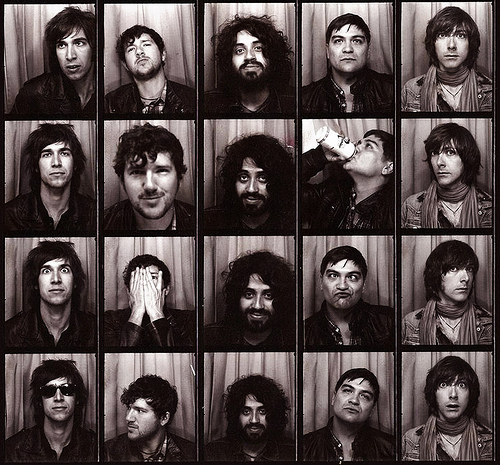
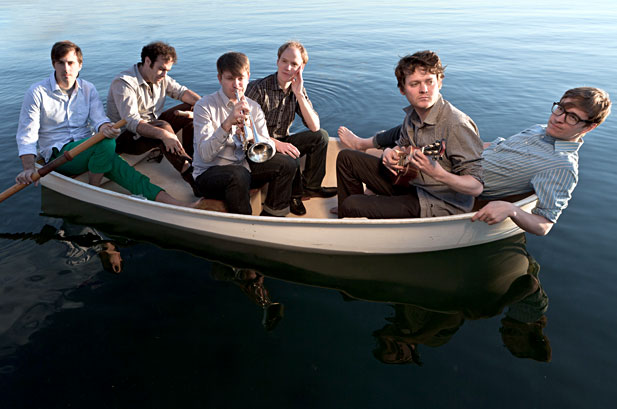
You know that feeling when you’re aware you’re hearing a song for the first time, yet it feels as though it’s always been there? It’s new-to-you but there’s something familiar, reassuring – it just works right, pinging back and forth through your ear drums and pulsating brain muscle. That’s how I felt when I first listened to the cool swagger of San Francisco’s the Soft White Sixties. The hard rocking quintet, formed by Mexican-American singer-songwriter Octavio Genera, has a real tight grip (full disclosure, “real tight  grip” is a lyric from SWS’s song “Too Late”) on classic Seventies rock’n’roll – with all the shoulder-shaking percussion, the bluesy rock riffs, and Genera’s soul-tinged Southern rock bravado.

The band had a pretty memorable year, performing with pals the Stone Foxes at Great American Music Hall during Noise Pop, hitting SXSW, touring the States, and at the start of summer, appearing at the Harmony Festival in Sonoma and the High Sierra Music Festival. Now summer is officially over, and the boys are back in town. Next up, a show at Bottom of the Hill tomorrow night.

Year and location of origin: 2008, the Haight.
Band name origin: Somebody had a bright idea
Band motto: “Wear it a lot, wash it a little”
Description of sound in 10 words or less: Rock ‘n’ roll, heavy on the roll, dipped in soul
Instrumentation: Guitar, keys, bass, drums, and vocals – and a runaway tambourine
Most recent release: self-titled EP (April 2011) – get it here.
Best part about life as a Bay Area band: The coastal fog and burritos
Worst part about life as a Bay Area band: Bridge tolls and parking tickets
First record/cassette tape/or CD ever purchased:
Octavio: Sound Effects Vol.1 (Track 25, “Car Starting” was a favorite).
Joey: Jodeci.
Ryan: Skid Row s/t (cassette), Wreckx N Effect Hard or Smooth (CD).
Aaron: Probably something like Enema of the State or Punk in Drublic.
Josh: The Simpsons Sing the Blues.
Most recent record/cassette tape/CD/or Mp3 purchased/borrowed from the Web:
Octavio: Black Girl (iTunes single Lenny Kravitz).
Joey: 100 classic French songs for $9.99.
Ryan: Wilco The Whole Love, Belle & Sebastian “The Blues Are Still Blue” iTunes single.
Aaron: Portugal. The Man – In the Mountain In the Cloud.
Josh: Blakroc
Favorite local eatery and dish: La Santeneca(3781 Mission St), best pupusas in the city.

The Soft White Sixties
With Mona and Funeral Party
Weds/5, 9 p.m., $12
Bottom of the Hill
1233 17th St., SF
www.bottomofthehill.com

Taking sit-lie lying down: Graduate student beds down on Haight Street

3

Some things seem strange even for San Francisco. The pedestrian double take was in full effect at the Haight Street curb where Bennett Austin fed the meter for his bed last Thursday. And it wasn’t even Parking Day

Austin hoped to create awareness about the homeless youth who wander, sleep, and hang out on Haight Street. The graduate school student set up a bed to demonstrate that the only safe space for the homeless to sleep in public are curb spots that they must pay for by the hour, joining the tradition of artists speaking out against sit-lie. 

His campaign, “Keep the Meter Running,” spun from last year’s sit-lie ordinance, which prohibits sitting or lying on the sidewalk or public spaces for more than three minutes at a time. Although this law is nominally meant to be enforced uniformly, it is widely understood that it targets the homeless. 

Austin wanted to do something. “I wanted to put creative efforts to solutions,” he told the Guardian that day on Haight Street. He contacted the Homeless Youth Alliance (HYA), a youth-focused organization in the Haight-Asbury which provides food, clothing, showers, counseling, and mental health and medical services to the homeless. Within three weeks his idea was in action. 

The project was also accepting donations for HYA’s HIV prevention program, whose  funding was recently cut, reducing the organization’s total funds by one-third. Mary Howe, founder and executive director for HYA, said she and her staff was very open to Austin’s advertising idea.

“It brings attention to the sit-lie law, which doesn’t solve the problem [of homelessness],” Howe said.  

Austin said he understands that everyone’s circumstances are different and he is hoping his campaign can help people become more open-minded. He said he has received very few negative responses. The first six people to donate to the HYA, Austin said, were homeless youth themselves.

Because the parking spot is paid for and Austin moves the bed every two hours (to comply with San Francisco parking laws) everything he is doing is legal. “Keep the Meter Running,” is costing Austin $16 per day to advertise on a historic street. For him, it is the cheapest and easiest way. 

“I’m reclaiming public space,” he added. “Because these kids are just as much a part of the Haight as the Haight is a part of them.”

We could ride trains

0

The Muni trains are fun. I rode them for years before I figured that out. 

Muni was always a matter of function, a means of getting around. I was in a rush, a busy person with Places to Be. I was late; the train wasn’t there. When one of those historic clankers from Boston showed up on Church Street, I got even more crabby. The thing goes about four miles an hour; don’t they know we’re on a schedule here?

And then I had a son.

Even before he could talk, Michael loved trains. He’d point at them and start waving his hands up and down and laughing. “Choo-choo” was one of his first words; I think he knew that one even before “dada” and “mama.” And when I finally took him for a ride on the J-Church, around his second birthday, he became the happiest boy on the planet.

For the next year or so, every weekend morning, when he woke me up at the crack of dawn, I’d ask him what he wanted to do that day, and he’d say, with a big smile, “We could ride trains!” And almost every Saturday and Sunday afternoon, that’s what we’d do, from Church Street to Market Street, down Market, maybe along the waterfront to the end of the line at Fisherman’s Wharf. Then we’d get on another train and ride back home.

Sometimes we’d stop for a while at Dolores Park; sometimes we’d have doughnuts and check out the sea lions at the wharf. Sometimes we’d take a walk along the bay and look at boats. But really, as Zen masters and three-year-old boys have always known, the journey was the destination.

It’s different seeing the city through a child’s eyes.

I remember the amazing sense of wonder I had when I first arrived in San Francisco, a 22-year-old out of the New York suburbs and a Connecticut college town who had never been west of Buffalo. Everything seemed so alive, so special and strange and funny. And after a while, like everyone else, I had to pay the rent, and fight with the bank and the phone company, and the IRS found me, and life in the big city became, well, life in the big city.

But when you walk around with a kid, it all starts to come back. The whole urban world is an adventure. That stuff blowing around on the sidewalks isn’t garbage — it’s treasure. The graffiti on the walls isn’t vandalism (or even art) — it’s a clue to some sort of puzzle, maybe a map to where the pirates buried the gold. Even watching the train pull away just before you get to the corner isn’t any reason to be mad — because (as Michael always announces with glee) pretty soon there will be another one!

Just walking out the door is an explosion of scientific marvels. The wind is moving air, which is pretty cool when you think about it. The fog is a cloud on the ground. The rain makes puddles, and puddles lead to big splashes and soaking wet feet, and life doesn’t get much better than that. I suspect that every day in Michael’s life is like the first time I smoked pot and tried to talk about the difference between time and color.

There was a long period (and now it seems like another lifetime) when I could go for weeks without venturing beyond work, the 500 Club, a couple of take-out places, and my apartment. The advantage (and curse) of this city is that you can live quite well in your own neighborhood (particularly when it’s a place like the Mission District or Bernal Heights), so you don’t need to go anywhere else.

Amazing what I was missing.

I’ve lived in or around the Mission for 10 years, and I’d never been to Garfield Pool. You can swim there for three bucks, and it’s never crowded. The locker room feels like something out of a 1940s socialist paradise — everything’s one color, brutally utilitarian, and just a little bit broken. There are free kickboards, basketballs (and a poolside hoop), and sometimes even swim goggles (I guess when people leave them behind they become properly nationalized). The Upper Noe Recreation Center has the same sort of feel: on Saturday mornings, there’s a toddler gym, filled with a huge conglomeration of toys that look and feel like they were never actually new. But they work just fine and are durable as hell, and on rainy days, dozens of children stranded inside get a chance to ride welded tricycles and plastic cars around and crash into each other, with no ill effect. I smile just thinking about it.

The big children’s playground at Golden Gate Park has a long, steep slide made out of concrete that would make a modern-day insurance agent gasp in horror and alarm. Kids who have barely learned to walk somehow manage to climb up about 75 slippery, uneven steps that are almost too much for me, then sit on torn pieces of cardboard and careen down a hard, fast incline and skid to a stop at the bottom. It’s outstanding.

At Crissy Field, there’s a narrow, shallow channel where the water in the newly restored tidal marsh flows in and out of the bay. I don’t think the people who oversaw the ecological restoration of the wetlands area had any idea they were creating a swimming hole for kids, but that’s what happened: on warm days, dozen of children splash in the stream and build elaborate sand castles on the banks. When the tide goes out, a muddy island appears in the middle. Even with the tide coming in, the channel is never more than a few feet deep. It’s mind-boggling: you’re on the edge of the bay, in the shadow of the Golden Gate Bridge, a few yards away from the icy-cold currents and riptides where even seriously athletic adults in wet suits venture only with care — and three-years-olds are romping in the water with their dogs.

There’s a railroad museum at the old Hunters Point shipyard, with vintage steam engines that still work. There’s a model river (full of water and plastic fish) at the Bay Area Discovery Museum in Sausalito. There’s a working beehive in the bug house at the San Francisco Zoo, and the queen bee has a white dot painted on her abdomen. There’s an artificial earthquake that shakes up the Lego houses you can build at the California Academy of Sciences.

There are stores in the Mission that sell parachuting space aliens. If you ask nicely at Mitchell’s Ice Cream, they’ll stick a few green gummy worms in your chocolate-chip cone.

These are all things I didn’t know.

When I was a kid in the suburbs, I couldn’t imagine growing up in a city. I hope my kids see it differently. Because I’m getting to be a kid again right here in San Francisco — and I can’t imagine anyplace better.

On the streets with Occupy San Francisco

31

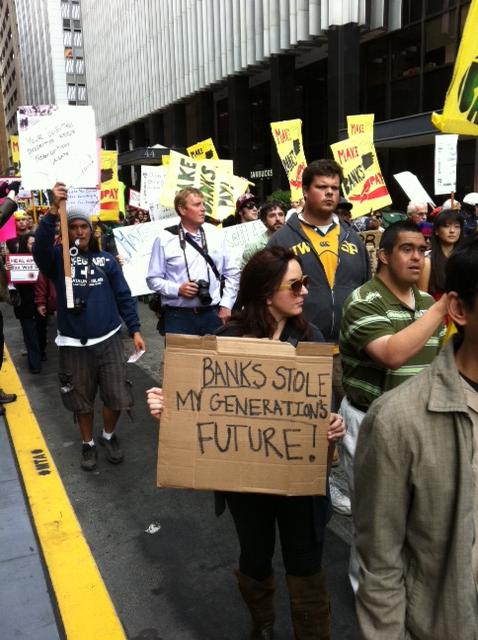
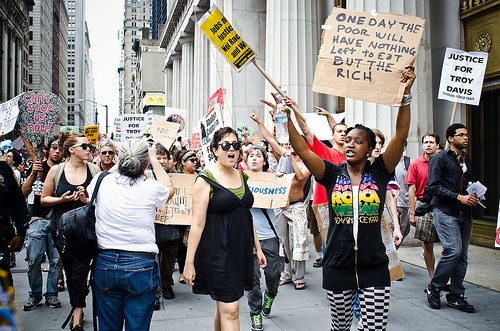
The messages sounded yesterday on the streets of San Francisco – delivered in speeches, chants, signs, songs, interviews, and the petition handed to Chase Bank officials by a half-dozen protesters before their arrest – should resonate with most Americans. After all, while rich corporations and individuals have been accruing ever more wealth, the vast majority of us have been falling behind.

“Banks get bailed out, we get sold out,” was one of those chants by the several hundred people who marched through the Financial District – our OccupySF effort building off the two-week Occupy Wall Street events – targeting some of the villains of the economic meltdown: JPMorgan Chase, Bank of America, Citibank, Charles Schwab, the Federal Reserve, and Goldman Sachs.

They may be relatively small and easy to ignore, these “occupations” of Wall Street and San Francisco and other cities that are entering their third week, but they’re being driven by a palpable anger and stirring critiques of economic and political systems that exploit the powerless. But as the foreclosures, layoffs, and other hardships continue, this nascent movement could have some staying power.

“I think it’s starting to wake people up out of their complacent distraction,” Robin Kralique, a 26-year-old SF resident holding a sign that read “Let’s have the GDP measure happiness,” told the Guardian. “We’re planting the seeds for a better future, and I’m hoping it wakes some people up.”

Like many of the young protesters gathered outside the corporate office building at 555 California at the start of the march, she was inspired by Occupy Wall Street. They’re angry watching their economic opportunities evaporate as more and more of the country’s wealth accumulates in fewer and fewer hands.

“There’s an insane amount of greed in this country,” 24-year-old Erin Kramer, a dancer and performance artist stuck in a corporate job she needs to get by, told me. Her sign read, “Don’t be afraid to say revolution!”

And many weren’t, with calls for revolution on the tips of many lips, albeit tempered with healthy doses of realism. “Even if it isn’t at critical mass yet, it sets the stage for the next revolution,” Kralique said when I asked her what she hoped this moment would accomplish.

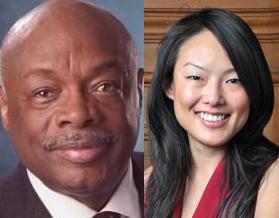
Sup. John Avalos, a progressive mayoral candidate who spoke at the rally, is pushing legislation to create a municipal bank in San Francisco, one that would invest far more money in local projects and small businesses than Bank of America, which manages most of the city’s money.

“We have to figure out new ways to use our local dollars to help our economy,” Avalos told us. “The message here is we’re pulling our dollars out of these banks unless they help us.”

Before Avalos spoke – asking the boisterous crowd, “Have you ever felt like you’ve been had?” – activist Bobbi Lopez was on the microphone decrying the “lack of accountability for the people responsible for this decline.”

And then, the march was off – flanked by dozens of San Francisco Police officers on motorcycles, riding bicycles, and in cars – to deliver creative forms of protest around the Financial District, including a funny song and dance routine by Fresh Juice Party in front of the Schwab office, singing, “Land of the free, home of the brave, this is the street our labor paved.”

In fact, that was almost literally true at the San Francisco march, which was shepherded by off-duty city workers from SEIU Local 1021.

“This Wall Street thing is really spreading. The message of a small group of people in New York has really spread…Wall Street is a symbol of all this corruption, cronyism, and greed,” Gabriel Haaland, an organizer with SEIU Local 1021, told me at the start of the march. “It’s really resonated with our members…It’s been picking up steam as things have been unraveling over the last year.”

An hour or so later, Haaland was one of six people who staged an occupation of the Chase branch at Market and 2nd streets, along with two women in his union who have been unsuccessfully battling bank foreclosures on their homes – Brenda Reed and Tanya Dennis – and three other activists: William Chorneau, Manny S. Tucker, and Claire Haas.

Tipped off by Haaland, I was inside the bank lobby as the march approached and a police officer on a bicycle came inside to warn bank officials, “The protest is headed your way, you may want to secure the premises.”

He and another officer helped prevent protesters from getting inside, but the six protesters had already infiltrated the building. They began chanting and pulled blankets out of a suitcase, laying them out and placing them on the ground.

Reed spoke for the group, demanding to meet with JPMorgan Chase & Co. CEO Jamie Dimond to present a petition calling for a halt to the bank’s foreclosures. Through tears, she told the story of her long struggle to protect her home from foreclosure by Chase, which had taken her loan over from another lender.

SFPD Lt. M.E. Mahoney told the group, “You’re not going to be able to camp out here and wait for the CEO to come talk to you,” asking store managers whether they wanted to make a citizen’s arrest. They did, but Mahoney also told Reed that he would watch as she handed the petition to store managers.

“I’m here today because for two and a half years, I have desperately tried to get Chase to work with me,” Reed told a bank employee as hundreds of protesters outside looked on and chanted their support. “You have put me through hell. You’ve destroyed my health, you’ve destroyed my business, and it’s not fair what you’ve done.”

After she was finished, another bank manager (who refused to give his name) told Reed, “Just to let you know, we are compassionate to your cause,” drawing from the protesters the frustrated retort, “No you aren’t!” Through the day, protesters noted that the banks have been profitable and don’t need to be foreclosing on so many homes, sitting on so much capital, and funneling their profits out of desperate communities and into the accounts of wealthy investors – particularly after being bailed out by taxpayers in 2008.

Outside, the crowd chanted “Go, Brenda, go!” and “Let those people go, arrest the CEO!”

The crowd remained outside for more than an hour as police tried to wait them out, finally arresting the occupiers on trespassing charges and quickly citing and releasing them, apparently in the hope it would clear the people out of congested Market Street. “That was my quickest arrest ever,” Haaland, a veteran of many labor actions and progressive protests over the years, told me afterward.

Reed addressed the crowd on a bullhorn, explaining that she refinanced her home in 2007 with a shady “pretender lender” who misrepresented what her monthly payments would be. They ballooned to a level she was unable to cover and she sought a loan modification from Chase, which had taken over the loan from the now defunct Washington Mutual.

“Chase Bank is trying to steal my home of 38 years,” she told the crowd. “Jamie Dimond, come out from under your rock and let me talk to you.”

She decried how government bailed out the banks and then allowed them to aggressively foreclose on homes whose mortgages they didn’t originate, but who acquired the title out of the complex financial derivatives that has sliced and diced mortgages into complex financial instruments.

“It’s government-sanctioned fraud,” she said. Despite what she said were Chase’s plans to auction her home in Oakland next month, she pledged, “You will not get my home. You will not get what belongs to me.”

But whether that kind of fierce resolve – voiced over and over again, by hundreds of activists fed up with economic injustice – translates into any kind of real change is yet to be determined.

The instruments of my life: Q&A with Beirut’s Zach Condon

1

Zach Condon, the pied piper of Beirut, is known for a great many things – his quavering voice and heart-tugging music (watch the new video for “Santa Fe” and try not to weep, I dare you), the global journeys on which he embarked to gain such a worldly sound, and, perhaps above all else, his skilled takes on an array of string and horn instruments. He employs their use to enable listeners an audio-vacation: the far corners of Eastern Europe and the Balkans, to the chateaus of French chansons, to his mariachi-filled hometown of Santa Fe, New Mexico.

As Beirut’s two Bay Area shows this weekend (at the Fox Theater in Oakland and the Independent in SF) are very, very sold out, I’m assuming there are a few of you out there grasping tickets as you read this. And if not, there are always scalpers (note: we do not condone buying from scalpers).

In a phone call a few weeks back from his current home of Brooklyn, Condon gave me the rundown on the instruments of his life:

San Francisco Bay Guardian: What’s the first instrument you ever played?
Zach Condon: I have to be honest, even though it makes for a jarring twist in the story. It was actually a guitar. When me and my two brothers were really young, my dad bought us an electric guitar. A Peavey Raptor if I remember correctly – it’s kind of a generic Stratocaster or something? I don’t know, I really don’t know guitars very well. And then some sort of cheap amp for it. Then he signed us up for some lessons. And I just remember thinking distortion was really funny and interesting but hating the lessons that I was taking.
SFBG: Why weren’t you interested?
ZC: I guess I’ve always had some sort of problem with authority. But it also felt like I hadn’t chosen the instrument. My dad, it’s really great that he did that, but he was really intense about us learning to play an instrument because his grandfather was a multi-instrumentalist. My dad was an obsessive guitar player so it always felt like, oh I don’t want to do that, that’s what my dad does.
SFBG: So what was the first instrument that you chose?
ZC:
That’s the funny part, I was also supposed to play saxophone, which is what [my dad] also played. My older brother and I signed up for band – this was probably about fifth grade – and I walked in the first day and they asked me what I was going to play. I said trumpet. I went home and told my parents some bullshit story about how they had too many saxophone players and they wanted a trumpet player. I don’t think they believed me but you know how when you’re a kid you kind of think that you got away with something? I think they were just like ‘well if he wants the instrument whatever, let’s just get him an instrument.’ They took me to a shop and I bought a pawn shop box student model trumpet That was an immediate love.
SFBG: What specific instruments did you play on 2006’s Gulag Orkestar?
ZC:
I played my grandmother’s accordion. She had died three or four years before that, and I had asked my grandfather to send me all her instruments that he could pack, which ended up only being the accordion. But she also played bagpipes, piano, organ. She was a good singer too. So he sent me her accordion and I had it fixed up a little, and I had a better trumpet at that point. At this point the family had finally gotten a real piano in the house and I had first bought a ukulele a year before that. Just this really janky little soprano uke from a guitar shop. I bought it as a joke at first then I totally fell in love with it.
Outside of that I had some percussion that I’d assembled from friends and neighbors – weird things. I remember thinking at the time, if I’m going this route then I probably shouldn’t use a general rock drumkit. So I was collecting tambourines and little hand drums. My neighbor in Santa Fe had this really funny conga djembe drum, which ended up being the basis for most of the percussion that Jeremy Barnes didn’t play on the record. Every songs is like eight tracks of me hitting the conga drum and then a bunch of tambourines.
SFBG: And 2007’s The Flying Club Cup?
ZC:
A bunch of the songs were written on this organ that someone had actually donated to me. There was a movie theater I worked at for quite a while, and I ended up developing a relationship with the people there. They were also attached to a theater that would have these weird traveling acts and there was this faux-circus cabaret act that had come through at some point and while they were there, they were taking this beautiful Farfisa organ which had broken down in Santa Fe and the guy just left it. They said, ‘if you can fix it, you can have it.’ I was able to fix it just enough. There are still notes on there that don’t work, so I had to write every song around certain notes, the entire album is almost in the same key. The rest was me picking up new brass instruments, phoneom and French horn, trying to open up on the brass front a little bit. And of course my grandmother’s accordion, although I bought a new one later that year from this mariachi shop, I don’t even remember the brand, because my accordion player can run circles around me blindfolded, so there’s kind of no point.
SFBG: Most recently, on The Rip Tide, what were some of the instruments you picked up for that?
ZC:
Not so much picked up, but went back to. The main one there would be the piano. I actually bought my first piano –I’d never had one of my own. I bought this Yamaha upright from this guy in Jersey and I had it shipped to upstate New York where I was writing, and I just spent a lot of time with this piano, writing these loops and chord progressions and melodies. A lot of this was based on me hammering around on the piano until I felt like I was sufficient. There’s just something cool about the piano, being next to it, it just wraps you up like a warm blanket. It’s such a big instrument. When you start playing the big chords on it, the acoustics are so interesting.
SFBG: Which instrument stands out as the most important to you? Your grandma’s accordion?
ZC:
To an extent yes, because it’s part of me writing songs. But I can’t help but feel like it was the trumpet that made me fall in love with writing and making music in the first place. As a kid it was the first instrument that I connected with. It was the first time I was proud of making a new note. There were a few false starts, between guitar and saxophone, it may never have happened if I hadn’t just randomly stumbled upon an instrument that immediately spoke to me.

Sat/1, sold out
Fox Theater
1807 Telegraph, Oakl.
www.thefoxoakland.com

Sun/2, sold out
The Independent
628 Divisadero, SF
www.theindependentsf.com

Period Piece: Mission Creek houseboat community rocks with the tides

3

Period Piece is Lucy Schiller’s recurring feature on the hidden histories of San Francisco. Give her a shout at culture@sfbg.com if you know of some hot dirt on olden times in the city

Few wander into Mission Creek’s small houseboat community. It’s hard to find, unless you live in the luxury condos across the channel or are tailgating in a nearby parking lot for a Giants game. But tucked under the I-280 ramp floats a tiny neighborhood, an undiscovered fixture of San Francisco.

On a recent visit, I am shown a residence festooned with skulls and racks of antlers, another with windowboxes full of carnivorous plants, and another with a ghoulishly grinning blowfish decorating the front door. Neighbors here include stingrays, anchovies, pelicans, seals, and – according to one resident – an on-again-off-again sea lion visitor of rather large proportions.  During the small-scale tsunami in March, the floating community felt their homes rise up by about three feet. When asked if any families lived in the boats, one resident responded sharply, “Yes. We’re all a family.” It couldn’t get any quainter, really. 

The short waterway has a long history. Before the white settlement of San Francisco, Ohlone Indians lived and boated along Mission Creek’s course, which was then much wider and longer, stretching almost from Twin Peaks to the Bay. Fast-forward some years and butchers were sending unwanted guts downstream, railroad companies were slowly paving it over to make way for new transportation networks, and Del Monte was setting up shop, using cheap labor to offload and can fruit in massive volume.

Today, a few of the creek’s residents are descendents of the dockworkers who worked to unload shipment after shipment of bananas. The houseboat community first began taking form in the early 1960s, with many of the original members moving from neighborhoods only a stone’s throw away. 

Now, the small settlement seems comprised of individuals filling strangely specific roles – I met and heard of the caretaker, the doctor, the weaver, the ex-taxi driver-current waterway historian. A small but productive community garden grows on a nearby bank. Needless to say, all who live here hold their patch of water very dear.

And it has changed considerably. In the still-recent past, San Francisco’s skyline gleamed through the boats’ kitchen windows; façades of the Berry Street condos have replaced that view. Mission Creek Park, a winding green space running parallel to the creek, is also a recent development. The inherent charm of living on a houseboat in the middle of the city is pretty obvious to outsiders, and residents worry about being slowly bought out by folks less devoted to the existing community. After recently renewing a lease with the Port Authority, however, the boaters should be sitting pretty till at least 2043, to the nightly sounds of shrieking egrets and Giants fans alike.


Six arrested protesting bank foreclosures during Occupy SF

131

Six activists protesting bank foreclosures were arrested after occupying Chase bank on Market Street in downtown San Francisco this afternoon (Thurs/29) as part of a broader action organized to mirror the Occupy Wall Street protests in New York City.

Brenda Reed, Tanya Dennis, William Chorneau, Manny S. Tucker, Gabriel Haaland, and Claire Haas were all arrested inside Chase on Market and Second streets while hundreds rallied outside, according to Guardian City Editor Steven T. Jones, who is there at the scene. The occupation was staged following a march that originated at San Francisco’s Goldman Sachs offices at 555 California Street and then progressed to the offices of CitiBank, Charles Schwab, and Chase.

The arrests prompted protesters to chant, “Let those people go! Arrest the CEO!” They also chanted, “Go, Brenda, go!” and “Shame on Chase!”

When they first entered the downtown San Francisco bank, Reed, who has battled a Chase foreclosure for two years, demanded to speak to the CEO. “You have put me through hell, and devastated my health,” she told the bank manager.

“Just to let you know, we are compassionate to your cause,” the manager responded, but was greeted by shouts of “No, you’re not!” from the crowd.

When Reed and her small group of supporters were asked to leave, they refused. As of 5:20 p.m., there was still a crowd of hundreds protesting out front.

UPDATE: They’ve been released, and Reed made the following statement to the crowd: “Chase Bank is trying to steal my home of 38 years.”

She said, “It’s government-sanctioned, nationalized fraud,” and added, “there are thousands and thousands and thousands of people like me, all over California.”

Video by Steven T. Jones


Will Brown sign Leno’s VLF bill?

11

We’re still waiting. A bill that could bring San Francisco another $75 million a year — just by restoring the vehicle license fee that people in this city paid before Arnold Schwarzenegger gutted it — is still sitting on Gov. Jerry Brown’s desk. And we have no idea what action he’s going to take on Sen. Mark Leno’s SB 223.

The good news is that he has already signed one bill that grants local governments in the East Bay to raise sales taxes with a vote of the people. So he’s clearly open to the idea. Leno told us he remains hopeful. “We’ve been working on this for eight years,” he told me. “And there’s never been a time when local government needs it more.”

Mayor Ed Lee has voiced his support; so has the Board of Supervisors. The SF Chamber of Commerce and the Labor Council are on board. “You can’t get much more broad-based support than we have in San Francisco,” Leno said.

There’s a form to email the governor here.

Occupy Wall Street comes to SF: VIDEO

24

Guardian City Editor Steven T. Jones is out in the streets this afternoon (9/29) covering the Occupy Wall Street protests that were brought to San Francisco by a coalition of labor and economic justice advocates, and inspired by ongoing demonstrations in New York City. Mayoral candidate Sup. John Avalos was spotted mixing with demonstrators as they flew signs calling for taxes on the rich.

“People are understanding that we’ve had the wool pulled over our eyes,” Avalos said, “and they’re fighting back.”

Here’s footage from the scene shot outside 555 California, a San Francisco skyscraper that was the former Bank of America headquarters and now houses offices for Goldman Sachs and other major financial players.

Video by Steven T. Jones

Endorsement interviews: Sharmin Bock

4

Sharmin Bock is one of just two candidates for district attorney ever to try a criminal case in court. In fact, she’s tried plenty of them in a 23-year career as an Alameda County prosecutor. She’s lived in San Francisco all that time, commuting across the Bay because, she told us, Alameda County had one of the two best D.A.’s offices in the country. (Not a nice assessment of the office she’s seeking; her implication is that she didn’t want to work at home because the office was never up to her standards).

Bock really pushed the experience line, saying that a candidate who hadn’t been in the trenches couldn’t lead a team of lawyers on the path toward reform. She told us she doesn’t think low (or maybe even mid-level) drug dealers should be in jail, and is big on changing the was cases are charged. She told us she opposes the death penalty, would never charge a non-violent felony as a third strike, and would focus on fixing the crime lab problems. She also vowed to be aggressive about municipal corruption.

Check out the audio and video after the jump.


Bock by endorsements2011

Hardly Strictly’s fresh blood

0

Hardly Strictly Bluegrass is a badge of San Francisco life. You move here and inevitably in your citywide journeys you’re part of a conversation debating the lineup of this unbelievably free, always-entertaining fall fest that takes in Golden Gate Park the first weekend of October each year.

It’s become a staple of the fall calendar, because well, the bands are good and we like our events free in this town. Now in its 11th year, there are still many new-to-HSB acts, along with the yearly frequenters Steve Earle, Emmylou Harris, Robert Earl Keen, and Ralph Stanley. Festival publicist Tracey Buck says there are at least half a dozen new local bands in 2011, and roughly 50 new touring acts.

Acquaint yourselves with a few from this year’s HSB freshman class. (Though keep in mind: they may be fresh blood at Hardly Strictly, but most have been at this whole music thing for quite some time.) The big weekend is pretty much here: Fri/30-Sun/2.

Locals:
Nell Robinson & Jim Nunally: Honky tonk at its finest. Robinson’s voice quavers like a modern-day Patsy Cline, on par with her contemporary (and fellow HSB performer) Emmylou Harris. Robinson lends her voice more to vintage sounds, than bending to current trends. It’s old time twang and classic country. (Sat/1, 6:05 p.m., Porch Stage)

The Devil Makes Three: One of the new locals that can rep the “bluegrass” marker of Hardly Strictly, Devil Makes Three plays a swinging mix of blues, rockabilly, ragtime, and yes, bluegrass. It’s roots American music with a hint of sinister mischief, all tattooed and bearded, whiskey-ed up toe-tapping fun. It’s been described as “dark bluegrass.”  Expect to hear tracks off the trio’s newest output, live album Stomp and Smash, which comes out Oct. 25. (Sun/2, 1:10 p.m., Arrow Stage)

Bob Mould:
Can you believe it’s Bob Mould’s first Hardly Strictly appearance? With all his local appearances, prestige, and now current Bay Area address, we could have sworn we’d seem him there before. The former Husker Du and Sugar frontperson, and current globally-adored indie rock solo artist (and recent memoirist/Herbst Theater interviewee) even inspired a tribute concert – it goes down in Los Angeles in November with Ryan Adams and No Age among others. But first, the rocker will appear at HSB. Perhaps he’ll read a passage or two from his new book See A Little Light: The Trail of Rage and Melody. (Sun/2, 2 p.m., Towers of Gold Stage)

Nationals/Internationals:
Kurt Vile & the Violators: One of the festival’s always-welcome surprises. Who would have guessed that straggly Mr. Vile would be playing the same event as Merle Haggard ? But actually, it makes sense. He of jangly guitars and mumbly, hoarse vocals, Vile has said that he grew up inspired by vintage records and is vocally inspired by Townes Van Zandt and Gram Parsons The critically acclaimed rocker will likely be one of the event’s highlights this year. (Fri/1, 2:25 p.m., The Rooster Stage)

http://www.youtube.com/watch?v=Y4-vvlkWE4Q

Thurston Moore: Catching Moore is a pretty big coup for festival organizers and goers alike. And his slot at HSB is well-earned. After years of beating guitars to a bloody pulp with Sonic Youth, he debuted the elegant, nearly all acoustic solo album, Demolished Thoughts, this year, produced by fellow luminary, Beck. I mean, the man was named one of Rolling Stones “100 Greatest Guitarists of All Time” – he can play his instrument damn well. (Fri/30, 5 p.m., Arrow Stage)

Broken Social Scene: While it’s Broken Social Scene’s first time at HSB, it may also be its last, at least for the time being. Following the Canadian indie (super)group’s highly anticipated show at the Fillmore on Oct. 1 (i.e. a few hours after its Hardly Strictly appearance), the massive act will go on indefinite hiatus. Here’s your chance to catch it in the fog-hampered sunshine, free of cost. (Sat/1, 3:25 p.m., Towers of Gold)

Style Paige: Welcome Stranger rides the Hayes Valley range

0

Follow Paige A. Ricks as she paws through local designers, boutiques, and street trends. Her first SFBG feature focuses on high end Western wear in a Hayes Valley boutique

Inimitably structured leather wallets by Maxx and Unicorn Co., paisley bow ties, old Americana: these are the style cues at Welcome Stranger.

Upon entering the store, you’re greeted with a welcome mat, of course. Before even touching a wool-blend shirt or a pair of dark denim jeans, take in the vintage pieces that decorate the room: picture-less picture frames, rifles, a deer head hanging on the wall, large old trunks and fake novels with wallpaper covers. 

The boutique is inspired by the outdoors, carrying brands like A.P.C Jeans, Burkman Bros, and Pendleton — all Western-style brands that mix plaids, denim, and suede fabrics in their pieces. But store mannequins are dressed San Francisco-appropriate with leather messenger bags and army green military jackets. From corduroy blazers to rainbow socks one could imagine wearing with Oxford shoes, there’s enough variety in the boutique to create an outfit from head to toe. An amazing pair of sunglasses made from bamboo by Waiting for the Sun would pair nicely with most of the outdoorsy, chic designs.

The store is owners Catherine Chow and Corina Nurimba second project on Gough Street – the two also own Azalea Boutique, located across the street from Welcome Stranger. 

As America enters into its fifth year of the recession, a high-end men’s clothing boutique seems like the dubious financial investment. But for these two stores financial worries haven’t been an issue — although there are few items under $100, a diverse clientele seems undeterred from shopping. Welcome Stranger attracts the hipsters, the hip-hop heads, the mountain men, and the well-established businessmen. 

Lesley Tanaka, Welcome Stranger general manager, said soon the store would begin selling their own Welcome Stranger clothing collection. The store already sells a few items under the Welcome Stranger brand – especially eye-catching are the cow skin satchels, which are reconstructed from vintage army sacks.

They epitomize the shop’s rugged flair. This is the kind of place that can make a man really feel at home. 


Welcome Stranger

Open 11 a.m.-6 p.m. daily

46 Gough, SF

(415) 864-2079

www.welcomestranger.com


Progressives battle downtown over economic and political reforms

63

Battles between progressive members of the Board of Supervisors and downtown power brokers such as the San Francisco Chamber of Commerce defined City Hall politics for much of the last decade, until the new politics of “civility” and compromise took hold this year, a dynamic that has favored downtown interests. But now, a pair of important, high-profile issues headed to the full board on Tuesday has revived the old dynamic. And in both cases, wealthy interests are putting enormous pressure on the board.

The first involves a proposal – put forward by Sups. Sean Elsbernd and Mark Farrell, the two most conservative supervisors – to gut the city’s system for publicly financing campaigns because downtown is threatening a lawsuit. They propose to end San Francisco’s program of giving publicly financed candidates more money when a privately funded candidate exceeds the spending cap because the Supreme Court recently struck down similar provisions in Arizona.

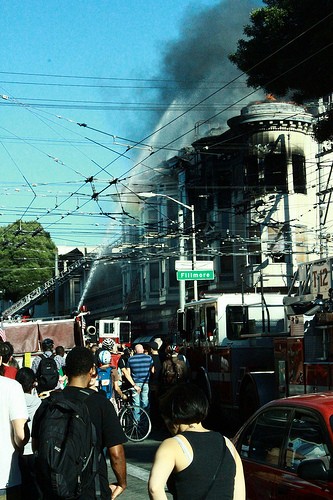
This week, after convening in closed session to discuss the threat of litigation by downtown groups, the board voted 7-3 – with Sups. David Campos, Jane Kim, and Eric Mar opposed, and Sup. Ross Mirkarimi absent because he rushed out to large structure fire in his district – for the Elsbernd/Farrell measure, one vote short of the supermajority needed to amend the current city law.

Campaign finance reform advocates such as Steven Hill argue that it’s unfair to modify the city program right in the middle of an election season in which Mayor Ed Lee and the wealthy independent expenditure groups supporting him are poised to spend millions of dollars to defeat a large field of mostly publicly funded mayoral candidates.

Hill and his allies are appealing to Mirkarimi – who told the Chronicle that he is leaning toward supporting the amendment when the measure returns to the board on Tuesday – not to support what they consider an overly broad capitulation to downtown’s threats. They’re also lobbying Sup. John Avalos to switch his vote, while downtown players are putting the screws to supervisors as well.

In an interview with the Guardian, Mirkarimi clarified his stance, noting that he was the sponsor of the original public financing law and his goal is to protect it, even if it needs to be modified to withstand a legal challenge. “I’m looking for alternatives to fortify San Francisco’s program,” he told us, noting that he missed some of this week’s discussion and he’s hoping something can be done to retain provisions that level the financial playing field with wealthy candidates.

Meanwhile, downtown forces are pulling out the stops to kill Sup. David Campos’ legislation that would prevent San Francisco businesses from pocketing money they set aside for their employees’ health care under a city mandate that they provide health coverage – totaling about $50 million last year – legislation that gets its first hearing tomorrow (Friday/30) at 10 am.

Board President David Chiu has put forward competing legislation that is more to the Chamber’s liking, letting businesses (mostly restaurants that are even placing surcharges of customers’ bills, ostensibly to subsidize their legal obligations) keep the money. But Campos and his labor allies believe they have the six votes they need to pass the legislation, thanks largely to moderate Sup. Malia Cohen’s pledge to support the measure.

While even some supporters have quibbled with the timing of this measure, Campos notes the urgency of keeping money intended for workers in their hands. “It’s an outrage and the longer we wait, the worse it gets,” Campos tells us, noting that the practice, “is what many of us consider fraud.”

Unfortunately, even if the board approves the measure this Tuesday, it will still need the signature of Mayor Lee to become law. While he hasn’t formally taken a position, given that his political base is the downtown crowd, he’s expected to veto the measure. But we’ll ask him about it tomorrow when he’s scheduled to meet with the Guardian for an endorsement interview at 2 pm.

CCDC, the Central Subway, and media manipulation (?)

21

I talked for some time yesterday with Gen Fujioka, an attorney at the Chinatown Community Development Center (CCDC), about an editorial he wrote criticizing a San Francisco Chronicle story revealing stunningly high payments to CCDC for subcontracting work on the Central Subway. (A better read, we must say, than Randy Shaw’s whining about how he’s a real journalist, he really really is, and it’s a grave injustice that someone denied him a press release.)

Fujioka claimed that the Chronicle had used fuzzy math, saying the per-hour breakdown of payments to the affordable housing nonprofit were lower in reality than the apalling $750 fee reported in the Chron. He said the management meetings listed in the purchase order actually took eight or nine hours per week to prepare for, which would bring the hourly payment closer to $102 an hour, which still strikes us as kind of steep.

Fujioka also took issue with the Chron’s report that CCDC received $25,000 for holding a single meeting.

We asked the city to send us the documents so we could have a look for ourselves. The $25,000 piece refers to two payments listed under “community relations / public outreach management” on the purchase order for CCDC’s subcontracting work with the Central Subway Partnership. CCDC, which is engaged in affordable housing work, will work with low-income tenants who will be uprooted and relocated as a result of Central Subway construction.

Essentially, the city paid CCDC $15,000 to “plan, coordinate, and implement Chinatown community briefings in cooperation with the San Francisco Municipal Transportation Agency (SFMTA),” plus another $10,000 to “collect and analyze input from community briefings, provide written report of recommendations, implement and support staff and social media at 821 Howard.” Next to each of those items is listed “Quantity: 1.” This seems to explain why the Chron reported that the combined payments were $25,000 for one meeting — the first payment was apparently to plan and host the meeting, while the second seemed to be for processing information gleaned from it.

Fujioka stressed that the description referred to briefings, plural, and that the item “is not one meeting — it’s one of that set of activities. The quantity is not ‘1.’ It’s the category of work.”

Other items on the purchase order, which totaled $410,500, show that the affordable housing nonprofit received $8,000 per month to develop and staff a Central Subway Development liason to publicize the transit project and create informational workshops, $35,000 to develop and implement an outreach plan for Chinese-language media, $95,000 to work with the SFMTA to create a public process for coordinating the design of the Chinatown station and transit-oriented development, and $10,000 to “attend meetings for and provide support services to Chinatown Public Art Plan.”

Fujioka claimed the article was an example of the media being used by one mayoral campaign to attack another, and hinted in his editorial that there was some kind of coordinated media campaign against his nonprofit.

The Chron story spurred a press conference by mayoral candidate and Sen. Leland Yee on Monday, who said he was submitting a request for all correspondence between CCDC, Chinatown power broker Rose Pak, and the mayor’s office in light of this information to pin down all instances of waste and abuse relating to the Central Subway. (Of course, he might want to look beyond CCDC — while the nonprofit may have ties with Lee and Pak, you can be sure that Aecom, the general contractor which has already secured multiple city contracts worth millions of dollars, is doing alright for itself in the Central Subway deal too.) Sources from Yee’s campaign told the Guardian that the senator might hold another press conference if he doesn’t get all the information he asked for, but Lee spokesperson Tony Winnicker told me on Monday that the information would be released “within hours.”

Meanwhile, there’s another interesting tidbit buried in this whole flap. The Chron ran a photograph with its article showing a chalkboard at CCDC offices depicting a power map of the city, with Mayor Ed Lee’s name appearing at the top as interim mayor. The caption said the snapshot was taken before Lee was appointed — which would suggest that CCDC had prior knowledge that Lee would be tapped to serve as caretaker mayor. Yet Fujioka claimed the photo was really taken after Lee had already been installed, and said the drawing was simply “a power map of the city, with the new mayor.” There was no timestamp on the grainy photo, so it’s impossible to verify.

So who’s the mystery photographer? The Chron lists it as an anonymous source.

Someone from Herrera’s camp told me that she’d heard rumors the photo was submitted by a “mole from Leland’s camp.” However, a source in Yee’s camp blatantly rejected that idea, telling me he was certain that it didn’t come from anyone working on Yee’s campaign — and had confirmation from campaign manager Jim Stearns to that effect.

Fujioka didn’t name the source, but said he was pretty sure he knew who it was. “We have a pretty strong suspicion it was a visitor to our office who happened to be there on behalf of a developer who was trying to promote a project,” he said. “He actually is a supporter of one of the other candidates.”

Chamber hip-hop opera ‘Great Integration’ returns with a second act

0

Perhaps you’ve seen the billboard on your daily Bay Bridge commute: simple white background, a hand with two fingers pressed together, and in bold type, the words Great Integration: A Chamber Hip-Hop Opera.

If you, like many commuters, are intrigued by the concept, allow me to shed some light. The two-act performance, which takes places this week, is a true blend of classical music and hip-hop; it’s 90 minutes of continuous flow, MCs spinning a dark and moral tale of modern corruption over a live ensemble of flute, clarinet, violin, cello, piano, drums, and bass. It’s a production spearheaded by the duo behind Oakland’s Gold Fetus Records – Christopher Nicholas and Joo Wan Kim, musicians who met in the dorms at Berklee College of Music, and Kim’s Ensemble Mik Nawooj. For this particular piece, Nicholas is mostly behind the scenes in organizing mode, and Kim is the music director who wrote the lurid tale at the heart of Great Integration.

“I think in order for something like this to happen, there has to be a general hybridization,” says Kim, “if you think about ‘crossover’, it generally means you’re compromising the genre, but what I’m doing is not necessarily hip-hop or classical, but bringing the elements of [both] and creating something new. In that way, to my knowledge, I don’t think anybody has done this – or to this length.”

The basic storyline follows five material lords, each corporate tycoons who represent  fundamental elements of the world – wood, fire, earth, water, and metal – and what happens when the Gods decide to assassinate the lords. Kirby Dominant is the MC for act one of Great Integration, playing a character in this act called “the Black Swordsman of Dominance.” Rico Pabón, the MC for act two, plays a character dubbed “the Water Bearer.”

Initially, Kim planned to base Great Integration on a comic book, but Dominant disliked the idea and pushed him to look deeper. The final plot came to Kim in a vision during a routine BART ride between San Francisco and Berkeley. It was those cryptic messages about God coming to earth and the material world’s end that inspired his story.

Creating the initial concept behind the chamber hip-hop opera itself took even longer. If you’ll allow it, I’ll reach farther back into Kim’s musical past to illuminate the hybridization. Born and raised in South Korea, he got his bachelors at Berklee, studying Western European classical music, and later received his masters at the San Francisco Conservatory Of Music . He was introduced to hip-hop by his friend, drummer Valentino Pellizzer, and initially hated it.

“I just didn’t understand it, then one day it clicked to me, I realized it was actually good,” Kim says. “I listened to NWA and really liked it. People think it’s really weird, because I’m totally into classical so they’re like ‘you might like J Dilla or Mos Def’ or some like, conscious hip-hop, but no, I listen to gangster rap.”

In 2005, Kim wrote a piece that started as chamber music. Pellizzer suggested he add an MC on it, so Kim contacted  Dominant and they did a show together. That was the musical precursor to Great Integration, long before the storyline was written. With the concept, the plots, the ensemble, and the MCs all in place, Kim and Co. presented the first act of Great Integration in 2010 with live dancers. They later performed it again at Yoshi’s and the Red Poppy Art House with just the musical elements. Now, for the first time, Great Integration premieres the second act, and the debut of MC Rico Pabón in the production – all going down this Friday, Sept. 30 at the Old First Concerts. Kim hopes the piece will expand the public’s understanding of what you can do with a piece of music.

“For our culture, the only thing we have is pop art. And unfortunately some of it, is really bad,” he complains, “People running the business don’t really care about good or bad, as long as they make money.”

Though he also sees the importance of music for the people: “On the other end of the spectrum there are people who are in school, getting grants, and writing this work that has nothing to do with anything – so nobody gets that. They drink wine and talk about fucking Stravinsky. Stravinsky wouldn’t like that. When he was writing music, he was writing for people. What Golden Fetus is doing, we’re bringing sophistication, but we’re not snobs. We love NWA as well.”

Great Integration: A Chamber Hip-Hop Opera
Fri/30, 8 p.m., $14-$17
Old First Concerts
1751 Sacramento, SF
www.goldenfetus.com

Counting calories

2

caitlin@sfbg.com

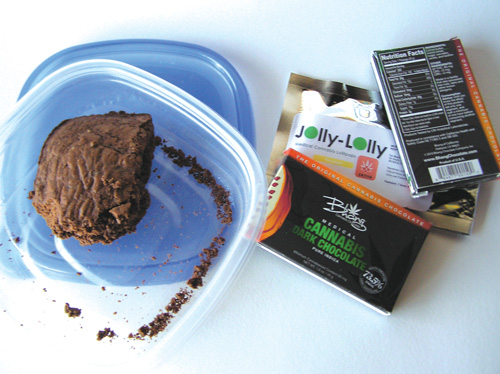
HERBWISE An old factory sits in the outskirts of Oakland. In decades past, this building produced name brand snacks, but the smell of baking still permeates the factory air.

And weed. It smells like weed too. Bhang Chocolate churns out medicinal marijuana sweets here, bars that are smartly packaged in Bhang’s sleek black, orange, and green boxes that are a far cry from the plain wax envelopes and saran wrap that most marijuana edibles used to be sold in. The company is part of the current expansion in edible products — these days, patients can buy medicated cheesecakes, and even savory trail mix.

Adjacent to Bhang’s factory floor, about ten marijuana edibles producers are listening to a man talk about quality control for weed food. Robert Martin, Ph.D., worked for years in corporate food product development and quality assurance. He tells the class his specialty was frozen foods.

Martin is the co-founder of C.W. Analytical, a business that consults marijuana producers and has cannabis testing facilities. A patient himself, he says that marijuana-medicated foods are technically subject to all the same guidelines for commercially-produced non-pot products, although actual enforcement is sparse. C.W. offers these classes for free to interested entrepreneurs. They teach professional skills and serve as an introduction to the for-sale services the business provides.

The students are being treated to quality assurance fail stories from Martin’s career in the corporate world. A sherbet producer he once knew bought a wildly expensive machine to make fudge bars, but when he failed to make the proper tests on his treats, they caused a nasty spate of diarrhea in consumers and he ended up losing his shirt.

“That’s the kind of crap that can happen to you guys,” cautions Martin, and starts reading from a tongue-in-cheek guide to how you can tell food has gone bad. “Flour is spoiled when it wiggles,” he reads. This is quality assurance humor. “I love this stuff!”

One of the day’s students Lacey (not her real name) says she learned a lot from the class that she’ll be able to implement in her own business, Laced Cakes Bakery. She’s been making prettily iced cannabis cookies and brownies since 2007 and has seen the industry requirements shift dramatically.

“Years ago, you could just bring down a tray [to a dispensary] and drop it off,” she says. Nowadays, to sell in San Francisco she has to package the sweets in opaque material and make sure that the design can’t be interpreted as too appealing to kids. “The laws keep changing.”

She had heard about C.W. Analytical at some of the cannabis expos she’s been a vendor at — the firm will have a booth at next weekend’s West Coast Cannabis Expo as well — and was happy that the class was offered for free. She hadn’t finalized her opinion, however, on Martin’s suggestion that producers get their foods analyzed by the company so that they can put nutrition labels on their packaging. “It seems like they might just be trying to make money off of us,” she mused. 

WEST COAST CANNABIS EXPO

Oct. 7-9. Fri/7, 3-9 p.m.; Sat/8, 11 a.m.-9 p.m.; Sun/9 11 a.m.-7 p.m., $18 one day/$45 weekend pass

Cow Palace

Geneva and Santos, Daly City

(650) 591-0420

www.westcoastcannabisexpo.com


The sight of sound

0

arts@sfbg.com

HAIRY EYEBALL “Home taping is killing music”, declared the 1980s anti-copyright infringement campaign waged by British music industry trade group, the British Phonographic Industry. History has proven BPI’s concerns to have been mis-targeted, with cassettes becoming an increasingly irrelevant medium in the ensuing decades, even as the music industry still struggles to respond to ever-mercurial forms of bootlegging and pirating. The cassette tape, however, has—perhaps unsurprisingly— re-emerged in recent years as both an object of nostalgia and a more exclusive format for more out-there musicians to release their small, home-made batches of black metal, experimental electronica, or noise out into the world for listeners for whom Tumblr is not enough.

Composer and musician Christian Marclay’s visual art often engages with our complicated relationship to outmoded technologies of audio-visual reproduction, particularly vinyl records. The photograms in his current show at Fraenkel Gallery continues this line of inquiry, playfully condensing the cassette tape’s arc from boon to perceived threat to obsolescence to fetish object.

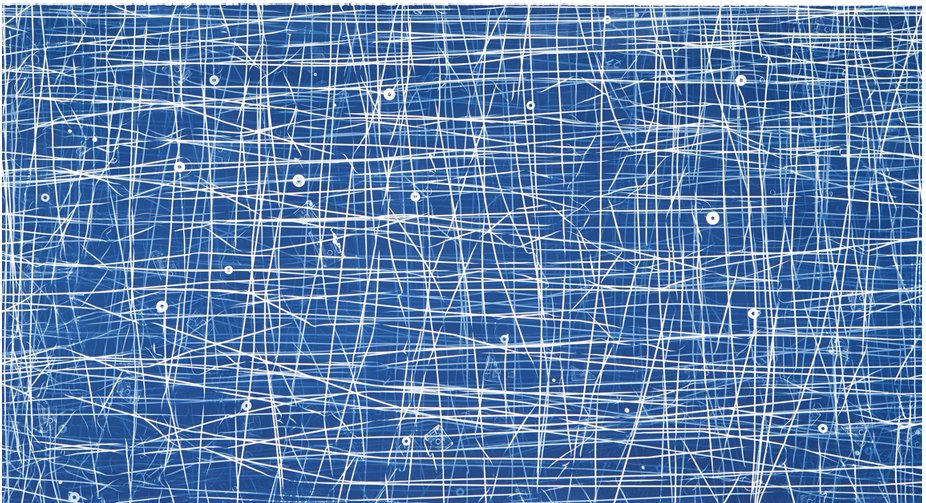
For the gorgeous 2009 photogram “Allover (Dixie Chicks, Nat King Cole and Others),” Marclay exposed photo-sensitized paper to light after he had strewn over it the magnetic innards of cassette tapes and fragments of the broken plastic shells that once contained them that had been coated in a photosensitive solution. The resulting sprawl of tangled white lines on blue brings to mind the splatter canvases of Jackson Pollock or the chalk squiggles of Cy Twombly (associations Marclay’s titular “allover” winks at). In other photograms, such as “Large Cassette Grid No. 9,” also from 2009, Marclay has arranged plastic cassette cases in block-like patterns that cover the entire paper, with each cases’ accumulated wear and tear providing subtle variations.

That cyan-like blue color is what gives Marclay’s chosen process, the cyanotype, its name. Discovered by English scientist Sir John Herschel in 1842, the cyanotype process was historically used to make blueprints. I’d like to imagine that this irony isn’t lost on Marclay. By using an outmoded photographic technology to make visual art out of an outmoded audio technology, Marclay underscores the eventual obsolescence of all reproductive technologies. His cyanotypes aren’t blueprints so much as headstone rubbings.

In “Looking for Love” (2008), a single channel video shown in the gallery’s backroom, Marclay’s stationary camera stays zoomed-in on a well-worn phonographic stylus, as his giant hands roughly skip the needle around record after record searching for any utterance of the word “love.” The film’s exaggerated scale combined with Marclay’s increasingly impatient and roughshod sample hunting can be read as a parody of the audiophile as techno-purist. But the film also speaks to our enduring investment in music—be it the Dixie Chicks, Nat King Cole, or any of the other inaudible “others” that went into the making of Marclay’s cyanotypes—even as our experience of listening to it becomes more and more immaterial.


HOMETOWN GIRL

Fran Herndon was not a name I was familiar with, so I’m glad to now be acquainted with this largely unsung player in San Francisco’s artistic firmament of the 1950s and 1960s (and all around bad-ass) thanks to the eye-opening selection of early oil paintings and mixed-media collages organized by Kevin Killian and Lee Plested currently on view at Altman Siegel.

An Oklahoma native, Herndon moved to San Francisco in 1957 with her husband, the California teacher and writer Jim Herndon, who she met while traveling in France. She quickly fell in with the likes of the Robin Blaser, Jess and his partner Robert Duncan, and Jack Spicer, with whom she formed an intense intellectual and aesthetic bond. Together, they founded the mimeographed poetry and art magazine J, and Herndon created lithographs for poet Spicer’s 1960 master-work The Heads of the Town Up to the Aether. All the while, Herndon continued to produce her own varied body of work that was as much a response to her newfound creative circle of friends and collaborators as it was to the times in which they were making art.

The series of sports themed collages she made in 1962 are especially representative of Herndon’s gift for exploding the hidden currents of emotion contained in her source material—in this case, images clipped from popular magazines such as Sports Illustrated and Life are transformed into near-mythological tableaux of victory and defeat in which race and the volatile racial climate of Civil Rights era-America are front and center (Herndon, who is of Native American heritage, has said “[America] is no place for a brown face”).

In “Collage for Willie Mays” the baseball legend is depicted hitting a homer out of a Grecian colonnade whereas in the decidedly darker and Romare Bearden-esque “King Football” an actual mask has fallen away from the titular ruler, revealing a skull-like visage wrapped in a cloak of newspaper clippings about the 49er’s then-scandalous decision to trade quarterback Y.A. Tittle for Lou Cordilione. The headlines about devastation and death speak to other off-field losses, though.

Other pieces resonate on a more emotional level. The gauche-smudged greyhounds in “Catch Me If You Can” bound past their bucolic counterparts like horses in a Chinese brush painting—all speed and wind—and are as much signs-of-the-times as the more politically overt anti-draft and anti-war collages Herndon made later in the decade.

Certainly, there was no time to wait. So much of Herndon’s art seems to come from an urge to document her “now” with whatever tools she had on hand, a present being lived and produced in the company of so many extraordinary others, from Spicer to Mays. Even her paintings seem to have been worked on only to the point at which their subjects just emerge distinct from their swirled backgrounds of color. Nearly fifty years later, Herndon’s urgency is still palpable.


CHRISTIAN MARCLAY: CYANOTYPES

Through Oct. 29

Fraenkel Gallery

49 Geary, Fourth Floor

(415) 981-2661

www.fraenkelgallery.com


FRAN HERNDON

Through Oct. 29

Altman Siegel Gallery

49 Geary, Fourth Floor

(415) 576-9300

www.altmansiegel.com

Our Weekly Picks: September 28-October 4

0

THURSDAY 29

We Don’t Belong Here Do we belong in our bodies, our skin, our families, this public space, this architectural space, this city space, the Milky Way, the planet, our species, the universe? Inquiring minds want to know. In We Don’t Belong Here, collaborators Katie Faulkner, choreographer and artistic director of little seismic dance company, and multimedia artist Michael Trigilio, along with a robust cast of 20 dancers, premiere a dance and media response to these questions as an impromptu renegade, do-it-yourself sideshow. The free performances, commissioned by Dancers’ Group as part of their Onsite series, take place at San Francisco’s Union Square and Yerba Buena Lane. Be sure to wear your San Francisco layers. (Julie Potter)

Through Fri/29, also Sun/2, 8 p.m., free

Union Square

Powell and Geary, SF

(415) 920-9181

www.dancersgroup.org


Quick Billy

Bruce Baillie’s high masterpiece moves from wounded channeling of The Tibetan Book of the Dead to metaphysical Western in the span of four reels. Baillie had thoroughly mastered his sentient film language of dissolves and superimpositions by the time of this 1970 effort. As Baillie noted then, “All of the film was recorded next to the Pacific Ocean in Fort Bragg, California, from dreams and daily life there; all of it given its own good time to evolve and become clear to me.” It still has that mysterious air of something slowly clarifying itself. Baillie, who founded Canyon Cinema fifty years ago, will be in attendance with a newly restored print of the film. (Max Goldberg)

7 p.m., $7-10

San Francisco Museum of Modern Art

151 Third St., SF

415-337-4000

www.sfmoma.org


Faustin Linyekula/Studios Kabako

“I am an African dancer. I tell exotic stories. Which one would you like today?” Congolese choreographer Faustin Linyekula does have stories to tell. Yet they have little to do with prettified harvest dances and initiation rituals. His tales are gritty, urban, and razor sharp. As a performer Linyekula is mesmerizing, a tornado of rage and vulnerability. For “more, more, more..future”, in addition to his fabulous male dancers, Linyekula is bringing a Congolese band with an indigenous pop style, ndombolo that mashes Western and African influences. Also integral to this local premiere are poems by political prisoner Antoine Vumilia Muhindo, Lineykula’s childhood friend. (Rita Felciano)

Through Sat/1, 8 p.m., $20–$25

Novellus Theater, Yerba Buena Center for the Arts

701 Mission, SF

(415) 978-2787

www.ybca.org


Weedeater

Weedeater is technically a power trio, but when the band performs, all eyes are on “Dixie” Dave Collins, its inimitable bassist-singer. With his instrument slung so low it threatens tangle between his legs, the manic North Carolingian stands cross-eyed at the mic, screaming so vehemently that it often looks like he’s about to swallow it whole. Though guitarist Dave “Shep” Shepard and drummer Keith “Keiko” Kirkum form a potent partnership, it’s Collins’ pungent bass tone that drives the music. Waves of down-tuned punishment and caterwauling fuzz seem to pour forth unabated from his amps, made musical only through Dixie’s nimble-fingered intercession. Channeled into riff after thundering riff, the onslaught is impossible to ignore. (Ben Richardson)

With Fight Amp, Bison, Saviours

8 p.m., $18

The Independent

628 Divisadero, SF

(415) 771-1421

www.theindependentsf.com


FRIDAY 30

Chicken John’s Book Release and Street Party

Chicken John Rinadi — a legendary local showman, provocateur, and one-time mayoral candidate — has written a book: The Book of the IS: Fail…To WIN! Essays in engineered disperfection. And in true Chicken fashion, he’s throwing an over-the-top book launch party featuring a stellar lineup of artists (56 of whom are designing custom book covers, including Swoon, Brian Goggin, and Rosanna Scimeca); installation art pieces by Michael Christian, Charlie Gadeken, and some Flaming Lotus Girls; live performances by Spacecraft and the Art of Bleeding; art cars and Doggie Diner heads; readings by special guests; and all manner of strange countercultural and cacophonic creations, all spilling out of the gallery into a closed-down Minna Street. This one is not to be missed. (Steven T. Jones)

7 p.m.-2 am, free

111 Minna, SF

(415) 974-1719

bookoftheis.com


FRIDAY 30

Saxon

Though they have since been overshadowed by Iron Maiden and Judas Priest, there was a time when Saxon rode on the foam-flecked crest of the New Wave of British Heavy Metal. Members have come and gone throughout the years, but a hard-rocking core formed by singer Peter “Biff” Byford and guitarist Paul Quinn dates back to the band’s beginnings in Yorkshire, in 1976. Eschewing the operatic excesses of its better-known competitors, the band has penned a vast repertoire of hard-charging, blue collar anthems. When Saxon takes the stage in Santa Clara, the fans will be wearing “Denim and Leather,” and they will expect some “Heavy Metal Thunder.” (Richardson)

With Haunted by Heroes, Hatchet, Borealis

8:30 p.m., $20

The Avalon

777 Lawrence Expressway, Santa Clara

(408) 241-0777

www.avalonsantaclara.com


SATURDAY 1

Alternative Press Expo

Although the ranks of off-the-beaten-cape comic artists swell each year at the mega-convention that is Wonder Con, the indie comic crown in San Francisco is reserved for Wonder’s younger sister, the Alternative Press Expo. At APE, special guests include not Stan Lee and Ryan Reynolds, but instead Daniel Clowes, creator of edgily neurotic texts like Wilson; Kate Beaton and her feminist re-takes of the days of the American revolution and Nancy Drew book covers; Adrian Tomime, who masterminds the Optic Nerve series. The convention also places an emphasis on pairing illustrators and writers, a useful tool for those that wish to traverse the underground tunnel to indie fame. (Caitlin Donohue)

Also Sun/2, 11 a.m.-7 p.m., $10 one day/$15 weekend pass

Concourse Exhibition Center

635 Eighth St., SF

www.comic-con.org/ape


World Vegetarian Day

Are you tentatively eying the nutritional yeast bins and blocks of jalapeño smoked tofu in the grocery store, unsure if you’re ready to take the leap beyond an animal product-dependent lifestyle? What you need is a heaping serving of vegetarian community. Enter the SF Vegetarian Society’s World Vegetarian Day expo, a meat-free miracle for those with a craving for more information on the veggie life. Two days of environmental, nutritional, and anti-paleo diet speakers have been scheduled, and those looking for a more experiential weekend can nosh on Saturday’s raw and vegan dinners — or even check out that day’s rounds of vegan speed dating. (Donohue)

Also Sun/2 10 a.m.-6 p.m., $8 suggested donation

County Fair Building

Ninth Ave. and Lincoln, SF

(415) 273-5481

www.sfvs.org/wvd


The Beat Is the Law: Fanfare for the Common People

It’s a musical fairytale story so good it could be a bad Mark Wahlberg movie: a lesser known band (Pulp) gets tapped to replace a headlining act (The Stone Roses) at a music festival (Glastonbury) and ends up blowing the non-existent roof off the place. Okay, so maybe it’s not a Wyld Stallyns level achievement, but it was supposed to be a helluva show and breakthrough in 1990s Britpop. Beyond myth-making in just the one moment, Eve Wood’s documentary, The Beat Is the Law, focuses on the decade building up to Glastonbury, in which Pulp seemed to be the little band that couldn’t. (Ryan Prendiville)

7:30 and 9:30 p.m., $10

Roxie Theater

3117 16th St., SF

(415) 863-1087

www.roxie.com


DARK PASSAGE

Celebrating the 10th anniversary of their “Film In The Fog” series, The San Francisco Film Society is presenting Dark Passage, the classic 1947 film noir thriller starring Humphrey Bogart and Lauren Bacall that was both set and filmed in San Francisco. Follow the exploits of Bogey as the wrongfully-convicted man on the run through the city at this special free outdoor screening, where audience members can set up blankets and lawn chairs and get cozy under the stars — or the city’s signature layers of fog. The movie will be preceded by a performance by local rockers Grass Widow, along with screenings of a ’50s era newsreel and a cartoon. (Sean McCourt)

5:30 p.m., free

Outside of Presidio Main Post Theater

99 Moraga, SF

www.sffs.org


SUNDAY 2

The Hades Channel

Sure, Gwyneth Paltrow just won an Emmy for guest-starring on Glee. Though she’s objectively the personification of modern evil, sinister stunt casting is actually nothing new. The Devil himself has graced the idiot box multiple times, and I’m not just talking South Park. The Vortex Room collects some of his best work (and some of the best work themed around his ominous deeds) for “The Hades Channel,” a marathon screening of episodes of classic shows like Lost in Space, Night Gallery, and Starsky and Hutch — seems Satanic Panic was a ripe plot device back in the day. Can’t get enough Beelzebub? Following “The Hades Channel,” the Vortex unleashes six weeks of hellzapoppin’ double features (sourced from the trashiest depths of the 1960s-80s), “The Vortex Incarnate,” starting October 666. Er, sixth. (Cheryl Eddy)

6:66 p.m.-1:45 a.m., $6.66

Vortex Room

1082 Howard, SF

Facebook: The Vortex Room


TUESDAY 4

John Lithgow

With a career that includes a wide spectrum of artistic output, John Lithgow has proven himself to be a versatile and talented actor, author ,and much more. His film credits such as The World According To Garp (1982) and Harry and The Hendersons (1987), television roles on shows like 3rd Rock From The Sun, and his series of stage performances and children’s books have entertained and enlightened for nearly four decades. Catch Lithgow tonight in an intimate talk about his new book, Drama (HarperCollins), focusing on his life lessons and his craft. (McCourt)

7:30 p.m., $12–$44

Sundance Kabuki Theater

1881 Post, SF

(800) 838-3006

www.booksmith.com


TUESDAY 4

Dum Dum Girls

Only In Dreams, the sophomore album from leatherette rockers Dum Dum Girls is a flavor at first consistent with the bubble gum pop of last year’s I Will Be. Half the album mechanically swings between the theme of romantic obsession, from the person you can’t bear to be without (“Bedroom Eyes”) to the one who needs to go away (“Just A Creep”). But the saccharine sweetness fades in the second half (and real substance) of the album, as singer-songwriter Dee Dee turns somber, reflecting on a loss that’s not just the sort of seasonal regularity she’s used to, but something more permanent. (Prendiville)

With Crocodiles and Colleen Green 9 p.m., $17-19

Great American Music Hall

859 O’Farrell, SF

(415) 885-0750

www.gamh.com


The Guardian listings deadline is two weeks prior to our Wednesday publication date. To submit an item for consideration, please include the title of the event, a brief description of the event, date and time, venue name, street address (listing cross streets only isn’t sufficient), city, telephone number readers can call for more information, telephone number for media, and admission costs. Send information to Listings, the Guardian Building, 135 Mississippi St., SF, CA 94107; fax to (415) 487-2506; or e-mail (paste press release into e-mail body — no text attachments, please) to listings@sfbg.com. Digital photos may be submitted in jpeg format; the image must be at least 240 dpi and four inches by six inches in size. We regret we cannot accept listings over the phone.

Stage Listings

0

THEATER

OPENING

The Kipling Hotel: True Misadventures of the Electric Pink ’80s Marsh San Francisco, 1062 Valencia, SF; (415) 282-3055, www.themarsh.org. $15-50. Opens Sat/1, 8:30pm. Runs Sat, 8:30pm; Sun, 7pm. Through Nov 13. Acclaimed solo performer Don Reed (East 14th) premieres his new show, based on his post-Oakland years living in Los Angeles.

Sorya! A Minor Miracle (Part One) NOHSpace, Project Artaud, 2840 Mariposa, SF; www.brownpapertickets.com. $12-18. Opens Sun/2, 7pm. Runs Sun-Mon, 7pm. Through Oct 24. Theatre of Yugen presents a selection of new and traditional Kyogen comedies.

BAY AREA

The World’s Funniest Bubble Show Marsh Berkeley, TheaterStage, 2120 Allston, Berk; (415) 826-5750, www.themarsh.org. $8-50. Opens Sun/2, 11am. Runs Sun, 11am. Through Nov 20. Louis "The Amazing Bubble Man" Pearl returns with this kid-friendly, bubble-tastic comedy.

ONGOING

"AfroSolo Arts Festival" Various venues, SF; www.afrosolo.org. Free-$100. Through Oct 20. The AfroSolo Theatre Company presents its 18th annual festival celebrating African American artists, musicians, and performers.

Alice Down the Rwong Wrabbit Whole Emerald Tablet, 80 Fresno, SF; (415) 500-2323, www.brownpapertickets.com. $15. Fri-Sat, 9pm. Through Oct 15. Karen Light and Edna Barrón perform their new comedy based on Alice in Wonderland.

All Atheists Are Muslim Stage Werx Theatre, 533 Sutter, SF; (415) 517-3581, www.brownpapertickets.com. $20. Thurs/29-Sat/1, 8pm. On the TV, CNN carries the dismal thumping of the Bush gang for more war. In the living room, a father and daughter are in a standoff over a proposed live-in boyfriend. It’s 2005, and a clash of generations, as Zahra tries to convince her immigrant Iranian American Muslim father that her white infidel boyfriend Duncan would make an ideal roommate. For her Muslim father, "the Duncan" has plenty of acceptable virtues — even his professed atheism is hardly an insurmountable obstacle to dad, who doesn’t seem to recognize the word but is sure it translates into a wishy-washy approach to the divine through an enthusiastic appreciation for gravity. But moving in together is a different story. How it plays out is the heart of comedian and solo performer Zahra Noorbakhsh’s uneven but charming and funny take on a familiar American family dynamic whose particular ethnic flavor includes a mild but timely geopolitical aroma. Playing herself as well as her loving mother, her bounding and big-hearted father (with his priceless Persian accent), and her good-natured but recalcitrant boyfriend, Noorbakhsh celebrates the immigrant experience while beating back the age’s pernicious appeal to stereotype and xenophobia with the far more realistic metaphor of a nice, crazy family dinner. (Avila)

American Buffalo Actors Theatre of San Francisco, 855 Bush, SF; (415) 345-1287, www.actorstheatresf.org. $26-38. Wed-Sat, 8pm. Extended through Oct 8. Actors Theatre of San Francisco performs the David Mamet crime classic.

Desdemona: A Play About a Handkerchief Boxcar Theatre Playhouse, 505 Natoma, SF; www.boxcartheatre.org. $15-35. Previews Thurs/29, 8pm. Opens Fri/30, 8pm. Runs Wed-Sat, 8pm; Sun, 3pm. Through Nov 5. Boxcar Theatre performs Pauls Vogel’s dark comedy, inspired by the three female characters from Shakespeare’s Othello.

Hunter’s Point St. Boniface Church Theater, 175 Golden Gate, SF; www.strangeangelstheater.org. $15-25 (no one turned away for lack of funds). Wed/28-Sat/1, 7pm. Strange Angels Theater in collaboration with Jump! Theatre performs Elizabeth Gjelten’s musical drama about homelessness.

Joy With Wings: A Daughter’s Tale Alcove Theater, 415 Mason, Fifth Flr, SF; www.brownpapertickets.com. $32-50. Wed-Thurs, 8pm. Through Oct 6. Chaucer Theater performs Becky Parker’s drama about a mother’s love.

Killing My Lobster Conquers the Galaxy The Jewish Theatre, 470 Florida, SF; www.killingmylobster.com. $10-20. Thurs-Fri, 8pm; Sat-Sun, 7pm (also Sat, 10pm). Through Oct 9. The sketch comedy troupe returns with a sci-fi show.

Lucrezia Borgia War Memorial Opera House, 201 Van Ness, SF; (415) 864-3330, www.sfopera.com. $30-389. Thurs/29 and Oct 5, 7:30pm; Sun/2, 2pm; Oct 8 and 11, 8pm. Famed soprano Renée Fleming stars in San Francisco Opera’s presentation of Gaetano Donizetti’s classic.

Night Over Erzinga South Side Theatre, Magic Theatre, Fort Mason Center, Marina at Laguna, SF; (415) 345-7575, www.goldenthread.org. $20-100. Thurs, 8:30pm; Fri-Sat, 8pm; Sun, 2pm. Through Oct 9. Golden Thread Productions’ season opener is the result of its first-ever Middle East America new play initiative (co-presented with Chicago’s Silk Road Theatre Project and New York’s Lark Play Development Center): playwright Adriana Sevahn Nichols’ story of three generations in an Armenian American family struggling with a history of violence, dispossession, and the tensions between individual and collective destiny in the modern world. The play begins at an overly dramatic pitch as a young woman (Sarita Ocón) summons the spirits of her grandparents. Director Hafiz Karmali’s staging is deliberately spare and sensible throughout, though this initial action feels alternately stiff and shuffling, and the recorded music can be overbearing, as the roots of a family saga are laid immediately before and after the 1915 genocide. But the second act settles into a surer and more engaging mode and tempo, as Ava (a sharp Juliet Tanner in a nicely shaded performance), rebellious American daughter of two Armenian exiles (Terry Lamb and Neva Marie Hutchinson), pursues a career as a popular dancer and singer and ends up estranged from her father for years (her mother, sole survivor of a massacred Armenian family, spends her latter years in a mental institution). Wooed by a charming Dominican crooner (an adept, appealing Brian Trybom), Ava starts a family of her own. While pregnant with daughter Estrella (the young, spirited Natalie Amanian), she re-establishes a shaky relationship with her repentant father. Old wounds and buried histories insure reconciliation won’t be easy, but the truth alone shows the way back to a sense of connection and communion for a family severed by injustice and unmoored in the drift of immigrant America. (Avila)

Not Getting Any Younger Marsh San Francisco, Studio Theater, 1062 Valencia, SF; (415) 826-5750, www.themarsh.org. $15-50. Thurs-Fri, 8pm; Sat, 8:30pm; Sun, 3pm. Through Oct 23. Marga Gomez is back at the Marsh, a couple of too-brief decades after inaugurating the theater’s new stage with her first solo show — an apt setting, in other words, for the writer-performer’s latest monologue, a reflection on the inevitable process of aging for a Latina lesbian comedian and artist who still hangs at Starbucks and can’t be trusted with the details of her own Wikipedia entry. If the thought of someone as perennially irreverent, insouciant, and appealingly immature as Gomez makes you depressed, the show is, strangely enough, the best antidote. Her narrative careens wildly from character-filled childhood memories (the earliest traumas on down) and stand-up-like shtick that turns over well-worn subject matter like babies with freshly piquant musings (idea for an "it get better" campaign for infants: you’ll be able to wipe yourself and chew your own food). There’s even something like wisdom, or anyway historical curiosity, in her skewed nostalgia for such childhood ephemera as Freedomland, a doomed Bronx-based Disneyland alternative Gomez is old enough to remember visiting. Needless to say, she looks and acts very good for her age, whatever it is exactly (there are, typically, no straight answers here).

The Odyssey Aboard Alma, Hyde Street Pier, San Francisco Maritime National Historic Park, SF; www.weplayers.org. $160. Sat/1, Oct 28-29, Nov 4-6, 11-12, and 18, 12:30pm. This "full afternoon adventure" (12:30-5pm) includes a sailing performance of tales from Homer by We Players (aboard an 1891 scow schooner), plus a light meal.

Once in a Lifetime American Conservatory Theater, 415 Geary, SF; (415) 749-2228, www.act-sf.org. $10-85. Opens Wed/28, 8pm. Runs Tues-Sat, 8pm (Oct 7 performance at 7pm); Wed and Sat-Sun, 2pm (no matinees Sun/25 or Sept 28; additional performance Sun/2 at 7pm). Through Oct 16. ACT performs a revival of Moss Hart and George S. Kaufman’s 1939 Hollywood satire.

*Patience Worth Thick House, 1695 18th St, SF; (415) 456-8892, www.symmetrytheatre.com. $20-30. Thurs/29-Sat/1, 8pm; Sun/2, 2pm. In the second decade of the 20th century, a young new St. Louis bride named Pearl Curran (Megan Trout), looking to rise above her humble Ozarks upbringing yet with hopeless aspirations to be a singer, suddenly began channeling the spirit of a 16th-century woman named Patience Worth. The rest was literary history, here uncovered and subtly examined by playwright Michelle Carter in Symmetry Theatre Company’s thoughtful, gradually stirring world premiere, its second production after last year’s strong debut (with Anthony Clarvoe’s Show and Tell). Introduced to Patience by Emily Hutchings (Elena Wright) and her Ouija board, Pearl soon displaces the chagrined Hutchings — who has literary aspirations of her own she pedals doggedly to the leading publisher of the day (Warren David Keith) — and inverts the patriarchal order as her much older husband (Keith) plays stenographer to the virtuosic verbosity of the spirit. When she adopts a child for Patience whome she names Patience Wee (Alona Bach), she drives the desperately lonely young girl into the arms of her equally isolated mother (Jessica Powell) toward an unexpected and terrible inspiration. Director Erika Chong Shuch sets her able cast (headed by Trout’s sure take on a complex figure) atop an area rug backed by a line of trees and strewn over the bare earth, like a floating island of bourgeois respectability amid a wild and mysterious sea of natural and supernatural impulses, in a complex tale of female liberation that intersects with questions of fame, status, self-invention, ventriloquism, and a dark bargain with destiny that has something quintessentially American about it. (Avila)

"Shocktoberfest 12: Fear Over Frisco" Hypnodrome Theatre, 575 10th St, SF; (415) 377-4202, www.thrillpeddlers.com. $25-35. Thurs-Sat, 8pm. Through Nov 19. The Thrillpeddlers’ 12th annual Grand Guignol fest features three "noir-horror" plays by noted noir expert Eddie Muller.

Show Ho New Conservatory Theatre Center, 25 Van Ness, SF; (415) 861-8972, www.nctcsf.org. $20-32. Thurs-Sat, 8pm; Oct 9, 2pm. Through Oct 9. Sara Moore performs her multi-character story about a clown in a low-rent circus.

Turandot War Memorial Opera House, 201 Van Ness, SF; (415) 864-3330, www.sfopera.com. $21-389. Sat/1, 8pm; Tues/4, 7:30pm. The San Francisco Opera performs Puccini’s classic in conjunction with the Lyric Opera of Chicago.

Why We Have a Body Magic Theatre, Fort Mason Center, Bldg D, SF; (415) 441-8822, www.magictheatre.org. $20-60. Wed/28-Sat/1, 8pm (also Sat/1, 2:30pm); Sun/2, 2:30pm. Magic Theater opens its new season with a "legacy revival" of playwright Claire Chafee’s comedy, a major hit for the Magic in 1993. Despite fleet staging by director Katie Pearl, the play feels dated, long-winded, and a bit too pleased with itself. Lili (Lauren English) is a private investigator who falls hard for a recently divorced paleontologist (Rebecca Dines) whose lesbian tendencies Lili awakens when they meet on a commercial flight. Lili’s sister, Mary (Maggie Mason), is a manic loner who holds up convenience stores and obsesses about Joan of Arc. Their mother (Lorri Holt), meanwhile, a Betty Friedan–era feminist and a specialist in the female brain (a brief and corny lecture on same is proffered early on), is up a tropical river on a solitary expedition. All four women are embarked on journeys of self-discovery as much as anything else, although Lili the P.I. emphasizes her desire to be someone else’s mystery for a change. The characters speak mainly in tedious monologues, however, with humor that is frequently strained and insights that are slim or false sounding, making the wandering narrative difficult to countenance pretty much from the get-go. (Avila)

BAY AREA

*A Delicate Balance Aurora Theatre, 2081 Addison, Berk; (510) 843-4822, www.auroratheatre.org. $10-48. Tues, 7pm; Wed-Sat, 8pm; Sun, 2 and 7pm. Extended through Oct 16. Aurora Theatre performs Edward Albee’s comedy of manners.

Madhouse Rhythm Cabaret at Marsh Berkeley, 2120 Allston, Berk; (415) 282-3055, www.themarsh.org. $15-35. Thurs, 7:30pm. Extended through Oct 6. Joshua Walters performs his hip-hop-infused autobiographical show about his experiences with bipolar disorder.

Of Dice and Men La Val’s Subterranean, 1834 Euclid, Berk; www.impacttheatre.com. $10-20. Thurs/28-Sat/1, 8pm. Impact Theatre performs Cameron McNary’s comedy about a group of adult Dungeons and Dragons players.

Phaedra Ashby Stage, 1901 Ashby, Berk; (510) 841-6500, www.shotgunplayers.org. $17-26. Thurs, 7pm; Fri-Sat, 8pm; Sun, 5pm (starting Oct 5, also runs Wed, 7pm). Through Oct 23. Shotgun Players perform Adam Bock’s modern adaptation of the Racine classic.

*Rita Moreno: Life Without Makeup Berkeley Repertory Theatre, Roda Theatre, 2015 Addison, Berk; (510) 647-2949, www.berkeleyrep.org. $14.50-73. Tues-Sun, showtimes vary. Through Oct 30. The life of stage and screen legend Rita Moreno is a subject that has no trouble filling two swift and varied acts, especially as related in anecdote, song, comedy, and dance by the serene multiple–award-winning performer and Berkeley resident herself. Indeed, that so much material gets covered so succinctly but rarely abruptly is a real achievement of this attractively adorned autobiographical solo show crafted with playwright and Berkeley Rep artistic director Tony Taccone. (Avila)

The Taming of the Shrew Bruns Amphitheater, 100 California Shakespeare Wy, Orinda; (510) 809-3290, www.calshakes.org. $35-66. Tues-Thurs, 7:30pm; Fri-Sat, 8pm (also Sat/1, 2pm); Sun, 4pm. Through Oct 16. California Shakespeare Theatre’s last show of the season is a high-fashion, pop-art take on Shakespeare’s battle of the sexes.

DANCE

"Falling Flags" Shotwell Studios, 3252-A 19th St, SF; www.brownpapertickets.com. Fri-Sat, 8pm; Sun, 7pm. $10-15. Footloose presents a dance and spoken word performance featuring poet Genny Lim and dancers Judith Kajiwara, Frances Cachapero, and Sharon Sato.

Faustin Linyekula/Studios Kabako Novellus Theater, Yerba Buena Center for the Arts, 700 Howard, SF; (415) 978-2787, www.ybca.org. Thurs-Sat, 8pm. $15-25. The Congolese choreographer and his company perform more more more…future.

"Imitations of Intimacy" Garage, 975 Howard, SF; (415) 518-1517, www.975howard.com. Fri-Sat, 8pm. $10-20. Detour Dance performs a new dance-theater work about "acting upon those irrational and rhetorical things we normally keep to ourselves."

"Lanyee: A Ballet from Guinea, West Africa" Dance Mission Theater, 3316 24th St, SF; www.duniyadance.com. Fri-Sat, 8pm; Sun, 6pm. $20. Duniya Dance and Drum Company presents this

traditional Guinean West African ballet directed by Bongo Sidibe.

"We Don’t Belong Here" Union Square, Powell at Geary, SF; www.dancersgroup.com. Thurs-Fri and Sun, 8pm. Also Oct 6-9, 8pm, Yerba Buena Lane (between Market and Mission and Third and Fourth Streets), SF. Free. Katie Faulkner’s little seismic dance company and multimedia artist Michael Trigilio present a new public performance project.

Stage listings are compiled by Guardian staff. Performance times may change; call venues to confirm. Reviewers are Robert Avila, Rita Felciano, and Nicole Gluckstern. Submit items for the listings at listings@sfbg.com. For further information on how to submit items for the listings, see Picks.


Legends of the underground

5

emilysavage@sfbg.com

MUSIC “There are people like us who decide we no longer want to deal with what is fed to us through commercial forces,” says infamous hardcore singer Mike Apocalypse, “We strive to create new things — if I couldn’t create new music, I would fall apart in a month’s time.”

It’s wretchedly hot on a Sunday afternoon at Mission bar Laszlo when Apocalypse, 37, makes the above statement while ordering a shot and a Red Stripe. Over the course of two-and-a-half hours, he orders many more shots and beers, and excitedly bumps into a cadre of fellow music-maker friends.

With a broad grin, his sea-green eyes widen as he recalls the early 90s origins of Gehenna, his longstanding hardcore-black metal band. He folds his tattooed fingers (one reads “83%” in ode to Gehenna’s first song) over a beer with a mention of the upcoming chopped and screwed Gehenna mixtape.

In addition to his role as Gehenna’s singer, Apocalypse is also a respected local DJ. He beams while giving me the rundown on his daily routine: recording music at home in the Excelsior District every morning, DJing at Laszlo, Showdown, or Argus Lounge every late night; recently spinning disparate tracks by the likes of Infest, Stone Roses, and Nipsey Hussle.

This, his openness and agreeable demeanor, are in direct contrast with his fabled persona. Mind you, he’s only a legend in the underground, in small pockets of cities like San Diego, Orange, Calif., and Reno, but within certain crowds, the rumors are alive. If you’ve heard of him — and chances are, you haven’t — than you’ve heard the drama.

The rumor mill: Apocalypse stabbed a guy at a punk show. He punched someone in the face at a record store. He contributed to another musician losing his mind. And so becomes a legend. There have been outsized rumors and half-truths, tattooed cupped hands whispering circles around Apocalypse, also known as Mike Cheese or DJ Apocalypse, for decades.

“You know more of the rumors than I do, and you know more of the falsehoods than I do,” he says. Without addressing any specific incidents he lays it out: “The rumors also come from people who have attacked me physically and they thought they could fuck me up. Fact is, I don’t bullshit. If you think you’re going to fuck me up, unfortunately, I’m pretty good at handling my hands, I’ve got some good fist game because I grew up in Detroit.”

That last part is unquestionably true, he lived in Detroit until age 14, when he moved to San Diego alone. By age 17, he was straight-edge and on a cheeseburger diet (hence the name “Cheese”). He met fellow musicians through the hardcore scene and formed Gehenna. With its pummeling drum beats, black metal riffs, droning breakdowns, and Apocalypse’s tortured, growling vocals, it brought something new to the 1993 hardcore table.

“I brought in some of the more metal elements, Mickey [Rhodes Featherstone] brought in 70s proto-punk and DC [Grave] brought in the really fucking heavy stuff and the straight thrash — we were able to incorporate all the things we liked into one sound.”

Through 17 years, the band has self-released seven-inches, splits, and a few full length LPs — most recently, 2011’s re-issue of Land Of Sodom II/Upon The Gravehill — and moved from San Diego to Phoenix to Orange to Reno. Apocalypse, far from straight edge, settled into San Francisco in 2008, but since the other members are spread elsewhere, Gehenna only plays SF once a year. “San Francisco, is one of the greatest cities in the United States. This is the most open-minded city I’ve ever been in.”

He seems pleased with his current lot in life; it might be the alcohol or recreational drugs talking, but he’s truly inspirational in his takes on art, music, life. Truth to those whispered rumors or not, legend or not, Apocalypse is a man of convictions.

“[Gehenna] is not making money, we’re not going to ever sign with a major label, we’re never going to do anything that’s outside of our realm of control. It’s always been about control.”


GEHENNA

With Hoax, Neo Cons, and Neighborhood Brats

Wed/28, 8 p.m., $8

Sub-Mission

2183 Mission, SF www.sf-submission.com