San Francisco

The war at home

0

FILM Agnieszka Holland is that kind of filmmaker who can become a well known, respectable veteran without anyone being quite sure what those decades have added up to. Her mentor was Andrzej Wadja, the last half-century’s leading Polish director (among those who never left). He helped shape a penchant for heavy historical drama and a sometimes clunky style not far from his own.

Since the late 1970s the result has been numerous great or at least weighty themes tackled head-on, with variable success. Following some well-received works at home, she commenced her international career with 1985’s Angry Harvest, about the amorous relationship between a Polish man and the Austrian, a Jewish woman, he hides during Nazi occupation. Very seldom inhabiting the present in her films, she’s approached classic children’s lit (1993’s The Secret Garden) and Henry James (1997’s Washington Square) with the same slightly ham-fisted competence.

She’s bolstered the notion of artistic genius being irascible via Ed Harris going Pollock on the ivories in 2006’s Copying Beethoven, and of Rimbaud and Verlaine shocking the bourgeoisie in 1995’s Total Eclipse. To Kill a Priest (1988) and The Third Miracle (1999) dealt with the uneasy relationship between faith, politics, and the Catholic Church in Poland. Less conspicuously, Holland has worked for hire on TV movies (one about murderer Gary Gilmore, another about murder victim Gwen Araujo) and series episodes (The Wire, Treme) that must rate among her least personal projects — as well as her finest.

http://www.youtube.com/watch?v=0LV4JJPZCwI

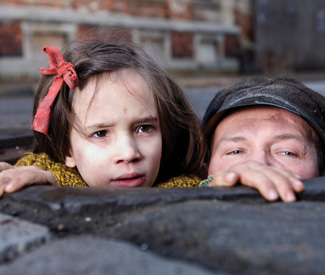
Her one indispensable feature is 1990’s Europa, Europa, an ideal vehicle for her favored mix of the grotesque, sober, and factual — following a Jewish boy who passed as Aryan German, to the point of joining the Hitler Youth. The new In Darkness is her best since then, and it can’t be chance that this too dramatizes a notably bizarre case of real-life peril and survival under the Nazis.

Its protagonist is Leopold Socha (Robert Wieckiewicz), an ordinary family man in Lvov (Poland then, Ukraine now) who’s not above exploiting the disarray of occupation and war to make ends meet. A sewer inspector, he uses his knowledge of underground tunnels to hide Jews who can pay enough when even the fenced-off ghetto is no longer safe. It’s late in the war; all avenues of flight are closed. The dozen or so citizens Socha secretes in the city’s bowels — freezing amidst vermin and waste — run a gamut despite shared panic. They include a professor, a junkie, a philanderer and mistress, and children. Extreme adversity doesn’t ennoble them — even in this dank entrapment there occur betrayals, fights, a bastard pregnancy. It is typical of Holland that when copulation and masturbation occur, the acts are at once furtively shameful and barnyard-frank.

Though both sides risk all, the “Polacks” openly disdain the “Yids,” and vice versa. In any other circumstance they’d happily snub one another. Only the flat brutality of the Nazis, gloating and laughing as they kill, can impose a thin allegiance. Yet as grueling months go by under constant threat of capture, something more than sheer dependency develops. Reluctantly, Socha finds himself unable to abandon “his” Jews even when they can no longer pay, and discovery would cost his life as well as theirs.

Holland will never be a cinematic poet. Her blunt, sometimes graceless approach to any story can leach its emotional subtleties as well as (more usefully) potential forced bathos and uplift. In Darkness has a few sequences poorly shaped enough to seem pointless. It takes us longer than it should to sort out all the major characters, and the sense of time passing is murky at best.

But for such a long, oppressive, and literally dark film, this one passes quickly, maintaining tension as well as a palpable physical discomfort that doubtlessly suggests just a fraction what the refugees actually suffered. On rare instances when Socha or others venture outdoors, sunlight feels as harsh and exposing as bleach.

In Darkness isn’t quite a great movie, but it’s a powerful experience. At the end it’s impossible to be unmoved, not least because the director’s resistance toward Spielbergian exaltation insists on the banal and everyday, even in human triumph.

In Darkness opens Fri/24 in San Francisco.

After Pressure from Occupy Bernal, Wells Fargo execs fly across country to meet with Bernal Heights man

50

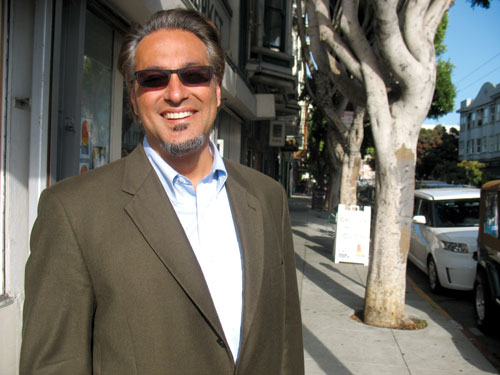
People facing eviction and foreclosure often report hardly being given the time of day by banks and lenders. But yesterday, three top Wells Fargo executives flew to San Francisco to meet with Alberto Del Rio, a Bernal Heights resident facing foreclosure.

Del Rio’s parents purchased their home in 1973. The home was refinanced multiple times, he says “for a better life” for his family. The most recent refinance, in 2007, was a result of lenders convincing Del Rio’s mother that refinancing would be an easy to pay for some of her retirement. 

“It sounded really great because my mother had no monies for retirement. The loan officers told her pull out some cash and reinvest it so she could have a better retirement. They told her, ‘after two years, you’ll be able to refinance out of this,’” said Del Rio.

The loan she got was a pick-a-pay loan, one of the most notoriously predatory loans that banks offered in the years leading up to the 2008 crash.

After continued requests from Bernal resident Alberto Del Rio and support from that neighborhood’s foreclosure-focused branch of the Occupy movement, Del Rio was finally given the time of day- by top executives in the Wells Fargo home preservation department.

The executives, including Sharon Zuniga and Shawn Woods, who flew in from Wells Fargo’s headquarters in Texas, met with Del Rio Feb. 22 at the San Francisco offices of Consumer Credit Counseling Services for about an hour and a half.

Del Rio says they gave him three options: to move out of his home and convert it into rental units, allow a short sale on the house and accept $3,000 to move, or let foreclosure proceedings continue as planned.

“They flew a guy here all the way from Houston to try to bully him into giving up,” said Buck Bagot, an organizer with Occupy Bernal.

But the fact that they took the time to do that was a result of continued pressure from Del Rio and his supporters.

“It was a good thing,” said Del Rio.

“But it also felt like they were trying to pressure us into doing something they wanted us to do rather than what we wanted to do.”

Del Rio says he’s grateful to Occupy Bernal for supporting him thus far. And when the Wells Fargo executives pled with him to give up his home, he refused.

“I’ve made up my mind. I told them, if I’m going to lose the house I’m going to lose the house to a fight, to what I want.”

His perseverance worked to a degree; the bankers agreed to give Del Rio 90 days to “increase his income,” and then, potentially, work towards loan modification. Del Rio, an independent contractor, thinks its possible.

Meanwhile, Occupy Bernal will continue to struggle others who, often, are ignored by banks when they express their need for loan modification.

“Looking at everybody that I’ve been meeting that’s going through foreclosure and eviction, every single person is either a person of a minority group, a senior citizen, disabled, or someone else that would be easily influenced when approached with a better life, a better financial life. It can be seen in all their faces,” Del Rio told me.

Occupy Bernal has help postpone and prevent dozens of evictions, including that of Monica Kenney yesterday morning. They are planning a forum tonight on foreclosures to be held at the Bernal Heights Neighborhood Center.

Antwon’s new video for ‘Helicopter’ is rooted in Bay Area connections

1

San Jose rapper Antwon’s new video for “Helicopter” (directed by Brandon Tauszik) splits time between the Steve McQueen classic Bullitt (1968), filmed on the mean streets of San Francisco, and present-day Oakland; the modern shots are of Antwon and friends including Squadda B and Mondre MAN of Oakland’s Main Attrakionz hanging out around the city, along with some gratuitous Sriracha pouring.

Motion could cripple case against Mirkarimi if granted

162

(UPDATE 2/27: The judge today denied the defense motion to suppress this video. More details here.) The domestic violence case against Sheriff Ross Mirkarimi could be dealt a crippling blow if the judge approves yesterday’s defense motion to bar videotaped testimony that his wife, Eliana Lopez, gave to their neighbor, Ivory Madison. But even if Mirkarimi beats the criminal rap, his political future could still depend on finally offering a detailed explanation of exactly what happened during that New Year’s Eve incident.

Yesterday’s motions were the subject of a cover story in today’s San Francisco Examiner, but they were strangely buried on page C2 in the San Francisco Chronicle, which also chose not to provide details of the motion, which makes a fairly compelling case for barring the videotape that is the only evidence that Lopez may have had a bruise on her arm, allegedly inflicted by Mirkarimi.

The motion argues that the videotape is inadmissible hearsay evidence that doesn’t meet the legal standard of an immediate reaction to a crime. Not only was it recorded the next day, but both Lopez and Madison say on the tape that it was intended to be used only if Lopez left Mirkarimi and sought sole custody of their two-year-old son, Theo.

“The videotape itself was the product of a reflective and deliberate decision to create evidence for purposes of a custody proceeding,” Mirkarimi attorney Lidia Stiglich argued in her motion, citing caselaw that makes such considered actions inadmissible. As the Examiner noted, the motion suggested Lopez might have ulterior motives in such an instance, making it possible that she misrepresented to Madison what had happened. Lopez denies that Mirkarimi abused her and is not cooperating with the prosecution.

Madison is quoted in the motion as saying the video was being made in case there was ever a child custody case and that “I really don’t know” what happened that night, but she believed it wasn’t an isolated incident, allegedly telling police, “she definitely didn’t describe it as ‘he grabbed my arm one time and left this mark.’”

Stiglich told the Guardian that barring the videotape from admission would be huge: “It’s a significant piece of evidence.” Some legal observers have even said the entire case against Mirkarimi could crumble if that evidence is barred, and that the ruling on its admissibility could really go either way depending on which judge gets assigned to the case tomorrow.

“We are not suprised nor concerned with the motion filed by Mr. Mirkarimi’s attorney and we will continue to handle legal issues in the courtroom and not in the media,” District Attorney’s Office spokesperson Omid Talai told us. He wouldn’t characterize how important that evidence is to the case, but he did say, “Every case is filed based on the totality of evidence.”

Yet Stiglich said much of the case rests of that videotaped evidence, which she believes presents a distorted view of what happened. “These statements are essential to their case, and there are issues with that type of testimony,” Stiglich told us.

Yet if Mirkarimi beats the criminal rap by suppressing that evidence, it’s unlikely to help him in the court of public opinion. Neither Mirkarimi nor Lopez have provided a full explanation or alternative narrative of what happened that night, how the alleged injury occurred, or other crucial details, and Stiglich said she doesn’t think now is the time for that kind of tell-all.

“I don’t think anyone should be making factual statements outside the courtroom at this point,” Stigich told us, confirming that she has advised against Mirkarimi making those kind of public statements, although she said he has been anxious to do so.

Motions in the case could be heard as soon as tomorrow, but Stiglich said she doesn’t expect opening statements in the case to take place under the week after next. She estimates witness testimony in the case will take about a week.

Then, after it’s all over and the jury renders a verdict, we’ll all see how much Mirkarimi’s team discloses about what actually happened that night and with earlier instances where Mirkarimi allegedly got physical with Lopez and a previous girlfriend, Christina Flores, who prosecutors also hope to put on the witness stand.

And if there are still questions to be answered, then we can all push Mirkarimi for a fuller accounting, render our own judgments, and determine where we think the truth lies and what that says about the public officials involved in this case.

Alive and kicking

1

THEATER Art is a life and death matter at the Garage this weekend, with the premieres of Dead/Alive and No Exit, two new contemporary dance-performance works from Minna Harri Experience Set and Christine Bonansea, respectively.

These intriguing pieces — instigated as part of an eight-month co-mentorship program between the Garage and ODC — have been developing separately for months. But in their flirtations with the sublime, they stand to be as complimentary as they will doubtlessly be distinct and strange. (Both works transfer to ODC this summer as part of the co-mentoring arrangement, a bridge-building initiative dreamed up by the Garage’s Joe Landini.)

Bonansea, who relocated to the Bay Area from her native France four years ago, is probably better known locally as a dancer — most recently for her wry, nimble performance in Catherine Galasso’s Bring on the Lumiere at ODC. A quick and spirited personality, Bonansea had just returned from Lumiere‘s New York premiere when I met with her to talk about No Exit. Bonansea studied modern literature at the Sorbonne; she took her title from Sartre, whose No Exit she revisited early on in the process.

She is careful not to equate her work with the famous play, however, stressing that it is only a starting point or one element in a larger mix of perspectives around a central idea — in this case, the illusory nature of self measured against certain physical and temporal absolutes. Moreover, she tends to think in terms of visuals and sound as much as in terms of movement.

“I like working with different media,” she explains. “There is a conversation; the perspectives are different. It’s totally a part of the process. It’s not that I do mixed media, but if I talk about something, I see that there are so many different ways to talk about it. When you work with different artists you just bounce off each other. It can be insane!” she says, explaining that for her, “insane” is a very positive word.

Sure enough, Bonansea has gathered an insanely impressive group of collaborators. Dancers Marina Fukushima, Jorge Rodolfo de Hoyos, and Rosemary Hannon will perform the piece. Graphic artist Olivia Ting provides visuals. Costumes (including an 18-yard wig) come courtesy of noted hair designer-sculpture Lauren Klein. The result is an absorbing anti-narrative inhabited by anti-characters, exploring transience and stasis while confronting irresolvable tensions in the human condition.

Similarly for Minna Harri, a Finnish-born dancer-choreographer now based in San Francisco, work often begins with a philosophical question or idea. Her last outing at the Garage was the eerily exquisite A Silent Fairground (3 Things). The delicately macabre beauty and darkly coiled humor of the piece suffused the black box with the sense of haunted memories and dreamlike intimations from the unconscious. But just whose memory, or whose unconscious, is hard to say.

“I don’t usually make work out of my own life,” Harri says. “Maybe it’s more things that bother me or won’t let me go.”

She admits that Dead/Alive, a multivalent rumination on mortality and dying that features three performers and some voluntary audience interaction, is a little different. “I bring my own thoughts and experiments, vulnerabilities and fears about that. Death as a subject in this culture is very weird, and it maybe should be talked about more,” she suggests.

Joining Harri onstage, and in her process, are performance artist and provocateur Philip Huang and, via video, dancer Ronja Ver (who figured stunningly in Silent Fairground). Harri also brought on two colleagues as dramaturges — Tessa Wills and Jesse Hewit — at distinct points in the process. “I enjoy very much a deep and thorough and informed discussion in the process of making a piece,” she explains.

Dead/Alive‘s origins reach back to an idea she first had three or four years ago.

“Maybe it’s more an aesthetic nostalgia that has been the thing for me,” says Harri, considering the matter. “I think an important part of what has influenced me is nature, the Finnish seasons. There, all four seasons are very stark. You live for the summer, which is a few months, and every fall is like dying. The birds fly away, and you know it’s going to be eight, nine months before they come back. The winter is dark. And when the spring comes, it’s wonderful because the sun comes out — but then the light is so harsh that you see every dog shit that comes out of the melting snow, and every speck of dust inside. The most suicides happen in April.”


NO EXIT AND DEAD/ALIVE

Fri/24-Sat/25, 8 p.m., $15

Garage

975 Howard, SF

www.975howard.com

Buy local: yoga edition

1

YOGA Walking into Bay Area yoga studios can sometimes feel like being subsumed into a cult of Lululemon, Yogitoes, and Gaiam. Yoga means big bucks these days, and most everyone seems to be sporting the same few brands while getting their warrior on. Yogic ideology espouses non-materialism and self-acceptance, yet it’s hard not want to fit in. Fortunately, there are lots of options that can get you out of big brand conformity and into stylie yoga gear that supports local vendors and designers. Follow these tips and in no time flat your yoga-related footprint won’t extend much farther than the four corners of your mat!


BLUE CANOE

Inspired by a homemade canoe that once sat on the shores of Humboldt County’s Benbow Lake, Blue Canoe’s name highlights its dedication to homegrown, yet stylish organic clothing. All its clothes are made in San Francisco and most use organic cotton in comfy blends. The company has been in business for more that 16 years and is known for its decidedly “un-granola” pieces that make as much sense in a yoga class as they do on Valencia Street.  

Hot item: boot cut pant

www.bluecanoe.com


LEOM DESIGNS

Born of designer Margaret Leom’s own need for good yoga and dance wear, Leom Designs has been operating out of Santa Cruz for six years. The clothes have a uniquely organic feel to them, taking inspiration from the environment and employing a deliberative creative process. Though initially Leom just made clothes for herself, she was always asked where she got her outfits. So she jumped at the chance to create designs in her vision and hasn’t looked back.  

Hot item: elfarrow men’s yoga top

www.leomdesigns.com


SWIRL SPACE

Since 2000 Swirl Space has been producing movement friendly, hemp-based clothes in San Francisco. As a business that’s committed to fair local labor, sustainable business practices, and educating the public about the benefits of Hemp, Swirl Space’s lofty ideals are an integral part of its goods.

Hot item: hemp hottie short

www.swirlspace.com


ZOBHA

Headquartered in Mill Valley, Zobha produces dreamy, high-end yoga wear that rivals Lululemon in fit and durability — yet the two companies’ trajectories couldn’t be more different. While Vancouver-based Lululemon seems to court controversy at every turn, Zobha directly supports Bay Area community initiatives like Headstand, which teaches yoga to at-risk youth. Bottom line, Zobha makes your butt look good while hitting the sweet spot between transcendent and trendy.

Hot item: Paige tank

www.zobha.com


KLEAN KANTEEN

Hydration is key while practicing yoga, but not every water bottle is created equal. It goes without saying that conscious yogis should eschew disposable plastic bottles in favor of refillables, and since 2004 Chico-based Klean Kanteen has been preaching the benefits of BPA-free, stainless steel bottles.  

Hot item: Klean Kanteen Reflect

www.kleankanteen.com


YOGA PROPS

Operating out of a warehouse in the Mission District, Yoga Props has been in business for 32 years. It sells a very wide range of items including blocks fashioned in the Props woodshop and locally made bolsters. In addition to online orders, Yoga Props welcomes walk-in customers who call ahead to its Mission HQ.  

Hot item: cylindrical bolster

www.yogaprops.net


YOGA MATS

Yoga Mats is another SF-based prop purveyor that’s been in town for decades, nearly three to be exact. While it participates in occasional Dogpatch neighborhood trunk sales, the bulk of Yoga Mats’ business is done online.

Hot item: kapok-filled zafu crescent

www.yogamats.com


TADASANA FESTIVAL

No need to fly to remote spots like Tulum or Bali to get your OM on en masse. Taking place on the beach in Santa Monica, the Tadasana Festival will pair classes by master teachers like Seane Corne and Elena Brower with performances by global music luminaries like Karsh Kale, Cheb i Sabbah, and Vieux Farka Touré. No passport necessary, just gather your yogi posse and carpool to LaLa Land come late-April.  

Can’t miss: Mandala vinyasa with Shiva Rea and the Touré-Raichel Collective

www.tadasanafestival.com 


Why do evictions continue despite widespread banking fraud?

9

Do you think a groundbreaking report – showing that 84 percent of foreclosures in San Francisco over the last three years involved faulty paperwork, some of it amounting to fraud – would finally mean swift justice for victims of those crimes?

Think again.

According to Assessor-Recorder Phil Ting, whose office produced the astonishing report, government action is certainly appropriate in the follow-up to the report. “There are potential legal action on behalf of the attorney general and potential policy solutions at the state level,” said Ting.

But these solutions will likely take their long, bureaucratic time. And in the meantime, San Francisco homeowners — many of whom say that they were lied to, tricked, or defrauded by the lenders or beneficiaries of their mortgage loans — will continue to be kicked out of their homes with no legal oversight.

People have been claiming these injustices for years. Now, the report has proven that the vast majority of them are probably right.

“Until now, public information in California regarding improper foreclosure practices has been largely anecdotal. This report is important because it is the first to provide a rigorous, quantifiable analysis of the nature and frequency of foreclosure irregularities in California,” said Lou Pizante of Aequitas, a mortgage investigation firm that partnered with the Assessor-Recorder’s office to produce the report, in a press release.

The report focuses on six areas: assignments, notice of default, substitution of trustee, notice of trustee sale, suspicious activities indicative of potential fraud, and conflicts relating to MERS (short for Mortgage Electronic Registration Systems, Inc.).

In 99 percent of loans, the report identifies “one of more irregularities.” In 84 percent, there were “what appear to be one or more clear violations of the law.”
These violations include forging signatures, failing to file proper paperwork, failing to notify borrowers of things that they are legally required to know such as changes in the owners of their mortgages and notices that they have been put on track for foreclosure. And lots of felony fraud. 

Yet Ting told us it will be difficult to use these findings to hold banks and other lenders accountable, at least any time soon.
The report is likely the beginning of a lengthy process that will, at best, involve investigations from several city and state departments.
Matt Dorsey, press secretary for the city attorney’s office, confirmed that “we’re working with our client department the Assessor-Recorder,” but couldn’t say much else.

District Attorney George Gascon released a statement addressing the report, which says that “Mortgage-related fraud is a top priority in my office will prosecute those who pray on vulnerable homeowners. Many people have lost their homes due to foreclosures, tearing apart families and communities.”

But according to Assistant District Attorney Omid Talai, the DA’s office cannot begin looking into the cases until it receives documents from the Assessor-Recorder detailing the allegations in the report.

Talai emphasized that “our door remains open, and we would always welcome anyone with any kind of information”; homeowners with documents that they believe contain proof of invalid foreclosure proceedings can go to the DA themselves.

But will the release of the report help these homeowners?
 
When asked if people who believe they were a victim of these “irregularities” and “felony crimes” could use the report to challenge their lenders, Ting replied, “they could potentially.”

But, “the alternate question would be asked, which is: were they actually making payments on their homes? If they weren’t, they would have a very hard time challenging their foreclosure.”

Yet, anecdotally, lenders often tell consumers that they need to stop making loan payments in order to qualify for loan modification. They then get put on the fast track for foreclosure. Ting said his office heard these anecdotes too.

“Unfortunately, oftentimes when that happens, it’s done verbally. We also heard that. But it becomes almost impossible to prove,” Ting told me.

So banks can lie to consumers, thus potentially immunizing themselves from prosecution based on crimes committed against consumers. Then to top it all off, when folks get evicted and become homeless, they can be ticketed or jailed for sitting on the sidewalk. Thanks, justice system.

Hopefully, this report can act as an important step in the right direction.

“I’m proud of the fact that this is the first report of its kind, in the state, really identifying these issues on a systematic basis,” said Ting.

At least now the thousands of San Francisco residents that have lost their homes can point to evidence proving that this is a more complicated problem than people borrowing money that they can’t afford to pay back.

As the report states, “Reckless borrowing notwithstanding, much publicly available evidence suggests that there are indeed many legitimate victims of abusive lending and service practices.”

These people didn’t need the report to tell them that they were “legitimate victims.” But let’s hope that, with its help, they can see some justice.

Fighting prejudice, one student at a time

0

By Elijah Jatovsky

I served as a Congressional page for Minority Leader Nancy Pelosi last summer, and witnessed the highly partisan and deadlocked environment that plagued the House of Representatives during the debt-ceiling fiasco.

Among the biggest challenges I faced during my two months as a page was being in an openly homophobic environment. One page laughed at the thought of having a gay president, saying if one were ever elected he would be the first in line with a shotgun.

As the son of gay parents, I was deeply hurt. For the first few weeks, whenever I heard a homophobic remark, I would stomp out, grumbling to myself about how backward these pages were.

Then it dawned on me that these homophobic pages had probably never knowingly met a gay person or someone related to one. I concluded that if I wanted to change their opinions about gay people I would have to appeal to their emotional side through personalization.

One night in a conversation with two of my homophobic page friends, I posed the question, “Should gay people be denied the right to marry?” They responded yes because gay people have the “choice” of being gay. I then asked, “If being gay was a choice, what are the children of gay people like?” They responded that the children probably led similarly immoral lifestyles, and that they were probably gay too. Then I posed my final question, “What if I told you I had gay parents?”

Despite my liberal worldview, these pages had come to perceive me as approachable and respectable. So when I came out as the son of gay parents, it challenged their preconceived notions. On the last day of the program, the pages wrote notes to one another to remember our experiences. One of them wrote in my book, “You changed my views of San Francisco… It’s full of liberals, but they’re OK peeps.”

I believe my fellow pages and I exhibited something that was absent in the House of Representatives this past summer: communication and respect. We were able to put our vast differences aside, and truly listen to one another. We held conversations that were not marred by fiery rhetoric, but rather educated one another about our core beliefs and why we held those opinions.

This type of dialogue is what a society needs to function — and that’s why I started a program called National Connect.

NatCon provides high school students the opportunity to communicate with people who have different upbringings and values. Scools provide background information ranging from student body size to religious affiliation through the NatCon website, and NatCon pairs very different schools. For example, the Jewish Community High School of the Bay in San Francisco is paired with Beulah High School in the rural town of Valley, Alabama.

Students are assigned individual “buddies” from their paired school. They begin online correspondences answering different prompts. The prompts are given in stages, initially asking students to describe their lives in general.

After a connection is established, NatCon provides another set of prompts, more personal and potentially controversial, such as asking students to discuss stereotypes they hold. Finally, participants are asked to discuss their core beliefs about provocative issues such as abortion, gay marriage, and the environment. Students are asked to state their position, and explain the values that inform their beliefs. The purpose is to educate and inform each other, not to convince anyone of a particular point of view.

In the first month since NatCon’s launch, there are more than 50 high school students participating from nine schools and six states. Maybe there’s hope.

Elijah Jatovsky, founder of NatCon, lives in San Francisco and attends Jewish Community High School of the Bay. For more information and to read the NatCon Blog please visit: www.nationalconnect.org or email: nationalconnect2012@gmail.com

The ‘ruination’ of Peter Gleick

27

Oooh, sfgate has dropped climate scientist Peter Gleick’s column on the City Brights section of the site. Harsh, man; I guess that’s enough to “damage, if not ruin” the reputation of one of the world’s leading authorities on climate change. Fired by City Brights; I bet he feels as if he’s been unfriended by Garrison Keillor.

I continue to be amazed at the ethics of the San Francisco Chronicle, which can’t tolerate Gleick but still allows Willie Brown to write a column in the news section of the paper.

And I’m amazed at all the handwringing over this incident. I means, what, exactly did Gleick do that is going to destory his scientific reputation after years of unimpeachable work? Here’s what he did: He contacted the nuts at the Heartland Institute and asked them to send him some material. Oh, and he didn’t give his real name.

It doesn’t appear that he broke into the Heartland office, or hacked into the Heartland server, or went in under false pretenses and made a bogus video. In fact, I’d argue that, whatever the Chron’s legal sources say, it’s pretty hard to call this “stealing.”

Look, if my phone rang and the person on the line said his name was Warren Buffet and he asked me to send him confidential Guardian business information because he was thinking about investing $1 billion in the alternative press, I’d make a coupla phone calls first — wouldn’t you? If I ran a right-wing nonprofit and somebody called and said she was a board member and could you please send a package of sensitive internal documents to an address in Oakland, California, I’d call back at the number I had for her and ask if she’d move to crazyland — wouldn’t you? Who on Earth sends that kind of material out without making sure it’s going where it’s supposed to go — unless the vast majority of what Heartland sent Gleick was in fact the same sort of stuff that the loonies there regularly ship out to other loonies who they think might agree that Al Gore was born a thetan and is secretly plotting the United Nations takeover of the planet so that nobody can have round light bulbs any more.

I’m not condoning this sort of behavior — although the history of journalism (sometimes excellent, important journalism) is filled with examples of reporters using what some would call dubious methods to get through what Robert Scheer used to call “the palace guard.” But compared to shit the right wing pulls routinely, as a matter of practice, this is hardly a major crime. And you have to put some of the blame on whatever fool at the Heartland Institute mailed the company secrets off without checking where they were going.

And isn’t it good that we now know how the oil industry is trying to create a K-12 curriculum that denies climate change?


Krushin’ on

0

SUPER EGO I’ve only a wee bit of space this week before I rush off back into the Mardi Gras of my mind, but I’ve got to three times diagonal-snap for local fashion designer Jeanette Au (jeanetteau.carbonmade.com) who tore it up for SF on the NY Fashion Week runways last week with her debut collection of 3-D knit fantasias. Ruling!


RED BARAAT

The Non Stop Bhangra (www.nonstopbhangra.com) monthly party’s return two weeks ago was beautiful-insane — if you missed it, or must fulfill your yearning for incredible Indian-inspired dance music sounds before the next installment, check out this live act featuring irrepressible bandleader Sunny Jain on the dhol drum, backed by a high-stepping nine-piece brass band. Bollywood meets Mardi Gras is the shorthand, but the ringing grooves transcend categorization.

Thu/23, 7:30 p.m., $12–$15, all ages. Slim’s, 333 11th St., www.slimspresents.com


ROLLER DISCO

Oh man, David Miles Jr., our patron saint of skate — “The Godfather of Skate,” actually, who founded the essential Black Rock Roller Disco and keeps peeps rollin’ from the Embarcadero to Golden Gate Park — lost everything in a tragic fire. He and his family are OK, but here’s a great event to help get them back on their (wheeled) feet. Skate rental available: Lots of good DJs.

Thu/23, 9 p.m., donations at the door. Mighty, 119 Utah, SF. www.mighty119.com


CUTE FANGS 4EVER!

It’s no secret that hyper-productive tech-breaks player and Cute Fang label owner Forest Green is one of my favorite people. It’s hard not to leave her parties with a smile plastered on your face — partly from the room-wobbling beats, partly from her pure positivity transmission. This is her two-room blowout birthday party, with a slew of bonkers local guests like DJ Denise, Dragn’fly, Raydeus, Tek 9, and Base Hed. And it will be cute!

Fri/24, 9 p.m.-4 a.m., $5 before 10 p.m., $10 after. Icon, 1192 Folsom, SF. www.forestgreen.org


SITUATION

Part of the reason door fees have risen so much in San Francisco is our insistence on relying on foreign or guest DJs to bring something interesting to the table. Flights are expensive, cover rises. Well here comes Situation, a free party deliberately designed to showcase local talent and some snappy grooves: “the new disco sound of New York, bangin’ house joints, 12-inch dance versions, and more than a few non-sequitors to keep things interesting,” quoth host DJ (along with Eug and Ash Williams) Derek Opperman, my nightlife critic counterpart at the Weekly, who’s basically an adorable human Shazam. Move out, yazoo.

Fri/24, 10 p.m., free. 222 Hyde, SF. www.222hyde.com


DJ KRUSH

Let’s just admit that future bass was the trip-hop revival, OK? And while Flying Lotus et al. took the sound to unfathomable new highs/lows (and old hands like Amon Tobin sizzled retinae with his ISAM stage-show comeback), there’s sometimes no beating the originals. After 20 years, Tokyoite chill-wizard DJ Krush can still gently ride those intelli-stoned waves into the stratosphere: a three-hour set should do you quite solid.

Sat/25, 9 p.m., $17.50 advance. Mezzanine, 444 Jessie, SF. www.blasthaus.com

Compressing the press

6

Journalism in the Bay Area has been in decline for many years, with corporate consolidations, shrinking newsrooms, declining print readership, and struggles with how to pay full-time reporters when content is offered free-of-charge on the Internet. And with its waning institutional strength, the Fourth Estate has lost some of its ability to watchdog the powerful, creating a dangerous situation in a country founded on the belief that a free press is an essential safeguard of liberty and fairness.

One countervailing trend during this time was the creation of robust nonprofit newsrooms, with the two largest ones in the Bay Area being the Berkeley-based Center for Investigative Reporting (CIR) and the Bay Citizen in San Francisco. But now those two entities have announced that they’re in merger talks — and that the combined newsrooms would be led by Phil Bronstein, who presided over the decline of San Francisco’s two major daily newspapers.

Whether this merger bodes well or ill for a journalistic resurgence remains unclear. Both entities have their strengths and flaws, and both of their boards are in the middle of a 30-day review period to determine whether the merger makes sense and what the combined operations would look like.

As the exclusive Bay Area content provider for The New York Times, Bay Citizen made a big splash when it was launched with $5 million in seed money from billionaire financier Warren Hellman in late 2009. As Hellman (who died in December) told me at the time, he was seeking to create an independent, local, public interest alternative to the San Francisco Chronicle, which was being gutted by its New York-based owners, Hearst Corp., and even threatened with closure if its unions hindered the downsizing.

Many were skeptical that a newsroom funded and overseen by Hellman and other uber-wealthy San Franciscans would deliver the kind of public interest journalism that the city needed, but under the leadership of veteran Editor Jonathan Weber, it produced many strong stories, starting on launch day with an investigation of how the richest home owners in the city avoid paying property taxes the city once relied on. And last year, Bay Citizen broke some important stories and created valuable databases on campaign contributions and danger spots for bicyclists, for which it recently won a Society of Professional Journalists award for computer-assisted reporting.

Acting CEO Brian Kelley told us the Bay Citizen has succeeded in creating a strong “three-legged stool” balancing solid journalism, a sustainable business model, and technological innovation. After raising about $17 million in three years, ranging from small donations to the $6 million Hellman contributed, “we’re in a very healthy state from a financial standpoint.”

But sources say the operation has had some tough internal divisions, some of it propagated by an out-of-touch board and an overpaid CEO, Lisa Frazier, who took a reported $457,000 salary to run an operation that she had served as Hellman’s consultant in launching. They say Frazier clashed with Weber and the reporting staff, particularly after it voted to unionize last year, and then with Weber’s successor, Steve Fainaru. Both Weber and Fainaru resigned in the last month, creating a leadership vacuum that was one of the factors that triggered the merger talks.

Meanwhile, CIR has experienced the most dynamic growth period in its 30-year history since 2008, when veteran editor Robert Rosenthal took over as executive director after leaving the Chronicle, where he served directly under Bronstein, who also later left the Chronicle and now serves as president of CIR’s board.

CIR has traditionally had a small staff working on a shoestring budget to produce a handful of big investigative journalism projects per year, including award-winning broadcast segments for “Frontline” and “60 Minutes.” But Rosenthal focused on securing millions of dollars in foundation funding and creating collaborations with media outlets around the state (such as KQED), launching California Watch to beef up coverage of statewide issues, as he describes in his 24-page essay “Reinventing Journalism: An unexpected journey from journalist to publisher” (www.californiawatch.org/project/reinventing-journalism).

“I was deeply frustrated by a lack of vision, ambition, and passion on the business side that was throttling creativity and undermining the crucial role that journalism, and especially investigative reporting, play in our democracy,” Rosenthal wrote in the report that was requested by the John S. and James L. Knight Foundation, one of three foundations that provided more than $1.2 million each to launch California Watch (the others are Irvine and Hewlett foundations).

The Guardian has long raised questions about the trend of foundations increasingly stepping in to fill journalism’s funding voids, arguing that it can compromise journalistic independence and allow wealthy interests to determine what issues get investigative scrutiny (see “Buying the news: How private foundations are quietly underwriting — and shaping — local news coverage of major issues,” 10/8/97).

But in an era when most California newspapers are clinging to life, Rosenthal had used the funding to augment CIR’s investigative reporting staff and get impactful, award-winning stories to run simultaneously in outlets around the state, challenging old journalistic norms about competition and exclusivity.

Rosenthal admits the model has its shortcomings, including the unreliability and often-narrow focus of foundation funding and how CIR’s successes have done little to backfill the loss of local beat reporting (such as covering City Hall or keeping the cops and local power brokers in check), but he thinks the merger might help in those areas.

“It’s exciting for us to be able to address what has been a vacuum in San Francisco for a long time,” Rosenthal told us about reviving local coverage. And on the funding model, he said, “If we can do this right, it’s about creating a local base of people who believe in accountability journalism to give small donations.”

Bronstein told us that many of the shortcomings at his old newspapers were the result of business decisions Hearst made and general trends in the industry. But he acknowledged people’s concerns about whether someone with such a long local history is the best person to turn things around: “I don’t know that I’m the best person to take it over. That’s something other people should determine, not me.”

Both admit that the Chronicle under their tenure could have better covered the consolidation of wealth and power and other economic justice issues, long a Guardian focus and one that the Occupy movement helped highlight. “The Bay Area media could have been a lot more effective on those issues,” Rosenthal said.

But Bronstein said he’s committed to supporting more accountability journalism in the Bay Area, supporting the work of the Bay Citizen, and supplementing work done at papers like the Guardian: “The weeklies do a fine job of writing some in-depth stories and we need more of that, providing context.”

Both said that even if the merger takes place, Bay Citizen would continue to provide local coverage under the brand and model it’s developed, although the New York Times has not yet determined whether it would continue to run its content if it’s not exclusive. The two newsrooms wouldn’t initially be merged, although Bronstein has said that achieving savings of up to $1.9 million is one of his goals, something he’d try to accomplish without reducing journalistic content or quality.

The two entities have slightly different cultures and areas of focus, so the question now is whether they’re compatible. Bay Citizen’s Kelley said he thinks they are: “I personally feel they are very complimentary.”


Guardian editorial: The DA and mayoral corruption

8

EDITORIAL The indictments of two executives of an airport shuttle company on charges of laundering campaign money are, in themselves, a rarity and something to celebrate: the district attorney of San Francisco is actually attempting to enforce the laws against political corruption. That’s unusual in this city, and worthy of note.

But at this point, the entire sum total of prosecutions involving the scandal-ridden campaign of Mayor Ed Lee amounts to a pair of cases against people who made what appear to be illegal contributions. As of today, the message that’s being sent is that nobody in the Lee campaign did anything wrong. And that seems a little bit curious.

Lee’s late entry into the race — after he’d promised for months not to run — and his refusal to abide by the rules of public financing forced his supporters to raise a large amount of money very quickly. There were so-called independent expenditure committees collecting donations and running parallel campaigns that, by law, should have been entirely distinct from Lee and his official effort. We’ve always been dubious about the supposed lack of coordination.

Then there were the well-documented instances of irregularities serious enough that every other candidate in the race asked for state and federal monitors to watch the election. Several eyewitnesses told local reporters that they saw volunteers for one of the supposedly independent groups filling out absentee ballots for voters, using a special template that ensured the votes would go for Lee. Some said they saw ballots being collected at a makeshift voting booth. In a video provided by the campaign of State Sen. Leland Yee, it appears that volunteers were both filling out ballots and placing them in bags — both clear violations of law.

Gascon’s announced investigations of all the allegations — but more than three months later, nothing has come of it. His office won’t confirm or deny whether investigations are ongoing or whether any further indictments may be forthcoming. But at the Chinese New Year Parade, Chinatown powerbroker and Lee ally Rose Pak announced that she had heard Gascon was investigating her.

There’s been plenty of time to collect evidence, and Gascon has a responsibility to let the public know, as quickly as possible, what’s happened to the rest of the allegations. If everyone in the Lee campaign is really innocent, and none of the independent groups supporting the mayor did anything wrong, he should say that, and present the evidence.

It doesn’t help Lee, the city, or the integrity of the voting process to have these cases drag out. Gascon needs to conclude them, expeditiously.

Rep Clock

0

Schedules are for Wed/22-Tues/28 except where noted. Director and year are given when available. Double features are marked with a •. All times p.m. unless otherwise specified.

ARTISTS’ TELEVISION ACCESS 992 Valencia, SF; www.atasite.org. $6-10. “Mad Dance,” films by Nina Fonoroff, Ken Paul Rosenthal, and Lewis Klahr, Sat, 8. “Short Sharp Shock: 3rd I International Shorts,” Sun, 1:30.

BAY THEATER Aquarium of the Bay, Embarcadero at Beach, SF; www.aquariumofthebay.org. $10-20. “An Evening of Sailing Films,” Fri, 6.

CASTRO 429 Castro, SF; (415) 621-6120, www.castrotheatre.com. $7.50-10. “Two Sides of a Coin: Kirk Douglas:” •Paths of Glory (Kubrick, 1957), Wed, 3, 7; Ace in the Hole (Wilder, 1951), Wed, 4:45, 8:45. Melancholia (von Trier, 2011), Thurs, 2:30, 5:15, 8. Fantasia (Walt Disney Productions, 1940), Fri-Sun, 2, 5, 8.

CHRISTOPHER B. SMITH RAFAEL FILM CENTER 1118 Fourth St, San Rafael; (415) 454-1222, www.cafilm.org. $6.75-10.25. “Rafael Film Club” with guest Ruthe Stein, Thurs, 1. Chico and Rita (Trueba, 2010), call for dates and times. “2012 Oscar Nominated Short Films,” narrative and documentary (separate admission), call for dates and times.

HERBST THEATRE 301 Van Ness, SF; www.sfopera.com. Free (advance registration requested at www.sfopera.com/girlmovie). The Girl of the Golden West — The Movie!, performed by the San Francisco Opera (2010), Sat-Sun, 1:30, 3:30.

JEWISH COMMUNITY CENTER OF THE EAST BAY 1414 Walnut, Berk; (510) 848-0237. $6-8. Joanna (Falk, 2010), Thurs, 7:30.

MECHANICS’ INSTITUTE 57 Post, SF; (415) 393-0100, rsvp@milibrary.org. $10. “CinemaLit Film Series: Hollywood Dames: Beauty and Brains:” The Barefoot Contessa (Mankiewicz, 1954), Fri, 6.

“NOISE POP FILM SERIES” Artists’ Television Access, 992 Valencia, SF; 2012.noisepop.com/film. $8-10. Bob and the Monster (Bahruth, 2011), Wed, 7; Hit So Hard (Ebersole, 2011), Wed, 9; Blank City (Danhier, 2010), Thurs, 7; N.A.S.A.: The Spirit of Apollo (Garon and Spiegel, 2009), Thurs, 9. Also AMC Loews Metreon 16, Fourth St at Mission, SF. $11.50. Re: Generation Music Project (Bar-Lev, 2011), Thurs, 8. Also Roxie, 3117 16th St, SF. $10. Cure for Pain: The Mark Sandman Story (Bralver and Ferino, 2011), Fri, 7; Andrew Bird: Fever Year (Aranda, 2011), Fri, 9; Upside Down: The Creation Records Story (O’Connor, 2010), Sat, 7; Dragonslayer (Petterson, 2011), Sat, 9:15.

PACIFIC FILM ARCHIVE 2575 Bancroft, Berk; (510) 642-5249, bampfa.berkeley.edu. $5.50-9.50. “Documentary Voices:” “”Making It (Un)Real: Animated Documentary Shorts,” Wed, 7. “Dizzy Heights: Silent Cinema and Life in the Air:” A Trip to Mars (Holger-Madsen, 1918), Thurs, 7; High Treason (Elvey, 1929), Fri, 7; The Mystery of the Eiffel Tower (Duvivier, 1927), Sat, 6; “Fantasies of Flight: Animation and Comedy Shorts,” Sun, 2. “Howard Hawks: The Measure of Man:” Barbary Coast (1935), Fri, 8:45; His Girl Friday (1940), Tues, 7. “Austere Perfectionism: The Films of Robert Bresson:” L’argent (1983), Sat, 8:35.

ROXIE 3117 and 3125 16th St, SF; (415) 863-1087, www.roxie.com. $6.50-10. SF IndieFest, Wed-Thurs. Visit www.sfindie.com for complete schedule. Straight Outta Hunters Point 2 (Epps, 2012), Feb 24-March 1, 7, 8:45 (also Sat-Sun, 3:15, 5). “Up the Oscars!”, Academy Awards viewing party, Sun, 3:45. This event, $15.

SF FILM SOCIETY CINEMA 1746 Post, SF; www.sffs.org. $10-11. Margaret (Lonergan, 2011), Wed-Thurs, 2, 5:30, 8:30. Roadie (Cuesta, 2011), Feb 24-March 1, 2:30, 5, 7, 9:15.

VORTEX ROOM 1082 Howard, SF; www.myspace.com/thevortexroom. $7 donation. “The Second Coming of the Vortex Room:” Privilege (Watkins, 1967), and The Devils (Russell, 1971), Thurs, 8.

YERBA BUENA CENTER FOR THE ARTS 701 Mission, SF; (415) 978-2787, www.ybca.org. $6-8. “Bros Before Hos: Sex in the Shadows,” presented by Albert Steg, Thurs, 7:30.

Our Weekly Picks: February 22-27

0

WEDNESDAY 22

Way Behind the Music

Famous rockers may have a way with riffs, but their grammar and syntax can often prove cringe-worthy. And yet, their inflated egos and turmoil-filled musings within literary efforts provide insight into worlds otherwise unknown. This, my friends, is the perfect set-up for an evening of music obsessed over-sharing. At the return of Litquake and Noise Pop’s collaborative event, Way Behind the Music, a collection of esteemed local musicians and writers will read from the autobiographies of Ozzy Osbourne, Sammy Hagar, Jewel, Slash, Ted Nugent, Marianne Faithfull, Angela Bowie, Jim Hutton (boyfriend of Freddie Mercury), and Christopher Ciccone (brother of Madonna). The group on stage — which includes Penelope Houston, Carletta Sue Kay, Jennifer Maerz, and more — will extract tales of Olympic-level drug use, epic bands fights, and rock star trials and tribulations, giving the audience just a taste of that wild ride to infamy. (Emily Savage)

7 p.m., $15

Make-Out Room

3225 22nd St., SF

(415) 647-2888

www.makeoutroom.com


THURSDAY 23

Big Black Delta

Big Black Delta is the solo project of Los Angeles maestro Jonathan Bates, lead singer of lo-fi rock band Mellowdrone. Legend has it Bates launched BBD after buying a used laptop off frequent Nine Inch Nails collaborator Alessandro Cortini and using it to create electronic soundscapes. Good thing too, because BBDLP1 is a crafty compilation made up of equal parts power and panache. “Huggin & Kissin” sounds so aggressive, it’s as if Depeche Mode’s synths decided to take steroids and beat up little kids. On the flip side, “Dreary Moon” with Morgan Kibby (the Romanovs, M83) has all the ethereal, vocal playfulness of an Air track. Bates brings in dueling drummers Mahsa Zargaran and Amy Wood for the live show. (Kevin Lee)

With New Diplomat, Aaron Axelsen & Nako 9 p.m., $10–<\d>$12 Rickshaw Stop 155 Fell, SF (415) 861-2011 www.rickshawstop.com


FRIDAY 24

“More Light”

If you’re up for a dose of reifying pessimism, check out “More Light” —a joint exhibition featuring new works by Francesco Deiana and Lafe Harley Eaves. In an effort to explore how society diverts humans from primordial joys, Deiana creates ballpoint pen drawings and images on photographic paper that juxtapose society’s adulterating tendencies with natural beauty (e.g. a drawing of an impenetrable brick wall flushed with a photograph of the ocean). Eaves, who’s said he views the world as “one dark joke after another,” makes line and pattern narratives that delve into the occult, religion, and the psychedelic. He also focuses on illustrating human duality and the uncertainty of relationships. (Mia Sullivan)

7 p.m. opening reception, free

Park Life

220 Clement, SF

(415) 386-7275

www.parklifestore.com


Image Comic Expo

With San Francisco’s WonderCon moving to Anaheim while Moscone Center South undergoes renovation, Image Comic Expo in Oakland is the primary destination for Bay Area comic book nerdery this season. Instead of focusing on Marvel and DC — the comics industry’s “Big Two” — the Expo bills itself as a “celebration of creator-owned comics.” Exhibitors include a number of independent publishers besides Berkeley-based Image Comics. Guests include Image luminaries Rob Liefeld, Todd McFarlane, and Robert Kirkman (The Walking Dead), plus fan favorites Jonathan Hickman (FF, Pax Romana), Joe Casey (Gødland), Brian K. Vaughan (Y: The Last Man, ABC’s Lost) and Blair Butler. (Sam Stander)

Fri/24, 3-8 p.m.; Sat/25, 10 a.m.-6 p.m.; Sun/26, 10 a.m.-5 p.m., $20–$150

Oakland Convention Center 550 10th St., Oakl.

www.imagecomicexpo.com


Dave Holland Overtone Quartet

English bassist Dave Holland came to the United States at the request of the legendary Miles Davis and became part of music lore as part of the quartet that birthed jazz fusion and its opus, Bitches Brew (Columbia). Holland has since worked with a number of jazz masters including Herbie Hancock, Stan Getz, Thelonious Monk and Chick Corea. When Holland was coming into his own as a musician in the 1970s, the rest of the Overtone Quartet were just entering into the world. But saxophonist Chris Potter (a frequent Holland collaborator), drummer Eric Harland (a SFJazz Collective performer) and pianist Jason Moran (a MacArthur Fellowship “Genius”) have established themselves as potent forces in their own right. (Lee)

8 p.m., $25–$65

Palace of Fine Arts

3301 Lyon, SF

(415) 567-6642

www.sfjazz.org


“Oracle and Enigma”

For a while, thanks to a series of festivals organized by producer Brechin Flournoy, San Francisco was the place in the country to see Butoh. The excitement and puzzlement surrounding the art has died down as it has simply become another form of international dance. So it should be good to again see one of its original practitioners, the Kyoto-born Katsura Kan who in 1997 moved to Thailand and has since become one of those peripatetic choreographer-dancers who takes inspiration from wherever he alights. As part of his winter residency at CounterPULSE, Kan and Shoshana Green will present “Oracle and Enigma” which they describe as “a journey towards the celestial horizon”. Sounds like Butoh . (Rita Felciano)

Fri/24-Sat/25, 8 p.m., $18–<\d>$20

CounterPULSE

1310 Mission, SF

(800) 350-8850

www.counterpulse.org


SATURDAY 25

Monster Jam

A stampede of horsepower comes thundering into the Bay Area today with the Monster Jam series of monster truck races and events, featuring 16 ground-shaking custom creations such as the long-running fan favorite “Grave Digger,” which is celebrating its 30th anniversary this year. Fans can get up close and personal with the burly behemoths during the afternoon “Party In The Pits” before the night’s main events, where the 10,000 pound muscle machines will fly through the air at distances up to 130 feet, reach heights up to 35 feet in the air, and of course, gloriously smash a series a puny regular cars. (Sean McCourt)

3-6 p.m. pit party, 7 p.m. main event; $12.50–<\d>$32, $125 for total access pass

O.co Coliseum

7000 Coliseum Way, Oakl.

(800) 745-3000

www.monsterjam.com


“Cum and Glitter: A Live Sex Show”

Perhaps you’re one of those people — that yes, do exist — left nonplussed by your standard strip club experience. Let’s face it, fried chicken buffets and atrocious choreography amplified by glitter platform heels don’t do it for us all. For you, then, queer pornographer Maxine Holloway’s new monthly sex show. Holloway, a vintage-loving local coquette, has bolstered her sex industry chops heading Madison Young’s women’s only POV website and used her connections to line up a crack cast for Cum and Glitter’s opening night: Kitty Stryker, Courtney Trouble, and Annika Amour among other superlative sex workers. Live cello music. Specialty cocktails named after the performers. Class. (Caitlin Donohue)

9 p.m., $30–$55 individuals, $50 couples

RSVP for location

www.cumandglitter.com


SUNDAY 26

“Up the Oscars!”

For a particular breed of movie fiend, the Academy Awards are more like a sporting event than a glamorous celebration of Hollywood. You know the type: catcalling the screen like they’re giving a blind ref the business (2006 flashback: “Crash? Are you fucking kidding me? Brokeback Mountain forever!”) This year’s ceremony will no doubt evoke its own array of passionate responses to awkward presenters and awkward gowns, omissions from the Tribute to the Dead, faux-surprised winners who unfurl pre-scripted lists of people to thank (“My agent! My masseuse!”), etc. The Roxie’s annual “Up the Oscars!” bash is aimed squarely at those who enjoy cheering and jeering the gold man in equal measure. D.I.Y. drinking games optional. (Cheryl Eddy)

3:45 p.m., $15

Roxie Theater

3117 16th St., SF

www.roxie.com


Stardust Sunday

Cover band? Try cover cult. The First Church of the Sacred Silversexual takes all the Christ allusions David Bowie made with The Rise and Fall of Ziggy Stardust and the Spiders from Mars and The Man Who Fell to Earth, exorcising one little bit — Jesus. The resulting mass is a blasphemous celebration of the 65-year-young rock God’s music. With as many members as Bowie has personas, all fully embracing their deity’s love of costume, the Church’s service has the campy theatricality of The Rocky Horror Picture Show and all the sparkle of a Ken Russell movie. (Ryan Prendiville)

With Space Cowboys DJs Mancub and 8Ball

8 p.m., $5

Public Works

161 Erie, SF

(415) 932-0955

www.publicsf.com


The Dodos

Listening to the Dodos kind of makes you feel like you’re part of a drum march that’s heading down a sunny country road via Brooklyn. Logan Kroeber, who’s been known to play a drum kit sans bass and to tape a tambourine to his foot, creates catchy rhythms that compel you to dance frenetically (really, it’s unavoidable), while lead vocalist Meric Long finger-picks an acoustic guitar and traverses the octaves with deep, introspective lyrics you can’t help Googling. This San Francisco-based indie folk duo most recently released fourth album, No Color (Frenchkiss) last year, and is closing out Noise Pop this year with what will likely be a memorable performance. (Sullivan)

With Au, Cannons and Clouds, Here Here

7 p.m., $20

Great American Music Hall

859 O’Farrell, SF

(415) 885-0750

www.gamh.com


MONDAY 27

Leslie and the LY’s

Long known for her 1980s-esque minimal dance-pop numbers encased in stretchy gold lame (referred to in “Gold Pants”), and even longer for her extensive bejeweled sweater collection (ahem, “Gem Sweater”), Leslie of Leslie and the LY’s boasts a newish additional talent to add to the mix: wedding officiant. The Ames, IA-based confetti-puke performance artist began officiating weddings when Iowa voted yes on gay marriage in 2009. The weddings she oversees are said to twinkle with her typical megawatt star quality — there’s even a documentary about one affair called Married in Spandex — and Mother Gem performs a personalized dance number for each lucky couple. While she may not be hosting any impromptu weddings during her appearance at Rickshaw this week, the world just feels more glamorous knowing that she could (for this, we listen to “Power Cuddle”). (Savage)

With Pennyhawk, Ramona & the Swimsuits

8 p.m., $13

Rickshaw Stop

(415) 861-2011

155 Fell, SF

www.rickshawstop.com


TUESDAY 28

Stephen Malkmus and the Jicks

Following 2010’s high profile Pavement reunion tour — which gave fans of the ’90s alternative rockers a chance to see the group live for the first or last time (as well as reportedly giving some of the members funds to pay off some financial debts) — leader Stephen Malkmus returned to the studio with his band the Jicks to record an album with Beck on board as producer. The result, Mirror Traffic, carries over the tour’s energy, and is the closest thing to a Terror Twilight follow-up to date. And as showcased by the Jicks’s all-too-short performance at the last Treasure Island Music Festival, Malkmus remains the slacker king of the nonchalant guitar solo. (Prendiville)

With Nurses

8 p.m., $20

Slim’s

333 11th St., SF

(415) 255-0333

www.slimspresents.com 

The Guardian listings deadline is two weeks prior to our Wednesday publication date. To submit an item for consideration, please include the title of the event, a brief description of the event, date and time, venue name, street address (listing cross streets only isn’t sufficient), city, telephone number readers can call for more information, telephone number for media, and admission costs. Send information to Listings, the Guardian Building, 135 Mississippi St., SF, CA 94107; fax to (415) 487-2506; or e-mail (paste press release into e-mail body — no text attachments, please) to listings@sfbg.com. Digital photos may be submitted in jpeg format; the image must be at least 240 dpi and four inches by six inches in size. We regret we cannot accept listings over the phone.

Film Listings

0

Film listings are edited by Cheryl Eddy. Reviewers are Kimberly Chun, Max Goldberg, Dennis Harvey, Lynn Rapoport, and Matt Sussman. For rep house showtimes, see Rep Clock. Due to the Presidents’ Day holiday, theater information was incomplete at presstime.

INDIEFEST

The 14th San Francisco Independent Film Festival runs through Thurs/23 at the Roxie Theater, 3117 16th St, SF. For tickets (most films $11) and schedule info, visit www.sfindie.com.

OPENING

Act of Valor Action movie starring real-life, active-duty Navy SEALs. (1:45)

*Bullhead Michael R. Roskam’s Belgian import scored an unexpected Best Foreign Language Film Oscar nomination this year. Unexpected, because it’s daring, disturbing, and a lot of other things that Foreign Language Film nominees usually are not (heartwarming, yes — gasp-inducing, no). The five-second description of this film, which is about a cattle farmer who injects both his livestock and his own body with illegal hormones, doesn’t do it justice. Who knew there was such a thing, for instance, as a “hormone mafia underworld”? While some of Bullhead‘s nuances, which occasionally pivot on culture-clash moments specific to its Belgium setting, will inevitably be lost on American viewers, the most important parts of the movie come through loud and clear, and you won’t soon forget them. (2:04) (Eddy)

*Dizzy Heights: Silent Cinema and Life in the Air The film medium’s first, sound free decades coincided with a sense of hurtling modernization throughout first-world society like nothing before or since — centuries of history had scarcely prepared for the sudden reality of such concepts as “world war” or “skyscraper.” Aviation in particular was such a fascinating wonder its potential seemed limitless, though commercial air travel was as yet many years and dollars from the average citizen’s reach. Curated by Patrick Ellis, this Pacific Film Archive series brings together some of the era’s most fanciful depictions of progress and peril in the skies. It includes 1918’s goofy, ambitious Danish A Trip to Mars, whose intrepid (if in-fighting) Earthlings land to promptly horrify the Red Planet of Peace’s entire vegetarian populace by shooting fowl and throwing a grenade. The influence of Isadora Duncan weighs heavily on the ensuing lessons learned, as wreath-bearing, toga clad peaceniks (“Come with me and look at the dance of chastity”) exhort our heroes to return home and preach pacifism — a very timely message, then. The 1929 British “disaster flick” High Treason more realistically depicts a very Jazz Age near future pushed away from the Charleston towards more catastrophic military conflict by unscrupulous war profiteers. Julien Duvivier, a director at the beginning of a long, sometimes pedestrian career in the French cinematic mainstream, was young and feckless when he made 1927’s Mystery of the Eiffel Tower, a long, antic conspiracy thriller that directly inspired the Tintin comics. This long weekend of rarities also includes a program of shorts encompassing animation from Disney and McKay, trick photography and Mack Sennett slapstick. Pacific Film Archive. (Harvey)

Gone A woman (Amanda Seyfried) who escaped a serial killer fears he has retaliated by kidnapping her sister. (1:34)

*In Darkness See “The War at Home.” (2:25)

*Khodorkovsky Russia today is a so-called “managed democracy.” Flawed a system as democracy is, though, it’s something you either live in or don’t — put a qualifier on the term, and it becomes something else. This particular something else is a nation where a popular, populist leader like Vladimir Putin can maintain an economically successful (at least for many) status quo and his own power by squelching any political opposition via decidedly un-democratic means. One of the most conspicuous such cases in recent years has been the imprisonment of Mikhail Khodorkovsky, former owner of oil company Yukos and the most fabulously wealthy “oligarch” to emerge from Russia’s post-Soviet move toward capitalist privatization. Though initially considered as corrupt as any in that privileged class, he realized after a fashion that transparency actually encouraged investment, becoming a noted respecter of oft-abused minority shareholder rights and a sort of poster child for ethical business practice. This transition coincided with increased friction between him and Putin, who had given Khodorkovsky and others like him relatively free rein so long as they “stayed out of politics.” On the day before the latter was arrested in 2003 — returning against all advice from an overseas trip where he’d been expected to become another wealthy “political emigrant” — he continued to align himself with the reformist anti-Putin opposition by telling a TV host “As long as our country isn’t fully a civil society, no one is safe from the people with handcuffs.” Conviction on questionable charges, Stalinesque detention in remote Siberia, and still-ongoing excuses for sentence elongation have ensued. The subject of Cyril Tuschi’s documentary (finally interviewed directly at the end) is certainly not innocent of arrogance, incaution, and possibly more prosecutable crimes; but he has also clearly chosen the hardest path against an intractable, grudge-keeping foe on moral principal. How many billionaires would even consider losing their freedom, comfort, and wealth for such an abstract? Khodorkovsky the movie has its character flaws, too — but you can forgive a filmmaker some of those when he’s working on a subject, and from a perspective, that has gotten more than a couple fellow journalists “mysteriously” poisoned to death. (1:51) (Harvey)

*Roadie Michael Cuesta’s first film as both director and writer (again co-authoring with brother Gerald) since 2001’s startling debut feature L.I.E. is also his best work since then. After nearly a quarter-century spent schlepping equipment for Blue Oyster Cult — the arty metal band (“Don’t Fear the Reaper,” i.e. “more cowbell!”) that was already sliding from the spotlight when he signed on — Jimmy Testergross (Ron Eldard) is fired, the reasons unknown to us. With nowhere else to go, he lands on the doorstep of his childhood home in Queens, where he hasn’t been seen in at least 20 years. Mom (Lois Smith) is going senile, though somehow her disapproval comes through with perfect clarity (and hasn’t changed in all that time). Seeking a liquid solace at a bar, our hero instead runs into Randy (Bobby Cannavale), who bullied him mercilessly way back when — and is now married to “Jimmy Testicle’s” still-hot former girlfriend Nikki (Jill Hennessey), who has rock-star aspirations of her own. Taking place over less than 24 hours’ span, Roadie is a very small character study, but a well-observed one. “Developmentally stunted by rock ‘n’ roll,” as one character puts it (when it emerges 40-something Jimmy has never learned to make coffee for himself), its protagonist is the kind of likable boy-man loser usually found in Fountains of Wayne songs, an aging lifelong air guitarist pining over good old days that probably weren’t even that good. His nostalgia is as touchingly hapless as his dubious future. (1:35) SF Film Society Cinema. (Harvey)

*Straight Outta Hunters Point 2 See “Back to the Point.” (1:20) Roxie.

Tyler Perry’s Good Deeds Director Tyler Perry puts aside the Madea drag to star as a man torn between Gabrielle Union and Thandie Newton. (1:51)

Wanderlust Paul Rudd and Jennifer Aniston star in this David Wain-directed, Judd Apatow-produced comedy about a New York City couple who move to a commune. (1:38)

ONGOING

*The Artist With the charisma-oozing agility of Douglas Fairbanks swashbuckling his way past opponents and the supreme confidence of Rudolph Valentino leaning, mid-swoon, into a maiden, French director-writer Michel Hazanavicius hits a sweet spot, or beauty mark of sorts, with his radiant new film The Artist. In a feat worthy of Fairbanks or Errol Flynn, Hazanavicius juggles a marvelously layered love story between a man and a woman, tensions between the silents and the talkies, and a movie buff’s appreciation of the power of film — embodied in particular by early Hollywood’s union of European artistry and American commerce. Dashing silent film star George Valentin (Jean Dujardin, who channels Fairbanks, Flynn, and William Powell — and won this year’s Cannes best actor prize) is at the height of his career, adorable Jack Russell by his side, until the talkies threaten to relegate him to yesterday’s news. The talent nurtured in the thick of the studio system yearns for real power, telling the newspapers, “I’m not a puppet anymore — I’m an artist,” and finances and directs his own melodrama, while his youthful protégé Peppy Miller (Bérénice Béjo) becomes a yakky flapper age’s new It Girl. Both a crowd-pleasing entertainment and a loving précis on early film history, The Artist never checks its brains at the door, remaining self-aware of its own conceit and its forebears, yet unashamed to touch the audience, without an ounce of cynicism. (1:40) (Chun)

*Chico and Rita This Spain-U.K. production is at heart a very old-fashioned musical romance lent novelty by its packaging as a feature cartoon. Chico (voiced by Eman Xor Oña) is a struggling pianist-composer in pre-Castro Havana who’s instantly smitten by the sight and sound of Rita (Limara Meneses, with Idania Valdés providing vocals), a chanteuse similarly ripe for a big break. Their stormy relationship eventually sprawls, along with their careers, to Manhattan, Hollywood, Paris, Las Vegas, and Havana again, spanning decades as well as a few large bodies of water. This perpetually hot, cold, hot, cold love story isn’t very complicated or interesting — it’s pretty much “Boy meets girl, generic complications ensue” — nor is the film’s simple graphics style (reminiscent of 1970s Ralph Bakshi, minus the sleaze) all that arresting, despite the established visual expertise of Fernando Trueba’s two co directors Javier Mariscal and Tono Errando. When a dream sequence briefly pays specific homage to the modernist animation of the ’50s-early ’60s, Chico and Rita delights the eye as it should throughout. Still, it’s pleasant enough to the eye, and considerably more than that to the ear — there’s new music in a retro mode from Bebo Valdes, and plenty of the genuine period article from Monk, Mingus, Dizzy Gillespie, Chano Pozo and more. If you’ve ever jones’d for a jazzbo’s adult Hanna Barbera feature (complete with full-frontal cartoon nudity — female only, of course), your dream has come true. (1:34) Smith Rafael. (Harvey)

*The Descendants Like all of Alexander Payne’s films save 1996 debut Citizen Ruth, The Descendants is an adaptation, this time from Kaui Hart Hemmings’ excellent 2007 novel. Matt King (George Clooney) is a Honolulu lawyer burdened by various things, mostly a) being a haole (i.e. white) person nonetheless descended from Hawaiian royalty, rich in real estate most natives figure his kind stole from them; and b) being father to two children by a wife who’s been in a coma since a boating accident three weeks ago. Already having a hard time transitioning from workaholic to hands-on dad, Matt soon finds out this new role is permanent, like it or not — spouse Elizabeth (Patricia Hastie, just briefly seen animate) will not wake up. The Descendants covers the few days in which Matt has to share this news with Elizabeth’s loved ones, mostly notably Shailene Woodley and Amara Miller as disparately rebellious teen and 10-year-old daughters. Plus there’s the unpleasant discovery that the glam, sporty, demanding wife he’d increasingly seemed “not enough” for had indeed been looking elsewhere. When has George Clooney suggested insecurity enough to play a man afraid he’s too small in character for a larger-than-life spouse? But dressed here in oversized shorts and Hawaiian shirts, the usually suave performer looks shrunken and paunchy; his hooded eyes convey the stung joke’s-on-me viewpoint of someone who figures acknowledging depression would be an undeserved indulgence. Payne’s film can’t translate all the book’s rueful hilarity, fit in much marital backstory, or quite get across the evolving weirdness of Miller’s Scottie — though the young actors are all fine — but the film’s reined-in observations of odd yet relatable adult and family lives are all the more satisfying for lack of grandiose ambition. (1:55) (Harvey)

The Help It’s tough to stitch ‘n’ bitch ‘n’ moan in the face of such heart-felt female bonding, even after you brush away the tears away and wonder why the so-called help’s stories needed to be cobbled with those of the creamy-skinned daughters of privilege that employed them. The Help purports to be the tale of the 1960s African American maids hired by a bourgie segment of Southern womanhood — resourceful hard-workers like Aibileen (Viola Davis) and Minny (Octavia Spencer) raise their employers’ daughters, filling them with pride and strength if they do their job well, while missing out on their own kids’ childhood. Then those daughters turn around and hurt their caretakers, often treating them little better than the slaves their families once owned. Hinging on a self-hatred that devalues the nurturing, housekeeping skills that were considered women’s birthright, this unending ugly, heartbreaking story of the everyday injustices spells separate-and-unequal bathrooms for the family and their help when it comes to certain sniping queen bees like Hilly (Bryce Dallas Howard). But the times they are a-changing, and the help get an assist from ugly duckling of a writer Skeeter (Emma Stone, playing against type, sort of, with fizzy hair), who risks social ostracism to get the housekeepers’ experiences down on paper, amid the Junior League gossip girls and the seismic shifts coming in the civil rights-era South. Based on the best-seller by Kathryn Stockett, The Help hitches the fortunes of two forces together — the African American women who are trying to survive and find respect, and the white women who have to define themselves as more than dependent breeders — under the banner of a feel-good weepie, though not without its guilty shadings, from the way the pale-faced ladies already have a jump, in so many ways, on their African American sisters to the Keane-eyed meekness of Davis’ Aibileen to The Help‘s most memorable performances, which are also tellingly throwback (Howard’s stinging hornet of a Southern belle and Jessica Chastain’s white-trash bimbo-with-a-heart-of-gold). (2:17) (Chun)

Hugo Hugo turns on an obviously genius conceit: Martin Scorsese, working with 3D, CGI, and a host of other gimmicky effects, creates a children’s fable that ultimately concerns one of early film’s pioneering special-effects fantasists. That enthusiasm for moviemaking magic, transferred across more than a century of film history, was catching, judging from Scorsese’s fizzy, exhilarating, almost-nauseating vault through an oh-so-faux Parisian train station and his carefully layered vortex of picture planes as Hugo Cabret (Asa Butterfield), an intrepid engineering genius of an urchin, scrambles across catwalk above a buzzing station and a hotheaded station inspector (Sacha Baron Cohen). Despite the special effects fireworks going off all around him, Hugo has it rough: after the passing of his beloved father (Jude Law), he has been stuck with an nasty drunk of a caretaker uncle (Ray Winstone), who leaves his duties of clock upkeep at a Paris train station to his charge. Hugo must steal croissants to survive and mechanical toy parts to work on the elaborate, enigmatic automaton he was repairing with his father, until he’s caught by the fierce toy seller (Ben Kingsley) with a mysterious lousy mood and a cute, bright ward, Isabelle (Chloe Grace Moretz). Although the surprisingly dark-ish Hugo gives Scorsese a chance to dabble a new technological toolbox — and the chance to wax pedantically, if passionately, about the importance of film archival studies — the effort never quite despite transcends its self-conscious dazzle, lagging pacing, diffuse narrative, and simplistic screenplay by John Logan, based on Brian Selznick’s book. Even the actorly heavy lifting provided by assets like Kingsley and Moretz and the backloaded love for the fantastic proponents at the dawn of filmmaking fail to help matters. Scorsese attempts to steal a little of the latters’ zeal, but one can only imagine what those wizards would do with motion-capture animation or a blockbuster-sized server farm. (2:07) (Chun)

The Iron Lady Curiously like Clint Eastwood’s 2011 J. Edgar, this biopic from director Phyllida Lloyd and scenarist Abi Morgan takes on a political life of length, breadth and controversy — yet it mostly skims over the politics in favor of a generally admiring take on a famous narrow-minded megalomaniac’s “gumption” as an underdog who drove herself to the top. Looking back on her career from a senile old age spent in the illusory company of dead spouse Denis (Jim Broadbent), Meryl Streep’s ex-British Prime Minister Margaret Thatcher steamrolls past hurdles of class and gender while ironically re-enforcing the fustiest Tory values. She’s essentially a spluttering Lord in skirts, absolutist in her belief that money and power rule because they ought to, and any protesting rabble don’t represent the “real England.” That’s a mindset that might well have been explored more fruitfully via less flatly literal-minded portraiture, though Lloyd does make a few late, lame efforts at sub-Ken Russell hallucinatory style. Likely to satisfy no one — anywhere on the ideological scale — seriously interested in the motivations and consequences of a major political life, this skin-deep Lady will mostly appeal to those who just want to see another bravura impersonation added to La Streep’s gallery. Yes, it’s a technically impressive performance, but unlikely to be remembered as one of her more depthed ones, let alone among her better vehicles. (1:45) (Harvey)

Margaret Lisa Cohen (Anna Paquin) is an Upper West Side teen living with her successful actress mother (J. Smith-Cameron, wife to writer-director Kenneth Lonergan) — dad (Lonergan) lives in Santa Monica with his new spouse — and going through normal teenage stuff. Her propensity for drama, however, is kicked into high gear when she witnesses (and inadvertently causes) the traffic death of a stranger. Initially fibbing a bit to protect both herself and the bus driver (Mark Ruffalo) involved, she later has second thoughts, increasingly pursuing a path toward “justice” that variably affects others including the dead woman’s friend (Jeannie Berlin), mom’s new suitor (Jean Reno), teachers at Lisa’s private school Matt Damon and Matthew Broderick), etc. Lonergan is a fine playwright and uneven sometime scenarist who made a terrific screen directorial debut with 2000’s You Can Count On Me (which also featured Ruffalo, Broderick and Smith-Cameron). He appears to have intended Margaret as a pulse-taking of privileged Manhattanites’ comingled rage, panic, confusion, and guilt after 9-11. But if that’s the case, then this convoluted story provides a garbled metaphor at best. It might best be taken as a messy, intermittently potent study of how someone might become the kind of person who’ll spend the rest of their lives barging into other people’s affairs, creating a mess, assuming the moral high ground in a stubborn attempt to “fix” it, then making everything worse while denying any personal responsibility. Certainly that’s the person Lisa appears to be turning into, though it’s unclear whether Lonergan intends her to be seen that way. Indeed, despite some sharply written confrontations and good performances, it’s unclear what Lonergan intended here at all — and since he’s been famously fiddling with Margaret‘s (still-problematic) editing since late 2005, one might guess he never really figured that out himself. (2:30) SF Film Society Cinema. (Harvey)

My Week With Marilyn Statuette-clutching odds are high for Michelle Williams, as her impersonation of a famous dead celebrity is “well-rounded” in the sense that we get to see her drunk, disorderly, depressed, and so forth. Her Marilyn Monroe is a conscientious performance. But when the movie isn’t rolling in the expected pathos, it’s having other characters point out how instinctive and “magical” Monroe is onscreen — and Williams doesn’t have that in her. Who could? Williams is remarkable playing figures so ordinary you might look right through them on the street, in Wendy and Lucy (2008), Blue Valentine (2010), etc. But as Monroe, all she can do is play the little-lost girl behind the sizzle. Without the sizzle. Which is, admittedly, exactly what My Week — based on a dubious true story — asks of her. It is true that in 1956 the Hollywood icon traveled to England to co-star with director Sir Laurence Olivier (Kenneth Branagh) in a fluff romance, The Prince and the Showgirl; and that she drove him crazy with her tardiness, mood swings, and crises. It’s debatable whether she really got so chummy with young production gofer Colin Clark, our wistful guide down memory lane. He’s played with simpering wide-eyed adoration by Eddie Redmayne, and his suitably same-aged secondary romantic interest (Emma Watson) is even duller. This conceit could have made for a sly semi-factual comedy of egos, neurosis, and miscommunication. But in a rare big-screen foray, U.K. TV staples director Simon Curtis and scenarist Adrian Hodges play it all with formulaic earnestness — Marilyn is the wounded angel who turns a starstruck boy into a brokenhearted but wiser man as the inevitable atrocious score orders our eyes to mist over. (1:36) (Harvey)

The Vow A rear-ender on a snowy Chicago night tests the nuptial declarations of a recently and blissfully married couple, recording studio owner Leo (Channing Tatum) and accomplished sculptor Paige (Rachel McAdams). When the latter wakes up from a medically induced coma, she has no memory of her husband, their friends, their life together, or anything else from the important developmental stage in which she dropped out of law school, became estranged from her regressively WASP-y family, stopped frosting her hair and wearing sweater sets, and broke off her engagement to preppy power-douchebag Jeremy (Scott Speedman). Watching Paige malign her own wardrobe and “weird” hair and rediscover the healing powers of a high-end shopping spree is disturbing; she reenters her old life nearly seamlessly, and the warm spark of her attraction to Leo, which we witness in a series of gooey flashbacks, feels utterly extinguished. And, despite the slurry monotone of Tatum’s line delivery, one can empathize with a sense of loss that’s not mortal but feels like a kind of death — as when Paige gazes at Leo with an expression blending perplexity, anxiety, irritation, and noninvestment. But The Vow wants to pluck on our heartstrings and inspire a glowing, love-story-for-the-ages sort of mood, and the film struggles to make good on the latter promise. Its vague evocations of romantic destiny mostly spark a sense of inevitability, and Leo’s endeavors to walk his wife through retakes of scenes from their courtship are a little more creepy and a little less Notebook-y than you might imagine. (1:44) (Rapoport)

W.E. Madonna’s first directorial feature, 2008’s Filth and Wisdom, was so atrocious, and the early word on this second effort so vitriolic, that there’s a temptation to give W.E. too much credit simply for not being a disgrace. Co-written by Madge and Alek Keshishian, it’s about two women in gilded cages. One is Wallis Simpson (the impressive Andrea Riseborough), a married American socialite who scandalized the world by divorcing her husband and running about with Edward, Prince of Wales (James D’Arcy), who had to abdicate the English throne in order to marry her in 1936. The other is fictive Wally Winthrop (Abbie Cornish), a childless Manhattan socialite in the late 1990s who’s neglected by her probably-unfaithful husband (Richard Coyle). Over-eagerly intertwined despite their trite-at-best overlaps (the main one being Wally’s obsession with Wallis), these two strands hold attention for a while. But eventually they grow turgid. We’re presumably meant to be carried away by their True Love, but the film doesn’t succeed in making Wallis and Edward seem more than two petulant, shallow snobs who were fortunate to find each other, but didn’t necessarily make one another better or more interesting people. (It also alternately denies and glosses over the couple’s fascist-friendly politics, which became an embarrassment as England fought Germany in World War II.) Meanwhile, Wally is a mopey blank too easily belittled by her spouse, and too handily rescued by a Prince Charming, or rather “Russian intellectual slumming as a security guard” (Oscar Isaac) working at Sotheby’s during an auction of the late royal couple’s estate. As is so often the case with Madonna, she seems to be saying something here, but precisely what is murky and probably not worth sussing out. Likewise, the attention to showy surface aesthetics — in particular Arianne Phillips’ justifiably Oscar-nominated costumes — is fastidious, revealing, and to an extent satisfying in itself. Somewhat ambitious and in several ways quite well crafted, the handsomely appointed W.E. isn’t bad (surely it wouldn’t have attracted such hostility if directed by anyone else), but the flaws that finally suffocate it reach right down to its conceptual gist. There is, however, one lovely moment toward the end: Riseborough’s Wallis, a well-preserved septuagenarian, dancing an incongruous yet supremely self-assured twist on request for her bedridden husband. (1:59) (Harvey)

On the Cheap

0

On the Cheap listings are compiled by Soojin Chang. Submit items for the listings at listings@sfbg.com. For further information on how to submit items for the listings, see Picks.

WEDNESDAY 22

“An Edward Gorey Birthday Party” Cartoon Art Museum, 655 Mission, SF; (415) 227-8666, www.cartoonart.org. 6 p.m.-8 p.m., free. Edward Gorey: a cool guy who not only made pop-up matchbox-sized books by hand, but also redefined the macabre nonsense that makes up children’s literature. Come celebrate the world-renowned author’s birthday with an evening of readings, interpretations, and cake.

BAY AREA

“Path to Prison Reform: Freeing Jails from Racism Berkeley-East Baby Gray Panthers” North Berkeley Senior Center, 1901 Hearst, Berk; (510) 548-9696, berkeleygraypathers.mysite.com. 1:30 p.m., free. Plenty of things go down in jails that are neither documented nor resolved. Join ACLU members and former prisoners in a discussion of how racism may be the culprit behind prison brutality.

THURSDAY 23

“A Mnemosyne Slumber Party” Mechanic’s Institute, 57 Post, SF; (415) 393-0101, www.mililibrary.org. 6 p.m., $12. Mnemosyne is a free online journal that features art, fiction, and nonfiction work dedicated to the science of memory and the mind. Come to the premiere of their newest “Sleep and Dreams” issue, stay for a night of live readings and artist appearances.

FRIDAY 24

“Diversity and Evolution of Hummingbirds” City College of San Francisco Ocean Campus, 50 Phelan, SF; (415) 239-3475, ccsf.edu/upcomingevents. Noon-1 p.m., free. Hitchcock ruined birds for some of us, but for those who still find these flying feathered creatures non-terrifying, this is a chance to join ornithology instructor Joe Morlan as he discusses the many birds he saw in his adventures in California, Arizona, Belize, Costa Rica, Trinidad, and Ecuador.

BAY AREA

Oakland Food Not Bombs benefit show Revolution Cafe, 1612 Seventh St., Oakl; (510) 625-0149, www.revcafeoak.com. 7 p.m., $4-$13. Food Not Bombs is all about non-violence, consensus decision-making, and tasty vegetarian meals, distributed for free to the community. What’s not to love? Support the group’s efforts this weekend in a benefit show featuring local bands Nate Porter and Wagon Boat.

SATURDAY 25

“Noise Pop Culture Club” Public Works, 161 Erie, SF; (415) 932-0955, www.publicsf.com. 11:30 a.m.-6:30 p.m., $10. Noise Pop would not be possible without the visionary artists in the music, film, art, design, technology, and food communities. This event features a discussion by Johnny Jewel of Glass Candy, artwork by Grimes, an Ableton Live workshop with Thavius Beck, a talk on animation by Aaron Rose and Syd Garon – plus a bounce lesson taught by New Orleans bounce belle, Big Freedia.

Punk Swap Meet Speakeasy Ales and Lagers, 1195 Evans, SF; (415) 642-3371, www.goodbeer.com. 1

p.m.-6 p.m., free. If you thought flea markets were just for old knitting ladies, you have never been more wrong. Punk Swap Meet has tables selling records, zines, tapes, DIY crafts, clothing, and is open to all ages. There will be food by Eagle Dog, with vegetarian and vegan options available, and brew on tap for $3.

San Francisco Crystal Fair Fort Mason Center Building A, 99 Marina, SF; (415) 383-7837, www.crystalfair.com. 10 a.m.-6 p.m. (also Sun/26, 10 a.m.-4 p.m.), $6 for two-day admission. Is your chakra out of sync? Not to worry. Pacific Crystal Guild is coming with over 40 exhibitors carrying crystals from Nepal, Bali, Afghanistan, and China.

SF Flea Herbst Pavilion at Fort Mason Center, One Buchanan, SF; (415) 990-0600, www.sf-flea.com. Sat., 11 am.1-6 p.m. (also Sun/26, 11 a.m.-5 p.m.), $5. SF Flea is a modern public market that brings together local design, style, food, art, and entertainment.

BAY AREA

Miss and Mister Oakland Punk Rock Pageant East Bay Rats Club House, 3025 San Pablo, Oakl; (510) 830-6466, www.eastbayrats.com. 8:30 p.m., $5 (free for contestants). Who says you have to be a six-year-old from Georgia or proclaim world peace in a bikini to be in a pageant? Have your long-awaited tiara moment by showcasing how swiftly you can open a beer bottle with your teeth at Oakland’s very own punk rock pageant.

Stories of Old San Francisco Chinatown reading Eastwind Books of Berkeley, 2066 University, Berk; (510) 548-2350, www.asiabookcenter.com. 3 p.m., free. A long walk through Chinatown conjures ghosts – one can’t help cogitating on these streets’ secrets and history. Join Lyle Jan, a San Francisco native, for a journey through his youth spent growing up in Chinatown.

SUNDAY 26

San Francisco Bookstore and Chocolate Crawl Meet at Green Apple Books, 506 Clement, SF. (415) 387-2272, www.greenapplebooks.com. Noon-6 p.m., free. Go on a walking tour of some of San Francisco’s finest bookstores, buy some books, and eat a lot of chocolate.

The Fairy Dogfather signing Books Inc., 3515 California, SF; (415) 221-3666, booksinc.net/SFLaurel. 3 p.m., free. In Alexandra Day’s new book, a dyslexic boy asks for a fairy dogfather instead of a fairy godfather. And we’re so glad he did, because the combination of a fedora-wearing dog-friend and a confused child makes for one adorable picture book.

MONDAY 27

Guitar Zero: The New Musician and the Science of Learning reading Booksmith, 1644 Haight, SF; (415) 863-8688, www.booksmith.com. 7:30 p.m., free. Is it really true that an old dog can never learn a new trick? In his book Guitar Zero, NYU professor Gary Marcus chronicles his own experience learning to play the guitar at age 38, and finds that there isn’t necessarily a cut-off age for mastering a new skill.

TUESDAY 28

“Pritzker Family Lecture” with Claude Lanzmann and Regina Longo Jewish Community Center of San Francisco, 3200 California, SF. (415) 292-1200, www.jccsf.org. 7 p.m., free with reservation. Lanzmann not only lived through the German occupation of France and fought with the French Resistance, but helped document the whole thing as the editor of Les Temps Modernes, Jean Paul Sartre’s political-literary journal. Come pick his brain as he discusses his new memoir, The Patagonian Hare, and his film, Shoah.

Stage Listings

0

Stage listings are compiled by Guardian staff. Performance times may change; call venues to confirm. Reviewers are Robert Avila, Rita Felciano, and Nicole Gluckstern. Submit items for the listings at listings@sfbg.com. For further information on how to submit items for the listings, see Picks.

THEATER

OPENING

The Pirates of Penzance Julia Morgan Center for the Arts, 2640 College, Berk; (510) 845-8542, www.juliamorgan.org. $17-35. Opens Sat/25, 2 and 7pm. Runs Fri-Sat, 7pm (also Sat, 2pm); Sun, noon and 5pm. Through April 1. Berkeley Playhouse performs the Gilbert and Sullivan classic, with the setting shifted to a futuristic city.

Titus Andronicus La Val’s Subterranean, 1834 Euclid, Berk; www.impacttheatre.com. $10-20. Previews Thurs/23-Fri/24, 8pm. Opens Sat/25, 8pm. Runs Thurs-Sat, 8pm. Through March 31. Impact Theatre takes on the Bard’s bloodiest tragedy.

ONGOING

*Blue/Orange Lorraine Hansberry Theatre, 450 Post, SF; (415) 474-8800, www.lhtsf.org. $43-53. Thurs-Sat, 8pm (also Sat, 2pm). Through March 18. Lorraine Hansberry Theater offers an uneven but worthwhile production of British playwright Joe Penhall’s sardonic comedy of ideas and institutional racism, an intriguingly frustrating three-hander about a young doctor (a bright Dan Clegg) at a psychiatric teaching hospital who begins a battle royal with his suave and pompous supervising physician (a comically nimble Julian Lopez-Morillas) over the release of a questionably-sane black patient. Originally brought in by police for creating a disturbance, Christopher (the excellent Carl Lumbly) still exhibits signs of psychosis and his ability to care for himself seems doubtful to the young doctor treating him. The older physician appeals to the patient’s general competence, hospital procedures, the shortage of beds, and the exigencies of career advancement in countering the younger doctor’s insistence on keeping the patient beyond the mandatory 28-day period required by law. For his part, Christopher, nervous and rather manic, is at first desperately eager to be released back to his poor London neighborhood. Competing interviews with the two doctors complicate his perspective and ours repeatedly, however, as a heated debate about medicine, institutionalization, cultural antecedents to mental “illness,” career arcs, and a “cure for black psychosis,” leave everyone’s sanity in doubt. Although our attention can be distracted by a too-pervading sound design and less than perfect British accents, Edris Cooper-Anifowoshe directs a strong and engaging cast in a politically resonant not to say increasingly maddening play. (Avila)

52 Man Pick Up Brava Theater, 2781 24th St, SF; (415) 647-2822, www.brava.org. $10-25. Thurs-Sat and Mon/27, 8pm. Through March 3. Desiree Butch performs her solo show about a deck of cards’ worth of sexual encounters.

Geezer Marsh San Francisco, MainStage, 1062 Valencia, SF; (415) 282-3055, www.themarsh.org. $25-100. Thurs and Sat, 8pm; Sun, 5pm. Through March 18. Geoff Hoyle’s hit solo show returns.

Glengarry Glen Ross Actors Theatre of San Francisco, 855 Bush, SF; (415) 345-1287, www.brownpapertickets.com. $26-40. Fri-Sat, 8pm. Through March 24. David Mamet’s cutthroat comedy, courtesy of the Actors Theatre of San Francisco.

Higher Theater at Children’s Creativity Museum, 221 Howard, SF; (415) 749-2228, www.act-sf.org. $10-65. Extended run: Wed/22, 2pm; Thurs/23-Sat/25, 8pm (also Sat/25, 2pm). American Conservatory Theater premieres artistic director Carey Perloff’s ambitious but choppy play about renowned architect Michael Friedman (an affably egotistical Andrew Polk) and brilliant but still up-and-coming Elena Constantine (a restlessly clever yet vulnerable René Augesen), lovers who find themselves competing for the same commission to design a memorial at the site of a bus bombing on the Sea of Galilee. The spunky widow (Concetta Tomei) of a wealthy American Jewish businessman is funding the memorial, and supervising the competition with the help of a handsome young Israeli, Jacob (Alexander Crowther), grieving for his father. The jet-set lovers only gradually realize they’re competitors (Michael very late in the game, which seems a bit too clueless). Meanwhile, Michael attends to the strained relationship with his grown-up but too-long-neglected gay son (Ben Kahre), a convert to “born-again Judaism” in contrast to his father’s attenuated affiliations; and shiksa Elena finds inspiration for a radical design in the grief-stricken (but soon smitten) Jacob, kneading the burnt sand at the shore of a lake “filled with Jewish tears.” In a play dealing with land and memory, reconciliation, chauvinism, and short-sightedness, the absence of any mention of Palestinian “tears” in the same water (or Palestinians at all) seems a conspicuous absence. The dialogue, meanwhile, while often witty, can be labored in its mingling of airy architectural notions with earthier matters. Mark Rucker’s direction gives scope to an admirably tailored performance from Augesen (the small stage offers a rewarding chance to watch the ACT veteran work up close) but not enough attention goes to the supposed sexual tension between Elena and Michael, which, despite sporadically randy dialogue and some awkward blocking on a mattress, is effectively nil. (Avila)

*Little Brother Gough Street Playhouse, 1620 Gough, SF; www.custommade.org. $25-32. Thurs/23-Sat/25, 8pm. Custom Made Theatre Co. performs Josh Costello’s adaptation of Cory Doctorow’s San Francisco-set thriller.

Not Getting Any Younger Marsh San Francisco, Studio Theater, 1062 Valencia, SF; (415) 826-5750, www.themarsh.org. $15-50. Extended run: Fri/24, 8pm; Sat/25, 5 and 8:30pm. Marga Gomez is back at the Marsh, a couple of too-brief decades after inaugurating the theater’s new stage with her first solo show — an apt setting, in other words, for the writer-performer’s latest monologue, a reflection on the inevitable process of aging for a Latina lesbian comedian and artist who still hangs at Starbucks and can’t be trusted with the details of her own Wikipedia entry. If the thought of someone as perennially irreverent, insouciant, and appealingly immature as Gomez makes you depressed, the show is, strangely enough, the best antidote. (Avila)

Private Parts SF Playhouse, Stage 2, 533 Sutter, SF; www.sfplayhouse.org. $20. Thurs, 7pm; Fri/24-Sat/25, 8pm. Graham Gremore performs his autobiographical solo comedy.

The Real Americans Marsh Studio Theater, 1062 Valencia, SF; (415) 282-3055, www.themarsh.org. $25-50. Fri, 8pm; Sat, 5pm; Sun, 2pm. Through March 18. Dan Hoyle revives his hit solo show about small-town America.

Scorched American Conservatory Theater, 415 Geary, SF; (415) 749-2228, www.act-sf.org. $10-85. Opens Wed/22, 7pm. Runs Tues-Sat, 8pm (Tues/28, show at 7pm); Wed, Sat-Sun, 2pm (no matinee Wed/22). Through March 11. Oscar nominee David Strathairn stars in ACT’s performance of Wajdi Mouawad’s haunting drama.

Three’s Company Live! Finn’s Funhouse, 814 Grove, SF; www.brownpapertickets.com. $20. Fri-Sat, 7 and 9pm. Through March 3. Cat Fights and Shoulder Pads Productions (best production company name ever?) brings the classic sitcom to the stage.

Tontlawald Exit on Taylor, 277 Taylor, SF; (415) 525-1205, www.cuttingball.com. $10-50. Thurs, 7:30pm; Fri-Sat, 8pm (also Sat, 2pm); Sun, 5pm. Through March 11. Cutting Ball Theater presents this world premiere ensemble piece, using text by resident playwright Eugenie Chan, a capella harmonies, and movement to re-tell an ancient Estonian tale.

*True West Boxcar Studios, 125A Hyde, SF; (415) 967-2227, www.boxcartheatre.org. $25. Thurs-Sat, 8pm. Through April 7. The first installment of Boxcar Theatre’s four-play Sam Shepard repertory project, True West ushers in the ambitious run with a bang. This tale of two brothers who gradually assume the role of the other is one of Shepard’s most enduring plays, rich with humorous interludes, veering sharply into dangerous terrain at the drop of a toaster. In time-honored, True West tradition, the lead roles of Austin, the unassuming younger brother, and Lee, his violent older sibling, are being alternated between Nick A. Olivero and Brian Trybom, and in a new twist, the role of the mother is being played by two different actresses as well (Adrienne Krug and Katya Rivera). The evening I saw it, Olivero was playing Austin, a writer banging away at his first screenplay, and Trybom was Lee, a troubled, alcoholic drifter who usurps his brother’s Hollywood shot, and trashes their mother’s home while trying to honor his as yet unwritten “contract”. The chemistry between the two actors was a perfect blend of menace and fraternity, and the extreme wreckage they make of both the set (designed by both actors), and their ever-tenuous relationship, was truly inspired. (Gluckstern)

*Vice Palace: The Last Cockettes Musical Thrillpeddlers’ Hypnodrome, 575 10th St, SF; (415) 377-4202, www.thrillpeddlers.com. $30-35. Fri-Sat, 8pm. Through March 3. Hot on the high heels of a 22-month run of Pearls Over Shanghai, the Thrillpeddlers are continuing their Theatre of the Ridiculous revival with a tits-up, balls-out production of the Cockettes’ last musical, Vice Palace. Loosely based on the terrifyingly grim “Masque of the Red Death” by Edgar Allan Poe, part of the thrill of Palace is the way that it weds the campy drag-glamour of Pearls Over Shanghai with the Thrillpeddlers’ signature Grand Guignol aesthetic. From an opening number set on a plague-stricken street (“There’s Blood on Your Face”) to a charming little cabaret about Caligula, staged with live assassinations, an undercurrent of darkness runs like blood beneath the shameless slapstick of the thinly-plotted revue. As plague-obsessed hostess Divina (Leigh Crow) and her right-hand “gal” Bella (Eric Tyson Wertz) try to distract a group of stir-crazy socialites from the dangers outside the villa walls, the entertainments range from silly to salacious: a suggestively-sung song about camel’s humps, the wistful ballad “Just a Lonely Little Turd,” a truly unexpected Rite of Spring-style dance number entitled “Flesh Ballet.” Sumptuously costumed by Kara Emry, cleverly lit by Nicholas Torre, accompanied by songwriter/lyricist (and original Cockette) Scrumbly Koldewyn, and anchored by a core of Thrillpeddler regulars, Palace is one nice vice. (Gluckstern)

*Vigilance Phoenix Theatre, 414 Mason, SF; (415) 335-6087, secondwind.8m.com. $20-25. Thurs/23-Sat/25, 8pm. Ian Walker (The Tender King) directs a sharp revival of his own lucid, involving 2000 domestic drama about three households brought to the brink by the arrival of a menacing working-class loner. Seamlessly staged in a single pair of rooms (designed by Fred Sharkey) representing all three suburban middle-class homes — as well as downstage on the street where dream-home lottery winner Duncan (an imposing Steven Westdahl) throws his beer cans and leers at the wives and children — Vigilance begins with three friends meeting under the pretext of a poker game. Host Virgil (played with gruff charm by a commanding Mike Newman) is a 30-something husband, father, and guy’s guy whose Montana-grown libertarian machismo compensates for the agro of a stormy marriage and rocky finances. He talks the suggestible, nebbishy Bert (a slyly humorous Ben Ortega) and the equally nerdy but independent-minded Dick (a nicely layered Stephen Muterspaugh) into forming a “committee” to deal with the troublesome Duncan. Walker’s well-honed dialogue brings out the false notes in the supposed pre-Duncan harmony right away, and the play strikes best at the buried politics of marriage and friendship. (Avila)

The Waiting Period MainStage, Marsh San Francisco, 1062 Valencia, SF; (415) 282-3055, www.themarsh.org. $15-50. Fri, 8pm; Sat, 5pm. Through March 24. Brian Copeland returns with a new solo show about his struggles with depression.

BAY AREA

Arms and the Man Lesher Center for the Arts, Margaret Lesher Theater, 1601 Civic, Walnut Creek; (925) 943-7469, www.centerrep.org. $38-43. Wed/22, 7:30pm; Thurs/23-Sat/25, 8pm. Center REPertory Company presents George Bernard Shaw’s classic romantic comedy.

*Body Awareness Aurora Theatre, 2081 Addison, Berk; (510) 843-4822, www.auroratheatre.org. $30-48. Tues, 7pm; Wed-Sat, 8pm; Sun, 2 and 7pm. Through March 11. In Annie Baker’s new comedy, receiving a top-notch Bay Area premiere at Aurora Theatre, peppy psychology prof Phyllis (Amy Resnick) hosts “Body Awareness Week” at her small Vermont college, while back home partner Joyce (Jeri Lynn Cohen) talks to her 21-year-old son Jared (Patrick Russell) about the porn pay-per-view bill he’s racked up. Phyllis contends that Joyce’s introverted, somewhat explosive virgin son (who in addition to bouts of violent anger soothes himself compulsively with an electric security toothbrush) has Asperger’s Syndrome — a diagnosis that Jared, a budding not too say obsessive lexicographer, hotly contests. That same week, the couple hosts a guest artist, Frank (Howard Swain), a breezy man’s man whose career stands squarely on a series of photographs of nude women and girls. The young man seeks sexual advice from the older one, much to Phyllis’s disgust and Joyce’s relief, while also tempting Joyce with the notion of posing for a nude portrait and “reclaiming her body image,” in a well-used phrase. An already delicate balance thus goes right off kilter as, between the poles of Phyllis and Frank, Joyce and Jared chase competing notions and definitions of themselves and the world. In the volatile tension between perspectives, power trips, and extreme personalities, playwright Baker initially pushes a comic form toward an unsettling edge, only to retreat in the end for safer ground and a family-friendly resolution. While that feels like a lost opportunity, Body Awareness is still a stimulating and solidly entertaining evening, brought to life by a warm and dexterous ensemble under fine, lively direction by Joy Carlin. (Avila)

Counter Attack! Ashby Stage, 1901 Ashby, Berk; (510) 444-4755, ext. 114, www.stagebridge.org. $18-25. Wed-Thurs, 7:30pm; Fri-Sat, 8pm (also Sat, 2pm); Sun, 2pm. Through March 4. Stagebridge presents the world premiere of Joan Holden’s waitress-centric play.

A Doctor in Spire of Himself Berkeley Repertory Theatre, Roda Theatre, 2015 Addison, Berk; (510) 647-2949, www.berkeleyrep.org. $14.50-73. Tues and Thurs-Sat, 8pm (also Thurs and Sat, 2pm; no matinees Sat/25, March 1, 8, and 15; no show March 23); Wed and Sun, 7pm (also Sun, 2pm). Through March 25. Berkeley Rep performs a contemporary update of the Molière comedy.

*The Kipling Hotel: True Misadventures of the Electric Pink ’80s New venue: Marsh Berkeley, 2120 Allston, Berk; (415) 282-3055, www.themarsh.org. $20-50. Sat, 8:30pm; Sun, 7pm. Extended through March 25. This new autobiographical solo show by Don Reed, writer-performer of the fine and long-running East 14th, is another slice of the artist’s journey from 1970s Oakland ghetto to comedy-circuit respectability — here via a partial debate-scholarship to UCLA. The titular Los Angeles residency hotel was where Reed lived and worked for a time in the 1980s while attending university. It’s also a rich mine of memory and material for this physically protean and charismatic comic actor, who sails through two acts of often hilarious, sometimes touching vignettes loosely structured around his time on the hotel’s young wait staff, which catered to the needs of elderly patrons who might need conversation as much as breakfast. On opening night, the episodic narrative seemed to pass through several endings before settling on one whose tidy moral was delivered with too heavy a hand, but if the piece runs a little long, it’s only the last 20 minutes that noticeably meanders. And even with some awkward bumps along the way, it’s never a dull thing watching Reed work. (Avila)

Mesmeric Revelation Berkeley City Club, 2315 Durant, Berk; (510) 558-1381, www.centralworks.org. Thurs-Sat, 8pm; Sun, 5pm. Through March 18. Central Works opens its season of world premieres with Aaron Henne’s Edgar Allen Poe-inspired drama.

A Steady Rain Marin Theatre Company, 397 Miller, SF; (415) 388-5208, www.marintheatre.org. $34-55. Wed/22, 7:30pm; Thurs/23-Sat/25, 8pm (also Sat/25, 2pm); Sun/26, 2 and 7pm. Marin Theatre Company performs Keith Huff’s neo-noir drama.

The World’s Funniest Bubble Show Marsh Berkeley, TheaterStage, 2120 Allston, Berk; (415) 826-5750, www.themarsh.org. $8-50. Extended run: Sun/26, March 11, and 18, 11am. Louis “The Amazing Bubble Man” Pearl returns with this kid-friendly, bubble-tastic comedy.

PERFORMANCE/DANCE

“Accentuate the PAWSitive!” DNA Lounge, 365 11th St, SF; www.dnalounge.com. Tues/28, 7pm. $20. Cabaret star Carly Ozard and friends perform to raise money for Pets Are Wonderful Support.

“The Auction” Kanbar Hall, Jewish Community Center of San Francisco, 3200 California, SF; (415) 292-1233, www.jccsf.org. Sat/25, 8pm. $10-40. Miranda July performs a piece based on her book It Chooses You.

Batsheva Dance Company Novellus Theater, Yerba Buena Center for the Arts, 700 Howard, SF; (415) 398-6449, www.sfperformances.org. Thurs/23-Sat/25, 8pm. $35-60. The Tel Aviv-based company performs Max.

“Black Choreographers Festival: Here and Now 2012” Dance Mission Theater, 3316 24th St, SF; www.bcfhereandnow.com. Fri/24-Sat/25, 8pm; Sun/26, 7pm. $10-25. Celebrate African and African American dance and culture at this multi-part festival, with works by Marc Bamuthi Joseph, Kendra Kimbrough Barnes, and more.

“Club Chuckles” Hemlock Tavern, 1131 Polk, SF; www.hemlocktavern.com. Thurs/23, 9pm. $8. Comedians Rob Cantrell, W. Kamau Bell, John Hoogasian, and Caitlin Gill perform.

“Elect to Laugh” Studio Theater, Marsh San Francisco, 1062 Valencia, SF; (415) 282-3055, www.themarsh.org. Tues, 8pm. Ongoing through Nov 6. $15-50. Will Durst and friends perform in this weekly political humor show that focuses on the upcoming presidential election.

“The Eric Show” Milk Bar, 1840 Haight, SF; www.milksf.com. Tues, 8pm (ongoing). $5. Local comedians perform with host Eric Barry.

“No Exit” and “Dead/Alive” Garage, 975 Howard, SF; www.brownpapertickets.com. Fri/24-Sat/25, 8 p.m., $15. Christine Bonansea and Minna Harri Experience Set perform new works.

“Oracle and Enigma” CounterPULSE, 1310 Mission, SF; 1-800-838-3006, www.counterpulse.org. Fri/24-Sat/25, 8pm. $20. Master Katsura Kan directs this Butoh dance theater work.

Alerts

0

WEDNESDAY, FEB. 22


Police graft

This event, part of the Shaping SF Public Talk series, will focus on the 1937 Atherton Report that blew the lid off San Francisco police corruption in that era. Speakers Hank Chapot and Chris Agee will address their research, on the report and on SF policing and crime in the 1950s, respectively.

7:30pm, free

CounterPULSE

1310 Mission, SF

www.counterpulse.org/?tribe_events=shaping-sf-public-talk-police-graft-in-san-francisco/

THURSDAY, FEB. 23

Eviction community forum

A panel discussion and chance to access resources for those affected by and interested in the epidemic of foreclosures and evictions in our neighborhoods. Hear from community organizers, foreclosure lawyers, and affected homeowners and tenants. This is organized by Occupy Bernal and will feature Spanish translation and childcare.

7pm, free

Bernal Heights Community Center

515 Cortland, SF

415-821-7617


Garden for the environment

Enjoy live music, food from Haight Street Market, a raffle, and a celebration of urban permaculture at the fundraiser. The Haight Ashbury Neighborhood Center celebrates the achievements of Garden for the Environment, a group that maintains a one-acre garden in the Sunset demonstrating the educational, environmental and food-security possibilities of permaculture.

6pm, $5

111 Minna, SF

www.hanc-sf.org/urban-farming-fundraiser-and-party.html

FRIDAY, FEB. 24


History of porn

Join author Sam Benjamin and golden age porn star Richard Pacheco for a lively presentation chronicling how porn emerged in its present form by looking back over past decades. The presentation will use non-explicit clips but promises to be funny and informative. Benjamin is the author of American Gangbang: A Love Story.

8pm, $10-30 suggested donation

Center for Sex and Culture

1349 Mission, SF

www.sexandculture.org/

SATURDAY, FEB. 25

Foreclose on Wells Fargo CEO

A demonstration, complete with street theater and education, as activists attempt to foreclose on and evict Wells Fargo CEO John Stumpf. According to Occupy Bernal, this fun community event will feature “street theater to foreclose, auction home, and evict the CEO, music, Pride at Work dance mob, and special surprise bidders.”

1pm, free

1090 Chestnut, SF

www.occupybernal.org/wordpress


Deep Green Resistance

Have you ever felt that to continue to live on the planet, people must actively dismantle industrial systems which are destroying the earth, perhaps by any means necessary? If so, you should hear author Aric McBay speak about his book Deep Green Resistance: Strategy to Save the Planet. In the book, also by Derrick Jensen and Lierre Keith, the authors discuss the philosophies, tactics and implications of this brand of radical environmental activism.

7:30pm, free

Unite HERE Local 2

209 Golden Gate, SF

www.occupysf.org/calendar-2/

Back to the Point

1

cheryl@sfbg.com

FILM “It’s highly probable that no one but Kevin Epps could have made a film like Straight Outta Hunters Point,” begins Erik K. Arnold’s 2001 Guardian article. Epps, then a 33-year-old first-time filmmaker, had just released his bold documentary; it investigated a neighborhood that most San Francisco residents never actually visited, but knew about thanks to news coverage of its prodigious gang violence.

“That world wouldn’t open up to an outsider,” Epps, who grew up there before studying film at San Francisco State University and the now-defunct Film Arts Foundation, told Arnold.

Cut to 2012, and Epps is no longer an emerging talent — he’s a full-time independent filmmaker with multiple credits (including The Black Rock, a documentary about Alcatraz’s African American inmates, and hip-hop film Rap Dreams), collaborations (with Current TV and others), and an artist fellowship at the de Young Museum under his belt. For his newest project, he returns to the scene of his first work. He no longer resides in Bayview-Hunters Point, but he still lives close by, and he’s never lost touch with the community that inspired the first film and encouraged him to make its follow-up.

Straight Outta Hunters Point opened up a lot of opportunities up for me, in terms of traveling abroad and being exposed to experiences that I would never have had [otherwise],” Epps explains. “But I was always mindful of, you know, this is my passport: telling the [community’s] stories, that’s my passport to the world. So though my life has changed a little bit, I’ve never been too far away from what’s going on in the community. I decided to keep shooting certain things that I thought had significance, and more importantly interviewing people in the community who could give insight into its current state.”

Despite its title, and its similar use of handheld camera, SOHP 2 is not a straightforward sequel to part one.

“I wanted to talk to people who really live in the community [to find out] what’s going on every day — Straight Outta Hunters Point eight, nine, ten years later. Have things changed for the better or gotten worse?” Epps says of his new film. “It’s not really a sequel — it’s a continuation of that conversation, and looking at where things are now, compared to how they were then. Obviously there’s some redevelopment that’s been happening. That’s apparent in the film, when the Hunters View housing development slowly gets torn down.”

Epps built his film around themes that arose from his interviews with Hunters Point residents, including the disconnect between generations — older folks with activist backgrounds, and youths who face “a lot of distractions” as they approach adulthood — and pressures, both internal and external, that have shaped the neighborhood.

“These are the predominant topics that come up, if you go to the barber shop or if you’re hanging out at the gym, and you get into an informal conversation. Redevelopment. Violence, which has a history that’s still being dealt with. [Discussing] these reoccurring themes is a way to see if there’s been any progress. Being a filmmaker, I was trying to put them into a creative context, more like an edu-tainment sort of piece,” he says. “My first documentary was really for the community, when I was living there, to have a conversation with ourselves. [SOHP 2] is less of a personal story. It’s [investigating], did we break some of the cycles? And how do things look in the present day?”

Going back to that earlier point about Epps’ unique access to the neighborhood: while he admits that not every person he approached was eager to be filmed (“When you go into these communities that have other activities going on, where people have other ways of survival because there are no jobs, you’re gonna always get opposition to cameras”), he does understand that in many ways, he has the exclusive on this particular story.

“Do people know me, and does that carry weight, because of the first film? Yes. It does help me get access to some things that a lot of people have had their cameras taken from them trying to do,” he says. “There were some German filmmakers out here for three years trying to shoot a film. They had funding and everything. They could talk and kick it on the block, but once they took out the cameras — they shut ’em down.”

STRAIGHT OUTTA HUNTERS POINT 2

Kevin Epps in person at Fri/24-Sat/25 evening shows

Feb. 24-March 1, 7 and 8:45 p.m. (also Sat/25-Sun/25, 3:15 and 5 p.m.), $6.50–$10

Roxie Theater

3117 16th St., SF

(415) 863-1087

www.roxie.com

Down Dog break down

29

culture@sfbg.com

YOGA For a sizeable sector of our population, yoga is as much a part of the culture as burritos and biking to work. With more than 50 studios in San Francisco’s 49 square miles alone — and even a brand-new yoga room in SFO, which claims to be an airport first — the Bay Area isn’t short on options for a Saturday morning sweat sesh or Sunday night candlelight.

But which teacher is best for you? For three exhaustive weeks I pretzeled it up from Berkeley to Bernal, sampling classes with some of our most famous and intriguing yogis. Below are my experiences with each, along with a one-to-five “sweat factor” intensity rating . Hopefully, this will help you choose the right teacher to help you lighten up, ground down, or just plain bliss out. (Perhaps you might be inspired to follow one of our dozens of other local yogis’ paths.)

Me? I’ll be soaking in a hot bath. Can you hand me that ice pack?


PETE GUINOSSO: GOOFY AND LOOSE

If you’re the kind of person who thinks the Black Eyed Peas and Beyoncé — let alone House of Pain — don’t belong in the yoga studio, then Pete’s Friday night Happy Hour Yoga at Yoga Tree on Valencia (www.yogatreesf.com) isn’t for you.

Guinosso breaks it down, both musically and with frequent stops to explain a new inversion or variation on an arm balance. With plenty of “play time” to work at your own pace, plus friendly gossip and occasionally flirty energy in the female-heavy room, the class can sometimes feel more like a very sweaty cocktail party. But it’s a great way to stay loose, learn new tricks, and cultivate what Pete calls the “inner teacher.” The smiley, Forrest-trained yogi also guides more traditional vinyasa and candlelight flow classes — no Top 40 here — but his liberating sense of humor remains.

Sweat Factor: 3 

The Takeaway: Fun and funky, but probably not best if verses from “Afternoon Delight” aren’t among your favored mantras.

www.petegyoga.com


LES LEVENTHAL: FRESH AND AFFIRMING

Imagine taking a rubber band ball and chucking it down some hard wooden stairs: that’s what Les was like, bouncing around during Saturday morning vinyasa while his students were still waking up.

But that’s all right. As my neighbor one mat over put it, Les is “really good at letting you know that where you are is fine, while at the same time pushing you to move forward.”

Leventhal’s quirky style, coupled with live beats by Sac-town sacred sound messenger Nate Spross (Les has also brought the likes of Buddha Bar’s Daniel Masson from Paris to spin), kept class sparkling; even when he got down among the mats to demonstrate a Foot-Behind-Head pose which morphed into a series of arm balances that had students’ eyes bulging, his sense of humor soothed the spirits of those of us who were in pain just watching — let alone trying to replicate the seamless flow.

“Why do we let our heads tell us what’s good enough?” he asked, putting a hand at neck level to show a separation between head and body. “Even if you’re in the simplest expression of this pose, it feels good from here down!”

Sweat Factor: 4 

The Takeaway: Down-to-earth, despite chanting in a reverberating baritone that brings me shuddering back to the rabbis of my Sunday school days.

www.yogawithles.com


JANET STONE: FAST AND UNFETTERED

With barely two inches between mats on a Saturday morning, it’s easy to see that Janet is a Bay Area favorite. She’s no slave to typical maneuvers like the Sun Salutation, though, and while her fast flows kept class interesting, all the unfamiliar iterations seemed a bit frantic — and made the class more about momentum (and not getting lost) than about muscle and alignment.

But of course, that’s the yoga. And though her students may love her because they come to learn her style, she might say the real work is in getting better at not knowing what’s next. Or, in Janet’s wording: “In this practice we pause and disarm our myriad of defenses, and experience the pure luminous light that is there.”

Sweat Factor: 3

The Takeaway: Good if you like spontaneous Hare Krishna-themed dance fevers and Lulu-clad students eager to show off their handstands — even when that means toppling onto others’ mats.

www.janetstoneyoga.com


RUSTY WELLS: DEVOTED AND UNDONE

Only a few years after beginning his journey as a yogi in early 1990s Atlanta, Rusty started to sense something missing.

“A teacher of mine told me after class one day, ‘it looks like you’re praying when you practice,'” Rusty says, “and my reply was, ‘What, am I not supposed to be?'”

Now he knows that something is bhakti, Sanskrit for “devotion to the wonder of life,” and it’s for sale (well, actually, for donation) at Rusty’s vinyasa-inspired studio near the Mission, Urban Flow (www.urbanflowyoga.com).

Taking class with Rusty is a bit like having your own personal cheerleader, albeit an extremely calm one, urging you to “undo a lifetime of doing.” His classes reflect the intention to be a beginner each time you return to the mat. But despite a slightly slower pace and emphasis on fundamentals, Bhakti Flow is by no means a soft option. In fact, everyone I saw there (including a smattering of other Bay Area teachers) was pretty much a hardbody.

Not that I should have noticed, my teacher told me.

“When I first started practicing,” Rusty said, “I used to look around and admire the people who were really strong, really stretchy.”

“After a while, I learned to look around and admire the people who were finding great joy in their practice. And a while after that,” the yogi concluded “I learned to just stop looking.”

Sweat Factor: 3

The Takeaway: Like Chicken Soup for the Ass(ana). Part workout, part therapy.

www.rustywells.com


STEPH SNYDER: COMFY AND UNASSUMING

I was a little intimidated, walking into the crowd assembled for Steph’s class on Super Bowl Sunday — my first with her, and her first upon returning to teaching after having a healthy baby boy. Excitement was as thick as the steam wafting through the air, streaking the windows with condensation. Friends squealed and greeted each other, mats moved over and over again to make more space, and shouts that had nothing to do with pigskin could be heard all around.

But once we started, it was like slipping into a favorite pair of old jeans. Her flows have great rhythm and plenty of variety. Plus something intuitive, as though my body knew what to do even before her cue. She’s humble, and you can tell that she honestly loves what she’s doing.

Part of her appeal is her belief in the practice, one she says has gotten her through dark times, and her commitment to making the same hold true for others.

“Whatever you need, the practice is there for you. If you need to be saved, it will literally save you,” she promises. Add to that a great workout, beautiful chanting, and some awesome harmonium playing (Steph says she accompanies herself every day) and you can’t go wrong.

Sweat Factor: 4

The Takeaway: Delicious in every way.

www.stephaniesnyder.com


PRADEEP TEOTI: SONGFUL AND BOLD

Born in a small village outside of New Delhi, Pradeep brings with him an international yoga certification in the Sivananda tradition, a deep personal practice that stretches way beyond asana, and an amazing unique voice that pitches and rolls all throughout class with nary an audible breath, making him sound something like a spiritual auctioneer trying to sell peace of mind and six-pack abs; the only pause in singsong accompaniment raising warrior ones to warrior twos is his distinctive intonation of exhaaayle, inhaaayle.

Pradeep’s classes, including this one at Oakland’s Flying Yoga Shala (www.flyingyogashala.com) are fast and packed with plenty of push-ups and core work, definitely best when you’re feeling bold. But his compassion is also undeniable.

“Yoga is not saying you put your leg behind your head,” he told me when I was feeling sick in class. “Yoga is just putting yourself in the moment, paying attention to right now. Maybe someone wants to come to my class and just do child pose for one whole hour. Then my job is to create that space for them.”

Sweat Factor: 5

The Takeaway:Though he said I taught him yoga that day, it’s better to leave the instruction up to Pradeep: he’s one of the best.

www.pradeepyoga.com


DARREN MAIN: SPIRITUAL AND SINCERE

Though he’s definitely made a student or two sweat, Darren truly shines when teaching restorative sessions — especially his donation-based Tuesday night practices in the cavernous Grace Cathedral, coupled with live music like Sam Jackson’s exquisite chorus of a dozen Tibetan singing bowls.

The temptation may be not to take Darren seriously: sometimes he slips into that same ethereal quality of voice he uses to introduce his “Inquire Within” podcasts, and the flowing blond hair and bright blue eyes staring out from the back of his most popular book, Yoga and the Path of the Urban Mystic, are a bit Cherub-cum-movie-star, come to that.

But his teachings — in the studio and as an author, essayist, and international speaker on spirituality — come from a sincere place: a struggle with issues of sexuality, religion, and identity. Who couldn’t use a teacher with that kind of experience on their quest for personal growth? Plus, his hair’s short now.

Sweat Factor: 1 

The Takeaway: Unique restorative classes with a dose of mysticism — and sometimes hot stones.

www.darrenmain.com


MARK MORFORD: CALM AND FOCUSED

Straight up: I have to respect a guy who starts class, no apologies, with core work. Mark is that guy. His classes are serious and to-the-point, but without the rush and ego I sometimes associate with other hardcore workout-focused yogis. Of course, he does teach, rather noticeably, with his shirt off. But we’ll give him the benefit of the doubt and chalk that up to inspiration. Perhaps because his classes don’t tend toward the super-crowded, they feel both peaceful and purposeful.

And — unlike his columns for the Chronicle, which are all over the place and over-the-top funny — his yoga, both the asana and the anecdotes, have a simple, quiet intensity and calm focus that make them rewarding and accessible for all levels.

Sweat Factor: 4 stars

The Takeaway: Strong, steady yoga with the occasional conversational foray.

www.markmorford.com


JANE AUSTIN: CANDID AND EARTHY

In classes filled with as much laughter and candid advice as yoga, Jane prepares new moms and moms-to-be for the best and worst of mothering. And she does it as much through understanding and open conversation as through asana (poses to strengthen the arms for holding a newborn, to rotate wee ones while they’re still inside, and to stretch, err, whatever might need stretching in preparation for delivery).

A midwife, doula, and mother of two, Jane is funny and warm, and able to come up with plenty for pregnant or healing women to do other than “go sit against the wall and squat.”

Plus, for ladies looking to speed things up, her classes have a history of hastening delivery — as in, right then and there. Pssst, the “water breaking spot” is just one mat to the right of the door at Yoga Tree on Valencia.

Sweat Factor: 2 

The Takeaway: Be prepared to discuss everything from the nipples on down. And imagine your cervix melting like butter.

www.janeaustinyoga.com

Will shutting down two businesses really ‘clean up’ the Tenderloin?

21

It was noon on the Jan. 30 when I broke the news to 24-year-old Amer Mousa that the City of San Francisco was filing a civil suit to shut down Walid Abdulrahman, his friend and owner of the Razan Deli on Ellis Street in the Tenderloin.

Two hours earlier, City Attorney Dennis Herrera and San Francisco Police Chief Greg Suhr held a press conference out the front of the Azaal Market on the corner of Leavenworth and Turk streets in the Tenderloin to announce the dual lawsuits against the markets owners, Jaber A. Algahim and Walid Abdulrahman, for maintaining a public nuisance. Our efforts to get comments from Algahim and Abdulrahman were not successful, but Mousa spoke freely about the situation.

The City’s complaint says the deli is a safe haven for criminal activity and that Abdulrahman either allows it to continue unabated or is actively involved himself. It is not hard to understand the logic behind the suit; shut down problem businesses and the neighborhood will heal. But in a City with a history of going after small businesses as if they are the root cause of all criminality, the question remains about whether this is really about helping the neighborhood or about being seen to help.

Abdulrahman does not speak English well, so it was Mousa who answered the phone. When first asked about the store’s involvement in illicit activity, Mousa became flustered, confused, and denied any knowledge of drug activity within the store. “Maybe outside, in the neighborhood, but I wouldn’t risk my job like that,” he said at the time.

Both Abdulrahman and Mousa are from Jordan. Abdulrahman is a close friend of Mousa’s father, so close Mousa refers to him as “uncle.” Mousa came to the U.S. on a greencard in 2009 and has been studying to be a nurse. He met his future wife in school and they married in 2010. Every day he heads into San Francisco from Daly City to work in deli from 10pm until 6am to support his young family.

The Razan Deli is a pokey little deli open 16 hours a day that does not sell alcohol and keeps little stacked on the shelves. It caters for the homeless and street population with candy, burritos, and cheap pre-made frozen meals. Bigger items are left to liquor-selling competitors across the road whose owners refuse to say anything about what happens outside their doors, lest some doped-up gang member decide to make an example of them. When asked, they just stare at the ceiling and say they put their faith in God.

Outside, Ellis Street is quiet, at least during the day, with the exception of a woman in a wheelchair and another leaning against a wall who mumbles something about robbery and cackles to herself. Stopping at any intersection along Turk Street invariably means being approached by dealers. The greatest concentration stand just outside the Azaal Market while they chatter constantly and offer passers-by narcotics with incomprehensible street names.

The lawsuit was the result of a two-year undercover operation by the SFPD that claimed to have found evidence of a “pattern of illegal activity” at each business. The complaint and police statements claim the deli acted as a safe-haven and intermediary for drug dealing and buys stolen goods for resale. To build the case, undercover officers visited a local Walgreen’s and asked the business to donate items before trying to re-sell the product to businesses in the Tenderloin, while slipping in the fact that they were stolen goods.

Police statements say Abdulrahman bought stolen goods and helped facilitate undercover officers buying drugs from the dealers loitering outside the shop. Mousa does not deny that Abdulrahman took the bait on the two occasions he was present. “Look, we’re not angels,” he says. “When the undercover police came, they gave us razors, you know like Gillette, and my uncle bought some stolen merchandise for personal use. He didn’t buy all, he just bought some.”

If true, that would be a very different accusation than the one being made by the city in its civil suit, which has asked the court to close the business and impose an initial penalty of $25,000, additional penalties of $2,500 for “each act of unlawful business practice” and costs for the suit and investigation. In a criminal prosecution, Abdulrahman might receive up to a year in jail for receiving stolen goods of around $200 in value and a separate charge for being an accessory to the sale of a small quantity illicit substances. That is, assuming he is guilty of everything the police say he is. And they have evidence.

Yet none of that matters. Abdulrahman cannot afford an attorney; he will appear self-represented. Either he will be sent into bankruptcy or he will be run out of business. This legal fight seems lopsided, to say the least.

The City of San Francisco has a history of going after small liquor shops and markets in the Tenderloin and the Mission on a crusade to shut down criminal “safe-havens” or “magnets of drug dealing,” as Matt Dorsey, media liaison for the City Attorney’s Office, framed it during a phone conversation about the city’s tactics in choosing to bring a civil claim against Abdulrahman. “Civil cases have lower standard of evidence. Effectively we’re going to try and shut the business down. As they say, the City’s Attorney tries to take their money. The District Attorney puts people in jail,” he said.

The theory goes that shutting down such places will force the criminal element out, leave them nowhere to go and ultimately make the neighborhood a safer place. Randy Shaw, Director of the Tenderloin Housing Clinic (THC) and editor of BeyondChron, has endorsed this view and has said he “cheered” the litigation.

Shaw’s hostility for the Azaal Market, alternatively known as the Barah Market, was plain. His tone indicated the market’s continued existence was a personal slight. “We sued the Maryland and the Barah markets in the 90’s and the Maryland hasn’t been a problem since,” said Shaw, a housing right attorney turned Tenderloin political power broker. Shaw said he welcomes any city efforts to try to clean up the neighborhood. But it’s hard to see how this action will make much difference, particularly given the neighborhood’s open criminality.

“I called the police more than seven or eight times, from the cell phone,” Mousa said. “What did they do? Nothing. They know who the drug dealers are. There’s just two to four drug dealers on the whole block. Most of the others just work for them. If police don’t come and do their job, what am I supposed to do? Start shooting? … If I keep calling the police I’m going to get shot. All I can do is tell them to get outside the store. Go sell your shit outside the store.”

Abdulrahman’s shop will close, that seems like the likely outcome. Once the shutters are drawn, the City Attorney and the Chief of Police will hold another press conference and claim a great victory in their fight to “clean up the neighborhood” in the name of “families and the elderly.” It will sound good on television, and read well in the papers. Everyone will clap and agree that the streets are a safer place for it, but it seems like a huge stretch of imagination to blame the Tenderloin’s problems on these two small businesses.

“I’m a full time student, I have a wife, I’m not living by myself, I cannot live by myself or with some buddies, I need to have a home. After the store closes, what’s going to happen to me? There are no jobs right now. Even if I get a full-time job, how much am I going to make?” Mousa says. “This is just going to destroy two families, two households. What’s going to happen? Nothing’s going to change. There are still going to be drug dealers outside… This neighborhood is broken. It was broken when we got here, it will be broken when we leave.”

Who gets to live here?

38

yael@sfbg.com

Housing policy — which determines who will be able to live in San Francisco — has been a hot topic at City Hall these days.

At a Board of Supervisors Land Use and Economic Development Committee meeting on Feb. 13, representatives from the Mayors Office of Housing (MOH) reported on the state of middle-income housing in San Francisco, at the request of Sup. Scott Wiener. “Middle class” people make up 28 percent of the city’s population, a 10 percent decrease in the past two decades, and to reverse that decline would cost about $4.3 billion in housing subsidies, or more than half the city’s annual budget.

Wiener, who insists that “middle income and low income housing are not mutually exclusive,” said he’s raising the issue because the needs of the shrinking middle class are not being addressed. But during the public comment period, a long procession of low-income residents say city housing policies have kept them on the brink of homelessness. The takeaway message was: don’t embark on new housing efforts until you can enforce the ones that are already in place.

Also underscoring the desperate state of many San Francisco residents, Assessor-Recorder Phil Ting released a report Feb. 16 that contains shocking statistics about invalid foreclosures and illegal evictions in San Francisco. Ting found that 99 percent of all foreclosure proceedings in San Francisco in the past four years have contained paperwork irregularities, and in 84 percent of cases, banks or lenders have committed fraud or broke other laws.

With the loss of the redevelopment agencies, Mayor Ed Lee’s proposal for a housing trust fund, renewed calls for more condo conversions, and a new focus on middle income housing incentives, the conversation on housing in San Francisco is heating up.


MOVING TOWARDS RENTAL

San Francisco’s housing market is 64 percent rentals and 36 percent ownership, according to MOH. So despite the focus of politicians and developers on homeownership, housing policy in San Francisco mostly involves renters, many of whom face myriad threats.

Rents can be so steep that market-rate rental housing is becoming increasingly accessible only for parts of the middle class and the highest income brackets in the city. People in San Francisco tend to pay a huge chunk of their income towards rent.

The federal Housing and Urban Development Agency considers it reasonable for a households to pay 30 percent of their income towards rent; but for the city’s very low income households, rent is typically nearly 60 percent of income. For middle income households, the average percent paid toward rent has increased since 1990, but remains below 30 percent.

Those people fall mainly into the middle-income bracket, those earning 80-120 percent of Area Median Income (AMI.) Planning Director John Rahaim said that for the very low-income population (0-50 percent AMI) all rental housing is “virtually off-limits.”

So, for the middle class, renting a place in San Francisco is tough. For the low and very-low income, it’s next to impossible. And that reality threatens the city’s diversity.

“The highest rent burden still falls on lower income residents, many of whom pay 70 percent of their income as rent,” Sup. Eric Mar, who also sits on the Land Use Committee, said at the hearing. “In my district, people have whole families living in their living room or extra bedroom.”

But things may be looking up for renters. MOH’ Brian Cheu said developers believe that the market trends are heading towards construction of new rental housing after being almost exclusively owner-occupied units for many years. Cheu said there are 725 rental units in the pipeline for the next five to ten years, more than twice the new housing units meant for ownership slated for that time period.

Most of this will be market rate housing, and thus still unaffordable for a good deal of the population. But for those making around 100 percent of AMI — the middle class that Wiener hopes to serve — there are more rental units on the way.

“Any increase in supply of rental housing would help,” said San Francisco Tenants Rights head Ted Gullickson, “because there’s been virtually no new rental housing built in San Francisco is last 20 years.”

Even as Wiener promised to continue to prioritize the needs low-income residents, the foreclosure crisis was barely acknowledged at the Feb. 13 hearing. Many low-income residents say they are not sure they can trust the city’s claim that “this is not a matter of us vs. them.”

At public comment, many community members spoke of the housing troubles that they were already facing. Yue Hua Yu, who spoke at the Feb. 13 hearing, lives with her family of four in a single residency occupancy hotel room (SRO), units intended for single occupants.

“We would support a policy that protects the city’s affordable housing stock,” said a statement from Wing Hoo Leumg, president of the Chinatown Community Tenants Association.

Renting may be the realistic choice for most San Franciscans, but homeownership remains an important goal and achievement for many families, and the main obsession of many politicians.

Part of the middle class exodus is unmistakably due to better homeownership rates in Oakland, Daly City, Marin, and other surrounding areas. But there are neighborhoods with higher rates of homeownership than others, including Bayview-Hunters Point.

BHP has long been a prime spot for low-income homeowners, but it’s slated for extensive new housing construction in the coming decades that could compromise its affordability. It is also an area hit hard by the foreclosure crisis: there have been 2,000 foreclosures in Bayview in the past four years, according to Ed Donaldson, housing counseling director at the San Francisco Housing Development Corporation.

Rising prices and the foreclosure crisis have played a large part in the large-scale African American out-migration that has devastated San Francisco communities in recent decades.


APARTMENTS OR CONDOS?

One of the biggest points of controversy in the homeownership debate has been the issue of condo conversion, which was brought up again this past week at the Feb. 14 Board of Supervisors meeting, when Sup. Mark Farrell asked Lee if he would support legislation to let 2400 tenancy-in-common (TIC) owners bypass legal limits and fastrack towards condo conversion.

Farrell framed this as “a vehicle to allow residents of our city to realize their goal of homeownership.”

On Jan. 16, the city held its annual condo conversion lottery, in which 200 lucky TIC owners win the chance to convert their units into condos, thereby legally becoming homeowners. TICs and condo conversion have long been fraught with controversy in San Francisco, where there is never enough housing for everyone who wants it.

Condo conversion proponents say that turning a TIC — usually a building that used to be rental housing that has been purchased by a group of people that own it in common — into condos is a cheap way to become a homeowner in a city as expensive as San Francisco.

But tenants rights advocates have long opposed this process on the basis that it depletes the city of its rental housing stock. “When you have more condo conversions, you have more evictions, and it’s harmful to low-income residents” Gullicksen said.

This controversy, and the struggle to maintain a balance between opportunities for homeownership and reasonable rents has raged in San Francisco for years. In 1982, the Board of Supervisors passed a limit of 200 condo conversions per year as a compromise. There are no regulations, however, on converting rental housing to TICs.

“This has come up almost every single year for years and years about this time,” said Peter Cohen, organizer with the Council of Community Housing Organizations.

This year, however, proponents are not simply reiterating a request to bypass the condo conversion lottery. Plan C, a coalition of San Francisco moderates, is pushing for adding a fee to condo conversion, ranging from $10,000 to $25,000, which would go towards an affordable housing fund.

Mayor Lee said that he is open to considering a change in condo conversion policy, “providing it balances our need for revenue for affordable housing, the value that responsible homeownership brings to the city, and the rights of tenants who could be affected by a change in policy.”


WHOSE TRUST FUND?

This comes at a time when the city is facing a loss of millions per year for affordable housing with the dissolution of the redevelopment agency (see “Transfer of power, Jan. 31).

That dissolution led to Mayor Lee’s plan for an affordable housing trust fund, to be voted on as a ballot measure this November. The kick-off for that plan also began recently, with a press conference and big-tent meeting to discuss what it might look like.

On the day after the Land Use Committee meeting, where he started the conversation on “middle class” housing, Wiener posed a question to Lee at a Board of Supervisors meeting, asking how the mayor plans to “ensure that the housing trust fund that comes out of the process you have convened will meaningfully address the need for moderate/middle income housing.”

Some are concerned that too much of the trust fund could be allocated outside low-income demographics. “There’s a limited size pie of resources,” Cohen said. “Just in a matter of the last months, we lost the redevelopment agency. The city is madly scrambling to try to replace that through housing trust fund, and working to get us back to somewhere close to where we were…Is that pie, that has dramatically shrunk, going to be stretched further for another income band?”

That question will be important when the proposal goes to vote in November. According to Donaldson, many low-income homeowners will not vote for the measure unless it addresses their needs. The specifics of the measure calling for the trust fund are still being worked out. But, it will likely be funded by an increase of the transfer tax paid when homes change ownership.

Yet that proposal was the subject of an unusual political broadside from the San Francisco Association of Realtors, which last week sent out election-style mailers attacking the idea. “Brace yourself for an unexpected visit from the city’s tax collector,” the mailer warns, showing the hand of government bursting through the wall of a home, urging people to contact Lee’s office.

The measure may also see opposition from low-income communities, especially if, as Wiener has urged in the past week, it allocates a chunk of funds towards middle-income housing.

“It’s hard to find people who will support it. They’re saying, ‘what’s in it for me? Why would I vote for a transfer tax that I’m going to have to pay to help finance the building of affordable housing or middle-income housing. Why support programs that will support middle income people, who make more money than existing homewoners?” explained Donaldson. To agree on a way forward for housing in San Francisco, policymakers will need to reconcile a range of interests. In the worst-case scenario, the profit interests of realtors and developers will overtake the interests of San Francisco families struggling to continue to live in the city they love. But housing advocates are willing to work together to come to a solution. “Let’s put everything on the table, and let’s figure it out. In the spirit of cooperation, and with the understanding that each respective constituent group is not going to get everything that they want, but let’s put all the cards of the table,” said Donaldson.

Editor’s Notes

1

“San Francisco’s economy is moving in the right direction,” Mayor Ed Lee told the Examiner last week. “My economic development and job creation policies are setting San Francisco on a path toward economic recovery.”

The normally modest mayor is making a rather sweeping statement there — the US economy is improving in general, and I don’t think the mayor can take credit for all of it. But he’s absolutely correct that he’s promoted policies that are aimed at bringing more tech companies in to San Francisco, and over the next few years, they will no doubt create a lot of high-paid jobs for people with specific skills that require a high degree of training and education.

Is that “the right direction” for the city? I lived here the last time that San Francisco was part of a tech boom, and I’m not so sure.

See, bringing all sorts of new wealth into town sounds good on the surface, and for some people — particularly real-estate speculators, landlords and purveyors of high-end services — it is. But in a city that has limited space and nearly unlimited demand for housing, lots of new rich people and lots of high-paid people looking for places to live puts pressure on the existing residents, particularly the poor and the working class. It screws the middle class, too — if you’re a teacher or a nurse and you want to buy a house in San Francisco during a boom, you’re S.O.L. You can barely afford to rent — and if you’re already renting, you’re constantly at risk of losing your home, and your ability to live in this city, because your landlord can make more money kicking you out and selling the place as a tenancy in common to someone with more money.

There’s no way to build enough new affordable rental housing, or housing that middle-class families can buy, to keep up with the demand. It’s impossible. Developers won’t do that — there’s too much money to be made in high-end housing for anyone in the private marketplace to waste time on anything else.

The only way to preserve the middle class in the upcoming boom that Lee is promoting is to aggressively protect existing rental housing stock — which means preventing condo conversions and TICs and the stuff that gets promoted as “middle-class housing.” The only way to prevent massive displacement of people and existing businesses is to regulate space in the city more tightly than anyone has ever done — which will, by its nature, make it harder for the newcomers and new millionaires to find places to live.

That’s the tradeoff. That’s the fact that Lee and his allies don’t seem to want to grasp