Ross Mirkarimi

Progressives show unity as board approves mayoral succession process

21

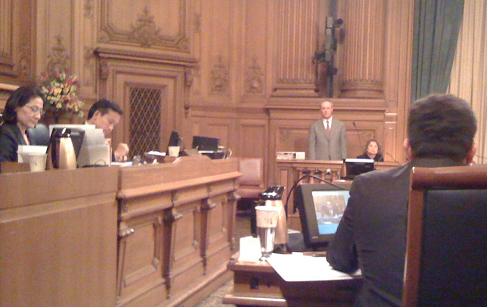
The San Francisco Board of Supervisors unanimously approved a process for replacing Mayor Gavin Newsom last night after the progressive majority stuck together on a pair of key procedural votes and some parliamentary jousting provided a preview of the high-stakes power struggle that will begin Dec. 7.

Sup. Sean Elsbernd led the board moderates (Sups. Carmen Chu, Michela Alioto-Pier, Bevan Dufty, and Sophie Maxwell) in trying to dilute the voting power of the six progressives on the board (Sups. David Chiu, Chis Daly, David Campos, Eric Mar, Ross Mirkarimi, and John Avalos) and ensure they can’t vote as a bloc to choose the new mayor.

State conflict-of-interest rules spelled out by the California Political Reform Act and associated rulings prevent supervisors from voting in their economic interests, as becoming mayor would be. So Board Clerk Angela Calvillo and the Santa Clara County Counsel’s Office (legal counsel in the matter after our own City Attorney’s Office recused itself) created procedures whereby all nominees leave the room while the remaining supervisors vote.

But as Daly noted, clearing several supervisors from the room would make it unlikely that those remaining to come up with six votes for anyone. He also said the system would deny too many San Franciscans of a representative in this important decision and allow sabotage by just a few moderate supervisors, who could vote with a majority of supervisors present to adjourn the meeting in order to push the decision back to the next board that is sworn in on Jan. 11.

“The process before us is flawed,” Daly said.

So Daly sought to have the board vote on every nomination as it comes up, but Elsbernd argued that under Robert’s Rules of Order, nominations don’t automatically close like that and to modify a board rule that contradicts Robert’s Rules requires a supermajority of eight votes. Calvillo, who serves as the parliamentarian, agreed with that interpretation and Chiu (who serves as chair and is the final word on such questions) ruled that a supermajority was required.

Although some of his progressive colleagues privately grumbled about a ruling that ultimately hurt the progressives’ preferred system, Chiu later told the Guardian, “I gotta play umpire as I see the rules…We need to ensure the process and how we arrive at a process is fair and transparent.”

Nonetheless, Chiu voted with the progressives on the rule change, which failed on a 6-5 vote. But Daly noted that supervisors may still refuse nominations and remain voting until they are ready to be considered themselves, which could practically have the same effect as the rejected rule change. “If we think that’s a better way to do it, we can do it, but we don’t need to fall into the trap and subterfuge of our opponents,” Daly told his colleagues.

Elsbernd then moved to approve the process as developed by Calvillo, but Daly instead made a motion to amend the process by incorporating some elements on his plan that don’t require a supermajority. After a short recess to clarify the motion, the next battleground was over the question of how nominees would be voted on.

Calvillo and Elsbernd preferred a system whereby supervisors would vote on the group of nominees all at once, but Daly argued that would dilute the vote and make it difficult to discern which of the nominees could get to six votes (and conversely, which nominees couldn’t and could thereby withdraw their nominations and participate in the process).

“It is not the only way to put together a process that relies on Robert’s Rules and board rules,” Daly noted, a point that was also confirmed at the meeting by Assistant Santa Clara County Counsel Orry Korb under questioning from Campos. “There are different ways to configure the nomination process,” Korb said. “Legally, there is no prohibition against taking single nominations at a time.”

So Daly made a motion to have each nominee in turn voted up or down by the voting board members, which required only a majority vote because it doesn’t contradict Robert’s Rules of Order. That motion was approved by the progressive supervisors on a 6-5 vote.

Both sides at times sought to cast the other as playing procedural games, and both emphasized what an important decision this is. “This is without a question the most important vote that any of us will take as a member of the Board of Supervisors and one that everyone is watching,” Elsbernd said of choosing a new mayor.

So after the divisive procedural votes played out, Chiu stepped down from the podium and appealed for unity around the final set of procedures. He said that San Franciscans need to have confidence that the process is fair and accepted by all, and so, “It would be great if we have more than a 6-5 vote on this.”

As the role call was taken, Carmen Chu was the first moderate to vote “yes,” and her colleagues followed suit on a 11-0 vote to approve the process. At that point, the board could have begun taking nominations, but it was already 7 p.m. and both Daly and Chiu argued to delay that process by couple weeks.

“We owe it to ourselves and this city to have a discussion [of what qualities various supervisors want to see in a new mayor] before we get into names and sequestration,” Daly said.

He and other progressive proposed to continue this discussion to Dec. 7, but Elsbernd – who was visibly agitated by the discussion – suddenly moved to table the item (which would end the discussion without spelling out the next step), a motion rejected on a 4-7 vote, with Maxwell joining the progressives.

The discussion ended with a unanimous vote to continue the item to Dec. 7, when supervisors will discuss what they want in a new mayor and possibly begin the process of making and voting on nominations. Anyone who receives six votes will need to again be confirmed during the board meeting on Jan. 4, a day after Newsom assumes the office of lieutenant governor.

About that “far left beating…”

61

Our old pal Chuck Nevius is gloating about how the “far left” (I guess that means the people who would have been called mainstream Democrats a generation ago, the ones who believe in the public sector and think economic equality matters) got beaten badly in the supervisors races. And he uses Aaron Peskin as the personification of the far left (amusing, because if you actually talk to Peskin, and look at his record, he’s hardly a crazy leftist. And I say that as someone who is. A crazy leftist, I mean.)

Anyway, here’s what Nevius missed:

Malia Cohen is on the Board of Supervisors because of Aaron Peskin.

Look at what happened in the ranked choice voting. Cohen came from back in the pack because of second-place votes — and a lot of that was because the Democratic County Central Commitee put her as its #2 choice, after DeWitt Lacy, who didn’t run much of an effective campaign.

How did she get the #2? How did a candidate who is bad on tenant issues beat out Tony Kelly, who was by far the most progressive contender, at the supposedly “far left” DCCC? That was the work of Peskin — who, to the chagrin of a lot of progressives (including me) decided to vote for and promote Cohen as the second choice on the slate.

First of all, that was hardly the move of a “far leftist,” since Cohen certainly ran as a more moderate candidate. Second, it showed that the “far left” isn’t some giant organized hippie commie bloc led by Commisar Peskin; it’s a sometimes-united, often-fractious coalition that shares some interests and agendas but doesn’t always have its shit together.

Then there’s this notion the moderates swept into power. Actually, by chance of the way lines are drawn, the even-numbered seats have always been more conservative than the odd-numbered ones. In this case, in many of the races, the progressives were (to quote Calvin Welch) “playing with the house’s money.” Check it out:

D2: Janet Reilly would have been much more reasonable than Michela Alioto-Pier, but Mark Farrell won’t be any worse. Almost by definition, he can’t be any worse than Alioto-Pier. That was a conservative seat, and still is.

D4: No change at all, still Carmen Chu, still a moderate-to-conservative seat.

D6: I supported Debra Walker, but by no stretch of the imagination is Jane Kim anything but a progressive. She’ll be more conciliatory than Chris Daly, but that’s not difficult; Walker would have been more conciliatory, too. Different people, different personalities. But in the end, Kim will be a progressive vote; I mean, she started out as a Green Party leader. The “far left” held that district.

 D8: Definitely the house’s money. Scott Wiener won’t be a whole lot different on the issues than Bevan Dufty. If Rafael Mandelman had won, it would have been a net pickup for the left, but as it is, I’d call it a wash. Sure, the DCCC endorsed Mandelman and he lost, but we all know that was an uphill battle; Wiener has been working that district for years, had plenty of money, was better-known, had the support of Mark Leno, who once held that seat and is immensely popular in the district.   

D10: Sophie Maxwell was never part of the progressive bloc on the board. Sometimes she voted with them; sometimes she didn’t. Tony Kelly would have increased the size of the progressive majority; Malia Cohen doesn’t change it.

In two years, five key progressive seats will be on the ballot — Eric Mar seeking re-election in D1, David Chiu in D3, Ross Mirkarimi termed out and an open race in D5, and David Campos and John Avalos running again in D9 and D11. That’s where the battle to hold the progressive majority will be fought — and those are districts where the DCCC has more influence anyway.

In other words, since the return of district election, the progressives — the “far left” if that’s what you want to call us — have only held one of the five even-numbered seats, and still do. That’s not spin, Chuck; that’s reality.

 PS: Just for fun, I went back four years and checked out our endorsements for supervisor the last time the even-numbered seats were up. W endorsed Sophie Maxwell for re-election in D10 (with reservations, and lacking a credible progressive alternative) and Daly was re-elected with our support in D6. But our candidates lost in D2, D4 and D8.  Nobody talked about the left getting destroyed.

Fighting dirty

1

rebeccab@sfbg.com

One by one, representatives from California local governments who had gone toe-to-toe with Pacific Gas & Electric Co. recounted their war stories. They were weary, fatigued, and uncertain of the future. Their resources had been depleted by hefty legal expenses, and they were forever caught up in the game of trying to undo the damage of misinformation campaigns whipped up against them by PG&E. None had ever suspected that following state law would be so arduous.

At a Nov. 8 hearing of the California Senate Select Committee on Renewable Energy, held in San Rafael, officials from the San Joaquin Valley, Marin County, and San Francisco spoke about challenges they faced trying to initiate community choice aggregation (CCA) programs, which would create alternative electricity providers to PG&E.

In accordance with Assembly Bill 117, which allows local governments to purchase power in bulk and distribute it to a customer base using the infrastructure and billing systems operated by investor-owned utilities, representatives from local government agencies said they pursued CCAs to bolster local economies and benefit the environment — but quickly fell prey to fierce marketing campaigns.

So far, PG&E hasn’t faced any real consequences for trying to derail its competitors using unethical and sometimes illegal tactics, and the director of the California Public Utilities Commission, Paul Clanon, did not commit to imposing fines or sanctions against the company.


COOPERATING FULLY

Despite a requirement under AB117 that utilities must “cooperate fully” with CCA implementation, agency representatives testified that PG&E consistently tried to obstruct their success. The San Joaquin Valley Joint Power Authority’s CCA effort was suspended after a protracted legal battle, and has yet to be revisited.

At the hearing, Sen. Mark Leno listened attentively and offered sympathetic words of encouragement. “It is a superhuman accomplishment that you are even here with us today,” he jested after Dawn Weisz, interim director of the Marin Energy Authority (MEA), finished describing a litany of tactics the monolithic utility employed against Marin’s CCA.

Marin’s experience may foreshadow what’s in store for San Francisco. CleanPower SF, the city’s CCA program, is picking up steam again after an initial attempt to hire a contractor failed to yield an acceptable agreement. On Nov. 5, the San Francisco Public Utilities Commission (SFPUC) announced it had received four responses to a second RFP for an electricity service provider to administer the city’s CCA.

Already San Francisco has weathered some attacks. Sup. Ross Mirkarimi, who chairs the Local Agency Formation Commission (LAFCo) and has been a key figure in moving CCA forward, characterized Marin and San Francisco as “brothers and sisters in arms,” saying, “We would share what we knew of what we could expect, because we were no strangers to these tactics.”

Weisz noted that early on, PG&E sent lobbyists to meet privately with local elected officials. Soon after, the company upped the ante with a negative marketing campaign, distributing mailers that contained misleading information about the program. Their activity prompted a rebuke — but no fines — from the CPUC. “I sent PG&E a letter to say knock it off,” Clanon said at the hearing.

PG&E also set up a phone-banking operation to dial up every prospective CCA customer in Marin County and encourage them to opt out of the program and used false information to persuade customers to stick with PG&E service, Weisz charged. “Many were led to believe that their lights wouldn’t go on if they didn’t opt out,” she said.

Once the CCA was in operation, PG&E imposed a delay on the billing process that made one month’s bill artificially low and the subsequent bill abnormally high, making it appear that CCA rates were higher than PG&E rates. This gaffe, which the company chalked up as a technical error, amounted to a sleight-of-hand: “Our rates were set to match PG&E rates,” Weisz explained.

PG&E did not return calls seeking comment.

Against all odds, Marin County is forging ahead with a power program that offers a 26.5 percent renewable energy mix, with 78 percent of its power generated without greenhouse gas emissions. State records show that only 14 percent of PG&E’s energy comes for renewable sources, failing to meet a state requirement that utilities get at least 20 percent of their power from such sources.

Charles McGlashan, a Marin County supervisor who chairs the Marin Energy Authority, noted that implementing a CCA was the most effective method the county could have employed to reduce greenhouse gas emissions, yielding an estimated 500,000-ton reduction of greenhouse gas emissions annually.

While the potential exists for other municipalities to follow suit, PG&E smear campaigns will likely discourage similar projects. “This is a powerful opportunity that has been virtually destroyed by the antics of PG&E,” McGlashan said. “It has had an extraordinary chilling effect on the political leaders to even embark on such an enterprise.” Later he added, “I’m only doing it because I’m so hell-bent on answering the children’s questions about climate change.”


STORM COMING

Meanwhile, in San Francisco, CCA advocates are getting ready to batten down the hatches. “We’re under no illusion — PG&E will compete fiercely,” San Francisco Public Utilities Commission spokesperson Charles Sheehan told the Guardian. He said the city was taking a proactive approach by conducting early outreach to residents and holding public informational meetings about CleanPower SF.

The SFPUC has received four bids from prospective electricity service providers. The respondents are Constellation Energy Commodities Group, Shell Energy North America, Power Choice Inc. (which was selected during the last RFP process but was unable to secure a binding agreement with the city), and Noble Americas Energy Solutions, formerly known as Sempra Energy Solutions. During the Senate hearing, San Francisco CCA director Mike Campbell noted that the city expected to complete a scoring process and select one of the four by the end of the year. The goal is to be fully operational by 2011, he added.

Leno predicted resistance from PG&E. “It’s like a storm coming in,” he said. “We have no doubt of its arrival. They have endless opportunities for nefarious creativity.” He queried Clanon on why the PUC wouldn’t levy fines or sanctions against the utility for the negative campaigns it waged in Marin, as a way to signal that such activity wouldn’t be tolerated in San Francisco.

Clanon did not commit to taking such an action. “That’s a choice about how you get the right behavior,” he said. He noted that the CPUC issued a decision last May preventing the utility from distributing false or misleading information about CCAs or illegally soliciting opt-outs. Clanon warned that PG&E might not be deterred by “fines and sanctions and specific rules.” Pressed on this point later, Clanon told the Guardian that imposing fines or sanctions “would take a lot of resources by us” at a time when the state agency is consumed with other pressing issues, such as the aftermath of the San Bruno explosion caused by a PG&E gas pipeline rupture. “If you set a rule, more people get around the rule,” he said.

Even if the state regulatory body doesn’t hold PG&E’s feet to the fire, Mirkarimi won’t hold back. “We’re tired of the thuggery. We’re tired of the bullying,” he said. He alluded to the Raker Act, a 1913 act of Congress that allowed San Francisco to build the O’Shaughnessy Dam and draw water from the Hetch Hetchy Reservoir under the condition that no private profit was derived from the development, saying the arrangement had been subverted by PG&E. “We should be able to chart our own energy destiny,” Mirkarimi said.

The next mayor

108

tredmond@sfbg.com

By the time a beaming Mayor Gavin Newsom took the stage at Tres Agaves, the chic SoMa restaurant, on election night, enough results were in to leave no doubt: the top two places on the California ballot would go to the Democrats. Jerry Brown would defeat Meg Whitman in the most expensive gubernatorial race in American history — and Newsom, who once challenged Brown in the primary and dismissed the office of lieutenant governor, would be Brown’s No. 2.

It might not be a powerful job, but Newsom wasn’t taking it lightly anymore. “We can’t afford to continue to play in the margins,” he proclaimed proudly, advancing a vague but ambitious agenda. “There is absolutely nothing wrong with California that can’t be fixed with what’s right with California.”

But around the city, as results trickled in for the local races, the talk wasn’t about Newsom’s role in the Brown administration, or the change the Democrats might bring to Sacramento. It was about the profound change that could take place in his hometown as he vacates the office of mayor a year early — and opens the door for the progressives who control the Board of Supervisors to appoint a chief executive who agrees with, and is willing to work with, the majority of the district-elected board.

At a time when the Republican takeover of Congress threatens to create gridlock in Washington, there’s a real chance that San Francisco’s government — often paralyzed by friction between Newsom and the board — could take on an entirely new direction. It’s possible that the progressives, long denied the top spot at City Hall, could put a mayor in office who shares their agenda.

This could be a turning point in San Francisco, a chance to put the interests of the neighborhoods, the working class, small businesses, the environmental movement, and economic justice ahead of the demands of downtown and the rich. All the pieces are in place — except one.

To make a progressive vision happen, the fractious (and in some cases, overly ambitious) elected leaders of the progressive movement will have to recognize, just for a little while, that it’s not about any individual. It’s not about David Chiu, or Ross Mirkarimi, or Chris Daly, or John Avalos, or Eric Mar, or David Campos, or Jane Kim, or Aaron Peskin. It’s not about any one person’s career or personal power.

It’s about a progressive movement and the issues and causes that movement represents. And if the folks with the egos and personal gripes and career designs can’t set them aside and do what’s best for the movement as a whole, then the opportunity of a generation will be wasted.

Folks: this is a hard thing for politicians to recognize. But right now it’s not about you. It’s about all of us.

It’s an odd time in San Francisco, fraught with political hazards. And it’s so confusing that no one — not the elected officials, not the pundits, not the lobbyists, not the insiders — has any clear idea who will occupy Room 200 in January.

Here’s the basic scenario, as described by past opinions of the city attorney’s office:

Under the state Constitution, Newsom will take office as lieutenant governor Jan. 3, 2011. The City Charter provides that a vacancy in the Mayor’s Office is filled by the president of the Board of Supervisors until the board can choose someone to fill the job until the end of the term — in this case, for 11 more months.

So if all goes according to the rules (and Newsom doesn’t try to play some legal game and delay his swearing-in), David Chiu will become acting mayor on Jan.3. He’ll also retain his job as board president.

On Jan. 4, the current members of the Board of Supervisors will hold a regularly scheduled Tuesday meeting — and the election of a new mayor will be on the agenda. If six of the current supervisors can agree on a name (and sitting supervisors can’t vote for themselves) then that person will immediately take office and finish Newsom’s term.

If nobody gets six votes — that is, if the board is gridlocked — Chiu remains in both offices until the next regular meeting of the board — a week later, when the newly elected supervisors are sworn in.

The new board will then elect a board president — who will also instantly become acting mayor — and then go about trying to find someone who can get six votes to take the top job. If that doesn’t work — that is, if the new board is also gridlocked — then the new board president remains acting mayor until January 2012.

There are at least three basic approaches being bandied about. Some people, including Newsom and some of the more conservative members of the board, want to see a “caretaker” mayor, someone with no personal ambition for the job, fill out Newsom’s term, allowing the voters to choose the next mayor in November, 2011. That has problems. As Campos told us, “The city has serious budget and policy issues and it’s unlikely a caretaker could handle them effectively.” In other words, a short-termer will have no real power and will just punt hard decisions for another year.

Then there’s the concept of putting in a sacrificial progressive — someone who will push through the tax increases and service cuts necessary to close a $400 million budget gap, approve a series of bills that stalled under Newsom, take the hits from the San Francisco Chronicle, and step out of the way to let someone else run in November.

The downside of that approach? It’s almost impossible for a true progressive to raise the money needed to beat a downtown candidate in a citywide mayor’s race. And it seems foolish to give up the opportunity to someone in the mayor’s office who can run for reelection as an incumbent.

Which is, of course, the third — and most intriguing — scenario.

The press, the pundits, and the mayor have for the past few months been pushing former Sup. Peskin as the foil, trying to spin the situation to suggest that the current chair of the local Democratic Party is angling for a job he wouldn’t win in a normal election. But right now, Peskin is no more a front-runner than anyone else. And although he’s made no secret in the past of wanting the job, he’s been talking of late more about the need for a progressive than about his own ambitions.

“If the board chose [state Assemblymember] Tom Ammiano, I would be thrilled to play a role, however small, in that administration,” Peskin told us.

In fact, Peskin said, the supervisors need to stop thinking about personalities and start looking at the larger picture. “If we as a movement can’t pull this off, then shame on us.”

Or as Sup. Campos put it: “We have to come together here and do what’s right for the progressive movement.”

Two years ago, the San Francisco left was — to the extent that it’s possible — a united electoral movement. In June, an undisputed left slate won a majority on the Democratic County Central Committee. In November 2008, Districts 1, 3, 5, and 11 saw consensus left candidates running against downtown-backed opponents — and won. In D9, three progressives ran a remarkably civil campaign with little or no intramural attacks.

The results were impressive. As labor activist Gabriel Haaland put it, “we ran the table.”

But that unity fell apart quickly, as a faction led by Daly sought to ensure that Sup. Ross Mirkarimi couldn’t get elected board president. Instead that job went to Chiu — the least experienced of the supervisors elected in that class, and a politician who is, by his own account, the most centrist member of the liberal majority.

This fall, the campaign to replace Daly in D6 turned nasty as both Debra Walker and Jane Kim openly attacked each other. Walker sent out anti-Kim mailers, and Kim’s supporters charged that Walker was part of a political machine — a damaging (if silly) allegation that created a completely unnecessary rift on the left.

And let’s face it: those fights were all about personality and ego, not issues or progressive strategy. Mirkarimi and Daly have never had any substantive policy disagreements, and neither did Walker and Kim.

In the wake of that, progressives need to come together if they want to take advantage of the opportunity to change the direction of the city. It’s not going to be easy.

“We’re good at losing,” Daly said. “I’m afraid we’re doing everything we can to blow it.”

The cold political calculus is that none of the current board members can count on six votes, and neither can Peskin or any of the other commonly mentioned candidates. The only person who would almost certainly get six votes today is Ammiano — and so far, he’s not interested.

“I know you never say never in politics, but I’m happy here in Sacramento. Eighty-six percent of the voters sent me back for another term, and I think that says something,” he told us.

It’s hardly surprising that someone like Ammiano, who has a secure job he likes and soaring approval ratings, would demur on taking on what by any account will be a short-term nightmare. The city is still effectively broke, and next year’s budget shortfall is projected at roughly $400 million. There’s no easy way to raise revenue, and after four years of brutal cuts, there’s not much left to pare. The next mayor will be delivering bad news to the voters, making unpleasant and unpopular decisions, infuriating powerful interest groups of one sort or another — and then, should he or she want the job any longer, asking for a vote of confidence in November.

Yet he power of incumbency in San Francisco is significant. The past two mayors, Newsom and Willie Brown, were reelected easily, despite some serious problems. And an incumbent has the ability to raise money that most progressives won’t have on their own.

Chiu thus far is being cautious. He told us his main concern right now is ensuring that the process for choosing the next mayor is open, honest, and legally sound. He won’t even say if he’s officially interested in the job (although board observers say he’s already making the rounds and counting potential votes).

And no matter what happens, he will be acting mayor for at least a day, which gives him an advantage over anyone else in the contest.

But some of the board progressives are unhappy about how Chiu negotiated the last two budget deals with Newsom and don’t see him as a strong leader on the left.

Ross Mirkarimi is the longest-serving progressive (other than Daly, who isn’t remotely a candidate), and he’s made no secret of his political ambitions. Then there’s Campos, an effective and even-tempered supervisor who has friendly relationships with the board’s left flank and with centrists like Bevan Dufty. But even if Dufty (who I suspect would love to be part of electing the first openly gay mayor of San Francisco) does support Campos, he’d still need every other progressive supervisor. Campos also would need Chiu’s vote to go over the top. Which means Chiu — who needs progressive support for whatever his political future holds — would have to set aside his own designs on the job to put a progressive in office.

In other words, some people who want to be mayor are going to have to give that up and support the strongest progressive. “If there’s someone other than me who can get six votes, then I’m going to support that person,” Campos noted.

Then there are the outsiders. City Attorney Dennis Herrera has already announced he plans to run in the fall. If the board’s looking for a respected candidate who can appeal to moderates as well as progressives, his name will come up. So will state Sen. Mark Leno, who has the political gravitas and experience and would be formidable in a re-election campaign in November. Leno doesn’t always side with the left on local races; he supported Supervisor-elect Scott Wiener, and losing D6 candidate Theresa Sparks. But he has always sought to remain on good terms with progressives.

All that assumes that the current board will make the choice — and even that is a matter of strategic and political dispute. If the lame duck supervisors choose a mayor — particularly a strong progressive — you can count on the San Francisco Chronicle, Newsom, and the downtown establishment to call it a “power grab” and cast doubt on the legitimacy of the winner.

“But choosing a mayor is the legal responsibility of this board and they ought to do their jobs,” Peskin said.

The exact makeup of the next board was still unclear at press time. Jane Kim is the likely winner in D6 and has always been a progressive on the School Board. She’s also close to Chiu, who strongly supported her. If Malia Cohen or Lynette Sweet wins D10, it’s unlikely either of them will vote for a progressive mayor.

Newsom also might try to screw things up with a last-minute power play. He could, for example, simply refuse to take the oath of office as lieutenant governor until after the new board is seated.

Chiu’s allies say it makes sense for the progressives to choose a mayor who’s not identified so closely with the left wing of the board, who can appeal to the more moderate voters. That’s a powerful argument, and Herrera and Leno can also make the case. The progressive agenda — and the city — would be far better off with a more moderate mayor who is willing to work with the board than it has been with the arrogant, recalcitrant, and distant Newsom. And if the progressives got 75 percent of what they wanted from the mayor (as opposed to about 10 percent under Newsom), that would be cause to celebrate.

But to accept that as a political approach requires a gigantic assumption. It requires San Franciscans to give up on the idea that this is still, at heart, a progressive city, that the majority of the people who live here still believe in economic and social justice. It means giving up the dream that San Francisco can be a very different place, a city that’s not afraid to defy national trends and conventional wisdom, a place where socioeconomic diversity is a primary goal and the residents are more important than the big companies that try to make money off them. It means accepting that even here, in San Francisco, politics have to be driven by an ever-more conservative “center.”

It may be that a progressive can’t line up six votes, that a more moderate candidate winds up in the Mayor’s Office. But a lot of us aren’t ready yet to give up hope.

Additional reporting by Noah Arroyo.

Advocates say Steve Li is DREAM Act eligible

4

The Board of Supervisors plans to introduce a resolution at their Nov. 9 meeting denouncing the deportation of Shing Ma “Steve” Li, a  20-year-old DREAM Act student at City College of San Francisco, calling for Immigration and Customs Enforcement to grant him deferred action status, and urging Congress to pass the DREAM (Development, Relief and Education for Alien Minors) Act.

The move comes the same day San Francisco Unified School District Board President Jane Kim (leading in the as yet unresolved race to replace termed-out D6 Sup.Chris Daly) plans to introduce a similar resolution at the SFUSD Board meeting, and a week after City College Board Trustee Lawrence Wong introduced a resolution supporting Li, who has lived in California since 2002 and is studying to be a nurse , but is now in an immigration detention center in Arizona.

“It’s unreal how fast things change”, Li said in a statement made from Arizona, just seven weeks after ICE raided his home and arrested him.

Li, who is ethnically Chinese, was born in Peru as his parents fled political persecution in China. And  ICE is allegedly preparing to deport him to Peru, which he left when he was 12. (Calls to ICE had not been returned as of blog post time, but I’ll update this blog, when I get a reply.)

“He knows no one in Peru,” said Li’s lawyer, Sin Yen Ling, senior staff attorney at the Asian Law Caucus, as she described how Li’s grandma returned to China, when his grandfather died.

Five years ago, the U.S. denied Li’s parents political asylum from China and issued a removal order. But Li says he was unaware of his immigration situation until his home was raided, and advocates and community members believe his case illustrates how the U.S.’s immigration system tears up families and targets contributing members of society.

Li’s Sept. 15 arrest occurred one week before Congress failed to vote on the DREAM Act, which would provide a pathway to legalization to undocumented students who’ve grown up in the US and atten two years of college or served two years of the military.

“It’s critical to pass the DREAM Act before the new Congressional session, but Steve literally cannot wait and is set for deportation any day now, that’s why we need our Senators’ leadership today,”  Li’s attorney Sin Yen Ling told me, noting that so far their has been no response from Sen. Dianne Feinstein, and that advocates are planning to target Sen. Barbara Boxer, now that the election is over.

In their resolution, Board President David Chiu and Sups. Eric Mar, John Avalos, David Campos and Ross Mirkarimi note that the DREAM Act is “bipartisan legislation that addresses the situation faced by young people who were brought to the United States years ago as undocumented immigrant children, and who have since grown up here, stayed in school, and kept out of trouble.”

These five supervisors note that each year, 65,000 U.S.-raised students who qualify from the DREAM Act’s benefits graduate. They also note that Democratic Sen. Dick Durbin and Republican Sen. Richard Lugar asked Department of Homeland Security Secretary Janet Napolitano on April 21, 2010 to halt the deportation of immigrant students who could earn legal status under the DREAM Act, which has the support of the House and Senate leadership, all of the relevant committee chairs, the nation’s military leaders, and President Barack Obama.

“I will do whatever it takes to support efforts to pass this bill so I can sign it into law on behalf of students seeking a college education and those who wish to serve in our country’s uniform. It’s the right thing to do,” Obama told the Congressional Hispanic Caucus on September 15, 2010—the same day that Li was arrested in San Francisco.

Update: Since writing this blog, I got a call back from ICE’s Lori Haley, who said she was limited in how much information she could share, but sent me this statement concerning Li:

“Shing Ma Li was taken into custody by ICE Fugitive Operations team officers on September 15, 2010, based upon a final order of removal issued by an immigration judge in 2004.  In 2005, the Board of Immigration Appeals (BIA) reviewed his case and upheld the immigration judge’s decision.  Shing Ma Li currently remains in ICE custody while the agency seeks to make arrangements for his removal.”


Waiting to inhale

0

news@sfbg.com

Much of the controversy around Proposition 19, which would legalize marijuana in California for even nonmedical uses, involves speculation about what comes next. Hash bars on Market Street? Packs of joints next to the cigarettes in Mission District bodegas? Bags of green buds available with the bongs for sale on Haight Street? They are questions that have yet to get serious consideration in the city where the medical marijuana movement was launched.

The measure would give local governments almost complete control over how to regulate recreational-use cannabis sales in much the same way that cities set their own standards for medical marijuana dispensaries, a realm in which San Francisco has shown real leadership and created a well-functioning, successful, and legitimate industry (see “Marijuana goes mainstream,” Jan. 27).

But San Franciscans have been slow to prepare for the post-Prop. 19 world, with some other Bay Area cities leaving it in the dust on these issues. Oakland City Council Member Rebecca Kaplan, who is now running for mayor, not only spearheaded that city’s ballot measures on taxing recreational pot sales and permitting large scale growing operations, she’s actively talking using the Amsterdam model to revitalize the city’s downtown business district.

“[Hash bars] absolutely potentially would be part of the mix,” Kaplan told us when we asked about the issue during her mayoral endorsement interview, seeing it as part of a multipronged economic development strategy.

When asked if Oakland should have places where people could go to blaze legally, something Oakland doesn’t allow in its medical marijuana dispensaries, Kaplan said, “Yes. Oh yeah, we’re definitely gonna have those. The only question is gonna be whether the consumption facilities are separate from [those for] sales,” or if they’re under the same roof.

Kaplan thinks this will be part of the winning strategy that takes cannabis use off street corners while acknowledging its appeal to visitors and “synergy with the restaurants. When I talk about wanting to replicate the Amsterdam model in Oakland … it doesn’t just mean that you have … a regulated cannabis facility. You also have restaurants, shops, pedestrian safety, nice lighting, patio dining, musicians, artists.”

She points out that although an Oakland-regulated cannabis industry may use current alcohol regulation as a template, the two substances would not be sold alongside each other. “Frankly, ABC [California Department of Alcoholic Beverage Control) will freak out.” That means, at least in Oakland, you won’t be able to purchase cannabis at bars, liquor, or grocery stores.

On this side of the bay, Sup. Ross Mirkarimi — who wrote the regulations on the city’s medical marijuana facilities — says it is “extremely premature” to contemplate Amsterdam-esque hash bars. “That would have to occur within a strong regulatory framework,” he said, one the Board of Supervisors has yet to envision. San Francisco attorney David Owen, who has helped advise some medical marijuana purveyors, said some dispensaries currently allow on-site medication, and San Francisco might legislate to extend the practice to bars.

Meanwhile other California cities such as Berkeley and Oakland are anticipating Prop. 19’s passage much more proactively. Berkeley’s Measure S would tax cannabis businesses, applying different rates to for profit med-use cannabis businesses, nonprofit med-use businesses, and rec-use businesses (which won’t exist unless Prop 19 passes). The measure would secure medical-use cannabis for low-income patients and tighten regulations on Berkeley’s current med-use dispensaries and cultivators regardless of how Prop. 19 fares. There’s also a Measure T on the ballot that would establish a new committee that, in the event that Prop. 19 passes, would advise city officials on how to implement it.

Berkeley City Council Member Kriss Worthington said planning for the post-Prop. 19 world is smart to “synchronize a forward movement on the state and local level” and to “hit the ground running,” a sentiment that Kaplan also voiced for Oakland and one shared by other cities.

Stockton’s Measure I would tax rec-use cannabis businesses at a higher rate than med-use businesses. Sacramento’s Measure C is similar, containing a provision for a rec-use tax range if Prop. 19 passes. Richmond’s Measure V would tax 5 percent of gross sales of cannabis, and could apply to rec-use businesses too. Oakland’s Measure V would add a 5 percent tax to other taxes already on med-use cannabis, and put a 10 percent sales tax on rec-use cannabis. Measure H, on Rancho Cordova’s ballot, would tax personal cultivation at a higher tax on any square footage beyond the 25 square feet that Prop 19 specifies. Long Beach’s Measure B would establish a business license tax on the city’s potential recreational cannabis businesses. Even Albany, which has no dispensaries, would tax for-profit and nonprofit dispensaries differently through its Measure Q.

But Mirkarimi said he would like to tax marijuana cultivation, and has even voiced support for med-use cannabis dispensaries working directly with SF General Hospital to provide to patients, “thereby segregating a special use” and keeping cannabis prices low or nonexistent based on patient needs.

So if Prop. 19 passes, where will San Franciscans be able to purchase rec-use cannabis? Current med-use dispensaries may be a logical choice. “We already have the infrastructure,” said SF dispensary Medithrive co-owner Daniel Bornstein.

Whereas alcohol purveyors are accustomed to providing one barrier to purchase (when they card the buyer), dispensaries such as Medithrive offer many. “We already card and only accept patronage from those with a valid doctor recommendation. We also require he/she become a member of the dispensary and limit to one visit per day.”

When he contemplates whether Medithrive might provide rec-use cannabis in the future, Bornstein says “If [the city adopts] a responsible statute that’s fair, we would welcome the opportunity to offer a broadened service to more people.”

That avenue troubles Mirkarimi. “I don’t know how that works,” he said. Rec-use cannabis purchase would require no doctor’s notes and could occur within a for-profit business model. How would dispensaries legally reconcile making money under their nonprofit status? “I don’t want to put that burden on them,” Mirkarimi said.

Prop. 19 offers other potential implementation conundrums. For example, the measure will only give local governments the option to legalize the limited cultivation/sale of cannabis. Legalization won’t be compulsory. Therefore, it is likely that a post-Prop. 19-approved California will become a patchwork of alternating “dry” and “wet” municipalities.

So let’s say you’re on a road trip and you pass through many cities that all treat cannabis differently. Bornstein and his Medithrive partner Misha Breyburg worry about such a “patchwork of legal complexity.” But Prop. 19 provides for the legal transport of cannabis through cities that prohibit its sale, and California Assemblymember Tom Ammiano has already proposed legislation to smooth out the rough spots in Prop. 19 and answer open questions.

So for now, everyone is just waiting to see what state voters do.


Endorsements 2010: San Francisco ballot measures

26

PROP. AA

VEHICLE REGISTRATION FEE

YES

Proposition AA would add $10 to the existing annual fee for vehicles registered in San Francisco, which would bring in about $5 million a year in desperately needed funds for public transit and other environmentally friendly modes of transportation. Proceeds would help to fund new bike infrastructure, pedestrian crosswalks, and transit reliability projects. Some would also be spent on street repairs — with top priority given to streets with bikeways and public transit routes. Unless Muni and bike infrastructure improves, it’s hard to persuade drivers to leave their cars at home and choose greener ways of getting around. Prop. AA is in line with the city’s transit-first goals, and it will be a step toward reducing traffic congestion and helping public transit. Vote yes.


PROP. A

EARTHQUAKE RETROFIT BOND

YES

This $46.15 million general obligation bond to support seismic upgrades for wood-framed buildings is an important means of protecting San Franciscans in an earthquake and preserving affordable housing. A 2009 report by the Department of Building Inspection found that 151 buildings that received government affordable housing support — 8,247 units in all — could be destroyed in the next big earthquake.

Unfortunately, most of these buildings are break-even ventures for their owners, who have no incentive to put the money into needed seismic upgrades. This measure would fund those improvements with grants and deferred loans, which would accrue interest but would only need to be paid back if the owner makes a profit or tries to convert the building to another use, providing further guarantees that the housing will remain affordable even after an owner’s obligation to the state or federal governments ends. Vote yes on Prop. A.


PROP. B

CITY RETIREMENT AND HEALTH PLANS

NO, NO, NO

Back when the great national health care reform debate was raging, the Guardian advocated for a single-payer system, which would have cut out health insurance companies altogether. What we got instead was a bill that requires everyone to buy health insurance. Now endlessly rising health insurance costs pose a problem for the city — in years of financial stress, it must make ever-larger payments to cover public employees’ health benefits. The blame for this dysfunctional system should be pinned on health insurance companies, not public employees. After all, the industry spent millions lobbying federal lawmakers to preserve a system in which they are solidly guaranteed to make millions off the backs of taxpayers.

But Prop. B, introduced by Public Defender Jeff Adachi, asks public employees to bear the brunt of these ballooning costs. It would also require them to contribute up to 10 percent of their pay to fund retirement benefits. One of the most compelling arguments against Prop. B was articulated by Assemblymember Tom Ammiano in a recent Guardian editorial: “A single mother will be forced to pay up to $5,600 per year for her child’s health care — in addition to the $8,154 she already pays.” That cost would be the same whether the employee earns $40,000 or $100,000 annually — and that’s just unfair. Prop. B would deal the greatest blow to the people who have the least. But there’s a broader consequence, too — take this kind of money out of the pockets of working people and you’ve done just the opposite of stimulating the economy.

Adachi wrote and circulated his measure without negotiating with city employee unions or seeking a solution that would be less harsh and regressive. We’re all for reviewing the city’s pension and health care costs. But making the lowest-paid city workers take the same hit as the overpaid managers is no answer. Vote no on B.


PROP. C

MAYOR APPEARANCES AT BOARD

YES

If you feel like you’ve seen this measure before, that’s because you have — an advisory measure asking the mayor to show up once a month and answer questions at the Board of Supervisors passed overwhelmingly in 2006. But Mayor Gavin Newsom ignored it, and a tougher measure failed the next year after Newsom raised $250,000 to defeat it.

Now the problem is worse than ever. In a year in which back room negotiations and underhanded political tactics marred the city budget approval process and other legislative initiatives, progressive supervisors are again trying to get Newsom and future mayors to engage in a political dialogue, in public, to determine what’s best for the city. This is precisely how the people’s business should be done, in an open and transparent way that respects the role that these two branches of government are supposed to play in running the city. Besides, won’t it be fun to watch? Vote yes.


PROP. D

NONCITIZEN VOTING IN SCHOOL BOARD ELECTIONS

YES

Sponsored by Board President David Chiu and Sups. David Campos, Eric Mar, John Avalos, Ross Mirkarimi, Sophie Maxwell, Chris Daly, and Bevan Dufty, this charter amendment would extend the right to vote in local school board elections to San Francisco residents who are parents, guardians, and caregivers of children who attend school in San Francisco, regardless of whether these residents are U.S. citizens.

One-third of San Francisco residents are foreign-born. Parental involvement has been determined as a critical factor in children’s education — and this measure only applies to elections for the Board of Education. Vote yes.


PROP. E

ELECTION DAY VOTER REGISTRATION

YES

In an era of growing political apathy and cynicism, anything that draws more people into the electoral process is a good thing. So this common sense measure by Sup. Ross Mirkarimi to remove one more barrier to participation in elections is a positive step.

Current state law requires eligible voters to register at least 15 days before an election. Prop. E would allow any city resident to simply show up at a polling place on Election Day, register to vote, and participate in a municipal election. Eight other states currently offer same-day voter registration. Vote yes.


PROP. F

HEALTH SERVICE BOARD ELECTIONS

NO

Sup. Sean Elsbernd, who sponsored this measure, says it will save the city money be consolidating elections for the board that oversees the city employee health care fund. But it won’t save much — $30,000 a year, at most — and the unions that represent the people who are served by this board say risks turning board elections into more expensive and complex political contests. Vote no.


PROP. G

TRANSIT OPERATOR WAGES

NO

We understand the motivations behind this measure — Muni drivers are the only city employees who don’t have to engage in collective bargaining for wages and work rules. Instead, the City Charter guarantees them the second-highest salary level of all comparable transit systems in the nation. Although that’s not an unreasonable salary level given that Muni is perhaps the country’s most challenging transit system and San Francisco has one of the highest cost of living price tags in the country, no city workers should have their salaries set this way.

We also agree that many of Muni’s work rules need to be changed and that removal of the salary guarantees would give the city more leverage to make those changes. We even agree that Transport Workers Union Local 250 hasn’t done itself any favors and should have been a better partner in this year’s difficult city budget process.

But we oppose Prop. G, which inappropriately seeks to blame Muni’s problems on its drivers and would set a new standard for collective bargaining that could hurt workers and perhaps make Muni more dangerous to pedestrians and others.

Like all city employees, Muni drivers are banned from going on strike. In exchange, the city agrees to binding arbitration if contract talks reach an impasse. But this measure adds a factor that exists in no other city union contract: the arbitrator would have to consider whether a proposed contract could negatively affect service.

While that might seem benign or even appropriate, the reality is that everything from driver rest breaks to assisting those with disabilities to the expectations of how fast drivers can complete a route all potentially affect service, forcing the arbitrator into positions of agreeing with city officials who have been choosing the politically expedient path of trying to squeeze more out of Muni without trying to give it the resources it needs to operate safely, efficiently, and reliably.

Earlier this year, progressive supervisors tried to craft an omnibus Muni reform measure that removed driver pay guarantees from the charter while also trying to get it more money and make critical changes in how the system is governed, an effort the TWU supported but that the supervisors ultimately abandoned. That’s the kind of balanced approach the system needs and it ought to be revived. In the meantime, vote no on G.


PROP. H

LOCAL ELECTED OFFICIALS ON POLITICAL PARTY COMMITTEES

NO

This one’s a pure political vengeance act by Mayor Newsom, who is unhappy that the local Democratic Party is controlled by progressives who oppose his initiatives. The measure would bar elected officials in San Francisco from serving on the Democratic or Republican County Central Committee. It’s almost certainly unconstitutional — the parties get to decide their own membership rules — and has no rationale at all except the mayor’s personal sour grapes. Vote no.


PROP. I

SATURDAY VOTING

YES

Okay, we’re suspicious of Prop I. The sponsor is Alex Tourke, a political consultant whose client list isn’t exactly a roster of progressive San Francisco. And it’s a little funky — it calls for an experiment in opening the polls the Saturday before the next mayoral election, with the costs covered by private donations. And the idea of private interests paying for an election strikes us as bad policy.

But at its base, the idea is sound. Tuesday voting is a very old idea that makes no sense in the modern age. We’d much rather see Election Day held at a time when most people aren’t working. In fact, we’d rather see the polls open for a week, not just one day. And this is a one-time test to see if weekend voting might increase turnout. Vote yes.

PROP. J

HOTEL TAX CLARIFICATION AND TEMPORARY INCREASE

YES

There are two competing hotel taxes on the November ballot: Prop. J and Prop K. Prop. K contains a poison pill: if both measures pass, whichever gets the most votes take effect. Both J and K try to address legal insufficiencies in San Francisco’s existing hotel tax, but Prop. J also asks visitors to pay a slightly higher tax — about $3 a night (the cost of a latte) — for the next three years.

Currently the way hotel taxes are assessed allows some online customers to avoid part of the tax. When a customer books a hotel room through an online booking service like Expedia or Orbitz, the hotel tax is only assessed on the amount that a hotel receives, not the amount that the website charges the customer. In other words, if a website sells a room to an online customer for $150 a night, but only $120 of that goes to the hotel, the customer is charged hotel tax on the lower amount. If Prop. J passes, the customer will have to pay a hotel tax on the full amount paid to the online booking service. The measure would also eliminate a loophole that allows airlines to book rooms for flight crews without paying any tax. Those changes are expected to generate at least $12 million a year. The $3 increase in the hotel tax will generate another $26 million.

The Chamber of Commerce and Convention and Visitors Bureau say the measure could hurt tourism — but it’s hard to imagine how somebody will decide not to visit San Francisco because of a $3 a night fee. Vote yes.


PROP. K

HOTEL TAX CLARIFICATION

NO

Put on the ballot by Mayor Newson at the behest of large hotel corporations, Prop. K also seeks to close loopholes in the hotel tax. But Prop. K doesn’t include a tax increase, meaning that it will contribute millions less to the city’s General Fund at a time when San Francisco is having trouble balancing its budget, leading to ongoing cuts in city staff and services.

Prop. K’s a direct attempt to undermine Prop. J. Vote no.


PROP. L

SITTING OR LYING ON SIDEWALKS

NO, NO, NO

What kind of a city is San Francisco? If proponents of Prop. L, the Civil Sidewalks Ordinance, were to be believed, it’s a city where nothing is done when uncivil people harass pedestrians, drink on the sidewalk, or pee in public. Even though Prop. L purports to address this kind of behavior, all it really does is outlaw sitting or lying on public sidewalks.

We think San Francisco is the kind of city that is smart enough to reject this dumb idea. The Prop. L proponents like to say it’s about public safety, but there is nothing inherently unsafe about sitting or lying down on the sidewalk. Street poets sit at their typewriters to sell sonnets to tourists. The tamale lady sometimes sits while selling her tasty Mexican treats. Day laborers sit when they get tired of standing around waiting for work. Many people who live on the streets lie down to sleep beside their shopping carts. If Prop. L passes, there is nothing to guarantee that buskers, day laborers, homeless people, partygoers, people with bad knees, or anyone else would not be harassed by police for the simple act of sitting.

But even if there are people squatting on the sidewalk harassing passersby, how is this law going to change that? All they have to do is stand up — which would still be legal. If they persist, and the police arrest them, the city will be on the hook for millions of dollars in costs for prosecution, defense, and incarceration.

The notion that the ordinance would only be used against troublemakers is problematic too, since a law that is selectively enforced could open the door to legal headaches. Prop. L is misguided, draconian, unnecessary, and the wrong direction for San Francisco. Vote no.


PROP. M

COMMUNITY POLICING AND FOOT PATROLS

YES

Prop. M offers an enlightened alternative to Prop. L. Introduced by Sup. Ross Mirkarimi, it would require the chief of police to establish a comprehensive beat patrol program, with cops on the beat, to deal with the safety and civility issues Prop. L seeks to address. It would also direct the Police Commission to adopt a written community policing policy, involving police interactions with the community, focusing police resources on high crime areas, and encouraging citizen involvement in combating crime. Prop. M also has a poison pill: if the voters adopt both M and L and M gets more votes, then the law against sitting or lying down on the sidewalk would not take effect. So a yes vote for Prop. M is kind of like another no vote against Prop. L. Vote yes.


PROP. N

REAL PROPERTY TRANSFER TAX

YES

With the city facing a massive structural budget deficit, it’s hard to argue against a measure that would bring in an average of $36 million without hurting anyone except the buyers and sellers of very high-end property — that is, big corporations and exceptionally wealthy individuals. Prop. N would slightly increase the tax charged by the city on the sale of property worth more than $5 million. Vote yes.


>>BACK TO ENDORSEMENTS 2010

The District 8 dilemma

13

tredmond@sfbg.com

Gabriel Haaland, a longtime queer labor activist, was talking to a friend from District 8 the other day, chatting about the race for a supervisor to fill the shoes of Harvey Milk, Harry Britt, Mark Leno, and Bevan Dufty. “She told me that she didn’t know who to vote for,” Haaland said, “because she didn’t know who the progressive was in the race.”

For supporters of Rafael Mandelman, that’s a serious challenge. “The polls are very consistent,” Haaland said. “Most of the voters in D-8 would prefer a progressive over a moderate, and when they know who the progressive is, they support that candidate.”

But oddly enough, although District 8 — the Castro, Noe Valley, and parts of the Mission — is one of the most politically active parts of the city, where voter turnout is consistently high, the supervisorial race is getting only limited media attention. The neighborhood and queer papers are doing a good job of covering the race, but for the rest of the media, it’s as if nothing’s happening. And that’s left voters confused about what ought to be a very clear choice.

The San Francisco Chronicle featured the District 6 race on the front page Sept. 19, with a long story about how demographic changes in the South of Market area would affect the successor to Sup. Chris Daly. District 10, with the mad political scrum of 22 candidates, no clear front runner and endorsements all over the map, has received considerable media attention.

Yet D–8 — which offers by far the most striking distinctions between candidates and the sharpest divisions over issues — has been flying under the radar.

Three major candidates are in the race, two gay men and a lesbian. All of them, for what it’s worth, are lawyers. Rafael Mandelman, who works for a firm that advises cities and counties, has the support of the vast majority of progressive leaders and organizations. Rebecca Prozan, a deputy district attorney, and Scott Wiener, a deputy city attorney, are very much on the moderate-centrist (some would say, by San Francisco standards, conservative) side of the political spectrum.

“As Barbara Boxer has said in her ads, the choice is clear,” Aaron Peskin, chair of the local Democratic Party and a Mandelman backer, told us. “Not to exaggerate, but this is like Boxer v. Carly Fiornia, and Rafael is our Boxer.”

Yet by almost all accounts, Wiener is ahead in the race.


ON THE ISSUES

The San Francisco Board of Supervisors has been roughly divided in the past decade between the progressive camp and moderate camp. And while those labels are hard to define (the Chronicle won’t even use the term “progressive,” preferring “ultraliberal”), most observers have a basic grip on the differences.

The moderates, who tend to support Mayor Gavin Newsom, are social liberals but fiscal conservatives. They talk about the city surviving budget red ink without major tax increases. They talk about controlling government spending and increasing public safety. The progressives generally see local government as underfunded after four years of brutal cuts and support the idea of raising new revenue to fill the gap. They support tenants over landlords, seek stronger protections for affordable housing, support Sanctuary City, and oppose sit-lie.

Certainly with Wiener and Mandelman, it’s abundantly clear where the candidates fall. The two agree on some things (they both oppose Prop. B, the pension-reform measure that would reduce health care payments for the children of city employees) and they both support nightlife. But overall, they take very different political stands.

Wiener told us, for example, that the city’s structural budget problems won’t be solved without cuts. “We’re not going to able to tax our way out of this,” he said in an endorsement interview. “We have to lower our expectations for government.”

Other than Muni, public safety, and core public health services, cuts “will have to be across the board,” he said. “What are the things we really can’t do without?”

Wiener supports the sit-lie proposal, saying that he doesn’t think the local police have the tools they need to get poorly behaving people off the streets. He doesn’t support Sup. Ross Mirkarimi’s measure mandating foot patrols because, he told us, he doesn’t think the supervisors should micromanage the Police Department.

Sup. Bevan Dufty, who currently holds the D–8 seat, has voted with the progressives occasionally — but almost never on tenant issues. And Wiener, who has the support of the rabidly anti-tenant Small Property Owners of San Francisco, is likely to follow that approach. Although he told us he supports rent control (which just about everyone in local politics agrees on at this point), he’s not a fan of additional protections against evictions and condo conversions. “I’m not prepared to go beyond what we have now” on eviction protections, he said. He supported Newsom’s plan to allow people to buy their way out of the waiting list and lottery for condo conversions.

And when it comes to public power, he’s to the right of the incumbent: Dufty has said repeatedly that he supports the city taking over Pacific Gas and Electric Co.’s infrastructure and putting the city in control of a full-scale public power system. Wiener says he supports community choice aggregation (CCA), but not full-scale public power.

Mandelman is a big supporter of local government and says, without hesitation, that the city needs more revenue. “The public sector is dramatically underfunded,” he told us in a recent interview. “There’s great wealth in the city and it needs to be tapped to preserve public services.” Mandelman said he’s not “tax happy,” but told us that the structure of how the city raises revenue is a mess. He supports a top-to-bottom review of the city’s revenue base with the goal of making taxation more progressive — and bringing in enough money to fund crucial services.

Mandelman is a foe of sit-lie, which he sees as punitive and ineffective. He opposes gang injunctions and supports Sanctuary City. And he’s a strong advocate for tenants, supporting stronger eviction protections and limits on condo conversions that take away affordable rental stock.

“You have to look at the candidates and ask what their priorities are,” he said. “Are the displacement of long-time residents critically important or something that’s not on the top of the list? Do you believe we need to rebuild the safety net? Or is queer politics all about property values?”

Prozan told us that she’s the one who can “bring the two sides together” and said that, like Dufty, she is “right up the middle.” She supports the hotel tax and the vehicle license fee and opposes sit-lie, but also thinks gang injunctions are a useful tool for law enforcement. She doesn’t see any reason to split appointments between the mayor and the supervisors for the board that oversees Muni or the Redevelopment Agency. She doesn’t think the city can or should do anything more about the conversion of rental property to tenancies in common, but supports the idea of taking over foreclosed properties to create housing for teachers, cops, and firefighters. So it’s safe to say the Prozan would probably be similar to the incumbent — with the progressives on a few things, against them on others.


UNDER THE RADAR?

Wiener and Mandelman agree on two basic points: there are stark differences between the candidates — and the city’s major media outlets aren’t paying enough attention. That’s probably because the relatively tame politics doesn’t compare to the sort of wild excitement you see in Districts 6 and 10.

“There’s less chaos than some of the other districts,” Wiener said. “The three major candidates are all hard-working, respected people who have all lived in the district a while.”

He also agreed that he and Mandelman have “very different visions” for the district and the city, and that there are sharp contrasts and divisions between the two candidates.

Prozan also argued that the political differences on issues aren’t going to be the only — or even the deciding — factor for many voters. “I think they’re looking for who’s got the courage and independence to do what’s right,” she told us.

But Mandelman told us there’s a crucial story here that needs to be told: “It’s a definitional fight about what the queer community is about in 2010. As goes D–8, so goes San Francisco.”

PG&E’s secret pipeline map

9

news@sfbg.com

>>CLICK HERE TO VIEW THE FULL-SIZE PG&E SECRET PIPELINE MAP (PDF)

It’s been nearly two weeks since the pipeline in San Bruno exploded and killed four people, injuring many more and destroying 37 homes. And it’s left a lot of people in San Francisco wondering: could it happen here?

Of course it could. PG&E has more than 200 miles of major gas pipelines under the city streets that are scheduled to be replaced — and that means they’re reaching the end of their useful life. Just like the pipe that blew up in San Bruno.

Are any running under your home or business? PG&E isn’t going to tell you.

That’s bad. “The public has a right to this information,” City Attorney Dennis Herrera told us. And Sup. Ross Mirkarimi has introduced a resolution calling on PG&E to make the locations of its pipelines, electric lines, and other potentially parts of the company’s infrastructure public.

But here’s what worse: even the city’s public safety departments — the ones that would have to respond to a catastrophic event involving a gas main break — don’t know where those lines are.

“I’m still looking for that map myself,” said Lt. Mindy Talmadge, a spokesperson for the Fire Department.

The city’s Public Utilities Commission, which, among other things, digs its own trenches to install and repair water pipes, doesn’t have the PG&E map. Neither does the the California PUC, which regulates PG&E.

It might also make sense for the City Planning Department to have the map; after all, zoning an area for the future development of dense housing that sits on top of an explosive gas main might be an issue. “People need to start holding PG&E accountable,” Planning Commission member Christina Olague told us. “Why shouldn’t PG&E release [the map] given the recent tragedy?”

PG&E insists that the exact location of the gas mains should remain secret because someone might want to use the information for a terrorist attack. But if the San Francisco Fire Department and Department of Emergency Services can’t get the map of the pipelines, something is very wrong. Even Sup. Sean Elsbernd, who has been allied with PG&E against public power issues, agreed that “the public safety agencies should certainly have that information.”

The Mirkarimi resolution urges PG&E “to cooperate with the city’s request for infrastructure information.” Mayor Gavin Newsom has already appointed the fire chief and city administrator to conduct a utility infrastructure safety review that would evaluate the location, age, and maintenance history of every pipeline underneath city streets.

Not every state allows utilities to keep this information secret. In both Washington and Texas, maps of underground pipelines are easily accessible, said Carl Weimer, executive director of the Bellingham, Washington-based nonprofit Pipeline Safety Trust. Texas even has an online system, he said.

But in California, PG&E keeps even essential safety agencies in the dark. If a fire came near where a PG&E pipeline was buried — or if an earthquake fractured some of the lines and gas started to leak — Talmadge said the San Francisco Fire Department wouldn’t be able to do anything about the explosive gas except call PG&E. Only the private utility can shut off the gas, which is under high pressure in the main lines.

“We radio to our dispatch center and request PG&E to respond … They would contact PG&E and have them respond,” she explained.

The department doesn’t prepare specifically for that sort of event. “We do not have a specific gas leak training … it would be more of a hazardous material training,” Talmadge said.

The remarkable thing is that much of the data the city doesn’t have — and PG&E won’t give up — can be pulled together from publicly accessible data. The major news media, particularly The Bay Citizen, have been pursuing the story and have run pieces of the map. Several newspapers and websites have published rough maps outlining where the major underground pipes are.

But as far as we know, nobody’s done a full-scale look at what the existing public records show.

Using information that the U.S. Department of Transportation has put on the Web, we’ve managed to put together a pretty good approximation of the secret map PG&E doesn’t want you to see.

We took a map from the DOT’s Pipeline and Hazardous Materials Safety Administration and layered it over a map of San Francisco. The maps of the southeast part of the city are more accurate; the information on gas mains going through the north and west side of town are sketchier. But the lines appear to run parallel to major streets, and we’ve put together a guide that at the very least can tell you if there’s a potentially explosive gas line in your neighborhood — and maybe even under your street.

Obviously, every house or business that has natural gas service — and that’s most of San Francisco — is hooked up to a gas pipe, and those feeder pipes run under almost every street. But the gas in those lines is under much lower pressure than the gas in the 30-inch main lines shown on this map, where pressure can reach 200 pounds per square inch. It was a main pipe that blew up under San Bruno.

It’s not surprising that the southeast — traditionally the dumping ground for dangerous and toxic materials — would have the most gas mains, and the most running through residential areas. One line, for example, snakes up Ray Street and jogs over to Delta Street on the edge of McLaren Park and near a playground. It continues under Hamilton and Felton streets, under the Highway 280 and onto Thornton Street before heading into the more industrial areas near Evans Avenue.

Another main line goes under the south side of Bernal Heights, running below Banks Street, around the park, then down Alabama Street to Precita Street, where it connects with 25th Street. That line then heads to Potrero Hill, where it follows Rhode Island Street to 20th Street.

Research assistance by Nichole Dial.


Subpoena PG&E’s maps

0

EDITORIAL If you’re worried about the safety of the natural gas mains running below San Francisco — and you should be — you might take a look at a city on the Peninsula, one about 22 miles south of the site of the gas explosion in San Bruno. Since 1927, the city of Palo Alto has been running its own gas and electric utility — and instead of worrying about pipelines blowing up, the city recently won an award for safety.

Palo Alto workers inspected every inch of every gas pipe in 2009, and the steel pipes are replaced every 37 years — well ahead of the rated lifetime of the material. Oh, and by the way: gas and electricity are way cheaper in Palo Alto.

Pacific Gas and Electric Co., the private utility that operates most of the pipelines underneath northern California, has a different approach. In the past, the company has been nailed for diverting ratepayer money from public safety and maintenance into executive salaries and profits. And the backlog of deferred pipeline maintenance (despite the fact that the company has been given rate hikes to pay for replacing old pipes) suggests that the pattern may be continuing.

That’s yet another in the long line of reasons why San Francisco needs to replace the incompetent, bloated private company with a public utility system.

It’s also the reason the city needs to be moving on every front to find out exactly where all of PG&E’s hazardous infrastructure is.

PG&E, as we report in this issue, doesn’t want anyone to know where the dangerous, aging gas mains run. Even the San Francisco Fire Department doesn’t have the map. So if a fire breaks out a few feet away from a gas line that could explode at any minute, the first responders have no way to know. That’s just crazy.

We’ve managed to piece together, from existing public records, a pretty good approximation of the secret PG&E map (see page 12), and it shows that some of the gas mains run right below densely populated urban neighborhoods. The company acknowledges that more than 200 miles of pipes in the city are due for replacement — but won’t release the maintenance schedule or any information about when the various pipes are in line for upgrades.

That’s an issue of basic public safety — and city officials shouldn’t tolerate it for another moment.

PG&E says it’s concerned about threats to the pipelines — but the real threat is to the public. If the residents of San Bruno who had been smelling gas — and San Bruno police and firefighters — knew that there was a 50-year-old pipeline carrying gas at 200 pounds per square inch underneath the residential area, they might have ordered an evacuation. That would have saved lives.

The California Public Utilities Commission can probably order PG&E to release its maps of all of its gas mains in the state, but the CPUC has never been terrribly good at regulating the utility and can’t be counted on here. So the San Francisco mayor, Board of Supervisors, and city attorney need to act.

The board should, of course, pass Sup. Ross Mirkarimi’s resolution calling on PG&E to cooperate with city officials on timely disclosure of the information. But the supervisors should be prepared to go further. They have the legal right to issue subpoenas, and if PG&E doesn’t at least give the relevant maps to the Fire Department, the board should demand that PG&E’s chief executive, Peter Darbee, show up at a public hearing and produce it. City Attorney Dennis Herrera also has the power, under limited circumstances, to issue subpoenas — and this certainly seems to qualify.

Meanwhile, the board should begin to hold hearings on the larger issue — could San Francisco run its own electric utility and a natural gas system too? Or should we just trust our safety to a company that can’t seem to find a gas leak that blew up an entire neighborhood?

Subpoena PG&E’s maps

1

EDITORIAL If you’re worried about the safety of the natural gas mains running below San Francisco — and you should be — you might take a look at a city on the Peninsula, one about 22 miles south of the site of the gas explosion in San Bruno. Since 1927, the city of Palo Alto has been running its own gas and electric utility — and instead of worrying about pipelines blowing up, the city recently won an award for safety.

Palo Alto workers inspected every inch of every gas pipe in 2009, and the steel pipes are replaced every 37 years — well ahead of the rated lifetime of the material. Oh, and by the way: gas and electricity are way cheaper in Palo Alto.

Pacific Gas and Electric Co., the private utility that operates most of the pipelines underneath northern California, has a different approach. In the past, the company has been nailed for diverting ratepayer money from public safety and maintenance into executive salaries and profits. And the backlog of deferred pipeline maintenance (despite the fact that the company has been given rate hikes to pay for replacing old pipes) suggests that the pattern may be continuing.

That’s yet another in the long line of reasons why San Francisco needs to replace the incompetent, bloated private company with a public utility system.

It’s also the reason the city needs to be moving on every front to find out exactly where all of PG&E’s hazardous infrastructure is.

PG&E, as we report in this issue, doesn’t want anyone to know where the dangerous, aging gas mains run. Even the San Francisco Fire Department doesn’t have the map. So if a fire breaks out a few feet away from a gas line that could explode at any minute, the first responders have no way to know. That’s just crazy.

We’ve managed to piece together, from existing public records, a pretty good approximation of the secret PG&E map (see here), and it shows that some of the gas mains run right below densely populated urban neighborhoods. The company acknowledges that more than 200 miles of pipes in the city are due for replacement — but won’t release the maintenance schedule or any information about when the various pipes are in line for upgrades.

That’s an issue of basic public safety — and city officials shouldn’t tolerate it for another moment.

PG&E says it’s concerned about threats to the pipelines — but the real threat is to the public. If the residents of San Bruno who had been smelling gas — and San Bruno police and firefighters — knew that there was a 50-year-old pipeline carrying gas at 200 pounds per square inch underneath the residential area, they might have ordered an evacuation. That would have saved lives.

The California Public Utilities Commission can probably order PG&E to release its maps of all of its gas mains in the state, but the CPUC has never been terrribly good at regulating the utility and can’t be counted on here. So the San Francisco mayor, Board of Supervisors, and city attorney need to act.

The board should, of course, pass Sup. Ross Mirkarimi’s resolution calling on PG&E to cooperate with city officials on timely disclosure of the information. But the supervisors should be prepared to go further. They have the legal right to issue subpoenas, and if PG&E doesn’t at least give the relevant maps to the Fire Department, the board should demand that PG&E’s chief executive, Peter Darbee, show up at a public hearing and produce it. City Attorney Dennis Herrera also has the power, under limited circumstances, to issue subpoenas — and this certainly seems to qualify.

Meanwhile, the board should begin to hold hearings on the larger issue — could San Francisco run its own electric utility and a natural gas system too? Or should we just trust our safety to a company that can’t seem to find a gas leak that blew up an entire neighborhood?

Herrera’s gang injunction becomes part of D. 10 dialogue

0

As stated in this week’s article about City Attorney Dennis Herrera’s Viz Valley gang injunction, Herrera’s move gives D. 10 candidates an opportunity to show they are tracking all the issues in a district that is home to the city’s largest public housing site.

As C.L.A.E.R. Project director Sharen Hewitt put it at a debriefing session about the injunction, “D. 10 has been reduced to the Lennar issue, and that’s what’s criminal.”

And the injunction is becoming part of the dialogue in the D. 10 race, with eleven candidates in that race sounding off on the injunction, many of them critiquing Dennis Herrera’s approach and/or advocating for legal representation for those named in the suit, and more services in this historically neglected district.

Candidates Isaac Bowers, Kristine Enea, Chris Jackson, Nyese Joshua, Steve Moss and Marlene Tran attended Hewitt’s August 12 gang injunction debriefing.

And by meeting’s end, Bowers and Enea said they would help community members get legal representation.
“A lot of people being served, don’t know what an injunction is, or don’t show up at the hearing and then they become subject to the injunction,”  Bowers said.

Enea said she was glad that City Attorney Yvonne Mere clarified at the debriefing that the 41 young men named in Herrera’s filing could not be included in the actual injunction until they have been served.

“It was important to clarify the notice process,” Enea said.

Jackson said he’s committed to helping these men access job and education opportunities.
“If you i.d. folks as low-income gang members, there is a lot more you can do than simply hand over their names to law enforcement,” Jackson said.
“Before the City Attorney puts in a gang injunction, that office should talk about it with the community.” Jackson continued. “Ultimately this is about land use.”

“For the City Attorney to have a top down approach to gang injunctions is unfortunate,” Jackson said, noting that Herrera’s injunctions have been in predominantly
African American and Latino neighborhoods.

“And in terms of taking away people’s civil rights, it’s unacceptable, “ Jackson added, noting that the City Attorney’s list of targeted individuals is public information.

Reached by phone, Moss says he’d like to see a time limit imposed on gang injunctions. Currently, injunctions are indefinite, once they have been granted.

“I haven’t studied the precise details,” Moss said, noting that he went to Hewitt’s debriefing and has leaved through materials the City Attorney’s Office provided.
“Generally, no one likes gang injunctions because they potentially threaten civil liberties and sometimes the city gets it wrong,” Moss said, referring to cases where folks have been wrongly named in previous injunctions. “But in places where injunctions have been brought, they do seem to have reduced the violence and calmed down the district. I’d like there to be a time limit, a sunset clause.”

D. 10 candidate Marlene Tran said she thinks the injunction could help reduce violence in the neighborhood.
“I was trying to listen to the different input at the debriefing session,” Tran said. “But on TV, I heard that when Herrera talked to the Chinese press, he cited some 200 incidents in the proposed safety zone. About 100 of those incidents involved guns, and there have been ten homicides in three years. Those are really glaring statistics. And this morning I read that there is another injunction in Oakland, and they talked about success with gang injunctions in Salinas, where the homicide rate dropped from 50 to 5, compared to 2008/2009.”

Tran, who sits on the Community Advisory Board for the Police Department’s Ingleside Station, said she heard from Ingleside Captain Louis Cassenego that he wants to serve all 41 respondents named in the injunction peacefully.
“If this is done without any casualties to the district and the community, and if it prevents any further violence, then this is the way to go,” Tran said.

Tran expressed some due process concerns.
“If they spend that much personnel and time [on putting the injunction together], it should be done with due process,” Tran said.

But she feels the current level of violence in Viz Valley is unacceptable.
“I’ve lived here for twenty something years, and if you talk to residents and children, who wants to hear gun fire,” Tran said. “So I think we have to work for a peaceful community to prevent these problems. That’s why we call ourselves the emergent district.”

D. 10 candidate Ed Donaldson believes the injunctions are a product of neglect.
“It comes back to a question of overall neglect in the district,” Donaldson explained.  When you have that level of social and economic neglect, gang injunctions become “necessary’. But when you look at the resources coming into the district through local non-profits, which comes, I believe to $110 million a year, 80 percent of which is city money, paid mostly to non-profits that may not be based in the district, you have to ask, Are we getting what we paid for? And do these non-profits have enough integrity to make sure there is a level of impact to transform people’s lives? “

Donaldson says that, given the overall level of neglect in public housing, it’s not surprising the district has challenges.

“So, are we willing to invest in the neighborhood in a very transformative way, or are we going to continue to give money to police and prisons?” Donaldson asked.
He notes that every year, 1,600 men and women return to the southeast side of San Francisco, and there is a 71 percent recidivism rate among these folks.

“Why is this rate so high in a progressive city like San Francisco?” Donaldson said. “Part of the answer lies with our public housing policy: if you can’t get public housing, you can’t apply for a job, you can’t go to school to better yourself.”

Donaldson says there is a direct connection between the district’s homicide rate and the people getting out of prison, returning to the district and re-offending.
“So, what’s so hard about getting our arms around 1,600 people a year and stabilizing them? Because then a lot of stuff about public safety will go away.”

D. 10 candidate Tony Kelly believes that if there were gangs in Viz Valley, then Herrera’s injunction would be valid.
 “There is gang-like activity, but it’s small scale turf wars, shootings and retaliations, and it’s not organized,” Kelly said. “ Instead, you’ve got unorganized young black men with no other options, doing whatever it takes to get ahead. But instead of doing something constructive, the City Attorney calls them gangs.”

Kelly notes that the City Attorney claims that most of the individuals named in the Viz Valley injunction don’t live in the proposed safety zone.
“But according to what I’m hearing on the ground, a bunch of them do live here and/or grew up here,” Kelly said. “So, we want their families to get involved. They need safe havens. But combined with last year’s budget cuts, all this does is criminalize young people and pushes the problem around. As long as we have 40-50 percent unemployment, we are not going to solve our crime problem.”

DeWitt Lacy, also a D. 10 candidate, said he is concerned that gang injunctions are circumventing people’s due process rights.
“In a criminal case, you have the right to an attorney, but that’s not so in a civil action,” Lacy said.

Lacy worries that gang injunctions lend themselves to racial profiling.
“Folks have to stay in their house or quickly go to and fro because they can’t hang out in the neighborhood,” Lacy said. “A smarter approach would be to do community policy that Sup. Ross Mirkarimi introduced in the Western Addition. It’s been shown to have a positive impact on criminal activity. We should have officers walking around in troubled areas. The more we change a foot patrol pilot into citywide policy, the more we actually address serious issues and problems. Everyone understands the value that police bring and everyone wants to be able to rely on them. When we only use police to bring a punitive action it reinforces the notion that they are evil enforcers.”

D. 10 candidate Malia Cohen said she was concerned by Herrera’s approach.
“I think we need a more comprehensive approach, otherwise, we’ll simply be moving crime two blocks over,” Cohen said. “We need long-term, not short-term solutions.”

Cohen noted that there are Chinese and Russian gangs in town, as well as African American ones, and Latino gangs like the Nortenos and Sudenos.
“But the style of how each gang manifests is different, which makes African Americans an easy target. We need to have a uniform approach to how we deal with this.”

The 41 men identified in Herrera’s latest injunction all appear to be African American, and many have family ties and roots in Sunnydale, meaning the injunction impacts a much larger circle of folks than those simply named in Herrera’s filings.
“The impact on families caught up in this can’t be overstated,” Cohen said.  “Either they’ll have to take bus down to court, or drag down and pay hella money for parking, and for food, and even take a day off from work if they are employed. And then there’s the emotional effect. We could be using our resources in a more productive way. I understand that Dennis Herrera is ambitious, but this is playing on people’s racism. It’s tantamount to ethnic cleansing. Maybe Herrera wants to be seen as tough on crime, but ut how about being seen as big on compassion? Or big on fair? This is not going to help people get jobs and housing. And it prevents American citizens from being able to travel.”

Eric Smith, also a D. 10 candidate, says it’s right to question the injunctions.
“David Campos and Eric Quezada both expressed concerns about Herrera’s injunction against the Nortenos, when they were running in the 2008 race for D. 9,” Smith observed.
“They talked about the unintended consequences of that injunction in terms of deporting folks who then train the next generation in the ways of gangs.”

Smith questions how effective gang injunctions are in the long-term.
“They are a band-aid,” Smith said. “This is like putting a finger in the dike, or using a hammer to kill a flea. Because the root causes are not addressed. If you don’t deal with young people’s lack of education and joblessness, their hopelessness, their choicelessness, the gang becomes their family. So, if the city did community policing and had great youth programs, it would help.”

Smith, who is a professional jazz musician, wants to see more music, poetry and spoken word programs and activities in the neighborhood.
“There’s a lot of untapped talent,” he said. “When you have arts, music and theater, those are life-saving opportunities.”

Also a bio-diesel advocate, Smith wants to see people who are returning to the community after a stint inside, being able to access green jobs, instead of doing more of the same stuff, only better, than the activities that landed them inside in the first place.

“I care about everyone in the district, but most of all about those who have been kicked to the curb and end up in gangs, on drugs, or dead.”

And D. 10 candidate Diane Wesley Smith believes there are better solutions than gang injunctions

“African American culture is almost opposite in terms of physical mannerisms and gestures and tone of voice, and that can be scary to someone who is used to being conservative,” Wesley Smith said, speaking to the rising tensions between some black and Asian residents in the district.

“I believe these things could be solved with town hall meetings, where there is food and translators so folks could talk things out, “ she said. “It’s never going to be worked out through the police. Only law enforcement benefits from these kinds of proceedings. We need to reach out and touch each other, so that the Chinese community knows that the black community has the same goals as they do, which are employment, housing and safety.”

“When we talk about violating people’s civil rights, posting people’s pictures on websites, preying on people’s fears, well, that’s how we got into the war,” Wesley-Smith said. “Unemployment. Lack of access to opportunity. Lack of education. No money for our schools, but an increase in spending on our jails. These all send the same message: You are not wanted.”

Wesley Smith is concerned that the gang injunctions will accelerate the mass exodus of blacks and people of color from San Francisco.
“We all want a safe San Francisco,” she observed. “The solution is more jobs, not war. People are just going to go more underground in face of these injunctions. Meanwhile, the kids in my district don’t have toilet paper or computer paper in their schools.”

“I understand that Dennis Herrera is a career politician, and time will tell what his true aspirations are, but this is not legislation we propose in a caring society,” Wesley-Smith concluded. “We’re not showing any of these kids any love. All we need to do is partner with business and government and work this out. Te thought that four men standing on a corner drinking an energy drink could be considered gang members is shocking. That’s how they perpetuated slavery, and that’s why blacks have problems today. All my nephews dress similarly. So, are we going to consider them gang members? The good and the bad kids dress the same. We need people and parents to understand that none of us can be safe, until we take care of those who have the least in our community. I’d venture that everyone who is a safety concern has not pursued their education, has not been assisted in pursuing education, and has not been assisted in pursuing employment.”

D. 10 candidate Lynette Sweet promised to call me back to talk about the gang injunction, and if and when she does, I’ll be sure to include her comments here. The same goes for Nyese Joshua, Geoffrea Morris and Steve Weber  who had not returned my calls as of blog time, and for any other D. 10 candidates that I was unable to reach for this article. So, stay tuned…

Democrats divided

25

Update:This online article contains a correction concerning the DCCC’s vote on Sup. Sean Elsbernd’s Muni pay guarantees (Prop. G). In the print version of this article, the Guardian reported that the DCCC had voted “to recommend a no vote” on Prop. G. This is incorrect. The DCCC voted “not to endorse” Prop. G. As Elsbernd points out, “This is a key distinction.”

Sarah@sfbg.com

With fewer than 10 weeks to go until a pivotal November election, the San Francisco Democratic County Central Committee (DCCC) approved a package of endorsements at its Aug. 11 meeting, giving the nod to mostly progressive candidates and rejecting Mayor Gavin Newsom’s most divisive ballot measures.

This crucial election could alter the balance of power on a Board of Supervisors that is currently dominated by progressives, and that new board would be seated just as it potentially gets the chance to appoint an interim mayor.

That’s what will happen if Newsom wins his race for lieutenant governor. The latest campaign finance reports show that Newsom has raised twice as much money as the Republican incumbent, former state Sen. Abel Maldonado. But the two candidates are still neck-and-neck in the polls.

Although the DCCC supports Newsom in the race, it is resisting his agenda for San Francisco, voting to oppose his polarizing sit-lie legislation (Prop. L), a hotel tax loophole closure (Prop. K) that would invalidate the hotel tax increase that labor unions placed on the ballot, and his hypocritical ban on local elected officials serving on the DCCC (Prop. H).

Shortly after the vote, the San Francisco Chronicle reported that Newsom called an emergency closed-door meeting with some of his downtown allies to discuss the upcoming election. “We just wanted to get on the same page on what’s going on locally, what’s going with the ballot initiatives, where people are on the candidates for supervisor,” Newsom told the newspaper.

DCCC Chair Aaron Peskin, who regularly battled with Newsom during his tenure as president of the Board of Supervisors, voted with the progressive bloc against Newsom’s three controversial measures. But he told us that he was glad to see the mayor finally engage in the local political process.

Sup. David Campos kicked off the DCCC meeting by rebuffing newly elected DCCC member Carole Migden’s unsuccessful attempt to rescind the body’s endorsement of Michael Nava for Superior Court Judge, part of a push by the legal community to rally behind Richard Ulmer and other sitting judges.

Things got even messier when the DCCC endorsed the candidates for supervisor. In District 2, the DCCC gave the nod to Janet Reilly, snubbing incumbent Sup. Michela Alioto-Pier, who is running now that Superior Court Judge Peter Busch has ruled that she is not termed out (a ruling on City Attorney Dennis Herrera’s appeal of Busch’s ruling is expected soon).

In District 6, where candidates include DCCC member Debra Walker, School Board President Jane Kim, Human Rights Commission Executive Director Theresa Sparks, neighborhood activist Jim Meko, and drag queen Glendon Hyde (a.k.a. Anna Conda), the club endorsed only Walker, denying Kim the second-place endorsement she was lobbying for.

But in District 8, where candidates include progressive DCCC member Rafael Mandelman, moderate DCCC member Scott Wiener, and moderate Rebecca Prozan, the politics got really squirrelly. As expected, Mandelman got the first-place nod with 18 votes: the progressive’s bare 17-vote majority on the 33-member body plus Assembly Member Leland Yee.

Yet because Yee supports Prozan and David Chiu, the Board of Supervisors president who was also part of the DCCC progressive slate, had offered less than his full support for Mandelman, a deal was cut to give Prozan a second-place endorsement.

That move caused some public and private grumbling from Jane Kim’s supporters, who noted that Kim is way more progressive than Prozan and said she should have been given the second-place slot in D6.

A proxy for John Avalos even tried to get the DCCC to give Walker and Kim a dual first-place endorsement, but Peskin ruled that such a move was not permitted by the group’s bylaws. Then DCCC members Eric Mar and Eric Quezada argued that Kim should get the club’s second-choice endorsement.

But Walker’s supporters argued that Kim only recently moved into the district and changed her party affiliation from the Green Party to the Democratic Party, and Kim’s supporters failed to find the 17 votes they needed.

“District 6 has an amazing wealth of candidates and I look forward to supporting many of them in future races,” Gabriel Haaland told his DCCC colleagues. “I will just not be supporting them tonight.”

Wiener told the group he would not seek its endorsement for anything below the top slot. “I’m running for first place and I intend to win,” Wiener said, shortly before Prozan secured the club’s second-choice endorsement.

In District 4, the DCCC endorsed incumbent Carmen Chu, who is running virtually unopposed. The DCCC also endorsed Bert Hill’s run for the BART Board of Directors, where he hopes to unseat James Fang, San Francisco’s only elected Republican.

The body had already decided to delay its school board endorsements until September and ended up pushing its District 10 supervisorial endorsement back until then as well because nobody had secured majority support.

“I think it’s because they want to give members of the DCCC a chance to learn more about some of the candidates,” District 10 candidate Dewitt Lacy told the Guardian. “I don’t think folks have spent enough time to make an informed decision.”

D10 candidate Chris Jackson agreed, adding, “The progressives in this race have brought our issues to the forefront.”

“I think it’s appropriate,” concurred D10 candidate Isaac Bowers. “D10 is a complicated district. It’s wise to wait and see how it settles out.”

The main thing that needs to be resolved is which candidate in the crowded field will emerge as the progressive alternative to Lynette Sweet, who has the support of downtown groups and mega-developer Lennar Corp.

After the meeting, Walker said different races require different political strategies. “I think it’s hard in the progressive community, where so many of us know each other and even our supporters know the other candidates and are their supporters in other scenarios,” Walker said.

“But the Democratic Party makes decisions not just based on politics,” she continued. “So the endorsement is about being viable and successfully involved in Democratic issues. And even though I want to encourage everyone to run, and we have that ability with ranked choice voting and public financing, when it comes to straight-on politics, the goal is winning.”

Walker said the vote on D8 reflected the reality that Mandelman was having trouble getting the necessary number of votes. “I know Rebecca and I know Rafael, and Rafael was my clear first choice,” Walker said.” Rafael asked me to consider voting for Rebecca—and I voted for her as my second choice.”

Walker predicts she’ll have union support behind her campaign, while Kim, who leads in fundraising, will have independent expenditure committees that will support her campaign.

“My consultant says it’s a $250,000 race, and unfortunately the viability is based on that reality, the funds, the money,” Walker observed.

On the fall ballot measures, the DCCC voted to recommend a no vote on Public Defender Jeff Adachi’s measure to make city employees pay more for the pension and healthcare costs (Prop. B), Sup. Sean Elsbernd’s Health Service Board Elections (Prop. F,) and Newsom’s three controversial measures. And they voted “no endorsement” on Elsbernd’s measure to remove from the charter Muni pay guarantees (Prop. G). 

But the DCCC did vote to endorse a local vehicle registration fee surcharge (Prop. AA), Newsom’s earthquake retrofit bond (Prop. A), Sup. Chris Daly’s proposed legislation to require mayoral appearances at board meetings (Prop. C), Chiu’s measure to allow noncitizen voting in school board elections (Prop. D), Sup. Ross Mirkarimi’s Election Day voter registration (Prop. E), former Newsom campaign manager Alex Tourk’s Saturday voting proposal (Prop. I) Labor’s hotel tax (Prop. J ), Mirkarimi’s foot patrols measure (Prop. M) and Avalos’ real estate transfer tax (Prop. N).

With just about everybody opposed to Adachi’s measure going after public employee unions, Walker observed that Adachi probably wishes he had done it differently now. But looking into the future, Walker sees opportunities for the party to come back together.

“There’s an opportunity to start a dialogue because everyone is hurting,” Walker said. “The more we don’t have a proactive solution, the more we get caught at the bottom.”

And in a feel-good vote for the frequently divided body, the DCCC also voted overwhelmingly to endorse the statewide initiative to legalize and tax marijuana (Prop. 19). Normally local party committees don’t take a position on state initiatives, but because the California Democratic Party took no position on Prop. 19, the DCCC had permission to weigh in.

As Peskin put it before the enthusiastic marijuana vote, “Raise your hands — high.”

Ideas that work: a plan for a new San Francisco

6

OPINION San Francisco is a city of tremendous riches and problems — a locus of wealth, inequality, innovation, creativity, and sometimes stifling resistance by political and economic power brokers. It’s time to break through. We have the ability, and opportunity, to create a whole new set of economic, social, and political relationships between people and government. On everything from municipal banking, to Muni reform, to public-controlled sustainable energy production and community-driven budgeting, we have a flood of ideas from thinkers and activists across the city.

The Aug. 14-15 Community Congress at the University of San Francisco will focus on turning those ideas into a political platform the city can implement. Last week, we described the vision; this week, we offer some proposals that will be discussed at the event; following the event, others will be posted at sfbg.com.

The event runs Aug. 14 from 9 a.m.–5 p.m. and Aug. 15 from 9 a.m.–1 p.m. at USF’s McLaren Conference Center. For information, go to www.sfsummitcongress.wordpress.com. (Karl Beitel and Christopher Cook)

1. A MUNICIPAL BANK


San Francisco is rich — it has $16.1 billion in assets, with a net worth of $6.5 billion, according to the city treasurer. With a little maneuvering and political will, roughly a half-billion of that money could be devoted to creating a municipal bank: a fiscally solvent, federally insured economic engine that would invest in community development projects serving underfunded activities and endeavors, providing significant economic and social benefits to the residents of San Francisco.

With its own public bank, San Francisco could begin to fund and promote more community-centered forms of economic development. Worker co-ops, for instance, could get loans for projects that are socially beneficial and economically viable. The bank could also help generate new homegrown industries that produce both revenue and social value to the city. This would help democratize the city economy, giving financial muscle to community-based projects and neighborhood-serving businesses.

Over a period of three to five years, a modest portion of the city’s liquid investments can be transferred to create to the new bank. The bank could use this pool of capital to extend low-interest, long-term loans for projects located in San Francisco. The bank would offer a full spectrum of retail banking services, such as money market accounts, to attract additional deposits to supplement funds from the city.

A municipal bank has potential to grow into a major economic force in the city for financing community-centered development. With the right up-front commitment from the city, the total asset portfolio of loans and other investments would grow far beyond this initial public investment — representing a significant infusion of loan capital into currently underserved segments of the credit market in San Francisco.

The municipal bank would be a member-owned, federally chartered, and federally insured credit union. It would engage in rigorous vetting of loan applicants. But because the bank would not run as a profit-maximizing enterprise, loan officers would explicitly consider projects in light of their economic viability and potential contribution to the economic, social, and cultural well being of San Francisco.

Priority could, for instance, be given to loans for affordable housing development and community economic development. In particular, the bank could prioritize businesses and enterprises that represent alternative models of ownership such as worker co-ops and worker collectives, and smaller, community-serving, locally-based, social enterprise-type businesses.

To ensure that the bank’s lending activities reflect the need for more democratic modes of credit and finance, governance and oversight could include representation from social groups and constituents normally excluded from corporate governance. The bank’s member-owners would elect the board of directors.

Municipal bank funds would be completely separate from the city’s general fund, with strict firewalls imposed to assure that lending activities do not become intermingled in any way with the annual appropriations process.

By creating its own bank, San Francisco would be a national model for community-based development and economic democracy. It would be a national first, and has the potential to transform how cities think about local economic development. (Beitel)

2. HOUSING SAN FRANCISCO


Since the beginning of the dot-com boom, San Francisco has seen displacement of low-income families from rent-controlled housing in alarming numbers. Much of this displacement has been happening through conversion of small residential apartment buildings (between four and 12 units) into tenancy in common units. Small-site displacement tends to target seniors, disabled people, and working class families — and many of the units that were converted were, under rent control, de facto affordable housing.

In addition, over the past 15 years the city has lost 4,370 units due to Ellis Act evictions. At the same time, the city’s housing production model favors larger projects because of the economies of scale possible for new construction of big projects, with 70 or more units. While these projects are important in adding to the city’s affordable housing stock, sites to accommodate giant developments are in short supply.

So how do we address San Francisco’s chronic affordable housing crisis. First, stabilize low-income communities and preserve diverse neighborhoods by encouraging the city to invest in developing a small sites acquisition and rehabilitation program that could help nonprofits take over and operate affordable rental housing for low-income tenants. That property could also be converted to limited equity housing cooperatives and community land trust properties.

Next, the city should ban all TICs from becoming condos. The city can give landlords and speculators a choice: If you want your property to be eligible for condo conversion, with all the economic benefits that come with that designation, then you need to follow the process and abide by tenant protections in the condo law. If you want to ignore the condo law, then you’re stuck with a TIC.

To further protect renters, prior to sale of a renter-occupied unit, the city could require the owner to offer tenants the right to buy the unit, at a price based on the last best offer from a bona fide purchaser.

The Rent Board also needs reform. The panel, which oversees rent increases, consists of five members: two landlords, two tenants, and one homeowner. All are appointed by the mayor. We suggest three tenants, two landlords, and two homeowners — with the appointments split between the mayor and the supervisors.

There also must be a permanent, local source of funding for affordable housing development. A progressive increase in the real estate transfer tax could generate $45 million annually.

We further support Sup. Ross Mirkarimi’s proposed legislation that would protect resident’s rights during relocation and ensure their right to return to buildings that have been redeveloped. (Amy Beinart and the Council of Community Housing Organizations)

3. THE CRISIS IN CARE


More than any other American city, San Francisco relies on a network of faith- and community-based nonprofits to deliver critical health and human services to its poorest and sickest residents. More than 15,000 people are employed in this sector, which had a total budget of almost $800 million in 2000.

Health and human service nonprofits play a significant role in providing a substantial portion of the city’s services for seniors, people with AIDS, the homeless, children and youth, people with special physical and mental needs, and those who suffer from substance abuse.

Yet this critical sector finds itself bearing the brunt of cuts and reduction in services caused by the fiscal crisis facing San Francisco.

So what can we do? Here are seven suggestions.

First, conduct a coordinated citywide health and human services needs assessment driven by neighborhoods and communities.

Second, working with service users, service providers, and city employees, create a 10-year plan for health and human services that can guide yearly budget considerations.

Third, as the city implements the 2009 ballot measure that calls for a two-year budget cycle informed by five-year financial plans, require department heads and commissions to include the perspective of professional service providers and service users, including a standards analysis plan and a narrative about the impact on services.

Fourth, open a dialogue with the foundation community on addressing the changing needs of the nonprofit human services community, including community needs, accountability, and funding cycles.

Fifth, depoliticize the request-for-proposals (RFP) process by moving it out of city departments and into the Controller’s Office.

Sixth, require city departments that contract with nonprofit health and human service providers to complete their implementation of the recommendations to streamline the city’s contracting and monitoring processes approved by the 2003 City Nonprofit Contracting Task Force, and ensure that current procedures and processes are consistent with those recommendations.

And seventh, preserve services for the most vulnerable San Franciscans by focusing on revenue solutions to the city’s ongoing structural budget deficit, including November 2010 campaigns to increase the hotel tax and the real property transfer tax. (Debbi Lerman, Human Services Network)

4. BUILDING WORKER COOPERATIVES


Although these are hard times, there’s an opportunity for San Francisco to realize a new model of economic sustainability — by supporting worker cooperatives.

The worker cooperative model is a business form well-suited to the diverse needs of urban areas and is already viable in a broad variety of sectors including manufacturing, service, and retail. A key aspect of worker cooperative development is that its goal is not just the creation of jobs; it’s also about making business ownership accessible.

An inspiring new model of economic development is currently taking place with the Evergreen Cooperatives in Cleveland. In an ambitious effort, anchor institutions such as the local universities, hospitals, and the City of Cleveland have established procurement agreements with developing worker cooperatives rooted in the struggling urban communities of Cleveland (where unemployment rates are as high as 25 percent). The goal is to redirect the estimated $3 billion that these anchor institutions spend on goods and services toward worker cooperatives in the communities where these institutions are located. The first two business models underway are a commercial laundry service and a solar installation company.

There’s also a lot of inspiring work already being done by the worker cooperative community in the Bay Area. The Arizmendi Association continues to develop new worker-owned bakeries despite the economic recession. This fall, Arizmendi will launch its second SF location in the Mission District, creating new jobs and opportunities for local residents to have ownership over their work. Rainbow Grocery and Other Avenues are two extremely successful, long-lasting worker-owned grocery stores in San Francisco.

The city ought to officially recognize the worker cooperative model as both viable and preferable, and include it in the city’s various efforts of economic development. And city officials should take a leadership role in reimagining what a vibrant economy could look like and begin to promote worker cooperatives as central to that vision. (Poonam Whabi, Rick Simon, Steve Rice, Inno Nagara, and Nadia Khastagir)

The deal is done

1

Mayor Gavin Newsom was quick to frame the Board of Supervisors’ 10-1 vote for Lennar Corp.’s massive redevelopment proposal for Candlestick Point-Hunters Point Shipyard on July 27 as a sign that plans to revitalize the Bayview are about to begin.

“Now we can truly begin the work of transforming an environmental blight into a new center of thousands of permanent and construction jobs, green technology investment, affordable housing, and parks for our city,” Newsom claimed in a prepared statement after the board (with Sup. Chris Daly as the lone dissenter) approved Lennar’s 700-acre project.

The proposal calls for 10,500 residential units; 320 acres of parks, retail and entertainment facilities, green-tech office space; and a San Francisco 49ers stadium if the team decides not to move to Santa Clara.

But Kofi Bonner, who worked for Mayor Willie Brown before becoming Lennar’s top Bay Area executive in 2006, said the vote means he can start shopping the plan around. “Now we have to find some money to move forward with the project,” Bonner told the San Francisco Chronicle.

Given the stubbornness of the recession, Bonner’s revelation that Lennar has yet to find all the necessary investors means local workers and public housing residents could be waiting a long time for jobs and housing in Bayview. If and when the project finally breaks ground, it will involve building condos in the Bayview’s only major park.

These realities undermine the claims of Lennar, which used the mantra of “jobs, housing, and parks” in 2008 to sell Proposition G but made no mention of a bridge over environmentally sensitive Yosemite Slough or selling state parkland for condos.

Also disturbing, says Sierra Club local representative Arthur Feinstein, is the lack of any economic analysis to support Lennar’s claims that the bridge is needed.

Indeed, the only thing clear to longtime observers of the plan is that the much vaunted jobs won’t happen soon, most of the housing will be unaffordable to current Bayview residents, and Candlestick Point State Recreation Area, the only major open space in the Bayview, will be carved up so Lennar can build luxury condos on waterfront land.

These concerns have led the Sierra Club to threaten a lawsuit over issues on which Board President David Chiu was the swing vote in favor of the Lennar and Redevelopment Agency plan. Yet Chiu told the Guardian that the process got him thinking that it might be time to reform the redevelopment process.

“Now might be a good time to address concerns about the potential for inconsistency between Redevelopment and the city when it comes to land use and planning visions,” Chiu said. “And I have concerns about the tax increment financing process.” Tax increment financing allows the Redevelopment Agency to keep all property tax increases from the project, up to $4 billion, to use in redevelopment projects rather than into city coffers.

Chiu says the amendment he offered July 12, which narrows Lennar’s proposed bridge over Yosemite Slough by half, was based “on the belief that having a connection between jobs and housing is important. And I had understood that it would cost the developer an additional $100 million if the bridge was removed.”

But Feinstein counters that it’s hard to imagine that building a bridge over an environmentally sensitive slough will attract investors that support green technology. He is concerned that the development is expected to attract 24,465 new residents but that the Lennar plan fails to mitigate for transit-related impacts on air quality. “The Bayview already has the highest rates of asthma and cancer in the city,” Feinstein said.

Chiu says the supervisors can introduce separate legislation to address this concern. “It’s my understanding that an air quality analysis could be implemented by the board,” he said.

Although the board’s July 27 vote was a relief for termed-out Sup. Sophie Maxwell, its failure to support the no-bridge alternative, increased affordability standards, and an air quality analysis could result in expensive and time-consuming litigation, Feinstein warns.

And although Sups. Chris Daly, Ross Mirkarimi, David Campos, John Avalos, and Eric Mar supported all three of these amendments, they were ultimately thwarted by a redevelopment law that limits the city’s control of such projects.

During the meeting, Daly acknowledged that it would be impossible for Lennar to meet his 50 percent affordability amendment. But he noted that if the project becomes too expensive “there’s going to be a pretty new neighborhood with lots of white folks living in the Bayview.”

But after Michael Cohen, Newsom’s top economic advisor, said the project would not be financially viable with 50 percent affordability, Sups. Chiu, Maxwell, Bevan Dufty, Michela Alioto-Pier, Carmen Chu, and Sean Elsbernd voted against Daly’s amendment.

These same six supervisors voted against Mirkarimi’s proposal to eliminate plans for a bridge across Yosemite Slough, even though Cohen was unable to point to any economic analysis to support Lennar’s claims that the bridge is necessary.

Arc Ecology owner Saul Bloom, whose nonprofit did studies indicating that an alternative route wrapping around the slough is feasible, says Lennar’s plan illustrates the problem that San Francisco has with development. “Elected officials couldn’t do anything,” he said, except give the nod to a plan he describes as “developed by a mayoral administration and approved by that mayor’s political appointees [on the Redevelopment Agency board],” Bloom said.

“The message that the environmental community takes away from all this is that it doesn’t pay to play well,” Bloom continued. “No matter how much you spend to try and ensure that litigation is not the only way to obtain the desired outcome, ultimately the message that comes back from the city and the developer is ‘sue us!’ That brings out the worst political conduct, not the most appropriate.”

Feinstein wouldn’t confirm that a Sierra Club lawsuit is imminent, but predicted that if the coalition — which includes Golden Gate Audubon, the California Native Plant Society, and SF Tomorrow — goes to court, it’s likely to win. “If we do litigate, we’ll probably do it on a wide range of issues,” Feinstein said. “They approved a fatally flawed document, and they could provide no documented evidence of the need for a bridge — and admitted that publicly.”

Feinstein contends that Lennar’s plan has been a runaway project from the get-go. “The idea was to march it through before the mayor is gone with little regard for process. And despite all the much vaunted public meetings, little in the plan has changed,” he said.

Feinstein added that he was disappointed in Chiu’s stance on the bridge. “There were five supervisors in the Newsom camp, but as board President, Chiu had a responsibility to be more vigilant,” he said. “We told him what’s wrong with the bridge plan, but he didn’t share our view.”

“This is a rare opportunity,” Maxwell said before the board’s final vote. “It focuses public and private investment into an area that has lacked it in the past. It’s unmatched by any development project in San Francisco. This project is large and complicated, no doubt. But let us not be fearful of this project because of its scale, because how else can we transform a neglected landscape?”

But project opponents say everyone should fear a deal that required the board to ask Lennar’s approval to amend a plan that was pitched by the Newsom administration and approved by a bunch of mayoral appointees on the Redevelopment Commission with little chance for elected officials to make changes.

Mirkarimi said the problem with a process in which redevelopment law trumps municipal law is that it creates a shadow government in those few municipalities in California where the Board of Supervisors or City Council is not the same entity as the Redevelopment Commission.

“This is not the first time Redevelopment’s plans have trumped the concerns of local residents,” Mirkarimi said, referring to the agency’s botched handling of the Fillmore District in the 1960s, which led to massive displacement of African and Japanese Americans.

“I’ve been told, ‘Don’t worry, Ross, this is not going to happen, we’re not going to use eminent domain.’ Well, jeez, that’s a consolation, because even when we’ve exercised our legislative influence and given our blessing, [Redevelopment] unilaterally changed the plan after it left the board,” Mirkarimi said, referring to Lennar’s decision to replace rental units with for-sale condos when it first began work on the shipyard in 2006. “That suggests a condescending role in which the developer is able to go to the Redevelopment Commission and make a unilateral change.”

Mirkarimi’s concerns seemed justified after Cohen, Bonner, and Redevelopment Director Fred Blackwell huddled in a corner of City Hall during the board’s July 27 meeting to decide which of the supervisors’ slew of amendments they would accept. When Cohen returned with the amendments organized into three categories (acceptable as written, to be modified, and completely unacceptable), Mirkarimi’s no-bridge amendment had been sorted into the “unacceptable” pile.

“With regard to your insistence on the economic reasons [for the bridge], please point to which document says that,” Mirkarimi said, leafing in vain through the project materials.

Cohen mentioned “a lessening of attractiveness,” “a lower-density product,” and a reduction of revenue available through tax increment financing to pay for the bridge.

“Yes, but I’m still trying to look for the information and all I’m hearing is this pitch,” Mirkarimi said. “The economic study is absent. There are no supporting documents here. This is why I feel it’s justified for us to have a review of this.”

Cohen rambled on about “rigorous public discussion over a number of years” and claimed that a “huge amount of studies had been done.”

“But there is no economic study,” Mirkarimi repeated.

The board then voted 6-5 against Mirkarimi’s amendment after deputy City Attorney Charles Sullivan said that the only way to remove the bridge — since the project’s environmental impact report had rejected that option — would be to reject the entire plan. “I wish we had been able to eliminate the bridge,” Campos told the Guardian after the vote. “Part of the challenge we have is to reexamine how Redevelopment works and explore the potential for taking it over.”

Daly believes the bridge has nothing to do with connecting the neighborhood to the city. “The idea is to allow white people to get the fuck out of the neighborhood,” he said. “And it connects a different class of people to a new job without having to go through a low-income community of color. That’s why the bridge is needed.”

Mirkarimi said he was satisfied that he had dissected the arguments against the no-bridge alternative but fears that institutional memory is lacking on the current board. “A lot of my colleagues have not been involved in the debacle,” he said, referring to decades of problems with redevelopment in San Francisco. But Maxwell was all smiles. “I did my homework a long time ago — that’s why they couldn’t touch the core of the project,” she said. “They just added to and augmented it.”

The politics of unity and division

7

steve@sfbg.com

These are strange days for the San Francisco Democratic Party, which is seeking to overcome bitter divisions on the local level and come together around candidates for statewide office that include Mayor Gavin Newsom, whose fiscal conservatism and petulant political style are the main sources of that local division.

The tension has played out recently around the Board of Supervisors deliberations on the new city budget and November ballot measures and in dramas surrounding the newly elected Democratic County Central Committee, where the battles during its July 28 inaugural meeting previewed a more significant fight over local endorsements coming up Aug. 11.

Almost every elected official in San Francisco is a Democrat. Newsom, the Democratic nominee for lieutenant governor, has been the main obstacle to new taxes that progressives and labor leaders say are desperately needed to preserve public services, deal with massive projected deficits in the next two years, and quit balancing budgets on the backs of workers.

“We balanced the budget without raising taxes. I don’t believe in raising taxes. We don’t need to raise taxes,” Newsom said proudly at his July 29 budget signing ceremony, during which he also effusively praised the labor unions whose support he needs this fall: “Labor has been under attack in this state and country. They’ve become a convenient excuse for our lack of leadership in Sacramento and around the country.”

That hypocritical brand of politics has been frustrating to his fellow Democrats, particularly progressive supervisors and DCCC members. At the July 27 board meeting, Sup. Ross Mirkarimi and Board President David Chiu reluctantly dropped their pair of revenue measures that would have raised $50 million, bowing to opposition by Newsom and the business community.

The San Francisco Chamber of Commerce has become such a vehicle for antitax and antigovernment vitriol that the DCCC on July 29 approved a resolution calling for the organization — which hosted a speech by Republican National Chair Michael Steele in June — to renounce the platform of the Republican National Committee.

“The Chamber is not a knee-jerk right-wing organization,” Chamber President Steve Falk felt compelled to clarify in a July 28 letter to DCCC Chair Aaron Peskin, closing with, “Anything you can do to avoid painting the Chamber as a pawn of the GOP would be greatly appreciated — because it just isn’t true.”

Yet Rafael Mandelman, who sponsored the resolution and is a progressive supervisorial candidate in District 8, told us the Chamber’s fiscal policies are indistinguishable from those pushed by Republicans. “They’re the leading force pushing the Republican agenda in San Francisco,” Mandelman said, calling the stance short-sighted. “It’s not in the long-term interests of the business community for our public sector to fall apart.”

Chiu’s business tax reform measure is a good example of how conservative ideology seems to be trumping progressive policy, even among Democrats. Only 10 percent of businesses in the city pay any local business tax, and the measure would increase taxes on large corporations, lower them on small businesses, create private sector jobs, bring $25 million per year into the city, and expand the tax burden to 25 percent of businesses, including the large banks, insurance companies, and financial institutions that are now exempt. But even the Small Business Commission refused to support the plan, prompting Chiu to drop the proposal and tell his colleagues, “There is still not consensus about whether this should move forward.”

Sup. Chris Daly, the lone vote against the budget compromise with Newsom and the removal of revenue measures from the November ballot, noted at the July 27 board meeting how the business community has sabotaged city finances, citing its 2002 lawsuit challenging the gross receipt taxes, which the board settled on a controversial 8-3 vote. “This is a large part of our structural budget deficit,” Daly said.

But antitax sentiment has only gotten worse with the current recession and political dysfunction, causing Democrats like Newsom to parrot Republicans’ no-new-taxes mantra, much to the chagrin of progressives.

“A lot of this is being driven by statewide politics. [Newsom] needs to not have taxes go up but he also needs the support of the labor unions, so we get weird stuff happening in San Francisco,” Mandelman said.

The situation has also fed Newsom’s animus toward progressives, who have enjoyed more local electoral success than the mayor. Newsom responded in June to the progressive slate winning a majority on the DCCC by placing a measure on the November ballot that would ban local elected officeholders from serving on that body, which includes four progressive supervisors and three supervisorial candidates.

Nonetheless, Newsom then unexpectedly sought a seat on the DCCC, arguing that his lieutenant governor nomination entitled him to an ex officio seat (those held by state and federal elected Democrats) even though the DCCC’s legal counsel disagreed. While noting the hypocrisy of the request, Party Chair Aaron Peskin took the high road and proposed to change the bylaws to seat Newsom.

Some progressives privately groused about giving a seat to someone who, as DCCC member Carole Migden said at the meeting, was “picking a fight” with progressives by pushing a measure she called “disrespectful and unconstitutional.” But in practice, the episode seems to have hurt Newsom’s relations with progressives without really strengthening his political hand.

Newsom ally Scott Wiener — a DCCC member and District 8 supervisorial candidate (who told us he opposes the mayor’s DCCC ballot measure) — proposed to amend Peskin’s motion to change the bylaws in order to seat Newsom with language that would allow Newsom to continue serving even if he loses his race in November.

That amendment was defeated on a 17-13 vote that illustrated a clear dividing line between the progressive majority and the minority faction of moderates and ex officio members. Even with Newsom and District Attorney Kamala Harris (who was seated as the Democratic nominee for attorney general) being seated — and counting the one absent vote, Sen. Leland Yee, who is expected to sometimes vote with progressives and sometimes with moderates — progressives still hold the majority going into the process of endorsing local candidates and allocating party resources for the fall campaign.

“Presuming that 17 people of that 33-member body all agree on something, then the presence of Mayor Newsom doesn’t change anything,” Peskin said. He also noted that even if Newsom’s measure passed and the progressive supervisors were removed, “the irony is that the chair of the party [Peskin] would appoint their successors.”

Also ironic is the political reality that it is Newsom who most needs his party’s support right now, while it is progressives who are adopting the most conciliatory tone.

“We should all be working to turn out the vote and help Democrats win,” Peskin told us. “I implore our mayor and lieutenant gubernatorial candidate to work with us and get that done.”

Yet after Newsom gave a budget-signing speech that included the line, “At the end of the day, it comes down to leadership, stewardship, collaboration, partnership,” he told the Guardian that he has no intention of removing or explaining his DCCC ballot measure, saying only, “If the voters support it, then it would be the right thing to do.”

Chiu responded to the news by telling us, “I hope the mayor can move beyond the politics of personality and build a party vehicle that is about unity.”

Celebrate popped 16

Pacific Gas & Electric Co. invested some $45 million into a June ballot initiative known as Proposition 16, a change to the state constitution that would have impeded the creation of green municipal electricity programs by requiring a two-thirds majority vote at the ballot. Widely viewed as a bid to secure its lucrative monopoly by snuffing out competitors before they could get on their feet, the utility’s bubble went pop when voters — especially those from PG&E service territory — rejected it.
 
Despite the utility’s deep pockets, a small cadre of public-power advocates and consumer watchdogs across the state worked tirelessly to defeat Prop. 16, employing creativity and volunteer efforts to counter PG&E’s slick, well-funded marketing campaign.

On Thursday, Aug. 5, the No on 16 Campaign Committee and a host of other individuals and organizations who helped defeat PG&E’s ballot initiative will hold a victory workshop and celebration at The Merchants Exchange Building in San Francisco.

The event is two-fold: From 1 p.m. to 5 p.m., a workshop will be held to examine California’s grassroots response to Prop. 16, and to discuss strategies for building a renewable, clean-energy infrastructure throughout the state. At 5:30 p.m., a celebration will get under way with food, music, and a campaign awards ceremony. For more information and to RSVP, attendees should visit www.celebrateno16.org

Sup. Ross Mirkarimi, Marin County Sup. Charles McGlashan, former California Energy Commissioner John Geesman, and others will lead a panel discussion during the workshop. In San Francisco, Mirkarimi was a key opponent of Prop. 16, bringing the Board of Supervisors on board in opposing the initiative, and traveling to Sacramento to speak out against it. He chairs a local commission working to implement CleanPower SF, an ambitious citywide clean-energy program.

No on 16 Victory Workshop and Celebration (free)
Thursday, August 5, 2010; Workshop 1:00-5:00 p.m., Celebration 5:30 p.m. 
The Merchants Exchange Building, Julia Morgan Ballroom, 465 California St, San Francisco

Board had to ask for Lennar’s approval…

0

Images by Luke Thomas

The Board of Supervisors found itself in the humiliating position July 27 of having to ask for the approval of Lennar and the city’s Redevelopment Agency before it could amend Lennar’s massive redevelopment plan for Candlestick Point-Hunters Point Shipyard.

If that’s not an argument for reforming how this city approaches redevelopment, I don’t know what is. Especially since the Board’s meeting illustrated only too well how thoroughly Lennar’s local executives, who used to work for the city under Mayor Willie Brown,  understand this game and how to outfoxed any resistance to their ongoing effort to eat San Francisco whole.

“This is a rare opportunity,” Sup. Sophie Maxwell said ahead of the Board’s 10-1 vote (Sup. Chris Daly was the lone dissenting voice) to approve Lennar’s entire plan. “It focuses public and private investment into an area that has lacked it in the past,”continued Maxwell, who represents the district that encompasses the shipyard and Candlestick Point. ” It’s unmatched by any development project in San Francisco. This project is large and complicated, no doubt. But let us not be fearful of this project because of its scale, because how else can we transform a neglected landscape?”

But who wouldn’t be afraid of a deal that found Maxwell, Board President Chiu and Sups. Michela Alioto-Pier, Carmen Chu, Bevan Dufty and Sean Elsbernd joining forces to vote against Sup. Ross Mirkarimi’s proposal that Lennar be required to include a non-bridge alternative?

And who wouldn’t be doubly afraid, given that these six supervisors took that vote after Michael Cohen, Mayor Gavin Newsom’s top economic advisor, was unable to point to a single document to support his claims that Lennar’s $100 million bridge over an environmentally sensitive slough is actually needed?

Talk about scary.

To his credit, Mirkarimi did a good job of illustrating what’s wrong with a process that allows a private developer like Lennar to pitch plans and get mayoral appointees to approve them, but doesn’t allow San Francisco’s elected officials to make any amendments unless the developer and Redevelopment agree.

At the root of this travesty is the fact that redevelopment law trumps municipal law, a power imbalance that creates a shadow government in those few municipalities in California where the city council or board of supervisors is not the same entity as the Redevelopment Commission.

San Francisco is one such municipality, and, as Mirkarimi explained, this is not the first time that Redevelopment’s plans have trumped the concerns of local residents.

“I’m the supervisor for the Fillmore, the first urban renewal laboratory took place in my district, and I vowed to never let it happen again, ”Mirkarimi said, referring to the massive displacement of African Americans and Japanese Americans that took place when Redevelopment decided to makeover the Fillmore in the 1960s.

“I’ve been told, “Don’t worry, Ross, this is not going to happen. We’re not going to use eminent domain,’” Mirkarimi continued. “Well, Jeez, that’s a consolation! Because even when we’ve exercised our legislative influence and given our blessing, [Redevelopment] unilaterally changed the plan after it left the Board. That suggests a condescending role in which the developer is able to go to the Redevelopment Commission and have a unilateral change.”

Mirkarimi was referring to how proposed rental units on Parcel A, the first parcel of shipyard land released for redevelopment, became for-sale condos at Lennar’s request, without the Board having any recourse, even though the area surrounding the redevelopment is ground zero for the city’s last remaining African American community and home to other low-income communities of color.

Deputy City Attorney Charles Sullivan explained that the s supervisors would require the approval of the developer and Redevelopment to amend Lennar’s latest plan, under Redevelopment law. Failing that, their only recourse would be to reject Lennar’s plan in its entirety–a nuclear option that only Daly seemed prepared to carry through.

Sup. David Campos noted that the city’s legal advice had been “somewhat of a moving target.” His comment suggested the Board had  been misled in the critical weeks before this final vote, including ahead of the Board’s July 14 vote to accept certification of the project’s final environmental impact report.

“When a number of us raised questions about the EIR, we were told we couldn’t, but that we would probably be able to make changes to the substantive plan,” Campos recalled. “But now we are getting a more complicated answer.”

Deputy City Attorney Sullivan said the situation was complicated, because some of the proposed amendments “don’t involve a simple stroke of the pen.”

But Campos pointed to the fact that Board President Chiu had introduced an amendment that only allows for a 41 ft. bridge across Yosemite Slough, thereby halving the width of the 82 ft. bridge that Lennar is proposing to build.

That amendment, which Chiu introduced July 12,  leaves the door open for the 82 ft. version of the bridge, if the 49ers indicate interest in a new stadium on Hunters Point Shipyard, a possibility the city claims is still alive, even though Santa Clara voters approved a new stadium for the 49ers this June.

“So, why can you amend the plan to include a scaled-down version of the bridge but not eliminate it altogether?” Campos asked.

“You can make that motion by voting not to approve the project,” Sullivan said.

“So, the change has to point to something already embedded in the project?” Campos asked.

“Or not be a rejection of everything that’s already been brought forward,” Sullivan replied.

After Mirkarimi proposed his no-bridge alternative, along with a slew of other amendments that Daly, Campos, and Sups. Eric Mar and John Avalos had been working on to strengthen the proposed development, Cohen, Mayor Gavin Newsom’s top economic advisor, huddled somewhere in City Hall along with Kofi Bonner,  Lennar’s top local executive and Fred Blackwell, the head of SF’s Redevelopment Agency to decide which of the Board’s amendments they would accept.

Cohen returned with the amendments organized into three categories: acceptable as written, modified, and completely unacceptable.

And predictably enough (to anyone  tracking Lennar’s insistence on a bridge) Mirkarimi’s no-bridge amendment had been tossed into the “unacceptable” pile.

“With regards to your insistence on the economic reasons for the bridge, please point to which document says that,” Mirkarimi said, leafing through the project materials that were piled on his desk.

Cohen mentioned a number of factors, including an alleged “lessening of attractiveness,” “a lower density product” and a reduction of property tax revenue that would be available through tax increment financing to pay for Lennar’s proposed bridge.

“Yes, but I’m still trying to look for the information, and all I’m hearing is this pitch,” Mirkarimi replied. “The economic study is absent. There are no supporting documents here. This is why I feel it’s justified for use to have a review of this.”

Cohen talked some more about “rigorous public discussion over a number of years.”

“But there is no economic study,” Mirkarimi repeated. At which point a deafening silence pervaded the Board’s venerable chambers, much as if the emperor had shown up without his proverbial clothes.

Deputy City Attorney Sullivan broke the silence by indicating that the only way for the Board to move a no-bridge alternative forward would be to stop all project approvals and send the plan back to Redevelopment.

And Mirkarimi reminded the supervisors that at the Board’s July 13 hearing, Cohen had said that there was no conclusive evidence around the need for the bridge.

But then the Board voted 6-5 against Mirkarimi’s proposal, a move insiders said was more about not pissing off Labor, which hopes to create jobs for iron workers, and not pissing off Lennar, whose control runs deep and wide, and less about being convinced of the actual need to build over the last unbridged waterway in the city’s southeast sector.

And a couple of amendments later, the Board gave its blessing and it was all kisses and hugs and applause in the Board Chambers, even though the folks from Dwayne Jones Communities of Opportunities (COO) program, who usually show up to support the plan, strangely weren’t in attendance, rumoredly because their program has been cut off at the knees in the last few weeks, following Jones resignation as COO’s director.

“I wish we had been able to eliminate the bridge,” Campos told me after the Board’s final vote. “I think part of the challenge we have is to reexamine how Redevelopment works and explore the potential for taking it over.”

Mirkarimi was satisfied that he had dissected the arguments against the no-bridge alternative, but feared that institutional memory is lacking on the Board, and that without fundamental Redevelopment reform, the city is in danger of seeing this kind of travesty repeated, over and over.

“A lot of my colleagues have not been involved in the debacle,” Mirkarimo said, referring to how Redevelopment’s infamous role dates back five decades, and how Lennar has been working the local political scene for longer than most of the Board’s current members.

But Maxwell was all smiles.
“I did my homework a long time ago, that’s why they couldn’t touch the core of the project,” she said. “They just added to and augmented it.”

With Maxwell’s days on the Board drawing to a close, I asked what she’s contemplating doing next.

“Sophie is looking into water policies and conservation,” Maxwell said. “Without blue there is no green.

It was about then that Mayor Gavin Newsom released a press statement that blabbed on in vaguely frothing terms about what would happen next.

“Now we can truly begin the work of transforming an environmental blight into a new center of thousands of permanent and construction jobs, green technology investment, affordable housing and parks for our City,” Newsom said

His words came shortly before Bonner said that Lennar would now start looking for investors, and shortly after Cohen admitted that it could be years before anything in Lennar’s plan actually gets built. But none of them mentioned that the Sierra Club and other environmental groups are planning to sue the City over the bridge, an outcome that could have been averted, Sierra Club officials warned, if the No-bridge alternative had been  included in the final redevelopment plan.

Stay tuned….


Board progressives ditch their own tax measures

5

After failing to win support from the small business community for a measure that would have helped it and fearing a well-funded attack from large corporations, Board of Supervisors President David Chiu today made the motion to reject his business tax reform ballot measure.
Labor leaders have also raised concerns about not having enough resources to fight for several revenue measures on the November ballot, mostly because they are focused on approving a hotel tax increase, supporting progressive supervisorial candidates, and defeating Jeff Adachi’s measure to increase how much city employees pay for health care and into their pensions.
“There is still not consensus about whether this should move forward,” Chiu said of his measure, which also suffered from being complicated and not easy to explain in an election campaign. It would have created a more progressive payroll tax structure – increasing taxes on large corporations and lowering them on small businesses – and a commercial rent tax that also would have exempted small businesses, raising about $25 million for the city and creating hundreds of private sector jobs, according to the city’s Office of Economic Analysis.
But the fear among some progressives is that too many revenue proposals would hurt their individual chances, given that the ballot will now include a hotel tax increase, a real estate transfer tax on properties worth more than $5 million (which the board approved today on an 8-3 vote), a $10 local surcharge on vehicle license fees, and a parcel tax from the Community College District.
So Sup. Ross Mirkarimi today also abandoned his proposal to increase the city’s parking tax from 25 percent to 35 percent, which would have raised about $25 million per year. Both Chiu and Mirkarimi said their measures were good policy and would have raised desperately needed revenue, but they were bowing to political reality.
“We’re challenged by the practicality of mounting a fall campaign around these revenue measures,” Mirkarimi said at the meeting.
The board voted 10-1 to table both measures, with a dissenting vote by Sup. Chris Daly, who said, “I just disagree with that political analysis.” He said voters would consider the measures individually and “I don’t think disappearing a progressive payroll tax and progressive parking tax are going to help the real estate transfer tax.”

City Hall standoff

0

steve@sfbg.com

Backroom politics, vote-trading, threats, and tricky legislative maneuvering marked — some would say marred — the approval of the city’s 2010-11 budget and a package of fall ballot measures.

For weeks, Mayor Gavin Newsom had been threatening to simply not spend the roughly $42 million in budgetary add-backs the supervisors had approved July 1, mostly for public health and social services, unless they agreed to withdraw unrelated November ballot measures that Newsom opposes (see "Bad faith," July 14).

The board’s July 20 meeting included a flurry of last-minute maneuvers interrupted by an hours-long recess during which Newsom, Board President David Chiu, and their representatives negotiated a deal that was bristled at by progressive supervisors and fiscal conservative Sup. Sean Elsbernd.

Ideological opposites Elsbernd and Sup. Chris Daly voted against motions to delay consideration of several measures — including splitting appointments to the Rent, Recreation and Park, and Municipal Transportation Authority boards; revenue measures; and requiring police foot patrols — until after approval of the city budget.

"What is the connection between [seismic retrofit] bonds and the budget?" Elsbernd asked as Budget Committee chair John Avalos made the motion to delay consideration of the $46 million general obligation bond Newsom proposed for the November ballot.

Avalos made an oblique reference to "other meetings" that were happening down the hall. Daly then criticized the maneuver, noting that "vote trading is illegal," later citing a 2006 City Attorney’s Office memo stating that supervisors may not condition their votes on unrelated items.

But that didn’t stop supervisors from engaging in a complex, private dance with the Mayor’s Office and other constituencies that day. In the end, the board approved the budget on a 10-1 vote, with Daly in dissent. Then Chiu provided the swing vote to kill the progressive proposal to split with the mayor appointments to the Recreation and Park Commission, with Sups. Daly, Avalos, Ross Mirkarimi, David Campos, and Eric Mar on the losing end of a 5-6 vote to place the measure on the fall ballot.

A measure to split appointments to the Rent Board was defeated on a 10-1 vote, with Daly dissenting, although that seems to be tactical concession by progressives. Campos, who sponsored the measure, said landlord groups were threatening an aggressive campaign against the measure that would also seek to tarnish progressive supervisorial candidates.

Removal of an MTA reform measure from the ballot, another mayoral demand, was also likely at the July 27 meeting (held after Guardian press time). Chiu told his colleagues July 20 that he was still negotiating with the mayor on implementing some of its provisions without going to the ballot this year.

Chiu rejected the notion that he cut an inappropriate budget deal, saying he was concerned the split appointment measures would be portrayed as a board power grab, noting that community groups need the funding that Newsom was threatening to withhold, and saying the board’s threats not to fund Newsom’s Project Homeless Connect facility and Kids2College Savings program were also factors in the deal.

"We were engaged with a number of conversations, they all took time, and we didn’t finish until very late," Chiu told us.

Even Daly acknowledged supervisors had few options to counter Newsom’s threats, but told us, "It’s just not the way we should be doing things."

The decision on three revenue measures (a parking tax increase, property transfer tax, and business tax reform) was set for July 27, with sources telling the Guardian that only one or perhaps two would make it onto the ballot. Newsom opposes all of them. Also hanging in the balance was Mirkarimi’s ballot measure requiring police to do more foot patrols, as well as another version in which Chiu added a provision that would invalidate the Newsom-backed ordinance banning sitting or lying on sidewalks, a retaliation for Newsom inserting a similar poison pill in his hotel tax loophole measure that would invalidate the hotel tax increase that labor put on the ballot if it gets more votes.

But most of the action was on July 20. The Transportation Authority (comprised of all 11 supervisors) voted 8-3 (with Chiu, Avalos, and Mar opposed) to place a $10 local vehicle license fee surcharge on the ballot, which would raise about $5 million a year for Muni. A Daly-proposed ballot measure to create an affordable housing fund and plan failed on 4-7 vote, with only Campos, Mar, and Chiu joining Daly.

There were some progressive victories as well. A charter amendment by Mirkarimi to allow voters to register on election day was approved 9-2, with Elsbernd and Alioto-Pier in dissent. A Chiu-proposed measure to allow non-citizens to vote in school board elections was approved 9-2, with Elsbernd and Carmen Chu voting no. And a Daly-proposed charter amendment to require the mayor to engage in public policy discussions with the board once a month was approved 6-5, opposed by Dufty, Alioto-Pier, Elsbernd, Maxwell, and Chu.

But the busy day left some progressives feeling unsettled. "How do you do this and not be trading votes?" Campos told us. "In the end, we’re saving programs, but what does it say about the institution of the board?"

Newsom spokesperson Tony Winnicker denied that the mayor made inappropriate threats, but confirmed that a deal was cut and told us, "Yes, the Mayor made his concerns about the budget clear. Yes, the mayor made his concerns about the charter amendments clear."

The mayor’s horrible deal

0

EDITORIAL Mayor Gavin Newsom put the supervisors in a terrible position — and showed the worst kind of political arrogance — when he held $43 million worth of critical services hostage to his desire to continue packing commissions with political hacks. The deal he presented to the board was shameful, and the supervisors should have rejected it. And now they should pass legislation to make this sort of logrolling illegal.

The mayor’s original budget plan included sharp cuts to a wide range of services. The supervisors’ Budget Committee found a way to add back more than $40 million in funding for things like psychiatric beds at SF General Hospital, violence-prevention programs, and public financing for the next mayor’s race.

But under the City Charter, the mayor can simply refuse to spend that money — and that’s what Newsom said he would do. That is, unless the board would agree to reject two proposed charter amendments to reform the Municipal Transportation Agency and the Recreation and Park Commission.

Let’s remember: the MTA and Rec-Park measures have nothing to do with the budget. The board wanted to overhaul those departments (and give the board some appointments) because they’re a mess; the Rec-Park Commission, appointed entirely by the mayor, is a rubber-stamp agency that votes with nearly 100 percent unanimity on every issue. The MTA has served as a slush fund for the police department at a time when bus lines are cut and fares keep going up.

Newsom told board members that he could, indeed, restore the funding they wanted; the money was there. But he wouldn’t. In other words, he would allow desperately ill people to be turned away from SF General for lack of a bed — if the board didn’t stand down on its reforms. And by a 6-5 margin, with Board President David Chiu providing the critical vote for the mayor’s agenda, the board went along with the deal.

Even worse: Chiu and his colleagues gave up their charter amendments. But the mayor didn’t give up his: a Newsom measure that would prevent elected officials (like Chiu) from serving on the Democratic County Central Committee is still on the ballot.

Five of the progressives on the board hung tough, and Sups. John Avalos, David Campos, Chris Daly, Eric Mar, and Ross Mirkarimi deserve credit for refusing to accept a bad, embarrassing deal.

But in the end, the board got rolled. The mayor played tough and a majority of the supervisors folded. If a supervisor proposes trading one piece of legislation for another, it would violate state law. That doesn’t apply to the mayor — but it should. The board should immediately pass legislation outlawing vote trading for all local elected officials, including the chief executive. Let’s see if Newsom wants to veto that.

The mayor’s horrible deal

0

The Supervisors should pass legislation outlawing vote trading for all local elected officials, including Newsom

EDITORIAL Mayor Gavin Newsom put the supervisors in a terrible position — and showed the worst kind of political arrogance — when he held $43 million worth of critical services hostage to his desire to continue packing commissions with political hacks. The deal he presented to the board was shameful, and the supervisors should have rejected it. And now they should pass legislation to make this sort of logrolling illegal.

The mayor’s original budget plan included sharp cuts to a wide range of services. The supervisors’ Budget Committee found a way to add back more than $40 million in funding for things like psychiatric beds at SF General Hospital, violence-prevention programs, and public financing for the next mayor’s race.

But under the City Charter, the mayor can simply refuse to spend that money — and that’s what Newsom said he would do. That is, unless the board would agree to reject two proposed charter amendments to reform the Municipal Transportation Agency and the Recreation and Park Commission.

Let’s remember: the MTA and Rec-Park measures have nothing to do with the budget. The board wanted to overhaul those departments (and give the board some appointments) because they’re a mess; the Rec-Park Commission, appointed entirely by the mayor, is a rubber-stamp agency that votes with nearly 100 percent unanimity on every issue. The MTA has served as a slush fund for the police department at a time when bus lines are cut and fares keep going up.

Newsom told board members that he could, indeed, restore the funding they wanted; the money was there. But he wouldn’t. In other words, he would allow desperately ill people to be turned away from SF General for lack of a bed — if the board didn’t stand down on its reforms. And by a 6-5 margin, with Board President David Chiu providing the critical vote for the mayor’s agenda, the board went along with the deal.

Even worse: Chiu and his colleagues gave up their charter amendments. But the mayor didn’t give up his: a Newsom measure that would prevent elected officials (like Chiu) from serving on the Democratic County Central Committee is still on the ballot.

Five of the progressives on the board hung tough, and Sups. John Avalos, David Campos, Chris Daly, Eric Mar, and Ross Mirkarimi deserve credit for refusing to accept a bad, embarrassing deal.

But in the end, the board got rolled. The mayor played tough and a majority of the supervisors folded. If a supervisor proposes trading one piece of legislation for another, it would violate state law. That doesn’t apply to the mayor — but it should. The board should immediately pass legislation outlawing vote trading for all local elected officials, including the chief executive. Let’s see if Newsom wants to veto that.

Lennar’s plan illustrates San Francisco’s redevelopment problem

9

Today, the Board of Supervisors confirmed that though they are elected officials, they have been told that they can’t do anything except second a massive redevelopment plan for the Bayview that was developed, first by Mayor Willie Brown and then by Mayor Gavin Newsom’s administrations. in cohoots with Lennar, an out-of-state private developer, and approved by a bunch of Brown and Newsom’s political appointees.


“At this point, a deal has been done and the Board has been neutralized,” Arc Ecology’s Saul Bloom said today. “It says a great deal about the process.”


Bloom spent today visiting the supervisors to explain the problems with the current Lennar plan, including a bridge that is proposed to be built across the environmentally sensitive Yosemite Slough.


“Sup. Ross Mirkarimi said the bridge plan reminds him of the exact same through way that was argued for during the Fillmore plan,” Bloom said.”That would never happen now, at least not overtly,


Bloom added that shopping the no-bridge alternative around to the Board today wasn’t exactly uplifting.
“The sense we got was that we were dragging a dead body around.”


So far, Board President David Chiu has taken major heat by deciding to suggest a narrower bridge rather than no bridge.


But at least he took a stand. That is more than can be said for those colleagues of his on the Board that sat silently through the July 13/14 proceedings, presumably making sure they can be reelected with the help of deep-pocketed developers.


Here’s hoping that this latest redevelopment charade convinces the progressives on the Board to reform the Redevelopment Agency, so that private developers and political appointees can no longer trump the legitimate concerns of the residents of San Francisco and their duly elected supervisors


And no matter what people in the Bayview have been led to believe, the sad truth if that the promised jobs and housing aren’t likely to happen any time soon.


“The developer is not going to be running hog wild out there,” Bloom observed. “Part of the sad trick is that the only rush was for them to have control over the property.”


Bloom predicts that the plan will ultimately be headed to court.
“They will have lawsuits and elections to contend with,” he said. “The message that the environmental community takes away from all this is that it doesn’t pay to play well. No matter how much you spend to try and ensure that litigation is not the only way to obtain the desired outcome, ultimately the message that comes back from the city and the developer is, ‘Sue us!’ That brings out the worst political conduct not the most appropriate.”


The good news? Lennar’s Treasure Island’s EIR is on the street, and environmental justice advocates should be fully versed in reading such hefty tomes and figuring out where the body is buried. The bad news? Redevelopment and the Mayor’s Office still control the process.