

Well, maybe not damaged — but Johnny talks about the new evidence that the brains of right wingers are different from those of other people. You can listen after the jump.
sfbg.com172010 by endorsements2010Radio
Music Listings
Music listings are compiled by Cheryl Eddy. Since club life is unpredictable, it’s a good idea to call ahead to confirm bookings and hours. Prices are listed when provided to us. Submit items for the listings at listings@sfbg.com. For further information on how to submit items for the listings, see Picks.
WEDNESDAY 5
ROCK/BLUES/HIP-HOP
Artwork Jamal Biscuits and Blues. 8 and 10pm, $15.
Funky C Elbo Room. 9pm.
Slim Jenkins, Swamp Angel Café Du Nord. 9:30pm, $7.
Ohio Players Yoshi’s San Francisco. 8 and 10pm, $25-35.
Ash Reiter, Pentacles, Thralls Hemlock Tavern. 9pm, $6.
JAZZ/NEW MUSIC
Gaucho, Michael Abraham Amnesia. 7pm, free.
Michael Parsons Revolution Café, 3248 22nd St, SF; (415) 642-0474. 8:30pm, free.
DANCE CLUBS
Booty Call Q-Bar, 456 Castro, SF; www.bootycallwednesdays.com. 9pm. Juanita Moore hosts this dance party, featuring DJ Robot Hustle.
Cannonball Beauty Bar. 10pm, free. Rock, indie, and nu-disco with DJ White Mike.
Hands Down! Bar on Church. 9pm, free. With DJs Claksaarb, Mykill, and guests spinning indie, electro, house, and bangers.
Jam Fresh Wednesdays Vessel, 85 Campton, SF; (415) 433-8585. 9:30pm, free. With DJs Slick D, Chris Clouse, Rich Era, Don Lynch, and more spinning top40, mashups, hip hop, and remixes. Mary-Go-Round Lookout, 3600 16th St, SF; (415) 431-0306. 10pm, $5. A weekly drag show with hosts Cookie Dough, Pollo Del Mar, and Suppositori Spelling.
Red Wine Social Triple Crown. 5:30-9:30pm, free. DJ TophOne and guests spin outernational funk and get drunk.
Respect Wednesdays End Up. 10pm, $5. Rotating DJs Daddy Rolo, Young Fyah, Irie Dole, I-Vier, Sake One, Serg, and more spinning reggae, dancehall, roots, lovers rock, and mash ups.
Synchronize Il Pirata, 2007 16th St, SF; (415) 626-2626. 10pm, free. Psychedelic dance music with DJs Helios, Gatto Matto, Psy Lotus, Intergalactoid, and guests.
THURSDAY 6
ROCK/BLUES/HIP-HOP
Death Valley High, I’m Dirty Too Knockout. 9pm, $5.
Havarti Party, Buffalo Tooth, PM, Maston Stud. 8pm, free.
Doug MacLeod Union Room at Biscuits and Blues. 8 and 10pm, $12.
Megafauna, Suite Unraveling, Quinn Hemlock Tavern. 9pm, $6.
Ohio Players Yoshi’s San Francisco. 8 and 10pm, $25-35.
Oona, Con Brio, Karyn Page Bottom of the Hill. 9pm, $8.
Titan Ups, Wicked Mercies, Franco Nero, DJ Dr. Scott Café Du Nord. 8pm, $12.
Verna Beware, Danvilles, Nervous Wreckords Thee Parkside. 9pm, $7.
Jimmy Warren Biscuits and Blues. 8pm, $18.
JAZZ/NEW MUSIC
Chris Clark Revolution Café, 3248 22nd St, SF; (415) 642-0474. 8:30pm, free.
Loe and the Nastys Red Poppy Art House. 7pm, $10-15.
Valerie Troutt Jazz and Soul Quartet Coda. 9pm.
FOLK/WORLD/COUNTRY
Dark Hollow Band Atlas Café. 8pm, free.
DANCE CLUBS
Afrolicious Elbo Room. 9:30pm, $10. DJs Pleasuremaker and Señor Oz spin Afrobeat, tropicália, electro, samba, and funk.
Caribbean Connection Little Baobab, 3388 19th St, SF; (415) 643-3558. 10pm, $3. DJ Stevie B and guests spin reggae, soca, zouk, reggaetón, and more.
Club Jammies Edinburgh Castle. 10pm, free. DJs EBERrad and White Mice spinning reggae, punk, dub, and post punk.
Drop the Pressure Underground SF. 6-10pm, free. Electro, house, and datafunk highlight this weekly happy hour.
Electric Feel Lookout, 3600 16th St, SF; www.fringesf.com. 9pm, $2. Indie music video dance party with subOctave and Blondie K.
Good Foot Som., 2925 16th St, SF; (415) 558-8521. 10pm, free. With resident DJs Haylow, A-Ron, Prince Aries, Boogie Brown, Ammbush, plus food carts and community creativity.
Guilty Pleasures Gestalt, 3159 16th St, SF; (415) 560-0137. 9:30pm, free. DJ TophZilla, Rob Metal, DJ Stef, and Disco-D spin punk, metal, electro-funk, and 80s.
Holy Thursday Underground SF. 10pm, $5. Bay Area electronic hip hop producers showcase their cutting edge styles monthly.
Jivin’ Dirty Disco Butter, 354 11th St., SF; (415) 863-5964. 8pm, free. With DJs spinning disco, funk, and classics.
Koko Puffs Koko Cocktails, 1060 Geary, SF; (415) 885-4788. 10pm, free. Dubby roots reggae and Jamaican funk from rotating DJs.
Lacquer Beauty Bar. 10pm-2am, free. DJs Mario Muse and Miss Margo bring the electro.
Mestiza Bollywood Café, 3376 19th St, SF; (415) 970-0362. 10pm, free. Showcasing progressive Latin and global beats with DJ Juan Data.
Peaches Skylark, 10pm, free. With an all female DJ line up featuring Deeandroid, Lady Fingaz, That Girl, and Umami spinning hip hop.
Popscene Rickshaw Stop. 9pm, $18. With Blaqk Audio.
Studio SF Triple Crown. 9pm, $5. Keeping the Disco vibe alive with authentic 70’s, 80’s, and current disco with DJs White Girl Lust, Ken Vulsion, and Sergio.
FRIDAY 7
ROCK/BLUES/HIP-HOP
BlackMahal, Afrolicious, DJ Timoteo Café Du Nord. 9pm, $10.
James Intveld, Red Meat Independent. 9pm, $14.
Monkey, Rule 5 DNA Lounge. 9pm, $10.
Jackie Payne Biscuits and Blues. 8 and 10pm, $20.
Phenomenauts, Tornado Rider, Manzanita Rickshaw Stop. 8pm, $12.
Slowburn, Planting Seeds, Ben Benkert Band, Aspect Slim’s. 9pm, $11.
Soft White Sixties, Trophy Fire, Bird By Bird, Beta State Great American Music Hall. 8pm, $11.
Space Vacation, Gypsyhawk, Green and Wood Hemlock Tavern. 9:30pm, $7.
Velvet Teen, Silian Rail, Low-five Bottom of the Hill. 10pm, $12.
JAZZ/NEW MUSIC
Musical Art Quintet Red Poppy Art House. 8pm, $10.
“San Francisco Tape Music Festival” Southside Theater, Fort Mason Center, Bldg D, Bay at Buchanan, SF; www.sfsound.org. 8pm, $8-15.
FOLK/WORLD/COUNTRY
Michael Winegard Revolution Café, 3248 22nd St, SF; (415) 642-0474. 9pm, free.
DANCE CLUBS
Braza! Som.10pm, $10. With DJs Vanka, Elan, and Caasi.
Deeper 222 Hyde, 222 Hyde, SF; (415) 345-8222. 9pm, $10. With rotating DJs spinning dubstep and techno.
Dirty Rotten Dance Party Madrone Art Bar. 9pm, $5. With DJs Morale, Kap10 Harris, and Shane King spinning electro, bootybass, crunk, swampy breaks, hyphy, rap, and party classics. Exhale, Fridays Project One Gallery, 251 Rhode Island, SF; (415) 465-2129. 5pm, $5. Happy hour with art, fine food, and music with Vin Sol, King Most, DJ Centipede, and Shane King.
Fat Stack Fridays Koko Cocktails, 1060 Geary, SF; (415) 885-4788. 10pm, free. With rotating DJs B-Cause, Vinnie Esparza, Mr. Robinson, Toph One, and Slopoke.
Fubar Fridays Butter, 354 11th St., SF; (415) 863-5964. 6pm, $5. With DJs spinning retro mashup remixes.
Good Life Fridays Apartment 24, 440 Broadway, SF; (415) 989-3434. 10pm, $10. With DJ Brian spinning hip hop, mashups, and top 40.
Hot Chocolate Milk. 9pm, $5. With DJs Big Fat Frog, Chardmo, DuseRock, and more spinning old and new school funk.
Original Plumbing: Fashion Elbo Room. 10pm, $5. Fashion show with DJs Rapid Fire and 100 Spokes.
Rockabilly Fridays Jay N Bee Club, 2736 20th St, SF; (415) 824-4190. 9pm, free. With DJs Rockin’ Raul, Oakie Oran, Sergio Iglesias, and Tanoa “Samoa Boy” spinning 50s and 60s Doo Wop, Rockabilly, Bop, Jive, and more.
Some Thing Stud. 10pm, $7. VivvyAnne Forevermore, Glamamore, and DJ Down-E give you fierce drag shows and afterhours dancing.
Strangelove Cat Club. 9:30pm, $6. “Back to School Night” with old school vs. new school goth and DJs Tomas Diablo, Bryan Hawk, Melting Girl, and Daniel Skellington.
Vintage Orson, 508 Fourth St, SF; (415) 777-1508. 5:30-11pm, free. DJ TophOne and guest spin jazzy beats for cocktalians.
SATURDAY 8
ROCK/BLUES/HIP-HOP
ArnoCorps, Judgement Day, A Band of Orcs Slim’s. 9pm, $14.
Blisses B, Moonlight Orchestra, Vandella Bottom of the Hill. 10pm, $10.
Blvd, Pink Mammoth Independent. 9pm, $15.
Communist Kayte, Basements Thee Parkside. 3pm, free.
Flash Gilmore and the Funbeatles, Lance Burden, Chineke, Organ Trail Kimo’s. 9pm, $7.
Melvins Great American Music Hall. 8pm, $21.
Radishes, Hounds and Harlots, Weekender Hemlock Tavern. 9:30pm, $6.
E.C. Scott Biscuits and Blues. 8 and 10pm, $20.
Walken, Cutthroats 9, Moses El Rio. 10pm, $7.
JAZZ/NEW MUSIC
Pete Cornell Revolution Café, 3248 22nd St, SF; (415) 642-0474. 9pm, free.
Patrick Wolff Quintet Red Poppy Art House. 8pm, $10-15.
“San Francisco Tape Music Festival” Southside Theater, Fort Mason Center, Bldg D, Bay at Buchanan, SF; www.sfsound.org. 8pm, $8-15.
FOLK/WORLD/COUNTRY
Ramblin’ Jack Elliott Noe Valley Ministry, 1021 Sanchez, SF; www.noevalleymusicseries.com. 8:15pm, $22.
Whisky Richards, 77 El Deora, Bootcuts, Songs Hotbox Harry Taught Us Café Du Nord. 9pm, $13.
Craig Ventresco and Meredith Axelrod Atlas Café. 4pm, free.
DANCE CLUBS
Bootie DNA Lounge. 9pm, $6-12. Mash-ups with Adrien and Mysterious D.
Bowie and Elvis Birthday Bash Edinburgh Castle Pub. 9pm, $5. With DJs Shindog, Skip, and special guests.
Cockblock Rickshaw Stop. 10pm, $7. Queer dance party for homos and friends with DJ Nuxx and guests.
Fire Corner Koko Cocktails, 1060 Geary, SF; (415) 885-4788. 9:30pm, free. Rare and outrageous ska, rocksteady, and reggae vinyl with Revival Sound System and guests.
Frolic Stud. 9pm, $3-7. DJs Dragn’Fly, NeonBunny, and Ikkuma spin at this celebration of anthropomorphic costume and dance. Animal outfits encouraged.
Hacienda Deco Lounge, 510 Larkin, SF; www.decosf.com. 10pm, free. Underground dance music with Inqilab and Tristes Tropiques plus guest Tal Klein.
HYP Club Eight, 1151 Folsom, SF; www.eightsf.com. 10pm, free. Gay and lesbian hip-hop party, featuring DJs spinning the newest in the top 40s hip hop and hyphy.
Rock City Butter, 354 11th St., SF; (415) 863-5964. 6pm, $5 after 10pm. With DJs spinning party rock.
Same Sex Salsa and Swing Magnet, 4122 18th St, SF; (415) 305-8242. 7pm, free.
Spirit Fingers Sessions 330 Ritch. 9pm, free. With DJ Morse Code and live guest performances.
Spotlight Siberia, 314 11th St, SF; (415) 552-2100. 10pm. With DJs Slowpoke, Double Impact, and Moe1.
Tormenta Tropical vs. Donuts Rickshaw Stop. 10pm, $5-10. With Teengirl Fantasy, Pictureplane, Disco Shawn, Oro11, and Pickpocket.
SUNDAY 9
ROCK/BLUES/HIP-HOP
Jake Bellows, Whispertown, Heather Porcaro and the Heartstring Symphony Hotel Utah. 8pm, $8.
Grass Widow, Babies, White Fence Hemlock Tavern. 9pm, $7.
Swann Danger, Bellicose Minds Knockout. 8pm, $6.
JAZZ/NEW MUSIC
“San Francisco Tape Music Festival” Southside Theater, Fort Mason Center, Bldg D, Bay at Buchanan, SF; www.sfsound.org. 8pm, $8-15.
FOLK/WORLD/COUNTRY
Afro Lungs Revolution Café, 3248 22nd St, SF; (415) 642-0474. 8:30pm, free.
*Willie Nelson Fillmore. 8pm, $55.
West Coast Ramblers Thee Parkside. 4pm, free.
DANCE CLUBS
Call In Sick Skylark. 9pm, free. DJs Animal and I Will spin danceable hip-hop.
DiscoFunk Mashups Cat Club. 10pm, free. House and 70’s music.
Dub Mission Elbo Room. 9pm, $6. Dub, roots, and classic dancehall with DJs Sep, Maneesh the Twister, and guest Sake1.
Gloss Sundays Trigger, 2344 Market, SF; (415) 551-CLUB. 7pm. With DJ Hawthorne spinning house, funk, soul, retro, and disco.
Honey Soundsystem Paradise Lounge. 8pm-2am. “Dance floor for dancers – sound system for lovers.” Got that?
Kick It Bar on Church. 9pm. Hip-hop with DJ Zax.
Religion Bar on Church. 3pm. With DJ Nikita.
Swing Out Sundays Rock-It Room. 7pm, free (dance lessons $15). DJ BeBop Burnie spins 20s through 50s swing, jive, and more.
MONDAY 10
ROCK/BLUES/HIP-HOP
Champagne Champagne, Mad Rad, C U Next Weekend, Moe Green Elro Room. 9pm, $8-10.
Foreign Objects, Neocon, Sydney Ducks Hemlock Tavern. 8pm, $5.
JAZZ/NEW MUSIC
Lavay Smith Swinget with Jules Broussard Enrico’s, 504 Broadway, SF; (415) 982-6223. 7pm, free.
FOLK/WORLD/COUNTRY
Toshio Hirano Amnesia. 9pm, free.
*Willie Nelson Fillmore. 8pm, $55.
DANCE CLUBS
Black Gold Koko Cocktails, 1060 Geary, SF; (415) 885-4788. 10pm-2am, free. Senator Soul spins Detroit soul, Motown, New Orleans R&B, and more — all on 45!
Death Guild DNA Lounge. 9:30pm, $3-5. Gothic, industrial, and synthpop with Joe Radio, Decay, and Melting Girl.
Krazy Mondays Beauty Bar. 10pm, free. With DJs Ant-1, $ir-Tipp, Ruby Red I, Lo, and Gelo spinning hip hop.
M.O.M. Madrone Art Bar. 6pm, free. With DJ Gordo Cabeza and guests playing all Motown every Monday.
Manic Mondays Bar on Church. 9pm. Drink 80-cent cosmos with Djs Mark Andrus and Dangerous Dan.
Network Mondays Azul Lounge, One Tillman Pl, SF; www.inhousetalent.com. 9pm, $5. Hip-hop, R&B, and spoken word open mic, plus featured performers.
Skylarking Skylark. 10pm, free. With resident DJs I & I Vibration, Beatnok, and Mr. Lucky and weekly guest DJs.
TUESDAY 11
ROCK/BLUES/HIP-HOP Ex Masheena, Baysic Wonder, Stork Biscuits and Blues. 9pm, $8. Fat Tuesday Band Biscuits and Blues. 8 and 10pm, $15. Rooftop Vigilantes, Primary Structures, Freddi and the Aztecs Hemlock Tavern. 9pm, $6. Roomful of Blues Yoshi’s San Francisco. 8pm, $30. Sweet Chariot, Sparrows Gate, Montra, Nico’s Georis, Matt Baldwin Slim’s. 8pm, $5. FOLK/WORLD/COUNTRY *Willie Nelson Fillmore. 8pm, $55. JAZZ/NEW MUSIC Nick Culp Revolution Café, 3248 22nd St, SF; (415) 642-0474. 8:30pm, free. DANCE CLUBS Alcoholocaust Presents Argus Lounge. 9pm, free. With DJ Aesop Dekker and DJ Denim Yeti. Bombshell Betty and Her Burlesqueteers Elbo Room. 9pm, $10. With Fromagique. Eclectic Company Skylark, 9pm, free. DJs Tones and Jaybee spin old school hip hop, bass, dub, glitch, and electro. Extra Classic DJ Night Little Baobab, 3388 19th St, SF; www.bissapbaobab.com. 10pm. Dub, roots, rockers, and reggae from the 60s, 70s, and 80s. Fashion Feud Rickshaw Stop. 7pm, free. With designers Crystal Hermann and Mary M. Yanez. Rock Out Karaoke! Amnesia. 7:30pm. With Glenny Kravitz. Share the Love Trigger, 2344 Market, SF; (415) 551-CLUB. 5pm, free. With DJ Pam Hubbuck spinning house. Womanizer Bar on Church. 9pm. With DJ Nuxx.<\! *
Film Listings
Film listings are edited by Cheryl Eddy. Reviewers are Kimberly Chun, Michelle Devereaux, Peter Galvin, Max Goldberg, Dennis Harvey, Johnny Ray Huston, Louis Peitzman, Lynn Rapoport, Ben Richardson, and Matt Sussman. The film intern is Ryan Prendiville. For rep house showtimes, see Rep Clock. For first-run showtimes, see Movie Guide.
OPENING
Bhutto The glamorous leading late force for progressivism in Pakistan lived a high-profile, highly dramatic life that — along with her nation’s never-ending sociopolitical tumult since World War II — is granted a solid overview in Duane Baughman and Johnny O’Hara’s new documentary. Benazir Bhutto was remarkable on so many grounds, as a female Prime Minister in an overwhelmingly male-centric culture (though she was perhaps too careful not to push a “feminist agenda” with regard to improving fellow countrywomen’s rights), a pro-democracy reformist (albeit one with a very mixed success record), a courageous figure of resistance despite imprisonment, death threats and, finally, assassination. Packed with information, interviews, and archival footage, arguably overpackaged with flashy editing and the kind of incessant music supervision that won’t quit when you really wish it would, this celluloid bio is as flawed as it is valuable. The main problem is that it presents itself so strongly as a definitive portrait. But too often Bhutto feels “authorized” to a fault (one of its producers even co-wrote the subject’s posthumously published tome Reconciliation: Islam, Democracy and the West), skimming over points of controversy and potential criticism. Commentators run a narrow gamut from appreciative allies (e.g. Condi Rice) to tearful surviving intimates (like her daughters). Admittedly, even almost two full hours isn’t enough to do this very complex global figure justice. Still, there’s plenty of space here for a more balanced perspective that the film doesn’t even try to attain. (1:51) Clay, Shattuck, Smith Rafael. (Harvey)
*Blue Valentine See “Woman on the Verge.” (1:53) Shattuck.
Country Strong Reality check: Gwyneth Paltrow is not now, nor will she ever be, a coal miner’s daughter. (1:51)
Season of the Witch Nicolas Cage rides again. (1:38)
The Strange Case of Angelica A young photographer is haunted by a recent subject — a beautiful, recently deceased bride — in 101-year-old director Manoel de Oliveira’s latest film. (1:35) Roxie.
ONGOING
*Animal Kingdom More renowned for its gold rush history and Victorian terrace homes than its criminal communities, Melbourne, Australia gets put on the same gritty map as Martin Scorsese’s ’70s-era New York City and Quentin Tarantino’s ’90s Los Angeles with the advent of director-writer David Michôd’s masterful debut feature. The metropolis’ sun-blasted suburban homes, wood-paneled bedrooms, and bleached-bone streets acquire a chilling, slowly building power, as Michôd follows the life and death of the Cody clan through the eyes of its newest member, an unformed, ungainly teenager nicknamed J (James Frecheville). When J’s mother ODs, he’s tossed into the twisted arms of her family: the Kewpie doll-faced, too-close-for-comfort matriarch Smurf (Jacki Weaver), dead-eyed armed robber Pope (Ben Mendelsohn), Pope’s best friend Baz (Joel Edgerton), volatile younger brother and dealer Craig (Sullivan Stapleton), and baby bro Darren (Luke Ford). Learning to hide his responses to the escalating insanity surrounding the Codys’ war against the police — and the rest of the world — and finding respite with his girlfriend, Nicky (Laura Wheelwright), J becomes the focus of a cop (Guy Pearce) determined to take the Codys down — and discovers he’s going to have use all his cunning to survive in the jungle called home. Stunning performances abound — from Frecheville, who beautifully hides a growing awareness behind his character’s monolithic passivity, to the adorably scarifying Weaver — in this carefully, brilliantly detailed crime-family drama bound to land at the top of aficionados’ favored lineups, right alongside 1972’s The Godfather and 1986’s At Close Range and cult raves 1970’s Bloody Mama and 1974’s Big Bad Mama. (2:02) Opera Plaza. (Chun)
*Black Swan “Lose yourself,” ballet company head Thomas (Vincent Cassel) whispers to his leading lady, Nina (Natalie Portman), moments before she takes the stage. But Nina is already consumed with trying to find herself, and rarely has a journey of self-discovery been so unsettling. Set in New York City’s catty, competitive ballet world, Black Swan samples from earlier dance films (notably 1948’s The Red Shoes, but also 1977’s Suspiria, with a smidgen of 1995’s Showgirls), though director Darren Aronofsky is nothing if not his own visionary. Black Swan resembles his 2008 The Wrestler somewhat thematically, with its focus on the anguish of an athlete under ten tons of pressure, but it’s a stylistic 180. Gone is the gritty, stripped-down aesthetic used to depict a sad-sack strongman. Like Dario Argento’s 1977 horror fantasy, the gory, elegantly choreographed Black Swan is set in a hyper-constructed world, with stabbingly obvious color palettes (literally, white = good; black = evil) and dozens of mirrors emphasizing (over and over again) the film’s doppelgänger obsession. As Nina, Portman gives her most dynamic performance to date. In addition to the thespian fireworks required while playing a goin’-batshit character, she also nails the role’s considerable athletic demands. (1:50) California, Empire, 1000 Van Ness, Piedmont, Presidio, Sundance Kabuki. (Eddy)
Burlesque Burlesque really wants your love. Much like its heroine Ali, the small-town girl with showbiz dreams (and the not-so-secret pipes to make those dreams a reality), Burlesque knows all the moves by heart and is determined to land a spot in the chorus-line next to Cabaret (1972), Pretty Woman (1990), The Devil Wears Prada (2006), and Gypsy (1962). “Come on,” it implores, firing off Bob Fosse finger-snaps and leg-bearing kicks, “I’ve got Christina Aguilera as the plucky newcomer and Cher as the seasoned stage-vet and owner of the Burlesque Lounge, a kind of music video purgatory in which the Pussycat Dolls never broke up.” [snap snap snap] “I’ve got Stanley Tucci trapped in the makeover montage closet, again, as the sassy gay-in-waiting to both female leads.” [snap snap snap] “I’ve got girls gyrating in a Victoria’s Secret catalog worth of risqué underthings.” [snap snap pant] “I’ve got melisma!” [pant pant pant] “Did I mention Cher’s eleventh-hour power ballad?” Yes, it’s true. Burlesque has all of the above (and can’t you just hear the hunger in its voice?) And yet, it is afflicted by a particularly unfortunate kind of mediocrity. Not terrible enough to be redeemable as camp, Burlesque also lacks what Kay Thompson would call “bazazz” — none of the leads have any chemistry with each other, or the camera for that matter — to make this musical truly sing. In the words of many a casting agent: “Maybe next time, kid.” (1:48) SF Center. (Sussman)
Casino Jack An unfortunate curtain call for director George Hickenlooper, who died two months ago, this biopic about infamous Washington lobbyist Jack Abramoff — sprung from federal prison just in time for Xmas ’10 — is no more successful than his prior stab at Edie Sedgwick, 2006’s Factory Girl. He chooses to portray the real-life protagonist’s wild ride through the Bush years — buying politicians (notably Tom DeLay, who’s about to start his own prison term), screwing the “little guys” (like casino-owning Native tribes), furthering the conservative “values” agenda while pocketing a whole lotta $$$ — as a farcical Horatio Alger success story run amuck, not unlike recent The Informant! (2009) or Catch Me If You Can (2002). But neither script or handling are deft enough to pull that off, resulting in an irksomely broad cartoon of recent events that isn’t tough enough on the crimes and corruption at hand. Worse, the film — and in particular star Kevin Spacey (representing a rare occasion on which Hollywood’s substitute is less handsome than the figure portrayed) — at times seem to actually admire Abramoff as a ballsy, spunky, big swingin’-dick example of all-American go-getter-ness. Sure he’s got flaws, but ya gotta love a guy with such brass cojones, right? Wrong. Spacey is very showy here, misjudging his target such that he comes off an egomaniacal jerk playing an egomaniacal jerk. The film’s stylistic gambits (like its perky 60s vocal-ensemble score) are likewise smug ‘n’ snarky in ways more grating than clever. The one standout in a too-hardworking cast is Jon Lovitz as the sleaziest of all Abramoff’s sleazy-operator cronies; he knows how to go way over the top while maintaining precise, hilarious control. You’re better off seeing Alex Gibney’s recent doc Casino Jack and the United States of Money, which far more skillfully weighs this subject with commingled awe, sarcasm, and revulsion. (1:48) Embarcadero, Shattuck. (Harvey)
The Chronicles of Narnia: The Voyage of the Dawn Treader It’s no secret that C.S. Lewis’ Narnia saga is a big ol’ Christian allegory. And hey, that doesn’t mean it’s not entertaining. The film adaptations of his novels have been decent, in that they’ve worked to please both mainstream audiences and religious zealots who want to see the Jesus lion die for our sins. But while The Lion, The Witch and the Wardrobe (2005) and Prince Caspian (2008) were essentially passable, The Voyage of the Dawn Treader is an overwhelming failure. It’s lazy, the plotting is uneven, the CGI is cringe-worthy, and the 3D is the kind of sloppy post-production mess that makes the actors’ faces look concave. Add to that the moral message, which is more hamfisted than ever. In his lengthy climactic sermon, Aslan — he’s known by a different name in our world — tells Lucy (Georgie Henley) and Edmund (Skandar Keynes) that all their adventures have been about bringing them closer to him. Suck it, atheists. (1:52) 1000 Van Ness, SF Center. (Peitzman)
*Fair Game Doug Liman’s film effectively dramatizes yet another disgraceful chapter from the last Presidential administration: how CIA agent Valerie Plame (Naomi Watts), who’d headed the Joint Task Force on Iraq investigating whether Saddam Hussein had WMDs, was identified by name in the Washington Post as a covert agent — thus ending her intelligence career and placing many of her subordinates and sources around the world in danger. This info was leaked to the press, it turned out, by highest-level White House officials as “punishment” for the New York Times editorial former ambassador Joe Wilson (Sean Penn) — Plame’s husband — wrote condemning their insistence on those WMDs to justify the Iraq invasion by then already well in progress. (The CIA task force had also found zero evidence of mass-destruction weapons, but Bush and co. chose to come up with their own bogus “facts” to sway US public opinion.) Purportedly, Karl Rove clucked to CNN’s Chris Matthews that Wilson’s awkwardly-timed dose of sobering truth rendered his spouse “fair game” for exposure. Unfortunately opening here several days after it might theoretically have done some election-day good — not that many Republican voters would likely be queuing up — Fair Game may be a familiar story to many. But its gist and details remain quite enough to make the blood boil. While the political aspects are expertly handled in thriller terms, the personal ones are a tad less successful. That’s partly because we never quite glimpse what brought these two very busy, business-first people together; but largely, alas, because so many of Wilson’s diatribes come off all too much as things that might be said by Sean Penn, Rabble-Rouser and Humanitarian. This is perhaps a case of casting so perfect it becomes a distracting fault. (1:46) Opera Plaza, Shattuck. (Harvey)
The Fighter Once enough of a contenda to have fought Sugar Ray Leonard — and won, though there are lingering questions about that verdict’s justice — Dicky (Christian Bale) is now a washed-up, crack-addicted mess whose hopes for a comeback seem just another expression of empty braggadocio. Ergo it has fallen to the younger brother he’s supposedly “training,” Micky (Mark Wahlberg), to endure the “managerial” expertise of their smothering-bullying ma (Melissa Leo) and float their large girl gang family of trigger-tempered sisters. That’s made even worse by the fact that they’ve gotten him nothing but chump fights in which he’s matched someone above his weight and skill class in order to boost the other boxer’s ranking. When Micky meets Charlene (Amy Adams), an ambitious type despite her current job as a bartender, this hardboiled new girlfriend insists the only way he can really get ahead is by ditching bad influences — meaning mom and Dicky, who take this shutout as a declaration of war. The fact-based script and David O. Russell’s direction do a good job lending grit and humor to what’s essentially a 1930s Warner Brothers melodrama — the kind that might have had Pat O’Brien as the “good” brother and James Cagney as the ne’er-do-well one who redeems himself by fadeout. Even if things do get increasingly formulaic (less 1980’s Raging Bull and more 1976’s Rocky), the memorable performances by Bale (going skeletal once again), Wahlberg (a limited actor ideally cast) and Leo (excellent as usual in an atypically brassy role) make this more than worthwhile. As for Adams, she’s just fine — but by now it’s hard to forget the too many cutesy parts she’s been typecast in since 2005’s Junebug. (1:54) Marina, 1000 Van Ness, SF Center, Sundance Kabuki. (Harvey)
*The Girl Who Kicked the Hornet’s Nest If you enjoyed the first two films in the Millennium trilogy — 2009’sThe Girl With the Dragon Tattoo and The Girl Who Played With Fire — there’s a good chance you’ll also like The Girl Who Kicked the Hornet’s Nest. Based on the final book in Stieg Larsson’s series, the film begins shortly after the violent events at the conclusion of the second movie. There are brief flashes of what happened — the cinematic equivalent of TV’s “previously on&ldots;” — but it’s likely an indecipherable jumble to Girl first-timers. Hornet’s Nest presents the trial of Lisbeth Salander (Noomi Rapace), the much-abused, much-misunderstood, entirely kick-ass protagonist of the series. With the help of journalist Mikael Blomkvist (Michael Nyqvist) and his sister Annika (Annika Hallin) as her lawyer, Lisbeth finally gets her day in court. The conspiracy that drives the story is somewhat convoluted, and while it all comes together in the end, Hornet’s Nest isn’t an easy film to digest. Still, it’s a well-made and satisfying conclusion to the trilogy — as long as you caught the beginning and middle, too. (2:28) Four Star, Lumiere, Red Vic. (Peitzman)
Gulliver’s Travels Here are some things that happen in Gulliver’s Travels, the modernized 3D adaptation of Jonathan Swift’s classic tale. Lowly mailroom clerk Lemuel Gulliver (Jack Black) plagiarizes a bunch of travel guides and somehow manages to fool his travel editor crush Darcy (Amanda Peet), who immediately gives him a big on-location assignment. Gulliver ends up in the land of Lilliput, where one of the tiny inhabitants soon gets lost in Gulliver’s giant ass-crack. But he can do a lot of good for these people, like when he pees all over a burning building — in glorious yellow detail! — or teaches Princess Mary (Emily Blunt) to say, “boosh!” Of course, it’s not all fun and games! While Gulliver has the Lilliputians reenacting Guitar Hero, his enemy General Edward (Chris O’ Dowd) is building a giant robot to take the beast down. There is war on the horizon, but — spoiler alert — it’s nothing a group sing-a-long can’t solve. Look, if you still want to see Gulliver’s Travels, more power to you, but I assure you this review is no lazier than the film. (1:25) 1000 Van Ness. (Peitzman)
*Hadewijch Celine (Julie Sokolowski) is a novice nun whose superiors see her fervency — which manifests in refusing to eat or wear warm clothing in winter — as “self-love” she must rid herself of before fully committing to the religious life. They order her back into the secular world to test her faith. Back in her parents’ Parisian very upper-class home, she drifts into friendship with Yassine (Yassine Salime), a young Arab living in the projects, while refusing to return his romantic interest. Indeed, she finds more kinship with his elder brother Nassir (Karl Sarafidis), who is as passionately committed to his God of Islam as she is to her Catholic one. Those who’ve worshipped at French writer-director Bruno Dumont’s feet all along won’t need convincing, but for those who found early works like Humanité (1999) and Twentynine Palms (2003) unbearably ponderous and pretentious, Hadewijch is even more of an advance than 2006’s Flanders. It’s a quietly absorbing study of faith, fanaticism, and bottomless spiritual need. Visually handsome and accompanied (albeit sparsely) by J.S. Bach, it leaves the viewer plenty of moral and narrative ambiguities to chew on after the final fade. (1:45) Roxie. (Harvey)
Harry Potter and the Deathly Hallows — Part 1 As enjoyable as the Harry Potter films are for fans, they never really hold their own. And that’s OK. They’re not Oscar bait the way the Lord of the Rings movies were, but they’re competent adaptations of a much beloved book series. While Harry Potter and the Deathly Hallows — Part 1 may not be a perfect film, it’s a solid translation of the source material, sure to appease the loyal readers who still can’t quite cope with the fact that the saga is nearly over. I count myself among them, and I’ll admit that it’s difficult to look at any Harry Potter movie with a critical eye. But even for an outsider, part one of Harry’s final chapter is likely to entertain, with plenty of action and a streamlined pace that helps the film move faster than past entries in the series. For devotees, the effect is greater, and the emotional wallop Deathly Hallows packs should not be underestimated. (2:26) 1000 Van Ness. (Peitzman)
How Do You Know With a title like How Do You Know, it’s amazing James L. Brooks’ latest romcom isn’t a total disaster. Don’t get me wrong, it’s bad — but there are one or two redeeming scenes that might justify a late-night cable viewing. Reese Witherspoon stars as Lisa, a professional softball player who gets cut from the Olympic team and has to figure out how to live life not as an athlete, but as a woman. If that sounds offensive, good: the most perplexing thing about How Do You Know is the way it reduces an otherwise strong female lead to traditional rom-com angst — will she choose cocky baseball star Matty (Owen Wilson) or the doting, hapless George (Paul Rudd)? Even when Lisa admits that she doesn’t think about settling down with a guy or having a baby, the film shoves her in that direction. Adding insult to injury, Jack Nicholson plays George’s dad Charles, padding out a corporate corruption side plot that stretches the movie to a plodding two hours. (1:53) 1000 Van Ness, Presidio. (Peitzman)
*I Love You Phillip Morris Given typically imitation-crazed Hollywood’s failure to built on the success of 2005’s Brokeback Mountain success — or see it as anything more than a fluke — the case of I Love You Phillip Morris is interesting for what it is and isn’t. It is, somewhat by default, the biggest onscreen gay romance (not including foreign and indie productions, which are always ahead of the curve) since that earlier film. What Phillip Morris is not, however, is a Hollywood or even American film, all appearances to the contrary. Its financing was primarily French — presumably because there wasn’t enough willing coin on this side of the Atlantic. We meet Steven Jay Russell as an uber-perky all-American lad — a nascent Jim Carrey. A near-fatal accident, however, induces him to merrily chuck it all and live life to the fullest by moving from Georgia to South Beach and becoming a “big fag.” He soon discovers that “being gay is really expensive,” or at least his chosen A-lister lifestyle is, so he turns to crime as a means of support. During one hoosegow stay, he meets the non-tobacco-related Phillip Morris (McGregor), a sweet Southern sissy. Directors Glenn Ficarra and John Requa approach their fascinating material with brashness and some skill, but without the control to balance its steep tonal shifts. Surprisingly, it’s in the “love” part that they often succeed best. While their comic aspects sometimes tip into shrill, destabilizing caricature — the excess that brilliant but barely-manageable Carrey will always drift toward unless tightly leashed — this movie’s link to Brokeback is that it never makes the love between two men look inherently ridiculous, as nearly all mainstream comedies now do to get a cheap throwaway laugh or three. (1:38) Lumiere, Shattuck. (Harvey)
Inside Job Inside Job is director Charles Ferguson’s second investigative documentary after his 2007 analysis of the Iraq War, No End in Sight, but it feels more like the follow-up to Alex Gibney’s Enron: The Smartest Guys in the Room (2005). Keeping with the law of sequels, more shit blows up the second time around. As with No End in Sight, Ferguson adeptly packages a broad overview of complex events in two hours, respecting the audience’s intelligence while making sure to explain securities exchanges, derivatives, and leveraging laws in clear English (doubly important when so many Wall Street executives hide behind the intricacy of markets). The revolving door between banks, government, and academia is the key to Inside Job‘s account of financial deregulation. At times borrowing heist-film conventions (it is called Inside Job, after all), Ferguson keeps the primary players in view throughout his history so that the eventual meltdown seems anything but an accident. The filmmaker’s relentless focus on the insiders isn’t foolproof; tarring Ben Bernanke, Henry Paulson, and Timothy Geithner as “made” guys, for example, isn’t a substitute for evaluating their varied performances over the last two years. Inside Job makes it seem that the entire crisis was caused by the financial sector’s bad behavior, and this too is reductive. Furthermore, Ferguson does not come to terms with the politicized nature of the economic fallout. In Inside Job, there are only two kinds of people: those who get it and those who refuse to. The political reality is considerably more contentious. (2:00) Bridge, Shattuck. (Goldberg)
The King’s Speech Films like The King’s Speech have filled a certain notion of “prestige” cinema since the 1910s: historical themes, fully-clothed romance, high dramatics, star turns, a little political intrigue, sumptuous dress, and a vicarious taste of how the fabulously rich, famous, and powerful once lived. At its best, this so-called Masterpiece Theatre moviemaking can transcend formula — at its less-than-best, however, these movies sell complacency, in both style and content. In The King’s Speech, Colin Firth plays King George VI, forced onto the throne his favored older brother Edward abandoned. This was especially traumatic because George’s severe stammer made public address tortuous. Enter matey Australian émigré Lionel Logue (Geoffrey Rush, mercifully controlled), a speech therapist whose unconventional methods include insisting his royal client treat him as an equal. This ultimately frees not only the king’s tongue, but his heart — you see, he’s never had anyone before to confide in that daddy (Michael Gambon as George V) didn’t love him enough. Aww. David Seidler’s conventionally inspirational script and BBC miniseries veteran Tom Hooper’s direction deliver the expected goods — dignity on wry, wee orgasms of aesthetic tastefulness, much stiff-upper-lippage — at a stately promenade pace. Firth, so good in the uneven A Single Man last year, is perfect in this rock-steadier vehicle. Yet he never surprises us; role, actor, and movie are on a leash tight enough to limit airflow. (1:58) Albany, Embarcadero, Empire, 1000 Van Ness, Piedmont, Sundance Kabuki. (Harvey)
Little Fockers (1:50) Marina, 1000 Van Ness, Shattuck.
Love and Other Drugs Whatever kind of movie you think Love and Other Drugs is, you’re wrong. To be fair, it’s hard to pin down. This is a romantic comedy about two people who can’t commit, a serious drama about a young women living with Parkinson’s, a dark satirical look at the pharmaceutical industry, and — well, you get the idea. Love and Other Drugs shouldn’t work, really: the story is overstuffed and the script isn’t always cohesive. But leads Jake Gyllenhaal and Anne Hathaway sell the material well. In the end, it almost doesn’t matter that the film isn’t sure what it wants to be. “Almost” is key: there are moments in which Love and Other Drugs slips into Judd Apatow comedy territory, and others when it completely devolves into a sexual farce. It works on several different levels, but all together, it’s admittedly a bit of a mess. No bother. Just focus on the attractive naked people making out and you’ll likely enjoy the movie regardless. (1:53) SF Center. (Peitzman)
*Made in Dagenham I hesitate to use the word “spunky,” lest I sound condescending, but indeed that’s what we have here: the spunky tale, drawn from real life, of women who worked sewing seats at a British Ford factory in the late 60s — and fought for equal pay, despite the tide of sexism that desperately tried to hold them down. Heading the charge is Rita (Sally Hawkins from 2008’s Happy-Go-Lucky), a married mom who becomes a feminist icon (and a labor hero) without really meaning to; she’s the most developed character in a script that mostly calls forth types (Bob Hoskins as the encouraging union man; Rosamund Pike as the frustrated intellectual-turned-housewife; Rita’s slutty factory co-worker with the enormous beehive; steely-eyed Ford execs). Adding spark is Miranda Richardson as Britain’s no-nonsense Secretary of State Barbara Castle, a legendary Labour party politician. Though it’s packaged a bit too neatly — from frame one, the film’s peppy tone all but guarantees a happy ending — Made in Dagenham‘s message is uplifting and worthy, and a reminder that it wasn’t so long ago that women were fighting for the seemingly most obvious of rights. (1:53) Opera Plaza, Shattuck. (Eddy)
127 Hours After the large-scale, Oscar-draped triumph of 2008’s Slumdog Millionaire, 127 Hours might seem starkly minimalist — if director Danny Boyle weren’t allergic to such terms. Based on Aron Ralston’s memoir Between a Rock and a Hard Place, it’s a tale defined by tight quarters, minimal “action,” and maximum peril: man gets pinned by rock in the middle of nowhere, must somehow free himself or die. More precisely, in 2003 experienced trekker Ralston biked and hiked into Utah’s Blue John Canyon, falling into a crevasse when a boulder gave way under his feet. He landed unharmed … save a right arm pinioned by a rock too securely wedged, solid, and heavy to budge. He’d told no one where he’d gone for the weekend; dehydration death was far more likely than being found. For those few who haven’t heard how he escaped this predicament, suffice it to say the solution was uniquely unpleasant enough to make the national news (and launch a motivational-speaking career). Opinions vary about the book. It’s well written, an undeniably amazing story, but some folks just don’t like him. Still, subject and interpreter match up better than one might expect, mostly because there are lengthy periods when the film simply has to let James Franco, as Ralston, command our full attention. This actor, who has reached the verge of major stardom as a chameleon rather than a personality, has no trouble making Ralston’s plight sympathetic, alarming, poignant, and funny by turns. His protagonist is good-natured, self-deprecating, not tangibly deep but incredibly resourceful. Probably just like the real-life Ralston, only a tad more appealing, less legend-in-his-own-mind — a typical movie cheat to be grateful for here. (1:30) Lumiere. (Harvey)
*Rabbit Hole If Rabbit Hole doesn’t sound like the kind of movie you’d want to watch, I don’t blame you. Following the lives of a married couple dealing with the loss of their young son, the film sounds a lot like the kind of Lifetime movie you accidentally spend a hung over Sunday sniffling through. But Rabbit Hole is a smart, complex addition to the genre, with exceptional performances from leads Nicole Kidman (Becca) and Aaron Eckhart (Howie), and a script by David Lindsay-Abaire, adapting his Pulitzer Prize-winning play. Director John Cameron Mitchell infuses Rabbit Hole with his trademark dark humor, creating a film that understands the serious toll grief takes but isn’t afraid to step back and laugh at life, too. Special attention must also be paid to the supporting cast, including Dianne Wiest as Becca’s mother, and newcomer Miles Teller as Jason. Explaining Jason’s role would be giving away too much — it’s enough to say that his presence is part of what elevates Rabbit Hole from grief porn to one of this year’s best. (1:32) Embarcadero. (Peitzman)
Rare Exports: A Christmas Tale High in the Finnish Arctic a scientific excavation unearths something exceedingly peculiar, with results that include several violent adult deaths and the mysterious disappearance of all local children in a depressed community whose flagging major industry is a reindeer slaughterhouse. When the area’s arms-bearing, beer-swilling menfolk prove clueless, it falls to hardboiled eight-year-old Pietari (Onni Tommila) to turn Kick-Ass and precociously marshal a full-on strategic offensive against intruders who reveal a disturbing ancient truth about Santa Claus and his elves. Writer-director Jalmari Helender’s first feature (which expands upon a couple prior shorts’ premise) gets points for being something definitely offbeat in the Yuletide fantasy sweepstakes. That said, its mix of black comedy, near-horror and action adventure doesn’t quite gel, or add up to more than an absurdist joke that feels overtaxed even at a fairly trim 84 minutes. (1:42) Lumiere. (Harvey)
*The Social Network David Fincher’s The Social Network is a gripping and entertaining account of how Facebook came to take over the known social-networking universe. In this version of events — scripted by Aaron Sorkin and based on Ben Mezrich’s book The Accidental Billionaires, in turn based substantially on interviews with FB cofounder Eduardo Saverin, with input from Mark Zuckerberg icily absent — a girlfriend’s dumping of Zuckerberg (Jesse Eisenberg) on a crisp evening in 2003 is the impetus in his headlong quest for a “big idea.” The film is structured around the conference-room depositions for two separate lawsuits, brought against Zuckerberg by Saverin (Andrew Garfield) and by fellow Harvard entrepreneurs Tyler and Cameron Winklevoss (Armie Hammer) and Divya Narendra (Max Minghella) for crimes involving intellectual property and vast scads of retributive money. Unless Zuckerberg decides to post it on Facebook (which he probably shouldn’t, given the nondisclosure vows that capped off the first round of lawsuits), we’ll never know what truly motivated him and how badly he screwed over his friends and fellow students. But Fincher and Sorkin have crafted a compelling, absorbing, and occasionally poignant tale of how it could have happened. (2:00) Four Star, Presidio, Shattuck. (Rapoport)
Somewhere A lonely Ferrari zooms around a deserted track, over and over and over again. The opening scene of Sofia Coppola’s latest, Somewhere, is such an obvious metaphor that at first I thought the director was joking. Actually, she’s not: Somewhere is indeed a repetitous movie about a very boring, very ennui-laden individual, who happens to be a movie star with the marquee-ready name of Johnny Marco (Stephen Dorff). Now that you’ve been smacked over the head with metaphor, feel free to play spot the subtext: Johnny lives at Sunset Boulevard haunt the Chateau Marmont, legendary for its often-behaving-badly celebrity clientele. His life is an endless progression of blah (wake up, smoke, pop a Propecia, eyefuck and fuck random female admirers), broken up by job obligations — the tedium of a press conference here, the drudgery of a visit to the special-effects make-up studio there. Sigh. Would any director not as privileged as Coppola dare to focus on a character whose massive wealth can’t at all assuage his existential crisis? Money may not buy happiness, but it’s kind of hard to feel sorry for a guy whose depression plays out as he floats the day away at a luxury hotel. Fortunately, there is a bright spot in all this: mostly-absentee dad Johnny has a kid, Cleo, a tween sprite played by the charming Elle Fanning. Cleo is the only meaningful thing in Johnny’s life, and the only interesting thing that happens in this glacially-paced, bellybutton-obsessed movie. (1:38) SF Center. (Eddy)
Summer Wars Teenage mega-nerd Kenji is a mathematical genius, already employed as an admin by Oz, a global virtual-reality program that’s kind of what Facebook will probably become in a few years — a place where everyone on the planet maintains an avatar, and carries on all of their necessary and unnecessary business, from city management to mortal combat. Basically, Oz won the internet. You might think Summer Wars, a rather charming animated tale from Japanese director Mamoru Hosoda, would make Oz the villain in this tale, but instead, it’s a rogue AI program that brings the online world to its knees with increasingly dangerous mischief. Kenji’s role in this virtual-reality disaster is complicated by the fact that in the real world, he’s been cajoled into pretending to be his crush’s boyfriend during an extended-family reunion at her great-grandmother’s estate. Fortunately, the expected clichés that come with this subplot are forgivable, since most of Summer Wars is comprised of enjoyable original ideas, with delightful animation to boot. (1:53) Opera Plaza. (Eddy)
Tangled In its original form, Rapunzel‘s a pretty brutal fairy tale: barely pubescent girl gets knocked up by a prince — who’s then blinded by her evil witch guardian — leaving Rapunzel to fend for herself as she’s exiled into the desert and bears twins. Relax, that isn’t the story Tangled tells. The new Disney film is a complete revamping of the tale: Rapunzel (Mandy Moore) escapes the clutches of Mother Gothel (Donna Murphy) with the help of ne’er-do-well Flynn Ryder (Zachary Levi). Along the way, there are songs and slapstick moments and, yes, anthropomorphic animals. But unlike the classic feel of last year’s The Princess and the Frog, Tangled comes across as recycled. It’s just not as fresh and sharp as it should be, especially given recent Disney accomplishments like Toy Story 3. Kids will enjoy it and adults won’t be bored, but it’s a step backward for the House of Mouse. And don’t expect to be humming any of the songs after you exit the theater. (1:32) 1000 Van Ness, SF Center. (Peitzman)
The Tourist Ah, all the champagne wishes and caviar dreams and daydreams of bouncing truffles off Angelina Jolie’s pillowy pout couldn’t quite stop The Tourist from going very much astray. How many ways can a movie go wrong? There’s the by-the-numbers yet somehow directionless direction from filmmaker Florian Henckel von Donnersmarck, who made one of the most absorbing film about surveillance to date with The Lives of Others (2006), only to completely miss the mark with this tone-deaf attempt at a Charade-like romantic escapade. The musty, fussy bodice-swelling score by James Newton Howard. A glassy-eyed Jolie somehow mistaking stony inexpressiveness for Garbo-esque mystique? The list goes on — at core, the casting is perhaps the sole compelling reason to see this waxy, museum-piece remake of the French film Anthony Zimmer (2005) — though the chemistry is negligible between the film’ attractive stars, with Jolie in particular waltzing through like a beautiful Euro-zombie, seemingly intent on sleepwalking through Venice and saving her better efforts for a more socially conscious film. Her disdain for the material sucks the air from this entire enterprise. The only bit of un-snuffable charm here lies in Johnny Depp’s naifish delivery and the murky, ironic humor he unobtrusively layers into his bemused performance. But then he’s just a tourist, passing through and providing the only scrap of pleasure in an otherwise dull outing. (1:44) 1000 Van Ness, Shattuck, Sundance Kabuki. (Chun)
Tron: Legacy A rare sequel among remakes, Tron: Legacy remains true to the 1982 nerd cult classic: it’s essentially a silly movie about being transported into a computer world where everyone dresses in rave couture. Jeff Bridges returns, now in opposing roles. On one side he’s computer genius Kevin Flynn, bearded zen master, and across the uncanny valley he’s CLU, an ageless software lord. Flynn’s been stuck in the Matri…er…Grid for decades, as CLU followed his programming to its logical conclusion: genocide. This is a bit too heavy of a theme for a film where almost every character gets blown to bytes upon introduction (cough, Michael Sheen, cough) but the light cycles and death pong are really cool in 3D. The plot, when it’s not setting up Disney’s inevitable sequels (hello, pointless Cillian Murphy) is Star Wars (1977), except Obi-wan Lebowski is the father. The son is Sam (Garrett Hedlund), whose good looks, penchant for extreme sports, and vacuous personality are the perfect avatar for our geek fantasy, where women strip us bare and are sexy guard dogs (Olivia Wilde.) While not passing the Bechdel Test, the film may be worth admission to hear the Dude’s Jedi utter “It’s biodigital jazz, man!” Look out for a special cameo by Daft Punk, playing hits from its score, which sounds like Kraftwerk mixing Vangelis and Danny Elfman (available in stores now.) They’ll be the ones wearing helmets. No, the other ones. (2:05) Castro, 1000 Van Ness, Sundance Kabuki. (Prendiville)
*True Grit Jeff Bridges fans, resist the urge to see your Dude in computer-trippy 3D and make True Grit your holiday movie of choice. Directors Ethan and Joel Coen revisit (with characteristic oddball touches) the 1968 Charles Portis novel that already spawned a now-classic 1969 film, which earned John Wayne an Oscar for his turn as gruff U.S. Marshall Rooster Cogburn. (The all-star cast also included Dennis Hopper, Glen Campbell, Robert Duvall, and Strother Martin.) Into Wayne’s ten-gallon shoes steps an exceptionally crusty Bridges, whose banter with rival bounty hunter La Boeuf (a spot-on Matt Damon) and relationship with young Mattie Ross (poised newcomer Hailee Steinfeld) — who hires him to find the man who killed her father — likely won’t win the recently Oscar’d actor another statuette, but that doesn’t mean True Grit isn’t thoroughly entertaining. Josh Brolin and a barely-recognizable Barry Pepper round out a cast that’s fully committed to honoring two timeless American genres: Western and Coen. (1:50) California, Empire, 1000 Van Ness, Presidio, SF Center, Sundance Kabuki. (Eddy)
*White Material Claire Denis was raised in colonial Africa, and White Material is her third feature set in its wake (the first two were 1988’s Chocolat and 1999’s breathtaking Beau Travail). This new film is very much about Africa, compositing elements of several different “troubles” (child soldiers, a strong man’s militia, radio broadcasts fomenting violence) into an abstract of conflict. Between the dead-eyed rebels in the bush and the brutally efficient forces in town stands Maria Vial (Isabelle Huppert), a colonial holdout. As the troubles mount, Maria buries the signs of encroaching threats; her refusal to be terrorized is a trait we typically ascribe to male action heroes, though Maria’s resolute blindness is its own kind of privilege in the African context. Unusually for Denis, the film is both a literary adaptation (cowritten with author Marie NDiaye and based on Doris Lessing’s The Grass is Singing) and a star vehicle for Huppert, whose stringy musculature is a nice match for Yves Cape’s lithe camerawork. The idea of Maria’s character already tends toward the parabolic, though, and all these different inputs can result in too much dramatic underlining. But for all White Material‘s novelistic concessions, Denis’ subtle command of composition and rhythm as elements of narration is beyond doubt. Her use of the handheld camera remains preternaturally attuned to her characters’ pleasures and anxieties. (1:42) Opera Plaza. (Goldberg)
Yogi Bear (1:19) 1000 Van Ness.<\!s>2
Smell something rotten?

By Peter Hart
OPINION At the end of every year, Fairness and Accuracy in Reporting rounds up some of the stinkiest examples of corporate media malfeasance for its annual P.U.-litzer prizes. This year brought no shortage of contenders.
PROSECUTE THE MESSENGER AWARD: DIANE SAWYER (ABC NEWS)
On Oct. 22, ABC World News anchor Diane Sawyer introduced a report on WikiLeaks’ exposure of thousands of classified documents from the Iraq War. ABC correspondent Martha Raddatz summarized the contents of the WikiLeaks files: “Deadly U.S. helicopter assaults on insurgents trying to surrender … The Iraqi civilian death toll far higher than the U.S. has acknowledged … Graphic detail about torture of detainees by the Iraqi military.” After Raddatz’s report, Sawyer offered this: “I know there’s a lot of outrage about this again tonight, Martha, but tell me — anything more about prosecuting the WikiLeaks group?”
NEW EXCUSES FOR BOMBING IRAN AWARD: DAVID BRODER (THE WASHINGTON POST)
On Oct. 31, Washington Post columnist David Broder offered one way for Barack Obama to demonstrate leadership after the midterms — a war with Iran. He wrote: “With strong Republican support in Congress for challenging Iran’s ambition to become a nuclear power, he can spend much of 2011 and 2012 orchestrating a showdown with the mullahs. This will help him politically because the opposition party will be urging him on. And as tensions rise and we accelerate preparations for war, the economy will improve.”
Broder insisted he was “not suggesting” inciting a war with Iran. He was merely saying it would bring the country together, fix the economy, and make Obama one of the greatest presidents of all time.
THE $250,000 MIDDLE AWARD: KIRAN CHETRY (CNN)
CNN anchor Kiran Chetry (“American Morning,” 2/1/10) interviewing White House budget director Peter Orszag: “You also talk about letting taxes expire for families that make over $250,000. Some would argue that in some parts of the country, that is middle class.” Back in reality, more than 98 percent of U.S. households make less than $250,000.
DISAPPEARING PALESTINIANS AWARD: THE NEW YORK TIMES
On The New York Times op-ed page (8/27/10), Martin Indyk of the Brookings Institution gave one reason to be hopeful about peace talks between Israel and the Palestinian Authority: “First, violence is down considerably in the region.” What he meant was that Israeli deaths were down. Completely unmentioned were the roughly 1,500 Palestinians who have been killed since the Israeli assault on Gaza in December 2008 — the vast majority minors or noncombatant adults, according to the Israel human rights group B’Tselem.
BALANCING TOLERANCE WITH HATE AWARD: WASHINGTON POST’S ON FAITH BLOG
On National Coming Out Day , Oct. 11, The Washington Post’s On Faith blog decided it would be a good time to hear from raging homophobe Tony Perkins of the Family Research Council. Perkins penned a column attacking “homosexual activist groups” under the headline “Christian Compassion Requires the Truth About Harms of Homosexuality.” The Post explained on Twitter that it was a matter of journalistic balance: “We’re working to cover both sides. Earlier, we hosted Dan Savage of It Gets Better in a live chat.” For the record, “It Gets Better” is Savage’s campaign to combat suicides among queer youth. Who knew that was a point of view that needed balancing?
AM-I-READING-THE-ONION HEADLINE WRITING AWARD: THE WASHINGTON POST
For its April 26 story, “Amid Outrage Over Civilian Deaths in Pakistan, CIA Turns to Smaller Missiles.”
ASK THE BOSSES AWARD: FAREED ZAKARIA (CNN)
Given the dismal state of the U.S. economy, the idea that Fareed Zakaria would present an Oct. 30 primetime CNN special called Restoring the American Dream made perfect sense. But then Zakaria got around to explaining his guestlist: “Many complain we don’t hear enough from businessmen.” And that presumably was Zakaria’s rationale for a discussion of what’s best for U.S. workers — restricted to four CEOs.
Peter Hart is FAIR’s activism director and cohost of the radio show CounterSpin.
SFBG Radio: Schwarzenegger’s bad pardon
So you thought Johnny was always mad; you ain’t seen nothing. Today he’s furious that the outgoing gov cut the prison sentence of a killer who happened to be the son of another prominent politician — while thousands of nonviolent inmates are rotting in prison. You can listen after the jump.
sfbgradio1/3/2011 by endorsements2010
DJ Earworm’s top pop mashup
Honestly, we meticulously avoid the TV, the radio, the mall, the Explorer dealer, and Chili’s all year, just so local wiz DJ Earworm‘s annual mashup of Billboard’s top 25 hits will surprise us — with brilliance. It’s the only way we can digest all that auto-syrup in one big candy-colored blast.
Music Listings
PHOTO BY KATHRIN MILLER
Music listings are compiled by Cheryl Eddy. Since club life is unpredictable, it’s a good idea to call ahead to confirm bookings and hours. Prices are listed when provided to us. Submit items for the listings at listings@sfbg.com. For further information on how to submit items for the listings, see Picks.
WEDNESDAY 29
ROCK/BLUES/HIP-HOP
Adam Hodani Rite Spot, 2099 Folsom, SF; www.ritespotcafe.net. 9pm, free.
Harvey Mandel Biscuits and Blues. 8 and 10pm, $18.
Persephone’s Bees, Marc and the Casuals, Virgil Shaw with Peacock Gap and the Wagoneers Hemlock Tavern. 8:30pm, sliding scale or bring canned food for the SF Food Bank.
Professor Gall, Thrillouette, Slow Poisoner Grant and Green. 9pm, free.
Tubes Yoshi’s San Francisco. 8pm, $26.
Victims Family, Schlong, Crosstops Elbo Room. 9:30pm, $10.
*X, Ray Manzarek Slim’s. 8pm, $31.
Yellow Dress, Alright Class, Wolf Larsen Bottom of the Hill. 9pm, $8.
JAZZ/NEW MUSIC
Gaucho, Michael Abraham Amnesia. 7pm.
Kim Nalley Rrazz Room. 8pm, $35.
Michael Parsons Revolution Café, 3248 22nd St, SF; (415) 642-0474. 8:45pm, free.
Sam Reider Coda. 7pm, $7.
Tom Shaw Trio Martuni’s, Four Valencia, SF; www.dragatmartunis.com. 7pm. With guest Jennifer Ekman.
DANCE CLUBS
Booty Call Q-Bar, 456 Castro, SF; www.bootycallwednesdays.com. 9pm. Juanita Moore hosts this dance party, featuring DJ Robot Hustle.
Cannonball Beauty Bar. 10pm, free. Rock, indie, and nu-disco with DJ White Mike.
Future Night Knockout. 9pm, $6. Chillwave, dubstep, electro bangers, and more with DJs Danny Glover, Mike Stasis, J. Kick, and the Pope.
Hands Down! Bar on Church. 9pm, free. With DJs Claksaarb, Mykill, and guests spinning indie, electro, house, and bangers.
Jam Fresh Wednesdays Vessel, 85 Campton, SF; (415) 433-8585. 9:30pm, free. With DJs Slick D, Chris Clouse, Rich Era, Don Lynch, and more spinning top40, mashups, hip hop, and remixes.
Mary-Go-Round Lookout, 3600 16th St, SF; (415) 431-0306. 10pm, $5. A weekly drag show with hosts Cookie Dough, Pollo Del Mar, and Suppositori Spelling.
Red Wine Social Triple Crown. 5:30-9:30pm, free. DJ TophOne and guests spin outernational funk and get drunk.
Respect Wednesdays End Up. 10pm, $5. Rotating DJs Daddy Rolo, Young Fyah, Irie Dole, I-Vier, Sake One, Serg, and more spinning reggae, dancehall, roots, lovers rock, and mash ups.
Synchronize Il Pirata, 2007 16th St, SF; (415) 626-2626. 10pm, free. Psychedelic dance music with DJs Helios, Gatto Matto, Psy Lotus, Intergalactoid, and guests.
THURSDAY 30
ROCK/BLUES/HIP-HOP
La Corde, Face the Rail, Cat Party Hemlock Tavern. 9pm, $6.
Dizzy Balloon, AB and the Sea Rickshaw Stop. 8pm, $14.
*Economen, Hormones, Myles Cooper Bottom of the Hill. 9pm, $8.
Rick Estrin and the Nightcats Biscuits and Blues. 8 and 10pm, $20.
Further Bill Graham Civic Auditorium, 99 Grove, SF; www.ticketmaster.com. 7:30pm, $45.
Home Alones Knockout. 9:30pm. Live music plus a screening of Home Alone (1990).
Kacey Johansing, Rad Cloud, Sparrowsgate Amnesia. 9pm, $7.
Little Hurricane, Midnight Sun, Scott Gagner Red Devil Lounge. 8pm, $6.
Opt Out, Death First, Homeowners, Neighborhood Brats, Cutter Sub-Mission, 2183 Mission, SF; www.sf-submission.com. 9pm, $6.
Slip, Nathan Moore Café Du Nord. 9pm, $30.
Troublemakers Union Velma’s Jazz and Blues Club, 2246 Jerrold, SF; (415) 824-4606. 7pm.
Zongo Junction, Turkuaz Slim’s. 9pm, $13.
JAZZ/NEW MUSIC
Stephen Lugerner Revolution Café, 3248 22nd St, SF; (415) 642-0474. 8:45pm, free.
Kim Nalley Rrazz Room. 8pm, $35.
Dianne Reeves Yoshi’s San Francisco. 8pm, $45.
DANCE CLUBS
Afrolicious Elbo Room. 9:30pm, $10. DJs Pleasuremaker and Señor Oz with guests See-I spin Afrobeat, tropicália, electro, samba, and funk.
Caribbean Connection Little Baobab, 3388 19th St, SF; (415) 643-3558. 10pm, $3. DJ Stevie B and guests spin reggae, soca, zouk, reggaetón, and more.
Drop the Pressure Underground SF. 6-10pm, free. Electro, house, and datafunk highlight this weekly happy hour.
Good Foot Som., 2925 16th St, SF; (415) 558-8521. 10pm, free. With DJs spinning R&B, Hip hop, classics, and soul.
Guilty Pleasures Gestalt, 3159 16th St, SF; (415) 560-0137. 9:30pm, free. DJ TophZilla, Rob Metal, DJ Stef, and Disco-D spin punk, metal, electro-funk, and 80s.
Erica Jayne Crib, 715 Harrison, SF; wwwthecribsf.com. 9pm.
Jivin’ Dirty Disco Butter, 354 11th St., SF; (415) 863-5964. 8pm, free. With DJs spinning disco, funk, and classics.
Koko Puffs Koko Cocktails, 1060 Geary, SF; (415) 885-4788. 10pm, free. Dubby roots reggae and Jamaican funk from rotating DJs.
Mestiza Bollywood Café, 3376 19th St, SF; (415) 970-0362. 10pm, free. Showcasing progressive Latin and global beats with DJ Juan Data.
Nightvision Harlot, 46 Minna, SF; (415) 777-1077. 9:30pm, $10. DJs Danny Daze, Franky Boissy, and more spinning house, electro, hip hop, funk, and more.
Peaches Skylark, 10pm, free. With an all female DJ line up featuring Deeandroid, Lady Fingaz, That Girl, and Umami spinning hip hop.
FRIDAY 31
ROCK/BLUES/HIP-HOP
Dresden Dolls, Pomplamoose Warfield. 9pm, $38-50.
Further Bill Graham Civic Auditorium, 99 Grove, SF; www.ticketmaster.com. 7:30pm, $65.
John Lee Hooker, Jr. Biscuits and Blues. 8 and 10pm, $60.
George Lacson Project, DJ Malcolm Marshall Union Room (upstairs from Biscuits and Blues). 9pm, $15.
Growlers, Gantez Warrior Hemlock Tavern. 9pm, $15.
Chris Isaak Fillmore. 9pm, $85.50.
Mo’Fessionals, Limbomaniacs, Adam Lesher Band Slim’s. 9pm, $45.
Nerf Herder, Hooks, Sassy!!! Bottom of the Hill. 10pm, $25.
Rebirth Brass Band, New Orleans Klezmer Allstars Independent. 9pm, $85.
Slackers, Boss 501 Great American Music Hall. 9pm, $35.
Sonny and the Sunsets, Fresh and Onlys Amnesia. 9pm, $20.
Surprise Me Mr. Davis, Big Light Café Du Nord. 9:30pm, $50.
JAZZ/NEW MUSIC
Kim Nalley Rrazz Room. 7 and 10:30pm, $60-135.
Rayband, 8 Legged Monster Coda. 6 and 9pm, $25.
Dianne Reeves Yoshi’s San Francisco. 8 and 10pm, $50-100.
*Lavay Smith and Her Red Hot Skillet Lickers, Casino Royale, Mr. Lucky and the Cocktail Party featuring Ralph Carney Bimbo’s 365 Club. 8pm, $60.
White Cloud, Andrew Benson, LAG Ensemble Lab, 2948 16th St, SF; www.thelab.org. 9pm, $15.
FOLK/WORLD/COUNTRY
“Hillbilly New Year’s Eve” Plough and Stars, 116 Clement, SF; (415) 751-1122. 9:30pm, $10. With the Earl Brothers.
Mucho Axe, Big Tings 50 Mason Social House, 50 Mason, SF; www.50masonsocialhouse.com. 9pm, $15.
“New Year’s Eve Carnaval” Peña Pachamama, 1630 Powell, SF; www.pachamamacenter.org. 7 and 8:30pm, $99-125. With Fogo Na Roupa, Fito Reinoso, and more.
DANCE CLUBS
Blow Up New Year’s Eve Kelly’s Mission Rock, 817 Terry Francois, SF; www.blowupsf.com. 10pm, $18. Electro party with DJs Jeffrey Paradise, Eli Glad, and more.
Cockblock NYE 2011 Rickshaw Stop. 9pm, $20. With Natalie Nuxx, DJ China G, and host the Gaysha.
Countdown San Francisco 2011 Impala, 501 Broadway, SF; www.impalasf.com. 8pm, $59. Two levels of music, including hip-hop, top 40, old school, and club hits.
11: SF’s Longest New Year’s Eve Celebration Factory, 525 Harrison, SF; (415) 339-8686. 8pm. Massive electronic music party with Mark Farina, Marques Wyatt, Dale Martin, Julius Papp, and more.
Icee Hot Elbo Room. 9pm, $15-25. Electro with Bok Bok, Ramadanman, Disco Shawn, Ghosts on Tape, and Rollie Fingers.
Lights, Champagne, Action! Bubble Lounge, 714 Montgomery, SF; www.bubblelounge.com. 10pm, $115. With the Corporate Scandals and lots of bubbly.
Mango New Year’s Eve Party El Rio. 7pm, $30-50. Hip-hop and salsa with DJs Marcella and Edaj.
Mega New Year’s Eve in the City Suite 181, 181 Eddy, SF; www.suite181.com. 8pm, $25. Multi-themed giant party with three different dance floors and DJs Escobar, Ski, Mauricio, and more.
New Year’s Eve 2011 Club Six. 8pm, $10. Hip-hop, reggae, dancehall, and more with Jah Warrior Shelter, Cooyah Ladeez, Mr. E., and others.
NYE @ Eve 2011 Eve Lounge, 575 Howard, SF; www.eveloungesf.com. 9pm, $40-50. Soulful house, Latin-Afro, soul, and more with Whooligan, DJ Mel, and DJ Inkfat.
1984 Mighty. 9pm, free. New Year’s Eve party with Dangerous Dan, Skip, and others spinning nonstop 80s music.
Palace on Wheels: Electric Vardo New Year’s Eve New Delhi Restaurant, 160 Ellis, SF; www.newdelhirestaurant.com. 9pm, $29-80. Dance, music, and cuisine following the Romani trail from Rajasthan to the world.
Sea of Dreams “GalaxSea” NYE Concourse Center, 635 Eighth SF; www.seaofdreamsnye.com. 9pm, $89-100. With Thievery Corporation, Balkan Beat Box, Modeselektor, Beats Antique, and more.
Streets of SF NYE 2011 Fort Mason Center, Marina at Laguna, SF; www.streetsofsfnye.com. 9pm, $200. Steve Aoki headlines, with Aaron Axelsen, Designer Deejays, and DJ Zaq.
Sunset + Honey New Year’s Eve Public Works, 161 Erie, SF; www.publicsf.com. 9:30pm, $20. With DJs Tim Sweeney and Kim Ann Foxman.
Teenage Dancecraze New Year’s Eve Party Knockout. 9pm. Twist, surf, and garage with DJs Russel Quann and dX the Funky Gran Paw.
Trannyshack New Year’s Eve DNA Lounge. 9pm, $20. With host Heklina.
21+ Indie and Hip-Hop Milk. 8pm, $20. With White Menace and Miles the DJ, plus a live performance by K. Flay.
Vivid NYE Wish, 1539 Folsom, SF; www.wishsf.com. 8pm. With DJs Seven and Sol, plus DJ Mancub.
SATURDAY 1
ROCK/BLUES/HIP-HOP
Avon Ladies, Dry Rot, Elders, Ecoli Hemlock Tavern. 9:30pm, $7.
John Nemeth Biscuits and Blues. 8 and 10pm, $20.
Pinback, JP Inc. Bottom of the Hill. 10pm, $20.
JAZZ/NEW MUSIC
Dianne Reeves Yoshi’s San Francisco. 8 and 10pm, $45.
FOLK/WORLD/COUNTRY
Africa Rising Coda. 10pm, $10.
DANCE CLUBS
Breakfast in Bed NYE 2011 After Party Supperclub. 5-11am, $15. With DJs David Harness, Galen, Alain Octavio, and more.
Debaser Knockout. 9pm. Nineties alternative with DJ Jamie Jams and Emdee.
Dirty Talk Deco Lounge, 510 Turk, SF; (415) 346-2425. 10pm, $3-5.
HYP Club Eight, 1151 Folsom, SF; www.eightsf.com. 10pm, free. Gay and lesbian hip hop party, featuring DJs spinning the newest in the top 40s hip hop and hyphy.
New Wave City DNA Lounge. 9pm, $7-12. Eighties dance party.
Reggae Gold Club Six. 9pm, $15. With DJs Daddy Rolo, Polo Mo’qz, Tesfa, Serg, and Fuze spinning dancehall and reggae.
Rock City Butter, 354 11th St., SF; (415) 863-5964. 6pm, $5 after 10pm. With DJs spinning party rock.
Saturday Night Soul Party Elbo Room. 10pm, $10. Soul with DJs Lucky, Phengren Oswald, and Paul Paul.
Spirit Fingers Sessions 330 Ritch. 9pm, free. With DJ Morse Code and live guest performances.
SUNDAY 2
ROCK/BLUES/HIP-HOP
Edgar Winter Band Yoshi’s San Francisco. 7pm, $38.
JAZZ/NEW MUSIC
Kally Price Old Blues and Jazz Band, Emperor Norton’s Jazz Band Amnesia. 9pm, $5.
DANCE CLUBS
Dub Mission Elbo Room. 9pm, $6. Dub, roots, and classic dancehall with DJs Sep, Maneesh the Twister, and guest Lady Ra.
Gloss Sundays Trigger, 2344 Market, SF; (415) 551-CLUB. 7pm. With DJ Hawthorne spinning house, funk, soul, retro, and disco.
Honey Soundsystem Paradise Lounge. 8pm-2am. “Dance floor for dancers – sound system for lovers.” Got that?
Kick It Bar on Church. 9pm. Hip-hop with DJ Zax.
Religion Bar on Church. 3pm. With DJ Nikita.
MONDAY 3
DANCE CLUBS
Black Gold Koko Cocktails, 1060 Geary, SF; (415) 885-4788. 10pm-2am, free. Senator Soul spins Detroit soul, Motown, New Orleans R&B, and more — all on 45!
Death Guild DNA Lounge. 9:30pm, $3-5. Gothic, industrial, and synthpop with Joe Radio, Decay, and Melting Girl.
Krazy Mondays Beauty Bar. 10pm, free. With DJs Ant-1, $ir-Tipp, Ruby Red I, Lo, and Gelo spinning hip hop.
M.O.M. Madrone Art Bar. 6pm, free. With DJ Gordo Cabeza and guests playing all Motown every Monday.
Manic Mondays Bar on Church. 9pm. Drink 80-cent cosmos with Djs Mark Andrus and Dangerous Dan.
Musik for Your Teeth Revolution Café, 3248 22nd St., SF; (415) 642-0474. 5pm, free. Soul cookin’ happy hour tunes with DJ Antonino Musco.
Network Mondays Azul Lounge, One Tillman Pl, SF; www.inhousetalent.com. 9pm, $5. Hip-hop, R&B, and spoken word open mic, plus featured performers.
Punk Rock Sideshow Hemlock Tavern. 10pm, free.
Skylarking Skylark. 10pm, free. With resident DJs I & I Vibration, Beatnok, and Mr. Lucky and weekly guest DJs.
TUESDAY 4
ROCK/BLUES/HIP-HOP
Bitter End, Psychology of Genocide, Wolves and Thieves, Maker Thee Parkside. 8pm, $8.
Boneless Children Foundation, Il Gato, My Second Surprise Hemlock Tavern. 9pm, $6.
Aaron Glass and friends, Sufis, Humboldt Squid Elbo Room. 9pm, $8.
Plan 9, Blasfemme Bottom of the Hill. 9pm, $8.
JAZZ/NEW MUSIC
Coda Jazz Jam Session Coda. 8pm, $5.
DANCE CLUBS
Eclectic Company Skylark, 9pm, free. DJs Tones and Jaybee spin old school hip hop, bass, dub, glitch, and electro.
Share the Love Trigger, 2344 Market, SF; (415) 551-CLUB. 5pm, free. With DJ Pam Hubbuck spinning house.
Womanizer Bar on Church. 9pm. With DJ Nuxx.
Film Listings
Film listings are edited by Cheryl Eddy. Reviewers are Kimberly Chun, Michelle Devereaux, Peter Galvin, Max Goldberg, Dennis Harvey, Johnny Ray Huston, Louis Peitzman, Lynn Rapoport, Ben Richardson, and Matt Sussman. The film intern is Ryan Prendiville. For rep house showtimes, see Rep Clock. For first-run showtimes, see Movie Guide.
OPENING
*Hadewijch Celine (Julie Sokolowski) is a novice nun whose superiors see her fervency — which manifests in refusing to eat or wear warm clothing in winter — as “self-love” she must rid herself of before fully committing to the religious life. They order her back into the secular world to test her faith. Back in her parents’ Parisian very upper-class home, she drifts into friendship with Yassine (Yassine Salime), a young Arab living in the projects, while refusing to return his romantic interest. Indeed, she finds more kinship with his elder brother Nassir (Karl Sarafidis), who is as passionately committed to his God of Islam as she is to her Catholic one. Those who’ve worshipped at French writer-director Bruno Dumont’s feet all along won’t need convincing, but for those who found early works like Humanité (1999) and Twentynine Palms (2003) unbearably ponderous and pretentious, Hadewijch is even more of an advance than 2006’s Flanders. It’s a quietly absorbing study of faith, fanaticism, and bottomless spiritual need. Visually handsome and accompanied (albeit sparsely) by J.S. Bach, it leaves the viewer plenty of moral and narrative ambiguities to chew on after the final fade. (1:45) Roxie. (Harvey)
Red Hill Like many recent westerns, Red Hill walks the line between genres. In fact, it’s more revenge thriller than a classic tale of gunslingers, which in the end is almost just as satisfying. True Blood‘s hunky Ryan Kwanten stars as the aptly named Shane Cooper, a young police officer assigned to a seemingly quiet country town. On his first day, he learns that his fellow officers have perhaps done something not-so-nice — and the victim of their not-so-niceness is seeking retribution. Look, there’s really nothing new here, aside from the nifty Australian accents. If you enjoy bloody vengeance (and who doesn’t?) you’ll likely get a kick out of Red Hill‘s brutal climax. But if you prefer your Westerns with a bit more depth, stick with Oscar contender True Grit. At the very least, Red Hill does a solid job of displaying Kwanten’s talents. Here’s hoping he picks up future roles that will leave a more lasting impression. (1:36) Lumiere. (Peitzman)
ONGOING
All Good Things This first narrative feature by Andrew Jarecki of the 2003 documentary Capturing the Friedmans fictionalizes another actual case of suspected nefarious deeds and high moral ambiguity. David Marks (Ryan Gosling) is the eldest son of a clan that’s among the greatest property-owning forces in NYC. But he rebels against following in the approved (and considerably corrupt) familial footsteps, in part by marrying Katie (Kirsten Dunst), a working-class Brooklynite whom his father (Frank Langella) helpfully notes “will never be one of us.” She’s no gold digger, however, and supports his every decision — even when he caves to pressure and joins the family biz after all, which is guaranteed to make him miserable. But does it make him crazy as well? The real-life model of this names-changed story was eventually accused or linked to three possible murders, though convinced only of one much lesser offense. All Good Things doesn’t feel the need to risk libel suits by pretending to know whether he was truly guilty or not — the record of known events alone over three-decades-plus offers quite enough provocative, sometimes downright bizarre fodder for drama. Very well-acted (particularly by Dunst, who’s been offscreen too long), the results have definite true-crime fascination. It’s too bad, however, that Jarecki evinces no talent for building suspense or momentum. What could have been a great movie just lays there after a certain point, absorbing on a moment-to moment basis yet ending up less than the sum of its parts. (1:41) Lumiere. (Harvey)
*Animal Kingdom More renowned for its gold rush history and Victorian terrace homes than its criminal communities, Melbourne, Australia gets put on the same gritty map as Martin Scorsese’s ’70s-era New York City and Quentin Tarantino’s ’90s Los Angeles with the advent of director-writer David Michôd’s masterful debut feature. The metropolis’ sun-blasted suburban homes, wood-paneled bedrooms, and bleached-bone streets acquire a chilling, slowly building power, as Michôd follows the life and death of the Cody clan through the eyes of its newest member, an unformed, ungainly teenager nicknamed J (James Frecheville). When J’s mother ODs, he’s tossed into the twisted arms of her family: the Kewpie doll-faced, too-close-for-comfort matriarch Smurf (Jacki Weaver), dead-eyed armed robber Pope (Ben Mendelsohn), Pope’s best friend Baz (Joel Edgerton), volatile younger brother and dealer Craig (Sullivan Stapleton), and baby bro Darren (Luke Ford). Learning to hide his responses to the escalating insanity surrounding the Codys’ war against the police — and the rest of the world — and finding respite with his girlfriend, Nicky (Laura Wheelwright), J becomes the focus of a cop (Guy Pearce) determined to take the Codys down — and discovers he’s going to have use all his cunning to survive in the jungle called home. Stunning performances abound — from Frecheville, who beautifully hides a growing awareness behind his character’s monolithic passivity, to the adorably scarifying Weaver — in this carefully, brilliantly detailed crime-family drama bound to land at the top of aficionados’ favored lineups, right alongside 1972’s The Godfather and 1986’s At Close Range and cult raves 1970’s Bloody Mama and 1974’s Big Bad Mama. (2:02) Opera Plaza. (Chun)
*Black Swan “Lose yourself,” ballet company head Thomas (Vincent Cassel) whispers to his leading lady, Nina (Natalie Portman), moments before she takes the stage. But Nina is already consumed with trying to find herself, and rarely has a journey of self-discovery been so unsettling. Set in New York City’s catty, competitive ballet world, Black Swan samples from earlier dance films (notably 1948’s The Red Shoes, but also 1977’s Suspiria, with a smidgen of 1995’s Showgirls), though director Darren Aronofsky is nothing if not his own visionary. Black Swan resembles his 2008 The Wrestler somewhat thematically, with its focus on the anguish of an athlete under ten tons of pressure, but it’s a stylistic 180. Gone is the gritty, stripped-down aesthetic used to depict a sad-sack strongman. Like Dario Argento’s 1977 horror fantasy, the gory, elegantly choreographed Black Swan is set in a hyper-constructed world, with stabbingly obvious color palettes (literally, white = good; black = evil) and dozens of mirrors emphasizing (over and over again) the film’s doppelgänger obsession. As Nina, Portman gives her most dynamic performance to date. In addition to the thespian fireworks required while playing a goin’-batshit character, she also nails the role’s considerable athletic demands. (1:50) California, Empire, 1000 Van Ness, Piedmont, Presidio, Sundance Kabuki. (Eddy)
Burlesque Burlesque really wants your love. Much like its heroine Ali, the small-town girl with showbiz dreams (and the not-so-secret pipes to make those dreams a reality), Burlesque knows all the moves by heart and is determined to land a spot in the chorus-line next to Cabaret (1972), Pretty Woman (1990), The Devil Wears Prada (2006), and Gypsy (1962). “Come on,” it implores, firing off Bob Fosse finger-snaps and leg-bearing kicks, “I’ve got Christina Aguilera as the plucky newcomer and Cher as the seasoned stage-vet and owner of the Burlesque Lounge, a kind of music video purgatory in which the Pussycat Dolls never broke up.” [snap snap snap] “I’ve got Stanley Tucci trapped in the makeover montage closet, again, as the sassy gay-in-waiting to both female leads.” [snap snap snap] “I’ve got girls gyrating in a Victoria’s Secret catalog worth of risqué underthings.” [snap snap pant] “I’ve got melisma!” [pant pant pant] “Did I mention Cher’s eleventh-hour power ballad?” Yes, it’s true. Burlesque has all of the above (and can’t you just hear the hunger in its voice?) And yet, it is afflicted by a particularly unfortunate kind of mediocrity. Not terrible enough to be redeemable as camp, Burlesque also lacks what Kay Thompson would call “bazazz” — none of the leads have any chemistry with each other, or the camera for that matter — to make this musical truly sing. In the words of many a casting agent: “Maybe next time, kid.” (1:48) SF Center, Shattuck. (Sussman)
Casino Jack An unfortunate curtain call for director George Hickenlooper, who died two months ago, this biopic about infamous Washington lobbyist Jack Abramoff — sprung from federal prison just in time for Xmas ’10 — is no more successful than his prior stab at Edie Sedgwick, 2006’s Factory Girl. He chooses to portray the real-life protagonist’s wild ride through the Bush years — buying politicians (notably Tom DeLay, who’s about to start his own prison term), screwing the “little guys” (like casino-owning Native tribes), furthering the conservative “values” agenda while pocketing a whole lotta $$$ — as a farcical Horatio Alger success story run amuck, not unlike recent The Informant! (2009) or Catch Me If You Can (2002). But neither script or handling are deft enough to pull that off, resulting in an irksomely broad cartoon of recent events that isn’t tough enough on the crimes and corruption at hand. Worse, the film — and in particular star Kevin Spacey (representing a rare occasion on which Hollywood’s substitute is less handsome than the figure portrayed) — at times seem to actually admire Abramoff as a ballsy, spunky, big swingin’-dick example of all-American go-getter-ness. Sure he’s got flaws, but ya gotta love a guy with such brass cojones, right? Wrong. Spacey is very showy here, misjudging his target such that he comes off an egomaniacal jerk playing an egomaniacal jerk. The film’s stylistic gambits (like its perky 60s vocal-ensemble score) are likewise smug ‘n’ snarky in ways more grating than clever. The one standout in a too-hardworking cast is Jon Lovitz as the sleaziest of all Abramoff’s sleazy-operator cronies; he knows how to go way over the top while maintaining precise, hilarious control. You’re better off seeing Alex Gibney’s recent doc Casino Jack and the United States of Money, which far more skillfully weighs this subject with commingled awe, sarcasm, and revulsion. (1:48) Embarcadero. (Harvey)
The Chronicles of Narnia: The Voyage of the Dawn Treader It’s no secret that C.S. Lewis’ Narnia saga is a big ol’ Christian allegory. And hey, that doesn’t mean it’s not entertaining. The film adaptations of his novels have been decent, in that they’ve worked to please both mainstream audiences and religious zealots who want to see the Jesus lion die for our sins. But while The Lion, The Witch and the Wardrobe (2005) and Prince Caspian (2008) were essentially passable, The Voyage of the Dawn Treader is an overwhelming failure. It’s lazy, the plotting is uneven, the CGI is cringe-worthy, and the 3D is the kind of sloppy post-production mess that makes the actors’ faces look concave. Add to that the moral message, which is more hamfisted than ever. In his lengthy climactic sermon, Aslan — he’s known by a different name in our world — tells Lucy (Georgie Henley) and Edmund (Skandar Keynes) that all their adventures have been about bringing them closer to him. Suck it, atheists. (1:52) 1000 Van Ness, SF Center. (Peitzman)
*Fair Game Doug Liman’s film effectively dramatizes yet another disgraceful chapter from the last Presidential administration: how CIA agent Valerie Plame (Naomi Watts), who’d headed the Joint Task Force on Iraq investigating whether Saddam Hussein had WMDs, was identified by name in the Washington Post as a covert agent — thus ending her intelligence career and placing many of her subordinates and sources around the world in danger. This info was leaked to the press, it turned out, by highest-level White House officials as “punishment” for the New York Times editorial former ambassador Joe Wilson (Sean Penn) — Plame’s husband — wrote condemning their insistence on those WMDs to justify the Iraq invasion by then already well in progress. (The CIA task force had also found zero evidence of mass-destruction weapons, but Bush and co. chose to come up with their own bogus “facts” to sway US public opinion.) Purportedly, Karl Rove clucked to CNN’s Chris Matthews that Wilson’s awkwardly-timed dose of sobering truth rendered his spouse “fair game” for exposure. Unfortunately opening here several days after it might theoretically have done some election-day good — not that many Republican voters would likely be queuing up — Fair Game may be a familiar story to many. But its gist and details remain quite enough to make the blood boil. While the political aspects are expertly handled in thriller terms, the personal ones are a tad less successful. That’s partly because we never quite glimpse what brought these two very busy, business-first people together; but largely, alas, because so many of Wilson’s diatribes come off all too much as things that might be said by Sean Penn, Rabble-Rouser and Humanitarian. This is perhaps a case of casting so perfect it becomes a distracting fault. (1:46) Opera Plaza, Shattuck. (Harvey)
The Fighter Once enough of a contenda to have fought Sugar Ray Leonard — and won, though there are lingering questions about that verdict’s justice — Dicky (Christian Bale) is now a washed-up, crack-addicted mess whose hopes for a comeback seem just another expression of empty braggadocio. Ergo it has fallen to the younger brother he’s supposedly “training,” Micky (Mark Wahlberg), to endure the “managerial” expertise of their smothering-bullying ma (Melissa Leo) and float their large girl gang family of trigger-tempered sisters. That’s made even worse by the fact that they’ve gotten him nothing but chump fights in which he’s matched someone above his weight and skill class in order to boost the other boxer’s ranking. When Micky meets Charlene (Amy Adams), an ambitious type despite her current job as a bartender, this hardboiled new girlfriend insists the only way he can really get ahead is by ditching bad influences — meaning mom and Dicky, who take this shutout as a declaration of war. The fact-based script and David O. Russell’s direction do a good job lending grit and humor to what’s essentially a 1930s Warner Brothers melodrama — the kind that might have had Pat O’Brien as the “good” brother and James Cagney as the ne’er-do-well one who redeems himself by fadeout. Even if things do get increasingly formulaic (less 1980’s Raging Bull and more 1976’s Rocky), the memorable performances by Bale (going skeletal once again), Wahlberg (a limited actor ideally cast) and Leo (excellent as usual in an atypically brassy role) make this more than worthwhile. As for Adams, she’s just fine — but by now it’s hard to forget the too many cutesy parts she’s been typecast in since 2005’s Junebug. (1:54) Marina, 1000 Van Ness, SF Center, Sundance Kabuki. (Harvey)
*The Girl Who Kicked the Hornet’s Nest If you enjoyed the first two films in the Millennium trilogy — 2009’sThe Girl With the Dragon Tattoo and The Girl Who Played With Fire — there’s a good chance you’ll also like The Girl Who Kicked the Hornet’s Nest. Based on the final book in Stieg Larsson’s series, the film begins shortly after the violent events at the conclusion of the second movie. There are brief flashes of what happened — the cinematic equivalent of TV’s “previously on&ldots;” — but it’s likely an indecipherable jumble to Girl first-timers. Hornet’s Nest presents the trial of Lisbeth Salander (Noomi Rapace), the much-abused, much-misunderstood, entirely kick-ass protagonist of the series. With the help of journalist Mikael Blomkvist (Michael Nyqvist) and his sister Annika (Annika Hallin) as her lawyer, Lisbeth finally gets her day in court. The conspiracy that drives the story is somewhat convoluted, and while it all comes together in the end, Hornet’s Nest isn’t an easy film to digest. Still, it’s a well-made and satisfying conclusion to the trilogy — as long as you caught the beginning and middle, too. (2:28) Lumiere, Shattuck. (Peitzman)
Gulliver’s Travels Here are some things that happen in Gulliver’s Travels, the modernized 3D adaptation of Jonathan Swift’s classic tale. Lowly mailroom clerk Lemuel Gulliver (Jack Black) plagiarizes a bunch of travel guides and somehow manages to fool his travel editor crush Darcy (Amanda Peet), who immediately gives him a big on-location assignment. Gulliver ends up in the land of Lilliput, where one of the tiny inhabitants soon gets lost in Gulliver’s giant ass-crack. But he can do a lot of good for these people, like when he pees all over a burning building — in glorious yellow detail! — or teaches Princess Mary (Emily Blunt) to say, “boosh!” Of course, it’s not all fun and games! While Gulliver has the Lilliputians reenacting Guitar Hero, his enemy General Edward (Chris O’ Dowd) is building a giant robot to take the beast down. There is war on the horizon, but — spoiler alert — it’s nothing a group sing-a-long can’t solve. Look, if you still want to see Gulliver’s Travels, more power to you, but I assure you this review is no lazier than the film. (1:25) 1000 Van Ness. (Peitzman)
Harry Potter and the Deathly Hallows — Part 1 As enjoyable as the Harry Potter films are for fans, they never really hold their own. And that’s OK. They’re not Oscar bait the way the Lord of the Rings movies were, but they’re competent adaptations of a much beloved book series. While Harry Potter and the Deathly Hallows — Part 1 may not be a perfect film, it’s a solid translation of the source material, sure to appease the loyal readers who still can’t quite cope with the fact that the saga is nearly over. I count myself among them, and I’ll admit that it’s difficult to look at any Harry Potter movie with a critical eye. But even for an outsider, part one of Harry’s final chapter is likely to entertain, with plenty of action and a streamlined pace that helps the film move faster than past entries in the series. For devotees, the effect is greater, and the emotional wallop Deathly Hallows packs should not be underestimated. (2:26) 1000 Van Ness. (Peitzman)
How Do You Know With a title like How Do You Know, it’s amazing James L. Brooks’ latest romcom isn’t a total disaster. Don’t get me wrong, it’s bad — but there are one or two redeeming scenes that might justify a late-night cable viewing. Reese Witherspoon stars as Lisa, a professional softball player who gets cut from the Olympic team and has to figure out how to live life not as an athlete, but as a woman. If that sounds offensive, good: the most perplexing thing about How Do You Know is the way it reduces an otherwise strong female lead to traditional rom-com angst — will she choose cocky baseball star Matty (Owen Wilson) or the doting, hapless George (Paul Rudd)? Even when Lisa admits that she doesn’t think about settling down with a guy or having a baby, the film shoves her in that direction. Adding insult to injury, Jack Nicholson plays George’s dad Charles, padding out a corporate corruption side plot that stretches the movie to a plodding two hours. (1:53) 1000 Van Ness, Presidio, Sundance Kabuki. (Peitzman)
*I Love You Phillip Morris Given typically imitation-crazed Hollywood’s failure to built on the success of 2005’s Brokeback Mountain success — or see it as anything more than a fluke — the case of I Love You Phillip Morris is interesting for what it is and isn’t. It is, somewhat by default, the biggest onscreen gay romance (not including foreign and indie productions, which are always ahead of the curve) since that earlier film. What Phillip Morris is not, however, is a Hollywood or even American film, all appearances to the contrary. Its financing was primarily French — presumably because there wasn’t enough willing coin on this side of the Atlantic. We meet Steven Jay Russell as an uber-perky all-American lad — a nascent Jim Carrey. A near-fatal accident, however, induces him to merrily chuck it all and live life to the fullest by moving from Georgia to South Beach and becoming a “big fag.” He soon discovers that “being gay is really expensive,” or at least his chosen A-lister lifestyle is, so he turns to crime as a means of support. During one hoosegow stay, he meets the non-tobacco-related Phillip Morris (McGregor), a sweet Southern sissy. Directors Glenn Ficarra and John Requa approach their fascinating material with brashness and some skill, but without the control to balance its steep tonal shifts. Surprisingly, it’s in the “love” part that they often succeed best. While their comic aspects sometimes tip into shrill, destabilizing caricature — the excess that brilliant but barely-manageable Carrey will always drift toward unless tightly leashed — this movie’s link to Brokeback is that it never makes the love between two men look inherently ridiculous, as nearly all mainstream comedies now do to get a cheap throwaway laugh or three. (1:38) Shattuck. (Harvey)
Inside Job Inside Job is director Charles Ferguson’s second investigative documentary after his 2007 analysis of the Iraq War, No End in Sight, but it feels more like the follow-up to Alex Gibney’s Enron: The Smartest Guys in the Room (2005). Keeping with the law of sequels, more shit blows up the second time around. As with No End in Sight, Ferguson adeptly packages a broad overview of complex events in two hours, respecting the audience’s intelligence while making sure to explain securities exchanges, derivatives, and leveraging laws in clear English (doubly important when so many Wall Street executives hide behind the intricacy of markets). The revolving door between banks, government, and academia is the key to Inside Job‘s account of financial deregulation. At times borrowing heist-film conventions (it is called Inside Job, after all), Ferguson keeps the primary players in view throughout his history so that the eventual meltdown seems anything but an accident. The filmmaker’s relentless focus on the insiders isn’t foolproof; tarring Ben Bernanke, Henry Paulson, and Timothy Geithner as “made” guys, for example, isn’t a substitute for evaluating their varied performances over the last two years. Inside Job makes it seem that the entire crisis was caused by the financial sector’s bad behavior, and this too is reductive. Furthermore, Ferguson does not come to terms with the politicized nature of the economic fallout. In Inside Job, there are only two kinds of people: those who get it and those who refuse to. The political reality is considerably more contentious. (2:00) Clay, Shattuck. (Goldberg)
The King’s Speech Films like The King’s Speech have filled a certain notion of “prestige” cinema since the 1910s: historical themes, fully-clothed romance, high dramatics, star turns, a little political intrigue, sumptuous dress, and a vicarious taste of how the fabulously rich, famous, and powerful once lived. At its best, this so-called Masterpiece Theatre moviemaking can transcend formula — at its less-than-best, however, these movies sell complacency, in both style and content. In The King’s Speech, Colin Firth plays King George VI, forced onto the throne his favored older brother Edward abandoned. This was especially traumatic because George’s severe stammer made public address tortuous. Enter matey Australian émigré Lionel Logue (Geoffrey Rush, mercifully controlled), a speech therapist whose unconventional methods include insisting his royal client treat him as an equal. This ultimately frees not only the king’s tongue, but his heart — you see, he’s never had anyone before to confide in that daddy (Michael Gambon as George V) didn’t love him enough. Aww. David Seidler’s conventionally inspirational script and BBC miniseries veteran Tom Hooper’s direction deliver the expected goods — dignity on wry, wee orgasms of aesthetic tastefulness, much stiff-upper-lippage — at a stately promenade pace. Firth, so good in the uneven A Single Man last year, is perfect in this rock-steadier vehicle. Yet he never surprises us; role, actor, and movie are on a leash tight enough to limit airflow. (1:58) Albany, Embarcadero, Empire, 1000 Van Ness, Piedmont, Sundance Kabuki. (Harvey)
Little Fockers (1:50) Four Star, Marina, 1000 Van Ness, Shattuck.
Love and Other Drugs Whatever kind of movie you think Love and Other Drugs is, you’re wrong. To be fair, it’s hard to pin down. This is a romantic comedy about two people who can’t commit, a serious drama about a young women living with Parkinson’s, a dark satirical look at the pharmaceutical industry, and — well, you get the idea. Love and Other Drugs shouldn’t work, really: the story is overstuffed and the script isn’t always cohesive. But leads Jake Gyllenhaal and Anne Hathaway sell the material well. In the end, it almost doesn’t matter that the film isn’t sure what it wants to be. “Almost” is key: there are moments in which Love and Other Drugs slips into Judd Apatow comedy territory, and others when it completely devolves into a sexual farce. It works on several different levels, but all together, it’s admittedly a bit of a mess. No bother. Just focus on the attractive naked people making out and you’ll likely enjoy the movie regardless. (1:53) Elmwood, SF Center. (Peitzman)
*Made in Dagenham I hesitate to use the word “spunky,” lest I sound condescending, but indeed that’s what we have here: the spunky tale, drawn from real life, of women who worked sewing seats at a British Ford factory in the late 60s — and fought for equal pay, despite the tide of sexism that desperately tried to hold them down. Heading the charge is Rita (Sally Hawkins from 2008’s Happy-Go-Lucky), a married mom who becomes a feminist icon (and a labor hero) without really meaning to; she’s the most developed character in a script that mostly calls forth types (Bob Hoskins as the encouraging union man; Rosamund Pike as the frustrated intellectual-turned-housewife; Rita’s slutty factory co-worker with the enormous beehive; steely-eyed Ford execs). Adding spark is Miranda Richardson as Britain’s no-nonsense Secretary of State Barbara Castle, a legendary Labour party politician. Though it’s packaged a bit too neatly — from frame one, the film’s peppy tone all but guarantees a happy ending — Made in Dagenham‘s message is uplifting and worthy, and a reminder that it wasn’t so long ago that women were fighting for the seemingly most obvious of rights. (1:53) Opera Plaza, Shattuck. (Eddy)
127 Hours After the large-scale, Oscar-draped triumph of 2008’s Slumdog Millionaire, 127 Hours might seem starkly minimalist — if director Danny Boyle weren’t allergic to such terms. Based on Aron Ralston’s memoir Between a Rock and a Hard Place, it’s a tale defined by tight quarters, minimal “action,” and maximum peril: man gets pinned by rock in the middle of nowhere, must somehow free himself or die. More precisely, in 2003 experienced trekker Ralston biked and hiked into Utah’s Blue John Canyon, falling into a crevasse when a boulder gave way under his feet. He landed unharmed … save a right arm pinioned by a rock too securely wedged, solid, and heavy to budge. He’d told no one where he’d gone for the weekend; dehydration death was far more likely than being found. For those few who haven’t heard how he escaped this predicament, suffice it to say the solution was uniquely unpleasant enough to make the national news (and launch a motivational-speaking career). Opinions vary about the book. It’s well written, an undeniably amazing story, but some folks just don’t like him. Still, subject and interpreter match up better than one might expect, mostly because there are lengthy periods when the film simply has to let James Franco, as Ralston, command our full attention. This actor, who has reached the verge of major stardom as a chameleon rather than a personality, has no trouble making Ralston’s plight sympathetic, alarming, poignant, and funny by turns. His protagonist is good-natured, self-deprecating, not tangibly deep but incredibly resourceful. Probably just like the real-life Ralston, only a tad more appealing, less legend-in-his-own-mind — a typical movie cheat to be grateful for here. (1:30) Bridge, Shattuck. (Harvey)
*Rabbit Hole If Rabbit Hole doesn’t sound like the kind of movie you’d want to watch, I don’t blame you. Following the lives of a married couple dealing with the loss of their young son, the film sounds a lot like the kind of Lifetime movie you accidentally spend a hung over Sunday sniffling through. But Rabbit Hole is a smart, complex addition to the genre, with exceptional performances from leads Nicole Kidman (Becca) and Aaron Eckhart (Howie), and a script by David Lindsay-Abaire, adapting his Pulitzer Prize-winning play. Director John Cameron Mitchell infuses Rabbit Hole with his trademark dark humor, creating a film that understands the serious toll grief takes but isn’t afraid to step back and laugh at life, too. Special attention must also be paid to the supporting cast, including Dianne Wiest as Becca’s mother, and newcomer Miles Teller as Jason. Explaining Jason’s role would be giving away too much — it’s enough to say that his presence is part of what elevates Rabbit Hole from grief porn to one of this year’s best. (1:32) Embarcadero. (Peitzman)
Rare Exports: A Christmas Tale High in the Finnish Arctic a scientific excavation unearths something exceedingly peculiar, with results that include several violent adult deaths and the mysterious disappearance of all local children in a depressed community whose flagging major industry is a reindeer slaughterhouse. When the area’s arms-bearing, beer-swilling menfolk prove clueless, it falls to hardboiled eight-year-old Pietari (Onni Tommila) to turn Kick-Ass and precociously marshal a full-on strategic offensive against intruders who reveal a disturbing ancient truth about Santa Claus and his elves. Writer-director Jalmari Helender’s first feature (which expands upon a couple prior shorts’ premise) gets points for being something definitely offbeat in the Yuletide fantasy sweepstakes. That said, its mix of black comedy, near-horror and action adventure doesn’t quite gel, or add up to more than an absurdist joke that feels overtaxed even at a fairly trim 84 minutes. (1:42) Lumiere, Shattuck. (Harvey)
*The Social Network David Fincher’s The Social Network is a gripping and entertaining account of how Facebook came to take over the known social-networking universe. In this version of events — scripted by Aaron Sorkin and based on Ben Mezrich’s book The Accidental Billionaires, in turn based substantially on interviews with FB cofounder Eduardo Saverin, with input from Mark Zuckerberg icily absent — a girlfriend’s dumping of Zuckerberg (Jesse Eisenberg) on a crisp evening in 2003 is the impetus in his headlong quest for a “big idea.” The film is structured around the conference-room depositions for two separate lawsuits, brought against Zuckerberg by Saverin (Andrew Garfield) and by fellow Harvard entrepreneurs Tyler and Cameron Winklevoss (Armie Hammer) and Divya Narendra (Max Minghella) for crimes involving intellectual property and vast scads of retributive money. Unless Zuckerberg decides to post it on Facebook (which he probably shouldn’t, given the nondisclosure vows that capped off the first round of lawsuits), we’ll never know what truly motivated him and how badly he screwed over his friends and fellow students. But Fincher and Sorkin have crafted a compelling, absorbing, and occasionally poignant tale of how it could have happened. (2:00) Shattuck. (Rapoport)
Somewhere A lonely Ferrari zooms around a deserted track, over and over and over again. The opening scene of Sofia Coppola’s latest, Somewhere, is such an obvious metaphor that at first I thought the director was joking. Actually, she’s not: Somewhere is indeed a repetitous movie about a very boring, very ennui-laden individual, who happens to be a movie star with the marquee-ready name of Johnny Marco (Stephen Dorff). Now that you’ve been smacked over the head with metaphor, feel free to play spot the subtext: Johnny lives at Sunset Boulevard haunt the Chateau Marmont, legendary for its often-behaving-badly celebrity clientele. His life is an endless progression of blah (wake up, smoke, pop a Propecia, eyefuck and fuck random female admirers), broken up by job obligations — the tedium of a press conference here, the drudgery of a visit to the special-effects make-up studio there. Sigh. Would any director not as privileged as Coppola dare to focus on a character whose massive wealth can’t at all assuage his existential crisis? Money may not buy happiness, but it’s kind of hard to feel sorry for a guy whose depression plays out as he floats the day away at a luxury hotel. Fortunately, there is a bright spot in all this: mostly-absentee dad Johnny has a kid, Cleo, a tween sprite played by the charming Elle Fanning. Cleo is the only meaningful thing in Johnny’s life, and the only interesting thing that happens in this glacially-paced, bellybutton-obsessed movie. (1:38) SF Center. (Eddy)
Summer Wars Teenage mega-nerd Kenji is a mathematical genius, already employed as an admin by Oz, a global virtual-reality program that’s kind of what Facebook will probably become in a few years — a place where everyone on the planet maintains an avatar, and carries on all of their necessary and unnecessary business, from city management to mortal combat. Basically, Oz won the internet. You might think Summer Wars, a rather charming animated tale from Japanese director Mamoru Hosoda, would make Oz the villain in this tale, but instead, it’s a rogue AI program that brings the online world to its knees with increasingly dangerous mischief. Kenji’s role in this virtual-reality disaster is complicated by the fact that in the real world, he’s been cajoled into pretending to be his crush’s boyfriend during an extended-family reunion at her great-grandmother’s estate. Fortunately, the expected clichés that come with this subplot are forgivable, since most of Summer Wars is comprised of enjoyable original ideas, with delightful animation to boot. (1:53) Opera Plaza. (Eddy)
Tangled In its original form, Rapunzel‘s a pretty brutal fairy tale: barely pubescent girl gets knocked up by a prince — who’s then blinded by her evil witch guardian — leaving Rapunzel to fend for herself as she’s exiled into the desert and bears twins. Relax, that isn’t the story Tangled tells. The new Disney film is a complete revamping of the tale: Rapunzel (Mandy Moore) escapes the clutches of Mother Gothel (Donna Murphy) with the help of ne’er-do-well Flynn Ryder (Zachary Levi). Along the way, there are songs and slapstick moments and, yes, anthropomorphic animals. But unlike the classic feel of last year’s The Princess and the Frog, Tangled comes across as recycled. It’s just not as fresh and sharp as it should be, especially given recent Disney accomplishments like Toy Story 3. Kids will enjoy it and adults won’t be bored, but it’s a step backward for the House of Mouse. And don’t expect to be humming any of the songs after you exit the theater. (1:32) Elmwood, 1000 Van Ness, SF Center. (Peitzman)
*Tiny Furniture Aura (Lena Dunham) has returned home to Manhattan after four undergraduate years cocooning in a Midwestern liberal arts education; either big-city life has gotten harder, or she has gotten very soft. She’s rather reluctantly welcomed back into their blindingly white TriBeCa loft by a successful artist mother (Laurie Simmons) and caustic, ambitious younger sister (Grace Dunham). Neither seemed to miss her much, and both are played by the writer-director-star’s actual family members. “I don’t know what to do with my life” is a very typical state post-graduation, but Aura’s stasis is positively Oblomov-ian — and since she is our protagonist, this movie, too, is all about the comedy of rudderlessness. Recently abandoned by a feminist college boyfriend who needed to “find himself,” she tries glomming on to such dubious romantic prospects as visiting filmmaker Jed (Alex Karpovsky), who gladly accepts free room and board but barely seems to register her as female. “Best friend” Charlotte (Jemima Kirke) is a spectacular wellspring of ideas meant to improve Aura’s lot, though since Aura basically walks around with a “Kick Me” sign on her posterior and Charlotte is sexy, moneyed, endlessly entitled trainwreck, her advice (e.g. “Just take him somewhere and grab his cock”) are bound make things worse. Tiny Furniture is indeed small, as first-feature achievements go. It’s anyone’s guess whether Dunham has it in her to make good movies less baldly autobiographical, as she’ll need to if she wants to have a career. That said, few films — certainly nothing Woody Allen’s done for ages — have been so dryly hilarious about the kind of NYC art-social milieux in which being a nobody really, truly sucks. Because everyone else is already somebody, if only in their own minds. It also has, hands down, the greatest three-minute, single-shot whiny meltdown speech of 2010 or nearly any other year. (1:38) Shattuck. (Harvey)
The Tourist Ah, all the champagne wishes and caviar dreams and daydreams of bouncing truffles off Angelina Jolie’s pillowy pout couldn’t quite stop The Tourist from going very much astray. How many ways can a movie go wrong? There’s the by-the-numbers yet somehow directionless direction from filmmaker Florian Henckel von Donnersmarck, who made one of the most absorbing film about surveillance to date with The Lives of Others (2006), only to completely miss the mark with this tone-deaf attempt at a Charade-like romantic escapade. The musty, fussy bodice-swelling score by James Newton Howard. A glassy-eyed Jolie somehow mistaking stony inexpressiveness for Garbo-esque mystique? The list goes on — at core, the casting is perhaps the sole compelling reason to see this waxy, museum-piece remake of the French film Anthony Zimmer (2005) — though the chemistry is negligible between the film’ attractive stars, with Jolie in particular waltzing through like a beautiful Euro-zombie, seemingly intent on sleepwalking through Venice and saving her better efforts for a more socially conscious film. Her disdain for the material sucks the air from this entire enterprise. The only bit of un-snuffable charm here lies in Johnny Depp’s naifish delivery and the murky, ironic humor he unobtrusively layers into his bemused performance. But then he’s just a tourist, passing through and providing the only scrap of pleasure in an otherwise dull outing. (1:44) 1000 Van Ness, Presidio, Shattuck, Sundance Kabuki. (Chun)
Tron: Legacy A rare sequel among remakes, Tron: Legacy remains true to the 1982 nerd cult classic: it’s essentially a silly movie about being transported into a computer world where everyone dresses in rave couture. Jeff Bridges returns, now in opposing roles. On one side he’s computer genius Kevin Flynn, bearded zen master, and across the uncanny valley he’s CLU, an ageless software lord. Flynn’s been stuck in the Matri…er…Grid for decades, as CLU followed his programming to its logical conclusion: genocide. This is a bit too heavy of a theme for a film where almost every character gets blown to bytes upon introduction (cough, Michael Sheen, cough) but the light cycles and death pong are really cool in 3D. The plot, when it’s not setting up Disney’s inevitable sequels (hello, pointless Cillian Murphy) is Star Wars (1977), except Obi-wan Lebowski is the father. The son is Sam (Garrett Hedlund), whose good looks, penchant for extreme sports, and vacuous personality are the perfect avatar for our geek fantasy, where women strip us bare and are sexy guard dogs (Olivia Wilde.) While not passing the Bechdel Test, the film may be worth admission to hear the Dude’s Jedi utter “It’s biodigital jazz, man!” Look out for a special cameo by Daft Punk, playing hits from its score, which sounds like Kraftwerk mixing Vangelis and Danny Elfman (available in stores now.) They’ll be the ones wearing helmets. No, the other ones. (2:05) 1000 Van Ness, Sundance Kabuki. (Prendiville)
*True Grit Jeff Bridges fans, resist the urge to see your Dude in computer-trippy 3D and make True Grit your holiday movie of choice. Directors Ethan and Joel Coen revisit (with characteristic oddball touches) the 1968 Charles Portis novel that already spawned a now-classic 1969 film, which earned John Wayne an Oscar for his turn as gruff U.S. Marshall Rooster Cogburn. (The all-star cast also included Dennis Hopper, Glen Campbell, Robert Duvall, and Strother Martin.) Into Wayne’s ten-gallon shoes steps an exceptionally crusty Bridges, whose banter with rival bounty hunter La Boeuf (a spot-on Matt Damon) and relationship with young Mattie Ross (poised newcomer Hailee Steinfeld) — who hires him to find the man who killed her father — likely won’t win the recently Oscar’d actor another statuette, but that doesn’t mean True Grit isn’t thoroughly entertaining. Josh Brolin and a barely-recognizable Barry Pepper round out a cast that’s fully committed to honoring two timeless American genres: Western and Coen. (1:50) California, Empire, 1000 Van Ness, Presidio, SF Center, Sundance Kabuki. (Eddy)
*White Material Claire Denis was raised in colonial Africa, and White Material is her third feature set in its wake (the first two were 1988’s Chocolat and 1999’s breathtaking Beau Travail). This new film is very much about Africa, compositing elements of several different “troubles” (child soldiers, a strong man’s militia, radio broadcasts fomenting violence) into an abstract of conflict. Between the dead-eyed rebels in the bush and the brutally efficient forces in town stands Maria Vial (Isabelle Huppert), a colonial holdout. As the troubles mount, Maria buries the signs of encroaching threats; her refusal to be terrorized is a trait we typically ascribe to male action heroes, though Maria’s resolute blindness is its own kind of privilege in the African context. Unusually for Denis, the film is both a literary adaptation (cowritten with author Marie NDiaye and based on Doris Lessing’s The Grass is Singing) and a star vehicle for Huppert, whose stringy musculature is a nice match for Yves Cape’s lithe camerawork. The idea of Maria’s character already tends toward the parabolic, though, and all these different inputs can result in too much dramatic underlining. But for all White Material‘s novelistic concessions, Denis’ subtle command of composition and rhythm as elements of narration is beyond doubt. Her use of the handheld camera remains preternaturally attuned to her characters’ pleasures and anxieties. (1:42) Opera Plaza. (Goldberg)
Yogi Bear (1:19) 1000 Van Ness.
Our Weekly Picks: December 29, 2010-January 4, 2011
WEDNESDAY 29
STAGE
John Oliver
Emmy-award winning writer and comedian John Oliver has lent a familiar Dickens-esque face to American TVs since he began his role as the senior British correspondent on Comedy Central’s The Daily Show in 2006. In addition to a large body of satirical news work overseas that you don’t care about, he is a regular on NBC’s Community and had a role in 2008’s The Love Guru, which was not his fault. To this day, and as a credit to his commitment to dry humor, he insists on telling every joke with a funny English accent. (Ryan Prendiville)
Wed/29-Thurs/30 and Sat/1, 8 p.m. (also Sat/1, 10:15 p.m.);
Fri/31, 7 and 9:45 p.m., $35.50–$60.50
Cobb’s Comedy Club
915 Columbus, SF
(415) 928-4320
THURSDAY 30
MUSIC
San Francisco Chamber Orchestra
Bottoms Up! is a series of free concerts around the Bay Area featuring 17-year-old internationally renowned cellist Nathan Chan. Chan made his debut at the age of three conducting the San Jose Chamber Orchestra. Although he has grown a bit since then, his prodigious musical ability remains intact. Chan joins bassist Michel Taddei and the rest of the San Francisco Chamber Orchestra in selections by Mozart, Jon Deak, and Tchaikovsky. Advanced reservations are strongly recommended. (Emmaly Wiederholt)
Through Jan. 3
Tonight, 5:30 p.m., free (check website for complete schedule)
Intercontinental Hotel
888 Howard, SF
MUSIC
Primus
What could be better than catching one of the two upcoming Primus shows to close out your 2010? How about seeing a run through of the classic 1991 album, Sailing the Seas of Cheese? The album, which first introduced a mainstream audience to Les Claypool’s bizarrely innovative bass playing and the band’s self-described brand of “psychedelic polka,” will be performed front-to-back. And just to add to the nostalgia, Jay Lane, one of the band’s original drummers, will be joining in for the first time since 1989. The novelty of the “band playing its classic album” craze might be wearing off a tad, but it’s tough to argue with this one. (Landon Moblad)
With the Residents
Thurs/30–Fri/31, 8 p.m., $42.50
Fox Theater
1807 Telegraph, Oakl.
(510) 302-2277
MUSIC
MarchFourth Marching Band
We here at the Guardian are collecting predictions for wonderful (only wonderful) things that will occur in 2011. Let me kick off the convo with an easy lay-up: the continued resurgence of vaudevillian entertainment. The thrift store baroque aesthetic of SF’s circus-burlesque-klezmer whorl has also been fermenting in darkly fantastic corners about the country — and happily, the hobohemians love to tour! MarchFourth Marching Band is one of the O.G.s of this scene, having burst onto (and off of) Portland, Ore., stages in their full be-stilted, brass band flag-twirling fury back in 2003. Let them blast you into your end of the year orbit with 360 degrees of their wily, high-stepping ways. (Caitlin Donohue)
With Bodice Rippers and DJ Shawna
9 p.m., $17
Independent
628 Divisadero, SF
(415) 771-1421
FRIDAY 31
PERFORMANCE
BATS Imrov’s New Year’s Eve Special
Both a school and a professional company, BATS Improv is the most awarded, largest, and longest-running improvisational theater group in Northern California. Join BATS this New Year’s Eve to usher in 2011 with a hilarious comedy improv show followed by an after-party complete with tasty snacks and a beer-wine-champagne bar. One complimentary beverage comes with admission. The cast, which includes John Remak, Kasey Klemm, Kimberly MacLean, Rafe Chase, Regina Saisi, and Tim Orr, will perform a variety of scenes and songs inspired by (and possibly even including) members of the audience. What better way to begin 2011 than with laughter and good cheer? (Wiederholt)
Fri/31, 8 p.m., $40
Bayfront Theater
Fort Mason Center, Marina at Laguna, SF
(415) 474-6776
EVENT
Vampire Tour of San Francisco
You’ll probably wake up with marks all over your neck anyway — you might as well have a good excuse for how they got there. Before 2011’s first fling vacuum-sucks your neck into the new year, head over to what is possibly the only event in SF that doesn’t increase ticket prices by 200 percent just because it’s the 31st: Mina Harker’s vampire tour. A self-proclaimed convert by none other than Count Dracula himself back in 1897, Harker now flits about Nob Hill sharing facts from our city’s long involvement with enterprising ghouls of her ilk. A fangtastic early evening plan, particularly if you like biters. (Donohue)
8–10 p.m., $15–$20
Departs from corner of California and Taylor, SF
(650) 279-1840
MUSIC
Chris Isaak
Contemporary crooner Chris Isaak really needs no introduction to Bay Area music fans — the longtime San Francisco resident has been performing his retro-rockabilly tinged tunes for more than 25 years now, scoring a multitude of hit singles along the way. It’s only fitting that he come back home to help ring in the New Year here with a gig that promises to be one hell of a party. There should be enough up tempo rockers like “Gone Ridin'” to keep the guys happy and plenty of hauntingly beautiful love ballads sure to make the ladies swoon — “Wicked Game” ought to do nicely as the soundtrack for that first tender New Year’s kiss. (Sean McCourt)
9 p.m., $99
Fillmore
1805 Geary, SF
(415) 346-6000
PERFORMANCE
“The Marga Gomez New Year’s Eve Spectacular”
Not for nothing is Marga Gomez known as “San Francisco’s queer queen of New Year’s Eve.” For the past seven years, she’s performed at Theatre Rhinoceros’ popular Dec. 31 extravaganza. But the whip-smart, no-holds-barred comedian and playwright has announced that this’ll be her final NYE gig; Gomez fans, temper this bittersweet revelation with the knowledge that she’ll be sure to go out with a mega-bang. The bill is rounded out by transsexual comedian Natasha Muse, Pirate Cat Radio Morning Show host Casey Ley, and Theatre Rhino’s own John Fisher as host with DJ OJ. Plus: balloon drop at midnight! (Cheryl Eddy)
7 and 9 p.m., $30–$35
Victoria Theatre
2961 16th St, SF
1-800-838-3006
FILM
The Phantom of the Opera
As any Hollywood history buff knows, both of Lon “Man of 1,000 Faces” Chaney’s parents were deaf. Having honed his pantomime skills since birth, Chaney’s success as a silent movie star should’ve surprised nobody (except that one sourpuss studio executive who, according to Wikipedia, told Chaney “You’ll never be worth more than $100 a week.”) One of the actor’s greatest triumphs, as the title role in 1925’s The Phantom of the Opera, is this year’s pick for Grace Cathedral’s annual New Year’s Eve silent movie. Go earlier if you have party plans, or for maximum spookiness, attend the later show, which lets out just before midnight. Musician Dorothy Papadakos accompanies both showings on the cathedral’s Aeolian-Skinner organ, itself almost as old as the Phantom film. (Eddy)
7 and 10 p.m., $10–$20
Grace Cathedral
1100 California, SF
(415) 392-4400
MUSIC
Slackers
New York City’s Slackers got unfairly lumped in with all of the punk-tinged, third-wave ska groups that blew up briefly in the mid-1990s. Look closer and you’ll see a band whose musical maturity (if not its lyrics) has always seemed a little classier and less concerned with current trends. And whether touching on rocksteady, soul, dub, reggae or old-fashioned rock and roll, Slackers shows always keep up-tempo, danceable rhythms and a party vibe throughout. Speaking of which — rumor has it the band throws a hell of a New Year’s Eve bash. (Moblad)
With Boss 501 and Lord Loves a Working Man
9 p.m., $35
Great American Music Hall
859 O’Farrell, SF
(415) 885-0750
SATURDAY 1
MUSIC
Breakfast of Champions
Saint Patrick’s Day, Halloween, New Year’s Eve: As my uncle Greg and pretty much any alcoholic will tell you, these are generally considered amateur hour when it comes to the drinking. This block party, the first thrown by the Space Cowboy DJ collective, provides an opportunity to celebrate New Year’s Eve, even if you skip out on the countdown, hoping to not have drunk bro vomit on your shoes as soon as the ball drops. Again. Or, it’s the opportunity to just roll straight through the night and keep dancing into next year. Conveniently, it starts when it’s legal to sell booze again. (Prendiville)
6 a.m., $25
Mighty
119 Utah, SF
(415) 762-0151
www.breakfast-of-champions.eventbrite.com
MUSIC
Pinback
Pinback is a great example of a band finding its own niche and mastering it. Since 1998, Rob Crow and Armistead Burwell Smith IV have made perfectly precise indie-rock albums, full of snaky bass lines and subtle time signature shifts. The songs can often sound so intricately crafted that they seem mechanical. But luckily, the pair are both gifted in the art of finding strong melodic hooks, counteracting the machine-like production with adequate amounts of human touch and catchy choruses. In a live setting, Pinback is expanded to a five-piece, with collaborators from its albums filling in the empty gaps. (Moblad)
With JP Inc.
10 p.m., $20
Bottom of the Hill
1233 17th Street, SF
(415) 621-4455
SUNDAY
JANUARY 2
Edgar Winter
One of two albino brothers. A child prodigy and multi-instrumentalist known to go from keys to saxophone to drums to synths and beyond in a single song. Among hits like “Free Ride,” had a No. 1 with face-melting, synthesizer-pioneering instrumental track “Frankenstein.” A Scientologist, he recorded Mission Earth, an album based on directions from L. Ron Hubbard. Still active into his 60s, Winter frequently tours with Ringo Starr, likely his favorite Beatle. If I had made up Edgar Winter, would you believe me? (Prendiville)
7 p.m., $38
Yoshi’s San Francisco
1330 Fillmore St., SF
(415) 655-5600
The Guardian listings deadline is two weeks prior to our Wednesday publication date. To submit an item for consideration, please include the title of the event, a brief description of the event, date and time, venue name, street address (listing cross streets only isn’t sufficient), city, telephone number readers can call for more information, telephone number for media, and admission costs. Send information to Listings, the Guardian Building, 135 Mississippi St., SF, CA 94107; fax to (415) 487-2506; or e-mail (paste press release into e-mail body — no text attachments, please) to listings@sfbg.com. Digital photos may be submitted in jpeg format; the image must be at least 240 dpi and four inches by six inches in size. We regret we cannot accept listings over the phone.
Year in Music: Pantha du Prince’s Top 10 (+1) of 2010
Phill Niblock, Touch Radio 57
Efdemin, Chicago
Konrad Sprenger, Versprochen
Avey Tare, Down There
Foxtrot Echo Lima Tango fanzine
Autechre, Oversteps
Moritz Von Oswald Trio, Live In New York
Live jams by The Sight Below in New York
Sohrab, A Hidden Place
John Roberts, Glass Eights
Craig Haines, Until the Point of Hushed Support
Pantha du Prince, “Stick to My Side”:
Year in Music: Alexis Georgopoulos of Arp’s Top 10 of 2010 (+1)
Durutti Column, “Stucki”
CFCF, The River
Oni Ayhun, “Untitled (OAR003–B)”
James Blake, Klavierwerke
Mario Basanov, Caribbean Girl
Sun Araw, Off Duty and Boat Trip
Charanjit Singh, Ten Ragas to a Disco Beat
Jaakko Eino Kalevi, Macho
Tensnake, Coma Cat
Tame Impala, Innerspeaker
The Radio Dept., “Heaven’s On Fire“
Oni Ayhun, “Untitled (OAR003-B)”:
James Blake, “Klavierwerke”:
Tame Impala, “Half Full Glass of Wine”:
SFBG Radio: The year in review
In today’s episode, Johnny and Tim talk about the crazy year that was 2010. Listen after the jump.
Music Listings
Music listings are compiled by Cheryl Eddy. Since club life is unpredictable, it’s a good idea to call ahead to confirm bookings and hours. Prices are listed when provided to us. Submit items for the listings at listings@sfbg.com. For further information on how to submit items for the listings, see Picks.
WEDNESDAY 22
ROCK/BLUES/HIP-HOP
Agalloch, Allerseelen, Dispirit Great American Music Hall. 8pm, $19.
Michael Chase and Lorenzo Rite Spot, 2099 Folsom, SF; www.ritespotcafe.net. 9pm, free.
Murkins, Attack Plan, Station and the Monster Bottom of the Hill. 9pm, $8.
Jason King Band Biscuits and Blues. 8 and 10pm, $15.
“Polk Street Lounge Comedy and Burlesque Show” Hemlock Tavern. 9pm, $6. With Mary Van Note, Nato Green, Sean Keane, and Miss Mae Western.
JAZZ/NEW MUSIC
“Christmas in San Francisco with Russ Lorenson and Friends” Rrazz Room. 8pm, $40.
Gaucho, Michael Abraham Amnesia. 7pm, free.
Horace-scope Coda. 10pm, $7.
Spaceheater Revolution Café, 3248 22nd St, SF; (415) 642-0474. 8:45pm, free.
FOLK/WORLD/COUNTRY
Dan Hicks and the Hot Licks Yoshi’s San Francisco. 8 and 10pm, $18-26.
DANCE CLUBS
Booty Call Q-Bar, 456 Castro, SF; www.bootycallwednesdays.com. 9pm. Juanita Moore hosts this dance party, featuring DJ Robot Hustle.
Cannonball Beauty Bar. 10pm, free. Rock, indie, and nu-disco with DJ White Mike.
Ceremony Presents Factory Records Night Knockout. 9pm, $5. Dark pop and new wave with DJs Deadbeat and Yule Be Sorry.
Club Shutter Elbo Room. 10pm, $5. Goth with Nako, Omar, and Justin.
Hands Down! Bar on Church. 9pm, free. With DJs Claksaarb, Mykill, and guests spinning indie, electro, house, and bangers.
Jam Fresh Wednesdays Vessel, 85 Campton, SF; (415) 433-8585. 9:30pm, free. With DJs Slick D, Chris Clouse, Rich Era, Don Lynch, and more spinning top40, mashups, hip hop, and remixes. Mary-Go-Round Lookout, 3600 16th St, SF; (415) 431-0306. 10pm, $5. A weekly drag show with hosts Cookie Dough, Pollo Del Mar, and Suppositori Spelling.
Red Wine Social Triple Crown. 5:30-9:30pm, free. DJ TophOne and guests spin outernational funk and get drunk.
Respect Wednesdays End Up. 10pm, $5. Rotating DJs Daddy Rolo, Young Fyah, Irie Dole, I-Vier, Sake One, Serg, and more spinning reggae, dancehall, roots, lovers rock, and mash ups.
Synchronize Il Pirata, 2007 16th St, SF; (415) 626-2626. 10pm, free. Psychedelic dance music with DJs Helios, Gatto Matto, Psy Lotus, Intergalactoid, and guests.
THURSDAY 23
ROCK/BLUES/HIP-HOP
Bell Biv DeVoe Yoshi’s San Francisco. 8 and 10pm, $25-35.
“Big Cat Blue Holiday Concert” Biscuits and Blues. 8 and 10pm, $15.
Blind Willies, Flash Gilmore, Funbeatles Stud. 8pm.
“Gospel Christmas with Kim Nalley and Tammy Hall” Rrazz Room. 8pm, $35.
Vienna Teng, Alex Wong and friends, Paul Joey Ryan, Amber Rubarth Great American Music Hall. 8pm, $26.
Michael Zapruder, We Is Shore Dedicated Hemlock Tavern. 9pm, $5.
JAZZ/NEW MUSIC
Def Poets Revolution Café, 3248 22nd St, SF; (415) 642-0474. 8:45pm, free.
FOLK/WORLD/COUNTRY
Bluegrass and old-time jam Atlas Café. 8pm, free.
Horse Thief Jack Rite Spot, 2099 Folsom, SF; www.ritespotcafe.net. 9pm, free.
DANCE CLUBS
Afrolicious Elbo Room. 9:30pm, $10. DJs Pleasuremaker and Señor Oz spin Afrobeat, tropicália, electro, samba, and funk.
Caribbean Connection Little Baobab, 3388 19th St, SF; (415) 643-3558. 10pm, $3. DJ Stevie B and guests spin reggae, soca, zouk, reggaetón, and more.
Drop the Pressure Underground SF. 6-10pm, free. Electro, house, and datafunk highlight this weekly happy hour.
Gigantic Beauty Bar. 9pm, free. With DJs Eli Glad, Greg J, and White Mike spinning indie, rock, disco, and soul.
Good Foot Som., 2925 16th St, SF; (415) 558-8521. 10pm, free. With DJs spinning R&B, Hip hop, classics, and soul.
Guilty Pleasures Gestalt, 3159 16th St, SF; (415) 560-0137. 9:30pm, free. DJ TophZilla, Rob Metal, DJ Stef, and Disco-D spin punk, metal, electro-funk, and 80s.
Jivin’ Dirty Disco Butter, 354 11th St., SF; (415) 863-5964. 8pm, free. With DJs spinning disco, funk, and classics.
Koko Puffs Koko Cocktails, 1060 Geary, SF; (415) 885-4788. 10pm, free. Dubby roots reggae and Jamaican funk from rotating DJs.
Peaches Skylark, 10pm, free. With an all female DJ line up featuring Deeandroid, Lady Fingaz, That Girl, and Umami spinning hip hop.
FRIDAY 24
ROCK/BLUES/HIP-HOP
Alvon Biscuits and Blues. 8 and 10pm, $20.
Oakland Interfaith Gospel Ensemble Slim’s. 7 and 9:30pm, $15.
FOLK/WORLD/COUNTRY
Baxtalo Drom Amnesia. 9pm, $7-10.
SATURDAY 25
ROCK/BLUES/HIP-HOP
“Bud E. Luv Christmas Show” Rrazz Room. 8pm, $30.
“13th Annual Black X-Mass” Elbo Room. 9pm. With Graves Bros Deluxe, Los Murderachis Dimesland, and more.
Earl Thomas and the Blues Ambassadors Biscuits and Blues. 8 and 10pm, $22.
FOLK/WORLD/COUNTRY
Craig Ventresco and Meredith Axelrod Atlas Café. 4pm, free.
DANCE CLUBS
Death Guild X-Mess Night DNA Lounge. 9:30pm, $5. Gothic, industrial, and synthpop with Decay, Joe Radio, and Melting Girl.
DJ Floydaclaus Hemlock Tavern. 9pm, free.
45Club Knockout. 10pm, free. Funky soul with dX the Funky Gran Paw, Dirty Dishes, and English Steve.
Go Bang! Presents: Ho Ho Bang! Deco Lounge, 510 Larkin, SF; www.gobangsf.com. 9pm, $5. Disco with Steve Fabus, Tres Lingerie, and Sergio.
SUNDAY 26
ROCK/BLUES/HIP-HOP
“Gorilla Holiday Takeover” DNA Lounge. 5:30pm, $12. With To Memory and Me, Twisted Blues, One for the Masses, and more.
Lucky Peterson Biscuits and Blues. 8 and 10pm, $20.
JAZZ/NEW MUSIC
Kim Nalley Rrazz Room. 7pm, $32.50.
DANCE CLUBS
Dub Mission Elbo Room. 9pm, $6. Dub, roots, and classic dancehall with DJs Sep, Maneesh the Twister, and guests Roy Two Thousand and DJ Quest.
Gloss Sundays Trigger, 2344 Market, SF; (415) 551-CLUB. 7pm. With DJ Hawthorne spinning house, funk, soul, retro, and disco.
Honey Soundsystem Paradise Lounge. 8pm-2am. “Dance floor for dancers – sound system for lovers.” Got that?
Kick It Bar on Church. 9pm. Hip-hop with DJ Zax.
Religion Bar on Church. 3pm. With DJ Nikita.
Swing Out Sundays Rock-It Room. 7pm, free (dance lessons $15). DJ BeBop Burnie spins 20s through 50s swing, jive, and more.
MONDAY 27
ROCK/BLUES/HIP-HOP
Allstar Weekend, Dylan Fox and the Waves, Greenlight District, Vegas is North Slim’s. 5:45pm, $16.
Cracker, Camper Van Beethoven Independent. 8pm, $25.
Morris Day and the Time Yoshi’s San Francisco. 8 and 10pm, $30-45.
Lucky Peterson Biscuits and Blues. 8 and 10pm, $20.
Richard Rite Spot, 2099 Folsom, SF; www.ritespotcafe.net. 9pm, free.
DANCE CLUBS
Death Guild DNA Lounge. 9:30pm, $3-5. Gothic, industrial, and synthpop with Joe Radio, Decay, and Melting Girl.
Krazy Mondays Beauty Bar. 10pm, free. With DJs Ant-1, $ir-Tipp, Ruby Red I, Lo, and Gelo spinning hip hop.
M.O.M. Madrone Art Bar. 6pm, free. With DJ Gordo Cabeza and guests playing all Motown every Monday.
Manic Mondays Bar on Church. 9pm. Drink 80-cent cosmos with Djs Mark Andrus and Dangerous Dan.
Musik for Your Teeth Revolution Café, 3248 22nd St., SF; (415) 642-0474. 5pm, free. Soul cookin’ happy hour tunes with DJ Antonino Musco.
Network Mondays Azul Lounge, One Tillman Pl, SF; www.inhousetalent.com. 9pm, $5. Hip-hop, R&B, and spoken word open mic, plus featured performers.
Skylarking Skylark. 10pm, free. With resident DJs I & I Vibration, Beatnok, and Mr. Lucky and weekly guest DJs.
TUESDAY 28
ROCK/BLUES/HIP-HOP
Morris Day and the Time Yoshi’s San Francisco. 8 and 10pm, $30-45.
Hollow Earth, Iron Witch, Vanishing Breed Hemlock Tavern. 9pm, $5.
Kitten on the Keys Rite Spot, 2099 Folsom, SF; www.ritespotcafe.net. 9pm, free.
Spirits in the Basement, Filthy Mudbloods, Laughing Prophets of Doom Bottom of the Hill. 9pm, $8.
*X, Ray Manzarek Slim’s. 8pm, $31.
DANCE CLUBS
Alcoholocaust Presents Argus Lounge. 9pm, free. With DJ Lightnin’ Jeff G. and DJ Filthy Phil.
Eclectic Company Skylark, 9pm, free. DJs Tones and Jaybee spin old school hip hop, bass, dub, glitch, and electro.
Share the Love Trigger, 2344 Market, SF; (415) 551-CLUB. 5pm, free. With DJ Pam Hubbuck spinning house.
Womanizer Bar on Church. 9pm. With DJ Nuxx.
Our Weekly Picks: December 22-28, 2010
WEDNESDAY 22
DANCE
The Christmas Ballet
Smuin Ballet’s The Christmas Ballet (previewed previously and now a mini-review) is a welcome antidote to the sentimentality surrounding the holiday season. The first part pays lip service to more or less classical music but the show really takes off in the second half, “The Cool Christmas.” Matthew Linzer as Elvis and Robin Cornwell, giving life to Eartha Kitt, are show-stealers. But then so is Ryan Camou’s high-leaping drummer boy. This entertainment — and that’s what it is — is ballet-based though leavened with Cajun, Irish, polka, waltz, hula, jazz, and tap. This year choreographer-in-residence Amy Seiwert’s added a spritely “Carol of the Bells”; her stark and sculpturally intriguing “Noel Nouvelet,” based on a 15th-century carol, still looks strong. The late Smuin’s wide-ranging musical taste allowed him to come with intriguing versions of familiar material. In this respect, at least, Seiwert seems to follow in his footsteps. (Rita Felciano)
Wed/22–Thurs/23, 8 p.m. (also Wed/22, 2 p.m.);
Fri/24, 2 p.m., $4–$62
Yerba Buena Center for the Arts
Novellus Theater
701 Mission, SF
(415) 978-2787
PERFORMANCE
SantaLand Diaries
David Sedaris, one of America’s favorite humorists, got his start with SantaLand Diaries, an essay on his stint working as an elf in the holiday spectacle at Macy’s. Sedaris first shared this humorous holiday anecdote on National Public Radio’s Morning Edition in 1992. Since then it has been adapted for the stage by Joe Mantello as a solo one-act. David Sinaiko stars as Crumpet the elf in Combined Artform’s annual presentation of holiday amusement and laughs. The wacky zaniness of the holidays is captured by Sedaris like none other. Note that no one under 16 will be admitted. (Emmaly Wiederholt)
Wed/22–Fri/24 and Dec. 26–-30, 8 p.m.;
(also Thurs/23, 5 p.m.; Fri/24, 3 p.m.) $20–$30
Eureka Theatre
215 Jackson, SF
MUSIC
San Francisco Symphony
In the last few frenzied days before Christmas, take time to get into the spirit with the San Francisco Symphony in ‘Twas the Night, a program of holiday favorites. From “Good King Wenceslas” to “The 12 Days of Christmas,” this assortment of beloved seasonal tunes will put the whole family in good cheer. Ages 17 and under are half-price and complimentary festive beverages follow the performance, so join in the jolly fun. With Ragnar Bohlin conducting, Robert Huw Morgan on organ, Lisa Vroman singing soprano, and Joan Cifarelli on piano, traditional carols and songs come to life as never before. (Wiederholt)
Wed/22–Thurs/23, 7:30 p.m.; Fri/24, 2 p.m., $15–$67
Davies Symphony Hall
201 Van Ness, SF
(415) 864-6000
THURSDAY 23
FILM
Sita Sings the Blues
Inspired by the sudden decay of her own marriage, Nina Paley recreated what she’s called “the greatest break-up story ever told,” the tale of Sita and Rama from Sanskrit epic the Ramayama. The resulting film, produced on the director’s home computer, has been hailed as a miracle of contemporary animation, blending various artistic styles with the music of 1920s blues singer Annette Hanshaw. Using that music created a copyright suit against Paley, who has since released the movie online as part of the Free Culture movement. These screenings benefit the Red Vic, courtesy of the director and Shadow Distribution. (Ryan Prendiville) Thurs/23 and Sun/26, 7:15 and 9:15 p.m.
(also Sun/26, 2 and 4 p.m.), $6–$9
Red Vic Movie House
1727 Haight, SF
(415) 668-3994
PERFORMANCE
“Joyful Noise: A Gospel Celebration of Christmas”
The Lorraine Hansberry Theatre is in the midst of its 30th anniversary seasons — and like all previous seasons, 2010-11 is dedicated to “exploring, celebrating, and reflecting the lives of African Americans.” But it’s been a bittersweet year, with the deaths of founding artistic director Stanley E. Williams and founding executive director Quentin Easter, a longtime couple, coming just weeks apart. LHT has dedicated this year’s spin on its traditional holiday gospel musical, Black Nativity, to the pair; the popular performance’s new title and script were created with Williams’ input before he died. But don’t expect a somber affair — the play honors the spirits of its founders with dance, humor, and powerful vocals, and promises to bring joy to all ages, cultures, and faiths. (Cheryl Eddy)
Through Dec. 31
Thurs, 8 p.m.; Fri/24 and Dec. 31, 2 p.m.;
(also Dec. 31, 7 p.m.); Sun/26, 4 p.m., $25–$50
Fort Mason Center
Southside Theater, Bldg D
Marina at Laguna, SF
EVENT
Latke Ball
While the nerdy Jews will be tittering away at Kung Pao Kosher Comedy (see below), the Jew who just wants to get her grind on (or anyone trying to duck down from tinsel) heads tonight to the annual Latke Ball, the Jewish Community Federation’s annual December fundraiser — usually held Dec. 24 but stepping into the night prior this year outta respect to shabbat. Sure, there are no cutting edge DJs on the bill, but more than 1,000 observant and not-so-much Heebs who refuse to take “closed for the holidays” for an answer? This calls for a mazel tov! — and maybe a Manhattan. (Caitlin Donohue)
9 p.m.–2 a.m., $40
Ruby Skye
420 Mason, SF
(415) 777-0411
www.jewishfed.org/event/latke-ball-2010
PERFORMANCE
Kung Pao Kosher Comedy
While the Jew into sweatin’ to the top 40 is dodging flailing stiletto vamps at the Latke Ball (see above), the more cerebral set heads to Kung Pao Kosher Comedy, comedian Lisa Geduldig’s 18-year-old stand-up alternative to the low-fi claymation specials blasting from your roommate’s TV. The annual event was birthed in a South Hadley, Mass., Chinese restaurant and serves up yucks by offbeat comedians hailing from various corners of Jewdom, all over family-style servings of rock cod with bok choy and Boca Raton-style chow mein. Headliners this year include creepy-cute comedy vet Wendy Liebman, 21-year old prodigy Nathan Habib, and Georgia-born Vietnamese-Jew Joe Nguyen. (Donohue)
Thurs/23–Sun/26, 5 and 8:30 p.m., $42–$62
New Asia Restaurant
772 Pacific, SF
(925) 275-9005
SATURDAY 25
EVENT
Safeway Holiday Ice Rink
New York City has its world-famous skating rink at Rockefeller Center, blah blah blah. But why travel to the freezing-cold East Coast when you can get some downtown ice time right here in San Francisco? Possibly rocking a t-shirt while you’re at it? Plunked down in the middle of Union Square, the Safeway Holiday Ice Rink offers 90-minute sessions starting on each even hour. You’ll already be banged up from fighting the crowds at Macy’s and (sweet Jeebus) Forever 21, so it’s well worth taking a shopping time-out to channel your inner Johnny Weir as Union Square’s behemoth Christmas tree twinkles overhead. (Eddy)
Through Jan. 17, 2011
Daily, 10 a.m.–10 p.m. (Fri-Sat, 10 a.m.-11:30 p.m.);
Dec. 31, closes at 9:30 p.m., $4.50–$9.50 (skate rental, $4)
Union Square
Geary and Powell, SF
MUSIC
“13th Annual Black X Mass”
Gotta love it when you click on an event taking place Dec. 25 and it takes you to the First Satanic Church’s homepage. The Black X Mass, though, is ironically a bit of a godsend. Maybe you don’t celebrate Christmas, or you’re unable to travel to hang with relatives — or perhaps you’re planning to do both, and fully realize you’ll need to decompress after a full-court press of holiday cheer. Whatever the reason, if you’ll be lurking around the dark and lonely streets of San Francisco during the holidays, head to the Elbo Room for Karla LaVey and the First Satanic Church’s annual Black X Mass party. Replace that Santa hat with horns and hail the stylings of Graves Brothers Deluxe, Dimesland, Los Murderachis, the Fuxedos, Theremin Wizard Barney, the Devil Dancers, and more. (Eddy)
9 p.m., $9.99
Elbo Room
647 Valencia, SF
(415) 552-7788
SUNDAY 26
PERFORMANCE
“Gallagher’s Holiday Smash Bash”
Like Sinbad, Gallagher has spent a couple decades in relative obscurity. So obscure, in fact, that’s it’s hard to imagine a time when he was popular. Immensely popular. Like, 10 televised specials between 1980 and 1987 popular. (Side note: this type of inexplicable success is known as “the Aykroyd phenomenon.”) Cultural amnesia makes it difficult to admit liking the innovator of prop comedy. But the decline of Gallagher is not due to simply a change in fashion, the way society decided one day that we no longer found giant men hilarious if they wore Hammer pants. No, it’s because of Carrot Top. That fucker single-handedly ruined props for everyone. Tonight, Gallagher may Sledge-O-Matic us back to a simpler time. (Prendiville)
7 p.m., $30
Yoshi’s San Francisco
1330 Fillmore, SF
(415) 655-5600
MONDAY 27
MUSIC
Morris Day and the Time
Few can rock a suit like Morris Day. After bringing himself out of a self-imposed retirement in 2004, the funk-R&B singer and Prince collaborator released It’s About Time, his first solo album in 12 years. Much to his fans’ delight, he also got all the original members of the Time back together to begin touring again. Pieced together by Prince in 1981 as an outlet for material he didn’t necessarily want to release under his own (ever-changing) name, the group eventually carried on itself, thanks in large part to the eccentric and energetic stylings of Day — who also turned in a memorable performance as the Purple One’s foil in 1984’s Purple Rain. (Landon Moblad)
Mon/27–Tues/28, 8 and 10 p.m., $30–$45
Yoshi’s San Francisco
1330 Fillmore, SF
(415) 655-5600
TUESDAY 28
MUSIC
“X-mas With X (An Evening With)”
Legendary Los Angeles punk rock group X distinguished itself from other bands of its era by adding the rock-solid drumming of DJ Bonebrake, the guitar virtuosity of Billy Zoom, and the poetic lyrics and intimate vocal interplay of John Doe and Exene Cervenka. It was this distinctive blend that caught the attention of Doors keyboardist Ray Manzarek, who went on to produce the band’s classic first album, 1980’s Los Angeles. At these two very special shows, Manzarek joins X on stage to perform their debut record in its entirety, lending his talents on the keys that helped shape tunes such as the throbbing “Nausea” and the set-closing “The World’s A Mess, It’s In My Kiss.” (Sean McCourt)
Through Dec. 29
8 p.m., $31
Slim’s
333 11th St., SF
(415) 255-0333
The Guardian listings deadline is two weeks prior to our Wednesday publication date. To submit an item for consideration, please include the title of the event, a brief description of the event, date and time, venue name, street address (listing cross streets only isn’t sufficient), city, telephone number readers can call for more information, telephone number for media, and admission costs. Send information to Listings, the Guardian Building, 135 Mississippi St., SF, CA 94107; fax to (415) 487-2506; or e-mail (paste press release into e-mail body — no text attachments, please) to listings@sfbg.com. Digital photos may be submitted in jpeg format; the image must be at least 240 dpi and four inches by six inches in size. We regret we cannot accept listings over the phone.
Film Listings
Film listings are edited by Cheryl Eddy. Reviewers are Kimberly Chun, Michelle Devereaux, Peter Galvin, Max Goldberg, Dennis Harvey, Johnny Ray Huston, Louis Peitzman, Lynn Rapoport, Ben Richardson, and Matt Sussman. The film intern is Ryan Prendiville. For rep house showtimes, see Rep Clock.
OPENING
*Boxing Gym See “Fight Club.” (1:30) Roxie.
Casino Jack An unfortunate curtain call for director George Hickenlooper, who died two months ago, this biopic about infamous Washington lobbyist Jack Abramoff — sprung from federal prison just in time for Xmas ’10 — is no more successful than his prior stab at Edie Sedgwick, 2006’s Factory Girl. He chooses to portray the real-life protagonist’s wild ride through the Bush years — buying politicians (notably Tom DeLay, who’s about to start his own prison term), screwing the “little guys” (like casino-owning Native tribes), furthering the conservative “values” agenda while pocketing a whole lotta $$$ — as a farcical Horatio Alger success story run amuck, not unlike recent The Informant! (2009) or Catch Me If You Can (2002). But neither script or handling are deft enough to pull that off, resulting in an irksomely broad cartoon of recent events that isn’t tough enough on the crimes and corruption at hand. Worse, the film — and in particular star Kevin Spacey (representing a rare occasion on which Hollywood’s substitute is less handsome than the figure portrayed) — at times seem to actually admire Abramoff as a ballsy, spunky, big swingin’-dick example of all-American go-getter-ness. Sure he’s got flaws, but ya gotta love a guy with such brass cojones, right? Wrong. Spacey is very showy here, misjudging his target such that he comes off an egomaniacal jerk playing an egomaniacal jerk. The film’s stylistic gambits (like its perky 60s vocal-ensemble score) are likewise smug ‘n’ snarky in ways more grating than clever. The one standout in a too-hardworking cast is Jon Lovitz as the sleaziest of all Abramoff’s sleazy-operator cronies; he knows how to go way over the top while maintaining precise, hilarious control. You’re better off seeing Alex Gibney’s recent doc Casino Jack and the United States of Money, which far more skillfully weighs this subject with commingled awe, sarcasm, and revulsion. (1:48) Embarcadero. (Harvey)
Gulliver’s Travels Jack Black stars in this updated take on the big-dude-in-little-people-land story. (1:25)
Little Fockers Yep, another one. (1:50) Four Star, Marina, Shattuck.
*Rabbit Hole If Rabbit Hole doesn’t sound like the kind of movie you’d want to watch, I don’t blame you. Following the lives of a married couple dealing with the loss of their young son, the film sounds a lot like the kind of Lifetime movie you accidentally spend a hung over Sunday sniffling through. But Rabbit Hole is a smart, complex addition to the genre, with exceptional performances from leads Nicole Kidman (Becca) and Aaron Eckhart (Howie), and a script by David Lindsay-Abaire, adapting his Pulitzer Prize-winning play. Director John Cameron Mitchell infuses Rabbit Hole with his trademark dark humor, creating a film that understands the serious toll grief takes but isn’t afraid to step back and laugh at life, too. Special attention must also be paid to the supporting cast, including Dianne Wiest as Becca’s mother, and newcomer Miles Teller as Jason. Explaining Jason’s role would be giving away too much — it’s enough to say that his presence is part of what elevates Rabbit Hole from grief porn to one of this year’s best. (1:32) Embarcadero. (Peitzman)
Somewhere See “In a Lonely Place.” (1:38)
Summer Wars Teenage mega-nerd Kenji is a mathematical genius, already employed as an admin by Oz, a global virtual-reality program that’s kind of what Facebook will probably become in a few years — a place where everyone on the planet maintains an avatar, and carries on all of their necessary and unnecessary business, from city management to mortal combat. Basically, Oz won the internet. You might think Summer Wars, a rather charming animated tale from Japanese director Mamoru Hosoda, would make Oz the villain in this tale, but instead, it’s a rogue AI program that brings the online world to its knees with increasingly dangerous mischief. Kenji’s role in this virtual-reality disaster is complicated by the fact that in the real world, he’s been cajoled into pretending to be his crush’s boyfriend during an extended-family reunion at her great-grandmother’s estate. Fortunately, the expected clichés that come with this subplot are forgivable, since most of Summer Wars is comprised of enjoyable original ideas, with delightful animation to boot. (1:53) Opera Plaza. (Eddy)
*True Grit Jeff Bridges fans, resist the urge to see your Dude in computer-trippy 3D and make True Grit your holiday movie of choice. Directors Ethan and Joel Coen revisit (with characteristic oddball touches) the 1968 Charles Portis novel that already spawned a now-classic 1969 film, which earned John Wayne an Oscar for his turn as gruff U.S. Marshall Rooster Cogburn. (The all-star cast also included Dennis Hopper, Glen Campbell, Robert Duvall, and Strother Martin.) Into Wayne’s ten-gallon shoes steps an exceptionally crusty Bridges, whose banter with rival bounty hunter La Boeuf (a spot-on Matt Damon) and relationship with young Mattie Ross (poised newcomer Hailee Steinfeld) — who hires him to find the man who killed her father — likely won’t win the recently Oscar’d actor another statuette, but that doesn’t mean True Grit isn’t thoroughly entertaining. Josh Brolin and a barely-recognizable Barry Pepper round out a cast that’s fully committed to honoring two timeless American genres: Western and Coen. (1:50) California, Presidio. (Eddy)
ONGOING
All Good Things This first narrative feature by Andrew Jarecki of the 2003 documentary Capturing the Friedmans fictionalizes another actual case of suspected nefarious deeds and high moral ambiguity. David Marks (Ryan Gosling) is the eldest son of a clan that’s among the greatest property-owning forces in NYC. But he rebels against following in the approved (and considerably corrupt) familial footsteps, in part by marrying Katie (Kirsten Dunst), a working-class Brooklynite whom his father (Frank Langella) helpfully notes “will never be one of us.” She’s no gold digger, however, and supports his every decision — even when he caves to pressure and joins the family biz after all, which is guaranteed to make him miserable. But does it make him crazy as well? The real-life model of this names-changed story was eventually accused or linked to three possible murders, though convinced only of one much lesser offense. All Good Things doesn’t feel the need to risk libel suits by pretending to know whether he was truly guilty or not — the record of known events alone over three-decades-plus offers quite enough provocative, sometimes downright bizarre fodder for drama. Very well-acted (particularly by Dunst, who’s been offscreen too long), the results have definite true-crime fascination. It’s too bad, however, that Jarecki evinces no talent for building suspense or momentum. What could have been a great movie just lays there after a certain point, absorbing on a moment-to moment basis yet ending up less than the sum of its parts. (1:41) Lumiere. (Harvey)
*Animal Kingdom More renowned for its gold rush history and Victorian terrace homes than its criminal communities, Melbourne, Australia gets put on the same gritty map as Martin Scorsese’s ’70s-era New York City and Quentin Tarantino’s ’90s Los Angeles with the advent of director-writer David Michôd’s masterful debut feature. The metropolis’ sun-blasted suburban homes, wood-paneled bedrooms, and bleached-bone streets acquire a chilling, slowly building power, as Michôd follows the life and death of the Cody clan through the eyes of its newest member, an unformed, ungainly teenager nicknamed J (James Frecheville). When J’s mother ODs, he’s tossed into the twisted arms of her family: the Kewpie doll-faced, too-close-for-comfort matriarch Smurf (Jacki Weaver), dead-eyed armed robber Pope (Ben Mendelsohn), Pope’s best friend Baz (Joel Edgerton), volatile younger brother and dealer Craig (Sullivan Stapleton), and baby bro Darren (Luke Ford). Learning to hide his responses to the escalating insanity surrounding the Codys’ war against the police — and the rest of the world — and finding respite with his girlfriend, Nicky (Laura Wheelwright), J becomes the focus of a cop (Guy Pearce) determined to take the Codys down — and discovers he’s going to have use all his cunning to survive in the jungle called home. Stunning performances abound — from Frecheville, who beautifully hides a growing awareness behind his character’s monolithic passivity, to the adorably scarifying Weaver — in this carefully, brilliantly detailed crime-family drama bound to land at the top of aficionados’ favored lineups, right alongside 1972’s The Godfather and 1986’s At Close Range and cult raves 1970’s Bloody Mama and 1974’s Big Bad Mama. (2:02) Opera Plaza. (Chun)
*Black Swan “Lose yourself,” ballet company head Thomas (Vincent Cassel) whispers to his leading lady, Nina (Natalie Portman), moments before she takes the stage. But Nina is already consumed with trying to find herself, and rarely has a journey of self-discovery been so unsettling. Set in New York City’s catty, competitive ballet world, Black Swan samples from earlier dance films (notably 1948’s The Red Shoes, but also 1977’s Suspiria, with a smidgen of 1995’s Showgirls), though director Darren Aronofsky is nothing if not his own visionary. Black Swan resembles his 2008 The Wrestler somewhat thematically, with its focus on the anguish of an athlete under ten tons of pressure, but it’s a stylistic 180. Gone is the gritty, stripped-down aesthetic used to depict a sad-sack strongman. Like Dario Argento’s 1977 horror fantasy, the gory, elegantly choreographed Black Swan is set in a hyper-constructed world, with stabbingly obvious color palettes (literally, white = good; black = evil) and dozens of mirrors emphasizing (over and over again) the film’s doppelgänger obsession. As Nina, Portman gives her most dynamic performance to date. In addition to the thespian fireworks required while playing a goin’-batshit character, she also nails the role’s considerable athletic demands. (1:50) California, Empire, Piedmont, Presidio, Sundance Kabuki. (Eddy)
Burlesque Burlesque really wants your love. Much like its heroine Ali, the small-town girl with showbiz dreams (and the not-so-secret pipes to make those dreams a reality), Burlesque knows all the moves by heart and is determined to land a spot in the chorus-line next to Cabaret (1972), Pretty Woman (1990), The Devil Wears Prada (2006), and Gypsy (1962). “Come on,” it implores, firing off Bob Fosse finger-snaps and leg-bearing kicks, “I’ve got Christina Aguilera as the plucky newcomer and Cher as the seasoned stage-vet and owner of the Burlesque Lounge, a kind of music video purgatory in which the Pussycat Dolls never broke up.” [snap snap snap] “I’ve got Stanley Tucci trapped in the makeover montage closet, again, as the sassy gay-in-waiting to both female leads.” [snap snap snap] “I’ve got girls gyrating in a Victoria’s Secret catalog worth of risqué underthings.” [snap snap pant] “I’ve got melisma!” [pant pant pant] “Did I mention Cher’s eleventh-hour power ballad?” Yes, it’s true. Burlesque has all of the above (and can’t you just hear the hunger in its voice?) And yet, it is afflicted by a particularly unfortunate kind of mediocrity. Not terrible enough to be redeemable as camp, Burlesque also lacks what Kay Thompson would call “bazazz” — none of the leads have any chemistry with each other, or the camera for that matter — to make this musical truly sing. In the words of many a casting agent: “Maybe next time, kid.” (1:48) Empire, 1000 Van Ness, SF Center, Shattuck. (Sussman)
The Chronicles of Narnia: The Voyage of the Dawn Treader It’s no secret that C.S. Lewis’ Narnia saga is a big ol’ Christian allegory. And hey, that doesn’t mean it’s not entertaining. The film adaptations of his novels have been decent, in that they’ve worked to please both mainstream audiences and religious zealots who want to see the Jesus lion die for our sins. But while The Lion, The Witch and the Wardrobe (2005) and Prince Caspian (2008) were essentially passable, The Voyage of the Dawn Treader is an overwhelming failure. It’s lazy, the plotting is uneven, the CGI is cringe-worthy, and the 3D is the kind of sloppy post-production mess that makes the actors’ faces look concave. Add to that the moral message, which is more hamfisted than ever. In his lengthy climactic sermon, Aslan — he’s known by a different name in our world — tells Lucy (Georgie Henley) and Edmund (Skandar Keynes) that all their adventures have been about bringing them closer to him. Suck it, atheists. (1:52) 1000 Van Ness, SF Center. (Peitzman)
*Fair Game Doug Liman’s film effectively dramatizes yet another disgraceful chapter from the last Presidential administration: how CIA agent Valerie Plame (Naomi Watts), who’d headed the Joint Task Force on Iraq investigating whether Saddam Hussein had WMDs, was identified by name in the Washington Post as a covert agent — thus ending her intelligence career and placing many of her subordinates and sources around the world in danger. This info was leaked to the press, it turned out, by highest-level White House officials as “punishment” for the New York Times editorial former ambassador Joe Wilson (Sean Penn) — Plame’s husband — wrote condemning their insistence on those WMDs to justify the Iraq invasion by then already well in progress. (The CIA task force had also found zero evidence of mass-destruction weapons, but Bush and co. chose to come up with their own bogus “facts” to sway US public opinion.) Purportedly, Karl Rove clucked to CNN’s Chris Matthews that Wilson’s awkwardly-timed dose of sobering truth rendered his spouse “fair game” for exposure. Unfortunately opening here several days after it might theoretically have done some election-day good — not that many Republican voters would likely be queuing up — Fair Game may be a familiar story to many. But its gist and details remain quite enough to make the blood boil. While the political aspects are expertly handled in thriller terms, the personal ones are a tad less successful. That’s partly because we never quite glimpse what brought these two very busy, business-first people together; but largely, alas, because so many of Wilson’s diatribes come off all too much as things that might be said by Sean Penn, Rabble-Rouser and Humanitarian. This is perhaps a case of casting so perfect it becomes a distracting fault. (1:46) Opera Plaza, Piedmont, Shattuck. (Harvey)
The Fighter Once enough of a contenda to have fought Sugar Ray Leonard — and won, though there are lingering questions about that verdict’s justice — Dicky (Christian Bale) is now a washed-up, crack-addicted mess whose hopes for a comeback seem just another expression of empty braggadocio. Ergo it has fallen to the younger brother he’s supposedly “training,” Micky (Mark Wahlberg), to endure the “managerial” expertise of their smothering-bullying ma (Melissa Leo) and float their large girl gang family of trigger-tempered sisters. That’s made even worse by the fact that they’ve gotten him nothing but chump fights in which he’s matched someone above his weight and skill class in order to boost the other boxer’s ranking. When Micky meets Charlene (Amy Adams), an ambitious type despite her current job as a bartender, this hardboiled new girlfriend insists the only way he can really get ahead is by ditching bad influences — meaning mom and Dicky, who take this shutout as a declaration of war. The fact-based script and David O. Russell’s direction do a good job lending grit and humor to what’s essentially a 1930s Warner Brothers melodrama — the kind that might have had Pat O’Brien as the “good” brother and James Cagney as the ne’er-do-well one who redeems himself by fadeout. Even if things do get increasingly formulaic (less 1980’s Raging Bull and more 1976’s Rocky), the memorable performances by Bale (going skeletal once again), Wahlberg (a limited actor ideally cast) and Leo (excellent as usual in an atypically brassy role) make this more than worthwhile. As for Adams, she’s just fine — but by now it’s hard to forget the too many cutesy parts she’s been typecast in since 2005’s Junebug. (1:54) 1000 Van Ness, SF Center, Sundance Kabuki. (Harvey)
*The Girl Who Kicked the Hornet’s Nest If you enjoyed the first two films in the Millennium trilogy — 2009’sThe Girl With the Dragon Tattoo and The Girl Who Played With Fire — there’s a good chance you’ll also like The Girl Who Kicked the Hornet’s Nest. Based on the final book in Stieg Larsson’s series, the film begins shortly after the violent events at the conclusion of the second movie. There are brief flashes of what happened — the cinematic equivalent of TV’s “previously on&ldots;” — but it’s likely an indecipherable jumble to Girl first-timers. Hornet’s Nest presents the trial of Lisbeth Salander (Noomi Rapace), the much-abused, much-misunderstood, entirely kick-ass protagonist of the series. With the help of journalist Mikael Blomkvist (Michael Nyqvist) and his sister Annika (Annika Hallin) as her lawyer, Lisbeth finally gets her day in court. The conspiracy that drives the story is somewhat convoluted, and while it all comes together in the end, Hornet’s Nest isn’t an easy film to digest. Still, it’s a well-made and satisfying conclusion to the trilogy — as long as you caught the beginning and middle, too. (2:28) Lumiere, Shattuck. (Peitzman)
Harry Potter and the Deathly Hallows — Part 1 As enjoyable as the Harry Potter films are for fans, they never really hold their own. And that’s OK. They’re not Oscar bait the way the Lord of the Rings movies were, but they’re competent adaptations of a much beloved book series. While Harry Potter and the Deathly Hallows — Part 1 may not be a perfect film, it’s a solid translation of the source material, sure to appease the loyal readers who still can’t quite cope with the fact that the saga is nearly over. I count myself among them, and I’ll admit that it’s difficult to look at any Harry Potter movie with a critical eye. But even for an outsider, part one of Harry’s final chapter is likely to entertain, with plenty of action and a streamlined pace that helps the film move faster than past entries in the series. For devotees, the effect is greater, and the emotional wallop Deathly Hallows packs should not be underestimated. (2:26) Empire, 1000 Van Ness. (Peitzman)
How Do You Know With a title like How Do You Know, it’s amazing James L. Brooks’ latest romcom isn’t a total disaster. Don’t get me wrong, it’s bad — but there are one or two redeeming scenes that might justify a late-night cable viewing. Reese Witherspoon stars as Lisa, a professional softball player who gets cut from the Olympic team and has to figure out how to live life not as an athlete, but as a woman. If that sounds offensive, good: the most perplexing thing about How Do You Know is the way it reduces an otherwise strong female lead to traditional rom-com angst — will she choose cocky baseball star Matty (Owen Wilson) or the doting, hapless George (Paul Rudd)? Even when Lisa admits that she doesn’t think about settling down with a guy or having a baby, the film shoves her in that direction. Adding insult to injury, Jack Nicholson plays George’s dad Charles, padding out a corporate corruption side plot that stretches the movie to a plodding two hours. (1:53) 1000 Van Ness, Presidio, Sundance Kabuki. (Peitzman)
*I Love You Phillip Morris Given typically imitation-crazed Hollywood’s failure to built on the success of 2005’s Brokeback Mountain success — or see it as anything more than a fluke — the case of I Love You Phillip Morris is interesting for what it is and isn’t. It is, somewhat by default, the biggest onscreen gay romance (not including foreign and indie productions, which are always ahead of the curve) since that earlier film. What Phillip Morris is not, however, is a Hollywood or even American film, all appearances to the contrary. Its financing was primarily French — presumably because there wasn’t enough willing coin on this side of the Atlantic. We meet Steven Jay Russell as an uber-perky all-American lad — a nascent Jim Carrey. A near-fatal accident, however, induces him to merrily chuck it all and live life to the fullest by moving from Georgia to South Beach and becoming a “big fag.” He soon discovers that “being gay is really expensive,” or at least his chosen A-lister lifestyle is, so he turns to crime as a means of support. During one hoosegow stay, he meets the non-tobacco-related Phillip Morris (McGregor), a sweet Southern sissy. Directors Glenn Ficarra and John Requa approach their fascinating material with brashness and some skill, but without the control to balance its steep tonal shifts. Surprisingly, it’s in the “love” part that they often succeed best. While their comic aspects sometimes tip into shrill, destabilizing caricature — the excess that brilliant but barely-manageable Carrey will always drift toward unless tightly leashed — this movie’s link to Brokeback is that it never makes the love between two men look inherently ridiculous, as nearly all mainstream comedies now do to get a cheap throwaway laugh or three. (1:38) Shattuck. (Harvey)
Inside Job Inside Job is director Charles Ferguson’s second investigative documentary after his 2007 analysis of the Iraq War, No End in Sight, but it feels more like the follow-up to Alex Gibney’s Enron: The Smartest Guys in the Room (2005). Keeping with the law of sequels, more shit blows up the second time around. As with No End in Sight, Ferguson adeptly packages a broad overview of complex events in two hours, respecting the audience’s intelligence while making sure to explain securities exchanges, derivatives, and leveraging laws in clear English (doubly important when so many Wall Street executives hide behind the intricacy of markets). The revolving door between banks, government, and academia is the key to Inside Job‘s account of financial deregulation. At times borrowing heist-film conventions (it is called Inside Job, after all), Ferguson keeps the primary players in view throughout his history so that the eventual meltdown seems anything but an accident. The filmmaker’s relentless focus on the insiders isn’t foolproof; tarring Ben Bernanke, Henry Paulson, and Timothy Geithner as “made” guys, for example, isn’t a substitute for evaluating their varied performances over the last two years. Inside Job makes it seem that the entire crisis was caused by the financial sector’s bad behavior, and this too is reductive. Furthermore, Ferguson does not come to terms with the politicized nature of the economic fallout. In Inside Job, there are only two kinds of people: those who get it and those who refuse to. The political reality is considerably more contentious. (2:00) Clay, Shattuck. (Goldberg)
The King’s Speech Films like The King’s Speech have filled a certain notion of “prestige” cinema since the 1910s: historical themes, fully-clothed romance, high dramatics, star turns, a little political intrigue, sumptuous dress, and a vicarious taste of how the fabulously rich, famous, and powerful once lived. At its best, this so-called Masterpiece Theatre moviemaking can transcend formula — at its less-than-best, however, these movies sell complacency, in both style and content. In The King’s Speech, Colin Firth plays King George VI, forced onto the throne his favored older brother Edward abandoned. This was especially traumatic because George’s severe stammer made public address tortuous. Enter matey Australian émigré Lionel Logue (Geoffrey Rush, mercifully controlled), a speech therapist whose unconventional methods include insisting his royal client treat him as an equal. This ultimately frees not only the king’s tongue, but his heart — you see, he’s never had anyone before to confide in that daddy (Michael Gambon as George V) didn’t love him enough. Aww. David Seidler’s conventionally inspirational script and BBC miniseries veteran Tom Hooper’s direction deliver the expected goods — dignity on wry, wee orgasms of aesthetic tastefulness, much stiff-upper-lippage — at a stately promenade pace. Firth, so good in the uneven A Single Man last year, is perfect in this rock-steadier vehicle. Yet he never surprises us; role, actor, and movie are on a leash tight enough to limit airflow. (1:58) Albany, Embarcadero, Piedmont, Sundance Kabuki. (Harvey)
Love and Other Drugs Whatever kind of movie you think Love and Other Drugs is, you’re wrong. To be fair, it’s hard to pin down. This is a romantic comedy about two people who can’t commit, a serious drama about a young women living with Parkinson’s, a dark satirical look at the pharmaceutical industry, and — well, you get the idea. Love and Other Drugs shouldn’t work, really: the story is overstuffed and the script isn’t always cohesive. But leads Jake Gyllenhaal and Anne Hathaway sell the material well. In the end, it almost doesn’t matter that the film isn’t sure what it wants to be. “Almost” is key: there are moments in which Love and Other Drugs slips into Judd Apatow comedy territory, and others when it completely devolves into a sexual farce. It works on several different levels, but all together, it’s admittedly a bit of a mess. No bother. Just focus on the attractive naked people making out and you’ll likely enjoy the movie regardless. (1:53) SF Center. (Peitzman)
*Made in Dagenham I hesitate to use the word “spunky,” lest I sound condescending, but indeed that’s what we have here: the spunky tale, drawn from real life, of women who worked sewing seats at a British Ford factory in the late 60s — and fought for equal pay, despite the tide of sexism that desperately tried to hold them down. Heading the charge is Rita (Sally Hawkins from 2008’s Happy-Go-Lucky), a married mom who becomes a feminist icon (and a labor hero) without really meaning to; she’s the most developed character in a script that mostly calls forth types (Bob Hoskins as the encouraging union man; Rosamund Pike as the frustrated intellectual-turned-housewife; Rita’s slutty factory co-worker with the enormous beehive; steely-eyed Ford execs). Adding spark is Miranda Richardson as Britain’s no-nonsense Secretary of State Barbara Castle, a legendary Labour party politician. Though it’s packaged a bit too neatly — from frame one, the film’s peppy tone all but guarantees a happy ending — Made in Dagenham‘s message is uplifting and worthy, and a reminder that it wasn’t so long ago that women were fighting for the seemingly most obvious of rights. (1:53) Opera Plaza, Shattuck. (Eddy)
*Megamind Be careful what you wish for, especially if you’re a blue meanie with a Conehead noggin and a knack for mispronunciation and mayhem. Holding up hilariously against such animated efforts as The Incredibles (2004) and Monsters, Inc. (2001), Megamind uses that nugget of wisdom as its narrative springboard and takes off where most superhero-vs.-supervillain yarns end: the feud between baddie Megamind (voiced by Will Farrell) and goody-two-shoes Metro Man (Brad Pitt) goes waaay back, to the ankle-biter years. They’ve battled so often over intrepid girl reporter Roxanne Ritchi (Tina Fay) that she’s beyond bored by every nefarious torture device and disco crocodile the Blue Man throws at her. When Mega finally, unexpectedly vanquishes his foe, he finds himself with a bad case of the blues. With the help of his loyal Minion (David Cross), he decides to change the game and create his own worthy opponent, who just happens to be Roxanne’s schlubby cameraman (Jonah Hill). Chortles ensue, thanks to the sarcastic sass emanating from the Will and Tina show, although the 3-D effects seem beside the point. The resemblance to this year’s Despicable Me is more than a little passing, from the bad guy on the moral turnaround to the adorable underlings, but Megamind‘s smart satire of comic hero conventions, its voice actor’s right-on riffs, and the rock and pop licks on the soundtrack make it the nice and nasty winner. (1:36) 1000 Van Ness. (Chun)
127 Hours After the large-scale, Oscar-draped triumph of 2008’s Slumdog Millionaire, 127 Hours might seem starkly minimalist — if director Danny Boyle weren’t allergic to such terms. Based on Aron Ralston’s memoir Between a Rock and a Hard Place, it’s a tale defined by tight quarters, minimal “action,” and maximum peril: man gets pinned by rock in the middle of nowhere, must somehow free himself or die. More precisely, in 2003 experienced trekker Ralston biked and hiked into Utah’s Blue John Canyon, falling into a crevasse when a boulder gave way under his feet. He landed unharmed … save a right arm pinioned by a rock too securely wedged, solid, and heavy to budge. He’d told no one where he’d gone for the weekend; dehydration death was far more likely than being found. For those few who haven’t heard how he escaped this predicament, suffice it to say the solution was uniquely unpleasant enough to make the national news (and launch a motivational-speaking career). Opinions vary about the book. It’s well written, an undeniably amazing story, but some folks just don’t like him. Still, subject and interpreter match up better than one might expect, mostly because there are lengthy periods when the film simply has to let James Franco, as Ralston, command our full attention. This actor, who has reached the verge of major stardom as a chameleon rather than a personality, has no trouble making Ralston’s plight sympathetic, alarming, poignant, and funny by turns. His protagonist is good-natured, self-deprecating, not tangibly deep but incredibly resourceful. Probably just like the real-life Ralston, only a tad more appealing, less legend-in-his-own-mind — a typical movie cheat to be grateful for here. (1:30) Bridge, Shattuck. (Harvey)
Rare Exports: A Christmas Tale High in the Finnish Arctic a scientific excavation unearths something exceedingly peculiar, with results that include several violent adult deaths and the mysterious disappearance of all local children in a depressed community whose flagging major industry is a reindeer slaughterhouse. When the area’s arms-bearing, beer-swilling menfolk prove clueless, it falls to hardboiled eight-year-old Pietari (Onni Tommila) to turn Kick-Ass and precociously marshal a full-on strategic offensive against intruders who reveal a disturbing ancient truth about Santa Claus and his elves. Writer-director Jalmari Helender’s first feature (which expands upon a couple prior shorts’ premise) gets points for being something definitely offbeat in the Yuletide fantasy sweepstakes. That said, its mix of black comedy, near-horror and action adventure doesn’t quite gel, or add up to more than an absurdist joke that feels overtaxed even at a fairly trim 84 minutes. (1:42) Embarcadero, Shattuck. (Harvey)
*The Social Network David Fincher’s The Social Network is a gripping and entertaining account of how Facebook came to take over the known social-networking universe. In this version of events — scripted by Aaron Sorkin and based on Ben Mezrich’s book The Accidental Billionaires, in turn based substantially on interviews with FB cofounder Eduardo Saverin, with input from Mark Zuckerberg icily absent — a girlfriend’s dumping of Zuckerberg (Jesse Eisenberg) on a crisp evening in 2003 is the impetus in his headlong quest for a “big idea.” The film is structured around the conference-room depositions for two separate lawsuits, brought against Zuckerberg by Saverin (Andrew Garfield) and by fellow Harvard entrepreneurs Tyler and Cameron Winklevoss (Armie Hammer) and Divya Narendra (Max Minghella) for crimes involving intellectual property and vast scads of retributive money. Unless Zuckerberg decides to post it on Facebook (which he probably shouldn’t, given the nondisclosure vows that capped off the first round of lawsuits), we’ll never know what truly motivated him and how badly he screwed over his friends and fellow students. But Fincher and Sorkin have crafted a compelling, absorbing, and occasionally poignant tale of how it could have happened. (2:00) 1000 Van Ness, Shattuck. (Rapoport)
Tangled In its original form, Rapunzel‘s a pretty brutal fairy tale: barely pubescent girl gets knocked up by a prince — who’s then blinded by her evil witch guardian — leaving Rapunzel to fend for herself as she’s exiled into the desert and bears twins. Relax, that isn’t the story Tangled tells. The new Disney film is a complete revamping of the tale: Rapunzel (Mandy Moore) escapes the clutches of Mother Gothel (Donna Murphy) with the help of ne’er-do-well Flynn Ryder (Zachary Levi). Along the way, there are songs and slapstick moments and, yes, anthropomorphic animals. But unlike the classic feel of last year’s The Princess and the Frog, Tangled comes across as recycled. It’s just not as fresh and sharp as it should be, especially given recent Disney accomplishments like Toy Story 3. Kids will enjoy it and adults won’t be bored, but it’s a step backward for the House of Mouse. And don’t expect to be humming any of the songs after you exit the theater. (1:32) 1000 Van Ness, Presidio, SF Center. (Peitzman)
The Tempest First things first: Julie Taymor’s misguided film adaptation of The Tempest isn’t entirely her fault. Even at his worst, Shakespeare is still — you know — Shakespeare, but The Tempest, his last completed play, has its fair share of flaws. Add to that Taymor, a director often criticized for choosing style over substance, and you have a messy, disorienting film. Helen Mirren is predictably great as Prospera: the gender switch from the original is Taymor’s invention. But despite a solid performance, Mirren can’t overcome the material, a condensed version of the play that jumps all over the place before reaching an unsatisfying conclusion. There are interesting moments, to be sure, particularly the trippy delights of Taymor’s trademark visuals. In the end, however, The Tempest drags. Even the sight of naked Ben Whishaw flittering about as Ariel doesn’t make the enterprise worthwhile. O brave new world that has such crappy movies in it! (1:50) SF Center. (Peitzman)
*Tiny Furniture Aura (Lena Dunham) has returned home to Manhattan after four undergraduate years cocooning in a Midwestern liberal arts education; either big-city life has gotten harder, or she has gotten very soft. She’s rather reluctantly welcomed back into their blindingly white TriBeCa loft by a successful artist mother (Laurie Simmons) and caustic, ambitious younger sister (Grace Dunham). Neither seemed to miss her much, and both are played by the writer-director-star’s actual family members. “I don’t know what to do with my life” is a very typical state post-graduation, but Aura’s stasis is positively Oblomov-ian — and since she is our protagonist, this movie, too, is all about the comedy of rudderlessness. Recently abandoned by a feminist college boyfriend who needed to “find himself,” she tries glomming on to such dubious romantic prospects as visiting filmmaker Jed (Alex Karpovsky), who gladly accepts free room and board but barely seems to register her as female. “Best friend” Charlotte (Jemima Kirke) is a spectacular wellspring of ideas meant to improve Aura’s lot, though since Aura basically walks around with a “Kick Me” sign on her posterior and Charlotte is sexy, moneyed, endlessly entitled trainwreck, her advice (e.g. “Just take him somewhere and grab his cock”) are bound make things worse. Tiny Furniture is indeed small, as first-feature achievements go. It’s anyone’s guess whether Dunham has it in her to make good movies less baldly autobiographical, as she’ll need to if she wants to have a career. That said, few films — certainly nothing Woody Allen’s done for ages — have been so dryly hilarious about the kind of NYC art-social milieux in which being a nobody really, truly sucks. Because everyone else is already somebody, if only in their own minds. It also has, hands down, the greatest three-minute, single-shot whiny meltdown speech of 2010 or nearly any other year. (1:38) Lumiere, Shattuck. (Harvey)
The Tourist Ah, all the champagne wishes and caviar dreams and daydreams of bouncing truffles off Angelina Jolie’s pillowy pout couldn’t quite stop The Tourist from going very much astray. How many ways can a movie go wrong? There’s the by-the-numbers yet somehow directionless direction from filmmaker Florian Henckel von Donnersmarck, who made one of the most absorbing film about surveillance to date with The Lives of Others (2006), only to completely miss the mark with this tone-deaf attempt at a Charade-like romantic escapade. The musty, fussy bodice-swelling score by James Newton Howard. A glassy-eyed Jolie somehow mistaking stony inexpressiveness for Garbo-esque mystique? The list goes on — at core, the casting is perhaps the sole compelling reason to see this waxy, museum-piece remake of the French film Anthony Zimmer (2005) — though the chemistry is negligible between the film’ attractive stars, with Jolie in particular waltzing through like a beautiful Euro-zombie, seemingly intent on sleepwalking through Venice and saving her better efforts for a more socially conscious film. Her disdain for the material sucks the air from this entire enterprise. The only bit of un-snuffable charm here lies in Johnny Depp’s naifish delivery and the murky, ironic humor he unobtrusively layers into his bemused performance. But then he’s just a tourist, passing through and providing the only scrap of pleasure in an otherwise dull outing. (1:44) Four Star, 1000 Van Ness, Presidio, Shattuck, Sundance Kabuki. (Chun)
Tron: Legacy A rare sequel among remakes, Tron: Legacy remains true to the 1982 nerd cult classic: it’s essentially a silly movie about being transported into a computer world where everyone dresses in rave couture. Jeff Bridges returns, now in opposing roles. On one side he’s computer genius Kevin Flynn, bearded zen master, and across the uncanny valley he’s CLU, an ageless software lord. Flynn’s been stuck in the Matri…er…Grid for decades, as CLU followed his programming to its logical conclusion: genocide. This is a bit too heavy of a theme for a film where almost every character gets blown to bytes upon introduction (cough, Michael Sheen, cough) but the light cycles and death pong are really cool in 3D. The plot, when it’s not setting up Disney’s inevitable sequels (hello, pointless Cillian Murphy) is Star Wars (1977), except Obi-wan Lebowski is the father. The son is Sam (Garrett Hedlund), whose good looks, penchant for extreme sports, and vacuous personality are the perfect avatar for our geek fantasy, where women strip us bare and are sexy guard dogs (Olivia Wilde.) While not passing the Bechdel Test, the film may be worth admission to hear the Dude’s Jedi utter “It’s biodigital jazz, man!” Look out for a special cameo by Daft Punk, playing hits from its score, which sounds like Kraftwerk mixing Vangelis and Danny Elfman (available in stores now.) They’ll be the ones wearing helmets. No, the other ones. (2:05) Castro, Marina, 1000 Van Ness, Sundance Kabuki. (Prendiville)
*White Material Claire Denis was raised in colonial Africa, and White Material is her third feature set in its wake (the first two were 1988’s Chocolat and 1999’s breathtaking Beau Travail). This new film is very much about Africa, compositing elements of several different “troubles” (child soldiers, a strong man’s militia, radio broadcasts fomenting violence) into an abstract of conflict. Between the dead-eyed rebels in the bush and the brutally efficient forces in town stands Maria Vial (Isabelle Huppert), a colonial holdout. As the troubles mount, Maria buries the signs of encroaching threats; her refusal to be terrorized is a trait we typically ascribe to male action heroes, though Maria’s resolute blindness is its own kind of privilege in the African context. Unusually for Denis, the film is both a literary adaptation (cowritten with author Marie NDiaye and based on Doris Lessing’s The Grass is Singing) and a star vehicle for Huppert, whose stringy musculature is a nice match for Yves Cape’s lithe camerawork. The idea of Maria’s character already tends toward the parabolic, though, and all these different inputs can result in too much dramatic underlining. But for all White Material‘s novelistic concessions, Denis’ subtle command of composition and rhythm as elements of narration is beyond doubt. Her use of the handheld camera remains preternaturally attuned to her characters’ pleasures and anxieties. (1:42) Opera Plaza. (Goldberg)
Yogi Bear (1:19) 1000 Van Ness.
Page street
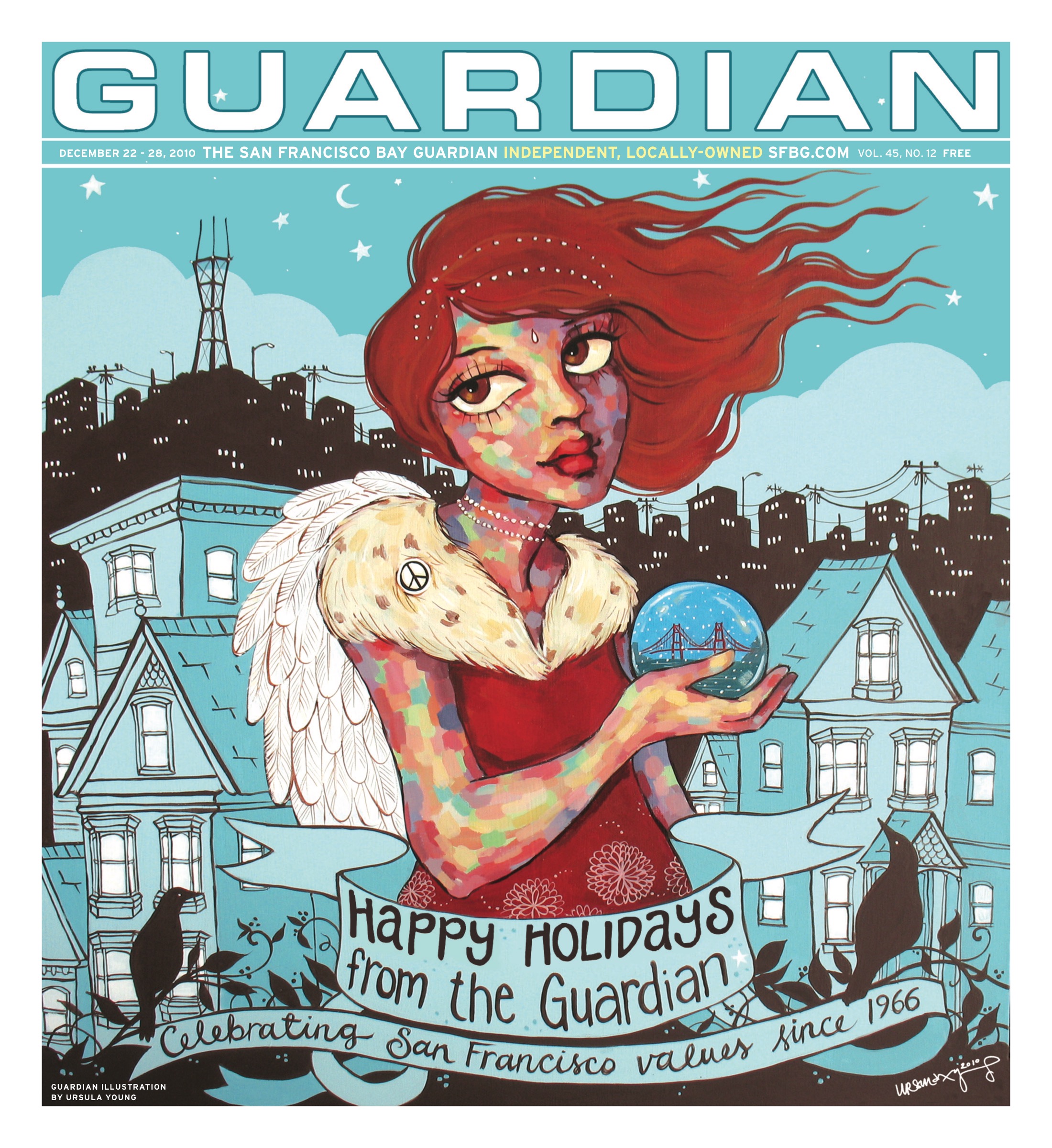
Rebecca Solnit’s Infinite City: A San Francisco Atlas (University of California Press, 158 pages, $24.95) is one of the best ideas a writer has come up with in a long time. By combining private and public support, Solnit was able to give away portions of the atlas in full-color, full-spread map handouts. (My favorite tracked both famous/infamous queer public spaces and the migration of butterflies throughout the city.). In the process, she also gave lectures in public spaces, providing a public service in the name of history and inclusion before dropping this tome on the book-buying masses. Gent Sturgeon’s version of a city-fied Rorschach alone is worth the price of the ticket. From insect habitats to serial killers, Zen Buddhist centers to the culture wars of the Fillmore and South of Market that some call redevelopment; Solnit and her cadre of artists, writers, cartographers, and researchers — Chris Carlsson, Guillermo Gómez-Peña, and Mona Caron among them — give us the infinite depths and limitless potential that can be found in 49 square miles. (D. Scot Miller)
A lot of good and even great books came from the Bay Area this year, but one stands out: a book of poetry, Cedar Sigo’s Stranger in Town (City Lights, 100 pages, $13.95). He is a young writer who improves dramatically each time I hear him read, and his poetry and critical writing are among the wonders of our age. And of the age before, since through him speak the dead poets David Rattray, John Wieners, Robert Creeley, Denton Welch, Philip Whalen, Salvador Dali, Jean Cocteau, Eartha Kitt, Raymond Roussel, Lorine Niedecker, and Cole Porter. When new writers come to San Francisco, they ask me if I’ve met Cedar Sigo. If they don’t know Sigo’s work, then I hand them a copy of the new collection. Don’t have to say much, I just step back a little to avoid the stars and diamonds and apples popping out of their eyes like toast from a toaster, because this crazy work is that crazy good. (Kevin Killian)
Compared with the prosaic grind of the inner city, the Sunset can seem like a — albeit foggy — vacation. Wide streets, surf breaks, dunes fit to get lost in: the neighborhood is just right for an offbeat bohemian getaway. But maybe those are just the reverberations of the past, which western neighborhood historian Woody LaBounty has dug up in Carville-by-the-Sea (Outside Lands Media, 144 pages, $35). This coffee table book illustrates the lives of the Sunset’s first modern-day inhabitants, who constructed a seaside village of retired street cars to inhabit back in the days before the N-Judah. Colorized at times for an Oz-like effect, the photos LaBounty digs up to illustrate “Cartown” reveal a community of artists, families, and enthusiasts — even a women’s cycling club — amid an untamed, oscillating sandscape. Those converted SoMa warehouse apartments suddenly don’t seem quite so rugged, do they now? (Caitlin Donohue)
In a city that boasts literally hundreds of theatrical world premieres per year, it’s astounding how few make it to the printed page. Bravo, then, to EXIT Press, new publishing arm of the venerable EXIT Theatre, for helping to ensure that at least some of our local play-writing talents will be preserved for posterity. And who better to inaugurate the series than Mark Jackson, whose professional development has been closely tied to the EXIT, and to the San Francisco Fringe Festival, which it produces? Far from being merely a collection of “Fringe-y” experimentation, Ten Plays (EXIT Press, 492 pages, $19.95) is a testament to the tenacity of vision. From reimagined Shakespearean classics (R&J, I Am Hamlet) to Jackson’s breakout hit The Death of Meyerhold, the bleakly comedic American $uicide, and the stirring Kurosawa-esque epic The Forest War, what these plays have in common is an audacious commitment to the illimitable possibilities of live theater. Of which, giving these works an opportunity to reach a wider audience is but one. (Nicole Gluckstern)
By any good political standard, John Lescroart’s Damage (Dutton, 416 pages, $26.95) is awful. It’s all about how a criminal uses the technicalities of law to get released (damn liberal judges) and how his family — newspaper publishers with ties to the (damn liberal) political establishment — protects him even as he continues to rape young women. Reminds me of that atrocious movie Pacific Heights, which is supposed to convince you that eviction protection and tenants rights are unfair to the poor landlords. But Lescroart writes about San Francisco, and does a pretty good job describing the city, and his characters are so real and well-crafted that I’m able to set aside the politics. In this case, Ro Curtlee, the rapist, is such an evil, evil bad guy — but a plausible, privileged evil bad guy — that he comes to life in a way that makes you want to kill him yourself. And makes you understand why a cop might feel the same way. And in the world of crime fiction, making you feel pain is half the game. It’ll be out in paper this spring. (Tim Redmond)
What Carl Rakosi was to Objectivism — a significant poet who dropped out of sight only to reemerge an old master — Richard O. Moore is to the SF Renaissance. The 90-year-old Moore was active in Kenneth Rexroth’s libertarian-anarchist circle in the 1940s, but abandoned poetry publishing for the more efficacious mass media of radio and TV, cofounding both KPFA and KQED in the process (and shooting the only footage of Frank O’Hara to boot). But Moore never stopped writing, and his debut volume Writing the Silences (University of California Press, $19.95) offers a brief but tantalizing introduction to more than 60 years of poetic activity. Moore’s diction is spare but memorable; a hawk’s wings, for example, “balance on the blind/ push of air.” Yet his low-key tones are wedded to an experimental sensibility; witness 1960’s “Ten Philosophical Asides,” which might be the first poem in English riffing on Wittgenstein, more than a decade before language poetry. Writing the Silences is thus belated yet ahead of its time. (Garrett Caples)
I commissioned three of the works in Veronica De Jesus’s Here Now From Everywhere (Allone Co. Editions, 130 pages, $26). Her portraits of Michael Jackson and Jay Reatard ran in the Guardian, while I paid out of pocket for her to render a tribute to the poet John Wieners for my boyfriend. Along with just-announced SECA Award winner Colter Jacobsen, who published this book, De Jesus is my favorite creator of drawings in the Bay Area. Like Jacobsen, she delves into memory — her memorial portraits can be seen for free on the windows of Dog Eared Books, where this book is for sale. The charm and value of Here Now From Everywhere is immediate, but the book reveals more of its multfaceted personality with each return visit. De Jesus’ illustrated dictionary of inspirational icons ranges from superstars to half-forgotten pop heroes, from cultural figures to obscure female athletes. It’s a gift. (Johnny Ray Huston)
“I told Micah last night that my new book would be a haunted house.” Berkeley-based poet Julian Poirier’s El Golpe Chileño (Ugly Duckling Presse, 128 pages, $15) is filled with the ghosts of past and present. Essentially a bildungsroman, it tracks Poirier’s protagonist’s growth from youthful journeyman into adulthood though a kind of mixed-genre Theatre of the Absurd. Vaudeville, comics, memoir, film pitch, epistolary, failed novel, poetry, the carnival, and travelogue are all wielded brilliantly in the hands of Poirier, making for a phantasmagoric reading experience where the whole emerges defiantly greater than the sum of its parts. Poirier writes, “I turned my whole brain into a city and wrote down everything I saw happening there.” And indeed it certainly feels that way — the book is ripe with the names of places, of friends living and dead; with lists of dates and years; and with drawings and photographs, making up what Poirier somewhat obliquely labels “The Stolen Universe.” El Golpe Chileño is truly a success of form and content, of the high and low, of pop and elegy. (John Sakkis)
Mayoral dynamics
steve@sfbg.com
Despite the best efforts of Sup. Chris Daly and some of his progressive colleagues to create an orderly transfer of authority in the city’s most powerful office, the selection of a successor to Mayor Gavin Newsom will come down to a frantic, unpredictable, last-minute drama starting a few days into the new year.
The board has convened to hear public testimony and consider choosing a new mayor three times, each time delaying the decision with little discussion by any supervisor except Daly, who pleaded with his colleagues on Dec. 14 to “Say something, the people deserve it,” and asking, “Are we going to take our charge?”
The current board will get one more crack at making the decision Jan. 4, a day after the California Constitution calls for Newsom to assume his duties as lieutenant governor — although Newsom has threatened to delay his swearing-in so Daly and company don’t get to the make the decision.
“I can’t just walk away and see everything blow up. And there are a few politicians in this town that want to serve an ideological agenda,” Newsom told KCBS radio reporter Barbara Taylor on Dec. 16, two days after praising the board for its “leadership and stewardship” in revising and unanimously approving the city’s bid to host the America’s Cup.
Newsom and his fiscally conservative political base fear that the board’s progressive majority will nominate one of its own as mayor, whereas Newsom told Taylor, “The board should pick a caretaker and not a politician — that’s my criteria.”
Some board members strongly disagree. “It’s not his to decide. Besides, what’s not ideological? That doesn’t make sense. Everyone’s ideological,” Sup. John Avalos told the Guardian, a point echoed by other progressives on the board and even many political moderates in town, who privately complain that Newsom’s stand is hypocritical, petty, and not in the city’s best interests.
The Guardian has interviewed a majority of members of the Board of Supervisors about the mayoral succession question, and all expect the board to finally start discussing mayoral succession and making nominations on Jan. 4.
But whether the current board, or the newly elected board that is sworn in on Jan. 8, ultimately chooses the new mayor is anyone’s guess. And at Guardian press time, who that new mayor will be (and what conditions that person will agree to) was still a matter of wild speculation, elaborate conspiracy theories, and backroom deal making.
GETTING TO SIX
A majority of supervisors say there’s a simple reason why the board hasn’t seriously discussed mayoral succession since it unanimously approved the procedures for doing so Nov. 23 (see “The process begins,” Nov. 30). Everyone seems to know that nobody has the required six votes.
Avalos said he thinks the current board is better situated to choose the new mayor because of its experience, even though he voted for the delay on Dec. 14 (in an 8-3 vote, with Daly and Sups. Ross Mirkarimi and David Campos in dissent). “I supported the delay because we were not closer to having a real discussion about it than we were the week before,” Avalos told us, noting that those who were pushing for Campos “didn’t do enough to broaden the coalition to support David Campos.”
For his part, Campos agreed that “the progressive majority has not figured out what it wants to do yet,” a point echoed by Mirkarimi: “I don’t think there’s a plan.” Sup. Sophie Maxwell, who made both the successful motions to delay the vote, told us, “There’s a lot more thinking that people need to do.”
“We do not yet have consensus,” Chiu said of his reasons for supporting the delay, noting that state conflict-of-interest and open government laws also make it difficult for the board to have a frank discussion about who the new mayor should be.
For example, Chiu is barred from even declaring publicly that he wants the job and describing how he might lead, although he is widely known to be in the running.
The board can’t officially name a new mayor until the office is vacant. Sup. Bevan Dufty, who is already running for mayor, told us the board should wait for Newsom to act. “I felt the resignation should be in effect before the board makes a move,” Dufty said.
Sups. Sean Elsbernd, Carmen Chu, Michela Alioto-Pier, and Eric Mar did not return the Guardian’s calls for comment.
PIECES OF THE PUZZLE
Adding to the drama of the mayoral succession decision will be the new Board of Supervisors’ inaugural meeting on Jan. 8, when the first order of business will be the vote for a new board president, who will also immediately become acting mayor if the office has been vacated by then and the previous board hasn’t chosen a new mayor.
While Newsom and his downtown allies are clearly banking on the hope that the new board will select a politically moderate caretaker mayor, something that three of the four new supervisors say they want (see “Class of 2010,” Dec. 8), the reality is that the new board will have the same basic ideological breakdown as the current board and some personal relationships that could benefit progressives Chiu and Avalos.
Daly said downtown is probably correct that the current board is more likely than the new one to directly elect a progressive mayor who might run for the office in the fall, such as Campos or former board President Aaron Peskin. But he thinks the new board is likely to elect a progressive as president, probably Campos, Chiu, or Avalos, and that person could end up lingering as acting mayor indefinitely.
“They really haven’t thought through Jan. 8. Downtown doesn’t like to gamble, and I think it’s a gamble,” Daly said. “There’s a decent chance that we’ll get a more progressive mayor out of the leadership vote for board president.”
Avalos said it “would be a disaster” for the board president to linger as acting mayor for a long time, complicating the balance of power at City Hall. But he wouldn’t mind holding the board gavel. “I think I would do a good job as board president, but I’m not going to scratch and claw my way to be board president,” Avalos said. “I’d be just as happy to be chair of the Budget Committee again.”
Avalos said he thinks it’s important to have a mayor who is willing to work closely with board progressives and to support new revenues as part of the budget solution, which is why he would be willing to support Chiu, Campos, or Mirkarimi for mayor, saying “All of them could do a good job.”
Given the progressive majority on the board, it’s also possible that there will be a lingering standoff between supporters for Chiu, a swing vote in budget and other battles who has yet to win the full confidence of all the progressive supervisors, and former Mayor Art Agnos, who has offered to serve as a caretaker. Some see Agnos as more progressive than the other alternatives pushed by moderates, including Sheriff Michael Hennessey and San Francisco Public Utilities Commission head Ed Harrington.
Moderates like Dufty are hopeful that a couple of progressives might break off to support Hennessey (“From the first minute, he knows everything you’d need to know in an emergency situation,” Dufty said) or Harrington (“I could see him stepping in and closing the budget deficit and finding a good compromise on pension reform,” Dufty said) after a few rounds of voting.
Mirkarimi is openly backing Agnos. “He has evolved, as I’ve known him, in the days since being mayor,” Mirkarimi said. “I think we’ve spent too much time on finding the progressive guy to be mayor than on setting up what a progressive caretaker administration would look like.” And then there are the wild cards, like state Sen. Mark Leno and City Attorney Dennis Herrera. Herrera’s a declared candidate and Leno has made it clear that he’d take the job if it were offered to him.
Given the fact that supervisors can’t vote for themselves, it’s difficult for any of them to win. “I don’t think it’s likely that a member of the Board of Supervisors will get enough votes to be mayor,” Avalos told us, although he said that Chiu is the one possible exception.
But to get to six votes, Chiu would have to have most of the progressive supervisors supporting him and some moderates, such as D10 Supervisor-elect Malia Cohen (whom Chiu endorsed), D8’s Scott Wiener, and/or Chu (who might be persuaded to help elect the city’s first Chinese American mayor).
That would be a delicate dance, although it’s as likely as any of the other foreseeable scenarios.
Could California go bankrupt?

Not today, not under current federal law. But Calitics alerts me to a really disturbing story that I didn’t know about: Congressional Republicans are pushing legislation that would allow (and actually encourage) state bankruptcies. The idea, of course, is to break public-employee unions and wipe out pensions that people have paid into and earned.
Oh, and by the way: The bill would almost certainly make it harder for states to borrow money for infrastructure projects. The cost of bonds would go up, California would have less money to build new schools, roads, high-speed rail etc. Again, something the Republicans like.
It’s crazy: California is such a wealthy state, and should be nowhere near bankruptcy. I heard on the radio the other day that Jerry Brown is going to have to do now what he should have done in 1978: Make Californians feel the affects of Prop. 13. Back then, after warning that the tax-cutting measure would have calamitous results, he used state money to bail out local governments and prevent the impacts from being felt. Now, when there’s no state money left, local governments are going to get hit really hard. The disaster that Prop. 13 opponents warned about 32 years ago is finally going to hit.
At the very least, if that’s Brown’s approach, he’s going to have to work to allow local governments more freedom to raise revenue on their own. Unless he wants cities and counties (which by law CAN go bankrupt) to follow that route. And I don’t think he does.
SFBG Radio: Why the rich won’t flee
Every time I talk about taxing the rich, some cretin comments and tells me that if you raise their taxes, they’ll all leave California. I’ve heard the same thin about businesses — and there is no factual evidence to support that. Johnny and I talk about this lunacy after the break.
sfbgradio12162010 by endorsements2010SFBG Radio: Can Callifornia wake up?
In today’s episode, we talk about Jerry Brown’s challenge: Can the new old governor wake the state out of a California dream that has become utterly unconnected to reality? Check it out after the jump.
Film Listings
Film listings are edited by Cheryl Eddy. Reviewers are Kimberly Chun, Michelle Devereaux, Peter Galvin, Max Goldberg, Dennis Harvey, Johnny Ray Huston, Louis Peitzman, Lynn Rapoport, Ben Richardson, and Matt Sussman. The film intern is Ryan Prendiville. For rep house showtimes, see Rep Clock.
OPENING
All Good Things This first narrative feature by Andrew Jarecki of the 2003 documentary Capturing the Friedmans fictionalizes another actual case of suspected nefarious deeds and high moral ambiguity. David Marks (Ryan Gosling) is the eldest son of a clan that’s among the greatest property-owning forces in NYC. But he rebels against following in the approved (and considerably corrupt) familial footsteps, in part by marrying Katie (Kirsten Dunst), a working-class Brooklynite whom his father (Frank Langella) helpfully notes “will never be one of us.” She’s no gold digger, however, and supports his every decision — even when he caves to pressure and joins the family biz after all, which is guaranteed to make him miserable. But does it make him crazy as well? The real-life model of this names-changed story was eventually accused or linked to three possible murders, though convinced only of one much lesser offense. All Good Things doesn’t feel the need to risk libel suits by pretending to know whether he was truly guilty or not — the record of known events alone over three-decades-plus offers quite enough provocative, sometimes downright bizarre fodder for drama. Very well-acted (particularly by Dunst, who’s been offscreen too long), the results have definite true-crime fascination. It’s too bad, however, that Jarecki evinces no talent for building suspense or momentum. What could have been a great movie just lays there after a certain point, absorbing on a moment-to moment basis yet ending up less than the sum of its parts. (1:41) (Harvey)
The Fighter Once enough of a contenda to have fought Sugar Ray Leonard — and won, though there are lingering questions about that verdict’s justice — Dicky (Christian Bale) is now a washed-up, crack-addicted mess whose hopes for a comeback seem just another expression of empty braggadocio. Ergo it has fallen to the younger brother he’s supposedly “training,” Micky (Mark Wahlberg), to endure the “managerial” expertise of their smothering-bullying ma (Melissa Leo) and float their large girl gang family of trigger-tempered sisters. That’s made even worse by the fact that they’ve gotten him nothing but chump fights in which he’s matched someone above his weight and skill class in order to boost the other boxer’s ranking. When Micky meets Charlene (Amy Adams), an ambitious type despite her current job as a bartender, this hardboiled new girlfriend insists the only way he can really get ahead is by ditching bad influences — meaning mom and Dicky, who take this shutout as a declaration of war. The fact-based script and David O. Russell’s direction do a good job lending grit and humor to what’s essentially a 1930s Warner Brothers melodrama — the kind that might have had Pat O’Brien as the “good” brother and James Cagney as the ne’er-do-well one who redeems himself by fadeout. Even if things do get increasingly formulaic (less 1980’s Raging Bull and more 1976’s Rocky), the memorable performances by Bale (going skeletal once again), Wahlberg (a limited actor ideally cast) and Leo (excellent as usual in an atypically brassy role) make this more than worthwhile. As for Adams, she’s just fine — but by now it’s hard to forget the too many cutesy parts she’s been typecast in since 2005’s Junebug. (1:54) (Harvey)
How Do You Know James L. Brooks directs Reese Witherspoon, Paul Rudd, and Owen Wilson in this romantic comedy. (1:53)
Rare Exports: A Christmas Tale High in the Finnish Arctic a scientific excavation unearths something exceedingly peculiar, with results that include several violent adult deaths and the mysterious disappearance of all local children in a depressed community whose flagging major industry is a reindeer slaughterhouse. When the area’s arms-bearing, beer-swilling menfolk prove clueless, it falls to hardboiled eight-year-old Pietari (Onni Tommila) to turn Kick-Ass and precociously marshal a full-on strategic offensive against intruders who reveal a disturbing ancient truth about Santa Claus and his elves. Writer-director Jalmari Helender’s first feature (which expands upon a couple prior shorts’ premise) gets points for being something definitely offbeat in the Yuletide fantasy sweepstakes. That said, its mix of black comedy, near-horror and action adventure doesn’t quite gel, or add up to more than an absurdist joke that feels overtaxed even at a fairly trim 84 minutes. (1:42) (Harvey)
Tron: Legacy Kevin Flynn (Jeff Bridges, playing old and young versions of himself) returns in this sequel to the 1982 sci-fi classic. (2:05) Castro.
Vincent: A Life in Color Vincent P. Falk, better known as “Riverace,” is a bit of an urban legend in Chicago. He’s spent the last several years’ lunch hours and weekends (when weather permits) wearing fluorescent-hued suits, doing runway twirls on bridges to attract the attention of passing tourist boats. He also performs variations on this “fashion show” for any available TV cameras, in the path of marathon runners, indeed anywhere else crowds can see and acknowledge him. Many locals would be surprised to learn he is not homeless or mentally ill, and that he is not just gainfully employed but a longterm white-collar governmental worker. He is also legally blind, was raised by nuns and foster parents, and once was a popular gay disco DJ. But Jennifer Burns’ documentary doesn’t penetrate beneath these biographical facts and Falk’s G-rated exhibitionism — perhaps there isn’t anything there to reveal. Even his closest friends (relatively speaking) confess they barely know this 60-year old studied eccentric whose identity as sartorial weirdo and “master of the corny pun” (that part is painful) might simply be a damaged individual’s way of controlling interpersonal communication he might otherwise find uncomfortable. Is he a performance artist, a living work of art, or (as someone puts it) one more face in the ranks of “deluded fools who think their personality should fill the space around them”? A Life in Color doesn’t have the answer, and frankly it could have asked that question in much less than full-length-feature time. (1:36) Red Vic. (Harvey)
Yogi Bear Dan Aykroyd and Justin Timberlake voice the picnic-crazed critters in this adaptation of the Hanna-Barbera cartoon. (1:19)
ONGOING
*Black Swan “Lose yourself,” ballet company head Thomas (Vincent Cassel) whispers to his leading lady, Nina (Natalie Portman), moments before she takes the stage. But Nina is already consumed with trying to find herself, and rarely has a journey of self-discovery been so unsettling. Set in New York City’s catty, competitive ballet world, Black Swan samples from earlier dance films (notably 1948’s The Red Shoes, but also 1977’s Suspiria, with a smidgen of 1995’s Showgirls), though director Darren Aronofsky is nothing if not his own visionary. Black Swan resembles his 2008 The Wrestler somewhat thematically, with its focus on the anguish of an athlete under ten tons of pressure, but it’s a stylistic 180. Gone is the gritty, stripped-down aesthetic used to depict a sad-sack strongman. Like Dario Argento’s 1977 horror fantasy, the gory, elegantly choreographed Black Swan is set in a hyper-constructed world, with stabbingly obvious color palettes (literally, white = good; black = evil) and dozens of mirrors emphasizing (over and over again) the film’s doppelgänger obsession. As Nina, Portman gives her most dynamic performance to date. In addition to the thespian fireworks required while playing a goin’-batshit character, she also nails the role’s considerable athletic demands. (1:50) Sundance Kabuki. (Eddy)
Burlesque Burlesque really wants your love. Much like its heroine Ali, the small-town girl with showbiz dreams (and the not-so-secret pipes to make those dreams a reality), Burlesque knows all the moves by heart and is determined to land a spot in the chorus-line next to Cabaret (1972), Pretty Woman (1990), The Devil Wears Prada (2006), and Gypsy (1962). “Come on,” it implores, firing off Bob Fosse finger-snaps and leg-bearing kicks, “I’ve got Christina Aguilera as the plucky newcomer and Cher as the seasoned stage-vet and owner of the Burlesque Lounge, a kind of music video purgatory in which the Pussycat Dolls never broke up.” [snap snap snap] “I’ve got Stanley Tucci trapped in the makeover montage closet, again, as the sassy gay-in-waiting to both female leads.” [snap snap snap] “I’ve got girls gyrating in a Victoria’s Secret catalog worth of risqué underthings.” [snap snap pant] “I’ve got melisma!” [pant pant pant] “Did I mention Cher’s eleventh-hour power ballad?” Yes, it’s true. Burlesque has all of the above (and can’t you just hear the hunger in its voice?) And yet, it is afflicted by a particularly unfortunate kind of mediocrity. Not terrible enough to be redeemable as camp, Burlesque also lacks what Kay Thompson would call “bazazz” — none of the leads have any chemistry with each other, or the camera for that matter — to make this musical truly sing. In the words of many a casting agent: “Maybe next time, kid.” (1:48) Empire, 1000 Van Ness, SF Center, Sundance Kabuki. (Sussman)
The Chronicles of Narnia: The Voyage of the Dawn Treader It’s no secret that C.S. Lewis’ Narnia saga is a big ol’ Christian allegory. And hey, that doesn’t mean it’s not entertaining. The film adaptations of his novels have been decent, in that they’ve worked to please both mainstream audiences and religious zealots who want to see the Jesus lion die for our sins. But while The Lion, The Witch and the Wardrobe (2005) and Prince Caspian (2008) were essentially passable, The Voyage of the Dawn Treader is an overwhelming failure. It’s lazy, the plotting is uneven, the CGI is cringe-worthy, and the 3D is the kind of sloppy post-production mess that makes the actors’ faces look concave. Add to that the moral message, which is more hamfisted than ever. In his lengthy climactic sermon, Aslan — he’s known by a different name in our world — tells Lucy (Georgie Henley) and Edmund (Skandar Keynes) that all their adventures have been about bringing them closer to him. Suck it, atheists. (1:52) 1000 Van Ness, SF Center. (Peitzman)
Due Date One delayed appearance for a baby’s birth does not a Hangover (2009) make. After all, even the most commited baby daddy isn’t totally required to be at the blessed event, unlike a wedding ceremony. So even two films into what seems like a trilogy of bromancey men’s coming-of-age terror, director Todd Phillips already seems to working a tired old bone. Slick LA architect Peter (Robert Downey Jr.) has a self-satisfied mean streak that doesn’t seem to be abating with the birth of his first child halfway across the country, or his run-ins with budding thespian Ethan (Zach Galifianakis) — the two collide cute in the airport on their way to the so-called Best Coast. One no-fly list leads to another, and Peter is reluctantly hightailing it by rental car with the uncoolest dude in school. Oh dear: Roadtrip for Schmucks, anyone? Due Date proves that, yes, contrary to what I once believed, there is such a thing as too much Galifianakis, in perpetual shtick mode here. And even though the weathered, well-textured Downey can build character with a single well-placed, black-hearted glare, he’s saddled with such a sorry misanthropic creep here that the audience is hard-pressed to care. (1:35) 1000 Van Ness. (Chun)
*Fair Game Doug Liman’s film effectively dramatizes yet another disgraceful chapter from the last Presidential administration: how CIA agent Valerie Plame (Naomi Watts), who’d headed the Joint Task Force on Iraq investigating whether Saddam Hussein had WMDs, was identified by name in the Washington Post as a covert agent — thus ending her intelligence career and placing many of her subordinates and sources around the world in danger. This info was leaked to the press, it turned out, by highest-level White House officials as “punishment” for the New York Times editorial former ambassador Joe Wilson (Sean Penn) — Plame’s husband — wrote condemning their insistence on those WMDs to justify the Iraq invasion by then already well in progress. (The CIA task force had also found zero evidence of mass-destruction weapons, but Bush and co. chose to come up with their own bogus “facts” to sway US public opinion.) Purportedly, Karl Rove clucked to CNN’s Chris Matthews that Wilson’s awkwardly-timed dose of sobering truth rendered his spouse “fair game” for exposure. Unfortunately opening here several days after it might theoretically have done some election-day good — not that many Republican voters would likely be queuing up — Fair Game may be a familiar story to many. But its gist and details remain quite enough to make the blood boil. While the political aspects are expertly handled in thriller terms, the personal ones are a tad less successful. That’s partly because we never quite glimpse what brought these two very busy, business-first people together; but largely, alas, because so many of Wilson’s diatribes come off all too much as things that might be said by Sean Penn, Rabble-Rouser and Humanitarian. This is perhaps a case of casting so perfect it becomes a distracting fault. (1:46) Sundance Kabuki. (Harvey)
*The Girl Who Kicked the Hornet’s Nest If you enjoyed the first two films in the Millennium trilogy — 2009’sThe Girl With the Dragon Tattoo and The Girl Who Played With Fire — there’s a good chance you’ll also like The Girl Who Kicked the Hornet’s Nest. Based on the final book in Stieg Larsson’s series, the film begins shortly after the violent events at the conclusion of the second movie. There are brief flashes of what happened — the cinematic equivalent of TV’s “previously on&ldots;” — but it’s likely an indecipherable jumble to Girl first-timers. Hornet’s Nest presents the trial of Lisbeth Salander (Noomi Rapace), the much-abused, much-misunderstood, entirely kick-ass protagonist of the series. With the help of journalist Mikael Blomkvist (Michael Nyqvist) and his sister Annika (Annika Hallin) as her lawyer, Lisbeth finally gets her day in court. The conspiracy that drives the story is somewhat convoluted, and while it all comes together in the end, Hornet’s Nest isn’t an easy film to digest. Still, it’s a well-made and satisfying conclusion to the trilogy — as long as you caught the beginning and middle, too. (2:28) Smith Rafael. (Peitzman)
Harry Potter and the Deathly Hallows — Part 1 As enjoyable as the Harry Potter films are for fans, they never really hold their own. And that’s OK. They’re not Oscar bait the way the Lord of the Rings movies were, but they’re competent adaptations of a much beloved book series. While Harry Potter and the Deathly Hallows — Part 1 may not be a perfect film, it’s a solid translation of the source material, sure to appease the loyal readers who still can’t quite cope with the fact that the saga is nearly over. I count myself among them, and I’ll admit that it’s difficult to look at any Harry Potter movie with a critical eye. But even for an outsider, part one of Harry’s final chapter is likely to entertain, with plenty of action and a streamlined pace that helps the film move faster than past entries in the series. For devotees, the effect is greater, and the emotional wallop Deathly Hallows packs should not be underestimated. (2:26) Empire, 1000 Van Ness, Sundance Kabuki. (Peitzman)
Inside Job Inside Job is director Charles Ferguson’s second investigative documentary after his 2007 analysis of the Iraq War, No End in Sight, but it feels more like the follow-up to Alex Gibney’s Enron: The Smartest Guys in the Room (2005). Keeping with the law of sequels, more shit blows up the second time around. As with No End in Sight, Ferguson adeptly packages a broad overview of complex events in two hours, respecting the audience’s intelligence while making sure to explain securities exchanges, derivatives, and leveraging laws in clear English (doubly important when so many Wall Street executives hide behind the intricacy of markets). The revolving door between banks, government, and academia is the key to Inside Job‘s account of financial deregulation. At times borrowing heist-film conventions (it is called Inside Job, after all), Ferguson keeps the primary players in view throughout his history so that the eventual meltdown seems anything but an accident. The filmmaker’s relentless focus on the insiders isn’t foolproof; tarring Ben Bernanke, Henry Paulson, and Timothy Geithner as “made” guys, for example, isn’t a substitute for evaluating their varied performances over the last two years. Inside Job makes it seem that the entire crisis was caused by the financial sector’s bad behavior, and this too is reductive. Furthermore, Ferguson does not come to terms with the politicized nature of the economic fallout. In Inside Job, there are only two kinds of people: those who get it and those who refuse to. The political reality is considerably more contentious. (2:00) Smith Rafael. (Goldberg)
The King’s Speech Films like The King’s Speech have filled a certain notion of “prestige” cinema since the 1910s: historical themes, fully-clothed romance, high dramatics, star turns, a little political intrigue, sumptuous dress, and a vicarious taste of how the fabulously rich, famous, and powerful once lived. At its best, this so-called Masterpiece Theatre moviemaking can transcend formula — at its less-than-best, however, these movies sell complacency, in both style and content. In The King’s Speech, Colin Firth plays King George VI, forced onto the throne his favored older brother Edward abandoned. This was especially traumatic because George’s severe stammer made public address tortuous. Enter matey Australian émigré Lionel Logue (Geoffrey Rush, mercifully controlled), a speech therapist whose unconventional methods include insisting his royal client treat him as an equal. This ultimately frees not only the king’s tongue, but his heart — you see, he’s never had anyone before to confide in that daddy (Michael Gambon as George V) didn’t love him enough. Aww. David Seidler’s conventionally inspirational script and BBC miniseries veteran Tom Hooper’s direction deliver the expected goods — dignity on wry, wee orgasms of aesthetic tastefulness, much stiff-upper-lippage — at a stately promenade pace. Firth, so good in the uneven A Single Man last year, is perfect in this rock-steadier vehicle. Yet he never surprises us; role, actor, and movie are on a leash tight enough to limit airflow. (1:58) (Harvey)
Love and Other Drugs Whatever kind of movie you think Love and Other Drugs is, you’re wrong. To be fair, it’s hard to pin down. This is a romantic comedy about two people who can’t commit, a serious drama about a young women living with Parkinson’s, a dark satirical look at the pharmaceutical industry, and — well, you get the idea. Love and Other Drugs shouldn’t work, really: the story is overstuffed and the script isn’t always cohesive. But leads Jake Gyllenhaal and Anne Hathaway sell the material well. In the end, it almost doesn’t matter that the film isn’t sure what it wants to be. “Almost” is key: there are moments in which Love and Other Drugs slips into Judd Apatow comedy territory, and others when it completely devolves into a sexual farce. It works on several different levels, but all together, it’s admittedly a bit of a mess. No bother. Just focus on the attractive naked people making out and you’ll likely enjoy the movie regardless. (1:53) 1000 Van Ness, SF Center, Sundance Kabuki. (Peitzman)
*Megamind Be careful what you wish for, especially if you’re a blue meanie with a Conehead noggin and a knack for mispronunciation and mayhem. Holding up hilariously against such animated efforts as The Incredibles (2004) and Monsters, Inc. (2001), Megamind uses that nugget of wisdom as its narrative springboard and takes off where most superhero-vs.-supervillain yarns end: the feud between baddie Megamind (voiced by Will Farrell) and goody-two-shoes Metro Man (Brad Pitt) goes waaay back, to the ankle-biter years. They’ve battled so often over intrepid girl reporter Roxanne Ritchi (Tina Fay) that she’s beyond bored by every nefarious torture device and disco crocodile the Blue Man throws at her. When Mega finally, unexpectedly vanquishes his foe, he finds himself with a bad case of the blues. With the help of his loyal Minion (David Cross), he decides to change the game and create his own worthy opponent, who just happens to be Roxanne’s schlubby cameraman (Jonah Hill). Chortles ensue, thanks to the sarcastic sass emanating from the Will and Tina show, although the 3-D effects seem beside the point. The resemblance to this year’s Despicable Me is more than a little passing, from the bad guy on the moral turnaround to the adorable underlings, but Megamind‘s smart satire of comic hero conventions, its voice actor’s right-on riffs, and the rock and pop licks on the soundtrack make it the nice and nasty winner. (1:36) 1000 Van Ness. (Chun)
Night Catches Us Director Tanya Hamilton’s exploration of manhood is largely an attempt to recreate a time and a place: 1976 Philadelphia. Race tensions are high, as Marcus Washington (Anthony Mackie) returns home for his father’s funeral. The threat of violence looms large as the town’s Black Panthers believe him to be a snitch, having turned over his best friend to be assassinated by the police. (Hamilton routinely sets the context by including interludes of documentary footage, including clips from 1971’s The Murder of Fred Hampton.) Kerry Washington plays Patricia, the widow, and Marcus’s only remaining friend in town. Scenes between the two have an intense quality, as we wait for them to talk about the ghost in the room. Otherwise characters are largely left underdeveloped, particularly a pushy cop (David Gordon) and a thuggish Panther (Jamie Hector), a waste of two alums of The Wire. Tariq Trotter of the Roots, who contribute to the film’s referential score, is woefully unexplored as Marcus’s brother. At best the film recalls the early work of Charles Burnett, although the degree of understatement is questionable. (1:28) (Prendiville)
127 Hours After the large-scale, Oscar-draped triumph of 2008’s Slumdog Millionaire, 127 Hours might seem starkly minimalist — if director Danny Boyle weren’t allergic to such terms. Based on Aron Ralston’s memoir Between a Rock and a Hard Place, it’s a tale defined by tight quarters, minimal “action,” and maximum peril: man gets pinned by rock in the middle of nowhere, must somehow free himself or die. More precisely, in 2003 experienced trekker Ralston biked and hiked into Utah’s Blue John Canyon, falling into a crevasse when a boulder gave way under his feet. He landed unharmed … save a right arm pinioned by a rock too securely wedged, solid, and heavy to budge. He’d told no one where he’d gone for the weekend; dehydration death was far more likely than being found. For those few who haven’t heard how he escaped this predicament, suffice it to say the solution was uniquely unpleasant enough to make the national news (and launch a motivational-speaking career). Opinions vary about the book. It’s well written, an undeniably amazing story, but some folks just don’t like him. Still, subject and interpreter match up better than one might expect, mostly because there are lengthy periods when the film simply has to let James Franco, as Ralston, command our full attention. This actor, who has reached the verge of major stardom as a chameleon rather than a personality, has no trouble making Ralston’s plight sympathetic, alarming, poignant, and funny by turns. His protagonist is good-natured, self-deprecating, not tangibly deep but incredibly resourceful. Probably just like the real-life Ralston, only a tad more appealing, less legend-in-his-own-mind — a typical movie cheat to be grateful for here. (1:30) Sundance Kabuki. (Harvey)
*The Social Network David Fincher’s The Social Network is a gripping and entertaining account of how Facebook came to take over the known social-networking universe. In this version of events — scripted by Aaron Sorkin and based on Ben Mezrich’s book The Accidental Billionaires, in turn based substantially on interviews with FB cofounder Eduardo Saverin, with input from Mark Zuckerberg icily absent — a girlfriend’s dumping of Zuckerberg (Jesse Eisenberg) on a crisp evening in 2003 is the impetus in his headlong quest for a “big idea.” The film is structured around the conference-room depositions for two separate lawsuits, brought against Zuckerberg by Saverin (Andrew Garfield) and by fellow Harvard entrepreneurs Tyler and Cameron Winklevoss (Armie Hammer) and Divya Narendra (Max Minghella) for crimes involving intellectual property and vast scads of retributive money. Unless Zuckerberg decides to post it on Facebook (which he probably shouldn’t, given the nondisclosure vows that capped off the first round of lawsuits), we’ll never know what truly motivated him and how badly he screwed over his friends and fellow students. But Fincher and Sorkin have crafted a compelling, absorbing, and occasionally poignant tale of how it could have happened. (2:00) Empire, 1000 Van Ness, Sundance Kabuki. (Rapoport)
Tangled In its original form, Rapunzel‘s a pretty brutal fairy tale: barely pubescent girl gets knocked up by a prince — who’s then blinded by her evil witch guardian — leaving Rapunzel to fend for herself as she’s exiled into the desert and bears twins. Relax, that isn’t the story Tangled tells. The new Disney film is a complete revamping of the tale: Rapunzel (Mandy Moore) escapes the clutches of Mother Gothel (Donna Murphy) with the help of ne’er-do-well Flynn Ryder (Zachary Levi). Along the way, there are songs and slapstick moments and, yes, anthropomorphic animals. But unlike the classic feel of last year’s The Princess and the Frog, Tangled comes across as recycled. It’s just not as fresh and sharp as it should be, especially given recent Disney accomplishments like Toy Story 3. Kids will enjoy it and adults won’t be bored, but it’s a step backward for the House of Mouse. And don’t expect to be humming any of the songs after you exit the theater. (1:32) 1000 Van Ness, Presidio, SF Center. (Peitzman)
The Tempest First things first: Julie Taymor’s misguided film adaptation of The Tempest isn’t entirely her fault. Even at his worst, Shakespeare is still — you know — Shakespeare, but The Tempest, his last completed play, has its fair share of flaws. Add to that Taymor, a director often criticized for choosing style over substance, and you have a messy, disorienting film. Helen Mirren is predictably great as Prospera: the gender switch from the original is Taymor’s invention. But despite a solid performance, Mirren can’t overcome the material, a condensed version of the play that jumps all over the place before reaching an unsatisfying conclusion. There are interesting moments, to be sure, particularly the trippy delights of Taymor’s trademark visuals. In the end, however, The Tempest drags. Even the sight of naked Ben Whishaw flittering about as Ariel doesn’t make the enterprise worthwhile. O brave new world that has such crappy movies in it! (1:50) SF Center. (Peitzman)
*Tiny Furniture Aura (Lena Dunham) has returned home to Manhattan after four undergraduate years cocooning in a Midwestern liberal arts education; either big-city life has gotten harder, or she has gotten very soft. She’s rather reluctantly welcomed back into their blindingly white TriBeCa loft by a successful artist mother (Laurie Simmons) and caustic, ambitious younger sister (Grace Dunham). Neither seemed to miss her much, and both are played by the writer-director-star’s actual family members. “I don’t know what to do with my life” is a very typical state post-graduation, but Aura’s stasis is positively Oblomov-ian — and since she is our protagonist, this movie, too, is all about the comedy of rudderlessness. Recently abandoned by a feminist college boyfriend who needed to “find himself,” she tries glomming on to such dubious romantic prospects as visiting filmmaker Jed (Alex Karpovsky), who gladly accepts free room and board but barely seems to register her as female. “Best friend” Charlotte (Jemima Kirke) is a spectacular wellspring of ideas meant to improve Aura’s lot, though since Aura basically walks around with a “Kick Me” sign on her posterior and Charlotte is sexy, moneyed, endlessly entitled trainwreck, her advice (e.g. “Just take him somewhere and grab his cock”) are bound make things worse. Tiny Furniture is indeed small, as first-feature achievements go. It’s anyone’s guess whether Dunham has it in her to make good movies less baldly autobiographical, as she’ll need to if she wants to have a career. That said, few films — certainly nothing Woody Allen’s done for ages — have been so dryly hilarious about the kind of NYC art-social milieux in which being a nobody really, truly sucks. Because everyone else is already somebody, if only in their own minds. It also has, hands down, the greatest three-minute, single-shot whiny meltdown speech of 2010 or nearly any other year. (1:38) (Harvey)
*Today’s Special This food comedy, written by and starring the Daily Show‘s Aasif Mandvi, is not an original recipe. It opens with an appetite-igniting cooking montage à la Eat Drink Man Woman (1994) and follows The Big Night (1996) structure. Samir (Mandvi) is a sous chef in a modern NYC restaurant, laboring under the dickish Dean Winters and next to the patently unnattractive Kevin Corrigan. He’s never made Indian food, despite his parents’ owning a struggling restaurant called Tandoori Palace. What is Samir to do when he gets turned down for a promotion, because his cooking is soulless? Things pick up in the film with the arrival of Mary Poppins in the form of worldly taxi driver and master chef, Akbar (Naseeruddin Shah). The course of this voyage of personal and cultural discovery is obvious, but the humor is as genuine as the performances, with the ingredients just needing a bit of time to come together. (1:39) Smith Rafael. (Prendiville)
The Tourist Ah, all the champagne wishes and caviar dreams and daydreams of bouncing truffles off Angelina Jolie’s pillowy pout couldn’t quite stop The Tourist from going very much astray. How many ways can a movie go wrong? There’s the by-the-numbers yet somehow directionless direction from filmmaker Florian Henckel von Donnersmarck, who made one of the most absorbing film about surveillance to date with The Lives of Others (2006), only to completely miss the mark with this tone-deaf attempt at a Charade-like romantic escapade. The musty, fussy bodice-swelling score by James Newton Howard. A glassy-eyed Jolie somehow mistaking stony inexpressiveness for Garbo-esque mystique? The list goes on — at core, the casting is perhaps the sole compelling reason to see this waxy, museum-piece remake of the French film Anthony Zimmer (2005) — though the chemistry is negligible between the film’ attractive stars, with Jolie in particular waltzing through like a beautiful Euro-zombie, seemingly intent on sleepwalking through Venice and saving her better efforts for a more socially conscious film. Her disdain for the material sucks the air from this entire enterprise. The only bit of un-snuffable charm here lies in Johnny Depp’s naifish delivery and the murky, ironic humor he unobtrusively layers into his bemused performance. But then he’s just a tourist, passing through and providing the only scrap of pleasure in an otherwise dull outing. (1:44) 1000 Van Ness, Shattuck. (Chun)
Unstoppable After a dunderheaded train-yard worker essentially flicks the “hellbent” switch on an unmanned train loaded with hazardous materials, it’s up to odd-couple operators Denzel Washington (old; cranky; in endearing subplot, his daughters work at Hooters) and Chris Pine (young; cocky; in weirdly off-putting subplot, his wife has a restraining order against him) to chase down that loco-motive and prove the movie’s title wrong. The film mostly darts between the interior of a train car, for Washington-Pine bickering; railroad mission control, where a miscast Rosario Dawson literally phones in her performance; TV news reports, lazily illustrating the train’s flight through rural Pennsylvania; and various low angles relative to the speeding train, so sinister it’s bright red and numbered 777 (which is, like, almost 666!) Veteran action director Tony Scott does what he can with the based-on-true-events storyline, but Unstoppable is so deadly serious and predictable it just gets boring after awhile. At least the runaway vehicle in 1994’s similar Speed had a villain to enjoy; here, there’s just an angry choo-choo. Miss you, Dennis Hopper. (1:38) 1000 Van Ness. (Eddy)
The Warrior’s Way (1:40) 1000 Van Ness.
*White Material Claire Denis was raised in colonial Africa, and White Material is her third feature set in its wake (the first two were 1988’s Chocolat and 1999’s breathtaking Beau Travail). This new film is very much about Africa, compositing elements of several different “troubles” (child soldiers, a strong man’s militia, radio broadcasts fomenting violence) into an abstract of conflict. Between the dead-eyed rebels in the bush and the brutally efficient forces in town stands Maria Vial (Isabelle Huppert), a colonial holdout. As the troubles mount, Maria buries the signs of encroaching threats; her refusal to be terrorized is a trait we typically ascribe to male action heroes, though Maria’s resolute blindness is its own kind of privilege in the African context. Unusually for Denis, the film is both a literary adaptation (cowritten with author Marie NDiaye and based on Doris Lessing’s The Grass is Singing) and a star vehicle for Huppert, whose stringy musculature is a nice match for Yves Cape’s lithe camerawork. The idea of Maria’s character already tends toward the parabolic, though, and all these different inputs can result in too much dramatic underlining. But for all White Material‘s novelistic concessions, Denis’ subtle command of composition and rhythm as elements of narration is beyond doubt. Her use of the handheld camera remains preternaturally attuned to her characters’ pleasures and anxieties. (1:42) (Goldberg)
SFBG Radio: What will Jerry do?
When Jerry Brown goes to UCLA to talk about education, what’s he going to say? How’s he going to promote the UC system when he’s facing a $25 billion budget crisis? Johnny and Tim talk abou that (and the Obama health care law and a few other things) after the jump.
sfbgradio12132010 by endorsements2010