Queer

Alerts

0

ALERTS

By Kristen Peters

alert@sfbg.com

WEDNESDAY, AUG. 25

"This in Itself is A Victory"


Celebrate the community of resistance that met the G8/G20 leaders in Ontario, Canada, in June to support actions for queer and transgender rights; environmental justice; income equity and community control over resources; gender justice, and disability rights; migrant justice; and an end to war and occupation. Attend a panel discussion with queer-identified Canadian activist Gesig Issac and local filmmaker Sarolta Jane as they analyze the convergence, its successes and failures, and post-mobilization issues.

7:30 p.m., $3–$5 donation suggested

Station 40

3030 B 16th St., SF

www.g20.torontomobilize.org/node/432

THURSDAY, AUG. 26

Innovations in Social Justice


Find out more about the cutting-edge social justice work of several leaders and organizations active in the Bay Area and beyond. The event features talks about new approaches to social justice, a Q&A session, and time to share ideas with local activists.

6:30 p.m., $5

David Brower Center

Suite 400

2150 Allston, Berk.

www.socialjusticeinnovation.eventbrite.com

Radical Love Workshop


Hear from educator and spokesperson from the polyamory community Wendy-O Matik as she presents the major concepts and challenges that are faced trying to reinvent relationships outside the dominant social paradigm. The evening includes a briefing of her book, Redefining Our Relationships: Guidelines for Responsible Open Relationships, a feminist critique of love and relationships, and a discussion intended to create a nonjudgmental support group.

7:30 p.m., $5–$10

Gilman Street Project

924 Gilman, Berk.

www.wendyomatik.com

SATURDAY, AUG. 28


Women’s Rights Day Celebration


Join Radical Women as they celebrate Women’s Rights Day with a focus on the struggle for immigrant rights, featuring a screening of the documentary film Made in L.A., in which three garment workers fight against unfair working conditions. Participants will be given the opportunity to deliver statements against SB1070 in an open mic segment following the film. A $7.50 summer buffet with vegetarian options precedes the screening at 6:15 p.m.

7:00 p.m., free

Suite 202

625 Larkin, SF

(415) 864-1278

SUNDAY, AUG. 29


Big Oil Teach-in


Discover the issues surrounding big oil companies, their local impacts, and positive solutions to the problem. The briefing will be followed by a mass show of resistance and an educational segment to prepare participants to join the nonviolent campaign or just learn about what’s involved. Attendees are encouraged to arrive on time and stay the whole time.

1 p.m., free

Frank Ogawa Plaza

Between 14th and Broadway, Oakl.

www.actforclimatejustice.org/west

MONDAY, AUG. 30


Katrina anniversary


Get involved in the efforts to stand up to big oil companies by marching on the five-year anniversary of Hurricane Katrina. The resistance will target the offices of BP and Chevron for their roles in environmental and community destruction in the gulf, the Bay Area, and around the world. The protest will also pressure the EPA to respond to increased drilling and to act on climate change.

11:30 a.m., free

Justin Herman Plaza

1 Market, SF

www.actforclimatejustice.org/west

The Performant: The Witching Hour — Puritan girls gone wild and midnight museum marauders

0

Checking out the local arts and culture scene …

There’s no doubt about it—San Franciscans love a rock opera. From the faux-real heavy metal anthems of “Live Evil” to the afterlife explorations of “Exit Sign,” the suicide art movement of “Thanatics” to the human sacrifices of “Wicker Man,” we like our rock operas loud, messy, and tinged with darkness and humor both. So an original rock opera about the Salem Witch Trials seems an obvious pairing between our love of the darkside plus power chords. Appropriately held at the Temple nightclub on Howard, “Abigail the Rock Opera” straddles the SF rock opera line between serious and silly.

There’s some damn fine singing, particularly from Alexis Lane Jensen who plays Betty Parris, and Daniel Knop, who plays her father Samuel Parris as well as a curiously fey Giles Corey in a silver mop-top/Andy Warhol wig and every 60’s British Invasion mannerism to ever make it onto the Ed Sullivan show. There’s some really solid rocking out thanks to the band, particularly guitarist Kurt Brown (who not coincidentally co-wrote the music with Knop). Plus there are dead babies, bloody aprons, moonlit excursions in the woods, goth-y girls in leather corsets and modest bonnets, and angry men wearing glittery facepaint, Thanksgiving pageant hats, and smug patriarchal entitlement.

There are some downsides too—namely over-reliance on video projection, hard-to-follow lyrics, and not enough campy abandon. I’d have liked to see the goth angle played up more as well as the glam. Perhaps a Klaus Nomi or Gary Numan homage tucked in between the standard rock anthems, or even a little synthesized EBM and some serious stomping. But for now they’ll be performing every Thursday at 9 p.m. through September, and one hopes they’ll make it at least to Halloween, with or without a darkwave makeover.

Meanwhile, it may have been midnight, but the YBCA was far from dark during the DIYbca party last Saturday. People dressed in hand-crafted costumes floated through the hallways of the museum like so many neon-colored moths, drawn to the flames of creative crowd-sourcing and hi tech/lo brow design hacks. In the Forum, reality television was getting a send-up with the Drinking and Dancing competition featuring fun-guy trio Adonisaurus, while in the gallery, old-school industrial noisemakers Kwisp jammed on bicycle parts, metal sheets and springs, and bits of old electronics before leading a hands-on, build-your-own thumb piano workshop (the best use for bobby pins and cigar boxes ever!).

A stencil workshop with queer street artist Jeremy Novy, creative cobbling with Mrs. Vera and SCRAP, a Puma shoe design competition, and a create your own techno music lab hosted by LoveTech rounded out the midnight hour, blurring the line between performer and participant to its most malleable degree. In other words, even the fun was being crowd-sourced, and pretty successfully so. Party promoters take note. You can hire all the big brand bands and fog machines and light-show designers you want, but for a really memorable event, you might want to consider adding a crafting circle to your lineup. Just saying. [Editor’s Note for craft aficionados — there is a wild Haute Gloo craft table every Friday night at the Stud‘s Some Thing drag party! And it totally works.]

Eating humble pie with Glendon “Anna Conda” Hyde

22

It was with a sinking feeling that I read the comments that Glendon “Anna Conda” Hyde’s supporters left on the Guardian’s website last week, after I wrote about the DCCC questionnaires last week—and managed to screw up by omitting Conda/Hyde from my hasty round up.

“How is it that you’ve omitted Anna/Glendon from your election roundup?” was one of many similar comments made by Conda/Hyde’s outraged supporters. “This looks awfully like PREJUDICE, darlings. You should be ashamed of yourselves. Anna/Glendon’s candidacy is not a joke. S/he is one of the most promising progressive voices in SF. Wake up.”

So, I picked up the phone, and called Conda/Hyde to offer my humble apologies.

And today we sat down and talked about the role of the media and political endorsement clubs in propping up the marginalization of marginalized candidates and communities—and the role of radical queers in pushing back against the status quo and the political machines.

Conda/Hyde kicked off by recalling how the DCCC offered congratulations on the campaign’s artwork.

“But then they said you are not a viable candidate, and have you thought about taking the spotlight off yourself,” Conda/Hyde claimed.

(After our interview, I put in a call to DCCC chair Aaron Peskin. He had no recollection of the conversation going down quite like that. But Peskin also noted that the DCCC had done a ton of interviews recently.

“I like Glendon and I remember him appearing,” Peskin said. “But I don’t remember anyone telling him he was not viable.”

But with 26 candidates in the D. 6 race, and 27 candidates in the D. 10 race, it’s likely that some similar-minded candidates in those contests may decide, or be advised, to rally together between now and the election to increase the chances that  “the bad guys” don’t win, right?

“You’d think,” Peskin said. “That’s why I dropped out of the Board of President’s race when Willie Brown’s guy looked like he was going to win, and as a result, Matt Gonzalez won the race.”)

Anyways, back to my interview with Conda/Hyde, who also claimed that D. 6 candidate h.brown recently got barred from a small business debate in SoMa.

I wasn’t at that particular forum, or the D. 10 debate that the SF Young Dems recently hosted in the Bayview.

But I have watched videos of the outrage that was triggered at the Young Dems forum, when D. 10 candidates Dianne Wesley Smith, Nyese Joshua, Ed Donaldson, Marie Harrison and Espanola Jackson were excluded from the debate, even though the Bayview is where they are based.

And it’s similar to the outrage that Conda/Hyde supporters understandably felt when their candidate’s positions on issues like Mayor Gavin Newsom’s sit-lie legislation weren’t included in my original summary of the DCCC questionnaire. Especially since Conda/Hyde led the pushback against Newsom’s sit-lie measure.

“Marginalized districts, marginalized candidate voices,” Conda/Hyde observed.

The point Conda/Hyde is making here is that all candidates bring unique voices and perspectives to a race, and they provide marginalized communities with a rare opportunity to push back against powerful interests and ill-advised measures before this or that political machine can shoe horn its preferred slate into office.

“I was the first candidate to come out against sit-lie aggressively,” Conda/Hyde noted, by way of example.

At this point in our conversation, Labor leader and DCCC member Gabriel Haaland, who sat in on today’s meeting and voiced sharp criticism of my Conda/Hyde omission last week, chimed in.

“So many candidates were ducking sit-lie, so when I introduced a resolution opposing sit-lie at the DCCC, so many people were pissed off,” Haaland said. “And it was refreshing to see Anna Conda vocally opposing sit-lie in drag on Polk Street.”

Haaland added that he’d be working for Conda/Hyde’s campaign, “if not for a 15 year friendship with Debra Walker.”

And then he pointed to the central role that radical queers have played in pushing for political change.

“The first queer to run for elected office was a drag queen,” Haaland observed. “Radical queers have always been leading the movement, busting a move and changing the world. And Anna Conda is more the Harvey Milk of the race, in my opinion.”

“You reflect my radical queer positions more,” Haaland continued, addressing Conda/Hyde direct.  “And you have a real base in the district in a way that Theresa Sparks does not. But people are moving into the district and having bases created for them.”

Conda/Hyde then observed that plans are afoot for an inclusionary District 6 forum.

“Jane Kim and I are getting together to do a forum that includes all the D. 6 candidates,” Conda/Hyde said, “We’ll be including James Keys, Dean Clark and Fortunate ‘Nate’ Payne, who are all out there working hard on their campaigns, as well.”

The ability to raise funds is often an indicator of whether a candidate is viable. Campaign finance records show that Conda/Hyde has applied for public funds, the application is under review, and that Jane Kim, Jim Meko, Theresa Sparks, Debra Walker and Elaine Zamora have qualified for public financing in the D. 6 race.

That level of public fund raising is only bested by D. 10 where Malia Cohen, Kristine Enea, Chris Jackson, Tony Kelly, DeWitt Lacy, Steven Moss, Eric Smith and Lynette Sweet have already qualified for public financing, and Diane Wesley Smith, has her application under review.

(In D. 2, Kat Anderson and Abraham Simmons have already qualified for public funding. In D. 8, Rafael Mandelman, Rebecca Prozan and Scott Wiener have already qualified, and Bill Hemenger’s application is under review.)

At the end of our meeting, Conda/Hyde talked about name recognition problems.
“I have a lot of name recognition as Anna Conda, and not as much as Glendon Hyde,” Conda/Hyde noted, choosing to pose as Glendon Hyde next to his D. 6 campaign sign.
“I think I’ve already proven that I’m a drag queen,” Hyde explained.

“And not just a pretty face,” Haaland concluded.


Hot sexy events Aug 18-24

0

Two words to understand why sex at Burning Man requires some amount of pre-playa study: alkaline dust. You do not want the stuff getting in while you do, lemme tell ya. So it is a very, very nice thing that Pink, one of Mission Control’s pansexy sex parties, is providing a primer on playa pussy (Fri/20). Subjects covered in the course? How to look for sexy in the barely clothed insta-city, tips for romping through the heat and psychedelia, and the importance of spray bottles when you’re getting with that neon fur-clad bunny you met by the ice stand.


Queer, Poly, and Under 30

So, what’s that like? Apparently, enough are interested in the successful maneuverings in the world of polyamory by the under-30 set that the Center for Sex and Culture planned a panel on the subject. Your experts? Among others, Jiz Lee, genderqueer porn star; Allison Moon, former mayor of Burning Man’s Camp Beaverton’s Home for Wayward Girls, and moderator Reid Mihalko, sex-help web guru. 

Thurs/19 7-9 p.m., $10 suggested donation

Center for Sex and Culture

1519 Mission, SF

(415) 255-1155 

www.sexandculture.org


Spunk

You know us youngsters, always listening to them iPod contraptions. Well now there’s a way for the gay men among us to shuffle up the tunes and their partners at the same time. I’m talking about Spunk, the weekly party for 18-29 year old members at Eros, which promises that the evening’s soundtrack will be comprised of “music most often heard on ipods, and swapped among friends.” Mmmm racy vagueness… 

every Thursday 4 p.m.- 12 a.m., $8

Eros 

2051 Market, SF

(415) 255-4921 

www.erossf.com


Pre-Pink Playa Sex Playshop

Pay good attention to your teachers – Doctor Friendly and Miss Pringle know what they’re talking about when it comes to Black Rock booty. Stay after the course for a little pre-fest warmup: the Pink party is on directly after. Come gussied up in next week’s costume to inject an extra hit of playa pizazz.

Fri/20 9-10:15 p.m., $20-30 members only

Mission Control 

2519 Mission, SF

www.missioncontrolsf.org


The Mystery and Seduction of Electro Play

Lady Ripplee Severin has this to say about her first, electrifying BDSM experience: “I found myself seduced and lured to the sound, sent and feel of this visceral form of BDSM play. The first time that violet wand touched my skin, I knew then I was hooked.” She sure sells the shock, no? Bring your electrical device if you’re well-versed in this kind of play – and curious bottoms, come prepared to be turned on. 

Sat/21 6-8 p.m.

Email BigPinkHouseSF@gmail.com for location and price

www.soj.org/calendar


Keeping It Hot in an LTR

It sounds like a sexy sportscar, no? But Lisa Skye Carle is actually using “LTR” to refer to a “long term relationship” – shhh don’t let the secret get out! Sometimes, the fact that you and your sweetie have been together forever can seem like a fact you want to forget in the bedroom. But it just doesn’t have to be like that. This course promises to show you lust and laviciousness, even in eyes you know as well as your own. 

Tues/24 6-8 p.m., $25-30

Good Vibrations

1620 Polk, SF

(415) 345-0400

www.goodvibes.com


The Eyes Have It/Swap It Out!

So you’ve got your Folsom Street Fair outfit picked out, but that black eyeliner is hard to apply! And come to think of it, the black platforms you have aren’t quite the same black as your bustier and cape… man, something just isn’t right. No worries, my leather love, the Citadel’s got you covered. Bethie Bee is presenting a two part course on makeup and fashion this week. Makeup is Tues, when basic looks are covered, and on Wednesday a clothing swap is being held to make sure you’re fly for the Fair.

Tues/24 8-10 p.m., $20

Weds/25 7:30-9:30 p.m., free if you bring 5 items or more

SF Citadel 

1277 Mission, SF

(415) 626-1746

www.sfcitadel.org


Film Listings

0

Film listings are edited by Cheryl Eddy. Reviewers are Kimberly Chun, Michelle Devereaux, Max Goldberg, Dennis Harvey, Johnny Ray Huston, Louis Peitzman, Lynn Rapoport, Ben Richardson, and Matt Sussman. 

OPENING

*Animal Kingdom More renowned for its gold rush history and Victorian terrace homes than its criminal communities, Melbourne, Australia gets put on the same gritty map as Martin Scorsese’s ’70s-era New York City and Quentin Tarantino’s ’90s Los Angeles with the advent of director-writer David Michôd’s masterful debut feature. The metropolis’ sun-blasted suburban homes, wood-paneled bedrooms, and bleached-bone streets acquire a chilling, slowly building power, as Michôd follows the life and death of the Cody clan through the eyes of its newest member, an unformed, ungainly teenager nicknamed J (James Frecheville). When J’s mother ODs, he’s tossed into the twisted arms of her family: the Kewpie doll-faced, too-close-for-comfort matriarch Smurf (Jacki Weaver), dead-eyed armed robber Pope (Ben Mendelsohn), Pope’s best friend Baz (Joel Edgerton), volatile younger brother and dealer Craig (Sullivan Stapleton), and baby bro Darren (Luke Ford). Learning to hide his responses to the escalating insanity surrounding the Codys’ war against the police — and the rest of the world — and finding respite with his girlfriend, Nicky (Laura Wheelwright), J becomes the focus of a cop (Guy Pearce) determined to take the Codys down — and discovers he’s going to have use all his cunning to survive in the jungle called home. Stunning performances abound — from Frecheville, who beautifully hides a growing awareness behind his character’s monolithic passivity, to the adorably scarifying Weaver — in this carefully, brilliantly detailed crime-family drama bound to land at the top of aficionados’ favored lineups, right alongside 1972’s The Godfather and 1986’s At Close Range and cult raves 1970’s Bloody Mama and 1974’s Big Bad Mama. (2:02) Metreon, Shattuck. (Chun)

Army of Crime In 1941 Paris, a group of resistance fighters — mostly foreign-born, many Jewish — form an underground network to sabotage the ever-growing Nazi presence in France. Their schemes range from the clever (playing loud piano to disguise the sound of a printing press) to the violent (grenades tossed under buses). Tension builds as the film progresses, though we learn in the first three minutes which characters will have “Died for France” at the end. In addition to its important historical lesson (with a modern-day nod toward the shifting definition of what makes a terrorist), Army of Crime also boasts a strong, easy-on-the-eyes ensemble cast and a depiction of wartime Paris that favors glamorous nostalgia. (2:13) Sundance Kabuki. (Eddy)

Hugh Hefner: Playboy, Activist, and Rebel See “Bunny Business.” (2:04) Lumiere, Shattuck.

Lebanon Das Boot in a tank” has been the thumbnail summary of writer-director Samuel Maoz’s film in its festival travels to date, during which it’s picked up various prizes including a Venice Golden Lion. On the first day of Israel’s 1982 invasion (which Maoz fought in), an Israeli army tank with a crew of three fairly green 20-somethings — soon joined by a fourth with even less battle experience — crosses the border, enters a city already halfway reduced to rubble, and promptly gets its inhabitants in the worst possible fix, stranded without backup. Highly visceral and, needless to say, claustrophobic (there are almost no exterior shots), Lebanon may for some echo The Hurt Locker (2009) in its intense focus on physical peril. It also echoes that film’s lack of equally gripping character development. But taken on its own willfully narrow terms, this is a potent exercise in squirmy combat you-are-thereness. (1:33) Embarcadero, Shattuck, Smith Rafael. (Harvey)

Lottery Ticket When Bow Wow wins $370 million in the lottery, his neighbors are, understandably, a bit jealous. The all-star ensemble also features Ice Cube, Loretta Devine, Mike Epps, and Charlie Murphy. (1:39)

*Mao’s Last Dancer Based on the subject’s autobiography of the same name, this Australian-produced drama chronicles the real-life saga of Li Cunxin (played as child, teen, and adult by Huang Wen Bin, Chengwu Guo, and Chi Cao), who was plucked from his rural childhood village in 1972 to study far from home at the Beijing Dance Academy. He attracted notice from Houston Ballet artistic director Ben Stevenson (Bruce Greenwood) during a cultural-exchange visit, and was allowed to go abroad for a Texas summer residency. At first the film looks headed toward well-handled but slightly pat inspirational territory pitting bad China against good America, as it cuts between Li’s grueling training by (mostly) humorless Party ideologues, and his astonishment at the prosperity and freedom in a country he’d been programmed to believe was a capitalist hellhole of injustice and deprivation. (Though as a Chinese diplomat cautions, not untruthfully, he’s only been exposed to “the nice parts.”) Swayed by love and other factors, Li created an international incident — tensely staged here — when he chose to defect rather than return home. But Jan Sardi’s script and reliable Aussie veteran Bruce Beresford’s direction refuse to settle for easy sentiment, despite a corny situation or two. Our hero’s new life isn’t all dream-come-true, nor is his past renounced without serious consequence (a poignant Joan Chen essays his peasant mother). The generous ballet excerpts (only slightly marred by occasional slow-mo gimmickry) offer reward enough, but the film’s greatest achievement is its honestly earning the right to jerk a few tears. (1:57) Albany, Embarcadero. (Harvey)

Nanny McPhee Returns Emma Thompson reprises her role as the magical nanny, this time helping out harried mother Maggie Gyllenhaal. (1:48) Presidio, Shattuck.

The Switch Sperm-donor humor: now officially a tired trend. (1:56) Shattuck.

Vampires Suck And they’re ripe for parody, too. (1:40)

ONGOING

Agora (2:06) Shattuck.

*Alamar (1:13) Roxie.

Cats and Dogs: The Revenge of Kitty Galore (1:40) 1000 Van Ness, SF Center.

The Concert (1:47) Clay.

Despicable Me (1:35) 1000 Van Ness, SF Center.

Dinner for Schmucks (1:50) 1000 Van Ness, SF Center.

*The Disappearance of Alice Creed (1:40) Sundance Kabuki.

Eat Pray Love The new film based on Elizabeth Gilbert’s chart-busting memoir, Eat Pray Love, benefits greatly from the lead performance by Julia Roberts, an actor who can draw from her own reserves of pathos when a project has none of its own. The adaptation, about a whiny American author farting around the globe in search of what amounts to spiritual room service, is nothing without her. The journey begins with the Type-A, book contract-inspired premise that Gilbert will travel to three appointed countries over the course of a year in order that, having thrice denied herself absolutely nothing, she might come out the other end a better-balanced human being. The first stop is Italy, where her entire plan is to finally unbutton her jeans and indulge in a celebrated cuisine, as if her home base of Manhattan were a culinary backwater. But this film is all about tired equivalencies, so Italy equals food, and expressive hand gestures, and “the art of doing nothing.” India, her next stop, equals enlightenment (her discovery that the guru she’s come to see is currently at an ashram in New York is an irony lost on the movie). And Bali, her final getaway, apparently equals contradictory but flattering aphorisms and thematically hypocritical romances. The sole appeal to a moviegoer here is aspirational. What’s so embarrassing about Eat Pray Love is its insistence that this appeal sprouts from the spiritual quest itself, and not just from the privilege that enables Gilbert to have such an extravagant quest in the first place. But then, self-awareness is supposed to be a obstacle to enlightenment. She’s got nothing to worry about there. (2:30) Cerrito, Elmwood, Empire, Marina, 1000 Van Ness, SF Center, Sundance Kabuki. (Jason Shamai)

The Expendables Exactly what you’re expecting: a completely ludicrous explosion-o-thon about mercenaries hired by Bruce Willis to take down a South American general who’s actually a puppet for evil CIA agent-turned-coke kingpin Eric Roberts. Clearly, Sylvester Stallone (who directed, co-wrote, stars, and even coaxed a cameo out of Schwarzenegger) knows his audience, but The Expendables — bulging with a muscle-bound cast, including Dolph Lundgren, Terry Crews, Jason Statham, and Steve Austin, plus Jet Li, who suffers many a short-guy joke — is content to simply tap every expected rung on the 80s-actioner homage ladder. There’s no self-awareness, no truly witty one-liners, no plot twists, and certainly no making a badass out of any female characters (really, couldn’t the South American general’s daughter have packed some heat, or kicked someone in the balls — anything besides simply heaving her cleavage around?) The only truly memorable thing here is the inclusion of Mickey Rourke as Stallone’s tattoo-artist pal; I would possibly wager that Rourke was allowed to write his own weepy monologue, delivered in a close-up so extreme it’s more mind-searing than any of the film’s many machine-gun brawls. (1:43) 1000 Van Ness, Sundance Kabuki. (Eddy)

The Extra Man (1:45) Elmwood, Embarcadero.

Farewell (1:53) Opera Plaza, Shattuck.

Get Low Born from the true story of Felix Bush, an eccentric Tennessee hermit who invited the world to celebrate his funeral in advance of his own death, Get Low is a loose take on what might inspire a man to do a thing like that. It’s a small story, and unlikely to attract the attention of popcorn-addled viewers in the midst of the summer blockbuster season, but Get Low has a whopper of a character in Felix Bush. Robert Duvall becomes Bush, constructing a quiet man who sees it all and speaks only when he has something to say, and supporting roles from Sissy Spacek and Bill Murray are expectedly solid, but the real surprise is what a strong eye director Aaron Schnieder has. In allowing scenes to unfold on their own terms and in their own time, Schneider gives a real humanity to what could have been a Hallmark movie. (1:42) Albany, Embarcadero, Piedmont. (Peter Galvin)

*The Girl Who Played With Fire (2:09) Embarcadero, Piedmont, Shattuck, Smith Rafael.

*The Girl With the Dragon Tattoo (2:32) Shattuck.

Harimaya Bridge (2:00) Four Star.

*I Am Love (2:00) Elmwood, Opera Plaza.

Inception (2:30) Empire, Marina, 1000 Van Ness, Sundance Kabuki.

*Joan Rivers: A Piece of Work (1:24) Opera Plaza, Red Vic.

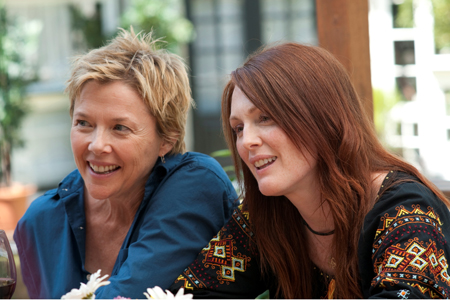
*The Kids Are All Right In many ways, The Kids Are All Right is a straightforward family dramedy: it’s about parents trying to do what’s best for their children and struggling to keep their relationship together. But it’s also a film in which Jules (Julianne Moore) goes down on Nic (Annette Bening) while they’re watching gay porn. Director Lisa Cholodenko (1998’s High Art) co-wrote the script (with Stuart Blumberg), and the film’s blend between mainstream and queer is part of what makes Kids such an important — not to mention enjoyable — film. Despite presenting issues that might be contentious to large portions of the country, the movie maintains an approachability that’s often lacking in queer cinema. Of course, being in the gay mecca of the Bay Area skews things significantly — most locals wouldn’t bat an eye at Kids, which has Nic and Jules’ children inviting their biological father (“the sperm donor,” played by Mark Ruffalo) into their lives. But for those outside the liberal bubble, the idea of a nontraditional family might be more eye-opening. It’s not a message movie, but Kids may still change minds. And even if it doesn’t, the film is a success that works chiefly because it isn’t heavy-handed. It refuses to take itself too seriously. At its best, Kids is laugh-out-loud funny, handling the heaviest of issues with grace and humor. (1:47) Bridge, California, Cerrito, 1000 Van Ness, Piedmont, Presidio, SF Center. (Peitzman)

*Life During Wartime The Kids Are Alright isn’t the only film this summer that subtly skewers the suburban upper-middle class by following a seemingly well-adjusted family as they’re thrown into crisis when a shadowy father figure attempts to enter their orbit. Only in the case of Todd Solondz’s Life During Wartime, instead of a sperm donor, Dad is a convicted child molester. A quasi-sequel to 1998’s Happiness, Life picks up 10 years later to survey the still-damaged Jordan sisters. After discovering that her husband Allen (Michael Kenneth Williams) is still making sexually harassing phone calls, mousy Joy (squeaky-voiced British actress Shirley Henderson) flees to Florida, where her older sister Trish (Allison Janney) has attempted to start a new life for herself and her children. Oldest Billy (Chris Marquette) is now a bitter college student, and youngest son Timmy (Dylan Riley Snyder) still doesn’t know the horrible truth about his father Bill (Ciarán Hinds), who has just been released from prison. Third sister Helen (Ally Sheedy), has had success in Hollywood, but still feels victimized by her family. Despite the entirely new cast, happiness remains just as elusive as before. Pleasure, when it can be found, is fleeting. Characters’ awkward conversations with each other inevitably sputter and stall, and even the best intentions are no measure against disaster. Solondz may be a scathing observer, but he is not above being sympathetic when its called for. Neither does he gloss over the serious questions — what are the limits of forgiveness? When is forgetting necessary? (1:37) Lumiere. (Sussman)

Lourdes (1:39) Roxie.

Middle Men (1:45) 1000 Van Ness, Sundance Kabuki.

The Other Guys (1:47) California, 1000 Van Ness, Presidio.

Patrik Age 1.5 (1:38) Lumiere.

Peepli Live (1:46) Balboa.

Salt (1:31) 1000 Van Ness, Sundance Kabuki.

*Scott Pilgrim vs. The World For fans of Bryan Lee O’Malley’s just-completed comics saga Scott Pilgrim, the announcement that Edgar Wright (2004’s Shaun of the Dead, 2007’s Hot Fuzz) would direct a film version was utterly surreal. Geeks get promises like this all the time, all too often empty (Guillermo del Toro’s Hobbit, anyone?). But miraculously, Wright indeed spent the past five years crafting the winning Scott Pilgrim vs. the World. The film follows hapless Toronto 20-something Scott Pilgrim (Michael Cera), bassist for crappy band Sex Bob-omb, as he falls for delivery girl Ramona Flowers (Mary Elizabeth Winstead), only to find he must defeat her seven evil exes — like so many videogame bosses — before he can comfortably date her. As it happens, he’s already dating a high-schooler, Knives (Ellen Wong), who’s not coping well with Scott moving on. Cera plays a good feckless twerp; his performance isn’t groundbreaking, but it dodges the Cera-playing-his-precious-self phenomenon so many have lamented. The film’s ensemble cast maintains a sardonic tone, with excellent turns by Alison Pill, Aubrey Plaza, and newcomer Wong. Jason Schwartzman is perfectly cast as the ultimate evil ex-boyfriend — there’s really no one slimier, at least under 35.The film brilliantly cops the comics’ visual language, including snarky captions and onomatopoetic sound effects, reminiscent onscreen of 1960s TV Batman. Sometimes this tends toward sensory overload, but it’s all so stylistically distinctive and appropriate that excess is easily forgiven. (1:52) California, Four Star, Presidio, Shattuck. (Stander)

Step Up 3D (1:46) 1000 Van Ness, SF Center.

Tales from Earthsea Drawn from Ursula K. Le Guin’s Earthsea series of fantasy novels, the feature debut of Goro Miyazaki, the legendary Hayao Miyazaki’s son, is the latest to come out of Japan’s Studio Ghibli. It tells the story of angsty patricidal prince-refugee Arren, who finds himself in the company of the wise Archmage Sparrowhawk and must help him and his friends defeat a Maleficent-esque evil sorcerer. But this film’s fantastical world tends too often toward the unengagingly mundane, with a cast of half-baked archetypes battling over overwrought metaphysical concepts. To boot, too many of the weird creatures and unreal elements seem reminiscent of the elder Miyazaki’s creations in films like Princess Mononoke (1997) and Spirited Away (2001). Ghibli is famed for its relentlessly creative productions, but Earthsea misses the mark, even if it is entirely watchable. It’s worth noting that Le Guin herself has written a lengthy piece on the film’s many problems. (1:55) Sundance Kabuki. (Sam Stander)

*Toy Story 3 (1:49) 1000 Van Ness, Shattuck, Sundance Kabuki.

Vengeance Prolific Hong Kong director Johnnie To’s two best films to date are 1999’s The Mission and its sorta-sequel, 2006’s Exiled. Both are about hired killers going about their business — a favored To plot that allows him to explore his fascination with male bonding, particularly amid crooks who fiercely adhere to the underworld’s sticky loyalty codes. His latest stateside release is 2009’s Vengeance; I had to double-check to make sure this was a new movie, because how could To have not made one called Vengeance already? The turf is classic To; The Mission and Exiled star Anthony Wong is, of course, the chief assassin; as always, he’s a cool, stone-faced cat of the sunglasses-at-night variety. There are elegantly staged gun battles, a post-skirmish tending-our-wounds scene, a daring getaway via a series of fire escapes, and lots of slo-mo. But there’s one new element here: 60-something Johnny Hallyday, dubbed “the French Elvis” in the 1960s. His Costello is a killer-turned-chef seeking revenge for the death of his Macau-based daughter’s family. He hasn’t been in the game for decades, so he hires Wong and co. to help him annihilate the bad guys. Hallyday has a certain glamorous presence, but at times it feels like he’s been grafted onto Vengeance just so it won’t feel like To is repeating himself (again). Costello is losing his memory at a rapid rate, so much time is spent waiting for him to shuffle through his Memento-style sheaf of Polaroids, struggling to recall who he’s with, why he’s there, and finally, “What is revenge?” Indeed, as another character points out, “What does revenge mean when you can’t remember anything?” Wong’s gunslingers may have just met Costello, but he’s paid for their loyalty — and earned their respect. Plus, his Paris restaurant is called “Frères,” so of course his newfound “brothers” will finish the job. (1:48) Four Star, Sundance Kabuki. (Eddy)

The Wildest Dream: Conquest of Everest (1:33) Opera Plaza.

*Winter’s Bone (1:40) Empire, Lumiere, Shattuck.

Hot sexy events August 11-17

0

It’s nice to see a couple of homegrown boys cinching their ties to their community. Dan and JD of Two Knotty Boys make some of the city’s more evocative bondage scenes – scroll through the galleries on their website for various visions of unrestrained restrained beauty, like two Manic Panic red heads impelled by the boys’ handiwork to assume an intimate “cuddle.” It’s this kind of imaginative use of ropes – they also do a series of “decorative bondage” in which corsets, bras, panties, and even dresses are crafted onto models by tightly pulled knots and loops – that make them the perfect teachers of the art. Couples especially are invited to their class at Good Vibrations this week (Wed/11): just remember to bring your ropes and you’re bound for inspiration.


Sex Bondage

Learn how to tie in furniture, vibrators, and more to your rope bondage play in this two hour workshop by SF’s good old boys, Dan and JD. The class is meant to be a serious, but humorous look at how you can aspire to the Two Knotty Boys’ level of corded mastery.

Wed/11 6-8 p.m., $25-30

Good Vibrations

1620 Polk, SF

(415) 345-0500

www.goodvibes.com


Sex Tapes for Seniors

Finally, a stage show about how those hot feelings south of of your control top don’t cease when you hit 60. Mario Cossa’s world premier plot takes us to Shambala Springs retirement home, where a group of sexually diverse couples are filming hot, wrinkly scenes of lust – to the chagrin of their peers and adult offspring. Not explicit by any means, the show is nonetheless a comic exploration of the bump and grind in the golden years.

Fri/13 (through Sun/22) 8 p.m., $25-40

Victoria Theater

2961 16th St., SF

(800) 838-3006

www.stfsproductions.com


San Fran Sexy Zine Launch

Before Kinky Salon takes a well deserved six week break, won’t you grab your partner (or single girlfriends) and head to the party for their new printed smut, San Fran Sexy? Here’s hoping it’s as successful as the city’s last licentious launch, the trans mag Original Plumbing. The first hour of the night celebrates the zealous zine and afterwards all the carnal cavorting the party is known for takes center stage. Ah, illiteration… 

Sat/14 9 p.m., $25 members only

Mission Control

2519 Mission, SF

www.kinkysalon.com


Iron Dom Contest (Updated: Correction! The Iron Dom competition is actually scheduled for Sat/20)

We’ve all played this game before. You’re stuck on a desert island – what three things would you need to create the bondage scene of your dreams? If you’re a candidate for top honors in Domina’s contest this Saturday, you won’t be picky – the point is to craft the best possible BDSM situation you can from what you’re given in terms of props (DIY castoffs) and partner (enthusiastic, yes. Your gender/sexual proclivity of choice, possibly not). Do you have what it takes to be the next Iron Dom? Kitchen Stadium – er, the Citadel is waiting to see. All proceeds go to the Somona County AIDS Food Bank.

Sat/14 doors 2:30 p.m., contest starts 5 p.m., $20-25

SF Citadel

1277 Mission, SF

(415) 626-1746

www.sfcitadel.org


Big

Stroke your hand seductively over your load of love – that belly’s getting you laid tonight! Particularly if you lope over to The Stud, where South Bay’s hottest chubby chase session is relocating for the evening. Skinny minnies out there? Remember, the bigger they come, the harder they come. Get you a fattie, stat.

Sun/15 6 p.m.-12 a.m., 

The Stud

399 Ninth St., SF

(415) 863-6623

www.studsf.com


Use Your Words: Hot and Sexy Talk

Can Tina Horn talk you into sexy time? The queer BDSM porn star would sure like to try. And it’s only right to let her – after all, Horn is facilitating this workshop so that you beatimous self can grab their reins of your voicebox to take your love making to new heights. It’s called dirty talk, y’all: get some.

Tues/17 6-8 p.m., $25-30

Good Vibrations

1620 Polk, SF

(415) 345-0500

www.goodvibes.com

Queen Carol

0

Let me tell you what I think about when I think about Carol Channing: “Jam tomorrow, jam yesterday, but never, ever, ever jam today.” And then she turns herself into a sheep.

That’s not a fever dream: it’s one of the more absurd scenes from the 1985 TV movie Through the Looking Glass, featuring Channing as the batty White Queen. Channing’s 60-year career spans film, television, and theater — she’s probably best known for her iconic roles in Broadway shows Hello, Dolly! and Gentlemen Prefer Blondes. And yet, in my mind, she’s waving her arms wildly and ranting nonsense at poor Alice.

In a way, that’s fair. It’s difficult to get a handle on Channing. I don’t think she could do it herself.

“I haven’t the slightest idea,” she said when I asked about the longevity and diversity of her career. “We’re all surprised at everything that happens to us.”

At nearly 90, Channing continues to perform. She’ll be in San Francisco for the Richmond/Ermet AIDS Foundation’s 16th annual Help is On the Way benefit concert. AIDS relief is one of Channing’s longest-running causes, inspired by a longtime friendship with the queer community.

“Way back in 1950, I don’t know what, we opened in San Francisco with Gentlemen Prefer Blondes,” she recalled. “They tell me there wasn’t a blonde wig left in San Francisco. They all came dressed as me.”

And because of her pioneering work, the gay community has continued to support her. Well, that and her status as Broadway legend: it kind of goes with the territory. Until talking to her, however, I had no idea about the politics of being a gay icon.

“They made me their queen, for life,” Channing explained. “The empress is only for three years — but they made me their queen.”

I didn’t have the nerve to ask where Liza Minnelli and Barbra Streisand fit into this hierarchy for fear I’d stir up tension and incite a coup. But Channing is more concerned with her current cause, the Carol Channing and Harry Kullijian Foundation for the Arts, which seeks to preserve arts education to keep kids in school.

“This is a crisis now in our country,” Channing lamented. “Not everybody gets it.”

Luckily, she laid it out for me: “Each of us sees the world differently. All the artist does is recreate what was already created, but as they see it. And once you start expressing how you see the world, it opens up the brain.”

And you were expecting “Raspberries!”  

HELP IS ON THE WAY XVI: THAT’S ENTERTAINMENT

Sun/15, 7:30 p.m., $75

Herbst Theatre

401 Van Ness, SF

(415) 392-4400

www.cityboxoffice.com


The Photo Issue: Parker Tilghman

0

SFBG Your website is more cunningly organized than a lot of photographer’s or artist’s sites. How does it relate to your photography?
Parker Tilghman I feel like my site isn’t fully representative of what I’m doing now. I’m in this weird exploration phase. I’m enjoying the medium as much as possible while I have access to tools at CCA. My website began as a creative outlet and a place to show my photography. It started with nightlife photography, but I got over it quickly. Once school started I didn’t have time to go out and I stopped working in that way to focus on my studies.

SFBG One of my favorite photos from the “night.” series on your site is of Fauxnique.
PT That was from [her show] Faux Real. It was such a cool number. I took that the last or second to last night [of the run]. I just happened to be in the front of the stage, and I was really excited when I got it. I showed it to Marc [Kate], her husband, and he was all about it. She’s so talented and I’m really thrilled about the success she has been achieving. 

SFBG “night.” also includes a photo of Veronica Klaus.
PT Veronica is probably one of my favorite women in SF. She’s amazing – so sweet and full of life and energy. One photo of her is from a big gay wedding that I shot shortly after Prop 8 passed. The other is of her and Joey Arias. Joey and Veronica were co-hosting Tingel Tangel that month. We did it really quick and dirty in the downstairs basement of The Great American Music Hall. The people behind the event wanted it to be done that night and I said if I was going to do it I wanted to take the time to do it right. I chose a spot and I set up all of my lights, but didn’t realize I was in front of the bathroom – someone took a major shit and it smelled really bad. Joey had to go on in about 15 minutes. I shot a few rolls and prayed for the best. It was classic.

SFBG Some of the bedroom and intimate interior shots from “lover no longer.” remind me a bit of the Boston School – Mark Morrisroe, David Armstrong, Nan Goldin – but they are mixed with outdoor scenes. Can you tell me a bit about that series and its subject?
PT He was this boy I was absolutely in love with. One of the first I felt I was actually in love with. He was living in NY and in graduate school at Columbia getting his MFA. Our time together was intense and very in the moment. He was here this time last year visiting me for a few weeks. The interior shots were taken in my apartment with a Polaroid Spectra. I would shoot without the flash in order to get these blurry, creepy images. I realized after we broke up that I never had a full head-on shot of him. It made sense because he was so far away both literally and emotionally. I was totally heartbroken but I  didn’t want to be a bitchy queen about it. I wanted to honor him in some way.
There are a lot of nude portraits of boys I don’t have on my site because everyone does that now. I have a beautiful collection of images of boys that I’ve encountered throughout my life. The images are a reminder of those relationships, sexual and otherwise.

SFBG You’ve made triptychs, and also series’ of related but varying images. What attracts you to that approach?
PT I’m obsessed with repetition – and how it can express obsession. People are drawn to form connections when they are confronted with multiple images in the same work. I’m interested in forming a communication between the images, whether they have something visually in common or not. In life I tend do the same stupid things over and over again. The repetition is an aesthetic choice, but it also forms a rhythm I become comfortable with and great things happen in that cycle.

SFBG What was it like to photograph Daniel Nicoletta?
PT I love Danny. He is such an idol to me and when I met him I was starstruck in a way. I think about it now and it seems silly because he is such a sweet man. I grew up queer in a small town in South Carolina. He was one of the first gay photographers I learned about through reading about Harvey Milk. He doesn’t have the recognition as a photographer that he deserves outside of SF. I feel that he has that potential now and I am very excited for him.
We spent a wonderful day together at Danny’s house when I photographed him. Danny was a bit of a bossy bottom — he tried to tell me what to do, but soon realized what he was doing and said, “I’m sorry, I’ll stop.” That image was the one moment where he let his guard down. He was fantastic and I still remain in close contact with him.
Recently, I’ve been spending some time with Arthur Tress. I photographed him last week. These photographers are coming into my life and I feel I can learn so much from them. They were there through the AIDS crisis and the Stonewall riots. They paved the way for me to make the work I am doing now.

SFBG “RGB” might be the most striking series on your site, both because of the colors and the sudden bursts of motion.
PT The original installation is on three separate televisions screens turned on their sides.  It’s fully dimensional and takes on aspects of 2-D, 3-D, and 4-D based mediums. They’re animated GIFS. I took the photographs with a stereoscopic lens and compiled the images in Photoshop to make them 3-D.
Stereoscopic imagery has been around since photography’s inception and you can still get these cheap stereoscopic lenses from Japan for about $100. At the time that I was heavily immersed in color theory- and constantly thinking about red, green, and blue. I wanted to play with those ideas on top of underlying notion of digital identity.

SFBG “marshall’s beach.” is different from some of the other series’ on your site in that it isn’t populated. Instead, you photograph detritus. It made me think of a time when I was on a beach with friends in Bolinas, and everyone was shell collecting, and I was most attracted to this bright yellow plastic bottle of Joy dishwashing liquid.
PT That series is more or less a placeholder for my site, although I do find the images to be beautiful. I was out at the beach on my birthday. The best thing I found in the sand that day was a deflated Mylar “Happy Birthday” balloon. I came back three days later and it was still there, so I kept it.
I saw this shirt on the pathway down to the water and thought, “Oh, someone’s cruising.” I walked through the bushes, but they were gone. All that was left were their condoms and lube on the ground. I began noticing that all the trash was in pairs around the area. I don’t think I’m the kind of photographer who just goes out and shoots rolls of film in hopes of finding something. That’s a boring task to me, but I like the idea of queer documentation in whatever form that takes.

SFBG That story makes me think about the waterfront and different photographers who’ve used it either to create gay photography, or documented gay life in that kind of zone. Alvin Baltrop did so in the Piers in New York, and his photos are also now a record of a Manhattan that doesn’t exist anymore. The other night I met an artist, Doug Ischar, who has a book of mid-1980s photos [Marginal Waters] of a sunbathing and cruising space in Chicago that also is no longer around. SF Camerawork had a show devoted to Alan B.Stone, who took pre-Stonewall photos of the Montreal coastline. And here in SF Denny Denfield was doing 3-D physique photography on the beaches.
PT Have you see Arthur Tress’s images from the New York piers in the ’70s? They’re fucking stunning – beautiful and violently sexual. He wouldn’t have sex with his subjects. The way he got off was by photographing these beautiful men in sexy, compromising spaces.
I like work like that because, while I’m a pervy gay boy at heart, I don’t want sex to be the overwhelming projection. I love Mapplethorpe, but more for the technical perfection and beautiful tones achieved in his prints than the blatantly sexual subject matter. I don’t want overwhelming sexuality to be present in my work because some people can’t get past it and it hinders further exploration.
For me, it’s more about having subtle undertones that are a little uncomfortable. You can feel its presence, but aren’t quite sure what is off. I think the magenta in the “Untitled.” color series is a good example of that. It has this underlying tone of strange eroticism that isn’t immediately recognizable.

SFBG There’s a specific alphabet on your main page, and around half of the letters aren’t attached to images yet. What’s to come?
PT I’m going to fill them up eventually. Knowing me, in a year’s time the entire site will be completely different. I like the format – if you get it, you get it. I live in the Tenderloin and within two days I got called a faggot twice walking down the street. I’ve been called a faggot my whole life, but I was in my own fucking neighborhood and I was just wearing boots and flannel! I didn’t even look that gay. I wanted to do something with the word ‘faggot’ and liked the idea of removing it from the alphabet completely. I like making people confused.

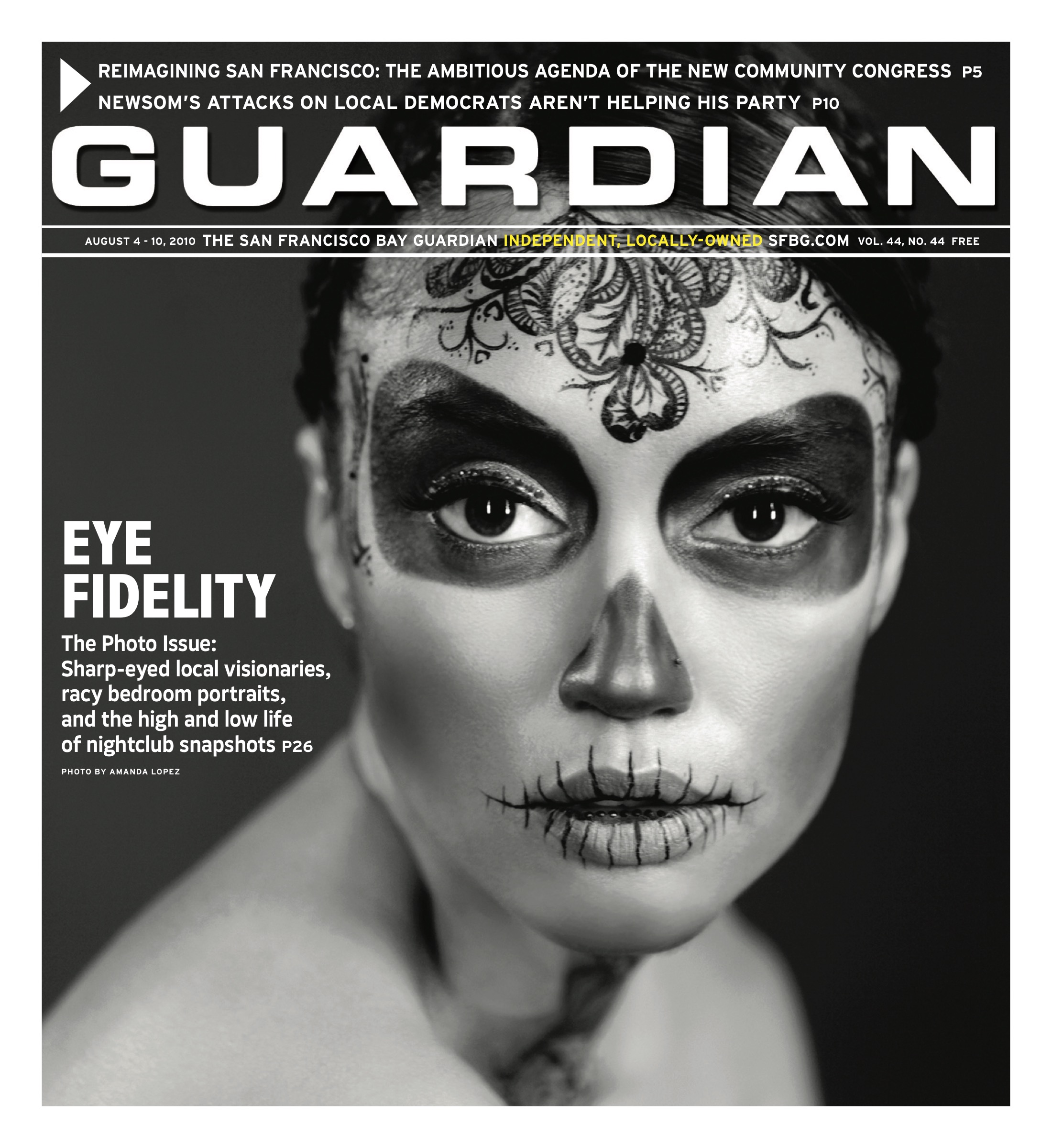
SFBG The image in the Guardian’s Photo Issue comes from “untitled (transparencies).” Can you tell me a bit about that series?
PT For this project I spent hours in the darkroom and sometimes forgot to eat or sleep. For me, it always starts as an aesthetic choice. I know a lot of people don’t like that idea, but I need something beautiful to work from as a point of departure. I wanted to play with pure color and investigate it was much as could within the photographic medium. I knew I wanted deep, rich color. I tried a bunch of crazy experiments with my film like pushing and pulling 5 or 6 stops at a time. I began using positive transparency film and printing it on normal color paper in order to produce a negative image. They’re double-exposed and manipulated in-camera. I can’t give away all my secrets.  There were tons of problem solving moments where I thought I would have a nervous breakdown, but it was fun to run with and work through.
The images themselves are horrific if you really look at them. I was reading a lot of Julia Kristeva, especially her writings about abjection and the duality of horror. She really defined what I was doing. I think in terms of queer art and culture she has so much to say, without even realizing it. There are so many connecting channels, even though her writing can be excruciatingly painful to read.
I was excited about making something beautiful and ugly at the same time by mutilating the figures. It’s something I’m proud enough to show, which is a big thing for me.

SFBG Your portraits of women have a mix of directness and depth.
PT Nude female portraiture is something straight male photographers do all the time. Being a gay male, the sexual tension was completely removed, which makes the gaze and the pose of the women very different.
A portrait shoot with me is like a two hour-long conversation. People ask about my camera because it’s big and imposing and it freaks them out sometimes.
I was interested in showcasing these queer women and normalizing them in a way. One person told me it’s like Cathy Opie without everything that makes them who they are. She’s concerned with all the surroundings that make them queer, while I’m interested in them when they are most vulnerable.

SFBG You’ve combined photography with different forms, from installation to bookmaking. What do you like about changing formats?
PT This is going to sound arrogant, but I don’t want to be just a photographer. I’m excited by having the opportunity to change and explore other mediums to achieve what I want. I don’t even really foresee that stopping in the near future. At the same time I’m interested in refining and focusing on what I’m trying to say and getting past making things just because they’re pretty.

SFBG What’s next?
PT I’m still playing with processes and have recently begun shooting directly onto color paper with an 8×10 camera to make paper negatives. I’m creating large wall installations of several small images. The color and detail I have been achieving is simply out of this world.

Windblown

0

marke@sfbg.com

SUPER EGO I just zoomed in from Guerneville on the back of Hunky Beau’s cherry red motorcycle, losing a few wigs along the way, oh well. Guerneville, for the uninitiated, is the supergayish resort town located about 100 miles north of here along the Russian River. It’s like the Riviera, but with more fish smell and meth shacks.

It’s also a hoot. We went up there to enjoy some sunshine — finally hello vitamin D — and join in the divine hoopla of Some Are Camp, an annual kiki agglomeration of post-ironic alternaqueer parties that take over the Russian River Resort. Man, there were a lot of shredded Day-Glo lace shawls and filthy Mouseketeer hats floating in the pool by weekend’s end. Little getaways are fierce, but our own party season is heating up, so grab your Dynasty-inspired water wings and let’s dive in.


BRIGHTER DAYS, LONGER NIGHTS

Is the Bay Area experiencing another Berlin brain drain? My mascara dribbles at the thought of us losing yet another techno luminary to that admittedly amazing German burg. But Nightlight Music honcho and funky-minimal musicmaker Alland Byallo must move on, and this special bon voyage shindig should give him something to remember. With DJs Dave Aju, Jeniluv, Dead Seal, and loads more.

Fri/13, 10 p.m.–4 a.m., $5. Triple Crown, 1760 Market, SF. www.triplecrownsf.com


WE ALL WE GOT

Let’s hear it for homegrown hip-hop: this monthly showcase consciously expands the local rap palette with a slew of upcoming talent that races past the yayo. The Fillmore’s Rappin’ 4-Tay headlines, Sellassie hosts, and T-Reezy, Blaze 1’s Pyrx Band, Unafeyed Bullyz, and tons more perform.

Fri/13, 9 p.m., $10. Club Six, 60 Sixth St., SF. www.clubsix1.com


BEARRACUDA 4-YEAR ANNIVERSARY

One of our few small alternative queer venues, Deco Lounge, recently got cited for capacity violations, forcing many parties to temporarily find new homes. But nothing can stop large-and-in-charge bear dance hoohaw Bearracuda from barreling ahead, this time at DNA Lounge. Floss with flying fur to DJs Rotten Robbie, boyshapedbox, and Honey Soundsystem, with art by queer graffitist Jeremy Novy.

Fri/13, 9 p.m.–3 a.m., $10. DNA Lounge, 375 11th St., SF. www.dnalounge.com


HERCULES AND LOVE AFFAIR

The Outside Lands pre-party brings back a band with thriving and complex San Francisco connections — and I’m eager to hear what this pulsating act has in store, now that its expansive deep disco and late-1980s house revivalism has become ubiquitous. All signs point to a tighter show and a brighter sound — without losing that special red-light emotion.

Fri/13, 9 p.m.–3 a.m., $20. Mighty, 119 Utah, www.mighty119.com


GREEN SOUND FINALE

For adventurous audiophiles, it’s been a wonderful summer so far thanks to the biannual Soundwave Festival that’s taken over the city the past two months. The “green sound” theme has brought us illuminated forests, singing sculptures, battery drones, and blooming speakers in Civic Center trees. This closing party takes it all to the de Young for “a journey inspired by our stunning city of wind, plant life, and fog.” Expect some sonic chills. With avant-jazz band the Drift.

Fri/13, 6:30 p.m.–8:30 p.m., free. de Young Museum, 50 Hagiwara Tea Garden Dr., SF. www.projectsoundwave.com


MIKE HUCKABY

I’ve been keeping an ear on this Detroit wizard for nigh on two decades now, and his mesmerizing techno-soul style is finally starting to gain major traction among dance aficionados. As the house DJ at beloved Motor City music store Record Time, his selections helped build many famed DJs secret arsenals. You can expect his influential deep-thinking, deep-reaching experience to shine when he takes the decks at the monthly No Way back party.

Sat/14, 10 p.m., $10. 222 Hyde, www.222hyde.com

SUNSET SUMMER BOAT PARTY

Can I just give it up for the Sunset kids this year? Their seasonal gigs have blossomed into true mainstays of good ol’ San Francisco love — no attitude, no trendy self-consciousness. Even the dis-aquatic among us will want to sign on to this floating blast, with classic Italian DJ Alexander Robotnick (of perma-jacking 1983 track “Problemes d’Amour”) and Germany’s Bruno Pronsato live. International wave!

Sun/15, 5 p.m.–11 p.m., $50. Pier 3, SF. www.pacificsound.net 2

Film listings

0

Film listings are edited by Cheryl Eddy. Reviewers are Kimberly Chun, Michelle Devereaux, Max Goldberg, Dennis Harvey, Johnny Ray Huston, Louis Peitzman, Lynn Rapoport, Ben Richardson, and Matt Sussman. For rep house showtimes, see Rep Clock. For first-run showtimes, see Movie Guide.

OPENING

Eat Pray Love Julia Roberts has a midlife crisis. (2:30) Cerrito, Elmwood, Marina.

The Expendables Sylvester Stallone directs and stars (along with just about every other action hero, ever) in this mercenaries-in-the-jungle-with-big-guns adventure. (1:43)

The Extra Man The polar opposite of buddy cop action flicks and spoofs a la The Other Guys, with only a faint resemblance to the bromances of Judd Apatow, Adam McKay, Will Ferrell, Seth Rogen, and so on, The Extra Man is a gently weird throwback to another era, much like its title character, Henry Harrison (Kevin Kline). Sweet, cross-dressing-curious teacher and would-be writer Louis Ives (Paul Dano) is drifting though life passively when he stumbles on eccentric playwright Harrison’s room-for-let and his oddball realm of hangers-on. A blustery, prickly, proudly misogynistic collector of Christmas balls, given to spasms of improvisational dancing, Harrison relishes his role as an escort to aged socialites, crankily shucking and jiving to score invites to fancy dinner parties and vacation homes in Florida. When Ives isn’t courting environmental magazine editor Mary (Katie Holmes) or hiding from the fearsome-looking wooly recluse Gershon (John C. Reilly), the mentor-able young man turns out to be more adept at the role than Harrison ever imagined. And like fossilized grande dames in Chanel, literate audiences also might be charmed by director-writer Shari Springer Berman’s unassuming, crushed-out bon mot, based on the novel by Jonathan Ames, to a few mannered, less-than-examined, happily twisted New York City subcultures. (1:45) Elmwood, Embarcadero. (Chun)

Harimaya Bridge The Harimaya Bridge might be the first film I’ve seen that portrays the American-Japanese culture clash so beloved by stateside filmmakers (see: 2003’s Lost in Translation) from the viewpoint of an African American man in Japan. The debut feature for short-film director Aaron Woolfolk, Bridge follows a retired man who travels to Japan after the death of his estranged son, with intentions to retrieve his son’s paintings for an art show. Likely based on Woolfolk’s personal experiences living in Japan, The Harimaya Bridge has both the look and feel of a short, an attribute that makes the otherwise agreeable film seem much too long and drawn-out. Or maybe, all along Woolfolk intended to replicate the dour melodrama and often glacial pacing of popular Japanese film. Meta-filmmaking? (2:00) Presidio. (Peter Galvin)

Lourdes Jessica Hausner’s Lourdes is a film about the people who things happen to rather than the things that happen to people. This is one of its merits yet also its greatest handicap because, really, not much does happen. Wheelchair-bound Christine (Sylvie Testud) makes the pilgrimage to the titular site of Catholic healing in the Pyrenees. When a miracle occurs and Christine walks, the other, less-enlightened denizens of Lourdes lampoon her, and God, for her inexplicable recovery. Hausner limns every scene with exaggerated blues, reds, and whites while relying on long takes and a certain clinical distance from the characters. The film’s atmosphere recalls Julian Schnabel’s The Diving Bell and the Butterfly (2007) but since Christine, unlike Jean-Dominique in that film, can speak and move, she doesn’t need to rely on her imagination to make sense of the world, and that would’ve been nice. Testud is subtle and sweet, but personality falls short here. Maybe it went out with her character’s legs. (1:39) Roxie. (Ryan Lattanzio)

Patrik Age 1.5 Freshly settled in suburbia, gay couple Goran (Gustaf Skarsgard) and Sven (Torkel Petersson) are eager to adopt a child — or at least Goran is, with Sven reluctantly caving in. But when against the odds they’re informed a native-born boy is available, a misplaced bit of bureaucratic punctuation means they get not the 18-month-old toddler expected but 15-year-old Patrik (Tom Ljungman). He’s a foul-tempered foster home veteran who makes it clear he’s no happier cohabiting with two “homos” than they are with him. Nevertheless, they’re stuck with each other at least through the weekend, allowing a predictable mutual warming trend to course through Ella Lemhagen’s agreeable seriocomedy. While formulaic in concept, the film’s low-key charm and conviction earn emotions that might easily have felt sitcomishly pre-programmed. (1:38) Lumiere, Shattuck. (Harvey)

Peepli Live Bollywood superstar Aamir Khan uses his powers for good in producing Peepli Live, Anusha Rizvi’s occasionally funny but also sobering satire. Poor and possibly a bit simple-minded, farmer Natha (Omkar Das Manikpuri) declares he’ll commit suicide after learning his family will receive enough benefits to save their land if he offs himself. He’s encouraged by his unmarried brother, received with skepticism by his exasperated wife, and harangued (as he clearly has been his entire life) by his sharp-tongued, bedridden mother. Once the media gets wind of Natha’s decision, he becomes a cause célèbre; ambitious reporters descend on Peepli, his tiny village, hoping to launch or further their careers with exclusive scoops (including one camera crew who proudly shares an exclusive close-up of Natha’s bowel movements). The bewildered man also becomes a political pawn among government muckety-mucks, who eagerly use him as leverage in a fast-approaching election. Though obviously an exaggeration, Peepli Live is grounded by the fact that India has had a real-life epidemic of farmer suicides. Stirring original music (though the film is not a musical) and an unpretentious filming style help Peelpli Live convey pressing themes of class and economics without slipping into preachiness. (1:46) Balboa. (Eddy)

The Oxford Murders One doesn’t need the deductive skills of Sherlock Holmes to see that things don’t quite add up in The Oxford Murders, cult Spanish director Álex de la Iglesia’s surprisingly stuffy adaptation of Guillermo Martinez’s 2003 murder mystery of the same name. Martin (Elijah Wood), an American graduate student, arrives at Oxford with the hopes of studying with the famous and prickly Wittgenstein scholar Arthur Seldom (John Hurt). After Seldom drubs Martin in a post-lecture Q&A, both men simultaneously come upon the corpse of Martin’s elderly landlady, a discovery appended by a cryptic note that reads, “the first of the series.” What follows is both a philosophical and criminal investigation as professor and student seek to prevent the next murders by determining whether the killer is a master domino layer or just a bookish nut-job. Iglesia has built his following on flash, and aside from one impressive tracking shot cribbed from 1958’s Touch of Evil and a few grisly air kisses to 1995’s Se7en, he yields far too much screen time to Seldom and Martin’s tendentious Philosophy 101 sparring matches. Although certainly more clever than your average Dan Brown whodunit, The Oxford Murders is no less ludicrous (or entertaining for that matter) for kitting out the bones of a CSI episode in the upper-crust finery of a university don. (1:50) Opera Plaza. (Sussman)

*Scott Pilgrim vs. The World See “Geek Love.” (1:52) California, Four Star, Presidio.

Tales from Earthsea Goro Miyazaki (son of Hayao) directs this animated, environmentally-themed fantasy. (1:55)

Vengeance See “Triad Quartet.” (1:48) Sundance Kabuki.

ONGOING

Agora There’s a good movie somewhere in Agora, but finding it would require severe editing. It’s not that the film is too long, though it does drag in stretches. The problem is that there are too many stories being told: Hypatia of Alexandria, the central figure, only emerges as the focus well into the film. Meanwhile, there’s Davus (Max Minghella), the slave boy in love with her; Orestes (Oscar Isaac), the student who tries to win her affection; Synesius (Rupert Evans), the devout Christian. We jump from character to character and plot to plot — the conflict between the pagans and the Christians, the conflict between the Christians and the Jews, and Hypatia’s studies in astronomy. Agora is so scattered that by the time it reaches its tragic conclusion — only a spoiler if you haven’t already Googled Hypatia — there’s little room to breathe, let alone grieve. While Hypatia herself is a fascinating subject, Agora is weighed down by all the stories it’s intent on cramming in. (2:06) Opera Plaza, Shattuck. (Peitzman)

*Alamar Pedro González-Rubio’s gorgeous Alamar (“to the sea”) is set between landscapes (land and sea) and ways of telling (fiction and documentary). The bare frame of a plot places a young boy with his father and grandfather, Mayan fishermen working the Mexican Caribbean. The sweetness of this idyll is tempered by its provisional bounds: the boy will return to his mother in Rome at the end of his compressed experience of a father’s love. Every shot is earned: there are several in which the camera bucks with the boat, physically linked to the actors’ experience. The child is at an age of discovery, and González-Rubio channels this openness by fixing on the details of the fisher’s elegant way of life and the environmental contingencies of their home at sea. (1:13) Sundance Kabuki. (Goldberg)

*Anton Chekhov’s The Duel Conformity vs. freedom, small-town whispers vs. the heavy hand of the law — Georgian director Dover Kosashvili successfully teases out some of the tensions in the Anton Chekhov novella, encapsulating the provincial pressures brought to bear on deviants and nonconformists during a steamy summer in a seaside resort town in the Caucasus. Dissolute civil servant and would-be intellectual Laevsky (Andrew Scott) is in the bind, as he gripes to the town doctor Samoylenko (Niall Buggy). Laevsky has everything he wants: he’s coaxed the creamy, married Nadya (Fiona Glascott) into living with him openly, yet now that her husband has died, he desires nothing more than to be free of her. In the meantime upstanding zoologist Von Koren (Tobias Menzies) simmers in the background, gaging Laevsky’s social mores and practically oozing contempt. Matters come to a head as Laevsky begs a loan from Samoylenko to escape his ripening paramour, who is also beginning to feel the gracious perimeters of the town closing in around her. From the buttons-and-bows millinery details to the oppressive dark wood furnishings, Kosashvili even-handedly builds a compelling Victorian-era mise en scene that seems to perfectly evoke the Chekhov’s milieu — it’s only when the title entanglement comes to pass that we finally see which side he’s on. (1:35) Smith Rafael. (Chun)

Cats and Dogs: The Revenge of Kitty Galore (1:40) 1000 Van Ness, SF Center.

Charlie St. Cloud The best thing one can say about Charlie St. Cloud is that it isn’t quite as terrible as the trailers would have you believe. Yes, the story is Nicholas Sparks-level silly: the eponymous Charlie (Zac Efron) loses his brother Sam (Charlie Tahan) in a tragic drunk driving accident, then spends the rest of the film playing baseball with his ghost. Add to that a romantic subplot involving fellow sailor Tess (Amanda Crew). There’s nothing you don’t already know about Charlie St. Cloud: each scene is laid out far in advance. So while the film itself is reasonably competent, it never surprises or unnerves an audience well-versed in its tropes. Efron, star of Disney’s delightful High School Musical series, is predictably charming, but even a few wet t-shirt scenes — yes, really — don’t distract from the story. Not to mention the fact that Tahan’s Sam is seriously grating. You’re dead, it sucks: no need to whine about it. (1:40) 1000 Van Ness. (Peitzman)

The Concert (1:47) Embarcadero.

Cyrus It’s tempting to label Mark and Jay Duplass’ Cyrus as “mumblecore goes mainstream.” Yes, the mumblecore elements are all there: plentiful moments of awkward humiliation, characters fumbling verbally and sometimes physically in desperate attempts to establish emotional connections, and a meandering, character-driven plot, in the sense that the characters themselves possess precious little drive. The addition of bona fide indie movie stars John C. Reilly, Catherine Keener, and Marisa Tomei — not to mention Hollywood’s chubby-funny guy du jour, Jonah Hill — could lead some to believe that the DIY-loving Duplass brothers (2005’s The Puffy Chair, 2008’s Baghead) have gone from slacker disciples of John Cassavetes (informally known as “Slackavetes”) to worshippers at the slickly profane (with a heart) altar of Judd Apatow. But despite the presence of Apatow protégé Hill (2007’s Superbad) in the title role, Cyrus steers clear of crowd-pleasing bombast, instead favoring small, relatively naturalistic moments. That is to say, not much actually happens. Mumblecore? More or less. Mainstream? Not exactly. Despite playing a character with some serious psychological issues, Hill comes off as likeable. Unfortunately the movie is neither as broadly comic nor as emotionally poignant as it needs to be — the two opposing forces seem to cancel each other out like acids and bases. (1:32) Shattuck, Sundance Kabuki. (Devereaux)

Despicable Me Judging from the adorable, booty-shaking, highly merchandisable charm of its sunny-yellow Percocet-like minions, Despicable Me‘s makers have more than a few fond memories of the California Raisins. That gives you an idea of the 30-second attention-span level at work here. Thanks to Pixar and company, our expectations for animated features are high, but despite the single lob at Lehman Brothers aimed toward the grown-ups, the humor here is pitched straight at the eight and younger crowd: from the mugging, child-like minions to the all-in-good-fun, slightly quease-inducing 3-D roller-coaster ride. Gru (Steve Carell) is Despicable‘s also-ran supervillain — a bit too old and too unoriginal for a game that’s been rigged in the favor of the youthful, annoyingly perky Vector (Jason Segel), who’s managed to swipe the Giza Pyramids and become the world’s number one bad dude. When Vector steals away the crucial shrink ray needed for Gru’s plot to thieve the moon, the latter pulls out the big guns: three adorable orphans who have managed to penetrate Vector’s defenses with their fund-raising cookie sales. It turns out kids have their own insidiously heart-warming way of wrecking havoc on one’s well-laid plans. Filmmakers Pierre Coffin and Chris Renaud do their best to exploit the 3-D medium, but Avatar (2009) this is not. Nor will many adults be able to withstand the onslaught of cute undertaken by all those raisins, I mean, minions. (1:35) 1000 Van Ness, SF Center. (Chun)

Dinner for Schmucks When he attracts favorable notice and a possible promotion from his corporate boss, Tim (Paul Rudd) is invited to an annual affair in which executives compete to see who can dig up the freakiest loser dweeb for everyone to snicker at. He literally runs into the perfect candidate: Barry (Steve Carrell), an IRS employee whose hobby is making elaborate tableaux with stuffed dead nice in tiny human clothes. He’s also the sort of person who, in trying to be helpful, inevitably wreaks havoc on the unlucky person being helped. Which means the 24 hours or so before the “Biggest Idiot” contest provide plenty of time for well-intentioned Barry to nearly destroy Tim’s relationship with a girlfriend (Stephanie Szostak), reunite him with Crazy Stalker Chick (Lucy Punch), and imperil his wooing of a multimillion-dollar account. Director Jay Roach (of the Austin Powers and Meet the Fockers series) has a full load of comedy talent on board here. So why are the results so tepid? This remake softens the bite of Francis Veber’s 1998 original French The Dinner Game by making Tim not a yuppie scumbag but a nice guy who just happens to have a jerk’s job (his company seizes ailing firms and liquidates them), and who doesn’t really want to expose hapless Barry to humiliation. But even with that satirical angle removed and a wider streak of sentimentality, it should cough up more laughs than it does. (1:50) Four Star, 1000 Van Ness, Presidio, SF Center. (Harvey)

*The Disappearance of Alice Creed The reliably alarming Eddie Marsen (concurrently Life During Wartime‘s pederast) plays bullying Vic, one-half of a criminal duo — with puppyish Danny (Martin Compston) his younger subordinate — who abduct grown child of wealth Alice (Gemma Arterton) for ransom in a carefully-thought-out kidnapping. This simple setup, for the most part very simply set in the two abandoned-apartment-complex rooms where Alice is held captive, allows talented British writer-director J. Blakeson to spring a number of escalating narrative surprises. The whole endeavor is almost too chamber-scaled to justify being seen on the big screen (let alone being shot in widescreen format). But it does have some mighty satisfying tricks up its sleeve. (1:40) Sundance Kabuki. (Harvey)

Farewell (1:53) Lumiere, Shattuck.

Get Low Born from the true story of Felix Bush, an eccentric Tennessee hermit who invited the world to celebrate his funeral in advance of his own death, Get Low is a loose take on what might inspire a man to do a thing like that. It’s a small story, and unlikely to attract the attention of popcorn-addled viewers in the midst of the summer blockbuster season, but Get Low has a whopper of a character in Felix Bush. Robert Duvall becomes Bush, constructing a quiet man who sees it all and speaks only when he has something to say, and supporting roles from Sissy Spacek and Bill Murray are expectedly solid, but the real surprise is what a strong eye director Aaron Schnieder has. In allowing scenes to unfold on their own terms and in their own time, Schneider gives a real humanity to what could have been a Hallmark movie. (1:42) Albany, Embarcadero, Piedmont. (Galvin)

*The Girl Who Played With Fire Lisbeth Salander is cooler than you are. The heroine of Stieg Larsson’s bestselling book series is fierce, mysterious, and utterly captivating: in the movie adaptations, she’s perfectly realized by Noomi Rapace, who has the power to transform Lisbeth from literary hero to film icon. Rapace first impressed audiences in The Girl With the Dragon Tattoo (2009), a faithful adaptation of Larsson’s premiere novel, and she returns as Lisbeth in The Girl Who Played With Fire. The sequel, as is often the case, isn’t quite on par with the original, but it’s still a page-to-screen success. And while the first film spent equal time on journalist Mikael Blomkvist (Michael Nyqvist), The Girl Who Played With Fire is almost entirely Lisbeth’s story. Sure, there’s more to the movie than the hacker-turned-sleuth — and the actor who plays her — but she carries the film. Rapace is Lisbeth; Lisbeth is Rapace. I’d watch both in anything. (2:09) Albany, Embarcadero, Piedmont, Smith Rafael. (Peitzman)

*The Girl With the Dragon Tattoo By the time the first of Stieg Larsson’s so-called “Millennium” books had been published anywhere, the series already had an unhappy ending: he died (in 2004). The following year, The Girl With the Dragon Tattoo became a Swedish, then eventually international sensation, its sequels following suit. The books are addicting, to say the least; despite their essential crime-mystery-thriller nature, they don’t require putting your ear for writing of some literary value on sleep mode. Now the first of three adaptive features shot back-to-back has reached U.S. screens. (Sorry to say, yes, a Hollywood remake is already in the works — but let’s hope that’s years away.) Even at two-and-a-half hours, this Girl With the Dragon Tattoo by necessity must do some major truncating to pack in the essentials of a very long, very plotty novel. Still, all but the nitpickingest fans will be fairly satisfied, while virgins will have the benefit of not knowing what’s going to happen and getting scared accordingly. Soon facing jail after losing a libel suit brought against him by a shady corporate tycoon, leftie journalist Mikael Blomkvist (Michael Nyqvist) gets a curious private offer to probe the disappearance 40 years earlier of a teenage girl. This entangles him with an eccentric wealthy family and their many closet skeletons (including Nazi sympathies) — as well as dragon-tattooed Lisbeth Salander (Noomi Rapace), androgynous loner, 24-year-old court ward, investigative researcher, and skillful hacker. Director Niels Arden Oplev and his scenarists do a workmanlike job — one more organizational than interpretive, a faithful transcription without much style or personality all its own. Nonetheless, Larsson’s narrative engine kicks in early and hauls you right along to the depot. (2:32) Shattuck, Smith Rafael. (Harvey)

*I Am Love I Am Love opens in a chilly, Christmastime Milan and deliberately warms in tandem with its characters. Members of the blue-blood Recchi family are content hosting lavish parties and gossiping about one another, none more than the matriarch Emma (Tilda Swinton). But when prodigal son Edoardo befriends a local chef, Emma finds herself taken by both the chef’s food and his everyman personality, and is reminded of her poor Soviet upbringing. The courtship that follows is familiar on paper, but director Luca Guadagnino lenses with a strong style and small scenes acquire a distinct energy through careful editing and John Adams’ unpredictable score. Swinton portrays Emma’s unraveling with the same gritty gusto she brought to Julia (2008), and her commitment to the role recognizes few boundaries. You’ve probably seen this story before, but it has rarely been this powerful. (2:00) Opera Plaza, Shattuck. (Galvin)

Inception As my movie going companion pointed out, “Christopher Nolan must’ve shit a brick when he saw Shutter Island.” In Nolan’s Inception, as in Shutter Island, Leonardo DiCaprio is a troubled soul trapped in a world of mind-fuckery, with a tragic-vengeful wife (here, Marion Cotillard) and even some long-lost kids looming in his thoughts at all times. But Inception, about a team of corporate spies who infiltrate dreams to steal information and implant ideas, owes just as much to The Matrix (1999), Eternal Sunshine of the Spotless Mind (2004), and probably a James Bond flick or two. Familiar though it may feel, at least Inception is based on a creative idea — how many movies, much less summer blockbusters, actually require viewer brain power? If its complex house-of-cards plot (dreams within dreams within dreams) can’t quite withstand nit-picking, its action sequences are confidently staged and expertly directed, including a standout sequence involving a zero-gravity fist fight and elevator ride. Though it’s hardly genius — and Leo-recycle aside — Inception is worth it, if you don’t mind your puzzle missing a few pieces. (2:30) Empire, Marina, 1000 Van Ness, Sundance Kabuki. (Eddy)

*Joan Rivers: A Piece of Work Whether you’re a fan of its subject or not, Ricki Stern and Annie Sundberg’s documentary is an absorbing look at the business of entertainment, a demanding treadmill that fame doesn’t really make any easier. At 75, comedian Rivers has four decades in the spotlight behind her. Yet despite a high Q rating she finds it difficult to get the top-ranked gigs, no matter that as a workaholic who’ll take anything she could scarcely be more available. Funny onstage (and a lot ruder than on TV), she’s very, very focused off-, dismissive of being called a “trailblazer” when she’s still actively competing with those whose women comics trail she blazed for today’s hot TV guest spot or whatever. Anyone seeking a thorough career overview will have to look elsewhere; this vérité year-in-the-life portrait is, like the lady herself, entertainingly and quite fiercely focused on the here-and-now. (1:24) Empire, Opera Plaza, Smith Rafael. (Harvey)

*The Kids Are All Right In many ways, The Kids Are All Right is a straightforward family dramedy: it’s about parents trying to do what’s best for their children and struggling to keep their relationship together. But it’s also a film in which Jules (Julianne Moore) goes down on Nic (Annette Bening) while they’re watching gay porn. Director Lisa Cholodenko (1998’s High Art) co-wrote the script (with Stuart Blumberg), and the film’s blend between mainstream and queer is part of what makes Kids such an important — not to mention enjoyable — film. Despite presenting issues that might be contentious to large portions of the country, the movie maintains an approachability that’s often lacking in queer cinema. Of course, being in the gay mecca of the Bay Area skews things significantly — most locals wouldn’t bat an eye at Kids, which has Nic and Jules’ children inviting their biological father (“the sperm donor,” played by Mark Ruffalo) into their lives. But for those outside the liberal bubble, the idea of a nontraditional family might be more eye-opening. It’s not a message movie, but Kids may still change minds. And even if it doesn’t, the film is a success that works chiefly because it isn’t heavy-handed. It refuses to take itself too seriously. At its best, Kids is laugh-out-loud funny, handling the heaviest of issues with grace and humor. (1:47) Bridge, California, Cerrito, 1000 Van Ness, Piedmont, SF Center. (Peitzman)

*Let It Rain Well-known feminist author Agathe Villanova (writer-director Agnès Jaoui) is taking a rare break from her busy Paris life, visiting her hometown to see family, vacation with boyfriend Antoine (Frédéric Pierrot), and do a little stumping for her nascent political career. But despite the ever-picturesque French countryside as background, all is not harmonious. Antoine complains Agathe’s workaholism (among other things) is killing their relationship, particularly once she agrees to be time-consumingly interviewed for film about “successful women” by shambling documentarian Michel (coscenarist Jean-Pierre Bacri) and local Karim (Jamel Debbouze). Her married-with-children sister Florence (Pascale Arbillot) is having a secret affair with Michel, but seems more focused on old resentments springing from Agathe being their late mother’s favorite. Karim — son of the family’s longtime housekeeper (Mimouna Hadji) — bears his own grudge against the clan and brusque, officious Agathe in particular. Being happily wed, he’s further bothered at his hotel day job by his attraction to co-worker Aurélie (Florence Loiret-Caille). These various conflicts simmer, then boil over as the documentary shooting goes from bumbling to disastrous. In 2004, Jaoui delivered a pretty near perfect Gallic ensemble seriocomedy in Look at Me. This isn’t quite that good. Still, her seemingly effortless skill at managing complex character dynamics, eliciting expert performances (including her own), and weaving it all together with insouciant panache makes this a real pleasure. The problem with Agnès Jaoui: she’s so good it chafes that (acting-only gigs aside) she’s made just three films in ten years. Pick it up, girl! (1:39) Elmwood, Smith Rafael. (Harvey)

*Life During Wartime The Kids Are Alright isn’t the only film this summer that subtly skewers the suburban upper-middle class by following a seemingly well-adjusted family as they’re thrown into crisis when a shadowy father figure attempts to enter their orbit. Only in the case of Todd Solondz’s Life During Wartime, instead of a sperm donor, Dad is a convicted child molester. A quasi-sequel to 1998’s Happiness, Life picks up 10 years later to survey the still-damaged Jordan sisters. After discovering that her husband Allen (Michael Kenneth Williams) is still making sexually harassing phone calls, mousy Joy (squeaky-voiced British actress Shirley Henderson) flees to Florida, where her older sister Trish (Allison Janney) has attempted to start a new life for herself and her children. Oldest Billy (Chris Marquette) is now a bitter college student, and youngest son Timmy (Dylan Riley Snyder) still doesn’t know the horrible truth about his father Bill (Ciarán Hinds), who has just been released from prison. Third sister Helen (Ally Sheedy), has had success in Hollywood, but still feels victimized by her family. Despite the entirely new cast, happiness remains just as elusive as before. Pleasure, when it can be found, is fleeting. Characters’ awkward conversations with each other inevitably sputter and stall, and even the best intentions are no measure against disaster. Solondz may be a scathing observer, but he is not above being sympathetic when its called for. Neither does he gloss over the serious questions — what are the limits of forgiveness? When is forgetting necessary? (1:37) Clay, Shattuck. (Sussman)

Making Plans for Lena Christophe Honoré’s latest presents an ensemble of difficult characters related to or entangled with a recently divorced mother of two. The titular Lena (Chiara Mastroianni) feels somewhat like a Noah Baumbach protagonist, a failing human being who is nonetheless pitiable and even relatable. At the core of this tense family drama are Lena’s relationships with her young son Anton (Donatien Suner), who is in many ways more mature than she is, and with her ex-husband Nigel (Jean-Marc Barr), whose name inspired the pun of the title, which refers to the XTC track “Making Plans for Nigel.” In the film’s most intriguing sequence, bookworm Anton reads his mother a story, which is in turn reproduced onscreen, of a woman who kills many suitors by dancing them to death. Besides that fantastical interlude, which hardly lightens the movie’s fundamental sadness, the film’s naturalistic depiction of family life rings true if also worryingly dissonant. (1:47) Sundance Kabuki. (Sam Stander)

Middle Men George Gallo’s Middle Men, though far beyond the salvage of so-bad-it’s-good, makes for the ultimate airplane movie (re: mind-numbing). Nothing audible is ever interesting, there are visual gimmicks galore, and you can more or less doze off and avoid missing much. Purportedly the events that unfold, from the 80s onward, are based on actual ones — but that’s like the Coen Brothers claiming Fargo (1996) was a true story. Pish posh. Jack (Luke Wilson) is a Texan who cleans up people’s messes. He gets entangled with the biggest idiots of all time, played by Giovanni Ribisi and Gabriel Macht, and soon they launch what will become the bastion of Americana: Internet porn. Everything is tits-and-giggles until the Russian mob wants a cut. It’s downright apoplexing how shallow, flashy, and lazy this movie is. If you must go, bring a friend and play I Spy A Desperate Has-Been (James Caan, Kelsey Grammer, Kevin Pollak). And Luke Wilson, formerly known as Fire of My Loins? Definitely not cute anymore. (1:45) 1000 Van Ness, Shattuck, Sundance Kabuki. (Lattanzio)

The Other Guys Will Ferrell and Adam McKay can do no wrong in some bro-medy aficionados’ eyes, but The Other Guys is no Talladega Nights: The Ballad of Ricky Bobby (2006) or Anchorman: The Legend of Ron Burgundy (2004). The other two Ferrell-McKay team-ups made short work of men’s jobs, in addition to genre filmmaking tropes, with crisper, cut-to-the-gag punchiness. And despite its laugh-out-loud first quarter — and some surprising TLC references by Michael Keaton, of all people, The Other Guys is about half a genuinely hilarious film that pokes fun at masculinity, as well as, interestingly, whiteness and beyond-the-pale, big-bucks white-collar crime. This lampoon of action buddy-cop flicks is dealt a semi-fatal blow when excess-loving, damage-dealing supercops Samuel Jackson and Dwayne Johnson exit, manically chewing scenery as they go. Two forgotten desktop jocks, forensic accounting investigator-with-a-past Allen (Ferrell) and ragaholic screwup Terry (Mark Wahlberg), must step it up when the dynamic duo dissipates, and go after crooked financier David Ershon (Steve Coogan). The second half of The Other Guys could have used some of the dramatic tension budding between buddy team Jackson-Johnson and reluctant cohorts Ferrell-Wahlberg, especially when Wahlberg begins to get bogged down in single-gear disbelief. But perhaps we should just be grateful for what few yuks we can glean from the atrocities of Great Recession-era robber barons. (1:47) California, 1000 Van Ness, Presidio. (Chun)

Salt Angelina Jolie channels the existential crisis of Jason Bourne and the DIY spirit of MacGyver in a film positing that America’s most pressing concern is extant Russian cold warriors, who are plotting to reestablish their country’s pre-glasnost glory via nuclear holocaust and a Dark Angel–style army of spy kids. Jolie plays CIA agent Evelyn Salt, a woman who can stymie the top-shelf surveillance system at work using her undergarments and fashion a shoulder-mounted rocket out of interrogation-room furniture and cleaning supplies. These talents surface after Salt is accused of being a Russian operative in league with the aforementioned disturbers of the new world order and takes flight, with her agency coworkers (Liev Schreiber and Chiwetel Ejiofor) in hot pursuit. What ensues is a vicious and confounding assault on the highest levels of the U.S. government, most known rules of logic, and the viewer’s patience and powers of suspending disbelief. Salt’s off-the-ranch maneuverings are moderately engaging, particularly in the first leg of the chase, but clunky expository flashbacks, B-movie-grade dialogue, and an absurd plotline slow the momentum considerably. (1:31) Empire, Sundance Kabuki. (Rapoport)

The Sorcerer’s Apprentice Socially awkward science nerd Dave (Jay Baruchel) toils away on his suspiciously elaborate NYU physics project, unaware that he’s about to have a Harry Potter-style moment of awakening. Enter Balthazar (Nicolas Cage), a centuries-old, steampunky sorcerer who believes Dave to be “the Prime Merlinian” — i.e., the greatest conjurer since Merlin himself. (Literally) rising from ashes to provide conflict are fellow sorcerers Horvath (Alfred Molina) and Morgana (Alice Krige); signing on for romantic-interest purposes are Monica Bellucci and newcomer Teresa Palmer. The Sorcerer’s Apprentice spins off Disney classic Fantasia (1940) in only the loosest sense, though there is a scene of dancing brooms. The bland Baruchel’s rise to fame continues to mystify, but at least Cage and Molina seem to be having a blast exchanging insults and zapping each other around. (1:43) SF Center. (Eddy)

Step Up 3D The third installment of the Step Up enterprise graduates performing arts high school and moves to the sidewalks, rooftops, and warehouses of New York City, as well as the occasional venue — part underground club, part ad-plastered sports arena — where packs of street dancers battle and mop up the floor with their rivals, employing only the weaponry of a fierce routine. That, and the fast-forward button in the editing suite — beyond drop kicks and droplets of water coming out of the screen at your face, Step Up 3D unabashedly adopts the choreographed F/X of contemporary action films, manipulating footage to make the dancers look like nimble, ferocious, supernatural creatures with a youthful disdain for gravity and the space-time continuum. There is a plot of sorts, involving a crew called the Pirates; their fearless leader Luke (Rick Malambri); his mysterious lady friend Natalie (Sharni Vinson); an NYU freshman named Moose (Adam Sevani of 2008’s Step Up 2: The Streets), who was, in Luke’s oft-repeated words, “born from a boombox” (or BFAB); and the warehouse wonderland where the Pirates live and train, amid a decor of tape-deck-womb walls and galleries of limited-edition sneakers. It’s best, though, not to follow along too closely on the rare occasions when director Jon Chu (Step Up 2) mistakenly lets more than four lines of earnest dialogue stack up without a dance-scene intervention. The near-continuous wave of choreographed outbursts is like eye candy injected with multiple shots of 5-Hour Energy drink, but those who flinch at the idea of Auto-Tuning dance performance may want to stay home and rent 2000’s Center Stage. (1:46) 1000 Van Ness, SF Center. (Rapoport)

*Toy Story 3 You’ve got a friend in Pixar. We all do. The animation studio just can’t seem to make a bad movie — even at its relative worst, a Pixar film is still worlds better than most of what Hollywood churns out. Luckily, Toy Story 3 is far from the worst: it’s actually one of Pixar’s most enjoyable and poignant films yet. Waiting 11 years after the release of Toy Story 2 was, in fact, a stroke of genius, in that it amplifies the nostalgia that runs through so many of the studio’s releases. The kids who were raised on Toy Story and its first sequel have now grown up, gone to college, and, presumably, abandoned their toys. For these twentysomethings, myself included, Toy Story 3 is a uniquely satisfying and heartbreaking experience. While the film itself may not be the instant classic that WALL-E (2008) was, it’s near flawless regardless of a viewer’s age. Warm, funny, and emotionally devastating—it’s Pixar as it should be. (1:49) 1000 Van Ness, Shattuck, Sundance Kabuki. (Peitzman)

The Wildest Dream: Conquest of Everest The Everest documentary has, by now, become a genre unto itself. It’s got its own tropes (sweeping shots of the mountain’s face, somber voice-over philosophizing about the human struggle with nature) and its own canon (topped, perhaps, by the harrowing 1998 IMAX hit Everest). The latest entry into this field is National Geographic Entertainment’s The Wildest Dream, which chronicles early-20th century explorer George Mallory’s lifelong — and ultimately life-ending — quest to reach Everest’s summit, and modern mountaineer Conrad Anker’s attempt to recreate his predecessor’s final climb. Director Anthony Geffen unfolds his tale in standard adventure-doc fashion. We get a lot of scratchy footage from Mallory’s climbs, a few risibly awkward dramatic re-creations, and quite a lot of portentous voiceover work. These are worn techniques, to be sure, but that doesn’t make the story told any less compelling. Mallory himself emerges as a particularly fascinating figure — a talented and charming scholar, a devoted husband, and an irresponsible, borderline suicidal obsessive. It’s a shame that we’re only able to observe him at a century’s distance. (1:33) Embarcadero. (Zach Ritter)

*Winter’s Bone Winter’s Bone has already won awards at the Berlin International Film Festival and the Sundance Film Festival, but it’s the kind of downbeat, low-key, quiet film that may elude larger audiences (and, as these things go, Oscar voters). Like Andrea Arnold’s recent Fish Tank, it tells the story of a teenage girl who draws on unlikely reserves of toughness to navigate an unstable family life amid less-than-ideal economic circumstances. And it’s also directed by a woman: Debra Granik, whose previous feature, 2004’s Down to the Bone, starred Vera Farmiga (2009’s Up in the Air) as a checkout clerk trying to balance two kids and a secret coke habit. Drugs also figure into the plot of the harrowing Winter’s Bone, though its protagonist, Ree Dolly (Jennifer Lawrence), is faced with a different set of circumstances: her meth head father has jumped bail, leaving the family’s humble mountain home as collateral; the two kids at stake are her younger siblings. With no resources other than her own tenacity, Ree strikes out into her rural Missouri community, seeking information from relatives who clearly know where her father is — but ain’t sayin’ a word. It’s a journey fraught with menace, shot with an eye for near-documentary realism and an appreciation for slow-burn suspense; Lawrence anchors a solid cast with her own powerful performance. Who says American independent film is dead? (1:40) Empire, Lumiere, Shattuck. (Eddy)

Prop 8 struck down by federal judge

0

US District judge Vaughan Walker has struck down California’s ban on same-sex marriage. Turns out the 18,000 same-sex marriages left intact from before the proposition was passed were key. Dang, I just planned my wedding in Connecticut.  

Eye fidelity

0

This year, the Guardian’s photo issue brings you something new, takes you out for a wild night on the town, and gets sexy in bed — not necessarily in that order.

The six photographers showcased in our annual collection of Bay Area visions include a trio of young artists with new visions of portraiture. Cover artist Dean Dempsey mixes realism and artifice to reimagine a personal history involving lost limbs. The photos of Amanda Lopez and Parker Tilghman are supercharged by a love of California and of queer life, respectively. The issue’s other three artists — Seza Bali, Sean Desmond, and Katherine Westerhout — reveal otherwise unseen (and in at least one case, tricky) beauty within the local landscape.


Seza Bali


Highway 1 Overlook (from “New Landscapes”), 2010, archival pigment print, 16″ x 54″

ABOUT THE PHOTO With this body of work, I combine traditional photography and digital technology to create images that speak of fabrication, illusion, and truth in photography. Questioning photography’s nature of representation, the images explore the ideas of real versus imaginary, scenic beauty, and the sublime. Oceans get stretched; land masses change orientation, disturbing the landscape’s passive quality. By expanding and collapsing space and changing the perception of the real, I create a new experience of a place. I am interested in this construction of impossible lands to speak of fantasy and to challenge the viewer’s beliefs about the existence of these places. By creating these idyllic and unconventional scenes, I search for the true meaning of landscape: a place mysterious and unknown to me.

CURRENT/UPCOMING SHOWS “Counterpoint 2010: Approximating Truth,” through Aug. 21. Togonon Gallery, 77 Geary, second floor, SF. Reception: Thurs/5, 5–7 p.m. (415) 398-5572, www.togonongallery.com. “Root Division’s Ninth Annual Art Auction,” Oct. 21. Root Division, 3175 17th St, SF. (415) 863-7668, www.rootdivision.org.

www.sezabali.com


Dean Dempsey


The Director (“Artifice” series)

Hand/gun (“Fragmentations” series), both 2010, transparency in light box, 36″ x 24″

ABOUT THE PHOTOS I’m showing from two bodies of work that share parallels in biographical history to examine personhood, normality, and social agency. In “Artifice,” I create an alienated, othered person as a way of discussing hybridity and gender in the context of the viewer’s gaze, exposing paraphernalia of process and production while simultaneously staging unreal and slightly grotesque figures. In “Fragmentations,” I anatomically deconstruct the body as discourse of origin and paternalism to retrace sights of trauma. Both series are ongoing, and I’m expanding on them in unison to construct a wider and interrelated narrative.

CURRENT SHOW “Counterpoint 2010: Approximating Truth,” through Aug. 21. Togonon Gallery, 77 Geary, 2nd floor, SF. Reception: Thurs/5, 5–7 p.m. Artists’ talk: Sat/7, 4 p.m. (415) 398-5572, www.togonongallery.com.

www.deandempsey.com


Parker Tilghman


Untitled (Red), 2009, c-print on glossy paper, 16″ x 20″

ART AND LIFE I believe in Gilbert and George. They refuse to distance their art from their daily lives and insist that everything they do is art. While I don’t quite take it to such an extravagant level, I do think it’s important to incorporate my work into everything I do. Otherwise, all is for naught. I utilize traditional, analog processes the wrong way to produce unexpected results. I am rather interested in exploiting and manipulating the dying aspects of the photographic medium in order to achieve surreal and dreamlike images. I spend hours in the darkroom experimenting with and fine-tuning processes that I stumble upon in my explorations. I often take inspiration from those around me. We are so fortunate in San Francisco to be surrounded by beautiful, creative people with a lot of energy to give. With their help, I want to build a new queer history.

SHOW “Spectrum Art Auction for Access Institute,” Oct. 17. Mezzanine, 444 Jessie, SF. (415) 861-5449, www.accessinst.org.

www.icaughtaglimpse.com


Amanda Lopez


Chandra, 2009, c-print on Fuji Crystal Archive, 20″ x 30″

ABOUT THE PHOTO This photo is part of a series I’m working on called “Cali LOVE.” The series is inspired by Dia de los Muertos, and is a collaborative project with makeup artist Jenni Tay and hairstylist Justina Downs. Chandra is a friend and agreed to let me take her picture as part of the project. Thus far, I have photographed 18 people. All of my subjects are friends or family members.  

UPCOMING SHOWS “El Tecolote: Imagining the Mission — Pasado, Present, Futuro,” Sat/7 through Aug. 29. Mission Cultural Center, 2868 Mission, SF. (415) 643-5001, www.missionculturalcenter.org.

www.amandalopezphoto.com, www.amandalopezphoto.blogspot.com


Katherine Westerhout


Wards VII, 2001-07, pigment on rag paper, 20.5″ x 25.5″ and 30″ x 40″

ART AND LIFE Closely related to the language of dreams, photography reveals reflections that inform my life. Within abandoned buildings, an echo punctuates human absence; carried on the light is a harbinger … These buildings are full of mystery and promise, and the longer one lingers the more embraced one feels by a presence, beyond the prosaic, in a sweeping realm, conjoined and familiar. I want others to feel a part of these places, to feel connected to the light within. True to the initial exposure, the photograph speaks directly. This photo is of Montgomery Ward’s former Western Distribution Center in East Oakland. It was taken during the site’s demolition in 2001.

CURRENT SHOWS “Wondrous Strange: A Cabinet of Twenty-first Century Curiosities,” through August 28th. San Francisco Museum of Modern Art Artists’ Gallery, Fort Mason Center, Bldg A, SF. (415) 441-4777, www.smoma.org; “Degrees of Separation: Contemporary Photography from the Permanent Collection,” through March 14, 2011. San Jose Museum of Art, 110 South Market, San Jose. (408) 271-6840, www.sjmusart.org.

www.katwest.com


Sean Desmond


Untitled (from “The Tenderloin Project”), 2009, 35mm Giclée print, 40″ x 60″

ABOUT THE PHOTO This image is from an ongoing artistic endeavor I’ve been working on in the Tenderloin since November 2008. Through photography, I’ve had the chance to interact with the community and its residents, seeking to capture a compelling and honest portrait focused on the art of living. A common thread I’ve heard from people living on the street is that, hardships aside, they enjoy the freedom that the streets afford them. Like birds, they have no roof or limiting boundaries. For me, the photo evokes this freedom and also the capabilities that we as humans all possess. The pigeons, like the human subject in the frame, are ascending and going forth. They embark into an unknown future, where perhaps optimism will conquer adversity. It’s all in tune with my project’s aim, displaying a sense of benevolence and hope through art in one of San Francisco’s most marginalized communities.

UPCOMING SHOW “The Tenderloin Project,” Aug. 14–Sept. 7. Butter Gallery, 2303 NW Second Ave., Miami. www.buttergallery.com, www.thetenderloinproject.com

Film listings

0

Film listings are edited by Cheryl Eddy. Reviewers are Kimberly Chun, Michelle Devereaux, Max Goldberg, Dennis Harvey, Johnny Ray Huston, Louis Peitzman, Lynn Rapoport, Ben Richardson, and Matt Sussman. For rep house showtimes, see Rep Clock. For first-run showtimes, see Movie Guide.

SAN FRANCISCO JEWISH FILM FESTIVAL

The 30th San Francisco Jewish Film Festival runs through Mon/9 at the Roda Theatre, 2025 Addison, Berk; Christopher B. Smith Rafael Film Center, 118 Fourth St, San Rafael; and the Jewish Community Center of San Francisco, 3200 California, SF. Tickets (most shows $11) are available by calling (415) 256-TIXX or visiting www.sfjff.org. For schedule, see www.sfjff.org.

OPENING

The Concert A former Bolshoi Orchestra conductor scrambles to reassemble his musician friends to play a last-minute concert. Mélanie Laurent (2009’s Inglourious Basterds) co-stars. (1:47) Embarcadero.

*The Disappearance of Alice Creed The reliably alarming Eddie Marsen (concurrently Life During Wartime‘s pederast) plays bullying Vic, one-half of a criminal duo — with puppyish Danny (Martin Compston) his younger subordinate — who abduct grown child of wealth Alice (Gemma Arterton) for ransom in a carefully-thought-out kidnapping. This simple setup, for the most part very simply set in the two abandoned-apartment-complex rooms where Alice is held captive, allows talented British writer-director J. Blakeson to spring a number of escalating narrative surprises. The whole endeavor is almost too chamber-scaled to justify being seen on the big screen (let alone being shot in widescreen format). But it does have some mighty satisfying tricks up its sleeve. (1:40) Sundance Kabuki. (Harvey)

Get Low Born from the true story of Felix Bush, an eccentric Tennessee hermit who invited the world to celebrate his funeral in advance of his own death, Get Low is a loose take on what might inspire a man to do a thing like that. It’s a small story, and unlikely to attract the attention of popcorn-addled viewers in the midst of the summer blockbuster season, but Get Low has a whopper of a character in Felix Bush. Robert Duvall becomes Bush, constructing a quiet man who sees it all and speaks only when he has something to say, and supporting roles from Sissy Spacek and Bill Murray are expectedly solid, but the real surprise is what a strong eye director Aaron Schnieder has. In allowing scenes to unfold on their own terms and in their own time, Schneider gives a real humanity to what could have been a Hallmark movie. (1:42) Albany, Embarcadero. (Peter Galvin)

*Life During Wartime See "The Kids Aren’t All Right." (1:37) Clay, Shattuck.

Making Plans for Lena Christophe Honoré’s latest presents an ensemble of difficult characters related to or entangled with a recently divorced mother of two. The titular Lena (Chiara Mastroianni) feels somewhat like a Noah Baumbach protagonist, a failing human being who is nonetheless pitiable and even relatable. At the core of this tense family drama are Lena’s relationships with her young son Anton (Donatien Suner), who is in many ways more mature than she is, and with her ex-husband Nigel (Jean-Marc Barr), whose name inspired the pun of the title, which refers to the XTC track "Making Plans for Nigel." In the film’s most intriguing sequence, bookworm Anton reads his mother a story, which is in turn reproduced onscreen, of a woman who kills many suitors by dancing them to death. Besides that fantastical interlude, which hardly lightens the movie’s fundamental sadness, the film’s naturalistic depiction of family life rings true if also worryingly dissonant. (1:47) Sundance Kabuki. (Sam Stander)

Middle Men George Gallo’s Middle Men, though far beyond the salvage of so-bad-it’s-good, makes for the ultimate airplane movie (re: mind-numbing). Nothing audible is ever interesting, there are visual gimmicks galore, and you can more or less doze off and avoid missing much. Purportedly the events that unfold, from the 80s onward, are based on actual ones — but that’s like the Coen Brothers claiming Fargo (1996) was a true story. Pish posh. Jack (Luke Wilson) is a Texan who cleans up people’s messes. He gets entangled with the biggest idiots of all time, played by Giovanni Ribisi and Gabriel Macht, and soon they launch what will become the bastion of Americana: Internet porn. Everything is tits-and-giggles until the Russian mob wants a cut. It’s downright apoplexing how shallow, flashy, and lazy this movie is. If you must go, bring a friend and play I Spy A Desperate Has-Been (James Caan, Kelsey Grammer, Kevin Pollak). And Luke Wilson, formerly known as Fire of My Loins? Definitely not cute anymore. (1:45) Presidio, Shattuck, Sundance Kabuki. (Ryan Lattanzio)

The Other Guys Another buddy-cop movie — though in this case, the buddies are the has-potential combo of Will Ferrell and Mark Wahlberg. (1:47) California, Presidio.

Step Up 3D It’s official: 3D has jumped the shark. And done the worm. (1:46)

The Wildest Dream: Conquest of Everest The Everest documentary has, by now, become a genre unto itself. It’s got its own tropes (sweeping shots of the mountain’s face, somber voice-over philosophizing about the human struggle with nature) and its own canon (topped, perhaps, by the harrowing 1998 IMAX hit Everest). The latest entry into this field is National Geographic Entertainment’s The Wildest Dream, which chronicles early-20th century explorer George Mallory’s lifelong — and ultimately life-ending — quest to reach Everest’s summit, and modern mountaineer Conrad Anker’s attempt to recreate his predecessor’s final climb. Director Anthony Geffen unfolds his tale in standard adventure-doc fashion. We get a lot of scratchy footage from Mallory’s climbs, a few risibly awkward dramatic re-creations, and quite a lot of portentous voiceover work. These are worn techniques, to be sure, but that doesn’t make the story told any less compelling. Mallory himself emerges as a particularly fascinating figure — a talented and charming scholar, a devoted husband, and an irresponsible, borderline suicidal obsessive. It’s a shame that we’re only able to observe him at a century’s distance. (1:33) Embarcadero. (Zach Ritter)

ONGOING

Agora There’s a good movie somewhere in Agora, but finding it would require severe editing. It’s not that the film is too long, though it does drag in stretches. The problem is that there are too many stories being told: Hypatia of Alexandria, the central figure, only emerges as the focus well into the film. Meanwhile, there’s Davus (Max Minghella), the slave boy in love with her; Orestes (Oscar Isaac), the student who tries to win her affection; Synesius (Rupert Evans), the devout Christian. We jump from character to character and plot to plot — the conflict between the pagans and the Christians, the conflict between the Christians and the Jews, and Hypatia’s studies in astronomy. Agora is so scattered that by the time it reaches its tragic conclusion — only a spoiler if you haven’t already Googled Hypatia — there’s little room to breathe, let alone grieve. While Hypatia herself is a fascinating subject, Agora is weighed down by all the stories it’s intent on cramming in. (2:06) Lumiere, Shattuck. (Peitzman)

*Alamar Pedro González-Rubio’s gorgeous Alamar ("to the sea") is set between landscapes (land and sea) and ways of telling (fiction and documentary). The bare frame of a plot places a young boy with his father and grandfather, Mayan fishermen working the Mexican Caribbean. The sweetness of this idyll is tempered by its provisional bounds: the boy will return to his mother in Rome at the end of his compressed experience of a father’s love. Every shot is earned: there are several in which the camera bucks with the boat, physically linked to the actors’ experience. The child is at an age of discovery, and González-Rubio channels this openness by fixing on the details of the fisher’s elegant way of life and the environmental contingencies of their home at sea. (1:13) Sundance Kabuki. (Goldberg)

*Anton Chekhov’s The Duel Conformity vs. freedom, small-town whispers vs. the heavy hand of the law — Georgian director Dover Kosashvili successfully teases out some of the tensions in the Anton Chekhov novella, encapsulating the provincial pressures brought to bear on deviants and nonconformists during a steamy summer in a seaside resort town in the Caucasus. Dissolute civil servant and would-be intellectual Laevsky (Andrew Scott) is in the bind, as he gripes to the town doctor Samoylenko (Niall Buggy). Laevsky has everything he wants: he’s coaxed the creamy, married Nadya (Fiona Glascott) into living with him openly, yet now that her husband has died, he desires nothing more than to be free of her. In the meantime upstanding zoologist Von Koren (Tobias Menzies) simmers in the background, gaging Laevsky’s social mores and practically oozing contempt. Matters come to a head as Laevsky begs a loan from Samoylenko to escape his ripening paramour, who is also beginning to feel the gracious perimeters of the town closing in around her. From the buttons-and-bows millinery details to the oppressive dark wood furnishings, Kosashvili even-handedly builds a compelling Victorian-era mise en scene that seems to perfectly evoke the Chekhov’s milieu — it’s only when the title entanglement comes to pass that we finally see which side he’s on. (1:35) Smith Rafael. (Chun)

Cats and Dogs: The Revenge of Kitty Galore (1:40) 1000 Van Ness, SF Center.

Charlie St. Cloud The best thing one can say about Charlie St. Cloud is that it isn’t quite as terrible as the trailers would have you believe. Yes, the story is Nicholas Sparks-level silly: the eponymous Charlie (Zac Efron) loses his brother Sam (Charlie Tahan) in a tragic drunk driving accident, then spends the rest of the film playing baseball with his ghost. Add to that a romantic subplot involving fellow sailor Tess (Amanda Crew). There’s nothing you don’t already know about Charlie St. Cloud: each scene is laid out far in advance. So while the film itself is reasonably competent, it never surprises or unnerves an audience well-versed in its tropes. Efron, star of Disney’s delightful High School Musical series, is predictably charming, but even a few wet t-shirt scenes — yes, really — don’t distract from the story. Not to mention the fact that Tahan’s Sam is seriously grating. You’re dead, it sucks: no need to whine about it. (1:40) 1000 Van Ness. (Peitzman)

Countdown to Zero "Every man woman and child lives under a nuclear Sword of Damocles, hanging by the slenderest of threads." So said John F. Kennedy when he addressed the UN in 1961. It’s a quote that’s oft repeated in Countdown to Zero, a fear-mongering horror film disguised as a documentary. Yes, nuclear war is a serious threat. Yes, the world would be a better place without any nuclear weapons. But exactly what is the point of a movie like Countdown to Zero, which serves only to remind us how fucked we truly are? There are no solutions offered, no real insight into how we got here. Instead, we get lots of facts and figures that underline how quickly and easily a country, a group of terrorists, or even a lone nut could end it all. At one point a series of disembodied voices describe — in endless detail — the result of a nuclear attack. And to what end? It’s unclear what Countdown to Zero realistically hopes to accomplish: worldwide disarmament is a lofty feat. Unsettling viewers, on the other hand — that’s cheap and easy. (1:30) Opera Plaza, Shattuck. (Peitzman)

Cyrus It’s tempting to label Mark and Jay Duplass’ Cyrus as "mumblecore goes mainstream." Yes, the mumblecore elements are all there: plentiful moments of awkward humiliation, characters fumbling verbally and sometimes physically in desperate attempts to establish emotional connections, and a meandering, character-driven plot, in the sense that the characters themselves possess precious little drive. The addition of bona fide indie movie stars John C. Reilly, Catherine Keener, and Marisa Tomei — not to mention Hollywood’s chubby-funny guy du jour, Jonah Hill — could lead some to believe that the DIY-loving Duplass brothers (2005’s The Puffy Chair, 2008’s Baghead) have gone from slacker disciples of John Cassavetes (informally known as "Slackavetes") to worshippers at the slickly profane (with a heart) altar of Judd Apatow. But despite the presence of Apatow protégé Hill (2007’s Superbad) in the title role, Cyrus steers clear of crowd-pleasing bombast, instead favoring small, relatively naturalistic moments. That is to say, not much actually happens. Mumblecore? More or less. Mainstream? Not exactly. Despite playing a character with some serious psychological issues, Hill comes off as likeable. Unfortunately the movie is neither as broadly comic nor as emotionally poignant as it needs to be — the two opposing forces seem to cancel each other out like acids and bases. (1:32) Shattuck, Sundance Kabuki. (Devereaux)

Despicable Me Judging from the adorable, booty-shaking, highly merchandisable charm of its sunny-yellow Percocet-like minions, Despicable Me‘s makers have more than a few fond memories of the California Raisins. That gives you an idea of the 30-second attention-span level at work here. Thanks to Pixar and company, our expectations for animated features are high, but despite the single lob at Lehman Brothers aimed toward the grown-ups, the humor here is pitched straight at the eight and younger crowd: from the mugging, child-like minions to the all-in-good-fun, slightly quease-inducing 3-D roller-coaster ride. Gru (Steve Carell) is Despicable‘s also-ran supervillain — a bit too old and too unoriginal for a game that’s been rigged in the favor of the youthful, annoyingly perky Vector (Jason Segel), who’s managed to swipe the Giza Pyramids and become the world’s number one bad dude. When Vector steals away the crucial shrink ray needed for Gru’s plot to thieve the moon, the latter pulls out the big guns: three adorable orphans who have managed to penetrate Vector’s defenses with their fund-raising cookie sales. It turns out kids have their own insidiously heart-warming way of wrecking havoc on one’s well-laid plans. Filmmakers Pierre Coffin and Chris Renaud do their best to exploit the 3-D medium, but Avatar (2009) this is not. Nor will many adults be able to withstand the onslaught of cute undertaken by all those raisins, I mean, minions. (1:35) 1000 Van Ness, SF Center. (Chun)

Dinner for Schmucks When he attracts favorable notice and a possible promotion from his corporate boss, Tim (Paul Rudd) is invited to an annual affair in which executives compete to see who can dig up the freakiest loser dweeb for everyone to snicker at. He literally runs into the perfect candidate: Barry (Steve Carrell), an IRS employee whose hobby is making elaborate tableaux with stuffed dead nice in tiny human clothes. He’s also the sort of person who, in trying to be helpful, inevitably wreaks havoc on the unlucky person being helped. Which means the 24 hours or so before the "Biggest Idiot" contest provide plenty of time for well-intentioned Barry to nearly destroy Tim’s relationship with a girlfriend (Stephanie Szostak), reunite him with Crazy Stalker Chick (Lucy Punch), and imperil his wooing of a multimillion-dollar account. Director Jay Roach (of the Austin Powers and Meet the Fockers series) has a full load of comedy talent on board here. So why are the results so tepid? This remake softens the bite of Francis Veber’s 1998 original French The Dinner Game by making Tim not a yuppie scumbag but a nice guy who just happens to have a jerk’s job (his company seizes ailing firms and liquidates them), and who doesn’t really want to expose hapless Barry to humiliation. But even with that satirical angle removed and a wider streak of sentimentality, it should cough up more laughs than it does. (1:50) Four Star, 1000 Van Ness, Presidio, SF Center. (Harvey)

Farewell (1:53) Embarcadero, Shattuck.

*The Girl Who Played With Fire Lisbeth Salander is cooler than you are. The heroine of Stieg Larsson’s bestselling book series is fierce, mysterious, and utterly captivating: in the movie adaptations, she’s perfectly realized by Noomi Rapace, who has the power to transform Lisbeth from literary hero to film icon. Rapace first impressed audiences in The Girl With the Dragon Tattoo (2009), a faithful adaptation of Larsson’s premiere novel, and she returns as Lisbeth in The Girl Who Played With Fire. The sequel, as is often the case, isn’t quite on par with the original, but it’s still a page-to-screen success. And while the first film spent equal time on journalist Mikael Blomkvist (Michael Nyqvist), The Girl Who Played With Fire is almost entirely Lisbeth’s story. Sure, there’s more to the movie than the hacker-turned-sleuth — and the actor who plays her — but she carries the film. Rapace is Lisbeth; Lisbeth is Rapace. I’d watch both in anything. (2:09) Albany, Embarcadero, Piedmont, Smith Rafael. (Peitzman)

*The Girl With the Dragon Tattoo By the time the first of Stieg Larsson’s so-called "Millennium" books had been published anywhere, the series already had an unhappy ending: he died (in 2004). The following year, The Girl With the Dragon Tattoo became a Swedish, then eventually international sensation, its sequels following suit. The books are addicting, to say the least; despite their essential crime-mystery-thriller nature, they don’t require putting your ear for writing of some literary value on sleep mode. Now the first of three adaptive features shot back-to-back has reached U.S. screens. (Sorry to say, yes, a Hollywood remake is already in the works — but let’s hope that’s years away.) Even at two-and-a-half hours, this Girl With the Dragon Tattoo by necessity must do some major truncating to pack in the essentials of a very long, very plotty novel. Still, all but the nitpickingest fans will be fairly satisfied, while virgins will have the benefit of not knowing what’s going to happen and getting scared accordingly. Soon facing jail after losing a libel suit brought against him by a shady corporate tycoon, leftie journalist Mikael Blomkvist (Michael Nyqvist) gets a curious private offer to probe the disappearance 40 years earlier of a teenage girl. This entangles him with an eccentric wealthy family and their many closet skeletons (including Nazi sympathies) — as well as dragon-tattooed Lisbeth Salander (Noomi Rapace), androgynous loner, 24-year-old court ward, investigative researcher, and skillful hacker. Director Niels Arden Oplev and his scenarists do a workmanlike job — one more organizational than interpretive, a faithful transcription without much style or personality all its own. Nonetheless, Larsson’s narrative engine kicks in early and hauls you right along to the depot. (2:32) Opera Plaza, Shattuck, Smith Rafael. (Harvey)

*I Am Love I Am Love opens in a chilly, Christmastime Milan and deliberately warms in tandem with its characters. Members of the blue-blood Recchi family are content hosting lavish parties and gossiping about one another, none more than the matriarch Emma (Tilda Swinton). But when prodigal son Edoardo befriends a local chef, Emma finds herself taken by both the chef’s food and his everyman personality, and is reminded of her poor Soviet upbringing. The courtship that follows is familiar on paper, but director Luca Guadagnino lenses with a strong style and small scenes acquire a distinct energy through careful editing and John Adams’ unpredictable score. Swinton portrays Emma’s unraveling with the same gritty gusto she brought to Julia (2008), and her commitment to the role recognizes few boundaries. You’ve probably seen this story before, but it has rarely been this powerful. (2:00) Opera Plaza, Shattuck. (Galvin)

Inception As my movie going companion pointed out, "Christopher Nolan must’ve shit a brick when he saw Shutter Island." In Nolan’s Inception, as in Shutter Island, Leonardo DiCaprio is a troubled soul trapped in a world of mind-fuckery, with a tragic-vengeful wife (here, Marion Cotillard) and even some long-lost kids looming in his thoughts at all times. But Inception, about a team of corporate spies who infiltrate dreams to steal information and implant ideas, owes just as much to The Matrix (1999), Eternal Sunshine of the Spotless Mind (2004), and probably a James Bond flick or two. Familiar though it may feel, at least Inception is based on a creative idea — how many movies, much less summer blockbusters, actually require viewer brain power? If its complex house-of-cards plot (dreams within dreams within dreams) can’t quite withstand nit-picking, its action sequences are confidently staged and expertly directed, including a standout sequence involving a zero-gravity fist fight and elevator ride. Though it’s hardly genius — and Leo-recycle aside — Inception is worth it, if you don’t mind your puzzle missing a few pieces. (2:30) Empire, Four Star, Marina, 1000 Van Ness, Sundance Kabuki. (Eddy)

*Joan Rivers: A Piece of Work Whether you’re a fan of its subject or not, Ricki Stern and Annie Sundberg’s documentary is an absorbing look at the business of entertainment, a demanding treadmill that fame doesn’t really make any easier. At 75, comedian Rivers has four decades in the spotlight behind her. Yet despite a high Q rating she finds it difficult to get the top-ranked gigs, no matter that as a workaholic who’ll take anything she could scarcely be more available. Funny onstage (and a lot ruder than on TV), she’s very, very focused off-, dismissive of being called a "trailblazer" when she’s still actively competing with those whose women comics trail she blazed for today’s hot TV guest spot or whatever. Anyone seeking a thorough career overview will have to look elsewhere; this vérité year-in-the-life portrait is, like the lady herself, entertainingly and quite fiercely focused on the here-and-now. (1:24) Opera Plaza, Smith Rafael. (Harvey)

*The Kids Are All Right In many ways, The Kids Are All Right is a straightforward family dramedy: it’s about parents trying to do what’s best for their children and struggling to keep their relationship together. But it’s also a film in which Jules (Julianne Moore) goes down on Nic (Annette Bening) while they’re watching gay porn. Director Lisa Cholodenko (1998’s High Art) co-wrote the script (with Stuart Blumberg), and the film’s blend between mainstream and queer is part of what makes Kids such an important — not to mention enjoyable — film. Despite presenting issues that might be contentious to large portions of the country, the movie maintains an approachability that’s often lacking in queer cinema. Of course, being in the gay mecca of the Bay Area skews things significantly — most locals wouldn’t bat an eye at Kids, which has Nic and Jules’ children inviting their biological father ("the sperm donor," played by Mark Ruffalo) into their lives. But for those outside the liberal bubble, the idea of a nontraditional family might be more eye-opening. It’s not a message movie, but Kids may still change minds. And even if it doesn’t, the film is a success that works chiefly because it isn’t heavy-handed. It refuses to take itself too seriously. At its best, Kids is laugh-out-loud funny, handling the heaviest of issues with grace and humor. (1:47) Bridge, California, 1000 Van Ness, Piedmont, SF Center. (Peitzman)

*Let It Rain Well-known feminist author Agathe Villanova (writer-director Agnès Jaoui) is taking a rare break from her busy Paris life, visiting her hometown to see family, vacation with boyfriend Antoine (Frédéric Pierrot), and do a little stumping for her nascent political career. But despite the ever-picturesque French countryside as background, all is not harmonious. Antoine complains Agathe’s workaholism (among other things) is killing their relationship, particularly once she agrees to be time-consumingly interviewed for film about "successful women" by shambling documentarian Michel (coscenarist Jean-Pierre Bacri) and local Karim (Jamel Debbouze). Her married-with-children sister Florence (Pascale Arbillot) is having a secret affair with Michel, but seems more focused on old resentments springing from Agathe being their late mother’s favorite. Karim — son of the family’s longtime housekeeper (Mimouna Hadji) — bears his own grudge against the clan and brusque, officious Agathe in particular. Being happily wed, he’s further bothered at his hotel day job by his attraction to co-worker Aurélie (Florence Loiret-Caille). These various conflicts simmer, then boil over as the documentary shooting goes from bumbling to disastrous. In 2004, Jaoui delivered a pretty near perfect Gallic ensemble seriocomedy in Look at Me. This isn’t quite that good. Still, her seemingly effortless skill at managing complex character dynamics, eliciting expert performances (including her own), and weaving it all together with insouciant panache makes this a real pleasure. The problem with Agnès Jaoui: she’s so good it chafes that (acting-only gigs aside) she’s made just three films in ten years. Pick it up, girl! (1:39) Smith Rafael. (Harvey)

Predators Anyone who claims to be disappointed by Predators has clearly never seen parts one and two in the series; all three are straight B-movie affairs (though 1990’s Predator 2 takes everything oh-so-slightly over the top. Gary Busey’ll do that). And if you’ve seen either of the recent Predator-versus-Alien flicks, Predators should feel like a masterpiece. Nimród Antal directs under the banner of Robert Rodriguez’s production company, which explains the presence of Danny "Machete" Trejo in the cast. Adrien Brody stashes his Oscar in a safe place to star as Royce, a well-armed mercenary who awakes to find himself in free fall, plummeting into a strange jungle along with other elite-forces types (including Brazilian Alice Braga, playing an Israeli soldier). It doesn’t take long before Royce realizes that "this is a game preserve, and we’re the game." I wish Predators had allowed itself to have a little more fun with its uniquely skilled characters (the yakuza guy does have a nice, if culturally-stereotyped, swordplay scene); there’s also an underdeveloped "plot twist" involving the presence of the decidedly un-badass Topher Grace among the human prey. But all is forgiven when Laurence Fishburne turns up as Crazy Old Dude Who’s Been Hiding Out With Predators a Little Too Long. Fishburne’s presence also adds to the heart-of-darkness vibe the movie seems vaguely interested in conveying. (1:51) 1000 Van Ness. (Eddy)

Ramona and Beezus (1:44) 1000 Van Ness.

*Restrepo Starting mid-’07, journalists-filmmakers Tim Hetherington and Sebastian Junger spent some 15 months off and on embedded with a U.S. Army platoon in Afghanistan’s Korengal Valley, a Taliban stronghold with steep, mountainous terrain that could hardly be more advantageous for snipers. Particularly once a second, even more isolated outpost is built, the soldiers’ days are fraught with tension, whether they’re ordered out into the open on a mission or staying put under frequent fire. Strictly vérité, with no political commentary overt or otherwise, the documentary could be (and has been) faulted for not having enough of a "narrative arc" — as if life often does, particularly under such extreme circumstances. But it’s harrowingly immediate (the filmmakers themselves often have to dive for cover) and revelatory as a glimpse not just of active warfare, but of the near-impossible challenges particular to foreign armed forces trying to make any kind of "progress" in Afghanistan. (1:33) Empire. (Harvey)

Salt Angelina Jolie channels the existential crisis of Jason Bourne and the DIY spirit of MacGyver in a film positing that America’s most pressing concern is extant Russian cold warriors, who are plotting to reestablish their country’s pre-glasnost glory via nuclear holocaust and a Dark Angel–style army of spy kids. Jolie plays CIA agent Evelyn Salt, a woman who can stymie the top-shelf surveillance system at work using her undergarments and fashion a shoulder-mounted rocket out of interrogation-room furniture and cleaning supplies. These talents surface after Salt is accused of being a Russian operative in league with the aforementioned disturbers of the new world order and takes flight, with her agency coworkers (Liev Schreiber and Chiwetel Ejiofor) in hot pursuit. What ensues is a vicious and confounding assault on the highest levels of the U.S. government, most known rules of logic, and the viewer’s patience and powers of suspending disbelief. Salt’s off-the-ranch maneuverings are moderately engaging, particularly in the first leg of the chase, but clunky expository flashbacks, B-movie-grade dialogue, and an absurd plotline slow the momentum considerably. (1:31) Empire, Four Star, Marina, 1000 Van Ness, Sundance Kabuki. (Rapoport)

The Sorcerer’s Apprentice Socially awkward science nerd Dave (Jay Baruchel) toils away on his suspiciously elaborate NYU physics project, unaware that he’s about to have a Harry Potter-style moment of awakening. Enter Balthazar (Nicolas Cage), a centuries-old, steampunky sorcerer who believes Dave to be "the Prime Merlinian" — i.e., the greatest conjurer since Merlin himself. (Literally) rising from ashes to provide conflict are fellow sorcerers Horvath (Alfred Molina) and Morgana (Alice Krige); signing on for romantic-interest purposes are Monica Bellucci and newcomer Teresa Palmer. The Sorcerer’s Apprentice spins off Disney classic Fantasia (1940) in only the loosest sense, though there is a scene of dancing brooms. The bland Baruchel’s rise to fame continues to mystify, but at least Cage and Molina seem to be having a blast exchanging insults and zapping each other around. (1:43) 1000 Van Ness, SF Center. (Eddy)

*Toy Story 3 You’ve got a friend in Pixar. We all do. The animation studio just can’t seem to make a bad movie — even at its relative worst, a Pixar film is still worlds better than most of what Hollywood churns out. Luckily, Toy Story 3 is far from the worst: it’s actually one of Pixar’s most enjoyable and poignant films yet. Waiting 11 years after the release of Toy Story 2 was, in fact, a stroke of genius, in that it amplifies the nostalgia that runs through so many of the studio’s releases. The kids who were raised on Toy Story and its first sequel have now grown up, gone to college, and, presumably, abandoned their toys. For these twentysomethings, myself included, Toy Story 3 is a uniquely satisfying and heartbreaking experience. While the film itself may not be the instant classic that WALL-E (2008) was, it’s near flawless regardless of a viewer’s age. Warm, funny, and emotionally devastating—it’s Pixar as it should be. (1:49) 1000 Van Ness, Piedmont, Shattuck, Sundance Kabuki. (Peitzman)

The Twilight Saga: Eclipse The only person more bored by the Twilight franchise than I am is Kristen Stewart. In Eclipse, the third installment of the film series, she mopes her way through further adventures with creepily obsessive vampire Edward (Robert Pattinson). Look, you’re either sold on this star-crossed love story or you’re not, and it’s clear which camp I fall into. Besides, Eclipse is at least better than New Moon, the dreadful Twilight film that preceded it last year. But the story is still ponderous and predictable — Eclipse sets up a conflict and then quickly resolves it, just so it can spend more time on the Bella-Edward-Jacob love triangle. (As if we don’t know how that ends.) Then there’s the unfortunate anti-sex subtext: carnal relations are cast as dirty, wrong, and soul-destroying. I’m not saying we should be encouraging all teenagers to have sex, but that doesn’t mean we should make them feel ashamed of their desires. And what parent would approve of Eclipse‘s conclusion? Marrying your first boyfriend at 18 — not always the best move. (2:04) 1000 Van Ness, Shattuck. (Peitzman)

Winnebago Man (1:15) Lumiere.

*Winter’s Bone Winter’s Bone has already won awards at the Berlin International Film Festival and the Sundance Film Festival, but it’s the kind of downbeat, low-key, quiet film that may elude larger audiences (and, as these things go, Oscar voters). Like Andrea Arnold’s recent Fish Tank, it tells the story of a teenage girl who draws on unlikely reserves of toughness to navigate an unstable family life amid less-than-ideal economic circumstances. And it’s also directed by a woman: Debra Granik, whose previous feature, 2004’s Down to the Bone, starred Vera Farmiga (2009’s Up in the Air) as a checkout clerk trying to balance two kids and a secret coke habit. Drugs also figure into the plot of the harrowing Winter’s Bone, though its protagonist, Ree Dolly (Jennifer Lawrence), is faced with a different set of circumstances: her meth head father has jumped bail, leaving the family’s humble mountain home as collateral; the two kids at stake are her younger siblings. With no resources other than her own tenacity, Ree strikes out into her rural Missouri community, seeking information from relatives who clearly know where her father is — but ain’t sayin’ a word. It’s a journey fraught with menace, shot with an eye for near-documentary realism and an appreciation for slow-burn suspense; Lawrence anchors a solid cast with her own powerful performance. Who says American independent film is dead? (1:40) Lumiere, Shattuck. (Eddy)

Our Weekly Picks: July 28-August 3, 2010

0

WEDNESDAY 28

VISUAL ART

“(Por)trait Revealed: A Juried Exhibition of Portrait Photography”

The latest RayKo offering runs the gamut of portraiture in American photography: Elvis impersonators, Arbus-esque twins (potentially Kubrick-esque too), among others. Combining You Are What You Eat by Mark Menjivar and Fritz Liedtke’s Skeleton in the Closet, this exhibit looks up and down the non-proverbial food chain and an obsession with keeping up appearances: the ectomorphic, the body-dysmorphic, and finally, the contents of the American fridge. This raw size-up of eating disorders and trends might leave you hungry, so I found several nearby restaurants (Supperclub, La Briciola, Chaat Café) with decent reviews on Yelp to make you feel better –– or possibly worse –– about yourself. (Ryan Lattanzio)

Through Sept. 10

Reception 6 p.m., free

RayKo Photo Center

428 Third St., SF

(415) 495-3773

www.raykophoto.com


THURSDAY 29

COMEDY

Tracy Morgan

Getting his first major mainstream exposure on the TV show Martin in the mid-1990s, Tracy Morgan quickly went on to join the cast of Saturday Night Live based on the strengths of his hilarious comedic talents. On SNL he created classic characters such as the moonshine-swilling “Uncle Jemima” and performed a host of side-splitting celebrity impersonations. Now turning the tables, in a manner of speaking, he pokes fun at his own celebrity on the hit NBC show 30 Rock in the guise of “Tracy Jordan” — Morgan has proven on the air that anything is possible, so expect nothing less when he hits the stage in front of a live audience. (Sean McCourt)

Thurs/29–Sat/31, 8 p.m. (also Fri/30–Sat/31, 10:15 p.m.);

Sun/1, 7:30 p.m., $40.50

Cobb’s Comedy Club

915 Columbus, SF

(415) 928-4320

www.livenation.com


DANCE

Napoles Ballet Theater

Napoles Ballet Theater might be considered a newbie in terms of other dance companies in the Bay Area, but this ballet-based modern dance company has a Cuban flair that says: NBT is here to stay. Under the artistic direction of Cuban choreographer Luis Napoles, NBT’s “First Home Season” features six different ballets by Napoles and includes the world premiere of his newest work, Lecuona. Reinventing classical ballet with elements of Afro-Cuban dance, contemporary movement, theater, and jazz, it wouldn’t be surprising if NBT’s first full-length performance in SF marks the first of many seasons to come. (Katie Gaydos)

Thurs/29-Sat/31, 8 p.m.; Sun/1, 4 p.m., $20

Dance Mission Theater

3316 24th St., SF

(415) 273-4633

www.napolesballet.org


FRIDAY 30

DANCE

“ODC’s Summer Sampler”

If you’re in the mood for modern dance but not sure if you can commit to sitting through a full-length performance, contemporary dance company ODC has what you want. With wine sampling, hors d’oeuvres, and a one-hour showing of some of ODC’s best works, its fourth annual “Summer Sampler” will satisfy your appetite without overloading your senses. The dance portion of the evening includes choreography by ODC artistic directors Brenda Way and KT Nelson, with audience favorites such as Nelson’s Stomp a Waltz (2006), Way’s John Somebody (1993), and ODC’s most recent premiere: Way’s sassy satire on feminine manners, Waving Not Drowning (A Guide to Elegance). (Gaydos)

Through Sat/31

6:30 p.m. (also Sat/31, 4:30 p.m.), $20

ODC Dance Commons

351 Shotwell, SF

www.odcdance.org


MUSIC

Zola Jesus

Opera is hardly the musical language of the young, but 21-year-old Nika Roza Danilova is as suited to the form as any goth kid from Madison, Wis/, can be. Danilova’s opera is no Carmen after all; she uses the techniques but favors atmospheric noise and murky echo, letting those sounds take the foreground over her powerful voice. As a sometime member of the band Former Ghosts and one-half of the synth-pop duo Nika + Rory (where she makes a significant case for the benefits of Auto-Tune), Danilova seems primed to find herself the catalyst for a new generation of opera singers — and fans. (Peter Galvin)

With Wolf Parade and Moools

8 p.m., $27.50

Fox Theatre

1807 Telegraph, Oakl.

1-800-745-3000

www.thefoxoakland.com


DANCE

Man Dance

His experiences running Central Dancer Theater in Nebraska had taught Man Dance Company founder Bryon Heinrich that audiences like theme-based programs. So for the company’s (sold-out) opening season last year, he let himself be inspired by ballet. This time he looked to romance in ballroom dancing. Joining his own company of seven men — women appear as guest artists — are ballroom professionals Roby Tristan, Chelsea Wielstein, and Eric Koptke. The first half of the evening offers mixed choreography, including young Alec Guthrie’s award-winning trio which he will perform in pointe shoes. The second half, “It Takes Two to Tango,” is a love story for ballroom and ballet dancers. (Rita Felciano)

Through Sat/31

8 p.m., $25–$45

San Francisco Conservatory of Music

50 Oak, SF

1-800-838-3000

www.mandance.org


VISUAL ART

“Between Currencies”

Texas-raised artist Erik Parra’s collage works prominently feature photographic images with an abiding retro aesthetic (probably because they appear to be actual old photographs), dappled with blobs or confetti-like clouds of color. The appealing result is vibrant and surprising, humorous but also a bit eerie, as colors creep into a black-and-white plane like so many stills from a forgotten, more austere version of Pleasantville (1998). Though perhaps it’s irrelevant to the ideas behind Parra’s art, this critically skewed lens on images of the not-so-distant past seems curiously complementary to the recent premier of Mad Men‘s fourth season. The gallery show opens today, but the official reception happens a week later. (Sam Stander)

Through Sept. 11

Reception Aug. 6, 5–8 p.m., free

Johansson Projects

2300 Telegraph, Oakl.

(510) 444-9140

www.johanssonprojects.com


SATURDAY 31

EVENT

Mama Calizo’s Voice Factory wake for 1519 Mission

Mama Calizo’s Voice Factory, having a few years ago taken over the space formerly occupied by the Jon Sims Center for the Arts, has carried forward nearly three decades of work by queer artists at 1519 Mission St. MCVF (and its new but unaffiliated off-shoot, THEOFFCENTER) promises to continue the mission of incubating queer performance, but the traditional Mission Street incubator must close its doors at the end of the month. A search for a new permanent home is underway, but in the meantime, MCVF will hold a “final performance and wake” on Saturday night to mourn, remember, and celebrate. (Robert Avila)

8 p.m., free

Mama Calizo’s Voice Factory

1519 Mission, SF

www.mcvf.org

www.theoffcenter.org


MUSIC

Swingin’ Utters

San Francisco’s street-punk stalwarts the Swingin’ Utters have steadily built a loyal following since they formed back in the late ’80s in Santa Cruz, and the band is back in action with a new seven-inch titled “Brand New Lungs.” Teeming with all the working-class attitude and piss and vinegar that fueled their early releases, the three-track single features Johnny Bonnel’s wonderfully ragged vocals once again mixing with Darius Koski’s searing guitars and the jackhammer rhythms of the rest of the group. A new full-length album, Here, Under Protest, is due in October, so catch them now before they hit the road for extended U.S. and European tours. (McCourt)

With Cute Lepers and Stagger and Fall

9 p.m., $16

Slim’s

333 11th St., SF

(415) 255-0333

www.slimstickets.com


EVENT

25th Annual Berkeley Kite Festival

Only in Berkeley do the world’s largest octopi fly through the sky in a giant octopile. No, the East Bay is not home to a freak show aquarium (as far as I know) — but it does host the annual Berkeley Kite Festival. So bust out your most impressive kites — bigger is not always better (especially when you’re trying to avoid kite-on-kite collisions) — and head over to Berkeley Marina. This might be your only chance to watch 30,000 square feet of creature kites take flight, eat corn on the cob at the kite ballet, and cheer on the Berkeley Kite Wranglers in the West Coast Kite Championships. (Gaydos)

Through Sun/1

10 a.m.–5 p.m., free

(free shuttle service to and from North Berkeley BART, 11 a.m.–5:30 p.m.)

Berkeley Marina, Cesar Chavez State Park

www.highlinekits.com


FILM

“Midnites for Maniacs: Macho Man-iacs Quadruple Feature”

In typical Castro Theatre tradition, Midnites For Maniacs unites Bay Area movie geeks with esoteric tastes and a palate for the weird and cult-y. Saturday is “Macho Man-iacs,” the quinto-mother of all manly movies with Stallone-starring Nighthawks (1981), Jean Claude Van Damme’s breakout film Bloodsport (1986), and two gems from the mine of John Carpenter B-movie bliss: They Live (1988) and Big Trouble in Little China (1986). Finally, this testosterone-charged program, with no X chromosomes in sight, concludes with a “Secrete Midnite Film.” All we know is it’s from 1989, not on DVD, and as the website insists, “You won’t believe there’s a 35mm print of this!” I’d bet money it’s a low-budget action flick starring a retrosexual with bad hair. (Lattanzio)

Films start at 2 p.m., $10

Castro Theatre

429 Castro, SF

(415) 621-6120

www.castrotheatre.com


MONDAY 2

MUSIC

Bomb the Music Industry!

If punk rock’s traditional values are DIY and egalitarianism, then Jeff Rosenstock of Bomb the Music Industry! is a stone cold reactionary. He’s known for blurring the line between fans and bandmates until it’s more or less invisible — bring a guitar or horn to a BTMI show, and there’s a good chance you’ll be invited onstage. Unswerving as the band’s commitment to aesthetic integrity might be, however, nobody could ever accuse BTMI of taking itself too seriously. Like their labelmates Andrew Jackson Jihad, Rosenstock and company leaven their scathing social commentary with lighthearted wit and eminently pogo-worthy arrangements. (Zach Ritter)

With Shinobu and Dan Potthast

9 p.m., $8

Bottom of the Hill

1233 17th St., SF

(415) 621-4455

www.bottomofthehill.com


TUESDAY 3

THEATER

MacHomer: The Simpsons Do Macbeth

Two of the most influential cultural icons ever, Shakespeare and The Simpsons, and two of art’s saddest sacks, Homer and Macbeth, finally arrive together on one stage, and in the form of one actor, in MacHomer: The Simpsons Do Macbeth. This solo show puts the Bard in Bart as Canadian import Rick Miller performs a daunting feat of incantation –– aside from that bewitching incantation “Double, double, toil and trouble” –– with voice impressions of more than 50 characters from the animated series. Miller is damn’d spot on, in both his display of an uncanny vocal talent and a commitment to making Shakespeare more accessible for younger audiences. (Lattanzio)

Through Aug.. 7

8 p.m. (also Aug. 6–7, 10:30 p.m.), $30–$40

Bruns Amphitheater

100 California Shakespeare Way, Orinda

(510) 548-9666

www.calshakes.org 

The Guardian listings deadline is two weeks prior to our Wednesday publication date. To submit an item for consideration, please include the title of the event, a brief description of the event, date and time, venue name, street address (listing cross streets only isn’t sufficient), city, telephone number readers can call for more information, telephone number for media, and admission costs. Send information to Listings, the Guardian Building, 135 Mississippi St., SF, CA 94107; fax to (415) 487-2506; or e-mail (paste press release into e-mail body — no text attachments, please) to listings@sfbg.com. We cannot guarantee the return of photos, but enclosing an SASE helps. Digital photos may be submitted in jpeg format; the image must be at least 240 dpi and four inches by six inches in size. We regret we cannot accept listings over the phone.

Best of the Bay 2010: Local Heroes

0

2010 LOCAL HERO

SHAREN HEWITT


“The thing I love most in life is being a grandmother for social change.”

“If you mess up, you fess up — and then you fix it up.” That’s one of the motivational philosophies Sharen Hewitt, founder and executive director of the Community Leadership Academy and Emergency Response Project (CLAER) passes on to the people she works with. Her organization provides peer-to-peer empowerment and civic engagement programs as well as immediate crisis stabilization for victims of violence, helping them get the support they need. CLAER is based in Bayview, “but we serve the whole city, which unfortunately needs us more than ever,” she says.

A community leader and organizer for decades, Hewitt has been a critical and unyielding voice on housing, voter registration, education, employment, and political access issues. Her current focus has been on easing recent tensions between the African American and Asian American communities, weeding through the crowded field of candidates running for District 10 supervisor, and “insuring continuing dialogue about the development of sound public policy in the face of diminishing resources.”

“We celebrate diversity, and we try to raise the bar every day,” she says of CLAER. “San Francisco is the richest city in the richest state in the richest country in the world. It should be unlimited in its capacity to serve.” 


2010 LOCAL HERO

ISO RABINS

“My favorite thing about the Bay Area is the coast along Route 1. It consistently amazes me.”

Food revolutionary Iso Rabins has organized the most intriguing — and fun — food events of the last year, expanding his health code-defying Underground Market far beyond its original berth in a Mission District home. But his keystone contribution to the Bay Area is his ability to communicate his vision of feeding communities without the agro-industrial machine — by recognizing the soil-generated bounty available to all of us if we know where to look.

“The way our society is structured right now didn’t seem like it paid attention to our local community. I think food is a great way to break through that,” Rabins says. His brainchild is forageSF, an organization that promotes hunting and gathering through wild food walks, eight-course foraged meals, and retail opportunities for foragers who spend days picking through the woods, fields, and coastlines. In the locavore-freegan vein, Rabins calls attention to a world beyond shrink-wrap and leaden government regulations. And his message is being eaten up by change-hungry SF. “I really think you can do business and help people at the same time,” he says.


2010 LOCAL HERO

KATHERINE PRIORE

“Something I love about San Francisco is being able to take yoga classes with the best teachers from here to Timbuktu.”

Eleven years ago Katherine Priore was an English teacher in Cincinnati’s public school system. After a particularly stressful day in the classroom, she finally took a close friend’s advice by attending said friend’s yoga class. Priore was instantly hooked. “I had never experienced such profound internal stillness. My stress was alleviated and the stream of anxious, teaching-related thoughts vanished in those 90 minutes.” It was this eureka moment that set Priore on the path to creating Headstand, an organization providing youth in economically disadvantaged areas with access to yoga.

The organization’s ultimate goal is to create a shift in the education system whereby the physical, emotional, and psychological health of students has the same importance as the academic skills they’re building. Headstand aims to do its part by integrating yoga into the curriculum, not just as an elective but as a requirement. Over the past two years, the organization has offered 1,400 yoga classes to 660 youths in the East Bay and San Francisco, and this fall it plans to bring Headstand to San Jose and Houston. With a slew of evidence that Headstand is positively affecting the lives of its students, all signs point to the early success of the program and to the potential it may just be starting to fulfill.


2010 LOCAL HERO

ERICA MCMATH SHEPPARD

“I love the Youth Speaks office. It doesn’t matter what I’m wearing or what I look like there.”

Odds were against Erica McMath Sheppard to be onstage at the Warfield this past March receiving thunderous applause from a sold-out crowd. But as McMath Sheppard’s powerful championship Youth Speaks Teen Poetry Slam spoken word performance put it, “I been helping myself my whole damn life .” Two things were clear under those bright lights: this woman has a story to tell, and the world’s going to hear it — no matter a difficult childhood, a disastrous trek through the foster care system, and eventual emancipation from her guardians at age 16.

In addition to her poetry laurels and longtime involvement with the Youth Speaks arts program, the Class of ’10 Leadership High graduate was senior class president, involved in the Black Student Union, and active in a slew of other extracurriculars — a record that earned her admission to Dillard University in New Orleans this fall. Does she consider herself a role model? “I’m not trying to be the voice for foster girls around the world,” she says. “But this is my dream.”


2010 LOCAL HERO

DONNA SACHET


“It’s not always easy to live in San Francisco — but it sure is a hell of a lot of fun.”

A constant presence on the queer and charitable scenes for years, Donna Sachet will go to any lengths to call attention to worthy causes — including rappelling down 38 stories of the Grand Hyatt San Francisco to raise money for the Special Olympics.

As a performer and sparkling personality, Sachet MCs the popular Sunday’s a Drag weekly brunch spectacular at Harry Denton’s Starlight Room, hosts the live coverage of the Pride parade on television, writes a society column for The Bay Area Reporter, and attends pretty much every charitable event worth attending. (You can always spot her by her impeccably tailored red outfits — she is, after all, Scarlet Empress XXX of San Francisco’s Imperial Court.) Her annual holiday Songs of the Season event and Pride Brunch fundraiser, along with her involvement with the Bare Chest Calendar benefiting the AIDS Emergency Fund, have raised thousands of needed dollars.

“You just have to do it,” she tells us of her unflagging energy. “I love my community. But even if it’s not particularly about your own community, we’re all in this together.”


2010 LOCAL HERO

VERNON DAVIS

“When I paint, I focus completely on what I’m doing and everything else fades.”

Freshly minted Pro Bowl superstar Vernon Davis has shown immense prowess on the football field since being drafted by the San Francisco 49ers in 2006. His career is on the upswing, and last season he tied the NFL all-time record for most touchdowns as a tight end. Davis’ success is the product of natural talent combined with drive and vision. He grew up in inner-city Washington, D.C., where a wise grandmother helped him dodge the environment’s potential pitfalls.

That same talent, drive, and vision extend beyond the goal posts into more esoteric realms. He’s an avid painter and seeks to be a role model for kids who might be afraid to explore their creativity. Earlier this year he launched the Vernon Davis Scholarship Fund, which will benefit a deserving Bay Area art student who would otherwise not be able to afford college. “I want to keep encouraging kids, especially in the inner city, to stay on track and pursue their dreams.”


2010 LOCAL HERO

JANE MARTIN


“I love being around a really vibrant queer and progressive community.”

On March 8, labor activist Jane Martin helped organize a flash mob in the crowded lobby of San Francisco’s Westin St. Francis Hotel. The purpose was to spread the word about a worker-called boycott of the hotel and urge tourists coming in for Pride to stay elsewhere. For five raucous and entertaining minutes, members of Pride at Work/HAVOQ, One Struggle One Fight, and the Brass Liberation Orchestra burst through the doors to sing, play, and dance to Lady Gaga’s hit “Bad Romance,” warning bewildered patrons not to “get caught in a bad hotel.”

The result: A collaborative effort of young and innovative labor leaders like Martin became a viral YouTube sensation, reaching hundreds of thousands of viewers. Martin has been joining with hotel workers in picket lines and organizing around queer economic justice issues in the Bay Area since 2001. She led picket lines at the Omni Hotel to decry the company’s move of locking out thousands of workers. “To ultimately win was really exciting,” she said. “When the hotels backed off, that was really inspiring.”

She recently joined 1,000 in staging a protest at the home of GOP gubernatorial candidate Meg Whitman as part of her organizing work with the California Nurses Association. And, as always with Martin, there’s more in the works.


2010 LOCAL HERO

DAVID CAMPOS


“The Bay Area embodies the American spirit more than anyplace else in the country. You can be who you are without any fear.”

San Francisco is a city of immigrants, a place where generations of people have come — from all over the country and all over the world — for a fresh start in a welcoming environment. But Mayor Gavin Newsom put that tradition at risk this year when he directed law enforcement agents to start referring juveniles charged with crimes to federal immigration authorities. It’s been a disaster — in one case, a 13-year-old charged with stealing 46 cents was turned over to the feds, and he and his mom, who is married to a U.S. citizen, both faced deportation, breaking up a family.

San Francisco Sup. David Campos has led the battle to protect the city’s sanctuary policy — and has taken on the larger issue of immigration reform. An immigrant who arrived in the United States from Guatemala at 14 (and who couldn’t get federal financial aid to go to college because of his status), Campos isn’t afraid to challenge the growing nativist movement: “What’s made this country great,” he told us, “is taking talent from all over the world and integrating it into society. Now the current climate precludes that.” 


PHOTO OF VERNON DAVIS BY PETER BOHLER. ALL OTHER PHOTOS BY KEENEY + LAW.

Film listings

0

Film listings are edited by Cheryl Eddy. Reviewers are Kimberly Chun, Michelle Devereaux, Max Goldberg, Dennis Harvey, Johnny Ray Huston, Erik Morse, Louis Peitzman, Lynn Rapoport, Ben Richardson, and Matt Sussman. For rep house showtimes, see Rep Clock. For first-run showtimes, see Movie Guide at www.sfbg.com. Due to early deadlines for this issue, theater information was incomplete at press time.

SAN FRANCISCO JEWISH FILM FESTIVAL

The 30th San Francisco Jewish Film Festival runs through Aug 9 at the Castro, 429 Castro, SF; Roda Theatre, 2025 Addison, Berk; CineArts@Palo Alto Square, 3000 El Camino Real Bldg Six, Palo Alto; and Christopher B. Smith Rafael Film Center, 118 Fourth St, San Rafael. Tickets (most shows $11) are available by calling (415) 256-TIXX or visiting www.sfjff.org. All times pm unless otherwise indicated.

WED/28

Castro Mrs. Moskowitz and the Cats 11:30am. Ingelore with "Surviving Hitler: A Love Story" 1:15. Budrus 4. Arab Labor: Season Two 6:30. Army of Crime 9.

THURS/29

Castro "Panel: Is Dialogue Possible? How Films Help Us Talk About Israel (…Or Not) 11:30am. Bugsy 1. Sayed Kashua: Forever Scared with Arab Labor: Season One, Episode 10 3:45. A Film Unfinished 8:45. The Klezmatics: On Holy Ground with "Seltzer Works" 8:45.

SAT/31

CineArts A Small Act noon. Jews and Baseball: An American Love Story 2. A Film Unfinished 4:15. Saviors in the Night 6:45. Father’s Footsteps 9.

Roda Bena noon. "Arab Labor: Season Two" 2. "Utopia in Four Movements" (live event) 4:30. The Klezmatics: On Holy Ground with "Seltzer Works" 7. Protektor 9:45.

SUN/1

CineArts My So Called Enemy noon. My Perestroika 2. The Worst Company in the World with "Baabaa the Sheep" 4. Anita 6:30. "Arab Labor: Season Two" 8:45.

Roda "Grace Paley: Collected Shorts" (shorts program) noon. Jews and Baseball: An American Love Story 2:15. A Film Unfinished 4:15. Budrus 6:45. Gruber’s Journey 9:15.

MON/2

CineArts Ahead of Time 2. Surrogate with "Guided Tour" 4. Te Extraño (I Miss You) with "Escape from Suburbia" 6:15. Bena 8:30.

Roda Long Distance with "You Can Dance" 2:15. Sayed Kashua: Forever Scared with "Arab Labor: Season One, Episode 10" 4. A Room and a Half 6. "Jews in Shorts: Focus on Israeli Narratives" (shorts program) 8:45.

TUES/3

CineArts Mrs. Moscowitz and the Cats 2. Long Distance with "You Can Dance" 4. The Wolberg Family with "Perfect Mother" 6. Jaffa with "The Orange" 8.

Roda 9 Years Later with "Perin’s Dual Identity" 2:30. Amos Oz: The Nature of Dreams 4:30. Anita 6:30. Illusiones Ópticas with "What About Me?" 8:45.

OPENING

*Alamar Pedro González-Rubio’s gorgeous Alamar ("to the sea") is set between landscapes (land and sea) and ways of telling (fiction and documentary). The bare frame of a plot places a young boy with his father and grandfather, Mayan fishermen working the Mexican Caribbean. The sweetness of this idyll is tempered by its provisional bounds: the boy will return to his mother in Rome at the end of his compressed experience of a father’s love. Every shot is earned: there are several in which the camera bucks with the boat, physically linked to the actors’ experience. The child is at an age of discovery, and González-Rubio channels this openness by fixing on the details of the fisher’s elegant way of life and the environmental contingencies of their home at sea. (1:13) Sundance Kabuki. (Goldberg)

Cats and Dogs: The Revenge of Kitty Galore Secret agent pets return, in 3-D. (1:40)

Charlie St. Cloud Zac Efron goes boating. (1:40)

Countdown to Zero This documentary takes on the nuclear arms race. (1:30) Embarcadero, Shattuck.

Dark House On a dare, a little girl enters the house "where the weird kids live," and finds a slew of children slaughtered, their murdering foster mother in suicidal death throes. Fourteen years later, Claire (Meghan Ory) is plagued by nightmares. Her therapist has the bright idea that she should "face the past" and unlock her repressed memories by visiting the house in question. Yeah, that’ll work. The arrival of high-tech spookhouse impresario Walston (Jeffrey Combs) provides a convenient plan of action, as he wants to hire her entire college acting class as live performers in a press preview of his latest creepy creation, a house of holographic horrors tastelessly located in the still-vacant site of that child massacre. Natch, before you can say "avenging evil spirit," the illusory frights turn into cast-winnowing real perils. This allows director-scenarist Darin Scott (who previously wrote 1995 horror omnibus Tales from the Hood) to toss in a bevy of genre familiars, from zombies to an axe-wielding scary clown. But Dark House isn’t meta-horror so much as a fairly ordinary slasher that’s more silly than it is self-aware (let alone scary). Meh. (1:26) Opera Plaza. (Harvey)

Dinner for Schmucks When he attracts favorable notice and a possible promotion from his corporate boss, Tim (Paul Rudd) is invited to an annual affair in which executives compete to see who can dig up the freakiest loser dweeb for everyone to snicker at. He literally runs into the perfect candidate: Barry (Steve Carrell), an IRS employee whose hobby is making elaborate tableaux with stuffed dead nice in tiny human clothes. He’s also the sort of person who, in trying to be helpful, inevitably wreaks havoc on the unlucky person being helped. Which means the 24 hours or so before the "Biggest Idiot" contest provide plenty of time for well-intentioned Barry to nearly destroy Tim’s relationship with a girlfriend (Stephanie Szostak), reunite him with Crazy Stalker Chick (Lucy Punch), and imperil his wooing of a multimillion-dollar account. Director Jay Roach (of the Austin Powers and Meet the Fockers series) has a full load of comedy talent on board here. So why are the results so tepid? This remake softens the bite of Francis Veber’s 1998 original French The Dinner Game by making Tim not a yuppie scumbag but a nice guy who just happens to have a jerk’s job (his company seizes ailing firms and liquidates them), and who doesn’t really want to expose hapless Barry to humiliation. But even with that satirical angle removed and a wider streak of sentimentality, it should cough up more laughs than it does. (1:50) (Harvey)

Farewell In Joyeux Noel (2005) director Christian Carion’s new drama, a KGB agent slips top-secret documents to a French businessman, hoping to bring about the end of the Cold War. Fun fact: Fred Ward plays Reagan. (1:53) Embarcadero, Shattuck, Smith Rafael.

*Kisses Sweet as a lingering caress or a smooch swiftly snatched, Kisses is besotted with the feel, lights, and ambiance of Dublin and the sensation of being young, free, and all too ready to plunge into the mysteries of adulthood. Next-door neighbors living on the outskirts of the big city, Kylie (Kelly O’Neill) and Dylan (Shane Curry) have a few things in common: they’re both children forced to grow up far faster than they like. When Dylan strikes back at his abusive father, the two flee, vowing never to return. Their goal is to find Dylan’s older brother, who ran from their father’s beatings long ago. And through their street-wise but still innocent eyes — and Kisses‘ gradual, graceful transition from black and white to color — Dublin takes on a subtle magic, one that darkens as the night and its dangers progress. To his credit, director and writer Lance Daly avoids striving for epic statements with Kisses. Rather, he keeps his unashamedly romantic focus tight on the moment and his two riveting leads, coaxing a wonderful performance in particular from O’Neill, whose angelic contenance, giving-as-good-as-it-gets lip, and bulldog feistiness stays with you long after Kisses‘ tender touch has faded. (1:15) (Chun)

*Orlando The director Sally Potter recently revealed during a panel discussion in New York that she was once told, "There’s only one golden rule: nobody should ever try to adapt Virginia Woolf!" Eighteen years later Potter’s fantastic Orlando (1992) stands as proof to the contrary. As whip smart and thick with history and allusion as Woolf’s 1928 "biography" of its titular time-traveling, gender-bending hero, Orlando feels less like an adaptation of its source material than a collaboration with it. While the sumptuous costumes and lush production design certainly do their part, Woolf’s sharp humor and nuanced observations about art, nature, gender, and, well, nearly everything else, truly come alive thanks to Tilda Swinton’s performance in the title role. With her androgynous features, dry delivery, and winking, direct addresses to the camera, Swinton carries Orlando‘s journey from male consort to Queen Elizabeth (Quentin Crisp, in a brilliant bit of casting that would be his last onscreen appearance), to the most desired woman in 18th century London, to modern day published author and mother, with the practiced ease of a prima ballerina. Orlando elevated the flame-haired actor from Derek Jarman-muse to full-blown art house star. Come and see why. (1:33) Lumiere, Shattuck. (Sussman)

Winnebago Man This documentary tells the strange story of Jack Rebney, a YouTube sensation (thanks to a cussin’-tastic RV commercial outtake) who has no idea of his viral fame. (1:15) Shattuck.

ONGOING

Agora There’s a good movie somewhere in Agora, but finding it would require severe editing. It’s not that the film is too long, though it does drag in stretches. The problem is that there are too many stories being told: Hypatia of Alexandria, the central figure, only emerges as the focus well into the film. Meanwhile, there’s Davus (Max Minghella), the slave boy in love with her; Orestes (Oscar Isaac), the student who tries to win her affection; Synesius (Rupert Evans), the devout Christian. We jump from character to character and plot to plot — the conflict between the pagans and the Christians, the conflict between the Christians and the Jews, and Hypatia’s studies in astronomy. Agora is so scattered that by the time it reaches its tragic conclusion — only a spoiler if you haven’t already Googled Hypatia — there’s little room to breathe, let alone grieve. While Hypatia herself is a fascinating subject, Agora is weighed down by all the stories it’s intent on cramming in. (2:06) (Peitzman)

*Anton Chekhov’s The Duel Conformity vs. freedom, small-town whispers vs. the heavy hand of the law — Georgian director Dover Kosashvili successfully teases out some of the tensions in the Anton Chekhov novella, encapsulating the provincial pressures brought to bear on deviants and nonconformists during a steamy summer in a seaside resort town in the Caucasus. Dissolute civil servant and would-be intellectual Laevsky (Andrew Scott) is in the bind, as he gripes to the town doctor Samoylenko (Niall Buggy). Laevsky has everything he wants: he’s coaxed the creamy, married Nadya (Fiona Glascott) into living with him openly, yet now that her husband has died, he desires nothing more than to be free of her. In the meantime upstanding zoologist Von Koren (Tobias Menzies) simmers in the background, gaging Laevsky’s social mores and practically oozing contempt. Matters come to a head as Laevsky begs a loan from Samoylenko to escape his ripening paramour, who is also beginning to feel the gracious perimeters of the town closing in around her. From the buttons-and-bows millinery details to the oppressive dark wood furnishings, Kosashvili even-handedly builds a compelling Victorian-era mise en scene that seems to perfectly evoke the Chekhov’s milieu — it’s only when the title entanglement comes to pass that we finally see which side he’s on. (1:35) Smith Rafael. (Chun)

Beetle Queen Conquers Tokyo Opening with the humid buzz of crickets and the probings of bug aficionados in the thick of a forest, first-time documentarian Jessica Oreck puts Japan’s fascination with insects under the microscope. Preferring to let the images and interview subjects speak for themselves, she turns a lens to young children who clamor to buy sleek, shiny, obsidian beetles, as well as the giant big city gatherings of insect collectors — events that likely are less than familiar to western audiences. Oreck’s intent is to get at the ineffable attraction behind such astonishing sales as that of a single beetle for $90,000 not so long ago, and to that end, she weaves in looks at insect literature and art, visits to Buddhist temples, and historical factoids about, for instance, the first cricket-selling business in the early 1800s. (1:30) (Chun)

Breathless (1:30)

*City Island The Rizzo family of City Island, N.Y. — a tiny atoll associated historically with fishing and jurisdictionally with the Bronx — have reached a state where their primary interactions consist of sniping, yelling, and storming out of rooms. These storm clouds operate as cover for the secrets they’re all busy keeping from one another. Correctional officer Vince (Andy Garcia) pretends he’s got frequent poker nights so he can skulk off to his true shameful indulgence: a Manhattan acting class. Perpetually fuming spouse Joyce (Julianna Margulies) assumes he’s having an affair. Daughter Vivian (Dominik García-Lorido) has dropped out of school to work at a strip joint, while the world class-sarcasms of teenager Vinnie (Ezra Miller) deflect attention from his own hidden life as an aspiring chubby chaser. All this (plus everyone’s sneaky cigarette habit) is nothing, however, compared to Vince’s really big secret: he conceived and abandoned a "love child" before marrying, and said guilty issue has just turned up as a 24-year-old car thief on his cell block. Writer-director Raymond De Felitta made a couple other features in the last 15 years, none widely seen; if this latest is typical, we need more of him, more often. Perfectly cast, City Island is farcical without being cartoonish, howl-inducing without lowering your brain-cell count. It’s arguably a better, less self-conscious slice of dysfunctional family absurdism than Little Miss Sunshine (2006) — complete with an Alan Arkin more inspired in his one big scene here than in all of that film’s Oscar-winning performance. (1:40) (Harvey)

Cyrus It’s tempting to label Mark and Jay Duplass’ Cyrus as "mumblecore goes mainstream." Yes, the mumblecore elements are all there: plentiful moments of awkward humiliation, characters fumbling verbally and sometimes physically in desperate attempts to establish emotional connections, and a meandering, character-driven plot, in the sense that the characters themselves possess precious little drive. The addition of bona fide indie movie stars John C. Reilly, Catherine Keener, and Marisa Tomei — not to mention Hollywood’s chubby-funny guy du jour, Jonah Hill — could lead some to believe that the DIY-loving Duplass brothers (2005’s The Puffy Chair, 2008’s Baghead) have gone from slacker disciples of John Cassavetes (informally known as "Slackavetes") to worshippers at the slickly profane (with a heart) altar of Judd Apatow. But despite the presence of Apatow protégé Hill (2007’s Superbad) in the title role, Cyrus steers clear of crowd-pleasing bombast, instead favoring small, relatively naturalistic moments. That is to say, not much actually happens. Mumblecore? More or less. Mainstream? Not exactly. Despite playing a character with some serious psychological issues, Hill comes off as likeable. Unfortunately the movie is neither as broadly comic nor as emotionally poignant as it needs to be — the two opposing forces seem to cancel each other out like acids and bases. (1:32) (Devereaux)

Despicable Me Judging from the adorable, booty-shaking, highly merchandisable charm of its sunny-yellow Percocet-like minions, Despicable Me‘s makers have more than a few fond memories of the California Raisins. That gives you an idea of the 30-second attention-span level at work here. Thanks to Pixar and company, our expectations for animated features are high, but despite the single lob at Lehman Brothers aimed toward the grown-ups, the humor here is pitched straight at the eight and younger crowd: from the mugging, child-like minions to the all-in-good-fun, slightly quease-inducing 3-D roller-coaster ride. Gru (Steve Carell) is Despicable‘s also-ran supervillain — a bit too old and too unoriginal for a game that’s been rigged in the favor of the youthful, annoyingly perky Vector (Jason Segel), who’s managed to swipe the Giza Pyramids and become the world’s number one bad dude. When Vector steals away the crucial shrink ray needed for Gru’s plot to thieve the moon, the latter pulls out the big guns: three adorable orphans who have managed to penetrate Vector’s defenses with their fund-raising cookie sales. It turns out kids have their own insidiously heart-warming way of wrecking havoc on one’s well-laid plans. Filmmakers Pierre Coffin and Chris Renaud do their best to exploit the 3-D medium, but Avatar (2009) this is not. Nor will many adults be able to withstand the onslaught of cute undertaken by all those raisins, I mean, minions. (1:35) (Chun)

*Exit Through the Gift Shop Exit Through the Gift Shop is not a film about the elusive graffiti-cum-conceptual artist and merry prankster known as Banksy, even though he takes up a good chunk of this sly and by-no-means impartial documentary and is listed as its director. Rather, as he informs us — voice electronically altered, face hidden in shadow — in the film’s opening minutes, the film’s real subject is one Thierry Guetta, a French expat living in LA whose hangdog eyes, squat stature, and propensity for mutton chops and polyester could pass him off as Ron Jeremy’s long lost twin. Unlike Jeremy, Guetta is not blessed with any prodigious natural talent to propel him to stardom, save for a compulsion to videotape every waking minute of his life (roughly 80 percent of the footage in Exit is Guetta’s) and a knack for being in the right place at the right time. When Guetta is introduced by his tagger cousin to a pre-Obamatized Shepard Fairey in 2007, he realizes his true calling: to make a documentary about the street art scene that was then only starting to get mainstream attention. Enter Banksy, who, at first, is Guetta’s ultimate quarry. Eventually, the two become chummy, with Guetta acting as lookout and documenter for the artist just as the art market starts clambering for its piece of, "the Scarlet Pimpernel of street art," as one headline dubs him. When, at about three quarters of the way in, Guetta, following Banksy’s casual suggestion, drops his camcorder and tries his hand at making street art, Exit becomes a very different beast. Guetta’s flashy debut as Mr. Brainwash is as obscenely successful as his "art" is terribly unimaginative — much to the chagrin of his former documentary subjects. But Guetta is no Eve Harrington and Banksy, who has the last laugh here, gives him plenty of rope with which to truss himself. Is Mr. Brainwash really the ridiculous and inevitable terminus of street art’s runaway mainstream success (which, it must be said, Banksy has handsomely profited from)? That question begs another: with friends like Banksy, who needs enemies? (1:27) Roxie. (Sussman)

Get Him to the Greek At this point movie execs can throw producer Judd Apatow’s name on the marquee of a film and it’s a guaranteed blockbuster. It’s hard to say whether this Forgetting Sarah Marshall (2008) spin-off benefits from the Apatow sign of approval or if it would be better off standing on its own, but it definitely doesn’t benefit from comparisons to its predecessor. Russell Brand returns as the British rock star Aldous Snow, and Jonah Hill, playing a different character this time, is given the task of chaperoning the uncooperative Snow from London to LA in 48 hours. Despite a great cast, including a surprisingly animated P. Diddy, the story is pretty bland and can’t match the blend of drama and comedy that Marshall achieved. Of course, none of that matters because the movie execs are right: if you like Apatow’s brand of humor, you’re going to have a good time anyway. (1:49) (Peter Galvin)

*The Girl Who Played With Fire Lisbeth Salander is cooler than you are. The heroine of Stieg Larsson’s bestselling book series is fierce, mysterious, and utterly captivating: in the movie adaptations, she’s perfectly realized by Noomi Rapace, who has the power to transform Lisbeth from literary hero to film icon. Rapace first impressed audiences in The Girl With the Dragon Tattoo (2009), a faithful adaptation of Larsson’s premiere novel, and she returns as Lisbeth in The Girl Who Played With Fire. The sequel, as is often the case, isn’t quite on par with the original, but it’s still a page-to-screen success. And while the first film spent equal time on journalist Mikael Blomkvist (Michael Nyqvist), The Girl Who Played With Fire is almost entirely Lisbeth’s story. Sure, there’s more to the movie than the hacker-turned-sleuth — and the actor who plays her — but she carries the film. Rapace is Lisbeth; Lisbeth is Rapace. I’d watch both in anything. (2:09) Smith Rafael. (Peitzman)

*The Girl With the Dragon Tattoo By the time the first of Stieg Larsson’s so-called "Millennium" books had been published anywhere, the series already had an unhappy ending: he died (in 2004). The following year, The Girl With the Dragon Tattoo became a Swedish, then eventually international sensation, its sequels following suit. The books are addicting, to say the least; despite their essential crime-mystery-thriller nature, they don’t require putting your ear for writing of some literary value on sleep mode. Now the first of three adaptive features shot back-to-back has reached U.S. screens. (Sorry to say, yes, a Hollywood remake is already in the works — but let’s hope that’s years away.) Even at two-and-a-half hours, this Girl With the Dragon Tattoo by necessity must do some major truncating to pack in the essentials of a very long, very plotty novel. Still, all but the nitpickingest fans will be fairly satisfied, while virgins will have the benefit of not knowing what’s going to happen and getting scared accordingly. Soon facing jail after losing a libel suit brought against him by a shady corporate tycoon, leftie journalist Mikael Blomkvist (Michael Nyqvist) gets a curious private offer to probe the disappearance 40 years earlier of a teenage girl. This entangles him with an eccentric wealthy family and their many closet skeletons (including Nazi sympathies) — as well as dragon-tattooed Lisbeth Salander (Noomi Rapace), androgynous loner, 24-year-old court ward, investigative researcher, and skillful hacker. Director Niels Arden Oplev and his scenarists do a workmanlike job — one more organizational than interpretive, a faithful transcription without much style or personality all its own. Nonetheless, Larsson’s narrative engine kicks in early and hauls you right along to the depot. (2:32) Smith Rafael. (Harvey)

*Great Directors Sussing taste in movies isn’t always as easy as perusing a shelf — not everyone necessarily cares to watch repeatedly even the films they esteem most. (Of course 1941’s Citizen Kane is brilliant, but do I own that? Nix. But 2000’s Dude, Where’s My Car? Yup.) Thus Angela Ismailos’ new documentary Great Directors is as interesting for what it reveals about the curator as for insights from "great" filmmakers themselves. Ismailos has tony taste: good if idiosyncratic, the kind you can respect yet argue with. She’s a real cineaste. And a narcissist, falling into that realm of filmmakers who make movies about other people yet incessantly insert themselves into the frame. Still, there have been far worse offenders in the realm of Gratuitous Me: The Documentary, and Ismailos chooses her subjects — plus filmic excerpts — with beguiling intelligence. The interviewees are very articulate. Are all "great"? Well, it’s hard to argue against Bernardo Bertolucci and David Lynch. Richard Linklater and Todd Haynes are inspired next-generation American choices. With John Sayles we enter the land of good intentions. Likewise Ken Loach and Stephen Frears. The jury’s still out on Catherine Breillat, while one truly odd choice is Liliana Cavani (1974’s S–M Nazi romance The Night Porter); offering contrast is Agnès Varda, whose puckish cinema is hobbit-like in its denial of sex. Several participants share tales of production travails, like Lynch claiming "It’s beautiful to have a great failure" (i.e., 1984’s Dune) since it freed him to make smaller, more personal projects like next-stop Blue Velvet (1986). Preening and adoring her idols in camera view, Ismailos flashes her good taste around. This would be more annoying if her taste wasn’t, in fact, pretty choice. (1:26) Opera Plaza, Shattuck. (Harvey)

Grown Ups In order of star power, Grown Ups casts Adam Sandler, Kevin James, Chris Rock, Rob Schneider, and David Spade as five fortysomething friends who reunite to attend the funeral of their high school basketball coach, and play catch-up over a long weekend together at a cabin by the lake. If you’re expecting five of America’s biggest comedy stars to form like Voltron and make the most hilarious movie of the year, you’ve got a sad day coming. Grown Ups is never the sum of its parts, it’s about on par with Sandler’s other producing/starring affairs, and probably features a lot of the same jokes. People fall in poop and little kids say cute things designed to make audiences awww, but history has shown that’s exactly what a popcorn viewer is looking for. By these standards, Grown Ups is a perfectly summer-y movie. (1:42) (Galvin)

*I Am Love I Am Love opens in a chilly, Christmastime Milan and deliberately warms in tandem with its characters. Members of the blue-blood Recchi family are content hosting lavish parties and gossiping about one another, none more than the matriarch Emma (Tilda Swinton). But when prodigal son Edoardo befriends a local chef, Emma finds herself taken by both the chef’s food and his everyman personality, and is reminded of her poor Soviet upbringing. The courtship that follows is familiar on paper, but director Luca Guadagnino lenses with a strong style and small scenes acquire a distinct energy through careful editing and John Adams’ unpredictable score. Swinton portrays Emma’s unraveling with the same gritty gusto she brought to Julia (2008), and her commitment to the role recognizes few boundaries. You’ve probably seen this story before, but it has rarely been this powerful. (2:00) (Galvin)

Inception As my movie going companion pointed out, "Christopher Nolan must’ve shit a brick when he saw Shutter Island." In Nolan’s Inception, as in Shutter Island, Leonardo DiCaprio is a troubled soul trapped in a world of mind-fuckery, with a tragic-vengeful wife (here, Marion Cotillard) and even some long-lost kids looming in his thoughts at all times. But Inception, about a team of corporate spies who infiltrate dreams to steal information and implant ideas, owes just as much to The Matrix (1999), Eternal Sunshine of the Spotless Mind (2004), and probably a James Bond flick or two. Familiar though it may feel, at least Inception is based on a creative idea — how many movies, much less summer blockbusters, actually require viewer brain power? If its complex house-of-cards plot (dreams within dreams within dreams) can’t quite withstand nit-picking, its action sequences are confidently staged and expertly directed, including a standout sequence involving a zero-gravity fist fight and elevator ride. Though it’s hardly genius — and Leo-recycle aside — Inception is worth it, if you don’t mind your puzzle missing a few pieces. (2:30) (Eddy)

*Joan Rivers: A Piece of Work Whether you’re a fan of its subject or not, Ricki Stern and Annie Sundberg’s documentary is an absorbing look at the business of entertainment, a demanding treadmill that fame doesn’t really make any easier. At 75, comedian Rivers has four decades in the spotlight behind her. Yet despite a high Q rating she finds it difficult to get the top-ranked gigs, no matter that as a workaholic who’ll take anything she could scarcely be more available. Funny onstage (and a lot ruder than on TV), she’s very, very focused off-, dismissive of being called a "trailblazer" when she’s still actively competing with those whose women comics trail she blazed for today’s hot TV guest spot or whatever. Anyone seeking a thorough career overview will have to look elsewhere; this vérité year-in-the-life portrait is, like the lady herself, entertainingly and quite fiercely focused on the here-and-now. (1:24) Smith Rafael. (Harvey)

John Rabe John Rabe (Ulrich Tukur) was the Oskar Schindler of Nanking: A man who, under discreetly opportunist pretenses, attempted to keep the Chinese in a safety zone from the Japanese in the late 30s. Steve Buscemi plays Robert Wilson, a surly American doctor. He’s to Tukur as Ben Kingsley was to Liam Neeson in 1993’s Schindler’s List, but without the nuance or iconic chemistry. Tukur is understated, bordering on uninteresting, and Buscemi is just over-the-top. Unlike Spielberg’s film, John Rabe grants us little access to the stories of civilians. The film is so preoccupied with people of power and those like Rabe, couched in a world of privilege, that the film lacks an emotional, human center. It’s impossible to feel much of anything because we’re never asked to feel, nor are we ever asked to endure any especially difficult scenes. Even the occasional rain of hellfire isn’t as wallop-packing as it ought to be. (2:14) (Ryan Lattanzio)

*The Kids Are All Right In many ways, The Kids Are All Right is a straightforward family dramedy: it’s about parents trying to do what’s best for their children and struggling to keep their relationship together. But it’s also a film in which Jules (Julianne Moore) goes down on Nic (Annette Bening) while they’re watching gay porn. Director Lisa Cholodenko (1998’s High Art) co-wrote the script (with Stuart Blumberg), and the film’s blend between mainstream and queer is part of what makes Kids such an important — not to mention enjoyable — film. Despite presenting issues that might be contentious to large portions of the country, the movie maintains an approachability that’s often lacking in queer cinema. Of course, being in the gay mecca of the Bay Area skews things significantly — most locals wouldn’t bat an eye at Kids, which has Nic and Jules’ children inviting their biological father ("the sperm donor," played by Mark Ruffalo) into their lives. But for those outside the liberal bubble, the idea of a nontraditional family might be more eye-opening. It’s not a message movie, but Kids may still change minds. And even if it doesn’t, the film is a success that works chiefly because it isn’t heavy-handed. It refuses to take itself too seriously. At its best, Kids is laugh-out-loud funny, handling the heaviest of issues with grace and humor. (1:47) (Peitzman)

*Knight and Day A Bourne-again Vanilla Sky (2001)? Considerably better than that embarrassingly silly stateside remake, though not quite as fulfilling as director James Mangold’s 3:10 to Yuma (2007) rework, this action caper played for yuks still isn’t the most original article in the cineplex. But coasting on the dazzling Cheshire grins of its stars, Tom Cruise and Cameron Diaz, reunited for the first time since Sky, you can just make out the birth of a beautiful new franchise. Everygirl June Havens (Diaz) is on her way to her sister’s wedding when she collides-cute at the airport with Roy Miller (Cruise). After killing the passengers and pilots on their plane, he literally sweeps her off her feet — thanks to some potent drugs. Picture a would-be Bond girl dragged against a spy-vs.-spy thriller semi-against-her-will — grappling with the subtextual anxiety rushing beneath all brief romantic encounters as well as some very justifiable survival fears. Can June overcome her trust issues? Is Roy the man of her dreams — or nightmares? Mangold and company miss a few opportunities to have more fun with those barely teased out ideas, and the polished, adult-yet-far-from-knowing charisma of the leads doesn’t quite live up to sophisticated interplay of Cary Grant and Grace Kelly, or even the down-home fun of Burt Reynolds and Sally Field, but it’s substantial enough for Knight and Day to coast on, for about 90 minutes tops. (2:10) (Chun)

The Last Airbender There must be some M. Night Shyamalan fans out there. How else does one explain the fact that he keeps making movies? And yet, most of his post-Sixth Sense (1999) work has ranged from forgettable to downright reviled. His latest disaster is sure to fall into the latter category: in The Last Airbender, he takes a much-loved Nickelodeon cartoon and transforms it into an awkwardly paced, poorly acted mess. Woefully miscast Noah Ringer stars as Aang, the avatar with the power to end the Fire Nation’s dominion. Along with his friends, siblings Sokka (Jackson Rathbone) and Katara (Nicola Peltz), Aang must — oh, just watch the damn show. For newcomers, the film is as confusing as Shyamalan’s equally self-indulgent Lady in the Water (2006). For fans of the TV show, The Last Airbender is nearly unbearable, condensing the entire first season into one film by removing the humor, the heart, and the complexity of the characters. There’s no twist here — we expect Shyamalan to disappoint, and he does. (1:34) (Peitzman)

*Let It Rain Well-known feminist author Agathe Villanova (writer-director Agnès Jaoui) is taking a rare break from her busy Paris life, visiting her hometown to see family, vacation with boyfriend Antoine (Frédéric Pierrot), and do a little stumping for her nascent political career. But despite the ever-picturesque French countryside as background, all is not harmonious. Antoine complains Agathe’s workaholism (among other things) is killing their relationship, particularly once she agrees to be time-consumingly interviewed for film about "successful women" by shambling documentarian Michel (coscenarist Jean-Pierre Bacri) and local Karim (Jamel Debbouze). Her married-with-children sister Florence (Pascale Arbillot) is having a secret affair with Michel, but seems more focused on old resentments springing from Agathe being their late mother’s favorite. Karim — son of the family’s longtime housekeeper (Mimouna Hadji) — bears his own grudge against the clan and brusque, officious Agathe in particular. Being happily wed, he’s further bothered at his hotel day job by his attraction to co-worker Aurélie (Florence Loiret-Caille). These various conflicts simmer, then boil over as the documentary shooting goes from bumbling to disastrous. In 2004, Jaoui delivered a pretty near perfect Gallic ensemble seriocomedy in Look at Me. This isn’t quite that good. Still, her seemingly effortless skill at managing complex character dynamics, eliciting expert performances (including her own), and weaving it all together with insouciant panache makes this a real pleasure. The problem with Agnès Jaoui: she’s so good it chafes that (acting-only gigs aside) she’s made just three films in ten years. Pick it up, girl! (1:39) Smith Rafael. (Harvey)

The Lottery (1:21) Roxie.

Micmacs An urge to baby-talk at the screen underlines what is wrong with Jean-Pierre Jeunet’s new film: it is like a precocious child all too aware how to work a room, reprising adorable past behaviors with pushy determination and no remaining spontaneity whatsoever. There will be cooing. There will be clucking. But there will also a few viewers rolling their eyes, thinking "This kid rides my last nerve." It’s easy to understand why Jeunet’s movies (including 2001’s Amélie) are so beloved, doubtless by many previously allergic to subtitles. (Of course, few filmmakers need dialogue less.) They are eye-candy, and brain-candy too: fantastical, hyper, exotic, appealing to the child within but with dark streaks, byzantine of plot yet requiring no close narrative attention at all. The artistry and craftsmanship are unmissable, no ingenious design or whimsical detail left unemphasized. In Micmacs, hero Bazil (Dany Boon) is a lovable misfit who lost his father to an Algerian landmine, then loses his own job and home when he’s brain-injured by a stray bullet. He falls in with a crazy coterie of lovable misfits who live underground, make wacky contraptions from junk, and each have their own special, not-quite-super "power." They help him wreak elaborate, fanciful revenge on the greedy arms manufacturers (André Dussollier, Nicolas Marié) behind his misfortunes, as well as various human rights-y global ones. So there’s a message here, couched in fun. But the effect is rather like a birthday clown begging funds for Darfur — or Robert Benigni’s dreaded Life is Beautiful (1997), good intentions coming off a bit hubristic, even distasteful. (1:44) (Harvey)

Predators Anyone who claims to be disappointed by Predators has clearly never seen parts one and two in the series; all three are straight B-movie affairs (though 1990’s Predator 2 takes everything oh-so-slightly over the top. Gary Busey’ll do that). And if you’ve seen either of the recent Predator-versus-Alien flicks, Predators should feel like a masterpiece. Nimród Antal directs under the banner of Robert Rodriguez’s production company, which explains the presence of Danny "Machete" Trejo in the cast. Adrien Brody stashes his Oscar in a safe place to star as Royce, a well-armed mercenary who awakes to find himself in free fall, plummeting into a strange jungle along with other elite-forces types (including Brazilian Alice Braga, playing an Israeli soldier). It doesn’t take long before Royce realizes that "this is a game preserve, and we’re the game." I wish Predators had allowed itself to have a little more fun with its uniquely skilled characters (the yakuza guy does have a nice, if culturally-stereotyped, swordplay scene); there’s also an underdeveloped "plot twist" involving the presence of the decidedly un-badass Topher Grace among the human prey. But all is forgiven when Laurence Fishburne turns up as Crazy Old Dude Who’s Been Hiding Out With Predators a Little Too Long. Fishburne’s presence also adds to the heart-of-darkness vibe the movie seems vaguely interested in conveying. (1:51) (Eddy)

Ramona and Beezus (1:44)

*Restrepo Starting mid-’07, journalists-filmmakers Tim Hetherington and Sebastian Junger spent some 15 months off and on embedded with a U.S. Army platoon in Afghanistan’s Korengal Valley, a Taliban stronghold with steep, mountainous terrain that could hardly be more advantageous for snipers. Particularly once a second, even more isolated outpost is built, the soldiers’ days are fraught with tension, whether they’re ordered out into the open on a mission or staying put under frequent fire. Strictly vérité, with no political commentary overt or otherwise, the documentary could be (and has been) faulted for not having enough of a "narrative arc" — as if life often does, particularly under such extreme circumstances. But it’s harrowingly immediate (the filmmakers themselves often have to dive for cover) and revelatory as a glimpse not just of active warfare, but of the near-impossible challenges particular to foreign armed forces trying to make any kind of "progress" in Afghanistan. (1:33) (Harvey)

Salt Angelina Jolie channels the existential crisis of Jason Bourne and the DIY spirit of MacGyver in a film positing that America’s most pressing concern is extant Russian cold warriors, who are plotting to reestablish their country’s pre-glasnost glory via nuclear holocaust and a Dark Angel–style army of spy kids. Jolie plays CIA agent Evelyn Salt, a woman who can stymie the top-shelf surveillance system at work using her undergarments and fashion a shoulder-mounted rocket out of interrogation-room furniture and cleaning supplies. These talents surface after Salt is accused of being a Russian operative in league with the aforementioned disturbers of the new world order and takes flight, with her agency coworkers (Liev Schreiber and Chiwetel Ejiofor) in hot pursuit. What ensues is a vicious and confounding assault on the highest levels of the U.S. government, most known rules of logic, and the viewer’s patience and powers of suspending disbelief. Salt’s off-the-ranch maneuverings are moderately engaging, particularly in the first leg of the chase, but clunky expository flashbacks, B-movie-grade dialogue, and an absurd plotline slow the momentum considerably. (1:31) (Rapoport)

The Secret in Their Eyes (2:07)

The Sorcerer’s Apprentice Socially awkward science nerd Dave (Jay Baruchel) toils away on his suspiciously elaborate NYU physics project, unaware that he’s about to have a Harry Potter-style moment of awakening. Enter Balthazar (Nicolas Cage), a centuries-old, steampunky sorcerer who believes Dave to be "the Prime Merlinian" — i.e., the greatest conjurer since Merlin himself. (Literally) rising from ashes to provide conflict are fellow sorcerers Horvath (Alfred Molina) and Morgana (Alice Krige); signing on for romantic-interest purposes are Monica Bellucci and newcomer Teresa Palmer. The Sorcerer’s Apprentice spins off Disney classic Fantasia (1940) in only the loosest sense, though there is a scene of dancing brooms. The bland Baruchel’s rise to fame continues to mystify, but at least Cage and Molina seem to be having a blast exchanging insults and zapping each other around. (1:43) (Eddy)

South of the Border After a prolific career of dramatic films steeped in political commentary, Oliver Stone drops the pretext. South of the Border is his Michael Moore moment, a chance for the filmmaker to make a direct and focused documentary in which his bias is readily apparent. Stone travels to South American nations and meets with their political leaders, men and women — including Hugo Chávez, Evo Morales, and Rafael Correa — who have long been considered enemies of the United States. His goal is to show that they are not ruthless dictators but rather democratically elected representatives of their country, cast in a negative light by a mainstream media with ulterior motives. Stone’s rapport with these politicians is intimate: at one point, he plays soccer with Morales. Even if you’re skeptical of his assertions, you can at least appreciate the unique perspective South of the Border offers. As a film, it’s somewhat slipshod, not nearly as glossy as a Moore production. But provided you’re willing to fill in the blanks, it’s a captivating and well-intentioned endeavor. (1:18) (Peitzman)

*Stonewall Uprising On the night of June 28, 1969, police embarked on what they thought would be a routine raid on a gay bar in New York’s Greenwich Village, the sleazy, Mafia-run Stonewall Inn. The ensuing three days of rioting — during which mostly young men and drag queens accustomed to being marginalized and hauled off to jail stood their ground and fought back — became what historian Lillian Faderman has called "the shot heard round the world" for LGBT activism: a spontaneous expression of street-level outrage that fueled the birth of a movement. Kate Davis and David Heilbroner’s solid documentary Stonewall Uprising takes a "just the facts, ma’am" approach to this historic flashpoint that makes for an information-packed, if at times dry, 80 minutes. Working around the paucity of photographic documentation of the actual riots (itself a testament to the marginalization of homosexuality in the late 1960s), Davis and Heilbroner make extensive use of period news footage and photography, reenactments, and most important, the first-person testimonies of who those who witnessed and participated in what one interviewee terms "our Rosa Parks moment." The filmmakers’ contextual groundwork is as impressive for its archival research as it is repetitive in its message: pre-Stonewall life was hell. The documentary becomes more nuanced as it zeros in on reconstructing the first night of rioting via eyewitness accounts. (1:22) (Sussman)

*Toy Story 3 You’ve got a friend in Pixar. We all do. The animation studio just can’t seem to make a bad movie — even at its relative worst, a Pixar film is still worlds better than most of what Hollywood churns out. Luckily, Toy Story 3 is far from the worst: it’s actually one of Pixar’s most enjoyable and poignant films yet. Waiting 11 years after the release of Toy Story 2 was, in fact, a stroke of genius, in that it amplifies the nostalgia that runs through so many of the studio’s releases. The kids who were raised on Toy Story and its first sequel have now grown up, gone to college, and, presumably, abandoned their toys. For these twentysomethings, myself included, Toy Story 3 is a uniquely satisfying and heartbreaking experience. While the film itself may not be the instant classic that WALL-E (2008) was, it’s near flawless regardless of a viewer’s age. Warm, funny, and emotionally devastating—it’s Pixar as it should be. (1:49) (Peitzman)

The Twilight Saga: Eclipse The only person more bored by the Twilight franchise than I am is Kristen Stewart. In Eclipse, the third installment of the film series, she mopes her way through further adventures with creepily obsessive vampire Edward (Robert Pattinson). Look, you’re either sold on this star-crossed love story or you’re not, and it’s clear which camp I fall into. Besides, Eclipse is at least better than New Moon, the dreadful Twilight film that preceded it last year. But the story is still ponderous and predictable — Eclipse sets up a conflict and then quickly resolves it, just so it can spend more time on the Bella-Edward-Jacob love triangle. (As if we don’t know how that ends.) Then there’s the unfortunate anti-sex subtext: carnal relations are cast as dirty, wrong, and soul-destroying. I’m not saying we should be encouraging all teenagers to have sex, but that doesn’t mean we should make them feel ashamed of their desires. And what parent would approve of Eclipse‘s conclusion? Marrying your first boyfriend at 18 — not always the best move. (2:04) (Peitzman)

*Winter’s Bone Winter’s Bone has already won awards at the Berlin International Film Festival and the Sundance Film Festival, but it’s the kind of downbeat, low-key, quiet film that may elude larger audiences (and, as these things go, Oscar voters). Like Andrea Arnold’s recent Fish Tank, it tells the story of a teenage girl who draws on unlikely reserves of toughness to navigate an unstable family life amid less-than-ideal economic circumstances. And it’s also directed by a woman: Debra Granik, whose previous feature, 2004’s Down to the Bone, starred Vera Farmiga (2009’s Up in the Air) as a checkout clerk trying to balance two kids and a secret coke habit.

Drugs also figure into the plot of the harrowing Winter’s Bone, though its protagonist, Ree Dolly (Jennifer Lawrence), is faced with a different set of circumstances: her meth head father has jumped bail, leaving the family’s humble mountain home as collateral; the two kids at stake are her younger siblings. With no resources other than her own tenacity, Ree strikes out into her rural Missouri community, seeking information from relatives who clearly know where her father is — but ain’t sayin’ a word. It’s a journey fraught with menace, shot with an eye for near-documentary realism and an appreciation for slow-burn suspense; Lawrence anchors a solid cast with her own powerful performance. Who says American independent film is dead? (1:40) (Eddy)


Why is Pelosi killing ENDA?

0

OPINION Why is the Congressmember from the gayest city in America blocking legislation that protects lesbian, gay, bisexual, and transgender workers from workplace discrimination? That’s the question LGBT workers across the country are asking, and why LGBT workers picketed her office in the Federal Building and delivered a letter demanding that she not kill the Employee Non-Discrimination Act (ENDA).

Most LGBT workers have no protections from workplace discrimination. ENDA would provide legal protection against discrimination nationally. In 29 states, it is still legal to fire someone solely because they are lesbian, gay, or bisexual. And in 38 states it is legal to fire someone solely for being transgender. The current version of the bill would outlaw discrimination on both sexual orientation and gender identity.

Speaker of the House Nancy Pelosi repeatedly promised that she would schedule a vote on the law, but repeatedly broke these promises.

A 2006 study by the Guardian and Transgender Law Center found that 60 percent of transgender people in San Francisco earn less than $15,300 per year, only 25 percent have a full-time job, and nearly 9 percent have no source of income.

Only 4 percent reported making more than $61,200, which is about the median income in the Bay Area. More than half of local transgender people live in poverty, and 96 percent earn less than the median income. Forty percent of those surveyed don’t even have a bank account.

What this study reveals is that even in a city that is considered a haven for the LGBT community, transgender workers face profound employment challenges and discrimination. If this is true in San Francisco, imagine the figures in less queer-friendly towns.

A 2007 meta-analysis from the Williams Institute of 50 studies of workplace discrimination against LGBT people found consistent evidence of bias in the workplace. The analysis found that up to 68 percent of LGBT people reported experiencing employment discrimination, and up to 17 percent said they had been fired or denied employment.

Public opinion polling shows that Americans are overwhelmingly in favor of making sure LGBT Americans get the same employment opportunities as everyone else. In fact, the latest surveys show that nearly 90 percent of Americans support workplace fairness for LGBT workers.

In a few weeks, Congress will finish its legislative business for the year so members can return to their districts to run for reelection. Last month at a LGBT Pride event, Rep. Jackie Spier (D-San Mateo) announced to a stunned crowd that not only would we not get ENDA before the end of the legislative session but she doesn’t think we would get it for five years because we won’t have enough votes in Congress again to ensure passage.

That’s right, at this moment, members of Congress are planning on leaving town and going home to campaign for their own jobs — while leaving thousands of LGBT workers without protections for the next five years. When 90 percent of Americans support workplace fairness, it’s challenging to believe that Pelosi fears a backlash from the voters.

That said, it’s fair to say that Pelosi may get a backlash from LGBT voters if she continues to block ENDA from a vote. The time to pass ENDA is now. The American people support it; the politicians promised it. No more broken promises. We demand that the House speaker stop blocking ENDA and schedule a vote.

Gabriel Haaland is a member of Pride at Work.


Stage listings

0

Stage listings are compiled by Guardian staff. Performance times may change; call venues to confirm. Reviewers are Robert Avila, Rita Felciano, and Nicole Gluckstern. Submit items for the listings at listings@sfbg.com.

THEATER

ONGOING

Abigail: The Salem Witch Trials Temple SF, 540 Howard; www.templesf.com. $10. July 29, Aug 5, 12, 19, 26, 9pm. Through Aug 26. Buzz Productions, with Skycastle Music and Lunar Eclipse Records, presents an original rock opera based on the Salem witch trials.

Beijing, California Thick House Theater, 1695 18th St; www.asianamericantheater.org. $15-25. Thurs-Sat, 8pm; Sun, 5pm. Through Sat/17. Asian American Theater Company presents a new play by Paul Heller set in the year 2050, when China invades America.

Cindy Goldfield & Scrumbly Koldewyn in Cowardly Things New Conservatory Theatre Center, 25 Van Ness; 861-8972, www.nctsf.org. $20-28. Thurs-Sat, 8pm. Through July 31. Cindy Goldfield and Scrumbly Koldewyn in a tribute to Noel Coward.

Comedy Ballet The Garage, 975 Howard; (800) 838-3006, www.brownpapertickets.com. $15-25. Thurs-Sat, 8pm, Sun, 3pm. Through Sun/18. Dark Porch Theatre presents an outlandish and unusual dance and theater hybrid.

Dead Certain Royce Gallery, 2901 Mariposa; (866) 811-4111. $12-28. Thurs-Sat, 8pm. Through August 14. Expression Productions presents a psychological thriller by Marcus Lloyd.

Foresight Fort Mason Southside Theater, Building D; www.fortmason.org. $22-27. Fri-Sat, 8pm; Sun, 2 and 8pm. Through July 18. Easily Distracted Theatre presents a new play by Bay Area filmmaker Ruben Grijalva.

Gilligan’s Island: Live on Stage! The Garage, 975 Howard; (800) 838-3006, www.brownpapertickets.com. $15-20. Sun, 8pm. Through August 29. Moore Theatre and SAFEhouse for the Performing Arts brings the TV show to the stage, lovey.

How the Other Half Loves Phoenix Theatre, 414 Mason; (800) 838-3006, www.offbroadwaywest.org. $35, Thurs-Sat, 8pm. Through July 31. In Alan Ayckbourn’s 1971 comedy, a night of infidelity propels two colliding couples into menacing a third, a pair of innocents unwittingly drawn into the whole affair as alibis. The collisions are made all the more kinetic by the fact that Ayckbourn cheekily drops the two principal couples into overlapping living rooms, where they continually brush by each other in ironic obliviousness. At the outset of this droll two-act, Fiona Foster (a smart, cucumber-cool Sylvia Kratins) has just slept with Bob Phillips (a brilliantly sourpussed James Darbyshire), junior colleague of her husband Frank (Jeff Garrett, exuding the animated splendor of the full-on English twit), on the night of the couple’s wedding anniversary (pure coincidence for the forgetful, loveless Fiona). In loose coordination with lover Bob, Fiona explains her late night absence with reference to a pair of vague acquaintances, the Featherstones (Jocelyn Stringer and Adam D. Simpson). Bob does the same with Teresa (a spunky Corinne Proctor), his homebound wife and a new, deeply disgruntled young mother. Naturally, back-to-back dinner parties with said alibis ensue, much to the horror and chagrin of the adulterers. Off Broadway West Theatre Company’s production, smoothly helmed by Richard Harder, makes the most of the complex staging as both time and space collapse over intersecting dining tables. If the play is slow to catch fire, it reaches a nice sustained peak that proves worth the going. Shaky accents from Garrett and especially Simpson can distract at times, but Harder’s cast is generally solid and engaging, with particularly enjoyable work from Darbyshire and Proctor as the volatile younger Phillips with their crass bickering, canned erotic energy, and barely countenanced off-stage baby. (Avila)

The 91 Owl African American Arts Cultural Complex, 762 Fulton; 574-8908, www.brownpapertickets.com. $10-25. Nightly, 8pm. Through July 22. A production of Bernard Norris’s play about the life of a San Francisco bus stop.

Peter Pan Threesixty Theater, Ferry Park (on Embarcadero across from the Ferry Bldg); www.peterpantheshow.com. $30-125. Tues and Thurs, 7pm; Fri-Sat, 7:30pm (also Sat, 2pm); Wed, 2pm; Sun, 1 and 5pm. Through August 29. JM Barrie’s tale is performed in a specially-built 360-degree CGI theater.

Piaf: Love Conquers All Eureka Theatre, 215 Jackson; (800) 838-3006, www.brownpapertickets.com. $25-36. Tues-Fri, 8pm; Sat, 2 and 8pm. Through August 7. Tone Poet Productions brings a portrait of Edith Piaf to the stage.

Posibilidad, or Death of the Worker Dolores Park and other sites; 285-1717, www.sfmt.org. Free. Sat-Sun, 2pm; also Sept 6, 2pm; Sept 17, 8pm. It may have been just a coincidence, but it certainly seems auspicious that the San Francisco Mime Troupe, itself collectively run since the 1970’s, would preview their latest show Posibilidad on the United Nations International Day of Cooperatives. The show, which centers around the struggles of the last remaining workers in a hemp clothing factory ("Peaceweavers"), hones in on the ideological divide between business conducted as usual, and the impulse to create a different system. Taking a clip from the Ari Lewis/Naomi Klein documentary The Take, half of the play is set in Argentina, where textile-worker Sophia (Lisa Hori-Garcia) becomes involved in a factory takeover for the first time. Her past experiences help inform her new co-workers’ sitdown strike and takeover of their own factory after they are told it will close by their impossibly fey, new age boss Ernesto (Rotimi Agbabiaka). You don’t need professional co-op experience to find humor in the nascent collective’s endless rounds of meetings, wince at their struggles against capitalistic indoctrination, or cheer the rousing message of "Esta es Nuestra Lucha" passionately sung by Velina Brown, though in another welcome coincidence, the run of Posibilidad also coincides with the National Worker Cooperative conference being held in August, so if you get extra inspired, you can always try to join forces there. (Nicole Gluckstern)

Reading My Dad’s Porn and French Kissing the Dog The Marsh Studio Theater, 1074 Valencia; (800) 838-3006, www.themarsh.org. Thurs-Sat, 8pm. Through Sat/17. The title of San Francisco writer-performer Cherry Zonkowski’s confessional solo show gives only a little away—a passing detail from the Nordic diversions of a spirited army brat and daughter of an alcoholic father—but the rest of the narrative leaves even less to the imagination. An account of Zonkowski’s initiation into the sex party and BDSM scene, Reading My Dad’s Porn bounces gleefully between comically graphic depictions of sweaty, writhing Bay Area meet-and-greets and a childhood and young adulthood buried in family dysfunction, a loveless marriage, and the grueling teaching load of a recent English PhD. Ultimately, it’s the story of a woman finding her own identity and community, and if the outlines sound familiar they also feel that way. The straightforward plot—peppered with humorous details and asides (as well as the odd song, accompanied by accordionist Salane Schultz, alternating nights with Aaron Seeman)—lacks both urgency and characters of much complexity. The story’s patina of outré sex, meanwhile, is far from revelatory and too superficial and jokey to offer much dramatic heft. Nevertheless, the show, developed with director David Ford, draws a limited appeal from the force of Zonkowski’s extroverted personality, whose orientation sexual and otherwise skews toward fun—although her more aggressive attempts to corral the audience into participating (mainly vocally) in the show’s narrative high jinx may put some off even more than the fisting by the snack table. (Avila)

What Mama Said About Down There Our Little Theater, 287 Ellis; 820-3250, www.theatrebayarea.org. $15-25. Thurs-Sun, 8pm. Through August 28. Writer-performer-activist Sia Amma presents this largely political, a bit clinical, inherently sexual, and utterly unforgettable performance piece.

Young Frankenstein Golden Gate Theatre, 1 Taylor; 551-2000, www.shnsf.com. $30-99. Thurs-Sat, 8pm; Sun, 2pm, also Tues/13, July 20, 8pm; Wed/7, July 24, 21, 2 and 8pm. Through July 25.

For all its outlandish showmanship, Mel Brooks’s other movie-turned-musical is not quite as grand a beast as The Producers . Still, the adventures of Victor Frankenstein’s reputation-conscious grandson, Frederick Frankenstein—played with exceeding charm and surgeon-like skill by major cut-up Roger Bart, originator of the role on Broadway—remains a monster of a show, in more ways than one. The rapid-fire repartee, for starters, is scarily deft, the comic timing among a first-rate cast all but flawless (even when milking a line shamelessly), the fancy footwork (choreographed by director Susan Stroman) pretty fancy, and the mise en scène holds some attractive surprises as well. At the same time, and despite the fecund humor revolving around questions of size and virility, the show’s actual two-and-a-half-hour length proves a bit wearying, especially as many of the best jokes (though by no means all) are the much-loved and universally much-repeated gags from the film. Moreover, Brooks’s songs, while very able, rarely rise to memorable and sometimes feel perfunctory or a bit busy. One of the glorious exceptions is the blind hermit scene (played brilliantly by Brad Oscar), which combines the hilariously plaintive song "Please Send Me Someone" with a lovingly faithful rendition of the original spoof for a sequence that literally smokes. (Avila)

BAY AREA

*East 14th: True Tales of a Reluctant Player Marsh Berkeley, 2120 Allston, Berk; www.themarsh.org. $20-50. July 24, 31, 8pm; Sun/18, July 25, Aug 1, 7pm; Fri/16, 9pm. Through August 1. Don Reed’s solo play, making its Oakland debut after an acclaimed New York run, is truly a welcome homecoming twice over. (Avila)

Left of Oz Ashby Stage, 1901 Ashby, Berk; (800) 838-3006, www.brownpapertickets.com. $25-50. Fri-Sat, 8pm, Sun, 7pm. Through Sun/18. Stephanie’s Playhouse presents a lez-queer musical comedy following the out west adventures of Dorothy.

Speech & Debate Aurora Theatre, 2081 Addison, Berk; www.auroratheatre.org. $34-55. Wed-Sat, 8pm; Sun, 2pm, 7pm; Tues, 7pm. Through Sun/18. Aurora Theatre closes its 18th season with Stephen Karam’s comedy about three teen misfits connected to a small town sex scandal.


PERFORMANCE/DANCE

BATS Improv Theatre Bayfront Theater, Fort Mason Center, B350 Fort Mason; 474-6776, www.improv.org. Fri-Sat, 8pm. Through July 31. Bay Area Theatresports presents an evening of theater and comedy.

The Bowls Project: Secrets of the Apocalyptic Intimate Yerba Buena Center for the Arts, Sculpture Court, 701 Mission; 978-2787, www.ybca.org. Various times. Through August 22. Charming Hostess presents a series of performances in conjunction with an interactive sound sculpture.

Liz Grant Variety Pack Comedy Show Purple Onion, 140 Columbus; 200-8781, www.brownpapertickets.com. Fri, 4:30pm. Through Sept 3. $10. A changing lineup of stand up comedy.

"San Francisco Olympians Festival" Exit Stage Left, 156 Eddy; www.sfolympians.com Fri/16-Sat/17, 8pm, $10. A series of one-act perfomances by No Nude Men Productions.

Film listings

0

Film listings are edited by Cheryl Eddy. Reviewers are Kimberly Chun, Michelle Devereaux, Max Goldberg, Dennis Harvey, Johnny Ray Huston, Erik Morse, Louis Peitzman, Lynn Rapoport, Ben Richardson, and Matt Sussman. For rep house showtimes, see Rep Clock. For first-run showtimes, see Movie Guide.

ANOTHER HOLE IN THE HEAD

The seventh Another Hole in the Head Film Festival runs July 8-29 at the Roxie, 3117 16th St, SF; and Viz Cinema, New People, 1746 Post, SF. For tickets (most shows $11) and schedule, visit www.sfindie.com.

OPENING

Inception Christopher Nolan takes a break from the Bat-Director’s Chair to helm this Leonardo DiCaprio thriller about futuristic mind crimes. (2:30) Marina, Presidio.

*Let It Rain Well-known feminist author Agathe Villanova (writer-director Agnès Jaoui) is taking a rare break from her busy Paris life, visiting her hometown to see family, vacation with boyfriend Antoine (Frédéric Pierrot), and do a little stumping for her nascent political career. But despite the ever-picturesque French countryside as background, all is not harmonious. Antoine complains Agathe’s workaholism (among other things) is killing their relationship, particularly once she agrees to be time-consumingly interviewed for film about "successful women" by shambling documentarian Michel (coscenarist Jean-Pierre Bacri) and local Karim (Jamel Debbouze). Her married-with-children sister Florence (Pascale Arbillot) is having a secret affair with Michel, but seems more focused on old resentments springing from Agathe being their late mother’s favorite. Karim — son of the family’s longtime housekeeper (Mimouna Hadji) — bears his own grudge against the clan and brusque, officious Agathe in particular. Being happily wed, he’s further bothered at his hotel day job by his attraction to co-worker Aurélie (Florence Loiret-Caille). These various conflicts simmer, then boil over as the documentary shooting goes from bumbling to disastrous. In 2004, Jaoui delivered a pretty near perfect Gallic ensemble seriocomedy in Look at Me. This isn’t quite that good. Still, her seemingly effortless skill at managing complex character dynamics, eliciting expert performances (including her own), and weaving it all together with insouciant panache makes this a real pleasure. The problem with Agnès Jaoui: she’s so good it chafes that (acting-only gigs aside) she’s made just three films in ten years. Pick it up, girl! (1:39) Opera Plaza. (Harvey)

*[Rec] 2 See "666-ZOMB." (1:24) Lumiere.

The Sorcerer’s Apprentice Socially awkward science nerd Dave (Jay Baruchel) toils away on his suspiciously elaborate NYU physics project, unaware that he’s about to have a Harry Potter-style moment of awakening. Enter Balthazar (Nicolas Cage), a centuries-old, steampunky sorcerer who believes Dave to be "the Prime Merlinian" — i.e., the greatest conjurer since Merlin himself. (Literally) rising from ashes to provide conflict are fellow sorcerers Horvath (Alfred Molina) and Morgana (Alice Krige); signing on for romantic-interest purposes are Monica Bellucci and newcomer Teresa Palmer. The Sorcerer’s Apprentice spins off Disney classic Fantasia (1940) in only the loosest sense, though there is a scene of dancing brooms. The bland Baruchel’s rise to fame continues to mystify, but at least Cage and Molina seem to be having a blast exchanging insults and zapping each other around. (1:43) (Eddy)

South of the Border After a prolific career of dramatic films steeped in political commentary, Oliver Stone drops the pretext. South of the Border is his Michael Moore moment, a chance for the filmmaker to make a direct and focused documentary in which his bias is readily apparent. Stone travels to South American nations and meets with their political leaders, men and women — including Hugo Chávez, Evo Morales, and Rafael Correa — who have long been considered enemies of the United States. His goal is to show that they are not ruthless dictators but rather democratically elected representatives of their country, cast in a negative light by a mainstream media with ulterior motives. Stone’s rapport with these politicians is intimate: at one point, he plays soccer with Morales. Even if you’re skeptical of his assertions, you can at least appreciate the unique perspective South of the Border offers. As a film, it’s somewhat slipshod, not nearly as glossy as a Moore production. But provided you’re willing to fill in the blanks, it’s a captivating and well-intentioned endeavor. (1:18) (Peitzman)

Spring Fever Shot surreptitiously and chock full of gay sex, Chinese director Lou Ye’s latest film isn’t likely to earn him any additional slack from Chinese government censors (his 2006 film, Summer Palace, got him banned from filmmaking for five years after he failed to preview it before it screened at Cannes). Using hand-held cameras, public settings, and natural lighting, Lou follows Wang Ping (Wu Wei), who’s been having a passionate, messy affair with travel agent Jiang Cheng (Qin Hao). Things get more complicated when the snoop Wang’s wife hires to follow her closeted husband winds up pursuing the two men in ways he never imagined. What Spring Fever lacks in continuity and psychological depth, it makes up for with sexual candor and a genuine frisson of risk, given the secretive conditions under which it was made. That thrill doesn’t quite last through the film’s duration, but as a document of defiance Spring Fever is commendable. (1:56) Four Star. (Sussman)

Standing Ovation Atlantic City teens form a song-and-dance troupe in this High School Musical-style family film. (1:48)

ONGOING

Beetle Queen Conquers Tokyo Opening with the humid buzz of crickets and the probings of bug aficionados in the thick of a forest, first-time documentarian Jessica Oreck puts Japan’s fascination with insects under the microscope. Preferring to let the images and interview subjects speak for themselves, she turns a lens to young children who clamor to buy sleek, shiny, obsidian beetles, as well as the giant big city gatherings of insect collectors — events that likely are less than familiar to western audiences. Oreck’s intent is to get at the ineffable attraction behind such astonishing sales as that of a single beetle for $90,000 not so long ago, and to that end, she weaves in looks at insect literature and art, visits to Buddhist temples, and historical factoids about, for instance, the first cricket-selling business in the early 1800s. (1:30) Sundance Kabuki. (Chun)

*City Island The Rizzo family of City Island, N.Y. — a tiny atoll associated historically with fishing and jurisdictionally with the Bronx — have reached a state where their primary interactions consist of sniping, yelling, and storming out of rooms. These storm clouds operate as cover for the secrets they’re all busy keeping from one another. Correctional officer Vince (Andy Garcia) pretends he’s got frequent poker nights so he can skulk off to his true shameful indulgence: a Manhattan acting class. Perpetually fuming spouse Joyce (Julianna Margulies) assumes he’s having an affair. Daughter Vivian (Dominik García-Lorido) has dropped out of school to work at a strip joint, while the world class-sarcasms of teenager Vinnie (Ezra Miller) deflect attention from his own hidden life as an aspiring chubby chaser. All this (plus everyone’s sneaky cigarette habit) is nothing, however, compared to Vince’s really big secret: he conceived and abandoned a "love child" before marrying, and said guilty issue has just turned up as a 24-year-old car thief on his cell block. Writer-director Raymond De Felitta made a couple other features in the last 15 years, none widely seen; if this latest is typical, we need more of him, more often. Perfectly cast, City Island is farcical without being cartoonish, howl-inducing without lowering your brain-cell count. It’s arguably a better, less self-conscious slice of dysfunctional family absurdism than Little Miss Sunshine (2006) — complete with an Alan Arkin more inspired in his one big scene here than in all of that film’s Oscar-winning performance. (1:40) Four Star. (Harvey)

Cyrus It’s tempting to label Mark and Jay Duplass’ Cyrus as "mumblecore goes mainstream." Yes, the mumblecore elements are all there: plentiful moments of awkward humiliation, characters fumbling verbally and sometimes physically in desperate attempts to establish emotional connections, and a meandering, character-driven plot, in the sense that the characters themselves possess precious little drive. The addition of bona fide indie movie stars John C. Reilly, Catherine Keener, and Marisa Tomei — not to mention Hollywood’s chubby-funny guy du jour, Jonah Hill — could lead some to believe that the DIY-loving Duplass brothers (2005’s The Puffy Chair, 2008’s Baghead) have gone from slacker disciples of John Cassavetes (informally known as "Slackavetes") to worshippers at the slickly profane (with a heart) altar of Judd Apatow. But despite the presence of Apatow protégé Hill (2007’s Superbad) in the title role, Cyrus steers clear of crowd-pleasing bombast, instead favoring small, relatively naturalistic moments. That is to say, not much actually happens. Mumblecore? More or less. Mainstream? Not exactly. Despite playing a character with some serious psychological issues, Hill comes off as likeable. Unfortunately the movie is neither as broadly comic nor as emotionally poignant as it needs to be — the two opposing forces seem to cancel each other out like acids and bases. (1:32) Empire, Sundance Kabuki. (Devereaux)

Despicable Me Judging from the adorable, booty-shaking, highly merchandisable charm of its sunny-yellow Percocet-like minions, Despicable Me‘s makers have more than a few fond memories of the California Raisins. That gives you an idea of the 30-second attention-span level at work here. Thanks to Pixar and company, our expectations for animated features are high, but despite the single lob at Lehman Brothers aimed toward the grown-ups, the humor here is pitched straight at the eight and younger crowd: from the mugging, child-like minions to the all-in-good-fun, slightly quease-inducing 3-D roller-coaster ride. Gru (Steve Carell) is Despicable‘s also-ran supervillain — a bit too old and too unoriginal for a game that’s been rigged in the favor of the youthful, annoyingly perky Vector (Jason Segel), who’s managed to swipe the Giza Pyramids and become the world’s number one bad dude. When Vector steals away the crucial shrink ray needed for Gru’s plot to thieve the moon, the latter pulls out the big guns: three adorable orphans who have managed to penetrate Vector’s defenses with their fund-raising cookie sales. It turns out kids have their own insidiously heart-warming way of wrecking havoc on one’s well-laid plans. Filmmakers Pierre Coffin and Chris Renaud do their best to exploit the 3-D medium, but Avatar (2009) this is not. Nor will many adults be able to withstand the onslaught of cute undertaken by all those raisins, I mean, minions. (1:35) 1000 Van Ness, Presidio, SF Center. (Chun)

*Exit Through the Gift Shop Exit Through the Gift Shop is not a film about the elusive graffiti-cum-conceptual artist and merry prankster known as Banksy, even though he takes up a good chunk of this sly and by-no-means impartial documentary and is listed as its director. Rather, as he informs us — voice electronically altered, face hidden in shadow — in the film’s opening minutes, the film’s real subject is one Thierry Guetta, a French expat living in LA whose hangdog eyes, squat stature, and propensity for mutton chops and polyester could pass him off as Ron Jeremy’s long lost twin. Unlike Jeremy, Guetta is not blessed with any prodigious natural talent to propel him to stardom, save for a compulsion to videotape every waking minute of his life (roughly 80 percent of the footage in Exit is Guetta’s) and a knack for being in the right place at the right time. When Guetta is introduced by his tagger cousin to a pre-Obamatized Shepard Fairey in 2007, he realizes his true calling: to make a documentary about the street art scene that was then only starting to get mainstream attention. Enter Banksy, who, at first, is Guetta’s ultimate quarry. Eventually, the two become chummy, with Guetta acting as lookout and documenter for the artist just as the art market starts clambering for its piece of, "the Scarlet Pimpernel of street art," as one headline dubs him. When, at about three quarters of the way in, Guetta, following Banksy’s casual suggestion, drops his camcorder and tries his hand at making street art, Exit becomes a very different beast. Guetta’s flashy debut as Mr. Brainwash is as obscenely successful as his "art" is terribly unimaginative — much to the chagrin of his former documentary subjects. But Guetta is no Eve Harrington and Banksy, who has the last laugh here, gives him plenty of rope with which to truss himself. Is Mr. Brainwash really the ridiculous and inevitable terminus of street art’s runaway mainstream success (which, it must be said, Banksy has handsomely profited from)? That question begs another: with friends like Banksy, who needs enemies? (1:27) Lumiere. (Sussman)

Get Him to the Greek At this point movie execs can throw producer Judd Apatow’s name on the marquee of a film and it’s a guaranteed blockbuster. It’s hard to say whether this Forgetting Sarah Marshall (2008) spin-off benefits from the Apatow sign of approval or if it would be better off standing on its own, but it definitely doesn’t benefit from comparisons to its predecessor. Russell Brand returns as the British rock star Aldous Snow, and Jonah Hill, playing a different character this time, is given the task of chaperoning the uncooperative Snow from London to LA in 48 hours. Despite a great cast, including a surprisingly animated P. Diddy, the story is pretty bland and can’t match the blend of drama and comedy that Marshall achieved. Of course, none of that matters because the movie execs are right: if you like Apatow’s brand of humor, you’re going to have a good time anyway. (1:49) Four Star, 1000 Van Ness, Presidio. (Peter Galvin)

*The Girl Who Played With Fire Lisbeth Salander is cooler than you are. The heroine of Stieg Larsson’s bestselling book series is fierce, mysterious, and utterly captivating: in the movie adaptations, she’s perfectly realized by Noomi Rapace, who has the power to transform Lisbeth from literary hero to film icon. Rapace first impressed audiences in The Girl With the Dragon Tattoo (2009), a faithful adaptation of Larsson’s premiere novel, and she returns as Lisbeth in The Girl Who Played With Fire. The sequel, as is often the case, isn’t quite on par with the original, but it’s still a page-to-screen success. And while the first film spent equal time on journalist Mikael Blomkvist (Michael Nyqvist), The Girl Who Played With Fire is almost entirely Lisbeth’s story. Sure, there’s more to the movie than the hacker-turned-sleuth — and the actor who plays her — but she carries the film. Rapace is Lisbeth; Lisbeth is Rapace. I’d watch both in anything. (2:09) Embarcadero, Smith Rafael. (Peitzman)

*The Girl With the Dragon Tattoo By the time the first of Stieg Larsson’s so-called "Millennium" books had been published anywhere, the series already had an unhappy ending: he died (in 2004). The following year, The Girl With the Dragon Tattoo became a Swedish, then eventually international sensation, its sequels following suit. The books are addicting, to say the least; despite their essential crime-mystery-thriller nature, they don’t require putting your ear for writing of some literary value on sleep mode. Now the first of three adaptive features shot back-to-back has reached U.S. screens. (Sorry to say, yes, a Hollywood remake is already in the works — but let’s hope that’s years away.) Even at two-and-a-half hours, this Girl With the Dragon Tattoo by necessity must do some major truncating to pack in the essentials of a very long, very plotty novel. Still, all but the nitpickingest fans will be fairly satisfied, while virgins will have the benefit of not knowing what’s going to happen and getting scared accordingly. Soon facing jail after losing a libel suit brought against him by a shady corporate tycoon, leftie journalist Mikael Blomkvist (Michael Nyqvist) gets a curious private offer to probe the disappearance 40 years earlier of a teenage girl. This entangles him with an eccentric wealthy family and their many closet skeletons (including Nazi sympathies) — as well as dragon-tattooed Lisbeth Salander (Noomi Rapace), androgynous loner, 24-year-old court ward, investigative researcher, and skillful hacker. Director Niels Arden Oplev and his scenarists do a workmanlike job — one more organizational than interpretive, a faithful transcription without much style or personality all its own. Nonetheless, Larsson’s narrative engine kicks in early and hauls you right along to the depot. (2:32) Four Star, Lumiere, Smith Rafael. (Harvey)

Grown Ups In order of star power, Grown Ups casts Adam Sandler, Kevin James, Chris Rock, Rob Schneider, and David Spade as five fortysomething friends who reunite to attend the funeral of their high school basketball coach, and play catch-up over a long weekend together at a cabin by the lake. If you’re expecting five of America’s biggest comedy stars to form like Voltron and make the most hilarious movie of the year, you’ve got a sad day coming. Grown Ups is never the sum of its parts, it’s about on par with Sandler’s other producing/starring affairs, and probably features a lot of the same jokes. People fall in poop and little kids say cute things designed to make audiences awww, but history has shown that’s exactly what a popcorn viewer is looking for. By these standards, Grown Ups is a perfectly summer-y movie. (1:42) 1000 Van Ness. (Galvin)

*I Am Love I Am Love opens in a chilly, Christmastime Milan and deliberately warms in tandem with its characters. Members of the blue-blood Recchi family are content hosting lavish parties and gossiping about one another, none more than the matriarch Emma (Tilda Swinton). But when prodigal son Edoardo befriends a local chef, Emma finds herself taken by both the chef’s food and his everyman personality, and is reminded of her poor Soviet upbringing. The courtship that follows is familiar on paper, but director Luca Guadagnino lenses with a strong style and small scenes acquire a distinct energy through careful editing and John Adams’ unpredictable score. Swinton portrays Emma’s unraveling with the same gritty gusto she brought to Julia (2008), and her commitment to the role recognizes few boundaries. You’ve probably seen this story before, but it has rarely been this powerful. (2:00) Embarcadero, Sundance Kabuki. (Galvin)

*Joan Rivers: A Piece of Work Whether you’re a fan of its subject or not, Ricki Stern and Annie Sundberg’s documentary is an absorbing look at the business of entertainment, a demanding treadmill that fame doesn’t really make any easier. At 75, comedian Rivers has four decades in the spotlight behind her. Yet despite a high Q rating she finds it difficult to get the top-ranked gigs, no matter that as a workaholic who’ll take anything she could scarcely be more available. Funny onstage (and a lot ruder than on TV), she’s very, very focused off-, dismissive of being called a "trailblazer" when she’s still actively competing with those whose women comics trail she blazed for today’s hot TV guest spot or whatever. Anyone seeking a thorough career overview will have to look elsewhere; this vérité year-in-the-life portrait is, like the lady herself, entertainingly and quite fiercely focused on the here-and-now. (1:24) Embarcadero. (Harvey)

John Rabe John Rabe (Ulrich Tukur) was the Oskar Schindler of Nanking: A man who, under discreetly opportunist pretenses, attempted to keep the Chinese in a safety zone from the Japanese in the late 30s. Steve Buscemi plays Robert Wilson, a surly American doctor. He’s to Tukur as Ben Kingsley was to Liam Neeson in 1993’s Schindler’s List, but without the nuance or iconic chemistry. Tukur is understated, bordering on uninteresting, and Buscemi is just over-the-top. Unlike Spielberg’s film, John Rabe grants us little access to the stories of civilians. The film is so preoccupied with people of power and those like Rabe, couched in a world of privilege, that the film lacks an emotional, human center. It’s impossible to feel much of anything because we’re never asked to feel, nor are we ever asked to endure any especially difficult scenes. Even the occasional rain of hellfire isn’t as wallop-packing as it ought to be. (2:14) Four Star, Presidio. (Ryan Lattanzio)

The Karate Kid The most baffling thing about The Karate Kid is its title: little Dre Parker (Jaden Smith) never actually learns karate. He practices kung-fu, an entirely different form of martial arts — you know, from a different country. There’s something obnoxious and absurd about the misnomer: the film seems to suggest that if you’ve seen one Asian culture, you’ve seen them all. That aside, it’s not a bad movie. Smith is mostly pretty likeable, and there’s a definite satisfaction to seeing him grow from bullied weakling to kung-fu star. And Jackie Chan gets to exercise his dramatic chops — he even gets a crying scene! But Karate Kid is a "reboot," the preferred term for the endless stream of unnecessary remakes Hollywood keeps churning out. You can’t help but think about the superior 1984 version. Jaden Smith is no Ralph Macchio, Jackie Chan is no Pat Morita, and kung-fu is no karate. Don’t even get me started on the "jacket on, jacket off" crap. Which, if you say it quickly, sounds a little adult for a PG movie. (2:20) 1000 Van Ness, SF Center. (Peitzman)

*The Kids Are All Right In many ways, The Kids Are All Right is a straightforward family dramedy: it’s about parents trying to do what’s best for their children and struggling to keep their relationship together. But it’s also a film in which Jules (Julianne Moore) goes down on Nic (Annette Bening) while they’re watching gay porn. Director Lisa Cholodenko (1998’s High Art) co-wrote the script (with Stuart Blumberg), and the film’s blend between mainstream and queer is part of what makes Kids such an important — not to mention enjoyable — film. Despite presenting issues that might be contentious to large portions of the country, the movie maintains an approachability that’s often lacking in queer cinema. Of course, being in the gay mecca of the Bay Area skews things significantly — most locals wouldn’t bat an eye at Kids, which has Nic and Jules’ children inviting their biological father ("the sperm donor," played by Mark Ruffalo) into their lives. But for those outside the liberal bubble, the idea of a nontraditional family might be more eye-opening. It’s not a message movie, but Kids may still change minds. And even if it doesn’t, the film is a success that works chiefly because it isn’t heavy-handed. It refuses to take itself too seriously. At its best, Kids is laugh-out-loud funny, handling the heaviest of issues with grace and humor. (1:47) Bridge, SF Center. (Peitzman)

*Knight and Day A Bourne-again Vanilla Sky (2001)? Considerably better than that embarrassingly silly stateside remake, though not quite as fulfilling as director James Mangold’s 3:10 to Yuma (2007) rework, this action caper played for yuks still isn’t the most original article in the cineplex. But coasting on the dazzling Cheshire grins of its stars, Tom Cruise and Cameron Diaz, reunited for the first time since Sky, you can just make out the birth of a beautiful new franchise. Everygirl June Havens (Diaz) is on her way to her sister’s wedding when she collides-cute at the airport with Roy Miller (Cruise). After killing the passengers and pilots on their plane, he literally sweeps her off her feet — thanks to some potent drugs. Picture a would-be Bond girl dragged against a spy-vs.-spy thriller semi-against-her-will — grappling with the subtextual anxiety rushing beneath all brief romantic encounters as well as some very justifiable survival fears. Can June overcome her trust issues? Is Roy the man of her dreams — or nightmares? Mangold and company miss a few opportunities to have more fun with those barely teased out ideas, and the polished, adult-yet-far-from-knowing charisma of the leads doesn’t quite live up to sophisticated interplay of Cary Grant and Grace Kelly, or even the down-home fun of Burt Reynolds and Sally Field, but it’s substantial enough for Knight and Day to coast on, for about 90 minutes tops. (2:10) 1000 Van Ness. (Chun)

The Last Airbender There must be some M. Night Shyamalan fans out there. How else does one explain the fact that he keeps making movies? And yet, most of his post-Sixth Sense (1999) work has ranged from forgettable to downright reviled. His latest disaster is sure to fall into the latter category: in The Last Airbender, he takes a much-loved Nickelodeon cartoon and transforms it into an awkwardly paced, poorly acted mess. Woefully miscast Noah Ringer stars as Aang, the avatar with the power to end the Fire Nation’s dominion. Along with his friends, siblings Sokka (Jackson Rathbone) and Katara (Nicola Peltz), Aang must — oh, just watch the damn show. For newcomers, the film is as confusing as Shyamalan’s equally self-indulgent Lady in the Water (2006). For fans of the TV show, The Last Airbender is nearly unbearable, condensing the entire first season into one film by removing the humor, the heart, and the complexity of the characters. There’s no twist here — we expect Shyamalan to disappoint, and he does. (1:34) 1000 Van Ness, SF Center, Sundance Kabuki. (Peitzman)

Micmacs An urge to baby-talk at the screen underlines what is wrong with Jean-Pierre Jeunet’s new film: it is like a precocious child all too aware how to work a room, reprising adorable past behaviors with pushy determination and no remaining spontaneity whatsoever. There will be cooing. There will be clucking. But there will also a few viewers rolling their eyes, thinking "This kid rides my last nerve." It’s easy to understand why Jeunet’s movies (including 2001’s Amélie) are so beloved, doubtless by many previously allergic to subtitles. (Of course, few filmmakers need dialogue less.) They are eye-candy, and brain-candy too: fantastical, hyper, exotic, appealing to the child within but with dark streaks, byzantine of plot yet requiring no close narrative attention at all. The artistry and craftsmanship are unmissable, no ingenious design or whimsical detail left unemphasized. In Micmacs, hero Bazil (Dany Boon) is a lovable misfit who lost his father to an Algerian landmine, then loses his own job and home when he’s brain-injured by a stray bullet. He falls in with a crazy coterie of lovable misfits who live underground, make wacky contraptions from junk, and each have their own special, not-quite-super "power." They help him wreak elaborate, fanciful revenge on the greedy arms manufacturers (André Dussollier, Nicolas Marié) behind his misfortunes, as well as various human rights-y global ones. So there’s a message here, couched in fun. But the effect is rather like a birthday clown begging funds for Darfur — or Robert Benigni’s dreaded Life is Beautiful (1997), good intentions coming off a bit hubristic, even distasteful. (1:44) Opera Plaza. (Harvey)

Predators Anyone who claims to be disappointed by Predators has clearly never seen parts one and two in the series; all three are straight B-movie affairs (though 1990’s Predator 2 takes everything oh-so-slightly over the top. Gary Busey’ll do that). And if you’ve seen either of the recent Predator-versus-Alien flicks, Predators should feel like a masterpiece. Nimród Antal directs under the banner of Robert Rodriguez’s production company, which explains the presence of Danny "Machete" Trejo in the cast. Adrien Brody stashes his Oscar in a safe place to star as Royce, a well-armed mercenary who awakes to find himself in free fall, plummeting into a strange jungle along with other elite-forces types (including Brazilian Alice Braga, playing an Israeli soldier). It doesn’t take long before Royce realizes that "this is a game preserve, and we’re the game." I wish Predators had allowed itself to have a little more fun with its uniquely skilled characters (the yakuza guy does have a nice, if culturally-stereotyped, swordplay scene); there’s also an underdeveloped "plot twist" involving the presence of the decidedly un-badass Topher Grace among the human prey. But all is forgiven when Laurence Fishburne turns up as Crazy Old Dude Who’s Been Hiding Out With Predators a Little Too Long. Fishburne’s presence also adds to the heart-of-darkness vibe the movie seems vaguely interested in conveying. (1:51) 1000 Van Ness. (Eddy)

*Restrepo Starting mid-’07, journalists-filmmakers Tim Hetherington and Sebastian Junger spent some 15 months off and on embedded with a U.S. Army platoon in Afghanistan’s Korengal Valley, a Taliban stronghold with steep, mountainous terrain that could hardly be more advantageous for snipers. Particularly once a second, even more isolated outpost is built, the soldiers’ days are fraught with tension, whether they’re ordered out into the open on a mission or staying put under frequent fire. Strictly vérité, with no political commentary overt or otherwise, the documentary could be (and has been) faulted for not having enough of a "narrative arc" — as if life often does, particularly under such extreme circumstances. But it’s harrowingly immediate (the filmmakers themselves often have to dive for cover) and revelatory as a glimpse not just of active warfare, but of the near-impossible challenges particular to foreign armed forces trying to make any kind of "progress" in Afghanistan. (1:33) Clay. (Harvey)

The Secret in Their Eyes (2:07) Opera Plaza, Red Vic.

*Stonewall Uprising On the night of June 28, 1969, police embarked on what they thought would be a routine raid on a gay bar in New York’s Greenwich Village, the sleazy, Mafia-run Stonewall Inn. The ensuing three days of rioting — during which mostly young men and drag queens accustomed to being marginalized and hauled off to jail stood their ground and fought back — became what historian Lillian Faderman has called "the shot heard round the world" for LGBT activism: a spontaneous expression of street-level outrage that fueled the birth of a movement. Kate Davis and David Heilbroner’s solid documentary Stonewall Uprising takes a "just the facts, ma’am" approach to this historic flashpoint that makes for an information-packed, if at times dry, 80 minutes. Working around the paucity of photographic documentation of the actual riots (itself a testament to the marginalization of homosexuality in the late 1960s), Davis and Heilbroner make extensive use of period news footage and photography, reenactments, and most important, the first-person testimonies of who those who witnessed and participated in what one interviewee terms "our Rosa Parks moment." The filmmakers’ contextual groundwork is as impressive for its archival research as it is repetitive in its message: pre-Stonewall life was hell. The documentary becomes more nuanced as it zeros in on reconstructing the first night of rioting via eyewitness accounts. (1:22) Lumiere. (Sussman)

Touching Home Hometown boys (Logan and Noah Miller) make good in this based-on-a-true-story tale of identical twins who must divide their time at home between training for major league baseball and looking after their alcoholic father. The brothers, who also wrote and directed the film, aim for David Gordon Green by way of Marin, but fall short of mastering that director’s knack for natural dialogue. Ed Harris is, unsurprisingly, compelling as the alcoholic father, but the actors in the film who are not named Ed Harris tend to contribute to the script’s distracting histrionics. Touching Home has some amazing NorCal cinematography, and I could see how family audiences might enjoy its "feel bad, then feel good" style of melodrama. But while it’s awkward to say that someone’s real-life experiences come off as trite, there are moments here that feel as clichéd as a Lifetime movie. (1:48) Smith Rafael. (Galvin)

*Toy Story 3 You’ve got a friend in Pixar. We all do. The animation studio just can’t seem to make a bad movie — even at its relative worst, a Pixar film is still worlds better than most of what Hollywood churns out. Luckily, Toy Story 3 is far from the worst: it’s actually one of Pixar’s most enjoyable and poignant films yet. Waiting 11 years after the release of Toy Story 2 was, in fact, a stroke of genius, in that it amplifies the nostalgia that runs through so many of the studio’s releases. The kids who were raised on Toy Story and its first sequel have now grown up, gone to college, and, presumably, abandoned their toys. For these twentysomethings, myself included, Toy Story 3 is a uniquely satisfying and heartbreaking experience. While the film itself may not be the instant classic that WALL-E (2008) was, it’s near flawless regardless of a viewer’s age. Warm, funny, and emotionally devastating—it’s Pixar as it should be. (1:49) Empire, Marina, 1000 Van Ness, Sundance Kabuki. (Peitzman)

The Twilight Saga: Eclipse The only person more bored by the Twilight franchise than I am is Kristen Stewart. In Eclipse, the third installment of the film series, she mopes her way through further adventures with creepily obsessive vampire Edward (Robert Pattinson). Look, you’re either sold on this star-crossed love story or you’re not, and it’s clear which camp I fall into. Besides, Eclipse is at least better than New Moon, the dreadful Twilight film that preceded it last year. But the story is still ponderous and predictable — Eclipse sets up a conflict and then quickly resolves it, just so it can spend more time on the Bella-Edward-Jacob love triangle. (As if we don’t know how that ends.) Then there’s the unfortunate anti-sex subtext: carnal relations are cast as dirty, wrong, and soul-destroying. I’m not saying we should be encouraging all teenagers to have sex, but that doesn’t mean we should make them feel ashamed of their desires. And what parent would approve of Eclipse‘s conclusion? Marrying your first boyfriend at 18 — not always the best move. (2:04) Empire, 1000 Van Ness, Sundance Kabuki. (Peitzman)

*Wild Grass The premise of Wild Grass, Alain Resnais’ loopy new film, could have come straight from Nancy Meyers: an older married man finds a single, middle-aged woman’s wallet. He returns it but can’t stop thinking about her. She, in turn, is intrigued by his attentions. Both are surprised by the connection they feel growing between them, one which they nevertheless have difficulty articulating. When they finally meet, sparks fly. That purloined wallet, along with the romcom set-up, aren’t the only MacGuffins in Resnais’ Wild ride, which uses Christian Gailly’s novel L’ Incindent as a rough guide for its careening tour of the irrational courses that desire can lead us down. The man and woman in question are Georges, an embittered writer with a possibly dark past, and flame-haired Marguerite, a dentist and part-time aviatrix, both played to neurotic perfection by longtime Resnais regulars André Dussollier and Sabine Azéma. Resnais’ attempt to translate what he has called the "musicality" of Gailly’s prose has resulted in a frenetic everything-but-the-kitchen-sink approach that tries to visually approximate Georges and Marguerites’ every internal monologue, fantasy, and increasingly risky instance of impulsive behavior, throwing in some knowing winks to classic Hollywood cinema for good measure. It’s a mess, to be sure (there are even two endings!). But like Mr. Magoo, the 87-year-old Resnais, as if by some unseen hand, steers clear of complete disaster. There hasn’t been a Gallic car crash this delightful to watch since Godard’s famous pile-up in 1967’s Week End. (1:44) Opera Plaza, Shattuck. (Sussman)

*Winter’s Bone Winter’s Bone has already won awards at the Berlin International Film Festival and the Sundance Film Festival, but it’s the kind of downbeat, low-key, quiet film that may elude larger audiences (and, as these things go, Oscar voters). Like Andrea Arnold’s recent Fish Tank, it tells the story of a teenage girl who draws on unlikely reserves of toughness to navigate an unstable family life amid less-than-ideal economic circumstances. And it’s also directed by a woman: Debra Granik, whose previous feature, 2004’s Down to the Bone, starred Vera Farmiga (2009’s Up in the Air) as a checkout clerk trying to balance two kids and a secret coke habit.

Drugs also figure into the plot of the harrowing Winter’s Bone, though its protagonist, Ree Dolly (Jennifer Lawrence), is faced with a different set of circumstances: her meth head father has jumped bail, leaving the family’s humble mountain home as collateral; the two kids at stake are her younger siblings. With no resources other than her own tenacity, Ree strikes out into her rural Missouri community, seeking information from relatives who clearly know where her father is — but ain’t sayin’ a word. It’s a journey fraught with menace, shot with an eye for near-documentary realism and an appreciation for slow-burn suspense; Lawrence anchors a solid cast with her own powerful performance. Who says American independent film is dead? (1:40) Embarcadero. (Eddy)

REP PICKS

*Beyond the Doors and Bigfoot This double bill in the middle of the Vortex Room’s conspiracy-focused schedule of Thursday screenings offers musings on some favorite 1970s subjects for paranoid speculation. "Our assignment: neutralize the three Pied Pipers of rock n’ roll music," recalls a government operative near the beginning of Larry Buchanan’s Beyond the Doors. Upset at Vietnam protests and drug culture, President Nixon hits on the logical solution: Jimi, Janis and Jim (Morrison) must die. Made in 1984, this late effort by Southern cheesebagger Buchanan followed three decades of such titles as Naughty Dallas (1964), Zontar: The Thing from Venus (1966), Mars Needs Women (1967), and The Loch Ness Horror (1981). Having achieved modest box-office success with his tabloid-tenored 1976 take on Marilyn Monroe, Goodbye Norma Jean, Buchanan applied the same delicate brushstrokes to this dramatized imagining of what really happened to acid rock’s martyred holy trinity. Actor "discoveries" Gregory Allen Chatman (Hendrix), Riba Meryl (Joplin), and Bryan Wolf (Morrison) were, not entirely surprisingly heard from again, though the various approximations of those musicians’ sounds could be worse. In the second half of the Vortex Room bill, John Carradine helps helps various bikers, rednecks, and cops investigate the abduction of underdressed white-meat babes which Bigfoot (or rather, several Bigfoots … or is that Bigfeet?) kidnaps to chain up in a cave so that they might squirm and scream in their bikini briefs. (The original ad line was "Breeds with anything.") Leading victim is 1950s starlet Joi Lansing, a Mormon-raised Monroe wannabe whose prior career highlights were a brief run on The Beverly Hillbillies, bits in studio features and leads in Z-grade films like the glorified ’67 country-music concert compendium Hillbillies in a Haunted House. This being a 1970 drive-in feature (by Robert F. Slatzer, who’d made the rather stupendously bad 1967 Hellcats), naturally a biker club rides to the eventual rescue, pitting one group of hairy primitives against another. Add Faster, Pussycat! Kill! Kill! (1965) star Haji, Elvis bodyguard Del "Sonny" West, some hoary Hollywood veterans, and lesser Mitchum family members, and you’ve got one weird time capsule. Thurs/15, 8 p.m., $5, Vortex Room, 1082 Howard, SF; www.myspace.com/thevortexroom. (Harvey)

Lisa Cholodenko on “The Kids Are All Right”

0

Writer-director Lisa Cholodenko earned attention with critically acclaimed features like High Art (1998) and Laurel Canyon (2002). Her latest movie, The Kids Are All Right, is a “personal film” about a lesbian couple raising teenagers. I spoke to Cholodenko about queer politics, explicit content, and keeping things lighthearted.

San Francisco Bay Guardian: Recently, there was a lot of controversy surrounding a Newsweek article, in which the author wrote about the difficulty of queer actors playing straight roles. I was wondering about your take on that, and on the opposite — straight actors playing queer roles. Is that something you even considered when casting?
 
Lisa Cholodenko: I’ll be honest, I was just told about this article and I didn’t read it. You know, I think it’s kind of weird thing to even discuss in a way, to me. Chiefly because I think actors’ personal lives — I just think people should have a private life, not that they should be in the closet, but that there should be a separation between professional life and personal life. And if a director feels like so-and-so, whether they’re gay or straight, would be good for a role, give them the role. What does it matter? As it turns out, I think gay people have more of an affect, whether they’re lesbians or gay men, that’s harder to camouflage in straight roles. Why that is, I mean, you could talk about that. I think it’s easier to go the other way. That’s just what it is. I say that without a value judgment. It is what it is.

SFBG: The Kids Are All Right has a same-sex relationship, of course, but it also has a fair amount of graphic sex and even a snippet of hardcore gay porn. Do you think it will shock a mainstream audience? Are they ready for it, and does that matter?

LC: I think it’s shocking in a sense that it’s portrayed in such a real way, that it’s not super arch, or it’s not like The L Word. This stuff has been on TV and in films. In a way, I’m not inventing the wheel at all. But I think the package that it’s coming in is going to be disarming to people. I think we tried and I think we were somewhat successful in making it so that you don’t realize exactly what you’re watching, the subversiveness of what you’re seeing. You can settle into watching it without that kind of discomfort of being super aware of, “This is something I’m not. I’m other and this is not my thing.” I think we figured out a way for people to enter it, and that was really important for us.

SFBG: I ask because I do feel like this shouldn’t be a big deal, that people should be able to handle it. And yet, the night before I saw your movie, I saw Sex and the City 2, in which there was a gay wedding. And as soon as the two men kissed, the camera cut away. There’s a lot of intimacy between Nic and Jules in the movie, so I was wondering particularly about that. Are people outside of San Francisco going to be apprehensive?

LC: Yeah. You know, I think we didn’t really know. I think we tried to write it and I tried to direct it in a way that the humor would be disarming enough, and the images themselves, if you really deconstruct it, would be tame enough. So it was more the suggestion of it. That would be the kind of twist. The people in the know would get it more than the people that were not in the know, maybe. I think we hoped that it would have a mainstream appeal to it, and that we could get beyond the people who would be apprehensive. There were questions about the gay porn and about how much sexuality we were showing, but we felt like, this is the fun of the film. It’s not going to be Spider-man 12 or something. It’s not going to be a multiplex film. But we hope it’s not going to be super rarefied art house film. So in terms of the Sex and the City thing, I think that they’re looking to go as wide as humanly possible, to every grandmother to every neck of whatever, so you can only take it so far.

SFBG: I want to touch on the humor that you mentioned, because I think it’s one of the movie’s real strong points. It’s so funny. What was your approach when you were co-writing to keeping the drama of the story but still making it fun?

LC: It was like a process, it was a real evolution. We had sort of a plot, a conceit for how the plot comes together, which was this thing about the kind of doofus friend wanting to watch the DVDs, and finding the porn, and blah, blah, blah, blah. So that all was funny, and then the kind of awkward conversation about trying to tiptoe around trying to figure out if their kid was gay, and that they would even care that the kid is gay, and how ironic that two gay moms are going to care that there kid is gay. And all that stuff. So it made us laugh, but there was a lot of other stuff in there that we took a lot more seriously and played a lot more seriously. I think as we went deeper into the drafts and moved along in the evolution of getting the film done, I really, really, really pushed for us to take whatever was potentially funny in there and just kick it up a notch. Stuart [Blumberg, who co-wrote the film] is a really funny guy — we have a similar sensibility. The same kind of stuff makes us laugh. So we knew if we were sitting there writing it and laughing, it was good. We had kind of gotten there.

SFBG: I think a lot of the humor comes from the fact that the film is so real and grounded. You have Laser, a 15-year-old boy, who talks like a 15-year-old boy, and that’s something we don’t always see in movies. And so it’s not stereotypical or preachy—it feels more organic than that.

LC: Yeah, we were really passionate about making it not politically correct and not sanctimonious and not super earnest and just hoping that there would be heart in it, simply because these were sympathetic and three-dimensional characters in a difficult situation.

SFBG: I wanted to ask about the character of Nic [played by Annette Bening], who could have been played very typically butch, because she has a masculine name and short hair and these traditionally “male” qualities. In terms of the writing and the directing, how did you make sure there was more complexity there?

LC: You know, I think that wasn’t super overdetermined. It’s really just kind of my worldview. I don’t live in a world where people are super stratified. I don’t feel like my partner and I are super — I kind of see the butch and femme in every lesbian I know. I know that there are lesbians who really kind of identify with that, and that’s there thing in the world, and that’s good. But it’s a personal film, so it’s written from my worldview. So there’s that, and then there’s also, you get Annette Bening and you get Julianne Moore, and they come with their own essence and personality. Julianne Moore has some butch in her and Annette Bening has some femme in her. They are who they are.

SFBG: There’s a great conversation early on in the film about the spectrum of sexuality and how it’s not so easily defined, which ties into Jules sleeping with a man. Were you concerned about an audience’s reaction to a lesbian having sex with a straight guy?

LC: I mean, it was a concern for me, but I felt like, you know what, oh well. I might be nailing the coffin. It might just be a bad choice. But in essence, the whole plot of the film revolves around that, so it was either, ditch the film or run with it and try to make it feel earned and interesting and viable and what not. In the early drafts I would show people — and when I started getting feedback in the early drafts, and “This is good,” I stopped being so uptight about that and just let myself kind of take it to the next place.

SFBG: It wasn’t an issue for me, but I think for a lot of people, they expect more rigid definitions. We don’t see a lot of queer characters on screen, and so when we do, many want them to be perfect: the queer voice, the lesbian, the gay man. And when they step outside those boundaries, suddenly it becomes an issue, politically.

LC: The calculated thing was that, I thought, a) I identify with this. This is something that I feel like, that makes sense to me. That makes sense to people I know. That makes sense to whatever. So it didn’t feel like some weird kind of conceit that I came up with that was like, that never happens. All lesbians are rigidly this and don’t go over that boundary. Because we know that’s not true. So there was that, and then I thought, I like this set-up and I like this plot, and also I feel like, it’s kind of an interesting intermingling of straight and gay. I felt like, if I really want this to be a mainstream film, that’s good. This is really inclusive of gay and straight, and I like that. I like that personally and I like that for this film. I was much more interested in reaching out to the male population than I was concerned about alienating a sector of the lesbian population.

SFBG: I wanted to talk about the title, The Kids Are All Right, and that focus on the children. How did the title come about? How do you feel about the role the kids play, and why is that central to the film?

LC: The film is about, you know, these women and their experience making a family. The family. The man who comes in and wants to be part of the family. Really when you’re talking about the family, it’s about the life of the kids. So it’s sort of an ironic title, in the sense that the kids are kind of doing better than the moms, in a way. And it’s also a kind of a wink to the notion that gay people can’t raise healthy, psychologically healthy children. Like, the kids are fine. Don’t worry about them. They’re just right.

SFBG: You talked a bit about what Annette Bening and Julianne Moore brought to the film, but I was wondering if you could elaborate on casting.

LC: Julianne was someone I had probably 10 years ago, just at some function somewhere. We had spoken about wanting to work together at some point. She was a fan of the first film that I made, High Art, and I was always a fan of hers, particularly in Boogie Nights (1997). So when Stuart and I wrote this, we asked ourselves several times, could Julianne play this part or that part? We were sort of on the fence. We thought she could play either part. So I sent it to her and I said, “Which part would you like to play?” And she picked Jules. Which, we weren’t surprised. We knew she’d want to play that part, but I thought I’d offer her the other one if she wanted it. And that was great.

Then finding her counterpart, the Nic character, was more difficult. It was kind of vexing. I just didn’t know what actor in that age group who had great acting chops, who was funny and dramatic and sexy, could be a good match for her. But when I stumbled on the idea of Annette Bening, I kind of got rabid about it. OK, this is it, this is the only person who can do it. So come hell or high water, she’s gonna do it.

SFBG: And then in terms of the younger actors — you don’t always see teenagers who actually look like teenagers.

LC: Well, they’re pretty close to the ages they’re supposed to play. Mia [Wasikowska] was like 19 at the time, and Josh [Hutcherson] was maybe 16, going on 17. So they were pretty close. Mia was someone that I had seen on an HBO series called In Treatment and thought she was interesting. I liked that she was Australian, not a typical American young actor, from LA or New York and wouldn’t have that baggage or affect that you might find in a lot of young actors from here. And he — I didn’t know his work, but I knew that he had done a lot of work. I was told he was an up-and-coming actor, so I was open to meeting him as well as other people, but when he came in and did the scene, it was just one of those things where you go like, “Oh, yeah.” I thought maybe Laser would be more of a Paul Dano-type kid, a little bit more twee, but when I saw him, I thought, oh, that’s good. He should be more boyish and more kind of robust, and just like a dude. I like that.

SFBG: There’s a lot of subtlety in The Kids Are All Right. I liked Nic’s drinking, which was fairly underplayed but came up several times. What was the thought process behind that? Does she have a drinking problem, or is that just the manifestation of the turmoil going on in her family?

LC: I think we felt like, oh, you know what? She’s kind of borderline. She’s a little bit of a lush. She’s kind of leaning on the wine too much, and this has become a thing and the other partner is now noticing. She’s drinking too much and she’s a stress case and she’s not dealing with it very well. She doesn’t have a good off valve. I think we tried to design it in a way that it felt like, this is something that’s coming to a head in their relationship. One partner’s seeing a behavior that’s making her concerned and the other one doesn’t want to deal with it yet, and she’s boozing it up.

SFBG: It’s also interesting because it’s easy to label Nic the control freak. But here’s Nic, who can’t control her drinking, and Jules, the free spirit, trying to get her to keep it in line.

LC: Right, right, right. Well, I felt like everybody has their ironies and contradictions and stuff. It’s endemic, I think, in all long-term relationships.

SFBG: There was another relationship that interested me, which was the relationship between Paul [Mark Ruffalo] and Tanya [Yaya DaCosta]. I was wondering if it was significant that it was an interracial relationship. In the sense that, 40 years ago, audiences might have been shocked by an interracial relationship, but now it plays naturally — and hopefully, the same will be true of same-sex relationships. Was that intentional, or am I reading into things too much?

LC: You know, I think it wasn’t totally consciously mediated, but at a certain point when I was thinking about casting, I had Erykah Badu in my mind for that role. I felt like, who’s the kind of person who Paul would be with? It seems like he’s the kind of guy who would be running after the most exotic person. That character to me was sort of gorgeous and exotic and whatever. And then, to go from that to Jules, who is totally exotic in her own way, because she’s who she is and she’s older and she’s beautiful and she’s a lesbian. It was this kind of motif of like, what’s exotic? The Tanya character, the black character, is clearly in love with him and would be devoted to him in a heartbeat. And the white character, who’s a lesbian and completely inaccessible, is not available at all.

I guess the second part to that question is, at a certain point when we were putting this together was, it’s not only that, in terms of the psychology of the character, but I think this is good to mix it up. You know, he’s screwing this black woman, and OK, compare that to the lesbians watching gay male porn. This is what people do in life. It’s not just white people and straight people. It’s mixed up.

The Kids Are All Right opens Fri/9 in San Francisco.

We are family

0

arts@sfbg.com

>>Read Louis Peitzman’s complete interview with director Lisa Chodolenko here

FILM In many ways, The Kids Are All Right is a straightforward family dramedy: it’s about parents trying to do what’s best for their children and struggling to keep their relationship together. But it’s also a film in which Jules (Julianne Moore) goes down on Nic (Annette Bening) while they’re watching gay porn.

“I think we tried and I think we were somewhat successful in making it so that you don’t realize exactly what you’re watching, the subversiveness of what you’re seeing,” says writer-director Lisa Cholodenko (1998’s High Art). “I think we figured out a way for people to enter it, and that was really important for us.”

That blend between mainstream and queer is part of what makes The Kids Are All Right such an important — not to mention enjoyable — film. Despite presenting issues that might be contentious to large portions of the country, the movie maintains an approachability that’s often lacking in queer cinema.

“I thought it was a very classic story,” Bening says, “other than that the women are gay.”

Cholodenko and Bening were both on hand in San Francisco to promote and speak about the film. Of course, being in the gay mecca of the Bay Area skews things significantly — most locals wouldn’t bat an eye at The Kids Are All Right, which has Nic and Jules’ children inviting their biological father (“the sperm donor”) into their lives. But for those outside the liberal bubble, the idea of a nontraditional family might be more problematic. Combine that with the film’s semiexplicit sexual content and a darkly comic, matter-of-fact script, and you’ve got a tougher sell.

“There were questions about the gay porn and about how much sexuality we were showing, but we felt like this is the fun of the film,” Cholodenko reflects. “It’s not going to be a multiplex film. But we hope it’s not going to be super-rarefied art house film.”

The fun Cholodenko mentions is the real strength of The Kids Are All Right, a movie that refuses to take itself too seriously. At its best, the film is laugh-out-loud funny, handling the heaviest of issues with grace and humor.

“To me, [the humor] is so important — and it’s harder,” Bening says. “That’s why more movies don’t have it. It’s because it’s harder. It’s much easier to write in an earnest way.”

That’s not to say that the film is insincere. Much of the humor is derived from the fact that it’s grounded in reality. The characters respond to their situation as real people do — and that’s far funnier than the broad, over-the-top reactions that often plague more mainstream comedies.

“We were really passionate about making it not politically correct and not sanctimonious,” Cholodenko explains. “As we went deeper into the drafts and moved along in the evolution of getting the film done, I really, really, really pushed for us to take whatever was potentially funny in there and just kick it up a notch.”

Besides — as Bening puts it — “I think if you’re trying to make an earnest movie about a lesbian couple with teenagers, whoa, what a nightmare that would be.” It’s not a message movie, but The Kids Are All Right may still change minds. And even if it doesn’t, the film is a success that works chiefly because it isn’t heavy-handed.

“It doesn’t ever have to go out and carry the banner, which is what great movies and great stories can do,” Bening notes. “You take an individual group of people, a specific little pod of people, and you try to tell their own personal stories as specifically as possible. Hopefully you get at something true and universal by doing that.”

THE KIDS ARE ALL RIGHT opens Fri/9 in San Francisco.