Public Power

Let’s push Jerry Brown on PG&E initiative

3

When the state Legislature approved the law allowing cities to create local public power co-ops, the bill specifically barred private utilities from interfering. So it’s easy to argue that Pacific Gas and Electric Co.’s ballot initiative to squash public power is, in fact, direct interference.

After all, the measure would create an almost insurmountable obstacle to creating community choice aggregation.

And the attorney general of California ought to be making that precise argument in court and trying to get this ballot initiative thrown out.

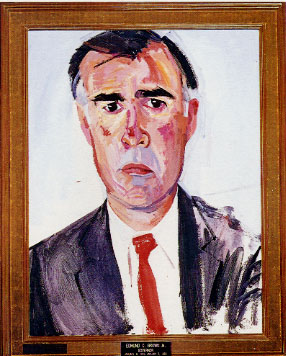
Sen. Mark Leno, a strong foe of the measure, told us he’s been in touch with Attorney General Jerry Brown’s staff, and is urging them to take action. He said he’s been assured the office is looking into the issue.

It will be interesting to see what Brown does. As governor, he was a strong opponent of PG&E’s Diablo Canyon nuclear power plant, and spoke at anti-nuclear rallies, but since then, he’s been awful wishy washy (and has, for example, never been an open supporter of public power.)

Now, however, he’s running for governor — and PG&E is one of the most hated institutions in the state. The old Jerry took on corporate power and positioned himself as a populist; this latest incarnation of Jerry could pick up a lot of progressive support (which he badly needs) and force Meg Whiman into a corner (what, is she going to support PG&E?).

So how about it, Jerry?

(And by the way, the San Francisco supervisors ought to pass a resolution calling on Brown to sue to get this evil measure off the ballot.)


Memorial for Charles Lee Smith (1925-2010), passionate pamphleteer

1

Memorial services for Charles Lee Smith, a classic liberal activist whose hero was Tom Paine and whose passion was pamphleteering, will be held at 3 p.m. on Friday, Feb. 12, at the Friends Meeting House, Walnut and Vine, in Berkeley. He died at his Berkeley home on Jan. 7 at 84.

His wife Anne said that Charlie, as we all called him, fell in December and never fully recovered. She brought him home under hospice care on Jan. 5 and she and his two sons Greg and Jay were with him his last three days.

Charlie first contacted me in the early days of the Guardian in the late l960s. I soon realized that he was my kind of liberal, always working tirelessly, cheerfully, and quietly to make things better for people and their communities. He was a remarkable man with a remarkable range of interests and causes that he pursued his entire life.

He campaigned endlessly for causes ranging from the successful fight to stop Pacific Gas and Electric Co. from building a nuclear power plant on Bodega Bay to integrating the Berkeley schools to third brake lights for cars to one-way tolls on bridges to disaster preparedness to traffic safety and circles to public power and keep tabs on PG@E and big business shenanigans.


When he first began sending tips our way, he was working with, among many others, UC Berkeley Professor Paul Taylor with his battles with the agribusiness interests. He was helping UC Berkeley professor Joe Neilands on his public power campaigns. I remember a key public power meeting that Joe and Charlie put together in a Berkeley restaurant. It brought together the sturdy public power advocates of that era. Charlie did much of the staff work and was seated at the speaker’s table next to the sign that read, Public Power Users Association.

I credit that event and its assemblage of public power activists as inspiring the Guardian to make public power and kicking PG@E out of City Halls a major crusade that continues to this day. Charlie and Joe rounded up, among others, then CPUC commissioner Bill Bennett, consumer writer Jennifer Cross, William Domhoff, the UC Santa Cruz political science professor who was the main speaker, and Peter Petrakis, a student of Neilands’ in biochemistry who researched and wrote the Guardian’s early pioneering stories on the PG@E/Raker Act scandal. (See Guardian stories and editorials since l969.) The room was also full of veteran public power warriors from PG@E battles in Berkeley, San Francisco, and around the bay.

Charlie was a lifelong volunteer for the Quakers and pamphleteered on many of their projects.

My favorite story was how he was helping Dr. Ben Yellen, a feisty liberal pamphleteer in Brawley. Yellen and Charlie were political and pamphleteering soulmates, but Charlie was operating in liberal Berkeley and Yellen was in very conservative Imperial County.

Yellen was blasting away at the absentee land owners who were cheating migrant laborers on health care, on high private power costs of city dwellers, and the misuse of government water subsidies. And so he had trouble getting his leaflets printed in Brawley. He would send leaflets up to Charlie and Charlie would get them duplicated and then send the copies back to Yellen. Yellen would distribute them, mimeographed material on legal-sized yellow construction paper, under windshield wipers during the early morning hours and into open car windows on hot afternoons.

Charlie relished promoting Yellen as a classic in the world of pamphleteering and loved to talk about how Yellen followed up his pamphleteering with several pro per lawsuits, an appearance on CBS’ 60 Minutes television show, and a case that went to the U.S. Supreme Court.

Charlie liked to talk about his triple play of information distribution. He pamphleteered on street corners, prepared more than 50 bibliographies of undiscussed issues (including the best bibliography ever done on San Francisco’s Raker Act Scandal), and circulated his personal essays and cut and pasted newspaper articles. Almost every day, he would take the newspapers from the sidewalk near his house and put them on the front porches of his neighbors. He got some exercise, since his house was on a Berkeley hill, and he endeared himself to his neighbors. He was given the title of “Mayor of San Mateo Road.”

Charlie pamphleteered on more than l50 “undiscussed subjects,” as he called them, in Berkeley, Oakland and San Francisco. He sometimes went out to Palo Alto, Santa Rosa, and Napa, with occasional excursions to Boston and London. His subjects were practical and straightforward but breathtaking in their range: humanizing bureaucracy, employee suggestions, penal reform, illiteracy, migant labor, water, energy, land reform, ombudsmen, coop issues, library use, land value taxation, transportation, disaster recovery planning. He handed out KPFA folios and an occasional Bay Guardian.

He often combined pamphleteering with doing bibliographies to spread the word about the undiscussed subjects.  On the first Earth Day in l970 at California State University, Hayward, Charlie spoke about the evils of automoblies. Then he distributed his bibliography of the Automobile Bureaucracy. In recognizable Charliese, he produced a blizzard of numbered citations on a summary of his speech so the audience could read further on his issues.

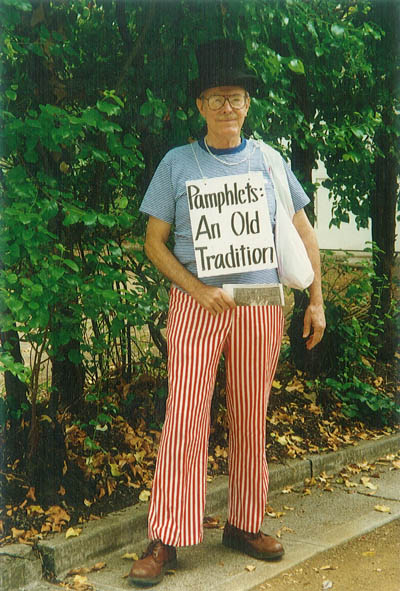
He considered pamphleteering as a noble form of communication that “went on during the colonial Period for a l00 years before the revolution and the arrival of Tom Paine in l775,” as he put it in his own pamphlet, “Pamphleteering: an old tradition.” He wrote that his main contribution “is the novel use of sandwich boards to screen out the disinterested while reaching the already-interested and open-minded persons with leaflets on the street, but not invading anyone’s privacy.”

Sometimes, Charlie had news close to home.

He said that giving out pamphlets to one or two people at a time was like holding a meeting with those persons and thus it was possible to have a “meeting” with several hundred people nearly anywhere within reasonable limits. He concluded that pamphleteering was “basic to building support for worthwhile projects” and claimes that it “may even be more effective than other forms of expensive communication.”

Charlie knew how to work the streets, but he also knew how to work inside the bowels of the bureaucracy. He worked for the California Division of Highways (now Caltrans) from l953 to 1987, mostly in an Oak Street office in San Francisco. I admit when Charlie talked to me about fighting bureaucracy, as he often did, I had trouble understanding how he was going about it. But Charlie had his ways.

Executive Editor Tim Redmond recalls that Charlie worked for Caltrans back in the days when the very thought there might be transportation modes other than highways was heresy.

He was an advocate of bicycles, carpools and public transit and Redmond thought that, when he first met Charlie in l984, “he must be like the monks in the middle ages, huddled in a corner trying to preserve knowledge. Nobody else at Caltrans wanted to talk about getting cars off the roads. Nobody wanted to shift spending priorities. Nobody wanted to point out that highrise development in San Francisco was causing traffic problems all over the Bay Area–and that the answer was slower development, not more highways.

“But Charlie said all those things. He told me where the secrets of Caltrans were hidden, what those dense environmental impact reports really showed, and how the agency was failing the public. I had a special card in my old l980s Rolodex labeled ‘Caltrans: Inside Source.’ The number went directly to Smith’s desk.” Charlie usually carpooled from Berkeley to his San Francisco office.

Charlie wrote a leaflet about the “Work Improvement Program” that then Gov. Pat Brown instituted in l960. It was, he wrote, a “novel program to get all state employees to submit ideas to improve their work.” Charlie labeled it “corrupt” and laid out the damning evidence. No appeal procedure. No protection for the employee making suggestions that the supervisor or organization didn’t want to use. No requirement for giving the employee credit for the idea or for following up the idea.

Charlie noted that he was a generalist with lots of ideas, read lots of publications, and was “sensitive to the problems that bother people.” He noted that there were l,500 employees in his Caltrans district who submitted 236 suggestions. Charlie submitted 35 of them.  But, he noted wryly, “my supervisor, Charles Nordfelt, did not respond at all to any of my suggestions.” And then, to make neatly make his point, Charlie listed a few of his suggestions, all of them practical and useful.

Many were adopted without Charlie ever getting credit. Others were adopted decades later. For example, he pushed the then-heretical idea of collecting tolls on a one-way basis only, instead of collecting them two ways. He noted that the tolls are now  being collected on the wrong side of the bridge. They should, he argued,  be collected coming from  the San Francisco side, where the few lanes of the bridge open up to many lanes. This would reduce or eliminate congestion. .

He listed other suggestions that showed his firm and creative grasp of the useful idea. Putting the third stop light on vehicles (which was finally put into effect in 1985). Numbering interchanges. Installing flashing red and yellow lights at different rates. (He  explained that his wife’s grandfather was color blind and drove through a flashing red light when she was with him.) Getting vehicle owners to have reflective white strips on the front bumpers of their cars, helping police spot stolen vehicles. Some of his suggestions are still percolating deep in the bureaucracies and may yet go into effect.

Charlie never got the hang of the internet but he covered more territory and reached more people in his personal face-to-face way than anybody ever did on the internet.

Charlie was born on a homestead farm eight miles from Weldona, Colorado. He attended a one-room school house and then moved on to a middle and high school in Ft. Morgan, Colorado. He got “ink in his blood,” as he liked to say, by working on the school paper called the Megaphone and then as a printer’s devil at the weekly Morgan Herald.

He was drafted into the army in l943 and served as an infantryman with the 343rd regiment, 86th Infantry Division. He was severely sounded in 1945 in the Ruhr Pocket battle near Cologne, Germany, the last major battle of the war. He suffered leg and hip injuries and had a l6 inch gouge  out of his right hip that cut within a quarter inch of the bone. He spent six months in the hospital. He was recommended for sergeant but he refused the promotion and ended the war as a private first class.

After his recovery, Charlie came to the Bay Area and took his undergraduate work at Napa Community College and San Francisco State, then did graduate work in sociology at the University of Washington, and in city and regional planning at the University of California-Berkeley.

In 1949, Charlie joined the American Friends Service Committee and became a lifelong volunteer, working on a host of projects. He did everything from helping with a clothing drive in Napa to being part of the crew that built the original Neighborhood House in Richmond.

Charlie met Anne Read in l954, a college student in Oregon, when she was on an AFSC summer project in Berkeley. Charlie visited the project, spotted Anne, and double dated with her. When she returned to Oregon State for her senior year, Charlie wrote her every single day. The two were married the following summer in June of l955.

Charlie is survived by Anne, two sons Greg and Jay, daughter-in-laws Karen Vartarian and Andrea Paulos, and granddaughter Mabel.

The family asks that, in lieu of flowers, please send a donation in Charlie’s name to the American Friends Service Committee, 65 9th St., San Francisco, Calif. 94l03.

I asked Anne why Charlie, the inveterate communicator, had not taken to the internet. Charlie, she replied, was a print guy and simply could not understand the internet. “He never ever used email,” she said. “He still thought he had to go to a library to make up a bibliography. I think Charlie was so sure that making a bibliography meant a lot of hard work, he couldn’t possibly do it on the internet.”

Well, Charlie, you may have missed the internet but you covered more territory and reached more people in your direct personal way with good ideas than anybody ever did on the internet.

Here are some of Charlie’s favorite pamphlets:
Governor Pat Brown’s Work Improvement Program
Pamphleteering: An Old Tradition
Short Statement on Plamphleteering

The attack on district elections begins

2

I knew it was coming. After ten years of district-elected supervisors promoting progressive policies (minimum wage and sick day laws, universal health care, tenant protections, public power, development limits, affordable housing etc.) downtown has finally figured out how to launch a counter-attack. It was announced this morning in the pages of the Chronicle

I knew it was coming. After ten years of district-elected supervisors promoting progressive policies (minimum wage and sick day laws, universal health care, tenant protections, public power, development limits, affordable housing etc.) downtown has finally figured out how to launch a counter-attack. It was announced this morning in the pages of the Chronicle

The idea is to replace some of the district supes with at-large representatives – say, four of the 11. That Chamber of Commerce is doing a poll on the issue. Expect a November ballot initiative.

C.W. Nevius chimed in, too, arguing in favor of the “hybrid” (sounds so much like an eco-friendly car) system.

The line is going to be this: District supervisors don’t pay attention to citywide issues.

“People like the idea of being able to talk to a district supervisor about neighborhood problems, but also feel that they want someone they can go to with broader, citywide concerns,” said Steve Falk, president and CEO of the San Francisco Chamber of Commerce.

Or as Nevius puts it:

The truth is that San Francisco has more supervisors than any county in California. Is it too much to ask that a few of them have the entire city’s best interest in mind?

Let’s consider for a moment what this is really about.

For starters, get rid of the nonsense about a “citywide perspective.” Even Nevius didn’t try to push that too hard when I emailed him with the facts, to wit: Over the past ten years, district-elected supervisors have devoted themselves to a long string of exceptional citywide reform measures and have been guilty of very little district pandering.

Consider a few examples:

Healthy San Francisco
The Rainy-Day Fund
Reforming the makeup of the Planning Commission, Police Commission and Board of Appeals
Restricting the use of plastic bags
Minimum wage and sick day laws
A citywide infrastructure plan and bond program
Community choice aggregation and green energy
Campaign finance reform
Sanctuary city protecting for immigrants

The list goes on and on.

You may agree or disagree with what this board has done, but nobody can honestly say that the district supervisors have ignored citywide issues or that they don’t have a citywide persoective. No: This has nothing to do with citywide issues vs. district issues. It’s entirely about policy – about the fact that district supervisors are more progressive. About the fact that downtown can’t possibly get a majority under a district system – because with those small districts that Nevius complains about, big money can’t carry the day.

In a district system, grassroots organizing – the stuff that labor and nonprofits and progressive groups are good at – is more important than raising money. So district supes are accountable to a different constituency.

I watched an at-large board for almost 20 years, and it was, by and large, a collection of sold-out hacks who did exactly what the mayor and the downtown donors said. It was really pathetic.

The polls have consistently shown that people like have district supes, so now there’s this “hybrid” effort.

Here’s what it means:

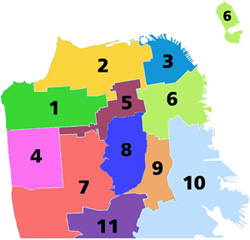
Right now, there are three districts that will generally elect a more conservative representative – D 2 (Michela Alioto-Pier) D- 4 (Carmen Chu) and D-7 (Sean Elsbernd). Districts 8, 10, 11 and 1 are swing districts, and the rest are going to go generally progressive.

So the odds are under this system that the left-leaning constituencies will have at least six votes, and in good times, as many as eight.

Now take four of those votes away, pretty much forever. Set it up so that four supervisors, elected citywide, will be guaranteed downtown call-up votes. Then add in one or two more from the more conservative districts, and you’ve got a majority.

That, my friends, is exactly what this is about, and any effort to frame it as anything else is just spin.

I asked Nevius what the hell he was doing buying the bogus argument that we need citywide perspective – since the district board has already demonstrated that, consistently. Here’s his response:

First, I’d envision the city-wide supes as made to order swing votes. When a district supervisor had a good idea, let’s say Healthy San Francisco, it might not be an issue of critical interest for a district supervisor. But it would be right in the wheelhouse for a city-wide official, who is looking for broad stroke issues to back. And, although you didn’t advance the idea, I’d reject the notion that whomever it was that was elected city-wide would be incredibly conservative and obstructionist. The most moderate politician we’ve elected in this city is Gavin Newsom. Although the Guardian doesn’t agree with him much of the time, he’s still advanced some very progressive ideas. Everyone jumps on the Chris Daly example as why district elections are a problem, but I think we can look beyond that. I think he’s been an aberration. District supes like David Campos and David Chiu have proved they can compromise and govern so I think that’s a good thing. I would never advocate that we get rid of representation in the neighborhoods. But c’mon, 11 little districts in a very small city? As Jim Stearns said, some of the districts are no more than a mile square. Combining some of them would still let residents have someone they could call to get the potholes fixed, but also spread out the areas.

Okay, I didn’t say citywide supes would be conservative. Sean Elsbernd is (relatively) conservative. He’s also independent of any big-money interest and does what he thinks is right. He doesn’t need half a million dollars to get elected in his district.

What I say is that citywide supes would be in hock to big money. I’ve seen it, lived with it. Suffered from it.

And guess what: Healthy San Francisco didn’t need any citywide supes; it passed just fine with the district board.

So what this is about is money and political control, and it’s about the political direction the city is going and who’s going to set that direction. Let’s get that straight and be honest about, and then we can have this discussion.

PG&E kicks press out of debate

2

By Brady Welch

news@sfbg.com

It sounded like a great story: a representative of Pacific Gas and Electric Co. agreed to a public debate over the merits of a ballot initiative the company essentially had paid to place on the California ballot. The measure seeks to curtail public power and clean energy in the state. And so far, PG&E has been loathe to discuss it in any open forum.

But on Jan. 27, PG&E’s political consultant, David Townsend, was scheduled to square off with state Sen. Mark Leno, a staunch foe of the measure, before what sounded like a great audience: the Northern California Power Agency, which represents 17 public power providers across the state.

At Sacramento’s Doubletree Inn, I headed to the lobby of the California Ballroom, where I found a woman sitting at a table adorned with the logo of the NCPA. “I’m a reporter here to cover the debate between Sen. Mark Leno and a representative from PG&E,” I said. “Would this be the right place?”

She smiled politely. Sorry, she said, you have to be an NCPA member and registered for the conference.

“I was invited by the senator,” I told her.

“Then you will have to wait until he gets here,” she said curtly.

I walked upstairs to the front desk — and just then, Leno walked through the main lobby’s sliding doors. I introduced myself, walked with him to the conference room, and quickly slipped in with some other attendees. Within three minutes, a man sitting next to me was called to the side by a steward who whispered something to him, and then just as quickly, returned to his seat. He turned to me.

Are you with the media? he whispered.

“I’m with a newspaper,” I said.

He then informed me that the conference was actually private, and sorry, I would have to leave. They would explain more outside.

After I was escorted out, Leno came up to me and explained that there had been a miscommunication. Turns out Townsend didn’t want the media around. And worse, the NCPA folks appeared to be taking his side. Leno arranged for me to hear his opening statement, but that was all.

The senator’s remarks were pointed. He noted that PG&E’s proposed legislation is not an initiative, but an amendment to the state Constitution. He mentioned the curtailing of free enterprise and a demise of state government. He likened the utility’s disrespect for the legislative process to a spit in the face, and at one point openly asked Townsend: “What good is your word?”

The political consultant, for his part, sat quietly. At times he rolled his eyes or bit his thumbs. When Leno was wrapping up, Townsend leaned over to the moderator and whispered something. The moderator then came over to me and said I’d have to leave.

So I walked out — but not without wondering: when exactly did PG&E hirelings get the right to exclude reporters from meetings filled with representatives of public agencies?

Leno himself wasn’t sure. “With all due respect to David Townsend,” he told the Guardian a few days later, “I don’t see why a consultant wouldn’t want to discuss the themes of his campaign in public. I think his decision not to allow the press to hear him speaks for itself.”

Despite multiple calls and e-mails, we couldn’t get NCPA director James H. Pope to tell us why he lets PG&E determine who can — and can’t — attend his sessions. Jane Cirrincione, NCPA’s assistant general manager for legislative and regulatory affairs, told us that Townsend was invited by her boss and was not authorized to speak publicly for PG&E.

But Peter Scheer, director of the California First Amendment Coalition, offered a possible explanation. NCPA, he contends, “is capitulating to PG&E’s demand for secrecy, not for ideological reasons, but simply because if the spokesperson walks, they don’t have a conference. The reasons for excluding the press are basically that mundane and stupid.”

Editorial: Indict PG&E

0

Kamala Harris is in a perfect position as the San Francisco D.A. to file charges against PG&E for violating state law

EDITORIAL When Carole Migden, then a state senator, introduced the bill that allowed cities to form electricity co-ops through community choice aggregation in 2002, Pacific Gas and Electric Co. was at the table. Migden didn’t kick PG&E out or deny the private utility its chance to have input on the bill — for better or for worse, according to all participants, PG&E was part of the process that led to the bill’s passage. And in the end, the company actually supported the measure.

But now that cities and counties are trying to implement it, PG&E has shifted position and is spending millions on a statewide initiative that would, for all intents and purposes, destroy CCA. The initiative would mandate a two-thirds vote in every community before any public power effort, including CCA, could take effect. That’s an almost impossible threshold — particularly when PG&E will be opposing every single proposal and using its almost unlimited resources to do so.

Editorial: The mayor’s race starts now

2

Ross and Jeff and any other progressive candidates need to decide soon if they are serious about running for mayor and either announce that they are running or step out of the way so someone else can step forward

EDITORIAL Back in 2007, when no leading progressive stepped in to run against Gavin Newsom, Sup. Chris Daly called a convention in the hope that someone would come forward and take up the challenge. All the major potential candidates showed up and spoke, but none announced a campaign.

Let’s not go there again.

We’re two years into Newsom’s second term, and the city’s a mess. After absorbing a round of brutal cuts last year, the budget’s still half a billion dollars out of whack. The mayor’s only answer at this point is to cut more (then raffle off to landlords the right to get rich by evicting tenants and turning apartments into condos). The Newsom agenda hasn’t created jobs or addressed the housing crisis or resolved the unfairness of the tax code or taken even the first steps toward energy self-sufficiency. Over the past year, he’s been largely inaccessible and hostile to the press, a mayor who won’t even tell the public where he is and what he does all day.

A candidate who wants to change the direction at City Hall should have no problem getting political traction in 2011. But the progressives are still floundering. And while the race is two years away, the more centrist candidates are already out the door. Sup. Bevan Dufty has announced he’s in the race, and state Sen. Leland Yee might as well have announced since everyone knows he’s running. Same for City Attorney Dennis Herrera. And at a certain point — in the not-too-distant future — those candidates will be starting to line up endorsers and making promises to major financial backers and constituency groups, which aren’t going to wait around forever for the progressives to settle on someone willing to make the immense effort to mount a serious campaign for mayor.

So the potential candidates — starting with Sup. Ross Mirkarimi and Public Defender Jeff Adachi — need to decide, soon, whether they’re serious about this or not, and either announce that they’re running or step out of the way so someone else can step forward.

With public financing, a candidate in San Francisco doesn’t have to be as well-heeled as Newsom was his first time around. It won’t take $6 million in contributions to win. But a progressive who wants to be the next mayor needs to demonstrate he or she can do a few key things, including:

<\!s>Motivate and unite the base. Labor (or at least the progressive unions), the tenants, the left wing of the queer community (represented to a great extent by the Harvey Milk LGBT club), the environmentalists, and the progressive elected officials have to be fairly consistent in backing a candidate or downtown’s money will carry the day. So Mirkarimi and Adachi (and anyone else who’s interested) ought to be making the rounds, now. If that critical mass isn’t there, the campaign isn’t going to work.

<\!s>Develop and promote a signature issue. Newsom won in part because he came up with the catchy “care not cash” initiative. Voters frustrated with years of failed homeless policies (and an incumbent, Willie Brown, who said the problem could never be solved) were willing to try something new (however bogus it turned out to be). Nobody’s developed a populist way to approach city finance. Nobody’s got a workable housing or jobs plan. What’s the central issue, or set of issues, that’s going to define the next progressive mayoral campaign?

<\!s>Put together a central brain trust. This city’s full of smart progressives who have experience and ideas and can help put together a winning platform and campaign strategy. A good candidate will have them on board, early.

<\!s>Herrera, Yee, Dufty, and others who might run (including Assessor-Recorder Phil Ting) are already out there looking for progressive supporters and allies, but none has yet offered an agenda the city’s left can support. Dufty pissed off the tenants by refusing to back stronger eviction protections. Herrera pissed off immigrant advocates by refusing to be as aggressive in supporting the city’s sanctuary law as he was in defending same-sex marriage (and because he hasn’t officially announced yet, he’s still not taking stands on political issues). Yee tried to sell off the Cow Palace. Ting has taken some great initiatives (forcing the Catholic Church to pay its fair share of property transfer taxes), but hasn’t developed or spoken out on the broader issues of city revenue. More of those candidates have been leaders in the public power movement.

It would be inexcusable if the progressives, who control the Board of Supervisors, are forced to pick a mayoral candidate by default. It’s time to end the speculation and dancing and find a candidate who can carry the progressive standard in 2011.

PG&E’s stealth initiative gets some press

0

By Tim Redmond

Pacific Gas and Electric Co’s $3 million ballot-box attack on public power is starting to get some press attention. The L.A. Times today has a nice story by Michael Hiltzik that points out the essential lie:

What are the chances that PG&E ginned up this innocuous-sounding initiative, shrouding its own involvement behind a scrim of public relations and law firms, largely to preserve its monopoly against competition from public power agencies? I’d say 100%.

It’s going to take a huge amount of effort to defeat this thing, but at least (some of) the media is starting to notice.

PG&E’s morning line of bullshit

0

By Tim Redmond

KQED’s Forum had a show on Marin County’s clean energy efforts and community choice aggregation this morning; the audio should be posted in an hour or two here. It gave me an opportunity to hear the greatest line of Pacific Gas and Electric Co. bullshit that I’ve come across in a while.

The director of the Marin Energy Authority, Dawn Weisz, talked about how her agency will be able to offer renewable power to Marin residents at a cost competitive with PG&E. Paul Fenn, the president of Local Power, pointed out that there’s not a lot of risk here, and that public power agencies routinely offer cleaner power at lower prices than PG&E, which can’t even meet the state’s weak renewable energy standard.

Then up pops PG&E flak David Rubin, who has the most amazing line: PG&E, he says, loves clean energy and really wants to help the good people of Marin and San Francisco and the rest of California reduce their carbon footprints. But gee, he’s concerned about CCA — not, of course, because it might cause PG&E to lose customers (perish the thought) but because nice ol’ PG&E is “worried about the risks to the taxpayers and the community.”

Ladies and gentlemen: Pacific Gas and Electric Company has never worried about risks to taxpayers and communities. The company worries only about its bottom line — and as host Scott Shafer (too gently) pointed out, CCA — like any form of public power — is a serious threat to PG&E’s profits.

That’s what the company is sponsoring a ballot initiative that would essentially end public power in California by mandating a two-thirds vote of the public for any new municipal power efforts.

PG&E has jacked up rates, gone bankrupt, provided lousy service and screwed San Francisco for decades. Now they nice folks over there are worried about the taxpayers.

Amazing. And this is the line that we will hear in the upcoming campaign to pass the PG&E ballot measure.

PG&E attack mailer puts City Hall on defensive

0

GREEN CITY On a Pacific Gas & Electric Co. conference call in late October, with top PG&E executives and analysts from Goldman Sachs, Deutsche Bank, and other prominent investment firms on the line, PG&E president Chris Johns explained how a company-sponsored ballot initiative could save millions of dollars for the utility.

“We have faced potential takeovers multiple times over the last several years and we have had to expend significant resources to oppose these efforts,” Johns explained, referring to attempts by public agencies to set up independent electricity programs that threaten to compete with PG&E. “The success of this initiative, if placed on the ballot, could significantly reduce the need for taxpayers and utilities to oppose these local government takeover attempts.”

His comments appeared in a transcript from an earnings call posted on a financial Web site called SeekingAlpha.com. When pressed by an analyst about how PG&E had come up with the idea, company CEO Peter Darbee chimed in. “What occurred to us was we were repeatedly faced with this, and we were spending significant amounts of money year after year,” Darbee said, according to the transcript. “So we asked ourselves: what would be something that could discourage this over the longer term?”

What surfaced was a proposal for a statewide ballot initiative that would amend the state constitution to require a two-thirds majority vote at the ballot before any local government could develop its own electricity program. With such a high hurdle in place, efforts to move forward with publicly-owned power programs would essentially come to a standstill. But with San Francisco’s own stab at it expected to get underway long before the proposed initiative is placed on the ballot, PG&E is back to its default tactic of pouring millions into an opposition campaign.

San Francisco’s community choice aggregation (CCA) initiative, called CleanPowerSF, took a leap forward last month when a request for proposals (RFPs) went out to potential electricity service providers. The program aims to provide 51 percent renewable electricity by 2017, a meaningful step toward reducing greenhouse gas emissions.

But on the heels of this milestone, a wave of mailers bearing PG&E’s name in fine print crashed into San Francisco homes and businesses, screaming “Business Beware” in 1.5-inch type and proclaiming CleanPowerSF to be a “costly energy scheme.” The mailer cites a city controller’s report projecting that customer bills could be 24 percent higher under CCA.

But the San Francisco Local Agency Formation Commission (LAFCo), which is working in partnership with the San Francisco Public Utilities Commission to craft the emerging power program, responded in a press statement that this claim is misleading, since a fee structure has not yet been nailed down. While the controller’s report also noted that it was too early to say just what the pricing structure would be, it’s been a primary goal of the city’s CCA all along to offer customer billing rates that meet or beat PG&E prices.

Meanwhile, the city appears ready to fight back — and questions have already been raised about whether it was legal to distribute the attack mailer. Sup. Ross Mirkarimi, who chairs LAFCo, announced at the Dec. 15 Board of Supervisors meeting that he was requesting that the city attorney examine whether PG&E had violated state law by distributing the mailer. According to the state law that laid the groundwork for CCAs to exist, investor-owned utilities are required to “cooperate fully” with the public power efforts of cities. “PG&E has blanketed this city … with mailers that distort and misrepresent what CCA is doing,” Mirkarimi said. “I believe this is a potential violation of California Public Utility Commission law.”

Several days before Mirkarimi’s announcement, the Guardian received confirmation from City Attorney Dennis Herrera that his office is looking into the matter.

The mailer included a link to the Web site CommonSenseSF.com, launched by an entity called the “Coalition for Reliable and Affordable Electricity.” A call to Townsend, Raimundo, Besler & Usher, a Sacramento public-relations firm that has worked with PG&E in the past, revealed that this coalition is one of the firm’s clients, and that the person handling that client is Bob Pence. The proponent listed on the statewide ballot initiative is Robert Lee Pence — evidently the same person. The Guardian left a message for Pence inquiring who, besides PG&E, the coalition members are (the mailer claims there are 50,000), but he did not return the call. Multiple calls to PG&E were not returned either.

Meanwhile, the Guardian has received a handful of anecdotal reports that when clipboard-wielding signature gatherers were out on the streets circulating a petition in support of the PG&E-backed ballot initiative, people were fed some fishy stories about what the proposed constitutional amendment would actually do.

A voter who lives in Bakersfield contacted the Guardian to say she’d signed the petition because she was told that the ballot initiative would limit PG&E expansion — but she later did some research and found that PG&E was the primary force behind it, so she called the Registrar of Voters to have her name struck from the list.

Mark Toney of the Utility Reform Network told the Guardian that he’d also been misinformed. But as someone familiar with the issue, he knew better. “I ran across signature gatherers in Emeryville. They told me that if I signed the petition, I’d be supporting a two-thirds majority vote to raise PG&E rates,” Toney said. “I said, ‘Well that’s interesting. The language here doesn’t say PG&E at all.

John Srebalus of Pasadena wrote in an e-mail that he was also misled by a signature gatherer. After he signed a petition to legalize marijuana, he said the woman with the clipboard flipped a few pages and asked him to sign again, as if in duplicate. But there was a rubber band securing the top half of this second page, hiding the text. When he peeled it back, he found that it was actually PG&E’s ballot initiative, which he had already refused to sign once before.

According to a source familiar with the campaign who asked not to be named, the petition was a particularly hard sell for signature gatherers, many of whom stake their entire livelihoods on earning less than $2 per signature. According to this individual, the erratic sales pitches caught on like wildfire because without a compelling hook, it was nearly impossible to convince random passersby to support something that came off as convoluted and wonky. This person said PG&E became alarmed when it caught wind of all the distorted representations and tried to put a stop to them.

Campaign spokesperson Greg Larsen told the Guardian he hadn’t heard anything about that, but he did emphasize the importance of the signed document, as opposed to the signature gatherers’ pitch. “The hope is that you read what you’re signing,” he said. “That’s really what the issue is — it’s what’s on this piece of paper.” Larsen added that the campaign had submitted 1.1 million signatures, “far in excess of the number of required certified signatures” to have the initiative placed on the ballot.

That’s funny, they didn’t mention climate change

1

By Rebecca Bowe

“The war with PG&E over clean energy is now fully on folks.”

That’s what local public power activist Eric Brooks had to say in a widely distributed email to alert green-power advocates that Pacific Gas & Electric Co. has started a smear campaign against San Francisco’s community-choice aggregation program, CleanPowerSF.

A “coalition” backed by PG&E recently sent glossy brochures to San Franciscan’s mailboxes, and launched a Web site called CommonSenseSF.com. Based on the information provided, it was unclear who, besides PG&E, the coalition members are.

The intent of CleanPowerSF is to reduce the city’s overall greenhouse gas emissions by offering San Franciscans the choice to use 51 percent green power supplied through a program administered by the San Francisco Public Utilities Commission, instead of buying power exclusively from PG&E, whose electricity sources are primarily fossil fuel and nuclear power plants.

PG&E often mentions climate change in its ads, but the topic doesn’t come up on either the mailer or the Web site. Instead, the message focuses on proposed exit fees that consumers would have to pay if they decided to go back to PG&E after the close of a two-month CCA opt-out period. It calls San Francisco’s CCA — one of the most dramatic attempts at community-wide greenhouse-gas reduction that any U.S. city has taken on — a “costly energy scheme.”

The campaign’s Web site notes that the information is provided by the “Coalition for Reliable and Affordable Electricity, a coalition of concerned consumers, small businesses, labor, community organizations and Pacific Gas and Electric Company.”

A representative from Townsend, Raimundo, Besler and Usher, a Sacramento-based PR firm, confirmed that the Coalition for Reliable and Affordable Electricity is one of its clients.

The person who is handling that client, we were told, is Bob Pence. If that name sounds familiar, it may be because Robert Lee Pence is listed as the proponent of a statewide ballot initiative that would impose a two-thirds majority vote requirement before CCA could be implemented.

The mailer includes a form that members of the public can send in, postage-free, to sign up for an alert when the Board of Supervisors votes on CCA. The address the postcards would be sent to appears to be a mail drop at Mailboxes Etc.

Newsom and the next chapter

3

By Tim Redmond

It’s a little weird that Gavin Newsom just disappeared after dropping out of the governor’s race. I had a feeling that he wasn’t going to hold up well under the pressure; he loves celebrity, loves to be on the A-List and loves to hear himself talk, but he can’t take a punch. And getting hit, a lot, is a big part of statewide politics. So I suspect that when he realized that this particular dream was over — clunk! — and that in two years, he’s not going to be anything but Gavin Newsom, citizen, he had a little meltdown.

This ought to be cause for concern: Somebody has to run the city for the next two years, and either Newsom is going to buck up, get back to work and try to change the way he does business — or he’s going to be a bitter lame-duck who can’t get anything accomplished except to go all Nixonian and attack his enemies.

I’m really hoping it’s the former — and now that he’s off his statewide horse, I think it’s safe to say that most of the supervisors, including the progressives he so disdains, would be more than willing to start working with him. I’d love to see the mayor come back from Hawaii with a clear understanding of what went wrong with his campaign. As we point out in an editorial today:

If the real Gavin Newsom had been anything like the campaign picture his handlers tried to present, he would have been a serious candidate. Newsom the candidate was a leader who brought San Franciscans together to get things accomplished. He was a progressive thinker who created universal health care and an effective budget process with a rainy day fund that prevented teacher layoffs. He was bold enough to challenge federal and state law on same-sex marriage and demand equality for all.

But Newsom the mayor was actually a snippy politician who refused to work with the Board of Supervisors and would never engage his opponents. He was great at press releases but short on accomplishments — universal health care and the rainy day fund were projects put together by Tom Ammiano, one of the supervisors the mayor disdained, who is now a state Assembly member. He refused to take a lead role fighting Pacific Gas and Electric Co. to promote clean energy and public power. And for all his success in moving same-sex marriage forward, he never once managed to bring that kind of progressive energy or policy-making to economic issues. His budget this year was the same as Republican Gov. Arnold Schwarzenegger’s budget — cuts and fees only. No new taxes.

As a result, the progressives and independent voters in his own town didn’t support his campaign — and without the environmentalists, labor, tenants, and progressive elected officials from San Francisco behind him, there was no way he could generate an honest grassroots movement.

I’d love to see the mayor reach out to the folks who have been snubbed all these years. Let’s talk about making the city budget work for everyone — and if that means some new revenue sources (which lots of other cities seemed to be able to pull off), at least he doesn’t have to worry about running statewide after raising local taxes.

He can take a hard look at where his cuts have really hit and try to work with labor to spread the pain a little better and chop from the top, not just the bottom.

He can become a real, serious clean-energy leader by strongly supporting CCA and taking a visible public role in the campaign against PG&E’s anti-public-power initiative.

The city’s ready for a Gavin, Chapter Two. And he wouldn’t be the first politician to rebound from a defeat, learn his lesson and start his career up again.

Any bets on whether that’s going to happen?

Editorial: The next Gavin Newsom

0

EDITORIAL It’s possible that Mayor Gavin Newsom took a long look at himself, his life, and his future last week and decided that politics — intense, 24/7/365 politics — wasn’t what he wanted right now. It’s possible (as Randy Shaw noted in Beyondchron.org) that Newsom "now joins longtime adversary Chris Daly in putting family relationships ahead of one’s political career." It’s possible that he never really wanted a future in electoral politics and was driven to run for governor less by personal ambition than by the desire of his advisors to see him in a higher political role.

In that case, Newsom has a responsibility to do the best job he can over the final two years of his term as mayor, then step away and find something else to do with his life.

But since it’s also possible — even likely — that Newsom still hopes to have a political career, and that his decision to drop out of the governor’s race was as much about his failure to gain any traction as it was about his family obligations, it’s worth talking about why his campaign failed and what he can and should do next.

For starters, Newsom never expected to beat Attorney General Jerry Brown in the big-donor fundraising battle. He was hoping to put together a grassroots operation, to mobilize the Obama constituency, and build a war chest with tens of thousands of small donors organized through social media and technology. And that kind of effort could have worked — Brown has name recognition and money, but not much else. It’s hard to imagine large masses of young activists donating time and energy to his primary campaign.

The problem was, those legions of California activists weren’t terribly excited about Newsom either. And there are good reasons for that — reasons Newsom needs to understand if he wants to run for statewide elected office in the future.

If the real Gavin Newsom had been anything like the campaign picture his handlers tried to present, he would have been a serious candidate. Newsom the candidate was a leader who brought San Franciscans together to get things accomplished. He was a progressive thinker who created universal health care and an effective budget process with a rainy day fund that prevented teacher layoffs. He was bold enough to challenge federal and state law on same-sex marriage and demand equality for all.

But Newsom the mayor was actually a snippy politician who refused to work with the Board of Supervisors and would never engage his opponents. He was great at press releases but short on accomplishments — universal health care and the rainy day fund were projects put together by Tom Ammiano, one of the supervisors the mayor disdained, who is now a state Assembly member. He refused to take a lead role fighting Pacific Gas and Electric Co. to promote clean energy and public power. And for all his success in moving same-sex marriage forward, he never once managed to bring that kind of progressive energy or policy-making to economic issues. His budget this year was the same as Republican Gov. Arnold Schwarzenegger’s budget — cuts and fees only. No new taxes.

As a result, the progressives and independent voters in his own town didn’t support his campaign — and without the environmentalists, labor, tenants, and progressive elected officials from San Francisco behind him, there was no way he could generate an honest grassroots movement in a Democratic primary.

Now he’s back from the campaign trail — and he has two years to pick up on the lessons of his ignominious political collapse. If he wants any kind of a political future, he needs to change. First, he needs to start engaging and working with the supervisors — even the ones who disagree with him. (Showing up for "question time" would be a huge step). He needs to take the city’s structural budget deficit seriously and present plans for progressive taxes to help close it. He needs to show he can take on big powerful local interests — PG&E, for example — by opposing the utility’s anti-public power initiative and putting his political capital on the line to support community choice aggregation.

Newsom the imperial mayor has, we hope, been a bit humbled. Let’s see if he comes out of this chapter as an embittered, angry (and ultimately unsuccessful) mayor committed to punishing his enemies — or a serious city leader who can live up to his own hype.

Leno goes after PG&E initiative

1

By Tim Redmond

State Sen. Mark Leno is asking the leadershiop of the state Democratic Party to pass an emergency measure opposing Pacific Gas and Electric Co’s plans for a statewide initiative against public power.

Leno told me he will travel to San Diego Nov. 14th to personally introduced a resolution to the party’s Executive Board putting the party on record in opposition to the measure. The company has been paying signature gatherers to collect enough names to place the measure on next spring’s statewide ballot.

The board is meeting that weekend. Since this would be an emergency measure, Leno said, any member of the Resolutions Committee could block it. But Leno thinks that’s unlikely; “who,” he asked, “is going to stand up and defend PG&E right now?”

PG&E’s spooky stories headed to your mailbox

0

By Rebecca Bowe and Rachel Sadon

At a Halloween-themed press conference on the steps of City Hall this afternoon, Supervisors Bevan Dufty and Ross Mirkarimi warned that PG&E plans to disseminate misleading information about the city’s Community Choice Aggregation (CCA) program.

The attack comes on the heels of the Board of Supervisor’s approval of a request for proposals for Clean Power SF, San Francisco’s own fledgling CCA, which seeks to provide competitively priced and significantly greener energy than PG&E. The CCA would challenge PG&E’s monopoly in the San Francisco Bay Area, and the utility is expected to fight it tooth and nail.

Sup. Dufty got a heads up from a PG&E employee this morning that mailers criticizing the program would be sent out tomorrow. Recalling last year’s multimillion dollar campaign against Prop H, an initiative for public power, Dufty emphasized that the city does not nearly have the funds to match a misinformation campaign.

Tom Ammiano denounced PG&E and their tactics as “avaricious, criminal, morally corrupt” and “a throwback to robber barons.”

Though the content of the mailers is unknown, it has already created a stir around City Hall and throughout the community that is advocating for community choice. At the press conference, which was scheduled with very little advance notice, Dufty and Mirkarimi were joined by Sup. David Campos, San Francisco Public Utilities Commission director Ed Harrington, state senator Mark Leno, and Sierra Club representatives Michael Borenstein and John Rizzo.

Mirkarimi, chair of the Local Agency Formation Commission (LAFCo), insisted that “San Francisco is steadfast in its commitment to Community Choice Aggregation,” and stressed that “PG&E continues to mock our commitment to green energy and will do everything in their power to circumvent the process.”

Killing the dream

0

tredmond@sfbg.com

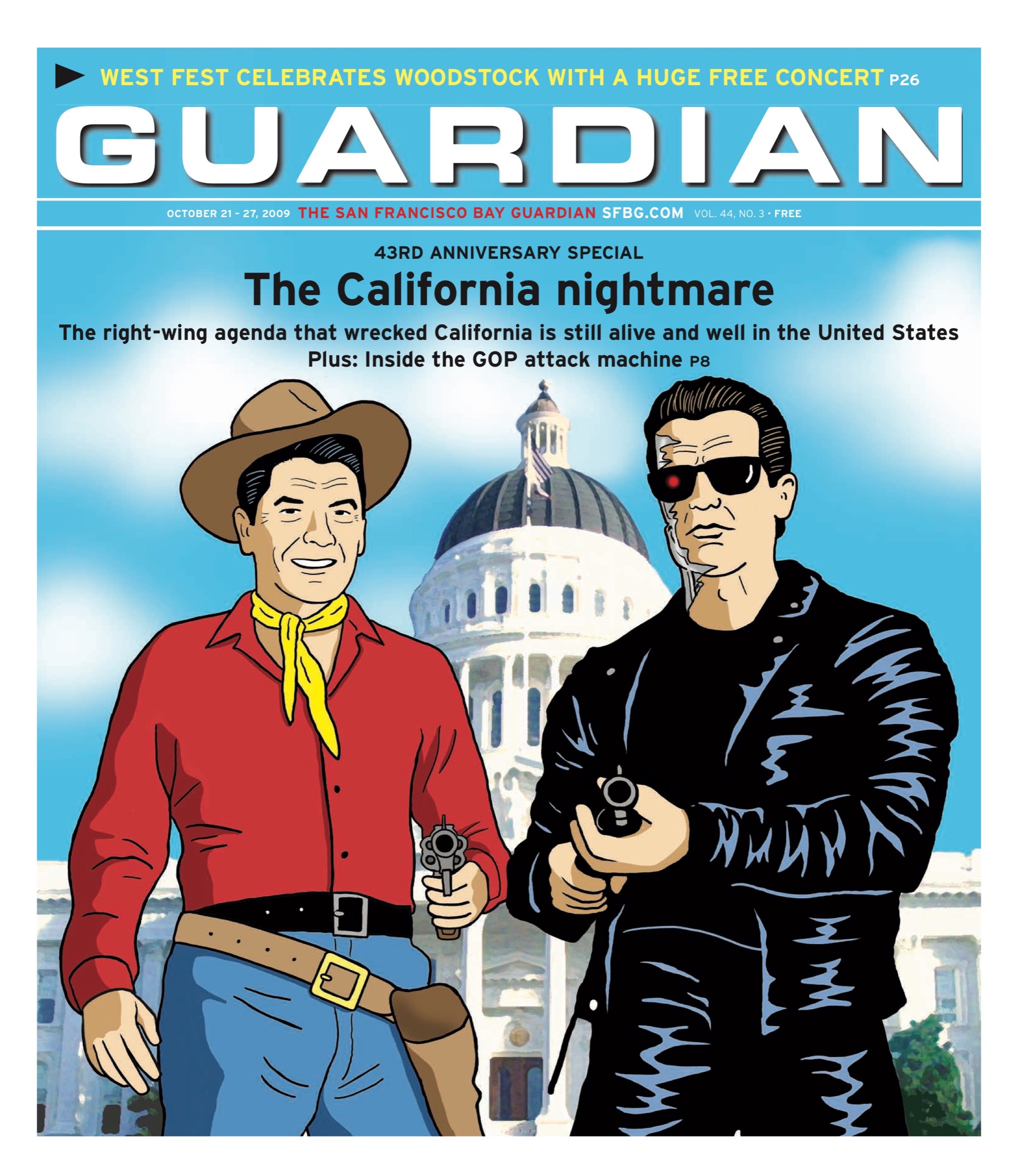
When the first issue of the Bay Guardian hit the stands in 1966, it was still really possible to talk about the California dream. The state had seemingly limitless potential and was in many way a model for the nation — a free public university system that was the envy of the world, an economy that provided jobs to hundreds of thousands of new arrivals, the beginnings of what would be the nation’s premier environmental movement pushing to save San Francisco Bay, save the coast, save Lake Tahoe … and the Free Speech Movement, the Summer of Love, the United Farm Workers Union, and so much more that was transforming politics and culture in the United States from the West Coast.

Twelve years later, it was all falling apart. Eight years of Gov. Ronald Reagan and then the passage of Proposition 13 launched a very different kind of movement out of the West, a movement that sought to dismantle the public sector and the social safety net, to treat government as the enemy, and to use culture wars to convince working-class Americans to vote against their own economic interests.

And now California is being described as the nation’s first failed state. Gov. Arnold Schwarzenegger — the second Republican actor to hold that role — has driven the state to the brink of bankruptcy. The University of California is drowning in red ink, raising fees and turning away students. The state’s water system is a mess; cities and counties are in fiscal collapse; the economy’s in the tank; and nobody seriously talks about a California dream anymore.

The story of how that happened — and how the diseases of tax-revolts, privatization, government corruption, and public disempowerment spread east from California — is the focus of this 43rd anniversary issue. It’s both enlightening and a bit scary to read through old issues, because in hundreds of stories over the past four decades, the Guardian has warned of exactly what was to come.

The very first issue of the Bay Guardian talked about the "historic election" pitting the incumbent, Democrat Pat Brown, against Reagan. A lot of people in the emerging "new left" were arguing that there wasn’t a bit of difference between the two, and that you might as well sit out the election. But the Guardian had a different take. The election was really about the direction California wanted to go, the paper said, a choice between a state that cares about the public sector and social welfare and a state where those things don’t matter.

"Reagan’s stands typify the temper of the cause," the Nov. 7, 1966 editorial stated. "He is on record, at various times, in opposition to the progressive income tax, Social Security, Medicare, the anti-poverty program, farm subsidies, the TVA, the Civil Rights Act, the Voting Rights Act, public housing, federal aid to education, and veterans hospitalization for anything other than service-connected disabilities. How can a man or a movement govern the state of California with such a political philosophy?"

Reagan’s election may have seemed like a fluke, but it was nothing of the sort. By the mid 1960s, with the counterculture — and equally important, the economic left — looking to make major inroads in American policy, the broad outlines of a right-wing attack plan were in place.

That’s something the Guardian always recognized — that powerful people who moved the levers of government typically did so with a long-term plan.

In San Francisco, part of that plan was the transformation of a human-scale city to a West Coast version of Manhattan. The idea: tear up South of Market (then mostly low-income housing) for a shiny new convention center and hotels. Dump dozens of big high-rise office buildings downtown. Construct a fixed-rail system to carry suburban commuters into the dense downtown. Drive up property values — massively — and if that means blue collar jobs and working class people had to go to make way for wealthier office workers, so be it. In the end, of course, the architects of the plan — landowners, developers, bankers, and big business leaders — became immensely wealthy.

On the state and national level, their plans were broader. Even so, they had one major aim: throttle the pubic sector. Cut off the funding for government programs, reduce regulations, undermine any concept of a welfare estate — and cut taxes on the rich.

As we report on page 8, the architects of this plan are happy today to talk about how it worked — how Reagan launched his war on government back in the 1970s, how a group of well-funded think tanks developed plans, and political consultants took advantage of people’s fears (and the Democratic Party’s failures) to put those plans into action.

The movement really got off the ground in 1978 with the passage of Proposition 13.

Prop. 13 emerged from a state in the middle of a massive growth spurt and a heated political cauldron of money, race, and Legislative failure. Howard Jarvis, a Republican landlord lobbyist who hated taxes, hated government, hated public schools, and disdained most Californians — "63 percent of [public school] graduates are illiterate" and would have no need for public libraries, he once quipped — took advantage of a gaping hole in political leadership and set off a movement that would cripple the United States of America.

The measure marked the final, fatal end in California of the era known as the ’60s — a period when the left was ascendant, when taxes on the wealthy funded education, infrastructure and programs for inner cities, and when economic and cultural liberalization seemed to be spreading across the nation.

Rising property values, driven by rapid population growth, were driving up property taxes — and the problem was real. Long-time residents, particularly people on fixed incomes, saw their taxes rise so high they couldn’t afford to stay in their homes. The Legislature could have addressed that (with, say, a split-roll measure that taxed residential and commercial property at different rates) but utterly failed to move on the crisis.

A series of assessor’s office scandals didn’t help, either. And, at the same time, the California Supreme Court ruled that rich school districts had to share revenue with poor districts, infuriating wealthy white property owners.

Jarvis and his partner Paul Gann circulated petitions to roll back property taxes and make it almost impossible to raise taxes in the future. It passed with 65 percent of the vote.

Of course, big businesses (particularly utilities) were the big winners. As the Guardian pointed out on June 1, 1978, the top five utilities in California alone (including Pacific Gas and Electric Co.) would gain billions from the tax cuts.

But beneath it all was a simmering discontent with government — something Jarvis had set afire and would later be used by Ronald Reagan and the right-wing operatives who backed him to undermine the New Deal, the social safety net, and the basic social contract in America. The antitax folks played to white people who didn’t want to see their money going to minorities, to the middle-class folks who thought (thanks to the assessor scandals) their tax money was being wasted by corruption — and to a lot of younger people coming out of the 1960s who had learned from Vietnam, COINTELPRO, and Watergate not to trust government.

The Bay Guardian opposed the measure strongly: "Most analyses indicate that without replacement taxes, hundreds of thousands of California public servants would be thrown out of work (which is exactly what Howard Jarvis intends) … " a May 18, 1978 editorial noted. "Vote for Prop. 13 only if you favor decreased government services (including cutbacks in everything from libraries to schools to street-cleaning crews and possibly police and fire departments) and are fond of half-baked measures that favor the rich."

Prop. 13 set off a national movement to cut taxes — and riding that wave, Reagan was elected president in 1980. He immediately set about attempting to slash taxes on big business and the wealthiest Americans, and eliminate environmental, workplace safety, and employment regulations.

You can see the results in California — and across the nation. The very strategies that emerged in this state and that the right has supported over the years have come very close to destroying the United States economy, leaving millions out of work — while the gap between the rich and the poor has risen to unsustainable levels.

Part of the reason this national attack on government and the public sector worked was the failure of Democrats to recognize that corruption matters. It was no small wonder that Californians were losing faith in government — in the 1970s and 1980s, the state Legislature, under the Democratic control of Speaker Willie Brown, was awash in sleaze, paralyzed by lobbyist influence and campaign money. Yet leading Democrats, fearful of Brown’s power, did little to reign in the appalling corruption.

In fact, when Brown became mayor of San Francisco, the entire Democratic Party, from the president of the United States on down, seemed to treat him as royalty — despite the fact that he was selling the city to every developer and corporate lobbyist who waved money under his nose. When taxpayers knew that a large part of their money was going to fund juicy jobs for Brown’s cronies and pet projects, it was hard to argue for higher taxes.

And it was the Democratic Party leadership in San Francisco who presided over two of the greatest examples of privatization of public resources in modern history: the Presidio and the Raker Act. Rep. Nancy Pelosi was the author of the bill that, for the first time, turned a national park over to the private sector — and hardly a Democratic leader in the city dared to lift a finger in opposition. And for decades — since the Guardian first broke the story in 1969 — the city’s Democratic power brokers have bowed and genuflected to PG&E and allowed the private utility to control the local electric grid and block implantation of the federal law that mandates public power for San Francisco.

And now PG&E wants to pull off one of the greatest feats of privatization in American history. The company has launched a ballot initiative that would wipe out any further attempts at public power in California, essentially guaranteeing that private companies, not the public sector, control the vast, critical resource of electric power in this state.

It’s the latest big battle between two divergent visions of America — and this time, the folks who have done so much damage to this state and this nation can’t be allowed to win. In fact, maybe the campaign against PG&E can be the turning point, the time when California realizes that privatization, attacks on the public sector, tax cuts for the rich, and political sleaze are a formula for disaster.

Endorsements

0

San Francisco is facing the worst budget crisis in modern history. More than 1,000 employees, mostly front-line workers in the Department of Public Health, have been laid off, and the red ink continues. Yet the only measure on the November ballot that would raise any money for the city is Sup. Bevan Dufty’s plan to sell off naming rights for Candlestick Park.

That’s pathetic. During the summer budget discussions, Mayor Newsom vowed to work with business, labor, and the supervisors to come up with a reasonable plan to bring in some new cash for the city. But that collapsed — largely because state law would have made it hard to raise taxes this fall without a unanimous vote of the supervisors. And while eight members were willing to put a revenue measure on the ballot, the three supervisors closest to the mayor — Sean Elsbernd, Carmen Chu, and Michela Alioto-Pier, all Newsom appointees — refused to go along. And the mayor made only a weak effort to change their minds.

So while Democrats everywhere decry Gov. Arnold Schwarzenegger’s insistence on a cuts-only budget, the Democratic mayor of San Francisco has forced essentially the same approach on this city. The only revenue increases we’re seeing are fees, like Muni fare hikes, that amount to taxes on the poor.

That’s the state of San Francisco as we head into what will almost certainly be a low-turnout election. Only two elected officials are on the ballot, and both are unopposed. Five ballot measures — several fairly significant — round out the local ballot. And with no big-name races at the top, they will win or lose on the votes of a small majority.

That’s too bad, because the issues matter. Vote Nov. 3 — and let’s hope next year’s ballot actually includes some new, progressive taxes.

OUR RECOMMENDATIONS


City Attorney

Dennis Herrera

San Francisco hasn’t always had a good track record with city attorneys. George Agnost, who ran the office in the 1970s and 1980s, was a dour, secretive, conservative lawyer who let downtown call all the shots. Louise Renne, who took over from Agnost, ran the office in the 1990s as if it was a wholly-owned subsidiary of Pacific Gas and Electric Co. Herrera, who took over in 2001, has been a major improvement. He’s turned the office into a modern operation, professionalized the administration, and taken on an activist role on consumer, environmental, and public-interest issues. He’s been a big supporter of marriage equality and of the city’s landmark health-care legislation. On his own initiative, he sued to end gender rating in health insurance and crack down on predatory payday lenders. He also moved to enforce health codes in housing and has been out front going after corrupt landlords like Skyline Realty.

We have some concerns about Herrera. Although he’s been far more sunshine-friendly than his predecessors, open-government activists are still sometimes forced to sue the city to get access to records. He won’t use his power as city attorney to enforce the Raker Act and bring public power to San Francisco. And during the current budget crisis, he cut the number of city attorney hours the supervisors can use to draft legislation.

And if, as rumored, he wants to run for mayor, Herrera needs to start taking public stands on major issues — like the unfairness of the local tax code and the need for new revenue.

But we’re happy to endorse him for another term.

Treasurer

Jose Cisneros

The incumbent treasurer is running unopposed, and we see no reason not to endorse him. He’s done some very positive things: Cisneros worked to get the big downtown law firms and other partnerships to pay their fair share of city taxes. He closed a tax loophole exploited by the big airlines that put up flight crews in local hotels.

He also convinced local banks and credit unions to accept consular identification cards to allow immigrants to open accounts and has pushed those institutions to offer "second-chance banking" to people with past credit problems. During his tenure, more than half of the 50,000 households in the city that lacked bank accounts have been able to get away from predatory check-cashing outfits and open legitimate accounts.

As an elected official, however, he could be doing a lot more. The city still keeps all its short-term accounts in one bank — Bank of America, which isn’t even local. Cisneros has promised to open that deal up to competitive bidding, but doesn’t have a timeline. And although nobody knows better than the treasurer how unfair and regressive the city’s tax codes are, he has never spoken out or offered any solutions. Cisneros says he wants his office to be apolitical, but city money is, by its nature, a political issue, and we’d like to see a little more leadership from the person who handles it. But overall, he’s a professional money manager who’s done a decent job and deserves another term.

Proposition A

Budget process

YES

We’re a little nervous about Prop. A, which would institute a two-year budget cycle for the city. Sup. Chris Daly, who opposes it, points out that the city controller’s budget projections are often wrong — badly wrong — and trying to plan 24 months ahead when economic conditions (and thus the city’s revenue stream) can change so quickly and unpredictably is a dangerous game.

But on balance, the approach in Prop. A makes sense. The budget debates would still take place every year, and the supervisors would still have to approve an annual budget — although the budget would be a rolling two-year projection. So next year, the board would approve a budget for 2010 and 2011, the following year for 2011 and 2012, and so on — leaving plenty of room for adjusting to meet economic changes. And two-year cycles might make it easier for nonprofits that rely on city funding to do some serious long-term planning.

Equally important, Prop. A requires the police and firefighters to negotiate their union contracts the same time the other unions do — before the budget deadline. The current system allows those unions to make demands that are unrelated to — and often outside — the current year’s budget realities.

Every progressive on the board except Daly supports this, and Sups. Alioto-Pier, Elsbernd and Chu oppose it.

Proposition B

Board of Supervisors aides

YES

This one’s a no-brainer. The City Charter mandates that each supervisor be allowed to hire two aides. The requirement dates back to a long-ago era when city budgets were far smaller, problems were less pressing and complex, and the supervisors worked part-time. It makes perfect sense to take such an archaic law out of the City Charter and allow the supervisors to set their own budgets — and staffing levels — the same way the mayor does. Vote yes.

Proposition C

Candlestick Park Naming Rights

NO

You have to give Sup. Bevan Dufty, the author of Prop. C, credit for trying. He’s looking for any angle he can use to help keep the 49ers in town, and allowing a corporate sponsor to pay for naming rights might possibly help cover the immense cost of substantially renovating aging Candlestick Park. And, like Prop. D (see below), this measure has a nice beneficiary: part of the money from naming rights would go to save the jobs of recreation directors, many of whom have faced budget-driven layoffs.

We agree that rec directors play a crucial role, particularly in neighborhoods with large numbers of at-risk youth. And we wish the Chamber of Commerce, Sup. Elsbernd, and other supporters of Prop. C were willing to accept some progressive tax hikes to fund those jobs.

But this isn’t a good deal. The city owns the stadium; the taxpayers financed its construction and spent 30 years paying off the bonds. But the 49ers, a private outfit owned by a very wealthy family, would get half the money from any naming deal. And the money that would come in would be radically short of what the team would need to rebuild the ‘Stick. Vote no.

Proposition D

Mid-Market special sign district

NO

Again: credit for the effort. David Addington, who owns the Warfield Theater and several other properties on mid-Market Street, accurately notes that the city’s main thoroughfare, between Fifth and Seventh streets, is rundown, ignored, and badly in need of an economic boost. He argues that allowing new digital billboards would create something of a Times Square in San Francisco, attracting tourists and turning mid-Market into a thriving theater district. Nothing else the city has done has worked — why not give this a try?

We aren’t necessarily opposed to digital billboards and we’d love to see mid-Market reinvigorated. But Prop. D would give too much authority to an unelected, unrepresentative group. It would amount to privatizing city planning and set a terrible precedent.

Under the measure, the Central Market Community Benefits District, a private group of property owners, organizations, and residents, would be authorized to approve new general advertising billboards as large as 500 square feet. The ads would have to meet city codes, but the Planning Department and supervisors would have no ability to block new installations. And the money — potentially millions of dollars a year — would go entirely to the property owners and the CBD, which would decide how to distribute it.

Yes, like Prop. C, this measure would help a worthy group: some of the new money would go to youth programs in the Tenderloin. But the process this measure describes isn’t at all democratic. The CBD board selects its own members, and the only oversight the city has is the ability of the Board of Supervisors to abolish the agency and start over.

We’re open to new ideas for central Market Street. We’re open to lights and ads and maybe even billboards. But we’re not willing to turn over zoning and public finance decisions to a private group. Vote no.

Proposition E

Advertisements on city property

YES

Proposition E, written by former Sup. Jake McGoldrick, would freeze new commercial billboards and ads on street furniture at 2008 levels and outlaw advertising on public buildings. It’s an extension of existing city policy, which seeks to limit the increasing blight of commercial ads in public space. Vote yes.

Editorial: PG&E’s biggest power grab ever

2

Wake up, City Hall — and get moving on community choice aggregation power

(B3 note: I made a mistake in this story. See the correction below.)

EDITORIAL San Francisco’s chance to create a semblance of public power, through community choice aggregation, faces a devastating threat from Pacific Gas and Electric Co. — and the city needs to move with a sense of real urgency to get this program off the ground.

CCA would allow San Francisco to buy electric power in bulk and sell it to customers at a reduced cost. It wouldn’t create a true public-power system — PG&E would still own the transmission facilities. And while customers would see price breaks, the city wouldn’t make much money off the deal. But it would be a major step toward breaking PG&E’s illegal monopoly.

Wake up, City Hall – and get moving on CCA

0

EDITORIAL San Francisco’s chance to create a semblance of public power, through community choice aggregation, faces a devastating threat from Pacific Gas and Electric Co. — and the city needs to move with a sense of real urgency to get this program off the ground.

CCA would allow San Francisco to buy electric power in bulk and sell it to customers at a reduced cost. It wouldn’t create a true public-power system — PG&E would still own the transmission facilities. And while customers would see price breaks, the city wouldn’t make much money off the deal. But it would be a major step toward breaking PG&E’s illegal monopoly.

The giant private utility desperately wants to avoid that, but right now its options are limited: The state law that authorizes CCAs, written by then-state Sen. Carole Migden (D-San Francisco), bars utilities from interfering with or trying to shoot down community attempts are creating the buying coops. So PG&E is paying to collect signatures for a statewide ballot initiative that would mandate a two-thirds vote before any city, county, or public agency can attempt to create or expand a public-power utility.

We all know what the two-thirds vote requirement has done in Sacramento — it’s paralyzed the Legislature. The PG&E initiative would do the same thing, making it almost impossible for any community to get rid of the dirty, high-priced power the utility peddles.

It’s going to take a huge statewide effort to defeat that initiative, and San Francisco — the only city with a federal mandate for public power — ought to be leading the way. Sup. Ross Mirkarimi has been pushing the issue, and the supervisors have passed a resolution opposing the measure. That’s a start, but city officials need to do a lot more. We suspect the initiative may violate Midgden’s law — by any reasonable standard, PG&E is interfering with the rights of local government here — and San Francisco City Attorney Dennis Herrera is investigating the issue. He needs to move aggressively and quickly to determine whether the city has a legal case that could get the measure thrown off the ballot. If so, he needs to connect with city attorneys in other public-power cities and launch a full-scale legal assault.

But if it looks as if a legal strategy won’t fly. Herrera, Mayor Gavin Newsom, the city’s state Legislative delegation and every other elected official in San Francisco needs to be speaking out against the measure — and working to set up a statewide coalition that can raise money to defeat it. The measure can’t be fought just with a few press conferences and statements of support — every public-power city, including Los Angeles, Sacramento, and Santa Clara, needs to be on board, with a high-profile campaign committee and public officials across the state holding fundraisers and looking to build a war chest in the millions of dollars.

And in the meantime, San Francisco absolutely must be moving at full speed to get its own CCA measure passed, in place and under way before this initiative gets on the ballot. For several years now, the San Francisco Public Utilities Commission has been dragging its feet on CCA, and General Manager Ed Harrington is hardly making it a top priority. That has to change, now. Mirkarimi, as chair of the board’s Local Agency Formation Commission, is pushing the PUC to get the process moving, and the mayor, who claims to support CCA, needs to direct Harrington to press forward as if there were a hard deadline of next spring for implementation. Because if the PG&E measure makes the spring 2010 ballot, and wins, San Francisco’s program will have to be fully under way — or it will be dead.

Other than Mirkarimi, who is trying to organize statewide opposition, nobody at City Hall seems to be taking this threat seriously. It’s time to wake up, folks — the future of public power, and all the benefits it could bring San Francisco, is on the line. *

LAFCo and SFPUC joint meeting: The clock is ticking

0

By Rebecca Bowe

tide clock.jpg

In the next few years, San Francisco residents will have the opportunity to switch to electricity that is publicly owned, more environmentally friendly, and either the same price or cheaper than power supplied by Pacific Gas & Electric Co. — if all goes according to plan.

That’s turning into a big “if.”

At a joint meeting held between the Local Agency Formation Commission (LAFCo) and San Francisco Public Utilities Commission (SFPUC) last Friday, LAFCo chair Sup. Ross Mirkarimi tried his best to start a fire under everyone’s rear. Clean Power SF, a public power program that will supplant PG&E in the city, had better get into gear without any foot-dragging or hesitation, Mirkarimi warned.

What’s the hurry? A proposed, PG&E-backed statewide ballot measure has cast a pall over Clean Power SF and other municipalities’ efforts at crafting public power alternatives, or Community Choice Aggregation (CCA) programs.

The PG&E-backed ballot measure would require 66 percent of voter approval before any local government could spend so much as a dime establishing a CCA, effectively creating an insurmountable hurdle. If successful, the ballot measure would snuff out any PG&E competition before it even caught on. The utility is poised to spend millions collecting signatures and pushing it through, and it has until Dec. 21 to gather the 694,354 signatures needed to place it on the ballot next year.

The $2.8 billion rate hike

0

news@sfbg.com

In the middle of what economists are calling the worst economic downturn since the Great Depression, when California unemployment rates have hit post-WWII records, commercial defaults are rising, and families and businesses are hurting, Pacific Gas and Electric Co. is asking for electricity rate hikes that would take at least $47 million out of the local community, a Guardian analysis shows. By some estimates, the impact could be has high as $787 million.

And the economy is already losing between $174 million and $483 million a year because the city hasn’t created a public power system. So the total impact on the San Francisco economy of paying PG&E’s high private rates could total $2.8 billion. That’s money that local residents can’t spend on good and services, local businesses can’t use to hire more workers and city government can’t collect taxes on.

The analysis is based on work done in 2002 by Irwin Kellner, chief economist for Marketwatch and a former economics professor at Hofstra University. Kellner analyzed the savings to the Long Island economy after that community replaced a private utility with a public power system (see "The $620 million shakedown, 9/4/2002).

It’s not a complicated set of calculations.

During the fiscal year ending in 2009, San Francisco residents and businesses paid $644 million on electricity, according to data from the city’s Controller’s Office. If PG&E’s proposed 6.5 percent average rate hike is approved for 2011 (with additional hikes of 1.4 percent and 1.1 percent the following two years) that number would ultimately rise to $704.5 million.

Over the next four years, as those rate hikes kick in, San Franciscans would be handing PG&E an extra $157 million. That’s $106 million businesses won’t have to pay employees or make capital improvements, and $51.3 million consumers won’t have to spend in local businesses.

"That’s $51 million less that would otherwise go into San Francisco neighborhood businesses," said Ted Egan, chief economist in the city’s Office of Economic Analysis. "Instead the $51 million goes to PG&E, and they won’t spend it all in San Francisco. Some will go to shareholders and outside the region, so the rate hike would end up having a larger impact than the initial $51 million."

That "larger impact" is called the multiplier effect: if you give one dollar to someone likely to spend it locally, he or she will buy shoes at a local shoe store, whose owner will use the dollar to buy groceries at the local grocery store, whose owner will pay the counter worker, who will spend the money on paint at the local hardware store — and by the time it’s circulated through the local economy, that dollar has created far more than a dollar’s worth of economic activity.

Economists argue on how to figure the exact impact of that dollar. Kellner has done studies of the economic impact of utility rates and estimates the multiplier — the economic impact of electricity rate hikes — to be five, expanding the $157.4 million to over $787 million.

Egan takes a more conservative view of the San Francisco economy and consumer spending. He estimates that the multiplier for utility rate hikes is closer to 0.3 — or slightly higher when commercial rates are factored in. According to his estimate the impact would be closer to $47,231,083.86.

The multiplier suggested by federal government economists during the stimulus bill discussion is 1.8, the number cautiously posited by Cynthia Kroll, senior regional economist for the Fisher Center for Real Estate and Urban Economics at UC Berkeley. Based on her calculations, PG&E would be yanking $283 million out of the local economy.

Either way, it’s a huge sum of money, particularly in a bad economy.

A PATTERN OF RATE HIKES


This latest rate hike, Mindy Spatt, communications director of the Utility Reform Network told us, is only part of a pattern of attempts by PG&E to raise rates. Every three years, utility companies present a general rate case to the California Public Utilities Commission. But Spatt said utilities can come to the PUC in between to ask for other rate hikes.

"They’re constantly coming back to the commission for this that and the other thing," she said. "[PG&E] came back after they got money for smart meters to get money for smarter meters.

"Overall, the pattern is that rates continue to go up," she continued. "The only other thing going up is executive compensation. We are still plagued with blackouts, we still get crappy service."

She’s right: data from other local utilities show that PG&E rates are anywhere from 20 percent to 40 percent higher than cities that have public power. PG&E would like its customers to believe that higher rates will improve service and reliability — but that’s not what’s happening.

"They don’t spend the money on giving us good service, instead [they focus] on convincing us they are giving us good service," Spatt said.

In its announcement of the proposed hike, PG&E claimed the rate hikes are to maintain infrastructure and reliability. A further $1.1 billion is also being asked for as part of a Cornerstone Improvement Project to increase reliability.

"Reliability" is an old battle horse trotted out every few years as the justification for rate hikes. PG&E is consistently less reliable than other local utilities and even less reliable than other large private utilities. So the company constantly asks for money to upgrade its system — except that reliability doesn’t seem to improve much, and it hasn’t improved much in the past decade, according to California Public Utilities Commission data.

"It’s interesting to compare their rates to municipal utilities and how much higher they are," Spatt said. "What do we get for the extra money we pay? Because by most measures they’re not doing a great job."

In fact, Guardian research shows that local municipal utilities have consistently better reliability records than PG&E (see "The blackout factor," 8/5/09).

PUBLIC POWER SAVINGS


The direct cost of PG&E’s high rates costs the local economy — and those losses are compounded by the money that could have been saved with public power.

A detailed Guardian analysis concluded last year that San Francisco would be able to cut electric rates by 15 percent if it ran its own utility (see "Cleaner and cheaper," 9/10/2008). That’s an entirely reasonable estimate, according to Jeff Shields, general manager of the South San Joaquin Irrigation District, which is fighting with PG&E to take over electricity distribution in its service area. He projects similar savings for his customers.

Shields thinks his system (and one in San Francisco) could cut rates even further. As nonprofit, he explained, SSJID can save money in multiple areas and pass those savings onto customers.

"We don’t pay taxes on earnings," he told us. "PG&E, as a shareholder company, can collect an 11.45 percent margin of profit. We don’t pay that. We don’t have the same overhead. We don’t have high-rises or corporate jets."

Public power agencies pay less to borrow money, are eligible for tax-exempt financing, typically have a higher credit rating and often keep a substantial cash reserve.

"[Selling electricity] will continue to produce substantial income," he said. "As a nonprofit, the only thing we can do with that income is continue to drop rates."

Other municipal utilities, like Silicon Valley Power in Santa Clara, have been able to keep rates low as PG&E has continued to raise rates. Larry Owens, customer services manager at SVP, said its residential rates are half of PG&E’s, and less for larger users.

The opportunity cost of not having municipal power — factoring in PG&E’s proposed rate hike and the assumption, based on Guardian and SSJID analyses, that rates would be lowered by at least 15 percent — is approximately $545 million over the next four years. Theoretically, that money could have resulted in a $980 million to $2.8 billion bump in the local economy.

This doesn’t include what some municipal utilities call "general fund transfers" or money that goes directly into a city’s piggy bank to be spent on libraries, schools, public health, and other services.

"Private sector utilities pay money to shareholders," said Joyce Kinnear, utility marketing services manager in Palo Alto. "We give these payments to the general fund to give services to local residents."

In Palo Alto’s case, this amounts to more than $9.25 million annually, or 9 percent of annual sales revenue, according Ipek Connolly, senior resource planner for the Palo Alto Utilities Department. Alameda Municipal Power’s Alan Hanger says AMP pays at least $4.2 million into city coffers. Silicon Valley Power, according to Owens, sends 5 percent of its revenue back to the city in the form of $12.92 million.

Shields, at SSJID, said the utility plans to give 4 percent of revenue to a public benefits program for "various social services, conservation, and energy efficiency programs." This, in addition to general fund transfers, constitutes a direct contribution to the community 50 percent larger than PG&E’s.

"Public power systems provide a direct benefit to their communities in the form of payments and contributions to state and local government," Nicholas Braden, director of communications at the American Public Power Association, told us. "The total value of the contributions made by the publicly-owned utilities often comes in many forms and is not always easily recognized. In addition to payments such as taxes, payments in lieu of taxes, and transfers to the general funds, many of the utilities make other contributions in the form of free or reduced cost services provided to states and cities."

San Francisco has a 7.5 percent utility user tax, but the tax is only levied on homes and businesses. In other words, PG&E takes hundreds of millions out of the local economy — and gives back nothing.

————-

HOW SF COULD LOSE $2.8 BILLION

Amount San Franciscans paid for electricity IN 2009: $644 million

Additional cost of PG&E rate hike (per year): $157 million

Multiplier (maximum estimate): $787 million

Reduction in costs under public power: $483 million

Multiplier: $2.1 billion

Total impact of high PG&E rates: $2.87 billion

SOURCE: Guardian research based on public records

————

RATE HIKES HIT THE POOR HARDEST

Pacific Gas and Electric Co. estimates that its current rate hike proposal will add between $2.23 and $16.76 per month to an average residential electricity bill. That may not seem huge — but it adds up.

"Each rate hike in and of itself isn’t that much money," acknowledges Mindy Spatt of the Utility Reform Network (TURN). "But overall, rates are very high."

And if you’re in one of the 24,000 San Francisco families that, according to U.S. census data, livie in poverty, even the smallest increase in utility bills can have serious ramifications.

"A few dollars here, and a few there can really affect low-income households," said Stephanie Chen, legal fellow at the Greenlining Institute, a public policy research and advocacy group. "It can mean the difference between ‘Do I pay the power bill, or do I buy groceries?’"

Utility bills are not a discretionary expense, and, as unemployment continues to rise and adjustable rate mortgages continue to adjust upward, more households are finding themselves squeezed on all sides. Depending on timing and cash flow, Chen said it would be easy to imagine a formerly stable household unable to pay the utility bill.

And if a household can’t pay the bill for two weeks, PG&E sends a notice of termination and shuts off power. According to Spatt, PG&E shuts off 15,000 households in its service area each month.

"Rate hikes are certainly not going to bring down that number," she said. "These are not people who can’t pay for a Mercedes and got it repossessed. They are people who are losing heat, electricity, the ability to cook."

To turn the power back on, PG&E requires a deposit of twice the average bill to reestablish credit. If a household can’t pay its regular bill, paying twice the amount is even harder.

Spatt says TURN is working to push the CPUC to do something about this and help consumers who are struggling. Chen says utility companies already know their customers are hurting during the recession.

"All the utilities are facing decaying infrastructure concerns and renewable energy goals," Chen said. "They are facing increased costs, which they pass on to ratepayers. We know rate increases are inevitable — but we want to make sure they are necessary and cost-effective."


Stopping PG&E’s fraudulent initiative

0

EDITORIAL A ballot measure that could spell the end of public power in California is headed for either the spring or fall 2010 ballot — and so far, the opposition is missing in action. This is a profoundly important issue, and every elected official, city council, board of supervisors, and utility agency in the Bay Area needs to immediately come out in opposition and start organizing to defeat it.

The source of the proposition, of course, is Pacific Gas and Electric Co. PG&E is facing political wildfires all over the state as communities rebel against bad service and high rates. In Marin County, a community choice aggregation (CCA) plan is moving along, full speed. In San Francisco, CCA is a little slower, but still on track. These efforts could turn two of PG&E’s most profitable territories into public power beachheads. Meanwhile, in San Joaquin County, a public power movement is trying to take over part of PG&E’s service area, and PG&E just spent millions of dollars fighting a similar effort in Davis.

So the utility has decided to fight back — not just in the local communities where activists can beat PG&E back, or in the state Legislature, where the giant company has fewer and fewer friends, but with a ballot initiative that has a misleading name, a misleading political message — and tens of millions of dollars to back it up.

Signature-gatherers are out in force already, collecting names for a measure called "New two-thirds requirement for local public electricity providers." The paid petition crews are describing it as a "right to vote" measure, giving the public a chance to weigh in on government action.

What the measure would really do is require a two-thirds affirmative vote before any public power agency could add new customers, or any local agency could get into the power business. It would force the existing CCA movements to get two-thirds of the local voters to approve their efforts.

That’s an almost impossible standard — particularly when PG&E spends millions to block public power efforts everywhere they appear.

The two-thirds voting requirement is increasingly being assailed as undemocratic. The state Legislature has been paralyzed by its own two-thirds requirement for passing a budget, and there are multiple moves to reduce that threshold. The two-thirds mandate for passing local taxes has been widely blamed for driving cities and counties to the brink of fiscal ruin.

And yet PG&E is trying to add a new, crushing mandate — aimed entirely at snuffing out public power advances. The impact on the state will be enormous. As Megan Rawlins reports on page 8, high PG&E rates and the lack of public power cost the San Francisco economy alone as much as $2.8 billion a year. Multiply that by a factor of 10 or 20, and you see what a devastating financial blow this PG&E move would be to California’s crumbling economy.

So where, exactly, is the opposition?

Sup. Ross Mirkarimi called a meeting last week at the offices of the Utility Reform Network (TURN) to try to get other public power communities involved in a statewide campaign. But it’s been slow going.

That’s not going to work. Every elected agency in the Bay Area needs to get this on the agenda — now. Every city official (starting with Mayor Gavin Newsom, who wants to be governor) and every state official (starting with Attorney General Jerry Brown, who also wants to be governor) needs to loudly and publicly denounce this move, help establish a high-level coalition to beat it back, and start raising money for the campaign.

There may be a legal strategy, too. The law that authorized cities and counties to set up CCAs bars PG&E and other private utilities from interfering with local CCA efforts — and it’s pretty clear that this initiative is designed to do exactly that. City Attorney Dennis Herrera needs to immediately investigate the possibility of suing to get this disastrous initiative off the ballot. *

Editorial: Stopping PG&E’s fraudulent initiative

3

Every elected official, city council, board of supervisors, and utility agency in the state needs to immediately come out publicly in opposition to the initiative and start organizing to defeat it. San Francisco elected officials, including City Attorney Dennis Herrera, need to lead the charge since San Francisco is the only city in the U.S. mandated by federal law to have public power (which it doesn’t have, thanks to PG&E’s corrupting influence through the decades.)

EDITORIAL A ballot measure that could spell the end of public power in California is headed for either the spring or fall 2010 ballot — and so far, the opposition is missing in action. This is a profoundly important issue, and every elected official, city council, board of supervisors, and utility agency in the Bay Area needs to immediately come out in opposition and start organizing to defeat it.

The source of the proposition, of course, is Pacific Gas and Electric Co. PG&E is facing political wildfires all over the state as communities rebel against bad service and high rates. In Marin County, a community choice aggregation (CCA) plan is moving along, full speed. In San Francisco, CCA is a little slower, but still on track. These efforts could turn two of PG&E’s most profitable territories into public power beachheads. Meanwhile, in San Joaquin County, a public power movement is trying to take over part of PG&E’s service area, and PG&E just spent millions of dollars fighting a similar effort in Davis.

Editor’s Notes

0

Tredmond@sfbg.com

Every poor and working class community in San Francisco has learned the hard way that its interests are at the bottom of the list as far as City Hall is concerned. At the top of the list are the banks, real estate interests, and large corporations, who view San Francisco not as a place for people to live and work and raise families, but as a corporate headquarters city and playground for corporate executives. By using their vast financial resources, they have been able to persuade local government officials that office buildings, hotels, and luxury apartments are more important than blue-collar industry, low-cost housing and decent public services and facilities.

Sound familiar?

It’s more than 30 years old.

Back in 1974, more than 50 San Francisco community groups — from Bay Area Gay Liberation to the Telegraph Hill Neighborhood Center, from the Federation of Ingleside Neigbhors to the San Quentin Six Defense Committee, from the Golden Gate Business and Civic Women’s Association to the Socialist Coalition — started meeting to develop a plan to take back the city.

It culminated with a Community Congress, on June 8, 1975, at Lone Mountain College (now part of the University of San Francisco). More than 1,000 people attended, and they drafted a remarkable 40-page document that outlined an alternative political, economic, social, and environmental agenda for San Francisco. The movement led, among other things, to the advent of district elections of supervisors (a key element in the platform) and the rise of active community-based organizations in this city.

Calvin Welch and Rene Cazenave, the veteran activists who run the San Francisco Information Clearinghouse, were among the organizers. They found the old manifesto recently and sent it out to a few of us by e-mail. I’ve posted it on the Politics blog. It calls for rent control, a sunshine ordinance, a health commission, full-time supervisors (who were to be paid $20,000 a year, the equivalent of $86,000 today), cable-TV coverage of the supervisors meetings, a mandate that developers build affordable housing and a feasibility study on public power. In fact, much of what the left has achieved in San Francisco in the past three decades is outlined in the Community Congress document.

(The congress also called for decriminalization of victimless crimes, including public inebriation, a guaranteed annual income, the abolition of the criminal grand jury, and some other things that didn’t quite come to pass.)

I mention this not only because it’s a fascinating historical document but because Welch and Cazenave think it’s time for a new Community Congress. Their draft agenda refers to a New Deal for San Francisco, and they’re talking about holding a series of meetings culminating in a major session sometime next year.

It’s tough to get the San Francisco left to come together on issues, even harder to build a broad-based organization that can push an agenda. Sup. Chris Daly tried several years ago, but the San Francisco People’s Organization never got the traction many of us had hoped for.

But although the progressives have accomplished a tremendous amount in this city, and have come a long way since 1975, the need is still there.

"San Francisco’s downtown corporate and banking interests and their representatives in city government are attempting at a local level to shift the burden of the current economic and political crisis ever more fully onto the backs of the poor and working people of San Francisco."

That was then. Today, Welch and Cazenave write, "San Francisco stands at a crucial junction brought about by the collapse of the real estate based speculative bubble and the related steep reduction of city revenue resulting in cuts in funding important programs and services … There needs to be a general coming together of community groups to articulate a set of policies able to be implemented at the local level which seek to maximize community control over the provision of critically needed health and human services and beneficial community development and to maintain a vital public sector."

Sounds like a plan. *

Public power fights back

3

By Rebecca Bowe

monopoly money.jpg
Which would you rather have: $11.6 million in cash, or a pile of Monopoly money?

Pacific Gas & Electric Co. stands to lose 40,000 meters to a public power district, which says it can deliver electricity service that’s cheaper, more reliable, and more accountable to ratepayers than what the private utility offers.

In a unanimous 5-0 vote yesterday, the South San Joaquin Irrigation District Board — a public utility agency — voted unanimously to approve an application to the San Joaquin Local Agency Formation Commission (LAFCo) to provide electricity service to some 40,000 customers who are now served by PG&E. The service territory spans the South San Joaquin County communities of Manteca, Escalon, and Ripon.

The move came after years of careful planning and extensive studies, SSJID General Manager Jeff Shields told us. An economic study concluded that switching from PG&E service to public power would save ratepayers $11.6 million annually — cash that would stay in the community rather than lining the pockets of a private, monopolistic utility.

Shields said between 70 and 90 people turned out for a public hearing held yesterday before the Board voted to approve the application. “Everybody that spoke against it was paid by PG&E,” he noted. “Everyone else was in favor.”