Public Health

Janet Reilly wants a centrist mayor. Ick.

8

Janet Reilly’s the overwhelming frontrunner in District 2, and has the support of just about everyone in the Democratic Party establishment, including U.S. Senator Dianne Feinstein and Mayor Gavin Newsom. But she seems to be nervous that someone might suggest she would support a progressive (like, Gasp! Aaron Peskin) for mayor if Newsom leaves the city for Sacramento and the Lt. Guv’s office.


So she sent out an email to her supporters today, announcing that she wouldn’t support any current member of the board — or any former member of the board who has served with any current member of the board. You following? Here’s the message:


I would strongly support a true interim Mayor who pledges not to seek
re-election to a 4-year term. The interim Mayor’s sole ambition should
be to successfully steward the city until the people choose the next
Mayor. I believe this person should be a senior statesperson or a
non-partisan city official with unquestioned expertise and integrity.
There may be others who have never been elected who would be suitable
for the position.

In recent years, I have disagreed with the divisive politics of the
Board. Therefore, if given the chance, I will not cast my vote for
interim Mayor for any currently sitting or former Supervisor who has
served with any member of the current Board. We need a caretaker Mayor
who will guide San Francisco until voters choose long-term leadership in
the November 2011 election. This should be a thoughtful decision.

The next mayoral election will give the city an important opportunity to
chart its future. I think we need to let this debate take place without
any one candidate enjoying the advantage of incumbency.

If I am elected and called upon to vote on this matter, I will vote “no”
on any current member of the Board of Supervisors for interim Mayor, and
I will also vote “no” on any past Supervisor who has served with any
member of the current Board.

I would look for a moderate, custodian Mayor who will govern from the
center for all San Franciscans.


Gawd — governing from the center. What a joke. There is no center in San Francisco politics today, not for the mayor who has to decide whether to raise taxes or cut services, whether to deal with police and fire or stick public health, the schools, human services and rec-park with all the cuts. There are tough decisions coming up, and they’ll require a mayor to take a stand.


And if all Janet Reilly really wants is someone who can duck like a champion, it won’t be in the interest of any San Franciscans.


(I’ve tried to call Reilly for comment on this, but she hasn’t gotten back to me. She’s probably watching the Giants game, which is what I should be doing instead of blogging on this fine Monday afternoon. But I’ve got it on the radio. Go Giants.

Endorsements 2010: San Francisco candidates

53

SUPERVISOR, DISTRICT 2


JANET REILLY


Frankly, we were a little surprised by the Janet Reilly who came in to give us her pitch as a District 2 supervisorial candidate. The last time we met with her, she was a strong progressive running for state Assembly as an advocate of single-payer health care. She was challenging Fiona Ma from the left, and easily won our endorsement.


Now she’s become a fiscal conservative — somewhat more in synch with her district, perhaps, but not an encouraging sign. Reilly seems to realize that there’s a $500 million budget deficit looming, but she won’t support any of the tax measures on the ballot. She’s against the hotel tax. She’s against the real estate transfer tax on high-end properties. She’s against the local car tax. She opposed Sup. David Chiu’s business tax plan that would have shifted the burden from small to larger businesses (even though it was clear from our interview that she didn’t understand it).


She talked about merging some of the nonprofits that get city money, about consolidating departments, and better management — solutions that might stem a tiny fraction of the red ink. But she wouldn’t even admit that the limited tax burden on the very rich was part of San Francisco’s budget problem.


Her main proposal for creating jobs is more tax credits for biotech, life sciences, and digital media and more public-private partnerships.


It’s too bad, because Reilly’s smart, and she’s far, far better than Mark Farrell, the candidate that the current incumbent, Michela Alioto-Pier, is backing. We wish she’d be realistic about the fiscal nightmare she would inherit as a supervisor.


On the positive side, she’s a strong supporter of public power and she has good connections to the progressive community. Unlike Alioto-Pier, she’d be accessible, open-minded, and willing to work with the progressive majority on the board. That would be a dramatic change, so we’ll give her the nod.


We were also impressed with Abraham Simmons, a federal prosecutor who has spent time researching city finance on the Civil Grand Jury. But he supports sit-lie, Prop. B and Prop. S, and opposes most new tax proposals and needs more political seasoning.


DISTRICT 4


NO ENDORSEMENT


We’ve always wanted to like Carmen Chu. She’s friendly, personable, intelligent, and well-spoken. But on the issues, she’s just awful. Indeed, we can’t think of a single significant vote on which she’s been anything but a call-up loyalist for Mayor Newsom. She even opposed the public power measure, Prop. H, that had the support of just about everyone in town except hardcore PG&E allies.


She’s running unopposed, and will be reelected. But we can’t endorse her.


DISTRICT 6


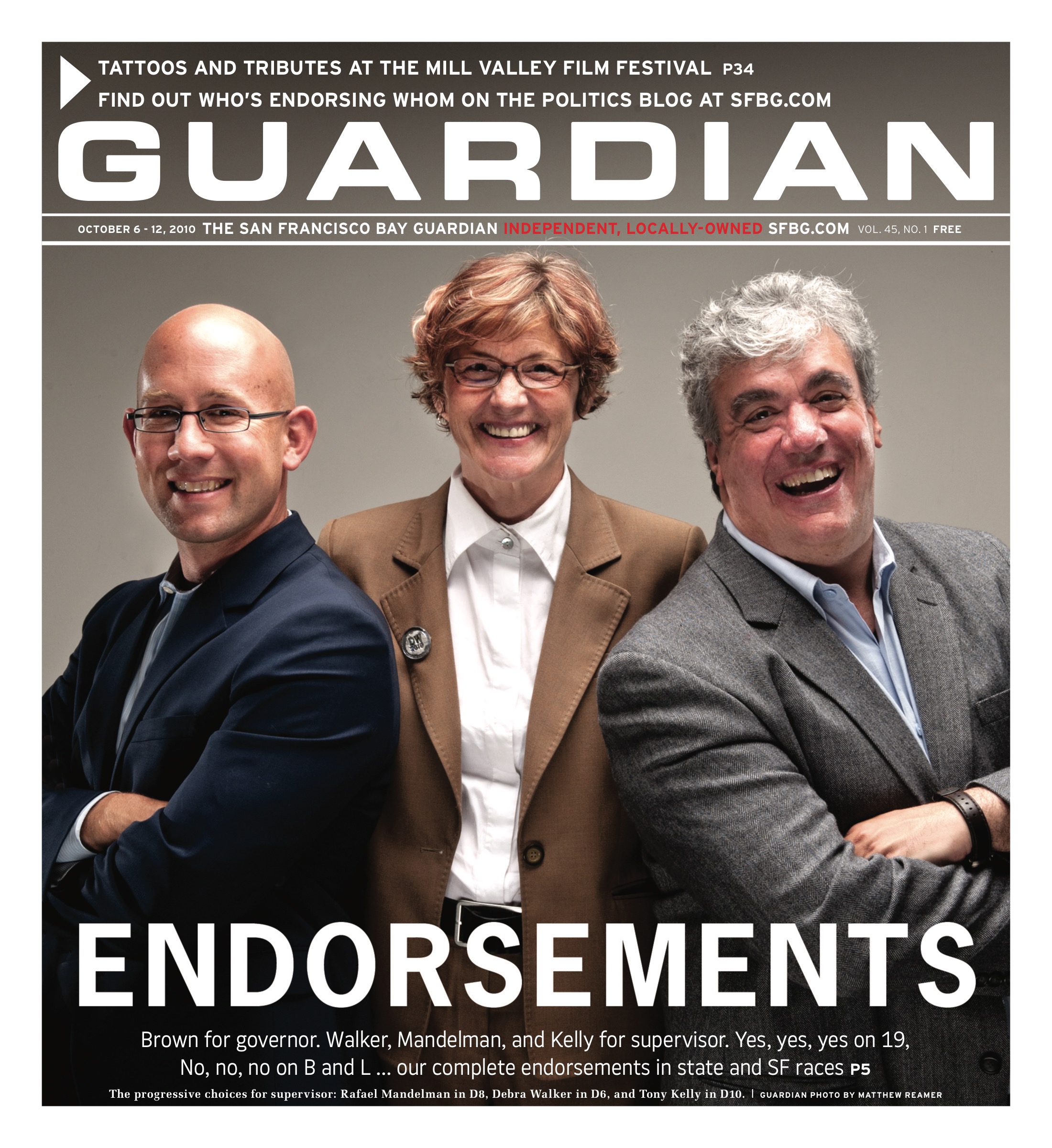
1. DEBRA WALKER


2. JANE KIM


3. GLENDON “ANNA CONDA” HYDE


CORRECTION: In our original version of this endorsement, we said that Jim Meko supports the sit-lie ordinance. That was an error, and it’s corrected below.


A year ago, this race was artist and activist Debra Walker’s to lose. Most of the progressive community was united behind her candidacy; she’d been working on district issues for a couple of decades, fighting the loft developers during the dot-com boom years and serving on the Building Inspection Commission. Then School Board member Jane Kim decided to enter the race, leaving the left divided, splitting resources that might have gone to other critical district races — and potentially helping to put the most pro-business downtown candidate, Theresa Sparks, in a better position to win.


Now we’ve got something of a mess — a fragmented and sometimes needlessly divisive progressive base in a district that’s key to holding progressive control of the board. And while neither of the two top progressive candidates is actively pursuing a credible ranked-choice voting strategy (Kim has, unbelievably, endorsed James Keys instead of Walker, and Walker has declined to endorse anyone else), we’re setting aside our concern over Kim’s ill-advised move and suggesting a strategy that is most likely to keep the seat Chris Daly has held for the past 10 years from falling to downtown control.


Walker is far and away our first choice. She understands land use and housing — the clear central issues in the district — and has well thought-out positions and proposals. She says that the current system of inclusionary housing — pressing market-rate developers to include a few units of below-market-rate housing with their high-end condos — simply doesn’t work. She supports an immediate affordable housing bond act and a long-term real estate transfer tax high enough to fund a steady supply of housing for the city’s workforce. She told us the city ought to be looking at planning issues from the perspective of what San Francisco needs, not what developers want to build. She’s in favor of progressive taxes and a push for local hiring. We’re happy to give her our first-place ranking.


Jane Kim has been a great SF School Board member and has always been part of the progressive community. But she only moved into District 6 a year and a half ago — about when she started talking about running for supervisor (and she told us in her endorsement interview that “D6 is a district you can run in without having lived there a long time.”) She still hasn’t been able to explain why she parachuted in to challenge an experienced progressive leader she has no substantive policy disagreements with.


That said, on the issues, Kim is consistently good. She is in favor of indexing affordable housing to market-rate housing and halting new condo development if the mix gets out of line. She’s for an affordable housing bond. She supports all the tax measures on this ballot. She’s a little softer on congestion pricing and extending parking-meter hours, but she’s open to the ideas. She supports police foot patrols not just as a law-enforcement strategy, but to encourage small businesses. She’d be a fine vote on the board. And while we’re sympathetic to the Walker supporters who would prefer that we not give Kim the credibility and exposure of an endorsement, the reality is that she’s one of two leading progressives and would be better on the board than the remaining candidates.


Hyde, a dynamic young drag queen performer, isn’t going to win. But he’s offered some great ideas and injected some fun and energy into the race. Hyde talks about creating safe injection sites for IV drug users to reduce the risk of overdoses and the spread of disease. He points out that a lot of young people age out of the foster-care system and wind up on the streets, and he’s for continuum housing that would let these young people transition to jobs or higher education. He talks about starting a co-op grocery in the Tenderloin. He proposes bus-only lanes throughout the district and wants to charge large vehicles a fee to come into the city. He’s a big advocate of nightlife and the arts. He lacks experience and needs more political seasoning, but we’re giving him the third-place nod to encourage his future involvement.


Progressives are concerned about Theresa Sparks, a transgender activist and former business executive who now runs the city’s Human Rights Commission. She did a (mostly) good job on the Police Commission. She’s experienced in city government and has good financial sense. But she’s just too conservative for what remains a very progressive district. Sparks isn’t a big fan of seeking new revenue for the city telling us that “I disagree that we’ve made all the cuts that we can” — even after four years of brutal, bloody, all-cuts budgets. She doesn’t support the hotel tax and said she couldn’t support Sup. David Chiu’s progressive business tax because it would lead to “replacing private sector jobs with public sector jobs” — even though the city’s own economic analysis shows that’s just not true. She supports Newsom’s sit-lie law.


Sparks is the candidate of the mayor and downtown, and would substantially shift the balance of power on the board. She’s also going to have huge amounts of money behind her. It’s important she be defeated.


Jim Meko, a longtime neighborhood and community activist, has good credentials and some solid ideas. He was a key player in the western SoMa planning project and helped come up with a truly progressive land-use program for the neighborhood. But he supports Prop. B and is awfully cranky about local bars and nightlife.


James Keys, who has the support of Sup. Chris Daly and was an intern in Daly’s office, has some intriguing (if not terribly practical) ideas, like combining the Sheriff’s Department and the Police Department and making Muni free). But in his interview, he demonstrated a lack of understanding of the issues facing the district and the city.


So we’re going with a ranked-choice strategy: Walker first, Kim second, Hyde third. And we hope Kim’s supporters ignore their candidate’s endorsement of Keys, put Walker as their second choice, and ensure that they don’t help elect Sparks.


DISTRICT 8


RAFAEL MANDELMAN


This is by far the clearest and most obvious choice on the local ballot. And it’s a critical one, a chance for progressives to reclaim the seat that once belonged to Harvey Milk and Harry Britt.


Mandelman, a former president of the Milk Club, is running as more than a queer candidate. He’s a supporter of tenants rights, immigrants’ rights, and economic and social justice. He also told us he believes “local government matters” — and that there are a lot of problems San Francisco can (and has to) solve on its own, without simply ducking and blaming Sacramento and Washington.


Mandelman argues that the public sector has been starved for years and needs more money. He agrees that there’s still a fair amount of bloat in the city budget — particularly management positions — but that even after cleaning out the waste, the city will still be far short of the money it needs to continue providing pubic services. He’s calling for a top-to-bottom review of how the city gets revenue, with the idea of creating a more progressive tax structure.


He’s an opponent of sit-lie and a supporter of the sanctuary city ordinance. He supports tenants rights and eviction protection. He’s had considerable experience (as a member of the Building Inspection Commission and Board of Appeals and as a lawyer who advises local government agencies) and would make an excellent supervisor.


Neither of the other two contenders make our endorsement cut. Rebecca Prozan is a deputy city attorney who told us she would be able to bring the warring factions on the board together. She has some interesting ideas — she’d like to see the city take over foreclosed properties and turn them into housing for teachers, cops, and firefighters — and she’s opposed to sit-lie. But she’s weak on tenant issues (she told us there’s nothing anyone can do to stop the conversion of rental housing into tenancies-in-common), doesn’t seem to grasp the need for substantial new revenues to prevent service cuts, and doesn’t support splitting the appointments to key commissions between the mayor and the supervisors.


Scott Wiener, a deputy city attorney, is a personable guy who always takes our phone calls and is honest and responsive. He’s done a lot of good work in the district. But he’s on the wrong side of many issues, and on some things would be to the right of the incumbent, Sup. Bevan Dufty.


He doesn’t support public power (which Dufty does). He says that a lot of the city’s budget problems can’t be solved until the state gets its own house in order (“we can’t tax our way out of this”) and favors a budget balanced largely by further cuts. In direct contrast to Mandelman, Wiener said San Franciscans “need to lower our expectations for government.” He wants broad-based reductions in almost all city agencies except Muni, “core” public health services, and public safety. He doesn’t support any further restrictions on condo conversions or TICs. And he has the support of the Small Property Owners Association — perhaps the most virulently anti-tenant and anti-rent control group in town.


This district once gave rise to queer political leaders who saw themselves and their struggles as part of a larger progressive movement. That’s drifted away of late — and with Mandelman, there’s a chance to bring it back.


DISTRICT 10


1. TONY KELLY


2. DEWITT LACY


3. CHRIS JACKSON


District 10 is the epicenter of new development in San Francisco, the place where city planners want to site as many as 40,000 new housing units, most of them high-end condos, at a cost of thousands of blue-collar jobs. The developers are salivating at the land-rush opportunities here — and the next supervisor not only needs to be an expert in land-use and development politics, but someone with the background and experience to thwart the bad ideas and direct and encourage the good ones.


There’s no shortage of candidates — 22 people are on the ballot, and at least half a dozen are serious contenders. Two — Steve Moss and Lynette Sweet — are very bad news. And one of the key priorities for progressives is defeating the big-money effort that downtown, the police, and the forces behind the Van Ness Avenue megahospital proposal are dumping into the district to elect Moss.


Our first choice is Tony Kelly, who operates Thick Description Theater and who for more than a decade has been directly involved in all the major neighborhood issues. He has a deep understanding of what the district is facing: 4,100 of the 5,300 acres in D10 have been rezoned or put under the Redevelopment Agency in the past 10 years. Planners envision as many as 100,000 new residents in the next 10 years. And the fees paid by developers will not even begin to cover the cost of the infrastructure and services needed to handle that growth.


And Kelly has solutions: The public sector will have to play a huge role in affordable housing and infrastructure, and that money should come from higher development fees — and from places like the University of California, which has a huge operation in the district and pays no property taxes. Kelly wants to set up a trigger so that if goals for affordable housing aren’t met by a set date, the market-rate development stops. He supports the revenue measures on the ballot but thinks we should go further. He opposes the pension-reform measure, Prop. B, but notes that 75 percent of the city’s pension problems come from police, fire, and management employees. He wants the supervisors to take over the Redevelopment Agency. He’s calling for a major expansion of open space and parkland in the district. And he thinks the city should direct some of the $3 billion in short-term accounts (now all with the Bank of America) to local credit unions or new municipal bank that could invest in affordable housing and small business. He’s a perfect fit for the job.


DeWitt Lacy is a civil-rights lawyer and a relative newcomer to neighborhood politics. He speaks passionately about the need for D10 to get its fair share of the city’s services and about a commitment to working-class people.


Lacy is calling for an immediate pilot program with police foot patrols in the high-crime areas of the district. He’s for increasing the requirements for developers to build affordable housing and wants to cut the payroll tax for local businesses that hire district residents.


Lacy’s vision for the future includes development that has mixed-use commuter hubs with shopping and grocery stores as well as housing. He supports the tax measures on the ballot and would be willing to extend parking meter hours — but not parking fines, which he calls an undue burden on low-income people.


He’s an outspoken foe of sit-lie and of gang injunctions, and with his background handling police abuse lawsuits, he would have a clear understanding of how to approach better law-enforcement without intimidating the community. He lacks Kelly’s history, experience, and knowledge in neighborhood issues, but he’s eminently qualified and would make a fine supervisor.


Chris Jackson, who worked at the San Francisco Labor Council and serves on the Community College Board, is our third choice. While it’s a bit unfortunate that Jackson is running for higher office only two years after getting elected to the college board, he’s got a track record and good positions on the issues. He talks of making sure that blue-collar jobs don’t get pushed out by housing, and suggested that the shipyard be used for ship repair. He wants to see the city mandate that landlords rent to people with Section 8 housing vouchers. He supports the tax measures on the ballot, but also argues that the city has 60 percent more managers than it had in 2000 and wants to bring that number down. He thinks the supervisors should take over Redevelopment, which should become “just a financing agency for affordable housing.” He wants to relocate the stinky sewage treatment plant near Third Street and Evans Avenue onto one of the piers and use the area for a transit hub. He’s still relatively unseasoned, but he has a bright political future.


Eric Smith, a biodiesel activist, is an impressive candidate too. But while his environmental credentials are good, he lacks the breadth of knowledge that our top three choices offer. But we’re glad he’s in the race and hope he stays active in community politics.


Malia Cohen has raised a lot of money and (to our astonishment) was endorsed No. 2 by the Democratic Party, but she’s by no means a progressive, particularly on tenant issues — she told us that limiting condo conversions is an infringement of property rights. And she’s way too vague on other issues.


Moss is the candidate of the big developers and the landlords, and the Chamber of Commerce is dumping tens of thousands of dollars into getting him elected. He’s got some good environmental and energy ideas — he argues that all major new developments should have their own energy distribution systems — but on the major issues, he’s either on the wrong side or (more often) can’t seem to take a stand. He said he is “still mulling over” his stand on sit-lie. He supports Sanctuary City in theory, but not the actual measure Sup. David Campos was pushing to make the policy work. He’s not sure if he likes gang injunctions or not. He only moved back to the district when he decided to run for supervisor. He’s way too conservative for the district and would be terrible on the board.


Lynette Sweet, a BART Board member, has tax problems (and problems explaining them) and wouldn’t even come to our office for an endorsement interview. The last thing D10 needs is a supervisor who’s not accountable and unwilling to talk to constituents and the press.


So we’re going with Kelly, Lacy, and Jackson as the best hope to keep D10 from becoming a district represented by a downtown landlord candidate.


SAN FRANCISCO BOARD OF EDUCATION


MARGARET BRODKIN


KIM-SHREE MAUFAS


HYDRA MENDOZA


Three seats are up on the School Board, and three people will get elected. And it’s a contested race, and in situations like that, we always try to endorse a full slate.


This fall, it was, to put it mildly, a challenge.


It’s disturbing that we don’t have three strong progressive candidates with experience and qualifications to oversee the San Francisco Unified School District. But it seems to be increasingly difficult to find people who want to — and can afford to — devote the time to what’s really a 40-hour-a-week position that pays $500 a month. The part-time school board is an anachronism, a creature of a very different economic and social era. With the future of the next generation of San Franciscans at stake, it’s time to make the School Board a full-time job and pay the members a decent salary so that more parents and progressive education advocates can get involved in one of the most important political jobs in the city.


That said, we’ve chosen the best of the available candidates. It’s a mixed group, made up of people who don’t support each other and aren’t part of anyone’s slate. But on balance, they offer the best choices for the job.


This is not a time when the board needs radical change. Under Superintendent Carlos Garcia, the local public schools are making huge strides. Test scores are up, enrollment is increasing, and San Francisco is, by any rational measure, the best big-city public school district in California. We give considerable credit for that to the progressives on the board who got rid of the irascible, secretive, and hostile former Superintendent Arlene Ackerman and replaced her with Garcia. He’s brought stability and improvement to the district, and is implementing a long-term plan to bring all the schools up to the highest levels and go after the stubborn achievement gap.


Yet any superintendent and any public agency needs effective oversight. One of the problems with the district under Ackerman was the blind support she got from school board members who hired her; it was almost as if her allies on the board were unable to see the damage she was doing and unable to hold her accountable.


Our choices reflect the need for stability — and independence. We are under no illusions — none of our candidates are perfect. But as a group, we believe they can work to preserve what the district is doing right and improve on policies that aren’t working.


Kim-Shree Maufas has been a staunch progressive on the board. She got into a little trouble last year when the San Francisco Chronicle reported that she’d been using a school district credit card for personal expenses. That’s not a great move, but she never actually took public money since she paid back the district. Maufas said she thought she could use the card as long as she reimbursed the district for her own expenses; the rules are now clear and she’s had no problems since. We don’t consider this a significant enough failure in judgment to prevent her from continuing to do what she’s been doing: serving as an advocate on the board for low-income kids and teachers.


Maufas is a big supporter of restorative justice and is working for ways to reduce suspensions and expulsions. She wants to make sure advanced placement and honors classes are open to anyone who can handle the coursework. She supports the new school assignment process (as do all the major candidates), although she acknowledges that there are some potential problems. She told us she thinks the district should go back to the voters for a parcel tax to supplement existing funding for the schools.


Margaret Brodkin is a lightening rod. In fact, much of the discussion around this election seems to focus on Brodkin. Since she entered the race, she’s eclipsed all the other issues, and there’s been a nasty whisper campaign designed to keep her off the board.


We’ve had our issues with Brodkin. When she worked for Mayor Newsom, she was part of a project that brought private nonprofits into city recreation centers to provide services — at a time when unionized public employees of the Recreation and Parks Department were losing their jobs. It struck us as a clear privatization effort by the Newsom administration, and it raised a flag that’s going to become increasingly important in the school district: there’s a coming clash between people who think private nonprofits can provide more services to the schools and union leaders who fear that low-paid nonprofit workers will wind up doing jobs now performed by unionized district staff. And Brodkin’s role in the Newsom administration — and her background in the nonprofit world — is certainly ground for some concern.


But Brodkin is also by far the most qualified person to run for San Francisco school board in years, maybe decades. She’s a political legend in the city, the person who is most responsible for making issues of children and youth a centerpiece of the progressive agenda. In her years as director of Coleman Advocates for Children and Youth, she tirelessly worked to make sure children weren’t overlooked in the budget process and was one of the authors of the initiative that created the Children’s Fund. She’s run a nonprofit, run a city department, and is now working on education issues.


She’s a feisty person who can be brusque and isn’t always conciliatory — but those characteristics aren’t always bad. Sup. Chris Daly used his anger and passion to push for social justice on the Board of Supervisors and, despite some drawbacks, he’s been an effective public official.


And Brodkin is full of good ideas. She talks about framing what a 21st century education looks like, about creating community schools, about aligning after-school and summer programs with the academic curriculum. She wants the next school bond act to include a central kitchen, so local kids can get locally produced meals (the current lunch fare is shipped in frozen from out of state).


Brodkin needs to remember that there’s a difference between being a bare-knuckles advocate and a member of a functioning school board. But given her skills, experience, and lifetime in progressive causes, we’re willing to give her a chance.


We also struggled over endorsing Hydra Mendoza. She works for Mayor Newsom as an education advisor — and that’s an out-front conflict of interest. She’s a fan of Obama’s Education Secretary, Arne Duncan, whose policies are regressive and dangerous.


On the other hand, she cares deeply about kids and public education. She’s not a big supporter of charter schools (“I’ve yet to see a charter school that offers anything we can’t do ourselves,” she told us) and while she was on the wrong side of a lot of issues (like JROTC) early in her tenure, over the past two years she’s been a good School Board member.


There are several other candidates worth mentioning. Bill Barnes, an aide to Michela Alioto-Pier, is a good guy, a decent progressive — but has no experience in or direct connection to the public schools. Natasha Hoehn is in the education nonprofit world and speaks with all the jargon of the educrat, but her proposals and her stands on issues are vague. Emily Murase is a strong parent advocate with some good ideas, but she struck us as a bit too conservative (particularly on JROTC and charter schools.) Jamie Wolfe teaches at a private school but lacks any real constituency or experience in local politics and the education community.


So given a weak field with limited alternatives, we’re going with Maufas, Brodkin and Mendoza.


SAN FRANCISCO COMMUNITY COLLEGE BOARD


JOHN RIZZO


The San Francisco Community College District has been a mess for years, and it’s only now starting to get back on track. That’s the result of the election of a few progressive reformers — Milton Marks, Chris Jackson, and John Rizzo, who now have enough clout on the seven-member board to drag along a fourth vote when they need it.


But the litany of disasters they’ve had to clean up is almost endless. A chancellor (who other incumbent board members supported until the end) is now under indictment. Public money that was supposed to go to the district wound up in a political campaign. An out-of-control semiprivate college foundation has been hiding its finances from the public. The college shifted bond money earmarked for an arts center into a gigantic, expensive gym with a pool that the college can’t even pay to operate, so it’s leased out to a private high school across the street.


And the tragedy is that all three incumbents — two of whom should have stepped down years ago — are running unopposed.


With all the attention on the School Board and district elections, not one progressive — in fact, not one candidate of any sort — has stepped forward to challenge Anita Grier and Lawrence Wong. So they’ll get another term, and the reformers will have to continue to struggle.


We’re endorsing only Rizzo, a Sierra Club staffer who has been in the lead in the reform bloc. He needs to end up as the top vote-getter, which would put him in position to be the board president. Rizzo has worked to get the district’s finances and foundation under control and he richly deserves reelection.


BART BOARD OF DIRECTORS, DISTRICT 8


BERT HILL


It’s about time somebody mounted a serious challenge to James Fang, the only elected Republican in San Francisco and a member of one of the most dysfunctional public agencies in California. The BART Board is a mess, spending a fortune on lines that are hardly ever used and unable to work effectively with other transit agencies or control a police force that has a history of brutality and senseless killing.


Fang supports the suburban extensions and Oakland Airport connector, which make no fiscal or transportation sense. He’s ignored problems with the BART Police for 20 years. It’s time for him to leave office.


Bert Hill is a strong challenger. A professional cost-management executive, he understands that BART is operating on an old paradigm of carrying people from the suburbs into the city. “Before we go on building any more extensions,” he told us, “we should take care of San Francisco.” He wants the agency to work closely with Muni and agrees there’s a need for a BART sunshine policy to make the notoriously secretive agency more open to public scrutiny. We strongly endorse him.


ASSESSOR-RECORDER


PHIL TING


San Francisco needs an aggressive assessor who looks for every last penny that big corporations are trying to duck paying — but this is also a job that presents an opportunity for challenging the current property tax laws. Phil Ting’s doing pretty well with the first part — and unlike past assessors, is actually stepping up to the plate on the second. He’s been pushing a statewide coalition to reform Prop. 13 — and while it’s an uphill battle, it’s good to see a tax assessor taking it on. Ting has little opposition and will be reelected easily.


PUBLIC DEFENDER


JEFF ADACHI


Adachi’s done a great job of running the office that represents indigent criminal defendants. He’s been outspoken on criminal justice issues. Until this year, he was often mentioned as a potential progressive candidate for mayor.


That’s over now. Because Adachi decided (for reasons we still can’t comprehend) to join the national attack on public employees and put Prop. B on the ballot, he’s lost any hope of getting support for higher office from the left. And since the moderate and conservative forces will never be comfortable with a public defender moving up in the political world, Adachi’s not going anywhere anytime soon.


Which is fine. He’s doing well at his day job. We wish he’d stuck to it and not taken on a divisive, expensive, and ill-conceived crusade to cut health care benefits for city employees.


SAN FRANCISCO SUPERIOR COURT


SEAT 15


MICHAEL NAVA


To hear some of the brahmins of the local bench and bar tell it, the stakes in this election are immense — the independence of the judiciary hangs in the balance. If a sitting judge who is considered eminently qualified for the job and has committed no ethical or legal breaches can be challenged by an outsider who is seeking more diversity on the bench, it will open the floodgates to partisan hacks taking on good judges — and force judicial candidates to raise money from lawyers and special interests, thus undermining the credibility of the judiciary.


We are well aware of the problems of judicial elections around the country. In some states, big corporations that want to influence judges raise and spend vast sums on trial and appellate court races — and typically get their way. In Iowa, three judges who were willing to stand on principle and Constitutional law and declare same-sex marriage legal are facing what amounts to a well-funded recall effort. California is not immune — in more conservative counties, liberal judges face getting knocked off the bench by law-and-order types.


It’s a serious issue. It’s worth a series of hearings in the state Legislature, and it might be worth Constitutional change. Maybe trial-court elections should be eliminated. Maybe all judicial elections should have public campaign financing. But right now, it’s an elected office — at least in theory.


In practice, the vast majority of the judicial slots in California are filled by appointment. Judges serve for four-year terms but tend to retire or step down in midterm, allowing the governor to fill the vacancy. Unless someone files specifically to challenge an incumbent, typically appointed judge, that race never even appears on the ballot.


The electoral process is messy and political, and raising money is unseemly for a judicial officer. But the appointment process is hardly pure, either — and governors in California have, over the past 30 years, appointed the vast majority of the judges from the ranks of big corporate law firms and district attorney’s offices.


There are, of course, exceptions, and Gov. Arnold Schwarzenegger has been better than his predecessor, Democrat Gray Davis. But overall, public interest lawyers, public defenders, and people with small community practices (and, of course, people who have no political strings to pull in Sacramento) have been frustrated. And it’s no surprise that some have sought to run against incumbents.


That’s what’s happening here. Michael Nava, a gay Latino who has been working as a research attorney for California Supreme Court Justice Carlos Moreno, was going to run for a rare open seat this year, but the field quickly got crowded. So Nava challenged Richard Ulmer, a corporate lawyer appointed by Schwarzenegger who has been on the bench a little more than a year.


We will stipulate, as the lawyers say: Ulmer has done nothing wrong. From all accounts, he’s a fine judge (and before taking the bench, he did some stellar pro bono work fighting for reforms in the juvenile detention system). So there are two questions here: Should Nava have even filed to run against Ulmer? And since he did, who is the better candidate?


It’s important to understand this isn’t a case of special interests and that big money wanting to oust a judge because of his politics or rulings. Nava isn’t backed by any wealthy interest. There’s no clear parallel to the situations in other areas and other states where the judiciary is being compromised by electoral politics. Nava had every right to run — and has mounted an honest campaign that discusses the need for diversity on the bench.


Ulmer’s supporters note — correctly — that the San Francisco courts have more ethnic and gender diversity than any county in the state. And we’re not going to try to come to a conclusion here about how much diversity is enough.


But we will say that life experience matters, and judges bring to the bench what they’ve lived. Nava, who is the grandson of Mexican immigrants and the first person in his family to go to college, may have a different perspective on how low-income people of color are treated in the courts than a former Republican who spent his professional career in big law firms.


We were impressed by Nava’s background and knowledge — and by his interest in opening up the courts. He supports cameras in the courtrooms and allowing reporters to record court proceedings. He told us the meetings judges hold on court administration should be open to the public.


We’re willing to discuss whether judicial elections make sense. Meanwhile, judges who don’t like the idea of challenges should encourage their colleagues not to retire in midterm. If all the judges left at the end of a four-year term, there would be plenty of open seats and fewer challenges. But for now, there’s nothing in this particular election that makes us fear for the independence of the courts. Vote for Nava.


>>BACK TO ENDORSEMENTS 2010

Endorsements 2010: State ballot measures

25

PROP. 19

LEGALIZE MARIJUANA

YES, YES, YES

The most surprising thing about Prop. 19 is how it has divided those who say they support the legalization of marijuana. Critics within the cannabis community say decriminalization should occur at the federal level or with uniform statewide standards rather that letting cities and counties set their own regulations, as the measure does. Sure, fully legalizing marijuana on a large scale and regulating its use like tobacco and alcohol would be better — but that’s just not going to happen anytime soon. As we learned with the legalization of marijuana for medical uses through Prop. 215 in 1996, there are still regional differences in the acceptance of marijuana, so cities and counties should be allowed to treat its use differently based on local values. Maybe San Francisco wants full-blown Amsterdam-style hash bars while Fresno would prefer far more limited distribution options — and that’s fine.

Other opponents from within marijuana movement are simply worried about losing market share or triggering federal scrutiny of a system that seems to be working well for many. But those are selfish reasons to oppose the long-overdue next step in legalizing adult use of cannabis, a step we need to take even if there is some uncertainty about what comes next. By continuing with prohibition Californians and their demand for pot are empowering the Mexican drug cartels and their violence and political corruption; perpetuating a drug war mentality that is ruining lives, wasting resources, and corrupting police agencies that share in the take from drug-related property seizures; and depriving state and local governments of tax revenue from the California’s number one cash crop.

Bottom line: if there are small problems with this measure, they can be corrected with state legislation that Assemblymember Tom Ammiano has already pledged to carry and that Prop. 19 explicitly allows. But this is the moment and the measure we need to seize to continue making progress in our approach to marijuana in California. Vote yes on Prop. 19.


PROP. 20

CONGRESSIONAL DISTRICT REAPPORTIONMENT

NO

Prop. 20 seeks to transfer the power to draw congressional districts from elected officials to the 14-member California Citizens Redistricting Commission, the state agency created in 2008 to draw boundary lines for California state legislative districts and Board of Equalization districts.

Supporters argue that Prop. 20, (which is backed by Charles Munger Jr., the heir to an investment fortune) would create more competitive elections and holds politicians accountable. And indeed, there’s been some funky gerrymandering going on the the state for decades.

But the commission is hardly a fair body — it has the same number of Republicans as Democrats in a state where there are far more Democrats than Republicans. And most states still draw lines the old-fashioned way, so Prop. 20 could give the GOP an advantage in a Democratic state. States like Texas and Florida, notorious for pro-Republican gerrymandering, aren’t planning to change how they do their districts.

That’s why former state Assemblymember John Laird (D-Santa Cruz), who lost his recent bid for the State Senate thanks to gerrymandering and an August special election, calls Prop. 20 “the unilateral disarmament of California.”

It could also create a political mess in San Francisco, Laird said. “An independent commission could end up dividing the city north/south, not east/west. Or it could throw Sen. Mark Leno and Leland Yee into the same district.” Vote no.


PROP. 21

VEHICLE LICENSE FEE FOR PARKS

YES

Part of the reason California is in the fiscal crisis it is now facing — underfunding schools, slashing services, and considering selling off state parks — is because Gov. Arnold Schwarzenegger ran for office on a pandering pledge to deeply cut the vehicle license fee, costing the state tens of billions of dollars since then. It was the opposite of what this state should have been doing if it was serious about addressing global warming and other environmental imperatives, not to mention encouraging car drivers to come closer to paying for their full societal impacts, which study after study shows they don’t now do. This measure doesn’t fully correct that mistake, but it’s a start.

Prop. 21 would charge an $18 annual fee on vehicle license registrations and reserve at least half of the $500 million it would generate for state park maintenance and wildlife conservation programs. As an added incentive, the measure would also give cars free entrance to the state parks, a $50 million perk. Of the remaining $450 million, $200 million could be used to back-fill state general fund revenue now going to these functions, which means most of this money would go to parks and wildlife.

We’d rather see funds derived from private car use go to mass transit and other alternatives to the automobile, but we’re not going to quibble with the details on this one. California desperately needs the money, and it’s time for drivers to start giving back some of the money they shouldn’t have been given in the first place.


PROP. 22

LOCAL REDEVELOPMENT FUNDS

NO

This one sounds good, on the surface: Prop. 22 would prevent the state from taking money from city redevelopment agencies to balance the budget in Sacramento. But it’s not so simple: Sometimes it actually makes sense to use redevelopment money to fund, say, education — and only the state can do that. Besides, this particular bill only protects cities, not counties — so San Francisco will take even more of a hit in tough times. Vote no.


PROP. 23

SUSPENDING AIR POLLUTION CONTROL LAWS

NO, NO, NO

Think of Prop. 23 as a band of right-wing extremists orchestrating a sneak attack on the one hope this country has for removing its head from the tarball-sticky sand and actually doing something, for real this time, about global warming. Assembly Bill 32, California’s Global Warming Solutions Act, imposes enforceable limits on greenhouse gas emissions by 2012 — and now, Big Oil is drilling deep into its pockets in an effort to blow up those limits.

Funded by Texas oil companies Tesoro Corporation and Valero Energy Corporation in conjunction with the Koch brothers, billionaires who have been called the financial backbone of the Tea Party, Prop. 23 would reverse a hard-fought victory by suspending AB32 until unemployment drops to 5.5 percent for four consecutive quarters — not likely to happen anytime soon. In truly sleazy fashion, proponents have dubbed Prop. 23 the “California jobs initiative.”

The environmental arguments for rejecting Prop. 23 are obvious, but this time there’s a twist — even the business community doesn’t like it. Take it from Rob Black of the San Francisco Chamber of Commerce, which is actively opposing Prop. 23. “There is a fear that clean energy policy is a communist plot,” Black explained. “We actually think it’s a good capitalist strategy.” To most business leaders, AB32 is like the goose that laid the golden egg — it encourages investment in green technology, which is probably California’s best future economic hope. Vote no on 23.


PROP. 24

BUSINESS TAXES

YES

Prop. 24 repeals some special-interest tax breaks that the Legislature had to accept as part of the latest budget deal. In essence, it restores about $1.7 billion worth of taxes on corporations, particularly larger ones that hide income among various affiliates. Vote yes.


PROP. 25

SIMPLE MAJORITY BUDGET PASSAGE

YES, YES, YES

Prop. 25 would be a step toward ending the budget madness that defines California politics every year. It would allow the state Legislature to pass a budget and budget-related legislation can be passed with a simple majority vote.

It’s not a full solution — a two-thirds vote would still be required to pass taxes. But at least it would allow the majority party to approve a blueprint for state spending and help end the gridlock caused by a small number of Republicans. Vote yes.


PROP. 26

TWO-THIRDS VOTE FOR FEES

NO, NO, NO.

Prop. 26 would require a two-thirds supermajority vote in the Legislature and at the ballot box in local communities to pass fees, levies, charges and tax revenue allocations that under existing rules can be enacted by a simple majority vote

It’s supported by the Chamber of Commerce, Chevron, Occidental Petroleum, the Wine Institute, and Aera Energy.

Opponents argue that Prop. 26 should be called the “Polluter Protection Act” because it would make it harder to impose fees on corporations that cause environmental or public health problems. For example, it would be harder to impose so-called “pollution fees” on corporations that discharge toxics into the air or water. It would also make it nearly impossible for San Francisco to impose revenue measures like the Alcohol Fee sponsored by Sup. John Avalos. It’s another in a long line of attempts at the state level to block local government from raising money. Vote no.


PROP. 27

ELIMINATING REDISTRICTING COMMISSION

YES

We opposed the 2008 ballot measure creating the redistricting commission, arguing that, while allowing the state Legislature to draw its own seats is a problem, the solution would make things worse. The panel isn’t at all representative of the state (it has an equal number of Republicans and Democrats) and could be insensitive to the political demographics of California cities (it makes sense, for example, to have Senate and Assembly lines in San Francisco divide the city into east and west sides because that’s how the politics of the city tend to break).

This measure abolishes that panel and would allow the Legislature to draw new lines for both state and federal offices after the 2010 census. We don’t love having the Legislature handle that task — but we like the existing, unaccountable, unrepresentative agency even less. Vote yes.


>>BACK TO ENDORSEMENTS 2010

Downtown money hits district races

42

Downtown cash is pouring into the district supervisorial races.

Ethics Department filings show that an alliance backed by the Chamber of Commerce, the SF Police Officers Association and United Health Care Workers West is dropping major money on Steve Moss in D10, Scott Wiener in D8 and Theresa Sparks in D6. 

Called the “Alliance for Jobs and Sustainable Growth,” the coalition supports the building of a mega-hospital on Cathedral Hill.

The independent expenditure alliance puts UHW, part of the Service Employees International Union, in the odd position of using membership money to attack progressive politics in San Francisco – potentially undermining years of work by another SEIU affiliate, Local 1021.

Campaign disclosure forms show that the Chamber-Police-UHW alliance has spent $20,000 on bilingual (English/Chinese) door hangers for Moss that feature photos of Chamber of Commerce President Steve Falk and United Healthcare Workers political director Leon Chow.

These same interests also spent $20,000 on robo-calls for Moss, with a heavy focus on Visitacion Valley in an effort to secure the Asian vote in the crowded D10, where there is a strong likelihood that the race will be decided by second and third place votes

Word on the street in the Bayview is that former Mayor Willie Brown is pissed off that the Chamber is backing Moss, instead of African American candidate Lynette Sweet, and that termed out D10 Sup. Sophie Maxwell is angry that big corporations are trying to buy an election in the poorest and most ethnically diverse district in town.

But unlike the rumor mill, the money trail doesn’t lie. And from that perspective this is looking like a replay of the June 2008 election, when big businesses bought support for Lennar’s Candlestick Point/shipyard development by claiming it would create thousands of jobs building condos that most workers can’t afford—jobs that have yet to materialize.

This time the battle cry is for jobs building a massive hospital, even though few workers will likely get service from this hospital, which is designed to serve as a regional center for high-end health care.

So far, the same alliance of police and corporate money has plunked down $17,000 for bilingual (English and Chinese) door hangers in support of Theresa Sparks in D6 and another $17,000 for bilingual robo-calls in support of Sparks.

And so far, Scott Wiener has gotten the relatively short end of the corporate money stick: the Alliance has only spent $15,000 on a door hanger in support of Wiener.

This means that the alliance spent $90,000 in a two-week period in September. The numbers lend credence to DCCC Chair Aaron Peskin’s belief that the alliance has a war chest of $800,000, which it intends to use to put pro-downtown candidates into power.

Asked about the support of this alliance, Sparks, Wiener and Moss gave markedly different replies that reveal as much about each candidate as the money behind them.

D6 candidate Theresa Sparks suggested that the Alliance was spending more on her and Moss’ D10 campaign, because it felt Wiener was further ahead in the D8 race than she is in D6 or Moss is in D10.

And Sparks was openly supportive of the Cathedral Hill hospital project. “I’ve been very supportive of that project,” Sparks told us.

Sparks also observed that it was logical that the Chamber would support her.

“D6 has one of the largest numbers of small businesses and one of my biggest platforms has been economic growth, and I think the Chamber has been very supportive of job creation,” Sparks said.

By comparison, Scott Wiener told the Guardian that he has not taken a position on CPMC’s proposed mega hospital on Cathedral Hill.

“Those kind of issues could come before the Board, in terms of CEQA issues, and so I could be conflicted out,” Wiener said.

When the Guardian noted that the Alliance has so far not spent any money on phone banking for Wiener in D8, Wiener said, “I have volunteers doing phone banking.”

As for Moss, he told the Guardian that said he doesn’t have a position on the mega-hospital.

“I haven’t seen the plan,” Moss said. “But I understand that there seems to be an agreement that would maintain St. Luke’s with about 300 beds, but that there is a deep suspicion among the nurses that it’s not economically viable. And there seems to be a much greater need for a hospital in the southeast.”

Moss, however, is with downtown on other key issues: He supports the sit-lie legislation on the November ballot. He also reiterated that he likes the rabidly anti-tenant Small Property Owners Association, whose endorsement he called a “mistake” during a previous interview with the Guardian.

“Landlords feel that they are responsible for maintaining costly older buildings and that they are not provided with ways to upgrade their units in ways that share costs with tenants,” Moss, who sold a condo on Potrero Hill in 2007 for the same price that he paid for the entire building in 2001, and owns a 4-floor rent-controlled apartment building in D8, near Dolores Park, that he bought for $1.6 million in 2007, and where he lived from December 2007 to February 2010.

Moss refused to provide a copy of the lease on his current rental at Vermont and 18th St—something that the Guardian requested in light of an email from his wife that indicated that the family intended to move back to Dolores Park of Moss loses the race.
‘That’s private information,” Moss said, claiming that he does not plan to move back into his apartment building in D8, if he loses in November.

Moss claimed that UHW endorsed him because his position on politicians and unions.
“I agreed that politicians should get not involved in union politics,” Moss said. “The United Healthcare Workers seem to be a worthy group,” he added. “All they said was that they wanted to make sure that they had access.”

All this campaign money drama is playing out against the backdrop of a punishing battle between United Healthcare Workers West and the rest of SEIU. And as these recent filings show, UHW is spending a huge amount of its membership dues to undermine the city’s progressive infrastructure by trying to elect candidates who are not progressive, even though its progressive sister union has endorsed Rafael Mandelman in D8.

SEIU 1021 member Ed Kinchley, who works in the Emergency Room at SF General Hospital, is furious that UHW is pouring all its money into downtown candidates like Moss, Sparks and Wiener and trying to undermine everything that its progressive sister union is trying to do.

“UHW basically isn’t participating in the Labor Council, it’s just doing its own thing,” Kinchley said.

Kinchley noted that UHW is currently in trusteeship, and is being controlled by its International, and not its local membership, thus explaining why it’s doing this dance with forces like the Chamber and the Building Owners and Managers Association, which have long been the enemy of labor.

“Sutter wants a monopoly on private healthcare, and people like Rafael Mandelman in and Debra Walker have been strong supporters of public healthcare,” Kinchley said, Kinchley also noted that he wants supervisors who are willing to state their support for public health care, rather than dodging the issue and hedging their bets, right now.

“I want someone who can straight-up say, here’s what’s important for families in San Francisco, especially something as important as healthcare,” Kinchley said. “but it sounds like UHW is teaming up with the Chamber and supporting people who are not progressive.”

“And it’s not OK for somebody in D10 to say they haven’t seen CPMC’s plans, when people from D10 use St. Luke’s all the time for healthcare, because it sounds like Sutter wants to change St. Luke’s into an out-patient clinic for paying customers,” he continued.

SEIU 1021 activist Gabriel Haaland accused the Chamber, the Building Owners and Managers Association, UHW and the Police Officers Association of putting together a massive political action committee, “to try and steal the election through corporate spending.”

All this leaves the Guardian wondering how Leon Chow, the political director of UHW, who has done good work in the past on health care issues, is feeling about seeing his photograph spreads all over town alongside that of Chamber of Commerce President Steve Falk on door hangers in support of Sparks, Wiener and Moss.
 
As of press time, Chow had not returned our calls, but if he does, we’ll update this post.

The Governator: Fighting oil villains or making life easier for them?

Today’s San Francisco Chronicle contains an opinion piece by David Horsey commending Gov. Arnold Schwarzenegger, a Republican, for taking Texas oil companies Tesoro and Valero to task for attempting to subvert California’s landmark global warming legislation, AB 32.

Titled “The Governator battles villains with ‘black oil hearts,’” the piece casts Schwarzenegger as an environmental superhero facing off against a band of greedy cowboys. Tesoro and Valero have sunk millions into Proposition 23, the deceptively titled “California Jobs Initiative,” which would suspend implementation of the greenhouse-gas reduction law until unemployment drops to 5.5 percent for four consecutive quarters. Prospects are dim for such a market condition anytime soon.

“It is electrifying to hear a Republican politician expose the big corporations that relentlessly subvert public policy and the national interest,” Horsey notes. “Arnold Schwarzenegger might be leaving office with a mixed record of accomplishment, but when it comes to challenging these modern-day bandits of industry, he could be the boldest action hero we’ve got.”

Schwarzenegger deserves credit for taking a stand against oil-industry giants on this particular issue, but he’s no environmental action hero. On Sept. 30, The Governator vetoed legislation that would have improved the state’s capability to respond to oil spills.

AB 234, authored by Assembly Member Jared Huffman, would have required large vessels to deploy oil containment booms prior to fuel transfers. The Dubai Star oil spill occurred during a fuel transfer, and the precautionary measure could have lessened the impact.

Additionally, the bill would have increased existing oil fees to bolster funding for the state’s oil spill prevention and response efforts. And it would have required the State Lands Commission to report on safeguards for offshore oil drilling and response plans in the event of the failure of an oil rig’s blowout preventer. The BP oil spill demonstrated how dire the consequences can be if such a failure occurs.

“With his veto of AB 234, Governor Schwarzenegger failed miserably when it came to protecting California’s environment, public health, seabirds, and our coastal waters from oil spills,” said Marcie Keever, Oceans & Vessels Campaign Director at Friends of the Earth, which sponsored the bill along with Pacific Environment.  “Assembly Member Huffman and the Legislature worked extremely hard this year to craft AB 234 to protect the people and resources of the state of California — and with a few strokes of his pen the Governor struck a significant blow to public health and our environment.”

Schwarzenegger may have publicly reprimanded the Texas oil cowboys for bankrolling Prop. 23, but he’s no Captain Planet.

Prop. B will save healthcare

59

By Jeff Adachi and Jim Illig

Editors note: Last week we ran an op-ed by Assemblymember Tom Ammiano opposing Proposition B. Public Defender Jeff Adachi asked for space to respond. His position follows.

OPINION San Francisco prides itself on the excellent health care services it provides to its residents. Per capita, San Francisco provides better quality healthcare to its poorest and most vulnerable residents than any other city in our state. Our city’s Healthy San Francisco program, which provides low- cost access to healthcare for all uninsured residents, has been heralded as a model program nationwide.

But the healthcare system that serves the city’s employees is teetering on the brink of insolvency. This year, the city will spend $456 million for healthcare costs for 26,000 city employees, and 28,000 retirees and their 47,000 dependents. According to the Controller’s Office, the city’s health system has an unfunded liability of $4 billion — meaning that it has made $4 billion in promised coverage to city employees and their dependents that it doesn’t have the money to pay for.

That’s a major reason why two city departments that serve the poorest residents, the Public Defender and Public Health, must cut millions of dollars of essential services each year, to save the city’s General Fund for growing employee healthcare and pension costs.

Currently most city employees contribute nothing for their own healthcare. Taxpayers subsidize the entire cost, which runs between $2,890 and $5,560 per year for each employee. Proposition B would change this by requiring that an employee insured under the basic health plan pay just $96 a year ($8 a month) for their healthcare. Under Prop. B, city employees would still pay 22 times less than private sector employees, who pay an average of $2,185 per year for their health insurance.

City employees with dependents currently pay $8 a month. Under Prop. B, they would pay $2,988 per year. Private sector employees with dependents pay an average of $7,026 a year. And this doesn’t include the 31 percent of San Franciscans who do not receive employer-paid health care costs and pay the entire cost themselves.

Opponents of Prop. B claim that city workers cannot afford to pay the health benefits if Prop B. passes. Their argument ignores the fact that the average San Francisco city employee earns $93,000 a year in salary alone, excluding benefits, while the average private sector salary is $46,000.

They also argue that “a single mother will be forced to pay up to $5,600 per year for her child’s health care — in addition to the $8,154 she already pays.”

First, this is not true. A city employee with two dependents only pays a total of $448 a month for full health coverage. Only if the city employee chooses the most expensive health plan, which costs $31,645, would the employee have to pay $19,561 a year under Prop. B instead of the $16,922, which he or she now pays.

Even with contributions required by Prop. B, city employees will receive a benefit package that is unparalleled in the private sector. Even more important, the city’s healthcare fund will be made more sustainable by ensuring that the funding for the city’s healthcare program doesn’t run dry when the city can no longer afford to pay these costs.

According to the Controller’s ballot statement, Prop. B would save the city $121 million annually. Some of these funds could be used to prevent the devastating cuts to the city’s mental health, substance abuse, and other community health programs for poverty-stricken adults and children who do not have healthcare coverage.

Voting yes on Prop. B is an antidote to continuing cuts to healthcare for the poorest San Franciscans. *

Jeff Adachi is a proponent of Proposition B and the city’s public defender. Jim Illig is the president of the San Francisco Health Commission.

Needed: a public health master plan

1

California Pacific Medical Center’s plan to build a massive new regional hospital on Van Ness shouldn’t be under the jurisdiction of the Planning Commission

EDITORIAL More than 100 people showed up at the Planning Commission Sept. 23 to oppose California Pacific Medical Center’s plan to build a massive new regional hospital on Van Ness Avenue. Most were neighborhood residents who raised an excellent point: what, exactly, would the shiny new $2.5 billion hospital offer for low-income people in the Tenderloin?

And that’s just the starting point for discussion. The new project is a piece of a much larger plan: CPMC wants to shut down part of its Laurel Heights campus, reduce the number of beds and the scope of service at St. Luke’s, turn Ralph K. Davis into a specialty facility, and reshape the way health care is provided in San Francisco.

That’s a huge deal — but right now, the city is looking at the projects piecemeal. That’s poor public health policy and poor land-use planning. In fact, there’s no real way to evaluate the Van Ness hospital in its proper context — the Planning Commission, which will rule on the development issues, is hardly the best venue in which to discuss the future of health care in San Francisco.

So new legislation by Sup. David Campos is critical to injecting some sanity into this, and the larger, health facilities debate. The Campos legislation would mandate a citywide Health Care Services Master Plan and would require that all new hospital development, public or private, be consistent with that plan. It’s a pretty basic concept, and it’s hard to imagine that nobody’s suggested this before.

San Francisco has a large, complex network of facilities providing health care — a big public hospital, a university hospital system (University of California San Francisco), a series of public and nonprofit community clinics, half a dozen private hospitals run by two competing chains (CPMC and Catholic Healthcare West), and one health maintenance organization (Kaiser). Some provide unique services, some provide competitive services — and there are some critical services that are hard to find anywhere.

It’s hard to say whether the city needs what CPMC is proposing — a gigantic medical center that some have described as the Mayo Clinic of the West, designed to attract patients from all over the region — without any sort of overall plan. How would the new facility and the CPMC restructuring affect services at St. Luke’s, a critical part of the health care infrastructure in the Mission? Where would patients who rely on Davies for emergency and clinical care in the Castro district wind up? How about all the medical office buildings and doctors’ offices situated near hospitals that are about to change?

How will CPMC’s moves affect low-income-patient care? How does the project fit in with the new Obama health care policies and the city’s own Healthy San Francisco program? Will a new hospital on Van Ness increase access to primary and emergency care for residents of the Tenderloin — or will they be shuttled somewhere else while the high-end facility caters to better-off patients seeking expensive specialty procedures?

Those aren’t land-use decisions — and while some Cathedral Hill residents argue that the new hospital will cause traffic problems, the biggest issues go beyond the scope and expertise of the city Planning Department.

Under the Campos bill, the Public Health Department would develop a master plan (which public health director Mitch Katz says can be done with existing resources), the Health Commission would review that plan, hold public hearings, and sign off on it — and city planners and health officials would have to make sure that new health-related development met existing and future public needs.

The supervisors should pass the bill and get the process going as quickly as possible. And they should refuse to sign off on any final version of the hospital plan until there’s a city framework in place — or at the very least, until CPMC can demonstrate that its citywide infrastructure plans are designed to meet public health needs. *


Needed: a public health master plan

0

EDITORIAL More than 100 people showed up at the Planning Commission Sept. 23 to oppose California Pacific Medical Center’s plan to build a massive new regional hospital on Van Ness Avenue. Most were neighborhood residents who raised an excellent point: what, exactly, would the shiny new $2.5 billion hospital offer for low-income people in the Tenderloin?

And that’s just the starting point for discussion. The new project is a piece of a much larger plan: CPMC wants to shut down part of its Laurel Heights campus, reduce the number of beds and the scope of service at St. Luke’s, turn Ralph K. Davis into a specialty facility, and reshape the way health care is provided in San Francisco.

That’s a huge deal — but right now, the city is looking at the projects piecemeal. That’s poor public health policy and poor land-use planning. In fact, there’s no real way to evaluate the Van Ness hospital in its proper context — the Planning Commission, which will rule on the development issues, is hardly the best venue in which to discuss the future of health care in San Francisco.

So new legislation by Sup. David Campos is critical to injecting some sanity into this, and the larger, health facilities debate. The Campos legislation would mandate a citywide Health Care Services Master Plan and would require that all new hospital development, public or private, be consistent with that plan. It’s a pretty basic concept, and it’s hard to imagine that nobody’s suggested this before.

San Francisco has a large, complex network of facilities providing health care — a big public hospital, a university hospital system (University of California San Francisco), a series of public and nonprofit community clinics, half a dozen private hospitals run by two competing chains (CPMC and Catholic Healthcare West), and one health maintenance organization (Kaiser). Some provide unique services, some provide competitive services — and there are some critical services that are hard to find anywhere.

It’s hard to say whether the city needs what CPMC is proposing — a gigantic medical center that some have described as the Mayo Clinic of the West, designed to attract patients from all over the region — without any sort of overall plan. How would the new facility and the CPMC restructuring affect services at St. Luke’s, a critical part of the health care infrastructure in the Mission? Where would patients who rely on Davies for emergency and clinical care in the Castro district wind up? How about all the medical office buildings and doctors’ offices situated near hospitals that are about to change?

How will CPMC’s moves affect low-income-patient care? How does the project fit in with the new Obama health care policies and the city’s own Healthy San Francisco program? Will a new hospital on Van Ness increase access to primary and emergency care for residents of the Tenderloin — or will they be shuttled somewhere else while the high-end facility caters to better-off patients seeking expensive specialty procedures?

Those aren’t land-use decisions — and while some Cathedral Hill residents argue that the new hospital will cause traffic problems, the biggest issues go beyond the scope and expertise of the city Planning Department.

Under the Campos bill, the Public Health Department would develop a master plan (which public health director Mitch Katz says can be done with existing resources), the Health Commission would review that plan, hold public hearings, and sign off on it — and city planners and health officials would have to make sure that new health-related development met existing and future public needs.

The supervisors should pass the bill and get the process going as quickly as possible. And they should refuse to sign off on any final version of the hospital plan until there’s a city framework in place — or at the very least, until CPMC can demonstrate that its citywide infrastructure plans are designed to meet public health needs.

Endorsement interviews: Chris Jackson

0

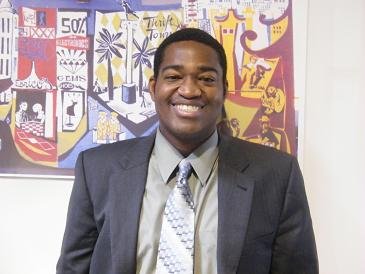
In 2008, San Francisco voters elected Chris Jackson to the Community College Board, where he serves as Budget Chair. And from 2007 until spring 2010, Jackson worked as a policy analyst for the San Francisco Labor Council.
Those experiences helped convince Jackson, whose grandfather came from Mississippi to work at Hunters Point Shipyard, of the pressing need for the next D10 supervisor to promote progressive policies that help working class families remain in San Francisco.

“People in D. 10 aren’t asking for market rate housing, they are looking for job opportunities,” Jackson said, clarifying that he wants to see the creation of good-paying, entry-level jobs with health and retirement benefits and the shoring up of local hiring policies, so workers can support their families and stay in the local community.

Jackson plans to create a stable funding source for truly affordable housing. He wants to help Section 8 recipients to rent in San Francisco. He thinks the city needs a different vision of redevelopment—one in which the Redevelopment Commission is brought within the control of the Board. He thinks gang injunctions serve to accelerate gentrification in low-income communities of color. And he thinks the city needs to reduce the number of high-level management positions before it fires and rehires thousands of public health workers at lower wages.

“I believe that the role of the supervisor is to empower local residents and community groups to be voices for real transformative chang,” Jackson said.
You can listen to the full interview here:


Cjackson by endorsements2010

The District 8 dilemma

13

tredmond@sfbg.com

Gabriel Haaland, a longtime queer labor activist, was talking to a friend from District 8 the other day, chatting about the race for a supervisor to fill the shoes of Harvey Milk, Harry Britt, Mark Leno, and Bevan Dufty. “She told me that she didn’t know who to vote for,” Haaland said, “because she didn’t know who the progressive was in the race.”

For supporters of Rafael Mandelman, that’s a serious challenge. “The polls are very consistent,” Haaland said. “Most of the voters in D-8 would prefer a progressive over a moderate, and when they know who the progressive is, they support that candidate.”

But oddly enough, although District 8 — the Castro, Noe Valley, and parts of the Mission — is one of the most politically active parts of the city, where voter turnout is consistently high, the supervisorial race is getting only limited media attention. The neighborhood and queer papers are doing a good job of covering the race, but for the rest of the media, it’s as if nothing’s happening. And that’s left voters confused about what ought to be a very clear choice.

The San Francisco Chronicle featured the District 6 race on the front page Sept. 19, with a long story about how demographic changes in the South of Market area would affect the successor to Sup. Chris Daly. District 10, with the mad political scrum of 22 candidates, no clear front runner and endorsements all over the map, has received considerable media attention.

Yet D–8 — which offers by far the most striking distinctions between candidates and the sharpest divisions over issues — has been flying under the radar.

Three major candidates are in the race, two gay men and a lesbian. All of them, for what it’s worth, are lawyers. Rafael Mandelman, who works for a firm that advises cities and counties, has the support of the vast majority of progressive leaders and organizations. Rebecca Prozan, a deputy district attorney, and Scott Wiener, a deputy city attorney, are very much on the moderate-centrist (some would say, by San Francisco standards, conservative) side of the political spectrum.

“As Barbara Boxer has said in her ads, the choice is clear,” Aaron Peskin, chair of the local Democratic Party and a Mandelman backer, told us. “Not to exaggerate, but this is like Boxer v. Carly Fiornia, and Rafael is our Boxer.”

Yet by almost all accounts, Wiener is ahead in the race.


ON THE ISSUES

The San Francisco Board of Supervisors has been roughly divided in the past decade between the progressive camp and moderate camp. And while those labels are hard to define (the Chronicle won’t even use the term “progressive,” preferring “ultraliberal”), most observers have a basic grip on the differences.

The moderates, who tend to support Mayor Gavin Newsom, are social liberals but fiscal conservatives. They talk about the city surviving budget red ink without major tax increases. They talk about controlling government spending and increasing public safety. The progressives generally see local government as underfunded after four years of brutal cuts and support the idea of raising new revenue to fill the gap. They support tenants over landlords, seek stronger protections for affordable housing, support Sanctuary City, and oppose sit-lie.

Certainly with Wiener and Mandelman, it’s abundantly clear where the candidates fall. The two agree on some things (they both oppose Prop. B, the pension-reform measure that would reduce health care payments for the children of city employees) and they both support nightlife. But overall, they take very different political stands.

Wiener told us, for example, that the city’s structural budget problems won’t be solved without cuts. “We’re not going to able to tax our way out of this,” he said in an endorsement interview. “We have to lower our expectations for government.”

Other than Muni, public safety, and core public health services, cuts “will have to be across the board,” he said. “What are the things we really can’t do without?”

Wiener supports the sit-lie proposal, saying that he doesn’t think the local police have the tools they need to get poorly behaving people off the streets. He doesn’t support Sup. Ross Mirkarimi’s measure mandating foot patrols because, he told us, he doesn’t think the supervisors should micromanage the Police Department.

Sup. Bevan Dufty, who currently holds the D–8 seat, has voted with the progressives occasionally — but almost never on tenant issues. And Wiener, who has the support of the rabidly anti-tenant Small Property Owners of San Francisco, is likely to follow that approach. Although he told us he supports rent control (which just about everyone in local politics agrees on at this point), he’s not a fan of additional protections against evictions and condo conversions. “I’m not prepared to go beyond what we have now” on eviction protections, he said. He supported Newsom’s plan to allow people to buy their way out of the waiting list and lottery for condo conversions.

And when it comes to public power, he’s to the right of the incumbent: Dufty has said repeatedly that he supports the city taking over Pacific Gas and Electric Co.’s infrastructure and putting the city in control of a full-scale public power system. Wiener says he supports community choice aggregation (CCA), but not full-scale public power.

Mandelman is a big supporter of local government and says, without hesitation, that the city needs more revenue. “The public sector is dramatically underfunded,” he told us in a recent interview. “There’s great wealth in the city and it needs to be tapped to preserve public services.” Mandelman said he’s not “tax happy,” but told us that the structure of how the city raises revenue is a mess. He supports a top-to-bottom review of the city’s revenue base with the goal of making taxation more progressive — and bringing in enough money to fund crucial services.

Mandelman is a foe of sit-lie, which he sees as punitive and ineffective. He opposes gang injunctions and supports Sanctuary City. And he’s a strong advocate for tenants, supporting stronger eviction protections and limits on condo conversions that take away affordable rental stock.

“You have to look at the candidates and ask what their priorities are,” he said. “Are the displacement of long-time residents critically important or something that’s not on the top of the list? Do you believe we need to rebuild the safety net? Or is queer politics all about property values?”

Prozan told us that she’s the one who can “bring the two sides together” and said that, like Dufty, she is “right up the middle.” She supports the hotel tax and the vehicle license fee and opposes sit-lie, but also thinks gang injunctions are a useful tool for law enforcement. She doesn’t see any reason to split appointments between the mayor and the supervisors for the board that oversees Muni or the Redevelopment Agency. She doesn’t think the city can or should do anything more about the conversion of rental property to tenancies in common, but supports the idea of taking over foreclosed properties to create housing for teachers, cops, and firefighters. So it’s safe to say the Prozan would probably be similar to the incumbent — with the progressives on a few things, against them on others.


UNDER THE RADAR?

Wiener and Mandelman agree on two basic points: there are stark differences between the candidates — and the city’s major media outlets aren’t paying enough attention. That’s probably because the relatively tame politics doesn’t compare to the sort of wild excitement you see in Districts 6 and 10.

“There’s less chaos than some of the other districts,” Wiener said. “The three major candidates are all hard-working, respected people who have all lived in the district a while.”

He also agreed that he and Mandelman have “very different visions” for the district and the city, and that there are sharp contrasts and divisions between the two candidates.

Prozan also argued that the political differences on issues aren’t going to be the only — or even the deciding — factor for many voters. “I think they’re looking for who’s got the courage and independence to do what’s right,” she told us.

But Mandelman told us there’s a crucial story here that needs to be told: “It’s a definitional fight about what the queer community is about in 2010. As goes D–8, so goes San Francisco.”

On the Cheap listings

0

On the Cheap listings are compiled by Paula Connelly. Submit items for the listings at listings@sfbg.com.

WEDNESDAY 22

Big Book Sale Festival Pavilion, Fort Mason Center, Laguna at Beach, SF; (415) 626-7500. Wed.-Sat. 10am-8pm, Sun. 10am-4pm; free. Head out to the annual big book sale and browse through a half a million books, DVDs, CDs, books on tape, vinyl, and more, all for $5 or less. Proceeds to benefit the San Francisco Public Library and literacy programs.

Party with Carnivores Conservatory of Flowers, 100 John F. Kennedy Dr., SF; (415) 831-2090. 5:30pm, $5. Take a tropical vacation for a night at the Conservatory of Flowers special exhibition, "Chomp 2: Return of the Carnivorous Plants" featuring artists Sarah Filley and Yvette Molina, who are working on a project to float a giant terrarium on Lake Merritt. This event is 21 and over, cocktails will be available for purchase.

THURSDAY 23

City of Stairways Red Poppy Art House, 2698 Folsom, SF; (415) 826-2402. 7pm, $5-$10. Join the young authors of WritersCorps for a reading of this new travel guide and literary anthology, packed with poetry, photography, artwork, maps, and tips on seeing some of the most memorable sites and neighborhoods in San Francisco. Also featuring live music by Hopie Spitshard, Tbird, and the Invisible Cities.

"Copyright Criminals" Mighty, 119 Utah, SF; www.theslayersclub.com/cc. 8:30pm, $10. Attend this screening of Copyright Criminals, a film about the history of music sampling, followed by a panel discussion with hip hop historian Jeff Chang, entertainment lawyer Tony Berman, Tim Jones, and more. Featuring live performances by controversial music collage master Steinski and DJ Amp Live, live painting by Nick Fregosi, b-boy performances, and more.

Fancy French Cologne Casanova Lounge, 527 Valencia, SF; www.fancyfrenchcologne.com. 7pm, free. Attend the launch party for this new web boutique inspired by classic San Francisco style and curated by two local ladies to carry fashion-forward clothing, bag, and accessory labels and handmade items from independent designers. Featuring complimentary treats and music by DJ Eli Glad.

FRIDAY 24

Farm Film Night Hayes Valley Farm, 450 Laguna, SF; www.hayesvalleyfarm.com. 6pm; free, $5 suggested donation for honeybee outreach efforts and programming. See the newly released eco-documentary Vanishing of the Bees, co-directed by Maryam Henein and George Langworthy and presented in partnership with Holos Institute. Featuring live music by local duo The Secrets. The film will start at sundown.

Leather Art The Eagle Tavern, 398 12th St., SF; (415) 626-0880. 9pm, free. Celebrate leather week at this art show and auction of homoerotic leather and exotic art by celebrities, known, and unknown artists, curated by Leather Daddy IV Tom Rodgers. Proceeds to benefit Visual Aid, a support program for artists living with HIV/AIDS and other life-threatening illnesses.

24 Days kickoff Mint Plaza, Jesse at Mary, SF; www.centralmarketarts.org. Fri. Noon-7pm, Sat. and Sun. 1pm-5pm; free. Enjoy three days of music and performances at Mint Plaza to kickoff a three week visual art and performance schedule happening at various locations in the Central Market district. The kickoff to include a free concerts and performances throughout the weekend by twenty dance and performance companies, including Project Bandaloop, Labayen Dance, Virginia Iglesias, LEVY Dance, KUNST-STOFF Dance Company, and many more.

SATURDAY 25

Dragon Boat Festival Treasure Island, SF; www.sfdragonboat.com. Racing Sat.-Sun. 8am-5pm, Festival Sat.-Sun. 10am-5pm; free. Watch the 15th annual dragon boat races following the Chinese tradition, where each boat uses 20 paddlers, a drummer, and a steers person to compete to win. There will also be a festival featuring live dance and music performances, international food vendors, arts and crafts, and more.

Festa Coloniale Italiana San Francisco Athletic Club, 1630 Stockton, SF; (415) 781-0165. 11am-6pm, free. Celebrate San Francisco’s rich Italian and Italian-American heritage at this festa featuring live Italian music, a pizza toss demonstration, dancers, delicious food, drinks, and wares. Promenade through the temporary piazza in the main ballroom and you’re sure to sing "vita bella."

Green Presidio Enter at the 15th Ave. gate, 15th Ave. at Lake, SF; (415) 561-5418. 11am-4pm, free. Attend the grand opening of the Presidio’s new Public Health Service District, a re-imagining of landmark buildings and homes to create a welcoming park, new apartments, cultural and educational programs, and new trails. The opening to feature local food, art, live music, and sustainable vendors.

North Beach Art Walk Start at Live Worms Gallery, 1345 Grant, SF; www.northbeachartwalk.org. Sat.-Sun. 11am-5pm, free. Pick up a map at Live Worms Gallery while you check out the group show by all participating art walk artists and then visit various venues along Columbus, Grant, and other neighboring streets for poetry, music, and art.

Polk Street Blues Festival Polk from Pacific to Union, SF; 1-800-310-6563. Sat.-Sun. 10am-6pm, free. Attend this first annual blues festival featuring two days of live blues on two stages, vendor booths, arts and crafts, gourmet food, a family area, café seating, and more.

Tour de Fat Lindley Meadow, Golden Gate Park, SF; www.sfbike.org. 11am-5pm, free. The day begins with a Bike Parade through Golden Gate Park at 11am and continues with fire-jumping bicycle acts, cycling games, live music, New Belgium beer, bike maintenance, and, of course, free bike valet parking. All proceeds to benefit the San Francisco Bicycle Coalition and the Bay Area Ridge Trail Council.

SUNDAY 26

BAY AREA

Tropical Time Machine Forbidden Island Tiki Lounge, 1304 Lincoln, Alameda; (510) 749-0332. 2pm, free. Browse through vintage tiki, Hawaiiana, rockabilly, vinyl, collectibles along with original art, collectible mugs, vintage furniture, and more. DJ Tanoa will be spinning exotica and the Reefriders will be playing live surf music in the evening. Food will be available from the La Piñata Taco Truck and drink specials and surprises will be on hand all day.

Burners in flux

39

steve@sfbg.com

Temples are the spiritual centers and gathering places for the communities that build them, standing as testaments to their faith. In traditional culture, they are lasting monuments. At Burning Man, these complex, beautiful structures are destroyed at the end of the festival.

Building something that takes months to plan, design, and construct but lasts only a week takes an unusual attitude and a faith — not in some unknowable deity, but in one another and the value of collective artistic collaboration. In many ways, the Temple of Flux, this year’s spiritual centerpiece on the playa, represents the essence of an event that is redefining the American counterculture.

Burning Man has been experiencing a renaissance in recent years as it moves from a wild bohemian celebration on the open frontier into a permanent counterculture with well-developed urban values, vast social networks, and regional manifestations around the world.

The Temple of Flux crew toiled for months in West Oakland’s huge, burner-run American Steel workspace, designing, cutting, painting, and assembling the parts and pieces of what would become five massive wooden structures. And for the last few weeks, they camped and worked in the desert to create what looks like a stunning series of peaks and canyons, dotted with caves and niches that tens of thousands of visitors will explore this week.

Even with volunteer labor, this 21,600 square foot project cost $180,000. And on Sunday, Sept. 5th, it will be completely destroyed by a carefully orchestrated fire. Yet its real value will linger on in the spirit, skills, and community that created it. And that’s true of many of the projects that comprise Black Rock City and this year’s particularly timely art theme: Metropolis: The Life of Cities.

The city that nearly 50,000 citizens build for Burning Man each year is one of world’s great urban centers while it stands, with mind-blowing art and world-class entertainment offered free to all in a stunning visual environment. The $210–$360 ticket that people buy to attend the event only entitles them to help build the city.

But it doesn’t last — the city is dismantled entirely, and some of the most impressive art is destroyed. Why do people devote months of their lives to build art that will be burned in a week?

An ambitious undertaking like the Temple of Flux required five carefully packed semi trucks to move and a mind-boggling logistical effort to construct in the hostile world of the Nevada desert. Making it happen was like a full-time unpaid job for four months for many of the more than 200 diverse volunteers.

I spent four months embedded with the crew and helped build the Temple, seeking to understand what drove the artists and builders. The question is pronounced, the answers varied, but it comes down to one of the defining characteristics of Burning Man: the process, the work, the experience, the challenge, and the ability to bond with and learn from others was far more important than the final product.

The three project principals and designers — Rebecca Anders, Jessica Hobbs, and PK Kimelman — have been lauded within the Burning Man community, but they say they are humbled by the efforts of the team that supported them and their vision.

“I was under the impression that I’d have to call in a lot of favors, but people have been coming out of the woodwork,” PK, a veteran of the Space Cowboys sound collective who is new to making large-scale art, told me in the desert. “It’s a very diverse group of people in their personalities and backgrounds, but it’s amazing how it’s become just one cohesive group without any factions.”

Indeed, a steady in-flow of volunteers showed up, ranging from experienced builders and grizzled Burning Man veterans to first-time burners (and a few who weren’t even attending the event) with no relevant skills but a desire to help in any way they can. Almost all said they were honored to simply be a part of the project and were willing to devote themselves to it.

“I’ve been amazed by people’s dedication and devotion. That doesn’t necessarily happen in the real world,” PK said.

This was a project that required an immense commitment, from raising the $120,000 needed to supplement a $60,000 art grant from Burning Man organizers to the thousands of person-hours required to build and burn it. And there were many unexpected obstacles to overcome along the way, such as when PayPal froze the group’s finances just as they were leaving for the playa.


BEFORE METROPOLIS

The only set pieces at Burning Man each year are the Man and the Temple, which get burned on successive nights as the week ends. Only the base of the Man changes each year, but the Temple gets designed from scratch. This is the first year the Temple isn’t a traditional building, but rather a throwback to precivilization.

The temple’s structure resembles five dunes, named for notable ridges, canyons, and land forms — Antelope, Bryce, Cayuga, Dumont, and El Dorado — the latter the biggest at more than 80 feet tall. Together they form sheltering canyons and create a contrast to the event’s Metropolis art theme and the tower that the Man stands on this year.

“Before we even discussed it together, we all gravitated toward the idea of natural formations, and the more we talked about it, the more it made sense. We wanted to relate Metropolis back to where we came from,” said Jessica Hobbs, who has done several large-scale artworks at Burning Man, last year creating Fishbug with fellow Temple artist Rebecca Anders.

Rebecca and Jess are veterans of the fire arts collective Flaming Lotus Girls (see “Angels of the Apocalypse,” 8/17/05), whose members are playing key roles with the Temple project as the group takes a year off. Rebecca has known PK since college and they’ve long talked about doing a big project together. The opportunity presented itself this year when Burning Man officials approached Jess and Rebecca about doing the Temple.

An architect by training, PK said the design and theme aren’t as incongruous as they might initially seem. “If the city was going to be architectural, then the Temple should stand in counterpoint to that and go back to where our collective enterprise began. Man originally sought shelter and dwelling in the land, in caves, and in canyons, and it was only after existing in the cradle of the earth, literally, that man then started making and building structures that became more and more elaborate … and we relate to it in very much the same way we once related to the peaks and canyons,” PK said.

Yet if the temple design seems to buck the Metropolis theme, the massive collaboration that created it epitomizes the urban ideal that Black Rock City is all about these days, as the chaotic frontier of old becomes a vibrant city with a distinctive DIY culture. The Temple of Flux drew together people of all skill sets from a wide variety of camps to design, build, fundraise, support, and create the nonprofit Flux Foundation to continue the collaboration into the future.

From the first meeting in mid-May, the project was broken down into teams devoted to design and structural engineering, fundraising, construction, a legal team (to create the nonprofit Flux Foundation, among other things), infrastructure and logistics, documentation, and the burn team, each headed by capable, experienced leaders (most of them women) with the authority to make myriad decisions big and small along the way.

“Big projects are really tough if I try to think about the whole thing all at once,” Jess told me June 6 during the regular Monday evening meeting and work session at American Steel.

Even at that early stage, before the design was done and all the wood had been ordered, there were already many moving parts to the project. A demonstration wall had been built to develop the look for the exterior cladding; a cutting station for creating the plywood strips for the cladding and a painting station for whitewashing them; 10 A-frames from Dumont — the smallest dune, the only one that would fit in the workspace — reached up about 20 feet and created a slow twist; scale models of the whole project were built and refined; and the whiteboard was filled with fundraiser dates and other project details.

Over the coming weeks, Dumont would be cladded with plywood strips and shapes, then torn apart and recladded, several times over, as part of the learning and training process. Caves and benches were added and refined. “This is the only one we can build in the shop, so this is our petri dish,” Rebecca said.

Johnny Poynton, a British carpenter and psychedelic therapist who didn’t really know anyone with the project but joined after his own request to Burning Man for “a ridiculous amount of money” for a lighthouse project was rejected, quickly became an integral member of the team, and perhaps its most colorful.

He had been going to Burning Man for 10 years with his son, Max, who is now 26. They each have been involved with a variety of camps, together and separately, something that has drawn them closer together. “It’s something we’ve bonded over, to say the least,” said Max, who worked hard on the Temple.

That kind of connecting through a shared purpose is important to Johnny, who quickly developed affectionate relationships with those on the project. He said it is the project, the shared vision, that unites people more than casual social connections. “For me, it’s not about how people are interconnected. It’s about what they want to do,” Johnny said.

Catie Magee, another former Flaming Lotus Girl, took on the role of project den mother, seeing to its myriad details while the principals initially focused on design and wrangling needed expertise and supplies. She was also dealing with Burning Man brass, who knew the project was underfunded but promised to make up for it with logistical support, free tickets, and as many early arrival passes as they needed to finish this labor-intensive project.

“From what we gather,” Catie said at the June 6 meeting of the passes needed to facilitate a large crew on the playa starting Aug. 13, “we get as many as we need.”


THE NATURE OF ART

The Flaming Lotus Girls, who work in steel and fire, have always focused on teaching and spreading the skills and knowledge to as many people as they could. But that was even easier to do with an accessible medium like wood, and all the more essential on a project of this scale. They needed as many people as possible to understand the design and do the work.

“A lot of us come from groups where we encourage empowerment and teaching,” Jess told the group during one meeting. “If the opportunity is there, please take it [and teach skills to someone who needs them].”

It was something all the leads encouraged throughout the project. “The design is about horizontal learning,” PK told group, referring to how the knowledge gets spread, with one person teaching another, who then teaches another.

The cladding on Dumont was placed and removed several times with different teams to hone the design and facilitate learning, waiting until late July to finally break it down and get its frames and cladding ready for transport to Burning Man. While the team used computer programs to design the structure and faces, the artistry came in modifying Dumont and letting it inform how the other dunes would look.

To represent the varied texture of hillsides, the plywood received a light latex whitewash, the wood grain showing through. Solid plywood sections would represent veins of solid rock, surrounded by the layers of sediment and dirt that would be created using strips of plywood randomly thatched together at varying angles.

“The metaphor we’re working for is the rock face with the various strata and how it changed over time,” Rebecca said.

“It’s important that it’s not an artist’s sketch,” PK said, but a work of art in progress. So as they learned from Dumont, studied photos of their dunes’ namesakes, and thought more about their art, the leads would draw new lines on the cardboard model they created, refining the design.

“I’m trying to use geological rules to do this. It’s all conceptual geology,” Jess said one Saturday in late June as she drew on the model with a pencil, shop glasses on her head, earplugs hanging about her neck, wearing a Power Tool Drag Races T-shirt.

In addition to doing freelance graphic design, she helps run All-Power Labs with her boyfriend, longtime Burning Man artist Jim Mason. “Work gets in the way,” said Jess, who was working on the temple project full-time. She supplemented her hands-on Burning Man art experience by studying at the San Francisco Art Institute, earning her MFA in 2005. So she brought an artistic eye to her innate social skills that made her an unflappable connecter of key people.

During a meeting at American Steel, PK said the architectural term for the way shapes are created that only fit together a few different ways is a “kit of parts,” adding, “It’s like building a puzzle without the box.”

Later, on the playa, he conveyed the concept to the group in a way that seemed downright zen. “The pieces will tell you the way more than the guidelines,” PK said of the cladding shapes and thatches. He said shapes have an inherent nature, something they want to be, and “they will show you the way if you let them.”

But the process was always more important than the product, something that was conveyed regularly through the project. At the July 12 meeting and work night, Jess, Rebecca, and Catie said the need for progress shouldn’t compromise the central mission of teaching and learning.

They told the temple crew that one woman working on the project complained that some of the more skilled men weren’t taking the time to teach her, and they said that was simply unacceptable. Rebecca even invoked the original Temple builder, artist David Best, who built all the Temples until 2005.

“David Best said, ‘Never take a tool out of a woman’s hand. It’s insulting and not OK.’ But I’d like to expand that and say never take a tool out of anyone’s hand,” Rebecca said. “Hopefully we can take on that sexism and some of the other isms in the world.”


TEMPLE OF FLUFF

Heavy equipment has become essential to creating the large-scale art that has been popping up in Black Rock City in recent years, so Burning Man has an Art Support Services crew to operate a fleet of cranes, construction booms, scissor lifts, and other equipment that big projects need.

For months, the Temple of Flux crew built sturdy frames that were carefully broken down for transportation on five tractor-trailers, along with hundreds of cladding thatches stacked on pallets, boxes of decorated niches, a tool room built in a shipping container, all the pieces and parts needed to create a smooth build on the playa.

“Then I get to pop in and help them make it art,” Davis, a.k.a. The Stinky Pirate, said as he prepared to take Lou Bukiet (a Flaming Lotus Girl in her early 20s) and a stack of thatches up in the boom lift on Aug. 23 to staple the cladding to the windward side of Cayuga, with Jess and her artistic eye spotting from the ground.

Davis has helped build Black Rock City every year since 1999 when he joined Burning Man’s Department of Public Works. In recent years, he has operated heavy equipment for a variety of notable artworks, such as Big Rig Jig and the Steampunk Treehouse. He said the groups do all the prep work and “I get to come in and be a star player.”

I began my work day on the playa ripping off cladding that had been placed on wrong the night before, an exercise that was a regular occurrence as the artists sought to perfect their work.

It was a little frustrating to undo people’s hard work, and Davis even told Jess before going up into the lift with Lou, “My goal is no more redoes, whatever time we have to take for a do.” Yet it was a minor quibble with a group he said was the best on the playa.

“This is a killer group. It’s probably the best crew I’ve gotten to work with,” Davis said, explaining that it was because of their attitude and organization. “Art is more than just building the art. It’s about community, and this group is really good at taking care of each other.”

Taking care of each other was a core value with this group. Not only did the Temple team have a full kitchen crew serving three hot, yummy meals a day and massage therapists to work out sore muscles, it also had a team of “fluffers” who brought the workers snacks, water, sunscreen, cold wet bandanas, sprays from scented water bottles, and other treats, sometimes topless or in sexy outfits, always with a smile and personal connection.

Margaret Monroe, one of the head fluffers, instructed her team to always introduce themselves to workers they don’t know and to touch them on the arms or back to make a physical connection and help them feel cared for and supported.

PK said he initially bristled at the high kitchen expense and other things that seemed extraneous to the cash-strapped project. “People are eating better here than they eat back at home,” he said. But he came to realize the importance of good meals and attentive fluffers: “If you keep people happy, then it’s fun. And if it’s fun, then it’s not like work.”


BUILT TO BURN

Don Cain is the head of the burn team, the group charged with setting the temple on fire. They worked out of his workspace and home in Emeryville, known as the Department of Spontaneous Combustion, which is like a burner clubhouse complete with bar, rigging, classic video games, old art projects, and the equipment to make new ones.

Don grew up in Georgia working in his dad’s machine shop and did stints as a police officer — where he cross-trained with the fire department and developed a bit of pyromania — and in the Army. After that, he lived in Humboldt and then came to the Bay Area to study art photography at San Francisco State University.

He attended his first Burning Man in 2000 “and my very first night there was epic.” So he immersed himself in the culture, making massive taiko drums for the burner musical ensemble The Mutaytor, creating liquid fuel fire cannons and building massive fire-spewing tricycles.

“I’ve been doing the fire stuff for a while and I have all my fingers and toes and I haven’t set anyone on fire yet,” Don told me in his shop.

So he was the natural choice to lead the team that will “choreograph the burn” of the Temple, as Don put it, an experienced group that loves geeking out on the best ways to burn things. “We have a collection of very experienced people in the fire stuff,” Don told me. “About 50 years of experience.”

The most basic goal was to create hundreds of “burn packs” made of paraffin, sawdust, burlap, and other flammable materials to “add a lot of calories in one spot, which is what we’re after,” he said. The burn packs, stacks of kindling, and tubes of copper and chlorine shavings to create a blue-green color were placed strategically throughout the Temple as soon as the framing was done.

The idea is to break down the structure before the cladding burns away so the A-frames aren’t standing up the air. “I would like to get the structure to collapse relatively quickly,” Don said. “Then we’ll have a pile of fuel that will burn for a while.”

They also created 13 “sawdust cannons” using the finest, cleanest sawdust from the cutting of wood at American Steel, one of many creative reuses of the project’s byproducts. Tubes of the sawdust, so fine they called it “wood flour,” were placed over buried air compressors that will be silently fired off during the burn to create flammable plumes. “I’ve taken the opportunity to turn this burn into more than just setting a structure on fire,” Don said.

The Temple is where burners memorialize those who have died, something that took on personal significance with the Department of Spontaneous Combustion crew when member Randall Issac died suddenly of cancer earlier this year.

So they created the largest cave in the Temple of Flux as a memorial to him, only to have Burning Man brass threaten to close it down because of concerns about the potential fire hazard. On Aug. 25, Burning Man fire safety director Dave X (who founded the Flaming Lotus Girls in 2000) led a delegation to inspect the Temple, which includes Bettie June from the Artery, lawyer Lightning Clearwater, Tomas McCabe from Black Rocks Arts Foundation, and fire marshal Joseph P.

“The thing we’re concerned about is closed spaces, ingress and egress,” said Dave X, who assembled all the relevant department heads to consider it together.

After touring the site with PK and Jess, the group eventually agreed that the risk was manageable if the Temple Guardians who will work shifts monitoring the project during the week watch out for certain things. “Their mantra needs to be no smoking, no fire,” Dave said. Joseph also said the caves needed to be named and a protocol developed for evacuation in case of accidental fire.

“The important thing is that whoever is calling in can use the terminology we use in our dispatch center,” Joseph said.

The fire arts were largely developed in the Bay Area by burners, who have developed an expertise and understanding that exceeds most civil authorities. And even though the Temple crew was like family to him, Dave X warned them, “You guys are in the yellow zone here where you’re taking precautions.”


KEEPING THE PACE

On the playa, a sense of camaraderie and common purpose propelled the Temple crew to make rapid progress on the project, working all day, every day, and most of every night. Given the uncertain weather on the playa, they still felt time pressure and the need to crack the whip on the crew periodically, particularly guarding against letting the great social vibe turn into a party that steals the focus from the work at hand.

“Let this temple be your highest priority,” Rebecca also said the night of Tuesday, Aug. 24, asking for a show of hands of when people were committing to work on the project: that night, the next morning, during the heat of the next day. “Look at each other and know that you’re making a commitment to yourselves and each other.”

That sort of hard sell, used several times during the week, hardly seemed necessary most of the time. People really were there to work long hours on the project and seemed to take great pride in it — even if many also took car trips during the hottest part of the day to the nearby reservoir and the on-playa hot springs Frog Pond and Trego. This was a treat for the crew, since they are all closed during Burning Man.

By Wednesday, Aug. 25, word arrived that windy, rainy weather was on the way that weekend, which got the group even more focused on finishing. “We need to ask everybody for a really big push,” Rebecca said.

“We are so close, so we need everyone to get out there and kick ass,” Jess said that evening. “We’re going to finish this tonight, and then we’re going to have fun for the rest of the time.”

And that’s what happened, with a huge crew working until the wee hours of the morning, leaving mostly fine-tuning to go as the winds began to pick up the next day, growing to zero-visibility dust storms by evening. But they finished with time to spare before the event began on Aug. 30, despite a nasty storm rolling in on the final weekend, complicating the breakdown of the camp and touched frayed nerves.

Seeing this massive project through was particularly poignant for PK, who suffered a seizure at Burning Man in 2001, leaving the playa with Rebecca and ending up getting a golf ball-sized brain tumor removed, the first of two craniotomies that left him partially paralyzed on his left side.

“I should have been dead by now if you look at the averages. I should have been dead a long time ago. So you learn to appreciate life in a slightly new way,” PK told me as the project was just getting underway. “The minute you give up the lust for life is the minute your life is over.

“Most importantly,” he continued, “you learn to appreciate the community, the people around you, and your support system.”

Catie, who has her master’s in public health and does evaluations and qualitative research, said the project was transformative for many of its participants. “It’s the capacity that has been built in people and the skills they’ve discovered,” Catie said of this project’s real value. “Even in West Oakland, people were having profound experiences. At the shop, I tell people it’s like being in love.”

And that love is likely to only grow as a spectacular fire consumes the Temple of Flux.

City Editor Steven T. Jones, who also goes by the playa name Scribe, is the author of the upcoming book The Tribes of Burning Man: How an Experimental City in the Desert Is Shaping the New American Counterculture, which draws from articles he has written for the Guardian on Flaming Lotus Girls, Burners Without Borders, Opulent Temple, Indie Circus, Borg2, and other Burning Man tribes.


 

The Chamber of Commerce is clueless

7

Check out the Chamber of Commerce and its vice president for public policy, Jim Lazarus, commenting on the state of the city’s finances in the Chron:


The Chamber opposes forcing the mayor to appear at “question time,” — “pure political theater,” — and an increase in property transfer tax — “Why do we need it? The budget is balanced.”


Yes, Jim — the budget is balanced. That’s a legal requirement. And it’s balanced by cutting all sorts of essential services. You like what’ s happening to Muni, and to public health? You like having mentally ill homeless people on the streets because there’s nowhere for them to get treatment?


But don’t worry — the budget is balanced.


Community Congress convened

1

news@sfbg.com

About 60 San Francisco citizens voted just before 1 p.m. on Aug. 15 to adopt a progressive platform of approximately 100 policy recommendations they hope will define the agenda of candidates and elected officials in coming years and offer a contrasting vision for the city to that of downtown corporate interests.

Sunday’s culmination of the 2010 Community Congress represented almost a year’s work by some 400 San Franciscans and dozens of community-based organizations, according to the Congress’ draft recommendations. The congress convened all day Aug. 14, at the University of San Francisco’s Fromm Hall, where participants engaged in breakout groups aimed at addressing four distinct local policy categories: health and human services; Muni and public transportation; affordable housing and tenant rights; and community-based economic development.

Recommendations in the four areas were drafted prior to the congress and published by the Guardian (see “Reinvention of San Francisco,” Aug. 4 and “Ideas that work: a plan for a new San Francisco,” Aug. 11), but planning group coordinator Calvin Welch said between a one-quarter and one-third were rewritten and amended during the breakout sessions on Saturday and by the congress as a whole on Sunday. Representatives from the breakout groups are working to finalize all the last-minute amendments and hope to post a final document by on the congress’ website (www.sfcommunitycongress.wordpress.com) by Aug. 20.

“This is a group of left-progressive people trying to articulate a left-progressive view for the city that is distinct from the cynicism of the [San Francisco] Chronicle and [Mayor] Gavin Newsom’s message,” Welch told the Guardian after the vote.

Gail Gilman facilitated the final adoption session on Aug. 15, passing a microphone to those who wished to speak or propose amendments while pushing the group to stick to the schedule. “I think we produced a solid progressive platform that will gain traction in the upcoming supervisors race,” Gilman told the Guardian outside the congress. “We’re hoping to have actionable items implemented over the next five years.”

Some of the congress’ ambitious agenda had to be put on hold, either because consensus couldn’t be reached or groups simply ran out of time. The Muni group’s recommendation to delay the Central Subway Project and use those funds to address “Muni’s backlog of operating, maintenance, and capital improvement needs” was tabled, as was decentralizing control of expenditures in health and human services out of the mayor’s hands. However, several agencies that the congress hopes to create, including a “canopy” entity to manage San Francisco’s public health system, would have direct budgetary control over city departments.

Health and human services group coleader and Bayview-Hunters Point Foundation Executive Director Jacob Moody told the crowd about a question posed early in the congress that informed his group’s recommendations: How do we create a city where people can live, work, and prosper together?

Welch admitted that some of policy recommendations would be difficult to realize and would draw the ire of powerful political groups in San Francisco, but he insisted that creating a municipal bank, an economic redevelopment agency, and a health and human services planning agency, and implementing several of the Muni group’s recommendations, were actionable in the short term.

“Some others would need to wait until the election of a new mayor,” Welch said. “I hope we can get some mayoral candidates to endorse some of these proposals.”

Sunnydale/southeast neighborhood community organizer Sharen Hewitt said that although there were often disagreements at the congress, the most important aspect of the event to her was that everyone learned from the perspectives of others.

“Tension is not always bad,” Hewitt told the Guardian at the event. “Everybody came here with biases and interests. Everybody needs to leave here with more. I’m damn near 60 years old and I grew half an inch today.”

Sunday’s congress and policy platform were modeled after San Francisco’s first Community Congress, which took place in 1975. But Welch told us this congress was entirely new. “To the extent that there is a historical aspect, 35 years ago we tried to figure out a way to bring people together. And 35 years later, young people want to do the same thing.”

“Diamond” Dave Whittaker, a modern Emperor Norton-esque San Francisco personality, closed the congress with a poem. “The basis of real social change is happening here,” he said. “And we need to continue casting a wider net, finding the thread, and letting it flourish.”

Two steaming non-scandals

24

The political press is all over two of the big non-scandals of the day, Jerry Brown’s pension and Jeff Adachi’s budget. Let’s start with ol’ Jer’.


You can say a lot of things about Jerry Brown, and I’ve said a lot of them myself, but the guy has never tried to enrich himself off the public dollar. Fact is, Jerry’s about as cheap as you can get, and hates to spend money — his money, campaign money, public money. In some ways, he’s responsible for Prop. 13, because he was such a cheapskate as governor in the 1970s that he ran up a huge billion-dollar-plus surplus in Sacramento at a time when property taxes were soaring.


But Matt Drudge, playing off public anger at state employee pensions, decided that Brown was “double dipping,” citing and OC Register report, and suddenly, the former gov’s secret pension was big news. But wait, the Chron actually figured it out: Brown isn’t drawing any pension at all right now. If he were to retire after about 25 years of service as secretary of state, governor, mayor of Oakland, attorney general and a Supreme Court clerk, he’d be eligible for a pension of $78,450 — considerably less than your average San Francisco cop or firefighter. Knowing Jerry, he’ll probably decline it anyway.


In other words: No story.


Then there’s Jeff Adachi’s budget. I know, it looks bad for a guy who’s trying to cut worker pensions and health care to be seeing budget increases and still leave the city with a $2 million legal tab for work he refused to handle. But really, this is old news — Adachi’s been warning for a couple of years that he was going to have to decline cases (and thus stick the city with a private legal bill). And let’s remember: The staff in the Public Defender’s Office handles almost twice as many cases as they ought to.


Adachi’s ballot initiative annoys me — he’s going after city employee benefits instead of looking at where the city can raise new revenue. And he’s acting like a lone wolf, demanding that his office is properly staffed and launching an initiative that attacks public employee unions instead of trying to work with them.


But I don’t blame him for being agressive in pushing for adequate funding for his shop — I wish the director of public health was willing to try as hard to avoid cutbacks instead of going along with whatever the mayor proposes. And his current budget is nowhere near as scandalous as what happens every single year with police and fire.


City Hall standoff

0

steve@sfbg.com

Backroom politics, vote-trading, threats, and tricky legislative maneuvering marked — some would say marred — the approval of the city’s 2010-11 budget and a package of fall ballot measures.

For weeks, Mayor Gavin Newsom had been threatening to simply not spend the roughly $42 million in budgetary add-backs the supervisors had approved July 1, mostly for public health and social services, unless they agreed to withdraw unrelated November ballot measures that Newsom opposes (see "Bad faith," July 14).

The board’s July 20 meeting included a flurry of last-minute maneuvers interrupted by an hours-long recess during which Newsom, Board President David Chiu, and their representatives negotiated a deal that was bristled at by progressive supervisors and fiscal conservative Sup. Sean Elsbernd.

Ideological opposites Elsbernd and Sup. Chris Daly voted against motions to delay consideration of several measures — including splitting appointments to the Rent, Recreation and Park, and Municipal Transportation Authority boards; revenue measures; and requiring police foot patrols — until after approval of the city budget.

"What is the connection between [seismic retrofit] bonds and the budget?" Elsbernd asked as Budget Committee chair John Avalos made the motion to delay consideration of the $46 million general obligation bond Newsom proposed for the November ballot.

Avalos made an oblique reference to "other meetings" that were happening down the hall. Daly then criticized the maneuver, noting that "vote trading is illegal," later citing a 2006 City Attorney’s Office memo stating that supervisors may not condition their votes on unrelated items.

But that didn’t stop supervisors from engaging in a complex, private dance with the Mayor’s Office and other constituencies that day. In the end, the board approved the budget on a 10-1 vote, with Daly in dissent. Then Chiu provided the swing vote to kill the progressive proposal to split with the mayor appointments to the Recreation and Park Commission, with Sups. Daly, Avalos, Ross Mirkarimi, David Campos, and Eric Mar on the losing end of a 5-6 vote to place the measure on the fall ballot.

A measure to split appointments to the Rent Board was defeated on a 10-1 vote, with Daly dissenting, although that seems to be tactical concession by progressives. Campos, who sponsored the measure, said landlord groups were threatening an aggressive campaign against the measure that would also seek to tarnish progressive supervisorial candidates.

Removal of an MTA reform measure from the ballot, another mayoral demand, was also likely at the July 27 meeting (held after Guardian press time). Chiu told his colleagues July 20 that he was still negotiating with the mayor on implementing some of its provisions without going to the ballot this year.

Chiu rejected the notion that he cut an inappropriate budget deal, saying he was concerned the split appointment measures would be portrayed as a board power grab, noting that community groups need the funding that Newsom was threatening to withhold, and saying the board’s threats not to fund Newsom’s Project Homeless Connect facility and Kids2College Savings program were also factors in the deal.

"We were engaged with a number of conversations, they all took time, and we didn’t finish until very late," Chiu told us.

Even Daly acknowledged supervisors had few options to counter Newsom’s threats, but told us, "It’s just not the way we should be doing things."

The decision on three revenue measures (a parking tax increase, property transfer tax, and business tax reform) was set for July 27, with sources telling the Guardian that only one or perhaps two would make it onto the ballot. Newsom opposes all of them. Also hanging in the balance was Mirkarimi’s ballot measure requiring police to do more foot patrols, as well as another version in which Chiu added a provision that would invalidate the Newsom-backed ordinance banning sitting or lying on sidewalks, a retaliation for Newsom inserting a similar poison pill in his hotel tax loophole measure that would invalidate the hotel tax increase that labor put on the ballot if it gets more votes.

But most of the action was on July 20. The Transportation Authority (comprised of all 11 supervisors) voted 8-3 (with Chiu, Avalos, and Mar opposed) to place a $10 local vehicle license fee surcharge on the ballot, which would raise about $5 million a year for Muni. A Daly-proposed ballot measure to create an affordable housing fund and plan failed on 4-7 vote, with only Campos, Mar, and Chiu joining Daly.

There were some progressive victories as well. A charter amendment by Mirkarimi to allow voters to register on election day was approved 9-2, with Elsbernd and Alioto-Pier in dissent. A Chiu-proposed measure to allow non-citizens to vote in school board elections was approved 9-2, with Elsbernd and Carmen Chu voting no. And a Daly-proposed charter amendment to require the mayor to engage in public policy discussions with the board once a month was approved 6-5, opposed by Dufty, Alioto-Pier, Elsbernd, Maxwell, and Chu.

But the busy day left some progressives feeling unsettled. "How do you do this and not be trading votes?" Campos told us. "In the end, we’re saving programs, but what does it say about the institution of the board?"

Newsom spokesperson Tony Winnicker denied that the mayor made inappropriate threats, but confirmed that a deal was cut and told us, "Yes, the Mayor made his concerns about the budget clear. Yes, the mayor made his concerns about the charter amendments clear."

Board reverses mayor’s mental health cuts

9

San Francisco’s $6.5 billion budget, which the Board of Supervisors approved late Tuesday nigth, included a complete restoration of outpatient mental health services funded through the city’s Department of Public Health. The board is expected to finalize the same budget after a second reading scheduled for July 27.

The board reversed a more than $4.1 million cut to community behavioral health services proposed by Mayor Gavin Newsom in early June, which would have affected a dozen agencies and approximately 1,000 patients. As the Guardian reported on June 8, Newsom’s massive cut to the DPH would have resulted in a much greater loss to community nonprofits that leverage federal dollars from city funding to treat San Francisco’s most severely mentally ill homeless and poor.

Sup. Bevan Dufty told the Guardian he was very impressed by Citywide Case Management and Community Focus after walking rounds with one of the nonprofit’s caseworkers. Citywide is one of the San Francisco’s best performing mental health nonprofits, according to DPH reviews, and it would also have been the hardest hit under Newsom’s plan.

“It’s clear to me that this is a program that we ought to be doubling rather than cutting,” Dufty told us. “The more that people saw what they were doing, the more people would get behind what they were doing. Other cities are building models based on what Citywide Case management is doing now.”

Citywide Director Dr. David Fariello wrote the Guardian this letter about restoration of funding to his program to the Guardian: “We have good news for the supporters of Citywide Case Management and Community Focus mental health services. As you remember we were facing the prospect of 38 percent budget lose and cutting services to 240 of the severely mentally ill clients that we treat. On July 20, the Board of Supervisors voted for a full restoration of outpatient mental health services. This means that we will not need to cut services to the clients we serve.
“Your article, as well as phone calls, emails, and letters from supporters made clear to the Mayor’s Office and to the Board of Supervisors how critical our services are. Citywide/Community Focus supporters generated more input than any other budget cut issue. The Mayor restored 40 percent of our cuts, even after submitting his budget to the Board of Supervisors. Ours was the only cut to be so restored. The Board restored the remainder along with other outpatient mental health programs.
“Thank you for your support. In return, we are rededicating ourselves to providing comprehensive, cutting-edge, quality treatment to those San Franciscans at highest risk because of their mental illness.”

Laura’s Law’s reactionary backers demonize progressives

23

San Francisco Chronicle columnist C.W. Nevius often gets things wrong in his columns, sometimes painfully so. Nobody’s perfect and we all make mistakes. But what’s less excusable is the fact that Chuck’s erroneous reporting, prominently presented by his newspaper, almost always serves a conservative political agenda. Even worse is that he won’t admit when he gets something wrong, even when directly confronted with accurate information – a cardinal sin for anyone who considers himself a journalist.

I experienced Chuck’s incurious intransigence at Tuesday’s Board of Supervisors meeting, the same day his column on Laura’s Law – which Sup. Michela Alioto-Pier is proposing to implement in San Francisco — appeared in the paper. Laura’s Law is a controversial measure that would allow counties to force medication and other psychiatric treatments on individuals who show signs of schizophrenia and other serious mental health issues, but who haven’t committed any crimes.

As with a Chronicle editorial the day before, Nevius took an overheated whack at progressives for not wholeheartedly supporting the measure: “Laura’s Law, which provides court-ordered mental health treatment for those individuals, is the kind of bold, breakthrough idea the city was once known to promote. But today, when it is considered by the Board of Supervisors, it will face an uphill battle. This is San Francisco at its worst, protecting small constituencies, worrying about legal consequences and letting lobbyists carry the agenda. It is an embarrassment for the city that used to know how to take a courageous stand.”

But none of that was true. The reality is that forcing treatment on mental health patients is an issue that divides that community and raises civil liberties concerns. This is an issue on which reasonable people can disagree, but Nevius’s column never aired that perspective, and it didn’t even mention that forced medication was an aspect of this law, so I asked him why and whether he understood that.

Nevius vehemently denied that forced medication was part of Laura’s Law, even though Dr. James Dillard from SF General Hospital had just testified that “medication is the single most important aspect of this care,” given that the patients involved are often exhibiting psychotic behavior, testimony on which Nevius took no notes and seemed to be playing with his phone during.

So I pulled out my own Iphone and quickly pulled up this recent article by the Chronicle’s Kevin Fagan, where the opening sentence defines the purpose of the law as “to compel the mentally ill to take medications.” Still, Nevius didn’t believe it, illogicaly quibbling over the definition of “compel,” and we stepped out into the hall to argue for a moment. There, representatives for the California Network of Mental Health Clients were gathered to oppose implementation of the law, distributing literature calling it, “an outdated, coercive, unproven, and divisive law that codifies involuntary outpatient commitment.” I left them to educate Nevius and went back inside, but after a few minutes he pulled me out to listen to one guy say that the law didn’t have strong enough teeth, thinking this supported his point. But when I asked point blank whether the law was about involuntary treatment, he agreed it was – and still Nevius wouldn’t relent.

Now, this is a complex issue, and Laura’s Law may actually be a good idea on balance. But rather than relying solely on horrific anecdotes of mentally ill people who commit crimes, as both Nevius and Alioto-Pier are doing, a smart and thorough legislative process will take into account a broad array of issues, including civil liberties concerns.

That’s what the progressive supervisors who Nevius tried to demonize did during the hearing, asking many questions for which Alioto-Pier didn’t have good answers. Dr. Mitch Katz, who runs the city’s Department of Public Health, the agency that would implement the law, opposes Laura’s Law but neither Alioto-Pier or Nevius could explain why in a way that made sense, and Katz was out of town during the hearing.

So rather than be pressured by these hyperventilating reactionaries, the board did the right thing and – over Alioto-Pier’s objections — delayed consideration of the item by two weeks, expressing support for the notion of improved pubic safety and mental health treatment, noting that the budget proposed by Mayor Gavin Newsom would have slashed mental health treatment services in the city, and asking for more information to reach a well-considered decision.

Nevius loves to paint progressives as wild-eyed ideologues who won’t listen to reason, but once again, this episode seems to show that it is this city’s so-called “moderates” that are most prone to going off on half-cocked ideological crusades using the most reactionary arguments.

Growing pains

1

steve@sfbg.com

The medical marijuana movement was born and raised in the Bay Area, and now the city of Oakland is poised to take the next big step forward by being the first city to explicitly allow and permit several massive cannabis cultivation facilities on industrial land, making millions of dollars in taxes in the process.

It’s the latest move in a growing trend toward Bay Area cities figuring out how to regulate and tax a booming industry that could really explode if California voters approve Proposition 19 in November, which would legalize even recreational uses of marijuana and give local jurisdictions more authority to control it.

Pot growing has long been the murkiest realm within an increasingly legitimate and professional medical marijuana industry (see “Marijuana goes mainstream,” 1/27/10). While Oakland, Berkeley, and San Francisco all have well-defined and regulated systems governing the 30 licensed cannabis dispensaries in those three cities, most of their growers are underground operations with no official oversight.

Public officials on both sides of the bay — who almost universally voice their support for the medical marijuana industry — say there can be problems associated with unregulated grows. Jerry-rigged wiring can pose a fire danger, and valuable crops can be targeted by criminals. Growers can be raided by police even when they have valid paperwork. And cash-strapped city governments aren’t able to tax or regulate an industry that has kept on booming throughout the Great Recession.

“There is no system to regulate production,” Oakland City Council member Rebecca Kaplan, who has authored cultivation regulations, along with co-sponsor Council member Larry Reid. Although the city may lack resources to enforce new requirements on growers, Kaplan believes growers will sign up voluntarily: “Every time we’ve created a permitting system, people have sought to use it. They want to be above board.”

The measure would permit growing facilities of more than 100,000 square feet, charging them each a $5,000 permit fee and $211,000 “regulatory fee,” as well as a gross receipts tax to be determined. The Oakland City Council approved the measure July 20 after Kaplan agreed to have staff also create a permit system for smaller growers, with both regulatory systems slated to take effect Jan. 1, 2011.  Kaplan has also proposed a November ballot measure to increase the current gross receipts tax on cannabis-related businesses from 1.8 percent now to up to as high as 11.2 percent, which the council is set to consider July 22.

Kaplan’s cultivation proposal initially generated a backlash from some small growers and Harborside Health Center, Oakland’s largest dispensary, because of its focus on creating mega-facilities that could monopolize the market and hurt the small growers who have been at the heart of the medical marijuana movement.

“All we’re asking for is a level playing field and a fair opportunity to compete with these factories,” attorney James Anthony, who represents Harborside and its network of growers, told the Guardian. “As medical cannabis comes into the light, it’s still capitalism out here in the world.”

Oakland developer and business person Jeff Wilcox, who is new to the marijuana industry, has been aggressively pushing to create a massive cannabis growing and manufacturing facility on his 7.4-acre warehouse complex near the Oakland Coliseum, covering 172,000 square feet over four buildings.

On May 21, Wilcox and his company, AgraMed, released a report showing how the facility could produce about 21,100 pounds of high-grade marijuana per year, generating about $60 million in gross sales and more than $2 million a year in taxes for Oakland, assuming a 3 percent tax rate (or about $3.5 million if the rate is set at 5 percent). The report was based partly on information gathered from independent local growers.

“By closing the loop and regulating the entire industry, we can ensure the healthy production and use of cannabis, and ensure its legitimate standing in our society. We’re working with public health and public safety agencies to make sure we do this right,” Wilcox, who did not return Guardian calls for comment, said in his press release.

Anthony said he was wary of Oakland politicians handing so much market power to one person: “It’s not for the government to pick the winners and losers through a regulatory scheme.” But he does agree that growers are overdue for regulation. “It’s time for cultivation to come into the light.”

State law requires growers to be part of the collective that uses or distributes the product, and the facility proposed by Wilcox would contract with many collectives, a model that hasn’t been tested in the courts yet. In fact, Council member Nancy Nadel has expressed concern that what she called “a structurally flawed proposal” could be on shaky legal ground (City Attorney John Russo, who has endorsed Prop. 19, did not return our calls with questions about the Oakland measure’s legality. His office also has not issued an opinion because it conflicts with federal law).

“Though state law allows for the operation of medical marijuana cooperatives by primary caregivers and patients, it does not legitimize large-scale growing operations. Just in the past few months, the DEA has raided two medical cannabis testing labs in Colorado. We need to retain a level of good sense and discretion,” Nadel wrote in a July 13 memo to her council colleagues, urging them to hold off on approving the measure until after voters decide Prop. 19 in November.

Yet Kaplan told us that even though the council moved the legislation forward, staff would continue to work through its myriad regulatory details and no permits will be issued until January. She also agreed that “it’s really important for Prop. 19 to pass,” giving Oakland more explicit authority to regulate the industry.

Oaksterdam University founder Richard Lee, who bankrolled the campaign to place Prop. 19 on the ballot, supports Kaplan’s regulations (although he told us he would like to see a greater focus on small cultivators) and called regulation of growers “a historic next step” that further legitimizes the industry.

“I think this will help Prop. 19 pass and help Oakland be ready when it does,” Lee said, voicing support for Wilcox and other business people who seek to join this movement. “We need everyone we can get on our side.”

Most polls show that Californians are split fairly evenly on Prop. 19. Even so, several California cities are already making preparations to use the new taxation and regulation authority that the measure would bestow.

Lee said Sacramento, Oakland, Stockton, Long Beach, San Jose, and Berkeley all have been working on cannabis regulatory schemes for voters to approve. For example, on July 13, the Berkeley City Council placed a measure on the November ballot proposing a gross receipts tax of 2.5 percent on medical marijuana and a 10 percent tax on recreational pot, as well as a system for permitting up to 10 medical marijuana growing operations.

“State law is really a mess at the moment and there are a number of things happening now that violate state law,” Lee told us. “That’s why Prop. 19 is going to be a cleanup law to deal with a lot of the stuff that’s going on now.”

Kaplan, who has been working on her ordinance for almost a year and got help from students in UC Berkeley’s Goldman School of Public Policy, agreed that the current legal requirements for growing medical marijuana are unclear: “There isn’t a right way [to permit cultivation facilities] under state law. The law isn’t clear.”

Attorney David Owen, who has researched medical marijuana laws for the new SPARC dispensary in San Francisco and for local growers, echoed the point. “The short answer is that we know so little about the boundaries of state law.”

Prop. 215, the 1996 measure that legalized medical marijuana, was broadly written and then codified largely by Senate Bill 420, portions of which were later struck down by the courts. But enforcement of marijuana laws has primarily been done by the federal government, which backed off after President Barack Obama took office, leaving state and local officials to regulate a fast-growing industry using standards that the courts have yet to clarify.

“We don’t have appellate court decisions to interpret a lot of key terms in state law,” Owen said. “We don’t really know what state law says.”

For example, Owen said the widely used term “dispensary” doesn’t even appear in state law. Local jurisdictions often define how much pot a patient can grow. For example, Oakland allows groups of three patients to grow up to 72 plants in 96 square feet. But most of those standards haven’t been held up by the courts. And even though state law says growers must be part of the same collective as their patients, Owen said, “In theory, you could have a collective with 37 million members.”

Although Owen said a large scale doesn’t necessarily make a marijuana operation illegal, he said permitting a 170,000 square foot facility is bound to draw attention from the feds: “I guarantee the DEA will be at their doorstep the day they open.”

Council member Nadel said Oakland could be liable then as well, noting that it would be permitting a facility that would meet about 60 percent of the entire Bay Area’s demand for 35,000 pounds of pot per year. “Thus, to prevent diversion to illegal markets and collective members outside of the cultivation collective (which would violate state law), the city must act responsibly and set a limit on the total size of cultivation allowed in Oakland. While the memo from the Council members discusses the alternative method [permitting a smaller capacity], it does not recognize the problems with projecting sales to dispensaries outside the Bay Area,” Nadel wrote.

Kaplan said the ordinance is a starting point that can be further refined by staff. But she emphasized the need to regulate the industry, warning of risks to Oakland residents. Her measure’s staff report attributes at least seven house fires, eight robberies, seven burglaries, and two homicides to unregulated growing operations in 2008 and 2009. Kaplan also said she worries about the possibility of “another Oakland Hills fire.”

Yet Kaplan, who is running for mayor, also told us the taxes are important in a city that was recently forced to fire 80 police officers. “Given Oakland’s budget crisis,” she said, “the revenue for the city is no small thing.”

Benefits: July 21-July 27

0

Ways to have fun while giving back this week


Thursday, July 22

“Battles Yet to be Won”
This benefit for political prisoner Marie Mason, who was sentenced to 22 years in 2009 on charges of property destruction related to her involvement in animal rights and environmental activism, will feature speakers Jeff Luers, Linda Evans, and Karen Pickett and tunes by KUSF DJ Carolyn Keddy. The speakers will contextualize Mason’s severe sentence with the U.S. governments past attempts at supressing the Black Panthers, the American Indian movement, Chicano rights, Puerto Rican Independentistas, and other political movements.
7:30 p.m., $5-$20 sliding scale
Submission Gallery
2183 Mission, SF
www.supportmariemason.org

Beer, Bites, and Bikes
Eat organic and locally made sausages and drink fine brews at this fundraiser for the San Francisco Bicycle Coalition’s Green Streets Project to improve Market street for cyclists.
6 p.m., $20
Show Dogs
1020 Market, SF
www.sfgreatstreets.org

Saturday, July 24

Pet-a-palooza
Help raise funds for the Alameda Animal Shelter, the Northern California German Shorthaired Pointer Rescue, and Friends of the Alameda Animal Shelter at this annual benefit party featuring an afternoon street fair from 1pm-6pm with a photobooth, a doggie fashion show, vendors, and more and an evening silent auction with entertainment.
1 p.m.-9 p.m., $20
Autobody Fine Art
1517 Park, Alameda
(510) 865-2608

Tuesday, July 27

Vote Health
Attend this 25th anniversary party for Vote Health, an Alameda based public health care advocacy group that supports a universal, single payer health care system for both the state and national levels. Featuring guest speaker Dr. Steffie Woolhandler, a founding member of Physicians for a National Health Program (PNHP) and renowned advocate for a  national single payer health system.
7 p.m., $15 suggested donation
California Nurses Association
2000 Franklin, Oakl.
(510) 658-1147

Board accepts EIR, but vows to amend Candlestick-Shipyard plan

14

Text by Sarah Phelan, images by Luke Thomas


At the end of a ten-hour hearing to appeal the final environmental impact report  for the city and Lennar’s massive Candlestick-Shipyard redevelopment project, the Board voted 8-3 to accept the FEIR, with only Sups. John Avalos, Chris Daly and Eric Mar voting to reverse certification of what they said was a flawed document.


But the vote does not mean the Board has voted to accept the city and the developer’s final redevelopment plan. That plan will come before the Board on July 27, and the supervisors are expected to introduce a slew of amendments, in addition to  five amendments that Board President David Chiu introduced earlier this week.


These amendments are intended to address longstanding concerns about toxins at the shipyard, limited liability on the part of the developer, the questionable need for a bridge over Yosemite Slough, the reality that Bayview residents may be cut out of any upcoming jobs, and the desire to nail down efforts to use public power at the site


“We can’t do the amendments here, we are frozen out, all we can do is an up and down vote on the EIR for now,” Sup. Ross Mirkarimi told the Guardian last night. 
Mirkarimi anticipates that the Board will seek additional mitigations, such as requiring liquidated damages to shore up a community benefits agreement that Labor entered into with Lennar in May 2008.


Mirkarimi said the Board would also seek to increase workforce development benefits.
“Thirty percent of the target workforce population are ex-offenders, so while they might get training, currently they won’t get jobs other than construction,” Mirkarimi observed.


Mirkarimi was proud of the Public Power amendment that Chiu has already lintroduced, pointing to an ordinance that he and then Sup. Gerardo Sandoval introduced and Mayor Gavin Newsom signed into law, in March 2006. This public power ordinance established that “where feasible, the City shall be the electricity provider for new City developments, including military bases and development projects.”


“PG& E was ripped when we pushed that through,” Mirkarimi said.


During yesterday’s marathon hearing, the supervisors grilled city staff on issues that have proved to be key sticking points, as the city seeks to win final project approvals, even though they cannot address these issues with amendments until the July 27 meeting.


The Board questioned the wisdom of moving forward with development on the Shipyard, as the Navy continues to clean up radiological contamination and other toxins at the site, including Parcel E-2, which contains some of the nastiest pollution at the yard.


“Why not just wait until the CERCLA process is completed?” Sup. Campos asked, referring to the fact that the Navy is responsible for shipyard clean up, under CERCLA, which is also known as the Superfund Act.


Campos question came after acclaimed environmental scientist Wilma Subra and national environmental human rights lawyer Monique Harden, challenged the sanity of having the Navy digging out toxins while a developer simultaneously installs infrastructure at the same site.


Subra, who works in Superfund sites throughout the U.S, warned the Board that it’s very common to find contamination at these sites after they have been declared clean.


“So, the number of samples isn’t the magic answer,” Subra said, referring to the city’s constant refrain that the Navy has taken thousands of samples at the site. Subra also warned that it is not uncommon for a contractor to dig into an area that has been capped, thereby potentially exposing workers and the community to contamination and resulting in legal stand-offs, as various parties argue as to who has responsibility to fix the resulting mess.


Harden, who is based in New Orleans but also has an office in D.C., expressed concern over the plan to begin construction on some shipyard parcels, even as the Navy continues to remove radiologically contaminated sewers and other deep infrastructure at the site.
“That’s like a person jumping up and down on a bed that another person is trying to make up,” Harden said


But Michael Cohen, Mayor Gavin Newsom’s chief economic advisor countered that there was no scientific evidence to support Subra or Harden’s concerns.


“It’s a very common situation, especially on brownfields,” Cohen said, (though the Shipyard is a Superfund site that’s been contaminated with radiological waste that was sandblasted off ships returning from a Bikini Atoll atomic testing experiment gone awry.)


“It’s the basis for shipyard artists and the police being on the site for many years,” Cohen continued. “It’s safe based on an extraordinary amount of data.”


But Cohen did agree that language in Chiu’s Parcel E-2 amendment should be changed from “should” to “shall” to indicate that city oversight is a requirement, not a request, when it comes to final decisions over the transfer of this particular parcel.


Mark Ripperda of U.S. EPA assured the Board that his agency is not going to permit transfer of parcels for development until cleanup is completed.
“We are not going to allow any transfer until we are convinced it’s safe,” Ripperda said.


Sup. Eric Mar chastised the EIR for its apparent failure to adequately discuss the impacts of the proposed development on schools in the surrounding area.


“There is less discussion of the impacts on schools than there is of the A-Bomb, which was held at the Shipyard for 1 to 2 days,” Mar said. “The analysis seems very weak.”


And Daly expressed frustration that the Board was being asked to take a decision when it lacked sufficient information about and understanding of the project.


“How do we know it’s safe? ” Daly asked, noting that, “Money talks, bullshit walks.”
(His point resonated as City staff scrambled to find key information within the 7,000 pages of comments and responses in the massive FEIR documents, and Amy Brownell of the city’s Public Health Department rattled off a series of measurements and schedules that few on the Board seemed to understand.)


“The risks are acceptable,” Brownell said. “And the only people allowed on the property [during the development] will be the ones doing the work.”


The Board also challenged the need for a bridge over the environmentally sensitive Yosemite Slough, especially in the wake of the June 2010 election in which Santa Clara voters approved building a new stadium for the 49ers near Great America.


“One reason I’ve been given for [the need for the bridge] is the financial viability of this project,” Campos said.


Cohen replied that if the city does not to build the bridge, “it elevates the financial risk.”


“Parcel C [on the shipyard] has been zoned for green tech, and for major employers, having that direct connectedness to BART and the T-Third is very important.”


Cohen also indicated that, thanks to the project’s huge reliance on tax increment financing, the loss of the bridge would translate into lost property tax revenues.


“Some of the repayment comes from generation of tax increment financing, so the failure to have a bridge here, degrades the potential of property tax revenues, and so you get much less tax increment,” Cohen stated.


The Board also expressed concerned that under the current terms of the deal they are now set to consider July 27, the developer has limited liability—an arrangement that has got supervisors worried that the city, and Bayview residents whose increased property taxes will help pay for the development, could end up on the wrong end of the financial hook.


Campos pointed to the disposition and development agreement (DDA) that the city drew up with Lennar.
“I’m specifically worried about a provision that on the face of it limits the developer’s liability,” Campos said, pointing to language that seems to say that “monetary damages are inappropriate”—conditions that Campos deemed, “Very unusual.


Cohen responded that the deal reflects the reality that, “the Navy, not Lennar is responsible for the cleanup.”
He added that the city retains the legal ability to sue, various remedies and, ultimately, “the right of reverter” (which folks call the “nuclear option” since it involves kicking out the developer, but losing everything in the process.)


“This is an incredibly frontloaded project,  in which we have the ability to terminate the developer at the cost of millions of dollars,” Cohen said.


But while the city and the developer ultimately affirm EIR certification, the decision left the Bayview community deeply divided, with many concerned that the FEIR failed to address their concerns, while others rejoiced, believing that they will benefit from jobs that will be created during the development’s 10-15 year build out and beyond. Only time will tell how it all plays out, but stay tuned as the Board prepares to try and make the plan the best it can in face of all these competing concerns.


Buyer beware of Candlestick-Shipyard project

0

Board President David Chiu has introduced five amendments to the city’s Candlestick Point-Hunters Point Shipyard redevelopment proposal. All five are a good start, but longtime observers question if they are too little, too late, in the face of intense lobbying by a city and a developer intent on getting project approvals before a new Board and possibly a new mayor occupy City Hall in January 2011.

Chiu’s amendments address key concerns with the city’s proposed redevelopment plan, and they come as the Board prepares for its July 13 hearing into three separate appeals of the project’s final EIR certification, as well as amendments to the Bayview Hunters Point and Shipyard redevelopment plans.

Two of Chiu’s amendments seek to address concerns about the clean-up of radiologically impacted waste at Parcel E-2 on the shipyard, and environmental impacts of a proposed bridge over Yosemite Slough.

Chiu’s other three amendments seek to finance the expansion of the Southeast Health Center, create a workforce development fund and analyze the feasibility of providing public power, including natural gas at the site.

But while all five amendments are welcome, some observers worry they do not fully address concerns about the project’s sustainability, financing and infrastructure.  But before we get to those concerns, let’s review Chiu’s five amendments in greater detail:

1. The Parcel E-2 amendment.
This amendment declares that the Board’s adoption of CEQA findings for the project “shall not in any way imply support of a cap for Parcel E-2.” 

As such, this amendment is a critical step towards insisting that the parcel get completely cleaned up, not just capped, as the Navy is currently proposing. On the other hand, it’s not a watertight demand to excavate and haul away all contamination from this parcel, which is the cleanup alternative that many in the community would prefer..

Instead, Chiu’s Parcel E-2 amendment declares that the U.S. EPA, California EPA and the Navy, “should pursue the highest practicable level of cleanup for Parcel E-2.”
And that the San Francisco Redevelopment Agency “should not accept the property unless and until that cleanup is satisfied.”

It also establishes that the Board shall conduct a hearing regarding final cleanup strategies for Parcel E-2 before a final remedy is selected, urges the U.S. EPA, California EPA and the Navy to participate in such a hearing, and further establishes that the Board shall conduct a separate hearing prior to any transfer of Parcel E-2 to Redevelopment.”

(There was some question as to why the Board was saying “should” in some parts of this amendment, and “shall” in others. The reason I heard was, you can’t force the Navy to do anything, but you can urge them, and you certainly can refuse to accept the property, if it is not cleaned up a city’s requirements.But this needs to be clarified.)

2. The Yosemite Slough Bridge amendment
Chiu notes that the city’s EIR for the project analyzed a non-49ers-stadium alternative that “includes an approximately 41 ft. wide bridge spanning the Yosemite Slough which is limited to bike, pedestrian and transit use.”
“However, in the event the San Francisco 49ers elect to build a new stadium on the shipyard site, the project will include a bridge spanning Yosemite Slough that is wider than 41 ft. across to accommodate game-day traffic,” Chiu’s amendment states.
(So, Chiu’s amendment doesn’t throw the bridge entirely out with the 49ers’ stadium, and that leaves environmental groups uneasy, afraid that the anticipated 25,000 new residents in the proposed development will subsequently push for legislation to allow for a wider, car-accessible bridge.)

3. The Southeast Health Center amendment
Chiu’s Southeast Health Center amendment demands that the developer contribute $250,000 to the Redevelopment Agency for a needs assessment study regarding the need to expand the center and the ongoing health needs of local residents, and, to the extent such expansion is needed, to help pay for predevelopment expenses associated with this expansion.
The capital costs for expanding the center would be funded through a combination of  tax increment dollars, a $2 million Wellness Contribution paid by the developer, and the City’s ability to finance savings that would accrue to the Department of Public Health by moving from leased space into owned space at the expanded center.

4. The Workforce Development Fund amendment
Chiu’s amendment would modify language in the current community benefits agreement to require the developer to contribute $8,925,000 to a workforce development fund to be used for programs “designed to create a gateway to career development, fiirst for residents of District 10 and secondly for “at-risk job applicants.”
(A member of the public suggested that veterans be specified as “at-risk job applicants,” an idea D. 10 Sup. Sophie Maxwell seemed to support during yesterday’s July 12 Land Use Committee hearing, which was where Chiu introduced his five proposed amendments.)

 5. The Public Power amendment 
Chiu’s public power amendment notes that the SFPUC confirmed the feasibility of providing electric service to the shipyard sire, but requires the agency to update this study and include the Candlestick site and include “an analysis of the feasibility of providing natural gas to the project site.”

But will these steps be enough to ensure that the development actually delivers on its promises of thousands of jobs, and hundreds of affordable housing units,? And is a bridge really necessary across Yosemite Slough, if the 49ers go to Santa Clara as planned?

Long-term observers of the project point to the first phase of the project, which began on the shipyard’s Parcel A, as a warning of where things might end up.

“We approved the fast-tracking of Parcel A based on a bevy of assurances and enthusiastic endorsements from the best and brightest this administration has to offer,” said a source who wishes to remain anonymous. “But what has happened since then, and what are we to learn from this experimental test case?”

This source noted that recent maps of the shipyard show that Parcel A, which the Navy conveyed to the city in 2004, has since been carved up into several new pieces.

“How did Parcel A get divided into two areas that don’t even border one another?” my source asked.

The answer appears to be that sections of the shipyard, including Parcel A,  have since been renamed as new and separate parcels, after it was discovered that shipyard sewers on those parcels contained radiologically contaminated material.

One of these sewer lines, as indicated on recent project maps, leads from a site now known as Parcel UC-3, into the Bayview. In other words, it appears to lead off the shipyard site and into the surrounding community. If so, this raises concerns that shipyard contamination is no longer limited to the shipyard in the Bayview, and could be impacting residents and businesses that are not covered by the Navy’s clean-up commitments.

Either way, it seems that the Board could use an update on what happened on Parcel A, since it was conveyed, what’s the deal with UC-3, and other recently renamed parcels, before they consider an early transfer of the rest of the shipyard.

“How can we start Phase 2 of the project, when we haven’t completed Phase 1?” my source asked.

And since the Navy is still tasked with cleaning up the rest of the shipyard parcels, it would be helpful if the Navy updated the Board on what the Navy is proposing in its Records of Decisions for each of these parcels, including UC-3, before the Board votes on Phase 2 of the project.

My source also noted that since the project plans to use 100 percent recycled water at the site, it would be helpful to have an update as to how issues with sewer contamination and groundwater concerns might impact the project’s sustainability plans.

“These issues touch on half of the documents that make up the EIR, but are now obsolete, because of the issue of radioactive contamination on UC-3,” my source claimed.

And then there’s the question of fproject financing and who the developer for the project actually is, these days.

“The city’s exclusive negotiating agreement (ENA) was with Lennar, so who is CP Development and why do we have an ENA with them?” my source asked.”What happened to Lennar? And why would we be obligated to negotiate solely with this CP Development group?”

Now, hopefully the Board has greatly reassuring answers to all these questions, so that the community can rest assured that the supervisors really do understand the ramifications of a project that they are being asked to approve in what appears to be an awful hurry.

Yes, there are plenty of project supporters who keep on urging “no delays.” I understand their concerns. They want jobs, housing, parks and other promised community benefits. And I don’t blame them.

But it’s up to the Board to ensure that it doesn’t get rushed into approving a project that perhaps doesn’t guarantee any or all of these things. So, let’s keep asking questions so the Board of Supervisors doesn’t end up with buyer’s remorse, but instead can truly claim to having secured a deal that really helps all the folks who currently live and work in the city’s southeast sector. Stay tuned.


T


Meg, Jerry and the Latino vote

0

It’s easy for political analysts to talk about “the Latino vote” as if 15 million people in California all shared exactly the same views and cared about exactly the same issues. Which is nuts: Latino voters are a diverse group.


On the other hand, it’s safe to say that over the past 15 years or so, as the California Republican party has become more and more viciously anti-immigrant, Latinos have been rejecting GOP candidates. When Pete Wilson pushed Proposition 187 — which would have prevented undocumented Californians from receiving public health services and would have kicked their kids out of public schools — he wrote off an entire generation of Latino voters.


And Jerry Brown has a strong history of supporting causes that resonate with a lot of Latinos.


So in general, recognizing that not all Latinos remember Brown’s support for Cesar Chavez or cae about the creation of the Agricultural Labor Relations Board, it ought to be a good assumption that Brown will win the Latino vote by a pretty wide margin. The fact that Whitman is narrowing his lead among Latinos is, I think, a sign that Brown is resting too much on history and hasn’t offered much in the way of ideas about jobs, education, or any of the other crucial issues that middle-class voters of all ethnic groups care about.


Still, the Spanish language billboards were really dumb. For a campaign that’s been as disciplined and message driven as the Whitman effort, it’s kind of a surprise. All Meg has done is give Brown a nice weapon, a reason to talk about an area where she’s very weak. And the more he can keep playing on that — the more he can point out how far to the right she and her advisors really are on immigration — the more it hurts her.