Protest

Wedding bells and Pride protests

0

rebecca@sfbg.com ; steve@sfbg.com

The city of San Francisco was a complete whirlwind from June 26 to June 30. First came the historic Supreme Court ruling that ended the ban on same-sex marriage in California and struck down the discriminatory Defense of Marriage Act. The historic decision, handed down just before the city’s Pride festivities got underway and as a rare heat wave gripped the city, unleashed widespread celebration June 26, culminating with a rally and dance party in the streets of the Castro.

The Supreme Court ruled that the Defense of Marriage Act, which denies federal recognition of same-sex marriage, “is unconstitutional as a deprivation of the equal liberty of persons that is protected by the Fifth Amendment.” According to the majority opinion, “DOMA’s principal effect is to identify a subset of state sanctioned marriages and make them unequal.”

Hollingsworth v. Perry, the Prop 8 case, was dismissed on standing due to the fact that the State of California refused to defend it in court. That meant the previous ruling invalidating Prop 8, by Judge Vaughan Walker and upheld by the Ninth Circuit Court, was upheld.

City Hall was totally packed at 7am when the Court convened, with hordes of journalists, gay and lesbian couples, and sign-wielding activists in the crowd. Cheers erupted when the decision was announced striking down DOMA. When the Prop 8 statement came down, the room went nuts.

“It feels good to have love triumph over ignorance,” said Mayor Ed Lee, who joined Lt. Gov. Gavin Newsom in escorting a fragile Phyllis Lyon down the stairway. When Lyon married the late Del Martin, they became the first same-sex couple to get legally married in California in 2004.

“San Francisco is not a city of dreamers, but a city of doers,” Newsom said. “Here we don’t just tolerate diversity, we celebrate our diversity.” He thanked City Attorney Dennis Herrera and others who’d contributed to the fight to for marriage equality. “It’s people with a true commitment to equality that brought us here.”

When Herrera took the podium, he turned to Newsom, and said, “Now you can say, ‘Whether you like it or not!'” — a joking reference to Newsom’s same-sex marriage rallying cry, which some blamed for boosting the anti-same-sex marriage cause. “We wouldn’t be here today if it wasn’t for Gavin Newsom’s leadership,” Herrera continued. “I remember in 2004 when people were saying it was too fast, too soon, too much.” Herrera also pledged to continue the fight that began here in City Hall more than nine years ago: “We will not rest until we have marriage equality throughout this country.”

Later that afternoon, clergy from a variety of faiths including Christianity, Judaism, Islam, Buddhism and the Church of Latter Day Saints gathered on the steps of Grace Cathedral on Nob Hill for a buoyant press conference to celebrate the court’s rulings.

“For 20 years I’ve been marrying gay and lesbian couples, because in the eyes of God, that love and commitment was real, even when it wasn’t in the eyes of the state,” said Rabbi Michael Lerner of the Beyt Tikkun Synagogue. “We as religious people have to apologize to the gay community,” he added, for religious texts that gave opponents of gay marriage ammunition to advance an agenda of discrimination.

He added that the take-home message of the long fight for marriage equality is, “don’t be ‘realistic.’ Thank God the gay community vigorously fought for the right to be married — because they were not ‘realistic,’ the reality changed. Do not limit your vision to what the politicians and the media tell you is possible.”

Mitch Mayne introduced himself as “an openly gay, active Mormon,” which is significant since the Mormon Church was a major funder of Prop 8. He called it “one of the most un-Christlike things we have ever done as a religion,” but noted that the sordid affair had brought on “a mighty change in heart from inside the Mormon community, with greater tolerance than ever before,” with many Mormons going out and marching in solidary with gay and lesbian couples, he said.

Then on June 28, earlier than expected, the County Clerk started issuing same-sex marriage licenses. Kris Perry and Sandy Stier, plaintiffs in the case against Prop. 8, became the first of dozens of happy couples to be married at City Hall that evening, and the marriages continued in the days that followed.

And as if that weren’t enough excitement, it all happened before the weekend, when Pride festivities got underway. This year featured not only the official Pride parade and myriad performances, but also an “Alternative to Pride Parade,” signifying that a radical Pride-questioning movement has been reawakened in San Francisco.

“Have you had enough with the poor political choices of some community leaders that claim to represent you? Are you over the over-corporatizing of SF Pride? Or just tired of the same old events that don’t reflect who you are, and how you want to celebrate your queer pride?” organizers wrote in a statement announcing the event.

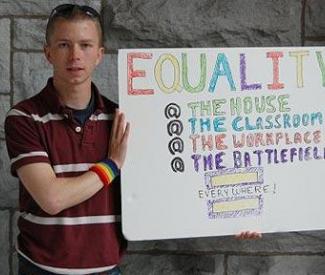
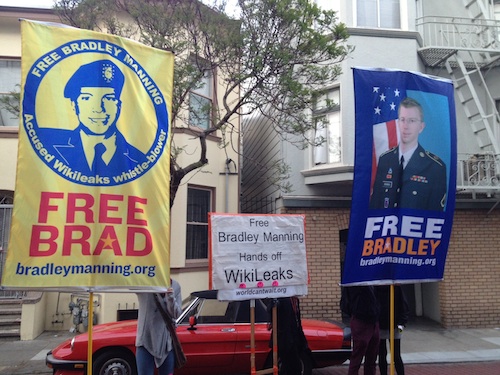
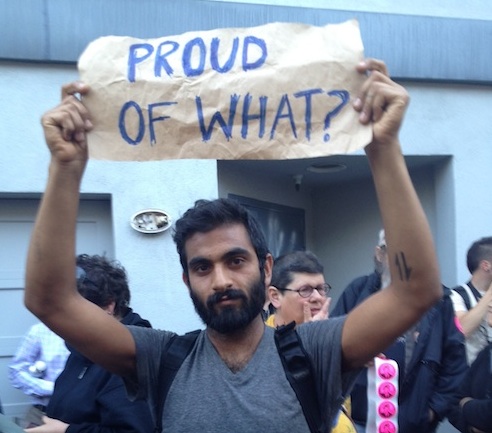
The parade itself, meanwhile, also featured some dissenters. The third annual Bradley Manning Support Network contingent swelled in ranks this year, due to the political maelstrom touched off when the Pride Board rescinded Manning’s appointment as Grand Marshal.

The Bradley Manning Support Network contingent attracted more than 2,000 supporters who marched to show solidarity with the openly gay whistleblower, comprising the largest non-corporate contingent in the Parade. Former military strategist Daniel Ellsberg, who leaked secret government documents known as the Pentagon Papers to the press in 1971, donned a pink boa and rode alongside his wife, Patricia, in a pick-up truck labeled “Bradley Manning Grand Marshal.” Patricia told the Bay Guardian, “There is something about the energy and triumph of this beautiful event … Just as the gays have made a tremendous difference with marriage, we have to do the same with wars and aggression” in U.S. foreign policy.

Pride’s legal counsel, Brooke Oliver — who resigned over the Pride Board’s handling of the Manning debacle — marched along with the Bradley Manning contingent. Bevan Dufty, former SF Supervisor and now the mayor’s point person on homelessness, stepped down as a Grand Marshal, also because of the Pride Board’s actions, but didn’t march with the contingent.

Nor were the Bradley Manning supporters the only protest contingent to take part in the parade. A group seized the opportunity to make a political statement by marching with a faux Google bus, an action meant to call attention to gentrification and evictions in San Francisco. They rented a white coach and covered it with signs printed up in a similar font to Google’s corporate logo, proclaiming: “Gentrification & Eviction Technologies (GET) OUT: Integrated Displacement and Cultural Erasure.”

Some trailed the faux Google bus with an 8-foot banner depicting a blown-up version of an Ellis Act evictions map. Others donned red droplets stamped with “evicted” to signify Google map markers, while a few toted suitcases to represent tenants who’d been sent packing. However, their ranks were thin in comparison with the parade contingents surrounding them, which included crowds of workers representing eBay, DropBox, and, of course, Google — the largest corporate contingent in the parade.

“The organizers of this anti-gentrification and displacement contingent are not ‘proud’ that folks are being kicked out of this city that was once their refuge,” organizers of the faux Google bus contingent wrote in a press statement. “The 2013 SF Homeless Count and Survey shows that 29 percent of the city’s homeless population is ‘LGB and other.’ The Castro is experiencing the highest number of evictions in the city. Meanwhile, the SF Pride Parade is becoming as gentrified as SF. This group is calling on Pride to remember its roots.”


Hungry for reform

16

news@sfbg.com

Sitawa Jamaa is among the thousands of California inmates who, two years ago this summer, took part in the largest prison hunger strike in US history to protest harsh conditions and their invisibility to those outside prison walls.

Now, Jamaa and other prisoners are about to launch another hunger strike to highlight the system’s unfulfilled promises and the persistence of inhumane conditions.

The California Department of Corrections and Rehabilitation (CDCR) counted 6,000 prisoners throughout the state who refused food over several weeks in July 2011. During a follow-up strike that September, the number of prisoners missing meals swelled to 12,000, according to the federal receiver who was appointed by the courts to oversee reforms in the system. At least one inmate starved to death.

As one of four inmates who call themselves the Short Corridor Collective, Jamaa was a key organizer of the hunger strike. The group of inmates drafted a list of core demands calling for the strike when they weren’t met.

That was no easy task for Jamaa, who has spent most of the last 28 years alone in a windowless, 8-by-10 foot concrete cell in Pelican Bay State Prison, a supermax facility not far from the Oregon border, where some 1,200 men are held in similar conditions.

Inmates held in solitary confinement (in government lingo: “Segregated Housing Units”, or “SHU” for short) aren’t supposed to communicate with each other, verbally or through the mail. But they were able to organize with the help of their lawyers, who they are allowed to communicate with, and prison reform advocates outside.

Jamaa and other inmates are planning to launch a second hunger strike on July 8. The Short Corridor Collective has drafted a list of 45 demands, reflecting concerns ranging from inadequate health care to extreme solitary confinement—conditions that prison advocates characterize as cruel and unusual punishment.

The list is an extension of the five initial demands that Pelican Bay inmates presented in 2011 before initiating a hunger strike. Most of those demands were never met, or they were met only with lip service, leading prisoners back to where they started.


CONFINEMENT AS TORTURE

High on the list are concerns about conditions in the SHU, the amount of time prisoners can be made to spend in isolation, and the public’s inability to monitor the situation.

“I feel dead. It’s been 13 years since I have shaken someone’s hand and I fear I’ll forget the feel of human contact,” Pelican Bay prisoner Luis Esquivel told attorneys with the Center for Constitutional Rights in an interview.

Along with Jamaa and others, Esquivel is a plaintiff in a lawsuit against the state of California that would effectively cap the time someone can spend in solitary confinement to 10 years.

“The hunger strike is an extreme act,” says Terry Kupers, a Piedmont-based psychology professor and clinical psychiatrist who has testified before the California State Assembly on long-term solitary confinement. “It’s very dangerous, and you can die. So when a group of prisoners go on hunger strike, it means they’ve exhausted all ways of expressing themselves and having their demands considered. And that’s very much the case here—some of these guys have been in SHU for 30 or 40 years.”

Kupers believes solitary confinement in California prisons violates the 8th Amendment’s prohibition on cruel and unusual punishment, a view echoed by activists who’ve launched a statewide effort called the Stop the Torture Campaign.

United Nations Special Rapporteur Juan Méndez, an expert on torture, has called for a ban on solitary confinement where inmates are kept in isolation for 22 hours a day or more, saying the practice should only be used in very exceptional circumstances and for short time periods.

The CDCR has made some concessions and reforms since the 2011 hunger strikes, but critical issues have gone unaddressed. In Pelican Bay’s SHU, the men are now allowed beanie caps for when it gets cold. They can now have wall calendars to track time and bring a human touch to their surroundings.

Some prisoners have received exercise equipment, such as a handball or pull-up bar. Each year, they now have permission to have one photograph of themselves taken to send to family members, and prison administrators have signaled that they are looking into extending Pelican Bay’s visitation hours.

But more pressing issues have yet to be resolved, so the prisoners who drafted the 45 demands are resorting to starvation once again, despite official statements that it will do little to improve their conditions.

“Negotiation is something the department does not do,” says Terry Thornton, a spokesperson for CDCR. But the department has met periodically with a mediation team, consisting of lawyers and prison activists, who have communicated the inmates’ concerns and gone over their demands with prison authorities.


RESISTING REFORM

In 2002, the state of California was sued, and lost, in an 8th Amendment class-action lawsuit: Plata v. Davis. The federal judge overseeing the case called the medical treatment in California prisons “horrifying,” sinking “below gross negligence to outright cruelty,” ordering improved treatment and reductions in severe prison overcrowding.

A court-appointed doctor found that out of 193 deaths over the course of one year, 34 were “probably preventable,” but medical staff gave “well below even minimal standards of care.” Eleven years later, the state is still under federal receivership, until it can show that conditions have actually improved.

Court-appointed consultant Dr. Raymond Patterson wrote his 14th annual assessment report last April, blaming high suicide rates behind bars on a lack of “adequate assessment, treatment or intervention.” After it was released, he quit the post in frustration, writing: “It has become apparent that continued repetition of these recommendations would be a further waste of time and effort.”

So inmates are taking in upon themselves to accomplish what the courts and consultants have failed to do: reform conditions in the prisons.

As happened in 2011, in spite of what is planned to be a peaceful protest, prisons housing strikers will be, according to Thornton, on “modified program” (or “lockdown,” as prisoners call it). Generally, that means inmates aren’t allowed to leave their cells, even to shower.

New regulations created after the 2011 strikes call for no visits for striking prisoners, and for their canteen food to be confiscated. In addition, “inmate(s) identified as strike leaders, instrumental in organizing, planning, and perpetuating a hunger strike, shall be isolated from non-participating inmates.”

Since March of this year, the Guantanamo Bay prisoner hunger strike has made news around the world for highlighting alleged violations of international law. There, when a striker goes below 85 percent Ideal Body Weight, regulations dictate that he or she be shackled to a chair, fitted with a mask, and have tubes inserted through their nostrils into their stomachs for up to two hours at a time.

That didn’t happen in California back during the 2011 strikes, but the Division of Correctional Health Care Services devotes five pages of its policy handbook to outlining specific instructions for dealing with hunger strikers, including transfers to prison medical facilities where they could potentially be force-fed, another practice the UN regards as torture.

Prisoners and activists believe the policy was instituted as preemptive attack on the upcoming hunger strike. “We are concerned that, under the pretext of ‘welfare’ checks, prisoners are being harassed, targeted, and deprived of sleep as the date of planned hunger strikes and work stoppages approaches,” said Isaac Ontiveros of the Prisoner Hunger Strike Solidarity group. “Whatever the case, new CDCR Secretary Jeffery Beard has an opportunity to avoid the strike and begin to undo the indescribable harm that the California prison system has caused.”


DANGEROUS ASSOCIATIONS

Problems associated with solitary confinement are closely connected to CDCR’s most commonly used tool for sending prisoners like Jamaa into the SHU: the controversial “gang validation” process.

Once an inmate is listed in prison records as a gang member, he or she loses multiple rights on the assumption that they’re a threat to the order of the prison. With no disciplinary write-ups since 1995, Jamaa would have been eligible for parole in 2004, except for the gang validation that led to his indefinite SHU sentence.

Getting pegged as a member of a gang can happen easily. Guards can write prisoners up for anything from the possession of artwork deemed to be gang-related, to information obtained from confidential informants whose claims prisoners often aren’t allowed to refute and whose identities remain unknown to the targeted prisoners.

Last year, in the wake of hunger strikes, CDCR announced a “complex retooling” of the gang validation practices. The so-called Step Down process, created in conjunction with the Department of Homeland Security, is meant to transition inmates out of gangs over the course of four years, with privileges gained over that time.

It might be the most significant of the reforms that followed the last hunger strike, but prisoners and their advocates criticize it as too lengthy of a process, subject to the arbitrary whims of the correctional officers overseeing a given prisoner. In fact, they say it may widen the definition of who counts as a gang member.

Manuel Sanchez, who is participating in the Step Down program at Corcoran State Prison, wrote in a letter that he is “seriously considering returning to SHU, where I’d be less harassed and I’d get more yard access more consistently.”

Compounding the problems in the prisons is a lack of transparency and public accountability.

“It’s like mentioning July 8 is anathema,” says San Francisco Bay View Editor Mary Ratcliff, whose African American-focused newspaper has been a CDCR censorship target.

From January to April of this year, Ratcliff said papers were being returned from Pelican Bay undelivered because they included articles about the hunger strikes, representing “material inciting participation in a mass disturbance,” and “a serious threat to the safety and security” of the prison, according to CDCR Administrator R.K. Swift.

“I think it’s remarkable that hunger strikes are considered a ‘disturbance,'” says Ratcliff. “A disturbance is supposed to mean a fight—something that threatens people. A hunger strike is a threat to no one except the people who are participating in it.”

Just as inmates can’t get news from the outside, they are also walled off from journalists who might cover them and the conditions they live in.

Since 1996, the CDCR has limited reporters to only interviewing prisoners they’ve selected. Last September, Governor Jerry Brown vetoed legislation that would have opened up media access to the prisons. “Giving criminals celebrity status through repeated appearances on television will glorify their crimes and hurt victims and their families,” he wrote, citing the media spectacle around Charles Manson.

But activists say the nearly $2 million Brown received from the California Correctional Peace Officers Association (CCPOA) during his successful bid for governor in 2010 had more to do with it than infamous serial killers.

Assembly member Tom Ammiano, who authored the most recent bill, stressed that “Press access isn’t just to sell newspapers. It’s a way for the public to know that the prisons it pays for are well-run. I invite the governor to visit the SHU to see for himself why media access is so important.”


DRASTIC MEASURES

Last time around, Jamaa lost 19 pounds. Deprived of sunlight, the Oakland-born man has developed melanin and vitamin D deficiencies that have lightened his normally dark brown skin. He suffers stomach problems and swollen thyroid glands that he didn’t have before prison. Starvation is a possibly lethal proposition. “Make no mistake, none of us wants to die. But we are prepared to, if that’s what it takes to force a real reform,” he and other strike leaders wrote in a statement last December. Jamaa’s sister, Marie Levin, who has organized monthly vigils for the strikers at Oakland’s monthly First Fridays/Art Murmur event, is worried about how her brother’s body will cope this time around. “It’s something that we as family members don’t want them to have to experience again,” she notes with anxiety. Yet both the prisoners and their advocates on the outside say they can’t simply let dehumanizing conditions in California’s prison system continue indefinitely. “I think things have changed, but not substantially in terms of actual conditions,” Kupers argues. “What is changed is the CDCR had to recognize the strikers, and conceded some of the things. And subsequently, the various prisoner groups have come together and made a commitment not to have violence between groups inside the prisons. This is huge advancement.” But unless all 45 demands are met, they say the strike will commence July 8. For now, Jamaa and others are readying their bodies for hunger, for a cause they believe goes far beyond prison walls. “Know this,” he wrote from SHU, words that needed to be smuggled out through unconventional means to get around an official wall of silence. “I am a … Prisoner of War, and I serve the interest of all people.”

‘Alternative to Pride Parade’ announced

57

In the wake of all the kerfuffles besetting Pride this year — from the Pride Board’s egregiously mismanaged reaction to the election of Bradley Manning as a community grand marshal (his supporters have plans of their own), to the recent announcement that military recruiters would be descending upon the celebration in earnest, and, well, just the continued corporatization of Pride in general — it comes as no surprise that a radical Pride-questioning movement has been reawakened.  Just like the ’90s are back, so is Gay Shame, at least in spirit.

And thus an alternative parade to the Pride one on Sunday has been announced — let us not be surprised that it is a bar crawl! In any case, it’s a nice start to getting us back to our gay, unlicensed roots while joining with other activists who are Over the Rainbow(TM). Here’s the statement from the organizers with more details.

Have you had enough with the poor political choices of some community leaders that claim to represent you? Are you over the over-corporatizing of SF PRIDE??? Or just tired of the same old events that don’t reflect who you are, and how you want to celebrate your queer pride?

Want to be part of something different, something fun, something that will challenge conventional thought within the SF LGBTQ community?

Then join us for an ALTERNATIVE TO PRIDE PARADE (AND BAR CRAWL).

We will be getting back to our gay roots, meeting at THE CINCH BAR at 1723 Polk Street at 12 NOON with the parade beginning at 1pm (we don’t think a 10:30am start time for a Pride Parade is appropriate), ending up at THE SF EAGLE.

We will make stops along the way, passing through SF PRIDE at Civic Center to express (peacefully) our displeasure with what passes for gay pride at this event, and then we will continue on to SOMA with stops at THE POWERHOUSE/HOLE IN THE WALL, and finally we will end up at The SF EAGLE.

We encourage you to DRESS UP, whatever you want: Drag, Leather, Freak, Nerd, Casual, Beach Wear, Furry, Punk, etc. We also encourage you to BRING PROTEST SIGNS, be creative (body paint?), be original! We will definitely want folks to know what we are up to and perhaps get people thinking about why we need BUDWEISER, VIRGIN AMERICA, VERIZON, WELLS FARGO, BANK OF AMERICA, and COMCAST to have a good time!

RSVP TODAY!!!

Disillusionment, “Everyman,” and Netroots Nation

For nearly the entire Caltrain ride to down San Jose last Thursday morning, my thoughts were fully consumed by the subject of liberal disillusionment and cynicism. I pondered the question, “How much progress have the things that liberals care about made since the start of the new millennium?”

The issue of gay rights was the only glimmer of hope I could conjure up. Since 2000, income inequality has increased astronomically, the military-industrial complex grows unabated, the drug war continues to destroy millions of lives, women are having to protest the same idiotic conservatives policies their mothers protested, we are realizing the tangible repercussions of climate change, the Citizens United ruling and Republicans have become the John Birch Party and Democrats, by and large, have become identical to the Republicans of 30 years ago.

And while it may be true that progressives were responsible for electing the first black president, the Obama Administration has, for the most part, ignored, shunned, and at times insulted progressives. If Obama governed like a progressive, he would have jailed Wall Street executives for their roles in the financial crisis and HSBC bankers for laundering terrorist and drug cartel money, he would have rejected the Keystone pipeline in resounding fashion, he would have fought harder for a public option, he would have ended or at least decreased the surveillance state, and he wouldn’t be prosecuting medical pot dispensaries with extreme vigor.

Like a lot of the other media there, I came in search of demoralized liberals and to see if the Democratic Party leaders and other notable figures in attendance would feel the brunt of this dismay.

Unsurprisingly, the boogeyman of John Boehner, the Koch Brothers, and other rightwing caricatures were paraded out in order to stomp out any reservations you may have had about the president. One of the most notable lines of the conference was Howard Dean’s unfunny salvo of how the president isn’t perfect, “but it sure beats having Bain Capital, oops, I mean Mitt Romney in the White House!”

When our Rep. Nancy Pelosi was booed for saying that Edward Snowden should be prosecuted for his leaks, she tried shouting over the jeers by repeatedly saying that Obama’s second term was not Bush’s fourth. Then she tried to calm the crowd down (in a twist of irony, a man named Marc Peckel was kicked out for voicing objection to a police state), saying she welcomed the booing and debate about privacy. But would we be having this debate now, if it weren’t for Snowden’s leaks?

I attempted to ask Rep. Pelosi some follow-up questions as she exited the building (flanked by numerous aides and security) but oddly enough, my shouts of “I’m with the San Francisco Bay Guardian!” didn’t faze her one bit.

From the dozens of interviews I conducted with a wide range of attendees, the overall consensus seemed to be that Obama, his administration and other Democratic Party leaders are still on their side – though a good number of my interviewees expressed profound disappointment that the president hasn’t been liberal enough. One healthcare organizer from Chicago said he was immensely dissatisfied by Obamacare, but believes that it’s right the step toward implementing universal healthcare.

Obama’s most visible critic for the three days was a man who goes by the name Stan Everyman, who came on behalf of the San Jose Peace & Justice Center and carried a sign everywhere he went that read “OBAMA=CHENEY”. Everyman, who fervently believes that “Netroots is firmly under control of the Democratic party,” saw the conference as an opportunity to connect with other progressives who have gripes with Obama. The majority of reactions to his sign were positive, he said, but he did wind up engaging in some mild confrontations with what he calls “Democrat loyalists.” He was aghast when he encountered someone who came to Netroots on behalf of a liberal dating service, saying, “she didn’t mind if her emails and calls were tapped and didn’t care if there were helicopters hovering over her house as long as it caught the terrorists.” and when it did elicit a reaction, did nothing more than get a thumbs up or an eye-roll.

Meanwhile, some Democratic figures urged progressives to pressure elected leaders as much as possible. Keith Ellison, a Minnesota representative and co-chair of the progressive caucus, stated: “If people who came before us got discouraged because things were hard, we’d still have slavery, have no right to collective bargaining, the air quality would be horrible. The problem isn’t that you’re not involved and you didn’t get what you wanted, the problem is that you got to stay involved.”

When I countered that a big reason behind liberal disillusionment was that our own guy didn’t come through for us, Ellison’s responded, “Let me say this, never ever organize around a personality – even if it’s an awesome personality like Obama’s. Organize around the principles that guide you. Somewhere along the way we stopped saying ‘yes we can’ and started saying ‘yes he can,’ and when he didn’t do certain things we want, we got discouraged. What personality does the Tea Party coalesce around? None! They coalesce around, ‘we hate government, we love guns’ and ‘if you’re not quite like us, you’re not all right.’ So the progressive movement should coalesce around generosity, inclusion, fairness, sustainability, and leaders need to live up to that, and if they do, they’re good, and if they don’t, they’re not. But it shouldn’t be a personality-driven thing.”

If you want change, you have to keep on keeping on, no matter. Sure, town halls, letter campaigns, and protests are great ways to engage your politicians and in democracy, but when you got to go to work or tend to your family, six-figure lobbyists walk through the halls of Congress retracting whatever impact the people’s efforts made. Politicians want us to give them the political will to do what’s right even though we elected them to do what’s right. I don’t naively believe politicians are perfect and that they’re our friends and that we can sit back and relax after we pull the voting lever. However I do have a problem with “I’ll fight for you!” during the campaign season and “Fight for me!” during the legislative sessions. The latter due to this being a non-election year, was the unofficial theme of Netroots Nation 2013, which also possessed a palpable feeling that the reason why many of the big names showed up was to throw the progressive wing a bone and quell whatever qualms they have.

I do admit that Netroots, in the past, has resulted in a concrete impact (namely, helping to get Obama elected and being instrumental in manufacturing a 21st century online campaign apparatus). However, the chances that it will be able to pull Hillary Clinton—who’s just as hawkish as Dianne Feinstein— to the left beyond the duration of the conference are lower than the probability of Obama appointing Angela Davis as his Chief of Staff. A piece on Salon.com a couple days ago reported that progressives are open to a Clinton run, which should come as no surprise to given how good the left is at reconciling their beliefs with that of their leaders.

So between now and NN14 (which is in Detroit), when the Democratic Leadership will come begging for the left’s help to return the Speakership crown back to Pelosi, pretty much everything the left holds dear will wallow in purgatory or regress to hell. But cheer up: At least Bain Capital isn’t president!

Small Business Commissioners support Pet Food Express over local stores

34

San Francisco’s Small Business Commission has recently come under fire for its promotion of corporate interests and, most recently, advocating for an allegedly predatory pet store chain known as Pet Food Express.

In 2009, the Small Business Commission voted in favor of denying Pet Food Express’ application for a location on Lombard Street in the Marina District. Subsequently, the Planning Commission also denied the request, seemingly blocking Pet Food Express’ efforts to set up shop in the Marina. 

San Francisco’s formula retail legislation requires chain stores like Pet Food Express to apply for a conditional use permit in order to receive approval for opening new locations.

But now, Pet Food Express is back after recently filing another identical application with the SBC for the exact same spot on Lombard Street, and this time some members of the SBC are oddly supporting the chain.

As Pam Habel, owner of local Marina pet store Catnip & Bones, pointed out at the commission meeting on June 10, Pet Food Express already has a location on California Street just one mile away. At the same meeting, Susan Landry, owner of another Marina pet store, Animal Connection, added that nothing has changed in the past four years that would point toward the Marina community needing or wanting this Pet Food Express, since four pet-related stores exist within a mile of the proposed Lombard Street location.

“We were really surprised and disappointed that the commission no longer seemed to be an advocate of small business and even made comments indicating sympathy for the big chain pet store,” Habel and Landry, told the Bay Guardian jointly via email. “Commissioner Adams even said it seemed unfair to him to penalize a business that had started out small and now are being victimized for their success since they are one of the largest pet store chains in the U.S.”

So what has changed since 2009 that is now making the SBC consider supporting the proposed Pet Food Express? For one, Mayor Ed Lee’s corporate-friendly appointees to the SBC, including developer Luke O’Brien and President Stephen Adams, a manager for Sterling Bank & Trust.

Additionally, San Francisco Animal Care and Control Director Rebecca Katz lobbied for approval of the Pet Food Express while holding a blind Chihuahua adorned with a sweater at the June 10 meeting. Katz cited Pet Food Express’ many financial contributions to her agency as reasoning behind supporting the chain’s new location and expansion. According to Animal Care and Control spokeswoman Deb Campbell, Pet Food Express donates an estimated $50,000 to $70,000 in supplies annually to the city department.

“The more business Pet Food Express does, the more they grow and the more they give back to the community,” Katz told the Bay Guardian. “We take in about 10,000 animals a year on a budget of about $40 million.”

Kathleen Dooley, one of the SBC’s few existing members still in favor of promoting local business over big business, met Katz’s lobbying with criticism.

“She went up and lobbied for Pet Food Express and implied if it wasn’t for them no pets would be adopted and the animal world would be in chaos,” Dooley told the Bay Guardian. “They already have a number of stores in San Francisco, but they act as if this one on Lombard would change the tide.”

But Katz says that her public promotion of Pet Food Express is not lobbying. “I spoke to the Ethics Commission and they told me it is okay for me to talk about what Pet Food Express does for us,” said Katz.

Few of the arguments in favor of the Pet Food Express’s intrusion into the Marina actually acknowledge the store’s potential detrimental impact on the existing local businesses. Katz even publically said she thought it was ironic to protest another corporation coming into the Marina, where so many chain businesses already exist.

“The size of the Lombard location would allow for an adoption center which would have a huge impact,” said Katz. “Whereas residents have to drive to the California Street location, now they could walk.”

Unfortunately for local Marina businesses, the SBC, whose professed goal is to “work to support and enhance an environment where small businesses can succeed and flourish,” may be doing just the opposite by supporting a chain business that will undoubtedly endanger the many locally owned pet stores.

“As small businesses in San Francisco, we rely on the SBC as our voice at City Hall, not as a sympathetic voice for chain stores,” said Habel and Landry. “Because of their response last month, we no longer feel that we can look to the SBC to support small business in San Francisco.”

In her presentation before the commission, Landry drew an analogy to the previous opening of a Blockbuster on Lombard Street. Following the corporation’s entrance into the community, all four independent video stores in Cow Hollow closed within a year.

At the same meeting, Commissioner Mark Dwight acknowledged the predatory nature of Pet Food Express, who has sat on the same property for four years in order to continuously rally support in favor of the proposed location.

The pet supply stores in the Marina could face the same fate as the local video rental shops if Pet Food Express succeeds in opening on Lombard Street.

“When chain stores go in, commercial rents go up and the small mom and pop businesses are priced out of the neighborhood and replaced by even more chain stores as they are the only ones who, with their corporate structures, can easily afford high rents,” said Landry and Habel. “This is about more than one Pet Food Express application on Lombard, this is part of our battle to retain the heart and soul of our neighborhood commercial corridors.”

Desperate for support, 8 Washington developers run ads proclaiming: “Stop the 1%”

With a July 8 deadline fast approaching, the developers behind the 8 Washington project are taking steps to ensure their measure to approve one of the priciest condo projects ever contemplated in San Francisco ends up on the November ballot.

David Beltran, a spokesman for 8 Washington’s campaign “Open Up the Waterfront,” says they are “on track” to collect the 9,000 signatures needed to place their measure – which would counter a measure opposing the project – on the ballot. But in a seemingly desperate move, the project proponents are paying a higher-than-average rate of $3 per signature. According to a voicemail left for petition gatherers, they’re trying to gather all the signatures by June 30, less than a week away.

“They have spent $220,000 on the campaign trying to qualify the counter measure for the ballot,” according to Jon Golinger, who ran the referendum campaign opposing the project.

Meanwhile, an online ad circulated by “Open Up the Waterfront” reads: “Stop the 1%. Don’t let the 1% prevent open access to the waterfront.” The ad makes no mention of the condos at the heart of the project. Apparently the deep-pocketed project proponents believe the best way to garner popular support is through vague messaging that sounds aligned against the superrich. “A corporate developer is posing as an Occupy activist and attacking the millionaires he is trying to build his luxury condos for,” Golinger says. “What’s next, Larry Ellison walking the picket line to protest the America’s Cup fiasco?”

Beltran, however, counters that “Open Up the Waterfront” is supporting the 99 Percent. “The 8 Washington plan will provide $11 million for the creation of new affordable housing, create 250 good paying construction jobs and 140 permanent jobs and generate over $100 million in benefits to the city,” he said. “Opponents of 8 Washington are selfishly asking San Franciscans to give all of this up, in order to protect the status quo: an asphalt parking lot and a private club that provides zero benefits to working families.”

In the end, Golinger says the developers will most likely obtain the signatures that are needed to land their measure on the ballot. “They have a harder road, but they have enough money and bodies on the street to get signatures,” he said.

Guardian forum on Plan Bay Area draws big, engaged crowd

72

San Franciscans who want to help shape how this city grows — rather than just leaving it up to regional planners and market forces — packed a large conference room last night for a community forum presented by the Bay Guardian: “Whose Future? What Does the Regional ‘Plan Bay Area’ Really Mean for San Francisco?”

Moderated and organized by Guardian Editor/Publisher Tim Redmond, and co-sponsored by the Council of Community Housing Organizations (CCHO) and Urban Institute for Development and Economic Alternatives (UrbanIDEA), the session began with a overview of what’s now being planned for the San Francisco of 2040.

Gen Fujoika of the Chinatown Community Development Center said that Plan Bay Area, which is being jointly developed by the Association of Bay Area Governments and Metropolitan Transportation Commission (which will hold a hearing on the plan tomorrow, Fri/14, at 9:30am in Oakland), doesn’t pay for itself yet it will include strong incentives that will shape development in the region.

“It is in some sense a plan and I think we need to critique the hell out of that plan,” he said. “As we think of Plan Bay Area as a vision statement, we need to think about whether it’s our vision.”

As illustrated by the Plan Bay Area maps that the lined the walls of the LGBT Center conference room, the plan’s “priority development areas” that are slated for dense, streamlined development are also the same areas identified as “communities of concern” with vulnerable, low-income populations, making the plan a recipe for mass displacement.

Fujoika quoted a comment that Mayor Ed Lee made on Tuesday when asked by Sup. Eric Mar about the issue: “San Francisco has some of the toughest anti-displacements laws in the country.” While that may be true, Fujoika said that the plummeting numbers of African-Americans in the city and Plan Bay Area’s displacement projections for San Francisco show those laws simply aren’t up the challenge.

“If we have the toughest anti-displacement position in the country, then we are in some trouble,” he said, calculating that the affordable housing needed to prevent extreme gentrification in the city would total $6.8 billion, and that the affordable housing fund created by voters last year is only projected to raise $1.3 billion by 2030.

Fujoika said that he and the other panelists aren’t against growth and development, “but we are for equitable growth,” which would involve more community buy-in for the plan, more money for affordable housing and infrastructure needs, and more of the growth burden being shared by other Bay Area communities.

San Francisco Planning Commission Chair Cindy Wu cited growth projections for Chinatown as a good example of the problem, noting that is already a dense, complete neighborhood that would suffer from the greatly increased traffic that would be funneled through it and other negative impacts of unfettered growth.

“It’s not just growth for growth’s sake, it’s who gets to live there and who gets those jobs,” she said. Wu called for more community organizing around this and other development plans, citing as a good example the coalition-building that forced California Pacific Medical Center to agree to a multi-hospital project with far better community benefits than the deal it originally cut with the Mayor’s Office.

It was a point echoed by Maria Zamudio with Causa Justa, who said Plan Bay Area will worsen pressures that are already displacing the Mission District residents she works with, or forcing them to live in unsafe housing. “They’re going to push our families out of the city and maybe out of the region,” she said.

To combat the power that this plan and profit-minded property owners will exert over how San Francisco grows, San Francisco Labor Council President Mike Casey, head of UNITE-HERE Local 2, said that progressive San Franciscans will need to work cooperatively with organized labor, a relationship that has suffered during these tough economic times.

“Unfortunately, I think we’ve become alienated and marginalized from each other,” Casey said, calling on activists to not let differences over individual projects or issues interfere with solidarity over the larger, longer struggle for equity and justice.

“Not everyone agrees that a strong labor movement is the cornerstone of a more progressive vision,” Casey said, arguing that displacement of working class people from the city has a cascading effect in gentrifying the city. “The demographics of a city shape very much what the politics of protest look like.”

And those politics of protest will be more crucial than ever in resisting the demands that powerful capitalists will make on San Francisco in the coming years, a point that all seven panelists seemed to agree on.

Bob Allen of Urban Habitat said the planning research groups represented on the panel need to find ways to funnel more funding into grassroots organizing, both in San Francisco and regionally. Otherwise, we’ll see the “suburbanization of poverty,” with Plan Bay Area funneling the best jobs and most expensive housing into urban areas and leaving everyone else to fend for themselves in communities that don’t have the tenant protections and other hard-won social justice programs that San Franciscans have struggled for.

“Local control can be a way of saying ‘I don’t want black or brown people to live in my suburban community,” Allen said.

Ironically, Plan Bay Area is ostensibly driven by concerns over climate change and the argument that it’s better to concentrate development along transit corridors, which is why almost all of San Francisco and much of Oakland is proposed for development that would be given waivers from some California Environmental Quality Act scrutiny.

Yet the plan doesn’t fund the transit upgrades that would be needed to serve that growth or create restrictions on automobile use that might encourage more transit use. Instead, Fujoika said low-income people who actually use transit would be the diplaced in favor of wealthier residents who might not.

“Transit has become an amenity rather than a necessity,” Wu said.

The forum, which was attended by more than 130 people, included a lively discussion that involved dozens of audience members who offered their own views, ideas, and strategies for how to move forward. Among them was Brian Basinger of the AIDS Housing Alliance, who said that he is working with a coalition to reform the Ellis Act, which allows landlords to evict tenants from rent-controlled apartments.

“We could move this as early as January,” Basinger said of the reform legislation now being developed with allies in the Legislature, urging attendees to get involved.

After the audience discussion, the meeting closed with Peter Cohen of the CCHO summarizing the high points and getting people to sign up on lists that were circulated to be involved with next steps. And Rachel Brahinsky, a former Guardian staff writer who is now a professor at USF’s Leo T. McCarthy Center for Public Service and the Common Good, urged attendees to fight for San Francisco to remain inclusive and diverse: “San Francisco is the place it is because people have kept fighting.”

Alerts

0

WEDNESDAY 12

Whose future? Community forum LGBT Community Center, 1800 Market, SF. sfbg.com, ccho@sfic-409.org. 6-8pm, free. In July, the Bay’s Regional governing body is scheduled to approve a state-mandated plan aimed at reducing carbon-emissions that proposes to put 280,000 more people, 92,000 new housing units, 100,000 new jobs (and 73,000 more cars) into SF over the next 30 years. By the proposed Plan’s own assessment: it will increase the risk of neighborhood disruption and displacement of existing residents and businesses, especially among the city’s working class communities. What can we do about it? Join Tim Redmond, San Francisco Bay Guardian; Mike Casey, Unite HERE Local 2; Cindy Wu, San Francisco Planning Commissioner; Maria Zamudio, Causa Justa: Just Cause; and others for this important panel discussion.

THURSDAY 13

Raising the Roof for Renters 111 Minna Gallery, 111 Minna, SF. tenantstogether.org/raisingtheroof2013. 6pm, $30 in advance/ $40 at the door. Tenants are hurting right now, so show your support by attending this fundraiser for Tenants Together — California’s statewide organization for renters’ rights. Celebrate five years of mobilizing tenants statewide for housing justice. Featuring a silent auction, fantastic food, and a cash bar.

SUNDAY 16

Teach-in: class struggle in Turkey Niebyl Proctor Marxist Library, 6501 Telegraph Ave., Oakl. (510) 428-1578. 10:30am-12:30 p.m., free with donation requested. On May 31, without warning, Turkey erupted. For the first time in recent history, women, students, workers, artists, youth, Kurds, Artists, Turks, gays-lesbians, Alevites, doctors, small merchants, environmentalists, unions and progressive associations rose up together. Mehmet Bayram, a long time journalist and Bay Area activist from Turkey, will report on the developments that led to the events and the aftermath. A discussion of politics and class struggle in Turkey will follow.

THURSDAY 20

Rally and protest against Keystone XL Battery East, below Golden Gate Bridge Visitor Center, SF. tinyurl.com/mf6m2ef. Noon, free. Join Bill McKibben of 350.org for a noon rally against the Keystone XL pipeline, followed by a march across the Golden Gate Bridge. This time, environmentalists seeking to halt this major oil infrastructure project will be joined by National Nurses United, who are organizing a day of action in the city against austerity and the Keystone XL.

A ‘reasonable’ cheek swab

7

Rebecca@sfbg.com

On June 3, the U.S. Supreme Court ruled that it’s legal for law enforcement to collect DNA samples from people who are arrested — even when the individuals taken into custody are never convicted of a crime. The justices were narrowly split, and the decision immediately drew criticism from civil liberties advocates like American Civil Liberties Union, who characterized it as a blow to American’s Fourth Amendment right to privacy.

Does the historic ruling carry implications for law enforcement practices in California? Not exactly. As it turns out, current state law allows police to collect DNA samples through cheek swabbing on a far more routine basis than in Maryland, where only a handful of serious offenses can trigger this kind of search. And in the Golden State, fewer protections are in place for arrestees.

The Supreme Court issued its ruling with a narrow 5-4 vote. “The majority’s take was that cheek-swabbing is reasonable … even without any suspicion of wrongdoing by the arrestee, because the intrusion is minimal, the arrestee has less of an expectation of privacy than a typical citizen, and the state has a strong interest in using DNA to identify people,” explained Andrea Roth, a law professor at the University of California at Berkeley and founding member of a group that studied and litigated forensic DNA typing.

In contrast, Roth said, conservative Justice Antonin Scalia “was concerned that this is the first time that we’ve ever allowed searches of someone’s body, without any type of individualized suspicion, for the purpose of general crime-solving. He thought that was a line the Constitution draws in the sand, and that the law is on the wrong side of that line.”

Despite drawing a scathing critique from a conservative Supreme Court justice, Maryland’s system for the collection and use of DNA is actually much narrower in scope than the law that went into effect in California in 2004, when Proposition 69 passed.

Maryland’s law “only applies to a limited number of offenses, it doesn’t apply at all to people who are simply arrested but not charged, and they can only make use of the sample after there’s been a judicial finding of probable cause,” Michael Risher, a lawyer with the Northern California Chapter of the American Civil Liberties Union, told us.

“California doesn’t have any of those safeguards,” Risher added. “It’s a different law.”

2.1 MILLION SAMPLES

When Prop. 69 was approved, California voters initially sanctioned DNA collection from people convicted of felony offenses. But on January 1, 2009, a different provision of that initiative kicked in, expanding it to allow police to collect DNA samples from “any adult person” arrested for “any felony offense,” regardless of whether that person is ever charged or convicted of a crime.

When used as a form of identification, DNA samples are processed to yield a 26-number sequence that aids law enforcement in verifying suspects’ identities.

Once they’re collected and used to produce unique identifiers, those cotton-swabbed samples aren’t destroyed; instead, they remain in the hands of a state agency. “The problem is that the state keeps your samples,” Roth said. “It’s not like they develop the 26-number profile and then throw the rest of the sample in the trash. So if you’re in a database, state officials still have your entire DNA strand.”

According to the California Department of Justice, since the start of the program, the DNA data bank had received and logged more than 2.1 million samples as of March 31. The data bank is shared with the National DNA Index System (NDIS), part of the Combined DNA Index System (CODIS), which is linked to federal records.

In its decision, the nation’s highest court determined that “taking and analyzing a cheek swab of the arrestee’s DNA is, like fingerprinting and photographing, a legitimate police booking procedure.”

Yet civil liberties advocates point out that the information contained in a DNA sample can reveal much more about an individual than either a fingerprint or a unique identifier generated from a sample.

“There’s a basic difference between your DNA and your fingerprint,” Risher explains. “Your fingerprint doesn’t tell you anything about yourself. And your DNA is your genetic blueprint. The profile that they generate might not say a lot about you … but they are keeping these physical samples. Current law says they can’t be tested for sensitive things, but laws change, and people can violate them.”

And a properly preserved DNA sample can last hundreds of thousands of years — essentially forever.

ANTI-WAR PROTESTER ASKED FOR DNA

Lily Haskell has been fighting the state of California over DNA collection ever since her arrest in March of 2009, at an anti-war demonstration in downtown San Francisco. Held to commemorate the anniversary of the start of the Iraq war, the protest was staged in Civic Center Plaza. “With no prior warning, police charged the crowd, penned us in, arrested us, and charged us with trying to incite a riot,” she told us.

But hours later, after she and a handful of others had been processed at the San Francisco County Jail, Haskell was summoned from her holding cell and presented with what struck her as an odd request. Although she says she had already been fingerprinted, and her identity already confirmed, an officer “told me I had to provide a DNA sample.”

Her first instinct was to decline. “I didn’t believe it was just to have to comply with that,” she said. “I told them I believed it was my right to refuse.” Haskell was told that if she continued to resist the sample collection, she’d be charged with a misdemeanor and would likely spend a few additional nights in jail. So she relented.

Although she was neither charged with a crime nor tried for a felony or any other offense after being released from jail 24 hours later, Haskell’s DNA sample remains in the state databank. Now she’s a lead plaintiff in a class action lawsuit filed by the ACLU.

Haskell said she’s never tried to get her DNA expunged from the state database, because she sees her participation in the lawsuit as an important challenge to a law she views as unjust. “I don’t want my DNA to be held,” Haskell says, “and I don’t want anybody else’s DNA to be held, either.”

Individuals who have tried to go the route of having DNA samples removed have found it can be tedious. “In California, the process of getting your DNA out of a database if your case ends in dismissal or acquittal is an onerous one,” Roth explained. “You have to pay your own filing and attorney fees, you have to wait until the statute of limitations has run, the judge has complete discretion to deny your motion, and you can’t appeal the judge’s decision.”

Legal upshot still unclear

Meanwhile, ACLU attorneys in Northern California were closely watching the Supreme Court case, Maryland v. King, to see how it might affect their class-action challenge to Prop. 69, a case known as Haskell v. Harris. Although a divided panel of Ninth Circuit judges upheld the law in February of 2012, the court took the unusual step last July of voting to rehear the case en banc, with a nine-judge panel. However, the court issued an order after oral arguments saying it wouldn’t issue a ruling until King had been decided in the Supreme Court.

“Yes, they will have to do something with our case — but what they do is actually up to them,” Risher explained. “There’s no binding opinion in our case right now. Everything was up in the air waiting for King to be decided.”

Risher added that in future arguments, the ACLU plans to highlight the differences between Maryland’s DNA collection law and California’s far broader Prop. 69. “If King was a 5-4 decision with a law that was so narrowly focused, with those safeguards,” he said, “well okay — this one crosses the line.”

Salon says, “Ladies, shush! People paid good money for Michelle Obama and rape”

20

Hey, remember Code Pink during the Bush years?  “Why can’t those old, shriveled, nagging dyke hags stop screaming about Iraq and stuff,” seemed to be the reaction of most of America and the media.

Meanwhile, even many of us wholly sympathetic to their message cringed a bit in our Internet-ringside seats as the valiant fuschia-clad ladies yelled, and yelled, and yelled. Even at Hillary Clinton and Nancy Pelosi! (Clutch pearls.) And hey, they’re still doing it. Even at Obama! (Clutch pearls tighter.)

Weren’t they hurting our cause with all this rudeness? Why could they just sit down at their Dell Gateway computers, dial up AOL, and write a firmly worded comment on the New York Times site like the rest of us. What about civility? WHO WILL THINK OF THE CIVILITY?

Now, of course, with the distance of time and the realization of just how awful that political period was still dawning, it’s like, “Thank fucking god someone was doing something real, however quixotic.”

And yet, the sorry clutching of pearls in the face of female resistance continues. Why can’t women just pipe down about stuff? Especially those whiny ol’ man-hater ones.

If you’re awake today, you’re hearing about how Ellen Sturtz of Berkeley-based gay rights activist group GetEQUAL “heckled” Michelle Obama at a $10,000 per person DNC fundraiser by loudly demanding that President Obama issue an executive order protecting LGBTs from discrimination by companies that contract with the federal government. “I’m a lesbian looking for federal equality before I die,” she shouted. WELL, I NEVER!

Michelle Obama left the podium, confronted Sturtz (whose description in almost every major news account incorporates the phrase “56-year-old lesbian activist” or, better, “a divorced lesbian” — because you know what that means: shrieky shrieky!), and told the crowd that it had to choose whether it wanted to hear her or Sturtz. Sturtz replied that she’d gladly take the mic. But, duh, the fancy crowd chose Obama, and Sturtz was promptly hauled off by security — thank god for our great country’s sake, and that of general decorum also.

Of course this episode is being touted, even by liberal-leaning outlets, as Michelle’s great “smackdown,” a “verbal chin check,” a brilliant takedown. She has had it, get huh! That angry lesbian got what she deserved.

But the most disappointing — and frankly shocking — take was by Mary Elizabeth Williams of Salon. In an incredibly weird and misguided post this morning called “Michelle Obama’s Heckler Win,” Williams decries any kind of disruptive protest, let alone one at a $10,000 per person fundraiser, my stars, because it’s forcing your values on someone else

“[Sturtz] explains her actions by saying, “I simply couldn’t stay silent any longer.” And she did manage to draw attention to the issue. But she did it by being rude and boorish, so where’s the satisfaction in that? The headline-grabbing outburst is a common ploy, one that, it depresses me to say, is far too often used by those of us here on the crunchy left. We can say that dire circumstances call for extreme reactions, but really, all that heckling does is broadcast to the world, “What I feel right this moment is more important than what everybody else in the room paid money to experience.”

Nevermind for a minute if Sturtz paid her money, too, or that Williams is privileging money over expression and using a common rightwing troll attack trope (protesting is infringing on freedom) — but seriously, WTF? Heaven forbid people get what they paid for at a political fundraiser … actual politics. (Obama was on her usual schtick about ‘we must help the poor children of Chicago.” Pretty sure not much of that $10,000 was going South of the Loop.)

Could everyone please just sit quietly after they give all their money to Michelle Obama or whoever because FREEDOM OF MONEY? Thanks. If you’re upset about something, organize your own million-dollar fundraiser. These people paid to worship Michelle, not hear about your discrimination under the hypocritical administration she’s representing. Why don’t you crunchy lefties understand that?

But wait, there’s worse. In her Salon piece, Williams extends her “please don’t ruffle the money feathers” to an incident that blew up last year when a woman, during a rape-based routine at a Daniel Tosh comedy show, stood up and yelled, “actually rape jokes are never funny!” (Tosh then suggested the crowd gang-rape the woman — and oh boy, did Mary Elizabeth Williams have some fucked up opinions about that at the time.) Her post this morning continues:

“Last summer, a comedy club patron enticed Daniel Tosh to make some very unfortunate remarks about rape – an event that was set in motion when the woman decided, “I felt that sitting there and saying nothing, or leaving quietly, would have been against my values as a person and as a woman.”  In other words, much like Sturtz, she decided that her values should be made known to everyone in the audience, because they were more important than anything anybody else was saying or doing. Certainly more important than what the person the rest of the assembly had paid their money to see was saying and doing.”

Um, so of course the woman “enticed” the rape remarks by speaking out against them — she sure was asking for it. She should have just sat there and not imposed her highly unusual and embarrasing “rape is bad” values on people who paid to hear rape jokes. Williams then ends the piece:

“A no-nonsense mom like Michelle Obama could tell you that any 2-year-old in a WalMart can get noticed just by throwing herself on the floor of the sporting goods aisle. That doesn’t mean anybody is going to take her seriously.”

So, just to recap, raising your voice for equality at a $10,000 per person fundraiser is just as annoying as standing up against rape jokes (which you caused in the first place) because you’re being a bully to all these people who paid money. Don’t ever speak up about injustice because you’re being a baby. Live with it like the rest of us, especially here at Salon, which never speaks out about anything to grab attention. 

Got it. Mary Elizabeth Williams, you are a master troll. Not even Code Pink with 10,000 crimson bullhorns could fault your logic. Ellen Sturtz, go to your room — with no equality for dinner.


On the Cheap listings

0

WEDNESDAY 5

SF Peace and Hope reading Sacred Grounds Café, 2095 Hayes, SF. www.sfpeaceandhope.com. 7pm open mic signup, 8:15 reading, free. Online poetry journal SF Peace and Hope takes its cues from 1960s idealism — if you’re feeling that flower vibe stop by its third anniversary open mic night.

“Radar Superstar” San Francisco Main Library, 100 Larkin, SF. www.sfpl.org. 6pm, free. To celebrate the progressive, queer-minded, reading series 10 years of life, the minds behind Radar have assembled crazy-like-a-fox performer Jibz “Dynasty Handbag” Cameron, founder of black gay theater posse Pomo Afro Homos Brian Freeman, Vice Magazine masculinity expert Thomas Paige McBee, and high femme performance artist Maryam Rostami.

THURSDAY 6

Etsy Craft Lab Museum of Craft and Design, 2569 Third St., SF. www.sfmcd.org. 7-9:30pm, $10. Rick Kitagawa makes his bread and butter at his SF print shop Lords of Print (not to mention with the zombie-printed ties he designs at www.monkeyandseal.com) — but today, he’s giving back and teaching the crowd. Attend his screen-printing workshop sponsored by Etsy today and walk with your very own poster.

Local Protest, Global Movements: Capital, Community, and State in San Francisco The Green Arcade, 1690 Market, SF. www.thegreenarcade.com. 7pm, free. Author Karl Beitel hashes out his new book on the battles against gentrification here in San Francisco.

FRIDAY 7

“Headspace” Krowswork, 480 23rd St., Oakl. www.krowswork.com. Through July 13. Opening reception: 6-9pm, free. “thru her eyes/there is love/in/lifes quiet things/as we take time/to recreate/our realities” Oakland photographer Sasha Kelley dreamy photo portraits show black life in the Bay with more style than you’ll see pretty much anywhere else. Check out her First Friday opening, where they’ll be paired with video and verse.

“Travesia: Journey of the Gray Whale” SF Zoo, 1 Zoo Road, SF. www.acs-sfbay.org. Mandatory RSVP at acs.sfbay@gmail.com. 5pm. Mexican whale lovers Proyecto Ballena Gris present on their mission to protect the habitats of the migratory gray whale, which travels up and down the West Coast. Tonight’s event is a companion to the “Travesia” exhibit that’ll be open at the SF Zoo’s Pachyderm Building tomorrow, Sat/8.

Temescal Art Hop Rise Above Gallery, 4770 Telegraph, Oakl. www.riseaboveoakland.com. 6-9pm, free. The Temescal neighborhood is joining the First Friday fray — pick up a “passport” from one of the participating 20 businesses and get them stamped at the neighbors to win raffle prizes.

SATURDAY 8

Bromeliad Society plant sale SF County Fair Building, Ninth Ave. and Lincoln, SF. www.sfbromeliad.org. Also Sun/9. 9am-5pm, free. Green thumbs and casual park strollers will both find something to love at this annual expo of cacti, succulents, and bromeliads. Pick up a Tillandsia airplant or an African aloe — you can find growths here starting at just $2.

“The Future is Electric: Plug in and Get There” San Francisco Main Library, 100 Larkin, SF. www.energycenter.org/cvrp-events. 10:30am-2pm, free. Learn how you can get up to $10,000 from the government towards buying a plug-in electric car, plus all the new infrastructure and programs that might make owning one easier to manage.

Urban farm tours Various locations in Albany, El Cerrito, Richmond, El Sobrante. www.iuhoakland.com. 11am-6pm, $5 per location. The Institute of Urban Homesteading wants you to realize the power of a plot when it comes to feeding your family. See how others are making urban farming work for them at this week’s farm tour day — register on the site and you’ll receive a map of locations where you can drop by and see rainwater collection systems, bee hives, veggie gardens, goats, and more.

“Head Over Heels” White Walls Gallery, 886 Geary, SF. www.whitewallssf.com. Through June 29. Opening reception: 7-11pm, free. Fragmented, weathered collages that take off from fashion photography don the walls at Greg Gossel’s new show at White Walls. Gossel hired a photog to snap the base images he hand-printed on these works, creating sexy, billboard-esque results.

SUNDAY 9

Sunday Streets Bayview and Dogpatch Third St. between Newcomb and 22nd St. and surrounding area, SF. www.sundaystreetssf.com. 11am-4pm, free. Cruise from AT&T Park to the Bayview Opera House on car-free streets courtesy of this recurring street festival. Bayview and Dogpatch’s edition will feature all the yoga, live tunes, and local business festivities Sunday Streets runners, bikers, skaters, and strollers have become accustomed to.

Habitot Children’s Museum LGBTQ family open house 2065 Kittredge, Berk. www.habitot.org. 10am-2pm, free. Kick off Pride month with your babies at Berkeley’s kid museum. Little ones can clamber around the museum’s fire truck, art studio, wind tunnel, and waterworks area — plus settle in for a LGBTQ-themed story hour.

MONDAY 10

Nancy Morejón 2969 Mission, SF. www.answersf.org. 7pm, $8-10 donation suggested. Cuban poet, daughter of one of Habana’s old colonial neighborhoods, and winner of her country’s National Literature Prize Morejón reads from her chronicles of Cuba’s capital and its residents.

Alerts

0

THURSDAY 6

Resisting gentrification in San Francisco The Green Arcade bookstore, 1680 Market, SF. www.thegreenarcade.com. 7-8:30pm, free. San Francisco author and political economist Karl Beitel will discuss his new book, Local Protest, Global Movements: Capital, Community, and State in San Francisco, which chronicles the history of anti-gentrification and housing rights activism in the city. The book focuses on the broader historical, political and global context of urban movements. Book talk followed by discussion.

Patent pending: The rise of GM humans Brower Center’s Goldman Theater, 2150 Allston, Berk. www.browercenter.org. 7:30pm, free. In 1997, New York Medical College cell biologist Stuart Newman applied for a patent on a “humanzee” — part human, part chimp — to call attention to the ethical hazards of biotech patenting. Last year, researchers in the UK and US sought approval for creating and implanting genetically modified (GM) human embryos. What is the state of human genetic modification? What is at stake for the species? Join Stuart Newman, PhD, in conversation with Milton Reynolds of Facing History and Ourselves for this talk, part of an East Bay Conversations series on the Promises and Perils of Biotechnology.

SATURDAY 8

Tenth anniversary World Naked Bike Ride Justin Herman Plaza, 1 Market, SF. 10:30am-4:30pm. Organizers of San Francisco’s Tenth Anniversary World Naked Bike Ride are hoping for the largest turnout yet. Meet on the northeast side of Vaillancourt Fountain at 10:30 AM to spend half an hour primping with body and face paint, then get ready to ride as bare as you dare. Route will pass through Fisherman’s Wharf, the Marina, Lombard, North Beach, the Embarcadero, the Civic Center, the Haight, past Golden Gate Park, and finally to Ocean Beach. The WNBR is part of a global against oil dependency.

TUESDAY 11

Our vanishing civil liberties St. John’s Presbyterian Church, 2727 College Avenue, Berk. 7:30-9:30pm, free. This panel talk on the erosion of civil liberties will feature Birgitta Jonsdottir, a member of Icelandic Parliament, Wikileaks and Bradley Manning supporter, and poet; Daniel Ellsberg of Pentagon Papers fame; and Nadia Kayyali of the Bill of Rights Defense Committee. Panelists will hit on concerns such as indefinite detention, the National Defense Authorization Act (NDAA), police militarization, and the prosecution of whistleblowers.

Alerts

0

WEDNESDAY 29

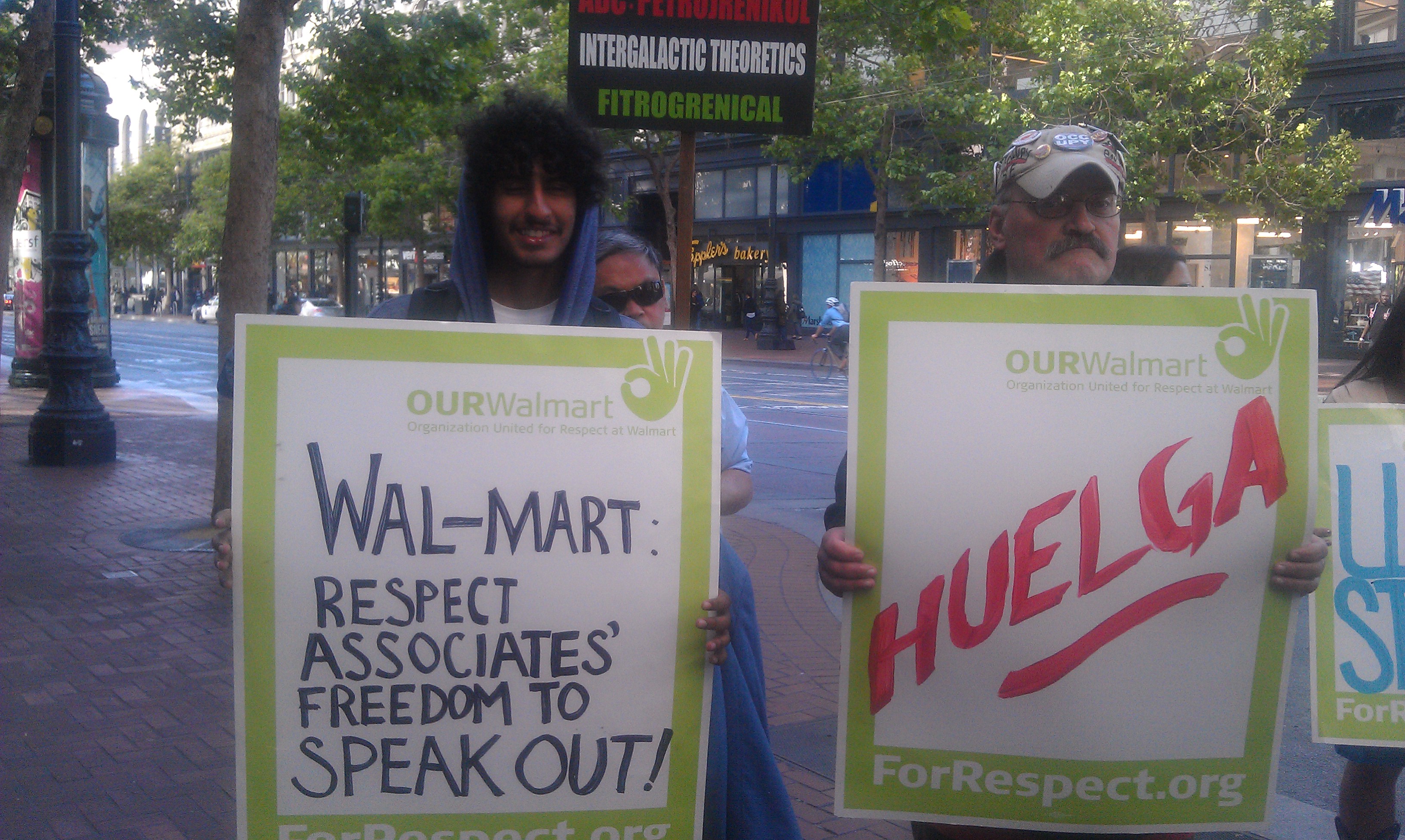
Protest: Call on Walmart and Gap to protect worker safety tinyurl.com/nfvnslj. Four Seasons, 757 Market, SF. Continue to Gap flagship store, 980 Market, SF. 5pm, free. Activists with Our Walmart and San Francisco Jobs With Justice recently discovered that Walmart made clothing at Rana Plaza, the Bangladesh factory building that collapsed recently, killing more than a 1,100 workers. Activists plan to rally outside the Four Seasons penthouse of Yahoo CEO Marissa Mayer, who also sits on the board of Walmart. Activists will show up to ask Mayer, then Gap, to sign onto a building safety agreement that would prevent future tragedies of this scale. Actions followed by a 6pm gathering at Bayanihan Community Center, 1010 Mission, SF. Dialogue on LGBT-inclusive comprehensive immigration reform SF Public Library, 100 Larkin, SF. www.sf-hrc.org. 5:30-7:30pm, free. The SF Human Rights Commission will host this community conversation on LGBT-inclusive comprehensive Immigration Reform, cosponsored by the Human Rights Commission LGBT Advisory Committee, Our Family Coalition, and Out4Immigration.

THURSDAY 30

San Francisco Green Film Festival Various SF and East Bay locations, Thu/30 thru Wed/5. www.sfgreenfilmfest.org. General admission $12/$11; Festival passes $100–$200. View 50 new films from around the globe, with over 70 visiting filmmakers and guest speakers, on topics ranging from clean energy, to water, to trash, to art in the environment. Events take place at the New People Cinema in Japantown, the SF Public Library, SPUR Urban Center and the David Brower Center in Berkeley.

SATURDAY 1

Moana Nui 2013 two-day teach-in Martin Luther King Jr. Middle School Auditorium, 1781 Rose, Berk. tinyurl.com/nlw34wd. 10am on Sat/1 to 6pm on Sun/2, $10–$20. The International Forum on Globalization and Pua Mohala I Ka Po present this two-day, international gathering featuring 45 speakers from 20 nations. All will present on critical issues facing the Asia-Pacific region, ranging from environment, to militarism, to global trade and resource depletion. Participants include Jerry Mander (dubbed as the "Ralph Nader of the anti-globalization movement" by the New York Times); indigenous actress Q’orianka Kilcher; Anuradha Mittal of the Oakland Institute, and Victoria Tauli-Corpuz, one of the original drafters of the UN Declaration on the Rights of Indigenous People, among others.

SUNDAY 2


Conference on public banking Dominican University, San Rafael. www.publicbanking.org. 1pm on Sun/2 to 6:30pm on Tue/4, $35 to $295. Join the Public Banking Institute in conversation with pioneering policymakers, civic leaders, banking entrepreneurs, innovators and ordinary citizens interested in learning about one of the most critical undertakings of our time: creating a truly prosperous, democratic and sustainable new economy. Attend the conference or just catch the Sun/2, 7pm forum, titled Take Our Economy Back from Wall Street, with Rolling Stone staff writer Matt Taibbi, Web of Debt author Ellen Brown, and guests Birgitta Jonsdottir, a member of Icelandic Parliament, and Gar Alperovitz, author of What Then Must We Do?

Pride reverses course, schedules public meeting May 31

In a surprising but welcome change of course — after it locked out Bradley Manning supporters and press at a meeting last month, and its statement that it would not hold any more public meetings until after Pride because its decision to rescind the grand marshalship from Manning was “final” — the SF Pride board has scheduled a public meeting for May 31, 6:30pm, at the Metropolitan Community Church.

And yet the letter to “community members” couldn’t resist a couple of digs:

***”The SF Pride Board recognizes and regrets the recent error in the announcement of Mr. Bradley Manning as the Electoral College’s Community Grand Marshal” (perhaps it will offer some proof at the meeting that this was, indeed, an error — and more openly address the fact that a beloved staffer was fired over this?)

***Its condescending tone and implication that Manning supporters are violent: “We continue to be open to peaceful and constructive conversation with set ground rules but will not condone violence in any form moving forward.”

Still, with this board, the meeting is at least something.   

Dear Community Members:

For the past four decades, SF Pride has stood firmly to advance its mission to educate the world about LGBT issues, commemorate LGBT heritage, celebrate LGBT culture, and liberate LGBT people.

Thank you for your patience regarding the rescheduling of our community meeting to discuss the recent Electoral College voting. The integrity of the elections process and procedures are very important to SF Pride and the community at large. The SF Pride Board recognizes and regrets the recent error in the announcement of Mr. Bradley Manning as the Electoral College’s Community Grand Marshal. As promised, in the spirit of fairness and transparency, we are calling for an open forum where we can hear the full range of the community’s concerns.

With this in mind, we have secured the Metropolitan Community Church of San Francisco sanctuary for Friday, May 31st starting at 6:30 p.m., which is located at 150 Eureka Street between 18th & 19th Streets in the Castro District.  We encourage all concerned to participate in this public forum that will be facilitated by Scott Shafer, host of KQED’s California Report.

 We continue to be open to peaceful and constructive conversation with set ground rules but will not condone violence in any form moving forward. To ensure that community members have the opportunity to speak along with securing the safety of all attendees, we will have security on the premises.  

Please also note that MCC encourages attendees to be respectful of their space –and their neighbors– and to take their water bottles, coffee cups, etc with them when leaving.  The event cannot go past 9:30 p.m.


More protests over Willits bypass project

Controversy over the Willits Bypass continued Monday, as Willits protesters sought to block Caltrans contractors from continuing work on the highway construction project. Protester Robert Chevalier, 66, locked himself to a Caterpillar tractor used for hauling felled logs using a steel “lock box.” At another location, four other protesters unfurled a banner to block work trucks that were preparing for pile-driving tests. Chevalier was arrested along with protesters Sara Grusky and Ellen Faulkner, who is 75.

Meanwhile, a new tree-sitter took to the branches of a rare wetland ash earlier this month. The protester, who goes by the name Condor, stationed himself at the northern end of the bypass on May 2. Since then, Condor has been replaced by a tree sitter who goes by the name of Hawk. “Part of the message of the medium is that birds move around,” explained Naomi Wagner, a spokesperson for Redwood Nation Earth First.

Condor was the eighth tree-sitter to protest the bypass. The first five were forcibly removed by CHP with cherry pickers on April 2. Two others decamped more recently before being arrested.

In the meantime, construction on the six-mile, four-lane highway continues, albeit with a few setbacks. On April 9, an inspector for the North Coast Water Quality Control Board visited the site and found that Caltrans had violated its permits by disturbing ground within 50 feet of streams and failing to follow statewide practices designed to prevent streamside runoff.

Critics maintain that it’s typical of Caltrans to go ahead with construction, even if that means violating the conditions of their permits. Jamie Chevalier of Earth First said, “Caltrans will just do what they’re gonna do and pay a fine.”

According to Caltrans spokesperson Phil Frisbie, however, the inspection was “normal routine business.”

“[The infraction] was an oversight on Caltrans and the contractor’s parts because the vegetation is so dense you can’t actually see the creek.” said Frisbie. “It won’t happen again.”

Last week, the California Transportation Commission approved an additional $26 million for the creation and rehabilitation of approximately 2,000 acres of wetlands. Many of those mitigation projects are years down the road, said Frisbie, a fact that alarms Chevalier and other opponents of the bypass.

Frisbie also said they were aware of the new tree-sitter, and were monitoring the situation.

When the Guardian reached Condor by phone last week, the tree sitter said he’d experienced minimal contact with Caltrans employees so far. “Yesterday they limbed an oak tree about a 100 feet from me,” he said. “I guess that was their response to my presence.”

Chevalier, the protester who locked himself to the Caterpillar, is a retired commercial fisherman who worked for years in Alaska.  He said he felt compelled to take a stand: “One thing we learned from fishing is that taking care of our rivers and forests creates a booming economy that will last. These big make-work projects leave the locals and the taxpayers worse off than before. It’s just a waste,” he said. “This project is trashing the land, water, and local jobs that we really do need.”

Pride Board locks out press, protesters at public comment meeting

“Let the press in! Let the press in!” the crowd of about 50-60 Bradley Manning for Grand Marshal supporters chanted yesterday evening at 7pm, packed into the lobby of the Golden Gate Business Association on Pearl Street, after being denied entrance to the elevator leading to the Pride Board meeting on the fourth floor. A hired security guard held the crowd, which included reporters from KTVU and KQED, back and the elevator doors closed for the last time as “No cameras, no justice!” filled the air. 

The word came via the significant police presence outside the building (officers were also posted outside the building’s stairwell) that only 15 people at a time were being allowed into the board meeting, which was held to accept “public comment” on the Bradley manning controversy. The meeting was also supposedly held to address any questions about its official statement, released yesterday afternoon, rescinding Manning’s election as Grand Marshal because he was “not local.”

No one there, it was clear, was getting in. 

Safety hazards were cited. Surely, some protesters put forth, the Pride Board knew it would need a bigger space to address the community’s concern — like, say, the LGBT Community Center across the street? 

Scene inside the lobby after being denied entrance to the Pride Board public comment meeting

(Blogger Michael Petrellis did manage to get into the sparsely occupied meeting by arriving early and begging to use the bathroom. You can read his report here.)

Among the protesters outside were Daniel Ellsberg of Pentagon Papers fame, who spoke eloquently at a previous demonstration defending Manning. (He eventually made it into the meeting, along with a few other high-profile community representatives like Gary Virginia, Carol Queen, Starchild, Lisa Geduldig, and Rainey Reitman of the Bradley Manning Support Network.) Also present outside were members of Code Pink, ACT UP/SF, and the Gray Panthers.

Waiting on the street was attorney David Waggoner, who that day had filed an official discrimination complaint with the city’s Human Rights Commission. The complaint alleges that “the Pride Board syomped on the moral convictions of the grand marshals who voted for Manning. SF Pride — a recipient of City funding — is not allowed to discriminate against people just because they don’t like their moral support of Manning.”

The Pride Board ended its meeting early, and a representative said that it would plan another in a more appropriate — hopefully meaning bigger — venue. 

As usual, queer activist Tommi Avicolli Mecca put everything into perspective.

“I know it’s 40 years ago and I’m old, but I was at the first Gay Freedom march in Philadelphia in 1972 — and we were oficially protesting the war in Vietnam. How did we come to this — standing outside the corporate offices of Pride and shouting for them to let a military protestor, from the military itself, into their parade — into our parade?”

As the Manning supporters took to the streets and shouted “You say court martial, we say grand marshal!” from the nearby F-Market stop, Patricia Jackson, convener of the Gray Panthers, added:

“If Pride is about inclusion, how can they shut us out — of the meeting, of the conversation? The only way to heal any divide in a community is to accept that people have different views, and make things bigger than that.”  

Don’t vent, organize and “primary” a Democrat near you

5

By Norman Solomon

Norman Solomon is co-founder of RootsAction.org and founding director of the Institute for Public Accuracy. His books include “War Made Easy: How Presidents and Pundits Keep Spinning Us to Death.” He writes the Political Culture 2013 column.

Progressives often wonder why so many Republican lawmakers stick to their avowed principles while so many Democratic lawmakers abandon theirs. We can grasp some answers by assessing the current nationwide drive called “Primary My Congressman” — a case study of how right-wing forces gain ground in electoral terrain where progressives fear to tread.

Sponsored by Club for Growth Action, the “Primary My Congressman” effort aims to replace “moderate Republicans” with “economic conservatives” — in other words, GOP hardliners even more devoted to boosting corporate power and dismantling the public sector. “In districts that are heavily Republican,” the group says, “there are literally dozens of missed opportunities to elect real fiscal conservatives to Congress — not more ‘moderates’ who will compromise with Democrats. . .”

Such threats of serious primary challenges often cause the targeted incumbents to quickly veer rightward, or they may never get through the next Republican primary.

Progressive activists and organizations could launch similar primary challenges, but — to the delight of the Democratic Party establishment — they rarely do. Why not?

Here are some key reasons:

*  Undue deference to elected Democrats.

Members of Congress and other elected officials deserve only the respect they earn. All too often, for example, plenty of Congressional Progressive Caucus members represent the interests of the establishment to progressives rather than the other way around. 

*  Treating election campaigns more like impulse items than work that requires long-term planning and grassroots follow-through.

The same progressives who’ve spent years planning, launching and sustaining a wide range of community projects are apt to jump into election campaigns with scant lead time. Progressives need to build electoral capacity for the long haul, implementing well-planned strategic campaigns with candidates who come out of social movements and have a plausible chance to win on behalf of those movements.

*  Assuming that millions of dollars are necessary to win.

Yes, successful campaigns require effective fundraising — but money is often a less significant obstacle than a shortage of commitment and willingness to do painstaking grassroots organizing.

*  Self-marginalization by ignoring elections.

Some on the left prefer to stay out of electoral contests while focusing on the next protest demonstration — thus leaving the electoral field to battles between corporate Democrats and Republicans. One sure result: a progressive won’t win.

*  Self-marginalization with third-party efforts in partisan races.

In congressional races, Green Party and other progressive third-party candidates have a zero record of success in our lifetimes. In other races with party affiliations also on the ballot (such as governor and state legislature), victories have been almost nonexistent. In such races, the corporate-military complex is not in the slightest threatened by third-party candidates, who rarely get higher than a low single-digit percentage of the vote. In nonpartisan races, by contrast, there are examples of successful and uplifting campaigns by third-party candidates, as with Green Party member Gayle McLaughlin, the mayor of Richmond, California. 

By changing just a few words in the Club for Growth’s “Primary My Congressman” manifesto, progressives have a road map for electoral progress: In districts that are heavily Democratic, there are literally dozens of missed opportunities to elect real progressives to Congress — not more of those who go along with the Obama White House as it keeps compromising with Republicans.

Anyone serious about getting genuine progressives elected to Congress next year should be engaged in developing campaigns now. To avoid the impulse-item syndrome, that means identifying key races where progressives have a real chance to win, while remaining mindful that election campaigns should be subsets of social movements and not the other way around.

If there’s a defining issue that now separates the Obama party leadership from social decency, it is the president’s push to cut Social Security benefits. Less ballyhooed but also crucial is his push to cut Medicare benefits and the ever-present danger of cuts to already woefully-underfunded Medicaid. Meanwhile, Democratic leaders are unwilling to seriously cut the enormous military budget.

Any incumbent Democrat who is not serving progressive interests should be weighed as a possible primary target. And the most fruitful primary challenges are beckoning in heavily Democratic districts where there are many progressive voters and incumbents aren’t measuring up.

By that standard, the Congress members who may be vulnerable to a primary challenge include the 44 who tout their membership in the Progressive Caucus but have refused to sign the letter (initiated by Congressmen Alan Grayson and Mark Takano) promising not to vote to cut Social Security, Medicare or Medicaid benefits.

A good starting point to consider launching a primary challenge in your area would be to look at those 44 members of Congress who continue to refuse to make such a promise, leaving themselves wiggle room to vote for cuts in three crucial programs of the social compact. To see the list of those self-described “progressives,” click here. (Meanwhile, wherever you live, you can let your Congress member and senators know what you think of proposals for such cuts by clicking here.)

It’s fair to say those 44 members of Congress are among the many Democratic incumbents showing themselves to be more afraid of the Obama White House and the Democratic Party hierarchy than they are of voters in their own districts. Progressives in and around those districts need to do less venting and more organizing.

Norman Solomon is co-founder of RootsAction.org and founding director of the Institute for Public Accuracy. His books include “War Made Easy: How Presidents and Pundits Keep Spinning Us to Death.” He writes the Political Culture 2013 column.


So SoMa

1

caitlin@sfbg.com

SEX The tech-y, day lit factory space of high design sex toy manufacturers Crave (www.lovecrave.com) is located at Folsom and Eighth Street, so of course the innovative, pronged vibrator that industrial designer Ti Chang is showing me doubles as a USB storage device.

“I can’t imagine a better city in the United States to do this,” Chang tells me, ushering me past the way-cool 3-D printer, laser engraver, and laser cutter the company uses to build its line of pricey vibrators (besides motors and batteries — difficult to source affordably from this country — the vibes are made and assembled right there in the SoMa space.)

Crave’s full line-up. Please note vibrating nipple clamp lariat necklace (top)

Assembly line. Bottom left, a contraption meant to test the vibes under water pressure

Chang launched the Crave line on Valentine’s Day with business partner Michael Topolovac after a wildly successful crowdfunding venture, accomplished without the help of Kickstarter, which eschews sex-related campaigns. They hosted a “build a vibe” workshop that allowed customers to see just how “safe and lovely it is when these [toys] come together,” she says.

The line is beautiful, made to appeal to women put off by more vulgar devices. The “Duet” vibrator features two prongs meant to surround the clitoris, and can deliver a powerful, silent range of vibrations. It’s USB rechargeable, and its base comes in stainless steel or plated with 24 karat gold, in the case of the model that also houses 16GB of data storage. (“That’s for the uber jet setter,” jokes Chang.)

I can’t remember what this machine does. Shapes metal?

Crave’s resident teddybear

Chang’s designs are so gorgeous you want to show them off — and you can. Crave’s “Foreplay” jewelry line (which is made in China) doubles as accessories. The “Droplet Necklace” is a lariat design featuring two graceful silver weights that can be affixed to your nipples, and set to vibrate.

Titillated? Crave is one of the local businesses hosting a factory tour through SFMade Week — go see how pleasure is built.

SF MADE CRAVE TOUR

May 9, 4-5pm, free

1234 Folsom, SF

www.sfmade.org

THIS WEEK’S SEXY EVENTS

“Porn 2.0: Creating Adult Content for Online Consumption” Wed/1, 7pm, $10. Feelmore510, 1703 Telegraph, Oakl. www.feelmore510.com. Roxxie Cyber teaches you about the best way to convert that sex tape to rock-hard… dollars.

“I Masturbate” Through May 31. Opening reception: Fri/3, 7-10pm, free. Center for Sex and Culture, 1359 Mission, SF. www.sexandculture.org. Down for a gallery show of positively sexy people masturbating? Of course you are! As bonus, photographer Shilo McCabe is willing to wager more displays of this nature are key to improving society’s openness about our sexuality. Now you’re perving with a purpose!

Thong Protest Sat/4, noon-2pm, free. Jane Warner Plaza, Market and Castro, SF. nude-in.blogspot.com. Toe the line of legality at this demonstration against the recent nudity ban, where thongs, jockstraps, socks-on-your-cock are the recommended dress code.