Protest

Alerts

0

alert@sfbg.com

WEDNESDAY 16

Confront the UC Regents

Editor’s Note: The UC canceled this meeting as we were going to press, citing public safety concerns, and protest organizers were figuring out how to respond. Check our Politics blog or www.makebankspaycalifornia.com for the latest.

The UC Board of Regents will be meeting at the UCSF Mission Bay Campus at 10 am, and students have been organizing for months to make their voices heard. The message: stop tuition hikes, budget cuts, and privatization of public schools; tax the 1 percent.

ReFund California and the Northern California Convergence will join up with OccupySF and Occupy encampments being set up on various college campuses this week to “Shut down the UC Regents meeting and take control of our education and our future.” ReFund California is also threatening to march on the Financial District to shut down banks if the Regents don’t support their five-point pledge of action (see “The growing 99 percent,” 11/9).

OccupySF will be marching from their encampment at Justin Herman Plaza (Market and Embarcadero) to the Mission Bay Campus starting at 7 am. UC Berkeley students can board a ReFund California bus at 7 am at Bancroft and Telegraph in Berkeley.

10 a.m., free

UCSF Mission Bay Campus

1675 Owens, SF

(650) 238-4821

www.occupyed.org

makebankspaycalifornia.com

occupyoureducation@gmail.com

rose.goldman@gmail.com


THURSDAY 17

Changing Congress

San Francisco Progressive Democrats of America hosts a discussion with Norman Solomon, a prolific progressive political writer who is running for Congress to replace retiring Rep. Lynn Woolsey (D-Marin), a member and former chair of the Congressional Progressive Caucus. The event opens the floor for questions and concerns regarding future legislation.

7-9 p.m., free

Harry R. Bridges Memorial Building, ILWU, 4th Floor

1188 Franklin, SF

sig4re@comcast.net

www.pdamerica.org


SATURDAY 19

Addiction & Society

Our capitalist society may be to blame for our addictive tendencies and obsessive consumerism. Dr. Gabor Mate, an author and physician who focuses on mental illness, explains how our market economy drives us crazy and leads us down a path toward dependency. Speak Out Now’s colloquium event will help listeners connect the dots between two of our country’s most prevalent concerns.

5-7 p.m., $2 suggested donation

South Berkeley Senior Center 2939 Ellis, Berk.

contactspeakout@gmail.com

www.speakout-now.org


MONDAY 21

“Gay Politics in Africa”

Beyond our own shores, homophobia persists to infiltrate government and subjugate people with leaders who use religion and law as instruments to thwart the freedom of sexual expression. Dr. Sylvia Tamale, renowned African feminist, analyzes the Ugandan Anti-Homosexuality Bill and opines on the roots of homosexual suppression in Africa and Western societies.

6- 7:30 p.m., free

Berman Hall in the Fromm Building, USF Golden Gate and Parker, SF

510-663-2255

priorityafrica@priorityafrica.org

www.priorityafrica.org

State of the occupations

0

rebeccab@sfbg.com

The police evictions of OccupyOakland and OccupyCal over the last week, and the looming threat of another attempt to evict OccupySF, presented challenges for the Bay Area protests just as similar police crackdowns targeted Occupy encampments in Portland, Denver, New York, and other cities nationwide.

These fast-moving developments also come at a time when university students from around California will be descending on San Francisco for a Nov. 16-17 University of California Board of Regents meeting that was canceled this week because of public safety concerns. All of this adds up to a big and unpredictable moment for the widening movement (see “The growing 99 percent,” 11/9).

So we’ve decided to start a regular feature to track the latest developments in an Occupy movement that seems adamant about standing its ground even as it’s forced to deal with threats from police, organizing challenges, and the coming of winter.


#OCCUPYCAL GROWS UP FAST

Students at the University of California at Berkeley burst onto the Occupy scene Nov. 9 with the launch of OccupyCal, a student-led protest that made waves nationally after university police advanced on around 500 students in Sproul Plaza, the historic epicenter of the Free Speech Movement, and struck them with batons after they tried to set up camp.

UCB police made 39 arrests in two separate actions against protesters, fueling student protesters’ resolve at a general assembly convened afterward that drew more than 1,000 people and lasted well into the night. At around 1:30 am, students voted to hold a student strike on Nov. 15 in solidarity with others throughout the UC system.

The harsh police response prompted condemnation from the Free Speech Movement Archives (FSM-A). “It appears that the campus police are in need of remedial education concerning fundamental protections offered by the US Constitution — including First Amendment rights to Free Speech and Free Assembly that were clearly recognized and enshrined on the UCB campus 47 years ago on these very steps,” the group noted in an open letter.

UC Berkeley Chancellor Robert J. Birgeneau, who was out of the country during the violent police crackdown, issued a statement on Nov. 14 ordering a third-party investigation of the clash and granting amnesty under the Student Code of Conduct to all students who were arrested for blocking police from removing the encampment.

“It was only yesterday that I was able to look at a number of the videos that were made of the protests on November 9. These videos are very disturbing. The events of last Wednesday are unworthy of us as a university community. Sadly, they point to the dilemma that we face in trying to prevent encampments and thereby mitigate long-term risks to the health and safety of our entire community,” he wrote. “Most certainly, we cannot condone any excessive use of force against any members of our community.”


#OCCUPYSF, THE NEXT BATTLEGROUND

At press time, student and labor groups that were planning to converge on the UC Regents meeting at UCSF Mission Bay on Nov. 16 by the thousands were deciding how to respond to the meeting cancellation, but protests are still planned for that day, with support from OccupySF.

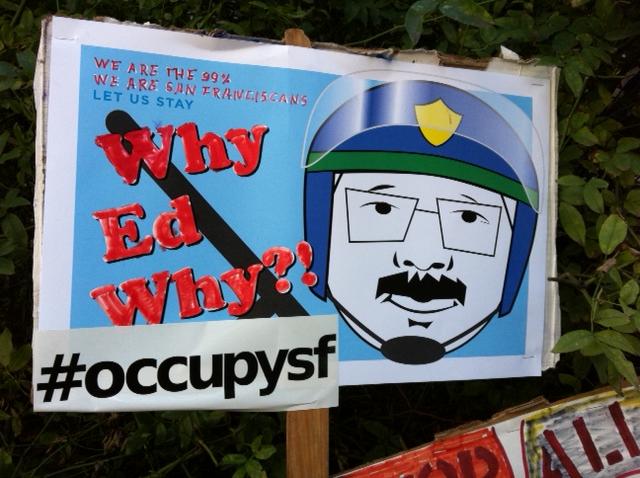
Meanwhile, Mayor Ed Lee continues to insist that OccupySF break camp, but instead it has only grown larger, with the tents spreading out from Justin Herman Plaza onto the nearby sidewalk along Market Street in front of the Federal Reserve. At press time, protesters feared what seemed an imminent police raid, particularly now that the election is over and busloads of student protesters were headed into town.


TRAGEDY STRIKES #OCCUPYOAKLAND

On Nov. 10, Kayode Ola Foster, 25, suffered a fatal gunshot wound to the head following an argument, just yards from the Occupy Oakland encampment in Frank Ogawa Plaza (Oscar Grant Plaza to the occupiers who’d camped there for a solid month).

A somber mood settled over the plaza in the hours following the shooting as the tent city dwellers absorbed the gravity of the situation, and occupy activists held a candlelight vigil. Although initial reports suggested Foster had no relationship to the camp, police later said they believed he and one of two shooting suspects had spent time there.


#OCCUPYOAKLAND GETS THE BOOT

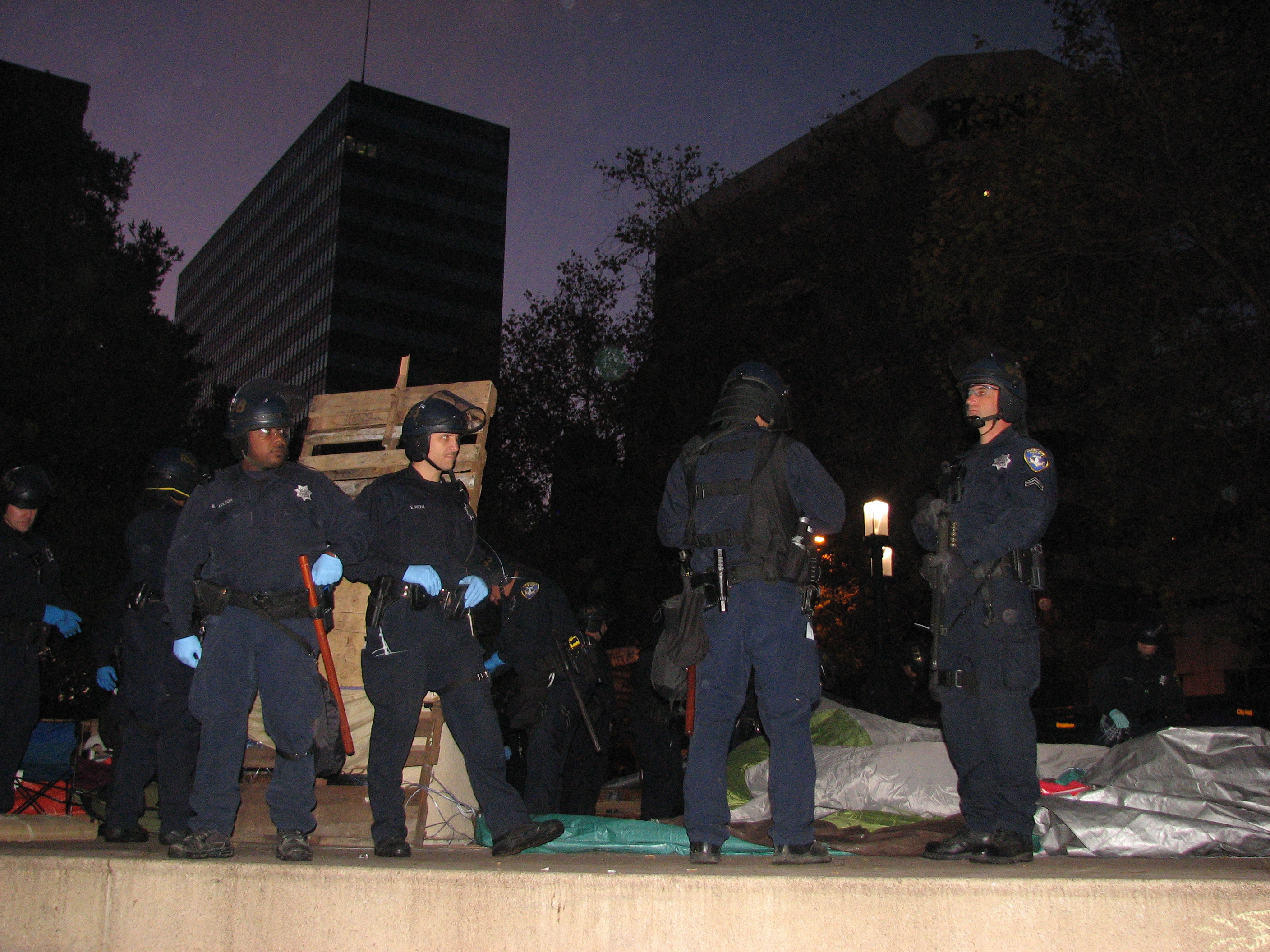
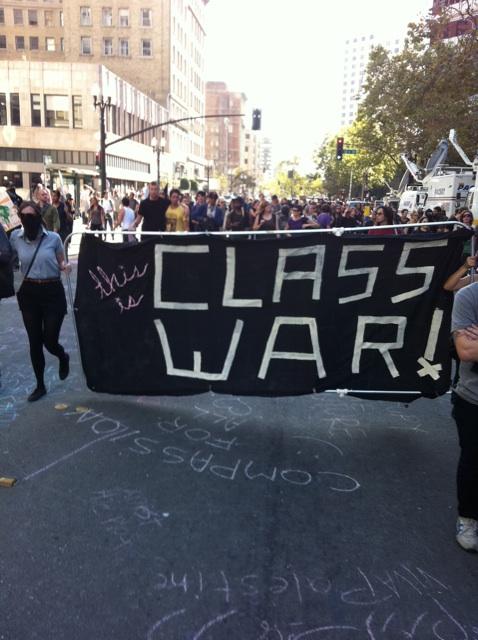
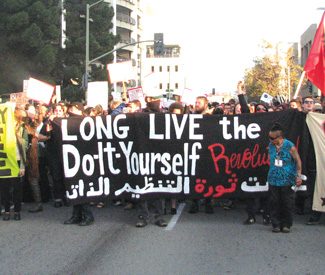
Three days after the fatal shooting near the OccupyOakland encampment sparked a hard-line response from local government officials, the camp was dismantled in an early morning police raid Nov. 14, the second to befall the occupation since it began a month ago. That evening, thousands marched back to the plaza in response to the raid and held a general assembly.

On the night of the raid, it took several hours for police to arrive at 14th and Broadway streets, where protesters began congregating in the intersection around 2 a.m. in anticipation of the forced eviction from camp. Law enforcement came en masse, with mutual aid support from seven different regional law enforcement agencies.

While two lines of riot police formed an L-shaped formation blocking protesters’ access to the plaza and nearby streets, hundreds more poured into the plaza to dismantle tents, flatten structures, and make arrests. Police arrested 32, the majority of whom belonged to a group of clergy members from the occupation’s Interfaith Coalition tent who sat calmly together in the plaza and sang by candlelight as they waited for police. Occupiers who witnessed the dismantling of the camp from behind police barricades yelled out, “Shame! Shame! Shame!”

Steven T. Jones contributed to this report.
Fearing violence, UC cancels Regents meeting; Chancellor pardons arrested UC protesters

15

Citing public safety concerns, University of California has canceled a UC Board of Regents meeting set for Wednesday morning at UCSF Mission Bay, a meeting that has been the target of months worth of student organizing to protest tuition hikes and service cuts and which dovetailed with the roiling Occupy movements in the Bay Area.

After police crackdowns on Occupy encampments in Oakland and in UC Berkeley’s Sproul Plaza over the last week, the long-planned showdown with the UC Regents – whom protest groups such a ReFund California say are among the powerful 1 percent that Occupy has targeted and which they blame for deep cuts in California’s public university system – was highly anticipated.

OccupyCal protesters have called for a strike on that and other UC campuses tomorrow to protest the violent police expulsion of student protesters at UC Berkeley last week. At a General Assembly at 6 pm today (Mon/14) in UC Berkeley’s Sproul Plaza, attendees will decide how to respond to the cancellation of the meeting.

Other groups that include labor representatives, such as ReFund California, will also independently decide how to proceed. “We’re figuring out what to do,” said Jennifer Tucker with ReFund, noting that they will post that information on its website: www.makebankspaycalifornia.com.

A statement issued today by the UC President’s Office cited information gathered by UC Police: “From various sources they had received information indicating that rogue elements intent on violence and confrontation with UC public safety officers were planning to attach themselves to peaceful demonstrations expected to occur at the meeting.

“They believe that, as a result, there is a real danger of significant violence and vandalism. They have advised us further that this violence could place at risk members of the public, students lawfully gathered to voice concerns over tuition levels and any other issues, the UCSF community, including patients, and public safety officers, UC staff and neighbors of UCSF Mission Bay. They recommended to us, in the strongest of terms, that we cancel or postpone the meeting as scheduled.”

Tucker criticized the move: “We were floored this morning by the announcement that the Regents were canceling their meeting. There had been a statewide organizing campaign for months on this with thousands of students coming in on buses from throughout the state,” she said, adding that, “There will still be protests on Wednesday, but we’re not sure what form they will take.”

Meanwhile, UC Berkeley Chancellor Robert J. Birgeneau, who was out of the country during the violent police crackdown last week, today issued a statement ordering a third-party investigation of the clash and granting amnesty under the Student Code of Conduct to all students who were arrested for blocking police from removing the encampment.

“It was only yesterday that I was able to look at a number of the videos that were made of the protests on November 9.  These videos are very disturbing.  The events of last Wednesday are unworthy of us as a university community.  Sadly, they point to the dilemma that we face in trying to prevent encampments and thereby mitigate long-term risks to the health and safety of our entire community,” he wrote. “Most certainly, we cannot condone any excessive use of force against any members of our community.”

Timber war returns

5

Protestors in flashy animal costumes picketed the appearance of infamous logger Archie “Red” Emerson, who was giving a guest lecture to the Forestry Department, at the University of California Berkeley campus on Oct. 14 to bring awareness to the increasing use of environmentally destructive logging practices.

The protesters were admittedly having fun parading around as skunks and beavers, but there was a heavy point to go with the theatrics. Emerson’s company, Sierra Pacific Industries (SPI) is being targeted by a new campaign to curtail and eventually eradicate the destructive logging technique called “clearcutting.”

The Redding-based Battle Creek Alliance, in cooperation with the Sierra Club, wants Californians to push for environmental protection measures that would ban clearcutting on the state level.

“We’re building a statewide coalition of people from all across the state — and hopefully, eventually, all across the country — who can be helping to call on the state of California and Gov. Brown to stop clearcutting and to protect our forests, watersheds, and wildlife,” said Sierra Club member Sarah Matsumoto, an East Bay resident who has joined the Battle Creek Alliance.

Those living close to clearcut areas say that the damage is devastating

“I live about a mile from most of the clearcutting,” said Patty Gomez, a resident of the Battle Creek area. “We like to call it ground zero.”

The term clearcutting describes the complete eradication of trees and shrubs from forest areas, some the size of Golden Gate Park. The area is then doused with thousands of gallons of herbicides and then replanted as a tree farm.

“Industrial tree farms are sterile and lifeless,” said Juliette Beck, coordinator of the Sierra Club’s Stop Clearcutting Campaign. “This particular method is incredibly ecologically destructive.”

SPI is the largest private landowner in California, owning 1.9 million acres. It owns 24 industrial facilities and employs approximately 3,400 workers.

“SPI own[s] so much land and potentially controls the fate of the forest,” said Beck. “SPI is the poster child for the one percent.” Because of SPI’s scorched-earth policy of completely clearing an area and sterilizing it for replanting, biologists are concerned that crucial plant species will soon become extinct.

“After clearcutting, there is a huge flush of sprouting natural regeneration of native species,” said veteran biologist Vivian Parker, who has lived in the Battle Creek area for 30 years and has worked for the U.S. Forest Service. “When the newly sprouting plant layer is sprayed with chemical herbicides and thus eliminated, the plants do not get a chance to grow and shed their seed.”

Parker argues that this interruption of natural regeneration over several periods of clearcutting will destroy the natural growth of plant life necessary to maintain a healthy forest.

This copious use of herbicides has also been suspect in a strange phenomenon affecting wildlife in North America. According to a study conducted by UC Berkeley professor of endocrinology Tyron Hayes, the use of herbicides, even at extremely small amounts, have been linked to biological mutations such as male frogs growing ovaries.

SPI is insistent that its practices are environmentally sound and internally regulated.

“We monitor all of our own activities to see where we have room for improvement,” Mark Pawlicki, director of Corporate Affairs and Sustainability at SPI, told the Guardian. “In many cases we’ve changed our practices.” New research on the effects of these herbicides have shown that current regulations don’t always address the cumulative impacts of chemical applications and other practices.

“We now know that it is the very diluted amounts of chemicals that [have the potential to] cause the most damage because they behave just like hormones,” Parker said. “The quantities are so small you can barely measure [them], but they have a disproportionate effect.”

Hayes’ study was publicized in a press release several years ago by ForestEthics, an environmental nonprofit intimately involved with campaigning against SPI’s environmentally destructive practices.

“After that release, we started getting calls from families,” said ForestEthics communication director Will Craven. “One family had a six-year-old daughter who developed brain cancer.”

Craven said the family lived across from one of SPI’s mills and close to clearcut areas. He had heard of families developing severe endocrine issues where they could no longer digest fruit or sugar.

Pawlicki cites studies done internally by scientists about the biodiversity of SPI’s land, stating that the proper measures have been taken to put aside enough land for endangered species like the spotted owls and that the effect of the herbicides are negligible if not insignificant.

“People make allegations all the time about us but there’s just no proof,” said Pawlicki. “Show us the proof, tell us the evidence that we’re harming anything.”

Marily Woodhouse, a resident of the Battle Creek area who has been a particularly passionate adversary of SPI, has spearheaded efforts to collect sufficient information in order for the Central Valley Regional Water Quality Control Board and the California Natural Resources Agency to take legal action; a process she said SPI has tried to undermine.

“SPI has given out the Water Board report and disparaged the way we collected the sample at public meetings,” Woodhouse said in an email conversation. “We collected the sample the way the lab instructed us to.”

However, these studies have a financial limit. Some tests can cost up to thousands of dollars, and ensuring that the tests are targeting specific herbicides used by SPI can be a guessing game. SPI is only required to disclose chemical use to the California Department of Pesticide regulation once a month and a yearly report can be requested, but this information is not disclosed to the public at the time of application.

The Water Board, a subsidiary of the Environmental Protection Agency, has conducted water tests and found no significant amount of chemicals in nearby watershed, but Parker said she believes this is because the agency doesn’t test for the specific chemicals used by SPI.

“Although they could request this information from the industry, the water board doesn’t know which chemicals are used, the quantities, or locations where they are applied,” Parker said. “Lack of information and inadequate testing ensures that the company is able to continue doing business.”

Residents and environmental groups have filed several lawsuits against SPI for more than 34 environmental and health policy violations, but have not been successful in curbing SPI’s destructive practices. According to legal experts, this is not necessarily because they don’t have a valid case.

“When you’re challenging these actions by SPI, what you’re really doing is challenging a decision by a state agency for approving their logging plan,” said Justin Augustine a staff attorney at the Center for Biological Diversity. “The agency can get deference from the court when it makes a good decision or a bad decision.”

The state agency Augustine is talking about is the California Department of Fire and Forestry Protection (Cal Fire). In the hierarchy of state agencies, Cal Fire sits next to the Department of Fish and Game and both are directly under the Natural Resources Agency. Each department plays a role in monitoring and enforcing logging practices and code violations.

Logging companies are required to file a Timber Harvesting Plan that describes the biodiversity of plant life, acreage, and wildlife of an area meant for harvesting. Cal Fire then approves or rejects the plan within 10 days of receipt. This approval process shields SPI from directly facing charges in court because Cal Fire is ultimately responsible for approving the plan.

Sierra Club and the Battle Creek Alliance are now fighting for legislation that will bar the use of clearcutting altogether.

“[SPI] could minimize clearcutting. The method is not appropriate to today’s forests,” said Beck. “We are demanding that they make the change to completely stop clearcutting.”

A new report by the State Water Resources Control Board regarding SPI is scheduled to be presented at a Board of Forestry hearing on Nov. 9, describing whether or not sediment from the clearcuts is reaching the creeks and harming the valuable salmon recovery project. The report is available on the Board of Forestry website.

“[There has been] a lot of evidence that the logging roads have to do with the sedimentation,” said Richard Stapler, deputy secretary of communications at the Natural Resources Agency. “It was brought to our attention by Marily Woodhouse, and is very much worth review.”

The review may bring about protections for the Battle Creek watershed, but activists remain focused on legislation to prohibit clearcutting on a broad scale. “Right now the only things valued are the short term profit for the timber industry,” said Beck. “There needs to be a change in the way the forests are managed”

Occupy Yolkland

0

le.chicken.farmer@gmail.com

CHEAP EATS While everyone else in Oakland was occupying Oakland, Hedgehog and me took a vote and decided unanimously to occupy Montclair Village. Oscar Ogawa Plaza didn’t scare us, head-wound-wise; it was just that, from the sound of it, we didn’t think there’d be room to play catch.

Whereas Montclair Playground has a whole empty ball field, and a pond with a fountain, and birdies. And the Montclair Egg Shop is only just a block away.

It feels and sounds like its own little town, but Montclair Village is still technically Oakland, after all. So, OK, we occupied it. If anyone interviewed us, we would say that our protest was peaceful — so peaceful it didn’t even include any signs or slogans. Just mitts. Our demands were simple: a catch, and some yummy egg dishes. (I had wanted to hit her grounders, too, but we couldn’t reach a consensus, so the bat stayed in the car.)

While we warmed up our arms, we talked about what we always talk about: Bloomsburg, Pennsylvania, where Hedgehog was borned and breaded. Like New Orleans — where she was, of course, fried — Bloomsburg has a bad habit of getting underwater up to its kitchen cabinets, and this fall’s flood, as reported in this very column, was its very worst one ever.

Another worst-ever thing about Bloomsburg, turns out, is its daily paper, the Press-Enterprise, whose sophisticated online version consists of unsearchable, unshareable PDFs of the paper paper, and (get this) you have to pay to see them!

Actual quote, from that paper’s publisher to a Poynter reporter: “If it’s important to people, they can go out and pick up a newspaper.”

As a result of such forward thinking, for a time the most extensive “national” news coverage of Hedgehog’s home town’s historic calamity could be found (gasp) in Cheap Eats! Because we was there, and I was personally and catastrophically affected: The fair was cancelled, and with it my first taste of what Hedgehog calls “real” chicken and waffles.

She and a handful of news hungry ex-Blooms, realizing their beloved hometown’s story was in absurdly incapable hands (i.e. mine, and the Press-Enterprise’s) accidentally started their own on-line rag, the Bloomsburg Daily, which has ever since been scooping the living daylights out of Mr. If-It’s-Important-To-People-They-Can-Go-Out-And-Pick-Up-A-Newspaper — live-streaming public meetings, posting original and professional quality videos, reporting on both sides of the great flood wall debate, and just generally kicking ass.

Problem: It’s Bloomsburg. Fucking. PA. I get tired of hearing about it, frankly, and now maybe you can relate.

I mean, I would like for my girlfriend to occupy Oakland with me, so long as we’re here.

“Hey,” I say, whenever enough gets to be, in a word, enough. “Let’s live where we live.”

We live down the hill, closer to the Dimond District, in Glenview, but I have always been fascinated by Montclair Village the same way Brisbane grabs me in San Francisco. I guess I’m a fan of anomalousness over quintessentiality.

Speaking of which, my old friend and favorite country song singer Hambone, she’s who told me about the Egg Shop. She lives in West Oakland but cleans house up in Montclair. “The Egg Shop!” she said.

So I invited her to occupy the Montclair Egg Shop with us one morning. She showed up fashionably late, and even more fashionably sporting the most farmerly overalls I ever seen on a cleaning woman. Driving a red pickup truck, to boot. Which is to say, our Hambone is the real deal, exactly.

And she was exactly right about the Egg Shop: excellent, and odd! A model BART train scooting back and forth along a track behind the counter. A real motorcycle in a Plexiglas case upstairs amidst a collection of antique rolltop desks, homemade apricot jam centerpiecing each table, and ham and cheese potato pancakes with cilantro and tomatoes. They were more like fancy hash browns than what Hedgehog would call “real” potato pancakes. But what the hell? I love hashbrowns! And eggs . . . 

MONTCLAIR EGG SHOP

Lunch: Mon.-Sat. 11 a.m.-3 p.m. Dinner: Sun.-Thu. 4:30-9:30 p.m.; Fri.-Sat. 4:30-10 p.m.

6126 Medau Place, Oakl.

(510) 339-9554

AE/MC/V

Beer & wine


The growing 99 percent

0

steve@sfbg.com

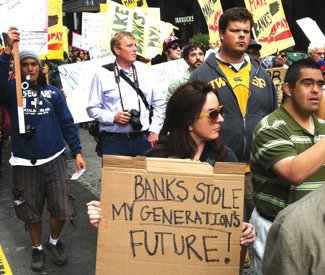
In recent weeks, the Bay Area has been roiled by anger and frustration with how the rich have grown richer while the rest of us endure underemployment, foreclosures, and deep cuts to public education and services, peaking with the Nov. 2 Oakland General Strike that drew more than 10,000 people into the streets to demand economic justice.

The Occupy Wall Street movement — and its many local manifestations, including OccupySF and Occupy Oakland — has been the main vehicle for those populist passions for the last two months, with the support of the labor movement. But now, student and faculty groups from California’s three public university systems are about to get involved in the fight in a big way.

Student and labor groups allied with the ReFund California coalition are planning a week of action for Nov. 9-16, culminating that final day in demonstrations outside the California State University Board of Trustees meeting in Fullerton and University of California Board of Trustees meeting at the UCSF campus in San Francisco’s Mission Bay.

Those protests aim to connect the problem of deep cuts and tuition hikes in the public university systems with the larger issue of wealthy individuals and corporations that haven’t been paying their fair share. The coalition wants the boards to pledge support for a five-point action plan that includes taxes on the wealthy, removing commercial property from Prop. 13 caps on property taxes, restoration of cuts to higher education, a sales tax on Wall Street financial transactions, and pressuring banks to reduce mortgage debt on underwater homes.

Charlie Eaton, a ReFund California organizer from United Auto Workers Local 2865, which represents teaching assistants at UC, notes that many UC and CSU board members also sit on the boards of major banks and corporations that have contributed to the current financial crisis and which have been in the crosshairs of the Occupy Wall Street movement.

“It’s really a club of California’s corporate elites,” Eaton said. “It’s about saying to these folks: if you aren’t willing to actively support paying your fair share, or at least get out of the way, we can’t let it be business as usual at the Wall Street institutions that you help run.”


NO BUSINESS AS USUAL

He said there’s a direct connection between the actions of these corporate boards and lack of resources in California for public education and services, so it’s only right that these powerful board members — from Regent Richard Blum, the investment banker husband of Sen. Dianne Feinstein, to Trustee Bill Hauck, former head of the California Business Roundtable — support the needs of the 99 percent.

“We’ll be there to call on them to sign the pledge,” Eaton said of the Nov. 16 meetings. “And if they aren’t prepared to make that pledge, we’re headed to the Financial District to make sure there is no business as usual for these corporations.”

That day of action will echo the last ReFund California protest in San Francisco, the Sept. 29 “Make Banks Pay” march through the Financial District that was one of the first high-profile demonstrations involving OccupySF. The march was several hundred strong, targeting major financial institutions including a Chase Bank branch on Market Street that was occupied by protesters, resulting in six arrests.

When we asked Eaton whether the Occupy movement would lend its energy and numbers to these ReFund California protests, he said, “We’re embedded in the Occupy movement, so it’s not quite right to say it’s something the Occupy movement might help with…I think the Occupy Wall Street movement shows we can make them pay.”

Meanwhile, the next day (Nov. 17), Occupy Wall Street plans to march the 11-mile length of Manhattan in a day of action that will be supported by solidarity marches by Occupy encampments across the country. That is also the day that a two-campus strike is being threatened by the California Faculty Association.

“I think that day is going to be a busy day all around the nation,” Kim Geron, a political science professor at CSU East Bay and vice president of the CFA, told us.

On Nov. 7, the CFA Board of Directors authorized one-day strikes for Nov. 17 at the CSU East Bay and CSU Dominguez Hills campuses to protest CSU Chancellor Charles B. Reed’s decision to withhold negotiated faculty pay raises. It would be the first faculty strike in the system since 1983, although a strike was authorized in 2007 but called off after a negotiated settlement.

After the vote, according to a statement put out to members, CFA President Lillian Taiz told her board, “We hope this carefully targeted strike, which symbolizes both our anger and our commitment to fairness, will lead to changes in his priorities and his positions. If it does not, the CFA leadership—and the CSU faculty we represent—are prepared to escalate the fight.”


DUCKING THE TAX ISSUE

CSU spokesperson Mike Uhlenkamp said the campuses will remain open despite the strikes. “We expect it to be business as usual,” he said. As for the pledge that ReFund California is seeking, “We don’t get into advocating between taxing and not taxing,” he said, saying that’s a state decision and “we’re not going to push them to make that determination.”

Guardian calls to the UC President’s Office were not returned by press time. A spokesperson for Gov. Jerry Brown, who is the subject of a student letter-writing campaign urging him to tax the rich and stop cutting public services, continued to blame Republicans.

“We too are deeply concerned about cuts to the state’s universities and colleges, which is why the Governor pushed for a solution to our budget deficit that included extending revenues. Unfortunately, Republicans in the Legislature refused to even allow the people of California to vote on the measure, which could have helped prevent future cuts,” Brown spokesperson Evan Westrup responded via email.

When we asked whether Brown was simply giving up, how he planned to deal with the problem, and why Brown has not followed up his campaign pledge to tax the rich with any proposals to do so, he wrote simply, “There are a number of ways to pursue additional revenue moving forward and these options are being considered.”

Geron said there is a clear connection between problems in the CSU system and the hoarding of resources by the richest one percent of Americans, the main critique of Occupy Wall Street, a movement driven largely by current and recent college students.

“We are part of it. One of our slogans is we are the 99 percent and we teach the 99 percent,” Geron told us.

While the CFU is focused on decisions by the Chancellor’s Office — indeed, the strike is legally allowed only because the chancellor broke the contract by withholding negotiated pay increases — Geron said those decisions were made in a climate of deep funding cuts prompted by the state budget crisis.

“Obviously, the economic crisis is a lot of the reason why all this happened. It’s part of a larger crisis that is going on about how to fund the public good, including higher education,” Geron said. “Students are paying a lot more and getting a lot less. That’s the heart of what’s going on.”

The UC Student Association is taking part in the ReFund California week of action, but has not yet voted to participate in direct action against corporations on Nov. 16, Executive Director Matt Haney told us. But he said that many UC students will still take part in that action, just as they’ve been taking part in the Occupy movement.

“It’s the same frustrations. We have to get out there and start pushing this ourselves,” he told us. “We need to show the state that things can’t just keep moving along as they have. We have to put a stop to business as usual. The economic collapse is what destroyed the UC system.”

Haney sees the student, labor, and Occupy movements starting to come together in a very natural way. “It has really put the wind in the sails of student activists to see the energy of the Occupy movement,” Haney said. “There is a coming together of students and labor, and it’s overlapping with the Occupy movement in a powerful way.” *

Find details about the ReFund California Week of Action at www.makebankspaycalifornia.com.

Alerts

0

alert@sfbg.com

WEDNESDAY 9

Student Day of Action

ReFund California begins its Make Banks Pay week of action by organizing a protest to shut down a local branch of Wells Fargo, a contributor to the financial collapse of 2008 and the current foreclosure crisis. Students from City College and the San Francisco State University will join forces to call for banks to help restore the deep cuts to higher educations that they helped cause.

Noon, free

Gather at SFSU Quad to take the M bus to West Portal and march to the bank

www.makebankspaycalifornia.com


THURSDAY 10

Poor People’s Decolonization

Join Occupy Oakland, POOR Magazine, and other groups for a march on four government offices that promote the criminalization and deportation of poor people from around the world: the Oakland Police Department, Oakland Housing Authority, Alameda County Social Services, and U.S. Department Immigration and Customs Enforcement.

Noon, free

Gather at the OPD

455 Seventh, Oakl.

www.occupyoakland.org


Picket Hotel Frank

Wells Fargo and its Hotel Frank management company, Provenance, refused to recognize the Unite Here Local 2 contract, increased the workload for employees, and haven’t paid any medical or pension coverage. The National Labor Relations Board has found Hotel Frank guilty of violating federal labor laws, including firing and disciplining workers for engaging in union activities, but only this daily picket seems capable of making a difference.

3-5:30pm, free

Hotel Frank Geary and Mason, SF

www.hotelfranksf.info


FRIDAY 11

Bay Area Resilience

Help formulate regional plans by community groups, social movements, and public planners for a strong economy, climate adaptation, and emergency preparedness. Bay Localize, Communities for a Better Environment, Global Exchange, and other groups are coming together for this Bay Area Convening on Resilience and Equity. Come and join the movement.

9am-3pm, $7-10 (includes lunch)

California Endowment Conference Center 1111 Broadway, Oakl

leanne@baylocalize.org

colin@baylocalize.org


SATURDAY 12

OccupySF Teach-In

Learn about the OccupySF movement and what it’s all about by attending the General Assembly at noon followed by a march to downtown at 3pm. Meet at the “SF Free School” poster.

Noon- 4:30 p.m., free

Justin Herman Plaza

Embarcadero and Market, SF

www.occupysf.com


Mail items for Alerts to the Guardian Building, 135 Mississippi St., SF, CA 94107; fax to (415) 437-3658; or e-mail alert@sfbg.com. Please include a contact telephone number. Items must be received at least one week prior to the publication date.

The Black Bloc is always with us

23

I learned about how a handful of people could screw up a major demonstration back in 1984, when the Democratic National Convention was in San Francisco and a fairly large number of peace activists had arranged a protest called the “War Chest Tour.” The idea was to draw attention to the fact that Democrats as well as Republicans got big campaign donations from defense contractors whose business was making war. Back then, a bunch of the biggest war profiteers had offices in San Francisco, and the demonstration — which attracted hundreds of people — wound through the financial district with signs and banners. It was, generally, a great success — except in the national press.

The thing is, the protest (like occupy Oakland) was prety anarchic, which a small “a” — peaceful, but leaderless. There was no organization with an office and a phone that the press could call for comment, no easy way to identify the coalition that had put it together.

Oh, but there was one very organized group present: The Revolutionary Communist Party had maybe a dozen members marching (which may have been the entire local membership of that particular group, which has been on the margins of the American left for many years). The RCP members had T-Shirts, newspapers, people designated to speak to the media, handouts with an office phone number — all the stuff that made lazy reporters’ lives easier. So when the story broke, both locally and nationally, the first paragraph read:

“Revolutionary Communists protestested yesterday in San Francisco ….” And the whole point of the War Chest Tour, which my friends had worked on for months, was lost.

Those of us who have been around awhile knew, and know, that the RCP is always with us. There may only be a handful of them still around, but they show up for everything — and don’t seem to care if they undermine the message that event organizers are trying to put out.

The Black Bloc — the “big A” Anarchists who broke windows in Oakland —  are becoming part of the same tradition. It’s a relatively small group, but it’s always around. The marches against the War in Iraq were huge, with tens of thousands of people, and entirely peaceful — except for a few Black Bloc-ers who broke windows and set fires.

Now: I’m not here to blast the Anarchists, or even the RCP. The Maoist/Bob Avakian types have become almost a parody of themselves in recent years, but if that’s what you’re into, go for it. I’m not even going to get into the argument over whether property damage counts as violence; been there, done that, got the circle-A T-shirt. Destroying stuff and causing mayhem can be a powerful political statement, and there have certainly been times when it was appropriate, effective and considered more than acceptable.

But it’s not always the right strategy, and in Oakland in 2011, I think it wasn’t. I recognize that this is an emergency situation, that the class warfare has already begun, and that extreme tactics are necessary to fight back. And hell, I don’t think smashing a bank window is so awful; smash enough of them and you put a lot of unemployed glaziers back to work. But in downtown Oakland, that tactic can too quickly backfire and lead to stuff like this. (Here’s an idea — how about a Shop Local day at Occupy Oakland, where everyone agrees to patronize small local businesses downtown? It fits right into the plan to withdraw your money from the big banks and put it in local credit unions.)

The problem with the Black Bloc (which isn’t really a bloc at all, it’s just a loose group of people who (a) think their tactics are appropriate and (b) love this shit) is that it’s acting in direct conflict with the many, many people who worked really, really hard to organize what was supposed to be a peaceful event. Like the RCP, they’re too quick to piss in the well.

You want to get violent? You want to break stuff? Show up for the general assembly, make your case, and see if you can convince the rest of the group that this is a good idea, right now, one that sends the right message and promotes the cause. Maybe you can do that; maybe everyone agrees. But if the majority of the group says no — that respect for property (much as we may hate private property, particularly bank property, and all that) is a better way to go right now, today, in this situation — then back off, dudes, and get with the program.

Miyamoto and jail abuse

107

A new video produced by lawyer Ben Rosefeld includes disturbing footage of deputy sheriffs under the supervision of Paul Miyamoto using excessive force on peaceful protesters. It reflects charges in a 2007 lawsuit against the city — and evidence collected in that case shows that Miyamoto, now a captain in the department and a candidate for sheriff, was an active participant in the alleged misconduct.

The lawsuit is a result of a protest that took place in June, 2004, when activists were demonstrating against a biotech conference in the city. Protesters dressed as mutant animals marched through the streets, and 17 were arrested and taken to the county jail.

The protesters declined to give their names — and at some point, sheriff’s deputies were directed to remove them from a holding cell.
As the video — taken by the Sheriff’s Department and released as part of the lawsuit — shows, the deputies used physical force to pull the protesters out of the cell. The protesters were holding on to each other — and in some cases, the level of force used certainly appears excessive.

Remember: These were nonviolent activists who never threatened the deputies or gave any sign that they were dangerous.

Miyamoto, then a sergeant, both supervised and participated in the removal. In a legal document responding to questions from Rosenfeld, who represented the protesters, Miyamoto said that he, along with another sergeant, had developed the extraction plan and “became physically involved in the cell extractions on more than one occasion.”

I called Miyamoto and sent him a copy of the video. He told me that he was, indeed, involved and said the video was “a fair representation” of what happened.

“I stand by out decision that night,” he told me, saying he didn’t see anything in the video that bothered him or that was inappropriate.

“Our job was to get them out individually, and we took great pains not to harm anybody,” he said.

The lawsuit charged that some of the protesters were seriously injured during the extraction. It was settled when the city agreed to pay $25,000.

Sup. Ross Mirkarimi, who is running for sheriff, told me that the video was, indeed, disturbing. “I think it speaks for itself,” he said, adding that he didn’t think the tactics were appropriate.

“This is why we need an independent sheriff who isn’t connected to the Deputy Sheriff’s Association,” he said.

Powerful, mostly peaceful Oakland action ends badly

19

After a long day of mostly peaceful demonstrations by thousands of protesters who joined OccupyOakland’s General Strike and Day of Action yesterday, it’s still unclear why the Oakland Police – which had stood down the entire day, leaving the movement to self-police – massed in riot gear around midnight and used tear gas and other projectiles to clear the streets and make a reported 80 arrests.

Spokespersons for the Oakland Police Department and Mayor Jean Quan haven’t returned Guardian phone calls, and reports in the Oakland Tribune and other media outlets don’t indicate exactly what prompted police to change tactics and aggressively confront the demonstration. Protesters had taken over a vacant building and erected barricades in the streets shortly before riot police showed up, and it appears from a Tribune video that a dumpster was set on fire after the police showed up.

Before the standoff between city officials and demonstrators in Oakland again took a violent turn, the day was notable for its lack of police presence around the occupied Oscar Grant Plaza and nearby 14th and Broadway epicenter. And despite a small number of masked agitators who broke bank windows and sprayed graffiti – much to the chagrin of most protesters who actively opposed such tactics – the movement was remarkably nonviolent and self-policing, particularly given a crowd of what seemed to be around 10,000 people at its peak. Protesters even handled traffic control, using a megaphone to help motorists through intersections congested with passing demonstrators.

“This is an extraordinarily peaceful collection of diverse people,” Sen. Loni Hancock (D-Oakland) told the Guardian just after 5 pm as a massive march left the encampment to shut down the Port of Oakland. “I feel like they’re doing what no elected person can do: they’re putting economic equity issues in front of the American people.”

“This is beautiful and powerful. This I love,” agreed Oakland City Council member Libby Schaaf, beaming as the peaceful march took off, although she told us that she was disappointed to see Oakland businesses vandalized, including her beloved Noah’s Bagels. “Fight greed, not bagels.”

Most of the crowd condemned the violence, and many openly worried that it would undercut the positive demonstration of people power and the airing of frustration with economic injustices in the country. But even Hancock said a few bad apples shouldn’t spoil people’s understanding of what an important day it was.

“I’m very grateful to them for calling attention to economic inequality. It is in the interests of cities that this issue take center stage,” Hancock told us. “There are so many things that have been talked about that are now on the stage and it’s a very important conversation to have.”

But many in the movement were disappointed nonetheless, despite the myriad successes in shutting down business nonviolently. Around 3 pm, a crowd of thousands marched past a Chase Bank at 20th and Berkeley streets where the front window had been shattered, as was the case with at least six other businesses. Taped to the windows were signs reading “We are better than this” and “This is not the 99%. Sorry, the 99%”.

As the huge crowd repeatedly chanted “peaceful protest,” Ryan, a 31-year-old Oakland resident, expressed his frustration over vandalism he blamed on out-of-town instigators. “People from Oakland would not damage their city like that,” he told me. “Last week was beautiful, we were dancing and singing in the streets,” he said, referring to the largely nonviolent response to police violence, “but this is bullshit.”

Large protests almost always have members who want to escalate the conflict and who see breaking windows as a legitimate tactic, and yesterday there were sometimes tense conflicts between protesters who disagreed on the issue. Another complex issue is how to now view Oakland Mayor Jean Quan, whose support for last week’s violent police crackdown prompted calls for her recall or resignation, although her subsequent apology, the re-encampment of Frank Ogawa Plaza, and yesterday’s police stand down caused some to rethink whether to actively oppose her.

“My goal for today is to spur the international movement forward and to show what we’re capable of,” said 23-year-old Iris Brilliant, who got more actively involved in OccupyOakland after the crackdown and said she was happy to see the police kept at bay. “It’s important to push this forward.”

But Tania Kappner, a 41-year-old teacher from Oakland, still hadn’t forgiven Quan or the police for the violent excesses in last week’s raid. She was camped out in Oscar Grant Plaza in a tent with the sign “Mayor Quan Must Go!”

“It’s good she’s not sending them in on us today, but she never should have done it in the first place,” Kappner told us. “We’re calling for her to go and the police who did it to be jailed.”

With the decision to again unleash the riot police and tear gas and arrest big numbers of people – which was the very thing that prompted such huge numbers of people to turn out yesterday, giving OccupyOakland the numbers and power to easily shut down the port and dozens of businesses – Oakland and the larger Occupy movement might again find itself back at square one.

The National Lawyer’s Guild, which had observers on hand to witness the late-night police crackdown, issued a statement today condemning the city’s actions and saying they violate a crowd control police the NLG helped the city write to settle lawsuits stemming from the OPD’s use of rubber bullets to clear anti-war protesters from the Port of Oakland back in 2003.

“Like we saw last Tuesday, the OPD actions in the late night hours violated numerous provisions of the Crowd Control Policy and the Constitutional rights of activists,” explained NLG’s San Francisco Bay Area chapter president Michael Flynn. “Our legal observers did not disobey any police orders and neither did many of the other arrestees.”
“The Crowd Control Policy clearly prohibits shooting munitions into a crowd,” added NLG attorney Rachel Lederman. “While the police are allowed to use tear gas, they are supposed to use a minimum amount and only where other crowd control tactics have failed.  It is not at all clear that less violent and less provocative measures would not have sufficed to achieve any legitimate law enforcement objectives last night.”

Meanwhile, in San Francisco, Mayor Ed Lee has reportedly assured OccupySF that he won’t follow through on threats to raid the camp if tents aren’t removed, at least not anytime soon (many observers speculate that he’ll at least wait until after next week’s mayoral election). But Lee has been unwilling to make a clear public statement that raids are now off the table.

When we sought to clarify Lee’s position and get his reaction to a Board of Supervisors resolution calling for the city to allow a 24/7 encampment, his Press Secretary Christine Falvey wrote: “The mayor has not focused on the resolution, but has been focusing on meeting with clergy, labor, occupysf demonstrators and his department heads to make sure that the site is kept clean, safe and accessible for everyone. He remains concerned about overnight camping and the public health and safety issues that brings. That said, he has seen some good progress over the last few days because of his open communication with the group. DPW cleaned up the site over the weekend and the demonstrators helped facilitate the cleanup. Tents were moved off the Bocce Ball Court as well. The group is working with Fire and Public Health officials to make some improvements. The dialogue is ongoing.”

Photos by Steven T. Jones

SF supervisors support OccupySF’s 24/7 encampment

56

The San Francisco Board of Supervisors today approved a resolution supporting Occupy Wall Street and the right of OccupySF to maintain a 24/7 encampment in Justin Herman Plaza, although sponsors of the measure narrowly lost a fight over amending the measure to allow police to use force if “there is an objective threat to safety or health.”

The sponsors of the measure – Sups. John Avalos, David Campos, Eric Mar, and Jane Kim – noted that heath and safety concerns were used as a pretext for both police raids on OccupySF and for last week’s violent police crackdown on the Occupy Oakland encampment, something San Francisco officials uniformly say they want to avoid here. Those four sponsors were joined by Sup. Ross Mirkarimi in opposing the amendment by Sup. Scott Wiener, which passed on a 6-5 vote.

But the overall measure – which urges Mayor Ed Lee to drop his opposition to tents and other camping infrastructure and not order another police raid on the camp – was then approved on an 8-3 vote, with Sups. Mark Farrell, Carmen Chu, and Sean Elsbernd in dissent. Farrell and Chu both expressed support for the movement’s call for addressing severe economic inequities in the country, but they oppose the tactic of occupation.

Board President David Chiu, the swing vote on allowing the resolution to be watered down, said his vote was an effort to get as much support for the measure as possible. “For me, it was important to build consensus here at the board,” he said, praising the work that city officials and OccupySF participants have done to resolve their differences. “I have been very impressed with the behavior of individuals involved in this movement.”

Wiener had made a number of amendments to the resolution that Avalos accepted without objection, drawing the line only at the change that would specifically allow for police to use force to dislodge the protesters. While the nonbinding resolution doesn’t compel any action by Lee or the SFPD, Avalos praised the mayor for meeting privately with OccupySF members after he seemed to take a firm public stand again allowing camping.

“I do want to thank the mayor for coming to the table on how our public spaces can be used,” Avalos said. Kim echoed the point, noting that, “A ton of progress has been made.” The Mayor’s Office has not yet responded to Guardian requests for comment on the resolution or his current position on OccupySF, but we’ll update this post when we hear back.

Wiener and others also thanked Avalos for taking the lead role in addressing this issue. “I want to thank Sup. Avalos for being so open and collaborative,” Wiener said, noting that he’s been very impressed with how OccupySF has handled itself throughout the standoff. “I’m very supportive of OccupySF…It’s been incredibly peaceful and people have been friendly and passionate.”

Leave the occupiers alone

0

EDITORIAL With all of the police raids and arguments over messages and demands and tactics, it’s easy to forget that the Occupy Wall Street movement has a clear political point — and it’s right.

The movement is about the devastating and unsustainable direction of the American economy, about the fact that a tiny elite controls much of the nation’s wealth, that virtually all of the income growth over the past 20 years has gone to the very top, about the collapse of the middle class and the rise of economic inequality that would have been unthinkable a generation ago. Those are the central issues facing the United States, the state of California and the cities of San Francisco and Oakland today — and instead of trying to crack down on the protests, city officials ought to be endorsing the occupy movement and talking about cracking down on the financial institutions and the wealthy.

A few things worth noting:

1. The protesters are almost entirely nonviolent. Although there have been a few isolated incidents in Oakland and SF, the overwhelming majority of the thousands of people at Justin Herman Plaza and Frank Ogawa Plaza are actively promoting and insisting on nonviolence. This is not a crowd that is a threat to anyone.

2. There’s a precedent for long-term political protest camps in San Francisco. The AIDS Vigil remained at U.N. Plaza — with tents, tarps, and cooking gear — for ten years, from 1985 to 1995.

3. The city of San Francisco’s citations — reported without question in the daily newspapers — about health and sanitation problems are way overblown. The OccupySF protesters are making extraordinary efforts to keep the place clean. When the city failed to live up to its promise to provide portable toilets, the protesters ordered (and paid for) their own. As state Sen. Leland Yee (not known as a crazy radical) noted after a visit Oct. 26: “While hundreds gathered, there was not one incident of violence. If the interim mayor thinks there are health issues, I certainly didn’t see them.” We visited Oct 31, and the place was clean and peaceful.

4. The cat-and-mouse game with the San Francisco police is the equivalent of psychological warfare; protesters have to be on edge at all times for fear of a crackdown that may or may not come.

5. Mayor Jean Quan made a bad mistake sending in the cops to roust Occupy Oakland. Nothing good at all can come of any further police eviction action.

Frankly, we don’t see why the protesters — who are well-behaved, represent no threat to anyone, and are doing a huge civic and national service by bringing attention to an issue that the powers that be in Washington, Sacramento and (sadly) San Francisco have largely ignored — can’t stay where they are. If there are health issues, let the Department of Public Health work with the occupiers. If there’s a problem with a portable kitchen, let the Fire Department show the protesters how to run it safely and legally (there are portable cooking devices at every street fair, in dozens of food trucks and in probably 100 other places around town).

The people at OccupySF and Occupy Oakland have done an amazing job of building a safe, respectful and inclusive community. They are the political heros of 2011. If there’s anyplace in America where the movement ought to be allowed to grow and thrive, it’s here in the Bay Area.

Localized Appreesh: The Sandwitches

0

Localized Appreesh is our weekly thank-you column to the musicians that make the Bay. Each week a band/music-maker with a show, album release, or general good news is highlighted and spotlit. To be considered, contact emilysavage@sfbg.com.

The Sandwitches are all about high highs and low lows. The vocals of Heidi Alexander and Grace Cooper (both former back-up singers for Fresh & Onlys) defy the bounds of San Francisco garage, piping up from low and fuzzed out to high-pitched and near theatrical. The music strays similiarly from convention, with an underlying garage-pop root that sometimes hits close to country-folk, other times lends itself more toward dewy trophy love song/doo-wap. It’s a sound that takes a minute to digest – and that’s a good thing.

You can check it out for yourself. The trio’s upcoming seven-inch single The Pearl is streaming now, here. And then you can go see it live. The Sandwitches will fill the opening slot of a pretty righteous show this week at the Fillmore, with headliners/Australian indie poppers Architecture in Helsinki and lo-fi American rockers DOM.

You may protest, “but that’s not how you spell sandwiches!” Yes, spelling wizards, it’s a play on words. Sand-witches. Witches of bread. Meaning sourdough with warts, or something less gross. Spooky PB&J? Bubbling cauldrons of BLT? Or as you’ll see below, the name simply came from “a process of elimination.”  It’s also way easier to Google.

Year and location of origin: 2009, Frisco, baby.
Band name origin: A process of elimination
Band motto: “More feeling”
Description of sound in 10 words or less: dingy, pingy, bumpy, pumpy, lumpy, brash, sophisticated, and smooth.
Instrumentation: Mexican telecaster, Mexican stratocaster, drum set
Most recent release: The Pearl/Benny’s Memory Palace 7″, Hardly Art
Best part about life as a Bay Area band:  The buds [ed note — double entendre?]
Worst part about life as a Bay Area band: The fog?
First record/cassette tape/or CD ever purchased:  Queen Greatest Hits I & II, Blue Beatles hits collection on tape.
Most recent record/cassette tape/CD/or Mp3 purchased/borrowed from the Web: Jackie Gleason, Music for Lover’s Only.
Favorite local eatery and dish: Chevys and fried chicken.

Sandwitches
With Architecture in Helsinki and DOM
Thurs/3, 8 p.m., $20-$29
Fillmore
1805 Geary, SF
(415) 346-6000
www.livenation.com

Guardian editorial: Leave the occupiers alone!

2


As the world watches, San Francisco and Oakland should set the standard by supporting  Occupy San Francisco and Occupy Oakland and supporting  their goals and peaceful tactics.  B3

 With all of the police raids and arguments over messages and demands and tactics, it’s easy to forget that the Occupy Wall Street movement has a clear political point — and it’s right.

The movement is about the devastating and unsustainable direction of the American economy, about the fact that a tiny elite controls much of the nation’s wealth, that virtually all of the income growth over the past 20 years has gone to the very top, about the collapse of the middle class and the rise of economic inequality that would have been unthinkable a generation ago. Those are the central issues facing the United States, the state of California and the cities of San Francisco and Oakland today — and instead of trying to crack down on the protests, city officials ought to be endorsing the occupy movement and talking about cracking down on the financial institutions and the wealthy.

A few things worth noting:

1. The protesters are almost entirely nonviolent. Although there have been a few isolated incidents in Oakland and SF, the overwhelming majority of the thousands of people at Justin Herman Plaza and Frank Ogawa Plaza are actively promoting and insisting on nonviolence. This is not a crowd that is a threat to anyone.

2. There’s a precedent for long-term political protest camps in San Francisco. The AIDS Vigil remained at U.N. Plaza — with tents, tarps, and cooking gear — for ten years, from 1985 to 1995.

3. The city of San Francisco’s citations — reported without question in the daily newspapers — about health and sanitation problems are way overblown. The OccupySF protesters are making extraordinary efforts to keep the place clean. When the city failed to live up to its promise to provide portable toilets, the protesters ordered (and paid for) their own. As state Sen. Leland Yee (not known as a crazy radical) noted after a visit Oct. 26: “While hundreds gathered, there was not one incident of violence. If the interim mayor thinks there are health issues, I certainly didn’t see them.” We visited Oct 31, and the place was clean and peaceful.

4. The cat-and-mouse game with the San Francisco police is the equivalent of psychological warfare; protesters have to be on edge at all times for fear of a crackdown that may or may not come.

5. Mayor Jean Quan made a bad mistake sending in the cops to roust Occupy Oakland. Nothing good at all can come of any further police eviction action.

Frankly, we don’t see why the protesters — who are well-behaved, represent no threat to anyone, and are doing a huge civic and national service by bringing attention to an issue that the powers that be in Washington, Sacramento and (sadly) San Francisco have largely ignored — can’t stay where they are. If there are health issues, let the Department of Public Health work with the occupiers. If there’s a problem with a portable kitchen, let the Fire Department show the protesters how to run it safely and legally (there are portable cooking devices at every street fair, in dozens of food trucks and in probably 100 other places around town).

The people at OccupySF and Occupy Oakland have done an amazing job of building a safe, respectful and inclusive community. They are the political heroes of 2011. If there’s anyplace in America where the movement ought to be allowed to grow and thrive, it’s here in the Bay Area.


Superviors and labor leaders challenge Lee’s OccupySF stance

41

Mayor Ed Lee has put the city and its police force on a collision course with not only OccupySF, but also several members of the Board of Supervisors and top labor leaders who support the movement and want the city to allow its encampment to continue.

They spoke at a special hearing of the City Operations and Neighborhood Services Committee that was convened by Chair John Avalos this morning, supporting a resolution that Avalos created to allow OccupySF to have tents and other infrastructure that Lee opposes. The resolution – which is co-sponsored by Sups. Eric Mar, David Campos, and Jane Kim – was approved by the committee and is set to be considered by the full Board of Supervisors tomorrow (Tues/1).

“It is something I am wholeheartedly supporting because it is an expression of great frustration and concern about the economic system,” Avalos said. “We need to speak with a greater voice about changing our economic system so it works for the many and not just the few,” Avalos said, explaining why he is “wholeheartedly supporting” the OccupySF movement.

But Avalos said he’s been frustrated that Lee and the police have raided the camp twice and are threatening more, something that Avalos has been trying to mediate since the first raid on Oct. 5. He also said the city should learn from Oakland that using the police force to stop the movement only makes it stronger.

“If we were to try to stop it from happening, it would just encourage more people to take part in it,” he said, noting that more midnight raids are dangerous for both police and protesters. “We have to figure out as a city how we’re going to facilitate, encourage, and accommodate this movement.”

But instead, Avalos said Lee’s stand against allowing tents or an kind of encampment, while claiming to support the message OccupySF, has created a tense standoff. “I’ve seen very mixed messages come out of this administration,” Avalos said, adding that nobody believes police statements that the massing of SFPD cops in riot gear on Oct. 26 was only a training exercise.

Mar said OccupySF deserves tremendous credit for holding the space and being responsive to the health and safety concerns raised by city officials. “I’ve seen a transformation in the movement in the last three weeks that is truly impressive,” Mar said. “I’ve also seen, during the General Assemblies, an incredible exercise in democracy.”

He also disputed accusations that the camps are dirty and that the movement is unfocused. “Don’t believe the hype from the mainstream media but look at the messages coming out of this movement,” said Mar, who was wearing a “We are the 99 percent” sticker.

“We should allow OccupySF to do what they’re doing,” Campos said. “It’s good for San Francisco.”

Campos also called out Lee and Oakland Mayor Jean Quan for ordering violent raids on the peaceful encampment, disputing the idea that “somehow it’s okay for us to spend the limited resources we have on these kinds of police actions…I hope we don’t have Mayors Quan and Lee wasting resources that could be better spent elsewhere.”

During the public comment portion of the hearing, each of the more than two dozen speakers supported the resolution.

“What this resolution does is it calls on the other supervisors and the mayor to decide how they want to deal with OccupySF,” said Gus Feldman of SEIU Local 1021.

Representatives of several labor unions and the San Francisco Labor Council that have voted to endorse OccupySF spoke at the hearing, include Ken Tray with United Educators of San Francisco, who gave a rousing speech in support of the movement.

“The times have changed and the political landscape has shifted,” Tray said, ticking off a long list of reasons for supporting the movement, from San Francisco’s long tradition of advocating for progressive change to the fact that “the schoolchildren of San Francisco are being denied resources because the 1 percent refuse to pay their fair share.”

Frank Martin del Campo of the SF Labor Council displayed the bruises on his arm inflicted by police during the raid on the Occupy Oakland, saying “this was an attempt to criminalize dissent…It represents the politicization of the police.”

Labor Council Executive Director Tim Paulson said, “I just want to be clear that we are the 99 percent….We want Occupy San Francisco to be there 24/7.” He and others say the Occupy movement is highlighting deep economic inequities that the labor movement has long been raising as well. “OccupySF has called the question on really important issues we’ve been struggling with for years,” said Gabriel Haaland of SEIU Local 1021

“Here is a peaceful protest being answered with violence,” said Pilar Schiavo of California Nurses Association, which has been supporting the occupations. This is an important political struggle, she said, and “It’s time for the mayor to decide what side he’s on.”

Many speakers focused their criticism on Lee, such as Brad Newsham, who said, “Any official who would send in the riot police to deal with this camp does not deserve to be mayor of San Francisco.” He said the city should set an example for the country by formally allowing the encampment to continue, and he turned to the young protesters in the room and said, “Hold your ground and we’ll try to get your back.”

Sean Semans, an active member of OccupySF since the beginning, thanked Avalos and the other progressive supervisors for “saving us when nobody would,” and he expressed frustration with the Mayor’s Office.

“The mayor still doesn’t recognize us, he won’t come down and see the work we’re doing,” Semans said. “We can do all kinds of work when we’re not fighting to protect our First Amendment rights.”

He was part of an OccupySF delegation that met with Lee last week, and Semans said the mayor offered to help get the protesters rooms in SRO hotels or meals from local soup kitchens, showing that he has a fundamental misunderstanding about what this occupation is about.

As Semans said, “It shows what we’re dealing with here.”

CHP menaces the Halloween Critical Mass ride

14

The California Highway Patrol seems to be on high alert and itching to fight the people in the street, at least if a bizarre incident at last night’s Critical Mass is any indication. And that’s a scary prospect in the Bay Area, where the ongoing standoffs between police and the Occupy movements in San Francisco and Oakland are potential powder kegs that require cool heads on both sides.
Critical Mass was rolling through the warm streets of San Francisco, as it’s been doing on the last Friday of the month for 19 years, and it was a glorious night. The weather was nicer than it’s been in years for the Halloween ride and most of the large crowd wore costumes, many of them playing off Occupy Wall Street themes, from zombie bankers to the Glass Seagull (a reference to the gutted banking regulation Glass-Steagall Act).
Best of all, the San Francisco Police Department seemed to be standing down and allowing the ride to self-regulate, which it did with a minimum of conflicts with drivers. The mood was buoyant and many riders said it was the best Critical Mass they’d been on in a long time.
Then suddenly, as the ride headed up Market Street toward the Castro, crossing Octavia Boulevard, about a dozen CHP officers on motorcycle rapidly descended on the ride, aggressively cutting the dense ride in half to clear Octavia. Some used their motorcycles to push the cyclists back and tensions flared.
Angry words were exchanged back-and-forth between the cyclists and cops, some of whom seemed to be itching for a fight. One in particular pursued the cyclists up Market Street, playing the provocative tough guy or using his motorcycle to try to corral and menace the ride, long after the standoff had ended with enough green lights for the ride to get past Octavia and his fellow officers left.
This battle over public space and freedom of assembly isn’t going away anytime soon. There are resentments building and there will be bad apples on both sides of the barricades in the days and weeks to come. That’s one reason why Mayor Ed Lee is playing a dangerous game by threatening to raid OccupySF at any moment, and why the SFPD’s approach to this ride was far better than the CHP’s.
Just stand down and let the people police themselves.

Bronc busting: Allegations of cruelty to animals at this year’s Grand National Rodeo

78

When the Grand National Rodeo was in town Oct. 14-15 and 21-22, we wrote about the presence of animal rights advocates lofting signs in the parking lot of Cow Palace outside the vernerable event. But it turns out the activists got to catch the show too — the Guardian has been sent videos from a local animal advocate that suggest that animals were in fact being mistreated at the event. The video shows a man prodding a bronco that’s waiting to be ridden with a long, angular object. Broncs are also shown having their tail twisted and at one point, being touched with a black object by a cowboy that Andrew Zollman of animal rights group LGBT Compassion says the video is “clearly showing two instances of electric shocks administered to animals” — and that’s illegal.

But when contacted for comment Lindsay Branquinho, press liasion for the Grand National stuck by what she had told this reporter on the sidelines of the very event in the video.

“For these animals their quality of life far exceeds that of most. They are fed the highest quality feeds, given frequent regular medical attention (i.e., check-ups, vaccinations, etc). The amount of time, money, and love that is wrapped up in these animals is huge and the people that own them do all that they can to protect them. These animals are their livelihood, and they would not jeopardize that.” She denied that the black object seen in the video was an electric prod, and said she’d get back to us about what it really was.

But Zollman wasn’t surprised by the contents of the video at all. He says that abuse from the kinds of offenses he sees in it — in addition to “painful caustic ointments” and stabbing, all which he says are violations of California’s penal code section 597(b) which bars tormenting, needless suffering, and unnecessary cruelty towards animals with the exception of slaughter for food — is endemic to all rodeos. He leads a campaign against the Golden State Gay Rodeo Association as well. A history of the Grand National Rodeo’s past offenses can be found here

The official response from the Professional Rodeo Cowboys Association was as follows (yawn): 

The Professional Rodeo Cowboys Association (PRCA) is committed to the proper care and handling of all animals that participate in our sanctioned rodeos.  There are 60 rules governing the treatment of the livestock are enforced by on-site rodeo officials.  A veterinarian is in attendance at all rodeo competition.  In addition to the PRCA rules, we are aware that the Grand National has additional standards for livestock care. 

The PRCA and the management of the Grand National were contacted regarding videotapes taken by those who wish to ban many uses of animals, including rodeo.  The videotapes have been reviewed by officials at the Grand National, the PRCA  as well as experts on the care of livestock and upon initial review the overall opinion is that the livestock were properly handled in accordance with standard livestock practices and PRCA rules.  There were, however,  a few instances where the care and handling of the livestock was not up to Grand National standards.  In one case, a livestock handler’s actions did not meet Grand Nationals standards for livestock care and was dismissed from working the remainder of the show.  

 The PRCA will continue to work with local officials, rodeo judges, on-site rodeo veterinarians, rodeo livestock owners and our members to insure that the livestock at PRCA sanctioned events is afforded proper care and handling. 

Calls for comment from the SFPD Mounted Unit (who ride at the Grand National and were also forwarded Zollman’s emails) and the Peninsula Humane Society, the organization who handles animal cruelty law enforcement for San Mateo County Animal Control, have so far gone unanswered. We’ll update when they get back to us. 

But is tail twisting inexcusable abuse? Akin to a horseback rider’s spurs? This reporter attended the rodeo and was standing quite close to the bronco pit as the above video was being taken — the tail twisting seemed a little harmful, but it’s hard to say with animals this large how much permanent damage that could cause to a 1,700 pound bull. Of course, some would say that any abuse to animals, regardless of severity, counts as cruelty. And the cattle roping — in which calves are lassoed around the neck as they run at top speed through the ring and thrown to the ground — definitely gave me pause. How much discomfort should animals have to endure to lead cushy lives (as doubtless the broncs’ are, bred as they are for generations to be in top form for the events). 

Thoughts from the cowpokes?