Pot

Year in Film: 2010

0

YEAR IN FILM To recap: 2010 was the year Oscar started dipping his golden fingers into the previous year’s pot of (mostly forgettable) big releases and fishing out 10 Best Picture nominees. Blue Pandora people were defeated at the podium, though they did leave a cultural stain behind — it’s safe to say, for example, that nobody’s been styling weddings after The Hurt Locker.

Predicting the next Academy Awards class requires looking past 2010’s top earners (Toy Story 3 and Inception aside) and focusing on films that pleased both critics and audiences (The Social Network, Winter’s Bone, Black Swan) — though if you’re in a betting mood, the carefully calibrated The King’s Speech seems exactly like the kind of movie the Academy will reward over anything achingly contemporary, staunchly gritty, or knowingly out-there. But as any true film fan knows, it’s usually not the movies that make the most money, or even win the most awards, that resonate and beg revisiting in the months and years that follow.

The Guardian’s annual Year in Film issue takes a look at some of 2010’s more notable trends, starring films you liked (The Kids Are All Right) and hated (I’m Still Here) — and films you wanted to see but forgot about and are now rushing to put on your Netflix queue (Splice). (Note: the “you” in the previous sentence is, uh, me.) And since I’m talking in the first person now, let me steer you toward my favorite documentary of the year (and 2010 boasted some great ones, including my second-favorite, The Tillman Story), made-for-ESPN tale The Two Escobars. I was lured in by heavy advertising during the World Cup — apologies to the Giants, but Landon Donovan’s ridiculous game-winner in USA versus Algeria is my pick for sports highlight of the year — and was unexpectedly mesmerized by its tragic story; only later did I learn of the film’s San Francisco connection. Read on, and pass the popcorn.

>>Babes in bondage

Or, 2010’s perfection-pursuing fatal femmes

>>Get “real”

The Social Network, Catfish, and I’m Still Here push the boundaries of truth and fiction

>>Past imperfect

Digging through the year in archival footage

>>Rate irate

Confidential to the Motion Picture Association of America: F-U

>>Baby daddy drama

Parsing 2010’s bumper crop of sperm donor comedies

>>Goal difference

Top 2010 doc The Two Escobars examines two sides of Colombian narco-soccer

>>Guardian critics pick their best movies of the year


Appetite: In Tequila with Fortaleza

1

Fortaleza is truly a special tequila. On my recent visit to Tequila, Mexico, this distillery enchanted with its agave covered hillsides and haunting caves. Fortaleza means fortitude, though in Mexico, you’ll find their bottles labeled Los Abuelos in memory of the grandfathers of Guillermo E. Sauza, the fifth generation producer who passionately runs Fortaleza by old world methods. He comes from tequila royalty as a Sauza… yes, that  Sauza (his family sold Sauza back in the ’70’s so don’t attribute the current quality level to them). Despite offers to be bought out by major tequila companies, Guillermo refuses, running his little distillery with a primary focus on quality and historical production. Here are just a few highlights of my visit over Day of the Dead in November.

DIA DE LOS MUERTOS at the distillery
The workers of Fortaleza and their children threw us one unforgettable Day of the Dead party. They exhibited impressive effort in a play performed under the stars of the distillery grounds. Tacos were filled with fresh-grilled chorizo and beef. A woman squeezed dough into a giant vat of bubbling oil, making the best churros I’ve ever tasted. Young men serenaded us with guitars while impromptu dancing erupted. Palomas (tequila and grapefruit soda), Mexican beers, and of course, tequila flowed. The caves glowed with candles, friendly skeletons and the occasional bat. We caroused, celebrated, sang by a campfire, and reveled in the magic of a night that could not have been recreated elsewhere.

VISITING the SAUZA FAMILY GRAVE in GUADALAJARA
In a surreal moment, I took in sunset at the Panteon de Mezquitan cemetery in Guadalajara with Guillermo Sauza. We stood at the grave of his great great grandfather Don Cenobio, the first to export tequila to the US in 1860’s, of his great grandfather, Don Eladio, and grandather, Don Javier, who carried on the tradition. Crumbling graves huddled in a maze of statues and crypts recall European cemeteries. But unlike those hushed sanctuaries, this graveyard swarmed with local families, music streaming from loud speakers, food for sale. We stood over the Sauza grave ablaze with orange flowers and streamers. Guillermo poured us shots of Fortaleza blanco while making a toast to his lineage. Over their graves we respectfully but joyfully partook of the fruit of their talented labor. From a place of death, I walked away having breathed in life, the riches of shared gifts and family.

TEQUILA PRODUCTION at the distillery
Think old world tequila production practices: small copper pot stills, mature agave plants steam-cooked in a brick oven to release natural sweetness, then crushed by a volcanic stone wheel pulled by a man-driven tractor in a circular pit. Mules used to pull that two-ton wheel but now a small tractor takes care of the heavy crushing. Two men still follow behind, sifting through the fibrous mash to achieve the right texture. The pot stills are labor-intensive being the smallest I’ve seen at a distillery of Fortaleza’s output. They double distill, then age in American oak in reused whiskey barrels.

GLASS-BLOWING (of Fortaleza bottles) in TONALA
In Guadalajara’s Tonala district, Fortaleza’s beautiful, hand-blown bottles with agave top are created. Hipolito Gutierrez, a third generation glass-blower, holds the Guinness World record for largest hand-blown bottle and runs this Tonala shop. Watching Fortaleza’s bottles being made is a mesmerizing dance of deft and delicate maneuvers. One misstep would lead to a serious burn as artisans flit between fire and searing hot molds with ease. I attempted to blow a glass myself, finding the greatest amount of breath I could muster was far from sufficient to fill even half a bottle with space. The skill required to blow continuously and fully is akin to the control Satchmo himself needed to play his trumpet.

EXPLORING TEQUILA
For those wanting to explore the riches of Tequila themselves, I met Clayton Szczech of Experience Tequila (www.experiencetequila.com) while in Mexico. Clayton regularly leads tours in the area, filling a rare niche for knowledgeable, passionate expertise on the region without rigid schedules and touristy stops one normally associates with a tour group. He purposely keeps it small, tailoring it towards the needs of each individual group. Clayton has good relationships with the distilleries (certainly with Fortaleza), maintaining a relaxed stance, as if traveling with friends, which, in fact, you just may become.

–Subscribe to Virgina’s twice monthly newsletter, The Perfect Spot.

Chickpeas and kugel: two recipes for a very veggie Christmas

0

I started seeing retail sales around town marked “last minute Christmas shopping events” a week and a half ago – who are these freakish people that think two weeks is not enough time to score trinkets for one’s loved ones? 

I hereby present to you two holiday recipes from the hottest new vegan and vegetarian on the market — with the explicit reminder that you have ample time to prepare them before a nice Friday night ‘neath the Christmas tree, clutching bowls of chickpea piccata and vegan kugel, and munching in time to a bangin’ holiday mix. Oh wait, I didn’t get a tree yet either. No matter baby — we got nothing but time.

And our favorite veggie Thanksgiving recipes can make the kitchen scene this weekend too! No one has to know that their stomach’s time continuum is being shifted… 


Vegan kugel with broccoli rabe and chanterelles

From Jenn Shagrin’s Veganize This! (Da Capo, 256 pages, $19) 

Hey goy! The Jews know what’s good when it comes to festive comfort food recipes. Kugel’s a big, sweet mess of noodles – perfect for your big, sweet mess of loved ones (or just for you if that’s the extent of your wolf pack).

Serves 6

1 (1-pound) package egg-less noodles

1⁄2 pound broccoli rabe

6 tablespoons (3⁄4 stick) vegan margarine

1 clove garlic, minced

1 large yellow onion, diced

1 cup chanterelle mushrooms, cleaned well

1 (12-ounce) package extra firm tofu

1 cup vegan sour cream

1 1⁄2 cups vegan scrambled eggs (page 27)

2 teaspoons kosher salt

Freshly cracked black pepper

Preheat the oven to 350°F, and grease a 9 by 13-inch baking dish.

Cook the noodles in a large pot of salted water until just al dente, then rinse with cold water and toss with a touch of cooking oil to prevent sticking.

Prepare an ice bath (a large bowl of ice water), and set aside.

Bring a medium-size pot of salted water to a boil, drop in the rabe, and allow to cook for 2 minutes. Drain the rabe, then plunge immediately into the ice bath. Drain well again and set aside.

Melt 2 tablespoons of the margarine in a large skillet over medium-high heat, then add the garlic. Sauté for 30 seconds, then add the onion and sauté until almost translucent. Add the rabe and chanterelles and sauté for another 4 to 5 minutes. Remove the pan from the heat and set aside to cool.

In a food processor, blend the tofu and crème fraîche until mixed well. Don’t overprocess; there should still be tiny pieces of whole tofu visible.

Using a spatula, transfer the sautéed vegetables to a cutting board. Use a sharp knife to chop roughly. In a large bowl, combine the vegetables, tofu mixture, and all the rest of the ingredients except for the cooked noodles. Once mixed well, stir in the noodles and transfer to the prepared pan. Bake for 50 to 60 minutes, until the top is browned and the center is firm.


Chickpea piccata

From Isa Chandra Moskowitz’s Appetite For Reduction (Da Capo, 336 pages, $19.95)

Another great vegan recipe that you only need a half hour to create from start to finish – heads up, procrastinators! Chickpea piccata looks fancy, is a great source of fiber, and the little peas are great at helping you detoxify sulfites (preservatives that are found in a lot of processed food, particularly salad dressings).

Serves 4 

1 teaspoon olive oil

1 scant cup thinly sliced shallots

6 cloves garlic, sliced thinly

2 tablespoons bread crumbs

2 cups vegetable broth

1/3 cup dry white wine

A few pinches of freshly ground black pepper

A generous pinch of dried thyme

1 (16-ounce) can chickpeas, drained and rinsed

1/4 cup capers with a little brine

3 tablespoons freshly squeezed lemon juice

4 cups arugula

Preheat a large, heavy-bottomed pan over medium heat. Sauté the shallots and garlic for about 5 minutes, until golden. Add the bread crumbs and toast them by stirring constantly for about 2 minutes. They should turn a few shades darker.

Add the vegetable broth, wine, salt, pepper, and thyme. Turn up the heat, bring the mixture to a rolling boil, and let the sauce reduce by half; it should take about 7 minutes.

Add the chickpeas and capers and let heat through, about 3 minutes. Add the lemon juice and turn off the heat.

If you’re serving the piccata with mashed potatoes, place the arugula in a wide bowl. Place the mashed potatoes on top of the arugula and ladle the piccata over the potatoes. The arugula will wilt and it will be lovely. If you are serving the piccata solo, just pour it right over the arugula.

Alerts

0

news@sfbg.com

WEDNESDAY, DEC. 22

Floyd Westerman Retrospective

You may remember him for his role in “Dances with Wolves” as Chief Ten Bears and as a country western singer/songwriter. But Floyd Westerman, a.k.a. Red Crow, was also an outspoken activist for Native Americans and the environment. A new documentary by Steve Jacobson explores his later life and activism. Along with the film, there will also be a social hour at 6:30 and a discussion following the film.

7:30–9:30 p.m., $5 suggested donation

Humanist Hall

390 27th St., Oakl.

510-681-8699

Real Mercantile Holiday Bazaar

If you still have some holiday shopping to do and just can’t summon the will to hit the stores or feed the machine, you can get some great stuff while supporting the local arts community and underground economy at the Real Mercantile Holiday Bazaar. held at arts impresario Chicken John spacious home and performance space. Homemade gifts and food are all available in a festive and very San Francisco atmosphere.

5–9 p.m., free

Chez Poulet

3359 Cesar Chavez, SF

www.therealmerchantile.com

THURSDAY, DEC. 23

Festivus 2010

San Francisco’s legendary Sisters of Perpetual Indulgence and pot activist Ed Rosenthal’s Green Aid unite to present a night of fundraising for the Medical Marijuana Legal Defense and Education Fund. The bash features an airing of grievances, feats of strength, the annual meeting of Dessert First Club, and live music and entertainment including The Phat Fly Girls and burlesque. Creative dress and cross-dressing encouraged.

7:30–11:30 p.m., $50 presale, $60 at door

SomArts

925 Brannan, SF

415-515-7483

SUNDAY, DEC 26

Get Your Spawn On

Join Brent Plater on a stroll through Muir Woods National Monument to learn more about coho and steelhead salmon and how to help them survive. The walk also features a search for endangered salmon in Redwood Creek. Make sure to wear something warm and bring your hiking boots.

10–12 p.m., free with RSVP

Meet at the Dipsea Trail trailhead

Muir Woods National Monument, Mill Valley

www.wildequity.org/events/3166

TUESDAY, DEC 28

Castro Queer-in

Join concerned local resident ins protesting the recently passed sit/lie ordinance more formally known as Proposition L. Bring out any and all musical instruments, games, food to share, face-painting kits, and any items to barter. Everyone will gather outside of Harvey Milk’s former camera store.

Noon–2 p.m., Free

575 Castro

Mail items for Alerts to the Guardian Building, 135 Mississippi St., SF, CA 94107; fax to (415) 437-3658; or e-mail alert@sfbg.com. Please include a contact telephone number. Items must be received at least one week prior to the publication date.

John Lennon, whirled peas, and the British art of tea making

2

Yoko Ono’s op-ed tribute to John Lennon in the New York Times today got me tearing up, as I remembered that horrible day, thirty years ago, when I heard that Lennon had been assassinated. I was in my early twenties and still living in England at the time, working in an inner-city school in Birmingham, and I remember feeling that his murder marked the death of my own generation’s innocence.

But as Ono points out in her sweet and funny tribute, Lennon’s untimely demise did not result in him being erased from the collective consciousness.
“People are not questioning if he is here or not,” Ono writes. “They just love him and are keeping him alive with love.”

Ono begins her tribute by revealing that Lennon was the tea maker in their relationship, a role he apparently assumed by dint of his being British.
“Yoko, Yoko, you’re supposed to first put the tea bags in, and then the hot water,” Lennon advised Ono, only to admit later that he had been doing it all wrong.
“I was talking to Aunt Mimi this afternoon and she says you are supposed to put the hot water in first. Then the tea bag,” Lennon said, a revelation that made them both crack up.

Ono’s account reminded me of my father, who was the official tea maker in my family and died overnight of a brain hemorrhage, 33 Christmases ago. A veteran of World War 11 who sailed on a miner sweeper with the Royal Navy, Daddy polished his shoes and made the tea each morning, before walking to the station at a brisk clip to catch the train to London, where he worked as an advertising executive, one of Britain’s original “mad men.”

I remember his morning tea-making ritual, because I was required to skip and do press-ups before breakfast, as part of Daddy’s training of his daughters as up and coming young tennis players. (My older sister was the real athlete, a tom boy who grew up playing rugby, I was the overweight book worm, and we both got forced to play tennis, a sport we became proficient in, but ditched at the end of high school, sick of the endless competition and parental pressure.)

I knew each morning that it was time to grab my skipping rope, when I’d hear the tea kettle whistling. According to Daddy, the proper way to make tea began with heating the water to an extended boil, then pouring it into empty tea cups and tea pot so as to warm them. Next, Daddy would place the water back on the burner to boil again, and spoon tea leaves (one spoon per person, plus one for the pot) into the warmed, but now emptied of water, pot.

Next, Daddy would pour boiling water over the tea leaves, cover the pot with a tea cozy (a little woollen hat with holes for the pot’s spout and handle) and let it stand for three minutes for a weak cuppa, longer for a stronger brew. Then he’d empty water from the warming tea cups, pour in the tea, and add milk and sugar. His method made a great cup of cha—and Daddy would often torment us by standing there and drinking it, in gutsy lip-smacking sips, in between telling us that we needed to skip faster and do an extra twenty push-ups, and perhaps some sit-ups, if he thought we were slacking.

I didn’t always appreciate my father while he was alive, but I loved him. And I still miss him to this day and I’m thankful for the things he taught me, including tea making. The same goes for Lennon. I didn’t always like everything he did, but I loved his music and what he stood for and I still miss him to this day, and I’m thankful for the message he brought to the world. Even though, according to Ono, he didn’t really know how to make tea.

Tofurky no! 3 veggie vittles for your day of thanks

1

Hello vegetarians. I’m checking in for quick sec – are we braving the snarky Tofurky asides and dietary litigation with the extended fam well this year? I hopes. 

The holidays can be a trickily-navigated time for the meatless maverick – but they also present a sweet opportunity to show your loved ones that this whole rejection of the agro-business line can be both heart and belly-warming. Call it culinary evangelism if you must. Read on for some gems from the newest crop of vegan and vegetarian cookbooks that’ll have everyone at the table giving thanks.


Cranberry–cashew biryani 

From Isa Chandra Moskowitz’s Appetite For Reduction (Da Capo, 336 pages, $19.95)

Moskowitz is royalty in the vegan punk cupcake world, and her knack for the realm of savory snacks seems to have hit a nerve with her last popular release, Veganomicon. Appetite For Reduction (set for release Dec. 7) follows the same straight-forward format, this time focusing on vegan foods that are exceptionally good for the old waist line for all you double-time health nuts. This Indian-inflected rice dish will be the perfect substantial side to impress on your parents that you’ve learned to cook, suddenly, somehow. Throwing your own pilgrim party? Moskowitz’s excellent food blog, Post Punk Kitchen has a mega-recipe for vegan Thanksgiving in an hour. AN HOUR. Rock. For the purpose of this biriyani, by the way, cashew pieces equals roughly chopped nuts. 

Serves 4 

1 teaspoon vegetable oil

1 teaspoon cumin seeds

1 teaspoon mustard seeds

3 cloves garlic, minced

1 cup small-diced carrots

1 cup brown jasmine or basmati rice

1 teaspoon garam masala

1/4 teaspoon turmeric

1/4 teaspoon red pepper flakes

1/2 teaspoon salt

2-1/2 cups water

1 tablespoon tomato paste

1/4 cup dried cranberries

1/4 cup roasted cashew pieces

1/2 cup frozen peas

chopped fresh cilantro, for garnish (optional)

Preheat a 2-quart pot over medium heat. Pour the oil into the pot and mix in the cumin and mustard seeds. Cover the pot and let the seeds pop for about a minute, or until the popping slows down, mixing once. If the seeds don’t pop, turn up the heat a bit until they do.

Add the garlic and sauté for about a minute. Add the carrots, rice, garam masala, turmeric, red pepper flakes, and salt, and stir constantly for about a minute. Add the water and tomato paste. Cover and bring to a boil. Once boiling, lower the heat as low as it will go and cook, covered, for about 40 minutes.

After 40 minutes the water should be mostly absorbed. Stir in the cranberries, cashews, and peas. Cook for another 15 minutes or so, until the water is completely absorbed. Fluff the rice with a fork and serve topped with the cilantro, if using.


Shepard’s pie with chard-lentil filling and onion gravy

From Kim O’Donnel’s The Meat Lover’s Meatless Cookbook (Da Capo, 264 pages, $16.95)

A pie plate of power – even if the stuffing’s got pork and the carrots came into an unholy alliance with chicken stock, this shepard’s pie will be at the ready to guide you into fields of fullness at your family’s table. O’Donnel, a one-time writer for the Washington Post, has put together a satisfying bunch of recipes in this book, which empowers the reader to make cruelty-free concotions that mimic even the most traditional of comfort foods. The recipe bellow has got a lot going on, stove-top acreage requirement wise – O’Donnel recommends starting the lentils first, then working on the gravy while they simmer.

Serves 6

Wine-braised lentils

1 tablespoon vegetable oil

1/2 cup onion, diced

1/4 cup carrot, peeled and diced

1 sprig fresh thyme, or

1/2 teaspoon dried

1/2 cup dried brown or green lentils, rinsed (the smaller French lentilles du Puy, with a more refined texture, are my preference, but they’re not always available. Use what you can find in your local market.)

2 tablespoons red wine you enjoy drinking

3/4 to 1 cup water

1/4 to 1/2 teaspoon salt

In a small saucepan, heat the oil over medium heat and add the onion, carrot, and thyme. Cook for about 5 minutes, until slightly softened. Add the lentils and stir to coat. Add the red wine (if using) and bring to a lively simmer. The wine will reduce a bit. Add 3/4 cup of thewater, return to a lively simmer, then lower the heat, cover and cook until fork tender, about 40 minutes. Check and add a little extra water if need be, to keep the lentils from drying out completely. Stir in ¼ teaspoon of the salt, taste, and add the remaining salt, if needed.

Makes 11/2 cups. If you love these lentils, amounts may be doubled for a big pot that will keep for days and pair up seamlessly with your favorite grain.


Onion gravy

3 tablespoons butter

2 cups onions, sliced thinly into half-moons

1 or 2 sprigs fresh thyme

1 tablespoon balsamic vinegar

2 cups water

1 tablespoon cornstarch dissolved in 1 tablespoon water

1/2 teaspoon salt

Pinch of sugar

1 teaspoon soy sauce

In a deep skillet, melt the butter over medium heat and add the onions and thyme. With tongs, toss to coat the onions with the butter and cook over medium-low heat, until softened, reduced, and jamlike, about 25 minutes.

Add the balsamic vinegar, stir, and cook for an additional 5 minutes.

Add the water and bring to a lively simmer. Reduce by half, about 15 minutes. Stir in the cornstarch mixture and cook for an additional 5 minutes; the gravy will continue to reduce. Stir in the salt and sugar, and taste. Finish off with the soy sauce.

Turn off the heat, cover, and gently reheat at a simmer, just before serving with pie.

Makes approximately 11/2 cups


Shepard’s pie

1 cup wine-braised lentils

11/2 cups onion gravy 

2 pounds medium-size potatoes

(4 to 5 potatoes; my favorites are Yukon Gold or Yellow Finn), washed, trimmed/peeled as needed, and cut into quarters

2 teaspoons salt

3 cloves garlic, peeled but left whole

5 tablespoons olive oil

Ground black pepper

3 to 4 cups chard (from 1 bunch), washed, stemmed, and chopped finely into “ribbons”

1 clove garlic, chopped roughly

1/4 teaspoon freshly grated nutmeg

1/4 cup grated Parmigiano-Reggiano cheese

Grease a 9-inch pie plate.

Fill a medium-size saucepan with 4 cups of water, and add the potatoes and salt. The water should just barely cover the potatoes. This is important.

Cover and bring to a boil. Add the whole garlic. Return the lid and cook until fork tender, about 30 minutes.

Preheat the oven to 350°F.

With a slotted spoon or skimmer, transfer the potatoes and garlic to a large mixing bowl and mash with a hand masher. Stir in the reserved cooking liquid as necessary to moisten the potatoes. Add 3 tablespoons of the olive oil and stir in vigorously with a wooden spoon. Taste for salt, pepper, and texture and season and stir accordingly; mashed potatoes should be smooth and well seasoned.

In a large skillet, heat the remaining olive oil over medium heat and cook the chard with the chopped garlic, until wilted, 3 to 5 minutes, regularly tossing with tongs to cook evenly. Stir in the nutmeg and season with more salt to taste, if needed. Transfer to a medium-size bowl.

Portion out 1 cup of the lentils (the rest is cook’s treat) and stir into the chard until well combined.

Assemble the pie: Transfer the chard mixture to the greased pie plate. Top with the mashed potatoes, and with a rubber spatula,

smooth the mash so that it’s evenly distributed and completely covers the surface. Top off with grated Parmigiano-Reggiano.

Place the dish in the oven and heat through, 20 to 25 minutes. During the final 2 minutes of cooking, set the oven to the broil setting to brown the cheesy-mashed top.

Remove from the oven, slice into wedges, and eat hot with a ladleful of onion gravy.


Butternut squash and vanilla bean risotto

From Jenn Shagrin’s Veganize This! (Da Capo, 256 pages, $19)

True to its name, Veganize This! takes on the challenge of de-meatifying things that you never knew could be made animal-free (sea bass and beef ragu, anyone?) Sadly, this means it relies a lot on processed meat substitutes, but the end result of all the Mimicreme and soy products does tend to be delicious. The book includes an entire chapter on surviving the holidays, veganism intact — from whence sprang this recipe. Originally seen on Giada De Laurentiis’ Italian cooking show, this risotto is raring to go for Turkey Day. You gotta check out the book’s Jewish treats, too: vegan matzo ball soup and kugel! 

Serves 6

4 cups vegan vegetable broth

1 large vanilla bean

12 ounces butternut squash, peeled and cubed

3 tablespoons vegan margarine

3⁄4 cup onion, chopped finely

11⁄2 cups arborio rice

1⁄2 cup dry white wine

1⁄2 cup nut cheese (any flavor), grated finely, or 1⁄4 cup vegan parmesan blend plus 1⁄4 cup vegan mozzarella, grated finely

1⁄2 teaspoon salt

Cracked white peppercorns

2 tablespoons chives, chopped finely (for garnish)

Warm the vegetable broth in a saucepan over medium-high heat. Split the vanilla bean in half lengthwise, scrape out the seeds, and add, along with the empty bean pod, to the broth.

Bring to a simmer, then lower the heat to low. Add the squash to the simmering broth, and cook until desired tenderness, about 10 minutes. Remove the squash with a slotted spoon and set aside. Lower the heat to low and cover the pot.

While the broth is covered and simmering, take a large, heavy saucepan and melt 2 tablespoons of the margarine over medium heat. Add the onion and sauté until tender, about 3 minutes. Add the rice and stir well with the margarine.

Add the wine and simmer until it has almost completely evaporated, about 3 minutes. Add 1⁄2 cup of the simmering broth and stir until almost completely absorbed, about 2 minutes. Continue cooking the rice, adding the broth 1⁄2 cup at a time, stirring constantly. Allow each addition of the broth to absorb before adding the next, until the rice is tender but still firm to the bite and the mixture is creamy, about 20 minutes total.

Discard the vanilla bean pod. Turn off the heat. Gently stir in the butternut squash, cheese, the remaining tablespoon of margarine, and the salt.

Transfer the risotto to a serving bowl and sprinkle with chives. Serve!

 

45 sessions

0

If you type “Myron and E” into the search engine on YouTube.com, you’ll likely find a simple video clip of a record player with one of the duo’s 7-inch singles on the turntable. Play the video clip, and the turntable’s needle will descend on the vinyl. And then some of the most wonderfully sweet grooves will pipe through your speakers.

Ba-ba-ba’s fill the air, and the backbeat pops along like a Holland-Dozier-Holland gem, perhaps the Supremes’ “Back in My Arms Again.” The voice of Myron is ragged yet soulful and insistent. “This old heart of mine can’t take much more of what it’s been given,” he sings, as E contributes “shoo-bee-doo-wah” ad libs. “And you showed no shame breaking my heart.” The entire performance lasts just under three minutes, just like they used to make ’em.

The song, “It’s A Shame,” was released on Helsinki, Finland, imprint Timmion Records in January. It’s one of four singles Myron & E has recorded with The Soul Investigators, a Finnish soul band whose members run Timmion. (L.A.-based major-indie powerhouse Stones Throw Records has licensed two of the singles, “Cold Game” and “It’s A Shame,” for U.S. distribution.) All of the singles sound like a lark, but that’s part of their charm.

“It just came together,” says Myron Glasper, snapping his fingers to illustrate, during an interview at Eric Cooke’s apartment in the Lower Haight. Cooke, better known as DJ and producer E Da Boss, cohosts a club night at Oakland spot the Layover on Saturdays called “The 45 Session.” His bedroom is filled with boxes of 7-inch records, including mint copies of Myron & E’s latest jam with the Soul Investigators, “The Pot Club.” As an ode to “Oaksterdam” and California’s burgeoning cannabis industry, complete with midnight-hour “rapp” vocals from Myron, it’s the duo’s most contemporary-sounding effort to date. A full-length album, Going in Circles, is due for imminent release. E Da Boss thinks it’ll drop by December, but early 2011 appears more likely.

The Myron & E thing happened by accident. A few years ago, E Da Boss was on a European tour with local producer Nick Andre; as E Da Boss and Nick Andre, the duo has released projects such as 2010’s Robot Practice EP. Traveling through Helsinki, they met the Soul Investigators and sparked an impromptu jam session. E Da Boss grabbed a microphone and began singing. “They kept telling me, ‘You sound good, you must sing.’ I didn’t really pay attention to it,” he remembers. Later in 2008, E Da Boss was assembling a solo production showcase for Om Records, and reached out to The Soul Investigators for sounds he could chop up into hip-hop beats. (He says Om Records dismantled its hip-hop division before the album could drop. All that came from it was a 2007 single, “Go Left.”)

When E Da Boss contacted The Soul Investigators, the group made a counter-offer: if they sent him some music, would he sing on it? E Da Boss thought of Myron; the two have been friends since touring around the world as part of Blackalicious’ backing band. “When they sent the beat over, I called Myron and said, ‘These guys want me to sing on some stuff. Come over here and help me write a song.'” Within an hour, they wrote an endearingly classic tune called “Cold Game.”

Perhaps Myron and E Da Boss’ years of experience in the music industry accounts for their effortless throwback soul. Originally from Los Angeles, Myron has worked as a dancer (he made a few appearances on the classic hip-hop sketch comedy In Living Color), an R&B singer (he has recorded sessions with Sir Jinx, Foster & McElroy and Dwayne Wiggins), and a backup vocalist (for CeCe Peniston, the Coup, and Lyrics Born). When gigs are few, he even drives a big-rig truck. “Real talk, I will jump in the rig if there ain’t no work. Yeah, cuddy! Rrrr-rrr!” Myron says, eliciting peals of laughter as he trills a few lines from Willie Nelson’s “On the Road Again.”

Myron & E’s first four singles have made an impact among soul fans and bloggers in the States, but the two say they’ve had far more success in Europe. Last summer, they performed for thousands at Helsinki’s Pori Jazz Festival. Myron opines that audiences there are more accepting of all forms of music. “They can go from gangsta rap to Norah Jones,” he says. Suffice to say that U.S. audiences don’t want Snoop Dogg at a Norah Jones concert.

And then there’s the question of the “retro-soul” resurgence itself. It can hardly be called a trend anymore since it’s been more than a decade since Sharon Jones & the Dap-Kings recorded its first singles for the now-defunct Desco imprint, arguably marking the scene’s evolution from acid jazz revivalism to full-on deep funk aesthetics. Much of the genre’s creative energy hasn’t come from the black community, though, but from discerning record collectors inspired by a musical world that disappeared long ago. That has made for some uncomfortable conversations about appropriation — E Da Boss compares it to the way British rockers adopted Southern folk blues idioms in the 1960s.

“If I went up to the homies in the hood and said, ‘Let’s do this music,’ it probably won’t happen because it’s all about the R&B and neo-soul, the Chris Browns, and the R. Kellys,” Myron says. Some notable black artists like Raphael Saddiq, Cee-Lo Green, and Solange Knowles have begun using a “retro-soul” sound, particularly as the style has grown popular. Still, Myron & E know their efforts, however great, can’t compare to the soul legends of Motown and Stax. As Myron says, “It’s easy to make something that already exists better.”

MYRON & E

Backed by Hot Pocket; with Kings Go Forth, The Selector DJ Kirk

Fri/19, 10 p.m.; $10–$13

Elbo Room

647 Valencia, SF

(415) 552-7788

www.elbo.com

Ode to a N-Owl

0

Honest to Tyra, one of my absolute favorite things in the world is the N-Judah Night Owl bus at 3 a.m. Where else can you encounter such a juicy cross-section of the city’s nightlife players — at least the ones too broke or too cheap (or too hot, like me) to snag a cab home?

The guilt-eyed bridesmaid lured away from her bachelorette for a quickie in the bushes; electro kids still fidgety from that tragic final snort; full-throated bro-skis trying tipsily to locate the end of their sentences; post-concert hipsters screaming over their own blown eardrums, ankles swollen and bright blue from asphyxiating jeggings (still!); drooling newbie Googlers who tried so very hard to be “cool,” succumbing to drowsy numbness as their $300 steampunk sunglasses slip, one lens cracked, from their acne-scarred foreheads; botched pot deals, stunned French teens, cruisy bears, fresh tweakers, gothic Lolitas, country line-dancers, really aspiring rappers, several actual hotties … Amazing. Especially when someone busts out a boombox. All aboard our homegrown diesel-driven party train, woot woot!


NERD NITE

“It’s like the Discovery Channel … with beer!” I’m not sure if there’s going to be intentional dancing at this hot monthly snarf-a-thon, but feisty cerebella should be jumpin’ for these presentations: “Mars’s Lumpy Bumpy Neato Magneto(sphero),” “Penguins, the True Chickens of the Sea,” and “The Perilous Infirmity of Burning: The History of Neisseria Gonorrhea.” OK!

Wed/17, doors 7:30 p.m., show at 8 p.m., $8. Rickshaw Stop, 155 Fell, SF. sf.nerdnite.com


PACO OSUNA

They say that minimal is dead — but it actually just got hijacked by hot Spaniards. They added some much-needed swing and even humor (not to mention a little color) to the pale-faced genre, keeping the intellectual rigor but expanding its rhythmic template. Beardy Barcelonan Paco Osuna still likes it dark and heady in a Plus8 Records vein, but he knows how to thump the floor as well.

Thu/18, 9:30 p.m., $10. Vessel, 85 Campton Pl., SF. www.vesselsf.com


RADIOACTIVITY

The monthly happy hour celebrating “the sound of low budget synthesizers, Eastern European Cold War dance parties, and the more experimental, dubby, and danceable side of post-punk” turns one year colder with special guests Dominique Leone, one of SF’s best hoarders of vinyl plutonium, and Wobbly, plus residents Robots.In.Heat and Tristes Tropique.

Fri/19, 6 p.m.–9 p.m., free. 222 Hyde, SF. www.222hyde.com


SIMIAN MOBILE DISCO

Yes, the Brit duo is still here, and yes, they are still your friends. I never use the word “eargasm,” because ew, but if your rocks pop for anthemic electro bombast and fuzzy blasts of bass tempered ever so slightly by devilishly insistent samples, then yes, you will have a bananas one of those.

Fri/19, 9 p.m., $18 advance. Mezzanine, 444 Jessie, SF. www.mezzaninesf.com


DUBSTEP BEAT BATTLE

Little recognized fact: the Bay has a shit-ton of excellent beats-production talent. (The recent Red Bull Big Tune and BART Series Big Battle were explosions of creativity.) Promoters Phillip Drummond and Ro Knew are unleashing the future wobble with this multiplayer rumble. Plus, it’s a canned food drive for Glide — bring a tin, leave with tinnitus?

Sat/20, 9 p.m., $10/$7 with can of food. Club Six, 66 Sixth St., SF. www.clubsix1.com


ILL-ESHA

Breakbeat specialist turned harmonic dubstep heroine (with occasional acid crunk overtones), the Daly City Records artist brings a decade of experience and some spicy live vocals to the tables. This special release party for her new EP includes Brit glitch-hoppers Glitchy and Scratchy, B. Bravo, Slayers Club DJs, and everybody’s favorite cuddly purple noise-monster, Mochipet.

Sat/20, 10 p.m.–3 a.m., $10. Public Works, 161 Erie, SF. www.publicsf.com


SEAN PRICE

The adventurous-eared monthly Frequency party brings in this super-talented, kicked-back, bearish Brooklyn rapper — as one-half of the classic Heltah Skeltah, Price rocked and rucked the ’00s, on his own he’s rolling over tasty Lee Mason “Shady Blues” samples. With Danny Brown, Moe Green, Quelle, and DJ Joe Quixx of Oakland Faders.

Sat/20, 10 p.m.–3 a.m., $10 advance. Mighty. 119 Utah, SF. www.mighty119.com 

Red-eyed and happy at the Cannabis Competition

9

All photos by Erik Anderson

Somewhere amidst the marijuana energy drinks and exuberantly filled bags of Volcano vapor at yesterday’s fourth annual Cannabis Competition, a young lady named Lacey was making a name for herself. 

“Sales have been excellent – we’ve cornered it! I think the best sellers have been the shortbread cookies. You can have them alone or we also make them into filled sandwiches,” said the fetching entrepreneur of Laced Cakes, who sat with her girl friends behind stacks of individually packaged marijuana edibles, all attired in vintage approximations of boho homemakers.

The trio joined proud purveyors of marijuana energy drinks, handmade color-changing coffee mugs, and raw organic hemp rolling papers — not to mention the more urban, less crunchy beats than Competitions past by Bayonics, Manicato, and Mystic Roots — in a celebration of gourmand greens. Set in Terra’s be-succulented patio and indoor space, the Competition was a happy, if slow moving refutation of the fact that pot heads can’t party.

Lesson of the day? There is life post-Prop 19. Even while plagued with last-minute venue kerfuffle and copyright blowback from the OG cannabis cuppers, High Times, the Cannabis Competition hit it big with SF indian summer weather to die for and an enthusiastic crowd. “It was an extremely successful event in terms of people having fun,” said Kevin Reed, CEO of the Green Cross, the pot delivery service that sponsored the event. 

“I think that [the venue change] probably did keep a lot of people home – anything that has to do with the police department will do that – but it did get us some mentions in the press,” Reed continued. He said that a few vendors also backed out at last minute for fear of conflict with the law. 

But the trepidation of the competition suited Lacey (real name: Courtney, she didn’t want her surname in the press) just fine. Laced Cakes has been around since 2007, but lack of consistency with her inventory – “you know how that happens,” she smiles – led to Lacey losing her regular selling gig at the Green Door, a SoMa dispensary. 

Six days before the Competition, the buyer at the Green Door mentioned there was an empty vendor booth still available – would Laced Cakes like an expo debut? Lacey sprung into action and baked up some product, even learning a recipe for caramel that looked like a success from where I was standing and admiring her cakes. Her other offerings? Zucchini bread, vegan butter, take and bake cookies with their own little tubs of frosting – all “medicated,” all preciously packaged and ready for action. 

Which was kind of a shame, because by the time I ran across her booth, I was in no shape to eat any more weed. In fact, by the end of the eight hours of Cannabis Comp, it was fair to say that not many were – particularly the judges of the Patient’s Choice contest itself. I spoke with one judge, who paid $250 for the privilege of weighing in on the Bay’s best buds. The Green Cross mails these brave arbiters 43 strains of weed (a gram of each), 17 kinds of weed edibles, and eight weed concentrates. 

Ahem, a mere 10 days before the competition. Clear your schedule! Reed says some patients – you have to have your medical marijuana card to participate – hosted tasting parties with their similarly-carded friends to help share the burden of the position. 

I got a chance to check out the tiny microscopes included in the judge’s package of fun (the Green Cross hands them out to all its patients who place orders with them). Equipped with a button to turn regular or black light on your bud of choice, the ‘scope revealed a tiny new land of purples and greens and complex crystal formations. The whole thing looked a lot like some dendrite-heavy sea creature. An pungent anemone, maybe. Or maybe I was just stoned.  

Makes you think differently about marijuana – the intent, surely, of a peaceful party packed with pot. Maybe the rest of the state’s not ready for legalizing the dro, but it would seem that for San Francisco, a lot of the victory would be a symbolic one. Symbols, man. 


2010 Cannabis Competition Patient’s Choice award winners (congrats!)

Best Edibles: First place – Scott Van Rixel’s Bang Dark Chocolate

Second place – (tie) Auntie Dolores’ chili-lime peanuts, The Green Door’s Buddies peanut butter pucks

Third place – Sean Polly’s Hash on the Mountaintop 


Best Concentrates: First place – (tie) The Green Cross’ Frosty Oil, The Vapor Room Co-operative’s Blue Moonrocks

Second place – The Green Door’s G18

Third place – The Green Cross’ Sour diesel keef 


Best Cannabis: First place – Boss’ OG Kush

Second place – (tie) Allen Wrench’s Island in the Sky, The Green Door’s Granddaddy, The Green Cross’ Kryptonite

Third place (tie) – Earth Green Cali Farm’s Jack Hare, Dutch Treat by San Francisco Medical Cannabis Garden


Pot competition survives SFPD crackdown

1

Prop. 19 may have been defeated last week, but marijuana is still the state’s top cash crop, and one where agricultural artisanship continues to flourish within the medical marijuana movement. The best of Northern California’s pot crop will be on display this weekend, Nov. 14, for the Fourth Annual Medical Marijuana Competition. The event features judging and awards in a variety of categories, from best bud to the best concentrates and edibles. The event, which will also feature information booths and entertainment, will be held at Terra Galley, 511 Harrison Street, SF. Tickets are $18.

But this was one party that almost wasn’t. Event organizers had to scramble for a new location after the San Francisco Police Department denied them a permit to hold event in the previous year’s location in Cafe Cocomo. According to David Goldman, a competition organizer and member of the Americans for Safe Access (ASA), the California department of Alcoholic Beverages Control even threatened to revoke Cafe Cocomo’s liquor license should they house the event. Café Cocomo has had recent problems, includng a shooting out front on Oct. 9, but club operators declined to comment on those incidents or the cops blocking their pot party.

Organizers say the ensuing scramble for a new location cost the event, which is a fundraiser for ASA, over $10,000. “It’s been a nightmare to throw this party,” Kevin Reed, co-chair of the event and president of the Green Cross, told us. But even with the cost of the move, Reed is hopeful about the new venue and the turnout. “Last year we had about 600 or 700 people and this year we anticipate 1,200 to 1,500.”

All of the proceeds of the upcoming competition will go to support ASA, a nonprofit group that holds weekly meetings at Bowzer’s Pizza that aim to educate patients on medical marijuana issues. “It’s amazing how pizza keeps it all together,” Reed said of the community that has formed up around these ASA meetings.

The jazz don

0

arts@sfbg.com

MUSIC Adam Theis says his school teachers always told him that to succeed, he’d have to learn how to focus. Surely what they meant was that he’d have to find enough things to focus on. For like all great connectors, Theis finds his genius in the multitudinous.

At least, that would explain why Theis’ loose network of funky jazz bands and musicians, the Jazz Mafia, has expanded to 70 members over the past decade — and why he has difficulties naming all the instruments he’s proficient at playing. His primary toy is the trombone, followed in no particular order by the electric bass, keyboards, tuba, conch shells, didgeridoo, and laptop.

Theis thrives on the large scale, and his current project has more moving parts than any he’s attempted in the past. A recent grant gave him the means to take a break from his 30-gigs-a-month schedule to compose a 50-piece orchestral symphonic score, Brass, Bows, and Beats. It debuted at the Palace of Fine Arts in 2009 and has since been touring jazz festivals across the continent. The production gathers together some of the Mafia’s finest wind, string, and percussion players, seats them behind hip-hop vocalists and MCs, and does much to convince one of the epic grandeur of hip-hop — if anyone still needs convincing in this day and age.

Brass, Bows, and Beats does all this while mixing a lot of other genres into the pot. Theis says he isn’t bothered by critics’ allegations that the work doesn’t rightly fit into the hip-hop tradition. “We’re not trying to do something that’s pure,” he says. “That’s pretty much never been the trip with our groups.” A friend who caught the piece’s SF debut summed up the scene aptly enough: “It’s like you’re watching something that has maybe never been done before.”

In the early aughts, Theis and many of the original members of his networks played a regular Tuesday night gig at North Beach’s Black Cat Club. The theme of those nights — when the Mafia was conceived — was improvisation. “We would always invite musicians to jump up — we’d give them space to do something and we’d vibe off it,” Theis says.

A recent transplant to the city, Theis couldn’t stop inviting in more players. “I’d meet an amazing new musician every day,” he explains. From these impromptu sessions came many of the Mafia’s lasting artistic collaborations. Even now, most Shotgun Wedding Quintet (Theis’ touring group) shows begin with a jam — some versions of which have made it into the score of the symphony.

You’d think that the guy that holds the Mafia baton would have an overarching vision for the crew. They’ve reached symphony status, and another orchestral piece is in the works. What’s next, a jazz army? A hip-hop city-state?

For now, Theis seems happy to let the capable musicians surrounding him riff off his beat. When I ask him about plans for the decade to come, he envisions his network becoming looser (“more of a structure for other musicians”), and the Jazz Mafia website (www.jazzmafia.com) morphing into a blog where one can read news about the bands involved, perhaps getting more involved with youth music education. Theis already holds concert-classes for hundreds of schoolkids at a time.

Which, of course, could mean Theis is on the hunt for new lieutenants. What can the Cosa Nostra do for you, young trumpeter?

JAZZ MAFIA’S 10TH ANNIVERSARY SHOW

Featuring The Realistic Orchestra with Latyrx

Sat/13, 9 p.m., $15–$20

Mezzanine

444 Jessie, SF

(415) 625-8880

www.mezzaninesf.com

Uncanny Xsnake

2

marke@sfbg.com

>>Alas! We’ve just heard word that Tensnake has had to cancel his appearance here due to visa and family issues. Hopefully he’ll make it here soon!

SUPER EGO I adore history, it’s all so pointless. It’s fun to play around with, too — stick your mitts in the used fork drawer of the past and clatter about a bit, just to make new noise. Artists do this all the time, grab stuff from different eras and pastiche them together to create unique and dreamlike emotional states. Bygones!

That sensibility is making a comeback in dance music. Over the past few years, there’s been a fascinating wave of sonic rummagers digging through five decades of strobe-lit tunes, Frankensteining together ambitiously funky, mostly midtempo tracks that knock sample-trainspotters sideways. What these posthistorical freaks come up with, creating songs that sound like they belong to a not-quite-placeable era, is uncanny, just a tad left of reality, something the wordy Germans call unheimlischkeit. Think DJ Shadow in neon Ray-Bans, collaging together decelerated Minneapolis and Motown samples, Heaven 17-ish synths, early ’90s R&B basslines, rolling Balearic keyboards, and half-forgotten garage house vocal snippets.

Rocketing to the top of the history-shuffling heap is Hamburg tunesmith Tensnake, whose riveting tracks like “In the End (I Want You to Cry),” “Holding Back (My Love)” and breezy monster hit “Coma Cat” open little windows into an imaginary dance floor past. Take, for instance, Tensnake’s phenomenal remix of Azari and III’s “Reckless (With Your Love),” in which he transforms an already post-postmodern ode to late ’80s house into an insanely bouncy Soul II Soul homage that breaks, at the climax, into a full-on sample of C+C Music Factory’s “Gonna Make You Sweat.” WTF? Which Midwestern gay bar am I wearing ripped jeans and a bolero jacket at?

http://www.youtube.com/watch?v=v10CG_GYU3k

“Playfulness is key to who I am and what I do.” Tensnake, Marco Niemerski, told me over e-mail. “Some of my music is more deep and dreamy, while other tracks are more open-armed and made for piano connoisseurs, ha. I do have a love and respect for dance music history but like any producer who cares about what they do, I want to look ahead, not back! Whenever I am referring musically to some old tunes, I think I am just trying to have a great time while producing a new one.”

Tensnake’s new double-disc mix for the Defected in the House series and his upcoming tour of the States are sure to expose a lot of European artists working with the new sensibility to American ears. We have our own reps in acts like Wolf + Lamb and Soul Clap, but it’s weird to hear such crate-digging audacity and soul sonics coming from across the pond.

“After the minimal sound, which was huge for a few years, people were hungry for more soulful stuff again,” Tensnake said. “I was never into minimal, so I’m glad that re-edits and classic tracks have come back to the fore. And I think this was always an American sound, the Chicago, Detroit, and New York sound. Very few house records from Europe were important to me. This trip will be the first time in America, so I’m very excited to see how my live show and tracks go down.”

Does he feel part of a revolutionary dance music movement? “I am not a big fan of labeling music or names and numbers — well, maybe apart from the number ten. I just like great music and melodies. To me a great song could be Saint Etienne, Prefab Sprout, or even Janet Jackson. There is just more of a melting pot at the moment and I think that’s incredibly healthy.”

TENSNAKE Fri/26, 9 p.m., $10. Public Works, 161 Erie, SF. www.publicsf.com


AMBROSIA SALAD’S DOBLE QUINCEAÑERA

Fluff up your pretty pink crinoline: “It’s like I’m becoming a woman again — except without the vaginoplasty,” drag princess Ambrosia tells me of her fab-sounding doble quinceañera birthday celebration. Including a mariachi band with accompanying live vocals from drag luminaries, DJs Javi en Rose and Juanita More, a traditional quinceañera waltz, Juanita Fajita’s fajita cart and the tamale lady, this will be one of the kooky-magical parties of the year. Doble the pleasure, darling.

Sun/14, 8 p.m., $8. Rickshaw Stop, 155 Fell, SF. myspecial15.blogspot.com

Is pot worse than death?

5

So let’s see if I have this American system of justice right:

You pull a gun and kill and unarmed man, under color of law, and you get two years in prison and wind up serving even less.

You grow a few pot plants and you get five years.

So marijuana is worse than murder. Hell of a system.

Why Prop. 19 went up in smoke

31

Hopes of legalizing marijuana may have gone up in smoke after Prop. 19’s defeat by a slim margin, but proponents are far from giving up. Groups such as Drug Policy Alliance, Just Say Now, and Bay Area proponents are already looking forward to 2012 to score more voters and support. But to win, they’re going to have to find solutions to the challenges they faced in this election.

While proponents are trying to rally people for 2012, others are scratching their heads and wondering what went wrong. Surprisingly, Prop. 19 failed to capture the vote in Humboldt, Mendocino and Trinity counties, one of the most pot friendly areas of California. According to Mother Jones, the initiative failed there because the growers in the so called Emerald Triangle fear the loss of their own pot heavy economy.

But our neighbors to the north aren’t the only reason why the initiative failed. Government opposition also turned away the vote along with the worry of the Fed, especially Attorney General Eric Holder fighting California on future marijuana issues. People are also speculating on a few other factors such as the small turnout of the younger generation of voters. Even though many are in favor, they did not turn out en masse to show their support and the vote went instead to the older generations.

And of course there was the vocal opposition of the proposition. In a recent post by Ryan Grim on the Huffington Post, the opposition ad campaign verged into paranoia. “A new Chamber of Commerce radio ad warns that in a dystopian, post-legalization world a Californian could be maimed in a car accident caused by a stoned driver and then treated in the hospital by nurses high off their gourds — all of it perfectly legal if the proposition passes, according to opponents,” wrote Grim.

Even with the loss, proponents are still hopeful for the future and see Prop. 19 as a stepping stone towards a future victory. According to Oaksterdam University Richard Lee, who funded the drive to create Prop. 19, the measure demonstrated a shift in opinions and a trend towards approving legalizing marijuana. “While we didn’t bring in enough votes tonight to pass Prop. 19, we know that we have achieved an enormous moral victory, and that there are millions of people across the country who are prepared to help finish the job they started here today when we come back to the polls stronger than ever in 2012,” Lee said in a statement following the defeat of the proposition.

Election 2010: A last sit on Haight Street

77

I guess sit-lie supporters don’t party that late. I arrived at Hobson’s Choice, the Haight Street election party central for Civil Sidewalks at 11:30 p.m. only to find the triumphant contingent long gone. “Oh yeah, the last couple guys just left,” the bartender tells me. “There was a ton of people here.”

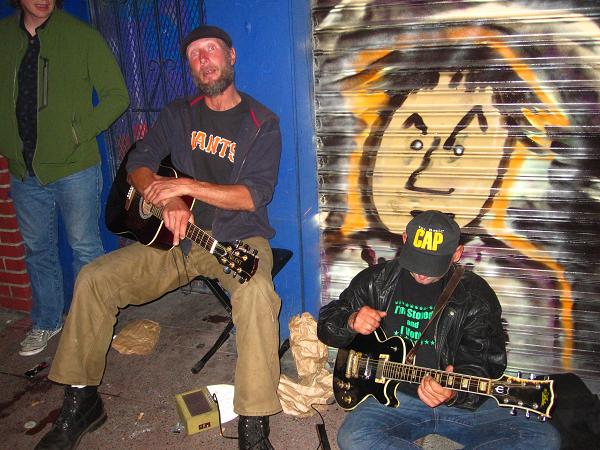
Not heading home any time soon, however, was Scott Free, who was sitting on a chair strumming a guitar down the block from Hobson’s contemplating the downfall of Prop. 19. Free’s been living “outdoors” for the past two years and has lived in the Haight for eight. He’s pretty sure the passage of Prop L is just a sign of a change that’s been long coming in the neighborhood. “Yeah, sit-lie will change things — but then, I didn’t think they’d be giving smoking tickets in Golden Gate Park. I came to San Francisco from Santa Clara County for the music and the tolerance.”

Hard to believe that voters in SF just passed a measure that will effectively ban Free and friends’ joyful noise. 

Their buddy is prone on the sidewalk besides him — drinking away the night that made homelessness illegal and made sure pot remained the same? “He’s real upset about it all,” Free tells me “he’s a big time sitter and liar.” 

Election 2010: Prop. 19 loses

4

Okay, I admit it: I thought Californians would come to their senses and vote in large numbers in favor of legalizing pot. And that’s how the polls looked — until Attorney General Eric Holder announced that he would continue to enforce federal law and bust Californians for marijuana offenses. At that point, the voters seemed to collectively sigh and say: Hell with it, if the feds are going to get us anyway, why bother? And that’s when the polls began to shift

The rest of the state props are a mixed bag — the proposal to get rid of the two-thirds vote on passing a budget went through, but so did the mandate that local fees get a two-thirds vote.

Another Monkey

6

paulr@sfbg.com

DINE The restaurant formerly known as Conduit was so strikingly designed inside that when, earlier this year, it morphed into a Thai spot, another of those with “monkey” in the name — Another Monkey — I winced, and only in part because the word “monkey” makes me think of ol’ Dubya, now in exile in the Dallas suburb of Elba. The indecorous neon beer sign glowing in the front window seemed to be a particularly glum portent. It said: come in and slam a few! And eat pad Thai with your fingers while you watch ESPN.

As fate would have it, Another Monkey does offer pad Thai, and the flat-panel television mounted over the bar probably does show ESPN on occasion, but otherwise, the ruin I inferred from the infernal neon sign is nowhere to be seen. The restaurant’s high-style interior is intact, while the food is electrifying. The only physical change I noticed in the space was the screening-off of what had been an exhibition kitchen at the rear of the dining room; the counter and stools are still there, but the view now consists of a long eyeful of frosted glass instead of a tableau of busy chefs.

Conduit had been, in its brief heyday, a scene reminiscent of the early days of Foreign Cinema — limousines double-parked on the street and swarms of hipster-geeks in various shades of black jamming the doorway — so Another Monkey’s more relaxed state is easier to live with. When a place becomes over-popular, everything is put at risk, from the quality of the food and service to the ambience itself. Another Monkey shows no signs of becoming a Conduit-style scene, but it is distinctive and gracious enough to draw a steady crowd. It has a neighborly feel, yet for those farther afield it’s worth seeking out, both for its distinctive setting and the sharpness of its cooking.

Chef Aom Phanthong’s menu is, like a bar stool (!), sturdily balanced on three legs: familiar standards, innovative dishes, and items for hard-core (or, in menu-speak, “experienced”) connoisseurs of Thai cuisine. In this last category we find the dip-relishes, whose odors and flavors are “very strong,” according to the menu card’s minatory phrasing. Suspicious people might flee in the direction of the pad Thai, or the excellent fish cakes ($7.50 for four) with an enlivening sweet-sour sauce on the side, along with threads of red and green cabbage.

In the alternative, they might turn toward the mix-and-match department. You can get tom yum shrimp ($9.95), served in little heaps atop crisped triangles of flour tortilla. The menu calls this “nacho style,” and it was quite good, though the frying left the tortillas with an oily aroma, and why flour tortillas instead of the tastier (and healthier, not to mention more authentic) kind made from masa?

The appeal of duck has long eluded me. Like goose, it resembles (for me) slightly gamier, richer chicken — the chicken, interestingly, being native to Southeast Asia. So subbing duck for chicken in a red curry ($15) wasn’t a complete Californication, and maybe, in its exponential richness (rich meat amplified by rich sauce) it wasn’t California at all. The portion size turned out to be just right, though, and with a pineapple slice for a subfloor and some fresh basil over the top, the dish’s richness remained under control.

Richness also briefly threatened the northern Thai hung le curry of pork belly ($13), mostly because of the nature of the meat. Our exquisitely polite server asked if we would be comfortable with “visible fat.” As an American, I have lived most of my life amid visible fat, so this prospect did not deter. And the dish itself turned out to be marvelous, a kind of gingery stew served in a handsome little pot, the meat stringy but tender and a scattering of fresh peanuts for textural counterpoint.

Another Monkey maintains an extensive wine list, which on the one hand is a reassuring line of continuity from Conduit and on the other is paradoxical. Thailand is not wine country, and Thai cuisine (like Indian and Mexican cuisine, to name two other large examples) didn’t evolve with wine. But wine geeks must love a challenge, because the carefully bound list is presented with almost biblical reverence. Beer is still preferable, in my view, but not the almost undrinkably bitter Duvel, the only Belgian beer I’ve ever had that I didn’t like. That’s not the beer proclaimed by the window sign, by the way.

ANOTHER MONKEY

Dinner: Sun.–Thurs., 5–10 p.m.

Lunch: Mon.–Fri., 11:30 a.m.–2:30 p.m.

280 Valencia, SF

(415) 241-0288

www.anothermonkeythai.com

Full bar

MC/V

Some noise, but not bad

Wheelchair accessible

Different walls

0

arts@sfbg.com

Palestinian perspectives are in. You know it when a major filmmaker like Julian Schnabel makes a big-budget film like Miral, based on the book by Palestinian journalist Rula Jebreal (which recently screened at the Mill Valley Film Festival in advance of a general release next year).

In many ways, though, it’s the rest of the country that’s catching up to places like the Bay Area, where Palestinian voices have long been a part of the cultural landscape. The Arab Film Festival, for instance, which just closed its 14th season, once again featured several films from and about Palestine. And this year the San Francisco International Film Festival gave us a look at Port of Memory, the latest work from Kamal Aljafari, one of the most interesting and sophisticated filmmakers to come from Palestine since Elia Suleiman.

In theater, San Francisco’s Golden Thread Productions just gave a staged reading of biographical work from youth in embattled Gaza called The Gaza Monologues. For years, Golden Thread has produced works incorporating the Palestinian perspective amid a mass culture overwhelmingly slanted toward the more powerful side in a basically colonial project. And currently Campo Santo and Intersection for the Arts bring the diasporic repercussions of Palestinian dispossession center stage in Habibi, a new play from a new Palestinian American theatrical voice, Sharif Abu-Hambeh.

Habibi makes its debut as the second offering in a trio of world premieres at Intersection by first-time playwrights (the first having been Chinaka Hodge’sMirrors in Every Corner). Directed by Omar Matwally, Abu-Hambeh’s play weaves together two distinct storylines that attempt to capture the inter-generational confusion and displacement experienced by assimilating Palestinian immigrants in the Bay Area. That confusion can regrettably transfer to the play itself, whose intentional deployment of ambiguity ends up, at least to some extent, being merely fuzzy rather than thought-provoking. But the ideas here are at times intriguingly subtle and the effort a promising one. Moreover, Matwally and Campo Santo give the play a strong production with various charms along the way.

At the center of this double helix of a narrative is young Palestinian American Tariq (a coolly vital and engaging Aleph Ayin). Tariq shares a small Mission District apartment and even — talk about family overload — a single bed with his loving but paternalistic father, Mohammed (a stern, sympathetic Paul Santiago). The deliberate and routine-loving Mohammed — who unlike his Americanized son speaks in accented English — is a museum guard with a strong work ethic that he’s trying, unsuccessfully, to instill in his slacker offspring. Tariq, for his part, has just happily shed his menial job at a local café and is in no hurry to find a new one. His absent mother (Nora El Samahy) apparently left them some time before, though she reappears at one point in his imagination.

This father and son dynamic, familial and almost too familiar, comes intercut with a public talk by a high-class museum curator (a sharp and funny El Samahy, dressed by costume designer Courtney Flores in esteem-grabbing Manhattan chic and sporting a very respectable English accent), who leads us through a slide lecture on the great art heists of the last century. Her talk, avid but meandering, is interrupted by simultaneously exasperating and guilt-producing phone calls from her terminally ill father, and a consequent tendency to wander into ruminations farther afield — summoned for us in pictures of dispossession that float by on the screen behind her (in video projections designed by Aubrey Millen).

Maybe these wayward ruminations aren’t so far afield after all, we come to suspect, as her theme of cultural theft warms up to its own complexities and encourages us to consider the nature of cultural transmission, loss, and hybridization in the life-and-death circumstances of exiled populations. This idea deepens as Tariq’s raucous and rebellious spirit extends to breaking into the curator’s monologue, and even smashing the fourth wall to confront us, her audience. Tariq also has a unique tendency to narrate his own actions, a self-conscious conceit that can be productive at times, especially of humor, and works as an indirect aside to the audience.

By the end, the two narratives come even closer together through a rash act of Tariq’s father that trades disastrously on the concept of family heirlooms, or the physical symbols of patrimony and place. The climax arrives too hastily, and its potential impact is muted. At the same time, the play’s departure from the more universal, shopworn gestures of “melting pot” tales verges on something rare and coruscating.

HABIBI

Thurs.–Sun., 8 p.m.; through Nov. 7; $15–$25

Intersection for the Arts

446 Valencia, SF

(415) 626-2787 

www.theintersection.org


Bar Agricole

1

paulr@sfbg.com

DINE At the risk of sounding like a grossly premature exit poll, I am willing to say that Bar Agricole, which opened mid-August on a rather grimy block of 11th Street, is already, and easily, the best restaurant on that block. Not that the bar (pardon my punnery) is set all that high. You might very well think that Butter, across the street, doesn’t represent serious competition. You might, if you have a long memory, remember Undici (later Eleven), a lofty, 1990s place across the street that might have been worthy of being mentioned in the same breath as Bar Agricole — but was also deafening. Bar Agricole is supremely worthy and not deafening.

The sonic detail deserves mention for several reasons, one of which is that the restaurant looks like it should be deafening. Once you gain the dining room (after a trek up a woody incline, past a semi-secluded open-air terrace), you find yourself in a onetime plumbing-supply shop remade in the sleek Euro-modern style that you might find in one of the more happening neighborhoods of Stockholm. Interior vistas consist of wood, plate glass, and seating that doesn’t look ergonomic. Noise is almost always the companion of these chic design elements.

But Bar Agricole’s tables are spaced widely enough to let the restaurant breathe, and, for a rustic-enviro touch, the long bar is made from wood recycled from an Ohio farm, if my eavesdropping ears heard the story right. The madding crowd is never far away, yet the sound is muted just enough not to become the center of attention. It’s like watching a big pot of simmering stock coming to a boil it never quite reaches. This kind of ambience management is a subtle but real triumph.

Agricole — as Francophiles might know — refers not only to agriculture but to a type of rum favored by the French. The chief impresario of the place, Thad Vogler, is a cocktail man, and the cocktail list is impressive. But you’d have a hard time finding any mixed drink to top the white, or unaged (“blanche”) armagnac, which, like my beloved grappa, is as clear as water but fruitier, more melodious, less openly fiery. Like agricole rum, it finds its way into a number of cocktails, but it’s splendid when taken straight.

Chef Brandon Jew’s cooking is also melodious and goes down easy. The theme is California eclectic, with, like a corniche, a fair number of tight twists and turns. The chopped liver on toast ($8), for instance, was warmed all the way through, which lent the dish an appealing melted-fused quality. Tomatoes with bottarga ($14) revealed itself to be a colorful salad of heirloom fruit with a heavy (and unannounced) scattering of shell beans. For seasoning, there were flecks of bottarga (salt-cured fish ovaries, a Mediterranean delicacy).

The kitchen’s eye for color is sharp. A plate of picalilli ($6), or pickled vegetables, was dominated by luminous yellow cauliflower florets and nearly as luminous quarters of red beet. Other players: halved baby carrots, long beans, skinny green peppers flushed with red as if by dawn, and whole okra pods. Altogether it looked like something Cézanne might like to paint, if he didn’t gobble it down first, which was what we did.

No menu is truly complete without at least one flop. At Bar Agricole, this would be the beguilingly named sardine roll mops ($6), which consisted of a large piece of fish wrapped pig-in-a-blanket-style around a pickle spear the color of radiator fluid, then laid on a board of flatbread and doused with crème fraîche. The overall effect was supposed to be, I guess, a variation on a Sunday-morning shmear, but the flatbread was uncooperative and difficult to eat and the fish-pickle pairing wasn’t much better, despite the cream’s attempts at reconciliation. If a dysfunctional family were turned into food, it might seem something like this.

On the other hand, we loved the tanginess of the olive-oil poached tuna ($14) mingled with fennel-root shavings and cilantro. And the corn pudding ($16) — like an eggy polenta, topped with corn kernels, okra halves, whole padrón peppers, and served in an earthenware crock — was original and sublime, while being at least plausibly vegetarian-friendly.

If you like lemon verbena cream, you’ll want dessert. A puffy cloud of it semi-salved the dryness of the blueberry shortcake ($8) — tons of blueberries, though — while another puff appeared, uncredited, with the wondrously glazed peach-pluot upside-down cake. If you had to bet the farm on one of these, you’d be wise to choose the latter. 

BAR AGRICOLE

Dinner: nightly, 6 p.m.–1 a.m.

355 11th St., SF

(415) 355-9400

www.baragricole.com

Full bar

AE/DS/MC/V

Tolerable noise

Wheelchair accessible


Lost city

2

arts@sfbg.com

WRITERS ISSUE With its vast divide between the rich and poor, its lusty appetite for sex, and its backroom real estate deals, it would seem that even the boutique and completely gentrified San Francisco of today offers to writers of crime fiction a rich vein of noir opportunity. Yet the lone novelist today determinedly probing the dark side of San Francisco’s endless battle to clean up the streets is Peter Plate. His latest novel, Elegy Written on a Crowded Street (Seven Stories Press, 176 pages, $13.95), is Plate’s ninth in a hardboiled writing career that spans the era of out of control gentrification in San Francisco. With little fanfare or support, against the real life backdrop of police sweeps of the homeless and the start of the dot com boom, Plate has produced a shelf of books that represent a lonely, yet noble and deeply radical literary effort to write noir crime fiction in which not the cops but the criminals are the protagonists.

Plate’s novels are full of delicious hooks. They reliably begin with some of the best premises in noir fiction today. Fogtown (Seven Stories Press, 2004) opens as a crowd of Market Street homeless and down and outers witness the crash of an armored Brinks truck at dawn that temporarily fills the desolate street with crisp, new hundred dollar bills. In Police and Thieves (Seven Stories Press, 1999), Doojie, a small-time Capp Street weed dealer, accidently witnesses the murder of a homeless man by a police officer and spends the rest of the book on the run from the murderous cop who seeks to silence him.

Like Doojie, Plate’s characters are always in the wrong place at the wrong time, unwilling spectators as the city changes around them. The free money in Fogtown offers the Market Street dwellers a tantalizing glimpse of the kind of new carefree life being lived all around them by the rich who have newly arrived to the city. Yet, like the upscale new eateries and clubs popping up everywhere, the money is off limits to them, and those who take the money instantly become, like Doojie, hunted by police. Plate’s strength is in conveying the hopelessness and despair of lone characters pitted in Doestoyevskian battle with societal forces far greater than they are. As they are slowly ground down by this struggle, we feel their terror, incomprehension and paranoia. As the drug dealer and SRO hotel manager, Jeeter, says in Fogtown, “Rights? You don’t have any rights. You have choices. That’s all you have. And you made the wrong one.”

In this context, noir fiction for Plate is protest fiction. A longtime street activist, Plate writes with the gut instincts of a protester, taking his novels right to the barricades where different visions of San Francisco violently clash. One Foot Off The Gutter (Incommunicado, 1995), is a mordant postcard from a Mission District just about to enter its gentrification era in which a homeless cop, a Latino gang member, and a yuppie doctor all covet the same Victorian houses at 21st Street and Folsom. Soon The Rest Will Fall (Seven Stories, 2006) is set in the Trinity Plaza Apartments on Market Street at the height of housing activists’ struggle to save the low income housing from demolition. Plate has so reliably found the pulse of change in the city that at times his work has blurred tragically with reality. Police and Thieves ends with a fire at the Crown Hotel on Valencia Street. Just months after the book’s publication, the real life Crown Hotel burned to the ground.

Since Plate finished his Mission Quartet at the close of the dot-com era, he has turned his attention to San Francisco’s Main Street, Market Street. Recently, in its inaugural issue, the incipient local newspaper San Francisco Public Press reported that one lone real estate speculator owns 62% of the vacant real estate between 5th and 6th on Market Street and that he is willfully leaving those properties vacant until he can make the money he thinks he deserves off of the property. Those uselessly abandoned and boarded up buildings at the very heart of the city are the recurring backdrop for much of Elegy Written On a Crowded Street, perhaps Plate’s darkest and most emotional work to date.

Elegy is not so much a traditional crime fiction thriller, but a lyrical roman noir in which police and thieves battle not each other but the stifling conditions of the city. Plate’s latest evokes Don Carpenter’s 1966 classic Hard Rain Falling (reissued this year by New York Review of Books), an unrelenting work that also took place largely on Market Street. Carpenter’s novel brings to life the old dive 24-hour pool halls and dirty hotel rooms of a 1950s San Francisco where the promise of the Gold Rush American West has faded. The novels’ restless young pool hustlers and small time thieves can only shuttle aimlessly back and forth in the new remote control city, like the 8 Ball, waiting to fall. Elegy’s characters are their descendents, still on Market Street and still waiting.

Down this mean street walks May Jones a tough, hard-drinking bail bondswoman, who is nearing forty with no prospects. Like everyone around her, Jones dreams of escape from the city. Even Jones’ clients are leaving for Portland. “It’s got trees. Good people. Cheap housing,” an erstwhile, young crusty-punk bank robber earnestly tells Jones as she prepares to skip bail. But Jones is condemned to remain, while all around her are the undead ghosts of those already disappeared and the soon to be departed. The cleaned up San Francisco is haunted. The living are exhausted. Jones says to herself, “I have pipelines to the lands of the dead.’

Jones echoes the food stamp caseworker, Charlene Hassler from Plate’s welfare reform novel, Snitch Factory (Incommunicado, 1996). Like Hassler, Jones is being worn down between the insatiable needs of her clients and the treacherous intrigues that surround her job. Jones’ client is Mary Anderson, a pregnant twenty-year-old African-American who has killed her boyfriend, the SFPD’s star snitch on Fillmore Street. By keeping her client out of jail, Jones finds herself on the cops’ shitlist and in fear for her life. As in other Plate novels, a police hunt for Jones ensues. As in other recent Plate novels, after the initial hook, the plot soon becomes murky and this hunt becomes elliptical and hard to follow, perhaps even a bit ridiculous. A plot sideline in which Jones has a brief fling with a dyke she meets at the End Up goes nowhere. The ghosts of Lenin and punk rock legend, Will Shatter make surprise cameos that stretch the reader’s credulity. Yet, Plate’s spot on descriptions of Market Street today and the universe of dread his characters inhabit there remains compelling throughout and one never doubts that the unraveling narrative is what life feels like for his characters. Plate writes with a tightly wound urgency throughout and Elegy makes a persuasive case that what is happening at 5th and Market today is happening to the city as a whole.

Fantastical plot aside, it is the weight of the dead that is the true subject of Elegy. The book opens with a dreamy scene, shrouded in fog, in which Jones watches the dead body of one of her former clients as it bobs up and down in the surf, unable to either reach the shore or go under for good. Some policemen have waded into the water to grapple with the dead man and bring him in, but the body proves too difficult to apprehend and the cops are pulled down with the it into the crashing waves. Throughout Elegy, Plate’s characters similarly bob along, paralyzed and unable to take decisive action, only pulling each other down, and as the novel ends, May Jones is more or less back where she started. Sadly, like many of Plate’s recent books, the novel fails to fully satisfy because there is no resolution to the plot. Plate’s characters do not seem changed by their ordeal; they only become more numb. Yet perhaps that is the point. Plate seems to be saying that as long as the city fails to grapple with its own dead, nothing can change, and the city is condemned to go around and around in a sort-of netherworld, reliving its past traumas in new conflicts. “It’s a moment in hell that should be taking place beneath the ground,” Plate writes of a brutal police assault on a drunken derelict in Elegy, and it sums up the whole book. The dead won’t stay buried.

While an elegy is a funeral song, a lamentation for the dead, it also suggests a last word. With Elegy has Plate said all he has to say about San Francisco? One hopes not. Perhaps no writer working today has left such a record of what it feels like to live in the American city in the era of gentrification. Yet, in life as in Plate’s fiction, knowing the truth can take its toll, as Doojie finds out when he is hunted by the police for the truth he alone knows. By the end of Elegy, May Jones has spent so much time wallowing in the murky depths where her clients dwell, that her identification with them is complete and her fate has become inseparable from theirs.

The exhausted tone of Elegy suggests that like Jones, Plate, the lifelong activist and engaged writer, has perhaps stared into the abyss too long. Nonetheless, his nine novels are a significant achievement, the life’s work of a doggedly engaged writer. In each book, I have found scenes that remain unforgettable in my own mind and that have permanently altered my own perceptions of San Francisco and its streets. While Plate’s novels are each flawed in their own way, I love them with the Algren-like compassion he clearly has for his memorable characters, like the homeless cop who lives in his squad car in Gutter, and the ex-con who robs a pot club while dressed like Santa Claus in Soon the Rest Will Fall. Taken as a whole, Plate’s novels offer a compelling and defiant portrait of the psychic toll the disappearance of loved people, places, and opportunity from the city has taken on those left behind.


East Bay endorsements 2010

31

BART BOARD DISTRICT 4

ROBERT RABURN

Incumbent Carole Ward Allen has been a disappointment, part of the moribund BART establishment that wastes money on pointless extensions, ignores urban cores, and can’t control its own police force. Robert Raburn, a bicycle activist with a PhD in transportation and urban geography, would be a great replacement. If he’s elected, and Bert Hill wins in San Francisco, BART will have two more progressive transit activists to join Tom Radulovich. Vote for Raburn.


BERKELEY CITY AUDITOR

ANN-MARIE HOGAN

Hogan’s running unopposed and we see no reason not to support her for another term.


BERKELEY CITY COUNCIL

DISTRICT 1

LINDA MAIO

Maio in the past has had a decent progressive track record, but lately she’s been something of a call-up vote for Mayor Tom Bates. We’re not thrilled with her more recent positions years (against raising condo conversion fees and for new high-rises downtown), but she has no strong credible opponents. Green Party Jasper Kingeter has never run for elective office before and needs more seasoning.

DISTRICT 4

JESSE ARREGUIN

Arreguin and Kriss Worthington hold down the progressive wing on the City Council. He’s pushed the Berkeley police to stop impounding the cars of undocumented immigrants and is a foe of the development-at-all costs mentality of the mayor.

DISTRICT 7

KRISS WORTHINGTON

It’s disappointing that Mayor Tom Bates and his allies are trying to get rid of Worthington, who by our estimation is the best, hardest-working, and most progressive member of the City Council. He’s been willing to stand up to the mayor when he’s wrong — and has managed to force developers to build more affordable housing. He’s against the mayor’s downtown plan, but sees a way forward to a compromise that includes all the positive elements without big high-rises. Vote for Worthington.

DISTRICT 8

STEWART JONES

Gordon Wozniak, the incumbent, is the most conservative member of the City Council and has been a bad vote on almost everything. He’s going to be tough to beat in this district, but we’re giving the nod to Jones, a teacher, Green Party member, and neighborhood activist. He lacks experience, but almost anyone would be better than Wozniak.


BERKELEY RENT BOARD

ASA DODWORTH

LISA STEPHENS

JESSE TOWNLEY

PAM WEBSTER

DAVE BLAKE

KATHERINE HARR

There’s a six-person tenant slate running, with endorsements from Worthington, Arreguin, and other progressive leaders. The members couldn’t find an easy mnemonic, so they’ve used the last letters of their last names, which, in the right order, add up to SHERRY. We’ve listed them in the order they’ll appear on the ballot.


OAKLAND CITY AUDITOR

COURTNEY RUBY

Ruby’s moved the office forward a bit, and we don’t see any argument to replace her.


OAKLAND MAYOR

1. REBECCA KAPLAN

2. JEAN QUAN

The danger in this race is Don Perata, the former state Senate president, longtime power broker, and friend of developers who has, at the very least, a checkered ethical record that led at one point to a five-year federal corruption investigation (the investigation ended with no charges filed). Perata wants to use the mayor’s office to continue his role as a regional kingpin, and he has the support of Pacific Gas and Electric Co. and the big developers. No thanks.

Two strong progressive challengers are taking him on. Our first choice is Rebecca Kaplan, an at-large City Council member who is full of great, innovative ideas for Oakland. She wants to enforce an Oakland-first hiring law, work on transit-oriented development, and encourage small businesses that can attract some of the $2 billion a year Oakland loses in retail sales from local residents who shop out of town.

Kaplan told us she thinks that if Proposition 19 passes and local government has the right to regulate legal marijuana, Oakland is perfectly situated to take advantage of the new law. By combining pot sales and possibly on-site consumption with new restaurants, bike lanes, and street-level amenities, the city could revitalize neighborhoods and bring in significant new tax revenue.

She’s a big bicycle advocate, would consider a progressive city income tax, and is a strong supporter of public power. She also has a practical sense of how to solve problems.

Jean Quan has been active in Oakland politics for decades. She served 12 years on the school board, eight on the City Council, and has the experience, skills, and vision to run the city. She’s also almost tied in the polls with Perata, despite being outspent dramatically (and being the subject of some nasty, inaccurate Perata hit pieces). She told us she wants to be a cheerleader for the public schools, to work with local businesses, expand the high school internship program, and add city wrap-around services to public schools. She’s had a long, impressive record on environmental issues (she worked with San Francisco on a plastic bag ban and wrote Oakland’s Styrofoam ban). She recognizes that much of the city’s budget problem comes from the police department and police pensions. But she’s a little less aggressive than Kaplan about raising new revenue, and while she fully supports Prop. 19 and the Oakland plan for allowing commercial marijuana operations, she is, in her own words, “relatively conservative” on how far Oakland should go to allow sales and use in the city.

Kaplan’s got more of the cutting-edge progressive vision. Quan’s got more experience and a longer track record. They’re the two choices to beat Perata and save Oakland’s future, and we’re happy that ranked-choice voting allows us to endorse them both.


OAKLAND CITY COUNCIL

DISTRICT 2

JENNIFER PAE

Patricia Kernighan is among the most conservative votes on the council. She’s also representing a wealthy, conservative hills district and will be hard to beat. We’re endorsing Jennifer Pae, community outreach director for the East Bay Voter Education Consortium. She has the backing of progressives like Supervisor Keith Carson and Berkeley City Council Member Kriss Worthington (as well as the Alameda County Green Party). She’s a long shot, but better than the incumbent.

DISTRICT 4

DANIEL SWAFFORD

The front-runners in this race are probably Libby Schaaf, a former aide to Ignacio de la Fuente; Melanie Shelby, a small business owner; and Daniel Swafford, a business consultant. Schaaf is too close to her old boss. We liked Shelby, but she’s awfully vague on solutions to Oakland’s problems — and she voted for Prop. 8. She now says her position on same-sex marriage is “evolving,” and she supports equal rights for all couples. But that’s an awfully big issue to have taken an awfully wrong stand on just two years ago.

This leaves Swafford, a neighborhood activist who grew up in Oakland and was City Council Member Jean Quan’s appointee to the Neighborhood Crime Prevention Council and is a strong advocate of community policing. He gets the nod.

DISTRICT 6

JOSE DORADO

Conventional wisdom says Desley Brooks is almost certain to get reelected to this seat. Her only competition comes from Nancy Sidebotham, whose platform is all cops all the time, and Jose Dorado, a bookkeeper with little political experience. Brooks is a fierce advocate for her district and has been tough on banks and good on pushing local hiring, but has too many ethical problems to merit our endorsement. She has never denied that she kept her boyfriend’s daughter on as a $5,000-a-month aide while the young woman was a full-time student at Syracuse University in New York. When San Francisco Chronicle columnist Chip Johnson challenged some of her ethical lapses, she sued him for libel (the case was dismissed).

Dorado is a neighborhood activist who is running a grassroots campaign and, while he needs more experience, he’s raising good issues (like public financing of elections). And unlike Sidebotham, he’s supporting the revenue measures on the ballot.


East Bay Ballot Measures

BERKELEY MEASURE H

SCHOOL FACILITIES TAX

YES

The East Bay cities have done a much better job than San Francisco at using parcel taxes — a poor substitute for property taxes but still a relatively progressive form of revenue — to support schools and other public services. Measure H would continue an existing tax on residential and commercial buildings — 6.3 cents per square foot on residences and 9.4 cents on businesses — to pay for maintenance on public school buildings. Vote yes.


BERKELEY MEASURE I

SCHOOL BONDS

YES

Measure I is a $210 million bond act to expand and upgrade the public schools. Vote yes.


BERKELEY MEASURE T

CANNABIS PERMITS

YES

Measure T is on the ballot as part of Berkeley’s effort to implement Prop. 19, the statewide pot-legalization measure. Berkeley and Oakland are both ahead of San Francisco in planning for legal marijuana. Prop. T would allow six medical cannabis clinics with cultivation permits, but restrict future industrial pot uses to industrial districts. Vote yes.


OAKLAND MEASURE L

SCHOOL TAX

YES

Another parcel tax for schools, this one $195 a year for 10 years, essentially to offset state cuts. There’s an exemption for low-income taxpayers. Vote yes.


OAKLAND MEASURE V

CANNABIS TAXES

YES

If Oakland goes ahead with its plans to allow large-scale cultivation and passes this tax hike on pot sales (to $50 per $1,000 of gross revenue for medical pot and $100 per $1,000 for recreational pot) the city could take in as much as $30 million a year — almost enough to offset the budget deficit. Vote yes.


OAKLAND MEASURE W

PHONE LINE TAX

YES

Another creative — if imperfect — way to raise some revenue, Measure W puts a modest $1.99 a month tax on phone lines to raise money for the general fund. Vote yes.


OAKLAND MEASURE X

POLICE PARCEL TAX

NO

We typically support any reasonable tax on property to pay for public services, but we can’t back this one. Measure X would impose a fairly high ($360 a year) parcel tax on single-family homes — entirely to pay for cops. The police union has been intractable, refusing to give back any of its generous pension benefits to help solve the budget deficit. We can’t see raising taxes for that department alone when so much of Oakland is hurting for money.


OAKLAND MEASURE BB

POLICE FUNDING

YES

Measure BB would allow Oakland to continue collecting violence-prevention money under a previous ballot measure even if the police department falls below a mandated staffing level. It would give the City Council more flexibility in addressing public safety. Vote yes.


>>VIEW OUR COMPLETE ENDORSEMENTS FOR THE 2010 ELECTION

Waiting to inhale

0

news@sfbg.com

Much of the controversy around Proposition 19, which would legalize marijuana in California for even nonmedical uses, involves speculation about what comes next. Hash bars on Market Street? Packs of joints next to the cigarettes in Mission District bodegas? Bags of green buds available with the bongs for sale on Haight Street? They are questions that have yet to get serious consideration in the city where the medical marijuana movement was launched.

The measure would give local governments almost complete control over how to regulate recreational-use cannabis sales in much the same way that cities set their own standards for medical marijuana dispensaries, a realm in which San Francisco has shown real leadership and created a well-functioning, successful, and legitimate industry (see “Marijuana goes mainstream,” Jan. 27).

But San Franciscans have been slow to prepare for the post-Prop. 19 world, with some other Bay Area cities leaving it in the dust on these issues. Oakland City Council Member Rebecca Kaplan, who is now running for mayor, not only spearheaded that city’s ballot measures on taxing recreational pot sales and permitting large scale growing operations, she’s actively talking using the Amsterdam model to revitalize the city’s downtown business district.

“[Hash bars] absolutely potentially would be part of the mix,” Kaplan told us when we asked about the issue during her mayoral endorsement interview, seeing it as part of a multipronged economic development strategy.

When asked if Oakland should have places where people could go to blaze legally, something Oakland doesn’t allow in its medical marijuana dispensaries, Kaplan said, “Yes. Oh yeah, we’re definitely gonna have those. The only question is gonna be whether the consumption facilities are separate from [those for] sales,” or if they’re under the same roof.

Kaplan thinks this will be part of the winning strategy that takes cannabis use off street corners while acknowledging its appeal to visitors and “synergy with the restaurants. When I talk about wanting to replicate the Amsterdam model in Oakland … it doesn’t just mean that you have … a regulated cannabis facility. You also have restaurants, shops, pedestrian safety, nice lighting, patio dining, musicians, artists.”

She points out that although an Oakland-regulated cannabis industry may use current alcohol regulation as a template, the two substances would not be sold alongside each other. “Frankly, ABC [California Department of Alcoholic Beverage Control) will freak out.” That means, at least in Oakland, you won’t be able to purchase cannabis at bars, liquor, or grocery stores.

On this side of the bay, Sup. Ross Mirkarimi — who wrote the regulations on the city’s medical marijuana facilities — says it is “extremely premature” to contemplate Amsterdam-esque hash bars. “That would have to occur within a strong regulatory framework,” he said, one the Board of Supervisors has yet to envision. San Francisco attorney David Owen, who has helped advise some medical marijuana purveyors, said some dispensaries currently allow on-site medication, and San Francisco might legislate to extend the practice to bars.

Meanwhile other California cities such as Berkeley and Oakland are anticipating Prop. 19’s passage much more proactively. Berkeley’s Measure S would tax cannabis businesses, applying different rates to for profit med-use cannabis businesses, nonprofit med-use businesses, and rec-use businesses (which won’t exist unless Prop 19 passes). The measure would secure medical-use cannabis for low-income patients and tighten regulations on Berkeley’s current med-use dispensaries and cultivators regardless of how Prop. 19 fares. There’s also a Measure T on the ballot that would establish a new committee that, in the event that Prop. 19 passes, would advise city officials on how to implement it.

Berkeley City Council Member Kriss Worthington said planning for the post-Prop. 19 world is smart to “synchronize a forward movement on the state and local level” and to “hit the ground running,” a sentiment that Kaplan also voiced for Oakland and one shared by other cities.

Stockton’s Measure I would tax rec-use cannabis businesses at a higher rate than med-use businesses. Sacramento’s Measure C is similar, containing a provision for a rec-use tax range if Prop. 19 passes. Richmond’s Measure V would tax 5 percent of gross sales of cannabis, and could apply to rec-use businesses too. Oakland’s Measure V would add a 5 percent tax to other taxes already on med-use cannabis, and put a 10 percent sales tax on rec-use cannabis. Measure H, on Rancho Cordova’s ballot, would tax personal cultivation at a higher tax on any square footage beyond the 25 square feet that Prop 19 specifies. Long Beach’s Measure B would establish a business license tax on the city’s potential recreational cannabis businesses. Even Albany, which has no dispensaries, would tax for-profit and nonprofit dispensaries differently through its Measure Q.

But Mirkarimi said he would like to tax marijuana cultivation, and has even voiced support for med-use cannabis dispensaries working directly with SF General Hospital to provide to patients, “thereby segregating a special use” and keeping cannabis prices low or nonexistent based on patient needs.

So if Prop. 19 passes, where will San Franciscans be able to purchase rec-use cannabis? Current med-use dispensaries may be a logical choice. “We already have the infrastructure,” said SF dispensary Medithrive co-owner Daniel Bornstein.

Whereas alcohol purveyors are accustomed to providing one barrier to purchase (when they card the buyer), dispensaries such as Medithrive offer many. “We already card and only accept patronage from those with a valid doctor recommendation. We also require he/she become a member of the dispensary and limit to one visit per day.”

When he contemplates whether Medithrive might provide rec-use cannabis in the future, Bornstein says “If [the city adopts] a responsible statute that’s fair, we would welcome the opportunity to offer a broadened service to more people.”

That avenue troubles Mirkarimi. “I don’t know how that works,” he said. Rec-use cannabis purchase would require no doctor’s notes and could occur within a for-profit business model. How would dispensaries legally reconcile making money under their nonprofit status? “I don’t want to put that burden on them,” Mirkarimi said.

Prop. 19 offers other potential implementation conundrums. For example, the measure will only give local governments the option to legalize the limited cultivation/sale of cannabis. Legalization won’t be compulsory. Therefore, it is likely that a post-Prop. 19-approved California will become a patchwork of alternating “dry” and “wet” municipalities.

So let’s say you’re on a road trip and you pass through many cities that all treat cannabis differently. Bornstein and his Medithrive partner Misha Breyburg worry about such a “patchwork of legal complexity.” But Prop. 19 provides for the legal transport of cannabis through cities that prohibit its sale, and California Assemblymember Tom Ammiano has already proposed legislation to smooth out the rough spots in Prop. 19 and answer open questions.

So for now, everyone is just waiting to see what state voters do.


Legalization proponents appeal to Reason

0

The Bay Area’s medical marijuana community may be divided over the legalization measure Prop. 19, but Reason’s Brian Doherty has penned an excellent analysis of the current campaign, why it will probably succeed, and how that will likely lead to a nationwide normalization of pot use rather than the federal crackdown and general sky falling that many critics of the measure predict.

City bid to bring vendors into Dolores Parks causes an uproar

12

Officials with the SF Recreation and Parks Department are attempting to quell the mounting frustrations of some Mission District merchants and residents who feel that the city shouldn’t allow private companies to operate in a public park, as the department is seeking to do. Even those who don’t necessarily have a problem with inviting more commerce into Dolores Park say the process should have been more open and transparent.

“I like pushcarts,” said Rachel Herbert, owner of Dolores Park Café. “I think they add flavor to San Francisco.” But Herbert is also allowing opponents of the department’s request for proposals (RFP) to set up shop in her store and gather signatures for a petition to “stop the commercialization of Dolores Park.” Herbert, who lives in the neighborhood, said she is helping the effort because “It’s about the process and Rec and Park not really thinking things through and doing whatever they want.”

Mike McConnell, the man behind the petition, holds a similar viewpoint. “I don’t feel that it was adequate outreach before this.” They’re not alone. McConnell currently has petitions in three stores – including his own store, Fayes Video – each with around 100 signatures, along with 700 online petition signatures.

While the controversy is recent, the RFP for the permits was issued in September last year. The proposal stated: “Before entering into permit agreement for the operation of a pushcart in any neighborhood park, the Department will conduct a community outreach process to determine the appropriateness of such a use in the park.”

It’s unclear how much outreach there was beyond a request for applicants posted in the July 31 issue of the San Francisco Chronicle. However, according to Mission Local, department spokesman Elton Pon sent them an email stating that the department mailed out “an announcement of the opportunity to more than 1,000 potential applicants.”

Regina Dick-Endrizzi, director of the SF Office of Small Business, said much of the demand for the permits has come from small time vendors. “Part of this has been an organic growing up of the vendors themselves,” Dick-Endrizzi said. “The mobile food folks have been coming and working and urging us to open up more space.”

Dick-Endrizzi helped vet the applicants in the panel that included members of department and the Mayor’s Office of Economic Development. “I can attest as being part of the committee that they were very careful in making their decision,” she said.

However one recipient of the permits, Oakland-based Blue Bottle Coffee, has received criticisms that it isn’t local enough – city policies encourage contracting with San Francisco small businesses. Blue Bottle is also backed by venture capital firm Kohlberg Ventures.

Its founder recently issued a public letter explaining his position: “I had assumed that since there were published articles in The Chronicle, the Examiner, and the SF Weekly in November of 2009, and January 2010, that the community around Dolores Park was well informed. So it pained me to hear that many of our (hopefully) future neighbors were upset that more outreach had not been done.”

This isn’t the first time a vendor has been allowed to operate in city parks. Nor are they the first merchant with questionable local status. Last August RPD commission voted 6-1 to replace long-time Stow Lake vendor with an out of state suitor. The Chronicle reported “the corporation, which has owned and operated the 1940s-era boathouse for 67 years, couldn’t compete with New Mexico-based Ortega Family Enterprises, which pledged to complete $233,000 worth of improvements to the well-worn building and buy a brand-new fleet of boats.”

Dolores has become a haven for unlicensed vendors selling items such as beer, hot dogs, ice cream, and even pot-laced brownies and truffles. What will become of them? “You pay thousands and thousands for your trailer and for permits and this guy comes around with his little cart and is selling coffee for 50 cents less, what are you going to do? You’re going to call the fucking cops and say get this scumbag out of here,” said local impresario Chicken John.

Dolores Park has traditionally been regarded with a kind of laissez faire attitude by many San Francisco residents. On a warm day it’s not uncommon to see hundreds of chic to cheap layabouts basking on its hills, beer and bowl in hand, without worry in mind. And many-a-cop has seen them too, but rarely do they intervene – and all was well. Maybe that’s another reason why there has been such uproar over the proposed introduction of pushcarts into the park.

Since the uproar, both Blue Bottle Coffee and the other potential vendor nonprofit Cocina have been put in limbo. La Cocina’s executive director, Caleb Zigas, told Mission Local that “he had expected to roll into the park this week and is disappointed by the delay. In the past four months he’s poured $28,000 in grant money into La Cocina’s food trailer, which is now sitting in storage.”

But how long will the pushcarts (they’re actually trailers powered by generators) gather dust in a garage? “For most types of appeals there is a 15-day window after the permit was issued,” said Cynthia Goldstein, executive director of the SF Board of Appeals. However it isn’t a concrete rule. “On rare instances the board will extend the window when there is evidence that the city did something wrong.” In addition, according to Goldstein, there is usually a 15-20 day window between when an appeal is filled and when it is reviewed by the Board. In short, the dilemma may not be quashed by the meeting this evening that the department is holding on the controversy.

The extension would bode well for any NIMBYs since Cocina’s and Blue Bottle’s permits were granted on April 15, 2010 and Sept 2, 2010, respectively.

RecPark was expecting a 12 percent cut on the pushcart profits and hoped to net around $70,000 annually. The pushcarts are just one of the many revenue generating ideas that are currently floating around. RecPark – under its new department head, Phil Ginsburg, who was previously chief of staff to Mayor Gavin Newsom – recently created a partnerships and revenue generating division with the purpose of capitalizing on many of the cities assets.

At the Jan 21, 2010 Recreation and Parks Commission meeting, pushcarts were discussed as a way to ostensibly keep city employees from getting laid off. Other ideas that were tossed out included hosting a production of Peter Pan, renting out parking places for car shares, and an adopt-a-park program; an adopt-a-gardener program was even suggested. The city was broke and was searching for a way to close huge General Fund deficits.

The idea of pushcarts was discussed again at the Feb 18 meeting. Nick Kinsey from the property division of RecPark, told the commission, “We received 18 responses to the RFP and we actually brought six of them in for interviews. As part of the interviews we met with the respondents, we evaluated their qualifications, evaluated their operation plans – in terms of where they wanted to be in each of the parks, in each of the proposed parks, how that would interact with residents and other park users use of the park space and if there would be any conflict there.”

Kinsey continued, “We’re also accepting application on a rolling basis right now. So if anyone is watching and interested in submitting an application for pushcarts, we are accepting pushcarts. Some of our location are maxed out we wouldn’t accept anyone else. But we have plenty of other park spaces where we think this is an appropriate use.”

The meeting of the issue is today (Thurs/7) at 4 p.m. in City Hall Room 416