Politics

A new route to public power

0

EDITORIAL Public power isn’t a hard sell in principle. For starters, public electric utilities in California offer consistently lower rates than private companies, and in many cases, the rates are far lower. Municipal utilities are more likely to be environmentally responsible and seek better conservation measures and renewable energy sources. San Francisco’s under the thumb of Pacific Gas and Electric Co., which has soaring rates, is plagued by reliability problems, and operates a nuclear power plant.

Besides, this is the only city in the nation that has a federal mandate, the Raker Act, requiring public power.

But the politics are tough: cities that want to go into the power business traditionally buy out the private company’s existing wires, polls, and meters — but that costs a big chunk of money. And any bond act to buy out PG&E’s system requires a citywide vote — which means fighting PG&E’s tens of millions of dollars in campaign cash. Over and over again since the 1930s, the company has defeated citywide bond acts with the pure power of money.

But now Sup. Chris Daly has an approach that might change the calculus.

As Amanda Witherell reports ("Public Power, Underground," page 13), every street in San Francisco is going to be torn up in the next few years, either by PG&E, which is replacing gas lines, or by the city, which is replacing water and sewer lines. Daly wants to require everyone who digs a ditch in a San Francisco street to allow the city to run electric wire and fiber-optic cable at the same time. Since the main cost of burying power lines is the excavation, the city would be able, over the course of 15 years or so, to create a cost-effective, safe, and modern underground utility system. Then there would be no need to buy out PG&E; city officials could simply start selling power on the public lines.

It’s not that simple, of course: the wire itself isn’t cheap — and Daly is looking at a finance system that would require property owners to vote to tax themselves to pay for it. And it’s going to take a long time to complete.

But the system could be built one neighborhood at a time and could be connected to new solar generating systems that the city is planning to construct anyway. So the residents of, say, Bernal Heights or the Haight or the Mission or Bayview could agree to pay for a local city-run electric project. The solar panels would generate power (cheaply), the city-owned lines would carry them, and the savings in energy costs would more than compensate for the modest tax increase.

The city’s Public Utilities Commission has only begun to look into the idea, but staffers there say it’s entirely feasible.

This proposal needs to move forward with all possible dispatch. The supervisors should authorize money for a full-scale feasibility study to look at the costs, the schedule, and the ways neighborhood-based public power projects can be started as soon as possible. The board should approve Daly’s legislation, and the mayor should sign it.

And the public power movement ought to get behind this plan. It’s not an instant answer — but then, neither is buying out PG&E’s system; the litigation alone might take a decade. And if San Francisco can create green public power in even one district, the idea is going to spread. *

Editor’s Notes

0

› tredmond@sfbg.com

Ken Garcia, who just loves to bash the left, announced in his Examiner column May 15 that the progressives in San Francisco are in disarray because we don’t have a candidate for mayor. That’s one way to look at it.

The other way — and, like many things in politics, it’s not entirely true but certainly not false — is that the process for choosing a candidate in this wonderful yet still pretty young progressive movement isn’t like anything Garcia would understand.

These days most candidates for public office tend to select themselves. You want to run, you go get the money and the initial support, and you announce. But it’s a little more complicated than that for San Francisco progressives. A lot of people — some elected officials, some community leaders, some hotheaded (and hardheaded) activists — want to be consulted and want a say in the decision. It’s not perfect democracy by any means, and it’s true that the lack of an obvious front-runner speaks to a certain degree of disorganization. But I’m also somewhat pleased that we don’t have a 600-pound gorilla demanding that the field be cleared. And Sup. Chris Daly’s proposed progressive convention may not work perfectly, but at least it’s a nod in the direction of the grass roots helping decide who will carry the torch.

Let’s remember: it’s been only seven years since the progressives finally ended three decades of stifling machine politics and cracked open the local system. Let’s remember: for much of the 1980s and ’90s, we had only self-selected candidates and unaccountable candidates for mayor. And now that the people who broke Willie Brown’s iron grip on San Francisco politics in 2000 are ready to run for higher office, it’s not surprising that they’re a bit cautious about jumping the gun.

We all know what’s going on: Aaron Peskin, Ross Mirkarimi, Chris Daly, and Matt Gonzalez have been approached and courted by all sorts of organizations and people. Peskin and Mirkarimi have said pretty flatly that they aren’t going to run. Daly will if he has to. And in the Chronicle on May 16, Matier and Ross proclaimed that Gonzalez is out of the picture.

I’m not so sure that’s true. I think Gonzalez — who starts off with the highest name recognition, poll numbers, and fundraising potential — is still taking a serious look at the race. I know he’s holding some preliminary house meetings this week and talking to people who aren’t among the traditional progressive voters. He’s also talking to his friends and allies. And I think it’s entirely possible that he could wind up deciding to go for it.

One very good thing that Daly has done is force that issue; if nobody else comes forward, Daly will announce at the convention, and then it will look lame and divisive for anyone else to join the race.

There are, of course, egos and personal agendas playing here; these are, after all, politicians, and (unfortunately) all of our major contenders are guys, which probably makes it worse. But again, let us remember: Daly, Peskin, Mirkarimi, and Gonzalez would all be good candidates. I’d be happy with any of them in room 200. They should all be happy with the idea that one of them could be the next mayor. And if we can all work together to pick a winner, then perhaps we can show the Ken Garcias of the world that this is a movement with legs. *

Typical Hummer owner

0

@@http://www.sfbg.com/blogs/politics@@

Out of downtown

0

› steve@sfbg.com

It wasn’t going well for Ted Strawser, predictably. The alternative transportation activist faced an uphill battle March 14 trying to convince a San Francisco Chamber of Commerce committee to endorse Healthy Saturdays, a plan to ban cars from part of Golden Gate Park.

Representatives of the park’s museums and Richmond District homeowners had just argued their case against the measure. “Visitors want access to our front door, and we want to give it to them,” Pat Kilduff, communications director for the Fine Arts Museums of San Francisco, indignantly told the group of two dozen business leaders gathered around a large conference table.

Strawser gave it his best shot: he talked about following the lead of other great cities to create car-free spaces; he said, “Golden Gate Park is one of the best parks in the nation, if not the world”; and he made a detailed case for closure. But around the table there were scowls, eye rolls, and other obvious signs that Strawser was being tolerated, not welcomed. Some — including chamber vice president Jim Lazarus — even started to interrupt and argue with him.

Then the man sitting next to Strawser spoke up. “I don’t think this is fair,” he said. And suddenly, everyone in the room shaped up. Strawser’s ally — his only supporter in the room — was somebody no chamber member could or would dismiss. Warren Hellman doesn’t shout or bang the table — but when he speaks, downtown pays attention.

Hellman, a prominent investment banker, told the committee members that he expected them to show the same respect for Strawser that they had for the previous two speakers. The nonsense ended, immediately.

And by the time Strawser turned the floor over to Hellman, the mood had changed. The group listened raptly, smiled, and nodded as Hellman spoke in his usual folksy, familiar, disarming style.

“It’s not a lot of fun when friends fall out,” he began, “because the previous speakers and many of you all agreed on the necessity of the garage [that was built in Golden Gate Park], and we worked together.”

He pointed out that many in the group had promised during the fall 2000 election to support Healthy Saturdays once the garage was built, although Hellman was now the only member of the coalition honoring that commitment. But he didn’t chide or shame his colleagues. That isn’t Hellman’s style.

Instead, he spoke their language. The garage has never been full and needs the money it can charge for parking to repay the bonds. This isn’t a fight that’s going away, since “part of the conflict is because this park is everybody’s park.” But there are “about 100 compromises not acceptable to either side that would move this forward.” And if a solution can’t be found, there will probably be an expensive ballot fight that nobody wants.

“My conclusion is we should attempt this test,” Hellman told the group. Ultimately, when the vote was later taken in secret, the chamber didn’t agree, although it did vote to back a trial closure after the California Academy of Sciences reopens next year.

At the meeting, Hellman openly called for Mayor Gavin Newsom to get involved in seeking a compromise, something Hellman said he had also just requested of the mayor at a one-on-one breakfast meeting. A couple of weeks later Newsom — who had already indicated his intention of vetoing the measure — did broker a compromise that was then approved by the Board of Supervisors.

As usual, Hellman didn’t take credit, content to quietly play a role in making San Francisco a better place.

Healthy Saturdays isn’t the most important issue in local history — but the significance of Hellman’s involvement can’t be underestimated. His alliance with the environmentalists and park advocates might even signal a sea change in San Francisco politics.

Warren Hellman represents San Francisco’s political and economic past. And maybe — as his intriguing actions of recent years suggest — its future.

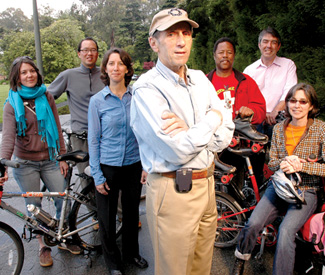
This guy is a rich (in all senses of the word) and compelling figure who stands alone in this town. And even though his leadership role in downtown political circles has often placed him at odds with the Guardian, Hellman consented to a series of in-depth interviews over the past six months.

“Our family has been here since early in the 19th century, so we had real roots here,” Hellman told us. His great-grandfather founded Wells Fargo and survived an assassination attempt on California Street by a man who yelled, “Mr. Hellman, you’ve ruined my life,” before shooting a pistol and barely missing.

The Hellman family has been solidly ruling class ever since, rich and Republican, producing a long line of investment bankers like Warren.

Yet the 72-year-old comes off as more iconoclast than patrician, at least partly because of the influence of his irreverent parents, particularly his mother, Ruth, who died in 1971 in a scuba-diving accident in Cozumel, Mexico, at the age of 59. “She was entirely nuts,” Hellman said, going on to describe her World War II stint as a military flier in the Women’s Auxiliary Service Pilots and other colorful pursuits. “She just loved people, a little like I do. She collected people.”

Hellman grew up wealthy and cultured, but he also attended public schools, including Grant Grammar School and Lowell High School. In between, the young troublemaker did a stint at San Rafael Military Academy — “reform school for the rich,” as he called it — for stunts such as riding his horse to Sacramento on a whim.

After doing his undergraduate work at UC Berkeley, Hellman got his MBA from Harvard and went on to become, at the age of 26, the youngest partner ever at the prestigious Manhattan investment firm Lehman Bros. He developed into an übercapitalist in his own right and eventually returned home from New York and founded Hellman and Friedman LLC in San Francisco in 1984, establishing himself as the go-to financier for troubled corporations.

“He is really one of the pioneers of private equity,” said Mark Mosher, a longtime downtown political consultant and the executive director of Gov. Arnold Schwarzenegger’s California Commission on Jobs and Economic Growth, on which Hellman sits.

Hellman became what Business Week called “the Warren Buffett of the West Coast,” a man of extraordinary wealth and power. Among other accomplishments, Hellman took Levi Strauss private, recently made billions of dollars in profits selling DoubleClick to Google, and manages the assets of the California public employee retirement funds (CalPERS and CalSTRS), which are among the largest in the world.

Like many financial titans, Hellman has always been a generous philanthropist, giving to the arts, supporting schools in myriad ways, and funding the San Francisco Foundation and the San Francisco Free Clinic (which his children run). He vigorously competes in marathons and endurance equestrian events, often winning in his age bracket. And he has his humanizing passions, such as playing the five-string banjo and creating the popular Hardly Strictly Bluegrass festival.

But he’s also been a prime facilitator of downtown’s political power, which regularly flexes its muscle against progressive causes and still holds sway in the Mayor’s Office and other city hall power centers.

Hellman founded, funds, and is a board member of the Committee on Jobs, which is perhaps the city’s most influential downtown advocacy organization. Hellman and his friends Don Fisher, the founder of the Gap, and Sen. Dianne Feinstein also started SFSOS, which now wages the most vicious attacks on left-of-center candidates and causes.

When the de Young Museum and other cultural institutions were threatening to leave Golden Gate Park, Hellman almost single-handedly had an underground parking garage built for them, in the process destroying 100-year-old pedestrian tunnels and drawing scorn from the left. The Guardian called it “Hellman’s Hole.”

“We at the Bike Coalition very much started out on the opposite side of Warren Hellman,” San Francisco Bicycle Coalition executive director Leah Shahum told us. “We couldn’t have been more like oil and water on the garage issue.”

But over the past two years or so, Hellman’s profile has started to change. He went on to become an essential ally of the SFBC and other environmentalists and alternative transportation advocates who want to kick cars off JFK Drive in Golden Gate Park on weekends, crossing the downtown crowd in the process. He has shared his wealth with progressive groups such as Livable City, which often fights downtown, and has stuck up for edgy fun seekers over more conservative NIMBY types. He has also publicly repudiated the attacks of SFSOS and its spokesperson, Wade Randlett, and withdrawn his support from the group.

Hellman is still a Republican, but a thoughtful and liberal-minded one who opposed the Iraq War and wrote an article for Salon.com in February titled “If the United States Were a Company, Would George Bush Be Our CEO?” (His answer: hell no.) And to top it all off, Hellman sports a few tattoos and even attended 2006’s Burning Man Festival and plans to return this year.

Unguarded and reflective, Hellman’s comments to the Guardian foreshadow the possible future of capitalism and influence in San Francisco and point to potential political pathways that are just now beginning to emerge.

Our first conversation took place at the Guardian office two weeks before the November 2006 election, when it was starting to look like Nancy Pelosi had a good shot at becoming speaker of the House of Representatives.

“I think this election in two weeks is going to be really interesting,” Hellman told us.

This Republican was cheering for the Democrats to win. “They aren’t my kind of Republicans,” he said of the people in power. Hellman didn’t support the war or approve of how the Bush administration sold it, and he wanted Pelosi and the Democrats to hold someone accountable.

“What I’d like her to do is admit that we can’t get out [of Iraq immediately], but start to talk about what the fallout has been. Discuss the enormous cost in human life as well as money, and how it’s possible the war united the Middle East against us,” Hellman said.

The one thing he can’t abide is disingenuousness. Hellman speaks plainly and honestly, and he asked us to keep particularly caustic comments off the record only a few times during almost six hours’ worth of interviews. He was self-effacing about his political knowledge and seemed most interested in working through the problems of the day with people of goodwill.

Asked what he values most in the people he deals with, Hellman said, “It’s authenticity. Do they believe things because they believe in them, or do they believe in things because they’re cynical or they’re just trying to gain something?”

Locally, Hellman has reached out to people with varying worldviews and come to count many friends among those who regularly battle against downtown.

“I love to know people,” he said. “That’s probably the single thing that motivates me. When someone says to me, ‘How can you be friends with [then–head of SEIU Local 790] Josie Mooney?’ I say, ‘Look, I want to know Josie Mooney. And if she’s awful, then we won’t be friends.’ I’m just fascinated by getting to know people. And virtually always, they’re a little like Wagner operas: they’re better than they sound.”

Hellman was the chair of the Committee on Jobs when he got to know Mooney, who chaired the San Francisco Labor Council and was a natural political adversary for the pro-business group, particularly when Hellman was leading the fight to do away with the city’s gross receipts tax, which has proved to be costly for the city and a boon for downtown.

But after that victory, Hellman turned around and cochaired a campaign with Mooney to retool and reinstate the gross receipts tax in a way that he believed was more fair and helped restore the lost revenue to the city.

“We lost, but he put $100,000 of his own money into that campaign,” Mooney told us, noting that the proposed tax would have cost Hellman and Friedman around $70,000 a year. “I think he just thought the city needed the money. It was a substantive point of view, not a political point of view.”

Mooney considers Hellman both a friend and “an extraordinary human being…. He has made a huge contribution to San Franciscans that doesn’t relate to ideological issues. A tremendous thing about Warren is he’s not ideological, even in his political point of view…. On politics, I’d say he is becoming more progressive as he understands the issues that confront ordinary people.”

Mooney is one of the people who have helped bring him that awareness. When they first met, Mooney said, Hellman told her, “You’re the first union boss I ever met.” That might have been an epithet coming from some CEOs, but Hellman had a genuine interest in understanding her perspective and working with her.

“In a sense, I think that was a very good era in terms of cooperation between the Committee on Jobs and other elements of the city,” Hellman said. “Josie and I had already met, and we’d established this kind of logic where 80 percent of what we both want for the city we agree on, and 20 percent [of the time, we agree to disagree].”

Committee on Jobs executive director Nathan Nayman — who called Hellman “one of my favorite people in the world” — told us that Hellman feels more free than many executives to be his own person.

“He’s not with a publicly held company, and he doesn’t have to answer to shareholders,” Nayman said. “He takes a position and lives by his word. You don’t see many people like him in his income bracket.”

Hellman has become a trusted hub for San Franciscans of all political persuasions, Nayman said, “because he’s very genuine. He’s fully transparent in a city that likes to praise itself for transparency. What you see is what you get.”

Hellman expects the same from others, which is why he walked away from SFSOS (and convinced Feinstein to bolt as well) in disgust over Randlett’s scorched-earth style. Among other efforts, SFSOS was responsible for below-the-belt attacks on Sups. Chris Daly, Jake McGoldrick, and Gerardo Sandoval (whom a mailer inaccurately accused of anti-Semitism).

“If all things were equal, I’d just as soon that SFSOS went away,” Hellman said. “SFSOS started doing the opposite of what I thought they would be doing, so it was fairly easy for me to part company with them. What I thought we were doing is trying to figure out ways to make the city better, not just being an antagonistic, nay-saying attack organization. I’m not a huge fan of Gerardo Sandoval, but I thought the attacks on him were beyond anything I could imagine ever being in favor of myself. And it was a series of things like that, and I said I don’t want anything more to do with this.”

Downtown, they’re not always quite sure what to make of Hellman.

“Every once in a while, he does things that irritate people who are ideologically conservative,” Mosher said. “He took an immense amount of heat for supporting the Reiner initiative [which would have taxed the rich to fund universal preschool].”

He’s given countless hours and untold riches to public schools, doing everything from endowing programs to knocking on doors in support of bond measures and often pushing his colleagues to do the same.

“My connection to him has been through the school district, and he’s really been a prince,” Sup. Tom Ammiano said. “He has even stopped calling me antibusiness. He put a lot of his energy into improving public education, and so he shows it can be done.”

Progressives don’t always agree with Hellman, but they feel like they can trust him and even sometimes win him over. “If you get a relationship with him and you’re always honest about the facts and your own interests, he will listen, and that’s pretty remarkable,” Mooney said. “He shows a remarkable openness to people who have good ideas.”

His appreciation for people of all stripes often causes him to reject the conventional wisdom of his downtown allies, who viciously attacked the Green Party members of the Board of Education a few years ago.

“Everybody said, ‘Oh my god, Sarah Lipson, you know, she’s a Green Party member, she’s the furthest left-wing person on the board,’ blah, blah, blah,” he said. “And I phoned her up one day and said, ‘I’d really like to meet you.’ And she’s — leave aside the fact that I think she’s a very good person as a human being, but she’s a very thoughtful, analytic person. Listening to her opinions about things that are happening in the school district, I really respect that. I mean, what do I know about what’s going on in the school district? I know more now than I did then. But just getting to know people, and maybe get them to understand my point of view, which isn’t that penetrating.”

Many of his efforts have received little publicity, as when he saved the Great American Music Hall from closure by investing with Slim’s owner Boz Scaggs and helping him buy the troubled musical venue. “There are things that you and I don’t even have a clue that he has done,” Nayman said.

“He’s an interesting guy,” Mosher said. “He’s one of a dying breed, a liberal Republican. He has a social conscience and wants to use his money to do good.”

Actually, calling Hellman liberal might be going too far. In the end, he’s still very much a fiscal conservative. He doesn’t support rent control, district elections for the Board of Supervisors, taxing businesses to address social problems such as the lack of affordable health care, or limits on condo conversions.

He also opposes the requirement that employers provide health care coverage, which downtown entities are now suing the city to overturn, telling us, “In general, I don’t think it’s a good idea, because I’m still, even in my aging years, a believer that the marketplace works better than other things…. Universal health care I do believe in, but what I worry is that it’s going to be another damned bureaucracy and that it’s not going to work.”

Yet he doesn’t believe wealth is an indicator of worth, saying of his fortune, “It is luck. Most of what you do you aren’t better at than everyone.”

He doesn’t believe in the law of the jungle, in which the poor and weak must be sacrificed in the name of progress. In fact, he feels a strong obligation to the masses.

As he told us, “My mantra for capitalism — and I didn’t invent this, but I think it’s pretty good — is that capitalism won, and now we need to save the world from capitalism.”

Hellman looms large over downtown San Francisco. His Financial District office offers a panoramic view of the Bay Bridge, Treasure Island, the Ferry Building, and the rest of the city’s waterfront. He likes to be personally involved with his city and the companies in which Hellman and Friedman invests.

“Usually I’m directly involved,” he told us in an interview earlier this year. “I’ve always said that I don’t like to go to the racetrack to just look at the horses. The fun of being a principal is that you’re standing at the track and not saying, ‘Gee, that’s a beautiful gray horse.’ You’re saying, ‘Come on, he’s got to win!’ So I’m almost always invariably invested in the companies that we work with, either individually or through the firm.”

Unlike many Wall Street barons who strive to control a company and bring in new executives, flip it for a quick profit, or liquidate it, Hellman said his firm tries to identify solid companies and help facilitate what they do. “We don’t usually take over companies. I always think that we provide a service to help the businesses,” he said. “Our job is kind of the opposite of owning a factory. Our job is to be sure the people who run the business feel like it’s their business.”

Similarly, he thinks capitalists need to feel a sense of ownership over society’s problems, something he thinks is taking root in San Francisco and other economic centers, particularly among the younger generations. “It’s about understanding how much suffering there is on the other side and trying to figure out how that suffering can be alleviated,” he said. “I think it’s partly good economics that as you bring people up, they’re able to do more for society. If nothing else, they’re able to buy more and shop at a Wal-Mart or something — probably someplace you would wildly disapprove of — and buy goods and services. But I don’t think it’s that narrow.”

Rather, he believes that everyone has a little progressive in them, a little desire to cooperatively solve our collective problems rather than pass them off to future generations. He sees a marked change from his days at Lehman Bros.

“Everybody was into making it,” he said, noting that many capitalists then did charity work as a means of attaining social status but focused mostly on the accumulation of wealth. But, he said, the new generation of capitalists seems genuinely interested in improving the world.

“The feeling for giving back in the next generation, in the now 25- to 35-year-olds, it’s just an order-of-magnitude difference than it was for people who are now in their 40s and early 50s,” Hellman said. “I’m very encouraged.”

Yet the flip side is that, in Hellman’s view, downtown doesn’t wield as much power as it once did. Low political contribution limits have made politicians less dependent on downtown money, creating fewer shot callers, while democratizing tools such as the Internet have broadened the political dialogue.

“For the last 30 years we have become an increasingly tolerant city, and that’s great,” he said. “In the old days, [the Guardian] complained about downtown, and yeah, no shit, downtown really did control the city. The benefit was as that slipped away, the city became fairer and more open to argument. So now downtown hardly has any power at all anymore. In a sense, that’s a good thing. Tolerance grew tremendously when the city wasn’t dictated to.”

That tolerance caused street fairs to pop up all over town and festivals such as Hellman’s Hardly Strictly Bluegrass to blossom in Golden Gate Park. Bike lanes have taken space from cars, events such as Halloween in the Castro have gotten crazier, street protests have gotten bigger and more frequent, and people have felt more free to fly their freak flags. And all that freedom eventually triggered a backlash from groups of isolated NIMBYs who complain and often find sympathetic ears at city hall.

“Sometimes you get the feeling in this city that in the land of the tolerant, the intolerant are king,” said Hellman, whose festival has endured noise complaints even though the music is shut off by 7 p.m. “There is a continuing pressure to do away with fun, because fun is objectionable to someone, [but] we need to think about not creating a new dictatorship of a tiny group of people whose views are not in line with the opinion of most of the people of San Francisco…. You should try to balance the good of a lot of people versus the temporary annoyance of a few people.”

Preserving fun and a lively urban culture is a personal issue for Hellman, who plays the five-string banjo and calls his festival “the most enjoyable two days of the year for me.” He helps draw the biggest names in bluegrass music and acts like a kid in a candy shop during the event.

“I feel very strongly that an important part of our culture is built on the type of music and type of performance that goes on at Hardly Strictly Bluegrass,” Hellman said. From parables set to music to songs of struggle and the old union standards, “that kind of music is the conscience of our country.”

He considers bluegrass a vital and historically important form of political communication, more so than many of the upscale art forms that the rich tend to sponsor. “I’m glad that we have first-rate opera, but it’s equally important that we foster the kind of music, lyrics, etc., that support all this,” he said. “Somebody once said that most of the great Western philosophy is buried in the words of country songs. And that’s closer to the truth than most people think. A big passion of mine is to try to help — and people have defined it too narrowly — the kinds of music that I think have a hell of a lot to do with the good parts of our society.”

Perhaps surprisingly for a Republican venture capitalist from the older generation, Hellman also considers the countercultural freaks of San Francisco to be some of the “good parts of our society.” That’s why he attended Burning Man for the first time last year and why, he said, he loved it, as much for the culture and community as for the art.

“I went to Burning Man because as much as possible I want to experience everything,” he said. “I want to just see directly what it’s like. I knew I’d enjoy it. I never doubted that. But what really overwhelmed me is it was 40,000 people getting along with each other. I mean, it’s pretty intense. There were dust storms and the world’s most repulsive sight: nude men over 70 just dangling along. But I never saw an argument. It was 40,000 people just enjoying each other.”

It was most striking to Hellman because of the contrast with the rest of society. As he said, “I’ve never seen this country so divided.”

While Hellman supports Schwarzenegger — calling him “a good advertisement to California” — he has nothing good to say about his fellow Republican in the Oval Office. He calls Bush’s tenure “an absolute four-star disaster.” The invasion of Iraq is the most obvious problem, he said. “Our war policy has slowly veered from being ‘Don’t tread on me’ to we’re going to jump on your neck.”

But his antipathy to certain aspects of the Republican Party began even earlier, when the religious right began to take over.

“I thought we were not that polarized during the Clinton administration. I was somewhat encouraged,” Hellman said. “Maybe there was an undercurrent of strident religious behavior or strident conservatism, but not the conservatism that I think the Republican Party used to stand for, which was fiscal conservatism instead of social conservatism. Somehow, there was this angst in this country on the part of religious people who I guess felt this country was being taken away from them, and they were the kind of stalwart or underpinnings of society. And they took it back.”

But in the wake of that disaster, Hellman thinks, there is an opportunity for reasonable people of goodwill to set the future political course. As Nayman said of Hellman, “He does believe there is a middle way pretty much all the time.”

Politically, that’s why Hellman gravitates toward the moderates of both major parties, such as Schwarzenegger and Newsom. He looks for people who will marry his economic conservatism with a regard for things such as environmentalism and social justice.

“It’s very tough to be a big-city mayor,” Hellman said. “[Newsom is] probably the best mayor we’re entitled to. He’s got this fantastic balancing act.”

Hellman said downtown hasn’t been terribly happy with Newsom for supporting striking hotel workers, getting behind Ammiano’s health insurance mandate, supporting tax measures, and generally letting the Board of Supervisors set the city’s agenda for the past two years.

“Their measure is he has 80-percent-plus popularity, and he ought to spend some of it. Well, they might not agree with what he would spend it on. And he’s been unwilling to spend very much of it. In some parts of the business community there is disappointment with him, but I don’t think that’s right. He didn’t hide what he would be like.”

What Newsom said he would be — a big reason for his popularity — is a mayor for the new San Francisco, a place where the city’s traditional economic conservatism has been tempered by a greater democratization of power and an ascendant progressive movement that expects its issues to be addressed.

“I don’t like people who are intolerant,” Hellman said. “I don’t like people that are telling you something to get some outcome that, if you understood it, you probably wouldn’t want. I like people that are passionate.”

Asked, then, about Sup. Chris Daly, the nemesis of downtown and most definitely a man of strong political passions, he said, “I admire Chris Daly. I disagree with Chris on a lot of things he believes, but there are also probably a lot of things I would agree with Chris on. And I respect him.”

Hellman is the rare downtown power broker who wants to bridge the gap between Newsom — whom he calls a “moderate to conservative establishment person” — and progressives such as Daly, Mooney, and the Bicycle Coalition. The middle ground, he said, is often a very attractive place, as it was with Healthy Saturdays.

“I’m sure you spend time in the park on Sunday, and it’s a hell of a lot nicer in there on Sundays than Saturdays,” Hellman said. But even more important to him, this is about integrity and being true to what Golden Gate Park garage supporters promised back in 2000.

“They were proposing Saturday closing at that time, which I’ve always thought was a good idea,” he said. “And we made a commitment to them, or I thought we made a commitment to them, that let’s not have Saturday closure now, but as soon as the garage was done, we’d experiment with Saturday closure.”

We brought up what Fine Arts Museums board president Dede Wilsey has said of that pledge, that it was under different circumstances and that she never actually promised to support Saturday closure after the garage was completed.

“There’s a letter. She put it in writing,” he said of Wilsey. “She signed a letter on behalf of the museums saying that when the de Young is done, we should experiment with Saturday closings.”

The Bike Coalition’s Shahum said that even when Hellman was an enemy, he was a reasonable guy. But it’s in the past couple of years that she’s really come to appreciate the unique role he plays in San Francisco.

“He showed decency and respect toward us,” she said. “We never saw him as a villain, even though we disagreed completely. Later he really stepped up and has been a leader on Healthy Saturdays. And what I was most impressed with is that he was true to his word.”

Supervisor McGoldrick, who sponsored the measure, echoed the sentiment: “Hellman was certainly a man of his word who acted in a highly principled way.”

So why does Hellman now stand apart from the downtown crowd? Has he parted ways with the economic and cultural power brokers who were once his allies?

No, he said, “I think they parted ways with me.” *

 

Politics Blog

0

@@http://www.sfbg.com/blogs/politics@@

Jerry McNerny, the war and the netroots

0

By Tim Redmond

So Rep. Jerry McNerny, who ran against Richard Pombo and told us all he was against the war, voted against withdrawing from Iraq. This has created a fascinating discussion on Calitics, which shows both how seriously the bloggers take their politics — and how forums like this have become THE place for political discussions of this sort.

And in the end, this is pretty fucking brilliant.

Fresh fruit from old punks

0

› a&eletters@sfbg.com

FULL CIRCLE Once upon a time, at Kezar Pavilion in San Francisco, the Dead Kennedys blew the Clash off the stage. I think it was early spring 1980. I didn’t pay much attention to dates in those days, but I remember this much — I was there.

On that night the DKs delivered their fat, funny broadsides with a joyous abandon that few bands of the era could match. Vocalist Jello Biafra — who finished his set drenched in sweat and wearing only his underwear’s elastic waistband — was simply inspired. The group was tight as a drum, and their material — most of which appeared on Fresh Fruits for Rotting Vegetables (Alternative Tentacles, 1980) — was first-rate. Songs such as "Holiday in Cambodia" and "California Über Alles" were politically sharp and lifted by the group’s sarcastic humor — which is to say the band delivered a hilarious, politically pointed good time.

The Clash never got cozy with their American audience. That evening they were self-conscious and too obviously under control — burdened by political points rather than delivering them. The band’s hard-edged working class–oriented politics, which evolved into complex internationalism, was hard for many to access. For comparison, try finding music by the Bay Area’s Dils, whose somewhat dry, hunt-and-peck rhetoric was as close to a domestic analogue as the Clash spawned.

That was nearly 30 years ago. Today Joe Strummer’s dead, Topper Headon looks dead, the DKs — minus Biafra — are an oldies act, and Biafra is an outspoken spoken word artist who, on his latest three-CD opus, In the Grip of Official Treason, compares DK guitarist East Bay Ray to deposed California governor Gray Davis.

Still, the Clash’s music holds up — as does Biafra’s delight with the absurdities of America’s hypocrisies. Our safe American homes don’t feel quite so secure, and bad news keeps leaking through cracks in the wall, which makes checking in with the Clash and Biafra relevant. The former’s somewhat vestigial but still cool Singles Box (Sony) was released late last year (there are so many discs that you could drop a few behind, say, a CD case and not miss ’em for a month or three). The compilation is simply superb, especially because it revives much of the band’s pre–London Calling material.

Nearly 30 years down the road, the Clash’s material has aged little. Perhaps the band just wanted fame, and the principals were as ignorant as the rest of us. Julien Temple’s recent documentary about Strummer, The Future Is Unwritten, undercuts that premise. But even the most cynical punks tended to clam up when it came to the Clash. To say the band wasn’t about albums before and after 1979’s fabulous London Calling (Sony) is a cop-out. Combat Rock (Sony, 1982) was a fully realized and wildly popular triumph, as much as three-disc Sandinista (Sony, 1981) was kind of a soporific mess. Nevertheless, punk rock — for aesthetic and financial reasons — wasn’t primarily about making albums.

Which means that hearing the Clash’s singles, along with the B-sides, as streamlined things unto themselves places a person right in step with what mattered from the only band that mattered. Just give a listen to "White Riot" or their simply brilliant cover of the Bobby Fuller Four’s "I Fought the Law."

Do you have to own this collection? Well, if you’ve got most of the band’s material, you can pass. This one might be best appreciated by fiends, collectors, and the idle rich. Yet it’s amazing how satisfying this music is, and not as a nostalgic exercise in golden protest. The Clash, born in defiant reaction against the musical mainstream, never made peace with it, their major-label contract and midcareer success notwithstanding. Their music delivers.

After all these years — and at this awfully nervous moment in history — it’s also a good time to consider Biafra’s new spoken word collection, a seriously timely 210-plus minutes of sardonic, smart, and occasionally funny political commentary. When he exited the DKs, Biafra drifted away from music as the principal vehicle for his wit and insight. Although he never moved far from punk, his work today seems to follow in the footsteps of social critics such as Paul Krassner.

On Grip (Alternative Tentacles), which consists of live material from various performances, Biafra offers uncommon observations about common household pests such as George Bush and Arnold Schwarzenegger, the wars on Iraq and on terror, and other familiar American vulgarities. Careening through a club while the Dead Kennedys were playing doesn’t, in most respects, share much with sitting down and listening to Biafra tear into the fabric of imperial America. What hasn’t changed, however, are the drive and acerbic wit that Biafra brings to the stage — then and now. *

DIRKFEST

Jello Biafra MCs the celebration of Dirk Dirksen’s life, with SF Mutant All Stars, the Contractions, White Trash Debutantes, No Alternative, and others

June 8, 8 p.m., $25

Great American Music Hall

859 O’Farrell, SF

(415) 885-0750

Digital Venuses

0

› a&eletters@sfbg.com

Call them the new British bitch pack: barefoot soul shouter Joss Stone and her ascendant sistren, skankin’ Lily Allen and torchy Amy Winehouse (Corinne Bailey Rae’s exempted due to being a queen of nice and hazy sentiment and, well, yes, color). The Pipettes also deliver Ronettes-Supremes paeans but have yet to splash large beyond the UK. It’s Stone and Winehouse who have made recent history on the US pop charts: the latter’s Back to Black (Republic) scored the highest ever debut for a British woman (number seven), and Stone’s Introducing Joss Stone (Virgin) followed a week later, debuting at number two.

The third release in this triumvirate, Allen’s Alright, Still (Capitol), is the least compelling, though it possesses the most diverse sonic palette: ska, Britpop jangle, punk, rocksteady, N’Awlinz funk, and English dancehall, courtesy of her fellow celebutot music maker, DJ and producer Mark Ronson. While "Friend of Mine" will doubtless prove a decent summer jam, the scattershot production speaks more to Ronson’s patented retro-soul ambition than to individuality on Allen’s part. I’m already over the stunt sampling of Professor Longhair and find Allen’s spin on jaded indie affect and lyrics powered by class snobbery grating.

The aforementioned artists are part of yet another wave of British acts working in black American musical idioms: James Hunter, James Morrison, Lady Sovereign, and Alice Russell. Call them the spawn of Dusty Springfield. Blue-eyed British soul diva Springfield’s 1969 classic Dusty in Memphis (Rhino/WEA) is the obvious grail for most of these new acolytes. They’ve also benefited from the successive layers of space opened by Blighty’s trends in Northern soul, acid jazz, trip-hop, and the Yankee stand taken for retro soul by the now-defunct Desco label (which split into Soul Fire and Daptone) with black vocalists such as Lee Fields. One wants to big up Allen, Winehouse, and Stone on the sisterhood empowerment tip for their brassy attitude and scathing kiss-offs to trifling men on these recordings. And it’s interesting that they’ve emerged at a time when their male counterparts, such as Morrison — and David Gray and Chris Martin — seem to have "bitched up." Yet this gender power–reversal is sadly trumped by glaring issues of race and authenticity.

REAL ME, REAL MIMICRY


Nowhere are these issues more clearly embodied than in Joss Stone, who’s about to hit the Yay Area. She’s been around for a minute, leading the cited alien invasion with her Miami Sound–assisted debut, The Soul Sessions (Virgin), in 2003. Missed in all the hype and scandal over Stone’s breakup with Motown scion Beau Dozier, her recent adoption of a faux-Yank accent, and the sacking of her handlers is the fact that her much-vaunted revamp has a precedent: Stone described her second CD — Mind, Body, and Soul (Virgin) — as her "real debut," and it contained a mix of Southern soul, urban swing, and hip-hop similar to the template codified by Lauryn Hill in the late 1990s.

The 19-year-old blond Venus actually coaxed Hill out of her fog to guest on "Music," but overall Introducing merely treads water instead of shifting any postmillennial soul paradigm. Stone remains trapped by the novelty factor of having been a 15-year-old girl from Devon who could mimic a middle-aged black American singer and has not figured out how to reconcile her West Country roots, accent, and affluence with the grit and honesty her ambitions require. She’s content to let producer Raphael Saadiq locate her brand-new thang somewhere between Aretha Franklin circa Sparkle and the early ’80s Isleys, with a soupçon of hip-hop flourishes — an approach that only really sparks on opener "Girl They Won’t Believe It" — when underage Stone really ought to be ashamed at her affair with 41-year-old Saadiq. The specter of Dallas Austin’s banging for beats screed rears its ugly head.

Stone may be styled in psychedelic body paint, flowers, and baubles as some lost wild child of Janis Joplin, but unlike that late bad-Jewish-girl-with-a-yen-for-the-blues icon, she lacks the ovaries and independence to instigate any sonic revolt, nor does she transcend her black influences. Although she too failed to flip the rock biz’s race politics, Joplin was an original. She was also perfecting a worthy form of hybridity, whereas Stone would still do best to apprentice behind a seasoned soul singer and grow into her voice. Meanwhile, she’s an immature artist trapped within the middle-class mythos and mass fantasies of the pop star system.

RUNNING THE RACE?


White artists’ love and theft of black expression, as ratified by the Elvis phenomenon, remains the primary cultural battleground in the aughties — don’t get it twisted. The phenomenon of white singers who sound black is as old as minstrelsy, of course. Vaginas trouble this aesthetic guerrilla warfare — with Stone and company entrenched in the valley of sound between Joplin, Springfield, Lydia Pense, and Teena Marie on the one side and Madonna, Taylor Dayne, Britney Spears, and Fergie on the other. Yet Stone and her sister purveyors of femme funk are not truly innocents with songs in their hearts and stars in their eyes. These daughters of Al Jolson, removing their Jewish foreignness by sonically and visually blacking up as he did in The Jazz Singer, are reaping the rewards this season from the West’s most vital industry: the consumption and export of essential blackness.

Whether fucking or channeling the likes of Dinah Washington and Ronnie Spector in the studio, Allen, Stone, and Winehouse are enjoying everything but the burden of blackness. These vocalists face the dilemma of the privileges of whiteness versus the comforts of being soulful, and this will continue to dog their careers if longevity’s next. Doubtless Stone, Allen, and Winehouse don’t want to be "nappy-headed hos" — thanks, Don Imus — but desire the erotic, exotic power of sistagirls without being the mules of the world. Yet why is the old "black joy, not black pain" truism surfacing now in the UK?

Look to recent cinema from across the pond: in The Queen, Elizabeth II, the paragon of English womanhood, is asked by Tony Blair to be feely and emotional to help heal the nation in the wake of Princess Diana’s death, to restore the heart Diana represented. But Elizabeth chafes, bound by old royal models of honor and duty. The crisis of Britannia is coded even more explicitly in Children of Men. In its dystopic vision, black women are despised yet also figures of salvation. As in the film, in which only a regenerative black female can save England, these new wave British soulsters labor to recuperate the distant and unreal of classic soul, despite its distinctly American set of societal preconditions. A post–Margaret Thatcher, post-Blair return to authenticity is what these singers represent, a late moment after Rod Stewart delivered fair Albion’s best-ever approximation of soul and empire has faded, leaving postcolonial turmoil and identity flux. Black female soul brings rebirth to this turbulent world via the vocalizing of Stone et al., placing them back at center of the world — at least aesthetically.

FLIPPING BACK TO BLACK


This activity meets its zenith in the petite, pinup-tatted, beehive-burdened, anorexic form of Winehouse. Unlike Stone, who’s at pains to elide her Englishness, Winehouse’s distinctly North London Jewish accent surfaces on her critically acclaimed Back to Black, but her extreme jazz-soul mummery remains paramount, even as white critics and listeners continue to adopt a white version of black culture at the expense of young black artists of the retro-nuevo soul or urban alternative persuasion. Winehouse has yet to be anointed with a universal ghetto pass and, like Stone and Allen, has bypassed the hood and proper apprenticeship for lucrative prime time at the nation’s premier venues this spring.

Throughout Back to Black, Winehouse gets away with borderline minstrelsy, carelessly mashing up a vocal cocktail of Washington, Billie Holiday, Carla Thomas, and Phil Spector’s girl-group surrogates while not being excoriated because her Pete Doherty–rivaling tabloid exploits with drunkenness, raunchy sexuality, and public belligerence fit her admirers’ view of authentic blackness. Behind Spanish Harlem drag, Motown cocktail dresses, and Cleopatra’s black eyeliner, Winehouse is the cunning poster girl of her mid-Atlantic milieu, permitted to get away with potentially offensive lyrics such as "side from Sammy you’re my best black Jew" ("Me and Mr. Jones"), showcasing a pair of cooning black backing vocalists and hipster-comforting insincerity.

"What kind of fuckery is this?" I’m sure to Winehouse’s equivalents across the color line — from fiftysomething Sharon Jones to 36-year-old failing freaky-deak diva Macy Gray and badass bitches in the wings such as Alice Smith — it seems like the demoralizing same old. These are black artists who, to varying degrees, can sang but whose efforts render them invisible in a field overwhelmed by white soul saviors. Why invest in these sistas’ development or even spotlight the neo–chitlin circuit movement afoot in the Southeast when the only blackness that really counts bears a stench of formaldehyde? *

JOSS STONE

Tues/15, 8 p.m., $35

Warfield

982 Market, SF

(415) 775-7722

Watered down

0

› a&eletters@sfbg.com

I’ve read more than once that Raymond Carver stories are short and laconic by artistic necessity. Some critics are invoking this dogma in writing of Ray Lawrence’s new movie, Jindabyne, and the story it’s based on, "So Much Water So Close to Home" (also used as a thread in Robert Altman’s Carver buffet Short Cuts). This is, at least where "So Much Water" is concerned, horse puckey. But Lawrence (director of 2001’s wonderful Lantana and 1985’s just-shy-of-brilliant Bliss) and screenwriter Beatrix Christian have only gone half the distance to prove it.

As Carver wrote the story, a woman struggles with the knowledge that her husband and his buddies decided to continue their fishing trip after finding a woman’s body in the river, not reporting the discovery for two days. Lawrence transplants the American story to Jindabyne, a second chance of a town in Australia’s New South Wales, relocated from its original spot, which is now under a human-made lake. The film adds characters and gives those original to the short story more unpleasantness to remember and more to look forward to, but it does substantially more in this undertaking than read Carver’s tea leaves. Particularly successful is the invention of an authority-undermining mother-in-law, whose strain on the already precarious marriage of Claire (Laura Linney) and Stewart (Gabriel Byrne) is no mere device. But the best-directed relationship in the movie is the one between the fishers and the river: the act of fishing is so lovingly captured as to implicate the audience in their decision to stay.

Overall, however, Lawrence’s style is so highly pitched (slow tracking shots of the mystery that is nature, indigenous wailing in the soundtrack, hypnotized stares aplenty) that the ugly power of the men’s decision is undercut by the film’s bigness. It waters down the shame — my preferred reading of the dammed-up Jindabyne metaphor — by elevating it. This same style was so much better suited to the tinier, coincidence-laden universe of Lantana, which actually held the mystery and danger that the editing and sound design so unaccountably try to re-create in Jindabyne.

Then there are the two megafuckups. Fuckup numero uno: the woman’s killer, ridiculously, is kept around in the movie to ooga-booga the proceedings at 20-minute intervals. He smacks strongly of the psycho in 2005’s limbs–torn–asunder–from–Down Under anatomy lesson Wolf Creek, but he lacks that character’s bitterness and intelligence. He also lacks any relevance to the story once he’s served his unfortunate inaugural purpose. But fuckup number two is a far bigger betrayal of the otherwise remarkably nurtured primary text: Lawrence and Christian graft race and class politics onto the self-contained family drama in the form of the discovered body, an Aboriginal woman, and her angry family. (For a lesson in subtly handled class politics, Wolf Creek, hand to god, is the way to go.) At first Claire’s quixotic attempts to connect with the woman’s family are good for the film’s battered soul: the men’s shameful negligence is followed by her flailing, insensitive attempts to make things right. But the film actually gives Claire and Stewart (and hell, everybody, in an end-of-the-movie congregation worthy of Scooby-Doo) their closure, and no less in a final sequence that is also blatant cultural voyeurism. An intended irony can be argued, I suppose, but some ironies are a lot more convenient than others. *

JINDABYNE

Opens Fri/11 in Bay Area theaters

See Movie Clock at www.sonyclassics.com/jindabyne

Myth of the universal library

0

› annalee@techsploitation.com

TECHSPLOITATION A lot of Web geeks believe that one day everything ever created by humans will be available online. Call it the myth of the universal library. Here’s how the myth goes: because there is unlimited real estate in cyberspace and because media can be digitized, we can fill cyberspace with all human knowledge and give everyone access to it. Without further ado, I present to you three arguments for the elimination of the myth of the universal library.

1. Cyberspace does not exist. The term cyberspace was invented in the late 1970s by a science fiction writer named William Gibson, who used it to describe a "consensual hallucination" experienced by people who were neurologically linked to computer networks. Even within Gibson’s novels, the author is careful to explain that the illuminated buildings, glowing roads, and avatars that his heroes meet in cyberspace are simply convenient representations of abstract data structures.

My point is that computer networks are not space and they are not real estate. They are data storage and manipulation devices connected together by wires and radio waves. They cost money and require massive amounts of power. They take up real-world space. And they break. In other words: no computer network is infinite. Storing all of human knowledge on a computer network would be expensive and intensely difficult to maintain. There is no infinite cyberspace — only finite computer networks subject to wear and tear.

2. Your human knowledge sucks. I was recently in a very interesting conversation with several smart librarians, all of whom are keen to use computers for preserving and disseminating information. Somebody pointed out that a good example of publicly accessible universal knowledge is the French Gaumont Pathé Archives, which makes hundreds of hours of searchable historic newsreel footage available online for free. The problem, as film archivist Rick Prelinger pointed out, is that the Gaumont Pathé project, like many of its kind, has had to pick and choose which films it can afford to archive. So the group focused heavily on politics and left the fashion and pop culture reels undigitized and therefore less accessible. The guy who’d brought up the archive thought this was just fine.

"No, it’s not," Prelinger replied. "If you want to know what everyday people cared about historically, fashion is going to tell you a lot more than newsreels about famous politicians."

The point is, people don’t agree on what "all of human knowledge" means. Is it great art and political history? Or is it xeroxed zines and fashion history? Who decides what gets digitized and what gets tossed in the ashtray of the unsearchable, the unnetworked? Do commercials go into our mythical universal library? What about hate speech and instruction manuals for hair dryers? Are those documents not also part of human knowledge? We will never reach an agreement on what all of human knowledge really is, and therefore we will never be able to preserve all of it.

3. Digitizing everything is impossible. Consumers can buy terabyte-size disk storage. The glorious Internet Archive buys petabyte storage devices by the bushel. You can fit your entire music collection in your pocket, and your book collection too. But even if we agreed on what all of human knowledge really is — which we never will — you couldn’t digitize all of it. Turning books into e-books takes time, as does turning film and television into digital video files. And what about rare scrolls, artworks, and machines? How do you put them online? Some medieval manuscripts and textiles are so delicate they can’t be exposed to light. Making something digital isn’t like waving a wand over it — poof, you’re digital! No matter how hard we work and no matter how much money we throw at this problem, there is simply no way to turn all physical media into digital formats.

The myth of the universal library is not only widespread, it’s also dangerous. Believing in the myth makes us forget that we need to be working hard right this second to preserve information in multiple formats and to make it available to the public any way that we can. *

Annalee Newitz is a surly media nerd who has a very large collection of nondigital books.

The waiting wife

0

While Chief Warrant Officer 2 Shurd Rice pilots a helicopter over bloodbaths in Iraq, his wife, Jane, peers at crustaceans through a microscope in a Tiburon laboratory 7,500 miles away and tries not to think about what’s happening to her husband.

"I worry more about Shurd’s sanity than his safety," said Rice, a research technician, who recently learned her husband won’t be home from Iraq until Halloween, thanks to a three-month extension of his tour of duty that he found out about on CNN.

"Just like that, they pull the finishing line away," Rice told the Guardian. "It’s soul destroying. I can’t watch the news anymore, waiting for a withdrawal time line that just turns into dust."

Rice, who was born in Zimbabwe and raised in South Africa, says she’s "used to crazy leaders…. So Bush made an error, but to do it over and over again? And his refusal to discuss getting out of Iraq leaves me speechless."

Losing herself in the world of science doesn’t protect Rice from learning about day-to-day horrors in Iraq, since the details spill into her husband’s frequent calls and e-mails.

In a recent e-mail, he wrote about atrocities that happened in an Iraqi village after an improvised explosive device blew up one of the commanders in the Iraqi Army.

"Somehow [the Iraqi Army] knew [whoever detonated the IED] was from a nearby Iraqi village," Shurd wrote, "so they rolled in there to ‘interrogate’ the village and find the trigger man." The interrogation consisted of "beating the women and children of the village, until they finally gave up the fella," he wrote. "But the original call for medivac came in for the trigger man himself, and the injuries were as follows: multiple gun shot wounds to the feet and hands, and rectal bleeding. That’s business Iraqi style."

For Rice, living in the Bay Area, where Shurd grew up and used to be a musician, means she faces painful judgments of her husband’s decision to enlist.

"This attitude that because you signed up, you must deserve it, you have it coming — that’s hard to field, but people like Shurd are the only ones standing between the self-righteous people and the draft," she says. "And Shurd turns all judgments on their heads. He’s the most nonjudgmental person I know. He’s always giving me a hard time for judging, so when people say, ‘Where’s your husband?’ and I say, ‘Iraq,’ and I see that look in their eyes, I think, oh my god! They’re judging him."

Rice met Shurd in South Africa when she was 18 and two weeks out of high school.

"I was working at a restaurant where I had to wear a big old 16th-century dress, and Shurd was painting a mural on the wall. He was so impressive, this world-traveling artist guy."

As a South African, Rice said, she didn’t have any preconceived notions about the military when Shurd joined the US Army two years after they met.

"It sounds naive now, but at the time it seemed like an adventure," says Rice, who, along with her husband, never imagined that Sept. 11, 2001, was lurking around the corner.

As Shurd wrote in a recent e-mail, "Guess I wasn’t paying attention enough to politics to see that coming. But I knew a vehicle for blind patriotism when I saw it and was sure someone was gonna pay, and a lot of people were gonna get paid because of it, and not only was I gonna be along for the ride, like it or not, I was sure to have a front row to see us do something foolish."

Police commission politics

0

theresasparks.jpg

By Tim Redmond

Theresa Sparks, a transgender activist who was honored as Woman of the Year by the state Assembly, called today to tell me she’s going to run for president of the Police Commission, challenging former City Attorney Louise Renne, who currently holds the job and shows no signs of wanting to step down.

I suspect Sparks will get at least a couple of votes from the more progressive side of the panel, including David Campos and maybe Petra DeJesus. That would leave Joe Vernonese, who is about to announce he’s running for state Senate, as the swing vote.

Should be a fascinating meeting May 9th.

Politics Blog

0

@@http://www.sfbg.com/blogs/politics/@@

Support for high-speed rail

0

High-speed rail got a timely and significant vote of support from the California Democratic Party on April 29 when delegates at the state convention approved a resolution pushing the project. The measure was the top vote getter, tied at 24 with a resolution urging accountability for the errors and deception that led to the Iraq War.

Yet a last-minute move weakening part of the measure raises questions about whether the Democrats are truly willing to fight Gov. Arnold Schwarzenegger, who has called for an indefinite delay in next year’s high-speed rail bond measure and proposed a budget that guts the California High-Speed Rail Authority (see "The Silver Bullet Train," 4/18/07).

The resolution praises the project as "a significant weapon against air pollution and global warming as it uses much less energy per passenger than cars and airplanes – and HSR will be even more essential if, as expected, petroleum supplies diminish in the future."

But state party leaders deleted language from the version that was submitted by San Francisco delegate Jane Morrison asking "that all California elected officials support the requested $103 million for HSR in the current state budget – and retain and support the $10 billion bond issue now scheduled for High Speed Rail in the 2008 election." Assemblymember Fiona Ma has emerged as the main legislative champion for the embattled project and helped push the resolution to the top of the legislative priority list. But she faces a big test in trying to get the money the project now needs.

Morrison told us, "We have to work to convince the legislature that we can afford it. That’s the hard part, so we’re not done yet."

A recent report from the Legislative Analyst’s Office criticized Schwarzenegger’s holding pattern as wasteful and concluded that the legislature should fully fund the project or vote to kill it. The report was titled "Time to Bite the Bullet for the Bullet Train."

There’s more on high-speed rail – including a telling exchange between the Guardian and the Governor’s Office – on our Politics blog, at www.sfbg.com/blogs/politics.

Editor’s Notes

0

> tredmond@sfbg.com

The delegates to the annual California Democratic Party convention began trickling into the San Diego Convention Center on April 27, and one of the first people they saw was Barbara Cummings. She had stationed herself about a block away from the entrance and was holding a big "Impeach Bush and Cheney" sign.

"It’s wonderful," the San Diego activist told me. "The delegates all want their pictures taken with us. The tourists want pictures too."

Inside the convention hall, the grassroots sentiment was pretty similar. The black "impeach" lapel stickers were everywhere, hundreds of delegates wore black "impeach" T-shirts, and impeachment banners and signs flew everywhere.

Within official party circles, though, the mood was slightly different. Art Torres, the chair of the state party, told the press early on that he expected the war and impeachment to dominate the convention, but when I asked him if there was any disconnect between the party faithful calling for impeachment and House Speaker Nancy Pelosi saying that wasn’t an option, he simply said, "No. That’s the Democratic Party." He added, "We see a distance between the grass roots and the leadership. That’s not uncommon."

In many ways, that was the theme of this convention. The California Democratic Party is changing, in part driven by a new wave of young, Internet-savvy activists and bloggers who are practically screaming for respect. And the old guard is having a very hard time giving up control.

At the Resolutions Committee meeting April 27, Torres, a smooth operator with more than 30 years’ experience in party politics, gave a textbook demonstration of how the powers that be keep the grass roots in line.

On one level, the resolutions that get passed at these conventions don’t matter that much; they don’t have any binding authority. But they do express the official position of the state party, can put pressure on Democratic elected officials – and sometimes highlight the schisms in the famously fractious organization.

In this case, activists had put forward a half-dozen reform proposals that all had the same issue at heart: control of state party money.

Howard Dean took on the old guard nationally when he decided to put money into party-building efforts and candidates in all 50 states; his fans in California want to see the state party follow that model in all 58 counties. They also want more transparency in how the money is handled.

The state party chair, of course, keeps a lot of his power and authority by controlling that cash, and the legislative leaders keep their powerful posts and ensure the loyalty of their troops in part by determining which Democrats get the resources in election years.

The resolutions called for an outside audit of party money and a formal 58-county strategy. Before a single supporter of those measures had a chance to speak, the chair of the Resolutions Committee turned the floor over to Torres – who suggested the whole thing be referred to a new task force, which he would appoint, for consideration at some time in the future. The committee chair quickly called for a motion and a vote, and the panel – also all appointed by Torres – swept every party-reform resolution right off the table.

The same pattern played out with impeachment; a strong grassroots effort became a weak final resolution. As one committee member told me, "Speaker Pelosi is against impeachment, so we can’t really vote for it."

With the early California primary, the state convention was a big-time event. Seven presidential candidates showed up, more than had ever come to a state party event in history. There was a palpable feeling of energy at the convention, a sense that this time around, the Democrats might actually be ready to win the White House.

On the convention floor the mood was festive as Hillary Clinton strode through a side entrance and walked past a mob of supporters to the stage. Her speech was about what I expected – standard stump lines, but well delivered and full of energy. She had the crowd with her for about 10 minutes, until she mentioned Iraq – at which point the boos and catcalls began, the people in the seats got restive, and the mood was shattered. "She still won’t apologize," one young delegate told me, shaking her head.

Barack Obama looked like the rock star he is, jogging through the entrance with a huge smile. In person he looks like he’s barely out of his 20s – and his army, while smaller then Clinton’s, was more diverse and a lot younger. He’s a dynamic speaker and got a huge ovation when he announced that "I stood up in 2002, when it wasn’t popular to stand up, and said [the war] was a bad idea."

Obama split without talking to the press. Clinton arrived 20 minutes late to a packed press conference and said very little of note.

John Edwards, who spoke Sunday morning, April 29, got his own star treatment and demonstrated a key difference with Clinton when he announced that "I voted for this war, and I was wrong to vote for this war." He was also the only candidate who actually talked about poverty in America. He showed up on time for his press availability; I managed to get the first question.

"Senator," I said, "the 25 top hedge fund managers in this country made enough money between them last year to pay the salaries of all 88,000 New York City public school teachers for three years. I know you want to repeal the Bush tax cuts, but beyond that, shouldn’t we actually raise taxes on the very rich so we can pay the teachers a little better?"

"It’s a good question," he said, "and it’s worthy of consideration." But for now, Edwards won’t go beyond restoring the tax code to its Bill Clinton-era levels, which are still far, far too rewarding to the tiny segment of the country that earns and controls the vast majority of the income and wealth.

I got to ask Sen. Chris Dodd of Connecticut the same question; he kindly agreed to a private interview and gave me 10 minutes or so. He, like Edwards, was kinda sorta maybe willing to consider raising taxes on people who make upward of $250 million a year.

I suppose this is progress.

All the liberal bloggers came to the April 27 evening fundraiser for Jerry McNerney, who defeated Ricahrd Pombo, and Charlie Brown, a Democrat who wants to unseat John Doolittle in congressional District 4 (north of Sacramento). Brown is a favorite of the blogosphere; he’s also a candidate who was barely on the official party radar when he ran in 2006.

All that has changed dramatically – with Doolittle circling the drain and Brown showing surprising strength. Even Pelosi plugged him from the convention stage.

But the only elected official I saw at the fundraiser was Assemblymember Mark Leno.

The people in the room represented a very different approach to state politics. It’s not even an entirely ideological division; it’s more about a form of activism. The bloggers (who aren’t just writing about the party but trying to change it) are still the party outsiders now – but they’ve already raised more money for Brown than any other single source, mostly in small contributions. And I suspect that if he gets elected, he’ll remember the people who were there for him first.

The outsiders still don’t understand how all the hardball politics work at conventions, but they’re learning. They’re also emerging as a tremendous force in American politics, and in California they’re knocking, loudly, on the state party doors. And Art Torres is a fool if he thinks he’s not going to have to let them in. *

For much, much more on the state convention, go to the Guardian politics blog at www.sfbg.com/blogs/politics.

Dem Con, Sunday: John Edwards

0

By Tim Redmond

Former Senator John Edwards can’t let Hillary and Barack show him up, so he has his own carefully staged entrance, surrounded by signs and supporters. He looks like a llittle Ken doll in the middle of the crowd, perfectly coiffed and impeccably dressed. But he’s got the right lines for this audience. “We are past the time for cautious, poll-driven politics,” he announces. He goes on to win loud cheers for the comment the directly separates him from Hillary Clinton: “I voted for this war, and I was wrong to vote for this war.”

Edwards affects a folksy manner, repeating aw-shucks phrases like “I don’t know if this is a good idea, but …” and “I don’t know if this is going to be popular, but …” To his credit, though, he actually mentions poverty — something the other major candidates haven’t discussed at all. “Thirty-seven million people wake up in poverty every day, and it’s wrong,” he says. “If my party can’t be the voice for the poor …. why do we exist?”

He’s very popular in a lot of Democratic circles for his willingness to talk about class issues, about the “two Americas.” And at a post-speech press conference, I push him on it.

Dem Con, 2 pm: The nuts have a choir

0

By Tim Redmond

Barack Obama is scheduled to speak shortly after 2 pm, but first we have to pass a rather large and loud choir that is performing in the convention lobby. I catch the posters in front, talking about the unlimited potential of nuclear energy and the tagling at the bottom: larouchepac.com.

Yes, it’s the followers of Lyndon LaRouche, one of the great oddballs of American politics — and they are singing. “What do you think?” one of them asks me. “I think Lyndon LaRouche is a nut,” I answer, honestly. The young man is deeply offended: “How can he be a nut when he’s mastered the technique of the human voice”?

“Yeah,” says another one. “We have used scientific principles to create a beautiful choir.”

singersa.jpg
(Photo by Dave Rolland)

He’s still a nut.

Politics Blog: Democratic convention

0

@@http://www.sfbg.com/blogs/politics/@@

Barons back off newspaper trial

0

See bottom of story for full Web package of Guardian newspaper-transaction coverage and documents related to the Reilly suit

Click here for the Reilly press conference documents.

Click here for the famous April 26, 2006 letter.

Well, it’s over before it ever truly began.

Clint Reilly’s federal civil suit against the Hearst Corp. and MediaNews Group, filed last year in an attempt to block the would-be competitors from sharing monopoly control of the Bay Area’s daily newspaper establishment, ended today in a settlement that left Reilly claiming victory.

The deal blocks any future business deals between Hearst, owner of the San Francisco Chronicle, and MediaNews, which now owns almost every other daily in the region.

The settlement saved some of the nation’s biggest newspaper barons from the prospect of a long and embarrassing trial that could have produced alarming revelations about the way the big publishers do business.

The case was set to go before a judge and jury April 30.

But in exchange, Reilly says he got most of what he was asking for – in particular, an end to the prospect of a Hearst-Media News business deal.

At a morning press conference April 25, Reilly announced that the settlement puts the Chronicle back into competition with local MediaNews properties.

“The purpose of my lawsuit,” Reilly told reporters, “was to ensure we will not have one company or one partnership owning every single paid subscription daily newspaper in the Bay Area … I strongly believe in newspaper competition. Newspapers create the record of our civic life.”

The local real-estate investor and former mayoral candidate forced the two companies, along with minority business partners the Stephens Group and Gannett Co., to promise they wouldn’t carry out the terms of a now-famous letter dated April 26, 2006 that outlined how Hearst and MediaNews could consolidate distribution and advertising operations among their local papers to create revenue.

That was just one of many proposed plans Reilly’s suit called a violation of federal antitrust laws. Also according to the settlement, Hearst’s $300 million stock investment in MediaNews, which CEO William Dean Singleton relied upon to complete his takeovers last spring of the San Jose Mercury News, the Contra Costa Times, the Monterey County Herald, and eventually, the Torrance Daily Breeze near Los Angeles, would rise and fall in value based only on the performance of MediaNews assets outside of the Bay Area.

The “tracking stock” scheme, as it’s known, was initially conceived this way to clear Hearst and MediaNews of immediate antitrust scrutiny by justice-department officials, but Hearst hoped it would later be converted into general MediaNews stock that included its Bay Area papers, a fact confirmed by records unearthed in an earlier phase of Reilly’s suit. Hearst, it turned out, much preferred that its huge investment include the totality of MediaNews.

But today’s settlement would keep that from happening, according to terms laid out between the parties, some of which they’ve agreed not to disclose.

Any talk of conjoined operations during the next three years between the companies would have to first be divulged to Reilly and his legal team.

Singleton has also agreed to turn over all executive meeting minutes of the California Newspapers Partnership, formed originally with Gannett and Stephens in 1999, that detail any negotiations with the Chronicle or other major media companies looking to do business with MediaNews in the Bay Area for the next three years.

In addition, Reilly will be permitted to recommend a citizen for appointment to the editorial boards of CNP’s Bay Area newspapers and will himself serve on the editorial board of at least one of them.

“The ten-month-long legal battle gave us a chance to see confidential documents between Hearst and MediaNews, Stephens and Gannett,” Reilly said. “Numerous documents show these newspaper companies and their executives are capable of the very cover-ups they so vigorously prosecute in politicians, executives and celebrities. I believe that their primary motivation for settling this case was their fear of exposing questionable competitive practices to public scrutiny.

“This is the second time Reilly has done this,” his attorney, Joe Alioto, told the reporters, referring to a 2000 suit Reilly filed to stop Hearst from shutting down the San Francisco Examiner. “And he does it because the government won’t do it. He does it all at his own cost and risk.”

—————————–

Reilly’s first antitrust assault on Hearst produced some sensational revelations – including the fact that the Examiner publisher sought to trade favorable editorial coverage of then-Mayor Willie Brown in exchange for Brown’s support of Hearst’s business deals.

With the settlement in place, Reilly’s second suit won’t produce that sort of high drama. But he has forced the release of records showing that Hearst and MediaNews wanted to develop close business ties – and there are more potentially explosive documents that may become public.

After the Guardian and Media Alliance intervened to have records previously sealed by the newspaper companies opened to public access, we learned for the first time that Hearst had considered selling the San Francisco Chronicle to Singleton in 2005. But the latter’s offer was chump change, coming just a few short years after Hearst had plowed through three quarters-of-a-billion dollars in its bid to take over the Chronicle and dump the San Francisco Examiner, which it had owned for more than a century. The terms were “totally unacceptable,” Hearst executive James Asher would tell the justice department in a September deposition that turned out to be among the most interesting and candid documents to surface from the intervention.

We learned that Hearst had spent more than 10 years gnashing at the bit for an opportunity to invest in the MediaNews business model, best described as a series of “clusters,” in which Singleton consolidates the operations of several regional newspapers, hacks madly at the payroll with a broadsword, and sends ill-fated staffers packing, from veteran editors with Pulitzers on their résumés to longtime press operators.

We learned that Hearst’s inspiration for its major stock investment in MediaNews began after the two became fast friends in Texas, Singleton’s home state. MediaNews in 1995 sold the assets of the Houston Post for $120 million to Hearst, which owned the Houston Chronicle, enabling Hearst to rid itself of a major-market competitor.

We learned that from day one, Hearst wanted its $300 million investment to directly hinge on Bay Area MediaNews properties as well, presumably meaning they believed it would make the investment more valuable, and also meaning Hearst would then have less of an incentive to compete directly with MediaNews. Would you if your competitor was holding $300 million of your money?

We also learned that an anticompetitive agreement to join advertising and distribution networks with MediaNews was required by Hearst “in order to proceed with the transaction,” according to a memo Hearst exec Asher sent to MediaNews president Joseph J. Lodovic IV in early 2006. In other words, a quid pro quo by its very definition.

We learned that contradictory legal strategies are far from off limits. The Hearst Corp. argued first in Reilly’s 2000 suit that the Bay Area is brimming with aggressive newspaper competition, and for that reason, he had no grounds to denounce the closure of the Examiner planned at the time. The papers argued in 2006, however, that newspaper competition in the Bay Area is actually all but non-existent because the markets are subdivided, so Clint Reilly doesn’t have anything to complain about.

Some of the most interesting material is still under court seal, including the depositions of senior publishing executives. But the settlement specifically allows Reilly to go back into court seeking an order to open those records, and he and Alioto vowed to do that very shortly.

—————————

Overall, it’s been a monumental year for newspapers, replete with massive waves of unfortunate irony. Banner headlines at dailies across the country have prophesied the death of newspapers, a trend story that Hearst and MediaNews tried to use in court to convince judge Illston that the industry was wilting under a consolidate-or-die atmosphere. A better analysis, of course, might conclude simply that shareholders aren’t getting the enormous returns they once did, with the exception of the Chronicle, which, we learned from Reilly’s suit, has been losing $1 million a week for Hearst — if not more.

A shareholder revolt broke to pieces one of the nation’s largest newspaper chains, Knight-Ridder, respected by many in the industry for its commitment to investigations, bold enterprise reporting and funding for national and international bureaus. The company was forced to sell after investors grew restless, and Singleton swept in to takeover the chain’s gem, the Merc, as well as the Times in Contra Costa County.

Layoffs ensued and MediaNews immediately began consolidating business-side functions in a single San Ramon office where operations for several papers could be managed at once. And MediaNews recently spiced up the company’s Web site, an emblem of its new dominant position. But like the old site, there’s very little information about the company’s journalism awards, and no bios of its editors, profiles of its reporters or portraits of anyone driving the company’s papers from the bottom up. Like the old site, there’s information for investors and photos of the company’s top executives, including one of Singleton smiling alongside company president Lodovic, who earned a $1 million bonus just as MediaNews consummated its marriage with Hearst last year.

At MediaNews papers in the Bay Area, single stories began appearing in several papers under one byline during Reilly’s suit meaning fewer perspectives for major Bay Area issues. Again with a touch of irony, one of the regular bylines on stories covering Reilly’s suit has been from veteran Merc reporter Pete Carey, who under the paper’s old owners helped win two Pulitzers, first for its joint 1985 coverage of the downfall of Filipino despot Ferdinand Marcos and second for stories explaining how red tape blocked needed retrofits at some California highways leading to greater infrastructure damage during the 1989 Loma Prieta earthquake.

In Minnesota, a Ridder family heir hung on as publisher of the St. Paul Pioneer Press after Singleton took it over last year with Hearst’s help before he left just recently for a job at the competing Minneapolis Star Tribune. The move has devolved into a bitter court dispute with Singleton, according to the Twin Cities alt weekly, City Pages. The Ridder family’s involvement with the Pi Press lasted more than 70 years.

Even Singleton’s beloved flagship paper, the Denver Post, couldn’t escape “industry changes” – that is, layoffs. The paper reported buyout offers to more than a third of its staff April 24.

But we have received a recent ominous sign of what’s to come just as Reilly inked his settlement with Hearst and MediaNews.

In an election for board directors at the April 24 annual meeting of the New York Times Co., 42 percent of the shareholders withheld their votes to protest the company’s stock structure, which keeps a controlling ownership stake in the hands of the Sulzberger family, the members of which have owned the Times for generations.

The Times – like the Washington Post – has staved off shareholder raids like the one that tanked Knight-Ridder by maintaining their own separate class of stock. The Sulzbergers have reiterated that the strategy enabled them to keep quality reporting at the paper’s forefront and short-term obsessions with profit at bay.

“Mr. Sulzberger dismissed the calls to separate his two titles,” a Times story on the meeting noted, “saying that holding both roles [of publisher and chairman] allows him to ‘balance the financial and journalistic needs of this institution.'”

But Wall Street’s war on newspapers, in the meantime, is likely not over.

“At the beginning of my case, I said that 25 years involvement in politics and government had taught me how important newspapers are to our democratic society,” Reilly said at the press conference. “I hope this lawsuit in 2007 will guarantee competition among newspapers for another generation in our city and the Bay Area.”

THE PAPER TRAIL
Several of the documents stemming from Clint Reilly’s antitrust claim against Hearst, MediaNews and other business collaborators in the California Newspapers Partnership

THE UNFOLDING STORY
Major Guardian stories and editorials published since last spring following the recent major Bay Area newspaper transactions and Clint Reilly’s resulting lawsuit

THE NEW-MEDIA SCOOP
Posts to the Politics Blog about the Clint Reilly suit

THE BRUCE BLOG ON MONOPOLY MEDIA
Keeping tabs on the Galloping Conglomerati via blog reports and impertinent questions

Otar, Otar, how does your “Garden” grow?

0

The San Francisco International Film Festival is offering a rare treat this year with its presentation of Otar Iosseliani’s latest film, Gardens in Autumn, and Julie Bertuccelli’s documentary about Iosseliani, Otar Iosseliani, The Whistling Blackbird. The director of 2003’s Since Otar Left, Bertuccelli has worked as Iosseliani’s assistant director, so her portrait goes well beyond a primer on his body of work, which began in Soviet Georgia in the late ’50s and continued through his relocation to France in 1982.

After a shaky beginning that has Iosseliani quoting Aleksandr Pushkin at length without translation, the doc moves quickly into the meat and potatoes of Gardens in Autumn‘s construction, such as a poetic demonstration of the transition from storyboarding to shooting. The sisterly abuse Iosseliani endures from his producer, though, is probably the best stuff in the film ("You took that idea from another screenplay"; "You’re not Rivette! Cut it down!"; "This ending is stupid"). Bertuccelli’s document of the bumpy road to a final product is a fascinating counterpoint to the sensuous languor of Iosseliani’s film.

Gardens in Autumn starts as unpromisingly as the doc, as a broadly Bunuelian satire of the bourgeoisie (a comic wife buys expensive junk, a bureaucrat quietly smokes a cigarette as a labor demonstration swells), but the story almost immediately makes a welcome 180-degree turn. As if our hero Vincent (Severin Blanchet) can sense the satire in progress, he abruptly resigns his post as a government minister and returns to the town of his youth, where his mother (Michel Piccoli, a fixture in Luis Bunuel’s French work, in convincing drag) holds court in an extravagant mansion and drunken clergymen with frat boy temperaments roam the streets. The film fans out into a thinly plotted waltz through the good life, where even the occasional bursts of violence look like they might be fun. It’s the type of film in which a man can shrug off the squatter inundation of his apartment and move into the secret back room behind the bookcase.

The critic J. Hoberman described one of Iosseliani’s recent ensemble films somewhat dismissively as a "genteel circus," but the tag can also serve as an affectionate characterization of his best work. His latest exercise in modulated hedonism may not have much to say on the politics of happiness, but sometimes that can be a blessing. (Jason Shamai)

GARDENS IN AUTUMN (Otar Iosseliani, France/Russia/Italy, 2006). Sun/29, 6:30 p.m., Kabuki. Also May 6, 8 p.m., Kabuki; May 8, 9:15 p.m., Kabuki

OTAR IOSSELIANI, THE WHISTLING BLACKBIRD (Julie Bertuccelli, France, 2006). Fri/27, 4 p.m., Kabuki. Also May 3, 8:45 p.m., Kabuki; May 9, 6:30 p.m., Kabuki

On point

0

> sarah@sfbg.com

April has been an exceptionally busy month for the artists at the Hunters Point Shipyard. In addition to dusting off work spaces in preparation for the upcoming Spring Open Studio, the 300-member colony is scrambling to track the implications of Mayor Gavin Newsom’s ever-shifting effort to keep the 49ers in town, particularly as it affects the artists who have rented space at the base for 30 years.

Newsom’s latest proposal involves building a football stadium in the shipyard rather than at Candlestick Point. That’s likely to displace a group that claims to be the largest colony of artists in the nation – unless the mayor can find a place for them in his hasty plans.

"Hellzapoppin’" is how shipyard artist Marc Ellen Hamel described the recent flurry of redevelopment-related meetings. Newsom says he needs to fast-track the transfer of the shipyard from the Navy to the city if he is to meet the 49ers’ deadline for being in a new stadium by 2012.

The blitz was triggered by the 49ers’ announcement in December 2006 that they were considering a move to Santa Clara – which team officials in part blamed on Newsom’s inattention – leading some Bayview-Hunters Point residents to complain that they’re paying the price for the administration’s fumble. Newsom has proposed folding Candlestick Point and the shipyard into a giant 2,000-acre redevelopment project – to be managed by the Lennar Corp., whose profits are nose-diving and which is being sued for alleged whistle-blower retaliation in connection with its failure to control toxic asbestos dust at the site.

"Newsom’s latest plan confirms his critics’ worst fears that this is a bait and switch," said builder Brian O’Flynn, who was part of last year’s referendum drive to put the city’s previous Bayview-Hunters Point redevelopment plan on the ballot and this year’s lawsuit to force a vote. "This latest plan is about political coverage for the mayor in an election year."

His group, Defend BVHP Committee, was already concerned about Newsom’s role in thwarting a vote on the old plan and has even more concerns about the new plan. "If the 49ers leave and the stadium plan is off the table, then Newsom’s latest proposal will make way for more condos for Lennar," O’Flynn told the Guardian.

Matt Dorsey of the City Attorney’s Office said that regardless of whether the city was right to strike down the referendum – as he maintains state case law required – the new plan will get more scrutiny. The Board of Supervisors voted in February to support Newsom’s approach to the shipyard but stipulated that the terms of any such transfer "require approval by the Recreation and Park Commission, the Board of Supervisors, and such other possible approvals, including voter approval."

The artists’ colony is waiting to learn the specifics of Lennar’s redevelopment proposal, which talks of creating "permanent space for the artists at Hunters Point Shipyard," along with new waterfront parks, 8,500 units of housing, and job-generating development. So far, Michael Cohen of the Mayor’s Office and Lennar’s Kofi Bonner are only shopping around what they call a "conceptual framework," which vaguely describes the parameters for merging the yard and Candlestick Point.

The city has promised to replace all existing low-income housing at the Alice Griffith projects and to phase in new units carefully so as not to displace current residents. The artists have not received such promises. They don’t know if they’ll end up paying double the price for half the space they currently occupy, which amounts to 248,400 square feet, according to building 101 artist David Trachtenberg.

But with Lennar announcing a two-year planning goal and talking about an arts-themed development, the colony is formuutf8g its own ideas about how such a plan could work.

"The shipyard is almost like an artists’ retreat," Estelle Akamine told us, as five colleagues spoke passionately about the light, desolation, and poppies that attract artists to the base.

"But it didn’t always feel like a retreat," recalled Akamine, who has rented at the shipyard for 18 years. "There was a lot of trauma in the 1980s when we thought that the USS Missouri was going to be home-ported here. So we’re very skeptical of plans. We were born out of politics."

The Mayor’s Office claims the city is working to expedite the cleanup and transfer of the shipyard not only to adhere to the 49ers’ timeline but also to "allow us to move forward with community benefits like parks, affordable housing, and jobs for the Bayview." Trachtenberg believes the mayor has a strong interest in keeping artists at the yard too.

Newsom promotes his proposal as a way to create jobs and revitalize the BVHP economy. Akamine said, "Artists are the tip of the iceberg. We’re the visible part of a huge, largely hidden industry." Recalling how artists in SoMa fell victim to the dot-com boom at the end of the ’90s, Akamine hopes such displaced organizations will be able to relocate to the shipyard.

"Why can’t we have galleries and suppliers down here too?" she asked.

April Hankins, who rents a studio in building 117, wants to see "performance space for productions, community theater and music, and touring groups. We are discussing space for classes. Ideally, it could make San Francisco a destination for the arts."

Dimitri Kourouniotis, who rents in building 116, is stoic about the inconvenience he’s already endured, thanks to the Navy’s radiological remediation on Parcel B, where his studio is situated.

"We have already had to leave temporarily," said Kourouniotis, explaining how a three-week project to remove radiological contamination from sewers and pipes ended up taking five months and left six buildings without running water or plumbing.

Hamel, who’s rented a studio in building 101 for 15 years, wants people to know that there’s "nothing wrong" with the artists at the shipyard. "We’re not contaminated, and none of the artists have had problems with illness from possible toxic elements," she says, while Hankins compares artists to the athletes that Newsom is apparently scrambling so hard to keep.

"Both need an arena in which to exhibit increasing skill," Hankins says. "An artist’s work and an athlete’s performance is their gift to their audience. In showing patronage, ball games with high ticket prices are attended; art is collected. In communities and teams, both nourish the culture of the city for which they perform. It would be a great loss to the Bay Area to have the shipyard artist community become a redevelopment casualty." *

Spring Open Studio runs April 28-29, 11 a.m.-6 p.m., at the Hunters Point Shipyard. For more information, go to www.springopenstudio.com.

Sunshine for Berkeley

0

EDITORIAL At long last the city of Berkeley is talking seriously about adopting a sunshine ordinance. That’s the good news, and it’s overdue: Councilmember Kris Worthington asked city attorney Manuela Albuquerque to start working on this six years ago.

The bad news is that Albuquerque has drafted a law that’s full of holes.

The biggest problem with the proposed ordinance is its lack of effective enforcement. Although the law sets (some) standards for open records and open meetings, any complaints about secrecy would go to the city manager. That won’t work: if we’ve learned one thing in covering politics for more than 40 years, it’s that city officials can’t police themselves on sunshine issues. What happens if the city manager is the biggest offender? What happens if the city manager doesn’t want to take on the mayor or the council members? What if the city manager winds up protecting city employees (who may be vioutf8g the ordinance with impunity)?

The ordinance needs a few other things – for example, mandatory time for public comment at City Council meetings ought to be written into the law instead of being left as a council rule that can change any time. There ought to be clear language stating that all requests for information are to be treated as public records requests, even if they aren’t in writing and didn’t come through the City Manager’s Office.

But if this ordinance is going to make any difference, it needs real enforcement – and that means having an outside, independent panel or commission that can handle complaints. In San Francisco, the Sunshine Ordinance Task Force does that job – and the city still lacks decent enforcement. If Berkeley wants to adopt a real landmark ordinance, it should follow what Connecticut has done and create an open records commission with the authority to order city departments, agencies, and officials to release documents and open up meetings.

Worthington is a strong supporter of an independent enforcement body and has been struggling to get Mayor Tom Bates and Albuquerque to go along.

At this point, Worthington and the sunshine advocates would be better off letting Terry Franke of Californians Aware and Mark Schlosberg of the American Civil Liberties Union – both of whom have offered their time and expertise – simply write another draft. It should include a new sunshine commission, with teeth. Worthington says that might require a charter amendment and thus a vote of the people, and he’s prepared to push the entire package onto the ballot if necessary.

That threat alone ought to get Bates and Albuquerque in line – and if it doesn’t, the voters of Berkeley should have the final say. *

Death of fun, the sequel

0

> news@sfbg.com

Fun – in the form of fairs, festivals, bars, art in the parks, and the freedom to occasionally drink alcohol in public places – is under attack in San Francisco.

The multipronged assault is coming primarily from two sources: city agencies with budget shortfalls and NIMBYs who don’t like to hear people partying. The crackdown has only intensified since the Guardian sounded the alarm last year (see “The Death of Fun,” 5/24/06), but the fun seekers are now organizing, finding some allies, and starting to push back.

Mayor Gavin Newsom and other city hall leaders have been meeting with the Outdoor Events Coalition, which formed last year in response to the threat, about valuing the city’s beloved social gatherings and staving off steep fee hikes that have been sought by the Recreation and Park, Fire, Public Works, and Police departments.

Those conversations have already yielded at least a temporary reprieve from a substantial increase in use fees for all the city’s parks. It’s also led to a rollback of the How Weird Street Faire’s particularly outrageous police fees (its $7,700 sum last year jumped to $23,833 this year – despite the event being forced by the city to end two hours earlier – before pressure from the Guardian and city hall forced it back down to $4,734).

The San Francisco Democratic County Central Committee will also wade into the issue April 25 when it considers a resolution warning that “San Francisco has become noticeably less tolerant of nightlife and outdoor events.” It is sponsored by Scott Wiener, Robert Haaland, Michael Goldstein, and David Campos.

The measure expresses this premier political organization’s “strong disagreement with the City agencies and commissions that have undermined San Francisco’s nightlife and tradition of street festivals and encourages efforts to remove obstacles to the permitting of such venues and events up to and including structural reform of government permitting processes to accomplish that goal.”

The resolution specifically cites the restrictions and fee increases that have hit the How Weird Street Faire, the Haight Ashbury Street Fair (where alcohol is banned this year for the first time), and the North Beach Jazz Festival, but it also notes that a wide variety of events “provide major fundraising opportunities for community-serving nonprofits such as HIV/AIDS, breast cancer, and violence-prevention organizations that are dependent upon the revenue generated at these events.”

Yet the wet blanket crowd still seems ascendant. Sup. Michela Alioto-Pier now wants to ban alcohol in all city parks that contain playgrounds, which is most of them. Hole in the Wall has hit unexpected opposition to its relocation (see “Bar Wars,” 4/18/07), while Club Six is being threatened by its neighbors and the Entertainment Commission about noise issues. And one group is trying to kill a band shell made of recycled car hoods that is proposed for temporary summer placement on the Panhandle.

That project, as well as the proposal for drastically increased fees for using public spaces, is expected to be considered May 3 by the Rec and Park Commission, which is likely to be a prime battleground in the ongoing fight over fun.


FEE FIGHT

Rec and Park, like many other city departments, is facing a big budget shortfall and neglected facilities overdue for attention. A budget analyst audit last year also recommended that the department create a more coherent system for its 400 different permits and increase fees by 2 percent.

Yet the department responded by proposing to roughly double its special event fees, even though they make up just $560,000 of the $4.5 million that the department collects from all fees. Making things even worse was the proposal to charge events based on a park’s maximum capacity rather than the actual number of attendees.

The proposal caused an uproar when it was introduced last year, as promoters say it would kill many beloved events, so it was tabled. Then an almost identical proposal was quietly introduced this year, drawing the same concerns.

“These are just preliminary numbers, and they may change,” department spokesperson Rose Dennis told us, although she wouldn’t elaborate on why the same unpopular proposal was revived.

Event organizers, who were told last year that they would be consulted on the new fee schedule, were dumbfounded. They say the new policy forces them to come up with a lot of cash if attendance lags or the weather is bad.

Mitigating such a risk means charging admission, corralling corporate sponsorship, or pushing more commerce on attendees. This may not be a hindrance for some of the well-known and sponsored events such as Bay to Breakers and SF Pride, but consider how the low-budget Movie Night in Dolores Park might come up with $6,000 instead of $250, or how additional permit fees could strangle the potential of nascent groups such as Movement for Unconditional Amnesty.

The group is sponsoring a march in honor of the Great American Boycott of 2006. On May 1 it will walk from Dolores Park to the Civic Center in recognition of immigrants’ rights. The group wanted to offer concessions, because food vendors donate a percentage of their sales to the organization, but the permit fee for propane use from the Fire Department was too high.

“They couldn’t guarantee they’d make more than $1,200 in food to cover the costs of permits,” said Forrest Schmidt, of the ANSWER Coalition, who is assisting the organizers. “So they lost an opportunity to raise funds to support their work. It’s more than $1,000 taken off the top of the movement.”

ANSWER faced a similar problem after the antiwar rally in March, when the rule regarding propane permits was reinterpreted so that a base charge, once applied to an entire event, was now charged of each concessionaire – quadrupling the overall cost. ANSWER pleaded its case against this new reading of the law and was granted a one-time reprieve. But Schmidt says none of the SFFD’s paperwork backs up a need to charge so much money.

“They kept on saying over and over again, ‘You guys are making money on this,’ ” Schmidt said. “But it’s an administrative fee to make sure we’re not setting anything on fire. It’s essentially a tax. It’s a deceitful form of politics and part of what’s changing the demographic of the city.”

The Outdoor Events Coalition, which represents more than 25 events in the city, agrees and has been meeting with city officials to hash out another interim solution for this year, as well as a long-term plan for financial sustainability for all parties.

“We’re cautiously optimistic,” said Robbie Kowal, a coalition leader and organizer of the North Beach Jazz Festival. But he’s still concerned about what he and the coalition see as a continuing trend.

“The city is changing in some way. It’s becoming a culture of complaint. There’s this whole idea you can elect yourself into a neighborhood organization, you can invent your own constituency, and the bureaucracy has to take you seriously. Neighborhood power can be so effective in fighting against a Starbucks, but when it’s turned around and used to kill an indigenous part of that neighborhood, like its local street fair, that’s an abuse of that neighborhood power.”


NIMBY POWER

Black Rock Arts Foundation, the San Francisco public art nonprofit that grew out of Burning Man, has enjoyed a successful and symbiotic partnership with the Newsom administration, placing well-received temporary artwork in Hayes Green, Civic Center Plaza, and the Embarcadero.

So when BRAF, the Neighborhood Parks Council, the city’s Department of the Environment, and several community groups decided several months ago to collaborate on a trio of new temporary art pieces, most people involved thought they were headed for another kumbaya moment. Then one of the projects hit a small but vocal pocket of resistance.

A group of artists from the Finch Mob and Rebar collectives are now at work on the Panhandle band shell, a performance space for nonamplified acoustic music and other performances that is made from the hoods of 75 midsize sedans. The idea is to promote the recycling and reuse of materials while creating a community gathering spot for arts appreciation.

Most neighborhood groups in the area like the project, and 147 individuals have written letters of support, versus the 17 letters that have taken issue with the project’s potential to draw crowds and create noise, litter, graffiti, congestion, and a hangout for homeless people.

But the opposition has been amplified by members of the Panhandle Residents Organization Stanyan Fulton (PROSF), which runs one of the most active listservs in the city, championing causes ranging from government sunshine to neighborhood concerns. The group, with support from Sup. Ross Mirkarimi’s staff, has delayed the project’s approval and thus placed its future in jeopardy (installation was scheduled to begin next month).

“My main concern would be that this is a very narrow strip of land that is bordered by homes on both sides,” said neighbor Maureen Murphy, who has complained about the project to the city and online through the PROSF. “My fear is that there is going to be amplification and more people and litter.”

The debate was scheduled to be heard by the Rec and Park Commission on April 19 but was postponed to May 3 because of the controversy. Nonetheless, Newsom showed up at the last hearing to offer his support.

“Rare do I come in front of committee, but I wanted to underscore … the partnership we’ve had with Black Rock Arts Foundation. It’s been a very successful one and one I want to encourage this commission to reinforce,” Newsom told the commission. “I think the opportunity exists for us … to take advantage of these partnerships and really bring to the forefront in people’s minds more temporary public art.”

Rachel Weidinger, who is handling the project for BRAF, said the organizers have been very sensitive to public input, neighborhood concerns, environmental issues, and the impacts of the project, at one point changing sites to one with better drainage. And she’s been actively telling opponents that the project won’t allow amplified music or large gatherings (those of 25 or more will require a special permit). But she said that there’s little they can do about those who simply don’t want people to gather in the park.

“We are trying to activate park space with temporary artwork,” she said. “Guilty as charged.”

Yet any activated public space – whether a street closed for a fair or a march, a park turned into a concert space, or a vacant storefront turned into a nightclub – is bound to generate a few critics. The question for San Francisco now is how to balance NIMBY desires and bureaucratic needs with a broader concern for facilitating fun in the big city.

“Some people have the idea that events and nightlife are an evil to be restricted,” Wiener said. But his resolution is intended as “a cultural statement about what kind of city we want to live in.” *


Take 50

0

TAKE 50: SF INTERNATIONAL FILM FESTIVAL

THURS/26

*Golden Door (Emanuele Crialese, Italy/France, 2006). Epic in scope, playful in its stylistic shifts and tonal splices, and sumptuous in its painterly framing and use of light, Golden Door looks on an age-old American saga – an immigrant family’s crossing from the Old World to the new – with startlingly fresh, impassioned eyes. Director Emanuele Crialese (Respiro) turns his sometimes wry, sometimes tender focus on a band of illiterate Sicilian peasants drawn from their dirt-poor village by pre-Photoshop pictures of giant chickens and trees laden with enormous gold coins. Led by an intrepid yet ignorant patriarch (Respiro‘s Vincenzo Amato) and a comical spiritual fixer of a grandmother (Aurora Quattrocchi), the group is joined in steerage by a cryptic gentlewoman (Charlotte Gainsbourg). Ellis Island and its proto-eugenic experiments await – along with dream sequences that fluidly transmit the otherworldly magic of the villagers’ forthcoming American mystery tour. (Kimberly Chun)

7 p.m., Castro. Opening night film and party at City Hall, $85-$125

FRI/27

Black Sheep (Jonathan King, New Zealand, 2006). Something is going baaaaaad in Lord of the Rings country. The usual science experiment-gone-wrong results in the usual creature rampage, as sheep go George Romero on humans at a rural New Zealand ranch. This jolly, diverting, ultimately too-silly horror comedy from neophyte writer-director Jonathan King is duly funny. Still, it overstays its one-joke welcome by a bleat or three. (Dennis Harvey)

10:45 p.m., Kabuki

*A Few Days Later … (Niki Karimi, Iran, 2006). Already a star from her appearances in Tahmineh Milani’s overwrought – but much beloved – melodramas, Iranian actress Niki Karimi looked to the grand master, Abbas Kiarostami, for directing inspiration. In this, her second feature, she beautifully captures a specific brand of avoidance and understatement. She plays Shahrzad, a mousy graphic designer who becomes distracted at work. At home her answering machine constantly squawks about her family’s health and well-being, and her annoying neighbor (Behzad Dorani, from Kiarostami’s The Wind Will Carry Us) keeps parking his giant SUV in her space. To her credit, Karimi never shows the expected hospital scenes, tearful good-byes, or tense confrontations that seem to be looming. Instead, she retreats inside the character’s head and brings the film to a stunningly private conclusion. (Jeffrey M. Anderson)

7:15 p.m., PFA. Also Sun/29, 12:15 p.m., Kabuki; Mon/30, 6:45 p.m., Kabuki

Murch (David and Edie Ichioka, England/US, 2006). Codirector Edie Ichioka is a disciple of legendary film and sound editor Walter Murch (Apocalypse Now, The English Patient), so you know this doc will be nothing less than a glowing portrait. But instead of a simple glorification, it is more an embellished interview (complete with jump cuts during the talking head portions), with Murch using an astounding array of metaphors – besides the obvious "editing is like putting together a puzzle," he also works in painters, sock puppets, kidney transplants, and dream therapy, among others – to explain his approach to his craft. As Murch proves, a talented editor can make a good film great and a great film a masterpiece; it all comes down to an intangible combination of technical skill, sense of rhythm, and artistic instinct. (Cheryl Eddy)

9 p.m., SFMOMA. Also Sun/29, 4:15 p.m., Castro; Tues/1, 1 p.m., Kabuki; May 5, 3:30 p.m., PFA

*Slumming (Michael Glawogger, Austria/Switzerland, 2006). Two arrogant yuppie pranksters (August Diehl and Michael Ostrowski) cruise around verbally pigeonholing others, making playthings of them. Meanwhile, a drunken, derelict poet (Paulus Manker) wanders the streets alternately cajoling and ranting at people. When the pranksters find the poet passed out on a bus station bench, they decide to transport him to a similar spot across the border, without a passport. Director Michael Glawogger (Workingman’s Death) and cowriter Barbara Albert achieve a pleasurable quirky quality with their black comedy, carefully guiding it between the precious and the preachy; they sometimes amusingly present a joke’s payoff before the setup. The film passes easily between immaculate cafes and slush-covered highways, but at its center is Manker’s wonderfully cantankerous performance. (Anderson)

9:30 p.m., Kabuki. Also Sat/28, 1:30 p.m., Kabuki; May 5, 8:30 p.m., SFMOMA; May 7, 6:30 p.m., Aquarius

SAT/28

*All in This Tea (Les Blank and Gina Leibrecht, US, 2006). Tea still has an effete connotation in this country, but David Lee Hoffman is an adventurer of the old order. An unabashed partisan of the fair drink, he regularly travels to China to ferret out farmers and distributors, sampling and savoring the Old World leaves. His dedication is total; we’re hardly surprised when Werner Herzog drops by Hoffman’s Marin home for a spot of tea, because the director is a connoisseur of aficionados, explorers, and cranks. Hoffman is capably eccentric but also unassuming, making All in This Tea a friendly primer. Codirectors Les Blank and Gina Leibrecht bring their usual ethnographic grace to this 10-years-in-the-making project. (Goldberg)

1:30 p.m., PFA. Also Sun/29, 4:45 p.m., Kabuki; May 2, 4 p.m., Kabuki

*At the Edge: New Experimental Cinema (various). Experimental showcases are always an Achilles heel for film festivals big on narrative. They’re often shoehorned with tepid concessions to so-called innovation, although sometimes they yield moments of genuine surprise. This showcase has a bit of both. Paul Clipson’s Super 8 trip of blurred urban lightscapes looks through Stan Brakhage’s kaleidoscope but can’t see beyond it. On the other hand, the sleep of reason produces monsters (slavery, social Darwinism) and some beautiful animation in Atlantis Unbound, in which Lori Hiris morphs her black-and-white charcoal sketches – evoking the mystical art of William Blake or Austin Osman Spare – of 19th-century scientists into slaves, merfolk, and other beings from beyond the pale of the Enlightenment. The banality of evil is also evoked in Xavier Lukomski’s static shots of the serene Drina River Bridge, where, as the voice-over informs us, Bosnians dredged up the victims of genocide. When viewed through a long shot, the horrors of history become more pronounced, given their calm surroundings. (Matt Sussman)

8:30 p.m., PFA. Also Tues/1, 6:15 p.m., Kabuki

*Carved Out of Pavement: The Work of Rob Nilsson On the brink of 70, longtime SF filmmaker Rob Nilsson is astonishingly prolific. No less than four work-in-progress features will be excerpted in this tribute program, including some from the nearly completed "9@Night" series of interwoven fictions made with the Tenderloin Action Group. For all his invention and industry in production, Nilsson hasn’t exactly worked overtime getting his movies seen – except at the Mill Valley Film Festival, where you can count on one or two premiering each fall. The MVFF is copresenting this special show, which will have the filmmaker reviewing a career that stretches back to the mid-’70s SF CineAction collective and 1979’s Cannes Camera d’Or-winning Northern Lights, as well as discussing latter-day digital projects with numerous current collaborators, also present. Excerpts from "9@Night" will also be projected on the SFIFF’s Justin Herman Plaza outdoor screen May 1 to 3. (Harvey)

7 p.m., Kabuki

Fabricating Tom Ze (Decio Matos Jr., Brazil, 2006). Though typically grouped with the explosive Brazilian Tropicalismo movement, Tom Ze has always been too much of an eccentric to fall properly into line. It’s a point made abundantly clear in Fabricating Tom Ze (I still haven’t figured out the title), a generally awestruck doc that makes up for its thin content with plenty of Ze’s indefatigable, abundant speech. Between the interruptions, self-mythologizing, and creative suggestions for the film’s director (all of which Decio Matos Jr. takes), Ze spills over with quixotic, brilliant epigrams on creativity and authenticity. "I have to make a small invention every time I have an idea worthy of becoming music," he reports – as if there were any doubting his inventiveness. (Goldberg)

1 p.m., SFMOMA. Also Tues/1, 8;30 p.m., El Rio; May 6, 3:30 p.m., Kabuki; May 9, 6:30 p.m., Aquarius

*Hana (Hirokazu Kore-eda, Japan, 2006). Hirokazu Kore-eda’s gentle deconstruction of that venerable institution of Japanese film the samurai movie isn’t too much of a departure from his previous features. Hana also focuses on the small, unexpected sense of community that arises out of idiosyncratic responses to tragedy or, in this case, the public’s hunger for it. It’s 1702, and like other underemployed samurai during peacetime, Sozaemon Aoki (Okada Junichi) is restless, as is the general population, which gorges itself on violent revenge plays and romanticized notions of honor. The pensive Sozaemon is bent on carrying out his duty to avenge his father’s death, even if he seems more at home tutoring the kids in the hardscrabble but lively tenement where he lives. His neighbors, who initially tease him about his lack of guts, eventually rally round his failures – and their own lowly status – and celebrate the humble resolve. To paraphrase resident dimwit Mago (Kimura Yuichi), when life gives you shit, make rice cakes. (Sussman)

4:30 p.m., Kabuki. Also May 2, 6:45 p.m.; and May 5, 5:45 p.m., PFA

*The Island (Pavel Lounguine, Russia, 2006). Not to be confused with Michael Bay’s jiggly, blow-’em-up, organ-harvesting gesture toward Logan’s Run. If Andrei Tarkovsky’s movies were lit by God, then The Island sets God to work creating an austere black-and-white landscape of unforgiving snow, rocky shores, hills of coal, and blighted driftwood. By all appearances a mad monk but in this reality a truth-talking, faith-healing saint of sorts, Father Anatoly is doing penance on the island for a wartime act that most reasonable deities would excuse. No such luck for this Russian Orthodox overseer – wearisome monastery politics and the teary negotiations of the sick and injured occupy the sooty savant in this elegantly wrought parable, which puts cheesy stateside Biblesploitation big-budgeters such as The Reckoning to shame. (Chun)

4:15 p.m., Kabuki. Also May 2, 6:45 p.m., Kabuki; May 3, 3:30 p.m., Kabuki

Once (John Carney, Ireland, 2006). A genuine sleeper at Sundance, this small Irish indie charmer will be spoiled only if you swallow all advance hype about its purported brilliance. Sometimes nice is quite enough. Real-life singer-songwriters Glen Hansard and Marketa Irglova play struggling Dublin musicians, one a native busker still living above Da’s vacuum repair shop, the other a Czech emigre supporting her family by selling flowers on the street. Their slow-burning romance is more musical than carnal, climaxing in a studio recording session. Writer-director John Carney’s film manages to play like a full-blown musical without anyone ever bursting into song. Instead, the appealing original folk rock tunes played and sound-tracked here come off as vivid commentary on a platonic (yet frissony) central relationship. (Harvey)

7:15 p.m., Kabuki. Also May 6, 9:30 p.m., Clay

Protagonist (Jessica Yu, US, 2006). Jessica Yu, the Oscar-winning director of the 1996 short documentary Breathing Lessons (she also made 2004’s In the Realms of the Unreal, a haunting look at outsider artist Henry Darger), returns with Protagonist, an initially confusing but ultimately fascinating doc about four men who couldn’t be more dissimilar on the surface. How can the themes of classical Greek tragedy link a Mexican bank robber, a German terrorist, a reluctantly gay Christian, and an aggro martial artist? Yu uses puppet interludes, revealing interviews, and a keen eye for detail as she traces their shared stages of provocation, rage, doubt, catharsis, and so on – proving the journey of an antihero has little to do with setting, be it ancient or modern. (Eddy)

6:15 p.m., SFMOMA. Also Mon/30, 4:15 p.m., Kabuki; Tues/1, 9:15 p.m., Kabuki

*Strange Culture (Lynn Hershman Leeson, US, 2006). The duly strange, as yet unresolved case of SUNY Buffalo art professor Steve Kurtz has spurred local filmmaker Lynn Hershman Leeson’s best feature to date, a documentary-dramatization hybrid. With the man himself still legally restrained from discussing his circumstances, Thomas Jay Ryan plays Kurtz, who as a founding member of the multimedia Critical Art Ensemble had long made work focusing on social justice issues and the intersection between science and government. To create an exhibition on biotechnology, he acquired for carefully safety-measured display some bacteria samples readily available online. When wife of 27 years Hope (played by Tilda Swinton) unexpectedly died of heart failure in her sleep, emergency medical personnel grew suspicious of these unusual art supplies. Soon FBI personnel evicted the distraught widower from his home, quarantined the entire block, and accused him of possessing bioterrorist weapons of mass destruction during an incredibly cloddish investigation. Kurtz’s real-life colleagues and friends were interviewed in a free-ranging yet pointed feature whose actors also step out of character to articulate their concern about the government’s post-9/11 crackdown on dissent, even the rarefied gallery kind. (Harvey)

6 p.m., Castro. Also May 4, 8: 45 p.m., SFMOMA; May 8, 7 p.m., PFA

SUN/29

The End and the Beginning (Eduardo Coutinho, Brazil, 2006). Picking a small town at random and making a film about its residents can be brave filmmaking. It can also be plain lazy, as is the case with Brazilian filmmaker Eduardo Coutinho’s directionless profile of rural Aracas, in the state of Paraiba. Unsurprisingly, people being people, he finds great interview subjects, but he doesn’t bother to connect them to one another or to the town. Only their highly region-specific Catholicism provides any unifying thread. And though Coutinho’s not exactly condescending (beyond some slight Kids Say the Darndest Things baiting of his loonier interviewees), there’s an unspoken mandate to keep things simple: his response to one woman’s enticing hint at her failed law practice is to ask about her sewing. (Jason Shamai)

7:15 p.m., Kabuki. Also Tues/1, 3:30 p.m., Kabuki; May 3, 4 p.m., Kabuki

*Singapore Dreaming (Yen Yen Woo and Colin Goh, Singapore, 2006). With their second feature, Yen Yen Woo and Colin Goh have their hearts in the right place while their eyes are on the prize of capturing a postcolonial city-state clutching at the global economy. The gently humorous, humanist realism of Edward Yang comes to mind while watching this husband-and-wife directorial team’s warm, witty depiction of the everyday lives of a working-class Singapore family who live, dream, bicker in pidgin English and Mandarin, and inhale vast quantities of herbal tea in their high-rise project. Pops buys lottery tickets, hoping to move into a slick new condo. Back from his studies in the States, the pampered son is discovering that in go-go Singapore his degree isn’t quite as covetable as it once was, and the beleaguered daughter is in her final trimester, coping with a demanding yuppie boss and a slacker hubby who yearns to be in a carefree rock band and pees in his father-in-law’s elevator. When disaster strikes, no one is thinking about the matriarch, whose only seeming desire is to properly feed and water her brood, but she ends up providing some unexpected feminist substance, rather than sustenance, under the movie’s wise gaze. (Chun)

8:30 p.m., Kabuki. Also May 4, 1 p.m., Kabuki; May 5, 3 p.m., Kabuki

12 Labors (Ricardo Elias, Brazil, 2006). Part Black Orpheus, part 400 Blows, 12 Labors is a Brazilian feature that revisits the myth of Hercules through the story of a motorcycle messenger’s rehabilitation. A kid from a rough part of Sao Paulo, Heracles gets out of juvie and tries to start a new life. To land a job as a motorcycle messenger, he has a trial day with (you guessed it) a dozen jobs to complete. An artist who never knew his father, he also writes origin stories in comic book form, which mystify his coworkers. Though Heracles’s experiences seem tinted with divinity, he inspires worry on the part of the viewer. Since all good myths have moral purpose, this one finally addresses the very current social issue of juvenile delinquency and rehabilitation in urban Brazil. (Sara Schieron)

9:30 p.m., Kabuki. Also Mon/30, 7 p.m., Kabuki; May 5, 4:30 p.m., Kabuki; May 7, 9:15 p.m., Aquarius

MON/30

*Broken English (Zoe Cassavetes, USA, 2006). "I don’t think Hollywood knows what to do with me," Parker Posey recently opined, despite having a prominent role in Superman Returns. Fortunately for us, Amerindie cinema does still know what to do with her. The SFIFF is hosting a double bill of the pushing-40 actor’s latest, reprising the title figure in Hal Hartley’s Henry Fool sequel Fay Grim and starring in Zoe Cassavetes’s feature debut. Posey is perfect as director-scenarist Cassavetes’s superficially cheery but highly insecure NYC hotelier. Some may think this low-key seriocomedy paces pat single-gal-searching paths – from Helen Gurley Brown’s Sex and the Single Girl to Sex and the City – but in its thoughtful nature and serious treatment of a clinical-depression interlude it roams well outside stock terrain. Even if the fade-out waxes a tad improbably happily-ever-after, Posey’s nuanced performance will make you root for it. (Harvey)

6:30 p.m., Kabuki. Also May 2, 2 p.m., Kabuki

Fay Grim (Hal Hartley, USA/Germany, 2006). A decade ago Hal Hartley made his best movie, the practically epic – by this miniaturist’s standards – Henry Fool. By most estimates it’s been downhill ever since. They love him in France – but perhaps he should never have left Long Island. So it was heartening news to hear he was returning to the world of Henry Fool, better still to know the sequel would revolve around the title character’s scrappy, vulnerable abandoned wife, Fay, who provided one of Parker Posey’s finest hours. She’s still good here, natch, but Fay Grim is all over the map – literally. The convoluted story line journeys from a mild farcical take on espionage thrillers to a murkily serious commentary on world politics. It’s watchable, but once again one gets the sense that with Hartley, the wider his focus, the blurrier it gets. (Harvey)

9:15 p.m., Kabuki. Also May 3, 9:10 p.m., PFA

TUES/1

Congorama (Philippe Falardeau, Canada/Belgium/France, 2006). Quebec writer-director Philippe Falardeau’s story of a revolutionary electric car and a sticky-fingered inventor is part of that ever-widening army of films that plant fairly obvious and poorly integrated details into the first act so that later, when the story is retold from another perspective, they reappear with more context to click Aha!-ingly into place. Though some of the big, unwieldy reveals are a lot of fun in a Lost sort of way, they distract from the more prosaic but more satisfying concerns of the film’s smartly drawn characters. The inventor, for instance, is a not particularly likable person who still has a believably loving, humor-filled relationship with his family. Now talk about a novel concept! (Shamai)

6 p.m., Kabuki. Also May 2, 9:15 p.m., PFA; May 6, 6:30 p.m., Aquarius

Private Fears in Public Places (Alain Resnais, France/Italy, 2006). Alain Resnais’s 17th feature is dreamy and sometimes enchanting, though it doesn’t warrant comparison to the knife-sharp moral plays made during his prime, such as Hiroshima Mon Amour and Last Year at Marienbad. Adapted from a play by Alain Ayckbourn (the two previously collaborated on Smoking and No Smoking), Private Fears in Public Places weaves the love(less) stories of a half dozen Parisians; plotlines intersect, but in light brushes rather than the solemn collisions of Babel and Crash). The artifice Resnais imposes on his film is poetic in miniature – the camera, for example, periodically floats above the set, filming actors as if they were in a dollhouse – but the sum total is stultifying, unhinging an already-adrift narration and making Private Fears in Public Places seem needlessly opaque. (Goldberg)

7 p.m., PFA. Also May 3, 6:15 p.m., Kabuki; May 7, 4 p.m., Kabuki

*Rocket Science (Jeffrey Blitz, USA, 2006). Promising to be the next best coming-of-age cultie with its sure-handed, sharp performances and Freaks and Geeks-like sobriety, Rocket Science finds new agony and indie rock-laced ecstasy in one miserable adolescent’s progress. Or to be specific, one stuttering, 98-pound weakling’s marked, often laugh-out-loud funny lack of progress. The high school years for Hal Hefner (compulsively watchable frail cutie-pie Reece Thompson) seem to be going from bad to sexy once he gets recruited for the school debate team by scarily driven, Tracy Flick-esque champ Ginny (Anna Kendrick). But his travails never quite end even as he attempts to extract nerd revenge and literally find his voice, accompanied by vintage Violent Femmes and hand-clapping quirk pop by Eef Barzelay of Clem Snide. Tapping memories connected to a speech impediment, Spellbound codirector Jeffrey Blitz turns tongue-tied prince Hal’s articulation struggles into the perfect metaphor for every awkward teen’s gropes toward individuation. (Chun)

4 p.m., Kabuki. Also May 4, 6:15 p.m., Clay