Politics

Our Weekly Picks: November 10-16, 2010

0

WEDNESDAY 10

EVENT

“Goldies After Party”

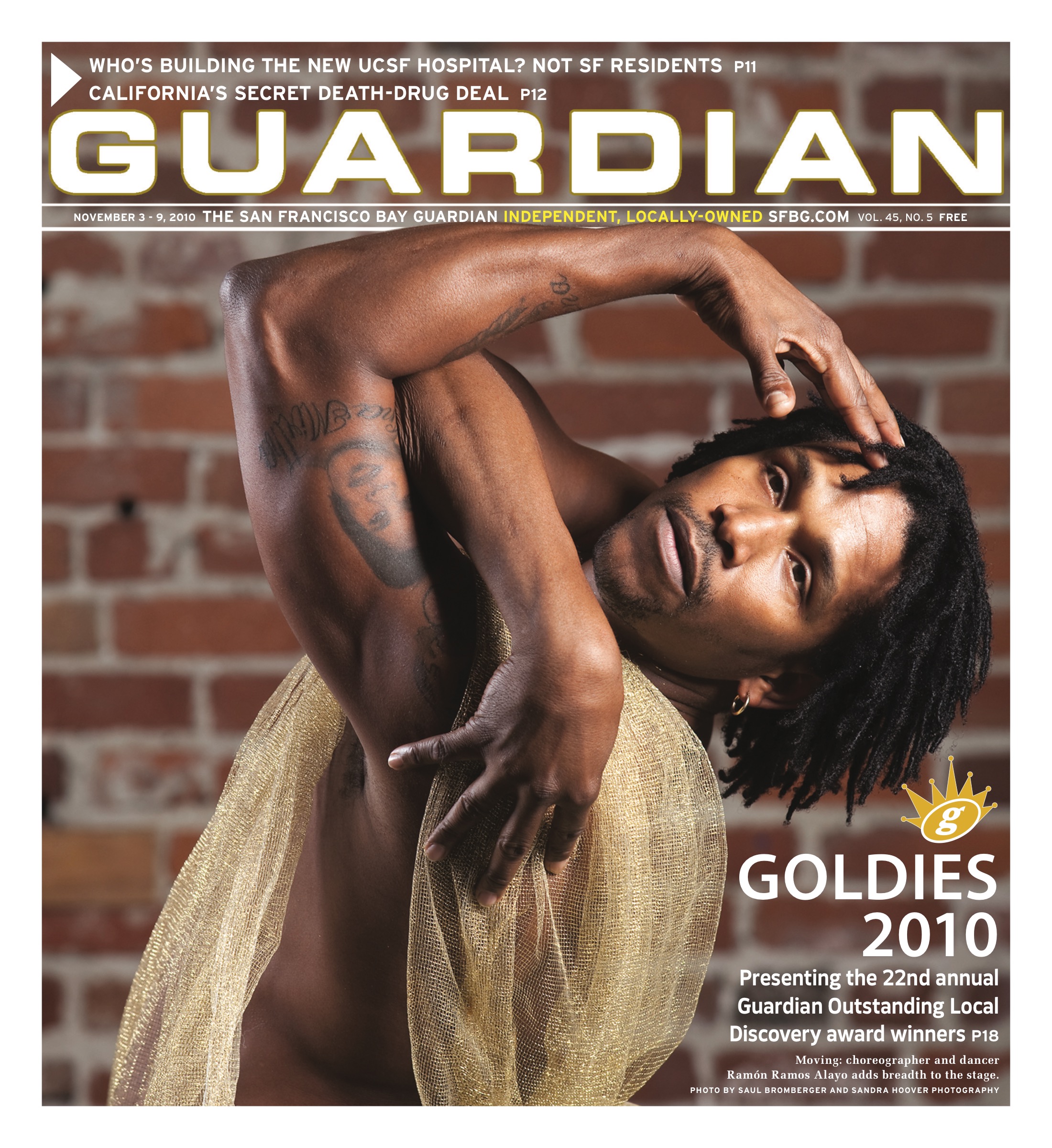
You dog-eared the pages of last week’s Guardian, reading about the Guardian Outstanding Local Discovery award winners. Tonight, head to 111 Minna to congratulate the artists in person — and to rock out at the free, open-to-the-public after party. Taking the stage: Oakland “slop-pop” rockers Bare Wires, SF popsters Brilliant Colors, dark post-punker Soft Moon (a.k.a. Luis Vasquez), pop sensation Myles Cooper (of “Gonna Find Boyfriends Today” fame) with club sensation Alexis Penney, and DJs Naoki Onodera and Primo Pitino. Don’t miss what’s sure to be a mother lode (yep, shameless gold joke) of a party! (Cheryl Eddy)

9 p.m., free

111 Minna Gallery

111 Minna, SF

www.sfbg.com/2010/11/03/goldies-2010


THEATER

Or,

Aphra Behn was a woman ahead of her time. A 17th century spy and the first professional female playwright, Aphra Behn is the topic of Liz Duffy Adams’ new play Or, at Magic Theatre. Full of sensationalism, sex, art, politics, and laughs, this comedy hosts a variety of eccentric characters including double agent William Scot, actress Nell Gwynne, and even King Charles II himself. Adams received the fifth Lillian Hellman Award for Playwrighting for Or, at the 2010 Lilly Awards; the play promises a dose of English history and a chance to chuckle the night away. (Emmaly Wiederholt)

Through Dec. 5

Wed.–Sat., 8 p.m. (also Sat, 2:30 p.m.);

Sun, 2:30 p.m.; Tues, 7 p.m., $45–$60

Magic Theatre

Fort Mason Center, Building D, Third Floor, SF

(415) 441-8822

www.magictheatre.org


THURSDAY 11

DANCE

Ampey!

In 2008, Adia Tamar Whitaker took a trip to Africa, where she encountered ampey, a Ghanian children’s dance for which you need to be on your toes in more ways than one. It became the inspiration for Ampey!, in which she explores complexities surrounding identity, family, and home. For Whitaker, that “return” trip had been become a voyage of discovery — though not in the way she anticipated. Presented as a work in progress last year, one could sense Ampey!’s artistic potential; it already included a powerful percussive “sitting dance.” Perhaps the best aspect of the two-year Performing Diaspora Project is its offer to artists like Whitaker to keep working on what needs to be done. (Rita Felciano)

Through Nov. 21

Thurs/11–Sun/14 and Nov. 18–20, 8 p.m.;

Nov. 21, 3 p.m., $19–$24

Counterpulse

1310 Mission, SF

1-800-838-3006

www.counterpulse.org


MUSIC

Ghostface Killah

No one has your back like Iron Man. Pretty Toney was the original link that brought the whole Wu-Tang together. Always willing to lend a devastatingly together verse to just about anybody’s single (MSTRKRFT, Prefuse 73, DANGERDOOM, etc), Starky still has found time to release classic after classic album. On his latest, Ghostdini: Wizard of Poetry in Emerald City, the Wallabee Kingpin went the extra mile, dispensing priceless relationship advice via a series of YouTube videos. Isn’t it about time you gave Ghostface Killah a little something back in return? (Ryan Prendiville)

With Sheek Louch and Music by Frank Dukes

9 p.m. $22

Slim’s

333 11th St., SF

(415) 255-0333

www.slims-sf.com


MUSIC

Masaki Batoh

Incorporating elements of Krautrock, folk, free jazz, and all manner of indigenous instrumentation, enigmatic Japanese psych collective Ghost are the heirs to such earlier cosmic emissaries as fellow countrymen the Taj Mahal Travelers. Founder and core player Masaki Batoh takes a similarly eclectic approach in his non-Ghost releases, whether turning out a chugging acoustic cover of Can’s “Yoo Doo Right” or mournful dirges, as on his recent collaborative albums with Espers’ Helena Espvall. Tonight’s rare solo set, with Batoh alternating between guitar and banjo and a table full of electronics, should prove no different. (Matt Sussman)

With Young Elders

10 p.m., $10

Vortex Room

1082 Howard, SF

www.myspace.com/thevortexroom

Also Fri/12

With Sic Alps

10 p.m., $5

Ghost Town Gallery

2519 San Pablo, Oakl.

www.myspace.com/ghosttowngallery


DANCE

Sankai Juku

Butoh is perhaps one of the most enigmatic dance forms. Emerging in the late 1950s in opposition to the Westernization of Japan, butoh often explores the more grotesque side of human nature. Unlike other dance forms with a syllabus of movements, butoh may be completely conceptual, hyper-slow, playful, scary, or none of the above. It defies definition. Audiences can begin to wrap their minds around butoh as Sankai Juku, the legendary Japanese butoh company, tours to San Francisco to present Hibiki: Resonance from Far Away, a piece said to plumb poetic beauty. Meditative and hypnotic in its simplicity, this award-winning work is a signature of butoh. (Wiederholt)

Thurs/11–Sat/13, 8 p.m.;

Sun/14, 2 p.m., $35–$60

Yerba Buena Center for the Arts

Novellus Theater

700 Howard, SF

(415) 978-2787

www.ybca.org


FRIDAY 12

MUSIC

Lindstrøm

Known to much prefer holing up in the studio in his home base of Oslo, Norway, than performing live, this is a rare opportunity to catch a set from one of the more interesting electronic music producers around. Lindstrøm first made a name for himself as a remix artist, reworking tracks from the likes of LCD Soundsystem, Roxy Music, Franz Ferdinand, and the Boredoms. His solo albums are full of frosty disco beats, heavy synthesizers, classic funk influences and enough of an adventurous streak to appeal to more than just the dance floor crowd. (Landon Moblad)

With Marbeya and Publicist

9 p.m., $15

Mezzanine

444 Jessie, SF

(415) 625-8880

www.mezzaninesf.com


DANCE

“Manifestival: Like Oil and Water: From Gaza to the Gulf”

Lots of Bay Area artists know that the world is a village, all politics are local, and that it’s probably not a good idea to ignore an problem until it burns your face. Socially committed dance is a large part of what we see on our stages. Artists are the antennas of the race and following them is fun as well as instructive. This year’s Manifestival theme of “Like Oil and Water: From Gaza to the Gulf” should provide more than enough inspiration for the two different programs. Onstage the first weekend are Jessica Damon, Jose Navarrete, Michael Velez, Nicole Klaymoon, Sri Susilowati, Naked Empire Buffoon, Stella Adelman, and Youth Speaks. (Felciano)

Through Nov. 20

Fri.–Sat., 8 p.m., $22

Dance Mission Theater

3316 24th St. SF

(415) 273-4633

www.brownpapertickets.com


VISUAL ART

“A Journeyman’s Papers”

Rare is the gallery show at which the owner of said gallery steps out from the wings and shows his or her own work. Risks! No one wants to be seen as the next megalomaniac Thomas Kincaid, drunkenly careening into the heavily curtained schlock-nests of Midwestern housewives, right? No fear of that kind of showboating here. Rob Delamater, co-owner of dapper cognoscenti-magnet Lost Art Salon, creates voluptuously genteel, generous-spirited pieces that fit right in with his gallery’s excellent collection of rare vintage modern works. Block-printed portraits of the wanton Bloomsbury group, evocative and crepuscular figure studies, and, perhaps most intriguing, softly primitive compositions evoking the California coastline painted on vintage book covers are the gorgeous, midcentury-type whistle stops on Delamater’s artistic journey. Doff your fedora, shed your silk shift, and have a lovely look. (Marke B.)

Through Jan. 31, 2011

5:30–8:30 p.m., free

Lost Art Salon

245 S. Van Ness, Suite 203, SF

(415) 861-1530

www.lostartsalon.com


SATURDAY 13

MUSIC

Dãm-Funk

George Clinton and Parliament Funkadelic are going to be at Yoshi’s next week. That’s cool. But instead of waiting to enjoy what’s sure to be a great reminiscing on where funk’s been, why not check where it’s going? Dãm-Funk (pronounced “Dame Funk”) lays down a DJ set at Som Bar. A DIY DJ, producer, and recording artist, Dãm-Funk uses the same playbook as Ariel Pink, digging deep into genres and musical styles that were left by the wayside to create distinct sounds. While I can’t guarantee that he’ll break out the Animal Collective (so many records to choose from), word is that he’ll bust out the keytar. (Prendiville)

With King Most, Jacob Pena, and Freddy Anzures

9 p.m., $10

Som.

2925 16th St., SF

www.som-bar.com


EVENT

“Frogs in the Fog”

Wow, I just found the frikkin’ treasure trove! Not even my ecology-expert friends knew that the San Francisco Naturalist Society has the most kickass events calendar (www.sfns.org/events) — one that’s updated daily, to (hiking) boot. Probably the coolest-sounding upcoming event is led by “Mr. Science,” a.k.a. Chris Giorni, founder of Tree Frog Treks, and starts with checking out his extensive stash of amphibians and reptiles. After bonding with uncharacteristic mini-fauna, grab a slice of pizza to sustain your explorer spirit onward toward the hidden ponds, sacred groves, and endless discoveries of western Golden Gate Park. While the Treks’ mission is to make science fun for the kiddos, this adventure is open to all. (Kat Renz)

4 p.m.–6:15 p.m., $15–$50 (sliding scale)

Tree Frog Treks’ Frog Hall

2114 Hayes, SF

(415) 564-4107

www.baynature.org


SUNDAY 14

MUSIC

Nile

Specializing in impossibly fast blast beats and meticulously researched Egyptological lyrics, Nile has carved out a niche as one of the scene’s most revered death metal acts. The South Carolina quartet hews closely to the genre’s traditions, playing intricate, epic compositions that lean heavily on tremolo picking and sheer speed. Replicating such extreme chops live is no mean feat, but previous appearances by the band have been flawless and incendiary, particularly when they launch into epic closer “Unas Slayer of the Gods.” Whether you’re there for the tales of bloodthirsty pharaohs or just excited to bask in the copious beats-per-minute, Nile will take no prisoners. (Ben Richardson)

With Ex Deo, Psycroptic, Keep of Kalessin

7:30 p.m., $30

Slim’s

333 11th St., SF

(415) 255-0333

www.slims-sf.com


MONDAY 15

MUSIC

Thermals

For punk-tinged indie rockers Thermals, consistency is the name of the game. Never straying too far from its bare-bones, guitar, bass, and drums format, the Portland, Ore.-based band has now released five albums of punchy Buzzcocks-esque rock ‘n’ roll. Its newest, Personal Life, was produced by Death Cab for Cutie’s Chris Walla and includes a nice mix of slower, more drawn-out tracks and infectious, pound-on-your-steering-wheel bursts of adrenaline, such as lead single “I Don’t Believe You.” (Moblad)

With Night Marchers and White Fang

8 p.m., $16

Independent

628 Divisadero, SF

(415) 771-1421

www.theindependentsf.com 


The Guardian listings deadline is two weeks prior to our Wednesday publication date. To submit an item for consideration, please include the title of the event, a brief description of the event, date and time, venue name, street address (listing cross streets only isn’t sufficient), city, telephone number readers can call for more information, telephone number for media, and admission costs. Send information to Listings, the Guardian Building, 135 Mississippi St., SF, CA 94107; fax to (415) 487-2506; or e-mail (paste press release into e-mail body — no text attachments, please) to listings@sfbg.com. We cannot guarantee the return of photos, but enclosing an SASE helps. Digital photos may be submitted in jpeg format; the image must be at least 240 dpi and four inches by six inches in size. We regret we cannot accept listings over the phone.
Film Listings

0

Film listings are edited by Cheryl Eddy. Reviewers are Kimberly Chun, Michelle Devereaux, Peter Galvin, Max Goldberg, Dennis Harvey, Johnny Ray Huston, Louis Peitzman, Lynn Rapoport, Ben Richardson, and Matt Sussman. The film intern is Ryan Prendiville. For rep house showtimes, see Rep Clock. 

OPENING

Cool It Bjørn Lomborg, author of The Skeptical Environmentalist, is a controversial figure in the climate change community. “He’s a massive negative force in this issue,” says a Stanford professor in Cool It, a documentary from Ondi Timoner (2004’s Dig!) Accused of being a climate change denier, Lomborg argues that it is not the case; he accepts the reality global warming, but believes current approaches are misguided. What do you do with $250 billion to fight climate change? Lomborg’s answer: prioritizing solving basically every major social and medical problem facing the world (wouldn’t that be nice) while also funding new technologies. The film gets insulting at parts, comparing Lomborg’s opponents to school children. (When Timoner takes the time to humanize, showing Lomborg calling his aging mother, it’s just insulting to the audience.) Ultimately, taken with films like 2006’s An Inconvenient Truth, there’s a convincing argument for a need to go home from the theater and look the issues up firsthand. (1:28) Bridge. (Prendiville)

*Four Lions If you think terrorism is no laughing matter you might resist English director-cowriter Chris Morris’ first film, which does make it pretty damn funny — it being the fanaticism, doggerel, and dim-bulbdom that can create suicide bombers, not the suicide bombing (or other murderous acts) themselves. Yes, people get hurt here, but within the Three Stooges tradition of folks who can’t stop boinking themselves or one another with mallets, or in this case (somewhat) more sophisticated weaponry. The protagonists here are working-class Sheffield Muslims, two of whom (Kayvan Novak, Riz Ahmed) just spectacularly flunked out of terrorist training camp in Pakistan. The others include a recent convert to Islam (Nigel Lindsay) who seems to be in it solely to lend his all-purpose rage an excusing “cause,” and a guy (Adeel Akhtar) training crows to deliver bombs — well, he’s trying. Their goal: getting blown to smithereens (hopefully taking as many infidels with them as possible) during the London Marathon. So … what’s their jihad? Let’s just say zeal outstrips cogency of moral mission, let alone competency at becoming a public threat, amongst these arbitrarily Koran-misquoting bozos. Four Lions manages to mix the credible and farcical, satirizing holy-terrorism without insulting religion (or culture, or ethnicity) itself. Despite very deft performances, script and direction remain hit ‘n’ miss to a point — but at that point, encompassing the long marathon-centered climax, it all turns freakin’ hilarious. (1:42) Lumiere. (Harvey)

Morning Glory Rachel McAdams plays a morning-show producer; Harrison Ford and Diane Keaton play her battling co-anchors. (1:47) Marina, Shattuck.

127 Hours See “Rock Rolled.” (1:30) Embarcadero.

Skyline Aliens invade LA, sending a cast of C-listers a-scurryin’ from a barrage of special effects. (runtime not available)

*Strange Powers: Stephin Merritt and the Magnetic Fields The release of the 1999 collection 69 Love Songs put the Magnetic Fields and Stephin Merritt, the group’s prickly mastermind, into the spotlight for the first time. Since then, the group has willingly slinked back into the arms of its devoted fan base while continuing to write some of the prettiest, cleverest, and most timeless-sounding pop songs around. Typically known as a bit of a recluse, Merritt allowed full access to the filmmakers, who captured over ten years of live footage, recording sessions, and personal interviews. Pulling back the curtain in this case isn’t a bad thing at all, as the group’s overall charm is balanced out with Merritt’s mysterious ambiguity intact. Some of the best moments — Merritt playing with his Chihuahua, casually arguing with his band mates, musing on the differences between Los Angeles and New York gay bars — find beauty in the mundane; just like the songs themselves. (1:22) Roxie. (Landon Moblad)

Unstoppable After a dunderheaded train-yard worker essentially flicks the “hellbent” switch on an unmanned train loaded with hazardous materials, it’s up to odd-couple operators Denzel Washington (old; cranky; in endearing subplot, his daughters work at Hooters) and Chris Pine (young; cocky; in weirdly off-putting subplot, his wife has a restraining order against him) to chase down that loco-motive and prove the movie’s title wrong. The film mostly darts between the interior of a train car, for Washington-Pine bickering; railroad mission control, where a miscast Rosario Dawson literally phones in her performance; TV news reports, lazily illustrating the train’s flight through rural Pennsylvania; and various low angles relative to the speeding train, so sinister it’s bright red and numbered 777 (which is, like, almost 666!) Veteran action director Tony Scott does what he can with the based-on-true-events storyline, but Unstoppable is so deadly serious and predictable it just gets boring after awhile. At least the runaway vehicle in 1994’s similar Speed had a villain to enjoy; here, there’s just an angry choo-choo. Miss you, Dennis Hopper. (1:38) (Eddy)

*Vision: From the Life of Hildegard von Bingen Born almost a 1,000 years ago and long regarded a feminist groundbreaker, Hildegard von Bingen was a composer, scientist, healer, writer, visionary, and game-changer in her humanist view of faith. A Benedictine nun who became the noted female spiritual leader when there were none, she built her own convent, and attracted the attention of the Pope with her waking visions, images she would interpret as dispatches from God. The feminist director of such classics of German new wave moviemaking as The Lost Honor of Katharina Blum (1975), Marianne and Juliane (1981), and Rosa Luxemburg (1986), Margarethe von Trotta is still focused on revolutionary women, albeit, with Vision, one who finds a way to work nonviolently, within the system. The challenge here is to bring the potentially stolid and static life of a medieval mystic to the screen — there are few concrete historical details about everyday life within a convent. But aided by Barbara Sukowa — the fiery radical center of both Marianne and Juliane and Rosa Luxemburg — von Trotta manages to give Hildegard human dimensions: the abbess is far from modest and retiring when, for instance, she needs to navigate the byzantine politics of the church or when her most devoted acolyte Richardis (Hannah Herzsprung) is wrenched away. Ornamented by Hildregarde’s compelling compositions and careful never to stray into kitsch, Vision only occasionally lapses into the flatness of a standard biopic — Hildegard (and Sukowa) are too fascinating, and von Trotta has been too long absent from moviemaking. (1:51) Lumiere, Shattuck, Smith Rafael. (Chun)

ONGOING

Carlos (5:30) Sundance Kabuki.

Conviction (1:47) Empire, Piedmont, SF Center.

Due Date One delayed appearance for a baby’s birth does not a Hangover (2009) make. After all, even the most commited baby daddy isn’t totally required to be at the blessed event, unlike a wedding ceremony. So even two films into what seems like a trilogy of bromancey men’s coming-of-age terror, director Todd Phillips already seems to working a tired old bone. Slick LA architect Peter (Robert Downey Jr.) has a self-satisfied mean streak that doesn’t seem to be abating with the birth of his first child halfway across the country, or his run-ins with budding thespian Ethan (Zach Galifianakis) — the two collide cute in the airport on their way to the so-called Best Coast. One no-fly list leads to another, and Peter is reluctantly hightailing it by rental car with the uncoolest dude in school. Oh dear: Roadtrip for Schmucks, anyone? Due Date proves that, yes, contrary to what I once believed, there is such a thing as too much Galifianakis, in perpetual shtick mode here. And even though the weathered, well-textured Downey can build character with a single well-placed, black-hearted glare, he’s saddled with such a sorry misanthropic creep here that the audience is hard-pressed to care. (1:35) Empire, Four Star, 1000 Van Ness, Presidio, SF Center, Shattuck, Sundance Kabuki. (Chun)

*Fair Game (1:46) California, Embarcadero, Piedmont, Sundance Kabuki.

For Colored Girls (2:00) 1000 Van Ness.

*The Girl Who Kicked the Hornet’s Nest (2:28) Clay, Piedmont, Shattuck, Smith Rafael.

Hereafter (2:09) Empire, 1000 Van Ness, Presidio, SF Center, Shattuck, Sundance Kabuki.

Inside Job (2:00) Embarcadero, Shattuck, Smith Rafael, Sundance Kabuki.

It’s Kind of a Funny Story (1:51) Four Star, 1000 Van Ness, Shattuck.

*Jackass 3D (1:30) 1000 Van Ness.

*Leaving (1:30) Albany, Opera Plaza, Smith Rafael.

*Mademoiselle Chambon (1:41) Opera Plaza.

*Megamind (1:36) 1000 Van Ness, Presidio, Sundance Kabuki.

*Monsters (1:33) California, Lumiere.

*Nowhere Boy (1:37) Shattuck.

Paranormal Activity 2 (1:45) California, 1000 Van Ness.

Red (1:51) 1000 Van Ness, SF Center, Sundance Kabuki.

Saw 3D (1:31) 1000 Van Ness.

*Secretariat (1:56) 1000 Van Ness, SF Center.

*The Social Network (2:00) Marina, 1000 Van Ness, Sundance Kabuki.

Stone (1:45) Opera Plaza.

*36 Quai des Orfèvres (1:51) Roxie.

Tibet in Song (1:26) Shattuck.

The Town (2:10) 1000 Van Ness, Presidio, SF Center, Shattuck.

*Waiting for “Superman” (1:51) Piedmont, SF Center, Shattuck.

Wall Street: Money Never Sleeps (2:13) Presidio.

You Will Meet a Tall Dark Stranger (1:38) Albany, Four Star, Opera Plaza.

Side of the road

0

arts@sfbg.com

FILM Kelly Reichardt wrote and directed a pair of arresting short features in the 1990s — River of Grass (1993) and Ode (1999) — but it was the two poignant recalibrations of the road movie she made during the George W. Bush years that put her on the map. With so much American independent cinema gone upwardly mobile, Old Joy (2006) and Wendy and Lucy (2008) were films that dug back in to that minor place that gives the 1970s cinema of Monte Hellman (1971’s Two-Lane Blacktop), Bob Rafelson (1970’s Five Easy Pieces), Barbara Loden (1970’s Wanda), and Eagle Pennell (1978’s The Whole Shootin’ Match) its plaintive appeal. Reichardt’s characters (the recent ones all developed with the help of Portland, Ore., author Jon Raymond) are side-winding, shipwrecked, or otherwise in limbo. The films do not engineer uplift, but instead reserve empathy for melancholy souls who, for one reason or another, feel themselves cut off.

Some of the elements of Reichardt’s “naturalism” include her subtle direction of actors (an emphasis on gesture and rhythm); her deceptively unhurried pacing which, as in the best short stories, reveals the continuity of life in its interruptions; her sensitivity to the emotional registry of politics; and the strong regional accents of all her films. If you’ve seen the two earlier movies, you know that Reichardt has a strong feeling for the southeast’s glades, but she’s since come to be associated with Oregon’s overcast skies (her new film, Meek’s Cutoff, was shot upon the state’s hardscrabble plains). Reichardt could probably make a good picture in any out-of-the-way place — a lot of America, actually.

Reichardt’s films unfold as ballads: a cast of two, with occasional walk-ons, observed from a near distance. The incremental addition of events anticipates heartbreak or worse, with context and emphasis left between the lines. Always, we find ourselves in an America where it’s hard to escape and easy to get lost. However the meaning of “escape” and “getting lost” might vary, the characters emerge similarly bruised: walking the strip, stuck in traffic, riding a freight train, or back at home without consolation. Many of Reichardt’s memorable scenes — and there are already many — might have been torn from Robert Frank’s The Americans.

Like all good ballads, the stories strike us as being emblematic. In interviews, Reichardt has made it clear that she intends her films to remind us of the times, whether evoking the left’s ineffectual ties in Old Joy or the lack of a public sphere in Wendy and Lucy. As with her ’70s forerunners, the films invite a pastoral daydream (renewal in the wilderness or out on the road) only to have it dissipate in responsibility or a dead end. Something Cozy (Lisa Bowman) says in River of Grass hangs over all Reichardt’s movies: “It’s funny how a person can leave everything she knew behind and still wind up in such a familiar place.”

Even before learning that Meek’s Cutoff (which premiered at the 2010 Venice Film Festival; no local release date has been announced) was to be set in 1845, it seemed reasonable to assume that we wouldn’t soon see a computer or text message in one of Reichardt’s films. Her characters all have difficulty communicating — this can be vexing, especially in Wendy and Lucy — but the films finally turn on the repressed energies and vulnerabilities that only surface in the midst of a genuine encounter. In Reichardt’s early work, intimate productions provided the right scale for these fragile relationships. That began to change in Wendy and Lucy by virtue of Michelle Williams, and now Meek’s Cutoff represents another enlargement of cast and budget. Reichardt will be in conversation with film scholar B. Ruby Rich following the Pacific Film Archive’s screenings of Old Joy and Wendy and Lucy, and it will be interesting to hear whether the extra attention has made it any more difficult for her to keep to the byways. 

KELLY REICHARDT WITH B. RUBY RICH

Nov. 11–13, $5.50–$9.50

Pacific Film Archive

2575 Bancroft, Berk.

(510) 642-5249 www.bampfa.berkeley.edu

Dodging bullets

14

steve@sfbg.com

Progressives in San Francisco dodged a few bullets on election night, which was the highest hope that many held in a campaign season dominated by conservative money and messaging. The Board of Supervisors retained a progressive majority, Prop B’s attack on public employees went down, the wealthy will pay more property transfer taxes, and — perhaps the best news of all — Gavin Newsom is leaving for Sacramento a year before his mayoral term ends.

But economically conservative and downtown-backed campaigns and candidates scored the most election-night victories in San Francisco, killing a temporary hotel tax hike pushed hard by labor and several progressive-sponsored ballot measures, and winning approval for the divisive sit-lie ordinance and Prop. G, removing Muni driver pay guarantees, which had the widest margin of the night: 65-35 percent.

“Ultimately, downtown did well,” progressive political consultant Jim Stearns told us on election night, noting how aggressive spending by downtown business and real estate interests ended a string of progressive victories in the last several election cycles. He cited the likely election of Scott Wiener in District 8 and the strong challenge in District 2 by Mark Farrell to perceived frontrunner Janet Reilly, who had progressive and mainstream endorsements.

A preliminary Guardian analysis of reported spending by independent expenditure committees shows that groups affiliated with downtown or supporting more conservative candidates spent about $922,435, the biggest contributions coming from conservative businessman Thomas Coates and the San Francisco Board of Realtors, compared to $635,203 by more progressive organizations, mostly the San Francisco Democratic Party and San Francisco Labor Council.

That spending piggy-backed on national campaigns that were also skewed heavily to conservative and corporate-funded groups and messaging that demonized government and public employee unions, playing on people’s economic insecurities during a stubborn recession and jobless recovery.

Stearns said voters are having a hard time in this economy “and they don’t like to see the government spending.” He said national polls consistently show that people are more scared of “big government” than they are “big corporations,” even if San Francisco progressives tend to hold the opposite view.

And even that narrow defeat came after an almost unprecedented opposition campaign that included every elected official in San Francisco except the measure’s sponsor, Public Defender Jeff Adachi, and both the labor movement and many moderate groups.

“The campaign on this was extraordinary and caught fire at the end,” Alex Clemens, founder of Barbary Coast Consulting, said at SPUR’s Nov. 4 election wrap-up event. In particular, the message about how much Prop B would increase the health care costs on median-income city employees seemed to resonate with voters.

“We are really happy that Prop. B is going down because it was such a misguided measure. It was not well thought through,” Labor Council President Tim Paulson told the Guardian at the election night party labor threw with the San Francisco Democratic Party at Great American Music Hall. “San Francisco voters are the smartest in America.”

Paulson was also happy to see those voters approve taxing the transfer of properties worth more than $5 million, “because San Franciscans know that everyone has to pay their fair share.”

In the Board of Supervisors races, it was basically a status quo election that shouldn’t alter the body’s current politics dynamics much. Sup. Bevan Dufty will be replaced with fellow moderate Scott Wiener in D8 and Sup. Chris Daly by progressive Jane Kim in D6. The outcome of races to replace ideological wobbler Sup. Sophie Maxwell in D10 and conservative Michela Alioto-Pier in D2 may not be conclusively known for at least a few more days (maybe longer if the close races devolve into lawsuits), but neither is a seat that would diminish the board’s progressive majority.

Progressives could have made a gain if Rafael Mandelman had won in D8, but he was seven points behind Wiener on election night and even more after the initial ranked choice tally was run on Nov. 5. And in D6, fears that downtown-backed candidate Theresa Sparks might sneak past dueling progressive candidates Jane Kim and Debra Walker never materialized as Sparks finished far behind the lefty pair.

Consultant David Latterman, who worked for Sparks, told us on election night that he was surprised to see that Kim was the choice of 32 percent of early absentee voters “because we targeted those voters.” By comparison, Walker was at 20 percent and Sparks was at 21 percent in the initial returns, which tend to be more conservative. By the end of the night, Kim had 31.3 percent, Walker 27.7 percent, and Sparks just 16.5 percent.

“If she did that well with absentees, it seems like it was Jane’s race to win. If they choose Jane, they wanted Jane. It’s just that simple,” Latterman told us on election night.

At her election night party, Kim credited her apparent victory to a strong campaign that she said fielded 400 volunteers on Election Day, most wearing the bright red T-shirts that read “See Jane Run” on the back. “I feel good,” Kim told the Guardian. “What I’m really happy about is we ran a really good campaign.”

In the end, Kim’s campaign was put over the top by the second-place votes of Sparks’ supporters, with 769 votes going to Kim and 572 to Walker in the first preliminary run of ranked-choice voter tabulations. But despite the bad blood that developed between progressives in the Kim and Walker campaigns, Board President David Chiu, an early Kim supporter, sounded a conciliatory note, telling the Guardian on election night, “Given where Debra and Jane are, I’m glad that we’re going to keep this a progressive seat.”

The next mayor

108

tredmond@sfbg.com

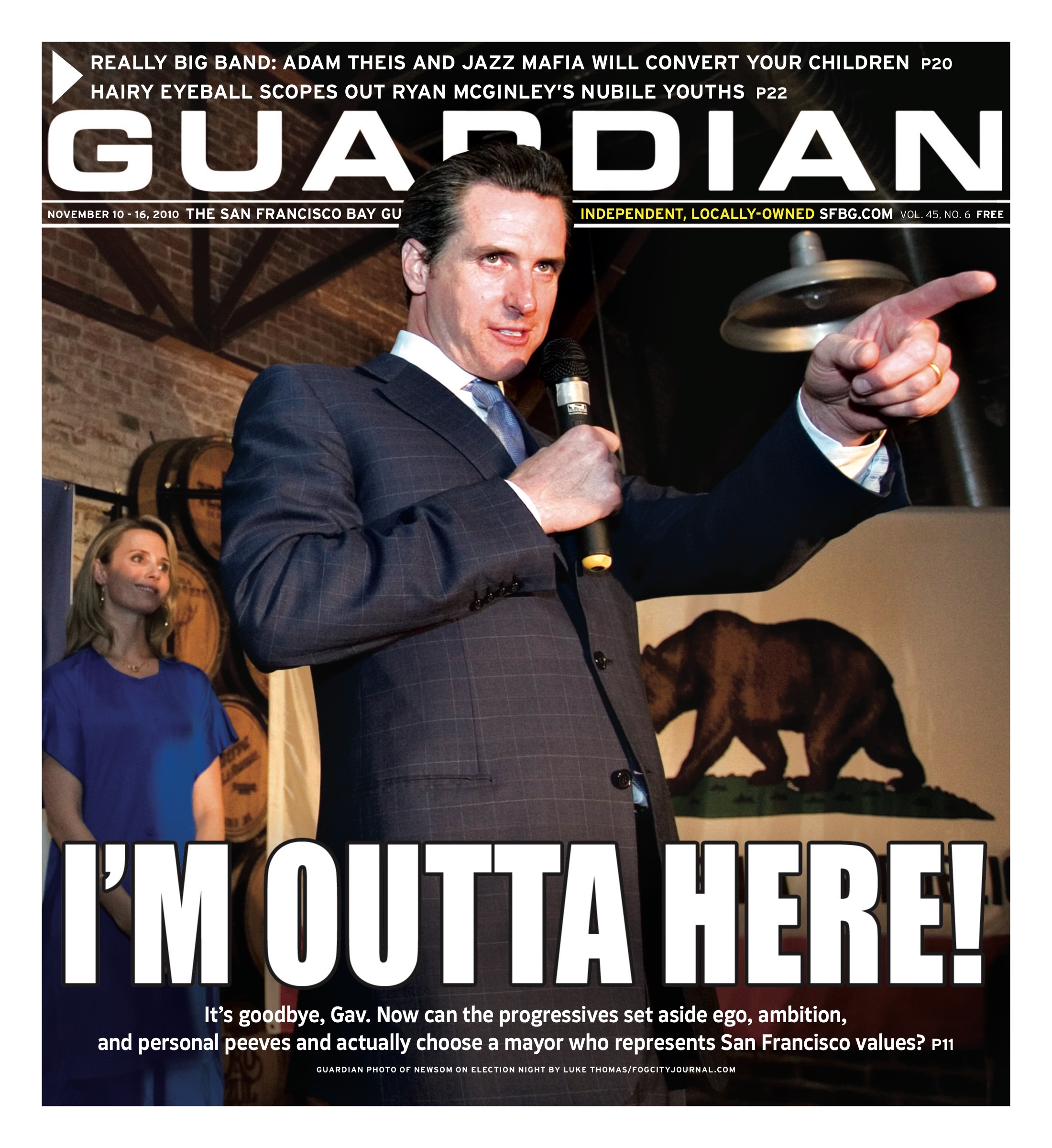
By the time a beaming Mayor Gavin Newsom took the stage at Tres Agaves, the chic SoMa restaurant, on election night, enough results were in to leave no doubt: the top two places on the California ballot would go to the Democrats. Jerry Brown would defeat Meg Whitman in the most expensive gubernatorial race in American history — and Newsom, who once challenged Brown in the primary and dismissed the office of lieutenant governor, would be Brown’s No. 2.

It might not be a powerful job, but Newsom wasn’t taking it lightly anymore. “We can’t afford to continue to play in the margins,” he proclaimed proudly, advancing a vague but ambitious agenda. “There is absolutely nothing wrong with California that can’t be fixed with what’s right with California.”

But around the city, as results trickled in for the local races, the talk wasn’t about Newsom’s role in the Brown administration, or the change the Democrats might bring to Sacramento. It was about the profound change that could take place in his hometown as he vacates the office of mayor a year early — and opens the door for the progressives who control the Board of Supervisors to appoint a chief executive who agrees with, and is willing to work with, the majority of the district-elected board.

At a time when the Republican takeover of Congress threatens to create gridlock in Washington, there’s a real chance that San Francisco’s government — often paralyzed by friction between Newsom and the board — could take on an entirely new direction. It’s possible that the progressives, long denied the top spot at City Hall, could put a mayor in office who shares their agenda.

This could be a turning point in San Francisco, a chance to put the interests of the neighborhoods, the working class, small businesses, the environmental movement, and economic justice ahead of the demands of downtown and the rich. All the pieces are in place — except one.

To make a progressive vision happen, the fractious (and in some cases, overly ambitious) elected leaders of the progressive movement will have to recognize, just for a little while, that it’s not about any individual. It’s not about David Chiu, or Ross Mirkarimi, or Chris Daly, or John Avalos, or Eric Mar, or David Campos, or Jane Kim, or Aaron Peskin. It’s not about any one person’s career or personal power.

It’s about a progressive movement and the issues and causes that movement represents. And if the folks with the egos and personal gripes and career designs can’t set them aside and do what’s best for the movement as a whole, then the opportunity of a generation will be wasted.

Folks: this is a hard thing for politicians to recognize. But right now it’s not about you. It’s about all of us.

It’s an odd time in San Francisco, fraught with political hazards. And it’s so confusing that no one — not the elected officials, not the pundits, not the lobbyists, not the insiders — has any clear idea who will occupy Room 200 in January.

Here’s the basic scenario, as described by past opinions of the city attorney’s office:

Under the state Constitution, Newsom will take office as lieutenant governor Jan. 3, 2011. The City Charter provides that a vacancy in the Mayor’s Office is filled by the president of the Board of Supervisors until the board can choose someone to fill the job until the end of the term — in this case, for 11 more months.

So if all goes according to the rules (and Newsom doesn’t try to play some legal game and delay his swearing-in), David Chiu will become acting mayor on Jan.3. He’ll also retain his job as board president.

On Jan. 4, the current members of the Board of Supervisors will hold a regularly scheduled Tuesday meeting — and the election of a new mayor will be on the agenda. If six of the current supervisors can agree on a name (and sitting supervisors can’t vote for themselves) then that person will immediately take office and finish Newsom’s term.

If nobody gets six votes — that is, if the board is gridlocked — Chiu remains in both offices until the next regular meeting of the board — a week later, when the newly elected supervisors are sworn in.

The new board will then elect a board president — who will also instantly become acting mayor — and then go about trying to find someone who can get six votes to take the top job. If that doesn’t work — that is, if the new board is also gridlocked — then the new board president remains acting mayor until January 2012.

There are at least three basic approaches being bandied about. Some people, including Newsom and some of the more conservative members of the board, want to see a “caretaker” mayor, someone with no personal ambition for the job, fill out Newsom’s term, allowing the voters to choose the next mayor in November, 2011. That has problems. As Campos told us, “The city has serious budget and policy issues and it’s unlikely a caretaker could handle them effectively.” In other words, a short-termer will have no real power and will just punt hard decisions for another year.

Then there’s the concept of putting in a sacrificial progressive — someone who will push through the tax increases and service cuts necessary to close a $400 million budget gap, approve a series of bills that stalled under Newsom, take the hits from the San Francisco Chronicle, and step out of the way to let someone else run in November.

The downside of that approach? It’s almost impossible for a true progressive to raise the money needed to beat a downtown candidate in a citywide mayor’s race. And it seems foolish to give up the opportunity to someone in the mayor’s office who can run for reelection as an incumbent.

Which is, of course, the third — and most intriguing — scenario.

The press, the pundits, and the mayor have for the past few months been pushing former Sup. Peskin as the foil, trying to spin the situation to suggest that the current chair of the local Democratic Party is angling for a job he wouldn’t win in a normal election. But right now, Peskin is no more a front-runner than anyone else. And although he’s made no secret in the past of wanting the job, he’s been talking of late more about the need for a progressive than about his own ambitions.

“If the board chose [state Assemblymember] Tom Ammiano, I would be thrilled to play a role, however small, in that administration,” Peskin told us.

In fact, Peskin said, the supervisors need to stop thinking about personalities and start looking at the larger picture. “If we as a movement can’t pull this off, then shame on us.”

Or as Sup. Campos put it: “We have to come together here and do what’s right for the progressive movement.”

Two years ago, the San Francisco left was — to the extent that it’s possible — a united electoral movement. In June, an undisputed left slate won a majority on the Democratic County Central Committee. In November 2008, Districts 1, 3, 5, and 11 saw consensus left candidates running against downtown-backed opponents — and won. In D9, three progressives ran a remarkably civil campaign with little or no intramural attacks.

The results were impressive. As labor activist Gabriel Haaland put it, “we ran the table.”

But that unity fell apart quickly, as a faction led by Daly sought to ensure that Sup. Ross Mirkarimi couldn’t get elected board president. Instead that job went to Chiu — the least experienced of the supervisors elected in that class, and a politician who is, by his own account, the most centrist member of the liberal majority.

This fall, the campaign to replace Daly in D6 turned nasty as both Debra Walker and Jane Kim openly attacked each other. Walker sent out anti-Kim mailers, and Kim’s supporters charged that Walker was part of a political machine — a damaging (if silly) allegation that created a completely unnecessary rift on the left.

And let’s face it: those fights were all about personality and ego, not issues or progressive strategy. Mirkarimi and Daly have never had any substantive policy disagreements, and neither did Walker and Kim.

In the wake of that, progressives need to come together if they want to take advantage of the opportunity to change the direction of the city. It’s not going to be easy.

“We’re good at losing,” Daly said. “I’m afraid we’re doing everything we can to blow it.”

The cold political calculus is that none of the current board members can count on six votes, and neither can Peskin or any of the other commonly mentioned candidates. The only person who would almost certainly get six votes today is Ammiano — and so far, he’s not interested.

“I know you never say never in politics, but I’m happy here in Sacramento. Eighty-six percent of the voters sent me back for another term, and I think that says something,” he told us.

It’s hardly surprising that someone like Ammiano, who has a secure job he likes and soaring approval ratings, would demur on taking on what by any account will be a short-term nightmare. The city is still effectively broke, and next year’s budget shortfall is projected at roughly $400 million. There’s no easy way to raise revenue, and after four years of brutal cuts, there’s not much left to pare. The next mayor will be delivering bad news to the voters, making unpleasant and unpopular decisions, infuriating powerful interest groups of one sort or another — and then, should he or she want the job any longer, asking for a vote of confidence in November.

Yet he power of incumbency in San Francisco is significant. The past two mayors, Newsom and Willie Brown, were reelected easily, despite some serious problems. And an incumbent has the ability to raise money that most progressives won’t have on their own.

Chiu thus far is being cautious. He told us his main concern right now is ensuring that the process for choosing the next mayor is open, honest, and legally sound. He won’t even say if he’s officially interested in the job (although board observers say he’s already making the rounds and counting potential votes).

And no matter what happens, he will be acting mayor for at least a day, which gives him an advantage over anyone else in the contest.

But some of the board progressives are unhappy about how Chiu negotiated the last two budget deals with Newsom and don’t see him as a strong leader on the left.

Ross Mirkarimi is the longest-serving progressive (other than Daly, who isn’t remotely a candidate), and he’s made no secret of his political ambitions. Then there’s Campos, an effective and even-tempered supervisor who has friendly relationships with the board’s left flank and with centrists like Bevan Dufty. But even if Dufty (who I suspect would love to be part of electing the first openly gay mayor of San Francisco) does support Campos, he’d still need every other progressive supervisor. Campos also would need Chiu’s vote to go over the top. Which means Chiu — who needs progressive support for whatever his political future holds — would have to set aside his own designs on the job to put a progressive in office.

In other words, some people who want to be mayor are going to have to give that up and support the strongest progressive. “If there’s someone other than me who can get six votes, then I’m going to support that person,” Campos noted.

Then there are the outsiders. City Attorney Dennis Herrera has already announced he plans to run in the fall. If the board’s looking for a respected candidate who can appeal to moderates as well as progressives, his name will come up. So will state Sen. Mark Leno, who has the political gravitas and experience and would be formidable in a re-election campaign in November. Leno doesn’t always side with the left on local races; he supported Supervisor-elect Scott Wiener, and losing D6 candidate Theresa Sparks. But he has always sought to remain on good terms with progressives.

All that assumes that the current board will make the choice — and even that is a matter of strategic and political dispute. If the lame duck supervisors choose a mayor — particularly a strong progressive — you can count on the San Francisco Chronicle, Newsom, and the downtown establishment to call it a “power grab” and cast doubt on the legitimacy of the winner.

“But choosing a mayor is the legal responsibility of this board and they ought to do their jobs,” Peskin said.

The exact makeup of the next board was still unclear at press time. Jane Kim is the likely winner in D6 and has always been a progressive on the School Board. She’s also close to Chiu, who strongly supported her. If Malia Cohen or Lynette Sweet wins D10, it’s unlikely either of them will vote for a progressive mayor.

Newsom also might try to screw things up with a last-minute power play. He could, for example, simply refuse to take the oath of office as lieutenant governor until after the new board is seated.

Chiu’s allies say it makes sense for the progressives to choose a mayor who’s not identified so closely with the left wing of the board, who can appeal to the more moderate voters. That’s a powerful argument, and Herrera and Leno can also make the case. The progressive agenda — and the city — would be far better off with a more moderate mayor who is willing to work with the board than it has been with the arrogant, recalcitrant, and distant Newsom. And if the progressives got 75 percent of what they wanted from the mayor (as opposed to about 10 percent under Newsom), that would be cause to celebrate.

But to accept that as a political approach requires a gigantic assumption. It requires San Franciscans to give up on the idea that this is still, at heart, a progressive city, that the majority of the people who live here still believe in economic and social justice. It means giving up the dream that San Francisco can be a very different place, a city that’s not afraid to defy national trends and conventional wisdom, a place where socioeconomic diversity is a primary goal and the residents are more important than the big companies that try to make money off them. It means accepting that even here, in San Francisco, politics have to be driven by an ever-more conservative “center.”

It may be that a progressive can’t line up six votes, that a more moderate candidate winds up in the Mayor’s Office. But a lot of us aren’t ready yet to give up hope.

Additional reporting by Noah Arroyo.

The “Democratic Machine” myth

34

Okay, I read the gloating from Randy Shaw about Jane Kim defeating the “Democratic Party Machine,” which, as far as I can tell, seems to consist of the Democratic County Central Committee and the Bay Guardian. (As I’ve said before, if I were that powerful, things would change around this city ….)


It annoys me because machine politics were once a harsh reality in this town. But not these days.


Let’s look seriously at the supposed immense clout of the DCCC. Everyone from Shaw to The Chron’s C.W. Nevius has been freaking out over the ability of the local Democratic Party to control who gets elected to the Board of Supervisors. And while I think it’s a good idea to have prgoressives control the local party (this is, after all, San Francisco), even a cursory look at election results suggests that this vaunted machine isn’t really running much of anything.


In every contested race for supervisor — every single one — the candidate endorsed first by the DCCC appears headed for defeat. It’s not just D6; The DCCC endorsed DeWitt Lacy in D10, and he finished well out of the picture. The person leading that race today, Tony Kelly, wasn’t even in the DCCC’s top three. The panel backed Rafael Mandelman in D8; Scott Wiener won. The party gave its nod to Janet Reilly in D2, and if early RCV results hold, she’s in serious trouble.


Here’s the facts: With district elections, and a weak mayor, power is far too diffuse in San Francisco today for anyone to operate a political machine. District races this time around weren’t about the DCCC; they were about local campaigns organizing around local issues.


The DCCC helped Debra Walker somewhat in D6 , but it also hurt: In the end, Kim won with a campaign that painted Walker as an old-school machine party politician — and, interestingly enough, according to Paul Hogarth, she won by reaching out to the more conservative voters:


We focused on pitching her biography as a Stanford and Berkeley graduate, who is a civil rights attorney. And Jane Kim was the kind of young professional these voters could relate to. 


If Randy Shaw was right, and a powerful Democratic party machine ran city politics, we wouldn’t all be scratching our heads and wondering who the hell the next mayor will be. I can tell you right now: Aaron Peskin, the titular head of this mighty machine, is pretty far out of the running. Sup. David Chiu, who has pretty much cut ties with Peskin and worked to elect Kim, is one of the top mayoral contenders. It’s also entirely possible that Mark Leno — who is by no means part of any Peskin operation — will wind up in Room 200.


Labor — supposedly part of this machine, too — can’t even agree half the time on its own endorsements — witness the United Healthcare Workers local splitting dramatically with its Local 1021 brothers and sisters in SEIU. UHW backed Wiener, Theresa Sparks and Steve Moss — all candidates opposed by Local 1021.


It’s an unsettled time in local politics, and I hope that the progressives who care about issues, not personalities and silly labels, can come together and choose a mayor who will support a progressive agenda. But that will be a close call, and no doubt will involve a temporary coalition that will fall apart as soon as the deal is done.


Because right now, nobody’s calling the shots in local politics. Just look at the facts on the ground. 

Pelosi seeks to remain her party’s leader

3

Nancy Pelosi has announced that she is running for House minority leader, citing the need to defend health care and Wall Street reforms and Social Security and Medicare. And my friend Donnie Fowler, a top national Democratic Party consultant, thinks that’s a very good thing, even if I have a few doubts.

“She is a fighter and can bring the majority back in 2012 and no one more progressive would beat her,” Fowler said as he shared the news of Pelosi’s announcement, responding to my skeptical initial reaction. He said that having Pelosi remain in a leadership position was the best hope for pushing San Francisco values in a tumultuous country that has moved the House far to the right.

The Bay Guardian and other leading San Francisco progressive voices have criticized Pelosi for allowing the wars in Iraq and Afghanistan to drag on, for not taking stronger stands on gay rights (from same-sex marriage to the military’s “don’t ask, don’t tell” policy), and for pushing flawed reforms of Wall Street and the health care system that left big corporations with too much power.

Fowler said Pelosi is “better in term of ideology and she’s a strong fighter,” but he conceded that she’s also a pragmatist, so she’ll often fight for outcomes that are not nearly as progressive as she would prefer, as she’s done recently. “She fights hard for what she can get today,” said Fowler, who has played leading roles in Democratic presidential and other campaigns and came in second in the race to chair the national party a few years ago. “Over the last two years, she has felt throttled by other parts of the Democratic Party and other leaders in Washington.”

But many of the moderate to conservative Democrats who have made Pelosi’s life so difficult were voted out of office on Tuesday, leaving a far more liberal caucus. “The biggest hit was to moderates and Blue Dogs, just because of where they live,” Fowler said, citing people such as Rep. Chet Edwards, who represented George W. Bush’s Crawford, Texas district, which now went Republican. “The caucus is going to be more liberal.”

Does that mean that Pelosi could sound a more full-throated defense of progressive values as minority leader? Yes, Fowler said, she could and should, but he’s still not sure whether she will. “The Democrats have got to say what they believe, they have to stand up for progressive values, and they have to be unashamed about it,” he said, noting that the centrist waffling was a factor in the party’s defeat this week, moreso than a genuine desire of the electorate to bring back the Republicans. “If you won’t stand up for yourself, people won’t believe that you’ll stand up for them.”

Right now, moderate Democrats are already starting to make the case that the party needs to be more economically conservative. Rep. Heath Shuler, a Blue Dog Democrat from North Carolina, has announced his intention to run for minority leader on a pro-business platform. It’s also possible progressives could mount a challenge from Pelosi’s left, such as Reps. Barbara Lee (who was the only vote against invading Afghanistan in 2001), Dennis Kucinich, or Raul Grijalva (the Arizona Democrat who co-chairs the Progressive Caucus with Rep. Lynn Woolsey).

Yet Fowler continues to believe that Pelosi is the best person to lead the party back through what’s expected to be a difficult couple years. But does it play into Republican hands to stick with their greatest foil, someone whose liberal politics and connection to a famously liberal city made her the focus in GOP attack ads?

Fowler dismissed that notion, saying that Republicans are going to demonize whoever leads the party. He said the Democrats could elect the most conservative good ole boy with a thick Southern accent “and they’ll still call him a liberal socialist.”

So then why not nominate an actual liberal socialist, someone who can bring a stronger critique of this country’s economic and political systems and set the country up for a more fundamental shift in 2012, someone like Lee, Kucinich, Grijalva, or Woolsey? To Fowler, that’s a bridge too far. Even with a more progressive caucus, he doesn’t think they could win, and he doesn’t think the party ought to move that far to the left anyway.

But what do you think, Guardian readers? Is this a time for Democrats to stay the course, or is this perhaps a moment for progressives to step up – unafraid of the Tea Party rhetoric – and start pushing everyone from President Obama on down to finally address inherent flaws in this country’s unsustainable economic and political systems?

Election 2010: SF’s season of political madness

7

You can draw — or not draw — all sorts of conclusions about the meaning of last night’s national election, but I can tell you what the state and local results mean: A season of political madness. As of the first week in January, San Francisco will have a new mayor and (probably) a new district attorney, and neither will be elected by the voters. And if some pundits are correct and Nancy Pelosi decides to retire rather than taking a seat on the back bench, then a once-in-a-lifetime change to take a safe seat in Congress will open up. And man, will the mad scramble be on.


Gavin Newsom will be sworn in as lt. governor the same day that Kamala Harris (if her lead in the polls holds) will be sworn in as attorney general. In theory, that means Board President David Chiu will become acting mayor — with the authority to appoint a new district attorney. That’s if Harris doesn’t step down a day early, allowing Newsom to appoint her replacement. Deals are being offered and tossed around already (and one of the interesting elements is that Chiu has always been interested in the D.A.’s job — which would open up not only the board presidency but his D3 seat.)


Then the current board members will have five days before their terms end to choose a new mayor by majority vote (except that no supervisor can vote form him or herself), and in the meantime, Chiu will be both acting mayor and board president. If the supes can’t make a decision, the new board — and we still don’t know who will be on that board — will get a chance to elect both a new board president (and acting mayor) and a new mayor.


And to make it more complicated, a number of the people being looked at for the mayor’s job — and some of the people who plan to run for mayor next November — would also be very interested in Pelosi’s seat.


This election isn’t over yet — but already, I promise you, the talks are on and everyone’s thinking about the deal.


It’s going to be crazy — and it also offers progressives a rare change to reshape city politics. No matter what happens with the D6 and D10 races, progressives will hold the board majority. If they can work together — thinking about the larger agenda, not just their personal egos — this could turn out very well indeed.

$100,000 -A-Year Women

0

Dick Meister, former labor editor of the SF Chronicle and KQED-TV Newsroom, has covered labor and politics for a half-century. Contact him through his website, www.dickmeister.com, which includes more than 250 of his columns.

Unfortunately, as we all know – or should know – working women generally make less than working men, currently 77 cents for every dollar earned by men. But now come new census figures showing that in at least one regard, women are forging ahead of their male counterparts. They’re doing much better than men among higher paid workers.

It turns out that the number of women with six-figure incomes is rising at a much faster pace than is the number of men making six-figure incomes.

Nationwide, it looks like this: About one in 18 women working full time – about 2.5 million women in all – earned $100,000 or more in 2009, a jump of 14 percent from two years earlier. Only one in seven men, a total of about 8 million, made that much, an increase of just four percent.

How did that happen? Why so many higher-paid women? The most important reason seems to be the steady growth over the past three decades of women with the academic credentials to qualify them for higher-paying work. Women, in fact, now outnumber men at just about every level of higher education, with three women attending college and graduate school for every two men doing so.

Women earn more master’s degrees and more PhDs. Most law school students are women. So are almost half of the country’s medical students. Law and medicine are, of course, the academic fields that generally lead to higher paying professional jobs.

The two Washington Post staff writers who reported the Census findings, Carol Morello and Dan Keating, caution, however, that the wage gap between men and women “remains stubbornly persistent”. And despite women’s increased pay generally, women are only sparsely represented at the higher levels of business. For instance, just 3 percent of Fortune 500 CEOs are women.

lIene Lang, president of Catalyst, a group that’s working to improve business opportunities for women,  is cautious as well. It’s no surprise to her that as women get more education, they earn more. But, she said, “women have been getting these degrees for a long time. And they’re still hitting a glass ceiling.”

We should take into account the impact of the current recession, which has hit men much harder than women. Median pay and hours worked fell twice as much for men as for women. The share of workers earning annual pay of $50,000 or more has stayed pretty much the same for men throughout the recession, but has risen 5 percent for women.

There’s another matter to consider. The fields with more men than women – manufacturing and construction, for example – have been declining throughout the recession, at the same time that there’s been a steady increase in jobs requiring the higher levels of education that more women have reached. So working women, although still far behind working men in compensation, are steadily gaining.

Women still have got a long, long way to go before reaching wage equality, but they’re on the way. Finally.

Dick Meister, former labor editor of the SF Chronicle and KQED-TV Newsroom, has covered labor and politics for a half-century. Contact him through his website, www.dickmeister.com, which includes more than 250 of his columns.

Election 2010: Labor and progressives dodge a bullet

22

Bucking a national conservative, anti-government political trend, San Franciscans stayed with some fairly progressive politics on election night, rejecting a measure to demonize public employees (Prop. B), giving progressive John Rizzo far more votes than his City College of San Francisco board rivals, and taking far more liberal positions in state ballot measures and candidates than California voters, who were already far to the left of national voters.
“We are really happy that Prop. B is going down because it was such a misguided measure. It was not well thought through,” San Francisco Labor Council President Tim Paulson told the Guardian at the party labor threw with the San Francisco Democratic Party at Great American Music Hall. “San Francisco voters are the smartest in America.”
Paulson was also happy to see those voters approve Prop. N, taxing the transfer of properties worth more than $5 million, “because San Franciscans know that everyone has to pay their fair share.”
Another labor priority, Prop. J, the temporary hotel tax increase, lost by a narrow margin after Mayor Gavin Newsom and his downtown allies opposed it, and the online travel company spent millions of dollars to bury Prop. K – a Newsom-created rival measure that would have closed a loophole that lets the company avoid paying the hotel tax.
Rizzo said he was happy to far outpoll Lawrence Wong and Anita Grier as the three incumbents ran uncontested for their City College board seats, which should put him in a leadership position in the troubled district. “There is a tradition at City College that the highest vote getter gets the presidency, so I’m pretty happy,” Rizzo told us on election night.
There were some conservative victories in San Francisco, including approval of Prop. L, which criminalizes sitting or lying on sidewalks, and Prop. G, which will reduce Muni operator wages and change work rules after getting the approval of about 63 percent of voters.
“Ultimately, downtown did well,” progressive political consultant Jim Stearns said, noting how aggressive spending by downtown business and real estate interests ended a string of progressive victories in the last several election cycles, including the likely election of Scott Wiener in D8 and the strong challenge in D2 by Mark Farrell to perceived frontrunner Janet Reilly, who had progressive endorsements.
Stearns said national polls have shown that people are more afraid of big government than big corporations, whereas progressives tend to hold the opposite view. “That national atmosphere definitely had an impact on even races locally,” Stearns said.
But in San Francisco, the progressives retain a strong position in the political debates to come.

Election 2010: The Prozan party

0

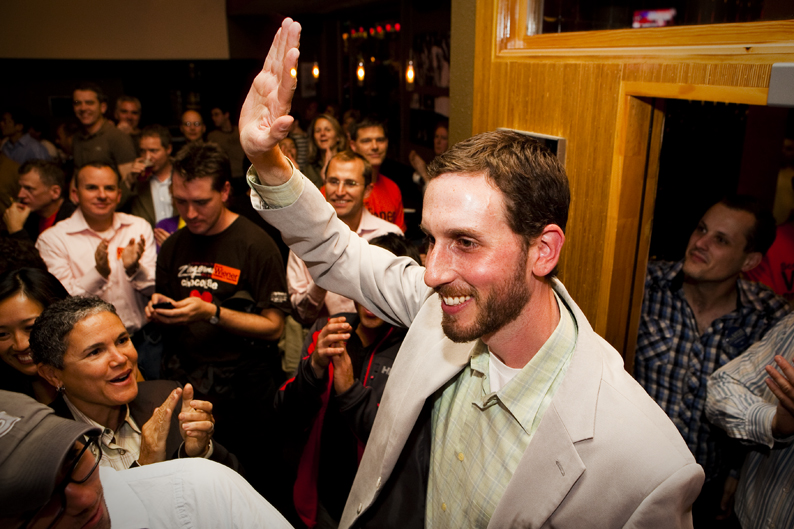
Amid a packed bar of Giants fans and political supporters, Rebecca Prozan was greeted with fervent clapping and shouts. Whether or not she wins tonight, her supporters and fans still believe strongly in her and her campaign. Her supporters even sported paper hats with Prozan’s face.


“My base and my supporters is the people I’ve met on Muni or worked with at the mayor’s office, or at the dog park.” She said, excitedly shaking hands, posing for pictures and greeting the crowd.


Her supporters were upbeat about the election results based on her politics and ideals.” It’s easy to read the paper and have thoughts but harder to take action,” Asit Panwala, one of the election canvassers said. “I see her willingness to help people and how she engages with the public.”


Film Listings

0

Film listings are edited by Cheryl Eddy. Reviewers are Kimberly Chun, Michelle Devereaux, Peter Galvin, Max Goldberg, Dennis Harvey, Johnny Ray Huston, Louis Peitzman, Lynn Rapoport, Ben Richardson, and Matt Sussman. The film intern is Ryan Prendiville. For rep house showtimes, see Rep Clock. For first-run showtimes, see Movie Guide at www.sfbg.com. For complete film listings, see www.sfbg.com.

OPENING

The Blue Tower Smita Bhide’s debut film, The Blue Tower, part of the 3rd I South Asian International Film Fest, begins with Mohan (Abhin Galeya) in the sort of loveless marriage that has become a standard cliché. It’s unnecessary to give any reason why the relationship is failing; as a viewer I accept it just as easily as I realize that with the introduction of Judy (Alice O’Connell), a young white nurse working for Mohan’s overbearing Auntie, Mohan will have an affair. However, this predictable fare, like a straight version of My Beautiful Laundrette (1985), takes a dark turn about halfway through, as every character and plot point emerges as more nefarious and twisted than originally imagined, and Mohan finds himself in a situation full of Lynchian perversion and Kafkaesque disorientation. The boldness and speed at which developments occur shifts the deadpan, suburban drama into a black-humored, grotesque ride — the sort you half want to stop, and you half want to see where it’s going. (1:25) Castro. (Prendiville)

*Brutal Beauty: Tales of the Rose City Rollers Focusing on Portland-based league Rose City Rollers, Chip Mabry’s Brutal Beauty offers some insights into the recent roller derby revival. The documentary follows the league travel team’s attempt to make it to Nationals over the course of the 2009 season. Ultimately though, the narrative really isn’t all that exciting (spoiler alert: they don’t make it very far). The real heart of the movie lies in the backgrounds and interviews of the tatted-up, foul-mouthed, dyed-haired derby girls from teams like the Break Neck Betties and Guns ‘N’ Rollers. Their personalities and stories of how derby helped shatter their ideas of self-expression and traditional gender norms helps keep the majority of the film’s 80-minute running time interesting, even when the action is not. (1:20) Red Vic. (Landon Moblad)

Butte, America: The Saga of a Hard Rock Mining Town This documentary follows the life and death of a great American mining town, following Butte, Montana’s rise as a mining town through to its inevitable environmental collapse. Once home to one of the world’s largest (and most dangerous) copper mines, Butte saw an influx of immigrants drawn to “the richest hill on earth.” Its story is definitely rich in terms of subject matter, particularly with the town’s role in the labor struggle; it could easily be the background for great early 20th century stories (as is the case with Atlantic City in HBO’s current Boardwalk Empire). But Butte, America is decidedly not cinematic, despite the voice-over narration by Gabriel Byrne, and is better suited to PBS than the big screen. (1:06) Victoria. (Prendiville)

Carlos Carlos, Olivier Assayas’s biopic of Ilich Ramírez Sánchez, a.k.a. Carlos the Jackal, begins with a warning, that while the film is the subject of historical and journalistic research, “relations with other characters have been fictionalized.” In other words: there be contradictions ahead. But I suppose that’s the least you can expect when you’re watching a 330 minute theatrical miniseries that gives the rock ‘n’ roll biopic treatment to a terrorist who, under an alias, professes “the pleasure of doing one’s duty in silence.” Much of this is intentional, questioning the convictions of extremists. One particularly well-shot scene involves Carlos (Édgar Ramírez) sexually dominating a cell member, only moments after she admits to being a German feminist. After about four hours, though, the intellectual irony begins to feel more like a filmmaker attempting to cover his bases. Carlos is an idealist, but also a sellout. An egalitarian revolutionary, but also a sexist bigot. (And so vain.) Still, the film, full of actors speaking a bevy of languages and propelled by a international punk rock soundtrack, manages to be engaging. Keep in mind, though, that the miniseries was originally aired in three parts, and viewing Carlos in one sitting should be left to the cinemasochists. (5:30) Sundance Kabuki. (Prendiville)

Due Date Robert Downey Jr. and Zach Galifianakis star in this Todd Phillips-directed road trip movie. (1:35) Four Star, Presidio, Shattuck, Sundance Kabuki.

*Fair Game Doug Liman’s film effectively dramatizes yet another disgraceful chapter from the last Presidential administration: how CIA agent Valerie Plame (Naomi Watts), who’d headed the Joint Task Force on Iraq investigating whether Saddam Hussein had WMDs, was identified by name in the Washington Post as a covert agent — thus ending her intelligence career and placing many of her subordinates and sources around the world in danger. This info was leaked to the press, it turned out, by highest-level White House officials as “punishment” for the New York Times editorial former ambassador Joe Wilson (Sean Penn) — Plame’s husband — wrote condemning their insistence on those WMDs to justify the Iraq invasion by then already well in progress. (The CIA task force had also found zero evidence of mass-destruction weapons, but Bush and co. chose to come up with their own bogus “facts” to sway US public opinion.) Purportedly, Karl Rove clucked to CNN’s Chris Matthews that Wilson’s awkwardly-timed dose of sobering truth rendered his spouse “fair game” for exposure. Unfortunately opening here several days after it might theoretically have done some election-day good — not that many Republican voters would likely be queuing up — Fair Game may be a familiar story to many. But its gist and details remain quite enough to make the blood boil. While the political aspects are expertly handled in thriller terms, the personal ones are a tad less successful. That’s partly because we never quite glimpse what brought these two very busy, business-first people together; but largely, alas, because so many of Wilson’s diatribes come off all too much as things that might be said by Sean Penn, Rabble-Rouser and Humanitarian. This is perhaps a case of casting so perfect it becomes a distracting fault. (1:46) Embarcadero, Sundance Kabuki. (Harvey)

For Colored Girls Sprinkling many tears and Janet Jackson’s blue steel throughout his high-camp, muy melodramatic adaptation of Ntzoke Shange’s For Colored Girls Who Have Considered Suicide When the Rainbow Is Enuf, Tyler Perry deserves at least an E for effort in attempting to bring Shange’s choreopoem masterpiece to the screen. The result is a free-floating, somewhat tortured contemporary collection of vignettes centered on a clutch of African American women residing in an Harlem apartment building — a structure that remotely evokes an early Wong Kar-Wai omnibus like Days of Being Wild (1991), sans the narrative ambiguity and sublime cinematography — with its “colored girls,” each representing a hue in Shange’s rainbow, occasionally pouring out the poet’s original verse. Crystal (Kimberly Elise) appears to have it the hardest, burdened with an abusive baby daddy (Michael Ealy), a veteran dealing with Post Traumatic Stress Disorder. Dance teacher Yasmine (Anika Noni Rose) is the beacon of positivity who finds her trust horribly betrayed. Tangie (Thandie Newton) is the saucy slut, baby sister Nyla (Tessa Thompson) is the good girl with a secret, and their mother Alice (Whoopi Goldberg) is the building’s extremely annoying holy roller. Overseeing all is the apartments’ de facto matriarch Gilda (Phylicia Rashad), safe sex activist Juanita (Loretta Devine), and social worker Kelly (Kerry Washington). Oh, yes, and there’s Miss Jackson, who plays the leather-tough, magazine-editing devil wearing Prada, and spends most of her time looking wrecked about possibly ruining her makeup with an actual facial expression. Yes, they will survive, hey, hey, and though Perry may not have been the best moviemaker to adapt Shange’s groundbreaking work, a few of his players, particularly Newton and Elise, rise above the rainbow with wrenching, scene-stealing performances. (2:00) (Chun)

Honest Man: The Life of R. Budd Dwyer Everyone of a certain age or with morbid curiosities has heard of R. Budd Dwyer, thanks to the very public way he died — by committing suicide at a televised-live press conference. The 1987 footage, of a portly middle-aged man with anguish in his eyes and a finger on the trigger, has been recycled in a number of contexts; thanks to the internet, it’s now freely viewable for shock value more than anything else (the incident created a controversy as to how much should be shown during news replays — when Dwyer takes out the gun? When he sticks it in his mouth?) Along the way, who Dwyer was, and why he shot himself, have kind of been lost by the general public. However, as director James Dirschberger discovers, the Pennsylvania politician’s widow, children, colleagues, and even the man whose testimony lead to a conviction in Dwyer’s corruption trial have never forgotten him. Honest Man suggests that Dwyer was actually innocent, but decided in despair to end his life before he’d been removed from office, thus allowing his family to collect full benefits. The full story will probably never be known, but Honest Man‘s attempts to show the man behind the gruesome film clip are sincere, if couched in the understanding that he’ll always be first associated with his infamous, well-documented death. (1:16) Red Vic. (Eddy)

*Megamind Be careful what you wish for, especially if you’re a blue meanie with a Conehead noggin and a knack for mispronunciation and mayhem. Holding up hilariously against such animated efforts as The Incredibles (2004) and Monsters, Inc. (2001), Megamind uses that nugget of wisdom as its narrative springboard and takes off where most superhero-vs.-supervillain yarns end: the feud between baddie Megamind (voiced by Will Farrell) and goody-two-shoes Metro Man (Brad Pitt) goes waaay back, to the ankle-biter years. They’ve battled so often over intrepid girl reporter Roxanne Ritchi (Tina Fay) that she’s beyond bored by every nefarious torture device and disco crocodile the Blue Man throws at her. When Mega finally, unexpectedly vanquishes his foe, he finds himself with a bad case of the blues. With the help of his loyal Minion (David Cross), he decides to change the game and create his own worthy opponent, who just happens to be Roxanne’s schlubby cameraman (Jonah Hill). Chortles ensue, thanks to the sarcastic sass emanating from the Will and Tina show, although the 3-D effects seem beside the point. The resemblance to this year’s Despicable Me is more than a little passing, from the bad guy on the moral turnaround to the adorable underlings, but Megamind‘s smart satire of comic hero conventions, its voice actor’s right-on riffs, and the rock and pop licks on the soundtrack make it the nice and nasty winner. (1:36) Presidio, Sundance Kabuki. (Chun)

*Monsters After a NASA space pod bearing samples of extraterrestrial life crashes in northern Mexico, a large swath of the now massively walled-off U.S. border area becomes an “Infected Zone,” with frequent unpleasant contact between humans and giant octopus-like creatures. Photographer Andrew (Scoot McNairy) is reluctantly charged with delivering his publisher’s daughter Sam (Whitney Able) to safety. Unfortunately, things do not go as planned. The duo find themselves making a dangerous journey northward straight through the Zone, right at the start of an annual “migration season” that always makes the critters especially ornery. Just as 2009’s District 9 commented obliquely on Apartheid, Gareth Edwards’ feature similarly riffs on our own illegal-alien debate. But there’s no need to look for deep meanings here. Taken as a slow build (sometimes a little too slow) toward the inevitable perils, Monsters is a successfully low-key, lower-budget spin on aspects of The War of the Worlds, Cloverfield (2008), The Mist (2007), etc. Those looking for lots of graphic horror-fantasy content may be frustrated, but on its own terms the film is creepy and credible enough. (1:33) California, Lumiere. (Harvey)

*36 Quai des Orfèvres It’s taken six years for this major French policier to get a proper U.S. release, which is a little strange considering its genre appeal and lack of conflict with an English-language remake (Martin Campbell, director of 2006’s Casino Royal, might make one within the next couple years). Leaving for another post, Paris’ Chief of Police (Andre Dussolier) wants to wrap things up tidily before he goes, and that means nailing the violent gang that’s been robbing armored trucks and killing their guards. Though he’d prefer his post be inherited by the honorable Leo Vrinks (Daniel Auteil) rather than the latter’s ex-friend, shamelessly ambitious and underhanded Denis Klein (Gerard Depardieu), internal politics necessitate he give it to whichever man and his team end this crime spree. When a con (Roschdy Zem) gives Vrinks a tip — albeit under seriously compromising, blackmail-ready circumstances — it seems the murderous gang will be caught under his supervision. Drunk and raging with envy, Klein pulls a stunt that has catastrophic consequences. Yet a chance windfall allows him to turn things to his advantage, and greatly against Vrinks. To a point the story is very loosely inspired by events that actually occurred in the mid-1980s, when director-writer Olivier Marchal was a Parisian cop. His script (penned in collaboration with three others) is intricate and dramatic, with some startling twists of fate; the casting, which includes a number of other leading French actors, is impeccable. 36 has been called a Gallic Heat — though it lacks the visually and thematically epic, larger-than-life qualities Michael Mann provided that film. Which leaves it a very good story competently executed, but not the great movie it could have been. (1:51) Roxie. (Harvey)

Tibet in Song It’s often a bad sign when directors are subjects in their own documentaries. With Tibet in Song, Ngawang Choephel has good cause to disprove this theory. In 1995, he returned to Tibet for the first time since fleeing with his mother as a child. An ethnomusicologist and Fulbright scholar, he wanted to record traditional Tibetan music. Instead he was arrested, lost half his footage, and charged with spying, eventually serving six years in jail. Tibet in Song is the completion of his original project, and although the director does give due attention to the circumstances of his own story, it’s always within the larger context of the music, as a culture is being held captive by Chinese pop and propaganda. As Choephel argues that the traditional Tibetan music has been manipulated to change the country’s identity generation by generation, we don’t just hear the music, but understand what it means. (1:26) Lumiere, Shattuck. (Prendiville)

ONGOING

Cairo Time (1:29) Opera Plaza.

Conviction (1:47) Empire, Piedmont, SF Center.

*Easy A (1:30) Shattuck.

Enter the Void (2:17) Lumiere.

*The Girl Who Kicked the Hornet’s Nest If you enjoyed the first two films in the Millennium trilogy — 2009’sThe Girl With the Dragon Tattoo and The Girl Who Played With Fire — there’s a good chance you’ll also like The Girl Who Kicked the Hornet’s Nest. Based on the final book in Stieg Larsson’s series, the film begins shortly after the violent events at the conclusion of the second movie. There are brief flashes of what happened — the cinematic equivalent of TV’s “previously on&ldots;” — but it’s likely an indecipherable jumble to Girl first-timers. Hornet’s Nest presents the trial of Lisbeth Salander (Noomi Rapace), the much-abused, much-misunderstood, entirely kick-ass protagonist of the series. With the help of journalist Mikael Blomkvist (Michael Nyqvist) and his sister Annika (Annika Hallin) as her lawyer, Lisbeth finally gets her day in court. The conspiracy that drives the story is somewhat convoluted, and while it all comes together in the end, Hornet’s Nest isn’t an easy film to digest. Still, it’s a well-made and satisfying conclusion to the trilogy — as long as you caught the beginning and middle, too. (2:28) Bridge, Embarcadero, Piedmont, Shattuck, Smith Rafael. (Peitzman)

Hereafter (2:09) Empire, Marina, 1000 Van Ness, SF Center, Shattuck, Sundance Kabuki.

Inside Job (2:00) Embarcadero, Shattuck, Sundance Kabuki.

It’s Kind of a Funny Story (1:51) 1000 Van Ness, Shattuck.

*Jackass 3D (1:30) 1000 Van Ness.

*The Kids Are All Right (1:47) Red Vic.

*Leaving Few beauties — French, English, French-English, or otherwise — have managed the transformation Kristin Scott Thomas has, in using her considerable beauty to convey unfathomable hunger. In this romantic thriller with a touch of Madame Bovary and more than a dab of noir, Scott Thomas is Suzanne, the efficient if somewhat taken-for-granted wife of a doctor (Yvan Attal, director of 2001’s My Wife Is an Actress and Charlotte Gainsbourg’s partner), whose marriage resembles a business arrangement more than a love match. The couple enlist Catalan ex-con Ivan (Sergi Lopez) to build an office for her budding physical therapy practice, and after a minor car accident, Ivan falls into Suzanne’s care, and as she grows to care more deeply about him, an affair begins. Director Catherine Corsini’s tough-eyed look at what follows — concerning the economics of marriage and the price of one woman’s individuation and passionate choices — calls to mind women’s melodramas of the ’40s and ’50s, though Corsini renders her oft-told tale of awakening with considerably less heavy-handedness and minimal condescension. That approach and Scott Thomas’ performance — the movie almost turns on the motionless, slowly evolving look in Suzanne’s eyes when she realizes what she must do — makes Leaving a departure from your average coming-of-liberation romance. (1:30) Albany, Clay. (Chun)

Let Me In (1:55) Four Star.

Life as We Know It (1:52) 1000 Van Ness.

*Mademoiselle Chambon (1:41) Opera Plaza.

My Dog Tulip (1:22) Smith Rafael.

Never Let Me Go (1:43) Four Star, Lumiere.

*Nowhere Boy (1:37) Opera Plaza, Shattuck.

Paranormal Activity 2 (1:45) California, 1000 Van Ness.

Red (1:51) 1000 Van Ness, SF Center, Sundance Kabuki.

Saw 3D (1:31) 1000 Van Ness.

*Secretariat (1:56) 1000 Van Ness, SF Center.

*The Social Network (2:00) Empire, Marina, 1000 Van Ness, Sundance Kabuki.

Stone (1:45) Opera Plaza.

The Town (2:10) 1000 Van Ness, Presidio, SF Center, Shattuck.

*Waiting for “Superman” (1:51) Piedmont, SF Center, Shattuck.

Wall Street: Money Never Sleeps (2:13) Presidio.

You Will Meet a Tall Dark Stranger (1:38) Albany, Opera Plaza, Presidio.

Election 2010: Wiener confident in D8, but Mandelman not giving up

5

The mood was buoyant in Harvey’s bar in the Castro, where D8 supervisorial candidate Scott Wiener had 54 percent of the vote in early returns when he arrived around 9:30 pm. His lead over progressive candidate Rafael Mandelman has narrowed since then (45-33 percent at last count), and that campaign was still hopeful at its party at Pilsner Inn on Church Street.
“The question is does it get tight enough that the number two votes make a difference,” Mandelman told the Guardian, referring to the ranked choice election and showing hope that many of Rebecca Prozan’s second choice votes would go to him. Mandelman noted that his campaign had a solid volunteer effort and good turnout in the district. “We think it’s going to be closer than in looks right now.”
But Wiener expressed confidence that he will prevail. “I feel really good about it,” he told the Guardian. The race was fairly cordial among the candidates, but Wiener got hit pretty hard by mailers from labor and tenant groups attacking him as hostile to progressive priorities.
“It got negative toward the end, and I think that’s unfortunate, but that’s modern politics and the truth prevailed,” said Wiener, who has argued that his record of votes on tenant issue while serving on the DCCC was better that it was represented in this election. In fact, even some progressives think Wiener might be a better vote on tenant issues than incumbent Bevan Dufty, who was consistently a swing vote against tenant protection legislation.
In fact, Wiener campaign manager Adam Taylor, who is a renter, told us that he wouldn’t have worked on the campaign if he didn’t believe Wiener would stand up for renters’ rights. “We expected certain falsehoods to count out and they did,” said Taylor, who was running his first campaign in San Francisco. “I’m proud of how we kept our head held high.”

GOLDIES 2010: Amanda Curreri

0

Five minutes into talking with Amanda Curreri over a slice and coffee at Mission Pie, I’ve agreed to take part in a piece she’s working on as part of Shadowshop, the in-gallery artists’ marketplace Stephanie Syjuco is organizing for SFMOMA’s upcoming survey of work made in the past decade.

“It’s called Afghanistan Insert,” Curreri explains, speaking in the measured fashion of someone who carefully considers her words. “I’m trying to insert Afghanistan into SFMOMA and into San Francisco’s art community.”

Curreri’s commitment to getting the local arts scene to engage with what has become commonly dubbed by the mainstream news media as “the forgotten war” is not just politically motivated. It’s also personal. Her husband has been working in Afghanistan for the past five months as a security contractor, during which he has sent her snapshots of local graffiti. They are documents of his ground truth.

Curreri plans on physically inserting herself and her husband’s images into Shadowshop, much in the same way she holds one of his pictures in the portrait accompanying this feature. Indeed, the photo, this profile, Curreri’s new status within the local arts community as a Goldie winner, and the conversations this increased attention might encourage will all become part of the discourse surrounding Insert Afghanistan and contributing to its impact.

All this is consonant with Curreri’s view of herself as more of an instigator than an artist. “I’m trying to make art that crosses out of the art world,” she says, echoing Joseph Beuys’ notion of social sculpture. Her projects thrive on participation, using the exhibition space as a kind of social laboratory in which she arranges shared cultural touchstones and institutions — campfire songs, the judicial process, family recipes — as prompts for personal reflection and shared conversation on the “big subjects” that undergird them: history, politics, memory, and in the case of Afghanistan Insert, their intersection within a seemingly endless and fruitless foreign occupation thousands of miles away.

Engaging with Curreri’s art often entails an extended encounter with the artist herself (given how unexpectedly my interview at Mission Pie has turned out, the reverse seems true as well). The last conversation I had with Curreri was this past July, when she videotaped my extemporaneous responses to her off-camera questioning about the topic of last words. My interview was to be incorporated into her concurrent exhibit “Occupy the Empty,” for which she transformed Ping Pong Gallery via hand-sculpted “props” into a courtroom in which various associates, friends, and strangers, such as myself, volunteered their time and testimony.

As with Insert Afghanistan, the inspiration for “Occupy the Empty” was also personal: after participating in a court hearing concerning her late father, Curreri found out it had been held in the same Massachusetts courthouse in which Italian-American anarchists Sacco and Vanzetti were sentenced to death in the early 20th century. Curreri, also of Italian-American descent, saw the coincidence as a chance to connect to that history and, in the process, build a community around a larger discussion of remembrance. Curreri recalls one participant for whom the show served an almost therapeutic function.

“I want to create art that has an interpersonal function, in real-time,” she says. “I want my work to set a specific frame around our inherent connectivity.” 

www.amandacurreri.com

>>MORE GOLDIES 2010

Sorting out the Kim and Walker claims

2

As the District 6 supervisorial race winds down, we at the Guardian have been inundated by calls and messages by Debra Walker supporters saying how nasty Jane Kim supporters are being, and by Kim supporters complaining that Walker’s people are being mean. And while we’d be the last ones to say that we told you so, everyone should remember that politics is nasty business, particularly when two progressive candidates are targeting the same voters.

It’s not worth trying to sort out the street-level accusations, but it’s worth pointing out some dubious claims in the mailers both sides have sent in recent days, punches and counter-punches that began last week with a mailer by Walker’s camp claiming Kim moved into the district to run for office. Kim’s people dispute that she moved into D6 simply to run, and they note that progressive politicians such as Chris Daly and and Matt Gonzalez were also recent transplants when they decided to run for supervisor.

Yet it’s probably going too far to label this “last-minute lies being spread,” as the latest Kim mailer contends. Another Walker mailer says that Kim is under investigation by the Ethics Commission for illegally coordinating with an independent expenditure mailer funded partially by Willie Brown, which Kim’s camp calls another lie.

It was a story first reported by the Guardian, then picked up by the Bay Citizen, which quoted Ethics head John St. Croix as saying the situation appeared to violate campaign finance law and “warrant an investigation.” Ethics can’t confirm when it is doing investigations, so it might be going to far to say Kim is under investigation, although the incident does appear to involve improper behavior that is probably fair game for criticism.

The mailer also included a Walker campaign accusation that Kim “took off on an all-expenses-paid trip to Vegas – and charged it to the School District” while it was laying off teachers and wrestling with a $40 million deficit. That also has a kernel of truth to it, even that it sounds worse than it was and is probably being blown out of proportion.

The Kim campaign says the trip to speak at a national education conference was paid for jointly between the conference organizers and the school district, which covered about $600 worth of hotel and meal expenses. Again, the accusation has some nasty implications, but it’s probably not an unreasonable accusation during the heat of an election season.

The hit on Walker that the Kim campaign sent out in response also seems to fudge the truth just a bit, but in this case it was in exaggerating Kim’s experience not in criticizing Walker (except for the line that Walker was “Appointed by City Hall insiders” to her spot on the Building Inspection Commission, rather than “Elected by the people,” as Kim was to the school board).

But three of the five claims that Kim makes seem to apply more to Superintendent Carlos Garcia and his administrative staff than to the part-time school board members: “Experience Administering A Budget of $400+ Million,” “Experience Overseeing Over 1,000 Employees,” and “Experience Bargaining With Labor Unions.”

Yet by tonight, all these claims and counter-claims, and all the street-level mudslinging that has been going on, will hopefully fade into memories of a heated political campaign. Hopefully. But if this inter-progressive-movement fight ends up handing this seat over to downtown-backed candidate Theresa Sparks, then the nastiness could be just beginning, because both campaigns will have some explaining to do.

Tony Serra weighs in on the election

10

Tony Serra, the legendary local lawyer and one of my favorite members of the legal profession, sent us this photo with his commentary on the Nov. 2 election. It’s hanging from his office out at 506 Broadway.


I just talked to Serra, and he said he’s had great feedback. “Channel Five came out and did a story,” he said. “They managed to shoot it so the lightpost covered up the U and the C. They interviewed people on the street, and a lot of them were cheering me on.”


His critique of the GOP candidates doesn’t mean he’s a Jerry Brown supporter; Serra has sworn off electoral politics, which he told me is part of the corruption of capitalism. But he’s happy to go after Meg and Carly: “I’m not going to let those two motherfuckers buy the election.”


I told Serra he’s always been one of my heroes. Still is. 

Your first world series is always the best

1

Dick Meister. former labor editor of the SF Chronicle and KQED-TV Newsroom, has covered labor and politics for a half century. Contact him through his website, www.dickmeistersf.com, which includes more than 250 of his columns.

Whoopie! Our valiant Giants are in the World Series again, for the fourth time since they moved to the city from New York in 1958. Pretty exciting, the first series for the Giants since the 2002 series that was won, alas, by the New York Yankees.

Pretty exciting stuff coming up in this year’s series too, Giants vs. Texas  Rangers. But it was more than excitement that swept San Francisco during that first SF Giants World Series and the regular season leading up to the series.  It was near-hysteria. As a young reporter for the SF Chronicle in those days, I felt it up close and very personal.
Merchants filled the newspapers with ads that offered goods “the Giants look up to,” promised “big league values,” and, of course, congratulated the Giants and their fans. for every victory leading to the series.

The hype was too much for some of us at the Chronicle, even me, a former ballplayer. I joined 10 others to sign an anti-baseball petition prompted by the airing at the paper — loudly and daily — of the radio broadcasts of Giants’ games.

 “It is not that we have any inherent objection to the Great American Pastime,” the petitioners explained. “Our protest is against the unilateral establishment of an electronic device which broadcasts to a captive city room the trivia associated with the sport. Exhortations like ‘Willie Mays,’ while they obviously provoke a pseudo-religious ecstasy among fans, leave a number of us writhing in embarrassment.”

We gained nothing by our petition. Worse, City Editor Abe Mellinkoff  added insult to injury by sending us out, transistor radios in hand, to capture the mood of the “man on the street” during the World Series’ broadcasts. I was the first to get the assignment. I was supposed to rush up to people in the street after particularly exciting plays, get their excited comments and weave them into one of the fluffy page one feature stories my editors favored – “wiggly rulers,” as they called them, after the wavy lines used to set them off.

But I stuffed the radio into a jacket pocket and wandered aimlessly around Chinatown, where there were few Giants fans in evidence, returning later to explain lamely that I just couldn’t find any men in the street who cared about the World Series.

The next day, the radio was turned over to another reporter, but he had no more interest in the assignment than I. City Editor Mellinkoff, hinting darkly that he might fire the lot of us for insubordination, got his story on the third try – even though the reporter he sent out that day spent the whole time in his favorite drinking establishment down the street.

The reporter returned to the office barely able to walk, much less type a story or give a coherent excuse for not doing so. We propped him up carefully behind a desk in the far reaches of the city room, safely hidden from the nearsighted city editor, then dictated a story to another reporter at the desk directly in front of his, using the names of friends for our men on the street and quotes we had turns making up to go along with the names.

As he completed a page, the reporter who was typing the story would turn and lay it on the desk of the reporter who supposedly was writing the story, one of us would shout, “Boy!,” and a copy boy would grab the page and rush it to the city editor’s desk at the front of the room.

It was a very lively story, quite possibly the best wiggly ruler the Chronicle had run in several months.

Dick Meister. former labor editor of the SF Chronicle and KQED-TV Newsroom, has covered labor and politics for a half century. Contact him through his website, www.dickmeistersf.com, which includes more than 250 of his columns.

Cash not care

5

sarah@sfbg.com

With the general election just days away, campaign disclosure reports show that downtown interests are spending huge amounts of money to create a more conservative San Francisco Board of Supervisors and to pass Proposition B, Public Defender Jeff Adachi’s effort to make city workers pay more for their pensions and health insurance.

Much of the spending is coming from sources hostile to programs designed to protect tenants in the city, including rent control and limits on the conversion on rental housing units to condominiums. An ideological flip of the board, which currently has a progressive majority, could also have big implications on who becomes the next mayor if Gavin Newsom wins his race for lieutenant governor.

At press time, downtown groups were far outspending their progressive counterparts through a series of independent expenditure committees, most of which are controlled by notorious local campaign attorney Jim Sutton (see “The political puppeteer,” 2/4/04) in support of supervisorial candidates Mark Farrell in District 2, Theresa Sparks in District 6, Scott Wiener in District 8, and Steve Moss in District 10.

Prop. B has also been a big recipient of downtown’s cash, although labor groups have pushed back strongly with their own spending to try to kill the measure, which is their main target in this election.

But the biggest spender in this election appears to be Thomas J. Coates, 56, a major investor in apartments and mobile homes and a demonstrated enemy of rent control. He alarmed progressive groups by giving at least $250,000 to groups that support Farrell, Sparks, Wiener, Moss, and Prop. G, legislation that Sup. Sean Elsbernd placed on the ballot to cut transit operator wages and change Muni work rules.

Although Coates declines to identify with a political party on his voter registration, he donated $2,000 to President George W. Bush in 2004. More significantly, he was the biggest individual donor in California’s November 2008 election, when he contributed $1 million to Prop. 98, which sought to repeal rent control in California and limit the government’s right to acquire private property by eminent domain.

Coates, who is also a yachting enthusiast and sits on San Francisco’s America’s Cup Organizing Committee (ACOC), donated $100,000 on Oct. 20 for Farrell, $45,000 for Sparks, $45,000 for Moss, and $10,000 for Wiener through third-party independent expenditure committees such as the Alliance for Jobs and Sustainable Growth.

The group has already received thousands of dollars in soft money from the San Francisco Police Officer’s Association, the Building Operators and Managers Association, the Golden Gate Restaurant Association, and SEIU-United Healthcare Workers, which supports a high-end hospital and housing complex on Cathedral Hill.

Those downtown groups have spent close to $200,000 on English and Chinese language mailers and robo calls in support of Sparks, Wiener, and Moss in hopes of securing a right-wing shift on the board.

Progressive groups including California Nurses Association, the San Francisco Tenants Union, and the SF Labor Council have tried to fight back in the supervisorial races. While downtown groups spent more than $100,000 promoting Sparks in D6, labor and progressive groups spent $13,000 opposing Sparks and $72,000 supporting progressive D6 candidate Debra Walker.

In D8, progressive groups that include teachers, nurses, and transit riders have outspent the downtown crowd, plunking down $40,000 to oppose Wiener and $90,000 to support progressive candidate Rafael Mandelman. So far, downtown groups have spent about $100,000 to support Wiener.

But in D10, the district with the biggest concentration of low-income families and communities of color, downtown interests spent $52,000 supporting Moss and $5,000 on Lynette Sweet while the Tenants Union was only able to summon $4,000 against Moss. The SF Building and Construction Trades Council spent $4,000 on Malia Cohen.

But that’s small potatoes compared to what downtown’s heavy-hitters are spending. The so-called Coalition for Sensible Government, which got a $100,000 donation from the San Francisco Association of Realtors, has already collectively spent $96,000 in support of Sparks, Wiener, Moss, Sweet, Rebecca Prozan in D8, Prop. G and Prop. L (sit-lie) and to oppose Prop. M (the progressive plan for police foot patrols) and Prop. N (a transfer tax on properties worth more than $5 million).

The Coalition for Responsible Growth, founded by Anthony Guilfoyle, the father of Mayor Gavin Newsom’s ex-wife, Kimberly Guilfoyle (who now works as a Fox News personality), has received $85,000 from the Committee on Jobs, $60,000 from the Realtors, and $35,000 from SF Forward. It has focused on spending in support of Prop. G and producing a voter guide for Plan C, the conservative group that supports Sparks, Wiener, Sweet, and Moss

Coates’ donations raise questions about his preferred slate’s views on tenant and landlord rights. A principal in Jackson Square Properties, which specializes in apartments and mobile homes, Coates is the founding partner of Arroya & Coates, a commercial real estate firm whose clients include Walgreens, Circuit City, and J.P. Morgan Investment Management. In 2008, when he backed Prop. 98, Coates told the San Francisco Chronicle that rent control “doesn’t work.”

Ted Gullicksen, director of the SF Tenants Union (SFTU), which has collectively spent $30,000 opposing Sparks, Wiener, and Moss, is disturbed that Coates spent so much in support of this trio.

“Coates was the main funder of Prop. 98,” Gullicksen explained. “His property is in Southern California. He’s pumping a lot of money into supervisors. And he clearly has an agenda that we fear Moss, Sparks, and Wiener share — which is to make the existence of rent control an issue they will take up in the future if elected to the board.”

That threat got progressive and labor groups to organize an Oct. 26 protest outside Coates’ San Francisco law office, with invitations to the event warning, “Be there or be evicted!”

Sparks, Moss, and Wiener all claim to support rent control, despite their support by someone who seeks to abolish it. “I answered such on my questionnaire to the SFTU, which chose to ignore it,” Sparks told the Guardian via text message. “In addition, I’ve been put out of apartments twice in SF, once due to the Ellis Act. They ignore that fact as well.”

Records show that in May 2009, Moss — who bought a rent-controlled apartment building near Dolores Park in D8 for $1.6 million and he lived there from the end of 2007 to the 2010, when he decided to run for office in D10 — served a “notice to quit or cure” on a tenant who complained about the noise from Moss’ apartment. Ultimately, Moss settled without actually evicting his tenant.

“I read about Coats’ [sic] contribution in Bay Citizen,” Moss wrote in an e-mail to the Guardian. “This donation was made to an independent expenditure committee over which I have no control and almost no knowledge. I have stated throughout the campaign, and directly to the Tenants Union, that I believe current rent control policy should remain unmolested.”

But Moss is with downtown on other key issues. He supports Newsom’s sit-lie legislation and the rabidly anti-tenant Small Property Owners Association, whose endorsement he previously called a “mistake.”

Yet Moss, who sold a condo on Potrero Hill in 2007 for the same price he paid for the entire building in 2001, seems to voice more sympathy for property owners than renters, who make up about two-thirds of city residents. He told us, “Landlords feel that they are responsible for maintaining costly older buildings and that they are not provided with ways to upgrade their units in ways that share costs with tenants.”

Another realm where downtown seems to be trying to flip the Board of Supervisors on a significant agenda item is on health care, particularly the California Pacific Medical Center proposal to build a high-end hospital and housing project on Cathedral Hill in exchange for rebuilding St. Luke’s Hospital in the Mission.

The project has divided local labor unions. UHW supports the project and a slate of candidates that its parent union, Service Employees International Union, is opposing through SEIU Local 1021, which is supporting more progressive candidates. The California Nurses Association also opposes the project and candidates such as Wiener who back it.

“A recent mailer by CNA falsely says that CPMC is closing St. Luke’s and Davies,” CPMC CEO Warren Browner recently complained in a letter to the Board of Supervisors. “We are not. We are committed to building a state-of-the-art, high-quality replacement hospital at St. Luke’s and continuing to upgrade Davies.”

But the CPMC rebuild is contingent on the board approving the Cathedral Hill project. So the CNA mailer focused on what could happen if the city rejects the CPMC project: “We could lose two San Francisco hospitals if Scott Wiener is elected supervisor.”

SEIU-UHW’s alliance with downtown groups and its use of member dues to attack progressive candidates places it at odds with SEIU Local 1021 and the SF Labor Council, which has endorsed Janet Reilly in D2, Walker in D6, Mandelman in D8, and Cohen (first choice) and Chris Jackson (second choice) in D10.

“We’re really disappointed that there are labor organizations that feel they have to team up with Golden Gate Restaurant Association, which is against health care [it challenged the city’s Healthy San Francisco program all the way to the U.S. Supreme Court], and with CPMC, which is working to keep nurses from joining a union,” Labor Council Director Tim Paulson said. “This alliance does not reflect what the San Francisco labor movement is about.”

Paulson said that the Labor Council values “sharing the wealth … So we don’t want Measure B [Jeff Adachi’s pension reform] or K [Newsom’s hotel tax loophole closure, which has a poison pill that would kill Prop. J, the hotel tax increase pushed by labor] or L [Newsom’s sit-lie legislation],” Paulson said.

CPMC’s plan is headed to the board in the next couple months, although Sup. David Campos is proposing that the city create a health services master plan that would determine what city residents actually need. Hospital projects would then be considered based on that health needs assessment, rather than making it simply a land use decision as it is now.

Moss told the Guardian that UHW endorsed him because of his positions on politicians and unions. “I agreed that politicians should get not involved in union politics,” Moss said. “The United Healthcare Workers seem to be a worthy group,” he added. “All they said was that they wanted to make sure that they had access.”

But CNA member Eileen Prendiville, who has been a registered nurse for 33 years, says she was horrified to see UHW members recently oppose Campos’ healthcare legislation. “I was shocked that they were siding with management,” she said.

Prendiville believes UHW is obliged to support CPMC’s Cathedral Hill plan, which is why it is meddling in local politics. In his letter to the board, Browner noted that his company and its parent company, Sutter Health, can’t legally do so directly. “The fact is that CPMC and Sutter Health are 501(c)(3) not-for-profit, nonpartisan organizations, and we neither endorse nor contribute to candidates,” Browner wrote.

“When UHW settled its contract with its members [as part of its fight with the rival National Union of Healthcare Workers], they had to publicly lobby for Cathedral Hill,” Prendiville claimed.

SEIU 1021 member Ed Kinchley, who works in the emergency room at SF General Hospital, is also furious that UHW is pouring money into downtown’s candidates and measures. “UHW isn’t participating in the Labor Council, it’s doing its own thing,” he said.

Kinchley said UHW, which is currently in trusteeship after a power struggle with its former elected leaders, is being controlled by SEIU’s national leaders, not its local membership, which explains why it’s aligned with downtown groups that have long been the enemy of labor.

“Sutter wants a monopoly on private healthcare and people like Rafael Mandelman and Debra Walker have been strong supporters of public healthcare,” Kinchley said. “I want someone who can straight-up say, here’s what’s important for families in San Francisco, especially something as important as healthcare. But it sounds like UHW is teaming up with the Chamber and supporting people who are not progressive.”


The mad hatter

0


le.chicken.farmer@gmail.com

CHEAP EATS I had a coffee date after work in Alameda. He wasn’t feeling well and wondered about chicken soup. I knew exactly what to tell him, and he invited me to come along, but got it to go.

“Do you want a drink?” he said, while we were waiting.

I liked the guy alright, but don’t drink before dinner.

When his soup came, he walked me to my bike and gave me a hug.

“Let me know what you think of the soup,” I said. The place was La Piñata, but it said something else on it. It still said La Piñata, but it just also said I-forget-what. Some other name. So maybe it was La Piñata, and maybe not. But, hey, I get sick too, and what if my favorite bowl of chicken soup in Alameda is not what it used to be?

These were the thoughts I was thinking. Honestly, I knew I wasn’t going to see the guy again, datewise. I just wanted to know about the soup. In retrospect, of course I should have just ordered a bowl, to stay, and sent him packing.

I remember why I didn’t. I had to get to Deevee’s house in downtown Oakland to pick up/borrow my/her pink cowboy hat before she went to sleep. This was important because I was going camping the next day, and Deevee goes to sleep early. So no matter how hungry I was (very very), I had to suck it up, bike to BART, BART to downtown Oakland, bike to Deevee’s, and bike back toward BART on an empty stomach.

All for the sake of a pink cowboy hat. What can I say? I have a huge fucking head, and this is one of only two hats I have found in my life that fits it. It’s good to have a cowboy hat when you go camping. Keeps the sun off your ears, the rain out of your eyes, and the pine needles out of your hair — and if it’s pink it might even make you popular with park rangers.

Just a thought.

Thinking which, I forsook a bowl of sit-down soup to get to Deevee’s before bedtime (hers). Then, on my way back to BART, I thought I would duck into the first restaurant I saw for a quick little bite of something-or-other.

Binh Minh Quan. Vietnamese. Downtown Oakland just a couple blocks shy of BART on 12th Street. It was after 9 p.m. so the place was more than half-empty.

Me, I rarely want to eat in a hurry, but I do, on occasion, have low blood sugar meltdowns that — as many of my friends will attest — can get a little dicey. Usually I manage to keep the dice in my head. I just quietly go crazy, lose my sense of self and direction, then, glazed and psychotic, stagger to the nearest refrigerator and eat every single thing in it in 30 seconds or less. Blink, everything’s okay again, give or take a little heartburn.

I’ve learned to stave off these attacks by eating five meals a day and snacking in between. But sometimes when I’m at work, dating over coffee, or on an urgent hat-related mission — not to mention all three back-to-back — shit happens.

Wouldn’t you know it? The cute little staff of Binh Minh Quan, on this particular evening, was entirely overwhelmed by a party of seven. It took them almost 15 minutes to take my order, and another 20 or so to bring me my bun. Meanwhile, I tried to distract myself by talking local politics to my hat in a Cookie Monster voice, but under my breath.

Finally! The bun was of course great, but no way is this my New Favorite Restaurant. No. My New Favorite Restaurant is the guy at El Rio who makes fry bread, or Indian tacos, on Monday nights. His name is Rocky, he recently transplanted himself here from Arizona, and I think he might be Apache or else maybe I got that wrong.

Any case, I’ve run into him twice, once on the sidewalk and once on the El Rio patio, and both times he made my day. His savory fry bread, stacked with beans, cheese, and onions, transports me back to Delta’s Depression Dough, and breakfast.

And that’s a great place to start. 

ROCKY THE FRY BREAD GUY @ EL RIO

Mon. 8 p.m. until he runs out of dough

3158 Mission, SF

(415) 282-3325

Cash only

Full bar


Editor’s notes

0

Tredmond@sfbg.com

At a certain point, you have to stop trying to project what’s going to happen and just wait for the election results. Because what matters now isn’t the $140 million Meg Whitman has spent or Carly Fiorina’s record at Hewlett-Packard or which aide to Jerry Brown called Whitman a whore. It’s who shows up to vote.

If I were Meg Whitman’s campaign manager, I’d stop spending money. Go into hiding. Pretend there’s nothing going on here, no big deal next Tuesday morning — and then pray for rain. Because the way Whitman wins — possibly the only way she wins — is if huge numbers of Californians don’t bother to vote.

If the turnout is reasonable — that is, if enough Democrats realize the danger posed by of the GOP candidate and go to the polls — then Jerry Brown is in. And if that happens, chances are good that the rest of the Democratic ticket — including Gavin Newsom and Kamala Harris — squeaks in, too. And then we can all start to have fun figuring out the future of San Francisco politics.

That, of course, depends on the same factor: Who’s going to show up to vote? Will all the tenants in District 8 — many of them unexcited about Jerry Brown — take the time to vote for Rafael Mandelman for supervisor? Will the progressive voters who have lived in District 6 for a while get to the polls in greater numbers than the conservative newcomers in the pricey condos? Will the next Board of Supervisors — which could be choosing the next mayor — be as progressive as the current board (which also might wind up choosing the next mayor?)

And who’s even on the mayoral short list?

At the Haight Ashbury Neighborhood Council forum Oct. 14, former Supervisor (and potential mayoral contender) Aaron Peskin noted that the person in Room 200 year “is going to have to take out the garbage.” The city’s going to face another awful budget deficit and a progressive interim mayor will have to make a lot of enemies. Who wants to face the voters in November 2011 after making more cuts and raising taxes?

Well, somebody needs to — because the “caretaker” mayor some people are pushing for won’t have the clout to make tough decisions. And frankly, a progressive with the power of incumbency might actually be able to win a full term, even up against a huge downtown war chest.

Fun stuff. Go out and vote.


Alerts

0

news@sfbg.com

THURSDAY, OCT. 29

Bert for BART

BART board candidate Bert Hill, who is endorsed by a broad array of progressive organizations in his bid to unseat Republican incumbent James Fang, will be campaigning and meeting commuters along with several of his campaign’s supporters.

4:30–7 p.m., free

Balboa Park BART Station

401 Geneva Ave., SF

www.bert4bart.org

FRIDAY, OCT. 29

Halloween Critical Mass

Find a costume, hop on your bicycle, and join the monthly Critical Mass bike ride, Halloween edition. This rolling street party is always a fun way to flip the normal transportation paradigm, but it’s even more festive when composed of zombies, naughty nurses, and sexy cops.

6 p.m., free

Justin Herman Plaza

Market and Embarcadero

www.sfcriticalmass.org

Zombie Flash Mob

Guardian sources have warned that a mob of zombies, possibly dressed in prom attire, will rampage through the streets of the Mission. They are said to be protesting being marginalized and are showing their solidarity with the LGBTQ community. Eventually, our sources say, they will converge at El Rio, 3158 Mission St., for a zombie prom featuring live music by Elle Niño and others, with a cover charge of $3 for the undead and $7 for the living.

8 p.m., free

Corner of 16th and Mission, SF

elleninosf@gmail.com

SUNDAY, OCT. 31

(SF) Rally to Restore Sanity

If you can’t make it to the National Mall in Washington, D.C. for the Rally to Restore Sanity and the March to Keep Fear Alive, the send-up of political events by Comedy Central satirists Jon Stewart and Steven Colbert, you can still take part in SF’s local version. The event include guest speakers, comedy, poetry, and dancing.

9 a.m.–3 p.m., free

Civic Center Plaza

Larkin and Grove, SF

www.sfsanityrally.com

MONDAY, NOV. 1

Urban Water Rates

Panelists from the industry will seek to answer whether water pricing at the urban water agency level can work as a water conservation tool, whether rate increases jeopardize revenue, and how to serve low-income and low-use customers. RSVP at info@whollyh2o.org.

1 p.m.–3 p.m., free

Jellyfish Gallery

1286 Folsom, SF

www.whollyh20.org

TUESDAY, NOV. 2

Election Day

This election features pivotal races for the governor of California, U.S. Senate, and San Francisco Board of Supervisors, as well as important local and state propositions, so don’t forget to vote. Use this week’s cover as a cheat sheet or view our complete endorsements. Also visit the Guardian’s Politics blog on Election Day for a rundown on the evening parties and follow our live election coverage there that night.

7 a.m. to 8 p.m., free

SF City Hall basement

1 Dr. Carlton B. Goodlett Place, SF

www.sfgov.org/elections


The politics of the World Series

15

Well, on one level there’s no political significance at all: Two teams made up of high-paid mercenaries who go where the money is and have only fleeting and often temporary connection to their respective cities will play for the national championship. The “World Series,” of course, is not a “world” anything since only two nations have ever been eligible to field teams.


Still: The Giants, a teram from San Francisco with a distictly nontraditional fan base is playing the team that launched the political career of George W. Bush.


Remember: Bush was a failed business owner and failed politician when he put together the group that bought the Texas Rangers in 1989. His initial investment was about $600,000, which he covered in part through a dubious stock sale. After he conviced the good people of Texas to foot most of the bill for a new stadium, the team shot up in value and he cashed out at $15 million.


He also built the contacts and political base that would lead to his election as governor of Texas. Which led to his election as president, two wars and the ecomic meltdown we’re all trying to survive today.


Is that the fault of the players who wear the Rangers uniform? Of course not. And I don’t know how many of the Giants players support same-sex marriage. But if there’s any symolism in pro sports, an underdog SF team taking on Bush’s legacy counts for something.


And does anyone really think Arlington, Texas would have embraced Tim Lincecum?


Go Giants.


Ignoring Cheney’s real victims

0

Dick Meister. former labor editor of the SF Chronicle and KQED-TV Newsroom, has covered labor and politics for a half century. Contact him through his website, www.dickmeistersf.com, which includes more than 250 of his columns.


So, as the Washington Post ‘s Paul Farhi reported recently, hunter Harry Whittington is still suffering from the effects of  being shot accidentally by hunting partner Dick Cheney in Texas four years ago.

I’m sure we’re all sorry about that, about how Whittington still has the lead pellet that pierced his larynx when the then-vice president swung around abruptly and fired away at a flight of quail. We’re of course sorry, too, about the 30 or so other pieces of shot still inside Whittington out of some 200 that slammed him, and the scars he bears.

 “I was lucky,” Whittington told Farhi, “I just feel every day ‘s a gift. Sometimes I wonder why I got those extra years.”

But what of the real victims? What of the defenseless quail that Cheney, Washington and two friends were stalking with a clear and undisguised intent to kill?

At least one quail was saved when Dead Eye Dick hit Whittington while aiming for a bird, and there was a bit of poetic justice since Whittington was struck as he was returning from retrieving a quail he had killed.

But no one bothered reporting how many other birds had been killed. After all, they were inferior beings raised for the amusement of Cheney and others who get their kicks stalking and killing fellow creatures.

Cheney’s been at it a long time, targeting ducks, pheasants and other birds as well as quail, in company with such other conservative favorites as Supreme Court Justice Antonin Scalia and former President George W. Bush.

Although apparently not as skilled and frequent a hunter as Cheney, Bush has managed to bring down a few winged creatures himself, most notably during his New Year’s holiday in Texas a few years back., Bush, who modestly declared that “I’m not that good a shot,” managed to down five quail. He said that “was a lot of fun.”
 
Bush praised the owner of the area in which the hunt took place for maintaining the land as a good habitat, not because it benefited the birds, of course, but because  – like the Texas farm where Cheney was hunting – it provided easy targets for hunters who wished to kill birds.

There are more than 20 million “sportsmen” like Bush and Cheney who find it fun to prey on innocent birds and animals.

The number of “sportsmen” has declined in recent years, thanks to anti-gun sentiment, urbanization, the animal rights movement, availability of a broad range of other leisure activities, heightened environmental awareness and the increasing cost of hunting equipment,

But there are still far too many people searching the countryside for winged and four-legged victims. What’s more, manufacturers of guns and other hunting gear have greatly intensified efforts to increase their number. So have state fish and game departments, which rely on hunters’ license fees to cover much of their operational costs.

Hunters and their defenders argue that, although the hunters’ targets are too dumb to realize it, hunting actually benefits them by “thinning the herds” and thus keeping them from starvation. But though there’s no doubt that reducing or at least relocating some animal populations may be necessary for their survival, there are civilized ways to do it.

Once, long ago, we had to hunt and kill in order to survive. But this is the 21st century. It’s outrageous that leaders and citizens of the world’s most powerful and influential nation, one that presumes to be the role model for all others, find it amusing to engage in the barbarity of killing for sport.

Invariably, when I address this subject, people come back at me complaining that I just don’t understand that some people need to hunt animals to help feed their families.

I understand. But that’s another matter entirely. I’m writing about the vast majority of hunters who hunt and kill their fellow animals, not for food, but for the fun of it. To me, that seems a sick thing to do.

 Let me repeat: It’s killing for the sport of it that should disturb us all. It’s not just the bird and animal targets that need protecting. Think of the message that’s being delivered to the rest of us. It’s a message, as animal rights activist Jamie Kemsey noted, “that it is acceptable to commit an act of violence and take innocent life simply for the fun of it. In these violent times we cannot afford, under any circumstances, to condone such morally bankrupt actions.”

Dick Meister. former labor editor of the SF Chronicle and KQED-TV Newsroom, has covered labor and politics for a half century. Contact him through his website, www.dickmeistersf.com, which includes more than 250 of his columns.