Poetry

Revolution 101

1

caitlin@sfbg.com

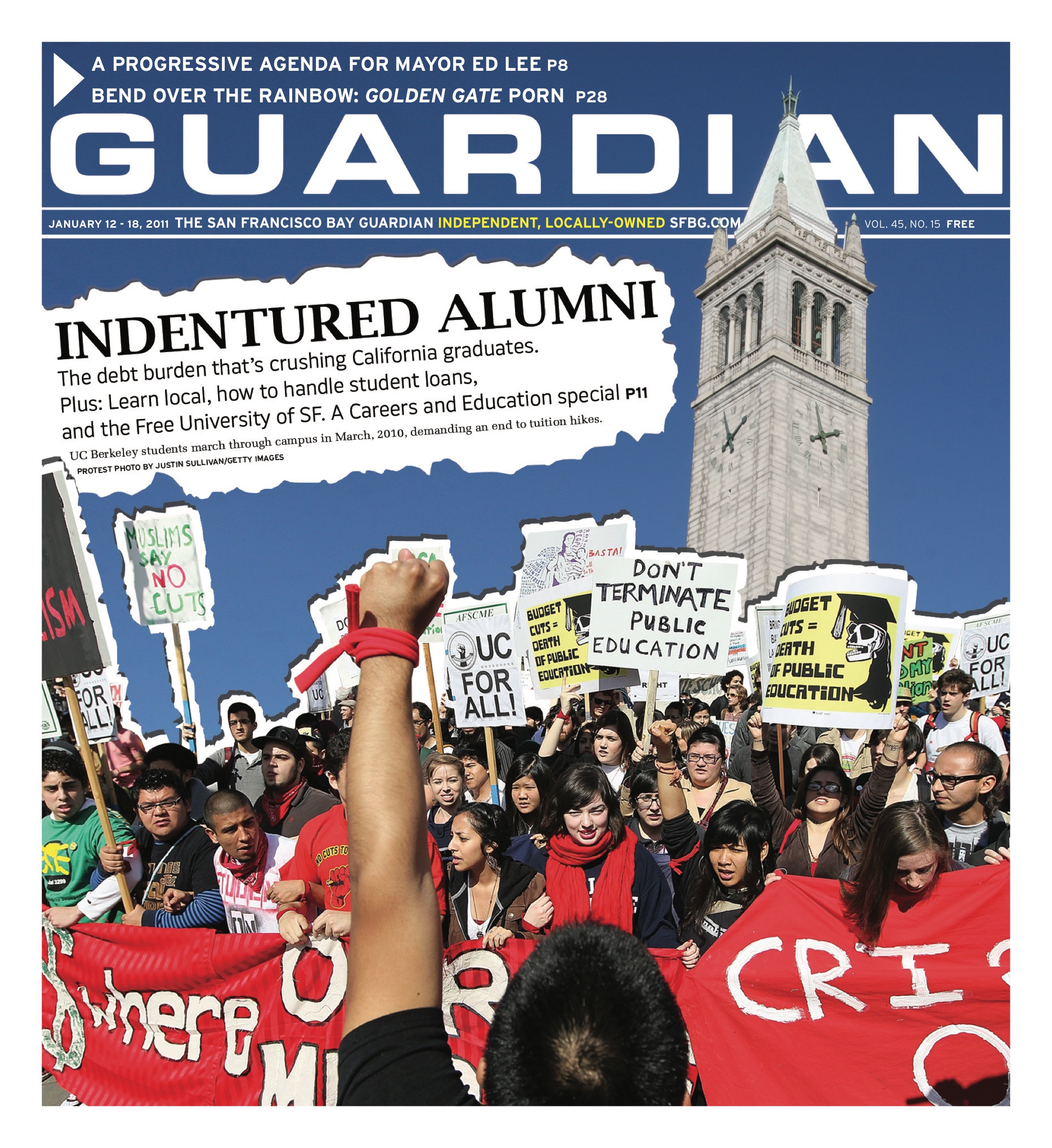
CAREERS AND ED Of course, you could just stop paying for school all together. Instead of putting their hopes for the future of education behind state reinvestment in university systems, a group of SF radical intellectuals are seeking to revamp the definition of learning by introducing the Free University of San Francisco. The nascent institution holds its first teach-in Feb. 5-6.

“Education is revolution,” says the incubator of the Free University, writer and poet Alan Kaufman. This ain’t Kaufman’s first rodeo. In 2004, while an instructor at SF’s Academy of Art University, he organized a student walk-out to protest the school’s violations of free speech rights. Employed through a temporary contract with the academy, Kaufman was not hired back the next term.

For him, it was a wake-up call that the current university system was teaching for the wrong reasons, not the least of which was the hefty price tag for classes that left his pupils in poverty. One student, he said in a recent phone interview with SFBG, had been “starving before my eyes, surviving on Ramen Noodle Cups” — all she could afford on top of tuition fees. He gave her $60 for food. But it wasn’t enough. Something had to be done.

When asked what he thinks the point of education is, Kaufman barely hesitates. “Liberation, freedom.” The current trends of privatization in public colleges, coupled with soaring school fees that far outpace students’ budgets, is symptomatic of a system that, as he prettily puts it, “funnels hearts and minds into narrowing corridors of survival. Creating profits for the university — that is the end game.”

He’s not the only person who thinks so. Kaufman and other Free University supporters have organized a teach-in next month that will feature college-level lectures from leading Bay Area artists and intellectuals, including Beat poet and SF poet laureate Diane Did Prima, former president of the Board of Supervisors Matt Gonzalez, and Pirate Cat Radio’s Diamond Dave Whitaker. The courses are no-credit, but the event is a symbol that the current educational system isn’t fulfilling some basic student needs. Instructors will teach on subjects that range from 19th-century poetry to natural geography.

Eventually Kaufman he envisions an “actual mobile university” capable of bringing the possibility of a college education to places where such a thing might be considered unattainable. And it wouldn’t just be beneficial to students. Guest faculty could experience “a kind of cleansing,” a temporary return to their original ideal of academia.

Of course, there are a few — ahem — challenges involved in starting a school that has no tuition, teacher salaries, or even monetary donors (Kaufman says the Free University will accept gifts in the form of books or other resources, but no cash). University supporters have decided to eschew accreditation for now, and true to Kaufman’s nomadic vision of the school, no location for classes has been set. First the teach-in, Kaufman says, and based on feedback, the consensus-based, hierarchy-free project will take it from there. The idea of the Free University, it would seem, is the thing for now.

It’s been done before. In the wake of the French Revolution, France established its Grandes Écoles system, a 250-school system that remains for the large part, tuition-free. The East Bay Free Skool is one outlet in the Bay that offers skill training, gratis. So for all the pie-in-the-sky idealism involved, perhaps the true test of the Free University of San Francisco won’t be its creation at all — crazy things have happened, haven’t they? Instead, it may be the extent that humanist students can steel a harsh economic climate that tends to reward monetarily-driven educations.

So why would a student chuck their pursuit of an accredited degree to participate in an uncertain radicalization of education? “Would it have practical application in a corporatized universe? Good question!” Kaufman chuckles. He launches into a torrid Marxist prediction: that our patently unfair education system cannot stand. “The system must be changed. When the pain is bad enough, people start to change.” *

FREE UNIVERSITY TEACH-IN

Feb. 5–6, 9 a.m.–5 p.m., free

Viracocha

998 Valencia, SF

(415) 374-7048

fusf.wordpress.com

Joining the journey

0

news@sfbg.com

Malcolm X once said “Tomorrow is for those who prepare for it today.” And today, Malcolm Shabazz, the eldest grandson of Malcolm X, says he is trying to carry on the storied legacy of the radical advocate for African American civil rights and leading voice for the Nation of Islam.

Shabazz, 26, was recently in San Francisco discussing that legacy, as well as his own spiritual and personal journeys, which included making the pilgrimage to Mecca for the hajj in November, a requirement for Muslims that his grandfather also undertook in 1964, the year before he was assassinated.

It was the latest chapter in a long and complicated story. At the age of 12, Shabazz started a fire in his Yonkers home that left his grandmother (Malcolm X’s wife, Betty) with burns over 80 percent of her body, which led to her death a few days later. Shabazz has spent more of his adolescence and adulthood in prisons and other institutions than in the real world.

After serving four years in juvenile correctional facilities for arson and manslaughter charges for the fire, Shabazz pleaded guilty to attempted robbery in 2002. He served three and a half years in prison for that crime and then went back to prison months after his release for punching a hole in a store window.

Although he is often portrayed in media accounts as disturbed, Shabazz seemed calm and reflective during a two-hour interview with the Guardian. A soft-spoken man with few but well-chosen words, Shabazz is not unafraid to speak his mind about the state of the country and his grandfather’s legacy.

“If you want to know anything, then go back to the source,” he told us, which is what we did, reviewing his long, twisted journey to Mecca.

As the oldest male heir to Malcolm X, Shabazz was born into a fascinating family. Media accounts have documented him as a troubled young man, shuttled back and forth among family members. Like his grandfather, he spent time on the streets and in jail. Like his grandfather, it was behind bars that he finally regained his faith and found himself fully immersed in Islam. Shabazz explains that while he was born into Islam, he finally began to fee its presence in his life during his most recent incarceration period. While quarantined in Attica Correctional Facility in New York, Shabazz explained that he “didn’t have any hygiene supplies, I didn’t have any reading materials.”

But it was during his time in Attica that he met another prisoner — half Mexican, half Iranian — who identified himself as a Shia Muslim. “He asked me ‘Are you in a lie? Or are you a real Muslim?’ ” Shabazz recalled. He answered that he was a real Muslim. “He gave me reading materials to read in my cell.”

According to Shabazz, this was the man who discussed and poured over religious texts with him during their time together, and the one who inspired him to convert from the Sunni sect to Shia.

“I was raised a Sunni, everyone in my family was Sunni,” he said. There is much antagonism between the two sects, so his conversion caused a backlash akin to when his grandfather left the Nation of Islam in 1964 and declared himself a Sunni, which let to his assassination the following year.

When word spread of Shabazz’s conversion, various Sunni leaders and community members expressed their discomfort with what he had done. He explained that many people wrote to him asking him, “How could you become a Shia?”

After his release, Shabazz decided to move to Syria to study at an Islamic institute and then spent the following eight months teaching English to children. “I came home from prison [and] I wanted to get away for a little while,” he explained.

After arriving back from Syria in April, Shabazz went to Miami and worked on his memoirs, which he said are due to come out this May. The book discusses Shabazz’s life and tribulations, noting that “there are misconceptions that I would like to clear up.”

Once he returned to the United States, Shabazz decided to follow his grandfather’s footsteps and make the pilgrimage to Mecca, where, he said “the air felt different.” But he also explained how the people he saw on the pilgrimage seemed less willing to impose their rules on Americans.

“It seems like they have more fear [of] Americans than they do for Allah,” he said. “If they know you’re American, I don’t know what it is, but they leave you alone.”

Shabazz said he had the experience of a lifetime and proved his intense vigor for the Islamic faith. He circled the Kaa’ba, and despite swollen feet and a bad case of the flu, carried on his pilgrimage like a true believer. “I never saw this many people at one place at one time. It was much more of a struggle than I had anticipated,” he said. “But everything was earned.”

Decades before, his grandfather Malcolm X made his mark on American culture, taking a radical approach to demanding equal rights. When asked if his grandfather would admire President Barack Obama if he were alive today, Shabazz replied, “Definitely not. To me, Obama is no different than [George W.] Bush.”

He said that democracy in this country is a sham, an illusion effectively perpetuated by the ruling elite. “The U.S. is a land of smoke and mirrors, and they’re the best at doing what they do,” he said. “My grandfather? Hah. He wouldn’t have supported any of those dudes.”

Although Shabazz doesn’t particularly admire Obama so far, he does hope that the election of the first African-American president will “boost the esteem of the young black youth.” And he said that the messages of Malcolm X are more important today than ever.

“My grandfather once stated that there are only two types of power that are respected within the United States of America — economic power and political power — and he went on to explain how social power derives from these two. Unfortunately, the majority of the people [today] are economically illiterate and politically naive. They believe most of what they see on television and read in the papers. I say believe half of what you see, and none of what you hear.”

For his own personal politics, Shabazz said change begins with education and unity. “[Education] could be done through music, spoken word poetry, art, preaching from the pulpit, or putting in physical work right in the trenches,” Shabazz said.

In terms of unity, he cited the European Union, explaining that it is an organization “where nations that don’t necessarily like each other [but] have at least enough common sense to come together for a cause, to achieve a common goal, or to stand up against a common enemy. When it’s time to put niggers in check, they know how to come together.”

Almost 10 years after the 9/11 attacks, Shabazz sees growing potential for Islam to exert an influence in the U.S. “After 9/11, a lot of people did not know too much [about Islam]. But they started to investigate and learn more.”

Although many people’s first reaction was to turn away from the religion of jihad, Shabazz feels that many people also felt the need to educate themselves on the matter — and found that there is much more to Islam than the mainstream media portrays. And for a young man who has already led a turbulent life, Shabazz is seeking something basic from his newfound faith: “I want a peace of mind.”

Page street

0

Rebecca Solnit’s Infinite City: A San Francisco Atlas (University of California Press, 158 pages, $24.95) is one of the best ideas a writer has come up with in a long time. By combining private and public support, Solnit was able to give away portions of the atlas in full-color, full-spread map handouts. (My favorite tracked both famous/infamous queer public spaces and the migration of butterflies throughout the city.). In the process, she also gave lectures in public spaces, providing a public service in the name of history and inclusion before dropping this tome on the book-buying masses. Gent Sturgeon’s version of a city-fied Rorschach alone is worth the price of the ticket. From insect habitats to serial killers, Zen Buddhist centers to the culture wars of the Fillmore and South of Market that some call redevelopment; Solnit and her cadre of artists, writers, cartographers, and researchers — Chris Carlsson, Guillermo Gómez-Peña, and Mona Caron among them — give us the infinite depths and limitless potential that can be found in 49 square miles. (D. Scot Miller)

A lot of good and even great books came from the Bay Area this year, but one stands out: a book of poetry, Cedar Sigo’s Stranger in Town (City Lights, 100 pages, $13.95). He is a young writer who improves dramatically each time I hear him read, and his poetry and critical writing are among the wonders of our age. And of the age before, since through him speak the dead poets David Rattray, John Wieners, Robert Creeley, Denton Welch, Philip Whalen, Salvador Dali, Jean Cocteau, Eartha Kitt, Raymond Roussel, Lorine Niedecker, and Cole Porter. When new writers come to San Francisco, they ask me if I’ve met Cedar Sigo. If they don’t know Sigo’s work, then I hand them a copy of the new collection. Don’t have to say much, I just step back a little to avoid the stars and diamonds and apples popping out of their eyes like toast from a toaster, because this crazy work is that crazy good. (Kevin Killian)

Compared with the prosaic grind of the inner city, the Sunset can seem like a — albeit foggy — vacation. Wide streets, surf breaks, dunes fit to get lost in: the neighborhood is just right for an offbeat bohemian getaway. But maybe those are just the reverberations of the past, which western neighborhood historian Woody LaBounty has dug up in Carville-by-the-Sea (Outside Lands Media, 144 pages, $35). This coffee table book illustrates the lives of the Sunset’s first modern-day inhabitants, who constructed a seaside village of retired street cars to inhabit back in the days before the N-Judah. Colorized at times for an Oz-like effect, the photos LaBounty digs up to illustrate “Cartown” reveal a community of artists, families, and enthusiasts — even a women’s cycling club — amid an untamed, oscillating sandscape. Those converted SoMa warehouse apartments suddenly don’t seem quite so rugged, do they now? (Caitlin Donohue)

In a city that boasts literally hundreds of theatrical world premieres per year, it’s astounding how few make it to the printed page. Bravo, then, to EXIT Press, new publishing arm of the venerable EXIT Theatre, for helping to ensure that at least some of our local play-writing talents will be preserved for posterity. And who better to inaugurate the series than Mark Jackson, whose professional development has been closely tied to the EXIT, and to the San Francisco Fringe Festival, which it produces? Far from being merely a collection of “Fringe-y” experimentation, Ten Plays (EXIT Press, 492 pages, $19.95) is a testament to the tenacity of vision. From reimagined Shakespearean classics (R&J, I Am Hamlet) to Jackson’s breakout hit The Death of Meyerhold, the bleakly comedic American $uicide, and the stirring Kurosawa-esque epic The Forest War, what these plays have in common is an audacious commitment to the illimitable possibilities of live theater. Of which, giving these works an opportunity to reach a wider audience is but one. (Nicole Gluckstern)

By any good political standard, John Lescroart’s Damage (Dutton, 416 pages, $26.95) is awful. It’s all about how a criminal uses the technicalities of law to get released (damn liberal judges) and how his family — newspaper publishers with ties to the (damn liberal) political establishment — protects him even as he continues to rape young women. Reminds me of that atrocious movie Pacific Heights, which is supposed to convince you that eviction protection and tenants rights are unfair to the poor landlords. But Lescroart writes about San Francisco, and does a pretty good job describing the city, and his characters are so real and well-crafted that I’m able to set aside the politics. In this case, Ro Curtlee, the rapist, is such an evil, evil bad guy — but a plausible, privileged evil bad guy — that he comes to life in a way that makes you want to kill him yourself. And makes you understand why a cop might feel the same way. And in the world of crime fiction, making you feel pain is half the game. It’ll be out in paper this spring. (Tim Redmond)

What Carl Rakosi was to Objectivism — a significant poet who dropped out of sight only to reemerge an old master — Richard O. Moore is to the SF Renaissance. The 90-year-old Moore was active in Kenneth Rexroth’s libertarian-anarchist circle in the 1940s, but abandoned poetry publishing for the more efficacious mass media of radio and TV, cofounding both KPFA and KQED in the process (and shooting the only footage of Frank O’Hara to boot). But Moore never stopped writing, and his debut volume Writing the Silences (University of California Press, $19.95) offers a brief but tantalizing introduction to more than 60 years of poetic activity. Moore’s diction is spare but memorable; a hawk’s wings, for example, “balance on the blind/ push of air.” Yet his low-key tones are wedded to an experimental sensibility; witness 1960’s “Ten Philosophical Asides,” which might be the first poem in English riffing on Wittgenstein, more than a decade before language poetry. Writing the Silences is thus belated yet ahead of its time. (Garrett Caples)

I commissioned three of the works in Veronica De Jesus’s Here Now From Everywhere (Allone Co. Editions, 130 pages, $26). Her portraits of Michael Jackson and Jay Reatard ran in the Guardian, while I paid out of pocket for her to render a tribute to the poet John Wieners for my boyfriend. Along with just-announced SECA Award winner Colter Jacobsen, who published this book, De Jesus is my favorite creator of drawings in the Bay Area. Like Jacobsen, she delves into memory — her memorial portraits can be seen for free on the windows of Dog Eared Books, where this book is for sale. The charm and value of Here Now From Everywhere is immediate, but the book reveals more of its multfaceted personality with each return visit. De Jesus’ illustrated dictionary of inspirational icons ranges from superstars to half-forgotten pop heroes, from cultural figures to obscure female athletes. It’s a gift. (Johnny Ray Huston)

“I told Micah last night that my new book would be a haunted house.” Berkeley-based poet Julian Poirier’s El Golpe Chileño (Ugly Duckling Presse, 128 pages, $15) is filled with the ghosts of past and present. Essentially a bildungsroman, it tracks Poirier’s protagonist’s growth from youthful journeyman into adulthood though a kind of mixed-genre Theatre of the Absurd. Vaudeville, comics, memoir, film pitch, epistolary, failed novel, poetry, the carnival, and travelogue are all wielded brilliantly in the hands of Poirier, making for a phantasmagoric reading experience where the whole emerges defiantly greater than the sum of its parts. Poirier writes, “I turned my whole brain into a city and wrote down everything I saw happening there.” And indeed it certainly feels that way — the book is ripe with the names of places, of friends living and dead; with lists of dates and years; and with drawings and photographs, making up what Poirier somewhat obliquely labels “The Stolen Universe.” El Golpe Chileño is truly a success of form and content, of the high and low, of pop and elegy. (John Sakkis)

Look forward in anger

0

arts@sfbg.com

HAIRY EYEBALL/YEAR IN ART The year in art is ending on a note both sour and defiant. On Nov. 30, Smithsonian Secretary G. Wayne Clough, caving to criticism voiced by conservative politicians and religious groups, ordered the removal of David Wojnarowicz’s 1987 video A Fire in My Belly from the National Portrait Gallery’s exhibition “Hide/Seek: Difference and Desire in American Portraiture.” It was a cowardly decision; one that ultimately has undermined the credibility of Clough and his institution.

It’s unfortunate that it took an act of censorship to get art — specifically, art by an openly gay artist responding to the darkest hours of the AIDS crisis — back into the national conversation, but the chorus of condemnation coming variously from journalists and critics, art museum associations, and even The New York Times editorial page, has helped to do just that.

Additionally, Wojnarowicz’s piece, which was uploaded to Vimeo by his estate and New York’s PPOW Gallery soon after it had been taken down in Washington, D.C., has undoubtedly been seen by more viewers in the past month than it had at the Smithsonian, or perhaps even in past installations (as of writing this column, the uploaded version has received more than 18,000 views).

This will probably continue to be the case as more galleries and museums across the country, in an impressive show of institutional solidarity, screen and/or install A Fire In My Belly. Locally, SF Camerawork and Yerba Buena Center for the Arts held screenings earlier this month. Southern Exposure will continue to show the piece through mid-February, and SFMOMA is scheduled to screen the full-length version of the video in early January.

While I agree with Modern Art Notes’ Tyler Green that SFMOMA’s commitment to screen A Fire in My Belly is “a turning point” in this whole debacle (New York’s four biggest art museums have remained silent on the matter), I find his characterization of SFMOMA as “America’s most conservative, play-it-safe modern-and-contemporary art museum” a bit harsh. Certainly, this year’s recently revealed SECA winners — three of whom, it must be noted, have been past Goldie recipients, including 2010 winner Ruth Laskey — attest to the fact that, for every groaner of an exhibit (“How Wine Became Modern,” anyone?), SFMOMA is also committed to supporting artists whose work cannot be dismissed as “play-it-safe.” For starters, the memory drawings of Colter Jacobson, one of this year’s SECA winners, certainly fall along the continuum of queer portraiture displayed in “Hide/Seek.”

This is not to encourage wishful thinking. While it’s hard to imagine a San Francisco art institution doing something along the lines of the Smithsonian, I don’t think anyone expected a reignition of decades-old culture wars, let alone in the very city where the Corcoran Gallery infamously canceled a Robert Mapplethorpe exhibit in 1989. The shorter our cultural memory, it seems, the greater is our propensity to repeat the lowest moments of our history.

So, over the past few weeks, I’ve been going over the works, exhibits, and events that I was thrilled did happen here, all glorious reclamations of our Convention and Visitors Bureau’s tagline, “Only in San Francisco.” Here is an in no way complete rundown of some of the art I didn’t cover in this column for a variety of reasons (scheduling conflicts, in-the-moment preference, critical laxity), save for the works themselves.


L@TE, BERKELEY ART MUSEUM, MOST FRIDAY NIGHTS

Turning staid-by-day museums into hip nightspots for hip young folks has been the hip thing for institutions to do for some time now. Thankfully, the Berkeley Art Museum knows how to do it right. Skip the catered canapés and light show, and focus on programming that is truly varied and more often than not, locally-minded — from Terry Riley celebrating his 75th to Xiu Xiu frontman Jamie Stewart improvising film soundtracks, from performance artist Kalup Linzy singing dirty love songs to outré Mexican B cinema— all for next to nothing.


CARINA BAUMANN, UNTITLED (2) (2008-09), 2ND FLOOR PROJECTS, JAN.–FEB.

At first I couldn’t see the woman’s face in Carina Baumann’s Untitled (2). I stared into the slate-like surface (actually, translucent white film developed on aluminum), incrementally adjusting my height, until the blackness stared back. The effect was not one of shock, as with the mirrors at the end of Disney’s Haunted Mansion ride, in which the holographic undead crowd in with your reflection. Baumann’s art asks for patience and slow adjustment, and in return, regifts your sense of sight.


“SUGGESTIONS OF A LIFE BEING LIVED,” SF CAMERAWORK, SEPT.–OCT.

Perhaps most germane to the issues about queerness, identity politics, and representation now being raised (again) by Wojnarowicz-gate and the “Hide/Seek” exhibit, this group show put together by Chicago-based curator Danny Orendorff and SF native Adrienne Skye Roberts took “queerness” out into the desert, helped it cast off the much-tattered coat of identity politics, and asked a group of artists, activists, and filmmakers to record its unfettered visions of things to come (many of which, as the resulting work testified to, are being lived out right now).


MATT LIPPS, “HOME,” SILVERMAN GALLERY, APRIL-JUNE; R.H. QUAYTMAN, “NEW WORK,” SFMOMA, THROUGH JAN. 16, 2011

Although Matt Lipps is a photographer and R.H. Quaytman is a painter, they tweak their respective mediums in these unrelated shows to arrive at a similar kind of flat sculpture, which flickers between abstract prettiness and representational heavy-lifting. Lipps’ densely layered photographs of assemblages — in which variously colored photographs of domestic interiors, cut into facets and taped back together to form the original image, become backdrops for cut-out reproductions of Ansel Adams landscapes — collapse foreground and background, personal space and photographic history. Quaytman, working in dialogue with the poetry of Jack Spicer and SFMOMA’s photo archive, silk-screens images from the museum’s holdings onto beveled, wooden panels of various sizes, augmenting them with flashes of Easter eggs-like color and glittering crushed glass.


ERIK SCOLLON, “THE URGE,” ROMER YOUNG (FORMERLY PING PONG), JULY–AUG.

Although nothing will top his porcelain casts of assholes that littered Ping Pong Gallery like so many discarded sand dollars for the 2009 group show “Live and Direct,” Eric Scollon’s more recent solo exhibit at the gallery, “The Urge,” continued to queer form and function. The 50 or so small porcelain works, painted in the blue and white style of Dutch Delftware and arranged in pun-laden groupings, smartly played off ceramics’ dual cultural status as both a “fine art” and kitsch object, while throwing shade at modern art’s conflicted relationship to ornament. Speaking of which, if only I had a Scollon for my tree.


ANDY DIAZ HOPE, “INFINITE MORTAL,” CATHARINE CLARK GALLERY, THROUGH JAN. 1, 2011

Diaz Hope’s dazzling sculptures owe as much to his engineering background as to, as he puts it in an e-mail, a “revisiting of childhood thoughts about mortality and infinity.” Their mirrored, crystalline exteriors yell “Gaga!” but once immersed in their kaleidoscopic guts, they are, much like Yayoi Kusama’s infinity boxes, meditation chambers built from carnival ride components. Simply beautiful stuff.

Grids and gridiron

0

le.chicken.farmer@gmail.com

CHEAP EATS Coach and me went to Benders many nights in a row. "Benders," she likes to say. "It’s what’s for dinner." But I don’t know. I love their burgers and tots. And their pulled pork, come to think of it, rebounded me nicely from that dollop of whatever-the-crap-that-was at Bonnie’s last week. But my sense of adventure begins to feel compromised after more than one night in a row at the same place.

Nevertheless, neither one of us has a TV. And we thought we should watch us some football. I swear our intention was to go to poetry readings, too. But we tended not to want to leave the bar.

It’s weird, liking football again, this time from a softer, less angular angle. For me, the football part of my friendship with Coach is the perfect blend of strategy (possible color-combinations, baggy vs. tight uniforms), surreality (keep reading), and camaraderie. It reminds me of watching the Niners with Wayway back in the day, only Coach and I seldom look at the TV and the plays we draw up on our napkins look a lot more like fruit trees in the end.

Moreover, I’m pretty sure Wayway never said (although he may well have been thinking it) during Monday Night Football: "This would be a lot more interesting if they were lesbians."

"They will be, Coach," I reminded her. "For now, just imagine."

The Ravens were playing the Texans.

We talked about relationships. We talked about depression. We talked about the holidays, and who I will meet and where we will be and who will like me. And always eventually it came back to the little TV at the other end of the bar.

"I like when the little guys dart around," she said. "They’re like shortstops, and second base."

"That’s the spirit," I said. "Now we’re talking."

Coach has a little notebook that she writes her football information in. There is a column of names. Most of our friends already know that they are playing football come spring. One or two even know how. I do! That’s why I get to be Coach’s coaching staff, confidant, and — if I don’t blow it — on-field captain. We already know who our quarterback will be and have a pretty good idea of the blockers. Less certain is who will play weasel, and the ever-important position Coach calls the "far runners." Myself, I am proud to be penciled in, according to her little notebook, at shortstop.

Which looks to me a little like the position formerly known as tight end. But when I mentioned this to Coach she got the giggles. "Tight end!" she said. "That’s perfect!"

I should stop writing about us. We are going to take this league by storm. And it might be better if no one sees us gathering on the horizon, like dark, sexy, undertalented and overburgered but height-weight proportionate clouds.

I’m just too excited to leave it alone!

OK, focus. My secret agent lady Sal and me didn’t want to sit in her rental car at the beach and watch surfer boys change clothes in her rear view mirror on an empty stomach, so we stopped off first for Korean.

Every Saturday a group of three or four food trucks circle the wagons down at McCoppin and Valencia around lunch time, and then some. I tried to go there once before with Mr. Wong when we were on our kimchi burrito kick, but Seoul on Wheels musta had a flat tire that week.

This time it was there! That’s the good news. The bad news is that its Korean burritos, which it calls korritos, are premade and have sour cream, which is a big mistake. An even bigger mistake: way too much rice and way not enough meat, or kimchi, or therefore flavor.

Weak. Weak. Weak.

On the other hand, I had a bulgogi taco and it had no rice at all. Small small small. But … delicious!

There’s also a Filipino truck there, which is pretty good, and I forget which taco truck — taco tacos, I mean. Next time I’ll try those.

SEOUL ON WHEELS @ OFF THE GRID

Sat. 11:30 a.m.–3 p.m.

McCoppin and Valencia, SF

(415) 336-0387

Cash only

No alcohol

Renegade Crafts Fair stuffed our stockings with future gift ideas

0

Martha Stewart would have been awed had she found her way to the Renegade Crafts Fair at the Concourse Exhibition Center this past weekend, 12/18-12/19. The amount of creative crafters packed into one space was overwhelming, and Martha would have found it quite inspiring.

The meandering crowds, diligently finishing up their holiday shopping, had a plethora of cool commodities to pick through, from vintagey Polaroids by Sprout Studio, to a hip stuffed-animal owl by Doris Anne. For those who wanted a truly creative gift, squished in the middle of the isle was The Poetry Store, where you could have Silvi Alcivar write you an impromptu poem for that special someone. There were also items that would have been totally dude-approved, including carefully crafted wooden watches by Mistura, and all-recycled bicycle clocks made by Oakland’s 1 by Liz.

The two cutest vendors at the fair were Ysabella and Anna Patricia Designs flower headbands (whose model was asleep in her stroller, which just added to the cuteness) and Twinkie Chan, who was working on a string of crocheted popcorn when I passed, but was also selling crocheted pizza scarves and cherry earrings.

And finally there were my two favorite vendors: first, Double Parlour‘s totally weird and wonderful dolls that were so expressive it was eerie. And then (boy, I wanted everything from these guys!) the awesome Native American inspired clothing and jewelery by The Local Branch. I especially loved their Hippie Fringe Necklaces, that were so undeniably handmade, making them ever so irresistible.

Ok, people. Christmas is just a few days away. I’ve done the hard part of finding all the awesomeness. Now you just need to buy it!

Video babies of 2010: A wee look back

1

Smoking Baby, Preacher Baby, Iron Baby, Samba Baby, Mini Daddy — Is it too premature to nominate 2010 for “Year of the Video Baby”? Copious amounts of Gaga-goo aside, this year had plenty to offer li’l sprout gawkers — the baby meme has definitely replaced the baby mama as our go-to young ‘un pop cultural signifier of choice. Here are some of our favorite kid video (kideo?) shout-outs from the past year …

>>Iron Baby

>>Heavy Metal Baby

>>Samba Baby

http://www.youtube.com/watch?v=fSBnNA_dHNU

>>Smoking Baby

>>Mini Daddy (NOT Smoking baby)

>>Awesome Poetry Baby

>>Chronic Reggae Baby

http://www.youtube.com/watch?v=Gd5yN43TqCk

>>Baby Monkey Riding Pig

>>Demon Baby from Hell

>>BONUS Two-Headed Baby Turtle

Visit msnbc.com for breaking news, world news, and news about the economy


Our weekly Picks: December 15-21, 2010

0

WEDNESDAY 15

MUSIC

Buzzov*en

Legendary sludge metal band Buzzov?en has been wandering the wilderness since the early ’90s, its members ping-ponging between different down-tuned, drugged-out projects. Sludge, an ugly-sounding offshoot of stoner metal, can be traced back to the Melvins, and it was relatively big business in 1994 when Buzzov?en’s second album, Sore, was picked up by Roadrunner Records. That honeymoon was over quickly, and the band’s career has been peripatetic since. Famous for the violence of its live shows and squalling, pummeling riffs, the band is likely to incite a frenzy wherever its brand-new tour may take them. (Ben Richardson)

With Brainoil, Neurotoxicity, No Statik, K. Lloyd

8:30 p.m., $16

DNA Lounge

375 11th St., SF

(415) 626-1409

www.dnalounge.com


MUSIC

John Grant

After the decade he spent fronting dreamy indie-pop group the Czars, John Grant has since gone on record saying he never really felt all that satisfied with the band’s albums. As crazy as that might sound to Czars fans, Queen of Denmark, his new solo album backed by Texas folk-rockers Midlake, is indeed a markedly personal album — and perhaps the type he wanted to make all along. Grant’s 1970s soft rock-inspired arrangements and rich baritone vocals are excellent; but it’s the emotional vulnerability and snarky humor of his lyrics that really define him as a songwriter who is very much deserving of some more attention. (Landon Moblad)

With Jessica Pratt

8 p.m., $15

Swedish American Hall

2170 Market, SF

(415) 861-5016

www.cafedunord.com


MUSIC

Del the Funky Homosapien

The Bay Area’s ambassador of hip-hop, not to the planet but the galaxy and beyond, Del the Funky Homosapien came out of Oakland’s Hieroglyphics crew before lending his unmistakable voice to projects of a stranger variety. A fetish for ginormous words and out-of-this-world concepts culminated in the future blap of 2000’s space jamming album Deltron 3030. A follow-up is supposedly in the can, reportedly ready for release in 2010. At this intimate event, fans will have the opportunity to remind Del that it is mid-December. (Ryan Prendiville)

 With Simple Citizens

Wed/15–Thurs/16, 8 p.m., $30

Yoshi’s San Francisco

1330 Fillmore, SF

(415) 655-5600

www.yoshis.com


THURSDAY 16

DANCE

“DANCEfirst! Modernity/Humanity: The Nzoto Installation

Often the very act of preserving an artifact distances it from its daily meanings. The “Art/Object: Recontextualizing African Art” exhibit now gracing the halls of the Museum of the African Diaspora seeks to right this wrong, inserting ancient costumes, tools, and accessories back into the flourishes of life they once accentuated. The integration of ritual and modernity is also the theme of an upcoming MoAD dance performance, The Nzoto Installation, presented by dance-community bridge-building organization see.think.dance, and featuring international performance artist Byb Chanel Bibene using the nzoto (“the body” in Bantu) of dancer groups to meld abstract thought and tradition with motion and emotion you can feel, now. (Caitlin Donohue)

6–9 p.m., free with admission ($5–>$15)

Museum of the African Diaspora

685 Mission, SF

(415) 358-7200

www.moadsf.org MUSIC


MUSIC

Om

The demise of Sleep marked a sad day for metal fans, but from the resin-soaked ashes of that vaunted South Bay trio emerged two bands that have done much to cheer them up. The success of Matt Pike and High on Fire is a topic to be considered elsewhere; Om is the order of the day. Founded by Sleep’s bassist and drummer, Al Cisneros and Chris Haikus, the meditative metal outfit has taken advantage of the former’s mellifluous playing to craft songs that are at once crushingly heavy and fuzzily embracing. Cisneros is now paired with new drummer Emil Amos, and they’re prepared to rock you into reverie. (Richardson)

With Lichens, Barn Owl, DJ Britt Govea

8 p.m., $16

Independent

628 Divisadero, SF

(415) 771-1422

www.independentsf.com.


FRIDAY 17

THEATER

Mr. Yoowho’s Holiday

In conjunction with Noh Space, Moshe Cohen presents Mr. Yoowho’s Holiday, a story fusing the spirit of adventure with the warmth of the season. Mr. Yoowho embarks on an international journey across geographical borders as well as the borders of the imagination. He meets Taro-kaja, the prototypical spirited trickster hero of Japanese Kyogen Theater, as well as encountering elements of the European circus and Yiddish absurdism. Drawing on aspects of traditional Japanese Noh Theater and Kyogen Theater, Cohen returns to SF after touring extensively through Europe to meld humor, poetry, and absurdity in this heartwarming tale. (Emmaly Wiederholt)

Through Jan. 2, 2011

Preview tonight, 8 p.m., $10

Fri.–Sat., 8 p.m., Sun., 3 p.m., $10–$18

Theatre of Yugen

2840 Mariposa, SF

1-800-838-3006

www.theatreofyugen.org


EVENT

“Hubba Hubba Revue’s Christmas Hanukkah Spectacular”

Who will be the next mayor? What will the new year bring? Which corporate Death Star will the WikiLeaks cabal take down next? The Guardian doesn’t have all the answers to these quandaries of the abyss yet — but we sure as sugar have the inside skinny on who will be taking off their clothes at Hubba Hubba Revue’s holiday burlesque spectacular (you’re welcome). To wit: the winner of “best variety act” at Las Vegas’ Burlesque Hall of Fame, Chicago’s Amazing Bendable Poseable Dolls of Doom, and boylesque troupe the Stage-Door Johnnies. Also, don’t miss (yes!) Hubba’s annual visit from the hang-10 Hasids themselves, Jewish surf band Meshugga Beach Party. (Donohue)

9 p.m., $10–$15

DNA Lounge

375 11th St., SF

(415) 626-1409

www.dnalounge.com


THEATER

Sweet Can Productions

Combining aerial silks, acrobatics, juggling, contortion, hula hoops, traditional circus, physical theater, dance, and live music, Sweet Can Production’s newest show Candid takes its audience into a charming topsy-turvy world where anything can happen. The limits of human imagination are stretched as mundane objects and everyday life transform into a breathtaking circus. Directed by Joanna Haigood and Wendy Parkman with new music by Eric Oberthaler, lighting designed by Tad Shannon, and performances by Beth Clarke, Natasha Kaluza, Kerri Kresinski, and Matt White, Candid aims to reveal the magic inherent in the ordinary. (Wiederholt)

Through Jan. 9, 2011

Schedule varies (opens tonight, 7 and 9 p.m.)

$15–$60

Dance Mission Theater

3316 24th St., SF

www.sweetcanproductions.com


MUSIC

Sub Swara

Bay Area dubstep freaks sometimes forget that the gateway to their bass addiction was a curious mutation of global funk — one that came to prominence in the mid-late ’00’s and mixed Jamaican dread, glitchy electronics, and bhangra flourishes into a heady, invigorating stew. Ground zero for this sound was the excellent Surya Dub party, much missed since its players went off to conquer the world. With a happy rumble, the Surya Dub crew is reuniting at Public Works, teaming up with Bay woofer-killers Slayers Club to bring in New York City duo Sub Swara, keepers of the international bass flame (with a cosmic-funky twist on their latest CD, Triggers). It’ll be a global-eared rumble that reunites seminal Bay influences while leaving you quaking in your Timberlands. (Marke B.)

10 p.m., $10

Public Works

161 Erie, SF

(415) 932-0955

www.publicsf.com


MUSIC

“Monsters of Accordion 2010”

The accordion: for many, it’s the runner-up for most annoying musical instrument (after bagpipes). When used outside of polka, zydeco, cumbia, and other “traditional genres” (read: mainstream pop), it has an attention-drawing, anachronistic quality. To rock it, a player must possess a superhuman degree of cool, like They Might Be Giants and, of course, Weird Al Yankovic. To that list add Jason Webley, the howling one-man band and mind behind Monsters of Accordion, known above all for his ability to convert nonbelievers to the squeezebox. (Prendiville)

With Corn Mo, Renee de la Prade, Petrojvic Blasting Co., and Duckmandu

9 p.m., $14

Slim’s

333 11th St., SF

(415) 255-0333

www.slims-sf.com


SATURDAY 18

MUSIC

Cyndi Lauper

With her string of recent successes, one could say that new wave chanteuse Cyndi Lauper is back. But that really wouldn’t be accurate — the independent firebrand never really went away. Starting with her smash breakthrough 1983 album She’s So Unusual and the string of hit singles that followed, including “Girls Just Want To Have Fun,” “She Bop,” and “Time After Time,” Lauper has continued to release a variety of music, along with appearing in films and being involved with human rights causes. She comes to the city tonight for an intimate club gig — here’s to hoping she can be persuaded to play “The Goonies ‘R’ Good Enough”! (Sean McCourt)

9 p.m., $65

Independent

628 Divisadero, SF

(415) 771-1422

www.independentsf.com


DANCE

Labayen Dance

It’s fun to watch artists who consistently surprise. Enrico Labayen is one of them. For a while, he dropped off the radar — turns out he went home to the Philippines to study native mythologies. When he returned, his first major endeavor became an ambitious Carmina Burana. Now he is taking on the Greeks. Icarus at the Edge of Recession promises to offer a fresh perspective on Daedalus as a CEO and Icarus as a young trader. He is showing this parable of a father sacrificing his son for his own ambition as a work in progress during what he calls a “holiday fun(d)raising event.” (Rita Felciano)

8 p.m., $20 (with pre-show party, 7 p.m., $25)

Garage

975 Howard, SF

(415) 509-3129

www.brownpapertickets.com


TUESDAY 21

MUSIC

Danny B. Harvey

Guitar slinger extraordinaire Danny B. Harvey has played with everyone from the Rockats, Nancy Sinatra, and Wanda Jackson to Bow Wow Wow and the Head Cat. This current tour stop finds him teaming up with his friend and “Rockabilly Filly” Rosie Flores. Harvey’s frantic finger-picking and tasty solos are truly a sight to behold live — especially when you look up from watching his fingers dancing on the fret board and see his expression — he often looks as if he’s enjoying a Jack and Coke at the bar, a big grin on his face and giving almost no indication of the difficulty of making the incredible sounds coming out of his guitar. (McCourt)

With Rosie Flores

9 p.m., $12–$15

Hotel Utah

500 Fourth St., SF

(415) 546-6300

www.thehotelutahsaloon.com

The Guardian listings deadline is two weeks prior to our Wednesday publication date. To submit an item for consideration, please include the title of the event, a brief description of the event, date and time, venue name, street address (listing cross streets only isn’t sufficient), city, telephone number readers can call for more information, telephone number for media, and admission costs. Send information to Listings, the Guardian Building, 135 Mississippi St., SF, CA 94107; fax to (415) 487-2506; or e-mail (paste press release into e-mail body — no text attachments, please) to listings@sfbg.com. Digital photos may be submitted in jpeg format; the image must be at least 240 dpi and four inches by six inches in size. We regret we cannot accept listings over the phone.

Libidinous literature with Naked Girls Reading

1

I had asked Lady Monster, over a pair of red wine glasses and the pleasant buzz of nearby patrons at Revolution Cafe, to tell me what story she’d read at the Halloween installation of her Naked Girls Reading literary series. We were chatting in anticipation of her International Day to End Violence Against Sex Workers edition of NGR (Fri/17) which will take place at the Center for Sex and Culture after the day’s City Hall vigil and march.

The curvaceous redhead is quite the story teller, even clothed. “I did the elevator scene from The Shining,” she told me, launching into a brief summary of the Torrance family’s elevator travails. By the end of it I had the crap scared out of me – and she was fully clothed! Imagine what this lady can get done in the buff – surely, a live literary luminary not to be trifled with.

Lady Monster first heard of the Naked Girls Reading series circa its Chicago inception by burlesque showgirl Michelle L’Amour in 2009. The series sits down sex-positive female role models (SF’s chapter features sexologist Carol Queen, sex activists, and burlesque beauty Dottie Lux among others) for a theme night of literary lustiness. The event struck a chord (books and boobies yay!), and not just among Chicago pervs – the series has been featured on the Carson Daly show and has spread to nine other cities. “Like wild blazes,” says Monster.

“Almost immediately Michelle had people wanting to franchise the series,” she continues. Naked girls getting brainy? Lady Monster had an inkling that her own San Francisco community would gag for a NGR chapter of their own. She scheduled NGR’s SF breakout in May of this year and the show’s played to packed houses every two months since – and will score a regular monthly gig at Viracocha come the new year. “It’s so much fun, so silly. It’s all about being comfortable in your own skin,” Monster asserts.

That’s something that she’s had little trouble with – even growing up on an Ohio farm, Monster started hosting her (initially PG-13 rated) play parties in fifth grade. “I’d have all my friends over and make sure everyone was coupled off. Then we’d go into my room and close the door. At first we’d all just make out, but as we got older it got more serious. I was my own sexually liberated role model!” With a little help from some open-minded parents, of course. “They didn’t bother us, they let us have our time together.”

From grade school groping, Monster graduated to more advanced expressions of sexuality. She worked the graveyard shift at a phone sex line and loved the intimacy and honesty she could find in horny men just getting home from last call. “I wanted to hear their secrets all the time,” she confesses. But she wanted it to happen face to face, so she tripped her way into a job doing “legal escort work.” Private peep show stuff, for which Monster would strip or faux-masturbate for a paying customer. 

Only it wasn’t legal, a fact that her employer neglected to tell her. And even though she was getting face to face time, the sexual intimacy she’d felt with men on the other end of the phone line was gone. “There was no talking! Yeah, the money was a lot better but I had to get out of there.” All the way to San Francisco, in fact – where Monster has put her open sexuality to work in service to SF Sex Information and pens sex stories and erotic poetry. She’s also a long time performer in the burlesque scene – she’s been known to create her own astronomically-inspired LED-lit costumes and accesorize with glitter-dipped viking axes. Oh, and she toured with Ministry.

Like NGR, The International Day to End Violence Against Sex Workers was created by an empowered sexual superstar and has grown into a far-reaching event, marked by vigils in cities around the globe and marches of men and women carrying red umbrellas (the adopted symbol of the movement). It was started by the Bay’s own feminist porn star Annie Sprinkle, an ex-sex worker who Monster counts amongst her role models: “she’s not really a mother figure, more like a respected aunt,” Monster says.

“Sex workers need protection,” she continues, noting that Sprinkle started the annual day of memorial after reading a serial killer’s confession that he killed over 40 prostitutes because he knew they were less likely to be reported missing or inspire dedicated police investigations.

Lady Monster’s convinced that sex worker safety is an issue that carries particular import this year for a variety of reasons. First: shitty profits. “Business is definitely being affected by the economy,” she says. “And on top of that the market’s flooded,” with all the men and women out of work in other industries. Lack of work can make it harder to avoid risky working situations that put sex workers at risk of withheld wages, assault, or rape. The shut-down of Craigslist’s casual encounters listings has made it more difficult to find clients in the first place, and in the midst of all of this, SFPD has adopted an evidenciary policy that discourages condom usage: if cops find a rubber on a suspected prostitute, they’ll use it as evidence of intent to have sex for money. 

That’s why Monster’s event Friday (which follows a vigil and march from City Hall that starts at 4 p.m.) will give voice to those that often go unheard in our society. Monster, her regular NGR cast, and Sprinkle will all read from literature penned by sex workers, including Jillian Lauren’s memoir of her time in the prince of Brunei’s harem and Scarlet Harlot’s account of becoming a radical prostitute, Unrepentant Whore.

“This is such a great opportunity for feminism and art,” Monster says. Undeniably, giving naked women a stage on which to talk about reclamation of body and sex issues is a unique approach. NGR, sex worker edition: sure to be a hot night, but also a reflection of the power of corpus woman when framing its own literary discourse. 


Naked Girls Reading: International Day to End Violence Against Sex Workers 

Fri/17 9 p.m., $15-20

Center for Sex and Culture

1519 Mission, SF

(415) 255-1155

www.nakedgirlsreading.com


Bodies and bacon

3

le.chicken.farmer@gmail.com

CHEAP EATS My new friends are young and queer and, most important, bikers, so I get to hang out at Benders where the burgers have whiskey and bits of bacon in them. Many of my new friends are vegetarian, which saves me from the awkwardness of having big fat crushes on them. My crushes are small and skinny and eat veggie burgers.

We’re starting a team in the girls football league. Remember, I wrote about them a few years back? I used to go to games on Sundays, and it was inspiring and scary. So scary that I tried to get on a team, but they never called me.

I can’t wait to play that team! It will be a made-for-TV movie made in heaven.

Probably, because I grew up in Ohio, I will have to start out at one of the so-called “skill positions,” such as running back or wide receiver, where I will bide my time making diving one-hand catches and long, slash-and-burn touchdown runs (yawn). But once I have earned everyone’s respect with my off-the-field poetry and appreciation for opera, maybe then they will move me to the offensive line.

Which is, as anyone who has ever played electric football knows, the most important position on the field.

Our coach, whom we call Coach, is such a consummate athlete that she doesn’t need to eat meat or rice. Fueled by air and eagerness, and maybe sometimes whiskey, she routinely wins bike races! And if anyone else enters, she comes in third. She lives in the Mission and owns at least three bikes that I know of, yet dates a motor vehicle. Coach jokes about never leaving the neighborhood, which is bullshit because I met her in a pond in Sonoma County. Interestingly, we were skinny dipping.

Or, I don’t know, maybe that’s not interesting.

How about if I described all my new friends’ bodies in full detail? This way everyone in the world will want to go skinny-dipping with me from now on! I’m kidding, of course. Respectfulness may not be my strong suit, let alone my swimsuit, but there are some lines I know better than to cross.

I’ll only describe Coach’s body — because our friendship I think can handle it, and anyway she’ll be on a three-week bike ride by the time this comes out, somewhere between here and San Luis Obispo, far far from newsstands.

How she does this shit — without fettuccini, I mean — I will never know. But the other day I ate Chinese food with Coach and Fiver, and I swear that all the rice on the table, and all but maybe one or two of the noodles wound up in me. The meat goes without saying.

The restaurant was Mission Chinese Food, which everyone has been singing about since I moved back to the neighborhood. It’s the restaurant inside the restaurant (Lung Shan) on Mission at 18th Street. You can believe what people are singing. It’s pretty special, despite its name.

I mean, where else can you get “thrice-cooked bacon” or “tingly lamb noodle soup”? And the bacon can be vegan, and still damn good, and the soup comes in a “numbing lamb broth.”

Which … they mean it. It’s a Szechwan spice, or herb, that literally numbs your mouth, and it was in the pickled beans and pickled pickles too. I don’t like that. I loved the flavor of everything I ate, even the fake bacon, but I’m sorry, I just don’t understand the point of numbness, except with respect to dentistry.

Folks, I want to feel what I eat. The not-at-all-fake lamb belly in the sizzling cumin lamb, for example, was a heavenly blend of crispy, tender, salty, peppery, game-flavored meat outside with an interior layer of soft, buttery, clouds of juicy joy.

Now I know what you’re thinking: No! There is no way that she’s that sexy.

I’m just saying. My job is to review restaurants. Your job, if you drive a car in California, is to go slow, watch the road, and see bicycles. Thanks for reading.

MISSION CHINESE FOOD

Mon.–Sat.: 11 a.m.–10:30 p.m.;

Sun.: noon–10 p.m.

(inside Lung Shan Restaurant);

2234 Mission, SF

(415) 826-2800

MC,V

Beer and wine

On the cheap listings

0

On the cheap listings are compiled by Caitlin Donohue. Submit items for the listings at listings@sfbg.com. For further information on how to submit items for the listings, see Picks.

Wednesday 17

Lara Adair Books Inc., 2251 Chestnut, SF; (415) 931-3633, www.booksinc.net. 7 p.m., free. Author Adair shares the secrets she’s privy to via her life of writing and coaching others – and that she’s published in her newest how-to, Naked, Drunk, and Writing. Pick up some pointers at this author talk, just don’t take the title too seriously now.

Dine Around, Shop Around, Drink Around Various venues, SF; (415) 558-6999 x230, www.dineshopdrink.aef-sf.org. 11 a.m.-2 p.m. A great excuse to paint the town red at some of your favorite neighborhood shops and eateries – tonight, 25 percent of your purchases will go towards HIV/AIDS and breast cancer support agencies.

Mole to Die For Mission Cultural Center for Latino Arts, 2868 Mission, SF; (415) 821-1155, www.missionculturalcenter.org. 7-10 p.m., $7. Dive into this Oaxacan delicacy at MCCLA’s cook-off, which this year features a special green mole for the true culinary enthusiasts.

“Saving the Last of the Wild: North American Corridors” California Academy of Sciences, 55 Music Concourse, SF; (415) 379-8000, www.wcs.org/patronseventCA. 6-8 p.m., free. A panel of scientific minds discuss the threat of human development to migration paths – lord, those animals have it rough! RSVP recommended.

Thursday 21

Switchback launch party Books and Bookshelves, 99 Sanchez, SF; www.swback.com. 7-9 p.m., free. The USF graduate school literary journal celebrates the sunshine on Issue No. 12, themed “Minority vs. Majority.” Raise your wine glass to live readings by scholarly bards, and ponder the conflicts between the few and the many in our society.

Friday 22

de Young artisan fair de Young Museum, 50 Hagiwara Tea Garden, SF; (415) 750-3600, www.famsf.org. (also Sat/20) 9:30 a.m.-8:30 p.m., free. Maybe you can’t afford the art up on the walls for your favorite masterpiece loved one this holiday season, but you can snag some one-of-a-kind gifts from the fine arts museum’s bazaar of local artesanals. Browse and shop accessories, clothing, and more.

Hospitality House “Art for the House” art auction The Shooting Gallery, 839 Larkin, SF; (415) 749-2184, www.hospitalityhouse.org. 6-10 p.m., free. Have a drink in the Tenderloin while you peruse for purchase the artwork of individuals from various community programs for the homeless and transitionally housed, including Roaddawgz and the Community Arts Program.

bay area

“Dracula to Twilight” Other Change of Hobbit, 3264 Adeline, Berk. (510) 654-6226, www.otherchangeofhobbit.com. 6-8 p.m., free. A professor and a chronicler of the Saint-Germain novels discuss the portrayal of blood-sucking undead in pop culture’s film and literature. Mortals welcome to attend, just make that your scarf is tied tightly and your garlic earrings are on hand.

Saturday 23

Celebrate People’s History release party Center for Political Education, 522 Valencia, SF; www.politicaleducation.org. 7 p.m., free. Perhaps you’ve caught CPH’s compelling radical prints on your neighborhood community center or bus shelter’s walls – they’ve been around since 1998. The group’s published a retrospective of their most vivid public art and you can celebrate its release here with historian Lincoln Cushing and artist Favianna Rodriguez.

“Science of Perception”: Human Potential Laboratory Southern Exposure, 3030 20th St., SF; (415) 863-2141, www.soex.org. (Also Sun/21) Noon-9 p.m., free. The Anonymous Immortal Collective and career alchemist Ean Huggins-McLean present an opportunity to extend the elasticity of your mortal coil: healing foods, training for aura-sighting, and more from their “new health care system” at this two-day workshop.

Tenderloin Reading Series Koko Cocktails, 1060 Geary, SF; (415) 596-7614. 7 p.m., free. The quarterly dish on the quirks and perks of the infamous TL features readings of poetry, fiction, and creative non-fiction. The much maligned neighborhood doesn’t get too many chances to revel in itself, so this is a great chance to celebrate your city.

bay area

Home and Hope interfaith benefit concert Transfiguration Episcopal Church, 3900 Alameda de las Pulgas, San Mateo. 7 p.m., donations accepted. The Foster City Community Chorus and East Bay Church of Religious Science Choir sing their hearts out in support of Home and Hope Shelter Services. The bringing of pie to the after-reception is highly encouraged.

Vintage Paper Fair Centre Concord, 5298 Clayton, Concord; (415) 814-2330, www.vintagepaperfair.com. (Also Sun/21) 10 a.m.-6 p.m., free. Maybe a bathroom plastered with old school cosmetic ads? Perhaps paper mache your refrigerator with postcards from famous foodie destinations? You can line your apartment with ephemera from antiquity after a shop-stroll through this bazaar of retro paper products – over a million scraps will be on sale.

Wednesday 17

bay area

Charity Turkey Bowl Serra Bowl, 3301 Junipero Serra, Daly City. (650) 992-3444, www.serrabowl.com. 10 a.m.-4 p.m., lanes $25 per hour, donations accepted. Dust off that strike form, young bowler: Serra Bowl is donating a turkey per ten-pin knockout to hunger organizations all day today. Now that’s reason enough to hit the lanes, no?

Free parking

0

arts@sfbg.com

THEATER/DANCE In the world of performing arts, it often feels like there is a dearth of resources. The race for funding, rehearsal space, performance space, and audience attention can easily create disillusion. Lucky for San Francisco, there is a light in all this resource madness: the Garage, a small theater run by Joe Landini.

“There is a danger in believing in limited resources,” Landini recently said. He believes in abundance, that there is actually plenty of room for everyone who wants to create work, and that perpetuating this kind of thinking is essential to the mission of the Garage.

An unassuming building, the Garage’s little red door at 975 Howard St. leads into a modest foyer and black box theater. The basement houses a green room, dressing room, and prop closet in one. A lighting board allowing for tech support and sound can be found directly off the stage to the right of the audience seating. A single bathroom and sink are behind the stage’s back curtain. Yet despite its meager facilities, the Garage is home to a surprisingly large number of artists. Approximately 120 performers from diverse disciplines enjoy residencies at the Garage every year, culminating in more than 200 shows annually.

The Garage offers two kinds of residencies for performing artists: AIRspace (artist in residence), which is geared toward queer artists, and RAW (Resident Artist Workshop), the general program. Both are 12-week residencies culminating in a two-night performance run. Artists receive four hours a week of rehearsal space, totaling 48 hours, plus publicity and technical support. Resident artists may also have the opportunity to present their works-in-progress at the informal Raw and Uncut performance series. But perhaps the pièce de résistance of all this is that it comes at no cost to the artist: the Garage provides free rehearsal space, performance space, tech support, and press.

The Garage’s humble facility might be a clue to how this generosity is achieved. Another clue lies in the number of theater personnel; a friend who recently attended a Garage show commented on Landini’s presence, asking who the guy was who ushered, bartended, ran tech, and was basically the Garage’s ringmaster. In other words, there’s no staff and no expensive facility to run either. The Garage is funded entirely by grants and ticket sales, which goes to supporting the artists.

Angela Mazziotta moved to San Francisco earlier this year after completing her BFA in dance at the University of South Florida. Although she had choreographed within her BFA program, she had little experience creating work outside the college environment. Interested in further exploring her choreographic voice, she took up a residency at the Garage in August and will be presenting her new work, SMACKdab — a piece dissecting themes of belonging — Dec. 1-2 as part of the RAW performance series. While researching the dance community before moving to San Francisco, she stumbled across the Garage’s webpage and recalls feeling like the Garage sounded like a place she could start establishing herself. Mazziotta is an example of a newcomer to the SF dance scene who has been able to pursue her choreographic interests through the Garage’s magnanimity.

“The Garage is a place for anyone who wants to get their dance out there,” Mazziotta mused. More likely, the Garage is a place for anyone who wants to put anything out there. From traditional to classical to contemporary to avant-garde to downright insane, the breadth of the work presented at the Garage is staggering. Sometimes the Garage is sold out; other times there’s a sympathetic handful — but the work goes on.

Although the majority of resident artists come from dance backgrounds — due in part to Landini’s strong ties within the dance community — the Garage is by no means limited to dance. Anything performance-related — thespians, circus groups, musicians, poets, and artists of all walks have enjoyed time on the Garage’s stage — can ostensibly find a home there. The basic screening process includes a short write-up of the proposed work and a YouTube video of prior work, and the majority of applicants are granted residencies. This egalitarian mentality manifests the Garage’s guiding principle that anyone who is willing to give their time and energy in the name of art should have a place to do so.

Thus, a new dancer to the city who needs a place to start choreographing can begin at the Garage. A more established artist with limited funds who wants a theater to present work in is welcome there as well. A multidisciplinary artist interested in combining poetry and film would fit in. An eccentric group of performers who stand on their heads and juggle eggs with their feet could probably be accommodated as well. Imagination is the limit. Whatever the inclination or area of interest, the black box theater at 975 Howard will continue to house and assist performing artists through its generous programming and services. Everyone has a voice, and everyone who wants to should have a forum in which to express that voice. The Garage is a perfect example of an institution that supports and promotes the expression of all voices.

www.975howard.com

Our Weekly Picks: November 10-16, 2010

0

WEDNESDAY 10

EVENT

“Goldies After Party”

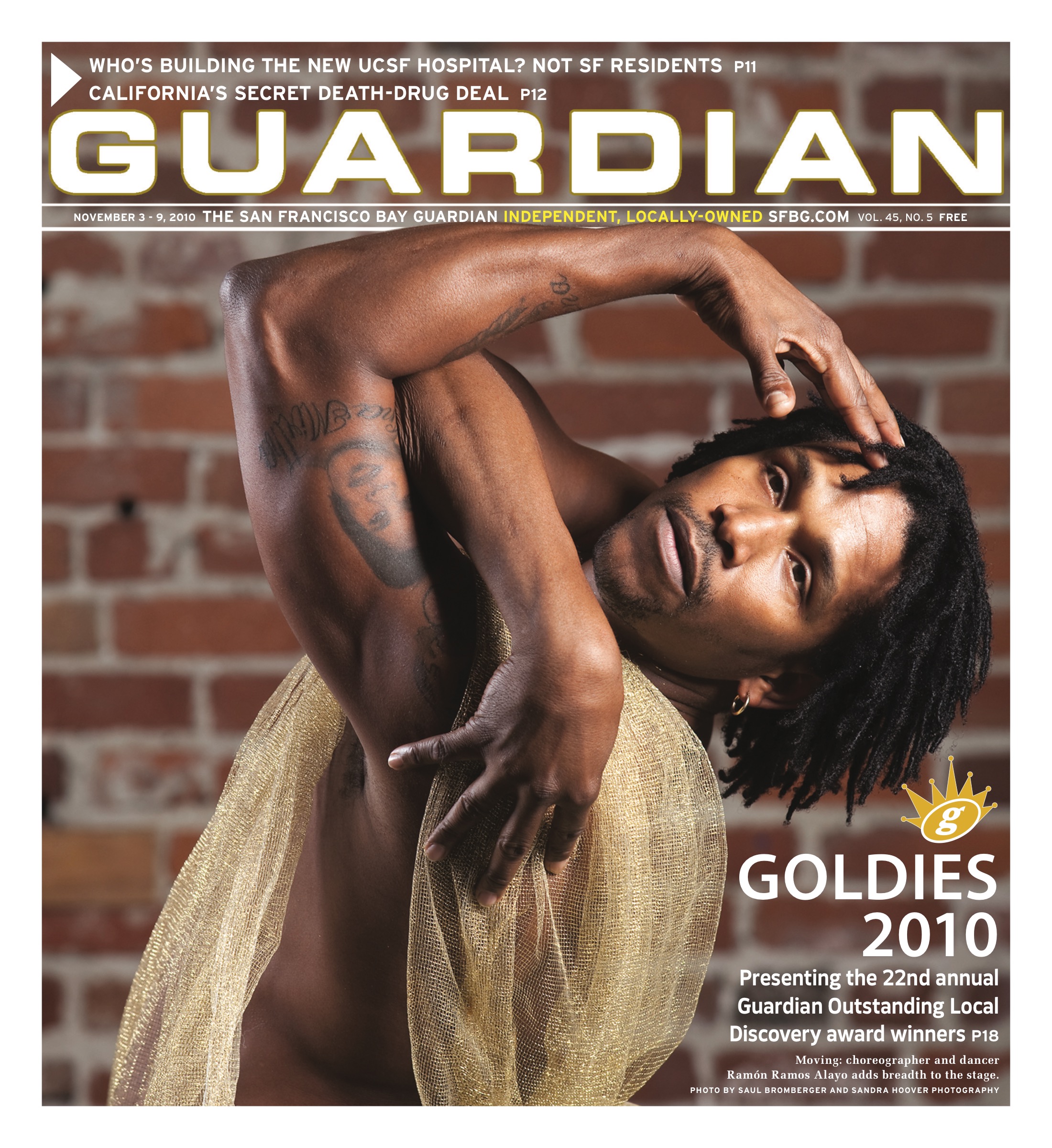
You dog-eared the pages of last week’s Guardian, reading about the Guardian Outstanding Local Discovery award winners. Tonight, head to 111 Minna to congratulate the artists in person — and to rock out at the free, open-to-the-public after party. Taking the stage: Oakland “slop-pop” rockers Bare Wires, SF popsters Brilliant Colors, dark post-punker Soft Moon (a.k.a. Luis Vasquez), pop sensation Myles Cooper (of “Gonna Find Boyfriends Today” fame) with club sensation Alexis Penney, and DJs Naoki Onodera and Primo Pitino. Don’t miss what’s sure to be a mother lode (yep, shameless gold joke) of a party! (Cheryl Eddy)

9 p.m., free

111 Minna Gallery

111 Minna, SF

www.sfbg.com/2010/11/03/goldies-2010


THEATER

Or,

Aphra Behn was a woman ahead of her time. A 17th century spy and the first professional female playwright, Aphra Behn is the topic of Liz Duffy Adams’ new play Or, at Magic Theatre. Full of sensationalism, sex, art, politics, and laughs, this comedy hosts a variety of eccentric characters including double agent William Scot, actress Nell Gwynne, and even King Charles II himself. Adams received the fifth Lillian Hellman Award for Playwrighting for Or, at the 2010 Lilly Awards; the play promises a dose of English history and a chance to chuckle the night away. (Emmaly Wiederholt)

Through Dec. 5

Wed.–Sat., 8 p.m. (also Sat, 2:30 p.m.);

Sun, 2:30 p.m.; Tues, 7 p.m., $45–$60

Magic Theatre

Fort Mason Center, Building D, Third Floor, SF

(415) 441-8822

www.magictheatre.org


THURSDAY 11

DANCE

Ampey!

In 2008, Adia Tamar Whitaker took a trip to Africa, where she encountered ampey, a Ghanian children’s dance for which you need to be on your toes in more ways than one. It became the inspiration for Ampey!, in which she explores complexities surrounding identity, family, and home. For Whitaker, that “return” trip had been become a voyage of discovery — though not in the way she anticipated. Presented as a work in progress last year, one could sense Ampey!’s artistic potential; it already included a powerful percussive “sitting dance.” Perhaps the best aspect of the two-year Performing Diaspora Project is its offer to artists like Whitaker to keep working on what needs to be done. (Rita Felciano)

Through Nov. 21

Thurs/11–Sun/14 and Nov. 18–20, 8 p.m.;

Nov. 21, 3 p.m., $19–$24

Counterpulse

1310 Mission, SF

1-800-838-3006

www.counterpulse.org


MUSIC

Ghostface Killah

No one has your back like Iron Man. Pretty Toney was the original link that brought the whole Wu-Tang together. Always willing to lend a devastatingly together verse to just about anybody’s single (MSTRKRFT, Prefuse 73, DANGERDOOM, etc), Starky still has found time to release classic after classic album. On his latest, Ghostdini: Wizard of Poetry in Emerald City, the Wallabee Kingpin went the extra mile, dispensing priceless relationship advice via a series of YouTube videos. Isn’t it about time you gave Ghostface Killah a little something back in return? (Ryan Prendiville)

With Sheek Louch and Music by Frank Dukes

9 p.m. $22

Slim’s

333 11th St., SF

(415) 255-0333

www.slims-sf.com


MUSIC

Masaki Batoh

Incorporating elements of Krautrock, folk, free jazz, and all manner of indigenous instrumentation, enigmatic Japanese psych collective Ghost are the heirs to such earlier cosmic emissaries as fellow countrymen the Taj Mahal Travelers. Founder and core player Masaki Batoh takes a similarly eclectic approach in his non-Ghost releases, whether turning out a chugging acoustic cover of Can’s “Yoo Doo Right” or mournful dirges, as on his recent collaborative albums with Espers’ Helena Espvall. Tonight’s rare solo set, with Batoh alternating between guitar and banjo and a table full of electronics, should prove no different. (Matt Sussman)

With Young Elders

10 p.m., $10

Vortex Room

1082 Howard, SF

www.myspace.com/thevortexroom

Also Fri/12

With Sic Alps

10 p.m., $5

Ghost Town Gallery

2519 San Pablo, Oakl.

www.myspace.com/ghosttowngallery


DANCE

Sankai Juku

Butoh is perhaps one of the most enigmatic dance forms. Emerging in the late 1950s in opposition to the Westernization of Japan, butoh often explores the more grotesque side of human nature. Unlike other dance forms with a syllabus of movements, butoh may be completely conceptual, hyper-slow, playful, scary, or none of the above. It defies definition. Audiences can begin to wrap their minds around butoh as Sankai Juku, the legendary Japanese butoh company, tours to San Francisco to present Hibiki: Resonance from Far Away, a piece said to plumb poetic beauty. Meditative and hypnotic in its simplicity, this award-winning work is a signature of butoh. (Wiederholt)

Thurs/11–Sat/13, 8 p.m.;

Sun/14, 2 p.m., $35–$60

Yerba Buena Center for the Arts

Novellus Theater

700 Howard, SF

(415) 978-2787

www.ybca.org


FRIDAY 12

MUSIC

Lindstrøm

Known to much prefer holing up in the studio in his home base of Oslo, Norway, than performing live, this is a rare opportunity to catch a set from one of the more interesting electronic music producers around. Lindstrøm first made a name for himself as a remix artist, reworking tracks from the likes of LCD Soundsystem, Roxy Music, Franz Ferdinand, and the Boredoms. His solo albums are full of frosty disco beats, heavy synthesizers, classic funk influences and enough of an adventurous streak to appeal to more than just the dance floor crowd. (Landon Moblad)

With Marbeya and Publicist

9 p.m., $15

Mezzanine

444 Jessie, SF

(415) 625-8880

www.mezzaninesf.com


DANCE

“Manifestival: Like Oil and Water: From Gaza to the Gulf”

Lots of Bay Area artists know that the world is a village, all politics are local, and that it’s probably not a good idea to ignore an problem until it burns your face. Socially committed dance is a large part of what we see on our stages. Artists are the antennas of the race and following them is fun as well as instructive. This year’s Manifestival theme of “Like Oil and Water: From Gaza to the Gulf” should provide more than enough inspiration for the two different programs. Onstage the first weekend are Jessica Damon, Jose Navarrete, Michael Velez, Nicole Klaymoon, Sri Susilowati, Naked Empire Buffoon, Stella Adelman, and Youth Speaks. (Felciano)

Through Nov. 20

Fri.–Sat., 8 p.m., $22

Dance Mission Theater

3316 24th St. SF

(415) 273-4633

www.brownpapertickets.com


VISUAL ART

“A Journeyman’s Papers”

Rare is the gallery show at which the owner of said gallery steps out from the wings and shows his or her own work. Risks! No one wants to be seen as the next megalomaniac Thomas Kincaid, drunkenly careening into the heavily curtained schlock-nests of Midwestern housewives, right? No fear of that kind of showboating here. Rob Delamater, co-owner of dapper cognoscenti-magnet Lost Art Salon, creates voluptuously genteel, generous-spirited pieces that fit right in with his gallery’s excellent collection of rare vintage modern works. Block-printed portraits of the wanton Bloomsbury group, evocative and crepuscular figure studies, and, perhaps most intriguing, softly primitive compositions evoking the California coastline painted on vintage book covers are the gorgeous, midcentury-type whistle stops on Delamater’s artistic journey. Doff your fedora, shed your silk shift, and have a lovely look. (Marke B.)

Through Jan. 31, 2011

5:30–8:30 p.m., free

Lost Art Salon

245 S. Van Ness, Suite 203, SF

(415) 861-1530

www.lostartsalon.com


SATURDAY 13

MUSIC

Dãm-Funk

George Clinton and Parliament Funkadelic are going to be at Yoshi’s next week. That’s cool. But instead of waiting to enjoy what’s sure to be a great reminiscing on where funk’s been, why not check where it’s going? Dãm-Funk (pronounced “Dame Funk”) lays down a DJ set at Som Bar. A DIY DJ, producer, and recording artist, Dãm-Funk uses the same playbook as Ariel Pink, digging deep into genres and musical styles that were left by the wayside to create distinct sounds. While I can’t guarantee that he’ll break out the Animal Collective (so many records to choose from), word is that he’ll bust out the keytar. (Prendiville)

With King Most, Jacob Pena, and Freddy Anzures

9 p.m., $10

Som.

2925 16th St., SF

www.som-bar.com


EVENT

“Frogs in the Fog”

Wow, I just found the frikkin’ treasure trove! Not even my ecology-expert friends knew that the San Francisco Naturalist Society has the most kickass events calendar (www.sfns.org/events) — one that’s updated daily, to (hiking) boot. Probably the coolest-sounding upcoming event is led by “Mr. Science,” a.k.a. Chris Giorni, founder of Tree Frog Treks, and starts with checking out his extensive stash of amphibians and reptiles. After bonding with uncharacteristic mini-fauna, grab a slice of pizza to sustain your explorer spirit onward toward the hidden ponds, sacred groves, and endless discoveries of western Golden Gate Park. While the Treks’ mission is to make science fun for the kiddos, this adventure is open to all. (Kat Renz)

4 p.m.–6:15 p.m., $15–$50 (sliding scale)

Tree Frog Treks’ Frog Hall

2114 Hayes, SF

(415) 564-4107

www.baynature.org


SUNDAY 14

MUSIC

Nile

Specializing in impossibly fast blast beats and meticulously researched Egyptological lyrics, Nile has carved out a niche as one of the scene’s most revered death metal acts. The South Carolina quartet hews closely to the genre’s traditions, playing intricate, epic compositions that lean heavily on tremolo picking and sheer speed. Replicating such extreme chops live is no mean feat, but previous appearances by the band have been flawless and incendiary, particularly when they launch into epic closer “Unas Slayer of the Gods.” Whether you’re there for the tales of bloodthirsty pharaohs or just excited to bask in the copious beats-per-minute, Nile will take no prisoners. (Ben Richardson)

With Ex Deo, Psycroptic, Keep of Kalessin

7:30 p.m., $30

Slim’s

333 11th St., SF

(415) 255-0333

www.slims-sf.com


MONDAY 15

MUSIC

Thermals

For punk-tinged indie rockers Thermals, consistency is the name of the game. Never straying too far from its bare-bones, guitar, bass, and drums format, the Portland, Ore.-based band has now released five albums of punchy Buzzcocks-esque rock ‘n’ roll. Its newest, Personal Life, was produced by Death Cab for Cutie’s Chris Walla and includes a nice mix of slower, more drawn-out tracks and infectious, pound-on-your-steering-wheel bursts of adrenaline, such as lead single “I Don’t Believe You.” (Moblad)

With Night Marchers and White Fang

8 p.m., $16

Independent

628 Divisadero, SF

(415) 771-1421

www.theindependentsf.com 


The Guardian listings deadline is two weeks prior to our Wednesday publication date. To submit an item for consideration, please include the title of the event, a brief description of the event, date and time, venue name, street address (listing cross streets only isn’t sufficient), city, telephone number readers can call for more information, telephone number for media, and admission costs. Send information to Listings, the Guardian Building, 135 Mississippi St., SF, CA 94107; fax to (415) 487-2506; or e-mail (paste press release into e-mail body — no text attachments, please) to listings@sfbg.com. We cannot guarantee the return of photos, but enclosing an SASE helps. Digital photos may be submitted in jpeg format; the image must be at least 240 dpi and four inches by six inches in size. We regret we cannot accept listings over the phone.

On the Cheap Listings

0

Events listings are compiled by Caitlin Donohue. Submit items for the listings at listings@sfbg.com. For further information on how to submit items for the listings, see Weekly Picks.

WEDNESDAY 10

Holiday Ice Rink in Union Square Union Square, SF. Sun-Thu 10am-10pm. Fri and Sat 10am-11:30pm. Runs through January 17. $4.50 for kids and $9 for adults before 6pm; $5 for kids, $9.50 for adults after. It’s time to glide into the holidays (or bruise your bottom) as this annual tradition opens for all comers on two blades. E may not have snow, but we’ll sure as heck have Celine Dion belting through the speakers at young couples.

How to Do Physics Experiments at Home Bazaar Café, 5927 California, SF. (415) 831-5620, www.julianagallin.com/howto. 7pm, free. Learn how to melt glass in your microwave, make your own speaker, speed up time (or at least your watch) – Maker Faire favorite Zeke Crossover of Physics Circus teaches you some snazzy physics tricks at the invaluable monthly How To series at Bazaar cafe.


THURSDAY 11

SF Etsy Team Show Shawna Stoney, 390 Kansas, SF. (415) 863-9700, www.shawnastoney.com. Noon-6pm, free. Kickstart your holiday shopping (or just pick up some ideas for the future) as Esty.com’s San Franciscan craftspeople band together to present an “Everything Handmade Show.” Cute and ingenious goodies galore – all locally made and often one-of-a-kind.

BAY AREA

Censored 2011 Revolution Books, 2425 Channing Way, Berk. (510) 848-1196, www.revolutionbooks.org. 7pm, free. From “Capitalist Forces Reaking Havoc in Africa” and “Internet Privacy and Personal Access at Risk” to “Global Plans to Replace the Dollar” and “US Funds and Supports the Taliban,” Project Censored has exposed the major stories reported about least in the mainstream media – in one handy annual compendium. Censored 2011 coauthors Mickey Huff and Peter Phillips discuss 20 of the big stories you might have missed, and how they affect us all.


FRIDAY 12

Big Things Grand Opening Kitsch gallery, 3265 17th St., SF; www.bigbigbigthings.com. 6pm, free. Big Things, a new local website dedicated to art, fashion, design, travel, people, “and other inspirational things” is launching, officially, with this giant shindig. Featuring drawings, paintings, video, sculpture and installations by a bevy of artists, music by kids from the the SF Rock Project and DJs April Knows Best and Ben Bracken. Plus, colorful objects to take home!


SATURDAY 13

“A Community Writing Itself” Book Launch Meridian Gallery, 535 Powell, SF. (415) 398-7229, www.acommunitywritingitself.com. 7:30pm, $10 (no one turned away for lack of funds). Local author and poet Sarah Rosenthal has compiled a book of her many fruitful and titillating conversations with Bay Area vanguard writers and experimentalists. This launch party will include poetry readings and Q&As with Truong Tranm Juliana Spahr, Stephen Ratcliffe, and Elizabeth Robinson.

“The Nutrition Perscription” Institute on Aging, 3600 Geary, SF; (415) 273-5481, www.sfvs.org. 8pm, free. The San Francisco Vegetarian Society invites Dr. Donald Forrester to speak about diet and its relationship to the major degenerative diseases plaguing Americans today. (Hint: drop that French fry!) Dr. Forrester has a background in both family practice medicine and chemical engineering, and has more than 30 years experience in the field.

Writers with Drinks Make-Out Room, 3225 22nd St., SF. www.makeoutroom.com; www.writerswithdrinks.com. 7:30pm-9:30pm, $5-$10 sliding scale. This monthly literary hoot continues to augment the heady with the fizzy. This time around, Richard Kadrey, Debbie Stoller, Deb Campo, Larry-Bob Roberts, and Indigo Moor take the stage and freshen your wordy cocktail.


MONDAY 15

Long Now: Rachel Sussman presents “The World’s Oldest Living Organisms” Cowell Theater, Fort Mason Center, Pier 2, SF; www.longnow.org; www.fortmason.org. 7 p.m., $10. long Now, the organizazion dedicated to slower living, presents a lecture and showing of Rachel Sussman’s photographs of some of the world’s longest-living beings, including 400,000-year-old Siberian bacteria.

TUESDAY 16

Mommy’s Playdate Good Vibrations Polk Gallery, 1620 Polk, SF; (415) 345-0400, www.goodvibessexymama.com. 7pm-9pm, free. Attend this afterhours mixer with like-minded moms who want to learn how to put some spice back into their sex lives. Enjoy a “Mommi-tini,” learn tips from Good Vibes sexologist Dr. Carol Queen, meet mommy writer Billee Sharp, quick-witted author of Fix It, Make It, Grow It, Bake It: The D.I.Y. Guide to the Good Life.

Prison for killer cop

0

rebeccab@sfbg.com

On Nov. 5, former BART Police officer Johannes Mehserle was sentenced to two years in state prison for fatally shooting Oscar Grant, a 22-year-old African American rider, on the Fruitvale train platform on New Year’s Day 2009.

Mehserle, who is white, was convicted of involuntary manslaughter in July in an incident that has become charged with racial undertones. He received credit for 292 days served in jail so far, which will considerably reduce his time in prison. It was the lightest prison sentence he could have received for the crime.

Grant supporters gathered in Frank Ogawa Plaza in downtown Oakland to express anger and sorrow upon hearing news of the sentence. “I’m not shocked,” said Cat Brooks, who helped organize an afternoon rally for the Coalition for Justice for Oscar Grant. “But I’m disgusted and distraught. It seems like the justice system didn’t work.”

After the rally came to a close and night fell, protesters spilled into the streets and marched toward the Fruitvale BART Station, the scene of the crime. But after a dozen car windows were smashed along the way, police officers in riot gear corralled the group into a residential neighborhood. Police then placed 152 protesters under mass arrest, mostly on charges of unlawful assembly. Roughly two-thirds of those arrested were Oakland residents, according to the Oakland Police Department, while others were from Berkeley, San Francisco, Hayward, and other local cities.


COMMUNITY RESPONDS

A stage outside Oakland City Hall was transformed into a venue for personal expression in the wake of the sentencing. Community members lined up to air their frustrations and resolve to keep fighting. They piled flowers onto a shrine that had been created with a picture of Grant’s face. Some painted pictures, while others gave spoken word or hip-hop performances. Several told stories of loved ones who’d died in police shootings.

Cephus Johnson, Grant’s uncle, was at the Los Angeles courtroom where Mehserle was sentenced, but shared some thoughts with the Guardian beforehand. Asked what he’d thought when the verdict had been announced, Johnson said, “My first thought was that we’re witnessing the criminal justice system failing to work as it should have worked.” If the sentence fell short of the 14-year maximum, he said, “it will be another slap in the face, signifying that black and brown men are worthless.”

East Bay labor organizer Charles Dubois was among those attending the Nov. 5 rally. “Every black parent, every brown parent, lives with this nightmare of their children being killed by some cops because they thought they had a gun,” Dubois said in an interview with the Guardian. “It’s been happening since I was a kid. It’s been happening then and it’s happening now, and it’s going to keep happening until we do something.”

California Assemblymember Tom Ammiano (D-SF) also weighed in during a phone call with the Guardian. “This verdict is outrageous,” he said. “It’s Dan White all over again.”


JUDGE DROPS GUN ENHANCEMENT

Judge Robert Perry sided with arguments presented by Mehserle’s defense attorney, Michael Rains, when he levied a reduced punishment. Mehserle could have served up to 14 years prison for involuntary manslaughter committed while wielding a gun, but Perry tossed out the firearm enhancement.

“No reasonable trier of fact could have concluded that Mehserle intentionally fired his gun,” the judge was quoted in media reports as saying. But that appears to be what the jury found, as the prosecution argued in a presentencing memorandum.

“The evidence was presented regarding the use of the gun, and in discussing the use of the gun in the jury room, somehow or another the jury decided he had used the gun illegally,” criminal defense attorney and National Lawyers Guild observer Walter Riley told the Guardian. “One has to believe the jury expected him to have exposure to a greater amount of jail time because of that.”

Perry said he believed Mehserle suffered a “muscle memory accident” that led him to draw and fire his service weapon instead of his Taser, a cornerstone of the defense’s case.

Rains wrote to the court prior to sentencing that jurors should never have been allowed to apply the firearm enhancement to an involuntary manslaughter conviction “because in this case, there is no logical way to square a verdict of involuntary manslaughter and a finding that Mehserle intended to use his gun.”

Prosecutor David Stein of the Alameda County District Attorney’s Office countered that the jury’s conviction showed they believed Mehserle intended to shoot, but not to kill, Grant. Yet Perry agreed with the defense, conceding he had mistakenly permitted the jury to enhance Mehserle’s sentence.

Riley said he sympathized with frustrations over the gun enhancement getting dismissed. “The use of guns is too prevalent in circumstances where law enforcement comes in contact with young black people,” he said. “Our society — our civil society, our judicial authority, and our communities — have to hold government and law enforcement officers to a higher level of accountability in their interactions with citizens. When people with guns shoot an inordinate number of people of one group, it’s worth tremendous scrutiny.”


ANOTHER NIGHT IN JAIL

Twice before, activists took to the streets in furious protest over this case. In January 2009, things escalated to the point where cars were set ablaze. In July 2010, a street rally gave way to rioting and looting. So on Nov. 5, many downtown Oakland storeowners boarded up and closed business early in anticipation of a third wave of vandalism.

Yet the turnout was smaller than the previous events. And while there were reports of smashed car windshields and other instances of vandalism along the circuitous path of the march, there was far less property destruction.

The community affair outside Oakland City Hall ended around 6 p.m., when the permit expired. Soon after, activists spilled into the intersection of 14th and Broadway streets, then began advancing down 14th Street chanting “No Justice! No Peace!” and “The whole system is guilty!” The march turned right onto Madison Street, then left onto 10th Street.

A police helicopter with a spotlight kept pace overhead while it progressed, and when protesters reached Laney College, police officers in riot gear blocked them in. So protesters cut through a park and wandered in a pack until they reached the intersection of East 18th Street and Sixth Avenue in a residential neighborhood. Once again, police surrounded the protesters. This time, the crowd was trapped.

Rachel Jackson, an activist who was barricaded in, began sounding off. “We were going to Fruitvale,” she explained. “We wanted to go to the scene of the crime. All night the police have been trying to suppress our free speech.” When a nearby TV news reporter asked her about windows that had been busted along the march, she was incensed. “We will not equate glass with Oscar Grant’s life!” she responded. “If we have to come out ourselves and board up windows, we’ll do that. But what we are concerned with right now is murder.”

Reporters were allowed to exit the confined area, but if anyone else had been inclined to leave peacefully, they were unable to. Police issued a call on a megaphone telling activists, “You are all under arrest. Do not resist arrest.” By the time the mass arrest was underway, public information officer Jeff Thomason told a group of reporters that there were more police officers on the scene than protesters.

“When the rocks were being thrown, it was declared an unlawful assembly,” Thomason explained. He said a dispersal order had been issued simultaneously. Yet it would have been impossible for the trapped crowd to comply with such an order.

Meanwhile, a resident of the Oakland neighborhood who had come outside when the commotion began told the Guardian that she sympathized with the protesters. “The only thing I don’t condone is the vandalism,” said Dyshia Harvey, who surveyed the scene from behind a fence with her six-year-old son.

Harvey had been anticipating word of Mehserle’s sentencing. “I was upset. I was frustrated, angry, and hurt” by the outcome, she said. But she wasn’t surprised. “I already knew we weren’t going to get no justice,” she said. “For taking a life, 14 years isn’t enough. It makes you feel like there’s no justice in the justice system.”


NOT OVER YET

Alameda County District Attorney Nancy O’Malley has not stated whether her office will appeal Perry’s ruling. Rains told reporters in L.A. that he would appeal Mehserle’s involuntary manslaughter conviction.

Meanwhile, the Civil Rights Division of the U.S. Department of Justice released a statement indicating that a federal investigation is in the works. “The Justice Department and the U.S. Attorney’s Office for the Northern District of California have been closely monitoring the local prosecution of this case,” a USDOJ prepared statement notes. “Now that the state prosecution has concluded and consistent with department policy, we will thoroughly review the prosecution and its underlying investigation to determine whether further action is appropriate.”

BART settled a civil lawsuit filed on behalf of Grant’s daughter in January that is likely to total $5.1 million, according to civil rights attorney John Burris’ website. Two other lawsuits, one on behalf of Grant’s mother and one on behalf of five other men on the Fruitvale station platform that night, have been consolidated into a single trial that will begin in May 2011, Burris told the Guardian.

Meanwhile, Grant’s death marked just one of three police shootings that occurred Jan. 1, 2009 — the other two cases also sparked allegations of civil-rights violations, since both victims were African American men. Adolph Grimes, 22, was fatally shot 14 times, including 12 times in the back, by a group of New Orleans police officers, who erroneously believed he was a suspect who’d fled the scene of a shooting.

The same night, Robert Tolan, 23 — the son of a Major League Baseball player — was shot and seriously injured outside his home in an upscale Houston suburb by a police officer who mistakenly believed Tolan had stolen the vehicle he was driving. Sgt. Jeffrey Cotton, the white officer who shot him, was ultimately acquitted.


CREATIVE OUTLET

Not everyone in Oakland reacted to Mehserle’s sentence by charging through the streets. The Oscar Grant Foundation, which facilitated live art performances at Frank Ogawa Plaza Nov. 5, is calling for youth groups, Bay Area schools, and adults to participate in an art and poetry showcase inspired by Grant. Information can be found online at IamOscarGrant.org. The foundation is advertising a $1,000 grand prize. Three artists from the Trust Your Struggle Collective didn’t wait to join a contest, however, and spent the afternoon of Nov. 5 adorning plywood covering the Youth Radio building windows at 17th Street and Telegraph Avenue, a few blocks from Frank Ogawa Plaza.

The mural displayed a prominent image of Grant holding his daughter, Tatiana, who was four years old when Grant was killed. The pair are flanked by the names and figures of more than 20 people killed by police.

“We asked the youth inside what they wanted to see,” Miguel Perez, an artist with the Trust Your Struggle Collective, told the Guardian as he looked over the mural. “They said they wanted to see the names of people killed by police nationwide, not just in the Bay Area. The list is so huge, it’s hard to pick out specific names.”

Perez said Trust Your Struggle is a group of artists and educators with social-justice backgrounds who create art as activism. “Being a person of color, I’ve had racist stuff said to me by the police,” Perez said. “It seems like it’s slowly been changing for the past hundreds of years, but it’s still not enough — enough being fairness.” *


GOLDIES 2010 LIFETIME ACHIEVEMENT: Marc Huestis

0

“What a swimmer is Dracula’s daughter!,” exclaims John “the Cool Ghoul” Zacherle, as “Dinner With Drac” blares from the speakers in Marc Huestis’ Redstone Labor Temple office. ‘Tis the season for Huestis’ tribute to Poltergeist‘s Jobeth Williams, and the activist, filmmaker, and camp impresario is in the final stretches of preparing for the big night.

What hasn’t Marc Huestis done? As a youngster, he arrived in San Francisco from Long Island, New York, unafraid to recite poetry while sporting a pompadour that would make any Elvis impersonator feel size envy. Soon you could see him singing in drag or writhing around on stage in a dirty diaper in Angels of Light productions. But from the very beginning, film was at the heart of Huestis’s life. His father was an editor who worked on the ’60s teen music TV show Hullabaloo, while his mother was a showgirl. “I have a little bit of both in me,” he jokes, and it’s the truth — a Marc Huestis extravaganza involves informed editing and explosive creative freedom.

One of Huestis’ first notable celebrations was the San Francisco Gay Film Festival, now known as the Frameline fest, which he and his non-biological twin-of-sorts Daniel Nicoletta (born just three days apart from him) began with other like minds in 1976. “It was fun, a bunch of kooky hippie kids who wanted to get their movies shown,” he remembers. “There was no pretense, and the group of us were able to get together to do it. It’s great to see what it has evolved into, and feel a bit like a patron saint. Some people will always hate you, but at this age” — Huestis is 55 — “you get to the point where some people respect you. And you respect yourself.”

In 1982, after making some short films, Huestis wrote and directed Whatever Happened to Susan Jane?, his distinctly San Francisco answer to the kinds of antic comedies John Waters was making on the East Coast. In recent years, the movie has found a new audience amongst music lovers devoted to San Francisco’s new wave heyday — one of its strongest aspects is its documentation of wild performances from Tuxedo Moon and other groups of the day. “It was a great combination of gay culture and punk culture,” Huestis says of the era. “There’s a kindness to it, and it was very smart.”

Huestis’s next feature-length movie, 1993’s Sex Is… is very much a film of its time. A direct look at and discussion of the experience of gay sex and intimacy amid the AIDS crisis, it was also a do-it-yourself, many-year labor of love, with DIY aesthetics one common thread throughout Huestis’s creative life. “It’s very heartfelt,” he says of the film. “It was an important film when it came out because no one was talking about sex, and if they were, it was really hypocritically. The high point of my life was to be at the Berlin Film Festival for the world premiere, and then several days later, be at the awards presentation with Billy Wilder sitting nearby. For me, having HIV, and not thinking I was going to live, that moment was a gift.”

One year later, Huestis moved into his office in the Labor Temple, a treasure trove of film memorabilia where the walls are lined with autographed photos, and VHS tapes, DVDs, VCRs and DVD players are stacked on top of each other — in a well-organized fashion. The site is his base for the celebrity events that he puts on at the Castro Theatre, theatrical and cinematic programs that have blazed a trail for another generation of movie mayhem purveyors such as Jesse Hawthorne Ficks and this year’s Goldie winner Joshua Grannell, a.k.a. Peaches Christ.

Old media surrounds us as we talk, but there is little doubt that Huestis, experienced at putting together political and community fundraisers, is always focused on the present and future as well. “I love new media,” he says. “I could not do what I do if I didn’t have knowledge. I design the posters, I do the clip reels, I get the music together, I do the PR. I would sell the popcorn if I could. I love it. I never get tired of movies.”

It’s fitting, then, that Huestis gets to call one of this country’s oldest and most beautiful movie palaces, the Castro Theatre, home. “One of the first shows I put on there was when the Republicans took control of Congress, so everything comes around,” he says. “The best thing is seeing someone go there for the first time. To me it’s like the town barn, but it’s an amazing, beautiful place.”

If star power can me measured in size, some of the players that Huestis has brought to the Castro over the years — Debbie Reynolds, Jane Russell, Tony Curtis, Piper Laurie, Patty Duke — rival the size of the fabled venue. He’s also given eccentric talents such as Sylvia Miles and Karen Black the type of spotlight they deserve. In the end, it’s about gratitude, on his part, on behalf of the audience, and hopefully, from the subjects of his tributes. Huestis’ night for Tony Curtis resulted in him being hired by the actor to create a clip retrospective that ultimately wound up being shown at Curtis’s funeral. “I had a great fondness for and connection with him,” he says. “I love it when they’re thankful, because no one shows gratitude, the world is so entitled. After the [Castro] show, he [Curtis] held my hand really hard, looked me straight in the eyes, and said, ‘Thank you.'”

Thank you, Marc Huestis.

www.myspace.com/marchuestispro  www.youtube.com/user/hostesshue

>>MORE GOLDIES 2010

Alerts

0

news@sfbg.com

THURSDAY, OCT. 29

Bert for BART

BART board candidate Bert Hill, who is endorsed by a broad array of progressive organizations in his bid to unseat Republican incumbent James Fang, will be campaigning and meeting commuters along with several of his campaign’s supporters.

4:30–7 p.m., free

Balboa Park BART Station

401 Geneva Ave., SF

www.bert4bart.org

FRIDAY, OCT. 29

Halloween Critical Mass

Find a costume, hop on your bicycle, and join the monthly Critical Mass bike ride, Halloween edition. This rolling street party is always a fun way to flip the normal transportation paradigm, but it’s even more festive when composed of zombies, naughty nurses, and sexy cops.

6 p.m., free

Justin Herman Plaza

Market and Embarcadero

www.sfcriticalmass.org

Zombie Flash Mob

Guardian sources have warned that a mob of zombies, possibly dressed in prom attire, will rampage through the streets of the Mission. They are said to be protesting being marginalized and are showing their solidarity with the LGBTQ community. Eventually, our sources say, they will converge at El Rio, 3158 Mission St., for a zombie prom featuring live music by Elle Niño and others, with a cover charge of $3 for the undead and $7 for the living.

8 p.m., free

Corner of 16th and Mission, SF

elleninosf@gmail.com

SUNDAY, OCT. 31

(SF) Rally to Restore Sanity

If you can’t make it to the National Mall in Washington, D.C. for the Rally to Restore Sanity and the March to Keep Fear Alive, the send-up of political events by Comedy Central satirists Jon Stewart and Steven Colbert, you can still take part in SF’s local version. The event include guest speakers, comedy, poetry, and dancing.

9 a.m.–3 p.m., free

Civic Center Plaza

Larkin and Grove, SF

www.sfsanityrally.com

MONDAY, NOV. 1

Urban Water Rates

Panelists from the industry will seek to answer whether water pricing at the urban water agency level can work as a water conservation tool, whether rate increases jeopardize revenue, and how to serve low-income and low-use customers. RSVP at info@whollyh2o.org.

1 p.m.–3 p.m., free

Jellyfish Gallery

1286 Folsom, SF

www.whollyh20.org

TUESDAY, NOV. 2

Election Day

This election features pivotal races for the governor of California, U.S. Senate, and San Francisco Board of Supervisors, as well as important local and state propositions, so don’t forget to vote. Use this week’s cover as a cheat sheet or view our complete endorsements. Also visit the Guardian’s Politics blog on Election Day for a rundown on the evening parties and follow our live election coverage there that night.

7 a.m. to 8 p.m., free

SF City Hall basement

1 Dr. Carlton B. Goodlett Place, SF

www.sfgov.org/elections


On the cheap listings

0

Events listings are compiled by Caitlin Donohue. Submit items for the listings at listings@sfbg.com.

WEDNESDAY 20

hell strung and crooked Release Party The Beat Museum, 540 Broadway, SF; www.thebeatmuseum.com. 6pm, free. The Beat Museum helps to present a night of intensely creative bards from the world over in anticipation of the release of their new poetry tome.

Smack Dab Open Mic Magnet, 4122 18th St., SF; wwwmagnetsf.org. 8pm, free. All ages and genders are welcome to this open mic, which sets a medley of musicians and poets onstage to the tune of five minutes a piece. No open mic traumas here, people.

THURSDAY 21

Art Attack One Year Anniversary supperclub, 657 Harrison, SF; www.visualsby3.com. 9:30 pm, $8. The flopsy, floozy art performance group celebrates its first 365 days on this earth with a burlesque-off featuring Alotta Boutté, Scotty the Blue Bunny, and more local A-listers from the world of tassels and tease.

"Graphic Details: Confessional Comics by Jewish Women" Cartoon Art Museum, 655 Mission, SF; (415) CAR-TOON, www.cartoonart.org. 7pm, $5. Beyond the kvetch and kibitz, female Jewish cartoonists have proven themselves adept at a stark, honest rendering of life in the 21st century. Hear them discuss their art at this panel discussion.

Jo Scott-Coe Books Inc., 2275 Market, SF; (415) 864-6777, www.booksinc.net. 7:30 pm, free. An ex-public school teacher exposes the subtle and overt forms of violence in the education system in her latest book, which she’ll discuss at this bookstore klatch.

BAY AREA

Homeless Connect Health Fair Multi Service Center, 2362 Bancroft, Berk; (510) 809-8516, www.sites.google.com/site/bfhphealth. Noon, free. Vision screenings, STD tests, flu shots, therapist and addiction referrals, haircuts, and more at this gathering of service providers for the homeless.

FRIDAY 22

UN-65 Muir Woods Walking Tour Cathedral UN Grove, Muir Woods, Sausalito; (415) 267-1866; www.una-sf.org. 11am, free. Advance registration requested. Mark 65 years of the United Nations’ brand of global collaboration with this trek through the redwoods, a cup of tea, and some Qi Gong — a path braved by UN founders in 1945.

Fog City Necropolis 354 5th St., SF; (415) 606-2503. 7pm, 10pm. Take a tour through SF’s interactive haunted house, whose theme this year is a truly scary trope: eviction! Evade the undead grasp of Jack Kerouac, Frida Kahlo, the crazy cat man of the Presidio, and more so that you can live to pay rent again.

BAY AREA

"Analysis of the Tea Party Movement" UC Berkeley Alumni House, Bancroft and Telegraph, Berk; www.ccsrwm.berkeley.edu/conferences. 8:30am-5:30am, free. Political scientists and sociologists take a look at America’s most grating political movement: are the Tea Partiers part of a grass roots campaign, a media-driven construction, or something in between?

SATURDAY 23

Actors Theatre Season Kick-Off Actors Theatre, 855 Bush, SF; (415) 345-1287; www.actorstheatresf.org. 7 pm, $10. A cabaret to celebrate the new stage season, featuring the psychedelic tropes of comedian Wil Franken, and the world premiere of William Blake Sings the Blues, penned by the theater’s own company member.

Bernal Yoga Literacy Series Bernal Yoga, 461 Cortland, SF; (4125) 643-9007, www.bernalyoga.com. 8pm, $5 suggested donation. Tsering Wangmo Dhopma and Stephen O’Connor, writers both, will fill the chakras of this neighborhood ayurvedic space with readings from their recent publications.

Bring Your Own Queer Festival Music Concourse, Golden Gate Park, SF; www.byoq.org. Noon-6pm, free. Pack a gay in your rucksack for this community collaboration of art, performance, and music, featuring DJ collectives Honey Soundsystem and Hard French, the Bay Area Derby Girls, and a rescue dog fashion show.

Drag Racing Day Velma’s, 2246 Jerrold, SF; (415) 824-4606. Noon, by donation. A Bayview family needs help raising funds for their drag racing team. They make their own motors and transmissions! Grab a bite at this neighborhood restaurant while you watch racing footage and dad Mike Henery’s presentation to interested young people.

Potrero Hill History Night International Studies Academy, 655 De Haro, SF; (415) 863-0784. 5:30 pm barbeque, $6; 7 pm historical program, free. A movie on Potrero Hill public housing, urban gardening in the neighborhood, and hood tales from 50-year residents like "Goat Hill Phil."

Seismic Safety Fair San Francisco General Hospital, 1001 Potrero, SF; www.sfdph.org/dph/rebuildsfgh. 9am, free. Feeling a little shaky? SF General’s setting aside a day to explain the base-isolated design of its new earthquake retrofitting. It’s meant to be the most seismically-resistant plan available today, so go on and get grounded.

BAY AREA

Cal Science and Engineering Festival Haas Pavilion, Bancroft, Berk; (510) 642-0352, www.scienceatcal.berkeley.edu/festival. 10am, free. Kids been clamoring to touch a real human brain? Bring ’em to this hands-on extravaganza of natural science — for free.

Fantastic Fountain Thistle Recovery Work Party Highway 92-W and I-280-N, San Mateo. 9am, free with RSVP. Remove invasive pampas grass and Australian tea tree so that our small bristly friend the fountain thistle can continue to live long and prosper in the Bay Area.

SUNDAY 24

Sunday Streets: Civic Center and Tenderloin Civic Center Plaza, SF; www.sundaystreetssf.com. 10 am- 3pm, free. The last Sunday Streets car-free community event takes the action to the heart of downtown, with clear biking and walking from a roller disco outside the Asian Art Museum to the Tenderloin National Forest.

Tricycle Music Fest West Various libraries and times, SF; www.sfpl.org/tricycle. Free. Three wheel from library to library or plunk the kiddies in front of a show of their choosing for this day of kids’ music, that effervescent establisher of early literary skills.

On the cheap listings

0

On the Cheap listings are compiled by Paula Connelly. Submit items for the listings at listings@sfbg.com.

WEDNESDAY 13

“How to Cook Like a Scientist” Bazaar Café, 5927 California, SF; (415) 831-5620. 7pm, free. Meet Jeff Potter, author of Cooking for Geeks, who combines cooking with Mythbusters to create a food-as-science, cooking experience for those who like to know how things work.

THURSDAY 14

Sparring with Beatnik Ghosts Beat Museum, 540 Broadway, SF; (415) 399-9626. 7pm, free. This ongoing multimedia poetry series returns to the Beat Museum with host Daniel Yaryan and featuring readings by David Meltzer, San Francisco Poet & Beat Icon, Ellyn Maybe & Her Band, Steve Arntson, Jerry Ferraz, Martin Hickle, Richard Loranger, Whitman McGowan, Ginger Murray, Julie Rogers, Margery Snyder, and Chris Vannoy.

FRIDAY 15

Mark I. Chester Benefit Mark I. Chester Studio, 1229 Folsom, SF; (415) 621-6294. 7pm; free, donations encouraged. Celebrate Mark I. Chester’s 60th birthday while helping to raise funds for a new book. View Chester’s current exhibit, “Doing Time on Folsom St: a 30 year retrospective of fine art gay radical sex photography” and enjoy readings and performances by Carol Queen, Tom Orr, Seth Eisen and Jesse Hewitt and more. Sponsored by the Center for Sex and Culture.

“Writing Our Word, Speaking Our Minds, Telling Out Stories” San Francisco Main Library, Latino/Hispanic Community Meeting Room, 100 Larkin, SF; (415) 557-4400. 6pm, free. Featuring readings by and about lesbians with disabilities with Elana Dykewomon, Barbara Ruth, Teya Schaffer, Dominika Bednarska, and the Mothertongue Feminist Theater Collective.

SATURDAY 16

“The Classics” 1:AM Gallery, 1000 Howard, SF; (415) 861-5089. 5:30pm, free. Attend the closing reception for this exhibit, curated by Nate1, that brings together original vintage work from the artists that put San Francisco on the graffiti map and defined Bay Area graffiti style. Guest speaker Spie will give an informative tour of the exhibit on Bay Area graffiti.

Halloween Bazaar Modern Eden Gallery, 403 Francisco, SF; (415) 420-2898. 7pm, free. End your day of touring open studios in North Beach, as part of SF Open Studios’ weekend two, at this spooky-themed trunk show featuring wares by local artists JuJu by Sarah, Marya Zoya Taxidermy Courture, Blackbird Bazaar, Squid Rose designs, and more plus pumpkin carving and painting, music, drinks, and treats. Costumes encouraged.

Potrero Hill Festival 20th street between Missouri and Wisconsin, SF; www.potrerofestival.com. 11am-4pm, free. Soak up the best of Potrero Hill at this street fair with a view featuring local merchants and residents selling their wares, arts, and crafts, two stages with live music, food from Potrero Hill restaurateurs, information booths, and kids activities including a bouncy house, petting zoo, pony rides, and performances.

Taste of Fillmore Fillmore between Post and Jackson, SF; www.tasteoffillmore.com. 1pm-6pm; free admission, $20 for wrist band. Buy a wrist band and enjoy food and wine tastings at boutiques and restaurants, or just walk around and check out some live jazz, walk through home décor scenes installed on the sidewalks, watch cooking demonstrations, fashion shows, and more.

Trolley Dances Meet at the Harvey Milk Center for Recreational Arts at Duboce Park, Scott at Duboce, SF; www.epiphanydance.org. 11am-2:45pm, tours leave every 45 min.; free with MUNI fare. Get out of the theater and into the streets with traveling performances by Epiphany Productions SDT, Joe Goode Performance Group, Sara Shelton Mann, and more as they take you from Duboce Park to the SF Botanical Garden in Golden Gate Park for several unique performance locations.

“The Wild Kitchen” Omnivore Books on Food, 3885a Cesar Chavez, SF; (415) 282-4712. 3pm, free. Hear authors Connie Green and Sara P. Scott discuss their book, The Wild Kitchen: Seasonal Foraged Foods and Recipes, and the increasing popularity of wild delicacies. Green sells her gathered goods across the country to Napa Valley’s finest chefs, so before you buy that expensive meal, consider the free buffet that is California.

Writers with Drinks Make Out Room, 3225 22nd St., SF; (415) 647-2888. 7:30pm, $5-$10 sliding scale. This installment of the monthly spoken word variety show features Marcia Clark, Ken Scholes, Jamie Freveletti, Stephen O’Connor, Kirya Traber and Daniel Allen Cox. Proceeds to benefit the Center for Sex and Culture.

Yerba Buena Fair Yerba Buena Gardens, Mission between 3rd and 4th St., SF; (415) 644-0728. 11am-3pm, free. Celebrate the Yerba Buena neighborhood at the fair featuring live music, dancing, acrobats, neighborhood food vendors, street food vendors, art and history walks, prizes and giveaways, kids activities, and more.

SUNDAY 17

Capsule Hayes Valley Park, Octavia at Hayes, SF; www.capsulesf.com. 11am-6pm, free. Enjoy this fashion design open air market and community party where you can browse locally made clothing, upcycled jewelry and accessories, steampunk-inspired wear, graphic tees, kids clothes, and designer housewares while listening to live music by members of the Jazz Mafia, Brent Bishop and the Part Poopers, and more.

Fiesta on the Hill Cortland between Bocana and Folsom, SF; (415) 206-2140. 10am-6pm, free. Join your friends and neighbors for the 22nd annual Fiesta to benefit the Bernal Heights Neighborhood center, an organization that works to maintain the ethnic, cultural, and economic diversity of Bernal Heights. This alcohol free family event to feature a petting zoo, pony rides, a pumpkin patch, non-profit booths, live music, food vendors and more.


A trio of great Hispanic leaders

0

Dick Meister, former labor editor of the SF Chronicle and KQED-TV Newsroom, has covered labor and politics for a half-century. Contact him through his website, www.dickmeister.com, which includes more than 250 of his columns.

It’s Hispanic Heritage Month, an excellent time to remember three of the most important Hispanic labor leaders in U.S. history. All three were engaged in the much needed and very tough job of organizing and improving the generally poor conditions of the nation’s largely Latino farm labor force.

Cesar Chavez, of course, is one of the farm worker leaders we should particularly honor. Another is Dolores Huerta, who joined Chavez in founding the United Farm Workers union – and who, in fact, is still organizing and otherwise helping Latino workers, particularly women.

The third leader who’s especially deserving of honor is the lesser known but no less important t pioneer farm labor organizer, Ernesto Galarza. Despite his important work, Galarza has been largely forgotten – though certainly not by me.  He’s been dead now for a quarter-century, but I recall him well from my days as a reporter covering farm labor:

His shining, black hair and fierce, penetrating gaze. His angry, intense words and slashing speeches against those who resisted demands for reform. His scholarly writing and novels and poetry – and his teaching.

Galarza was one of the loudest and most unusual of the voices that have been raised for the farm worker. He had a Ph. D., wrote a half-dozen books and numerous pamphlets and articles , and taught at all levels, from elementary school to university.

Yet Galarza was also an active union organizer – a key leader in laying the groundwork for the farm labor movement led by Cesar Chavez.

Galarza came to California’s fields in 1948, as an officer of the American Federation of Labor’s now long gone National Farm Labor Union. He had grown up in California, and had worked on farms as a teenager.

But Galarza had left that behind to head off to college on a scholarship and, eventually, to Columbia University for a doctorate in Latin American affairs.

After that, Galarza worked for the Pan American Union in Washington – until, characteristically, he became enraged over what he felt was the organization’s overlooking the exploitation of Latin American workers by US business interests. He resigned to take the job with the National Farm Labor Union.

Galarza led several strikes, but he was completely thwarted by the federal Bracero program that allowed growers to import penniless, undemanding Mexican workers to replace US workers who dared to strike or otherwise seek better treatment. So Galarza shifted his efforts into trying to abolish the Bracero program.

For more than a dozen years he fought a frustrating and often lonely battle. He spoke out endlessly before legislative committees and elsewhere, He issued hundreds of reports documenting the abuses of U.S. and Mexican workers under the Bracero program,. But the program remained untouched, and by 1960, Galarza’s union was gone. Near exhaustion, he turned mainly to writing and teaching.

But finally, in 1964, the public pressure that Galarza had a key role in generating led Congress to kill the Bracero program. It’s no coincidence that year, 1964, was the same year in which Cesar Chavez began his organizing drive. For Galarza was correct: The existence of the Bracero program had made farm labor organizing impossible.

By the time of Galarza’s death at 78 in 1984, the Chavez-led United Farm Workers had become an effective, nationally supported union.

The farm labor system still relies heavily on desperately poor immigrant workers, But thanks to the farm workers union that Ernesto Galarza helped bring about, many workers have had the chance to seek – and many have won – the right to the decent lives that Ernesto Galarza spent so much of his life seeking for them.

I was fortunate enough to also get to know Cesar Chavez.  I first met him when I was covering labor for the San Francisco Chronicle. It was on a hot summer night 45 years ago in the little farm town of Delano in southern California.

“Si se puede . . . It can be done . . . Si se puede.” He said it repeatedly as we talked deep into the early morning hours.

Si se puede . . . But I would not be persuaded. Too many others, over too many years, had tried and had failed to win for farm workers the union rights they had to have if they were to escape their severe economic and social deprivation. The Industrial Workers of the World who stormed across western fields early in the 20th century, had first tried organizing farm workers – and failed. Failing, too, were Communist organizers, socialists, and AFL and CIO organizers.

I was certain Chavez’ effort would be no different from theirs. Boy, was I wrong.  I had not accounted for the tactical brilliance, creativity, courage and just plain stubbornness of Cesar Chavez.

He understood that farm workers had to organize themselves, not depend on outsiders to do it. Chavez led the workers in creating a union of their own, which then sought out – and won – widespread support  from influential outsiders through boycotts and other tactics of non-violence patterned after those of Mohandas Gandhi and Martin Luther King Jr.

Chavez proved beyond doubt that the poor and oppressed can prevail against even the most powerful of opponents – if they can effectively organize themselves and adopt non-violence as their principal tactics. As Chavez explained, “We have our bodies and spirits and the justice of our cause as our weapons.”

The results of the Chavez-led organizing drives were impressive – the first farm union contracts in U.S. history, and the California law, also a first, that requires growers to bargain collectively with workers who vote for unionization.

Chavez worked closely with Dolores Huerta in creating and leading the United Farm Workers union. Huerta was, for instance, one of the principal leaders of the worldwide grape boycott that forced growers to agree to those first farm labor contracts  – which Huerta negotiated despite her lack of experience in contract bargaining.

Huerta’s work with the UFW was just a part of her lifelong and extraordinarily successful and courageous fight for economic and social justice that she waged while also raising 11 children.

Huerta’s traveled the country, speaking out and joining demonstrations for a wide variety of causes and successfully lobbying legislators for important gains for Hispanic immigrants and others.

Huerta started out as an elementary school teacher in northern California in 1955, but soon tired of seeing the children of farm workers regularly come to school hungry. That, and her anger over the injustices suffered by the local farm workers, led Huerta to quit teaching and join the Community Services Organization – the CSO – an organization founded by community organizer Saul Alinsky, with Chavez eventually serving as its General Director.

The CSO helped local Chicanos wage voter registration drives and take other actions to win a strong political and economic voice. But when the CSO’s other directors refused to agree to a union organizing drive among local farm workers, Chavez and Huerta quit to organize on their own. Like so many others, the CSO directors said it couldn’t be done. Thankfully, they were wrong and Cesar Chavez and Dolores Huerta were right.

But being right is just the first step, essential as it is. Hundreds of thousands, if not millions of poorly treated farm workers badly need to be organized, badly need the decent treatment that unionization can bring them, as it did to many others that the extraordinary efforts of Cesar Chavez, Dolores Huerta, and Ernesto Galarza helped bring to many others.

Dick Meister, former labor editor of the SF Chronicle and KQED-TV Newsroom, has covered labor and politics for a half-century. Contact him through his website, www.dickmeister.com, which includes more than 250 of his columns.

Quick Lit: Oct. 1-Oct. 5

0

Literary readings, book tours, and talks this week

Litquake is back from Oct. 1-9 with more than 550 authors and events. Find out how to catch some this week after the jump.

Friday, Oct. 1

Litquake 2010 kickoff
Grab you litquake program and enjoy music by “Diva Deluxe” Suzy Williams and Brad Kay as they perform songs based on the work of well-known authors Kurt Vonnegut, Raymond Chandler, and more. You can also sip cocktails while browsing the gallery’s latest exhibit “Everyday,” showcasing new works by California tattoo artists. Litquake programming through Oct. 9.
5 p.m., free
111 Minna Gallery
111 Minna, SF
www.litquake.org

Saturday, Oct. 2

Off the Richter Scale
From poetry to comics to dad lit, this Litquake opening weekend event will feature literary tweeters, bloggers, illustrators, mystery writers, fathers, poets, historians, and more.
Noon – 4 p.m., free
Variety Preview Room Theatre
582 Market, SF
www.litquake.org

 
Watershed Environmental Poetry Festival
Enjoy a stellar line-up of poets and environmental writers including Brenda Hillman, Robert Haas, Allison Hawthorne Deming, Al Young, David Meltzer, Camille T. Dungy, and more. Also featuring a poem installation by Arthur Okamura, live music, environmental updates and information, and more.
Noon-4:30 p.m., free
Civic Center Park
Martin Luther King, Jr. at Center, Berk.
www.poetryflash.org

Sunday, Oct. 3

Barely Published Authors
Readings by up-and-coming masters of prose from the Bay Area including Jeremy Hatch, Mimi Lok, Caitlin Myer, Andre Perry, Paul Spinrad, Ian Tuttle, Alia Volz, and Olga Zilberbourg. Emceed by Ransom Stephens.
7 p.m., free
Make-Out Room
3225 22nd St., SF
www.litquake.org

“CLA All-Stars: 25 Years of San Jose’s Center for Literary Arts”
Join best-selling authors Maxine Hong Kingston (The Woman Warrior, Tripmaster Monkey), Mary Roach (Packing for Mars, Stiff, Spook, Bonk), Daniel Alarcon (Lost City Radio), and Andrew Sean Greer (The Story of a Marriage) as they read from their latest works. This program was developed in collaboration with the San Jose Center for Literary Arts and Litquake.
6:30 p.m., $10
The California Historical Society Museum
678 Mission, SF
(415) 357-1848

Ein Zweigabend: A Zweig Evening
Enjoy this literary and musical eveing dedicated to the works and memory of Austrian writer Stefan Zweig, featuring violinist Gregory Sykes, pianist Ian Scarfe, and vocalist Patrick Marks playing some of Zweig’s favorite music. Wine, champagne, and hors d’oeuvres.
7 p.m., $20 suggested donation
Green Arcade
1680 Market, SF
(415) 431-6800

North Beach Literary Tour
Learn more about the literary tradition of North Beach, from the Gold Rush, to the Beats, and into the modern era. The one mile tour concludes at Focus Gallery on 1534 Grant with readings by political satirists, socially savvy novelists, outlaw poets, and cultural historians Phil Bronstein, Will Durst, Ben Fong-Torres, Alan Kaufman, Ellen Sussman, and Jody Weiner.
5:30 p.m., free
Meet at The Beat Museum
540 Broadway, SF
www.litquake.org

Off the Richter Scale, Day Two
Day Two of Off the Richter Scale features panel discussions on alternative publishing and literature in translation and readings by Hedgebrook Alums and writers on California and San Francisco.
Noon – 4 p.m., free
Variety Preview Room Theatre
582 Market, SF
www.litquake.org

Monday, Oct. 4

Final Flight
Join author Peter Stekel for a reading and discussion of his new book, Final Flight: The Mystery of a WWII Plane Crash and the Frozen Airmen in the High Sierra.
6 p.m., free
University Press Books
2430 Bancroft, Berk.
(510) 548-0585


Tao Lin

Tao Lin takes his trademark minimalism in a different direction as he ponders the meaning of illicit sex for a generation with no rules in his new book, Richard Yates, named after the real-life writer. In Richard Yates, Lin narrates a tale about a young man dealing with the consequences of an affair with an underage, self-destructive girl.
7:30 p.m., free
The Booksmith
1644 Haight, SF
(415) 863-8688

“Original Shorts: Bottom’s Up”
Join this year’s esteemed scribblers as they reveal their original takes on the theme “Bottoms Up,” with Dodie Bellamy, Elizabeth Bernstein, Joshua Braff, Anne Finger, Shanthi Sekaran, Namwali Serpell, and James Warner.
7 p.m., free
Heart Wine Bar
1270 Valencia, SF
www.litquake.org

“Words and Waves”
A night of surf lit with Krista Comer and Elizabeth Pepin, Doug Dorst, Daniel Duane, Thomas Farber, Steven Kotler, emcee Mark Massara, Michael Scott Moore, Matt Warshaw, and Jaimal Yogis.
6:30 p.m., $5-$10 donation entitles you to order of the happy hour menu all night
Park Chalet
1000 Great Hwy, SF
www.litquake.org


Tuesday, Oct. 5


“Dave Cooper Gets Bent”

Award-winning cartoonist and illustrator Dave Cooper will sign his new book, Bent, and discuss his career in comics.
7 p.m., $5
Cartoon Art Museum
655 Mission, SF
www.cartoonart.org

I Live in the Future and Here’s How It Works
Hear New York Times technology writer Nick Bilton explain why social networks, the openness of the Internet, and all the handy new gadgets are becoming the foundation for “anchoring communities” that tame information overload and help us to determine what is important at this reading of his new book, I Live in the Future and Here’s How It Works: Why Your World, Work, and Brain are Being Creatively Disrupted. Part of Litquake.
7:30 p.m., free
The Booksmith
1644 Haight, SF
www.booksmith.com

“Tales of Hollywood Hell”
Litquake and Porchlight Storytelling collaborate for a special one-night show of true stories from inside the world’s entertainment machine. Book options, screenplays, adaptations, celebrity, and just plain Hollywood weirdness, explained without notes or memorization, featuring Exene Cervenka, Michael Tolkin, Martin Cruz Smith, Kristen Tracy, Jack Boulware, Joyce Maynard, and Jill Soloway. Hosted by Porchlight’s Arline Klatte and Beth Lisick.
8 p.m., $15
Herbst Theater
401 Van Ness, SF
www.litquake.org

“Virtual Reality: The Effect of Fiction on Your Mind”
Attend this Litquake panel discussion that looks into the readers’ interaction with the characters they meet in works of fiction, whether or not it’s healthy to visit imaginary worlds, and how well the authors themselves know their own characters. Featuring Robert Burton, M.D., former Chief of Neurology, Mt. Zion-UCSF Hospital, Elaine Petrocelli, President of Book Passage, Michelle Richmond, author of The Year of Fog and No One You Know, Blakey Vermeule, Ph.D., Associate Professor of English, Stanford University, and Mark Vonnegut, M.D., pediatrician, memoirist, and son of the late Kurt Vonnegut.
6:30 p.m., $12
Mechanic’s Institute
57 Post, SF
(415) 393-0100

On the Cheap listings

0

On the Cheap listings are compiled by Paula Connelly. Submit items for the listings at listings@sfbg.com.

FRIDAY 1

Litquake 2010 kickoff 111 Minna Gallery, 111 Minna, SF; www.litquake.org. 5pm, free. Grab you litquake program and enjoy music by "Diva Deluxe" Suzy Williams and Brad Kay as they perform songs based on the work of well-known authors Kurt Vonnegut, Raymond Chandler, and more. You can also sip cocktails while browsing the gallery’s latest exhibit "Everyday," showcasing new works by California tattoo artists. Litquake programming through Oct. 9.

SATURDAY 2

Arab Cultural Festival Union Square, Geary at Powell, SF; www.arabculturalcenter.org. Noon-6pm, $6 suggested donation. Celebrate Arab heritage as Union Square is transformed into a traditional open market place with live music performances including Moroccan gnawa music, Arabic classical, and popular music, Arabic food, entertainment, folkloric dance performances, live fairytale performances, and more.

Community Healing Garden Huntington Square Park, Sacramento at Taylor, SF; (415) 552-1105. 11am-3pm, free. Pack a picnic and bring your friends and family to this healing focused afternoon of dance, live music, onsite art-making, bodywork, children’s activities, and health resources.

MAPP Begin at Red Poppy Art House, 2698 Folsom, SF; (415) 826-2402. 7pm-Midnight, free. Every two months, the Mission Arts and Performance Project gives space and voice to the multiplicity of perspectives and experiences of our urban art community by transforming garages, cafes, studios, gardens, and street corners into makeshift venues artistic display and performance. Get your "MAPP" from the Red Poppy Art House and wander around the mission for some art, music, poetry, dance, and film.

World Veg Festival San Francisco County Fair Building, 9th Ave. at Lincoln, SF; (415) 273-5481. Sat.-Sun. 10am-6pm, $7 suggested donation. Spend the weekend with you fellow vegetarians and healthy food enthusiasts taking in informative lectures about the vegetarian movement, creative vegan cooking demos, veggie speed dating, an eco fashion show, entertainment, and vendors offering international cuisine and animal friendly merchandise. A vegan dinner, cooked or raw, will be available at 6:45pm for $20.

BAY AREA

Watershed Environmental Poetry Festival Civic Center Park, Martin Luther King, Jr. at Center, Berk.; www.poetryflash.org. Noon-4:30pm, free. Enjoy a stellar line-up of poets and environmental writers including Brenda Hillman, Robert Haas, Allison Hawthorne Deming, Al Young, David Meltzer, Camille T. Dungy, and more. Also featuring a poem installation by Arthur Okamura, live music, environmental updates and information, and more.

SUNDAY 3

Castro Street Fair Castro at Market, SF; www.castrostreetfair.org. 11am-6pm, free. The theme of this year’s street fair is "get your freak on" and attendees are encouraged to bring a little of their inner freak to enjoy this daytime costume party featuring live music and drag performances, Bay Area DJs, a country western dance pavilion, carnival performers, local artists, vendors, and craftspeople, and much more.

North Beach Literary Tour Meet at The Beat Museum, 540 Broadway, SF; www.litquake.org. 5:30pm, free. Learn more about the literary tradition of North Beach, from the Gold Rush, to the Beats, and into the modern era. The one mile tour concludes at Focus Gallery on 1534 Grant with readings by political satirists, socially savvy novelists, outlaw poets, and cultural historians Phil Bronstein, Will Durst, Ben Fong-Torres, Alan Kaufman, Ellen Sussman, and Jody Weiner.

BAY AREA

Nature of Art Stream Trail, Redwood Regional Park, 7867 Redwood, Oakl.; www.artinnaturefestival.com. Noon-4pm, free. Move through several site-specific interactive installations with ongoing performances organized by Shamavesha, an international multidisciplinary performing arts collective, and directed by Italian composer and artistic director Laura Inserra. and to both watch, listen, and/or participate. Events include storytelling, watching artists create work, dance, music, martial arts, circus, theater, and children’s activities.

MONDAY 4

Tao Lin The Booksmith, 1644 Haight, SF; (415) 863-8688. 7:30pm, free. Tao Lin takes his trademark minimalism in a different direction as he ponders the meaning of illicit sex for a generation with no rules in his new book, Richard Yates, named after the real-life writer. In Richard Yates, Lin narrates a tale about a young man dealing with the consequences of an affair with an underage, self-destructive girl.

TUESDAY 5

Feast of Words SOMArts Cultural Center, 934 Brannan, SF; www.litquake.org. 7pm; $10, or free with potluck dish. Part potluck, part inspiration, and part quick-write for foodies and writers, this literary potluck with the theme "healing" offers a chance to participate in the three sentence throw down, share a theme-based work of eight minutes or less, join in the open mic, or just sit back and enjoy the show. Featured guests are author Darren De Leon and the SF Food Adventure Club.

The Performant: Site (-specificity) for sore hearts

0

Under the benevolent neon rainbow of Twin Peaks Tavern, a bearded man with a battered trunk strolls up and addresses a group of people seated at café tables in the little plaza tucked beside the F-Market turnaround at Castro and 17’th. It’s the sort of thing that happens a lot in San Francisco, the difference in this case being that the figure is none other than Walt Whitman (robustly channeled by No Nude Men’s Ryan Hayes), and the assembled crowd a diverse group of Fringe Festival patrons,

Castro habitués, and curious bystanders sucked in by the moment. Average of build yet bold of purpose, this is not the “Old Father Graybeard” of Allen Ginsberg’s “A Supermarket in California”—but rather a younger, lustier Whitman, who perambulates easily about the crowd and speaks desire to the bustle of passerby and impatient streetcars.

This site-specific piece entitled “Boys Together Clinging: the Gay Poetry of Walt Whitman” brings to vibrant life the “Calamus” poem-cluster, contained within Whitman’s definitive tome Leaves of Grass. Written 150 years ago, the “Calamus” poems speak frankly of “manly attachment,” “athletic love,” and a multitude of “comrades”.

Walt speaks! Ryan Hayes channels in the Castro

Insinuating himself into his audience, the present-day incarnation of the poet grasped hands, caressed shoulders, chased after a hottie in a hoodie, a “passing stranger,” calling out after him: “I slept with you”. He is gentle, candid, sweetly-frustrated, threatening to drop allegiance to his poetry for his unnamed love. “I am indifferent to my own songs,” he confesses, but “determined to unbare this broad breast of mine, I have long enough stifled and choked.” His confession come to an end, he hoists his trunk once more, his burden, and prepares to follow the F-Market, and his desires, to the end of the line.

On the opposite side of town, another site-specific piece was also airing out some secrets. Genny Lim’s “Paper Angels” might have been written in 1980, and set in 1915, but the politics of the still-controversial 14th Amendment regarding birthright citizenship which permeate it are uncomfortably close to the present moment.

Set on Angel Island, (though performed more accessibly at Portsmouth Square, on the edge of Chinatown) “Paper Angels” follows the detention of seven Chinese immigrants, awaiting their release, or deportation. Because of the Chinese Exclusion act of 1882, many Chinese immigrants could expect to be turned back before ever setting foot past the Immigration Station, but thanks to a curious loophole—the fact that all of San Francisco’s birth and immigration records had been destroyed in the fires of 1906—a wave of “paper sons” were able to claim birthright citizenship by changing their identities to match those of families who had already been granted citizenship.

It’s a complex and painful history, told by NYC’s Direct Arts through a kaleidoscopic series of short vignettes against a backdrop of projections of the over-crowded barracks and anguished poetry carved into the walls by the incarcerated detainees. Though much more robust in terms of production values than “Boys Together,” both pieces shared a deliberate resonance with their chosen sites, the heartache of secrecy, the resolute power of poetry, and the transcendence of release.

“Red” bayou

0

STAGE The young woman has something wrong with her; a chorus of women tell us so. They’re neighbors in the same particular, yet nebulous, time/place: a housing project in a nameless small town in the Louisiana bayou, some time in the “distant present.” As if floating on water, the young woman, an African American teen named Oya (Lakisha May), lies prone on a dais at the center of an otherwise bare stage as they speak of her. Her name, like those of all the characters in Tarell Alvin McCraney’s In the Red and Brown Water, evokes African folklore, but there is something of the classical Greek tragedy about all this too, something of Lorca, and more. This is meta-theatrical terrain as hybrid and multifarious as the culture of the bayou itself.

As we circle back to the beginning of her story, Oya seems destined for great things. She’s an exceptional runner, a natural in fact, and it brings her great joy as well as the offer of a scholarship to the state school. But she defers the offer to be with her ailing single mother (Nicol Foster) and soon finds herself not moving at all.

Oya’s hopes shift to love. But the great love of her young life, a lothario named Shango (an excellent Isaiah Johnson), soon joins the military, leaving Oya to the care of a fallback sweetheart, the big, gentle, stuttering Ogun Size (Ryan Vincent Anderson). She continues stagnating, restless, unhappy, spending all her time on the porch of her house. It seems a baby might save Oya, but she appears incapable of becoming pregnant. Her desperation grows, since her womb and her world will not. Left with no room to breathe, no air, no forward motion, Oya’s fate is all but sealed.

It would be something for any new play by a playwright under 30 to live up to the hype that greeted McCraney’s In the Red and Brown Water, which opened last week at Marin Theatre Company. Fortunately for playwright and audience alike, MTC delivers a solid production, attractively staged by its own producing director, Ryan Rilette (whose relationship with the playwright goes back to a production at Rilette’s former stomping grounds, New Orleans’ Southern Rep), and featuring some fine performances by a strong, engaging ensemble. But if the Bay Area premiere of this first work in McCraney’s much touted trilogy, The Brother/Sister Plays — all being staged over the coming weeks in an unprecedented coproduction by MTC, the Magic, and ACT — well serves the real talents exhibited by the acclaimed newcomer, the play itself still falls short of its ambitious scope.

Rilette’s impressive cast and fluid staging take the poetry and humor in McCraney’s words and run with it. The playwright has his characters voice their own and others’ stage directions — calling knowing attention to the artifice of theatrical storytelling as well as the narrations we make of our own lives — and the actors handle this aspect with aplomb, deftly shifting from bland utterance to in-character performance of the emotion or action described. There’s much well-throated song and some affecting sensuality here too. But the theatrical style only partly makes up for some thinness in plot and character. Oya’s is a humble story, at one level, and the strength of the play comes in recognizing her as worthy of our attention. At the same time, the playwright’s urge to cast her along a trajectory of classical-tragic proportions ends up feeling overblown instead of quietly poignant.

Bay Area audiences have the opportunity to see The Brother/Sister Plays trilogy over the coming weeks, which is no small thing, marking an unprecedented collaboration between three major companies. The Magic Theatre opens The Brothers Size this week (Size having first brought attention to McCraney when it was produced by New York City’s Public Theater in 2006) and American Conservatory Theater will follow in October with the Bay Area premiere of Marcus; or the Secret of Sweet. Qualifications aside, this is an unusual and enticing project all around. 

IN THE RED AND BROWN WATER

Through Oct. 10, $32–$-53

Marin Theatre Company

397 Miller, Mill Valley

(415) 388-5208

www.marintheatre.org