Photography

Marshall amps

1

johnny@sfbg.com

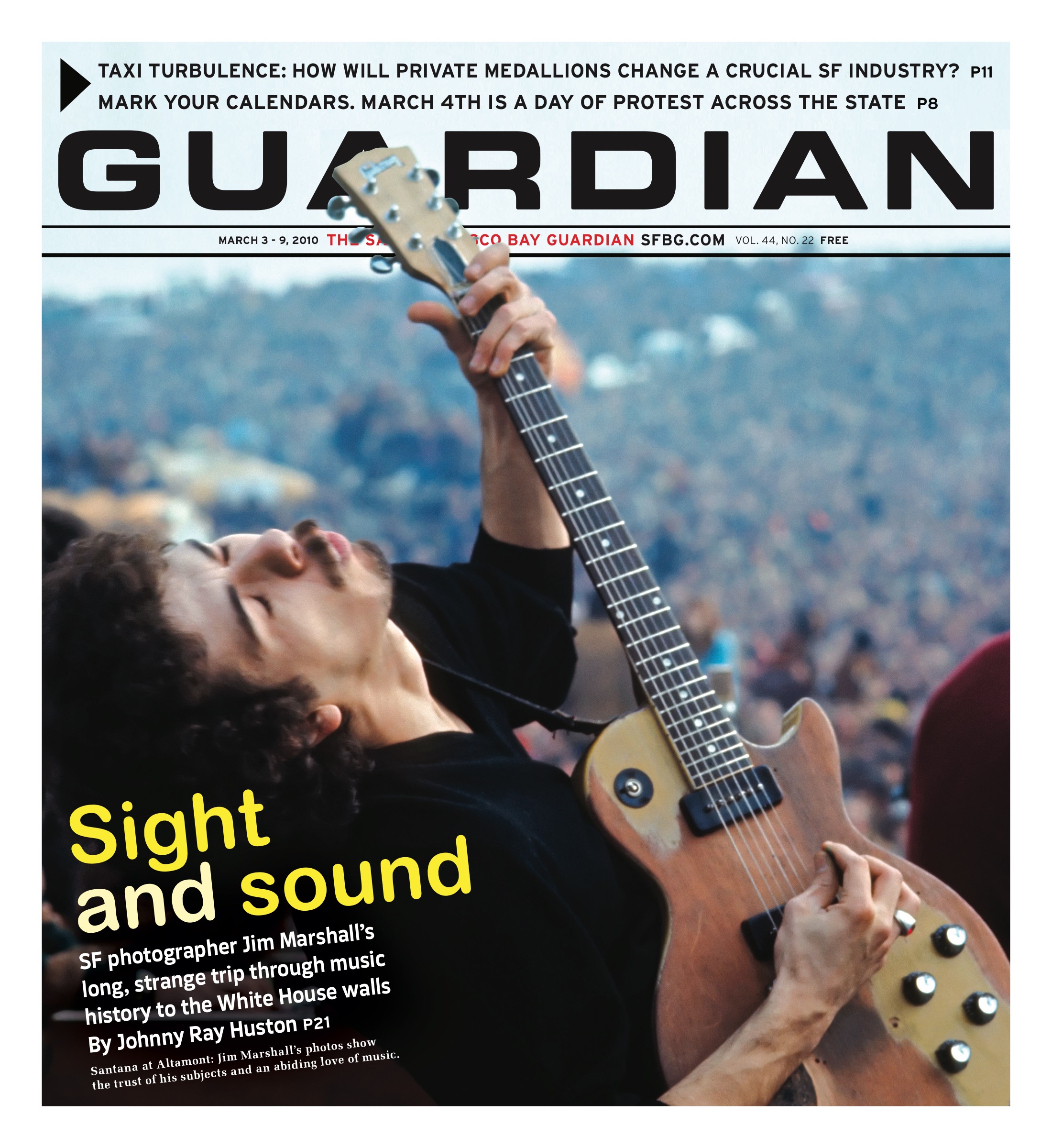
VISUAL ART/MUSIC I’m walking with Jim Marshall from his apartment in the Castro to his favorite restaurant just around the corner. The T-shirt he’s wearing showcases one of his more famous photos, of Johnny Cash flipping the bird. Marshall tells me and his friend and assistant of 13 years, Amelia Davis, about another time he was wearing the shirt. When the person he was with said he wanted one, he promptly took it off and gave it to him. We sit down at a table, I turn on my old tape recorder, and Marshall asks me for my first question. I say, “Well, it’s not a question, but I guess the first thing I could observe about you is that you’ll give someone the shirt off your back.” He laughs.

This story, itself born from a story from Marshall, suits an article about him, because as the title of his one of his new books makes clear, a major foundation of his photography is trust. Almost every page of Trust: Photographs of Jim Marshall (Vision On, 165 pages, $34.95) illustrates the deep implicit bond between photographer and subject in Marshall’s work, an element largely lacking from the prefab realm of music photography today. At times, this trust makes for startling juxtapositions: more than once Marshall’s camera catches a singer — Mahalia Jackson at Carnegie Hall; BB King at the Fillmore West; Janis Joplin at an outdoor concert in San Jose; Big Mama Thornton in a San Francisco recording studio; Nina Simone at New York Town Hall; Big Joe Turner at Berkeley Folk Festival — wholly unguarded, with arms open wide. The gesture reflects Marshall’s wholehearted embrace of music, an approach that makes his best images sing.

Marshall is a San Francisco photographer. “I was just starting out during the Beat era, in 1959, hanging out in North Beach,” he says. “They called me Jaguar Jim because I had a Jag 120. I photographed at the Hungry Eye. Lenny Bruce was the first roll of color I ever shot — 10 frames. Fantasy Records called me up about 10 years ago and said, ‘Jim, we’ve got some of your shots here.’ I figured there was some Creedence [Clearwater Revival] stuff, or Otis Redding. But there were 10 slides [of Bruce] that had been stuck under a cabinet for 35 years.” One of those 10 frames can be found in Match Prints (HarperCollins, 208 pages, $40), a just-published collaborative monograph that juxtaposes photos by Timothy White with photos by Marshall. In the shot, Bruce is standing before a brick wall, and he has his arms outstretched — almost like he’s expecting to be arrested. He’s on stage.

The back and forth between White’s photos and Marshall’s in Match Print — also on display at New York’s Staley-Wise Gallery later this month — is partly a conversation between on-the-scene verité images and the carefully set designed studio shots that tend to dominate magazine profiles. But it’s also about iconography and a memorable pose: Jim Morrison taking a drag from a cigarette for Marshall, Robert Mitchum inhaling (unlike Bill Clinton) for White. Match Prints has a casual sense of humor, evident in the pairing of Cash giving the finger with a White shot of Elizabeth Taylor flipping two birds after stepping out of a limo. (It’s also made clear by Alice Cooper’s playfully catty comments about his sister-in-leopard-skin-boots Lil’ Kim.) But the lingering moments of the book, and ironically, the most contemporary visions, come from older black and white Marshall photos, such as one of a zaftig Mama Cass in the back of a car, or bouffant-and-eyeliner beauty Little Richard lost in thought. Cass’s style and Richard’s drag are very Bay Area rock n’ roll 2010.

Marshall’s photography is 2010 enough to be lodged in the White House at the moment. President Obama has a Marshall shot of John Coltrane (also within Trust) on the wall. “He [Obama] had a White House photographer take a picture of him reflected in the [frame’s] glass,” Marshall explains with pride. “He signed it, ‘To Jim — I’m a big fan of your work … and Coltrane!” A little later, back at Marshall’s apartment, I look at this photo, and think of Obama’s image and trust. In deed, is the President doing right by the artists?

At lunch, Marshall zooms in on a telling moment from Obama’s recent State of the Union address. “He said, ‘This administration this year will end discrimination against gays in the military.’ The camera was on four generals and admirals in front of Obama. The whole place stood up and applauded. Those motherfuckers didn’t blink, didn’t move — nothing. They just sat there stone-faced. That’s the last thing they wanted to hear.”

The trust recorded in Trust is a different kind of commitment than one offered by a political figure. The photo of Coltrane — itself reflective, a bit melancholy, even haunted — that Obama sees himself within is a chief example. “Miles [Davis] saw my pictures of Coltrane and saw that John trusted me, and that was good enough for Miles,” Marshall explains, after I tell him about a great Davis interview in which he proclaimed that his favorite thing to do was watch white people act stupid on TV. “Miles, he didn’t like white people a whole lot. But for some reason he liked me. He said, ‘You’re as crazy as me.'” The truth is, in America, then and now, that’s as good a reason as any to like someone.

Truth is another strong element of Trust. Marshall’s investment in emotional truth means that his opinions aren’t always orthodox. Trust contains some photos of the infamous 1972 Rolling Stones American tour — “I must have done two pounds of blow on that tour,” Marshall crows — also documented by Robert Frank in the movie Cocksucker Blues. “I was never a big Robert Frank fan, and I’ll tell you why,” Marshall says, with trademark intimate candor. “As good as [Frank’s classic 1958 monograph] The Americans is — and it’s one of the all-time great photo books, damn near as great as [1955’s] Family of Man — what Frank failed to do is this: he didn’t show in one picture, as far as I can remember, the joy of being an American. It’s cynical. That bothers the shit out of me.”

As much as Frank, Marshall is a primary documentarian of 20th century America, well aware of a time when great filmmakers and photographers had enough faith in the government to work for it. “I had a Baby Brownie [camera] when I was a kid,” he says, when asked how he found his calling. “Everything was blurry — you had to take the picture when the sun was at your back. But I won a track meet, the 50 yard dash, and a guy was taking pictures for the school. He had an early Leica. When we go back to my apartment I’ll show you my scrapbook — it has pictures of cameras cut out of magazines and pasted on the paper, with their prices written in pencil. He took a picture of me that was razor sharp, and I thought, ‘This guy has a magic box.'”

Marshall’s Leica images have their own magic, evident in monographs such as Tomorrow Never Knows — The Beatles’ Last Concert (1987), Monterey Pop (1992), Not Fade Away (1997), Proof (2004), and Jazz (2005). Trust distinguishes itself by the dominance of color images — Marshall laughs heartily when I tell him that the blue sky found in a pair of outdoor concert photos of Joplin is a California blue. The color in Marshall’s photos is super-real, to re-deploy a word Anthony DeCurtis applies to White in the introduction to Match Prints. It isn’t the cliché hallucinogenic vision found in so many recreations of drug trips or the ’60s, but instead an extra intensity, utterly pure.

“The single greatest performance I ever saw in my life was Otis Redding in Monterey [at Monterey Pop in 1967],” Marshall says, as we page through Trust. “Brian Jones was there as a guest, and he said, ‘I think Mick [Jagger] is one of the greatest singers, and our band is one of the best, but personally, you couldn’t give me a million pounds to follow Otis Redding on stage.’ It was that shattering of a performance.” The photo we’re looking at as he says this is deep black and rich blue, with fists to the fore. It’s a cry — a shout — into the night.

A pair of photos in Trust capture confidences exchanged between Johnny Cash and a top-of-the-world Bob Dylan — a country-folk echo of the gestures of confidence between Marshall, Coltrane, and Davis. Marshall laughs when I tell him of an anecdote about the great folk artist-archivist and magician Harry Smith slamming the door of his Chelsea Hotel room in the young Dylan’s face with a loud “Fuck off!” When Marshall first began to photograph Cash and Dylan, the upstart musician was uncooperative, until his idol set him straight about the man behind the lens. “Bob Dylan respected without equivocation two people,” says Marshall. “Johnny Cash and Pete Seeger.” Indeed, Trust’s American history isn’t just a rock star history, it’s a secret history, a braided folk tale that extends from Elizabeth Cotten to the unlikely yet perfectly logical friendship between Sly Stone and Doris Day. Its stunning photos of the Carter Family can inspire a conversation about Redding’s and Anita Carter’s individually magnificent versions of “I’ve Been Loving You Too Long.”

Back at Marshall’s apartment, a photo of his late friend Tim Hardin at Woodstock broods as quietly as one of Hardin’s ballads, near the fireplace. “A million people around him, and he’s totally alone,” Marshall says, as if he took the shot yesterday. The hallway is lined with photos, not just by Marshall, but more often by famous acuaintances, many of them layered gestures of friendship that need no inscription. Marshall takes out his teenage scrapbook and sets it down on a table by his autographed images of Obama and Joe DiMaggio. “This was from the late 1940s!” he says, his voice rising in amazement. “Isn’t that a mindfuck?” It sure is. Another mindfuck would be for the best musicians and biggest personalities of the Bay Area to step in front of Marshall’s Leica today.


A NEW LOOK: JIM MARSHALL AND FRIENDS PUT THE FOCUS ON MS

VISUAL ART/EVENT This month, from March 5–19, one of Jim Marshall’s iconic images of Janis Joplin will be showcased in Union Square. The shot, of Joplin at the Palace of Fine Arts with arms outstretched as she sits atop a colorful Volkswagen Beetle, is just one of a number of prints being auctioned up for sale by photographers such as Baron Wolman, Michael Zagaris, Herb Greene, Robert Altman, Bobby Klein, and Marshall.

The cause is treatment of — and public awareness and conversation about — multiple sclerosis. All of the proceeds from sales of the photography goes to MSFriends, a grass-roots nonprofit begun by Marshall’s longtime friend Amelia Davis. Marshall hired Davis as an assistant knowing she had MS, and one encounter with Davis makes it easy to see why: she’s committed and dedicated. In the case of MSFriends, this dedication involves providing 24/7 telephone peer support, running an organization staffed by people who have MS, in an effort to help people with MS and others understand and respond to a misdiagnosed and misunderstood disease. 

For more information about MSFriends Rock for MS and MSFriends, go to www.msfriends.org  
 

No pixels, please — we’re plastic

0

Film and prints, like dinosaur bones and fossilized treasures, seem like ancient artifacts blown to the wayside in our digital age. We lost the mystery in photography when we introduced the point and shoot, erasing not only the physical labor but the ugly smiles, blinky eyes, and embarrassing angles. Where are the mistakes? The light leaks and fuzz on the lens? They’re making a comeback.

Obscure, eerie, and beautifully whimsical images galore will be on display starting Fri/26  at the RayKo Photo Center, as part of the third annual Plastic Camera Show.

More than 100 images from Bay Area artists, national and international photographers will have you yearning to get out there, grind that advance gear, and capture a local critter with some old fashion film.

A fascination with old school cameras is growing, with updated versions of the Diana and Holga plastic models showing up at Urban Outfitters and antique versions trading online faster than they can click. A backlash to our digital photo machines, it’s invigorating to see a picture lacking today’s high standards of “perfection”, allowing the camera to steer and our imagination to follow.

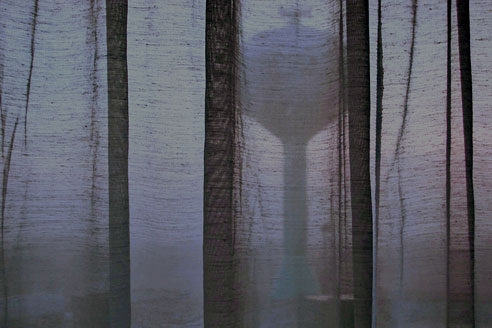
Cloudy, out of focus bridges and water towers clash and mingle with oddly colored figures and landscapes. Advanced photographer and amateurs alike can find success with the plastic gadgets, yielding photos with a quality unlike any produced by the futuristic models.

The work of Czech artist, Michael Borek, will be highlighted in the exhibit, shots of hot air balloons (see above) and lazy summer days harnessing the Holga’s unpredictability with gorgeous light leaks and inspiring angles.

RayKo’s 3rd Annual Plastic Camera Show
Fri/26-April 17 (Opening reception 6-9pm)
RayKo Photo Center
428 Third St., SF
www.raykophoto.com

Sex & Romance

0

BEST RESTAURANT TO SPARK ROMANCE

Café Jacqueline

Small, chic, and oh so French, this North Beach gem is an ideal spot to sip wine with your candlelit date while waiting for your made-to-order soufflé.

1454 Grant, SF. (415) 981-5565

BEST ONLINE PERSONALS

Eros-guide.com

Like Craigslist but without all those pesky non-sex-related categories, Eros is the definitive guide to escorts, strippers, BDSM partners, and “adult” dating.

www.eros-guide.com

BEST PLACE FOR SINGLES TO MEET SOMEONE

The Cellar

This small subterranean dance club features reasonably priced drinks, theme parties, and singles nights.

685 Sutter, SF. (415) 441-5678, www.cellarsf.com

BEST FIRST DATE SPOT

Foreign Cinema

Upscale cuisine, excellent cocktails, an adjacent art gallery, and a backdrop of films projected onto the wall in the outdoor patio make this a classy choice for a first night out.

2534 Mission, SF. (415) 648-7600, www.foreigncinema.com

BEST PLACE FOR AN ILLICIT TRYST

Bathrooms at the Lexington Club

Girls like going to the loo together — especially at the Lexington, SF’s favorite lesbian bar.

3464 19th St., SF. (415) 863-2052, www.lexingtonclub.com

BEST BREAKUP SPOT; BEST CRUISING SPOT

Dolores Park

On a sunny day, this sprawling, multifaceted public park is jam-packed with people. Once you finish the breakup talk, just hop to the next blanket over to find your rebound.

Dolores, between 18th and 20th Sts., SF

BEST PLACE TO BUY WEDDING WEAR

Dark Garden

This versatile shop offers quality custom corsets for all your costume, special occasion, and seduction needs.

321 Linden, SF. (415) 431-7684, www.darkgarden.net

BEST PLACE TO HAVE YOUR WEDDING CEREMONY

San Francisco City Hall

Say your vows with simple sophistication in the rotunda of this gorgeous historic building.

1 Dr. Carlton B. Goodlett Place, SF. (415) 554-4933, www.sfgov.org/cityhall

BEST HOT TUB RENTAL

The Hot Tubs on Van Ness

Clean, comfortable, and calming, each room at the Hot Tubs offers a redwood sauna, a hot tub, a seating area, and controlled lighting and music.

2200 Van Ness, SF. (415) 441-8827, www.thehottubs.com

BEST FLOWER SHOP

Church Street Flowers

Friendly petal peddlers offer a selection of quality blooms in traditional and creative arrangements.

212 Church, SF. (415) 553-7762, www.churchstreetflowers.com

BEST COUPLES COUNSELOR

Marriage Prep 101

This husband-and-wife team hosts informative, proactive, practical sessions to help your relationship succeed.

417 Spruce, SF. (415) 905-8830, www.marriageprep101.com

BEST PLACE TO BUY LINGERIE


My Boudoir: Best Place to Buy Lingerie
GUARDIAN PHOTO BY BRANDON JOSEPH BAKER

My Boudoir Lingerie

The exquisite yet low-key purveyor of intimate finery delights shoppers with a diverse selection of reasonably priced, well-crafted bras, panties, teddies, and more.

2029 Fillmore, SF. (415) 346-1502, www.myboudoir.net

BEST PLACE TO BUY SEX TOYS; BEST CONDOM SELECTION

Good Vibrations

It’s famous for a reason: a great selection of toys, books, and accessories; helpful staff; and a comfortable atmosphere.

603 Valencia, SF. (415) 552-5460; 1620 Polk, SF. (415) 345-0400; 2504 San Pablo, Berk. (510) 841-

8987; www.goodvibes.com

BEST PLACE TO BUY FETISH GEAR

Mr. S Leather/Madame S Boutique

Between the two of them, Mr. and Madame S can satisfy any of your leather or latex needs, be it for bondage clothing, kinky sex toys, or sexy bedroom hardware.

385 Eighth St., SF. (415) 863-7764, www.mr-s-leather.com, www.madame-s.com

BEST ADULT VIDEO STORE

Superstar Satellite

Home of independent, gay-themed, and top Hollywood movie releases, Superstar is also beloved for its collection of gay adult films.

474 Castro, SF. (415) 863-3333, www.castromoviestore.com

BEST STRIP CLUB

Lusty Lady

The world’s only unionized, worker-owned peep show, the Lusty is a perennial award winner.

1033 Kearny, SF. (415) 391-3991, www.lustyladysf.com

BEST SEX CLUB

Eros

Spa by day and sex club by night, this clean Castro locale provides steam, saunas, showers, lube and condoms, and a diverse selection of music and porn for its male clientele.

2051 Market, SF. (415) 255-4921, www.erossf.com

BEST SEX EDUCATION RESOURCE

Center for Sex and Culture

Is there anything the center doesn’t do? Workshops, classes, social gatherings, a library, archives, and special events are all part of its mission of providing the public with nonjudgmental, sex-positive education and support.

(415) 255-1155, www.sexandculture.org

BEST SEX WRITER

Virgie Tovar

This sex educator, sexual enhancement coach, phone sex operator, and former radio host titillates readers with Destination DD: Adventures of a Breast Fetishist.

www.myspace.com/thevirgieshow, www.breastfetishist.com

Sex & Romance

BEST SWEET PIECE OF ASS


Cake Gallery: Best Sweet Piece of Ass
GUARDIAN PHOTO BY BRANDON JOSEPH BAKER

Scoring a sweet piece of ass in SoMa has never been difficult, but finding it gushing with chocolate or vanilla? And in a box? For that you’ll have to head to the Cake Gallery, where a three dimensional ass-cake is actually one of the tamer selections on the menu. The policy here is to quickly whip up “anything your demented mind can imagine.” A giant penis spurting Bavarian jizz? Pssh. If you can’t conjure anything crazier than that for your sister’s Quinceañera, you can peruse an album of past creations for ideas: trannies swimming in rivers of piss, clam bumpin’ lesbians, and iconic cartoon characters engaged in bizarre sex acts are just the tip of the iceberg here. Think big! The only order that might get you a sidewise glance is a “normal” one.

290 Ninth St., SF. (415) 861-2253, www.thecakegallerysf.com

BEST APHRODISIAC WITH ADMISSION

Most San Francisco foodies worth their salt wouldn’t consider dating someone who didn’t like oysters. Obvious body-part references aside, oysters are supposedly one of the saltiest, slipperiest, juiciest aphrodisiacs on the planet (due to high levels of libido-increasing zinc) — plus there’s something both sexy and classy about the whole process of eating them. The largest oyster festival on the West Coast, O’Reilly’s Oyster Festival, then, seems like a good place to take someone if you’ve got ulterior motives. With attractions like the “Shuck and Suck Competition” (winner gets innuendo-filled bragging rights for a whole year), cooking demonstrations, an oyster history exhibition, and live music, North Beach’s oystery weekend pretty much completely rocks. Add that other great aphrodisiac — beer — to the equation, and you’d better have some smooth moves planned for when the sun goes down.

Second weekend in May, Fort Mason’s Great Meadow, SF. www.oreillysoysterfestival.com

BEST DAREDEVIL FIRST DATE

Let’s face it: San Francisco’s dating scene is exhausting. The excess of attractive, successful single people who live and date within the city limits practically guarantees that whoever you’re dating is probably dating someone else; and if someone wants to settle down with you, you’re not quite ready because your three other options are just too good to discard. That means there are a lot of first dates happening all over the city. And how many times can you go for a cup of coffee at an anarchist café, or dinner at a new trendy restaurant, or an indie show at a tiny dive? For an out-of-the-ordinary meet-and-greet, trek your asses up Diamond Heights (specifically, to Douglass Street between 19th and 20th) to the Seward Slides, sit on the empty pizza box you brought with you, and get ready to shoot headfirst down the awesomest hidden hillside slides in San Francisco. Plus, you’re less likely to run into your date’s other poly partners.

Seward and Douglass Sts., SF.

BEST ROMANTIC ACTIVISM

What’s more romantic than equality? A place to celebrate it right in the center of one of our favorite neighborhoods. That’s what we’ve got with Heart of the Castro Wedding Chapel, a charming locale for commitment ceremonies that opened on the heels of the California Supreme Court decision to allow same-sex marriage. The chapel is run by a collective of friends and activists striving to keep the institution legal while also providing dream weddings for couples who never thought they’d have one. Want something simple and elegant? Something crazy and kooky? The folks at Heart will help you plan it, and then they’ll host it in their lovely Victorian suite. Want a big party in December? Or quickie nuptials tomorrow afternoon? Either way, they’ll try to accommodate you. Indeed, they’re so dedicated to your happiness, they’ll even help you find a different venue if theirs doesn’t work for you. With reasonable prices and a great mission, we love Heart of the Castro so much it makes us want to marry them.

4052 18th St., SF. (415) 626-7743, www.heartofthecastro.com

BEST DOGGIE STYLE

Forget the Hallmark cards and expensive rings. Valentine’s Day was made for one thing only: boning. You know it, we know it, and all the animals on God’s green earth know it. If you need proof, book a spot at the SF Zoo’s annual Woo at the Zoo for a multimedia, champagne-soaked rundown of the myriad fornication styles the Coital Creator has bestowed upon Her beastly children. Gasp at the site of a horse’s schlong as it enters an unsuspecting mare. Wince at the violent lovemaking rituals of sharks. Imagine penguin orgies and simian BDSM parties. By the time the show’s over, your animal-loving date will be hornier than a bonobo and ready to get down, monkey-style, in the backseat of your Jaguar (or VW Rabbit, if that’s how you roll). If you hear screams of ecstasy in the parking lot after the show, listen closely — we bet some of ’em are human.

1 Zoo, SF. (415) 753-7080, www.sfzoo.org

BEST FLOATING LAP DANCE

OK, so the dancers on the Mermaids Cruise don’t actually dress like Disney’s Ariel, but they still do a pretty good job of satisfying whatever deep and dirty fetish you have for that under-the-sea siren. Book a spot for you and your friends any Friday or Saturday — or charter a private ride on another night of the week — and you’ll find yourself trapped on a boat for a two hours with an open bar and randy strippers like goth girl Candy, Brazilian kitten Cheetah, Southern belle Trillian, or hip-hop hottie Vanity. They may not have fish scales, but we bet men and women alike won’t be able to keep their eyes off the mermaids’ tails. Heteros, homos, singles, and couples are all welcome on the restored classic motor vessel. And if women aren’t your thing, the company has a Merman Cruise too.

(415) 859-7052, www.mermaidscruise.com

BEST HIPSTER HOOKUP HANGOUT

Want to pick up a hipster punk but can’t handle another night in the Mission. Your best bet is Hemlock Tavern, run by the same folks responsible for Valencia Street favorite Casanova. Located in Polk Gulch (otherwise known as the Tenderloin with higher rent), the Hemlock has a 360-degree bar, plenty of PBR, a pool table, an enclosed and heated smoking room, and bags of peanuts for a dollar — all well worth riding a fixed gear across town for. Plus, there’s often live music in a side room. When the giant red arrow on the wall lights up, you can pay a small cover to see the music or simply stay in the larger bar area and watch music-lovers in tight jeans and studded belts parade past you. Another bonus: this might be the only non-gay bar in San Francisco where the line for the men’s room is longer than the one for the ladies’, which means plenty of opportunity for hitting on cute hipster boys.

1131 Polk, SF. (415) 596-7777, www.hemlocktavern.com

BEST NEXT STEP IN YOUR RELATIONSHIP


Filbert Street Steps: Best Next Step in Your Relationship
GUARDIAN PHOTO BY BRANDON JOSEPH BAKER

It’s quite possible that the only thing cuter than twosomes of cooing birds are the cooing couples who watch them. For your own chance to go “awwww” with your amore, head over to the Filbert Steps. Yes, this is the locale for feel-good-movie-of-all-time The Wild Parrots of Telegraph Hill, featuring the tiny cherry-headed conures that make their homes in the trees lining the steps for most of the year. To get there, take your sweetie and your fixie through the Broadway Tunnel to Washington Square Park, and head up Telegraph Hill to the base of Coit Tower. Check out the WPA murals on the way, then descend 28 stories down the wooden stairs until you hear distinctive squawks from the flock. Next? Look. Listen. Lock lips. What you do after that is between you, the birds, and the bees.

Filbert and Telegraph Hill Blvd., SF. www.coittower.org

BEST BEER GOGGLES DOWN BELOW

The thing about shelling out for drinks when you aim to impress a hottie is that they go away so quickly (the drinks, definitely; the hottie, possibly). By the time your crush is rattling ice in the base of their empty vodka-cran-lime glass, the object of your financed affections may have moved on to the other end of the bar. But strike up a good rapport with someone at the Lucky 13, Zeitgeist, the R Bar, or Ace’s, and you can spend your hard-earned bucks on a longer-lasting investment with clearer purpose — and a better chance of big returns. The answer? Underwear bearing the bar’s logo. If your paramour accepts the gift, you know you’re on the same page — and possibly on your way to a private, postbar fashion show. Just make sure you get ones you like. After all, both rejection and romance can end with you having to wear them.

BEST BAR FOR A BOOTY CALL

Smooth-talking, heavy-handed bartenders and a packed house of good-looking, hormonal twenty- and thirtysomethings boozing it up in muted, raucous style are part of what make Solstice a classic among booty-call bars. If you’ve already got a FWB, this place will get you in the mood — and do it in style. And if you’re simply looking for a bed buddy, you’ll have your pick of young execs with flushed cheeks, loosened ties, and skirts deliberately pushed up high-thigh. The menu’s got classy down-home bar food like Kobe beef sliders with sweet potato fries or gorgonzola mac ‘n’ cheese, so you can satisfy any “not before you buy me dinner” roadblocks. Add in that happy hour that starts at 5 p.m. and food is available until midnight (that’s seven hours to score), and you’re looking at pretty good odds. Speaking of looking good, everyone does after a bottle of wine, so take advantage of Monday’s half-off special.

2801 California, SF. (415) 359-1222, www.solsticelounge.com

BEST VIOLET BLUE


Violet Blue: Best Violet Blue
GUARDIAN PHOTO BY BRANDON JOSEPH BAKER

Beloved San Francisco sex writer Violet Blue recently started seeing red when she realized porn actress Ada Mae Johnson had adopted her moniker in 2001 — using it to make 300 films, which earned her the coveted “Best New Starlet” award from Adult Video News in 2002. The conflict came to a head at the 2006 Exotic Erotic Ball, where confusion ensued when SF Violet Blue (her given name) and porn star Violet Blue both attended. Last year the writer of sex books and columnist for SFGate.com sued her doppelgänger to get Johnson to change her stage name. After the writer won an initial victory in the courts earlier this year, the porn star finally changed her name — first to Violetta Blue, then to Noname Jane. We’re happy for Blue, though we assume Noname doesn’t feel the same. She’s probably green with envy.

www.tinynibbles.com, www.myspace.com/nonamejane

BEST DISNEY WITH LUBE

Whoever thinks a DVD is the best way to see gay porn never watched it on 8mm. The undoctored color, the absence of grunting, the lurid, jumpy detail … how could you not prefer that to the glossy, homogenous automatons in contemporary adult films? Of course, finding gay porn by way of the DVD’s lasered predecessor isn’t easy — which is where Super8Man comes in. This 8mm-afficionado has collected an impressive number of such films, exhibiting the grainy fantasies at various clubs and venues — like Artists’ Television Access — throughout the city. So keep an eyeball out for this showman and his varied and nuanced delights. Perhaps you’ll even get to see his personal favorite: a madcap vignette of two guys fucking in a van while a wheel man zips them through town with the back doors swinging open. It’s like Disney’s North Avenue Irregulars with lube!

www.super8men.com, www.handbookmen.com

BEST MÉNAGE À MEATLESS

It’s said that vegetarians have the freshest smelling genitals around. But the folks at Millennium seem to know something about the way a flesh deficit affects a vegetarian’s sex life in other ways. Apparently, noncarnivores feel an intense yearning for a four-course meal and an all-night session of cruelty-free lovemaking every month. That’s why they host an Aphrodisiac Dinner and optional accompanying overnight package in a Love Suite at The Hotel California every Sunday closest to the full moon. Gone are the days of curry-scented, low-budget establishments and a grabass session in the VW bus — high-rolling horny vegans can now feast and fornicate in upscale style. You can opt only for the meal ($45), but we suggest the full package ($192) for a more satisfying dessert.

580 Geary, SF. (415) 345-3900, www.millenniumrestaurant.com

BEST SWINGIN’ SEX CLUB

It isn’t just the jazz bands that are swingin’ in North Beach. Private club Twist offers couples the opportunity to engage in that other kind of swinging, away from home. Located in a two-story commercial space, Twist provides a club atmosphere for adults who want to play you-show-me-yours-I’ll-show-you-mine with style, sophistication, and secrecy — the club is invitation-only (apply online), very big on etiquette, and very specific about not giving away details about its patrons. No drugs are allowed, but unlike many sex clubs, there is a bar, though it’s BYO wine and beer (no hard alcohol). Visitors like the art on the walls; the washable black covers on couches and beds; and the supply of fluffy towels, condoms, and lube in every room. Voyeurs and exhibitionists love transparent room dividers, while shyer types like the downstairs dance floor and DJ. No single men are allowed, and couples are asked to arrive, participate, and leave together, so this is an especially appealing and safe place for single ladies. Plus, they get in free!

(415) 812-7221, www.twist-sf.com

BEST GALLERY-WORTHY GLAMOUR SHOTS

Looking for a sexy gift? Or maybe a titillating mantelpiece? We suggest photos of you naked, in your favorite corset, or wrapped around your lover, taken at Erosfoto, the boudoir photography studio run by gallery-exhibited artist Suzanne Jameson. A far cry from mall-quality glamour photos, Jameson’s prints fuse fine art principles with her subjects’ ideas, making the result of each private session tasteful and uniquely sexy. Even better, Jameson’s an expert in helping the women and couples she works with feel comfortable. She encourages models to bring their own music, clothing, lingerie, jewelry, and props — or to borrow some from her extensive collection. She also can provide makeup and hair artists upon request — indeed, many brides-to-be kill two birds with one erotic stone by using portraits as nuptial gifts for their spouses and a chance to test out wedding day hair and makeup. The pictures aren’t cheap — it costs $600 for a two-hour session — but you’re welcome to split the cost with a friend who wants to pose too. You get a DVD with digital negatives, and you keep all rights to the photos.

1483 Guerrero, SF. (415) 706-5237, www.erosfoto.net

BEST DARING DRESS-UP CLOTHES


Stormy Leather: Best Daring Dress-Up Clothes
GUARDIAN PHOTO BY BRANDON JOSEPH BAKER

While roses and rosé may do it for some, others need latex and leather to get them in the mood. The latter lotharios need look no further than Stormy Leather. This SoMa warehouse is a dream for playing daring dress-up, carrying everything from sweet silk corsets to sadistic leather whips — and everything in between. We especially like its line of latex clothing, with styles ranging from Cat Woman to Marilyn Monroe–esque, and the selection of corsets, including the ruffled Colette and military-themed Sergeant. Since Stormy’s a manufacturer as well as a retailer, you can have items custom made to fit your size and preferences (yellow extra small? red silk 5X?) — and the knowledgeable staff to help you figure out what, exactly, those preferences are. What’s even sexier is how involved Stormy is in the community, providing classes in fetish play, hosting art shows, and sponsoring burlesque troupe Twilight Vixen Revue.

1158 Howard, SF. (415) 626-1672, www.stormyleather.com

Raison ritual

0

YEAR IN FILM “We could live like this forever.” Josephine, the serious young woman in Claire Denis’ gorgeous chamber drama 35 Shots of Rum, whispers this line to her father while they’re camped out on the beach. It’s unclear, however, whether she’s referring to this particular sandy spot or the rituals of home and work that structure the film. As with Chris Chong’s remarkable short, Block B, 35 Shots of Rum (a ritual in the title itself) is set in a superficially unattractive apartment complex. Beyond the concrete is an intricate network of human relations. In the republic of cinema, the Denis film descends from that great poet of routine life, Yasujiro Ozu. Daily rituals dilate exposition and emotion; the safe enclosure of home unfolds in time.

Many of the most indelible, mood-lifting moments of my sporadic year of film-going arrived in the deepened presence of ritual: two shots of espresso, in separate cups; dismantling a bomb; shaving radishes; sheering sheep; the ecstatic sweat of a Lightning Bolt concert; the murderous talk surrounding a stand-up act. The Limits of Control cracks a zen joke out of those scenes that take us to edge of plotlessness; The Hurt Locker posits them at the lip of death. Every genre has its rites, but ritual is roped off by an extraordinary and transformative act of concentration: not so much a slice of life, as the heart of it.

To begin with an imperfect example, take Funny People. The informal joke workshops are the best thing about Judd Apatow’s chef-d’oeuvre by some distance — a romantic plot is deathly flat next to the backstage lollygagging. Likewise, for all The Hurt Locker‘s amazing mappings of harm’s way and its rigorous equation of work and action, Kathryn Bigelow’s film sags in the bland passages earmarked for character development. However momentarily, both movies put the blockbuster through paces.

Rituals, as I’ve described them, give us time to think and feel, and thus crop up with greater frequency in experimental work (ritual makes the documentary-fiction divide matter less). In Heddy Honigmann’s Oblivion, political history flows from her interview subjects’ ingenious livelihoods. Representatives of the service class relay personal and national narratives at work, their gestures embodying resilience and wisdom beyond the bounds of political rhetoric.

A clarifying admiration of labor also animates Sweetgrass, Ilisa Barbash and Lucien Castaing-Taylor’s near-wordless immersion into a final sheep drive across Montana. Recorded with ethnographic grit and uncommon lyricism, the film counterpoints detailed sound recordings with monumental, temporal landscape photography. A peculiar mix of estrangement (the implacable animal stare) and intimacy (the last cowboys’ muttered curses), Sweetgrass packages a dying way of life as a wayward phenomenological experience — the ritual as haunting.

Rendered as cinema, there is every possibility that ritual will make for a trance. Ben Russell actively cultivates this state in his Black and White Trypps series. Excerpts of all six of these shorts, as well as a 10-minute slice of Russell’s acclaimed feature debut, Let Each One Go Where He May, are available on his Vimeo site, but seeing the third installment in 35mm at the Pacific Film Archive raised the stakes considerably. In it, Russell sends a beam of light into the teenage sprawl of a Lightning Bolt show, creating a visible field barely broad enough for one or two wild faces. The crowd’s pulse makes for an ephemeral, twisting portrait. Projected on the big screen, the baroque expanse of sound and black gave the mined portraits a distinctly transcendent aura. Russell’s Warhol-worthy idea locates solitude in collectivity and authenticity in performance. The 11-minute film also invites us to reconsider the coordinates of that other common ritual that brings us alone together in the dark — cinema.

Events listings

0

Events listings are compiled by Paula Connelly. Submit items for the listings at listings@sfbg.com.

FRIDAY 27

Accessories in Action 111 Minna, 111 Minna, SF; (415) 974-1719. Noon; $8, $5 with donation of shoes. Enjoy this fashion fundraiser and holiday shopping event that supports local designers while donating to a good cause. Proceeds from the door to benefit Soles4Souls, a charity that provides people in need with shoes.

Holiday Tree Lighting Union Square, Powell at Geary, SF; (415) 393-3459. 6pm, free. If you find yourself downtown on Black Friday stop the annual Macy’s Tree Lighting Ceremony. Festivities preceding the tree lighting begin at Noon in Union Square.

SATURDAY 28

Celebration of Craftswomen Herbst Pavilion, Fort Mason Center, SF; (650) 615-6838. 10am-5pm, $8.50. Join the Women’s Building in celebrating their 31st Anniversary at this holiday crafts fair featuring functional and decorative pieces of handcrafted items and fine art for both the home and body. All items are made by female artists and are environmentally conscious and economically sustainable alternatives to mainstream consumption.

Crystal Fair Fort Mason Conference Center, Fort Mason, SF; (415) 383-7837. Get an aura reading, a massage, an amethyst geode, or look around for the most gift worthy crystals, beads, jewelry and more to ward off the ghosts of holidays past.

Everything Must Go! Climate Theater, 285 9th St., SF; (415) 704-3260. 8pm, $5-500 sliding scale. Be wowed as a diverse group of Bay Area artists respond to the web of consumerism in the world around us with multi media commentary including performance, intallation, video, photography, and more.

BAY AREA

Berkeley Artisans Open Studios Various locations in Berkeley; (510) 845-2612, www.berkeleyartisans.com. Sat.-Sun. 11am-6pm, continuing every weekend through 12/20. Buy original creative gifts while supporting local artisans this holiday season. Featuring blown glass, decorative ceramics, ornaments, Menorahs, lamps, original prints, and more.

SUNDAY 29

Classic Black San Francisco Library, 100 Larkin, SF; (415) 557-4400. 3pm, free. Hear former San Francisco Poet Laureate Devorah Major perform spoken word poetry accompanied by Bay Area jazz musicians Richard Howell, on saxophone, and Mark Izu, on bass at this reading titled, Classic Black: African-American Voices from 19th Century San Francisco.

TUESDAY 1

AIDS Around the World Commonwealth Club, 2nd floor, 595 Market, SF; (415) 597-6700. Hear Jose M. Zuniga, President and CEO of the International Association of Physicians in AIDS Care (IAPAC), discuss the work of IAPAC In Africa, South America, North America, and Europe. December 1st is World AIDS day.

The Assassination of Fred Hampton City Lights Bookstore, 261 Columbus, SF; (415) 362-8193. 7pm, free. Hear autor Jeffrey Haas discuss his new book that gives a personal account of how he and People’s Law Office partner Flint Taylor pursued Black Panther member Fred Hampton’s assassins.

Get Through the Holidays SF LGBT Community Center, 1800 Market, SF; www.ourfamily.org. 6pm, free. Attend this workshop for gay couples distressed over holiday issues with in-laws and parenting. The workshop will offer discussion, strategies, and tips for navigating the holidays as a couple.

Sex, Love, and Attachment Bayfront Theater, Fort Mason, SF; 1-800-994-0041. 7pm, $20. Join anthropologist Helen Fisher as she shares her insights from years of research with tens of thousands of individuals on the biological drive that pulls us towards sex, love, and attachment.

Hot sex events this week: Nov 18-24

0

Compiled by Molly Freedenberg

sexeventssirloin_111809.jpg
Sir Loin Strip and Amelia Mae Paradise plan to take over Monday Night’s Hubba Hubba Revue in Oakland with surprises, quirks, vaguery, folly, and fancy. Photo by Molly DeCoudreaux.

————-

>> Flogassage
Serena Aderlini-D’Onofrio hosts this workshop on the bioenergetics of multiple loves, a hands-on course combining small group massage and mild flogging to convey the experience of polyamory.

Wed/18, 7pm
$5-$35
Center for Sex and Culture
1519 Mission, SF
www.sexandculture.org

————-

>> Sex Workers’ Writing Workshop
Gina de Vries hosts this workshop for current and former sex workers who want to share their writing and get honest, non-judgmental feedback.

Wed/18, 6-8pm
$10-$20
Center for Sex and Culture
1519 Mission, SF
www.sexandculture.org

————-

>> ArtUndressed SF
Fashion shows, body painting, and live entertainment at this huge, three-day celebration and exhibit of erotic art, sculpture, and photography — featuring local winners of Erotic Signature’s 2009 International Erotic Art Competition, including Nancy Peach, Damon Banner, Marc Taro Holmes, Retrotie, and 120 more!
Nov 19-21, Thursday and Friday 6pm to midnight and Saturday 3pm-9pm, $20
California Modern Art Gallery
1035 Market, SF
www.artundressed.net

———–

>> Mission Control Fundraiser: Carnival Midway Sextravaganza!
Kinky Salon a sexy, scintillating evening featuring stripper clowns, carnival games, a bake sale and auction, fortune tellers, and XXX backroom action, plus appearances by Boenobo, DJ Nezzy Idy, Sister Kate, and more.
sex
Fri/20, 8pm
$20 (includes 10 free tokens to play)
Mission Control
2519 Mission, SF
ymlp.com/zlzJwg

————-

>> Hubba Hubba Revue: The Miss Hubba Hubba Pageant!
It’ll be a sensational, galmour-packed, talent-rich night when burlesque performers compete for the title of Miss Hubba Hubba. Also featuring Fromagique and Bombshell Betty’s Burlesqueteers.

Fri/20, 9pm
$5-$12
DNA Lounge
375 11th St, SF
www.dnalounge.com

————-

Dark mirrors

0

arts@sfbg.com

LIT Recently I was at a meeting with an unnamed arts organization, planning for an AfroSurreal art exhibit. As we were hashing out the details of display, the concept of the black dandy become a bone of contention among my learned colleagues. What was, and is, a black dandy? How does the black dandy differ from the white dandy? What’s the difference between a dandy and fop? Aren’t those terms interchangeable? Why bother looking at or for a black dandy at all? I’m seldom at a loss for words — it just takes me a minute to arrange them properly sometimes. (Ask my editor.) But this time, I had nothing to say. I just directed all queries to Slaves To Fashion: Black Dandyism and the Styling of Black Diasporic Identity (Duke University Press, 408 pages, $24.95).

Monica L. Miller’s book is the first of its kind: a lengthy written study of the history of black dandyism and the role that style has played in the politics and aesthetics of African and African American identity. She draws from literature, film, photography, print ads, and music to reveal the black dandy’s underground cultural history and generate possibilities for the future.

Slaves to Fashion looks at black dandies of the past, beginning with Mungo Macaroni, a freed slave and well-known force within the London social scene in the 18th century. Miller also studies contemporary manifestations, in the vestments of Andre 3000 and Puff Daddy, showing how black dandies have historically used the signature tools of clothing, gesture, and wit to break down limiting definitions and introduce new, fluid concepts of social and political possibility. Though Slaves to Fashion is über-academic and at times weighed down by post-structrualist jargon, Miller more than makes up for it with uncanny feats of scholarship that illustrate ways in which the figure of the black dandy has been an elephant-in-the-room — albeit a particualrly well-dressed one.

A great example is Miller’s citing of the character of Adolph in Harriet Beecher Stowe’s 1852 Uncle Tom’s Cabin. Almost immediately after the publication of this "great abolitionist work," its characters became some of the first American archetypes: Simon Legree and Uncle Tom are two notable examples. In comparison, Adolph — a black dandy pivotal to the story — was excised from the public imagination. Miller sees this as a reaction to what she calls "crimes of fashion," which take place when Africans and African Americans don the clothing of the oppressed to both emulate and satirize the oppressor. Adolph served as a "dark mirror" to both American materialism and the deep fear of the impending gender and race-mixing that would take place after abolition.

This fear, according to Miller, is the difference between the black dandy and the white dandy or the fop. Unlike a Caucasian counterpart, exemplified by the likes of Oscar Wilde, the black dandy comes from a position of underprivilege and uses flair and style as a way to redefine masculinity to include him. In other words, as opposed to a feminine front, it is the black dandy’s fluid masculinity — his "queering" of the term — that threatens to undermine the social order. Adolph is the exact opposite of the static, predictable docility and animalism of "the Big Black Buck" Uncle Tom. When he’s in town, you have to lock up your sons, daughters, wives, mother, father, and yourself because his power of seduction is so great. Think Prince during his Dirty Mind (Warner Bros., 1980) phase and you get the general idea.

Fear, according to Miller, continues to generate a serious backlash in reaction to the idea — let alone reality — of true equality for black people in the west. Images of black cork minstelry that lampoon the black dandy’s aspirations have been around as long as the black dandy. From Zip Coon and Jim Dandy in the early 19th century to present-day manifestations in popular culture, ambivalence — a tool of the black dandy — has served as a double-edged sword. Exactly when and where does "stylin’ out" become "coonin’"? If W.E.B. Du Bois, the quintessential black dandy, couldn’t figure it out, I’m not sure that I can find a definitive answer.

Slaves to Fashion rediscovers its footing in exploring the nature of "otherness." Returning from investigations of the black dandy’s lineage to note his role in contemporary art and culture, Miller shines a light on filmmaker Isaac Julien, editor and photographer Iké Udé, visual artist Yinka Shonibare, and beyond. In the process, she answers a variety of questions regarding what a black dandy is and does. Ultimately, the black dandy’s problem is an AfroSurreal one: by perpetrating these "crimes of fashion," by avoiding and exploding pat definitions of blackness, masculinity, and sexuality, he occupies a realm outside convention, and all too often, recognition. It is from these murky waters of post-postmodernity, I believe, that the black dandy brings a message for us all.

This is it

0

arts@sfbg.com

VISUAL ART In its opening week, the posthumous Michael Jackson film This Is It topped the international box office. It’s a testament to the enduring ardor of his fans. But one day in the not-so-distant future, the film will likely be core material in a media studies program. Perhaps even a Michael Jackson studies program.

In 2005, Candice Breitz, a Berlin-based, South African-born artist whose works of photography and video installation address the psychosocial power of pop, created King (A Portrait of Michael Jackson). Breitz’s multimedia project efficiently makes the case that the musician and his fans are engaged in a deeply complicated relationship, one with an infectious soundtrack. King is direct — 16 Jackson fans, videotaped singing and dancing to the entire Thriller album, are presented together in the gallery on plasma screens. The result is a dynamic image of the entertainer in which he never appears.

The similarly structured 2006 work Working Class Hero (A Portrait of John Lennon) is one of two celebrity-appropriating Breitz works currently on view at SFMOMA. Like a good pop song, it seduces with a hook and takes a complicated foothold in your consciousness. The second piece, 2005’s Mother, isolates scenery-chewing performances by six major Hollywood actresses: Faye Dunaway, Diane Keaton, Shirley MacLaine, Julia Roberts, Susan Sarandon, and Meryl Streep.

"I’m turned on by the potential for the work of art to articulate complex ideas and simultaneously engage a broader audience which might not be as invested in the discourse of contemporary art," the highly articulate Breitz explains in a recent conversation. She offers what she terms "the South Park model," suggesting the subversive cartoon is something you can simply be entertained by or write a PhD dissertation on.

Breitz’s projects frequently manage to have it both ways. The Lennon piece beckons with the sound of familiar songs. But encountering 25 video monitors, each one slightly enlarging a passionate fan, is involvingly witty — and frightening, due to the intensity of the performances. These are people who clearly take the music to heart and have made it their own. Being able to look at them so closely in a gallery is an uncomfortably intimate experience — an effect perhaps achieved by the fact that each participant is recorded alone.

"I’m interested in the ping pong, that they’re there both as individuals who have their own subtle or radically different ways of interpreting their challenge, but also as members of what Benedict Anderson refers to as an ‘imagined community,’" Breitz says. "They don’t know each other, but by virtue of their shared interests they belong to an abstract community." This explanation concisely identifies a key component of the media-dependent condition of modern life.

The scenarios in Breitz’s works have been complicated by the popularity of American Idol and YouTube. Breitz views them with characteristic criticality. "In as much as I am flirting with those formats, there are certain elements of those programs I don’t care to embrace," she admits. "One is the way in which participants are humiliated and stripped of dignity."

The Breitz exhibition recalls Phil Collins’ crowd-pleasing 2005 dünya dinlemiyor, a chapter of his Smiths karaoke video project that SFMOMA presented in 2006. Collins’ piece also accesses powerful pop bonds, allowing one to see young Turkish fans deliver versions of Morrissey’s lyrics in flawless English. Coincidentally enough, Collins made a project (2005’s the return of the rea / gercegin geri donusu) about people who felt damaged and exploited by their participation in British reality TV shows. While one might imagine a rivalry between the artists, Breitz acknowledges an appreciation and dialogue.

"Who did it first?" she asks. "I find it fascinating when different people do something similar at the same time. I find it affirming — there’s a relevance [when] other people are thinking about the same things."

Mutual thoughts seem to have been entertained by the screenwriters of Kramer vs. Kramer (1979) and Mommie Dearest (1981), which are among the vintage film sources for Breitz’s Mother. The piece essentially constructs new meanings from elements such as Faye Dunaway’s over-the-top performance as Joan Crawford and Shirley MacLaine’s fictitious Debbie Reynolds portrayal in Postcards from the Edge (1990). In the process, it spotlights the ways in which we embrace and consume maternal archetypes.

"There’s a tug of war for meaning going on, and at the end of the rope there are all of those existing meanings and identifications and desires already invested in that material," Breitz says. "And then there’s me — I’m doing my best to bring a new translation or angle."

She manages the feat, not least because her perspectives on her material and equipment are so spot-on. "I think of those plasma displays as vitrines," she says of the screens in her works. "They’re like glass boxes in the natural history sense. Almost immediately, what you put into them is something of the past — they’re less objects of our present than documents that refer back to something which was." Like the first time we heard that favorite Michael Jackson song.

ON VIEW: CANDICE BREITZ

Through Dec. 20., $9–$15 (free for kids and on first Tues.; half-price Thurs. evenings)

San Francisco Museum of Modern Art

151 Third St., SF

(415) 357-4000

www.sfmoma.org

Goldies Extra — Cary Cronenwett’s revolution now

0

By Cheryl Eddy

maggots.jpg
Still from Maggots and Men

“It was schoolboys sitting in the classroom, having daydreams,” Cary Cronenwett explains, describing Phineas Slipped, his 2003 debut as a director. “The classroom was in video, and the daydreams that the boys had were little Super 8 [films]. It was bullies, and bullies being bullied, and it was sexy and violent and stuff like that.”

Five years in the making — including time spent studying filmmaking at City College of San Francisco with director of photography Ilona Berger — Cronenwett’s follow-up effort Maggots and Men was first seen by Bay Area audiences as a short film (“sort of an overgrown trailer,” as Cronenwett calls it)


trailer for Maggots and Men

Maggots and Men | MySpace Video

“The structure of the film is kind of expandable and contractable. It’s broken up into discrete stories, or segments. More of those could be added, or taken away,” Cronenwett says. “I did the same thing with my first film: the idea was to get three quarters of the way through it, and then see what’s needed. I always wanted to lean towards the side of making it shorter and really dense. But I also thought, we’ll see how it works out and maybe it needs to become longer.”

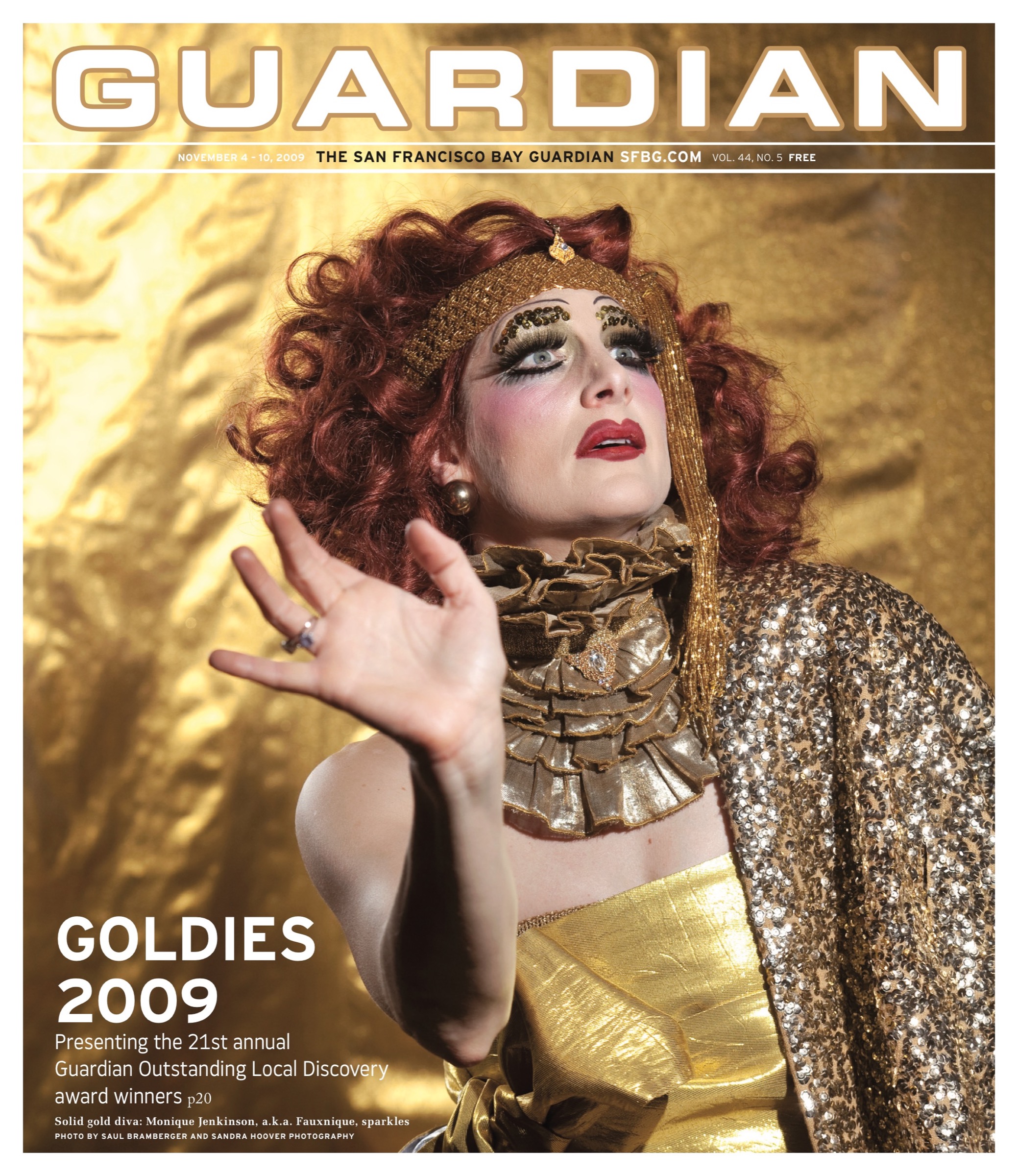
GOLDIES 2009

0

As the great man sings, "Do I hear 21, 21, 21? I’ll give you 21, 21, 21." It’s Fibonacci time: the Guardian Outstanding Local Discovery awards are turning 21, nine years into the 21st century. Old enough to drink and to gamble and to trick, though truth be told, the awards we call Goldies have done all three, if they wanted to, on their own terms, for some time now — they’ve grown up quick, fighting off streamlined convention every step of the way in the name of influential and imaginative art.

It’s only fitting that 2009’s Goldies feature two winners — at the very least — who aren’t averse to sporting some gold sequins on stage. Golden honey, golden Oakland: these are some of the main ingredients that have revealed themselves in an awards year that doesn’t just bend gender but rends it asunder while bringing strong expressions of the theatrical and political. This year’s winners can shred, or tear it up on stage. They can discover and reveal a place outside of society. They’ve got a tender side — and go go power.

The 2009 Goldie winners were selected by the Guardian‘s Johnny Ray Huston and Cheryl Eddy, with input from our writers and critics, including Robert Avila, Rita Felciano, and Glen Helfand, as well as members of the Bay Area arts community. Put on your soulful dress and join the awardees on Monday, Nov. 9 for a free party at 111 Minna Gallery. You’ll discover 14 reasons why it’s great to be 21.

All GOLDIES winners portraits by Saul Bromberger and Sandra Hoover Photography

———–

LIFETIME ACHIEVEMENT

SUGAR PIE DESANTO

———–

LIFETIME ACHIEVEMENT

EMORY DOUGLAS

———–

MUSIC

TY SEGALL

———–

MUSIC

SAVIOURS

————

MUSIC

HONEY SOUNDSYSTEM

————

MUSIC

D-LO

———–

FILM

CARY CRONENWETT

————

STAGE

MONIQUE JENKINSON

————–

DANCE

NOL SIMONSE

————–

THEATER

BETH WILMURT

————-

THEATER

THRILLPEDDLERS

————-

VISUAL ART

DAVID WILSON

————

VISUAL ART

VERONICA DE JESUS

————

VISUAL ART

LUKE BUTLER

Writers Issue: The men behind Peter

2

By Johnny Ray Huston

This week’s Writers Issue includes a page devoted to the visual side of books and magazines, with contributions by comic book artist Eric Haven and comedy routine and joke book specialists Kasper Hauser. You’ll notice some compelling ads on the page — after admiring them, contemplate the fact that they are from Peter, a local men’s magazine co-created by David Enos and Tag Savage with a little help from their friends. So, what exactly is Peter? I recently met Enos in the smoking section. When I asked him for some background, I got some priceless rugged poetry for my troubles. Man oh man. Ooh la la!

SFBG How did Peter come to be?
David Enos Well, last year Tag (Savage) found a copy of a ’60s-era tabloid for men, a poverty-row Esquire or Argosy, called Man. This was from the Magazine, a great used bookstore in the Tenderloin that also sells found photographs. The voice of Man was that of a tough guy who doesn’t mince words, like a Kirk Douglas, but who also has a thirst for some very questionable, morbid information. In the way that Kirk Douglas wouldn’t think it odd to go into a book shop and ask the girl behind the counter for a book on Roman entertainment practices; to him it’s just part of having a healthy curiosity and he should catch up on the details.
The cover was a grid of boxes, and each one was a tease for an article: “KKK On My Skin” was a headline I remember. We both independently made take-offs after reading it. It was hard to shake. Around the same time, we had been talking about recreating the covers of board games like Mastermind as a photography exercise. Peter was a result of mushing these projects together. Also borne of this was Scumbag, a crasser counterpart to Peter.

SFBG Who is the target or ideal Peter reader?
DE I was never sure who would end up seeing it. Peter is for the reader who enjoys the finer things in life. Scumbag is for a different audience, maybe in jail. I think it was more of a success. It gets right to the point.

SFBG Unlike with so many magazines, Peter‘s advertisements often have an appeal that matches the editorial content. What advertisers are drawn to you, what do you like about their style or their products, and what advertisers would you like to court in issues to come?
DE Peter is 80 percent ads.
I saw an ad in an issue of Popular Mechanics. They send you the black widow eggs and you build wooden homes for them. You receive blueprints of cubbies for them to get into and build webs.

Writers Issue: Steve Rotman

2

By Johnny Ray Huston

The cover image of this week’s Writers Issue and some of the photos accompanying the writing itself come courtesy of Steve Rotman, whose dedication to photographing work by local painters is evident in his amazingly vast and comprehensive Flickr contributions under the name funkandjazz. It’s also on display in a pair of recent books, Bay Area Graffiti (Mark Batty, 208 pages, $29.95) and San Francisco Street Art (Prestel Publishing, 91 pages, $14.95). I recently threw some questions Rotman’s way, and his answers were characteristically generous. Read up, then scope out his work.

SFBG What got you started taking graffiti and street art pics?
Steve Rotman In early 2004, I was spending a lot of time roaming around the city with my camera. At some point, I got inspired to shoot photos of all the incredible murals spread around San Francisco just because I really liked the art. I also enjoyed the process of searching for the murals — it became a fun new way to explore the city. Eventually, I came across some stunning murals created by graffiti artists, and they blew me away. I got curious about graffiti and began to look for it more and more and I also started to research the subculture and its history. Pretty quickly I got hooked! I’ve been photographing graffiti and street art ever since. I totally dig the art and to me it’s especially compelling because of its outlaw nature.

SFBG How did the funkandjazz moniker come about?
SR Years before Flickr, I was active on another photo-sharing site and needed a moniker. I spur-of-the-moment picked funkandjazz just because at that time I was listening to a lot of classic funk music and I’ve always been heavily into jazz — I was a jazz dj for years. No deeper meaning to it than that. When I joined Flickr, I kept the name and for some reason — inertia I suppose — I’ve stuck with it.

SFBG How would you say SF street art varies from street art in other cities featured within the series?
SR I don’t notice huge differences. Graffiti and street art today are worldwide forms of expression and styles are less regional than they used to be. San Francisco attracts artists from all over the world, so there’s a lot of variety and experimentation here. That melting-pot quality keeps the scene fresh. There does seem to be a little more playfulness or weirdness here, and that’s especially reflected in the city’s rich tradition of character-based graffiti.

SFBG Within the graffiti documentation realm, who do you have a kinship with or admire?
SR There are so many fantastic graffiti photographers out there. I’m a huge fan of the groundbreaking work of Martha Cooper and Henry Chalfant. Steve Grody does inspiring work covering the scene in Los Angeles. Jim and Karla Murray‘s documentation of New York and Miami is outstanding. And there are many others. Honestly, before I began to shoot graffiti, I was mainly into landscape photography, and I think my style and approach often reflects that, for better or worse. Many of my favorite photographers are landscape people. I tend to be influenced a lot by criticism and advice from friends and the other photographers I shoot with.

Playlist

0

CROCODILES

Summer of Hate

(Fat Possum)

If it’s 1988 all over again, Crocodiles are our Spacemen 3, ready to deliver the perfect prescription: drum machines. vintage organs, drugs = god lyrics. They’ve got the best Jesus and Mary Chain death anthems too, and the occasional burst of energy, trading ‘ludes for upper-spiked punk on "Soft Skull (In My Room)." The poise and epic production here are surprising for a debut.

GRASS WIDOW

Grass Widow EP

(Make a Mess)

Bullseye. Times four.

BARBARA LYNN

Here is Barbara Lynn

(Water)

A lost gem of Atlantic, saved by the boys of Water in Oakland. The clarity and purity of Lynn’s voice are rare — and don’t let those adjectives fool you into thinking she’s a frail flower. Here, the left-handed guitarist makes wise ballads she wrote as a teen burn as strong and steady as anything by Irma Thomas. It’s all in the voice.

EMITT RHODES

The Emitt Rhodes Recordings [1969-1973]

(Hip-O-Select)

Oh, Emitt. At your peak you were picture-perfect: thick brown hair parted down the middle, angelic face with a doll’s complexion. The music business’ merry-go-round was cruel to you, but what glorious pop songs you’ve given us: "Live Till You Die" has been holding me together the last week or two, and it’s just one of many beauties from your self-titled 1970 LP.

SALLY SHAPIRO

My Guilty Pleasure

(Paper Bag)

The mystery girl who goes by the name of Sally and her partner in song Johan Agebjörn trade the melancholic depths of their first synth pop collection for lighter, sunnier fare. But the Expose-like "Save Your Love" has its charms, as does the song that pits love versus people dying in Africa.

SORCERER

Neon Leon

(Tirk)

On his second album, SF’s Daniel Judd veers away from the Hawaiian and beach themes and takes inspiration from novelist Elmore Leonard while adding some funk touches. But the tracks here still bloom and glisten like a tropical flower seen through time-lapse photography. "Dayglow" is gorgeous and many-faceted. "Raydio (Play It)" is the loveliest tribute to Ray Parker Jr. in the history of recorded sound.

Events listings

0

Events listings are compiled by Paula Connelly. Submit items for the listings at listings@sfbg.com.

THURSDAY 17

Crafty Hour Element Lounge, 1028 Geary, SF; (415) 440-0111. 5pm, free. Check out new work from 16 emerging local artists, working in varying mediums at this Lightbox happy hour Lightbox is a support system for emerging artists and proceeds from the event will go toward creating a permanent workspace and gallery.

Curry Contest a.Muse Art Gallery, 614 Alabama, SF; www.yourmusegallery.com. 6pm, $10 suggested donation. Sample vegetarian curry made by both professional and non-professional chefs and vote for your favorite by putting a tip in their jar. The chef with the most tips wins! All tips go to the International Campaign for Justice in Bhopal (ICJB).

"Darkness is Your Candle" First Unitarian Universalist Church, 1187 Franklin, SF; 1-800-233-6984. 7pm, $15. Enjoy an evening of poetry and music with mythologist and storyteller Michael Meade, mystical poets Rumi and Hafiz, and devotional music by the Qadim Ensemble to benefit at risk youth and intercultural projects.

Fetish Photography Blue Sky Studios, 2325 3rd St., SF; www.blueskysf.com. 6pm, $10. Join renowned fetish photographer Eric Kroll for a presentation and discussion of his Fetish Photography Art from his early days to the present.

Internet Bookburning Books Inc., 601 Van Ness, SF; (415) 776-1111. 7pm, free. Learn more about the problems that the internet poses for the book business with a panel of outlaw thinkers including, Peter Maraveilis, Peter Plate, Herbert Gold, Ethan Watters, and Brenda Knight.

FRIDAY 18

Round 2 111 Minna Gallery, 111 Minna, SF; (415) 974-1719. 5pm. Help raise funds and awareness for The Leukemia and Lymphoma Society at his benefit and art auction featuring artists Brett Amory, Kevin E. Taylor, Regino Gonzales, Ferris Plock, and more, and live painting, drawing, and music.

SATURDAY 19

West Coast Live Ferry Building, Port Commission Room, 2nd floor, 1 Ferry Plaza, SF; (415) 433-9500. 10am, $18. Attend a live broadcast of the West Coast Live radio show moderated by Sedge Thomson featuring music by Sarah Lee Guthrie and Johnnie Irion, and authors Gennifer Choldenko, Sue Monk Kidd, and Ann Kidd Taylor.

Roadworks Steamroller Prints SF Center for the Book, Rhode Island between 16th and 17th St., SF; (415) 565-0545. Noon – 5pm, free. Check out this street fair where featured artists and community members can have their work printed by a steamroller. Also featuring vendors, music, food, and activities.

SUNDAY 20

Rock For MS Boom Boom Room, 1601 Fillmore, SF; (415) 673-8000. 7:30pm, $25. Enjoy a smokin’ hot show with Roy Rogers at this benefit for the MS Friends foundation, featuring author Deborah Grabien signing copies of her new JP Kinkaid mystery series books.

TUESDAY 22

Digital Publishing Revolution Mechanics Institute Library, 57 Post, SF; (415) 393-0101. 7pm, $10. Hear more about how digital publishing is changing the lives of writers at this American Society of Journalists and Authors (ASJA) meeting, featuring a panel of local experts with Bob Cauthorn, Mark Coker, and Ivory Madison.


Is Burning Man right to control images from the event?

1

By Steven T. Jones
fireme.jpg
Will Burning Man send us a take-down notice for my unauthorized use of this photo of myself?

As I prepare for my seventh trip to Burning Man this weekend, I came across a fascinating discussion about restrictions on the use of photography from the event. Electronic Freedom Foundation fired the first shot, criticizing Burning Man for controlling the use of images from the event, and BM’s Andie Grace responded with a long defense of their reasons for doing so, and lively discussions ensued on other blogs.

I’ve written quite a bit about Burning Man over the years, including a piece called “Burning Brand” that touches on some of these issues. I also have a contract to write a book about the event (look for “The Tribes of Burning Man” next year), so I wrestle with the restrictions on the use of images from the event more than most people.

But for now, I’m going to keep my opinions to myself and just appreciate the great debate that has ensued. What do you think?

Electric truth

0

johnny@sfbg.com

1. New wave of California painting My thoughts on the topic are still percoutf8g, but it will soon be time to take on the inspiring subject of new California painters. Amanda Kirkhuff’s superb oil portrait of Lorena Bobbitt, currently up at [2nd Floor Projects], is one touchstone. Neil Ledoux’s brown invocations at Silverman Gallery earlier this year is another. The next few months bring a blitz of lively, original paintings. Brendan Lott serves up ugly-beautiful America. (Oct.-17-Nov. 14, Baer Ridgway Exhibitions, www.baerridgway.com) Alika Cooper continues her film femme fatale fascination with some Farrah. (Sept. 3-Oct. 17, Mark Wolfe Contemporary Art, www.wolfecontemporary.com) Kim Cogan pictures San Francisco. (September, Hespe Gallery, www.hespe.com) Nancy Chan sets friends floating in space and Matt Momchilov confronts weird normality head on. (Sept. 11-Oct. 17, Eleanor Harwood, www.eleanorharwood.com) But most of all, I’m looking forward to Conrad Ruiz’s sure-to-be-orgasmic debut SF solo show. (Dec. 11-Jan. 23, 2010; Silverman Gallery, www.silverman-gallery.com)

2. "When Lives Become Form: Contemporary Brazilian Art, 1960s to the Present" Tropicália can’t be revived often enough, even if Os Mutantes have — shame, shame — soundtracked a McDonald’s commercial. This survey, which includes fashion and architecture in addition to visual art and music, has been traveling the globe. Finally, SF gets a chance to see the movement Hlio Oiticica built. Nov. 5-Jan. 31, 2010; Yerba Buena Center for the Arts, www.ybca.org

3. "Moby Dick" After last fall’s show devoted to L. Frank Baum’s The Wizard of Oz, CCA Wattis Institute’s trilogy of shows inspired by novels goes fishing for Herman Melville’s biggest catch. The range of artists taking part is impressive, with the likes of Tacita Dean placed next to local talents such as Colter Jacobsen. A number of works by filmmakers — including Buster Keaton, Jean Painlevé, Peter Hutton, and Kenneth Anger — are on deck. Sept. 22-Dec. 12, CCA Wattis Institute for Contemporary Arts, www.wattis.org

4. "On View: Candice Breitz" A working class hero is something to be. Breitz’s video portrait of 25 John Lennon fans singing along to John Lennon/Plastic Ono Band (Apple/EMI, 1970) sounds derivative of Phil Collins’ karaoke vids of Smiths fans, but in pop, no ideas are original, and all ideas are meant to be stolen and transformed. Plus the musical source is so damn good. A side video, 2005’s Mother — the title of one of John Lennon/Plastic Ono Band‘s best songs — mines cinema. Oct. 1-Dec. 20, San Francisco Museum of Modern Art, www.sfmoma.org

5. "Wonderland" Lance Fung’s curatorial idea to bring together 52 artists (43 from San Francisco and nine from other countries) for 10 site-specific projects in the Tenderloin has greater potential than any standard museum or gallery show. Oct. 17-Nov. 14, various sites, www.wonderlandshow.org

6. Photography Decades of work by an autodidact who learned from Warhol, studied under Irving Penn and at least briefly influenced Larry Clark comes together in "Ari Marcopoulos: Within Arm’s Reach," Marcopoulos’s first midcareer survey (Sept. 23-Feb. 7, 2010; Berkeley Art Museum, www.bampfa.org) Charles Gatewood’s raw and candid portraits of celebrities — no, he doesn’t only aim his camera at naked bodies with piercings — are gathered to form a countercultural scrapbook. (Sept. 3-Oct. 31, Robert Tat Gallery, www.roberttat.com) Johan Hagemeyer turns now-endangered California nature into a subject of eternal awe. (Sept. 9-Nov. 3, Scott Nichols Gallery, www.scottnicholsgallery.com) Hiroshi Sugimoto captures the surreal beauty of lightning in a manner Jean Painlevé might admire. (Sept. 10-Oct. 31, Fraenkel Gallery, www.fraenkelgallery.com) And San Francisco itself is the subject of the first entry in the vast retrospective "An Autobiography of the San Francisco Bay Area." Sept. 10-Oct. 31, SF Camerawork, www.sfcamerawork.org

7. "There’s a Mystery There: Sendak on Sendak" Where are the wild things this fall? On the movie screen — thanks to Spike Jonze’s adaptation of a children’s classic by Maurice Sendak — and in the museum, where this show presents watercolors, sketches, drawings and dummy books. Sept. 8-Jan. 19, 2010; Contemporary Jewish Museum, www.thecjm.org

8. "Bellwether" As New Langton Arts goes down amid dissent and criticism, the vibrant but at times diffuse Southern Exposure introduces a new Mission District home space with a 10-artist show that includes contributions by Renee Gertler and Lordy Rodriguez. Oct. 17-Dec. 12, Southern Exposure, www.soex.org

9. "The Art of Richard Mayhew" The Museum of the African Diaspora plays host to one-third of a three-part retrospective of the artist and activist’s career. The show includes work from the late 1950s through the 1970s, a time span that includes his beginnings as an artist and his work with Spiral, a group of black artists including Romare Bearden. Oct. 9-Jan. 10, 2010; Museum of the African Diaspora, www.moadsf.org.

10. Solo and duo shows a go go Ara Peterson proves once again that few people chart — and bring dimension to — color with such power. (Nov. 6-Dec. 18, Ratio 3, www.ratio3.org) David Hevel gathers hideously pretty sculptures of Bernie Madoff, Michael Jackson, Farrah Fawcett, and Brangelina. (Sept. 10-Oct. 17, Marx & Zavattero, ww.marxzav.com) The late illustrator Charley Harper — beloved by Todd Oldham — gets a tribute. (Sept. 24-Oct. 31, Altman Siegel Gallery, www.altmansiegel.com) Local minimalist Todd Bura presents another open puzzle. (Sept. 18-Oct. 25, Triple Base, www.basebasebase.com) Pop goes berserk in the works of John De Fazio, and Daniel Minnick reinvents the American photo booth (fall, [2nd floor projects], www.projects2ndfloor.blogspot.com) Katya Bonnenfont proves — with a light and lovely touch, and against most evidence in galleries — that design can be art. (Oct. 22-Dec. 24, Haines Gallery, www.hainesgallery.com) And last, Luke Butler brings hotness and comedy together through razor-sharp collage. Sept. 11-Oct. 17, Silverman Gallery, www.silverman-gallery.com.

Somers Town

0

PREVIEW Black and white photography born out of technical necessity transforms Somers Town into a stark and poignant portrait of the drudgery and displacement of two wayward youths in modern-day England. Tomo (Thomas Turgoose), a cheeky runaway who perhaps in a past life was a Dickensian street urchin, flees Nottingham and hops aboard a train bound for London, seeking refuge from the banality of life in the Midlands. Cornered in an alleyway, robbed, and beaten, Tomo finally finds a reluctant and unlikely friend in Marek (Piotr Jagiello), a Polish immigrant who just moved to the U.K. Unbeknownst to his father, Marek begins hiding his homeless friend in his flat. Joining forces, the two boys bond by working odd jobs for their cockney landlord, stealing clothes from a local launderette, and fighting for the affections of a charming French waitress. Director Shane Meadows (2006’s This is England) instills Somers Town with humanity and humor mined from class and culture shock, with his subtle comedic stylings springing from simple interchanges like when Marek’s landlord insists that he remove his Manchester United jersey to avoid getting roughed up by soccer hooligans. Despite these comedic moments, Meadows does not shy away from the pain of feeling adrift in a new city or country and beautifully captures the melting pot mentality that is London. From their low-rent apartment overlooking a train station that holds the promise of Paris and love and friendship, Tomo and Marek slowly but surely build a brotherly camaraderie, awakening a dreamlike, limitless world that, in the end, is a little less black and white.

SOMERS TOWN opens Fri/28 in Bay Area theaters.

Saved!

0

a&eletters@sfbg.com

PHOTO ISSUE Take Me to the Water (Dust-to-Digital, 96 pages, $32.50) is an eccentric archive, under the same bewildering sign as Harry Smith’s epochal Anthology of American Folk Music (1952). It comprises both a book (75 sepia plates of full immersion baptism scenes performed in nature) and accompanying CD in the same vein as Dust-to-Digital’s earlier ark of covenants, Goodbye, Babylon (2003). But the beautifully reproduced photographs are what make it worthwhile.

They were made at a time when photography was reserved for occasion (one shudders to think of the contemporaneous rage for photographs of lynching scenes). A photograph, like a baptism, was something you dressed up for. In many images here, figures stare down the camera, distracted from the spectacle at hand. One atypical shot looks as if it was snapped under cover of trees: we peer through shrubs at a minister and convert, rippling the water alone.

There is always a danger of mystifying the past with ephemeral evidence this gorgeous, but it would be foolhardy to think the invocatory power of these photographs is purely the invention of contemporary eyes — if anything, the images restore the spiritual sense in which photography is called a medium. The believers are transfigured by God’s light, the photograph by the world’s.

The cameraperson typically shoots from an opposite bank, offering a broad scene. Crowds are in the dozens, if not hundreds, draping bridges and packing every jut of land. The principle pictorial advantage of this framing is the emphasis it places on the water’s reflection. The reverse image coasting the water’s surface rhymes with the one produced by the camera’s lens. More immediately, this reflection gives the impression of ghosts. In his introduction, Luc Sante makes the point that many of these sites were so used for generations, and therefore "accrued layers of association and sentiment." Ghosts were to be expected.

Because the scope of the photographs frequently exceed the camera’s depth of field, surrounding space buckles to the distant baptism’s sharp focus. Time itself seems to bend around this point of clarity and calm. The person being baptized is most deeply submerged, making their reflections the clearest ones. Much of what the photographs communicate, then, is the way these baptisms were both public events and private passages. The individual is simultaneously a part of and apart from the community, in the same way death is to life.

Nearly all those pictured in Take Me to the Water have since crossed to the other side — the passage of time is there in the splotches and creases. The poignancy of these imperfections is that they remind us that the photographs belonged to people, as mementos. In one, a pen marking indicates one of many figures in the water — someone’s relation. Beauty balancing the ordinary and sublime is a strange gift indeed. The wonder isn’t that these photographs survived, but that they existed in the first place.

See here now

0

This is the third year of the Guardian’s photography issue, and fittingly, three themes or commonalities are at the forefront.

First, there is an emphasis on urban landscape or place — while we’ve always only showcased work by Bay Area artists, this year a number of photographs overtly consider specific settings in SF and surrounding areas as part of their subject matter. Or, in the case of John Chiara and Aaron Rosenstreich, their chief subject.

Second, this issue often — though not always — looks like trans or queer spirit. Molly Decoudreaux, Jack Fulton, Katy Grannan and Josh Kirschenbaum all capture moments in the neverending gender play that is San Francisco life. The vast breadth and wildly different shadings of their collective vision is itself quite different from the East Coast trans visions of Diane Arbus and, later, the "Boston School" (David Armstrong, Nan Goldin, and the under-known Mark Morrisroe).

Third, there is a tension between now and then, thanks to a 1968 photo by Fulton, a contribution from archivist Robert Flynn Johnson, and the issue’s more contemporary looks at local faces and places.

To borrow a phrase from SF Camerawork curator Chuck Mobley — who remodeled it from documentary filmmaker Thom Andersen, who in turn took it from porn director Fred Halsted — in the images that follow, San Francisco plays itself. It’s a great performance. (Johnny Ray Huston)

————

459-chiang.jpg

JAMES CHIANG

TITLE Untitled

BACKGROUND This image is from a recent collaboration with the kind folks of the San Francisco Food Bank.

SHOUT OUTS Josh Kirschenbaum’s work has always been my primary source of photographic inspiration. Special thanks to the Academy of Art Photo Department, and the wonderfully talented students there for allowing the exigency of my work to expand beyond just the printed medium.

WEB www.jameschiang.com

————

459-chiara.jpg

JOHN CHIARA

TITLE Bowdoin at Harkness, 2008

BACKGROUND I photograph cityscapes in a process that is part photography, part event, and part sculpture — an undertaking in apparatus and patience. Many times this process involves composing pictures from the inside of a large hand-built camera that is mounted on a flatbed trailer and produces large scale, one-of-a-kind, positive exposures.

SHOUT OUTS Artists I have worked with and those who have been inspirational are Jean Graf, P.K. Steffen, Michael Ninnan Hermann, Sue Ciriclio, Linda Flemming, Jim Goldberg, Stephen Goldstein, Larry Sultan, Richard Misrach, Marco Breuer, and Muriel Maffre .

SHOW "An Autobiography of the Bay Area, Parts 1 and 2," Sept. 1 through Oct. 31. SF Camerawork, 657 Mission, second floor, SF. (415) 512-2020. www.sfcamerawork.org.

WEB www.lightdark.com

————-

459-molly.jpg

MOLLY DECOUDREAUX

TITLE Go-Go Outfit, Lamp, and Heels (Mica Phelan), 2008

BACKGROUND This is from "The Creatives: Daytime Portraits From a Queer Nightlife," a series of portraits of San Francisco’s DJs and drag queens in their personal spaces. Mica Phelan, a.k.a. "VivvyAnne ForeverMore," is the creator of Tiara Sensation and Beast clubs and the designer behind House of Horseface, as well as a method go-go dance master.

SHOWS "The Creatives," Sept. 15 through Oct. 15. The Seventh Heart, 1592 Market, SF. (415) 431-1755, www.myspace.com/theseventhheart. Also: Nov. 10-Dec. 18 at the Lexington Club, 3464 19th St., SF. (415) 863-2052, www.lexingtonclub.com

WEB www.mollydecoudreaux.com

————–

459-torre.jpg

SERGIO DE LA TORRE

TITLE Waiting for Olafur Eliasson (from "Drivers"), 2009

BACKGROUND The idea is to photograph a series of limousine service drivers at different international airports. In front of the camera, a driver patiently waits with a sign in hand for an artist that will never arrive. The artists include Gabriel Orozco, Olafur Eliasson, and Francis Alÿs, among others. The artists’ names are selected based on their international presence within contemporary art spaces including museums, galleries, publications, and art events over the last nine years.

The process involves hiring a limousine driver to go to the airport and pick up a given artist. Drivers are expected to arrive five minutes before the arrival and wait for 10 minutes. These photos are not staged. The driver is real and he believes the artist he is waiting for will likely arrive, like in Waiting for Godot where two tramps wait by a sickly-looking tree for the arrival of M. Godot. The tramps quarrel, make up, contemplate suicide, try to sleep, eat a carrot, and gnaw on some chicken bones. Between the first and second day, the tree has sprouted a few leaves.

SHOW "An Autobiography of the Bay Area, Parts 1 and 2," Sept. 1 through Oct. 31. SF Camerawork, 657 Mission, second floor, SF. (415) 512-2020. www.sfcamerawork.org.

WEB www.maquilopolis.com

————-

459-fulton.jpg

JACK FULTON

TITLE Three on a Cadillac (from the portfolio "Nellie’s (K)night: Black and White Photographs From Halloween 1968, the Tenderloin, San Francisco, CA")

BACKGROUND The prelude to this is Martin Luther King’s death in April, and Mario Savio’s defiance at University of California Berkeley in 1964. It is ALL about freedom of being who you are and being appreciated for that. In 1968, when these photographers were made, the only night a man could "legally" dress as a woman in public places was on Halloween. In the then-Tenderloin, the baths were open and fun was everywhere with the police supporting the whole thing.

SHOUT OUTS Thank you to Brennan and Don Guynes

SHOW "New Works by Togonon Gallery Photographers," Nov. 5 through Dec. 5. Togonon Gallery, 77 Geary, second floor, SF. (415) 398-5572.

WEB www.jackfulton.net; www.togononongallery.com

————

459-johnson.jpg

ROBERT FLYNN JOHNSON

TITLE "Buddha Pests"

BACKGROUND In this anonymous photograph, Bohemian Club members somewhat irreverently sit in the hands of a 70-foot plaster replica of the Daibutsu of Kamakura, Japan that was made for the "Buddha Jinx" of 1892 in Muir Woods. The next year, the Bohemian Grove was permanently relocated north to Monte Rio.

MONOGRAPHS Anonymous: Enigmatic Images From Unknown Photographers (Thames and Hudson) and The Face in the Lens (University of California, 208 pages, $45).

SHOW "Hunters and Gatherers: Photographs from the Private Collection of Robert Flynn Johnson," through Aug. 29. Modernism Gallery, 685 Market, SF. (415) 541-0425,

www.modernisminc.com

WEB flynnjohnson@gmail.com

———–

459-rocky.jpg

ROCKY MCCORKLE

TITLE Wishing Well (from "You and Me On A Sunny Day," 2007)

BACKGROUND For the past few years, I have been constructing a silent film narrating the internal discourse of an elderly woman in today’s pervasively influential world. Through a sequence of stills, "You and Me On A Sunny Day" explores the impact that film and fictional media has on her way of life.

SHOUT OUTS Special thanks to Gilda Todar for her extraordinary acting and dedication. We’ve taken photographs for this project nearly every Sunday since 2007.

AWARD McCorkle is one of the winners of Flash Forward, the Magenta Foundation’s annual international competition for emerging photographers. A book launch will be held at Lenox Contemporary in Toronto, Canada, in October.

WEB www.rockymccorkle.com

————

459-rosenstreich.jpg

AARON ROSENSTREICH

TITLE Illinois Street, San Francisco (from Ocular Landscape), 2007

BACKGROUND This is an image taken from my studio window near the Mirant power plant. In that particular moment the sky was extraordinarily apocalyptic. This image is part of a series of constructed landscapes in the San Francisco Bay Area.

SHOUT OUTS Eugene Atget, William Christenberry, vernacular landscape photographs, neighborhood histories, urban planning

SHOW "PastForward: The 25th Anniversary Exhibition," through Aug. 29. The LAB, 2948 16th St., SF. (415) 864-8855, www.thelab.org www.thelab.org

WEB www.aaronrosenstreich.com

Showdown time for SF Bike Plan

6

By Steven T. Jones
bikecrowd.jpg
Guardian photo by Keeney and Law Photography

Bicyclists enjoy strong support on the progressive-dominated San Francisco Board of Supervisors, so the real question about today’s long-awaited Bike Plan hearing is whether anti-bicyclist activist Rob Anderson and his attorney Mary Miles can throw enough legalistic dust into the air to delay a decision.

Indeed, Miles told the Guardian this morning that she didn’t have time to talk because she was busy preparing a lengthy written argument opposing the plan. And given that city officials will need to follow-up the plan’s approval by going into court to try to get a three-year-old injunction against bike projects lifted, supervisors will likely be advised to tread carefully.

But Anderson doesn’t think they will. “They’re going to pass it, of course. That’s a foregone conclusion, but the real battle will be in Judge [Peter] Busch’s court,” he told us. “The EIR is certainly inadequate.”

That Environmental Impact Report – which the city originally neglected, leading to the injunction after Anderson and Miles sued — has been two years in the making and city officials are confident that it will pass legal muster. And San Francisco Bicycle Coalition director Leah Shahum told us, “We’re expecting good things today.”

Not being boring

0

a&eletters@sfbg.com

There are reasons why John Baldessari has always seemed a little like god. For one, the L.A.-based artist resembles popular visions of the man upstairs. He’s a formidably tall fellow — 6 feet, 7 inches — with white hair and beard, and he exudes an unflappably calm, wise demeanor, characteristics that figure in his role as an influential professor for almost three decades at Calarts and UCLA. In Seven Days in the Art World, the dishy 2008 book-length look at the pre-downturn contemporary art scene, author Sarah Thornton describes Baldessari as "a hippie version of Michelangelo’s representation of the grand old man in the Sistine Chapel." It wouldn’t be hyperbolic to suggest that he makes art that you can faith in, if not always completely decipher.

At 78, Baldessari has amassed quite a body of work, even though he pared things down as one of his important early gestures, famously cremating his paintings to start afresh as a conceptualist. "I Will Not Make Any More Boring Art" was the ironic mantra that fueled a 1971 video and his first print, in which he wrote the phrase repeatedly as if a punishment. Since that time, he has well managed to steer clear of boredom, his own and that of his viewers, with works that playfully address mediated culture and the making of art.

Baldessari received a Golden Lion Lifetime Achievement award at the current Venice Biennale, and he’ll be honored with a retrospective at London’s Tate Modern this fall. In San Francisco, a thorough selection of his prints is on view at the Legion of Honor. While screenprints and lithographs aren’t usually considered primary works, Baldessari’s approach is so connected to mechanical reproduction — he relies on found images, text, and photography — that the exhibition’s 100-plus examples, all from the collection of Jordan Schnitzer, an Oregon-based Baldessari devotee, comprise a very satisfying survey.

Baldessari’s art is seductive, though surprisingly difficult to parse. His works can play like engaging rebuses that are thwarted by his frequent use of bold, primary-colored dots placed over faces and objects, seriously throwing their meaning into question. Just as often, however, a Baldessari can have a succinct visual/conceptual punch line, like his 1973 Throwing Three Balls in the Air to Get a Straight Line (Best of Thirty-Six Attempts), which in classic conceptual art fashion, is just what the title describes. That early work also exemplifies the sense of playfulness and pleasure often present in Baldessari’s art. It shouldn’t seem surprising that his prints can evoke Matisse’s buoyantly colorful Jazz cut-outs.

"I’m glad you saw that, he’s a huge influence on me," Baldessari says when I mention the Matisse connection during a recent interview. At the Venice Biennale award ceremony, he acknowledged his indebtedness to Giotto, Goya, Duchamp, and especially Sol LeWitt, the latter two being similarly playful conceptualists who played with systems to rejigger the way we think about life and art. Baldessari’s mode of operation involves breaking down mass-produced images until they take on new meanings. He has long collected 8 x 10 glossies from forgotten films, advertising campaigns, or various other commercial images that he reconfigures, crops, and/or paints over. Like Cindy Sherman’s Untitled Film Stills from the postmodern late 1970s, Baldessari’s sources are coded with meaning and narrative, but are emphatically anonymous. "If I know who it is, it’s ruined for me," he says.

Besides movie stills, Baldessari turns his attention to drab landscapes, mundane table lamps — resulting in a jaunty 1994 series of full-size reproductions with bold patches of color painted over the shades and shadows — and body parts, notably noses and ears (don’t miss the vacuum-formed piece mounted on the ceiling at the entrance of the Legion exhibition).

One room at the Legion is devoted to a 2004 series of prints of men playing guitars. The images are broken into layers, goosing the perspective by having some areas on thicker paper and turning the instruments into solid blocks of color. The story of their making offers a window into Baldessari’s process: "I’ve had these 8 by 10’s of rock and roll musicians for years," he begins. "I collect a lot of stuff because I’m repulsed by it, and that whole rock and roll musician thing does not interest me in the least. I just wonder, why are they popular? I had the photos for years and didn’t know what to do with them, and all of a sudden something clicked — the guitar is an element in art from Cubism, it’s always there with the bottle of wine and newspaper and a loaf of bread. So I thought, how does that work in a more contemporary context?"

He goes on to describe his interest in shapes in photographs, making perspective into a flat plane. "What if I just erase all the gradation and make shapes of color? When the guitars are tilted, they’re pretty interesting shapes, especially in context with gaudy costumes, glitter and bling. It’s an interesting collision."

Perhaps not a lightning bolt from above, but like most of Baldessari’s work, the clash creates subtle sparks. The kind you can believe in.

JOHN BALDESSARI: A PRINT RETROSPECTIVE FROM THE COLLECTIONS OF JORDAN D. SCHNITZER AND HIS FAMILY FOUNDATION

Through Nov. 8 (Tues.– Sun., 9:30 a.m.–5:15 p.m.)

free–$10

Legion of Honor

Lincoln Park, 34th Ave. and Clement, SF

(415) 750-3600
www.thinker.org

“Richard Avedon: Photographs 1946-2004”

0

REVIEW I saw my deceased grandfather before I saw Groucho Marx. In Richard Avedon’s 1972 photograph of the aging comedian, Marx’s push-broom mustache, here a baleen of gray bristles, is the only obvious identifying feature in what otherwise looks to be a portrait of an elderly Jewish man. Marx’s eyes — like Marilyn Monroe’s in Avedon’s famous 1957 portrait of the star seeming to want out of her skin — avoid the camera, looking off glassily toward something in the distance. Or perhaps they are trying to look at nothing.

Of all the faces in "Richard Avedon: Photographs 1946-2004," the first large-scale retrospective of the late photographer’s work that makes its only U.S. stopover at the San Francisco Museum of Modern Art, the ones crumpled with age, the ones closest to death, hold my attention most. The ubiquitous white backdrop and large format camera used in many shots allow the viewer an intimate look at the liver spots, wrinkles, fleshy furrows, stray hairs, scars, and other accumulated physical tallies that testify to what Susan Sontag called photography’s ability to depict "time’s relentless melt."

As in my encounter with the Marx portrait, you often notice the physical attributes of Avedon’s subjects before you register who they are. John Ford, replete with eye-patch, resembles a pumpkin caving in. Isak Dinesen (uncannily resembling Little Edie Beale in a brooch-adorned knit cap) is all hollowed cheekbones and cracked lips, and to quote Geoff Dyer’s wonderful catalog essay, "looks like she was once the most beautiful woman in the world — about 2,000 years ago." The exhibit contrasts Avedon’s portrait of Andy Warhol’s scarred torso, gnarled into a Weston-worthy bell pepper by Valerie Solanias’s gunshots, with the Apollonian perfection of the male superstars in the famous panorama of Warhol and his Factory Avedon shot prior to the artist’s near death experience.

Death has been a subject for photographers since photography’s invention, as much as it has developed as trope within writing on photography. Sontag certainly touched on photo-mortality, but it was taken up most melodramatically by Roland Barthes, who declared: "All young photographers who are at work in the world, determined upon the capture of actuality, do not know that they are agents of Death."

It would be foolish to brand Avedon with such a label, but there is something to be said for his willingness to allow his subjects’ place on this mortal coil to show through so clearly. Avedon was probably the most unsparing of 20th century photography’s great portraitists. But in their calculated presentation of their subject’s imperfections, his photographs manage at the very least to seem uncontrived — perhaps the best compliment a photograph can attract.

RICHARD AVEDON: PHOTOGRAPHS 1946–2004 Through Nov. 29, $9-$15 (free first Tues. and half-off Thurs. evenings). Mon–Tues. and Fri.–Sun., 10 a.m.–5:45 p.m.; Thurs., 10 a.m.–8:45 p.m. San Francisco Museum of Modern Art, 151 Third St., SF. (415) 357-4000. www.sfmoma.org