Performance

Live Shots: PJ Harvey at the Warfield, 4/14/11

0

PJ Harvey has taken the Warfield stage at numerous points and in many forms during her career over the past two decades – never predictable, always engaging. Her performance on Thursday night, a pre-Coachella warm-up gig, was the sort of wonderfully unexpected showing you’d come to expect from Polly Jean.

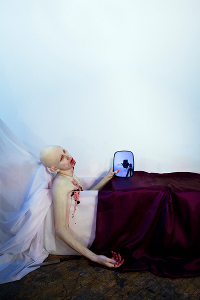
Dressed in a white robe and black-feathered Valkyrie-esque headdress, Harvey spent much of the night cradling her autoharp, looking like a dreamscape figment from one Neil Gaiman’s Sandman novels. It was appropriate attire for the set of music she delivered – both ethereal and sublime.

With the backing of her deft three piece band (featuring longtime collaborator John Parish) Harvey delved deeply into the new material from her latest album, Let England Shake. By her standards, it’s a quiet body of work (resonating with the atmosphere of 1998’s Is This Desire), reflecting on our modern era of warfare and human strife. The material is excellent, and Harvey delivers it with an affected certainty, as if the entire setlist was handed down to her on divine authority. This then, made for a night that was far less rock concert and more of an artistic exploration of sorts. With most artists, that may have made it tedious, but with Harvey it was spellbinding.

She delivered some big favorites, of course, including “Down by the Water,” “Big Exit,” and “The Sky Lit Up,” though she fit them into the evocative mood she had been developing all evening. The crowd didn’t seem to mind in the least, spending many of the down moments in between songs broadcasting their love and gratitude to Harvey and her music.

Never content to just tow the line of what has worked in the past, Polly’s past three albums (most notably the hallucinatory piano balladry of White Chalk) have been mature and outside-the-box efforts unlikely to win huge commercial appeal. But like this unique performance at the Warfield, it stands as evidence that the 50 Foot Queenie is poised to age gracefully.


Live Shots: Fact/SF at The Garage, 4/14/11

0

I remember when I was a little girl, I used to live down at my Grandma Kay’s house in Belmont. She had a big living room, with floor to ceiling windows that looked out over the bay. I used to dance around on the wooden floors in my socks to her Peggy Lee and Patsy Cline cassettes, which I played over and over again. It was a strange time. Grandma Kay was sick with cancer and I was too young to totally understand what was going on.

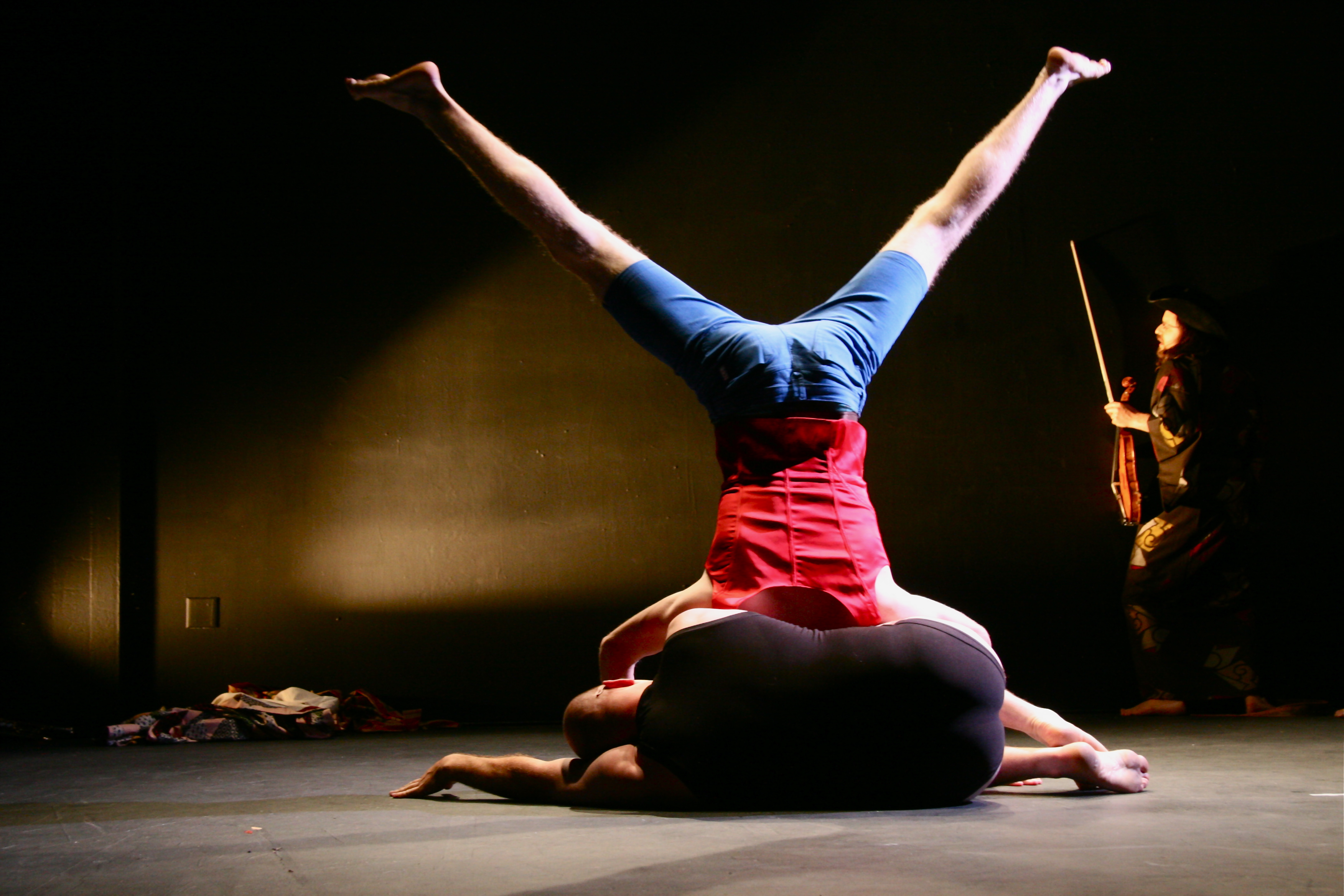
Last night I went to watch FACT/SF at the Garage. The first piece was two people, sitting in metal folding chairs, a lit cigarette filling the room with sweet smoke. There was not an inch of movement, just the sound of Peggy Lee singing “Is That All There Is.” It was melancholy and brought me right back to that living room in Belmont, and I wondered how many other people in the audience had some strange connection to that song.

This is my third time seeing FACT/SF and every time I see them it’s emotional. Yes, there are perfect pirouettes and elegant extensions, but then there’s always something deep, slightly dark and always thought-provoking. 

There’s a little bit of theater, at least a few wonderfully wacky costumes, and of course, there are the eyeballs. Choreographer Charles Slender has a serious thing about eyeballs and their ability to transform his dancers into more than just moving bodies. Whether the dancers are staring straight into your own eyes, or directly up at the ceiling, there’s an intensity about those eyeballs that brings so much to the performance.

The show, which has one more run tonight, is a collection of new and old works, including an excerpt from the evocative “The Consumption Series,” with it’s fluffy red tutus and bright orange tangerines. I know you haven’t made any plans for tonight, so now you’ve got some. Now then: let’s keep dancing. Let’s break out the booze and have a ball …


Lemi Ponifasio’s Tempest: Without a Body has a soul

0

Watching Lemi Panafasio/MAU’s Tempest: Without a Body on Thurs/7 amplified the grave feeling I often possess when I read the newspaper. The sense of deep empathy and sadness in an effort to understand the unsettling and horrific events in the world permeated the experience. Tempest delivered a heavy reminder of the ugly oppression and destruction of which humans are capable. The visceral result of the performance lingered after the curtain descended, as many of my generally chatty acquaintances remained quiet and introspective in the lobby. The post-show vibe highlighted the transformative power of this very big work composed of rich imagistic theater and ritual dance from the Pacific. The company, MAU, employs indigenous artists to perform outside of the original context of their art form, and the form strongly translates in the context of Tempest.

The dark nature of the work was, thankfully, not elicited by shock factor. A spaciousness allowed for images to shift and resonate, from the pure energy of a man acting in resistance with a quivering hand and ejected tongue, to the creaturely walking of another on all fours, with fisted hands and jutting hips. A silvery naked figure, supine and slithering, offered a luminous embodiment of human breath and life, juxtaposed with a dusty, bloody fallen angel with crooked wings and a blood-curling scream. Throughout the evening, a rumbling stasis reinforced the sense of doom. The images of chaos and toil, absent of overt literality, accumulated and stirred.

Excerpt from Tempest: Without a Body:

http://www.youtube.com/watch?v=WfLqv85uCww

Despite the bleak environment, the performers embodied resilience during certain scenes. Charles Koroneho, with his expressive tattooed face, delivered in the Maori tongue a powerful passage called “The Establishment of Life Principle.” He was dwarfed by a large projection of a man’s face, thus appearing to stand up to a grand opposing force. During his oration he experienced each word with his entire body, stamping feet and thrusting limps, completely consumed and incensed to emphasize his message. Within the doomed landscape, he revealed a striving and a voice. Later, a handful of robed men also brought forth a thread of hope, as they executed precise gestural movements and shuffled through a cloud of dust singing a harmonic song, which intensely cut through the dark rumbling.

True to the company’s mission, the work emerges as activist art. In blending politics and performance, Tempest calls on us to do better, to reconnect with that which is nourishing, to take better care of ourselves, each other, our world. Even in an adverse environment, Lemi Ponifasio’s performers boldly demonstrate the pursuit and challenge of humanity in the chaos. Tempest is, indeed, completely unsettling, which fuels its potency and power to transform. This moving work of art shakes us around and asks us to consider our action given the uncomfortable and ugly truths of our time. 

American Idol: Where’s Simon when we need him?

4

Well, we don’t get far into the show before Ryan Seacrest reminds us all that Jennifer Lopez has just been named the Most Beautiful Woman in the World. Go, J-Lo. Tonight, however, she looks rather odd in a dress that included a big pink fluffy thing in her lap, as if she’d just given birth to a sea anenome.


The theme is “songs of the cinema,” which the contenders seem to take as “any song that’s evr been used in any movie anywhere,” which leaves a lot of room. Paul opens with Bob Seger’s “Old Time Rock ‘n’ Roll,” and it’s awful, a perfomance that should mark the end of his tenure on the show. Except that Lauren tries to sing that bad syrupy song from the Hannah Montana movie and can’t even hit all the notes. The Big Cringe. Two down.


Here’s the problem (and the reason I miss Simon Cowell, despite all the annoyance he brought): The three judges were all sunshine and roses, talking about how great those two performances were. Embarassing. Simon would never have tolerated this level of weak and worthless junk.


Then along comes Stefano, who has to be shaken up about what happened last week, but he’s a step up from the other two. Scotty’s next, and, as usual, far outclasses the rest of the field.


Casey. Whoa. He turns down a Phil Collins tune and does Nat King Cole. Really fine performance, something totally different — but I fear it’s way too weird for America. We shall see.


Haley: Blondie, “Call me.” She’s got the same problem as when she tried to sing Janis Joplin; she smiles too much. You need attitude for this shit, and she doesn’t have it.


Jacob, after a bit of flailing around, decides on “Bridge Over Troubled Waters,” and it’s a knockout. Not my favorite Paul Simon song, but perfect for Jacob, who I still don’t like as much as my kids do.


And then James, the show closer, the show stopper. He takes a risk, too, and does … Metal. Real Metal, the theme song from the “Heavy Metal” movie, complete with Zakk Wylde on guitar. Give metal a chance, he says — and it’s the peformance of the night, an Idol moment, and it better not cost him in the votes.


If there’s an Idol God, then Paul, Lauren and Stefano are the bottom three and Paul is going home. I voted.


Live Shots: Queens of the Stone Age, Fox Theater, 4/11/11

0

Racing up and down the pavement on Telegraph Avenue, the scalpers were grinding hard outside the Fox Theater on Monday night, perhaps with an inkling that the venue might not be standing by the time the Queens of the Stone Age left the stage in a few hours. True to form, Josh Homme and crew all but blew the Fox to pieces with a monstrous rendering of their debut album, as well as two hefty encores that showcased the stoner age rock royalty in all of their primal glory.

Winding down a ferocious “Walkin’ on the Sidewalks” behind their Mongol-on-a-warpath drummer Joey Castillo, keyboardist Dean Fertita (recently of Dead Weather fame) dialed up the intro for Homme to lay into the sleazy start-and-stop riff of “You Would Know.”  They were barely a half dozen songs in, but it was apparent that the juggernaut assault of the Queens’ self-titled debut was offering the audience a glimpse into the band’s nerve center, to the raw and infectious source of one of the best rock outfits of the past decade.

Though his has been dubbed stoner rock, Homme seems to have delved deeply into his Southern California music environment, with traces of Jane’s Addiction-channeling-Zeppelin against Hollywood glam and a dark dose of Doors psychedelia. Songs like “Mexicola” and “You Can’t Quit Me Baby” matched live wire energy against stunning musicianship. 

The following encores included a great cross section of the band’s more recent material, with radio hits “Little Sister” and “Go With the Flow” receiving the biggest ovations. But it was a pair of fan favorites – “Better Living Through Chemistry” and “Song for the Dead” – that capped off the performance with proper might, and caused you to wonder why so few live shows these days ever achieve such sonic magnitudes.

The crowd spilt out of the theater half dazed and nearly deaf, but mostly satisfied. Although this show at the Fox showcased the Queens at their beginning, it left you anxious for what they will do next.


Setlist:

Regular John

Avon

If Only

Walkin’ on the Sidewalks

You Would Know

How to Handle a Rope

Mexicola

Hispanic Impressions

The Bronze

Give the Mule What He Wants

I was a Teenage Hand Model

You Can’t Quit Me Baby


Encore:

Monster in the Parasol

Burn the Witch

Make It Wit Chu

Little Sister


Encore 2:

Better Living Through Chemistry

Go With the Flow

A Song For the Dead


Our Weekly Picks: April 13-19, 2011

0

THURSDAY

APRIL 14

MUSIC


Two Door Cinema Club

Featured as a “You Oughta Know” artist on VH1, Northern Ireland’s Two Door Cinema Club is an indie electropop trio comprised of Alex Trimble (lead vocals/guitar), Sam Halliday (vocals/guitar), and Kevin Baird (bass/vocals). (What of the drummer, you ask? Sometimes human, sometimes a computer.) The band’s Tourist History recently picked up the 2010 Choice Music Prize for Irish album of the year, suggesting its making good on the promise shown by opening for indie rock greats like Foals, Phoenix, and Delphic. If you’re one of the working schmucks who can’t take the time off for Coachella, catch Two Door Cinema Club before it goes to Indio. (Jen Verzosa)

With Globes and Work Drugs

8 p.m., $20

Fillmore

1850 Geary, SF

(415) 346-6000

www.livenation.com

EVENT


“Charles Phoenix Retro Slide Show”

Oddball Americana guru Charles Phoenix has explored and celebrated the best in kitschy, cool, kooky artifacts and history for many years now, having written several books on mid-20th century deep-fried pop culture, fashion, lifestyles, and more. The author of tomes such as Southern California In The ’50s and Americana The Beautiful brings his hilarious slide show and talk to the city, set to roast the imagery found in some of the thousands of vintage Kodachrome slides has collected at flea markets over the years. Be sure to keep an eye out for some familiar places and things — Phoenix has promised to include a bevy of vintage San Francisco slides for this entertaining ode to the odd and unique. (Sean McCourt)

8 p.m., $25

Roxie Theater

3117 16th St., SF

(415) 863-1087

www.roxie.com

PERFORMANCE


Our Daily Bread

Carb load on this: in a collaboration between Amara Tabor-Smith’s Deep Waters Dance Theater, director Ellen Sebastian Chang, and visual artist Lauren Elder, Our Daily Bread delves into the folklore and stories surrounding food traditions. The socially conscious hybrid theater experience draws from a family gumbo tradition, examining how industrialized agriculture, fast food culture, and our global food crisis affect current food practices. In addition, CounterPulse resident artist Tabor-Smith also considers who is missing from the sustainable food movement. With red beans and rice on the mind, expect to fill your plate with individual food legacies and questions regarding your own relationship to food. You are what you eat. (Julie Potter)

Thurs/14–Sun/17, 8 p.m., $18–$22

CounterPulse

1310 Mission, SF

(415) 626-2060

www.counterpulse.org

EVENT


Nikki Sixx

Known not only for his fiery stage presence and key songwriting contributions as bassist for Mötley Crüe, Nikki Sixx also gained a notorious reputation for his off-stage antics, particularly his legendary appetite for drugs and debauchery. Sober now for several years, Sixx detailed many of these early escapades and horrors in his 2007 book The Heroin Diaries. He returns — just before a major summer tour, which includes a June stop in SF — with the follow-up, This Is Gonna Hurt: Music, Photography, and Life through the Distorted Lens of Nikki Sixx, a look at his post-addiction life that finds him a successful author, radio host, and of course, still rocking the stage with the Crüe. (McCourt)

6 p.m., $29.99 (includes book)

Book Passage

One Ferry Building, SF

(415) 835-1020

www.bookpassage.com

FRIDAY

APRIL 15

DANCE


Alonzo King’s Lines Ballet

The longer I watch Alonzo King’s Lines Ballet, the more this choreographer manages to surprise me. What intrigues is not so much his language — intricate, idiosyncratic, and demanding — or even the way he uses it on his dancers. But there is a vision, a philosophy behind his work, that we get glimpses of in every new piece. That’s what good dance is supposed to do. King also goes out of his way to find collaborators who can envelop his choreography in the mantle of new contexts. Of course, it helps that these other-than-dance contributions, in particular, are often spectacular on their own. But to get Mickey Hart, who actually is philosophically pretty close to King, create a score for Lines Ballet is a coup even for a choreographer with a growing international reputation. Architect Christopher Haas, who worked on the de Young Museum, created the set. (Rita Felciano)

Through April 24

Fri.–Sat., 8 p.m.; April 20–21, 7:30 p.m.;

April 24, 5 p.m., $25–$65

Yerba Buena Center for the Arts

Novellus Theater

700 Howard, SF

(415) 978-2787

www.linesballet.org

MUSIC


The Residents

Hang on to your eyeballs, San Francisco’s most enigmatic art-rock collective the Residents will storm the stage at Bimbo’s in support of its for-no-particular-reason, ghost-story themed “Traveling Light” tour. The calculatedly anonymous group (currently a trio), as well known for its elaborately costumed stage personae and mixed-media presentations as for its deconstructed lyrics and dystopian musical baditude, is fast approaching its fourth decade. But don’t expect a set stuffed merely with humdrum nostalgia. Actually, don’t expecting any particular thing, because defying expectations is what the Residents do best. Word is the group will be recording the proceedings in three (possibly four ) dimensions, so wearing your very best top hat to the show might not be a bad idea. (Nicole Gluckstern)

Fri/15–Sat/16, 9 p.m., $30

Bimbo’s

1025 Columbus, SF

(415) 474-0365

www.bimbos365club.com

PERFORMANCE


Zaccho Dance Theatre

With a title — The Monkey and the Devil — taken from racial slurs, Joanna Haigood’s dance theater performance installation, performed by Zaccho Dance Theatre, addresses lingering contemporary racism, rooted in the lasting effects of America’s slave trade. Even in the age of Obama, the performance acknowledges how Americans grapple with the residue of slavery and reunite a split house. Surrounded by two massive, rotating set pieces designed by visual artist Charles Trapolin, audience members are free to navigate the continuously running performance installation in the Yerba Buena Center for the Arts Forum. A post-performance discussion follows Friday’s installment. Don’t miss this immersive, compelling work. (Potter)

Fri/15, 8–10 p.m.;

Sat/16-Sun/17, 12-2 p.m. and 3–5 p.m., free

Yerba Buena Center for the Arts Forum

701 Mission, SF

(415) 978-5210

www.ybca.org

SATURDAY

APRIL 16

EVENT


“How-to Homestead: 11 in 11 Tour”

You can go on tour without ever leaving your city. That’s the idealistic message of How-to Homestead’s “11 in 11 Tour,” a yearlong barnstorming series with dates planned for each of San Francisco’s districts. Spearheaded by Melinda Stone, a University of San Francisco professor equally knowledgeable in matters of celluloid and soil, How-to Homestead’s homebrew of entertainment and education draws on alternative cinema, practical workshops, and live music to create a distinctly flavorful commons. The fourth “11 in 11” program takes place at the historic Bayview Opera House and features a “Chickens in the City” workshop and contra dance call, in addition to the usual potluck dinner and film treats. With spring in the air, it should be an especially lively installment. (Max Goldberg)

4–10:30 p.m., $5 suggested donation

Bayview Opera House

4705 Third St., SF

www.howtohomestead.org

DANCE


ODC Dance Jam

At first the ODC Dance Jam consisted of half a dozen cute kids showing their prowess on an ODC/Dance opening night. Today ODC’s youth program is much too big for such capers, and the tables have been turned. This year the professional company will make an appearance — with Brenda Way’s John Somebody — at ODC Dance Jam’s own concert, “Make the Road by Walking.” Taking classes five times in addition to rehearsing, the 14-member troupe, ages 13-18, may not call itself pre-professional, but its dancers surely are on the way. KT Nelson, Kimi Okada, Bliss Kohlmeyer-Dowman, Greg Dawson, and Kim Epifano, about as professional a group as any, created choreography for them. (Felciano)

Sat/16, 8 p.m.; Sun/17, 4 and 7 p.m., $12

ODC Dance Commons

351 Shotwell, SF

(415) 863-9830

www.brownpapertickets.com/event/166923

SUNDAY

APRIL 17

MUSIC


Foxtails Brigade

(((folkYeah!))) and Antenna Farm Records host a release party in honor of San Francisco duo Foxtails Brigade’s full-length debut, The Bread and the Bait. On its surface, The Bread and the Bait is as delicate as lace — the album art depicts a ladylike tea party in progress. But look closer (why are two of the women blindfolded? And why is one clutching a knife?) and listen closely: there’s an underlying darkness cloaked in those ethereal vocals set against simple cello and violin melodies. Join in the celebration with musical performances by ‘Tails and Rachel Fannan of Sleepy Sun, plus comedy by Brent Weinbach and Moeshe Kasher, and a fashion show featuring designs by Verriers and Sako, Lecon de Vetement, and Zoe Hong. (Verzosa)

With Rachel Fannan

8 p.m., $15

Swedish American Music Hall

2174 Market, SF

(415) 861-5016

www.swedishamericanhall.com MUSIC


Wire

On a recent trip to New York City, I won tickets to watch Wire from the “Band Bench” on Late Night with Jimmy Fallon. Arriving at 30 Rock, I found a few other awkward music nerds who refused to take off their jackets looking forward to the performance. In a bit of TV magic, they filled out the 30 or so “hardcore fans” with tourists eager for a glimpse of Fallon guest Keanu Reeves. It could just be the standard practice, but it’s also typical of the U.K. band’s U.S. reception, remaining relatively unknown despite being perpetual critical darlings and inspiring alternative rock bands throughout a career spanning from the release of 1977’s influential punk album, Pink Flag, to their most recent, Red Barked Tree. (Ryan Prendiville) With Lumerians and DJ Callum McGowan

8 p.m., $21

Slim’s

333 11th St., SF

(415) 255-0333

www.slims-sf.com 

The Guardian listings deadline is two weeks prior to our Wednesday publication date. To submit an item for consideration, please include the title of the event, a brief description of the event, date and time, venue name, street address (listing cross streets only isn’t sufficient), city, telephone number readers can call for more information, telephone number for media, and admission costs. Send information to Listings, the Guardian Building, 135 Mississippi St., SF, CA 94107; fax to (415) 487-2506; or e-mail (paste press release into e-mail body — no text attachments, please) to listings@sfbg.com. Digital photos may be submitted in jpeg format; the image must be at least 240 dpi and four inches by six inches in size. We regret we cannot accept listings over the phone.

Stage Listings

0

Stage listings are compiled by Guardian staff. Performance times may change; call venues to confirm. Reviewers are Robert Avila, Rita Felciano, and Nicole Gluckstern. Submit items for the listings at listings@sfbg.com. For further information on how to submit items for the listings, see Picks. For complete listings, see www.sfbg.com.

THEATER

OPENING

Cordelia NOHspace, 2840 Mariposa; (800) 838-3006, www.brownpapertickets.com. $18-20. Previews Tues/19, 7pm. Opens April 20, 7pm. Wed-Thurs, 7pm; Fri-Sat, 8pm. Through May 7. Theatre of Yugen presents world premiere of an abstraction of Shakespeare’s King Lear.

ONGOING

The Busy World is Hushed New Conservatory Theatre Center, 25 Van Ness; 861-8972, www.nctcsf,org. $24-40. Wed-Sat, 8pm; Sun, 2pm. Through May 1. New Conservatory Theatre Center presents the world premiere of a play by Keith Bunin.

*Caliente Pier 29, The Embarcadero; 438-2668, www.love.zinzanni.org. $117-145. Wed-Sat, 6pm; Sun, 5pm. Open-ended. Teatro Zinzanni presents a new production conceived in San Francisco.

Collected Stories Stage Werx, 533 Sutter; Z(800) 838-3006, www.brownpapertickets.com. $20-25. Fri-Sat, 8pm (alos April 24 2pm). Through May 7. Stage Werx presents David Margulies’ drama about art, ethics, and betrayal.

*40 Pounds in 12 Weeks The Marsh, Studio Theater, 1074 Valencia; (800) 838-3006, www.themarsh.org. $15-35. Call for dates and times. Through April 30. Pidge Meade’s one-woman show extends its successful run.

Free Theater Community Room, Notre Dame Senior Plaza, 347 Dolores; 864-4467. Free. Fri, 7:30pm; Sat-Sun, 3pm. Through April 17. The 16th Street Players present four comic plays.

*Geezer Marsh, 1062 Valencia; (800) 838-3006, www.themarsh.org. $20-50. Thurs, 8pm; Sat, 5pm; Sun, 3pm. Through May 1. The Marsh presents a new solo show about aging and mortality by Geoff Hoyle.

Into the Clear Blue Sky Phoenix Theater, 414 Mason; 913-7272, www.sleepwalkerstheatre.com. $15-17. Thurs-Sat, 8pm. Through April 30. Sleepwalkers Theatre presents the second production in a three-part apocalypse series.

KML Reboots Traveling Jewish Theater, 470 Floriad; www.killingmylobster.com. $10-20. Thurs-fri, 8pm; Sat, 7 and 10pm; Sun, 7pm. Through April 24. The sketch comedians present a new show about the pleasures and pains of technology.

Loveland The Marsh, 1062 Valencia; (800) 838-3006, www.themarsh.org. $20-35. Fri, 8pm; Sat, 8:30pm (also May 1 and 8, 7pm). Through May 8. Ann Rudolph’s one-woman show continues its successful run.

M. Butterfly Gough Street Playhouse, 1620 Gough; (510) 207-5774, www.custommade.org. $20-28. Thurs-Sat, 8pm. Through April 30. Custom Made Theatre presents David Henry Hwang’s award-winning play.

*Obscura: A Magic Play Exit Studio, 156 Eddy; 673-3847, www.sffringe.org. $20-25. Fri-Sat, 8pm. Through Sat/16. Christian Cagigal is back with the magical. Over the last several years, the popular Bay Area writer/performer has developed a series of dramatically structured magic shows (the most recent being the autobiographical Now and at the Hour), each a different attempt at blending expert prestidigitation with elements of narrative theater. Tightly focused and deliberately small-scale, Obscura is in some ways his most successful foray yet. In the Exit Theater’s new studio space, Cagigal (with occasional help from his audience) unfolds a series of sly Gothic stories combined with extremely clever, sometimes dementedly playful card and coin tricks—the majority a collection of favorite pieces from other magicians—all played out on a delicately managed little table augmented by overhead projection (a set-up that offers various visual opportunities, including use of title cards). Rapid-fire narration (occasionally indistinct but generally articulate) and a laid back, slightly mischievous demeanor combine here with consummate skill in an intimate and very enjoyable evening of crafty little tales. If there’s an overarching theme, it probably has something to do with human folly, the persistence of mystery, and the devil, but then any good fable involving a deck of cards probably should. (Avila)

Party of 2 — The New Mating Musical Shelton Theater, 533 Sutter; 1-800-838-3006, www.partyof2themusical.com. $27-29. Fri, 9pm. Open-ended. A musical about relationships by Shopping! The Musical author Morris Bobrow.

The Real Americans The Marsh MainStage, 1062 Valencia; 282-3055, www.themarsh.org. $25-35. Fri, 8pm; Sat, 8:30pm. Through April 30. Dan Hoyle’s hit show returns for another engagement.

Sea Turtles Exit Theater, 156 Eddy; www.generationtheatre.com. $15-25. Fri-Sat, 8pm; Sun, 3pm (also April 28, 8pm). Through April 30. GenerationTheatre presents an original play by David Valayre.

Secret Identity Crisis SF Playhouse, Stage 2, 533 Sutter; 869-5384, www.un-scripted.com. $10-20. Thurs-Sat, 8pm (no show may 7). Through May 14. Un-Scripted Theater Company presents a story about unmasked heroes.

Shopping! The Musical Shelton Theater, 533 Sutter; (800) 838-3006, www.shoppingthemusical.com. $27-29. Sat, 8pm. Open-ended. A musical comedy revue about shopping by Morris Bobrow.

*Songs of the Dragons Flying to Heaven The Thick House, 1695 18th St; 255-8746, www.asianamericantheatre.org, www.crowdedfire.org. $15-25. Call for dates and times. Through Sat/16. “They have no idea what the fuck we’re doing,” observes one of the nameless “Korean” characters in Young Jean Lee’s Songs of the Dragons Flying to Heaven. In rapid succession the audience has witnessed a video clip of the playwright being slapped repeatedly in the face, a westernized Korean woman (Cindy Im) ranting about her “retarded monkey” parents and minority rage yet promising her Grandmother that she’ll give Jesus a whirl, bafflingly banal interactions between two “white” people (Alexis Papedo and Josh Schell) struggling with their floundering romance, and cartoonish interludes of exaggerated sex, consumerism, and violence enacted by three gaudily-dressed Korean women (Mimu Tsujimura, Lily Tung Crystal, Katie Chan)—none of whom are actually played by Koreans. It’s a play you have to surrender yourself to, a roller-coaster ride of sharp curves and nausea-inducing plunges (especially twisted is the gross-out contest of suicide methods in which each character takes a turn at dying in an unimaginably gruesome yet hilarious manner). Oddly, the piece ends on a rather lackluster note, with the two “white” people exploring the mutual contempt they pretend is love, which might be the playwright’s method of showing that white people can ruin anything without half trying, but the ride before their dead end is a thrilling one. (Gluckstern)

A Streetcar Named Desire Actors Theatre, 855 Bush; 345-1287, www.actorstheatresf.org. $26-38. Wed-Sat, 8pm. Through June 4. Actors Theatre of San Francisco presents the Tennessee Williams tale.

Talking With Angels Royce Gallery, 2901 Mariposa; (800) 838-3006, www.brownpapertickets.com. $21-35. Thurs-Sat, 8pm. Through May 21. A play by Shelley Mitchell set in Nazi-occupied Hungary.

Tape The Dark room, 2263 Mission; www.darkroomsf.com. $10-20. Fri-Sat, 8pm (also Sat/16, 10pm). Through April 23. The 4th Mirror presents a production of the play by Stephen Belber.

Twelfth Night African American Art & Culture Complex, 762 Fulton; (800) 838-3006, www.African-AmericanShakes.org. $15-35. Sat, 8pm; Sun, 3pm (no performance April 24). Through May 1. African-American Shakespeare Company presents a jazzy interpretation of the Bard.

*Wirehead SF Playhouse, 533 Sutter; 677-9596, www.sfplayhouse.org. $30-50. Tues-Wed, 7pm; Thurs-Fri, 8pm; Sat, 3and 8pm. Through April 23. Perfectionism’s ruthless class dimensions come to the fore in SF Playhouse’s smart, fun, and sharply staged Bay Area premiere about the super-smart posthumans of the near future, and the rest of us. A shady China-based conglomerate with a name that sounds like Sin-Tell sells a scintillating if dangerous procedure for those already well connected: a hardwire boost to the neural circuitry that gives the recipient more than an edge on the competition and something just shy of godlike powers. Two friends and colleagues in a banking firm (Craig Marker and Gabriel Marin) and their variously class-marked but equally ambitious girlfriends (Lauren Grace and Madeleine H.D. Brown) are all drawn into this cyborgian gold rush, and it gets sticky in more ways than one, as meanwhile a brash local DJ named RIP (Scott Coopwood) raps sardonically over the airwaves about this latest twist in an old game. SF Playhouse’s Susi Damilano directs a charismatic cast (including a terrific Cole Alexander Smith in a related series of frenetic roles) in Matt Benjamin and Logan Brown’s culture-jamming riposte to tech-mad humanist hogwash about Progress. It gets you thinking. (Avila)

BAY AREA

*Beardo Ashby Stage, 1901 Ashby, Berk; (510) 841-6500, www.shotgunplayers.org. $17-26. Thurs-Sat, 8pm; Sun, 5pm. Through April 24. Shotgun Players present a an original songplay about Rasputin.

East 14th – True Tale of a Reluctant Player The Marsh Berkeley, 2120 Allston Way, Berk; (800) 838-3006, www.themarsh.org. $20-50. Sat, 8pm; Sun, 7pm. Through May 8. Don Reed’s one-man show continues.

Eccentricities of a Nightingale Aurora Theatre, 2081 Addison; (510) 843-4822, www.auroratheatre.org. $34-45. Tues, 7pm; Wed-Sat, 8pm; Sun, 2 and 7pm. Through May 8. Aurora Theatre Company presents a Tennessee Williams drama.

Not a Genuine Black Man The Marsh Berkeley, TheaterStage, 2120 Allston Way, Berk; (800) 838-3006, www.themarsh.org. $20-50. Thurs, 7:30pm. Through May 5. Brian Copeland’s one-man show continues.

Out of Sight The Marsh Berkeley, Theaterstage, 2120 Allston Way, Berk; (800) 838-3006, www.themarsh.org. $20-50. Sat, 5pm (no show Sat/9); Sun, 3pm. Through May 8. Sara Felder’s one-woman show returns.

Quidam The Cow Palace 2600 Geneva, Daly City; (415) 404-4100; www.cowpalace.com, www.cirquedusoleil.com. $32-115. Call for dates and times. Through Sun/17. In Albert Lamorisse’s 1956 short film The Red Balloon, a child’s love affair with a mischievous toy takes place on the streets of Paris, a rough gray place that weirdly foreshadows the subterranean world inhabited by the mysterious creatures of Quidam. Here the silent child toting a giant red balloon is Zoe (Alessandra Gonzalez), who’s been spirited away to their underworld from her neglectful, oblivious parents. Her participation in their antics basically amounts to her looking on as acrobats, contortionists, and clowns strut their stuff, in the uninviting, under-populated confines of the Cow Palace, a far from ideal venue for a show that relies so much on audience participation and intimacy. In general the acts involving more performers work better in the cavernous space—an inventive diabolo juggling act, a complicated twenty-person jump rope exhibition, a five-person aerial Spanish Webs ensemble, and a highly-acrobatic fifteen-person Banquine act: synchronized, rapid-fire flinging of bodies to, fro, high, and low without missing a beat or (thankfully) a catch. There is much to admire in Cirque du Soleil’s dedication to legitimizing the Circus as a higher art form, but this presentation of Quidam aims unfortunately low. (Gluckstern)

Singing at the Edge of the World The Cabaret at The Marsh Berkeley, 2120 Allston Way, Berk; (800) 838-3006, www.brownpapertickets.com. $15-35. Thurs-Fri, 8pm; Sat, 5pm. Through Sat/16. The Marsh presents a one-man show by Randy Rutherford.

Slices 2011 pear Avenue Theatre, 1220 Pear, Mtn View; (650) 254-1148, www.thepear.org. $15-30. Thurs-Sat, 8pm; Sun, 2pm. Through April 24. Pear Avenue Theatre presents its annual festival of short plays.

Snow Falling on Cedars TheatreWorks at Mountain View Center for the Performing Arts, 500 Castro, Mtn View; (650) 463-1960, www.theatreworks.org. $24-67. Tues-Wed, 7:30pm; Thurs-Fri, 8pm; Sat, 2 and 8pm; Sun, 2 and 7pm. Through April 24. TheatreWorks presents a stage adaptation of the David Guterson novel.

Three Sisters Berkeley Reperory Theatre, Thrust Stage, 2025 Addison, Berk; (510) 647-2949, www.berkeleyrep.org. $29-73. Dates and times vary. Through May 22. The creators of Eurydice and In the Next Room present a new take on Chekhov.

The World’s Funniest Bubble Show The Marsh Berkeley, Cabaret, 2120 Allston Way, Berk; (800) 838-3006, www.themarsh.org. $8-50. Through July 10. The bubbles keep flowing.


Film Listings

0

Film listings are edited by Cheryl Eddy. Reviewers are Kimberly Chun, Michelle Devereaux, Peter Galvin, Max Goldberg, Dennis Harvey, Johnny Ray Huston, Louis Peitzman, Lynn Rapoport, Ben Richardson, and Matt Sussman. For rep house showtimes, see Rep Clock. For first-run showtimes, see Movie Guide.

OPENING

An Affirmative Act A lesbian couple fights for their right to stay married in this narrative courtroom drama. (1:33) Four Star.

*Circo The old notion of “running away with the circus” seldom seemed appealing — conjuring images of following an elephant around with a shovel — and it grows even less so after watching Aaron Schock’s warm, touching documentary. The kids here might one day run away from the circus. They’re born into Grand Circo Mexico, one of four circuses run by the Ponce family, which has been in this business for generations; if they’re old enough to walk, they’re old enough to perform, and help with the endless setup and breakdown chores. (Presumably child labor laws are an innovation still waiting to happen here.) Touring Mexico’s small towns in trucks with a variety of exotic animals, it’s a life of labor, with on-the-job training in place of school — arguably not much of a life for child, as current company leader Tino’s wife Ivonne (who really did run away with the circus, or rather him, at age 15) increasingly insists. Other family members have split for a normal life, and Tino is caught between loyalty to his parents’ ever-struggling business and not wanting to lose the family he’s raised himself. This beautifully shot document, scored by Calexico and edited by Mark Becker (of 2005’s marvelous Romantico), is a disarming look at a lifestyle that feels almost 19th century, and is barely hobbling into the 21st one. (1:15) Lumiere, Shattuck. (Harvey)

The Conspirator It may not be your standard legal drama, but The Conspirator is a lot more enjoyable when you think of it as an extended episode of Law & Order. The film chronicles the trial of Mary Surratt (Robin Wright), the lone woman charged in the conspiracy to assassinate Abraham Lincoln. It’s a fascinating story, especially for those who don’t know much of the history past John Wilkes Booth. But while the subject matter is compelling, the execution is hit-or-miss. Wright is sympathetic as Surratt, but the usually great James McAvoy is somewhat forgettable in the pivotal role of Frederick Aiken, Surratt’s conflicted lawyer. It’s hard to say what it is that’s missing from The Conspirator: the cast — which also includes Evan Rachel Wood and Tom Wilkinson — is great, and this is a story that’s long overdue to be told. Still, something is lacking. Could it be the presence of everyone’s favorite detective, the late Lennie Briscoe? (2:02) Embarcadero, Piedmont. (Peitzman)

Henry’s Crime See “Breaking Point.” (1:48) California, Embarcadero.

Meet Monica Velour Kim Cattrall stars as an aging porn star in this comedy. (1:37)

Rio Jesse Eisenberg and Anne Hathaway lend their voices to this animated bird adventure. (1:32) Presidio.

Scre4m It’s kinda fun to just look at the cast list and wonder which demi-star will suffer the most hideous death at the hands of ol’ Ghostface: Emma Roberts? Adam Brody? Shanae Grimes? (run time not available)

Some Days Are Better Than Others First-time director Matt McCormick doesn’t break any new stylistic or thematic ground with his ensemble drama, but Some Days Are Better Than Others does boast an interesting bit of stunt casting. Indie rock fans will recognize the Shins’ James Mercer as mopey Eli, who drifts between temp jobs trying to earn enough money to go back to school because he hates working so much; fellow musician Carrie Brownstein appears as Katrina, a recently-dumped, reality TV-obsessed dog-shelter worker; her character is the kind of emo thrift-shopper that Portlandia would had no trouble poking fun at. Other points on this sad-sack square are a lonely woman ((Renee Roman Nose) who finds an erstwhile cremation urn, and an elderly man (David Wodehouse) obsessed with the kaleidoscope-like patterns he captures while filming soap bubbles. Moments of wry humor (Katrina checks messages at “mumblemail.net”) and some Ghost World-ish jabs at mainstream go-getters (including a moving-company douchebag who hires Eli to help clean out a recently-deceased woman’s house) keep Some Days from being a total downer, but be warned: this is one melancholy movie. Shins fans will enjoy the scene where Eli, alone in his room, rehearses for a yearned-for karaoke date with a Bonnie Tyler classic. (1:33) Roxie. (Eddy)

ONGOING

The Adjustment Bureau As far as sci-fi romantic thrillers go, The Adjustment Bureau is pretty standard. But since that’s not an altogether common genre mash-up, I guess the film deserves some points for creativity. Based on a short story by Philip K. Dick, The Adjustment Bureau takes place in a world where all of our fates are predetermined. Political hotshot David Norris (Matt Damon) is destined for greatness — but not if he lets a romantic dalliance with dancer Elise (Emily Blunt) take precedence. And in order to make sure he stays on track, the titular Adjustment Bureau (including Anthony Mackie and Mad Men‘s John Slattery) are there to push him in the right direction. While the film’s concept is intriguing, the execution is sloppy. The Adjustment Bureau suffers from flaws in internal logic, allowing the story to skip over crucial plot points with heavy exposition and a deus ex machina you’ve got to see to believe. Couldn’t the screenwriter have planned ahead? (1:39) 1000 Van Ness, Shattuck, Sundance Kabuki. (Peitzman)

Arthur (1:45) Empire, Four Star, Marina, 1000 Van Ness, SF Center, Sundance Kabuki.

*Battle: Los Angeles Michael Bay is likely writhing with envy over Battle: Los Angeles; his Transformers flicks take a more, erm, nuanced view of alien-on-human violence. But they’re not all such bad guys after all; these days, as District 9 (2009) demonstrated, alien invasions are more hazardous to the brothers and sisters from another planet than those trigger-happy humanoids ready to defend terra firma. So Battle arrives like an anomaly — a war-is-good action movie aimed at faceless space invaders who resemble the Alien (1979) mother more than the wide-eyed lost souls of District 9. Still reeling from his last tour of duty, Staff Sergeant Nantz (Aaron Eckhart) is ready to retire, until he’s pulled back in by a world invasion, staged by thirsty aliens. In approximating D-Day off the beach of Santa Monica, director Jonathan Liebesman manages to combine the visceral force of Saving Private Ryan (1998) with the what-the-fuck hand-held verite rush of Cloverfield (2008) while crafting tiny portraits of all his Marines, including Michelle Rodriguez, Ne-Yo, and True Blood‘s Jim Parrack. A few moments of requisite flag-waving are your only distractions from the almost nonstop white-knuckle tension fueling Battle: Los Angeles. (1:57) 1000 Van Ness. (Chun)

*Bill Cunningham New York To say that Bill Cunningham, the 82-year old New York Times photographer, has made documenting how New Yorkers dress his life’s work would be an understatement. To be sure, Cunningham’s two decades-old Sunday Times columns — “On the Street,” which tracks street-fashion, and “Evening Hours,” which covers the charity gala circuit — are about the clothes. And, my, what clothes they are. But Cunningham is a sartorial anthropologist, and his pictures always tell the bigger story behind the changing hemlines, which socialite wore what designer, or the latest trend in footwear. Whether tracking the near-infinite variations of a particular hue, a sudden bumper-crop of cropped blazers, or the fanciful leaps of well-heeled pedestrians dodging February slush puddles, Cunningham’s talent lies in his ability to recognize fleeting moments of beauty, creativity, humor, and joy. That last quality courses through Bill Cunningham New York, Richard Press’ captivating and moving portrait of a man whose reticence and personal asceticism are proportional to his total devotion to documenting what Harold Koda, chief curator at the Costume Institute at the Metropolitan Museum of Art, describes in the film as “ordinary people going about their lives, dressed in fascinating ways.” (1:24) Embarcadero, Shattuck. (Sussman)

*Cedar Rapids What if The 40 Year Old Virgin (2005) got so Parks and Rec‘d at The Office party that he ended up with a killer Hangover (2009)? Just maybe the morning-after baby would be Cedar Rapids. Director Miguel Arteta (2009’s Youth in Revolt) wrings sweet-natured chuckles from his banal, intensely beige wall-to-wall convention center biosphere, spurring such ponderings as, should John C. Reilly snatch comedy’s real-guy MVP tiara away from Seth Rogen? Consider Tim Lippe (Ed Helms of The Hangover), the polar opposite of George Clooney’s ultracompetent, complacent ax-wielder in Up in the Air (2009). He’s the naive manchild-cum-corporate wannabe who never quite graduated from Timmyville into adulthood. But it’s up to Lippe to hold onto his firm’s coveted two-star rating at an annual convention in Cedar Rapids. Life conspires against him, however, and despite his heartfelt belief in insurance as a heroic profession, Lippe immediately gets sucked into the oh-so-distracting drama, stirred up by the dangerously subversive “Deanzie” Ziegler (John C. Reilly), whom our naif is warned against as a no-good poacher. Temptations lie around every PowerPoint and potato skin; as Deanzie warns Lippe’s Candide, “I’ve got tiger scratches all over my back. If you want to survive in this business, you gotta daaance with the tiger.” How do you do that? Cue lewd, boozy undulations — a potbelly lightly bouncing in the air-conditioned breeze. “You’ve got to show him a little teat.” Fortunately Arteta shows us plenty of that, equipped with a script by Wisconsin native Phil Johnston, written for Helms — and the latter does not disappoint. (1:26) Shattuck. (Chun)

Certified Copy Abbas Kiarostami’s beguiling new feature signals “relationship movie” with every cobblestone step, but it’s manifestly a film of ideas — one in which disillusionment is as much a formal concern as a dramatic one. Typical of Kiarostami’s dialogic narratives, Certified Copy is both the name of the film and an entity within the film: a book written against the ideal of originality in art by James Miller (William Shimell), an English pedant fond of dissembling. After a lecture in Tuscany, he meets an apparent admirer (Juliette Binoche) in her antique shop. We watch them talk for several minutes in an unbroken two-shot. They gauge each other’s values using her sister as a test case — a woman who, according to the Binoche character, is the living embodiment of James’ book. Do their relative opinions of this off-screen cipher constitute characterization? Or are they themselves ciphers of the film’s recursive structure? Kiarostami makes us wonder. They begin to act as if they were married midway through the film, though the switch is not so out of the blue: Kiarostami’s narrative has already turned a few figure-eights. Several critics have already deemed Certified Copy derivative of many other elliptical romances; the strongest case for an “original” comes of Roberto Rossellini’s Voyage to Italy (1954). The real difference is that while Rossellini’s masterpiece realizes first-person feelings in a third-person approach, Kiarostami stays in the shadow of doubt to the end. (1:46) Opera Plaza, Shattuck, Smith Rafael. (Goldberg)

*Hanna The title character of Hanna falls perfectly into the lately very popular Hit-Girl mold. Add a dash of The Boys from Brazil-style genetic engineering — Hanna has the unfair advantage, you see, when it comes to squashing other kids on the soccer field or maiming thugs with her bare hands — and you have an ethereal killing/survival machine, played with impassive confidence by Atonement (2007) shit-starter Saoirse Ronan. She’s been fine-tuned by her father, Erik (Eric Bana), a spy who went out into the cold and off the grid, disappearing into the wilds of Scandinavia where he home-schooled his charge with an encyclopedia and brutal self-defense and hunting tests. Atonement director Joe Wright plays with a snowy palette associated with innocence, purity, and death — this could be any time or place, though far from the touch of modern childhood stresses: that other Hannah (Montana), consumerism, suburban blight, and academic competition. The 16-year-old Hanna, however, isn’t immune from that desire to succeed. Her game mission: go from a feral, lonely existence into the modern world, run for her life, and avenge the death of her mother by killing Erik’s CIA handler, Marissa (Cate Blanchett). The nagging doubt: was she born free, or Bourne to be a killer? Much like the illustrated Brothers Grimm storybook that she studies, Hanna is caught in an evil death trap of fairytale allegories. One wonders if the super-soldier apple didn’t fall far from the tree, since evil stepmonster Marissa oversaw the program that produced Hanna — the older woman and the young girl have the same cold-blooded talent for destruction and the same steely determination. Yet there’s hope for the young ‘un. After learning that even her beloved father hid some basic truths from her, this natural-born killer seems less likely to go along with the predetermined ending, happy or no, further along in her storybook life. (1:51) Empire, 1000 Van Ness, Presidio, SF Center, Sundance Kabuki. (Chun)

Hop (1:30) 1000 Van Ness, Presidio, Shattuck.

I Am File in the dusty back drawer of An Inconvenient Truth (2006) wannabes. The cringe-inducing, pretentious title is a giveaway — though the good intentions are in full effect — in this documentary by and about director Tom Shadyac’s search for answers to life’s big questions. After a catastrophic bike accident, the filmmaker finds his lavish lifestyle as a successful Hollywood director of such opuses as Bruce Almighty (2003) somewhat wanting. Thinkers and spiritual leaders such as Desmond Tutu, Howard Zinn, UC Berkeley psychology professor Dacher Keltner, and scientist David Suzuki provide some thought-provoking answers, although Shadyac’s thinking behind seeking out this specific collection of academics, writers, and activists remains somewhat unclear. I Am‘s shambling structure and perpetual return to its true subject — Shadyac, who resembles a wide-eyed Weird Al Yankovic — doesn’t help matters, leaving a viewer with mixed feelings, less about whether one man can work out his quest for meaning on film, than whether Shadyac complements his subjects and their ideas by framing them in such a random, if well-meaning, manner. And sorry, this film doesn’t make up for Ace Ventura: Pet Detective (1994). (1:16) Shattuck. (Chun)

*In a Better World Winner of this year’s Best Foreign Language Film Oscar, this latest from Danish director Susanne Bier (2004’s Brothers, 2006’s After the Wedding) and her usual co-scenarist Anders Thomas Jensen (2005’s Adam’s Apples, 2003’s The Green Butchers) is a typically engrossing, complex drama that deals with the kind of rage for “personal justice” that can lead to school and workplace shootings, among other things (like terrorism). Shy, nervous ten-year-old Elias (Markus Rygaard) needs a confidence boost, but things are worrying both at home and elsewhere. His parents are estranged, and his doting father (Mikael Persbrandt) is mostly away as a field hospital in Kenya tending victims of local militias. At school, he’s an easy mark for bullies, a fact which gets the attention of charismatic, self-assured new kid Christian (William Jøhnk Nielsen), who appoints himself Elias’ new (and only) friend — then when his slightly awed pal is picked on again, intervenes with such alarming intensity that the police are called. Christian appears a little too prone to violence and harsh judgment in teaching “lessons” to those he considers in the wrong; his own domestic situation is another source of anger, as he simplistically blames his earnest, distracted executive father (Ulrich Thomsen) for his mother’s recent cancer death. Is Christian a budding little psychopath, or just a kid haplessly channeling his profound loss? Regardless, when an adult bully (Kim Bodnia as a loutish mechanic) humiliates Elias’ father in front of the two boys, Christian pulls his reluctant friend into a pursuit of vengeance that surely isn’t going to end well. With their nuanced yet head-on treatment of hot button social and ethical issues, Bier and Jensen’s work can sometimes border on overly-schematic melodrama, meting out its own secular-humanist justice a bit too handily, like 21st-century cinematic Dickenses. But like Dickens, they also have a true mastery of the creating striking characters and intricately propulsive plotlines that illustrate the points at hand in riveting, hugely satisfying fashion. This isn’t their best. But it’s still pretty excellent, and one of those universally accessible movies you can safely recommend even to people who think they don’t like foreign or art house films. (1:53) Embarcadero, Shattuck. (Harvey)

Insidious (1:42) 1000 Van Ness.

*Jane Eyre Do we really need another adaptation of Jane Eyre? As long as they’re all as good as Cary Fukunaga’s stirring take on the gothic romance, keep ’em coming. Mia Wasikowska stars in the titular role, with the dreamy Michael Fassbender stepping into the high pants of Edward Rochester. The cast is rounded out by familiar faces like Judi Dench, Jamie Bell, and Sally Hawkins — all of whom breathe new life into the material. It helps that Fukunaga’s sensibilities are perfectly suited to the story: he stays true to the novel while maintaining an aesthetic certain to appeal to a modern audience. Even if you know Jane Eyre’s story — Mr. Rochester’s dark secret, the fate of their romance, etc. — there are still surprises to be had. Everyone tells the classics differently, and this adaptation is a thoroughly unique experience. And here’s hoping it pushes the engaging Wasikowska further in her ascent to stardom. (2:00) Albany, Embarcadero, Piedmont, Sundance Kabuki. (Peitzman)

Kill the Irishman If you enjoy 1970s-set Mafia movies featuring characters with luxurious facial hair zooming around in Cadillacs, flossing leather blazers, and outwitting cops and each other — you could do a lot worse than Kill the Irishman, which busts no genre boundaries but delivers enjoyable retro-gangsta cool nonetheless. Adapted from the acclaimed true crime book by a former Cleveland police lieutenant, the film details the rise and fall of Danny Greene, a colorful and notorious Irish-American mobster who both served and ran afoul of the big bosses in his Ohio hometown. During one particularly conflict-ridden period, the city weathered nearly 40 bombings — buildings, mailboxes, and mostly cars, to the point where the number of automobiles going sky-high is almost comical (you’d think these guys would’ve considered taking the bus). The director of the 2004 Punisher, Jonathan Hensleigh, teams up with the star of 2008’s Punisher: War Zone, Ray Stevenson, who turns in a magnetic performance as Greene; it’s easy to see how his combination of book- and street smarts (with a healthy dash of ruthlessness) buoyed him nearly to the top of the underworld. The rest of the cast is equally impressive, with Vincent D’Onofrio, Val Kilmer, Christopher Walken, and Linda Cardellini turning in supporting roles, plus a host of dudes who look freshly defrosted from post-Sopranos storage. (1:46) Lumiere. (Eddy)

The King’s Speech Films like The King’s Speech have filled a certain notion of “prestige” cinema since the 1910s: historical themes, fully-clothed romance, high dramatics, star turns, a little political intrigue, sumptuous dress, and a vicarious taste of how the fabulously rich, famous, and powerful once lived. At its best, this so-called Masterpiece Theatre moviemaking can transcend formula — at its less-than-best, however, these movies sell complacency, in both style and content. In The King’s Speech, Colin Firth plays King George VI, forced onto the throne his favored older brother Edward abandoned. This was especially traumatic because George’s severe stammer made public address tortuous. Enter matey Australian émigré Lionel Logue (Geoffrey Rush, mercifully controlled), a speech therapist whose unconventional methods include insisting his royal client treat him as an equal. This ultimately frees not only the king’s tongue, but his heart — you see, he’s never had anyone before to confide in that daddy (Michael Gambon as George V) didn’t love him enough. Aww. David Seidler’s conventionally inspirational script and BBC miniseries veteran Tom Hooper’s direction deliver the expected goods — dignity on wry, wee orgasms of aesthetic tastefulness, much stiff-upper-lippage — at a stately promenade pace. Firth, so good in the uneven A Single Man last year, is perfect in this rock-steadier vehicle. Yet he never surprises us; role, actor, and movie are on a leash tight enough to limit airflow. (1:58) Empire, Red Vic, Shattuck. (Harvey)

*Limitless An open letter to the makers of Limitless: please fire your marketing team because they are making your movie look terrible. The story of a deadbeat writer (Bradley Cooper) who acquires an unregulated drug that allows him to take advantage of 100 percent of his previously under-utilized brain, Limitless is silly, improbable and features a number of distracting comic-book-esque stylistic tics. But consumed with the comic book in mind, Limitless is also unpredictable, thrilling, and darkly funny. The aforementioned style, which includes many instances of the infinite regression effect that you get when you point two mirrors at each other, and a heavy blur to distort depth-of-field, only solidifies the film’s cartoonish intentions. Cooper learns foreign languages in hours, impresses women with his keen attention to detail, and sets his sights on Wall Street, a move that gets him noticed by businessman Carl Van Loon (Robert DeNiro in a glorified cameo) as well as some rather nasty drug dealers and hired guns looking to cash in on the drug. Limitless is regrettably titled and masquerades in TV spots as a Wall Street series spin-off, but in truth it sports the speedy pacing and tongue-in-cheek humor required of a good popcorn flick. (1:37) California, 1000 Van Ness, SF Center, Sundance Kabuki. (Galvin)

*The Lincoln Lawyer Outfitted with gym’d-tanned-and-laundered manly blonde bombshells like Matthew McConaughey, Josh Lucas, and Ryan Phillippe, this adaptation of Michael Connelly’s LA crime novel almost cries out for an appearance by the Limitless Bradley Cooper — only then will our cabal of flaxen-haired bros-from-other-‘hos be complete. That said, Lincoln Lawyer‘s blast of morally challenged golden boys nearly detracts from the pleasingly gritty mise-en-scène and the snappy, almost-screwball dialogue that makes this movie a genre pleasure akin to a solid Elmore Leonard read. McConaughey’s criminal defense attorney Mickey Haller is accustomed to working all the angles — hence the title, a reference to a client who’s working off his debt by chauffeuring Haller around in his de-facto office: a Lincoln Town Car. Haller’s playa gets truly played when he becomes entangled with Louis Roulet (Phillippe), a pretty-boy old-money realtor accused of brutally attacking a call girl. Loved ones such as Haller’s ex Maggie (Marisa Tomei) and his investigator Frank (William H. Macy) are in jeopardy — and in danger of turning in some delightfully textured cameos — in this enjoyable walk on the sleazy side of the law, the contemporary courtroom counterpart to quick-witted potboilers like Sweet Smell of Success (1957). (1:59) Four Star, 1000 Van Ness, SF Center, Sundance Kabuki. (Chun)

Max Manus One of Norway’s most expensive films to date, Max Manus follows the rise to infamy of the title character, a charismatic World War II resistance fighter whose specialty was blowing up German ships docked in occupied Oslo harbor. Again, I emphasize: this is a World War II movie about Norway made by Norwegians — though the Brits play a role, there’s nary a mention of the United States. That fact is the single most refreshing part of a movie that’s nonetheless clearly been inspired by stateside war epics, with traumatic flashbacks, male bonding, sadistic Nazis, rousing if familiar-sounding dialogue (“Being a commando takes more than courage!”), etc. Star Aksel Hennie anchors a film that’s painted in pretty broad strokes with a nuanced performance befitting the real-life Manus’ legacy as an everyman who became a hero. (1:58) Balboa. (Eddy)

Miral (1:42) Opera Plaza.

*Of Gods and Men It’s the mid-1990s, and we’re in Tibhirine, a small Algerian village based around a Trappist monastery. There, eight French-born monks pray and work alongside their Muslim neighbors, tending to the sick and tilling the land. An emboldened Islamist rebel movement threatens this delicate peace, and the monks must decide whether to risk the danger of becoming pawns in the Algerian Civil War. On paper, Of Gods and Men sounds like the sort of high-minded exploitation picture the Academy swoons over: based on a true story, with high marks for timeliness and authenticity. What a pleasant surprise then that Xavier Beauvois’s Cannes Grand Prix winner turns out to be such a tightly focused moral drama. Significantly, the film is more concerned with the power vacuum left by colonialism than a “clash of civilizations.” When Brother Christian (Lambert Wilson) turns away an Islamist commander by appealing to their overlapping scriptures, it’s at the cost of the Algerian army’s suspicion. Etienne Comar’s perceptive script does not rush to assign meaning to the monks’ decision to stay in Tibhirine, but rather works to imagine the foundation and struggle for their eventual consensus. Beauvois occasionally lapses into telegraphing the monks’ grave dilemma — there are far too many shots of Christian looking up to the heavens — but at other points he’s brilliant in staging the living complexity of Tibrihine’s collective structure of responsibility. The actors do a fine job too: it’s primarily thanks to them that by the end of the film each of the monks seems a sharply defined conscience. (2:00) Albany, Opera Plaza. (Goldberg)

Paul Across the aisle from the alien-shoot-em-up Battle: Los Angeles is its amiable, nerdy opposite: Paul, with its sweet geeks Graeme (Simon Pegg) and Clive (Nick Frost), off on a post-Comic-Con pilgrimage to all the US sites of alien visitation. Naturally the buddies get a close encounter of their very own, with a very down-to-earth every-dude of a schwa named Paul (voiced by Seth Rogen), given to scratching his balls, spreading galactic wisdom, utilizing Christ-like healing powers, and cracking wise when the situation calls for it (as when fear of anal probes escalates). Despite a Pegg-and-Frost-penned script riddled with allusions to Hollywood’s biggest extraterrestrial flicks and much 12-year-old-level humor concerning testicles and farts, the humor onslaught usually attached to the two lead actors — considered Lewis and Martin for pop-smart Anglophiles — seems to have lost some of its steam, and teeth, with the absence of former director and co-writer Edgar Wright (who took last year’s Scott Pilgrim vs. the World to the next level instead). Call it a “soft R” for language and an alien sans pants. (1:44) 1000 Van Ness. (Chun)

*Poetry Sixtysomething Mija (legendary South Korean actor Yun Jung-hee) impulsively crashes a poetry class, a welcome shake-up in a life shaped by unfulfilling routines. In order to write compelling verse, her instructor says, it is important to open up and really see the world. But Mija’s world holds little beauty beyond her cheerful outfits and beloved flowers; most pressingly, her teenage grandson, a mouth-breathing lump who lives with her, is completely remorseless about his participation in a hideous crime. In addition, she’s just been disgnosed with the early stages of Alzheimer’s, and the elderly stroke victim she housekeeps for has started making inappropriate advances. Somehow writer-director Lee Chang-dong (2007’s Secret Sunshine) manages not to deliver a totally depressing film with all this loaded material; it’s worth noting Poetry won the Best Screenplay Award at the 2010 Cannes Film Festival. Yun is unforgettable as a woman trying to find herself after a lifetime of obeying the wishes of everyone around her. Though Poetry is completely different in tone than 2009’s Mother, it shares certain elements — including the impression that South Korean filmmakers have recognized the considerable rewards of showcasing aging (yet still formidable) female performers. (2:19) Balboa, Opera Plaza, Shattuck, Smith Rafael. (Eddy)

Potiche When we first meet Catherine Deneuve’s Suzanne — the titular trophy wife (or potiche) of Francois Ozon’s new airspun comedy — she is on her morning jog, barely breaking a sweat as she huffs and puffs in her maroon Adidas tracksuit, her hair still in curlers. It’s 1977 and Suzanne’s life as a bourgeois homemaker in a small provincial French town has played out as smoothly as one of her many poly-blend skirt suits: a devoted mother to two grown children and loving wife who turns a blind eye to the philandering of husband Robert (Fabrice Luchini), Suzanne is on the fast track to comfortable irrelevance. All that changes when the workers at Robert’s umbrella factory strike and take him hostage. Suzanne, with the help of union leader and old flame Babin (Gerard Depardieu, as big as a house), negotiates a peace, and soon turns around the company’s fortunes with her new-found confidence and business savvy. But when Robert wrests back control with the help of a duped Babin, Suzanne does an Elle Woods and takes them both on in a surprise run for political office. True to the film’s light théâtre de boulevard source material, Ozon keeps things brisk and cheeky (Suzanne sings with as much ease as she spouts off Women’s Lib boilerplate) to the point where his cast’s hammy performances start blending into the cheery production design. Satire needs an edge that Potiche, for all its charm, never provides. (1:43) Clay, Shattuck, Smith Rafael. (Sussman)

*Rubber This starts out just on the right side of self-conscious prank, introducing a droll fourth-wall-breaking framework to a serenely surreal central conceit: An old car tire abandoned in the desert miraculously animates itself to commit widespread mayhem. Credit writer-director-editor-cinematographer-composer Quentin Dupieux for an original concept and terrific execution, as our initially wobby antihero wends its way toward civilization, discovering en route it can explode (or just crush) other entities with its “mind.” Which this rumbling black ring of discontent very much enjoys doing, to the misfortune of various hapless humans and a few small animals. Rubber is an extended Dadaist joke that has adventurous fun with filmic and genre language. Beautifully executed as it is, the concept tires (ahem) after a while, reality-illusion games and comedic flair flagging by degrees. Still, it’s so polished and resourceful a treatment of an utterly peculiar idea that no self-respecting cult film fan will want to say they didn’t see this during its initial theatrical run. (1:25) Lumiere. (Harvey)

Soul Surfer (1:46) 1000 Van Ness, SF Center.

*Source Code A post-9/11 Groundhog Day (1993) with explosions, Inception (2010) with a heart, or Avatar (2009) taken down a notch or dozen in Chicago —whatever you choose to call it, Source Code manages to stand up on its own wobbly Philip K. Dick-inspired legs, damn the science, and take off on the wings of wish fulfillment. ‘Cause who hasn’t yearned for a do-over — and then a do-over of that do-over, etc. We could all be as lucky — or as cursed — as soldier Colter Stevens (Jake Gyllenhaal), who gets to tumble down that time-space rabbit hole again and again, his consciousness hitching a ride in another man’s body, while in search of the bomber of a Chicago commuter train. On the upside, he gets to meet the girl of his dreams (Michelle Monaghan) — and see her getting blown to smithereens again and again, all in the service of his country, his commander-cum-link to the outside world (Vera Farmiga), and the scientist masterminding this secret military project (Jeffrey Wright). On the downside, well, he gets to do it over and over again, like a good little test bunny in pinball purgatory. Fortunately, director Duncan Jones (2009’s Moon) makes compelling work out of the potentially ludicrous material, while his cast lends the tale a glossed yet likable humanity, the kind that was all too absent in Inception. (1:33) Marina, 1000 Van Ness, Sundance Kabuki. (Chun)

Sucker Punch If steampunk and Call of Duty had a baby, would it be called Baby Doll? That seems to be the question posed by director-cowriter Zack Snyder with his latest edge-skating, CGI-laden opus. Neither as saccharine and built-for-kids as last year’s Legend of the Guardians, nor as doomed and gore-besotted as 2006’s 300, Sucker Punch instead reads as a grimy Grimm’s fairy tale built for girls succored on otaku, Wii, and suburban pole dancing lessons. Already caught in a thicket of storybook tropes, complete with a wicked stepfather and vulnerable younger sister, Baby Doll (Emily Browning) is tossed into an asylum for wayward girls, signed up for a lobotomy that’s certain to put her in la-la land for good. Fortunately she has a great imagination — and a flair for disassociating herself from the horrors around her —and the scene suddenly shifts to a bordello-strip club populated by such bad-girls-with-hearts-of-gold as Sweet Pea (Abbie Cornish) and sister Rocket (Jena Malone). There Baby Doll discovers yet another layer in the gameplay: like a prospective hoofer in Dancing with the Stars, she must dance her way to the next level or next prize — while deep in her imagination, she sees herself battling giant samurai, robot-zombie Nazis, dragons, and such, assisted by the David Carradine-like, cliché-spouting wise man (Scott Glenn) and accompanied by an inspiring score that includes Björk’s “Army of Me” and covers of the Pixies and Stooges. Things take a turn for the girl gang-y when she recruits Sweet Pea, Rocket, and other random stripper-‘hos (Vanessa Hudgens and Real World starlet Jamie Chung) in her scheme to escape. Why bother, one wonders, since Baby Doll seems to be a genuine escape artist of the mind? The ever-fatalistic Snyder obviously has affection for his charges: when the shadows inevitably close in, he delicately refrains from the arterial spray as the little girls bite the dust in what might be the closest thing to a feature-length anime classic that Baz Luhrmann would give his velvet frock coat to make. (2:00) 1000 Van Ness. (Chun)

Super Naive, vaguely Christian, and highly suggestible everyman Frank (Rainn Wilson) snaps when his wife (Liv Tyler) is seduced away by sleazy drug dealer Jacques (Kevin Bacon). With a little tutoring from the cute girl at the comic store, Libby (Ellen Page), he throws together a pathetically makeshift superhero costume and equally makeshift persona as the Crimson Bolt. Time to dress up and beat down local dealers, child molesters, and people who cut in line with cracks like, “Shut up, crime!” Frank’s taking stumbling, fumbling baby steps toward rescuing his lady love, but it becomes more than simply his mission when Libby discovers his secret and tries to horn in on his act as his kid sidekick Boltie. Alas, what begins as a charming, intriguing indie about dingy reality meeting up with violent vigilantism goes full-tilt Commando (1985), with all the attendant gore and shocks. In the process director James Gunn (2006’s Slither) completely squanders his chance to peer more deeply into the dark heart of the superhero phenom, topping off this vaguely Old Testament reading of good and evil with an absolutely incoherent ending. (1:36) Lumiere. (Chun)

*Win Win Is Tom McCarthy the most versatile guy in Hollywood? He’s a successful character actor (in big-budget movies like 2009’s 2012; smaller-scale pictures like 2005’s Good Night, and Good Luck; and the final season of The Wire). He’s an Oscar-nominated screenwriter (2009’s Up). And he’s the writer-director of two highly acclaimed indie dramas, The Station Agent (2003) and The Visitor (2007). Clearly, McCarthy must not sleep much. His latest, Win Win, is a comedy set in his hometown of New Providence, N.J. Paul Giamatti stars as Mike Flaherty, a lawyer who’s feeling the economic pinch. Betraying his own basic good-guy-ness, he takes advantage of a senile client, Leo (Burt Young), when he spots the opportunity to pull in some badly-needed extra cash. Matters complicate with the appearance of Leo’s grandson, Kyle (newcomer Alex Shaffer), a runaway from Ohio. Though Mike’s wife, Jackie (Amy Ryan), is suspicious of the taciturn teen, she allows Kyle to crash with the Flaherty family. As luck would have it, Kyle is a superstar wrestler — and Mike happens to coach the local high school team. Things are going well until Kyle’s greedy mother (Melanie Lynskey) turns up and starts sniffing around her father’s finances. Lessons are learned, sure, and there are no big plot twists beyond typical indie-comedy turf. But the script delivers more genuine laughs than you’d expect from a movie that’s essentially about the recession. (1:46) Bridge, California, Piedmont, SF Center. (Eddy)

Winter in Wartime (1:43) Smith Rafael.

Your Highness One of the dangers of reviewing a film like Your Highness is that stoner comedies have a very specific intended audience. A particular altered state is recommended to maximize one’s enjoyment. I tend not to show up for professional gigs with Mary Jane as my plus-one, so I had to view the latest from Pineapple Express (2008) director David Gordon Green through un-bloodshot eyes. While Express was more explicitly ganja-themed, Your Highness is instead a comedy that approximates the experience of getting as high as possible, then going directly to Medieval Times. Never gut-bustingly funny, Your Highness still reaps chuckles from its hard-R dialogue and plenty of CG-assisted sight gags involving genetalia. James Franco and Danny McBride star as princes, one heroic and one ne’er-do-well, who quest to save a maiden kidnapped by an evil wizard (Justin Theroux). Natalie Portman turns up as a thong-wearing warrior, just ’cause it’s that kind of movie. Forget the box office; only time and the tastes of late-night movie watchers will dictate whether Your Highness is a success or a bust. Case in point: nobody thought much of Half Baked (1998) when it was released, but in certain circles, it’s become a bona fide classic. Say it with me now: “Fuck you, fuck you, fuck you, you’re cool, and fuck you. I’m out!” (1:42) 1000 Van Ness, Presidio, SF Center, Sundance Kabuki. (Eddy) 

 

On the Cheap Listings

0

On the Cheap listings are compiled by Jackie Andrews. Submit items for the listings at listings@sfbg.com. For further information on how to submit items for the listings, see Picks.

WEDNESDAY 13

Party to save the Dyke March! El Rio, 3158 Mission, SF; www.elriosf.com. 8:30-11:30pm, $3. Strut your stuff at this new dance party – appropriately called “Strutter,” featuring DJ Andre, who will be busting out all the right hip-hop stops and a few rock tunes for good measure. The organizers will be donating all of the profits from the night to help the annual Dyke March promenade to take to the streets for another year. Of course, feel free to dig deeper into your pockets and donate even more to help this important San Francisco institution remain visible in the community.

Beatbox how-to Bazaar Cafe, 5927 California, SF; (415) 831-5620, www.howtonight.com. 7pm, free with food and beverage purchase. Another boring day at the office got you down? Maybe the fancy PowerPoint transitions and fonts fail to add the same level of oomph they once had in the past? Maybe it’s time to go big and add some live vocal percussion to your presentation. Tonight, you can learn how when the talented Wes Carroll helps you transform your mouth into a human drum machine. He’ll get you up and beatboxing like Biz Markie in no time.

THURSDAY 14

Spring into health Marine Mammal Center, 2000 Bunker, Sausalito; www.marinemammalcenter.org. 2-6pm, free. Quit putting off that yearly physical and take advantage of free health screenings all day long at the first ever Sausalito Wellness Fair. Get your blood pressure checked out and get screened for high cholesterol and diabetes – no fasting required for any of these, so feel free to help yourself to the plethora of healthy snacks on hand. Afterward, talk to the experts and create a health action plan, enjoy a relaxing chair massage, collect free health-related giveaways, and even learn about what we have in common with our marine mammal friends.

FRIDAY 15

C. Ryder Cooley performance art Luggage Store Gallery, 1007 Market, SF; www.luggagestoregallery.org. 8pm, $5-10 sliding scale. Come check out this new multimedia exhibit by inter-disciplinary artist C. Ryder Cooley with videos, musical performances, and performances that may or may not fall in to the “other” category. The theme of her show “Ximalia” is extinction, and Cooley, once an active member in the SF art and music scenes, will perform with her usual singing saw and accordion – although these days, she’s really more into her six-stringed ‘uke – and yes, there will be taxidermy. We hear a be-dazzled dear skull may be involved in some way, so be sure to circle today on your calendar and find out what that’s all about.

SATURDAY 16

Central YMCA’s Healthy Kids Day Shih Yu-Lang Central YMCA, 387 Golden Gate, SF; www.ymcasf.org. 2-8pm, donations encouraged. Calling all parents – take your kids to the YMCA today for an all-day play date! Healthy Kids Day is the nation’s largest health-themed day for families, and San Francisco’s central YMCA has got a fun-filled carnival planned for you and your brood, featuring games and prizes, performances, exercise demos, health screenings, and (yes!) even a bouncy house! It’s never to late to be healthy, active, and connected.

SUNDAY 17

Doggie Easter egg hunt Wag Hotel, 25 14th St., SF; (415) 876-0700, www.waghotels.com. 11am-2:30pm, donations encouraged. Dust off your Easter hats – human and canine alike – and bring your furry friends over to the Wag Hotel to sniff out treat-filled eggs and meet the Easter Bunny himself. Critter-less? That’s OK. Stop by anyway and meet adoptable dogs, schmooze with fellow dog-lovers, and ogle the adorable spectacle that is a doggie Easter egg hunt. All donations go directly to the Animal Care and Control of San Francisco.

MONDAY 18

105th anniversary of The Big One Meet at Lotta’s Fountain, corner of Kearny, 3rd Street, and Geary, SF.; www.sanfranciscostories.com. 4:30am, free. Whether it’s your Monday morning or you’re still rocking Sunday night, you won’t want to miss this annual San Francisco tradition commemorating the great earthquake and fire of 1906. Since this year’s ceremony is dedicated to the Japanese quake victims, San Franciscan Nisei and Sansei will join Ed Lee and others at Lotta’s fountain to kick off the event. After 5:11am, which marks the exact moment of the quake, attendees can go to Dolores Park for the annual painting of the fire hydrant that saved the Mission District. Afterward, head over to Lefty O’Doul’s at 333 Geary for a Bloody Mary breakfast (sadly, not free) before you inevitably go home and crawl back in to bed.


American Idol: The Pia shocker

0

When I first saw that Jacob was in the bottom three, I wondered: Did the hard-core Christian vote fail to turn out in a crucial election? Did his on-camera (much hyped) decision to make a moral statement about Marvin Gaye (he refused to sing “Let’s Get it On” because he couldn’t do a song about people “doing the nasty”) make enough of us want to puke that his incredible singing talent was eclipsed?


No: He made it through. Which is fine; the guy can sing. My kids love him. I just hope he’s not a finalist; there’s enough religion on the airwaves as it is.


Now to the real scandal: Pia.


A couple of weeks ago, I was the one complaining about her being boring, and she clearly needs a new stylist; if she’d worn the Thursday outfit (whoa!) for the Wednesday performance, instead of those silly bloomers, she’d have won about 10 million more votes.


But still — she has an amazing voice, and this week’s “River Deep Mountain High” was a breakout performance.
J-Lo was in tears when Ryan announced the last results: Stephano, in, Pia out. Stephano? One of the weakest competitors? One of the two (along wth Paul) who everyone knows is on borrowed time?


I have to feel a little sorry for the guy — the audience bitterly booed when he was left standing. But he didn’t deserve to continue on, and she did, and the judges knew it and the audience knew it and you know it too. And now he can’t possibly succeed — everyone pissed about Pia will vote against him next week.


Next week’s losers: Paul (who mangled “Folsom Prison Blues”), Stefano (see above) and Haley (you can’t sing Janis Joplin with a stupid shit-earting grin on your face.)


You read it here first. I haven’t been right yet.

First Thursday: Deathly portraits, cubic rams, smudgy painted mutts, and Aids 3-D

0

April is usually one of the liveliest months for the make-your-own-maze blitz of art openings that is “first Thursday,” and this year is no exception. One highlight is definitely the debut solo show by Dean Dempsey, who graced the cover of the 2010 Photo Issue of the Guardian, and was interviewed on the Pixel Vision blog. Dempsey has since relocated to New York, and “Selected Works” at Togonon Gallery offers a new glimpse into his idiosyncratic “pictorial sculpture” take on portraiture. Speaking of which, glitter painter Jamie Vasta invokes Caravaggio in a new show at Patricia Sweetow Gallery. More about hers and other openings after the jump.

In “After Caravaggio,” 2007 Guardian “Flaming Creator” Vasta gathers friends and associates as subjects for a take on the master painter that coincides with the 400th anniversary of his death. There’s a deathly presence in more than one or two first Thursday shows, from Dempsey’s and Vasta’s to the X-ray images in Guardian Photo Issue alum David Maisel’s “History’s Shadow” at Haines Gallery, a logically dis-ease oriented extension of his recent large-scale renderings of rusty urns containing the ashes of anonymous mental institution patients.

Other first Thursday shows, works, and exhibitions of note: Aids 3-D (Daniel Kollar and Nik Kosmas) bring audience-energy solar panels to Altman Siegel Gallery; Shawn Smith serves up a colorful cubic ram at Cain Schulte Contemporary Art; Eric Zener presents emotionally evocative tree paintings at Hespe Gallery; Eric Ginsberg’s smudgy mutts and other dogs find a home at Mina Dresden; and Fauxnique talks about performance at Gallery 16.

Mayoral staff member to direct America’s Cup Organizing Committee

The San Francisco Ethics Commission voted unanimously on March 14 to waive a pair of ethics rules in order to allow Kyri McClellan, a project manager in the Mayor’s Office of Economic and Workforce Development (OEWD), to become executive director of the nonprofit America’s Cup Organizing Committee (ACOC). The fundraising arm of the America’s Cup effort, ACOC’s role in bringing the world-famous sailing regatta to San Francisco is to secure corporate donations to offset city costs.

For months, McClellan has been on the city’s side of the negotiating table in discussions with ACOC to hash out a memorandum of understanding (MOU) concerning its fundraising obligations to the city. Without skipping a beat, she’ll now be interfacing with the city on the ACOC side. At press time, it was unclear whether McClellan had already started her new job, but her voicemail with OEWD was still in service. We left a message, but haven’t heard back.

McClellan sat down with the Guardian last November for an interview about the America’s Cup. She seemed knowledgeable and organized — and race organizers were clearly impressed with her performance. Regardless of how qualified she may be, however, the Ethics Commission’s decision to grant these waivers raises the question of whether McClellan received special treatment from the very entity that’s tasked with ensuring ethical government conduct.

The move also raises concerns about a revolving door between the Mayor’s Office of Economic and Workforce Development and the powerful private-sector interests behind the prestigious sailing event. Rather than preserving the ethical barrier that the rules intended, ACOC will now gain a team member who has detailed knowledge of OEWD’s inner workings.

In order to accommodate McClellan, commissioners agreed to waive two post-employment restrictions for city officials. The first is a yearlong post-employment communications ban, and the second prohibits former city employees from receiving compensation from city contractors for two years.

To better understand the intent behind these bans, the Guardian phoned the Ethics Commission and was connected to Deputy Executive Director Mabel Ng. She explained that the communications ban prohibits former city employees from taking private-sector positions that interface with the same department they worked for, “because you might have some undue influence.”

The two-year ban on receiving compensation from city contractors is meant to ensure that city officials engaged in negotiating contracts are not doing so to secure an outcome that would benefit them personally. “This again, just to make sure that when you are negotiating a contract … you’re doing this on behalf of the city,” Ng said.

Asked to explain the commission’s reasoning behind the granting McClellan the waivers, Ng said it was because “it determined that there would not be a potential for undue influence … because it seemed like [ACOC’s] interests were aligned with the city’s interests.”

As one ethics commissioner pointed out during the meeting, however, the same could be said of virtually any nonprofit entering into an agreement with the city.

Asked what would happen if ACOC somehow failed to raise the agreed-upon funds, placing McClellan in the position of having to explain the shortfall or re-negotiate with her former coworkers, Ng allowed, “If something like that happened, there might be a conflict.”

And what justification was given for waiving the ban on former employees receiving compensation from city contractors? “For that one, in the law itself, it says the commission may waive it … if it would cause extreme hardship,” Ng explained. “There would be a hardship, because … this is a great opportunity for her, and there was a short timeline for her to do it.”

Pressed on that point, Ng confirmed that the “hardship” in this case was the possibility of being barred from a great job opportunity, not the threat of financial impact or job loss.

The other issue, Ng said, was that without McClellan serving in that post, the committee’s fundraising effort might not be successful. “It just seemed like, you need to have somebody take charge,” she said. “The committee may suffer without her at the helm. If she were not able to do that, the committee — which plays a very crucial role in this — may not be able to meet its obligations.”

When we mentioned to Ng that the committee was composed of some very well-connected individuals, she noted that she was not familiar with its membership.

As we reported in previous coverage of the America’s Cup, ACOC is a veritable who’s who. Hollywood mogul Steve Bing, who’s donated millions to the Democratic Party and funded former President Bill Clinton’s 2009 trip to North Korea to rescue two imprisoned American journalists, is on the committee. Tom Perkins, a Silicon Valley venture capitalist, billionaire, and former mega-yacht owner, has a seat. George Schultz and his wife, Charlotte, are members. Billionaire Warren Hellman, San Francisco socialite Dede Wilsey, and former Newsom press secretary Peter Ragone are also on the committee. And that’s to say nothing of the less well-known investors, or the honorary members — elected officials serving at all levels of government. Would a powerful crew such as this have a difficult time raising money without McClellan’s leadership? Seems like a stretch, but that reasoning was offered as a factor in the decision to grant the waiver.

In an odd twist, McClellan might also be working alongside her former boss on the America’s Cup effort. In January, ACOC named its “first ever” Ambassador at Large: Lt. Governor Gavin Newsom.

While several ethics commissioners raised questions before granting the waiver, the vote ultimately came to 4-0 in favor of McClellan’s request. Board President David Chiu sent his legislative aide, Judson True, to speak in support of issuing the waiver.

Inside job

0

arts@sfbg.com

THEATER A man lies in the woods, his arm in a hole. A mystic? A mushroom hunter? A mad monk maybe? He’s in tatters, grimy, seemingly unconscious, bearded.

Magnificently leafless tree trunks (courtesy of scenic designer Lisa Clark) rise ominously around the man, while nestled among them lurks a somewhat inconspicuous string quintet. Finally, the local peasant who owns the land (Josh Pollock) asks for some explanation. He brings the man home to his wife (Sarah Mitchell), who looks askance at the stranger as she shaves the evening’s fare with a sharp knife. She soon finds herself inexorably charmed by the magnetic outsider as he breaks into a self-promotional song, inspiring the peasant to pound the kitchen table with a soft mallet and his wife to take knife to potato in the manner of a Puerto Rican güiro.

Those who thought Rasputin just sold records on Telegraph Avenue are in for a musical and cunningly skewed history lesson, in addition to a wholly agreeable evening. In the opening salvo of its 20th anniversary season, Shotgun Players hits a raucous, ribald, and consistently clever bull’s eye with Beardo, the latest from Brooklyn-based Banana Bag & Bodice, creators of 2008’s Beowulf: A Thousand Years of Baggage. Each detail of this exquisite production — from a pitch-perfect cast to the rich palette employed by composer Dave Malloy to Christine Crook’s gorgeously layered, vibrantly crimson-marked costuming — serves an inspired reappraisal of madness and revolution in and beyond the never-named Romanov household.

Concepts of inside and outside percolate productively throughout Jason Craig’s book and lyrics, as Beardo (Ashkon Davaran), guided by a resolute yet warped-sounding inner voice, penetrates the household of Imperial Russia’s grief-stricken Tsarista (Anna Ishida) and her affably effete tsar-husband (Kevin Clarke). His way with their sickly child (Juliet Heller) has them deeply in his debt and enthralled. Meanwhile, Beardo shakes and shimmies behind competing, maybe complimentary, countenances: that of the mystic healer, and that of the debauched cowboy on one hell of a bender. A transcultural mashup of outlaw whimsy, class war, and the banalities of upper-class decadence take flight in some inspired set pieces too fresh to give away here, and a wonderfully orchestrated score.

Composer and musical director Dave Malloy, whose gifts for composition and drama have been growing apace since relocating to New York City (where his beautiful and rollicking venture Three Pianos at the New York Theatre Workshop recently won a well-deserved Obie), conjures a very convincing Russian cabaret atmosphere. Doses of Rachmaninoff and other authentic samplings strategically arise amid his brisk Weimar-esque rhythms, lilting melodies, and one fantastic choral arrangement — a startling convergence of roughly 40 “peasants” who suddenly erupt into song.

Shotgun’s artistic director Patrick Dooley helms the production with a deft hand, his witty detailing and precise staging perfectly in sync with the loose and wild composure of writer Craig’s sure, literate, post-punk poetics. The cast is uniformly terrific. As the hirsute healer and unlikely royal heartthrob, Davaran delivers — in a Wild West drawl reminiscent of a young Tom Waits crossed with John Huston — a performance that accomplishes the seemingly impossible: making utterly magnetic and finally sympathetic a preposterously unkempt and ridiculous antihero.

From Rasputin to Putin, Russia’s political history has been one long cabaret act in much poorer taste than anything you’ll find here. But Beardo, virile and viral, is less about Russia (although it lends tacit support to the long-standing theory that the Russian Revolution was in part galvanized by Rasputin’s undermining of tsarist authority) than about a crazy social hierarchy so steep and brittle, so vast in its gulf between high and low, that a single does of mayhem can become a political force “where the outside meets the inside.” It’s then that a little disorder is what’s in order.

BEARDO

Through April 24; $17–$26

Ashby Stage

1901 Ashby, Berk.

(510) 841-6500

www.shotgunplayers.org


Our Weekly Picks: April 6-12, 2011

0

THURSDAY 7

FILM

“An Evening with Les Blank”

The man who held Werner Herzog to a bet that involved the consumption of footwear (and filmed it, in 1980’s literally-titled Werner Herzog Eats His Shoe) comes to the Red Vic to present two of his best-loved films: 1969’s The Blues Accordin’ to Lightnin’ Hopkins and 1978’s Always for Pleasure. The Bay Area resident is famed for his ability to seek out and artfully capture American folkways, and this screening includes intimate looks at Texas blues and New Orleans street parties. The latter will be presented in “Smellaround!,” which I think is the Red Vic’s way of suggesting you’ll be unable to resist the rice and beans cooking up free for each attendee — using “Les’ own special recipe.” Let’s hope no boots are in the pot! (Cheryl Eddy)

7:30 p.m., $15

Red Vic Movie House

1727 Haight, SF

(415) 668-3994

www.redvicmoviehouse.com DANCE


DANCE

Lemi Ponifasio

You have never heard of Lemi Ponifasio, the Samoan chief with a full-body tattoo who now lives and works primarily in New Zealand? If you had been lucky enough to attend recent Edinburgh, Sidney, Lincoln Center, or Holland festivals, you might have encountered his Mau (“Vision”) company, which earned accolades in ceremonial dance theater that may be culturally-specific but is not culturally-limited. Ponifasio has said that his work always explores issues around “power and life.” Tempest: Without A Body draws on Shakespeare, Paul Klee, and political philosopher Giorgio Agamben. A Maori activist, Tami Iti, appears in the piece to make a case for his people and for social change. On opening night, director Peter Sellars engages Ponifasio in a pre-performance conversation. (Rita Felciano)

Thurs/7, 8:15 p.m. (pre-performance conversation, 7:15 p.m.);

Fri/8–Sat/9, 8 p.m., $30

Yerba Buena Center for the Arts

701 Mission St., SF

(415) 978-2787

www.ybca.org


EVENT

“Wicked Plants”

Inspired by Northern California writer Amy Stewart’s 2009 New York Times bestseller about deadly plants and their place in human history, the new exhibit “Wicked Plants: Botanical Rogues and Assassins” features a bevy of beautiful (but dangerous and sometimes lethal) flora. Poison hemlock, white snakeroot, castor bean, and more are among the living examples of plants whose effects on people can range from skin irritation, severe pain, and even agonizing death. Explore more than 30 species of this mysterious greenery, all displayed in a spooky Victorian garden — a setting that would make Agatha Christie proud — if you dare. (Sean McCourt)

Through Oct. 30

Tues.–Sun., 10 a.m.–4 p.m., $1.50–$7

Conservatory of Flowers

100 John F. Kennedy Drive

Golden Gate Park, SF

(415) 831-2090

www.conservatoryofflowers.org


DANCE

San Francisco Ballet

The exquisite range of the San Francisco Ballet will be on display this week as it continues its spring season by opening two mixed programs. Program 6 features the company’s premiere of Wayne McGregor’s Chroma, set to compositions by Joby Talbot and arrangements by Jack White (best known for the recently-disbanded White Stripes, though his musical outlets are legion), along with works by Christopher Wheeldon (with a score by erstwhile Winger frontman-turned-composer Kip Winger), and artistic director Helgi Tomasson. Program 7 includes Michel Fokine’s Petrouchka, the tragic tale of a puppet who possesses a human soul. Choreographed to Stravinsky’s mysterious and haunting score, this century-old ballet was originally danced by Sergei Diaghilev’s Ballet Russes. (Julie Potter)

Through April 20

Performance times vary, $20–$135

War Memorial Opera House

301 Van Ness, SF

(415) 865-2000

www.sfballet.org PERFORMANCE


COMEDY

Brian Posehn

After getting his start doing stand-up in Northern California, comedian Brian Posehn has since gone on to lend his many talents to a wide variety of other media: TV shows such as The Sarah Silverman Program, films including Rob Zombie’s The Devil’s Rejects (2005), and albums like 2006’s Live In: Nerd Rage. The album featured the side-splitting parody song “Metal By Numbers,” where he skewered modern “false metal” with his searing lyrics and growled incantations of “Cookie Cookie Cookie!” Fans are sure to be in for a treat when Posehn returns to the live stage, free to riff on whichever hilarious subjects — music, pop culture, and more — he chooses. (McCourt)

Thurs/7–Sun/10, 8 p.m.

(also Fri/8–Sat/9, 10:15 p.m.), $17.50–$20.50

Cobb’s Comedy Club

915 Columbus, SF

(415) 928-4320

www.cobbscomedyclub.com


MUSIC

Big Freedia and Rusty Lazer

Words fail. One would be best served by simply looking live videos of “Azz Everywhere” up on YouTube, to be greeted by the sight of sweaty dancers in booty shorts shaking it for the MC, to the call of “Ass all over/ Like I told ya/ Bend over/ Like I told ya.” This indelible image comes courtesy of bounce (or “sissy bounce”), a New Orleans-regional, bass-heavy, call-and-response style of hip-hop. And Big Freedia is its “Queen Diva.” Too heavy for radio, too sexual for TV, but just right for a killer night on the floor. (Ryan Prendiville)

With Richie Panic, Hot Tub DJs, and more

9 p.m., $10

Public Works

161 Erie, SF

www.publicsf.com


FRIDAY 8

DANCE

“Triptych: New work by Kelly Bowker, Gretchen Garnett, Ishika Seth”

If you look at the history of modern dance, you’ll encounter a group of (mostly) women passionate about their discoveries of the body’s expressive potential. They scraped by financially and danced for and with each other, getting paid if there was money — which was rarely the case. Guess what? Not that much has changed. The Bay Area is still a welcoming place for young artists who just have to do what they have to do. Kelly Bowker, Gretchen Garnett, and Ishika Seth are familiar to those who hunt out the less familiar performance venues. That’s probably how they met and found that they could share precious resources. Bowker calls her piece Parallel Uncertainties; Garnett’s is Six Years Dreaming; and Seth’s two works are Death and Other Things and Khwaish. (Felciano)

Fri/8–Sat/9, 8 p.m., $15–$20

CounterPULSE

1310 Mission, SF

www.brownpapertickets.com


FILM

“Jane Russell 1921-2011”

Don’t let Elizabeth Taylor hog the dead non-blonde former sex symbol spotlight. Jane Russell was so hot she changed censorship in the United States. The promotional pictures for 1943’s The Outlaw got director Howard Hughes in trouble with the Hollywood Production Code and the film was delayed for years until cleavage cuts were made. (Not to mention giving new meaning to the term “double feature” — rim shot!) Sure, Marilyn gets the titular nod with 1953’s Gentlemen Prefer Blondes, but the alluring Russell proves that not all men are gentlemen. (Prendiville) The Outlaw, 1, 5, and 9 p.m.;

Gentlemen Prefer Blondes, 3:15 and 7:15 p.m., $7.50–$10

Castro Theatre

429 Castro, SF

www.castrotheatre.com


MUSIC

Akron/Family

True or false: band monikers that contain punctuation marks are penned just to screw with the minds of music and copy editors. Either way, the bicoastal trio Akron/Family is undoubtedly a genre-fuck. It’s avant-garde sans the pretentiousness, combining folk, Japanese noise, fuzzed-out rock, and psychedelic elements. To boot, it injects found-sounds like the creaking of a chair into its music à la The Books. While accusations of it being a cult have been refuted, its newest LP, S/T II: The Cosmic Birth and Journey of Shinju TNT, was purportedly written in a cabin perched upon an active volcano on a Japanese island. The album’s origins are simultaneously weird and awesome, just like the band. (Jen Verzosa)

With Delicate Steve, Honeymoon, and DJ Britt Govea

9 p.m., $15

Independent

628 Divisadero, SF

www.theindependentsf.com


DANCE

Fact/SF

With a sense of humor and a solid group of daring, theatrical performers, Charles Slender’s Fact/SF burst onto San Francisco’s dance scene with a steady output of new work. Prior to founding his company in 2008, the U.C. Berkeley graduate danced abroad, spending time in Russia studying with choreographer Tatiana Baganova and performing in her Provincial Dances Theatre company. Slender creates with a dance-theater edge, resulting in compositions that range from the minimal to highly physical, some serious and others lighthearted. His company’s third home season, running for two consecutive weekends, features company repertory as well as a premiere. (Potter)

Fri/8–Sun/10, 8 p.m., $20

Garage

975 Howard, SF

(800) 838-3006

www.975howard.com


SATURDAY 9

MUSIC

Cold War Kids

With overwhelmingly positive cyberspace reviews of self-released EPs With Our Wallets Full and Up in Rags, Long Beach indie-rock foursome Cold War Kids has music bloggers to thank for its popularity — and notoriety. (Pitchfork famously described the band as “skinny-jeaned Christians” because three members attended a Los Angeles bible college). But Cold War Kids has withstood the so-called damnation of this label; newest release Mine Is Yours is more polished than past albums, and the band has joined the ranks of other indie-turned-mainstream greats like Kings of Leon. As they say, bigger is better. (Verzosa)

With Sean Hayes

8 p.m., $25

Fox Theatre

1807 Telegraph, Oakl.

www.thefoxoakland.com


MUSIC

Papercuts

Frequently revered by critics but never quite matching the praise with comparable commercial success, Papercuts frontman Jason Robert Quever may finally break the pattern with Fading Parade, a beautiful new album that marks his first release on Sub Pop. The San Francisco songwriter creates lush, ethereal music full of 1980s dream-pop touchstones and traces of the shimmering lo-fi of artists such as Ariel Pink and Wild Nothing. A healthy dose of reverb surrounding Quever’s melancholic delivery, and the sustained organ and synth lines buried underneath, help evoke the feelings of nostalgic longing he’s no doubt shooting to convey. He may be more than a decade into his career, but one listen to Fading Parade makes it seem like Quever is just starting to get warmed up. (Landon Moblad)

With Banjo or Freakout

9:30 p.m., $14

Café Du Nord

2170 Market, SF

(415) 861-5016

www.cafedunord.com


MONDAY 11

EVENT

“The Spirit of Montmartre: Cafes, Cabarets, and Other Cacophony”

You don’t have to go to Paris to delve into the Moulin Rouge lifestyle and bohemian pleasures. Indeed, you can check out this multimedia presentation by professor William Eddelman, a costume designer and theater historian, exploring the rise of the Paris avant-garde. The evening reveals the world of Toulouse- Lautrec and his contemporaries, a hotbed of collaborative performance art, bold design, laughter, and high spirits in the early 20th century. Francophiles won’t want to miss this sensory event, which includes corset fashions by Dark Garden and an absinthe tasting. (Potter)

7 p.m., $15–$20

Museum of Performance and Design

401 Van Ness, SF

(415) 255-4800

www.mpdsf.org 

The Guardian listings deadline is two weeks prior to our Wednesday publication date. To submit an item for consideration, please include the title of the event, a brief description of the event, date and time, venue name, street address (listing cross streets only isn’t sufficient), city, telephone number readers can call for more information, telephone number for media, and admission costs. Send information to Listings, the Guardian Building, 135 Mississippi St., SF, CA 94107; fax to (415) 487-2506; or e-mail (paste press release into e-mail body — no text attachments, please) to listings@sfbg.com. Digital photos may be submitted in jpeg format; the image must be at least 240 dpi and four inches by six inches in size. We regret we cannot accept listings over the phone.

Stage Listings

0

Stage listings are compiled by Guardian staff. Performance times may change; call venues to confirm. Reviewers are Robert Avila, Rita Felciano, and Nicole Gluckstern. Submit items for the listings at listings@sfbg.com. For further information on how to submit items for the listings, see Picks. For complete listings, see www.sfbg.com.

THEATER

ONGOING

The Busy World is Hushed New Conservatory Theatre Center, 25 Van ness; 861-8972, www.nctcsf,org. $24-40. Wed-Sat, 8pm; Sun, 2pm. Through May 1.New Conservatory Theatre Center presents the world premiere of a play by Keith Bunin.

*Caliente Pier 29, The Embarcadero; 438-2668, www.love.zinzanni.org. $117-145. Wed-Sat, 6pm; Sun, 5pm. Open-ended. Teatro Zinzanni presents a new production conceived in San Francisco.

*40 Pounds in 12 Weeks The Marsh, Studio Theater, 1074 Valencia; (800) 838-3006, www.themarsh.org. $15-35. Call for dates and times. Through April 30. Pidge Meade’s one-woman show extends its successful run.

*Geezer Marsh, 1062 Valencia; (800) 838-3006, www.themarsh.org. $20-50. Thurs, 8pm; Sat, 5pm; Sun, 3pm. Through May 1. The Marsh presents a new solo show about aging and mortality by Geoff Hoyle.

It is not about pomegranates! Boxcar Playhouse, 505 Natoma; (510) 982-6311, www.darvag.org. $20. s-Sun, 8pm. Through Sun/10. “It’s not about pomegranates,” the exasperated playwright Atoosa (Ana Bayat King) tells dramaturge Sean (Richard Reinholdt), referring to the fact that her play about love doesn’t deal directly with her purported cultural identity as a woman “between two worlds,” Iran and the US. Any artist who has felt the pressure to play an easily marketable role can sympathize with her dilemma. As a woman from the Middle East (“middle of what,” she demands to know), her story is a hot commodity, but only as it fits the preconceived notion of what her story should be. It’s a premise worthy of exploration, but in Darvag Theatre’s awkwardly-staged production, the exposition comes off as being more preachy than genuine, and the characters confined by the very stereotypes they are battling against. Indeed, though the lady doth protest, the play becomes very much about pomegranates as the broad assumptions the protagonists make about each other in the beginning of the play are little dispelled by their actions by the end. Sean is a rude American man, Atoosa a passionate enigma. There is some quiet humor that infuses the dialogue and the actors are a likable pair, but the piece itself feels underdeveloped and unresolved. (Nicole Gluckstern)

Lady Grey (in ever lower light) EXIT on Taylor, 277 Taylor; (800) 838-3006, www.brownpapertickets.com. $15-50. Thurs-Sat, 8pm; Sun, 5pm. Through Sun/10. Cutting Ball Theater presents the Bay Area premiere of three short plays by Will Eno.

Loveland The Marsh, 1062 Valencia; (800) 838-3006, www.themarsh.org. $20-35. Fri, 8pm; Sat, 8:30pm (also May 1 and 8, 7pm). Through May 8. Ann Rudolph’s one-woman show continues its successful run.

M. Butterfly Gough Street Playhouse, 1620 Gough; (510) 207-5774, www.custommade.org. $20-28. Thurs-Sat, 8pm (also Sun/10, 7pm). Through April 16. Custom Made Theatre presents David Henry Hwang’s award-winning play.

*Obscura: A Magic Play Exit Studio, 156 Eddy; 673-3847, www.sffringe.org. $20-25. Fri-Sat, 8pm. Through April 16. Christian Cagigal is back with the magical. Over the last several years, the popular Bay Area writer/performer has developed a series of dramatically structured magic shows (the most recent being the autobiographical Now and at the Hour), each a different attempt at blending expert prestidigitation with elements of narrative theater. Tightly focused and deliberately small-scale, Obscura is in some ways his most successful foray yet. In the Exit Theater’s new studio space, Cagigal (with occasional help from his audience) unfolds a series of sly Gothic stories combined with extremely clever, sometimes dementedly playful card and coin tricks—the majority a collection of favorite pieces from other magicians—all played out on a delicately managed little table augmented by overhead projection (a set-up that offers various visual opportunities, including use of title cards). Rapid-fire narration (occasionally indistinct but generally articulate) and a laid back, slightly mischievous demeanor combine here with consummate skill in an intimate and very enjoyable evening of crafty little tales. If there’s an overarching theme, it probably has something to do with human folly, the persistence of mystery, and the devil, but then any good fable involving a deck of cards probably should. (Avila)

*The Oldest Profession Brava Theater, 2781 24th St; 647-2822, www.brava.org. $10-25. Thurs-Fri, 8pm; Sat, 3 and 8pm. Through Sat/9. Brava Theater presents a play by Paula Vogel, directed by Evren Odcikin. Who says tricks are for kids? Five elderly women of the night (Linda Ayres-Frederick, Lee Brady, Tamar Cohn, Cec Levinson, Patricia Silver) converge by day at a park bench to swap stories, cavil, and defend their turf amid a changing world and one or two last hurrahs in Brava Theater’s production of Paula Vogel’s 1988 play about sex work, aging, and class solidarity. The subject matter is ripe, but the drama feels somewhat undeveloped. Although consciously set on the cusp of the Reagan era—an era culminating now in roiling confrontations everywhere you look—this fitfully amusing if generally well-acted and enjoyable feminist drama-cum-floorshow gives only a gentle political bite, preferring the tickle and caress of heartfelt comedy centered on the seeming incongruity of streetwise matrons. As the group dwindles, each final bow comes as a sexy and/or raunchy swan song—highlights of the evening—accompanied with Old New Orleans ambience by Angela Dwyer’s jaunty upright piano. It’s a bit like Cabaret meets Going in Style, and as directed by Evren Odcikin makes for a short but sweet ride. (Avila) Party of 2 — The New Mating Musical Shelton Theater, 533 Sutter; 1-800-838-3006, www.partyof2themusical.com. $27-29. Fri, 9pm. Open-ended. A musical about relationships by Shopping! The Musical author Morris Bobrow.

*Pearls Over Shanghai Thrillpeddlers’ Hypnodrome, 575 Tenth St; 1-800-838-3006, www.brownpapertickets.com. $30-69. Sat, 8pm. Through Sat/9. Thrillpeddlers’ acclaimed production of the Cockettes musical ends its successful run.

7 Sins…One More Time! EXIT Theatre, 156 Eddy; (800) 838-3006, www.brownpapertickets.com. $25-40. Fri-Sat, 8pm. Through Sun/10. James Judd’s long-running comedy hit has a return engagement.

Secret Identity Crisis SF Playhouse, Stage 2, 533 Sutter; 869-5384, www.un-scripted.com. $10-20. Thurs-Sat, 8pm (no show may 7). Through May 14. Un-Scripted Theater Company presents a story about unmasked heroes.

Shopping! The Musical Shelton Theater, 533 Sutter; (800) 838-3006, www.shoppingthemusical.com. $27-29. Sat, 8pm. Open-ended. A musical comedy revue about shopping by Morris Bobrow.

A Streetcar Named Desire Actors Theatre, 855 Bush; 345-1287, www.actorstheatresf.org. $26-38. Wed-Sat, 8pm. Through May 28. Actors Theatre of San Francisco presents the Tennesse Williams tale.

Talking With Angels Royce Gallery, 2901 Mariposa; (800) 838-3006, www.brownpapertickets.com. $21-35. Thurs-Sat, 8pm. Through may 21. A play by Shelley Mitchell set in Nazi-occupied Hungary.

Twelfth Night African American Art & Culture Complex, 762 Fulton; (800) 838-3006, www.African-AmericanShakes.org. $15-35. Sat, 8pm; Sun, 3pm (no performance April 24). Through may 1. African-American Shakespeare Company presents a jazzy interpretation of the Bard.

*Wirehead SF Playhouse, 533 Sutter; 677-9596, www.sfplayhouse.org. $30-50. Tues-Wed, 7pm; Thurs-Fri, 8pm; Sat, 3and 8pm. Through April 23. Perfectionism’s ruthless class dimensions come to the fore in SF Playhouse’s smart, fun, and sharply staged Bay Area premiere about the super-smart posthumans of the near future, and the rest of us. A shady China-based conglomerate with a name that sounds like Sin-Tell sells a scintillating if dangerous procedure for those already well connected: a hardwire boost to the neural circuitry that gives the recipient more than an edge on the competition and something just shy of godlike powers. Two friends and colleagues in a banking firm (Craig Marker and Gabriel Marin) and their variously class-marked but equally ambitious girlfriends (Lauren Grace and Madeleine H.D. Brown) are all drawn into this cyborgian gold rush, and it gets sticky in more ways than one, as meanwhile a brash local DJ named RIP (Scott Coopwood) raps sardonically over the airwaves about this latest twist in an old game. SF Playhouse’s Susi Damilano directs a charismatic cast (including a terrific Cole Alexander Smith in a related series of frenetic roles) in Matt Benjamin and Logan Brown’s culture-jamming riposte to tech-mad humanist hogwash about Progress. It gets you thinking. (Avila)

BAY AREA

*Beardo Ashby Stage, 1901 Ashby, Berk; (510) 841-6500, www.shotgunplayers.org. $17-26. Thurs-Sat, 8pm; Sun, 5pm. Through Apil 24. Shotgun Players present a an original songplay about Rasputin.

East 14th – True Tale of a Reluctant Player The Marsh Berkeley, 2120 Allston Way, Berk; (800) 838-3006, www.themarsh.org. $20-50. Sat, 8pm; Sun, 7pm. Through May 8. Don Reed’s one-man show continues.

Eccentricities of a Nightingale Aurora Theatre, 2081 Addison; (510) 843-4822, www.auroratheatre.org. $34-45. Tues, 7pm; Wed-Sat, 8pm; Sun, 2 and 7pm. Through May 8. Aurora Theatre Company presents a Tennessee Williams drama.

Free Range Thinking Marsh Berkeley, TheaterStage, 2120 Allston, Berk; (800) 838-3006, www.themarsh.org. $15-50. Fri, 8pm; Sat, 5pm. Through Sat/ 9. The Marsh Berkeley presents a new comedic solo show by Robert Dubac.

Not a Genuine Black Man The Marsh Berkeley, TheaterStage, 2120 Allston Way, Berk; (800) 838-3006, www.themarsh.org. $20-50. Thurs, 7:30pm. Through May 5. Brian Copeland’s one-man show continues.

Out of Sight The Marsh Berkeley, Theaterstage, 2120 Allston Way, Berk; (800) 838-3006, www.themarsh.org. $20-50. Sat, 5pm (no show Sat/9); Sun, 3pm. Through May 8. Sara Felder’s one-woman show returns.

*Ruined Berkeley Repertory Theatre, Roda Theatre, 2015 Addison, Berk; (510) 647-2949, www.berkeleyrep.org. $29-73. Call for dates and times. Through Sun/10. Berkeley Rep presents Lynn Nottage’s Pulitzer-winning play about the lives of women in Africa.

Singing at the Edge of the World The Cabaret at The Marsh Berkeley, 2120 Allston Way, Berk; (800) 838-3006, www.brownpapertickets.com. $15-35. Thurs-Fri, 8pm; Sat, 5pm. Through April 16. The Marsh presents a one-man show by Randy Rutherford.

Snow Falling on Cedars TheatreWorks at Mountain View Center for the Performing Arts, 500 Castro, Mtn View; (650) 463-1960, www.theatreworks.org. $24-67. Tues-Wed, 7:30pm; Thurs-Fri, 8pm; Sat, 2 and 8pm; Sun, 2 and 7pm. Through April 24. TheatreWorks presents a stage adaptation of the David Guterson novel.

The World’s Funniest Bubble Show The Marsh Berkeley, Cabaret, 2120 Allston Way, Berk; (800) 838-3006, www.themarsh.org. $8-50. Through July 10. The bubbles keep flowing.


Film Listings

0

Film listings are edited by Cheryl Eddy. Reviewers are Kimberly Chun, Michelle Devereaux, Peter Galvin, Max Goldberg, Dennis Harvey, Johnny Ray Huston, Louis Peitzman, Lynn Rapoport, Ben Richardson, and Matt Sussman. For rep house showtimes, see Rep Clock. For first-run showtimes, see Movie Guide.

OPENING

Arthur For those keeping score at home, this is 456th remake of 2011. And it’s only April! (1:45) Four Star, Marina.

*Bill Cunningham New York See “The Joy of Life.” (1:24) Embarcadero, Shattuck.

Born to Be Wild Morgan Freeman narrates this IMAX nature doc. (:40)

*Hanna See “Hanna and Her Sisters.” (1:51) Presidio.

*In a Better World Winner of this year’s Best Foreign Language Film Oscar, this latest from Danish director Susanne Bier (2004’s Brothers, 2006’s After the Wedding) and her usual co-scenarist Anders Thomas Jensen (2005’s Adam’s Apples, 2003’s The Green Butchers) is a typically engrossing, complex drama that deals with the kind of rage for “personal justice” that can lead to school and workplace shootings, among other things (like terrorism). Shy, nervous ten-year-old Elias (Markus Rygaard) needs a confidence boost, but things are worrying both at home and elsewhere. His parents are estranged, and his doting father (Mikael Persbrandt) is mostly away as a field hospital in Kenya tending victims of local militias. At school, he’s an easy mark for bullies, a fact which gets the attention of charismatic, self-assured new kid Christian (William Jøhnk Nielsen), who appoints himself Elias’ new (and only) friend — then when his slightly awed pal is picked on again, intervenes with such alarming intensity that the police are called. Christian appears a little too prone to violence and harsh judgment in teaching “lessons” to those he considers in the wrong; his own domestic situation is another source of anger, as he simplistically blames his earnest, distracted executive father (Ulrich Thomsen) for his mother’s recent cancer death. Is Christian a budding little psychopath, or just a kid haplessly channeling his profound loss? Regardless, when an adult bully (Kim Bodnia as a loutish mechanic) humiliates Elias’ father in front of the two boys, Christian pulls his reluctant friend into a pursuit of vengeance that surely isn’t going to end well. With their nuanced yet head-on treatment of hot button social and ethical issues, Bier and Jensen’s work can sometimes border on overly-schematic melodrama, meting out its own secular-humanist justice a bit too handily, like 21st-century cinematic Dickenses. But like Dickens, they also have a true mastery of the creating striking characters and intricately propulsive plotlines that illustrate the points at hand in riveting, hugely satisfying fashion. This isn’t their best. But it’s still pretty excellent, and one of those universally accessible movies you can safely recommend even to people who think they don’t like foreign or art house films. (1:53) Embarcadero. (Harvey)

Max Manus One of Norway’s most expensive films to date, Max Manus follows the rise to infamy of the title character, a charismatic World War II resistance fighter whose specialty was blowing up German ships docked in occupied Oslo harbor. Again, I emphasize: this is a World War II movie about Norway made by Norwegians — though the Brits play a role, there’s nary a mention of the United States. That fact is the single most refreshing part of a movie that’s nonetheless clearly been inspired by stateside war epics, with traumatic flashbacks, male bonding, sadistic Nazis, rousing if familiar-sounding dialogue (“Being a commando takes more than courage!”), etc. Star Aksel Hennie anchors a film that’s painted in pretty broad strokes with a nuanced performance befitting the real-life Manus’ legacy as an everyman who became a hero. (1:58) Balboa. (Eddy)

*Poetry Sixtysomething Mija (legendary South Korean actor Yun Jung-hee) impulsively crashes a poetry class, a welcome shake-up in a life shaped by unfulfilling routines. In order to write compelling verse, her instructor says, it is important to open up and really see the world. But Mija’s world holds little beauty beyond her cheerful outfits and beloved flowers; most pressingly, her teenage grandson, a mouth-breathing lump who lives with her, is completely remorseless about his participation in a hideous crime. In addition, she’s just been diagnosed with the early stages of Alzheimer’s, and the elderly stroke victim she housekeeps for has started making inappropriate advances. Somehow writer-director Lee Chang-dong (2007’s Secret Sunshine) manages not to deliver a totally depressing film with all this loaded material; it’s worth noting Poetry won the Best Screenplay Award at the 2010 Cannes Film Festival. Yun is unforgettable as a woman trying to find herself after a lifetime of obeying the wishes of everyone around her. Though Poetry is completely different in tone than 2009’s Mother, it shares certain elements — including the impression that South Korean filmmakers have recognized the considerable rewards of showcasing aging (yet still formidable) female performers. (2:19) Opera Plaza, Shattuck, Smith Rafael. (Eddy)

Soul Surfer Biopic about teen surfer and shark-attack survivor Bethany Hamilton. (1:46)

Your Highness Failed Oscar host James Franco goes back to his day job in his anachronistic medieval comedy from David Gordon Green (2008’s Pineapple Express). (1:42) Presidio.

ONGOING

The Adjustment Bureau As far as sci-fi romantic thrillers go, The Adjustment Bureau is pretty standard. But since that’s not an altogether common genre mash-up, I guess the film deserves some points for creativity. Based on a short story by Philip K. Dick, The Adjustment Bureau takes place in a world where all of our fates are predetermined. Political hotshot David Norris (Matt Damon) is destined for greatness — but not if he lets a romantic dalliance with dancer Elise (Emily Blunt) take precedence. And in order to make sure he stays on track, the titular Adjustment Bureau (including Anthony Mackie and Mad Men‘s John Slattery) are there to push him in the right direction. While the film’s concept is intriguing, the execution is sloppy. The Adjustment Bureau suffers from flaws in internal logic, allowing the story to skip over crucial plot points with heavy exposition and a deus ex machina you’ve got to see to believe. Couldn’t the screenwriter have planned ahead? (1:39) Four Star, 1000 Van Ness, Piedmont, SF Center, Shattuck, Sundance Kabuki. (Peitzman)

*Battle: Los Angeles Michael Bay is likely writhing with envy over Battle: Los Angeles; his Transformers flicks take a more, erm, nuanced view of alien-on-human violence. But they’re not all such bad guys after all; these days, as District 9 (2009) demonstrated, alien invasions are more hazardous to the brothers and sisters from another planet than those trigger-happy humanoids ready to defend terra firma. So Battle arrives like an anomaly — a war-is-good action movie aimed at faceless space invaders who resemble the Alien (1979) mother more than the wide-eyed lost souls of District 9. Still reeling from his last tour of duty, Staff Sergeant Nantz (Aaron Eckhart) is ready to retire, until he’s pulled back in by a world invasion, staged by thirsty aliens. In approximating D-Day off the beach of Santa Monica, director Jonathan Liebesman manages to combine the visceral force of Saving Private Ryan (1998) with the what-the-fuck hand-held verite rush of Cloverfield (2008) while crafting tiny portraits of all his Marines, including Michelle Rodriguez, Ne-Yo, and True Blood‘s Jim Parrack. A few moments of requisite flag-waving are your only distractions from the almost nonstop white-knuckle tension fueling Battle: Los Angeles. (1:57) 1000 Van Ness, Shattuck. (Chun)

*Carancho What Psycho (1960) did for showers this equally masterful, if far more bloody, neo-noir is bound to do for crossing the street at night. Argentine director Pablo Trapero has spun his country’s grim traffic statistics (the film’s opening text informs us that more than 8,000 people die every year in road accidents at a daily average of 22) into a Jim Thompson-worthy drama of human ugliness and squandered chances. Sosa (Ricardo Darín of 2009’s The Secret in Their Eyes) is the titular “carancho,” or buzzard, a disbarred lawyer-turned-ambulance chaser who swoops down on those injured in road accidents on behalf of a shady foundation that fixes personal injury lawsuits. It’s only a matter of time before he crosses paths with and falls for Lujan (a wonderful Martina Gusman, also of Trapero’s 2008 Lion’s Den), a young ambulance medic battling her own demons and a grueling work schedule. A May-December affair begins to percolate until Sosa botches a job and incurs the wrath of the foundation, kicking off a chain reaction that only leads to further tragedy for him and his newfound love. Trapero keeps a steady hand at the wheel throughout, deftly guiding his film through intimate scenes that lay bare Lujan’s quiet desperation and Sosa’s moral ambivalence as well as genuinely shocking moments of violence. The Academy passed over Carancho as one of this year’s nominees for Best Foreign Language Film, but Hollywood would do well to learn from talent like Trapero’s. (1:47) Lumiere. (Sussman)

*Cedar Rapids What if The 40 Year Old Virgin (2005) got so Parks and Rec‘d at The Office party that he ended up with a killer Hangover (2009)? Just maybe the morning-after baby would be Cedar Rapids. Director Miguel Arteta (2009’s Youth in Revolt) wrings sweet-natured chuckles from his banal, intensely beige wall-to-wall convention center biosphere, spurring such ponderings as, should John C. Reilly snatch comedy’s real-guy MVP tiara away from Seth Rogen? Consider Tim Lippe (Ed Helms of The Hangover), the polar opposite of George Clooney’s ultracompetent, complacent ax-wielder in Up in the Air (2009). He’s the naive manchild-cum-corporate wannabe who never quite graduated from Timmyville into adulthood. But it’s up to Lippe to hold onto his firm’s coveted two-star rating at an annual convention in Cedar Rapids. Life conspires against him, however, and despite his heartfelt belief in insurance as a heroic profession, Lippe immediately gets sucked into the oh-so-distracting drama, stirred up by the dangerously subversive “Deanzie” Ziegler (John C. Reilly), whom our naif is warned against as a no-good poacher. Temptations lie around every PowerPoint and potato skin; as Deanzie warns Lippe’s Candide, “I’ve got tiger scratches all over my back. If you want to survive in this business, you gotta daaance with the tiger.” How do you do that? Cue lewd, boozy undulations — a potbelly lightly bouncing in the air-conditioned breeze. “You’ve got to show him a little teat.” Fortunately Arteta shows us plenty of that, equipped with a script by Wisconsin native Phil Johnston, written for Helms — and the latter does not disappoint. (1:26) California, Four Star. (Chun)

Certified Copy Abbas Kiarostami’s beguiling new feature signals “relationship movie” with every cobblestone step, but it’s manifestly a film of ideas — one in which disillusionment is as much a formal concern as a dramatic one. Typical of Kiarostami’s dialogic narratives, Certified Copy is both the name of the film and an entity within the film: a book written against the ideal of originality in art by James Miller (William Shimell), an English pedant fond of dissembling. After a lecture in Tuscany, he meets an apparent admirer (Juliette Binoche) in her antique shop. We watch them talk for several minutes in an unbroken two-shot. They gauge each other’s values using her sister as a test case — a woman who, according to the Binoche character, is the living embodiment of James’ book. Do their relative opinions of this off-screen cipher constitute characterization? Or are they themselves ciphers of the film’s recursive structure? Kiarostami makes us wonder. They begin to act as if they were married midway through the film, though the switch is not so out of the blue: Kiarostami’s narrative has already turned a few figure-eights. Several critics have already deemed Certified Copy derivative of many other elliptical romances; the strongest case for an “original” comes of Roberto Rossellini’s Voyage to Italy (1954). The real difference is that while Rossellini’s masterpiece realizes first-person feelings in a third-person approach, Kiarostami stays in the shadow of doubt to the end. (1:46) Embarcadero, Shattuck, Smith Rafael. (Goldberg)

Diary of a Wimpy Kid: Rodrick Rules (1:36) 1000 Van Ness.

Even the Rain It feels wrong to criticize an “issues movie” — particularly when the issues addressed are long overdue for discussion. Even the Rain takes on the privatization of water in Bolivia, but it does so in such an obvious, artless way that the ultimate message is muddled. The film follows a crew shooting an on-location movie about Christopher Columbus. The film-within-a-film is a less-than-flattering portrait of the explorer: if you’ve guessed that the exploitation of the native people will play a role in both narratives, you’d be right. The problem here is that Even the Rain rests on our collective outrage, doing little to explain the situation or even develop the characters. Case in point: Sebastian (Gael García Bernal), who shifts allegiances at will throughout the film. There’s an interesting link to be made between the time of Columbus and current injustice, but it’s not properly drawn here, and in the end, the few poignant moments get lost in the shuffle. (1:44) Opera Plaza. (Peitzman)

Hop (1:30) 1000 Van Ness, Presidio, Shattuck.

I Am File in the dusty back drawer of An Inconvenient Truth (2006) wannabes. The cringe-inducing, pretentious title is a giveaway — though the good intentions are in full effect — in this documentary by and about director Tom Shadyac’s search for answers to life’s big questions. After a catastrophic bike accident, the filmmaker finds his lavish lifestyle as a successful Hollywood director of such opuses as Bruce Almighty (2003) somewhat wanting. Thinkers and spiritual leaders such as Desmond Tutu, Howard Zinn, UC Berkeley psychology professor Dacher Keltner, and scientist David Suzuki provide some thought-provoking answers, although Shadyac’s thinking behind seeking out this specific collection of academics, writers, and activists remains somewhat unclear. I Am‘s shambling structure and perpetual return to its true subject — Shadyac, who resembles a wide-eyed Weird Al Yankovic — doesn’t help matters, leaving a viewer with mixed feelings, less about whether one man can work out his quest for meaning on film, than whether Shadyac complements his subjects and their ideas by framing them in such a random, if well-meaning, manner. And sorry, this film doesn’t make up for Ace Ventura: Pet Detective (1994). (1:16) Shattuck. (Chun)

*The Illusionist Now you see Jacques Tati and now you don’t. With The Illusionist, aficionados yearning for another gem from Tati will get a sweet, satisfying taste of the maestro’s sensibility, inextricably blended with the distinctively hand-drawn animation of Sylvain Chomet (2004’s The Triplets of Belleville). Tati wrote the script between 1956 and 1959 — a loving sendoff from a father to a daughter heading toward selfhood — and after reading it in 2003 Chomet decided to adapt it, bringing the essentially silent film to life with 2D animation that’s as old school as Tati’s ambivalent longing for bygone days. The title character should be familiar to fans of Monsieur Hulot: the illusionist is a bemused artifact of another age, soon to be phased out with the rise of rock ‘n’ rollers. He drags his ornery rabbit and worn bag of tricks from one ragged hall to another, each more far-flung than the last, until he meets a little cleaning girl on a remote Scottish island. Enthralled by his tricks and grateful for his kindness, she follows him to Edinburgh and keeps house while the magician works the local theater and takes on odd jobs in an attempt to keep her in pretty clothes, until she discovers life beyond their small circle of fading vaudevillians. Chomet hews closely to bittersweet tone of Tati’s films — and though some controversy has dogged the production (Tati’s illegitimate, estranged daughter Helga Marie-Jeanne Schiel claimed to be the true inspiration for The Illusionist, rather than daughter and cinematic collaborator Sophie Tatischeff) and Chomet neglects to fully detail a few plot turns, the dialogue-free script does add an intriguing ambiguity to the illusionist and his charge’s relationship — are they playing at being father and daughter or husband and wife? — and an otherwise straightforward, albeit poignant tale. (1:20) Opera Plaza. (Chun)

Inside Job Inside Job is director Charles Ferguson’s second investigative documentary after his 2007 analysis of the Iraq War, No End in Sight, but it feels more like the follow-up to Alex Gibney’s Enron: The Smartest Guys in the Room (2005). Keeping with the law of sequels, more shit blows up the second time around. As with No End in Sight, Ferguson adeptly packages a broad overview of complex events in two hours, respecting the audience’s intelligence while making sure to explain securities exchanges, derivatives, and leveraging laws in clear English (doubly important when so many Wall Street executives hide behind the intricacy of markets). The revolving door between banks, government, and academia is the key to Inside Job‘s account of financial deregulation. At times borrowing heist-film conventions (it is called Inside Job, after all), Ferguson keeps the primary players in view throughout his history so that the eventual meltdown seems anything but an accident. The filmmaker’s relentless focus on the insiders isn’t foolproof; tarring Ben Bernanke, Henry Paulson, and Timothy Geithner as “made” guys, for example, isn’t a substitute for evaluating their varied performances over the last two years. Inside Job makes it seem that the entire crisis was caused by the financial sector’s bad behavior, and this too is reductive. Furthermore, Ferguson does not come to terms with the politicized nature of the economic fallout. In Inside Job, there are only two kinds of people: those who get it and those who refuse to. The political reality is considerably more contentious. (2:00) Opera Plaza. (Goldberg)

Insidious (1:42) 1000 Van Ness.

*Jane Eyre Do we really need another adaptation of Jane Eyre? As long as they’re all as good as Cary Fukunaga’s stirring take on the gothic romance, keep ’em coming. Mia Wasikowska stars in the titular role, with the dreamy Michael Fassbender stepping into the high pants of Edward Rochester. The cast is rounded out by familiar faces like Judi Dench, Jamie Bell, and Sally Hawkins — all of whom breathe new life into the material. It helps that Fukunaga’s sensibilities are perfectly suited to the story: he stays true to the novel while maintaining an aesthetic certain to appeal to a modern audience. Even if you know Jane Eyre’s story — Mr. Rochester’s dark secret, the fate of their romance, etc. — there are still surprises to be had. Everyone tells the classics differently, and this adaptation is a thoroughly unique experience. And here’s hoping it pushes the engaging Wasikowska further in her ascent to stardom. (2:00) Albany, Embarcadero, Piedmont, Sundance Kabuki. (Peitzman)

Kill the Irishman If you enjoy 1970s-set Mafia movies featuring characters with luxurious facial hair zooming around in Cadillacs, flossing leather blazers, and outwitting cops and each other — you could do a lot worse than Kill the Irishman, which busts no genre boundaries but delivers enjoyable retro-gangsta cool nonetheless. Adapted from the acclaimed true crime book by a former Cleveland police lieutenant, the film details the rise and fall of Danny Greene, a colorful and notorious Irish-American mobster who both served and ran afoul of the big bosses in his Ohio hometown. During one particularly conflict-ridden period, the city weathered nearly 40 bombings — buildings, mailboxes, and mostly cars, to the point where the number of automobiles going sky-high is almost comical (you’d think these guys would’ve considered taking the bus). The director of the 2004 Punisher, Jonathan Hensleigh, teams up with the star of 2008’s Punisher: War Zone, Ray Stevenson, who turns in a magnetic performance as Greene; it’s easy to see how his combination of book- and street smarts (with a healthy dash of ruthlessness) buoyed him nearly to the top of the underworld. The rest of the cast is equally impressive, with Vincent D’Onofrio, Val Kilmer, Christopher Walken, and Linda Cardellini turning in supporting roles, plus a host of dudes who look freshly defrosted from post-Sopranos storage. (1:46) SF Center. (Eddy)

The King’s Speech Films like The King’s Speech have filled a certain notion of “prestige” cinema since the 1910s: historical themes, fully-clothed romance, high dramatics, star turns, a little political intrigue, sumptuous dress, and a vicarious taste of how the fabulously rich, famous, and powerful once lived. At its best, this so-called Masterpiece Theatre moviemaking can transcend formula — at its less-than-best, however, these movies sell complacency, in both style and content. In The King’s Speech, Colin Firth plays King George VI, forced onto the throne his favored older brother Edward abandoned. This was especially traumatic because George’s severe stammer made public address tortuous. Enter matey Australian émigré Lionel Logue (Geoffrey Rush, mercifully controlled), a speech therapist whose unconventional methods include insisting his royal client treat him as an equal. This ultimately frees not only the king’s tongue, but his heart — you see, he’s never had anyone before to confide in that daddy (Michael Gambon as George V) didn’t love him enough. Aww. David Seidler’s conventionally inspirational script and BBC miniseries veteran Tom Hooper’s direction deliver the expected goods — dignity on wry, wee orgasms of aesthetic tastefulness, much stiff-upper-lippage — at a stately promenade pace. Firth, so good in the uneven A Single Man last year, is perfect in this rock-steadier vehicle. Yet he never surprises us; role, actor, and movie are on a leash tight enough to limit airflow. (1:58) Empire, 1000 Van Ness, Piedmont, Shattuck, Smith Rafael, Sundance Kabuki. (Harvey)

*Last Lions It’s hard being a single mom. Particularly when you are a lioness in the Botswana wetlands, your territory invaded and mate killed by an invading pride forced out of their own by encroaching humanity. Add buffalo herds (tasty yes, but with sharp horns they’re not afraid to use) and crocodiles (no upside there), and our heroine is hard-pressed to keep herself alive, let alone her three small cubs. Derek Joubert’s spectacular nature documentary, narrated by Jeremy Irons (in plummiest Lion King vocal form) manages a mind-boggling intimacy observing all these predators. Shot over several years, while seeming to depict just a few weeks or months’ events, it no doubt fudges facts a bit to achieve a stronger narrative, but you’ll be too gripped to care. Warning: those kitties sure are cute, but this sometimes harsh depiction of life (and death) in the wild is not suitable for younger children. (1:28) Opera Plaza. (Harvey)

*Limitless An open letter to the makers of Limitless: please fire your marketing team because they are making your movie look terrible. The story of a deadbeat writer (Bradley Cooper) who acquires an unregulated drug that allows him to take advantage of 100 percent of his previously under-utilized brain, Limitless is silly, improbable and features a number of distracting comic-book-esque stylistic tics. But consumed with the comic book in mind, Limitless is also unpredictable, thrilling, and darkly funny. The aforementioned style, which includes many instances of the infinite regression effect that you get when you point two mirrors at each other, and a heavy blur to distort depth-of-field, only solidifies the film’s cartoonish intentions. Cooper learns foreign languages in hours, impresses women with his keen attention to detail, and sets his sights on Wall Street, a move that gets him noticed by businessman Carl Van Loon (Robert DeNiro in a glorified cameo) as well as some rather nasty drug dealers and hired guns looking to cash in on the drug. Limitless is regrettably titled and masquerades in TV spots as a Wall Street series spin-off, but in truth it sports the speedy pacing and tongue-in-cheek humor required of a good popcorn flick. (1:37) 1000 Van Ness, SF Center, Sundance Kabuki. (Galvin)

*The Lincoln Lawyer Outfitted with gym’d-tanned-and-laundered manly blonde bombshells like Matthew McConaughey, Josh Lucas, and Ryan Phillippe, this adaptation of Michael Connelly’s LA crime novel almost cries out for an appearance by the Limitless Bradley Cooper — only then will our cabal of flaxen-haired bros-from-other-‘hos be complete. That said, Lincoln Lawyer‘s blast of morally challenged golden boys nearly detracts from the pleasingly gritty mise-en-scène and the snappy, almost-screwball dialogue that makes this movie a genre pleasure akin to a solid Elmore Leonard read. McConaughey’s criminal defense attorney Mickey Haller is accustomed to working all the angles — hence the title, a reference to a client who’s working off his debt by chauffeuring Haller around in his de-facto office: a Lincoln Town Car. Haller’s playa gets truly played when he becomes entangled with Louis Roulet (Phillippe), a pretty-boy old-money realtor accused of brutally attacking a call girl. Loved ones such as Haller’s ex Maggie (Marisa Tomei) and his investigator Frank (William H. Macy) are in jeopardy — and in danger of turning in some delightfully textured cameos — in this enjoyable walk on the sleazy side of the law, the contemporary courtroom counterpart to quick-witted potboilers like Sweet Smell of Success (1957). (1:59) 1000 Van Ness, Presidio, SF Center, Sundance Kabuki. (Chun)

Miral (1:42) Embarcadero.

*Of Gods and Men It’s the mid-1990s, and we’re in Tibhirine, a small Algerian village based around a Trappist monastery. There, eight French-born monks pray and work alongside their Muslim neighbors, tending to the sick and tilling the land. An emboldened Islamist rebel movement threatens this delicate peace, and the monks must decide whether to risk the danger of becoming pawns in the Algerian Civil War. On paper, Of Gods and Men sounds like the sort of high-minded exploitation picture the Academy swoons over: based on a true story, with high marks for timeliness and authenticity. What a pleasant surprise then that Xavier Beauvois’s Cannes Grand Prix winner turns out to be such a tightly focused moral drama. Significantly, the film is more concerned with the power vacuum left by colonialism than a “clash of civilizations.” When Brother Christian (Lambert Wilson) turns away an Islamist commander by appealing to their overlapping scriptures, it’s at the cost of the Algerian army’s suspicion. Etienne Comar’s perceptive script does not rush to assign meaning to the monks’ decision to stay in Tibhirine, but rather works to imagine the foundation and struggle for their eventual consensus. Beauvois occasionally lapses into telegraphing the monks’ grave dilemma — there are far too many shots of Christian looking up to the heavens — but at other points he’s brilliant in staging the living complexity of Tibrihine’s collective structure of responsibility. The actors do a fine job too: it’s primarily thanks to them that by the end of the film each of the monks seems a sharply defined conscience. (2:00) Albany, Lumiere. (Goldberg)

*Orgasm, Inc. Liz Canner’s doc begins as she’s hired to do some editing work for a drug company in need of a loop of erotic videos to excite the women who’re testing its latest invention: a cream targeting so-called “Female Sexual Dysfunction.” As it turns out, basically everyone with a lab is frantically trying to develop a female Viagra; potential profits could rake in billions. Canner’s intrigued enough to leave the porn-editing bay and further investigate the race to scientifically calculate exactly what women need to achieve orgasm. Of course, it’s not as simple as what men need — though that doesn’t stop pharmaceutical giants from pushing potentially harmful drugs, inventors from convincing women to get invasive operations to test something called the “Orgasmatron” (note: Woody Allen not included), surgeons from pimping scary “genital reconstruction surgery,” or TV doctors from defining what a “normal” woman’s sex life should be. San Francisco’s own Dr. Carol Queen is among the inspiring experts interviewed to help cut through all the big-money bullshit. (1:19) Roxie. (Eddy)

Paul Across the aisle from the alien-shoot-em-up Battle: Los Angeles is its amiable, nerdy opposite: Paul, with its sweet geeks Graeme (Simon Pegg) and Clive (Nick Frost), off on a post-Comic-Con pilgrimage to all the US sites of alien visitation. Naturally the buddies get a close encounter of their very own, with a very down-to-earth every-dude of a schwa named Paul (voiced by Seth Rogen), given to scratching his balls, spreading galactic wisdom, utilizing Christ-like healing powers, and cracking wise when the situation calls for it (as when fear of anal probes escalates). Despite a Pegg-and-Frost-penned script riddled with allusions to Hollywood’s biggest extraterrestrial flicks and much 12-year-old-level humor concerning testicles and farts, the humor onslaught usually attached to the two lead actors — considered Lewis and Martin for pop-smart Anglophiles — seems to have lost some of its steam, and teeth, with the absence of former director and co-writer Edgar Wright (who took last year’s Scott Pilgrim vs. the World to the next level instead). Call it a “soft R” for language and an alien sans pants. (1:44) 1000 Van Ness. (Chun)

Potiche When we first meet Catherine Deneuve’s Suzanne — the titular trophy wife (or potiche) of Francois Ozon’s new airspun comedy — she is on her morning jog, barely breaking a sweat as she huffs and puffs in her maroon Adidas tracksuit, her hair still in curlers. It’s 1977 and Suzanne’s life as a bourgeois homemaker in a small provincial French town has played out as smoothly as one of her many poly-blend skirt suits: a devoted mother to two grown children and loving wife who turns a blind eye to the philandering of husband Robert (Fabrice Luchini), Suzanne is on the fast track to comfortable irrelevance. All that changes when the workers at Robert’s umbrella factory strike and take him hostage. Suzanne, with the help of union leader and old flame Babin (Gerard Depardieu, as big as a house), negotiates a peace, and soon turns around the company’s fortunes with her new-found confidence and business savvy. But when Robert wrests back control with the help of a duped Babin, Suzanne does an Elle Woods and takes them both on in a surprise run for political office. True to the film’s light théâtre de boulevard source material, Ozon keeps things brisk and cheeky (Suzanne sings with as much ease as she spouts off Women’s Lib boilerplate) to the point where his cast’s hammy performances start blending into the cheery production design. Satire needs an edge that Potiche, for all its charm, never provides. (1:43) Clay, Shattuck, Smith Rafael. (Sussman)

Rango (1:47) Empire, 1000 Van Ness, Sundance Kabuki.

Red Riding Hood In order to appreciate a movie like Red Riding Hood, you have to be familiar with the teen supernatural romance genre. Catherine Hardwicke’s sexy reinterpretation of the fairy tale is not high art: the script is often laughable, the acting flat, and the werewolf CGI embarrassing. But there’s something undeniably enjoyable about Red Riding Hood, especially in the wake of the duller, more sexually repressed Twilight series. Amanda Seyfried stars as Valerie, a young woman living in a village of werewolf cannon fodder. She’s torn between love and duty — or, more accurately, Peter (Shiloh Fernandez) and Henry (Max Irons). Meanwhile, a vicious werewolf hunter (Gary Oldman) has arrived to overact his way into killing the beast. It’s a silly story with plenty of hamfisted references to the original fairy tale, but if you can embrace the camp factor and the striking visuals, Red Riding Hood is actually quite fun. Though, to be fair, it might help if you suffer through Beastly first. (1:38) SF Center. (Peitzman)

*Rubber This starts out just on the right side of self-conscious prank, introducing a droll fourth-wall-breaking framework to a serenely surreal central conceit: An old car tire abandoned in the desert miraculously animates itself to commit widespread mayhem. Credit writer-director-editor-cinematographer-composer Quentin Dupieux for an original concept and terrific execution, as our initially wobby antihero wends its way toward civilization, discovering en route it can explode (or just crush) other entities with its “mind.” Which this rumbling black ring of discontent very much enjoys doing, to the misfortune of various hapless humans and a few small animals. Rubber is an extended Dadaist joke that has adventurous fun with filmic and genre language. Beautifully executed as it is, the concept tires (ahem) after a while, reality-illusion games and comedic flair flagging by degrees. Still, it’s so polished and resourceful a treatment of an utterly peculiar idea that no self-respecting cult film fan will want to say they didn’t see this during its initial theatrical run. (1:25) Lumiere. (Harvey)

*Source Code A post-9/11 Groundhog Day (1993) with explosions, Inception (2010) with a heart, or Avatar (2009) taken down a notch or dozen in Chicago —whatever you choose to call it, Source Code manages to stand up on its own wobbly Philip K. Dick-inspired legs, damn the science, and take off on the wings of wish fulfillment. ‘Cause who hasn’t yearned for a do-over — and then a do-over of that do-over, etc. We could all be as lucky — or as cursed — as soldier Colter Stevens (Jake Gyllenhaal), who gets to tumble down that time-space rabbit hole again and again, his consciousness hitching a ride in another man’s body, while in search of the bomber of a Chicago commuter train. On the upside, he gets to meet the girl of his dreams (Michelle Monaghan) — and see her getting blown to smithereens again and again, all in the service of his country, his commander-cum-link to the outside world (Vera Farmiga), and the scientist masterminding this secret military project (Jeffrey Wright). On the downside, well, he gets to do it over and over again, like a good little test bunny in pinball purgatory. Fortunately, director Duncan Jones (2009’s Moon) makes compelling work out of the potentially ludicrous material, while his cast lends the tale a glossed yet likable humanity, the kind that was all too absent in Inception. (1:33) Marina, 1000 Van Ness, Sundance Kabuki. (Chun)

Sucker Punch If steampunk and Call of Duty had a baby, would it be called Baby Doll? That seems to be the question posed by director-cowriter Zack Snyder with his latest edge-skating, CGI-laden opus. Neither as saccharine and built-for-kids as last year’s Legend of the Guardians, nor as doomed and gore-besotted as 2006’s 300, Sucker Punch instead reads as a grimy Grimm’s fairy tale built for girls succored on otaku, Wii, and suburban pole dancing lessons. Already caught in a thicket of storybook tropes, complete with a wicked stepfather and vulnerable younger sister, Baby Doll (Emily Browning) is tossed into an asylum for wayward girls, signed up for a lobotomy that’s certain to put her in la-la land for good. Fortunately she has a great imagination — and a flair for disassociating herself from the horrors around her —and the scene suddenly shifts to a bordello-strip club populated by such bad-girls-with-hearts-of-gold as Sweet Pea (Abbie Cornish) and sister Rocket (Jena Malone). There Baby Doll discovers yet another layer in the gameplay: like a prospective hoofer in Dancing with the Stars, she must dance her way to the next level or next prize — while deep in her imagination, she sees herself battling giant samurai, robot-zombie Nazis, dragons, and such, assisted by the David Carradine-like, cliché-spouting wise man (Scott Glenn) and accompanied by an inspiring score that includes Björk’s “Army of Me” and covers of the Pixies and Stooges. Things take a turn for the girl gang-y when she recruits Sweet Pea, Rocket, and other random stripper-‘hos (Vanessa Hudgens and Real World starlet Jamie Chung) in her scheme to escape. Why bother, one wonders, since Baby Doll seems to be a genuine escape artist of the mind? The ever-fatalistic Snyder obviously has affection for his charges: when the shadows inevitably close in, he delicately refrains from the arterial spray as the little girls bite the dust in what might be the closest thing to a feature-length anime classic that Baz Luhrmann would give his velvet frock coat to make. (2:00) Empire, 1000 Van Ness. (Chun)

Super Naive, vaguely Christian, and highly suggestible everyman Frank (Rainn Wilson) snaps when his wife (Liv Tyler) is seduced away by sleazy drug dealer Jacques (Kevin Bacon). With a little tutoring from the cute girl at the comic store, Libby (Ellen Page), he throws together a pathetically makeshift superhero costume and equally makeshift persona as the Crimson Bolt. Time to dress up and beat down local dealers, child molesters, and people who cut in line with cracks like, “Shut up, crime!” Frank’s taking stumbling, fumbling baby steps toward rescuing his lady love, but it becomes more than simply his mission when Libby discovers his secret and tries to horn in on his act as his kid sidekick Boltie. Alas, what begins as a charming, intriguing indie about dingy reality meeting up with violent vigilantism goes full-tilt Commando (1985), with all the attendant gore and shocks. In the process director James Gunn (2006’s Slither) completely squanders his chance to peer more deeply into the dark heart of the superhero phenom, topping off this vaguely Old Testament reading of good and evil with an absolutely incoherent ending. (1:36) Embarcadero, California. (Chun)

*Win Win Is Tom McCarthy the most versatile guy in Hollywood? He’s a successful character actor (in big-budget movies like 2009’s 2012; smaller-scale pictures like 2005’s Good Night, and Good Luck; and the final season of The Wire). He’s an Oscar-nominated screenwriter (2009’s Up). And he’s the writer-director of two highly acclaimed indie dramas, The Station Agent (2003) and The Visitor (2007). Clearly, McCarthy must not sleep much. His latest, Win Win, is a comedy set in his hometown of New Providence, N.J. Paul Giamatti stars as Mike Flaherty, a lawyer who’s feeling the economic pinch. Betraying his own basic good-guy-ness, he takes advantage of a senile client, Leo (Burt Young), when he spots the opportunity to pull in some badly-needed extra cash. Matters complicate with the appearance of Leo’s grandson, Kyle (newcomer Alex Shaffer), a runaway from Ohio. Though Mike’s wife, Jackie (Amy Ryan), is suspicious of the taciturn teen, she allows Kyle to crash with the Flaherty family. As luck would have it, Kyle is a superstar wrestler — and Mike happens to coach the local high school team. Things are going well until Kyle’s greedy mother (Melanie Lynskey) turns up and starts sniffing around her father’s finances. Lessons are learned, sure, and there are no big plot twists beyond typical indie-comedy turf. But the script delivers more genuine laughs than you’d expect from a movie that’s essentially about the recession. (1:46) Bridge, California, Piedmont, SF Center. (Eddy)

Winter in Wartime (1:43) Embarcadero, Shattuck, Smith Rafael.


Rep Clock

0

Schedules are for Wed/6–Tues/12 except where noted. Director and year are given when available. Double features are marked with a •. All times are p.m. unless otherwise specified.

ARTISTS’ TELEVISION ACCESS 992 Valencia, SF; www.atasite.org. $6. Amreeka (Dabis, 2009), Thurs, 7:30. Woven (Vargas), Fri, 8. With live music by Ever Isles and Honeycomb. “Other Cinema:” “All-16mm, All Retro Music-on-Film Party,” Sat, 8:30.

BERKELEY FELLOWSHIP OF UNITARIAN UNIVERSALISTS 1924 Cedar, Berk; www.bfuu.org. $5-15. “A Quarter Century of Chernobyl:” Chernobyl4Ever, Sun, 4. With panel discussion featuring anti-nuclear activists.

CASTRO 429 Castro, SF; (415) 621-6120, www.castrotheatre.com. $7.50-10. The Fighter (Russell, 2010), Wed, 3, 5:30, 8. “Orson Welles Double Feature:” •The Lady From Shanghai (1947), Thurs, 3, 7, and Touch of Evil (1958/1998), Thurs, 4:45, 8:45. “Jane Russell Double Feature:” •The Outlaw (Hughes, 1943), Fri, 1, 5, 9, and Gentlemen Prefer Blondes (Hawks, 1953), Fri, 3:15, 7:15. “Justin Vivian Bond in Concert,” Sat, 8. This performance, $27-75; call (415) 863-0611 or visit www.ticketfly.com. Seven Samurai (Kurosawa, 1954), Sun, 2:30, 7.

CHRISTOPHER B. SMITH RAFAEL FILM CENTER 1118 Fourth St, San Rafael; (415) 454-1222, www.cafilm.org. $6.50-15. Certified Copy (Kiarostami, 2010), call for dates and times. Trophy Wife (Ozon, 2010), call for dates and times. Winter in Wartime (Koolhoven, 2009), call for dates and times. Fat, Sick & Nearly Dead (Cross, 2010), Wed, 7. Filmmaker Joe Cross in person. Poetry (Yun, 2010), April 8-14, call for times.

CITY COLLEGE OF SAN FRANCISCO Cloud Hall, Room 246, 50 Phelan, SF; (415) 23903580. Free. The Wild Parrots of Telegraph Hill (Irving, 2003), Wed, 7. With filmmaker Judy Irving in person.

HUMANIST HALL 390 27th St, Oakl; www.humanisthall.org. $5. Crude: The Real Price of Oil (Berlinger, 2009) Wed, 7.

MECHANICS’ INSTITUTE 57 Post, SF; (415) 393-0100, rsvp@milibrary.org. $10. “CinemaLit Film Series: French Twist:” Irma Vep (Assayas, 1996), Fri, 6.

PACIFIC FILM ARCHIVE 2575 Bancroft, Berk; (510) 642-5249, www.bampfa.berkeley.edu. $5.50-9.50. “Film 50: History of Cinema: Fantasy Films and Realms of Enchantment:” Dreamchild (Millar, 1985), Wed, 3:10. “Alternative Visions:” “The Chicago Survey Trilogy” (Cornerford, 2002-2010), Wed, 7:30. “Patricio Guzmán:” The Southern Cross (1992), Thurs, 7; The Battle of Chile (1975-1978), Sun, 1 (part one), 3 (part two), 5:30 (part three). “Under the Skin: The Films of Claire Denis:” The Intruder (2004), Fri, 6:30 and Sat, 8:30; •U.S. Go Home (Denis and Kahn, 1994) with Claire Denis: The Wanderer (Lifshitz, 1996), Fri, 9. “First Person Rural: The New Nonfiction:” Alamar (González-Rubio, 2009), Sat, 6:30.

RED VIC 1727 Haight, SF; (415) 668-3994; www.redvicmoviehouse.com. $6-10. The Housemaid (Im, 2010), Wed, 2, 7:15, 9:20. “An Evening with Les Blank,” Thurs, 7:30. Enter the Void (Noé, 2009), Fri-Sun, 8:30 (also Sat-Sun, 2, 5:15). Blue Valentine (Cianfrance, 2010), Mon-Tues, 7, 9:20.

ROXIE 3117 and 3125 16th St, SF; (415) 863-1087, www.roxie.com. $5-9.75. Orgasm, Inc. (Canner, 2009), Wed-Thurs, 6:45, 8:30, 10. “San Francisco International Women’s Film Festival,” Wed-Sun. Visit www.sfwfi.com for program info. “It’s the Paul Meinberg! Show:” All-American Co-Ed (Prinz, 1941), Tues, 7 and 9:45; Big Town Girl (Werker, 1937), Tues, 8.

SEBASTANI THEATER 476 First St East, Sonoma; www.sonomafilmfest.org. $15. “14th Annual Sonoma International Film Festival,” documentaries, world cinema, and more, including a Susan Sarandon tribute, Wed-Sun. YERBA BUENA CENTER FOR THE ARTS 701 Mission, SF; (415) 978-2787, www.ybca.org. $6-8. “Fearless: Chinese Independent Documentaries:” Tape (Li, 2010), Thurs, 7; Ghost Town (Zhao, 2008), Sun, 2.

The Performant: Stupid is in the eye of the beholder

0

St. Stupid and Karen Finely ride again

For anyone who could count that high, Friday’s St. Stupid’s Day parade marked its 33rd anniversary — a year that was also auspicious, it should be noted, for that famous first martyr, Jesus Christ Superstar. Will St. Stupid, revered patron of the First Church of the Last Laugh, succumb to a similar fate as JC? 

Methinks not. The Romans have yet to suss out the threat St. Stupid’s low-maintenance doctrine poses to their empire building, and the Stupids are not about to let them in on that little secret. After all, on the surface it seems pretty benign, a bit of only-in-San-Francisco color for the die-hards to cherish and the tourists to gawk at. But beneath the greasepaint, dirty balloon animals, and silly sloganeering (“Dum is Sexy,” “I Can’t Afford an Actual Sign,” “Serfs Up!”), there’s still a feverish drop of pure dada shivering in the mix.

Of course, before you can have chaos you must first have a veneer of order. There’s a certain ritual solemnity to this carnival of fools and surprisingly strict adherence to the “stations of stupid,” a chain of locations stretched throughout the Financial District. 

These include the statue of the bare butt mechanics, the sunken plaza of slack, the banker’s heart, this last a huge chunk of polished black marble squatting malignantly outside the Bank of America HQ. The route provides ample opportunity to poke fun at the suits sticking their puzzled heads out of high-rise windows and demystify the sacred symbols of commerce, particularly the old Pacific Stock Exchange (now a fitness gym) with an annual “sock” exchange in which the crowd pelts each other with holey/holy footwear. 

Within the cast of carousing hundreds there are even set roles, in particular that of the Bishop Joey, a.k.a., parade founder Ed Holmes, who leads the parade with as much pomp and circumstance as a man in court-jester dishabille can. Like any good parade there are noisemakers, chants (“No more chanting, no more chanting”), and even a float bearing three iconic Doggy Diner heads — plus Wavy Gravy — but they are all mere means to justify an end, and in the best tradition of participatory anarchy, what you take away from the experience is very much equal to what you put in.

What has performance artist Karen Finley taken away from a lifetime of participatory anarchy? Finley’s a woman who has been derided as obscene by racists, who uses confrontational nudity to inflame not loins but synapses – an act of protest that can be likened to that of the infamous Nigerian “curse of nakedness.” 

Reading excerpts from her new book The Reality Shows, Finley kept her clothes on, but still provoked a few good reactions imagining a love match between George W. and Martha Stewart, embodying the persona of a cranky New Yorker (“no, USA Today is not a real paper, no, I do not want to just ‘hang out’”), and portraying a woman who loves to fuck amputee veterans of the first Gulf War. In fact, her quiet confidence and leopard print outfit made her seem exactly like the kind of person who could roll with the St. Stupid’s Day festivities for the right reasons, if only because there are no wrong ones.


Remembering Peter L. Petrakis, the pioneering Guardian investigative reporter who exposed the biggest urban scandal in U.S. history

2

Peter L. “Pete” Petrakis was the Guardian investigative reporter who developed the stories in the mid-1970s that became known to Guardian readers as the PG&E/Raker Act scandal.

Pete died Feb. 28 in Everett, Washington.

In story after story, Pete laid out the scandal that the local media had buried for generations: how PG&E had in effect stolen San Francisco’s electrical power supply from the Hetch Hetchy dam in violation of the public power mandates of the federal Raker Act of 1913. The act allowed the city an unprecedented concession, to build a dam in a national park (Yosemite), on condition that the city have a public water and public power system. Pete detailed how PG&E used its corporate and political muscle to keep the cheap, green, hydro power from city residents and businesses and instead forced them to buy PG&E’s expensive private power, at a cost through the years of billions of dollars.

Pete learned of the scandal in the mid-1960s as a student of Prof. J. B. Neilands, a biochemistry professor and citizen activist at the University of California-Berkeley.

Joe Neilands had in the late 1950s started the campaign in his living room in the Berkeley Hills that ended up stopping PG&E from building a nuclear power plant upwind of San Francisco at Bodega Bay.

This was a truly historic victory of citizens fighting the local private utility, as recent events have demonstrated with the nuclear disaster in Japan.

In the process of researching the Bodega Bay story, Joe came upon an even bigger scandal: the PG&E/Raker Act scandal. After winning at Bodega Bay, Joe did the research into the scandal and then brought it to me shortly after the Guardian began publication in 1966.

This was a huge story and I remember saying, “Joe, why are you bringing a big story like this to me?” He replied, “Nobody else will print it, because of PG&E. You’re my only hope. If you don’t print the story, nobody will.”

I was happy to publish Joe’s story and it appeared in our March 27, 1969 edition, pretty much as Joe wrote it. The story was solid, and created ripples, but it was only a start because PG&E had successfully managed to bury the scandal over the years, and had used its political muscle to keep San Francisco’s City Hall  as a virtual PG&E subsidiary. The story needed much more research and development on several levels.

A few weeks after Joe’s story appeared, Pete came to me at the Guardian with the big new angle. He had figured out that the city’s charter revision committee was about to gut quietly the provision in the 1932 charter that updated the Raker Act and mandated the city to “gradually acquire” and “ultimately own” its own power system.  Pete swung into action with a three page story on Sept. 30, 1969,  that detailed the capitulation to PG@E  under the headline: “The Charter Board–afraid to enforce the Raker Act and bring cheap public power to San Francisco.”

He added a timeline: “How to Hetch Hetchy the city charter.” And he explained that “to Hetch Hetchy” meant to “confuse and confound the public by adroit acts and deceptive words in order to turn to private corporate profit a trust set up for the people” This was a quote used by U.S. Interior Secretary Harold Ickes in a speech to the Commonwealth Club in 1941 in support of a bond issue to buy out PG&E. PG&E Hetch Hetchyed the bond campaign to death and it lost.

In short, Pete dug into the scandal  with gusto and research skill and wicked wit. He  produced several major stories over a five year period  with shocking new information on how  PG&E was systematically screwing the city by stealing its Hetch Hetchy power. Each year, we would turn Pete’s  stories over to the civil grand jury, with his documentation, and formally ask  the grand jury to investigate the Hetch Hetchy scandal and make a report and recommendation.

Finally, in 1974, the grand jury to our great surprise came out with a report that corroborated Pete’s reporting. As our editorial put it in our Jan. 17, 1974 edition, “In short, the grand jury has corroborated almost everything the Guardian has been saying about the Hetch Hetchy scandal for the past five years…
What the grand jury did was to independently review the history of the Raker Act and the performance of the city in fulfilling its conditions. The jury retraced our steps, read documentation we have read and some we haven’t, never once quoted us or cited us and still came to the same conclusion–that San Francisco is forbidden to transfer Hetch Hetchy power to private utilities.but is nonetheless doing so, and that PG&E must be replaced in San Francisco by a municipal power and light department.”

As it had for years, City Hall and the local media promptly buried the story. And PG&E quietly put its surrogates into succeeding grand juries to bury the report and see that it would never again see the light of day.

As Pete noted wryly, “Are San Franciscans too dumb to run their own electricity system? As the grand jury pointed out in the relevant point of comparison, our water bills are lower today than they were 40 years ago before the city acquired the Spring Valley Water Company. How high are our utility bills after seven PG&E rate increases just this last year?”

Pete was an editor’s dream, using his science training to be thorough, accurate, fair, and on point.  Not once did a story “bounce” and never did anyone catch him in a factual mistake. He put legs and muscle on the the PG&E/Raker Act story that helped inspire three public power campaigns and a  strong public power movement in the city with a passion to enforce the Raker Act, kick PG&E out of City Hall, and bring our own Hetch Hetchy power to our citizens and businesses in San Francisco.

Pete was born on July 9, 1928, in Sioux Falls, South Dakota, the second son of first generation Greek immigrants. Pete served in the U.S. Air Force during the Korean War at the military hospital in Rantoul, Illinois. He received a Bachelor of Science degree in Zoology from the University of South Dakota, a Master of Science in Biochemistry from the University of Oklahoma, a PHD in Biochemistry from the University of California, San Francisco Medical Center, and an MPH from the UC Berkeley School of Public Health. He taught biochemistry at San Francisco State University.

Pete married Lorraine (Mardie) Tecklenberg in 1953. They moved to San Francisco in l959 where they raised two daughters.

Pete left the Guardian in the mid-1970s and went to Washington, D.C. to use his new journalistic skills to start a new career as a technical writer and editor.

He worked first as the editor of AMINCO (American Instrument Company) News and later as a writer-editor for many U.S. government agencies. He was an award-winning science writer for the National Institutes of Health. Pete met and married his second wife, Julia, in 1982, and the couple lived in Annapolis, Maryland, before relocating to Camano, Island, Washington where they lived for 20 years. Using online technology, Pete continued the editorial work of his one-man company, Life Sciences Editorial Services. Earlier, Pete had purchased one of the first home computers a VectoGraphic, taught himself programming and in the 1990s wrote and distributed commercially a DOS software program, TimeSet.

Pete was something of a renaissance man. His formal education was in the sciences, but he was an enthusiastic self-learner and student of American culture, politics, and history. Most recently, he was researching climate change. He enjoyed taking his family traveling and camping throughout the U.S., working to ensure his daughters had outdoor survival skills and and an appreciation of national parks. He loved jazz and bluegrass music. With no formal musical training, he taught himself to play banjo, guitar, fiddle and mandolin, and he designed and hand-crafted 5-string banjos.

He was also an avid astronomer and built several reflecting telescopes and enjoyed participating in neighborhood “star” parties. In 1973, he took his family to Africa to witness and record on film one of the longest total solar eclipses of modern times.

Pete is survived by his wife Julia of Camano Island; daughters Sonya Lee Petrakis and her husband Bruce Couch of Lake Oswego, Oregon; Tina Petrakis and her son, Lorenzo of Pacifica; brother Nicholas and his wife Patricia of San Francisco; step-daughter, Elizabeth Stam, her husband, Randy Kinnunen, and their two daughters, Julia and Caitlin, all of Camano Island; step-son, Allan Stam, his wife Eileen, and their three sons of Saline, Michigan.

At Pete’s request, a Celebration of Life service was held privately at the family home on March 13. Pete requested memorial contributions be made to the American Red Cross. Condolences can be sent to Julia Petrakis at petrakisjw@yahoo.com.

So long, Pete, you left the Guardian and San Francisco with one helluva story. B3


Early Peter Petrakis articles, from 1969 to 1973

The Charter Board–afraid to enforce the Raker Act and bring cheap public power to San Francisco

Sept. 30, 1969

SF power — in the great tradition of Abe Ruef and Candlestick

Feb. 28, 1970

PG&E keeps public power out of UC-Berkeley

April 17, 1970

PG&E, staunch defender of private enterprise, is the biggest welfare recipient

Oct. 26, 1970

The great 1965 James K. Carr public power disaster

Dec. 23, 1970

PG&E steals $40 million a year from San Francisco

June 7, 1971

If they ration our gas and our heat, why not ration PG&E and Standar Oil Profits?

Nov. 28, 1973


Live Shots: Nrityagram Dance Ensemble at the Palace of Fine Arts, 3/31/11

1

You could hear the dancers before you could actually see them. The stage was dark, but there was a jingling of a hundred bells that encased the dancer’s ankles and jangled with each of their movements. When the lights went up, the audience came face to face with an array of brilliant colors as the dancers moved across the stage in dazzling Indian saris.

These performers have traveled all around the world to share dances that go back to dates that end in B.C. We’re talking ancient movements, ones that have been passed down for tens of generations. But what makes Nrityagram Dance Ensemble so unique is not the dances they perform, but the way in which they learn them.

The dancers live communally in India, in the Nrityagram dance village located on a rural farm. The dancers not only practice their performance pieces, but also yoga, meditation, and martial arts — to name just a few of their ongoing areas of study. The goal is not only to become great dancers but to become well-balanced human beings. Dance as a form of life. Ingenious, right?

The whole performance was strikingly beautiful, especially with the help of four live musicians, whose beats and rhythms could put anyone into a hypnotic trance. There were many movements that I’d seen in yoga class, from elegant hand mudras to precarious one-legged balancing acts. It was ancient and yet so modern — back in the B.C.’s, these kind of dance moves never would have made their mark on soil of San Francisco.


Get some perspective: CounterPulse’s resident artists rearrange a theater

0

People who have never performed in their life can take the stage this week at CounterPulse. While artists-in-residence Kegan Marling and Eric Kupers spent the past few months creating new work to premiere this week, they also re-envisioned the black box theater space, turning platforms, nooks, and crannies into performance areas, and situating audience seats to surround the action and also exist smack in the middle of the stage.  
Based on a March 12 work-in-progress preview, the resulting performance will likely offer an up close and personal program of narrative dance theater works linked by each artist’s unusual use of the space and the intimate perspectives created. The open presentation and arrangement makes the resident artist performance series double as a creative venue remix. 

Prior to the shared residency at CounterPulse, Marling and Kupers crossed artistic paths at U.C. Davis and while performing in the Bay Area. Though Marling’s new work Jump Ship Midway is thematically distinct from Kupers’s Friend, the creations compliment one another, employing fragmented storytelling and allowing close proximity to performers for a cohesive shared evening. For Marling, the re-imagined space begins as a club concert environment with an elevated area and three small platforms in the center of the stage. Along with James Graham, Mica Sigourney, and Nol Simonse, Marling dances on and between these elevated areas with highly physical and character-nuanced movement passages. Through spoken word, they deliver anecdotes, memories, and reflections about life transitions navigated by gay men. One’s placement in the rearranged space and proximity to the performers determines which sections become amplified, overriding the usual cues of lighting which draw attention in proscenium theater based on a particular vantage point.

Friend, performed by Kupers’s Dandelion Dancetheater, relies on a certain degree of darkness. Since dim surroundings augment the impact of sound, the audience’s auditory senses perk up in this environment. Instruments played from different areas of the theater and the hand-clapping of performers direct one’s gaze. Projections surround the audience from all directions with images of brain scans, providing an unusual set for certain scenes. Friend honors a close friend of Kupers who passed away recently, and also mines the nature of friendship. 

The joint performance of Marling and Kupers/Dandelion Dancetheater showcases CounterPulse like you’ve never seen it. Don’t be afraid to get close.


COUNTERPULSE ARTISTS IN RESIDENCE KEGAN MARLING AND DANDELION DANCETHEATER

Thur/31- Sat/2, 8 p.m. also Sun/3, 7 p.m., $12-$17

CounterPulse

1310 Mission, SF

(800) 838-3006 

www.counterpulse.org