Parks

Political juggernaut

3

sarah@sfbg.com

City officials are scrambling to secure final approvals to allow Lennar Corp. to move forward with its 770-acre Candlestick/Hunters Point Shipyard redevelopment of San Francisco’s impoverished and polluted southeast sector. But the community remains divided on the project, raising concerns that wary residents will end up being steamrolled by this politically powerful juggernaut.

Some groups say the project needs major amendments, but fear it will be rushed to the finish for political reasons. Others say they are hungry to work and desperate to move into better housing units, so they don’t want all the myriad project details to slow that progress. And Mayor Gavin Newsom’s administration is arguing that approving the project’s final environmental impact report by June 3 is crucial if San Francisco wants to keep the San Francisco 49ers in town.

But many observers fear Lennar wants its entitlements now before its project can be subjected to greater scrutiny that could come with the November elections. Newsom, who made Lennar’s project the centerpiece of his housing policy, will be replaced as mayor if he wins the lieutenant governor’s race. And a crowded field of candidates, many of them progressives concerned about the project’s impacts on the poor and the environment, are vying to replace termed-out Sup. Sophie Maxwell, whose district includes Lennar’s massive territory.

“It’s 180 percent about the 49ers,” land use attorney Sue Hestor told the Guardian, referring to the city’s proposed rush job, as evidenced by a rapid entitlement schedule that the Newsom’s administration wants city commissions and the board to follow.

Under that schedule, which Hestor procured from the Mayor’s Office, Planning and Redevelopment commissioners are expected to certify the project’s final 6,000-page EIR, adopt California Environmental Quality Act findings, approve amendments to the project’s original disposition and development agreement, and authorize land trust and open space reconfigurations — all during a June 3 meeting where public comment will likely last for many hours.

Saul Bloom, executive director of Arc Ecology, a community-based nonprofit that tracks the development, says this schedule stretches the credulity that this is a deliberative process. “There’s no way anyone could make a functional reasoned assessment,” Bloom told us. “How do you have any meaningful public conversation under those circumstances?”

Michael Cohen, Newsom’s chief economic advisor, asserted in an April 29 article in The New York Times that Lennar’s plan is a “really, really good project,” echoing the glowing praise he’s heaped on the project since its conception.

“But there’s nothing new in their proposal,” Bloom told us. “That’s because they haven’t been listening to the public’s concerns. [Cohen] says, ‘Haven’t we talked enough? The community’s been waiting all these years!’ But waiting to get what done?”

Lennar’s project — which had early backing from Newsom, U.S. Sen. Dianne Feinstein, and other political power brokers — was sold as creating “jobs, housing, and parks” and “revitalizing the abandoned shipyard” when voters approved the Lennar-financed Proposition G in 2008.

“Proposition G is from the community and for the community,” Lennar’s campaign promised. “You can turn the abandoned Hunters Point Shipyard into a clean, healthy, sustainable, livable neighborhood — a place where people can raise their children.”

The shipyard once employed thousands of workers, including African Americans who were recruited from the South in the 1940s and ’50s. But the district’s economic engine fell into disrepair when the military left in 1974. Today the neighboring Hunters Point and Bayview neighborhoods have the highest unemployment and crime rates and the largest concentration of African American families in the city.

But the city’s final EIR for the project, which the Planning Department released mid-May, shows that 68 percent of the developer’s proposed 10,500 new housing units will be sold at market rates unaffordable to area residents, and that many of these units will be built on state park land at Candlestick Point.

Lennar is also proposing to build a bridge across the environmentally sensitive Yosemite Slough, significantly changing the southeast waterfront. Lennar says it plans to develop the project’s remaining 3,000 units at below market prices, including one-for-one replacement of rundown Alice Griffith public housing units. Its proposal includes a dozen high-rise towers, 2.7 million square feet of commercial space, 1 million square feet of retail space, a performing arts theater, and an artists colony.

Lennar claims its proposal will create 1,500 construction jobs annually during the project’s 20-year build-out, along with 10,000 permanent jobs, thanks to a United Nations Global Compact Sustainability Center and a vaguely defined green technology office park.

The project and its impacts are already an issue in this year’s District 10 supervisor’s race (see “The battle for the forgotten district,” Feb. 23). Candidate Chris Jackson says Lennar’s proposal is weak when it comes to creating well-paying, low-skilled green collar jobs. He supports Arc’s proposal to including green maritime industrial use at the shipyard.

Arc recommends that the city’s final EIR allow recycling and repairing of ships, including the Suisun Bay Ghost fleet — decommissioned U.S. Navy, cruise, and ferry ships — arguing that “ship recycling and repair are resurgent strategic industrial activities yielding employment opportunities for our existing pool of skilled and unskilled workers.”

Jackson, who was elected to the Community College Board in 2008 and recently jumped into the District 10 race, wants the city to assert that the project is not a regional housing plan.

“It’s a local housing plan for local residents,” Jackson asserts. “It’s not here to provide housing for Silicon Valley. It’s for Bayview-Hunters Point and District 10 residents.”

Jackson understands why some local residents want no delays on final EIR approval: “I can never blame folks in Alice Griffith public housing for coming out and saying ‘no delays.’ They really want something real, housing that is not rat and cockroach infested.”

As a policy analyst (a position he’s quitting to focus on the District 10 race) for the San Francisco Labor Council — which gave key backing to the project in the 2008 election — Jackson knows labor is frustrated by all the project meetings. “I try to tell them it’s better to get this project right than rush it through and find out later that it goes against the interests of labor,” Jackson said.

In May 2008, the Labor Council signed a community benefits agreement (CBA) with Lennar. Since then labor leaders have urged no delays on the project’s draft EIR review. But Jackson believes the city must demand that financial consequences, such as liquidated damages, be a project approval condition if the developer reneges on the CBA.

“Right now the only push-back the city has is to threaten to kill the whole project if Lennar doesn’t meet its timeline,” Jackson said. “But people are really invested in this project, and I don’t believe anyone would pull the trigger and end the entire development. We don’t need to throw everything out; we just need to change them.”

Jackson wants to see the inclusion of a special-use district that would create a cooperative land trust to ensure affordability and home ownership opportunities for local residents. “I love open space and sustainability, but I also want affordable housing and real light-industrial opportunities that can employ people living in the district now.”

Special-use districts, Jackson argues, give city commissioners a way to amend this project to make it more acceptable.

Jackson wants to see strong tenant protections for public housing residents. “The vast majority of those residents are African American. At the end of the day, I want to see economic and environmental justice, so we can say we brought the right change to our community.”

Jackson also would like to see a more independent Mayor’s Office. “Don’t you feel like its 2002/2003, and that if you speak out against the project, it’s like you are speaking out against the Iraq war, and all of a sudden you are not patriotic?”

Fellow District 10 candidate Eric Smith concurred. “The powers that be are definitely moving this thing forward,” he said. “And this is a monster train, a juggernaut that is gathering steam. But how it shakes out down the road remains to be seen. My whole mantra is that there needs to be greater transparency down the line. If I become the sheriff, I’ll be shining a light on all this stuff.”

Smith warned that the community needs to work together or it won’t win a better deal. “It’s clear that folks in the city are hoping against all odds that Lennar can pull this stuff off so they can prove all the naysayers wrong and these community benefits can be realized, and that scrutiny of the projects can go on while all this happens,” he said.

But Arthur Feinstein, the Sierra Club’s political chair, worries that the city’s rush job is resulting in seriously flawed documents and decision-making. “It’s difficult for folks to digest 6,000 pages of comments and responses on the draft EIR in the three weeks since planning posted them online,” Feinstein said. “And nothing has changed despite all the comments, which is why it continues to be a nonsense process.”

Feinstein says the Sierra Club’s top concerns are the Parcel E-2 cleanup on the shipyard, a deal to transfer 23 acres at Candlestick Park for development, and the bridge over Yosemite Slough.

“You can cover most of the site,” he said. “But when it comes to Parcel E-2, where the dump burned for six months in 2002, that’s only 20 acres, it could and should be removed. This is the environmental justice issue that has the community up in arms.”

Feinstein worries about the precedent that selling a state park for condos sets. “This is our park, and they are shrinking it.” He is also concerned that the developer wants to bridge Yosemite Slough for cars.

How many of these concerns will be addressed at the June 3 hearing, which is just days before Santa Clara County voters decide whether to try to lure away the 49ers with a new publicly financed stadium? We’ll see.

On the Cheap listings

0

On the Cheap listings are compiled by Paula Connelly. Submit items for the listings at listings@sfbg.com.

THURSDAY 3

Craft Bar Museum of Craft and Folk Art, 51 Yerba Buena Lane, SF; (415) 227-4888. 6pm; $5 includes gallery admission and craft supplies. Explore your crafty creative process at this outdoor craft garden featuring crochet fabric appliquéd jewelry, Asian pop culture emporium Giant Robot launching their new pop-up store, a free-form stitch and bitch area, live music, and refreshments from Trumer Pilsner.

Divisadero Art Walk Divisadero between Geary and Haight, SF; divisaderoartwalk.blogspot.com. 5pm-midnight, free. Spend the night enjoying the best of the Divisadero corridor with art openings, food and drink specials, extended hours for galleries and retails stores, and more.

“Hipster Apocalypse” Café Royale, 800 Post, SF; (415) 441-4099. 8pm, free. Artists Megan Wolfe, Teppei Ando, Kevin Buckley, Mario Delgado, Albert Nguyen, Tamar Solomon, Marcus Thiele, and David Young V imagine a world where alternative culture is pop culture and are showcasing paintings and drawings that focus on the rise of hipster culture in the mainstream and challenge it’s very survival as a culture based on opposing the mainstream. Oh, the irony.

SpaceCRAFT CELLspace, 2050 Bryant, SF; www.cellspace.org. 7pm, free. Check out new works by CELLspace resident artists at this monthly reception featuring performance artists, music, dance, food, and drinks.

FRIDAY 4

SF Underground Market SomArts, 934 Brannan, SF; www.foragesf.com. 11am-Midnight, $2. Taste and purchase food that is being produced in backyards and home kitchens in the Bay Area at this market with live music, food and drinks. The market helps producers without the cash for a commercial kitchen tap into a “homemade community” to get some exposure.

BAY AREA

Oakland Under $100 Temescal Art Center, 511 48th St., Oakl.; (510) 923-1074. 7pm, free. Shop for affordable local art at this community event happening in conjunction with the monthly Oakland Art Murmur featuring local musicians and work by artists Mark Peterson, Allyson O’ Brien, Terrence Dowd, Hollyce Jones, Rachel Hubbard, Alice Worland, and more.

SATURDAY 5

Mujeres Unidas y Activas Family Festival Dolores Park, above the tennis courts, Dolores at 18th St., SF; (415) 621-8140, ext. 310. 1pm, free. Cheer for the participants in the Latino Food Contest, enjoy delicious food, and take part in fun activities for the whole family at this Taste of MUA Family Festival.

National Parks Free Days Participating National Parks in California, for a full list of participating parks, visit www.nps.gov/findapark/feefreeparks. Sat.-Sun, regular park hours. All weekend, the National Park Service is waiving entrance fees, tour fees, and transportation entrance fees on select parks across the United States. Participating California parks include Muir Woods National Monument, San Francisco Maritime National Historic Park, Yosemite National Park, Joshua Tree National Park, Sequoia National Park, and many more.

Nature Fan Fest SF Botanical Garden Recreation Room, Golden Gate Park, SF; RSVP at heydayooks.com. 2pm, free. Celebrate Bay Area nature and the work of John “Jack” Muir Laws at this informational session and party featuring presentations on how to get involved with local organizations like Tree Frog Treks, Bay Nature, and Golden Gate Raptor Observatory, Teacake Bake Shop cupcakes, buttons, books, and more.

Union Street Fair Union between Gough and Steiner, SF; 1-800-310-6563. 10am-6pm, free. Enjoy arts and crafts booths, gourmet food vendors, live music, bistro style cafes, and more at this year’s eco-urban themed Union Street Fair featuring two blocks of green exhibitors, educational displays, and sustainable art.

BAY AREA

Chocolate and Chalk Art Festival Sidewalks along North Shattuck, Berk.; www.anotherbullwinkleshow.com. 10am, free. Sign up for free to be assigned an area of sidewalk to create your best chalk drawing and to be entered to win prizes or purchase a packet of tickets ($10) to sample chocolate treats from participating businesses in the area.

East Bay Open Studios Artist Studios across the East Bay. For more info and to get a map, visit www.proartsgallery.org/ebos. Sat-Sun, various times; free. Gain access to over 400 artists’ studios around the East Bay and peek into the creative process of local artists, socialize with other art lovers, and get a chance to buy works directly.

La Peña Day Prince and Shattuck, Berk.; (510) 849-2568. Noon-6pm, free. Enjoy this street fair and carnival to celebrate La Peña’s 35th anniversary as an open space for community action through the arts featuring cultural dance and music performances that showcase the talents of it’s diverse community, food, art, vendors, and more.

SUNDAY 6

Indie Mart Design & DIY Street Fair Thee Parkside, Wisconsin between 16th and 17th St., SF; www.indie_mart.com. Noon-6pm, $3 suggested donation. Indie Mart is back and bigger than ever with over 100 vendors bringing you locally made and designed, unique goodies, art, and baked treats, live music with Music for Animals, Jonesin’, Magic Magic Roses, and Red, White, and Drunken, stiff drinks, cheap beers & fresh BBQ from Thee Parkside, a demo station brought to you by Workshop, San Franpsycho live printing, Heavy Metal Aerobics, DJs, and more.

BAY AREA

Oral History Project: Our Elders’ Stories Berkeley Fellowship of Unitarian Universalists, 1924 Cedar, Berk.; (510) 841-4824. 2pm, free. Join member of your community for good food and to hear some of recorded stories from the Oral History Project and enjoy the accompanying photo exhibit of participating elders paired with quotes from the project. The recordings will be transferred into the UC Bancroft Library.


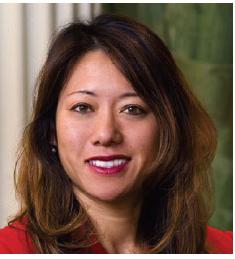
Fiona Ma’s cash machine

6

Why does Assembly member Fiona Ma take on odd causes like ending rent control for trailer parks?


Maybe it’s because almost 90 percent of the money she raises comes from outside her district. From the Chron today:


But San Francisco’s Fiona Ma, who was elected in 2006 and quickly rose to power within the Democratic Caucus, took the top spot when it came to sheer cash collected out of district: $1.68 million. Ma, now speaker pro tempore, raised more campaign cash from outside her district than either of the leaders of both houses. Her outside contributions made up 88 percent of the money she raised, placing her 29th in funds raised outside the district. Ma attributed the prolific fundraising to her involvement in statewide issues, such as high-speed rail, agriculture and domestic violence, that take her on the road. She said that as a member of the Assembly’s Democratic leadership – and someone from a safe Democratic district – she funnels a lot of money to other candidates. But she said the interests of her San Francisco constituents are well served because her high profile helps her promote those interests.


Arnold’s attack on the poor

5

As usual, Robert Cruickshank at Calitics has it exactly right: The governor’s budget isn’t just bloody and brutal, it’s a direct attack on poor people — and an effort to divide the interests of the poor and the middle class. If the new round of budget cuts had continued to hit public schools, higher education, state parks and other things that benefit the middle class and the people who are slightly better off, there might be a huge public backlash. Instead, almost everything that he’s hacking away is a program that helps the most needy:


Arnold is implicitly telling the middle-class “either you screw these poor families or we’re cutting something you want” and counting on the middle-class to react the same way they did in the ’80s and ’90s – by saying “go ahead, we won’t stop you.” 


In a sick way, it’s brilliant; it worked so well for Ronald Reagan, and Schwarzenegger figures it might work for him, too.


So this budget battle will not just be a test of whether the Democrats have the spine to stand up to the guv and the political skill to outflank the Republicans; it will be a test of whether they — and the better-off among the voters — are willing to go beyond narrow self-interest and stand up for the people at the bottom.


If not, what the governor is proposing will be the creation of a permanent underclass in California.

Democratizing the streets

steve@sbg.com

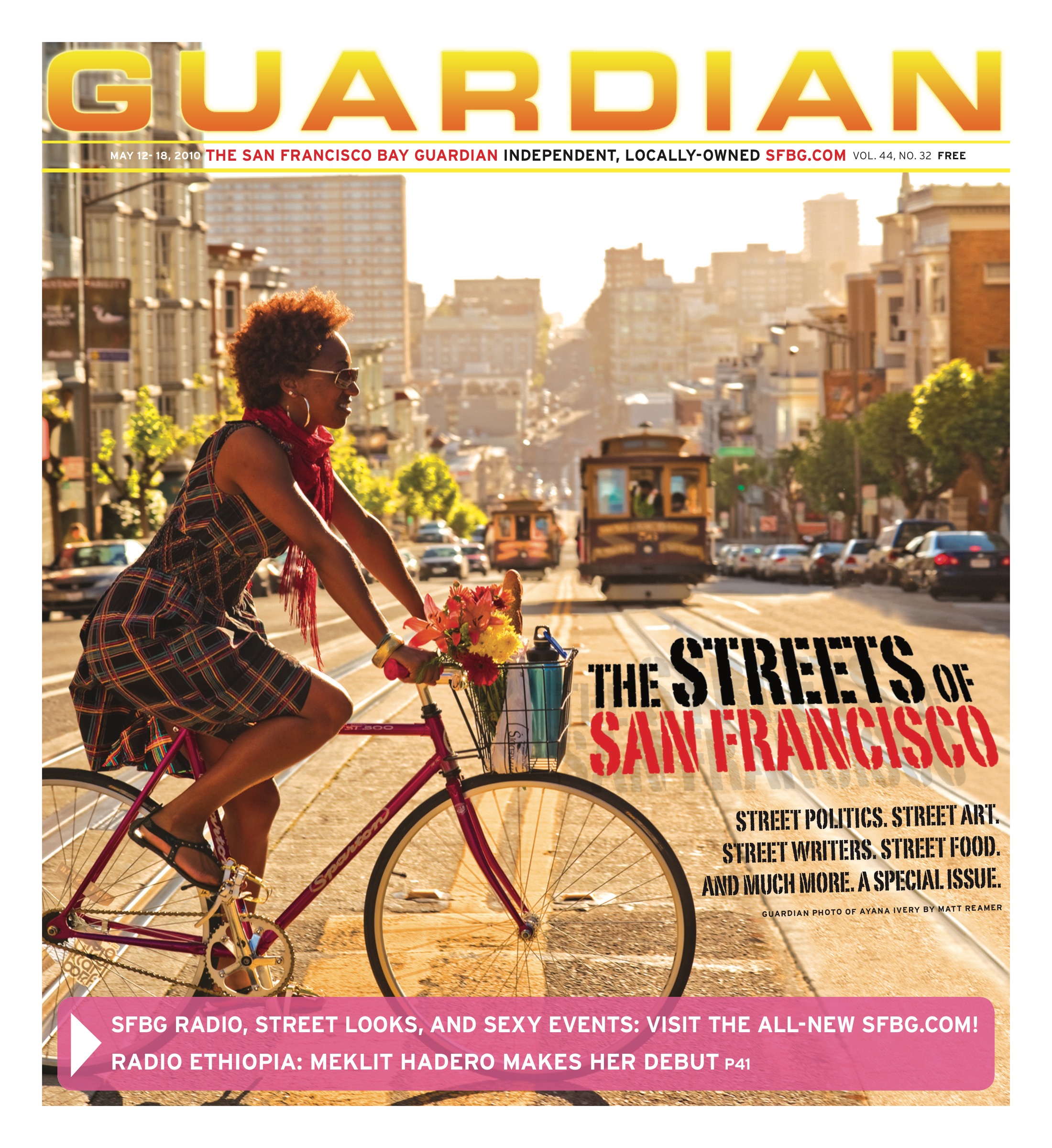
It’s hard to keep up with all the changes occurring on the streets of San Francisco, where an evolving view of who and what roadways are for cuts across ideological lines. The car is no longer king, dethroned by buses, bikes, pedestrians, and a movement to reclaim the streets as essential public spaces.

Sure, there are still divisive battles now underway over street space and funding, many centered around the San Francisco Municipal Transportation Agency, which has more control over the streets than any other local agency, particularly after the passage of Proposition A in 2007 placed all transportation modes under its purview.

Transit riders, environmentalists, and progressive members of the Board of Supervisors are frustrated that Mayor Gavin Newsom and his appointed SFMTA board members have raised Muni fares and slashed service rather than tapping downtown corporations, property owners, and/or car drivers for more revenue.

Board President David Chiu is leading the effort to reject the latest SFMTA budget and its 10 percent Muni service cut, and he and fellow progressive Sups. David Campos, Eric Mar, and Ross Mirkarimi have been working on SFMTA reform measures for the fall ballot, which need to be introduced by May 18.

But as nasty as those fights might get in the coming weeks, they mask a surprising amount of consensus around a new view of streets. “The mayor has made democratizing the streets one of his major initiatives,” Newsom Press Secretary Tony Winnicker told the Guardian.

And it’s true. Newsom has promoted removing cars from the streets for a few hours at a time through Sunday Streets and his “parklets” in parking spaces, for a few weeks or months at a time through Pavement to Parks, and permanently through Market Street traffic diversions and many projects in the city’s Bicycle Plan, which could finally be removed from a four-year court injunction after a hearing next month.

Even after this long ban on new bike projects, San Francisco has seen the number of regular bicycle commuters double in recent years. Bike to Work Day, this year held on May 13, has become like a civic holiday as almost every elected official pedals to work and traffic surveys from the last two years show bikes outnumbering cars on Market Street during the morning commute.

If it wasn’t for the fiscal crisis gripping this and other California cities, this could be a real kumbaya moment for the streets of San Francisco. Instead, it’s something closer to a moment of truth — when we’ll have to decide whether to put our money and political will into “democratizing the streets.”


RECONSIDERING ROADWAYS

After some early clashes between Newsom and progressives on the Board of Supervisors and in the alternative transportation community over a proposal to ban cars from a portion of John F. Kennedy Drive in Golden Gate Park — a polarizing debate that ended in compromise after almost two acrimonious years — there’s been a remarkable harmony over once-controversial changes to the streets.

In fact, the changes have come so fast and furious in the last couple of years that it’s tough to keep track of all the parking spaces turned into miniparks or extended sidewalks, replacement of once-banished benches on Market and other streets, car-free street closures and festivals, and healthy competition with other U.S. cities to offer bike-sharing or other green innovations.

So much is happening in the streets that SF Streetsblog has quickly become a popular, go-to clearinghouse for stories about and discussions of our evolving streets, a role that the San Francisco Bicycle Coalition — itself the largest grassroots group in the city, with more than 11,000 paid members — recently recognized with its Golden Wheel award.

“I think we are at a tipping point. All these little things have been percolating,” said San Francisco Planning Urban Research Association director Gabriel Metcalf, listing examples such as the creative reuse of San Francisco street space by Rebar and other groups (see “Seizing space,” 11/18/09), experiments in New York and other cities to convert traffic lanes to bicycle and pedestrian spaces, a new generation of more forward-thinking traffic engineers and planning professionals working in government, and more aggressive advocacy work by the SFBC, SPUR, and other groups.

“I think it’s all starting to coalesce,” Metcalf said. “Go to 17th and Valencia [streets] and feel what it’s like to have a sidewalk that’s wide enough to be comfortable. Or go ride in the physically separated bike lane on Market Street. Or take your kids to the playground at Hayes Green that used to be a freeway ramp.”

Politically, this is a rare area of almost universal agreement. “This is an issue where this mayor and this board have been very aligned,” Metcalf said. Winnicker, Newsom’s spokesperson, agreed: “The mayor and the board do see this issue very similarly.”

Mirkarimi, a progressive who chairs the Transportation Authority, also agreed that this new way of looking at the streets has been a bright spot in board-mayoral relations. “It is evolving and developing, and that’s a very good thing,” Mirkarimi said.

Both Winnicker and Mirkarimi separately singled out the improvements on Divisidero Street — where the median and sidewalks have been planted with trees and vegetation and some street parking spaces have been turned into designated bicycle parking and outdoor seating — as an example of the new approach.

“It really is a microcosm of an evolving consciousness,” Mirkarimi said of the strip.

Sunday Streets, a series of events when the streets are closed to cars and blossom with life, is an initiative proposed by SFBC and Livable City that has been championed by Newsom and supported by the board as it overcame initial opposition from the business community and some car drivers.

“There is a growing synergy toward connecting the movements that deal with repurposing space that has been used primarily for automobiles,” Sunday Streets coordinator Susan King told us.

Newsom has cast the greening initiatives as simply common sense uses of space and low-cost ways of improving the city. “A lot of what the mayor and the board have disagreements on, some of that is ideological,” Winnicker said. “But streets, parks, medians, and green spaces, they are not ideological.”

Maybe not, but where the rubber is starting to meet the road is on how to fund this shift, particularly when it comes to transit services that aren’t cheap — and to Newsom’s seemingly ideological aversion to new taxes or charges on motorists.

“We’re completely aligned when it comes to the Bike Plan and testing different things as far as our streets, but that all changes with the MTA budget,” said board President David Chiu, who is leading the charge to reject the budget because of its deep Muni service cuts. “Progressives are focused on the plight of everyday people who can’t afford to drive and park a car and have to rely on Muni. So it’s a question of on whose back will you balance the MTA budget.”


WHOSE STREETS?

The MTA governs San Francisco’s streets, from deciding how their space is allocated to who pays for their upkeep. The agency runs Muni, sets and administers parking policies, regulates taxis, approves bicycle-related improvements, and tries to protect pedestrians.

So when the mayoral-appointed MTA Board of Directors last month approved a budget that cuts Muni service by 10 percent without sharing the pain with motorists or pursuing significant new revenue sources — in defiance of pleas by the public and progressive supervisors over the last 18 months — it triggered a real street fight.

The Budget and Finance Committee will begin taking up the MTA budget May 12. And progressive supervisors, frustrated at having to replay this fight for a second year in a row, are pursuing a variety of MTA reforms for the November ballot, which must be submitted by May 18.

“We’re going to have a very serious discussion about MTA reform,” Chiu said, adding, “I expect there to be a very robust discussion about the MTA and balancing that budget on the backs of transit riders.”

Among the reforms being discussed are shared appointments between the mayor and board, greater ability for the board to reject individual initiatives rather than just the whole budget, changes to Muni work rules and compensation, and revenue measures like a local surcharge on vehicle license fees or a downtown transit assessment district.

Last week Chiu met with Newsom on the MTA budget issue and didn’t come away hopeful that there will be a collaborative solution such as last year’s compromise. But Chiu said he and other supervisors were committed to holding the line on Muni service cuts.

“I think the MTA needs to get more creative. We have to make sure the MTA isn’t being used as an ATM with these work orders,” Chiu said, referring to the $65 million the MTA pays to the Police Department and other agencies every year, a figure that steeply increased after 2007. “My hope is that the MTA board does the right thing and rolls back some of these service reductions.”

Transit riders have been universal in condemning the MTA budget. “The budget is irresponsible and dishonest,” said San Francisco Transit Riders Union project director Dave Snyder. “It reveals the hypocrisy in the mayor’s stated environmental commitments. This action will cut public transit permanently and that’s irresponsible.”

But the Mayor’s Office blames declining state funding and says the MTA had no choice. “It’s an economic reality. None of us want service reductions, but show us the money,” Winnicker said.

That’s precisely what the progressive supervisors are trying to do by exploring several revenue measures for the November ballot. But they say Newsom’s lack of leadership on the issue has made that difficult, particularly given the two-third vote requirement.

“There’s been a real failure of leadership by Gavin Newsom,” Mirkarimi said.

Newsom addressed the issue in December as he, Mirkarimi, and other city officials and bicycle advocates helped create the city’s first green “bike box” and honor the partial lifting of the bike injunction, sounding a message of unity on the issue.

“I can say this is the best relationship we’ve had for years with the advocacy community, with the Bicycle Coalition. We’ve begun to strike a nice balance where this is not about cars versus bikes. This is about cars and bikes and pedestrians cohabitating in a different mindset,” Newsom said.

Yet afterward, during an impromptu press conference, Newsom spoke with disdain about those who argued that improving the streets and maintaining Muni service during hard economic times requires money, and Newsom has been the biggest impediment to finding new revenue sources.

“Everyone is just so aggressive on trying to raise revenue. We’ve been increasing the cost of going on Muni the last few years. I think people need to consider that,” Newsom said. “We’ve increased the cost of parking tickets, increased the cost of using a parking meter, and we’ve raised the fares. It’s important to remind people of that. The first answer to every question shouldn’t be, OK, we’re going to tax people more or increase their costs.

“You have to be careful about that,” he continued. “So my answer to your question is two-fold. We’re going to look at revenue, but not necessarily tax increases. We’re going to look at revenue, but not necessarily fine increases. We’re going to look at revenue, but not necessarily parking meter increases. We’re going to look at new strategies.”

Yet that was six months ago, and with the exception of grudgingly agreeing to allow a small pilot program in a few commercial corridors to eliminate free parking in metered spots on Sunday, Newsom still hasn’t proposed any new revenue options.

“The voters aren’t receptive to new taxes now,” Winnicker said last week. Mirkarimi doesn’t necessarily agree, citing polling data showing that voters in San Francisco may be open to the VLF surcharge, if we can muster the same kind of political will we’re applying to other street questions.

“It polls well, even in a climate when taxation scares people,” Mirkarimi said.


BIKING IS BACK

It was almost four years ago that a judge stuck down the San Francisco Bicycle Plan, ruling that it should have been subjected to a full-blown environmental impact report (EIR) and ordering an injunction against any projects in the plan.

That EIR was completed and certified by the city last year, but the same anti-bike duo who originally sued to stop the plan again challenged it as inadequate. The case will finally be heard June 22, with a ruling on lifting the injunction expected within a month.

“The San Francisco Bicycle Plan project eliminates 56 traffic lanes and more than 2,000 parking spaces on city streets,” attorney Mary Miles wrote in her April 23 brief challenging the plan. “According to City’s EIR, the project will cause ‘significant unavoidable impacts’ on traffic, transit, and loading; degrade level of service to unacceptable levels at many major intersections; and cause delays of more than six minutes per street segment to many bus lines. The EIR admits that the “near-term” parts of the project alone will have 89 significant impacts of traffic, transit, and loading but fails to mitigate or offer feasible alternatives to each of these impacts.”

Yet for all that, elected officials in San Francisco are nearly unanimous in their support for the plan, signaling how far San Francisco has come in viewing the streets as more than just conduits for cars.

City officials deny that the bike plan is legally inadequate and they may quibble with a few of the details Miles cites, but they basically agree with her main point. The plan will take away parking spaces and it will slow traffic in some areas. But they also say those are acceptable trade-offs for facilitating safe urban bicycling.

The city’s main overriding consideration is that we must do more to get people out of their cars, for reasons ranging from traffic congestion to global warming. City Attorney’s Office spokesperson Matt Dorsey said that it’s absurd that the state’s main environmental law has been used to hinder progress toward the most environmentally beneficial and efficient transportation option.

“We have to stop solving for cars, and that’s an objective shared by the Board of Supervisors, and other cities, and the mayor as well,” Dorsey said.

Even anti-bike activist Rob Anderson, who brought the lawsuit challenging the bike plan, admits the City Hall has united around this plan to facilitate bicycling even if it means taking space from automobiles, although he believes that it’s a misguided effort.

“It’s a leap of faith they’re making here that this will be good for the city,” Anderson told us. “This is a complicated legal argument, and I don’t think the city has made the case.”

A judge will decide that question following the June 22 hearing. But whatever way that legal case is decided, it’s clear that San Francisco has already changed its view of its streets and other once-marginalized transportation choices like the bicycle.

Even the local business community has benefited from this new sensibility, with bicycle shops thriving around San Francisco and local bike messenger bag companies Timbuk2 and Rickshaw Bags experiencing rapid growth thanks to a doubling of the number of regular bicyclists in recent years.

“That’s who we’re aiming at, people who bike every day and make bikes a central part of their lives,” said Mike Waffenfels, CEO of Timbuk2, which in February moved into a larger location to handle it’s growth. “It’s about a lifestyle.”

For urban planners and advocates, it’s about making the streets of San Francisco work for everyone. As Metcalf said, “People need to be able to get where they’re going without a car.”

Editor’s Notes

1

Tredmond@sfbg.com

San Francisco has a lot of streets. Take a look at an aerial picture, or just look at the land-use statistics. More of this city is devoted to paved roads — pathways used largely and designed primarily for private automobiles — than any other single use. Parks, for example, don’t even come close.

That’s partially a matter of urban density. In more suburban-type cities like Berkeley or Portland or Seattle, the lots are bigger, yards are bigger, houses are bigger, and there’s more space between the strips of pavement.

But that density gives us a choice other cities don’t have. Maybe we don’t really need that much pavement.

I know it’s kind of a crazy thought, but imagine what some San Francisco neighborhoods would look like if we closed down, let’s say, one out of every four streets. I don’t mean open that land up for development, either — leave it as a passageway, a thoroughfare — but not for cars. Tear up the concrete, plant grass, make pathways for walking and biking … make the streets places where people can gather, kids can play, stores can enjoy the kind of traffic that only comes with a pedestrian mall, and restaurants can have outdoor seating in what would amount to a strip of mixed-use urban parkland.

Closing streets to cars creates plenty of problems, but I don’t think they’re insurmountable. Seniors and disabled people might have trouble with eliminating bus routes and parking in front of their houses, and that’s a legit concern. (Of course, the number of pedestrian seniors and disabled people killed or maimed by cars might go down too.) So maybe some streets could be turned into one-lane strips, and only people with disabled placards could use them. And ambulances and police and fire vehicles can already drive on car-free pathways in parks. And Muni could run a fleet of electric golf carts to ferry people with mobility issues up and down the grassy lanes.

Those of us who have cars would give up a certain amount of convenience; people without cars would get more of the benefits. That might discourage car use, which is good.

But even for drivers, I wonder. Would I be willing to give up the relative ease of parking near my house in exchange for letting my kids just open the front door of the house and run out and play in a safe, vehicle-free park that used to be a street? Would you?

The world is changing; the days of car culture driven by cheap oil are almost over. More and more people are going to be living in cities (that particular demographic trend is one of the most consistent in modern history). When we talk about the Streets of San Francisco, let’s stop for a moment and ask: does it all have to be about cars?

Lookin’ hot in the bike lane: Two-wheel tips from Meli of ‘Bikes And The City’

2

Meli Burgueno is the woman pedaling hard behind the killer San Francisco blog, Bikes And The City and after catching a glimpse of her always adorable road-friendly attire, it was time to get behind the chains and cranks to get a few style fashion-dos from the bicycle lover herself. Poking in and out of her favorite stores on Polk Street, Meli shows ladies the rules for hot cruisin’…of which she says there are none.

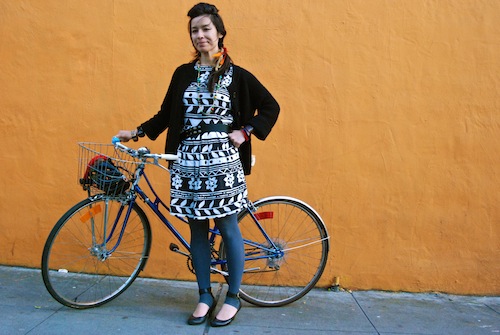
She rolls up on her companion of choice, “Frenchie” and parks her next to the coffee shop. Meli is sporting her usual cute; a flirty spring dress, black cardigan, gray tights and low black heels; the epitome of fearless femininity on wheels. As a biker myself, Meli and I agreed that looking lady-like in the bike lane often attracts glances from the other riders and drivers alike– there seems to be an assumption that biking requires spandex, jeans or some other bike ‘intended’ fabric. This is not true. 

“The key to bike fashion is finding stylishly comfortable pieces, which is basically anything,” says Meli with a shrug. “If you can walk comfortably in that shirt, dress or pants, you can bike comfortably in it, too.”

Meli30510

We step into Tedda Hughes and Meli’s grin goes ear to ear. “I’m a terrible shopper, but I love this store,” she says while flipping through the racks. Meli has been biking since 2003, making cycling her main mode of transportation and a huge part of her life. She encourages other women to hop on wheels and quit fussing over the details. 

“You have to get over your questions and just try it. Sometimes my shoes get dirty, but they can always be washed. And yes, sometimes I get sweaty– but isn’t that what bodies are for?” 

She picks out a frilly black skirt, made by store owner Tedda Hughes herself. Meli never wears jeans. “I have a pair, yes, but I haven’t worn them for about four years. I can’t believe people bike in jeans…but then again, I don’t think they’re comfortable to walk in.”

Meli40510

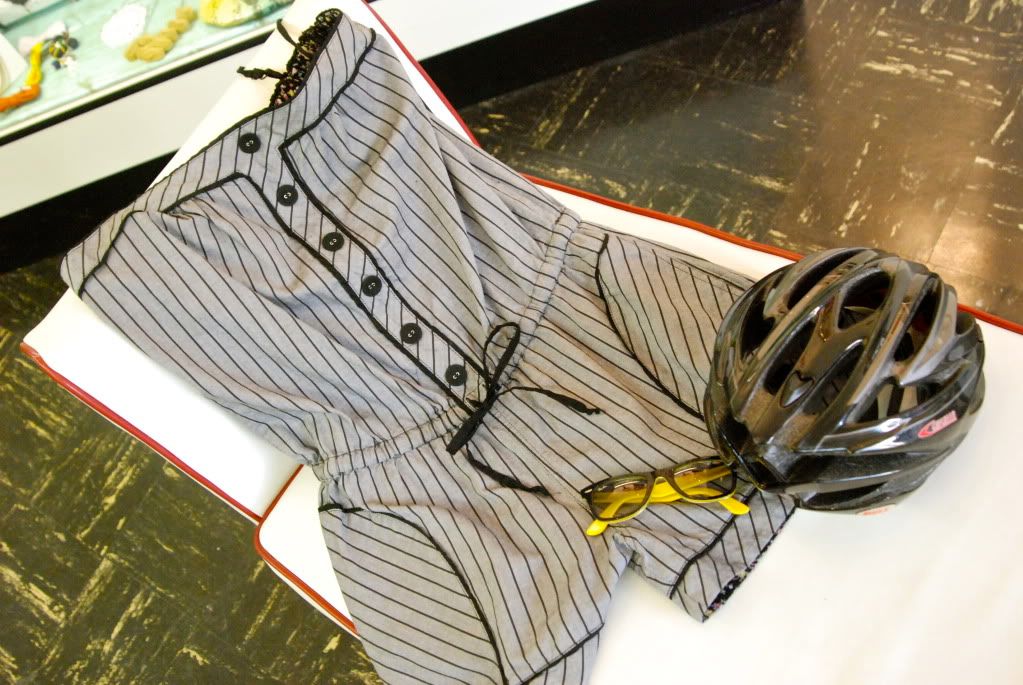
We spot this lovely Gentle Fawn jumper, which is perfect for riding around town on a summer day– comfy, sweet and ideal for modest girls won’t have to worry about flashing their panties. 

Meli60510

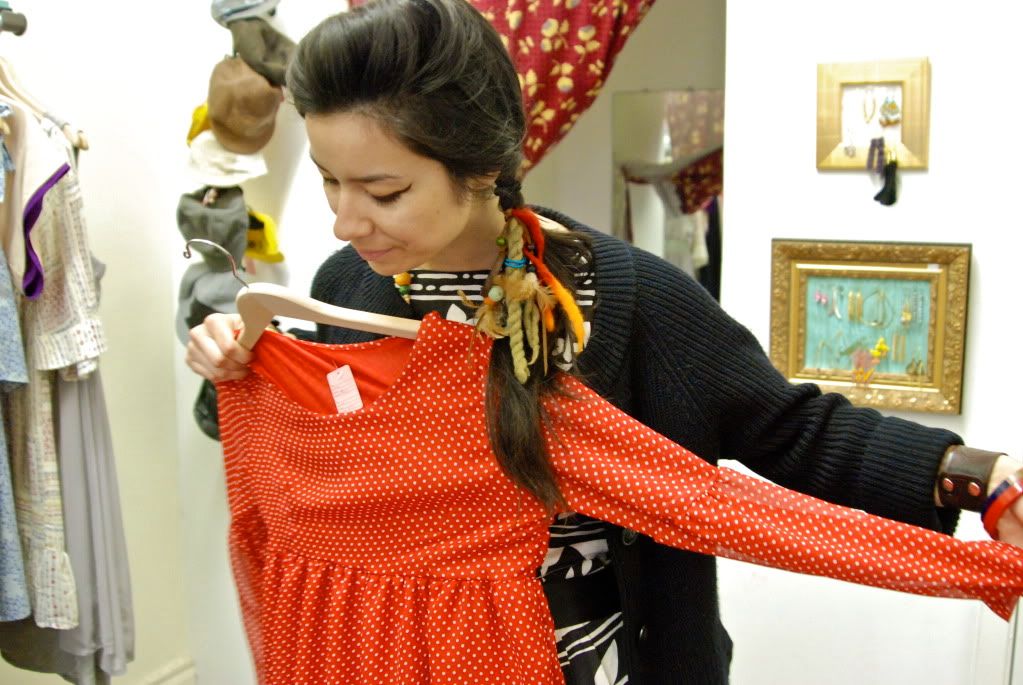
Meli loves bright colors, which not only look stellar, but they’re great for visibility reasons; get attention from sexy bike lane buddies and angry taxi drivers alike. This red, polka dot baby doll adaptation is another Tedda Hughes creation and Meli was drawn to the light, breathable fabric. 

“I also really like wool. It’s a great fabric for absorbing sweat and it dries fast.”

meli70510

These marine blue, suede pumps by Charlotte Ronson may look a bit freaky compared to the average bike sneaks, but Meli assures that heels are totally cool for cycling, as long as you can stand on them at the stoplight. The heel hooks around the pedal and acts like a clip, making them surprisingly ok for riding. The heels on Meli’s toes have rubber soles, which are also complimentary for her pedal style and help with grip. 

meli80510

meli90510

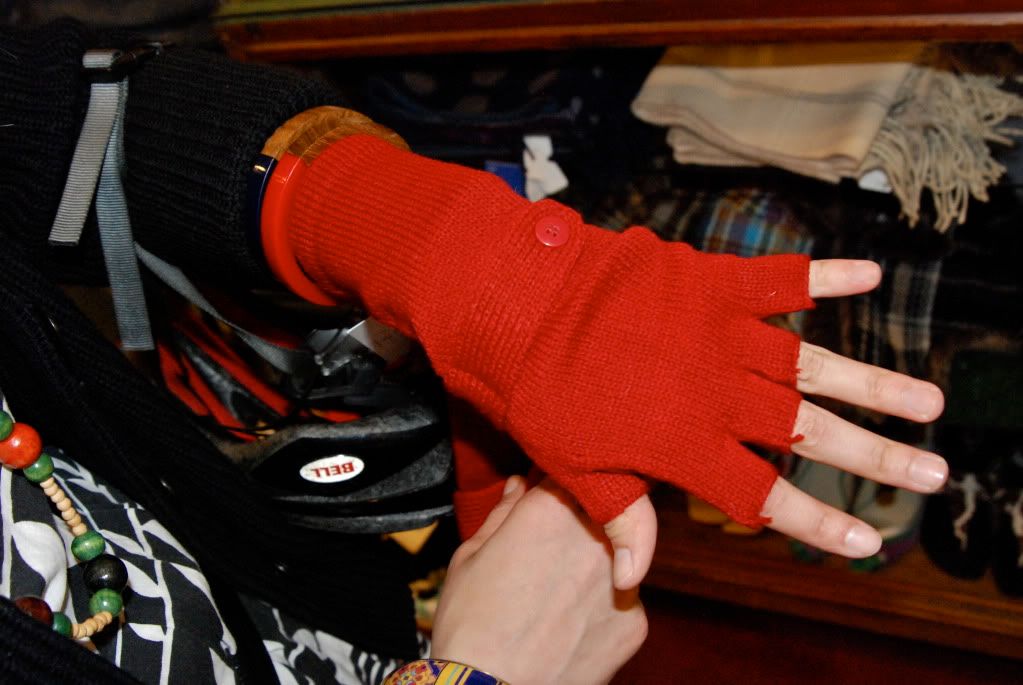
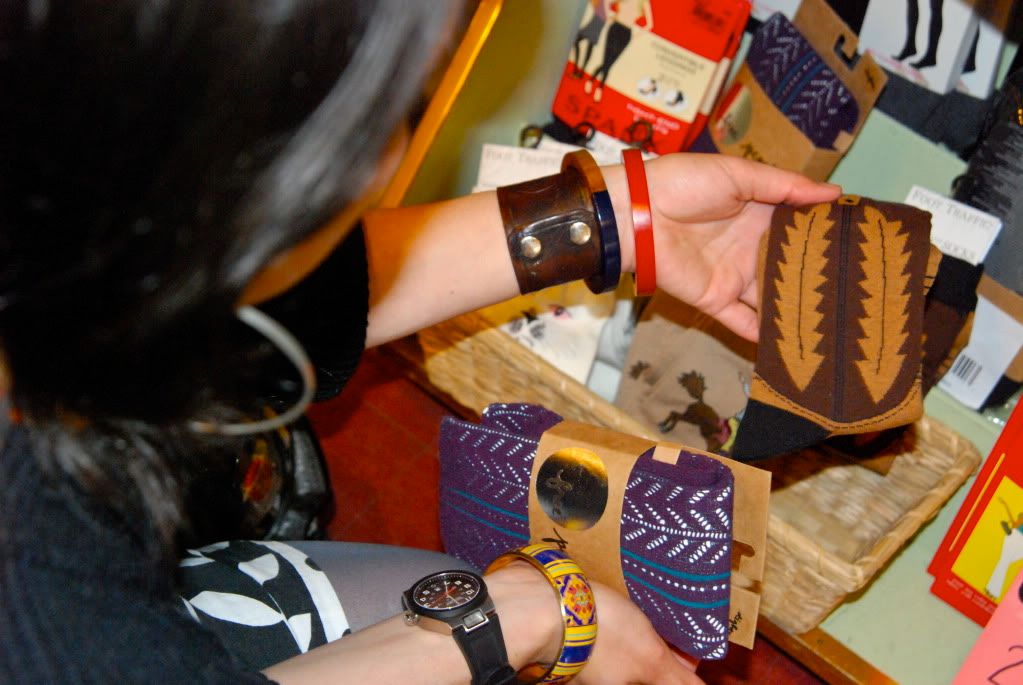
We walk down the block and browse through another of Meli’s must-visit shops, Picnic, which is filled with fun wares, gifts and chunky accessories. Meli is all about layers and being prepared for the various micro-climates in the city. These Tullette finger-less mitts are an ideal friend for evening rides. And then she spots the basket of tights. 

“I’m a tights whore,” she says digging through the pack and making comments about each gem she finds.

meli100510

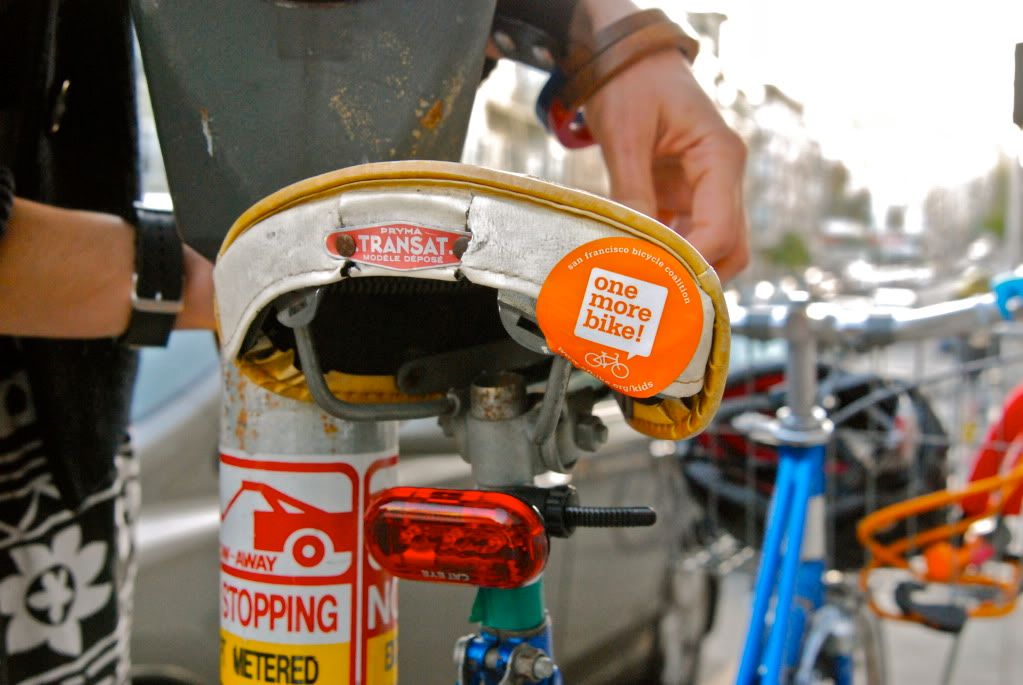
A fine day of shopping and it’s time to hit the road. Unlocking her bike, Meli has one final bit of advice to tote before jetting off into the sunset.

“Basically I think you should just wear it– no hesitations, no questions. If you like pants or whatever you feel good in, you should wear it and just ride.”


Catch more of Meli @www.BikesAndTheCity.blogspot.com

Luis Echegoyen’s old school Mission cool

3

Back when he was a television star in El Salvador, Luis Echegoyen could have little guessed that fifty year later he’d be performing in his own poetry reading in San Francisco of classic Spanish authors (Sat/8, Mission Cultural Center for Latino Arts). But it’s not the least probable feat that legendary Spanish language Bay area news anchor Echegoyen has accomplished — after all, poetry is his retirement project.

Echegoyen was famous in El Salvador when he made his first trip to the United States. A television and stage star, he had joined a troupe of artists who were performing in high schools and colleges across the country in a sort of cultural education tour for North American students. But when he arrived in San Francisco in November of 1962, he stayed. His sister lived here, and he heard that San Francisco State had a top-shelf drama program, where he planned on continuing the five years of formal stage education he had received back home.

But “I didn’t have the English,” Echegoyen tells me. He’s now a stately older gent in a turned-out suit, reminiscent of his days as a storied San Franciscan Spanish language news anchor. He shares his memories with me in a room at the Mission Cultural Center, and they’re fascinating, scenes set in the familiar streets of the Mission, but with reality set at a different angle from historical currencies.

With the education system unassailable, he turned to what he knew best; Spanish language show biz. His first major project was a radio show called Escala de Fama, which was being recorded in front of a live audience at the Victoria Theater. Echegoyen was a rookie at KOFY, which broadcasted Escala, but he could tell the hosts of the variety show needed help.

“The audience was very rowdy,” he recalls. “The announcers were afraid of the audience, they would hide behind the curtains!” He grabbed the mic, and drew on his years of experience during El Salvador‘s golden age of show business, cracking jokes and walking through the aisles of the Victoria. The spotlights followed him, and he hosted Escala for the next 13 years. Luis had arrived in San Francisco.

It’s fascinating to hear someone talk, as Luis does, about the way the Mission neighborhood was generations ago. It doesn’t sound so very different — sure, less fixed gear bikes — but the immigrant families packed into subdivided Victorians were already there, without many of the resources they needed to thrive. This was back before the advent of the social organizations that today call the Mission home. “Kids didn’t have anywhere to go; no parks, no gyms, no after school programs. I said, ‘okay, we need a park, we need a gym,’” says Luis.

Avance Luis! The man in magazine covers

And if talking with the man taught me one thing, it was this; what Echegoyen decides to do, Echegoyen does. To fix the issues he saw, he got in deep with a whole laundry list of community organizations; Bay Area Neighborhood Development, Mission Coalition Organization, and the Economic Opportunity Council, to name a few. He started working on seniors’ issues, delinquency issues, economic issues. Most importantly, he parlayed his growing radio and television celebrity into making change.

At one point, the Parks & Recreation department responded to his entreaties to build a park almost sarcastically, saying that if he wanted a park for his adopted neighborhood, they’d build it — if he could find an empty lot in the well-populated Mission neighborhood. On his way to shoot a news story with his camera crew, Echegoyen saw one, a dump site in the outer Mission/Bernal Hieghts.

He broadcasted from the site, sitting amidst the rubble. “I said ‘this is an empty lot, and we can use it to build a park. Let’s go to City Hall, and ask for a park to be built in this place.” Which of course, he did himself, only to find that Parks & Rec themselves were the property’s owners. Today, the park is there, testament to Echegoyen’s ability to use his broadcast skills and community position to effect change.

“You have to use the media to benefit the community. I went out on the streets, I found problems. Some of the problems were solved, some not,” he says, looking back at his activist career.

Today Echegoyen is retired, the first Latino inductee in the silver and gold circles of the National Academy of Television Arts and Sciences, a winner of a Lifetime Achievement Special Emmy.

“Luis has always been a leader in the community,” says Cynthia Harris, anchor of Univision KDTV’s En la Bahia, a local Spanish language news show of which Echegoyen was producer and host for many years. During his tenure, Luis brought in neighborhood leaders, as well as  local and international Latino artists. Harris says it was projects like these that reflect Echegoyen’s startling impact on San Francisco. “It was an opportunity for the Latino community to have a say — something that previously that hasn’t existed.”

Clearly, this is a man who’s earned his retirement. Although Echegoyen is active in senior education through AARP, two scholarship organizations for low income students, and is currently toying with the idea of organizing an artists’ flea market in the Mission, his pet project of the moment takes the stage at Mission Cultural Center for Latino Arts this weekend.

He’ll be reading poetry, the Spanish language masters. He’s a connoisseur of the art form, having recently recorded four volumes of poetic anthologies he‘s releasing one at a time on CD. “Poetry is so ample,” he tells me, proudly handing over a copy of volume one. “It’s really painful to be choosing which to include on the CDs.”

Sat/8 7 p.m., $15
Mission Cultural Center for Latino Arts
2868 Mission, SF
(415) 643-5001
www.missionculturalcenter.org

ENDORSEMENTS: National and state races

15

Editor’s note: the file below contains a correction, updated May 5 2010. 


National races


U.S. SENATE, DEMOCRAT


BARBARA BOXER


The Republican Party is targeting this race as one of its top national priorities, and if the GOP can dislodge a three-term senator from California, it will be a major blow for the party (and agenda) of President Obama. The pundits are happily talking about how much danger Barbara Boxer faces, how the country’s mood is swinging against big-government liberals.


But it’s always a mistake to count out Boxer. In 1982, as a Marin County supervisor with little name recognition in San Francisco, she trounced then-SF Sup. Louise Renne for an open Congressional seat. Ten years later, she beat the odds and won a hotly contested primary and tough general election to move into the Senate. She’s a fierce campaigner, and with no primary opposition, will have a united party behind her.


Boxer is one of the most progressive members of the not-terribly progressive U.S. Senate. She’s been one of the strongest, most consistent supporters of reproductive rights in Washington and a friend of labor (with 100 percent ratings from the AFL-CIO and National Education Association). We’ve had our disagreements: Boxer supported No Child Left Behind, wrote the law allowing airline pilots to carry guns in the cockpit, and was weak on same-sex marriage when San Francisco sought to legalize it (although she’s come around). But she was an early and stalwart foe of the war in Iraq, split with her own party to oppose a crackdown on illegal immigration, and is leading the way on accountability for Wall Street. She richly deserves reelection, and we’re happy to endorse her.


CONGRESS, 6TH DISTRICT, DEMOCRAT


LYNN WOOLSEY


It’s odd that the representative from Marin and Sonoma counties is more progressive by far than her colleague to the south, San Francisco’s Nancy Pelosi. But over the years, Lynn Woolsey has been one of the strongest opponents of the war, a voice against bailouts for the big Wall Street banks, and a foe of cuts in the social safety net. We’re proud to endorse her for another term.


CONGRESS, 7TH DISTRICT, DEMOCRAT


GEORGE MILLER


George Miller has been representing this East Bay district since 1974, and is now the chair of the Education and Labor Committee and a powerhouse in Congress. He’s too prone to compromise (with George W. Bush on education policy) but is taking the right line on California water (while Sen. Dianne Feinstein is on the wrong side). We’ll endorse him for another term.


CONGRESS, 8TH DISTRICT, DEMOCRAT


NANCY PELOSI


We’ve never been terribly pleased with San Francisco’s most prominent Congressional representative. Nancy Pelosi was the author of the bill that created the first privatized national park at the Presidio, setting a horrible standard that parks ought to be about making money. She was weak on opposing the war, ducked same-sex marriage, and has used her clout locally for all the wrong candidates and issues. But we have to give her credit for resurrecting and pushing through the health care bill (bad as it was — and it’s pretty bad — it’s better than doing nothing). And, at a time when the Republicans are trying to derail the Obama presidency, she’s become a pretty effective partner for the president.


Her fate as speaker (and her future in this seat) probably depends on how the Democrats fare in the midterm Congressional elections this fall. But if she and the party survive in decent shape, she needs to take the opportunity to undo the damage she did at the Presidio.


CONGRESS, 9TH DISTRICT, DEMOCRAT


BARBARA LEE


Barbara Lee, who represents Berkeley and Oakland, is co-chair of the Progressive Caucus in the House, one of the most consistent liberal votes in Congress, and a hero to the antiwar movement. In 2001, she was the only member of either house to oppose the Bush administration’s Use of Force resolution following the 9/11 attacks, and she’s never let up on her opposition to foolish military entanglements. We’re glad she’s doing what Nancy Pelosi won’t — represent the progressive politics of her district in Washington.


CONGRESS, 13TH DISTRICT, DEMOCRAT


PETE STARK


Most politicians mellow and get more moderate as they age; Stark is the opposite. He announced a couple of years ago that he’s an atheist (the only one in Congress), opposed the Iraq war early, called one of his colleagues a whore for the insurance industry, and insulted President Bush and refused to apologize, saying: “I may have dishonored the commander-in-chief, but I think he’s done pretty well to dishonor himself without any help from me.” He served as chair of the House Ways and Means Committee for exactly one day — March 3 — before the Democratic membership overruled Speaker Pelosi and chucked him out on the grounds that he was too inflammatory. The 78-year-old may not be in office much longer, but he’s good on all the major issues. He’s also fearless. If he wants another term, he deserves one.


State races


GOVERNOR, DEMOCRAT


EDMUND G. BROWN


Jerry Brown? Which Jerry Brown? The small-is-beautiful environmentalist from the 1970s who opposed Pacific Gas and Electric Co.’s Diablo Canyon nuke and created the California Conservation Corps, the Office of Appropriate Technology, and the Farm Labor Relations Board (all while running a huge budget surplus in Sacramento)? The angry populist who lashed out at corporate power on a KPFA radio talk show and ran against Bill Clinton for president? The pro-development mayor of Oakland who sided with the cops on crime issues and opened a military academy? Or the tough-on-crime attorney general who refuses to even talk about tax increases to solve the state’s gargantuan budget problems?


We don’t know. That’s the problem with Brown — you never know what he’ll do or say next. For now, he’s been a terribly disappointing candidate, running to the right, rambling on about preserving Proposition 13, making awful statements about immigration and sanctuary laws, and even sounding soft on environmental issues. He’s started to hit his stride lately, though, attacking likely GOP contender Meg Whitman over her ties to Wall Street and we’re seeing a few flashes of the populist Brown. But he’s got to step it up if he wants to win — and he’s got to get serious about taxes and show some budget leadership, if he wants to make a difference as governor.


LIEUTENANT GOVERNOR, DEMOCRAT


JANICE HAHN


Not an easy choice, by any means.


Mayor Gavin Newsom jumped into this race only after it became clear that he wouldn’t get elected governor. He sees it as a temporary perch, someplace to park his political ambitions until a better office opens up. He’s got the money, the statewide name recognition, and the endorsement of some of the state’s major power players, including both U.S. Senators and House Speaker Nancy Pelosi. He’s also been a terrible mayor of San Francisco — and some progressives (like Sup. Chris Daly) argue, persuasively, that the best way to get a better person in Room 200 is to ship Newsom off to an office in Sacramento where he can’t do much harm and let the supervisors pick the next mayor.


But it’s hard to endorse Newsom for any higher office. He’s ducked on public power, allowing PG&E to come very close to blocking the city’s community choice aggregation program (See editorial, page 5). His policies have promoted deporting kids and breaking up families. He’s taken an approach to the city budget — no new revenue, just cuts — that’s similar to what the Republican governor has done. He didn’t even bother to come down and talk to us about this race. There’s really no good argument for supporting the advancement of his political career.


Then there’s Janice Hahn. She’s a Los Angeles City Council member, the daughter of a former county supervisor, and the sister of a former mayor. She got in this race way before Newsom, and her nightmare campaign consultant, Garry South, acts as if she has some divine right to be the only Democrat running.


Hahn in not overly impressive as a candidate. When we met her, she seemed confused about some issues and scrambled to duck others. She told us she’s not sure she’s in favor of legalizing pot, but she isn’t sure why she’s not sure since she has no arguments against it. She won’t take a position on a new peripheral canal, although she can’t defend building one and says that protecting San Francisco Bay has to be a priority. She won’t rule out offshore oil drilling, although she said she has yet to see a proposal she can support. Her main economic development proposal was to bring more film industry work to California, even if that means cutting taxes for the studios or locating the shoots on Indian land where there are fewer regulations.


On the other hand, she told us she wants to get rid of the two-thirds threshold in the state Legislature for passing a budget or raising taxes. She supports reinstating the car tax at pre-Gov. Arnold Schwarzenegger levels. She supports a split-roll measure to reform Prop. 13. She wants to see an oil-severance tax to fund education. She’s one of the few statewide candidates who openly advocates higher taxes on the wealthy as part of the solution to the budget crisis.


We are under no illusions that Hahn will be able to use the weak office of lieutenant governor to move on any of these issues, and we’re not at all sure she’s ready to take over the top spot. But on the issues, she’s clearly better than Newsom, so she gets our endorsements.


SECRETARY OF STATE, DEMOCRAT


DEBRA BOWEN


Debra Bowen is the only Democrat running, a sign that pretty much everyone in the party thinks she’s doing a fine job as Secretary of State. She’s run a clean office and we see no reason to replace her.


CONTROLLER, DEMOCRAT


JOHN CHIANG


Like Bowen, John Chiang has no opposition in the primary, and he’s been a perfectly adequate controller. In fact, when Gov. Schwarzenegger tried two years ago to cut the pay of thousands of state employees to the minimum wage level, Chiang defied him and refused to change the paychecks — a move that forced the governor to back down. We just wish he’d play a more visible role in talking about the need for more tax revenue to balance the state’s books.


TREASURER, DEMOCRAT


BILL LOCKYER


Bill Lockyer keeps bouncing around Sacramento, waiting, perhaps, for his chance to be governor. He was attorney general. Now he’s treasurer seeking a second term, which he will almost certainly win. He’s done some good things, including trying to use state bonds to promote alternative energy, and has spoken out forcefully about the governor’s efforts to defer deficit problems through dubious borrowing. He hasn’t, however, come out in favor of higher taxes for the rich or a change in Prop. 13.


ATTORNEY GENERAL, DEMOCRAT


KAMALA HARRIS


There are really only two serious candidates in this race, Kamala Harris, the San Francisco district attorney, and Rocky Delgadillo, the former Los Angeles city attorney. Harris has a comfortable lead, with Delgadillo in second and the others far behind.


Delgadillo is on his second try for this office. He ran against Jerry Brown four years ago and got nowhere. And in the meantime, he’s come under fire for, among other things, using city employees to run personal errands for him (picking up his dry-cleaning, babysitting his kids) and driving his car without insurance. On a more significant level, he made his reputation with gang injunctions that smacked of ethnic profiling and infuriated Latino and civil liberties groups. It’s amazing he’s still a factor in this race; he can’t possibly win the general election with all his baggage.


Harris has a lot going for her. She was among the first California elected officials to endorse Barack Obama for president, and remains close to the administration. She’s a smart, articulate prosecutor and could be one of the few women atop the Democratic ticket this year. We were never comfortable with her ties to Willie Brown, but he’s no longer a factor in state or local politics. These days, she’s more closely allied with the likes of State Sen. Mark Leno.


That said, we have some serious problems with Harris. She’s been up in Sacramento pushing Republican-style tough-on-crime bills (like a measure that would bar registered sex offenders from ever using social networking sites on the Internet) and forcing sane Democrats like Assembly Member and Public Safety Committee Chair Tom Ammiano to try to tone down or kill them (and then take the political heat). If she didn’t know about the problems in the SFPD crime lab, she should have, and should have made a bigger fuss, earlier.


But Harris has kept her principled position against the death penalty, even when it meant taking immense flak from the cops for refusing to seek capital punishment for the killer of a San Francisco police officer. She’s clearly the best choice for the Democrats.


INSURANCE COMMISSIONER, DEMOCRAT


DAVE JONES


Two credible progressives are vying to run for this powerful and important position regulating the massive — and massively corrupt — California insurance industry. Dave Jones and Hector De La Torre are both in the state Assembly, with Jones representing Sacramento and De La Torre hailing from Los Angeles. Both have a record opposing insurance industry initiatives; both are outspoken foes of Prop. 17; and either would do a fine job as insurance commissioner. But Jones has more experience on consumer issues and health care reform, and we prefer his background as a Legal Aid lawyer to De La Torre’s history as a Southern California Edison executive. So we’ll give Jones the nod.


BOARD OF EQUALIZATION, DISTRICT 1, DEMOCRAT


BETTY T. YEE


Betty Yee has taken over a job that’s been a stronghold of progressive tax policy since the days of the late Bill Bennett. She’s done well in the position, supporting progressive financial measures and even coming down, as a top tax official, in favor of legalizing (and taxing) marijuana. We’re happy to endorse her for another term.


SUPERINTENDENT OF PUBLIC INSTRUCTION


TOM TORLAKSON


Two prominent Democratic legislators are running for this nonpartisan post, state Sen. Gloria Romero of Los Angeles and Assembly Member Tom Torlakson of Martinez. It’s a pretty clear choice: Romero is a big supporter of charter schools who thinks parents should be able to move their kids out of one school district and into another (allowing wealthier white parents, for example, to abandon Los Angeles or San Francisco for the suburban districts). She’s been supported in the past by Don and Doris Fisher, who put a chunk of their GAP Inc. fortune into school privatization efforts. Torlakson wants more accountability for charters, opposes the Romero district-option bill, and has the support of every major teachers union in the state. Vote for Torlakson.


STATE SENATE, DISTRICT 8, DEMOCRAT


LELAND YEE


Sen. Leland Yee can be infuriating. Two years ago, he was hell-bent on selling the Cow Palace as surplus state property and allowing private developers to take it over. In the recent budget crisis, he pissed off his Democratic colleagues by refusing to vote for cuts that everyone else knew were inevitable (while never making a strong stand in favor of, say, repealing Prop. 13 or raising other taxes). But he’s always been good on open-government issues and has made headlines lately for busting California State University, Stanislaus over a secret contract to bring Sarah Palin in for a fundraiser — and has raised the larger point that public universities shouldn’t hide their finances behind private foundations.


Yee will have no serious opposition for reelection, and his campaign for a second term in Sacramento is really the start of the Leland Yee for Mayor effort. With reservations over the Cow Palace deal and a few other issues, we’ll endorse him for reelection.


 Correction update: Yee’s office informs us that the senator suports an oil-severance tax and a tax on high-income earners and “believes that Prop. 13 should be reformed,” although he hasn’t taken a position on Assemblymember Tom Ammiano’s reform bill. 


STATE ASSEMBLY, DISTRICT 12, DEMOCRAT


FIONA MA


Fiona Ma’s a mixed bag (at best). She doesn’t like Pacific Gas and Electric Co. and supports public power, but comes up with strange bills that make no sense, like a 2009 measure to limit rent control in trailer parks. Why does Ma, who has no trailer parks in her district, care? Maybe because the landlords who control the mobile home facilities gave her some campaign cash. She faces no opposition, and we’re not thrilled with her record, but we’ll reluctantly back her for another term.


STATE ASSEMBLY, DISTRICT 13, DEMOCRAT


TOM AMMIANO


When the history of progressive politics in modern San Francisco is written, Tom Ammiano will be a central figure. His long-shot 1999 mayoral campaign against Willie Brown brought the left to life in town, and his leadership helped bring back district elections and put a progressive Board of Supervisors in place in 2000. As a supervisor, he authored the city’s landmark health care bill (which Newsom constantly tries to take credit for) and the rainy day fund (which saved the public schools from debilitating cuts). He uses his local influence to promote the right causes, issues, and candidates.


And he’s turned out to be an excellent member of the state Assembly. He forced BART to take seriously civilian oversight of the transit police force. He put the battle to reform Prop. 13 with a split-role measure back on the state agenda. And his efforts to legalize and tax marijuana are close to making California the first state to toss the insane pot laws. As chair of the Public Safety Committee, he routinely defies the police lobbies and the right-wing Republicans and defuses truly awful legislation. We’re glad Ammiano’s still fighting in the good fight, and we’re pleased to endorse him for another term.


STATE ASSEMBLY, DISTRICT 14, DEMOCRAT


NANCY SKINNER


Nancy Skinner has taken on one of the toughest, and for small businesses, most important, battles in Sacramento. She wants to make out-of-state companies that sell products to Californians collect and remit sales tax. If you buy a book at your local bookstore, you have to pay sales tax; if you buy it from Amazon, it’s tax-free. That not only hurts the state, which loses hundreds of millions of dollars in tax revenue, it’s a competitive disadvantage to local shops. Skinner’s a good progressive vote and an ally for Ammiano on the Public Safety Committee. We’re happy to endorse her for another term.


STATE ASSEMBLY, DISTRICT 16, DEMOCRAT


SANDRE SWANSON


Sandre Swanson represents the district where BART police killed Oscar Grant, but he wasn’t the one out front pushing for more civilian accountability; that was left to SF’s Ammiano. And while Swanson was generally supportive of Ammiano’s bill, he was hardly a leader in the campaign to pass it. This is too bad, because Swanson’s almost always a progressive vote and has been good on issues like whistleblower protection (a Swanson bill that passed this year protects local government workers who want to report problems confidentially). We’ll endorse him for another term, but he needs to get tougher on the BART police.

What’s wrong with taxing car owners?

13

It’s almost as if we need a full-time blogger to monitor the backwards ideas coming from the Chron’s C.W. Nevius. Today’s case in point: Nevius thinks the idea of charging for Sunday parking is “the dumbest idea since the imitation crab meat cocktail.” 


His brilliant investigative observation:


For all the talk about the fees on Sunday turning over parking spaces, you never read very far into one of these parking enforcement stories before you get to the bottom line — an estimated $2.8 million a year in this case if the Sunday-charge system was implemented citywide.


That’s exactly right, Chuck: This is a way to bring in money for Muni. And I don’t get what’s wrong with that. People who drive cars (and I admit, I’m one of them) have an outsized impact on the city; they take up a huge amount of space (San Francisco devotes more urban land to streets than parks), they pollute the air, they increase the nation’s reliance on fossil fuels and they contribute to global warming. And they don’t pay anywhere near enough taxes and fees to mitigate the impacts of their behavior.


I’m all for higher gas taxes, for example; taxes should not just be a source of revenue but should, when possible, be targeted to discourage socially detrimental behavoir. And charging people a little money to drive their cars to Sunday brunch instead of walking or taking public transit isn’t a terribly radical, unusual or disturbing idea. (In fact, we ought to charge the churches for the right to turn the streets into private parking lots on Sunday mornings).


Nevius complains that car drivers aren’t bad:


But c’mon. These aren’t evil people. They aren’t trying to scam the city, pee on the street, or break car windows and steal backpacks. We could fine the aggressive panhandler and the petty break-in artists, but they don’t have any money.


And I agree: They aren’t bad. But the same way taxes on cigarettes both defray the social cost of tobacco use and discourage the dangerous and noxious habit, a modest little fee for parking your car helps pay for public transit and might just encourage a few people not to drive their cars. That’s something everyone in the city should support.

Rolling forward

7

By Adrian Castañeda

news@sfbg.com

San Francisco’s Potrero del Sol Skatepark is often packed with skaterboarders, a testament to the sport’s popularity and to the dearth of places in the city where it’s legal to skate. But that will soon change with the city’s commitment to build two new skateparks: one in SoMa and the other in the Haight.

Both have been tentatively approved by the Board of Supervisors. But before any concrete is poured, the skaters will have to overcome budget crises, angry homeowners, and their own bad reputations, particularly in the Haight, where the proposed park has gotten caught up in the furor over vagrants and the proposed sit-lie ordinance.

San Francisco has long been a skateboarding hub, yet there’s always been friction with police, businesses, and everyday city life. Even though it’s legal, there just aren’t that many places to do it anymore, partially because the city and property owners routinely attach barriers to any surfaces that might be appealing to skaters.

Skateboarders, long accustomed to being ignored and disenfranchised, have responded in their usual DIY fashion, such as building a few obstacles in an empty parking lot under a freeway overpass. The city took notice of the demand and after three years of planning and meetings, the newest of San Francisco’s skate parks has finally been allotted the necessary funds to begin construction around the end of summer.

The Central Freeway Skate Park will be located in what is now a parking lot at the intersection of Duboce and Stevenson streets in the north Mission District area. With $2 million collected through the Central Freeway Corridor Housing and Transportation Improvement Act of 1999, which provides for the sale and lease of parcels of city land that were under the now-demolished freeway, officials plan to develop the park to eventually include basketball courts and a dog run.

Rich Hillis of the Mayor’s Office of Economic Development said the city is considering a variety of improvements, but confirmed that “we think the skate park is the priority.” He attributes the park’s relatively unopposed approval to the demands of the city’s skaters and to the community as a whole. “They embraced the idea of a skatepark early on,” Hillis said of the forward-thinking residents of the area. He jokingly adds that the park should be named “Hornbeck Park” after Bryan Hornbeck, director of the San Francisco Skateboard Association. Hornbeck and his associates started the SFSA to push the city to build new parks designed with skaters in mind.

“San Francisco has to have a world-class skatepark,” Hornbeck said at one of the many skate events his group organizes. Hornbeck said the city has been receptive, working with skaters on the design of the park, but left SFSA to organize skaters and raise the funds. “It’s bake sale; it’s lemonade stand; it’s the best we can do,” Hornbeck said. “We’re not trying to take anything, we’re trying to make our own thing.”

Plans for the park, drawn up by notable skatepark design firm New Line Skateparks, are currently under review by civil engineers. After the plans are finalized, the project will be bid out to find a contractor. Tentative 3-D renderings have been online for months, sparking heated debate on skateboarding Web sites.

When the acclaimed Potrero del Sol Skatepark opened in 2008, many skaters felt that while it was well-designed and enjoyable, it didn’t have enough terrain that mimicked street riding. New Line has designed a number of skating plazas, most recently in Los Angeles. Its involvement gives many skaters hope that the new park will incorporate obstacles that represent the city’s rich street skating history.

But things are not moving as swiftly for the city’s other planned skate park, just beyond where Waller dead-ends at Stanyan in the Haight, which doesn’t have the same guaranteed funding stream. While bids for a design have been submitted, the Recreation and Park Department needs to get approval for $1 million–$2 million in construction funds before moving forward. The city proposed the 120,000-square-foot cul-de-sac at the end of Waller and next to SFPD’s Park Station after the original site near the Golden Gate Park horseshoe pits was found to be too small and lacking the necessary sight-lines for safety. But according to some residents groups, the parking lot is less safe for youths.

Citing police incident reports, Lena Emmery, president of the Cole Valley Improvement Association, told us the Waller park would be in an area with a high number of reported assaults and drug arrests and would add to noise pollution. “This location puts a skateboard park too close to a dense residential area, as well as some businesses that would be negatively impacted by the noise from the skaters,” she wrote via e-mail.

While the lot is occasionally used for bicycle safety classes and overflow parking at Kezar Stadium, it sits empty most of the year, although a farmers market will hold its grand opening there April 28. Will Keating, a Waller Street resident and skateboarder who works on Haight Street, is excited about the proposed park. He disagrees with claims that the park would be a negative impact on his neighborhood. “I hear homeless mutants going crazy outside my window every night, I would much prefer skateboards,” Keating said of the current noise pollution.

The Haight Ashbury Improvement Association, which is leading the charge for a sit-lie ordinance, conducted a survey on its Web site and found that many of its visitors feel the skatepark would increase noise and safety problems in the Haight. Visitors to the site also said the lot would be better used as a farmers market. Yet city officials say the two are not mutually exclusive, and early designs for the project are said to include a large public plaza adjacent to the park intended for community events.

“We realize this is going to be a multiuse space,” said Nick Kinsey, property manager for the Recreation and Park Department. “Throughout San Francisco there are thousands and thousands of skateboarders but only two places where it is legal to skate.” Kinsey called the park is “a done deal,” citing a 2007 ordinance introduced by Sup. Ross Mirkarimi that mandates the department build a skatepark on the cul-de-sac.

Kent Uyehara, merchant chair for the HAIA and owner of FTC skateshop on Haight, said the community’s fears about pedestrian safety are understandable, but that fears of increased violence and drug use are irrational. “If you can’t have a skate park next to a police station, then basically you are saying you can’t have it.”

If the city enacts the sit-lie ordinance, which Uyehara supports, it would be easy to imagine that a skate park would be a magnet for homeless and others looking to escape police harassment. But Uyehara is adamant that the park would not become a haven for Haight Street refugees. “Skateboarders self-police their own areas,” he said. “We’re not trying to kick the homeless out,” he added. “We’re trying to make the neighborhood attractive for everyone, whether they’re buying something or not.”

Uyehara is no stranger to opposition. When his shop first moved to the Haight in 1994, he had to deal with threats from residents and a neighborhood organization, similar to the one he is now a part of, because of what skateboarding represented to them. Since then skateboarding and his business have prospered, and FTC now has four locations worldwide. “For a city that hosted the X-Games, it’s pathetic how skateboarding has been treated.”

Uyehara says the Waller park, along with the Central Freeway and Potrero del Sol parks, are part of a plan developed by the San Francisco Skate Task Force, created in 2002 by then-Sup. Gavin Newsom to address the growing friction between the city and its skateboard population. The task force envisioned “a series of five parks located in a star pattern, and one in the middle of the city, [that] would make it possible for users to easily get to a park within at least two miles of their home.”

All the meetings and fundraising will be in vain if the park is poorly designed and built, said Jake Phelps, editor-in-chief of Thrasher Magazine. He says locals should design the park “so we have no one to blame but ourselves,” and avoid another flawed park like Crocker Amazon in Sunnydale where, he says, “the fence costs more than the skatepark.” Unimpressed with preliminary designs for the park on Duboce, the notoriously blunt Phelps says, “They’re going to come to our town, drop a turd, and leave.”

The veteran skater is wary of “landscape designers” with grandiose ideas. “There are people who get too involved. They don’t skate. Who are they to tell anybody what it is?” Newer skateparks are too crowded with obstacles trying to please all different kinds of skaters, he said. Instead, he urges a simple design similar to the streets of downtown. “The whole idea of skating is being utilitarian with your environment.” Regardless of the design, he believes it won’t have a dramatic effect on the Haight community: “Homeless people are gonna sleep there,” he said. “People are gonna tag on it and think it’s theirs.”

“The whole city’s a park, but people need somewhere to go when they get kicked out of everywhere,” says pro skater Tony Trujillo, who is able to skate to the Potrero park from his house and thinks others should have the same proximity to hassle-free skating. Julien Stranger, another local pro, feels a park in the Haight would benefit youth in the area by giving them a healthy, creative outlet, something the Haight symbolizes to many. “I don’t think that the neighborhood should be complaining about the energy a skate park will bring,” he said. “Skate parks are pretty positive.”

Earlier this month, an informational meeting hosted by the Haight Ashbury Neighborhood Council, Kinsey, Hornbeck, and other residents raised concerns that noise pollution and property damage would increase because of the skate park. “There’s been no public outreach,” said Martha Hoffman, who lives across from where the park is slated to be built. “If we’d known about it sooner, we would have opposed earlier.”

Thuy Nguyen of the SF Skate Club, an after-school program that promotes skateboarding as a safe and positive activity, urged residents to look beyond their property values and consider the benefits for the city’s youth. “It’s important for kids who feel that traditional sports aren’t for them.” Her partner, Shawn Connolly, added that skateboarding has grown in popularity with children. “It’s right after baseball,” he said.

“If the city doesn’t have a skatepark, the city is the skatepark,” Hornbeck said of the Waller Street lot where he often hosts skate events with donated ramps to ease the community into the idea of skateboarders using the area. But until the city budget can provide for skateboarders, the debate over the park will rage — and the underused parking lot at the end of Waller will remain just that.

Nevius’ argument doesn’t fly

Here’s a line from the San Francisco Chronicle’s latest “hard-hitting” science news, penned by columnist C.W. Nevius:

“Birds have been flying around similar buildings for years, but apparently would suddenly lose their bearings and crash into this one.”

The building Nevius refers to, of course, is the proposed 555 Washington tower, the subject of mighty controversy which will go before the Board of Supervisors today, April 20.

The luxury condo tower would be erected beside the Transamerica Pyramid, and it’s drawn no shortage of criticism due to a variety of issues including, yes, the threat it poses to birds.

Nevius seems to be implying that anyone who would worry about the welfare of birds when there’s a recession going on is just plain silly. But is a luxury condo tower that most people can’t afford to live in really going to benefit the average San Franciscan who’s reeling from the recession?

And what about the birds, anyway? While the danger to birds is just one issue critics have pointed to — think increased traffic congestion, public parks darkened by shadows, spot-zoning that doubles the allowable height limit, etc. — Nevius dismisses it as ridiculous without, apparently, so much as glancing at the facts.

So in case anyone cares, here’s is a deeper explanation of the bird issue, derived from information (readily available via Google search) on the Golden Gate Audubon Society Web site. Since birds migrate at night, they can be thrown off course by tall, lighted structures. Scientists aren’t really sure why lit-up skyscrapers are so confusing to the delicate winged creatures, but they think it may have something to do with the fact that they use the stars as navigational cues.

“Once in among the lights, birds seem reluctant to fly out,” the Audubon Society informs us. “Sometimes they strike buildings or rooftop structures outright. Sometimes they continue flying in circles around the lighted buildings until they drop to the rooftop or the ground from exhaustion.”

So, the notion that birds have been flying around similar buildings for years without any problem is pretty much a myth. And the idea that they would lose their bearings seems to be backed by science — not (gasp!) some wild tale crafted by hysterical anti-development lefties who hate progress.

Some of the roughly 250 different kinds of birds that migrate through the Bay Area are threatened species.

The Golden Gate Audubon Society sponsors a voluntary program called Lights Out for Birds (an apt or unfortunate title, depending on how you look at it), in which building owners, managers, and tenants work together to turn off unnecessary lighting between key migration dates.

Now, this isn’t to say that 555 Washington ought to be halted purely because some endangered birds might meet their demise slamming against the fancy new addition to downtown San Francisco (though this prospect doesn’t exactly jive with they city’s green image, does it?). Whether or not the building moves forward is the subject of a rigorous public debate that we can surely look forward to very soon. But we just wanted to set the record straight on the bird bit, lest you feel disoriented and confused by Nevius’ reporting.

P.S. We emailed Nevius a little while ago for a comment. If he responds, we’ll post it as an update.

Editorial: No free ride for developers

0

Under Newsom’s approach, the current residents and businesses of San Francisco will have to put up millions of dollars to cover the costs created by market-rate housing developers

The dumbest plan the Newsom administration has cooked up in a long time continues to make its way through City Hall. The mayor wants to defer fees for housing developers as a way to “stimulate” the economy — despite the fact that the city’s own economist concluded the plan would lead to the creation of a relatively tiny number of jobs and perhaps 40 or 50 new market-rate condos over the next two years.

And the cost would be staggering. Over the next 15 to 20 years, depending on how much the housing market picks up, $43 million worth of fees developers typically pay before they break ground could be deferred, an analysis by Fernando Marti, a member of the Eastern Neighborhoods Citizens Advisory Committee, shows. The city would get the money eventually — but buildings would go up before the cash to provide water and sewer service, public transportation, schools, parks, and other amenities is in the city’s accounts.

At the same time, information released by the city last week shows that the gap between the cost of the infrastructure needed for the Eastern Neighborhoods plan and the fees developers will pay is at least $100 million, and perhaps as much as $234 million.

The message is clear. Under Newsom’s approach, the current residents and businesses of San Francisco will have to put up millions of dollars to cover the costs created by market-rate housing developers. In fact, Newsom’s administration is already suggesting special levies on property in the impacted areas to make up the difference.

In underserved areas like the Eastern Neighborhoods, where transit and open space are already inadequate to meet current needs, the situation is particularly harsh. “They want to have the Eastern Neighborhoods pay higher taxes than anyone else to mitigate the impacts of new stuff that was supposed to pay for itself,” planning activist Tony Kelly, who is running for District 10 supervisor, told us. “This is a non-starter.”

The problem is nothing new — although a lot of pro-development activists have been denying it for years: new high-end housing development doesn’t pay its own way. If more than 40,000 new residents are going to live in the southeast part of town, San Francisco will have to build schools, police stations, firehouses, bus and rail lines, parks, and in some cases new roads. Then the city will have to hire (and train) cops, bus drivers, firefighters, gardeners, and teachers. None of that is cheap — in fact, the Eastern Neighborhoods Infrastructure Finance Working Group estimates that the actual cost of providing basic infrastructure would be about $22 for every square foot of new development.

The developers howl at that sort of number and insist they can’t afford it, so the city is prepared to charge closer to $10 a square foot. To make up the difference in the Eastern Neighborhoods, the working group suggested some form of tax-increment financing — that is, the city would borrow against the expected new property tax revenues from the new development and use that to build infrastructure. The mayor took that off the table, wanting any new revenue to go right to the General Fund.

And, of course, under the mayor’s current plan, the modest fees developers actually have to pay will be deferred for several years, making the problem even worse. So the only way to pay for the costs of new housing development is some sort of special property-tax district in the affected neighborhoods.

Add to this the fact that the mayor’s proposal would mean the immediate loss of at least 400 affordable housing units, and the whole thing becomes untenable.

The supervisors have amended the fee-deferral plan to make it a bit less awful, but the whole approach is still completely backward. City fees aren’t holding up housing construction; the weak market and tight credit are to blame for that. And when those conditions change, developers will be poised — as always — to make a vast amount of money selling overpriced condos for millionaires in San Francisco. And if they can’t pay their own way, the city shouldn’t allow them to break ground.


No free ride for developers

2

EDITORIAL The dumbest plan the Newsom administration has cooked up in a long time continues to make its way through City Hall. The mayor wants to defer fees for housing developers as a way to "stimulate" the economy — despite the fact that the city’s own economist concluded the plan would lead to the creation of a relatively tiny number of jobs and perhaps 40 or 50 new market-rate condos over the next two years.

And the cost would be staggering. Over the next 15 to 20 years, depending on how much the housing market picks up, $43 million worth of fees developers typically pay before they break ground could be deferred, an analysis by Fernando Marti, a member of the Eastern Neighborhoods Citizens Advisory Committee, shows. The city would get the money eventually — but buildings would go up before the cash to provide water and sewer service, public transportation, schools, parks, and other amenities is in the city’s accounts.

At the same time, information released by the city last week shows that the gap between the cost of the infrastructure needed for the Eastern Neighborhoods plan and the fees developers will pay is at least $100 million, and perhaps as much as $234 million.

The message is clear. Under Newsom’s approach, the current residents and businesses of San Francisco will have to put up millions of dollars to cover the costs created by market-rate housing developers. In fact, Newsom’s administration is already suggesting special levies on property in the impacted areas to make up the difference.

In underserved areas like the Eastern Neighborhoods, where transit and open space are already inadequate to meet current needs, the situation is particularly harsh. "They want to have the Eastern Neighborhoods pay higher taxes than anyone else to mitigate the impacts of new stuff that was supposed to pay for itself," planning activist Tony Kelly, who is running for District 10 supervisor, told us. "This is a non-starter."

The problem is nothing new — although a lot of pro-development activists have been denying it for years: new high-end housing development doesn’t pay its own way. If more than 40,000 new residents are going to live in the southeast part of town, San Francisco will have to build schools, police stations, firehouses, bus and rail lines, parks, and in some cases new roads. Then the city will have to hire (and train) cops, bus drivers, firefighters, gardeners, and teachers. None of that is cheap — in fact, the Eastern Neighborhoods Infrastructure Finance Working Group estimates that the actual cost of providing basic infrastructure would be about $22 for every square foot of new development.

The developers howl at that sort of number and insist they can’t afford it, so the city is prepared to charge closer to $10 a square foot. To make up the difference in the Eastern Neighborhoods, the working group suggested some form of tax-increment financing — that is, the city would borrow against the expected new property tax revenues from the new development and use that to build infrastructure. The mayor took that off the table, wanting any new revenue to go right to the General Fund.

And, of course, under the mayor’s current plan, the modest fees developers actually have to pay will be deferred for several years, making the problem even worse. So the only way to pay for the costs of new housing development is some sort of special property-tax district in the affected neighborhoods.

Add to this the fact that the mayor’s proposal would mean the immediate loss of at least 400 affordable housing units, and the whole thing becomes untenable.

The supervisors have amended the fee-deferral plan to make it a bit less awful, but the whole approach is still completely backward. City fees aren’t holding up housing construction; the weak market and tight credit are to blame for that. And when those conditions change, developers will be poised — as always — to make a vast amount of money selling overpriced condos for millionaires in San Francisco. And if they can’t pay their own way, the city shouldn’t allow them to break ground.

Park it here: an alterna-Dolores six pack

1

The other day, sharing the scrap of blanket space I was able to hustle between 1,000 of my Vitamin D deprived brethren, I spotted:

1. A green parrot. On a man’s shoulder.

2. A green python. Ditto, shoulders.

3. An LED light filled, fixed gear frame.

All in a ten foot radius. Freaky! Unique! Not very relaxing! Conclusion: I need a break from Dolo. 

Luckily, I made a serendipitous discovery: there are other parks in San Francisco! Many, in fact. Here are some green spaces that are sunny, green, and relatively free of studied self imagery:

Alamo Square

Okay, so perhaps this won’t provide much respite from those hip cats and their big snakes — on a sunny day, Alamo is almost as flush with BBQs and irony as it’s neighbor in the Mission down South. But Alamo’s got the most iconic view in the city (if your icons, as mine, are based on early ‘90s sitcoms) and a really cool shoe garden by the public bathrooms.

Walk in at: Steiner & Hayes


Lafayette Square

One of the most intelligent ideas our city planners had was to put a park on nearly every peak in our city. Head up to Lafayette Square, deep in the heart of tony Pac Heights, and you can see their brillance manifested for yourself — a panoramic view of urban valleys, green hills. This park is where all the little old rich ladies go with their little old rich dogs, and its pristine lawns is aching for a little more infiltration by the prols.

Walk in at: Sacramento & Laguna, SF


Alta Plaza

One hill over, Alta Plaza is Lafayette’s only slightly less ritzy cousin. Most of the lawn space is on a terraced slant, perfect for when the sun is in the southern end of the sky. And should you get the yen to rise up and do something, Alta’s got superb tennis and basketball courts that are rarely occupied on weekdays.

Walk in at: Clay & Steiner, SF


Ocean Beach

Did you know that the western side of the city is lined by the Pacific Ocean? It’s true! And while Ocean Beach no longer features the amusement parks and boho repurposed streetcar villages, it’s still one of the coolest things about living here. Pick a sunny day (or a tempestuous one if you dig watching storm action in a solid coating of Gore-Tex) and post up between a couple dunes, where you chill in a little wind sheltered, clothing optional cove of your own. [note: nudity not really legal]

Walk in at: Judah & Great Highway, SF


Misson Creek Park

With all the UCSF construction in the neighborhood to the south, who knows how long it’ll stay this way, but for now, Mission Creek Park reminds me the river we used to escape to when I was in high school; a spot where we could swim that was still close enough to the city to be doable on a half day off. Don’t swim in Mission Creek (actually, do it! That’d be hilarious!). But you get what I mean, here’s a place to hang, eat, read, smoke that J — next to a river. Bliss.

Walk in at: Channel & 4th St.


Fillmore Center

Am I really blowing up the spot on this little oasis? Dang, I’m taking this whole journalism thing seriously.  Consider yourself in on the greenest little patch of lawn in Western Addition — enter in through the snazzy plaza, and head straight past all the old people on benches to the wall of cascading water in back, which has a tranquil little pool and all the empty lawn space you need. All this solitude does come at a price though: BYO tamales and ganja treats.

Walk in at: Fillmore & O’Farrell

The problem with Park Merced

7

It’s no secret that Park Merced, the sorta-suburban mega-housing complex in the southwest corner of the city, wants to expand. New mid-rise towers would house some 7,000 apartments, with space for maybe 12,000 new residents — which is fine if you like the idea of more rental housing in the city (although much of it not affordable). But it also means a huge amount of new traffic in the area, particularly on 19th Avenue, which is pretty crowded as it is.


Now, the developer and the city talk about adding new transit to the area — an underground Muni rail station at Park Merced, more buses, all that good stuff. Sup. Sean Elsebernd, who represents the district, is (properly) demanding it.


But here’s the hitch: Never once in the history of this city has a major new development paid enough fees or brought enough money into the city to pay for the infrastructure required to serve it. And that’s going to get even worse if the mayor gets his way and defers development fees.


The cost of the level of transit necessary to serve the new residents of Park Merced, along with the expanded number of students at San Francisco State, and the expansion of the Stonestown shopping center, is gong to be massive. Park Merced may pay to build a new station — but the developer won’t pay for the cost of buying new buses and trains, hiring operators, and paying them. The increased property tax revenue from the project won’t cover that, either — particularly since it also has to cover water and sewer expansion, police and fire expansion, new schools and parks, and all the other expensive things that 7,000 new residents will want.


I don’t think the city’s even come close to figuring out the total bill for all the infrastructure improvements this project will require. Let’s add that up first — before the city issues any permits — and present the developer with the bill. Then we can decide if this project is a good idea.

Inside the squat

1

By Evan DuCharme

news@sfbg.com

Homes Not Jails (HNJ) has fought diligently for two decades to shed light on the economic disparity that exists in San Francisco, where the number of homeless people would fit almost perfectly into the supply of vacant homes.

So on a cold Saturday night, April 3, as I sit shivering in the back of a van waiting for my group’s turn to covertly enter a vacant house, I’m surprised at the calmness on some of the members’ faces. This group of eight is planning to enter and occupy apartments at 572 and 572A San Jose Avenue. And while only a few have been through this before, the rest make up for their lack of experience with a passion for the cause.

Around 2 a.m., the group somehow manages to enter the building without being caught, but it’s not easy. Between the drunken couple arguing on the street, the cops breaking up a bar fight nearby, and a neighboring couple who keep shining flashlights at the units, the group should never have made it in. But it does, and at the moment there’s no time to dwell on luck because there’s food and water to unpack, entrances to secure, and rooms to search, all while remaining perfectly silent and unseen.

Typically HNJ, a project of the San Francisco Tenants Union, conducts weekly searches it calls “urban exploring” in the hopes of finding useable vacant property to set up as a “squat” for people looking for a place to live rent-free. Every so often, its activism goes mainstream in the form of public occupations like this one, when the media is notified.

The immediate goal is to simply enter, secure, and occupy the apartment until noon the next day when a rally starting at 24th and Mission streets will march right in front of the building. Once there, they are supposed to let fly a couple HNJ banners while the rally outside features speeches, chants, and music by the Brass Liberation Orchestra.

But the catch is that the squatters cannot be seen before the rally arrives outside, otherwise their cover will be blown, they could be arrested, and the goal of shedding light on this waste of vacant housing will be ruined.

After attending HNJ meetings and events for a few weeks, I was allowed to follow the group into the apartment and report on their occupation from the inside as long as I protected the anonymity of those who wanted it. With that in mind, the group included Tim, one of the most experienced HNJ members; SFSU grad-student Aaron Buchbinder; Elihu Hernandez, a candidate for the District 6 seat on the Board of Supervisors; Matt, another experienced HNJ member; and local activists Carling, Scott, and a seventh member who asked to remain anonymous.

The building they targeted had strong symbolic value; it was where an elderly man was forced out by the landlord using the Ellis Act, which for the past decade has been the root cause of a large number of what the group sees as unjust and immoral evictions.

The Ellis Act was adopted in 1985 to give landlords the right to clear their rent-controlled buildings of tenants and get out of the rental business, expanding their previous rights to evict tenants through Owner Move-In (OMI) evictions, which allowed landlords and their immediate family members to oust renters.

Once a landlord invokes the Ellis Act, tenants in the building are given 120 days to move out, although seniors and those with disabilities must be given a year’s notice. Tenants are entitled to almost $5,000 each in relocation costs, or a maximum of almost $15,000 per unit. Seniors and those with disabilities get an extra $3,300 each.

After the building is vacated, it is usually taken off of the rental market for at least five years. During that time, the former tenants retain the right to reoccupy their old units at their original rent for 10 years. If the building is re-rented within five years, the landlord can only charge what the previous tenants were paying. These restrictions are attached to the deed and apply to subsequent property owners as well.

Although the restrictions were meant to discourage the eviction of tenants from rent-controlled units, they also have encouraged some property owners to keep buildings vacant while they wait for property values to increase or to re-rent their units at higher prices. If the landlord wants to convert, remodel, or add any additions to the property, they still must seek the city’s approval.

This landlord power is the primary reason HNJ chose to occupy 572 and 572A San Jose Avenue. A few years ago, the property was purchased by Ara Tehlirian, who sought to remodel it and live there himself, evicting 82-year-old Jose Morales in the process. Morales had been legally renting the property since 1965 and challenged his eviction in court.

Morales won when the judge ruled that it was illegal to evict him for the sole purpose of renovating the building for the new landlord. But Morales’ success was short-lived. Tehlirian invoked the Ellis Act, so Morales was no longer legally able to live in his home. When Tehlirian subsequently asked for permission to renovate his house as he had initially planned, the judge denied the request citing that landlords cannot invoke the Ellis Act for an OMI eviction.

One reason the Ellis Act is used so frequently traces back to the passage of Proposition G in 1998, which prevented the type of eviction initially tried on Morales. Prop. G requires landlords invoking an OMI eviction to move into the evicted tenant’s unit within three months of the eviction and to stay for a minimum of three years.

Furthermore, it limited such evictions to one person per building and banned them if a comparable unit was open in the building. Finally, and the reason cited in Morale’s case, it made permanent an existing law that was set to expire in June of that year that prohibited any OMI eviction of senior, disabled, or catastrophically ill tenants.

Tehlirian, like many others before him, decided to use the Ellis Act to bypass these OMI restrictions. Ted Gullicksen, director of the Tenants Union, said Prop. G had the unintended effect of encouraging property owners to clear their buildings of tenants, a requirement of Ellis Act.

“A vacant building is generally worth 20 to 30 percent more than a building occupied with tenants because the landlord can do whatever he wants with the units, including selling them or renting at market rate,” he told us.

So Morales was forced out of what remains a vacant building. This is why HNJ illegally occupied the property, arguing that trying to effect change through legal avenues is at times just as difficult as Morales’ individual struggle against the Ellis Act. It highlighted the human cost of property rights.

“People who keep vacant buildings for profit tend to be the same ones who donate money to political campaigns,” Tim said. Which is why he is resorting to a form of civil disobedience that is very likely to end with him in handcuffs.

Around 1 p.m. Sunday, April 4, the rally met in front of the property and the occupiers frantically rushed to hang banners and secure any entrance the San Francisco police might find. As the first drops of rain fell, the Brass Liberation Orchestra played, speakers including Gullicksen and Morales said a few words, and the Food Not Bombs organization supplied free food to occupiers and members of the rally.

After a few hours, the rally dispersed with much appreciation from those inside the apartment and what started as a group of seven SFPD squad cars dwindled to two. Tim, Elihu, Scott, Aaron, and Matt decided to remain in the building while the rest of us said goodbye and climbed out an open window.

The remaining members spent their second night in the building, but this time they didn’t have to be quiet. Supporters brought the group pizzas and a neighbor offered to supply water to the group as long as they didn’t mind if it came from her tap. They huddled in the same room playing cards and joking until Tehlirian and the SFPD made it through the front door, ending the occupation.

Each member was cited and released on the premises at 1:35 p.m. April 5 under penal code 602m for trespassing. Tehlirian stood by and observed while his lawyer, Zach Andrews, unsuccessfully pressed him to charge the group with breaking and entering. When the group dispersed, Tehlirian and a few members of the SFPD broke through a second door to gain access to the bottom level of the property.

When Tehlirian came out for a break, I tried to speak with him but he refused to answer my questions. Shortly afterward, I met up with the HNJ group at the Tenants Union and asked Tim if he thought they were successful in accomplishing their goals. “Not completely,” he said. “But we made the most with what we had.”

Tenants may not have the law on their side in many cases, but in a city that is two-thirds renters, they have each other. And for a few days, they had one more home. The group’s feelings seemed to be summed up by this quote on a HNJ pamphlet: “We are too valuable to live huddled in the rain, in the parks, in dangerous unhealthy shelters. Freezing, dying so that others can realize profits.”

Revenue for all

2

OPINION Cut, cut, cut, cut, cut: this is the sound of your government — parks, schools, playgrounds, hospitals, clinics, public transportation, programs for youth and seniors, arts, social services, the whole fabric that makes San Francisco what it is — fading away as state and local politicians refuse to raise revenue to revitalize our economy.

Mayor Gavin Newsom and big business groups have promoted a defeatist politics of low expectations, cutting spending, laying off city workers by the thousands, and offering tax breaks to businesses and developers rather than tapping San Francisco’s deep pockets of wealth to generate economic opportunities citywide.

It’s time for a new path: a fiscal politics of optimism, opportunity, and addition rather than subtraction. It’s time for an unapologetic progressive taxation movement for this November’s ballot and beyond, to make the city’s great wealth — individual and corporate, often badly undertaxed — work for all San Franciscans.

As California crumbles, local revenue movements could fuel a statewide campaign of towns, cities, and counties to overturn Proposition 13. San Francisco can take the lead with progressive taxation to create jobs, promote small neighborhood businesses, expand affordable housing and public transit, save public health, and more.

A citywide campaign for progressive taxes is building, including leaders from community-based nonprofits, grassroots organizing and neighborhood groups, labor unions, and some corners of City Hall. There are many promising ideas; with the right political will and organizing, the city could, for instance, tax large-scale real estate and levy profits from large firms. Progressive taxes could, at minimum, bring in close to $100 million and help save critical city services.

To win this campaign, a strong coalition must educate and mobilize the public about the vital importance — and citywide benefit — of raising revenue through targeted taxes on large firms and wealthy individuals. The city’s political leaders will need prodding, pressure, and support to get this done.

Progressive taxation will benefit all of San Francisco, not just some — working-class people of color and immigrants who endure the cuts’ harshest effects, everyone from youths to seniors, and vitally needed city employees like social workers, nurses, librarians, park workers, and firefighters.

The politics of austerity poses false choices between public safety and public health — as if health isn’t a safety issue. San Franciscans of all stripes must reject the pitting of services and "constituencies" against each other, reject the wedge politics that pit labor against nonprofits (both of which work to uplift working-class and poor residents), and unify around progressive revenue.

Nobody likes taxes, least of all the middle class, working class, and poor (the vast majority of us) who shoulder the bulk of the burden. But wealthy individuals and corporations can and must pay their fair share. According to a 2007 World Wealth Report produced by Merrill Lynch, 123,621 households in the Bay Area — many of them in San Francisco — "had $1 million or more in financial assets in 2007, up 10.8 percent from the year before," the San Francisco Chronicle reported.

At a Feb. 14, 2007 Town Hall on Poverty in Bayview-Hunters Point, Newsom asserted, "we haven’t addressed the wealth divide; we haven’t addressed the health divide; we haven’t addressed the economic divide … why in a city like San Francisco has income inequality grown like it has?"

Yet Newsom and others continue to avoid progressive taxation — despite polls suggesting such measures can win. Tell Mayor Newsom, and your district supervisor, to make San Francisco’s wealth work for everyone. Now. *

Christopher Cook, an award-winning journalist and former Bay Guardian city editor, is communications director for the Revenue for All campaign of Budget Justice, a coalition of members from dozens of community organizations, labor unions and their allies working to raise revenue and protect the most vulnerable San Franciscans from budget cuts.

Sit-lie: A city planning issue?

4

The City Planning Commission will be taking up the proposed sit-lie law April 1. No, that’s not an April Fool’s joke — city planners are going to take testimony and weigh in on the proposal to ban sitting on the sidewalks. Why is this a planning issue? Well, Commissioner Michael Antonini asked for a hearing to see what other cities do (and he’ll probably push the commission to endorse the law) — and Commissioner Christina Olague wanted to see what impact the law would have on the city’s Pavement to Parks program.

It’s a serious question: A Planning Department staff report (PDF) discusses the issue in some depth, noting that the General Plan suggests that “parts of wide sidewalks can be turned into children’s play areas and sitting areas for adults.” General Plan policy 26.1 calls on the city to “consider the sidewalk as an important element in the citywide open-space system.” After all, streets and sidewalks take up 25 percent of all the land in San Francisco — far more than the parks.

And the Planning Department has been moving actively in the past year to turn more bits of pavement into temporary urban parks, places that used to be streets or sidewalks where people are now encouraged to …. sit. “It is unclear if the ordinance would apply to the temporary plazas and informal seating crated by Pavement to Parks,” the report concludes.

So expect some sparks to fly here, and for a heated debate if the commission tries to take action supporting or opposing the law.


Finding the right dog walker

8

news@sfbg.com

If you wake up every morning and begin your day with a leisurely stroll to the park to spend time frolicking with your beloved pup and other pup friends, you’re blessed. But if your schedule isn’t so flexible — and you’ve got a little cash to spare — there’s an easy way to keep your BFF (best furry friend) exercised, socialized, trained, and happy.

Hundreds of dog walkers in this city are looking for your business. There are companies and independent walkers, playgroups and privates. Some pet sit, some don’t. Some even bathe your pooch if it happens to get too dirty while out on the town.

But there are also some operators who cram too many dogs into small vehicles, pay little attention to them while they run amok on public land, and don’t show much concern for your pet’s overall health. So it’s important to take some time finding someone who has a good reputation, a good rapport with your dog, and has a training philosophy you either share or would like to learn.

Start with your doggie’s temperament. If she thrives with other dogs, go playgroup. If not, one-on-one time is best. Endless energy and in need of a vigorous workout? Maybe a daily jogging session is required. Dogs who don’t get along with other dogs won’t be accepted by most dog walkers — although some specialize in behavior problems.

Next, pick a setting. It’s not always the case that off-leash park romps are the best option. If your pooch has anxiety in new places, say due to poor eyesight, maybe a neighborhood haunt is best. If she is limited by arthritis, a stroll close to home might be ideal.

Then go observe the dog walkers in action. Find someone whose energy fits your dog’s and start asking questions. Ask for references. Ask happy dog owners or your veterinarian’s office for recommendations.

Transparency, friendliness, and willingness to spend time answering your questions are good signs; nevertheless, the proof is in the meeting. Make sure you have an interview with all potential dog walkers. Most dogs get driven together to parks, so make sure the vehicle is safe, large, and cool enough.

Good dog walkers train their charges during their time with them. Great ones become extended family members. And remember: you’re trusting this person with the keys to your home. There’s no state or city licensing required, so make sure your dog walker is bonded and insured. Top-end dog walkers are often members of the Association of Pet Dog Trainers and have taken classes in animal behavior.

I recently spent an hour romping around in the Presidio with 10 ecstatic dogs and walker Andrew Frye. Frye is the newest partner of Who Let the Dogs Out (WLTDO). Lauren Goldboss, who started the company seven years ago after deciding she’d rather be outside with dogs than inside with bankers, calls Frye "the best dog walker in the city."

Frye takes out two playgroups a day, and Goldboss says people beg to be in his group. After 30 minutes of picking up the pups and getting to the park — favorites are Crissy Field, the Presidio, Bernal Heights, and McClaren Park — he runs around with the dogs playing ball and teaching them tricks. He taught Birdie the cattle dog to weave in and out of his legs as he walks.

Frye loves his job and is great at training the pups to behave while showing them a fabulous time. He has no formal education in dog training, but reads extensively about classical conditioning and spends his free time talking to other people and dog walkers about tips for making the animals learn and behave.

Goldboss says the most important thing she looks for when hiring dog walkers is the way they interact with the dogs. They need to be willing, able, and happy to run around with the dogs everyday — rain or shine.

For an hour of park time five days a week WLTDO charges a monthly rate of $385 — a relative bargain. Some independent walkers I spoke with charge $15– $30 per trip, depending on the details, so you can spend as much as $600 a month for a daily walk. Typically, there are discounts for households with multiple dogs.

One benefit of hiring an established company is consistency. If your dog walker gets sick or takes a vacation, other staff can fill in, leaving your schedule is undisturbed.

But if your own schedule is flexible or is subject to sudden changes, make sure your dog walker is open to that and won’t charge you for days when you don’t need the services. Individual dog walkers are often willing to be accommodating.

Finally, different companies offer different services: SF Puppy Prep, for example, (sfpuppyprep.com) specializes in adolescent dogs.

On a beautiful, sunny Tuesday, it definitely didn’t suck going out to the park to bounce around with the dogs. As Ernie the bulldog rolled around on the beach, covering his wrinkly face with a thin brown mask of sand, I knew he had found the perfect dog walker in Frye. Earlier that morning, I saw the same honest grin on Jack the standard poodle as he wrestled with his neighborhood friends in the run. That’s one of the best standards of all — your dog walker is having fun, and so is your BFF.

Sit, lie, stand and fight

14

A version of the following op-ed by Ben Rosenfeld ran in this week’s Guardian, edited for space reasons, and it’s generating quite a lively discussion here. He has asked us to post this extended dance mix of his piece, which offers more political context and gets into some of the issues raised in this weeks’ cover story, which is also generating heated debate. So here it is:

            This is a call out to creative, fun-loving San Franciscans: The mayor, the police chief, and their downtown cronies have declared war on our grassroots arts culture, and they are coming for your actual and conceptual space next. All that stands between the town you love and their vision of San Francisco as one big mercantile zone is a single vote progressive majority on the Board of Supervisors. But come November, they see the chance to take that away. The future they promise is already manifest in their many recent attacks on public and private gatherings, and their efforts to wrest the commons from the commoners.

            On Halloween 2009, the San Francisco Police, under their new chief, Los Angeles transplant George Gascón, shut down the Take Back Halloween Flashdance in front of the Ferry Building before DJ Amandeep “Deep” Jawa even arrived. Then they shut down several smaller street parties. (SFBG, 11/2/09) Their official reason—that organizers lacked permits—is what Bill Clinton famously termed an explanation, but not an excuse. The SFPD has a long history not only of tolerating unpermitted gatherings, but of re-routing traffic around and even escorting them. They are fully empowered to grant the equivalent of on-the-fly permits, a concept recognized in federal parks regulations. Applying for an actual permit is cumbersome, costly, anti-spontaneous, and reinforces the government’s view of itself as censor.

            Since Halloween, Chief Gascón’s force has been striking a mighty blow against crime by writing scores of open container citations to revelers in Dolores Park; fining or forcing the closure of SOMA clubs and bars for failing to conform to every fickle letter of the law; and sending undercover officers into warehouse and studio parties to bust them from within, sometimes violently, and without warrants. Their alpha party-crasher is a twitchy undercover cop named Larry Bertrand. He reportedly makes a habit of gratuitously attacking partygoers and vandalizing property, especially DJ equipment. One DJ wrote on a confidential email list: “I have been telling every DJ I know to run with their gear when your party gets busted [by Bertrand].” Not only has the chief failed to rein in Bertrand, but he wants to put a Taser in his hand, and in the hands of a rotten core of approximately 100 other officers whom the Chron found in 2006 are responsible for most citizen complaints, but whom the Department and this chief have systematically failed to discipline.

            Perhaps the most un-San Franciscan of all of Gascón’s initiatives is his demand for an anti-sit/lie ordinance, which would literally criminalize the very act of sitting or lying on certain public sidewalks at certain times. Never mind the fact that most violent crime is committed by people standing up and in striking range. Gascón appears to share the mayor’s philosophy that homelessness is just an aesthetic problem the rest of us should hose off our sidewalks. Not only is the idea just plain mean, it is anathema to San Francisco’s culture of compassion and broadmindedness, and its affirmative celebration of vibrant street culture. The danger is not that the police will arrest everyone who dares to take a load off or sit and sip a Snapple against the side of a building, but that they will enforce the law selectively according to their own purity tests, while robbing the rest of us of a diverse street scene that makes us all richer.

            To be sure, essential San Francisco has reasserted itself in the teeth of earlier culture wars, if in ever wealthier iterations. When Willie Brown stood in front of Critical Mass in 1997 and declared it illegal, riders blew by him like he was a grand prix flagman, and ridership surged from one or two thousand to five to seven thousand. What’s different this time are the demographics. San Francisco is richer than ever before, even at the height of the dot.com boom. Rents are through the roof. Everywhere, industrial warehouses and studios are drying up and concept industrial restaurants and bars are sprouting up. A new wave of young, hip residents has arrived seeking Dionysus, but they want no part of the political machinations under his robe. They are liberal, but they are not active. At least not yet. The mayor, the chief, and the norm core they serve are counting on our collective non-engagement. If we don’t band together—hipsters, activists, artists, and fun-loving folk all—we will watch the San Francisco we cherish slip away.

            On March 27, reclaim public space. Sit and lie on the public sidewalk. March and sing in the public street. Picnic on the pavement. Pop open a beer in Dolores Park. Do it without a permit. The Constitution is your permit. San Francisco’s heritage of artistic experimentation is your permit. Hell, the people telling you to get a permit flocked here because people like you marched around them in the first place and made this City a model of art and innovation for the world. Do it for them too. This is a defining moment. They are playing for keeps and so must we. Let’s bask in San Francisco’s ongoing heyday, not in quaint stories of the good times that used to be.

The pool next door

0

“Oh yeah, the best part of the job is the swim lessons,” says Al Hardy, senior swim instructor at the newly reopened Hamilton Recreation Center. We were standing at the corner of his new pool, where the San Francisco native worked for 20 years before renovations closed down the lanes two years ago. The center opened back up for business on March 6th. During my visit within weeks of its rebirth it was filled with community members using every aspect of its varied fitness facilities. Clearly, I’m not the only one that’s stoked my neighborhood has a swimming pool once again.

San Francisco has approximately 808,976 people living within its city limits. SF Parks and Recreation operates nine public swimming pools, each a major boon to their communities, which if you average them out amount to 89,886 people per pool. That’s a lot of floaty toys. 

Hardy is happy that once again, the Western Addition neighborhood can take a dip. We watched local high school swim teams race up and down the lanes- the swim teacher himself swam competitively through his youth and his years at Lincoln High School- and Hardy tells me “the kids love it here. But a lot of people that come through say that it’s long overdue.” Admission to the pool is only a dollar for kids under 18, five for adults- manageable even for the families of Western Addition, where a lot of the city’s low income housing is situated.

Four out of five babies agree: Hamilton Rec Center beats bathtime

The changes wrought through two years of renovations constitute a definite upgrade in the center’s services. “The pool is the major draw,” says Cherease Coates, one of the center’s fitness directors. Maybe that’s the centerpiece, but the facilities were all pretty impressive, starting with sprawling outside playground areas, each cluster appropriate for a different age group and foam floored- free of the sand that can cause health concerns.

There were major changes inside, too. “This is a total 180 from what we had before,” Coates comments as we survey the sweeping, floor length windows that illuminate the swimming pool where before stood a blank wall. 

In the gym, a new ecosystem of pickup hoop games was already in full flourish, along with a schedule that can accommodate casual games whenever the center is open. An adult league is in the works for this summer.

“We’ve been talking to the community to see what they want from this place,” Coates tells me. “It’s important to them to have this time to play.” The teams on-court were framed nicely by the new facelift; adjustable backboards, perfect for when the little ones want to ball out, and new paint everywhere, with much of the bleacher space removed for reasons Coates doesn’t quite understand.

And then I saw it. Sparkling, pristine- the fitness room. Free weights, cardio machines- an elliptical? Compared to the “makeshift” setup Coates recalls from before the renovations, this is major. The equipment is available for free public use everyday — Hamilton holds special, women-only hours on Wednesdays from 5-7 p.m. and Saturdays 10 a.m.- noon. 

I left high on the new center’s possibilities. Rooms for my next birthday party? A full schedule of fitness and art classes? A reason to ditch my high priced gym membership and get fit with my community? Welcome back to the neighborhood, Hamilton.

Hamilton Rec Center

1900 Geary, SF

(415) 292-2008

www.sfgov.org


Developers win, but just this round

16

So the developers won the first round of the 555 Washington battle — and the role of the Recreation and Parks and City Planning Commissions said a lot about the state of local politics today. In both cases, you had the equivalent of a party-line vote: Every commissioner appointed by Mayor Gavin Newsom voted in favor of the project, and every commissioner appointed by the Board of Supervisors voted against it.


And since the Rec-Park commission is entirely made up of mayoral appointees, that vote was unanimous.


The fact that there were dissenting views on the Planning Commission is a clear indication of why it’s so important that the supes and the mayor both get to name members of that panel. And perhaps it’s time to apply the same standard to Rec-Park.


A sign of how bad it was at planning: Toward the end of the discussion on the certification of the environmental impact report, after board-appointed commissioner Christina Olague complained about the threats to the redwood trees on the site, commissioner Bill Lee insisted on taking some expert testimony on the issue. And who did he call up? The landscape architect for the project sponsor. Guess what? She thought the trees would be just fine.


But this shady deal is not done yet. The Planning Commission was set to vote not only on the EIR but on the other various approvals the project needs, but Sue Hestor, a lawyer and project foe, pointed out that the developer had made some last-minute changes to the plans, and by law, the public needed more time to review the new material. And the City Attorney’s Office, to its credit, agreed, and told the commission to continue that part of the vote for two weeks.


Meanwhile, it’s pretty clear that opponents will appeal the EIR certification to the Board of Supervisors — and the board will also have to approve the zoning changes and the sale of a public street that are necessary for the project to go forward.


And interesting twist at the commission meeting: Former Sup. Aaron Peskin pointed out that in 1992, a similar project came before the Recreation and Parks Commission — similar except that it was about half as tall. And the commission rejected it because it would cast shadows on public parkland.


And yet, a much bigger project, which must more extensive shadows, sailed through Newsom’s park panel — with no discussion at all. “This thing was a greased as it gets,” Peskin told me.


U.S. Census begins, officials work to quell fears

14

By Adrián Castañeda

Federal Census forms are being mailed out today, March 15. It’s a massive government effort to count everyone who lives in the United States that comes every 10 years, and it’s being matched by an equally strong effort by nonprofit groups to ensure that even marginalized residents get counted.

In a country that once counted slaves as 3/5 a person and did not count Native Americans at all, it appears that the 2010 census will come the closest to counting all people living in the U.S. Millions of dollars are being spent to inform people of the importance, and the function, of responding to the decennial census – and saving the feds from spending further millions on door-to-door enumerating. 

Among other things, the population count is used to determine the apportionment of public funds to various communities and of seats in the U.S. House of Representatives. Despite all the immigrant-bashing by right-wingers who claim to revere the U.S. Constitution, that guiding document requires that all persons, not just citizens, be counted. It is for this reason that special care is being taken to include the historically undercounted communities such as low-income families, non-English speakers, and immigrants both undocumented and documented.

For Alex Darr, office manager of the San Francisco census office that covers all of the Mission and Bayview districts, the task is difficult but familiar. A veteran of the 2000 census, when some estimates say as many as 100,000 San Francsicans were not counted, Darr says the census has evolved in both form and execution. 

What used to be a multi-page document with as many as 52 questions per person has now been whittled down to just 10. “Ten questions in ten minutes, we like to say around here,” says Darr. The questions are of the most basic sort, requesting the age, sex and race of every member of a household. It does not ask about citizenship. Even more reassuring to immigrants, 2010 is the first census that will be available en Español. Spanish language forms will be arriving in the Mission, but that and the laws that require participation may not be enough to encourage people to respond.

 The U.S. Census Bureau is actively recruiting bilingual speakers to work in the Mission and educate residents of the importance of the census for things like social services and infrastructure. Employing residents of the area, Darr says, will reassure people that responding to the census is not a risk when census-takers begin knocking on doors in late May because, “it’s easier to hear this from your neighbor.”

A document released by the census bureau estimates that for each percentage point of the population that does not return its census form by the April 14th deadline, the government will spend $80-90 million sending out census-takers to visit homes. Darr says that his office’s efforts will, “save [residents] some trouble, save the government some money as well.” San Francisco’s census-takers, with a starting salary of $22 per hour, will be among the highest paid in the country.

In addition to the boost in recruitment, Darr’s office has teamed up with a variety of community organizations to form the Mission Complete Count Committee and build on the existing relationships with residents. Rosario Anaya of the Mission Language and Vocational School (MLDS) says students at the center are being urged to pass on information about the census to their families and the building is being used as a training center for census workers. Anaya says the response has been good but there is hesitation. Some residents have told her, “We get counted but there’s no services coming back to us.”

Joel Aguiar of the SF Day Laborer program says his group trained day laborers and domestic workers to go out and engage their friends in discussion about the census. “When they think of the census, they’re not going to think of somebody knocking on their door,” Aguiar says of their program. Many of the workers are worried that by responding to the census, they would put their housing at risk by inadvertently revealing to the landlord or housing authorities how many live in their crowded homes.

But Aguiar says the laborers found that, “really a lot of their fears are unfounded.” Many of the community groups in the Mission will also be hosting Questionnaire Assistance Centers starting March 19th, with multilingual staffs to help anyone who needs help filling out forms. Information on individual QAC sites and much more on the census will be printed in El Tecolote’s late March issue.

MLDS is one of several groups who participated in conjunction with the city and the SF Recreation and Parks Department in a community soccer tournament over the weekend at Garfield Park. The tournament featured both adult and children’s teams representing the various social justice groups as well as a team fielded by the census bureau. Aguiar says the soccer games strengthened the census education effort by “associating it with something which is already a community event.”

The Mission is also home to a number of single room occupancy hotels, or SROs, that are another community that was vastly undercounted by the last census. “Many SROs don’t have buzzers, have absent managers, or have managers who will not let us in,” says Kendra Froshman of the Mission SRO Collaborative. In response, the Mission SRO has joined a citywide coalition formed by the Community Housing Partnership to push for legislation that would change SRO visitor policies to allow census workers to enter.

The Mission is not the only area on Darr’s agenda. While citizenship is not a major issue in Bayview-Hunter’s Point, investigation into the low mail-back rate after the 2000 census found that many residents did not return their forms simply because they did not have a mailbox on their street. It remains unclear if mailbox distribution is one of the many things the government uses census data to calculate, but for the 2010 census, the Postal Service and the Housing Authority have set up various locations in the neighborhood where people can drop off their completed forms to be mailed.

“We are starting at a new beginning point for people to understand the importance of being counted,” Bayview Census representative Omar Khalif says of the outreach effort he has been working on since last July. Khalif attributes the low return rate to misinformation, saying many of the people in the area are hesitant to divulge personal information to the government despite being on government assistance and living in government housing.

As part of the effort, many different groups, such as the SF Housing Development Corporation, have come together to form the Bayview Complete Count Committee and host a series of community events such as a Gospel feast on March 28, giving residents a chance to win prizes for turning in their forms early. Flyers posted in community centers urge residents that being counted could mean thousands of government dollars in funding for their neighborhood. Working with all the established groups has given the census office better access to an often-disenfranchised community, Khalif says: “This is something that benefits us as a whole.”

The first census since the 9/11 attacks and the federal government crackdown that followed has many has many people understandably worried about giving too much personal information to the government. Census data is used by a variety of government agencies as well as private entities for everything from allocating federal funds to academic research and even advertising.

Many undocumented people fear that participating in the Census will tip off ICE agents. However, personal census information, including names, is strictly confidential even to other agencies within the government. “If the president asked me for your census form, I can say ‘No, you can’t get it,'” U.S. Census Bureau Director, Robert Groves recently told a crowd of immigrants in a Texas bordertown.

The long form of the 2000 census asked a variety of questions including employment, living expenses, and citizenship. These questions are now found on the American Community Survey (ACS), which is sent out every year to a small percentage of homes and gives the Department of Commerce more up to date and in depth data on how Americans live. Yet fears on both sides of the issue persist.

Some Latino advocacy groups such as the National Coalition of Latino Clergy and Christian Leaders (CONLAMIC) have launched a campaign urging Latinos to boycott the census until Congress passes comprehensive immigration reform. “Before you count us you must legalize us,” proclaims the president and founder of CONLAMIC, Rev. Miguel Angel Rivera, on his website. Similarly, several conservative politicians have spoken out about counting non-citizens, as it will shift Congressional power and federal money to areas with high populations of immigrants.

Conservative U.S. Rep. Michelle Bachman (R-Minnesota) briefly called for a boycott of the census, saying on air that the survey is intrusive but does not ask the right questions. “This would be your perfect opportunity to find out how many illegal aliens are in [the] United States,” she suggested. She also cited the internment of Japanese-Americans in World War II as a misuse of Census data. Census Bureau officials have stated that the USA Patriot Act does not override the explicit, legally mandated confidentiality of the census. Government assurances do little to quell public fears, but it is possible that the boots on the ground work done by census takers and their partners in the various community groups around the city will make the 23rd census a success.