Pacific Film Archive

Event Listings

0

Listings compiled by George McIntire. Submit items for the listings at listings@sfbg.com. For further information on how to submit items for the listings, see Picks.

WEDNESDAY 28

The Guardian presents: GOLDIES Afterparty 111 Minna, SF. www.sfbg.com. 9pm, free. Perhaps you caught the paper a couple weeks ago — you know, the one with all the mega-talented rising art stars? That’d be the Goldies. Tonight, our honorees get their actual awards and to celebrate, we’re throwing a totally free, totally amazing afterparty featuring DJ Bus Station John and performances by Kat Marie Yoas, Mad Noise, and Dr. Zebrovski. Gold attire is encouraged, as are winter formal looks.

Grant 121: The Best of Young Brazilian Novelists Green Apple Books, 506 Clement Street, SF. (415) 387-2272, . 7pm, free. Brazil well on its way to becoming an economic super power, and it’s going to need some adept writers to chronicle its ascent. Scratch that, it already has plenty: Cristhiano Aguiar and Vinicius Jatoba are among their number. The two will be reading about modern Brazilian society from the latest issue of Granta Magazine.

Ferocious Reality Tosca Café, 242 Columbus, SF. (415) 986-9651, . 7-9pm, free. Eric Ames penned Ferocious Reality: Documentary according to Werner Herzog, an examination of more than 25 of Werner Herzog’s films. If you’re a Herzog head or simply curious about his work, come for a conversation and Q&A at this book-signing with Professor Ames.

THURSDAY 29

Collecting 2.0 Contemporary Jewish Museum, 736 Mission, SF. (415) 655-7800, . 6:30-8pm, free–$5. Does the Internet enhance or detract from experiencing art? How has the Internet affected our ability to collect art? These questions and others like them will be at the center of the discourse at this event where curators, gallerists, collectors, and other art world denizens will come together to expound on the Internet’s influence on modern creativity.

FRIDAY 30

SCRAP Art Fair Arc Gallery, 1246 Folsom, SF. (415) 298-7969, . Through January/9. Opening reception: 6:30-9pm, free. One person’s trash is another person’s art supply. Arc Gallery presents its fourth exhibition of creatively-used pieces of scrap taken from landfills and used as tools for art. The show’s purpose, however, isn’t just to say, “hey you can make art out of trash!” Rather, it expands our notion of where art can come from, and promotes reuse.

Call Me Home Gallery Carte Blanche, 973 Valencia, SF. (415) 821-1055, . Through Jan. 23. Opening reception: 6-9pm, free. If you’re a proud San Franciscan, check out this event to make your chest swell and tears surface. “Call Me Home: A Photographic Journey in San Francisco” is presented by the one-year old Carte Blanche Gallery and features the works of five photographers

SATURDAY 1

Paxton Gate Anniversary Party Paxton Gate, 824 Valencia, SF. (415) 824-1872, . 8-10pm, free. The eccentric shop will be celebrating two decades at its Valencia location in carnival-like fashion. Among the fanfare will be contortionists, stilt walkers, and the sounds of “Shovelman” in addition to an open bar of courtesy of Hendrick’s Gin.

Palestinian Gifts Bazaar Middle East Children’s Alliance, 1101 Eighth St., Berk. (510) 548-0542, . Also Sun/2, 10am-5pm, free. Come peruse this superb emporium of elegantly fashioned items from across the Middle East. If you got someone special in your life who lives from things like pure olive oil soap, exotic scarves & shawls, and hand-blown glassware, make sure you circle this event for your holiday shopping to-do list.

SUNDAY 2

Psychotherapy Institute Art Show and Sale Psychotherapy Institute, 2322 Carleton, Berk. (510) 548-2250, . Noon-5pm, free. Support local artists and the advancement of the study of psychotherapy at this art sale benefiting the Psychotherapy Institute of Berkeley. The event, which also celebrates the 40th anniversary of the institute, features work from artists like Joan Alexander, Jim Fishman, and Jane Reynolds.

Readings on Cinema: The Truman Show Pacific Film Archive Theater, 2575 Bancroft, Berk. (510) 642-1124, . 5:20pm, $5.50-13.50. I’m sure we’ve all had the feeling that each one of us is the star of our very own “Truman Show” because if someone else had his or her own Truman show, you’d know about it right? Well this feeling of screens staring at you is what motivated Bay Area film historian David Thomson to pen his latest book, The Big Screen: The Story of the Movies—and What They Have Done to US. In this book event Thomson plans to illustrate the concepts of his book via the existential comedy The Truman Show.

TUESDAY 4

Wood Shoppe Free Concert Series Brick and Mortar Music Hall, 1710 Mission, SF. (415) 371-1631, . 8pm, free. A free concert is like a 72 degree day in the city — you’ve just gotta take advantage. Participating in this free concert series occurring on the first Tuesday of every month is Oakland DIY pop outfit Trails and Ways, music theorist Cayucas, and garage psych-poppers The Tambo Rays.

Rep Clock

0

Schedules are for Wed/21-Tue/27 except where noted. Director and year are given when available. Double and triple features marked with a •. All times pm unless otherwise specified.

ARTISTS’ TELEVISION ACCESS 992 Valencia, SF; www.atasite.org. $6-10. “Other Cinema: McCormick’s Great Northwest,” an experimental travelogue, plus works by Robert Machoian and Rodrigo Ojeda-Beck, Sat, 8:30.

CASTRO 429 Castro, SF; (415) 621-6120, www.castrotheatre.com. $8.50-11. •The Big Lebowski (Coen, 1998), Wed, 2:30, 7, and Thunderbolt and Lightfoot (Cimino, 1974), Wed, 4:45, 9:15. The Sound of Music (Wise, 1965), presented sing-along style, Nov 23-Dec 2, 7 (also Fri/23-Sun/25 and Dec 2, 1; no shows Dec 1).

CHRISTOPHER B. SMITH RAFAEL FILM CENTER 1118 Fourth St, San Rafael; (415) 454-1222, www.cafilm.org. $6.75-$10.25. A Late Quartet (Zilberman, 2012), call for dates and times. The Other Son (Lévy, 2012), call for dates and times. A Royal Affair (Arcel, 2012), call for dates and times. Sister (Meier, 2012), call for dates and times. “World Ballet on the Big Screen:” works by the Netherlands Dance Theater, Sun, 10am and Tue, 6:30. This event, $15. With “David Thomson Presents: The Big Screen:” The Third Man (Reed, 1949), Sun, 7.

PACIFIC FILM ARCHIVE 2575 Bancroft, Berk; (510) 642-5249, bampfa.berkeley.edu. $5.50-9.50. “Grand Illusions: French Cinema Classics, 1928-1960:” Marius (Korda, 1931), Fri, 4; Fanny (Allégret, 1932), Fri, 7; César (Pagnol, 1936), Sat, 5; Beauty and the Beast (Cocteau, 1946), Sat, 7:20; Douce (Autant-Lara, 1943), Sun, 3; Such a Pretty Little Beach (Allégret, 1949), Sun, 4:50; Orpheus (Cocteau, 1949), Tue, 7.

ROXIE 3117 and 3125 16th St, SF; (415) 863-1087, www.roxie.com. $6.50-11. San Francisco Documentary Film Festival, through Wed/21. Visit www.sfindie.com for complete schedule. “The JFK Assassination 49 Years Later:” JFK (Stone, 1991), Thu, 4:45. With panel discussion to follow. The Comedy (Alverson, 2012), Nov 23-29, 8 and 9:45. Daisies (Chytilová, 1966), Nov 23-29, 6:30 (also Sat-Sun, 1).

VICTORIA 2961 16th St, SF; www.sfcult.org. $10. •Cannibal! The Musical (Parker, 1993), Tue, 7, and Parents (Balaban, 1989), Tue, 9.

Rep Clock

0

Schedules are for Wed/7-Tue/13 except where noted. Director and year are given when available. Double and triple features marked with a •. All times pm unless otherwise specified.

ARTISTS’ TELEVISION ACCESS 992 Valencia, SF; www.atasite.org. $6-10. “Bruised Jewels: Films and Slide Works by Luther Price,” Thu, 7:30. With Price in person; presented by SF Cinematheque. “Bright Mirror: An Evening of Sound and Image,” with Jeff Surak, Sylvia Schedelbauer, Jefre Cantu-Ledesma, and Paul Clipson, Fri, 8. “Other Cinema:” “Live A/V” with works by Lori Varga, Kerry Laitala, Anne McGuire, and more, Sat, 8:30. “Small Press Traffic: A Reading and Conversation with kathryn l. pringle, Erin Moure, and Andrea Rexilius,” Sun, 5. “Alain LeTourneau and Pam Minty: Empty Quarter,” Sun, 7:30. With LeTourneau and Minty in person; presented by SF Cinematheque.

BALBOA 3630 Balboa, SF; www.cinemasf.com. $10. The Doors: Live at the Bowl ’68, Thu, 8.

CASTRO 429 Castro, SF; (415) 621-6120, www.castrotheatre.com. $8.50-11. •The Game (Fincher, 1997), Wed, 1:30, 7, and Zodiac (Fincher, 2007), Wed, 4, 9:25. “An Evening with Ken Burns:” The Dust Bowl (2012), Thu, 7:30. Advance tickets ($12-18) at www.cityboxoffice.com. “Forever Natalie Wood:” •Rebel Without a Cause (Ray, 1955), Fri, 2:30, 7, and This Property is Condemned (Pollack, 1966), Fri, 4:45, 9:15; •Gypsy (LeRoy, 1962), Sat, noon, and Love With the Proper Stranger (Mulligan, 1963), Sat, 3; Splendor in the Grass (Kazan, 1961), centerpiece event with Natalie Wood’s sister, Lana Wood, in person, Sat, 7:30; West Side Story (Robbins and Wise, 1961), presented sing-along style (this event, $10-15), Sun, 2; •Bob & Carol & Ted & Alice (Mazursky, 1969), Sun, 7, and Inside Daisy Clover (Mulligan, 1965), Sun, 9:05. •Lawless (Hillcoat, 2012), Tue, 7, and Killer Joe (Friedkin, 2011), Tue, 9:10.

CHRISTOPHER B. SMITH RAFAEL FILM CENTER 1118 Fourth St, San Rafael; (415) 454-1222, www.cafilm.org. $6.75-$10.25. All Together (Robelin, 2011), Wed-Thu, call for times. A Liar’s Autobiography: The Untrue Story of Monty Python’s Graham Chapman (Jones, Simpson, and Timlett, 2012), call for dates and times. The Other Son (Lévy, 2012), call for dates and times. “Johnny Legend’s TV in Acidland, Thu, 7 and Sun, 2. A Late Quartet (Zilberman, 2012), Nov 9-15, call for times. Sister (Meier, 2012), Nov 9-15, call for times. The Welcome (McMillan, 2011), Sun, 7. With Bill McMillan in person.

COUNTERPULSE 1310 Mission, SF; www.sftff.org. $12-15. San Francisco Transgender Film Festival: “Performance Extravaganza,” Thu, 8; films, Fri-Sat, 8; Sun, 7.

EMBARCADERO One Embarcadero Center, SF; www.sffs.org. $12-25. “New Italian Cinema:” “An Evening with Valeria Golino,” Sun, 5:30; Texas (Paravidino, 2005), Sun, 9; A Tale of Love (Maselli, 1986), Mon, 6:15; Respiro (Crialese, 2002); The Greatest of Them All (Virzi, 2011), Tue, 6:15; Kryptonite! (Cotroneo, 2011), Tue, 9. Series continues through Nov. 18.

FIRST UNITARIAN CHURCH OF SAN FRANCISCO 1187 Franklin, SF; www.billviola.com. $50-125. “Transformation from Within,” with video art pioneer Bill Viola and curator John Walsh, Fri, 7:30.

“NAPA VALLEY FILM FESTIVAL” Various North Bay venues; www.napavalleyfilmfest.org. First-run films and documentaries, plus tributes to Alan Cumming, James Marsden, and more, Wed-Sun.

NEW PEOPLE CINEMA 1746 Post, SF; www.sffs.org. $12-25. “Cinema By the Bay:” Trattoria (Wolos, 2012), Fri, 7 and 9:30; Casablanca mon amour (Slattery, 2012), Sat, 2:30; “Essential SF,” Sat, 5 (free admission); Jason Becker: Not Dead Yet (Vile, 2012), Sat, 7; Amity (Adams, 2012), Sat, 9:30; “Moving Image at the End of the World: Shorts from Headlands Center for the Arts,” Sun, 2; “A Conversation with Lucy Gray,” Sun, 4:15; The Revolutionary Optimists (Grainger-Monsen and Newnham, work in progress), Sun, 6; CXL (Gillane, 2011), Sun, 8:30.

PACIFIC FILM ARCHIVE 2575 Bancroft, Berk; (510) 642-5249, bampfa.berkeley.edu. $5.50-9.50. “Alternative Visions:” “The Films of John Smith,” Wed, 7. “Afterimage: The Films of Kidlat Tahimik, Indigenous:” Who Invented the Yoyo? Who Invented the Moon Buggy? (1979), Thu, 7; Perfumed Nightmare (1977), Tue, 7. “Grand Illusions: French Cinema Classics, 1928-1960:” Children of Paradise (Carné, 1945), Fri, 7; Grand Illusion (Renoir, 1937), Sat, 6:30; The Story of a Cheat (Guitry, 1936), Sat, 8:45; Toni (Renoir, 1934), Sun, 2. “Art for Human Rights: Ai Weiwei:” Ai Weiwei: Never Sorry (Klayman, 2012), Sun, 4:30.

ROXIE 3117 and 3125 16th St, SF; (415) 863-1087, www.roxie.com. $6.50-11. Bigfoot: The Lost Coast Tapes (Grant, 2012), Wed, 9:30; Thu, 9. Kiss Kiss Bang Bang (Black, 2005), Wed, 7:15. The Magnificent Pigtail Shadow (Cerio, 2012), Wed, 7:15. Miami Connection (Kim, 1986), Wed, 6:45. The Waiting Room (Nicks, 2012), Thu, 7. “City College’s Second Annual Festival of the Moving Image,” Thu, 7 and 9. San Francisco Documentary Film Festival, Nov 9-21. Visit www.sfindie.com for complete schedule.

VICTORIA 2961 16th St, SF; www.sfcult.org. $10. •Slaughter in San Francisco (Wei, 1974), Fri, 7, and The Warriors (Hill, 1979), Fri, 9.

YERBA BUENA CENTER FOR THE ARTS 701 Mission, SF; www.ybca.org. $10. “Animating Dark Dreams: The Films of Jan Svankmajer:” Alice (1989), Thu, 7:30; Lunacy (2006), Sun, 2; Little Otik (2000), Sun, 4:30. “Constancy of Change: Films of John Smith,” Fri, 7:30.

True facts: there are at least 15 movies opening this week

0

Pack up the leftover Halloween candy and head to the movies this weekend — what better way to escape election-related craziness and/or rest your liver after all that LET’S GO GIANTS damage you just did?

Your options are pretty spectacular, as well: intriguing Israeli doc The Flat, in which a Jewish filmmaker learns his grandparents counted a Nazi couple among their social circle (my interview with director Arnon Goldfinger here); bonkers 1987 rock ‘n’ roll taekwondo spectacular Miami Connection (Dennis Harvey’s take on this newly discovered instant cult classic here)

Plus, RZA’s The Man With The Iron Fists, an homage to chopsocky classics (with, I’m assuming, a much better soundtrack); Denzel Washington playing an airline pilot whose secret drinking problem comes to light only after he prevents a plane from crash landing in Flight; and Deep Dark Canyon, a NorCal-set thriller by former locals Silver Tree and Abe Levy starring Ted Levine.

And that’s not even the end of it! Read on for video game characters run amok, two found-footage horror flicks, a musically-inclined Pacific Film Archive program, tributes to Tony Bennett (speaking of the Giants) and Monty Python’s Graham Chapman, and, I kid you not … even more.

Amber Alert An audition tape for The Amazing Race quickly turns into an epic chase in this low-budget “found footage” drama. Arizona BFFs Nate (Chris Hill) and Sam (Summer Bellessa, wife of director Kerry Bellessa) — and Sam’s teenage brother, shaky-cam operator Caleb (Caleb Thompson) — notice they’re driving behind the very Honda that’s being sought by an Amber Alert. “Following at a safe distance,” as advised when they call the cops, leads to high-decibel arguments about how to handle the situation — and for the next hour-plus, the viewer is trapped in a car with two people communicating only in nails-on-chalkboard tones. Amber Alert‘s nonstop bickerfest is so tiresome that it’s actually a relief when the child molester character starts taking an active role in the story. Not a good sign. (1:20) (Cheryl Eddy)

http://www.youtube.com/watch?v=ctkkn1qSYKw

The Bay Top-quality (i.e., realistically repulsive) special effects highlight this otherwise unremarkable disaster movie that’s yet another “found footage” concoction, albeit maybe the first one from an Oscar-winning director. But it’s been a long time since 1988’s Rain Man, and the Baltimore-adjacent setting is the only Barry Levinson signature you’ll find here. Instead, parasites-gnaw-apart-a-coastal-town drama The Bay — positioned as a collection of suppressed material coming to light on “Govleaks.org” — is a relentlessly familiar affair, further hampered by a narrator (Kether Donohue) with a supremely grating voice. Rising star Christopher Denham (Argo) has a small part as an oceanographer whose warnings about the impending waterborne catastrophe are brushed aside by a mayor who is (spoiler alert!) more concerned with tourist dollars than safety. (1:25) (Cheryl Eddy)

“Don’t Shoot the Player Piano: The Music of Conlon Nancarrow” The late Texarkana-born composer’s birth centenary is celebrated in this two-part (Fri/2 and Sun/4) program of films examining his unique contribution to 20th century music. Frustrated early on by the inability of standard musicians to play his incredibly complicated scores, he turned to composing for player pianos, with their greatly heightened capacity for producing density of notes and rhythms. A member of the American Communist Party, he returned from fighting fascists in the Spanish Civil War to discover the U.S. government had revoked the passports of many citizens with similar political convictions. As a result, in 1940 he moved to Mexico, where he remained until his death 57 years later — his reputation remaining an underground musicologists’ secret until the early 1980s, in large part due to his disinterest in fame and dislike of crowds (he’d always avoided any gathering of over five people). But in his last years he became much more widely known, thanks in large part to fans like fellow composer Gyorgy Ligeti, who in one documentary here calls him “the most important composer of our time,” comparing him to Beethoven and saying “his work is completely, totally different from [his contemporaries].” Among the movies screening are Uli Aumuller and Hanne Kaisik’s 1993 German Music for 1,000 Fingers, in which the reclusive, elderly subject allows us into his studio to explain his (still somewhat inexplicable) methodologies. The brand-new, hour-long Conlon Nancarrow: Virtuoso of the Player Piano offers a posthumous appreciation of his life, music and influence. It’s a first film from James Greeson, a professor of music at the University of Arkansas who knew the man himself. Also featured are several international shorts that provide interpretive visual complements to Nancarrow pieces. His widow and daughter, as well as kinetic sculptor Trimpin and composer-former KPFA music director Charles Amirkhanian will appear at both PFA programs. Pacific Film Archive. (Dennis Harvey)

http://www.youtube.com/watch?v=vXFOYmsYCTA

A Late Quartet Philip Seymour Hoffman is fed up playing second fiddle — literally. He stars in this grown-up soap opera about the internal dramas of a world-class string quartet. While the group is preparing for its 25th season, the eldest member (Christopher Walken) is diagnosed with early stage Parkinson’s. As he’s the base note in the quartet, his retirement challenges the group’s future, not just his own. Hoffman’s second violinist sees the transition as an opportunity to challenge the first violin (Mark Ivanir) for an occasional Alpha role. When his wife, the quartet’s viola player (Catherine Keener), disagrees, it’s a slight (“You think I’m not good enough?”) and a betrayal because prior to their marriage, viola and first violin would ”duet” if you get my meaning. This becomes a grody aside when Hoffman and Keener’s violin prodigy daughter (Imogen Poots) falls for her mother’s old beau and Hoffman challenges their marriage with a flamenco dancer. These quiet people finds ways to use some loud instruments (a flamenco dancer, really?) and the music as well as the views of Manhattan create a deeply settled feeling of comfort in the cold —insulation can be a dangerous thing. When we see (real world) cellist Nina Lee play, and her full body interacts with a drama as big as vaudeville, we see what tension was left out of the playing and forced into the incestuous “family” conflicts. In A Late Quartet, pleasures are great and atmosphere, heavy. You couldn’t find a better advertisement for this symphonic season; I wanted to buy tickets immediately. And also vowed to stay away from musicians. (1:45) (Sara Vizcarrondo)

A Liar’s Autobiography: The Untrue Story of Monty Python’s Graham Chapman Blessed with recordings made by Monty Python member Graham Chapman (King Arthur in 1975’s Monty Python and the Holy Grail; Brian in 1979’s Life of Brian) before his death in 1989 from cancer, filmmakers Bill Jones, Jeff Simpson, and Ben Timlett recruited 14 different animation studios to piece together Chapman’s darkly humorous (and often just plain dark) life story. He was gay, he was an alcoholic, he co-wrote (with John Cleese) the legendary “Dead Parrot Sketch.” A Liar’s Autobiography starts slowly — even with fellow Monty Python members Cleese, Terry Jones, Terry Gilliam, and Michael Palin lending their voices, much of the bone-dry humor falls disappointingly flat. “This is not a Monty Python film,” the filmmakers insist, and viewers hoping for such will be disappointed. Stick with it, though, and the film eventually finds its footing as an offbeat biopic, with the pick-a-mix animation gimmick at its most effective when illustrating Chapman’s booze-fueled hallucinations. In addition to opening theatrically, the film also debuts Fri/2 on premium cable channel Epix. (1:22) (Cheryl Eddy)

http://www.youtube.com/watch?v=SIIMFHcC1Fc

The Loneliest Planet Travel broadens, they say — and has a way of foregrounding anxiety and desire. So the little tells take on a larger, much more loaded significance in The Loneliest Planet when contextualized by the devastatingly beautiful Caucasus Mountains in Georgia. In this film by Russian American director and video artist Julia Loktev, adventuring, engaged Westerners Nica (an ethereal Hani Furstenberg) and Alex (Gael García Bernal) hire a local guide and war veteran (Bidzina Gujabidze) to lead them on a camping trip through the wilderness. They’re globe-trotting blithe spirits, throwing themselves into new languages and new experiences, though the harsh, hazardous, and glorious Georgian peaks and crevasses have a way of making them seem even smaller while magnifying their weaknesses and naiveté. One small, critical stumble on their journey is all it takes for the pair to question their relationship, their roles, and the solid ground of their love. Working with minimal dialogue (and no handlebar subtitles) from a Tom Bissell short story, Loktev shows a deliberate hand and thoughtful eye in her use of the space, as well as her way of allowing the silences to speak louder than dialogue: she turns the outdoor expanses into a quietly awe-inspiring, albeit frightening mirror for the distances between, and emptiness within, her wanderers, uncertain about how to quite find their way home. (1:53) (Kimberly Chun)

The Other Son The plot of ABC Family’s Switched at Birth gets a politically-minded makeover in Lorraine Lévy’s The Other Son, in which the mixed-up teens represent both sides of the Israel-Palestine conflict. When mop-topped wannabe rocker Joseph (Jules Sitruk) dutifully signs up for Israeli military duty, the required blood test reveals he’s not the biological son of his parents. Understandably freaked out, his French-Israeli mother (Emmanuelle Devos) finds out that a hospital error during a Gulf War-era evacuation meant she and husband Alon (Pascal Elbé) went home with the wrong infant — and their child, aspiring doctor Yacine (Medhi Dehbi), was raised instead by a Palestinian couple (Areen Omari, Khalifia Natour). It’s a highly-charged situation on many levels (“Am I still Jewish?”, a tearful Joseph asks; “Have fun with the occupying forces?”, Yacine’s bitter brother inquires after his family visits Joseph in Tel Aviv), and potential for melodrama is sky-high. Fortunately, director and co-writer Levy handles the subject with admirable sensitivity, and the film is further buoyed by strong performances. (1:53) (Cheryl Eddy)

http://www.youtube.com/watch?v=OCD00LLZmys

A Simple Life When elderly Ah Tao (Deanie Ip), the housekeeper who’s served his family for decades, has a stroke, producer Roger (Andy Lau) pays for her to enter a nursing home. No longer tasked with caring for Roger, Ah Tao faces life in the cramped, often depressing facility with resigned calm, making friends with other residents (some of whom are played by nonprofessional actors) and enjoying Roger’s frequent visits. Based on Roger Lee’s story (inspired by his own life), Ann Hui’s film is well-served by its performances; Ip picked up multiple Best Actress awards for her role, Lau is reliably solid, and Anthony Wong pops up as the nursing home’s eye patch-wearing owner. Wong’s over-the-top cameo doesn’t quite fit in with the movie’s otherwise low-key vibe, but he’s a welcome distraction in a film that can be too quiet at times — a situation not helped by its washed-out palette of gray, beige, and more gray. (1:58) (Cheryl Eddy)

http://www.youtube.com/watch?v=87E6N7ToCxs

Wreck-It Ralph Wreck-It Ralph cribs directly from the Toy Story series: when the lights go off in the arcade, video game characters gather to eat, drink, and endure existential crises. John C. Reilly is likable and idiosyncratic as Ralph, the hulking, ham-fisted villain of a game called Fix-It-Felix. Fed up with being the bad guy, Ralph sneaks into gritty combat sim Hero’s Duty under the nose of Sergeant Calhoun (Jane Lynch), a blond space marine who mixes Mass Effect‘s Commander Shepard with a PG-rated R. Lee Ermey. Things go quickly awry, and soon Ralph is marooned in cart-racing candyland Sugar Rush, helping Vanellope Von Schweetz (a manic Sarah Silverman), with Calhoun and opposite number Felix (Jack McBrayer) hot on his heels. Though often aggressively childish, the humor will amuse kids, parents, and occasionally gamers, and the Disney-approved message about acceptance is moving without being maudlin. The animation, limber enough to portray 30 years of changing video game graphics, deserves special praise. (1:34) (Ben Richardson)

http://www.youtube.com/watch?v=bLxP8snjdGc

The Zen of Bennett Landing somewhere between a glorified album making-of and a more depthed exploration, this documentary about famed crooner Tony of “I Left My Heart in San Francisco” fame shows him recording last year’s all-standards Duets II disc. His vocal collaborators are an eclectic — to say the least — mix of mostly much younger artists including Norah Jones, John Mayer, Carrie Underwood, Willie Nelson, and Andrea Bocelli. Some pairings are clearly a matter of commerce over chemistry, while others surprise — Lady Gaga is better than you might expect, while Aretha Franklin is certainly worse. Most touching as well as disturbing is his session with the late Amy Winehouse, whose nervous, possibly hopped-up appearance occasions his most gentlemanly behavior, as well as genuine admiration for her talent. (Others on the record, including Mariah Carey and k.d. lang, do not appear here.) Unjoo Moon’s rather mannered direction includes little displays of temperament from the octogenarian star, and glimpses of his family life (which extends well into his work life, since they all seem to be on the payroll), but just enough to tease — not enough to provide actual insight. Still, fans will find this less than-definitive portrait quite satisfying enough on its own limited terms. (1:24) (Dennis Harvey)

Rep Clock

0

Schedules are for Wed/31-Tue/6 except where noted. Director and year are given when available. Double and triple features marked with a •. All times pm unless otherwise specified.

ARTISTS’ TELEVISION ACCESS 992 Valencia, SF; www.atasite.org. $5-10. "Openscreening," Thu, 8. Struggle (Hill, 2012), Fri, 8. "Small Press Traffic: A Reading and Conversation with Dana Ward, Julian Brolanski, and Cynthia Sailers," Sun, 5. "Other Cinema:" Informant (Meltzer, 2012), Sat, 8:30.

BALBOA 3630 Balboa, SF; www.cinemasf.com. $10. Halloween (Carpenter, 1978), Wed, 10pm. New HD transfer; screens with a short doc about the film’s impact.

CASTRO 429 Castro, SF; (415) 621-6120, www.castrotheatre.com. $8.50-11. •Broken Flowers (Jarmusch, 2005), Wed, 3, 7, and The Swimmer (Perry, 1968), Thu, 5, 9. "Midnites for Maniacs: Celebrate the End of Days:" •Terminator 2: Judgment Day (Cameron, 1991), Fri, 7; Inception (Nolan, 2010), Fri, 9:30; and Halloween 3: Season of the Witch (Wallace, 1982), Fri, 11:59. One or all three films, $13. "Scary Cow Short Film Festival," Sat, 3. This event, $10-25; advance tickets at www.scarycow.com. Escape to Witch Mountain (Hough, 1975), Sun, call for times. •Hollywood to Dollywood (Lavin, 2011), Sun, call for times, and Gayby (Lisecki, 2012), Sun, call for times.

CHRISTOPHER B. SMITH RAFAEL FILM CENTER 1118 Fourth St, San Rafael; (415) 454-1222, www.cafilm.org. $6.75-$10.25. All Together (Robelin, 2011), Wed-Thu, call for times. "World Ballet on the Big Screen:" Swan Lake, from the Royal Ballet, London, Sun, 10am and Tue, 6:30pm. This event, $15. A Liar’s Autobiography: The Untrue Story of Monty Python’s Graham Chapman (Jones, Simpson, and Timlett, 2012), Nov 2-8, call for times. The Other Son (Lévy, 2012), Nov 2-8, call for times.

COWELL THEATER Fort Mason Center, SF; www.absinthe-films.com. $10. Resonance (Hostynek, 2012), Fri, 8:30. Backcountry snowboarding documentary.

PACIFIC FILM ARCHIVE 2575 Bancroft, Berk; (510) 642-5249, bampfa.berkeley.edu. $5.50-9.50. "Alternative Visions:" "Avant-Garde Masters: A Decade of Preservation," Wed, 7. "Behind the Scenes: The Art and Craft of Cinema with Editor Sam Pollard:" Mo’ Better Blues (Lee, 1990), Thu, 7; Style Wars (Silver, 1984), Sat, 8:15. "Don’t Shoot the Player Piano: The Music of Conlon Nancarrow:" Conlon Nancarrow: Virtuoso of the Player Piano (Greeson, 2012), Fri, 7. "At Jetty’s End: A Tribute to Chris Marker, 1921-2012:" Sans soleil (1982), Fri, 9:20; Music for 1,000 Fingers: Conlon Nancarrow (Uli Aumüller and Hanne Kaisik, 1993), Sun, 4. "Grand Illusions: French Cinema Classics, 1928-1960:" L’étrange Monsieur Victor (Grémillion, 1938), Sat, 6; La bête humaine (Renoir, 1938), Sun, 2.

ROXIE 3117 and 3125 16th St, SF; (415) 863-1087, www.roxie.com. $6.50-11. "Not Necessarily Noir III:" Near Dark (Bigelow, 1987), Wed, 6, 10; From Dusk Till Dawn (Rodriguez, 1996), Wed, 8. Sleepwalk With Me (Birbiglia), Wed-Thu, 7, 9. Rare, Thu, 6. More info at www.rarefilm.org. "TGIF vs. SNICK," clips from classic TV shows, Fri-Sat, 8. Miami Connection (Kim, 1996), Fri-Sat, 10:45. Ornette: Made in America (1984/2012), Sat-Tue, 6:45 (also Sat-Sun, 3, 5).

YERBA BUENA CENTER FOR THE ARTS 701 Mission, SF; www.ybca.org. $10. El Velador (Almada, 2011), Thu, 7:30; Sun, 2.

Film Listings

0

Film listings are edited by Cheryl Eddy. Reviewers are Kimberly Chun, Dennis Harvey, Lynn Rapoport, and Sara Vizcarrondo. For rep house showtimes, see Rep Clock.

OPENING

Amber Alert An audition tape for The Amazing Race quickly turns into an epic chase in this low-budget "found footage" drama. Arizona BFFs Nate (Chris Hill) and Sam (Summer Bellessa, wife of director Kerry Bellessa) — and Sam’s teenage brother, shaky-cam operator Caleb (Caleb Thompson) — notice they’re driving behind the very Honda that’s being sought by an Amber Alert. "Following at a safe distance," as advised when they call the cops, leads to high-decibel arguments about how to handle the situation — and for the next hour-plus, the viewer is trapped in a car with two people communicating only in nails-on-chalkboard tones. Amber Alert‘s nonstop bickerfest is so tiresome that it’s actually a relief when the child molester character starts taking an active role in the story. Not a good sign. (1:20) Rohnert Park 16. (Eddy)

The Bay Top-quality (i.e., realistically repulsive) special effects highlight this otherwise unremarkable disaster movie that’s yet another "found footage" concoction, albeit maybe the first one from an Oscar-winning director. But it’s been a long time since 1988’s Rain Man, and the Baltimore-adjacent setting is the only Barry Levinson signature you’ll find here. Instead, parasites-gnaw-apart-a-coastal-town drama The Bay — positioned as a collection of suppressed material coming to light on "Govleaks.org" — is a relentlessly familiar affair, further hampered by a narrator (Kether Donohue) with a supremely grating voice. Rising star Christopher Denham (Argo) has a small part as an oceanographer whose warnings about the impending waterborne catastrophe are brushed aside by a mayor who is (spoiler alert!) more concerned with tourist dollars than safety. (1:25) (Eddy)

"Don’t Shoot the Player Piano: The Music of Conlon Nancarrow" The late Texarkana-born composer’s birth centenary is celebrated in this two-part (Fri/2 and Sun/4) program of films examining his unique contribution to 20th century music. Frustrated early on by the inability of standard musicians to play his incredibly complicated scores, he turned to composing for player pianos, with their greatly heightened capacity for producing density of notes and rhythms. A member of the American Communist Party, he returned from fighting fascists in the Spanish Civil War to discover the U.S. government had revoked the passports of many citizens with similar political convictions. As a result, in 1940 he moved to Mexico, where he remained until his death 57 years later — his reputation remaining an underground musicologists’ secret until the early 1980s, in large part due to his disinterest in fame and dislike of crowds (he’d always avoided any gathering of over five people). But in his last years he became much more widely known, thanks in large part to fans like fellow composer Gyorgy Ligeti, who in one documentary here calls him "the most important composer of our time," comparing him to Beethoven and saying "his work is completely, totally different from [his contemporaries]." Among the movies screening are Uli Aumuller and Hanne Kaisik’s 1993 German Music for 1,000 Fingers, in which the reclusive, elderly subject allows us into his studio to explain his (still somewhat inexplicable) methodologies. The brand-new, hour-long Conlon Nancarrow: Virtuoso of the Player Piano offers a posthumous appreciation of his life, music and influence. It’s a first film from James Greeson, a professor of music at the University of Arkansas who knew the man himself. Also featured are several international shorts that provide interpretive visual complements to Nancarrow pieces. His widow and daughter, as well as kinetic sculptor Trimpin and composer-former KPFA music director Charles Amirkhanian will appear at both PFA programs. Pacific Film Archive. (Harvey)

The Flat See "Past Lives." (1:37) Albany, Embarcadero.

Flight Robert Zemeckis directs Denzel Washington as an airline pilot whose act of heroism brings to light his secret drinking problem. (2:18) Presidio.

A Late Quartet Philip Seymour Hoffman and Christopher Walken head up a star-spangled cast in this drama about a famous string quartet. (1:45) Embarcadero.

A Liar’s Autobiography: The Untrue Story of Monty Python’s Graham Chapman Blessed with recordings made by Monty Python member Graham Chapman (King Arthur in 1975’s Monty Python and the Holy Grail; Brian in 1979’s Life of Brian) before his death in 1989 from cancer, filmmakers Bill Jones, Jeff Simpson, and Ben Timlett recruited 14 different animation studios to piece together Chapman’s darkly humorous (and often just plain dark) life story. He was gay, he was an alcoholic, he co-wrote (with John Cleese) the legendary "Dead Parrot Sketch." A Liar’s Autobiography starts slowly — even with fellow Monty Python members Cleese, Terry Jones, Terry Gilliam, and Michael Palin lending their voices, much of the bone-dry humor falls disappointingly flat. "This is not a Monty Python film," the filmmakers insist, and viewers hoping for such will be disappointed. Stick with it, though, and the film eventually finds its footing as an offbeat biopic, with the pick-a-mix animation gimmick at its most effective when illustrating Chapman’s booze-fueled hallucinations. In addition to opening theatrically, the film also debuts Fri/2 on premium cable channel Epix. (1:22) Smith Rafael, Sundance Kabuki. (Eddy)

The Loneliest Planet Travel broadens, they say — and has a way of foregrounding anxiety and desire. So the little tells take on a larger, much more loaded significance in The Loneliest Planet when contextualized by the devastatingly beautiful Caucasus Mountains in Georgia. In this film by Russian American director and video artist Julia Loktev, adventuring, engaged Westerners Nica (an ethereal Hani Furstenberg) and Alex (Gael García Bernal) hire a local guide and war veteran (Bidzina Gujabidze) to lead them on a camping trip through the wilderness. They’re globe-trotting blithe spirits, throwing themselves into new languages and new experiences, though the harsh, hazardous, and glorious Georgian peaks and crevasses have a way of making them seem even smaller while magnifying their weaknesses and naiveté. One small, critical stumble on their journey is all it takes for the pair to question their relationship, their roles, and the solid ground of their love. Working with minimal dialogue (and no handlebar subtitles) from a Tom Bissell short story, Loktev shows a deliberate hand and thoughtful eye in her use of the space, as well as her way of allowing the silences to speak louder than dialogue: she turns the outdoor expanses into a quietly awe-inspiring, albeit frightening mirror for the distances between, and emptiness within, her wanderers, uncertain about how to quite find their way home. (1:53) Clay, Shattuck. (Chun)

The Man With The Iron Fists Erstwhile Wu Tang-er RZA directs (and co-wrote, with Eli Roth) this over-the-top homage to classic martial arts films. (1:36)

Miami Connection See "Black-Belt Sabbath." (1:23) Roxie.

The Other Son The plot of ABC Family’s Switched at Birth gets a politically-minded makeover in Lorraine Lévy’s The Other Son, in which the mixed-up teens represent both sides of the Israel-Palestine conflict. When mop-topped wannabe rocker Joseph (Jules Sitruk) dutifully signs up for Israeli military duty, the required blood test reveals he’s not the biological son of his parents. Understandably freaked out, his French-Israeli mother (Emmanuelle Devos) finds out that a hospital error during a Gulf War-era evacuation meant she and husband Alon (Pascal Elbé) went home with the wrong infant — and their child, aspiring doctor Yacine (Medhi Dehbi), was raised instead by a Palestinian couple (Areen Omari, Khalifia Natour). It’s a highly-charged situation on many levels ("Am I still Jewish?", a tearful Joseph asks; "Have fun with the occupying forces?", Yacine’s bitter brother inquires after his family visits Joseph in Tel Aviv), and potential for melodrama is sky-high. Fortunately, director and co-writer Levy handles the subject with admirable sensitivity, and the film is further buoyed by strong performances. (1:53) Opera Plaza, Shattuck, Smith Rafael. (Eddy)

A Simple Life When elderly Ah Tao (Deanie Ip), the housekeeper who’s served his family for decades, has a stroke, producer Roger (Andy Lau) pays for her to enter a nursing home. No longer tasked with caring for Roger, Ah Tao faces life in the cramped, often depressing facility with resigned calm, making friends with other residents (some of whom are played by nonprofessional actors) and enjoying Roger’s frequent visits. Based on Roger Lee’s story (inspired by his own life), Ann Hui’s film is well-served by its performances; Ip picked up multiple Best Actress awards for her role, Lau is reliably solid, and Anthony Wong pops up as the nursing home’s eye patch-wearing owner. Wong’s over-the-top cameo doesn’t quite fit in with the movie’s otherwise low-key vibe, but he’s a welcome distraction in a film that can be too quiet at times — a situation not helped by its washed-out palette of gray, beige, and more gray. (1:58) Four Star. (Eddy)

Wreck-It Ralph Wreck-It Ralph cribs directly from the Toy Story series: when the lights go off in the arcade, video game characters gather to eat, drink, and endure existential crises. John C. Reilly is likable and idiosyncratic as Ralph, the hulking, ham-fisted villain of a game called Fix-It-Felix. Fed up with being the bad guy, Ralph sneaks into gritty combat sim Hero’s Duty under the nose of Sergeant Calhoun (Jane Lynch), a blond space marine who mixes Mass Effect‘s Commander Shepard with a PG-rated R. Lee Ermey. Things go quickly awry, and soon Ralph is marooned in cart-racing candyland Sugar Rush, helping Vanellope Von Schweetz (a manic Sarah Silverman), with Calhoun and opposite number Felix (Jack McBrayer) hot on his heels. Though often aggressively childish, the humor will amuse kids, parents, and occasionally gamers, and the Disney-approved message about acceptance is moving without being maudlin. The animation, limber enough to portray 30 years of changing video game graphics, deserves special praise. (1:34) Balboa, Presidio, Shattuck. (Ben Richardson)

The Zen of Bennett Landing somewhere between a glorified album making-of and a more depthed exploration, this documentary about famed crooner Tony of "I Left My Heart in San Francisco" fame shows him recording last year’s all-standards Duets II disc. His vocal collaborators are an eclectic — to say the least — mix of mostly much younger artists including Norah Jones, John Mayer, Carrie Underwood, Willie Nelson, and Andrea Bocelli. Some pairings are clearly a matter of commerce over chemistry, while others surprise — Lady Gaga is better than you might expect, while Aretha Franklin is certainly worse. Most touching as well as disturbing is his session with the late Amy Winehouse, whose nervous, possibly hopped-up appearance occasions his most gentlemanly behavior, as well as genuine admiration for her talent. (Others on the record, including Mariah Carey and k.d. lang, do not appear here.) Unjoo Moon’s rather mannered direction includes little displays of temperament from the octogenarian star, and glimpses of his family life (which extends well into his work life, since they all seem to be on the payroll), but just enough to tease — not enough to provide actual insight. Still, fans will find this less than-definitive portrait quite satisfying enough on its own limited terms. (1:24) Vogue. (Harvey)

ONGOING

Alex Cross (1:41) 1000 Van Ness, SF Center.

Argo If you didn’t know the particulars of the 1979 Iranian Revolution, you won’t be an expert after Argo, but the film does a good job of capturing America’s fearful reaction to the events that followed it — particularly the hostage crisis at the US embassy in Tehran. Argo zeroes in on the fate of six embassy staffers who managed to escape the building and flee to the home of the sympathetic Canadian ambassador (Victor Garber). Back in Washington, short-tempered CIA agents (including a top-notch Bryan Cranston) cast about for ways to rescue them. Enter Tony Mendez (Ben Affleck, who also directs), exfil specialist and father to a youngster wrapped up in the era’s sci-fi craze. While watching 1973’s Battle for the Planet of the Apes, Tony comes up with what Cranston’s character calls "the best bad idea we have:" the CIA will fund a phony Canadian movie production (corny, intergalactic, and titled Argo) and pretend the six are part of the crew, visiting Iran for a few days on a location shoot. Tony will sneak in, deliver the necessary fake-ID documents, and escort them out. Neither his superiors, nor the six in hiding, have much faith in the idea. ("Is this the part where we say, ‘It’s so crazy it just might work?’" someone asks, beating the cliché to the punch.) Argo never lets you forget that lives are at stake; every painstakingly forged form, every bluff past a checkpoint official increases the anxiety (to the point of being laid on a bit thick by the end). But though Affleck builds the needed suspense with gusto, Argo comes alive in its Hollywood scenes. As the show-biz veterans who mull over Tony’s plan with a mix of Tinseltown cynicism and patiotic duty, John Goodman and Alan Arkin practically burst with in-joke brio. I could have watched an entire movie just about those two. (2:00) Four Star, Marina, 1000 Van Ness, SF Center, Sundance Kabuki. (Eddy)

Beasts of the Southern Wild Six months after winning the Grand Jury Prize at Sundance (and a Cannes Camera d’Or), Beasts of the Southern Wild proves capable of enduring a second or third viewing with its originality and strangeness fully intact. Magical realism is a primarily literary device that isn’t attempted very often in U.S. cinema, and succeeds very rarely. But this intersection between Faulkner and fairy tale, a fable about — improbably — Hurricane Katrina, is mysterious and unruly and enchanting. Benh Zeitlin’s film is wildly cinematic from the outset, as voiceover narration from six-year-old Hushpuppy (Quvenzhané Wallis) offers simple commentary on her rather fantastical life. She abides in the Bathtub, an imaginary chunk of bayou country south of New Orleans whose residents live closer to nature, amid the detritus of civilization. Seemingly everything is some alchemical combination of scrap heap, flesh, and soil. But not all is well: when "the storm" floods the land, the holdouts are forced at federal gunpoint to evacuate. With its elements of magic, mythological exodus, and evolutionary biology, Beasts goes way out on a conceptual limb; you could argue it achieves many (if not more) of the same goals Terrence Malick’s 2011 The Tree of Life did at a fraction of that film’s cost and length. (1:31) Shattuck. (Harvey)

Chasing Mavericks Sidestepping the potential surf-porn impact of influential docs like The Endless Summer (1966) and Step Into Liquid (2003), Chasing Mavericks directors Curtis Hanson and Michael Apted instead focus on the coming-of-age back story of Santa Cruz surf legend Jay Moriarity, who landed on the cover of Surfer magazine at the very unripe age of 16 while attempting the way-challenging waves at Half Moon Bay’s Mavericks. How did the teenager manage to tackle the mythically massive, highly dangerous 25- to 80-plus-foot waves that have killed far more seasoned surfers? It all started at an early age, a starting point that’s perhaps a nod to Apted’s lifetime-spanning Up documentaries, as Moriarity (Jonny Weston) learned to gauge the size of the waves on his own and grew up idolizing neighbor and surfing kahuna Frosty Hesson (Gerard Butler). After tailing Hesson on a Mavericks surfing jaunt, Moriarity becomes enthralled with the idea of tackling those killer waves — an obsession that could kill the kid, Hesson realizes with the help of his wife Brenda (Abigail Spencer). So the elder puts him through a makeshift big-wave rider academy, developing him physically by having the teen, say, paddle from SC to Monterey and mentally by putting him through a series of discipline-building challenges. The result is a riptide of inspiration that even Moriarity’s damaged mom (Elisabeth Shue) can appreciate, that is if the directors hadn’t succumbed to an all-too-predictable story arc, complete with random bullying and an on-again-off-again love interest (Leven Rambin), plus the depthless performance of a too-cute, cherubic Weston. Too bad Butler, who tasted the ocean’s wrath when he got injured during the production, aged out of the Moriarity role: he brings the fire — and the fury that fuels a drive to do the physically unthinkable — that would have given Moriarity’s story new life. (1:45) Metreon, 1000 Van Ness. (Chun)

Cloud Atlas Cramming the six busy storylines of David Mitchell’s wildly ambitious novel into just three hours — the average reader might have thought at least 12 would be required — this impressive adaptation directed (in separate parts) by Tom Twyker (1998’s Run Lola Run) and Matrix siblings Lana and Andy Wachowski has a whole lot of narrative to get through, stretching around the globe and over centuries. In the mid 19th century, Jim Sturgess’ sickly American notory endures a long sea voyage as reluctant protector of a runaway-slave stowaway from the Chatham Islands (David Gyasi). In 1931 Belgium, a talented but criminally minded British musician (Ben Whishaw) wheedles his way into the household of a famous but long-inactive composer (Jim Broadbent). A chance encounter sets 1970s San Francisco journalist Luisa (Halle Berry) on the path of a massive cover-up conspiracy, swiftly putting her life in danger. Circa now, a reprobate London publisher’s (Broadbent) huge windfall turns into bad luck that gets even worse when he seeks help from his brother (Hugh Grant). In the not-so-distant future, a disposable "fabricant" server to the "consumer" classes (Doona Bae) finds herself plucked from her cog-like life for a rebellious higher purpose. Finally, in an indeterminately distant future after "the Fall," an island tribesman (Tom Hanks) forms a highly ambivalent relationship toward a visitor (Berry) from a more advanced but dying civilization. Mitchell’s book was divided into huge novella-sized blocks, with each thread split in two; the film wastes very little time establishing its individual stories before beginning to rapidly intercut between them. That may result in a sense of information (and eventually action) overload, particularly for non-readers, even as it clarifies the connective tissues running throughout. Compression robs some episodes of the cumulative impact they had on the page; the starry multicasting (which in addition to the above mentioned finds many uses for Hugo Weaving, Keith David, James D’Arcy, and Susan Sarandon) can be a distraction; and there’s too much uplift forced on the six tales’ summation. Simply put, not everything here works; like the very different Watchmen, this is a rather brilliant "impossible adaptation" screenplay (by the directors) than nonetheless can’t help but be a bit too much. But so much does work — in alternating currents of satire, melodrama, pulp thriller, dystopian sci-fi, adventure, and so on — that Cloud Atlas must be forgiven for being imperfect. If it were perfect, it couldn’t possibly sprawl as imaginatively and challengingly as it does, and as mainstream movies very seldom do. (2:52) Balboa, California, 1000 Van Ness, Presidio, SF Center, Sundance Kabuki. (Harvey)

The Dark Knight Rises Early reviews that called out The Dark Knight Rises‘ flaws were greeted with the kind of vicious rage that only anonymous internet commentators can dish out. And maybe this is yet another critic-proof movie, albeit not one based on a best-selling YA book series. Of course, it is based on a comic book, though Christopher Nolan’s sophisticated filmmaking and Christian Bale’s tortured lead performance tend to make that easy to forget. In this third and "final" installment in Nolan’s trilogy, Bruce Wayne has gone into seclusion, skulking around his mansion and bemoaning his broken body and shattered reputation. He’s lured back into the Batcave after a series of unfortunate events, during which The Dark Knight Rises takes some jabs at contemporary class warfare (with problematic mixed results), introduces a villain with pecs of steel and an at-times distractingly muffled voice (Tom Hardy), and unveils a potentially dangerous device that produces sustainable energy (paging Tony Stark). Make no mistake: this is an exciting, appropriately moody conclusion to a superior superhero series, with some nice turns by supporting players Gary Oldman and Joseph Gordon-Levitt. But in trying to cram in so many characters and plot threads and themes (so many prisons in this thing, literal and figural), The Dark Knight Rises is ultimately done in by its sprawl. Without a focal point — like Heath Ledger’s menacing, iconic Joker in 2008’s The Dark Knight — the stakes aren’t as high, and the end result feels more like a superior summer blockbuster than one for the ages. (2:44) Metreon. (Eddy)

Diana Vreeland: The Eye Has to Travel The life of legendary fashion editor Diana Vreeland is colorfully recounted in Diana Vreeland: The Eye Has to Travel, a doc directed by her granddaughter-in-law, Lisa Immordino Vreeland. The family connection meant seemingly unlimited access to material featuring the unconventionally glamorous (and highly quotable) Vreeland herself, plus the striking images that remain from her work at Harper’s Bazaar, Vogue, and the Costume Institute of the Metropolitan Museum of Art. "Narrated" from interview transcripts by an actor approximating the late Vreeland’s husky, posh tones, the film allows for some criticism (her employees often trembled at the sight of her; her sons felt neglected; her grasp of historical accuracy while working at the museum was sometimes lacking) among the praise, which is lavish and delivered by A-listers like Anjelica Huston, who remembers "She had a taste for the extraordinary and the extreme," and Manolo Blahnik, who squeals, "She had the vision!" (1:26) Opera Plaza. (Eddy)

Frankenweenie Tim Burton’s feature-length Frankenweenie expands his 1984 short of the same name (canned by Disney back in the day for being too scary), and is the first black and white film to receive the 3D IMAX treatment. A stop-motion homage to every monster movie Burton ever loved, Frankenweenie is also a revival of the Frankenstein story cute-ified for kids; it takes the showy elements of Mary Shelley’s novel and morphs them to fit Burton’s hyperbolic aesthetic. Elementary-school science wiz Victor takes his disinterred dog from bull terrier to gentle abomination (when the thirsty Sparky drinks, he shoots water out of the seams holding his body parts together). Victor’s competitor in the school science fair, Edgar E. Gore, finds out about Sparky and ropes in classmates to scrape up their dead pets from the town’s eerily utilized pet cemetery and harness the town’s lightning surplus. The film’s answer to Boris Karloff (lisp intact) resurrects a mummified hamster, while a surrogate for Japanese Godzilla maker Ishiro Honda, revives his pet turtle Shelley (get it?) into Gamera. As these experiments aren’t borne of love, they don’t go as well at Victor’s. If you love Burton, Frankenweenie feels like the at-last presentation of a story he’s been dying to tell for years. If you don’t love him, you might wonder why it took him so long to get it out. When Victor’s science teacher leaves the school, he tells Victor an experiment conducted without love is different from one conducted with it: love, he implies, is a variable. If that’s the variable that separates 2003’s Big Fish (heartbreaking) from 2010’s Alice In Wonderland (atrocious), it’s a large one indeed. The love was there for 29 minutes in 1984, but I can’t say it endures when stretched to 87 minutes 22 years later. (1:27) Metreon, 1000 Van Ness. (Vizcarrondo)

Fun Size (1:45) Metreon, 1000 Van Ness, Shattuck.

Here Comes the Boom The makers of September’s Won’t Back Down might quibble with this statement, but the rest of us can probably agree that nothing (with the possible exception of Trapper Keepers) says "back to school" like competitive steel-cage mixed martial arts — particularly if the proceeds from the matches go toward saving extracurriculars at a down-at-the-heels public high school. Kevin James plays Scott Voss, a 42-year-old biology teacher at the aforementioned school, whose lack of vocational enthusiasm is manifested by poor attendance and classroom observations about how none of what the students are learning matters. He’s jolted from this criminally subpar performance of his academic duties, however, when budget cuts threaten the school’s arts programs, including the job of an earnest and enthusiastic music teacher (Henry Winkler) whose dedication Scott lazily admires. It seems less than inevitable that this state of affairs would lead to Scott’s donning his college wrestling singlet and trundling into the ring to get pummeled and mauled for cash, but it seems to work better than a bake sale. Less effective and equally unconvincing are Scott’s whiplash arc from bad apple to teacher-of-the-year; a percolating romance between him and the school nurse, played by Salma Hayek; and the script’s tortuous parade of rousing statements celebrating the power of the human spirit, seemingly cribbed from a page-a-day calendar of inspirational quotes. (1:45) SF Center. (Rapoport)

Hotel Transylvania (1:32) Metreon, 1000 Van Ness, Shattuck.

The House I Live In Much like he did in 2005’s Why We Fight, filmmaker Eugene Jarecki identifies a Big Issue (in that film, the Iraq War) and strips it down, tracing all of the history leading up to the current crisis point. Here, he takes on America’s "war on drugs," which I put quotes around not just because it was a phrase spoken by Nixon and Reagan, but also because — as The House I Live In ruthlessly exposes — it’s been a failure, a sham, since its origins in the late 1960s. Framing his investigation with the personal story of his family’s housekeeper — whose dedication to the Jarecki family meant that she was absent when her own son turned to drugs — and enfolding a diverse array of interviews (a sympathetic prison guard, addicts and their families, The Wire‘s David Simon) and locations (New York City, Sioux City), Jarecki has created an eye-opening film. Particularly well-explained are segments on how drug laws correlate directly to race and class, and how the prison-industrial complex has played a part in making sure those laws remain as strict as possible. (1:48) Sundance Kabuki. (Eddy)

Looper It’s 2044 and, thanks to a lengthy bout of exposition by our protagonist, Joe (Joseph Gordon-Levitt), here’s what we know: Time travel, an invention 30 years away, will be used by criminals to transport their soon-to-be homicide victims backward, where a class of gunmen called loopers, Joe among them, are employed to "do the necessaries." More deftly revealed in Brick writer-director Rian Johnson’s new film is the joylessness of the world in which Joe amorally makes his way, where gangsters from the future control the present (under the supervision of Jeff Daniels), their hit men live large but badly (Joe is addicted to some eyeball-administered narcotic), and the remainder of the urban populace suffers below-subsistence-level poverty. The latest downside for guys like Joe is that a new crime boss has begun sending back a steady stream of aging loopers for termination, or "closing the loop"; soon enough, Joe is staring down a gun barrel at himself plus 30 years. Being played by Bruce Willis, old Joe is not one to peaceably abide by a death warrant, and young Joe must set off in search of himself so that—with the help of a woman named Sara (Emily Blunt) and her creepy-cute son Cid (Pierce Gagnon)—he can blow his own (future) head off. Having seen the evocatively horrific fate of another escaped looper, we can’t totally blame him. Parsing the daft mechanics of time travel as envisioned here is rough going, but the film’s brisk pacing and talented cast distract, and as one Joe tersely explains to another, if they start talking about it, "we’re gonna be here all day making diagrams with straws" —in other words, some loops just weren’t meant to be closed. (1:58) 1000 Van Ness, Piedmont, SF Center, Sundance Kabuki. (Rapoport)

Masquerade (2:11) Metreon.

The Master Paul Thomas Anderson’s much-hyped likely Best Picture contender lives up: it’s easily the best film of 2012 so far. Philip Seymour Hoffman stars as Lancaster Dodd, the L. Ron Hubbard-ish head of a Scientology-esque movement. "The Cause" attracts Freddie Quell (Joaquin Phoenix, in a welcome return from the faux-deep end), less for its pseudo-religious psychobabble and bizarre personal-growth exercises, and more because it supplies the aimless, alcoholic veteran — a drifter in every sense of the word — with a sense of community he yearns for, yet resists submitting to. As with There Will Be Blood (2007), Anderson focuses on the tension between the two main characters: an older, established figure and his upstart challenger. But there’s less cut-and-dried antagonism here; while their relationship is complex, and it does lead to dark, troubled places, there are also moments of levity and weird hilarity — which might have something to do with Freddie’s paint-thinner moonshine. (2:17) Albany, Sundance Kabuki. (Eddy)

Middle of Nowhere All the reasons why movie publicist turned filmmaker Ava DuVernay scored the best director award at the Sundance Film Festival are up here on the screen. Taking on the emotionally charged yet rarely attempted challenge of picturing the life of the loved one left behind by the incarcerated, DuVernay furthers the cause of telling African American stories — she founded AaFFRM (African-American Film Festival Releasing Movement) and made her directorial debut with 2008 LA hip-hop doc This Is The Life — with Middle of Nowhere. Medical student Ruby (the compelling Emayatzy Corinealdi) appears to have a bright future ahead of her, when her husband Derek (Omari Hardwick) makes some bad choices and is tossed into maximum security prison for eight long years. She swears she’ll wait for him, putting her dreams aside, making the long bus ride out to visit him regularly, and settling for any nursing shift she can. How will she scrape the money together to pay the lawyer for Derek’s parole hearing, cope with the grinding disapproval of her mother (Lorraine Toussaint), support the increasingly hardened and altered Derek, and most importantly, discover a new path for herself? All are handled with rare empathy and compassion by DuVernay, who is rewarded for her care by her cast’s powerful performances. Our reward might be found amid the everyday poetry of Ruby’s life, while she wraps her hair for bed, watches Ali: Fear Eats the Soul (1974), and fantasizes about love in a life interrupted. (1:41) Stonestown. (Chun)

Paranormal Activity 4 (1:21) Metreon, 1000 Van Ness.

The Perks of Being a Wallflower Move over, Diary of a Wimpy Kid series — there’s a new shrinking-violet social outcast in town. These days, life might not suck quite so hard for 90-pound weaklings in every age category, what with so many films and TV shows exposing, and sometimes even celebrating, the many miseries of childhood and adolescence for all to see. In this case, Perks author Stephen Chbosky takes on the directorial duties — both a good and bad thing, much like the teen years. Smart, shy Charlie is starting high school with a host of issues: he’s painfully awkward and very alone in the brutal throng, his only friend just committed suicide, and his only simpatico family member was killed in a car accident. Charlie’s English teacher Mr. Andersen (Paul Rudd) appears to be his only connection, until the freshman strikes up a conversation with feline, charismatic, shop-class jester Patrick (Ezra Miller) and his magnetic, music- and fun-loving stepsister Sam (Emma Watson). Who needs the popular kids? The witty duo head up their gang of coolly uncool outcasts their own, the Wallflowers (not to be confused with the deeply uncool Jakob Dylan combo), and with them, Charlie appears to have found his tribe. Only a few small secrets put a damper on matters: Patrick happens to be gay and involved with football player Brad (Johnny Simmons), who’s saddled with a violently conservative father, and Charlie is in love with the already-hooked-up Sam and is frightened that his fragile equilibrium will be destroyed when his new besties graduate and slip out of his life. Displaying empathy and a devotion to emotional truth, Chbosky takes good care of his characters, preserving the complexity and ungainly quirks of their not-so-cartoonish suburbia, though his limitations as a director come to the fore in the murkiness and choppily handled climax that reveals how damaged Charlie truly is. (1:43) Embarcadero, Piedmont, Presidio, Shattuck, Sundance Kabuki. (Chun)

Pitch Perfect As an all-female college a cappella group known as the Barden Bellas launches into Ace of Base’s "The Sign" during the prologue of Pitch Perfect, you can hear the Glee-meets-Bring It On elevator pitch. Which is fine, since Bring It On-meets-anything is clearly worth a shot. In this attempt, Anna Kendrick stars as withdrawn and disaffected college freshman Beca, who dreams of producing music in L.A. but is begrudgingly getting a free ride at Barden University via her comp lit professor father. Clearly his goal is not making sure she receives a liberal arts education, as Barden’s academic jungle extends to the edges of the campus’s competitive a cappella scene, and the closest thing to an intellectual challenge occurs during a "riff-off" between a cappella gangs at the bottom of a mysteriously drained swimming pool. When Beca reluctantly joins the Bellas, she finds herself caring enough about the group’s fate to push for an Ace of Base moratorium and radical steps like performing mashups. Much as 2000’s Bring It On coined terms like "cheerocracy" and "having cheer-sex," Pitch Perfect gives us the infinitely applicable prefix "a ca-" and descriptives like "getting Treble-boned," a reference to forbidden sexual relations with the Bellas’ cocky rivals, the Treblemakers. The gags get funnier, dirtier, and weirder, arguably reaching their climax in projectile-vomit snow angels, with Elizabeth Banks and John Michael Higgins as grin-panning competition commentators offering a string of loopily inappropriate observations. (1:52) Metreon, 1000 Van Ness. (Rapoport)

Samsara Samsara is the latest sumptuous, wordless offering from director Ron Fricke, who helped develop this style of dialogue- and context-free travelogue with Koyaanisqatsi (1982) and Baraka (1992). Spanning five years and shooting on 70mm film to capture glimmers of life in 25 countries on five continents, Samsara, which spins off the Sanskrit word for the "ever-turning wheel of life," is nothing if not good-looking, aspiring to be a kind of visual symphony boosted by music by the Dead Can Dance’s Lisa Gerrard and composers Michael Stearns and Marcello De Francisci. Images of natural beauty, baptisms, and an African woman and her babe give way to the madness of modern civilization — from jam-packed subways to the horrors of mechanized factory farming to a bizarre montage of go-go dancers, sex dolls, trash, toxic discarded technology, guns, and at least one gun-shaped coffin. After such dread, the opening and closing scenes of Buddhist spirituality seem almost like afterthoughts. The unmistakable overriding message is: humanity, you dazzle in all your glorious and inglorious dimensions — even at your most inhumane. Sullying this hand wringing, selective meditation is Fricke’s reliance on easy stereotypes: the predictable connections the filmmaker makes between Africa and an innocent, earthy naturalism, and Asia and a vaguely threatening, mechanistic efficiency, come off as facile and naive, while his sonic overlay of robot sounds over, for instance, an Asian woman blinking her eyes comes off as simply offensive. At such points, Fricke’s global leap-frogging begins to eclipse the beauty of his images and foregrounds his own biases. (1:39) Opera Plaza, Shattuck. (Chun)

Searching for Sugar Man The tale of the lost, and increasingly found, artist known as Rodriguez seems to have it all: the mystery and drama of myth, beginning with the singer-songwriter’s stunning 1970 debut, Cold Fact, a neglected folk rock-psychedelic masterwork. (The record never sold in the states, but somehow became a beloved, canonical LP in South Africa.) The story goes on to parse the cold, hard facts of vanished hopes and unpaid royalties, all too familiar in pop tragedies. In Searching for Sugar Man, Swedish documentarian Malik Bendjelloul lays out the ballad of Rodriguez as a rock’n’roll detective story, with two South African music lovers in hot pursuit of the elusive musician — long-rumored to have died onstage by either self-immolation or gunshot, and whose music spoke to a generation of white activists struggling to overturn apartheid. By the time Rodriguez himself enters the narrative, the film has taken on a fairy-tale trajectory; the end result speaks volumes about the power and longevity of great songwriting. (1:25) Opera Plaza, Shattuck. (Chun)

The Sessions Polio has long since paralyzed the body of Berkeley poet Mark O’Brien (John Hawkes) from the neck down. Of course his mind is free to roam — but it often roams south of the personal equator, where he hasn’t had the same opportunities as able-bodied people. Thus he enlists the services of Cheryl (Helen Hunt), a professional sex surrogate, to lose his virginity at last. Based on the real-life figures’ experiences, this drama by Australian polio survivor Ben Lewin was a big hit at Sundance this year (then titled The Surrogate), and it’s not hard to see why: this is one of those rare inspirational feel-good stories that doesn’t pander and earns its tears with honest emotional toil. Hawkes is always arresting, but Hunt hasn’t been this good in a long time, and William H. Macy is pure pleasure as a sympathetic priest put in numerous awkward positions with the Lord by Mark’s very down-to-earth questions and confessions. (1:35) California, Embarcadero, Sundance Kabuki. (Harvey)

Seven Psychopaths Those nostalgic for 1990s-style chatty assassins will find much to love in the broadly sketched Seven Psychopaths. Director-writer Martin McDonough already dipped a pen into Tarantino’s blood-splattered ink well with his 2008 debut feature, In Bruges, and Seven Psychopaths reads as larkier and more off-the-cuff, as the award-winning Irish playwright continues to try to find his own discomfiting, teasing balance between goofy Grand Guignol yuks and meta-minded storytelling. Structured, sort of, with the certified lucidity of a thrill killer, Seven Psychopaths opens on Boardwalk Empire heavies Michael Pitt and Michael Stuhlbarg bantering about the terrors of getting shot in the eyeball, while waiting to "kill a chick." The talky twosome don’t seem capable of harming a fat hen, in the face of the Jack of Spades serial killer, who happens to be Psychopath No. One and a serial destroyer of hired guns. The key to the rest of the psychopathic gang is locked in the noggin of screenwriter Marty (Colin Farrell), who’s grappling with a major block and attempting the seeming impossible task of creating a peace-loving, Buddhist killer. Looking on are his girlfriend Kaya (Abbie Cornish) and actor best friend Billy (Sam Rockwell), who has a lucrative side gig as a dog kidnapper — and reward snatcher — with the dapper Hans (Christopher Walken). A teensy bit too enthusiastic about Marty’s screenplay, Billy displays a talent for stumbling over psychos, reeling in Zachariah (Tom Waits) and, on his doggie-grabbing adventures, Shih Tzu-loving gangster Charlie (Woody Harrelson). Unrest assured, leitmotifs from McDonough plays — like a preoccupation with fiction-making (The Pillowman) and the coupling of pet-loving sentimentality and primal violence (The Lieutenant of Inishmore) — crop up in Seven Psychopaths, though in rougher, less refined form, and sprinkled with a nervous, bromantic anxiety that barely skirts homophobia. Best to bask in the cute, dumb pleasures of a saucer-eyed lap dog and the considerably more mental joys of this cast, headed up by dear dog hunter Walken, who can still stir terror with just a withering gaze and a voice that can peel the finish off a watch. (1:45) Marina, Metreon, 1000 Van Ness, Piedmont, Sundance Kabuki. (Chun)

Silent Hill: Revelation 3D The husband and adopted daughter of Rosa (Radha Mitchell, star of the 2006 first film and seen briefly here), Harry (Sean Bean) and Heather (Adelaide Clemens) have been on the run from both police and ghouls since mom vanished into the titular nether land some years ago. When dad is abducted, Heather must follow him to you-know-where, accompanied by cute-boy-with-a-secret Vincent (Kit Harington). There she runs screaming from the usual faceless knife-wielding nuns and other nightmare nemeses while attempting to rescue Pa and puzzle out her place in resolving the curse placed on the ghost town. The original 2006 film adaptation of the video game was a mixed bag but, like the game, had splendid visuals; this cut rate sequel lacks even that, despite the addition of 3D (if you’re willing to pay for a premium ticket). It’s pure cheese with no real scares, much-diminished atmosphere, and laughable stretches of mythological mumbo-jumbo recited by embarrassed good actors (Martin Donovan, Deborah Kara Unger, Carrie-Anne Moss, a punishingly hammy Malcolm McDowell). There is one cool monster — a many-faced "tarantula" assembled from mannequin parts — but its couple minutes aren’t worth ponying up for the rest of a movie that severely disappoints already low expectations. (1:34) Metreon, 1000 Van Ness. (Harvey)

Sinister True-crime author Ellison Oswalt (Ethan Hawke) hasn’t had a successful book in a decade. So he uproots wife (Juliet Rylance) and kids (Michael Hall D’Addario, Clare Foley) for yet another research project, not telling them that they’re actually moving into the recent scene of a ghastly unsolved murder in which an entire family — save one still-missing child — was hanged from a backyard tree. He finds a box in the attic that somehow escaped police attention, its contents being several reels of Super 8 home movies stretching back decades — all of families similarly wiped out in one cruel act. Smelling best-sellerdom, Ellison keeps this evidence of a serial slayer to himself. It’s disturbing when his son re-commences sleepwalking night terrors. It’s really disturbing when dad begins to spy a demonic looking figure lurking in the background of the films. It’s really, really disturbing when the projector starts turning itself on, in the middle of the night, in his locked office. A considerable bounce-back from his bloated 2008 Day the Earth Stood Still remake, Scott Derrickson’s film takes the opposite tact — it’s very small in both physical scope and narrative focus, almost never leaving the Oswalt’s modest house in fact. He takes the time to let pure creepiness build rather than feeling the need to goose our nads with a false scare or goresplat every five minutes. As a result, Sinister is definitely one of the year’s better horrors, even if (perhaps inevitably) the denouement can’t fully meet the expectations raised by that very long, unsettling buildup. (1:50) Metreon, 1000 Van Ness. (Harvey)

Tai Chi Zero A little boy dubbed "the Freak" for the curious, horn-like growth on his forehead grows up to be Lu Chan (Jaydan Yuan), who becomes a near-supernatural martial arts machine when the horn is punched, panic-button style. But activating the "Three Blossoms of the Crown," as it’s called, takes a toll on the boy’s health, so he’s sent to the isolated Chen Village to learn their signature moves, though he’s repeatedly told "Chen-style kung fu is not taught to outsiders!" Stephen Fung’s lighthearted direction (characters are introduced with bios about the actors who play them, even the split-second cameos: "Andrew Lau, director of the Infernal Affairs trilogy"), affinity for steampunk and whimsy, engagement of Sammo Hung as action director, and embracing of the absurd (the film’s most-repeated line: "What the hell?") all bring interest to this otherwise pretty predictable kung-fu tale, with its old-ways-versus-Western-ways conflict and misfit hero. Still, there’s something to be said for batshit insanity. (Be warned, though: Tai Chi Zero is the first in a series, which means one thing: it ends on a cliffhanger. Argh.) (1:34) Metreon. (Eddy)

Taken 2 Surprise hit Taken (2008) was a soap opera produced by French action master Luc Besson and designed for export. The divorced-dad-saves-daughter-from-sex-slavery plot may have nagged at some universal parenting anxieties, but it was a Movie of the Week melodrama made on a major movie budget. Taken 2 begins immediately after the last, with sweet teen Kim (Maggie Grace) talking about normalizing after she was drugged and bought for booty. Papa Neeson sees Kim’s mom (Famke Janssen) losing her grip on husband number two and invites them both to holiday in Istanbul following one of his high-stakes security gigs. When the assistant with the money slinks him a fat envelope, Neeson chuckles at his haul. This is the point when women in the audience choose which Neeson they’re watching: the understated super-provider or the warrior-dad whose sense of duty can meet no match. For family men, this is the breeziest bit of vicarious living available; Neeson’s character is a tireless daddy duelist, a man as diligent as he is organized. (This is guy who screams "Victory loves preparation!") As head-splitting, disorienting, and generally exhausting as the action direction is, Neeson saves his ex-wife and the show in a stream of unclear shootouts. Taken 2 is best suited for the small screen, but whatever the size, no one can stop an international slave trade (or wolves, or Batman) like 21st century Liam. Swoon. (1:31) Metreon, 1000 Van Ness. (Vizcarrondo)

The Waiting Room Twenty-four hours in the uneasy limbo of an ER waiting room sounds like a grueling, maddening experience, and that’s certainly a theme in this day-in-the-life film. But local documentarian Peter Nicks has crafted an absorbing portrait of emergency public health care, as experienced by patients and their families at Oakland’s Highland Hospital and as practiced by the staff there. Other themes: no insurance, no primary care physician, and an emergency room being used as a medical facility of first, last, and only resort. Nicks has found a rich array of subjects to tell this complicated story: An anxious, unemployed father sits at his little girl’s bedside. Staffers stare at a computer screen, tracking a flood of admissions and the scarce commodity of available beds. A doctor contemplates the ethics of discharging a homeless addict for the sake of freeing up one of them. And a humorous, ultra-competent triage nurse fields an endless queue of arrivals with humanity and steady nerves. (1:21) Shattuck, Sundance Kabuki. (Rapoport)


The real McGee

0

caitlin@sfbg.com

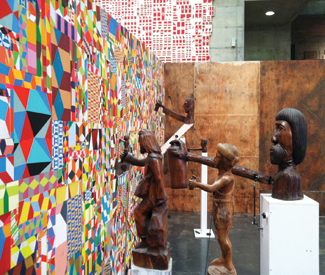
STREET ART Gone are the days when Barry McGee, or Twist, or Ray Fong, or whatever alias he happened to be painting under at the time, stalked the San Francisco streets throwing up 3-D screws, Clarion Alley stunners, and his much-admired tags. Nowadays, he exhibits in big-deal gallery shows, like his mid-career retrospective that opened to much fanfare at the Berkeley Art Museum and Pacific Film Archive on August 24.

BAM/PFA devoted a space the size of a downtown parking garage to McGee’s works, which have ballooned in size as the years go on. Walls literally bulge with clusters of photos and drawings, a homage to the multifarious chorus of the street. A four-pack of dummies from his show at Pittsburgh’s 55th Carnegie International perch on each other shoulders, the uppermost’s arm mechanically waving a spray can. Look, an upended white van! Curator Lawrence Rinder had “no idea” how McGee and his henchmen managed to fit the vehicle into the gallery, as Rinder told a passel of press types at a media preview.

Recently-completed behemoth wall of his patched acid tests in Brooklyn notwithstanding, McGee is the poster child for decades-old genre of “street artist” — those who may have gotten started on the street, but now focus their creative oeuvre on recreating street art-style works indoors.

You’ll never miss the graffiti cultural reference at the retrospective — outside BAM/PFA, tags covered one wall of the museum (“SNITCH” the faker said, tricking me for a moment into thinking that someone had beef with McGee, which would be heresy in these parts) and its glass front doors.

This juxtaposition may be the main thing that keeps McGee’s art interesting. Small tropes impregnate the Berkeley retrospective: on one red wall McGee’s buffed his own work, then overlaid it with blank speech bubbles. Creation, censure, empty creation — it’s the weird feedback loop of his gallery-street life encapsulated.

“I appreciates his early stuff more than the esoteric stuff he’s doing today,” says muralist Sirron Norris when I call him at his Valencia Street studio to talk about McGee’s influence. “That stuff just goes right over my head.”

Norris moved to SF in 1997. Initially a commercial artist, “I was just blown away by the fact that there were cartoons in museums and galleries, and that was because of Barry,” he said. “I thought, I can do that.” McGee and his partner Margaret Kilgallen were instrumental in Norris’ decision to paint his now-signature blue bears and Victorion anti-gentrification Transformer on walls in the Mission and Western Addition. (Catch his most recent, whimsical mega-wall, info in this week’s rundown of our favorite Bay Area murals)

“He was doing something different.” Susan Cervantes co-founded Precita Eyes Mural Arts in 1977, and since then has been at the nexus of community mural-making in San Francisco and the Mission. The kind of murals that Precita Eyes sponsors tend to more neighborhood, family-based than McGee’s works, which even then smacked of high art potential (or were they high art already? A graduate of the SF Art Institute, the “street artist cum gallery artist” cliché was never apt in describing McGee.) Cervantes has known him since before he got into street art, and once he started on her neighborhood’s walls, she says his influence on other artists was undeniable.

“He showed us another way of seeing the world around us,” she tells me in a phone interview. “There’s things that have more content in them than just doing your name, or doing different styles of lettering.”

Looking around at the murals in the Bay today, the possibilities McGee exposed us to are evident. But I wonder sometimes who is becoming inspired by his gallery works, or those of other “street artists” who have found a way to support themselves in the art world. Are there baby taggers out there who are having their minds blown by this street-gallery mashup, who see possibilities for the once-and-sometimes-subversive art, not just increased the potential commercial viability?

Well anyway, I sure hope so.

BARRY MCGEE

Through Dec. 9, $9.50 museum admission

Berkeley Art Museum and Pacific Film Archive

2626 Bancroft Way, Berk.

bampfa.berkeley.edu


Rep Clock

0

Schedules are for Wed/12-Tue/18 except where noted. Director and year are given when available. Double and triple features marked with a •. All times pm unless otherwise specified.

ARTISTS’ TELEVISION ACCESS 992 Valencia, SF; www.othercinema.com. $6. "Other Cinema:" works by Damon Packard, Marcy Saude, and more, Sat, 8:30.

BRIDGE 3010 Geary, SF; www.landmarktheatres.com. $8-10.50. "Studio Ghibli Animation Retrospective:" Ponyo (Miyazaki, 2008), Wed, 2:45, 7, English language version; The Cat Returns (Morita, 2002), Wed, 5:10, 9:25, in Japanese with English subtitles; Howl’s Moving Castle (Miyazaki, 2004), Thu, 2, 7, English language version; My Neighbors the Yamadas (Takahata, 1999), Thu, 4:30, 9:35, in Japanese with English subtitles.

CALIFORNIA 2113 Kittredge St, SF; www.landmarktheatres.com. $8-10.50. Nausicaä of the Valley of the Wind (Miyazaki, 1984), Fri-Sat, 1:50, 4:25, 7, 9:35; Kiki’s Delivery Service (Miyazaki, 1989), Sun-Mon, 1:55, 7; Castle in the Sky (Miyazaki, 1986), Sun-Mon, 4:15, 9; Porco Rosso (Miyazaki, 1992), Tue, 2:50, 7; The Cat Returns (Morita, 2002), Tue, 5, 9:10. All films in Japanese with English subtitles.

CASTRO 429 Castro, SF; (415) 621-6120, www.castrotheatre.com. $8.50-11. •The Breakfast Club (Hughes, 1985), Wed, 7, and Animal House (Landis, 1978), Wed, 8:55. •Bad Day at Black Rock (Sturges, 1955), Thu, 2:30, 7, and The Wild Bunch (Peckinpah, 1969), Thu, 4:10, 8:35. "Midnights for Maniacs: Trix Are For Kids" •The Iron Giant (Bird, 1999), Fri, 7:30; Labyrinth (Henson, 1986), Fri, 9:20; Phenomena: Unrated Director’s Cut (Argento, 1985), Fri, 11:30. One or all three films, $13. Sutro’s: The Palace at Lands End (Wyrsch, 2011), Sat, 2. Remembering Playland At the Beach (Wyrsch, 2010), Sat, 3:30. Kill Bill: Vol. 1 (Tarantino, 2003), Sat, 7. Kill Bill: Vol. 2 (Tarantino, 2004), Sat, 9:10. Willy Wonka and the Chocolate Factory (Stuart, 1971), Sun, 2. Punch-Drunk Love (Anderson, 2002), Sun, 5, 8:45. Death Proof (Tarantino, 2007), Sun, 7. Moonrise Kingdom (Anderson, 2012), Mon-Tue, 7, 9:05 (also Tue, 2:30, 4:45).

CHRISTOPHER B. SMITH RAFAEL FILM CENTER 1118 Fourth St, San Rafael; (415) 454-1222, www.cafilm.org. $6.75-$10.25. Ai Weiwei: Never Sorry (Klayman, 2012), call for dates and times. Beasts of the Southern Wild (Zeitlin, 2012), call for dates and times. The Queen of Versailles (Greenfield, 2012), call for dates and times. 2 Days in New York (Delpy, 2012), call for dates and times. Arbitrage (Jarecki, 2012), Sept 14-20, call for times. Cane Toads: The Conquest 3D (Lewis, 2012), Sept 14-20, call for times. This event, $10-12.

"CINE + MAS SAN FRANCISCO LATINO FILM FESTIVAL" Various Bay Area locations; www.sflatinofilmfestival.com. Most shows $12. Forty features, documentaries, and shorts from Latin America, Spain, and the United States. Sept 13-28.

"FILM NIGHT IN THE PARK" This week: Dolores Park, 19th Ave and Dolores, SF; www.filmnight.org. Donations accepted. The Graduate (Nichols, 1967), Sat, 8.

GOETHE-INSTITUT SAN FRANCISCO 530 Bush, SF; (415) 263-8760. $5 suggested donation. "Homage to Romy Schneider:" The Swimming Pool (Dery, 1969), Wed, 7:30.

MANDELA VILLAGE ARTS CENTER 1357 Fifth St, Oakl; www.ticketweb.com. $10. Brainwash Drive-In/Bike-In/Walk-In Movie Festival, Sat and Sept 21-22, 9. Outdoor screenings with live music and food trucks.

PACIFIC FILM ARCHIVE 2575 Bancroft, Berk; (510) 642-5249, bampfa.berkeley.edu. $5.50-9.50. "Alternative Visions:" "Nights and Days: A Decade of Lebanese Short Films," Wed, 7. "LA Rebellion: Creating a New Black Cinema:" Bush Mama (Gerima, 1975), Thu, 7. "Grand Illusions: French Cinema Classics, 1928-1960:" La jour se lève (Carné, 1939), Fri, 7; Casque d’or (Becker, 1952), Fri, 8:50; Hôtel du Nord (Carné, 1938), Sat, 8:20. "Life is Short: Nikkatsu Studios at 100:" Hometown (Mizoguchi, 1930), Sat, 6:30. "A Theater Near You:" Once Upon a Time in Anatolia (Bilge Ceylan, 2011), Sun, 5.

ROXIE 3117 and 3125 16th St, SF; (415) 863-1087, www.roxie.com. $6.50-10. Kumaré (Gandhi, 2011), Wed, 6:45, 8:45. Red Hook Summer (Lee, 2012), Wed, 6:45, 9. Freedom House: Street Saviors (Starzenski, 2009), Thu, 7:30. "Projector Magazine Screening," Thu, 8. Beauty is Embarrassing (Berkeley, 2012), Sept 14-20, 7, 8:45 (also Sun, 3:15, 5).

SIBLEY AUDITORIUM Bechtel Engineering Center, UC Berkeley, Berk; nature.berkeley.edu. Free (limited seating). California Forever: The Future of Our State Parks (Vassar, 2012), Thu, 5:30. Followed by a panel discussion with filmmakers and environmentalists.

TANNERY 708 Gilman, Berk; berkeleyundergroundfilms.blogspot.com. Donations accepted. "Berkeley Underground Film Society:" Sixteen Candles (Hughes, 1984), Sun, 7:30.

2969 MISSION 2969 Mission, SF; www.answersf.org. $5-10. Attica (Firestone, 1974), Wed, 7.

YERBA BUENA CENTER FOR THE ARTS 701 Mission, SF; www.ybca.org. $8-10. "Femina Potens’ Askew Film and Performance Festival:" "Intersections: LOVE:SEX:PORN:ART: Our Intimate Identity," Thu, 7; "The Birth of Something New: Explorations of Queer Home, Family, and Community," Fri, 7; "In/Visible: Women fighting for visibility and survival in a world that doesn’t always celebrate difference," Sat, 7. Guest-curated by Madison Young of Femina Potens Gallery. *

Rep Clock

0

Schedules are for Wed/5-Tue/11 except where noted. Director and year are given when available. Double and triple features marked with a •. All times pm unless otherwise specified.

ARBOR 4210 Telegraph, Oakl; www.shapeshifterscinema.com. Free. "Shapeshifters Cinema:" expanded cinema works by Kerry Laitala with John Davis and Neal Johnson, Thu, 8.

BRIDGE 3010 Geary, SF; www.landmarktheatres.com. $8-10.50. "Studio Ghibli Animation Retrospective:" Spirited Away (Miyazaki, 2001), Fri, 1:47, 7; Nausicaä of the Valley of the Wind (Miyazaki, 1984), Fri, 4:30, 9:40; My Neighbor Totoro (Miyazaki, 1988), English language version Sat, 3. 7; Japanese with English subtitles, Sat, 5, 9; Princess Mononoke (Miyazaki, 1997), Sun, 1:40, 7; Kiki’s Delivery Service (Miyazaki, 1989), Sun, 4:30, 9:50; Porco Rosso (Miyazaki, 1992), Mon, 2, 7; Only Yesterday (Takahata, 1991), Mon, 4:20, 9:10; Castle in the Sky (Miyazaki, 1986), Tue, 1:40, 4:20, 7, 9:40. All films in Japanese with English subtitles, except where noted with My Neighbor Totoro.

CASTRO 429 Castro, SF; (415) 621-6120, www.castrotheatre.com. $8.50-11. •Fast Times at Ridgemont High (Heckerling, 1982), Wed, 7, and Back to School (Metter, 1986), Wed, 8:45. •The Harder They Come (Henzell, 1972), Thurs, 7, and Marley (Macdonald, 2012), Thurs, 9. "QT & PT:" Reservoir Dogs (Tarantino, 1992), Fri, 7:30, and Sidney (Hard Eight) (Anderson, 1996), Fri, 9:30; •Pulp Fiction (Tarantino, 1994), Sat, 1, 7, and Boogie Nights (Anderson, 1997), Sat, 3:55, 9:55; •Magnolia (Anderson, 1999), Sun, 2:30, 8:50, and Jackie Brown (Tarantino, 1997), Sun, 6. Magic Mike (Soderbergh, 2012), Tue, 2, 4:30, 7, 9:20.

CHRISTOPHER B. SMITH RAFAEL FILM CENTER 1118 Fourth St, San Rafael; (415) 454-1222, www.cafilm.org. $6.75-$10.25. Ai Weiwei: Never Sorry (Klayman, 2012), call for dates and times. Beasts of the Southern Wild (Zeitlin, 2012), call for dates and times. Little White Lies (Canet, 2010), call for dates and times. The Queen of Versailles (Greenfield, 2012), call for dates and times. 2 Days in New York (Delpy, 2012), call for dates and times. California Forever (Vassar, 2012), Sun, 7. With filmmakers David Vassar and Sally Kaplan in person; this event, $12.

"FILM NIGHT IN THE PARK" This week: Old Mill Park, 300 block of Throckmorton, Mill Valley; www.filmnight.org. Donations accepted. Mamma Mia! (Lloyd, 2008), Fri, 8. China Camp, San Rafael. The Adventures of Tintin (Spielberg, 2011), Sat, 8.

GOETHE-INSTITUT SAN FRANCISCO 530 Bush, SF; (415) 263-8760. $5 suggested donation. "Homage to Romy Schneider:" Sissi (Marischka, 1955), Wed, 7:30.

GRAND LAKE 3200 Grand, Oakl; www.sf911truth.org. $7-10. 9/11 Truth Film Festival, a benefit for the Northern California 9/11 Truth Alliance, Tue, 2-11.

JACK LONDON SQUARE First Street at Broadway, Oakl; www.jacklondonsquare.com. Free. Fatal Attraction (Lyne, 1987), Thu, sundown.

PACIFIC FILM ARCHIVE 2575 Bancroft, Berk; (510) 642-5249, bampfa.berkeley.edu. $5.50-9.50. "Alternative Visions:" "The Nervous Films of Janie Geiser" (2002-12), Wed, 7. "LA Rebellion: Creating a New Black Cinema:" Daughters of the Dust (Dash, 1991), Thu, 7. "Life is Short: Nikkatsu Studios at 100:" Capricious Young Man (Itami, 1936), Fri, 7; The Warped Ones (Kurahara, 1960), Fri, 7; Season of the Sun (Furukawa, 1956), Sat, 6:30. "A Theater Near You:" The Graduate (Nichols, 1967), Sat, 8:20.

ROXIE 3117 and 3125 16th St, SF; (415) 863-1087, www.roxie.com. $6.50-10. San Francisco United Film Festival, local and global docs, features, and more, Wed-Thu. Tickets ($10) and more info at www.theunitedfest.com. The Ambassador (Brügger, 2012), Wed-Thu, 7, 9. Kumaré (Gandhi, 2011), Sept 7-13, 6:45, 8:45 (also Sat-Sun, 3, 4:45).

SAN FRANCISCO ART INSTITUTE 800 Chestnut, SF; www.iranianfilmfestival.org. $8-10 (festival pass, $80-100). Iranian Film Festival, short and feature films made by or about Iranians, with a tribute to composer Esfandiar Monfaredzade, Sat-Sun, 11am.

TANNERY 708 Gilman, Berk; berkeleyundergroundfilms.blogspot.com. Donations accepted. "Berkeley Underground Film Society:" The Last Picture Show (Bogdanovich, 1971), Sun, 7:30. *

Barry McGee, you tricked me

0

Granted I’m not out in Berkeley a ton, but I found it strange that someone had tagged an entire concrete side of the Berkeley Art Museum/Pacific Film Archive the very first week that thousands of impressionable minds were invading the UC Berkeley campus and waiting in half-block lines to enjoy a free grilled cheese sandwich in between classes.

“SNITCH,” the 15-foot-tall graff screamed, with a bubble dotting its “I.” Wow, I thought, proceeding to the media preview of Barry McGee a.k.a. Twist a.k.a. Lydia Fong a.k.a. Ray Fong’s first mid-career retrospective (opening today, through Dec. 9) — someone’s not big on Twist.

But duh, everyone (everyone in the Bay who would tag a museum wall, at least) is big on Twist. The “SNITCH” tag, just like the massive red piece that obscured the museum’s glass front doors, was engineered by McGee and his some-dozen team of be-cardiganed, baseball cap flat-brimmed artistic cohorts, many of whom were still bustling about on Thursday trying to get the exhibition ready for the opening reception mere hours away. 

He came up earning tagger cred for his masterful tags and cartoon anti-heroes all over the streets of SF, but the hyper-successful and hyper-problematic museum-street art confluence is a crossroad that Twist has stood firmly atop for decades now. Of course he’s the first to tag his own opening.

I’m not going to go into too much depth about the exhibit here, because that would make the paper piece I’m going to write about it in a few weeks totally pointless, but know that it is the most ambitious spread BAM/PFA has ever undertaken (how the hell did they get that van in there? Curator Larry Rinder had no answers for the passel of press assembled at the preview), in terms of mediums it is wildly diverse, and you will probably never see any thing like it because the days of astronomical funding for art are dead and many of the rarely-seen Twist projects — he hasn’t had a Bay Area solo show since 1994 — took stacks to produce.

If you’re looking for a good moment to check out the show, I suggest that you don’t do it during university passing time unless you dig flip-flops, and that you coordinate instead with one of the rad events that BAM/PFA has scheduled to run in accordance with the show. Here’s a couple: 

L@TE: Friday Nights @ BAM/PFA

Sept. 21, curator Larry Rinder in conversation with Jeffrey Deitch 6-7pm; Lawrence Rinder; Devendra Banhart, Justin Hoover, and Chris Treggiari 7:30-9pm, $7. McGee chats with the guy who funded his biggest splashes, Deitch, and exhibit curator Rinder. The artist’s SF Art Institute fellow alum Barnhardt brings his wacky brand of folk to the L@TE night event, with Hoover and Treggiari slinging their street-based cuisine. 

Oct. 19, Jim Prigoff: “Graffiti: A History in Photographs” 6pm; T.I.T.S. and Erick Lyle (Scam) 7:30-9pm, $7. Prigoff, along with peers Martha Cooper, Jon Naar, Jack Stewart, Henry Chalfant, traveled the world when graff was still in its young’n stages, snapping shots of a youth-based art form that had yet to run through the commercial grinder. Tonight, he runs through some of his archival images of Bay greats like DREAM, and of course, Twist. Zinester Lyle and grrrl mob quartet T.I.T.S. raise a rebel yell later that night at L@TE. 

Nov. 16, Peggy Honeywell and Bill Daniel 7:30-9pm, $7. Visual artist Clare Rojas, a.k.a. folk singer Peggy Honeywell shares an affinity with partner McGee for aliases, and is sure to turn out a hot show (check out our 2011 interview for her woman-centric, quietly lovely artwork). Bill Daniels tracks indie film and hobos with his “dirt lot cinema.”

Barry McGee

Fri/24-Dec. 9

Berkeley Art Museum/Pacific Film Archive

2626 Bancroft, Berk.

(510) 642-0808

bampfa.berkeley.edu

Rep Clock

0

Schedules are for Wed/25-Tue/31 except where noted. Director and year are given when available. Double and triple features marked with a •. All times pm unless otherwise specified.

ARTISTS’ TELEVISION ACCESS 992 Valencia, SF; www.atasite.org. $6. Reconnect: A Film on Cell Phones and Health Effects (Kunze, 2012), Sat, 8.

CASTRO 429 Castro, SF; (415) 621-6120, www.castrotheatre.com. $8.50-11. San Francisco Jewish Film Festival, Wed-Thu. For tickets and more information, visit www.sfjff.org. •Spaceballs (Brooks, 1987), Fri, 7:30, and Blazing Saddles (Brooks, 1974), Fri, 9:25. “The Silence of the Trans:” The Silence of the Lambs (Demme, 1991), with pre-show starring Sharon Needles, Peaches Christ, and the Midnight Mass Players, Sat, 3, 8. Tickets for this event, $25-45; visit www.peacheschrist.com for info. Bearcity 2: The Proposal (Langway, 2012), Sun, 11:30am, 2:00, 4:30, 7:00, 9:25. This event, $10-12; visit bearcity2theproposal.ticketbud.com for info. •Purple Rain (Magnoli, 1984), Tue, 7:30, and Pink Floyd the Wall (Parker, 1982), Tue, 9:40.

CHRISTOPHER B. SMITH RAFAEL FILM CENTER 1118 Fourth St, San Rafael; (415) 454-1222, www.cafilm.org. $6.75-$10.25. Beasts of the Southern Wild (Zeitlin, 2012), call for dates and times. Bernie (Linklater, 2012), call for dates and times. Dark Horse (Solondz, 2011), call for dates and times. Take This Waltz (Polley, 2011), call for dates and times. The Queen of Versailles (Greenfield, 2012), July 27-Aug 2, call for times. Bill W. (Carracino and Hanlon, 2011), Sun, 7.

DAVIES SYMPHONY HALL 201 Van Ness, SF; www.sfsymphony.org. $25-75. The Wizard of Oz (Fleming, 1939), Thu-Fri, 7:30. Screening with live orchestral accompaniment. “Pixar in Concert,” Sat, 7:30; Sun, 2. Songs from Pixar films, with accompanying movie clips.

JACK LONDON SQUARE First Street at Broadway, Oakl; www.jacklondonsquare.com. Free. Ghostbusters (Reitman, 1984), Thu, sundown.

MECHANICS’ INSTITUTE 57 Post, SF; (415) 393-0100, rsvp@milibrary.org. $10. “CinemaLit Film Series: Fairytale Endings:” Excalibur (Boorman, 1981), Fri, 6.

PACIFIC FILM ARCHIVE 2575 Bancroft, Berk; (510) 642-5249, bampfa.berkeley.edu. $5.50-9.50. “Bellissima: Leading Ladies of the Italian Screen:” Open City (Rossellini, 1945), Wed, 7; Bellissima (Visconti, 1953), Sat, 5:30. “The Eternal Poet: Raj Kapoor and the Golden Age of Indian Cinema:” Boot Polish (Arora and Kapoor, 1954), Thu, 7; Awaara (Kapoor, 1951), Sat, 7:45. “Cool World:” Heathers (Lehmann, 1989), Fri, 7; Thunderbolt and Lightfoot (Cimino, 1974), Fri, 9:05. “Russian Inferno: The Films of Alexei Guerman:” The Seventh Companion (Guerman and Aronov, 1967), Sun, 5. “Always for Pleasure: The Films of Les Blank:” •ry cooder group ’88 santa cruz (1988) and Sworn to the Drum: A Tribute to Francisco Aguabella (1995), Sun, 7.

ROXIE 3117 and 3125 16th St, SF; (415) 863-1087, www.roxie.com. $6.50-10. Romantics Anonymous (Ameries, 2011), Wed-Thu, 7, 9. KQED presents: •A Brush With the Tenderloin (Bierma, 2011), and Stage Left: A Story of Theater in San Francisco (Forbord, 2010), Wed, free. Free screening, but RSVP recommended; visit trulyca.eventbrite.com. Kids of Today (De Missolz, 2011), Thu, 7. •Not a Memory (Burdenski, 2012), and Something Personal (Elsaesser, 2012), Thu, 9:15. This event, $5. “This Must Be the Place: Post-Punk Tribes 1978-1982:” La Brune et moi (Puicouyoul, 1979), Fri, 7:30; Rough Cut and Ready Dubbed (Shah and Shaw, 1982), Fri, 8:40; “special secret movie,” Fri, 9:40; The Slog Movie (Markey, 1982), Sat, 7:30; “I Can See It and I’m Part of It: San Francisco Punk Portraits 1978-82” (shorts program), Sat, 9; “Buzz or Howl Under the Influence” (live footage), Sat, 10:20; Debt Begins at 20 (Beroes, 1980), Sun, 7; Downtown 81 (Bertoglio, 1981), Sun, 8:15. Shit Year (Archer, 2010), July 27-Aug 2, 7. “Johnny Legend presents:” The Big TNT Show (Peerce, 1966), Mon, 8; Mondo Teeno: Teenage Rebellion (Herman and Visconti, 1967), Mon, 6:10, 9:45; Teenage Cruisers (Legend, 1977), Tue, 6, 9:45; One Million Years AC/DC (De Prieset, 1969), Tue, 8.

SF FILM SOCIETY CINEMA 1746 Post, SF. $10-11. A Burning Hot Summer (Garrel, 2011), Wed-Thu, 3, 5, 7, 9. Sacrifice (Chen, 2010), July 27-Aug 2, 1, 3:30, 6, 8:30.

TOP OF THE MARK InterContinental Mark Hopkins, One Nob Hill, SF; www.topofthemark.com. Free. “Summer Movie Nights:” It Happened One Night (Capra, 1934), Tue, 7:30. Wine tasting at 5:30.

YERBA BUENA CENTER FOR THE ARTS 701 Mission, SF; (415) 978-2787, www.ybca.org. $6-8. “Documentaries By Ai Weiwei:” One Recluse (2010), Sun, 2.