Opinion

Beyond the budget spin

0

OPINION Local government is frozen. The mayor’s office and the Board of Supervisors have been engaged in open warfare for months. This week, Mayor Gavin Newsom announced that in order to balance San Francisco’s budget, city services and community-based organizations will have to undergo draconian cuts.

In a preemptive move against embarrassing protests, the mayor’s press office did not reveal the location of the annual budget presentation to the news media until late Friday afternoon. Even the supervisors, who will be debating and voting on the budget during the month of June, were left in the dark until then.

While the mayor didn’t blame city workers for the financial crisis, he did suggest that Service Employees International Union Local 1021, which represents the low-wage, frontline, service-providing city workers, should "help out."

Well, we have. SEIU members stepped up to "help out" in fiscal years 2003–04 and 2004–05 by agreeing to wage freezes and self-funding our pensions. All the recent midyear cuts were in public health agencies and among SEIU-represented nonprofits.

Most recently we stepped up by helping draft and vigorously campaigning to pass Proposition B, which freezes city workers wages for two years and tightens eligibility for retiree health care benefits in exchange for a modest increase in city pension benefits.

The mayor’s budget director repeatedly has said that this is a spending problem, not a revenue problem. Talk about spin.

Moreover, in his June 2 budget presentation, the mayor made no mention of raising revenue as an answer to our fiscal problems. You could almost hear Gov. Schwarzenegger’s voice as Newsom presented a slash-services budget with a "no-new-taxes" slogan waiting in the wings for his next campaign.

Everyone knows it’s expensive to live in San Francisco. Paying city employees a wage that allows them to stay in the community they serve isn’t a budget "problem." It ought to be a basic part of what City Hall does and cares about. And if that means looking at bringing in new sources of money, we should have that conversation.

We believe there are various revenue sources that make more sense to explore than some of these service cuts, including a real estate transfer tax increase for high-level properties.

Fortunately, the mayor’s proposal is just a starting point. Soon we will be proposing specific alternatives.

Toward that end, the San Francisco Human Services Network and Coleman Advocates for Children and Youth have organized a citywide forum on the mayor’s proposed budget cuts. SEIU 1021 is cosponsoring this event. The San Francisco budget and revenue town-hall meeting will be held June 9 from 2-4 p.m. in the San Francisco Main Library’s Koret Auditorium, 100 Larkin (at Grove)

Don’t get angry. Get organized.

Robert Haaland

Robert Haaland is a longtime San Francisco activist who works for Local 1021.

Cal-ISO totally changes tune on power plants

0

Oh my. For all you folks that have been following the controversy around building new power plants in San Francisco, it just got even better.

Mayor Gavin Newsom sent a letter to the Board of Supervisors today outlining a “more promising way forward than the current proposal” to build two natural gas-burning “peaking” power plants in the city.

The way forward: retrofit three existing diesel turbines at the Mirant-Potrero Power Plant, while at the same time shutting down Unit 3, the most polluting part of the power plant, as soon as the Transbay Cable comes online.

“On Friday, May 23, Ed Harrington [General Manager of the SFPUC], City Attorney Dennis Herrera and I met with president of Cal-ISO – Yakout Mansour, the chairman of the CPUC – Mike Peevey, the CEO of Mirant – Ed Muller, the CEO of PG&E – Bill Morrow, and our respective staffs. In this meeting we vetted the possibility of retrofitting the diesel turbines [currently owned and operated by Mirant] and asked each stakeholder to give us the necessary commitments to advance this alternative,” Newsom wrote to the Board.

For anyone who’s been closely following the nuances of this argument, this is a significant change in position from the California Independent System Operator [Cal-ISO], and it should be noted that it took — not just the Mayor sitting down at the table — but top dogs from PG&E and Mirant (who both stand to lose money by the city building its own power plants), as well as the CPUC’s Peevey, who’s never expressed a positive opinion about the true need for more power plants in the city.

Now, suddenly, Cal-ISO is departing significantly from all previously expressed demands that we build power plants.

The background: The state, through Cal-ISO, has for the last several years insisted that San Francisco needs 150 megawatts of peak electricity at the ready. We currently get this from Mirant-Potrero, but Unit 3 of that facility has a bad rep as the greatest single source of pollution in the city. People in the Bayview neighborhood, which have carried more of their fair share of pollution, have been waiting a long time for the plant to close. Stakeholders have been meeting for over seven years, working on ways to close the plant, and much of the leadership on the issue has come from Sup. Sophie Maxwell, who represents the Bayview district.

Cal-ISO has insisted that the only way to close Unit 3 is to build new peakers, which would be owned and operated by the city, run cleaner and more efficiently, and still supply that 150 MW of peak power. Even when the 400 MW Transbay Cable was approved, Cal-ISO insisted San Francisco would still need the peakers.

But in a June 2 letter, Cal-ISO suddenly had a different response for the Mayor.

San Francisco, meet Joe Nation

0

OPINION How would you like to be represented by someone who flacks for the insurance industry, serves real estate developers and landlords with zeal, opposes consumer privacy, and is a role model for corporate Democrats with a firm allegiance to big business?

You wouldn’t know it from the vague aura of his slick ads, but Joe Nation is hoping to be that someone in the state Senate. He’s the third candidate in the hotly contested race that includes two stalwart progressive politicians — incumbent Senator Carole Migden and Assemblymember Mark Leno.

Nation jumped into the Senate race in the 3rd District just three months ago. He’s trying to win in a sprawling district that includes half of San Francisco along with all of Marin and parts of Sonoma County. And he could pull it off.

The real danger of a Nation victory hasn’t been apparent to many San Francisco voters. Eyes have been mostly focused on the Leno-Migden battle, and Nation has never been on the ballot in the city before. But those of us who live in North Bay are all too familiar with Joe Nation.

When Nation’s campaign Web site trumpets him as an "advocate for universal health care," the phrasing is typical of his evasive PR approach. While in the state Assembly, Nation pushed for legislation that would force consumers and taxpayers to subsidize the health insurance industry. Meanwhile, he continues to oppose a single-payer system that would guarantee publicly financed health care for all in California.

Likewise, Nation leaves out key information when he calls himself an "international expert on climate change" for an "environmental consulting firm," ENVIRON International. He’s not eager to disclose that much of his work at the firm is for Coca-Cola, which excels at greenwashing its image to obscure its dubious environmental record.

In the Legislature, where he supported charter schools, Nation was problematic on public education. He earned distrust from the California Teachers Association and the California Federation of Teachers, both of which endorsed Leno in the Senate race.

When lawmaker Jackie Speier put forward a tough bill to safeguard consumer information rather than allowing financial institutions to sell it to the likes of telemarketers, Nation worked to undermine the legislation.

In 2006, nearing the end of his six corporate-friendly years in the state Assembly, Nation launched a Democratic primary challenge to US Rep. Lynn Woolsey — who has strong support in the North Bay congressional district because of her courageous leadership against the Iraq war and for a wide range of progressive causes. Nation attacked her from the right. She trounced him on Election Day.

Nation’s long record of siding with powerful economic players inspired the San Francisco Apartment Association and other landlord groups to throw a big fundraiser for his Senate campaign a couple of weeks ago. To big-check donors with an anti-renter agenda, plunking down money for Nation is a smart investment.

Independent polls now show a close race between Nation and Leno, with Migden a distant third. As a practical matter, the way for progressive voters to prevent Joe Nation from winning the state Senate seat is to vote for Mark Leno. *

Norman Solomon is the author of many books, including War Made Easy: How Presidents and Pundits Keep Spinning Us to Death (Wiley, 2005).

The threat of Proposition 98

0

OPINION Just as the California Supreme Court finally recognizes queers as full and equal citizens by ruling in favor of gay marriage, a June 3 ballot measure threatens to kill anti-discrimination protections for queers. But that’s not the half of it: Proposition 98 is in fact a savage attack on protections of all kinds for all Californians.

A fraud wrapped within a fraud, Prop. 98 masquerades as eminent domain reform while only semi-covertly legisutf8g the death of rent control. But just as rent control is about far more than price alone, Prop. 98 is about far more than only ending rent control.

All Californians, not only the 14 million who rent, will be trampled under the iron hooves of this Trojan horse. In a detailed analysis, the Western Center on Law and Poverty concludes: "There is nothing in the text that prevents Prop. 98 from being used to prohibit or limit land use decisions, zoning, work place laws, or environmental protections."

Prop. 98 not only bans all state and local residential and mobile-home rent control laws, now and forever, it kills inclusionary housing requirements and ends tenant protections in the Ellis Act. But wait, there’s more! As assessed by the Western Center, other "likely" applications of Prop 98 include the end of just-cause protections for eviction, and the end of most regulation of residential rental property.

The center also rates it "possible" that Prop. 98 will invalidate all anti-discrimination protections below the federal level — including California’s LGBT fair-housing protections.

Given the potential outcome, the nearly $2 million that more than 100 apartment building and mobile home park owners spent to put Prop. 98 on the ballot, and the subsequent $291,000 that the Apartment Owners Association political action committee gave the Yes on 98 campaign represent a shrewd investment.

It would be a bargain for them at twice the price. Being able to charge unlimited amounts for renter screening and credit checks, for instance, and no longer having to provide deadbolt locks, a usable telephone jack, and working wiring means a nice chunk of change for landlords and speculators. But that’s nothing compared to the larger gains to be exploited: a landlord would be free to have you sign a lease without being obligated to disclose that he or she already applied for a demolition permit on the property. Serious defects in the unit? Too bad, the prohibition on landlords collecting rent while substandard conditions exist would fly out the (broken) window.

Unlike the tenant-backed Prop. 99, which truly prevents eminent domain abuse on behalf of renters and owners alike, Prop. 98 only guarantees the domain of the wealthiest over the rest of us. If we let this Trojan horse in, whether actively — by voting for it — or passively — by not voting — June 3 (and that’s a real danger since too many San Francisco voters assume the measure will fail anyway), all Californians will pay the price. *

Mara Math is a writer and tenant organizer.

We do

0

› steve@sfbg.com

Less than two hours after the California Supreme Court announced its 4–3 decision legalizing same-sex marriage, San Francisco City Hall filled with smiling couples and local politicians of various ideological stripes to celebrate the city’s central role in achieving the most significant civil rights advance in a generation.

The case began four years ago in San Francisco when Mayor Gavin Newsom decided to have the city issue marriage licenses to gay and lesbian couples. City Attorney Dennis Herrera and his legal team built the voluminous legal case that won an improbable victory in a court dominated 6 to 1 by Republican appointees.

"In light of the fundamental nature of the substantive rights embodied in the right to marry — and the central importance to an individual’s opportunity to live a happy, meaningful, and satisfying life as a full member of society — the California Constitution properly must be interpreted to guarantee this basic civil right to all individuals and couples, without regard to their sexual orientation," Chief Justice Ronald George wrote in the majority opinion.

Newsom cut short a trip to Chicago to return home and make calls to the national media and join Herrera’s press conference, where hundreds of couples who got married in San Francisco City Hall were assembled on the City Hall staircase as a backdrop to the jubilant parade of speakers that took the podium.

"What a wonderful, wonderful day," a beaming Herrera told the assembled crowd, adding, "California has taken a tremendous leap forward."

Some speakers (as well as the next day’s coverage in the San Francisco Chronicle) emphasized the potential of the issue to embolden conservatives and the possibility that a November ballot measure could nullify the decision by, as a prepared statement by Rep. Nancy Pelosi put it, "writing discrimination into the state constitution."

But for most San Franciscans, it was a day to celebrate a significant victory. Herrera praised "the courageousness of the California Supreme Court." He also commended Deputy City Attorney Terry Stewart, who argued the case, legal partners such as the National Center for Lesbian Rights, the eight other California cities that supported San Francisco’s position with amicus briefs — and Newsom, who clearly soaked up the adulation and gave a fiery speech that could easily become a campaign commercial in his expected run for governor.

"I can’t express enough how proud I am to be a San Franciscan," Newsom said, later saying of the decision, "It’s about human dignity. It’s about human rights. It’s about time."

Newsom also emphasized that "this day is about real people and their lives."

Among those people, standing on the stairs of City Hall, was Emily Drennen, a current candidate for the Democratic County Central Committee and the District 11 seat on the Board of Supervisors, who was the 326th couple to get married in San Francisco, taking her vows with partner Linda Susan Ulrich.

"When it got nullified, something was taken away from us. It really felt like that," Drennen told the Guardian, adding that she was thrilled and relieved by the ruling. "I was just holding my breath this whole time, expecting the worst but hoping for the best."

Herrera spokesperson Matt Dorsey, who is gay, was similarly tense before the ruling, knowing how much work had gone into it but worried the court might not overcome its ideological predisposition to oppose gay marriage.

"For everyone who worked on this, it was the case of their lives," Dorsey told us. "Politically and legally, there was so much work that this office did that I’m so proud of, and I hope people understand that." *

JROTC must go now

0

OPINION In November 2006, San Francisco made history when the school board made this the first big city in the nation to ban JROTC [Junior Reserve Officer Training Corps]. The board’s resolution, which called for phasing out JROTC from high schools this June, stated that “JROTC is a program wholly created and administrated by the United States Department of Defense, whose documents and memoranda clearly identify JROTC as an important recruiting arm.”

A poison pill was added to the resolution at the last minute: it called for a task force to be set up to find an “alternative” program to JROTC. The school district administration, in a particularly despicable move, set up the task force with more than 10 members supporting JROTC, and only one member opposed.

Surprise! After sitting for almost a year, the task force failed to come up with an alternative, so the school board rolled over and, except for two courageous members — Mark Sanchez and Eric Mar — voted last December to extend JROTC for another year.

In 2005, San Franciscans passed Proposition I by almost 60 percent, declaring it “city policy to oppose military recruiting in public schools.” That same year, by the Army’s own report, 42 percent of JROTC graduates across the nation signed up for the military. As this country enters its sixth year of the illegal occupation of Iraq and Afghanistan, it’s time for the school board to go back to its original decision to kick the military out of our schools.

The school board must end JROTC — now. JROTC is currently scheduled to be “phased out,” but not until June 2009. By then both Sanchez and Mar will be off the school board, and there will be little to prevent the military from orchestrating a vote to extend JROTC indefinitely. If, on the other hand, the school board votes to end JROTC this June as their original resolution required, JROTC would be gone.

Two progressives on the board must be convinced to send the military packing: Kim-Shree Maufas and Green Party member Jane Kim.

Both received endorsements from progressives. To convince them that they risk such endorsements in the future, the JROTC Must Go! Coalition is circuutf8g the following statement: “We will look very closely at the next school board vote on JROTC and will consider the votes carefully when making any endorsements for future candidates.”

Within a week, the Tenants Union, the Harvey Milk LGBT Democratic Club, and the San Francisco Bay View newspaper signed the statement. If Maufas and Kim join Sanchez and Mar, we’ll make history again.

Riva Enteen is the former program director for the National Lawyers Guild and the mother of two San Francisco school district graduates. Tommi Avicolli Mecca is a southern Italian queer atheist writer and activist. For more information contact the JROTC Must Go! Coalition: (415) 575-5543 or JROTCmustgo@gmail.com.


Bones and balls

0

› le_chicken_farmer@yahoo.com

CHEAP EATS Bones are supposed to decompose, right? But sometimes, for the sake of archaeology, they don’t. They pile up behind you in the cave until, if you eat as much meat as I do, you eventually have to live outside.

It’s like naming a band. The old ones don’t go away, so it just keeps getting harder, which is why many musicians my age either give up or rejoin their old groups and go on reunion tours. Or they switch genres, simply so they can recycle the old names but with z‘s for s‘s. A short-lived solution (if it has any life at all), as evidenced by the almost immediate fizzle of The Bee Geez, Harry Nilzzon, and the Mamaz & the Papaz — heavy metallic flops all.

Soon we will begin to see (and hear, and feel) the effects of a generation of rising rockers whose parents announced their births via e-mail. Brace yourselves. Here comes U2000, Prince2009, and, my personal favorite, AbbaLoL.

Recycling is good. It’s decided, right? Without it we all die and have no music to listen to on our deathbeds. I save the bones. So do lots of people, Mountain Sam to name just one. He makes sculptures out of them. I make soup, then I scrape and dry them, wrap one end with rubber and/or felt, and re-reuse them as steel drum mallets. So that’s food, food again, then music. Then they just pile up in my cave and stay there, waiting for future archaeologists to wonder about a chicken-like creature that wore socks.

I was babysitting the baby I babysit (I’m not allowed to say her name) and the TV was on because the mama and the papa hadn’t left yet. This is what distinguishes me as a babysitter: no TV. None. Absolutely not. TV is not harmful enough, in my opinion. Instead, we do truly dangerous things together, like tasting mysterious plants, staring into mirrors, and rock climbing, me and this one-year-old.

But the parents hadn’t left yet. The TV was on. Food Channel, so I was interested. Mesmerized. Appalled … because what they were talking about was barbecued spaghetti, some joint in Tennessee, and I have to say it looked delicious. I was appalled because here I’ve been trying to invent a thing that has already been invented.

Hey, there oughta be a saying about this, something like, I don’t know, reinventing the … uh …

Never mind.

You people who live your whole life without ever changing gender — not even once. Frankly, I don’t know how you do it. I mean, it takes all kinds, I suppose, but I personally would have died of boredom by now.

In the coed soccer league I play in, I’m an average-size girl with average speed and average skills. I’m slightly above-average agewise, and slightly below-average butchwise. No matter what, though, there is always one thing that distinguishes me from the other girls on the field and it is this: as far as I know, I’m the only one out there with balls.

And I’m not speaking figuratively. If anything having balls, in this case, makes you chickenshit. You know how when guys line up in front of a free kick, they place their hands over their crotch? I can’t do that! So I run away. Nobody knows I’m trans. At least that I know of, nobody knows. I’m not sure about league policy on this.

I’ve always wondered what would happen … what I would do, what my body would do, if and when I took a ball to the balls in one of these games. It was a matter of time, and in the first half of the second game of my third season as a girl, there it was. A guy unloaded and I jumped but didn’t twist, and, oof!

Guys know what this feels like. Now I know what it feels like to feel that feeling and not be able to go down, not even to one knee. To have to turn and run like nothing much happened, without even a look on your face, breathless, hating life but just generally playing on.

—————————————————————————-

My new favorite restaurant is Mary’s Place in Novato, where I’ve been camping out a lot on account of car problems. Mary’s Place is a way to kill time over delicious crepes, hash browns, and coffee, coffee, coffee. It has a counter. It’s kind of a diner-ish feel, but with way better food. And, oh yeah, a bar.

MARY’S PLACE

819 Grant, Novato

(415) 897-9761

Tue.–Sat., 7 a.m.–9 p.m.

Sun.–Mon., 7 a.m.–3 p.m.

Full bar

MC/V/AE

We stand with Carole Migden

0

OPINION As longtime fans of the Guardian and as allies in almost every fight, including the struggles for public power, affordable housing, people-focused land use policy, and clean and open government, we do not like finding ourselves on the opposite side of an issue as important as this year’s state Senate race. Respectfully, we must say that we believe the Guardian‘s failure to endorse Carole Migden in that race was a colossal mistake — not unlike the decision to endorse Angela Alioto over Tom Ammiano and Matt Gonzalez for mayor in 2003.

Both Leno and Migden are good votes in Sacramento. But the simple reality is that Carole Migden has been there for the local left in ways that make her the only choice for progressives willing to take on the establishment. Certainly Migden has made herself vulnerable to political attacks. Her failure to retain a professional treasurer for her campaign finance filings was clearly an error of judgment. But for us, none of this outweighs her incredible record of achievement in Sacramento or her far more reliable support of progressive candidates and causes in San Francisco.

Guardian readers should by now be familiar with Migden’s long record in Sacramento: the California Clean Water Act, saving the Headwaters Forest, community choice aggregation (CCA), a series of domestic partnership laws that have established a viable alternative to marriage in California while setting the stage for extending marriage rights to same-sex couples, a remarkable package of foster care reforms, and cosmetics safety legislation.

But it is Migden’s role locally that makes her so important to San Francisco progressives. Migden is the only candidate in the race who has been there for progressives in difficult political battles. As candidates for the Democratic County Central Committee, we are grateful that the Guardian endorsed our entire slate. But we wonder if the Guardian considered the fact that the vast majority (indeed, almost unanimous) of Hope Slate candidates are Migden supporters, because they are the leading progressive candidates to retain a progressive majority on the Board of Supervisors in November. It is not coincidental.

Few politicians who have risen as high in the establishment food chain as Carole Migden have done so retaining a willingness to fight for the underdog. Guardian readers should be familiar with the litany: she supported Aaron Peskin and Jake McGoldrick in 2000; reached out to Chris Daly soon thereafter and stood strongly with him against subsequent challenges; never, ever supported Gavin Newsom; attended the Progressive Convention; and financed progressive campaigns from the Affordable Housing Bond to Muni reform.

Migden is a scrappy street fighter who helps other scrappy street fighters. As one of the very first queers and one of the first women to take political power at these levels, she had to be. Someday progressive politics may not need scrappy street fighters (and someday maybe women will be better represented in public office) — but not yet.

We are proud to stand with Carole Migden, as she has stood with us. She is the candidate in this race who we can count on to fight when it really counts.

Bill Barnes, Chris Daly, Michael Goldstein, Robert Haaland, Joe Julian, Eric Mar, Rafael Mandelman, Eric Quezada, and Debra Walker

The writers are Hope Slate candidates for the DCCC.

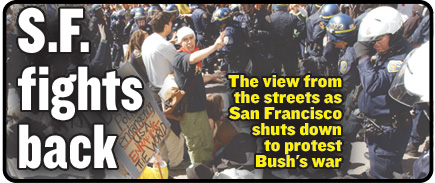
No peace, no work

0

OPINION Organized labor is set to mark May Day — International Workers’ Day — with what could be the loudest and most forceful demand yet for rapid withdrawal of US forces from Iraq.

Members of the International Longshore and Warehouse Union (ILWU) will lead the way by refusing to work their eight-hour morning shifts at ports in California, Oregon, and Washington. For them, it will be a "no peace, no work" holiday — in effect, a strike against the war.

Like many other unions and labor organizations nationwide, the ILWU has long opposed the war in Iraq as an imperialist action in which the lives of young working-class Americans and Iraqi citizens are being needlessly wasted.

The ILWU hopes the dramatic act of shutting down West Coast ports will inspire Americans everywhere to oppose the war.

The coalition behind this movement, US Labor Against the War (USLAW), has been growing steadily since the invasion of Iraq. It’s now the largest organized antiwar group of any kind and is drawing important support, not only from unions but from a wide variety of socially-conscious activist groups outside the labor movement.

USLAW’s members, which represent millions of workers, significantly include the AFL-CIO and most of the federation’s 56 affiliated unions. No one can doubt USLAW’s ability to organize a massive protest like the one ILWU is hoping to lead: it was USLAW that put together the antiwar demonstration that drew half a million marchers to Washington, DC last year.

USLAW is demanding primarily that "our elected leaders stop funding the war, bring our troops home, and start meeting human needs here at home," notes Fred Mason, an AFL-CIO official in Maryland.

In the meantime, says Gerald McEntee, a key public employee union leader, "We are spreading violence in Iraq, not democracy." The Bush administration’s policies, says Musicians Union leader Tom Lee, "make us less secure, increase the threat of terrorism, and have put Iraq on a path of civil war."

ILWU President Robert McEllrath has urged unions and allied groups outside the United States to also mount protests "to honor labor history and express support for the troops by bringing them home safely."

The AFL-CIO’s role is particularly notable. It marks the first time the federation has ever opposed a war, whether the president was a pro-labor Democrat or, as now, an antilabor Republican.

The longshoremen’s union, which was not affiliated with the AFL-CIO at the time, was firmly opposed to the Vietnam and Persian Gulf wars. The ILWU also was a major opponent of dictatorial regimes in South and Central America and the apartheid regime in South Africa, its members often refusing to handle cargo coming from or going to those countries. Just recently, ILWU members in Tacoma, Wash., refused for conscientious reasons to load cargo headed for the Iraq war zone.

We can only hope — and hope fervently — that the union’s May Day show of strong opposition to the war in Iraq will help prompt millions of others to conclude that they, too, cannot in good conscience support that seemingly endless war.

Dick Meister

Dick Meister is a San Francisco–based writer who has covered labor and political issues for a half-century as a reporter, editor, and commentator. Contact him through his Web site: www.dickmeister.com

Newsom’s missing trees

0

OPINION During his 2003 mayoral campaign, Gavin Newsom circulated a beautifully presented eight-page "policy brief" for "A Green and Clean San Francisco." The first four pages were devoted to a pledge to "grow our urban canopy" — a subject near and dear to my heart.

Newsom announced: "As mayor of San Francisco, I will lead the city government and community organizations to make San Francisco a city we can take pride in — a city with green [emphasis mine], clean, and livable neighborhoods." As his first action, he said, "I will grow our urban canopy by placing a priority on tree planting and care."

For good measure, he tantalized us with some goodies: "Visualize 19th Avenue as a welcoming beautiful gateway to the city, lined with trees and planters." He promised to improve the lack of coordination among city agencies and departments involved in street tree planting, care, and planning by using new technologies such as CitiStat. And, most important, he committed himself to addressing the massive underfunding of the expansion and maintenance of the urban canopy.

These promises were made in the context of the long-standing critical state of the city’s urban forest. The candidate put it this way: San Francisco lags behind other communities in providing a vital, vibrant, and ecologically sustainable urban canopy, as well as open space, in the city. San Francisco has an estimated 90,000 street trees. By comparison, San Jose boasts 231,000 street trees. Our urban canopy is full of holes: Friends of the Urban Forest estimates we have only 75 street trees per mile, compared to the national average of 120 trees per mile. That means San Francisco has a little more than half the street trees of similarly sized cities.

Today, after more four years in office, the mayor’s promises are still just that. Nothing close to what he committed to do has been accomplished or implemented. Instead the mayor has relied on press releases, disinformation, and a newly staffed position with a yet-to-be-defined role to publicize his claimed achievements.

As I speak, the mayor has seven full–time press officers polishing his image, which, coincidentally, is the same number — seven — of filled managerial/administrative positions in the Department of Public Works Bureau of Urban Forestry, the division responsible for managing all the street trees in the city. The Department of the Environment has only two-thirds of one position (out of some 65 full-time positions) devoted to urban trees.

The Office of Greening, established in 2005, has had three directors, with no announced action from the latest one since she took over in February. The Greening Vision Council, chaired by the greening director, has been dormant for more than two years. The April 2006 Urban Forest Plan died in the Planning Department. And no one in the Controller’s Office has any direct knowledge of that new technology, CitiStat.

The mayor’s spinning was at its most inventive when he used creative accounting to claim on Arbor Day last year that more than 15,000 trees were added to the city in the years 2004 to 2006, when actual total was closer to 4,800 trees.

So much for "green and clean."

Allen Grossman

Allen Grossman is executive director of the SF Urban Forest Coalition.

The SEIU strikes back

0

› jesse@sfbg.com

The Rhode Island Street headquarters for Local 1021 of the giant Service Employees International Union (SEIU) had several surprise visitors April 14. First, International President Andy Stern arrived from Washington DC to speak with the local’s executive board.

Then, after word of Stern’s last minute appearance got out, a group of 20 activists from Oakland–based SEIU affiliate United Healthcare Workers West (UHW) attempted to enter the building and confront Stern about what they perceive to be his anti-democratic administration. They were barred from the meeting. When the Guardian attempted to gain entrance, we were twice escorted to the exit by 1021 staffers. A source inside the union said Stern left through a back door during lunchtime.

Stern’s visit and the dissidents’ foiled attempt to meet him reflect the high level of tension inside SEIU these days. As it prepares to vote on several democratic reform measures at a convention in early June, internal fault lines have split the 1.9 million-member union.

As we reported last week ("Hard Labor," 4/9/08) Stern loyalists have pushed the boundaries of union rules, and perhaps even federal law, to beat back the slate of reforms championed by UHW’s dissident leader, Sal Rosselli.

Now, in response to our reporting and to Rosselli’s movement, leaders inside the labor giant apparently have gone into full damage-control mode.

In fact, an election committee that appears to have been hand-picked by Local 1021’s president already rejected an internal complaint about the election process — and critics are calling foul.

WHO’S A MEMBER?


Two weeks ago, the Guardian reported on a controversial batch of e-mails among SEIU officials. Calling themselves the "salsa team," high-level union staffers — including Damita Davis-Howard, whom Stern appointed as president of 1021, as well as Josie Mooney, a Stern assistant — swapped campaign strategy and exchanged anti-Rosselli talking points during an election to select delegates to the upcoming convention.

On April 4, more than a dozen union members lodged a formal complaint with the organization’s local election committee. The complaint charged that the salsa team’s missives broke union rules against staff involvement in elections. Soon afterward, lawyers representing Rosselli’s union filed suit against Stern and the SEIU — alleging, among other things, that SEIU "officers, employees, and allies" interfered with delegate elections in violation of federal labor law.

While the lawsuit will not see a courtroom for some time, it didn’t take long for the union committee to rule against the members’ complaint. In a memo dated the following Monday, April 7, and obtained by the Guardian, the nine-member body reported to the union’s International Secretary-Treasurer that "the staff (directors and others) named in the challenge are members of Local 1021 and therefore have the same right as all other members" to participate in the election.

The distinction is key: union rules strictly forbid paid staffers from interfering in elections by members. And supporters of union democracy insist that a central tenet of their movement are the notions that staffers work for the membership — and that the members, not the staff, determine union policy (See Opinion, page 7).

The outcome is important not only to the union but to progressive politics in San Francisco. Local 1021 (and Local 790, the San Francisco chapter that predates it) has played a major role in supporting progressive causes and candidates.

The committee’s ruling, and the speed with which it reached its decision, outraged many inside the union. A number of 1021 staffers who declined to be identified for fear of reprisal called the memo "bullshit" when asked to comment.

Union member Maria Guillen, one of the members who signed the complaint, told us that the salsa team’s actions and their exoneration by the election committee "go against the spirit of union democracy." Guillen went on to challenge the assertion that union staff, especially top management like Mooney and Davis-Howard, have the same rights as rank and file members when it comes to campaigning in union elections.

"None of the executive board members I’ve spoken to can recall voting on that. Who had the authority to permit that? … To think that folks with all the resources and all the connections are working against us, it breaks my heart."

The makeup of the committee also raises conflict of interest issues.

According to the provisional bylaws for Local 1021, which were enacted after it was formed in early 2007 by merging 10 separate Northern California locals, 1021’s appointed president Damita Davis-Howard has control "in creating committees and naming members to such committees." Several sources inside the union told us she used this power to select the members of the election committee that apparently ruled on whether she herself broke union rules.

Davis-Howard did not return calls for comment and our attempts to reach committee chair Cassandra Burdick through staff at Local 1021 were unsuccessful.

SEIU international spokesperson Andy McDonald could not confirm whether Davis-Howard had in fact named the election committee members to their positions

ROUGH STUFF


In another indication of just how radioactive SEIU’s internal dissension has become, numerous Democratic politicians and party officials in California recently received a letter signed by five presidents of SEIU locals around the state, including Davis-Howard. The letter, obtained by the Guardian and dated April 2 — the day after we broke the salsa team story — seeks to reassure party members that the union will clean its own house. It also appears to warn the state’s political leaders not to choose sides between Rosselli and Stern.

With millions of dollars in its coffers, SEIU is a prime source of campaign cash for politicians.

"We have a democratic process for resolving our internal differences," the letter reads. "In fact, our members will debate and set the course of our union at our convention in June. We hope that you will respect the right of our members to decide for themselves the direction of their union and avoid involvement in our internal affairs."

SEIU’s alleged hardball tactics have extended beyond its internal conflict in recent weeks. The union has been feuding with the California Nurses Association over allegations that the nurses’ union has been attempting to woo SEIU members into switching to the competing union.

Last week, several CNA board members in Southern California claimed that SEIU staffers showed up at their doors and confronted them. SEIU confirmed that it’s sending people to CNA members’ houses, but said there was no intimidation. And last weekend, a large crowd of SEIU members allegedly stormed a convention in Michigan put on by the magazine Labor Notes. A press release from CNA claimed several people were injured and that numerous CNA officials had to flee "out the back of the hall for their safety."

SEIU’s Lynda Tran confirmed that "things got a little rough" when a group of SEIU members and staff attempted to confront a CNA official. "Folks from both sides got injured," she added.

Labor activist and author Herman Benson, of the Association for Union Democracy in New York, told the Guardian that the divisions within SEIU, and its conflicts with other unions, are nothing new in the labor movement. For nearly as long as unions have existed, he said, power struggles have taken place among union brass. "Any incumbency has enormous weapons at its disposal."

Benson praised Stern for his efforts in recruiting new members for SEIU. As the rest of organized labor has continued to decline in America, Stern’s shop has brought in nearly 1 million new members. But Benson took issue with what he perceived as intolerance for dissent within his ranks.

"Stern has a vision of an almost militarized bureaucratic labor movement … but if you can’t have criticism before your international convention, when can you have it?"

What union democracy means

0

OPINION The troubles in the Service Employees International Union, and within SEIU Local 1021 in San Francisco, share a similar theme. How much do individual locals direct their work in the face of the international’s set agenda? And more important, how do union members themselves direct the vision, use of resources, and work of both their local and international union? What is union democracy and how is it made real?

Active members in Local 1021 learned a painful lesson recently when we discovered that senior 1021 staff ran a clandestine campaign during a member election to choose delegates to SEIU’s quadrennial convention this June. These same senior staff demanded that their junior staff remain completely neutral and uninvolved in the election.

A key tenet of union democracy is recognition by all parties that the union staffers work for the members, whose dues pay for their salaries and benefits, their offices, and the programs run by the union.

Local 1021’s governing bodies were appointed by Andy Stern, president of the international, at the time of the merger of 10 locals into one. Next year, Local 1021 holds its first officer and executive board elections. It is essential that we lay out bylaws and an election process guaranteeing that the direction of our local union will be led by its members.

We are at a vital juncture. Do we allow the programs and process to be driven by the international, Stern, and his loyalist staff — or do we assert ourselves as members, examine the issues for ourselves, and choose how we prioritize the work to be done?

At stake is not just the true empowerment of our union, but its credibility. We demand a sense of fair play from the employers we bargain with and consistently take a hard line against managerial favoritism.

In practically every contract campaign, there is a battle over the definition of our union and our very identity. We put forth photographs of our members, use their quotes in the press, and otherwise say to the public, the press, and elected officials that “these people are the union — the nurses, transit workers, librarians, road crews and others who serve our community.”

Meanwhile, management — as well as anti-union lobbies, officials, and think tanks — speak in more pejorative terms of “union bosses” and “big labor,” conjuring images of bureaucrats who cut deals, make the real decisions, and are disconnected from their rank-and-file membership.

It is critical that we don’t prove our opponents right. If the boss-like behavior of our leaders and the manner in which they govern this union promotes double standards, favoritism, and a lack of local autonomy, we only make it easier for anti-union forces to drive a wedge between our members and their union.

Nobody has more at stake in SEIU than the members who pay the bills and whose wages, benefits, and working conditions are being negotiated. Without the international showing respect for local autonomy or democratic empowerment at the local and worksite levels, we cannot hope for existing members to feel like stakeholders in their union, or to inspire prospective members to join us in the future.

Mary C. Magee and Roxanne Sanchez

Mary C. Magee, RN, works at San Francisco General Hospital. Roxanne Sanchez works for Bay Area Rapid Transit. They are members of SEIU Local 1021.


The punch line

0

› le_chicken_farmer@yahoo.com

CHEAP EATS I wrote a joke. I don’t mean that I tried to write something funny. I’ve been doing that (which is to say, this) since I was nine. I mean that for the first time, I wrote a joke joke, the kind that gets told by comedians, barbers … basically everybody in the world tells jokes. Except me, cause I can never remember the punch line.

For the joke I wrote, I made the punch line first. It was twisted, diabolical, clever, goofy, and just generally pretzels — such an amazing and unthinkable payoff that it took me hours and hours and hours to earn it, to craft the hard part of the joke, the long part, in my head. I was driving. By the time I got the getting-there down, I had forgotten the punch line.

Not really. But I knew I would. So as soon as I got out of the car, I wrote it down in an e-mail and, to be mean, sent it to my most inquisitive, most curious, most questioning, most nearly neurotic friend. I said, "I wrote a joke. Here’s the punch line."

Then I forgot it. I could find it in my out box, maybe, but it’s more fun, in my opinion, not to remember the punch line to the joke you wrote, or not to know the joke to the greatest punch line in the history of humor. My friend probably disagrees.

I never said I was nice. Sweet, yes. Cute. And sometimes, like when I’m not splashing green salsa or dumping noodle soup all over myself (admittedly the moments are rare), I can be charming, dignified, even ladylike. But I’m not a good person.

For example, I hate dogs. I don’t know what dogs ever did to me, or what I ever did to dogs, but I hate them and the feeling seems mutual. I do know what I did, actually, but it was so long ago! I was five! And socially awkward! And incontinent!

My kindergarten teacher, Mrs. Plant, left her toy poodle Muffy in her car, windows closed, on the hottest day of the year, and the poor little feller just melted. When, from the playground, we heard Mrs. Plant’s shriek, we of course went running to see what was biting her.

Well, poor little Muffy had been perched on the armrest, scratching at the passenger seat window, when she gave up the … whatever. Thus, when poor shrieky Mrs. Plant finally opened the car door, Muffy just sort of oozed out into the parking lot. Rigor mortis had not set in. I mean, this dog was practically liquid, sort of steaming, sort of wavy, like a mirage.

Here’s where accounts vary. I say: while my angelic, dog-loving classmates wrapped themselves comfortingly around Mrs. Plant’s considerable legs — I believe there were two of them — I stepped up to little liquid Muffy and, with a perfectly healthy and appropriately morbid curiosity, touched it with my toes. At which, quite naturally, considering the magnitude of the moment, I wet my pants, kind of adding to the mess.

What Mrs. Plant told the principal was I squatted over her dear, departed doggy, lifted my skirt (figuratively speaking) and "scatologically degraded its corpse."

Truth be told, I prefer her version. It’s so punk!

In any case, not to date myself (although it might eventually come to that) … but this was back when corporal punishment was quite in style at public schools. Our principal’s weapon of ass destruction, as we called it, was nicely varnished at the handle, then raw wood at the business end, scuffed and scored to encourage splinters.

I was still crying when my mom, a top-shelf linguistics prof with poetic powers (or at least a liking of alliteration) came home from work.

My mother was a sensible, kind, instructive woman, and at this point anyone who knows her suddenly realizes, without a shred of doubt, that this is a joke. However, exactly what my mother said to me after I tearfully told all, only one person in this wide world knows. And it isn’t me, and it’s certainly not my mom.

What’s in it for you is dinner.

My new least favorite restaurant is La Corneta in Glen Park. I’ve always had a love/hate relationship with it. Now it’s hate. The green salsa, which I love, got stuck in the squeeze bottle. Why anyone would keep salsa in a squeeze bottle is beyond me. But there it was, and stuck it was. Until I squeezed too hard. It became unstuck in dramatic fashion. My face, my eye, my hair, my new dress, my cousins, the wall. I’m still finding green salsa in places where no color salsas should be. Bullshit!

LA CORNETA

Mon.–Sat., 10 a.m.–10 p.m.; Sun., 11 a.m.–9 p.m.

2834 Diamond, SF

(415) 469-8757

Beer

Cash only

NY Times gets all anguished over opinions

0

I thought this debate was pretty much over, but the Public Editor at the NY Times is all agitated now about the “line between analysis and opinion” in newspapers. Gee: A business or legal reporter with many years experience in the field dares to give an informed opinon about what’s really going on. That seems like elemental journalism to me.

I think Clark Hoyt missed the larger, and more interesting debate, which is particularly relevant at a time when blogs are becoming a major source of information for people.

It’s not about opinion or analysis; it’s about reporting.

Some opinion writers (Maureeen Dowd comes to mind at the Times) never ever seem to pick up the phone and call anyone; they just read what others have written and opine. That’s fine, I suppose, but I’ve always thought the best columnists were the ones who actually do some legwork, who get out and report on events and then tell us what they think. At the Times, Bob Herbert does that. William Safire, who was often wrong, did it, too — I remember years ago reading a piece he’d written about NY Governor Mario Cuomo and Saddam Hussein; instead of whining about the guv, he picked up a telephone and called him. Thanks to the Times index, I ran the 1992 column down. Check it out; here’s a conservative Times columnist and a liberal New York governor arguing about how to handle what become the first Gulf War. Far more interesting reading than a lot of the tumbsucking that goes on in op-ed columns these days.

So if the business and legal reporters, who are actually interviewing sources and calling people and running down stories want to add their opinions, the world is better for it.

The bloggers who actually make phone calls, interview people, call someone before they comment about him or her are still rare. But that will change as this new form of journalism emerges.

I’ve found that my biased, slated, non-objective reporting is always better if I call the other side and argue for a while. Makes me smarter. Makes the story better. Demanding that your columnists call the subjects of their vitriole before they let loose seems to me a lot more important than worrying about who’s sneaking an opinion into a story.

Play, don’t spray

0

OPINION On Aug. 1, 2008, the California Department of Food and Agriculture plans to spray the San Francisco Bay Area from the air with a time-released pesticide in an effort to wipe out the Light Brown Apple Moth (LBAM). There will be continuous spraying every 30 to 90 days for the next two to 10 years. We can’t leave town for the weekend and come back when it’s clear; there will be no "all-clear" to come home to. The CDFA claims that the spray "should be" safe, despite that it has never been independently tested and no environmental studies have been done.

We represent concerned families with children, pets, and loved ones with respiratory ailments. The more we research this proposal, the more upset and opposed we’re becoming. Thus far we’ve learned that the pheromone pesticide, Checkmate OLF-R, is untested, contains known carcinogens and endocrine disruptors, and is delivered in time-released microcapsules that can be inhaled and lodged in the lungs, causing respiratory harm.

Here are some of the warnings on the Checkmate label:

KEEP OUT OF REACH OF CHILDREN…. Harmful if absorbed through the skin. Harmful if inhaled…. IF ON SKIN OR CLOTHING: Take off contaminated clothing. Rinse skin immediately with plenty of water for 15-20 minutes. Call poison control …

The US Department of Agriculture announced emergency funding to combat the LBAM infestation in California, bypassing the normal safety and environmental studies, and asks us to take on faith that aerial spraying is necessary and safe. How many times have we been told something was safe only to hear a big "oops" a few years or decades later? Thalidomide, DDT, Agent Orange…. The most vulnerable populations include fetuses, pregnant women, and children.

Biologists and etymologists agree that aerial spraying will not accomplish the CDFA goal of eradicating the moth. Instead, they encourage focus on containment. Less invasive, integrated pest management solutions for the LBAM exist and are working for other countries such as New Zealand, whose climate and flora are comparable to California’s. Aerial spraying is expensive, outdated, unsustainable, and — ultimately — likely to be unsuccessful.

What is even more alarming is that the LBAM has not proven to be a devastating pest elsewhere. It has not caused crop damage in Hawaii over the past 100 years. Europe has no restrictions against it. According to a report published by horticulturalists Daniel Harder and Jeff Rosendale, the moth rarely penetrates fruit, does not defoliate plants, and at worst causes only cosmetic damage.

We don’t want to be the guinea pigs for this wasteful, thoughtless, and high-risk approach. Do not sit quietly.

Get educated, spread the word, and contact our elected officials to say that we will not stand by and let this happen. Email your supervisor here. Write to Assembly and Senate members here.

We are planning a peaceful "play-in" with children present on Monday, April 28 at 10 a.m. in front of City Hall to show our strength against this immoral and illegal plan. Play, not spray.

Check out these sites to learn more: www.LBAMspray.com and www.stopthespray.com

Nina Gold, Amy Lodato, Lynn Murphy, Patricia Ardziejewski

Nina Gold, Amy Lodato, Lynn Murphy, and Patricia Ardziejewski are members of Play Not Spray, a group opposed to the LBAM spraying.

Speed Reading

0

THE DEATH OF THE CRITIC

By Rónán McDonald

Continuum

160 pages

$21.95

Rónán McDonald notes that upon hearing his book’s Roland Barthes–inspired title, people assume he is celebrating the death of so-called (and often self-deemed) experts. The Death of the Critic‘s jacket image mordantly plays off this assumption — one might think the contents were a fictive, rather than nonfiction, whodunit. Those who look beneath the red-and-black color scheme will discover McDonald has penned a passionate four-chapter eulogy for a practice that he believes can be reborn. His reference points are United Kingdom–centric, and in this newspaper critic’s opinion, he could go beyond name-dropping certain populist writers with vernacular voices to engage with their ideas as seriously as he does those of scholars. But in a pair of core chapters — about critical value, and science and sensibility — McDonald’s phrasing and historical erudition are as sharp as the bloody knife on the cover. (Johnny Ray Huston)

HEADLESS BODY IN TOPLESS BAR

By the staff of the New York Post

HarperEntertainment

191 pages

$14.95

Probably the greatest headline ever written (outside of The Onion) is the title of this book, a collection of New York Post zingers that prove no news is above mockery ("Al-Qa-ught: Cops catch five London bombers") and that a good pun never gets old ("NO KWAN DO: Michelle threatens to quit Games"). The cover artwork, reproduced with full-page treatments for notable efforts, is worth mentioning, such as the "755: Bonds breaks home-run record" cover, which illustrated the feat by spelling out "755" with syringes. Divided into chapters by subject (politics, celebrities, mafia, etc.) Headless Body is well worth reading through in one sitting before stashing in the john for future, random-page chuckles. (Cheryl Eddy)

Grooves

0

KYLIE MINOGUE

X

(EMI)

As with any highly anticipated release from a pop siren, there’s sure to be predictable praise from diehard fans: think of all the Janet devotees who’ve supported her multiple failed attempts to relaunch as an pop icon, instead of a wardrobe-malfunctioning pariah. Also to be expected are the rip-to-shreds haters who will use any sign of weakness as bait. For miniature Aussie pop goddess Kylie Minogue, her 10th effort, X, was receiving equal amounts of love and hate many moons before its repeatedly pushed-back release date. Thanks to the cyberpirates of the techno-age, Minogue’s aural goodies were offered up for all of the online world to hear — even before the official tracklist was determined.

Leakage aside, opinion didn’t deter this überpop-tart from bringing a fiercer, more sexed-up version of her already adorable self to the dozen tracks on the uneven but thoroughly enjoyable X. Highlights include the vampy swagger of opener "2 Hearts" and the frenetic disco-meets-electro jam "In My Arms," written and produced by Scottish electro prodigy Calvin Harris and laced with his signature warped, underwater synths and pert handclap percussion. In its weaker moments, X sounds like a mashup of modern pop heavies. The robotic chant of "Speakerphone" recalls a made-for-TV version of Daft Punk’s "Harder, Better, Faster, Stronger" and "Nu-di-ty" is a Britney-esque banger, with jolts of ripping bass and nasally vocal "whoops" that would have fit perfectly into the guiltily pleasurable Blackout (2007). Back in her skyscraping stilettos, Kylie proves with X that her kitten-with-a-whip dance anthems still titillate. (Hayley Elisabeth Kaufman)

THE BREEDERS

Mountain Battles

(4AD)

Eighteen years after debuting with the alluringly odd Pod (4AD), and 15 since careening full force into the mainstream for a few months with the bubble-bass alterna-anthem "Cannonball," the Breeders return with Mountain Battles, their fourth album in nearly two decades. While hardly prolific, the Kim Deal–led enterprise has been successful in concocting fetchingly askew garage-pop, and their latest presents the band in marvelously fevered, fearless form, covering a considerable amount of stylistic and emotional territory over the course of 35 minutes.

Deal’s exuberantly woozy vocals remain as cough syrup–thick as ever, and the microphone give-and-take with sister Kelley once again yields delectable results. "Bang On" — a fiercely minimal hip-wiggling thump à la ESG — focuses around the chanting proclamation, "I love no one, and no one loves me," with Kim’s sunny assertion of the phrase chased by Kelley’s frowning echo. Elsewhere, the opiated melodica backdrops of "Istanbul" make for a seductive travelogue, as does "Regalame Esta Noche," an exquisitely vulnerable Spanish-language ballad rendered in the dustiest, huskiest of tones. Listeners seeking the familiar Breeders guitar-chug, however, will gleefully throw themselves face-first into the psychedelicized swirls of "Overglazed," an ecstatic thunderer set a-twitch by Kim’s howling repetition of a simple, inarguable line: "I can feel it." Honestly, though: who couldn’t? (Todd Lavoie)

THE BREEDERS

With Colour Revolt

April 30, 8 p.m., $23

Slim’s

333 11th St., SF

www.slims-sf.com

VARIOUS ARTISTS

Om: Miami 2008

(Om)

Back when I was a younger young ‘un, Om helped open my ears to the world of San Francisco house music. I’d waste gallons of gas I couldn’t afford, driving around listening to the likes of Miguel Migs and Colette because my car had a decent sound system. Lately, though, I’ve been disappointed with the label since it seems to have drifted away from the soulful house I had grown to love. So I was skeptical when I popped the new Om: Miami 2008 in my deck while driving down I-580. Two bridge tolls and four missed exits later, I was still in a trance from the Fred Everything’s deliciously nostalgic "Here I Am." Overall the compilation stitches together a slew of impressive sounds, including Eric Kupper’s remix of Samantha James’s "Breathe In." Om is clearly back to its old tricks, and I’m all ears. (Jamilah King)

Chop from the top

0

OPINION San Francisco officials released two very different documents last week. The first was a list of the 596 city employees making $150,000 a year or more in base salary. The second was a letter to the 334 patients of the Chronic Care Public Health Nursing program informing them that as of April 15 they will no longer have a public-health nurse helping them manage their illnesses.

You might expect that when the mayor proposes an "across the board" budget cut from city departments because of a looming budget deficit, almost any position in city government would be on the table. You might expect that maintaining services to the most vulnerable city residents would be a priority. But according to these two documents, you’re safe if your salary is $150,000 or more, and you are abandoned if you are poor, frail, and chronically ill.

Last week, Board of Supervisors President Aaron Peskin suggested that instead of just cutting from the bottom, the city also consider cuts at the top. "So let me understand," the Chronicle quotes District Attorney Kamala Harris (No. 55 on the top-earners list), "Aaron Peskin is basically saying we should eliminate all the doctors and lawyers who work for the city."

But Harris didn’t understand. Peskin isn’t proposing to cut all of those 596 positions. He is proposing that in a fiscal crisis, the agenda should include some cutting from the top, not just the bottom.

As a public health nurse in the program slated for closure, I’ve been working to treat and make plans for my patients during the day, while working at night to keep the program open. I’m not worried about my job: nurses are in high demand and there’s comparable pay in many private hospitals. But private health care rarely serves the people I’ve come to know doing this job for the past year: frail, uninsured elderly folks with no families; patients who face language and literacy barriers who can’t navigate the system and use emergency rooms when they feel sick; long-time residents of Laguna Honda Hospital coming back to the community not knowing how to use a cell phone, let alone monitor their diabetes.

As the number of chronically ill people skyrockets, along with the costs of caring for them, it would seem a no-brainer to fund a group of nurses who are experts in keeping those folks out of the hospital. But our health care system still operates on an acute-care model. While Medi-Cal will pay the city much of the expense of sending a nurse to do brief wound care for a diabetic, it pays much less for a nurse to keep that same person healthy enough to avoid the next wound. Calcuutf8g future savings from chronic care health services is hard. So on paper at least, it’s a money-saver, if not the moral choice, to close the program.

When I was in nursing school, my public health professors told me, "in Public Health, you have to be an advocate, because your patients can’t be." But I bet those 596 top earners can defend themselves — and Peskin is right, some of them should be given the opportunity.

Stefan Lynch

Stefan Lynch, RN, is a public health nurse at the San Francisco Department of Public Health and a member of Service Employees International Union 1021.

The price of gold

0

› news@sfbg.com

Five years ago, the overseers of San Francisco’s iconic Golden Gate Bridge were facing a $454 million budget deficit. That figure was larger than the gross domestic products of East Timor, the west African country of Gambia, and the Independent State of Samoa.

Investigative reporter Thomas Peele of the Contra Costa Times decided to try and figure out how a bridge in the United States could amass a funding shortfall that dwarfed the economic output of entire nations. For one, he reported in a 2002 story, the Golden Gate Bridge, Highway, and Transportation District used money from the tolls paid by motorists to bankroll an expensive transit system that includes a network of buses in Marin County and a fleet of ferry boats that collectively cost millions per year to operate.

Peele also discovered that the bridge’s 19-person board of directors, some members of which live far from the Bay Area, spent more than $56,000 over a two-year period just to cover trips — including meals, rental cars, and hotels — to regular meetings at the Golden Gate’s administrative offices in San Francisco.

The embarrassed district promised reforms and vowed to get its economic house in order.

But five years later, we’ve learned, very little has changed.

The district touts its substantial cuts in overhead, insisting everything possible has been done to avoid raising the toll on motorists. But the Golden Gate Bridge District’s financial problems aren’t going away — and the only solution the administration can come up with is perpetual toll increases.

Even that answer poses huge problems. The bridge doesn’t expect that the actual volume of toll-paying motorists, or the ridership on its buses and ferries, will rise in the near future at the same pace as its expenses, which are largely consumed by employee salaries, benefits, and other perks that the district’s hundreds of workers, including its board members, enjoy.

Public records show today that the district pays for health insurance for 14 of the (very) part-time directors. Last year alone, that insurance combined cost $48,000 — even though several of the board members, including two mayors and four county supervisors, are already eligible for insurance coverage in their home counties.

The bridge district’s projections show vast deficits stretching off into the next decade — and if the problem isn’t solved, a public transit system will be at risk. Riders, among them a high number of business commuters, make 9.4 million annual trips on Golden Gate’s transit system. If the fiscal mess continues unabated, the board will either have to hike tolls to larger numbers ($10, $15, $20?) or start cutting back on the buses and ferries.

The only alternative, says Golden Gate board member and San Francisco supervisor Gerardo Sandoval, may be to ask state lawmakers for the right to change the district’s charter so it can raise money a different way, such as through sales or parcel taxes.

But many of the board members, who benefit from the lucrative sinecure and the power of this bureaucracy, don’t want to take that risk. "Their fear is that if they go to Sacramento, no one’s going to ask them their opinion," Sandoval told us. "The end result is going to be some legislation that significantly changes the way the bridge is run."

BUY A BIB, SAVE A BRIDGE


Bridge officials say the projected deficit was a lot worse five years ago, before they instituted cost-cutting measures. The biggest cuts came in the form of eliminating nearly 200 positions, about a fifth of the workforce. The district also instituted a hiring freeze and forced workers to negotiate wage rollbacks and share more of the costs of their medical coverage.

Bus services from the district’s fleet of 200 were reduced by 22 percent in March and November of 2003, and taking a bus from Marin to San Francisco now costs 34 percent more than it did five years ago. The weekday fare for a ferry from Larkspur to San Francisco was raised a whopping 118 percent, and available ferry seats were reduced 23 percent by cutting trips. It can cost between $7 and $8 one-way to ride Golden Gate’s ferries and buses today.

But over the next five years, the district still anticipates its deficit will reach $91 million.

So after raising the toll five years ago, bridge officials want to do so again as soon as September. Motorists would pay $6 in cash, $5 if using a FasTrak prepaid device, and $3 instead of $1.50 for disabled drivers.

"It seems pretty clear that the [bridge’s] staff is driving the board of directors, and not the other way around, toward infinite toll increases," Sandoval said. "It’s a ludicrous idea, but that’s the only one they have right now."

Earnest bridge staffers point out in reports prepared for the public that they’ve implemented "revenue enhancements," such as putting out a donation box for visitors who might be willing to give up some pocket change and creating special sales programs at the gift shop.

Online trinkets for sale have even been expanded. At Goldengate.org you can purchase a piece of the bridge’s original cable for $175 or an $8 baby bib that reads "Golden Gate Bridge: Big, Strong and Awesome, Just Like My Dad."

But that’s not going to add up to $91 million.

Meanwhile, the anticipated deficit doesn’t even include capital projects like the nearly $185 million the district wants to spend overhauling and replacing its buses and ferries, or the $36 million it hopes to spend over the next 10 years deterring suicides, which are perhaps the second best-known feature of the Golden Gate Bridge after its aesthetic beauty.

And, of course, the bridge constantly needs repainting, thanks to the wind and salt air. "There’s more [required] maintenance on the Golden Gate Bridge than any other bridge in the country because of where it’s at…. It has to be looked after everyday by a crew of ironworkers and painters and whatever else is needed," said board president John Moylan.

The district’s largest operating expense involves paying the remaining 836 full- and part-time workers at the bridge and granting them fringe benefits like insurance coverage and supplemental pensions. This year alone salaries and benefits will cost about $100 million.

THE RED INK MOUNTS


About 60 percent of the district’s budget goes toward keeping its ferries and buses running, but key performance measures show that Golden Gate’s transit system does poorly in three crucial areas, including cost efficiency and effectiveness. When compared with national averages, Golden Gate Transit has one of the top five highest operating costs per "vehicle revenue mile" — a barometer of efficiency — out of the 150 largest transit agencies nationwide, making it more inefficient than BART, AC Transit in Alameda County, and the transportation authorities in Santa Clara and San Mateo counties, according to 2005 figures maintained by the federal Department of Transportation.

It’s common for transit systems to rely on government subsidies, and few environmentalists have sympathy for drivers who whine about toll increases from the comfortable interiors of their automobiles. Mass transit is the future of urban living.

"The Golden Gate Bridge may not be as efficient as other comparable systems," Sandoval said, "but if we abandon the investment we have made in mass transportation, it will really leave us with poor options in the years to come."

Alan Zahradnik, Golden Gate’s director of planning, adds that the bridge’s buses and ferries are dissimilar to other transit systems around the country because they tend to carry fewer commuter passengers over greater distances mostly during peak hours compared to transportation authorities like San Francisco’s Muni and AC Transit.

"It’s more expensive to provide suburban, fixed-route transportation," Zahradnik said.

Nonetheless, without an increase in the toll for motorists, the bridge expects to sustain annual deficits for each of the next 10 years until the red ink reaches $290 million.

So it would seem that if the district is asking everyone to tighten their belts, its board of directors should probably do the same. The extraordinarily large 19-member Golden Gate board contains more than twice as many directors as the seven-member board that oversees Muni’s trains and buses and the nine-member board that governs BART.

That’s a throwback to history. When the bridge district formed in 1928, several counties north and south of the span were asked to participate in the $35 million bond issue required to construct a road across the Golden Gate, and although the bonds were paid off decades ago, each of those counties still receives representation on the board.

"There have been attempts to topple the bridge district in the past, but they’re so hard-wired, it’s been impossible," said Susan Deluxe, a Tiburon resident and long-time critic of the district.

The list includes two counties located far to the north, Mendocino and Del Norte — the latter bordering Oregon. But the board’s structure hasn’t been tinkered with since its formation.

When asked whether the far-flung board has outlived its usefulness, the representative from Del Norte County, Gerald Cochran, explained that the distant jurisdictions help diminish tension between the representatives from San Francisco and Marin, who frequently argue over who should contribute more to maintain the bridge. Besides, he said, Del Norte stepped up to help make the Golden Gate Bridge happen in the first place.

"It’s not what we do today," Cochran said, "it’s what we did 75 years ago to get this bridge built. We make our contributions."

The travel expenses of the two directors representing Del Norte and Mendocino counties were the highest board-meeting travel costs he found back when Peele first reported on the board’s budget — $42,404 to cover trips from their home counties to San Francisco for regular board meetings over two years.

In 2002, bridge officials told the public that the district’s top-heavy administration would spend less along with everyone else to save money. The newest $6 toll was proposed "with the understanding that staff will continue to focus on finding internal cost savings," one staff report promised.

But that’s not exactly what new numbers we obtained from the district through a public records request show. Transporting distant directors to district meetings over the past two years cost more than $54,000.

Exasperated district staffers respond that travel for board members to conferences around the globe has already been trimmed and the number of regular meetings they hold in San Francisco were cut to save on the $50 stipends board members traditionally earned per meeting for serving.

A HEALTHY PERK


A majority of the directors receive health insurance coverage from the district, either Blue Shield or Kaiser — a perk that few other part-time boards in the state offer. Last year, that cost $48,000.

But many of the directors already receive coverage from plans in their home counties. The bridge paid $1,200 last year to cover Mike Kerns; he is also a Sonoma County supervisor, where he’s on a second plan that includes life, dental, vision, and health coverage — and costs taxpayers there about $63,000 annually, the clerk of Sonoma County’s board told us. Kerns was on vacation when we called his office at press time.

Board member Albert Boro receives health insurance through the bridge, but taxpayers in San Rafael, where he’s the mayor, pay an additional $19,000 annually to cover him there, according to figures provided by San Rafael’s city manager.

But Boro told the Guardian that the bridge coverage is "secondary and it’s only utilized when my primary doesn’t cover something…. It’s not a premium in the sense that it might be through the city [of San Rafael]."

Three San Francisco supervisors participate in the plan offered here for county employees, which annually costs taxpayers approximately $10,500 per person, according to the controller’s office. But the bridge also covers those individuals. The list includes Tom Ammiano, Jake McGoldrick, and Gerardo Sandoval and costs a total of $14,000 to cover all three of them, according to district numbers we requested.

Ammiano said the benefit could be done away with if it truly became a burden on the bridge’s budget. "That would take the will of the board," he said. "[Doing away with it is] not something I would be against, but I can only speak for myself."

Board director Bevan Dufty, also a San Francisco supervisor, declined to sign up for the coverage when he joined the bridge’s board in 2005.

"I had insurance and it seemed duplicative to me … I meet with people every day who don’t have insurance from all walks of life and so I felt fortunate," Dufty said.

Only about 12 percent of the 450 or so special districts that responded to a survey two years ago asking about health coverage said they offered such benefits to their directors or trustees, according to Neil McCormick, head of the California Special Districts Association. The group represents around 900 waste management, utility, fire, and recreation districts across the state. The Golden Gate district is not a member.

The real problem here is that after the district retired its bond debt in 1971, it never came up with an adequate revenue source to cover all of its operating or capital costs. Bridge officials never sought from state lawmakers a mechanism, for instance, to borrow money at a fixed rate, like school districts do.

So what will the bridge do in five more years? Nobody seems to know. According to San Francisco board member Janet Reilly, "That’s the $64,000 question…. There’s only so much toll tolerance among drivers."

My grandson looks like Barack Obama

0

OPINION He really does. I was sitting and reading (that’s what I do most of the time) and I came across a picture supplied by Obama’s half-sister (who is half-Indonesian) of their mom and Barack at around two years of age. I was struck by the similarities between young Barack (taken some 44 years ago) and my grandson, Wesley, who is two and multi-racial — the new zeitgeist.

Kamala Harris is multiracial. Elaine Santore is multiracial. So is my granddaughter, Tandiwe. And Tiger Woods. And Derek Jeter. It shouldn’t be a big deal anymore.

But it is.

I want my multiracial grandkids to spend the next eight years of their development thinking that having a black President of the United States is the most natural thing in the world. I want my white grandson to think the same thing. I want America to think it too.

Obama’s mom reminds me so much of my own daughter. Barack’s mom joined United Nations efforts. My daughter joined the Peace Corps. Neither ever worked anything but a life of service to America and the needy people of the world (my daughter went from Peace Corps to America Corps and then back to Peace Corps.

I thought these things as I hung out on my balcony (OK, it’s a Tenderloin fire escape) and watched the St. Patrick’s Day parade go under my perch. The first ranks had the cops and an Asian woman at the head. The black cops walking with her seemed normal now, because my grandkids are black and Irish. I read a book once that said that 25 percent of American black folks have American Indian blood in them.

In other words, we’re a multiracial society and should stop listening to the reactionary voices like Hillary Clinton and her supporters who think that any person of color who has a top job or candidacy is there due to some racial quota.

"I’ve been to the jungles and the lowlands beneath / where tigers question jaguars about their teeth. / Never forget the moral that I trace. / This world is a dangerous place."

Bertolt Brecht

One thing that most of the people of the third world agree upon is that you can’t trust white men. That can be something of a hindrance when you’re trying to negotiate something. That’s why Colin Powell and Kofi Annan get much better receptions in the world’s capitals. Imagine going from sending the likes of Dick Cheney to talk to the Iraqis to having Barack Obama represent you.

I’m not trying to be trite here, but let’s face it — most of the world is a lot more likely to have someone in their family who looks like Barack Obama than are most Americans. That counts for a lot.

So let’s be sensible and elect a president who looks like my grandson. It works for me.

h. Brown

h. Brown is a 62 year-old keeper of sfbulldog.com, an eclectic site featuring a half-dozen City Hall denizens. h is a former sailor, firefighter, teacher, nightclub owner, and a hard-living satirical muckraker. He also writes the Court Jester column for fogcityjournal.com, where an earlier version of this column appeared.

Don’t stop the torch protests

0

EDITORIAL We (almost) sympathize with Mayor Gavin Newsom: The Olympic torch is a political nightmare. House Speaker Nancy Pelosi is pushing in one direction; Senator Dianne Feinstein is pushing in another. The local Chinese community is far from unanimous — many residents are proud of the Beijing Olympics and don’t want politics to mar the celebration, while others think the Chinese government’s actions in Tibet are inexcusable and need to be publicized. The mayor has tried to split the difference, welcoming the torch but promising (for now) to keep it out of Chinatown — and to limit protest.

In fact, the Mayor’s Office has talked of establishing isolated "free-speech zones" — an oxymoron if there ever was one — to keep the more vocal demonstrators away from the feel-good imagery of the torch passing through this city.

That’s a bad mistake.

Olympic officials and their allies like to say the games are not about politics, and that’s fine, as far as it goes — but it really doesn’t go that far. China, which has a long list of political problems, wants to use the games to burnish its international reputation. We’re not for boycotting the games (the United States’ boycott of the Moscow Olympics in 1980 was foolish, as was the Soviet Union’s retaliation in Los Angeles four years later). But it’s entirely appropriate for critics of the host nation’s government to use the occasion to make some points.

And there’s plenty to talk about: China has sealed off Tibet to the news media, preventing the world from learning anything beyond the official line. The oppression and human-rights issues are hard to hide, though, and reminding a world audience of that battle for justice and self-determination is a worthy goal of Olympic protests. So is the situation in Darfur, where New York Times columnist Nicholas Kristof writes that "in exchange for access to Sudanese oil, Beijing is financing, diplomatically protecting and supplying the arms for the first genocide of the 21st century."

We’re a little baffled at why Newsom is so worried about the torch passing through Chinatown (where there are at least as many people who would cheer as would protest) and why he’s trying to prevent visible demonstrations as the icon is carried along the streets of one of the world’s most politically active cities. As Vincent Pan, executive director of Chinese for Affirmative Action, told us, "we want to allow dissent and model it for the rest of the world."

The politics are tricky, but the answer ought to be simple: forget the "free-speech zones." Bring the torch to town, publicize the route — and allow anyone who has a strong opinion on any side of the issue to show up and be heard.

Blown coverage

0

Most major media outlets are cautious about the war in Iraq these days. Other than times like, say, the fifth anniversary, they don’t cover the war every day, and when they do, they usually provide some sense of the war’s enormous costs, as well as its unpopularity both here and abroad.

But that wasn’t always the case. When George W. Bush beat the drums of war five years ago, most news organizations did little to question the president’s rhetoric. Some even played an active role in selling his case to the public.

“Although some raised doubts, none of the major newspapers were completely against the war,” Greg Mitchell, editor of Editor and Publisher magazine, told the Guardian. According to a 2003 survey by Mitchell’s publication, about 24 percent of newspapers questioned Bush’s arguments prior to the invasion, while the rest supported or were impartial to them.

“Very few disagreed with Bush’s language when he used terms like axis of evil and evildoers,” said David Domke, associate professor of communication at the University of Washington. Domke analyzed 320 editorial pages of the country’s top 10 newspapers between Sept. 11 and the beginning of the Iraq War. He found very little scrutiny or questioning of the administration’s case.

Another 2003 study, this one published in the Newspaper Research Journal, examined coverage by The New York Times and Washington Post between Sept. 11 and Oct. 7, 2001. The study concluded that most editorials in the influential papers simply reiterated White House opinions. This passive acceptance of administration spin did not just influence public opinion, the Journal argued. It also set the tone for news coverage across the country.

Broadcast media mimicked the pro-war bent of the country’s major newspapers. “Overwhelmingly, the expert sources [on television] were pro-war, even [on] PBS,” said Isabel Macdonald, communications director of Fairness and Accuracy in Reporting (FAIR).

In the weeks following Colin Powell’s presentation to the United Nations, FAIR found that 75 percent of the 393 sources who appeared on ABC, CBS, NBC, and PBS nightly news were current or former military officials. Only one speaker, Sen. Edward Kennedy (D-Mass.) denounced the invasion.

Since the invasion five years ago, the public’s approval of the Iraq War has gone from about 70 percent to 35 percent. Recent editorials reflect this drastic shift. A July 2007 study by Politico.com found that newspaper opinion pieces are now much more critical of the war. The New York Times called for a troop withdrawal on July 8, 2007. The Fort Worth Star-Telegram, which twice endorsed Bush, called for a withdrawal several months before the Times. Another traditionally conservative daily, the Dallas Morning News, also asked for troop reductions.

Once the war started going badly, “a lot of military elite jumped ship,” Robert McChesney of the media reform organization Free Press told the Guardian. “Reporters have changed their stance because their sources have given them a different point of view.”

The alternative press, on the other hand, was consistently against the war from the start, and alternative weeklies provided some of the most significant coverage of the antiwar movement. The Guardian editorialized against the war, did cover stories against the war and pushed the agenda on a regular basis – and we weren’t alone.

We emailed editors of papers belonging to the Association of Alternative Newsweeklies to get a sense of how many were out in front against the invasion, and the results were impressive. All over the country, in big cities and small towns, alt-weeklies were filling the role that the daily papers and TV stations didn’t.

Among the papers that published articles critical of Bush’s war plans and that reported favorably on the protests: Tucson Weekly. Athens (Ohio) News. Boulder Weekly. Long Island Press. North Coast Journal. Monterey Coast Weekly. Random Lengths (San Pedro). Memphis Flyer. Boston Phoenix. ArtVoice (Buffalo). Rochester City Newspaper. Colorado Springs Independent.

“We came out against it immediately,” wrote Bradley Zeve, publisher of the Coast Weekly. “And we sent a report to Iraq.”

Said Robbie Woliver, editor in chief of Long Island Press: “We were on this from the start and even had some amazing ongoing coverage by a reporter who was non-embedded. Back then that was pretty rare.”

Paemla White at Boulder Weekly noted that her paper “wrote a mondo article covering every single antiwar event in the week prior to shock and awe in an effort to prove conclusively that there was opposition.”

Ken Neill, publisher of the Memphis Flyer, reminded us that his paper was “ahem, outspoken in our editorials and in coverage of marches, etc.” That’s something of an understatement – Neill and his publication were among the most vociferous opponents of the war in the country.

In fact, most of the alts were writing about the war well ahead of the invasion: “Don’t forget that we gave the anti-war perspective BEFORE the war started,” said James Allen, publisher of Random Lengths.

The Village Voice and the L.A. Weekly both had strong antiwar articles in 2003. But they’re now part of the same chain that owns the SF Weekly, and the chain (now called Village Voice Media) doesn’t allow editorials in its publications. In fact, the Weekly made fun of the antiwar protesters (including the Guardian staff).

But overall, if you wanted to find out the other side of the war story, the alternative weeklies were offering it.

A deadly Clinton legacy

0

OPINION In her autobiography Living History (Simon and Schuster, 2003), Sen. Hillary Clinton portrays herself as an advocate for children, a defender of women and human rights. In fact, the Clintons have a long history of sacrificing the rights — and even the lives — of children for political expediency. It is time to set the record straight.

On Sept. 6, 2006, a Senate bill — a simple amendment to ban the use of cluster bombs in civilian areas — presented Sen. Clinton with a timely opportunity to protect the lives of children throughout the world.

The cluster bomb is one of the most hated and heinous weapons of modern warfare, and its primary victims are children.

Sen. Barack Obama voted for the amendment to ban cluster bombs. Clinton, however, voted with the Republicans to kill the humanitarian bill.

It’s hard to believe that Clinton was unaware of the humanitarian crisis when she voted to continue the use of cluster bombs in cities and populated areas. A United Nations weapons commission called cluster bombs "weapons of indiscriminate effect." For years the international press reported the horrific consequences of cluster bombs on civilians. On April 10, 2003, for example, Asia Times described the carnage in Baghdad hospitals: "The absolute majority of patients are women and children, victims of shrapnel, and most of all, fragments of cluster bombs."

Even after wars subside, after treaties are signed, and after belligerents return home, cluster bombs wreak havoc on civilian life. Up to 20 percent of the bomblets fail to detonate on impact, only to become landmines that later detonate on playgrounds and farmlands.

Children are drawn to cluster bomb canisters, the deadly duds that look like beer cans or toys before they explode.

Because Clinton is now taking credit for accomplishments during the White House years, when she was a partner in power, we should also look closely at Bill Clinton administration’s policy regarding landmines. The United States is the leading manufacturer of landmines. For families across the rest of the globe, landmines are buried terror. More than 100 million mines are deployed in more than 60 countries worldwide — 9 million in Angola, 10 million in Cambodia. About 20,000 M14 antipersonnel mines are buried in the mountain areas of Yong-do, South Korea. According to UN estimates, 26,000 people, mostly civilians in developing countries, are killed or mutilated by landmines every year.

The worldwide movement to ban landmines burgeoned during the Clinton years. In Dec. 1997, 137 nations more than two-thirds of the world’s countries — signed the Ottawa treaty, an agreement to ban the use, production, stockpiling, and transfer of antipersonnel landmines. How did President Clinton respond?

Clinton flat-out refused to become party to the Ottawa convention. As he put it, "I could not sign in good conscience the treaty banning landmines."

In "good conscience"?!

Landmines are not good for children, Hillary.

Paul Rockwell

Paul Rockwell (rockyspad@hotmail.com) is a national columnist living in the Bay Area.

Resistance is futile — or is it?

0

It was a time without precedent in American history. The commander-in-chief voiced his intention to take the country to war — a voluntary, preemptive war with no clear catalyst, no faraway invasion or Pearl Harbor or sinking of the Maine and millions of people shouted their opposition. With plenty of time to avert war, the protesters warned the invasion would be a costly disaster.

They were right. And it didn’t matter.

The war in Iraq was a test of our democratic ideals. It was a test that this country failed, a failure that has been felt by the people of the United States, Iraq, and elsewhere for the last five years. For many, the refusal of the US government to heed the demands of its citizens left them disillusioned and disempowered.

But others say it sparked a political change that woke up an apathetic citizenry, pulled the Democratic Party back to the left, and may have averted war with Iran.

It’s certainly arguable that the presidential campaign of Barack Obama owes its energy and success in part to the antiwar movement — and if Obama wins, he will be the first president in a long time who took office thanks to the support of a strong grassroots progressive movement.

Nowhere was the clash of people power and government will more acute than on the streets of San Francisco, where a series of massive marches, some drawing nearly 100,000 people, filled the streets prior to the invasion of Iraq on March 19, 2003. The onset of war led protesters to effectively shut down the city, resulting in about 2,300 arrests and millions of dollars in costs to the city.

President George W. Bush dismissed the protests, of course, but he wasn’t the only one. Political leaders such as Rep. Nancy Pelosi, then-Mayor Willie Brown and soon-to-be Mayor Gavin Newsom (who didn’t attend any of the marches, unlike progressives on the Board of Supervisors) condemned the peace movement for hurting an innocent city. But with the “battle for San Francisco” making international news, the protesters were more concerned with the global audience.

A month earlier, on the weekend of Feb. 15 and 16, there were coordinated protests against the impending war in about 800 cities around the world, drawing around 10 million people. The peace march in Rome included about 3 million people, earning a listing in the Guinness Book of World Records as the largest anti-war rally in history. People have never made such a loud and clear statement against an incipient war.

Beyond the numbers, the antiwar movement was also right. On every major issue and prediction, the messages from the street proved correct while those from the White House were wrong. The US wasn’t welcomed as liberators. There were no weapons of mass destruction. Iraq after the invasion isn’t a stable democracy or shining beacon to anyone but the new generation of jihadis Bush created.

We can blame a hard-headed president, ineffectual opposition party, failure of the national media, or the national climate of fear following Sept. 11. But rather than refighting that lost battle, now is the time to gain perspective on the events of five years ago and determine what it means for democracy and the post-Bush national agenda.


TO THE STREETS

There were two main umbrella groups organizing protests before the war: Direct Action to Stop the War (DASW) and International ANSWER (Act Now to Stop War and End Racism). ANSWER has remained active and DASW has recently been reconstituted for the fifth anniversary of the war, using direct action in San Francisco as well as other urban centers and outposts like Chevron’s refinery in Richmond, which has reportedly been processing Iraqi oil.

“With the fifth anniversary coming up, we’re going back to direct action on the streets,” said Henry Norr of DASW. “But I don’t have any illusions that it’s going to be like it was five years ago.”

The maddening march to an ill-advised war created a political dynamic in which a broad cross-section of Americans was willing to hit the streets.

“We had a wonderfully diverse group of people, from soccer moms to anarchists,” said Mary Bull, who cofounded DASW, a collective of various affinity groups and concerned individuals formed in October of 2002 as Bush started beating the drums of war.

It was a group fiercely determined to prevent the war — and really believed that was possible. In fact, Bull recalls how she and other members of the group burst out crying at one meeting when a key activist said the war was going to happen.

Richard Becker, who cofounded ANSWER and serves as its West Coast coordinator, said that in the summer of 2002, “we came to the conclusion that [the war] was going to happen.” The group called its first big protest for Sept. 15, 2002, and another one two weeks later. But the movement really exploded on Oct. 26 when almost 100,000 people took to Market Street, much of it a spontaneous popular uprising.

“We were overwhelmed,” Becker said. “We were in a perpetual state of mobilization to keep up with what was going on. But then it didn’t stop the war.”

Did he think they could?

“I think a lot of people thought maybe it was possible to stop it. And we thought maybe it was possible to stop it,” Becker said.

The high point, according to Becker and Norr, was Feb. 17, 2003, when the New York Times ran a front page analysis piece entitled “A new power in the streets” that claimed “the huge anti-war demonstrations around the world this weekend are reminders that there may still be two superpowers on the planet: the United States and world public opinion.” But then Colin Powell went to the United Nations to argue for the invasion, and the Democrats in Congress did nothing, and it became clear war was coming.

Norr stayed out there protesting, being arrested several times and even shot in the leg by Oakland police with a rubber bullet during a protest at the Oakland docks. And he thinks some good came from the experience.

“The lesson for people is the political and economic elites are committed to preserving and extending empire. And they basically say as much in their own writing,” Norr said. “Wars are not anomalies.”

Despite being a frustrating and depressing exercise, most saw benefits to the failed movement. “People got an incredible education about how the system really worked,” Becker said. “Building a movement is mostly about a series of setbacks.”

Medea Benjamin, cofounder of both Global Exchange and CodePink and fixture of the anti-establishment peace movement for years, was upbeat about the protests. “We did our job as citizens. We did what we were supposed to do: organize, get people to take action, get people onto the streets,” she said. “We did everything we could think of.

“What you take from it is we don’t have a very well-developed democracy because the people spoke and the government didn’t listen.”

25war2_Lars1.jpg The ever-evolving “Democracy Wall” on Valencia Street, March 2003, helped stir up debate (Photo by Lars Howlett)


FACING ARREST

The collective action of five years ago starts with a series of personal stories — tens of thousands of them — so let me briefly begin with mine.

My arrival in San Francisco was closely tied to the march to war. I was living in Sacramento and working as the news editor of the Sacramento News & Review when Bush began his saber rattling against Saddam Hussein, but by the end of 2002 I had a falling out with my boss and found myself jobless.

Like most Northern Californians who opposed the war, I came to San Francisco on Jan. 18 to make my voice heard and experienced a bit of serendipity on my way to Justin Herman Plaza: while reading the Guardian on Muni, I saw their advertisement for a city editor, a job that was ideal for me at a paper I’ve always loved. Needless to say, it was a great day, empowering and full of possibilities.

Less than two months later I was on the job, and on the second week of that job I was back on the turbulent streets of San Francisco, part of a Guardian team covering the eruption of this city on the first full day of war. When I stepped off the cable car just after 7 a.m., people were streaming up Market Street and I joined them.

When a large group stopped at the intersection of Market and Beale, I stopped too, taking notes and bearing witness to this historic, exciting event. I had a press pass issued by the California Highway Patrol that allowed me to cross police lines, so when police in riot gear surrounded us and threatened arrest, I held my ground with 100 or so protesters.

After interviewing about a dozen people about why they were there and that they hoped to accomplish (see “On the bus: Journalists, lawyers, four-year-olds — the cops were ready to bust anyone Thursday morning“), I was arrested with the others and taken to a makeshift jail and processing center at Pier 27 (no charges were filed in my case, and charges against all of the 2,300 people arrested here in those first few days of the war were later dropped).

I recently tracked down a few of the people who appeared in my article, including Daphne and Ross Miller, who were at the center of the most interesting drama to play out during our standoff with the police. She’s a family practice physician, he’s an architect, and they live in Diamond Heights with their two children, Emet, who is almost 9, and Arlen, 12, who was away on vacation when the war began.

“We were genuinely shocked that the war started,” Ross told me. “We were at some of the earlier protests and really thought there was no way [Bush] could do it.”

They woke up March 20, 2003, to news that the war had begun and immediately walked to the BART station with Emet and rode to the Embarcadero station, not really planning for the day ahead but just knowing that they had to make themselves heard.

“We were pissed as hell. I don’t think I’ve ever been so angry in my life,” Daphne said.

They quickly came up with a plan. “We basically decided that if anyone was going to be arrested, it was going to be Ross and I’d stay with Emet. But it didn’t end up that way and I ended up in the arrest circle.”

Daphne had their house keys and threw them over the police line to Ross at one point. A photographer in the circle had gotten shots of a man named Roman Fliegel being roughed up by police as they pulled him off his bicycle, which was towing a trailer with a sound system, and decided to throw his backpack with camera gear out as well. When Ross — who had four-year-old Emet on his shoulders — caught it and refused police orders to give it to them, police grabbed Emet and roughly arrested Ross, leaving a gash on his forehead.

“Rage surged through the crowd, and it seemed as if things might get ugly, but the police kept a tight lid on the situation, using their clubs to shove back protesters who had moved forward,” I wrote at the time.

Emet was delivered into the circle with Daphne as the arrests continued, many quite rough. “At that point, as a mom, I had to exercise the most restraint ever,” said Daphne, who was angry about the situation but fearful about what she was exposing her son to. “Please, don’t let any violence happen here,” she pleaded with the crowd. Eventually, commanders on the scene let the mother and child go.

“The officer who let me go said that if he saw me again out there, he would call Child Protective Services on me,” Daphne said. But two days later, still brimming with outrage at her country’s actions, she ditched a downtown medical conference to rejoin the street protests, this time solo.

The couple say they’ve lost friendships over the war and have become more engaged with politics, coming to believe that Bush and the neocons are malevolent figures who knew how badly the war would go and did it anyway to establish a large, permanent military base in Iraq.

“Since that day, we’ve been far more active,” Ross said. “We realized you can’t just trust the system. You have to push.”

But that determination was mixed with feelings of disempowerment and depression. They attended some of the protests that following year, but the couple — like most people — just stopped going at some point because they seemed so futile.

“There was a horrible sense of resignation and a genuine depression that followed,” Ross told me.

The nadir was when Bush was reelected and they considered leaving the country. But then, Ross said, “we decided we’re not just going to run away and we’re not going to accept this.” Looking back, even with the scare over Emet, they express no regrets.

“It was the right thing to do because it was the wrong war to have. I’d do it again and again and again if I had to,” Ross said

They’re guardedly hopeful that Barack Obama could begin to turn things around if he’s elected. “I think the right president can at least start to dismantle this,” Daphne said. “I think thousands of people marching in the streets is something he would listen to.”

25war3_Charles1.jpg A die-in on the streets of San Francisco in March 2007 marked the fourth anniversary of the invasion (Photo by Charles Russo)


WITNESS TO HISTORY

Covering the peace movement in those early days was a heady experience, like reporting on a revolutionary uprising or working in a foreign country where the people are organized and active enough to be able to shut down society and brave enough to risk bodily injury for their beliefs.

I was at the founding meeting of CodePink — which became the most effective group at personally confronting the warmongers and keeping the war in the public eye — one evening at Muddy Waters in the Mission District shortly after the war started.

Looking back, Benjamin rattled off a long list of the alliances the group built — with labor, churches, businesses, and a wide array of social movements — and creative actions intended to build and demonstrate popular support for ending the war.

“We’ve done so many things and what did we get? We got a surge,” she said. “It shows the crisis in our democracy, the crisis of the two-party system, the crisis of a dysfunctional opposition party.”

Yet she said the peace movement has been remarkably successful in convincing the public that the war was a mistake and that it’s time for the troops to come home, even if the Democrats have been slow to respond to that shift.

“The progress we’ve made is turning around public opinion and that’s going to play a big role in the upcoming elections,” she said. For Norr, the role of the news media is a particular sore spot. He was a technology reporter for the San Francisco Chronicle who called in sick on the first full day of war and was arrested on Market Street with his wife and daughter, resulting in suspension by editor Phil Bronstein for his actions.

I wrote several stories on the issue, which culminated in Norr being fired and Bronstein unilaterally banning Chron employees from peace protests. I even borrowed CodePink’s guerilla tactics when Bronstein repeatedly refused to return my calls or address why he had singled out antiwar protesters for uniquely punitive treatment. I confronted him during a speech he gave at the Commonwealth Club (see “Lies and half-truths,” 5/7/03). That was the tenor of the times: we were all tired of being lied to and we decided to push back.

Norr was particularly frustrated with his own paper’s reporting of the war and started sending articles by the foreign press to his paper’s news desk, trying to wake his colleagues up to the pro-war propaganda being passed off as journalism in this country.

He was also disappointed with the country and with the Chronicle — both the management and his fellow reporters, who did little to support him — but the experience caused him to return to his roots as a progressive activist.

“The war and losing the job and everything brought an abrupt end to my consumerist phase and dumped me back into the world of being an activist,” said Norr, who serves on the KPFA 94.1 FM local station board and has made three recent trips to the Palestinian territories while working with the International Solidarity Movement.

Benjamin said Americans shouldn’t expect the next president to end the war — not without lots of pressure from a renewed and vocal peace movement. “This is the time to set the stage for the post-Bush agenda,” Benjamin said. “Don’t put your hopes in Barack Obama in getting us out of Iraq. Put your hopes in the people.”

25war4_Lane1.jpg A rally and nonviolent direct action at the Richmond refinery targeted Chevron on March 15 (Photo by Lane Hartwell)


THE AFTERMATH

The San Francisco Police Department, which spent more than $2 million on overtime costs responding to peace protests between March 15 and April 16, 2003, generally behaved with restraint and professionalism, but there were several exceptions.

The most costly and disturbing incident came when Officer Anthony Nelson began aggressively swinging his long riot baton at protesters, badly shattering the arm of peaceful protester Linda K. Vaccarezza, who suffered a permanent disability in her career as a court reporter.

Nelson’s incident report falsely stated that Vaccarezza had threatened him with a sign attached to a solid pole, but video of the incident later clearly showed there was no pole and that she was retreating when he teed off on her (see “The home front,” 05/19/04).

Vaccarezza received an $835,000 settlement from the city in November of 2004. On Oct. 5, 2005, two and a half years after the incident, SFPD fired Nelson for lying about what happened that day, and the City Attorney’s Office has been successfully fighting Nelson’s appeals in court ever since, putting in more than $100,000 in attorney time and costs into the Nelson and Vaccarezza cases.

The other significant ongoing litigation from the antiwar protests involved Mary Bull, who was arrested during an early protest for pouring fake blood in front of the entrance to Chevron’s San Francisco office before being allegedly strip searched and left naked in her San Francisco Jail cell for 36 hours.

Ironically, Bull was among those who brought a successful class action lawsuit against Sacramento County after she and others protesting a logging plan were strip searched, setting a precedent and led most counties to reform their strip-search policies. She used her share of the $15 million judgment to buy an organic permaculture farm in Sebastopol.

Her San Francisco case, in which Bull won a multimillion-dollar judgment, is still under appeal and now in mediation. Bull said the protests five years ago did make a difference, something she tells those who fret about its apparent failure. “I tell them to look at what issues the candidates are talking about now and I thank them for protesting then.”

“Even though we had millions throughout the world, we were sort of blocked, but now we’re regaining that momentum,” Melodie Barclay, a massage therapist who was also arrested with me on the first day of the war, told me recently. “We can’t judge it by the fact that we didn’t get the momentum we wanted.”

Norr started his antiwar activism working with Students for a Democratic Society in Boston, protesting the Vietnam War, which he said shares many similarities with the current situation, for good or for ill. He said that people tend to forget that while the protests then were huge and helped end the war, the movement did wane after Nixon ended the draft and substituted massive aerial bombardment for boots on the ground.

“The protests dropped off considerably,” he said. “A lot of the things that drove people to take risks in the late ’60s had faded by the early ’70s.”

He thinks the current administration learned a lesson from those days: it’s easier to maintain a war effort if the average citizen isn’t affected.

But there are other factors as well keeping a lid on the antiwar outrage.

“The culture has changed too. Young people are oversaddled with debt. People in schools seem to be docile. The culture as a whole seems to be more individualist and consumerist,” Norr said.

Yet some young people have woken up and many of them are funneling their energies into a peace group that was formed in the summer of 2005: World Can’t Wait, as in: the world can’t wait for the end of Bush’s second term before we change our direction and leadership.

“We don’t just want them gone, we need to repudiate their program,” said Giovanni Jackson, a 26-year-old WCW student organizer. “If we’re going to change anything, we need the youth.”

Jackson was at WCW’s founding convention in New York City, which came just as New Orleans was being flooded and then essentially abandoned by the federal government.

“When [Kerry] lost, people felt demoralized and World Can’t Wait kind of stepped into that situation,” Jackson said. “There was a lot of demoralization in the antiwar movement at that time.”

The group organized protests and student walkouts on Nov. 2, 2005.

“Everyone has their moments of doubt,” he said, “but I’m motivated by the crimes we see everyday.”


THE LESSONS

One of the biggest barriers to galvanizing people and turning the fifth anniversary of the war into something that might make a difference is the presidential election, which is diverting the energy of many potential protesters — and at the same time, offering some hope that a new president may lead to peace.

After all, every single one of the Democratic presidential candidates has promised to withdraw troops from Iraq, with varying timelines and numbers of US personnel left behind. And with enough encouragement, they might be willing to help change the status quo.

Many of the activists who volunteered their time and money to help move the Obama campaign into its front-runner position came out of the antiwar movement, and Obama’s strong stand against the war has been a key factor in his popularity.

Becker and some other activists don’t have much faith that a change in presidents will change the course in Iraq, although he agrees that much of the energy now surrounding Barack Obama derives directly from the antiwar movement.

“There’s been a huge upsurge of hope for Obama and that he might bring about the kind of change we need,” Bull said, adding that she doesn’t share that hope, believing the only path to peace is to pressure Obama and other leaders to commit to more progressive positions.

Norr said, “On one level, people have illusions about the power of peaceful protests. People believe in democracy, as well they should. We feel like the rulers should be paying attention to public opinion.

“It’s a remarkable story how broadly and quickly the American people have turned against the war. Public opinion was certainly ahead of the Democrats.”

And people will only grow more disenchanted with Iraq and its multitude of costs. “The people here are paying for this war, and everyday we have new stories about health clinics being shut down,” Becker said.

Becker was amazed last March as massive demonstrations for immigrant rights seemed to explode out of nowhere. “We think there will be more things like that,” he said.

Because after five years of organizing communities to resist the military-industrial complex’s plans, Becker thinks there’s been some visible progress.

“There isn’t a town or hamlet in the US that doesn’t have activism going on, but you wouldn’t know it from the corporate media,” Becker said. “It’s a mistake for people to feel discouraged.”