Opinion

Art/S Global Tapas

1

paulr@sfbg.com

DINE You walk into a restaurant that offers “global tapas,” and you see a sushi chef standing behind a sushi bar, like an extra player who’s been thrown into some mammoth baseball trade to sweeten the deal, a utility infielder or the fabled “player to be named later.” Apart from this apparent anomaly, the restaurant is good-looking, with a long screen of dark wooden louvers to separate the bar from the dining room, halogen lamps like dangling stars, and plenty of green paint. The place is called Art/S, and the worst criticism that can be made of the physical layout is that the large front windows are filled with Lombard Street traffic.

A few years ago, an excellent restaurant called Sangha, in the Glen Park Village, offered a menu that mingled nuevo Latino and Japanese elements with surprising success (although it didn’t save it from closing late last spring). Still, the Sangha run suggested that Japanese cuisine was not necessarily insular and could sometimes be mixed and matched with other cuisines.

At Art/S, the riff is match, not mix. There is no overt cross-cultural pollination; the two-sided menu card offers a California hodgepodge, with Iberian and Mexican touches, on its front face, while the Japanese items are to be found on the other side. The twain do not meet. Over the head of the sushi chef is a long chalkboard — a kind of scoreboard for the food-involved — listing delicacies such as paella negra (made with squid-ink rice), but he can’t see it.

Paella is one of the few full-sized plates. Most of the dishes are smaller, though large enough to be shareable, and they range in tone from classic bar food to exercises in sophistication that would play well in the temples of haute cuisine downtown. We were especially impressed, in the latter vein, by the yellowtail crudo ($9), which arranged flaps of fish in the shallow wells of a long, narrow porcelain tray, thatched them with shredded radish and slices of jalapeño pepper, and gently doused them with a tart truffle ponzu sauce.

The bar-food angle is well-served by such shamelessly fatty crowd-pleasers as cheese croquette ($9), a blend of white cheddar and mozzarella cheeses like molten lava in a crust of fried breading and served with a ramekin of balsamic vinaigrette, as dark and viscous as used motor oil and quite tasty, though superfluous. Another small plate with similar visceral appeal is the Cali chili-fried potato ($5), spears of Yukon Gold sprinkled with chili flakes and presented with an addictive caesar aioli.

The Iberian-tinged dishes, interestingly, caused some division of opinion. The pintxos chorizo ($7) sounded Spanish, even Basque (“pintxos” is the Basque equivalent of “tapas”), but the chorizo lengths in question were Mexican, made from fresh pork, with plenty of garlic and chile. (Spanish chorizo is air-cured, like prosciutto, and typically seasoned with smoked paprika.) Atop each sausage cylinder, a tab of sweet potato had been fastened with a toothpick, and I wasn’t sure why. The tabs were as pale as Monterey Jack cheese and didn’t add much flavor or texture — not that Mexican chorizo needs help in the flavor department.

The Galicia octopus ($9), an earthenware crock filled with octopus and potato chunks in a spicy dark tomato-based sauce, also left a hung jury. The sauce had the faintly bitter bite of smoked paprika, which perhaps is an acquired taste, and I long ago acquired it; I thought it made a handsome contrast with the faint sweetness of the octopus. Others disagreed. Further objections were raised (rather spuriously, I thought) against the potatoes. They weren’t exactly necessary, but they did add some ballast to the dish. On the other hand, everyone like the spiced chicken tacos ($6 for two), which were made with proper corn tortillas and enlivened with blue cheese.

Fish: several varieties are offered as “sizzling” plates, among them an excellent mahi-mahi filet ($10), dense, meaty, and juicy atop a jumble of bean sprouts, green peas, yellow zucchini, goji berries, and Meyer lemon in a garlic sauce. For unsizzling, flip the menu card and find an extensive list of nigiri, sashimi, and rolls, including spicy tuna — the “ultimate” ($7.50) — and Cancun ($9), with smoked albacore, roasted jalapeño peppers, avocado, and spicy radish. The Cancun struck me as a Californication (a quite nice one, though), while the former strongly appealed to a member of our party who’d never eaten a sushi-style dish before: an already small world growing a little smaller.

ART/S GLOBAL TAPAS

Dinner: Sun.–Wed., 5:30-10 p.m.; Thurs.–Sat., 5:30–11 p.m.

2353 Lombard, SF

(415) 931-7900

www.artsglobaltapas.com

Full bar

AE/DS/MC/V

Moderately noisy

Wheelchair accessible

Radio: It’s about local, dammit

8

By Johnny Angel Wendell


arts@sfbg.com

As the 2010 midterm elections approach, so rises the heat level in one of the American news media’s most vitriolic battlegrounds: AM (and increasingly FM) news/talk radio. Dominated almost entirely by the American right in all its permutations, the genre is part of what Hillary Clinton once deemed a "vast right-wing conspiracy." And while she may have overstated the case somewhat, talk radio is the angry white male’s jungle drum. As the broadcast point for the economic and social theorizing emanating from billionaire-funded think tanks like the Heritage Foundation and American Enterprise Institute, as well as repeating anti-government (when the government is not being run by Republicans) doggerel whose roots run all the way back to Father Coughlin’s screeds in the 1930s, it’s as effective a tool for mounting outrage (which is never aimed at corporate America, a telling sign, populism-wise).

Because of this obvious one-sidedness masquerading as news, many media critics on the left have demanded the reinstatement of the Fairness Doctrine — a law enacted in 1949 that required the holders of broadcast licenses to present issues of public importance in a way that a government commission deemed fair and equal, so both sides of an issue got equal time. The doctrine remained the standard by which talk radio operated until it was repealed in the late 1980s. Shortly after that, Rush Limbaugh began his ascent to the summit of talk radio, becoming its most popular voice. If the Fairness Doctrine was still in place, however, that might never have happened.

President Obama has said that he has no interest in restoring the doctrine, claiming it’s a distraction. Despite the fact that reinstating it would personally benefit yours truly as a left-leaning talk show host, I’m also opposed to it — it does not solve what truly ails talk radio today.

What’s really wrong with talk isn’t the imbalance between right and left — it’s local vs. national, live vs. syndicated. Tune in to nearly 80 percent of talk outside of morning and afternoon drive time, and it’s one national show after another: Rush Limbaugh, Sean Hannity, Glenn Beck, Dr. Laura. Their politics are irrelevant — they’re broadcasting on local frequencies and not discussing local events.

Talk radio does not need partisan balance. At this point, half the country gets its news from the Internet, where thousands of Web sites provide every conceivable point of view. What talk does need — and badly — is a requirement that stations devote at least half their time to local issues. Most of the day or part of the evening should be devoted to what actually affects the audience — schools, traffic, cops, corruption, our kids, our money, what we see and hear right in front of us.

Radio chains might scream bloody murder at this because syndication is cheaper. But the two most popular AM stations in the state — KFI AM640 in Los Angeles and KGO 810 in San Francisco — are locally-based stations. KGO has no syndicated programming at all Monday through Friday, and consistently has been the top-rated station in the city.

A Fairness Doctrine would be seen (rightfully so) as a way to shut up the right. But a 50/50 Doctrine would not — and given that the polarity of opinion on local issues is less (because it’s real and present), the blatant disregard for fact would evaporate quickly. This is worth lobbying for — if anything meant "bringing it all back home," local talk would be the optimal place to begin. *

Johnny Angel Wendell is a talk show host at KTLK AM 1150 in Los Angeles and has been on Green 960 and KIFR 106.8 in SF.

Street view

37

By Skyler Swezy

news@sfbg.com

The Haight-Ashbury is out-of-control, according to some recent news reports and testimony by cops and other backers of the proposed sit-lie ordinance. They report street toughs brazenly smoking crack, blocking sidewalks, spitting on babies, and intimidating citizens with pit bulls.

As this story goes, dangerous thugs have replaced harmless beggars. They’ve gone from annoying to menacing, a change police say they’re helpless to address without legislation banning sitting or lying on sidewalks, which Mayor Gavin Newsom and Police Chief George Gascón introduced March 1.

Proponents and opponents have attended City Hall meetings and voiced their arguments in the media. The police, homeless rights advocates, Haight Street business owners, residents, Newsom, and columnists have spoken their piece. But what do the street kids, who haven’t been heard from in this debate, have to say for themselves?

So on March 19, I spent the day walking the Haight to get the perspective from the street, asking kids what they think is going on?

It’s 3 p.m. and I’m standing on the southwest corner of Central and Haight streets next to a Bob Marley mural painted on the side of a liquor store. A cop car cruises by. With no thugs or panhandlers in sight, I head toward Golden Gate Park along the south side of the street.

On the corner of Masonic and Haight, there are some well-kept teens perched against the wall of X-Generation. Clutching shopping bags, they are not panhandlers, but they sit on the ground because Haight Street doesn’t have benches, except for one on Stanyan facing the park.

These kids clearly aren’t the targets of this ordinance, so I move on to the notorious Haight-Asbury intersection, which is also devoid of vagabonds. An old woman and young boy, both well-dressed, squat in front of Haight Asbury Vintage, watching shoppers pass by.

Almost at the end of the block, outside a closed storefront, a scruffy young man is perched on a back pack holding a battered piece of cardboard that reads “SMILES/HAVE A NICE DAY!? OR NIGHT.”

“You have a beautiful smile,” he croons to passersby. Most stare straight ahead, some smile without making eye contact; a woman in her 30s asks to take his picture. Jay is 18, has a scarce beard and crust in the corners of his sleepy pale blue eyes. He is from Ohio and says he has been bumming on Haight and sleeping in the park for about three months. He hitchhiked to San Francisco because his sister is “a back-stabbing crack head, so I left.”

He doesn’t think panhandling has become more aggressive recently, but that business owners “just want to be asses.” He’s not much of a talker and more interested in smiles, so I leave Jay to his work.

On the next block I meet Kevin Geoppo, 31, cupping a handful of coinage, sitting on the window ledge of a storefront under renovation. Kevin says he’s a heroin addict who grew up in Orlando, Fla., and made his way to San Francisco years ago. He’s obtained an SRO and primary care doctor, but can’t get a job.

He sees both sides of the sit/lie law debate. “Those who sit and lie do cause a lot trouble, stir up energy that isn’t needed to [hurt] tourism, and [threaten] violence, so I can understand why this is being talked about,” he says.

At the same time, he is wary of how the police would use the law and at whom it would be directed. He doesn’t think things are getting worse, but he says the panhandling and menacing attitudes of some kids ebb and flow as different groups pass through the city.

“A lot of these yuppie, rich, bureaucrat people are trying to clean up everything because if you take a left or a right anywhere off Haight Street, it’s rich people living in those houses,” he says. I let him get back to business and proceed down the street.

I decide to drop into Aub Zam Zam cocktail lounge for a veteran bartender’s opinion. Owner Bob Harpe is behind the horseshoe bar, slicing limes and chatting with long-time Haight resident Paul Zmudzinski.

Harpe doesn’t have problems with aggressive or congregating street kids. “If you ask them to move and treat them with a general level of respect, they go on their way.”

He believes the rising number of homeowners in the neighborhood and businesses catering to a more affluent clientele are behind the recent uproar. “The rents on Haight Street have escalated dramatically, so boutique owners have to pump up their prices. Then you get more affluent shoppers who are turned off by the skuzzy-looking street kids coming through,” Harpe says. “The whole thing is kind of disgusting.”

Back outside, I head to the next block and come across Kasper who is “flying a sign” that reads “SEX!!! NOW THAT I HAVE YOUR ATTENTION, SPARE ANY $$$?”

He is a 33-year-old traveler who just landed back on Haight, having spent the last three weeks in Berkeley. He’s headed north to a 420 Rainbow gathering and then to Idaho for work. With combat boots, Army pants, and a neck tattoo, he’s a tough-looking guy with a soft-spoken voice.

“They don’t understand all the money they’ll lose. We panhandle money in the street and then spend it in the stores here,” Kasper says. “Those liquor stores rely on street people.”

He says many tourists come to the Haight to see people playing guitars, banging drums, and selling their hemp trinkets. And when it comes to instances of violence or aggressiveness, those are limited to a few of the community and could happen anywhere, regardless of a sit-lie law.

“These things are heavy,” he says nodding to his backpack. “To have to stand, hold your straps, and fly a sign to get something to eat is just ridiculous.”

McDonalds is the last establishment before Golden Gate Park, which serves as a three-mile squatter haven stretching to the Pacific Ocean. Beneath the golden arches, three guys are singing an improvised McDonalds song, but two busted guitar strings kills their burger ballad hustle.

The three agree to an interview and form a semicircle on the sidewalk. Stoney, 19, the guitar player, is wearing sunglasses, a backwards cap, and is heavily scarred on his arms and neck. “Are you against weed?” he asks, before hitting a pipe carved from a deer antler.

Angelo, 23, is a self-dubbed vagabond originally from Virginia. He just got out of jail for selling weed to a cop in the Tenderloin. Nick, 18, wears a mighty Afro and says almost nothing.

Two bike cops zip up and tell us to move it. “You’re blocking the sidewalk,” one cop says. Everyone stands up. “It’s not illegal yet, dude!” Stoney yells back toward the cops as we cross Stanyan to enter the park.

Stoney and Angelo agree with each other that lawmakers are focusing on the bad actions of a few to push all street kids off Haight. “We have the right to use the sidewalk just like anyone else,” Angelo says. “It’s crazy, man. We’re all just fuckin’ a bunch of cells put together, floating around a ball of fire in space.”

The sit-lie ordinance could be considered by the Board of Supervisors next month. For details on a March 27 citywide protest of the measure, visit www.standagainstsitlie.org.

The commons and commoners

48

By Ben Rosenfeld


OPINION This is a call out to creative, fun-loving San Franciscans: the mayor, the police chief, and their downtown cronies have declared war on our grassroots arts culture, and they are coming for your actual and conceptual space next. The future they promise is manifest in their many recent attacks on public and private gatherings, and their efforts to wrest the commons from the commoners.

On Halloween 2009, the San Francisco Police, under their new chief, Los Angeles transplant George Gascón, shut down the Take Back Halloween Flashdance in front of the Ferry Building before DJ Amandeep "Deep" Jawa even arrived. Then they shut down several smaller street parties. Their official reason — that organizers lacked permits — is what Bill Clinton famously termed an explanation, but not an excuse.

The SFPD has a long history of not only tolerating unpermitted gatherings, but of rerouting traffic around and even escorting them. The cops are fully empowered to grant the equivalent of on-the-fly permits. Applying for an actual permit is cumbersome, costly, anti-spontaneous — and reinforces the SFPD’s view of itself as censor.

Since Halloween, Chief Gascón’s force has been striking a mighty blow against crime by writing scores of open container citations to revelers in Dolores Park; fining or forcing the closure of SoMa clubs and bars for failing to conform to every fickle letter of the law; and sending undercover officers into warehouse and studio parties to bust them from within, sometimes violently, and without warrants.

Perhaps the most un-San Franciscan of all Gascón’s initiatives is his demand for an ordinance that would literally criminalize the very act of sitting or lying on certain public sidewalks at certain times. Never mind the fact that most violent crime is committed by people standing up and in striking range.

Not only is the idea just plain mean, it is anathema to San Francisco’s culture of compassion and broadmindedness, and its affirmative celebration of vibrant street culture. The danger is not that the police will arrest everyone who dares to take a load off or sit and sip a Snapple against the side of a building, but that they will enforce the law selectively according to their own purity tests, while robbing the rest of us of the diversity and ferment which make us richer.

On March 27, reclaim space for art and innovation. Sit and lie on the public sidewalk! March and sing in the public street! Picnic on the pavement. Pop open a beer in Dolores Park. Do it without a permit. The Constitution is your permit. San Francisco’s heritage of artistic experimentation is your permit. Hell, the people telling you to get a permit flocked here because people like you marched around them in the first place and made this city inspiring. Do it for them too. This is a defining moment. They are playing for keeps, and so must we. Let’s bask in San Francisco’s ongoing heyday, not in quaint stories of what used to be.

Ben Rosenfeld is a lawyer in San Francisco.

Cut administration, not schools

30

I received an interesting opinion piece this week from a group of teachers and parents working on sfbudgetblog.com, which looks at the San Francisco School District budget. They make some valid points:


By T.R. Amsler
Just when you think you’ve reached bottom, California schools find another shovel. Next year, San Francisco school children face even deeper cuts as many lose summer school, face increased class sizes and witness the dismissal of beloved teachers.


In identifying Sacramento as the crux of the problem, San Francisco schools superintendent Carlos Garcia has advocated a lawsuit against the state of California for failing to provide adequate funding to educate all children.
While we wait for a lawsuit that has not been filed, his proposed a 2010-11 budget slashes funding to classrooms while protecting central office jobs.


We wholeheartedly support Garcia’s effort to hold California accountable for the shameful under-funding of our schools. But change at the state level will take time—and in the meantime, we are baffled as to why, on a local level, he is not demonstrating the kind of ethical leadership we know he believes in.


Because of the state cuts, San Francisco must reduce its schools budget by $113 million over the next two years. The superintendent proposes making over 50% of those cuts from schools and classrooms. Over $8 million of the cuts are achieved by increasing K-3 class size—impacting our youngest and most vulnerable children. Over $8 million is slashed from Targeted Instructional Improvement Block Grant funds for the city’s lowest performing schools. Another $4.5 million comes from summer school programs for our struggling high school students. Garcia saves over $3 million by eliminating supplemental counseling funds for high schools supporting college readiness. Another $9 million is saved through furlough days, cutting instructional time for all students when we need to be expanding it.


Some say these draconian cuts are the only option. Some say we cannot find cuts in the central office because it is already lean. Yet the facts suggest otherwise: Compared to four similar-sized school districts (Elk Grove, Santa Ana, San Bernadino, and Capistrano), San Francisco spends significantly more on administration ($462 per student in SF compared to an average of $387) and less on instruction ($4,763 per student in SF compared to an average of $5,685).
Where does San Francisco spend its money instead of schools? This year, the district spent $340 million in centrally-budgeted services, as compared to $257 million in school-based funding. A portion of the central funds flows to schools in the form of centrally-funded staff, but the majority does not. There are many talented people working in the central departments, and many of the central services are helpful. But in a crisis, we must ask: do non-classroom-based expenditures better support student achievement than direct support of classrooms?


If San Francisco were to cut 20% from these central office budgets, we could save $68 million a year and close the budget gap without touching a penny of school-based funding. This would mean radically rethinking how the central office works—but if the alternative is radically slashing our schools, that’s some rethinking we cannot afford to put off.
Garcia’s proposal is to drastically defund school sites, fundamentally changing the experience of students and families. The radical shift however needs to happen not to families, but to the central office.


A group called the Children’s Allocation Team has created an alternative set of central office cuts that demonstrate the real possibility of protecting our schools and classrooms during this budget crisis. We need district staff to engage in this kind of creative thinking too.


In the San Francisco Chronicle on January 27, Superintendent Garcia wrote, “I recognize that we are in the midst of extraordinarily difficult economic times, but to place that burden on our children is morally unethical.” We agree.
Now we need our superintendent to make the morally ethical budget cuts he calls for. It is time to radically re-think the central office, not to fundamentally defund classrooms. We can, and we must, close the budget gap without touching classrooms and students.


T.R. Amsler has been a high school teacher and journalism teacher for ten years. SFbudgetblog.com is a collection of teachers, parents and administrators losing sleep to represent their investigations and analysis of the SFUSD local budget. Read, consider and contribute at www.sfbudgetblog.com


Why Muni is in such trouble

10

OPINION The Municipal Transportation Agency’s Web site states a goal of providing a "convenient, reliable, accessible, and safe transit system that meets the needs of all transit users" in San Francisco. I have a feeling that if you ask most Muni riders, few would use those words ("convenient," "reliable," "safe," "meeting the needs of all transit users") to describe Muni today.

Riders have been put in the untenable position of paying higher fares for less service. Yet Muni still faces a $17 million deficit (projected to grow to $55 million next year), which it proposes to close by again increasing fares and cutting services. When asked about Muni recently, Mayor Gavin Newsom pointed to a $179 million reduction in state funding as the culprit. And while no one can dispute the devastating impact of such a cut, there are a few questions that suggest that the state alone is not to blame for Muni’s troubles.

For one, we just learned that the MTA has not had a management and performance audit since 1996. Although it’s undergone a number of fiscal audits, a management audit is different; such an audit would actually evaluates Muni’s operations to determine if the system is run effectively and efficiently. How is it that an $800 million operation can go for 14 years without that type of evaluation?

Moreover, what does it say about how Muni is managed when the agency has consistently failed to control overtime costs? We just learned that Muni accounts for about half of the city’s overtime expenses. This fiscal year alone, Muni has spent $23.8 million in overtime, or 45.6 percent of the city’s total. What kind of management and operational practices allow an agency to function like this?

And why is Muni spending 9 percent of its budget ($67 million) on work orders (with other departments) for services that may or may not have much to do with its mission — including $12.2 million for the Police Department, $8.5 million for the Department of Telecommunications, and $6.9 million for the General Services Agency that runs 311? Since a quarter of the value of these work orders would suffice to wipe away its deficit, what, if anything, has Muni done about this?

And speaking of Muni’s deficit, why is it that increasing fares and reducing services seem to be the only tools in its tool box? As a number of transportation experts have suggested, there are several options that should have been on the table — raising parking fees, adding parking meters, charging for blue placards, and putting a revenue measure on the ballot, just to name a few. While some of these options may not be the answer, has Muni at least considered them? Did it consider them before proposing more fare increases and service cuts, including doubling fares for seniors, the disabled, and youth?

All this points to a more fundamental question — what about the MTA Board? Has the board provided the type of engaged and independent oversight needed to guarantee effective management? And is independent oversight even possible when all board members are appointed by one person, the mayor?

Because of these and other questions, I am proud that the Board of Supervisors unanimously approved a motion I introduced asking the budget analyst to conduct an independent management audit of the MTA. Given the timing of the budget process, the first phase of the audit will be completed by May 1, with the remainder in the summer. The audit will evaluate key areas of Muni’s operations to shed light on whether it is truly following best practices. We owe it to the ridership to face these questions head on. We no longer have the luxury to wait for the state to do the right thing.

SF Supervisor David Campos represents District 9.

A very different approach to the sit-lie law

1

By Gabriel Haaland


OPINION Last week, Mayor Gavin Newsom introduced legislation that would make it illegal for anyone to sit or lie on the sidewalk in San Francisco’s commercial corridors. The move came after an intense media campaign by the San Francisco Chronicle, which once again created a “crisis” between young street people and other residents of the Haight, much as the paper did with immigrant youth.


The crisis? Youths are sitting on the sidewalk. As a long time resident of the Haight, the dynamics I see are far more complex than that. I understand that my neighbors feel overwhelmed and upset. They want options, want solutions, and, at first blush, it seems some want to get the youths off our streets. However, citing or jailing the kids will not make them go away or improve their relationships with the rest of the community.


The real frustrations my neighbors are voicing are not primarily about whether someone is sitting on the sidewalk, but over genuine concern about violence in our neighborhood. They are looking for safety and respect; however, this legislation does not create conditions for increased safety and respect.


Most experts recognize that the criminal justice system for youths has failed, and putting people in jail for a nonviolent crime doesn’t make a lot of sense. Most of the youths on San Francisco streets come from broken homes from around the country. Some of them, LGBTQ youths in particular, are forced out of their homes and come here because we are still a beacon of hope for those who are marginalized and discriminated against.


If the criminal justice system is failing these young people, how can we address that in a way that creates real, positive change for everyone involved?


I would like to suggest a different path, one that has been wildly successful working with young people. It’s based on restorative justice principles. Restorative justice refers to a growing number of practices around the world that set out to bring together those most affected by a crime or conflict in order to understand and address the harm that has been done. At their best, these practices also support changes in the conditions in which these actions or crimes are taking place, making them less likely to happen in the same way in the future.


One example of this is the Restorative Circle process, which I was introduced to by Dominic Barter, who began developing this process 15 years ago with others in the favelas of Rio de Janeiro, where drug gangs are the main employers and homicide is the most common cause of death for people under 25. The process has been used in pilot programs by the Brazilian Ministry of Justice for the last five years and shown to be very effective. And now Restorative Circle pilot programs are starting in other countries.


Restorative Circles bring together the three parties involved in crimes or other painful acts: those who committed the act, those most directly affected, and the community of those indirectly affected. After each party has a pre-circle meeting with a facilitator, they all come together using a dialogue process intended for each to speak and be heard about the impact the conflict is having on them and about what motivated them to choose the actions they took. With the new understanding established, all are invited to collaborate in devising specific actions, with doable timeframes, involving accessible resources, in an attempt to repair the harm done and restore the sense of dignity, security, and justice of all present, and the wider community.


In Brazil, people across the political spectrum acknowledge the success of Restorative Circles. I would ask people across the political spectrum in San Francisco to join me in creating a new paradigm of public safety in the Haight and across the city based on Restorative Circles, a model that will empower our communities and transform systemic problems into real solutions. *


Gabriel, a.k.a. Robert, Haaland is a 15-year resident of the Haight-Ashbury neighborhood and serves on the board of SF Pride at Work and the Democratic County Central Committee. This proposal was reviewed by Li Morales and by Becky Sutton, community outreach coordinator for Restorative Circles, North America. For more info, go to www.restorativecircles.org.


Homeowners for Prop. 13 reform

32

The Chron’s headline says “most want cuts, not taxes, to fix state budget.” The story cites a new Field poll, and the Chron’s not the only paper to spin it that way. The Sacramento Bee also claims that the poll shows widespread support for cuts instead of taxes.


But the folks at Calitics drew a different, more encouraging conclusion:


The responses, of statewide registered voters:
Cuts only: 31%
Mostly cuts: 19%
Equal mix of cuts and taxes: 29%
Mostly taxes: 9%
Taxes only: 4%
No opinion: 8%
So the way this is being reported in the media strikes me as being pretty flawed. The way I read this says 61% of voters want taxes to be some element of the solution to the budget mess, and only 31% want cuts-only.


And as people take to the streets March 4th to protest cuts to education and public services, I think that message will get reinforced. I certainly hope so — and I hope when protesters are interviewed, they don’t make the mistake of saying that “there’s plenty of waste in the budget” or that resources need to be better deployed.


The truth is that we need to raise taxes, particularly on the wealthy, to close this budget gap without destroying the state. I’m a homeowner who wants higher property taxes and better schools; anyone want to join me in Homeowners For Prop. 13 Reform?

A progressive primary for District 6

8

By Supervisor Chris Daly

OPINION Ten years ago, the newly drawn District 6 (which includes the Tenderloin, South of Market, and North Mission) was thought to be politically up for grabs. With an aggressive grassroots campaign and a progressive sweep across the city, we won the seat. Despite small demographic shifts to the right over the years, we’ve built a clear progressive identity for our district. Community stakeholders and all of progressive San Francisco should be proud of this accomplishment.

In 2006, despite downtown’s major effort to unseat me, I held on with a nine point, or 1,600-vote, margin. I would guess that this is generally reflective of the current political dynamics in the district. In other words, District 6 is roughly a progressive +10 district.

But heading into the first open-seat race in the district in 10 years, we have to take care to not become victims of our own success. Already, four serious progressive candidates have declared for the seat and are now raising money, seeking endorsements, formulating campaign strategy, and assembling their teams.

Our system for electing supervisors allows voters to rank their top three choices. In other words, even if all progressive voters ranked three progressive candidates on every ballot, a certain number of those votes would not transfer to the strongest progressive candidate. In District 6, where the political contests have been pretty black and white for a decade, it’s a safe bet we’ll have more than our share of voters who only vote for one candidate. (In 2006, a number of voters even marked me as their first, second, and third choice.)Sensing an unexpected political opportunity, downtown is working to coalesce around a single candidate to steal away the seat and the progressive majority on the Board of Supervisors. We can’t afford to let that happen. Our 10-point margin of error is too small to risk moving forward on our current path.

That’s why I have asked all the major progressive candidates in the race to participate in a progressive primary early this summer. A central polling place will be open to all District 6 voters. We will have a ranked-choice ballot that will include the progressive candidates who have qualified for public financing (raised more than $5,000 in qualifying contributions.) Permanent absentee voters will be able to mail in their ballots. In most respects, the progressive primary will look like an officially sanctioned election.

The primary will give district voters an opportunity to signal their early preference in candidates and will give the progressive campaigns much-needed experience identifying and turning out their supporters. More important, it will give the rest of us a window into what otherwise could become a very confusing progressive cluster.

The winner of the primary will become the beneficiary of my endorsement and campaign support. It also will be a momentum-builder for the campaign that is already strongest within the district and will signal to all progressive voters that, even if they’ve committed to another candidate, they need to make sure they rank the progressive primary winner on their ballot.

As progressives continue to build our politics, we need to keep creating democratic forums and structures. I hope the Progressive Primary becomes a useful component of our political movement.

Supervisor Chris Daly represents District 6.

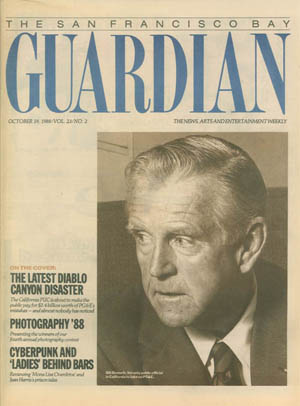
Bill Bennett, the only public official in California to take on PG&E

0

William Morgan Bennett, 1918-2010

On the front page of the Guardian of Oct. 19, 1988, we ran a big picture of Bill Bennett with a caption that read: “Bill Bennett, the only public official in California to take on PG&E.”

The reason we featured Bennett was because the California Public Utilities Commission was poised to make yet another multi-billion giveaway to the Pacific Gas & Electric Company.

This time the CPUC would force the public to pay $3.4 billion worth of PG&E’s mistakes  at its Diable Canyon nuclear power plant and not one public official in San Francisco, home of the PG&E/Raker Act scandal, and not one from any other public agency or public institution was on hand to monitor the CPUC hearings and testify about the horrible impacts the Diablo rate hike will have on the public.

The lone, honorable exception was Bill Bennett. Our editorial noted, “The only public official in California who has taken on the case is Bill Bennett, a member of the State Board of Equalization and a former member of the CPUC, a determined old warrior who fought Diablo from the start and continues to do so today, on his own, against the odds and at considerable personal cost.”

To drive the point home about Bennett’s couirageous stand, we continued, “Those who ignored the case–for example, the supervisors, mayor and city attorney of San Francisco, the board of directors of BART, the regents of the University of California and their counterparts in every other public agency and institution that pays or represents people who pay PG&E bills–ought to be ashamed. The citizens of every city, county and district ought to look at their representatives and ask: Where were you when PG&E walked away with all the marbles.”

 The press in Northern California was ignoring the story, despite the colorful,  forceful and newsworthy campaign that Bennett was waging. He said he had called the  Chronicle and Examiner reporters to try to interest them in the story, but “it was useless so I gave up.”  Guardian Reporter Jim Balderston did the story and quoted Bennett  as saying, among other things, “This commission (the CPUC) must think long and hard of the welfare of the ratepayers and the shareholders of PG&E.” With no Bill Bennett on the CPUC, PG&E once again quietly walked away with billions in ratepayer money.

William Morgan Bennett, the public attorney  who for more than five decades fought the corporate goliaths from taking all the marbles, died Feb.9th at his home in Kentfield after a short illness. He was 91. An overflow crowd paid tribute  to his extraordinary life and career at services held on Feb. 12th at St. Patrick’s Church in Larkspur

When his daughter Joan phoned me about Bennett’s death, I realized once again how much the Guardian and the consumer and the rate-payer would miss Bennett. We are in the middle of PG&E’s biggest monopoly scam ever –Prop l6 and PG&E’s initiative to kill public power and community choice aggregation (CCA)– and Bennett is alas missing in action, for one of the first times in his life. Today, there are other public officials out there fighting PG&E, but there is nobody who can  take on PG&E and its allies as effectively as Bennett.

Our 1988 story had a sidebar with the head, “Bennett vs. PG&E: The 30 years war.” The sidebar recounted an incident characteristic of Bennett and the way he gave new meaning to the term public service.  In 1959 the El Paso/Pacific Northwest natural gas pipeline merger was all but approved by the CPUC, except for an appeal from Bennett as CPUC general counsel.  Before Bennett could file the appeal, he got a phone call from Gregory Harrison, a partner in the politically powerful law firm of Brobeck, Phleger and Harrison. Harrison asked Bennett if he was going to file. Bennett said yes and Harrison responded, “I told them you would say that.”

Harrison told Bennett he would be removed from the case if he filed the appeal. Bennett told Harrison he was going to call a press conference. Harrison responded. “I told them you would say that,” and hung up. Shortly thereafter, Bennett got a call from Gov. Brown, who asked him if he was going to file the appeal. Bennett said yes and Brown refused to discuss the matter further.

Twenty minutes later, Bennett got a telegram from Brown that stated, “You no longer represent me or the State of California in USA v El Paso.” This infuriated Bennett and fueled his relentless 14-year crusade to compel El Paso to divest itself of Pacific Northwest. because of its price-fixing and monopolistic implications for California. In 1969, appearing as a private citizen, he successfully argued the final U.S. Supreme Court appeal in the case, the last oral argument heard by the Earl Warren court.

The Washington Monthly caught the drama and precedent of Bennett’s appearance in its November 1971 issue. “His last appearance before the court in 1969
needs to have been witnessed. Standing alone against an array of the best legal talent that could be provided by El Paso, the states of California and Utah, lawyers for other gas companies and the U.S. government, represented personally by Solicitor General Erwin Griswold, Bennett attacked as the lone surviving avenging angel of the original antitrust action. Finger in the air, voice crying out in toners of retribution, he spoke brilliantly and forcefully without notes for an hour…In the process, Bennett impressed at least one justice privately, and many more observers, as one of the most brilliant and effective lawyers to have gotten to his feet to present oral arguments to the court during the last 14 years.”

 As the final footnote in this legal saga, Bennett  stopped El Paso’s efforts in Congress to pass legislation to void the breakup of El Paso. The result: the largest refund for California ratepayers in the history of regulation to date.  The decision set a  national precedent in antitrust law.

Bennett was born Feb. 20, 1918 in San Francisco to Lt. William M. Bennett of the San Francisco Police Department and Eva Curran of Amador. He attended Most Holy Redeemer Elementary School, St. Ignatius High School, the University of San Francisco and the Hastings College of Law. At the outbreak of World War II, he suspended his law studies and joined the U.S. Army Air Corps.

He was a B-17 pilot in the North African, Mediterranean and European theater of operations, l5th Air Force, 483rd Bombardment Group, 815th Squadron, stationed in North Africa and then in Foggia, Italy. The 483rd flew a total of 215 combat missions during 14 months of combat duty and Bennett was in the middle of it all. “Wherever there were major oil refineries, aircraft and parts factories, tank works, railroad terminals and marshaling yards, supply dumps, bridges and communication networks, he saw action,” Jane Bennett said.  He flew 35 missions and encountered severe flak and fighter attacks at some of the most heavily defended targets in Europe:  Linz’ Herman Goering Tank Works; Berlin’s Daimler-Benz Tank Works; Innsbruck; Vienna; Regensburg; Blechhhammer; Schweinfurt; Salzburg; Landshut; Moosbierbaum, and Ruhland where ME 262 German jets attacked his squadron.

The Tuskegee Airmen, the famous black squadron, escorted Bennett’s missions. “Their base was right next to my father’s,” Joan Bennett said. “They were separated on the ground but equal in the air. That is, they were  equal targets for the Germans.” Bennett often visited some of the fighters across the runway that segregated the blacks.   George McGovern,  the bomber pilot who later became a presidential candidate in l972, was stationed at a nearby base.  He flew B-24s.

Bennett flew some of the first shuttle missions into Russia.  As the bomber squadrons flew deeper into Germany, the planes did not have fuel or were too shot up  to return to their base in Italy. So the squadrons continued on to Poltova,  Russia, to get refueled  and repaired, and  then either flew back  immediately back to their base or stayed over night and flew back the next day.  The missions were kept secret during the war  but later became known as the “Poltova missions.”

 Of the original 646 crew members sent to Italy in March 1944, 38 per cent were killed or missing in action. His bomb group received numerous battle awards, including two outstanding unit presidential citations. Bennett was highly decorated and won three Oak Leaf Clusters, four Bronze Stars and the Distinguished Flying Cross. He was awarded the DFC  for his courage and skill in miraculously bringing his plane back from a mission over Worgi, Austria, in February, 1945.  Bennett’s plane was hit by heavy enemy fire and the two right engines were shot out. He told his crew to bail out but they refused because they counted on Bennett to pull  them through.  Bennett did, safely piloting his crippled plane over the Alps. When the plane limped back to its base in Italy, there was nothing left inside, because the crew had ditched everything to lighten the load.


Col. Paul L. Barton, Bennett’s commanding officer, pins the Distinguished Flying Cross on Bennett in a ceremony on May 12, l945, at the air base on the Sterparone farm in Foggia, Italy.  Gen. Twining, head of the l5th Air Force who ended up as Chief of Staff of the USAF after the war,  attended the ceremony.  “There was no Tom Hanks, Brad Pitt, Tom Cruise WWII move glamor,”  Bennett’s daughter Jane told me.  “The base itself was primitive: steel mats for runways.  Ankle deep mud in the winter along with snow, ice and rain. Open latrines, no toilet paper, tent-living with one crew per tent. No mess halls. One canteen of water per day, etc.”  She said the Bennetts visited the farm in l982.  “The runways were vineyards,” she recalled. “The briefing hall for the men still stands. The interior of white plaster is still lined with drawings of pinup girls. The young girl who lived on the farm during the war is now the owner of the family land. She was very gracious.  She invited us in for coffee.”

 After the war, Bennett finished  law school at the University of San Francisco and then embarked upon a remarkable career of public service. Until I started working on his obituary,  I knew nothing about Bennett’s distinguished war record as a bomber pilot.   But it is clear to me that, having followed Bennett through the years, that  his combat experience under artillery fire and with flak coming at him from all directions served him well in public life.  He spent most of his public career  as a tough, smart and  aggressive attorney who relished  taking on the big cases and the big corporate behemoths who were screwing the public on illegal mergers or monopoly rate increases. To him, this was just combat in a different theater of operations. Sometimes as a public attorney, sometimes acting as an individual citizen, he handled precedent-setting cases  in antitrust, regulatory and criminal law and argued six times before the U.S. Supreme Court. He earned the nickname “the legal Houdini” but I always thought of him as “Fighting Bill” Bennett.

 As a deputy attorney general, he successfully prosecuted public corruption trials in 1954-55 against the State Board of Equalization in San Diego and put l3 public officials in jail. From 1957-59, he handled the celebrated case of Caryl Chessman, known as “the redlight bandit.” After his argument before the U.S. Supreme Court, the court clerk quietly handed him a note from Associate Justice Felix Frankfurter. He wrote, “There is no reason why I should not tell you how admirably you represented the state in this important case.” The clerk told Bennett he should save the note because it was only the second such note that Frankfurter had ever written.

From 1957-58, Bennett represented the state before the CPUC and won many cases against utilities that resulted in hundreds of millions of dollars in ratepayer rebates. Gov. Brown appointed him chief counsel of the PUC in 1958.

In 1960 Bennett was invited to join Sen. John F. Kennedy’s campaign as an advance man canvassing a territory from Chicago to New York.  He became friends with JFK and was considered part of Kennedy’s “Irish mafia.” Kennedy asked him to head the Federal Power Commission but he rejected it to remain with his family.

Bill Bennett and then presidential candidate John F. Kennedy  are pictured in 1960 as they got off the campaign plane at O’Hare field in Chicago.  Bennett was an advance man for JFK and helped stage several rallies in Chicago. Then JFK and Bennett headed east to Hamtramck, Michigan, and finished up at the garment center in New York.  JFK asked Bennett to be head of the Federal Power Commission but Bennett turned the appointment down to remain in California with his family.

In 1962, after Brown appointed Bennett to the CPUC, he promptly took on PG&E with gusto.  With the support of the Sierra Club, Bennett filed the lone dissenting opinion against the CPUC’s approval of a nuclear power plant upwind of San Francisco at Bodega Bay. The  Bodega fight was started in the living room of Prof. Joe Neilands, a UC-Berkeley biochemistry professor and stoked along by the Neilands/CharlieSmith/David Pesonen gang, with help from the Chronicle and its executive editor Scott Newhall and environmental writer Harold Gilliam.  The battle caught on and became a national story and focal point for the emerging anti-nuclear movement. PG&E was forced by public opinion to withdrew its application and skedall down  to Diablo Canyon. And so did Bennett.
Bennett was later visited by the chairman of PG&E, Robert Gerdes. told Bennett, “We don’t mind you dissenting, but do you realize the Russians are trying to stop us from building atomic plants.”

During his CPUC tenure, Bennett led the commission to regularly reduce electricity and gas rates in response to rate cases before the commission. In 1968, then Gov. Ronald Reagan refused to reappoint Bennett to the commission and sent Bennett a letter apologizing for not being able to reappoint him. Reagan did not explain the reason. Before Reagan could kick him off the CPUC,  Bennett  had saved the consumers hundreds of millions of dollars. Ever after Bennett, the CPUC has operated on a supine  basis with PG&E and other utilities and has handed down rate increases and goodies to them on a virtual assembly line basis.  

I first met Bennett in 1967 in his CPUC office overlooking the Civic Center  in the  state building. Lee Fremstad, then the San Francisco correndent for the Sacramento Bee, took me in and introduced me. I had rarely seen a public official like Bennett. He knew about the Guardian and me, had some juicy story ideas for me, and a batch more for Fremstad. Fremstad bantered back and forth with Bennett, noting a couple of ideas but rejecting others as too much even for the Bee and its longtime public power posture.  Bennett was open, expansive,  full of Irish humor,  a populist Democrat full of opinions I liked, jutting the Bennett jaw to make a point, and the kind of guy  who might be good for a lively  three martini lunch.

I thought he would have made a wonderful newspaper columnist or editorial writer, if he could find a newspaper that would publish his  tough consumer-oriented opinions that so  agitated the PG&Es and Hearsts  of the region.  We always enjoyed  Bennett at the Guardian, endorsed and supported him and used him as a friendly source and inspiration.all through the years. 

When Bennett left the CPUC, Neilands and Smith held an appeciation dinner for him in Berkeley that brought together the Bodega Bay/public power warriors of the era.   This was a watershed moment for the Guardian and me.  My wife Jean and I went, met Bennett and Neilands et al and got initiated. We also met Peter Petrakis, a fan of Bennett’s, and a graduate student of Neilands. Neilands did our pioneering expose of the PG&E/Raker Act  scandal in l969.   Petrakis joined the Guardian and  followed up Neilands’ work with a series of investigative storiies that revived the scandal and  the public power movement in San Francisco.  Bennett, as I realized, was a catalyst.  

Bennett’s next move to stay in public service was to run for the State Board of Equalization and Franchise Tax Board. He won his first campaign in l970 even though his opponent outspent him $450,000 to $4,000, all his own money. He was relected to five more terms, despite refusing to accept campaign contributions, and continued to fight the good fight against the special interests in Sacramento and beyond. He was also a professor of law at Hastings while on the board.

Bill Bennett with his wife Jane in 1943 at the primary cadet school in King City, Calif. They were married 67 years.

Bennett is survived by his wife of 67 years, Jane, and sons William (wife Gwendolyn) of Lafayette, James (Paula) of Kentfield, Michael (Roxanne) of Manhattan, Kansas, and daughter Joan of Kentfield and grandsons Jimmy, Will, Jack, and Brendan of Kentfield.

The Bennett family obituary  sums up their patriarch: “Despite his friendships with president and esteemed jurists, his out-going nature was such that he was a friend to all. He was a populist democrat, consumer rights advocate, and a veritable David against the corporate world’s Goliaths, in the vein of his mentor and ultimately friend, Earl Warren. Even with such achievements, his most important and cherished career was as a father and family man. Upon retirement, he embarked upon his most rewarding and enjoyable career: a devoted, loving, entertaining husband, father, and grandfather. For them and through them, he will live forever ‘in his way.'” 

For me, I will stick with our cutline under Bennett’s picture on our l988 front page: “Bill Bennett, the only public official in California to take on PG&E.”


The Bennett family photo was taken in May,  2009, at the Napa airport. A B-l7 was touring the country and Bennett wanted to see it. Jane Bennett said he actually went through the plane. “It was not easy. The access was a skinny, steep, metal ladder to the cockpit. I don’t know how he got up it. He refused a ride in the plane. As he said, ‘If I cannot fly it, what’s the point.'”

Chatting with “The Yellow Handkerchief” star Eddie Redmayne

0

English actor and model Eddie Redmayne isn’t yet a household name, but he’s achieved rising star status with a string of much lauded roles in indie and mainstream films. After playing Edward Wilson, Jr. in The Good Shepherd (2006) and murderous son Tony in Savage Grace (2007), he returns to American film as colorful outcast Gordy in The Yellow Handkerchief. I spoke to Redmayne about getting a handle on his strange character, which meant doing road trip research and adopting a Southern drawl.

San Francisco Bay Guardian: The character of Gordy is a rather unusual one. How would you describe him to someone who hadn’t seen The Yellow Handkerchief?

Eddie Redmayne: Good question. I would say he is an open-hearted eccentric. He has spent his entire life as an outcast. He’s trying to find his own way, so he’s never fit in really. But he has an open heart, which is often misunderstood.

SFBG: So what drew you to the character?

ER: What drew me to the character was how utterly ridiculous it was that they would consider the idea of an English actor to play the part. When I read it, I thought that’s the most absurd thing in the world, I will never get it. So I went into the audition without a sort of care in the world, assuming that it was madness that they would consider me. I suppose what drew me to the part was how far from me he was.

SFBG: Is that a challenge for you, playing American parts? You’ve kind of shifted back and forth — do you see yourself doing more of that in the future?

ER: For me, what I love about my job is, I love storytelling. And if the story’s a good one to tell, then I’m incredibly proud to be a part of it, whether it’s English, American. It’s neither here nor there, really. I found this one a specific challenge and working on the accent was challenging. I had a great dialect coach. And also you feel a responsibility when it’s someone so far from where you are. But you have to actually go under the skin of it. So I did go down to Louisiana and do a road trip from Oklahoma through the Osage nation reservation and then down into New Orleans, so at least I could get a sense of the geography and the kind of places this guy was growing up in.

SFBG: How much of that were you able to use in creating Gordy’s backstory?

ER: Well, I don’t know if you remember the [sketchbook]. That was something that, when I did my road trip, I collected myself. I went and used all these disposable cameras and took photos and did drawings and messed around. Which was a lot of fun, and a way of building up a backstory for who he was and who his dad was and what his life story had been. For the audience, it’s kind of extraneous, I suppose, but for me it’s important that I knew where he was from.

SFBG: I wanted to commend you for your performance in The Yellow Handkerchief, but I also thought you were great in Savage Grace. You seem to play these characters who aren’t always relatable or even very likable to an audience. They’re interesting, but they’re not necessarily people you’d want to spend a lot of time with. So how do you find that balance in making them sympathetic but also difficult?

ER: [laughs] I know what you mean, and certainly with Tony in Savage Grace, that film wasn’t written as a psychological discussion as to how this person had ended up there. It was a cold detachment on what this life was, and what happens when relatively talented people have so much money that it catalyzes inertia almost. There’s nothing to do with your life because you don’t have to do anything. I suppose what I try to do is not to judge the characters that I play, and just present them honestly and hope that, certainly more so in Yellow Handkerchief, that the audience does eventually, despite feeling alienated and isolated from this guy to begin with because of his quirks and his eccentricities, that eventually they do see that there is an openness they can relate to.

SFBG: Going back to The Yellow Handkerchief, I wanted to ask for your opinion on why this unlikely trio forms. Obviously there’s some attraction on Gordy’s part when it comes to [Kristen Stewart’s character] Martine, but what else is there that links them together?

ER: For me, the film is about chance, really. It’s about chance and circumstance. And what I love is, it hopefully feels like this is a story going on in the world that the camera stumbles across, travels with, and then lets go. It’s really about the truth of those moments in life that it is through moments of luck or passing or who you bump into on the street or whether, specifically in Yellow Handkerchief, a rain storm causes these people to end up in a car together for three days. It’s as simple a conceit as that. But I think it plays truthfully in its idiosyncrasies almost.

SFBG: Can you talk about developing chemistry with your co-stars, William Hurt and Kristen Stewart? How did you form that bond, both on-screen and off?

ER: Well, what was wonderful is, Kristen is magnetic and an incredibly wonderful person, very open and lovely, and we got on very well form the outset. William is someone I’ve admired for a long time and have worked with on The Good Shepherd, although I’d never acted with him. What was great is, firstly, we had two weeks rehearsal, which is rare on film and something that William insists on. So we got to know each other. But also, three of us sat in a car in the incredible heat in Louisiana, passing through these extraordinary landscapes. It’s a way to bond quite promptly, and so the chemistry built really through spending an intense, really quite intimate time together.

SFBG: I wanted to close by asking what’s next for you. You’ve done your fair share of theater, so I was wondering if you might be returning to the stage anytime soon?

ER: Actually, I open a play on Broadway [on March 11] with Alfred Molina. It’s a new play about Mark Rothko, which we just finished a run of at the Donmar Warehouse Theatre in London. It’s called Red, and it’s about Rothko and his assistant. So I’m lucky enough to act on Broadway in two weeks time.

The Yellow Handkerchief opens Fri/5 in Bay Area theaters.

The Chronicle’s dishonest hit on district elections

8

The move to get rid of district elections – which is based entirely on the fact that big business and more conservative voices (including the Chron) don’t like the progressive policy positions of the current board – is now well under way. The Chron devoted its Insight section to the issue Feb. 28, leading with a long editorial that wandered back and forth between points and never really made the case.


An example of the Chron’s logic:


But sitting atop the decision-making tree [in San Francisco] are small-time politicos, some elected with fewer than 10,000 votes in a city with a population of 808,976.


Horrifying! It’s as if the United States Congress – which has to decide issues like war and peace — was made up of local politicos who were elected with as few as 100,000 votes in a nation of 350 million.


Or as if the California Assembly – which has to deal with a $28 billion budget deficit – was made up of local politicos who were elected with as few as 50,000 votes in a state of more than 35 million.


A district supes votes could represent about 1.2 percent of the entire city. A state Assembly member could represent only 0.1 percent of the population of the state. And yet, I don’t hear the Chron calling for the state Assembly to be replaced with an at-large body.


More:


A town with sweeping plans to develop two empty Navy bases at Hunters Point and Treasure Island, fill vacant offices with new jobs, and cut its budget by more than a half billion dollars isn’t getting the thought, expertise – and citywide vision – it needs for these challenges.
This lack of broad leadership obstructs the city’s future. A major cause is the district election system that magnifies neighborhood and tight-knit interest groups to produce officeholders with little stake in citywide questions. If all politics is local, as former House Speaker Tip O’Neill famously declared, then San Francisco has pushed this dictum to the max. It’s all about me and my neighborhood.


That’s absolutely, factually untrue – the district elected board has done more to advance citywide issues – from minimum wage to health care to the rainy day fund to infrastructure planning – than any at-large board in the previous 20 years.


And the Chron’s own editorial contradicts that argument:


Supervisor David Campos (a winner with 9,440 votes) led a move to keep illegal immigrants who are juveniles accused of felonies from being turned over to federal authorities, despite a city legal opinion that the idea wouldn’t fly. Supervisor John Avalos (6,918 votes) dreamed up the “must spend” order directing the mayor to maintain expenditures in a record deficit year. Thankfully, he dropped the idea at the 11th hour


Okay, I get that the Chronicle editorial board doesn’t like the Campos sanctuary bill or the Avalos must-spend legislation – but that are both citywide issues. They have nothing to do with “me and my neighborhood.”


Which is really the entire point here. The Chron doesn’t like the outcome of district elections – because over the past ten years, the progressives have shown they can win district races. There’s a good reason for that; in district races, you don’t need to raise huge amounts of money.


As Assemblymember Tom Ammiano and Supervisor David Chiu point out in an opposing editorial:


Part of that increased accessibility to government is the result of the decrease in the cost of running a district versus a citywide election. In the 1994 citywide elections, the average winning candidate spent $456,000 in today’s dollars. That’s 225 percent greater than the amount spent today: In 2008, the winning candidates spent an average of $204,000. Candidates needing to raise money for a citywide race will inevitably turn to special interests for contributions. If you believe elected representatives should speak up for people, not just the special interests that donated to their campaigns, today’s district system serves you better.


They also note:


Before district elections were passed, under a citywide election system, many neighborhoods – the Excelsior, the Sunset, the Mission and Bayview-Hunters Point – had no supervisor of their own. Today, all residents can pick up the phone and reach an office responsible for their neighborhood and responsive to their concerns – a broken streetlight, a dangerous pothole or a consistently tardy Muni line.


A lot of people don’t like Chris Daly’s personality, and some don’t like his politics, but if you’re a person living on SSI in a grubby little hotel room in the Tenderloin and you need help, you can walk into his office and get a welcome reception and assistance with your needs. You won’t get that from the mayor.


On the other hand, do you think, Don Fisher ever needed to stand in line and try to make a 15-minute appointment to talk to Gavin Newsom? Seriously?


And while we’re on the personality stuff: Yeah, some of Daly’s antics have been over the top. But he’s no worse than some of the others who have served on citywide boards. Former Sup. Bill Maher once accused one of his opponents of having a small penis, and waved around two fingers spread about an inch apart to the press and public.


More important, we had supervisors who did nothing. We had supervisors who did exactly what the mayor said without any question. We had supervisors who were wholly-owned subsidiaries of major local corporations. I’ll take Chris Daly over those folks any day.


By any rational standard, the district board over the past ten years has been more productive, more accountable, more representative and more accessible than any at-large board I’ve seen in my almost 30 years of covering this city.


So the Chron needs to shut up about “citywide perspective”’ and personalities. If the paper wants to oppose district elections, it needs to drop the poll-tested downtown talking points and tell the truth:


The current board is too liberal for the Chron. The moderate candidates the paper prefers can’t win in districts. So they want to change the rules.


That’s the story, beginning, middle and end.


PG&E’s laughable Prop 16: Who needs friends when you’ve got $35 million?

Last month, when the Guardian sent an intern to cover a debate between Pacific Gas & Electric Co. spokesperson David Townsend and California Sen. Mark Leno, the reporter was ejected from the event at Townsend’s request.

I figured I’d be immune from such nonsense when I ventured to the state capitol yesterday for a joint informational hearing about Proposition 16, the ballot initiative that PG&E has bankrolled for the June ballot for the purpose of extinguishing competition in its service territory. The initiative would establish a two-thirds majority vote before any municipal electricity program could get up and running, and its sole sponsor is PG&E.

But just after I snapped a photo of Sen. Mark Leno and Assemblyman Tom Ammiano chuckling sardonically at a PG&E executive who had mistakenly referred to the ballot initiative as “Prop 13,” a guard swooped in and ordered me to stop photographing and turn off my voice recorder.

I shot him a dirty look at first, but then realized that I could wind up meeting the same fate as our unfortunate intern if I didn’t cooperate. He informed me that it’s protocol to provide advance notification before photographing or recording a public meeting at the capitol (despite the fact that the hearing is televised and open to the public). Then he asked for my name and affiliation, and said he would have to ask committee members for permission before he could allow me to do any more recording or photographing. Presumably, the decision would be based on who was asking. He vanished and, a few minutes later, returned to say that the answer was “no.”

Thus, I was reduced to frantically scribbling down notes, which means the exchanges transcribed below aren’t as complete as they could be. (Anyone know of an acupuncturist who can soothe muscle stiffness in the forearm?)

Yesterday’s hearing made it clear that PG&E has little support for the ballot initiative other than its own war chest of funding, and it’s royally pissed off the Legislature besides. PG&E Senior Director Ed Bedwell blushed a bright red hue more than once when he was assailed with statements such as, “Alienating those who are usually in your camp is not a good sign,” an admonishment delivered by Assembly Member Tom Ammiano when pointing out that not even California’s other investor-owned utilities are behind the initiative.

Apparently, not even the Republican members of the Senate Energy, Utilities and Communications Committee and the Assembly Utilities and Commerce Committee could stand the smell of the PG&E’s bullshit, as every one of them had walked out of the room by the end. Not a single member of either legislative committee had a positive word for the proposition, but Assembly Member Jared Huffman plainly stated his opinion: “I think this is a terrible initiative.”

Nor was there any evidence of the “coalition” supporting Prop 16 that the PG&E-funded public relations firm that orchestrated this campaign claims exists. Every single member of the public who commented voiced strong opposition, and most had traveled there on their own dime.

Even the conservative-leaning Agricultural Energy Consumers Association, which represents 40,000 growers, is against it. “It would have a chilling effect on the farming community,” Michael Boccadoro of the Agricultural Energy Consumers testified. A representative from the California Chamber of Commerce spoke in favor, but local Chambers of Commerce are not unified in their support.

Paul Hauser, of Redding Electric Utility, testified that if customers in his territory —  which has been slammed with high unemployment — were paying PG&E prices instead of the municipal electricity rates, every single man, woman, and child would have to fork over an extra $440 per year.

The Pacific Gas & Electric Corporation, which is the parent company of the regulated Pacific Gas & Electric Company, has vowed to spend $35 million on Prop 16. Since the corporation derives all of its funding from the company, which is regulated by the California Public Utilities Commission and earns its money through customer billing, this means that every PG&E ratepayer is pitching in. Speaking of bills, PG&E rates will increase 30 percent by 2013 if PG&E is granted its requested hikes, according to The Utility Reform Network.

“Maybe it’s time the Legislature took a very hard look at whether that parent corporation needs to exist,” Boccadoro, of the agricultural group, commented. “Maybe it’s time for a vote on rate increases as well.”

One point that came up over and over again during questioning was the fact that instead of proposing changes to legislation, PG&E sought to use the initiative process to get its way, a move that Leno argues is flouting the democratic process. A second point was that its move is inconsistent with a statute that requires utilities to “cooperate fully” with community-choice aggregation programs. Below are some exchanges between members of the Legislature and Bedwell, the PG&E executive.

Leno: Can you describe to us how Prop 16 exemplifies your abiding by the statute of AB 117 in “cooperating fully?”
Bedwell: Can you repeat that?
Leno: (repeats language of statute)
Bedwell: … “I don’t see how that’s necessarily inconsistent. The cooperation aspect is in the implementation…”
(Leno takes issue with this, saying that they could have proposed that such language be included in the bill at the time it was being drafted. He points out that Prop 16 would present a “hurdle” to municipal power programs, and asks Bedwell if he agrees.)
Bedwell: Says he thinks it would create “a high bar.”
Leno: “A high bar. How is a high bar in any way consistent with ‘cooperate fully?’”
Bedwell: … “I don’t see it’s a matter of cooperation or lack of cooperation. …”

Bedwell: “We value our customers. I think you know through the last six or seven years in San Francisco, you know that we’re very committed to retaining our customers.”
Leno: (Explains that he is a PG&E customer in San Francisco, and a Sacramento Municipal Utility District [SMUD] customer in Sacramento.) “I pay PG&E 25 percent more, and I get more green power here in Sacramento. [In PG&E’s San Francisco territory] my business suffers regularly from blackouts. I’ve never had a blackout here in Sacramento.”

Gascon’s remarks at press conference are stunning

4

By Brady Welch

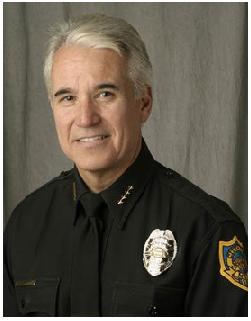
Police Chief George Gascon held a press conference Feb 25th to discuss his desire to arm his officers with Conducted Energy Devices (known to you and me as Tasers or stun guns) — and his comments demonstrated that the chief still doesn’t get it.

Gascon is arguing that Tasers could prevent some deadly police shootings. But there’s a much larger issue that he seems to be ignoring.

On December 28, 2009, the federal Ninth Circuit Court of Appeals right here in San Francisco affirmed the decision of a lower court that an unarmed man shot with a Taser can sue the city of Coronado, just outside San Diego. The zapping caused Carl Bryan to fall face first into the pavement, thus knocking out his four front teeth. To add insult to injury, one of the Taser probes lodged in the man’s flesh, requiring a doctor’s scalpel to remove it.
And what was this citizen’s crime? Getting upset with himself for being pulled over twice in the same day for routine traffic infractions. According to court records, the 21-year-old Bryan was driving home on a Sunday morning after a long night with friends and got pulled over for speeding. Later that same morning, he got stopped again, this time for not wearing a seat belt (which he forgot to put back on after initially getting stopped).

Bryan pulled to the curb and started punching the steering wheel, shouting expletives at himself for being so careless. He then got out of the car “yelling gibberish and hitting his thighs,” the court decision reports. The officer yelled at Bryan to get back in the car, but Bryan apparently didn’t hear him. Then the cop, without warning, shot the kid with his Taser gun.
Bryan didn’t die. He also wasn’t on drugs (Tasers are particularly dangerous to people under the influence of stimulants). But he was hurt — and at least according to the court files, there’s good grounds to argue that he should never have been zapped in the first place.

Gascon acknowledged that Tasers can be dangerous, although he offered a somewhat morbid justification of taser-implicated deaths—loosely paraphrased, he suggested that if you ask a crackhead to run around the block, that person would probably suffer cardiac arrest anyway. And he talked about special training to avoid police Tasing of drug-addled and mentally ill people.

But what he’s missing — and what has a lot of community activists concerned — is the situation in Coronado: The Taser shooting of someone who should never have been shot with anything. Two police commissioners, Petra DeJesus and Vincent Pan, have expressed concerns over whether people can trust a San Francisco police department armed with semi-lethal weapons that officers might feel inclined to used in decidedly less than semi-lethal situations. The Ninth Circuit’s opinion is only the most recent and ballyhooed case.

What was particularly galling during the chief’s press conference was when Taser-supporting commissioners Tom Mazzucco and Jim Hammer came forward to plead the case for using Tasers on the mentally ill — as opposed to real bullets — almost as if to say, Certainly, we can all agree on this.

Well, maybe not. Here’s what the Ninth Circuit had to say:

A mentally ill individual is in need of a doctor, not a jail cell, and in the usual case—where such an individual is neither a threat to himself nor to anyone else—the government’s interests in deploying force to detain him is not as substantial as its interest in deploying that force to apprehend a dangerous criminal. Moreover, the purpose of detaining a mentally ill individual is not to punish him, but to help him. The government has an important interest in providing assistance to a person in need of psychiatric care; thus, the use of force that may be justified by that interest necessarily differs both in degree and in kind from the use of force that would be justified against a person who has committed a crime or who poses a threat to the community.

In other words: Cops shouldn’t be shooting mentally ill people anyway, with Tasers or with pistols.

And if you give the cops Tasers, it’s almost certain that they’ll zap a whole lot of people who were, as one critic put it, “guilty of nothing more than mouthing off to a cop on the bus.”

BTW, there’s an interesting Amnesty International report on Tasers here


This kiss’ progress

0

arts@sfbg.com

MUSIC Tino Sehgal doesn’t like objects. But it’s not just the thing-ness of things he shuns; it’s also the traces of things. In addition to refusing any recordings of his work, Tino (his last name is too “thingy” even for me) also refuses to deal with artist statements or written contracts, or anything, really, that might leave a material residue. (Digital photos? Sorry, they can be disseminated and printed.)

Tino is formally trained in dance and economics (not visual art). One starts to wonder if he doesn’t share the same eccentric anxieties and crackpot economic theories Ezra Pound did about usury. Pound loathed interest precisely because it left a trace; it created a thing (money) out of a non-thing (borrowed time) and refused to disappear. And this usurpation competed with the clean, rigid images and lines of Pound’s Vorticist vision and poetics of precision.

Despite Pound’s and Tino’s shared aversion for extraneous excess, there is one fundamental difference: if the Vorticist and Imagist movements attempted to “capture movement in an image,” then Tino’s work is attempting to release movement beyond the image — and into the realm of lived experience. But before I delve into the ontology of materialism, let me walk you through his current show at the Guggenheim Museum. (Those who plan to see the work in person should stop reading now.)

With a steady flow of people ahead and behind, you pass through the revolving doors at the Guggenheim’s entrance and are spit into the atrium of the Frank Lloyd Wright-designed rotunda — a naturally bright, open chamber that resembles an indoor shopping mall with circulating escalators, or the inside of an enormous Energy Dome (that Devo hat) flipped upside down and bleached white. Either way, when you look up, you feel vertigo. When you look back down, you see Tino’s first piece, Kiss (2004), and you start to feel dizzy again, but erotically so.

Kiss is two young things caught in a slow, exaggerated embrace of seamless looped sequences blending makeouts and dry humps all at about the speed of 2 frames per second. The couple is entirely absorbed into each other as they transition from standing to lying down and back again. And you become entirely absorbed in their absorption. It’s like watching a soft-core in slo-mo. You start to get aroused, but then a grandmother chides her grandson in that grating “New Yawk” accent, and your gaze breaks. You roll your head slowly, exhaling, then head for the ramp nearby.

After the first bend an elated, eager child steps in front of you and offers his hand. “Hi. This is a piece by Tino Sehgal, would you like to follow me?” “Sure,” you say. Then the precocious or extremely caffeinated kid asks you what your understanding of “progress” is, and you respond a bit sarcastically, “It’s a word.” But the kid doesn’t give a shit what you think or say; he’s just cataloging your responses in order to hand them off to the next interlocutor — a teenager with an opinion.

“You think “progress” is a word?” asks the confident teen, who anticipates your answer with a reply before you’re able to split your lips. You argue back and forth about the merits and semiotics of progress, and whether or not it’s even a real thing. The philosophical banter is fun for a moment but then you realize the jerk is basically repeating everything you say but with a contradictory spin. So you quicken your pace and by the next bend in the road the succeeding generation’s representative inserts an anecdotal non sequitur in stride.

“So the other day I lied about something really petty … You ever do that? Lie about stupid things?” Or “After I graduated law school, I realized I didn’t want to be a lawyer and am now doing voluntary work….” Or some other minor/major consciousness shift where one becomes concerned and aware of one’s life and its recursive trajectory. This is where the conversations actually start to “progress” and you find yourself engaging with a stranger who otherwise feels like an old friend — albeit a needy, unstable one.

At this point there are maybe two revolutions left in the rotunda. Your adult friend gets siphoned off somewhere into the building’s innards, and a weathered, smiling face greets you in relief. The two of you walk slowly as the senior agent massages a memory and focuses on the importance of restoring phenomenology. Your attention oscillates between boredom and intrigue as you offer “ums” and “uh-huhs” and the occasional “wow, really?” Then you reach the end, and Wisdom vanishes.

You start to wonder about the disingenuous aspects of Tino’s pieces — how some of the conversations felt artificial and scripted, not genuine and spontaneous — and if the experience was real. Like really real. As real as the people or walls you bumped into along the way, and as real as the vertigo-induced anxiety now screaming through your body as you look over the hip-high ledge and down the spiraling corridor at Kiss below. Kiss is now in its dry-humping stage and looks 100 percent flat, like a 2-D painting — a painting depicting a deformed centaur’s suicide: three legs, two heads, and one arm sprawled in an outline. But then it moves. Slightly.

“When you look at a painting,” Tino tells me in an interview back on ground level, “you know that you might like it or you might not like it, but you don’t have a similarity to it. With my work, the medium of the work is the same as you. And as a visitor, one has all the resources there as well.”

The interactions, Tino assures me, “are not scripted. They might repeat something sometimes, but that’s not what they’re supposed to do. They get information about you, and then they react to you. It’s a loose structure.” The only restrictions the conversationalists have: “They can’t talk about art, and they can’t talk about the piece itself.”

It’s this last part, the refusing to talk about itself — refusing, for instance, to call itself “This Is Progress” — that makes Tino’s work surpass a role as just the latest “Death of Art” incarnation in the Fountain and Brillo Box evolutionary chain. And because Sehgal’s work desperately needs you — an audience member, a participant — to exist, a sustainable and open relationship develops and lasts even after the museum’s doors close.

CCA Wattis Institute is currently hosting Tino’s first U.S. solo exhibition, a constantly evolving work incorporating pause, through April 24. It’s on a much smaller scale than the Guggenheim’s Sehgal show, but well worth the visit.

TINO SEHGAL

Through March 10

Solomon R. Guggenheim Museum

1071 Fifth Ave., N.Y.

(213) 423-3500

www.guggenheim.org

TINO SEHGAL

Through April 24

CCA Wattis Institute for Contemporary Arts

1111 Eight St., SF

(415) 551-9210

www.wattis.org

An open letter to the Transit Workers Union

18


By Gabriel Metcalf

OPINION Last week, the Transit Workers Union refused to accept a deal with San Francisco that would have modestly reduced major service cuts and eliminated another increase in discount fares at least for this year. The proposal would have involved two things: first, a one-time contribution by drivers to their own pension plans (worth $8.9 million for next year, almost precisely cancelled by the automatic raise of $8 million the drivers will receive next year); and second, a change in work rules that would have required drivers to actually work 40 hours in a week before earning overtime, which would have saved $3.8 million over the next 14 months.

Muni is facing a deficit of at least $17 million in the current fiscal year and around $55 million next year. Future years will be worse. Given these pressures, the TWU is getting ready to re-vote. I presume that, eventually, union members will accept the deal. But either way, given how utterly marginal this deal is for the riders, progressives need to begin a public conversation about what responsibility the union has for making Muni work better.

The problem is not that TWU salaries are too high. The problem is the work rules. These include: drivers not having to let their managers know how long they will be absent from work, making it impossible to set schedules; drivers earning overtime pay before actually working 40 hours a week; and perhaps most significantly, a set of rules that makes it virtually impossible to hire part time drivers. Currently, Muni is forced by the work rules to pay drivers at full hourly rates to sit around between the morning and afternoon peaks. That rule costs MTA about $11 million each year.

If the TWU is willing to give on just the overtime and part-time driver rules, MTA would save $12.4 million in next year’s budget — and this savings would grow in the future. Other work rule changes could save much, much more, while dramatically increasing service to riders.

Probably the underlying cause of Muni’s work rules is the fact that the TWU, unlike other bargaining units in the city, has its salary and benefits set by formula in the City Charter — which means that management has nothing to offer during labor negotiations. Friends of mine in the labor movement argue that TWU is just doing its job in trying to get a good deal for members. I would argue that TWU needs to do more than that, and needs to begin taking responsibility for building a transit system that works well and can grow over time.

Maybe this public sector union needs to take a page from the Swedish labor movement.

Early into the post World War II economic boom, the Swedish unions learned that, since they controlled the government and increasingly controlled the boards of directors of the corporations they had organized, they were essentially always going to get their major demands met. This forced a big shift in their culture, causing them to have to take responsibility not just for cutting a good deal for their members, but for ensuring the profitability of the companies. Labor could easily “win too much” and drive the companies out of business, thereby returning its members to unemployment. Once labor controlled the businesses, it had to come up with a proactive agenda for how to run them successfully.

Closer to home, we’ve seen the teachers union accept cuts and changes to their equivalent of work rules in order to prevent teacher layoffs. And we’ve seen the Service Employees International Union at the national level put immense resources into passing health care reform — something that will benefit all Americans, not just SEIU members.

Something similar needs to happen now at Muni.

Muni workers deserve a good wage. It’s a hard job under the best of circumstances. And as Muni tries to keep service on the streets without enough money for equipment and maintenance, workers on the front lines will bear the brunt of the bigger problems. But a lot of people resent the things the union has chosen to ask for in addition to a good wage.

Muni’s troubles are multifaceted. They involve bad management, bad street design, bad land use planning, and certainly insufficient funding. But work rules are undeniably part of the issue as well. It cannot be progressive for the TWU, in the middle of the worst financial crisis to hit our country since the Great Depression, to cling to the same work rules it has had in the past. Muni needs TWU to help it be successful.

Gabriel Metcalf is executive director of the San Francisco Planning and Urban Research Association (SPUR).

The “Newsom wins” merry-go-round: What fun

10

Gavin Newsom still hasn’t said for sure that he’s in the race for lt. governor, although just about everyone in town now thinks he’s going for it.

But the very prospect of the mayor leaving office before his term is up has the political classes speculating: Who gets that job? And how does it happen?

It’s actually pretty interesting.

Under the City Charter, the president of the Board of Supervisors becomes acting mayor in the event that the mayor leaves office before the end of his or her term. Then the supervisors, by a six-vote majority, can appoint someone else to the job.

Melissa Griffin lays out one piece of the scenario, which is that the board could appoint a new mayor in advance, without anyone serving as acting mayor.

But there’s much more to the story.

According to a fascinating city attorney’s opinion issued in 1978 (PDF), when George Moscone and Harvey Milk were killed and Dianne Feinstein was board president, no supervisor is allowed to vote on his or her own appointment. Which would mean that if, say, Board President David Chiu wanted the job, he’d need six votes not including his own.

Now the plot thickens. Suppose nobody can round up six votes — that is, a majority of the supervisors can’t agree on a new mayor? Well, Chiu, as board president, would be acting mayor — potentially for the entire duration of Newsom’s term, roughly a year. He’d also remain as board president. It’s the same as if the mayor goes out of the state and names an acting mayor in his place; that person is still a supervisor. So Chiu would have all the powers of both the mayor and the board president — and immense amout of clout for one person at City Hall.

But wait, there’s more: Chiu is board president only until the board elected in November of this year takes office, which would be about five days after Newsom would become lite guv. So unless the current board can choose a new mayor, with six votes (not including the vote of any supervisor being nominated), the new board would elect a new board president — who would instantly become acting mayor at the same time.

And since supervisors are allowed to vote for themselves for board president, any member would be allowed to vote for him- or herself for acting mayor.

Confused yet? Clearly, the folks who wrote the City Charter never actually envisioned this scenario (or didn’t think about it very much).

Of course, what that means that with the current board split the way it is, with exactly six solid progressive votes, someone who isn’t currently on the board (say, Aaron Peskin — or Tom Ammiano, or Mark Leno, or whoever) would have a better chance of getting a majority than a current member, who would need at least one of the moderate bloc votes.

And if Newsom runs, it will make the fall supervisorial elections even more important, because potentially those newly elected supes will be choosing not only a board president but a mayor.

Here’s another fun twist: If District Attorney Kamala Harris is elected attorney general, the mayor gets to appoint a new D.A. But suppose Newsom also wins and is sworn in a few minutes before Harris. Presumably acting mayor David Chiu (a former prosecutor who rumor has it might like to be D.A. himself someday) would choose the new D.A. — and suppose Chiu knows he doesn’t have six votes to be mayor. There’s no reason why he couldn’t appoint himself D.A., leaving a vacancy on the board and a vacancy for board president, which would be filled by anyone who could get six votes, who would then be acting mayor and could appoint a new supervisor to Chiu’s seat. Who could then be the deciding vote on who gets to be mayor.

Whoa. I can’t wait. Run, Gavin, Run.

Editorial: How to create jobs in San Francisco

3

If Newsom decides to solve the city’s $520 million deficit with cuts alone, he will be taking more than $1 billion out of the local gross domestic product

EDITORIAL If Mayor Gavin Newsom is serious about stimulating the San Francisco economy, he ought to start with a basic number that the city’s own economist, Ted Egan, passed along to us this week. The number is 2.11 — and Egan says that’s the multiplier effect of cuts in local public spending.
In other words, every dollar Newsom cuts from the city budget has a ripple effect of taking $2.11 out of the San Francisco economy. Which means that if the mayor decides to solve the city’s $520 million deficit with cuts alone, he’ll be taking more than $1 billion out of the local gross domestic product.
And that, in a nutshell, is the problem with the mayor’s economic stimulus package: it’s entirely aimed at the private sector, with no regard for how it will hit public spending.
A dose of reality here — public-sector jobs are also jobs. People who work in the public sector pay rent and mortgages and buy clothes and food for their kids and go shopping in local stores and go to local clubs and restaurants and pay taxes — and have the same economic impacts on the economy as private-sector workers. If you lay off nurses and recreation directors, those people stop spending money in town, and you continue the vicious cycle that has made this recession so deep and painful.
And if your entire economic stimulus program is aimed at cutting private sector taxes, it’s going to lead to public sector job losses. And those losses will undermine much of the impact of any gains you might get from private sector job growth.
Egan predicts that Newsom’s program of eliminating the payroll tax for new hires would create 4,330 new jobs in the city. We find that something of a stretch — it’s hard to imagine how any struggling small business would find eliminating a small tax enough reason to hire a new worker, and small businesses provide the vast majority of the private-sector jobs in San Francisco. But even if it’s accurate, it’s a fairly tiny gain. The city’s lost more than 35,000 jobs since 2007, and when the economy rebounds in the next two years, Egan predicts about 20,000 new jobs in the city even without the stimulus.
Egan also acknowledged to us last year that “the consensus among economists is that most of the time government spending stimulates the economy more” [than tax cuts].”
That’s particularly true in a city where the largest employers are all in the public sector (see opinion piece this page).
If the mayor and the supervisors actually want to create jobs in San Francisco, there are plenty of things they can do — starting with finding ways to close as much of the budget gap as possible without layoffs. Here are some possible approaches.
• Put a major revenue measure on the November ballot that saves city jobs without costing private sector jobs. There are several ways to do this, but all of them start with the well-demonstrated concept that transferring wealth from the rich to the poor and middle-class — that is, giving money to people most likely to spend it — is good for job creation. One option: shift the payroll tax to a gross receipts tax and charge bigger companies a higher rate. Another: a commuter tax on income earned above $50,000 a year would charge wealthier people who use city services and don’t pay for them.
• Issue infrastructure bonds. The notion that cities can’t borrow money the way the federal government does to fund economic stimulus programs is just wrong. San Francisco can sell bonds for a wide range of projects, from affordable housing to alternative energy projects to public works programs that are badly needed and could put San Franciscans directly to work. But it can’t be small-time projects; to make a difference, direct stimulus needs to be big, perhaps $1 billion. San Francisco’s property owners, who ultimately are on the hook for the bonds, are by and large (thanks to Prop. 13) entirely able to handle more payments.
• Lend more money to small businesses. The biggest obstacle to small business hiring isn’t taxes but a lack of credit. The $73 million Newsom is going to spend on tax cuts would create far more jobs as part of a city-sponsored microloan fund. Newsom’s efforts on that front are still very small scale.
There’s so much more the city can do — but cutting taxes and losing city jobs is the wrong way to turn around the economy.

How to create jobs in SF

10

EDITORIAL If Mayor Gavin Newsom is serious about stimulating the San Francisco economy, he ought to start with a basic number that the city’s own economist, Ted Egan, passed along to us this week. The number is 2.11 — and Egan says that’s the multiplier effect of cuts in local public spending.

In other words, every dollar Newsom cuts from the city budget has a ripple effect of taking $2.11 out of the San Francisco economy. Which means that if the mayor decides to solve the city’s $520 million deficit with cuts alone, he’ll be taking more than $1 billion out of the local gross domestic product.

And that, in a nutshell, is the problem with the mayor’s economic stimulus package: it’s entirely aimed at the private sector, with no regard for how it will hit public spending.

A dose of reality here — public-sector jobs are also jobs. People who work in the public sector pay rent and mortgages and buy clothes and food for their kids and go shopping in local stores and go to local clubs and restaurants and pay taxes — and have the same economic impacts on the economy as private-sector workers. If you lay off nurses and recreation directors, those people stop spending money in town, and you continue the vicious cycle that has made this recession so deep and painful.

And if your entire economic stimulus program is aimed at cutting private sector taxes, it’s going to lead to public sector job losses. And those losses will undermine much of the impact of any gains you might get from private sector job growth.

Egan predicts that Newsom’s program of eliminating the payroll tax for new hires would create 4,330 new jobs in the city. We find that something of a stretch — it’s hard to imagine how any struggling small business would find eliminating a small tax enough reason to hire a new worker, and small businesses provide the vast majority of the private-sector jobs in San Francisco. But even if it’s accurate, it’s a fairly tiny gain. The city’s lost more than 35,000 jobs since 2007, and when the economy rebounds in the next two years, Egan predicts about 20,000 new jobs in the city even without the stimulus.

Egan also acknowledged to us last year that “the consensus among economists is that most of the time government spending stimulates the economy more” [than tax cuts].”

That’s particularly true in a city where the largest employers are all in the public sector (see opinion piece this page).

If the mayor and the supervisors actually want to create jobs in San Francisco, there are plenty of things they can do — starting with finding ways to close as much of the budget gap as possible without layoffs. Here are some possible approaches.

Put a major revenue measure on the November ballot that saves city jobs without costing private sector jobs. There are several ways to do this, but all of them start with the well-demonstrated concept that transferring wealth from the rich to the poor and middle-class — that is, giving money to people most likely to spend it — is good for job creation. One option: shift the payroll tax to a gross receipts tax and charge bigger companies a higher rate. Another: a commuter tax on income earned above $50,000 a year would charge wealthier people who use city services and don’t pay for them.

Issue infrastructure bonds. The notion that cities can’t borrow money the way the federal government does to fund economic stimulus programs is just wrong. San Francisco can sell bonds for a wide range of projects, from affordable housing to alternative energy projects to public works programs that are badly needed and could put San Franciscans directly to work. But it can’t be small-time projects; to make a difference, direct stimulus needs to be big, perhaps $1 billion. San Francisco’s property owners, who ultimately are on the hook for the bonds, are by and large (thanks to Prop. 13) entirely able to handle more payments.

Lend more money to small businesses. The biggest obstacle to small business hiring isn’t taxes but a lack of credit. The $73 million Newsom is going to spend on tax cuts would create far more jobs as part of a city-sponsored microloan fund. Newsom’s efforts on that front are still very small scale.

There’s so much more the city can do — but cutting taxes and losing city jobs is the wrong way to turn around the economy.


Newsom’s war on the public sector

2


By Calvin Welch

OPINION With the Feb. 10 release of the Controller’s Office economic analysis of Mayor Gavin Newsom’s proposed tax cuts to businesses, combined with its December 2009 analysis of the Newsom administration’s proposed fee cuts to market-rate condo developers, we now have a clear and objective measurement of this administration’s response to the biggest economic collapse in San Francisco since the Great Depression: the mayor hopes to create 4,400 jobs (of the 39,000 jobs lost in San Francisco since the start of the downturn) and 40 to 50 new market-rate condos over the next two years at the cost of $72 million in lost tax revenues.

The plan includes no affordable housing — zero, zip, nada — below-market rate housing for moderate-income San Franciscans. Instead, the developer fees that fund parks, transit, and other critical neighborhood infrastructure projects promised for the Market Street, Octavia Street, and eastern neighborhoods plan areas will be postponed indefinitely.

Those impacts don’t include the loss of public sector jobs and services. The report rather coyly notes that “the potential impacts of the city revenue decline on public services, and indirectly on the economy, is not considered because the city could adjust to that impact in many ways.” The analysis warns: “However, if the stimulus does not directly incentivize job creation, it may not overcome the loss of public sector employment that the subsidy’s revenue would pay for.”

That last point that needs some attention.

Newsom’s “stimulus” is targeted solely at the private sector, with no requirement that the companies slated to get tax breaks and fee reductions actually perform — either through job growth or housing development. It cuts public sector employment and public sector-led infrastructure development — affordable housing, transit lines, parks and playgrounds — when it’s clear that both public employment and infrastructure development would be a direct stimulus to the local economy.

Quick, name the biggest employer in San Francisco. How about the second biggest — or fourth, sixth, or seventh? Well, they’re all in the public sector: the City and County of San Francisco, the University of California, San Francisco, the State of California, the San Francisco Unified School District, and the U.S. Postal Service top the list. As of 2008, some 85,000 jobs in San Francisco — 15 percent of all jobs in the city — were in the public sector. More than half were in education, and the bulk of the rest were in health and human services.

The Newsom administration’s war, and it is a war, on the public sector is economic suicide. We should look at stimulus as saving as many public sector jobs — especially in education and health and human services — as we can and finance as much local infrastructure development as we can afford. That’s real economic stimulus. What Newsom is proposing is the same old, inside-the-box, tried and failed trickle-down that got us in this ditch in the first place.

Calvin Welch has spent the last four decades working for sane economic development policies in San Francisco.

The “jobs” shell game

0

Written with Nima Maghame

news@sfbg.com

While many San Francisco city officials have been trying to figure out how to close a projected budget deficit of more than $520 million, Mayor Gavin Newsom has spent the last month trying to make that spending gap even larger by aggressively pushing a variety of business tax cuts that economists say will do little to improve the local economy and could actually make it worse.

Newsom first proposed his so-called “local economic stimulus package” a year ago during his ill-fated run for governor, just as President Barack Obama was pushing his own economic stimulus plan. But unlike the federal government’s $787 billion plan, about a third of which involved tax cuts demanded by conservatives, Newsom proposed to cut local business taxes while also deeply slashing local government spending and laying off hundreds of city workers.

Most economists say that’s a terrible idea. In fact, a report issued at the time by Moody’s Investor Services made it clear that every dollar of direct government spending adds about $1.60 into the economy (or $1.73 if it’s on food stamps, the most stimulative spending government can make), whereas business tax cuts add only about $1 to the economy for every dollar spent.

We clashed with the Mayor’s Office at the time on our Politics blog (see “Mayor Newsom doesn’t understand economics,” 2/13/09), with Newsom’s spokesperson telling us the mayor was relying on the input of City Economist Ted Egan. But when we interviewed Egan about the issue, he agreed that it’s a bad idea to slash government spending to pay for tax cuts.

“We were in no way saying you should cut taxes to stimulate the economy, particularly if it means reducing government spending,” Egan told us then. And when we asked directly whether it’s better for San Francisco’s economy for the city to directly spend a dollar on payroll or to give that dollar away in a private sector tax break, he told us, “The consensus among economists is that most of the time government spending stimulates the economy more.”

The Board of Supervisors basically ignored Newsom’s proposal. But he revived it last month, expanding the proposals with even more private sector subsidies and making them the centerpiece of his Jan. 13 State of the City speech, publicly pushing it since then with a series of public events at businesses located in the city.

And this time — with the local economy still slow, projected city budget deficits bigger than ever, and little serious talk about how the city can bring in more money — it appears the proposals will be the subject of a series of hearings before Board of Supervisors’ committees in the coming weeks.

Newsom’s tax cut proposals include a proposal to waive the 1.5 percent payroll tax (the city’s main business tax) for all new hires; extend and expand the payroll tax exemption for biotech companies (see “Biotech’s bonanza,” p. 12); give small businesses tax credits for their spending on health plans; and allow developers to pass one-third of their affordable housing in-lieu fees onto future homeowners.

Newsom and his Press Secretary Tony Winnicker have spoken euphorically about the proposals, saying they’re desperately needed to spur the local economy. “We believe that enacting these tax incentives, particularly the payroll tax credit for new hires, is one of the single biggest things we can do for economic growth,” Winnicker said.

Despite repeated questions about the economists’ concerns over financing tax cuts with government spending cuts, we couldn’t get them to address the tradeoff directly. “The mayor will support critical public services,” was all Winnicker would say about the deep cuts that Newsom is expected to announce in his June 1 budget.

Sup. John Avalos, who chairs the Board of Supervisors Budget and Finance Committee, expressed more skepticism about the mayor’s proposals. “Do tax breaks have the intended effect of stimulating the economy? As we underfund government services, are we getting a net gain or are we getting something taken away? For the very small businesses in my district, it’s going to be trickle-down economics. It’s very unrelated and unmeasurable in benefit,” he told us.

David Noyola, board aide to President David Chiu, said his boss is supporting the biotech tax credit but reserving judgment on the rest. “It’s going to be a cost-benefit analysis,” Noyola said. “When we’re talking about jobs, we’re talking about public and private sector jobs, always.”

While Egan’s economic analysis predicts tax cuts will encourage some economic growth, even he is circumspect about the good it will do, particularly without finding a way to avoid deep cuts in city spending. “The truth of the matter is that our stimulus efforts are small because the city has relatively small power to affect the local economy,” Egan told us.

That’s the consensus economic opinion. Huge federal spending can help a national economy a little bit, but local economies are just different animals that local governments are largely powerless to really alter, particularly through tax cuts.

“I agree with Egan: city government has little power over the local economy,” Mike Potepan, an urban development economist at San Francisco State University, told the Guardian.

Both economists agree that tying tax cuts to job creation or development stimulus is better than general tax cuts, but that neither is good if it means laying off more city workers.

“Research shows that by cutting taxes you have more business activity where studies show it is likely to effect employment,” Potepan said. “On the other side, you have to think about revenue. Cities are going to have to balance their budgets, which could mean a cut in services.”

Author Greg LeRoy expresses a more critical perspective in his book The Great American Jobs Scam: Corporate Tax Dodging and the Myth of Job Creation (1995, Berrett-Koehler), amassing evidence from economic studies and CEO surveys that corporate tax breaks, even those tied to new job creation, have almost no effect on private companies’ decisions about where to locate and whether to hire.

“How can companies get away with this? Because the system is rigged. Corporations have it down to a science. They have learned how to chant ‘jobs, jobs, jobs’ to win huge corporate tax breaks — and still do whatever they wanted all along,” LeRoy writes. “That’s the Great American Jobs Scam: an intentionally constructed system that enables corporations to exact huge taxpayer subsidies by promising quality jobs — and lets them fail to deliver. The other benefit often promised — higher tax revenues — often proves false as well.”

While proposing to forgo collecting millions of dollars in payroll taxes (the Controller’s Office is still working on a projected total for the tax cut package), the Mayor’s Office also wants to spur development of new housing with a proposal that would delay collection of needed affordable housing money by more than a decade.

After hearing mostly from a large crowd of desperate developers and construction workers during a Jan. 21 hearing on the proposal, the Planning Commission approved the package on a 4-3 vote, with the mayor’s appointees in agreement and the board’s appointees in dissent. It will be considered by the Board of Supervisors Land Use Committee sometime after Feb. 12.

The most controversial part of the fee reform package involves reducing the fee developers pay to support affordable housing by 33 percent, then charging a 1 percent transfer tax to subsequent buyers of those homes. Egan estimates developers would save almost $20,000 per housing unit, and that it would take an average of 16 years for the city to recover that money. But for high-rise luxury condos, the city would eventually recover about $27,000 per unit.

“It’s a classic make-an-investment-now-to-get-more-later strategy,” Michael Yarne, who crafted the policy for the Mayor’s Office of Economic and Workforce Development at Newsom’s direction, told the Guardian.

“If it makes it feasible for projects to be started, then it is worth passing,” Tim Colen, a representative of San Francisco Housing Action, said at the Planning Commission hearing, expressing hope that it will help create desperately needed construction jobs and new market rate housing.

But affordable housing advocates and some progressives criticize the policy as completely backward, saying that affordable housing development is desperately needed now, during these tough economic times, rather than a policy that encourages more market rate housing and bails out bad investments made at the height of the real estate bubble.

“What the city needs to do is directly build affordable housing, for which there is a demand,” affordable housing activist Calvin Welch told us. “The problem is that the banks don’t want to lend these guys money because they know nobody can afford to buy houses at the prices that these guys are demanding.”

Debra Walker, who is running for supervisor from District 6 and voted against the proposal when it came before the Building Inspection Commission (the sole vote on a commission dominated by mayoral appointees), agrees.

“The whole argument is that it stimulates development, but it doesn’t,” Walker said, arguing that the incremental gains (about 25 housing units per year, Egan estimates) will be offset by delayed affordable housing construction. “There would be more economic stimulus by using the fee to build more affordable housing.”

Instead, it simply shifts resources to favored entities: from home owners to developers, in the case of the affordable housing fees, or in the case of the tax credits, from the public to the private sector. But Newsom’s office just doesn’t see it that way.

“The Guardian believes in protecting public sector employees over private sector employees,” was how Winnicker formulated our understanding of what the economists are saying. “Most people don’t work for the city, and if we can support private sector jobs, that adds to sales tax revenues and benefits the economy. Despite a short-term impact of the tax credit, that’s a benefit.”

Adam Lesser contributed to this report


Why Newsom drives me nuts

2

This is the kind of thing that drive me nuts about the Newsom administration.


A few days ago, SF Appeal ran an item on a speech Newsom gave about condo conversions. The mayor wants to let more people turn rental units and tenancy-in-common units into condominiums; that, Newsom argues, will bring more revenue into the city treasury (those conversion permits are expensive).


But there’s a reason why the city limits to 200 the number of units that can be converted in any one year. Turning a rental unit into a condo reduces the number of rentals available, and turning a rent-controlled unit into a condo (or into a TIC and then a condo) cuts into the affordable housing stock.


And a majority of the supervisors, who recognize the impact the mayor’s plan would have on tenants (by making it easier to take rental units off the market), are dubious.


Okay, that’s a difference of opinion. You don’t have to make it personal. And yet, at his press conference, the mayor insisted that


“Half of the members of the board have been beneficiaries of condo conversions, and yet they deny it to other people.”


As the Appeal pointed out, that’s simply untrue.


A majority of Board members own their homes, according to a check of property records: mayoral allies Michela Alioto-Pier, Sean Elsbernd and Carmen Chu all enjoy the benefits of owning and equity, as do Sophie Maxwell and progressive Budget chairman John Avalos.


Eric Mar and David Chiu rent, according to a City Hall source. Chris Daly lives in a condo, but “my condo has always been a condo,” according to the supervisor (and according to the Assessor-Recorder’s Office, Daly at least bought his condo as a condo and not a tenancy-in-common or conversion).


By all accounts, progressive Ross Mirkarimi is on the condominium-conversion waitlist (an older news report says Ross owns a TIC and is on the conversion list; we’ll check in with him to confirm, he is at this moment still in committee). Mirkarimi and Bevan Dufty would be the two Board members conflicted-out of any votes on condo-conversions; Dufty went from a condo to a TIC after his daughter was born.


“And nobody was evicted,” the Bev told us today.


Okay, as I see it only one supervisor is even in a position to benefit from the condo conversion law. So I asked Tony Winnicker, the mayor’s press secretary, whether Newsom had been misquoted. Apparently not. So why did ne make an innacurate statement that insulted half the members of the board?


Winnicker:


His comments came in the context of the polarized politics of San Francisco which pit tenants vs homeowners to the benefit of no one. He was speaking that many Boardmembers enjoy the benefits of homeownership and that opposing the condo conversion proposal denies those benefits to others who are already living in TICs and displacing no one through condo conversion.


But there’s a big distinction between what Winnicker is talking about and what Newsom actually said. It’s entirely possible to be a homeowner in this city without evicting anyone and without taking a rental unit off the market. That’s what most of the homeowning board members have done.


As for TICs “displacing no one,” that’s wrong, too. The number one cause of no-fault evictions in this city is the use of the Ellis Act to clear the tenants out of a building to create a TIC. The only thing holding the TIC epidemic in check is the fact that the TIC ownership model is complex and a bit tricky. The minute you can convert those TICs into condos, you open the floodgates for a lot more of them — and that means a lot more evictions.


Newsom can make the case for condo conversions just fine without making factually inaccurate statements that insult the supervisors. Instead he pulls this shit. And then he complains about the supervisors not wanting to work with him


Drives me nuts.


Welcome to the new SFBG.com

4

Happy 2010, and welcome to the new SFBG.com — the Web site for the San Francisco Bay Guardian.

We’ve redesigned the site in order to have a more immediate interaction with you, our reader, and to launch the next phase in our 45-year history of serving the Bay Area community with the latest, local-oriented, proudly made-in-the-Bay news, reviews, commentary, and guides. It’s a fiesta, so dig in!

In the near future, we’ll be adding new features, making some wee adjustments, and ironing out any kinks. We always appreciate your feedback, and hope that you enjoy our changes.

Here are a few notes to help you get oriented.

*Our homepage now consists of a Top Story, links to listings, our daily Hot List, and recent posts from our blogs. The homepage is updated several times a day with fresh stories and features.

*You can access the content of our current weekly paper by clicking on the cover under “This Week’s Paper” at the top of the site.

*You can access anything on the site through the top navigational bar, using the mouse-over menus — or, you can use the search box located at the top of every page.

*You no longer have to register and remember that pesky username and password to comment on any articles or blog posts.

*Unfortunately, a few recent comments on articles and posts were deleted during the transition. We apologize. Please feel free to post your thoughts again if they were deleted.

*The weekly paper area will be updated every Tuesday night, as usual. But the blogs and homepage will be updated several times a day.

*We are still in the process of adding some back issues to the site. A few old article link URLs no longer work, but you can find almost any article from 2005 until now by using the search box.

*As always, comments are welcome — we love to engage in constructive dialogue. We would never censor anyone expressing a different opinion about or offering supplemental information to our stories. However, we reserve the right to delete any comments containing hate speech, libelous implications, or completely unrelated blather.

*Please explore!

Again, we always welcome feedback. You can email me directly, and we’ll be publishing a Contact Us page very soon.

Thanks,

Marke B.

Senior Editor, Culture and Web

marke@sfbg.com


PS. Incredible thanks to our Web developer Harris Rashid and tech admin Adam Michon for all their help!