Oil

The Dining Room

0

› paulr@sfbg.com

Ritz sounds a lot like rich, and you might well catch a glimpse of some rich people as you make your way toward the Dining Room at the Ritz-Carlton, where you have taken care to make a reservation. You might see them, financiers and captains of industry with entourages of family, debouching from black Lincoln Town Cars in front of the hotel, a colonnaded fortress of marble that sits like the Parthenon on an outlier of Nob Hill. The rich are different from you and me, Scott Fitzgerald said, but they get hungry too, and they know a good spot when they find one.

When I last visited the Dining Room, about a decade ago, Sylvain Portay had just become chef, and the mâitre d’ was Nick Peyton, pioneer of the cheese cart. Both are gone now, off to other ventures, but the cheese cart remains — reinforced by a champagne cart and a digestif cart — while the chef’s toque came to rest three years ago on the head of Ron Siegel. His penultimate gig was at Masa’s, and Masa’s is probably the restaurant in the city that most neatly compares with the Dining Room. At both places, Siegel seems to have eased a certain Gallic haute rigueur and added notes of Asian whimsy without descending into chaos. The Dining Room at the Ritz-Carlton has long been, and remains, among the most formal and correct restaurants you will find in this city — also among the priciest. But it isn’t stuffy, and the money spent, on the food and the enveloping experience, is money well spent.

Who among us could dislike a restaurant that sends bottles of fine champagne trundling from table to table on a wheeled apparatus laden with shaved ice? You know the wine is well chilled because you can see the bottles sweating as, one by one, they are lifted from the cart and presented to you, and if a glass of Henriot rosé ends up costing $22, then you will be glad you enjoyed your glass and didn’t order a second.

You wouldn’t really have had time to enjoy the refill, anyway, since the three-course à la carte menu ($74) is punctuated not only by a bread service but also by a sequence of dazzling amuses bouches, beginning perhaps with a creamed-spinach risole (a half-moon-shaped pastry pouch), continuing with a strip of crisp-fried Japanese butterfish presented on pickled daikon, and culminating in a divine sea urchin panna cotta, served like a bit of leftover sour cream in a martini glass and finished with a splash of extra-virgin olive oil infused with Tahitian vanilla.

Compared to these bright little dabs of flavor, flaring and vanishing like the glow of fireflies in the summer night, the first courses are large enough to last for several bites. A wild-mushroom soup required some assembly, with the puree poured from a glass teapot over a pair of lobster ravioli waiting at the bottom of the bowl. An heirloom tomato salad, meanwhile, consisted of several fat disks of blood-red tomato of that 11th-hour, beginning-to-split ripeness you sometimes find in the final minutes of farmers markets. Goat cheese, a familiar accoutrement to such salads, was well marbled here and jumbled among the mixed baby greens like strips of pork fat.

Since it is king salmon season for the first time in several years, one took delivery of the fish with some sense of greeting a long-lost acquaintance. (The three-course option gives you choice of starter, main dish, and dessert, but there are also several set multicourse menus, one of them vegetarian.) The salmon turned out to be a wonderfully crisped, medium-rare square of filet, presented on a green and yellow blanket of béarnaise sauce and English-pea puree, with some wild-mushroom dice and baby leeks enhancing the sense of rich earthiness.

Sea bream en papillote, by contrast, struck an ethereal note. The fish, along with a bouquet of lemon verbena, was cooked to exquisite moistness in a glove of aluminum foil, which was presented whole before being cut open tableside. The dish also filled out our daily ration of pasta pillows; once the filet had been extracted from its crinkly lair, it was laid to rest on a handful of porcini ravioli, with lemon verbena sauce poured around.

The cheese course, at $18, isn’t a bad deal. You get four choices from the day’s array of cheeses, and the chunks (along with bread, grapes, mulberry jam, honeycomb, and roasted almonds) are big enough to share. We noted several varieties from Cowgirl Creamery on the cart; 10 years ago, almost all the selections were from France. I let the cheddarhead have at it while contenting myself with a glass of Darozze Armagnac ($16), poured from the lazing digestif cart. Armagnac has a pleasant fieriness, almost like a cross between cognac and calvados.

Dessert brought our only disappointment: a chocolate savarin that seemed dry despite a good soaking with some orange liqueur. The chocolate manjari caramel cake, on the other hand — escorted by a tuile and a pat of walnut ice cream — was alive with moistness and suppleness, and no wonder it’s a mainstay of the pastry menu. Then there were the petits fours, followed by a parfait, of blueberry-fennel crumble atop lemon verbena cream atop strawberry jam — a school’s-out-for-the-summer treat subtly adjusted for an adult sensibility.

According to Open Table, the restaurant’s dress code is "jacket preferred," and that is probably enough to ward off hip-huggerists. At least we saw none. The tone, as in the rest of the hotel, is one of old money comfortable in its skin while gliding across a red and gold carpet of quiet beauty and richness.*

THE DINING ROOM AT THE RITZ-CARLTON

Dinner: Tues.–Thurs., 5–9 p.m.; Fri.–Sat., 5:30–9:30 p.m.

600 Stockton, SF

(415) 773-6168

www.ritzcarltondiningroom.com

Not noisy

AE/CB/DC/DISC/MC/V

Full bar

Wheelchair accessible

La Salette

0

› paulr@sfbg.com

Is Portugal the most isolated country in Europe? It’s certainly competitive. It is the sidekick land of the Iberian peninsula, itself a geographical curiosity barely connected to the rest of the continent by a mountainous isthmus. Iberia’s big bruiser is Spain, of course, and the Iberian siblings are strikingly similar in language, history, and of course, cuisine. But whereas Spain looks both outward to the Atlantic and inward to the Mediterranean basin, much of which it ruled not so long ago, Portugal looks on the Atlantic only. In this sense it resembles its northerly, lonely-island kin, Ireland and Iceland — but it differs from them too, in having a long and global maritime tradition that over the centuries has brought to the home country all manner of exotic influences, many of them culinary.

LaSalette is, to my knowledge, the only spiffy Portuguese restaurant in the Bay Area. (The menu describes chef Manuel Azevedo’s cooking as "cozinha nova Portuguesa." Try saying that fast, three times.) Although I wonder why there aren’t more such places, given the obvious symmetries of climate and topography between Iberia and northern California, I am glad we have this one at least. When I stepped into the restaurant recently, I flashed for a moment on Babette’s, which in the 1990s occupied a similar space — perhaps the same space? — near the rear of a building on Sonoma’s verdant town square. "No, not the same space," one of my companions said. "It just looks the same." Later I referred the controversy to my friend Google, which returned information suggesting that Babette’s space is not LaSalette’s. So: touché! I did eat one of the best cheeseburgers of my life at Babette’s, long ago, and RIP.

LaSalette’s space is lovely, a patio and cool tiled room at the end of a lazy walkway in the Mercado building. The interior has a certain Zuniness, a handsome functional look with ceramic tiles whose images of happy fish remind us that the Portuguese have long been a seafaring people. Chief among these is the salt cod the Portuguese call bacalhau — but much of the cod came from the New World, especially the Grand Banks off the coast of Newfoundland.

Another New World import is the chile pepper, which the Portuguese turn into a spicy sauce called piri-piri and use as a marinade, often for chicken. Boneless breasts so marinated and grilled turn up at the heart of a tasty sandwich ($10.75) that can be made even tastier by the addition of avocado or bacon slices or both ($1.25 each). The perfect fries on the side also seemed to have been enhanced by a dusting of pepper, which gave just a whisper of heat through the oily crunch.

Piri-piri was also listed as a participant in the unusual and marvelous sardine pâté, one of the tapaslike arrays of small plates ($13.95 for three items) that are good enough to make the main courses of a meal seem like afterthoughts. But I did not detect its smoldering presence in the pâté. Mostly I was aware of a pleasant, creamy brininess. A little sharper were the vinegar-bathed boquerones, white anchovies from Spain. And even whiter than those was the queijo fresco, a disk of soft farmers cheese topped with a single pearl of tomato confit, like a bit of salmon roe. Best of all was the linguica, the garlicky sausage, still sizzling from the grill and cut into not-quite-separated coins.

If Portuguese cuisine has a signature other than bacalhau, it is probably caldo verde ($7.75), the soup that thinks it’s a plate of meat and potatoes. LaSalette’s version consists mostly of beef broth, and color (green, of course) is provided by a puree of collard greens. The potatoes are pureed too, to thicken the liquid. No bowl of restaurant soup would be complete without accents, and here these include rounds of linguica, a scattering of skinned potato chunks, and, over the top, a few squirts of extra-virgin olive oil, whose own green sheen makes a subtle contrast to the soup’s opaque silkiness.

While I can accept the rationale for a tuna melt — it is an energetic way of disguising canned tuna’s mediocrity — I am not sure it applies to crab, even out-of-season crab. Nonetheless, the restaurant offers a crab melt ($12.95), really a kind of faintly too-sweet crab salad topped by meltings of cheddar cheese. Crab is so naturally sweet that it doesn’t need mixing with commercially prepared mayonnaise. In a related, industrial vein, an accompanying side dish of grilled yellow corn ($3.95), served off the cob, was mushy and sweet in a way that did not convince. And in the middle of corn season, no less.

Not all sweetness is a sin, of course, and meantime I am in awe of any kitchen that can make something appealing out of figs, which are also in season. Although figs have their partisans, I am not one of them. To me they are the eggplants of the fruit kingdom: seedy, mealy, and generally difficult to deal with. So I was especially impressed by LaSalette’s fig cake ($6.95), a formidable wedge of vanilla ice cream studded with walnuts and cosseted top and bottom by a mild, moist gâteau with bits of fig in it and a faintly figgy flavor — but not too much! One may never learn to love the fig in isolation, but one can accept it in small, well-costumed roles in ensemble performances.*

LA SALETTE

Breakfast: Wed.–Sun., 8:30–11:30 a.m. Brunch: Sun., 11:45 a.m.–3 p.m. Lunch: Mon.–Fri., 11:45 a.m.–2:30 p.m.; Sat., 11:45 a.m.–4 p.m. Dinner: Mon.–Sat., 5–9 p.m.; Sun., 3–9 p.m.

452 First St. E., suite H, Sonoma

(707) 938-1927

www.lasalette-restaurant.com

Beer and wine

AE/MC/V

Pleasant noise level

Wheelchair accessible

Panisses, chez toi

0

› paulr@sfbg.com


Oh irony: summer — meaning August, fog, cold wind — has arrived weeks ahead of schedule, and the bluster has slammed shut the grilling window. We huddle around the stove instead, warming our hands over bubbling soups and stews. Additional irony: tomatoes are starting to turn up at the farmers market. Luckily, the Provençal seafood-stew recipe I’ve been using for years calls for tomatoes. Irony overload averted.

What to serve the stew with or over has long been an issue. Rice is an obvious choice, while mashed potatoes are nice and wintry. White beans and polenta have seen service. Toasted bread would work. But … how about panisses? These are the french fry–like chickpea sticks of Provence that for some reason have never found much of an audience here despite their many attractions.

Panisses are quite easy to produce. They are, essentially, chilled polenta cut into thin bars that are then fried up until golden crispy. The twists are that you use chickpea flour instead of cornmeal, you must allow an hour or two for the batter to chill and stiffen in the refrigerator, and you need some parchment paper and, ideally, a large nonstick skillet.

Make the faux polenta by putting one cup of chickpea flour in a heavy saucepan with a pinch of salt and a splash of olive oil. Slowly whisk in one cup of water until you have a smooth batter. Add two more cups of water, turn on the heat to high, bring to a boil, then turn down the heat and simmer, stirring, until the mixture is quite thickened. Pour it into a rectangular pan lined with parchment paper (I use a meat loaf pan), let it cool, then chill in the refrigerator. When you are ready to make the panisses, remove the slab from the pan and slice into narrow bars. Heat about an inch of vegetable oil in your skillet and put in the panisses. (They will be geutf8ous but should hold together if handled gently.) Turn after five minutes or so to crisp them all over. Remove from the skillet and drain briefly on paper towels.

As for the stew: you’re on your own, but if you can’t be bothered, the panisses are magnificent on their own.

Welcome to my pop nightmare

0

› a&eletters@sfbg.com

Gazing disdainfully from the cover of their album Strange House (Loog), the Horrors greet listeners with the air of Edward Gorey characters on a smoke break. Together, they are a scarily beautiful organism: a slick plastic spider with 10 spindly legs and a penchant for manic, blood-soaked coffin rock. Their shows, in contrast, are short, riotous affairs that revolve around a schizoid brand of gothabilly and the shrieks and antics of lead vocalist Faris Badwan. The Horrors have graced the cover of NME, dumped garbage on industry bigwigs at South by Southwest, and amassed a throng of fans worldwide. They’ve also, of course, sent the pointy-shoe market skyrocketing.

The Horrors were born, appropriately enough, in the bowels of a rotting Victorian hotel, the home of the fashionable Junk Club in Southend-on-Sea in London’s neighboring Essex County, in the summer of 2005. Rhys "Spider" Webb, keyboardist for the Horrors, recalls that the transition from clubgoers to band was not a prolonged one. "We were actually sitting around a table, and it was, like, ‘Let’s go into the studio for rehearsal next week.’ Faris had a couple of cover versions he wanted to work on. We’ve been playing ever since, to be honest."

One of the covers that Badwan had chosen, Screaming Lord Sutch’s "Jack the Ripper," eventually became the Horrors’ debut single. It was paired with an original composition, "Sheena Is a Parasite," a bombastic microtune of a minute and 42 seconds, the tale of an enigmatically vile heroine set to a pulsating bass and a skittering, looped backbeat. The song attracted the attention of one Chris Cunningham, the creative force behind Aphex Twin’s infamous "Come to Daddy" and "Windowlicker" videos, who allegedly found it on MySpace. Cunningham had soured on videos and hadn’t made one in seven years when the Horrors caught his ear and sent him into a storyboarding frenzy. Webb remembers, "He contacted Polydor and said, ‘Who’s doing the video? I’d love to do it.’" The finished product shows Samantha Morton falling victim to her own exploding viscera amid a frenetic doomscape. Apparently not bothered by disemboweled women, MTV banned the video for its use of strobe lights, promptly creating more publicity for the piece — and the Horrors — than it would have otherwise garnered.

As heirs of death rock, the Horrors come across like the naughty grandchildren of the Birthday Party, with Badwan channeling bits of Nick Cave as he screams his ghoulish repertoire, his large frame weaving across the stage. (In fact, Bad Seed Jim Sclavunos appears in the credits for Strange House, having produced their single "Count in Fives.") But while blood pours out of their lyrics and violence peppers their shows, it is the Horrors’ love of music — all music — that grants them a sense of humor and keeps them from buying into their gloomy hype. A club DJ for many years, Webb explains that playfulness further, saying, "The music I like to buy could be Robert Johnson or the Sonics, the Contortions, or DNA." He recalls a group walking into the Horrors’ dressing room and getting a surprise: "I think they expected us to be listening to ’60s garage and punk and rhythm and blues, and they caught us all dancing to drum ‘n’ bass records."

In the song "Draw Japan," Badwan tackles manifest destiny as Bauhaus beats rush past and Webb’s organ hiccups away in counterpoint. "I will draw Japan with a ravenous pen / Hungry for oil and iron and tin," he barks. It’s almost more Christian death than the Cramps, a perfect example of the Horrors’ genre blend ‘n’ bend. The key to that meld is guitarist Joshua Third, a.k.a. Joshua Hayward, possessor of the Horrors’ hugest mane of hair and, coincidentally, a physics degree. Webb describes Third as "a bit of a mad scientist" who spends his free time "locked in his cupboard, building strange components." For a recent issue of the band’s fanzine, Horror Asparagus Stories, Third taught readers how to build their own effects pedal. Webb is already gearing up for the next edition, having created a compilation called "Top Tracks about the Unstable State of Human Minds."

For all their conceptual flourishes, the Horrors have encountered a backlash from people who take exception to their meticulously crafted aesthetic. Webb concedes, "If you see a band like us, it looks like this kind of package," but notes that their look is inspired by friends such as album artist Ciaran O’Shea, who worked with Webb before the Horrors existed. Detractors aside, the tacit test for the Horrors will be their upcoming US tour. Webb recounts being warned before their first transatlantic jaunt that crowds in the States would be anything but enthusiastic. Instead, he was happy that "we’ve never found that anywhere in the world. The music provokes the same kind of reaction wherever we are." *

HORRORS

Tues/19, 9 p.m., $13

Popscene

330 Ritch, SF

(415) 541-9574

www.popscene-sf.com

How is that gratitude?

0

› amanda@sfbg.com

GREEN CITY Doing the right thing often costs a little more. Organic food, solar panels, and compact fluorescent lightbulbs are all pricier than conventional options. But Café Gratitude is now adding legal fees to the cost of going green for terminating a linen service contract in order to use unbleached cotton napkins in its four restaurants.

It’s hard to imagine how a restaurant could be any more humane, sustainable, and environmentally conscious. Café Gratitude’s raison d’être is encouraging deeper human relationships with one another and the world while serving strictly raw, vegan food. Wheatgrass grows on its counters, and if it’s not organic, it’s not on the menu.

Terces and Matthew Engelhart opened the first restaurant in the Mission District in 2004 and have since spread to the Sunset, Berkeley, and San Rafael, with a Los Angeles location on the way. Each spot has compact fluorescent lightbulbs, toilets that flush with a low-flow gush, high-output hand dryers, and cornstarch to-go containers.

In order to eliminate plastic from their entire supply chain, the Engelharts have leaned on their bulk-food carriers to use fusti containers (large, stainless-steel casks provided by the café) instead of those ubiquitous, unrecyclable five-gallon buckets when shipping their raw goods. A recent raw food recipe book by Terces was printed on 100 percent recycled paper at her insistence. The cafés frequently host fundraisers for local nonprofits. Of course they compost, recycle, and buy local. The delivery van putters along on biodiesel.

Yet in the process of seeking to further green their business, the issue of bleached napkins came up. The Engelharts have always used cloth napkins rather than paper. Once washing napkins themselves became infeasible for their growing business, they contracted for clean cotton napkins from Mission Linen Supply. From the start, they asked the company for an unbleached alternative, but none was available.

Anyone with a bottle of Clorox can read the warning label cautioning against allowing its contents anywhere near your skin, mouth, or eyes. The use of chlorine bleach in laundry produces chloroform, a human carcinogen, and additional industrial uses create another 177 organochlorine byproducts, including dioxin, the stuff found in pesticides like DDT and Agent Orange. No level of exposure to dioxin is considered safe, but it has pervaded the environment so deeply that it typically turns up in breast milk and semen, drinking water, and the fatty tissue of the fish we eat. Dioxin can lead to hormone imbalances, reproductive disorders, kidney and liver diseases, and cancer of all kinds.

So the Engelharts decided to switch from Mission Linen to another nationally known company, Aramark, which offers unbleached cotton cloth rags, often used in the auto industry. The rags, which are a creamy beige color and look like they could have come off a shelf at Crate and Barrel, would have a first run at Café Gratitude, then be recycled for their next job, wiping oil dipsticks. "We thought this was a great green solution," Terces said.

But now Café Gratitude is being sued for $25,000 by Mission Linen for breach of contract.

Before terminating their contract with Mission Linen, the Engelharts continued to press the company for a green solution, but no dice. They decided to keep the bleached supply coming to the Harrison Street location, but as new cafés opened, they’d use Aramark’s unbleached alternative, which is the same price.

After repeatedly requesting a greener laundry service from Mission Linen, they reviewed their contract and determined it could be terminated if Mission Linen couldn’t provide a product or service of the quality found at a similar laundry in the area. Mission Linen did not return calls for comment, but according to the Engelharts’ lawyer, Fania Davis, the linen company interprets that language more narrowly and is suing for the estimated lost profit. The Engelharts offered a settlement, and the company turned them down, so the fight continues, but the Engelharts still think it’s unfair.

"We were more committed to green than to continuing to bleach in ever-increasing numbers," Terces said.

Matthew added that the point isn’t to cast Mission Linen in a bad light but to bring attention to an important need in the restaurant community for more environmentally friendly laundry options.

"We’re not doing this for us," Matthew said. "It’s for everyone, our children and grandchildren." *

Comments, ideas, and submissions for Green City, the Guardian‘s weekly environmental column, can be sent to news@sfbg.com.

Little green burners

0

› steve@sfbg.com

GREEN CITY Today’s environmental problems — global warming, peak oil, drastically dwindling biodiversity, an unsustainable economic system that pollutes and consumes too much — are big. And there are many big solutions proposed by big governmental bodies, big individuals, and big corporations.

A major commitment is truly needed, but perhaps it’s the million small innovators and gestures that are most likely to add up to the most fundamental shift. Could these people, linked together, with enough freedom and support to pursue their visions, save the planet?

Burning Man founder Larry Harvey threw a stone into this pond last September when he chose Green Man as the theme for this year’s event, a decision that has rippled through the thousands of creative, capable people who spend much of the year tinkering in workshops around the Bay Area and across the country. People like Jim Mason.

Mason heeded Harvey’s call in his typically exuberant fashion, developing an innovative gasification system that turns biomass waste products into a usable fuel similar to natural gas. Collaborating with fellow artists and engineers in the Shipyard space that he created in Berkeley, Mason has been doing groundbreaking work.

The group converted a 1975 pickup truck owned by impresario Chicken John to run on substances like wood chips and coffee grounds, and Mason and John have been working principally with artists Michael Christian and Dann Davis to develop a fire-spewing, waste-eating, carbon-neutral slug called Mechabolic for Burning Man this year.

"Chicken’s shitty truck is going to be sitting in front of the Silicon Valley’s big alternative-energy conference for venture capitalists," Mason told the Guardian on May 22 as he headed to the Clean Technology 2007 confab, an illustration of the place little innovators are starting to find amid the big.

The New York Times featured Mechabolic in a technology article it ran earlier in May about the Green Man theme, and the project has been a centerpiece of the green evangelizing being done by Burning Man’s new environmental director, Tom Price.

Price has been working with hundreds of innovators like Mason to turn this year’s Burning Man, at least in part, into a green-technology exposition where creative types from around the world can exchange ideas. "It’s the Internet versus the big three networks" was how Price compared the big and small approaches to environmental solutions. "The goal is to show how easy and do-it-yourself profound solutions can be."

But ragtag approaches like Mason’s don’t fit well into institutional assumptions about art and technology, as he discovered May 11 when Berkeley city officials ordered him to shut down the Shipyard or bring it into immediate compliance with various municipal codes.

"They need to temporarily leave while they seek the permits that ensure it’s safe to be there," Berkeley planning director Dan Marks told us May 18. He criticized the Shipyard for using massive steel shipping containers as building material, doing electrical work without permits, and not being responsive to city requests.

The move stopped work on gasification and other projects as the Shipyard crew scrambled to satisfy bureaucratic demands — but it also prompted a letter-writing campaign and offers of outside help and collaboration that convinced Mayor Tom Bates and city council member Darryl Moore to meet with Mason on May 21 and agree to help the Shipyard stay in business.

Berkeley fire chief David Orth and other officials fighting the Shipyard say that Bates has asked for their cooperation. "A request has been made to see what can be done to keep the facility there but bring it into compliance," Orth told us.

All involved say the Shipyard has a long way to go before it’s legal and accepted by the city. Among other things, Mason must prove that the old, recycled oceangoing shipping containers (which enclose the Shipyard and other Bay Area artists’ collectives) are safe. But he and others are hopeful, driven, and convinced that they’re onto something big.

"Places like the Shipyard, which is a cauldron of ideas, don’t fit into the traditional model of how a city should work," Price told us. "The fringes, where the rules are a little fuzzy, is where surprisingly creative things happen." *

Comments, ideas, and submissions for Green City, the Guardian‘s weekly environmental column, can be sent to news@sfbg.com.

It’s the environment, stupid

0

› paulr@sfbg.com


You must be a pretty good orator if you can bewitch a roomful of people who can’t understand a word you’re saying — except for, perhaps, your incantatory "stupido!"s while discussing America’s many foolish agricultural policies — and by this standard Carlo Petrini, founder of Slow Food, is a pretty good orator. He held a media crowd rapt at a lunch recently at Greens, the point of which gathering was to proclaim the advent of Slow Food Nation a year hence at Fort Mason. Dutifully I cheer and huzzah the news, though I continue to think the word "slow" is all wrong for this country. In America, "slow" means "stupid" — or, as Petrini and his fellow Italians would say, "stupido."

"Stupido" — operatic accent on the first syllable — is great fun to say, much more fun than "biodiesel," which seemed to be Mayor Gavin Newsom’s mantra as he addressed the same crowd in its native English. Why, you ask, would the mayor be discussing biodiesel at a food-related gathering? Was he planning to haul away some of the restaurant’s used cooking oil for use in Muni buses? Or was he reminding us of the deeper political tectonics at work beneath Slow Food? Food is politics, and a rising theme in politics these days is the fate of the earth itself.

Newsom, despite the travails of the past few months, looked like one of the youngest people in the room — the man with the most tomorrows in the bank. The likelihood is that most of his political career is still ahead of him, and what does a politician of his age see when scanning the prospect? Crisis, of course, since that is the nature of politics and indeed of human beings, but crisis of a new sort, one in which the livability of this globe and the survival of its inhabitants can no longer be assumed. The younger you are, the more acutely you sense that the consequences of our poor planetary stewardship will make your stay here less pleasant — and maybe to suppose that biomass fuels and sustainable agriculture are important pieces of the same big puzzle.

I love slow food by any name, and I am older than the mayor by more years than please me, but on the matter of ecopolitics: faster is better.

Nuts about wine!

0

› paulr@sfbg.com


What sort of birthday present do you get for the wine fancier who already has everything: a cellar full of rare and prized bottles, a kitchen drawer with a full complement of cork pulls, a special refrigerator for chilling wine? You might tell yourself that not every wine fancier has everything — yet — but because oenophilia has become such a conspicuous component of lifestyle pornography, of status-consumption culture, the gap between aspiration and acquisition narrows a little every day. If wine in these parts is now a sort of wampum, constantly traded in an informal barter economy, it is still one thing to show up for dinner at somebody else’s house with a bottle of midrange chardonnay or pinot noir and quite another to present the same wine as a gift that’s supposed to signify in its own right.

The situation isn’t hopeless, however, at least for the moment, because at the Ross Valley Winery in San Anselmo, owner and winemaker Paul Kreider has begun turning out half bottles of vin de noix ("wine of nuts," specifically walnuts), a Provencal-style digestif little known in this country. The walnut-infused wine has a portlike presence, with a low center of gravity and some restrained though deep sweetness, but it is a different color and has an extra dimension in the mouth. The color is the easier of the two differences to describe; whereas port is typically a deep ruby hue, the vin de noix looks like a blend of well-aged balsamic vinegar and some kind of winter ale. As for the additional flavor: it is nutty. If there were a dessert version of Kürbiskernöl (the Austrian pumpkinseed oil), it would be something like the vin de noix.

Best of all, for the gift-minded shopper, is the price — $20. That’s not nothing, but it’s a pretty good deal for what you get. The smallness of the bottle, incidentally, adds to the aura by suggesting that the elixir within is potent and concentrated, a drink to be not quaffed but sipped, thought about, discussed, sipped some more.

And in other news, a reader wrote to remind me (apropos of my recent piece on Portuguese wine) that there is indeed a Portuguese restaurant in the Bay Area other than the Grubstake (if the latter even fully counts). That would be La Salette, on Sonoma’s town square. Obrigado.

Out of downtown

0

› steve@sfbg.com

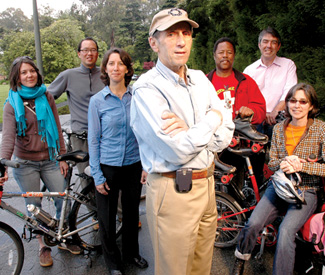
It wasn’t going well for Ted Strawser, predictably. The alternative transportation activist faced an uphill battle March 14 trying to convince a San Francisco Chamber of Commerce committee to endorse Healthy Saturdays, a plan to ban cars from part of Golden Gate Park.

Representatives of the park’s museums and Richmond District homeowners had just argued their case against the measure. “Visitors want access to our front door, and we want to give it to them,” Pat Kilduff, communications director for the Fine Arts Museums of San Francisco, indignantly told the group of two dozen business leaders gathered around a large conference table.

Strawser gave it his best shot: he talked about following the lead of other great cities to create car-free spaces; he said, “Golden Gate Park is one of the best parks in the nation, if not the world”; and he made a detailed case for closure. But around the table there were scowls, eye rolls, and other obvious signs that Strawser was being tolerated, not welcomed. Some — including chamber vice president Jim Lazarus — even started to interrupt and argue with him.

Then the man sitting next to Strawser spoke up. “I don’t think this is fair,” he said. And suddenly, everyone in the room shaped up. Strawser’s ally — his only supporter in the room — was somebody no chamber member could or would dismiss. Warren Hellman doesn’t shout or bang the table — but when he speaks, downtown pays attention.

Hellman, a prominent investment banker, told the committee members that he expected them to show the same respect for Strawser that they had for the previous two speakers. The nonsense ended, immediately.

And by the time Strawser turned the floor over to Hellman, the mood had changed. The group listened raptly, smiled, and nodded as Hellman spoke in his usual folksy, familiar, disarming style.

“It’s not a lot of fun when friends fall out,” he began, “because the previous speakers and many of you all agreed on the necessity of the garage [that was built in Golden Gate Park], and we worked together.”

He pointed out that many in the group had promised during the fall 2000 election to support Healthy Saturdays once the garage was built, although Hellman was now the only member of the coalition honoring that commitment. But he didn’t chide or shame his colleagues. That isn’t Hellman’s style.

Instead, he spoke their language. The garage has never been full and needs the money it can charge for parking to repay the bonds. This isn’t a fight that’s going away, since “part of the conflict is because this park is everybody’s park.” But there are “about 100 compromises not acceptable to either side that would move this forward.” And if a solution can’t be found, there will probably be an expensive ballot fight that nobody wants.

“My conclusion is we should attempt this test,” Hellman told the group. Ultimately, when the vote was later taken in secret, the chamber didn’t agree, although it did vote to back a trial closure after the California Academy of Sciences reopens next year.

At the meeting, Hellman openly called for Mayor Gavin Newsom to get involved in seeking a compromise, something Hellman said he had also just requested of the mayor at a one-on-one breakfast meeting. A couple of weeks later Newsom — who had already indicated his intention of vetoing the measure — did broker a compromise that was then approved by the Board of Supervisors.

As usual, Hellman didn’t take credit, content to quietly play a role in making San Francisco a better place.

Healthy Saturdays isn’t the most important issue in local history — but the significance of Hellman’s involvement can’t be underestimated. His alliance with the environmentalists and park advocates might even signal a sea change in San Francisco politics.

Warren Hellman represents San Francisco’s political and economic past. And maybe — as his intriguing actions of recent years suggest — its future.

This guy is a rich (in all senses of the word) and compelling figure who stands alone in this town. And even though his leadership role in downtown political circles has often placed him at odds with the Guardian, Hellman consented to a series of in-depth interviews over the past six months.

“Our family has been here since early in the 19th century, so we had real roots here,” Hellman told us. His great-grandfather founded Wells Fargo and survived an assassination attempt on California Street by a man who yelled, “Mr. Hellman, you’ve ruined my life,” before shooting a pistol and barely missing.

The Hellman family has been solidly ruling class ever since, rich and Republican, producing a long line of investment bankers like Warren.

Yet the 72-year-old comes off as more iconoclast than patrician, at least partly because of the influence of his irreverent parents, particularly his mother, Ruth, who died in 1971 in a scuba-diving accident in Cozumel, Mexico, at the age of 59. “She was entirely nuts,” Hellman said, going on to describe her World War II stint as a military flier in the Women’s Auxiliary Service Pilots and other colorful pursuits. “She just loved people, a little like I do. She collected people.”

Hellman grew up wealthy and cultured, but he also attended public schools, including Grant Grammar School and Lowell High School. In between, the young troublemaker did a stint at San Rafael Military Academy — “reform school for the rich,” as he called it — for stunts such as riding his horse to Sacramento on a whim.

After doing his undergraduate work at UC Berkeley, Hellman got his MBA from Harvard and went on to become, at the age of 26, the youngest partner ever at the prestigious Manhattan investment firm Lehman Bros. He developed into an übercapitalist in his own right and eventually returned home from New York and founded Hellman and Friedman LLC in San Francisco in 1984, establishing himself as the go-to financier for troubled corporations.

“He is really one of the pioneers of private equity,” said Mark Mosher, a longtime downtown political consultant and the executive director of Gov. Arnold Schwarzenegger’s California Commission on Jobs and Economic Growth, on which Hellman sits.

Hellman became what Business Week called “the Warren Buffett of the West Coast,” a man of extraordinary wealth and power. Among other accomplishments, Hellman took Levi Strauss private, recently made billions of dollars in profits selling DoubleClick to Google, and manages the assets of the California public employee retirement funds (CalPERS and CalSTRS), which are among the largest in the world.

Like many financial titans, Hellman has always been a generous philanthropist, giving to the arts, supporting schools in myriad ways, and funding the San Francisco Foundation and the San Francisco Free Clinic (which his children run). He vigorously competes in marathons and endurance equestrian events, often winning in his age bracket. And he has his humanizing passions, such as playing the five-string banjo and creating the popular Hardly Strictly Bluegrass festival.

But he’s also been a prime facilitator of downtown’s political power, which regularly flexes its muscle against progressive causes and still holds sway in the Mayor’s Office and other city hall power centers.

Hellman founded, funds, and is a board member of the Committee on Jobs, which is perhaps the city’s most influential downtown advocacy organization. Hellman and his friends Don Fisher, the founder of the Gap, and Sen. Dianne Feinstein also started SFSOS, which now wages the most vicious attacks on left-of-center candidates and causes.

When the de Young Museum and other cultural institutions were threatening to leave Golden Gate Park, Hellman almost single-handedly had an underground parking garage built for them, in the process destroying 100-year-old pedestrian tunnels and drawing scorn from the left. The Guardian called it “Hellman’s Hole.”

“We at the Bike Coalition very much started out on the opposite side of Warren Hellman,” San Francisco Bicycle Coalition executive director Leah Shahum told us. “We couldn’t have been more like oil and water on the garage issue.”

But over the past two years or so, Hellman’s profile has started to change. He went on to become an essential ally of the SFBC and other environmentalists and alternative transportation advocates who want to kick cars off JFK Drive in Golden Gate Park on weekends, crossing the downtown crowd in the process. He has shared his wealth with progressive groups such as Livable City, which often fights downtown, and has stuck up for edgy fun seekers over more conservative NIMBY types. He has also publicly repudiated the attacks of SFSOS and its spokesperson, Wade Randlett, and withdrawn his support from the group.

Hellman is still a Republican, but a thoughtful and liberal-minded one who opposed the Iraq War and wrote an article for Salon.com in February titled “If the United States Were a Company, Would George Bush Be Our CEO?” (His answer: hell no.) And to top it all off, Hellman sports a few tattoos and even attended 2006’s Burning Man Festival and plans to return this year.

Unguarded and reflective, Hellman’s comments to the Guardian foreshadow the possible future of capitalism and influence in San Francisco and point to potential political pathways that are just now beginning to emerge.

Our first conversation took place at the Guardian office two weeks before the November 2006 election, when it was starting to look like Nancy Pelosi had a good shot at becoming speaker of the House of Representatives.

“I think this election in two weeks is going to be really interesting,” Hellman told us.

This Republican was cheering for the Democrats to win. “They aren’t my kind of Republicans,” he said of the people in power. Hellman didn’t support the war or approve of how the Bush administration sold it, and he wanted Pelosi and the Democrats to hold someone accountable.

“What I’d like her to do is admit that we can’t get out [of Iraq immediately], but start to talk about what the fallout has been. Discuss the enormous cost in human life as well as money, and how it’s possible the war united the Middle East against us,” Hellman said.

The one thing he can’t abide is disingenuousness. Hellman speaks plainly and honestly, and he asked us to keep particularly caustic comments off the record only a few times during almost six hours’ worth of interviews. He was self-effacing about his political knowledge and seemed most interested in working through the problems of the day with people of goodwill.

Asked what he values most in the people he deals with, Hellman said, “It’s authenticity. Do they believe things because they believe in them, or do they believe in things because they’re cynical or they’re just trying to gain something?”

Locally, Hellman has reached out to people with varying worldviews and come to count many friends among those who regularly battle against downtown.

“I love to know people,” he said. “That’s probably the single thing that motivates me. When someone says to me, ‘How can you be friends with [then–head of SEIU Local 790] Josie Mooney?’ I say, ‘Look, I want to know Josie Mooney. And if she’s awful, then we won’t be friends.’ I’m just fascinated by getting to know people. And virtually always, they’re a little like Wagner operas: they’re better than they sound.”

Hellman was the chair of the Committee on Jobs when he got to know Mooney, who chaired the San Francisco Labor Council and was a natural political adversary for the pro-business group, particularly when Hellman was leading the fight to do away with the city’s gross receipts tax, which has proved to be costly for the city and a boon for downtown.

But after that victory, Hellman turned around and cochaired a campaign with Mooney to retool and reinstate the gross receipts tax in a way that he believed was more fair and helped restore the lost revenue to the city.

“We lost, but he put $100,000 of his own money into that campaign,” Mooney told us, noting that the proposed tax would have cost Hellman and Friedman around $70,000 a year. “I think he just thought the city needed the money. It was a substantive point of view, not a political point of view.”

Mooney considers Hellman both a friend and “an extraordinary human being…. He has made a huge contribution to San Franciscans that doesn’t relate to ideological issues. A tremendous thing about Warren is he’s not ideological, even in his political point of view…. On politics, I’d say he is becoming more progressive as he understands the issues that confront ordinary people.”

Mooney is one of the people who have helped bring him that awareness. When they first met, Mooney said, Hellman told her, “You’re the first union boss I ever met.” That might have been an epithet coming from some CEOs, but Hellman had a genuine interest in understanding her perspective and working with her.

“In a sense, I think that was a very good era in terms of cooperation between the Committee on Jobs and other elements of the city,” Hellman said. “Josie and I had already met, and we’d established this kind of logic where 80 percent of what we both want for the city we agree on, and 20 percent [of the time, we agree to disagree].”

Committee on Jobs executive director Nathan Nayman — who called Hellman “one of my favorite people in the world” — told us that Hellman feels more free than many executives to be his own person.

“He’s not with a publicly held company, and he doesn’t have to answer to shareholders,” Nayman said. “He takes a position and lives by his word. You don’t see many people like him in his income bracket.”

Hellman has become a trusted hub for San Franciscans of all political persuasions, Nayman said, “because he’s very genuine. He’s fully transparent in a city that likes to praise itself for transparency. What you see is what you get.”

Hellman expects the same from others, which is why he walked away from SFSOS (and convinced Feinstein to bolt as well) in disgust over Randlett’s scorched-earth style. Among other efforts, SFSOS was responsible for below-the-belt attacks on Sups. Chris Daly, Jake McGoldrick, and Gerardo Sandoval (whom a mailer inaccurately accused of anti-Semitism).

“If all things were equal, I’d just as soon that SFSOS went away,” Hellman said. “SFSOS started doing the opposite of what I thought they would be doing, so it was fairly easy for me to part company with them. What I thought we were doing is trying to figure out ways to make the city better, not just being an antagonistic, nay-saying attack organization. I’m not a huge fan of Gerardo Sandoval, but I thought the attacks on him were beyond anything I could imagine ever being in favor of myself. And it was a series of things like that, and I said I don’t want anything more to do with this.”

Downtown, they’re not always quite sure what to make of Hellman.

“Every once in a while, he does things that irritate people who are ideologically conservative,” Mosher said. “He took an immense amount of heat for supporting the Reiner initiative [which would have taxed the rich to fund universal preschool].”

He’s given countless hours and untold riches to public schools, doing everything from endowing programs to knocking on doors in support of bond measures and often pushing his colleagues to do the same.

“My connection to him has been through the school district, and he’s really been a prince,” Sup. Tom Ammiano said. “He has even stopped calling me antibusiness. He put a lot of his energy into improving public education, and so he shows it can be done.”

Progressives don’t always agree with Hellman, but they feel like they can trust him and even sometimes win him over. “If you get a relationship with him and you’re always honest about the facts and your own interests, he will listen, and that’s pretty remarkable,” Mooney said. “He shows a remarkable openness to people who have good ideas.”

His appreciation for people of all stripes often causes him to reject the conventional wisdom of his downtown allies, who viciously attacked the Green Party members of the Board of Education a few years ago.

“Everybody said, ‘Oh my god, Sarah Lipson, you know, she’s a Green Party member, she’s the furthest left-wing person on the board,’ blah, blah, blah,” he said. “And I phoned her up one day and said, ‘I’d really like to meet you.’ And she’s — leave aside the fact that I think she’s a very good person as a human being, but she’s a very thoughtful, analytic person. Listening to her opinions about things that are happening in the school district, I really respect that. I mean, what do I know about what’s going on in the school district? I know more now than I did then. But just getting to know people, and maybe get them to understand my point of view, which isn’t that penetrating.”

Many of his efforts have received little publicity, as when he saved the Great American Music Hall from closure by investing with Slim’s owner Boz Scaggs and helping him buy the troubled musical venue. “There are things that you and I don’t even have a clue that he has done,” Nayman said.

“He’s an interesting guy,” Mosher said. “He’s one of a dying breed, a liberal Republican. He has a social conscience and wants to use his money to do good.”

Actually, calling Hellman liberal might be going too far. In the end, he’s still very much a fiscal conservative. He doesn’t support rent control, district elections for the Board of Supervisors, taxing businesses to address social problems such as the lack of affordable health care, or limits on condo conversions.

He also opposes the requirement that employers provide health care coverage, which downtown entities are now suing the city to overturn, telling us, “In general, I don’t think it’s a good idea, because I’m still, even in my aging years, a believer that the marketplace works better than other things…. Universal health care I do believe in, but what I worry is that it’s going to be another damned bureaucracy and that it’s not going to work.”

Yet he doesn’t believe wealth is an indicator of worth, saying of his fortune, “It is luck. Most of what you do you aren’t better at than everyone.”

He doesn’t believe in the law of the jungle, in which the poor and weak must be sacrificed in the name of progress. In fact, he feels a strong obligation to the masses.

As he told us, “My mantra for capitalism — and I didn’t invent this, but I think it’s pretty good — is that capitalism won, and now we need to save the world from capitalism.”

Hellman looms large over downtown San Francisco. His Financial District office offers a panoramic view of the Bay Bridge, Treasure Island, the Ferry Building, and the rest of the city’s waterfront. He likes to be personally involved with his city and the companies in which Hellman and Friedman invests.

“Usually I’m directly involved,” he told us in an interview earlier this year. “I’ve always said that I don’t like to go to the racetrack to just look at the horses. The fun of being a principal is that you’re standing at the track and not saying, ‘Gee, that’s a beautiful gray horse.’ You’re saying, ‘Come on, he’s got to win!’ So I’m almost always invariably invested in the companies that we work with, either individually or through the firm.”

Unlike many Wall Street barons who strive to control a company and bring in new executives, flip it for a quick profit, or liquidate it, Hellman said his firm tries to identify solid companies and help facilitate what they do. “We don’t usually take over companies. I always think that we provide a service to help the businesses,” he said. “Our job is kind of the opposite of owning a factory. Our job is to be sure the people who run the business feel like it’s their business.”

Similarly, he thinks capitalists need to feel a sense of ownership over society’s problems, something he thinks is taking root in San Francisco and other economic centers, particularly among the younger generations. “It’s about understanding how much suffering there is on the other side and trying to figure out how that suffering can be alleviated,” he said. “I think it’s partly good economics that as you bring people up, they’re able to do more for society. If nothing else, they’re able to buy more and shop at a Wal-Mart or something — probably someplace you would wildly disapprove of — and buy goods and services. But I don’t think it’s that narrow.”

Rather, he believes that everyone has a little progressive in them, a little desire to cooperatively solve our collective problems rather than pass them off to future generations. He sees a marked change from his days at Lehman Bros.

“Everybody was into making it,” he said, noting that many capitalists then did charity work as a means of attaining social status but focused mostly on the accumulation of wealth. But, he said, the new generation of capitalists seems genuinely interested in improving the world.

“The feeling for giving back in the next generation, in the now 25- to 35-year-olds, it’s just an order-of-magnitude difference than it was for people who are now in their 40s and early 50s,” Hellman said. “I’m very encouraged.”

Yet the flip side is that, in Hellman’s view, downtown doesn’t wield as much power as it once did. Low political contribution limits have made politicians less dependent on downtown money, creating fewer shot callers, while democratizing tools such as the Internet have broadened the political dialogue.

“For the last 30 years we have become an increasingly tolerant city, and that’s great,” he said. “In the old days, [the Guardian] complained about downtown, and yeah, no shit, downtown really did control the city. The benefit was as that slipped away, the city became fairer and more open to argument. So now downtown hardly has any power at all anymore. In a sense, that’s a good thing. Tolerance grew tremendously when the city wasn’t dictated to.”

That tolerance caused street fairs to pop up all over town and festivals such as Hellman’s Hardly Strictly Bluegrass to blossom in Golden Gate Park. Bike lanes have taken space from cars, events such as Halloween in the Castro have gotten crazier, street protests have gotten bigger and more frequent, and people have felt more free to fly their freak flags. And all that freedom eventually triggered a backlash from groups of isolated NIMBYs who complain and often find sympathetic ears at city hall.

“Sometimes you get the feeling in this city that in the land of the tolerant, the intolerant are king,” said Hellman, whose festival has endured noise complaints even though the music is shut off by 7 p.m. “There is a continuing pressure to do away with fun, because fun is objectionable to someone, [but] we need to think about not creating a new dictatorship of a tiny group of people whose views are not in line with the opinion of most of the people of San Francisco…. You should try to balance the good of a lot of people versus the temporary annoyance of a few people.”

Preserving fun and a lively urban culture is a personal issue for Hellman, who plays the five-string banjo and calls his festival “the most enjoyable two days of the year for me.” He helps draw the biggest names in bluegrass music and acts like a kid in a candy shop during the event.

“I feel very strongly that an important part of our culture is built on the type of music and type of performance that goes on at Hardly Strictly Bluegrass,” Hellman said. From parables set to music to songs of struggle and the old union standards, “that kind of music is the conscience of our country.”

He considers bluegrass a vital and historically important form of political communication, more so than many of the upscale art forms that the rich tend to sponsor. “I’m glad that we have first-rate opera, but it’s equally important that we foster the kind of music, lyrics, etc., that support all this,” he said. “Somebody once said that most of the great Western philosophy is buried in the words of country songs. And that’s closer to the truth than most people think. A big passion of mine is to try to help — and people have defined it too narrowly — the kinds of music that I think have a hell of a lot to do with the good parts of our society.”

Perhaps surprisingly for a Republican venture capitalist from the older generation, Hellman also considers the countercultural freaks of San Francisco to be some of the “good parts of our society.” That’s why he attended Burning Man for the first time last year and why, he said, he loved it, as much for the culture and community as for the art.

“I went to Burning Man because as much as possible I want to experience everything,” he said. “I want to just see directly what it’s like. I knew I’d enjoy it. I never doubted that. But what really overwhelmed me is it was 40,000 people getting along with each other. I mean, it’s pretty intense. There were dust storms and the world’s most repulsive sight: nude men over 70 just dangling along. But I never saw an argument. It was 40,000 people just enjoying each other.”

It was most striking to Hellman because of the contrast with the rest of society. As he said, “I’ve never seen this country so divided.”

While Hellman supports Schwarzenegger — calling him “a good advertisement to California” — he has nothing good to say about his fellow Republican in the Oval Office. He calls Bush’s tenure “an absolute four-star disaster.” The invasion of Iraq is the most obvious problem, he said. “Our war policy has slowly veered from being ‘Don’t tread on me’ to we’re going to jump on your neck.”

But his antipathy to certain aspects of the Republican Party began even earlier, when the religious right began to take over.

“I thought we were not that polarized during the Clinton administration. I was somewhat encouraged,” Hellman said. “Maybe there was an undercurrent of strident religious behavior or strident conservatism, but not the conservatism that I think the Republican Party used to stand for, which was fiscal conservatism instead of social conservatism. Somehow, there was this angst in this country on the part of religious people who I guess felt this country was being taken away from them, and they were the kind of stalwart or underpinnings of society. And they took it back.”

But in the wake of that disaster, Hellman thinks, there is an opportunity for reasonable people of goodwill to set the future political course. As Nayman said of Hellman, “He does believe there is a middle way pretty much all the time.”

Politically, that’s why Hellman gravitates toward the moderates of both major parties, such as Schwarzenegger and Newsom. He looks for people who will marry his economic conservatism with a regard for things such as environmentalism and social justice.

“It’s very tough to be a big-city mayor,” Hellman said. “[Newsom is] probably the best mayor we’re entitled to. He’s got this fantastic balancing act.”

Hellman said downtown hasn’t been terribly happy with Newsom for supporting striking hotel workers, getting behind Ammiano’s health insurance mandate, supporting tax measures, and generally letting the Board of Supervisors set the city’s agenda for the past two years.

“Their measure is he has 80-percent-plus popularity, and he ought to spend some of it. Well, they might not agree with what he would spend it on. And he’s been unwilling to spend very much of it. In some parts of the business community there is disappointment with him, but I don’t think that’s right. He didn’t hide what he would be like.”

What Newsom said he would be — a big reason for his popularity — is a mayor for the new San Francisco, a place where the city’s traditional economic conservatism has been tempered by a greater democratization of power and an ascendant progressive movement that expects its issues to be addressed.

“I don’t like people who are intolerant,” Hellman said. “I don’t like people that are telling you something to get some outcome that, if you understood it, you probably wouldn’t want. I like people that are passionate.”

Asked, then, about Sup. Chris Daly, the nemesis of downtown and most definitely a man of strong political passions, he said, “I admire Chris Daly. I disagree with Chris on a lot of things he believes, but there are also probably a lot of things I would agree with Chris on. And I respect him.”

Hellman is the rare downtown power broker who wants to bridge the gap between Newsom — whom he calls a “moderate to conservative establishment person” — and progressives such as Daly, Mooney, and the Bicycle Coalition. The middle ground, he said, is often a very attractive place, as it was with Healthy Saturdays.

“I’m sure you spend time in the park on Sunday, and it’s a hell of a lot nicer in there on Sundays than Saturdays,” Hellman said. But even more important to him, this is about integrity and being true to what Golden Gate Park garage supporters promised back in 2000.

“They were proposing Saturday closing at that time, which I’ve always thought was a good idea,” he said. “And we made a commitment to them, or I thought we made a commitment to them, that let’s not have Saturday closure now, but as soon as the garage was done, we’d experiment with Saturday closure.”

We brought up what Fine Arts Museums board president Dede Wilsey has said of that pledge, that it was under different circumstances and that she never actually promised to support Saturday closure after the garage was completed.

“There’s a letter. She put it in writing,” he said of Wilsey. “She signed a letter on behalf of the museums saying that when the de Young is done, we should experiment with Saturday closings.”

The Bike Coalition’s Shahum said that even when Hellman was an enemy, he was a reasonable guy. But it’s in the past couple of years that she’s really come to appreciate the unique role he plays in San Francisco.

“He showed decency and respect toward us,” she said. “We never saw him as a villain, even though we disagreed completely. Later he really stepped up and has been a leader on Healthy Saturdays. And what I was most impressed with is that he was true to his word.”

Supervisor McGoldrick, who sponsored the measure, echoed the sentiment: “Hellman was certainly a man of his word who acted in a highly principled way.”

So why does Hellman now stand apart from the downtown crowd? Has he parted ways with the economic and cultural power brokers who were once his allies?

No, he said, “I think they parted ways with me.” *

 

Disorientation

0

› le_chicken_farmer@yahoo.com

CHEAP EATS The closest chicken fried steak to my shack is at the Route 1 Diner in Valley Ford. You probably know it, if you’ve ever been to Bodega Bay. And if not, what the fuck? The Sonoma coast has the prettiest beaches in the world. Surfers don’t like it because they get eaten by sharks, but, other than that …

Anyway, I’m not a beach reviewer.

Two chickens, like I said. That’s all the chickens I have left is two chickens. One lays eggs, and the other one eats them. Or: tough times for a chicken farmer. Oldest trick in the book is to suck the egg out of an egg, then fill it up with Tabasco sauce and put it back in the nest.

But I treat my chickens with a little more respect, I like to think, than most backyard farmers. Instead of Tabasco sauce, I’m whipping up a little roux — butter and flour — then adding onions, fresh jalapeños, tomatoes, and hot sausage. Season to taste, and this way if the oldest trick in the book doesn’t trick her out of the nasty habit, she’ll practically already be jambalaya.

One way or another, I’ll be eating lunch again in no time, by my calculations. But right now I’m still eating breakfast because it’s only 10:30. And I’m all-the-way out of money, so I have to put it on the card, but there’s a $10 minimum, so I have to have coffee too, even though I’m already overcaffeinated, and therefore I can’t stop writing on napkins.

Guess what. Now that I ain’t getting any at home, I can order eggs in restaurants again! Chicken fried steak and eggs ($8.75). Route 1 Diner, Valley Ford, on the way to Bodega Bay — for you. For me, it’s on the way to the city and back.

The eggs are not as fresh or as free-rangy as I’m accustomed to, but the chicken fried is great. Big, thick slab of cubed steak in a nice, crispy breading, draped over a mound of hash browns and just drowned in gravy.

Speaking of which (gravy), Satchel Paige the pitcher was here with his little Thai fambly, and his big American fambly threw a little picnic party for him recently. In Sacramento! So even though I didn’t get to ground out weakly to second against him, or eat no all-you-can-eat sushi with him, or laugh at his little tiny daughter for almost choking to death on cantaloupe instead of chicken bones, I did get to see my old big old friend, and hug him and stuff. And talk about how good the chicken wings were, just like in the good old days.

Except this time I was in Sacramento, which can be very disorienting. Warmth. Mosquitoes. Fireworks. A keg. And when I got back to the Bay Area, you’re not going to believe this, but I swear to you there was a small, compact car on fire at the MacArthur Maze, on the ramp from West 80 to South 880. Couple fire trucks, police, flares, one lane open, and traffic slowed some but not too bad because it was one in the morning, or at any rate after midnight.

Went to sleep in West Oakland, and by the time I woke up, in West Oakland, the media had blown the whole thing entirely out of proportion. Other people had to have seen this. Right? I swear, it was an old Pinto, slapped on the ass, or something. No big deal, a little campfire fire, they were roasting hot dogs and marshmallows.

And by four in the morning it wasn’t a Pinto anymore, it was an oil tanker, spun out and exploded. And the freeway had melted and collapsed and the MacArthur Maze as we know it was no more, snarling traffic all day, affecting the travel plans of generations to come and just generally ruining everything.

You’da thunk I’d have heard something like that right outside my window. Big rig goes boom, couple football fields of freeway crashing down, sirens, states of emergency, and so on. Yeah, right.

My point being: damn, those were some damn good chicken wings! Eh, Satch? To knock me out that hard. I must of ate about a bucket of them myself. And if I knew the name of the Sacto deli that battered and fried and buttered and hot-sauced them, I’d review it.

But I don’t, so … *

ROUTE 1 DINER

Mon. and Wed., 6:30 a.m.–7 p.m.; Thurs.–Sat., 6:30 a.m.–7 p.m.; Sun., 6:30 a.m.–5 p.m.

14450 Route 1, Valley Ford

(707) 876-9600

Takeout available

No alcohol

MC/V

Wheelchair accessible

Cleaning the sour lake

0

>amanda@sfbg.com

Pablo Fajardo, Humberto Piaguaje, and Guillermo Grefa – three natives of Ecuador – recently made a visit to the Bay Area, but not as mere tourists.

"I’ve come here to inform you, San Francisco, so that you here might know what Chevron does outside the borders of the United States," Fajardo said at a press conference outside City Hall. "They are contributing to the destruction of humanity on a global level."

Fajardo is one of the lead litigators in a 14-year-old civil action lawsuit against Texaco (which was purchased by the Chevron Corp. in 2001) accusing the multinational oil company of business practices that soured the lakes, streams, soil, air, and lives of the residents of Lago Agrio ("sour lake" in Spanish). Texaco was based in this rainforest region for 28 years and operated 343 wells and processing plants that pumped 1.5 billion barrels of oil through a 300-mile exposed pipeline over the Andes. The plaintiffs allege that substandard storage and handling of the oil and its toxic byproducts during those productive years have poisoned an area three times the size of Manhattan.

Chevron contends that it has adequately cleaned up 45 sites and anything beyond that is the responsibility of PetroEcuador, a government-owned company with which Texaco had a partnership for use, ownership, and maintenance of the wells.

Chevron is the sixth largest oil company in the world and the richest corporation in the Bay Area. The San Francisco Chronicle recently dubbed Chevron its "corporation of the year" after the oil company posted $17 billion in profits in 2006.

But by the end of this year, Chevron may have a new distinction: loser of the largest environmental remediation case ever litigated. Even though legal scholars say it’s quite possible the Ecuador court will rule against Chevron, company executives still haven’t set aside any money or fully informed shareholders of this potential liability.

A resident of Lago Agrio since he was 14, Fajardo received his law degree through correspondence school coursework just three years ago, and this is the first case he’s argued. But he’s not alone. His legal team includes New York-based Steve Donziger and a bankroll from Philadelphia’s Kohn, Swift and Graf. The recent trip was also supported by the San Francisco organizations Amazon Watch and Rainforest Action Network.

"This was to put a message to the Bay Area. This is your homegrown oil company," Amazon Watch’s executive director, Atossa Soltani, said. "This is an opportunity to hold them accountable. We need to demand they uphold the values of this community."

While in town, Fajardo invited Governor Arnold Schwarzenegger to tour one of the 600 unlined oil pits that are seeping sludge into the drinking water of 30,000 Lago Agrians.

"I know that you have close ties to this company," Fajardo wrote in a letter to Schwarzenegger. "I have read that Chevron has donated over $600,000 to your campaigns and inaugurations. I have also read that your former chief of staff was a lobbyist for Chevron. However, I have faith because I know you are a man of the environment. You are making California a leader in the United States on almost every environmental issue. You are what they call a ‘green’ governor."

The governor is still reviewing the letter, his spokesperson Aaron McLear said, and has not yet decided on taking a field trip to the country. According to an Associated Press article, at an April 24 press conference Schwarzenegger was asked why he turned down an offer to meet the Ecuadorans. He responded, "Everyone has their own ideas of what it is to be an environmentalist and to protect the environment."

To convey their idea of what it means to be a good corporate citizen, Piaguaje and Grefa busted into the April 25 annual shareholders meeting at Chevron’s headquarters in San Ramon, as guests of Soltani and RAN executive director Michael Brune – who both happen to own a little stock in the company.

As three dozen protesters stood outside the meeting holding a banner that read, "Tell shareholders the toxic truth," the usual crowd of well-heeled investors dressed in prim suits and trim neckties mingled inside.

Two individuals looked a little different. Grefa wore a pale green shirt and a thick rope of multicolored beads around his neck. Beside him sat Piaguaje, in a long red tunic with a traditional headdress covering his black hair. During the question period of the meeting, they addressed Chevron board president David O’Reilly.

"Our fight is not for money," Piaguaje, the Secoya tribe leader, said through a translator. "We want you to give back our lives. We want to live in peace, harmoniously with nature. Above all, we want justice. We will continue to fight until we get justice or we will die in our struggle."

"The problems you have there," O’Reilly responded, "you need to take up with the government. There’s no credible evidence that Texaco did anything wrong."

The plaintiffs argue that Chevron’s $40 million remediation job during the ’90s is an implicit admission of some level of guilt.

Chevron says it’s being attacked for the size of its purse. At the shareholders meeting, company executives proudly reported the company made $17.1 billion last year, will be investing about $15 billion in oil exploration, and is kicking off 30 new capital projects at the cost of $1 billion apiece.

Should the Ecuadoran plaintiffs prevail, the cost of a real cleanup has been estimated at $6 billion – enough to hinder just half a dozen of Chevron’s new oil wells. Chevron contends the figure is grossly inflated. "This $6 billion assessment was made by a consultant hired by the attorneys [on the plaintiffs’ side] who only spent three days there," one of Chevron’s lawyers, Ricardo Veija, told the Guardian.

"He was there for a few weeks, actually," said the environmental scientist at his side, Sara McMillen, who’s consulting for Chevron on the case. She added that the consultants asked other experts to consider the figure. "They actually bust out laughing when they hear that number," she said. "It’s more than the cost of Exxon Valdez."

But Fajardo contends the spills in Lago Agrio are larger than the Valdez tanker spill – 30 times larger, in fact (18.5 billion gallons versus 11 million). He said Ecuadorans are more interested in drinking clean water and being treated like humans than squeezing money from Chevron.

Because of the trial, Fajardo was not allowed to attend the shareholders meeting, but we asked what he would say to O’Reilly if they were face-to-face.

"If I could speak with him," Fajardo said in clear, direct words, as if talking to a child who doesn’t want to listen, "I would tell him that I think human beings are the same. We have the same rights no matter what part of the world we live in. This company has caused great harm. Instead of spending millions of dollars in defense, they could be investing money in cleanup. It’s a question of justice."

Fajardo, his stern brow softening as he considered his words, added, "I’d also tell him I have nothing against him personally. I respect him like I respect every other person." *

Scott Howard

0

> paulr@sfbg.com

As an aficionado of the men’s-club look, I was swept into Scott Howard as if into some beautiful dream. Beyond the set of fluttering drapes that shield the host’s station from errant breezes blowing near the front door lies a world of coffee- and tea-colored wood (floor, table and chairs, wall trim), gently dim lighting, a slightly sunken floor like that of some kind of arena, and a brilliantly backlit bar standing against one wall like a sentinel.

But … we weren’t really under any delusion of having stepped into White’s or the Athenaeum in London; although Scott Howard’s interior design relies heavily on traditional materials, it gives them a spare, modern look. Lines are clean and frivolities few, and you feel that the restaurant is meant to appeal to tasteful people who know how to make much of time. There is no wasted motion or idle effect. The Cypress Club (which long occupied the space) is indeed gone for good.

The masculine cast of things isn’t surprising, if only because the restaurant’s chef-owner and eponym bear a name of double-barreled maleness. Yet Scott Howard (the restaurant, and maybe the man too) is all about elegance, not ESPN, and elegance here is understood as flowing from understatement. In this sense the place makes an interesting contrast to nearby Bix (just around the corner, on brick-lined, lanelike Gold Street), whose aura, while also male, has a distinctly more fanciful, Great Gatsby retro element. You could easily stand at Bix’s bar and indulge a brief fantasy of waiting for Nick Carraway; Scott Howard, by contrast, is very much of the here and now, spotlighted by halogen sconce lamps in the ceiling.

The tables are set comfortably far apart – a subtle touch that helps the restaurant breathe more easily and allows the restaurant’s patrons to converse in ordinary tones. And what would they be conversing about? Why, the prix fixe, of course, an innovation Howard returned to the one-and-a-half-year-old restaurant a few months ago. The deal is $32 for a three-course dinner – starter, main dish, and dessert, with a couple of choices available in each category – or $47 for the same dinner with wine pairings. (No choices as to the wines, and none needed, so far as I was concerned. The pairings were superior.)

A la carte devotees and other iconoclasts need not fret, for an entire side of the menu card is given over to the regular menu, whose entries, from a pork chop to Maine lobster to hamachi, reveal Howard’s distinctive blending of European, Asian, and all-American cooking. His style is a bit like Bradley Ogden’s, but with a less overt Middle Western bent.

It is sometimes said by cognoscenti that when visiting London and Paris, you should always go to London first so as not to be disappointed. If you start in Paris, you might find London, for all its splendors, a little tatty. A similar advisory ought to apply to Scott Howard’s tuna tartare ($12), a disk of chopped fish atop a bed of cubed avocado, with a well-modulated chorus of piperade and crisped chorizo bits on the side and, throughout, a subtle perfume of vanilla oil. This dish is so sublime that you will struggle not to order a second one (we struggled unsuccessfully), and if you start with it, you might find that it casts a shadow over everything that follows. One solution would be to have it for dessert, but this would seem odd, despite the vanilla; another would be not to have it at all, but this would be a heavy loss.

Only marginally less rapturous but considerably earthier is the orzo "mac and cheese" with tomato jam ($7 for a sizable crock), which could pass as an especially creamy risotto. ("That stuff is evil!" our server said to us with barely restrained glee. He meant "evil," of course, in the best possible, the Dame Edna, sense.) If Howard’s sensibility glides gracefully between the earthy and the sublime, then the prix fixe cooking finds a balance somewhere near the middle, in happy-medium country. The cooking here is sophisticated rather than dazzling – the kind of food your table considers for a moment in quiet admiration but does not hesitate to eat, while talking about other matters.

A tomato soup, for instance, was rich and thick, with a few flicks of fennel pollen (which looked like black pepper) cast over the molten surface and a faint hint of smokiness that suggested roasting. A plate of smoked salmon draped over a potato pancake – really more of a fritter – and garnished with a dollop of sour cream was a classic presentation, the kind of thing you might be served at your club, if you belonged to one. (Wine pairing for both: a crispy-rich albarino.)

The recurrence of salmon – Scottish, as a main course, with hedgehog mushrooms and coins of fingerling potatoes in a tarragon broth – didn’t quite make it up the mountain for me. The poached fish was fishy, the broth watery. Much better was roasted lamb loin, ruby rose in the middle, laid in two pieces atop a bed of braised spinach and scallions and finished with dribbles of truffled jus. Your club would definitely serve this with pride. (Wine pairing for both: an intense but controlled California primitivo.)

Prix fixe desserts seldom set the world on fire, and Scott Howard’s are no exception, though the sparkling moscato sounded a festive holiday note. Warm chocolate cake with blackberry coulis and whipped cream? Nice, but a rerun deep in syndication. There was nothing showy about butterscotch pudding either, except that it was dense and good, sweet but not too. Can a dessert be manly? *

SCOTT HOWARD

Dinner: Tue.-Sat., 5:30-10 p.m.

500 Jackson, SF

(415) 956-7040

www.scotthowardsf.com

Full bar

AE/DC/MC/V

Well-managed noise

Wheelchair accessible

Small Business Awards 2007: Cooperative Award

0

Down near the dead end of Palou Avenue, beside the old Hunters Point Shipyard, whose claim to infamy is being the city’s sole Superfund site still rife with toxic waste and radioactive material, there’s a woodworking shop that goes against the grain.

Woodshanti, a worker-owned cooperative of custom-furniture builders, strives to be as peaceful as its Hindi-inspired name suggests – "not a negative but a positive part of the ecology," cofounder Shawn Berry says. He and Tom Clossey took over the shop in 1997, when it was still run-of-the-sawmill, and transformed it into an expression of their core values: responsibility, trust, and fun. That last one is underscored by the Ping-Pong table in the break room and a print from Where the Wild Things Are hanging behind Berry’s desk.

As members of a cooperative, Berry, Clossey, and their four co-owners – Todd Rowan, Laura King, Dave Dupuis, and Zac Rose – are directly vested in the business, divide profits based on hours worked, and carry equal amounts of responsibility. Becoming an owner requires at least a three-year commitment and an ability to mesh with the group culture.

Environmentalism and sustainability are the key values of this business, making it a rarity in an industry that depends on cutting down trees. Unlike most wood shops, Woodshanti has a thumbs-up from the Forest Stewardship Council (FSC), a certification in the building trade similar to organic certification in the world of agriculture. Requirements are strict, and the shop is regularly inspected to ensure that the entire chain of custody – from the forest to the sawmill to the lumberyard – adheres to specific standards regarding how and where the trees are sawed. Wood must be responsibly harvested or "rediscovered," meaning it’s salvaged from windfalls, forest fires, or construction sites.

"We wound up doing it because there wasn’t a lot of credibility when we just asked lumberyards if the wood was responsibly harvested," Berry says. Though he believes that the field needs more improvements and the FSC certification isn’t perfect, it’s still above and beyond the conventional foresting industry, as there aren’t any restrictions on clear-cutting, mono-cropping, and using pesticides on privately owned land.

Health is also a part of the wealth of the work and workers. "This is by far the best-smelling finishing room you’ll ever be in," Berry says of the partitioned-off area where tables, bookcases, cabinets, and chairs await their departure. "This is what really sets us apart."

Most woodworkers use a petrochemical base for their finish, a fluid that dries into a slick, impermeable coat and feels more like plastic than wood. Woodshanti uses a linseed-oil-based blend of natural turpentine, rubbed into the wood by hand and designed to penetrate and protect in the way that moisturizer does dry skin. These finishes deepen, rather than stain, the arboreal hues and require additional applications over time. "We’re really up front with the customers," Berry says of the process. "If you’re not into it, there’s a shop around the corner that will do the standard finish."

They’re also forthcoming about their prices. As with most custom work, their products aren’t for the lighter purse. A basic furniture piece clocks in around $2,000; a kitchen on the cheap runs $30,000 and as much as $60,000 for more challenging joinery or costlier wood.

"Our clientele is more or less wealthy," Berry concedes. The co-op’s monetary success, in turn, allows for occasional generous donations of custom furniture to worthy causes and helps the co-op promote and foster its ideals for community outreach through such outlets as the Urban Alliance for Sustainability, an organization founded by Berry that is a clearinghouse of information for the sustainability-driven citizen and raises awareness of locally made goods and services. "What’s important is not to be individually self-sustaining," Berry says, "but to be part of a community that is." (Amanda Witherell)

WOODSHANTI COOPERATIVE

909 Palou, SF

(415) 822-8100

www.woodshanti.com

Small Business Awards 2007: Solar-Powered Business Award

0

Going to a mechanic can be like paying a visit to a dentist. Sometimes it feels like they’ve done more harm to your grill than good. Needless to say, it can be a chore to find a good one. Bless your stars and garters that the steady-handed masters at Berkeley’s Oceanworks, which specializes in repairing Japanese cars, are the preeminent green and reliable mechanics around.

Since the current incarnation of the shop opened in 1991, it has developed a reputation for being affordable, trustworthy, environmentally thoughtful, and, most of all, competent. Words wished for in, but not always associated with, the world of automotive repair.

When you step into owner Angus Powelson’s small office, little details reveal that his West Berkeley shop departs from the typical automotive garage. Rather than Popular Mechanics, recent issues of the New Yorker rest on the coffee table, and the good old pot of coffee has been replaced by an antique-looking Italian espresso machine. Sure there are the smells and sounds found in any other garage, but this is about as bohemian an auto shop as you’re going to find.

It’s not only the decor that makes this place so great: Oceanworks consciously does all it can to limit the damage it causes to our beautiful bay biosphere. Upgraded in 1997, the garage receives roughly 75 percent of its power from the reflective solar panels that you see soaking up the rays on the roof. In the office the key word is reuse. Envelopes, boxes, plastic bags, Ziplocs, and cardboard continually find new raisons d’etre. The small amount of paper that is not reclaimed goes into the blue bin, along with any cans and bottles, and is sent off to the recycling yard.

In the garage the story is the same. Coolants get reused and engines are built from salvaged parts. Scrap steel and aluminum are either recovered or recycled. Salvageable car parts are sorted and stored for a chance to live again. When Powelson first took over Oceanworks, the garage filled a six-cubic-yard waste can daily. Today the can is three cubic yards and rarely gets full.

It seems hard to believe, but this mechanic and his shop tread as lightly as possible. Powelson may change oil and rebuild motors for a living, but his dedication to environmentally conscious auto repair is rivaled only by his commitment to traveling by bike as much as possible and using his truck only for work-related tasks.

While the outfit specializes in foreign cars, it’s also thinking ahead. Oceanworks deals in Swift bicycles, those nifty folding Xootr bikes that are superlightweight and can be readily stored without nuisance. "Anything to get people out of their cars," Powelson says. (Chris Jasmin)

OCEANWORKS

2703 10th St., Berk.

(510) 849-1383

www.oceanworksberkeley.com

Eco trip

0

› kimberly@sfbg.com

SONIC REDUCER So you wanna live clean, go green, and leave a low-impact footprint on this embattled Earth — yet you also want to bring the noise, bust a move, and get the rock out? It’s worth wondering about on Earth Day, when everyone seems to be looking to what they can change while the powers-that-be hold their apocalyptic course. Some might argue that a decadent pop lifestyle clashes with the color green — and even those who want to tour consciously must pay a price.

"It is a lot of work," said Oakland musician John Benson, whose veggie oil–fueled bus and curbside shows are a model for ecopunks who want to burn less petroleum and more french fry grease. He has converted vehicles for about five bands so far and plans to attend the Version Festival in Chicago to demo veggie-run vehicles, but Benson and his converts are learning that culling free fuel from oil Dumpsters behind truck stops can be dirty and time-consuming work.

"Bands that are really glamour conscious get really bummed out," he explained. "There’s a time loss and a filth factor, and when you’re on a tour, you’re conscious of making the next show." Also with used oil, "you get dead rats, sweet and sour sauce, and the occasional ball of hair," he added. "You have to be prepared to pull over and pull it out. Be prepared to get your favorite suit covered with rat droppings. It’s a fashion hazard."

Still, creating a cleaner planet doesn’t have to be a filthy business, despite the fact that even green-minded musos such as Smog Veil Records honcho Frank Mauceri admit, "Traditionally, the music industry has not been a green industry. It’s not a business that’s been sensitive to the environment."

Nonetheless, Mauceri, who fought Chicago’s city hall to install an electricity-producing wind turbine and solar panel system atop his new headquarters, and others are trying to buck tradition. San Francisco singer-songwriter Kelley Stoltz’s recent Below the Branches (Sub Pop, 2006) sported a Green-e label, tagging the full-length as the first to be recorded with all-renewable energy purchased through offsets from the Bonneville Environmental Foundation. Pink Floyd guitarist David Gilmour similarly created a climate-neutral solo album, On an Island (Sony, 2006), through an arrangement with the CarbonNeutral Co., planting trees in response to the carbon emissions produced during the disc’s making.

But what can you, humble musicmaker and fan, do? I did a little chatting, Web searching, and non-ozone-depleting cogitating for just a few suggestions on how to green your music enjoyment.

THE TROUBLE WITH CDS Are digital downloads the real green deal for music consumers? Part of Smog Veil’s green initiatives involves eliminating jewel cases and using all-paper Digipaks, eventually moving to solely digital downloads. But the digital divide continues to be an issue — so the nonwired music lover might want to purchase music from bands such as Cloud Cult who have packaged their CDs in 100 percent postconsumer recycled paper with nontoxic soy ink. And those still attached to the shiny plastic discs can turn to Green Citizen (1-877-918-8900) for recycling. Meanwhile old-school DIY-ers such as Benson make a plea for analog: "People are finding bulk tapes in thrift stores and recording over them in the spirit of recycling."

DELIVERY SYSTEM BLUES You’ve proudly purchased that ecofriendly download, yet what to do when the trusty iPod breaks? Apple has a recycling program: any US Apple store will accept old iPods and offer a 10 percent discount on a new player. Nonetheless the highly toxic e-waste generated by all MP3 makes and models continues to worry environmentalists. Cart those busted players to the aforementioned Green Citizen or call pickup artists such as E-Recycling (1-800-795-0993).

LIVE WASTE "Music is a catalyst," Perry Farrell recently told me from London. "It can bring people together and make change fashionable. I’d love to see everyone buying recycled paper and buying hydrogen fuel cell cars." Farrell has done his part with Lollapalooza, which introduced solar-powered stages and came up with fun ways to encourage recycling (audience members gathering the most recyclables have scored backstage passes). Bonnaroo and the Vans Warped Tour have powered stages, generators, and buses with biodiesel. Still, efforts can be as simple as the Green Apple Music and Arts Festival (not to be confused with the SF bookstore). Founder Peter Shapiro is using the fest to promote Earth Day with shows in San Francisco, Chicago, and New York City this year while providing city venues with environmentally friendly paper products, garbage bags, and cleaning materials and offsetting the carbon dioxide emissions produced by the festival, making it the largest carbon-neutral event in the country. He told me that he hopes "we’ll get people to think about it for 30 seconds, maybe go buy an energy-efficient lightbulb, maybe carpool or walk to the next show."

GET IN THE VAN Not all young bands can afford to buy carbon dioxide emission offsets and convert to biodiesel when they go on tour, like Barenaked Ladies, Pearl Jam, Gomez, and Crosby, Stills, Nash and Young — let alone slap their name on a biodiesel company the way Willie Nelson has with BioWillie. But that doesn’t mean musicians have to stop spreading the green love. Someone Still Loves You Boris Yeltsin’s Philip Dickey says his Springfield, Mo., group is aiming to convert its touring van to veggie oil someday, but until they can afford it, they’re trying to do their part. "No one in the band has a car. We all ride bikes when we’re in town, and when we’re touring, there’s five of us in a van. Pollution sucks, and pollution coming out of our van sucks. But it’s not like one person in an SUV. We also have a new song called ‘Bigger Than Your Yard’ about how everyone has to have a car." *

GREEN APPLE MUSIC AND ARTS FESTIVAL EARTH DAY EVENT

With Bob Weir and Ratdog, Stephen Marley, the Greyboy Allstars, and others

Sun/22, 11:30 a.m., free

Golden Gate Park

Fulton and 36th Ave., SF

Other events run Thurs/19–Sat/21

For a schedule, go to www.greenapplefestival.com

SOMEONE STILL LOVES YOU BORIS YELTSIN

Tues/24, 8 p.m., $14–$15

Slim’s

333 11th St., SF

(415) 255-0333

>

El pollo greco

0

Herbs tell stories, and the association of certain herbs with certain experiences can be specific and powerful. Basil, for instance, is summer and tomatoes, while sage is Thanksgiving and bread stuffing. Oregano? Its strong perfume is the smell of pizza — but it’s also Greek. It is, in particular, the herb that gives Athenian or Greek chicken its bewitching character.

For years I tried without much success to create at home a plausible version of the Athenian chicken that we found so irresistible in Greek restaurants. The restaurant chickens often seemed to have been roasted on rotisseries, and while I couldn’t match that, I did have my trusty vertical roasters, which produced (with day-before rubbing of kosher salt and Herbes de Provence) wonderful Zuni-style roast chickens. My basic theory was to substitute oregano for the Herbes; this worked, but the results were underwhelming, certainly no match for their Zuniesque brethren. Smashed garlic and lemon slices under the skin? These helped a little, but the birds still seemed to lack the sought-after verve.

Of course, there is more than one way to roast a chicken. Roasting says oven the way oregano says pizza, but it need not be so. Let us not forget pan roasting, a near relation to braising, in which the item in question is cooked on the stove top in a small amount of fat or other liquid. I had a time-tested recipe for pan-roasted lemon-rosemary chicken; what if I dropped the rosemary in favor of (dried) oregano? I did: eureka!

Start with an oregano-and-salt-rubbed chicken, cut into pieces. Put the pieces in a large nonstick skillet over lively heat for a minute or two, turning occasionally until they’re lightly seared. Add a couple of tablespoons each of sweet butter and olive oil to the pan, along with a good pinch of salt, a heaping tablespoon of dried oregano, and three cloves of smashed, peeled garlic. Cook for a few minutes more, shaking the pan and turning the pieces. Add a cup of dry white wine, and bring to a boil; reduce the heat and simmer, partly covered, for 30 to 40 minutes, turning the pieces now and then. When the chicken is golden brown, remove from the pan and deglaze with the juice of one lemon. I use a gravy separator for the pan juices, but you don’t have to. Serve the jus on the side and say oompah!

Paul Reidinger

› paulr@sfbg.com

Biodiesel backfire

0

› news@sfbg.com

On May 18, 2006, Mayor Gavin Newsom issued Executive Directive 06-02 — also referred to as the Biodiesel Initiative — ordering the city of San Francisco to switch to a fuel blend that includes at least 20 percent biodiesel in all of its diesel vehicles. The move won environmental plaudits: the National Biodiesel Board cited the plan as being the farthest-reaching proclamation of its kind.

It was the kind of ambitious program that played up the mayor’s environmental credentials. Biodiesel is made not from petroleum but from renewable domestic resources such as vegetable oil. It produces far fewer greenhouse gases and toxic byproducts than traditional diesel and can work with any standard diesel engine.

Using just 20 percent biodiesel in the fuel mix can reduce carbon monoxide emissions by 12 percent and smog-forming hydrocarbons by 20 percent.

And Newsom insisted this wasn’t a far-off dream: he projected that a full 25 percent of the city’s diesel fleet would be using the green fuel by March 31, 2007, and every last bus, street cleaner, and fire truck would be switched over by the end of the year.

But March 31 has come and gone, and the city isn’t even close to meeting that goal.

San Francisco uses approximately eight million gallons of diesel fuel per year, in vehicles ranging from heavy-duty fire engines to street sweepers, airport shuttles, and maintenance vehicles. The biggest user by far is Muni, which burns as much as six million gallons annually.

And Muni is way behind on its biodiesel deadline. In fact, the agency has yet to submit its pilot proposal to the Department of the Environment. And while clean vehicles coordinator Vandana Bali told us 33 of Muni’s nonrevenue vehicles are being fueled with B20 — the mandated mix of 20 percent biodiesel and 80 percent traditional petroleum product — she was unable to offer even a tentative timeline for introduction of the less-noxious fuel into Muni’s diesel bus fleet.

Converting Muni to biodiesel hasn’t been as easy as Newsom projected. Much of the bus fleet uses a high-tech emission control system, and the manufacturer hasn’t approved the device for use with biofuels.

And then there are the transition issues.

Mike Ferry, a firefighter at the San Francisco Fire Department, which runs about 150 diesel vehicles, told us the department had to put a lot of time and money into upgrading its infrastructure for biodiesel.

Regular diesel is a fuel that practically takes care of itself, even under substandard conditions — but biodiesel requires better storage conditions, more regular rotation, and cleaner tanks. And although diesel engines require little to no modification to be compatible with biodiesel blends, it’s often necessary to change out the fuel filter before introducing the biofuel, to prevent clogging.

The fire department also has to clean out all 20 of its diesel storage tanks, at a cost of between $2,000 and $3,000 a tank.

But for a department with an annual budget of $220 million, that’s not a vast amount of cash. And several other city departments have managed to comply with Newsom’s edict. San Francisco International Airport started using B20 in 19 airport shuttles in July 2006, and the entire inventory of approximately 150 diesel vehicles switched to B20 on a permanent basis the following September.

The city’s central shops, where more than 900 diesel vehicles — including street sweepers and Recreation and Park Department equipment — are fueled, switched one of two diesel tanks over to B20 in 2006 and the second on March 15, 2007. Jim Johnson, superintendent of central shops, estimates that the agency uses about 650,000 gallons of diesel fuel annually.

But compared with the six million gallons of diesel fuel used by Muni, 650,000 gallons is a drop in the municipal bucket. In fact, while the Biodiesel Initiative was designed to spare the air the effects of at least 1.6 million gallons of petrodiesel annually, 20 percent of 650,000 gallons is just 130,000 gallons of pure biodiesel. Even adding in the approximately 5,000 gallons of B20 per month used by the airport and the 2,000 gallons (out of 170,000) per month currently being used by the Fire Department, the city still falls short of 25 percent implementation by a large margin.

Nathan Ballard, a spokesperson for Newsom, told us the mayor had discussed the situation with Muni before making his public statement and at the time Muni officials were fully supportive of the plan.

It’s still possible for the city to get closer to Newsom’s emissions-reduction goal: even if Muni is unable (or unwilling) to make the shift, other agencies could increase the amount of biodiesel they put in the mix. Most vehicles can run fine on 100 percent biodiesel. But December is fast approaching — and it’s hard to see how Newsom can make his promise come true. *


For more SFBG biodiesel coverage, click here

Vino, verde, vici

0

› superego@sfbg.com

SUPER EGO Fuck green — I want emerald, I want turquoise, I want veridian. I want shades of chartreuse cascading down the sides of my highball glass and mint cream swirling at the lip of my rim. Mmm. I was going to write this week about how much I’m head over loafers for Lil Mama’s clover new vid, "Lip Gloss," and what the deal is lately with so many trash-tragic newbie chicks wearing flip-flops and fleece to the clubs (did I miss a memo from Target?), but it’s the Green Issue — yay for Earth! — so I’m going in on the recent trend toward "green" cocktails.

Green cocktails? Easy! All you have to do is down eight or nine shots of Fernet, and — voila! — you’re green. And let’s not even get into how some drinks instantly recycle themselves. Yet in terms of mixology, green usually means organic — juices, vodka, ice cubes, fruit flies, what have you. Organic, however, doesn’t necessarily mean green: it probably took five tons of jet fuel to plop that native Guangdong lychee into your tropical Bellini. Conundrums! When it comes to partying green, it seems, the snifter of a conscious tipple is somewhat bruised with environmental irony. It’s environy.

But if you can snag some local fresh-squeezed mixer, shake it with small-batch liquor, and consume only what you need — not hard, since organic cocktails are kind of freakin’ pricey — you can still get three sheets to the wind and not feel like you’re littering. Usual suspects such as gourmet vegetarian legend Millennium (milleniumrestaurant.com — house-infused kumquat–star anise gin, anyone?) and the snuggly bar at Roots Restaurant (theorchardgardenhotel.com) in the grandly green-built Orchard Garden Hotel have been in on the organic, fresh-brewed tip for a while. And a few surprising spots have begun wearing their green hearts on their sleeves too. Vesuvio (vesuvio.com) in North Beach is bursting with ecofriendly drinks such as the Pojito, a mojito with local-made 209 gin and organic Pama pomegranate liqueur. SoMa restaurant Coco500 (coco500.com) features a nifty lemongrass Bloody Mary, with lemongrass-infused organic vodka, organic tomato juice, and sriracha (sun-dried chili paste).

As for less immediately intoxicating spirits, Yield Wine Bar (yieldsf.com) offers a vast array of biodynamic, sustainable, and organic wines with some of the more harmful of the 250 chemicals involved in production filtered out — that’s almost as many chemicals involved as in the first 10 minutes of a drag queen’s night out. Harmful. Wine’s pretty easy, of course — we live in wine heaven, and the products of conscious vintners such as Beringer (beringer.com) and Five Rivers Ranch (fetzer.com), as well as those from distributors such as the Organic Wine Co. (ecowine.com), can be found all over. Beer’s getting in on it too: local foam-meister Anderson Valley Brewing Co. (avbc.com) pumps out the suds from a solar-powered brewery, even.

But the green drink ground zero in San Francisco has to be Elixir in the Mission. Not only does it foreground organic cocktails, but the whole Elixir enchilada is officially green certified by the city in terms of recycling, cleaning, and waste disposal — the first bar of its kind. H., Elixir’s wryly gregarious owner, mixes up fierce experimental environmental drinks at the bar’s monthly green drink happy hour, which brings in an enthusiastic crowd of ecoliquor seekers (who are also really into baseball, judging from the reactions to the big-screen TVs). At a recent green grog gathering, he whipped me up a luscious Eldersour, using organic Square One rosehip-infused vodka and elderflower syrup, and a kick-ass — I can’t believe I’m seriously about to type this word — GreenTeani, a Square One martini with organic green tea infusion and lime zest. It was gone in a minute — gulp.

"There’s the green side of our business — stuff like installing low-flow toilets and making sure we recycle as much as possible," H. says. "And then there’s the organic side, with the drinks, that people seem to be getting really into lately. The little things you can do every day to feel like you make a difference matter more and more, the principle of it — even if it’s related to being a bar or going out. Nobody can be perfect when it comes to environmental stuff. I mean, I drive an old BMW to work — and it doesn’t run on used fryer oil. But it’s paid for."

After a few more GreenTeanis and a quick trip to the low-flow, I had to admit that I certainly felt better about my environment. Global warming? Pshaw. Everything was just ducky. Now where can I get an organic date? *

GREEN DRINK HAPPY HOUR

Second Thursdays, 6 p.m.–late

Elixir

3200 16th St., SF

(415) 552-1633

www.elixirsf.com

>

Esperpento

0

› paulr@sfbg.com

Spanish food may have struggled for recognition in this country and will almost certainly never be as well loved as its near relation, Italian cooking, but in the last decade or so the Iberian peninsula has given us at least one big present: the tapa. Tapas, the little plates that could, are so big now that they’re often not even remotely Spanish: we find Cuban and nuevo Latino and even American versions, while small plates from other cultures end up being called "tapas" for convenience’s sake. People might not know about, and might be chary of ordering, a meze platter, but if you call it Turkish or Greek tapas, they’re in.

At Esperpento, which turns 15 this year (the name means "absurdity"), the tapas are still tapas, still Spanish — the kinds of things you’d have with a beer or a glass of verdujo or rioja in the middle evening at some restaurant near the Plaza Mayor in Madrid. The venue itself, with its forest of support columns and cheerful, well-scuffed yellowness, looks like such a place and offers us a reminder that restaurant interiors evolve or accrete meaning through use and are not necessarily complete when created, no matter how elaborately and expensively they are designed. But what most amazes about Esperpento is the paella, which is actually better than good — quite near excellent, in fact. While I cling to my view that the best paella is likely to be made by a home cook, I can no longer say that restaurants can’t pull it off. Esperpento can and does, though, as with soufflés, you are given notice that there will be a 30-minute wait.

If you have to wait a spell for your main dish, what better way to pass the time than by noshing on tapas in a house of tapas? Esperpento’s selection is huge, turn-around time is short, and a surprising number of the small plates are vegetarian friendly. You could easily order up a meatless feast here without disappointing meat eaters in the slightest. Especially fabulous are the alcachofas a la plancha ($5.50), disks of thinly sliced artichokes grilled with a simple combination of garlic and parsley. And not far behind are the patatas ali-oli ($4.50), crispy-tender new-potato quarters generously spattered with garlic mayonnaise. If you like your potatoes a little less free-form, you might prefer the tortilla de patata ($6), which the menu describes as an "omelet" of potatoes and onion but is really more like a cross between a quiche and a tart and is far tastier (and substantial: the pie yields six decent-size slices) than its modest list of ingredients might imply.

As in Italian cooking, simple preparations yield potent results. Mushrooms sautéed with garlic ($5.25) were as meaty and fragrant as chunks of kebab. A salad of roasted julienne red pepper ($5.50) dressed with a house vinaigrette was gorgeous, even though the peppers were just the ordinary kind rather than the fancier (and slightly hotter) sort from Navarre. Boquerones ($5), Spain’s famous white anchovies, were dipped in batter and flash-fried, so they resembled french fries, while calamares a la plancha ($6.50) took a turn on the grill quick enough to keep them tender. One plancha-style dish did disappoint: clams ($6.25), which were not bad, just pallid despite garlic, parsley, and olive oil. And a salad of white beans ($4.75) could have used a boost of something.

A common booster in Spanish cooking is pimentón ahumado, or smoked paprika. This is the spice that gives Spanish chorizo its distinctive flavor, and it turned up big in the sauce of the rabbit stew ($6.75), a quasi-signature dish. The meat itself, still on the bone, was fine if not remarkable, but we carefully sopped up all of the sauce with rounds of white bread from the continually replenished basket.

The paella — de carnes y mariscos ($26 for two, but plenty for four if sufficiently preceded by tapas) — arrived in due course and was inspected. We noted the traditional two-handled pan, the wealth of meat, mussels, prawns, and green peas, and the bright yellowness of the rice — an indication that there has been no stinting on the saffron. The grains of rice were plump and glistening, a sign that they had just been cooked straight through rather than parboiled, left to wait, then finished in haste.

Best of all was the caramelized crust that had developed at the bottom of the rice layer. One of the big differences between risotto and paella is that the former is stirred more or less constantly, with a creamy result, while the latter is stirred hardly at all. The result of this stasis is the crust, which is something of a delicacy, though scraping it off and folding it into the rest of the dish can be an indelicate operation.

Paella is one of life’s more festive dishes, and Esperpento, despite its advanced age, has to be one of the more festive restaurants in the not-exactly-somnolent Mission: large parties wait at the door, tables are pushed together, cheerful voices are raised, plates laden with tapas fly from the kitchen (to return a few minutes later, stripped clean), service staff move nimbly among the tables like performers in some high-wire circus act. It is chaos, yes, but functional chaos, absurd as that might sound. *

ESPERPENTO

Lunch: Mon.–Fri., 11 a.m.–3 p.m. Dinner: Mon.–Fri., 5–10 p.m. Continuous service: Sat.–Sun., noon–10 p.m.

3295 22nd St., SF

(415) 282-8867

Beer and wine

AE/DISC/MC/V

Noisy

Wheelchair accessible

>

This November, let’s fix Muni

0

OPINION In 2007 quality public transportation is not just a hallmark of a world-class city; it’s our best defense against global warming. In a state where half of all greenhouse gas emissions comes from mobile sources, we have to provide people the real choice to get out of their cars and onto public transit.

Nationwide, public transit use was up 3 percent last year. In San Francisco, Muni’s ridership declined 2 percent. This is a city that understands the threat of global warming, rallies against oil wars, believes in an improved quality of life with fewer cars, and long ago adopted a transit-first policy; the Muni ridership drop is totally unacceptable.

Muni should be attracting new riders, not driving the existing users off the system. A reliable Muni is also a serious social justice issue: 29 percent of San Francisco households get by without a car, mostly because they can’t afford it.

Muni’s meltdown in the 1990s was one of the biggest failures of the Willie Brown administration. The crisis caused voters to amend the City Charter in 1999 and create the Municipal Transportation Agency (MTA), setting explicit standards of service quality and guaranteeing predictable funding. Using new capital from the reauthorization of the sales tax for transportation, Muni was able to replace its bus fleet and restore most of its operability.

However, early in the Gavin Newsom administration, Muni service quickly began to deteriorate. Recently, Muni officials even sought to lower their on-time goals. This month’s opening of the T–Third Street line brought Muni metro service to a near standstill. Muni leadership apparently agreed that the problems were unacceptable — they spent much of their time passing out written apologies to Muni riders. However, these service interruptions are symptoms of deeper, structural problems at Muni. Apologies are not enough. It’s clear that significant additional Muni reform is necessary.

That’s why we are proposing a charter amendment for this November’s ballot to make managers and operators more accountable for their performance and to find new sources of revenue for this struggling system.

The MTA currently lacks the vision, accountability, and resources to deliver the transportation system that San Francisco needs. While Muni’s structural deficit has risen to $150 million a year, Muni officials have been slow to propose revenue options, and we know voters won’t be happy to provide more funding without structural reforms that make those public investments worthwhile. Measured in passengers carried per hour of revenue service, Muni’s current productivity has dropped to a historic low.

We need to make sure Muni’s managers and service planners have the tools to deploy their workforce efficiently, and we need to hold them accountable for delivering promised service.

We don’t know if Newsom will support substantial Muni reforms — but the system has broken down on his watch, and every San Franciscan who relies on Muni and who cares about the environment needs competent leadership from city hall now. *

Chris Daly and Aaron Peskin

Supervisors Chris Daly and Aaron Peskin represent Districts 6 and 3, respectively.


The silver bullet train

0

› steve@sfbg.com

There aren’t many easy answers to the environmental crisis facing California, a state with a fossil fuel–dependent culture that’s cooking the planet, congesting the freeways and airports, and hastening a tumultuous end to the oil age. But there is one: build a high-speed rail system as soon as possible.

All the project studies indicate this should be a no-brainer. San Franciscans could travel to Los Angeles in just a couple hours, the same time it takes to fly, at a fraction of the cost. And the system — eventually stretching from Sacramento to San Diego — would generate twice as much money by 2030 as it costs to build. The trains use far less power than planes or cars and can be powered by renewable resources with no emissions. The system would get more than two million cars off the road and single-handedly reduce greenhouse gas emissions by as much as 12 million metric tons per year.

High-speed rail is a proven green technology that works well everywhere it’s been implemented, including most of Europe and Asia. In France the TGV line from Paris to Lyon connects the country’s two most culturally important cities in the same way that Los Angeles would be linked to San Francisco — from one downtown core to the other — allowing for easy day trips and ecofriendly weekend jaunts. Advocates for high-speed rail say it’s an essential component of California going green and the only realistic way to meet the ambitious climate change targets approved last year in Assembly Bill 32.

Yet for some strange reason, the idea of high-speed rail has barely clung to life since San Franciscan Quentin Kopp first proposed it more than a decade ago as a member of the State Senate and set the studies in motion, all of which have found the project feasible and beneficial. Today Kopp, a retired judge, chairs the California High-Speed Rail Authority (CHSRA), which has fought mightily to move the project forward despite severe underfunding and sometimes faltering political support.

Growing awareness of climate change has increased support for high-speed rail among legislators and in public opinion polls (among Democrats and Republicans), leaving only one major impediment to getting energy-efficient trains traveling the state at 220 mph: Gov. Arnold Schwarzenegger.

While posing for the April 16 cover of Newsweek with the headline "Save the Planet — or Else" and touting himself around the world as an environmental leader, Schwarzenegger has quietly sought to kill — or at least delay beyond his term — high-speed rail.

The $10 billion bond issue to build the LA-to-SF section was originally slated for 2004, then pushed back to 2006, then pushed back to 2008 because Schwarzenegger worried it would hinder the $20 billion transportation bond, Proposition 1B, which was focused mostly on new freeway construction.

Part of the deal to delay the train bond involved giving the CHSRA the money it needed to start ramping up the project, which included $14.3 million last year, the most it has ever received. But rather than give the authority the $103 million that it needs this year to honor contracts, set the final Bay Area alignment, start buying rights-of-way, and complete the engineering work and financing plan, the governor’s budget proposed offering the agency just $1.3 million — only about enough to keep the lights on and not fire its 3 1/2 staffers.

And now Schwarzenegger is asking the legislature to once again delay the 2008 bond measure, which would take a two-thirds vote of both houses. "Investing in it now would prevent us from doing bonds for any other purposes," the governor’s spokesperson, Sabrina Lockhart, told us, citing prisons, schools, and roads as some other priorities for the governor. "It’s not cost-effective in the short term."

The stand baffles environmentalists and other high-speed rail supporters, who say the project is expensive but extremely cost-effective over the long term (although it gets less so the longer the state delays, with about $2 billion tacked on the price tag for every year of delay).

"If the governor would get up on his bully pulpit and talk about high-speed rail to the California people, we would be starting construction in 2009," Kopp told the Guardian. "What you have is political fear instead of political will."

Asked why Schwarzenegger doesn’t seem to understand the importance of this issue — or how it relates to his green claims — CHSRA executive director Mehdi Morshed can only guess. Some of it is the daunting price tag and long construction schedule, some of it is that the governor tends to defer to the Department of Transportation for his transportation priorities, "and they’re in the business of building more roads, so that’s what they say we need."

But mostly, it’s a failure to understand the kind of transportation gridlock that’s headed California’s way if we do nothing. "It’s an alternative to meeting the travel demand with more highways and airport expansions," Carli Paine, transportation program director with the Transportation and Land Use Coalition, told us. But as Morshed told us, "The governor doesn’t suffer much on the freeways, and he has his own plane."

The person doing Schwarzenegger’s dirty work on high-speed rail is David Crane, an attorney turned venture capitalist who, although he’s a Democrat from San Francisco, is one of the governor’s top economic advisers and his newest appointee to the CHSRA board. Despite thick stacks of detailed studies on the project, Crane seems to want to return the project to square one.

"There’s never been a comprehensive plan for how you’re going to finance this thing," Crane told us, noting that the LA-SF link is likely to cost far more than the bonds would generate. "The bond itself is a red herring. You could raise the $10 billion now and still not have a high-speed rail."

Yet supporters of high-speed see the Schwarzenegger-Crane gambit as mostly just a stall tactic. While Crane argues that the private sector funding — which could account for about half his estimated $40 billion in total project costs (other documents say around $26 billion) — needs to be nailed down first, supporters say California must firmly commit to the project if it’s going to happen.

"Private capital won’t be interested unless they know there is a public commitment," Kopp told us.

"You need to take a leap of leadership. When there is something that makes sense in so many ways, you need to have that initial public buy-in," said Bill Allayaud, legislative director for the Sierra Club California.

Support for that stance also seems to be strong in the legislature, where San Francisco’s newest representative, Assemblymember Fiona Ma, has emerged as the point person on the issue. She even went on a fact-finding mission in France, aboard the TGV train when it reached 357 mph to break the world rail speed record.

"We can’t do it until we have that public investment," Ma told us, noting that holding detailed financial debates right now is a diversion considering that "this project will pay for itself."

"My assembly caucus is extremely positive about high-speed rail. Right now it’s on the ballot for next year, and I think it’s going to stay there," Ma said. She isn’t sure that she can get the CHSRA the full $103 million it wants this year, "but whatever we can come up with is going to be better than $1 million."

"The governor needs to get on board. This is an important environmental issue," Ma told us. "For him not to be behind it doesn’t make sense."

Californians also seem to have a hard time fully understanding the project, probably because polls show that only about 10 percent of them have ever used high-speed rail in another country. Yet polls show climate change is a top public concern among Democrats and Republicans.

"Number one, the dollar figure is daunting," Kopp said. "Number two, we’re Americans, and we just haven’t experienced it."

Yet when the project and its benefits are explained, it doesn’t seem to have any opponents outside the Schwarzenegger administration. Morshed said not even Big Oil and Big Auto — two deep-pocketed entities with a history of fighting large-scale transit projects — have opposed high-speed rail. Once people get it, everyone seems to love it.

"The reaction you get almost every time is ‘Why aren’t we building it?’ That’s the thing that is universal, people saying, ‘Why don’t we have this? What’s wrong with us?’ " Morshed said.

For such a massive project — with construction spanning almost the entire state — it’s notable that none of the state’s major environmental groups have challenged the project’s environmental impact reports, which were certified in November 2005. That’s largely because the route uses existing transportation corridors and has stops only in urban areas, thus not encouraging sprawl.

"Environmental groups generally don’t like big projects, but they like this one," the Sierra Club’s Allayaud told us. "There aren’t a lot of negatives that we’re having to balance out, and there are a lot of positives."

Yet politics being what it is, other obstacles are likely to present themselves. The CHSRA is now setting the route into the Bay Area, either through the Altamont Pass or the Pacheco Pass, both of which have political and environmental concerns.

Morshed — an engineer who served as consultant to the Senate Transportation Committee for 20 years before heading the CHSRA — expressed confidence that the project will happen if the state’s leaders support it: "It’s moving ahead, and we have very good support in the legislature. The only soft spot is the governor, who wants to postpone it and seems to have other priorities." *

Green isn’t PG&E

0

› amanda@sfbg.com

You’ve seen the ads, lime colored and screaming from the sides of Muni buses, papered to the walls of BART stations, popping up on local news Web sites. "Let’s green this city," they proclaim in a chummy, we’re-all-in-this-together way. Like any good ad campaign, these broadsides, brought to you by Pacific Gas and Electric Co., are designed to snap your eco-consciousness into thinking, "Hell yeah! I’m going to get right on that!"

And like any good greenwashing campaign, they are also designed to distract you from what’s really going on at the $12.5 billion utility company.

"There’s an advertising rule that’s based on the idea to advertise where you’re weakest," says Sheldon Rampton, cofounder of the Center for Media and Democracy, which regularly tracks corporate greenwashing. "What typically happens with greenwashing is an attempt to create a superficial image without changing anything the company’s doing that would affect their bottom line."

Yes, PG&E has the fourth largest alternative fuel fleet of any utility in the country. (That’s if you define natural gas as an alternative fuel, a resource in which this utility happens to have $9 billion already invested. It’s still a fossil fuel and only burns 30 percent cleaner than oil and coal.)

Yes, PG&E is making environmental strides with increased investments in solar, biogas, and wind energy. (But the company will, by its own admission, fail to make the state-mandated goal of selling 20 percent renewables by 2010.)

Yes, PG&E has committed $1 billion over the past three years to energy-efficiency programs. (Actually, that money isn’t a kindhearted gift from the shareholders. It’s mandated by state law. And much of it comes from the ratepayers — see the "Public Goods Charge" on your monthly bill.)

Yes, PG&E has been donating solar panels to local schools and nonprofits. (Less than 1 percent of PG&E’s power comes from solar energy.)

Yes, the folks at PG&E have been loudly announcing all their good deeds. Here’s what else they’ve been working on, a little more quietly.

GREEN IS NOT A SUPERHERO


A recent PG&E television commercial shows children playing with Renewable Energy Man and chanting, "Sun, water, wind" as the future sources of power. But consider:

PG&E’s current power profile is 44 percent fossil fuels, 24 percent nuclear, 20 percent large hydro, and only 12 percent renewable.

As of 2006, PG&E had planned to integrate 300 megawatts of renewable energy sources a year into its overall profile in an effort to make the state-mandated goal of 20 percent renewables by 2010.

In 2006 Securities and Exchange Commission filings, PG&E projected it would miss that goal by a couple percentage points and is relying on the "flexible compliance" that the law allows.

The utility is currently building 1,350 megawatts of fossil fuel–burning plants, which are permitted to emit up to 1,100 pounds of carbon dioxide per megawatt-hour.

In December 2006, PG&E filed permit applications with the California Pubic Utilities Commission for 2,300 megawatts of conventional, nonrenewable power sources.

Renewable Energy Man is looking pretty weak.

GREEN ISN’T NATURAL GAS


PG&E is working to secure permission to build an $850 million, 232-mile gas pipeline, called the Pacific Connector, to bring one billion cubic feet of natural gas a day from Oregon into PG&E’s California customer territory starting in 2011. Some facts about natural gas:

PG&E customers currently use 836 billion cubic feet of natural gas per year, or 2.3 billion cubic feet per day. Over the past 20 years, natural gas usage in California has increased in concert with the rise in population — about 1 to 2 percent per year. The new pipeline would increase daily supply by 50 percent.

Liquefied natural gas (LNG) is considered the cleanest of the fossil fuels, but it’s still a hazardous, flammable material and can freeze-burn skin, crack ship decks, and asphyxiate.

A "small" LNG tanker is the length of three football fields and burns 170 metric tons of fuel (natural gas and heavy-duty diesel) per day. Planners anticipate at least six to seven ships will dock per month at a new LNG terminal in Coos Bay, Ore.

PG&E recently showcased a hybrid natural gas–electricity plug-in Toyota Prius with V2G, or vehicle to grid, technology. Unlike those of other electric cars, the connection is two-way — power comes from the grid to the car, but power can also go from the car to the grid. PG&E has said that if enough people own these cars, each one will be a miniature storage unit of power for the utility to draw on during peak hours — eliminating the need for more power plants. If the utility takes too much electricity from your battery while you work or sleep, you can still run the car on natural gas. But either way, you’re paying PG&E for the electricity and the fuel, and since PG&E electricity is hardly renewable, it isn’t doing much for the ecosystem.

GREEN IS NOT A NUKE


Twenty-four percent of PG&E’s so-called nonemissions burning power comes from nuclear plants in Humboldt Bay and Diablo Canyon. When asked if PG&E is considering future nuclear power plants, spokesperson Keely Wachs said, "We’re not ruling it out." Some reasons to worry:

One of PG&E’s newest board members is Richard Meserve, former chair of the US Nuclear Regulatory Commission.

The decommissioning of nuclear power facilities is set to begin at the Humboldt Bay plant in 2009 and at the Diablo Canyon plant in 2024, at a cost of $2.1 billion, or more than $5 billion in future dollars — all of which you will pay.

PG&E will undergo a $16 million study of the feasibility of relicensing Diablo Canyon (at your expense).

PG&E currently has contracts out for $539 million of nuclear fuel, which you will pay for.

And, of course, PG&E spends millions fighting public power (which is almost always more environmentally sound than PG&E’s private mix). Green city or greenwashing? It seems pretty clear to us. *

The green issue

0

› tredmond@sfbg.com

Climate change is a global problem. A lot of the solutions, at least in the United States, are going to be local.

And a lot of them are going to start and end with the way we use land.

That’s a critical theme for this year’s Earth Day: cities like San Francisco, which claims to be (and really ought to be) a world leader in environmental sustainability, have to rethink everything from housing and consumption to open space and energy use — and particularly transportation.

Cars — private-use automobiles, the center of so much of American life and public policy for the past 100 years — are also one of the greatest threats to the future of the planet. The byproducts of tens of millions of internal combustion engines on the roads every day are a major component of greenhouse gases (not to mention other environmental pollutants). And the oil that fuels them drives a foreign policy that leads, as we’ve seen, to tyranny, instability, and millions of deaths.

It’s not enough to raise gas taxes or promote hybrids or increase fuel-efficiency standards (although all of those should be on the national agenda). Cities and states have to profoundly change the way people get around and the way they use public and private space.

Some of this is just so simple you can’t believe it’s not already happening. As Steve Jones reports ("The Silver Bullet Train"), a high-speed rail connection from San Francisco to Los Angeles would get almost two millions cars off the road and cut down immensely on the use of airline fuel. It would also pay for itself in a few years. It’s a form of public transit that would work right away: nobody likes to drive to LA. If you could take a train, get there in less time than it takes to fly, and pay less than $50 for the trip, why would you travel any other way?

Some of it requires more political vision (and political guts). If San Francisco wants to fight sprawl and encourage less car use, it has to be willing to build housing for people who work here — and that means, by city estimates, ensuring that two-thirds of all new housing be affordable.

And if San Franciscans want to reconnect to urban land and encourage bikes and walking, we have to think seriously about open space — even if it means that roads and private developments have to be sacrificed. That’s what Deborah Giattina describes ("Open Water,").

Cities and states also have to think about energy policy, and that means reclaiming energy as a public good, not a private commodity. San Francisco’s private utility, Pacific Gas and Electric Co., is spending millions trying to tell us how green it is; as Amanda Witherell notes ("Green Isn’t PG&E,"), that’s a big lie.

On this Earth Day 2007, the time to mess around and debate has run out. Think globally, act locally — and push for a city and state environmental agenda that is more than hot air. *

Clean isn’t always green

0

› gwschulz@sfbg.com

There’s no more symbolic and tangible an issue for elected officials than clean streets.

Not everyone can see firsthand how well local schools are operating, whether nonprofits receiving city grants are spending the money wisely, or if every board and commission is complying with open-government rules.

On the other hand, everyone knows when the streets are filthy, and if a grease-soaked, wind-tossed burger bag slaps you in the face on your way to the ballot box, you’ll angrily remember it.

But clean doesn’t inherently equal green. Street sweepers don’t magically cause dirt to disappear. Where do the used condoms, food wrappers, trails of frothy malt liquor, puddles of urine, auto exhaust particulates, oil and gas residue, toxic chemical spills, and arching piles of trash go after being sucked into a street sweeper’s collection bin?

Well, two places really. When haulers and street sweepers at the Department of Public Works pick up junk from the streets, as much as possible gets recycled at a site on Tunnel Avenue.

"DPW separates materials we pick up for recycling [furniture, appliances, construction debris, etc.], which as recently as 2003 went to the landfill," department spokesperson Christine Falvey told the Guardian.

Then, however, the street sweepers all congregate at a DPW maintenance yard on César Chávez Street, where workers hose charming layers of sludge off the inside reservoir panels of the trucks and out onto two grates — little more than storm drains, which ultimately empty into the bay.

Harvey Rose, chief budget analyst for the Board of Supervisors, released a comprehensive management audit of the DPW in January. Buried on page 149 is a description of what San Francisco does with all this waste scrubbed from the city’s asphalt surfaces and left clinging to the inside of street sweepers.

For the audit, Rose’s office hired health and safety experts from the San Francisco Public Utilities Commission and the San Francisco International Airport to conduct an inspection of the maintenance yard.

We recently requested a copy of the report, and it shows that the foul and possibly toxic liquids removed from the trucks — still swirling with smaller debris that slipped through the grates — wind up in the city’s sewers.

A capture basin below the drains, which the SFPUC cleans out once a week, gathers some of the smaller debris such as trash and gravel. But the basins lose their treatment capacity once they’re a third full, and auditors noted that the basins were almost overflowing when they visited. And despite the presumably high concentration of pollutants in the waste liquids (uninhibited runoff from the streets is a chief contributor to water pollution), no special attention was being given to their handling.

"There are no measures in place to prevent an acute discharge of a collected hazardous material," the analyst’s report concluded, "or to reduce the chronic influx of pollutants generated from this activity."

In other words, the city is cleaning crud off the streets, where people can see it — then dumping it into the bay, where it’s a lot less visible.

In the DPW’s official response to the audit, director Fred Abadi did not dispute how poorly the agency was treating discarded waste from street sweepers and vowed to link the catch basin to a multichambered oil-grit separator, as auditors proposed. Falvey admitted that sometimes night-shift sweepers dumped their entire loads at the César Chávez yard, but she said that habit stopped after the audit was released. The DPW is currently in the market for an oil-grit separator, she added, and the maintenance yard’s drains that receive material from the sweepers have been covered with metal nets.

Of course, all that flushing also requires a lot of water — and that’s in scarce supply right now. San Francisco is experiencing its fourth driest winter on record, and to fill the region’s water needs, there’s talk of diverting more precious flow from the Tuolumne River, threatening fish and wildlife (see "Draining the River").

The DPW’s "street flushers" can each hold 3,200 gallons of water and use about 15,000 gallons of freshwater every business day to cover an average of 25 routes.

In comparison, three average San Francisco households would have to cease using water for an entire month to equal the amount of water used to clean local streets each day. The DPW’s Bureau of Street Environmental Services used 5.6 million gallons of water last year, according to figures provided by water officials. The agency used 90.8 million for landscape maintenance, mostly irrigation for street medians, which during droughts in the late ’80s was temporarily outlawed to conserve water, according to SFPUC spokesperson Tony Winnicker. San Francisco is not there yet, but "for now we would just like everybody to cut back," Winnicker said, "and certainly the city has room to do that as well."

There are costs involved in not cleaning the streets. The Maryland-based Stormwater Center, funded in part by the Environmental Protection Agency, argues that it’s not clear how much street cleaners help remove surface pollution before it runs directly into the oceans. The center says, however, the runoff could be reduced by 5 to 30 percent with the right modern trucks and aggressive maintenance.

Street sweeping as a municipal function historically began as a matter of aesthetics. Unmanageable layers of trash and slime on the street are unsightly and generally not considered to be a part of good public policy, to say the least.

More recently, though, cities have looked at how street cleaning can also help green their locales. "They still want to pick up trash and litter, which was the original idea," said Jim Scanlon, a program director for the Alameda Countywide Clean Water Program. "But it’s moving a little bit more toward wanting to pick up the finer particles because of the pollutant-reduction capabilities."

To its credit, the DPW has planted several thousand trees in the city over the past three years at the direction of the mayor, helping to contain burgeoning stormwater during heavy rains that would otherwise overflow into the ocean. It’s a strategy lauded by groups such as San Francisco Planning and Urban Research. And elsewhere at the César Chávez maintenance yard, auditors noted the DPW’s good housekeeping, including its storage of toxic materials.

But scooping up noxious sludge in one place and pouring it out somewhere else isn’t exactly the sort of green behavior that Mayor Gavin Newsom likes to talk about. *