Oakland

Metal Mania: The return of the kings

0

› a&eletters@sfbg.com

It’s a Sunday night in late February, and the facade of Slim’s is shrouded by the shadow of a monstrous black tour bus. Inside, middle-aged bikers rub shoulders with teenagers in skin-tight jeans and garish print hoodies. At the bar, tattooed hipsters vie for position against glowering heshers and balding suburban fathers in polo shirts. As New Orleans black metal band Goatwhore kicks into a crescendo, the masses teem, pumping their fists and offering devil-horn salutes. Song finished, vocalist Ben Falgoust gulps for air before raising the mic to his mouth: "Are you guys ready for Exodus!?"

The multitude roars. They are ready for Exodus; ready to rock out to a band that formed in San Francisco 28 years ago, before many of them were even born. They are ready to help write a new chapter in the bloodstained tome of American metal and ready to crank their iPods to 11. After the winter of the ’90s, when the genre hibernated through grunge, boy bands and rap-rock, metal is back in bearlike force, packing halls across the nation and charting albums with astounding frequency. (Most recently Lamb of God’s Sacrament (Epic) hit number eight on the Billboard charts in September 2007, and the Bay Area’s Machine Head reached no. 54 with The Blackening [Roadrunner] last April.)

While it’s true that some of this success is due to the work of our nation’s talented young headbangers, it is the reinvigoration of the genre’s veteran warriors that makes the renaissance so momentous. Almost three decades ago, the Bay Area witnessed the birth pangs of thrash metal: a frantic mixture of hardcore punk and the burgeoning new wave of British Heavy Metal that would come to define heavy music in America for much of the ’80s. This generation of thrashers produced Metallica, who need no introduction, but it also produced a pair of massively influential bands that never quite garnered the spotlight they deserved: Exodus and Testament.

After years of strife, drug addiction, illness, and disregard, these two titans are both back on the road, promoting brand new albums to brand new fans with the same fury they mustered in their youth. As Exodus guitarist Gary Holt puts it over the phone while taking a well-earned respite from the road: "We’re proving that the founding fathers still know how to do it better than anyone else."

Rob Flynn — guitarist for the vintage Oakland thrash band Vio-lence and current frontman for local groove-metal crowd-pleasers Machine Head, who were recently nominated for a Grammy — has witnessed the thrash revival from both sides of the stage. Speaking by phone from his tour bus, he lauds the two bands’ success: "Exodus and Testament are appealing to an entirely new generation of kids, as they should." This appeal is the result of a national hunger for musical authenticity that both outfits are eager to sate. Similarities between Reagan- and George W. Bush-era politics have fueled a new wave of thrash polemics, and the bands’ undiminished ability to slay from onstage has won them a new legion of supporters.

EARLY SUCCESS


Exodus was the first of the two bands to coalesce. Holt joined forces with childhood friend Tom Hunting on drums and Kirk Hammet on guitar; Hammet would play on the band’s early demos before leaving in 1983 to join Metallica. In 1985, the group released Bonded by Blood (Torrid), an incendiary full-length filled with breakneck tempos and anthemic, shout-along choruses, eminently deserving of its place on the short list of best metal albums.

Testament got off to a slower start, forming in 1983 under the name Legacy, which had to be scuttled after a jazz combo of the same name complained. Joined in 1986 by a man-mountain of a singer named Chuck Billy, the group released their debut, The Legacy in 1987 on Megaforce Records. While they retained the pummeling tempos that defined the thrash idiom, they drew heavily on the progressive leanings of lead guitar player Alex Skolnick, a prodigy who joined the band when he was just 16. Their third album, Practice What You Preach (Megaforce) was extremely well-received, with the title track garnering video plays on MTV throughout 1989.

When interviewed by phone, Billy is quick to point to two catalysts for the music’s early success. The first was its combative nature, which pitted ascetic thrashers against their mortal enemies, the so-called posers. Groups sought out ever more extreme tempos and tunings in order to alienate the hair-sprayed acolytes of glam metal, whose temple was located on Los Angeles’s Sunset Strip. Beyond distinguishing themselves from their gussied-up foils in Mötley Crüe, bands strove to out-do each other: "It was all friendly competition, the desire to be bigger and do better," explains Billy.

Flynn sums up the impact of Testament and Exodus memorably: "If it wasn’t for those bands, there wouldn’t be a Machine Head. When I was a kid, Exodus was my favorite band of all time. Bonded by Blood was like my life. I once punched some kid in the face for saying that Gary Holt sucked."

In addition to Vio-lence, local outfits like Death Angel and Forbidden released classic albums during this period, taking advantage of a record industry shopping spree that was triggered by the success of the Big Four — Metallica, Megadeth, Anthrax, and Slayer — during the years 1988 to 1990. This success had its consequences as the towering reputation of those four groups began to overshadow the lesser-known acts that had helped pioneer the thrash idiom. The slight sticks with Holt to this day: "We were one of the first thrash metal bands ever, and it certainly sucks when you hear people referring to the ‘Big Four’ and you’re left out, considered by some to be a ‘second-tier’ band."

THE DARK AGE


For Exodus and Testament, things would get much worse before getting better. As the airwaves clogged with one metal band after another, the genre’s countercultural status began to erode. Diagnosing the problem, Holt recalls the beginning of the music’s slow implosion: "I’ve always thought metal needed a common enemy. It became a parody of itself." On Jan. 11, 1992, Nirvana’s Nevermind (DGC) hit No. 1 on the Billboard’s album sales chart, neatly coinciding with Capitol Records’s decision to drop Exodus from its lineup, and ushering in a long winter for metal in America. Exodus broke up. Testament sustained itself by touring in Europe, where, as Billy explains, "they didn’t have that grunge thing, so it’s been all metal, all the way." Faced with uninterested record executives and a fan base that was buying flannel, thrash retreated into the underground.

Financial struggles were soon compounded by medical woes. In 1999, Testament guitarist James Murphy was diagnosed with a brain tumor. Although he made a full recovery, Murphy was forced to rely on a number of local fundraisers to afford treatment. In 2001, lightning struck twice, and Billy developed a rare form of cancer known as germ cell seminoma, which also necessitated extensive and expensive treatment. In August 2001, San Francisco’s dormant thrash community banded together for "Thrash of the Titans," a benefit concert to raise money for Billy and Death frontman Chuck Schuldiner, another metal god battling cancer (Schuldiner passed away in December of that year). The concert showcased reunions by Exodus, Death Angel, and Legacy, the pre-Billy incarnation of Testament.

As the metal community united around its stricken heroes, old grudges were put aside, and the two bands began making tentative comeback plans. The reinvigoration of Exodus was tragically put on hold in 2002 when original vocalist Paul Baloff suffered a stroke while riding his bike and lapsed into a coma, eventually being taken off life support at his family’s request. While Holt was pained by the loss of his old friend and bandmate, he was determined to soldier on: "I felt like I still have something to prove, even if I don’t. I still keep a chip on my shoulder."

Billy recovered fully in 2003, and Testament was offered a slot at a metal festival in Eindhoven, the Netherlands. Reenlisting the participation of Skolnick, who had left the band to pursue his interest in jazz, Testament rediscovered the pleasures of touring for new audiences and found itself poised to regain some of its past glory. As Billy explains, "The whole music business is all about timing. The reunion show that brought people together again enabled people to put their problems aside, to do it for the music. The reason those bands weren’t touring was that the climate of metal wasn’t right.

"I think the bands like Shadows Fall, Trivium, and Chimaira — all these bands making names for themselves by bringing back our style of music — its perfect for a band like us," he continues.

By the time this article is published, Testament will have played two sold-out shows at the Independent, a triumphant homecoming in a city eager to acknowledge its extensive thrash history. On April 29, they will release their first album of new material in nine years, The Formation of Damnation, on Nuclear Blast, a label that is also the new home of Exodus, who released The Atrocity Exhibition … Exhibit A in October 2007.

Billy describes the Testament release as a return to form, with more traditional thrash elements replacing the midtempo brutality that defined their ’90s material. "We hadn’t written a record that had lead guitar sections," he says. "We have Alex Skolnick back in the band — it was feeling good, like it used to. I wanted to sing more, not do death metal vocals. I wanted it to be heavy, but have catchy melodies." The few tracks that Nuclear Blast has divulged to journalists confirm his analysis: they include scorching Skolnick shred and singing that is at times almost hooky.

The Atrocity Exhibition is a more modern-sounding recording, appropriating the blast beats and Byzantine song structures of death metal and continuing the trend established by the act’s two other recent releases, 2004’s Tempo of the Damned and 2005’s Shovelheaded Kill Machine (both Nuclear Blast). This evolution has its detractors, much to Holt’s frustration. "Some people want me to write Bonded by Blood over and over again," he says, "But I can’t." Despite the protestations of the purists, Exodus’s recent material is invariably successful at adapting the techniques and innovations of a new generation of metal without compromising the group’s essential sound.

Both bands will continue to tour voraciously throughout the spring and summer, eager to win over new fans with their daunting chops and undimmed energy. According to Holt, their hard work on the road is already paying off. "It’s a change for us to look out in the audience and see kids that are 17 or 18 years old," he says. "In the last five years we’ve been beating ourselves to death on tour and we’ve acquired a new audience. The old guys all have mortgages and their wives won’t let them go to shows anymore." This time around, even the subprime lending crisis is unlikely to deter Exodus and Testament. Far from being nostalgia acts, the two bands have relied on their competitive natures to keep their music on the bleeding edge of metal, refusing to sacrifice even a lone beat-per-minute to old age. Buoyed by fans both old and new and revered by a rapidly expanding metal world eager to give them their due, the new order is bonded by the blood of the past — but looking toward the future.

Labor’s merger pains

0

› jesse@sfbg.com

Part one of a series on the emerging problems with labor mergers

For well over 100 years, San Francisco hod carriers — workers who assist stone, brick, and plaster masons — have gathered at the Local 36 hiring hall to find work. Though not as large and bustling as it was in its heyday, the hall, now situated in Daly City, still serves as an important social as well as professional gathering place for San Francisco and San Mateo County "hoddies."

But on Monday, March 10 and Tuesday the 11th, when the union’s members arrived to put in for jobs, they found the entrance shuttered and a paper sign taped to the door.

"This Office Will be Temporarily Closed Due to the Transition of the Separation between Local Unions," the sign read. Several South Bay phone numbers were listed below — one for the dispatch office at Local 270, a much larger South Bay chapter of the Laborer’s International Union of North America (LIUNA), and one for Carlos Lujan, 270’s business manager. When the workers tried to call the numbers to secure work, they claim officials at 270 told them they couldn’t help them.

Meanwhile, several told the Guardian they could hear the phone ringing through the hiring hall door as calls from contractors came into the office. Every phone call most likely meant a job that would not be filled by one of the willing workers left outside.

"I felt abandoned," 25-year union member Jerrold ‘JJ’ Jones told the Guardian. Jones told us he waited for nearly three hours for the hall to open on March 11, only to give up in frustration. "Here I pay dues six months in advance and because that hall is closed, I didn’t have the opportunity to go out for a job that day."

A LESS THAN PERFECT UNION


The reasons for the hall’s closure trace back to an ill-fated merger between Local 36 and Local 270. The story is more than just a tiff in a relatively small labor group; it’s symbolic of a much wider issue that’s beginning to explode in organized labor.

In recent years, unions across the country have been encouraging smaller locals like 36 to join with larger shops to increase their clout and negotiating power. Supporters say these mergers create organizations better able to stand up to giant businesses and institutions.

But the trend also has drawbacks: more members under the aegis of one organization means more power in fewer hands — and sometimes, a lack of union democracy.

Local 36 seemed a prime candidate for merger, with only 120 members. Local 270 had more than 4,000 dues-paying workers and hefty political and trust fund accounts. But high-placed sources within the San Jose local tell us that it’s had serious turmoil over the past year — and the members from San Francisco say they feel left out.

Local 270’s leader, Carlos Lujan, is the subject of an investigation by the international union’s inspector general. Documents provided to the Guardian show that the inspector general has been looking into several complaints about Lujan’s leadership, including his conduct of meetings. An official from the parent union has observed the last three executive board gatherings and is expected to file a report with the Washington brass in the coming weeks.

"Clearly there are troubles out there," attorney Bob Luskin of the Washington firm Patton, Boggs, told us. Luskin acts as the union’s special counsel. "The marriage [between 36 and 270] looked like a good idea at first," he said. "But in the end, it didn’t turn out so well."

Much of the current internal strife at Local 270 appears to have begun when Lujan announced his retirement at the end of March 2007. Two weeks prior to his planned departure, Lujan’s advisors proposed a post-retirement consultant’s job for him. According to a complaint filed with the Department of Fair Housing and Employment by former 270 employee Leslie Scanagatta, the consulting gig would have paid Lujan $500 a week, and the union would pay to fly him from his home in Texas to San Jose for meetings.

Scanagatta’s complaint states that Lujan became angry after she and several other officials voiced concerns with the plan. It alleges that Lujan declared to another union official that she would "be terminated by the end of the week" — which she was.

"It was devastating," Scanagatta, who now works for Santa Cruz County, said. "I was laid off for eight months and I’ve taken a 38 percent pay cut now."

Lujan did not return repeated phone calls seeking comment.

One of the people pushing for Lujan’s consultant job was Edgar Calonje. Calonje, who worked for the union as an independent contractor, said he met with Lujan before the boss announced his retirement, and that Lujan told him and Enrique Arguello, a member of 270’s executive board, that he was planning "to get his retirement [benefits] and consultant fees as well."

"We thought if we helped him [get the deal], we would be in good shape," Calonje said by phone from Nicaragua, where he was visiting family. "But that’s not what happened."

First, Lujan withdrew his retirement and decided to stay on. Then, in November 2007, Colanje lost his job — after, he says, a private memo he had written surfaced in which he criticized Lujan’s leadership and integrity.

Shortly after Colanje was let go, Arguello — who now says he didn’t actively support Lujan’s retirement plan — resigned from his job as a business agent rather than accept a demotion. A Nov. 28 letter from Lujan to Arguello obtained by the Guardian states, "the reason for the change in your position was because the pattern of actions made by you in the past could put this Local in a difficult position."

THE LOCK OUT


Early in 2008, the atmosphere of dissension in San Jose began to affect the hiring hall in Daly City, and eventually boiled over into physical confrontation. First, former Local 36 business manager Alex Corns clashed with Lujan and resigned in a huff from his new job at 270. Then Will Davis, who ran the Daly City hall after the merger, was dismissed. A March 6 letter from Lujan to Davis cites Davis’s "lack of commitment to work under my agenda as Business Manager" as the reason for his termination.

The following afternoon, Friday, March 7, Davis and Corns arrived at the hall to find the locks changed. That evening, they told us, a group of former Local 36 members met in a pizza parlor across from the shuttered hall and decided to petition the International to grant Local 36 back its independence. According to their account of what happened next, which was verified by Sgt. Ron Mussman of the Daly City Police Department, when Davis, Corns, and the other participants in the meeting emerged from the pizza parlor, they saw Lujan sitting in his pickup truck, which was parked in the restaurant’s lot. Across the street, two officials from 270 were inside the hiring hall removing computer equipment.

The now-dissident union members surrounded Lujan’s vehicle. Lujan fled the scene, according to worker and police accounts, allegedly striking one of the members in the forearm with his car as he backed up. The incensed crowd moved across the street and the workers from 270 barricaded themselves inside the hall. Lujan reportedly flagged down a police car as he drove away and the cops drove to the hall to escort the two men from San Jose safely out of the building.

Corns and Davis said they could not secure keys to the hall’s new locks by the time of Monday morning’s job call. For two consecutive mornings, out-of-work union members were turned away. Corns told us he finally called a local locksmith late Tuesday morning, March 11, so that members could be dispatched to jobs the following day.

HOW BIG IS TOO BIG?


For Corns, the failed merger with Local 270 is a personal as well as a professional tragedy: he was instrumental in helping 36 join with 270 after Lujan’s election as the bigger local’s business manager. Now he feels responsible for jeopardizing the organization he’s worked for since he was a teenager.

"I’ve been in the union for 35 years," Corns said, his voice choking up. "This is so heartbreaking to me."

Beyond the problems with one controversial business manager, Corns says the story is about the larger problem: increasingly top-down union management. In late February, he told us, 70 members of Local 36 voted unanimously to secede from 270 and become an autonomous chapter again. A representative from LIUNA was present at the vote and confirmed their version of the events for us. Despite the members’ calls for autonomy, officials in LIUNA’s International office in Washington, DC refused to go along; instead, on March 13, union brass granted their secession from Local 270 but immediately forced 36 into another merger — this time with a chapter based in Oakland, Local 166.

As a result of the two mergers, Corns says, the assets of Local 36 have been swallowed up by the larger chapters. He produced old bank account statements for us that showed well more than $100,000 in Local 36’s coffers before the organization joined with 270. Now, he says, he doesn’t know where that money is. Laborer’s International spokesperson Jacob Hay told us that the parent union is undertaking a "reconciliation process" to determine how much of Local 36’s money should go to Oakland and how much should stay in San Jose. Despite the apparent desire for independence among 36’s members, Hay argued that the union is making the right decision by forcing them into another merger.

"We think that it is in the best interests of smaller locals like [36] to join with larger, more powerful locals," he said. "You have more collective bargaining power with larger numbers [of members] … the goal here is to get all the hod carriers in the Bay Area into one local."

Will Davis and other Local 36 members do not share Hay’s bigger-is-better enthusiasm. "We’ve never gotten a good reason why we can’t just have the local back," Davis said. "We’ve never done anything wrong. We’ve never been under investigation. Why are we being punished for something we didn’t do?"

Editor’s Note: In the paper edition of this article, the Guardian misidentified two dates. Lujan announced his retirement in 2007, and the atmosphere of dissension began to affect the hiring hall in Daly City early in 2008.

Complexions Contemporary Ballet

0

PREVIEW It’s about time. This Saturday, Complexions Contemporary Ballet is finally making its Bay Area debut. The company is 14 and travels all over the globe, from Israel to New Zealand. Founded by former members of Albert Ailey American Dance Theater Dwight Rhoden and Desmond Richardson, the company started out small, primarily with duets Rhoden created for himself and Richardson. In the Bay Area, Rhoden’s work has been seen most often during the Ailey company’s yearly gigs. In 2002, the Oakland Ballet (then under the leadership of Karen Brown) debuted his Glory Fugue to much acclaim. Meanwhile, Richardson, a principal guest artist of American Ballet Theater, is mesmerizing in whatever capacity he chooses to perform. In the Bay Area he is best known for the title role in San Francisco Ballet’s filming of Othello. Today, Rhoden is a hot item in musical theater, film, video, and jazz, as well as ballet and modern dance. Complexions’s 20-odd dancers continue to focus most of their endeavors on the prolific Rhoden’s choreography, which favors speed, angularity, and the kind of power attacks even a William Forsythe could admire. As performed by Complexions, the pieces showcase forceful dancers who draw their perspectives from a wide variety of backgrounds — both artistic and cultural. The program for this one-night stand includes a solo by Ailey dancer Abdur-Rahim Jackson; the rest of the program is entirely by Rhoden and features the recent Dear Frederic (2007), an homage to Chopin, and honors Marvin Gaye with the closer Chapters Suite (2007), which Rhoden peopled with a fabulously eclectic mix of street characters.

COMPLEXIONS CONTEMPORARY BALLET Sat/5, 8 p.m., $25–$40. Marin Veterans’ Memorial Auditorium, 10 Avenue of the Flags, San Rafael. (415) 499-6800, www.marincenter.org

Gamelan Sekar Jaya

0

PREVIEW A Balinese gamelan ensemble is a world within a world, where the very notion of time is freed from the banality of the steadily ticking clock and sent sailing on a twisting river of interlocking rhythms. The many facets of traditional percussion music from Indonesia can be hard to grasp all at once — dainty metal hammers flash as golden-robed performers, seated on the floor, sway back and forth to a hauntingly tuned scale. Suddenly, the tempo quickens, urged on by agitated drum beats, and a dancer shifts from slow graceful movements to frenetic gestures and theatrical facial expressions. Sinuous flute and metal clangs blend into a pulsing, shimmering wall of sound.

It is the Bay Area’s great fortune that Gamelan Sekar Jaya, devoted to presenting authentic performances of energetic, elaborate, and sonically enchanting Balinese gamelan music, calls El Cerrito home. For this concert, they’ll dust off three distinct sets of pitched metal gongs and marimbalike instruments from Bali, with guest bandleaders Dewa Putu Berata and Gadung Kasturi direct from one of the island’s most celebrated gamelan troupes. There’s a feast to be had here for gamelan enthusiasts, notably the appearance of Oakland’s adventuresome Balinese fusioneers, Gamelan X. And for the uninitiated, it’s high time to take that long-awaited vacation to Bali, right in your own backyard.

GAMELAN SEKAR JAYA With Gamelan X, Dewa Putu Berata, and Gadung Kasturi. Sat/5, 8 p.m., $10–$18. Julia Morgan Center, 2640 College, Berk. (925) 798-1000, www.gsj.org

Careers & Ed: Pedalheads

0

› culture@sfbg.com

For many of us, reminiscing to the warm spring days of childhood can be a tour adorned with dreamy bike rides through old neighborhoods or feverish races in back lot trails. But at some point, sadly, those plywood jumps crumbled, the mudholes dried up, our skinned knees healed, and ultimately, we bought cars and began our lifelong battles for parking. Well, at least some of us did. Others, such as the Oakland-based founders of Broakland Bicycles — Jason Grove, Jason Montano, and Steve Radonich — made biking their passion, zipping past the norm and into the bipedal future of urban transportation.

Handmade in Oakland, Broakland bicycles are fixed-gear bikes professionally designed to be sold for both the track and for everyday commutes. Reviving the triple-triangle frame made famous by GT Bicycles, the boys at Broakland have unleashed a uniquely Bay Area flavor of bike, complete with custom paint jobs by local graffiti artists. The old-school style and unquestionable quality of the work entrusted into these bikes dial them into that nexus where "great" separates itself from "good." But what really makes these cycles so special is the way the three unique personalities of Broakland’s classically East Bay designers shine through in their finished product.

BIKES BY THE NUMBERS


Jason Montano, also owner and chief mechanic of upbeat Oakland bike shop Montano Velo, is the numbers guy. He tweaks the fork rakes, offsets, bottom bracket drops, head angles, and seat angles, even if you don’t know what those things are. He hasn’t owned a car in eight years.

He’s as unlikely to be behind the wheel of a car as he is behind a desk. He’s more likely to be out riding his beauties or working on bikes at the shop. He admits that he doesn’t fit the classic model of a businessowner. "I don’t wear a suit," he said. "I am who I am. But if I couldn’t live doing what I’m doing, I wouldn’t do it."

So far, so good. The shop’s been open for four years and is doing well. And the Broakland line, unveiled a little over a year ago, has been garnering great reviews.

BIKE BUILDING AS SCIENCE


The ridiculously talented craftsman of the Broakland crew is Jason Grove, who is also the man behind Emeryville’s El Camino Fabrications. A welder who developed and refined his skills at the Seattle aerospace juggernaut Boeing, and he’s been building bikes for almost 18 years. Armed with his TIG welder, Jason prudently fashions the Broakland frames from high-grade aluminum and titanium tubing, utilizing a technique that fills the tubes with argon during welds to ensure extra durability and a longer shelf life.

His solar-powered shop, which doubles as his studio apartment, is impressively clean. He claims that clean air helps the welds gel. Confucians claim that a clean house creates good energies that help the mind think. In that vein, Grove prides himself on putting good energy into his product. "It’s all about good karma," he said. "And I think that goes into these bikes and makes them better for it."

THE ART OF THE BICYCLE


Broakland’s jack-of-all-trades is Steven "Stevie" Radonich. He’s the energetic hype man who makes sure that the bikes are as stylish as they are functional. Stevie, rider and art consultant for Broakland, has brought in East Bay graffiti artists Soul from the TDK crew and widely-known Goser to create custom paint jobs for these rides. Sleek marble, quintessential custom flame paint jobs, or graffiti-style lettering topped off with a beautiful finish elevate these high-end bikes beyond transportation or sport: they ascend into the realm of art.

THE PRODUCT


The prices on these masterpieces start with the Street Fighter model, a traditional track bike that runs about $1,350, including a base paint job. Things get pricier as you continue to trick them out. In the past, naysayers argued that spending so much moolah on a street bike is a fool’s errand for gearheads and overgrown kids whose cash burns a hole in their messenger bags. But that was before gas hit $4 a gallon. Now it makes as much sense to shell out for a bike you love as it ever did to do the same for a car.

And these designers are making sure their products are worth it. "Our bikes have to live up to our standards," Montano said. "If we build a bike we like to ride, then other people will like to ride them too."

The Broakland crew unveiled their first design in San Jose just over a year ago at the 2007 North American Handmade Bicycle Show, the four-year-old exhibition of the nation’s top designers and bikemakers. In February, the Broakland crew set up a display, including the cream-and-magenta-marbled Meat Wagon, now on exhibit in the window of Montano Velo, at the 2008 NAHBS in Portland, Ore.

When asked what these bikes mean to him, Jason Grove just laughed. "It’s nice having a solid ride."

Check out Broakland’s designs or pick up some gear at Montano Velo, 4266 Piedmont Ave., Oakl., (510) 654-8356, or at www.myspace.com/broaklandbicycles

Superlist: Youth record labels

0

› superlists@sfbg.com

Youth record labels are fast becoming one of the most innovative and effective ways to combine job development, skills training, and music production for many working-class youth of color. At these programs, there are no holier-than-thou "back when I was a kid" lectures from out-of-touch old fogies. Instead, kids study DJ’ing under DJ Quest and get stage-presence tips from Zion I. Teens also take an active role in the creation, production, and management of their projects and think about their work as something larger than simply entertainment. From beat-making classes to benefit concerts for immigrant rights, young folks are helping lead the cry for transformation at every level of society — all to an intricately produced soundtrack. What follows are the heavy-hitting youth record labels in the Bay.

The DJ Project (440 Potrero, SF; 415-487-6700, info@thedjproject.com) is a youth entrepreneurship program built on the foundations of hip-hop and community empowerment. As part of Horizons Unlimited, the DJ Project offers classes in DJ’ing, music production, and promotions taught by some of the Bay’s finest independent hip-hop artists. Aside from simply making hip-hop, young artists discuss how such forces as racism, love, homophobia, and anger inform their lyrics. After they record their first CD, the students learn graphic design skills in order to create their own cover art. Recently, the project produced the film Grind & Glory (2007), which showcased local young hip-hop artists competing for a chance to play at the annual hip-hop festival Rock the Bells.

Youth Movement Records (368 24th St., Oakl.; 510-832-4212, contact@youthmovementrecords.org) is one of the more popular youth record labels around. Their program offers classes such as music production and entertainment law and boasts a stellar success rate, with over 90 percent of its graduates earning their high school diplomas. Already, YMR acts have toured the country in support of Amnesty International. The program features tutelage from folks such as Zion I and Brotha Los of Company of Prophets.

Bay Unity Music Project (BUMP) Records (1611 Telegraph, Oakl.; 510-836-1056, bump@bavc.org), a Bay Area Video Coalition (BAVC) program, is a youth-run record label that gives its participants hands-on experience with music making. BUMP Beats is an introductory music production and composition program geared toward youth with little or no previous experience. Students get the opportunity to perform and distribute their work with local Bay Area promoters.

Cov Records (220 Harrison, Oakl.; 510-625-7800, www.myspace.com/covrecords) is a community-based music and production center serving young adults in Oakland between the ages of 13 and 25. As a project of the Covenant House community center and homeless shelter, Cov Records has produced documentaries, offered classes in video and music production, and teamed up with the Stop the Violence campaign to organize Turf Unity shows, which get young folks from rival neighborhoods to create art together.

Superlist: Make some noise

0

› superlists@sfbg.com

Don’t despair if your frequent oral treatises to progressive ideals end up falling on deaf ears. Instead, let your feet walk and your trumpet talk. Armed with even an undernourished musical skill and the will to disregard noise ordinances in your neighborhood, you can find a street band, whether bawdy or principled, to soundtrack your most ardently held beliefs. Oh, you’ll be heard all right.

Bateria Lucha (www.baterialucha.org) could be loosely translated as "drums for the struggle," but essentially the passion of the Brazilian percussion tradition to which the name refers has no cognate in staid English. Catalyzed by the initial uproar over the current Iraq war, Lucha founder Derek Wright envisioned a musical force that would unify and groove-ify the chants of protesters, not drown out their message. Today, aspiring bateristas can join Wright for multilevel Brazilian percussion workshops each Thursday in Oakland in preparation for Bateria Lucha’s musical surge tactics, employed everywhere from picket lines to San Francisco Carnaval.

If you’ve ever joined a human blockade on Market or picketed the Woodfin Hotel, you’ve certainly had your marching morale boosted by the Brass Liberation Orchestra (< a href="http://www.brassliberation.org" target="blank_">www.brassliberation.org). Hailing from Oakland and San Francisco, this dedicated group takes peace and social justice activism seriously, even when enticing a city block of protesters to shake it to the Black Eyed Peas. Dispatching a spirited crew of brass, woodwind, and percussion players to rallies and events around the region, the BLO welcomes new members who can keep pace with the music and the cause.

If it’s spectacle you seek, look no further than Extra Action Marching Band (www.extra-action.com), the drum majors of San Francisco values since 1999. Credited with being among the early subverters of the once mannerly marching band aesthetic, Extra Action still manages to shock audiences with antics and braggadocio, often posing profound questions such as: why perform on a stage when you can dance naked on top of the bar?

Offering youth classes in San Francisco since 1994, the leadership of Loco Bloco (www.locobloco.org) has already raised a generation of students into its own ranks. Each year, the nonprofit’s mentors in Brazilian drumming and dance prepare a performance group for participation in San Francisco’s Carnaval. Drawing a strong contingency of players already affiliated with Loco Bloco, rehearsals preceding the May parade are open to all ages and abilities. The $5 class fee for adult Carnaval participants goes toward scholarships for youth.

Oakland’s Loyd Family Players (www.theloydfamilyplayers.com) are no purists. Beats and hooks from the band members’ own diverse musical backgrounds have found their way into this bateria’s boisterous repertoire. Nevertheless, the lineup of Brazilian surdos, snare drums, shakers, and bells still carries the distinctive thump of authentic samba at its craziest. Props go to the fiercest female percussion section around.

A spirit of cheerful anarchy sustains the Los Trancos Woods Community Marching Band (www.ltwcmb.com), which began its long life on New Years Day, 1960, in a hilltop village tucked away behind Palo Alto. The application for new members requires only "the desire to have a good time," and rehearsals are limited to once a year. You can tag along with their procession through North Beach on Columbus Day as long as your "uniform" is suitably absurd, but you’ll know you’re really in the club when you find yourself halfway to Monterey honking New Orleans–style kazoo in the Castroville Artichoke Festival Parade.

The Musicians Action Group (Magband@aol.com), a self-described circle of "old left wingers," roots its music in the history of American activism, performing songs of the labor, antiwar, and civil rights movements. Born out of a need to make noise about social justice, MAG has played at major demonstrations and protests since 1981. The group welcomes newcomers who share their mission of supporting progressive causes with music that is historically and politically significant.

Superlist: Cultural center dining

0

What better way to experience the fuzzy warmth of good home cooking — and avoid the stress that sometimes comes with family — than to chow down on some authentic cuisine from the mother country. Likewise, any epicurean can appreciate the opportunity to partake in rich cuisines of different origin. Given the promise of indulging in a jumbo portion of paella or satisfying a noodle craving, the only obstacle between you and fulfillment is scrounging up directions.

Nothing brings out the joys of a French and Spanish union in quite the same way as Basque cuisine. You can taste the region’s flavors in such traditional dishes served at the Basque Cultural Center (599 Railroad Avenue, South SF; 650-583-8091, www.basqueculturalcenter.com) as lentil soup, Paté de Campagne, and Veal Forestière. In this sit-down restaurant, a staff reminiscent of your own kindly ma regularly restocks your plate with portions that fill even the bellies of growing teenage boys.

Ernest Hemingway would be proud to hear you express an interest in Spanish cuisine, and there’s no better way to dive in than at the Spanish Cultural Center’s Patio Español (2850 Alemany Boulevard, SF; 415-587-5117, www.patioespanol.com). Score both hot and cold tapas like the Calamares Fritos or the Chorizo Manchego, and if you’re craving a bigger zing in the seafood department, give its Paella Marinera a try. You can partake of this authentic experience in either its Spanish-style restaurant or bar, Wednesday through Sunday. If you’re in need of culturally enjoyable hangover sustenance, stop by on Sunday mornings for its buffet brunch.

Visit the friendly Sunday food fair at the Thai Temple and Culture Center (1911 Russell, Berk.; www.tccsfbayarea.org) in Berkeley to get a sampling of Thai cuisine. From the traditional restaurant fare like Pad Thai, various curries, and papaya salad to beef noodle soup, fried chicken, and favorite desserts like mangos and sticky rice, the selection makes it difficult to not turn dining at the temple into a habit. It starts serving as early as 9 a.m. and lasts until 2 p.m., so take your time trying everything the center has to offer.

Who doesn’t have a craving for a good Bolognese sauce from time to time? The Italian American Social Club (25 Russia Ave, SF; 415-585-8059) in the Excelsior district makes it easy to fill your tummy with a spread of antipasti and olive samplings, varying pastas, and, to top off your meal, ice cream. The low-key, quaint decor will have you longing for trips to Italy during the lazy summer months. Go for lunch or dinner — but unfortunately, it’s only open Wednesday through Friday.

Nestled in Oakland’s Chinatown, this center satisfies a sweet tooth. Located on the lower floor of the Oakland Asian Cultural Center (388 Ninth St., Oakl.; 510-637-0455, www.oacc.cc), the "Sweet Booth" features Asian-style shaved ice topped with condensed milk, boba balls, and red beans. Their sesame, avocado, and coconut ice creams, made in-house, should be sampled and accompanied by the ever-enjoyable staple of pearl milk tea. If you’re in the mood for a little something different, get a taste of its passion fruit, papaya, or mango pearl shakes.

Switchboard Music Festival

0

PREVIEW While something like the Treasure Island Music Festival can be summarized in a nutshell — a day of indie rock and a day of electronica — the annual Switchboard Music Festival defies classification. Traditionally, a lack of stylistic consistency is frowned upon in the music world — some artists spend years searching for their own reliable sound — Switchboard organizers say times have changed. With file-sharing and iTunes inundating fans with music, composers have the opportunity to go wild. On a song-by-song basis, good music is good music, regardless of who produced it or what genre it is.

Like many of the acts throughout the day, San Francisco’s Aaron Novik seems to put his eggs in more baskets than the Easter Bunny. Novik is a self-described "clarinetist, composer, bandleader" who clearly has a propensity toward variety, as his projects span anywhere from psychedelic jazz to metal. At the festival, Novik will lead his traditional Jewish folk band the Yidiots, which includes Guardian editorial intern Dina Maccabee on violin.

Fellow musical butterfly Amy X Neuberg, the festival’s headliner, will demonstrate her wide range of musical manifestations. Oakland composer Neuberg’s performance centers on creative uses of her own voice, including some over-the-top opera, soft jazz tones, and spoken word — all looped in real time through a sequencer to create harmonies. Genres will bend and tear within her set and those of others, only to shatter with the first note of the following act.

SWITCHBOARD MUSIC FESTIVAL With Christopher Adler, Dan Becker, Del Sol String Quartet, Edmund Wells, Erik Jekabson, Gamelan X, Ian Dicke, Ian Dickenson, Inner Ear Brigade, Jonathan Russel, Robin Estrada, Ryan Brown, and Slydini. Sun/30, 2–10 p.m., $5–$25. Dance Mission Theater, 3316 24th St., SF. (415) 826-4441, www.switchboardmusic.com

Murder, revisited

0

Editor’s note: The Chauncey Bailey Project just won a major national award, the Renner Award from Investigative Reporters and Editors. The award honors “outstanding reporting covering organized crime or other criminal acts” According to the IRE press release, tho award went to A.C. Thompson, Thomas Peele, Josh Richman, Angela Hill, Mary Fricker, G.W. Schulz, Cecily Burt, Bob Butler, Paul T. Rosynsky and Harry Harris for “The Chauncey Bailey Project.” Thompson works with New American Media, Peele, Richan, Burt, Rosynsky, Hill and Harris are from the Bay Area News Group. Fricker is a retired reporter from the Santa Rosa Press Democrat. Bob Butler is a freelance radio reporter. Schulz works for the Bay Guardian. The coordinator of the project is Robert Rosenthal, director of the Center for Investigative Reporting. “These stories would have been difficult to pursue under any circumstances,” the organization noted, “but it took extreme dedication to get at the truth following the assassination of Oakland Post Editor Chauncey Bailey. In the tradition of the Arizona Project, this coalition of Bay area journalists delved into questionable real estate deals and contracts involving the owners of Your Muslim Bakery in Oakland. The reporters raised questions about the thoroughness of a police investigation into the group before Bailey’s murder. They probed the interrogation and confession of Bailey’s alleged killer. And they carried on the work that Bailey intended to pursue before his death. (IRE is providing data analysis and computer services for the project). “ —————————————————————- SANTA BARBARA – Police here, responding to inquiries by the Chauncey Bailey Project, have re-opened an investigation into the unsolved 1968 shooting deaths of a couple affiliated with a mosque that was the forerunner to Your Black Muslim Bakery. Detectives could arrive in Oakland as early as this week to question Abdul Raab Mohammad, 71, formerly known as Billy X Stephens. He is the brother of late Your Black Muslim Bakery patriarch Yusuf Ali Bey, who was born Joseph H. Stephens. In the mid-1960s, the brothers converted to Islam in this seaside city 90 miles north of Los Angeles and founded a now-defunct mosque, planting the seeds of what eventually became the Bey organization, its Oakland bakery and a culture of African-American defiance and self-reliance. But just as those aspects of the bakery began in Southern California, so too did allegations of intimidation and crimes ranging from fraud to murder. On Aug. 17, 1968, two members of the Santa Barbara mosque, Birdie Mae Scott, 33, and her husband, Wendell Scott, 30, were slain with a 30.30 rifle as they slept in an apartment they shared with her two children, ages 13 and 10. Though he was never named as a suspect, records show the police investigation at the time focused largely on Billy X Stephens, who was the organization’s top leader as minister. Joseph Stephens served as its secretary. No arrests were made in the case. Police reports were copied to microfilm, archived and remained untouched for decades. Nearly 200 pages of documents about the Scott killings released by Santa Barbara police to the Chauncey Bailey Project show that detectives in 1968 focused on internal mosque disputes as the motive in the Scott killings. Wendell Scott, according to police documents, had written a letter to Nation of Islam leaders in Chicago complaining that he had been forced to burn two cars belonging to the Stephens brothers’ mother so insurance money could be collected. Billy Stevens learned of the letter and suspended the Scotts from the mosque, the documents said. The couple was killed weeks later. Documents also show similarities to the Aug. 2 killing of Oakland Post editor Chauncey Bailey, who was investigating the bakery’s finances and internal disputes. A handyman at the bakery has been arrested and charged with murder in connection with the shooting. The handyman, Devaughndre Broussard, 20, told authorities he shot Bailey because he wanted to be a “good soldier” for bakery leaders; he has since recanted that confession. In both the Scott and Bailey cases, police have theorized the slayings were carried out to silence critics of the Stephens/Bey family and their organizations. Another look Santa Barbara police said they will investigate the Scott killing again. “There has been some recent information from some cases up in Oakland that have some similarities,” said Santa Barbara Police Lt. Amando Martel. Detectives will “see maybe if there are any connections with the case in Oakland and the one here in 1968.” Billy X Stephens, in a telephone interview from his home in Oakland, denied last week having anything to do with the double slaying in Santa Barbara. “I didn’t do it. I don’t know who did it, nor did I know beforehand that it was going to happen,” he said. “I don’t have anything to hide.” He said the shooting had nothing to do with the mosque and that “outsiders” committed the crime. In their 1968 reports, Santa Barbara police wrote they suspected Wendell Scott was targeted because of his complaints about Billy and Joseph Stephens. Police noted that Birdie Scott’s brother, Toby Jackson, told them Wendell Scott was “trying to drop out” of the organization. “In those days … the only way you left the Black Muslims was feet first because you were privy to information that may have involved possible criminal activity,” said retired Santa Barbara officer Keene Grand, who worked on the case. In investigating the Scotts’ killing, police found a pattern of intimidation and fear within the mosque’s members. The mosque was a closed group that resolved its own problems and had little contact with outsiders, especially police, records show. “There were a lot of discussions and rumors (in 1968) of the potential of a connection (between the killings and) the mosque and some of (its) leaders,” Martel said. “People were reluctant to talk.” Detectives also ran into a tangle of family intrigue – Birdie Scott was the sister of Billy X Stephens’ former wife, Mary. Documents show that detectives believed Mary Stephens, who still lives in Santa Barbara, may have known more about the killings than she said at the time. In a brief telephone interview last week, Mary Stephens said she would welcome justice for her late sister but declined to discuss the slaying. “It’s been 40 years and I’ve put it out my mind and I don’t want to put my mind back on it,” she said. Five weeks after the killings, Billy and Mary Stephens married for a second time. Police reports note that several people told detectives the couple remarried because Billy X Stephens believed Mary could not be forced to testify against him if she was his wife. The couple divorced again in 1976. The early investigation Much of the investigation in 1968 focused on Billy X Stephens and a phone call he made to police the night of the shooting – a call that other mosque members told police was in direct violation of Stephens’ stringent policy against bringing outsiders into mosque affairs, according to police reports. Stephens, however, said no such policy existed. “There was no rule about not calling the police,” he said last week. “You wouldn’t do it if it was a family disturbance. Any time I hear a gunshot I call the police.” Documents show that Stephens phoned police at 2:30 a.m. Aug. 17, 1968, but didn’t report hearing gunshots from the Scotts’ apartment, which was directly above his in a shoebox-shaped complex Stephens managed just yards from U.S. Highway 101. Stephens “said he just finished a business phone call and had gone to bed and was just in ‘twilight’ sleep when he heard what sounded like a door slam,” a detective wrote. Stephens told police he called the Scotts’ phone several times to inquire about their welfare and became worried when no one answered, records show. Police found the Scotts’ apartment door kicked in and the couple dead in their bed. Each was shot twice. The children in the next room were unharmed. Police began an aggressive canvas of the neighborhood at dawn. At least six people interviewed said they’d heard four gun shots roughly 20 minutes earlier than Stephens’ call to police, the reports said. One man, who lived about 75 yards away, told detectives the shots came during the climactic scene of a movie he was watching on television. The detectives contacted the Los Angeles television station that broadcast the movie and found the scene the man described aired about 2:10 a.m. Other people who lived nearby told police they also heard the shots, followed by a more dull, cracking sound, and police speculated that the gunman may have entered the apartment with a key and kicked in the door when leaving to make it look as if entry was forced, according to documents. Police noted that Stephens managed the apartment complex. Stephens said he never heard any shots and suggested the killer used a rifle with a silencer attached. “I didn’t hear any shots,” he told the Chauncey Bailey Project. “I heard them rumbling down the stairs.” There is no reference in the police reports to Stephens telling police he heard anyone on the stairs. When detectives confronted Stevens with the time discrepancy and other questions, he became angry and refused their request to take a lie detector test, according to reports. Last week, Stephens said he didn’t take the lie detector test because a woman phoned him anonymously and told him police would use the results to arrest him. “They were trying to build a case against me,” he said. Another person named in police reports in 1968 was a former U.S Army soldier named Ermond Givens. He is a retired school janitor, now 70, who changed his name to Ali Omar and lives in Alameda. He served as the mosque’s lieutenant and was responsible for what he described in a recent interview as “training the Muslim soldier.” In an interview at his Alameda home, Omar first said there were never any problems at the Santa Barbara mosque during his tenure there. When reminded of the double killing, he remembered that police had never solved the case but said he knew little about it. Police reports show that a woman named Ida Hamilton, who was also a member of the mosque, told detectives that Omar was among those closest to Billy X Stephens. Omar said last week he had no information about the shooting. Birdie Scott’s daughter, Audrey Hazelwood, who was 13 the night of the killing and in the next bedroom, cannot recall hearing the fatal shots. She said her family deserves to know who killed her mother and stepfather. “Of course we do,” said Hazelwood, now 53 and living in Santa Barbara, “My (late grandmother) always said that she would live to see the day” when the case would be investigated again. “But I guess it’ll be in my lifetime.” Investigation hits a dead end Police continued to investigate through the end of 1968, documents show, but hit a dead-end when 30.30 shell casings found in the Scott’s bedroom didn’t have any fingerprints on them. In the days before DNA testing, police were left with little physical evidence. Martel, the Santa Barbara police lieutenant, said any breaks in the case will have to come from someone with knowledge of it who talks to detectives. Detectives, he said, will question people in both Santa Barbara and Oakland, where the Stephens brothers moved in 1970 with orders from a Nation of Islam leader to open another mosque. A year later, the brothers split – Billy X became Abdul Raab Mohammad and stayed with the Nation of Islam. He served as a minister in the organization for 44 years and is now living in Oakland. Joseph Stephens took the name Yusuf Bey and broke away from the Nation of Islam. He started his own organization, which became Your Black Muslim Bakery and served as a center of empowerment and employment for African Americans in Oakland. It was one of the few places where ex-convicts could find work. Cracks in the bakery’s respectability began to appear in 1994 when four of its associates were charged with assaulting and torturing a man over a real estate deal. Bey died in 2003 while awaiting trial on statutory rape charges, and the bakery soon descended into chaos. Yusuf Bey’s hand-picked successor, Waajid Aliawwaad, 51, soon disappeared and was found five months later in a shallow grave. Another of Bey’s protégés left town after several men opened fire on him as he left his house for work. Police suspected other members of the organization were involved in both crimes, which remain unsolved, largely because police have found no one willing to provide them with information, a decades long pattern of silence that apparently began in Santa Barbara. Bob Butler is a freelance journalist. Thomas Peele is an investigative reporter for the Bay Area News Group. Contact Butler at bobbutler7@comcast.net and Peele at tpeele@bayareanewsgroup.com. The Chauncey Bailey Project is a consortium of news organizations dedicated to continuing the reporting that Bailey, editor of the Oakland Post, was pursuing when he was killed Aug. 2. For information, contact Dori J. Maynard of the Robert C. Maynard Institute for Journalism Education at 510-684-3071. E-mail tips to gwschulz@sfbg.com.

Swordfish, styrofoam, and sprouting growth

0

By Vanessa Carr

bloodscryptsa.jpg
“Bloods & Crypts” (detail) by Kiersten Essenpreis

At the Johansson Projects gallery in Oakland, the natural and man-made, the real and the imagined collide in a group show that gallery owner Kimberly Johansson says is about consumption and sprouting growth.

moonset.jpg
“Moon Set” by Tadashi Moriyama

Gangs of children fight with swordfish in a snowy wood. The moon pours like effluent into an urban lake. Folded paper and Styrofoam pieces flock overhead. Bag-eyed girls spill fish from their mouths.

girlsmake.jpg
“Girls Make the World” by Alexis Amann

Opened March 20, “Propagations” features works by Tadashi Moriyama, Paul Hayes, Kiersten Essenpreis, Rebecca Whipple, and Alexis Amann.

SPORTS: Real March Madne$$

0

Everyone’s getting rich off the NCAAs — except the players

By A.J. Hayes

madness.jpg
Played, not paid

Last week, Boston Red Sox players staged what had to be the most ludicrous wildcat strike in the history of labor relations. The entire Bosox team(sters) threatened not to board a plane bound for Japan for a series of games vs. the Oakland A’s, unless club management, or major league baseball, or anyone else but the players themselves, forked over some serious cash.

Painting themselves as championing of the little guy, the Boston players said the trip was off unless each of the team’s coaches, trainers and clubhouse personnel received the same $40,000 bonus that each of the players was to pocket for enduring the hardship of an all-expenses paid, first-class jaunt to Japan.

And they say politicians are out of touch with the average American wage earner.

To drive home their point, the players refused to take their positions for an exhibition game against the Toronto Blue Jays until the matter was settled, making paying fans sit on their hands for 90 minutes at Ft. Myers, Florida.

The world champs finally decided to play ball when MLB and the club agreed to split the cost of paying the support staff. Considering that the bloated Red Sox staff contained nearly 30 coaches, trainers and others last season, that figure came in somewhere in excess of $1 million.

Meanwhile, most sports fans across the nation – even those who know the clubs are traveling to Japan – could hardly give a damn about a few early season baseball games in Tokyo. When Boston and Oakland are done, they’ll still have 160 more games to go.

Most sports fans across the nation are glued to their televisions watching athletes pour out their hearts and sweat in another sport – and receive not a penny. In fact, the players will be lucky to come away with a free t-shirt. It’ll probably be a 50/50 blend too.

In case you don’t own a television or haven’t picked up a newspaper in the past couple of weeks, we’re were in the midst of the NCAA basketball tournament, aka March Madness, aka the Big Cash Cow in Tube socks.

Every one remotely tied to the NCAAs, from the universities to CBS to the sports bars and the zillions of amateur bettors toting their cherished “brackets” will be racking in the dough this month.

Everyone is getting rich except for the one making it all possible – the players.

South by Cynic

0

By Kimberly Chun


› kimberly@sfbg.com

SONIC REDUCER Date night, March 15, the closing Saturday eve of the South by Southwest music conference, and I swear, the biggest thrill around is my offroadin’ pedicab ride on my way to the Diesel:U:Music bash atop Mount San Jacinto, through the remains of the Mess with Texas 2 music-comedy day-party in Waterloo Park. How sad is that?

"I do yoga, so that helps," explains my "driver" Liam (his name changed to protect the innocent). The spines of his spindly, highly waxed mohawk shiver like excited mushrooms beneath a forager’s greedy digits and his wire-rimmed spectacles gently mist as he steps up and pedals hard, climbing the park’s slopes as the Texas Capitol shines reprovingly above. "Hopefully it’s not all blocked off — this is my favorite shortcut."

Some shortcut: we career down too-tight paved paths, nearly get decked by a hat vendor stand, then head off onto the grass and through the woods, plunk down a curb — with minimal lady-passenger spillage — and then get back on a path and through a parking structure and finally, somehow, we’re on San Jac. Saint Jack ‘n’ Coke be praised. Liam glances back, mildly beatific: "Wanna smoke a bowl?"

Hey, I’ve only downed a few gratis cans of Lone Stars and a tall sweet tea ‘n’ vodka so far tonight — and with only a giveaway energy bar to absorb it all. Welcome to Austin, Texas, and SXSW, the now unfailingly polite, organizationally fine-tuned, and increasingly disappointing group-grope-n-grip for the increasingly somber, not-so-extravagantly partying music biz. Sure, the numbers are there — the fest appears to be doing well, with more than 123,000 attendees and 1,500 showcased acts, while pouring more than $77 million in expenditures into Austin coffers, according to 2007 stats — and the nontoiling gawkers and stalkers still filled the streets for what has become the nation’s fave musical spring break. But how to quantify the new wave of malaise? Roughly parse the leavings in the tea cup: where were the conference heavies when Dolly Parton bowed out due to health issues, as did, ahem, the Lemonheads? Was 60-ish ex-Oakland R&B elder Darondo’s much-talked-of Ubiquity appearance the best of the fest — or was it Yeasayer or Vampire Weekend? Does Ice Cube really wanna forsake Friday for the rap game? Can all the Euro and overseas showcases sub for the dampened-down US major label presence due to layoffs and cutbacks? At the troubled heart of 2008’s decentralized music biz, few could be heard whooping it up or mourning over at the fall of New York Governor Eliot Spitzer, who as the state’s attorney general oversaw the uncovering of $50 million in unpaid royalties to musicians and served subpoenas against labels while investigating payola. Is it true, as so many I spoke to at SXSW have said, that "everything I’ve seen that I’ve liked, I’ve already seen before"? My, South By, how lame you were this year. (Can this trend bottom out? See Sonic Reducer’s 2007’s judgment: "But for a three-time SXSWhiner like myself … the fest generally underwhelmed this year," and 2006’s description of "the ground-level, vaguely dissatisfied vibe at this year’s fest — one studded with sentiments ranging from "there’s too many people here" to "everyone I’ve talked to is complaining about working too hard and not having any fun.")

Sure, there were plenty of free shows and oodles of guest-list jockeying, but when the most talked-about soirees were Perez Hilton’s hush-hush hoedown, Rachael Ray’s bid for day-party indie cred ("There better be good food!" one warily groaned), and natch, the Playboy after-hours warehouse rave — complete with more empties and Porta-Johns than you can shake a Hefty bag at — you can just toss the teacup and throw up your multi-wristbanded hands. The truth: do these brands, celebs, or marketing pipe dreams have anything to do with music? The sonic sustenance of SXSW has become secondary to product placement, relegated to background noise amid a recession-jittered hard sell. No surprise that my extremely random sampling of music lovers were uniformly disgruntled. They weren’t hearing the sounds that made it worth braving the yeehawing and puking hordes, risking podiatric agony for five whole nights.

Sure, there were revelatory moments: the grinning electro-diva Santogold, the crowd-entrancing the Whip, and teased blonde soulstress Duffy (dimpled Kate Bosworth-like everygirl to Amy Winehouse’s trouble-lady) were fab, as were Sightings and Evangelista. Lou Reed cracked mordantly wise even while hawking his new concert doc recreating Berlin (RCA, 1973), shades of Neil Young and Heart of Gold two years ago. SXSW organizers oughta take a cue from the packed "Vinyl Revival" panel, the teeming unofficial shows off the beaten Sixth Street path, where Monotonix raised the roof — and drum kit — at the Typewriter Museum, and where experi-punks screeched under sunny skies at Ms. Bea’s at shindigs hosted by Brooklyn party-starter Todd P, who was given his own official showcases this year. You can already make out signs of the next-gen underground filtering into Moby’s Girl Talk–like Playboy finale and folkie Liam Finn’s noise climax on DirectTV. Is the life-support-via-corporate-sponsorship worth the tourist buck, South By? Next time bring the focus back to the truly smokin’ sounds.

Also glad I saw: Black Moth Super Rainbow (spewing glitter and piñata), Joe Lean and the Jing Jang Jong (let the nouveau-mod boy-band revolution begin), Ra Ra Riot (kids love Arcade Fire!), High on Fire and Motorhead, Blitzen Trapper with Adam Stephens on harmonica, Justice and Moby’s DJ sets, Torche, High Places, Half Japanese (with a wiggly David Fair and Yo La Tengo’s Ira Kaplan on sax), Deer Tick, Scary Mansions, Inca Ore and Grouper, a musically unimaginative but enthusiastic Carbon/Silicon, Goat the Head, Lightspeed Champion, Sons and Daughters, the Kills, "Body of War," Yacht, Does It Offend You, Yeah?, Smalltown Supersounders Lindstrom and Kim Hiorthoy, Naked Raygun, the Dicks, the Ting Tings, Paper Rad, Samara Lubelski, and Black Helicopter.

Regret I missed: the Rascals, the Wombats, Barbara Mason, Jaymay, Bun B, the Bo-Keys, Game Rebellion, These New Puritans, Robyn, Pete Rock, Ruby Suns, Napalm Death, the Touch Alliance, Snowglobe, Kayo Dot, Ola Podrida, Bowerbirds, Dark Meat, White Rabbits, White Rainbow, El-P, Herman Dune, Holy Ghost!, Digitalism, Arp, Juiceboxxx, Supagroup, Daryl Hall, Meneguar, Black Ghosts, the Mirrors, Van Morrison, 17 Hippies, Afrobots, Working for a Nuclear Free City, Boyz Noize, Peggy Sue and the Pirates, Death Sentence: Panda!, Christian Kiefer, Megafaun, Salvador Santana Band, Psychic Ills, Devin the Dude, Passenger, the Morning Benders, the Tennessee Three, the Switches, Sera Cahoone, Little Freddie King, A-Trak, Kid Sister, the Clipse, Headlights, Los Llamarada, Pissed Jeans, Rob G, Wale, Dax Riggs, Neon Neon, These Are Powers, WILDILDLIFE, Clockcleaner, Look See Proof, the Cynics, Dusty Rhodes and the River Band, Rahdunes, Stars Like Fleas, and Cheveu.

Pigeon vs. Fuck: Pidgeon, the Pigeon Detectives, Pigeon John, and Woodpigeon go up against Fuck Buttons, Holy Fuck, and Fucked Up, umpired by CunninLynguists.

BLACK MOTH SUPER RAINBOW

Wed/19, 9 p.m., $12

Bottom of the Hill

1233 17th St., SF
www.bottomofthehill.com

Resistance is futile — or is it?

0

It was a time without precedent in American history. The commander-in-chief voiced his intention to take the country to war — a voluntary, preemptive war with no clear catalyst, no faraway invasion or Pearl Harbor or sinking of the Maine and millions of people shouted their opposition. With plenty of time to avert war, the protesters warned the invasion would be a costly disaster.

They were right. And it didn’t matter.

The war in Iraq was a test of our democratic ideals. It was a test that this country failed, a failure that has been felt by the people of the United States, Iraq, and elsewhere for the last five years. For many, the refusal of the US government to heed the demands of its citizens left them disillusioned and disempowered.

But others say it sparked a political change that woke up an apathetic citizenry, pulled the Democratic Party back to the left, and may have averted war with Iran.

It’s certainly arguable that the presidential campaign of Barack Obama owes its energy and success in part to the antiwar movement — and if Obama wins, he will be the first president in a long time who took office thanks to the support of a strong grassroots progressive movement.

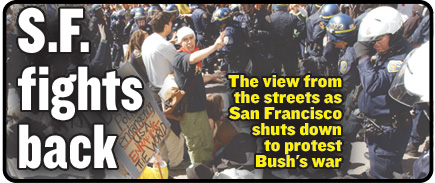
Nowhere was the clash of people power and government will more acute than on the streets of San Francisco, where a series of massive marches, some drawing nearly 100,000 people, filled the streets prior to the invasion of Iraq on March 19, 2003. The onset of war led protesters to effectively shut down the city, resulting in about 2,300 arrests and millions of dollars in costs to the city.

President George W. Bush dismissed the protests, of course, but he wasn’t the only one. Political leaders such as Rep. Nancy Pelosi, then-Mayor Willie Brown and soon-to-be Mayor Gavin Newsom (who didn’t attend any of the marches, unlike progressives on the Board of Supervisors) condemned the peace movement for hurting an innocent city. But with the “battle for San Francisco” making international news, the protesters were more concerned with the global audience.

A month earlier, on the weekend of Feb. 15 and 16, there were coordinated protests against the impending war in about 800 cities around the world, drawing around 10 million people. The peace march in Rome included about 3 million people, earning a listing in the Guinness Book of World Records as the largest anti-war rally in history. People have never made such a loud and clear statement against an incipient war.

Beyond the numbers, the antiwar movement was also right. On every major issue and prediction, the messages from the street proved correct while those from the White House were wrong. The US wasn’t welcomed as liberators. There were no weapons of mass destruction. Iraq after the invasion isn’t a stable democracy or shining beacon to anyone but the new generation of jihadis Bush created.

We can blame a hard-headed president, ineffectual opposition party, failure of the national media, or the national climate of fear following Sept. 11. But rather than refighting that lost battle, now is the time to gain perspective on the events of five years ago and determine what it means for democracy and the post-Bush national agenda.


TO THE STREETS

There were two main umbrella groups organizing protests before the war: Direct Action to Stop the War (DASW) and International ANSWER (Act Now to Stop War and End Racism). ANSWER has remained active and DASW has recently been reconstituted for the fifth anniversary of the war, using direct action in San Francisco as well as other urban centers and outposts like Chevron’s refinery in Richmond, which has reportedly been processing Iraqi oil.

“With the fifth anniversary coming up, we’re going back to direct action on the streets,” said Henry Norr of DASW. “But I don’t have any illusions that it’s going to be like it was five years ago.”

The maddening march to an ill-advised war created a political dynamic in which a broad cross-section of Americans was willing to hit the streets.

“We had a wonderfully diverse group of people, from soccer moms to anarchists,” said Mary Bull, who cofounded DASW, a collective of various affinity groups and concerned individuals formed in October of 2002 as Bush started beating the drums of war.

It was a group fiercely determined to prevent the war — and really believed that was possible. In fact, Bull recalls how she and other members of the group burst out crying at one meeting when a key activist said the war was going to happen.

Richard Becker, who cofounded ANSWER and serves as its West Coast coordinator, said that in the summer of 2002, “we came to the conclusion that [the war] was going to happen.” The group called its first big protest for Sept. 15, 2002, and another one two weeks later. But the movement really exploded on Oct. 26 when almost 100,000 people took to Market Street, much of it a spontaneous popular uprising.

“We were overwhelmed,” Becker said. “We were in a perpetual state of mobilization to keep up with what was going on. But then it didn’t stop the war.”

Did he think they could?

“I think a lot of people thought maybe it was possible to stop it. And we thought maybe it was possible to stop it,” Becker said.

The high point, according to Becker and Norr, was Feb. 17, 2003, when the New York Times ran a front page analysis piece entitled “A new power in the streets” that claimed “the huge anti-war demonstrations around the world this weekend are reminders that there may still be two superpowers on the planet: the United States and world public opinion.” But then Colin Powell went to the United Nations to argue for the invasion, and the Democrats in Congress did nothing, and it became clear war was coming.

Norr stayed out there protesting, being arrested several times and even shot in the leg by Oakland police with a rubber bullet during a protest at the Oakland docks. And he thinks some good came from the experience.

“The lesson for people is the political and economic elites are committed to preserving and extending empire. And they basically say as much in their own writing,” Norr said. “Wars are not anomalies.”

Despite being a frustrating and depressing exercise, most saw benefits to the failed movement. “People got an incredible education about how the system really worked,” Becker said. “Building a movement is mostly about a series of setbacks.”

Medea Benjamin, cofounder of both Global Exchange and CodePink and fixture of the anti-establishment peace movement for years, was upbeat about the protests. “We did our job as citizens. We did what we were supposed to do: organize, get people to take action, get people onto the streets,” she said. “We did everything we could think of.

“What you take from it is we don’t have a very well-developed democracy because the people spoke and the government didn’t listen.”

25war2_Lars1.jpg The ever-evolving “Democracy Wall” on Valencia Street, March 2003, helped stir up debate (Photo by Lars Howlett)


FACING ARREST

The collective action of five years ago starts with a series of personal stories — tens of thousands of them — so let me briefly begin with mine.

My arrival in San Francisco was closely tied to the march to war. I was living in Sacramento and working as the news editor of the Sacramento News & Review when Bush began his saber rattling against Saddam Hussein, but by the end of 2002 I had a falling out with my boss and found myself jobless.

Like most Northern Californians who opposed the war, I came to San Francisco on Jan. 18 to make my voice heard and experienced a bit of serendipity on my way to Justin Herman Plaza: while reading the Guardian on Muni, I saw their advertisement for a city editor, a job that was ideal for me at a paper I’ve always loved. Needless to say, it was a great day, empowering and full of possibilities.

Less than two months later I was on the job, and on the second week of that job I was back on the turbulent streets of San Francisco, part of a Guardian team covering the eruption of this city on the first full day of war. When I stepped off the cable car just after 7 a.m., people were streaming up Market Street and I joined them.

When a large group stopped at the intersection of Market and Beale, I stopped too, taking notes and bearing witness to this historic, exciting event. I had a press pass issued by the California Highway Patrol that allowed me to cross police lines, so when police in riot gear surrounded us and threatened arrest, I held my ground with 100 or so protesters.

After interviewing about a dozen people about why they were there and that they hoped to accomplish (see “On the bus: Journalists, lawyers, four-year-olds — the cops were ready to bust anyone Thursday morning“), I was arrested with the others and taken to a makeshift jail and processing center at Pier 27 (no charges were filed in my case, and charges against all of the 2,300 people arrested here in those first few days of the war were later dropped).

I recently tracked down a few of the people who appeared in my article, including Daphne and Ross Miller, who were at the center of the most interesting drama to play out during our standoff with the police. She’s a family practice physician, he’s an architect, and they live in Diamond Heights with their two children, Emet, who is almost 9, and Arlen, 12, who was away on vacation when the war began.

“We were genuinely shocked that the war started,” Ross told me. “We were at some of the earlier protests and really thought there was no way [Bush] could do it.”

They woke up March 20, 2003, to news that the war had begun and immediately walked to the BART station with Emet and rode to the Embarcadero station, not really planning for the day ahead but just knowing that they had to make themselves heard.

“We were pissed as hell. I don’t think I’ve ever been so angry in my life,” Daphne said.

They quickly came up with a plan. “We basically decided that if anyone was going to be arrested, it was going to be Ross and I’d stay with Emet. But it didn’t end up that way and I ended up in the arrest circle.”

Daphne had their house keys and threw them over the police line to Ross at one point. A photographer in the circle had gotten shots of a man named Roman Fliegel being roughed up by police as they pulled him off his bicycle, which was towing a trailer with a sound system, and decided to throw his backpack with camera gear out as well. When Ross — who had four-year-old Emet on his shoulders — caught it and refused police orders to give it to them, police grabbed Emet and roughly arrested Ross, leaving a gash on his forehead.

“Rage surged through the crowd, and it seemed as if things might get ugly, but the police kept a tight lid on the situation, using their clubs to shove back protesters who had moved forward,” I wrote at the time.

Emet was delivered into the circle with Daphne as the arrests continued, many quite rough. “At that point, as a mom, I had to exercise the most restraint ever,” said Daphne, who was angry about the situation but fearful about what she was exposing her son to. “Please, don’t let any violence happen here,” she pleaded with the crowd. Eventually, commanders on the scene let the mother and child go.

“The officer who let me go said that if he saw me again out there, he would call Child Protective Services on me,” Daphne said. But two days later, still brimming with outrage at her country’s actions, she ditched a downtown medical conference to rejoin the street protests, this time solo.

The couple say they’ve lost friendships over the war and have become more engaged with politics, coming to believe that Bush and the neocons are malevolent figures who knew how badly the war would go and did it anyway to establish a large, permanent military base in Iraq.

“Since that day, we’ve been far more active,” Ross said. “We realized you can’t just trust the system. You have to push.”

But that determination was mixed with feelings of disempowerment and depression. They attended some of the protests that following year, but the couple — like most people — just stopped going at some point because they seemed so futile.

“There was a horrible sense of resignation and a genuine depression that followed,” Ross told me.

The nadir was when Bush was reelected and they considered leaving the country. But then, Ross said, “we decided we’re not just going to run away and we’re not going to accept this.” Looking back, even with the scare over Emet, they express no regrets.

“It was the right thing to do because it was the wrong war to have. I’d do it again and again and again if I had to,” Ross said

They’re guardedly hopeful that Barack Obama could begin to turn things around if he’s elected. “I think the right president can at least start to dismantle this,” Daphne said. “I think thousands of people marching in the streets is something he would listen to.”

25war3_Charles1.jpg A die-in on the streets of San Francisco in March 2007 marked the fourth anniversary of the invasion (Photo by Charles Russo)


WITNESS TO HISTORY

Covering the peace movement in those early days was a heady experience, like reporting on a revolutionary uprising or working in a foreign country where the people are organized and active enough to be able to shut down society and brave enough to risk bodily injury for their beliefs.

I was at the founding meeting of CodePink — which became the most effective group at personally confronting the warmongers and keeping the war in the public eye — one evening at Muddy Waters in the Mission District shortly after the war started.

Looking back, Benjamin rattled off a long list of the alliances the group built — with labor, churches, businesses, and a wide array of social movements — and creative actions intended to build and demonstrate popular support for ending the war.

“We’ve done so many things and what did we get? We got a surge,” she said. “It shows the crisis in our democracy, the crisis of the two-party system, the crisis of a dysfunctional opposition party.”

Yet she said the peace movement has been remarkably successful in convincing the public that the war was a mistake and that it’s time for the troops to come home, even if the Democrats have been slow to respond to that shift.

“The progress we’ve made is turning around public opinion and that’s going to play a big role in the upcoming elections,” she said. For Norr, the role of the news media is a particular sore spot. He was a technology reporter for the San Francisco Chronicle who called in sick on the first full day of war and was arrested on Market Street with his wife and daughter, resulting in suspension by editor Phil Bronstein for his actions.

I wrote several stories on the issue, which culminated in Norr being fired and Bronstein unilaterally banning Chron employees from peace protests. I even borrowed CodePink’s guerilla tactics when Bronstein repeatedly refused to return my calls or address why he had singled out antiwar protesters for uniquely punitive treatment. I confronted him during a speech he gave at the Commonwealth Club (see “Lies and half-truths,” 5/7/03). That was the tenor of the times: we were all tired of being lied to and we decided to push back.

Norr was particularly frustrated with his own paper’s reporting of the war and started sending articles by the foreign press to his paper’s news desk, trying to wake his colleagues up to the pro-war propaganda being passed off as journalism in this country.

He was also disappointed with the country and with the Chronicle — both the management and his fellow reporters, who did little to support him — but the experience caused him to return to his roots as a progressive activist.

“The war and losing the job and everything brought an abrupt end to my consumerist phase and dumped me back into the world of being an activist,” said Norr, who serves on the KPFA 94.1 FM local station board and has made three recent trips to the Palestinian territories while working with the International Solidarity Movement.

Benjamin said Americans shouldn’t expect the next president to end the war — not without lots of pressure from a renewed and vocal peace movement. “This is the time to set the stage for the post-Bush agenda,” Benjamin said. “Don’t put your hopes in Barack Obama in getting us out of Iraq. Put your hopes in the people.”

25war4_Lane1.jpg A rally and nonviolent direct action at the Richmond refinery targeted Chevron on March 15 (Photo by Lane Hartwell)


THE AFTERMATH

The San Francisco Police Department, which spent more than $2 million on overtime costs responding to peace protests between March 15 and April 16, 2003, generally behaved with restraint and professionalism, but there were several exceptions.

The most costly and disturbing incident came when Officer Anthony Nelson began aggressively swinging his long riot baton at protesters, badly shattering the arm of peaceful protester Linda K. Vaccarezza, who suffered a permanent disability in her career as a court reporter.

Nelson’s incident report falsely stated that Vaccarezza had threatened him with a sign attached to a solid pole, but video of the incident later clearly showed there was no pole and that she was retreating when he teed off on her (see “The home front,” 05/19/04).

Vaccarezza received an $835,000 settlement from the city in November of 2004. On Oct. 5, 2005, two and a half years after the incident, SFPD fired Nelson for lying about what happened that day, and the City Attorney’s Office has been successfully fighting Nelson’s appeals in court ever since, putting in more than $100,000 in attorney time and costs into the Nelson and Vaccarezza cases.

The other significant ongoing litigation from the antiwar protests involved Mary Bull, who was arrested during an early protest for pouring fake blood in front of the entrance to Chevron’s San Francisco office before being allegedly strip searched and left naked in her San Francisco Jail cell for 36 hours.

Ironically, Bull was among those who brought a successful class action lawsuit against Sacramento County after she and others protesting a logging plan were strip searched, setting a precedent and led most counties to reform their strip-search policies. She used her share of the $15 million judgment to buy an organic permaculture farm in Sebastopol.

Her San Francisco case, in which Bull won a multimillion-dollar judgment, is still under appeal and now in mediation. Bull said the protests five years ago did make a difference, something she tells those who fret about its apparent failure. “I tell them to look at what issues the candidates are talking about now and I thank them for protesting then.”

“Even though we had millions throughout the world, we were sort of blocked, but now we’re regaining that momentum,” Melodie Barclay, a massage therapist who was also arrested with me on the first day of the war, told me recently. “We can’t judge it by the fact that we didn’t get the momentum we wanted.”

Norr started his antiwar activism working with Students for a Democratic Society in Boston, protesting the Vietnam War, which he said shares many similarities with the current situation, for good or for ill. He said that people tend to forget that while the protests then were huge and helped end the war, the movement did wane after Nixon ended the draft and substituted massive aerial bombardment for boots on the ground.

“The protests dropped off considerably,” he said. “A lot of the things that drove people to take risks in the late ’60s had faded by the early ’70s.”

He thinks the current administration learned a lesson from those days: it’s easier to maintain a war effort if the average citizen isn’t affected.

But there are other factors as well keeping a lid on the antiwar outrage.

“The culture has changed too. Young people are oversaddled with debt. People in schools seem to be docile. The culture as a whole seems to be more individualist and consumerist,” Norr said.

Yet some young people have woken up and many of them are funneling their energies into a peace group that was formed in the summer of 2005: World Can’t Wait, as in: the world can’t wait for the end of Bush’s second term before we change our direction and leadership.

“We don’t just want them gone, we need to repudiate their program,” said Giovanni Jackson, a 26-year-old WCW student organizer. “If we’re going to change anything, we need the youth.”

Jackson was at WCW’s founding convention in New York City, which came just as New Orleans was being flooded and then essentially abandoned by the federal government.

“When [Kerry] lost, people felt demoralized and World Can’t Wait kind of stepped into that situation,” Jackson said. “There was a lot of demoralization in the antiwar movement at that time.”

The group organized protests and student walkouts on Nov. 2, 2005.

“Everyone has their moments of doubt,” he said, “but I’m motivated by the crimes we see everyday.”


THE LESSONS

One of the biggest barriers to galvanizing people and turning the fifth anniversary of the war into something that might make a difference is the presidential election, which is diverting the energy of many potential protesters — and at the same time, offering some hope that a new president may lead to peace.

After all, every single one of the Democratic presidential candidates has promised to withdraw troops from Iraq, with varying timelines and numbers of US personnel left behind. And with enough encouragement, they might be willing to help change the status quo.

Many of the activists who volunteered their time and money to help move the Obama campaign into its front-runner position came out of the antiwar movement, and Obama’s strong stand against the war has been a key factor in his popularity.

Becker and some other activists don’t have much faith that a change in presidents will change the course in Iraq, although he agrees that much of the energy now surrounding Barack Obama derives directly from the antiwar movement.

“There’s been a huge upsurge of hope for Obama and that he might bring about the kind of change we need,” Bull said, adding that she doesn’t share that hope, believing the only path to peace is to pressure Obama and other leaders to commit to more progressive positions.

Norr said, “On one level, people have illusions about the power of peaceful protests. People believe in democracy, as well they should. We feel like the rulers should be paying attention to public opinion.

“It’s a remarkable story how broadly and quickly the American people have turned against the war. Public opinion was certainly ahead of the Democrats.”

And people will only grow more disenchanted with Iraq and its multitude of costs. “The people here are paying for this war, and everyday we have new stories about health clinics being shut down,” Becker said.

Becker was amazed last March as massive demonstrations for immigrant rights seemed to explode out of nowhere. “We think there will be more things like that,” he said.

Because after five years of organizing communities to resist the military-industrial complex’s plans, Becker thinks there’s been some visible progress.

“There isn’t a town or hamlet in the US that doesn’t have activism going on, but you wouldn’t know it from the corporate media,” Becker said. “It’s a mistake for people to feel discouraged.”


‘Who’s Krazy?’ Rapper Ise Lyfe raises questions with his new one-man play

0

IseLyfe.jpg

By Jamilah King

The definition of blackness is so highly debated that even black folks have a difficult time defining it. Oakland-raised rapper Ise Lyfe looks at blackness and some of these questions associated with the concept in his one-man play, Who’s Krazy? Told through spoken word and monologue and accompanied a ’70s soul and hip-hop sounds, Who’s Krazy? revolves around Victor, a 31-year-old African American man who runs from anything he considers “black.” Victor’s journey takes a staggering detour after he has a mental breakdown and locks himself in his basement. I spoke to Lyfe recently about his work.

SFBG: What have you been up to since the release of your last album?

Ise Lyfe: Mainly I’ve been traveling and performing, teaching a bit. I started an educational company that basically explores the roots causes of violence in our community. It got to a point where I realized that the material being taught in our schools didn’t relate to the realities that a lot of people face at home or in real life. So we created a program that teaches young folks about the history of violence against women, our internal impulses toward violence and the systemic causes of violence in our communities that we may not think about in our daily lives.

I’ve also been working on an album. The project is called Prince Cometh, and it’s probably one of my proudest accomplishments to date. I’m releasing it independently and it should be out in May or June.

SFBG: Now let’s talk about your latest project, Who’s Krazy? Where did the idea come from?

IL:
Since I’ve been traveling a lot, I always encounter interesting people. A while back I was speaking on a panel at Smith College, and the guy sitting next to me was this brotha who was a total tight ass and seemed hella removed from his blackness. It was a trip.

SXSW: High on Fire blows away Motorhead; cruising Ms. Bea’s and Typewriter Museum

0

highonfire1.jpg
Totally high on High on Fire. All photos by Kimberly Chun.

“Purple is the color of sexual frustration,” quips one English SXSW conventioneer to two ladies asking about their wardrobe choice in the elevator. Not so over at Stubb’s and Vice‘s metal showcase yesterday, March 13. I missed Napalm Death, damn it all, but made it to see High on Fire totally kick arse! Lordy, who knew Matt Pike and company had it in ’em? All assembled would have to confess: they totally blew away metal-punk grandpappies Motorhead. (OK, I only stayed for a portion of Motorhead’s set but chances looked slim that they were going to kick up more dust.)

highonfire2.jpg

“This song goes out to all my friends who came here from Oakland!” Pike exclaimed before launching into a brute, pummeling rendition of “Speedwolf.” Holy mother of fuck…

highonfire3.jpg

You can’t envy Lemmy and his weathered road warriors, following that. But you can admire the devil horns getting thrown up front.

motorhead1.jpg

Craft fare

0

› le_chicken_farmer@yahoo.com

CHEAP EATS There was this crafts fair at one of our bars, and Sockywonk said she knew a guy who was giving away waffles. "Crafts fair?" I said, picturing clothes, jewelry, and purses, but not waffles.

Yeah, she said. He’d figured out a way to get waffle batter into an aerosol can, like Reddy-Wip, and he was promoting his brilliant invention by feeding all the craft fairies for free.

I loved Sockywonk for knowing such a thing. But after a sporty morning, I had me a good sticky, stinky sweat on and was mostly interested in her bathtub. We were going to a potluck at another bar later in the afternoon. I still had my soccer socks on.

"Well … " I said.

"Waffles!" she said, and what could I say? I had to agree with her 100 percent, once she put it like that. Waffles! Free ones, at that, and I was hungry and only had exactly $1.15.

"Waffles!" I said. And I changed my socks, borrowed a shirt, and found all sorts of things in Sockywonk’s bathroom to rub and spray on myself in lieu of a waterier bath.

At the end of the block we joined forces with Natty King Coal, the oatmeal pusher, and his charming bag lady–enforcer (and my personal hero) Little Orphan-Maker Annie, who was on crutches due to a grisly roller derby smash-up. She hadn’t been out of the house in months. I’m not kidding.

Annie had a crazed and wonderful look in her eye, like Give Me Blood, or syrup, or bargains. She also had a handicapped-parking thingy, so we drove to the bar even though it was within walking distance — or would have been, without pins and rods and crushed bones and so forth.

"What’s that smell?" Natty King said once all the car doors were closed.

"Do you mean ‘What are those smells?’" I said. "They represent a delicate yet complicated blending of the usual — sweat, smoke, and chicken shit — with the unusual: whatever the hell Socky keeps on the shelf in her bathroom."

Sockywonk works at a girly, soapy bath, spray, and general smell shop called Common Scents, and that was pretty much what I smelled like, like the entire store, Common Scents, on 24th Street. Plus sweat and smoke and of course chicken shit.

"I like it," the Orphan-Maker said, turning in her seat and smiling. Christ, she’s so sweet. And that was the end of that discussion.

At the crapshoot, or crafts fair, Sockywonk left less $40, the Orphan-Maker dropped two great T-shirts’ worth, plus the $20 she spotted the Wonk for even more cool stuff. Natty King, who knows how to treat his girls, bless him, went down whatever-the-worth of three bags of hot-sauced mango from a sidewalk vendor. Yum! And I, your chicken farmer truly, walked away with exactly $1.15, plus Aunt Jemima stains all over my borrowed shirt. Syrup. Sorry, Socky.

The verdict on aerosol-can waffle and pancake batter?

Yeah. Whatever. No, I mean, it was free, and it was delicious. But being a person who loves to cook, and who loves to spend as much time as possible doing the things that I love to do, like cooking, why in the world would I ever in the world squeeze waffle batter out of a can? And then blow time looking out the window that I could have more wisely spent separating egg whites and hand-whisking until they hold soft peaks?

No kidding, I make three meals a day. I want to have my hands in the food, and my arms, teeth, and tongue when appropriate. Like sex, I actually want it to take as long as possible. And dirty all the dishes. (I’ll do ’em in the morning.) You’re in a hurry, I know. You have a job. Check it out: batterblaster.com. Me, I’ll keep doing what I do … stirring constantly.

——————————–

My new favorite restaurant is Pretty Lady, a divine dive in West Oakland. Me and Deevee both ordered fried egg sandwiches, because we only had $10 between us, and all of it was hers. She laughed at me for ordering my sandwich eggs over easy, and I laughed last when my first bite squirted egg yolk all over my shirt and pants and the place. Which I really and truly love, did I mention? Nothing but counter, U-shaped for easier people-watching/eavesdropping. Saw a good-looking salad and stir-fry down the counter, so … stay for lunch.

PRETTY LADY

1733 Peralta, Oakl.

(510) 832-1213

Mon.–Sat., 7 a.m.–3:30 p.m.

No alcohol

Credit cards not accepted

Clubs: Cumbia/electro underground surfaces at Tormenta Tropical

1

tormentasml.jpg

By Michael Harkin

The South American sound of cumbia has its very own hour-of-power in San Francisco: Tormenta Tropical, whose fourth incarnation rolled up to the Mezzanine last Saturday after prior appearances at Rickshaw Stop and the Dark Room at Club Six. Tormenta is a new monthly party thrown by Bersa Discos, an Oakland record label showcasing the experimental cumbia/electro/dancehall underground of Argentina.

Bersa especially digs into what’s up around Buenos Aires, where the label’s two founders, Disco Shawn and Oro 11 (say that 11 as “once”/OHN-say), moved separately from the Bay Area and met up amid the woolly, melodica-filled excitement to be had at club nights like Zizek.

It was, in fact, several regulars from Zizek that started off the night as Zizek Urban Beats Club, including sets by El Remolón, Frikstailers, and other fixtures from the Buenos Aires night that so inspired Bersa’s founders as well as such hip jocks as DJ/Rupture and Diplo of Hollertronix and Mad Decent. The crew are touring to SXSW this week, also making appearances in New York and Chicago later this month.

Freedom of Information: Battleship metadata

0

› sarah@sfbg.com

On Valentine’s Day, Assemblymember Jose Solorio (D-Santa Ana) introduced Assembly Bill 1978, legislation that seeks to define computer mapping systems and make them available to commercial interests at a fee — a one-two punch that freedom of information advocates fear constitutes a serious blow to the California Public Records Act.

Noting that computer mapping systems, computer programs, and computer graphic systems do not constitute public records under current law, Solorio’s bill seeks to amend the CPRA to define computer mapping systems to include "assembled model data, metadata, and listings of metadata, regardless of medium, and tools by which computer mapping systems are created, stored, and retrieved."

AB 1978 would also allow "commercial interests, who are most benefited by these systems, to obtain the portion of these systems developed by a public agency, at a fee designed to offset the agency’s cost of maintenance for the computer mapping systems."

But Oakland-based Bruce Joffe, who works as a geographic information consultant to cities, counties, and state agencies in California, warns that AB 1978 would allow public agencies to charge the public more for this data than the cost of duplication.

"It would severely weaken the CPRA and reduce the public’s access to government records," said Joffe, noting that as the law currently stands, CPRA requires state and local agencies to make their records available and, upon request, to provide copies on payment of any applicable fee.

Solorio aide Hazel Miranda told the Guardian that the intent of the bill is to protect software, not to restrict access to information.

"Our intent is to protect the software, not to restrict the information that is given out on it," Miranda said, noting that the bill’s sponsor is the government of Orange County. "The concern was that a lot of corporations were taking this information — and when the information is given out, you have to give out the software, too — and using it to their own benefit."

Joffe, who was the California First Amendment Coalition’s technical advisor when CFAC successfully sued Santa Clara County over access to the county’s tax maps, disagrees.

"When you give information out, you are not giving out software, you are giving out data in export format," said Joffe, who believes Solorio wants to change the law so that AB 1978’s sponsor, Orange County, which has sold its tax maps for $400,000 in the past, can continue to sell its data.

Holly Fraumeni, the AB 1978 lobbyist with the well-connected firm Putf8um Advisors, deferred questions to Bruce Matthias of Orange County’s legislative affairs, who told us, "The County of Orange has never disagreed on sharing public data. We are not trying to hide data down here. If you want it on a disk, we charge 25 cents. All we are doing is updating language in the bill. Our exclusive intent is to protect the software we’ve developed." Records show Orange County paid Putf8um Advisors $60,000 between October 1 and December 31, 2007.

CFAC executive director Peter Scheer believes AB 1978 is an attempt to take the information that CFAC has tried to make freely available and put it back under lock and key, so that it is proprietary information that can be sold.

Recalling how, years ago, the only way you could see a county’s tax maps was as an engineer’s rendering on paper, Scheer observed that when this data is computerized and made publicly available, "individuals and businesses can create all kinds of valuable tools or simply post the raw data on the Internet."

Blair Adams, chief consulting officer at San Francisco’s Department of Technology and Information Services, says the city’s GIS data has been publicly available for five years.

"We have no intent to change that," Adams said. "Our motto is ‘Go have it, and help us make it better.’<0x2009>"

But while San Francisco treats this data as a public record and copies it for the price of a blank DVD, Santa Clara and Orange counties have treated it as a revenue generator.

"They charge an arm and a leg, and another arm and leg, and whatever other appendages they can think of," said Scheer, noting that Santa Clara County charges $100,000 for a full base map of its real estate parcels — data that can be used to determine whether properties are assessed correctly, and whether pothole repairs are carried out equitably.

"Likely clients willing to purchase this data would be utilities, phone companies, and developers, who can’t do without it," Scheer said. "But public health and safety departments need access to it, too."

Joffe agrees, and it’s something he has plenty of experience with. He helps cities and counties create geographic information systems that allow ambulances to take the most efficient routes, the Department of Public Works to carry out better capital improvements, and the police to conduct better crime analysis.

"Every department uses it, and because it’s in the government system, therefore it is a public record, and the public has the right to access those records at no more cost than it takes to duplicate them," Joffe said. He added, "If AB 1978 passes, we’ll lose considerable access."

>

Freedom of Information: A citizen’s guide to fighting secret government

0

San Francisco has the best local sunshine law in the country — and there are still problems getting access to information. Even though the digital age in which we live affords government agencies with myriad ways to give citizens more access to public documents, there is too often little official will to create transparency. And often, bureaucrats are downright hostile to public scrutiny. But help is out there. This guide to local and national organizations offers a wide range of resources for journalists, citizen activists, and hell-raisers who want to track their tax money and hold their government accountable.

LOCAL ORGANIZATIONS


The California First Amendment Coalition is an independent, nonpartisan, nonprofit organization whose mission is to "promote and defend the people’s right to know" by improving compliance with state and federal access laws. CFAC’s Web site contains an archive of articles dealing with FOI issues, the texts of state FOI laws, and other useful resources. 534 Fourth St., Suite B, San Raphael, CA 94901. (415) 460-5060, cfac@cfac.org, www.cfac.org.

The California Newspaper Publishers Association is the umbrella organization to which most newspapers in the state belong, so it has an acute interest in open government. Its FOI Watch newsletter (also available online) includes a clearinghouse of sunshine news from around the state. 708 Tenth St., Sacramento, CA 95814. (916) 288-6015, tom@cnpa.com (general counsel Thomas Newton), www.cnpa.com.

Californians Aware, run by former CFAC general counsel Terry Francke, helps activists and organizations get access to public meetings and records and offers resources on the Web for citizens, public officials, journalists, and attorneys. 2218 Homewood Way, Carmichael, CA 95608. (916) 487-7000, info@calaware.org, www.calaware.org.

The Center for Investigative Reporting sponsors workshops on investigative techniques for journalists and university students. The center’s Web-based magazine provides FOI information, tips for journalists, and updates on past CIR investigations. 2927 Newbury St., Suite A, Berkeley, CA 94703. (510) 809-3160, center@cironline.org, www.muckraker.org.

The DataCenter provides on-call research, consultation, and referrals to justice organizations regarding FOI issues. It also offers research and action training. Services are free or on a sliding scale, depending on one’s ability to pay. 1904 Franklin St., Suite 900, Oakland, CA 94612. (510) 835-4692, ext. 376, www.datacenter.org.

The Electronic Frontier Foundation, an online First Amendment organization, works to uphold digital free speech, empower the online public, and protect privacy on the Internet. It provides stories and alerts on its Web site, with daily updates. Effector, an e-mail newsletter, is available through the site. 454 Shotwell St., S.F., CA 94110. (415) 436-9333, information@eff.org, www.eff.org.

The First Amendment Project is a public interest law firm that provides legal representation, educational programs, and low-cost or free advice for journalists, public interest organizations, and individual citizens with public records and FOI-related issues. In a joint publication effort with the Society of Professional Journalists, the project offers three free pocket guides, on the Brown Act, California’s Open Meeting Law, and accessing court records. The Web page has information on using the California Public Records Act as well as on getting court records. 1736 Franklin St., 9th floor, Oakland, CA 94612. (510) 208-7744, fap@thefirstamendment.org, www.thefirstamendment.org.

Media Alliance is a nonprofit media center that offers classes on journalism skills, including how to find and use public records. 1904 Franklin St., Suite 500 Oakland, CA 94612. (510) 832-9000, information@media-alliance.org, www.media-alliance.org.

The Society of Professional Journalists, Northern California Chapter, FOI Committee fights for open access to information and educates members of the public on FOI issues. The group provides a subscription e-mail list for journalists and others involved in FOI and First Amendment issues in California as well as putting on the James Madison FOI Awards. 222 Sutter St, 6th Floor, San Francisco, CA 94108 (415) 321-1700, www.spj.org/norcal.

NATIONAL ORGANIZATIONS


The Brechner Center for Freedom of Information conducts research and educates the public in mass-media law and the First Amendment, including public access to government meetings and records and litigation information. University of Florida, College of Journalism and Communications, 3208 Weimer Hall, P.O. Box 118400, Gainesville, FL 32611-8400. (352) 392-2273, www.jou.ufl.edu/brechner.

The Center for National Security Studies works with concerned citizens and groups to expose secret government policies and offers free assistance to those seeking records under the Freedom of Information Act. It also coordinates related litigation. 1120 19th St. NW, 8th floor, Washington, D.C. 20036. (202) 721-5650, cnss@cnss.org, www.cnss.org.

The FOIA Blog, created by an FOIA Washington attorney, has an updated list of documents currently being released by several government agencies infoprivacylaw@yahoo.com, www.thefoiablog.typepad.com.

The Freedom of Information Center of the University of Missouri School of Journalism has a collection of more than one million articles and documents about access to information at the local, state, and federal levels. The center works to ensure compliance with sunshine laws around the country. Its Web site contains links, updates, and tips on FOI inquiries. A free e-mail newsletter provides information on developments in FOI access and issues; you can sign up by contacting umcjourfoi@missouri.edu. University of Missouri, 133 Neff Annex, Columbia, MO 65211. (573) 882-5736, daviscn@missouri.edu, www.missouri.edu/~foiwww.

GovernmentDocs allows people to browse and search thousands of pages acquired through the FOIA and sunshine laws. Registered users can review and comment on documents. www.governmentdocs.org

GovTrack provides information on the U.S. Congress. It compiles information on federal legislation, voting records, and other congressional date and simplifies the language for ordinary citizens. It also indexes all bills, as well as changes to them, in Congress and all roll call votes www.govtrack.us.

Investigative Reporters and Editors provides educational services for investigative reporters and editors. The group’s Web site offers FOI-related resource guides, a database of FOI stories, tips for using the Freedom of Information Act, and a database of previous FOI requests. University of Missouri School of Journalism, 138 Neff Annex, Columbia, MO 65211. (573) 882-2042, www.ire.org

The National Freedom of Information Coalition is composed of First Amendment organizations dealing with FOI issues. It provides resources for the media, government officials, lawyers, and citizens who want access to public information. The coalition also offers seminars and workshops to media professionals, attorneys, academics, students, and the public on FOI issues and helps nurture start-up FOI groups and Internet sites. Its Web site offers links to relevant legislation and organizations state by state, as well as an Internet mailing list, FOI-L. 133 Neff Annex, Columbia, MO 65211. (573) 882-5736, cdavis@nfoic.org, www.nfoic.org.

OMB Watch is a member of the Public Access Working Group, a coalition of organizations promoting greater access to government information. OMB Watch offers an online newsletter, OMB Watcher, available on its Web site or by e-mail, which typically includes articles on FOI issues. To subscribe to the weekly e-mail version, e-mail join-ombwatcher@lyris.ombwatch.org. 1742 Connecticut NW, Washington, D.C. 20009. (202) 234-8494, www.ombwatch.org.

The Project on Government Secrecy is an advocacy and public education project of the Federation of American Scientists. The project has an extensive archive and provides regular news updates through its Web site and e-mail newsletter, Secrecy News. 1725 DeSales Street NW, 6th floor, Washington, D.C. 20036. (202) 454-4691, www.fas.org/sgp/index.htm.

Project Vote Smart provides information on local, state, and national candidates, including voting records, issue positions, campaign contributions, phone numbers, and mailing addresses. The database is accessible by calling the toll-free hotline at 1-888-VOTE-SMART. 1 Common Ground, Phillipsburg, MT 59858. (406) 859-8683 comments@vote-smart.org, www.vote-smart.org.

The Radio-Television News Directors Association is the world’s largest professional organization devoted to electronic journalism. It lobbies for cameras in courtrooms and strong FOI laws and provides coverage of FOI issues on its Web site. 1600 K St. NW, Suite 700, Washington, D.C. 20006. (202) 659-6510, www.rtnda.org.

The Reporters Committee for Freedom of the Press operates the 24-hour FOI Service Center at 1-800-336-4243 to answer emergency questions from journalists and others with open-records problems. 1101 Wilson Blvd., Suite 1101, Arlington, VA 22209. (703) 807-2100, rcfp@rcfp.org, www.rcfp.org.

The Society of Professional Journalists advocates for open access to information and educates members of the public on FOI issues. The society’s Web site has an FOI section with extensive links to resources and information, including a list of FOI advocacy organizations. 3909 N. Meridian St., Indianapolis, IN 46208. (317) 927-8000, questions@spj.org, www.spj.org.

State Sunshine and Open Records shares information, guidance and advice on developments and news about open records at the state and local level. They also have an extensive list of links to other sunshine blogs. www.openrecords.wordpress.com.

The Student Press Law Center works with the Reporters Committee for Freedom of the Press to cover FOI and other First Amendment issues reutf8g to high school and college journalists. It offers free advice, lawyer referrals, and analysis. 1101 Wilson Blvd., Suite 1100, Arlington, VA 22209. (703) 807-1904, admin@splc.org, www.splc.org.

The Sunlight Foundation develops a database to ensure transparency in government and fiscal accountability. They digitize new info and provide access to existing information. 1818 N Street NW, Suite 410, Washington, D.C. 20036, (202) 742-1520. www.sunlightfoundation.com.

WikiFOIA helps people understand the FOI Act on a state and federal level by providing a how-to-guide about open records requests, as well information on how to make that request. www.wikifoia.pbwiki.com.

INTERNATIONAL ORGANIZATIONS AND RESOURCES


The Guardian Web site has extensive information and links concerning international press-freedom issues. For details on journalists under fire, including frontline dispatches and reports from the battle to keep the world safe for journalists, go to www.sfbg.com/journalists/. For updates, dispatches, and links to national and international FOI groups, go to www.sfbg.com/FOI.

The UK FOI Blog provides a glimpse into how FOI issues are dealt with across the pond by listing news and developments on FOI in Great Britain. www.foia.blogspot.com.

Local government resources

The Government Information Center, on the fifth floor of the San Francisco Public Library’s Main Branch, stocks public documents published by the city. These include annual reports for committees and departments, minutes and agendas of official meetings, environmental impact reports, and city audits, ordinances, and resolutions. San Francisco Public Library, 100 Larkin St., S.F., CA 94102. (415) 557-4500, www.sfpl.org.

The Oakland Public Ethics Commission responds to complaints and holds hearings on possible violations of the city’s Sunshine Ordinance. Records, tapes of the commission’s meetings, agendas, and minutes can be picked up at the commission’s office. 1 Frank Ogawa Plaza, 4th floor, Oakland, CA 94612. (510) 238-3593, ethicscommission@oaklandnet.com, www.oaklandnet.com/government/public_ethics/webpage.html.

The Office of Information and Privacy, U.S. Department of Justice, provides online versions of frequently requested records, opinions, policy statements, and guides to the Freedom of Information Act. The guides include detailed instructions for filing FOIA requests, average response times for different governmental offices, and a wealth of other useful information. The text of the FOIA is available on the office’s Web site. 1425 New York Ave., Suite 11050, Washington, D.C. 20530. (202) 514-3642, www.usdoj.gov/oip/oip.html.

Public Access to Court Electronic Records is an online database of court records and decisions. Web access is 8¢ a page, and requires registration through the Web at www.pacer.psc.uscourts.gov. P.O. Box 780549, San Antonio, TX 78278. 1-800-676-6856, pacer@psc.uscourts.gov.

The San Francisco Ethics Commission monitors and enforces the Sunshine Ordinance and the city’s governmental-ethics, campaign-finance, and lobbyist-reporting laws. Individuals can file complaints regarding violations of the Sunshine Ordinance. The commission meets the second Monday of each month at 5:30 p.m. in City Hall, Room 408. 25 Van Ness, Suite 220, S.F., CA 94102. (415) 252-3100, ethics.commission@sfgov.org, www.sfgov.org/site/ethics_index.asp.

The San Francisco Law Library is open to the public, though only government officials, state bar members, and judges can check out items. Main reference library: Mon.-Fri., 8:30 a.m.-5 p.m., Veterans War Memorial Building, 401 Van Ness, Room 400, S.F. (415) 554-6821. Courthouse reference room: Mon.-Fri., 8:30 a.m.-4:30 p.m., 400 McAllister, Room 512, S.F. (415) 551-3647. Financial District branch: Mon.-Thurs., 9 a.m.-9 p.m.; Fri.-Sat., 9 a.m.-5 p.m.; Sun., noon-4 p.m., 685 Market St., Suite 420, S.F. (415) 882-9310, www.ci.sf.ca.us/site/sfll_index.asp.

The Sunshine Ordinance Task Force oversees compliance with San Francisco’s sunshine law by investigating complaints from individuals who believe city officials have withheld records or conducted meetings in violation of the law. The task force meets the fourth Tuesday of each month at 4 p.m. City Hall, 1 Dr. Carlton B. Goodlett Place, Room 244 (meetings held in Room 408), S.F. For complaint forms and other information call (415) 554-7724 or go to http://www.sfgov.org/site/sunshine_index.asp

PUBLICATIONS


The California First Amendment Coalition publishes the California Journalist’s Legal Notebook, a handy guide to the legal issues surrounding telephone interviews, press passes, gags on sources, and other journalism-related topics ($36.25, $30.88 for CFAC members, shipping included). Also by CFAC is The New Brown Act: How the Open Meeting Law Has Been Revised ($12.75, $7.39 for CFAC members, shipping included). (415) 460-5060.

The Oakland Public Ethics Commission publishes a free brochure, How to Notice a Public Meeting under the Oakland Sunshine Ordinance and the Brown Act, useful for making sure a public meeting follows the requirements of the Brown Act. (510) 238-3593, (510) 238-6620, ethicscommission@Oaklandnet.com, www.oaklandnet.com/government/public_ethics/webpage.html.

Access to Courts and Court Records in California, Open Meeting Laws in California, and The California Public Records Act are free, convenient, quick-reference guides published by the Society of Professional Journalists, Northern California Chapter, and the First Amendment Project. (510) 208-7744, www.thefirstamendment.org/freepress.html.

The ACLU Freedom of Information Project publishes Using the Freedom of Information Act: A Step-by-Step Guide (#4002, $3) and Your Right to Government Information (#1190, $5.95), which covers a broader range of topics, including how to get into public meetings. Both publications can be ordered online through the ACLU’s e-store or by phone. ACLU Publications, P.O. Box 4713, Trenton, NJ 08650-4713. 1-800-775-2258, www.aclu.org.

The Government Printing Office publishes The Freedom of Information Act Guide and Privacy Act Overview ($63), a 986-page guide to the FOIA produced by the Justice Department. It can be ordered by phone at 1-866-512-1800 or online at bookstore.gpo.gov. The Citizen’s Guide is available in its entirety online at www.fas.org/sgp/foia/citizen.html.

The Freedom of Information Clearinghouse Guidebook is a free brochure about making FOIA requests and appealing agency decisions. It’s available online through the Freedom of Information Clearinghouse. www.citizen.org/litigation/free_info/index.cfm.

Paper Trails: A Guide to Public Records in California ($12.89), written by Stephen Levine and Barbara Newcombe, is published by the Center for Investigative Reporting and supported by the California Newspaper Publishers Association. It can be ordered from the CIR. An abridged, online version is coming soon. 2927 Newbury St., Suite A, Berkeley,, CA 94703. (510) 809-3160, www.centerforinvestigativereporting.org/

The fourth edition of the Investigative Reporters’ Handbook ($61, $51 for Investigative Reporters and Editors members), by Steve Weinberg, Brant Houston, and Len Bruzzese, is a comprehensive and accessible guide for novice and experienced journalists that shows how to locate and use more than 500 sources of public information. (573) 882-3364, www.ire.org/store/books.

The Reporters Committee for Freedom of the Press supplies a wealth of publications on public access and other First Amendment topics. How to Use the Federal FOI Act ($5) is a handbook on FOI rights, with instructions for appealing if your request is denied, and includes sample letters. The First Amendment Handbook ($7.50) is a journalist’s pocket guide to FOI issues. Two guides — Judicial Records: A Guide to Access ($3) and Access to Electronic Records ($5) — analyze state laws and decisions regarding access to legal records and government electronic data. Tapping Officials’ Secrets is a set of guides to state public records and open-meeting laws ($10 a state). The News Media and the Law is a quarterly magazine that includes updates on legislation pertinent to FOI ($30 a year for four issues). Some of these publications are available in their entirety online; all can be ordered online. 1-800-336-4243, www.rcfp.org.

The second edition of Law of the Student Press ($18) is a vital handbook for student newspapers. It’s extensively annotated but avoids legalese and tries to bring the law to life for students and educators. The Student Press Law Center also publishes Covering Campus Crime, Third Edition ($2) and the Student Press Law Center Report ($15 for three issues a year). (703) 807-1904, www.splc.org.

Citizen Muckraking: How to Investigate and Right Wrongs in Your Community ($9) offers advice on writing press releases, conducting interviews, and using the FOIA. The book, a collaborative effort by the Center for Public Integrity, is available through Common Courage Press. 1-800-497-3207, www.commoncouragepress.com

>

Freedom of Information: 2007 James Madison Award winners

0

Click here for details on the First Amendment Awards Dinner.

Norwin S. Yoffie Career Achievement Award

DAN NOYES (COFOUNDER, CENTER FOR INVESTIGATIVE JOURNALISM)


If journalists were the subjects of trading cards like baseball players, the Dan Noyes rookie card would be just as impressive as a 2008 career highlights card. Think Reggie Jackson: a long, impressive career, spanning multiple organizations and a propensity to come out swinging big at the end of a hard-fought battle.

Over a career spanning 30 years, Noyes has pursued serious investigations, some lasting as long as a year, into everything from questionable Liberian timber imports to illicit gun trafficking from United States suppliers to the Nuestra family gang. Journalism first interested Noyes during the crucial investigative reporting that sparked Watergate scandal in the early 1970s.

In 1977 Noyes cofounded the Berkeley-based Center for Investigative Reporting (CIR), an independent news organization which produces in-depth stories and documentaries for all major news outlets. In 1979, reporting for the ABC News program 20/20, CIR broke a story on a swindling United Nations charity organization and its connections to international drug trafficking.

More recently, Noyes has done a series of print and broadcast pieces concerning gang violence in California and its effect on the lives of those surrounding the lifestyle. Noyes still holds an executive position at the CIR and continues to contribute to the world of investigative journalism.

Beverly Kees Educator Award

CLIFF MAYOTTE


Cliff Mayotte sees his Advanced Acting Class at Lick-Wilmerding High School as one that merges students’ "consciousness and awareness as young adults with their skills and energies as performance artists."

The subtitle of the course is "Theatre as Civic Dialogue," and the eight students enrolled during the 2007 spring semester used all their abilities to pull off a notable show.

After an introduction to Documentary Theatre — a form he described as "oral history turned into performance" — the group selected a topic that was important to them, giving birth to the "Censorship Project."

The students interviewed their peers, teachers, and administrators to gather perspectives on the ways in which expression and opinion can be muted or altered, both voluntarily and involuntarily. They reached out to organizations such as Project Censored, the First Amendment Project, and the Ella Baker Center for Human Rights. They transcribed interviews and studied subjects in order to capture statements, word patterns, and mannerisms of interviewees, then shaped the themes into a 60-minute performance.

Professional Journalists

WILL DEBOARD


"Being a high school sports guy, I don’t get to do this very often," the Modesto Bee‘s Will DeBoard said of his first major foray into investigative reporting. He had gotten a tip that the California Interscholastic Federation was investigating recruiting violations by the football program at Franklin High School in Stockton, which competed with schools in his area. DeBoard asked the school and CIF about recruiting violations, but the football coach flatly denied the allegations and the CIF wasn’t much more helpful.

So DeBoard decided to make formal requests for public records with the help of business reporter Joanne Sbranti, and after fighting through some initial denials, he obtained hundreds of pages of investigatory documents from CIF showing how the school was recruiting players from American Samoa. "It really was a treasure trove of great stuff. We got two weeks’ worth of stories out of these documents," DeBoard said. "It really showed us that what the school was telling us just wasn’t true."

The documents detailed the recruiting scheme and gave DeBoard tons of leads for follow-up stories, including the address of "a home owned by the coach where there were all these gigantic Samoan linemen living there." DeBoard called the effort an "adrenaline rush" better than that caused by the best game he’s covered and a high point of his journalism career.

THOMAS PEELE


Contra Costa Times investigative reporter Thomas Peele has a long history of battling for public records access on behalf of both reporters and private citizens. Peele, who helps with projects for all the newspapers under the Bay Area News Group-East Bay ownership, helped ensure the recovery of thousands of e-mails from the Oakland mayoral tenure of Jerry Brown when he left office to become the state’s attorney general in 2006. Peele also helped conduct a statewide audit of Public Records Act compliance by law enforcement agencies with the nonprofit Californians Aware, which revealed glaring inconsistencies in how police across the state make information about their activity available to the public. And he’s been a major figure in helping the Chauncey Bailey Project pry out new information about Bailey’s murder last year and it’s connection to Your Black Muslim Bakery. He began his career in 1983 at a small weekly in Bridgehampton, N.Y., and moved from there in 1988 to the Ocean County Observer in New Jersey before joining the CCT in 2000.

ROLAND DE WOLK


KTVU-TV producer Roland De Wolk is leading the investigative team of photographer Tony Hedrick and video editor Ron Acker in a quest to get the names of drivers who regularly use FasTrak lanes but don’t pay anything. But to date, says De Volk, the Metropolitan Transportation Commission has been blocking his team’s quest.

De Wolk told the Guardian that his team filed a California Public Records request when the MTC wouldn’t provide information on the amount of money it was losing thanks to drivers who don’t pay tolls when they use FasTrak lanes.

"We asked MTC for specific numbers last summer and got little information. That makes a reporter’s antennae quiver," said De Wolk.

But when he and his team asked for the numbers of people obstructing their plates, the MTC started acting squirrelly, De Wolk said.

"Finally, after six to eight weeks of asking we got an answer: a photo of a car whose plate was blank," fumed De Wolk, whose team continues to push for the names of the 10 most frequent FasTrak violators.

Broadcast News Outlet

KGO-TV


When KGO-TV reporter Dan Noyes and producer Steve Fyffe asked Muni to turn over records of public complaints against its drivers, they were ready for some bureaucratic foot dragging. But they never expected the yearlong grudge match that followed. First, the union representing Muni drivers sued to keep the records sealed. Then Muni’s parent department, the Municipal Transportation Agency, made a backroom deal with the union and released a blizzard of confusing and heavily redacted paperwork that would have made the Pentagon blush.

"It was essentially a big document dump," Fyffe told us. "There was no way to tell one form from another or which driver was which."

Noyes and Fyffe convinced their bosses at KGO-TV to file a lawsuit for full access to the records. The station prevailed, after which Noyes and Fyffe received over 1,200 pages of public complaints about 25 drivers. Recently, the station went back to court after Muni refused to release surveillance tapes of the drivers. As in the previous case, the judge ruled that the public had a right to the materials and forced the transit agency to hand the tapes over.

Fyffe said he sees KGO’s legal successes as small victories in a much larger fight. "I hope in the future that this case will make Muni and other city departments more [responsive] to records requests … these kinds of incremental victories hopefully lead, little by little, to a more open government."

Print News Outlet

SACRAMENTO BEE


The Sacramento Bee operates in a city run by top-tier politicians and their spinmeisters, so the editors and reporters there have placed increasingly high value on using documents to support their stories.

"We’ve always used public records here. Being in a state capital, we’re a little more aware of the necessarily of that," managing editor Joyce Terhaar said. "You just need to be able to tell a story about what’s really happening."

Yet she said that in recent years, the Bee has made a concerted effort to hire public-records experts and to have them share their knowledge with the paper’s staff through regular workshops. And last year, those efforts paid off with a string of big, impactful investigative stories.

Among them was Andy Furillo’s look at how much the state was spending to fight inmate care lawsuits, Andrew McIntosh’s exposé on the lack of oversight for paramedics and emergency medical technicians, and stories by John Hill and Kevin Yamamura on misconduct by the state’s Board of Chiropractic Examiners.

In selecting the Bee, Society of Professional Journalists judges recognized these individual efforts as well as the Bee‘s "institutional support of reporters and their use of public records for numerous stories."

Community Media

THE BERKELEY DAILY PLANET


One of the only ways to uncover corporate wrongdoing is to dig through court records, and it’s the job of the press to report what it discovers, said Becky O’Malley, executive editor for the Berkeley Daily Planet. She was convinced that a prior court order violated the public’s constitutional rights to see court documents, so the small daily newspaper sued and won in a California appeals court last year, making public 15,000 pages of records from a class-action suit filed against Wal-Mart in 2001.

The documents included allegations that the company had denied rest breaks to its workers and deleted hours from paychecks. In the Planet‘s freedom of information suit, the appeals court judges agreed with the paper’s attorneys that the case could set a dangerous precedent where the public would have to prove its right to access court records. "It’s becoming more of a trend for judges to grant permanent seals on court records," said O’Malley. That’s unfortunate, she added, since "the only way the public finds out about bad things going on in society is through court records."

Special Citation Award

CHAUNCEY BAILEY PROJECT


After Oakland journalist Chauncey Bailey was murdered last August, a large group of Bay Area media organizations formed a rare coalition to investigate his death and the activities of Your Black Muslim Bakery, a long-time East Bay institution believed by police to be involved in the killing. Since then, the group has produced several stories complete with audio, video, and photo presentations, the most recent of which is a series by retired Santa Rosa Press-Democrat reporter Mary Fricker detailing the sexual assault allegations made by young women once in the custody of Yusuf Bey Sr., founder of the bakery. Fricker received help from independent radio journalist Bob Butler, investigative reporter A.C. Thompson, and MediaNews staff writers Cecily Burt, Thomas Peele and Josh Richman. Other stories have reported allegations of real estate fraud against bakery associates, explored potential coconspirators in Bailey’s death, and examined the bakery’s ties to several prominent politicians. More about the project — the first of its kind since a group of journalists investigated the murder of Don Bolles more than 30 years ago in Arizona — can be found at chaunceybaileyproject.org, or at www.sfbg.com/news/chaunceybailey.

Public Official

MARK LENO


It was a staff member, Kathryn Dresslar, who told Assemblymember Mark Leno how horrible state agencies had become at complying with the California Public Records Act. Dresslar served on the board of Californians Aware, a group that advocates for open government, and she described to her boss how a 1986 audit by the organization had given every one of the 33 agencies in California government a failing grade.

Ryan McKee, then a high-school student and the son of CalAware board president Rich McKee, had visited each agency and asked for a few simple things. He wanted to see each agency’s guidelines for public access, and he requested some basic information, including the salary of the agency director. Agency after agency refused to follow the law.

So Leno introduced legislation that would have mandated that every agency post its access guidelines on the Web — and included stiff fines for agencies that violated the Public Records Act. "It put some teeth into the law," Leno told us. "And I got 120 of 120 members of the state Legislature to vote for it.

That wasn’t enough for Gov. Arnold Schwarzenegger, who vetoed the bill, saying it wasn’t needed. The governor insisted that he had already ordered state agencies to fix the problem.

"It was a great eye-opener for me, and showed me the resistance this administration has to allowing public access to state government," Leno said. "Without that access the public is at a great disadvantage."

Library

UC BERKELEY’S BANCROFT LIBRARY LOYALTY OATH PROJECT


It might be hard to believe, but in 1949 the University of California Regents, a bastion of higher education, rode the wave of anticommunist fervor and McCarthyism, forcing all UC employees to take a loyalty oath. The Board of Regents adopted the rule that UC administrators pushed forth: denounce communism and swear loyalty to the state, or face losing your job.

As could be expected, people resisted and 31 faculty, workers, and student employees lost their jobs. They appealed the case to the California Supreme Court and eventually were reinstated in 1952, but the controversy cast a pall over the UC’s reputation and divided campuses. With the help of a grant from UC President Emeritus David Gardner, archivists from UC Berkeley’s Bancroft Library and other researchers painstakingly compiled 3500 pages of text, many audio statements, and photos from four UC collections.

The online collection, which went live in December 2007, serves as primary source material for students and researchers who want to understand how UC administrators got embroiled in and came to terms with the McCarthy-era tensions that rocked the country.

Legal Counsel

RACHEL MATTEO-BOEHM


Electronic data is the new frontier for public-records law, and Rachel Matteo-Boehm, a lawyer with Holme, Roberts and Owen, last year won a key case preserving the public’s right to access to what some public agencies have tried to claim was proprietary data.

The county of Santa Clara produced a digital map showing property lines, assessors parcels and other key real-estate data, and that became the basis for a geographic information system tool. The GIS would allow users to plot everything from property taxes to street repairs, public investment, political party registration, school test scores and other trends. But Santa Clara wasn’t giving it out to the public: The database cost more than $100,000, which meant only big businesses could use it.

Boehm went to court on behalf of the California First Amendment Coalition to argue that the data was public, and must be made available without high charges. "As information begins to be collected in electronic form, and governments choose to put information in sophisticated electronic formats, you can run into real public-access problems," Boehn told us.

Boehm convinced a Santa Clara Superior Court judge that the data was indeed covered under the California Public Records Act. Now Santa Clara must make the map available to the public — and other counties with similar data, seeing the results of the suit, are following that rule.

The decision was a key one, Boehm said: "One day we’re going to wake up and all there will be is electronic records," she noted. And if governments can apply different rules to those documents, "you can kiss the Public Records Act goodbye."

Whistleblower

DAN COOKE


When Dan Cooke shared details of an alleged sewage spill on Alcatraz Island with the Guardian, the health of the national park — where he’d been working as an historical interpreter for over a decade — was foremost on his mind. But he lost his job after the story was published — apparently for taking a proactive role in noting details of the spill in the island’s log book and speaking candidly to the press about what he’d seen. Wanting nothing more than a return to his job leading educational tours of the island, he filed an administrative claim with the US Department of Labor against the Golden Gate National Park Conservancy and the National Park Service. And he called the Guardian. We reported his firing. The next time Cooke called, it was to happily report he was back on the job.

Citizen

SUPERBOLD (BERKELEYANS ORGANIZED FOR LIBRARY DEFENSE)


SuperBOLD has accomplished something entirely different from what it set out to do. Originally, the small group of devoted Berkeley public library users organized to oppose the installation of RFID tags in books. "In the process of going to library board of trustees meetings, we discovered they were vioutf8g the Brown Act," said Gene Bernardi, who heads SuperBOLD’s steering committee with Jane Welford, Jim Fisher, and Peter Warfield. They found, among other things, that certain documents were only made available to trustees and a lottery system was employed in selecting speakers during public comment. They took their complaints to the Berkeley city attorney and joined up with the First Amendment Project, which threatened a lawsuit. Things have changed, though it’s still not perfect — city council meetings only allow 10 speakers and the library trustees still play the lottery for public comment, but marginal improvements portend better days.

"Now you can speak more than once," said Bernardi. "Now you can speak on consent calendar and agenda items. So there are more opportunities to speak … if the Mayor [Tom Bates] remembers to call public comment."

Electronic Access

CARL MALAMUD, PUBLIC.RESOURCE.ORG


For years, web pioneer Carl Malamud has sought ways to use the Internet to connect average citizens with their government. His new Web site public.resource.org helps that cause by excavating buried public domain information and posting it online. Though still in its early stages, the site already allows users to tap into hard-to-find records from places like the Smithsonian, Congress, and the federal courts system.

Even though most government records are part of the public domain, fishing them out from the bureaucratic depths can be a daunting and expensive task, even for someone like Malamud. During a lecture at UC Berkeley last year, he related his recent difficulties in acquiring a simple database from the Library of Congress. Instead of turning over the materials, officials at the Library cited dubious copyright protections and presented Malamud with a bill for over $85,000 — all for access to supposedly public information.

Thanks to Malamud’s Web site, that database and millions of other documents are now available with the click of a mouse. Ultimately, Malamud hopes public.resource.org will help bring about an age of "Internet governance," in which every last byte of public data winds up online for all to see, free of charge.

THE SOCIETY OF PROFESSIONAL JOURNALISTS
NORTHERN CALIFORNIA CHAPTER presents the 23RD ANNUAL JAMES MADISON FREEDOM OF INFORMATION AWARDS DINNER

MARCH 18, 2008
NEW DELHI RESTAURANT
160 ELLIS STREET
SAN FRANCISCO
No-host bar @ 5:30 p.m.
Dinner/Awards @ 6:30 p.m.

TICKETS:
$50 SPJ members & students
$70 General public
For more information, contact David Greene (dgreene@thefirstamendment.org)

>

Hey napkin-doodler! Win this …

0

Yep, it’s that time again — time for the Mama’s Royal Cafe Annual Napkin Art Contest!

napkin2006.jpg
2006 winner!

The fave-rave Oakland cafe is presenting it’s 26th one of these suckers — and your noodle-doodle entry could snag you $400, or any one of 32 other fabulous prizes (including free breakfast.

napkin2.jpg
2007 First runner up!

All those years of crayoning your placemat could finally pay off … but get to scribblin’ kids, the deadline is March 31. We eagerly await seeing your entry displayed in Mama’s incomparable online napkin art gallery.

napkin1.jpg
Use only what you need!

Keeping it raw

0

› kimberly@sfbg.com

SONIC REDUCER Who took the sex outta my rock ‘n’ roll? You gotta wonder, watching the Virgins — looking all of 12, collectively, and working the style and charisma of boys whose mothers still dress them — who played a Noise Pop show March 1 at Mezzanine. Sure, the New York City combo can write a good song — far better than those by the old-enough-to-know-better Gutter Twins, who were messing with almost two-decades-old, decayed grunge tropes across town at Bimbo’s 365 Club that same night. But they weren’t kidding when it came to picking a name: far be it from the Virgins to be mentally undressed. They looked like they were safely tucked into fresh, clean underwear — no holes bitten through by groupies — much like those other hotties in prep clothing, Vampire Weekend.

Where to find lusty, lascivious pop? Even Mariah Carey is giving brain cells top billing with her upcoming album, E=MC2 (Island). When it comes to the once-squeaky-clean Jacksons, "Don’t go there" Michael tops "Yeah, that’s sexy, sexy, sexy" Janet with his 25-year-old classic Thriller (Sony) — despite the former’s hopes in picking up where Control (A&M, 1986) left off by focusing on the dance floor with her likable, pillow-talking Discipline (Island). Sex? There are no bejeweled nipples in sight — and as for Jacko, the gloves are off and Neverland Ranch has been foreclosed. And the Vampires and Virgins definitely aren’t providing any.

Perhaps it’s time to turn to more wholesome pleasures like, say, jogging. Yoni Wolf of Why? — a self-proclaimed member of the Bronson Pinchot Fan Club, Anticon stalwart, and stealth heart-rate-raiser — will turn you around. "I can tell you right now, if you don’t know the power of endorphins, it’s a beautiful, wonderful thing," raves Wolf, 28, on the line from his Oakland abode. "I’ve never been a jock because I’m not coordinated. But to jog, you just have to move your legs around. You don’t need to catch a ball or hold a ball and get knocked down. I don’t even remember why I started doing this — probably ’cause I got a little gut and I gotta knock this off. Yeah, eat a midnight snack … "

Yep, it’s funny how passion plays out. Why?’s new disc, Alopecia (Anticon), returns to the lost love pined over on Why?’s last album, the breaking-through-after-breaking-up Elephant Eyelash (Anticon, 2005), and settles happily into its own sense of resignation — or as Wolf puts it, "hopeful frustration" — about that girlfriend and about life. Honestly, Wolf bedazzles with bared-belly, gutsy rhymes about jerking off in museums, "blowing kisses to disinterested bitches," a childhood fear of that ShowBiz Pizza bear, "eating pussy for new fans," "sucking dick for drink tickets at my cousin’s bar mitzvah," and "using Purell till my hands bleed and swell" — and that’s just in one track ("Good Friday").

Working with Why? cohorts — brother Josiah and Doug McDiarmid — as well as Fog’s Andrew Broder, Mark Erickson, Thee More Shallows’ D. Kessler, and ex-Beulah-ite Eli Crews, Wolf has stripped off the stray mustaches he’s been hiding behind to fully expose his pungent, punchy, stream-of-consciousness rhymes. Highly specific, yes; weirdly sexy, uh-huh — right down to the CD title, named for the mysterious disorder in which hair follicles halt production.

"You don’t suffer from alopecia?" I venture.

"What are you trying to say, I’m hairy?" jokes Wolf. "I’m a monkey? I actually suffered from it for a minute — on my penis."

Nah, nah, nah, the vocalist actually had a coin-size patch of affected skin for two years: "I have a theory why mine started happening — the hand of god came down and touched me on this one spot — no, I stepped on a bottle in a river and I got some sort of infection." It lingered throughout the period that Why? wrote, recorded, and mixed the new full-length, like an uninvited sweetheart. "It was looming and ominous and weird. At first I thought it was a fucking STD," Wolf says.

Slug of Atmosphere ended up setting him straight at a show in Baton Rouge, La., Wolf continues, and in the end, the bald patch "symbolized that period of my life for me, the creation of this record. For me, it was this little patch of honest skin: honest flesh with no covering or pretenses of an attempt to cover itself up, a little patch of baby skin that was really soft. That’s what I was thinking, a return to the raw." Oh, and it’s a tad sexy: "It’s a pretty word," Wolf adds. "It sounds like a flower." *

WHY?

With Dose One, Cryptacize, and DJ Odd Nosdam and DJ Jel

Thurs/6, 9 p.m., $13

Great American Music Hall

859 O’Farrell, SF

www.gamh.com

DOING DAMAGE

MINMAE


The Portland indie-psych outfit love them some land of the dead — and some Robotech. Thurs/6, 9 p.m., $6. Hotel Utah, 500 Fourth St., SF. www.thehotelutahsaloon.com

WILDILDLIFE


SF’s Crucial Blast ambassadors resurrect classic rock, post-punk, and sludge for giggles. With Old Time Relijun and Tea Elles. Thurs/6, 9:30 p.m., $8. Hemlock Tavern, 1131 Polk, SF. www.hemlocktavern.com

HEAVENLY STATES


Libya rocks — thanks to the Bay’s Heavenly States, who invest a whole lotta soul into their forthcoming Delayer (Rebel Group). With Citay. Fri/7, 9 p.m., $12. Independent, 628 Divisadero, SF. www.theindependentsf.com

XNOBBQX AND TOMES


The atonal Aussie Siltbreezers eschew bone meat, instead cutting to the ‘core with militant vegan deconstructo-noise. Opening as Tomes, Loren Chasse and Glenn Donaldson delve into the dark, dank folk flip of Thuja. With Curse of the Birthmark. Sat/8, 9:30 p.m., $7. Hemlock Tavern, 1131 Polk, SF.

“Speaking Fierce”

0

PREVIEW The first time I discovered feminism wasn’t just for white women who ate organic produce, I was eavesdropping on one of my mom’s phone calls. She was going off about some ex-boyfriend and a few "lazy-ass mothafuckas" before declaring that neither her mother, nor her mother’s mother, nor her mother’s mother’s mother had taken any bullshit and she didn’t plan to break the chain now. Put in those terms, my 10-year-old brain started to think that the word feminism might just apply to every woman I knew who had the nerve to survive in my Fillmore neighborhood. Years later, I picked up Colonize This! Young Women of Color on Today’s Feminism (Seal Press, 2002), coedited by Daisy Hernandez and Bushra Rehman, and read about how other women my age were piecing together their own narratives of empowerment. Nowadays, Brooklyn-born Rehman is probably best known for writing on-the-road adventure stories about runaway Desi girls. She’s featured in this evening of art, spoken word, humor, and music in celebration of International Women’s Day. The night also includes performances by Bay Area soul diva Jennifer Johns and poetry collective Climbing PoeTree. Aside from celebrating stories of creative resistance, the event supports the Women of Color Resource Center, which works with war vets and teaches media production to low-income women of color in Oakland.

"SPEAKING FIERCE" Thurs/6, 7–9 p.m., $10–$25 (no one turned away for lack of funds). First Congregational Church, 2501 Harrison, Oakl.; (510) 444-2700, ext. 305, www.coloredgirls.org