Newsom

From Wisconsin to San Francisco

101

Public Defender Jeff Adachi is scurrying all over town trying to explain how his version of pension reform is really “progressive.” It would be laughable if its implications weren’t so devastating for working people employed by the city and those living in and around San Francisco.

Adachi is rightfully worried that the events in Wisconsin and the national movement to defend union rights they have inspired will hurt his campaign. He is eager to say that he, unlike the Republicans in Wisconsin, supports unions’ rights to collective bargaining. But while Wisconsin Gov. Scott Walker and the Republican Legislature eliminated collective bargaining for their public employees to slash their wages, health care, and pensions, Adachi is slashing San Francisco’s workers pay and pensions through the ballot, effectively taking those items off the bargaining table. What’s the difference?

In both Wisconsin and San Francisco the deficit is the excuse to require cuts in public worker retirement and community services. Walker created Wisconsin’s deficit by granting huge tax cuts for corporations and the super-rich. In San Francisco, the deficit that cannot cover the city’s pension fund contributions was similarly brought on by three decades of tax cuts for corporations and the rich in California, compounded by former Mayor Gavin Newsom opposing nearly every revenue measure proposed throughout his seven-year reign — and by the city not contributing its share to the pension fund for all the years the stock market was doing well.

In determining how “progressive” Adachi’s measure is, we should, as always, follow the money. Here’s who’s is backing his proposal:

 Michael Moritz, the billionaire venture capitalist (and No. 308 last year on Forbes’ list of wealthiest Americans) who hosted fundraisers for Prop. B — Adachi’s first attempt last year at pension reform that was soundly defeated — and is a major financial backer of Republican Ohio Gov. John Kasich and the Ohio Republican Party Central Committee.

 Howard Leach, the billionaire financier who raised almost $400,000 for the George W. Bush campaign and was rewarded with the position of ambassador to France. He also contributes to the Republican Governors Association, whose major objective was the election of the new crop of conservative governors pushing anti-worker measures in Wisconsin, Ohio, Indiana, Florida, New Jersey, and other states.

 David Crane, who is a paltry multimillionaire former investment banker and close friend of and former top pension adviser to Republican former Gov. Arnold Schwarzenegger.

You have to wonder why these super-rich are suddenly so concerned about the parks and senior and youth programs, the mental health and drug abuse programs Adachi cites as being cut because of pension costs. If these billionaires were so moved, they could take the money they are sinking into Adachi’s measure and donate that to the programs. Or they could support some kind of progressive revenue measure that makes the wealthy downtown financiers and investors — who can afford to pay — ante up to protect the programs they claim to be concerned about.

No one is more concerned with the viability of the pension fund than those who plan to retire on it. That’s why the city’s unions are engaged in discussions with the city to develop real pension reform that is fact-based, principled, and compassionate to those trying to raise families in this economic climate.

So when Adachi’s high-priced signature gatherers (paid as much as $5 per signature to get Prop. B on the ballot) come to your neighborhood grocery store, just say “No!”

No, this is not what we call progressive policy. Not in Wisconsin, and not in San Francisco.

Roxanne Sanchez is president and Larry Bradshaw is San Francisco vice president of SEIU Local 1021.

The Guardian endorses: Jello Biafra for Mayor!

On every level, the San Francisco mayor’s race is critical. San Franciscans will decide whether a fiscally conservative candidate backed by downtown interests will continue Gavin Newsom’s legacy of gutting critical services while refusing to raise taxes, or if a progressive will lead the city into a new era.

San Francisco needs a mayor who is motivated not by campaign donations from corporate fat cats, but by true San Francisco values. The city needs some one who is ready to fight the war on fun, by boldly having more fun than the warmongers can possibly stand.

What San Francisco needs is Jello Biafra. In a rare early endorsement, the Guardian has thrown its support behind Biafra for mayor. Formerly the lead singer of legendary punk rock group the Dead Kennedys, he is now the front man of Jello Biafra and the Guantanamo School of Medicine. In 1979, Biafra ran for mayor against former Mayor Dianne Feinstein and former state Sen. Quentin Kopp. His campaign motto was There’s Always Room for Jello.

“I am honored,” Biafra said when he was notified that he had received the Guardian’s endorsement for mayor. “After all, how could I be any worse than the last elected mayor, who turned out to be a horrible Frankenstein of Dianne Feinstein, Gray Davis and Tom Cruise?”

Biafra went on to talk about his campaign platform. “I would immediately reverse all [Newsom’s] mean-spirited, bigoted, anti-homeless laws, and instead hire all the panhandlers to work for the city on a 50 percent commission to help balance the budget,” he said.

Biafra said San Francisco could take a cue from Austin, Texas for another revenue-generating measure. “I would … declare the outlying strip on 11th and Folsom to be a music district, like they did on Sixth Street in Austin Texas, instead of having the police harass them and shut them down. This has brought in a huge amount of tax revenue for Austin, by the way.”

As part of this plan, the city could “use the revenue to buy back KUSF for the people of the city,” he added.

Biafra has a refreshing approach to ending police misconduct and promoting reform within the San Francisco Police Department. “Police officers should be an elected position,” he told the Guardian. “Every four years, you run for election, voted on by the district you patrol. You couldn’t just run off and hide in Novato after beating and shooting people anymore.”

An honest mayoral candidate, Biafra doesn’t pull any punches – not even when it comes to criticizing the Guardian, which has been the only publication to endorse his campaign so far. “I think the Guardian blew it when they came out against the initiative to rename our sewage plant after George W. Bush,” he said. “I think that would be a great idea. I’ll bring that one back, too.”
Rather than minimum wage, Biafra would like to implement a maximum wage, which has been proposed by the California Green Party.

“What should the wage be? Let’s be generous: Two hundred grand, and then you’re done,” Biafra decided. “You can live really well on that kind of money. Everything else goes back to the public purse, and you’ve got schools, you’ve got health care for everybody, transportation for everybody, people can even go to law school on the public’s dime – and why not? I mean, what about just giving some of that money back to people who didn’t make the $200,000 and guarantee people income, instead of talking about welfare cheats?”

When he ran for mayor in 1979, Biafra generated a great deal of attention with his proposal to require businessmen to wear clown suits between the hours of nine and five. But he said this required some explanation: “This is only in downtown,” he noted, “because this is a response to Feinstein’s campaign to clean up Market Street. She meant the Tenderloin, I meant downtown where Chevron and Bechtel and Bank of America and the other looters hold court.”

http://www.youtube.com/watch?v=bPhfUOsT71c&feature=related

Biafra said he also planned to bring back another proposal from his first mayoral bid: “Create a board of bribery, to set fair standards and public rates for liquor licenses, building code exemptions, police protection, and most importantly, protection from the police,” he explained.

As for the re-naming of Candlestick Park, Biafra had a flash of inspiration during his endorsement interview. “Isn’t there those little bags of junk food under the brand Emperor Norton for, you know, dried bread chips and stuff? How about, if they’re going to sell off the name Candlestick Park — or for that matter, finally name our baseball stadium after something other than a phone company — how about Emperor Norton Park?” Biafra suggested.

Vote for Jello Biafra for Mayor of San Francisco. After all, as he told us, “I would definitely be better than the last elected mayor. Then again, so would a cockroach.”

Vote early, vote often, and vote like your city depended on it!

P.S.: If Jello Biafra doesn’t win, we’ll kill ourselves.

Jello Biafra and the Guantanamo School of Medicine will launch their latest album, Enhanced Methods of Questioning, at Slim’s on June 4.

April Fool’s. Kinda.

Progressive pension reform

5

EDITORIAL It’s entirely possible that San Francisco voters will see three different pension proposals on the November ballot. Public Defender Jeff Adachi, who failed to pass a harsh pension-reform plan last year, is determined to try again. A working group headed by investment banker Warren Hellman is working on a plan, and Sup. Sean Elsbernd expects some version of that to move forward. And organized labor may do its own initiative.

But before any of those efforts are finalized, it’s worth understanding where this so-called crisis originated — and how to fashion a progressive approach to the issue.

The idea behind San Francisco’s fixed-benefit system is simple. Every year, the city and it’s employees contribute to a pension fund, which is invested under strict rules, and when an employee retires, he or she gets paid a predetermined amount out of that fund. Until the financial system imploded and the stock market crashed in 2008, San Francisco’s pension fund was solid. The reserves more than covered expected payouts. In fact, the fund was so healthy, and growing so fast, that some years the city didn’t have to contribute anything at all.

Under Mayors Willie Brown and Gavin Newsom, the city used its flush pension fund as a way to avoid tough decisions on employee pay. Instead of giving raises, for example, the city offered to pick up the contributions some workers were making to the fund (which would cost the city nothing as long as the stock market kept booming).

Now things aren’t so rosy, and the city’s having to put hundreds of millions a year into the fund to keep it solvent. For the record, that’s not the fault of the city employees who negotiated their contracts in good faith — and who weren’t players in the Wall Street greed and corruption that wrecked the economy. In fact, if the city had continued paying into the fund in good times, the costs would be far lower now.

The various pension proposals look at a wide range of approaches, but in essence, both Adachi and Hellman’s group are going to ask city employees to put more of their paychecks into the pension fund. That’s the equivalent of a pay cut — they’ll be taking home less money for the same benefits they currently receive.

It’s true that city employees now get better pensions than most private-sector workers (a result in part of the fact that corporate American, aided by Congress, shifted most retirement plans to the 401(k) model, which puts all the risk on the employees and leaves employers largely off the hook). And there’s some horrendous abuse, particularly by senior police and fire staffers (former Police Chief Heather Fong is getting $229,000 a year for life, which is ridiculous).

It’s also true that the average midlevel city worker gets a pension between $20,000 and $24,000 a year.

Labor has already given back some $500 million in concessions over the past four years (and most of that money has come from lower and midlevel workers) City programs and services have been cut, by most estimates, by close to $1 billion.

The city has raised only $90 million in new taxes.

The bottom line is that over the past four years, the rich and big corporations, which are radically undertaxed in our society, have given back almost nothing to the city, have felt almost no pain. Unless pension reform takes that into account, it won’t be fair or acceptable.

The first element of any new pension plan should be progressive in scale: capping pensions at, say, $100,000 (or lower); eliminating pension spiking; and requiring high-paid employees to contribute a higher percentage to the fund than low-paid workers would make sense. Policy makers should treat this as what it is, a pay cut — and any cuts should fall disproportionately on those who are more able to afford it. Requiring the city to put its share into the fund every year, even if the market is booming, would help ease the pain in bad years.

But there should be no pension reform without tax reform. If San Francisco is going to ask its employees to do more to balance the local budget — and that probably has to happen — then city officials should be willing to ask the richest residents and businesses to share the pain too.

Editorial: Toward progressive pension reform

11

It’s entirely possible that San Francisco voters will see three different pension proposals on the November ballot. Public Defender Jeff Adachi, who failed to pass a harsh pension-reform plan last year, is determined to try again. A working group headed by investment banker Warren Hellman is working on a plan, and Sup. Sean Elsbernd expects some version of that to move forward. And organized labor may do its own initiative.

But before any of those efforts are finalized, it’s worth understanding where this so-called crisis originated — and how to fashion a progressive approach to the issue.

The idea behind San Francisco’s fixed-benefit system is simple. Every year, the city and it’s employees contribute to a pension fund, which is invested under strict rules, and when an employee retires, he or she gets paid a predetermined amount out of that fund. Until the financial system imploded and the stock market crashed in 2008, San Francisco’s pension fund was solid. The reserves more than covered expected payouts. In fact, the fund was so healthy, and growing so fast, that some years the city didn’t have to contribute anything at all.

Under Mayors Willie Brown and Gavin Newsom, the city used its flush pension fund as a way to avoid tough decisions on employee pay. Instead of giving raises, for example, the city offered to pick up the contributions some workers were making to the fund (which would cost the city nothing as long as the stock market kept booming).

Now things aren’t so rosy, and the city’s having to put hundreds of millions a year into the fund to keep it solvent. For the record, that’s not the fault of the city employees who negotiated their contracts in good faith — and who weren’t players in the Wall Street greed and corruption that wrecked the economy. In fact, if the city had continued paying into the fund in good times, the costs would be far lower now.

The various pension proposals look at a wide range of approaches, but in essence, both Adachi and Hellman’s group are going to ask city employees to put more of their paychecks into the pension fund. That’s the equivalent of a pay cut — they’ll be taking home less money for the same benefits they currently receive.

It’s true that city employees now get better pensions than most private-sector workers (a result in part of the fact that corporate American, aided by Congress, shifted most retirement plans to the 401(k) model, which puts all the risk on the employees and leaves employers largely off the hook). And there’s some horrendous abuse, particularly by senior police and fire staffers (former Police Chief Heather Fong is getting $229,000 a year for life, which is ridiculous).

It’s also true that the average midlevel city worker gets a pension between $20,000 and $24,000 a year.

Labor has already given back some $500 million in concessions over the past four years (and most of that money has come from lower and midlevel workers) City programs and services have been cut, by most estimates, by close to $1 billion.

The city has raised only $90 million in new taxes.

The bottom line is that over the past four years, the rich and big corporations, which are radically undertaxed in our society, have given back almost nothing to the city, have felt almost no pain. Unless pension reform takes that into account, it won’t be fair or acceptable.

The first element of any new pension plan should be progressive in scale: capping pensions at, say, $100,000 (or lower); eliminating pension spiking; and requiring high-paid employees to contribute a higher percentage to the fund than low-paid workers would make sense. Policy makers should treat this as what it is, a pay cut — and any cuts should fall disproportionately on those who are more able to afford it. Requiring the city to put its share into the fund every year, even if the market is booming, would help ease the pain in bad years.

But there should be no pension reform without tax reform. If San Francisco is going to ask its employees to do more to balance the local budget — and that probably has to happen — then city officials should be willing to ask the richest residents and businesses to share the pain too.


Ethics Commission complacency continues

5

As the Rules Committee considers two diametrically opposed nominees to the Ethics Commission – one a reformer and the other an ally of those who want this political watchdog to be as toothless as possible – Larry Bush with the new CitiReport blog has penned an excellent rundown of the sad recent history of an agency that is ineffective at best and corrupt at worst.

We at the Guardian have reported extensively on the problems with the Ethics Commission, from its coverup of Gavin Newsom’s money-laundering to its failure to regulate Willie Brown’s blatant flouting of city lobbying laws, as well as how the agency has expelled the only public-spirited employees it’s had, such a Oliver Luby and Joe Lynn.

At a time when big corporations and local power brokers are cutting backroom deals to give away millions of dollars in taxpayer revenue, and when even public officials are refusing to answer basic questions about ethics violations and influence peddling, this would seem to be a good time to try to restore faith in the agency that is supposed to be regulating that kind of thing.

Instead, powerful interests seem to be doubling down and going for broke, hoping that the public is too trusting or complacent to do anything about it. Sadly, they may just be right.

Editorial: Gascón’s conflict

1

There’s a good reason that not too many police chiefs become district attorneys. Obviously, not a lot of cops have law degrees, but it goes beyond that. The district attorney is supposed to monitor the police, to investigate criminal behavior by cops, to make sure the people out on the streets aren’t doing anything that will screw up cases in court.

But that didn’t bother former Mayor Gavin Newsom (who apparently doesn’t think that conflict-of-interest statutes apply to him). Newsom appointed Gascón to the D.A.’s job despite some serious concerns about the operations of the Police Department — and problems at the SFPD have blown up yet again. Four times in the past two weeks, Public Defender Jeff Adachi has released videotapes showing undercover cops entering residential hotel rooms without a warrant. The videos appear to contradict the information that the officers presented in their written reports, and the pattern of conduct has caused interim Chief Jeff Godown to suspend the entire undercover narcotics unit at Southern Station.

It’s also caused the District Attorney’s Office to undertake an investigation. And no matter what comes out of that inquiry, it will be fatally tainted by the fact that Gascón is, in effect, investigating his own operation.

Gascón hired Godown, who came from Los Angeles. He was, until just three months ago, in charge of the department that’s apparently running amok. The problems that have surfaced didn’t just emerge the day Gascón left; for all practical purposes, they are his problems, coming from his department, growing and festering under his watch.

A serious investigation would not only look at the actions of this one handful of officers, but at the command structure and climate that allowed this sort of behavior to become routine. It would look at the chain of command all the way to the top — that is, to the chief. To Gascón.

The D.A.’s office can’t possibly get this right. If Gascón finds wrongdoing on the part of these particular officers, the officers will no doubt seek to have the investigation and any prosecution set aside on the grounds that the former chief was a conflict. If he finds no wrongdoing, it will look like a cover-up.

This is only the first of what could be a long series of conflict problems with Gascón’s office. Put simply: the former chief can’t effectively monitor the police department, particularly if there are allegations of misconduct that come from the era when he was in charge.

There’s no easy way around this. Gascón could (and probably should) recuse himself and his office, and ask the attorney general to conduct the investigation. But the A.G.’s office doesn’t have a great track record on taking over local cases like these. His only real alternative is to hire an independent outsider — the equivalent of a special prosecutor — to handle all cases involving the police department. That would be expensive, but it’s the result of the unfortunate, highly unusual situation that Newsom and Gascón created.<0x00A0><cs:5>2<cs

Gascon’s conflict

2

EDITORIAL There’s a good reason that not too many police chiefs become district attorneys. Obviously, not a lot of cops have law degrees, but it goes beyond that. The district attorney is supposed to monitor the police, to investigate criminal behavior by cops, to make sure the people out on the streets aren’t doing anything that will screw up cases in court.

But that didn’t bother former Mayor Gavin Newsom (who apparently doesn’t think that conflict-of-interest statutes apply to him). Newsom appointed Gascón to the D.A.’s job despite some serious concerns about the operations of the Police Department — and problems at the SFPD have blown up yet again. Four times in the past two weeks, Public Defender Jeff Adachi has released videotapes showing undercover cops entering residential hotel rooms without a warrant. The videos appear to contradict the information that the officers presented in their written reports, and the pattern of conduct has caused interim Chief Jeff Godown to suspend the entire undercover narcotics unit at Southern Station.

It’s also caused the District Attorney’s Office to undertake an investigation. And no matter what comes out of that inquiry, it will be fatally tainted by the fact that Gascón is, in effect, investigating his own operation.

Gascón hired Godown, who came from Los Angeles. He was, until just three months ago, in charge of the department that’s apparently running amok. The problems that have surfaced didn’t just emerge the day Gascón left; for all practical purposes, they are his problems, coming from his department, growing and festering under his watch.

A serious investigation would not only look at the actions of this one handful of officers, but at the command structure and climate that allowed this sort of behavior to become routine. It would look at the chain of command all the way to the top — that is, to the chief. To Gascón.

The D.A.’s office can’t possibly get this right. If Gascón finds wrongdoing on the part of these particular officers, the officers will no doubt seek to have the investigation and any prosecution set aside on the grounds that the former chief was a conflict. If he finds no wrongdoing, it will look like a cover-up.

This is only the first of what could be a long series of conflict problems with Gascón’s office. Put simply: the former chief can’t effectively monitor the police department, particularly if there are allegations of misconduct that come from the era when he was in charge.

There’s no easy way around this. Gascón could (and probably should) recuse himself and his office, and ask the attorney general to conduct the investigation. But the A.G.’s office doesn’t have a great track record on taking over local cases like these. His only real alternative is to hire an independent outsider — the equivalent of a special prosecutor — to handle all cases involving the police department. That would be expensive, but it’s the result of the unfortunate, highly unusual situation that Newsom and Gascón created.

Board to approve highly staged mayoral question time

8

When San Franciscans voted on two occasions to require the mayor to meet publicly with the Board of Supervisors to answer questions – most recently in November when voters approved a binding measure after Gavin Newsom ignored the preview measure – I don’t think they had in mind the sterile, staged process that the board is poised to approve today.

Sponsored by Sups. David Chiu and Eric Mar (an early endorser of Chiu for mayor) and rubber-stamped by the Chiu-stacked Rules Committee, the procedures are a far cry from England’s raucous question time, which supporters and critics have always compared the proposal to. And it seems to let board-appointed Mayor Ed Lee and his successor off very easy.

The rules call for the mayor to appear on the second regular board meeting of each month (meaning Lee’s first session will be five months after voters approved it) and for only supervisors from odd-numbered districts to be allowed to ask questions one month, followed by even-numbered supes the next.

Supervisors are then required to submit their questions in writing almost a week in advance – and even then a supermajority of eight supervisors can vote the question down, meaning the mayor won’t have to answer. Conversely, a supermajority can also approve questions after the deadline when they arise about pressing business.

That’s quite a neat and tidy little democratic exercise that the new powers-that-be at City Hall are trying to create.

UPDATE: Chris Daly, who authored the question time measure as a supervisor, told us that neither of its sponsors nor any Rules Committee members who asked him about the legislative intent of the measure or the language he wrote in it, which Daly said the board and the mayor are violating.

“The intent of the charter amendment was to increase the dialogue and discourse, but the rules seem to dampen the ability of that discourse to take the city somewhere,” Daly told us. He also said that the measure calls for the mayor to appear monthly before the board and it contained no provision suspending that requirement while the board and mayor spend months coming up with ground rules, so “the mayor has been in violation of the charter since then.”

Accusations against SFPD officers impact D.A.’s race

2

The decision by San Francisco prosecutors to drop a drug case that involved four of six plainclothes officers currently under investigation for illegally raiding residential hotel rooms and then lying about the busts in police reports, came one day after the Public Defender’s Office released videos that contradicted police reports in two separate cases. And it’s thrown another curve ball into the D.A.’s race, which veered into weird and uncharted territory the minute former Mayor Gavin Newsom appointed the city’s top cop George Gascón as SF’s next D.A.

The D.A.’s Office and the San Francisco Police Department have both announced that they have launched internal investigations into the SFPD officers after video footage from busts at the Henry Hotel in December and January was released. And D.A. spokesperson Erica Derryck sought to clarify that the D.A.’s office dropped the case because of ongoing investigations into the alleged misconduct, and that the D.A.’s investigation is independent of SFPD.

“As the District Attorney’s Office of this County, we are conducting our own, independent investigation into this matter,” Derryck said. “If there is criminal wrong-doing found it will be handled accordingly. Our Justice Integrity Unit will conduct an independent investigation to determine if any criminal conduct has occurred. This is separate from any SFPD investigation. Our Trial Integrity Unit will examine on a case-by-case basis, what, if any, cases may be affected by this investigation and the alleged conduct of these officers.”
 
But former Police Commissioner David Onek, who is running against Gascon in the D.A.’s race this fall, called for a completely independent investigation, citing the conflict of interest created by Gascón’s investigation of alleged officer misconduct that occurred during his tenure as San Francisco’s top cop,
“There is a clear conflict of interest when our current District Attorney investigates potential criminal activity that took place at the SFPD under his watch,” Onek said. “The foundation of a safe city is earning and keeping the public’s trust. And that requires calling in outside agencies when this trust will be undermined by a conflict of interest, such as the one presented by these facts.”

“Whatever decision Gascón now makes, he will highlight to the public his conflict of interest as the former police chief,” added Onek, who is the founding executive director of the Berkeley Center for Criminal Justice. “If he decides not to charge the officers, the public will question if he did so to protect his former officers or his former administration. If he decides to press charges, the officers themselves will ask if he is doing so because he is a candidate for office and feels the need to show a tough attitude towards his former department. In the interest of justice, former chief Gascón should recuse himself and his agency from investigating the SFPD  in cases that occurred when he was chief. If you are conducting a fair investigation, you not only review the conduct of individual officers, you also explore if this alleged conduct was the result of issues with training and supervision. No fair investigation of these facts can be conducted by the individual responsible at the time for that training and supervision.”

Newsom’s fancy gift, trip to China

The Chronicle’s got a story today about how Lt. Gov. Gavin Newsom’s personal investments and earnings, documented in an economic disclosure form released by the Fair Political Practices Commission (FPPC), make him a lot richer than his boss, Gov. Jerry Brown.

The form also discloses travel payments and gifts Newsom received in 2010, which makes for some interesting reading. For one, San Francisco’s former mayor evidently received a very expensive pen (made by Louis Vuitton and valued at $398) last year from this guy.

The most significant item in the travel and gifts category, of course, was Newsom’s trip to Shanghai last June, valued at $9,082 and paid for by the San Francisco-Shanghai Sister City Committee. He traveled there with former Mayor Willie Brown and some others for San Francisco week at Expo 2010 Shanghai China.

Evidently, it was a week filled with dancing, singing, and celebration. (And dressing to impress. Check out the creamy, eco-friendly suit Brown wore at this “dazzling” event.)

http://www.youtube.com/watch?v=NZ8rKho15dw

Since becoming lieutenant governor of California, Newsom has continued his efforts to improve business relations between China and San Francisco. Just have a look at his recent article in China Brief, a magazine published by the American Chamber of Commerce in the People’s Republic of China (AmCham-China).

In the article, penned in late January of 2011, Newsom wrote:

“China’s central government stresses the importance of developing their innovation industry sectors–including clean-tech, biotech and information technology (IT)—and is projected to commit over $600 million of government funds to support this development. This overlaps with San Francisco’s core industry sectors. With over 500 tech and new media companies (including leaders such as Salesforce.com, Zynga and Twitter), more than 225 clean-tech companies and a worldclass biotech hub (anchored by the University of California San Francisco), San Francisco brings together internationally-recognized leadership in each of these sectors.”

Meanwhile, a few items on that economic disclosure form suggest that what’s good for business in China is also good for Newsom. His wife’s investment portfolio, the Jennifer Siebel Newsom Trust, includes stocks ranging from $10,001 to $100,000 each in China Valves Technology, a for-profit, “e-learning services provider” called  Chinacast, and a Chinese motor manufacturer called Harbin Electric.

The mayor’s race: beyond compromise

0

EDITORIAL The race for mayor is now fully underway, with eight candidates declared — and at least four are fighting for the progressive vote. It’s a remarkably open field — and the fact that there’s no clear frontrunner, no candidate whose money is dominating the election, no Willie Brown or Gavin Newsom, is the result of two critical progressive reforms: public financing and ranked-choice voting.

In fact, those two measures — promoted by the progressive, district-elected supervisors — have transformed the electoral process in San Francisco and undermined, if only somewhat, downtown’s control.

As Steven T. Jones points out in this week’s issue, the leading candidates are all sounding similar, vague themes. They all say the city can work better when we all work together. That’s a nice platitude, but it reminds us too much of President Obama’s promise to seek bipartisan consensus, and it’s likely to lead to the same result.

On the big issues, the Republicans don’t want to work with the president, and big downtown businesses, developers, and landlords don’t want to work with the progressives. In the end, on some key issues, there’s going to be a battle, and candidates for mayor need to let us know, soon, which side they’re going to be on.

Sup. David Chiu, who entered the race Feb. 28, may have the hardest job: he actually has to help balance the city budget. As board president, he’ll be involved in the negotiations with the Mayor’s Office and the final product will almost certainly carry his imprimatur. It’s unlikely the progressives on the board will agree with the mayor on cuts; it’s much more likely that some will seek revenue enhancements as an alternative. Whatever Chiu does, he’ll be on the record with a visible statement of his budget priorities.

We’d like to hear those priorities now, instead of waiting until June. But either way, the remaining candidates, particularly those who want progressive and neighborhood support, need to start taking positions, now. What in the city budget should be cut? What new revenue should be part of the solution? What, specifically, do you support in terms of pension reform? How would you, as mayor, deal with the budget crisis?

Every major candidate in the race has enough familiarity with city finance to answer those questions. None should be allowed to duck or resort to empty rhetoric about everyone working together.

The same goes for community choice aggregation and public power. There is no consensus here, and will never be. Either you’re for public power and against Pacific Gas and Electric Co., or you’re opposed, weak, or ducking — all of which put you in PG&E’s camp.

There are many more issues (condo conversions, tax breaks for big corporations, housing development, help for small business, etc.) on which there has never been, and likely never will be, agreement. The people who make money building new condos will never accept a law mandating that 50 percent of all new housing be affordable (although the city’s own Master Plan sets that as a goal). The landlords will never accept more limits on evictions and condo conversions.

We’re all for working together and seeking shared solutions, but the next mayor needs to be able to go beyond that. When the powerful interests refuse to bend, are you ready to fight them?

Editorial: The mayor’s race: beyond compromise

0


The litmus test issue: Either you’re for public power and against Pacific Gas and Electric Co., or you’re opposed, weak, or ducking — all of which put you in PG&E’s camp.

The race for mayor is now fully underway, with eight candidates declared — and at least four are fighting for the progressive vote. It’s a remarkably open field — and the fact that there’s no clear frontrunner, no candidate whose money is dominating the election, no Willie Brown or Gavin Newsom, is the result of two critical progressive reforms: public financing and ranked-choice voting.

In fact, those two measures — promoted by the progressive, district-elected supervisors — have transformed the electoral process in San Francisco and undermined, if only somewhat, downtown’s control.

As Steven T. Jones points out on page 11, the leading candidates are all sounding similar, vague themes. They all say the city can work better when we all work together. That’s a nice platitude, but it reminds us too much of President Obama’s promise to seek bipartisan consensus, and it’s likely to lead to the same result.

On the big issues, the Republicans don’t want to work with the president, and big downtown businesses, developers, and landlords don’t want to work with the progressives. In the end, on some key issues, there’s going to be a battle, and candidates for mayor need to let us know, soon, which side they’re going to be on.

Sup. David Chiu, who entered the race Feb. 28, may have the hardest job: he actually has to help balance the city budget. As board president, he’ll be involved in the negotiations with the Mayor’s Office and the final product will almost certainly carry his imprimatur. It’s unlikely the progressives on the board will agree with the mayor on cuts; it’s much more likely that some will seek revenue enhancements as an alternative. Whatever Chiu does, he’ll be on the record with a visible statement of his budget priorities.

We’d like to hear those priorities now, instead of waiting until June. But either way, the remaining candidates, particularly those who want progressive and neighborhood support, need to start taking positions, now. What in the city budget should be cut? What new revenue should be part of the solution? What, specifically, do you support in terms of pension reform? How would you, as mayor, deal with the budget crisis?

Every major candidate in the race has enough familiarity with city finance to answer those questions. None should be allowed to duck or resort to empty rhetoric about everyone working together.

The same goes for community choice aggregation and public power. There is no consensus here, and will never be. Either you’re for public power and against Pacific Gas and Electric Co., or you’re opposed, weak, or ducking — all of which put you in PG&E’s camp.

There are many more issues (condo conversions, tax breaks for big corporations, housing development, help for small business, etc.) on which there has never been, and likely never will be, agreement. The people who make money building new condos will never accept a law mandating that 50 percent of all new housing be affordable (although the city’s own Master Plan sets that as a goal). The landlords will never accept more limits on evictions and condo conversions.

We’re all for working together and seeking shared solutions, but the next mayor needs to be able to go beyond that. When the powerful interests refuse to bend, are you ready to fight them?


Messages to the next police chief

While researching Tasers in the wake of last week’s police commission hearing, I came upon an online series published while the city of San Jose was considering candidates for police chief. Created by Silicon Valley De-Bug as part of an effort with San Jose’s Coalition for Justice and Accountability, the project featured the messages of people who wished to share their personal stories with the next top cop. Each week leading up to the selection of the new chief, the group posted another “Message to the Next Police Chief.”

One video featured Art Calderon, whose 68-year old father was beaten by San Jose police, addressing how officers could improve their relationship with the Latino community. A young homeless person weighed in on their interactions with the police. Another contributor wrote that he was bipolar and wanted the next chief to train officers to be sensitive to people with mental-health issues, since he was slammed against a squad car once while delusional.

Raj Jayadev, director of Silicon Valley De-Bug, told the Guardian that the project also included surveying 3,000 community members in three different languages, and organizing seven community forums to generate input from communities of color on what qualities and characteristics they hoped to see in the next chief. When the former chief retired, “We knew for sure that we were standing at this really historic moment,” Jayadev said. “We wanted to get as much community input as possible.” The coalition was motivated to improve relations between police and communities of color in San Jose amid a history of fatal officer-involved shootings, accidental deaths following deployment of Tasers, and disturbing accounts of excessive use of force, particularly against young people of color.

The group focused their questions on three “hot-button issues,” Jayadev said, including use of force, racial profiling, and concern surrounding police cooperation with federal immigration authorities. Based on a review of the survey responses, the coalition generated a list of six tenets they hoped would guide the selection process for the new police chief.

San Jose Police Chief Chris Moore, who was sworn in last week, wasn’t DeBug’s first choice, Jayadev said. However, Moore has met with the Coalition for Justice and Accountability and plans to sit down with them a second time. Although the community lacked decision-making power, Jayadev noted, thanks to De-Bug’s project “there’s going to be clarity on what the community wants.”

Meanwhile, San Francisco is undergoing its own process of selecting a new police chief, and the San Francisco Police Commission is expected to submit the names of up to three applicants to Mayor Ed Lee by March 15. The process is overshadowed by the mayor’s race, since a newly elected mayor could opt to initiate a new candidate search if he or she isn’t satisfied with Lee’s pick.

That uncertainty hasn’t discouraged the 75 hopefuls who reportedly submitted applications. Police Commission Secretary Lt. Tim Falvey told the Guardian that the number of candidates under consideration was recently whittled down to 25, but he declined to say how many candidates were to be interviewed by commissioners. Nor would he say when the interviews were taking place, or where they were being held.

Meanwhile, the San Francisco Police Commission held three community meetings in February to garner community input on the selection of the next chief, with three commissioners present at each forum. Asked if there were any notes, recordings, or other documentation of those meetings available, Falvey said nothing like that was required since they weren’t official commission meetings. “I don’t know if [commissioners] just took mental notes, or maybe they took notes for themselves, but that’s not something I have here,” he said.

Falvey said the turnout ranged from 25 to 45 people at the three meetings, which were held at the United Irish Cultural Center on 45th Avenue, the Southeast Community Facility in the Bayview, and the San Francisco LGBT Center in the Castro. “A lot of people wanted a track record in community policing,” Falvey noted when asked what points came up repeatedly during the community forums. Another common issue was improved relations with the nightlife and entertainment industry, he said.

At the end of the day, the choice lies with the police commissioners — four of whom were appointees of former Mayor Gavin Newsom — and of course, Mayor Lee.

Falvey said that candidates had expressed concern that they did not want their names publicized, and that every effort was being made to keep the applicants’ identities secret until Mayor Lee makes his final announcement.

What do San Francisco community members want in a new police chief? And in the end, how much will their opinions matter?

John Ross memorial takes the streets

1

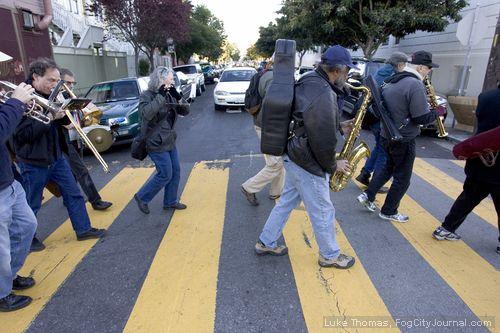
A standing-room-only crowd gathered at United Mission Presbyterian Church on 23rd and Capp Feb. 25th to remember Guardian correspondent and hell-raising investigative poet John Ross. John’s old friends Q.R. Hand, Hermann Bellinghausen, Frank Bardacke, Kevin Quigley and me spoke; his kids, Carla Ross-Allen and Dante Ross, gave moving remeberances. Then we marched through the Mission, led by the Musicians Action Group playing the Internationale. It was a perfect Ross moment: A few of the celebrants put pieces of yellow tape across their chests and stood in the streets halting traffic to the let the procession pass. A couple of confused bicycle cops went by, but took no action, which was good for all involved.


When we reached Cafe LaBoheme, the crowd took over much of 24th Street — but the air of fun and solidarity was so visible and loud that most of the cars simple stopped and waited patiently for room to crawl past. A wild, crazy anarchist funeral mob on the streets of San Francisco; we sent him off right.


PS: The generally nice obituary in the Chronicle described Ross as


“an author, poet, liberal activist and journalist who toiled against perceived injustice from the jungles of Chiapas, Mexico, to the baked streets of Baghdad.”


Which is wrong on two accounts. First of all, there was nothing “perceived” about the injustice Ross saw and wrote about; it was very real. But that’s just a daily paper trying to be objective in a way that turns out to be embarassing. More to the point, as his longtime friend Elizabeth Bell noted, calling Ross a “liberal”  is wildly inaccurate.


Here’s the letter she sent to the Chron:


Although some time has gone by since the Chronicle’s obituary of Bay Area activist and poet John Ross, I must correct a glaring inaccuracy–indeed, slander–that appears in the very first sentence of your otherwise adequate write-up.  John Ross was not at the time of his death, nor had he ever been, a “liberal.”  He was not a liberal-diaper baby, his pioneering refusal to serve in the Vietnam war was not the act of a liberal, nor was placing his body between Palestinian olive farmers and club-wielding Israelis.  His response to a Mexican journalist who asked his profession, “Soy comunista,” does not translate to “I’m a liberal.”  A raucous rebel and man of the people, Ross believed to his dying day that revolution in the United States was necessary and possible. A brief vocabulary lesson, Mr. Coté: Gavin Newsom is a liberal. John Ross was a liberal like a Molotov cocktail is a gin rickey.


Local hire victory party a political who’s who

2

The atmosphere at the local hiring victory party that Laborers Local 261 held at its Union Hall this week  was positively elated. Beer, wine and yummy pupusas flowed, commendations were made, and live drumming gave the event a playful edge. And it didn’t hurt that the place was crammed with political candidates, past, present and future, as San Francisco gears up for a a mayor, D.A. and sheriff’s race, this fall.

Sup. David Campos, who hasn’t thrown his hat in the mayor’s race, at least not yet, described the mood as “exciting.” “Who would have thought a year ago that we’d be having this victory,” Campos said, crediting fellow progressive Sup. John Avalos and the community for “great legislative work.”

Sup. John Avalos, who isn’t showing signs of running in the mayor’s race despite his legislative victories, saw implementation and resistant building trades as the biggest hurdles, moving forward. But he felt city departments will lead the way in showing how to implement the new law, when it kicks in March 25. “The San Francisco PUC has shown that local hire can be successful,” he said. “The new PUC building is at 48 percent local hire across all trades.”

Avalos hoped the building trades will come to see local hire in a more positive light. “They need to understand that it’s good for this city, their unions and union membership,” he said.

Avalos noted that he recently met with members of the San Mateo Board of Supervisors to address concerns that SF’s local hire would lead to job losses in San Mateo.Just before Christmas, the San Mateo supes voted unanimously to urge Newsom to veto Avalos’ local hire policy, but it turns out they had been misled around the law’s impacts. ”I met with [County Sups.] Carole Groom and Adrienne Tissier and said, ‘We have a huge misunderstanding,” Avalos said, noting that Jerry Hill’s recent grandstanding against local hire appears to be going nowhere.

Mayor Ed Lee, who insists he’s not planning to run for mayor in November, urged folks to focus on implementation of Avalos’ legislation.
“We are not just here to celebrate a legislative victory but the first jobs we create,” Lee said. “The world does not just turn by signing legislation.”

Board President David Chiu, who dropped by towards the end of the party with Sup. Jane Kim,Board President David Chiu, said he is “still thinking” about running for mayor, and acknowledged that the road to implementing local hire could be challenging. “But during this Great Recession, we have to do everything we can to make sure San Francisco residents get put to work, and local hire is an important part of that.”

Sup. Ross Mirkarimi, who has just announced that he is running for sheriff, linked high recidivism rates in San Francisco to the need to do a better job of hiring local residents. “We have a 70 percent repeat offender rate,” Mirkarimi said. “That’s 3 out of 4 folks.” Noting that there are 1800 parolees in San Francisco daily, Mirkarimi observed that if folks can’t get a job when they come out of the criminal justice system, they are way more likely to re-offend.

Bayview resident Deanna Rice, who got out of a federal penitentiary a year ago, and is still looking for work, said unemployment is another barrier in the way of her trying to regain custody of her kids, who are 9 and 10 years old.

Laborers Local 261 Business Manager Ramon Hernandez acknowledged that more work needs to be done to make local hire a go.
“We will try to do the best we can to get everyone on the same page,” he said

Local 261 Secretary-Treasurer David De La Torre said their membership is struggling and hurting, existing members and residents are not working
“Local hire is not about a sense of entitlement,” he said. “We gotta put people to work and build the local economy. It’s not about race. It’s about community, a disadvantaged community.”

Greg Doxey of the Osiris Coalition pointed to the economic benefits of local hire.
“If you hire local, people are going to shop two, three blocks from home, the economy will get stronger, they’ll be more tax revenue, and folks could even qualify to buy homes

CityBuild’s Guillermo Rodriguez praised the Board, department heads and Mayor Ed Lee “for getting together with labor” to pass Avalos local hire legislation.

But despite the happy vibes at the party, I left wondering if there is going to be adequate investment in workforce development side come budget time, if folks will try to game the system by using the address of locally-based subcontractors to establish local residency, and whether local efforts to sabotage the legislation are going to escalate now that the San Mateo Board no longer seems opposed to the law. But I also left knowing that folks like James Richards, President of Aboriginal Blacks United, have made it clear that if local hire doesn’t get  implemented, they’ll keep protesting until it does. So, stay tuned….


Paul Henderson denies D.A. deal with Willie Brown

6

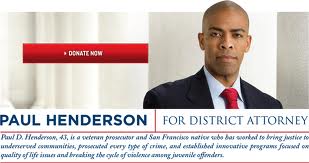
Paul Henderson doesn’t mince words when it comes to debunking the notion that Willie Brown helped him get his new job as Mayor Ed Lee’s public policy czar. Or that his decision to drop out of the D.A.’s race was in exchange for his new job.

“There was no deal with Willie Brown. I called and said, so do I get a check in the mail, a basket of fruit?” Henderson said, recalling his furious reaction to Brown’s claim, made in the Chronicle in January, that Brown and then mayor Gavin Newsom conspired to make sure Henderson was “taken care of,” in the wake of Newsom’s shocking announcement that he had appointed San Francisco Police Chief George Gascón as D.A.

“If there was a set up for me somewhere, I still have not got it. I didn’t get shit,” Henderson, who joined the D.A.’s office in 1995 and was said to be former D.A. Kamala Harris’ preferred pick to fill the D.A. post, after she won the state Attorney General’s race, last fall.

Instead, Henderson, who filed papers to run in the D.A.’s race in November, saw his plans blown out of the water when Newsom, in his last act as mayor, appointed Gascón as Henderson’s new boss. And when Gascón filed papers in the D.A.’s race the very next day, Henderson found himself in the unenviable situation of holding an at-will position in the D.A.’s office, while running against his boss in the 2011 D.A. election.

“ If there was any deal, it was for me not to lose my job,” Henderson added.  “And it’s the best decision for me. I really do care about public service.”

During his 16 years in the D.A.’s office, Henderson established juvenile drug and community justice courts, set up domestic violence and hate crime programs, and focused on rehabilitative, reformative, treatment-oriented alternatives to imprisonment.

He said his decision to join the Mayor’s Office is based on a long relationship with Lee. “I want to have a voice in the criminal justice system, and I’ve known Ed Lee independent of all this political business,” Henderson said, recalling that he worked with Lee to develop language programs in the D.A.’s office, so employees could take lessons and better interact with community members, victims and witnesses in court.

“I’m a third generation San Francisco resident, and the first generation not to grow up in the projects, though we lived opposite them,” Henderson continued, recalling how his mother is a Public Defender, his grandmother was a community advocate, and he went to preschool in Sunnydale. Those experiences gave him a strong sense of being connected to and serving his community from an early age, Henderson said.

And he soon found himself holding the highest position, as a gay and black, in the D.A.’s office in the 1990s.‘I was the first African American the D.A.’s office had hired in five years,” Henderson said, recalling how the department looked in 1995. “And look at it now,” he added, noting that since he took over hiring at the D.A.’s office, more gays, lesbians, Asians, Latinos and other minorities have been employed.

“I’m very aware of who I am and what I represent in this office,” Henderson said. “For me, it’s about creating an open door and having a voice at the table. Ed Lee has asked if I would be the liaison between national, state and local agencies collectively in his office. And this expands my voice and creates opportunities for all in San Francisco in ways that are exciting to me.”

Henderson said his new post will have a very different focus from the role former US Attorney Kevin Ryan played, during his brief tenure in the Mayor’s Office, under Gavin Newsom.“This will be about policy development, advice and implementation, and it will be more reflective of marginalized communities,” Henderson said. “So, I don’t want these communities being misled into thinking, ‘oh, he got a hand out.’ This was not a hook-up. I earned my place here.”

“The truth is that you have access to me because I am in this position,” Henderson continued. “And I hope it’s transformative for the city and the community. Because I did not get shit. There is no Paul Henderson pay-off. I’d be happy to tell you if I’d sold out. But no. I knew Ed independently. He knows my heart, trusts my judgment and reputation. This has nothing to do with Willie, Gavin and Kamala. Unless it did, and they are all tricking me. In which case, they should at least tell me, so I can credit them. But the truth is, I’ve worked so hard, and if I’ve become ‘the Man,’ then I’m at the table for the community. I’m not the person who took a pay out, got a hook up, a cushy deal, so I will go away, to silence my voice.”

Henderson notes that he has not given up his political aspirations, despite all that went down recently. “If it’s not my time right now, I still have political credibility and a profile in the city that isn’t going away “ he said, noting that he raised $65,000 in 28 days, just before Christmas, with no staff, immediately after a statewide election. “That speaks to how much support I have. Obviously I was disappointed that I wasn’t appointed D.A. But I’m not dead, and I’m trying to move in a direction that expands my voice.”

Henderson says his new role won’t change him and he’ll remain accessible to gay, black, Chinese, Samoan, immigrant, low-income, Latino and other marginalized communities.“I have a lens that most city leaders don’t have,” he said, noting that he was homeless and slept in his car when he was going to law school. “Ad now I can affect policy. Many folks feel the criminal justice system happens to you, and over 80 percent of victims are people of color and poor people. But who speaks for and represents them?”

Henderson drops out of D.A’s office and race, SFPD Chief turned D.A. Gascón appoints DeBerry as new chief of staff

4

I wondered what Willie Brown was talking about when he wrote that making sure that D.A. office insider Paul Henderson was “taken care of” was one of only two details to be worked out, following former Mayor Gavin Newsom’s shocking last-minute appointment of former police chief George Gascón as the next District Attorney  And now I think I found out: Henderson, who was former D.A. Kamala Harris’ chief of administration and her preferred pick, announced yesterday that he is dropping out of the D.A.’s race and will serve as Lee’s public safety czar.

Henderson starts his new job March 8, meaning 15 months has passed since former U.S. Attorney Kevin Ryan resigned from the Mayor’s Office of criminal justice—leaving everyone unsure what Henderson’s new post entails, and whether it comes with a staff and/or a budget.

Henderson says his new job includes involvement in the Taser debate, the next police chief selection, and assessing how budget cuts impact public safety. And he certainly didn’t publicly let on that he was anything but delighted about this latest twist in the ever evolving race to be the next elected district attorney.

“I’m excited about helping our Mayor shape this new position and about what we can accomplish under his leadership to enhance public safety in the City,” Henderson, who is  reportedly backing Gascón in the D.A.’s race, told the Guardian.

But Henderson’s move brings us back to the other detail Brown referred to in January, namely, “assessing the odds of Gascón winning the D.A.’s race in November.”

Currently, David Onek, a senior fellow at the UC Berkeley Center for Criminal Justice and served in the Mayor’s Office of Criminal Justice under Newsom and Alameda County Deputy District Attorney Sharmin Bock, are the only remaining contenders. And while little has been heard from Bock since she filed in January, Onek has been doing all he can to stay relevant, including holding house parties, raising money, calling for transparency in the D.A.’s Office around officer-involved shootings, and interviewing criminal justice experts as part of his Criminal Justice conversations podcast project in Berkeley.

Onek’s latest interview is with Michael Romano, co-founder of the Stanford Three Strikes Project, which represents folks serving life sentences under the Three Strikes law for minor, non-violent offenses – such as stealing a pair of socks. “Addressing the flaws in the Three Strikes law will protect Californians while also having a positive impact on our state budget.” Onek observed in a campaign email. “According to the California state auditor, non-violent third strikers will cost our state at least $4.8 billion over the next 25 years – almost $200 million per year.”
 
Onek also noted that the next few months are crucial for his D.A. campaign, “to build strong partnerships between law enforcement and the community.”
And the challenge for anyone who is not part of the Brown- Newsom machine to remain viable in the D.A.’s race were illustrated afresh yesterday when Gascón convened a 30-minute press conference at the Hall of Justice to announce he is reorganizing his staff to focus on cutting the backlog of homicides and other felony cases–and was replacing Henderson with Cristine DeBerry, who was deputy chief of staff under Mayor Gavin Newsom and Mayor Ed Lee.

Gascón said the reshuffle was a product of six weeks talking to prosecutors, court officials, defense lawyers and others in the criminal justice system. And so far it has led to David Pfeiffer being named as heads of special operations, Sharon Woo as head of operations, Eugene Clendinen as chief of administration, Braden Woods as chief of the criminal division, Lenore Anderson as chief of collaborative courts, Maria Bee as chief of victim services, June Cravett as head of the white collar division, Jim Crisolo as chief of investigations and Jerry Coleman as chief of the Brady, appellate and training division.

Gascón said he doesn’t foresee immediate layoffs in the department, which has a $39 million annual budget. But he warned that if he is required to cut his budget by 10 percent, as Mayor Lee has requested of all departments, he’ll have to lay off the equivalent of 18 prosecutors.
“Hopefully, we’ll be spared that,” he said. “As it is, we have so much unattended business.”

Gascón blamed the crushing deficit in the D.A.’s Office on budget constrictions over many years, as he used a Power Point slide show to illustrate how the department had less funding in 2008 than in 1986 (if numbers are adjusted for inflation).
“It’s why we had problems in the past and why we are doing this reorganization,” he said, claiming that a significant lack of training in the department has caused “a poor performance in court,” and that there is only one paralegal for every 9 attorneys, on average.

Gascón said it took 3-4 months to process most felony cases, and up to 3 1/2 years to bring a murder case to trial, under the office’s previous configuration.  “By that time, memories have faded, and people are not showing up,” he said.
(D.A. press spokesperson Seth Steward clarified today that Gascón’s claim that “only one out of every 26 misdemeanor cases” was in fact a misstatement, and that the D.A. is working to provide a more accurate analysis.)

Gascón also announced that he is rolling out a makeshift community court system in the next few months, in which alleged perpetrators, victims and three mediating members of the public would work to find a solution, which could be community service.
‘So you can roll the dice and be prosecuted or go to the community court,” he said. “We believe we can take 20 percent of our work load, which is about 1,000 cases, and run it through this system.”

He also claimed that instead of spending $1,200 to $1,300 in the court system, these cases would only cost $300, and that the Tenderloin Community Justice Center will stay in place, under the reshuffle.
 “My goal as Chief was the make San Francisco the safest and largest city in the United States, and that continues to be the goal,” Gascón concluded.


Behind the Twitter tax break deal

36

There’s much political intrigue and anticipation swirling around the Central Market Payroll Tax Exclusion, aka the Twitter Tax Break, which the Board of Supervisors will consider next month. This has all the elements of a great story: backroom deals between political and corporate power brokers, the strange argument that Republican-style tax cuts will cure Mid-Market blight, the fact that Twitter executives have uttered nary a tweet about shaking down SF taxpayers, and the role that a pair of supposedly progressive supervisors have played in brokering the deal.

Following up on my Feb. 10 post about how the deal would help Twitter meet the high asking price of politically connected landlord Alvin Dworman for a new mid-Market headquarters, the Bay Citizen yesterday had a great story showing how Dworman gave then-Mayor Gavin Newsom discounted office space for his lieutenant governor bid just as Newsom proposed the tax break that would benefit Dworman and Twitter. The story also includes a nice tick-tock about how this unseemly deal unfolded.

We at the Guardian are currently awaiting a big package of documents from City Hall that we requested on the deal, and sources tell us they’re likely to include some interesting insights and tidbits. For example, are Twitter and Dworman the main beneficiaries of this legislation or are there other corporations (and the politicians they support) who were pushing this plan? Everyone is also waiting to see how the city’s Office of Economic Analysis rates the proposal, and Economic Ted Egan tells us that report should be out by the end of next week or beginning of the following week.

At this point, we have more questions than answers, but that should start changing by next week. Maybe we’ll gain a better understanding of why Sup. Jane Kim is pushing this deal (much to the consternation of some of her former top supporters) or why Randy Shaw, the taxpayer-subsidized blogger and Tenderloin don, strongly backed Kim’s candidacy and attacked her critics with such perplexing ferocity. Will Willie Brown’s name continue popping up? Perhaps we’ll be able to determine whether the Newsom-Dworman pact actually broke campaign finance laws. And we’ll certainly gain some insights into how the Mayor’s Office of Economic and Workforce Development trades away taxpayer money to successful corporations that wield whines and threats of relocation.

If nothing else, we’ll get a peek into modern crony capitalism, San Francisco-style, dressed up in the guise of “saving” the Tenderloin. So, from a strictly journalistic perspective, this should be fun.

Who’s next?

39

steve@sfbg.com and tredmond@sfbg.com

The seven serious candidates who have announced plans to run for mayor extends from moderate to conservative at this point, but it’s an unusual field for San Francisco: there is no clear progressive standard-bearer, and no clear downtown candidate.

But it probably won’t stay that way. Sources say others are likely to join the lackluster race in the coming months, and there’s a strong likelihood that some progressive candidate will decide to the take plunge.

Also unlike the last few mayor’s races, there appears to be no clear frontrunner — either in fundraising or in having a clear constituency base — a new dynamic that creates an unpredictability that will be exacerbated because this is the first contested mayor’s race using the ranked-choice voting system and public financing of candidates.

There was a weak field of challengers to Gavin Newsom in 2007 and no one qualified for public financing or presented a strong threat. But this time City Attorney Dennis Herrera and former Sup. Bevan Dufty already have indicated they will take public financing, and others are expected to follow suit.

In addition to Herrera and Dufty, the field includes Sen. Leland Yee, Assessor-Recorder Phil Ting, venture capitalist Joanna Rees, and former Sups. Tony Hall and Michela Alioto-Pier. Those close to Board President David Chiu also say he is “seriously considering” jumping into the race and talking to friends and supporters about that possibility now.

But so far none come from the progressive political community that has controlled the Board of Supervisors for the past decade. Although Chiu is the only candidate in the field to self-identify as a progressive, he has adopted a more moderate governing style that has frustrated many progressive activists and supervisors. So that leaves voters on the left without a candidate right now.

“If a credible progressive candidate doesn’t get into the race, then we’ll see the top-tier candidates — which so far Leland Yee and Dennis Herrera — try to make friends with progressive San Francisco. And it would appear they have a lot of work to do,” Aaron Peskin, the former board president who chairs the San Francisco Democratic Party, told us.

Both Yee and Herrera have taken some progressive positions, and Yee has consistently endorsed more progressive candidates than anyone else in the mayoral field, but they have also taken many positions that have alienated them from progressives. And both have been taking in lots of campaign cash from interests hostile to the progressive base of renters, environmentalists, and advocates for social and economic justice.

“Nobody who has put their hats in the ring is really exciting anyone, so there is plenty of room for new entrants,” Peskin said, noting the progressives are actively discussing who should run. Peskin wouldn’t identify whom they’re courting, but some of the names being dropped are Sups. John Avalos, Ross Mirkarimi, and David Campos, as well as former Sup. Chris Daly and Peskin.

But Mirkarimi shifted some of that talk this week when he announced that he intends to run to replace the retiring Mike Hennessey as sheriff.

Political consultant Jim Stearns, who is representing Yee, also expects others to get into the race. “I don’t think the field is complete yet. Historically, the strong self-identified progressive candidate has come in late or surged late, like [Tom] Ammiano and [Matt] Gonzalez,” Stearns said.

Ammiano launched his write-in mayoral bid in September 1999 and Gonzalez jumped into the race just before the filing deadline in August 2003, so there’s plenty of time for progressive candidates to get in. “It’s never too late in San Francisco,” Stearns said. And unlike those two races when the upstarts were seriously outspent by the well-heeled frontrunners, Stearns said this year’s field will likely be on a fairly even financial footing.

“It’s likely every candidate will have $1.5 million to $2 million to spend,” he said. That means the keys to the race are likely to be name ID with voters and “which campaign can do the most with the least dollars,” Stearns said.

Already, some of the candidates who will be running to the center are looking for progressive support. Yee, for example, has given substantial amounts of money to progressive groups and candidates and has endorsed progressives for office.

Yee told us he’s positioning himself as “the candidate of the regular folks of San Francisco — the people who are trying to raise their families and live in this city.” He added: “To the extent that the progressive agenda fits that, we’ll be part of it.”

But he already has the endorsement of the Building Trades Council, which has often been at war with progressives, particularly over development issues.

Yee said he hasn’t yet weighed in on the local budget, but he agreed that new revenue “shouldn’t be off the table.” He said he thinks the current pension reform discussions at City Hall, involving Mayor Ed Lee, Sup. Sean Elsbernd, financier Warren Hellman, and union representatives are “the right way to go.”

Herrera said he’s going to run on his record — which includes a long list of progressive legal actions (along with his gang injunctions, which a lot of progressives question). He also told us that he’s involved in the pension reform discussions but thinks that new revenue absolutely ought to be a part of the budget debate.