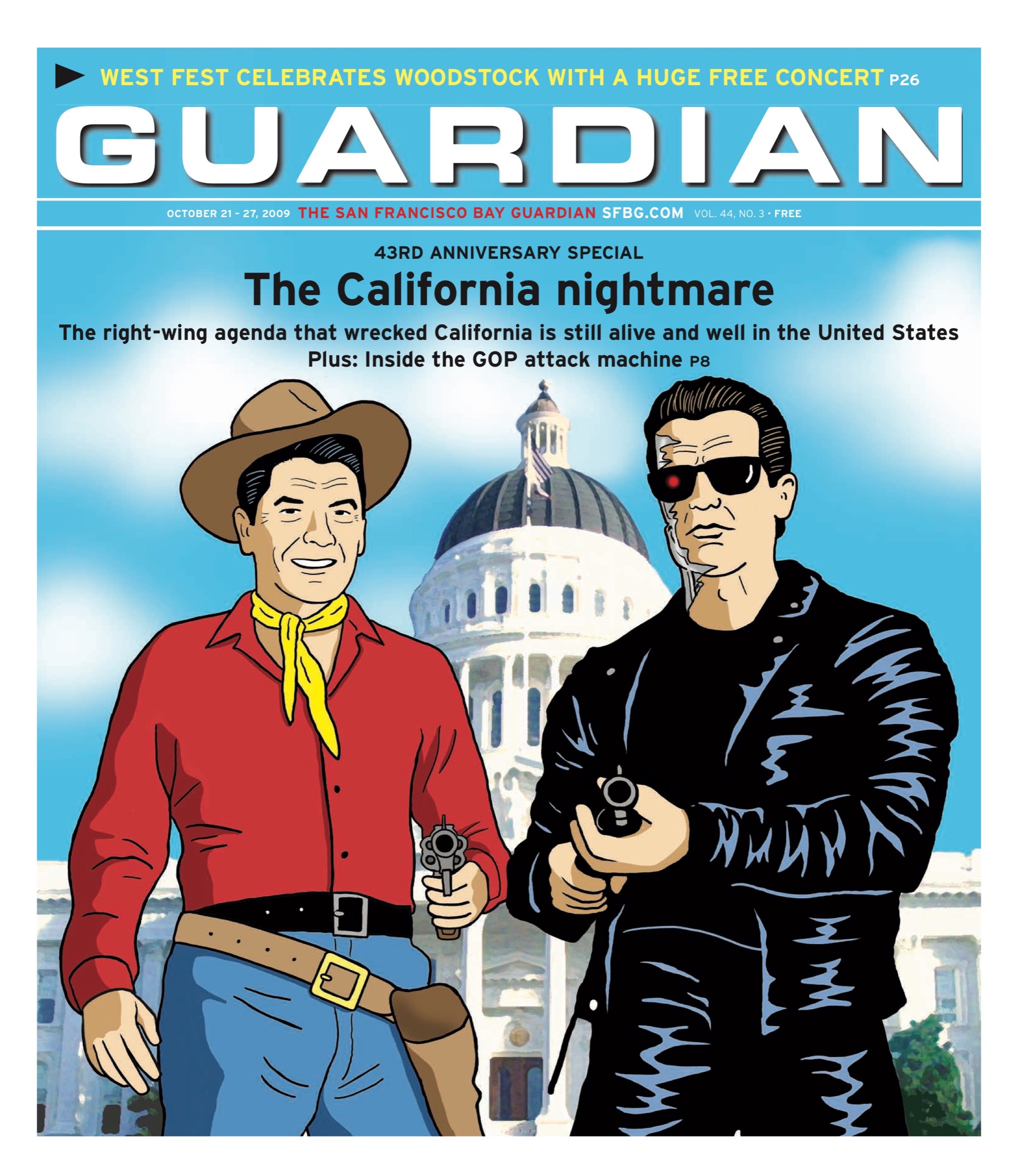
News

The old Gov. Moonbeam shit

1

Okay, I’ve got a lot of problems with Jerry Brown. He was an awful mayor of Oakland, sided with the developers and the cops, and seemed to lose almost all of his progressive insticts. He’s against raising taxes on the rich. He won’t even support marijuana decriminalization.

There are good reasons to criticize the guy, and I’m right there at the front of the line.

But I fear that’s not what the press is going to do over the next year. It’s way too much fun to dredge up the old Gov. Moonbeam shit

Check out Carla Marinucci today:

now’s a good time to re-introduce you to author Jerry Brown, whose ’90s book “Dialogues” also contains a few memorable quotes that may end up in some 2010 gubernatorial campaign ads …. For Brown fans, the material illustrates the intellectual curiousity and independence that they say set him apart in the current pack of pols. For conservatives, it’s more proof he’s still that ultra-liberal, wacky “Moonbeam” character.

(btw, ultra-liberal is the Chron’s disparaging term for progressive. Although C.W. Nevius seems to like “militantly liberal.”)

So here are some of the examples of questions Brown asked in his interviews that the Chron thinks are utterly wacky:

*To author and philosopher Noam Chomsky:

*”How would you compare the propaganda system in the so-called free world to an authoritarian system? What are the differences?”

Umm, Chomsky is a brilliant linguist, an expert on the use of words. That’s a perfectly legit question to ask him. And it’s based on what anyone who follows the news media knows very well — that a lot of what is presented as unbiased news is actually slanted to promote a point of view. Why is that strange or wacky?

OR:

*To Judi Bari, late “Earth First!” enviromental activist:

*”None of us is an isolated monad with this bundle of private property rights outside the fabric of these larger obligations. So I very much believe that it’s time to take another step in the evolution of capitalism. Right now, I don’t think the federal government can make that happen…it can’t even operate what it owns, so that’s not the answer. But we’re on a track of real destruction socially and ecologically and we have to understand that as clearly as we can in order to come up with a better set of rules.”

*To Wolfgang Sachs, author and enviromental researcher:

*”As you observe modernizing projects in the world today that are operated by multinational corporations without much interference from national governments, do you see fascistic elements there? There are certainly enormous changes imposed without the consent of the governed.”

Again: Brown’s points are pretty basic, pretty clear — and almost indisputably correct.

The Sacramento Bee has had fun with some of Brown’s old lefty stuff on KPFA, but again, I have to ask: What did he say that was wrong?

He called capital punishment “state murder” and said U.S. Sens. Dianne Feinstein and Barbara Boxer, both Democrats, had “sold out” U.S. truck drivers by letting their Mexican counterparts drive uninspected vehicles into the United States.

In one of the most controversial excerpts, Brown called the prison system a racket that pumped profits out of the poor’s misfortunes and into the pockets of prison guards.

“The big lockup is about drugs,” Brown stated in an excerpt from late 1995. “Here’s the real scam. The drug war is one of the games to get more convictions and prisoners. There’s a lot of chemicals out there and when certain ones are made illegal, they become a huge profit opportunity and bring violence, crime and more people to imprison.”

Again: What, exactly, is wrong with anything he said? It’s all perfectly true.

More from the Bee:

Garry South, a top strategist for Democratic gubernatorial candidate Gavin Newsom, said the KPFA (94.1 FM) broadcasts would make Brown vulnerable if he reaches the general election.

Brown opened an exploratory committee for a gubernatorial run last month but has not officially announced his candidacy.

“California Democrats need to ponder very seriously the prospect of putting up a candidate for governor who comes with reams of radio-show rantings and ravings like Brown,” South wrote in an e-mail.

Rantings and ravings? Does Newsom support the death penalty? NAFTA? The drug war? If he does, that’s a bigger problem than Brown’s off-the-cuff radio remarks.

Appetite: Cliff House hits 100, juicy “Appetite City”

0

Every week, Virginia Miller of personalized itinerary service and monthly food, drink, and travel newsletter, www.theperfectspotsf.com, shares foodie news, events, and deals. View the last installment here.

cliffhouse1009.jpg

11/4 Cliff House Centennial Celebration
Cliff House is one of our San Francisco classics, surviving fires and decades with seaside dining over crashing waves and sunset vistas. In 1909, the third “fire-proof” incarnation was built by Adolph Sutro’s daughter, Dr. Emma Merritt, after the original two locations burnt to the ground. There have been numerous renovations, the last in 2004, two restaurants, the Bistro and more upscale Sutro’s, and George Morrone came on as chef for a time, raising menu offerings commensurate with the views.

CliffHouseGown1009.jpg

Cliff House’s centennial celebration is coming up on November 4. Though it does cost a lofty $175, there’s no other party quite like it. Benefiting Golden Gate National Parks Conservancy, there will be an intriguing auction of period ball gowns made from recycled Cliff House menus, memorabilia and photographs, by 3D designer, Mari O’Connor. Fashion buffs, check out sketches of the gowns representing various eras throughout the century – sure to be a highlight of the night.

While savoring hors d’oeuvres and cocktails, there’s a Beach Blanket Babylon performance, dancing to the Reinhardt Swing Band or a DJ in the Terrace Room, historical exhibits, with hosts, Gene Burns and John Rothmann, of KGO radio, and comedian, Bob Sarlatte.

If that’s too much money to swing, commemorate 100 years in the Bistro on Wednesday nights with a $19.09 three-course prix fixe, or Sutro’s $20.09 three-course lunch every Tuesday, through the end of 2009.
Wednesday, November 4
6:30pm
$175
1090 Point Lobos
415-386-3330
Vintage attire or black tie eveningwear

www.cliffhouse.com

AppetiteCity1009a.jpg

Oct. 28 — William Grimes talks about his latest book, “Appetite City”, at Omnivore Books
William Grimes is a former restaurant reviewer for the New York Times whose book, Straight Up or on the Rocks: The Story of the American Cocktail, ignited my passion for the history of the cocktail, leading to excessive reading on the subject afterwards. His knowledge of drink and food is both broad and deep. I’m eager to hear him talk about his latest, Appetite City: A Culinary History of New York, at Omnivore Books in Noe next Wednesday. The book covers the daring, multicultural past of New York’s food scene with Grimes’ impeccable historical writing and attention to detail, plus more than 100 photographs and rare menus. Food and restaurant lovers will find something of interest here – but arrive early enough to squeeze into Omnivore’s small space.
Wed/28, 6-7pm, free
3885A Cesar Chavez
415-282-4712

Omnivore Books

Appetite: Cliff House hits 100, juicy “Appetite City”

0

Every week, Virginia Miller of personalized itinerary service and monthly food, drink, and travel newsletter, www.theperfectspotsf.com, shares foodie news, events, and deals. View the last installment here.

cliffhouse1009.jpg

11/4 Cliff House Centennial Celebration
Cliff House is one of our San Francisco classics, surviving fires and decades with seaside dining over crashing waves and sunset vistas. In 1909, the third “fire-proof” incarnation was built by Adolph Sutro’s daughter, Dr. Emma Merritt, after the original two locations burnt to the ground. There have been numerous renovations, the last in 2004, two restaurants, the Bistro and more upscale Sutro’s, and George Morrone came on as chef for a time, raising menu offerings commensurate with the views.

CliffHouseGown1009.jpg

Cliff House’s centennial celebration is coming up on November 4. Though it does cost a lofty $175, there’s no other party quite like it. Benefiting Golden Gate National Parks Conservancy, there will be an intriguing auction of period ball gowns made from recycled Cliff House menus, memorabilia and photographs, by 3D designer, Mari O’Connor. Fashion buffs, check out sketches of the gowns representing various eras throughout the century – sure to be a highlight of the night.

Attack of the right-wing nuts

0

news@sfbg.com

In April 2006, with the approval ratings of President George W. Bush plummeting, his senior political advisor, Karl Rove, began discussing a plan to turn things around.

His strategy: attack progressive organizations that were registering low-income people to vote and helping them fight corporate power — and claim it was about voter fraud.

The main White House target, newly released records show, was the Association of Community Organizations for Reform Now (ACORN). By the end of 2006, Rove would oversee the removal of eight U.S. attorneys, including two who refused to press bogus charges against ACORN in New Mexico and Missouri, and a third under similar suspicions in Washington state.

ACORN made a convenient target for Rove and his gang — and the well-orchestrated attacks on that group, which have exploded into the headlines this year, provide a compelling case study in how the right wing operates in this country.

Although it was the GOP that removed tens of thousands of likely Democratic voters from the rolls in the 2000 and 2004, the Republicans and their allies were able to make the issue of voter fraud all about ACORN, using a handful of isolated problems to undercut an organization focused on giving a voice to poor people.

Founded in Little Rock, Ark. at the end of the 1960s, ACORN has grown into the nation’s top community-organizer group, thanks to success in improving poor people’s housing, wages, and educational access. By the eve of the 2008 presidential election, ACORN had helped register more than 1.3 million voters — mostly young, low-income minorities — in 21 states, including the battleground states of Florida, Pennsylvania, Michigan, and Ohio.

As The Nation put it, these successes made ACORN “something of a right-wing bogeyman.”

And while the recent furor over a conservative videographer secretly taping ACORN employees saying dumb things has somehow become one of the big political stories of the year, the major media have mostly ignored how this attack is part of a larger conservative strategy.

In August, hundreds of pages of e-mails and transcripts related to the 2006 U.S. attorney-firing scandal were released to the press and public — but few news outlets mentioned that Rove was focused on attacking ACORN’s voter registration efforts, even though ACORN and voter fraud are repeatedly mentioned in these documents.

“This is about a campaign that goes back a decade to big business and that people who don’t like what ACORN does and is effective at — namely, helping groups to organize and put pressure on banks around sub[prime] mortgage loans to stop racial discrimination,” Peter Dreier, a professor of politics at Occidental College, told us.

It wasn’t really about voter fraud. As former U.S. Attorney David Iglesias, a Republican from New Mexico, recently stated on The Rachel Maddow Show: “They were looking at numbers [and] didn’t like the demographic tidal wave that was coming their way so they wanted to engage the machinery of the Justice Department to stop that wave.”

After two years of investigating ACORN and other supposed perpetrators of left-wing voter fraud, Igelias said, “I couldn’t find one case I could prosecute.”

But for the right-wing attack machine, it didn’t matter — the damage was done.


THEIR MASTERS’ VOICE

White House communications strategist Anita Dunn created a stir in mid-October when she told CNN host Howie Kurtz that Fox News “is really more of a wing of the Republican Party. … Let’s not pretend they’re a news network like everybody else is.”

It didn’t take long for Fox commentator Glenn Beck to retaliate. In a series of broadcasts, he attacked Dunn, compared the Obama administration to a communist dictatorship, and likened the criticism to the Holocaust. “Ask yourself this question,” Beck said during a radio segment, vaguely addressing people he called “good journalists” at other mainstream news networks. “When they’re done with Fox, and you decide to speak out on something — it’s the old ‘first they came for the Jews, and I wasn’t Jewish.'” Beck concluded the segment by warning his audience, “this is how a dictatorship always starts.”

Beck’s comment may strike San Francisco progressives as outrageous, but given the rhetoric routinely issuing from the right-wing megaphone, it’s also 100 percent predictable.

But when Dunn called Fox News Channel an arm of the GOP, she was dead on. Consider the history of its chairman and CEO, Roger Ailes, who ran Richard Nixon’s 1968 presidential campaign and later those of presidents Ronald Reagan and George H.W. Bush, guiding them all to victory through his brilliant and successful media campaign strategies.

“Roger Ailes is a newsman with a profound disdain for newsmen,” according to a New York magazine profile. “Fox News is being promoted as an anti-network, a news channel designed to appeal to the people … who don’t trust [the others].” Portrayed in the story as a “self-described paranoid,” Ailes reportedly resigned from an earlier position as head of CNBC after questions were raised about his desire to use his position as a weapon against his enemies.

Fox News is an outgrowth of its parent company, Rupert Murdoch’s News Corporation. A look at the board of directors of this multinational giant yields some startling insight into who controls the “fair and balanced” news network. Ailes himself has a seat at the table — but not every board member has a background in media.

News Corp. board member Viet Dinh, for example, is an attorney who came to the United States as a boy from Vietnam. In a 2002 interview with the Los Angeles Times, Dinh, who then served as an assistant attorney general at the Department of Justice, recalled an exchange he had with then-Attorney General John Ashcroft in the wake of the Sept. 11 attacks. “He told me: ‘The art of leadership is the redefinition of the possible. I want you to be the think tank to help me redefine the possible for the Department of Justice.'”

Dinh successfully redefined “the possible” by acting as a primary author of the USA PATRIOT Act, quickly propelling himself to prominence as a darling of conservatives and an enemy of civil liberties watchdog groups. A law professor at Georgetown University, Dinh is also founder and chief of Bancroft Associates PLLC, a consulting firm that specializes in helping Fortune 500 companies “navigate the federal and state criminal or civil investigations, congressional investigations, and complex litigation,” according to the firm’s Web site. It also specializes in public relations.

Another board member is José Maria Aznar, former prime minister of Spain. Aznar was born into a politically active, conservative family in Spain in 1953, and both his father and grandfather held government jobs under Gen. Francisco Franco, the fascist dictator. Aznar was handpicked by Manuel Fraga, a minister under Franco, to succeed him in leading Spain’s center-right People’s Party (Partido Popular), according to an article in the U.K.’s The Independent.

Aznar now serves as president of the Foundation for Social Studies and Analysis, a right-wing think tank based in Spain that, according to its Web site, works closely with the CATO Institute, the Heritage Foundation, and other conservative U.S. think tanks.

Occupying other seats at News Corp.’s board table is an assortment of professors, attorneys, public-relations experts, and businessmen with their fingers in a variety of banks and multinational corporations. Among the more familiar names are Phillip Morris, Ford Motor Co., Hewlett Packard, Goldman Sachs, HSBC North America, and JP Morgan Chase. Lesser known are the investment banking firms that have stakes in the petroleum industry, utilities, mining companies, and real estate.

While the connections between corporate interests and the country’s leading conservative propagandist are extensive and obvious, there’s a stark contrast between the message delivered by Fox News and the interests of its parent company.

Fox News plays up the theme of patriotism and reinforces the idea that there is a distinction between “real Americans” and outsiders. But Fox’s board is made up of members whose lives and economic interests are scattered across the globe, but have one common thread: they all control extraordinary sums of concentrated wealth.


PROPAGANDA AND EMOTIONS

While Dunn called Fox News Channel an arm of the Republican Party, others have gone so far as to label its content pure propaganda — and incredibly effective propaganda at that.

“This is very, very sophisticated propaganda,” says Bryant Welch, a clinical psychologist, author, and expert on political manipulation. “I don’t think progressives really get it that it’s a technique being used all the time.”

Welch said when he began working as a Washington, D.C., lobbyist on behalf of the American Psychological Association years ago, he started observing the tricky political maneuverings at play in the nation’s capital through the eyes of a psychotherapist who had spent some 30,000 hours helping patients confront their deep-seated hang-ups.

To his surprise, Welch found that some of the most successful right-wing political operatives also seemed to have an understanding of psychology — although they use the knowledge very differently. “A lot of it is psychological manipulation,” Welch asserts.

George Lakoff, a professor of linguistics at UC Berkeley and author of Don’t Think of an Elephant: Know Your Values and Frame the Debate, offered a similar analysis. He said Republicans approach issues as a marketing challenge. “They’ve learned from the cognitive scientists. Even if they don’t understand the science, they know how to do marketing.”

Welch, who is also an attorney and Huffington Post blogger, provides an analysis of how the right wing gets its message across in his book, State of Confusion: Political Manipulation and the Assault on the American Mind. He argues that public relations professionals, right-wing commentators, and others in the business of shaping public opinion are skilled at tapping into widespread feelings of anxiety and uncertainty.

“In this world, things are confusing,” he explains. “You’ve got to be constantly adapting and assimiutf8g new information. When times get confusing, people have a hard time forming a sense of what’s real.”

Right-wing television and radio personalities like Sean Hannity, Glenn Beck, or Rush Limbaugh prey on this widespread uncertainty, Welch argues, by providing viewers and listeners with an absolute version of reality that is easily grasped, neatly divided into right and wrong, and spelled out in very certain terms.

“The thing that Bill O’Reilly and Sean Hannity do is, they sound very powerful, certain, and aggressive,” Welch told us. “[Viewers] identify with that strength. They draw a sense of security from someone who has certainty about what is real.”

Viewers who find that their anxiety subsides when they tune in are hard-pressed to go back and reexamine their views later on, Welch said, because they’re satisfied with the answers they’ve been given. And in right-wing messaging, those answers consistently cast government as the enemy.

On Fox and AM radio, the use of repetition helps drive home an idea until it becomes a conviction in the mind of a listener. Television reinforces those key phrases with patriotic color schemes. The whole package is designed to transform an audience’s sense of bewilderment over a complex world into trust in spokespeople helping them make sense of it.

The right-wing commentators’ success lies partly in their ability to harness core human emotions such as paranoia or envy, Welch said. He pointed to the health care debate as an example, noting how Fox News has repeatedly played up the false concept of “death panels” to create fear.

To counter this tactic, Lakoff suggests that the left would do well to learn how to frame things in moral terms instead of playing defense against right-wing spin masters.

President Obama’s problem, Lakoff said, is that he is still trying to unify the country. “More power to him, but I don’t believe it’s possible,” Lakoff said. “Republican presidential candidate Sen. John McCain got 47 percent of the vote, bad as he was, and given how terrible a campaign he ran, and given that Obama ran a perfect campaign. So Obama’s election was not a landslide, even though he had one of the best campaign organizations and one of the best framed campaigns ever.” Obama doesn’t play the same manipulative games, Lakoff noted. “Obama believes that if you just tell the truth, it’ll be OK, and every day have a truth squad to find the conservative lies,” Lakoff said. “What he didn’t understand was that by focusing on the conservative lies, he was in fact helping the conservative cause. It’s like Richard Nixon saying, ‘I’m not a crook.'” That why Lakoff says it’s so important for Obama, and for the progressive movement in general, to define the moral imperative behind empowering the people and their government to create a better world, then aggressively push a campaign to do so. “It’s the ‘this is the right thing to do’ approach,” Lakoff explained. “And once it’s been framed that way, then you can say what’s false or true. But you should never go on the defensive first. As soon as you go point by point, you are on the defensive.”

The lesson of California

0

news@sfbg.com

Much of the right-wing agenda that has thrown this nation into economic chaos can be traced back to what was once called the Golden State.

The tax revolts that started here under Gov. Ronald Reagan and continued to sweep the country and the world under President Reagan never abated. Indeed, they have only been strengthened by the big business power that created and benefited from them.

But now that California is showing signs of being the country’s first failed state — caught in fiscal freefall and mired in political gridlock as a generation’s worth of neglected problems surge to the surface — this state has become a cautionary tale for that anti-government ideology.

Trends in America tend to start out west, and the economic and political disaster that California has become contains critical lessons for the rest of the country.

Lewis Uhler — president and founder of the National Tax Limitation Committee — speaks candidly and proudly of his key early role in helping build a conservative movement to limit the size of government and do battle with those who want the public sector to actively promote social and economic justice.

Uhler, a UC Berkeley Boalt Hall School of Law graduate who did legal work for conservative causes in the 1960s, was tapped by then-Gov. Reagan in 1970 to be the director of the Office of Economic Opportunity, a federally-funded legal assistance program created as part of President Lyndon Johnson’s war on poverty.

While that may seem like a strange role for an avowed conservative and former member of the John Birch Society, Uhler says Reagan basically brought him in to wreck the program and fight the feds. “I was asked to put my money where my mouth was for my conservative philosophy,” Uhler told the Guardian. “OEO was set up to ensure conflict and confrontation … The mission of legal services was to change public policy through lawsuits they decided to file. I thought it was a corruption of the legal system.”

At the time, public-interest law and liberal economic and social policies were on the rise in California and spreading to the rest of the nation. So the Reaganites fought back.

Rather than helping poor plaintiffs file environmental, consumer protection, equal rights, or other types of lawsuits designed to level the playing field with powerful interests, Uhler blocked lawsuits brought by attorneys he calls “ambulance-chasers” and gutted the program. “Ultimately,” he said, “we vetoed funding for California Rural Legal Assistance.”

And for his efforts, Uhler was rewarded with a cabinet-level position: assistance secretary of the Health and Welfare Agency. Again, his role wasn’t to make the agency more effective, but to make it less effective in a realm where he believes government was too big and too active.

“The problem was uncontrolled state and local spending,” Uhler said. “Intuitively, everyone who gathered around Reagan shared the same philosophy that government doesn’t really contribute anything to economic growth.”

In 1972, Reagan gave Uhler the opportunity to work more directly on the mission of cutting taxes and shrinking the size of government, naming him chair of the Governor’s Tax Reduction Task Force. It was, in many ways, the beginning of the vast right-wing conspiracy.

“I asked to be given the chance to go across the country and find the best free market minds in the country to develop these policies,” Uhler said, explaining that he wanted to borrow the liberal strategy of giving an academic veneer to their ideas, as presidents Kennedy and Johnson had done in the realm of foreign policy. “Our side had never really done that.”

Uhler’s first stop was the University of Chicago School of Economics, where he met with noted free market economists Milton Friedman, James Buchanan, and George Stigler, who were brought into the cause.

Today’s vast network of conservative think tanks didn’t exist at that time, so Uhler tapped conservative thinkers from the American Enterprise Institute and the Hoover Institute at Stanford University, as well as other conservative economists such as Peter Drucker from Claremont McKenna College.

“There were 35 people who helped us design the first effort at a constitutional initiative in California to limit year-over-year growth of the state’s general fund,” Uhler said. “All of us as free market enthusiasts and economists all shared the belief that government beyond a certain level eats the seed corn of the nation and doesn’t produce anything.”

While voters narrowly rejected their group’s first effort to cap government growth — Proposition 1 on the November 1973 ballot — the ground had been prepared and the seeds had been sown for the tax revolts that would sweep the country in the late 1970s, with many of the campaigns coordinated by Uhler and the organization he formed for that purpose in 1975, the National Tax Limitation Committee, and a rapidly growing network of similar, interconnected organizations.

As Uhler worked with Reagan to weaken California’s government from within, his fellow travelers were developing national and international strategies to create aggressive, coordinated, well-funded campaigns to attack government and spread the free market dogma.

In August 1971, Lewis Powell — a conservative corporate attorney who President Richard Nixon had just nominated to the U.S. Supreme Court (where he served from 1972-87) — wrote a confidential memorandum to the leadership of the U.S. Chamber of Commerce titled “Attack on the American Free Enterprise System.”

He sounded the alarm that the ascendant environmental and consumer movements were going to destroy capitalism in the country unless corporate America aggressively fought back in a coordinated fashion, which he spelled out in great detail.

He called for all major corporations to develop aggressive legal and public relations strategies for fighting the left, creation of a network of think tanks and media outlets to push the conservative message, manipulation of the legal system, and sponsorship of university programs to study conservative ideas and incubate future leaders — which all came to pass in the coming decades.

“American business [is] ‘plainly in trouble’; the response to the wide range of critics has been ineffective and has included appeasement: the time has come — indeed, it is long overdue — for the wisdom, ingenuity, and resources of American business to be marshaled against those who would destroy it,” Powell wrote.

Part of that strategy involved having the federal government promote and popularize free market economic theories being developed by Friedman and his colleagues at the University of Chicago, a movement that is well-documented by journalist Naomi Klein in her book The Shock Doctrine: The Rise of Disaster Capitalism.

In 1971, Friedman and his colleagues began working with rich conservatives in Chile who were allied with Gen. Augusto Pinochet, who in turn were conspiring with the CIA to overthrow and assassinate the democratically elected, leftist President Salvador Allende, which they successfully did on Sept. 11, 1973.

Friedman’s economic theories called for a radical restructuring of society — slashing taxes and social spending; removing most regulation and trade restrictions; crushing labor unions; promoting economic growth at any cost — and Pinochet executed the strategy in brutal fashion, ordering the death of at least 3,200 of his political opponents, including the car-bomb assassination of economist Orlando Letelier in Washington, D.C., in 1976.

Friedman and Pinochet consulted openly and shared a basic disdain for social programs and progressive taxation. “The major error, in my opinion,” Friedman wrote in a letter to Pinochet in 1975, referring to the government antipoverty programs Pinochet dismantled, was “to believe that it is possible to do good with other people’s money.”

The model Pinochet and Friedman developed in Chile would eventually go global — promoted by its top cheerleaders, Reagan and British Prime Minister Margaret Thatcher — and be implemented (with disastrous results for most citizens but creating huge profits for wealthy individuals and corporations) in Indonesia, Bolivia, Argentina, Peru, Russia, Poland, South Africa, Japan, and elsewhere.

But with the corporate media and conservative opinion-shapers focused mostly on economic growth — ignoring persistent poverty and the brutal tactics used to suppress the popular movements that tried to resist Friedman’s “economic shock therapy” — Friedman had become a sort of free-market prophet by the time he died in 2006.

“In the torrent of words written in eulogy to Milton Friedman, the role of shocks and crises to advance his worldview received barely a mention,” Klein wrote. “Instead, the economist’s passing provided an occasion for a retelling of the official story of how his brand of radical capitalism became government orthodoxy in almost every corner of the globe.”

California’s fiscal shackles have been in place since 1978, when Proposition 13 and subsequent measures capped property taxes and required an undemocratic two-thirds vote to either raise taxes or pass the annual budget.

A Republican landlord lobbyist named Howard Jarvis charged onto the field that Reagan, Uhler, and their team had prepared and took advantage of a gaping hole in political leadership to set off a movement that would cripple the United States of America.

There was some logic to it then. Times were good in California in the 1970s, good enough that people were flocking to the state by the millions. That was driving up property values — and thus property taxes.

Jarvis bought his home for $8,000 in 1946; 30 years later, it was assessed at $80,000. In fact, inflation was running at close to 10 percent a year in California. Homeowners were getting huge tax hikes each year, and tenants were getting huge rent hikes at a time when state government had a budget surplus.

Homeowners saw millions of dollars sitting in the coffers in Sacramento while they couldn’t pay their tax bills. Yet nobody in the Legislature or governor’s office came up with a solution.

So when Jarvis showed up with petitions to roll back property taxes and prevent future increases, he found a broad base of support. Even tenants went along — Jarvis and his gang promised that property-tax cuts would be passed on to tenants and would mean the end of the escautf8g rent hikes.

Jarvis collected signatures for a radical measure that essentially blocked all property tax increases and allowed new assessment only when a parcel sold. It was, in the end, a huge tax giveaway to major corporations. Since commercial property turned over far less often than residential property (and since commercial sales could be hidden as stock transfers), big businesses wound up paying far less of the state’s tax burden. Corporations used to pay about two-thirds of the state’s property taxes, and individuals one-third; now that is reversed.

It didn’t help tenants, either. Few of the landlords who saw the benefits of Prop. 13 passed the money along to their renters. Most just kept it. San Francisco activist Calvin Welch likes to say that Howard Jarvis was “the father of rent control.”

The campaign against Prop. 13 warned of the dangers of cutting local government; police and fire chiefs appeared in ads opposing it. But the No on 13 folks never talked about the huge windfall big corporations would get from the measure, or the huge disparities in wealth that would be created by defunding government and dereguutf8g corporations.

If the goal was to skew the concentration of wealth in the state, it worked brilliantly. According to the California Budget Project (CBP) of the Franchise Tax Board, recent data taken before the current economic recession illustrates an ever-widening chasm between the wealthiest taxpayer and the working-class person.

The total adjusted personal income for Californians rose by nearly $64 billion in 2006-07 — with approximately three-quarters of that increase going to the top fifth of wealthiest taxpayers, and 30 percent going to the top 1 percent. That left only $19 billion for everyone else.

“The average taxpayer in the top 1 percent experienced a $128,261 increase in AGI [adjusted gross income] between 2006 and 2007, which was more than three times the total AGI of the average middle-income taxpayer in 2007 ($36,115),” stated the June 2009 report.

This continues a long-term trend in which the wealthy continue to leave the average income-earner behind in a trail of dollar-sign dust. From 1995 to 2007, income gains for that top 1 percent come to a whopping 117.3 percent increase — nearly 13 times more than the gains of the middle-income taxpayer.

The nation’s income gap has reached a “level higher than any other since 1917,” according to a paper by University of California, Berkeley economic professor Emmanuel Saez. According to Saez’s analysis of census data, there’s been a steady increase in the income gap since the 1970s, rising 20 percent over the years.

Yet even today, the defenders of Prop. 13 continue to sound the same consistent themes. “Those who are directly involved in government are a militant special interest,” Howard Jarvis Taxpayer Association executive director Kris Vosburgh told us. “They don’t like anything that limits their revenue stream.”

While that last statement could be applied equally to corporations or other private sector enterprises, as Vosburgh reluctantly admitted when asked, he continues to imply malevolence to those who defend government. He said the state’s current fiscal collapse can only be solved by slashing government expenditures.

“It is not valid to be talking about revenue-side solutions,” he said. “Our position is the state has enough money to accomplish its goals.”

People have never liked paying taxes, but the antitax movement is about far more than just that basic individual desire to hold onto our money.

The attacks were well planned, carefully targeted, and part of a much larger effort aimed at maintaining corporate and conservative power, undermining the New Deal, reducing taxes on the rich, and radically reducing the size and scope of the public sector.

As Powell called for, corporations have aggressively challenged, in legal courts and those of public opinion, every significant progressive advance — from San Francisco’s attempt at universal health care to California’s tentative first steps to address global warming.

With a level of discipline unheard of on the left, conservative opinion-shapers pound their talking points and enforce party unity through mechanisms like the “no new taxes” pledge that every Republican in the California Legislature has signed and heeded, under the very real threat of recall.

Opposition to taxes is now so deeply embedded into the psyche of the California electorate, and such a core tenet of today’s Republican Party, that elected officials who tout fiscal responsibility allowed the state’s debts to go unpaid (destroying its credit rating in the process) and its education and transportation systems to be decimated rather considering new revenues.

Gov. Arnold Schwarzenegger’s spokesperson Aaron McLear told us, “He believes we ought to live within our means and pay for only the programs we can afford.”

That simple talking point gets repeated no matter how the question is asked, or when we point out that it means we’re being forced to live within historic lows this year. But they claim the people support them.

“We had tax increases on the May ballot and they were rejected by a 2-1 margin. We should listen to the will of the voters,” McLear said.

Never mind that this regressive, dishonest package of temporary tax hikes was opposed by the Guardian and a variety of pro-tax progressive groups. McLear wouldn’t even admit that point or respond to it honestly.

And he’s certainly right that most polls show a majority of Californians don’t want new taxes. But these polls also show that people want continued government services, more investment in our neglected state infrastructure, and a whole bunch of other contradictory things.

That’s why newspapers and analysts around the world are looking at California, the world’s eighth largest economy, and wondering (as the Guardian of London headline asked Oct. 4): “Will California become America’s first failed state?”

In many ways, it already is. The question now is whether we’ll try to learn from and correct our mistakes. Ryan Riddle contributed to this report. ———–

THE CONSERVATIVE RELIGION

When I asked Lewis Uhler, one of the architects of the Reagan revolution, what Americans believed in these days — where the people he likes to talk about who hate the government (but are also admittedly disillusioned with Wall Street) turn — he answered simply: religion.

It should come as no surprise that many religious fundamentalists tend to side with the free market conservatives — both ideologies require a leap of faith and ignoring certain troubling facts, such as increasing disparities of wealth, natural resource depletion, and global warming.

Their arguments mostly make sense — until these inconvenient truths come up.

Certainly, turning over more public resources to free market capitalists, cutting taxes, and slashing government regulation will spur private sector economic growth, just as advocates claim.

But that growth has a cost. The wealth won’t be shared by everyone. Indeed, poverty has persisted even through even the economic boom of the 1990s — but almost everyone will be affected by underfunded road, education, public safety, and other essential systems.

As the conservative movement has successfully limited taxes and cut regulation over the last 40 years, working class wages have stagnated as the rich have gotten richer. Many of the world’s oil reserves have peaked and gone into decline, and rapidly increasing carbon emissions have collected in the atmosphere and caused global warming.

So how do conservatives respond to these realities as they argue for the continued dismantling of government, which is the only entity with the scope and incentive to deal with these problems? They simply deny them.

Uhler decried the “pseudoscience of climate change” as hindering economic progress and claimed that there’s actually been a global cooling trend in the last 10 years. (Actually the last 10 years have been some of the hottest on record, causing glaciers around the world to melt, according to data and observations from a consensus of the world’s climate scientists, including NASA, the Union of Concerned Scientists, and the United Nations Climate Change Conference.)

It’s the same story with the consolidation of wealth, which hurts the free market fantasy that letting the super-wealthy keep more money will eventually trickle down to benefit us all. Uhler simply denied the growing disparity of wealth, saying the “movement between quintiles is significant.”

He was talking about people’s ability to go from poor to rich with a little hard work and initiative, the core idea of free market conservatives. But data from the U.S. Census Bureau and many other entities indicate that median wages have been stagnant for decades (which wouldn’t be true if there was lots of upward mobility) and that most of the wealth created in the U.S. over the last 40 years has pooled with the top 1 percent.

In fact, when it comes to measuring social impacts, Uhler has simply one metric: “Governments at all levels are twice the size they should be to maximize economic growth.” (Steven T. Jones)


Buns and the city

0

paulr@sfbg.com

DINE In our hamburger-challenged city, the Mission District would not seem to be a particularly promising place to go burger-hunting. The hamburger is the all-American statement food, while the Mission is many things, but probably not all-American. Among the most conspicuous burger outlets in the Mission is Whiz Burger, which has held down the corner of 18th Street and South Van Ness since time immemorial and even has a parking lot, as if Arthur Fonzarelli might soon be rolling up in a ’57 Chevy. I have eaten Whiz burgers from time to time, but I don’t remember them — and, in fact, not remembering the hamburgers one has eaten in San Francisco seems to be a central fact about eating hamburgers in San Francisco. They are, generally speaking, forgettable at best.

Why this is so remains a mystery to me. Part of the answer might involve the local tendencies toward preciousness and fuss — obsessing about the pedigree of the meat and the bun (ciabatta? focaccia? baked with organic flour?) and the fancy cheese on top, or the exotic bacon, or the foie gras. All these grand touches are ruinous. A hamburger should not be complicated or fussy. The meat should have fat in it and be adequately salted. The soft bun should be buttered and toasted or griddled a little. Maybe a slice of cheese; the best cheese is wrapped in plastic sheets. Nothing says "American" quite like plastic.

Because the Mission is such a gaudy potpourri of ethnicities, styles, and foods, eating a hamburger there could be seen as a particularly pathetic sort of defeat. You could have had dosas or pupusas or rendang curry for the same money, maybe less. On the other hand, maybe there’s an ironic appeal, and maybe that’s the bet placed by Urbun Burger, which opened recently in the heart of the Valencia Street scene in a space that once held Yum Yum House.

The aesthetic makeover, it must be said, is sensational, with a spic-and-span factor Ray Kroc himself would approve of. Despite the deepness and narrowness of the layout, there is a sunniness to things. Under the cashier’s station at the back is a panel of ceramic tiles in mod colors, while the tables sit on gleaming stainless-steel (or chrome) stems. Seating choices are unexpectedly vast; there are tables with taverna chairs, tables with barstools, and a long counter with barstools.

The turkey burger is to hamburger cookery what fish is in other kitchens: it is the test. A good turkey burger, like a good fish dish, doesn’t just happen. Turkey is unforgiving. It dries out easily and doesn’t taste like much. The best news I have to give about Urbun’s turkey burger ($7.75) is that the fries ($2.75) were excellent — tender-crispy, near-molten inside, well-seasoned. But the burger itself was rather dry and lifeless inside its glossy (egg-washed?) bun. Had the kitchen failed to take the necessary remedial steps of adding at least egg yolk, and maybe some oil, to the ground meat? A slice of pepper-jack cheese struggled to make itself noticed, while the restaurant’s signature urban sauce was a little too soupy to bring deliverance. But the fries!

While you can also get a vegan (although not a turkey) burger at Mission Burger, the real burger ($8) here is of beef. And not just beef but a blend of short rib, brisket, and chuck (all from Harris Ranch), none of which are exactly lean cuts. Plus, the patties are seared in beef fat. So moistness and flavor are not issues.

Neither is the setting, because for all practical purposes there is none. Mission Burger isn’t a restaurant, per se; it’s a kind of station at the end of the meat counter in the Duc Loi supermarket. You find it by locating the sign taped to an exhaust hood, as if the hood were a piece of oversized junk waiting on the sidewalk for a bulk-item collection by the trash company. Seating? There is a small family of low benches squatting against one wall, as if in the lounge of a forlorn regional airport. You probably don’t want to sit there. Mission Burger is fundamentally a takeout operation, but also a made-to-order one.

But one of the virtues of a genuine fatburger is that it travels well. As insurance, the briochy-looking bun is lined with jack cheese, spicy caper mayonnaise, and a slathering of caramelized onions. This combination isn’t exactly coherent, but it is tasty. Plus, there are fries, and they are as good as McDonald’s fries used to be back in the day when they were fried in beef tallow. For a bit of color: coleslaw made with red cabbage. It’s appealingly creamy, although that doesn’t do much for the calorie count — not that it matters in the shadow of Mount Fatburger. Could it be the highest point in the Mission?

URBUN BURGER

Mon.–Thurs., 11 a.m.–10 p.m.;

Fri.–Sat., 11 a.m.–11 p.m.

581 Valencia, SF

(415) 551-2483

www.urbunburger.com

Beer and wine

MC/V

Noisy

Wheelchair accessible

MISSION BURGER

Lunch: Fri.–Wed., noon–3 p.m.

2200 Mission, SF

(415) 551-1772

No alcohol

AE/MC/V

Noisy

Wheelchair accessible

A tale of two hoaxes

1

by Rebecca Bowe

YesMen.jpg

Bonner & Ass 2.jpg

Politico has reported that the Yes Men, a left-leaning activist group that has created public-relations messes for big business before, fooled Reuters, CNBC, and the Washington Post this morning by issuing a fake press release from the U.S. Chamber of Commerce declaring that it had withdrawn its opposition to the climate-change bill.

This is from the fake press release:

“We believe that strong climate legislation is the best way to ensure American innovation, create jobs, and make sure the U.S. and the world are on track to reduce global carbon emissions, and to provide for the needs of the American business community for generations to come,” said the spokesman, Hingo Sembra.

“The new position is an about-face on climate policy for the Chamber, which previously lobbied against government action. The shift comes after the defection of several prominent members of the Chamber, including PG&E, Apple, PNM Resources, and Exelon.

Here’s the reaction from a Chamber of Commerce spokesman (as reported by Fox News) after the COC figured out they’d gotten punked:

“Public relations hoaxes undermine the genuine effort to find solutions on the challenge of climate change,” spokesman Thomas Collamore said. “These irresponsible tactics are a foolish distraction from the serious effort by our nation to reduce greenhouse gases.”

The Yes Men are self-styled pranksters, their media stunts are immediately recognized for being the bold political statements that they are, and they serve to amplify public pressure on crucial issues such as human rights or global warming. Although the Yes Men may have temporarily posed as Chamber of Commerce press contacts, it’s worth noting that there’s a huge difference between that media stunt and the AstroTurf hoax that PR firm Bonner & Associates evidently thought it could get away with this past summer.

The PR firm, which was tapped by the American Coalition for Clean Coal Energy (ACCCE), sent forged letters opposing the climate bill purporting to be from the National Association for the Advancement of Colored People (NAACP) and other minority groups. Bonner & Associates is now under Congressional investigation for the fake letters.

A popular term for this PR tactic is AstroTurfing: Creating the illusion of a grassroots campaign driven by ordinary people when in fact the campaign is a targeted attack powered by millions of dollars to advance a business agenda. And according to an article in the National Journal, AstroTurfing is on the rise.

According to a quote from a Congressional aide that appeared in that story:

“I think what we’ve seen, especially this summer with the energy and health care debates, is that AstroTurf has become much more widespread than I think we’ve ever seen it before … The American public is honestly confused about what is real and what is not.”

So while the Yes Men’s “foolish distraction” may have been successful in focusing attention on how big business is trying to block efforts to address climate change, don’t forget that they aren’t the only ones pulling a fast one — and the tricksters on the business side are trying to avoid the attention of the media, rather than attract it. By the way, there’s a movie coming out soon called The Yes Men Fix the World. It opens Oct. 30 in the Bay Area.

Meister: Radio noise that mattered post-quake

0


After the earthquake of Oct. l7, 1989, commercial radio stations performed an invaluable public service and justified, if only briefly, the bright hopes when radio broadcasting was introduced 75 years ago


By Dick Meister

(Dick Meister is a longtime San Francisco journalist)

To me, and doubtless to many others, commercial radio is nothing more than highly unwelcome noise. Turn the dial, and what do you usually get? Advertising. Lots and lots of advertising. Inane music and talk shows. News headlines conveyed with great speed and false excitement in hopes you will stay alert for yet another commercial.

It is radio designed primarily to deliver listeners to advertisers. But it can serve nobler ends. I know, as do millions of others in Northern California. We found out within minutes after the earth began the 15 seconds of terrible shaking that brought such great devastation to the region on Oct. 17, 1989.

Why do they hate America and love Brazil?

2


What we have here with Rush Limbaugh and staffers at the Weekly Standard is a coup de foudre, a thunderbolt of love that strikes without warning and cannot be denied.

By Jess Brownell

(Jess Brownell is our Voice of the Heartland, observing the political scene as a freelance writer from Milwaukee.)

According to news reports, staffers at the conservative Weekly Standard cheered when they learned that Rio de Janeiro rather than Chicago had been selected to host the 2016 Olympics. Rush Limbaugh pronounced himself “gleeful,” I’m told. Others in that camp were equally pleased at the result.

Why do these people hate America?

Understand that I ask the question in a plaintive tone. In the past they were the people who could always be depended upon to love America unconditionally, without reservations, with all their hearts and souls, forever and ever, amen. When others ventured to criticize some little American venture – Viet Nam, Iraq – they were the ones who told us to love our country or leave it. They carried around flags to wrap themselves in whenever they thought the occasion called for it and a camera was in the vicinity. They admired the men and women of our armed forces so much they might almost have become one of them had they not heard a higher call to punditry. Now, without warning, they have transferred their undying affection to Brazil. How could this happen?

Is the truth out there?

0

cheryl@sfbg.com

FILM Habitual attendees of documentary films in San Francisco might be surprised to see so many familiar titles in this year’s SF DocFest lineup. At least one (American Artifact: The Rise of American Rock Poster Art, which played the Red Vic a few months back) is skippable. Others — like I Need That Record: The Death (or Possible Survival) of the Independent Record Store, Johnny Cash at Folsom Prison, Off and Running, and especially Johnny Weir portrait Pop Star on Ice — make welcome returns. But the standout film is brand-new to these parts, and since it’s the closing-night film, it screens only once. Fans of true crime, urban legends, twisted suburbia, and serial killers won’t want to miss Cropsey.

For kids growing up on Staten Island — including codirectors Barbara Brancaccio and Joshua Zeman — "Cropsey" was the name given to the faceless boogeyman who lurked in the woods, slaking his bloodthirsty urges with disobedient children. (The name spread into popular culture with 1981 summer-camp slasher The Burning, featuring a bad guy named "Cropsy.") Sure, logic dictates that boogeymen aren’t real, but kids of Staten Island might’ve had trouble believing that. First of all, the husk of Willowbrook State School, subject of an infamous 1972 TV expose by a young Geraldo Rivera, loomed nearby; it closed in 1987, years after the horrible conditions within were exposed. Then, that same year, a 12-year-old girl with Down syndrome disappeared, and was found dead a month later. Suddenly, the Cropsey legend no longer felt like fiction.

A multilayered doc that’s clearly the product of a genuinely curious filmmaking team, Cropsey digs into Staten Island’s history to explore the community’s reaction to the tragedy, and to the man eventually charged for it: Andre Rand. Rand’s wild-eyed, drooling perp walk was enough to convince the general public, police, and media (the New York Daily News called him the "Hannibal Lecter of Staten Island") of his guilt. And he was a shady character, a former Willowbrook employee who’d taken to camping out among its abandoned buildings. He also had a history of sexual crimes against children. But, as Brancaccio and Zeman discover, there was no evidence, beyond unreliable eyewitnesses, that tied him to the girl’s disappearance. As Cropsey unfolds in true crime-drama style, fact and folklore become increasingly tangled; the viewer is openly encouraged to consider every angle with equal gravity.

Just as disturbing, but in a marginally less sinister and more overtly entertaining way, is the Johnny Knoxville-produced The Wild and Wonderful Whites of West Virginia. Fans of Jesco "Dancing Outlaw" White, take note: Wild follows White’s entire family, all as quotable and lawbreaking as he is, for a year, chronicling births, deaths, jail ins and outs, pill-popping, pill-snorting, public drunkenness, gunplay, DIY tattooing, and questionable parenting (and grandparenting). Fortunately it’s not completely exploitative, though the above description may suggest otherwise.

SF DOCFEST

Oct 16–29, $11

Roxie, 3117 16th St., SF

www.sfindie.com

Turf war

0

news@sfbg.com

The signs around Kimbell Playground in the Western Addition announce the field’s closure for construction until April 2010. Although they detail the extensive renovations, there is no hint that controversy swirls around one particular aspect: replacing living grass with synthetic turf.

In 2004, the San Francisco Recreation and Park Department issued an assessment of the city’s recreation facilities that estimated the city needed 30 softball fields and 35 soccer fields to match demand from the city’s players. Looking to get the most playing time from existing facilities, Rec and Park officials turned to turf.

Yet concerned citizens, community groups, and environmental organizations are trying to stop the conversion until the impacts of turf are better understood. Both sides say they are fighting for the welfare of San Francisco’s children. City officials tout increased availability of fields and reduced maintenance costs, while activists cite a wide variety of health and environmental issues.

"No one is happy about taking natural grass away," Rec and Park project manager Dan Mauer told the Guardian, "but we’re trying to meet multiple demands with limited resources."

In fact, the department’s steadily dwindling budgets led it to privatize the transition. In 2005, Rec and Park began collaborating with the newly formed nonprofit City Fields Foundation, signing a formal memorandum of understanding in 2006. This public-private partnership determined that without the resources to buy real estate for new fields, putting artificial turf on existing fields was the best alternative.

The transition began in 2006 with Garfield Square and Silver Terrace Playground; the partnership deemed both a success, and pushed for more. In February 2008, voters passed Proposition A, a $185 million parks bond that included $8.5 million earmarked for "park playfields repair and reconstruction." The legal text makes no mention of synthetic turf, but the money was intended to match funds from City Fields for the installation of turf, lights, and other improvements to designated fields.

The project is estimated to cost $45 million, with $25 million coming from City Fields and $20 million from the city. Although cash-strapped Park and Rec department officials stress the financial benefits, environmental concerns prompted the department to create a Synthetic Playfields Task Force in March 2008 with 16 volunteer members.

The task force was charged with evaluating peer-reviewed data on a new generation of artificial turf that improved on the older variety, commonly referred to by the brand that popularized it, AstroTurf. The new turf was less likely to cause injury than its predecessor and could withstand higher levels of play than grass, which takes time to absorb rainfall and must rest and regrow after heavy use.

The Synthetic Fields Task Force identified 11 possible issues of public concern and made a number of emphatic recommendations on how to proceed, including avoiding products with lead and investigating alternatives to rubber infill. Despite this, it didn’t call for a moratorium and conversions continued.

The city has converted four sites, soon to be five, and added lights at a sixth as part of the Playfields Initiative. According to City Fields Foundation spokesperson Patrick Hannan, "These fields have gone from being fields of last resort to some of the most requested fields in the city." According to organization’s estimates, the addition of lights and turf has added more than 27,000 hours of playtime to the first five sites.

Perhaps no one is more enthusiastic about synthetic turf than the sons of the late Gap, Inc. founder Donald Fisher, a regular funder of conservative causes. Bill, John, and Bob Fisher founded and partially funded City Fields Foundation "to give back to the city and provide children with access to the same fields and opportunities they had as children," Hannan said.

Opponents argue that synthetic fields are not the same ones the Fishers played on as children. In January 2008, Pinky Kushner of the Sierra Club sent a letter asking the Recreation and Park Department to suspend the program until "it can be demonstrated that these projects will have no negative impacts on the environment or on human health and enjoyment of public open space."

Her letter references the city’s Precautionary Principle, a policy whereby the city seeks to avoid taking action that might harm the environment even when there is a "lack of full scientific certainty about cause and effect." SF’s Environment Deparment says the principle "does not advocate the avoidance of any and all potential environmental risks." Rather, it "advocates for a public process in which the benefits of an action or technology are weighed against potential risks."

Rec-Park and City Fields are confident the Synthetic Playfields Task Force inquiry meets the requirements. But Sup. Ross Mirkarimi has authored a resolution asking for a moratorium on turf conversion until the state completes a study on the issue. Gov. Arnold Schwarzenegger signed legislation in September 2008 tasking state agencies to study the turf question and submit a report by September 2010.

Even if it passes, Mirkarimi’s resolution is nonbinding and unlikely to halt the current conversion of Kimbell Field. But it does have support from activists who believe synthetic turf poses a health risk. In several parks, community members lobbied against the proposed conversions and successfully convinced City Fields and Rec and Park not to move forward.

Franco Mancini, president of Friends of McLaren Park, described how a few residents were initially opposed to the proposed fences and lighting but soon became embroiled in the larger issue of synthetic turf and "playing Russian roulette with our children’s safety."

The new synthetic turf consists of a polypropylene fabric backing, an infill of crumb rubber made from shredded tires, and polyethylene fibers that replicate blades of grass. One of the principal concerns is that the crumb rubber infill, made from up to 50,000 tires per field, contains hazardous materials that pose potential health risks. Other health concerns are the presence of lead as a color fixative and the possibility of zinc leaching into the groundwater.

There are also concerns about what to do with the fields when they wear out and whether particles leach into the environment, problems Rec and Park officials have promised to work with turf companies to address. But so far research into the environmental impacts of turf have yielded conflicting results.

Resident Kelley Watts is concerned the "research is only in the very beginning stages" and compares the situation to the 1940s and ’50s when conflicting research about cigarettes was emerging.

Concerns that turf overheats on hot days led to ongoing moratoriums in Los Angeles and New York City. San Francisco’s mild climate doesn’t create the same problem, although it does have the underlying issue that synthetic turf absorbs heat and replaces carbon-absorbing grass, contributing to what is known as the "heat-island effect," a factor in global warming.

The Athena Institute, an Ontario, Canada, nonprofit, estimates that for the average synthetic soccer field to be carbon-neutral, 1,861 trees would have to be planted and allowed to grow for 10 years.

Kimball Field is in the process of converting but the next project, and potential fight, will be at Golden Gate Park’s Beach Chalet soccer fields next year.

New coach, new approach

0

news@sfbg.com

The chief was running late. As a group of Guardian reporters filed into his modest, comfortable conference room on the fifth floor of the Hall of Justice, an aide told us that Police Chief George Gascón was still meeting with Mayor Gavin Newsom at City Hall, and that we’d all have to cool our heels for a while.

While we were waiting, Michelangelo Apodaca, a public affairs officer in the chief’s office (he called himself an “image strategist”) stressed the recent sea change at SFPD, labeling it “new coach, new approach.” (It appears, however, that the mayor is still pushing his so-called “quality of life” agenda. “I just came from a meeting where I got beat up for not doing enough about public drinking and public disorder,” the chief belatedly told us.)

But once we got into the interview, Gascón was friendly, candid, thoughtful, and accommodating, and spent nearly an hour discussing his philosophy of law enforcement, his vision for San Francisco, and his positions on some tricky and divisive problems.

We left with the impression that the new chief, although hardly in agreement with us on a number of issues, is far more open than his predecessor, willing to shake things up in the moribund department — and sometimes, interested in discussion and compromise on progressive concerns.

“My philosophy of policing is very heavy in community involvement, very transparent,” Gascón told us.

Gascón said he’s moving quickly on implementing many of the items that he’s promised, such as creating a COMPSTAT (computerized crime and staffing statistics) system that will be accessible to the public. He plans to launch it Oct. 21.

And beyond the technology, he seems interested in shifting the top-down structure of the department. “I said that we would reorganize the department in certain levels and do certain levels of decentralization to increase resources at the neighborhood level so that we actually have people within the police department who have greater ownership of neighborhood issues,” he said. “And we’re going to do that in November. I stated that we would have community police advisory boards at each of the stations, and those basically will be neighborhood-level people, anywhere from 10 to 20, for each station. We’ll work with our local captains on neighborhood-related issues.”

He said that improving how the department does community policing will have a two-fold impact. “One is, the cops get to understand better what the community really wants. The other is that the community gets to understand better what the resources really are.

“Everybody wants a foot-beat cop,” he continued. “Everybody wants a fixed-post cop. Everybody wants a cop in every bus. If we had 10,000 people, then perhaps we could fulfill all those wishes. The reality is that we don’t.”


EXPENSIVE CRACKDOWN

But the most tangible impact of Gascón’s tenure so far has been his crackdowns on drug-related activity in the Tenderloin, where more than 300 people at a time have been swept up in sting operations, and on marijuana-growing operations in the Sunset District, where 36 locations were raided (four of which Gascón said were discovered to be “legitimate” medical marijuana growers who had their crops returned by police).

The arrest surge generated a lot of positive press — but also is costing the city a bundle. Sheriff Michael Hennessey, who runs the county jail, told us that he had to reopen several jail housing units that had been slated to close to meet his budget for the current fiscal year. He said the average daily jail population in July was 1,861, but that it has risen to 2,146 in September, a 285 inmate increase.

If it stays at this level, Hennessey estimates that he’ll need up to $3.5 million in additional annual funding to house the larger population, as he indicated in a letter that he wrote to the Board of Supervisors last month, letting them know that he will probably need a supplemental budget appropriate this year.

When we asked Gascón whether affected city agencies — including the Sheriff’s Department, District Attorney’s Office, and Public Defender’s Office — should increase their budgets to deal with the SFPD’s new approach, he said they should.

There’s a touch of the corporate manager about Gascón. When we challenged him to defend the efficacy of the crackdowns, Gascón pulled out a pen and paper and started drawing a Venn diagram, with its three overlapping circles. He explained that many criminal justice studies have shown that about 10 percent of criminal suspects commit about 55 percent of the crime, that 10 percent of crime victims are the targets of about 40 percent of crimes, and that crime is often concentrated in certain geographic areas.

By concentrating on the overlap of these realms, Gascón said police can have a major impact on crime in the city. Although Gascón admits that “police can never arrest themselves out of social problem,” he also said “there are people who do need to be arrested … Most of the arrests are for serious felonies.”

It’s a potentially tricky approach — in essence, Gascón is saying that when you mix some people and some places (in this case, mostly people of color and mostly poor neighborhoods) you create crime zones. The difference between that and racial profiling is, potentially, a matter of degree.

But Gascón defended the surge in arrests over the last two months as targeting those who need to be arrested and, just as important, sending a message to the greater Bay Area that San Francisco is no longer a place where open-air drug dealing, fencing stolen goods, and other visible crimes will be tolerated.

“We need to adjust the DNA of the region,” he said.

And while Gascón said the arrest surge might not be sustained indefinitely, he also frankly said that the city will probably need to spend more money on criminal justice going forward. In other realms of the recent crackdown, such as the police sweeps of Dolores Park and other parks ticketing those drinking alcohol, Gascón said that was more of a balancing act that will involve ongoing community input and weighing concerns on both sides of the issue.

It was when we pushed for the SFPD to ease up busting people in the parks who were drinking but not causing other problems that Gascón told us that the mayor had a different opinion and had been chiding his new chief to be tougher on public drinking.

In light of several recent shootings by SFPD officers of mentally ill suspects, we asked Gascón whether he’s satisfied with how the department and its personnel handle such cases. He didn’t exactly admit any problems (saying only that “there’s always room for improvement”) but said he was concerned enough to create a task force to investigate the issue last month, headed by Deputy Chief Morris Tabak.

When we asked if we can see the report on the 90-day review, Gascón didn’t hesitate in answering yes, “the report will be public.”


FIRE TEN COPS?

If Gascón follows through with his promises, internal discipline — one of the worst problems facing the department — could get a dramatic overhaul. The new chief wants to clear up a serious backlog of discipline cases, possibly by reducing the penalties — but claims to be willing to take a much tougher stand on the serious problem cases.

In fact, Gascón said he wants the authority to fire cops — that power now rests entirely with the Police Commission — and said there are eight to 10 police officers on the San Francisco force who should be fired, now, for their past record of bad behavior. That would be a radical change — in the past 20 years, fewer than five officers have ever been fired for misconduct, despite the fact that the city has paid out millions in legal settlements in police-abuse cases.

Gascón also discussed controversial legislation by Sup. David Campos that would require due process before undocumented immigrant youths arrested by the SFPD are turned over to federal immigration authorities, an amendment to the sanctuary city policy that was weakened by Newsom.

Just days after arrived in town, Gascón had made comments to the San Francisco Chronicle supporting Newsom’s position and saying that under Campos’ legislation, “drug or even violent offenders could be released by judges on reduced charges in lieu of reporting them for possible deportation.”

But in the interview with us, while not backing away from his previous statement, Gascón seemed to take a more nuanced position that pointed toward the possibility of compromise. He reminded us that he’d spent time in Mesa, Ariz., tangling with a county sheriff, Joe Arpaio, who has gone far beyond any reasonable standard in trying to arrest and deport undocumented residents. He also told us that he doesn’t think the cops, by themselves, should decide who gets turned over the feds for deportation.

That alone is a significant step — and suggests that Gascón could turn out to be one of Newsom’s best hires.

————-

GASCON ON IMMIGRATION

SFBG Are you still concerned about waiting for the courts to determine a suspect’s guilt before turning him over to the feds? Gascón Yes, it’s very much a concern. And by the way, I fully understand the concerns Sup. David Campos brings to the table.

I have the benefit of being on the other side also, where you have police agencies aggressively engaged in immigration enforcement, where people that frankly were not engaged in any criminal activity other than being here without authority — which sometimes, by the way, is not criminal. In fact, depending on whose numbers you listen to, anywhere from 30 to 50 percent of people who are here without authority in this country have not committed a criminal violation; they have committed an administrative violation.

And people get deported. I have seen very young people, people that basically came to this country when they were three, four years old, they are actually staying clean, they are going to school, and they get stopped for a traffic violation at age 17 or 18, and now all of a sudden they are getting deported to a country where they really have no roots at all. I have seen that, and I’m very sensitive to that.

On the other hand, I think it’s important also to recognize that in any group, whether you were here legally or not legally, whether you were born here or not, whether you are green, red, or brown, there are people that for a variety of reasons aren’t willing to live by the social norms we all need to live by to be able to have a peaceful environment.

I think that allowing the process to go all the way to the point where a judge decides whether to allow this to continue … is probably too far down the food chain for my comfort level. On the other hand, I would not want to have police officers on the streets stopping people and trying to assess whether they are here legally or not.

So I think we need to find somewhere down the middle, that if person is arrested, there is a non-law enforcement review. And quite frankly, probably the best person would be the D.A. They determine whether they have a prosecutable case or not. If it’s prosecutable case and a predictable offense that requires reporting, then that would be a good time where a flag could go up.

SFBG But that’s not the process right now.  Gascón No, the process now is triggered by the Probation Department, which is a law enforcement entity. So I think we have a process where law enforcement is making a decision and Sup. Campos is looking at a process of adjudication.

SFBG It sounds as if you agree substantially with Sup. David Campos. Is there room for compromise? 

Gascón I’m hoping there is room for compromise, that is something we’re trying to work with.

Sarah Phelan and Rebecca Bowe contributed to this report.

Jon Stewart: CNN leaves it there

2

B3: Jon Stewart says, “CNN: Nobody leaves more things there.” In a short segment on his Daily show (l0/12/09),
Stewart gives one of the most incisive commentaries I’ve seen on the problem with television news. He nails,
among other things, the interviewing bloviator who allows the lies to go unchallenged, doesn’t ask the obvious followup questions, or do the research to get at the truth. How can CNN keep “leaving it there” (the lie), he asks, when it has a huge backup staff and a 24-hour news cycle?

The Daily Show With Jon Stewart Mon – Thurs 11p / 10c
CNN Leaves It There
www.thedailyshow.com
Daily Show
Full Episodes
Political Humor Ron Paul Interview

Appetite: Whiskey wonderland and a Cool Black Ball

0

Every week, Virginia Miller of personalized itinerary service and monthly food, drink, and travel newsletter, www.theperfectspotsf.com, shares foodie news, events, and deals. View the last installment here.

whiskiesworld1009.jpg
Whiskeyfest events and tastings all week long. Sazerac cocktail photo by Daniel Stumpf

Through 10/17 – Whiskeyfest happenings all week long
I told you about Whiskeyfest happening this Friday in last week’s Appetite, but for those who either can’t afford the big blowout at the Marriott on Friday, or who want to keep the celebration (and tasting) going all week, pick from a stellar line-up and range of events happening through Saturday. Whiskeyfest’s Web site has a comprehensive listing, as does one of my favorite spirits’ blogs, Camper English’s Alcademics. There are tasting sessions from distillers and whiskey experts at restaurants and bars around town, like Elixir and 15 Romolo, roundtable tastings and a Glenfiddich & Cigars night at whiskey dive bar haven, Broken Record, Fifth Floor’s always classy Whiskey Wednesdays and other special happy hours, and even a whiskey dinner at the Alembic put on by K&L Wine Merchants. So many choices, (thankfully) all of them involving whiskey.
www.maltadvocate.com

coolblack1009.jpg

10/17 – Lower Fillmore’s Cool Black Ball
Here’s sexy way to drink and dine… in a night that evokes the jazz glory days of Lower Fillmore, come out in your 1920’s-50’s dress for Cool Black Ball, darting in and out of Fillmore’s jazz clubs and restaurants, like 1300 on Fillmore, Yoshi’s, Rasselas, Sheba Piano Lounge. Each will feature special menu items, jazz bands and dancing till 2am, concerts included with the price of a ticket (or a free show at Bruno’s on Fillmore; note details on the website for getting half off your ticket if you dine at Yoshi’s or Rasselas). In the Fillmore Center Plaza from 7:30-8:30pm, there’s free swing lessons and open dancing in the plaza from 8:30-10pm. Think vintage clothing from any of those four decades, with emphasis on “cool, classy, sexy, hip and all black”. Certainly non-vintage black is welcome, and watching Fillmore come alive with finely dressed partiers should be a surreal experience. Come out for a little night music… and some food.
10/17, 7pm-2am
$30 Advance; $40 at door (Fillmore Center Plaza)
Lower Fillmore Street (between Post and Eddy)
www.coolblackball.com

Don’t Ask, Just Drag

0

By Caitlin Donohue

Where is Cindy Sheehan these days? The 2005 Nobel Peace Prize nominee/mom was all up in the news a few years ago what with the campouts in Bush’s front yard and all. Inside scoop: this Halloween she’ll be kicking up her heels right here in the city on behalf of a dragged-up peaceful protest to remember.

make
Spend your Halloween advocating for more choppers with pink bows in their propellers

Yes, the Peace Mom herself will be tramping about on stage as George W. Bush himself, in Comfort & Joy’s “Make Drag Not War” benefit drag revue, hosted by Artist Malcom Drake. The event is a benefit for Dialouges Against Militarism, a group sending a delegation to Israel and Palestine to meet with peaceniks on all sides of the Gaza Strip conflict.

Stephen Frank of Iraq Veterans Against the War organized the event, which features a debut drag performance by 12 of his gung-ho veterans. Stephen says the boys are excited to rock the stage, if understandably a little nervous. “The performance will be based on stories from the military perspective. These are significant issues, and instead of sitting in a circle and talking about them, we’ll be reenacting them in a way that’s more entertaining.”

make drag not war 2 1009.jpg
SF Boylesque: Using their good looks to noble ends

Bravo, boys. Our troops will be sharing the stage (provided without charge to the event planners by Mission Dance Theater) with Raya Light, Suppositori Spelling and all male burlesque beauties SF Boylesque. A few of our intrepid performers leave for the Middle East tour early Sunday morning. Shall we send them off with a bad hangover and good memories?

Sat/31 7:30 p.m. (doors at 7 p.m.), $15-$20
Dance Mission Theater
3316 24th St., SF
http://www.againstmilitarism.org/buytickets

Joseph Stiglitz: Borlaug and the Bankers

1


If neoclassical economic theory were correct, Norman Borlaug would have been among the wealthiest men in the world, while our bankers would have been lining up at soup kitchens.

Here is our monthly installment of Joseph E. Stiglitz’s Unconventional Economic Wisdom column from the Project Syndicate news series. Stiglitz is a professor of economics at Columbia University, and recipient of the 2001 Nobel Prize in Economics, is co-author, with Linda Bilmes, of The Three Trillion Dollar War: The True Costs of the Iraq Conflict.

By Joseph E. Stiglitz

NEW YORK – The recent death of Norman Borlaug provides an opportune moment to reflect on basic values and on our economic system. Borlaug received the Nobel Peace Prize for his work in bringing about the “green revolution,” which saved hundreds of millions from hunger and changed the global economic landscape.

Before Borlaug, the world faced the threat of a Malthusian nightmare: growing populations in the developing world and insufficient food supplies. Consider the trauma a country like India might have suffered if its population of a half-billion had remained barely fed as it doubled. Before the green revolution, Nobel Prize-winning economist Gunnar Myrdal predicted a bleak future for an Asia mired in poverty. Instead, Asia has become an economic powerhouse.

City spanks Power Exchange

0

news@sfbg.com

"Power Exchange is currently closed due to unfair Fire Department restrictions," states the message on the telephone answering machine of the embattled sex club, which plans to open — and possibly reignite its battle with neighbors and city officials — as soon as this weekend, Oct. 11.

Owner Michael Powers had hoped to open Oct. 2 after being shut down for alleged Fire Code violations on Sept. 18, shortly after opening for business in its new home at 34 Mason St. in the Tenderloin. But things are taking longer than Powers expected after he failed another city inspection Oct. 1. The seemingly endless paperwork from the various city agencies and the bewildering bureaucratic process are causing Powers to lose money — and patience — with each passing weekend.

Power Exchange isn’t just a venerable sex club, it’s a popular gathering place for the transgender and BDSM communities and a hub for unfettered sexual fun of all types, drawing customers from all over the Bay Area. Yet along with its strong following, the club has garnered significant opposition that recently forced its closure.

For 13 years, business boomed at the previous location at 74 Otis St. But Powers’ landlord and business partner went into bankruptcy, so Powers tried to reopen on Gough Street. But the Brady Street Neighborhood Coalition mobilized an opposition campaign with flyers and phone calls and the lease was terminated. Powers says the closure wasn’t because of the neighbors, but because the area had undergone a zoning change, making it difficult to acquire necessary permits.

So Powers found the location at 34 Mason and claims he was told by the Planning Department that it had previously housed Crash nightclub with an assembly permit already in place, and that no conditional use permit hearings were required. As far as he knew, Power Exchange was good to go.

Then the San Francisco Chronicle starting agitating against Power Exchange, quoting opponents and linking the club’s opening to incidents at the Pink Diamond nightclub and Grand Liquor, two Tenderloin businesses plagued with violence and liquor license issues. In the Sept. 12 article, "Backlash Against Sex Club in Tenderloin," news columnist C.W. Nevius wrote, "The club’s workers just moved in, opened for business, and apparently assumed that no one would say a word. They are in for a surprise."

Yet a subsequent news article ("Sex Club’s Presence Raises Concern," Sept. 17) cited zoning administrator Lawrence Badiner from the Planning Department and Department of Public Health spokesperson Jim Soos as indicating Power Exchange was a legal use for the site. "Even though the club operates from 9 p.m. to 5 a.m., it does not need an after-hours permit or a public hearing before the Entertainment Commission, nor does it need a permit from the health department because it does not sell food or alcohol or operate whirlpool tubs," reporter Meredith May wrote, although she indicated that city officials were looking for ways to heed the concerns of some neighbors and stop the club from opening.

Powers was preparing to open when he was told that the building did not, in fact, have a permit for assembly. Fire Department spokesperson Mindy Talmage claims, "Crash never obtained a permit to operate. Nothing. So they were in there illegally."

Fire Department inspector Kathy Harold met with Powers in early August and gave him a list of improvements to acquire the proper permit. He completed all but two, and had a work order for the remaining items. Harold told Powers they could issue a conditional use permit, allowing him to open.

Powers eagerly awaited Harold’s follow-up visit on Sept. 16 when she was to issue the conditional use permit. But Harold was, unexpectedly, joined by inspector Donal Duffy from the Building Department. Instead of a conditional use permit, Powers was issued a "cease all operations" citation.

"Apparently the Building Department had an issue with Powers. They never called to say they did everything on the list. Normally we could issue them a conditional public assembly permit. However, the Building Department issued a cease operations permit, and they supercede us. We can’t overrule that," Talmage said. So the party was over before it had much of a chance to begin.

A frustrated Powers went ahead and opened Sept. 18, but city officials showed up to shut it down. He’s convinced that this is about more than a few building improvements or filing a change of use document for the appropriate permit. "It’s not about whether that building is safe. It’s safe as safe can be right now," he claims.

Tenderloin Station Police Capt. Gary Jimenez disagrees. "We want to prevent them from opening up because the location is dangerous. It’s a fire hazard, we’re not sure the sprinkler system is hooked up, and they don’t have an occupancy permit from the Fire Department. Nor will they be able to get one until they clear the building inspector violations."

Yet city officials seemed OK with the club until neighbors and the Chronicle turned up the heat.

"The feeling most residents have is that they’re already dealing with significant crime and quality of life issues. This is the last thing that they wanted to move into this largely residential neighborhood," says Daniel Hurtado, executive director of the Central Market Community Benefit District.

Patrons say the discreet club has gotten a bum rap. "Power Exchange has always had good security, a good relationship with its neighbors and customers, an open-door policy on concerns, and a sense of giving back to the community," Dori, a longtime Power Exchange patron, told us.

Powers, who ran for mayor in 2007, remains defiant: "Currently I look like I’m closed down because I’m defying the law. The reality? You’re not going to prohibit me from being open because of paperwork. If I need to file a new document, fine. Let’s move on."

But after failing to get the green light during an Oct. 1 inspection, Powers is feeling frustrated. "The Planning Department, again, is doing their hocus-pocus over their interpretation of the business. If you’re going to say we’re not restrained from going in there, what does it matter what type of business we are? If Badiner would just say we’re not prohibiting them from opening, the Fire Department will let us kick the doors open."

Devoted patrons of Power Exchange echo this frustration. "We all want a safe club and appreciate the need for inspections related to safety and expect the city to work quickly and fairly with the PE to remedy any safety issues so it may reopen for business soon for me and the whole community," Robin said.

Powers describes his "complete and utter frustration with the finger pointing of the different bureaucracies" as maddening. But the ball is rolling. When they do reopen, it remains to be seen if residents of San Francisco — known to be open-minded and accepting — will allow Powers to just settle in. For now, neighborhood groups wait with watchful eyes as Power Exchange patrons prepare to play once again.

After the peak

0

news@sfbg.com

To prepare for the inevitable decline in fossil fuel production, San Francisco’s Peak Oil Preparedness Task Force (see "Running on Empty," 1/30/08) has concluded the city needs to rapidly implement the community choice aggregation and its related renewable energy projects, beef up "buy local" programs, convert unused land (including some park and golf course property) into public food gardens, and consider implementing city carbon, gas, vehicle, and fast food taxes.

The task force presented its findings, contained in a 125-page report, to the Board of Supervisors’ Government Audit and Oversight Committee on Sept. 24. It notes the city’s weak current position with respect to the economy, food security, and transportation, yet it remains to be seen how the Board of Supervisors will answer the task force’s call. Sup. Ross Mirkarimi says he will look for ways to initiate some of the short- and long-term recommendations "to legitimize its most salient parts."

San Francisco is the largest U.S. city to produce a sweeping report on the potential impacts of peak oil, a term that refers to the point of maximum oil production, after which extracting dwindling supplies gets steadily more difficult and expensive. Although there isn’t consensus on when the peak will come, the task force’s message is clear: action must be taken now. "The transition cannot be done quickly; the city faces a limited window of opportunity to begin, after which adaptation will become enormously difficult, painful, and expensive," concludes the report. Without sufficient preparation, dwindling supplies of oil and fossil fuel could have dire impacts on San Francisco’s economy, food supply, and security.

Many actions recommended by the task force focus on developing local sustainability. For example, disaster planning needs to cover peak oil phenomena. If delivery of food is delayed or reduced due to fuel shortage, food prices could soar, creating a great need for local options, particularly for low-income families. So the report recommends maximizing the amount of time San Francisco can sustain itself locally.

Specifically, implementing an aggressive "Buy Local First" program that prompts public institutions to purchase regionally produced food when possible would encourage more local food production. A fast food tax could further support this goal. Other recommendations include establishing food production education programs and conducting a comprehensive evaluation of which public lands could be converted to food production. Although the Bay Area is capable of producing enough food to sustain itself, food currently being produced is not diverse enough, and much of it is exported.

The report also warns of the social unrest that could result from improper preparation. San Francisco’s economy depends heavily on travel and visitors, with about 18 percent of city revenue coming from tourism. Escautf8g energy costs and its myriad impacts could send the economy into a prolonged downward spiral.

"With food becoming increasingly expensive, travel and the distribution of goods significantly affected, and unemployment climbing, economically vulnerable populations — including a high percentage of people of color — could experience increasing malnutrition, and some may not be able to maintain health without government intervention," the report reads.

Such future scenarios should affect today’s decisions in all realms, including transportation. Tom Radulovich, executive director of Livable Cities and an elected BART board member, said at the Sept. 24 hearing that it doesn’t make sense to fund highway expansions when future resources might not be able to support even the current number of automobiles on the roads.

In fact, he said, there is a cultural shift already underway in which people want to move away from the car-dependant suburbs and into more pedestrian-friendly urban areas, although policymakers haven’t caught up with this trend yet. While BART and Muni fight uphill battles to expand public transit service with dwindling resources, Radulovich pointed out that the Bay Area Metropolitan Transport Commission (MTC) is proposing to direct $6.4 billion toward highway expansion, despite a decline in vehicle miles traveled. Livable Cities coauthored a resolution, recently approved by the Board of Supervisors, urging the MTC to redirect these funds toward improving transit.

As oil becomes scarcer, the need to create and improve communities where people can safely get around by foot or bicycle will be paramount. Ben Lowe, a task force member specializing in transportation security, noted how important it is to look for regional solutions that go beyond individual cities. There is no magic single solution, but dealing with limited-supply and cost-prohibitive oil requires numerous small solutions as we make this transition.

The main obstacle, as Mirkarimi sees it, is that the sense of urgency is not there. Public officials need to educate the public and "to find something, key pieces of legislation, to rally around," he said. He plans to look into formal ways to keep the seven task force members involved in this process, for example, by matching them with policy experts who can facilitate creation of pertinent legislation.

The task force’s mantra for dealing with forthcoming shortages in oil is to integrate peak oil consideration into government planning and all the decisions made by the mayor and Board of Supervisors. Mirkarimi warns that it would be myopic for San Franciscans not to deliberate on the dangers and opportunities outlined in this report.

Read the report at www.sfenvironment.org/our_policies/overview.html?ssi=20.

SF vs. Frank Lembi

0

news@sfbg.com

One of San Francisco’s largest and most notorious landlords and the many shell corporations under his control have been withholding money from their tenants, the banks that financed their rapid real estate acquisitions, and even San Francisco’s public treasury.

But while the banks have acted, seizing property from the delinquent borrowers, city officials have let Skyline Realty, CitiApartments, Lembi Group, and related corporations stonewall the city and pay far less property taxes than they should have owed, depriving city programs of hundreds of thousands of dollars.

The various corporations run by real estate mogul Frank E. Lembi (who has not returned our calls seeking comment) have earned a terrible reputation in San Francisco, even as they’ve expanded their rental property holdings in recent years.

An award-winning, three-part Guardian series ("The Scumlords," March 2006) documented how the companies used intimidating goons and an arsenal of nefarious tactics meant to drive out low-income tenants from rent-controlled units, prompting City Hall hearings and an ongoing lawsuit against the enterprise by the City Attorney’s Office.

Then, earlier this year, many tenants joined a class action lawsuit against the Lembi enterprises, alleging the landlords have been illegally withholding deposits from departing tenants as a routine business practice, even after admitting that the tenants were entitled to full refunds (see "CitiApartments once again accused of mistreating tenants," Politics blog, July 15).

Attorneys for the firm Seeger Salvas LLP filed the complaint, which tells several appalling stories, including that of Joy Anderson. When Anderson went to retrieve the deposit she was owed, CitiApartments employees allegedly threatened her in front of her eight-year-old son, telling her that if she wanted her money back, she should talk to a lawyer.

Yet in that lawsuit and the one filed by City Attorney Dennis Herrera, which deals with harassment of tenants and other business practices that the city contends are illegal, Lembi’s empire has refused to cooperate, employing a variety of delay tactics. The city’s lawsuit has been stuck in the discovery process for years.

A court filing by the city alleges Lembi’s enterprise has participated in "well over a year of discovery gamesmanship." New counsel for the defendants has promised to speed things up, but Herrera told us it is still an ongoing battle. "It has been incredibly hard to get documents and information in this case. He’s been stonewalling us," Herrera told the Guardian.

Seegar Salvas attorney Brian Devine said six defendants named in his complaint didn’t respond to discovery requests and were found to be in default by the judge, meaning they basically opted not to contest their culpability. Meanwhile, 75 other defendants did respond but haven’t turned over any documents to the plaintiffs, dragging out the discovery process.

"It’ll take sometime for anything to happen," Devine told us. "There’s no Matlock moment where it all comes to a head. There are a lot of procedures to go through."

And apparently the Lembi enterprises know a little something about how to use legal and bureaucratic procedures to hang onto their money for as long as possible, judging from how they’ve worked the process to avoid paying the full amount of property taxes on their holdings.

At last count, there were 13 property foreclosure lawsuits pending on Lembi properties because he couldn’t pay the loans. The banks have seized many of his properties and started selling them off. But while the banks are getting their due, the Assessor’s Office and city taxpayers seem to be getting stiffed.

Lembi has been on the radar of city officials for quite awhile, but he is still managing to avoid getting some of his recently purchased properties reassessed, according to a Guardian investigation of city records. For example, one Lembi-controlled corporation — Trophy Properties X — snatched up a Russian Hill parking garage for $4.7 million in 2007.

Under Proposition 13, that property should have been reassessed when it was purchased, but it wasn’t. The current taxable price tag on the property is still slightly more than $443,000, a gap that costs the city upwards of $50,000 a year in taxes.

In general, property is reassessed at fair market value when there is a change in ownership, increasing the taxes owed on the property. According to the California Board of Equalization, the purchase price is the basis for reassessed value in most cases, although officials can also take into account comparable sales and other factors to increase value even more.

Yet nearly three years later, this property still hasn’t been reassessed.

Assessor-Recorder Phil Ting told the Guardian the reason for the delay is because Lembi hasn’t been cooperative in providing the information needed to do a reassessment. We obtained an October 2007 letter sent out by the Assessor’s Office requesting Lembi’s limited liability corporation provide information on the acquisition of the property and statistics on the garage itself. That letter and others went unanswered.

Common sense suggests that the sale price be used to reassess the garage and be done with it. Yet Ting said he fears that using that price would result in an inaccurate reassessment, which in turn might screw up the amount of taxes the city could ultimately collect. Then again, simply waiting on the unresponsive Lembi enterprise has resulted in less taxes being collected on the parking garage last year and again this year, according to public tax records.

"We try to get it right the first time. If we don’t get it right the first time, then oftentimes it creates a lengthier appeals process and a much lengthier, more adversarial [relationship] between us and the taxpayer," Ting said. "We absolutely don’t want to reassess that property too low because of Prop. 13. You only get one chance, so you have to be high."

Ting told us that the only recourse he has with an uncooperative taxpayer like Lembi is to reassess using information from similar properties in the same area. Once this is done, the negligent taxpayer can either agree with or challenge the new market value, a move that would switch the burden to Lembi. But that wasn’t done for the Russian Hill parking garage.

"That’s the only recourse we have, meaning that we can’t fine them; we can’t subpoena them; we can’t force them to give us the information," Ting said. "By law, they’re supposed to give us the information. But there are no real enforcement powers behind it."

According to Section 480 of the Revenue and Taxation Code, the assessor does have an option and can levy a penalty if a property owner fails to file a change in ownership statement, which can be up to 10 percent of the taxes due on the newly appraised value.

Several other Lembi-controlled properties have been reassessed recently after a delay, including 19,650-square-foot apartment building down the street from the parking garage at 2238 Hyde St. Before the reassessment, the property was valued at a little over $1 million. The current value is $11.7 million, which amounts to a tax bill of more than $137,000 this year.

Lembi bought the building in December 2005, and the Assessor’s Office got in just under the wire of the four-year statue of limitations for reassessments. Last year the taxes paid on the building came to a little more than $13,000, based on its previous $1 million value.

Then there is the 31,812-square-foot apartment building on 1735 Van Ness Ave. that Lembi bought back in June 2006. According the city records, the taxes paid last year on the property were nearly $48,000 based on a market value of $3.9 million. Recently the building was reassessed with a value of $9.6 million. This year’s taxes amount to more than $114,000. Whether or not the Van Ness Avenue building is a case in which the Lembi Group also withheld information is currently being looked into by the Assessor’s Office.

Yet on the Russian Hill parking garage, Lembi is still getting away with withholding the necessary documents for an accurate reassessment — and time is running out. In a little over a year, the statue of limitations runs out and the city will no longer be able to collect anything from Lembi.

Further complicating the city’s efforts to collect is the fact that some other the properties in question have been foreclosed on.

When the Russian Hill garage and other Lembi properties went back to the banks, the Assessor’s Office looked into what could be done to collect the city’s lost revenue. Its solution: a transfer tax. But that was not an option because the bank held the main mortgage, so it wasn’t considered a change of ownership.

Even though the parking garage and other properties have slipped out of Lembi’s control, he is still responsible for the taxes on them during his period of ownership, according to Ting. But given the experiences of others who have tried to collect money from Lembi, that could be a long, expensive process.

While the Lembi enterprises may be stingy in giving the city and tenants their money, they haven’t had a problem making political campaign contributions. Taylor Lembi, grandson of Frank, gave $500 to Mayor Gavin Newsom’s reelection campaign in 2006, according to public campaign contribution records, although Newsom’s campaign offices returned the money exactly two months later (Newsom’s campaign office didn’t respond to our questions about the contributions or reason for returning it).

Skyline Properties, parent of Skyline Realty, also donated $100 to Newsom’s initial mayoral campaign in 2003, and supported Mayor Willie Brown before that. Lembi continues to be a prominent landlord, the subject of a sympathetic profile by the San Francisco Apartment Association in August 2008.

Yet with lawsuits mounting, the banks foreclosing, and the real estate market slumping, the multigenerational Lembi empire that once controlled more rental units in San Francisco than any other entity appears to be in trouble.

And lest anyone slide under its control unaware, the Lembi empire’s many enemies have organized into a group called CitiStop, supported by groups that include the San Francisco Tenants Union and Pride at Work, which argues that "nothing frightens CitiApartments more than knowledgeable tenants."

www.citistop.live.radicaldesigns.org/index.php

www.sfaa.org/aug2008/0808chapleau.html

H1N1, round two

0

news@sfbg.com

The H1N1 virus has already taken a deadly toll in San Francisco, and is expected to hit young people harder than any other group this fall, San Francisco public health officials warned.

Although the virus, also known as swine flu, is reportedly no more serious than conventional strains of flu, health officials told the Guardian that the number of young patients contracting the illness could be significantly higher due to a lack of partial immunity against the strain.

"In terms of the severity of the illness, we are not seeing a difference at all between normal and H1N1 swine flu," said Susan Fernyak, director of communicable disease control and prevention at the San Francisco Department of Public Health. "Yet while a lot of people have partial immunity to seasonal influenza, most people have no immunity from this virus.

"It might not have a higher transmission rate or be any more severe, but we are predicting more illness in the community," she added.

According to Fernyak, vaccinations will soon become available for "high-risk individuals." These include pregnant women, health care workers, people between 25 and 64 with underlying chronic health disorders, and everyone between the ages of 6 months and 24 years.

In late August, the Castro District community was left in shock when 41-year-old Doug Murphy, co-owner of Moby Dick and the recently opened Blackbird bars, died after contracting the H1N1 virus.

Blackbird co-owner Shawn Vergara spent most of his working life with Murphy and shared the same birthday (Aug. 3) with his friend. He said the community was left speechless at the loss of such a prominent and important member.

"It is a tragic loss for us here at Blackbird, and we are suffering terribly from the death of our friend," Vergara said. "We thought he had a cold and had absolutely no idea how serious it was. People should be careful and just use good common sense when taking precautions from this virus."

Although people over 65 are usually the ones who require hospitalization or die from conventional strains of flu, younger people have been most affected by the H1N1 virus, local doctors said. "The difference with this virus is that people who are over 65 are underrepresented in the number of people getting sick, going to hospital, and dying," said Dr. Lisa Winston, an epidemiologist at San Francisco General Hospital.

Experts believe there might be some preexisting immunity among the older age groups, she added. Although initial data from Australia suggests people will be immune from the virus within 10 days of taking the vaccine, Winston is still concerned about the impact H1N1 will have within the community.

"Hopefully we can make the impact less if we get a lot of the vaccine and distribute it properly," Winston said. "But it could still impact a lot of areas, from schools to employment, and place a severe burden on the healthcare system.

"We are still concerned that even if we only have a small number of people having bad outcomes from the virus, there could still be a substantial number in hospitals," she said. "We know there is still some H1N1 circuutf8g and expect a peak, but we are not sure when it’s going to be. There is anxiety around it, and a lot of that is appropriate."

According to Winston, two-thirds of the people who have been hospitalized and died from H1N1 have had underlying medical conditions. Unlike with seasonal flu, those who are morbidly obese also have been highlighted as being possible high-risk patients.

The Monster

0

El Monstruo: Dread & Redemption In Mexico City is a perverse love letter to the most contaminated, crime-ridden, corrupt and conflictive urban stain on the western side of the planet, where I have been touched to live for the past quarter of a century. My life is now hopelessly entangled with the life of this monster of a megalopolis.

El Monstruo was indeed a monstrous book to write. The slagheap of materials that I sucked up — hundreds of volumes of history, slagheaps of newspapers, mountains of personal recollections — fill my threadbare room at the Hotel Isabel in the old quarter of this city from floor to ceiling. The narrative I have assembled spans 50,000,000 years give or take a few minutes, dating from the Paleocene to last spring’s Swine Flu panic with significant stops for the doomed Aztec empire, the war of liberation from Spain, the Mexican revolution of 1910-1919, the student massacres of the ’60s, the Great 1985 earthquake, and the erratic governance of the electoral left for the past 12 years.

It is a long story.

The Mexican Revolution was in many ways a war against Mexico City, a capital for which the rest of the country was named and from which all power continues to radiate. The great revolutionary leaders Emiliano Zapata and Pancho Villa viewed Mexico City as a Sodom & Gomorrah that had to be destroyed if the country was to be redeemed and they did their best to do so. The excerpt that follows speaks to the Monstruo on the eve of the downfall of dictator Porfirio Diaz and the inception of the first great revolution of the landless in the Americas.

WHAT THE LAND WAS LIKE

Back home in Morelos, Emiliano Zapata was elected village leader, entrusted to recover Anenecuilco’s lost lands, granted to the Indians by the Crown in the 17th century. The sugar planters, many of whom were foreigners, had gobbled up the Nahuas’ land and water without remorse.

“Land and Water” was in fact the slogan of Madero ally Vicente Leyva’s campaign for governor of Morelos in 1909 against Díaz’s gallo (rooster), Pablo Escandón, the scion of an immensely wealthy criollo family that had first struck it rich in real estate during Juárez’s Reform, and also a sugar planter who rarely bothered to visit the tiny state. Zapata aligned Anenecuilco’s fortunes with Leyva and Madero. Escandón won by a landslide of course, without ever having to leave El Monstruo. To Zapata, Escandón WAS El Monstruo.

By 1910, 2 percent of all Mexicans owned all the land—save for 70 million hectares held by foreigners with family names like Rockefeller and Hearst and Morgan. One hundred percent of the good farming land in Morelos was occupied by 17 haciendas operated by absentee patrones (bosses). The haciendas sucked up all the groundwater, leaving villages like Anenecuilco dry as a bone. The unequal distribution of water continues a century hence. Wealthy Chilangos have overrun Morelos with their golf courses and palatial second homes, leaving the villages just as thirsty as they were in 1910.

Years ago, I rented a large house in Olintepec, a colonia that shares ejido land (communal farmland) with Anenecuilco, and was able to see how the land must have looked to Zapata when he rode through these fields. I walked out through the tall sugar cane along the irrigation canals to the Caudillo’s humble adobe home, now a museum, on a back street in Anenecuilco, and each young horseman barreling down the country lanes could have been the Caudillo all over again.

But an hour and fifty-five minutes later, when I stepped down off a bus in the belly of the Monstruo, the urban hurly-burly swirling all around me, I always got a whiff of the profound culture shock Emiliano Zapata must have suffered when he was forced to visit this city he so detested.

MADERO’S REVOLUTION

Francisco Madero’s call for the revolution to commence November 20, 1910, stirred sparse response. Up in Puebla, Díaz’s agents murdered Madero’s lieutenant, the revolutionary shoemaker Aquiles Serdán, and his family, two nights before the festivities were slated to kick in. In Morelos, Zapata and the peasant army he had assembled bided their time, waiting to see who would make the first move first.

Mexicans are never on time. Finally, in January, Doroteo Arango AKA Francisco “Pancho” Villa, a popular Chihuahua desperado of Hobsbawmian proportions, and his ruthless cohort Pascual Orozco, declared themselves in revolt and were immediately joined by the Maderista governor of Coahuila, Venustiano Carranza and his “Constitutionalist” Army. Díaz’s Federales were beaten back at Ciudad Guerrero, Mal Paso, and Casas Grandes. Villa laid siege to Ciudad Juárez on the border, the vital railhead that linked Mexico City to the United States and was the lifeblood of the country’s commercial transactions.

By February 1911, with the synchronicity that sometimes made the Mexican Revolution work, the Zapatistas had advanced to Xochimilco. Workers in the heart of the city suffering from what the Porfirian rag El Imparcial tagged ”huelga-manía” or strike fever, declared seven major strikes that paralyzed the Monstruo in 1910–1911. Demonstrators were emboldened enough to assemble in the Zócalo and shout “Death to the Dictator!” beneath Don Porfirio’s balcony by spring. Others menaced his mansion on Cadena Street in the Centro Histórico and were repelled by the gendarmes.

Pablo Escandón fled Mexico for Europe, kvetching to the press that Mexico had fallen into “niggerdom.” Don Porfirio’s class of people was stunned by this threat to their carefree lives and comforts. Indeed, the leisure class had not changed all that much from when the criollos and Gachupines cowered inside the city as Hidalgo’s Indiada advanced on El Monstruo.

After three and a half decades in power, the Dictator remained a figure of adoration in the mansions of La Condesa. For the university students, largely the sons of the ruling class, Don Porfi was the epitome of modernity. To them, Villa and Orozco and Carranza were the Barbarians of the North, Zapata the Attila of the South, and they cast the Dictator as the savior of civilization as they knew it.

But the old man was 81, and it hurt just to keep a stiff upper lip. The medals weighed heavily on his chest. He knew in his heart of hearts what his adorers could not admit—the jig was really up. Ciudad Juárez was days away, even via the modern rail system he had built, and the army’s mobility to supply his troops was restricted. Don Porfiriopochtli, as political cartoonists were drawing him now, had, like the Aztecs, expanded his empire to a point where he could no longer defend it.

In May, the Dictator sent his vice president, Francisco León de la Barra, to the north to negotiate an easy exit to his 34 years on the throne of Mocuhtezuma, and on May 24, 1911, having brokered an agreement with Madero that León de la Barra would remain as provisional president for the next six months, the old man set sail from Puerto, México, for Paris, France, aboard the German steamer Ypringa with this famous caution: “The wild beasts have been loosed. Let us see who will cage them now.”

Wild celebrations broke out in Mexico City as if to underscore the old man’s dictum—15,000 workers invaded the Chamber of Deputies and marched on the National Palace, where the Dictator’s police opened fire, wounding scores. The offices of the Porfirian mouthpiece El Imparcial were set afire. By July, the Monstruo was shut down by a general strike. The wrath of the Mexicans had indeed been loosed, and Madero’s intentions to cage it up again would dictate the next phase of Mexico’s cannibal revolution.

THE GODS ARE SKEPTICAL

After a discreet pause to make sure the old man was really gone, Francisco Madero started off on the long train ride from Ciudad Juárez to Mexico City in early June. There were many treacheries up ahead and he had plenty of time to consider his options as the train lurched from state to state. As he passed through Zacatecas and Aguascalientes, jubilant mobs overran the train depots waving Mexican flags and shouting “¡Vivas!” until they were hoarse and Madero’s train long out of sight.

The presumptive president of Mexico arrived in the capital at Buenavista terminal, the great northern station, on the morning of June 9, and the tumult was overwhelming. Kandell compares it to Juárez’s return to rekindle the republic. I stare at the news photographs. People are excited, even exhilarated. They push and jostle for a view of the little Lenin look-alike. But some are more reserved. They stand back from the jubilant throng. They have come more out of curiosity than conviction. Their faces seem to ask, what next?

From Buenavista, Madero rode through the city in a Dupont motorcar, the sidewalks bursting with well-wishers and flag wavers. Many residents of the metropolis were relieved not so much because of the hope the little man brought with him as for the fact that this change of power had taken place with a minimum of damage to themselves and their city.

When Madero entered the old city for the final jog to the National Palace, he mounted a white horse. In the Palacio, he met with León de la Barra and they reaffirmed their bargain—Porfirio’s stooge would govern for the next six months while Madero campaigned for presidential elections set for November 2. The two emerged on the president’s balcony and “¡Vivas!” erupted from the joyous mob that filled the Zócalo below.

But the old Gods of Tenochtitlán were skeptical about Francisco Madero’s grasp on the presidency. At 6:00 that afternoon they rendered their verdict, upstaging his triumphal arrival in the capital with a deadly earthquake that surged out of the Pacific Ocean along the Jalisco coast and wrought havoc throughout that western state, killing 400 in Zapopan and setting off the Volcano of Colima before smashing into the north of Mexico City and leveling Santa María de la Ribera and San Cosme. There were no Richter scales in those days to measure the quake, but an uncounted number of lives were lost in the capital—perhaps hundreds, reported El Imparcial, which published three extras that day but paid scant attention to Madero’s arrival, burying the story beneath the fold.

Hear Ross read from El Monstruo and sign copies Nov. 18 at Modern Times, 888 Valencia, 7:30 p.m.

Film listings

0

Film listings are edited by Cheryl Eddy. Reviewers are Kimberly Chun, Michelle Devereaux, Max Goldberg, Dennis Harvey, Johnny Ray Huston, Louis Peitzman, Lynn Rapoport, Ben Richardson, Matt Sussman, and Laura Swanbeck. The film intern is Fernando F. Croce. For rep house showtimes, see Rep Clock. For first-run showtimes, see Movie Guide.

MILL VALLEY FILM FESTIVAL

The 32nd Mill Valley Film Festival runs October 8-18 at the Century Cinema, 41 Tamal Vista, Corte Madera; CinéArts@Sequoia, 25 Throckmorton, Mill Valley; 142 Throckmorton Theatre, 142 Throckmorton, Mill Valley; and Smith Rafael Film Center, 1118 Fourth St, San Rafael. Tickets (most shows $12.50) available by calling 1-877-874-MVFF or visiting www.mvff.org. For commentary, see article at www.sfbg.com. All times p.m. unless otherwise noted.

THURS/8

Sequoia The Boys Are Back 7 and 7:15. The Road 9:40.

Smith Rafael Precious: Based on the Novel Push By Sapphire 7.

FRI/9

Sequoia An Education 6:30. Saint Misbehavin’: The Wavy Gravy Movie 6:45. The Bass Player: A Song for Dad 9. Ricky 9:15.

Smith Rafael Aching Hearts 6. Bomber 6:30. "Spotlight on Clive Owen: Croupier" 7. Eat the Sun 8:30. Original 8:45.

SAT/10

Sequoia Ricky Rapper 1:30. Breath Made Visible 2. Race to Nowhere 3:30. Awakening from Sorrow 4:30. Here and There 6. Soundtrack for a Revolution 7. Fish Tank 8:30. Guy and Madeline on a Park Bench 9:30.

Smith Rafael The Ten Lives of Titanic the Cat 1. Stalin Thought of You 1:15. Miracle in a Box: A Piano Reborn 3. Four of a Kind 3:30. Aching Hearts 3:45. "Tribute to Uma Thurman: Motherhood" 6. Original 6:15. Passengers 6:30. Superstar 8:30. Imbued 9. Dark and Stormy Night 9:15.

Throck Zombie Girl: The Movie 1. Concert for a Revolution 9:30.

SUN/11

Sequoia Stella and the Star of the Orient 10:30am. Homegrown 1. Jim Thorpe, the World’s Greatest Athlete 1:15. Ricky 3:30. Icons Among Us: jazz in the present tense 4. Tapped 6. Motherhood 6:30. The Maid 8:15. Sorry, Thanks 9.

Smith Rafael The Letter for the King 12:30. Shylock 1:15. "New Movies Lab: Girl Geeks" 1. "Insight: Henry Selick and the Art of Coraline" 3:15. Guy and Madeline on a Park Bench 3:30. The Red Machine 3:45. Elevator 5:30. The Private Lives of Pippa Lee 5:45. Room and a Half 6. The Bass Player: A Song for Dad 7:30. The Eclipse 8:15. Imbued 9.

Throck "Children’s FilmFest Party" 12:30. "Live Show: Jazz Icons Among Us" 8.

MON/12

Sequoia "5@5: America is Not the World" (shorts program) 5. Barking Water 6. Storm 6:45. The Private Lives of Pippa Lee 7. Four of a Kind 8. Sparrow 9:30.

Smith Rafael Room and a Half 4. The Red Machine 4:30. "5@5: Oscillate Wildly" (shorts program) 5. Breath Made Visible 6:45. Linoleum 7. Jermal 7:15. A Year Ago in Winter 9. Here and There 9:15. Sorry, Thanks 9:30.

TUES/13

Cinema Youth in Revolt 7.

Sequoia "5@5: The More You Ignore Me, the Closer I Get" (shorts program) 5. The Horse Boy 6:30. Skin 6:45. Fish Tank 9. Passengers 9:15.

Smith Rafael "5@5: Sister I’m a Poet" 5. Pierrot le fou 6. HomeGrown 6:45. Saint Misbehavin’: The Wavy Gravy Movie 7. Shameless 8:45. Superstar 9. The Maid 9:15.

OPENING

The Boys Are Back "Inspired by a true story," as its poster trumpets, The Boys Are Back is truly all about inspiration. It hopes to propel its parenting-age demographic to be their better selves, wooing them with elusive shots of adorable, floppy-haired youngsters whooping it up — or at least to make them feel good about their own attempts at child-rearing. Director Scott Hicks (1996’s Shine) positively luxuriates in Australia’s countryside — its rippling, golden waves of grass, dazzling vistas of ocean — in way that seems to simulate the honey-hued memories of an adult looking back fondly on his or her own childhood. But alas, despite some lyrical cinematography, The Boys Are Back doesn’t rise far beyond its heart-tugging TV movie material. Clive Owen is a sports writer who finds his life torn asunder when his wife dies of cancer: like a true sportsman, he’s game to the task of learning to care, solo, for the scrumptiously shaggy 7-year-old Arthur (Nicholas McAnulty) as best he can — all is permissible in his household except swearing and do whatever dad says. And when his guarded older son Harry (George MacKay) jets in from boarding school in England, it’s as if The Dangerous Book for Boys has come to cinematic fruition, with a few mildly tough lessons to boot. Owen does his best to transfigure that scary, albeit sexy, rage lurking behind blue eyes into the stuff of parental panic, but for half the audience at least, that can’t save this feel-gooder designed for women about a man among boys. The gender breakdown at my screening could be encapsulated by the woman quietly sobbing at the start and the man gently snoring through two-thirds. (1:45) California, Embarcadero. (Chun)

Chelsea on the Rocks Abel Ferrara’s first documentary should be a sure thing: a storied New York extremist contemplates the place where others before him went to push the edge in a kind of ritualized bohemia. The Chelsea Hotel is a long poem of death at an early age, with a registry that includes Dylan Thomas’s chasers, Harry Smith’s debts, Warhol’s superstars, Leonard Cohen and Janis Joplin in a room, and Sid and Nancy at the end. One doesn’t expect a straight-laced historical record from the prowling Ferrara; what disappoints about Chelsea on the Rocks isn’t the film’s loose, marinating narration, but rather Ferrara’s refusal to pursue any conversational threads past a convivial but stultifying, "No fucking way." One wants more of the longtime residents’ molasses-slow anecdotes and further investigation of their own private Xanadus. The film is a fount of New York conversation, but it’s also teeming with irritating "wish you were here" postcards from a bygone underground. The question isn’t one of self-regard — the Chelsea wouldn’t exist without it — so much as editing. Milos Foreman’s Cheshire grin is fun, but do we really need to watch him network with Julian Schnabel’s daughter? At the heart of Chelsea on the Rocks is a fairly conventional underdog story: longtime manager and patron Stanley Bard has been cut out by a new board looking to cash in on the Chelsea’s legend, leaving the "real" bohemians in the lurch. But then, pace Ethan Hawke, hasn’t this hipster haunted house been cannibalizing its own past all along? (1:28) Lumiere, Shattuck. (Goldberg)

Couples Retreat Vince Vaughn heads up an ensemble cast in this comedy about four couples who unwittingly vacation at a resort for couples who need relationship therapy. (1:47) Grand Lake, Marina.

Eating Out 3: All You Can Eat A third entry in the low-budget gay franchise that goes mano-a-mano for crassness with mainstream teen sex comedies, this latest ages past even collegiate youth. That’s doubtless due to the expired jeune-fille status of series fave Rebekah Kochan, whose character Tiffani is a bitchy, potty-mouthed, horndoggie drag queen improbably inhabiting the person of an actual heterosexual born-female. Who operates a nail shop in West Hollywood, yet. That she bears no resemblance to credible real-world womanhood doesn’t entirely erase the line-snapping panache of Kochan herself, a gifted comedienne. If only she had better material to work with. After a truly horrific opening reel — duly tasteless but so, so unfunny — director Glenn Gaylord (is that really his name?) and scenarist Phillip J. Bartell’s sequel mercifully goes from rancid to semisweet. There’s little surprise in the Tiffani-assisted pursuit of slightly nelly dreamboat Zack (Chris Salvatore) by pseudo-nerdy, equally bodyfat-deprived new kid in town Casey (Daniel Skelton). But there is a pretty amusing climax involving a three-way (theoretically four) recalling the original’s hilarious phone-sex-coaching highlight. (1:23) Roxie. (Harvey)

*Paranormal Activity In this ostensible found-footage exercise, Katie (Katie Featherson) and Micah (Micah Sloat) are a young San Diego couple whose first home together has a problem: someone, or something, is making things go bump in the night. In fact, Katie has sporadically suffered these disturbances since childhood, when an amorphous, not-at-reassuring entity would appear at the foot of her bed. Skeptical technophile Micah’s solution is to record everything on his primo new video camera, including a setup to shoot their bedroom while they sleep — surveillance footage sequences that grow steadily more terrifying as incidents grow more and more invasive. Like 1999’s The Blair Witch Project, Oren Peli’s no-budget first feature may underwhelm mainstream genre fans who only like their horror slick and slasher-gory. But everybody else should appreciate how convincingly the film’s very ordinary, at times annoying protagonists (you’ll eventually want to throttle Micah, whose efforts are clearly making things worse) fall prey to a hostile presence that manifests itself in increments no less alarming for being (at first) very small. When this hits DVD, you’ll get to see the original, more low-key ending (the film has also been tightened up since its festival debut two years ago). But don’t wait — Paranormal‘s subtler effects will be lost on the small screen. Not to mention that it’s a great collective screaming-audience experience. (1:39) Metreon. (Harvey)

*A Serious Man You don’t have to be Jewish to like A Serious Man — or to identify with beleaguered physics professor Larry Gopnik (the grandly aggrieved Michael Stuhlbarg), the well-meaning nebbishly center unable to hold onto a world quickly falling apart and looking for spiritual answers. It’s a coming of age for father and son, spurred by the small loss of a radio and a 20-dollar bill. Larry’s about-to-be-bar-mitzvahed son is listening to Jefferson Airplane instead of his Hebrew school teachers and beginning to chafe against authority. His daughter has commandeered the family bathroom for epic hair-washing sessions. His wife is leaving him for a silkily presumptuous family friend and has exiled Larry to the Jolly Roger Motel. His failure-to-launch brother is a closeted mathematical genius and has set up housekeeping on his couch. Larry’s chances of tenure could be spoiled by either an anonymous poison-pen writer or a disgruntled student intent on bribing him into a passing grade. One gun-toting neighbor vaguely menaces the borders of his property; the other sultry nude sunbather tempts with "new freedoms" and high times. What’s a mild-mannered prof to do, except envy Schrodinger’s Cat and approach three rungs of rabbis in his quest for answers to life’s most befuddling proofs? Reaching for a heightened, touched-by-advertising style that recalls Mad Men in look and Barton Fink (1991) in narrative — and stooping for the subtle jokes as well as the ones branded "wide load" — the Coen Brothers seem to be turning over, examining, and flirting with personally meaningful, serious narrative, though their Looney Tunes sense of humor can’t help but throw a surrealistic wrench into the works. (1:45) Embarcadero. (Chun)

The Wedding Song Continuing the examination of Muslim-Jewish tensions and female sexuality that she started in La Petit Jerusalem (2005), writer-director Karin Albou’s sophomore feature places the already volatile elements in the literally explosive terrain of World War II. Set in Tunis in 1942, it charts the relationship between Nour (Olympe Borval), a young Arab woman engaged to her handsome cousin, and Myriam (Lizzie Brocheré), the outspoken Jew she’s known since childhood. Bombs rain down from the sky and toxic Nazi propaganda fills the air, but to Albou the most trenchant conflict lies between the two heroines, who bond over their place in an oppressive society while secretly pining for each other’s lives and loves. Jettisoning much of the didacticism that weighted down her previous film, Albou surveys the mores, rituals, and connections informing the thorny politics of female identity with an assured eye worthy of veteran feminist filmmaker Margarethe von Trotta (1986’s Rosa Luxemburg). (1:40) Smith Rafael. (Croce)

ONGOING

Amreeka Dreaming of freedom and white picket fences in the US, West Bank transplants Muna (Nisreen Faour) and son Fadi (Melkar Muallem) instead get racist slurs and White Castle. Despite being overqualified with previous experience as a banker, Muna must work at the restaurant chain to make ends meet while Fadi struggles with bigotry and culture shock in school. Set in the days following September 11, Amreeka (the Arabic word for "America") details the backlash against innocent, unsuspecting minorities who many labeled as terrorists. Cherien Dabis’ feature film debut is smart and enticing (a sign outside White Castle meant to spell "Support Our Troops" drops the "tr" to display a clever preternatural clairvoyance) and creates a lively debate on immigration and discrimination. Ending with a symbolic dance between two nationalities, Dabis recognizes that while people may be bombarded with empty promises of freedom and hope on the Internet, the real American Dream doesn’t exist online but, instead, in small pockets of the community where a Palestinian and a Polish Jew can dance side by side. (1:37) Opera Plaza. (Swanbeck)

*The Baader Meinhof Complex "The Baader Meinhof gang? Those spoiled, hipster terrorists?" That was the response of one knowledgeable pop watcher when I told her about The Baader Meinhof Complex, the new feature from Uli Edel (1989’s Last Exit to Brooklyn). The violence-prone West German anarchist group, otherwise known as the Red Army Faction (RAF), still inspires both venomous spew and starry-eyed fascinatio; Edel’s sober, clear-eyed view of the youthful and sexy yet arrogant and murderous, gun-toting radicals at the center of Baader-Meinhof’s mythology — a complex construct, indeed — manages to do justice to the core of their sprawling chronology, while never overstating their narrative’s obvious post-9/11 relevance. The director’s far from sympathetic when it comes to these self-absorbed, smug rebels, yet he’s not immune to their cocky, idealistic charms. Cool-headed yet fully capable of thrilling to his subjects’ eye-popping audacity, the filmmaker does an admirable job of contextualizing the group within the global student and activist movements and bringing the viewer, authentically, to the still timely question: how does one best (i.e., morally) respond to terrorism? (2:24) Opera Plaza. (Chun)

*Bright Star Is beauty truth; truth, beauty? John Keats, the poet famed for such works as "Ode on a Grecian Urn," and Jane Campion, the filmmaker intent on encapsuutf8g the last romance of the archetypal Romantic, would have undoubtedly bonded over a love of sensual details — and the way a certain vellum-like light can transport its viewer into elevated reverie. In truth, Campion doesn’t quite achieve the level of Keats’ verse with this somber glimpse at the tubercular writer and his final love, neighbor Fanny Brawne. But she does bottle some of their pale beauty. Less-educated than the already respected young scribe, Brawne nonetheless may have been his equal in imagination as a seamstress, judging from the petal-bonneted, ruffled-collar ensembles Campion outfits her in. As portrayed by the soulful-eyed Abbie Cornish, the otherwise-enigmatic, plucky Brawne is the singularly bright blossom ready to be wrapped in a poet’s adoration, worthy of rhapsody by Ben Whishaw’s shaggily, shabbily puppy-dog Keats, who snatches the preternaturally serene focus of a fine mind cut short by illness, with the gravitational pull of a serious indie-rock hottie. The two are drawn to each other like the butterflies flittering in Brawne’s bedroom/farm, one of the most memorable scenes in the dark yet sweetly glimmering Bright Star. Bathing her scenes in lengthy silence, shot through with far-from-flowery dialogue, Campion is at odds with this love story, so unlike her joyful 1990 ode to author Janet Frame, An Angel at My Table (Kerry Fox appears here, too, as Fanny’s mother): the filmmaker refuses to overplay it, sidestepping Austenian sprightliness. Instead she embraces the dark differences, the negative inevitability, of this death-steeped coupling, welcoming the odd glance at the era’s intellectual life, the interplay of light and shadow. (1:59) Marina, Piedmont, Sundance Kabuki. (Chun)

*Capitalism: A Love Story Gun control. The Bush administration. Healthcare. Over the past decade, Michael Moore has tackled some of the most contentious issues with his trademark blend of humor and liberal rage. In Capitalism: A Love Story, he sets his sights on an even grander subject. Where to begin when you’re talking about an economic system that has defined this nation? Predictably, Moore’s focus is on all those times capitalism has failed. By this point, his tactics are familiar, but he still has a few tricks up his sleeve. As with Sicko (2007), Moore proves he can restrain himself — he gets plenty of screen time, but he spends more time than ever behind the camera. This isn’t about Moore; it’s about the United States. When he steps out of the limelight, he’s ultimately more effective, crafting a film that’s bipartisan in nature, not just in name. No, he’s not likely to please all, but for every Glenn Beck, there’s a sane moderate wondering where all the money has gone. (2:07) California, Empire, Grand Lake, Marina, 1000 Van Ness, SF Center, Sundance Kabuki. (Peitzman)

Cloudy With a Chance of Meatballs (1:21) Grand Lake, 1000 Van Ness.

Coco Before Chanel Like her designs, Gabrielle "Coco" Chanel was elegant, très chic, and utterly original. Director Anne Fontaine’s French biopic traces Coco (Audrey Tautou) from her childhood as a struggling orphan to one of the most influential designers of the 20th century. You’ll be disappointed if you expect a fashionista’s up close and personal look at the House of Chanel, as Fontaine keeps her story firmly rooted in Coco’s past, including her destructive relationship with French playboy Etienne Balsar (Benoît Poelvoorde) and her ill-fated love affair with dashing Englishman Arthur "Boy" Capel (Alessandro Nivola). The film functions best in scenes that display Coco’s imagination and aesthetic magnetism, like when she dances with Capel in her now famous "little black dress" amidst a sea of stiff, white meringues. Tautou imparts a quiet courage and quick wit as the trailblazing designer, and Nivola is unmistakably charming and compassionate as Boy. Nevertheless, Fontaine rushes the ending and never truly seizes the opportunity to explore how Coco’s personal life seeped into her timeless designs that were, in the end, an extension of herself. (1:50) Albany, Clay, SF Center. (Swanbeck)

*District 9 As allegories go, District 9 is not all that subtle. This is a sci-fi action flick that’s really all about racial intolerance — and to drive the point home, they went and set it in South Africa. Here’s the set-up: 20 years ago, an alien ship arrived and got stuck, hovering above the Earth. Faster than you can say "apartheid," the alien refugees were confined to a camp — the titular District 9 — where they have remained in slum-level conditions. As science fiction, it’s creative; as a metaphor, it’s effective. What’s most surprising about District 9 is the way everything comes together. This is a big, bloody summer blockbuster with feelings: for every viscera-filled splatter, there’s a moment of poignant social commentary, and nothing ever feels forced or overdone. Writer-director Neill Blomkamp has found the perfect balance and created a film that doesn’t have to compromise. District 9 is a profoundly distressing look at the human condition. It’s also one hell of a good time. (1:52) Four Star, 1000 Van Ness, Sundance Kabuki. (Peitzman)

Fame Note to filmmakers: throwing a bunch of talented young people together does not a good film make. And that’s putting it mildly. Fame is an overstuffed mess, a waste of teenage performers, veteran actors, and, of course, the audience’s time. Conceptually, it’s sound: it makes sense to update the 1980 classic for a new, post-High School Musical generation. But High School Musical this ain’t. Say what you will about the Disney franchise — but those films have (at the very least) some semblance of cohesion and catchy tunes. Fame is music video erratic, with characters who pop up, do a little dance, then disappear for a while. The idea that we should remember them is absurd — that we should care about their plights even stranger. It doesn’t help that said plights are leftovers from every other teen song-and-dance movie ever: unsupportive parents, tough-love teachers, doomed romance. "Fame" may mean living forever, but I give this movie two weeks. (1:45) 1000 Van Ness. (Peitzman)

(500) Days of Summer There’s a warning at the tender, bruised heart of (500) Days of Summer, kind of like an alarm on a clock-radio set to MOPEROCK-FM, going off somewhere in another room. Tom (Joseph Gordon-Levitt), a student of architecture turned architect of sappy greeting card messages, opts to press snooze and remain in the dream world of "I’m the guy who can make this lovely girl believe in love." The agnostic in question is a luminous, whimsical creature named Summer (Zooey eschanel), who’s sharp enough to flirtatiously refer to Tom as "Young Werther" but soft enough to seem capable of reshaping into a true believer. Her semi-mysterious actions throughout (500) Days raise the following question, though: is a mutual affinity for Morrissey and Magritte sufficient predetermining evidence of what is and is not meant to be? Over the course of an impressionistic film that flips back and forth and back again through the title’s 500 days, mimicking the darting, perilous maneuvers of ungovernable memory, first-time feature director Marc Webb and screenwriters Scott Neustadter and Michael H. Weber answer this and related questions in a circuitous fashion, while gently querying our tendency to edit and manufacture perceptions. (1:36) Shattuck. (Rapoport)

*Five Minutes of Heaven Most bad guys were good guys once — it’s a process, not a natal condition. It’s unpleasant but valuable work to imagine exactly how fanaticism can create a sense of righteousness in violence. Who really knows what we’re be capable of after a few weeks, months, years of deprivation or indoctrination? It took Patty Hearst just 71 days to become machine-gun-wielding Tania. Who can blame her if she chose a life of John Waters cameos and never discussed the matter afterward? Alistair, the character played by Liam Neeson in Five Minutes of Heaven, deals with his terroristic youth in precisely the opposite fashion — it’s become both penitentiary cause and ruination of his life. At age 17, he assassinated a young Catholic local to prove mettle within a midsize Irish city’s pro-England, Protestant guerrilla sect. He served 12 years for that crime. But in mind’s eye he keeps seeing his young self committing murder — as witnessed by the victim’s little brother, Joe. Directed by Oliver Hirschbiegel, German director of 2004’s Downfall, Five Minutes of Heaven — the ecstatic timespan James Nesbitt’s flop-sweating adult Joe figures he’d experience upon killing Alistair — is divided into three acts. The first is a vivid, gritty flashback. The second finds our anxious protagonists preparing for a "reconciliation" TV show taping that doesn’t go as planned. Finally the two men face each other in an off-camera meeting that vents Joe’s pent-up lifetime of rage. Heaven has been labeled too theatrical, with its emphasis on two actors and a great deal of dialogue. But there’s nothing stagy in the skillful way both rivet attention. This very good movie asks a very human question: how do you live with yourself after experiencing the harm fanaticism can wreak, as perp or surviving victim? (1:30) Opera Plaza, Smith Rafael. (Harvey)

*Food, Inc. Providing a broader survey of topics already covered in prior documentaries like 2004’s Super Size Me and 2007’s King Corn, Robert Kenner’s feature taps the expertise of authors Eric Schlosser (Fast Food Nation), Michael Pollan (The Omnivore’s Dilemma), and others to explore how agribusiness’ trend toward "faster, fatter, bigger, cheaper" is bad news for your health, and that of the planet. Corporations have monopolized factory farming, slaughterhouses, and processing plants — and made themselves largely immune from regulatory agencies while creating more risks of food poisoning and diabetes through the use of food engineering, antibiotics, pesticides, and even ammonia. Lobbyists, in-pocket legislators (Clarence Thomas is just one of the many policy-setters still loyal to their behemoth ex-employer Monsanto), immigrant worker exploitation, grotesque livestock conditions, and much more figure among the appetite-suppressing news spread here. This informative, entertaining documentary with slick graphics ends on an upbeat note, stressing that your own consumer choices remain the most powerful tool for changing this juggernaut of bad culinary capitalism. (1:34) Roxie. (Harvey)

*In the Loop A typically fumbling remark by U.K. Minister of International Development Simon Foster (Tom Hollander) ignites a media firestorm, since it seems to suggest war is imminent even though Brit and U.S. governments are downplaying the likelihood of the Iraq invasion they’re simultaneously preparing for. Suddenly cast as an important arbiter of global affairs — a role he’s perhaps less suited for than playing the Easter Bunny — Simon becomes one chess piece in a cutthroat game whose participants on both sides of the Atlantic include his own subordinates, the prime minister’s rageaholic communications chief, major Pentagon and State Department honchos, crazy constituents, and more. Writer-director Armando Iannucci’s frenetic comedy of behind-the-scenes backstabbing and its direct influence on the highest-level diplomatic and military policies is scabrously funny in the best tradition of English television, which is (naturally) just where its creators hail from. (1:49) Lumiere, Shattuck. (Harvey)

Inglourious Basterds With Inglourious Basterds Quentin Tarantino pulls off something that seemed not only impossible, but undesirable, and surely unnecessary: making yet another of his in-jokey movies about other movies, albeit one that also happens to be kinda about the Holocaust — or at least Jews getting their own back on the Nazis during World War II — and (the kicker) is not inherently repulsive. As Rube Goldbergian achievements go, this is up there. Nonetheless, Basterds is more fun, with less guilt, than it has any right to be. The "basterds" are Tennessee moonshiner Pvt. Brad Pitt’s unit of Jewish soldiers committed to infuriating Der Fuhrer by literally scalping all the uniformed Nazis they can bag. Meanwhile a survivor (Mélanie Laurent) of one of insidious SS "Jew Hunter" Christoph Waltz’s raids, now passing as racially "pure" and operating a Paris cinema (imagine the cineaste name-dropping possibilities!) finds her venue hosting a Third Reich hoedown that provides an opportunity to nuke Hitler, Himmler, Goebbels, and Goering in one swoop. Tactically, Tarantino’s movies have always been about the ventriloquizing of that yadadada-yadadada whose self-consciousness is bearable because the cleverness is actual; brief eruptions of lasciviously enjoyed violence aside, Basterds too almost entirely consists of lengthy dialogues or near-monologues in which characters pitch and receive tasty palaver amid lethal danger. Still, even if he’s practically writing theatre now, Tarantino does understand the language of cinema. There isn’t a pin-sharp edit, actor’s raised eyebrow, artful design excess, or musical incongruity here that isn’t just the business. (2:30) Lumiere, 1000 Van Ness, SF Center, Shattuck. (Harvey)

*The Informant! The best satire makes you uncomfortable, but nothing will make you squirm in your seat like a true story that feels like satire. Director Steven Soderbergh introduces the exploits of real-life agribusiness whistleblower Mark Whitacre with whimsical fonts and campy music — just enough to get the audience’s guard down. As the pitch-perfect Matt Damon — laden with 30 extra pounds and a fright-wig toupee — gee-whizzes his way through an increasingly complicated role, Soderbergh doles out subtle doses of torturous reality, peeling back the curtain to reveal a different, unexpected curtain behind it. Informant!’s tale of board-room malfeasance is filled with mis-directing cameos, jokes, and devices, and its ingenious, layered narrative will provoke both anti-capitalist outrage and a more chimerical feeling of satisfied frustration. Above all, it’s disquietingly great. (1:48) Bridge, Empire, Four Star, Marina, Oaks, 1000 Van Ness, SF Center. (Richardson)

The Invention of Lying Great concept. Great cast. All The Invention of Lying needed was a great script editor and it might have reached classic comedy territory. As it stands, it’s dragged down to mediocrity by a weak third act. This is the story of a world where no one can lie — and we’re not just talking about big lies either. The Invention of Lying presents a vision of no sarcasm, no white lies, no — gasp —creative fiction. All that changes when Mark Bellison (Ricky Gervais) realizes he can bend the truth. And because no one else can, everything Mark makes up becomes fact to the rubes around him. If you guessed that hilarity ensues, you’re right on the money! Watching Mark use his powers for evil (robbing the bank! seducing women!) makes for a very funny first hour. Then things take a turn for the heavy when Mark becomes a prophet by letting slip his vision of the afterlife. Faster than you can say "Jesus beard," he’s rocking a God complex and the audience is longing for the simpler laughs, like Jennifer Garner admitting to some pre-date masturbation. (1:40) 1000 Van Ness, Piedmont, Shattuck. (Peitzman)

Irene in Time With a scheduled limited release following Father’s Day, Irene in Time no doubt hoped to capitalize on its father/daughter sob stories of altruism and abandonment alike. Set in modern-day L.A., the film opens with Irene, a neurotic, self-absorbed singer, listening eagerly to recollections of her late father, a compulsive gambler and philanderer whom she nonetheless idealizes. Plagued by "daddy issues," Irene believes that her father’s inconsistent presence has left her unable to form a mature and lasting relationship. When not strung along by a procession of two-timing suitors, she is scaring them away with her manic bravado. Additionally, her fundamental need to recapture her father in the form of a lover (can you say "Electra complex"?) comes across as creepy and borderline incestuous. This self-indulgent endeavor of epic proportions finally descends into soap-opera kitsch when a family secret surfaces (explaining Irene’s pipes but not her grating personality) and sinks further still with a slow-mo musical montage using old footage of Irene and her father frolicking in the surf. (1:35) Opera Plaza. (Swanbeck)

Julie and Julia As Julie Powell, disillusioned secretary by day and culinary novice by night, Amy Adams stars as a woman who decides to cook and blog her way through 524 of Julia Child’s recipes in 365 days. Nora Ephron oscillates between Julie’s drab existence in modern-day New York and the exciting life of culinary icon and expatriate, Julia Child (Meryl Streep), in 1950s Paris. As Julia gains confidence in the kitchen by besting all the men at the Cordon Bleu, Julie follows suit, despite strains on both her marriage and job. While Streep’s Julia borders on caricature at first, her performance eventually becomes more nuanced as the character’s insecurities about cooking, infertility, and getting published slowly emerge. Although a feast for the eyes and a rare portrait of a female over 40, Ephron’s cinematic concoction leaves you longing for less Julie with her predictable empowerment storyline and more of Julia and Streep’s exuberance and infectious joie de vivre. (2:03) Oaks, Piedmont. (Swanbeck)

My One and Only (1:48) Opera Plaza, Shattuck.

*9 American animation rarely gets as dark and dystopian as the PG-13-rated 9, the first feature by Shane Acker, who dreamed up the original short. The end of the world has arrived, the cities are wastelands of rubble, and the machines — robots that once functioned as the War of the Worlds-like weapons of an evil dictator — have triumphed. Humans have been eradicated — or maybe not. Some other, more vulnerable, sock-puppet-like machines, concocted with a combination of alchemy and engineering, have been created to counter their scary toaster brethren, like 9 (voiced by Elijah Wood), who stumbles off his worktable like a miniature Pinocchio, a so-called stitch-punk. He’s big-eyed, bumbling, and vulnerable in his soft knitted skin and deprived of his guiding Geppetto. But he quickly encounters 2 (Martin Landau), who helps him jump start his nerves and fine-tune his voice box before a nasty, spidery ‘bot snatches his new friend up, as well a mysterious object 9 found at his creator’s lab. Too much knowledge in this ugly new world is something to be feared, as he learns from the other surviving models. The crotchety would-be leader 1 (Christopher Plummer), the one-eyed timid 5 (John C. Reilly), and the brave 7 (Jennifer Connelly) have very mixed feelings about stirring up more trouble. Who can blame them? People — and machines and even little dolls with the spark of life in their innocent, round eyes — die. Still, 9 manages to sidestep easy consolation and simple answers — delivering the always instructive lesson that argument and dialogue is just as vital and human as blowing stuff up real good — while offering heroic, relatively complicated thrills. And yes, our heros do get to run for their little AI-enhanced lives from a massive fireball. (1:19) Four Star, 1000 Van Ness, SF Center. (Chun)

*Oblivion We go to documentaries to learn about the lives of others, but rarely are we put in touch with the patience, sensitivity, and grit required of listening. Heddy Honigmann’s films privilege the social aspect of these encounters and are the emotionally richer for it — I’d bet her hard-earned humanism would appeal to a wide cross-section of audiences if given the chance, but her documentaries remain woefully under-distributed. Oblivion is her first set in Lima since 1992’s Metal and Melancholy, still my favorite film of hers. Honigmann, who was born in Lima to Holocaust survivors but left the city to study and work in Europe, made that first film to clarify the everyday reality of Peru’s economic ruin. In Oblivion, Honigmann reverses angle, following children and adolescents as they flip cartwheels for stopped traffic, the crosswalk their stage. She also zeroes in on the more established service class, from a stunned shoeshine boy up to a dexterous master of the pisco sour. Slowly, we realize Honigmann’s interviews are an exercise in political geography: she talks to people in the near proximity of the presidential palace, the long shadow of Peru’s ignominious political history framing their discreet stories. Oblivion exhibits both class consciousness and formal virtuosity in its coterminous realizations of an Altman-numbered array of characters. As ever, Honigmann’s ability to transform the normally airless interview format into a cohesive band of intimate encounters is simply stunning. History consigned them to oblivion, but as Honigmann adroitly shows by periodic cut-aways to past presidential inaugurations, personal memory often outlasts the official record. (1:33) Sundance Kabuki. (Goldberg)

Pandorum (1:48) 1000 Van Ness.

*Paris Cédric Klapisch’s latest offers a series of interconnected stories with Paris as the backdrop, designed — if you’ll pardon the cliché — as a love letter to the city. On the surface, the plot of Paris sounds an awful lot like Paris, je t’aime (2006). But while the latter was composed entirely of vignettes, Paris has an actual, overarching plot. Perhaps that’s why it’s so much more effective. Juliette Binoche stars as Élise, whose brother Pierre (Romain Duris) is in dire need of a heart transplant. A dancer by trade, Pierre is also a world-class people watcher, and it’s his fascination with those around him that serves as Paris‘ wraparound device. He sees snippets of these people’s lives, but we get the full picture — or at least, something close to it. The strength of Paris is in the depth of its characters: every one we meet is more complex than you’d guess at first glance. The more they play off one another, the more we understand. Of course, the siblings remain at the film’s heart: sympathetic but not pitiable, moving but not maudlin. Both Binoche and Duris turn in strong performances, aided by a supporting cast of French actors who impress in even the smallest of roles. (2:04) Albany, Embarcadero. (Peitzman)

*Passing Strange: The Movie Spike Lee should do more concert films. His records of theatrical events like the all-star stand-up gathering in The Original Kings of Comedy (2000) or Roger Guenveur Smith’s one-man show in A Huey P. Newton Story (2001) are not without the director’s trademark stylistic bombast, yet they show how, when serving the material, Lee’s overheated camera tricks become rollicking rather than overbearing. So it goes with this kinetic filmed performance of the Tony-winning Broadway rock musical, shot during its last two nights at New York’s Belasco Theater. Starting slow but building to a cheering frenzy, the show takes its timbre from the rich rumble of writer-composer-narrator Stew (nee Mark Stewart), who regales the audience with an autobiographical tale of restless youth (energetically embodied by Daniel Breaker), clinging motherhood (Eisa Davis), and burgeoning artistic identity. Performed and directed with celebratory vigor, this is Lee’s most purely enjoyable work in nearly a decade. (2:15) Shattuck. (Croce)

*The September Issue The Lioness D’Wintour, the Devil Who Wears Prada, or the High Priestess of Condé Nasty — it doesn’t matter what you choose to call Vogue editor-in-chief Anna Wintour. If you’re in the fashion industry, you will call her — or at least be amused by the power she wields as the overseer of style’s luxury bible, then 700-plus pages strong for its legendary September fall fashion issue back in the heady days of ’07, pre-Great Recession. But you don’t have to be a publishing insider to be fascinated by director R.J. Cutler’s frisky, sharp-eyed look at the making of fashion’s fave editorial doorstop. Wintour’s laser-gazed facade is humanized, as Cutler opens with footage of a sparkling-eyed editor breaking down fashion’s fluffy reputation. He then follows her as she assumes the warrior pose in, say, the studio of Yves St. Laurent, where she has designer Stefano Pilati fluttering over his morose color choices, and in the offices of the magazine, where she slices, dices, and kills photo shoots like a sartorial samurai. Many of the other characters at Vogue (like OTT columnist André Leon Talley) are given mere cameos, but Wintour finds a worthy adversary-compatriot in creative director Grace Coddington, another Englishwoman and ex-model — the red-tressed, pale-as-a-wraith Pre-Raphaelite dreamer to Wintour’s well-armored knight. The two keep each other honest and craftily ingenious, and both the magazine and this doc benefit. (1:28) Presidio, Shattuck, Sundance Kabuki. (Chun)

*Still Walking Hirokazu Kore-eda’s 1998 After Life stepped into a bureaucratic beyond. His 2001 Distance probed the aftermath of a religious cult’s mass suicide. Likewise loosely inspired by fact, Nobody Knows (2004) charted the survival of an abandoning mother’s practically feral children in a Tokyo apartment. 2006’s Hana was a splashy samurai story — albeit one atypically resistant to conventional action. Despite their shared character nuance, these prior features don’t quite prepare one for the very ordinary milieu and domestic dramatics of Still Walking. Kore-eda’s latest recalls no less than Ozu in its seemingly casual yet meticulous dissection of a broken family still awkwardly bound — if just for one last visit — by the onerous traditions and institution of "family" itself. There’s no conceptually hooky lure here. Yet Walking is arguably both Kore-eda’s finest hour so far, and as emotionally rich a movie experience as 2009 has yet afforded. One day every summer the entire Yokohama clan assembles to commemorate an eldest son’s accidental death 15 years earlier. This duty calls, even if art restorer Ryota (Hiroshi Abe) chafes at retired M.D. dad’s (Yoshio Harada) obvious disappointment over his career choice, at the insensitivity of his chatterbox mum (Kiri Kirin), and at being eternally compared to a retroactively sainted sibling. Not subject to such evaluative harshness, simply because she’s a girl, is many-foibled sole Yokohama daughter Chinami (Nobody Knows‘ oblivious, helium-voiced mum You). Small crises, subtle tensions, the routines of food preparation, and other minutae ghost-drive a narrative whose warm, familiar, pained, touching, and sometimes hilarious progress seldom leaves the small-town parental home interior — yet never feels claustrophobic in the least. (1:54) Roxie. (Harvey)

Surrogates In a world where cops don’t even leave the house to eat doughnuts, Bruce Willis plays a police detective wrestling with life’s big questions while wearing a very disconcerting blond wig. For example, does it count as living if you’re holed up in your room in the dark 24/7 wearing a VR helmet while a younger, svelter, pore-free, kind of creepy-looking version of yourself handles — with the help of a motherboard — the daily tasks of walking, talking, working, and playing? James Cromwell reprises his I, Robot (2004) I-may-have-created-a-monster role (in this case, a society in which human "operators" live vicariously through so-called surrogates from the safe, hygienic confines of their homes). Willis, with and sans wig, and with the help of his partner (Radha Mitchell), attempts to track down the unfriendly individual who’s running around town frying the circuits of surrogates and operators alike. (While he’s at it, perhaps he could also answer this question: how is it that all these people lying in the dark twitching their eyeballs haven’t turned into bed-sore-ridden piles of atrophied-muscle mush?) Director Jonathan Mostow (2003’s Terminator 3) takes viewers through the twists and turns at cynically high velocity, hoping we won’t notice the unsatisfying story line or when things stop making very much sense. (1:44) Empire, 1000 Van Ness, Sundance Kabuki. (Rapoport)

Toy Story and Toy Story 2 Castro, Grand Lake, 1000 Van Ness, SF Center, Sundance Kabuki.

*We Live in Public Documentarian Ondi Timoner (2004’s DiG!) turns her camera on a longtime acquaintance, internet pioneer Josh Harris, as talented and maddening a subject as DiG! trainwreck Anton Newcombe. From the internet’s infancy, Harris exhibited a creative and forward-thinking outlook that seized upon the medium’s ability to allow people to interact virtually (via chat rooms) and also to broadcast themselves (via one of the internet’s first "television" stations). Though he had an off-putting personality — which sometimes manifested itself in his clown character, "Luvvy" (drawn from the TV-obsessed Harris’ love for Gilligan’s Island) — he racked up $80 million. Some of those new-media bucks went into his art project, "Quiet," an underground bunker stuffed full of eccentrics who allowed themselves to be filmed 24/7. Later, he and his girlfriend moved into a Big Brother-style apartment that was outfitted with dozens of cameras; unsurprisingly, the relationship crumbled under such constant surveillance. His path since then has been just as bizarre, though decidedly more low-tech (and far less well-funded). Though I’m not entirely sold on Timoner’s thesis that Harris’ experiments predicted the current social-networking obsession, her latest film is fascinating, and crafted with footage that only someone who was watching events unfurl first-hand could have captured. (1:30) Roxie. (Eddy)

Whip It What’s a girl to do? Stuck in small town hell, Bliss Cavendar (Ellen Page), the gawky teen heroine of Drew Barrymore’s directorial debut, Whip It, faces a pressing dilemma — conform to the standards of stifling beauty pageantry to appease her mother or rebel and enter the rough-and tumble world of roller derby. Shockingly enough, Bliss chooses to escape to Austin and join the Hurl Scouts, a rowdy band of misfits led by the maternal Maggie Mayhem (Kristin Wiig) and the accident-prone Smashley Simpson (Barrymore). Making a bid for grrrl empowerment, Bliss dawns a pair of skates, assumes the moniker Babe Ruthless, and is suddenly throwing her weight around not only in the rink, but also in school where she’s bullied. Painfully predictable, the action comes to a head when, lo and behold, the dates for the Bluebonnet Pageant and the roller derby championship coincide. At times funny and charming with understated performances by Page and Alia Shawcat as Bliss’ best friend, Whip It can’t overcome its paper-thin characters, plot contrivances, and requisite scenery chewing by Jimmy Fallon as a cheesy announcer and Juliette Lewis as a cutthroat competitor. (1:51) 1000 Van Ness, Presidio, SF Center, Sundance Kabuki. (Swanbeck)

A Woman in Berlin As titles go, A Woman in Berlin is rather vague. A clearer option, to borrow from a popular children’s books series, would be A Series of Unfortunate Events. Based on a true story published anonymously by, well, a woman in Berlin, the film recounts the tribulations faced by German women at the end of World War II. As the Russian army occupies Berlin, these ladies must defend themselves against rape and domination while they await their husbands’ return. It’s a dark chapter in history—and a frequently forgotten one at that. But though A Woman in Berlin may be an important film, it’s not a good one. Without the cinematic flair required to handle a story of this magnitude, writer-director Max Färberböck turns the movie into something monotonous and draining. The characters are morally ambiguous but not interesting; the plot is depressing but tedious. I’m reminded of a quote from The History Boys (2006), another film that touches on (albeit briefly) the atrocities of the second world war: "How do I define history? It’s just one fuckin’ thing after another." (2:11) Four Star. (Peitzman)

*Zombieland First things first: it’s clever, but it ain’t no Shaun of the Dead (2004). That said, Zombieland is an outstanding zombie comedy, largely thanks to Woody Harrelson’s performance as Tallahassee, a tough guy whose passion for offing the undead is rivaled only by his raging Twinkie jones. Set in a world where zombies have already taken over (the beginning stages of the outbreak are glimpsed only in flashback), Zombieland presents the creatures as yet another annoyance for Columbus (Jesse Eisenberg, who’s nearly finished morphing into Michael Cera), a onetime antisocial shut-in who has survived only by sticking to a strict set of rules (the "double tap," or always shooting each zombie twice, etc.) This odd couple meets a sister team (Emma Stone, Abigail Breslin), who eventually lay off their grifting ways so that Columbus can have a love interest (in Stone) and Tallahassee, still smarting from losing a loved one to zombies, can soften up a scoch by schooling the erstwhile Little Miss Sunshine in target practice. Sure, it’s a little heavy on the nerd-boy voiceover, but Zombieland has just enough goofiness and gushing guts to counteract all them brrraiiinss. (1:23) 1000 Van Ness, Shattuck, Sundance Kabuki. (Eddy)

REP PICKS

*"Pink Cinema Revolution: The Radical Films of Koji Wakamatsu" See article at www.sfbg.com. Yerba Buena Center for the Arts.


Appetite: Major wine and whiskey brouhahas

0

Every week, Virginia Miller of personalized itinerary service and monthly food, drink, and travel newsletter, www.theperfectspotsf.com, shares foodie news, events, and deals. View the last installment here.

appetitewineandspirits_1009.jpg

10/14 Wine & Spirits Top 100 Event at SF Design Center
Six years strong, I’ve heard that Wine & Spirits Top 100 Tasting, honoring their pick of the Top 100 Wineries of the Year from around the globe, is one of the better wine events of the year, full of tastings, food, and merriment. Yes, you can meet the winemakers while sampling their award-winning wines. Just a few wineries at this year’s event include Krug, Louis Roederer, Diamond Creek, Henschke, Shafer, Williams Selyem. Never fear, foodies, the food is equally a draw. They’ve assembled a line-up of eats from the classic (Cliff House) to the latest and greatest, like Flour+Water, RN74, Gitane, Il Cane Rosso and Showdogs. There’s even signature specialties from the likes of 4505 Meats, Candybar, Barefoot Coffee, Brix and Hog Island. Sounds way better than happy hour.
6:30-8:30pm (VIP 6pm)
General admission $95, VIP $125
The Galleria at SF Design Center
101 Henry Adams Street
www.wineandspiritsmagazine.com/top100

10/16 SF WhiskeyFest at the Marriott
Call me a lush, but knowing there will be some of the world’s finest whiskeys (and whiskies – yes, there is a difference) all under the roof of the San Francisco Marriott for Whiskeyfest makes me a bit giddy. It’s three hours of tasting bourbons, scotches, and ryes from around the globe. Distillers and experts will be pouring themselves, so you can ask questions, dialogue, and find new favorites. A charity whisky table features ultra-rare bottles (donations for tasting go to Meals on Wheels San Francisco), and bartenders, like the Bourbon & Branch crew, will be mixing special cocktails at their booths. There’s also seminars, a food buffet, and with the price of admission, a Scottish crystal glass, and a one-year subscription to Malt Advocate. If you still want more (you greedy aficianado, you), $150 VIP passes secure access one hour before everyone else arrives, plus an additional number of rare pours.
6:30-9:30pm
Regular $110, VIP $150

San Francisco Marriott
55 4th Street
800-610-MALT
www.maltadvocate.com/docs/whiskyfest/san_francisco

The bogus credit-card “scandal” st SFUSD

44

By Tim Redmond

90509maufas.jpg>
Maufas didn’t steal money or cheat the public

Let’s get this out of the way immediately, so my dear commenter trolls won’t take my head off and call me a hypocrite: I don’t think Kim-Shree Maufas should have used her school district credit card for personal expenses. It wasn’t illegal, and she quickly reimbursed the district for all those expenses — but it still wasn’t a good idea.

And I fully agree that the daily newspaper in town has every right and responsibility to check the expenses of all public officials and local agencies.

But let’s have a little perspective here: Was this really such a huge scandal that it deserved to be the lead story on the front page of the Sunday Chronicle?

Because the more I look into it, the more I think it’s really not front-page news.