News

Hollis Update: Coma be gone!

0

It’s been awhile since we’ve posted news about Hollis Hawthorne, the Bay Area dancer, artist, and activist who was suffered brain injury in a motorcycle accident last year and was stranded in India until the generosity of friends, family, and strangers brought her home. Though her condition has been steadily improving since she landed at Stanford, then at St. Luke’s, and finally, at a rehab center near her family in Tennessee, progress has been painfully slow and difficult to quantify. The word from her family’s blog was all about incremental progress: slight movement in her right leg, for example, or the progression from ingesting only liquids to taking several bites of applesauce. For those close to her, and others who don’t know her but have been following her story, it’s been hard to tell exactly what this incremental progress means – and especially, now that she’s halfway across the country, what this looks like.

But the Interwebs shuddered with happy news this week as friends shared reports from Harrison, the beau who saved her life in India, who visited Hollis and her family on the anniversary of the accident:

“I am sitting here in a chair in Nashville in complete shock and amazement. Today is the one year anniversary of Diane’s arrival in India. Wednesday was the one year anniversary of the accident. I just returned from Hollis’ rehabilitation center where upon leaving I shed tears of joy.

HOLLIS IS NOT AT ALL IN A COMA ANYMORE!!!

Yes! You read that correctly! Scream, shout, jump up and down! Have a shot! Dance! Kiss somebody! It’s the real deal, seen it with mine own two eyes! She is awake and talking and present and brilliant and amazing!”

[Read more here.]

Not only is Harrison’s account particularly touching, considering the trauma he and Hollis shared, but hearing his perspective on the contrast between the Hollis of today and the Hollis he saw more than five months ago has been helpful and encouraging.

What’s next? As Harrison points out, Hollis still has a long road ahead of her. Her family hopes to get her accepted into an excellent (and expensive) rehabilitation center in Atlanta. And there’s no telling how long full recovery will take, or what that’ll look like. But those surrounding Hollis are talking hope and miracles and the strength of community, and the fact that if anyone can pull out of this, smart, sassy, stubborn Hollis can.

Expanding movement

1

rebeccab@sfbg.com

When University of California Berkeley students staged building occupations last fall, their furious, brazen response to startling tuition hikes and staff cutbacks captured the attention of the world, recalling the radical actions of earlier generations.

Yet the thrust behind the March 4 Strike and Day of Action, a mass mobilization for public education and services that is reaching into all corners of the state and spreading nationwide, appears to stem from widespread agitation that extends well beyond the flare-ups on college campuses.

"What’s historic about this is that pre-K through PhD has never walked together," said Lillian Taiz, president of the California Faculty Association, which represents faculty in the California State University system. "We have often been pitted against one another, and I think everyone feels finally, in the end, there is no difference in importance between pre-K and PhD. We need it all."

The historic new alliance faces an uphill climb in an environment characterized by a devastating budget crisis at the state level. California — the world’s eighth-largest economy — hovers around 47th in the nation in terms of per-pupil spending, and the most recent wave of budget rollbacks has cut to the bone.

Students and teachers across the Bay Area argue that with dramatic slashes in funding, the educational system is failing youth. Class sizes are ballooning to claustrophobic levels, students are unable to take their desired courses, fees are going up, bathrooms are getting cleaned less frequently, and staffers are getting stressed by overwhelming workloads. "Classes are jam-packed," Taiz says. "You have kids sitting on the floor. You have students just begging to be allowed in a class."

As University of California students decry a 32 percent hike in fees, the California State University system is suffering from damage inflicted by 2,000 faculty layoffs over the past year. The San Francisco Unified School District, meanwhile, is staring down an estimated $113 million budget deficit over the next two years, and 900 layoff notices recently were issued to teachers, librarians, secretaries, and other school employees to warn them that their jobs could be slashed by the end of the school year.

When San Francisco’s school district faced a gaping budget shortfall during the last budget cycle, it was propped up by a combination of Rainy Day Fund reserve dollars and stimulus funding from the American Recovery and Reinvestment Act. With no such safety nets in place this time around, anxiety levels are higher and the outlook is uncertain.

March 4 is shaping up to be more than an opportunity to vent frustrations to elected leaders. Instead, organizers describe it as a rallying point for a movement to defend public education that has caught on like wildfire, uniting people from different worlds. Pickets and rallies will be staged throughout the region. Thousands are expected to swarm Civic Center Plaza in San Francisco. Students from a handful of East Bay campuses are organizing marches to Frank Ogawa Plaza in downtown Oakland. Students and faculty from Berkeley will be boarding buses to take the message to Sacramento. The Oakland Unified School district will host a districtwide mock "disaster drill" to call attention to the disastrous budget. Even public transit activists opposed to the latest round of Muni service cuts and fare hikes are joining the protests, hoping to expand the discussion to support vital public services (for details on these and other events, see "Alerts" opposite this page).

"We’ve never gotten this level of activism over anything in SF since I’ve been here," says Matthew Hardy, communications director for United Educators of San Francisco. "There’s a growing movement for progressive taxation and budget reform instead of draconian cuts."

Taiz, who teaches history at Cal State Los Angeles, described March 4 as an opportunity to fill a void in leadership. "Historically, in these moments where ordinary people step up to the plate, you end up leading the leaders," she said. "We are kind of shocked, but in truth, we do know what has to be done." Quality education isn’t just important for young people, but for society as a whole, she argued. "I am a baby boomer, and if the folks coming up behind me don’t have really, really good jobs, I’m going to be eating dog food. Because those are the people who pay Social Security and pay the taxes."

In the week preceding March 4, teachers and students throughout the Bay Area were in a frenzy of preparation.

Carlos Baron, a theater professor at SF State, was wondering whether the grand procession of papier-mâché puppets his theater students will unveil on the March 4 Day of Action should take a V-shape or some other form. "The main puppet is the Draculator," explained Baron, a Chilean who directed plays in the Salvador Allende era before he began teaching at SF State in 1978. "It’s a cross between the Terminator-Governor and Dracula. But also it doubles as a banker and a general."

When asked how funding cutbacks affect students, Baron didn’t hesitate. "It impedes the creation of a positive vision for themselves and this society," he said. It stunts "the development of the imagination," he added. "We are trained as individuals to accept our failure and our smallness because we’re familiar with it. They don’t want an educated population, a sensitive population, a dreaming population. Would we select Schwarzenegger?"

Nicole Abreu Shepard, a first-grade teacher at Buena Vista Elementary in San Francisco’s Mission District, was collecting permission slips from parents to take her students to a rally and march down 24th Street. "The entire school is walking out," Abreu Shepherd said. Buena Vista’s art program exists solely because parents volunteer their time, she explained. More than half the students qualify for free or reduced lunch, and many incoming kindergarteners or preschoolers are new to the English language. Now there are proposals on the table to increase kindergarten class sizes to 25 or possibly even 30 students. "It’s sort of tying their hands behind their back and asking them to teach on one foot," she noted, and worried about the eventual result. "It’s going to be harder and harder to keep parents who could afford private school in a public school system."

Meanwhile, at the UC Berkeley campus, Krystof Cantor was sitting behind a table heaped with piles of radical literature bearing titles such as "After the Fall: Communiques from an Occupied California." Cantor, who earned his PhD in vision science in 2005, was joining student organizers in making one last push to drum up student interest in March 4 events at a multi-faceted event called "Rolling University." Late on the evening of Feb. 26, a dance party on the Berkeley campus morphed into a street riot — replete with ignited Dumpsters — in downtown Berkeley. The incident attracted media attention and drew public criticism from administrative officials.

The radicalized student movement that has erupted on the UC Berkeley campus is "very much about seizing power," Cantor told the Guardian several days before. "It’s been disruptive, it’s been militant, and it’s been creative. That’s very scary," to the administrators the movement is targeting, he added.

That focused pressure on UC administrators sets these students apart from the coalition of UC Berkeley faculty members and student government members and allies who are coordinating bus trips to protest in Sacramento March 4, he explained. "Sacramento’s not innocent, but it’s not like the administrators are just doing what they have to do," he charged, pointing to new construction projects on campus even as workers are hit with layoffs and furloughs, plus an increasing trend of privatizing on-campus jobs and services. "You can save the public sector by pouring money into it. But it won’t work if the people in charge … want to privatize everything."

Jasper Bernes, a graduate student in English who was seated next to Cantor, noted that the occupation tactic is catching on at other campuses. "I have no doubt that March 4 will greet us with news of many occupations," he said.

Baron, the Chilean theater professor, noted that some SF State students had occupied a business school building in protest of budget cuts. "They were pissed," he said. "They wanted to do something radical. They really inconvenienced a lot of people — but they took chances nonetheless. I went there, and I locked arms with them for awhile." At the same time, he wondered about how effective it was, he said.

And for all the months of preparation and visioning, Baron said he also wonders what will ultimately be borne out of the marches, rallies, pickets, and procession of lovingly crafted street puppets he helped breathe life into. For all the hard work and planning, he says, "My problem is not so much March 4. It’s March 5."

Still defying gravity

0


By Brady Welch

news@sfbg.com

For more than a decade, a curious scene has greeted viewers looking upon the old Hugo Hotel at Sixth and Howard streets. A bright green couch lurches precipitously from the building’s corner window. Packs of reading lamps are scaling the building’s outer walls. A floor or two up, another couch, some coffee tables, and one of those old and impossibly heavy television cabinets appear to contemplate jumping from the fourth-story rooftop. No prank of the homeless, this precarious assemblage — wow, that’s a dangling claw-foot bathtub three stories up — is the Defenestration Project, the work of Bay-Area artist Brian Goggin.

“I never thought it would last,” Goggin recently admitted to us. In fact, the project wasn’t supposed to last for more than six months. “The clock and armoire were built for the project. But the bathtub is an original from the Hugo, and all the others were salvaged from the street or found in thrift stores.” It is a testament to the project’s sheer fortitude against the elements — and its quirky appeal — that Defenestration will celebrate its 13th anniversary March 5 at 1:AM Gallery, located directly across the street from the installation.

The event will be a retrospective-cum-fundraiser for a proposed $75,000 restoration Goggin has titled “Project Restore Defenestration” that includes illuminating the lamps and installing an LED strobe in the hulking television set. “We’re making sure that all the pieces are looking good and in some cases even better than they originally looked,” he said.

A few pieces of furniture already have been removed, many needing to be entirely rebuilt. Others will be restored while remaining affixed to the building, requiring boom lifts and scaffolding. Overall, these will require resealing, repainting, fiberglassing in some instances, and in the case of the couch, getting covered in a new gloss of latex (as a preservative). Goggin estimates the restoration will take from one to three months, and he may even add some entirely new pieces to the installation.

“We want to see it vibrant again,” he said. For the gallery show, he plans to have individual pieces of furniture on view with the intent that patrons will sponsor them. “We’re hoping to get the funding and support, so by the time the rain stops, we’re funded and ready to go. If we don’t, maybe it’s time for it to come down.”

And come down it eventually will, though not for lack of funding and support. In October 2009, a court ruled that the San Francisco Redevelopment Agency could condemn and acquire the building under eminent domain for $4.6 million. Though the agency’s plan is to build much-needed affordable housing in the area, the sale represented the retreat of any protective cover the building’s original owners, the I.M. and S.I. Patel Living Trust, inadvertently provided for the artwork.

The Guardian spoke to Jeremy Sugerman, Goggin’s legal adviser, who was able to confirm that the artist always had a loose agreement with the Patels whereby they reserved the right to notify the artist to take down the work for any reason or lose title to it. So when the Redevelopment Agency purchased the building, the notice from the Patels came due.

Sugerman and Goggin then went directly to the Redevelopment Agency and pleaded with them to let the building and art stay until a new development was solidly in the works. A raggedy Hugo Hotel with couches and reading lamps welded to its side, they argued, is easier on the eye than an empty hole in the ground. Sugerman told us that the agency was immediately receptive. A month after the purchase, SFRA commissioners approved a permit stipulating that the work could stay hanging for a minimum of 18 months.

Then again, any demolition of the building will require a litany of proposal reviews, permits, and budgeting that could take longer than the 18-month lifeline. In other words, Defenestration will continue to occupy the same conspicuously abandoned and, depending on whom you ask, dilapidated building at the corner of Sixth and Howard.

Originally funded by a combination of maxed-out credit cards, a $3,500 grant from the National Endowment for the Arts, “sweat equity” from more than 100 volunteers, and a staggering $14,000 raised on the project’s opening night, Goggin — understandably — doesn’t envision the same type of institutional support existing in today’s economy for his present renovation. Still, he’s positive. “I feel like this can be done,” he said, adding that $75,000 “is not an outrageous amount to be raised. It’s much less than Burning Man projects that only stay up for a few days.”

Which got us to wondering how in the heck Goggin came up with the idea of Defenestration — a word that means throwing someone or something out a window — in the first place. “I was an apprentice to a sculptor in Europe for a number of years, helping him set up shows, and he invited me to go create an installation in Paris,” Goggin told us. “There was this one area where they were demolishing 18th-century buildings, and I could see remnants of the walls and portions of the staircases and tiled elements of the bathrooms and old shelving. Through the course of imagining what could fill that vacant space that so many had lived in, life and form created a drama.”

For years, it was a drama that played out solely within the artist’s head. But Goggin eventually received the NEA grant, and like a kid who just received his allowance, went shopping around. “I just started knocking on doors, asking people who had buildings if they’d be interested as a base for this installation,” he told us. “Most owners were interested in the idea but then, when they found out what would be involved in installing the piece, became less interested. After I was told off a 16th time, I was riding my bicycle by the Hugo Hotel and I noted the sign.” The sign Goggin is referring to is still there. Posted for potential buyers of the building, it reads: “LOT & BUILDING for SALE. Limit ‘130’ ZONED: RC. 3 HEIGHT,” and lists a fax number.

“It looked vacant, so it seemed like a good option,” he said. “I sent them a proposal.”

Sumati Patel, the daughter of the buildings owner, loved the idea, and over the course of a few weeks, convinced her father that having Goggin work on the building would ultimately be advantageous to the real estate. Squatters had become a problem since renovations on the building had stalled in the 1990s. “Lots of squatters,” Patel told us. “Tons. They’re pooping and peeing. They would have rallies. It gets tiring. It gets expensive.” Under the artist’s agreement with the owners, Goggin sort of took responsibility for the building. “If a squatter got it in, Brian would go over there and take care of it,” Patel said. And how does she feel the project turned out? “I remember once picking up my AAA magazine and seeing an article about Defenestration and showing my dad, like, ‘See?'”

The agreement between Goggin and SFRA to keep the work hanging certainly testifies to the success of the project. It has become part of the neighborhood, and although its days are numbered, perhaps they will be brighter than ever before.

It’s so easy to go after public employees

4

The always-insightful Robert Cruickshank has a fascinating piece on Calitics today talking about the investigative reports showing that some state employees save up all their vacation time and get big payouts when they retire. It’s true that some state workers walk away with upwards of $100,000, and it’s true that it pisses people off, and it’s true that there probably ought to be some reforms that limit the amount of vacation time you can save and cash in.


But as Cruickshank notes, the payouts have cost the state $486 million since 2006, and:


$486 million sounds like a lot of money. But that is just 2.43% of the current $20 billion deficit. In other words, if we had eliminated that practice in 2006, or capped it, the budget deficit would not be meaningfully impacted. In fact, given that we’ve had about $60 billion in budget shortfalls since 2007, these vacation payouts are 0.81% of the overall deficit.


He explains:


Of course, these kinds of articles help build a larger narrative that the budget problem is in large part caused by greedy public sector workers who are paid too much. The actual numbers here indicate that the vacation payouts are not a meaningful part of the budget problem at all. Similarly, Meg Whitman’s desire to layoff 40,000 state workers would probably save about $2.5 billion (assuming those workers make the state average). That’s a bigger chunk of the projected $20 billion deficit, but it’s still only 12.5%. Whitman and other critics of public employees need to come up with solutions for the other 87.5% of the deficit.


Maybe one place to start is by looking at how the rich evade their tax obligations. Last week the LA Times’s Michael Hiltzik showed that Frank and Jamie McCourt paid no federal or state income tax between 2004 and 2009. Many wealthy Californians and large corporations have similarly evaded taxes.


So why do the relatively minor excesses by state employees get much more press attention that the vast cheating and looting of the public treasury by the rich and by big businness? Well, after 30 years in journalism, I can tell you one reason:


It’s easy.


State employee payrolls are public record. It’s easy to find out how much overtime Muni drivers make, or how many city workers earn more than $100,000 a year, or what the firefighters contract allows. Editors love these kinds of stories, because they always stir up populist indignation and outrage.


I’ve done it myself. We all do.


On the other hand, try to figure out how a big commercial property owner is using complicated stock transfers to hide a change in ownership and avoid tens of millions of dollars in property-tax liability. It’s a bitch. That kind of work takes weeks, months of investigation and requires some sophisticated legal and financial knowledge. See, the private sector — particularly the folks who are hiding behind tax shelters and scams — is big on secrecy, and the laws don’t help reporters.


Investigative reporting on the private sector is expensive. And in these days of diminished news budgets, not that much of it happens any more.


So the message you get in the press is that public employees are busting the budgets, and if we could just quit paying them so much money all would be fine. And the real budget busters, the real scam artists, the real crooks who are sucking the public treasury dry … they just keep right one going. And nobody’s paying attention.

Siteseeing

0

FILM If America garlanded a filmmaker laureate, who would be better than James Benning? After helping thaw the structuralist/abstraction divide in the 1970s and ’80s, he’s since embarked on several adjoining 16mm contemplations of the American landscape, as marked by trains, lakes, paradises lost and alienation found — in the course, this son of Milwaukee has produced a matchless western oeuvre. In Ruhr (2009), his latest, Benning migrates to Europe and digital, but the bedrock is safe.

The constant of Benning’s films is a multilevel engagement with time. Within the structural demands of the audience (you will sit and watch these 10-minute takes), different measures of duration are overlaid — if you find yourself contemplating industry, geology, historical revisionism, prophecy, chaos theory and, indeed, the meaning of contemplation itself, you are following Benning’s path.

An earlier work screening this weekend, American Dreams (1983), is an intriguing bit of watch-making. The hour-long film tracks three chronologies, roughly aligning with image, sound, and text. Benning’s immaculate collection of cards and memorabilia plots Hank Aaron’s record-busting career (the home run king started as a Milwaukee Brave); the sound excerpts political speeches, newscasts, pop songs, and jingles concurrent with Hammerin’ Hank’s mounting statistics; and finally the text, in Benning’s own script, sources the 1972 diaries of Arthur Bremmer (also from Milwaukee), the man who shot George Wallace. On the one hand, we can’t take it all in; on the other, we never can. After RR (2007), it’s tempting to conceptualize the film’s historiography kit as a "if one train leaves the station at 2 p.m." problem, and indeed, the pleasure is not unrelated to that of an elegant math proof.

The question of whose story this is lingers, as does the trifurcated quicksand of history as progress (the home run chase), rupture (the news briefs) and maelstrom (the sociopath’s diary). At the root of American Dreams’ archaeology is the triangulation of Aaron, Bremmer, and Benning’s respective quests (the latter as artist and collector), all encoded as different figures of masculinity. If the subject of his artist’s talk Sunday afternoon is any indication, Benning continues to work through this enigmatic mode of portraiture. Two years ago, he built replicas of a pair of all-American cabins: those of Thoreau’s Walden and Ted Kaczynski’s own private Montana. It takes a lively mind to discern this hermetic dialectic — and a brave one to turn it back on his own practice.

"DARKEST AMERICANA AND ELSEWHERE"
Fri/26, 7 and 8:15 p.m., $10
Yerba Buena Center for the Arts
701 Mission, SF
Sat/27, 7:30 p.m., $10
Presentation Theater at USF
2350 Turk, SF
Sun/3, 3 p.m., $10
McBean Theater at Exploratorium
3601 Lyon, SF

Economy vs. environment

0


By Adam Lesser

news@sfbg.com

GREEN CITY The Port of Oakland has long been a battleground that pits economic development against environmental justice, a dichotomy that has become all the more fraught with emotional baggage during the current recession.

For years, West Oakland residents, environmentalists, and public health officials have demanded that government officials do something about the long lines of old, idling diesel trucks that spew toxic emissions that have sickened the surrounding community (see “The polluting Port,” 3/24/09).

When the state finally mandated expensive retrofits of the oldest trucks at the start of this year, truckers and their allies reacted angrily to what they called a job-killing regulation. But rather than viewing such fights in isolation, a new Bay Area movement is seeking to broaden the debates within what it labels the “toxic triangle” extending from the Port of Oakland to San Francisco’s Bayview-Hunters Point to the city of Richmond.

Citing concern for how to effectively address the cumulative impact of pollution, community groups including the West Oakland Environmental Indicators Project and Asian Pacific Environmental Network are sponsoring the Toxic Triangle Hearings. The first hearing was held Feb. 13 in Oakland; the next two hearings will take place later this year in the other two triangle points.

At the first hearing, supporters introduced their cumulative impact pledge, a request that agencies ranging from the Environmental Protection Agency to the California Air Resources Board work together to define emission limits for an entire area and to collectively adopt reduction strategies. The ultimate goal is an environmental justice ordinance that would require any new project to receive an “EJ permit” before a proposed project was allowed to move forward.

The city of Cincinnati approved a similar system last June, but it was put on hold this month due to concerns about the cost of implementing it during these hard economic times. The delay in Cincinnati points to an emerging theme in the narrative from lawmakers and corporations. With high unemployment and huge government budget deficits, can we afford to further regulate pollution?

California Assembly Member Nancy Skinner, who represents Richmond, was on hand at the Toxic Triangle Hearings. Questions arose about the ongoing legal battle between community groups and Chevron, which wants to expand its Richmond refinery. The refinery is the largest in Northern California, with a capacity of 240,000 barrels of crude oil per day.

The retrofit is on hold after a court rejected the project’s EIR, asking Chevron to clarify whether the expanded refinery would process heavy crude oil, which generates more pollution. A Jan. 19 editorial in the Contra Costa Times made the pro-business argument, claiming that Chevron “is poised to shut down its Richmond refinery operations” and laying blame on environmentalists.

“All we know is that the Chevron people have talked of change — there’s been a shift,” Skinner said. “They’re looking at all their North American operations. That doesn’t mean we just roll over. But it means that we have to be aware of that when we sit at the table.”

But environmentalists question whether closing the Richmond refinery is a realistic threat from Chevron, or merely a negotiating tactic. “There is no credible scenario in which this refinery will close anytime soon for business reasons,” said Greg Karras, a senior scientist for Communities for a Better Environment. “The issue is whether Chevron can move to heavier oil and whether they have to disclose that. It has nothing to do with jobs.”

The Toxic Triangle Hearings highlight this perceived conflict between the economy and the environment. But Karras called the dichotomy a “false choice,” arguing that the greatest potential for job growth lies in innovation and green jobs, not a refinery expansion.

APEN’s State Organizing Director Mari Rose Taruc agreed: “We want people to have jobs and make it out of the recession. But we’re not going to trade our health and the ailing conditions of our community for something worse.”

Taruc sounded frustrated, similar to the tone Karras expressed when faced with the question of the economic impact of environmental regulation. For now, she said the rationale for delay is the recession, but “when the economy is good, there would be another excuse.”

Fixing the Foundation

1


By Anna Widdowson

news@sfbg.com

The Foundation of City College of San Francisco is seeking to shield its financial dealings from public scrutiny under a new agreement that could limit the college district’s oversight of fundraising done in its name.

The agreement establishes the formal relationship between the foundation and the district, renewing a document that expired last June. But it became controversial when the district sought to make the foundation into an auxiliary organization, which would allow greater oversight by the district and the public, while the foundation sought greater autonomy and secrecy surrounding its fundraising operations.

The two sides have been in strained negotiations for months, but the freshly inked compromise agreement will likely be on the Feb. 25 Board of Trustees’ agenda as a discussion item so that public testimony can be taken and changes can be made before it’s formally considered for approval.

The backdrop of the dispute — and the reason it’s so contentious — is last year’s criminal indictment of former City College Chancellor Philip Day for a money-laundering scheme using foundation accounts. Last July, Day was charged with eight felonies for misappropriating more than $150,000 in college funds, including using the foundation to funnel public money into a political campaign and maintaining an unregulated slush fund. The trial is set to begin later this year.

But the foundation, which controls more than $19 million in scholarships and other assets for the district, says that corruption is precisely why it wants to back away from the college, which managed the foundation’s finances under the previous agreement that expired last June.

Peter Bagatelos, the foundation’s lawyer, said Day’s missteps have cast a shadow on the foundation that has impeded its ability to fundraise. He explained that many donors mistook the district’s actions for those of the foundation and were scared away from donating, which is why the foundation is seeking to be an independent body.

Yet a Guardian investigation (“On shaky ground,” 3/5/08) unearthed documents showing that the foundation helped Day launder $35,000 in public funds into a 2006 political campaign, although an internal audit couldn’t find evidence that foundation directors approved the transfer and, as Bagetelos told us at the time, “It was never done with their consent or knowledge or participation.”

Now the foundation is asserting that it cannot fundraise successfully if it is turned into an auxiliary organization, as some trustees are seeking, which would subject the foundation to public records, open meetings, and other sunshine laws that Bagatelos derided as “a lot of bureaucracy and entanglements.”

“They just want to go out and raise money to help the students,” Bagatelos said. As for why transparency hinders that cause, he said: “There are many donors who don’t want to be made public.”

“The foundation is not a public agency, it’s a private corporation,” he noted.

A rough draft of the agreement, which is still under review, lays out the steps the foundation will take to gain greater autonomy, including hiring and paying its own employees, and adopting a structure comparable to other nonprofit entities to make it more attractive to prospective donors.

But some college trustees, including President Milton Marks and Vice President John Rizzo, believe they should be given greater oversight over the foundation’s finances. “The district [and the foundation are] equally tarnished by the activity because they enabled [Day],” Rizzo said. “I just want to get enough sunshine in there that goes beyond what they have to report by law, so if a future chancellor does something like that, we’ll know about it.”

Bagatelos said the foundation will still be subject to monthly reviews and regular audits as outlined by the laws governing all nonprofit organizations, but the district may not have access to donor and fundraising information.

Hao Huntsman, president of the Academic Senate, which represents the college faculty, said this lack of transparency would hurt the ability of both entities to rebuild their reputations.

“The foundation raises money using the City College name. We have a lot of investment in that name and are very sensitive to how that name is being used and the kinds of places we are soliciting money from,” he said. “We don’t want to be taking money from firearm manufacturers and tobacco companies, for example.”

But Rizzo explained that the college has no control over where the foundation gets its donations. “They could collect money from PG&E or Chevron and give scholarships and the district would have no say,” he said.

This leaves the college wide open to efforts by corporations to make donations that direct the course of research at the college, a phenomenon that has blighted many a public school over the years. “We are concerned that there won’t be the same degree of knowing,” Huntsman said. “If the college doesn’t have a say in the control of that money, it could be used for something other than what it was intended for.”

As it stands, the foundation primarily raises money for scholarships. Rizzo would also like to see the foundation give the college from $3 million to $5 million annually to help cover operational costs and close the budget deficit. “It’s great to have scholarships, but if we don’t have classes the scholarship can’t mean much,” he said.

Rizzo and Huntsman also want the new agreement to require the foundation to turn over upwards of $3 million raised by faculty members independently of the foundation.

Rick Knee, a member of the San Francisco Sunshine Ordinance Task Force who has tried for years to bring City College under its oversight, said the potential agreement raises concerns about the foundation’s ability to wield unprecedented political clout.

“It might enable them to do some arm twisting,” Knee said. “If the foundation wants to make a clean break from the Day era, they should give the current Board of Trustees a chance to make their case and demonstrate that they’re not Phil Day.”

Peter Scheer, executive director of the First Amendment Coalition, said that an agreement in which there was both independence and transparency for the two parties would strike an appropriate balance.

“The irony here is that you have the college and the foundation saying the exact same thing,” he said. “The college is worried that unless they have control the foundation will threaten its integrity, and the foundation is saying that without autonomy the school will tarnish its name and make it harder for them to get donors. They are both right in light of what happened with Day.”

Lawyers on both sides agree that, as a nonprofit, the foundation has the right to control its own assets. But that doesn’t mean they should keep the district in the dark, say the trustees, who want the foundation to open its books to the district, if only to ensure a modicum of public accountability.

Rizzo, who was on the negotiating team, told us that the agreement currently maintains donor secrecy but allows for some financial oversight by the district, including monthly audit reports and notification of instances when district funds enter foundation accounts. “They’ll have to report some things to the Board of Trustees, then the district will make them public,” Rizzo said. “But they do not want to report donor names and that will be an item of discussion.” *

Steven T. Jones contributed to this report.

Just what we need: Guns in the park

23

Okay, here’s some excellent news: You can now carry a concealed weapon in a national park. So when I’m hiking in Muir Woods or the GGNRA, I can look forward to running into a gun toter. I hope my dog doesn’t pee on his leg.


This is embarassing

2

Come on, folks.


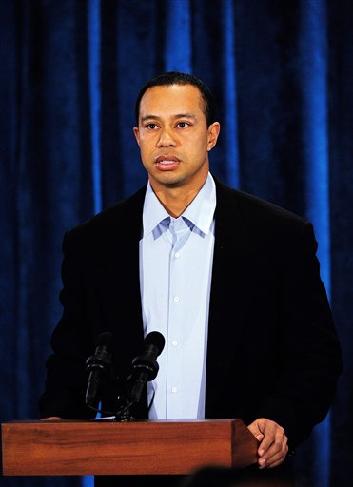
Tiger woods just made international news with a 15-minute press conference in which he … apologized to his wife. Oh dear me, I’m so bad, I’ve let the whole world down, won’t you ever forgive me, I need more treatement, I need more therapy, please oh please I’m an awful human being but I’m trying to win back your respect …


Ladies and Gentlemen of the press: Tiger Woods didn’t kill anyone. He didn’t run over a child, or beat up a nun, or stab someone to death in a drunken bar fight. He didn’t steal money, or bankrupt the United States financial system. His dick just isn’t that important.


And Tiger, dude, get a grip: You cheated on your wife. You had affairs. I’m not condoning it, but Jesus: If every prominent person in the world who was unfaithful to his or her spouse had to take six months off, go into seclusion and act like a little spoiled baby, the world would come to a halt and nothing would ever get done.


Man up, Mr. Woods. The Masters starts in a month and a half. Quit whining and get back to work.


Action alert: Stop the banks!

0


Let’s have a show of hands.

To those of you in small business: have you noticed the banks getting tough with you on credit?  To customers of banks: have you noticed all the funny business with higher fees and shorter grace periods with credit cards? Does it annoy you that the big banks and Wall street get bailed out with little oversight or accountability,  and the rest of us on Main Street and the neighborhoods of San Francisco and beyond suffer with no relief in sight?

Here’s one thing you can do.  Sign a petition from the Consumer Watchdog, a militant warrior for consumer rights in Washington, D.C., demanding that Sen. Dodd, a heavily bank-financed Democrat from Connecticut,  support an independent Consumer Financial Protection Agency.  Carmen Balber, Consumer Watchdog’s DC director, supplies the details on the petition and  Dodd’s dancing and waffling. Balber writes in her email alert:

The Senate’s Wall Street reform bill will be public any day now but its author, Senate Banking Committee Chairman Chris Dodd, still won’t say where he stands on consumer protection.

Sign your name to our petition today. Demand that Senator Dodd stand up for consumers, not Wall Street, by supporting an independent Consumer Financial Protection Agency with full power to write, oversee and enforce new rules of the road to hold the big banks accountable.

In November, Dodd released a reform bill with a strong consumer protection agency. But news reports in January said he might abandon it, in February that it was back on track, and just last week that the consumer regulator was in doubt once again.

What’s the real story?

Tell Senator Dodd it’s time to make his choice. Will he stand with Wall Street or Main Street?

Sign the petition demanding Senator Dodd stand up for an independent Consumer Financial Protection Agency.

Thanks for signing,

Carmen Balber
Consumer Watchdog’s DC Director

Consumer Watchdog is a nonprofit, nonpartisan consumer protection organization.
To support their work, please make a tax-deductible contribution here.

Loose in Obamalandia: Dead man walking through CA

1

I am on a low-rent book tour with my new cult classic El Monstruo – Dread & Redemption In Mexico City.  For the next three months, I will stumble across this land from sea to stinking sea probing the underbelly of Obama’s America.  The findings will be posted on these pages.

1.
First stop was the near north woods, Humboldt County USA, to wheedle the medicos into granting me a clean bill of health before I hit the road.  A year ago this February, my doctor who has poked and probed my old broken cadaver for nearly 20 years, pronounced me dead. “Liver Cancer” he parsed gravely — but I am still alive and kicking. The class enemy be warned: I am not dead yet.

Humboldt had just been wracked by a 6.5 earthquake that cut a swath through Oldtown Eureka’s antique shops but was not quite Haiti.  Nonetheless, the shake-up worked its usual bad mojo and implanted the seeds of fear and loathing in every soul.  On January 22nd, three separate police agencies shut down the north end of Arcata and evacuated hundreds of residents after a scruffy hippie-type tried to fed ex a suspicious package to Berkeley that leaked, according to the clerk at Kinko’s, “a chemical odor.” The offending package was blown up in a back alley.

The next day, the local rag commonly known as the Times-Slander conceded in front-page headlines that the “bomb” was “Actually a brake light.” The paranoia was symptomatic.  A commercial jetliner to Kentucky was forced down by air force jet fighters after an orthodox Jewish kid pulled out his Tefillin to pray and, in a spasm of extreme religious irony, the panicked stewardess took him for some Muslim terrorist and confused the leather straps and little prayer boxes with bomb components that would blow the paying customers to kingdom come. 

Nine years ago, just weeks after 9/11, I got on the road to preach Zapatismo to the North Americanos. Flags flew from every home, a sort of Talisman against the terrorist devils.  It was not a healthy ambiance for spreading revolution and resistance in Amerikkka.  Prospects for the Monster Tour suddenly turned ominous.

2.  
San Francisco’s Mission District gets shabbier day by day as the “Great Recession” (read “Depression”) gallops towards economic Armageddon. The Miracle Mile is lined with empty storefronts and 98 Cent Stores (marked down from 99.)  The homeless sleep under their shopping carts – the Mission Local reports that 40 homeless families are living in 16th Street Single Room Occupancy hotels, twice the occupancy rate of a year ago.  In this Sanctuary City for the rich, the yuppie Mayor, who now aspires to be nothing more than a yuppie clerk in a yuppie wine store, is deporting undocumented teenagers convicted of no crime and the class divide seems more brutal than ever.

We posted up on Market Street in front of the Commonwealth Club, where torture enabler John Yoo was hawking his new book to the City’s elite. Financial District drones en route back to the ‘burbs asked Yoo Who?
I checked my watch.  It was time to hit the rails.

3.
The Central Valley was the first stop on the Monster Tour, the most deadly stretch of soil in North American California. The water plumes are all poisoned by agrochemicals and when one turns on the faucet on the west side of the valley, deformed babies pop out. 

This cesspool of chemical effluvia is populated by perhaps the most ethnically diverse crazyquilt in all of Obama’s America.  Anglo bigwigs and white Armenians rule the roost but down below Mixteco is spoken on the radio, communicating the bad news to the out-of-work Oaxacans who once toiled in the fields and packing sheds. The humongous Hmung community is up in arms over the FBI’s harassment of their spiritual leader, General Vang Pau who authorities accuse of conspiring to overthrow the doctrinaire Communist government of Laos.  Unemployed Palestinians and Pakistanis, Filipinos, white trash, and historic enclaves of Blacks, survive in this fulminating chemical stew by their wits. On every street corner, the down-at-the-heels don shabby green gowns and sagging Styrofoam Statue-of-Liberty crowns, holding up cardboard arrows pointing towards strip mall tax return scammers.

I stepped out into Catherine Campbell’s unplanted garden.  Police helicopters hovered overhead, searching out suspected gangbangers. Catherine is a veteran prison rights attorney who pays particular attention to what goes on behind bars at Corcoran and Chowchilla, two of the cruelest his & her lock-ups in the state. Recently, she put her know-how to work defending anarchists who had been beaten into the sidewalk by the Fresno pigs for handing out graphic leaflets depicting the torture of elephants during Ringling Brothers Barnum & Bailey’s annual visit to town, and she and a gaggle of advocates have been trying to keep the cops off a venerable homeless encampment. Now the City Council is seeking to felonize panhandling on Fresno’s median strips as a “safety hazard.” 

The Fresno gendarmes are particularly keen on persecuting young adults of color for alleged gang activities. An article in the Morning Bee reported on the so-called “Bulldog Gang” (the bulldog is the icon of the Fresno State football team so gang colors are readily available) whose members were accused of smashing windows and barking at the cops over on the decrepit west side.  Catherine says the bulldogs’ bark is more a growl.  Such are the sounds of hope in the second year of Obama’s lacerated reign.

Sam Stoker is a child of the Valley. One night last summer, I bought him a beer at the counter of my beloved Café La Blanca back home in the Centro Historico of Mexico City.  Sam, an acculturated Chicano, had journeyed to Mexico to connect with his family in Tamaulipas and bum around, sniffing out what was left of the 2006 rebellion in Oaxaca. When he went home to Winton near Merced, he spoke enough Spanish to delight his grandma. 

Sam is also an anarchist and a budding journalist who has been up to his neck in the struggle for justice for Oscar Grant in Oakland. Now he had come to the Valley to spread the virus of anarchism. Rebellion in the fields could bring California to its knees, he confided. I was only too happy to help out. 

Anarchism has a beachhead in Fresno at the Infoshop where 70 folks turned out to hear me preach revolution. Not all of the fellow workers were young punks. One gentleman in attendance told me he had been an organizer for Cuauhtemoc Cardenas’s foiled presidential campaign in 1988 in Sinaloa and fled Mexico when dozens of his companeros were gunned down by the mal gobierno.  He was still here, still waiting for the revolution. 

Over in Merced, I shouted out my poems in a long dark bar, The Partisan, on Superbowl Sunday.  A “digital remix” of Guy Debord’s “Society of The Spectacle ” preceded my incendiary words.  Maybe Sam Stoker’s pipedream is not as wacky as it sounds.

4.
So it was goodbye to Fresno and hello to Hollywood. I accessed the City of Fallen Angels over the Grapevine with a pit stop at Bob Hope airport and a bar in Santa Monica to watch the Lakers kick booty. My gigs were spread out all over this pedestrian unfriendly megalopolis and the signs of hard times were hard to avoid.  On the beach in Santa Monica, excruciatingly gaunt old men jogged against debilitating cancers and aging hippies scoured the sands with metal detectors for spare change.

Even out in ritzy Claremont, where I hobnobbed with a Palestinian restaurateur about the Nakba, Obama’s America seemed out of synch.  A student at Pomona College where I spieled had just been handcuffed and interrogated by transit security cops in Philadelphia for transporting 200 Arabic-English flashcards across state lines and some cad ripped off my cane down at the train station.  The Inland Empire, which abuts this restricted enclave, has the fifth highest mortgage foreclosure rates in the nation.

In Hollywood, where I spent a night on my favorite sofa, the glitz was tempered by the homeless with all their possessions piled high atop their shopping carts around the new Metro station. How many of them were out-of-work script doctors is not yet known.

Down in South Central, where anger is endemic, I spoke to a handful of Afro-Americans at Eso Won, an admirable black bookstore. The proprietor sported a prototypical pork pie hat and told me that when he sees the Mexicans coming over the border, he sees black people. We talked animatedly for a few hours about Afro-Mexicans who were a third of the population of Mexico at liberation from Spain in 1810 and whose history has been pointedly ignored south of the border.             

L.A. is gearing up for the trial of killer BART cop Johannes Mehserle, Oscar Grant’s assassin, that will be held in the same court house where O.J. won acquittal — if it’s not moved to Ensenada, taking a cue from outgoing Governor Terminator’s plan to build California prisons south of the border.

Students at Cal State L.A., the most Chicano university in Califas, honed in attentively when I expounded on the revolution that is brewing down south.  1810-1910-2010 – every hundred years on the tenth year of the century, Mexico explodes in violent social upheaval and even the Wall Street Journal is worried (see WSJ front pager January 15th.)

Looking at Obamalandia through the eyes of students is a useful handle for understanding what comes next.  Classes and services have been bludgeoned by budget cuts and the profs at Cal State furlough one day a week to make ends meet in this damaged economy that the President lies is booming again because only a half a million workers filed first time unemployment claims last month.  The light at the end of the tunnel is a bullet train pointed straight at the heart of the people.

All of this bad news is healthy for fightback.  The day I hit El Ley, Muslim students at U.C.-Irvine rose up against the Israeli consul ten times in a single speech until the university president sicced the campus cops on them. The next day a whole coast away, kids at Georgetown shouted down General Betrayus. Throw in the cutbacks and the furloughs and the hopelessness and it could be a long, hot spring semester and it won’t be just because of global warming.  I will do my best to fan the flames as I stumble front one campus to the next in the coming months.

On my last days in the late great golden state, I slept in a yoga house under a colorful banner of Ganesh, the elephant guy who gets fat eating others’ obstacles.  Lets hope he’s on my side. A year ago I was sentenced to death and although I’m still kicking, the future is laced with sharpened punji sticks, not the least of which incubates on my liver.

Talking truth to power is still the best medicine to beat back Nuestra Senora Santa Muerte.

John Ross and The Monstruo will be visiting the Narciso Martinez Cultural Center in the heart of the Rio Grande Valley Sat. Feb 20th. The Monster Tour plays El Paso, Las Cruces, and Albuquerque from Feb. 21st-28th.  Consult the Nation Books page for details or write johnross@igc.org

Appetite: Forecast — a downpour of delicious varietals and gourmet bites

0

It’s been a stunning week of sunny weather… We may get a little rain on Saturday, but no problem if we can spend the afternoon indoors sipping delicious wine, right? On Sat/20, the largest competition of American wines in the world takes place in Fort Mason’s Festival Pavilion.

The San Francisco Chronicle Wine Competition features literally thousands of our country’s best with gourmet bites along the way. Maybe it’s Sonoma Artisan Foie Gras or A Perfect Pear‘s delicious jams. Or you can sample what the CCA students are cooking up.

The event started in 1983 as an annual fundraiser for the Santa Rosa Junior College Wine Studies Program & Culinary Arts Program (now that’s a mouthful), and was then known as the humble Cloverdale Citrus Fair wine competition — eventually growing to the point where it moved to SF. More than 4800 nationwide wines are judged in January by 60 industry judges. The gold medal wines are offered to you — that’s a lot of wine tasting!

You’ll taste wines of many a varietal and within a wide price range, like a Norton from Missouri, Rieslings from both coasts, or a Chambourcin from the Finger Lakes. Fort Mason is yours to roam: sipping, nibbling, taking in views of Golden Gate Bridge. Rainy or not, that sounds like a sweet Saturday.

San Francisco Chronicle Wine Competition
Sat/20; 2-5pm, $60 advance/ $80 at the door
Fort Mason Center Festival Pavillion, 38 Fort Mason 11
www.winejudging.com
twitter.com/sfcwinecomp

Check out Virginia’s culinary itinerary site www.theperfectspotsf.com for more food news and views.

Public employees feel blindsided by Newsom’s layoff scheme

39

Mayor Gavin Newsom’s proposal to lay off 10,000 city employees and rehire them at lower pay is being met with outrage by some public-sector workers. The plan, crafted as a way of saving money to balance the city budget, would amount to sweeping pay cuts across the board for a significant number of city workers.

Formal discussions about it are in the earliest stages, and Tony Winnicker, the mayor’s press secretary, described it as “just one alternative that we’re investigating.” Nonetheless, some members of Service Employees International Union Local 1021 are furious that the mayor unveiled this plan in the San Francisco Chronicle instead of at a meeting with the city’s labor leaders.

“As far as we can tell, an idea he has ended up on the front page of the Chronicle that’s had a devastating ripple affect among the people who work for the city and county,” SEIU Local 1021 President Damita Davis-Howard told the Guardian. “We feel like we got a sucker-punch. … We really wish he had talked to us before he governed by press conference.”


Davis-Howard said she’s been inundated with phone calls from angry union members who read the article. “This is the same proposal he floated last year,” Davis-Howard said. “Most of our members believed that they gave up their holiday pay in order to avoid this very thing.”

The proposal, which was briefly considered last year but never moved forward, serves to illustrate just how hard financial woes are hitting San Francisco. The city is staring down a $522 million deficit, and Newsom’s proposal would make up for a mere $50 million in savings.

Winnicker declined to comment on Davis-Howard’s concerns about being blindsided by news of the layoff plan, brushing it off by saying the mayor did discuss it with “some folks in labor.” Instead, he suggested that Newsom is getting serious about solving the budget crisis while the Guardian is just focusing on irrelevant gripes.

“It is an unprecedented budget shortfall, and it is real,” Winnicker said, stressing that the gaping budget gap will have to be bridged without the infusion of federal stimulus dollars that cushioned the blow last year. “The easy choices are behind us.” This layoff plan could prevent “hundreds, if not thousands, of layoffs,” but the mayor is open to other ideas that labor brings to the table, he said.

“That logic is just flawed,” Davis-Howard said when asked about the assertion that the plan could prevent layoffs. “That’s not the way you re-stimulate the economy, by taking more dollars out of the economy. We can’t continue to balance the budget on cuts, because pretty soon the actual fiber of the city and county of San Francisco will be reeling because of the number of cuts that we sustained.”

When asked how SEIU Local 1021 would respond, she said, “I do believe we need to be open-minded, imaginative, and creative in coming up with some revenue-generating measures here.”

No doubt the mayor will receive plenty of suggestions as negotiations continue in the coming weeks.

Why Newsom drives me nuts

2

This is the kind of thing that drive me nuts about the Newsom administration.


A few days ago, SF Appeal ran an item on a speech Newsom gave about condo conversions. The mayor wants to let more people turn rental units and tenancy-in-common units into condominiums; that, Newsom argues, will bring more revenue into the city treasury (those conversion permits are expensive).


But there’s a reason why the city limits to 200 the number of units that can be converted in any one year. Turning a rental unit into a condo reduces the number of rentals available, and turning a rent-controlled unit into a condo (or into a TIC and then a condo) cuts into the affordable housing stock.


And a majority of the supervisors, who recognize the impact the mayor’s plan would have on tenants (by making it easier to take rental units off the market), are dubious.


Okay, that’s a difference of opinion. You don’t have to make it personal. And yet, at his press conference, the mayor insisted that


“Half of the members of the board have been beneficiaries of condo conversions, and yet they deny it to other people.”


As the Appeal pointed out, that’s simply untrue.


A majority of Board members own their homes, according to a check of property records: mayoral allies Michela Alioto-Pier, Sean Elsbernd and Carmen Chu all enjoy the benefits of owning and equity, as do Sophie Maxwell and progressive Budget chairman John Avalos.


Eric Mar and David Chiu rent, according to a City Hall source. Chris Daly lives in a condo, but “my condo has always been a condo,” according to the supervisor (and according to the Assessor-Recorder’s Office, Daly at least bought his condo as a condo and not a tenancy-in-common or conversion).


By all accounts, progressive Ross Mirkarimi is on the condominium-conversion waitlist (an older news report says Ross owns a TIC and is on the conversion list; we’ll check in with him to confirm, he is at this moment still in committee). Mirkarimi and Bevan Dufty would be the two Board members conflicted-out of any votes on condo-conversions; Dufty went from a condo to a TIC after his daughter was born.


“And nobody was evicted,” the Bev told us today.


Okay, as I see it only one supervisor is even in a position to benefit from the condo conversion law. So I asked Tony Winnicker, the mayor’s press secretary, whether Newsom had been misquoted. Apparently not. So why did ne make an innacurate statement that insulted half the members of the board?


Winnicker:


His comments came in the context of the polarized politics of San Francisco which pit tenants vs homeowners to the benefit of no one. He was speaking that many Boardmembers enjoy the benefits of homeownership and that opposing the condo conversion proposal denies those benefits to others who are already living in TICs and displacing no one through condo conversion.


But there’s a big distinction between what Winnicker is talking about and what Newsom actually said. It’s entirely possible to be a homeowner in this city without evicting anyone and without taking a rental unit off the market. That’s what most of the homeowning board members have done.


As for TICs “displacing no one,” that’s wrong, too. The number one cause of no-fault evictions in this city is the use of the Ellis Act to clear the tenants out of a building to create a TIC. The only thing holding the TIC epidemic in check is the fact that the TIC ownership model is complex and a bit tricky. The minute you can convert those TICs into condos, you open the floodgates for a lot more of them — and that means a lot more evictions.


Newsom can make the case for condo conversions just fine without making factually inaccurate statements that insult the supervisors. Instead he pulls this shit. And then he complains about the supervisors not wanting to work with him


Drives me nuts.


Strong Beer Month pours it on, is strong

0

There’s not a lot to look forward to in February. Unless, of course, you happen to be into beer. (And, er, love.) Yes, we’re currently in the middle of a great SF Beer Week. But the city has also embarked on an entire month of sudsy exploration. A proud tradition imported from Munich, Germany, strong beer (Starkbier) festivals have become part of the beer drinker’s winter calendar worldwide. In San Francisco, where good beer is as easy to find as a decent burrito, and not much more expensive, Strong Beer Month, co-hosted by Magnolia Pub and Brewery and 21st Amendment (both of which make their own) still stands out on the beer enthusiast radar as a special occasion. First, because it’s about beer. Second, because it’s about strong beer – as in extra-alcoholic. And mostly, because like any celebration of the craft of beer-making, it’s full of delicious and surprising nuances.

Maybe the first surprise to the uninitiated is discovering just how many various beer styles are represented in the festival. The original Starkbier might have been the monastic Doppelbock (famously brewed to chase away the Lenten doldrums, and “replace” the food not allowed to be eaten by the monks who first brewed it), but any beer can be made stronger by the addition of extra malts or sugars. There’s hardly a repeat flavor to be found on the combined menus of the 12 strong beers on tap offered throughout the month at Magnolia and 21st Amendment. Punchcards are available at both locations, and the lucky drinker who manages to get through all 12 during the course of the month, gets a commemorative glass.

The good news, for everyone concerned (and especially your liver), is that the strong beer limit is three nightly at each location, so you can take your time
getting around to them all.

I wrangled brewmaster and owner Dave McLean to give me a brief lowdown on all the strong beers available at Magnolia this year.

Magnolia’s Dave dives in. Photo by Jennifer Yin

The venerable Old Thunderpussy Barleywine, named for iconic restaurateur Magnolia Thunderpussy (as is Magnolia), who originally occupied the location, is entering its 13th year of notoriety. Clocking in at a respectable 10.8% alcohol content, this traditional, English-style barleywine is a sentimental favorite for the Magnolia brew-crew and clientele alike. Other returnees include the malt-rich imperial stout—Smokestack Lightning—and the hop-tastic Promised Land IPA, plus a back-by-popular-demand rye beer, the Delilah Jones, the premise of which makes my mouth water.

It was the new brews, though, that intrigued me the most: the Belgian-style Four Winds Quadrupel, and this year’s contender for “most interesting experiment” — Let It Rauch. This tastebud-stunner contains the famous smoked Bamberg malt used in other smoked beers. But instead of using a lager yeast, Magnolia went with an alt-bier yeast from Düsseldorf, giving it, as Dave puts it, a brighter, more vibrant mouth-feel and ale-like notes.

Magnolia taps at the ready. Photo by Jennifer Yin

Next I dropped in on 21st Amendment and slaked my growing thirst with a tasting of each of the six beers in their lineup. I started with a tipple of their experimental BeerSchool, basically a dry-hopped blonde. Definitely one for the ale-lover, though not nearly as much as the next beer on the tasting rotation: Imperial Jack. This extra special bitter practically sings “Hail Britannia” on your tongue while waving the Union Jack.

But when I got to the Two Lane Blacktop I knew I was in love. A double black IPA, super well-balanced, subtly woody, and smooth on the palate. Blind Lust was next, a blended Belgian-style brew with a “splash” of Lindeman’s Lambic. A sort of cherry cough-drop meets summer meadow affair, or like a frolic in the raspberry bushes. It’s the 10-year anniversary of 21st Amendment’s barleywine, Lower de Boom, which I found to be surprisingly subtle: amber-colored, hop-fragrant, and, despite an alcohol-by-volume of 11.2 percent, dangerously drinkable.


Incidentally, this delish drink won 3rd place last year at Toronado’s annual Barleywine Festival (coming up again on the 13-14th of February!), an award which seems well-deserved. By the time it was time to taste the Hop Crisis, my tastebuds were already in a bit of a crisis, but like a good triple-IPA should, it cut straight through the nerve. The aggressive nose was like snorting an entire packet of cascade hops in an isolation chamber, and after a few sips, my tongue went numb! Probably not a beer for the fair-weather beer dabbler, but definitely a hop-lover’s tour de force.

So what’s the final verdict? It’s beer. It’s strong. And best of all, you still have three weeks to try some yourself.

Strong Beer Month

www.strongbeermonth.com

through February

at

Magnolia Pub and Brewery

1398 Haight, SF

www.magnoliapub.com

and

21st Ammendment Brewery Cafe

563 Second St., SF.

www.21st-ammendment.com

Welcome to the new SFBG.com

4

Happy 2010, and welcome to the new SFBG.com — the Web site for the San Francisco Bay Guardian.

We’ve redesigned the site in order to have a more immediate interaction with you, our reader, and to launch the next phase in our 45-year history of serving the Bay Area community with the latest, local-oriented, proudly made-in-the-Bay news, reviews, commentary, and guides. It’s a fiesta, so dig in!

In the near future, we’ll be adding new features, making some wee adjustments, and ironing out any kinks. We always appreciate your feedback, and hope that you enjoy our changes.

Here are a few notes to help you get oriented.

*Our homepage now consists of a Top Story, links to listings, our daily Hot List, and recent posts from our blogs. The homepage is updated several times a day with fresh stories and features.

*You can access the content of our current weekly paper by clicking on the cover under “This Week’s Paper” at the top of the site.

*You can access anything on the site through the top navigational bar, using the mouse-over menus — or, you can use the search box located at the top of every page.

*You no longer have to register and remember that pesky username and password to comment on any articles or blog posts.

*Unfortunately, a few recent comments on articles and posts were deleted during the transition. We apologize. Please feel free to post your thoughts again if they were deleted.

*The weekly paper area will be updated every Tuesday night, as usual. But the blogs and homepage will be updated several times a day.

*We are still in the process of adding some back issues to the site. A few old article link URLs no longer work, but you can find almost any article from 2005 until now by using the search box.

*As always, comments are welcome — we love to engage in constructive dialogue. We would never censor anyone expressing a different opinion about or offering supplemental information to our stories. However, we reserve the right to delete any comments containing hate speech, libelous implications, or completely unrelated blather.

*Please explore!

Again, we always welcome feedback. You can email me directly, and we’ll be publishing a Contact Us page very soon.

Thanks,

Marke B.

Senior Editor, Culture and Web

marke@sfbg.com


PS. Incredible thanks to our Web developer Harris Rashid and tech admin Adam Michon for all their help!

Memorial for Charles Lee Smith (1925-2010), passionate pamphleteer

1

Memorial services for Charles Lee Smith, a classic liberal activist whose hero was Tom Paine and whose passion was pamphleteering, will be held at 3 p.m. on Friday, Feb. 12, at the Friends Meeting House, Walnut and Vine, in Berkeley. He died at his Berkeley home on Jan. 7 at 84.

His wife Anne said that Charlie, as we all called him, fell in December and never fully recovered. She brought him home under hospice care on Jan. 5 and she and his two sons Greg and Jay were with him his last three days.

Charlie first contacted me in the early days of the Guardian in the late l960s. I soon realized that he was my kind of liberal, always working tirelessly, cheerfully, and quietly to make things better for people and their communities. He was a remarkable man with a remarkable range of interests and causes that he pursued his entire life.

He campaigned endlessly for causes ranging from the successful fight to stop Pacific Gas and Electric Co. from building a nuclear power plant on Bodega Bay to integrating the Berkeley schools to third brake lights for cars to one-way tolls on bridges to disaster preparedness to traffic safety and circles to public power and keep tabs on PG@E and big business shenanigans.


When he first began sending tips our way, he was working with, among many others, UC Berkeley Professor Paul Taylor with his battles with the agribusiness interests. He was helping UC Berkeley professor Joe Neilands on his public power campaigns. I remember a key public power meeting that Joe and Charlie put together in a Berkeley restaurant. It brought together the sturdy public power advocates of that era. Charlie did much of the staff work and was seated at the speaker’s table next to the sign that read, Public Power Users Association.

I credit that event and its assemblage of public power activists as inspiring the Guardian to make public power and kicking PG@E out of City Halls a major crusade that continues to this day. Charlie and Joe rounded up, among others, then CPUC commissioner Bill Bennett, consumer writer Jennifer Cross, William Domhoff, the UC Santa Cruz political science professor who was the main speaker, and Peter Petrakis, a student of Neilands’ in biochemistry who researched and wrote the Guardian’s early pioneering stories on the PG@E/Raker Act scandal. (See Guardian stories and editorials since l969.) The room was also full of veteran public power warriors from PG@E battles in Berkeley, San Francisco, and around the bay.

Charlie was a lifelong volunteer for the Quakers and pamphleteered on many of their projects.

My favorite story was how he was helping Dr. Ben Yellen, a feisty liberal pamphleteer in Brawley. Yellen and Charlie were political and pamphleteering soulmates, but Charlie was operating in liberal Berkeley and Yellen was in very conservative Imperial County.

Yellen was blasting away at the absentee land owners who were cheating migrant laborers on health care, on high private power costs of city dwellers, and the misuse of government water subsidies. And so he had trouble getting his leaflets printed in Brawley. He would send leaflets up to Charlie and Charlie would get them duplicated and then send the copies back to Yellen. Yellen would distribute them, mimeographed material on legal-sized yellow construction paper, under windshield wipers during the early morning hours and into open car windows on hot afternoons.

Charlie relished promoting Yellen as a classic in the world of pamphleteering and loved to talk about how Yellen followed up his pamphleteering with several pro per lawsuits, an appearance on CBS’ 60 Minutes television show, and a case that went to the U.S. Supreme Court.

Charlie liked to talk about his triple play of information distribution. He pamphleteered on street corners, prepared more than 50 bibliographies of undiscussed issues (including the best bibliography ever done on San Francisco’s Raker Act Scandal), and circulated his personal essays and cut and pasted newspaper articles. Almost every day, he would take the newspapers from the sidewalk near his house and put them on the front porches of his neighbors. He got some exercise, since his house was on a Berkeley hill, and he endeared himself to his neighbors. He was given the title of “Mayor of San Mateo Road.”

Charlie pamphleteered on more than l50 “undiscussed subjects,” as he called them, in Berkeley, Oakland and San Francisco. He sometimes went out to Palo Alto, Santa Rosa, and Napa, with occasional excursions to Boston and London. His subjects were practical and straightforward but breathtaking in their range: humanizing bureaucracy, employee suggestions, penal reform, illiteracy, migant labor, water, energy, land reform, ombudsmen, coop issues, library use, land value taxation, transportation, disaster recovery planning. He handed out KPFA folios and an occasional Bay Guardian.

He often combined pamphleteering with doing bibliographies to spread the word about the undiscussed subjects.  On the first Earth Day in l970 at California State University, Hayward, Charlie spoke about the evils of automoblies. Then he distributed his bibliography of the Automobile Bureaucracy. In recognizable Charliese, he produced a blizzard of numbered citations on a summary of his speech so the audience could read further on his issues.

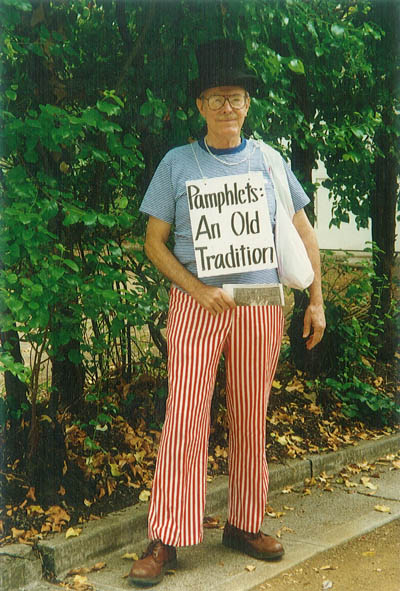
He considered pamphleteering as a noble form of communication that “went on during the colonial Period for a l00 years before the revolution and the arrival of Tom Paine in l775,” as he put it in his own pamphlet, “Pamphleteering: an old tradition.” He wrote that his main contribution “is the novel use of sandwich boards to screen out the disinterested while reaching the already-interested and open-minded persons with leaflets on the street, but not invading anyone’s privacy.”

Sometimes, Charlie had news close to home.

He said that giving out pamphlets to one or two people at a time was like holding a meeting with those persons and thus it was possible to have a “meeting” with several hundred people nearly anywhere within reasonable limits. He concluded that pamphleteering was “basic to building support for worthwhile projects” and claimes that it “may even be more effective than other forms of expensive communication.”

Charlie knew how to work the streets, but he also knew how to work inside the bowels of the bureaucracy. He worked for the California Division of Highways (now Caltrans) from l953 to 1987, mostly in an Oak Street office in San Francisco. I admit when Charlie talked to me about fighting bureaucracy, as he often did, I had trouble understanding how he was going about it. But Charlie had his ways.

Executive Editor Tim Redmond recalls that Charlie worked for Caltrans back in the days when the very thought there might be transportation modes other than highways was heresy.

He was an advocate of bicycles, carpools and public transit and Redmond thought that, when he first met Charlie in l984, “he must be like the monks in the middle ages, huddled in a corner trying to preserve knowledge. Nobody else at Caltrans wanted to talk about getting cars off the roads. Nobody wanted to shift spending priorities. Nobody wanted to point out that highrise development in San Francisco was causing traffic problems all over the Bay Area–and that the answer was slower development, not more highways.

“But Charlie said all those things. He told me where the secrets of Caltrans were hidden, what those dense environmental impact reports really showed, and how the agency was failing the public. I had a special card in my old l980s Rolodex labeled ‘Caltrans: Inside Source.’ The number went directly to Smith’s desk.” Charlie usually carpooled from Berkeley to his San Francisco office.

Charlie wrote a leaflet about the “Work Improvement Program” that then Gov. Pat Brown instituted in l960. It was, he wrote, a “novel program to get all state employees to submit ideas to improve their work.” Charlie labeled it “corrupt” and laid out the damning evidence. No appeal procedure. No protection for the employee making suggestions that the supervisor or organization didn’t want to use. No requirement for giving the employee credit for the idea or for following up the idea.

Charlie noted that he was a generalist with lots of ideas, read lots of publications, and was “sensitive to the problems that bother people.” He noted that there were l,500 employees in his Caltrans district who submitted 236 suggestions. Charlie submitted 35 of them.  But, he noted wryly, “my supervisor, Charles Nordfelt, did not respond at all to any of my suggestions.” And then, to make neatly make his point, Charlie listed a few of his suggestions, all of them practical and useful.

Many were adopted without Charlie ever getting credit. Others were adopted decades later. For example, he pushed the then-heretical idea of collecting tolls on a one-way basis only, instead of collecting them two ways. He noted that the tolls are now  being collected on the wrong side of the bridge. They should, he argued,  be collected coming from  the San Francisco side, where the few lanes of the bridge open up to many lanes. This would reduce or eliminate congestion. .

He listed other suggestions that showed his firm and creative grasp of the useful idea. Putting the third stop light on vehicles (which was finally put into effect in 1985). Numbering interchanges. Installing flashing red and yellow lights at different rates. (He  explained that his wife’s grandfather was color blind and drove through a flashing red light when she was with him.) Getting vehicle owners to have reflective white strips on the front bumpers of their cars, helping police spot stolen vehicles. Some of his suggestions are still percolating deep in the bureaucracies and may yet go into effect.

Charlie never got the hang of the internet but he covered more territory and reached more people in his personal face-to-face way than anybody ever did on the internet.

Charlie was born on a homestead farm eight miles from Weldona, Colorado. He attended a one-room school house and then moved on to a middle and high school in Ft. Morgan, Colorado. He got “ink in his blood,” as he liked to say, by working on the school paper called the Megaphone and then as a printer’s devil at the weekly Morgan Herald.

He was drafted into the army in l943 and served as an infantryman with the 343rd regiment, 86th Infantry Division. He was severely sounded in 1945 in the Ruhr Pocket battle near Cologne, Germany, the last major battle of the war. He suffered leg and hip injuries and had a l6 inch gouge  out of his right hip that cut within a quarter inch of the bone. He spent six months in the hospital. He was recommended for sergeant but he refused the promotion and ended the war as a private first class.

After his recovery, Charlie came to the Bay Area and took his undergraduate work at Napa Community College and San Francisco State, then did graduate work in sociology at the University of Washington, and in city and regional planning at the University of California-Berkeley.

In 1949, Charlie joined the American Friends Service Committee and became a lifelong volunteer, working on a host of projects. He did everything from helping with a clothing drive in Napa to being part of the crew that built the original Neighborhood House in Richmond.

Charlie met Anne Read in l954, a college student in Oregon, when she was on an AFSC summer project in Berkeley. Charlie visited the project, spotted Anne, and double dated with her. When she returned to Oregon State for her senior year, Charlie wrote her every single day. The two were married the following summer in June of l955.

Charlie is survived by Anne, two sons Greg and Jay, daughter-in-laws Karen Vartarian and Andrea Paulos, and granddaughter Mabel.

The family asks that, in lieu of flowers, please send a donation in Charlie’s name to the American Friends Service Committee, 65 9th St., San Francisco, Calif. 94l03.

I asked Anne why Charlie, the inveterate communicator, had not taken to the internet. Charlie, she replied, was a print guy and simply could not understand the internet. “He never ever used email,” she said. “He still thought he had to go to a library to make up a bibliography. I think Charlie was so sure that making a bibliography meant a lot of hard work, he couldn’t possibly do it on the internet.”

Well, Charlie, you may have missed the internet but you covered more territory and reached more people in your direct personal way with good ideas than anybody ever did on the internet.

Here are some of Charlie’s favorite pamphlets:
Governor Pat Brown’s Work Improvement Program
Pamphleteering: An Old Tradition
Short Statement on Plamphleteering


Gavin for Lite Guv?

1

Willie Brown thinks it’s a good idea. And you can tell Newsom wants to consider it, since he knows there’s nothing else obvious for him to do once his term as mayor is up — and there are going to be a lot of options not too far down the road. Sen. Dianne Feinstein isn’t getting any younger, and at some point she’ll retire. If Jerry Brown doesn’t get elected governor, the Democrats will be looking for someone very different in four years. But once a politician like Newsom is out of office and out of the spotlight, he’ll have a hard time coming back.

So he could sit up there in the Lite Gov’s office, doing what John Garamendi did — taking on issues like cuts to the University of California (the Lt. Gov. sits on the Board of Regents) and making speeches about reform, and maybe he could get out in front of this constitutional convention stuff, and keep his name in the news, without having to make a single difficult or unpleasant decision that he can be blamed for later.

You know he wants to do it ….

But there’s this problem, and for Newsom, it’s very real.

As people close to the mayor have told me repeatedly, the money people who helped put the mayor in office — and who would have to be around to help him run for any other office — are not at all pleased with the prospect of Newsom leaving San Francisco a year early. See, that would give the district-elected supervisors the chance to fill the mayor’s job for the last year of Newsom’s term, and the person they appointed would be able to run as an incumbent.

And while it’s not clear who could get six votes (David Chiu? David Campos? Ross Mirkarimi? Aaron Peskin?) it’s pretty clear that the new mayor would not be an ally of Newsom’s pals.

Sure, when he was running for governor, it seemed fine — having their guy in charge of the state was worth the loss of the San Francisco mayor’s office. But for a relatively powerless job? I think they’d crucify him.

Joseph Stiglitz: Muddling Out of Freefall

0

Here is our monthly installment of Joseph E. Stiglitz’s Unconventional Economic Wisdom column from the Project Syndicate news series. Stiglitz is University Professor at Columbia University and the winner of the 2001 Nobel Prize in economics. His new book is Freefall.

NEW YORK – Defeat in the Massachusetts senatorial election has deprived America’s Democrats of the 60 votes needed to pass health-care reform and other legislation, and it has changed American politics – at least for the moment. But what does that vote say about American voters and the economy?

It does not herald a shift to the right, as some pundits suggest. Rather, the message it sends is the same as that sent by voters to President Bill Clinton 17 years ago: “It’s the economy, stupid!” and “Jobs, jobs, jobs.” Indeed, on the other side of the United States from Massachusetts, voters in Oregon passed a referendum supporting a tax increase.

The US economy is in a mess – even if growth has resumed, and bankers are once again receiving huge bonuses. More than one out of six Americans who would like a full-time job cannot get one; and 40% of the unemployed have been out of a job for more than six months.

As Europe learned long ago, hardship increases with the length of unemployment, as job skills and prospects deteriorate and savings gets wiped out. The 2.5-3.5 million foreclosures expected this year will exceed those of 2009, and the year began with what is expected to be the first of many large commercial real-estate bankruptcies. Even the Congressional Budget Office is predicting that it will be the middle of the decade before unemployment returns to more normal levels, as America experiences its own version of “Japanese malaise.” 

As I wrote in my new book Freefall, President Barack Obama took a big gamble at the start of his administration. Instead of the marked change that his campaign had promised, he kept many of the same officials and maintained the same “trickle down” strategy to confront the financial crisis. Providing enough money to the banks was, his team seemed to say, the best way to help ordinary homeowners and workers.

When America reformed its welfare programs for the poor under Clinton, it put conditions on recipients: they had to look for a job or enroll in training programs. But when the banks received welfare benefits, no conditions were imposed on them. Had Obama’s attempt at muddling through worked, it would have avoided some big philosophical battles. But it didn’t work, and it has been a long time since popular antipathy to banks has been so great.

Obama wanted to bridge the divides among Americans that George W. Bush had opened. But now those divides are wider. His attempts to please everyone, so evident in the last few weeks, are likely to mollify no one.

Deficit hawks – especially among the bankers who laid low during the government bailout of their institutions, but who have now come back with a vengeance – use worries about the growing deficit to justify cutbacks in spending. But these views on how to run the economy are no better than the bankers’ approach to running their own institutions.

Cutting spending now will weaken the economy. So long as spending goes to investments yielding a modest return of 6%, the long-term debt will be reduced, even as the short-term deficit increases, owing to the higher tax revenues generated by the larger output in the short run and the more rapid growth in the long run.

Trying to “square the circle” between the need to stimulate the economy and please the deficit hawks, Obama has proposed deficit reductions that, while alienating liberal democrats, were too small to please the hawks. Other gestures to help struggling middle-class Americans may show where his heart is, but are too small to make a meaningful difference.

Three things can make a difference: a second stimulus, stemming the tide of housing foreclosures by addressing the roughly 25% of mortgages that are worth more than the value the house, and reshaping our financial system to rein in the banks.

There was a moment a year ago when Obama, with his enormous political capital, might have been able to achieve this ambitious agenda, and, building on these successes, go on to deal with America’s other problems. But anger about the bailout, confusion between the bailout (which didn’t restart lending, as it was supposed to do) and the stimulus (which did what it was supposed to do, but was too small), and disappointment about mounting job losses, has vastly circumscribed his room for maneuver.

Indeed, there is even skepticism about whether Obama will be able to push through his welcome and long overdue efforts to curtail the too-big-to-fail banks and their reckless risk-taking. And, without that, more likely than not, the economy will face another crisis in the not-too-distant future.

Most Americans, however, are focused on today’s downturn, not tomorrow’s. Growth over the next two years is expected to be so anemic that it will barely be able to create enough jobs for new entrants to the labor force, let alone to return unemployment to an acceptable level.

Unfettered markets may have caused this calamity, and markets by themselves won’t get us out, at least any time soon. Government action is needed, and that will require effective and forceful political leadership.

Joseph E. Stiglitz, winner of the 2001 Nobel Prize in economics, served as Chairman of the Council of Economic Advisers from 1995 to 1997. He is the author of the recently published bestseller, Freefall: America, Free Markets, and the Sinking of the World Economy.

Copyright: Project Syndicate, 2010.
www.project-syndicate.org
For a podcast of this commentary in English, please use this link: http://media.blubrry.com/ps/media.libsyn.com/media/ps/stiglitz122.mp3


Internship Programs

0

EDITORIAL INTERNSHIPS

What we offer

The Bay Guardian offers opportunities for its interns to develop reporting skills and to write numerous articles. We also provide workshops for interns on city politics, research and writing skills, and freelancing. Interns advance at their own pace. Although there are no guarantees, interns should leave the paper writing better and faster.

What we’re looking for

We are looking for self-motivated people with strong research, fact-checking, and writing skills, but prior journalistic experience is not required. Some familiarity with the Bay Area is helpful. In choosing interns, we take into consideration how well our intern program mirrors the readership our newspaper serves. People of color, lesbians, gay men, and bisexuals are strongly encouraged to apply. Applicants from both student and nonstudent populations are welcome.

What we expect

News interns help staff reporters with research and news gathering and develop their own short articles. They cover events, write blog entries, and in time some may write longer features.

For those whose interests lean more toward arts and entertainment, there are slots open for A&E interns, who write previews and short reviews, and potentially longer pieces. A&E interns also contribute regularly to the paper’s Pixel Vision (arts and culture) and Noise (music) blogs. These interns are hired based on writing skills and their knowledge of music, film, visual art, theater, dance, or any combination of the above. Knowledge of the local arts scene is a big plus.

Our Culture interns focus on food, shopping, fashion, nightlife, history, and other aspects of city living and global culture. They help out with special issues and contribute incisive blog posts and feature articles. As with A&E interns, our selection is based on writing skills, web-savviness, and eagerness to explore the city in all its cultural aspects. 

Web interns write blog posts, contribute to ongoing features, and help edit and post sfbg.com. Proven experience in these areas and familiarity with blogging and social networking is a plus. The web internship offers a chance to cover a specific area of interest, develop online features, and expand one’s web presence. 

Internships require a commitment of two full days each week (during regular business hours) for four months. Interns’ schedules will be arranged at an orientation prior to the internship. All internships are voluntary and unsalaried.

HOW TO APPLY

News internship: Send a resumé, cover letter, and three writing samples (clips are preferable) to Steven T. Jones, SFBG, 835 Market Street, Suite 550, SF, CA 94103 or email steve@sfbg.com

Culture and A&E internships: Send a résumé, cover letter, and three writing samples (published clips are preferable; blog entries are acceptable; please, no academic samples!) to Cheryl Eddy, SFBG, 550 Market Street, Suite 550, SF, CA 94103 — or email to cheryl@sfbg.com


Anyone interested in applying to more than one internship position should send separate applications and should inform each department of the different positions s/he is applying to.

INTERNSHIP DATES

Fall internship: begins in early September. APPLICATION DEADLINE: AUG 27

Winter/Spring internship: begins early January. 

Summer internship: begins in early May. (We understand that school schedules vary, so we’re somewhat flexible on summer start/end dates. Please indicate your availability in your cover letter.)

THE SAN FRANCISCO BAY GUARDIAN

550 Market Street, Suite 550

San Francisco, CA 94103


Jobs

0


JOBS:

ADVERTISING ACCOUNT EXECUTIVE

and

PROMOTIONS TEAM MEMBER (PART TIME)

INTERNSHIPS:

Editorial Internships


The San Francisco Bay Guardian, Northern California’s largest circulation newsweekly with more than three quarter million readers, is currently seeking qualified candidates to help us print the news and raise hell.

We are looking for talented-professional individuals to work in an environment that is casual, customer focused, deadline driven, supportive, progressive and professionally competitive.

Your talent, intelligence and ability to help us grow are our only hiring criteria.

The San Francisco Bay Guardian employs dedicated people of all ages, racial backgrounds, and sexual orientations.

Our benefits package for full-time employees includes medical and dental insurance and a generous vacation schedule we expect you to use.

If you feel you are qualified to fill one of the positions above, please submit your resumé today.

THE SAN FRANCISCO BAY GUARDIAN
255 Bush, 17th Floor
San Francisco, CA 94104

An interview with a guitar-playing teabagger

0

By Jess Brownell

(Jess Brownell is our Voice of the Midwest, a freelance writer living in Milwaukee, Wisconsin.)

In the Feb. 1 issue of the New Yorker there’s a story about the Tea Party people the point of which seems to be that this is a genuine grass-roots movement rather than just a side-line activity for Fox News analysts taking a little time off from the competition to be the next Joseph Goebbels when their Adolph comes along. These Tea Partiers are just regular folks, according to the article. The actual people the New Yorker writer, Ben McGrath, interviewed seemed a little weird to me, to be honest, but if by regular he means there are a lot of them out there, I can’t argue.

After those interviews and a general discussion of the political power this group now wields, the article ends with a description of a meeting of enthusiasts in Brooklyn that concludes with the singing of a folk-style anthem about taking back America led by a gray-haired man with an acoustic guitar.

(Okay, let me ask right here: Just who the hell are these people who claim the right to “take back” America? Do they have any proof that they ever owned it in the first place? Do they have deeds? Where is their provenance? Are they really directly descended from the pioneers who stole it from the Indians or are they just the children of late-arriving immigrants like most of the rest of us? I want to see some documentation, damn it. I want to see some birth certificates.)

Trash Lit: Things are weird around ‘Mariposa’

0

Editor’s note: Guardian Executive Editor Tim Redmond has a bad 30-year addiction to mystery/crime/thriller books. He’s decided that he may as well put this terrible habit to productive use by writing about these sometimes awful, sometimes entertaining and — on rare occasion — significant works of mass-market literature. Read his last installment here

mariposa.jpg

Mariposa
By Greg Bear
(Vanguard Press, 340 pages, $25.95)

By Tim Redmond

Good science fiction has a moral, of sorts. Frank Herbert wrote about the scary power of a charismatic leader. Robert Heinlein gave us the fun of free love and the lie of religion. William Gibson outlined the weird dangers of a digital society. My favorite sci-fi movie ever, RoboCop (1987), was all about the perils of privatizing public services.

Mariposa is part science fiction and part action thriller, and the mix works. I liked this book a lot – it’s got creepy tech advances — digital storage devices that dissolve in your blood; tattoos that allow you to exchange information by skin-to-skin contact; monitoring chips that follow your every move; roller bots; a new drug that makes you a near-legendary fighter and totally fucks up your brain – as well as a message that’s eerily relevant.

Mariposa‘s opening is bizarre. The first chapter seduces you in a way that reminds me of Neuromancer. It’s the second decade of the 21st century. Oil prices have collapsed, destabilizing much of the Middle East. The United States is $30 trillion in debt and the president has had to accept IMF-style international receivership. “And it’s all our fault,” one character notes. “We do hate paying taxes, and we do love our government services.”

And the news media? “The dwindling national press – those journalists who still worked for networks or newspapers or the five prime news sites and could afford to travel rather than just sit in front of a screen and suck coffee and pontificate on what others saw and wrote – was as worn out and discouraged as the rest of the nation.”

Most of Texas is no longer under effective federal control. The FBI is in the process of being dismantled.The real, emerging power in the nation, and perhaps soon the world, is the head of a giant private security company that got rich off military contracts. In fact, he’s trying to prove how powerful he is by orchestrating the death sentence of a 15-year-old kid who has the misfortune to be the son of a federal agent.

Into this nightmare step a handful of still-loyal FBI operatives working directly for the dying president, who has been shot with a bullet laced with deadly engineered proteins. They’re trying to rescue a deep cover agent planted in the Talos Corporation — someone who is trying to sneak the explosive data in the company’s files out of a tightly controlled compound. They’re also out to save the 15-year-old’s life before the Texas corrections system, which pretty much reports to Talos, gets to stick him with a lethal injection.

Syntobe proteins that turn Coca Cola syrup into bombs. Desert car chase with hellfire missiles in drone planes. Robot snakes retrieving blood laced with digital downloads. Slightly lame FBI sex. Wicked drug-addled martial arts fighting. A hero who fights off powerful sedatives to take out six guys with a pole ax. I have to say: This one goes down as one of the best action books of the last year.