News

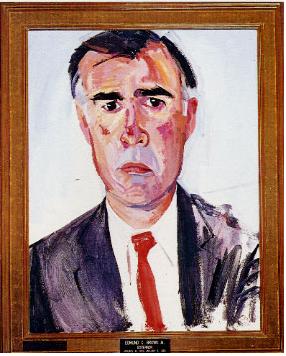
The good news for Jerry Brown

4

The press is all over the latest Field Poll, which shows Jerry Brown and Meg Whitman in a dead heat.  And it’s no surprise that, thanks to a campaign that thus far has been almost entirely negative, voters aren’t particularly thrilled with either candidate.


But I think there’s some good news for Jerry Brown here. Whitman has spent more than $90 million so far, and the voters like her less than they did six months ago. After all that money, some of which has gone for blistering attacks on Brown, Whitman is still not ahead. And it’s hard to see what she can do now to move the needle.


CallBuzz:


Moreover, it looks like the attack ads on Whitman by Brown’s labor allies — including California Working Families 2010 — have had their intended effect: to increase Whitman’s negatives and keep her from pulling away from Brown during the summer, before he can afford to put his own ads on TV.


Meanwhile, Brown’s favorability is only marginally changed from March. It’s 42-40% favorable today, compared to 41-37% favorable before. (Of course, Brown’s favorable was 50-25% back in March of 2009, but that was when he was just the new Attorney General and not a candidate for governor with rivals.)


At some point, Jerry’s got to start seriously campaigning, and he’s got a lot of work to do. He has to define himself to younger voters, who know a lot more about Ebay than about Brown’s tenure as governor, which was generally pretty good. He has to remind Latinos of how awful Whitman is on immigration. He’s got to spend some money.


But at this point, there’s hardly a voter in California (at least, not one with a TV set) who hasn’t seen multiple Whitman ads, defining her as a successful business person and attacking Brown as a failed politician. Those are powerful messages. The ads have been well produced, well targeted and should have been effective. And they haven’t gotten her over the halfway point yet — even against an opponent who is vulnerable to attack and hasn’t campaigned much at all.


Both candidates seem to be holding the party loyalists — the vast majority of the Republicans like Meg, the vast majority of the Democrats like Jerry. And there are more Democrats than Republicans. The independents aren’t breaking Meg’s way, either — she’s only slightly ahead, not enough to make up the difference.


Now if Brown can just get his people to care enough to go to the polls. …

Our Weekly Picks: July 7-13, 2010

0

WEDNESDAY 7

EVENT

The Butterfly Mosque reading

Journalist and author G. Willow Wilson is familiar to comics fans for her Vertigo-published modern fantasy series Air and graphic novel Cairo, both with artist M.K. Perker, as well as her work on various superhero properties. A woman in mainstream comics is unusual enough, but Wilson is also a Muslim. Her new prose memoir, The Butterfly Mosque: A Young American Woman’s Journey to Love and Islam, treats the experiences that led her from her home in Denver through Boston University to time spent teaching in Cairo. Much of her comics work deals with the collision of the West with the Middle East, often in fictionalized political contexts, and this reading and Q & A should include plenty of her uniquely positioned insights on this cultural dynamic. (Sam Stander)

7:30 p.m., free

Booksmith

1644 Haight, SF

(415) 863-8688

www.booksmith.com


DANCE

The Foundry

When words fail, a turn of a cheek or small shift in stance can signify a world of meaning. Choreographer, dancer, and director of the Foundry Alex Ketley is hyperconscious of the subtle secrets our bodies both hide and reveal. This consciousness allows him to deconstruct and reconstruct movement in such a way as to capture the emotional unknown that lies beyond words. Enlisting a cast of captivating dancers and former Ballet Frankfurt media artist Les Stuck, Ketley’s newest project, Please Love Me, explores how we relate to others and investigates the contradictory nature of love and relationships. (Katie Gaydos)

8 p.m., $20

Z Space at Theater Artaud

450 Florida, SF

www.conservatoryofdance.org


THURSDAY 8

FILM

Mulholland Dr.

Lucid dreams, fever dreams, wet dreams — what’s the difference in Mulholland Dr., David Lynch’s 2001 apocalyptic vision of Hollywood? Above all else, the film is a love story doomed from the very start as Rita (Laura Herring) stumbles out of a car wreck and into the arms of Betty (Naomi Watts, in a performance somewhere between Pollyanna and Patty Hearst). What follows is a Pandora’s box — and Rita’s got the key to a blue one of those you definitely shouldn’t open — of Bergmanesque female trouble, and some surrealist hell to boot: the jitterbug, Roy Orbison, and bite-size geriatrics, to name a few. In every dread-drenched scene, Lynch has our undivided attention even when we have no idea what the hell is going on. (Ryan Lattanzio)

2 and 7 p.m., $7.50–$10

Castro Theatre

429 Castro, SF

(415) 621-6120

www.castrotheatre.com


COMEDY

David Alan Grier

Although he got his start in acting by tackling serious roles and earning a master’s at the Yale School of Drama, David Alan Grier got his first taste of mainstream exposure and success as a cast member on the classic 1990s TV show In Living Color, where he brought to life hilarious characters such as Antoine from “Men on Film” and the crazy blues singer Calhoun Tubbs. In the years since, Grier has lent his considerable talents to several other projects, more recently Comedy Central’s show Chocolate News and his 2009 book Barack Like Me: The Chocolate Covered Truth. Here’s your chance to check out Grier live, uncensored, raw, and on stage. (Sean McCourt)

Through Sun/11

8 p.m. (also Fri/9-Sat/10, 10:15 p.m.)

$22.50–$23.50

Cobb’s Comedy Club

915 Columbus, SF

(415) 928-4320

www.cobbscomedyclub.com


EVENT

Cybernet Expo

It would seem like a no-brainer, filling a webmaster job at an adult Internet company. Geeks love porn, right? True as that may be, they still need a conference to link them up to the pervy, techie job of their dreams. Never fear, Cybernet Expo is here! The trade show has been linking sticky palms since 1997, and offers seminars, panel discussions, networking opportunities — and a convention-closing get down among the chains and whips of the SF Armory. “Oh yeah, it’s gonna be a fun party,” says Terry Mundell, business development manager of Kink.com, who will be organizing Saturday night’s after hours good times. Even better than a night on his website? (Caitlin Donohue)

Through Sat/10, $199

Golden Gateway Hotel (most events)

1500 Van Ness, SF

www.cybernetexpo.com


FRIDAY 9

DANCE

“Symbiosis: A Celebration of Dance and Music”

Kara Davis seems to be able to do it all. A trained ballet dancer, she has danced for the last 14 years with who’s who of modern dance in San Francisco. No matter the style and the challenge, she eats it up. Now she is also developing a strong, independent voice as a choreographer for her project agora company. This program, presented as part of Dance Mission Theater’s “Down and Dirty Series,” is half dance and half music. It reprises Davis’ two substantial ensemble pieces, A Softened Law and one Tuesday afternoon, first seen at ODC in December, and the gorgeous 2006 duet, Exit Wound, choreographed for herself and Nol Simonse. Exit‘s music was written by Sarah Jo Zaharako, whose Gojogo quartet, in the evening’s second half, will play more of Zaharako’s compositions. The lineup culminates in a premiere, Symbiosis, which features — no surprise here — Davis as a solo dancer. (Rita Felciano)

Through Sun/11

8 p.m., $20

Dance Mission Theater

3316 24th St., SF

www.dancemission.com


EVENT

Pantheon

The Temple is Burning Man’s sacred space. And this year, the Temple of Flux is really something special, among other reasons for its massive collaboration of various Bay Area tribes to build the biggest and most unusual and ambitious temple in the event’s long history (something I know from embedding myself with the project for an upcoming Guardian cover story). But to pull this off, the Temple crew has embarked on an equally aggressive and unprecedented fundraising campaign, the centerpiece of which is Pantheon, featuring Elite Force, Soul of Man, 21 of SF’s best DJs, transformative décor, and a slew of sexy gods and goddesses roaming the temple grounds. So don a toga or other Greek or Roman attire and join this bacchanalian celebration. (Steven T. Jones)

9 p.m.–5 a.m., $20–$25

103 Harriett, SF

www.pantheonsf.eventbrite.com

www.temple2010.org


SATURDAY 10

VISUAL ART

“Alien/ation”

A showcase of illustrators whose work has appeared in Hyphen magazine, “Alien/ation: An Illustration Show” will open at SPACE Gallery in SF with DJ sets by B-Haul and Gordon Gartrell and live painting from participating artists, in what is billed as “an art riot extravaganza.” Currently on its 20th issue, Hyphen is a San Francisco-based publication focusing on Asian American culture, and the crossover of its featured art into a gallery setting is a welcome development. Magazine illustration is generally frequented by talented cartoonists and fine artists, and the artists featured here are excellent and stylistically diverse enough to keep things interesting. Particularly exciting is the inclusion of oddball cartoonist Rob Sato, lush illustrator Kim Herbst, and distinctive portraitist Jon Stich. (Stander)

7 p.m. (artists’ reception, 5:30 p.m.), $5

SPACE Gallery

1141 Polk, SF

(415) 377-3325

www.spacegallerysf.com


SUNDAY 11

MUSIC

“Simcha! The Jewish Music Festival’s 25th Anniversary Party”

Rabbi Nachman, a 14th century Chassidic scholar, counted in his teachings the importance of displaying simcha (Hebrew for joy), like, all day every day so that you could effectively carry out God’s commandments. The translation for all you pagan sinners remains salient: you gotta be loose to enjoy the flow. Take simcha as your mantra when you head to the Jewish Music Festival’s 25th anniversary party, where tunes from Glenn Hartman and the Klezmer Playboys, the Red Hot Chacklas, Eprhyme, and oh so much more will trip happily through the Yerba Buena Gardens. Duck next door to the Yerba Buena Center for the Arts Sculpture Court (Third Street at Mission) to check out Jewlia Eisenberg and Charming Hostess’ “The Bowls Project: Secrets of the Apocalyptic Intimate,” an odd blending of sustainable architecture, the domestic sacred, and haunting evocations of secrets held and shared. (Donohue)

Noon–5 p.m., free

Yerba Buena Gardens

Mission at Fourth St., SF

(510) 848-0237, ext. 119

www.jewishmusicfestival.org


MUSIC

Gipsy Kings

It might seem ridiculous to argue that the Gipsy Kings are underrated, but bear with me. Sure, they’ve sold millions and millions of albums worldwide, and sure, they contributed a key cut to the iconic Big Lebowski (1998) soundtrack (their music is also featured in Toy Story 3). Despite this, or perhaps because of it, they still don’t seem to get much respect. The Gipsy Kings aren’t anyone’s favorite band. People rarely argue about the extent of their cultural influence or whether they’re “important.” This is a shame, really, because their covers reveal an unexpectedly sly, parodic impulse, while their standard flamenco tracks are actually relatively innovative in their merging of traditional Spanish dance with more modern pop influences. (Zach Ritter)

8 p.m., $85

Fillmore

1805 Geary, SF

(415) 346-3000

www.thefillmore.com


MUSIC

Weed Diamond

Though Weed Diamond hails from Denver, its conspicuous name alone suggests a sentiment we San Franciscans can relate to. Despite an insistently lo-fi, reverb-soaked gamut — like putting a beautiful indie rock seashell to the ears — these guys aren’t afraid of an infectious chorus. They also aren’t afraid of paying due respect to their influences, especially in the trippy shoegaze and heavy-on-the-feedback noise pop elements. Now on tour with Dash Jacket and Tan Dollar, Weed Diamond evolved from the solo project of Tim Perry to a full five-piece band and has since played SXSW and up and down the West. It’s like a psychoactive bonbon: delicious yet intoxicating. (Lattanzio)

With Tan Dollar and Dash Jacket

4 p.m., free

Milk Bar

1840 Haight, SF

www.milksf.com


MONDAY 12


PERFORMANCE

“What’s Cookin’ With Josh Kornbluth”

Monday special at the Contemporary Jewish Museum café: Josh Kornbluth on wry. Popular monologist Kornbluth, fresh from his latest solo flight, Andy Warhol: Good For the Jews?, is once again hanging out on the border of fine art and cultural critique, only this time there’s matzo ball soup and a Cobb salad option. It’s also more interactive. From noon to 2 p.m. (each Monday over the next five weeks) Kornbluth will be offering conversation to museum patrons bold or clueless enough to enter his well-appointed lair. It’s as simple as that. But then, if you know Kornbluth, nothing is ever that simple. (Robert Avila)

Through Aug. 9

Mondays, noon-2 p.m., free (museum admission not included)

Contemporary Jewish Museum

736 Mission, SF

(415) 655-7800

www.thecjm.org 

The Guardian listings deadline is two weeks prior to our Wednesday publication date. To submit an item for consideration, please include the title of the event, a brief description of the event, date and time, venue name, street address (listing cross streets only isn’t sufficient), city, telephone number readers can call for more information, telephone number for media, and admission costs. Send information to Listings, the Guardian Building, 135 Mississippi St., SF, CA 94107; fax to (415) 487-2506; or e-mail (paste press release into e-mail body — no text attachments, please) to listings@sfbg.com. We cannot guarantee the return of photos, but enclosing an SASE helps. Digital photos may be submitted in jpeg format; the image must be at least 240 dpi and four inches by six inches in size. We regret we cannot accept listings over the phone.

Riot awakening

0

arts@sfbg.com

FILM On the night of June 28, 1969, police embarked on what they thought would be a routine raid on a gay bar in New York’s Greenwich Village, the sleazy, Mafia-run Stonewall Inn. The ensuing three days of rioting — during which mostly young men and drag queens accustomed to being marginalized and hauled off to jail stood their ground and fought back — became what historian Lillian Faderman has called “the shot heard round the world” for LGBT activism: a spontaneous expression of street-level outrage that fueled the birth of a movement.

Kate Davis and David Heilbroner’s solid documentary Stonewall Uprising takes a “just the facts, ma’am” approach to this historic flashpoint that makes for an information-packed, if at times dry, 80 minutes. Working around the paucity of photographic documentation of the actual riots (itself a testament to the marginalization of homosexuality in the late 1960s), Davis and Heilbroner make extensive use of period news footage and photography, reenactments, and most important, the first-person testimonies of who those who witnessed and participated in what one interviewee terms “our Rosa Parks moment.”

And what damning facts they are. Stonewall Uprising is most effective in its first half, when it vividly conveys the demonization and oppression queers regularly faced at a time when homosexuality was illegal in every state except Illinois. In one excerpted clip from a 1966 CBS investigative report that I’m sure Mike Wallace would just as soon have stricken from the record, the news anchor states matter-of-factly: “The average homosexual, if there be such, is promiscuous.” In another clip, a Florida detective sternly warns a gym full of middle school students that should any of them act on their same-sex desires, “you will be caught.”

Davis and Heilbroner’s contextual groundwork is as impressive for its archival research as it is repetitive in its message: pre-Stonewall life was hell. The documentary becomes more nuanced as it zeros in on reconstructing the first night of rioting via eyewitness accounts. Howard Smith and Lucian Truscott IV, journalists for the Village Voice whose offices were nearby, remember fearing for their lives when they found themselves barricaded inside the bar with the police. But it is former police deputy Seymour Pine who emerges as the night’s unofficial antihero, having ordered his officers to hold their fire to prevent unnecessary bloodshed. Pine’s interview — as much a mea culpa as a performance of self-assurance by an elderly man that he is on the right side of history — is Stonewall Uprising‘s true revelation. 

STONEWALL UPRISING opens Fri/9 in Bay Area theaters.

Sicily unbound

0

arts@sfbg.com

FILM Francesco Rosi once remarked to an interviewer, “A film is always a testimony of the age in which it lives.” It’s one thing to recognize this as an incipient truth and quite another to enact it as a code of filmmaking. Rosi’s films from the 1960s and ’70s evince the common roots of aesthetic and ethic, exhibiting what can only be called an ardor for the analysis of social conditions — both their mechanisms and mentalities. Though still relatively unsung among the major Italian auteurs, of which he is certainly one, a career-spanning retrospective at the Pacific Film Archive makes the case for the writer-director’s staying power.

Rosi studied law at school and film with the Italian directors of the 1940s and ’50s. In his own early features, he placed additional demands upon the conventions of neorealism. Putting aside the tempting notion that the camera will discover a transcendent truth if only stripped of the artifices of professional actors and sets, Rosi’s films are concerned with inventing a public sphere for argument and questioning — this before the age of the Internet and 24-hour news.

Take Salvatore Giuliano (1961), his sophisticated dissembling of the tangled (and at that time recent) history of the eponymous gangster, a Robin Hood figure in the postwar Sicilian imagination who aided the area’s separatist movement. “He took from the rich and gave to the poor,” a local tells a bored reporter. When he finds out the newsman is from Rome, he adds, “What can you understand about Sicily?”

Rosi’s out-of-joint narration of events from before and after Giuliano’s death in 1950 takes at least a couple of viewings to puzzle together, and even then, much remains pointedly obscure. The film recalls Borges’ description of Citizen Kane (1941) as “a labyrinth without a center,” and, as such, contains an implicit disavowal of neorealist orthodoxy (if such a thing ever existed). If “reality” is transparent, why the confusing jumps in time? Why go to such lengths to keep Giuliano himself in the shadows? Why leave so much basic plot material unclear, from major events (the motivation behind Giuliano’s orchestration of a massacre of communists at Portella della Ginestro, for instance) to minor gestures (like when, at the end, one of Giuliano’s associates palms the bottle of medicine that has apparently just poisoned the bandit’s right-hand man)?

The answer has to do with Rosi’s desire to replace the “not knowing” of complacency with that of skepticism. The subject of the film is not Giuliano so much as the Sicilians who presume to know him. We begin with the bandit’s death, in Kane fashion, but even before the plot has insinuated a cover-up, Rosi visually undermines any easy sense of certitude. We watch the inspection of Giuliano’s prone corpse from several striking bird’s-eye-view shots, but soon discover these compositions are not as omniscient as we might first (complacently) assume. In fact, they represent the vantage point of the reporters hounding the carabinieri and citizens for a story quite separate from Rosi’s. Here the director insinuates how difficult it is to find your footing in the Sicilian situation. Taking aim at collusion, he formally imbricates us in its grip.

Rosi’s neorealism is one of provocation. He obsessively stages recent history in the actual locations in which it unfolded, employing eyewitnesses as themselves. Testimony is activated, not relegated to incidental afterthought. Even in later, more traditionally allegorical films like Three Brothers (1981), in which Rosi seems to move toward seeing political discourses as being channeled and contained by subjective experience, his visual and narrative designs mirror the macro controls at work in complex social systems. Watching Rosi’s work, we realize that the news lives inside us, whether we like it or not.

MODERNIST MASTER: THE CINEMA OF FRANCESCO ROSI

July 8-Aug 28, $5.50–$9.50

Pacific Film Archive

2575 Bancroft, Berk.

(510) 642-5249

www.bampfa.berkeley.edu

Transit troubles

0

rebeccab@sfbg.com

Peggy da Silva is an avid cyclist, public transit advocate, and member of the San Francisco Transit Riders Union — a new organization made up of several hundred San Franciscans who want to see improvements to Muni.

Yet even she admits that when it comes to getting to work, it takes just 15 minutes by car or an hour if she opts to go by bus. “I am committed to transit and cycling” for environmental reasons, she said, but “it gets really frustrating” to wait for the bus or light rail cars to arrive.

Da Silva could be considered lucky in that she can opt to drive if she feels it’s necessary, while many lower-income San Franciscans cannot afford a car and have no choice but to rely on Muni to get to work, buy groceries, or make doctor appointments. It’s even worse late at night when the buses run less frequently and the streets are dark and empty.

Speaking at a June 29 transit rally, the Rev. Norman Fong of the Chinatown Community Development Center joked that Chinatown is one of the city’s greenest neighborhoods — but “not by choice.” Most Chinatown residents just can’t afford to own a car, underscoring the point that Muni service cuts affect lower-income communities more significantly than those with more transportation options.

The perception that Muni is broken isn’t unique to transit advocates. Around City Hall, a number of proposals have been put forth to fix the ailing system, which has been mired in delays and overcrowding as fares have gone up and service was slashed. But determining what the root problems are, how they should be addressed, and what the best path forward may be has proved arduous.

Rather than a simple calculation or a study in efficiency, the debate surrounding Muni is spinning into an emotionally charged affair. For those aiming to protect low-income riders from service cuts or fare increases, it’s a discussion about social justice, calling into question why the city is asking more of bus riders than motorists in a city with a “transit-first” mandate in its charter.

The strong opposition to the cuts by supervisors and the public has led to a rollback. On June 30, the San Francisco Municipal Transportation Agency (SFMTA) announced that on Sept. 4, it would be able to restore half of the 10 percent systemwide service reduction that went into effect in May.

“Due to stronger than expected revenue streams, operational efficiencies, and new grant opportunities, staff is recommending the restoration of service on some routes and lines this fall,” according to an SFMTA press release. Buses that run all night would come more often, and the partial service restoration would help ease over-crowding.

While this was welcome news for anyone who takes transit, the expected improvement still leaves untouched many key issues plaguing the city’s public transit system. Two separate initiatives most likely destined for the November ballot seek to deal with systemic problems — but both have met with resistance.

On July 1, Sup. Sean Elsbernd announced that he had submitted some 75,000 signatures for a proposed charter amendment for the November ballot to change the way transit operator salaries are determined. Since they only needed 46,000 signatures, “presumably, we’ll qualify,” Elsbernd told us.

“It presses the reset button on all the [memorandums of understanding] and then puts the riders at the table,” he explained. “It also eliminates the side letters that allow the six leaders of the union to get full-time salaries and benefits without needing to drive.”

Elsbernd’s proposal would require operator wages and benefits to be set through collective bargaining, instead of the current guarantee that their wages be at least as high as the average wage rate for transit operators in the two highest paying comparable transit systems.

Yet his proposal is opposed by the city’s transit operators union, TWU Local 250-A, whose members feel they’ve been unfairly blamed for the MTA’s fiscal problems. Speaking at the June 29 rally, Ron Heintzman, the new international president of the Amalgamated Transit Union, summed up the attitude of drivers who feel they are being asked to give up hard-fought gains in the face of an economic downturn.

“I’ve been told that here in San Francisco, the mayor for some reason clearly has his head up his ass,” Heintzman said. “It’s time to tell him to stop trying to balance the damn budget on the backs of the workers.”

Speakers at the rally voiced support for federal legislation that would bolster municipal transit budgets nationwide with a $2 billion emergency infusion. A second federal bill would allow local governments greater flexibility with federal transit funding that currently can only be spent on capital projects, not day-to-day operations.

“We’re asking them not to make us buy a bus when we can’t hire a bus operator to drive it,” explained Harry Lombardo, international president of the Transit Workers Union. “There’s no point in spending hundreds of thousands on a bus and letting it sit in mothballs. And believe me, it’s happening all over the country.”

Sup. David Campos, a cosponsor of a competing ballot measure that aims for more comprehensive Muni reform, joined the rally and criticized the notion that drivers should be blamed a dysfunctional, underfunded transit system.

“Those of you who live in San Francisco know that right now there is a climate at City Hall that is pointing the finger at drivers, blaming drivers and blaming the workers for the problems that this system has,” Campos said at the rally. “Muni is broken. But Muni is not broken because of labor. And we have to say no to that push to somehow create a division between riders and drivers…. We can’t ignore the fact that we have a system that is getting money that is not being used well.”

Campos has joined with Sups. Ross Mirkarimi, Eric Mar, and Board President David Chiu to propose a reform package that would remove the pay guarantee for Muni driver, but also create split appointments to the MTA Board of Directors, allocate a share of property tax revenue to the city’s Transportation Fund, and establish an Office of the MTA Inspector General to help reduce waste and ramp up efficiency. The proposal would be subject to voter approval in November.

The proposal to give the supervisors some appointments to an MTA board that is now solely accountable to the Mayor’s Office became an issue at the eleventh hour of budget negotiations between the supervisors and Newsom on June 30. The mayor strongly opposed that and two similar charter amendments that would establish split appointments for the Recreation and Park Commission and the San Francisco Rent Board, as well as a ballot measure that would require the police department to engage in foot beat patrols.

Many saw his stance as a quid pro quo that inappropriately tied mayoral support for the budget — which included funding restorations to community programs that progressive board members wanted to preserve — to these unrelated ballot proposals.

Dave Snyder, who directs the SF Transit Riders Union, viewed the move as an affront on Muni riders. “This particular mayor has managed to screw up Muni service through his complete control over the agency,” Snyder said. “And whatever it takes, Muni riders want to see that fixed.”

While he said he thought a split appointment for the MTA Board was important, “the most important thing is more money. That’s the key issue,” he added, noting the reform package would create more funding for Muni.

Members of the Budget and Finance Committee resisted the mayor’s demand and forwarded a budget to the full board that included their high-priority restorations. The proposed ballot measures will be considered by the board this month.

“If you ask me, I would say we should have commission reform across the board,” Mirkarimi told the Guardian. “The idea of having [equally balanced appointments] is a smart way for us to share the responsibility and the consequences.”

MTA’s fiscal problems aren’t unique to San Francisco. On July 1, Caltrain announced a menu of undesirable options to deal with big financial troubles facing the commuter railroad. Elimination of weekend service and certain weekday train stops, or a 25-cent increase to base fares or zone fares, will be the subject of public hearings this summer.

Noting that all the different sources that fund Caltrain have been slashed, spokesperson Christine Dunn told us, “It’s frustrating to not be able to provide the service you want to provide.”

Truce talks

5

news@sfbg.com

All parties are hopeful for peace in the Guardian-labeled War on Fun after oppressive raids on SoMa clubs have stopped and the feuding sides — mainly the San Francisco Police Department and nightclub owners — are sitting down to truce talks brokered in part by the fledgling California Music and Culture Association (CMAC).

“I’m here to work with you,” Kitt Crenshaw, commander of SFPD’s new Entertainment Task Force, told the crowd at a Nightlife Safety Summit on June 30. “I’m not the enemy. I’m not the ‘War on Fun,’ as they call it. I’m not the Antichrist.” The summit was sponsored by the Mayor’s Office, Entertainment Commission, SFPD, Small Business Commission, and CMAC.

Club owners and the SFPD are attempting to find balance between stifling the entertainment industry with heavy-handed enforcement and doing something about the deadly gun violence plaguing neighborhoods around some San Francisco nightclubs. Owners and party promoters don’t want entertainment permitting power to go back to the SFPD, as Mayor Gavin Newsom has suggested. But recent shootings and the Entertainment Commission’s inability to immediately close problem clubs have city officials demanding change.

Board of Supervisors President David Chiu introduced legislation in early June that would give the Entertainment Commission the authority to revoke the entertainment permits of noncompliant clubs that are consistently scenes of violence. Chiu’s legislation would further extend temporary suspension powers the board granted to the commission in 2009.

“There is strong consensus that the Entertainment Commission needs to do its job. And if this is what it takes to give it more tools, then so be it,” Chiu told the Guardian after the June 25 CMAC Insider Luncheon, where he participated in a forum with entertainment industry representatives. Chiu said he was feeling pressure from his constituents in North Beach to “come down like a hammer on the industry” following several shootings around the neighborhood’s nightclubs this year.

Terrance Alan, a longtime industry advocate and entertainment commissioner, told the Guardian he recently requested that the City Attorney’s Office help define when nightclub owners should be blamed for violence occurring near their business. “If we’re going to hold venues and security teams responsible, we have to tell them and make sure it’s legal,” he said. “The line of reasoning that blames the nearest business will force San Francisco to shut down. The first thing we have to do is stop blaming each other.”

Chiu, speaking to a crowd at the Nightlife Safety Summit, recounted a handful of incidents that pushed him to craft the new legislation. Since the last legislation was passed to strengthen the Entertainment Commission’s power to regulate nightclubs, eight people were shot outside the Regency night club Nov. 15, 2009; 44 rounds were fired outside club Suede, resulting in one death and four injuries Feb. 7; a shooting occurred on Broadway outside a strip club in mid-February; and a police officer was shot outside the Mission District’s El Rincon club on June 19. “And so on, and so on,” Chiu said.

Following the shooting at Club Suede, which had long been a site of violence prior to the gang-related carnage in February, officials were stunned to learn the commission did not have the power to revoke entertainment permits. The most it could do was suspend Suede’s permit to play music for 30 days.

“To hold the commission responsible for something it was never envisioned to do and never given the power to do is where the narrative has gone wrong recently,” Alan said of widespread criticism that the commission just didn’t simply “shut down” Club Suede.

Suede remains voluntarily closed as it bargains with the City Attorney’s Office, which filed a complaint against the club after the shootings. Alex Tse, the lead attorney for the city in the case, told the Guardian there was nothing he could legally do to prevent Suede from reopening before Aug. 10, when the court is scheduled to rule on a preliminary injunction (court mandated closing) the City Attorney’s Office filed. But he doesn’t expect them to reopen because Suede and the city are currently working toward settling the case.

If the incidents Chiu described represent a black eye for San Francisco’s entertainment industry, the California Department of Alcoholic Beverage Control and SFPD aren’t necessarily squeaky clean either. “I sat down with [ABC director] Steve Hardy and told him that where the state was focusing efforts in San Francisco was completely misguided,” Chiu said at the CMAC luncheon. “And I’ve spoken to [California Senator] Mark Leno to try to move them in the right direction.”

The break in the crackdowns of 2009, mostly attributed to severe tactics employed by SFPD Officer Larry Bertrand and ABC agent Michelle Ott, followed a widespread backlash to the sometimes brutal treatment legitimate business owners were receiving in the name of public safety. Back-to-back over stories in the Guardian (see “The new War on Fun,” March 23, 2010) and the SF Weekly, calls to the ABC from city officials, the formation of CMAC, and a Racketeer Influenced and Corrupt Organizations (RICO) suit filed against San Francisco and the rogue officers spurred officials to rein in Ott and Bertrand.

Hardy told the Guardian that Ott is no longer assigned to alcohol enforcement in San Francisco. Bertrand has traded in his plain-clothes for a uniform and hasn’t been seen busting into clubs, beating up the help, or confiscating DJ equipment for several months.

Mark Webb, plaintiff’s attorney in the RICO case, which was moved to the federal court by the City Attorney’s Office, said Bertrand is scheduled to give a deposition for the case July 26. Webb told the Guardian he plans to ask Bertrand questions relating to “a pattern of ongoing and repeated abuses” claimed in the complaint, which includes Newsom and ABC as defendants.

“We’re at a crossroads,” Chiu told the crowd at the Nightlife Safety Summit, adding that if the new power for the Entertainment Commission does not reduce club violence, stronger measures would be taken, whether it’s Newsom’s suggestion to scrap the commission entirely and give permitting power back to the police department or Chiu’s idea to create another “less politicized” body to issue entertainment permits made up of representatives from city department that are affected when nightlife entertainment goes wrong.

“There has been significant dissatisfaction with the Entertainment Commission due to many actual and apparent conflicts of interests,” Chiu said. “Frankly, this is why we may need to move to a different model of who actually makes decisions on permits, because often the people who want to make those decisions are the ones who stand to get the most benefit out of them.”

But club owners and party promoters argue that the police issuing entertainment permits, as they did prior to the Entertainment Commission’s creation in 2002, has a chilling effect on an important part of San Francisco’s economy.

Alan said a civil grand jury found the police department had a conflict of interest in being both the granter and enforcer of nightclub permits, a finding that spurred the creation of the Entertainment Commission.

“I’ve been in the industry long enough to remember when it was in the Police Department’s hands,” said Guy Carson, owner of Café Du Nord and director of CMAC. “Since the advent of the Entertainment Commission, more permits have been issued, which has vitalized the industry.”

Club owners and party promoters don’t want to be blamed for street violence over which they have no control, and they have some political support for that stance. “Clubs don’t create youth gun violence, society creates youth gun violence,” Sup. Bevan Dufty proclaimed to the crowd at the Nightlife Safety Summit, drawing thunderous applause from the room.

“There is a street scene and a club scene, and they do intersect. But a lot of the violence occurs in the street scene,” Carson said. “A lot of shootings that happen relate to people never inside the clubs. That’s a conversation CMAC looks forward to having — to have a little more accurate discussion.”

While he asserts that some nightclubs attract violence to the city from out of town, Crenshaw said he was pleased and surprised at the level of collaboration emerging between entertainment representatives and SFPD. “I got so much positive feedback from it [the Nightlife Safety Summit]. It was a bit overwhelming,” he told us. “I think the industry itself is tired of being labeled as a pariah. They want to change their image.”

Brit Hahn, owner of City Nights and SFClubs, agreed that working with district captains was in the best interest of any club looking to remain profitable. “When something bad happens at a nightclub anywhere in San Francisco, he said at the Nightlife Safety Summit, “it’s bad for all of our businesses.”

Ungodly deeds

0

news@sfbg.com

The Catholic Church claims to value charity and justice, but recent local conflicts over cutting off child care for low-income families and refusing to pay millions of dollars in taxes to cash-strapped San Francisco city government — as well as the ongoing priest pedophilia cover-up cases — cast doubt over the church’s commitment to those in need.

The San Francisco Catholic Archdiocese has said it will close the Children’s Village Development Center in August, displacing 110 children enrolled in the program and leaving 100 families — a third of them low-income — scrambling for hard-to-find childcare providers.

The Archdiocese also sold other surrounding properties because it could not afford to retrofit its buildings for earthquakes, selling them to developers Chris Harney and Tom Murphy. Both the church and the developers rejected efforts by Children’s Village parents, who formed the nonprofit Supporting Early Experience and Development (SEED), to temporarily lease the building.

Dan Dillon, a representative for Harney and Murphy, told the Guardian that they decided to reject SEED’s leasing offer because they had already made a deal with a tenant who was willing to offer more money. Dillon wouldn’t identify the tenant, but he said the new tenant would use the building without major modifications, which might have triggered a need for city permits and a public hearing.

Catholic Charities CYO, an agency of the Archdiocese that oversees programs such as the Children’s Village program, closed the center because it wasn’t making money. The city gave about $1.5 million in grants and loans to support childcare for poor families at Children’s Village, with most of the money coming from the Low Income Investment Fund.

According to Catholic Charities’ official statement on the dispute, it tried to maintain the program by cutting slots for low income families in an effort to subsidize the program. There was still not enough money to fund the program. Catholic Charities representative Gabrielle Slanina told us that the tough economy and internal budget cuts hurt their ability to continue providing childcare at the site.

“The program hasn’t been financially sustainable over the years,” Slanina told us. “Sustainability just wasn’t turning around. But we tried to keep it going for as long as we could.”

Catholic Charities still plans to later build a new $1 million children development center three blocks away on the corner of 10th and Mission streets. But SEED members are left in the lurch for now, causing them to question the validity of Catholic Charities’ mission to “support, stabilize, and strengthen families.”

Dee Dee Workman, a consultant helping SEED, was disappointed with the Archdiocese’s bottom-line approach to helping local families. “They have not attempted to secure slots with these families,” Workman told us. “They don’t care about these kids. It’s just about the money, and it’s immoral.”

SEED member Sabrina Qutb, who has a three-year-old son enrolled in Children’s Village, said she sees the new center as a waste of money. “I do not believe the city should continue to fund Catholic Charities child care programs,” Qutb told us. “Who’s to say they won’t drop 10th and Mission in a few years and waste even more of the city’s money?”

Many child care programs have waiting lists up to two years in a city where there are more than twice as many children under 13 with working parents as there are licensed child care slots, according to a study prepared for the city by the California Child Care Resources and Referral Network. Child care slots for infants are among the fewest, making up only 6 percent of the 17,894 child care center slots in the city. Preschool children ages two to five years old occupy 63 percent of the child care slots.

SEED member Kathryn Shantz put her two-year-old daughter on a waiting list for another child care facility immediately after the announcement of Children’s Village closure. “I’m 104 on the waiting list for the Yerba Buena Child Development Center,” Shantz said. “I’ve been on the wait-list for a year, and they basically told me that there’s no way I’m getting in.”

Meanwhile, while the city supported the church’s child care program, the church is still stiffing the city on its tax bill. On April 16, the Archdiocese filed a suit in the San Francisco Superior Court against Assessor-Recorder Phil Ting. The suit challenges a Transfer Tax Review Board ruling last November which held that the Archdiocese owed the city $14.4 million after transferring 232 parcels of property among three Archdiocese corporations in 2008 without paying the required transfer taxes attached to those vacant lots, parking lots, apartments, commercial buildings, parishes, and schools. This is the second-largest transfer tax bill in San Francisco history.

Repeated calls to the Archdiocese of San Francisco were not returned. In a press release, the Archdiocese said that it “maintains that to impose transfer taxes, penalties, and interest on a religious organization in connection with an internal restructuring involving no exchange or receipt of money from which to pay any tax is inequitable and threatens to confiscate substantial church assets that are devoted to religious purposes.”

The next court date for this case is scheduled for Sept. 17. This recent lawsuit and the sale of Archdiocese properties come at a time when the church is facing the possibility of paying out big settlements in cases involving sexual abuse by priests.

Survivor Network of Those Abused by Priests (SNAP) Northern California Regional Office representative Joey Piscitelli said that if victims weren’t so afraid to report their abuse, the Archdiocese would owe its victims even more money. “Ninety-eight percent of victims never report the abuse, and the average person reports the abuse 25 years after the incident,” Piscitelli said. “The church brags that the clergy didn’t do it because they were never convicted, yet they’re paying billions of dollars in lawsuits.”

With the Catholic Church now facing scrutiny on so many fronts, it seems that a day of reckoning could be in its future. On June 29, the Supreme Court decided not to hear an appeal by the Vatican for immunity in a highly publicized pedophilia suit, clearing the way for the 2002 lawsuit to advance.

The plaintiff, under the name of John V. Doe, alleged that he was abused in 1965 by Father Andrew Ronan in Portland, Ore. Ronan died in 1992. The Vatican tried to kill the lawsuit by stating that it was protected under the Foreign Sovereign Immunities Act of 1976, a federal law that prevents foreign states from lawsuits.

The appeals court determined that there was an exception to the law, stating that Ronan was an employee of the Vatican and he was working under Oregon law. No one has ever won a lawsuit against the Vatican for sexual abuse allegations made by the clergy. This Supreme Court decision opens the door for future lawsuits against the Holy See.

Naked fun in the sun!

9

Entertainer Wavy Gravy and Pentagon Papers leaker Daniel Ellsberg like Red Rock Beach; Marin Superior Court Commissioner Roy Chernus favors Bass Lake, and Marin County Sup. Steve Kinsey says he’s been naked at Red Rock, Bolinas, Hagmier Pond, and Mount Vision Pond.

“I’ve probably hit every nude beach in Marin,” says Kinsey, who has described his visits as “exhilarating and normal.” “My last dip was at Bass Lake last fall. It has beautiful, fresh water, and the swimming environment is wonderful. I look forward to the next opportunity.”

But on their next trips to the nude section of beautiful Muir Beach, visitors may notice something new: a warning sign is being erected by the county this summer to urge users to be “respectful” of each other and to notify authorities if there’s trouble.

The sign is the result of a compromise worked out by nudists, law enforcers, county officials, and local homeowners, some of whom wanted nudity stopped. Under the agreement, cops are making a few more visits than before. But through July 1, 2010, only four complaints about nudity and one citation for improper sexual conduct have occurred since January 1, 2009, and none since August 13, 2009, according to marin county sheriff’s office crime analyst Susan Medina. “We keep responding to complaints, but I can’t recall any recent citations,” says Lt. Cheryl Fisher, commander of the Marin County Sheriff’s Office’s West Marin Station. Fisher says the subjects are usually suited up by the time deputies arrive. “A deputy showed up on a very hot Sunday,” says regular visitor Michael Velkoff of Scotts Valley. “As soon as he left, everybody was naked again.”

“Of course, guys in spiked penis rings not parading themselves around also have helped,” says Sup. Kinsey, who, for now, has spiked his previous threat to fight back by starting an effort to make Muir and other beaches clothing-optional under a 1975 law giving Marin County the power to exempt areas from its anti-nudity provisions. “Sometimes the best thing we can do in government is to stay out of the way.”

Homeowners remain wary. One, who wants to remain anonymous, tells the Guardian: “We are optimistic” about being able to “coexist” with the naturists, “but we also remain very clear about what is legal and what will and won’t be tolerated.” And a former advocate of the ban told me that instead of not going to Muir Beach “a person wanting to use the beach nude might do it in a manner that doesn’t draw a lot of attention.”

As if the Marin mashup wasn’t enough, nervous naturists also got ready to do battle with state authorities, who they feared would eventually ban nudity at Devil’s Slide in San Mateo County and at Bonny Doon Beach near Santa Cruz, both of which are state beaches.

The jitters came in the wake of an October 2009 California high court ruling allowing a crackdown on nude sunbathing on state beaches, even in areas traditionally used for such activity. “All it takes now is an individual ranger with the desire to issue a citation,” warns R. Allen Baylis, a Huntington Beach attorney representing the Naturist Action Committee, the country’s biggest nudist lobbying group. “It could have a chilling effect [on nudity] on any state beach.”

“Our thin line of security has been overturned,” says Rich Pasco, head of the Bay Area Naturists, based in San Jose. “So let’s hope that in today’s economy, the thin level of state park staff has better things to do with their time than dealing with naturists.”

At press time, the NAC, along with BAN and 14 other nudist groups, were preparing, for the first time, to officially petition California to “designate clothing-optional areas” on one or more state beaches. Other efforts have, says Baylis, been “less formal.” “Do they really expect us to pack up and leave?” Baylis asks. “We’re going to fight back. This is our freedom they’re messing with!”

What’s the good news? Just like at Muir Beach, it doesn’t look like naturists have anything to worry about for now in Northern California. “In the short term, things at Bonny Doon are destined to continue the way they are,” says Kirk Lingenfelter, sector superintendent for Bonny Doon. He wants a better trail, stairs, and parking, but says the cash-starved state doesn’t have the budget to make even a preliminary plan or increase ranger visits. He said his staff have not issued any citations or warnings at the nude cove, which he calls one of the spots that “really give you the feeling of rugged, untouched majesty. It’s a very important feeling. Going to places like Bonny Doon helps you get recharged.”

And the Devil’s Slide police source, who wants to remain anonymous, told us: “Rangers aren’t going to be pursuing enforcement against nudity per se. Nothing’s changed.” Rangers will continue responding to complaints, he explained, but it usually means they arrive too late to do anything about them because cell phones don’t work on the beach. “We hear about it after the fact,” says another Devil’s Slide enforcer, Supervising State Park Ranger Michael Grant.

Want to contribute to the glad tidings? There’s still time for plenty of fun in the sun. You can donate your body to the record books, at least temporarily, by showing up Saturday, July 10 at the Sequoians Clothes Free Club (www.sequoians.com) in Castro Valley, when its annual attempt at setting a world skinny-dipping record, with 138 other nude locations, will be held. And if you’ve ever been dying to do a little light cleaning in the nude (no window-washing needed), here’s your chance: Your butt can be bare if you stop by Bonny Doon Sept. 18 to help fans pick up cigarette butts and other litter on the beach.

Speaking of good things, would you like to help improve our report? Please send brainstorms, your new beach “finds,” improved directions (especially road milepost numbers), and trip reports to garhan@aol.com or by snail mail to Gary Hanauer, c/o San Francisco Guardian, 135 Mississippi St., San Francisco CA 94107. Please include your phone number so we can verify that you’re not just another mirage in the nude beach sand.

>>BELOW ARE CAPSULE GUIDES TO POPULAR NUDE BEACHES. CLICK HERE FOR OUR COMPLETE GUIDE, INCLUDING MANY MORE

NORTH BAKER BEACH, SAN FRANCISCO

Things are really cooking at San Francisco’s long, narrow North Baker, which is in good shape this year, with plenty of sand and an influx of young people and more women than five years ago, even though the beach is still heavily male. “If you want to see naked chicks and guys, it’s the place to go,” says aficionado Paul Jung. Although beach regulars like himself welcome all the new nude volleyball players, “some of them seem to make up rules as they go along,” he laughs. Fun activities: Look for dolphins that occasionally surface in the water off shore. And in low tide only, walk around the big rocks at the north end of the beach to check out Baker’s “secret” tide pools.

Directions: Take the 29 Sunset bus or go north on 25th Avenue to Lincoln Boulevard. Turn right and take the second left onto Bowley Street. Follow Bowley to Gibson Road, turn right, and follow Gibson to the east parking lot. Head right on the beach to the nude area, which starts at the brown and yellow “Hazardous surf, undertow, swim at your own risk” sign. Some motorcycles in the lot have been vandalized, possibly by car owners angered by bikers parking in car spaces; to avoid trouble, motorcyclists should park in the motorcycle area near the cyclone fence.


LAND’S END BEACH, SAN FRANCISCO

Land’s End is just the beginning: it’s not just the ground that seems to “disappear” into the sunset at this little slice of paradise off Geary Boulevard. So do your clothes, if you want to be magically transported to another dimension, away from the cares of everyday constraints. Shorts, swimsuit, even work clothes during a quick lunch break — they all can be removed at this delightful cove, which features a mix of sand and rocks plus some of San Francisco’s best views. Better still, only a handful of people are usually present. Bring a windbreak for protection in case the weather changes.

Directions: Follow Geary Boulevard to the end, then park in the dirt lot up the road from the Cliff House. Take the trail at the far end of the lot. About 100 yards past a bench and some trash cans, the path narrows and bends, then rises and falls, eventually becoming the width of a road. Don’t take the road to the right, which leads to a golf course. Just past another bench, as the trail turns right, go left toward a group of dead trees where you will see a stairway and a “Dogs must be leashed” sign. Descend and head left to another stairway, which leads to a 100-foot walk to the cove. Or, instead, take the service road below the El Camino del Mar parking lot 1/4 mile until you reach a bench, then follow the trail there.

GOLDEN GATE BRIDGE BEACH, SAN FRANCISCO

Don’t come to Golden Gate Bridge Beach, also called Nasty Boy Beach, if you want privacy: dozens to hundreds of visitors show up on the hottest days at the site that some have likened to a “gay meat market.” Along with the guys, a smattering of women, straight couples, children and fishermen are spread out on the three adjoining rocky coves that make up the beach, whose stunning views of the Bridge will make you feel like you’re the star of your own postcard. “It’s really nice to walk in the water,” says a woman. “In low tide, you can sometimes go out 150 feet.”

Directions: Directions: from the toll booth area of Highway 101/1, take Lincoln Boulevard west about a half mile to Langdon Court. Turn right (west) on Langdon and look for space in the parking lots, across Lincoln from Fort Winfield Scott. Park and then take the new, improved beach trail, starting just west of the end of Langdon, down its more than 200 steps to Golden Gate Bridge Beach, also known as Marshall’s Beach.


FORT FUNSTON BEACH, SAN FRANCISCO

If you try to be naked here on weekends, you’ll be barking up the wrong tree. The main creatures who go nude at Fort Funston, south of Ocean Beach, are dogs, but that hasn’t stopped a small band of stark naked sunbathers from hiding away in some sand dunes when rangers aren’t in the area. Authorities usually issue several citations a year here. But if you don’t make a fuss and visit on a weekday, you probably won’t be busted. If anyone complains, put on your beach gear right away. Two more fun activities at “Fort Fun”: watching hang-gliders take off from the cliffs and checking out a seemingly endless passing parade of people and their pets.

Directions: From San Francisco, head west to Ocean Beach, then go south on the Great Highway. After Sloat Boulevard, the road goes uphill. From there, curve right onto Skyline Boulevard, go past one stoplight, and look for signs for Funston on the right. Turn into the public lot and find a space near the west side. At the southwest end, take the sandy steps to the beach, turn right, and walk to the dunes. Find a spot as far as possible from the parking lot. Do not go nude here on the weekends. And if you don’t like dogs, go elsewhere.


LAS TRAMPAS REGIONAL WILDERNESS, CASTRO VALLEY

Nudity’s banned in the East Bay Regional Park District, but if you tell that to the nude hikers who will be once again walking across park land July 23 and Aug. 22 — at night — they may moon you en masse. On America’s only naked “Full Moon Hikes,” participants leave the grounds of the Sequoians Naturist Club in Castro Valley fully clothed at dusk and walk through meadows and up hills until the moon rises, before heading back down the slopes with their clothes folded neatly into their backpacks. Says Dave Smith, of San Leandro: “It’s truly wonderful. Except for deer, we’re usually the only ones on the path.” Agrees James, of Fremont: “It’s one of the best experiences I’ve ever had. You’re walking in this silvery light. The moonlight is flooding everything. You feel like you’re in the middle of a beautiful dream.”

Directions: Contact the Sequoians Naturist Club (www.sequoians.com) or the Bay Area Naturists (www.bayareanaturists.org) for details on how to join a walk. Participants usually meet at and return to the Sequoians Club. To get there, take Highway 580 east to the Crow Canyon Road exit. Or follow 580 west to the first Castro Valley off-ramp. Take Crow Canyon Road toward San Ramon 0.75 mile to Cull Canyon Road. Then follow Cull Canyon Road around 6.5 miles to the end of the paved road. Take the dirt road on the right until the “Y” in the road and keep left. Shortly after, you’ll see the Sequoians sign. Proceed ahead for about another 0.75 mile to the Sequoians front gate.


DEVIL’S SLIDE, MONTARA

Will they be having a devil of a time in paradise? For the first time, rangers say they’ll begin enforcing state anti-nudity regulations if offended beachgoers complain about the nudists who visit Gray Whale Cove, which is commonly called Devil’s Slide. The good news: It’s a nonissue because cell phones (used to summon rangers) don’t work on the beach, so by the time cops arrive, the offenders have long since suited up or left. And the beach’s top enforcer told us he won’t be telling rangers to bust nudists they see. Most visitors love the long sandy shore, where nudies, about 20 percent of visitors, hang out on the north end.

Directions: Driving from San Francisco, take Highway 1 south through Pacifica. Three miles south of the Denny’s restaurant in Linda Mar, turn left (inland or east) on an unmarked road, which takes you to the beach’s parking lot and to a 146-step staircase leads to the sand. “The steps are in good shape,” Ron says. Coming from the south on Highway 1, look for a road on the right (east), 1.2 miles north of the Chart House restaurant in Montara.


SAN GREGORIO NUDE BEACH, SAN GREGORIO

America’s oldest nude beach, near Half Moon Bay, offers two miles of soft sand and tide pools to explore, as well as a lagoon, lava tube, and, if you look closely enough on the cliffs, the remains of an old railroad line. Pets are allowed on weekdays. Up to 200 visitors may be present, but they’re usually so spread out, you may not even notice them. Gay men tend to hang out on the north side and in “sex condos” made of driftwood by visitors — a major annoyance to those who are easily offended. On the south end of the beach, there are sometimes dozens of straight couples and families, naked and clothed. For weather information, call (415) 765-7697.

Directions: Head south on Highway 1 past Half Moon Bay. Between mileposts 18 and 19, look on the right side of the road for telephone call box number SM 001 0195, at the intersection of Highway 1 and Stage Road and near an iron gate with trees on either side. From there, expect a drive of 1.1 miles to the entrance. At the Junction 84 highway sign, the beach’s driveway is just 0.1 mile away. Turn into a gravel driveway, passing through the iron gate mentioned above, which says 119429 on the gatepost. Drive past a grassy field to the parking lot, where you’ll be asked to pay an entrance fee. Take the long path from the lot to the sand; everything north of the trail’s end is clothing-optional.


BONNY DOON NUDE BEACH, BONNY DOON

Bonny Doon isn’t doomed. To the contrary, because the state has no plans to develop it or send rangers out to make anti-nudity patrols, it looks like it will remain Santa Cruz County’s prettiest nude beach, which should please the nudists who were on the edge of their towels wondering what would happen. Says Kirk Lingenfelter, sector superintendent for Bonny Doon and nearby state beaches: “Going to places like Bonny Doon helps you get recharged.” Naturists usually use the cove on the north end of the beach, which attracts more women and couples than most clothing-optional enclaves.

Directions: Head south on Highway 1 to the Bonny Doon parking lot at milepost 27.6 on the west side of the road, 2.4 miles north of Red, White, and Blue Beach, and some 11 miles north of Santa Cruz. From Santa Cruz, head north on Highway 1 until you see Bonny Doon Road, which veers sharply to the right just south of Davenport. The beach is right off the intersection. Park in the paved lot to the west of Highway 1; don’t park on Bonny Doon Road or the shoulder of Highway 1. If the lot is full, drive north on Highway 1, park at the next beach lot and walk back to the first lot. To get to the beach, climb the berm next to the railroad tracks adjacent to the Bonny Doon lot, cross the tracks, descend, and take the trail to the sand. Walk north past most of the beach to the cove on the north end.


2222, SANTA CRUZ

Size matters at 2222, which is the smallest nude beach in the U.S. — and probably smaller than your backyard. Not many people can fit into it and not many have heard about it, so not many are there, which is just fine with its mostly young crowd of local college students. Located across from 2222 West Cliff Drive, it’s a great place to sunbathe, read, relax, or even watch Neal the Juggler practice tossing balls, pins, and beanbags on the sand. But don’t attempt the very steep climb up and down the cliff unless you’re in good shape.

Directions: The beach is a few blocks west of Natural Bridges State Beach and about 2.5 miles north of the Santa Cruz Boardwalk. From either north or south of Santa Cruz, take Highway 1 to Swift Street. Drive 0.8 miles to the sea, then turn right on West Cliff Drive. 2222 is five blocks away. Past Auburn Avenue, look for 2222 West Cliff on the inland side of the street. Park in the nine-car lot next to the cliff. If it’s full, continue straight and park along Chico Avenue. Bay Area Naturists leader Rich Pasco suggests visitors use care and then follow the path on the side of the beach closest to downtown Santa Cruz and the Municipal Wharf.


PRIVATES BEACH, SANTA CRUZ

Privates Beach, at 4524 Opal Cliff Drive, north of the Capitola Pier, is so private that it has a locked gate, security guards, and, unless you’re too cheap to pay and want to try another option, a $100 per year fee (cash only). The two coves are exceptionally clean and you’re likely to see families, kids, and dogs on the shore.

Directions: 1) Some visitors walk north from Capitola Pier in low tide (not a good idea since at least four people have needed to be rescued after being trapped by rising water). 2) Others reach it in low tide via the stairs at the end of 41st Avenue, which lead to a surf spot called the Hook at the south end of a rocky shoreline known as Pleasure Point. 3) Surfers paddle on boards for a few minutes to Privates from Capitola or the Hook. 4) Most visitors buy a key to the beach gate at Freeline Design Surfboards (821 41st Ave., Santa Cruz, 831-476-2950) 1.5 blocks west of the beach. Others go with someone with a key or wait outside the gate until someone with a key goes in. “Most people will gladly hold the gate open for someone behind them whose hands are full,” says Bay Area Naturists leader Rich Pasco. The nude area is to the left of the bottom of the stairs.


MUIR NUDE BEACH, MUIR BEACH

The mellowness of marvelous Muir Beach was marred last year when some homeowners verbally clashed with nudists over use of the sand. After a few meetings, it was decided that while bare buns on the beach wouldn’t be banned, a warning sign stressing “respect” for everyone and listing a phone number for complaints will be erected, most likely in July, near the border of the nude and clothed sections of the shore. The nude spot is pretty and curved and usually has excellent swimming conditions and access. Instead of a trail, you just walk along the water from the public beach and go around and over some easy-to-cross rocks.

Directions: From San Francisco, take Highway 1 north to Muir Beach, to milepost 5.7. Turn left on Pacific Way and park in the Muir lot (to avoid tickets, don’t park on Pacific). Or park on the long street off Highway 1 across from Pacific and about 100 yards north. From the Muir lot, follow a path and boardwalk to the sand, and then walk north to a pile of rocks between the cliffs and the sea. You’ll need good hiking or walking shoes to cross; in very low tide, try to cross closer to the water. The nude area starts north of it.


RED ROCK BEACH, STINSON BEACH

Bay Area fan favorite Red Rock is still rocking with an improved trail, more sand than last summer, Ultimate Frisbee games that last as long as three hours, a shower where you can cool down on a hot day, and up to 75 people a day. “More rock climbers than ever are coming to the beach,” says the Rock’s “ambassador,” Fred Jaggi. “You can get more privacy there.” Three nude women who were perched on a terrace overlooking the cove in June were recently anointed as the Cheerleaders by members of the fun, highly social crowd below.

Directions: The easiest way to find the beach is to go north on Highway 1 from Mill Valley, following the signs to Stinson Beach. At the long line of mailboxes next to the Muir Beach cutoff point, start checking your odometer. Look for a dirt lot full of cars to the left (west) of the highway exactly 5.6 miles north of Muir and a smaller one on the right (east) side of the road. The lots are at milepost 11.3, one mile south of Stinson Beach. Limited parking is also available 150 yards to the south on the west side of Highway 1. Take the path to the beach that starts near the Dumpster next to the main parking lot. The trail’s doable but moderately long, steep, and slippery, so don’t wear flip-flops.


BASS LAKE, BOLINAS

If you’re sleepless in San Anselmo, a cure might be to bare your bottom at Bass in Bolinas. “If you want to visit an enchanted lake, Bass is it,” says Ryan, of the East Bay. “Tree branches reach over the water, forming a magical canopy, and huge bunches of calla lilies bloom on the shore.” Even walking to Bass, 45-60 minutes from the lot over 2.8 relatively easy miles, can be an adventure like none other. You may see people with backpacks but no pants on the trail. Rangers once stopped and cited a clad man who had an unleashed dog but let the nudists continue. Says Dave Smith, of San Leandro, who unusually walks naked: “I came around a corner and there was a mountain lion sitting like Egypt’s Great Sphinx of Giza 50 yards down the path.” Bring a heavy towel or tarp for sitting on a somewhat prickly meadow near the water.

Directions: From Stinson Beach, go north on Highway 1. Just north of Bolinas Lagoon, turn left on the often-unmarked exit to Bolinas. Follow the road as it curves along the lagoon and eventually ends at Olema-Bolinas Road; continue along Olema-Bolinas Road to the stop sign at Mesa Road. Turn right on Mesa and drive four miles until it becomes a dirt road and ends at a parking lot. On hot days the lot fills quickly. A sign at the trailhead next to the lot will guide you down scenic Palomarin Trail to the lake.


RCA BEACH, BOLINAS

Couples love RCA Beach near Bolinas, and so do singles who long for a ruggedly isolated shoreline that doesn’t take long to reach. This summer, there’s even more to enjoy: the beach is reported to be about four to six feet wider than last year. But it has more gravel this season. “A downside is that it’s very exposed to the wind,” says regular visitor Michael Velkoff. “There’s so much driftwood on the sand that many people build windbreaks or even whole forts. The last time I went, somebody built a 30-foot-tall dragon.” The breathtakingly beautiful beach seems even bigger than its one mile length because, Velkoff says, “you might only see eight people spread out on the sand. Everybody’s like 100 feet apart. It’s great.”

Directions: From Stinson Beach, take Highway 1 (Shoreline Highway) north toward Calle Del Mar for 4.5 miles. Turn left onto Olema Bolinas Road and follow it 1.8 miles to Mesa Road in Bolinas. Turn right and stay on Mesa until you see cars parked past some old transmission towers. Park and walk a 0.25 to the end of the pavement. Go left through the gap in the fence. The trail leads to a gravel road. Follow it until you see a path on your right, leading through a gate. Take it along the cliff top until it veers down to the beach. Or continue along Mesa until you come to a grove of eucalyptus trees. Enter through the gate here, then hike a 0.5 mile through a cow pasture on a path that will also bring you through thick brush. The second route is slippery and eroding, but less steep.


LIMANTOUR BEACH, OLEMA

You can tour long, lovely Limantour in Point Reyes National Seashore while wearing only your smile and some suntan lotion. Few visitors realize the narrow spit of sand is clothing-optional. But unless there are complaints or if you beach your bare body too close to a parking lot or the main entrance, you shouldn’t be hassled. The site is so big — about 2.5 miles long — you can wander for hours, checking out ducks and other waterfowl, shorebirds such as endangered snowy plovers, gray whales in the spring, and playful harbor seals (offshore and on the north side). Dogs are allowed on six-foot leashes on the south end. Directions: Follow Highway 101 north to the Sir Francis Drake Boulevard exit, then follow Sir Francis through San Anselmo and Lagunitas to Olema. At the intersection with Highway 1, turn right onto the highway. Just north of Olema, go left on Bear Valley Road. A mile after the turnoff for the Bear Valley Visitor Center, turn left (at the Limantour Beach sign) on Limantour Road and follow it 11 miles to the parking lot at the end. Walk north a 0.5 mile until you see some dunes about 50 yards east of the shore. Nudists usually prefer the valleys between the dunes for sunbathing. “One Sunday we had 200 yards to ourselves,” says a nudist. But lately, the dunes have been more crowded.

Weird Uncle Jerry

0

I’m starting to feel as if Jerry Brown is that strange old uncle who comes over for dinner and says things that make you cringe — and you can’t really tell if he’s just a loveable old character, a bright guy with a weird sense of humor, or someone who’s completely losing his marbles.


Check this out: First he makes a very valid, even insightful statement that’s right on target:


“Were I a CEO and someone said, ‘You know what, I’ve never been in this company, I never saw the product and I want to be a boss,’ I’d say, ‘Hey, why don’t you start at the bottom and work your way up,’ ” he said. “That’s the same way with government — you can’t wake up one morning and say, ‘Gee, I’ve got a billion dollars and I want to be governor.’ You got to learn something because those people up in Sacramento are sharks.”


Then he goes completely off the deep end:


Brown discussed his implementation of Prop. 13 despite his earlier opposition to it, as well as support for the 2nd Amendment and same-sex marriage. He said he opposed efforts to legalize marijuana, which will be on the November ballot.


“We got to compete with China, and if everybody’s stoned, how the hell are we going to make it?” he said.


Jerry, pal, I’ve got news for you: The people who are the most successfully competing with China, the brilliant high-tech visionaries you love so much? They’re already stoned. All we can do now is get some tax money out of it.


Besides, China can’t compete with this:


An online defense of print—and a plug for the Public Press’ first print edition

2

I spent my lunch hour yesterday indulging in what media critics say could soon be a lost experience: reading the first print issue of a newspaper.

As I turned the pages of a pilot print edition of the San Francisco Public Press, which has been in existence online since March 2009, I was surrounded by folks who were tapping out messages on plastic coated cell phones or sitting scrunched at table trying to read stuff on laptops.

And I began to wonder, will there be a print renaissance in my life time as upcoming generations begin to feel the impacts of too much screen and keyboard time? And begin to realize the benefits of having a print presence in this increasingly digital world? Or is print really going to go the way of the dinosaurs?

Maybe it’s because I’m old school, but I actually believe there’s a future for print journalism, though it may be a limited one. To my mind you can’t beat the sensation that comes from leafing through a newspaper, while sipping morning coffee, or the welcome relief of reading the news in hard copy, after staring at computer screens all day. And then there’s the fact that I’m never going to get mugged, or have my car broken into, because someone wants to steal a newspaper–something that can’t be said if you leave your Kindle or Blackberry or fancy laptop around.

Yeah, I never have to worry about sand at the beach, or water in the bath, when I read a print newspaper. And I can rest assured that when I am done with my paper, and leave it in a coffee shop, someone else can read it, or recycle it in their blue bin or reuse it as the proverbial bird cage liner or fish wrap.

Now, what’s especially interesting about the San Francisco Public Press—and distinguishes it from most other print newspapers currently available—is that it’s free of advertisements. Or, as the folks at the Public Press like to say, it’s “ad-free news in the public interest.”

    “Why no ads?” the Public Press asks. “As the newspaper advertising market has drained to Internet competitors, we need to search for other sources of income to support quality journalism. Advertising has also warped the content of the newsroom, both explicitly and subtly, encouraging newspapers to shift their coverage to topics of interest to businesses and wealthy readers—the target of ads. Noncommercial news, while often less lucrative, has the luxury of independence.”

The Public Press also devotes some wordage to explaining why they have turned to ink:
    “Newspapers help bridge the digital divide,” they state, noting that San Francisco’s 2009 City Survey showed that more than 34 percent of households with income under $50,000 cannot access the Internet at home via personal computers.
    “Newspapers serve as communal touchstones,” they continue, observing how isolating digital widgets can be, compared to reading a print newspaper in public.
    “We want to pay our hardworking staff for the work they do,” they add, reminding us that folks buy 50 million newspapers everyday in the US, but are still averse to paying for news online.
    “People use paper and electronic devices differently,” they conclude. “There are times and places when even the most tech-savvy Bay Area digerati enjoy some screen relief.”

I got my hands on a copy of the San Francisco Public Press’ first print edition, because Lila Lahood, SFPP’s director of operations, and SFPP contributor Christopher D. Cook, who wrote a timely piece about Lennar using federal taxpayer funds to balance its books, stopped by the Guardian with a stack of papers.

And while they were in newspaper delivery mode, Lahood and Cook also shared their thoughts on “Lessons Learned” from their first foray into print.

“We missed our deadline,” Lahood admitted, observing how, in future, the Public Press plans to focus less on breaking news and more on timely features to avoid deadline stress. The plan going forward, Lahood said, is to publish a print edition on a quarterly basis, with the hope of becoming a monthly print publication at some point next year.

“Some of us we stayed up the whole night, filings our full package at 6 in the morning,” Lahood added, tipping her hat to the “strong and committed core” of Public Press workers that made this first print edition possible.

‘Though most of us are journalists, we worked for publications that were already in existence before we arrived,” Lahood continued, acknowledging that the team had much to learn about putting out a print edition from start to finish this first time around.

‘But we showed it could be done,” Cook added.  “There is a solid professional publication now in the public sphere, making a dent in the San Francisco community.”

Available in 35 bookstores and newsstands in the Bay Area, the Public Press’ print edition is also available on the street for $2 a pop—an exercise in sales that isn’t as easy as the guys who peddle the Street Sheet (a monthly tabloid written primarily by homeless and formerly homeless people) make it look.

“It’s hard to sell newspapers on the street,” Cook acknowledged. “We knew it was going to be challenging. When you are out there, standing on the corner in the urban crunch, no one has an interest, but the minute you connect to folks, on an individual level, it changes.”

On June 22, the Public Press’s first pilot newspaper hit the streets. At 28 pages long, it includes two sections, three investigative reports, a full-page graphic novel and 50 articles from staff members and a broad spectrum of public media and civic groups, including KALW, KQED, Commonwealth Club, World Affairs Council, California Watch and Consumers Union.

I found the Public Press’ special section on Treasure Island intriguing and informative—the kind of in-depth investigation that’s hard for one journalist to pull off, but is crucial if the city of San Francisco and all its many residents are going to make informed planning and development decisions.

I appreciated the wide-range of articles in the Public Press’ main section, including items on the ongoing battle over the future of the open-air sewage digesters that have been stinking up the Bayview for decades now.

I loved the “Sit, Lie, Get Deported” comic strip that merges photos with hand-drawn illustrations and uses the actual words of politicians, city officials, activists and gadflies to help illustrate its point.

And I’m still trying to finish the crossword. In fact,  I plan to read the SFPP’s first printedition from front to back over the July 4 holiday weekend, when I’ll have the time to really absorb and enjoy it.

“Ideally, news will appear in print first, then online, so there’s interest in seeking out the print edition,” Lahood told me, noting that the Public Press’ first edition amounts to about 70,000 words. “So, it a novel, in length,” Lahood laughed. “People are, if not starving, at least very hungry for news analysis and investigative reporting. There are a lot of online sites that aggregate other publications content, and then there’s the corporate model of the Chronicle, but while there is some good reporting in town, there are fewer reporters.”

No kidding. All the more reason for this reporter to write an online defense of print, in the hope that you rush out to secure your copy of the Public Press’s first print edition and evaluate this new model of journalism. I think you’ll be glad you did.

Hot sexy events June 30-July 6

0

Thank god for this column, which allows me a great forum to come out of the closet. Some people may judge, but fuck em, right? I’m totally, one hundred percent Team Jacob. Yup. I just saw Twilight: Eclipse (the third installation in the “saga”) and I’m gonna go with the NYT on this one, werewolf is the new vampire. Who will the wan protagonist choose, her perma-shirtless Native American werewolf childhood best friend (played by 18-year old eek hottie yay Taylor Lautner), or the near-omnipotent, beyond the grave love of her alabaster vampire betrothed? I’m hella going for Jacob the werewolf, if only on the basis that he is a. alive, b. connected with the earth (all Native Americans are, right?) and c. smoking hot.

Literally! When Bella was freezing to death waiting in her alpine tent, Edward the cold fish vampire could only look on in horror as Jacob the werewolf climbed into her sleeping bag for body temp restoring snuggle time. That being said, if in the next chapter it behooves Edward to get in that sack too… but now we’re talking hypotheticals. Better to get onto this week’s sex events, shall we?


Twilight: Eclipse

Why do we make fun of all the Twi-fan teenage girls in the world? There are perhaps less empowering mass marketed fantasies they could obsess over than a young woman teasing two supernatural hotties along at the same time. For example: any of the Britney Spears videos. Sorry, girl. Anyways, get hot and bothered at this innuendo-y bubblegum good time.

Starts Wed/30 in Bay area theaters


Beginner’s Dungeon Class

Just getting into the BDSM scene? This is the 101. Learn how to dress, what you’ll see, how to stay safe, and just what the hell all that leathery code word action could possible mean. Trust me, you don’t want to be caught holding your whip wrong. Que faux pas!

Thurs/1 7:30-10:30 p.m., $10-20

SF Citadel

1277 Mission, SF

www.edukink.org 


How to Choose a Vibrator

Gosh, there’s just so many options. Pearls, shapes, sizes, cost levels, which animal you want your vibrator to look like. Eek! So! Instruct your clitoris’ well being to a doctor. That’s what Good Vibes wants you to do at their “Ask a Doc” free class series. No proof of insurance required!

Thurs/1 6:30-7:30 p.m., free

Good Vibrations 

603 Valencia, SF

(415) 522-5460

www.goodvibes.com


Locker Room

Locker Room is abandoning its Wednesday shift, so that’s the bad news. The good news is, that it’s moving to Thursday night – and, if you check your clothes at the door save your jockstrap, your entry in is on the house! So get on someone in the house – and make up for those not-so-fun days of gym class with a sexy, sexy evening.

Thurs/1 9 p.m., free when you strip to your jock

Chaps Bar

1225 Folsom, SF

(415) 225-CHAP

www.chapsbarsanfrancisco.com


Threshold 

Getting a little bit rougher than most Mission Control sex parties, but still focusing on the softer side of BDSM, Threshold will feature the tie-me-up, tie-me-down talents of Stefano, Chey, and Nefarious1. Enjoy Mission Control’s various horizontal play structures – maybe even put that stripper pole to use as  a hitching post.

Fri/2 9 p.m.-2 a.m., $20

Mission Control

www.missioncontrolsf.org


Trailer Trash

You know when the hosts suggest you look at www.peopleofwalmart.com for costume suggestions, you’re heading out to a different kind of BDSM bash. What kind of scene will you concoct? A BBQ gone bad? Naughtiness in the camps on NASCAR weekend? Hey wait, I’m not trying to give away all my ideas… 

Sat/3 8 p.m.-1 a.m., $25

SF Citadel

1277 Mission, SF

(415) 626-1746

www.sfcitadel.org

Powder keg

5

news@sfbg.com

Ask any pollster, political consultant, or academic who studies the American electorate about the mood of the voters this year and you’ll get the same one-word answer: Angry.

Everyone’s pissed — the liberals, the conservatives, the moderates, the people who don’t even know where they fit in. It’s an unsettled time and, potentially, very bad news for a progressive agenda that seeks to address issues ranging from poverty and war to the long-term health of the public and the planet.

The Democrats, who swept into power with an enormously popular president just 18 months ago, may lose control of Congress. The tea partiers have driven the Republicans so far to the right that some candidates for Senate are openly talking about eliminating Social Security. The unemployment rate — the single most important factor in the politics of the economy — remains high and doesn’t show any signs of improving.

And the progressive left seems frustrated and demoralized, particularly in California. The Golden State, which once led the nation in innovation and enlightened social policy, now seems to be leading the politically dysfunctional race to the bottom.

The nation could be headed for a dangerous era, rife with the potential for right-wing demagoguery and other nasty political schisms. The state of the economy could easily fuel a more powerful movement to shrink the scope of government and a continuing backlash against the public sector — and the financial backers of the antitax and antiregulation movement are drooling at the prospect.

But there’s also a chance for progressives to seize a populist narrative and shift the discussion away from traditional disagreements and toward those areas, particularly the destructive influence on government by powerful corporations, where the grassroots right and grassroots left might actually agree.

The anger that voters feel toward a government that isn’t meeting their needs is starting to find other outlets. People are as mad about the abuses of big business — the Wall Street meltdown, the bailouts, the BP oil spill, the political manipulation — as they are about the failures of Congress and the president. If you ask Americans of every political stripe who they least trust — big government or big business — even conservatives aren’t so sure anymore.

For 30 years, the central narrative of American politics has revolved around the size and effectiveness of government. Now there’s a chance to shift that entire debate in American politics toward the largely unchecked power of corporations. It is, populist writer Jim Hightower told us, “an enormous opportunity handed to us by the bastards.”

But so far, none of the Democratic leaders in California are taking advantage of it to start dispelling damaging myths and crafting political narratives that might begin to create some popular consensus around how to deal with society’s most pressing problems.


THE PEOPLE WANT TAXES

There have been many polls gauging voter anger, but one of the most comprehensive and interesting recent ones was “Californians and Their Government,” a collaborative study by the Public Policy Institute of California and the James Irvine Foundation that was released in May.

It shows that Californians are mad about the state’s fiscal problems, disgusted with their political leaders, divided by ideology, and deeply conflicted over the best way forward. An astounding 77 percent of respondents say California is headed in the wrong direction and 81 percent say the state budget situation is a “a big problem.”

But the anti-incumbent message isn’t necessarily an anti-government message. Most Californians are willing to put more of their cash into public-sector programs, even during this deep recession. When asked to name the most important issues facing the state, 53 percent mentioned jobs and the economy . The state budget, deficit, and taxes only got the top billing of 15 percent.

And contrary to the conventional wisdom espoused by moderate politicians and political consultants, most voters say they are willing to pay higher taxes to save vital services. “Californians tell us they continue to place a high value on education and want education to be protected from cuts. And they’re willing to commit their money to help fund that,” PPIC director Mark Baldassare told the Guardian.

The survey found that 69 percent of respondents say they would pay higher taxes to protect K-12 education from future cuts, while 54 percent each say they would pay higher taxes to prevent cuts to higher education and to health and human services programs. In other words, voters seem to recognize where we’ve cut too deeply — and where we haven’t cut enough: only 18 percent of respondents would be willing to pay higher taxes to prevent cuts to prisons and corrections.

Baldassare said the June primary results also showed that people are willing to pay more in taxes for the services they value. “Around the state, there was a lot of evidence that people responded favorably to requests by their local governments for money, particularly for schools,” he said.

Both the California Legislature and Gov. Arnold Schwarzenegger are held in very low esteem with voters, according to the PPIC study, and Schwarzenegger’s 23 percent rating is the lowest in the poll’s history.

Barbara O’Connor, political communications professor who heads the Institute for the Study of Politics and the Media at Sacramento State University, told us that voter unhappiness with elected leaders is no surprise. Right now, most people are afraid that their basic needs won’t be met over the long run.

“The common narrative is fear, and fear channels into anger,” O’Conner said.

And that fear is being tapped into strongly this year by the Republican candidates, who are trying to scare voters into embracing their promises to gut government and keep taxes as low as possible.

“If there’s any lesson to be learned from Meg and Carly’s early ads, it’s fear-mongering, fear-mongering all the time — and that doesn’t create a very positive narrative,” O’Connor said of gubernatorial candidate Meg Whitman and U.S. Senate candidate Carly Fiorina.

O’Connor noted that Barack Obama’s campaign had great success in using a positive, hopeful message and said she believes the right leader can also do so in California. “I talked to Jerry [Brown]’s people about it and said you can’t just run a negative campaign because that’s what Meg is doing.”

Despite the tenor of the times, O’Connor said she’s feeling hopeful about hope. She also believes Californians would respond well to a leader like Obama who tried to give them that hope — if only someone like Brown can pick up that mantle. “I think the environment is right for a positive message. But the question is: do we have people capable of delivering it?”

She said the no-new-taxes, dismantle-government rhetoric has started to wear thin with voters. “The real fiscal conservatives are badly outnumbered in Californian,” O’Connor said. As for the corporate sales jobs, O’Connor said voters have really started to wise up. “They aren’t going to be scammed.”

The results of the June primary election showed that voters across the spectrum were also disturbed by big special-interest money. Proposition 16, backed by $46 million from Pacific Gas and Electric Co., went down to defeat — even in counties that tend to vote Republican.

And this fall, with two rich former CEOs spending their personal wealth to win two of California’s top elected offices and energy companies pushing a measure to roll back California’s efforts to combat global warming, there could be great opportunity in a narrative targeting those at the top of our economic system.


THE TOP AND THE BOTTOM

Some observers say that whatever their shared feelings about corporate scams, conservatives and liberals in the state are just too far apart, and that there’s little hope for any substantive agreement. “People are becoming more polarized,” said consultant David Latterman, who often works for downtown candidates and interests. “I think we’re beyond compromise.”

Allen Hoffenblum, a Los Angeles-based Republican strategist, agreed. “The voter are all mad, but they’re mad at different things. I just don’t see where they come together.”

But Hightower, who has spent a lifetime in politics as a journalist, elected official, author, and commentator, has a different analysis.

“As I’ve rambled through life,” he wrote in a recent essay, “I’ve observed that the true political spectrum in our society does not range from right to left, but from top to bottom. This is how America’s economic and political systems really shake out, with each of us located somewhere up or down that spectrum, mostly down.

“Right to left is political theory; top to bottom is the reality we actually experience in our lives every day — and the vast majority of Americans know that they’re not even within shouting distance of the moneyed powers that rule from the top of both systems, whether those elites call themselves conservatives or liberals.”

In an interview, he told us he sees a lot of hope in the fractured and potentially explosive political ethos. “There’s all this anger,” he said. “People don’t know what to do. And I think the one focus that makes sense is the arrogance and abuse of corporate executives.”

In fact, Hightower pointed out, the teabaggers didn’t start out as part of the Republican machinery. “Wall Street and the bailouts sparked the tea bag explosion,” he said. It wasn’t until big right-wing outfits like the Koch brothers, who own oil and timber interests and fund conservative think tanks, started quietly funding tea party rallies that the anti-corporate, anti-imperial edge came off that particular populist uprising.

“At first, the teabaggers didn’t even know where the money was coming from,” Hightower said. “You can’t be mad at the teabaggers; we should have been out there organizing them first.”

There’s plenty of evidence that anger at big business is growing rapidly — and rivals the distrust of big government that has defined so much of American politics in the past 30 years. The bailouts were “the first time in a long time that people have been slapped in the face by collusion between big business and its Washington puppets,” Hightower noted.

Then there’s the Supreme Court decision in Citizens United v. Federal Elections Commission. In January, a sharply divided court ruled 5-4 that corporations had the right to spend unlimited amounts of money supporting or opposing political candidates. Progressives were, of course, outraged — but conservatives were, too.

Polls show that more than 80 percent of Democrats think the decision should be overturned. So do 76 percent of Republicans. “This is a winner for our side,” Hightower noted. “But our side’s not doing anything about it.”

Sure, President Obama denounced the ruling in his State of the Union speech and promised reform. But the bill the Democrats have offered in response does nothing to stop the flow of money; it would only increase disclosure requirements. And in response to furor from the National Rifle Association, it’s been amended and is now so full of holes that it doesn’t do much of anything.

Political consultants advising Whitman are clearly looking for ways to direct the voter unhappiness into a demand for lower taxes and smaller budgets. She’s already vowed to fire 40,000 state workers, and her most recent campaign ad attacks Brown for expanding public programs and raising the state deficit.

So far Brown hasn’t challenged that narrative — and some Democrats say he shouldn’t. It would be safer, they say, for Brown to get out front and demand his own cuts in Sacramento. “Going after public-sector pensions is a winner,” one Democratic campaign consultant, who asked not to be named, told us. “If Whitman beats Brown on those issues, she wins.”

But that approach is never going to be effective for Democrats. If the argument is over who can better cut government spending, the GOP candidates will always win. The better approach is to see if progressives can’t shift the debate — and the anger — toward the private sector.

As Hightower put it: “You can yell yourself red-faced at Congress critters you don’t like and demand a government so small that it’d fit in the backroom of Billy Bob’s Bait Shop and Sushi Stand, but you won’t be touching the corporate and financial powers behind the throne.”

That’s where the discussion has to start. And there’s no better place than California.

The Golden State is a great example of what happens when the tax- cutters win. In 1978, the liberals in Sacramento, operating with a huge state budget surplus, couldn’t figure out how to derail the populist anger of property tax hikes. So Proposition 13, the beginning of the great tax revolt, passed overwhelmingly. Over the next decade, more antitax initiatives went before the voters, and all were approved.

Now the state is heading toward fiscal disaster. The schools are among the worst-funded in the nation. The world-famous University of California system is on the brink of collapse. Community colleges are turning away students. The credit rating on California bonds have fallen so far that it’s hard for the state to borrow money. And there’s still a huge budget gap.

The tax-cut mentality that led to the so-called Reagan revolution started in California; a political movement that shifts the blame for many of the state’s problems away from government and onto big business ought to be able to start here as well. And it’s potentially a movement that could bring together people who normally find themselves on opposite sides of the fence.

A case in point: the measure the oil companies have put on the November ballot to repeal the state’s greenhouse gas limits. The corporations backing the initiative, led by Valero, argue that California’s attempts to slow climate change will cost jobs. That’s a line we’ve heard for decades. Every tax cut, every move toward deregulation, is defended as helping spur job growth.

But the past four presidents have done nothing but cut taxes and reduce regulations — and the result is facing Americans on the streets every day. There is also growing evidence that even Republican voters don’t believe everything big businesses tell them anymore. And they’re starting to grasp that sometimes deregulation leads to outcomes like larcenous CEOs and unstoppable oil leaks.

So the potential for a successful progressive populist movement is out there. But it’s not going to happen by spontaneous combustion.


SF SHOWS THE WAY

On the national level, one of the factors creating this gloomy electorate is the failure of President Obama to keep the coalition that elected him active and engaged. The intense partisanship in Washinton has turned off many independent Obama voters, while his progressive supporters have been disappointed by issues ranging from his escalation in Afghanistan to tepid reforms on health care and Wall Street.

“One of the narratives now is where are the Obama voters and will they participate?” Jim Stearns, a San Francisco political consultant who works mostly on progressive campaigns, told us. “They still love Obama but they’re not moved by him anymore.”

Perhaps more important, they have lost the sense of hope that he once instilled. The Republican Party’s descent into right-wing extremism and the strong anticorporate narratives that have emerged in the last year — from BP’s oil spill to PG&E’s political manipulation to Goldman Sachs’ self-dealing to the prospect of unrestricted corporate campaign propaganda unleashed by the Citizens United ruling — have created the possibility that the negative narratives by the left may crowd out the positive ones.

“Meg Whitman is someone you can hate. She’s the rich Republican CEO trying to buy her way into office,” Stearns said. “But it’s a depressing message.”

But Stearns said there is another, most hopeful political narrative that is emerging in San Francisco, one that might eventually grow into a model that could be used at the state and federal levels. “We’re lucky in San Francisco. Progressive voters are engaged.”

He noted that San Francisco’s voter turnout was higher than expected in the June primary, and far higher than the record low state number, even though there really weren’t any exciting propositions or closely contested races on the local ballot — except for the Democratic County Central Committee, where progressives maintained their newfound control. And it’s because of the organizing and coalition-building that the left has done.

“What you’ve seen over the last few years is a coalition of labor, neighborhood groups, environmentalists, and the progressives now operating through the Democratic Party. That’s a great coalition with a lot for people to trust,” Stearns said.

Meanwhile, downtown has all but collapsed as a unified political force. “They don’t really have a political infrastructure,” Stearns said of downtown. “Normally it would be the mayor who gets everyone in line and working together.”

Even Latterman, the downtown-oriented consultant, agrees that the business community is no longer setting San Francisco’s agenda because it’s become fractured and unable to push a consistent political narrative: “There’s certainly been a lack of coordination.”

He also agrees that progressives have become more organized and effective. “Clearly, the Democratic Party of San Francisco has become a conduit for progressive politics and politicians, but not issues,” Latterman said. “What a lot of people get wrong in the city is the difference between politics and policy.”

Part of the reason is economic. With scarce resources, a high threshold for approving new revenue sources, and a fiscally conservative mayor unwilling to talk taxes, it’s been difficult to move a progressive agenda for San Francisco. And in Sacramento, it’s barely part of the discussions.

“The people of California have been held hostage by a handful of Republicans who are making us cut everything we care about,” while in San Francisco “Newsom is taking an entirely Republican approach to the budget,” Stearns said.

Looking toward the fall races, Stearns said the progressive coalition and majority on the Board of Supervisors will be tested on issues such as Muni reform, and the question will be whether fiscal conservatives like Sup. Sean Elsbernd can blame Muni’s problems on drivers, or whether progressives can create and sell a broader package that includes new revenue and governance reforms.

“The drivers are going to get their guarantee taken out of the charter, that’s going to happen. But people know that isn’t all that’s wrong with Muni,” Stearns said.

But to craft a more comprehensive solution, he said the progressives are going to need to use their growing coalition to connect the dots for voters. “We need to run a citywide campaign around a whole constellation of issues,” Stearns said, citing Muni, schools, taxes, resistance to mean-spirited measures like sit-lie, and the larger issues raised by the Brown and Barbara Boxer campaigns. “We need to figure out a way to put all that in the same coalition and run one campaign around it. And we can do that because progressives retained control of the DCCC.”


THE STRUGGLE AHEAD

Although they’ve made great strides, San Francisco progressives are still struggling with a mayor who sees the solution to every budget crisis as cuts — and with a growing number of efforts to blame public employees for the city’s fiscal problems. Even Jeff Adachi, the public defender once considered a standard-bearer for progressive causes, is pushing a ballot measure that would require city workers to pay more for their pensions.

Gabriel Haaland, who works with Service Employees International Union Local 1021, made the right point in the pension debate. “Big financial institutions crashed the stock market,” he said recently, “and now they want to blame city workers.”

In a blog post on the political website Calitics, Robert Cruickshank put it clearly: “The notion that ‘everyone needs to give back’ just doesn’t make sense given our economic distress. We’ve already given back too much. We gave back our wages. We gave back our ability to afford health care and housing and transportation. We gave back the robust public- sector services that created widespread prosperity in the 1950s and 1960s. We gave back affordable, quality education. And too many of us have given back our future.

“No, it’s time for someone else to give back. It’s time for the wealthiest Californians and the large corporations to give back. For 30 years now they have benefited from economic policy designed to take money and benefits from the rest of us and give it to those who already have wealth and power.”

That’s a message that ought to appeal to anyone who’s hurting from this recession. It ought to cross red and blue lines. It ought to be the mantra of a new progressive populism that can channel voter anger toward the proper target: the big corporations that created the problems that are making us all miserable.

If Jerry Brown could adopt that narrative, he could change the state of California — and the state of the nation.

Hear the call for East Oakland community paparazzi

0

When Oacia5804 (her screen name) was asked on the Our Oakland website to contribute an image that told a story about her East Oakland home, she didn’t rip her shot off of the TV news. The mother of two sent in an amazing shot of her kids pointing up at a rainbow looping perfectly over a neighborhood street. “Even tho [sic] the streets of East Oakland seem dark at times, There is Always a ray of light that will shine and inspire Greatness,” writes the photographer in the shot’s caption. That’s exactly the kind of alternative narrative that Our Oakland, a non profit that is gathering stories for incorporation into a public arts project, hopes to publicize. They’re calling for submissions for a photo contest (submissions accepted until Thurs/8) that want to challenge our perceptions of what East Oakland looks like. 

 “Each contest photo reshapes the image of East Oakland,” states Rene Yung in the press release for the competition. And it does need a certain amount of retooling, that image. What do you think about when you think East Oakland? Unfortunately, we’ve been somewhat programed with a negative answer. It’s detrimental to the reasoning skills of people who have to listen to an endless reel of news about drug deals and prostitution outside of the neighborhood, but what does that negative imaging mean to the people that live on those streets that are so often pictured behind yellow caution tape, or gone “wild” with gang activity?

Yung created the website as part of a project she’s doing for the East Oakland Community Library, in which she’s integrating art with community voice. The finished product will include a digital archive of stories about the neighborhood as told by residents, and a 64-foot bank of etched glass windows that are meant to invoke the interconnectedness of the community. At the moment, the website includes user generated written narrative — but the photo contest is Our Oakland’s big deal at the moment. “Each photographer is taking charge of what the public gets to see and hear about the community, and, in the process, is changing the conversation about East Oakland,” says Yung.

To build awareness about the  photo contest (and the prizes, natch — whooo wants some schmancy electronics?), Our Oakland has been staging a series of events that focus on building story telling skills and technological expertise in taking photos. It’s spread the news about the project at Lao Family Community Development, an organization that promotes social self-sufficiency in Southeastern Asian families, Our Oakland’s booth encouraged kids and families to write down and illustrate their stories on big, fun pieces of construction paper. Our Oakland has also conducted photo workshops for the kids at the Allendale Recreational Camp and the Tassafaronga Recreation Center.

But shooting’s open to all, so tell your mamma, tell a friend, get those photos in. We can widen that running commentary we all have to hear about East Oakland — and maybe even change some minds on what a strong community looks like.

For more information on the My East Oakland photo contest, go here. Entries are due by Thurs/8.

Psychic Dream Astrology

0

June 30-July 7

ARIES

March 21-April 19

You’ve fixed one problem and then a bunch of other troubles reared their annoying heads. Chances are that it’s nothing new, just some old crap that needs coping with. This week, focus on what next, not why.

TAURUS

April 20-May 20

No matter how restless you feel, this is the right time to adopt a steady pace. Move forward without rushing, and be self-protective without stalling. Forge ahead in a way that rocks the boat without sinking it.

GEMINI

May 21-June 21

Going for what you want is awesome, but it can also have big consequences. Strike out in the name of love this week, but do it for you, Gem. If you are waiting for validation from others you’ll be less authentic.

CANCER

June 22-July 22

All you need is love! Love and support will work wonders this week, whether you lavish it on others or give it to yourself. All the indecision, blame games, and head-tripping in the world will only create more of the same.

LEO

July 23-Aug. 22

Anxiety is a four-letter word. Bolster your battered self-esteem by retreating from the world. Recharge your emotions by checking in with yourself; did you take a wrong turn somewhere? Be humble enough to figure it out.

VIRGO

Aug. 23-Sept. 22

Sometimes the best course of action leads you down a sad times path, Virgo. Step into the wisdom that only a broad view can provide, even if your truth takes courage to embody and brings about a loss.

LIBRA

Sept. 23-Oct. 22

Don’t give up! Your task this week is to stay present and stand firm when things don’t go your way. There is no magic pill that will fix things, pal. Be willing to work, even when you would rather run away.

SCORPIO

Oct. 23-Nov. 21

You’re ready to break through some old conditioning that has been unnecessarily limiting you, Scorpio. Stop listening to your old fears. Have better boundaries with yourself, it’s as simple as that.

SAGITTARIUS

Nov. 22-Dec. 21

Focus on your worst case scenario for a minute, Sag. Is it as bad as you’ve been thinking it is? By living so focused on negative thoughts, you are pretty much stuck in crappy situations before they happen. Get grounded.

CAPRICORN

Dec. 22-Jan. 19

You’re not in control, it’s true. You’re an emotional creature who is vulnerable to all kinds of crap. The good news is that you are growing and changing, getting more creative with your relationship to yourself — enjoy it!

AQUARIUS

Jan. 20-Feb. 18

Don’t cling to people or things you’ve outgrown. You’ve arrived at the end of a cycle, and it’s time to make some major changes. Make your outsides better match your insides. Adopt a pace you can sustain.

PISCES

Feb. 19-March 20

If you don’t have a clear vision, how can things turn out the way you want? Break the habit of being reactive and cultivate some damn clarity. Otherwise you’ll keep leaving your fate to Lady Luck, and she’s a fickle friend.

Jessica Lanyadoo has been a Psychic Dreamer for 16 years. Check out her website at www.lovelanyadoo.com or contact her for an astrology or intuitive reading at (415) 336-8354 or dreamyastrology@gmail.com.

SUV rampage victim speaks about the night he was hit

A line of television news cameras swiveled toward Rolando Casajeros, known to his friends and coworkers as “Allan,” and followed him as he moved gingerly into the conference room at a downtown San Francisco law office. The press conference was held on June 24 at the office of Choulos, Choulos & Wyle, the law firm tapped to represent him in a civil suit against the driver of the blue Nissan Rogue SUV that rammed into him June 2.

Casajeros was the first of four victims to be intentionally hit by the SUV driver on a rampage, only a few doors down from his home, near the intersection of 24th and Harrison streets in San Francisco’s Mission district. Since surviving the hit-and-run, his life has been turned upside down.

As he took a seat before three microphones, it became obvious that he had sustained very serious injuries. A scar zigzagged across the top of his shaved head, and a second scar crossed vertically down his forehead, marks from intensive surgery he’d endured to alleviate bleeding in his brain. His front teeth were missing and his lips were swollen. While his attorney, Claude Wyle, explained that he had sustained 12 facial fractures, jaw fractures that left him with a wired jaw, and mouth injuries in addition to the complications that necessitated brain surgery, Casajeros kept his eyes closed. “He’s very brave to come here today,” Wyle said gently.

When asked what he remembered from that night, Casajeros opened his eyes and looked up. Speaking in a low tone, he replied that he’d gone out to buy something from Safeway, and had a few grocery items with him as he biked home. The next thing he remembers is blacking out. “Bam, that’s it,” he said. “I just remember I flew in the air. That’s it.” Two nights later, he woke up in the hospital.

Casajeros underwent 19 hours of intensive surgery. He said he “almost fainted” when the doctor conveyed to him the extent of the damage. Since being released from the hospital last week, he’s been staying with the family of his best friend, Ronnie Guinto, who is a care provider by trade. Casajeros, who is originally from the Philippines, is the godfather of Guinto’s children.

The children’s mother, Kellie Arechiga, also spoke at the press conference, saying she wanted to get the word out about this weekend’s fundraiser at the Old Clam House to help cover expenses while he recovers from the traumatic experience. Casajeros has worked as a waiter at the Old Clam House for 12 years. He does not have health insurance, but there is a chance that the city’s Healthy San Francisco program will step in to assist with medical payments. State funds earmarked to aid victims of violent crime may also be available to him, according to his attorney.

Earlier on the day he was struck by the SUV, Casajeros and Guinto had gone out for a long recreational bike ride. “I love bikes,” Casajeros told the reporters. “I love to go biking. I go running. I’m an active person. But after this, I don’t know.” Casajeros cannot imagine why he was targeted, or why the man accused of going on the rampage, 39-year-old David Mark Clark of Albany, would have plowed into him and three others seemingly out of nowhere.

“To all the bike enthusiasts – be careful,” Casajeros said.

Wyle said it sometimes takes an outrageous event to highlight a broader trend of motorists behaving aggressively toward bicyclists in traffic. “There are many, many instances … where motorists are intentionally or recklessly endangering the lives of bicyclists,” said Wyle, who has taken many cases involving bike accidents.

Casajeros — who lives paycheck to paycheck working as a server in San Francisco — is not expected to be able to return to work for at least three months, according to the most optimistic estimate. In the meantime, he is in need of assistance to cover monthly expenses like rent, car payments, and transportation to and from his physical therapy appointments. Information on how to make a donation to a charitable trust fund set up by his attorney can be found here. Meanwhile, his friends and coworkers are still in need of items or services for a raffle at Sunday’s fundraiser at the Old Clam House.

The fundraiser will be held on Sunday, June 27, from 3 p.m. to 10 p.m. at the Old Clam House, 299 Bayshore Blvd, near Oakdale Avenue. $20 gets you a plate of food, one free drink, and two raffle tickets. There will also be live music and a DJ. Anyone wishing to make a donation for the raffle should e-mail Kelliearechiga2000@gmail.com.

From great man to great screw-up: behind the McChrystal uproar

0

Norman Solomon is executive director of the Institute for Public Accuracy. His books include “War Made Easy: How Presidents and Pundits Keep Spinning Us to Death.”

When the wheels are coming off, it doesn’t do much good to change the driver.

Whatever the name of the commanding general in Afghanistan, the U.S. war effort will continue its carnage and futility.

Between the lines, some news accounts are implying as much. Hours before Gen. Stanley McChrystal’s meeting with President Obama on Wednesday, the New York Times reported that “the firestorm was fueled by increasing doubts — even in the military — that Afghanistan can be won and by crumbling public support for the nine-year war as American casualties rise.”

It now does McChrystal little good that news media have trumpeted everything from his Spartan personal habits (scarcely eats or sleeps) to his physical stamina (runs a lot) to his steel-trap alloy of military smarts and scholarship (reads history). Any individual is expendable.

For months, the McChrystal star had been slipping. A few days before the Rolling Stone piece caused a sudden plunge from war-making grace, Time Magazine’s conventional-wisdom weathervane Joe Klein was notably down on McChrystal’s results: “Six months after Barack Obama announced his new Afghan strategy in a speech at West Point, the policy seems stymied.”

Now, words like “stymied” and “stalemate” are often applied to the Afghanistan war. But that hardly means the U.S. military is anywhere near withdrawal.

Walter Cronkite used the word “stalemate” in his famous February 1968 declaration to CBS viewers that the Vietnam War couldn’t be won. “We have been too often disappointed by the optimism of the American leaders both in Vietnam and Washington to have faith any longer in the silver linings they find in the darkest clouds,” he said. And: “It seems now more certain than ever that the bloody experience of Vietnam is to end in a stalemate.”

Yet the U.S. war on Vietnam continued for another five years, inflicting more unspeakable horrors on a vast scale.

Like thousands of other U.S. activists, I’ve been warning against escalation of the Afghanistan war for a long time. Opposition has grown, but today the situation isn’t much different than what I described in an article on December 9, 2008: “Bedrock faith in the Pentagon’s massive capacity for inflicting violence is implicit in the nostrums from anointed foreign-policy experts. The echo chamber is echoing: the Afghanistan war is worth the cost that others will pay.”

The latest events reflect unwritten rules for top military commanders: Escalating a terrible war is fine. Just don’t say anything mean about your boss.

But the most profound aspects of Rolling Stone’s article “The Runaway General” have little to do with the general. The takeaway is — or should be — that the U.S. war in Afghanistan is an insoluble disaster, while the military rationales that propel it are insatiable. “Instead of beginning to withdraw troops next year, as Obama promised, the military hopes to ramp up its counterinsurgency campaign even further,” the article points out. And “counterinsurgency has succeeded only in creating a never-ending demand for the primary product supplied by the military: perpetual war.”

There was something plaintive and grimly pathetic about the last words of the New York Times editorial that arrived on desks just hours before the general’s White House meeting with the commander in chief: “Whatever President Obama decides to do about General McChrystal, he needs to get hold of his Afghanistan policy right now.”

Like their counterparts at media outlets across the United States, members of the Times editorial board are clinging to the counterinsurgency dream.

But none of such pro-war handwringing makes as much sense as a simple red-white-and-blue bumper sticker that says: “These colors don’t run . . . the world.”

Fierce controversy has focused on terminating a runaway general. But the crying need is to terminate a runaway war.

_________________________________________

Norman Solomon is executive director of the Institute for Public Accuracy. His books include “War Made Easy: How Presidents and Pundits Keep Spinning Us to Death.”

CompStat vs. community policing

0

By Alex Emslie


news@sfbg.com


Two competing visions for the San Francisco Police Department are central to a looming debate involving the mayor and his police chief, who favor the high-tech yet impersonal CompStat model, and progressive members of the Board of Supervisors who are pushing for a community-based, cops-walking-beats blueprint for SFPD.


District 5 Sup. Ross Mirkarimi introduced a proposed ballot measure on June 7 that would require the police chief to institute foot patrols in all districts and ask the Police Commission to establish a written community policing policy. SFPD Chief George Gascón opposes the initiative, instead favoring a reliance on the new CompStat system to determine how best to use police resources.


The terms “CompStat” and “community policing” have become trendy buzz words, UC Berkeley law professor Franklin Zimring told the Guardian, so they mean different things to the police departments that employ them, muddying the waters of the current debate.


“When labels get popular, they get pasted into lots of different things,” said Zimring, who wrote The Great American Crime Decline (Oxford University Press, 2006) and is working on a second book about the crime rate drop in the 1990s in New York City, where CompStat orginated. Yet the two models point to differing law enforcement philosophies.


At its most basic, CompStat uses computerized crime mapping software to drive police deployment decisions. It emphasizes lowering a city’s crime rate by centralizing authority, spotting statistical trends, and targeting crime hot spots. Community policing, a model embraced by many U.S. police departments in the 1980s and ’90s before CompStat swept the nation, grounds police officers in the neighborhoods they serve, decentralizing authority. The model seeks to prevent crime with regular patrols that develop relationships on their beats and lets the community help set law enforcement priorities.


“There is not community policing in San Francisco,” Mirkarimi — the only member of the board to go through the police academy — told the Guardian. “I don’t care what anybody says. If they say there is, then it is isolated. It’s unique to that particular experience or location.”


Proponents of CompStat insist the new model is really just a part of community policing. Gascón wrote a letter to the Board of Supervisors in February saying the proposed legislation “oversteps the jurisdiction of the legislative branch,” “attempts to give district station captains authority and discretion that rightfully belong to the chief of police,” and “will deprive the department of the flexibility it needs to address public safety throughout the city.”


Mirkarimi doesn’t oppose CompStat and said he sees merit in the program’s statistical collection, which has long been a shortcoming in the SFPD. “But I caution against any over-reliance on CompStat as a method that dictates how policing and public safety should be applied,” Mirkarimi told us. “Because the casualty of this over-reliance will be a compromising of any hopes of having true community policing.”


The SFPD website portrays CompStat as starting with data collection and then, similar to community policing, encouraging officers to find creative solutions to ongoing problems, anything from singular incidents of burglary to repeated graffiti or even a spike in murders. The crime triangle, a lasting symbol of community policing, illustrates that victims, suspects, and locations are all necessary for crime to thrive, and successfully policing even one of those factors can prevent crime. But CompStat programs often lack sustained commitment to building relationships with neighborhoods.


“Compstat seemed to engender a pattern of organizational response to crime spikes in hot spots that was analogous to the Whack-a-Mole game found at fairs and carnivals,” argued a 2003 study commissioned by the national Police Foundation titled “CompStat in Practice: An in-depth Analysis of Three Cities.”


The study found immediate contradictions in Lowell, Mass.; Minneapolis, and Newark, N.J. between beat officers’ new responsibility to “simply follow their superiors’ orders” and the community policing model that cast them as individual, authoritative protectors of their neighborhoods. CompStat centralizes authority with the higher echelons of SFPD. It includes bimonthly meetings in which station captains are grilled by SFPD brass and are expected to answer for the statistics in their district.


“Given the gap between the two models of policing, CompStat naturally tends to encounter the greatest resistance in departments that are most committed to community policing,” the study found.


Understaffed and poorly trained crime analysis units tasked with deciphering data patterns into useful correlations (for example, between drug crimes and murder) was another barrier to the success of CompStat outlined in the study. SFPD’s crime analysis unit consists of three civilians housed at the Hall of Justice, SFPD spokesperson Lt. Lyn Tomioka told us. They are not deployed to district stations and are supervised by a lieutenant who also has other responsibilities.


“There are a lot of rough edges. There’s a lot of non-fit there,” Zimring told the Guardian. “Who sets the priorities? CompStat priorities are always crime prevention, and they are set, and tactics are provided, by the chief of police. He is, in the immortal words of George W. Bush, ‘the decider.’ Community policing is supposed to be more cooperative and organic.”


Gascón initiated CompStat in San Francisco in October 2009, although Mayor Gavin Newsom has been touting the CompStat model since he first ran for mayor in 2003, when a campaign policy brief gushed about its “accurate and timely intelligence, rapid deployment, effective tactics, and relentless follow-up and assessment.” Initially, however, SFPD only took baby steps, using a confusing plot system to map crimes. That changed when Gascón took over as police chief last August, bringing experience in the program with him from the Los Angeles Police Department.


SFPD officials say vendor contract costs to start the system’s electronic crime mapping were less than $1 million, and an additional $1 million has been proposed for next year’s budget for technology upgrades in the CompStat unit. But the numbers so far haven’t backed up the boldest claims. SFPD reports 24 homicides this year as of June 12, up 20 percent from last year’s rate for early June. Homicide arrests are down from 12 last year to eight this year. Occurrences of rape are also up by 12 percent, but overall violent crime is down 2 percent compared to this time last year.


Gascón wrote that foot patrols are a valuable tool for community policing in San Francisco, but he doesn’t want to be forced to maintain them with limited staffing. Newsom’s proposed budget maintains current SFPD staffing, 2,317 sworn officers, while many other city departments received deep staffing cuts. Progressive supervisors have pledged to closely scrutinize SFPD’S budget.


Community policing was law enforcement’s response to civil unrest in the 1960s and ’70s, when police were seen as the enforcers of institutional power. Previous beat patrol methods largely ended when the 911 system came along, and the emphasis was placed on calls for service, statistics, and response times, leaving officers with little time to patrol and prevent crime.


The change to community policing emphasized neighborhood input and officers becoming an organic part of the community they served. Citizen contributions, generally through community meetings, began to drive decision-making. Foot patrols were revived and officers were once again expected to have a physical presence and a connection to the community they served.


That change was seen as particularly important in poor neighborhoods and communities of color, where police can sometimes be seen as an occupying army and residents were reluctant to cooperate with investigations. Officials hoped to prevent crimes by showing a presence in neighborhoods rather than simply reacting to them when someone called.


Mirkarimi says a CompStat-driven police force would be a return to that reactive model, potentially sacrificing the long-term commitment required to build trust between a neighborhood and its police department, which is central to community policing. “[CompStat] undermines the principles and practices of community policing because true community policing requires a discipline and a protocol that is sustained,” he said.


While either approach can theoretically result in the same practices, such as a foot beat patrol in a given neighborhood, Zimring said the reasoning behind it depends on the model. “CompStat to begin with is completely crime-driven,” Zimring said. “The reason you have it is to reduce crimes. It involves computerized mapping of crimes. It involves allocating resources to so-called hot spots, and it involves the police department imposing its own priorities as opposed to implementing community priorities.”


The Board of Supervisors will consider Mirkarimi’s measure and SFPD budget in July, airing a debate that could continue on to the November ballot, when voters would decide whether to maintain their faith in CompStat and the SFPD or ask for more community policing and foot patrols.

What the “Defund ACORN Act” is really about

13

Last September, the US Congress approved the Defund ACORN Act without investigating the charges leveled against ACORN.

Bertha Lewis, ACORN’s CEO, claims that these charges were nothing more than a massive “propaganda campaign” and that ACORN was targeted because it was successful at organizing low-income communities–the very folks that rich corporate interests don’t want to see voting and otherwise standing up for their rights.

Now with a hearing scheduled for June 24, Lewis is asking folks to stand up and fight what she describes as an assault on the Constitution itself.

“Congress’ move, singling out one organization for sanctions without investigation, is called a “bill of attainder” and it is expressly prohibited by the Constitution of the United States,” Lewis stated in a press release issued today.

” If this attack is allowed to stand, then any other organization that displeases those with power in the United States can be similarly attacked and, potentially, destroyed,” Lewis said.

As she notes, ACORN has been investigated by four separate and independent, sources – former Massachusetts Attorney General Scott Harshbarger; the Brooklyn District Attorney’s office; the California Attorney General; and the Government Accountability Office (GAO).

“Each of them has cleared ACORN of any wrongdoing,” Lewis observed. “ Three investigations reviewing the videos used to attack ACORN determined that they were “splice jobs” in which “the truth is on the cutting room floor”. The fourth, from the GAO, concluded that ACORN had not misused any of the Federal funds it had received. In other words, the entire set of attacks was a witch hunt driven using modern propaganda techniques and with millions of dollars in dedicated air time on a “news” channel and talk radio.”

Lewis thinks she knows why these attacks happened.

” We were simply too good at what we did – engaging low- and moderate-income families and families of color in America’s democratic system,” she said. “ If we hadn’t helped 860,000 new voters get on the voter rolls since 2004 (we believe this is the largest non-partisan voter registration effort ever carried out by a single non-profit organization), if we hadn’t helped raise the minimum wage in seven states, if we hadn’t blown the whistle about predatory lending in the sub-prime market back in 1999, and if we hadn’t brought in over $15 billion in direct benefits to America’s low- and moderate-income neighborhoods from 1994 – 2004, then we wouldn’t have been the targets of smears and attacks going back to the 2004 election. Smears that were exposed during the height of the scandal surrounding the firing of US Attorneys like David Iglesias in New Mexico, who refused to trump up phony voter fraud charges against ACORN.”

Lewis comments that if the attacks leveled against ACORN had really been about misusing taxpayer dollars, then defense contractors like Xe (formerly Blackwater), Halliburton, and Kaman Dayron, all of whom have been found guilty of either committing actual crimes or of collectively defrauding the American people of hundreds of millions of dollars, would have been the subject of their own Defund Corporate Criminals Act.

”But, of course, they aren’t,” Lewis concluded.  Because, unlike ACORN’s low- and moderate-income membership, these corporations can buy influence in the highest levels of political power in the United States. So, our lawsuit against the unconstitutional Defund ACORN Act is not about ACORN and its past federal funding. It is about justice for all organizations that fight for the interests of regular folks against the most powerful interests in America.”

Judge orders UC police to hand over journalist’s photographs

Remember when a crowd of angry student protesters surrounded the home of UC Berkeley Chancellor Robert Birgeneau last December, and broke some windows? And then Gov. Arnold Schwarzenegger called them terrorists?

That eventful night touched off a months-long court battle for David Morse, a journalist who was arrested at the chancellor’s residence along with seven protesters but later had his charges dropped entirely. After a June 18 court ruling in his favor, Morse will finally have his photographs from the protest returned to him.

The win signifies a major victory for the First Amendment Project, which represented him pro bono, and strengthens the principle that journalists’ unpublished photographs and information should not be seized by police and used for law-enforcement purposes.

Morse was at the fiery Dec. 11 march not to protest, but to report on it for Indybay, the San Francisco Bay Area Independent Media Center. He wore a press badge, and repeatedly identified himself as a reporter to University of California police officers when they detained him. Nonetheless, campus police seized his camera and arrested him, initially charging him with several felonies. “They said to me, ‘you were taking pictures of us. We want your camera,’” Morse recalled.

As the scene at the chancellor’s residence made headlines the following morning, Morse was sitting in jail in Santa Rita. “My voice as an eyewitness was completely silenced,” he told the Guardian when we interviewed him for an earlier story.

His charges were dropped, and his camera was returned within a few weeks. However, he’s been in court for about six months trying to get his digital photos back. 

State law prohibits the issuance of search warrants for unpublished journalistic materials. The idea behind this is to protect journalists from serving law enforcement’s agenda against their will, which could limit the flow of information by causing sources to clam up. Yet the UC police department obtained a search warrant for Morse’s unpublished photos, which were stored on a memory disc seized along with his camera.

The First Amendment Project stepped in on his behalf. FAP attorney Geoff King said the affidavit that triggered the issuance of the warrant failed to mention that Morse had identified as a journalist. It was a strange omission, King said, since the police report included several references to Morse’s assertion that he was there as a reporter. Since the affidavit didn’t describe Morse as a journalist, the judge had no way of knowing that the warrant was illegal.

On June 18, Morse and FAP claimed victory as an Alameda Superior Court judge quashed the warrant. The court also ordered UCPD to return all of Morse’s photographs, including any copies, and to declare under oath what other agencies had received copies.

While the decision is a major win for press freedom, UC police used the illegally obtained photographs for their own purposes in the interim. Morse’s photos of activists were uploaded onto a “Wanted” website maintained by UCPD, but have since been removed, King said. The university has also indicated that it wanted to use the photos in a series of disciplinary hearings targeting students who engaged in on-campus activism protesting tuition hikes.

In a San Jose Mercury News article, UCPD Capt. Margo Bennett was quoted as saying the department has not considered changing the way it deals with journalists.

God’s not on the side of the union busters

6


Dick Meister, former labor editor of the SF Chronicle and KQED/TV Newsroom, has covered labor and politics for a half-century. Contact him through his website, www.dickmeister.com, which includes more than 250 of his recent columns.


God may or may not be on the side of unions, but a Catholic scholars group says that being on the other side, that is being against unions, is a “grave violation” of the church’s social doctrine. Opposing unions is, in fact, a mortal sin. And should be.

Anti-union actions violate both the letter and spirit of Catholic social doctrine, declared the Massachusetts- based Catholic Scholars for Worker Justice in a document distributed recently by the Catholic News Service.

 Specifically, say the scholars, it violates church doctrine to try to block union organizing campaigns, stall in union contract talks, unilaterally roll back wages and benefits and violate existing labor contracts and other labor-management agreements.

Those tactics are far too common among the tactics used against unions by far too many employers, including many who are Catholic and presumably follow church teachings.  That’s not to mention the lay employers who operate Catholic hospitals and other facilities for the church and are openly – sometimes fiercely – anti union.

The Catholic scholars make an irrefutable case. As they say, Catholic social doctrine is “forthright and unambiguous ” in regard to unions. “It states boldly that they are essential to the universal common good.”

 The scholars note that in supporting unions, the church is supporting the vital philosophical principle of freedom of association and the vital moral principle of “a just and or living wage.”

From the scholars’ point of view, it boils down to this: “The right to form unions is rooted in divine law, ” and man-made law and the enforcement of it should reflect that.  Opposing unions – that is, opposing the workers’ natural right of free assembly and right to decent wages and benefits – harms not only the workers directly involved. It also hurts society-at-large by lessening overall income and social solidarity and thus diminishing the universal common good.

The scholars’ statement stemmed primarily from concern over an increase in the use of anti-union tactics in recent years by some Catholic dioceses and Catholic organizations that obviously are not practicing what they preach.

 “There are many Catholic institutions that live up to Catholic teachings,” said Joseph Fahey, a Manhattan College professor of Religious Studies who chairs the Catholic Scholars for Worker Justice. “But there are some, either by ignorance or by design, that ignore Catholic teaching.”

Those who violate workers’ rights of unionization, added Fahey, “are involved in the grave matter of mortal sin.”

Fahey and his fellow scholars are particularly critical of the sponsors and managers of Catholic institutions who hire “union avoidance firms” to help them block their employees from unionizing or to help employers oust – or “bust” – unions that previously won the legal right to represent their employees on setting pay, benefits and working conditions.

Ousting or breaking unions in that way – or any other way – amounts to “wage theft” and “the theft of the human right of free association,” say the scholars.

Whatever your religion, or lack of it, you have to agree they’re absolutely correct. You have to agree there’s a great need for the spread of unionization to bring about the truly just society that the Catholic scholars, the nation’s union leaders and members and so many others of varying backgrounds seek.

Dick Meister, former labor editor of the SF Chronicle and KQED/TV Newsroom, has covered labor and politics for a half-century. Contact him through his website, www.dickmeister.com, which includes more than 250 of his recent columns.

Hot sexy events June 16-22

0

How’s this fix for ailing municipal governments across the country; quit using law enforcement to harass sex workers doing their thing. Good, right? The Desiree Alliance would have to agree. The sex worker led advocate coalition is taking over Las Vegas next month for their annual conference, where they’ll discuss implementation of the harm reduction, political advocacy, and health services they provide for fellow escorts. Sexy guest speakers include Stephen Eliot (who will lead a storytelling session, and speak in an expert panel on taking your sex worker art to the next level), and Lauren McClubbin (an ACLU lawyer and Las Vegas performer).

But they need your help to make it all the awesomeness it can be. A big old public performance-demonstration is planned for the Strip — but the gambling tourists won’t get their dose of reality unless the Alliance raises the $2,500 they need to make the damn thing happen. You can donate on their Kickstarter page here. And learn more about the group’s antics right here, if you’re wondering. And now, in local news…

——————————————-

Asking For What You Want in the Bedroom and Beyond

Do you find it difficult to speak up for what you want between the sheets? Out of the sheets? In life, generally speaking? Well, who doesn’t, really (besides maybe Kanye West). Enter Marcia Baczynski, whose skills as a relationship counselor and sex educator lead her to create Cuddle Party – and this class, which gives you some excellent universal pointers on how to speak up and get yours.

Wed/16 8-9:30 p.m.

Center for Sex and Culture

1519 Mission, SF

(415) 255-1155

www.sexandculture.org

——————————————-

Latex Fashion School

Polly Pandemonium has been making high quality latex couture since 1995 in the London fetish scene, and now she wants to teach you, her San Francisco disciples! Learn about the shiniest, stretchiest, naughtiest ways to DIY. Apparently, it’s a very forgiving medium for the beginning seamstress or seamster.

Wed/16 6-9 p.m., $250

central SF location

(415) 269-8616

email polly@superstaravatar.com for information and reservations

www.latexfashionschool.com

——————————————-

Daddy and Boy: A Journey

Daddy Sal (founder of The Exiles) and boyjean, long time activists in the leather community, explicate their daddy/boy BDSM relationship, and go into the different dynamics of ways to be romantically involved for the long run in the domme/sub rainbow.

Fri/18 8-10 p.m., $4-10

Women’s Building

3543 18th St., SF

www.theexiles.org

——————————————-

Rope Dance: Dynamic Passionate Movements

Japanese bondage expert Midori leads you in this course on dancing, stretching, seducing, connecting… on the ropes. Bring a yoga mat, comfy clothes to move in and your sexiest, sassiest ‘tude.

Sun/20 2-5 p.m., $30 solo, $50 couple

SF Citadel

1277 Mission, SF

(415) 626-1746

www.sfcitadel.org

——————————————-

David Jedeikin

What usually happens when you give up your liver in a risky transplant to your ailing man? Usually not a sexy solo journey around the world. But life is complicated, and that’s what happened to Mr. Jedeikin, whose “flashpacking” (apparently a term used to describe the party backpacker) took him all over the world to the sexiest spots and parties in the gay world. In his book Wander the Rainbow, we get to hear about his trysts with exchange students in Beijing, and sex club bartenders in Berlin. So read all about it, sticky hands – and get your copy signed at this in store appearance.

Tues/22 7:30 p.m., free

A Different Light bookstore

489 Castro, SF

(415) 431 0891

www.adleventscastro.blogspot.com

——————————————-

Amos Mac’s “Boys in their Bedrooms”

A photographic exhibition of the city’s hottest FTMs in their pjs and Power Ranger blankies shot by photog extraordinaire Amos Mac. DJ Katastrophe will spin as you take in the sexy studs featured in Original Plumbing magazine.

Tues/22 7 p.m., free

The Lexington Club

3464 19th St., SF

(415) 863-2052

www.originalplumbing.com

Tale of two landfills

2

Sarah@sfbg.com

Everyone should make a pilgrimage to the landfill where their city’s garbage is buried. For San Francisco residents to really understand the current trash situation — and its related issues of transportation, environmental justice, greenhouse gas reduction, corporate contracting, and pursuing a zero waste goal — that means taking two trips.

The first is a relatively short trek to Waste Management’s Altamont landfill in the arid hills near Livermore, which is where San Francisco’s trash has been taken for three decades. The next is a far longer journey to the Ostrom Road landfill near Wheatland in Yuba County, a facility owned by Recology (formerly NorCal Waste Systems, San Francisco’s longtime trash collector) on the fertile eastern edge of the Sacramento Valley, where officials want to dispose of the city’s trash starting in 2015.

Both these facilities looked well managed, despite their different geographical settings, proving that engineers can place a landfill just about anywhere. But landfills are sobering reminders of the unintended consequences of our discarded stuff. Plastic bags are carried off by the wind before anyone can catch them. Gulls and crows circle above the massive piles of trash, searching for food scraps. And the air reeks of methane, a potent greenhouse gas that is second only to carbon dioxide as a manmade cause of global warming.

It’s also a reminder of a fact most San Franciscans don’t think much about: The city exports mountains of garage into somebody else’s backyard. While residents have gone a long way to reduce the waste stream as city officials pursue an ambitious strategy of zero waste by 2020, we’re still trucking 1,800 tons of garbage out of San Francisco every day. And now we’re preparing to triple the distance that trash travels, a prospect some Yuba County residents find troubling.

“The mayor of San Francisco is encouraging us to be a green city by growing veggies, raising wonderful urban gardens, composting green waste and food and restaurant scraps,” Irene Creps, a San Franciscan who owns a ranch in Wheatland, told us. “So why is he trying to dump San Francisco’s trash in a beautiful rural area?”

Behind that question is a complicated battle with two of the country’s largest private waste management companies bidding for a lucrative contract to pile San Francisco’s trash into big mountains of landfill far from where it was created. This is big and dirty business, one San Francisco has long chosen to contract out entirely, unlike most cities that at least collect their own trash.

So the impending fight over who gets to profit from San Francisco’s waste, a conflict that is already starting to get messy, could illuminate the darker side of our throwaway culture and how it is still falling short of our most wishful rhetoric.


TALKING TRASH

The recent recommendation by a city committee to leave the Altamont landfill and turn almost all the city’s waste functions — collection, sorting, recycling, and disposal — over to Recology (see “Trash talk,” 3/30) angered Waste Management as well as some environmentalists and Yuba County residents.

WM claimed the contract selection process had been marred by fraud and favoritism, and members of YUGAG( Yuba Group Against Garbage) charged that sending our trash on a train through seven counties will affect regional air quality and greenhouse gas emissions and target a poor rural community. Observers also want details such as whether San Francisco taxpayers will have to pay for a new rail spur and a processing facility for organic matter.

Mark Westlund of the Department of Environment told the Guardian that negotiations between the city and Recology are continuing and the contract bids remain under seal. “Hopefully they’ll be concluded in the near future,” Westlund said. “I can’t pinpoint an exact date because the deal is still being fleshed out, but some time this summer.”

Under the tentative plan, Recology’s trucks would haul San Francisco’s trash across the Bay Bridge to Oakland, where the garbage would be loaded onto trains three times a week and hauled to Wheatland. Recology claims its proposal is better for the environment and the economy because it takes trucks off the road and removes organic matter from the waste before it reaches the landfill and turns into methane gas.

But WM officials reject the claim, noting that both facilities will convert methane to electricity, energy now used to fuel the trucks going to Altamont. The landfill produces 8.5 MW of electricity annually, some of which is converted into 4.7 million gallons of liquid natural gas used by 300 trucks. The Ostrom Road facility would produce far less methane, using it to create 1.5 MW of electricity annually.

Recology officials say removing organic matter to produce less methane is an environmental plus because much of the methane from Altamont escapes into the atmosphere and adds to global warming, although WM claims to capture 90 percent of it. Yet David Assman, deputy director of the San Francisco Department of the Environment, doesn’t believe WM figures, telling us that they are “not realistic or feasible.”

State and federal environmental officials say about a quarter of the methane gas produced in landfills ends up in the atmosphere. “But they acknowledge that this is an average. Some landfills can be worse, others much better if they have a good design. And there is no company that has done as much work on this as Waste Management,” company spokesperson Chuck White told us, citing WM-sponsored studies indicating a methane capture rate as high as 92 percent. “The idea of 90 percent capture of methane is very credible if you are running a good operation.”

Ken Lewis, director of WM’s landfills, said the facility’s use of methane to cleanly power its trucks has been glossed over in the debate over this contract. “We’re just tapping into the natural carbon cycle,” Lewis told us.

But Recology spokesperson Adam Alberti (who works for Singer & Associates, San Francisco’s premier crisis communications firm) counters that it’s better to avoid producing methane in the first place because some of it escapes and adds to global warming, which Recology claims it will do by sorting the waste, in the process creating green jobs in the organics recycling and reducing the danger of the gases leaking or even exploding.

“But what has Recology done to show us that the capture rate at their Ostrom landfill is on the high side?” Lewis asks. “Folks in San Francisco say it’s not possible, but we’ve got published reports.”

Assman admits that San Francisco won’t be able to ensure that other municipalities that use Ostrom Road will be focusing on organics recycling. While questions remain about how that facility will ultimately handle a massive influx of garbage, Altamont has been housing the Bay Area’s trash for decades. And even though San Francisco’s current contract will expire by 2015, this sprawling facility nestled in remote hillsides can still handle more trash for decades to come.


ZERO SUM

Perhaps the most striking aspect of the Altamont landfill is the 30-foot-tall fence that sits on a ridge on the perimeter of the facility. It’s covered with plastic bags that have escaped the landfill and rolled like demonic tumbleweeds along what looks like a desolate moonscape.

Wind keeps the blades turning on the giant Florida Power-owned windmills that line the Altamont hills, but it also puffs plastic bags up like little balloons that take off before the bulldozers can compress them into the fill. Lewis said he bought a special machine to suck up the bags, and employs a team of workers to collect them from the buffer zone surroundinge site.

Although difficult to control or destroy, plastic bags are not a huge part of the waste volume. San Francisco has already banned most stores from using them, and the California Legislature is contemplating expanding the ban statewide in a effort to limit a waste product now adding to a giant trash heap in the middle of the Pacific Ocean.

“Plastic bags are a visual shocker,” said Marc Roberts, community development director for the city of Livermore. “In that sense, they are similar to Styrofoam. It’s pretty nasty stuff, can get loose, and doesn’t break down. But they’re not a major part of the volume.”

Yet Roberts said that these emotional triggers give us a peek into the massive operations that process the neverending stream of waste that humans produce and don’t really think about that often.

“Our world is so mechanized,” Roberts observed. “Stuff disappears in middle of night, and we don’t see where it goes.”

San Francisco officials confirm that the trend of disappearing stuff in the night will continue, no matter which landfill waste disposal option the city selects.

“No matter what option, it’s going to involve some transportation to wherever,” Assman said. Currently, Recology and WM share control over San Francisco’s waste stream. But that could change if the waste disposal contract goes to Recology.

A privately-held San Francisco firm, Recology has the monopoly over San Francisco’s waste stream from curbside collection to the point when it heads to the landfill. Waste Management, a publicly-traded company that is the nation’s largest waste management operation, owns 159 of the biggest landfills in the nation, including Altamont, the seventh-largest capacity landfill in the nation.

San Francisco started sending its trash to Altamont in 1987, when it entered into a contract with Waste Management for 65 years or 15 million tons of capacity, a level expected to be hit by 2015, triggering the current debate over whether it would be better to send San Francisco’s waste on a northbound train.


TRAIN TO WHEATLAND

Creps, 76, a retired school teacher, warns folks to watch out for rattlesnakes as she shows them around this flood-prone agricultural community.

“This is an ancient sea terrace, and now it’s fertile grazing ground between creeks,” Creps said as we walked around the ranchland that Creps’ grandfather settled when he came to California in 1850. Today he lies buried here in a pioneer cemetery, along with Creps’ adopted daughter, Sophie, who was killed at age 27 after she witnessed a friend’s murder in Oakland in 2006.

Creps’ cousin, Bill Middleton, who grows walnuts on a ranch adjacent to hers, worries about the landfill’s potential impact on the groundwater. “The water table is really high here, so you’ve go a whole pond of water sitting under this thing,” Middleton said.

Wheatland’s retired postmaster, Jim Rice, recalled that when the landfill opened on Ostrom Road in the 1980s, individual cities had veto power over any expansion plans. “But Chris Chandler, who was then the Assembly member for Sutter County and is now a judge, carried a bill in legislature to do away with veto power,” Rice said.

“So we lost out and ended up with a dump,” Middleton said.

Creps believes the landfill should be for the use of local residents only. “There’s a lot of development going on around here and the population is going to grow,” she said. “But at this rate, this landfill will be used up before Yuba and the surrounding counties can use it. And that’s not fair. They think they can get a foothold in places off the beaten path.”

Yet not everyone in Yuba County hates San Francisco’s Ostrom Road plan. On June 7, the Yuba-Sutter Economic Development Corporation backed Recology’s plan to build a rail spur to cover the 100 yards from the Union Pacific line to the landfill site.

EDC’s Brynda Stranix said the garbage deal is still subject to approval by San Francisco officials, but will bring needed money to the county. “The landfill is already permitted to take up to 3,000 tons of garbage a day and it’s taking in about 800 tons a day now,” Stranix said.

If the deal goes through, it would triple the current volume at the landfill, entitling Yuba County to $22 million in host fees over 10 years.

Recology’s Phil Graham clarified that Ostrom Road is considered a regional landfill, one that has already grown to 100 feet above sea level and is permitted to rise another 165 feet into the air. “So even with the waste stream from San Francisco,” he said, “we’ll still be operating well under the tonnage limits.”

“The world has changed. Federal regulations come in, and landfill operations change,” Recology’s Alberti said as we toured the site. “And there really are no longer any local landfills. This one is already operating, accepting regional waste.”

He claimed that Livermore residents had similar concerns to those now expressed in Yuba County when San Francisco’s waste started going to Altamont. Livermore and Sierra Club brought a lawsuit around plans to expand the dump, a suit that forced WM to create an $10 million open space fund.

Alberti said he understands that people like Creps are concerned. “But we are not seeking an expansion. The only thing we are asking for is a rail track.

“From our point of view it’s simple,” he continued. “We have the facility; Ostrom Road is close to rail; and it’s not open to the public. So it’s a tightly contained working area.”

Graham, the facility’s manager, also dismissed concerns that the landfill might harm the groundwater or the health of the local environment. “A lot of people don’t know how highly regulated we are,” he said. “That’s why we are having public meetings. Our compass is out in the community. These are people we work and live with.”

Alberti said YUGAG and other opponents of the landfill aren’t numerous. “If we draw the circle wider to the two-county area, how many people even know a landfill is operating here?”

Graham takes that as a testament to how well the facility is operated. “I consider that a compliment. Obviously, we weren’t causing any problems.”


TRASH MONOPOLY

Those who run both landfills say they recognize that their industry’s heyday is over, and that the future will bring a more complicated system that sends steadily less trash to the landfills.

“Eventually we will be all out of business,” Alberti predicted. “One reason we changed our name was knowing that landfills are not sustainable. And that’s a significant difference. Waste Management is the largest landfill owner in the world. Recology is a recycling company that owns a few landfills and, for that reason, does innovative things like the food scraps program.”

But the company with the new green name has traditionally been a powerhouse in San Francisco’s trash industry, becoming a well-entrenched monopoly after buying out two local competitors — Sunset Scavenger and Golden Gate Disposal and Recycling — a triad that has long held exclusive rights over the city’s waste.

The 1932 Refuse Collection and Disposal Ordinance gave the company now calling itself Recology a rare and enviably monopoly on curbside collection, one that had no expiration date and would be difficult to change. “So legally, it’s not an option,” Assman said.

Retired Judge Quentin Kopp, a former member of the Board of Supervisors and California Legislature, got involved in an unsuccessful effort to break Recology’s curbside monopoly in the 1990s when the company then known as NorCal Waste asked for another rate increase. But he found the contractual structure to be almost impossible to break.

“The DPW director examines all the allowable elements and makes recommendations to the Rate Board,” Kopp said. “And the Rate Board consists of three people: the chief administrative officer, the controller, and the general manager of the San Francisco Public Utilities Commission.”

SFPUC General Manager Ed Harrington says Recology’s curbside monopoly is unusual compared to other places, but it also makes the company a strong contender to the landfill contract. “It comes down to economies of scale. If you don’t have a contract with a facility that does recycling or waste disposal, you can collect the garbage, but where are you going to take it?”

Harrington said the situation was better before Recology purchased Sunset Scavenger, which mostly handled residential garbage, and Golden Gate, which mostly handled commercial garbage. Today, he said, the city has little control over commercial garbage rates or Recology’s overall finances. “That made it more difficult, and we only set the rate of residential garbage collection,” Harrington observed. “They have never come before the rate appeal board over commercial rates. I have asked who subsidizes whom, the commercial or the residential, and they say they think the commercial. But we have no ability to govern or manage those rates.”

WM’s Skolnick said a positive outcome of the current contract negotiations would be to break Recology’s monopoly on curbside collection. “We have to work to keep our business. That’s the competitive process. But we have a competitor that can encroach into our area even though we can’t encroach on San Francisco. And they claim to have one of the most competitive rates in the country — but try getting those numbers,” he said.

WM’s David Tucker added: “We’d like if San Francisco jumped into the 21st century and had a competitive bid process.”


DIRTY BUSINESS

The battle between WM’s local landfill option and Recology’s plan for a longer haul but with more diversion of organic materials is complicated, so much so that the local Sierra Club chapter has yet to take a position.

Glen Kirby of the Sierra Club’s Alameda County chapter told the Guardian that the Sierra Club’s East Bay, San Francisco, and Yuba chapters are taking a “wait and see what becomes public next” stance for now. But insiders say the club’s national position is against landfill gas conversion projects like that at Altamont, possibly favoring Recology’s bid.

Recology proponents claim the Sierra Club didn’t initially oppose landfill gas conversions because its members in the East Bay benefit from an open space fund that WM pays into as mitigation for a 1980 expansion at the Altamont. And Alberti claimed that WM’s analysis of greenhouse gas emissions from the competing waste transportation plans was flawed.

“Their calculation is a shell game. And it relies on Recology using diesel when we are using green biodiesel trains. This is not your grandfather’s train any more. One train equals 200 trucks,” Alberti said.

But WM’s Lewis defends the company’s analysis, which showed Recology’s bid to be worse for greenhouse gas emissions than WM’s.

“Landfill gas is a byproduct of an existing system,” Lewis said, noting that 43 percent of the trash buried at Altamont comes from San Francisco. The implication is that a large part of the methane in the landfill comes from — and benefits — San Francisco.

“We are delivering waste products that contain organics,” he said. “We realized that we could flare methane [to burn it up] or produce electricity. California has very aggressive landfill gas requirements, and the collection rates are relatively good at most sites. But once you’ve collected it, what to do? Historically, they flared the gas. Twenty years ago, there was not a lot of technology to allow anything else.”

Lewis says WM began producing electricity from the gas in 1987. “What we do in the future is decoupled from what was giving us the methane in the past,” he said. “Today we are managing what was brought here 15-20 years ago. It’s your hamburger, cardboard, and paper that has been sitting up there since 1998. We’re doing something good with something that we used to flare.”

“If Altamont was closed today, the gas yield coming off it would be enough to produce 10,000 gallons a day for the next 25 years,” WM’s Bay Area president Barry Skolnick interjected.

And Lewis observed that if you take organics out of the waste stream, as Recology proposes, that matter has value, whether in a digester to produce energy or a composting operation. That complicates the comparison of the two bids.

“We agree that if you can get that waste out in a clean form, that’s a good thing,” Lewis said. “But composting is a very highly polluting approach. In the process of degrading, it gives off a lot of volatiles and carbon dioxide. So air districts have not traditionally been very positive on sitting aerobic composting facilities.”


WHAT’S NEXT?

The contract that San Francisco has tentatively awarded to Recology is for 5 million tons or 10 years, whichever comes sooner. As such, it’s a much smaller contract than the city’s 1987 contract with WM, mostly because the future is uncertain.

But trucks will remain a part of the equation. Recology is proposing to continue driving 92 truckloads of garbage over the Bay Bridge per day, possibly to keep the Teamsters happy, frustrating transportation advocates who believe direct rail haul or barges across the bay would be greener options.

In December 2009, Mayor Gavin Newsom and Bob Morales, director of the Teamsters Union Waste Division, cowrote an op-ed in the Sunday Sacramento Bee, in which they argued the case for increased recycling and composting as a “zero waste” strategy for California and as a way to generate green jobs and reduce global warming.

“Equally important for the future of our green economy is that recycling and composting mean jobs,” Newsom and Morales wrote. “The Institute for Local Self-Reliance reports that every additional 10,000 tons recycled translates into 10 new frontline jobs and 25 new jobs in recycling-based manufacturing.”

Newsom and Morales clarified that they do not support waste-to-energy or landfilling as part of their zero waste vision.

“It makes no sense to burn materials or put them in a hole in the ground when these same materials can be turned into the products and jobs of the future,” they stated.

Yet WM’s Skolnick sees a certain hypocrisy in San Francisco turning its back on the methane gas that its garbage helped create at Altamont over the past three decades. “Here’s a very progressive city, and we want to take their waste from the last 30 years and use gas from it to fuel their trucks,” he said. “But they want to haul waste three times as far to Wheatland. What does that say about San Francisco’s mission to become the greenest city?”

David Pilpel, a political activist who has followed the contract, agreed that San Francisco officials can’t simply walk away from Altamont and call it a green move, but he would like to see the city use rail rather than trucks. “Instead of putting stuff on long-haul trucks, put it on a rail gondola and haul it around the peninsula to Livermore,” he said. “The Altamont expansion was for San Francisco’s purposes. So to say now, ‘We’ll go elsewhere,’ is lame.”

Sally Brown, a research associate professor at the University of Washington, acknowledges that landfills have done a great job of giving us places to dump our stuff and can be skillfully engineered to release less methane and capture more productive biogases.

“However, we are entering a new era where resources are limited and carbon is king,” Brown wrote in the May 2010 edition of Biocycle magazine. “In this new era, dumping stuff may cease to be an option because that stuff has value. and that value can be efficiently extracted for costs that are comparable to or lower than the costs — both environmental and monetary — associated with dumping.”

The San Francisco Board of Supervisors will vote on the contract later this year, deciding whether to validate the Department of the Environment’s choice of Recology or go with WM. Either way, lawsuits are likely to follow.


Voters are pissed

0

By Guardian News Staff

news@sfbg.com

After spending more than $70 million, two big corporations failed to convince Californians to vote their way. After spending nearly $70 million, the former head of a big corporation easily convinced Californians to vote her way. And that outcome is not as schizophrenic as it sounds.

On one level, the outcome of the June 8 election was a sign of the anti-corporate anger seething through the California electorate. “BP, Goldman Sachs, PG&E — anything that seems connected to a big corporation is in serious trouble right now,” one political insider, who asked not to be named, told us.

Yet two candidates who were very much corporate icons — Meg Whitman and Carly Fiorina — won handily in the Republican primaries and now have a real chance to become the state’s next governor and junior senator. What’s happening? It’s fascinating. The voters in the nation’s most populous state are pissed off — at big business, at government, at the oil spill, at 10 percent unemployment, at Washington, at Sacramento, at Wall Street. It’s an unsettled electorate, uncertain about its future and looking for something new, and definitely despising power.

There’s a populist fervor out there, and it’s going to define this fall’s expensive, dirty, and high-stakes battle for California’s future.


THE MAYOR GOES STATEWIDE

Addressing a crowd of supporters gathered at Yoshi’s San Francisco on election night, San Francisco Mayor Gavin Newsom — who easily beat opponent Janice Hahn to claim the Democratic nomination for lieutenant governor — said he was excited to be part of a crucial political year for the Golden State.

“We’re very proud to be in a position to be the Democratic nominee and to work with the other Democratic nominees,” Newsom told supporters. He lavished praise on the Democratic nominee for governor, Jerry Brown — the man who just last year he was trying to beat in a primary — telling stories about his father’s long relationship with the former governor and expressing his admiration. “I couldn’t be more proud to quasi- be on a ticket with Jerry Brown,” he said.

The race for lieutenant governor may prove one of the most interesting this election season — and not just because a victory for Newsom would transform San Francisco politics. Newsom’s opponent is Abel Maldonado, a moderate Republican who enjoys popularity among the growing, influential Latino community, and who Newsom’s team said will be a formidable challenge.

The campaign could revolve around an intriguing question. At a time when the Republican Party has been taken over by virulent anti-immigrant politicians — Whitman and Fiorina have both made harsh statements about illegal immigrants and vowed never to support “amnesty” (that is, immigration reform) — will Latino voters go for a white Democrat over a Latino Republican?

“You talk to them about all the same issues you talk to all voters about: jobs, education, and health care,” Newsom political strategist Dan Newman said when asked whether Newsom could win over Latino voters. “Latinos, like all voters, will appreciate someone with a proven record of success.”

Pollster Ben Tulchin also downplayed the trouble Newsom could encounter in winning the Latino vote. “With what’s going on in Arizona, they are very wary of Republicans,” Tulchin said, but then added: “We don’t want to underestimate the challenge we have. There’s never been a moderate Latino on the statewide ballot.”

Newsom sounded another alarm. If Whitman decides to help Maldonado, the race will get even tougher. “We’re running against Meg Whitman’s checkbook,” the mayor said.

“Expect to see Meg and Abel together a whole lot in the next few months,” one consultant predicted.

If Newsom wins, San Francisco will get a new mayor a year early — and the district-elected Board of Supervisors will choose the person to fill out the last year of Newsom’s term. Technically, the current board will still be in office then, but the task may well fall to the next board — which makes the local November elections even more important.

“Everyone is gaming this out and trying to figure out what happens,” political consultant Alex Clemens said during a post-election wrap-up at the San Francisco Planning and Urban Research Association office. “There will be a lot of dominoes to fall and deals to be cut.”

Meanwhile, Newsom’s nomination for lieutenant governor places many San Franciscans in an uncomfortable position, one that was illustrated well by Newsom’s victory speech, in which he proudly rejected taxes. Although most San Francisco progressives are disenchanted with their fiscally conservative mayor, few would rather vote for Maldonado.

Tim Paulson, the SF Labor Council president, was at the Newsom event gritting his teeth as he talked about the opportunity progressives now have to work with “a mayor of San Francisco we have issues with.” Now, he noted, “There is going to be a real campaign around this man. It could establish a narrative for what California is about.”


POWERFUL WOMEN

At Delancey Street on election night, San Francisco District Attorney Kamala Harris talked about getting “tough and smart on crime,” addressing gang-related criminal activity but also focusing on corporate criminals. She talked about cracking down on predatory lenders, supporting health care reform, and protecting California’s environment. And she made a point of dragging in BP.

“It must be the work of the next attorney general to ensure that the disaster and tragedy that happened in the Gulf of Mexico never happens in California,” she said, warning of attacks on AB 32, which set California’s 2020 greenhouse gas emissions reduction goal into law in 2006.

Of course, Harris now has to take on her southern counterpart, Los Angeles DA Steve Cooley, who is a moderate but comes in with much stronger law enforcement support. If Harris wins, it will go a long way to prove that opposition to the death penalty isn’t fatal in California politics, and that voters are finally ready for a women of color as the top law enforcement official — a first in state history.

But she and Newsom will both have to overcome likely attacks for the San Francisco’s crime lab scandal, one of many hits to be magnified by the size of Whitman’s war chest.

Whitman, who trounced opponent Steve Poizner in the primary, is riding the crest of a new wave of Republican-style “feminism,” starring her, Fiorina, and Fox news pundit Sarah Palin as female champions of the right-wing agenda. A few short months ago, it looked as if Brown was in serious trouble. But that was before Whitman and Insurance Commissioner Steve Poizner got into an $85 million bloodbath that left the winner of the GOP primary badly wounded. Whitman wants to play off the populist uprising by portraying herself as an outsider running against a career politician; Poizner gave her a huge scare by hammering her ties to Goldman Sachs.

That Wall Street narrative is one Democrats will push against Whitman and Fiorina. “I think it is stunningly politically tone deaf to nominate two Wall Street CEOs to the top of the ticket,” Newman said. Voters will decide whether they are fresh voices with new ideas or corporate hacks who laid off Californians and made fortunes with dubious stock market deals.

Brown leads in the polls — narrowly — but he’s vulnerable. He’s taken so many stands over so many years and Whitman’s fortune will hammer any openings they see. Brown is only slowly getting into campaign mode, but it’s no secret what he has to do. If the campaign is about Jerry Brown, unconventional politician, against Meg Whitman, Wall Street darling, then he wins.

But to take advantage of that, Brown has to offer some concrete solutions to the state’s problems — and he has to start acting like the progressive he once was. “If I were him, I’d run hard to the left,” a consultant who isn’t involved in any of the gubernatorial campaigns said.

The conventional wisdom had Barbara Boxer in trouble, too — but she’s a savvy campaigner who has beaten the odds before. And while the senator appears ripe for attack — almost 30 years in Washington, a voting record perhaps a bit more liberal than the state as a whole — her opponent, Fiorina, has baggage too.

For starters, Fiorina’s entire pitch is that she — like Whitman — would bring business-world savvy to politics. But as CEO of HP, “she was about perks and pink slips,” Newman said. “She laid off Californians and shipped those jobs overseas while enriching herself.”

Her own primary pushed her far to the right (at one point, in an embarrassing sop to the National Rifle Association, she actually argued that suspected terrorists on the federal no-fly list should be able to buy handguns). And speaking of feminist values, her anti-abortion positions won’t help her in a decidedly pro-choice state.


PROP. 16 GOES DOWN

The defeat of Proposition 16 will go down in history as one of the most remarkable campaigns ever. It was, Sup. Ross Mirkarimi noted, “a righteous win:” The No on 16 campaign spent less than $100,000 and still captured 52 percent of the vote. Another narrow corporate-interest measure, Mercury Insurance’s Prop. 17, faced a similar fate.

One reason: PG&E’s $50 million campaign backfired, making voters suspicious of the company’s propaganda. Another: it lost overwhelmingly in its own service area, the company rejected by those who know it best.

Now PG&E CEO Peter Darbee, who pushed to mount the expensive campaign, must return to his shareholders empty-handed — and that’s going to cause problems. “I assume the leadership of PG&E will be called to task,” Clemens said. “They truly rolled the dice.”

The day after the election, PG&E shares dropped 2.2 percent, a possible sign of shaken investor confidence. Mindy Spatt of the Utility Reform Network (TURN), a nonprofit that worked on the No on 16 effort, described the situation succinctly. “Peter Darbee’s got egg on his face,” she said. “Big-time.”

Mirkarimi has witnessed other battles with PG&E, and said this probably wouldn’t be the last. “PG&E, every time we want to have a seat at the table, tries to take us out, like assassins,” he said. “If they were smart, they would take us up on what we asked many years ago, and that is to abide by peaceful coexistence.”

On the statewide level, the bold and expensive deceptions pushed by PG&E and Mercury Insurance were countered by only a handful of super-committed activists and a broad cross-section of newspaper editorials, a reminder that newspapers — battered by the economy and technological changes — are neither dead nor irrelevant.

One of the wild cards of the election was Prop. 14, which will eliminate party primaries for state offices — and potentially shake up the state’s entire political structure. “This is a big deal even if we don’t know how it’s going to play out,” consultant David Latterman said at the SPUR event.

Interestingly, the only two counties that voted No on 14 were the most progressive — San Francisco — and the most conservative, Orange.

Progressives did well in San Francisco, expanding their majority on the Democratic County Central Committee. “In an environment where it was about hundreds of millions of dollars from PG&E and Meg Whitman and Chris Kelly outspending us, we showed that San Francisco is San Francisco and we support San Francisco values,” DCCC chair Aaron Peskin told us.

Money used to define the debates in San Francisco, but the dominant narratives are now being written by the coalition of tenants, environmentalists, workers, social justice advocates, and others who backed a progressive slate of DCCC candidates, which took 18 of the 24 seats on a body that makes policy and funding decisions for the local Democratic Party.

“This time it was the coalition that really made the difference,” DCCC winner Michael Bornstein said on election night. “Frankly, our people worked harder.”

Board of Supervisors President David Chiu agreed, telling us, “For the Central Committee, the message is people power wins.”

The lesson from this election is that people are starting to get wise to corporate deceptions. And they’re realizing that with hard work and smart coalition-building, the people can still prevail.

Steven T. Jones, Rebecca Bowe, Sarah Phelan, and Tim Redmond contributed to this report.


All is bacon

0

le.chicken.farmer@gmail.com

CHEAP EATS I had lunch with my agent, and then we talked all afternoon and wound up going to a party together. One interesting thing is that I don’t have an agent. I haven’t had an agent since the early ’90s.

"Write a novel. Write a novel. Write a novel," my old ex-agent used to say, because of course she couldn’t sell my short story collection.

So I wrote a novel, and she couldn’t sell it. In fact, she didn’t try. She read my manuscript and very efficiently dropped me, I think because my main character, who was pole-vaulting over a prison wall at the time, lost her nerve and, as a result, wound up suspended in the air for days — up over the barbed wire there, like a flag. As I recall, she was attempting to break into the prison. So that might have had something to do with it.

Anyway, I have never had an agent since then. Nor have I exactly needed one, thanks to my friend who isn’t my agent, but did help me get two of my books published in exchange for steak dinners. Which … I’m not sure, come to think of it, that I wouldn’t have gotten off easier at 15 percent.

Anyanyway, in a heroic effort to remind me to write another book, she came over. She brought me four books and a really pretty bra that doesn’t fit, but looks nice hanging from a hook in my closet. And then, as if that all wasn’t inspirational enough, she took me to lunch at Limon Rotisserie.

Where, though it is by no means a downscale establishment, you can eat half of an amazing chicken with two awesome sides for under $10!! Until they see themselves in Cheap Eats and raise the prices, that is.

In the interim, this will be my new favorite restaurant.

And my secret agent lady (slash) literary yenta Sally, or Sal the Pork Chop (as I call her for short) is my new favorite person — not only for bringing me book ideas that come with an editor already attached, and bras. This chick loves pork so much she dates a cop! With a pet pig! I mean, a cop with a pet pig!

Oh, but it ain’t so simple as it sounds. Get this. Um. Well, hmm, so the pig itself is technically the police officer’s ex‘s pet. He has custody. So let me see if I can say this without scrapping my last little shred of journalistic integrity …

Yes! You know how I sometimes substitute the word bacon for anything else in life that is divine and wonderful, such as good news, an amazing time, or love itself? In which case, one’s lover might also be described (by me) as their bacon. Right? Okay then. So one way of describing the situation would be that the pig’s ex-bacon’s pig is coming between the pig and the pork chop.

Necessitating couples therapy and so forth.

So I got to hear all about that, and she got to hear all about the other thing. But before I forget about this

The rotisseried chicken at Limon, in addition to being the best bargain on the menu, is marinated in something heavenly, rubbed by pure herbal bliss, and spin-roasted to perfection. In other words, it’s bacon.

We also had the ceviche mixto, which was shrimp, calamari, and halibut, and delicious — but, to warn you, it’s a small plate for the same price as half a chicken.

For our sides we chose vegetales salteados and yuca frita — that’s the fried cassava root, and I’ve had it before elsewhere, but never as good as this. Perfectly seasoned, crunchy outside, and soft-centered. And the other one was just different-colored string beans, but it tasted like, like, different-colored bacon, or something.

I love it when something simple, like beans, makes you want to sing or write poetry and books. We were walking. There was a special police car with a big white star on it — Special Task Something Something — blocking the crosswalk.

"You don’t look special," Sal the Pork Chop sassed into the passenger cop’s open window. I just stared at the star itself, and made me a little wish. *

LIMON ROTISSERIE

Sun.–Thu.: noon–10 p.m.; Fri.–Sat.: noon –10:30 p.m.

1001 South Van Ness, SF

(415) 821-2134

D/MC/V

Beer and wine