Nature

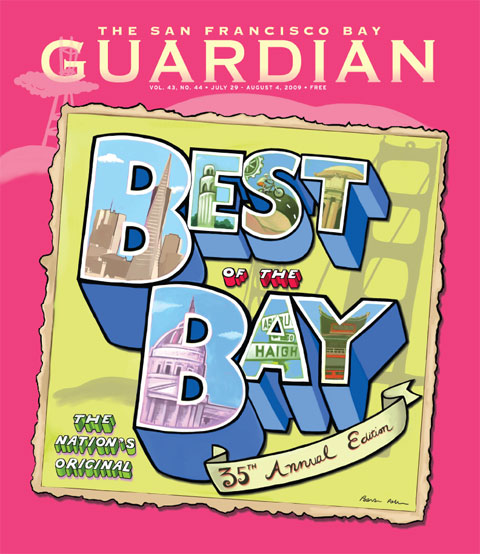
Best of the Bay 2009: Readers Poll Winners

0

Readers Poll — Food and Drink

BEST OVERALL RESTAURANT

Chez Panisse

1517 Shattuck, Berk. (510) 548-5525, www.chezpanisse.com

BEST NEW RESTAURANT

Sidebar

542 Grand, Oakl. (510) 452-9500, www.sidebar-oakland.com

BEST CAFÉ

Cafe Flore

2298 Market, SF. (415) 621-8579, www.cafeflore.com

BEST BOWL OF NOODLES

King of Thai

Various locations

BEST TAQUERIA

Taqueria Cancun

Various locations

BEST SMALL PLATES

Cha Cha Cha

1801 Haight, SF. (415) 386-7670; 2327 Mission, SF. (415) 824-1502, www.cha3.com

BEST SUSHI

Blowfish Sushi to Die For

2170 Bryant, SF. (415) 285-3848, www.blowfishsushi.com

BEST ITALIAN RESTAURANT

Delfina

3621 18th St., SF. (415) 552-4055, www.delfinasf.com

BEST MIDDLE EASTERN RESTAURANT

La Mediterranee

Various locations, www.cafelamed.com

BEST INDIAN RESTAURANT

Dosa

955 Valencia, SF. (415) 642-3672; 1700 Fillmore, SF. (415) 441-3672, www.dosasf.com

BEST LATIN AMERICAN RESTAURANT

La Mar Cebicheria

Pier 1 ½, SF. (415) 397-8880, www.lamarcebicheria.com

BEST ASIAN RESTAURANT

Slanted Door

1 Ferry Building, Suite 5, SF. (415) 861-8032, www.slanteddoor.com

BEST PIZZA

Little Star

846 Divisadero, SF. (415) 441-1118; 400 Valencia, SF. (415) 551-7827, www.littlestarpizza.com

BEST SANDWICH

Mr. Pickles

Various locations, www.mrpicklesinc.com

BEST BRUNCH

Ella’s

500 Presidio, SF. (415) 441-5669, www.ellassanfrancisco.com

BEST LUNCH

San Francisco Soup Company

Various locations, www.sfsoupco.com

BEST BURGER AND FRIES

BurgerMeister

Various locations, www.burgermeistersf.com

BEST BARBECUE

Big Nate’s

1665 Folsom, SF. (415) 861-4242

BEST RESTAURANT WITH A VIEW

Green’s

Building A, Fort Mason Center, SF. (415) 771-6222, www.greensrestaurant.com

BEST LATE-NIGHT RESTAURANT

Grubstake

1525 Pine, SF. (415) 673-8268, www.sfgrubstake.com

BEST SPLURGE RESTAURANT (MORE THAN $20 PER PERSON)

Boulevard

1 Mission, SF. (415) 543-6084, www.boulevardrestaurant.com

BEST CHEAP RESTAURANT (LESS THAN $6 PER PERSON)

Tu Lan

8 Sixth St., SF. (415) 626-0927, tulansf.blogspot.com

BEST APPETIZERS

Kokkari

200 Jackson, SF. (415) 981-0983, www.kokkari.com

BEST DESSERT

Mission Pie

2901 Mission, SF. (415) 282-1500, www.missionpie.com

BEST SERVICE

Gary Danko

800 North Point, SF. (415) 749-2060, www.garydanko.com

BEST VEGETARIAN RESTAURANT

Millenium

580 Geary, SF. (415) 345-3900, www.millenniumrestaurant.com

BEST VEGAN RESTAURANT

Café Gratitude

Various locations, www.cafegratitude.com

BEST COFFEEHOUSE

Blue Bottle

Various locations, www.bluebottlecoffee.net

BEST TEA SHOP

Lovejoy’s

1351 Church, SF. (415) 648-5895, www.lovejoystearoom.com

BEST OVERALL BAR

Broken Record

1166 Geneva, SF. (415) 963-1713, www.brokenrecordsf.com

BEST WINE BAR

Yield

2490 Third Street, SF. (415) 401-8984, www.yieldsf.com

BEST SELECTION OF BEERS

Toronado

547 Haight, SF. (415) 863-2276, www.toronado.com

BEST COCKTAILS

Alembic

1725 Haight, SF. (415) 666-0822, www.alembicbar.com

BEST BLOODY MARY

Zeitgeist

199 Valencia, SF. (415) 255-7505

BEST BAKERY

Tartine

600 Guerrero, SF. (415) 487-2600, www.tartinebakery.com

BEST BUTCHER SHOP

Drewes Bros. Meats

1706 Church, SF. (415) 821-0515, www.drewesbros.com

BEST CHEESE SHOP

Cheeseboard

1504 Shattuck, Berkeley. (510) 549-3183, www.cheeseboardcollective.coop

BEST CHOCOLATIER

Recchiuti

1 Ferry Building, Suite 30, SF. (415) 834-9494, www.recchiuti.com

BEST FARMERS MARKET

Ferry Plaza

1 Ferry Building, SF. (415) 983-8000, www.ferrybuildingmarketplace.com

BEST LOCAL PRODUCE DELIVERY SERVICE/CSA

Farm Fresh to You

1 Ferry Building, Suite 9, SF. (415) 834-9981, www.farmfreshtoyou.com

Readers poll — Arts and Nightlife

BEST MOVIE THEATER

Castro Theatre

429 Castro, SF. (415) 621-6120, www.castrotheatre.com

BEST REP FILM HOUSE

Red Vic

1727 Haight, SF. (415) 668-3994, www.redvicmoviehouse.com

BEST THEATER COMPANY

American Conservatory Theater

405 Geary, SF. (415) 749-2228, www.act-sf.org

BEST DANCE COMPANY

ODC

351 Shotwell, SF. (415) 863-6606, www.odcdance.org

BEST ART GALLERY

City Art Gallery

828 Valencia, SF. (415) 970-9900, www.cityartgallery.org

BEST MUSEUM

California Academy of Sciences

55 Music Concourse Dr., SF. (415) 379-8000, www.calacademy.org

BEST EMERGING ARTIST

Jacinta Vlach

www.jacintavlach.com

BEST ART COLLECTIVE

Root Division

3175 17th St., SF. (415) 863-7668, www.rootdivision.org

BEST LOCAL WRITER

Stephen Elliot

www.stephenelliott.com

BEST LOCAL ZINE

Hamburger Eyes

www.hamburgereyes.com

BEST LOCAL PUBLISHING HOUSE

Last Gasp

777 Florida, SF. (415) 824-6636, www.lastgasp.com

BEST LOCAL RECORD LABEL

Six Degrees

www.sixdegreesrecords.com

BEST DANCE CLUB

DNA Lounge

375 11th St., SF. (415) 626-1409, www.dnalounge.com

BEST ROCK CLUB

Bottom of the Hill

1233 17th St., SF. (415) 626-4455, www.bottomofthehill.com

BEST HIP-HOP CLUB

Club Six

60 Sixth St., SF. (415) 863-1221, www.clubsix1.com

BEST JAZZ CLUB

Yoshi’s

510 Embarcadero West, Oakl. (510) 238-9200; 1330 Fillmore, SF. (415) 655-5600, www.yoshis.com

BEST SALSA CLUB

Cafe Cocomo

650 Indiana, SF. (415) 824-6910, www.cafecocomo.com

BEST PUNK CLUB

Thee Parkside

1600 17th St., SF. (415) 252-1330, www.theeparkside.com

BEST AFTER-HOURS CLUB

Endup

401 Sixth St., SF. (415) 646-0999, www.theendup.com

BEST HAPPY HOUR

El Rio

3158 Mission, SF. (415) 282-3325, www.elriosf.com

BEST DIVE BAR

500 Club

500 Guerrero, SF. (415) 861-2500, www.fivehundredclub.com

BEST SWANKY BAR

Bourbon and Branch

501 Jones, SF. (415) 931-7292, www.bourbonandbranch.com

BEST TRIVIA NIGHT

Edinburgh Castle

950 Geary, SF. (415) 885-4074, www.castlenews.com

BEST JUKEBOX

Lucky 13

2140 Market, SF. (415) 487-1313

BEST KARAOKE BAR

The Mint

1942 Market, SF. (415) 626-4726, www.themint.net

BEST CLUB FOR QUEER MEN

Bearracuda

www.bearracuda.com

BEST CLUB FOR QUEER WOMEN

Lexington Club

3464 19th St., SF. (415) 863-2052, www.lexingtonclub.com

BEST CLUB FOR TRANNIES

Divas

1081 Post, SF. (415) 474-3482, www.divassf.com

BEST SINGER-SONGWRITER

Kitten on the Keys

www.suzanneramsey.net

BEST METAL ACT

Ludicra

www.myspace.com/ludicra

BEST ELECTRONIC MUSIC ACT

DJ Earworm

www.djearworm.com

BEST HIP-HOP ACT

Trackademicks

www.myspace.com/trackademicks

BEST INDIE ACT

Loquat

www.loquatmusic.com

BEST COVER BAND

Smash-Up Derby

www.smashupderby.com

BEST DJ

Richie Panic

www.richiepanic.com

BEST BURLESQUE ACT

Twilight Vixen Revue

www.twilightvixen.com

BEST DRAG ACT

Fauxnique

www.fauxnique.net

BEST COMEDIAN

Marga Gomez

www.margagomez.com

BEST MAGICIAN

Chin-Chin

www.chin-chin.com

BEST OPEN MIC NIGHT

Mondays at Hotel Utah

500 Fourth St., SF. (415) 546-6300, www.hotelutah.com

BEST LITERARY NIGHT

Writers with Drinks

www.writerswithdrinks.com

Readers Poll — Outdoors and Sports

BEST PROFESSIONAL SPORTS TEAM

San Francisco Giants

sanfrancisco.giants.mlb.com

BEST NON-PROFESSIONAL SPORTS TEAM

B.ay A.rea D.erby Girls

www.bayareaderbygirls.com

BEST GYM

Mission Cliffs

2295 Harrison, SF. (415) 550-0515, www.touchstoneclimbing.com/mc.html

BEST YOGA STUDIO

Yoga Tree

Various locations, www.yogatreesf.com

BEST DANCE STUDIO

Cheryl Burke

1830 17th St., SF. (415) 252-9000, www.cherylburkedance.com

BEST PUBLIC SPORTS FACILITY

AT&T Park

24 Willie Mays Plaza, SF. (415) 972-2000

BEST SPORTING GOODS STORE

Sports Basement

500 Bryant, SF. (415) 575-3000; 610 Old Mason, SF. (415) 437-0100, www.sportsbasement.com

BEST PLACE TO BUY CAMPING GEAR

REI

Various locations, www.rei.com

BEST PLACE TO BUY BIKES AND GEAR

Valencia Cyclery

1065 and 1077 Valencia, SF. (415) 550-6600, www.valenciacyclery.com

BEST PERSONAL TRAINER

Christabel Zamor

www.hoopgirl.com

BEST SKATE SPOT

Potrero del Sol

25th Street and Utah, SF

BEST PUBLIC POOL

Rossi Pool

600 Arguello, SF. (415) 666-7014

BEST SURF SPOT

Linda Mar

BEST PARK FOR HIKING

Land’s End

BEST NUDE BEACH

Baker Beach

BEST CLOTHED BEACH

Stinson Beach

BEST NATURE SPOT FOR PEOPLE WITH DISABILITIES

Crissy Field

BEST PICNIC SPOT

Dolores Park

BEST PUBLIC PARK

Golden Gate Park

BEST DOG PARK

Fort Funston

BEST CAMPGROUND

Angel Island

BEST PLACE TO WATCH THE SUNRISE

Twin Peaks

BEST PLACE TO WATCH THE SUNSET

Ocean Beach

BEST PLACE TO SEE THE STARS

Mt. Tamalpais

BEST CITY VISTA

Bernal Hill

Readers Poll — Shopping

BEST INDEPENDENT BOOKSTORE

Green Apple Books and Music

506 Clement, SF. (415) 387-2272, www.greenapplebooks.com

BEST USED BOOKSTORE

Green Apple Books and Music

BEST SPECIALTY BOOKSTORE

Green Arcade

1680 Market, SF. (415) 431-6800, www.thegreenarcade.com

BEST COMIC BOOK STORE

Isotope

326 Fell, SF. (415) 621-6543, www.isotopecomics.com

BEST MAGAZINE SELECTION

Fog City News

455 Market, SF. (415) 543–7400, www.fogcitynews.com

BEST PLACE TO BUY VINYL

Amoeba

1855 Haight, SF. (415) 831-1200; 2455 Telegraph, Berk. (415) 549-1225, www.amoeba.com

BEST PLACE TO BUY CDS

Amoeba

BEST PLACE TO RENT MOVIES

Le Video

1231 Ninth Ave., SF. (415) 566-3606, www.levideo.com

BEST CLOTHING STORE (WOMEN)

Ambiance

Various locations, www.ambiancesf.com

BEST CLOTHING STORE (MEN)

Sui Generis

2265 Market, SF. (415) 437-2265, www.suigenerisconsignment.com

BEST CLOTHING STORE (KIDS)

Peek-A-Boutique

1306 Castro, SF. (415) 641-6192, www.peekabootiquesf.com

BEST LOCAL DESIGNER

Colleen Mauer

3361 Mission, SF. (415) 637-7762, www.colleenmauerdesigns.com

BEST VINTAGE CLOTHING STORE

La Rosa

1711 Haight, SF. (415) 668-3744

BEST PLACE TO BUY EYEWEAR

City Optix

2145 Chestnut, SF. (415) 921-1188; 1685 Haight, SF. (415) 626-1188, www.cityoptix.com

BEST THRIFT STORE

Out of the Closet

Various locations, www.outofthecloset.org

BEST SHOE STORE

Shoe Biz

Various locations, www.shoebizsf.com

BEST NEW FURNITURE STORE

Propeller

555 Hayes, SF. (415) 701-7767, www.propellermodern.com

BEST SECOND-HAND FURNITURE STORE

Community Thrift

623 Valencia St. (415) 861-4910, www.communitythriftsf.org

BEST FLEA MARKET

Alameda Flea Market

2100 Ferry Point, Suite 100, Alameda. (510) 522-7500, www.antiquesbythebay.net

BEST HARDWARE STORE

Cole Hardware

Various locations, www.colehardware.com

BEST TOY STORE

The Ark

Various locations, www.thearktoys.com

BEST SHOP FOR PARENTS-TO-BE

Natural Resources

1367 Valencia, SF. (415) 550-2611, www.naturalresources-sf.com

BEST PET SHOP

B&B Pets

4820 Geary, SF. 1-866-476-7734, www.bandbpetsupplies.net

BEST QUIRKY SPECIALTY STORE

Five and Diamond

510 Valencia, SF. (415) 255-9747, www.fiveanddiamond.com

BEST ECO-FRIENDLY RETAILER

Rainbow Grocery

1745 Folsom, SF. (415) 863-0620, www.rainbow.coop

Readers Poll — Sex and Romance

BEST RESTAURANT TO SPARK ROMANCE

Chez Spencer

82 14th St., SF. (415) 864-2191, www.chezspencer.net

BEST ONLINE PERSONALS

Eros Guide

www.eros-guide.com

BEST PLACE TO MEET SOMEONE

Dolores Park Café

501 Dolores, SF. (415) 621-2936, www.doloresparkcafe.org

BEST FIRST DATE SPOT

Foreign Cinema

2534 Mission, SF. (415) 648-7600, www.foreigncinema.com

BEST PLACE FOR AN ILLICIT TRYST

Hot Tubs on Van Ness

2200 Van Ness, SF. (415) 441-8827, www.thehottubs.com

BEST BREAKUP SPOT

The Bitter End

441 Clement, SF. (415) 221-9538

BEST PLACE TO BUY WEDDING WEAR

Dark Garden

321 Linden, SF. (415) 431-7684, www.darkgarden.com

BEST PLACE TO GET HITCHED

City Hall

1 Dr. Carlton B. Goodlett Place, SF. (415) 554-6068, www.sfgov.org

BEST HOT TUB RENTAL

Piedmont Springs

3939 Piedmont, Oakland. (510) 652-9191, www.piedmontsprings.com

BEST FLOWER SHOP

Church Street Flowers

212 Church, SF. (415) 553-7762, www.churchstreetflowers.com

BEST COUPLES COUNSELOR

Dossie Easton

406 16th Ave., SF. (415) 752-7455, www.dossieeaston.com

BEST PLACE TO BUY LINGERIE

Dollhouse Bettie

1641 Haight, SF. (415) 252 7399, www.dollhousebettie.com

BEST PLACE TO BUY SEX TOYS

Good Vibrations

Various locations, www.goodvibes.com

BEST PLACE TO BUY FETISH GEAR

Mr. S and Madame S.

385 Eighth St., SF. (415) 863-9447, www.madame-s.com, www.mr-s-leather.com

BEST ADULT VIDEO STORE

Folsom Gulch

947 Folsom, (415) 495-6402

BEST STRIP CLUB

Lusty Lady

1033 Kearny, SF. (415) 391-3126, www.lustyladysf.com

BEST SEX CLUB

Eros

2051 Market, SF. (415) 255-4921, www.erossf.com

BEST CRUISING SPOT

Powerhouse

1347 Folsom, SF. (415) 552-8689, www.powerhouse-sf.com

BEST SEX-EDUCATION RESOURCE

Center for Sex and Culture

1519 Mission, SF. (415) 255-1155, www.centerforsexandculture.com

BEST SEX WRITER

Violet Blue

www.tinynibbles.com

Readers Poll — City Living

BEST LOCAL BLOG

Muni Diaries

www.munidiaries.com

BEST LOCAL WEB SITE

Broke Ass Stuart’s Goddamn Website

www.brokeassstuart.com

BEST TATTOO ARTIST

Idexa at Black and Blue

381 Guerrero, SF. (415) 626-0770, www.blackandbluetattoo.com

BEST TATTOO SHOP

Black Heart

177 Valencia, SF. (415) 431-2100, www.blackhearttattoosf.com

BEST POLITICIAN YOU LOVE TO HATE

Gavin Newsom

1 Dr. Carlton B. Goodlett Place, Room 200, SF. (415) 554-6141, www.sfgov.org

BEST POLITICIAN

Gavin Newsom

BEST LOCAL NONPROFIT

SF SPCA

2500 16th St., SF. (415) 554-3000, www.sfspca.org

BEST TV NEWSCASTER

Dana King, CBS 5

855 Battery St., SF. (415) 362-555, www.cbs5.com

BEST LOCALLY PRODUCED TV SHOW

Distortion 2 Static

570 Beale St, Suite 204, SF. www.distortion2static.com

BEST RADIO STATION

Energy, 92.7 FM

400 Second St., Suite 300, SF. (415) 356-1600, www.energy927fm.com

BEST STREET FAIR

Folsom Street Fair

965 Mission, Suite 200, SF. (415) 777-3247, www.folsomstreetfair.org

BEST DOG-WALKING SERVICE

Mighty Dog Walking

(415) 235-5151, www.mightydogwalking.com

BEST PET GROOMER

Little Ark

748 14th St., SF. (415) 626-7574

BEST VETERINARIAN

Especially Cats

1339 Taraval, SF. (415)-681-5553, www.especiallycats.com

BEST CAMP FOR KIDS

Camp Galileo

Various locations, www.galileo-learning.com

BEST DENTIST

Melissa Chavez, DDS

2460 Mission St. Suite 201, SF. (415) 821-0101

BEST DOCTOR

Erika Horowitz, ND

1615 20th St., SF. (415) 643-6600, www.somaacupuncture.com

BEST PLUMBER

ACE Plumbing and Rooter

945 Taraval, Suite 201, SF. (415) 824-6333, www.aceplumbingandrooter.com

BEST ELECTRICIAN

Wells Electrical

80 Duboce, SF. (415) 255-7831

BEST MOVING SERVICE

Delancey Street Movers

600 Embarcadero, SF. (415) 512-5110, www.delanceystreetfoundation.org

BEST MASSAGE THERAPIST

Joshua Alexander, CMT

29 Saturn, SF. www.joshuaalexandercmt.com

BEST ALTERNATIVE HEALING

Immune Enhancement Project

3450 16th St., SF. (415) 252-8711, www.iepclinic.com

BEST CAR MECHANICS

Art’s Automotive

2871 San Pablo Ave., Berkeley. (510) 540-7093, www.artsautomotive.com

BEST BICYCLE MECHANICS

Box Dog Bikes

494 14th St., SF. (415) 431-9627, www.boxdogbikes.com

BEST SALON

Edo Salon

601 Haight, SF. (415) 861-0131, www.edosalon.com

BEST DAY SPA

Blue Turtle

57 West Portal, SF., 170 Columbus, SF. (415) 699-8494, www.blueturtlespa.com

BEST SHOE REPAIR

Haight Street Shoe Repair

1614 Haight, SF. (415) 565-6710

BEST TAILOR

San Francisco Tailors

109 Geary, Suite M, SF. (415) 392-6611

BEST LOCAL ANIMAL RESCUE

Rocket Dog Rescue

(415) 642-4786, www.rocketdogrescue.org

BEST LAUNDROMAT

Brain Wash

1122 Folsom, SF. (415) 431-9274, www.brainwash.com

Readers Poll — Classics

BEST CLASSIC RESTAURANT

Zuni

1658 Market, SF. (415) 552-2522, www.zunicafe.com

BEST CLASSIC BAR

Specs’ Twelve Adler Museum

12 William Saroyan Pl., SF. (415) 421-4112

BEST MUSIC ORGANIZATION

San Francisco Gay Men’s Chorus

www.sfgmc.org

BEST ARTS ORGANIZATION

Intersection for the Arts

446 Valencia, SF. (415) 626-3311, www.theintersection.org

BEST CLASSIC RETAIL SHOP

City Lights

261 Columbus, SF. (415) 362-8193, www.citylights.com

BEST LANDMARK

Golden Gate Bridge

BEST HISTORICAL BUILDING

Ferry Building

BEST RESOURCE FOR BAY AREA HISTORY

California Historical Society

678 Mission, SF. (415) 357-1848, www.californiahistoricalsociety.org

BEST CLASSIC AUTHOR

Dashiell Hammett

BEST CLASSIC ARTIST

Ruth Asawa

BEST CLASSIC MUSICIAN

Carlos Santana

BEST CLASSIC ACTIVISTS

Del Martin and Phyllis Lyon

BEST CLASSIC POLITICIAN

Harvey Milk

BEST CLASSIC SONG ABOUT SAN FRANCISCO

“I Left My Heart in San Francisco”

BEST FILM MADE OR SET IN SAN FRANCISCO

Milk

Tenant Torment

0

Mayor Gavin Newsom’s mid-December decision to announce — on YouTube — that he planned to introduce legislation to protect San Francisco renters from foreclosure-related evictions has outraged tenants rights organizations.

They say Newsom is trying to undermine a much stronger bill by Sup. John Avalos that would give thousands of tenants in newer buildings the same protections as tenants in buildings constructed before 1979.

The mayor’s bill is a classic piece of politics — stealing some of the limelight and giving political cover to mayoral candidate Sup. Bevan Dufty, who voted against Avalos’ package but doesn’t want to be seen as anti-tenant.

This way Newsom and Dufty can enthusiastically support a bill that won’t offend as many landlords — while the mayor vetoes a more robust tenant-protection measure.

Dufty’s decision to side with Sups. Michela Alioto-Pier, Carmen Chu, and Sean Elsbernd in voting Dec. 8 against Avalos’ just-cause legislation gave Newsom veto power over a package that would have empowered thousands of renters.

The Avalos legislation seeks to extend just-cause eviction requirements and protections to tenants in units that are not now subject to eviction controls, which includes most residential rental units built after June 13, 1979. That’s when the city’s current rent control law took effect — and as part of a compromise needed to get the votes for that law, its framers agreed to exempt all “newly constructed” housing.

Newsom’s proposal would only protect those tenants from one category of evictions.

While Newsom promised to introduce his counter-proposal Dec. 15, nothing has come from the Mayor’s Office of Housing so far, fuelling suspicions that the legislation is in fact being drafted by Michael Yarne, a former developer who now works for the Mayor’s Office of Economic and Workforce Development.

Asked Dec. 16 if the Mayor’s Office has submitted any tenant protection legislation, mayoral spokesperson Joe Arellano e-mailed the Guardian, “Not yet. Still ironing out a few details.”

‘OUTRAGEOUS’

In his YouTube address, Newsom said he was committed to vetoing the Avalos legislation, which he claimed was “well-intended” but “went too far.”

His alternative, Newsom said, would protect tenants from the “predatory nature of banks” and “other circumstances” related to “macroeconomic challenges.”

Sara Shortt, executive director of the Housing Rights Committee of San Francisco, described Newsom’s play as “outrageous.”

“The mayor is essentially stealing a bill that came out of the community, watering it down and taking credit for other people’s work,” she said.

“Probably the most frustrating part of this is that there was no attempt to work with any of us,” Shortt added.

As Shortt notes, if Avalos’ legislation doesn’t pass, tenants in at least 10,000 rental units that have come onto the market since 1979 will be left without just-cause eviction protection. That means they can be tossed out for almost any reason.

Shortt’s estimate includes 1,900 units at Trinity Place, 113 units at 430 Main St., 308 units at 333 Harrison St., 113 units built by the Emerald Fund in the Castro District, 192 recently completed units at Strata in Mission Bay, 179 units at 1 Polk St., 720 units at 1401 Market St., 52 units at 818 Van Ness Ave., 5,679 units at Park Merced, and 720 units at Archstone, 350 Eighth St.

But her estimate doesn’t factor in the thousands of potential rentals in the pipeline for Treasure Island, the Candlestick Point shipyard development and the old Schlage Lock site.

Facing a mayoral veto and unwilling to leave tenants without any hope, Avalos introduced an amended version of his just-cause evictions package that addressed Dufty’s concerns about unintended consequences during the board’s Dec. 15 meeting.

“Dufty said he was worried that if someone was in the military and was sent to Afghanistan or decided to go to Harvard to finish their master’s and then wanted to return to their apartment, they’d have to pay a relocation benefit,” Avalos legislative aide Raquel Redondiez explained.

So Avalos amended his legislative package to provide an owner the option of giving additional notice in lieu of making relocation payments for owner move-in eviction of a newly converted single-family home or individually-owned condominium, provided the tenant was initially given specified notice of this status.

The amended bill would also allow eviction from a condominium unit with separable title that had been rented by the developer for a limited time prior to sale of the unit, when the developer has given specified advance notice to the renters.

But Dufty still voted against the amended legislation.

Dufty’s legislative aide Boe Hayward claimed the office didn’t cut a deal with Newsom. “We heard Newsom was interested in introducing legislation but we haven’t seen a draft,” Hayward said. “Michael Yarne mentioned it.”

NO DATA

Hayward told the Guardian that part of Dufty’s problem was an absence of data to support advocates’ claims that people in non-rent-controlled units are being evicted without cause.

“I’ve heard anecdotally that this has happened, but I’ve never seen anyone testify that this has happened,” Hayward said.

He also said Dufty wants Avalos to sit down with small property owners and the San Francisco Apartment Association to hear their concerns.

Shortt acknowledged that such data is hard to come by, but noted that this data gap occurs precisely because there is currently no reporting requirement for evictions that occur in buildings built after June 1979.

“For folks in non-rent-controlled units, it’s like the Wild West,” she said. “Landlords can say ‘I want you out’ and they don’t have to give a reason.

“Right now, such evictions are perfectly legal,” Shortt added, noting that part of the benefit of Avalos’ proposed legislation is that these evictions would be tracked and monitored in future.

She said the mayor’s alternative doesn’t address the larger problem. “While foreclosures are a huge piece of the problem, they are not all of it. There is all this new construction going on. And now that the housing market has turned, units that are either being built or temporarily marketed as rentals, not condos. We’re gaining more units without protections. We can’t just turn a blind eye and say there is no problem and wait for a crisis.”

Dufty told the Guardian that he voted Dec. 15 against Avalos’ amended proposal because “small property owners weren’t invited to the table to dialogue. There needs to be more dialogue between tenant advocates and property owners to come to common ground.”

He said owners are already keeping thousands of rent-controlled units off the market and fears they’ll do the same with post-1979 units. “I don’t want to legislate to the extremes and create a ripple effect where post-1979 units are kept off the market. I’m trying to find ways for folks to rent out their units.” Dufty also said he hadn’t seen the mayor’s proposed legislation.

Shortt said she doesn’t understand what Dufty hopes to achieve by convening landlords and tenant groups. “I feel like we’ve made it clear where we’re willing to go on this, and I can’t imagine anything the San Francisco Apartment Association or others might say that would convince us otherwise. Maybe it’s just a torture technique.”

————–

PROTECTING FAMILIES FROM EVICTIONS

Another major tenant protection bill — Sup. Eric Mar’s legislation to protect families from owner move-in evictions — is headed to the full Board of Supervisors in January. The legislation follows what Mar calls “a couple of minor tweaks” during a Dec. 14 Land Use Committee hearing that took place after months of vetting his bill with the public and family, tenant, and landlord advocacy groups.

The bill seeks to protect families with children from eviction through the OMI process, but would preserve the right of a landlord’s family to evict a tenant’s family, Mar explained.

“During these challenging economic times, our city needs to do whatever it can to ensure that our families are able to live and work here,” Mar said. “This legislation will help our city protect one of our most vulnerable populations: families with children.”

During the hearing, Mar observed that San Francisco is the third most expensive county in the nation for renters and that rent-controlled housing, which encompasses about 70 percent of the city’s rental housing stock, contributes to maintaining a balanced city.

“When a rent-controlled unit is vacated voluntarily or through eviction, the landlord can bring the rental property up to current market rate, making these units unaffordable for our working class and low-income families,” Mar said.

Ted Gullicksen, executive director of the San Francisco Tenants Union, said children need to be protected from no-fault evictions.

“San Francisco protects seniors and other vulnerable tenants from no-fault evictions like the so-called owner move-in eviction,” Gullicksen observed. “We see many families with children being evicted in San Francisco, too often resulting in the family being forced to leave the city where their children were born.”

Advocates say the problem is serious. “We see families flee San Francisco every year due to evictions such as owner move-ins,” said Chelsea Boilard, family policy and communications associate at Coleman Advocates for Children.

Representatives for the San Francisco Apartment Association and other landlord groups spoke out against Mar’s proposal, arguing that anyone with children would have a permanent protection and raising similar objections to ones raised in hearings on Sup. John Avalos’ just-cause legislation.

By the meeting’s end, Mar had amended his legislation to address concerns around the definition of “custodial parent,” including the worry that a 19-year-old could sublease a room to a 16-year-old pretending to be the “custodial parent.”

But Sup. Sophie Maxwell came out against Mar’s amended proposal, which is headed to the full board in January at the recommendation of Mar and Board President David Chiu. All three supervisors sit on the Land Use committee.

“I’m not comfortable with a yes on this legislation,” Maxwell said. “I think we need a comprehensive look at our rental laws and what we need to do. Otherwise, we’ll end up with a hodgepodge.” (Sarah Phelan)

Meister: A lesson too long unlearned

0

Wisconsin has enacted a law that makes the teaching of labor history and collective bargaining part of the state’s model standards for social studies classes in the state’s public schools

(Dick Meister, former labor editor of the SF Chronicle and KQED-TV Newsroom, has covered labor, politics and other matters for half-century)

Despite the importance of unions in our lives, our schools pay only
slight attention to their importance – or even to their existence.

Little is done in the classroom to overcome the negative view of organized labor held by many Americans, little done to explain the true nature of organized labor.

There have been many attempts to remedy that situation, none more promising than the steps taken recently in Wisconsin with enactment of a law that makes the teaching of labor history and collective bargaining part of the state’s model standards for social studies classes in the state’s public schools.

The law does not mandate the teaching of labor history and collective bargaining, as its sponsors had wanted. But it amounts to just about the same thing, by requiring the state superintendent of public instruction to make the subjects part of the state’s educational standards and to provide schools and teachers assistance in teaching labor subjects.

The Wisconsin Labor History Society, the state AFL-CIO and other labor and educational groups worked a dozen years to finally win enactment of the law, the first such state law anywhere. But the History Society fully expects other states to follow Wisconsin’s example.

The importance of including labor history in the classroom was underscored effectively in the latest issue of the American Federation of Teachers journal,

American Educator.

“With the key protections for workers that unions have gained under attack,” said a journal article, “there is a greater need for the next generation to understand the real role of working men and women in building the nation and making it a better place.”

James Green, a professor at the University of Massachusetts-Boston, explains that, in studying labor, students learn important lessons – above all “the contributions that generations of union activists have made to building a nation and democratizing and humanizing its often brutal workplaces.”

Fred Glass, communications director of the California Federation of Teachers,

provides an ideal primer for students studying labor. His summary is an excellent guide to what they should know about labor – a guide to what we should all know.

“Some people,” said Glass, “interpret the decline of organized labor as if unions belong to the past, and have no role to play in the global economy of the 21st century. They point to the numbers and say that workers are choosing not to join unions anymore.

“The real picture is more complex and contradicts this view. Most workers would prefer to belong to unions if they could. But many are being prevented from joining, rather than choosing not to join.”

Unions, Glass concludes, “remain the best guarantee of economic protection and political advocacy for workers. But as unions shrink, fewer people know what unions are, and do. And fewer remember what unions have to do with the prosperity of working people.”

That’s what our schools should be teaching, and presumably what they’ll be teaching in Wisconsin shortly, thanks to the new law there. If we’re fortunate, more states will soon follow suit.

Dick Meister, former labor editor of the SF Chronicle and KQED-TV Newsroom, has covered labor, politics and other matters for half-century. Contact him through his website, www.dickmeister.com, which includes more than 250 of his recent columns.

Swans, symmetry, and sensations

0

DANCE Looking back over a year’s dance performances feels like reading a horoscope backward. Were there surprises, disappointments, new loves, emerging trends, familiar encounters, and reasons for hope and despair? Of course. Perhaps the best part of this yearly exercise is that it allows works to bubble up that for one reason or another — quality, daring, perspective, innovation — stuck in the mind. You want to see them again. Some, you actually will. As for the not-that-again, forget-it, or please-don’t pieces, they already have sunk into the grand pool of oblivion. The following is a baker’s dozen of top picks, chosen roughly in the order in which they were seen.

Sean Dorsey’s dance-theater piece Lou, based on the writings of transgender pioneer Lou Sullivan and danced by Dorsey, Brian Fisher, Juan de la Rosa, and Nol Simonse, was a penetrating portrait of one man’s courage and lust for life. It also highlighted Dorsey’s increasingly fluid skill in fusing language and dance.

San Francisco Ballet’s most recent Swan Lake (to be reprised in January 2010) is an odd mix of traditional (the choreography) and edgy (the production). By using the bold design of a ballet neophyte, Broadway-credited Jonathan Fensom, Helgi Tomasson took a huge risk in offending traditionalists who like their swans pure. Danced fabulously well, this is a Swan Lake for our own time.

Pichet Klunchun and Myself was just a one-night stand, but what a night it was. To watch French super-theorist Jérôme Bel and classical Thai dancer Klunchun play their intellectual ping pong game about life, dance, culture, and everything in between was to watch two master performers at work.

The big deal about Jess Curtis/Gravity’s brainy and sensuous The Symmetry Project was not that Curtis and Maria Francesca Scaroni performed nude, but that they embodied the idea of relationships — physical, intellectual, emotional, erotic — as being constantly in play.

Presented by the San Francisco Museum of Modern Art in conjunction with their exhibit on William Kentridge, The Return of Ulysses was Kentridge’s translation of Monteverdi’s jewel into puppet theater. The multiple perspectives on time and place and the exquisite cooperation between puppets and singers were awe-inspiring.

ODC/Dance — just because of who they are. Sometimes we tend to take established hometown companies for granted. Yet these dancers have never looked better. Additionally, both Brenda Way’s In the Memory of the Forest and KT Nelson’s Grassland overflowed with commanding and beautifully shaped ideas.

We know Heidi Schweiker best as an interpreter of other people’s choreography. That’s why it was so gratifying to see her first full evening of work. Dreams of Speaking showed a choreographer of intelligence, imagination, and a fine sense of craft.

Ramón Ramos Alayo’s fifth annual Cuba Caribe Festival packed them in. It’s SoMa’s own ethnic dance festival sporting a highly partisan and knowledgeable audience and performers who compete — in a friendly way. High points were the sassy female Las Que Son Son and Alayo dancing up a storm with Silfredo La O Vigo.

Seen in a drizzly rain on a preview performance, Spirit of Place (to be reprised this spring), Anna Halprin’s tribute to husband Lawrence Halprin’s reimagined Stern Grove Theater, was a gorgeous response to a space where nature and art collaborate. The dancers looked like spirits emanating from this magisterial grass and granite environment.

Togetherness suits artistic and life partners Janice Garrett and Charles Moulton. For their second collaboration, The Illustrated Book of Invisible Stories (which returns in January 2010), they worked with two groups of completely different dancers. The result was mysterious, mesmerizing, and surprisingly fresh.

The big surprise at the San Francisco International Arts Festival was the extraordinarily skilled and theatrically vibrant The Angel and the Woodcutter, South Korea’s Cho-In Theatre’s eloquent retelling in movement of a popular Korean fairy tale. It deserved a larger audience.

Suzanne Farrell Ballet’s lecture-demonstration, The Balanchine Couple, served as a vivid reminder that Balanchine never ran out of ideas for pas de deux. The nine on this program could not have been more different — all of them first-rate. The program also brought home the painful truth that such finely detailed and musically phrased Balanchine interpretations are a rarity.

Sometimes it helps to look beyond the hook. The big deal about South African dancer Gregory Maqoma’s Beautiful Me was that he used material from three other (cooperating) artists for his own choreography. Fair enough, but what left this audience member speechless was the grace, virility, and technical and emotional virtuosity with which Maqoma realized this portrayal of self.

Finally, the Performing Diaspora Festival was an ambitious project “featuring traditional forms as a basis for experimentation and innovation.” It boasted an elaborate support structure of studio time, blogs, workshops, and symposia. In the two programs I saw, the work ranged from first rate to mediocre. Fortunately, this is a two-year project — so let’s toast to 2010.

Durst: The Top Ten Comedic News Stories of 2009

0

Okay. Here’s the deal: the Top Ten Comedic News Stories of 2009 are not to be confused with the Top Ten Legitimate News Stories of 2009. They are as different as night and day. Fire and frogs. Popeye’s chicken and ballet fundraisers. High rise condo balconies and balsa wood furniture. Southern Baptist 4th of July church picnics and snow tires. There were all sorts of heavy- duty stories that impacted the country and the planet. Can’t think of any right now, but trust me, there was a bunch. Rather, the Top Ten Comedic News Stories of 2009 are the accounts that provoked a slow shake of the head and a soft chuckle without having to bear a moral weight larger than Manitoba owing to the extreme unfunny nature of the death, destruction and gruesomeness inherent in the legitimate news. So here is the flip side, the stories from 09 most filled with mirthing possibilities.

Shades of green

0

news@sfbg.com

Can "green" consumerism help "green" the planet? In other words, can we spend our way to a better future? Or is the demand for more environmentally benign products and services just a way of making people feel better while delaying capitalism’s inevitable day of reckoning?

To explore these questions, consider the San Francisco Green Festival, the second-most attended green festival in the world and what organizers say is the country’s largest sustainability event. More than 40,000 people and 350 companies visited the eighth annual festival, held last month at the San Francisco Concourse Exhibition Center.

The emphasis of the event was on the power of purchasing. Just about everything was for sale, from fair-trade chocolate and hemp sweaters to paper journals made from Sri Lankan elephant dung. Certified "green" companies were happy to spend from $5,000 to $100,000 for their stalls and passersby shopped for guilt-free gifts. But critics of the trend question whether green consumption is ever better than no consumption at all.

"I believe we are getting to the point of urgency. We are beyond incremental reform and need significant structural change," said Brahm Ahmadi, cofounder and executive director of People’s Grocery. "What we really need to do is fundamentally shift the level of consumerism — not just shift into the consumption of more sustainable things — but realize that we need to consume less as a society."

The 2008 Living Planet Report, produced by the World Wildlife Fund, indicates that our global footprint now exceeds the world capacity to regenerate by about 30 percent. The report notes that if demands on the planet continue at the same rate, by the mid-2030s, we will need to the equivalent of two planets to maintain our lifestyles.

Ahmadi said trade-show events like the Green Festival can function as a good point of entry for people interested in reducing their own ecological footprint, but added that they don’t go nearly far enough in addressing the problem. They may even hinder people’s understanding of what needs to be done.

"The problem is that the words "green," "local," and "sustainable" can be used interchangeably now. They have become another sort of brand element in marketing," he said. "If this festival is the first step in a multistep strategy on how to change the planet, then that is great. But impressions aren’t set up in a way that puts the consumer on the path to a longer-term perspective."

For example, the Green Festival isn’t local. Although festival organizers say it promotes local companies that make green products, a spokeswoman admitted that about 40 percent of the exhibitors reside more than 150 miles from the site — the criteria one must meet to be deemed local by the festival.

Kevin Danaher, founder of Green Festivals and the cofounder of Global Exchange, told the Guardian that the festival costs almost $1 million to put on and makes $10,000–$30,000 in profit each year. He stressed that the aim of the event is to accelerate the transition to a green economy, an economy he says "will make better profits by saving nature rather than destroying it.

"We are trying to take enterprise away from big corporations and redefine it," Danaher continued. "For us, free enterprise should mean the freedom for everybody to be enterprising, the realization that alternative business models can make better profits than traditional ones."

Although Danaher claims the festival is an "enterprise-based event that encourages people to consume less," he believes it’s better to meet consumer demand with a green-mind business than leave it to be filled by a multinational corporation. "We know that people buy socks, toilet paper, and cat litter, and they can either buy the crappy corporate stuff or the good, green, socially-responsible stuff. That’s the choice," he said.

But Ahmadi sees a flaw in this premise. As long as progress is measured and defined by economic growth — the neverending requirement of the capitalist system — society will continue to fall short of sustainability targets, no matter what kind of products people buy, he said.

"At some point there is a threshold, even for green products, when the net benefits of producing the product will be surpassed," he said. "We need to go back to the framework that the economy is currently based on. At the moment, perpetual growth is the only way to assign value. But this linear way of thinking is dangerous to the sustainability of the planet. We must define value differently."

More than 125 speakers attended the event, including Democracy Now! founder Amy Goodman, nutrition expert Marion Nestle, and Mayor Gavin Newsom. Some even emphasized the tension inherent in staging the festival.

"It’s a good thing and a bad thing. People leave more conscious and aware, but they also leave a tremendous footprint getting here and leaving," said CEO of Gather restaurant Ari Derfel, who spoke on the main stage in front of a piece of art made from a year’s worth of his own trash. "People do engage in gross consumerist behavior. But they also get engaged with some companies that are doing incredible things."

Although he added that a green future must go beyond that represented at the Green Festival, he acknowledged that it represents the period of transition we now live in. "We can’t go from A to Z without touching on all the letters in between. And we are still in a consumer-based, material goods economy. We couldn’t make one wholesale swoop in one day."

Yet for Derrick Jensen, environmental activist and author of Endgame — a book that questions the inherently unsustainable nature of modern civilization — events like the Green Festival don’t really address the real problems at the center of the sustainability movement.

"I don’t see it as a transition," said Jensen, who made a speech at the event a few years ago. "It is not nearly sufficient. Now there is an attempt to add the word "green" before something and pretend that we’re actually going to make a significant difference. But this is problematic."

The problem, as he sees it, is that attendees simply learn to accept the existing economic system — and even believe it can become sustainable. They come to think that buying the right socks or toilet paper is helping to save the planet.

"Where is the overtly revolutionary material?" Jensen asked. "Where is the acknowledgement that capitalism needs to come down, or the discussion of the psychopathology of those in power? They talk only of alternative economies, but look what happened to every alternative economy — they get taken over and consumed by mainstream culture."

Jensen added that the notion of basing a revolution on changes to personal consumption is not only inherently flawed but dangerously misinformed. "This sort of festival is based on the mistaken notion that personal consumption represents a significant portion of the economy," he said. "In reality, 1,600 pounds of trash are produced per capita. If I reduce that to zero, it’s great. But per capita waste production by industries is on average 26 tons. That is 97 percent of all waste.

"This festival can make you feel good for one day, but then you just go back to normal life," he added. "And in some ways, it’s a real distraction. It makes people identify as consumers rather than citizens who have a whole range of resistance methods rather than just to buy or not buy."

Although Danaher stressed that each company at the festival went through Green America’s screening process — where they are subject to almost 250 questions analyzing their true social and environmental impact — Jensen said even "green" products often rely on the wasteful industrial system to be manufactured and transported.

"It is not difficult to see. You just can’t have infinite growth on a finite planet. The hyper-exploitation of even renewable resources won’t last, by definition. For any economic system to be sustainable, it has to benefit the land base it is based on."

Many of the companies at the event had obtained Green America’s sought-after Seal of Approval, which takes into account issues including the company’s manufacturing and marketing of products, as well as treatment of employees and effects on surrounding communities. At the same time, certain corporations that didn’t meet those criteria, like eBay, were invited anyway and labeled "corporate innovators."

Hamler said these are corporations that are moving toward social and environment responsibility, and they are still subject to a very strict review. Noting that only 60 out of every 300 corporations make the cut, she emphasized the changing nature of markets and the place for corporations within them.

Yet for Ahmadi, the very idea that large corporations can be a part of this change is misleading. "Even if a majority of their product line is green, the global ecological footprint of a corporation will almost always be beyond measure," he said. "The notion of consolidated corporations is counter to the diversity we need to create an equitable and sustainable economy."

While the Green Festival offsets the carbon emissions of its organizers and hosts carbon-offsetting companies, it doesn’t pretend to be a carbon-neutral event that covers anywhere near all its vendors and attendees. Indeed, environmental activist Josh Hart said that the system of carbon offsets — whereby people, companies, and states can claim to reduce their carbon emissions by investing in carbon-friendly projects elsewhere — represents yet another move in the wrong direction.

Hart went to festival as a representative of Cheatneutral, a satirical company that claims to offset romantic infidelity by paying someone else to be faithful. He said he wanted to expose the "pink elephant in the room" that no one else seemed to discuss at the festival.

"Offsetting is just another way of using the psychological technique of denial. It says you can carry on as normal but pay someone else to be green. This is the wrong approach and it is a fiction, not a reality," he told us. "The festival is putting itself forward as green, but people are doing this really unsustainable thing: flying out to the conference from all around the country for a few days and then leaving. This acts as a greater disservice to what we really need to be doing."

Although Lee did not yet know the carbon emissions total from this year’s festival, she said the five green festivals from last year produced about 900 tons of carbon –- the equivalent of roughly 355 roundtrip cross-continental flights — not including electricity, product consumption, or local travel.

But for Hart, this number represents a "massive underestimate" of the true carbon footprint, considering the number of people who attended the San Francisco event alone. He said the festival should take into account all the people who flew to the event, including company representatives and ticket-buyers, not just festival staff.

"The CO2 from a roundtrip flight from New York to San Francisco is around 2,280 kg, the equivalent of running a refrigerator for more than 22 years. It’s more than running a car all year," he said. "It’s staggering, really, how much carbon flying emits, and how incompatible aviation is with anything purporting to be green."

He added: "I think this issue goes straight to the battle over the heart of the green movement. Are we going to tell people that going green is easy and gloss over the difficult realities? Or are we going to be honest about the science that tells us that dramatic changes in lifestyles are required, in particular how we get around and what we consume?"

Yet for activists like Jenson, the extent to which the festival is carbon neutral is insignificant compared to the role the festival could play as a catalyst for future action.

"It is not the role of the activist to navigate systems of oppressive power, but instead to confront and take down those systems," Jensen said. "The point is, as far as an event like the Green Festival explicitly puts itself up as part of a larger culture of resistance, then I don’t have a problem with it. But if it suggests that in any way it is remotely sufficient to what we’re facing, then we have a problem."

1, 2, 3 — do you copy?

0

a&eletters@sfbg.com

MUSIC "Is it nature or nurture?" asks David West, pondering whether garage rock is the most natural sound of San Francisco. Playing in "rough ‘n’ ready" fashion makes sense today, he thinks, given the city’s pricey rents and dense environment, whereas the psych bands of the 1960s, and ’70s art-punk bands like Chrome, Flipper, and Tuxedomoon, could better afford to have "a conceptual mind and lots of practice." An interesting hypothesis.

Rank/Xerox, a trio featuring West on guitar and vocals; Kevin McCarthy on bass, vocals, and keyboard; and drummer Jon Shade, are no "garage" band, but their music is some of the most exhilarating in San Francisco. I met with McCarthy and West at McCarthy’s house, where the pair took turns putting LPs by Thin Lizzy and the Ramones on the turntable as they discussed their group, which came together earlier this year.

Shade and McCarthy run a Web-based videozine, Mondo Vision. They had been playing music together for about a year, never finding a third player they were happy with until they met West — who recently moved to SF from Perth, Australia — in February. Their first shows came in April, and they released a split cassette with Grass Widow on Wizard Mountain Tapes shortly thereafter. Brynn Michelle, who’s played saxophone at a few Rank/Xerox gigs, overdubbed some improvised, inspired parts on these urgent, punchy cassette recordings.

"It’s still pretty up in the air as to what we’re going for — we take it song for song," McCarthy says. "We kind of have a law that we can’t say what we want." This desire to avoiding any hard-and-fast description or formula is understandable; even as Rank/Xerox’s music (thus far) resonates with the very best of the grim, mesmeric post-punk seeping out of England in the early ’80s, their bracing sound feels wholly unforced. Born of this troubled moment, it hits an anxious nerve. West reluctantly hints that the group is drawn to "more difficult punk music," and that Rank/Xerox lyrics address "power relationships, gender equality, sexual dynamics, socioeconomic issues, and love," before concluding with a laugh that "the songs are mostly about feelings."

New it may be, but Rank/Xerox already has serious connections to the Old World, sharing its name with an Italian comic book superhero created in 1978 and a song off of German punk band Hans-A-Plast’s 1979 debut, a vinyl copy of which McCarthy readily furnishes. Additionally, its only "tour" so far was through Eastern Europe in early October — a fluke occurrence stemming from the fact that all three group members happened to be there at the same time.

Rank/Xeroz’s terrific split cassette is sold out, sadly, but a new single is now available directly from the band, featuring "In a Hole," "Basement Furniture," and "Masking/Confessions." It’s the inaugural release on Shade’s own label, Mondo Bongo Top Ten Hits, and a thoroughly DIY affair: West recorded it; McCarthy made the artwork; and Shade is releasing it.

I once spotted a local Rank/Xerox fan sporting a homemade T-shirt that stated, in permanent marker, "Listen to Rank/Xerox." Earnest, homespun advice worth heeding before they’re on some future Messthetics comp devoted to SF in the good ol’ aughts. *

www.mondovision.tv/mongobongo; www.myspace.com/rankxeroxx

RANK/XEROX

part of "ATA 25"

Sun/13, 11 a.m.-10 p.m. (10 p.m. performance), $10

Artists’ Television Access

992 Valencia, SF

(415) 824-3890

www.atasite.org

Coda

0

paulr@sfbg.com

Coda is just the sort of stylish urban vault where you’d expect to find votive candles flickering on every table, but you don’t. It’s the visual equivalent of a promising dish that’s lacking a final dash of some seasoning. The space has the look of a sound stage — exposed-brick walls, concrete floors, a large dining area uncluttered by pillars — and while there is something exciting about the vastness, vast spaces also fill up easily with darkness. And while darkness can be exciting and even beautiful, it’s more beautiful when punctuated and shaped by light.

The Coda space was home most recently to Levende Lounge — which looked pretty much the same — and before that, Butterfly, whose layout was different and whose tables were each finished with a candle, so that, on entering, you gazed upon a flickering sea of candlelight. Candlelight is wonderfully softening, like a dab of foamed milk atop a demitasse of strong, dark espresso. Shafts of red halogen light, such as shine on one of Coda’s brick walls, are arresting but don’t cast the same limbic spell.

Onward. The space is comfortable enough without candles. The tables, in particular, are nicely spaced, with plenty of breathing room between them. This gives an appealing sense of insulation from other tables and the conversations going on at them (nota bene, eavesdroppers). The overall noise level is also surprisingly moderate, at least when live music isn’t being played. But Coda, in addition to being a good restaurant, is also a live-music venue, with performances every night of the week, beginning at 9 p.m. weekday evenings, 10 p.m. Saturdays, and 8 p.m. Sundays. If it’s just food you seek, plan accordingly.

Simple seekers after food won’t be disappointed. Coda’s menu has been put together by Chris Pastena, who is one of the local masters of Cal-Ital cooking and had a hand in the revival of Bruno’s a few years back. Pastena’s Coda menu divides its offerings according to their nature rather than along the formal lines of a dinner service, so instead of first, main, and side courses, you have soups and salads, starches and grains, vegetables, and flesh. This sort of arrangement is conducive to nibbling; it also helps gently remind us that we should mind our starch intake.

Having said that, I must say that one of the best items on the menu, pastena in brodo ($6.25), smuggles starch to the table under cover of soup. Pastena, in addition to being the chef’s surname, is a small, star-shaped pasta, and it is usually spelled "pastina" — but that would wreck the joke. The pasta is a bit player, anyway, since the real star is the golden brodo, chicken broth stoutly fortified with truffle oil and grated parmesan cheese. The broth could have stood alone, like a brilliant (or consummate) consommé.

As a loather of brussels sprouts in childhood, I am perhaps perversely drawn to them now. They are a real test of vegetable cookery: can the bitterness be drawn away and the texture softened without losing the essential character of the vegetable? Coda’s kitchen makes a lovely salad out of the little cabbages; they are coarsely shredded, dressed with a vinaigrette of sherry and toasted garlic, tossed with bacon and goat cheese, and topped with a poached egg. I didn’t like the egg, which introduced a gooiness I found unsettling, but the rest was fabulous. You could easily re-spin these flavors into a fine pizza.

Another potentially difficult member of the cruciferous family, cavolo nero, or black kale ($4) is simply braised here (in what? we couldn’t tell, but maybe just olive oil) to a tender crispness that reminded me of the flash-fried arugula leaves I had years ago at Abiquiu near Union Square. The bane of kale cookery is toughness, so if your kale turns out tender — as here — you have succeeded.The lone small dish we found underpowered was a bowl of Israeli couscous ($4.25) tossed with what appeared to be mainly a dice of carrots and zucchini. It lacked a unifying flavor or theme and would probably work best as a side dish — to one of the formidable plates of flesh, say.

Among the most interesting of these was the coffee-crusted pork loin ($16): four slices of medium-rare meat bathing in a shallow pool of (Jameson) whiskey-cream sauce. The coffee rub and cream sauce combined to produce a latte effect — beguiling in its own right and also a welcome change from the usual cliched accompaniments of apples, cherries, and so forth. Less impressive, though still quite good, was a grilled ribeye steak ($24.50), nestled on a mat of watercress. The meat had a good smoky flavor and was nicely rare, but it was a little fattier than ideal.

Of an ideal fattiness was the honey-lavender panna cotta, like a tasty, creamy cloud that had been captured in a martini glass. At $5.50, it has to be the best buy on the dessert menu. And a deal is always music to some ears.

CODA

Dinner: Tues.–Sun., 5:30–-10 p.m.

1710 Mission, SF

(415) 551-CODA (2632)

www.codalive.com

Full bar

AE/MC/V

Loud

Wheelchair accessible

Film listings

0

Film listings are edited by Cheryl Eddy. Reviewers are Kimberly Chun, Michelle Devereaux, Max Goldberg, Dennis Harvey, Johnny Ray Huston, Louis Peitzman, Lynn Rapoport, Ben Richardson, Matt Sussman, and Laura Swanbeck. The film intern is Fernando F. Croce. For rep house showtimes, see Rep Clock. For first-run showtimes, see Movie Guide.

OPENING

Invictus Elected President of South Africa in 1995 — just five years after his release from nearly three decades’ imprisonment — Nelson Mandela (Morgan Freeman) perceives a chance to forward his message of reconciliation and forgiveness by throwing support behind the low-ranked national rugby team. Trouble is, the Springboks are currently low-ranked, with the World Cup a very faint hope just one year away. Not to mention the fact that despite having one black member, they represent the all-too-recent Apartheid past for the country’s non-white majority. Based on John Carlin’s nonfiction tome, this latest Oscar bait by the indefatigable Clint Eastwood sports his usual plusses and minuses: An impressive scale, solid performances (Matt Damon co-stars as the team’s Afrikaaner captain), deft handling of subplots, and solid craftsmanship on the one hand. A certain dull literal-minded earnestness, lack of style and excitement on the other. Anthony Peckham’s screenplay hits the requisite inspirational notes (sometimes pretty bluntly), but even in the attenuated finals match, Eastwood’s direction is steady as she goes — no peaks, no valleys, no faults but not much inspiration, either. It doesn’t help that Kyle Eastwood and Michael Stevens contribute a score that’s as rousing as a warm milk bath. This is an entertaining history lesson, but it should have been an exhilarating one. (2:14) Sundance Kabuki. (Harvey)

Me and Orson Welles See “Citizen Welles.” (1:54)

*The Princess and the Frog Expectations run high for The Princess and the Frog: it’s the first Disney film to feature an African American princess, the first 2D Disney cartoon since the regrettable Home on the Range (2004), and the latest entry from the writing-directing team responsible for The Little Mermaid (1989) and Aladdin (1992). Here’s the real surprise — The Princess and the Frog not only meets those expectations, it exceeds them. After years of disappointment, many of us have given up hope on another classic entry into the Disney 2D animation canon. And yet, The Princess and the Frog is up there with the greats, full of catchy songs, gorgeous animation, and memorable characters. Set in New Orleans, the story is a take off on the Frog Prince fairy tale. Here, the voodoo-cursed Prince Naveen kisses waitress Tiana instead — transferring his froggy plight to her as well. A fun twist, and a positive message: wishing is great, but it takes hard work to make your dreams come true. For those of us raised on classic Disney, The Princess and the Frog is almost too good to believe. (1:37) Shattuck. (Peitzman)

*The Private Lives of Pippa Lee See “Life Out of Balance.” (1:40) Albany, Bridge, Smith Rafael.

A Single Man Tom Ford directs Colin Firth and Julianne Moore in this 1960s-set tale of a man mourning the death of his longtime partner. (1:39) Sundance Kabuki.

Uncertainty A knocked-up girl (Lynn Collins) and a guy with a coin in his pocket (Joseph Gordon-Levitt) stand on the Brooklyn Bridge, circle the issue, flip the coin, then bolt in opposite directions. The coin was clearly purchased in some dusty, mysterious Chinatown magic shop from a loopy-seeming octogenarian codger, because at each end of the bridge, the pair reunite for two 24-hour bouts of the title’s psychological state that unspool side by side in time but diverge in mood and pace and genre: on the Brooklyn side, we get a slow-paced family drama; in Manhattan, a pulse-raising action-thriller. In other words, a monument, a monumental decision, and a premise spun out of such pure and visible artifice that it seems unlikely to translate into absorbing filmmaking. It does, though, somehow, in the hands of writer-directors Scott McGehee and David Siegel (2005’s Bee Season, 2001’s The Deep End), who adroitly move Uncertainty’s central characters through familial scenes weighted down by quiet grief, strife, love, and worry and through the more heightened anxiety of chase and gunplay and ceaseless surveillance. While the framework remains a distracting fact, something constructed while we watched and then imposed on us, the film, heavily improvised, is carefully edited to guide us without tripping between the two threads of story. And in each — in what is becoming a pleasurable habit — we watch Gordon-Levitt bring texture and depth to the smallest moments in a conversation or scene. (1:45) Roxie. (Rapoport)

ONGOING

Armored (1:28) 1000 Van Ness, Shattuck.

*Bad Lieutenant: Port of Call New Orleans Consider that ridiculous title. Though its poster and imdb entry eliminate the initial article, it appears onscreen as The Bad Lieutenant: Port of Call New Orleans. That’s the bad lieutenant, not to be confused with Abel Ferrara’s 1992 Bad Lieutenant. The bad lieutenant has a name: Terence McDonagh, and he’s a police officer of similarly wobbly moral fiber. McDonagh’s tale — inspired by Ferrara and scripted by William Finkelstein, but perhaps more important, filmed by Werner Herzog and interpreted by Nicolas Cage — opens with a snake slithering through a post-Hurricane Katrina flood. A prisoner has been forgotten in a basement jail. McDonagh and fellow cop Stevie Pruit (Val Kilmer) taunt the man, taking bets on how long it’ll take him to drown in the rising waters. An act of cruelty seems all but certain until McDonagh, who’s quickly been established as a righteous asshole, suddenly dives in for the rescue. Unpredictability, and quite a bit of instability, reigns thereafter. Every scene holds the possibility of careening to heights both campy and terrifying, and Cage proves an inspired casting choice. At this point in his career, he has nothing to lose, and his take on Lt. McDonagh is as haywire as it gets. McDonagh snorts coke before reporting to a crime scene; he threatens the elderly; he hauls his star teenage witness along when he confronts a john who’s mistreated his prostitute girlfriend (Eva Mendes); he cackles like a maniac; he lurches around like a hunchback on crack. Not knowing what McDonagh will do next is as entertaining as knowing it’ll likely be completely insane. (2:01) Shattuck, Smith Rafael. (Eddy)

The Blind Side When the New York Times Magazine published Michael Lewis’ article “The Ballad of Big Mike” — which he expanded into the 2006 book The Blind Side: Evolution of a Game —nobody could have predicated the cultural windfall it would spawn. Lewis told the incredible story of Michael Oher — a 6’4, 350-pound 16-year-old, who grew up functionally parentless, splitting time between friends’ couches and the streets of one of Memphis’ poorest neighborhoods. As a sophomore with a 0.4 GPA, Oher serendipitously hitched a ride with a friend’s father to a ritzy private school across town and embarked on an unbelievable journey that led him into a upper-class, white family; the Dean’s List at Ole Miss; and, finally, the NFL. The film itself effectively focuses on Oher’s indomitable spirit and big heart, and the fearless devotion of Leigh Anne Tuohy, the matriarch of the family who adopted him (masterfully played by Sandra Bullock). While the movie will delight and touch moviegoers, its greatest success is that it will likely spur its viewers on to read Lewis’ brilliant book. (2:06) 1000 Van Ness, Sundance Kabuki. (Daniel Alvarez)

Brothers There’s nothing particularly original about Brothers — first, because it’s based on a Danish film of the same name, and second, because sibling rivalry is one of the oldest stories in the book. The story is fairly straightforward: good brother (Tobey Maguire) goes AWOL in Afghanistan, bad brother (Jake Gyllenhaal) comforts his sister-in law (Natalie Portman), attraction develops, but then — and here’s where things get awkward — good brother comes home. Throughout much of Brothers, the script is surprisingly restrained, holding the film back from Movie of the Week territory. Those moments of subtlety are the movie’s strongest, but by the end they’ve given way to giant, maudlin explosions of angst, which aren’t nearly as impressive. Still, the acting is consistently strong. Maguire is especially good as Captain Sam Cahill in a performance that runs the gamut from doting father to terrifyingly unbalanced. It’s unfortunate that the quiet scenes, in which all the actors excel, are overshadowed by the big, plate-smashing ones. (1:50) 1000 Van Ness, Shattuck, Sundance Kabuki. (Peitzman)

*Capitalism: A Love Story Gun control. The Bush administration. Healthcare. Over the past decade, Michael Moore has tackled some of the most contentious issues with his trademark blend of humor and liberal rage. In Capitalism: A Love Story, he sets his sights on an even grander subject. Where to begin when you’re talking about an economic system that has defined this nation? Predictably, Moore’s focus is on all those times capitalism has failed. By this point, his tactics are familiar, but he still has a few tricks up his sleeve. As with Sicko (2007), Moore proves he can restrain himself — he gets plenty of screen time, but he spends more time than ever behind the camera. This isn’t about Moore; it’s about the United States. When he steps out of the limelight, he’s ultimately more effective, crafting a film that’s bipartisan in nature, not just in name. No, he’s not likely to please all, but for every Glenn Beck, there’s a sane moderate wondering where all the money has gone. (2:07) Roxie. (Peitzman)

Christmas with Walt Disney Specially made for the Presidio’s recently opened Walt Disney Family Museum, this nearly hour-long compilation of vintage Yuletide-themed moments from throughout the studio’s history (up to Walt’s 1966 death) is more interesting than you might expect. The engine is eldest daughter Diane Disney Miller’s narrating reminiscences, often accompanied by excerpts from an apparently voluminous library of high-quality home movies. Otherwise, the clips are drawn from a mix of short and full-length animations, live-action features (like 1960’s Swiss Family Robinson), TV shows Wonderful World of Disney and Mickey Mouse Club, plus public events like Disneyland’s annual Christmas Parade and Disney’s orchestration of the 1960 Winter Olympics’ pageantry. If anything, this documentary is a little too rushed –- it certainly could have idled a little longer with some of the less familiar cartoon material. But especially for those who who grew up with Disney product only in its post-founder era, it will be striking to realize what a large figure Walt himself once cut in American culture, not just as a brand but as an on-screen personality. The film screens Nov 27-Jan 2; for additional information, visit http://disney.go.com/disneyatoz/familymuseum/index.html. (:59) Walt Disney Family Museum. (Harvey)

*Collapse Michael Ruppert is a onetime LAPD narcotics detective and Republican whose radicalization started with the discovery (and exposure) of CIA drug trafficking operations in the late 70s. More recently he’s been known as an author agitator focusing on political coverups of many types, his ideas getting him branded as a factually unreliable conspiracy theorist by some (including some left voices like Norman Solomon) and a prophet by others (particularly himself). This documentary by Chris Smith (American Movie) gives him 82 minutes to weave together various concepts — about peak oil, bailouts, the stock market, archaic governmental systems, the end of local food-production sustainability, et al. — toward a frightening vision of near-future apocalypse. It’s “the greatest preventable holocaust in the history of planet Earth, our own suicide,” as tapped-out resources and fragile national infrastructures trigger a collapse in global industrialized civilization. This will force “the greatest age in human evolution that’s ever taken place,” necessitating entirely new (or perhaps very old, pre-industrial) community models for our species’ survival. Ruppert is passionate, earnest and rather brilliant. He also comes off at times as sad, angry, and eccentric, bridling whenever Smith raises questions about his methodologies. Essentially a lecture with some clever illustrative materials inserted (notably vintage educational cartoons), Collapse is, as alarmist screeds go, pretty dang alarming. It’s certainly food for thought, and would make a great viewing addendum to concurrent post-apocalyptic fiction The Road. (1:22) Shattuck. (Harvey)

La Danse: The Paris Opera Ballet (2:38) Smith Rafael.

Disney’s A Christmas Carol (1:36) 1000 Van Ness.

*An Education The pursuit of knowledge — both carnal and cultural — are at the tender core of this end-of-innocence valentine by Danish filmmaker Lone Scherfig (who first made her well-tempered voice heard with her 2000 Dogme entry, Italian for Beginners), based on journalist Lynn Barber’s memoir. Screenwriter Nick Hornby breaks further with his Peter Pan protagonists with this adaptation: no man-boy mopers or misfits here. Rather, 16-year-old schoolgirl Jenny (Carey Mulligan) is a good girl and ace student. It’s 1961, and England is only starting to stir from its somber, all-too-sober post-war slumber. The carefully cloistered Jenny is on track for Oxford, though swinging London and its high-style freedoms beckon just around the corner. Ushering in those freedoms — a new, more class-free world disorder — is the charming David (Peter Sarsgaard), stopping to give Jenny and her cello a ride in the rain and soon proffering concerts and late-night suppers in the city. He’s a sweet-faced, feline outsider: cultured, Jewish, and given to playing fast and loose in the margins of society. David can see Jenny for the gem she is and appreciate her innocence with the knowing pleasure of a decadent playing all the angles. The stakes are believably high, thanks to An Education’s careful attention to time and place and its gently glamored performances. Scherfig revels in the smart, easy-on-eye curb appeal of David and his friends while giving a nod to the college-educated empowerment Jenny risks by skipping class to jet to Paris. And Mulligan lends it all credence by letting all those seduced, abandoned, conflicted, rebellious feelings flicker unbridled across her face. (1:35) Albany, Piedmont. (Chun)

The End of Poverty? (1:46) Four Star.

Everybody’s Fine Robert De Niro works somewhere between serious De Niro and funny De Niro in this portrait of a family in muffled crisis, a remake of the 1991 Italian film Stanno Tutti Bene. The American version tracks the comings and goings of Frank (De Niro), a recently widowed retiree who fills his solitary hours working in the garden and talking to strangers about his children, who’ve flung themselves across the country in pursuit of various dreams and now send home overpolished reports of their achievements. Disappointed by his offspring’s collective failure to show up for a family get-together, he embarks on a cross-country odyssey to connect with each in turn. Writer-director Kirk Jones (1998’s Waking Ned Devine) effectively underscores Frank’s loneliness with shots of him steering his cart through empty grocery stores, interacting only with the occasional stock clerk, and De Niro projects a sense of drifting disconnection with poignant restraint. But Jones also litters the film with a string of uninspired, autopilot comic moments, and manifold shots of telephone wires as Frank’s children (Kate Beckinsale, Drew Barrymore, and Sam Rockwell) whisper across the miles behind their father’s back — his former vocation, manufacturing the telephone wires’ plastic coating, funded his kids’ more-ambitious aims — feel like glancing blows to the head. A vaguely miraculous third-act exposition of everything they’ve been withholding to protect both him and themselves is handled with equal subtlety and the help of gratingly precocious child actors. (1:35) 1000 Van Ness. (Rapoport)

*Everything Strange and New In Frazer Bradshaw’s Everything Strange and New, Wayne (Jerry McDaniel), wears overalls too large and a look of pained, dazed acquiescence. It’s as if not just his clothes but his life were given to the wrong person — and there’s a no-exchange policy. He loves wife Reneé (the writer Beth Lisick) and their kids. But those two unplanned pregnancies mean she’s got to stay home; daycare would cost more than she’d earn. So every day Wayne returns from his dead-end construction job to the home whose mortgage holds them hostage; and every time Reneé can be heard screaming at their not-yet-school-age boys, at the end of her tether. Sometimes he silently just turns around to commiserate over beer with buddies likewise married with children, but doing no better. Wayne’s voiceover narration endlessly ponders how things got this way — more or less as they should be, yet subtly wrong. He might be willing (or at least able) to let go of the idea of happiness. But Reneé’s inarticulate fury at her stifling domestication keeps striking at any nearby punching bag, himself (especially) included. Something’s got to change. But can it? Veteran local experimentalist and cinematographer Bradshaw’s first feature, which he also wrote, never stoops to narrative cliché. Or to stylistic ones, either — there’s a spectral poetry to the way he photographs the Oakland flats. (1:24) Roxie. (Harvey)

*Fantastic Mr. Fox A lot of people have been busting filmmaker Wes Anderson’s proverbial chops lately, lambasting him for recent cinematic self-indulgences hewing dangerously close to self-parody (and in the case of 2007’s Darjeeling Limited, I’m one of them). Maybe he’s been listening. Either way, his new animated film, Fantastic Mr. Fox, should keep the naysayer wolves at bay for a while — it’s nothing short of a rollicking, deadpan-hilarious case study in artistic renewal. A kind of man-imal inversion of Anderson’s other heist movie, his debut feature Bottle Rocket (1996), his latest revels in ramshackle spontaneity and childlike charm without sacrificing his adult preoccupations. Based on Roald Dahl’s beloved 1970 book, Mr. Fox captures the essence of the source material but is still full of Anderson trademarks: meticulously staged mise en scène, bisected dollhouse-like sets, eccentric dysfunctional families coming to grips with their talent and success (or lack thereof).(1:27) Empire, 1000 Van Ness, SF Center, Sundance Kabuki. (Devereaux)

The Maid In an upper-middle class subdivision of Santiago, 40-year-old maid Raquel (Catalina Saavedra), perpetually stony and indignant, operates a rigorous dawn-to-dusk routine for the Valdez family. Although Raquel rarely behaves as an intimate of her longtime hosts, she remains convinced that love, not labor, bonds them. (Whether the family shares Raquel’s feelings of devotion is highly dubious.) When a rotating cast of interlopers is hired to assist her, she stoops to machinations most vile to scare them away — until the arrival of Lucy (Mariana Loyola), whose unpredictable influence over Raquel sets the narrative of The Maid on a very different psychological trajectory, from moody chamber piece to eccentric slice-of-life. If writer-director Sebastián Silva’s film taunts the viewer with the possibility of a horrific climax, either as a result of its titular counterpart — Jean Genet’s 1946 stage drama The Maids, about two servants’ homicidal revenge — or from the unnerving “mugshot” of Saavedra on the movie poster, it is neither self-destructive nor Grand Guignol. Rather, it it is much more prosaic in execution. Sergio Armstrong’s fidgety hand-held camera captures Raquel’s claustrophobic routine as it accentuates her Sisyphean conundrum: although she completely rules the inner workings of the house, she remains forever a guest. But her character’s motivations often evoke as much confusion as wonder. In the absence of some much needed exposition, The Maid’s heavy-handed silences, plaintive gazes, and inexplicable eruptions of laughter feel oddly sterile, and a contrived preciousness begins to creep over the film like an effluvial whitewash. Its abundance makes you aware there is a shabbiness hiding beneath the dramatic facade — the various stains and holes of an unrealized third act. (1:35) Shattuck. (Erik Morse)

The Men Who Stare at Goats No! The Men Who Stare at Goats was such an awesome book (by British journalist Jon Ronson) and the movie boasts such a terrific cast (George Clooney, Kevin Spacey, Jeff Bridges, Ewan McGregor). How in the hell did it turn out to be such a lame, unfunny movie? Clooney gives it his all as Lyn Cassady, a retired “supersolider” who peers through his third eye and realizes the naïve reporter (McGregor) he meets in Kuwait is destined to accompany him on a cross-Iraq journey of self-discovery; said journey is filled with flashbacks to the reporter’s failed marriage (irrelevant) and Cassady’s training with a hippie military leader (Bridges) hellbent on integrating New Age thinking into combat situations. Had I the psychic powers of a supersoldier, I’d use some kind of mind-control technique to convince everyone within my brain-wave radius to skip this movie at all costs. Since I’m merely human, I’ll just say this: seriously, read the book instead. (1:28) Shattuck. (Eddy)

*The Messenger Ben Foster cut his teeth playing unhinged villains in Alpha Dog (2006) and 3:10 to Yuma (2007), but he cements his reputation as a promising young actor with a moving, sympathetic performance in director Oren Moverman’s The Messenger. Moverman (who also co-authored the script) is a four-year veteran of the Israeli army, and he draws on his military experience to create an intermittently harrowing portrayal of two soldiers assigned to the U.S. Army’s Casualty Notification Service. Will Montgomery (Foster) is still recovering from the physical and psychological trauma of combat when he is paired with Tony Stone (Woody Harrelson), a by-the-book Captain whose gruff demeanor and good-old-boy gallows humor belie the complicated soul inside. Gut-wrenching encounters with the families of dead soldiers combine with stark, honest scenes that capture two men trying to come to grips with the mundane horrors of their world, and Samantha Morton completes a trio of fine acting turns as a serene Army widow. (1:45) Shattuck, Smith Rafael. (Richardson)

Ninja Assassin Let’s face it: it’d be nigh impossible to live up to a title as awesome as Ninja Assassin –- and this second flick from V for Vendetta (2005) director James McTeigue doesn’t quite do it. Anyone who’s seen a martial arts movie will find the tale of hero Raizo overly familiar: a student (played by the single-named Rain) breaks violently with his teacher; revenge on both sides ensues. That the art form in question is contemporary ninja-ing adds a certain amount of interest, though after a killer ninja vs. yakuza opening scene (by far the film’s best), and a flashback or two of ninja vs. political targets, the rest of the flick is concerned mostly with either ninja vs. ninja or ninja vs. military guys. (As ninjas come “from the shadows,” most of these battles are presented in action-masking darkness.) There’s also an American forensic researcher (Noemie Harris) who starts poking around the ninja underground, a subplot that further saps the fun out of a movie that already takes itself way too seriously. (1:33) 1000 Van Ness, Shattuck. (Eddy)

Old Dogs John Travolta and Robin Williams play lifelong friends, business partners, and happily child-free bachelors whose lives change when the latter is forced to care for the 7-year-old twins (Conner Rayburn, Ella Bleu Travolta) he didn’t know he’d sired. You know what this will be like going in, and that’s what you get: a predictable mix of the broadly comedic and maudlin, with a screenplay that feels half-baked by committee, and direction (by Walt Becker, who’s also responsible for 2007’s Wild Hogs) that tries to compensate via frantic over-editing of setpieces that end before they’ve gotten started. The coasting stars seem to be enjoying themselves, but the momentary cheering effect made by each subsidiary familiar face –- including Seth Green, Bernie Mac, Matt Dillon, Ann-Margret, Amy Sedaris, Dax Shepard, Justin Long, and Luis Guzman, some in unbilled cameos –- sours as you realize almost none of them will get anything worthwhile to do. (1:28) 1000 Van Ness. (Harvey)

Pirate Radio I wanted to like Pirate Radio, a.k.a., The Boat That Rocked –- really, I did. The raging, stormy sounds of the British Invasion –- sex, drugs, rock ‘n’ roll, and all that rot. Pirate radio outlaw sexiness, writ large, influential, and mind-blowingly popular. This shaggy-dog of a comedy about the boat-bound, rollicking Radio Rock is based loosely on the history of Radio Caroline, which blasted transgressive rock ‘n’ roll (back when it was still subversive) and got around stuffy BBC dominance by broadcasting from a ship off British waters. Alas, despite the music and the attempts by filmmaker Richard Curtis to inject life, laughs, and girls into the mix (by way of increasingly absurd scenes of imagined listeners creaming themselves over Radio Rock’s programming), Pirate Radio will be a major disappointment for smart music fans in search of period accuracy (are we in the mid- or late ’60s or early or mid-’70s –- tough to tell judging from the time-traveling getups on the DJs, played by Philip Seymour Hoffman and Rhys Darby, among others?) and lame writing that fails to rise above the paint-by-the-numbers narrative buttressing, irksome literalness (yes, a betrayal by a lass named Marianne is followed by “So Long, Marianne”), and easy sexist jabs at all those slutty birds. Still, there’s a reason why so many artists –- from Leonard Cohen to the Stones –- have lent their songs to this shaky project, and though it never quite gets its sea legs, Pirate Radio has its heart in the right place –- it just lost its brains somewhere along the way down to its crotch. (2:00) Oaks, Piedmont, 1000 Van Ness. (Chun)

Planet 51 (1:31) Oaks, 1000 Van Ness.

*Precious: Based on the Novel Push By Sapphire This gut-wrenching, little-engine-that-could of a film shows the struggles of Precious, an overweight, illiterate 16-year-old girl from Harlem. Newcomer Gabourey Sidibe is so believably vigilant (she was only 15 at the time of filming) that her performance alone could bring together the art-house viewers as well as take the Oscars by storm. But people need to actually go and experience this film. While Precious did win Sundance’s Grand Jury and Audience Award awards this year, there is a sad possibility that filmgoers will follow the current trend of “discussing” films that they’ve actually never seen. The daring casting choices of comedian Mo’Nique (as Precious’ all-too-realistically abusive mother) and Mariah Carey (brilliantly understated as an undaunted and dedicated social counselor) are attempts to attract a wider audience, but cynics can hurdle just about anything these days. What’s most significant about this Dancer in the Dark-esque chronicle is how Damien Paul’s screenplay and director Lee Daniels have taken their time to confront the most difficult moments in Precious’ story –- and if that sounds heavy-handed, so be it. Stop blahging for a moment and let this movie move you. (1:49) SF Center, Shattuck, Sundance Kabuki. (Jesse Hawthorne Ficks)

Red Cliff All Chinese directors must try their hands at a historical epic of the swords and (arrow) shafts variety, and who can blame them: the spectacle, the combat, the sheer scale of carnage. With Red Cliff, John Woo appears to top the more operatic Chen Kaige and a more camp Zhang Yimou in the especially latter department. The body count in this lavishly CGI-appointed (by the Bay Area’s Orphanage), good-looking war film is on the high end of the Commando/Rambo scale. The endless, intricately choreographed battle scenes are the primary allure of this slash-’em-up, whittled-down version of the Chinese blockbuster, which was released in Asia as a four-hour two-parter. Yet despite some notably handsome cinematography that rivals that of the Lord of the Rings trilogy in its painterliness, seething performances by players like Tony Leung and Fengyi Zhang, and recognizable Woo leitmotifs (a male bonding-attraction that’s particularly pronounced during Leung and Takeshi Kaneshiro’s zither shred-fests, fluttering doves, a climactic Mexican standoff, the added jeopardy of a baby amid the battle), the labyrinthian complexity of the story and its multitude of characters threaten to lose the Western viewer –- or anyone less than familiar with Chinese history –- before strenuous pleasures of Woo’s action machine kick in. The completely OTT finale will either have you rolling your eyes its absurdity or laughing aloud at its contrived showmanship. Despite Woo’s lip service to the virtues of peace and harmony, is there really any other way, apart from the warrior’s, in his world? (2:28) Shattuck. (Chun)

The Road After an apocalypse of unspecified origin, the U.S. –- and presumably the world –- is depleted of wildlife and agriculture. Social structures have collapsed. All that’s left is a grim survivalism in which father (Viggo Mortensen) and son (whimpery Kodi Smit-McPhee) try to find food sources and avoid fellow humans, since most of the latter are now cannibals. Flashbacks reveal their past with the wife and mother (Charlize Theron) who couldn’t bear soldiering on in this ruined future. Scenarist Joe Penhall (a playwright) and director John Hillcoat (2005’s The Proposition) have adapted Cormac McCarthy’s novel with painstaking fidelity. Their Road is slow, bleak, grungy and occasionally brutal. All qualities in synch with the source material –- but something is lacking. One can appreciate Hillcoat and company’s efforts without feeling the deep empathy, let alone terror, that should charge this story of extreme faith and sacrifice. The film just sits there –- chastening yet flat, impact unamplified by familiar faces (Robert Duvall, Guy Pearce, Molly Parker) road-grimed past recognition. (1:53) California, Piedmont. (Harvey)

*A Serious Man You don’t have to be Jewish to like A Serious Man — or to identify with beleaguered physics professor Larry Gopnik (the grandly aggrieved Michael Stuhlbarg), the well-meaning nebbishly center unable to hold onto a world quickly falling apart and looking for spiritual answers. It’s a coming of age for father and son, spurred by the small loss of a radio and a 20-dollar bill. Larry’s about-to-be-bar-mitzvahed son is listening to Jefferson Airplane instead of his Hebrew school teachers and beginning to chafe against authority. His daughter has commandeered the family bathroom for epic hair-washing sessions. His wife is leaving him for a silkily presumptuous family friend and has exiled Larry to the Jolly Roger Motel. His failure-to-launch brother is a closeted mathematical genius and has set up housekeeping on his couch. Larry’s chances of tenure could be spoiled by either an anonymous poison-pen writer or a disgruntled student intent on bribing him into a passing grade. One gun-toting neighbor vaguely menaces the borders of his property; the other sultry nude sunbather tempts with “new freedoms” and high times. What’s a mild-mannered prof to do, except envy Schrodinger’s Cat and approach three rungs of rabbis in his quest for answers to life’s most befuddling proofs? Reaching for a heightened, touched-by-advertising style that recalls Mad Men in look and Barton Fink (1991) in narrative — and stooping for the subtle jokes as well as the ones branded “wide load” — the Coen Brothers seem to be turning over, examining, and flirting with personally meaningful, serious narrative, though their Looney Tunes sense of humor can’t help but throw a surrealistic wrench into the works. (1:45) California, Piedmont. (Chun)

2012 I don’t need to give you reasons to see this movie. You don’t care about the clumsy, hastily dished-out pseudo scientific hoo-ha that explains this whole mess. You don’t care about John Cusack or Woody Harrelson or whoever else signed on for this embarrassing notch in their IMDB entry. You don’t care about Mayan mysteries, how hard it is for single dads, and that Danny Glover and Chiwetel Ejiofor jointly stand in for Obama (always so on the zeitgeist, that Roland Emmerich). You already know what you’re in store for: the most jaw-dropping depictions of humankind’s near-complete destruction that director Emmerich –- who has a flair for such things –- has ever come up with. All the time, creative energy, and money James Cameron has spent perfecting the CGI pores of his characters in Avatar is so much hokum compared to what Emmerich and his Spartan army of computer animators dish out: the U.S.S. John F. Kennedy emerging through a cloud of toxic dust like some Mary Celeste of the military-industrial complex, born aloft on a massive tidal wave that pulverizes the White House; the dome of St. Paul’s flattening the opium-doped masses like a steamroller; Hawaii returned to its original volcanic state; and oodles more scenes in which we are allowed to register terror, but not horror, at the gorgeous destruction that is unfurled before us as the world ends (again) but no one really dies. Get this man a bigger budget. (2:40) Empire, California, 1000 Van Ness. (Sussman)

The Twilight Saga: New Moon Oh my God, you guys, it’s that time of the year: another Twilight chapter hits theaters. New Moon reunites useless cipher Bella (Kristen Steward) and Edward (Robert Pattinson), everyone’s favorite sparkly creature of darkness. Because this is a teen wangstfest, the course of true love is kind of bumpy. This time around, there’s a heavy Romeo and Juliet subplot and some interference from perpetually shirtless werewolf Jacob (Taylor Lautner). Chances are you know this already, as you’ve either devoured Stephenie Meyer’s book series or you were one of the record-breaking numbers in attendance for the film’s opening weekend. And for those non-Twilight fanatics — is there any reason to see New Moon? Yes and no. Like the 2008’s Twilight, New Moon is reasonably entertaining, with plenty of underage sexual tension, supernatural slugfests, and laughable line readings. But there’s something off this time around: New Moon is fun but flat. For diehard fans, it’s another excuse to shriek at the screen. For anyone else, it’s a soulless diversion. (2:10) Empire, 1000 Van Ness, SF Center, Sundance Kabuki. (Peitzman)

Up in the Air After all the soldiers’ stories and the cannibalism canards of late, Up in the Air’s focus on a corporate ax-man — an everyday everyman sniper in full-throttle downsizing mode — is more than timely; it’s downright eerie. But George Clooney does his best to inject likeable, if not quite soulful, humanity into Ryan Bingham, an all-pro mileage collector who prides himself in laying off employees en masse with as few tears, tantrums, and murder-suicide rages as possible. This terminator’s smooth ride from airport terminal to terminal is interrupted not only by a possible soul mate, fellow smoothie and corporate traveler Alex (Vera Farmiga), but a young tech-savvy upstart, Natalie (Anna Kendrick), who threatens to take the process to new reductionist lows (layoff via Web cam) and downsize Ryan along the way. With Up in the Air, director Jason Reitman, who oversaw Thank You for Smoking (2005) as well as Juno (2007), is threatening to become the bard of office parks, Casual Fridays, khaki-clad happy hours, and fly-over zones. But Up in the Air is no Death of a Salesman, and despite some memorable moments that capture the pain of downsizing and the flatness of real life, instances of snappily screwball dialogue, and some more than solid performances by all (and in particular, Kendrick), he never manages to quite sell us on the existence of Ryan’s soul. (1:49) SF Center. (Chun)

*William Kunstler: Disturbing the Universe A middle-class suburban lawyer radicalized by the Civil Rights era, Kunstler became a hero of the left for his fiery defenses of the draft-card-burning Catonsville Nine, the Black Panthers, the Chicago Twelve, and the Attica prisoners rioting for improved conditions, and Native American protestors at Wounded Knee in 1973. But after these “glory days,” Kunstler’s judgment seemed to cloud while his thirst for “judicial theatre” and the media spotlight. Later clients included terrorists, organized-crime figures, a cop-killing drug dealer, and a suspect in the notorious Central Park “wilding” gang rape of a female jogger –- unpopular causes, to say the least. “Dad’s clients gave us nightmares. He told us that everyone deserves a lawyer, but sometimes we didn’t understand why that lawyer had to be our father” says Emily Kunstler, who along with sister Sarah directed this engrossing documentary about their late father. Growing up under the shadow of this larger-than-life “self-hating Jew” and “hypocrite” –- as he was called by those frequently picketing their house –- wasn’t easy. Confronting this sometimes bewildering behemoth in the family, Disturbing the Universe considers his legacy to be a brave crusader’s one overall –- even if the superhero in question occasionally made all Gotham City and beyond cringe at his latest antics. (1:30) Roxie. (Harvey)

Ready, set, Whirling Dervish

0

By Caitlin Donohue

dervishes 1 1209.tif
Get lost in the whirl of the Mevlevi, better known as the Order of the Whirling Dervish

Recents events involving an unlit bicycle, an unsignaled left turn onto Geary and an unexpected phone call from the emergency room have impressed upon me the true cyclical nature of this crazy world we live in. Viewed from a properly meditative perspective (difficult when one is contemplating ambulance bills san health insurance), it can be a calming thought; that the ups and downs and round abouts we experience are merely a reflection of a turning universe.

The Order of the Whirling Dervish, or the Mevlevi, are a Sufi Islam sect that holds that to revolve is life’s original nature. Electrons, protons and neutrons revolve, the human being’s life cycle revolves from the earth to life and back again. The prophet Rumi developed their traditional “whirling” dance, the sema, 700 years ago to reflect this fact and to bring one closer to the “Perfect,” or the god force.

At one point banned from their religious practice in Turkey by a political regime for being excessively mystic, the Mevlevis are allowed to continue their sema in their home country for purposes of tourism- but not to vocalize their prayers to Allah. In 1986 the head of the Mevlevi sect sent his son to America to spread their beliefs. Since then, the Order has had several successful US sema tours- and apparently has accrued some American faithful as well. The US Mevlevi website posts an announcement of an “obligatory practice and tuning for all semazen (as the participants in the ritual dance are called) turning in SF and Sacramento” to proceed the public event at the Palace of Fine Arts on Friday.

In practice, the semazen are hypnotically tranquil in their dance. Traditional Sufi music accompanies the dancers, an atmospheric affair of sitars that provide fertile foundation for whatever meditation you bring to the performance. The men and women are dressed in white robes to signify “ego’s shroud” and tall camel hair fez-like hats portraying “ego’s tombstone.” They whirl about the floor on their right feet, weaving through one another in one long motion of prayer with one arm extending to Allah and one cradled in front of them, delivering a message to their fellow human beings on earth. Altogether, they look like maple tree seed pods, helicoptering down from their branches. Its calming, almost enough to make one appreciate that in life’s twists and turns lie an equilibrium of sorts.

In the meantime… anyone know a good bike lawyer?

Fri/11 8 p.m., $25- $45
The Palace of Fine Arts
3301 Lyon, SF
www.ciis.edu

Our Weekly Picks

0

WEDNESDAY 2

MUSIC
Baroness
Baroness became one of the most promising bands in heavy music with the release of 2007’s The Red Album (Relapse), generating high expectations for its new monochromatic opus, The Blue Album (Relapse), released this fall. Driven by the squalling vocals and versatile technique of guitarist John Baizley (who also has made a name for himself as a visual artist) the band has exceeded the high hopes of their fans with an offering that combines muscular riffing, allusive Southern flair, and affecting dynamics. Those gathered at Bottom of the Hill will rock out to standouts like “Ogeechee Hymnal” and “The Sweetest Curse.” (Ben Richardson)
With Earthless, Iron Age
9 p.m., $14
Bottom of the Hill
1233 17th, SF
(415) 626-4455
www.bottomofthehill.com

THURSDAY 3

EVENT
Handmade Ho-Down
Over 55 crafty bitches will participate in the Handmade Ho-Down, SoMa’s first craftstravaganza urban street fair. This means you will have 55 very good reasons to blow some cash. From pillows to wall prints, there will be something precious for everyone. Forget the stench of mothballs, this ain’t your grandmother’s fluorescent-lit craft show. And what’s a street fair in San Francisco without booze and music? There will be a full holiday bar along with a DJ so you can drink, dance, and shop to your heart’s content. Bring unused art supplies to benefit Drawbridge, a nonprofit art program for homeless and at-risk youth, and get there early for a free SWAG bag. (Lorian Long)
6 p.m., free
1015 Folsom
1015 Folsom, SF
www.handmadehodown.com

FILM
Black Christmas
Some call 1974’s Black Christmas the first-ever slasher film — it predates Halloween by four years, and its sorority-sister victims are picked off one by one as the movie progresses. (It also beat 1979’s When a Stranger Calls to the creepy prank-caller punch.) With an incredible cast (Olivia Hussey! Margot Kidder! John Saxon! Keir Dullea!) and atmospheric direction by the late, great Bob Clark (who also helmed that other holiday classic, 1983’s A Christmas Story), Black Christmas remains legitimately spooky, as well as one of the greatest holiday-horror flicks ever made. Traveling moviemeister Will the Thrill presents the film tonight with live music by Project Pimento; check the Thrillville Web site for deets on the Dec. 10 show in San Jose. (Cheryl Eddy)
8 p.m., $10
Four Star
2200 Clement, SF
(415) 666-3488
www.thrillville.net

FILM/MUSIC
Joshua Churchill and Paul Clipson
In conjunction with NOMA Gallery’s current “Until the Bright Logic is Won/Unwishpering as a Mirror is Believed” exhibit by artists Peggy Cyphers and Joshua Churchill, Churchill and Paul Clipson are presenting a this one-off sound and film performance. I’m imagining two hours filled with Brian Eno-y abstractions and spiritual glosses of nature’s lovely things. If that isn’t unclear enough, maybe the curious misspelling in the show’s title, lifted from Hart Crane’s poem “Legend,” might help. I’m referring to switcheroo of the h in “Unwishpering” (the original being “Unwhispering”). Assuming it was intentional, we now have a new word that undoes the whispering of a wish. Come witness this etymological birthing as Churchill and Clipson unwishper in your eyes and ears. (Spencer Young)
7-9 p.m., free
NOMA Gallery
80 Maiden Lane, 3rd floor, SF
(415) 391 0200
www.nomagallerysf.com

THEATER
Golden Girls: The Christmas Episodes
Dreading December’s inevitable mall trip? Consider Golden Girls’ Dorothy your inspiration: “You know Robbie wants a Batman hat. I went to six different stores, they were all sold out … Ugh, I cannot believe a person would push a perfect stranger out of the way, step on her hand, and give her an elbow to the forehead just for a Batman hat. But I did it anyway.” Ah Bea Arthur, what ever will we do without you? But although our favorite sassy grandmas may no longer be churning out the pithy one-liners they once were, their torch has happily been plucked and held aloft by San Francisco drag queens. The ladies will be performing two of the original series’ very special Christmas episodes line-for-line — rumor has it the fearsome foursome takes on a soup kitchen in one. Get some silver-haired sass for your holiday soul. (Caitlin Donohue)
7 and 9 p.m. (also Fri.-Sat., through Dec. 26), $20–$25
Mama Calizo’s Voice Factory
1519 Mission, SF
www.trannyshack.com
www.cookievision.com
www.ticketweb.com

FRIDAY 4
EVENT/VISUAL ART
The 13th Small Format Art Sale
My grandma did beautiful paintings of Texas hill country, but nowadays I’ve only got one ’cause the durn things are too large to qualify as carry-on luggage. Would that Grandma had lived in the age of the The Lab’s small-work-and-postcard art show. The space’s 13th annual celebration of all things tiny and beautiful is perfect for that nomadic creative type on your shopping list. And as a nomadic creative, I’m fully ready to celebrate some innovative, postal service-friendly designs, accumulated during an egalitarian open submissions call. If while there you are shoulder-tapped by a man or woman who wants to show you what’s in their pocket, be not alarmed. They’re a representative of the Museum of Pocket Art, a group that piggybacks larger gallery events to show wallet-sized works. Or they’re a total perv. Only one way to find out … (Caitlin Donohue)
6–-9 p.m. reception (continues through Sun/6), free
The Lab
2948 16th St., SF
(415) 864-8855
www.thelab.org
www.mopaonline.com

MUSIC
The Dead Hensons Finale Extravaganza
While cuddly Muppets and innovative creature designs are probably the first things that pop into most people’s minds when they hear the name Jim Henson, the late creative genius also incorporated wildly catchy music into his productions, using songs that still have the power to transport listeners back to their youth when hearing just a few bars of tunes such as “Pinball Number Count.” Capturing that unbridled sense of joy and innocence, The Dead Hensons perform selections from the early days of The Muppet Show and Sesame Street, and are known to cause spontaneous bouts of dancing and sing-alongs with their rockin’ interpretations. Tonight the eight-piece band will joined by several special guests, including members of Rogue Wave, No Doubt, and more. (Sean McCourt)
9:30 p.m., $12
Bottom of the Hill
1233 17th St., SF.
(415) 621-4455
www.bottomofthehill.com

EVENT/VISUAL ART
Lower Haight Art Walk
Whether you like it or not, the holidays are here. Avoid the bloated shopping malls and the schizophrenia of Union Square, and hit up the Lower Haight for its “Holiday Edition” Art Walk instead. The event takes place between the 400 and 700 blocks, and nearly 30 merchants will participate with live music, art shows, live painting, and waistband-threatening holiday munchies. There will be window and tree display contests, which means you might see Baby Jesus robotripping with a pacifier in his mouth, or Santa and Rudolph getting bestial under the mistletoe. This is the Lower Haight, after all, and one should expect something subversive and oddly charming from such a crazy yet cozy spot in the city. Fuck Macy’s and fuck carolers, the Xmas spirit thrives with the freaks and geeks of Haight Street. (Long)
7–10 p.m., free
Haight (between Pierce and Webster), SF
www.lowerhaight.org/events

SATURDAY 5

MUSIC
The Cranberries
Before emo came along and turned 13-year-olds into crybabies, there was the Cranberries. Dolores O’Riordan was the mouthpiece for many angst-ridden adolescent girls in the mid-1990s. Say what you will about the band, there’s no denying the sense of dreamy giddiness one feels whenever “Linger” or “Dreams” plays on the radio. Memories of flannel dresses, cassette tapes in your backpack, and the anticipation of another glorious episode of My So-Called Life can overwhelm you with sugary-sweet nostalgia. Following in the footsteps of such holy-shit! reunions like Pavement, Jesus Lizard, and Sunny Day Real Estate, the Cranberries — performing with the original lineup — could name their tour “Everyone Else Is Reuniting, So Why Can’t We?” It’s been seven years since the band last toured, so let’s hope “Zombie” still has sharp teeth. (Long)
8 p.m., $36
Regency Ballroom
1290 Sutter, SF
(415) 673-5716
www.theregencyballroom.com

EVENT/LIT/VISUAL ART
“Exercises in Seeing”
Wish you could give up the heavy-lidded responsibility of having eyeballs day in day out? Hate having to constantly gaze, blink, scan, squint, divert, and cry? And tired of going to art shows where all you do is look at things? Or maybe you just hate art altogether? Well, tonight’s your lucky night. You can wear two eye-patches if you want, because those pesky wet balls will be useless at this exhibit. For one night only, poet David Buuck will audibly walk you through artwork in the dark by 30 local and international artists — artwork even he hasn’t seen! All you have to do is listen or sleep or walk around and relive your first sexual experiences by “accidentally” groping people. (Young)
9 p.m.–6 a.m.
Queen’s Nails Projects
3191 Mission, SF
(415) 314-6785
www.queensnailsprojects.com

SUNDAY 6

FILM
Om Shanti Om
Om my gawd, y’all — Om Shanti Om is playing the Yerba Buena Center for the Arts! Set within the world of Bollywood, this 2007 monster hit from director-choreographer Farah Khan (she choreographed 2001’s Monsoon Wedding) works cameos galore into the tale of good-hearted, 1970s-era bit player Om (Shah Rukh Khan), who falls for movie star Shanti (Deepika Padukone), not realizing she’s already entangled with sinister producer Mukesh (Arjun Rampal). Stuff — betrayals, tragedy, reincarnation, revenge plots, haunting — happens, but you know you wanna see Om Shanti Om primarily for the glorious musical numbers, and for the mighty SRK, gloriously corny here (as always). (Eddy)
2 p.m., $6–$8
Yerba Buena Center for the Arts
701 Mission, SF
(415) 978-2787
www.ybca.org

MUSIC
Marduk
Formed in Sweden in 1990, legendary black metal group Marduk was designed, in the words of founding member Morgan Hakansson, to be “the most blasphemous metal act ever.” Although it draws from similar lyrical themes as other groups in its genre, such as the requisite references to Satanism and gore, Marduk adds several other diabolical layers, notably imagery and historical content from World War II. Marduk had to cancel its opening slot appearance for Mayhem earlier this year due to visa issues — this is the first chance in years for Bay Area metal fans to see one of the most brutal acts in our neck of the woods. (McCourt)
With Nachtmystium, Mantic Ritual, Black Anvil, Merrimack and DJ Rob Metal
8 p.m., $20
DNA Lounge
375 11th St., SF
(415) 626-1409
www.dnalounge.com

MONDAY 7
MUSIC
A Multimedia Event with Califone
The lonesome crowded West has an apt soundtrack in the music of Califone, whose very name evokes rustic Americana. Some groups never let a good song get in the way of atmosphere, while others are guilty of just the opposite. In contrast, Califone frequently manages to combine strong songcraft with an attention to scene-setting detail. And that it should — its new album All My Friends are Funeral Singers (Dead Oceans) shares the same title as the feature film directorial debut of the group’s Tim Rutili. In fact, tonight the band supplies a live score to Rutili’s movie, which stars Angela Bettis, the petite-but-tough-as-nails presence at the core of low-budget horrors such as May (2002) and Tobe Hopper’s not-bad 2003 remake of Toolbox Murders. A throwback to a time when actual actresses rather than Hollywood fembots had lead roles in U.S. movies, Bettis plays a fortune-teller who lives in an old house at the edge of the woods. Califone plays the music. (Johnny Ray Huston)
8 p.m., $16
Great American Music Hall
859 O’Farrell, SF
(415) 885-0750
www.gamh.com
The Guardian listings deadline is two weeks prior to our Wednesday publication date. To submit an item for consideration, please include the title of the event, a brief description of the event, date and time, venue name, street address (listing cross streets only isn’t sufficient), city, telephone number readers can call for more information, telephone number for media, and admission costs. Send information to Listings, the Guardian Building, 135 Mississippi St., SF, CA 94107; fax to (415) 487-2506; or e-mail (paste press release into e-mail body — no text attachments, please) to listings@sfbg.com. We cannot guarantee the return of photos, but enclosing an SASE helps. Digital photos may be submitted in jpeg format; the image must be at least 240 dpi and four inches by six inches in size. We regret we cannot accept listings over the phone.

No escape from Azeroth

0

World of Warcraft
Blizzard Entertainment (PC, Mac)

Most games don’t celebrate anniversaries, nor do they last long enough to celebrate five. World of Warcraft is so unlike most games that its recent milestone seems like just a pit-stop on the way to its 10th, or 15th year. Produced by Blizzard Entertainment in Irvine, the Massively Multiplayer Online Roleplaying Game (MMORPG) has rewritten the rules of the possible when it comes to computerized entertainment, smashing records of size, scope, and popularity with every new press release.
Since it debuted Nov. 23, 2004, players have logged cumulative years of their lives into the game, creating characters and venturing forth into a vast world filled with ax-toting foes and ravenous, mythical beasts. Their progress is driven by the accumulation of experience (doled out for vanquishing enemies and completing epic missions); reputation (among fellow players and also the computer-controlled “nonplayer characters” that pepper the vast, living world); and loot, the not-so-secret lifeblood of the MMORPG enterprise, which pumps through the endless “my sword is bigger than yours” status grind at the heart of the game. Thanks to the $15 subscription fee that each player ponies up each month, Blizzard has raked in around $1 billion in revenue each year.
With 11.5 million subscribers, World of Warcraft is now more populous than that titan of central African geography, Chad. Drawing on huge user-bases in China, Korea, and Europe, along with its North American stronghold, Blizzard has strangled the MMORPG market with both fists. The game is so popular and so time-consuming, furthermore, that it is in direct competition with virtually every other game released. Those caught in the icy clutches of “WoW” must decide whether they can afford to take time off to enjoy the new console shooter or world-building strategy fest.
In other circumstances, the overweening success of a single game would prove frustrating to its competitors: other developers trying to get their products in the hands of receptive audiences. Except in this case, most of those developers are themselves addicted to what some call the “World of Warcrack.” Far from resenting the pixelated equivalent of smokeable cocaine, these designers, some of them genuine gaming nobility, are just as starving for new content and phat lewts as the next Cheeto-stained WoW-head.
This kind of unquenchable hunger for the game will surely serve as the focus for much of the mainstream fifth-anniversary coverage. Bound up in WoW’s immensely popularity, unending structure, and time-sucking nature is a good deal of human iniquity. Five years of endless questing have given us “Warcraft widows” — significant others spurned in favor of virtual breastplates. A blind item on popular gossip site Gawker.com implicated the game in the breakup of a prominent celebrity couple. There have been murder plots and accidental deaths. Sweatshop-style “gold farms” in places like China force teenage employees to spend endless hours accumuutf8g virtual currency to sell on the Internet black market, much to the consternation of Blizzard.
Despite its addicting foibles, World of Warcraft shows no sign of slowing down. Cataclysm, the third expansion to the game, will reap huge profits — on top of the monthly subscription fees — when it comes out next year, promising new areas to explore and new characters to inhabit. In case you thought you had any hope of avoiding this magical, alternate world, be warned — a feature film directed by Sam Raimi is already in the works.

Big bang

0

THEATER “Stop the world, I want to get off” — a hoary phrase of pop weltschmerz that only now strikes me as a choice bit of narcissistic prurience, thanks to Peter Sinn Nachtrieb. The phrase doesn’t actually figure in his latest work, a date-play apocalypse called boom, but when you see the play you too will encounter unexpected resonances between world-shaking existential dread and the most banal of Craigslist innuendo.
The personals posting that actually gets the ball rolling promises something more like “sex to change the course of the world.” Finally, some truth in self-advertising. For as it happens, the man who placed the ad, Jules (a delightfully earnest Nicholas Pelczar), is a young marine biologist who through diligent study of the nervous diurnal habits of tropical reef fish has deduced the end of the world by comet — in what, by the opening of the action, is about a few minutes time. Accordingly, he has lured an eager and feisty young journalism student named Jo (a terrific, wound-up and wounding Blythe Foster) to his creepily well-stocked underground lab-lair to, little does she realize, repopulate the soon-to-be-barren earth. Never mind that Jules is a big gay virgin, or that Jo turns out to detest the very thought of babies: this is the End of the World, people.
But of course rare is the hookup that matches what it promises, fate of humanity notwithstanding. Given our would-be Adam and his don’t-even-think-about-it Eve, things look increasingly dire for a race suddenly dependent on two maladapted virgins whose strange backgrounds — he, the sole survivor of a cursedly accident-prone family; she, hard-wired to faint at the first sign of danger — may or may not bode well from an evolutionary point of view. On this Darwinian date with destiny, Jules and Jo rank as colder fish than their tropical roommates, staring back at them from the aquarium center stage.
Such contrasts between the mundane and the profound make for good comedy, especially in the very sharp production at Marin Theatre Company helmed by Ryan Rilette, but they also spark insight in a work that, for all its winning humor, ponders without pretension serious themes none too arbitrary here at what does kind of look like the end of the line for life as we know it.
boom is never heavy about it, but it thoughtfully celebrates the ambiguous nature of things, or indeed the ambiguity in Nature itself. It’s a bracing tonic — whether in comedy or tragedy, you can always make my entendre a double. Nachtrieb and MTC serve up a stiff one, spiked with an even headier irony: the story we are watching of a heavily freighted blind date gone horribly wrong is itself actually a museum exhibit from the far future side of our impending doom, operated by a slowly unraveling docent (played with Chaplin-esque aplomb by an irresistible Joan Mankin) during what turns out to be her last day on the job, after many creatively frustrated work-years under heartless management.
But Nachtrieb, the San Francisco–based playwright responsible for some of the more successful and smart comedies of recent years (Hunter Gatherers; T.I.C. Trenchcoat in Common), has never shied from the deeper social implications of his effortlessly hilarious send-ups of familiar human foibles — probably because his characters are always so lovingly rooted in their particular time and place, they just rise up naturally from his stories. boom, which is reportedly the most-popularly produced new play in the country this year, is no exception. Its human touch makes its posthuman dimensions somehow strangely reassuring. It’s as if, in almost diffident fashion, the play succeeds where the dogged journalism student in Jo would: in wringing a modest moral (and a final A) from the blackest hole of tragedy and the detritus of cliché — you know, “in some small, stupid way that’s sort of uplifting.”

BOOM
Through Dec. 6
Wed, 7:30 p.m.; Thurs–Sat, 8 p.m.; Sun, 7 p.m., $31–$51
Marin Theatre Company
397 Miller, Mill Valley
(415) 388-5208
www.marintheatre.org

Book Review: When nature calls

0

By Molly Freedenberg

sexinatent_1109.jpg

This may seem like a strange time of year to get nostalgic about camping, but the truth is, much of my adult backpacking adventures have been in winter. Most of those trips were with my college boyfriend, and we scheduled our outings around October and November’s breaks and long weekends before the second semester’s term papers and thesis craziness kept us campus bound.

So while the sun and heat of summer might remind most people of climbing mountains and forging across rivers, it’s the crisp clearness of fall and winter that reminds me of Gore-Tex and GORP. Which is perhaps why this week I finally reached for a book that’s been sitting on my shelf for almost two years: Michelle Waitzman’s Sex in a Tent: A Wild Couple’s Guide to Getting Naughty in Nature (Wilderness Press, 2007).

The premise is exactly what you’d think: how to get it on in nature. How much about this topic isn’t entirely intuitive, you might ask? According to the book’s author, the answer is “a lot.” In fact, it seems this book is mostly geared towards novice campers and the mountaineers who love them, and also assumes both parties are a bit naieve when it comes to sex.

Things We Like

0
Yoshi’s Fillmore

The Fillmore district was an epicenter of the golden age of West Coast jazz, and this huge, luxurious, recent addition to the area is reviving the spirit of that bygone era for thousands of delighted musicophiles and newbies. Dine on delicious sushi, grab a couple of cool cocktails, and sink into the tuneful, improvisatory vibes with live shows nightly. Don’t be surprised if you find yourself taking in performances by (or sitting next to) some of the Bay’s jazz greats. 1330 Fillmore. (415) 655-5600, www.yoshis.com
Neighborhood: Fillmore. Muni: 22 Fillmore, 38 Geary

Glen Canyon Park

A stunning shot of Northern California nature lies smack-dab in the middle of the city. This huge preserve in the Glen Park neighborhood offers outdoor activities, unusual wildlife, sports utilities, and the opportunity to get away from it all without the car-rental fees. Pack a couple of buttery chocolate croissants from nearby Destination Baking Company in the Glen Park Village shopping area and commune with nature (and gooey pastry) for an afternoon.
Bosworth and Elk
Neighborhood: Glen Park. Muni: 44 O’Shaughnessy. BART: Glen Park

Ton Kiang

Chinatown gets all the press when it comes to Chinese cuisine in this town — deservedly so — but locals also flock to this Outer Richmond neighborhood fave from 10:30 a.m. to 9 p.m. daily to dive into some of the city’s best dim sum. That means the large two-story dining room gets a little packed and noisy, but who cares when you’re gorging on delectable hai kim (shrimp-stuffed crab claws) and siu lung bao (Shanghai meat dumplings)?
5821 Geary. (415) 752-4440, www.tonkiang.net
Neighborhood: Outer Richmond. Muni: 38 Geary

Temple

If you’re into giant, after-hours nightlife experiences with a spiritual edge, this recently opened megaclub will grab you body and soul (without completely draining your wallet). Techno, tribal, electronica, hip-hop – even guided meditation and peace conferences – all find a home in the bangin’ multiple rooms of this green-certified palace. Check the basement “catacombs” for the latest sounds, grab a bite at attached Thai restaurant Prana, and don’t forget your latest dancing shoes.
540 Howard. www.templesf.com www.templesf.com
Neighborhood: SoMa. Muni: 27 Bryant

Zante Pizza and Indian Cuisine

It’s one thing to claim to invent a curious dish like “Indian pizza” – but quite another to have it turn out quite so amazingly. Zante in the Outer Mission has been serving this unique, crispy-crusted delicacy for years; it’s a San Francisco classic. Choose your toppings from an expansive, unusual list that includes spinach, tandoori chicken, cauliflower, eggplant, and more. The restaurant also features savory traditional Indian foods (the veggie samosas will knock your socks off). If you can’t make it in, Zante delivers to most of the city seven days a week.
3489 Mission. (415) 821-3949, www.zantespizza.com
Neighborhood: Outer Mission. Muni: 14 Mission

Fiona’s Sweet Shoppe

Ah yes, the famous Union Square, where the tumult of international commercialism, in the form of a gazillion department stores and tourist traps, can certainly overwhelm. When you’ve had enough browsing, or just need a sweet refresher, head a few blocks northeast to this incredibly cute, tiny candy store on Sutter Street. Scrumptious old school confections like English toffee and Dutch licorice abound, each piece individually wrapped and displayed in adorable jars.
214 Sutter. (415) 399-9992, www.fionassweetshoppe.com
Neighborhood: Downtown. Muni: 30 Stockton, 45 Union

Harry Denton’s Starlight Room

An oldie but still very-goodie. This dazzling bar and nightclub on the 21st floor of the Sir Francis Drake Hotel has an atmosphere that occasionally rises into glitzy high camp, but with 360-degree views of the glimmering city at night through floor-to-ceiling plate glass windows – well, all aboard the disco-go-round! Among all the polished Art Nouveau decor, the 1930s-style ladies room is a definite must-see. Sundays play host to the raucous “Sunday’s a Drag” brunch and gender-illusionist showcase – a stunning buffet if ever there was one.
450 Powell. (415) 395-8595, www.harrydenton.com
Neighborhood: Downtown. Muni: 38 Geary, 30 Stockton

Upper Playground

An art gallery, a fashion label, a men’s and women’s boutique – Upper Playground, whose various outlets take up approximately an entire block of Fillmore Street in Lower Haight, is the streetwise hipster’s one-stop dream. Local graffiti artists line up to design for Upper Playground’s numerous lines of T-shirts, hats, jackets, and accessories (including cheeky dildos and shot glasses), or to display their latest graphic works. When you’re done fingering monogrammed fleece in downtown’s tourist traps, this is the place to collect real SF souvenirs.
220 Fillmore. (415) 861-1960, www.upperplayground.com
Neighborhood: Lower Haight. Muni: 30

The Buena Vista

Whether or not the talented gents of the Buena Vista bar and cafe brought the everdreamy Irish coffee to America (as has been claimed), this well-appointed bar is well worth visiting for its cozy, old-timey atmosphere in the heart of North Beach – and for that lovely, steaming concoction of Irish whisky and specially prepared cream. Fog? What fog? You’ll slice right through it with a couple of warm ones in your belly.
2765 Hyde. (415) 474-5044. www.thebuenavista.com
Neighborhood: North Beach. Cable Car: Powell and Hyde

Ritual Coffee Roasters

With its anti-establishment logo, interesting art, tattooed baristas devoted to coffee culture, and scenester customers devoted to their laptops, Ritual embodies several generations of quintessential San Franciscan culture – from the summer of love to the dot com boom (2.0) – with a decidedly funky Mission District flair. This is where to plug in, foam up, and get connected, whether you’re new in town or ready to launch that quirky startup.
1026 Valencia, SF. (415) 641-1024, www.ritualroasters.com
Neighborhood: Mission. Muni: 14 Mission, 26 Valencia. BART: 24th Street

Zeitgeist

Rain or shine, this world-famous dive always seems packed with hipsters, hippies, bikers, anarchists, burners, European exchange students, and anyone else willing to brave notoriously surly service from punk-rock bartenders. The payoff? A chance to sip stellar Bloody Marys or draught imports on a beer garden-style bench in the expansive backyard. Sunday afternoons are especially raucous, and feature a shamelessly carnivorous barbeque.
199 Valencia, SF. (415) 255-7505, myspace.com/zeitgeistsf
Neighborhood: SoMa. Muni: 22 Fillmore, 26 Valencia

AsiaSF

Sleek, upscale, stylish – and fabulously gender-bending. Chichi drinks and high-end food are part of the deal, but AsiaSF’s real draw is its spectacular, theatrical, during-dinner shows featuring gorgeous, jaw-dropping gender illusionists – high-kicking, hair-flipping, and lip-synching with flair atop the long, thin bar. A restaurant and club perfect for celebrations, special occasions, and other-side-of-the-mirror titillation.
201 Ninth St., SF. (415) 255-2742, www.asiasf.com
Neighborhood: SoMa. Muni: F Line, 14 Mission, 19 Polk. BART: Civic Center Station

Bottom of the Hill

Situated deep in the deceptively charming industrial district of Potrero Hill, this live music venue, bar, and restaurant is known to music fans worldwide as one of the best places in San Francisco to see live bands. With a roster of performers that reads like Pitchfork’s Who’s Who of Indie Rock (and local acts soon to be included), an intimate stage, cheap cover, and a comfortable smoking patio, it’s a good bet seven days a week.
1233 17th St., SF. (415) 621-4455, www.bottomofthehill.com
Neighborhood: Potrero Hill. Muni: 19 Polk, 22 Fillmore

TransportedSF

San Francisco’s take on the tour bus, this biodiesel-fueled, decked-out VW is one part party, one part educational tool (by day, as Das Frachtgut), and all parts experience. Hop aboard for a movie-, DJ-, or dinner-themed trip with other strangers in the know, or rent it out for your own private fete. Either way, you’ll see several San Francisco landmarks, from peeks at Ocean Beach to a great view of your purple-haired fellow rider.
Pick up at Shine (call for schedule), 1337 Mission, SF. (415) 424-1058, www.transportedsf.com
Neighborhood: SoMa and all over. Muni: F Line, 14 Mission, 26 Valencia

Japantown

Japanese immigrants flocked to the area in Western Addition between Van Ness Avenue and Fillmore 100 years ago, and Japanophiles have been following their lead ever since. You can’t miss Japan Center, a three-block mall featuring shops that sell rare Japanese products, a multiplex theater, and a memorial designed by a world-renowned architect. Highlights include noodles at Suzu Ya, the baths and spa at Kabuki Springs, and oodles of anime figurines and samurai swords.
Between Geary, Polk, Laguna, and Fillmore, SF. www.sfjapantown.org
Neighborhood: Fillmore. Muni: 38 Geary

Beat Museum

If there’s one thing North Beach is known for more than its Italian roots, it’s for being the adopted home of the Beat Generation. This shop and museum is dedicated to all things Kerouac-and-friends, from documentaries upstairs to Beat bobbleheads (downstairs). An interesting education for curious on-the-roaders and a treasure trove for serious, finger-snapping fanatics looking to get groovy.
540 Broadway, SF. (800) 537-6822, www.thebeatmuseum.org
Neighborhood: North Beach. Muni: 20 Columbus, 41 Union, 45 Union/Stockton

Casanova Lounge

Hip, crowded, and unapologetically ironic (read: velvet nudes on the walls), Casanova, a full-service dive bar, is a Mission flagship. Crimson lighting and comfortable couches give it a slight boudoir/opium den feel, while lots of standing room and loud DJ music keep a casual vibe. And yes, it’s a meat market, but also a great place to meet well-versed, impeccably accessorized locals.
527 Valencia, SF. (415) 863-9328, www.casanovasf.com
Neighborhood: Mission. Muni: 22 Fillmore, 26 Valencia, BART: 16th Street

21st Century ‘Fox’

0

FILM A lot of people have been busting filmmaker Wes Anderson’s proverbial chops lately, lambasting him for recent cinematic self-indulgences hewing dangerously close to self-parody (and in the case of 2007’s Darjeeling Limited, I’m one of them). Maybe he’s been listening. Either way, his new animated film, Fantastic Mr. Fox, should keep the naysayer wolves at bay for a while — it’s nothing short of a rollicking, deadpan-hilarious case study in artistic renewal.

While the movie’s gorgeous autumnal color palette of saffron, ginger, cinnamon, and pomegranate recalls the Indian location of Darjeeling, Fox explodes that film’s stagnant complacency. A kind of man-imal inversion of Anderson’s other heist movie, his debut feature Bottle Rocket (1996), his latest revels in ramshackle spontaneity and childlike charm without sacrificing his adult preoccupations.

Sporting a double-breasted corduroy suit and velour pullover, Mr. Fox (George Clooney in full suave mode) is the essence of the old duality of man-fox conundrum. The ultimate impish rogue, what he might lack in competence, he makes up for in self-assured, foxlike élan. But Mr. Fox’s true animal nature has been compromised by domesticity. Forced to give up his chicken-stealing and killing ways by his wife (a subtly sly Meryl Streep), he’s also stymied by his only son (Jason Schwartzman), an attention-starved, Max Fischer-esque oddball with a penchant for sporting a towel as a cape.

Based on Roald Dahl’s beloved 1970 book, Fantastic Mr. Fox captures the essence of the source material but is still full of Anderson trademarks: meticulously staged mise en scène, bisected dollhouse-like sets, eccentric dysfunctional families coming to grips with their talent and success (or lack thereof).

And then there’s that pesky, romantic death obsession. Sure the animals are cute, but at times the stop-motion animation lends them a singularly creepy subtext. Fur routinely flits around in scattershot directions, seemingly independent of body movement. The effect weirdly evokes those time-lapse shots of animals in rapid decay.

As Mr. Fox himself points out, these are "wild animals with true natures and pure talents" — talents that often involve killing one another. After a fatal showdown with a malevolent rat (Willem Dafoe), Fox waxes philosophic. "In the end, he’s just another dead rat in a garbage pail behind a Chinese restaurant," he intones. It’s possibly the most contextually stupefying, hilarious moment in a film teeming with them.

When Mr. Fox finally embraces his essential foxiness once again, ultimately succeeding in gaming the system (more or less), it feels like a victory for Anderson as well. After all, he’s concocted a family film as slyly subversive as its titular character, and done so on his own terms. Let’s hope it’s in his nature to make more movies like this one.

FANTASTIC MR. FOX opens Wed/25 in Bay Area theaters.

Film listings

0

Film listings are edited by Cheryl Eddy. Reviewers are Kimberly Chun, Michelle Devereaux, Max Goldberg, Dennis Harvey, Johnny Ray Huston, Louis Peitzman, Lynn Rapoport, Ben Richardson, Matt Sussman, and Laura Swanbeck. The film intern is Fernando F. Croce. For rep house showtimes, see Rep Clock. For first-run showtimes, see Movie Guide.

OPENING

Christmas with Walt Disney Specially made for the Presidio’s recently opened Walt Disney Family Museum, this nearly hour-long compilation of vintage Yuletide-themed moments from throughout the studio’s history (up to Walt’s 1966 death) is more interesting than you might expect. The engine is eldest daughter Diane Disney Miller’s narrating reminiscences, often accompanied by excerpts from an apparently voluminous library of high-quality home movies. Otherwise, the clips are drawn from a mix of short and full-length animations, live-action features (like 1960’s Swiss Family Robinson), TV shows Wonderful World of Disney and Mickey Mouse Club, plus public events like Disneyland’s annual Christmas Parade and Disney’s orchestration of the 1960 Winter Olympics’ pageantry. If anything, this documentary is a little too rushed –- it certainly could have idled a little longer with some of the less familiar cartoon material. But especially for those who who grew up with Disney product only in its post-founder era, it will be striking to realize what a large figure Walt himself once cut in American culture, not just as a brand but as an on-screen personality. The film screens Nov 27-Jan 2; for additional information, visit http://disney.go.com/disneyatoz/familymuseum/index.html. (:59) Walt Disney Family Museum. (Harvey)

*Fantastic Mr. Fox "See 21st Century Fox." (1:27) Four Star, Marina.

Ninja Assassin Let’s face it: it’d be nigh impossible to live up to a title as awesome as Ninja Assassin –- and this second flick from V for Vendetta (2005) director James McTeigue doesn’t quite do it. Anyone who’s seen a martial arts movie will find the tale of hero Raizo overly familiar: a student (played by the single-named Rain) breaks violently with his teacher; revenge on both sides ensues. That the art form in question is contemporary ninja-ing adds a certain amount of interest, though after a killer ninja vs. yakuza opening scene (by far the film’s best), and a flashback or two of ninja vs. political targets, the rest of the flick is concerned mostly with either ninja vs. ninja or ninja vs. military guys. (As ninjas come "from the shadows," most of these battles are presented in action-masking darkness.) There’s also an American forensic researcher (Noemie Harris) who starts poking around the ninja underground, a subplot that further saps the fun out of a movie that already takes itself way too seriously. (1:33) (Eddy)

Oh My God? See "Pray Tell." (1:38) Lumiere.

Old Dogs John Travolta and Robin Williams play lifelong friends, business partners, and happily child-free bachelors whose lives change when the latter is forced to care for the 7-year-old twins (Conner Rayburn, Ella Bleu Travolta) he didn’t know he’d sired. You know what this will be like going in, and that’s what you get: a predictable mix of the broadly comedic and maudlin, with a screenplay that feels half-baked by committee, and direction (by Walt Becker, who’s also responsible for 2007’s Wild Hogs) that tries to compensate via frantic over-editing of setpieces that end before they’ve gotten started. The coasting stars seem to be enjoying themselves, but the momentary cheering effect made by each subsidiary familiar face –- including Seth Green, Bernie Mac, Matt Dillon, Ann-Margret, Amy Sedaris, Dax Shepard, Justin Long, and Luis Guzman, some in unbilled cameos –- sours as you realize almost none of them will get anything worthwhile to do. (1:28) Oaks. (Harvey)

Red Cliff All Chinese directors must try their hands at a historical epic of the swords and (arrow) shafts variety, and who can blame them: the spectacle, the combat, the sheer scale of carnage. With Red Cliff, John Woo appears to top the more operatic Chen Kaige and a more camp Zhang Yimou in the especially latter department. The body count in this lavishly CGI-appointed (by the Bay Area’s Orphanage), good-looking war film is on the high end of the Commando/Rambo scale. The endless, intricately choreographed battle scenes are the primary allure of this slash-’em-up, whittled-down version of the Chinese blockbuster, which was released in Asia as a four-hour two-parter. Yet despite some notably handsome cinematography that rivals that of the Lord of the Rings trilogy in its painterliness, seething performances by players like Tony Leung and Fengyi Zhang, and recognizable Woo leitmotifs (a male bonding-attraction that’s particularly pronounced during Leung and Takeshi Kaneshiro’s zither shred-fests, fluttering doves, a climactic Mexican standoff, the added jeopardy of a baby amid the battle), the labyrinthian complexity of the story and its multitude of characters threaten to lose the Western viewer –- or anyone less than familiar with Chinese history –- before strenuous pleasures of Woo’s action machine kick in. The completely OTT finale will either have you rolling your eyes its absurdity or laughing aloud at its contrived showmanship. Despite Woo’s lip service to the virtues of peace and harmony, is there really any other way, apart from the warrior’s, in his world? (2:28) Embarcadero, Smith Rafael. (Chun)

The Road After an apocalypse of unspecified origin, the U.S. –- and presumably the world –- is depleted of wildlife and agriculture. Social structures have collapsed. All that’s left is a grim survivalism in which father (Viggo Mortensen) and son (whimpery Kodi Smit-McPhee) try to find food sources and avoid fellow humans, since most of the latter are now cannibals. Flashbacks reveal their past with the wife and mother (Charlize Theron) who couldn’t bear soldiering on in this ruined future. Scenarist Joe Penhall (a playwright) and director John Hillcoat (2005’s The Proposition) have adapted Cormac McCarthy’s novel with painstaking fidelity. Their Road is slow, bleak, grungy and occasionally brutal. All qualities in synch with the source material –- but something is lacking. One can appreciate Hillcoat and company’s efforts without feeling the deep empathy, let alone terror, that should charge this story of extreme faith and sacrifice. The film just sits there –- chastening yet flat, impact unamplified by familiar faces (Robert Duvall, Guy Pearce, Molly Parker) road-grimed past recognition. (1:53) Embarcadero, California, Piedmont. (Harvey)

Sophie’s Revenge Zhang Ziyi stars as the titular woman who seeks you-know-what after her boyfriend dumps her. (1:47) Four Star.

ONGOING

Art and Copy Doc maker Doug Pray (1996’s Hype!, 2001’s Scratch, 2007’s Surfwise) uses the mid-twentieth century’s revolution in advertising to background an absorbing portrait of the industry’s leading edge, with historical commentary, philosophical observations, and pop-psych self-scrutiny by some of the rebel forces and their descendants (including locals Jeff Goodby and Rich Silverstein). We see the ads that made a permanent dent in our consciousness over the past five decades. We hear conference-room tales of famous campaigns, like "Got Milk?" and "I Want My MTV." And during quieter interludes, stats on advertising’s global cultural presence drift on-screen to astonish and unnerve. Lofty self-comparisons to cave painters and midwives may raise eyebrows, but Pray has gathered some of the industry’s brighter, more engaging lights, and his subjects discuss their métier thoughtfully, wittily, and quite earnestly. There are elisions in the moral line some of them draw in the process, and it would have been interesting to hear, amid the exalted talk of advertising that rises to the level of art, some philosophizing on where all this packaging and selling gets us, in a branding-congested age when it’s hard to deny that breakneck consumption is having a deleterious effect on the planet. Instead the film occasionally veers in the direction of becoming an advertisement for advertising. Still, Art and Copy complicates our impressions of a vilified profession, and what it reveals about these creatives’ perceptions of their vocation (one asserts that "you can manufacture any feeling that you want to manufacture") makes it worth watching, even if you usually fast-forward through the ads. (1:30) Roxie. (Rapoport)

*Bad Lieutenant: Port of Call New Orleans Consider that ridiculous title. Though its poster and imdb entry eliminate the initial article, it appears onscreen as The Bad Lieutenant: Port of Call New Orleans. That’s the bad lieutenant, not to be confused with Abel Ferrara’s 1992 Bad Lieutenant. The bad lieutenant has a name: Terence McDonagh, and he’s a police officer of similarly wobbly moral fiber. McDonagh’s tale — inspired by Ferrara and scripted by William Finkelstein, but perhaps more important, filmed by Werner Herzog and interpreted by Nicolas Cage — opens with a snake slithering through a post-Hurricane Katrina flood. A prisoner has been forgotten in a basement jail. McDonagh and fellow cop Stevie Pruit (Val Kilmer) taunt the man, taking bets on how long it’ll take him to drown in the rising waters. An act of cruelty seems all but certain until McDonagh, who’s quickly been established as a righteous asshole, suddenly dives in for the rescue. Unpredictability, and quite a bit of instability, reigns thereafter. Every scene holds the possibility of careening to heights both campy and terrifying, and Cage proves an inspired casting choice. At this point in his career, he has nothing to lose, and his take on Lt. McDonagh is as haywire as it gets. McDonagh snorts coke before reporting to a crime scene; he threatens the elderly; he hauls his star teenage witness along when he confronts a john who’s mistreated his prostitute girlfriend (Eva Mendes); he cackles like a maniac; he lurches around like a hunchback on crack. Not knowing what McDonagh will do next is as entertaining as knowing it’ll likely be completely insane. (2:01) Embarcadero, Shattuck, Smith Rafael, Sundance Kabuki. (Eddy)

The Blind Side When the New York Times Magazine published Michael Lewis’ article "The Ballad of Big Mike" — which he expanded into the 2006 book The Blind Side: Evolution of a Game —nobody could have predicated the cultural windfall it would spawn. Lewis told the incredible story of Michael Oher — a 6’4, 350-pound 16-year-old, who grew up functionally parentless, splitting time between friends’ couches and the streets of one of Memphis’ poorest neighborhoods. As a Sophomore with a 0.4 GPA, Oher serendipitously hitched a ride with a friend’s father to a ritzy private school across town and embarked on an unbelievable journey that led him into a upper-class, white family; the Dean’s List at Ole Miss; and, finally, the NFL. The film itself effectively focuses on Oher’s indomitable spirit and big heart, and the fearless devotion of Leigh Anne Tuohy, the matriarch of the family who adopted him (masterfully played by Sandra Bullock). While the movie will delight and touch moviegoers, its greatest success is that it will likely spur its viewers on to read Lewis’ brilliant book. (2:06) Cerrito, 1000 Van Ness, Presidio, Sundance Kabuki. (Daniel Alvarez)

*Capitalism: A Love Story Gun control. The Bush administration. Healthcare. Over the past decade, Michael Moore has tackled some of the most contentious issues with his trademark blend of humor and liberal rage. In Capitalism: A Love Story, he sets his sights on an even grander subject. Where to begin when you’re talking about an economic system that has defined this nation? Predictably, Moore’s focus is on all those times capitalism has failed. By this point, his tactics are familiar, but he still has a few tricks up his sleeve. As with Sicko (2007), Moore proves he can restrain himself — he gets plenty of screen time, but he spends more time than ever behind the camera. This isn’t about Moore; it’s about the United States. When he steps out of the limelight, he’s ultimately more effective, crafting a film that’s bipartisan in nature, not just in name. No, he’s not likely to please all, but for every Glenn Beck, there’s a sane moderate wondering where all the money has gone. (2:07) Red Vic, Roxie. (Peitzman)

Coco Before Chanel Like her designs, Gabrielle "Coco" Chanel was elegant, très chic, and utterly original. Director Anne Fontaine’s French biopic traces Coco (Audrey Tautou) from her childhood as a struggling orphan to one of the most influential designers of the 20th century. You’ll be disappointed if you expect a fashionista’s up close and personal look at the House of Chanel, as Fontaine keeps her story firmly rooted in Coco’s past, including her destructive relationship with French playboy Etienne Balsar (Benoît Poelvoorde) and her ill-fated love affair with dashing Englishman Arthur "Boy" Capel (Alessandro Nivola). The film functions best in scenes that display Coco’s imagination and aesthetic magnetism, like when she dances with Capel in her now famous "little black dress" amidst a sea of stiff, white meringues. Tautou imparts a quiet courage and quick wit as the trailblazing designer, and Nivola is unmistakably charming and compassionate as Boy. Nevertheless, Fontaine rushes the ending and never truly seizes the opportunity to explore how Coco’s personal life seeped into her timeless designs that were, in the end, an extension of herself. (1:50) Opera Plaza, Shattuck. (Swanbeck)

Defamation When you begin to perceive all criticism as persecutorial, you might forget it’s possible to be wrong. That’s the worry driving Yoav Shamir’s Defamation, opening theatrically following a stormy reception at July’s San Francisco Jewish Film Festival. The documentarian (2003’s Checkpoint) says that as an Israeli Jew he’s never actually experienced anti-Semitism. So he sets out to explore that prejudice’s status quo — or so he claims, somewhat disingenuously. Because Defamation‘s real agenda is positing anti-Semitism as a distorted, exploited, propagandic bludgeon used to taint any critique of Israeli government policies or the foreign lobbies supporting them. This is a theory bound to inflame angry emotions, not least the "self-hating Jew" accusation. It must be said that Shamir lays himself at risk — à la Michael Moore — of selectively gathering only evidence that supports his agenda. Anti-Semitism certainly does exist today, in many different forms, around the world. And if Defamation‘s deliberate omissions and occasional snarky tone hamper its case, Shamir nonetheless makes legitimately troubling points. His most controversial interviewee is Norman Finklestein, whose book The Holocaust Industry got him pilloried as a Holocaust denier (untrue) and quite likely cost him his teaching position. The son of Shoah survivors, he thinks "the Nazi Holocaust is now the main ideological weapon for launching wars of aggression" and that "pathological narcissism" desensitizes many American Jews to other people’s sufferings. The author can be persuasively reasonable. To Defamation‘s credit, however, it doesn’t yell "Cut!" when Finklestein whips himself into a crank-case frenzy that masochistically self-destructs his credibility. Absolute righteousness ain’t pretty, anywhere on the political spectrum. (1:33) Roxie. (Harvey)

Disney’s A Christmas Carol (1:36) 1000 Van Ness.

*An Education The pursuit of knowledge — both carnal and cultural — are at the tender core of this end-of-innocence valentine by Danish filmmaker Lone Scherfig (who first made her well-tempered voice heard with her 2000 Dogme entry, Italian for Beginners), based on journalist Lynn Barber’s memoir. Screenwriter Nick Hornby breaks further with his Peter Pan protagonists with this adaptation: no man-boy mopers or misfits here. Rather, 16-year-old schoolgirl Jenny (Carey Mulligan) is a good girl and ace student. It’s 1961, and England is only starting to stir from its somber, all-too-sober post-war slumber. The carefully cloistered Jenny is on track for Oxford, though swinging London and its high-style freedoms beckon just around the corner. Ushering in those freedoms — a new, more class-free world disorder — is the charming David (Peter Sarsgaard), stopping to give Jenny and her cello a ride in the rain and soon proffering concerts and late-night suppers in the city. He’s a sweet-faced, feline outsider: cultured, Jewish, and given to playing fast and loose in the margins of society. David can see Jenny for the gem she is and appreciate her innocence with the knowing pleasure of a decadent playing all the angles. The stakes are believably high, thanks to An Education‘s careful attention to time and place and its gently glamored performances. Scherfig revels in the smart, easy-on-eye curb appeal of David and his friends while giving a nod to the college-educated empowerment Jenny risks by skipping class to jet to Paris. And Mulligan lends it all credence by letting all those seduced, abandoned, conflicted, rebellious feelings flicker unbridled across her face. (1:35) Albany, Embarcadero, Piedmont. (Chun)

*Good Hair Spurred by his little daughter’s plaintive query ("Daddy, how come I don’t have good hair?"), Chris Rock gets his Michael Moore freak on and sets out to uncover the racial and cultural implications of African-American hairstyling. Visiting beauty salons, talking to specialists, and interviewing celebrities ranging from Maya Angelou to Ice-T, the comic wisecracks his way into some pretty trenchant insights about how black women’s coiffures can often reflect Caucasian-set definitions of beauty. (Leave it to Rev. Al Sharpton to voice it ingeniously: "You comb your oppression every morning!") Rock makes an affable guide in Jeff Stilson’s breezy documentary, which posits the hair industry as a global affair where relaxers work as "nap-antidotes" and locks sacrificially shorn in India end up as pricey weaves in Beverly Hills. Maybe startled by his more disquieting discoveries, Rock shifts the focus to flamboyant, crowd-pleasing shenanigans at the Bronner Bros. International Hair Show. Despite such softball detours, it’s a genial and revealing tour. (1:35) Opera Plaza. (Croce)

*The House of the Devil Ti West’s The House of the Devil is a retro thrillfest quite happy to sacrifice the babysitter to the Dark Lord. "Based on true unexplained events" (uh-huh), the buzzed-about indie horror has fanboy casting both old school (Dee Wallace, Mary Woronov, Tom Noonan — all performing seriously rather than campily) and new (AJ Bowen of 2007’s The Signal and mumblecore regular Greta Gerwig). Its heroine (Jocelin Donahue), a 1980 East Coast collegiate sophomore desperate for rent cash so she can escape her dorm roomie’s loud nightly promiscuity, signs on for a baby- (actually, grandma-) sitting gig advertised on telephone poles. For tonight. During a lunar eclipse. Bad move. Devil takes its time, springing nothing lethal until nearly halfway through. Its period setting allows for ultratight jeans, feathered hair, rotary dialing, a synth-New Wavey score, and other potentially campy elements the film manages to render respectfully appreciative rather than silly. Ultimately, it isn’t significantly better than various fine indie horrors of recent vintage and various nationality that went direct to DVD. (Quality, let alone originality, aren’t necessarily a commercial pluses in this genre.) But it is dang good, and that cuts it above most current theatrical horror releases. (1:33) Lumiere. (Harvey)

The Maid In an upper-middle class subdivision of Santiago, 40-year-old maid Raquel (Catalina Saavedra), perpetually stony and indignant, operates a rigorous dawn-to-dusk routine for the Valdez family. Although Raquel rarely behaves as an intimate of her longtime hosts, she remains convinced that love, not labor, bonds them. (Whether the family shares Raquel’s feelings of devotion is highly dubious.) When a rotating cast of interlopers is hired to assist her, she stoops to machinations most vile to scare them away — until the arrival of Lucy (Mariana Loyola), whose unpredictable influence over Raquel sets the narrative of The Maid on a very different psychological trajectory, from moody chamber piece to eccentric slice-of-life. If writer-director Sebastián Silva’s film taunts the viewer with the possibility of a horrific climax, either as a result of its titular counterpart — Jean Genet’s 1946 stage drama The Maids, about two servants’ homicidal revenge — or from the unnerving "mugshot" of Saavedra on the movie poster, it is neither self-destructive nor Grand Guignol. Rather, it it is much more prosaic in execution. Sergio Armstrong’s fidgety hand-held camera captures Raquel’s claustrophobic routine as it accentuates her Sisyphean conundrum: although she completely rules the inner workings of the house, she remains forever a guest. But her character’s motivations often evoke as much confusion as wonder. In the absence of some much needed exposition, The Maid’s heavy-handed silences, plaintive gazes, and inexplicable eruptions of laughter feel oddly sterile, and a contrived preciousness begins to creep over the film like an effluvial whitewash. Its abundance makes you aware there is a shabbiness hiding beneath the dramatic facade — the various stains and holes of an unrealized third act. (1:35) Clay, Shattuck. (Erik Morse)

The Men Who Stare at Goats No! The Men Who Stare at Goats was such an awesome book (by British journalist Jon Ronson) and the movie boasts such a terrific cast (George Clooney, Kevin Spacey, Jeff Bridges, Ewan McGregor). How in the hell did it turn out to be such a lame, unfunny movie? Clooney gives it his all as Lyn Cassady, a retired "supersolider" who peers through his third eye and realizes the naïve reporter (McGregor) he meets in Kuwait is destined to accompany him on a cross-Iraq journey of self-discovery; said journey is filled with flashbacks to the reporter’s failed marriage (irrelevant) and Cassady’s training with a hippie military leader (Bridges) hellbent on integrating New Age thinking into combat situations. Had I the psychic powers of a supersoldier, I’d use some kind of mind-control technique to convince everyone within my brain-wave radius to skip this movie at all costs. Since I’m merely human, I’ll just say this: seriously, read the book instead. (1:28) 1000 Van Ness, Presidio, Shattuck, Sundance Kabuki. (Eddy)

*The Messenger Ben Foster cut his teeth playing unhinged villains in Alpha Dog (2006) and 3:10 to Yuma (2007), but he cements his reputation as a promising young actor with a moving, sympathetic performance in director Oren Moverman’s The Messenger. Moverman (who also co-authored the script) is a four-year veteran of the Israeli army, and he draws on his military experience to create an intermittently harrowing portrayal of two soldiers assigned to the U.S. Army’s Casualty Notification Service. Will Montgomery (Foster) is still recovering from the physical and psychological trauma of combat when he is paired with Tony Stone (Woody Harrelson), a by-the-book Captain whose gruff demeanor and good-old-boy gallows humor belie the complicated soul inside. Gut-wrenching encounters with the families of dead soldiers combine with stark, honest scenes that capture two men trying to come to grips with the mundane horrors of their world, and Samantha Morton completes a trio of fine acting turns as a serene Army widow. (1:45) Albany, Smith Rafael. (Richardson)

*Michael Jackson’s This Is It Time –- and a tragic early death –- has a way of coloring perception, so little surprise that these thought pops into one’s head throughout This Is It: when did Michael Jackson transform himself into such an elegant, haute-pop sylph? Such a pixie-nosed, lacy-haired petit four of music-making delicacy? And where can I get his to-die-for, pointy-shouldered, rhinestone-lapeled Alexander McQueen-ish jacket? Something a bit bewitching this way comes as Michael Jackson –- now that he’s gone, seemingly less freakish than an outright phenomenon –- gracefully flits across the screen in this final (really?) document of his last hurrah, the rehearsals for his sold-out shows at O2 Arena in London. This Is It is far from perfect: this grainy video scratchpad of a film obviously wasn’t designed by the perfectionist MJ to be his final testament to pop. Director Kenny Ortega does his best to cobble together what looks like several rehearsal performances with teary testimonials from dancers (instilled with the intriguing idea that they are extensions of the surgery-friendly Jackson’s body onstage), interviews with musicians, minimal archival footage, and glimpses of Jacko protesting about being encouraged to "sing through" certain songs when he’s trying to preserve his voice, urging the band to play it "like the record," and still moving, dancing, and gesticuutf8g with such grace that you’re left with more than a tinge of regret that "This Is It," the tour, never came to pass. It’s a pure, albeit adulterated, pleasure to watch the man do the do, even with the gaps in the flow, even with the footage filtered by a family intent on propping up the franchise. Amid the artistry and kitsch, critics, pop academics, and superfans will find plenty to chew over –- from Jackson’s curiously timed physical complaints as the Jackson 5 segment kicks in, to the surreally CGI-ed, golden-age-of-Hollywood mash-up sequence. (1:52) 1000 Van Ness, Presidio, SF Center, Shattuck. (Chun)

New York, I Love You A dreamy mash note to the city that never sleeps, New York, I Love You is the latest installment in a series of omnibus odes to world metropolises and the denizens that live and love within the city limits. Less successful than the Paris, je t’aime (2006) anthology — which roped in such disparate international directors as Gus Van Sant and Wes Craven, Alfonso Cuaron and Olivier Assayas — New York welcomes a more minor-key host of directors to the project with enjoyable if light-weight results. Surely any bite of the Big Apple would be considerably sexier. Bradley Cooper and Drea de Matteo tease out a one-night stand with legs, and Ethan Hawke and Maggie Q generate a wee bit of verbal fire over street-side cigs, yet there’s surprisingly little heat in this take on a few of the 8 million stories in the archetypal naked city. Most memorable are the strangest couplings, such as that of Natalie Portman, a Hasidic bride who flirtatiously haggles with Irrfan Khan, a Jain diamond merchant, in a tale directed by Mira Nair. Despite the pleasure of witnessing Julie Christie, Eli Wallach, and Cloris Leachman in action, many of these pieces — written by the late Anthony Minghella, Israel Horovitz, and Portman, among others — feel a mite too slight to nail down the attention of all but the most desperate romantics. (1:43) Lumiere, Shattuck. (Chun)

*Paranormal Activity In this ostensible found-footage exercise, Katie (Katie Featherson) and Micah (Micah Sloat) are a young San Diego couple whose first home together has a problem: someone, or something, is making things go bump in the night. In fact, Katie has sporadically suffered these disturbances since childhood, when an amorphous, not-at-reassuring entity would appear at the foot of her bed. Skeptical technophile Micah’s solution is to record everything on his primo new video camera, including a setup to shoot their bedroom while they sleep — surveillance footage sequences that grow steadily more terrifying as incidents grow more and more invasive. Like 1999’s The Blair Witch Project, Oren Peli’s no-budget first feature may underwhelm mainstream genre fans who only like their horror slick and slasher-gory. But everybody else should appreciate how convincingly the film’s very ordinary, at times annoying protagonists (you’ll eventually want to throttle Micah, whose efforts are clearly making things worse) fall prey to a hostile presence that manifests itself in increments no less alarming for being (at first) very small. When this hits DVD, you’ll get to see the original, more low-key ending (the film has also been tightened up since its festival debut two years ago). But don’t wait — Paranormal‘s subtler effects will be lost on the small screen. Not to mention that it’s a great collective screaming-audience experience. (1:39) Metreon, 1000 Van Ness. (Harvey)

*Paris Cédric Klapisch’s latest offers a series of interconnected stories with Paris as the backdrop, designed — if you’ll pardon the cliché — as a love letter to the city. On the surface, the plot of Paris sounds an awful lot like Paris, je t’aime (2006). But while the latter was composed entirely of vignettes, Paris has an actual, overarching plot. Perhaps that’s why it’s so much more effective. Juliette Binoche stars as Élise, whose brother Pierre (Romain Duris) is in dire need of a heart transplant. A dancer by trade, Pierre is also a world-class people watcher, and it’s his fascination with those around him that serves as Paris‘ wraparound device. He sees snippets of these people’s lives, but we get the full picture — or at least, something close to it. The strength of Paris is in the depth of its characters: every one we meet is more complex than you’d guess at first glance. The more they play off one another, the more we understand. Of course, the siblings remain at the film’s heart: sympathetic but not pitiable, moving but not maudlin. Both Binoche and Duris turn in strong performances, aided by a supporting cast of French actors who impress in even the smallest of roles. (2:04) Opera Plaza. (Peitzman)

Pirate Radio I wanted to like Pirate Radio, a.k.a., The Boat That Rocked –- really, I did. The raging, stormy sounds of the British Invasion –- sex, drugs, rock ‘n’ roll, and all that rot. Pirate radio outlaw sexiness, writ large, influential, and mind-blowingly popular. This shaggy-dog of a comedy about the boat-bound, rollicking Radio Rock is based loosely on the history of Radio Caroline, which blasted transgressive rock ‘n’ roll (back when it was still subversive) and got around stuffy BBC dominance by broadcasting from a ship off British waters. Alas, despite the music and the attempts by filmmaker Richard Curtis to inject life, laughs, and girls into the mix (by way of increasingly absurd scenes of imagined listeners creaming themselves over Radio Rock’s programming), Pirate Radio will be a major disappointment for smart music fans in search of period accuracy (are we in the mid- or late ’60s or early or mid-’70s –- tough to tell judging from the time-traveling getups on the DJs, played by Philip Seymour Hoffman and Rhys Darby, among others?) and lame writing that fails to rise above the paint-by-the-numbers narrative buttressing, irksome literalness (yes, a betrayal by a lass named Marianne is followed by "So Long, Marianne"), and easy sexist jabs at all those slutty birds. Still, there’s a reason why so many artists –- from Leonard Cohen to the Stones –- have lent their songs to this shaky project, and though it never quite gets its sea legs, Pirate Radio has its heart in the right place –- it just lost its brains somewhere along the way down to its crotch. (2:00) 1000 Van Ness, Piedmont, Sundance Kabuki. (Chun)

Planet 51 (1:31) Oaks, 1000 Van Ness.

*Precious: Based on the Novel Push By Sapphire This gut-wrenching, little-engine-that-could of a film shows the struggles of Precious, an overweight, illiterate 16-year-old girl from Harlem. Newcomer Gabourey Sidibe is so believably vigilant (she was only 15 at the time of filming) that her performance alone could bring together the art-house viewers as well as take the Oscars by storm. But people need to actually go and experience this film. While Precious did win Sundance’s Grand Jury and Audience Award awards this year, there is a sad possibility that filmgoers will follow the current trend of "discussing" films that they’ve actually never seen. The daring casting choices of comedian Mo’Nique (as Precious’ all-too-realistically abusive mother) and Mariah Carey (brilliantly understated as an undaunted and dedicated social counselor) are attempts to attract a wider audience, but cynics can hurdle just about anything these days. What’s most significant about this Dancer in the Dark-esque chronicle is how Damien Paul’s screenplay and director Lee Daniels have taken their time to confront the most difficult moments in Precious’ story –- and if that sounds heavy-handed, so be it. Stop blahging for a moment and let this movie move you. (1:49) SF Center, Shattuck, Sundance Kabuki. (Jesse Hawthorne Ficks)

*The September Issue The Lioness D’Wintour, the Devil Who Wears Prada, or the High Priestess of Condé Nasty — it doesn’t matter what you choose to call Vogue editor-in-chief Anna Wintour. If you’re in the fashion industry, you will call her — or at least be amused by the power she wields as the overseer of style’s luxury bible, then 700-plus pages strong for its legendary September fall fashion issue back in the heady days of ’07, pre-Great Recession. But you don’t have to be a publishing insider to be fascinated by director R.J. Cutler’s frisky, sharp-eyed look at the making of fashion’s fave editorial doorstop. Wintour’s laser-gazed facade is humanized, as Cutler opens with footage of a sparkling-eyed editor breaking down fashion’s fluffy reputation. He then follows her as she assumes the warrior pose in, say, the studio of Yves St. Laurent, where she has designer Stefano Pilati fluttering over his morose color choices, and in the offices of the magazine, where she slices, dices, and kills photo shoots like a sartorial samurai. Many of the other characters at Vogue (like OTT columnist André Leon Talley) are given mere cameos, but Wintour finds a worthy adversary-compatriot in creative director Grace Coddington, another Englishwoman and ex-model — the red-tressed, pale-as-a-wraith Pre-Raphaelite dreamer to Wintour’s well-armored knight. The two keep each other honest and craftily ingenious, and both the magazine and this doc benefit. (1:28) Presidio. (Chun)

*A Serious Man You don’t have to be Jewish to like A Serious Man — or to identify with beleaguered physics professor Larry Gopnik (the grandly aggrieved Michael Stuhlbarg), the well-meaning nebbishly center unable to hold onto a world quickly falling apart and looking for spiritual answers. It’s a coming of age for father and son, spurred by the small loss of a radio and a 20-dollar bill. Larry’s about-to-be-bar-mitzvahed son is listening to Jefferson Airplane instead of his Hebrew school teachers and beginning to chafe against authority. His daughter has commandeered the family bathroom for epic hair-washing sessions. His wife is leaving him for a silkily presumptuous family friend and has exiled Larry to the Jolly Roger Motel. His failure-to-launch brother is a closeted mathematical genius and has set up housekeeping on his couch. Larry’s chances of tenure could be spoiled by either an anonymous poison-pen writer or a disgruntled student intent on bribing him into a passing grade. One gun-toting neighbor vaguely menaces the borders of his property; the other sultry nude sunbather tempts with "new freedoms" and high times. What’s a mild-mannered prof to do, except envy Schrodinger’s Cat and approach three rungs of rabbis in his quest for answers to life’s most befuddling proofs? Reaching for a heightened, touched-by-advertising style that recalls Mad Men in look and Barton Fink (1991) in narrative — and stooping for the subtle jokes as well as the ones branded "wide load" — the Coen Brothers seem to be turning over, examining, and flirting with personally meaningful, serious narrative, though their Looney Tunes sense of humor can’t help but throw a surrealistic wrench into the works. (1:45) California, Embarcadero, Empire, Piedmont. (Chun)

2012 I don’t need to give you reasons to see this movie. You don’t care about the clumsy, hastily dished-out pseudo scientific hoo-ha that explains this whole mess. You don’t care about John Cusack or Woody Harrelson or whoever else signed on for this embarrassing notch in their IMDB entry. You don’t care about Mayan mysteries, how hard it is for single dads, and that Danny Glover and Chiwetel Ejiofor jointly stand in for Obama (always so on the zeitgeist, that Roland Emmerich). You already know what you’re in store for: the most jaw-dropping depictions of humankind’s near-complete destruction that director Emmerich –- who has a flair for such things –- has ever come up with. All the time, creative energy, and money James Cameron has spent perfecting the CGI pores of his characters in Avatar is so much hokum compared to what Emmerich and his Spartan army of computer animators dish out: the U.S.S. John F. Kennedy emerging through a cloud of toxic dust like some Mary Celeste of the military-industrial complex, born aloft on a massive tidal wave that pulverizes the White House; the dome of St. Paul’s flattening the opium-doped masses like a steamroller; Hawaii returned to its original volcanic state; and oodles more scenes in which we are allowed to register terror, but not horror, at the gorgeous destruction that is unfurled before us as the world ends (again) but no one really dies. Get this man a bigger budget. (2:40) California, Empire, Marina, 1000 Van Ness. (Sussman)

The Twilight Saga: New Moon Oh my God, you guys, it’s that time of the year: another Twilight chapter hits theaters. New Moon reunites useless cipher Bella (Kristen Steward) and Edward (Robert Pattinson), everyone’s favorite sparkly creature of darkness. Because this is a teen wangstfest, the course of true love is kind of bumpy. This time around, there’s a heavy Romeo and Juliet subplot and some interference from perpetually shirtless werewolf Jacob (Taylor Lautner). Chances are you know this already, as you’ve either devoured Stephenie Meyer’s book series or you were one of the record-breaking numbers in attendance for the film’s opening weekend. And for those non-Twilight fanatics — is there any reason to see New Moon? Yes and no. Like the 2008’s Twilight, New Moon is reasonably entertaining, with plenty of underage sexual tension, supernatural slugfests, and laughable line readings. But there’s something off this time around: New Moon is fun but flat. For diehard fans, it’s another excuse to shriek at the screen. For anyone else, it’s a soulless diversion. (2:10) Cerrito, Empire, 1000 Van Ness, Presidio, SF Center. (Peitzman)

(Untitled) The sometimes absurd pretensions of the modern art world have –- for many decades –- been so easily, condescendingly ridiculed that its intelligently knowing satire is hard to come by. (How much harder still would it be for a fictive film to convey the genius of, say Anselm Kiefer? Even Ed Harris’ 2000 Pollock less vividly captured the art or its creation –- better done by Francis Ford Coppola and Nick Nolte in their 1989 New York Stories segment –- than the usual tortured-artist histrionics.) Bay Arean Jonathan Parker attempts to correct that with this perhaps overly low-key witticism. Erstwhile Hebrew Hammer Adam Goldberg plays a composer of painfully retro, plink-plunk 1950s avant-gardism. (His favorite instrument is the tin bucket.) His lack of success is inevitable yet chafes nonetheless, because he’s a) humorlessly self-important, and b) sibling to a painter (Eion Bailey) whose pleasant, unchallenging abstracts are hot properties amongst corporate-art buyers. But not hot enough for his gorgeous agent (Marley Shelton), who puts off showing him at her Chelsea gallery in favor of cartoonishly "edgy" artists –- like soccer hooligan Vinnie Jones as a proponent of lurid taxidermy sculpture –- and takes a contrary (if unlikely) fancy to Goldberg. (How could her educated like not know his music is even less cutting-edge than the brother’s canvases?) (Untitled) holds interest, but it’s at once too glib and modest –- exaggerative sans panache. This is equivalently if differently problematic from Parker’s 2005 Henry James-goes-Marin County The Californians. It can’t compare to his 2001 feature debut, the excellent Crispin Glover-starring translation of Melville’s Bartleby to Rhinoceros-like modern office culture. (1:30) Bridge, Shattuck. (Harvey)

Where the Wild Things Are From the richly delineated illustrations and sparse text of Maurice Sendak’s 1963 children’s book, director Spike Jonze and cowriter (with Jones) Dave Eggers have constructed a full-length film about the passions, travails, and interior/exterior wanderings of Sendak’s energetic young antihero, Max. Equally prone to feats of world-building and fits of overpowering, destructive rage, Max (Max Records) stampedes off into the night during one of the latter and journeys to the island where the Wild Things (voiced by James Gandolfini, Catherine O’Hara, Forest Whitaker, Chris Cooper, Lauren Ambrose, Paul Dano, and Michael Berry Jr.) live — and bicker and tantrum and give in to existential despair and no longer all sleep together in a big pile. The place has possibilities, though, and Max, once crowned king, tries his best to realize them. What its inhabitants need, however, is not so much a visionary king as a good family therapist — these are some gripey, defensive, passive-aggressive Wild Things, and Max, aged somewhere around 10, can’t fix their interpersonal problems. Jonze and Eggers do well at depicting Max’s temporary kingdom, its forests and deserts, its creatures and their half-finished creations from a past golden era, as well as subtly reminding us now and again that all of this — the island, the arguments, the sadness — is streaming from the mind of a fierce, wildly imaginative young child with familial troubles of his own, equally beyond his power to resolve. They’ve also invested the film with a slow, grim depressive mood that can make for unsettling viewing, particularly when pondering the Maxes in the audience, digesting an oft-disheartening tale about family conflict and relationship repair. (1:48) 1000 Van Ness, Sundance Kabuki. (Rapoport)

*William Kunstler: Disturbing the Universe A middle-class suburban lawyer radicalized by the Civil Rights era, Kunstler became a hero of the left for his fiery defenses of the draft-card-burning Catonsville Nine, the Black Panthers, the Chicago Twelve, and the Attica prisoners rioting for improved conditions, and Native American protestors at Wounded Knee in 1973. But after these "glory days," Kunstler’s judgment seemed to cloud while his thirst for "judicial theatre" and the media spotlight. Later clients included terrorists, organized-crime figures, a cop-killing drug dealer, and a suspect in the notorious Central Park "wilding" gang rape of a female jogger –- unpopular causes, to say the least. "Dad’s clients gave us nightmares. He told us that everyone deserves a lawyer, but sometimes we didn’t understand why that lawyer had to be our father" says Emily Kunstler, who along with sister Sarah directed this engrossing documentary about their late father. Growing up under the shadow of this larger-than-life "self-hating Jew" and "hypocrite" –- as he was called by those frequently picketing their house –- wasn’t easy. Confronting this sometimes bewildering behemoth in the family, Disturbing the Universe considers his legacy to be a brave crusader’s one overall –- even if the superhero in question occasionally made all Gotham City and beyond cringe at his latest antics. (1:30) Opera Plaza, Shattuck. (Harvey)

Psychic Dream Astrology

0

ARIES

March 21-April 19

It’s not your struggles that define you, Aries, but how you rise to meet them. As you climb to new peaks of awesomeness in your quest for self-mastery, you are likely to trip over some stumbling blocks. Look before you leap and try to understand the nature of your adversities so you can get a better handle on them.

TAURUS

April 20-May 20

Your sign resists change largely because it makes you feel so out of control. This week you’re the one who is changing, but it’s the repercussions that are getting you frazzled. By letting go of your comfort zone, you may have caused a ripple effect of changes that are overwhelming you. You can’t run backward through that china shop, Bull, so just deal.

GEMINI

May 21-June 21

Your notions about family are being challenged, and if you’re waiting for someone to swoop in and magically fix all your problems, you’ve got another think coming. Who can you be the most real version of yourself with? Your family. Invest your energy and time with them this holiday season for best results.

CANCER

June 22-July 22

Do you know how to finesse holding your ground in such a way that you don’t come off as a pushy jerk? Sure ya do, but only when you put your foot down before you feel … crabby. Pay better attention to your own moodiness this week in an effort to avoid unnecessary problems between you and the ones you love.

LEO

July 23-Aug. 22

Asserting your boundaries doesn’t have to harsh your mellow. The only way to get what you want out of life is to be clear. Know your limits and what works for you, so that you can be unmistakable about it with others. You can’t control what they’ll do with that information, but strive to take responsibility for your part this week.

VIRGO

Aug. 23-Sept. 22

It’s so much easier to keep it together when you’re all alone and can control what you concentrate on. Being around people is full of surprises, and you may not be in the mood. But don’t avoid people. Iinstead, strive to deal with *yourself* differently. Focus on the good in the folks around you, even when you’re annoyed this week.

LIBRA

Sept. 23-Oct. 22

Be careful what you wish for, Libra, ’cause you just may get it. Whatever it is that you’re really focusing on may be different from your surface mental chatter. Check in with yourself to make certain that you want goodness for you. If you have a hard time with that, surround yourself with the most positive folks you know and ride their example.

SCORPIO

Oct. 23-Nov. 21

You are finally ready to embody the changes you’ve been cultivating in your self. In the big picture of things, you’re on the right track. But that doesn’t mean the new and improved you will be well-received. As long as you are being true to yourself and cool with others, don’t let it deter you. Allow for growing pains.

SAGITTARIUS

Nov. 22-Dec. 21

There’s the you in your head, and then the you around other people. Which one is the real Sag? Work toward incorporating these two parts of yourself. You have been feeling disjointed around your homies and like you’re missing a part of yourself when you’re alone. Integrate! Make the time you spend in either company more enjoyable.

CAPRICORN

Dec. 22-Jan. 19

Too much worry only puts creases on your brow. You are running over the same problems with the same fine-tooth comb, expecting to come up with new ideas or solutions. Not so much, pal. You are not in the control tower, so don’t even bother shouting orders up to the fool in charge. Just let it go for now.

AQUARIUS

Jan. 20-Feb. 18

You have to be nicer to yourself. The remedy for your anxieties is good old fashioned TLC. That stands for tender lovin’ care, but since you are such an individualist, I’m going to add a new meaning just for you: heal yourself with time, leniency, and compassion. It will help you to help yourself through your worries.

PISCES

Feb. 19-March 20

You don’t know who’s to blame for what, much less who deserves credit, Pisces. You have been growing and learning to take up more space in your own life, which is awesome. The only drawback is that you’re struggling with your fears of being responsible for things. Be willing to make mistakes,

and you won’t have as much to fear.

Jessica Lanyadoo has been a psychic dreamer for 15 years. Check out her Web site at www.lovelanyadoo.com or contact her for an astrology or intuitive reading at (415) 336-8354 or dreamyastrology@gmail.com.

Presents of mind

0

culture@sfbg.com

Gang, put away those Halloween costumes ’cause it’s that time of year again: gift list time. And oh lordy, do we Americans love us some holiday season! It’s gotten to the point that the annual orgy of consumerism, though somewhat abated this year (the National Retail Federation says projected per-person spending will fall to a piddling $682.74), has become an important crutch for our gimpy economy. Basically your ducats make a difference. With that in mind, the question becomes: what kind of difference are they making? May I hereby propose that this year we work through our list of the naughty and nice not at the big box corporate megaliths but with the groups that work to make our community more socially just, culturally rich, and environmentally friendly? Here’s some ideas for gifts that give back.

GIVE ME SHELTER CAT RESCUE


One of the most life-changing gifts you could give this year would be that of a furry new life partner. No, I’m not suggesting a gift certificate for Lone Star Saloon, I’m talkin’ ’bout shelter cats. But if your loved one’s not quite prepared for litter boxes and wet food, perhaps she’s ready for wine glasses and corkscrews. Give Me Shelter Cat Rescue teams up this year with urban winery Crushpad to offer choice pours like Meow Merlot and Calico Cabernet (bottles from $22-$28), meaning the commitment-shy animal lover can support kitty cats without actually owning one. Bonus: they can get sauced at the same time.

(415) 297-4301, www.givemesheltersf.org, www.wine.crushnet.com/givemeshelter

SAN FRANCISCO FOOD BANK


With more families’ finances dancing the recession stutter-step, the Food Bank has had to step up its game and provide even more for less. Help them help the 150,000 San Franciscans at risk of going hungry this holiday season by buying your favorite foodie into the SF Food Bank Chef-for-a-Day program. For just $150 ($65 of which goes straight to the Bank), food-minded philanthropists get the chance to help and hang out with chef Bob Helstrom during the lunch shift at Kuleto’s Italian Kitchen. The day includes a souvenir cookbook and a special lunch for two prepared by Helstrom himself.

900 Pennsylvania, SF. (415) 282-1900, www.sffoodbank.org

SF BICYCLE COALITION


The hundreds of tourists who blaze their bike saddles over the Golden Gate Bridge everyday probably don’t know the debt they owe to the San Francisco Bicycle Coalition. These activists are the folks behind winning two-wheel access to the bridge and carfree days in Golden Gate Park, not to mention the 201 miles of bike lanes in our city. The coalition also provides free urban cycling classes and hooks up underserved communities with bike safety gear. Totally rad, right? Want an equally rad gift idea? Buy your biker buddy a Coalition membership ($35-$100), which gets them discounts at a ton of bike shops in town, free bike trailer rentals, and 10 percent off at Rainbow Grocery when they ride there — all while supporting SF cyclist’s favorite organization.

995 Market, Suite 1550, SF. (415) 431-2453, www.sfbike.org

RAINBOW GROCERY


Started as an ashram in 1975, Rainbow Grocery isn’t a nonprofit in the strict sense — but the lack of 501(c)(3) designation belies the fact that Rainbow makes San Francisco a better place. The workers’ cooperative hawks the wares of small local farmers and sells naught but the healthiest, most socially equitable edibles. To support Rainbow’s efforts, I highly suggest do-it-youselfing a food basket from here for your friend on the healthy living tip (or your friend who’s gotta get on the healthy living tip). It also has a kickin’ gift section if you need a quick one-off. One of my favorite holiday-ready items? Rainbow’s line of screenprinted bags from Jaguar Moon ($5.99–$15.99), a refugee artists’ collective that produces organic sacks from recycled material.

1745 Folsom, SF. (415) 863-8620, www.rainbowgrocery.org; www.jaguarmoonbags.com

GOLDEN GATE NATIONAL PARK CONSERVANCY


What’s crazy about San Francisco is that in this epicenter of art, culture, music, food, and all kinds of urbanity at its finest, given 20 minutes and a functional vehicle, you can find yourself in the heart of America’s most gorgeous natural hang-outs. We have Golden Gate National Park Conservancy to thank for the continued awesomeness of places like Tennessee Valley and Muir Woods — and thank them you can by doing your holiday shopping at the Warming Hut Park Store and Cafe, the little shop/shack tucked away by the Golden Gate Bridge. The store sells gorgeous posters glorifying the day trips all around us ($9.95–$190), as well as bits of SF park history, like the Conservancy’s own We Hold The Rock, a book detailing the badass Native American Alcatraz occupation 30-some years back. In other words, perfect gifts for the radical nature lover on your list, and for the Conservancy too.

Presidio Building, 983 Marin Dr., SF. (415) 561-3040, www.store.parksconservancy.org/store

Creativity Explored

Helping the developmentally disabled find their voice through art since 1983, Creativity Explored’s annual art sale is an amazing opportunity to buy sensational pieces by undiscovered artists. Prices are friendly for those with financial disabilities as well.

3245 16th St, SF. (415) 863-2108, www.creativityexplored.org

LA COCINA


Supporting the right of women to take charge of their lives and finances, La Cocina easily surpasses its neighboring yuppie eateries and corner taquerias for the title of the Mission’s coolest kitchen. The space rents to budding food entrepreneurs and hosts delicious classes on subjects from tamale making to the exhilaration of home canning. This year buy your beloved eater one of La Cocina’s much lauded gift boxes, which range from $20–$100 and feature pear butter and fruit drinks from the new local food businesses that call La Cocina home.

2948 Folsom, SF. (415) 824-2729, www.lacocinasf.org

826 VALENCIA


C’mon people, we’ve got to support our local independent pirate store. Whether it’s lard, eye patches ($4–$5), or posters emblazoned with truisms for surviving life in this scurvy-filled world ($20 for such design gems as "Cannons don’t sink ships: Pirates with cannons sink ships"), 826 Valencia has got you covered. Better still, the shopfront’s proceeds go directly to the booty within the building’s hull: Dave Eggers’ writing workshop for San Francisco youngsters that has spawned sister programs the country over. Pirate flags and punctuation pointers? A match destined to take the high seas.

826 Valencia, SF. (415) 642-5905, www.826valencia.org/store

FERRY PLAZA FARMERS MARKET


Know someone who’s dragging their feet on the farmers market craze? Support your local small agriculturist and the culinary trend that’s turning our city into a locavore fantasyland by getting them a bag of wooden gift coins for fruit and veggie buying, tucked into a reusuable produce bag and available at the Ferry Plaza market on Tuesdays, Thursdays, and Saturdays, or at the CUESA office inside the Ferry Building.

1 Ferry Building, SF. (415) 291-3276 x103, www.cuesa.org

UNDER ONE ROOF


OK fine, sometimes it’s OK to go to the mall. But I’m lifting my moratorium on the sole condition that you use it on Under One Roof’s holiday store at Westfield Centre. The shop, which is mainly staffed by volunteers and has a year-round location at 518A Castro, has been benefiting San Francisco’s HIV/AIDS community since 1990 with its sales. Brave the melee at Westfield for the shop’s killer selection of Christmas tree ornaments (starting at $8.95), SF/Castro-themed clothes, and a heap of toys for the shorter set.

Westfield San Francisco Centre, 865 Market, SF. (415) 978-9877, www.underoneroof.org

Privacy/Comment Policy

0

This Privacy Policy discloses the privacy practices for The San Francisco Bay Guardian newspaper and sfbg.com. For the purposes of this Privacy Policy, unless otherwise noted, all references to “The Guardian” include sfbg.com and The San Francisco Bay Guardian newspaper.

Information Gathering

The information we gather falls into two categories: 1) personal information you voluntarily supply when you subscribe, order, complete a survey, register for an online discussion, enter a contest or provide your e-mail address, and 2) tracking information collected as you navigate through our sites.

Use of Information

* If you have registered online to one of our sites, The Guardian will not sell, rent, swap or authorize any third party to use your e-mail address without your permission. This also applies to any information that personally identifies you, except as noted immediately below. We do, however, share information about our audience in aggregate form. For example, we may want to know how long the average reader spends on our site, or which pages or features get the most attention.
* The Guardian may perform statistical analyses of subscribers and their subscribing and purchasing patterns for product development purposes and to generally inform advertisers about the nature of our subscriber base.
* We may use demographic and preference information to allow advertising on our Web sites to be targeted, in aggregate, to the users for whom they are most pertinent.
* We contract with other companies to provide services on our behalf, including credit-card and billing processing, e-mail distribution, list processing and analytics or promotions management.
* Any information you disclose when posting to a message board, along with your message board screen name or ID, becomes public and may be used by The Guardian for online and offline promotional or commercial uses in any and all media.

Your Privacy Choices

If, at any time, you prefer not to receive e-mail marketing information from us, simply follow the unsubscribe options at the bottom of each e-mail.
To view and edit your personal information, please visit the appropriate part of any of our Web sites.

How To Contact Us

For any questions or comments regarding our information or security practices, you may contact us by e-mail at online@sfbg.com or by mail at Ad Services Dept., 225 Bush, 17th Floor, San Francisco, CA 94104.


COMMENT POLICY

Under the Digital Millennium Copyright Act, comments are the sole responsibility of the individual commenters. SFBG reserves the right to delete any comments that include hate speech, libel, plagiarism, threats, personal attacks or off-topic assertions, and inappropriate language in order to protect the integrity of the site and its users. We do not edit comments for content.  

Something absurd you may have heard

0

arts@sfbg.com

THEATER The Bald Soprano and A Body of Water, two very different plays, share a strange symmetry. Both feature a married couple with no recollection whatsoever of their longstanding daily relationship who gingerly grope toward mutual recognition.

Cutting Ball Theater’s slick production of Eugene Ionesco’s The Bald Soprano clocks in at a breezy and laugh-filled 70 minutes. Artistic director Rob Melrose’s staging is exactingly precise yet nimble enough to seem almost carefree. That dovetails nicely with Ionesco’s text — offered here in Melrose’s own fresh and astute translation — whose surreal linguistic contortions famously grew from the playwright’s attempt to learn English from the usual textbooks and their usual absurdities: "You are my husband, Mr. Smith. I am your wife, Mrs. Smith. We live in London. We had braised beef shanks for dinner. I wear my hat outside but not inside." Things like that. I don’t know about you, but people who talk this tediously are something of a perverse turn on. And so it was for Ionesco, onetime ESL hopeful, whom it’s all too easy to imagine gleefully holed up in language lab, under a sweaty pair of bulky headphones, tittering shamelessly to himself and getting a big idea.

The idea starts with a Mr. and Mrs. Smith of London (David Sinaiko and Paige Rogers). They get a visit from the Martins (Caitlyn Louchard and Donell Hill), who upon being left alone together become blank slates to one another and must painstakingly reacquaint themselves. An upstart maid (Anjali Vashi) and a boyishly enthusiastic fire captain (Derek Fischer) also make memorable contribution to the mix. The plot is about as complex and meaningful as one you might find on Sesame Street, but it’s just this lack of semantic sense that makes the play enduringly provoking and anxiously funny.

Cast and director ground the play’s giddy, unhinged quality in bright, highly articulate, physically taut comedic performances, set on designer Michael Locher’s swank orange-toned living room as if collapsed onto the glossy page of a magazine. Culminating in deftly choreographed mayhem, as all spout non sequiturs and literally bounce off the walls, Cutting Ball’s smart showmanship finds just the right visual and gestural corollaries to Ionesco’s wonderful linguistic somersaults.

A Body of Water is a 2005 work by American playwright Lee Blessing, presented by Spare Stage. A man named Moss (James Allen Brewer) and a woman named Avis (Holly Silk) confront each other cordially in bathrobes one morning in a remote lakeside house, and proceed to puzzle out who each one is and the exact nature of their relationship. Before long, a young woman named Wren (Halsey Varady) arrives. They suspect she may be their daughter, but who knows? Moss and Avis are wary of appearing completely clueless, and thus resist asking obvious questions. Soon, though, Wren takes dramatic charge of the situation, leveling a series of competing "back stories" at the couple with something between sorrowful exasperation and sadistic delight.

Funny at moments but generally darker and more sinister in tone, A Body of Water — decently but somewhat haltingly acted under direction of Stephen Drewes — starts out a little like Ionesco and quickly veers toward Harold Pinter. Indeed, Blessing’s fraught exploration of memory, of our discrete and linked identities, and of attendant power plays in close quarters are probably too reminiscent of Pinter, since they never really do him justice. Midway through, the play’s drama strains under its own premise and an increasingly tedious set of reversals, and begins to founder.

But Spare Stage’s venturing into Blessing’s Body of Water reveals starkly what makes the humor in Soprano so unnerving and successful: language is the ground beneath our sense of identity. Ionesco’s big idea was to make everyday language nonsensical enough to become transparent in both its function and its inadequacy. In both plays, with differing degrees of success, a crisis in the ability to name, and therefore recognize ourselves, points to a miraculous and precarious fact: as persons we may talk the talk, but we walk on water.

THE BALD SOPRANO

Through Dec. 12

Thurs.–Sat., 8 p.m.; Sun, 5 p.m., $15–$30

Exit on Tayor, 277 Taylor, SF

1-800-838-3006

www.cuttingball.com

A BODY OF WATER

Fri/20-Sat/21, 8 p.m.; Sun/22, 7 p.m., $18-24

Exit Theatre, 156 Eddy, SF

1-800-838-3006

Psychic Dream Astrology

0

ARIES

March 21-April 19

Your sign governs pioneering, and you are full of grand ideas and the energy needed to carry them out. You are not known for excellent timing, though, and that’s no accident, Aries! Everything, right away, is not a timetable — it’s compulsion. Don’t allow your ego to compel you into action. Iinstead, move at a pace you can handle emotionally.

TAURUS

April 20-May 20

Feeling anxious and overwhelmed is sometimes unavoidable, but other times giving in to those emotions can be an inconvenient and masochistic form of escapism. If you can balance your blah needs, like paying the bills and charging your phone, with your needs for love and creativity, you may find that you’re more stressed but less anxious. Deal with the real.

GEMINI

May 21-June 21

Staying focused on the good stuff is awesome, but only if it doesn’t require you to repress your fears and worries. Right now, what you resist will persist like a MF, so be willing to deal constructively with your life. Instead of fretting or hiding, make one list of all your concerns, then another of what you can do about them. Let go of the rest for now.

CANCER

June 22-July 22

You are en route to major and deep changes, and there’s no place like home. The meaningful nature of your emotional transitions may be forcing everything else to slow down or take a back seat, but that’s OK. Find your inner sanctum by catching up with your inner recluse.

LEO

July 23-Aug. 22

Investigate the line that exists between being foolhardy and not being fear-driven. You have some choices to make, and no matter what, it’s essential that you be honest with yourself about your motives. Don’t pretend you’re paying back your debts on principle when you just don’t want to see zeros in your account.

VIRGO

Aug. 23-Sept. 22

How can you have such strong yet frail shoulders, dear Virgo? You take on all of the world’s ills and carry them like Atlas with his ball. You can’t fix it, or will it away, Tough Guy. Take a leap of faith and trust that once you’ve done your part, things will work out on their own. Stop hitting yourself with that worry stick.

LIBRA

Sept. 23-Oct. 22

Don’t let cloudiness slow you down. You may find that your thinking has gotten a bad case of the fuzzies, like the SF fog has spread into your noggin. But don’t fret. This too, like the fog, will pass. Start something new or reinject energy into your recent projects and let the unknown in your life clarify itself when the time is right.

SCORPIO

Oct. 23-Nov. 21

You’re trying to make a decision by rattling the magic 8 ball or reading your horoscope. Don’t do it! This week, make decisions for yourself. Take all the advice you can from oracles, friends, and strangers, but in the end, you alone are responsible for you. Intuition is awesome, but without a clear process of evaluation, it’s likely to lead you astray.

SAGITTARIUS

Nov. 22-Dec. 21

When did you start doubting yourself so much? You are poised to affect change in a key way and you’ve got all you need to pull it off. Your energy is high and you’ve got skills. But your worries are throwing off your sense of timing, and that only brings more to fret over. Consult with your friends for a reality check.

CAPRICORN

Dec. 22-Jan. 19

Jeanette Winterson said it best when she wrote:"You play, you win; you play, you lose. You play." This is a time where the most important thing is to stay in the game and not give up. You’re struggling with a heavy heart and negative expectations. Don’t jockey for power or accept defeat. Instead, find a sense of humor about your situation and see what there is to be learned from it.

AQUARIUS

Jan. 20-Feb. 18

Sometimes you’ve just gotta pucker up and drink the lemonade from all those lemons life has handed you. There’s no deal to be struck with the fates. If there is an unpleasant reality that you’ve been writhing away from, it’s time to deal. Quit evading and wishing for things to be different, pal. You are so effective once to get to it.

PISCES

Feb. 19-March 20

You are ready to take a new course of action. It’s all about how you get where you’re going, not the destination itself. If you’re trying to lose weight, don’t focus on the numbers. Instead focus on why you eat what you do. Motive is everything. Understanding your actions will help you to change them permanently.

Jessica Lanyadoo has been a psychic dreamer for 15 years. Check out her Web site at www.lovelanyadoo.com or contact her for an astrology or intuitive reading at (415) 336-8354 or dreamyastrology@gmail.com.

Film listings

0

Film listings are edited by Cheryl Eddy. Reviewers are Kimberly Chun, Michelle Devereaux, Max Goldberg, Dennis Harvey, Johnny Ray Huston, Louis Peitzman, Lynn Rapoport, Ben Richardson, Matt Sussman, and Laura Swanbeck. The film intern is Fernando F. Croce. For rep house showtimes, see Rep Clock. For first-run showtimes, see Movie Guide.

OPENING

*Bad Lieutenant: Port of Call New Orleans See "Call of the Weird." (2:01) Embarcadero, Shattuck, Smith Rafael.

*Black Dynamite A lot of movies have spoofed in passing the cliches and excesses of 70s blaxploitation movies. But this collaboration between director Scott Sanders and coscenarist-star Michael Jai White makes you realize they only scratched the surface. It takes real love to meticulously reproduce not just the obvious retro pimp-wear, but every cheesy 70s graphic, wah-wah soundtrack riff, arbitrary plot development, and horrendous interior decoration tip the genre once offered up with a straight face. The brawny White plays our titular hero, a one-man ghetto militia out to avenge the inevitable death of the inevitable kid brother, in the process naturally exposing The Man’s latest heinous plot to keep the Black Man down. Between dealings with the CIA, the mob, pushers, narcs, and righteous soul sisters, B.D. of course finds plenty of time to satisfy a rainbow coalition of topless foxes. (There are also sidekicks like Arsenio Hall as Tasty Freeze and comedian Tommy Davison as Cream Corn.) Every ludicrous yet deadpan detail here is perfect, such that you could take any few seconds here and pass them off as snipped from a real grindhouse relic circa 1975. It’s in the bigger picture that Black Dynamite eventually flags a bit — when the movie ought to be getting its second wind, instead it begins to run out of steam, with a White House finale that’s just too silly. Nonetheless, this is easily one of the year’s best comedies. After inexplicably bombing in limited theatrical release elsewhere last month, it’s finally reaching the Bay Area in midnight-only showings, and is not to be missed. (1:28) Castro, Grand Lake. (Harvey)

The Blind Side When the New York Times Magazine published Michael Lewis’ article "The Ballad of Big Mike" — which he expanded into the 2006 book The Blind Side: Evolution of a Game —nobody could have predicated the cultural windfall it would spawn. Lewis told the incredible story of Michael Oher — a 6’4, 350-pound 16-year-old, who grew up functionally parentless, splitting time between friends’ couches and the streets of one of Memphis’ poorest neighborhoods. As a Sophomore with a 0.4 GPA, Oher serendipitously hitched a ride with a friend’s father to a ritzy private school across town and embarked on an unbelievable journey that led him into a upper-class, white family; the Dean’s List at Ole Miss; and, finally, the NFL. The film itself effectively focuses on Oher’s indomitable spirit and big heart, and the fearless devotion of Leigh Anne Tuohy, the matriarch of the family who adopted him (masterfully played by Sandra Bullock). While the movie will delight and touch moviegoers, its greatest success is that it will likely spur its viewers on to read Lewis’ brilliant book. (2:06) Cerrito, Grand Lake, Presidio. (Daniel Alvarez)

Defamation See "What’s Hate Got to Do With It?" (1:33) Roxie.

*The House of the Devil Ti West’s The House of the Devil is a retro thrillfest quite happy to sacrifice the babysitter to the Dark Lord. "Based on true unexplained events" (uh-huh), the buzzed-about indie horror has fanboy casting both old school (Dee Wallace, Mary Woronov, Tom Noonan — all performing seriously rather than campily) and new (AJ Bowen of 2007’s The Signal and mumblecore regular Greta Gerwig). Its heroine (Jocelin Donahue), a 1980 East Coast collegiate sophomore desperate for rent cash so she can escape her dorm roomie’s loud nightly promiscuity, signs on for a baby- (actually, grandma-) sitting gig advertised on telephone poles. For tonight. During a lunar eclipse. Bad move. Devil takes its time, springing nothing lethal until nearly halfway through. Its period setting allows for ultratight jeans, feathered hair, rotary dialing, a synth-New Wavey score, and other potentially campy elements the film manages to render respectfully appreciative rather than silly. Ultimately, it isn’t significantly better than various fine indie horrors of recent vintage and various nationality that went direct to DVD. (Quality, let alone originality, aren’t necessarily a commercial pluses in this genre.) But it is dang good, and that cuts it above most current theatrical horror releases. (1:33) Lumiere. (Harvey)

*The Messenger Ben Foster cut his teeth playing unhinged villains in Alpha Dog (2006) and 3:10 to Yuma (2007), but he cements his reputation as a promising young actor with a moving, sympathetic performance in director Oren Moverman’s The Messenger. Moverman (who also co-authored the script) is a four-year veteran of the Israeli army, and he draws on his military experience to create an intermittently harrowing portrayal of two soldiers assigned to the U.S. Army’s Casualty Notification Service. Will Montgomery (Foster) is still recovering from the physical and psychological trauma of combat when he is paired with Tony Stone (Woody Harrelson), a by-the-book Captain whose gruff demeanor and good-old-boy gallows humor belie the complicated soul inside. Gut-wrenching encounters with the families of dead soldiers combine with stark, honest scenes that capture two men trying to come to grips with the mundane horrors of their world, and Samantha Morton completes a trio of fine acting turns as a serene Army widow. (1:45) Albany, Smith Rafael. (Richardson)

Planet 51 In this animated adventure, Earth astronauts realize they’re the aliens when they visit a populated planet elsewhere in the galaxy. (1:31) Oaks.

The Twilight Saga: New Moon The one with the werewolf. (2:10) Cerrito, Grand Lake, Presidio.

*William Kunstler: Disturbing the Universe A middle-class suburban lawyer radicalized by the Civil Rights era, Kunstler became a hero of the left for his fiery defenses of the draft-card-burning Catonsville Nine, the Black Panthers, the Chicago Twelve, and the Attica prisoners rioting for improved conditions, and Native American protestors at Wounded Knee in 1973. But after these "glory days," Kunstler’s judgment seemed to cloud while his thirst for "judicial theatre" and the media spotlight. Later clients included terrorists, organized-crime figures, a cop-killing drug dealer, and a suspect in the notorious Central Park "wilding" gang rape of a female jogger –- unpopular causes, to say the least. "Dad’s clients gave us nightmares. He told us that everyone deserves a lawyer, but sometimes we didn’t understand why that lawyer had to be our father" says Emily Kunstler, who along with sister Sarah directed this engrossing documentary about their late father. Growing up under the shadow of this larger-than-life "self-hating Jew" and "hypocrite" –- as he was called by those frequently picketing their house –- wasn’t easy. Confronting this sometimes bewildering behemoth in the family, Disturbing the Universe considers his legacy to be a brave crusader’s one overall –- even if the superhero in question occasionally made all Gotham City and beyond cringe at his latest antics. (1:30) Opera Plaza, Shattuck. (Harvey)

ONGOING

Amelia Unending speculation surrounds the fate of aviator Amelia Earhart, who, with navigator Fred Noonan, disappeared in 1937 over the Pacific while attempting to circumnavigate the globe. However, Mira Nair’s biopic Amelia clarifies at least one fact: that Earhart (played by Hilary Swank) was a free-spirited freedom-loving lover of being free. We learn this through passages of her writing intoned in voice-over; during scenes with publisher and eventual husband George Putnam (Richard Gere); and via wildlife observations as she flies her Lockheed Electra over some 22,000 miles of the world. Not much could diminish the glory of Earhart’s achievements in aviation, particularly in helping open the field to other female pilots. And Swank creates the impression of a charming, intelligent, self-possessed woman who manages to sidestep many of fame’s pitfalls while remaining resolute in her lofty aims. She’s also slightly unknowable in her cheery, near-seamless virtue, and the film’s adoring depiction, with its broad, heavy strokes, at times inspires a different sort of restlessness than the kind that compels Earhart to take flight. Amelia is structured as a series of flashbacks in which the aviator, while circling the earth, retraces her life –- or rather, the highlights of her career in flying, her marriage to Putnam, and her affair with Gene Vidal (Ewan McGregor), another champion of aviation (and the father of author Gore). And this, too, begins to feel lazily repetitive, as we return and return again to that cockpit to stare at a doomed woman as she stares emotively into the wild blue yonder. (1:51) Elmwood. (Rapoport)

Art and Copy Doc maker Doug Pray (1996’s Hype!, 2001’s Scratch, 2007’s Surfwise) uses the mid-twentieth century’s revolution in advertising to background an absorbing portrait of the industry’s leading edge, with historical commentary, philosophical observations, and pop-psych self-scrutiny by some of the rebel forces and their descendants (including locals Jeff Goodby and Rich Silverstein). We see the ads that made a permanent dent in our consciousness over the past five decades. We hear conference-room tales of famous campaigns, like "Got Milk?" and "I Want My MTV." And during quieter interludes, stats on advertising’s global cultural presence drift on-screen to astonish and unnerve. Lofty self-comparisons to cave painters and midwives may raise eyebrows, but Pray has gathered some of the industry’s brighter, more engaging lights, and his subjects discuss their métier thoughtfully, wittily, and quite earnestly. There are elisions in the moral line some of them draw in the process, and it would have been interesting to hear, amid the exalted talk of advertising that rises to the level of art, some philosophizing on where all this packaging and selling gets us, in a branding-congested age when it’s hard to deny that breakneck consumption is having a deleterious effect on the planet. Instead the film occasionally veers in the direction of becoming an advertisement for advertising. Still, Art and Copy complicates our impressions of a vilified profession, and what it reveals about these creatives’ perceptions of their vocation (one asserts that "you can manufacture any feeling that you want to manufacture") makes it worth watching, even if you usually fast-forward through the ads. (1:30) Roxie. (Rapoport)

*The Box In recent interviews, Donnie Darko (2001) director Richard Kelly has sounded like he’s outright begging to go Hollywood with The Box. But try as he might (and the horribly cheesy trailer does try to puff up this dread-imbued, downbeat thriller into the stuff of big-box blockbuster numbers), Kelly can’t stop himself from making a movie that rises above its intentions — and its trashy entertainment value. Norma (Cameron Diaz) and Arthur (James Marsden) seem like a perfect, beautiful couple, until the cracks begin to quickly appear in their sporty, well-groomed facade: the victim of a girlhood accident, Norma has a startling masochistic streak, while NASA engineer and would-be astronaut Arthur is eager to channel his interest in exploring outer space toward mysteries closer to home: a box that suddenly appears, courtesy of the maimed, besuited Arlington Stewart (Frank Langella). Press the button and someone will die — but the couple will receive one million dollars. Pointing to the existential parable of No Exit like a pretentious, AP-course-loaded high-schooler, The Box also touches on such memorable genre-busters as Kiss Me Deadly (1955) with its Pandora’s box conceit, but more obviously it’s boxed in and stuck in the ’70s, fascinated by the fear, loathing, and paranoia generated by conspiracy-obsessed flicks like The Parallax View (1974) and Three Days of the Condor (1975). Those films reveled in a romantic fatalism and radiating all-encompassing negativity that had its roots in the conformity-fearing Invasion of the Body Snatchers (1956) and found its amplified, arguable apotheosis in the body horror of David Cronenberg. The analog synth score by Arcade Fire’s Win Butler and Regine Chassagne and Final Fantasy’s Owen Pallett also cues memories of Cronenberg, while the soft-focus shots of Cameron Diaz with Charlie’s Angels hair and well-chosen songs like "Bell Bottom Blues" conjure a mood that overcomes narrative potholes as big as the Scanners-like gap in Arlington Stewart’s face. (1:56) 1000 Van Ness, SF Center. (Chun)

*Capitalism: A Love Story Gun control. The Bush administration. Healthcare. Over the past decade, Michael Moore has tackled some of the most contentious issues with his trademark blend of humor and liberal rage. In Capitalism: A Love Story, he sets his sights on an even grander subject. Where to begin when you’re talking about an economic system that has defined this nation? Predictably, Moore’s focus is on all those times capitalism has failed. By this point, his tactics are familiar, but he still has a few tricks up his sleeve. As with Sicko (2007), Moore proves he can restrain himself — he gets plenty of screen time, but he spends more time than ever behind the camera. This isn’t about Moore; it’s about the United States. When he steps out of the limelight, he’s ultimately more effective, crafting a film that’s bipartisan in nature, not just in name. No, he’s not likely to please all, but for every Glenn Beck, there’s a sane moderate wondering where all the money has gone. (2:07) California. (Peitzman)

Coco Before Chanel Like her designs, Gabrielle "Coco" Chanel was elegant, très chic, and utterly original. Director Anne Fontaine’s French biopic traces Coco (Audrey Tautou) from her childhood as a struggling orphan to one of the most influential designers of the 20th century. You’ll be disappointed if you expect a fashionista’s up close and personal look at the House of Chanel, as Fontaine keeps her story firmly rooted in Coco’s past, including her destructive relationship with French playboy Etienne Balsar (Benoît Poelvoorde) and her ill-fated love affair with dashing Englishman Arthur "Boy" Capel (Alessandro Nivola). The film functions best in scenes that display Coco’s imagination and aesthetic magnetism, like when she dances with Capel in her now famous "little black dress" amidst a sea of stiff, white meringues. Tautou imparts a quiet courage and quick wit as the trailblazing designer, and Nivola is unmistakably charming and compassionate as Boy. Nevertheless, Fontaine rushes the ending and never truly seizes the opportunity to explore how Coco’s personal life seeped into her timeless designs that were, in the end, an extension of herself. (1:50) Lumiere, Shattuck, Sundance Kabuki. (Swanbeck)

*The Damned United Like last year’s Frost/Nixon, The Damned United features a lush 70’s backdrop, a screenplay by Peter Morgan, and a commanding performance by Michael Sheen as an ambitious egotist. A promising young actor, Sheen puts on the sharp tongue and charismatic monomania of real-life British soccer coach Brian Clough like a familiar garment, blustering his way through a fictionalized account of Clough’s unsuccessful 44-day stint as manager of Leeds United. Though the details of high-stakes professional "football" will likely be lost on American viewers, the tale of a talented, flawed sports hero spiraling deeper into obsession needs no trans-Atlantic translation, and the film is an engrossing portrait of a captivating, quotable character. (1:38) Opera Plaza. (Richardson)

Disney’s A Christmas Carol (1:36) 1000 Van Ness, Sundance Kabuki.

*An Education The pursuit of knowledge — both carnal and cultural — are at the tender core of this end-of-innocence valentine by Danish filmmaker Lone Scherfig (who first made her well-tempered voice heard with her 2000 Dogme entry, Italian for Beginners), based on journalist Lynn Barber’s memoir. Screenwriter Nick Hornby breaks further with his Peter Pan protagonists with this adaptation: no man-boy mopers or misfits here. Rather, 16-year-old schoolgirl Jenny (Carey Mulligan) is a good girl and ace student. It’s 1961, and England is only starting to stir from its somber, all-too-sober post-war slumber. The carefully cloistered Jenny is on track for Oxford, though swinging London and its high-style freedoms beckon just around the corner. Ushering in those freedoms — a new, more class-free world disorder — is the charming David (Peter Sarsgaard), stopping to give Jenny and her cello a ride in the rain and soon proffering concerts and late-night suppers in the city. He’s a sweet-faced, feline outsider: cultured, Jewish, and given to playing fast and loose in the margins of society. David can see Jenny for the gem she is and appreciate her innocence with the knowing pleasure of a decadent playing all the angles. The stakes are believably high, thanks to An Education‘s careful attention to time and place and its gently glamored performances. Scherfig revels in the smart, easy-on-eye curb appeal of David and his friends while giving a nod to the college-educated empowerment Jenny risks by skipping class to jet to Paris. And Mulligan lends it all credence by letting all those seduced, abandoned, conflicted, rebellious feelings flicker unbridled across her face. (1:35) Albany, Embarcadero, Piedmont. (Chun)

For the Love of Movies: The Story of American Film Criticism Informative, nostalgic, and incredibly depressing, Gerald Peary’s For the Love of Movies traces film criticism from ye olden days (Vachel Lindsay’s appreciation of Mary Pickford) to today (Harry Knowles drooling over Michael Bay). Peary, himself a film critic, captures big-name writers working (or recently out-of-work) today, with Roger Ebert, A.O. Scott, J. Hoberman, Jonathan Rosenbaum, and multiple others explaining why they chose to make a career out of their love for movies, and how the gig has changed over the years. Peary clearly believes the heyday of film criticism is over, having hit peak in the 60s and 70s, when new releases by filmmakers like Scorsese and Altman were argued-about in print and on talk shows by longtime rivals Andrew Sarris (who weighs in here) and the late Pauline Kael. Of course, these days, anyone with a blog can call him or herself a film critic, and while For the Love of Movies acknowledges the importance of the internet, it also points out that when "everyone’s a critic," quality control suffers. Welcome to the future. (1:21) Roxie. (Eddy)

The Fourth Kind (1:38) 1000 Van Ness.

*Good Hair Spurred by his little daughter’s plaintive query ("Daddy, how come I don’t have good hair?"), Chris Rock gets his Michael Moore freak on and sets out to uncover the racial and cultural implications of African-American hairstyling. Visiting beauty salons, talking to specialists, and interviewing celebrities ranging from Maya Angelou to Ice-T, the comic wisecracks his way into some pretty trenchant insights about how black women’s coiffures can often reflect Caucasian-set definitions of beauty. (Leave it to Rev. Al Sharpton to voice it ingeniously: "You comb your oppression every morning!") Rock makes an affable guide in Jeff Stilson’s breezy documentary, which posits the hair industry as a global affair where relaxers work as "nap-antidotes" and locks sacrificially shorn in India end up as pricey weaves in Beverly Hills. Maybe startled by his more disquieting discoveries, Rock shifts the focus to flamboyant, crowd-pleasing shenanigans at the Bronner Bros. International Hair Show. Despite such softball detours, it’s a genial and revealing tour. (1:35) Opera Plaza. (Croce)

Law Abiding Citizen "Spike Lee’s Inside Man (2006) as re-imagined by the Saw franchise folks" apparently sounded like a sweet pitch to someone, because here we are, stuck with Jamie Foxx and Gerard Butler playing bloody and increasingly ludicrous cat-and-mouse games. Foxx stars as a slick Philadelphia prosecutor whose deal-cutting careerist ways go easy on the scummy criminals responsible for murdering the wife and daughter of a local inventor (Butler). Cut to a decade later, and the doleful widower has become a vengeful mastermind with a yen for Hannibal Lecter-like skills, gruesome contraptions, and lines like "Lessons not learned in blood are soon forgotten." Butler metes out punishment to his family’s killers as well as to the bureocratic minions who let them off the hook. But the talk of moral consequences is less a critique of a faulty judicial system than mere white noise, vainly used by director F. Gary Gray and writer Kurt Wimmer in hopes of classing up a grinding exploitation drama. (1:48) 1000 Van Ness. (Croce)

The Maid In an upper-middle class subdivision of Santiago, 40-year-old maid Raquel (Catalina Saavedra), perpetually stony and indignant, operates a rigorous dawn-to-dusk routine for the Valdez family. Although Raquel rarely behaves as an intimate of her longtime hosts, she remains convinced that love, not labor, bonds them. (Whether the family shares Raquel’s feelings of devotion is highly dubious.) When a rotating cast of interlopers is hired to assist her, she stoops to machinations most vile to scare them away — until the arrival of Lucy (Mariana Loyola), whose unpredictable influence over Raquel sets the narrative of The Maid on a very different psychological trajectory, from moody chamber piece to eccentric slice-of-life. If writer-director Sebastián Silva’s film taunts the viewer with the possibility of a horrific climax, either as a result of its titular counterpart — Jean Genet’s 1946 stage drama The Maids, about two servants’ homicidal revenge — or from the unnerving "mugshot" of Saavedra on the movie poster, it is neither self-destructive nor Grand Guignol. Rather, it it is much more prosaic in execution. Sergio Armstrong’s fidgety hand-held camera captures Raquel’s claustrophobic routine as it accentuates her Sisyphean conundrum: although she completely rules the inner workings of the house, she remains forever a guest. But her character’s motivations often evoke as much confusion as wonder. In the absence of some much needed exposition, The Maid’s heavy-handed silences, plaintive gazes, and inexplicable eruptions of laughter feel oddly sterile, and a contrived preciousness begins to creep over the film like an effluvial whitewash. Its abundance makes you aware there is a shabbiness hiding beneath the dramatic facade — the various stains and holes of an unrealized third act. (1:35) Clay, Shattuck, Smith Rafael. (Erik Morse)

The Men Who Stare at Goats No! The Men Who Stare at Goats was such an awesome book (by British journalist Jon Ronson) and the movie boasts such a terrific cast (George Clooney, Kevin Spacey, Jeff Bridges, Ewan McGregor). How in the hell did it turn out to be such a lame, unfunny movie? Clooney gives it his all as Lyn Cassady, a retired "supersolider" who peers through his third eye and realizes the naïve reporter (McGregor) he meets in Kuwait is destined to accompany him on a cross-Iraq journey of self-discovery; said journey is filled with flashbacks to the reporter’s failed marriage (irrelevant) and Cassady’s training with a hippie military leader (Bridges) hellbent on integrating New Age thinking into combat situations. Had I the psychic powers of a supersoldier, I’d use some kind of mind-control technique to convince everyone within my brain-wave radius to skip this movie at all costs. Since I’m merely human, I’ll just say this: seriously, read the book instead. (1:28) Empire, Grand Lake, 1000 Van Ness, Presidio, Shattuck, Sundance Kabuki. (Eddy)

*Michael Jackson’s This Is It Time –- and a tragic early death –- has a way of coloring perception, so little surprise that these thought pops into one’s head throughout This Is It: when did Michael Jackson transform himself into such an elegant, haute-pop sylph? Such a pixie-nosed, lacy-haired petit four of music-making delicacy? And where can I get his to-die-for, pointy-shouldered, rhinestone-lapeled Alexander McQueen-ish jacket? Something a bit bewitching this way comes as Michael Jackson –- now that he’s gone, seemingly less freakish than an outright phenomenon –- gracefully flits across the screen in this final (really?) document of his last hurrah, the rehearsals for his sold-out shows at O2 Arena in London. This Is It is far from perfect: this grainy video scratchpad of a film obviously wasn’t designed by the perfectionist MJ to be his final testament to pop. Director Kenny Ortega does his best to cobble together what looks like several rehearsal performances with teary testimonials from dancers (instilled with the intriguing idea that they are extensions of the surgery-friendly Jackson’s body onstage), interviews with musicians, minimal archival footage, and glimpses of Jacko protesting about being encouraged to "sing through" certain songs when he’s trying to preserve his voice, urging the band to play it "like the record," and still moving, dancing, and gesticuutf8g with such grace that you’re left with more than a tinge of regret that "This Is It," the tour, never came to pass. It’s a pure, albeit adulterated, pleasure to watch the man do the do, even with the gaps in the flow, even with the footage filtered by a family intent on propping up the franchise. Amid the artistry and kitsch, critics, pop academics, and superfans will find plenty to chew over –- from Jackson’s curiously timed physical complaints as the Jackson 5 segment kicks in, to the surreally CGI-ed, golden-age-of-Hollywood mash-up sequence. (1:52) Marina, 1000 Van Ness, SF Center, Shattuck, Sundance Kabuki. (Chun)

New York, I Love You A dreamy mash note to the city that never sleeps, New York, I Love You is the latest installment in a series of omnibus odes to world metropolises and the denizens that live and love within the city limits. Less successful than the Paris, je t’aime (2006) anthology — which roped in such disparate international directors as Gus Van Sant and Wes Craven, Alfonso Cuaron and Olivier Assayas — New York welcomes a more minor-key host of directors to the project with enjoyable if light-weight results. Surely any bite of the Big Apple would be considerably sexier. Bradley Cooper and Drea de Matteo tease out a one-night stand with legs, and Ethan Hawke and Maggie Q generate a wee bit of verbal fire over street-side cigs, yet there’s surprisingly little heat in this take on a few of the 8 million stories in the archetypal naked city. Most memorable are the strangest couplings, such as that of Natalie Portman, a Hasidic bride who flirtatiously haggles with Irrfan Khan, a Jain diamond merchant, in a tale directed by Mira Nair. Despite the pleasure of witnessing Julie Christie, Eli Wallach, and Cloris Leachman in action, many of these pieces — written by the late Anthony Minghella, Israel Horovitz, and Portman, among others — feel a mite too slight to nail down the attention of all but the most desperate romantics. (1:43) Bridge, Shattuck. (Chun)

*Paranormal Activity In this ostensible found-footage exercise, Katie (Katie Featherson) and Micah (Micah Sloat) are a young San Diego couple whose first home together has a problem: someone, or something, is making things go bump in the night. In fact, Katie has sporadically suffered these disturbances since childhood, when an amorphous, not-at-reassuring entity would appear at the foot of her bed. Skeptical technophile Micah’s solution is to record everything on his primo new video camera, including a setup to shoot their bedroom while they sleep — surveillance footage sequences that grow steadily more terrifying as incidents grow more and more invasive. Like 1999’s The Blair Witch Project, Oren Peli’s no-budget first feature may underwhelm mainstream genre fans who only like their horror slick and slasher-gory. But everybody else should appreciate how convincingly the film’s very ordinary, at times annoying protagonists (you’ll eventually want to throttle Micah, whose efforts are clearly making things worse) fall prey to a hostile presence that manifests itself in increments no less alarming for being (at first) very small. When this hits DVD, you’ll get to see the original, more low-key ending (the film has also been tightened up since its festival debut two years ago). But don’t wait — Paranormal‘s subtler effects will be lost on the small screen. Not to mention that it’s a great collective screaming-audience experience. (1:39) Metreon, 1000 Van Ness. (Harvey)

*Paris Cédric Klapisch’s latest offers a series of interconnected stories with Paris as the backdrop, designed — if you’ll pardon the cliché — as a love letter to the city. On the surface, the plot of Paris sounds an awful lot like Paris, je t’aime (2006). But while the latter was composed entirely of vignettes, Paris has an actual, overarching plot. Perhaps that’s why it’s so much more effective. Juliette Binoche stars as Élise, whose brother Pierre (Romain Duris) is in dire need of a heart transplant. A dancer by trade, Pierre is also a world-class people watcher, and it’s his fascination with those around him that serves as Paris‘ wraparound device. He sees snippets of these people’s lives, but we get the full picture — or at least, something close to it. The strength of Paris is in the depth of its characters: every one we meet is more complex than you’d guess at first glance. The more they play off one another, the more we understand. Of course, the siblings remain at the film’s heart: sympathetic but not pitiable, moving but not maudlin. Both Binoche and Duris turn in strong performances, aided by a supporting cast of French actors who impress in even the smallest of roles. (2:04) Opera Plaza. (Peitzman)

Pirate Radio I wanted to like Pirate Radio, a.k.a., The Boat That Rocked –- really, I did. The raging, stormy sounds of the British Invasion –- sex, drugs, rock ‘n’ roll, and all that rot. Pirate radio outlaw sexiness, writ large, influential, and mind-blowingly popular. This shaggy-dog of a comedy about the boat-bound, rollicking Radio Rock is based loosely on the history of Radio Caroline, which blasted transgressive rock ‘n’ roll (back when it was still subversive) and got around stuffy BBC dominance by broadcasting from a ship off British waters. Alas, despite the music and the attempts by filmmaker Richard Curtis to inject life, laughs, and girls into the mix (by way of increasingly absurd scenes of imagined listeners creaming themselves over Radio Rock’s programming), Pirate Radio will be a major disappointment for smart music fans in search of period accuracy (are we in the mid- or late ’60s or early or mid-’70s –- tough to tell judging from the time-traveling getups on the DJs, played by Philip Seymour Hoffman and Rhys Darby, among others?) and lame writing that fails to rise above the paint-by-the-numbers narrative buttressing, irksome literalness (yes, a betrayal by a lass named Marianne is followed by "So Long, Marianne"), and easy sexist jabs at all those slutty birds. Still, there’s a reason why so many artists –- from Leonard Cohen to the Stones –- have lent their songs to this shaky project, and though it never quite gets its sea legs, Pirate Radio has its heart in the right place –- it just lost its brains somewhere along the way down to its crotch. (2:00) Elmwood, Oaks, 1000 Van Ness, Piedmont, Sundance Kabuki. (Chun)

*Precious: Based on the Novel Push By Sapphire This gut-wrenching, little-engine-that-could of a film shows the struggles of Precious, an overweight, illiterate 16-year-old girl from Harlem. Newcomer Gabourey Sidibe is so believably vigilant (she was only 15 at the time of filming) that her performance alone could bring together the art-house viewers as well as take the Oscars by storm. But people need to actually go and experience this film. While Precious did win Sundance’s Grand Jury and Audience Award awards this year, there is a sad possibility that filmgoers will follow the current trend of "discussing" films that they’ve actually never seen. The daring casting choices of comedian Mo’Nique (as Precious’ all-too-realistically abusive mother) and Mariah Carey (brilliantly understated as an undaunted and dedicated social counselor) are attempts to attract a wider audience, but cynics can hurdle just about anything these days. What’s most significant about this Dancer in the Dark-esque chronicle is how Damien Paul’s screenplay and director Lee Daniels have taken their time to confront the most difficult moments in Precious’ story –- and if that sounds heavy-handed, so be it. Stop blahging for a moment and let this movie move you. (1:49) SF Center, Shattuck, Sundance Kabuki. (Jesse Hawthorne Ficks)

*The September Issue The Lioness D’Wintour, the Devil Who Wears Prada, or the High Priestess of Condé Nasty — it doesn’t matter what you choose to call Vogue editor-in-chief Anna Wintour. If you’re in the fashion industry, you will call her — or at least be amused by the power she wields as the overseer of style’s luxury bible, then 700-plus pages strong for its legendary September fall fashion issue back in the heady days of ’07, pre-Great Recession. But you don’t have to be a publishing insider to be fascinated by director R.J. Cutler’s frisky, sharp-eyed look at the making of fashion’s fave editorial doorstop. Wintour’s laser-gazed facade is humanized, as Cutler opens with footage of a sparkling-eyed editor breaking down fashion’s fluffy reputation. He then follows her as she assumes the warrior pose in, say, the studio of Yves St. Laurent, where she has designer Stefano Pilati fluttering over his morose color choices, and in the offices of the magazine, where she slices, dices, and kills photo shoots like a sartorial samurai. Many of the other characters at Vogue (like OTT columnist André Leon Talley) are given mere cameos, but Wintour finds a worthy adversary-compatriot in creative director Grace Coddington, another Englishwoman and ex-model — the red-tressed, pale-as-a-wraith Pre-Raphaelite dreamer to Wintour’s well-armored knight. The two keep each other honest and craftily ingenious, and both the magazine and this doc benefit. (1:28) Presidio. (Chun)

*A Serious Man You don’t have to be Jewish to like A Serious Man — or to identify with beleaguered physics professor Larry Gopnik (the grandly aggrieved Michael Stuhlbarg), the well-meaning nebbishly center unable to hold onto a world quickly falling apart and looking for spiritual answers. It’s a coming of age for father and son, spurred by the small loss of a radio and a 20-dollar bill. Larry’s about-to-be-bar-mitzvahed son is listening to Jefferson Airplane instead of his Hebrew school teachers and beginning to chafe against authority. His daughter has commandeered the family bathroom for epic hair-washing sessions. His wife is leaving him for a silkily presumptuous family friend and has exiled Larry to the Jolly Roger Motel. His failure-to-launch brother is a closeted mathematical genius and has set up housekeeping on his couch. Larry’s chances of tenure could be spoiled by either an anonymous poison-pen writer or a disgruntled student intent on bribing him into a passing grade. One gun-toting neighbor vaguely menaces the borders of his property; the other sultry nude sunbather tempts with "new freedoms" and high times. What’s a mild-mannered prof to do, except envy Schrodinger’s Cat and approach three rungs of rabbis in his quest for answers to life’s most befuddling proofs? Reaching for a heightened, touched-by-advertising style that recalls Mad Men in look and Barton Fink (1991) in narrative — and stooping for the subtle jokes as well as the ones branded "wide load" — the Coen Brothers seem to be turning over, examining, and flirting with personally meaningful, serious narrative, though their Looney Tunes sense of humor can’t help but throw a surrealistic wrench into the works. (1:45) California, Embarcadero, Empire, Piedmont, Sundance Kabuki. (Chun)

*Skin This is one of those movies that works in large part because you know it’s a true story –- its truth is almost too strange to be credible as fiction. In 1955 the Laings, a white Afrikaner couple (played by the blond and blue-eyed likes of Sam Neill and Alice Krige) gave birth to a second child quite unlike their first, or themselves. Indeed, Sandra (Ella Ramangwane) was, by all appearances, black. Mrs. Laing insisted she hadn’t been unfaithful –- further, the couple were firm believers in the apartheid system –- and it was eventually determined Sandra’s looks were the result of a rare but not-unheard-of flashback to some "colored" genes no doubt well-buried far in their colonialist ancestry. Living in rural isolation, the well-intentioned Laings were able to keep Sandra oblivious to her being at all "different." But when time came to send her off to boarding school, she got a rude awakening in matters of race and class, resulting in court battles and myriad humiliations. Sophie Okonedo (2004’s Hotel Rwanda) plays the rebellious adult Sandra, who must reject her upbringing to find an identity she can live with –- as opposed to the wishful-thinking one her parents insist upon. Based on the real protagonist’s memoir, Anthony Fabian’s first feature observes the institutional cruelty and eventual fall of apartheid from the uniquely vivid perspective of someone yanked from privilege to prejudice. It’s a sprawling, involving story that affords excellent opportunities for its very good lead actors (also including Tony Kgoroge as Sandra’s abusive eventual husband). (1:47) Opera Plaza, Smith Rafael. (Harvey)

2012 I don’t need to give you reasons to see this movie. You don’t care about the clumsy, hastily dished-out pseudo scientific hoo-ha that explains this whole mess. You don’t care about John Cusack or Woody Harrelson or whoever else signed on for this embarrassing notch in their IMDB entry. You don’t care about Mayan mysteries, how hard it is for single dads, and that Danny Glover and Chiwetel Ejiofor jointly stand in for Obama (always so on the zeitgeist, that Roland Emmerich). You already know what you’re in store for: the most jaw-dropping depictions of humankind’s near-complete destruction that director Emmerich –- who has a flair for such things –- has ever come up with. All the time, creative energy, and money James Cameron has spent perfecting the CGI pores of his characters in Avatar is so much hokum compared to what Emmerich and his Spartan army of computer animators dish out: the U.S.S. John F. Kennedy emerging through a cloud of toxic dust like some Mary Celeste of the military-industrial complex, born aloft on a massive tidal wave that pulverizes the White House; the dome of St. Paul’s flattening the opium-doped masses like a steamroller; Hawaii returned to its original volcanic state; and oodles more scenes in which we are allowed to register terror, but not horror, at the gorgeous destruction that is unfurled before us as the world ends (again) but no one really dies. Get this man a bigger budget. (2:40) California, Empire, Grand Lake, Marina, 1000 Van Ness. (Sussman)

(Untitled) The sometimes absurd pretensions of the modern art world have –- for many decades –- been so easily, condescendingly ridiculed that its intelligently knowing satire is hard to come by. (How much harder still would it be for a fictive film to convey the genius of, say Anselm Kiefer? Even Ed Harris’ 2000 Pollock less vividly captured the art or its creation –- better done by Francis Ford Coppola and Nick Nolte in their 1989 New York Stories segment –- than the usual tortured-artist histrionics.) Bay Arean Jonathan Parker attempts to correct that with this perhaps overly low-key witticism. Erstwhile Hebrew Hammer Adam Goldberg plays a composer of painfully retro, plink-plunk 1950s avant-gardism. (His favorite instrument is the tin bucket.) His lack of success is inevitable yet chafes nonetheless, because he’s a) humorlessly self-important, and b) sibling to a painter (Eion Bailey) whose pleasant, unchallenging abstracts are hot properties amongst corporate-art buyers. But not hot enough for his gorgeous agent (Marley Shelton), who puts off showing him at her Chelsea gallery in favor of cartoonishly "edgy" artists –- like soccer hooligan Vinnie Jones as a proponent of lurid taxidermy sculpture –- and takes a contrary (if unlikely) fancy to Goldberg. (How could her educated like not know his music is even less cutting-edge than the brother’s canvases?) (Untitled) holds interest, but it’s at once too glib and modest –- exaggerative sans panache. This is equivalently if differently problematic from Parker’s 2005 Henry James-goes-Marin County The Californians. It can’t compare to his 2001 feature debut, the excellent Crispin Glover-starring translation of Melville’s Bartleby to Rhinoceros-like modern office culture. (1:30) Embarcadero, Shattuck. (Harvey)

Where the Wild Things Are From the richly delineated illustrations and sparse text of Maurice Sendak’s 1963 children’s book, director Spike Jonze and cowriter (with Jones) Dave Eggers have constructed a full-length film about the passions, travails, and interior/exterior wanderings of Sendak’s energetic young antihero, Max. Equally prone to feats of world-building and fits of overpowering, destructive rage, Max (Max Records) stampedes off into the night during one of the latter and journeys to the island where the Wild Things (voiced by James Gandolfini, Catherine O’Hara, Forest Whitaker, Chris Cooper, Lauren Ambrose, Paul Dano, and Michael Berry Jr.) live — and bicker and tantrum and give in to existential despair and no longer all sleep together in a big pile. The place has possibilities, though, and Max, once crowned king, tries his best to realize them. What its inhabitants need, however, is not so much a visionary king as a good family therapist — these are some gripey, defensive, passive-aggressive Wild Things, and Max, aged somewhere around 10, can’t fix their interpersonal problems. Jonze and Eggers do well at depicting Max’s temporary kingdom, its forests and deserts, its creatures and their half-finished creations from a past golden era, as well as subtly reminding us now and again that all of this — the island, the arguments, the sadness — is streaming from the mind of a fierce, wildly imaginative young child with familial troubles of his own, equally beyond his power to resolve. They’ve also invested the film with a slow, grim depressive mood that can make for unsettling viewing, particularly when pondering the Maxes in the audience, digesting an oft-disheartening tale about family conflict and relationship repair. (1:48) 1000 Van Ness, Sundance Kabuki. (Rapoport)

*The Yes Men Fix the World Can you prank shame, if not sense, into the Powers That Be? Andy Bichlbaum and Mike Bonnano, the jesters-activists who punked right-wing big-business in the documentary The Yes Men (2003), continue to play Groucho Marx to capitalism’s mortified Margaret Dumont in this gleeful sequel. Decked in sharp suits and packing fake websites and catchphrases, the duo bluffs its way into conferences and proceeds to give corporate giants the Borat treatment. The stunts are often inspired and, in their visions of fantasy justice, poignant: Bichlbaum and Bonnano pose as Dow envoys and announce the company’s plans to send billions to treat victims of the 1984 Bhopal chemical disaster, and later appear as HUD representatives offering a corrective to the shameful neglect of New Orleans in the wake of Hurricane Katrina. The Yes Men may not fix the world, but their ruses once more prove the awareness-raising potential of comedy. (1:30) Smith Rafael. (Croce)


Dark mirrors

0

arts@sfbg.com

LIT Recently I was at a meeting with an unnamed arts organization, planning for an AfroSurreal art exhibit. As we were hashing out the details of display, the concept of the black dandy become a bone of contention among my learned colleagues. What was, and is, a black dandy? How does the black dandy differ from the white dandy? What’s the difference between a dandy and fop? Aren’t those terms interchangeable? Why bother looking at or for a black dandy at all? I’m seldom at a loss for words — it just takes me a minute to arrange them properly sometimes. (Ask my editor.) But this time, I had nothing to say. I just directed all queries to Slaves To Fashion: Black Dandyism and the Styling of Black Diasporic Identity (Duke University Press, 408 pages, $24.95).

Monica L. Miller’s book is the first of its kind: a lengthy written study of the history of black dandyism and the role that style has played in the politics and aesthetics of African and African American identity. She draws from literature, film, photography, print ads, and music to reveal the black dandy’s underground cultural history and generate possibilities for the future.

Slaves to Fashion looks at black dandies of the past, beginning with Mungo Macaroni, a freed slave and well-known force within the London social scene in the 18th century. Miller also studies contemporary manifestations, in the vestments of Andre 3000 and Puff Daddy, showing how black dandies have historically used the signature tools of clothing, gesture, and wit to break down limiting definitions and introduce new, fluid concepts of social and political possibility. Though Slaves to Fashion is über-academic and at times weighed down by post-structrualist jargon, Miller more than makes up for it with uncanny feats of scholarship that illustrate ways in which the figure of the black dandy has been an elephant-in-the-room — albeit a particualrly well-dressed one.

A great example is Miller’s citing of the character of Adolph in Harriet Beecher Stowe’s 1852 Uncle Tom’s Cabin. Almost immediately after the publication of this "great abolitionist work," its characters became some of the first American archetypes: Simon Legree and Uncle Tom are two notable examples. In comparison, Adolph — a black dandy pivotal to the story — was excised from the public imagination. Miller sees this as a reaction to what she calls "crimes of fashion," which take place when Africans and African Americans don the clothing of the oppressed to both emulate and satirize the oppressor. Adolph served as a "dark mirror" to both American materialism and the deep fear of the impending gender and race-mixing that would take place after abolition.

This fear, according to Miller, is the difference between the black dandy and the white dandy or the fop. Unlike a Caucasian counterpart, exemplified by the likes of Oscar Wilde, the black dandy comes from a position of underprivilege and uses flair and style as a way to redefine masculinity to include him. In other words, as opposed to a feminine front, it is the black dandy’s fluid masculinity — his "queering" of the term — that threatens to undermine the social order. Adolph is the exact opposite of the static, predictable docility and animalism of "the Big Black Buck" Uncle Tom. When he’s in town, you have to lock up your sons, daughters, wives, mother, father, and yourself because his power of seduction is so great. Think Prince during his Dirty Mind (Warner Bros., 1980) phase and you get the general idea.

Fear, according to Miller, continues to generate a serious backlash in reaction to the idea — let alone reality — of true equality for black people in the west. Images of black cork minstelry that lampoon the black dandy’s aspirations have been around as long as the black dandy. From Zip Coon and Jim Dandy in the early 19th century to present-day manifestations in popular culture, ambivalence — a tool of the black dandy — has served as a double-edged sword. Exactly when and where does "stylin’ out" become "coonin’"? If W.E.B. Du Bois, the quintessential black dandy, couldn’t figure it out, I’m not sure that I can find a definitive answer.

Slaves to Fashion rediscovers its footing in exploring the nature of "otherness." Returning from investigations of the black dandy’s lineage to note his role in contemporary art and culture, Miller shines a light on filmmaker Isaac Julien, editor and photographer Iké Udé, visual artist Yinka Shonibare, and beyond. In the process, she answers a variety of questions regarding what a black dandy is and does. Ultimately, the black dandy’s problem is an AfroSurreal one: by perpetrating these "crimes of fashion," by avoiding and exploding pat definitions of blackness, masculinity, and sexuality, he occupies a realm outside convention, and all too often, recognition. It is from these murky waters of post-postmodernity, I believe, that the black dandy brings a message for us all.