Film listings are edited by Cheryl Eddy. Reviewers are Kimberly Chun, Michelle Devereaux, Peter Galvin, Max Goldberg, Dennis Harvey, Johnny Ray Huston, Louis Peitzman, Lynn Rapoport, Ben Richardson, and Matt Sussman. For rep house showtimes, see Rep Clock. For first-run showtimes, see Movie Guide.
SF INDIEFEST
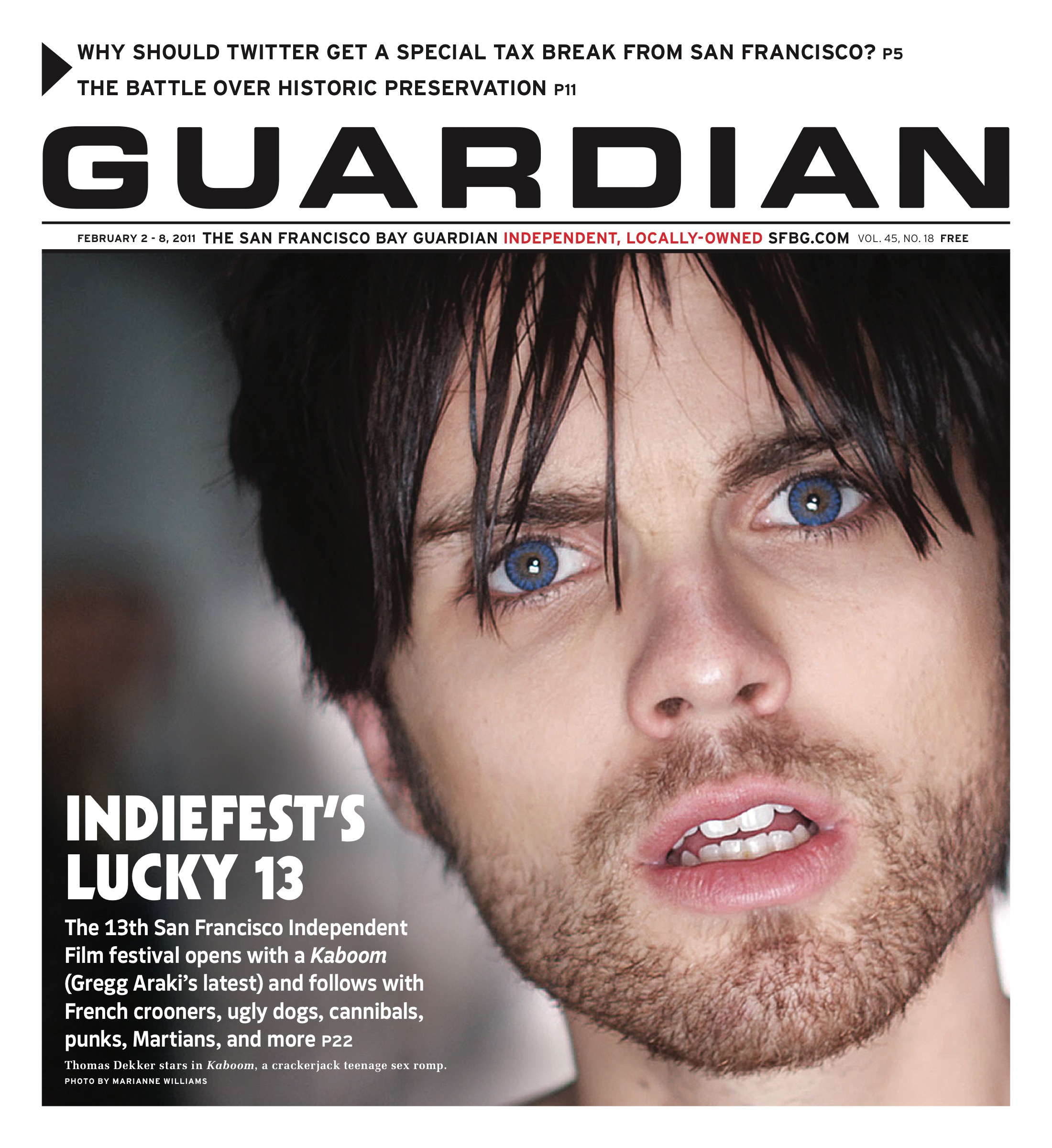
The 13th SF Independent Film Festival runs Feb 3-17 at the Roxie Theater, 3117 16th St, SF, and the Victoria, 2961 16th St, SF. Tickets (most shows $11) available at www.sfindie.com or by calling 1-800-838-3006.
WED/9
Roxie Special Treatment 7. The Evangelist 7. Worst in Show 9:15. Machete Maidens Unleashed! 9:15.
THURS/10
Roxie RU There 7. The Happy Poet 7. “The Sight of Music” (shorts program) 9:15. Gabi On the Roof 9:15.
FRI/11
Roxie Bloodied But Unbowed 7. The Singularity is Near 7. Machotraildrop 9:15. The Beast Pageant 9:15. Machotaildrop 11:30. The Trashmaster 11:30.
SAT/12
Roxie Toumast: Guitars and Kalashnikovs 2:30. The Beast Pageant 2:30. Corpusse: Surrender to the Passion 4:45. Je T’aime I Love You Terminal 4:45. RU There 7. Superstonic: The Rebel Dread 7. Fuerteventura 9:15. “The End of Love As We Know It” (shorts program) 9:15. Nude Nuns With Big Guns 11:30.
Victoria “When Peaches Met Chucky:” Seed of Chucky 8.
SUN/13
Roxie Worst in Show 2:30. The Singularity is Near 2:30. Food Stamped 4:45. The Trashmaster 4:45. The Sentinel 7. Engine Slayer 7. “Not Your Average Kids’ Show” (shorts program) 7. The Last Circus 9:15. Free Radicals 9:15.
MON/14
Roxie “The End of Love As We Know It” (shorts program) 7. Bloodied But Unbowed 7. “Love Bites: Power Ballad Sing-a-long” 9:15. Je T’aime I Love You Terminal 9:15.
TUES/15
Roxie Food Stamped 7. “Not Your Average Kids’ Show” (shorts program) 7. Fuerteventura 9:15. Corpusse: Surrender to the Passion 9:15.
OPENING
*Cedar Rapids See “Beige to the Bone.” (1:26) Metreon.
Come Undone SFFS Screen presents this Italian import about marital strife in Milan. (2:04) Sundance Kabuki.
The Eagle The mysterious fate of Rome’s Ninth Legion is all the rage lately — well, so sayeth the wee handful of people who caught Neil Marshall’s Centurion last year. For all who missed that flawed if worthy release, The Eagle arrives with a bigger budget and a bigger-name cast to puzzle out exactly what happened when thousands of Roman soldiers marched into what’s now Scotland, circa 120 AD, and never returned. The Eagle‘s Kevin Macdonald (2006’s The Last King of Scotland) bases his film on Rosemary Sutcliff’s popular children’s book, The Eagle of the Ninth, but the theory advanced here resembles Centurion‘s: the army was wiped out by hostile (and occasionally body-painted) natives. Much of The Eagle takes place decades after the disappearance, with the son of a Roman commander (Channing Tatum) scuttling past Hadrian’s Wall to seek truth, clear his family name, and reclaim a highly symbolic bronze eagle. Providing muscle and street smarts (or whatever the equivalent — backwoods smarts?) is slave Jamie Bell. The Eagle is handsomely shot, with some semi-thrilling PG-13 battle scenes, and any spin on Unsolved Mysteries: The Ninth Legion can’t really suck outright. But while Tatum has clearly clocked in the gym time to embody a Roman soldier, he doesn’t possess nearly enough depth (or any interesting qualities whatsoever) to play a character who supposedly has a lot of big emotions to work through. Bell does what he can with his sidekick role, short of performing CPR on his pulse-free costar, but it ain’t enough. Was Vin Diesel unavailable, or what? (1:54) (Eddy)
Gnomeo and Juliet If you willingly see a movie titled Gnomeo and Juliet, you probably have a keen sense of what you’re in for. And as long as that’s the case, it’s hard not to get sucked into the film’s 3D gnome-infested world. Believe it or not, this is actually a serviceable adaptation of Shakespeare’s classic — minus the whole double-suicide downer ending. But at least the movie is conscious of its source material, throwing in several references to other Shakespeare plays and even having the Bard himself (or, OK, a bronze statue) comment on the proceedings. It helps that the cast is populated by actors who could hold their own in a more traditional Shakespearean context: James McAvoy, Emily Blunt, Maggie Smith, and Michael Caine. But Gnomeo and Juliet isn’t perfect — not because of its outlandish concept, but due to a serious overabundance of Elton John. The film’s songwriter and producer couldn’t resist inserting himself into every other scene. Aside from the final “Crocodile Rock” dance number, it’s actually pretty distracting. (1:24) Presidio. (Peitzman)
Just Go With It Adam Sandler, Jennifer Aniston, and Sports Illustrated model Brooklyn Decker’s bikini body star in this rom-com. (1:56) Marina.
Justin Bieber: Never Say Never 3D Blame Canada. (1:45)
Outside the Law Three brothers fight for Algeria’s independence from France in this drama, recently nominated for Best Foreign Language Film. (2:18) Embarcadero.
“2011 Academy Award-Nominated Short Films, Live-Action and Animated” Increase your chances of winning the Oscar pool by sussing out the competition in the short-film categories, presented in two separate-admission engagements. (Live-action, 1:50; animated, 1:25). Lumiere, Opera Plaza.
ONGOING
All’s Well Ends Well 2011 and I Love Hong Kong (1:40) Four Star.
*Another Year Mike Leigh’s latest represents a particularly affecting entry among his many improv-based, lives-of-everyday-Brits films. More loosely structured than 2008’s Happy-Go-Lucky, which featured a clear lead character with a well-defined storyline, the aptly-titled Another Year follows a year in the life of a group of friends and acquaintances, anchored by married couple Tom (Jim Broadbent) and Gerri (Ruth Sheen). Tom and Gerri are happily settled into middle-class middle age, with a grown son (Oliver Maltman) who adores them. So far, doesn’t really sound like there’ll be much Leigh-style heightened emotion spewing off the screen, traumatizing all in attendance, right? Well, you haven’t met the rest of the ensemble: there’s a sad-sack small-town widower, a sad-sack overweight drunk, a near-suicidal wife and mother (embodied in one perfect, bitter scene by Imelda Staunton), and Gerri’s work colleague Mary, played with a breathtaking lack of vanity by Lesley Manville. At first Mary seems to be a particularly shrill take on the clichéd unlucky-in-love fiftysomething woman — think an unglamorous Sex in the City gal, except with a few more years and far less disposable income. But Manville adds layers of depth to the pitiful, fragile, blundering Mary; she seems real, which makes her hard to watch at times. That said, anyone would be hard-pressed to look away from Manville’s wrenching performance. (2:09) Albany, Embarcadero. (Eddy)
Barney’s Version The charm of this shambling take on Mordecai Richler’s 1997 novel lies almost completely in the hang-dog peepers of star Paul Giamatti. Where would Barney’s Version be without him and his warts-and-all portrayal of lovable, fallible striver Barney Panofsky — son of a cop (Dustin Hoffman), cheesy TV man, romantic prone to falling in love on his wedding day, curmudgeon given to tying on a few at a bar appropriately named Grumpy’s, and friend and benefactor to the hard-partying and pseudo-talented Boogie (Scott Speedman). So much depends on the many nuances of feeling flickering across Giamatti’s pale, moon-like visage. Otherwise Barney’s Version sprawls, carries on, and stumbles over the many cute characters we don’t give a damn about — from Minnie Driver’s borderline-offensive JAP of a Panofsky second wife to Bruce Greenwood’s romantic rival for Barney’s third wife Miriam (Rosamund Pike). A mini-who’s who of Canadian directors surface in cameos — including Denys Arcand, David Cronenberg, and Atom Egoyan — as a testament to the respect Richler commands. Too bad director Richard J. Lewis didn’t get a few tips on dramatic rigor from Cronenberg or intelligent editing from Egoyan — as hard as it tries, Barney’s Version never rises from a mawkish middle ground. (2:12) Embarcadero, Shattuck, Sundance Kabuki. (Chun)
Biutiful Uxbal (Javier Bardem) has problems. To name but a few: he is raising two young children alone in a poor, crime-beset Barcelona hood. He is making occasional attempts to rope back in their bipolar, substance-abusive mother (Maricel Álvarez), a mission without much hope. He is trying to stay afloat by various not-quite legal means while hopefully doing the right thing by the illegals — African street drug dealers and Chinese sweatshop workers — he acts as middleman to, standing between them and much less sympathetically-inclined bossmen. He’s got a ne’er-do-well brother (Eduard Fernandez) to cope with. Needless to say, with all this going on (and more), he isn’t getting much rest. But when he wearily checks in with a doc, the proverbial last straw is stacked on his camelback: surprise, you have terminal cancer. With umpteen odds already stacked against him in everyday life, Uxbal must now put all affairs in order before he is no longer part of the equation. This is Alejandro González Iñárritu’s first feature since an acrimonious creative split with scenarist Guillermo Arriaga. Their films together (2006’s Babel, 2003’s 21 Grams, 2000’s Amores Perros) have been criticized for arbitrarily slamming together separate baleful storylines in an attempt at universal profundity. But they worked better than Biutiful, which takes the opposite tact of trying to fit several stand-alone stories’ worth of hardship into one continuous narrative — worse, onto the bowed shoulders of one character. Bardem is excellent as usual, but for all their assured craftsmanship and intense moments, these two and a half hours collapse from the weight of so much contrived suffering. Rather than making a universal statement about humanity in crisis, Iñárritu has made a high-end soap opera teetering on the verge of empathy porn. (2:18) California, SF Center, Sundance Kabuki. (Harvey)
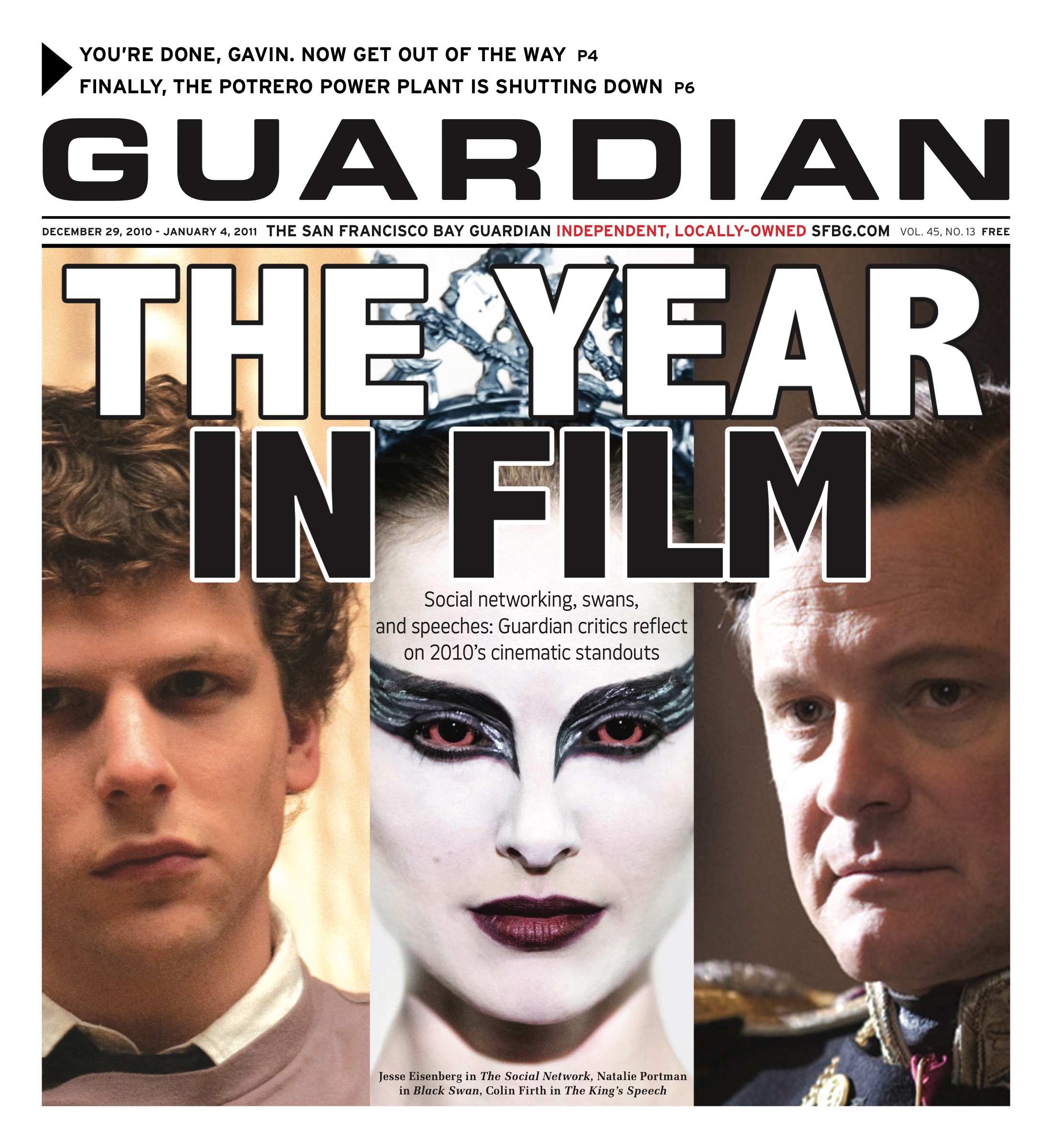
*Black Swan “Lose yourself,” ballet company head Thomas (Vincent Cassel) whispers to his leading lady, Nina (Natalie Portman), moments before she takes the stage. But Nina is already consumed with trying to find herself, and rarely has a journey of self-discovery been so unsettling. Set in New York City’s catty, competitive ballet world, Black Swan samples from earlier dance films (notably 1948’s The Red Shoes, but also 1977’s Suspiria, with a smidgen of 1995’s Showgirls), though director Darren Aronofsky is nothing if not his own visionary. Black Swan resembles his 2008 The Wrestler somewhat thematically, with its focus on the anguish of an athlete under ten tons of pressure, but it’s a stylistic 180. Gone is the gritty, stripped-down aesthetic used to depict a sad-sack strongman. Like Dario Argento’s 1977 horror fantasy, the gory, elegantly choreographed Black Swan is set in a hyper-constructed world, with stabbingly obvious color palettes (literally, white = good; black = evil) and dozens of mirrors emphasizing (over and over again) the film’s doppelgänger obsession. As Nina, Portman gives her most dynamic performance to date. In addition to the thespian fireworks required while playing a goin’-batshit character, she also nails the role’s considerable athletic demands. (1:50) California, Empire, 1000 Van Ness, Piedmont, Presidio, Sundance Kabuki. (Eddy)
*Blue Valentine Sometimes a performance stands out and grabs attention for embodying a particular personality type or emotional state that’s instantly familiar yet infrequently explored in much depth at the movies. What’s most striking about Derek Cianfrance’s Blue Valentine is the primary focus it lends Michelle Williams’ role as the more disgruntled half of a marriage that’s on its last legs whether the other half knows that or not. Ryan Gosling has the showier part — his Dean is mercurial, childish, more prone to both anger and delight, a babbler who tries to control situations by motor-mouthing or goofing through them. But Williams’ Cindy has reached the point where all his sound and fury can no longer pass as anything but static that must be tuned out as much as possible so that things get done. Things like parenting, going to work, getting the bills paid, and so forth. It’s taken a few years for Cindy to realize that she’s losing ground in her lifelong battle for self-improvement with every exasperating minute she continues to tolerate him. Williams’ bile-swallowing silences and the involuntary recoil that greets Dean’s attempts to touch Cindy are the film’s central emotional color: that state in which the loyalty, obligation, fear, pity, or whatever has kept you tied to a failing relationship is being whittled away by growing revulsion. Gosling’s excellent stab at an underwritten part is at a disadvantage compared to Williams, who just about burns a hole through the screen. (1:53) 1000 Van Ness, SF Center, Shattuck, Sundance Kabuki. (Harvey)
*The Company Men Globalization, recession, and the stockholder-driven bottom line are wreaking havoc on business as usual at GTX, a Boston-based veteran manufacturer of shipping containers. CEO James Salinger (Craig T. Nelson) is coolly unconcerned about deep workforce cuts that preserve his fabulous wealth. But co-founder Gene (Tommy Lee Jones), who was not born with the proverbial silver spoon, is appalled by this willingness to sacrifice jobs for high-end investor wealth. (Nonetheless this doesn’t stop Gene from having as his mistress GTX fiscal hatchet-woman Maria Bello, whose part is the script’s weakest element.) His protests do nothing to halt the grim progression of layoffs — which next strike cocky young sales whiz Bobby (Ben Affleck), who’s furiously unable to cope with this blow to his inflated ego despite the levelheaded support of wife Maggie (Rosemarie DeWitt). Even worse equipped for change is 30-year company drone Phil (Chris Cooper), who’s too old to start again in a market where ruthless downsizing allows considerable ageism. With mortgages, college educations, country club memberships (ya gotta network somewhere), and so forth on the line, the protagonists here run the gamut of distressed emotions in coping with their suddenly reduced economic circumstances. TV-famed producer (ER, The West Wing) John Wells’ debut as feature writer director is a white-collar Arthur Miller update, earnest, meaty, and intelligent if unfashionably literal-minded about middle-to-upper-class angst. It’s engrossing for the most part, affording excellent dramatic opportunities to the estimable Jones, Cooper, and yes Ben Affleck — now that the latter is a respected director himself, you are officially granted permission to allow that he can act. If only this solid albeit unremarkable effort didn’t compromise itself with an ending phoned in by the Make A-Wish Foundation after nearly two hours of sober real-world credence. (1:53) 1000 Van Ness, Opera Plaza. (Harvey)
The Dilemma A dilemma: being stuck with two terrible options, say, having to watch a Vince Vaughn movie (that isn’t 1996’s Swingers) or an episode of the King of Queens, starring Kevin James. With Ron Howard’s The Dilemma, you don’t have to choose. Middle American dreams come true by pairing two actors who define undeserving success. The film plays like an extended episode of a CBS sitcom, complete with the timeless trope of average-looking guys coupled with stunning women. However, like James, some things don’t make the transition to the big screen very well, as Howard illustrates perfectly in an intimate scene by contrasting the faces of Vaughn and actress Jennifer Connelly via extreme close-up. The plot? Ronny (Vaughn) catches Geneva (Winona Ryder) cheating on his BFF (James), but can’t tell because they are working on an important project: developing an electric car that’s not “gay.” (Seriously.) Not quite a dilemma, cheap complications prolong the film to the point that you’ll scream for Vaughn to confess and start the credits. (1:58) 1000 Van Ness, SF Center. (Ryan Prendiville)
The Fighter Once enough of a contenda to have fought Sugar Ray Leonard — and won, though there are lingering questions about that verdict’s justice — Dicky (Christian Bale) is now a washed-up, crack-addicted mess whose hopes for a comeback seem just another expression of empty braggadocio. Ergo it has fallen to the younger brother he’s supposedly “training,” Micky (Mark Wahlberg), to endure the “managerial” expertise of their smothering-bullying ma (Melissa Leo) and float their large girl gang family of trigger-tempered sisters. That’s made even worse by the fact that they’ve gotten him nothing but chump fights in which he’s matched someone above his weight and skill class in order to boost the other boxer’s ranking. When Micky meets Charlene (Amy Adams), an ambitious type despite her current job as a bartender, this hardboiled new girlfriend insists the only way he can really get ahead is by ditching bad influences — meaning mom and Dicky, who take this shutout as a declaration of war. The fact-based script and David O. Russell’s direction do a good job lending grit and humor to what’s essentially a 1930s Warner Brothers melodrama — the kind that might have had Pat O’Brien as the “good” brother and James Cagney as the ne’er-do-well one who redeems himself by fadeout. Even if things do get increasingly formulaic (less 1980’s Raging Bull and more 1976’s Rocky), the memorable performances by Bale (going skeletal once again), Wahlberg (a limited actor ideally cast) and Leo (excellent as usual in an atypically brassy role) make this more than worthwhile. As for Adams, she’s just fine — but by now it’s hard to forget the too many cutesy parts she’s been typecast in since 2005’s Junebug. (1:54) Presidio, 1000 Van Ness, SF Center, Sundance Kabuki. (Harvey)
*The Green Hornet I still don’t understand why this movie had to be in 3D, or what Cameron Diaz’s character has to do with anything, but I liked The Green Hornet in spite of myself. Only in Hollywood could artsy director Michel Gondry hook up with self-satisfied comedian Seth Rogen, who stars in and co-wrote this surprisingly amusing (if knowingly lightweight) superhero entry. After the death of his father (a megarich newspaper owner — how retro!), Rogen’s party boy Britt Reid decides, either out of boredom or misdirected rebellion, to become an anti-crime vigilante only pretending to be a criminal. (And that’s about as complicated as this movie gets.) Helping him, which is to say creating all of the cool cars and gadgets and single-handedly winning all of the fist fights, is Kato (Taiwanese actor Jay Chou, taking over the role Bruce Lee made famous). As himself, Reid is so obnoxious he pisses off newspaper editor Axford (Edward James Olmos); as the Hornet, he’s so obnoxious he pisses off actual crime boss Chudnofsky, played by movie highlight Christoph Waltz — more or less doing a Eurotrash twist on his Oscar-winning Inglourious Basterds (2009) Nazi. (1:29) 1000 Van Ness, SF Center. (Eddy)
*Housemaid One of the most famous Korean films of its era — and notorious for its near-horror catalog of shocking behaviors — Kim Ki-young’s original 1960 The Housemaid took a caustic view of the new middle class emerging in a nation still crawling out from under the wreckage of war. Im Sang-soo’s extremely loose new remake — more of a complete rethink — focuses on titular figure Eun-yi (Jeon Do-yeon) , a simple soul who can’t believe her luck at first in finding a job cleaning what might easily be mistaken for a royal palace. But all this changes when Eun-yi lets herself be seduced by her employer and gets pregnant, to the fury of his wife. This triggers a series of acts that grow to encompass near-fatal “accidents,” poisonings, and lines like “How could that bastard do this to me? With the bitch who washes my underwear?!?” Even farther from genre horror that its predecessor, this Housemaid is a glacially reserved black comedy that regards its characters as figures in a gorgeously expensive Architectural Digest landscape. As such it’s witty and entertaining until the very end, when the urge to go overboard can no longer be resisted (apparently), and an unconvincing final atrocity is followed by some sort of dream sequence that simply, ham-fistedly underlines what we already knew: the filthy rich are, well, in need of a moral wash. (1:46) Lumiere, Shattuck. (Harvey)
*The Illusionist Now you see Jacques Tati and now you don’t. With The Illusionist, aficionados yearning for another gem from Tati will get a sweet, satisfying taste of the maestro’s sensibility, inextricably blended with the distinctively hand-drawn animation of Sylvain Chomet (2004’s The Triplets of Belleville). Tati wrote the script between 1956 and 1959 — a loving sendoff from a father to a daughter heading toward selfhood — and after reading it in 2003 Chomet decided to adapt it, bringing the essentially silent film to life with 2D animation that’s as old school as Tati’s ambivalent longing for bygone days. The title character should be familiar to fans of Monsieur Hulot: the illusionist is a bemused artifact of another age, soon to be phased out with the rise of rock ‘n’ rollers. He drags his ornery rabbit and worn bag of tricks from one ragged hall to another, each more far-flung than the last, until he meets a little cleaning girl on a remote Scottish island. Enthralled by his tricks and grateful for his kindness, she follows him to Edinburgh and keeps house while the magician works the local theater and takes on odd jobs in an attempt to keep her in pretty clothes, until she discovers life beyond their small circle of fading vaudevillians. Chomet hews closely to bittersweet tone of Tati’s films — and though some controversy has dogged the production (Tati’s illegitimate, estranged daughter Helga Marie-Jeanne Schiel claimed to be the true inspiration for The Illusionist, rather than daughter and cinematic collaborator Sophie Tatischeff) and Chomet neglects to fully detail a few plot turns, the dialogue-free script does add an intriguing ambiguity to the illusionist and his charge’s relationship — are they playing at being father and daughter or husband and wife? — and an otherwise straightforward, albeit poignant tale. (1:20) Clay, Shattuck, Smith Rafael. (Chun)
Inside Job Inside Job is director Charles Ferguson’s second investigative documentary after his 2007 analysis of the Iraq War, No End in Sight, but it feels more like the follow-up to Alex Gibney’s Enron: The Smartest Guys in the Room (2005). Keeping with the law of sequels, more shit blows up the second time around. As with No End in Sight, Ferguson adeptly packages a broad overview of complex events in two hours, respecting the audience’s intelligence while making sure to explain securities exchanges, derivatives, and leveraging laws in clear English (doubly important when so many Wall Street executives hide behind the intricacy of markets). The revolving door between banks, government, and academia is the key to Inside Job‘s account of financial deregulation. At times borrowing heist-film conventions (it is called Inside Job, after all), Ferguson keeps the primary players in view throughout his history so that the eventual meltdown seems anything but an accident. The filmmaker’s relentless focus on the insiders isn’t foolproof; tarring Ben Bernanke, Henry Paulson, and Timothy Geithner as “made” guys, for example, isn’t a substitute for evaluating their varied performances over the last two years. Inside Job makes it seem that the entire crisis was caused by the financial sector’s bad behavior, and this too is reductive. Furthermore, Ferguson does not come to terms with the politicized nature of the economic fallout. In Inside Job, there are only two kinds of people: those who get it and those who refuse to. The political reality is considerably more contentious. (2:00) Lumiere, Shattuck. (Goldberg)
*Ip Man 2: Legend of the Grandmaster There’s an ounce of irony that the Wing Chun master who ended up popularizing martial arts throughout the world by way of his most famous pupil, Bruce Lee, would still be the subject of contention (see dueling biopics like Wong Kar-wai’s forthcoming The Grandmasters) and the center of passionate nationalism. In 2008’s Ip Man, the modest master (Donnie Yen) pit his considerable skills against the karate of the invading Japanese army, and here, in ’50s Hong Kong, he tests his skills against the British colonists’ boxing champion. Imperial villainy is painted in broad strokes, but that’s the only predictable stumble in this otherwise step-above effort, with its handsome, sepia-toned art direction and its martial arts choreography by Sammo Hung. As 2 opens, the noble Ip Man has survived the tribulations of WWII only to find himself tussling with rival martial arts groups in rough-and-tumble HK in his efforts to start a Wing Chun school. His most formidable opponent is the powerful master Hung Chun-nam (Hung, who threatens to steal scenes from an earnest if adept Yen), until the two are finally brought together by shared Chinese family values in the ugly face of colonial injustice. The focus of this sequel, once pegged to Ip Man and Lee’s relationship, shifted when director Wilson Yip and company failed to finalize film rights with the star’s descendants, yet much like its near-saintly subject, Ip Man 2 succeeds despite all obstacles. (1:48) Shattuck. (Chun)
The King’s Speech Films like The King’s Speech have filled a certain notion of “prestige” cinema since the 1910s: historical themes, fully-clothed romance, high dramatics, star turns, a little political intrigue, sumptuous dress, and a vicarious taste of how the fabulously rich, famous, and powerful once lived. At its best, this so-called Masterpiece Theatre moviemaking can transcend formula — at its less-than-best, however, these movies sell complacency, in both style and content. In The King’s Speech, Colin Firth plays King George VI, forced onto the throne his favored older brother Edward abandoned. This was especially traumatic because George’s severe stammer made public address tortuous. Enter matey Australian émigré Lionel Logue (Geoffrey Rush, mercifully controlled), a speech therapist whose unconventional methods include insisting his royal client treat him as an equal. This ultimately frees not only the king’s tongue, but his heart — you see, he’s never had anyone before to confide in that daddy (Michael Gambon as George V) didn’t love him enough. Aww. David Seidler’s conventionally inspirational script and BBC miniseries veteran Tom Hooper’s direction deliver the expected goods — dignity on wry, wee orgasms of aesthetic tastefulness, much stiff-upper-lippage — at a stately promenade pace. Firth, so good in the uneven A Single Man last year, is perfect in this rock-steadier vehicle. Yet he never surprises us; role, actor, and movie are on a leash tight enough to limit airflow. (1:58) Albany, Embarcadero, Empire, Marina, 1000 Van Ness, Piedmont, Sundance Kabuki. (Harvey)
The Mechanic Apparently The Mechanic is a remake of 1972 film starring Charles Bronson, but that’s kind of beside the point. This is simply another vehicle for Jason Statham to shoot people, set off big explosions, and make straight men feel sexually confused. And there’s really nothing wrong with that, as long as you know what you’re in for. Statham plays expert assassin Arthur Bishop, who is forced to train Steve McKenna (Ben Foster) in the fine art of killing. There’s really not much more to it than that. The Mechanic does exactly what it needs to, getting louder and bloodier with each passing minute. Statham is really just playing himself at this point — and he’s damn good at it. Foster isn’t bad at stepping into action flick shoes, although he never quite reaches Statham’s testosterone-drenched heights. If you’re looking for any modicum of complexity, The Mechanic is not your best bet. Otherwise, sit back, shut off your brain, and enjoy. (1:40) 1000 Van Ness, SF Center. (Peitzman)
No Strings Attached The worst thing about No Strings Attached is its advertising campaign. An eyeroll-worthy tagline — “Can sex friends stay best friends?” distracts from the fact that this is a sharp and satisfying romantic comedy. Perhaps it’s not the most likely follow-up to Black Swan (2010), but Natalie Portman is predictably charming, and Ashton Kutcher proves he’s leading man material after all. They’re aided by an exceptional supporting cast, including indie darlings Greta Gerwig and Olivia Thirlby, and underrated comic actors Lake Bell and Mindy Kaling. No Strings Attached is a welcome return to form from director Ivan Reitman, who gave us classics like Ghostbusters (1984) before tainting his image with Six Days Seven Nights (1998) and My Super Ex-Girlfriend (2006). There are likely going to be many who will dismiss Reitman’s latest out of hand — and with those misleading trailers and posters, it’s hard to blame them. But I advise you to give No Strings Attached a chance: at the very least, it’ll counter the image of Portman tearing at a stubborn hangnail. (1:50) 1000 Van Ness, Presidio. (Peitzman)
*Nuremberg: Its Lesson For Today “We will show you their films&ldots;” So said Justice Robert Jackson during his opening remarks at Nuremberg, setting the stage not only for the historic prosecution but also for film history. After so much subsequent repackaging, it’s bracing being returned to this initial use of the Nazi archive as hard evidence in Nuremberg: Its Lessons for Today, the documentary produced by Pare Lorentz and the Schulberg brothers for the Office of Strategic Services in 1948. Though it screened widely in postwar Germany, Nuremberg never made it to American screens — one wonders whether the film’s vision of US-USSR cooperation wasn’t as much a stumbling block as its images of atrocities. While Nuremberg won’t soon replace Eichmann in Jerusalem as a probing account of the war tribunals, this crisp restoration remains a fascinating document of the moral condemnation of Nazi Germany in formation. Modern viewers may be surprised, for instance, by how long it takes before the Holocaust (still not called by that name, of course) is invoked. History casts a withering eye on Russian and American prosecutors denouncing military aggressions and needless civilian deaths, but one is nonetheless struck and even moved by what Nuremberg represents — specifically, the need to give a rational account of the terms of the peace, and to begin remembering. As with all the films produced by Lorenz, Nuremberg benefits from great rhetorical economy and fluid pacing. Now one only wishes that John Huston’s 1946 Let There Be Light — a harrowing postwar document of mentally disturbed veterans also produced for (and then suppressed by) the Army — would receive the same treatment. (1:18) Shattuck. (Goldberg)
127 Hours After the large-scale, Oscar-draped triumph of 2008’s Slumdog Millionaire, 127 Hours might seem starkly minimalist — if director Danny Boyle weren’t allergic to such terms. Based on Aron Ralston’s memoir Between a Rock and a Hard Place, it’s a tale defined by tight quarters, minimal “action,” and maximum peril: man gets pinned by rock in the middle of nowhere, must somehow free himself or die. More precisely, in 2003 experienced trekker Ralston biked and hiked into Utah’s Blue John Canyon, falling into a crevasse when a boulder gave way under his feet. He landed unharmed … save a right arm pinioned by a rock too securely wedged, solid, and heavy to budge. He’d told no one where he’d gone for the weekend; dehydration death was far more likely than being found. For those few who haven’t heard how he escaped this predicament, suffice it to say the solution was uniquely unpleasant enough to make the national news (and launch a motivational-speaking career). Opinions vary about the book. It’s well written, an undeniably amazing story, but some folks just don’t like him. Still, subject and interpreter match up better than one might expect, mostly because there are lengthy periods when the film simply has to let James Franco, as Ralston, command our full attention. This actor, who has reached the verge of major stardom as a chameleon rather than a personality, has no trouble making Ralston’s plight sympathetic, alarming, poignant, and funny by turns. His protagonist is good-natured, self-deprecating, not tangibly deep but incredibly resourceful. Probably just like the real-life Ralston, only a tad more appealing, less legend-in-his-own-mind — a typical movie cheat to be grateful for here. (1:30) Four Star. (Harvey)
*Rabbit Hole If Rabbit Hole doesn’t sound like the kind of movie you’d want to watch, I don’t blame you. Following the lives of a married couple dealing with the loss of their young son, the film sounds a lot like the kind of Lifetime movie you accidentally spend a hung over Sunday sniffling through. But Rabbit Hole is a smart, complex addition to the genre, with exceptional performances from leads Nicole Kidman (Becca) and Aaron Eckhart (Howie), and a script by David Lindsay-Abaire, adapting his Pulitzer Prize-winning play. Director John Cameron Mitchell infuses Rabbit Hole with his trademark dark humor, creating a film that understands the serious toll grief takes but isn’t afraid to step back and laugh at life, too. Special attention must also be paid to the supporting cast, including Dianne Wiest as Becca’s mother, and newcomer Miles Teller as Jason. Explaining Jason’s role would be giving away too much — it’s enough to say that his presence is part of what elevates Rabbit Hole from grief porn to one of this year’s best. (1:32) Lumiere. (Peitzman)
The Rite There are times when The Rite crosses the threshold from bad-bad to good-bad — bits of overacting and absurdity that almost launch the film into potential cult classic territory. Sadly, those moments only occur after an hour of the bad kind of boring: by the time you get to Anthony Hopkins’ most ludicrous performance to date, you’re kind of just wishing The Rite would exorcise itself. The story is a near carbon copy of The Exorcist (1973), though as is the case with many films in the genre, The Rite feels that by acknowledging the clichés, it can continue to use them. Colin O’Donaghue plays Michael Kovak, a soon-to-be-priest dabbling in atheism. Hopkins is Father Lucas, the seasoned exorcism expert who takes Michael under his wing. You can figure out the rest. The Rite could have been a fun movie — the moment in which Father Lucas answers his cell phone during an exorcism gave me some hope — but ultimately the film takes itself too seriously. It is inspired by true events, after all. (1:47) 1000 Van Ness, Shattuck. (Peitzman)
The Roommate (1:33) 1000 Van Ness.
Sanctum An underwater thriller bankrolled by James Cameron, filmed using techniques developed for Avatar (2009), Sanctum is 3D like that blockbuster, and thoroughly two-dimensional. As a storm approaches, explorers are deep inside Papua New Guinea’s geological anus. Before you can say “What could possible go wrong, diving in caves?” (which a character actually does, in full Cameron-esque wank mode), everything floods and the fight for survival starts. A secondary plot concerns tension between a young diver (Rhys Wakefield) and his overbearing, tough-as-nails pro-explorer father (Richard Roxburgh), but this is a movie to watch to see who lives rather than reconciles. To its credit, the danger is mostly handled with a face smashing, drowning brutality rather than drawn-out melodrama (although Ioan Gruffudd gives a characteristically cheesy performance as a clichéd tycoon). Sanctum is at it’s best when submerged (and no one’s talking) but the atmosphere is generally robbed by David Hirschfelder’s unnecessary orchestra score. (1:43) 1000 Van Ness. (Prendiville)
*The Social Network David Fincher’s The Social Network is a gripping and entertaining account of how Facebook came to take over the known social-networking universe. In this version of events — scripted by Aaron Sorkin and based on Ben Mezrich’s book The Accidental Billionaires, in turn based substantially on interviews with FB cofounder Eduardo Saverin, with input from Mark Zuckerberg icily absent — a girlfriend’s dumping of Zuckerberg (Jesse Eisenberg) on a crisp evening in 2003 is the impetus in his headlong quest for a “big idea.” The film is structured around the conference-room depositions for two separate lawsuits, brought against Zuckerberg by Saverin (Andrew Garfield) and by fellow Harvard entrepreneurs Tyler and Cameron Winklevoss (Armie Hammer) and Divya Narendra (Max Minghella) for crimes involving intellectual property and vast scads of retributive money. Unless Zuckerberg decides to post it on Facebook (which he probably shouldn’t, given the nondisclosure vows that capped off the first round of lawsuits), we’ll never know what truly motivated him and how badly he screwed over his friends and fellow students. But Fincher and Sorkin have crafted a compelling, absorbing, and occasionally poignant tale of how it could have happened. (2:00) Bridge, Piedmont, Shattuck. (Rapoport)
Somewhere A lonely Ferrari zooms around a deserted track, over and over and over again. The opening scene of Sofia Coppola’s latest, Somewhere, is such an obvious metaphor that at first I thought the director was joking. Actually, she’s not: Somewhere is indeed a repetitous movie about a very boring, very ennui-laden individual, who happens to be a movie star with the marquee-ready name of Johnny Marco (Stephen Dorff). Now that you’ve been smacked over the head with metaphor, feel free to play spot the subtext: Johnny lives at Sunset Boulevard haunt the Chateau Marmont, legendary for its often-behaving-badly celebrity clientele. His life is an endless progression of blah (wake up, smoke, pop a Propecia, eyefuck and fuck random female admirers), broken up by job obligations — the tedium of a press conference here, the drudgery of a visit to the special-effects make-up studio there. Sigh. Would any director not as privileged as Coppola dare to focus on a character whose massive wealth can’t at all assuage his existential crisis? Money may not buy happiness, but it’s kind of hard to feel sorry for a guy whose depression plays out as he floats the day away at a luxury hotel. Fortunately, there is a bright spot in all this: mostly-absentee dad Johnny has a kid, Cleo, a tween sprite played by the charming Elle Fanning. Cleo is the only meaningful thing in Johnny’s life, and the only interesting thing that happens in this glacially-paced, bellybutton-obsessed movie. (1:38) SF Center. (Eddy)
*The Time That Remains Filmmaker Elia Suleiman has achieved the seemingly unimaginable: an impish, insightful comedy about the everyday life of a Palestinian family and its Nazareth neighborhood, from 1948, and the creation of Israel, through today. Borrowing some of the elegant, eloquent long-shot compositions of Jacques Tati, as well as the French legend’s bemused, ever-amused long-view perspective on modern life, Suleiman doesn’t shy away from the injustices suffered by the Palestinians. The forbidding shadows cast by Israeli tanks and patrolling soldiers loom over everything undertaken by the Suleiman clan and their community — a family meal, a dance party, nighttime fishing, a work errand that ends with an act of life-saving courage. In their at-times-zenlike, at-times-unpredictable responses to their understandably untenable situation, the Suleimans start to seem like the unlikely, impassive distant relatives of the zany, exploding familia in Pedro Almodóvar’s What Have I Done to Deserve This? (1984). As Suleiman’s decent, resistant father is tortured and harassed and his mother pens letters to relatives in exile, it’s easy to picture this family, much like Almodóvar’s post-Franco clan, as one on the verge of a perpetual nervous breakdown. Instead, they rise above, getting a black-humored bird’s eye view of, say, a man taking out the garbage in the sights of a tank gun, with Suleiman bringing a very real, extraordinary poetry to each vignette about life under pressure. (1:49) Sundance Kabuki. (Chun)
Tron: Legacy A rare sequel among remakes, Tron: Legacy remains true to the 1982 nerd cult classic: it’s essentially a silly movie about being transported into a computer world where everyone dresses in rave couture. Jeff Bridges returns, now in opposing roles. On one side he’s computer genius Kevin Flynn, bearded zen master, and across the uncanny valley he’s CLU, an ageless software lord. Flynn’s been stuck in the Matri…er…Grid for decades, as CLU followed his programming to its logical conclusion: genocide. This is a bit too heavy of a theme for a film where almost every character gets blown to bytes upon introduction (cough, Michael Sheen, cough) but the light cycles and death pong are really cool in 3D. The plot, when it’s not setting up Disney’s inevitable sequels (hello, pointless Cillian Murphy) is Star Wars (1977), except Obi-wan Lebowski is the father. The son is Sam (Garrett Hedlund), whose good looks, penchant for extreme sports, and vacuous personality are the perfect avatar for our geek fantasy, where women strip us bare and are sexy guard dogs (Olivia Wilde.) While not passing the Bechdel Test, the film may be worth admission to hear the Dude’s Jedi utter “It’s biodigital jazz, man!” Look out for a special cameo by Daft Punk, playing hits from its score, which sounds like Kraftwerk mixing Vangelis and Danny Elfman. They’ll be the ones wearing helmets. No, the other ones. (2:05) 1000 Van Ness. (Prendiville)
*True Grit Jeff Bridges fans, resist the urge to see your Dude in computer-trippy 3D and make True Grit your holiday movie of choice. Directors Ethan and Joel Coen revisit (with characteristic oddball touches) the 1968 Charles Portis novel that already spawned a now-classic 1969 film, which earned John Wayne an Oscar for his turn as gruff U.S. Marshall Rooster Cogburn. (The all-star cast also included Dennis Hopper, Glen Campbell, Robert Duvall, and Strother Martin.) Into Wayne’s ten-gallon shoes steps an exceptionally crusty Bridges, whose banter with rival bounty hunter La Boeuf (a spot-on Matt Damon) and relationship with young Mattie Ross (poised newcomer Hailee Steinfeld) — who hires him to find the man who killed her father — likely won’t win the recently Oscar’d actor another statuette, but that doesn’t mean True Grit isn’t thoroughly entertaining. Josh Brolin and a barely-recognizable Barry Pepper round out a cast that’s fully committed to honoring two timeless American genres: Western and Coen. (1:50) California, Empire, Four Star, 1000 Van Ness, Presidio, SF Center, Sundance Kabuki. (Eddy)
The Way Back Master director Peter Weir returns to the man-versus-nature-and-each-other canvas of his previous film, 2003’s Master and Commander: The Far Side of the World, for this truth-based tale about a multinational crew of gulag escapees during the early days of World War II. Figuring he’d rather take his chances battling the elements (bitter cold, extreme heat, wolves, bounty-hunting natives, would-be cannibals) than face certain death doing back-breaking work in Siberia, Polish prisoner Janusz (Jim Sturgess from 2007’s Across the Universe) organizes a breakout. Joining him are a ragtag group, most of whom have been incarcerated for minor offenses that nonetheless rankled the ruling Communists. (One exception: Colin Farrell’s heavily tattooed, knife-wielding career criminal.) As the men, including taciturn American Mr. Smith (Ed Harris), slog across treacherous terrain, they lose some of their own numbers, and pick up another fugitive, fragile teenager Irina (Saoirse Ronin). The Way Back is a high-quality production, and certainly one of recent years’ most successful attempts at this kind of survivalist epic. But it throws exactly no curveballs (see: Werner Herzog’s 2006 Rescue Dawn, similar but far less predictable), and like its characters trudges toward a dutifully noble finish. (2:13) Opera Plaza, Shattuck. (Eddy)
*Winter’s Bone Winter’s Bone has already won awards at the Berlin International Film Festival and the Sundance Film Festival, but it’s the kind of downbeat, low-key, quiet film that may elude larger audiences (and, as these things go, Oscar voters). Like Andrea Arnold’s recent Fish Tank, it tells the story of a teenage girl who draws on unlikely reserves of toughness to navigate an unstable family life amid less-than-ideal economic circumstances. And it’s also directed by a woman: Debra Granik, whose previous feature, 2004’s Down to the Bone, starred Vera Farmiga (2009’s Up in the Air) as a checkout clerk trying to balance two kids and a secret coke habit. Drugs also figure into the plot of the harrowing Winter’s Bone, though its protagonist, Ree Dolly (Jennifer Lawrence), is faced with a different set of circumstances: her meth head father has jumped bail, leaving the family’s humble mountain home as collateral; the two kids at stake are her younger siblings. With no resources other than her own tenacity, Ree strikes out into her rural Missouri community, seeking information from relatives who clearly know where her father is — but ain’t sayin’ a word. It’s a journey fraught with menace, shot with an eye for near-documentary realism and an appreciation for slow-burn suspense; Lawrence anchors a solid cast with her own powerful performance. Who says American independent film is dead? (1:40) Opera Plaza. (Eddy)
REP PICKS
*Rope Alfred Hitchcock is known for an unparalleled attention to film form and, well, being a twisted son of a gun. In 1948’s Rope, two well-to-do young Leopold and Loeb types, John Dall (1950’s Gun Crazy) and Farley Granger (1951’s Strangers on a Train), stare too far into Nietzsche’s abyss and decide it would be a fine idea to commit murder and then throw a dinner party. It’s ripped from the headlines and cribbed from The Tell-Tale Heart, as Jimmy Stewart is tasked with uncovering their deed. On the other side of Hitchcock, it’s an extreme exercise in film form, choreographed to appear as one continuous shot. Some of the hidden cuts are as hard to spot as the director’s signature cameo. (1:20) Pacific Film Archive. (Prendiville)