Music

Riding the bright horse with Patrick Wolf

0

By Todd Lavoie

All aboard the Technicolor carousel!

patrickwolfcoversml.bmp

Patrick Wolf emerges from his blink-and-you-miss-it retirement – he’d announced only last month that he’d be taking an extended break from music – with a Left Coast tour. Our beloved British Boy Wonder will eventually head back overseas on another European orbit to support his recent glitter-fabulous release, The Magic Position (Fontana Universal). Wolf’s threats of self-imposed exile? A hasty decree delivered from a temporary funk, apparently, according to his press releases. So, I guess it’s true, folks: April showers do bring May flowers, after all.

patrickwolf.bmp
Please, kind sir, may I offer you a ride on my showily art-directed carousel?

And what sorts of floral bouquets are we talking about here, you ask? Heavens above! How about garlands so glitzy, so glammy, so shamelessly rococo that they border on the surreal? Theatricality is one thing, but the breathlessly-ambitious Wolf – all of 23 years old – pivots and whirls into near-pageantry territory, as sweeping string arrangements and dense canopies of sound provide the sort of surging drama needed for such a commanding vocal presence. Restrained this ain’t, and the otherwise dull-as-dishwater world of pure pop has been made all the better for it. Sure, I could trot out a Rufus Wainwright comparison for the quick answer, but consider this: if Rufus aches to be Judy Garland, Wolf fancies himself the heir apparent to Hunky Dory-era David Bowie, and he’s got the vision to back it up. And much like bright-eyed Bowie believers Marc Almond and the late, great Billy Mackenzie of the Associates, the guy knows how to work the camp angle and still wreck the sweet bejesus out of your poor unsuspecting heart.

Patrick Wolf plays Monday and Tuesday, May 21 and 22, at Café du Nord, 2170 Market, SF. No Bra and DJ Baron Von Luxxury open, starting at 9 p.m. Tickets are $14.

Artsfest

0

Artsfest 2007 Arts Expo Attendees To Create Gaint Peace Sign
Collaborative Art Project Sponsored by MySpace.com

MySpace.com and the Bay Area’s Create Peace Project have teamed up with Artsfest to offer attendees of all ages at the Artsfest 2007 Arts Expo the opportunity to create a giant peace sign made from individually created peace cards.

Based on the idea that ‘what you create will change the world,’ this collaborative community art project is part of a daylong celebration of the arts on Saturday, May 19 from 11am to 6pm in front of San Francisco City Hall (Polk Street at McAllister).

The 32 foot by 32 foot peace sign engages participants to become ‘culture catalysts’ for peace. Furthermore, the sign is designed to travel to peace and community events throughout the summer and Artsfest 2007 organizers are arranging a location for its permanent display in the Bay Area thereafter. In addition to the on-site creation of this artwork, MySpacers can also create online video cards that will be uploaded to a peace card gallery at www.myspace.com/artsfest.

Artsfest 2007 Arts Expo is a free, family-friendly, multi-cultural event that features daylong entertainment including music, dance, theatre, spoken word, visual arts, fashion, food, a beer and wine garden and more. Headliners include the hot alt rock band RubberSideDown, Hot Pink Feathers, Blue Bone Express, Lutsinga Musical Ensemble, Youth Speaks and many others.

As a unifying non-profit organization in the San Francisco Bay Area, Artsfest is a culture catalyst that engages and connects people in the arts, business, media, non-profit, government and the public sectors by producing and promoting art events and services that inspire cooperation, creativity, commerce and a culturally vibrant community.

Visit Artsfest at www.Artsfestsf.org or Create Peace Project at www.createpeaceproject.org.

Five recent adds to Victor Krummenacher’s iPod

0

Ex-Guardian art director Victor Krummenacher has left our fair offices but he’s not forgotten: dude can still be seen playing around town and far beyond city limits with his groundbreaking group Camper Van Beethoven and in CVB vocalist David Lowery’s Cracker – and now solo (see this week’s Sonic Reducer) – future appearances include opening for the Knitters at Great American Music Hall on Saturday, May 19.

Victorkrumm.bmp

Folks depart, but some things are eternal…like music lists. Here’s Krummenacher’s most recent adds to his iPod.

– Tinariwen, Aman Iman (World Village)
By far the most badass Malian blues band going. The CD of the year so far.

– James McMurtry Americana Master Series: Best of the Sugar Hill Years (Sugar Hill)
Given to me by a friend, an old friend who knows me too well and is currently stuck on “Gulf Road.”

– Grinderman, Grinderman (Anti-)
The undercurrent of demonic Pro Tools loops by Warren Ellis keeps grabbing my ear.

– Paula Frazer and Tarnation, Now It’s Time (Birdman)
Best release by Paula in a long time – cool string arrangements.

– Fall, Hex Enduction Hour double-CD reissue (Castle)
A birthday present. My favorite record of my junior year of high school holds up 25(!) years later.

Support your local band…shell

0

panhandle_bandshell_logo.jpgSome people make plans to spend their summer drinking beer and barbecuing beef ribs. Others have slightly more ambitious goals. Like the people behind the Panhandle Bandshell project, a temporary installation made from reclaimed materials meant as a community performance and acoustic music space. These architects, artists, activists, freaks, friends, and volunteers are spending their whole summer doing manual labor for the collective good.

So how can we help them? (Other than drinking a beer and eating a rib in their honor?) There are all kinds of ways to be found on their website. But the most immediate is to stop by tonight’s fundraising event at Madrone. There will be a silent auction featuring local merchant wares and art, a short bandshell design presentation, and music and performance by Dr. Abacus, Allison Lovejoy, Clide vs Crocodiles,Cohen, and DJ Delachaux.

INFO: Wednesday, May 16. 8pm-2am. $5-$20 sliding scale. Madrone Lounge, Divisadero at Fell, SF.

SFSYO: Celebrating 25 years of serving the community and kicking ass

0

By Molly Freedenberg

It’s rare that a youth orchestra performs Beethoven’s monumental Symphony No. 9, the one famous for being created after he went deaf (and also for being considered one of mankind’s greatest artistic achievements.) But the San Francisco Symphony Youth Orchestra, who will present the symphony on Sunday, May 20, is no ordinary youth orchestra.SFSYObridge.jpg

No, this ensemble of 100 culturally diverse musicians ranging in age from 12 to 21 is considered one of the finest of its kind in the world. And that’s not just because it’s been providing tuition-free orchestral experience to youth for 25 years. It’s because the experience these kids are getting is a world-class, pre-professional caliber musical education. (After all, how often do you think youth orchestras get to work with Yo-Yo Ma and Isaac Stern the way SFSYO has? Answer: almost never.)

It’s basically a guarantee then, that Sunday’s 25th Anniversary concert will amaze and impress – especially considering the performance will include Grammy Award-winning San Francisco Symphony Chorus and four San Francisco Opera Adler Fellows as soloists. Oh yeah, and Colin McPhee’s Tabuh-Tabuhan, a work inspired by Indonesian gamelan music (you know, more of the usual youth orchestra fare…)

SFS YOUTH ORCHESTRA 25TH ANNIVERSARY CONCERT (including post-concert reception and anniversary exhibit)
May 20, 2 p.m.
$10 general, $75 reserved
Davies Symphony Hall
201 Van Ness, SF
(415) 864-6000
sfsymphony.org

You are free

0

kimberly@sfbg.com

SONIC REDUCER Afraid to leave home? Worried about breaking away from the pack? Terrified of alarming the animals? Don’t be baaah’d.

Now that the few days of spring heat have descended on the Bay, baking our brains and filling our tenderized minds with thoughts of possibility, freedom, and escape, we begin to contemplate new adventures, new paths, a new life without you.

Yes, you. I’m speaking to the you perched morosely on that porcelain throne, lined up at the bus stop ready and unsteady with workaday abuse, desperately reaching for yet another Advil, another sutra, a 12th step.

What makes you make that leap from the everyday, the norm? What makes you go from belonging — being a part of the gang, a member of the band — to stepping out and up on your own: solo, al dente, au jus?

Sprinkle as much cheap restaurant Latinate on the idea as you like, but you too can break rank and make it, meaning art, on your own. You too can be free.

"If you’re sincere about being an artist, you have to follow your heart, trite as it sounds," Victor Krummenacher recently wrote me in an e-mail. The ex–Guardian art director now flies freelance — he’s still playing with his groundbreaking teen band Camper Van Beethoven and has just released his fourth solo album, The Cock Crows at Sunrise (Magnetic), a proudly "grown-up" disc of full-blown, handmade, blues-based rock songs rooted in his St. Louis family lore. But back to the solo question: "Camper is a joy because I grew up playing with those guys, and we’re very powerful together. But it is a very hard relationship and not always easy or fun. Playing solo is hard work but seldom a chore."

It can be more than OK, judging from, say, the solo debut by Strokes guitarist Albert Hammond Jr., Yours to Keep (Rough Trade/New Line), released here this spring after trying its wings overseas. It’s a fun recording, full of sweetness and light, pop hooks and happy storybook critters — and cavity-inducing ’80s rewrites such as synth pop charmer "In Transit" and the "Love Vigilantes"–cribbing "101." Those two — coupled with buoyant rhythms that sound infinitely more innocent and heartfelt in Hammond’s hands than on the Strokes’ recent albums — will make ex-cheerleaders and frustrated go-go dancers twirl around the room on the balls of their feet, bouncing to the beat and frightening the cat.

In his Manhattan digs, Hammond sounded loogey but resigned to the fate of his songs as he girded himself for his US tour, kicking off in San Francisco this week. Yours to Keep began as an attempt for Hammond to get out of his, well, home (read: his comfort zone). "It started out with me just wanting to leave my apartment and go somewhere else," he explained. He began with the album’s opening track, "Cartoon Music for Superheroes" (a lullaby, as Hammond described it, though he knows no kids to sing it to; "I’m my own child," he claimed, citing Bugs Bunny as a favorite cartoon character). Then he ventured out from there, he added: "We basically built up our confidence. You don’t just walk into Electric Lady Studios and do good work."

Still, Hammond went from almost no input on the Strokes’ songs — "I did find my own guitar tone," he confessed — to putting himself out there in a disarmingly artful, if not artless, way. As Krummenacher wrote, "You better be resolved. On a good night, I get maybe 10 to 20 percent of the crowd that Camper would get, and you have to have a certain kind of ego to try to rock out in front of 50 people when you’re used to much more."

But you listen to the songs, the spring, and you know you gotta start all over again, whether you’re 27, like Hammond, or 42, like Krummenacher, who has been playing for almost as long as the former has been alive. The fear is, of course, that you won’t find anything out there worth keeping or hanging on to and you won’t succeed in "creating your own world," as Hammond repeatedly said. All told, everything from Yours to Keep‘s title, coined from the words Hammond would write on demos, to the solid songwriting sounds like a tentative baby step from buzz-band-dom toward longevity. "Only time will tell about that," Hammond said. "And time will be able to tell about me as well, whether I create something that lasts." *

ALBERT HAMMOND JR.

Sun/20, 9 p.m., $18

Independent

628 Divisadero, SF

(415) 771-1421

www.theindependentsf.com

VICTOR KRUMMENACHER

With the Knitters

Sat/19, 9 p.m., $25

Great American Music Hall

859 O’Farrell, SF

(415) 885-0750

www.musichallsf.com

GET A LOAD OFF

MODEST MOUSE


Who’d’a thunk that 14 years along, the band that seemed to be busy aping Built to Spill would produce its most musically intriguing recording, We Were Dead before the Ship Even Sank (Epic)? With Man Man and Love as Laughter. Wed/16, 8 p.m., $35. San Jose State University Event Center Arena, S. Seventh St. and San Carlos, San Jose. www.ticketmaster.com

PETRACOVICH


Local electronics-dappled dream poppers turned out a lovely disc, We Are Wyoming (Redbuttons), a few years back. With Snowblink and the Spires. Thurs/17, 9 p.m., $8. Make-Out Room, 3225 22nd St., SF. (415) 647-2888, www.makeoutroom.com

SIGHTINGS


The NYC neg heads ice up our drinks, then threaten to rape our ear holes. Mon/21, 8 p.m., call for price. Hemlock Tavern, 1131 Polk, SF. (415) 923-0923, www.hemlocktavern.com. May 23, 9 p.m., $7. Uptown, 1928 Telegraph, Oakl. (510) 451-8100

Going to town

0

Would you consider remixing Thelonious Monk? Pianist Jason Moran would, and he has.

He’s not playing those remixes, though, when he comes to town this week to re-create the famed pianist-composer’s Town Hall concert of 1959. This time through, Moran, along with Monk’s son, drummer T.S. Monk, will play the large-band concert relatively straight. But the performance is a primer for Moran’s newest musical exploration: a Monk-based multimedia performance titled In My Mind.

Moran says the idea stems from an SFJAZZ request that he replicate the Town Hall show. The notion wasn’t tremendously exciting to Moran until he thought about bringing in some nonjazz elements.

"I wondered what would happen if I didn’t think about this musically and only thought about it conceptually," Moran says from New York City.

That’s how young pianists think when they are influenced by visual artists such as Jean-Michel Basquiat and Robert Rauschenberg. Moran’s interests recently led him into collaboration with video artist Joan Jonas on The Shape, the Scent, the Feel of Things, a multimedia performance inspired by the writing of the German art historian Aby Warburg.

So conceptual Monk? Why not? "What I’m seeing is a way to look at Monk and this concert as an artifact. Not as music," Moran says.

Moran likes the way artist Fred Wilson recontextualizes images and objects, giving them a new meaning. "Once you start to experience objects like that, you have a different sensibility about what it means to you, its relationship to you," he explains. "That’s how I wanted to think about Monk and this concert — what is its relationship to me?"

Monk is the reason Moran started playing piano, and the young player has a deep understanding of the often misunderstood and misrepresented sphinx of the keyboard.

"The hard part is actually trying to unlearn what learned me," Moran explains with a laugh. "I want to reconnect with Monk, not with people talking about his ‘quirky rhythms’ or ‘off-centered humor.’ I wanted to get past all that and say this was a real human being who shaped the world of jazz and the world of music, partially because of what he did at the instrument but mostly because of the way he thought."

This first show May 19 won’t encompass the multimedia audio-mix aspects Moran will bring to another San Francisco performance this fall, but he thinks people should see both shows, saying, "I want them to understand how jazz performance can change." (Marcus Crowder)

JASON MORAN AND ORCHESTRA FEATURING T.S. MONK

Sat/19, 8 p.m., $25–$64

Palace of Fine Arts Theatre

3301 Lyon, SF

1-800-850-SFJF

www.sfjazz.org

Family values

0

› a&eletters@sfbg.com

Forty years ago Rufus Wanta sent lyrics to one of the song-poem studios that were popular at the time. The record he eventually received from the company was, with its tacky torch-song treatment, a big disappointment. Call it poetic justice, then, that keyboardist Nathan Wanta uses words penned by his grandfather in a song written by his band, Last of the Blacksmiths. "And Then Some" is the A-side to the band’s recently minted 7-inch, which also features another intergenerational collaboration — the cover artwork was drawn by vocalist-guitarist Nigel Pavao’s father.

A sense of history — the past as pretext — figures heavily in the musical vision of Last of the Blacksmiths, a group whose extraordinary camaraderie is immediately clear. "There’s family involved," drummer Bert Garibay explained as the band gathered for rehearsal in their modest studio, near the end of the J Church line. "We played Rufus Wanta’s 80th birthday party. It’s more important than playing big shows — it’s real."

Bassist Jake Bunch, whose father played bass professionally in the 1960s, added, "There are no egos in this band. It’s one of the reasons we have been able to stay together as long as we have."

Indeed, after four years Last of the Blacksmiths may be hitting their creative stride. The new single and an as-yet-unreleased LP were put to tape by Desmond Shea, whose talent for crafting Americana gothic is evidenced in records he has made with Jeffrey Luck Lucas and the Court and Spark. "We trusted Desmond because of his body of work," Garibay said. "It was the beginning of a new understanding as a band." Pavao, who recorded the band’s self-titled debut along with Garibay, further explained, "It didn’t take Desmond long to get what we wanted to do. He pushed us and showed us where we needed to focus."

The result, recorded live in the Studio That Time Forgot, is a wide canvas on which patience and space are valued over punctuation and bombast. Each instrument — whether Wanta’s loping Rhodes piano or the cherubic mandolin of Pavao’s confessional B-side, "You Think I’m OK" — is allowed to settle into a graceful groove and assert itself without force. Wanta channels his elder over a loamy soundscape decidedly more appropriate than the old song-poem cut: "I gave until the hurt was real / I suffered today for tomorrow’s meal."

Last of the Blacksmiths haven’t yet set a release date for their full-length, which is being mixed, but the disc, like the 7-inch, will bear the mark of their new label home, the Vanguard Squad, which also offers "logical disputation and investigation of truth, art, musings, manifestos, and general fuckery" through its Proletariat Press. "It wasn’t a big stretch," Wanta confessed. "[Label owner] Bambouche is a dear friend who likes our music." But the compelling question for Last of the Blacksmiths is not "who do we know?" but "where have we been?" And in the end, one of their greatest strengths is the ability to embrace their craft as they have their heritage — as an unbroken line forward and back. *

LAST OF THE BLACKSMITHS

With Or, the Whale and the Finches

Sun/20, 8 p.m., $10

Cafe du Nord

2170 Market, SF

(415) 861-5016

www.cafedunord.com

Rhymes with work

0

johnny@sfbg.com

I have some Björk memories stowed on shelves and in crates. There’s the signed copy of the Sugarcubes’ "Birthday" 12-inch from the days of the group’s English-language interview with Melody Maker, when Björk showed up late and apologized with the immortal first words "I was shitting" (a moment that all who mistook her for a cute elf should have noted). And I’ve got a great teenage Kodak shot of a friend who helped start riot grrrl long before she picked up a guitar, sitting on Björk’s lap.

But whither Björk? Has she indeed withered to nothing but old soulless art zombie bones because Matthew Barney took a flensing knife to her whale of a voice and cut away her personality? Those were the questions a semilapsed Björk maniac and I leaped to the minute her new album, Volta (Atlantic), blasted from his car speakers with its brash yet mannered call to arms, "Earth Intruders." Here it was, a track that united Björk and Timbaland! Ten years ago, swept up by my love for Post and Homogenic (both Elektra; 1995 and 1997) and the late Aaliyah’s even greater One in a Million (Blackground, 1996), I’d have been rapt. Now we both shrugged and wished we could wish ourselves into truly enjoying what we were hearing.

The good news about Volta is that it gets much better as it goes along. The bad news is that it takes a while to get someplace vital or unconventional by Björk’s standards. The arrival occurs when the heavily processed guitar riff and seesawing volume levels of "Declare Independence" kick in and Björk begins issuing commands like a less moldy and more melodic Peaches, a Chick on Speed with pagan fire in her blood, or a Cobra Killer without a sense of the ridiculous. Here, at least and at last, her flag-raising and megaphone-crackling shouts are matched by musical momentum, so that by the end of the track you’d have to be dead not to want to join her cheerleading squad.

She’s spelling out F-E-M-I-N-I-S-M, but in a manner much different from that of the riot grrrl schools with whom she once swam upstream, against dull dude rock currents, though sporting savvier raver gear. Volta‘s glossy color cover art and some of Björk’s comments about the album suggest she’s made a collection of wise party anthems for girls of the next generation. Her dedication to the feminine is there, no doubt, yet her mood and the music surrounding it are — until "Declare Independence" hits — often morose. The Henryk Górecki–influenced horn symphonics of a track such as "The Dull Flame of Desire" were mined a decade ago by Björk’s lesser contemporaries of the time, Lamb, and her duet partner on it, Antony (Hegarty, of Antony and the Johnsons), engages her in a maddening war of affectations. She has more range and emotion; he should be fined for grievous vibrato abuse. In the end, they’re both stampeded by the drumroll cameo of Lightning Bolt’s Brian Chippendale. It’s epic, all right.

Elsewhere, Björk occasionally dips into the orientalist waters near where her husband’s recent ship of a movie, Drawing Restraint 9, sank much too slowly. Built around Min Xiao-Fen’s skittering pipa sounds, "I See Who You Are" gives that film’s anatomy lessons a less violent and possibly lesbian twist, staying chilly, while "Hope," another underwhelming collabo with Timbaland, further proves his ego is bigger than his imagination these days. So what’s to love? Before the anarchic blast of "Declare Independence," Volta‘s highlight is "Vertebrae by Vertebrae"; the sinister symphonic dissonance that was Björk’s métier during parts of Homogenic and most of her Dancer in the Dark numbers comes back, and she’s more than ready for it, unleashing her wildest howls. Instead of Górecki, the deathly cloud formations of Alban Berg come to mind during the song’s interludes. But Björk is no naive Lulu — she uses such a scene to try out some primal vocal and back-stretching calisthenics.

Such signs of life are a step in the right direction, away from the nadir of 2004’s Medúlla (Elektra), which was doomed from its conception as an all-vocal album. Björk has a tendency to overestimate her singing range, as any Ella Fitzgerald fan who has heard the Icelandic one try to get through "Like Someone in Love" on sheer winking cuteness can attest to. Fortunately, this same belief in her power has made for some thrilling songs. Volta only has a couple, but a couple are better than none. *

BJÖRK

With Joanna Newsom and Ghost Digital

Sat/19, 7:30 p.m., $26.50–$70.50

Shoreline Amphitheatre

1 Amphitheatre Pkwy., Mountain View

(415) 421-TIXS

www.tickets.com

Weird Fish

0

› paulr@sfbg.com

The fishing-out of the oceans, like all disasters, has produced its share of odd delights. Fish that were considered junk a generation ago — monkfish, grouper, skate — suddenly didn’t look so shabby when cod and bluefin tuna became scarce. Today’s weird fish is tomorrow’s lovable fish, mostly because it’s still there. But these little discoveries of necessity tend to end up amplifying the problem, as species go from being overlooked to sought after and thus overfished. Skate: one of nature’s most fabulous fish to eat, and a no-no.

At Weird Fish, a distinctly Mission-style seafood joint that opened late last year, you aren’t going to find much in the way of weird fish on the menu. You will find, in a host of guises, tilapia and catfish, a pair of river species (the former native to the Nile) that have become favorites of aquaculture. Farmed versions produce filets of mild white flesh that, like chicken, lends itself to sassy preparations and accompaniments, which the kitchen at Weird Fish ably supplies. But you aren’t stuck with them; in the evening the menu opens out to include such interesting, though far from weird, specimens as trout and ahi.

The restaurant’s physical setting is striking, despite the ordinariness of the storefront space: a deep, high-ceilinged, and narrow shoebox with a single aisle, as on a cramped airliner. The interior design includes swatches of blue-green paint and mirrors that look like portholes, but the overall effect doesn’t say "seafood house" so much as "Mission hipster café." If you’re in any doubt, the loud, bad music should clear it up. Here is yet another restaurant that does not need to be adding decibels beyond the ample number provided by the clientele. We did like the tabletops of pressed-tin ceiling remnants under glass.

Seafood takes far better to spicy handling than conventional wisdom — with its delicate sauces of butter, shallots, and white wine — seems to understand, and Weird Fish isn’t afraid of laying it on. A catfish po’boy ($7) wouldn’t be much without its bayou-style rémoulade, just a slab of breaded, deep-fried fish filet on soft bread. But the sweet heat of the sauce, essentially a mayonnaise reinforced with mustard and cayenne, provided enough voltage to power the sandwich. For an extra $2.50 you can get a side of fries — a blend of potato and yam sticks — but, given the scale of the handsomely bronzed stack, sharing is a thought to consider. Salting up is another. In this connection, the vegetarian black-bean chili ($3 for a cup) deserves a mention; it was dotted with corn niblets and was excellent in a mild-mannered way once a few good licks from the saltshaker had been applied. A few good licks of chipotle pepper would have been nice too, but I didn’t see that shaker.

Not everything on the menu is strongly seasoned. A sandwich of grilled tilapia ($7), for instance, was quite tasty despite an absence of any condiment other than coleslaw, but then, grill smoke is basically a spice. And a split-pea soup ($3.50 for a cup) was hearty and textural and didn’t seem to miss a powerful organizing flavor. But another soup, the ballyhooed tortilla (also $3.50) — almost like a thick salsa decorated with chunks of avocado and a blob of sour cream, with thin strips of crisped tortilla arranged around the edge of the bowl like a rib cage — delivered a forceful wallop of capsicum heat that would have done the black-bean chili proud.

We found the Jamaican-style catfish ($7) to be on the docile side despite a thick smear of jerk sauce spooned over the top of the poached filet. The jerk tended toward sweetness rather than menace; it was like a defensive fortification, a blanket draped over some weak-kneed (though firm and moist) fish, rather than a swaggering man-o’-war presence. But a daily-special starter, ahi tuna tartare ($10), did swagger. The cubes of ruby flesh were gently tossed in a ginger-soy-cayenne bath before being arranged atop a trio of deep-fried wonton skins, like a set of magic carpets bronzed as mementos of some exotic childhood in Lilliput.

And the evening’s "suspicious" dish ($10; the price varies), a kind of chef’s surprise, turned out to be spectacularly tasty despite being a pasta — linguine, in fact, tossed with a medley of bay shrimp, clams, and prawns in a garlic–<\d>white wine sauce perfumed with cilantro. The sauce gave a pleasant tingle on the lips, and the clams and small shrimp were fine in their supporting roles, but we did find the larger prawns to be noticeably dry and mealy: had they been frozen and thawed? Frozen too long or mishandled in some other way? This was an unexpected shortcoming in a restaurant that announces its commitment to high-quality ingredients in a posting at the doorway.

Apart from some hinky shellfish and too much noise, Weird Fish gives us a mostly bracing vision of a modern San Francisco seafood house. It is not the obvious descendant of such old-timers as Tadich Grill and Sam’s, nor is it the clear relation of such temples of luxe as Farallon and Aqua — but it does, perhaps, have some wisdom to impart to these august places despite being a whippersnapper. Its emphases on sustainability and the ingenious making of lemonade from the lemons of fish farming do raise the hope, however modest, that the weird fish of today will still be there tomorrow. *

WEIRD FISH

Mon.–Thurs. and Sun., 9 a.m.–10 p.m.; Fri.–Sat., 9 a.m.–midnight

2193 Mission, SF

(415) 863-4744

www.weirdfishsf.com

Beer and wine

MC/V

Loud

Wheelchair accessible

Tattoo you

0

CHEAP EATS She had tattooed knuckles. One hand said PORK and the other said CHOP. I expressed my adoration, and she said, "You should see the other ones."

"Should I?" I asked.

She has a girlfriend in Canada. This was not a date but a business meeting.

Business = new favorite Vietnamese restaurant. Pho Clement, between, I think, Third and Fourth avenues on Clement Street. One hundred and seventy things on the menu, not counting appetizers and sandwiches.

Over two bowls of soup big enough to paddle two small canoes in, I said to my new friend Pork Chop, "What else ya got?"

"Bacon," she said. I think she said it was on her stomach, but I kind of passed out at that point, and when I came to we were making whole different sentences.

Something about Michigan. Turns out, thanks to Pork Chop’s encouragement, I am going to go there this summer for that wimmin’s music festival. Pork Chop works in the kitchen and has been attending the festival for six or seven years. Says it has changed her life.

I’m sure it will change mine too. For one thing, I won’t be as pretty as I am now, what with black eyes, broken teeth, and every manner of structural damage.

Oy, the things we do for a story, eh, fellow hard news reporters and investigative journalists? I tell you. I for one am not a fan of pain or mosquito bites. Yet there I will be, in Michigan in August, getting my ass kicked by both bugs and backward-thinking lesbian feminist separatists. Ah, but someone’s gotta go see what these girls are having for dinner, and there’s no question I’m the tranny for the job.

Oh: I say backward-thinking because their definition of wimmins is stuck all the way back on what Mr. Doctor had to say about it, overriding all present tense appearances to the contrary. Because everyone knows that the last-century medical profession, or in other words, "the Man," interprets reality more accurately and certainly more definitively than we do, its living and kicking and messy subjects, prone as we are to the pesky revisionism of tick tick time, the great editor.

To review: trans men welcome, beards and testosterone and homemade wieners and all; trans women, no, nope, not welcome, sorry.

But now I have a friend on the inside. In the kitchen. With tattoos! And I don’t know why I love soup so much, but with all due respect to pork, if I could have tattoos on my knuckles I think they would say SOUP and SOUP. Big bowl of steamy, sopping noodles on my belly … but it’s always only a dream because as much as I love tattoos, and seeing them on other people and thinking about them on me, and soup, I can’t take the pain, personally, like I said.

So … "Do you regret any of them? Your tattoos?" I asked.

Her bowl of pho was way bigger than my hot and sour shrimp soup, yet she was almost finished and I was just getting started. I’m a slow eater.

She thought about it. "No," she said, finally, tentatively. Then: "Maybe ‘pork pies’ instead of ‘pork chop.’"

But that’s editorial. That ain’t regret.

Pork butt, pork buns, pork soup, pork meat, pork beef, more pork, I thought, savoring my pineapples, tomatoes, and celery. Sometimes with shrimp and sometimes with catfish, I’ve been ordering canh chua for as long as I’ve been eating in Vietnamese restaurants, and it hadn’t occurred to me until now to ask for noodles too.

The waitressperson had seemed delighted by this suggestion, and I was certainly delighted by the outcome. Only it came out in two separate bowls, and one reason I was so far behind was because it took me 10 minutes to decide whether to add the noodles to the soup, or the soup to the noodles.

Anyway, it was great, and nobody was in no hurries. And I left when I left with a sloshy stomach that worked weirdly well on the soccer field. At least at first. I scored a goal early, then kind of went to sleep in the grass and dreamed about doughnuts. *

PHO CLEMENT

Daily, 10 a.m.–10 p.m.

239 Clement, SF

(415) 379-9008

Takeout available

Beer and wine

MC/V

Wheelchair accessible

Out of downtown

0

› steve@sfbg.com

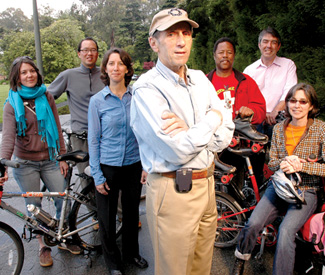
It wasn’t going well for Ted Strawser, predictably. The alternative transportation activist faced an uphill battle March 14 trying to convince a San Francisco Chamber of Commerce committee to endorse Healthy Saturdays, a plan to ban cars from part of Golden Gate Park.

Representatives of the park’s museums and Richmond District homeowners had just argued their case against the measure. “Visitors want access to our front door, and we want to give it to them,” Pat Kilduff, communications director for the Fine Arts Museums of San Francisco, indignantly told the group of two dozen business leaders gathered around a large conference table.

Strawser gave it his best shot: he talked about following the lead of other great cities to create car-free spaces; he said, “Golden Gate Park is one of the best parks in the nation, if not the world”; and he made a detailed case for closure. But around the table there were scowls, eye rolls, and other obvious signs that Strawser was being tolerated, not welcomed. Some — including chamber vice president Jim Lazarus — even started to interrupt and argue with him.

Then the man sitting next to Strawser spoke up. “I don’t think this is fair,” he said. And suddenly, everyone in the room shaped up. Strawser’s ally — his only supporter in the room — was somebody no chamber member could or would dismiss. Warren Hellman doesn’t shout or bang the table — but when he speaks, downtown pays attention.

Hellman, a prominent investment banker, told the committee members that he expected them to show the same respect for Strawser that they had for the previous two speakers. The nonsense ended, immediately.

And by the time Strawser turned the floor over to Hellman, the mood had changed. The group listened raptly, smiled, and nodded as Hellman spoke in his usual folksy, familiar, disarming style.

“It’s not a lot of fun when friends fall out,” he began, “because the previous speakers and many of you all agreed on the necessity of the garage [that was built in Golden Gate Park], and we worked together.”

He pointed out that many in the group had promised during the fall 2000 election to support Healthy Saturdays once the garage was built, although Hellman was now the only member of the coalition honoring that commitment. But he didn’t chide or shame his colleagues. That isn’t Hellman’s style.

Instead, he spoke their language. The garage has never been full and needs the money it can charge for parking to repay the bonds. This isn’t a fight that’s going away, since “part of the conflict is because this park is everybody’s park.” But there are “about 100 compromises not acceptable to either side that would move this forward.” And if a solution can’t be found, there will probably be an expensive ballot fight that nobody wants.

“My conclusion is we should attempt this test,” Hellman told the group. Ultimately, when the vote was later taken in secret, the chamber didn’t agree, although it did vote to back a trial closure after the California Academy of Sciences reopens next year.

At the meeting, Hellman openly called for Mayor Gavin Newsom to get involved in seeking a compromise, something Hellman said he had also just requested of the mayor at a one-on-one breakfast meeting. A couple of weeks later Newsom — who had already indicated his intention of vetoing the measure — did broker a compromise that was then approved by the Board of Supervisors.

As usual, Hellman didn’t take credit, content to quietly play a role in making San Francisco a better place.

Healthy Saturdays isn’t the most important issue in local history — but the significance of Hellman’s involvement can’t be underestimated. His alliance with the environmentalists and park advocates might even signal a sea change in San Francisco politics.

Warren Hellman represents San Francisco’s political and economic past. And maybe — as his intriguing actions of recent years suggest — its future.

This guy is a rich (in all senses of the word) and compelling figure who stands alone in this town. And even though his leadership role in downtown political circles has often placed him at odds with the Guardian, Hellman consented to a series of in-depth interviews over the past six months.

“Our family has been here since early in the 19th century, so we had real roots here,” Hellman told us. His great-grandfather founded Wells Fargo and survived an assassination attempt on California Street by a man who yelled, “Mr. Hellman, you’ve ruined my life,” before shooting a pistol and barely missing.

The Hellman family has been solidly ruling class ever since, rich and Republican, producing a long line of investment bankers like Warren.

Yet the 72-year-old comes off as more iconoclast than patrician, at least partly because of the influence of his irreverent parents, particularly his mother, Ruth, who died in 1971 in a scuba-diving accident in Cozumel, Mexico, at the age of 59. “She was entirely nuts,” Hellman said, going on to describe her World War II stint as a military flier in the Women’s Auxiliary Service Pilots and other colorful pursuits. “She just loved people, a little like I do. She collected people.”

Hellman grew up wealthy and cultured, but he also attended public schools, including Grant Grammar School and Lowell High School. In between, the young troublemaker did a stint at San Rafael Military Academy — “reform school for the rich,” as he called it — for stunts such as riding his horse to Sacramento on a whim.

After doing his undergraduate work at UC Berkeley, Hellman got his MBA from Harvard and went on to become, at the age of 26, the youngest partner ever at the prestigious Manhattan investment firm Lehman Bros. He developed into an übercapitalist in his own right and eventually returned home from New York and founded Hellman and Friedman LLC in San Francisco in 1984, establishing himself as the go-to financier for troubled corporations.

“He is really one of the pioneers of private equity,” said Mark Mosher, a longtime downtown political consultant and the executive director of Gov. Arnold Schwarzenegger’s California Commission on Jobs and Economic Growth, on which Hellman sits.

Hellman became what Business Week called “the Warren Buffett of the West Coast,” a man of extraordinary wealth and power. Among other accomplishments, Hellman took Levi Strauss private, recently made billions of dollars in profits selling DoubleClick to Google, and manages the assets of the California public employee retirement funds (CalPERS and CalSTRS), which are among the largest in the world.

Like many financial titans, Hellman has always been a generous philanthropist, giving to the arts, supporting schools in myriad ways, and funding the San Francisco Foundation and the San Francisco Free Clinic (which his children run). He vigorously competes in marathons and endurance equestrian events, often winning in his age bracket. And he has his humanizing passions, such as playing the five-string banjo and creating the popular Hardly Strictly Bluegrass festival.

But he’s also been a prime facilitator of downtown’s political power, which regularly flexes its muscle against progressive causes and still holds sway in the Mayor’s Office and other city hall power centers.

Hellman founded, funds, and is a board member of the Committee on Jobs, which is perhaps the city’s most influential downtown advocacy organization. Hellman and his friends Don Fisher, the founder of the Gap, and Sen. Dianne Feinstein also started SFSOS, which now wages the most vicious attacks on left-of-center candidates and causes.

When the de Young Museum and other cultural institutions were threatening to leave Golden Gate Park, Hellman almost single-handedly had an underground parking garage built for them, in the process destroying 100-year-old pedestrian tunnels and drawing scorn from the left. The Guardian called it “Hellman’s Hole.”

“We at the Bike Coalition very much started out on the opposite side of Warren Hellman,” San Francisco Bicycle Coalition executive director Leah Shahum told us. “We couldn’t have been more like oil and water on the garage issue.”

But over the past two years or so, Hellman’s profile has started to change. He went on to become an essential ally of the SFBC and other environmentalists and alternative transportation advocates who want to kick cars off JFK Drive in Golden Gate Park on weekends, crossing the downtown crowd in the process. He has shared his wealth with progressive groups such as Livable City, which often fights downtown, and has stuck up for edgy fun seekers over more conservative NIMBY types. He has also publicly repudiated the attacks of SFSOS and its spokesperson, Wade Randlett, and withdrawn his support from the group.

Hellman is still a Republican, but a thoughtful and liberal-minded one who opposed the Iraq War and wrote an article for Salon.com in February titled “If the United States Were a Company, Would George Bush Be Our CEO?” (His answer: hell no.) And to top it all off, Hellman sports a few tattoos and even attended 2006’s Burning Man Festival and plans to return this year.

Unguarded and reflective, Hellman’s comments to the Guardian foreshadow the possible future of capitalism and influence in San Francisco and point to potential political pathways that are just now beginning to emerge.

Our first conversation took place at the Guardian office two weeks before the November 2006 election, when it was starting to look like Nancy Pelosi had a good shot at becoming speaker of the House of Representatives.

“I think this election in two weeks is going to be really interesting,” Hellman told us.

This Republican was cheering for the Democrats to win. “They aren’t my kind of Republicans,” he said of the people in power. Hellman didn’t support the war or approve of how the Bush administration sold it, and he wanted Pelosi and the Democrats to hold someone accountable.

“What I’d like her to do is admit that we can’t get out [of Iraq immediately], but start to talk about what the fallout has been. Discuss the enormous cost in human life as well as money, and how it’s possible the war united the Middle East against us,” Hellman said.

The one thing he can’t abide is disingenuousness. Hellman speaks plainly and honestly, and he asked us to keep particularly caustic comments off the record only a few times during almost six hours’ worth of interviews. He was self-effacing about his political knowledge and seemed most interested in working through the problems of the day with people of goodwill.

Asked what he values most in the people he deals with, Hellman said, “It’s authenticity. Do they believe things because they believe in them, or do they believe in things because they’re cynical or they’re just trying to gain something?”

Locally, Hellman has reached out to people with varying worldviews and come to count many friends among those who regularly battle against downtown.

“I love to know people,” he said. “That’s probably the single thing that motivates me. When someone says to me, ‘How can you be friends with [then–head of SEIU Local 790] Josie Mooney?’ I say, ‘Look, I want to know Josie Mooney. And if she’s awful, then we won’t be friends.’ I’m just fascinated by getting to know people. And virtually always, they’re a little like Wagner operas: they’re better than they sound.”

Hellman was the chair of the Committee on Jobs when he got to know Mooney, who chaired the San Francisco Labor Council and was a natural political adversary for the pro-business group, particularly when Hellman was leading the fight to do away with the city’s gross receipts tax, which has proved to be costly for the city and a boon for downtown.

But after that victory, Hellman turned around and cochaired a campaign with Mooney to retool and reinstate the gross receipts tax in a way that he believed was more fair and helped restore the lost revenue to the city.

“We lost, but he put $100,000 of his own money into that campaign,” Mooney told us, noting that the proposed tax would have cost Hellman and Friedman around $70,000 a year. “I think he just thought the city needed the money. It was a substantive point of view, not a political point of view.”

Mooney considers Hellman both a friend and “an extraordinary human being…. He has made a huge contribution to San Franciscans that doesn’t relate to ideological issues. A tremendous thing about Warren is he’s not ideological, even in his political point of view…. On politics, I’d say he is becoming more progressive as he understands the issues that confront ordinary people.”

Mooney is one of the people who have helped bring him that awareness. When they first met, Mooney said, Hellman told her, “You’re the first union boss I ever met.” That might have been an epithet coming from some CEOs, but Hellman had a genuine interest in understanding her perspective and working with her.

“In a sense, I think that was a very good era in terms of cooperation between the Committee on Jobs and other elements of the city,” Hellman said. “Josie and I had already met, and we’d established this kind of logic where 80 percent of what we both want for the city we agree on, and 20 percent [of the time, we agree to disagree].”

Committee on Jobs executive director Nathan Nayman — who called Hellman “one of my favorite people in the world” — told us that Hellman feels more free than many executives to be his own person.

“He’s not with a publicly held company, and he doesn’t have to answer to shareholders,” Nayman said. “He takes a position and lives by his word. You don’t see many people like him in his income bracket.”

Hellman has become a trusted hub for San Franciscans of all political persuasions, Nayman said, “because he’s very genuine. He’s fully transparent in a city that likes to praise itself for transparency. What you see is what you get.”

Hellman expects the same from others, which is why he walked away from SFSOS (and convinced Feinstein to bolt as well) in disgust over Randlett’s scorched-earth style. Among other efforts, SFSOS was responsible for below-the-belt attacks on Sups. Chris Daly, Jake McGoldrick, and Gerardo Sandoval (whom a mailer inaccurately accused of anti-Semitism).

“If all things were equal, I’d just as soon that SFSOS went away,” Hellman said. “SFSOS started doing the opposite of what I thought they would be doing, so it was fairly easy for me to part company with them. What I thought we were doing is trying to figure out ways to make the city better, not just being an antagonistic, nay-saying attack organization. I’m not a huge fan of Gerardo Sandoval, but I thought the attacks on him were beyond anything I could imagine ever being in favor of myself. And it was a series of things like that, and I said I don’t want anything more to do with this.”

Downtown, they’re not always quite sure what to make of Hellman.

“Every once in a while, he does things that irritate people who are ideologically conservative,” Mosher said. “He took an immense amount of heat for supporting the Reiner initiative [which would have taxed the rich to fund universal preschool].”

He’s given countless hours and untold riches to public schools, doing everything from endowing programs to knocking on doors in support of bond measures and often pushing his colleagues to do the same.

“My connection to him has been through the school district, and he’s really been a prince,” Sup. Tom Ammiano said. “He has even stopped calling me antibusiness. He put a lot of his energy into improving public education, and so he shows it can be done.”

Progressives don’t always agree with Hellman, but they feel like they can trust him and even sometimes win him over. “If you get a relationship with him and you’re always honest about the facts and your own interests, he will listen, and that’s pretty remarkable,” Mooney said. “He shows a remarkable openness to people who have good ideas.”

His appreciation for people of all stripes often causes him to reject the conventional wisdom of his downtown allies, who viciously attacked the Green Party members of the Board of Education a few years ago.

“Everybody said, ‘Oh my god, Sarah Lipson, you know, she’s a Green Party member, she’s the furthest left-wing person on the board,’ blah, blah, blah,” he said. “And I phoned her up one day and said, ‘I’d really like to meet you.’ And she’s — leave aside the fact that I think she’s a very good person as a human being, but she’s a very thoughtful, analytic person. Listening to her opinions about things that are happening in the school district, I really respect that. I mean, what do I know about what’s going on in the school district? I know more now than I did then. But just getting to know people, and maybe get them to understand my point of view, which isn’t that penetrating.”

Many of his efforts have received little publicity, as when he saved the Great American Music Hall from closure by investing with Slim’s owner Boz Scaggs and helping him buy the troubled musical venue. “There are things that you and I don’t even have a clue that he has done,” Nayman said.

“He’s an interesting guy,” Mosher said. “He’s one of a dying breed, a liberal Republican. He has a social conscience and wants to use his money to do good.”

Actually, calling Hellman liberal might be going too far. In the end, he’s still very much a fiscal conservative. He doesn’t support rent control, district elections for the Board of Supervisors, taxing businesses to address social problems such as the lack of affordable health care, or limits on condo conversions.

He also opposes the requirement that employers provide health care coverage, which downtown entities are now suing the city to overturn, telling us, “In general, I don’t think it’s a good idea, because I’m still, even in my aging years, a believer that the marketplace works better than other things…. Universal health care I do believe in, but what I worry is that it’s going to be another damned bureaucracy and that it’s not going to work.”

Yet he doesn’t believe wealth is an indicator of worth, saying of his fortune, “It is luck. Most of what you do you aren’t better at than everyone.”

He doesn’t believe in the law of the jungle, in which the poor and weak must be sacrificed in the name of progress. In fact, he feels a strong obligation to the masses.

As he told us, “My mantra for capitalism — and I didn’t invent this, but I think it’s pretty good — is that capitalism won, and now we need to save the world from capitalism.”

Hellman looms large over downtown San Francisco. His Financial District office offers a panoramic view of the Bay Bridge, Treasure Island, the Ferry Building, and the rest of the city’s waterfront. He likes to be personally involved with his city and the companies in which Hellman and Friedman invests.

“Usually I’m directly involved,” he told us in an interview earlier this year. “I’ve always said that I don’t like to go to the racetrack to just look at the horses. The fun of being a principal is that you’re standing at the track and not saying, ‘Gee, that’s a beautiful gray horse.’ You’re saying, ‘Come on, he’s got to win!’ So I’m almost always invariably invested in the companies that we work with, either individually or through the firm.”

Unlike many Wall Street barons who strive to control a company and bring in new executives, flip it for a quick profit, or liquidate it, Hellman said his firm tries to identify solid companies and help facilitate what they do. “We don’t usually take over companies. I always think that we provide a service to help the businesses,” he said. “Our job is kind of the opposite of owning a factory. Our job is to be sure the people who run the business feel like it’s their business.”

Similarly, he thinks capitalists need to feel a sense of ownership over society’s problems, something he thinks is taking root in San Francisco and other economic centers, particularly among the younger generations. “It’s about understanding how much suffering there is on the other side and trying to figure out how that suffering can be alleviated,” he said. “I think it’s partly good economics that as you bring people up, they’re able to do more for society. If nothing else, they’re able to buy more and shop at a Wal-Mart or something — probably someplace you would wildly disapprove of — and buy goods and services. But I don’t think it’s that narrow.”

Rather, he believes that everyone has a little progressive in them, a little desire to cooperatively solve our collective problems rather than pass them off to future generations. He sees a marked change from his days at Lehman Bros.

“Everybody was into making it,” he said, noting that many capitalists then did charity work as a means of attaining social status but focused mostly on the accumulation of wealth. But, he said, the new generation of capitalists seems genuinely interested in improving the world.

“The feeling for giving back in the next generation, in the now 25- to 35-year-olds, it’s just an order-of-magnitude difference than it was for people who are now in their 40s and early 50s,” Hellman said. “I’m very encouraged.”

Yet the flip side is that, in Hellman’s view, downtown doesn’t wield as much power as it once did. Low political contribution limits have made politicians less dependent on downtown money, creating fewer shot callers, while democratizing tools such as the Internet have broadened the political dialogue.

“For the last 30 years we have become an increasingly tolerant city, and that’s great,” he said. “In the old days, [the Guardian] complained about downtown, and yeah, no shit, downtown really did control the city. The benefit was as that slipped away, the city became fairer and more open to argument. So now downtown hardly has any power at all anymore. In a sense, that’s a good thing. Tolerance grew tremendously when the city wasn’t dictated to.”

That tolerance caused street fairs to pop up all over town and festivals such as Hellman’s Hardly Strictly Bluegrass to blossom in Golden Gate Park. Bike lanes have taken space from cars, events such as Halloween in the Castro have gotten crazier, street protests have gotten bigger and more frequent, and people have felt more free to fly their freak flags. And all that freedom eventually triggered a backlash from groups of isolated NIMBYs who complain and often find sympathetic ears at city hall.

“Sometimes you get the feeling in this city that in the land of the tolerant, the intolerant are king,” said Hellman, whose festival has endured noise complaints even though the music is shut off by 7 p.m. “There is a continuing pressure to do away with fun, because fun is objectionable to someone, [but] we need to think about not creating a new dictatorship of a tiny group of people whose views are not in line with the opinion of most of the people of San Francisco…. You should try to balance the good of a lot of people versus the temporary annoyance of a few people.”

Preserving fun and a lively urban culture is a personal issue for Hellman, who plays the five-string banjo and calls his festival “the most enjoyable two days of the year for me.” He helps draw the biggest names in bluegrass music and acts like a kid in a candy shop during the event.

“I feel very strongly that an important part of our culture is built on the type of music and type of performance that goes on at Hardly Strictly Bluegrass,” Hellman said. From parables set to music to songs of struggle and the old union standards, “that kind of music is the conscience of our country.”

He considers bluegrass a vital and historically important form of political communication, more so than many of the upscale art forms that the rich tend to sponsor. “I’m glad that we have first-rate opera, but it’s equally important that we foster the kind of music, lyrics, etc., that support all this,” he said. “Somebody once said that most of the great Western philosophy is buried in the words of country songs. And that’s closer to the truth than most people think. A big passion of mine is to try to help — and people have defined it too narrowly — the kinds of music that I think have a hell of a lot to do with the good parts of our society.”

Perhaps surprisingly for a Republican venture capitalist from the older generation, Hellman also considers the countercultural freaks of San Francisco to be some of the “good parts of our society.” That’s why he attended Burning Man for the first time last year and why, he said, he loved it, as much for the culture and community as for the art.

“I went to Burning Man because as much as possible I want to experience everything,” he said. “I want to just see directly what it’s like. I knew I’d enjoy it. I never doubted that. But what really overwhelmed me is it was 40,000 people getting along with each other. I mean, it’s pretty intense. There were dust storms and the world’s most repulsive sight: nude men over 70 just dangling along. But I never saw an argument. It was 40,000 people just enjoying each other.”

It was most striking to Hellman because of the contrast with the rest of society. As he said, “I’ve never seen this country so divided.”

While Hellman supports Schwarzenegger — calling him “a good advertisement to California” — he has nothing good to say about his fellow Republican in the Oval Office. He calls Bush’s tenure “an absolute four-star disaster.” The invasion of Iraq is the most obvious problem, he said. “Our war policy has slowly veered from being ‘Don’t tread on me’ to we’re going to jump on your neck.”

But his antipathy to certain aspects of the Republican Party began even earlier, when the religious right began to take over.

“I thought we were not that polarized during the Clinton administration. I was somewhat encouraged,” Hellman said. “Maybe there was an undercurrent of strident religious behavior or strident conservatism, but not the conservatism that I think the Republican Party used to stand for, which was fiscal conservatism instead of social conservatism. Somehow, there was this angst in this country on the part of religious people who I guess felt this country was being taken away from them, and they were the kind of stalwart or underpinnings of society. And they took it back.”

But in the wake of that disaster, Hellman thinks, there is an opportunity for reasonable people of goodwill to set the future political course. As Nayman said of Hellman, “He does believe there is a middle way pretty much all the time.”

Politically, that’s why Hellman gravitates toward the moderates of both major parties, such as Schwarzenegger and Newsom. He looks for people who will marry his economic conservatism with a regard for things such as environmentalism and social justice.

“It’s very tough to be a big-city mayor,” Hellman said. “[Newsom is] probably the best mayor we’re entitled to. He’s got this fantastic balancing act.”

Hellman said downtown hasn’t been terribly happy with Newsom for supporting striking hotel workers, getting behind Ammiano’s health insurance mandate, supporting tax measures, and generally letting the Board of Supervisors set the city’s agenda for the past two years.

“Their measure is he has 80-percent-plus popularity, and he ought to spend some of it. Well, they might not agree with what he would spend it on. And he’s been unwilling to spend very much of it. In some parts of the business community there is disappointment with him, but I don’t think that’s right. He didn’t hide what he would be like.”

What Newsom said he would be — a big reason for his popularity — is a mayor for the new San Francisco, a place where the city’s traditional economic conservatism has been tempered by a greater democratization of power and an ascendant progressive movement that expects its issues to be addressed.

“I don’t like people who are intolerant,” Hellman said. “I don’t like people that are telling you something to get some outcome that, if you understood it, you probably wouldn’t want. I like people that are passionate.”

Asked, then, about Sup. Chris Daly, the nemesis of downtown and most definitely a man of strong political passions, he said, “I admire Chris Daly. I disagree with Chris on a lot of things he believes, but there are also probably a lot of things I would agree with Chris on. And I respect him.”

Hellman is the rare downtown power broker who wants to bridge the gap between Newsom — whom he calls a “moderate to conservative establishment person” — and progressives such as Daly, Mooney, and the Bicycle Coalition. The middle ground, he said, is often a very attractive place, as it was with Healthy Saturdays.

“I’m sure you spend time in the park on Sunday, and it’s a hell of a lot nicer in there on Sundays than Saturdays,” Hellman said. But even more important to him, this is about integrity and being true to what Golden Gate Park garage supporters promised back in 2000.

“They were proposing Saturday closing at that time, which I’ve always thought was a good idea,” he said. “And we made a commitment to them, or I thought we made a commitment to them, that let’s not have Saturday closure now, but as soon as the garage was done, we’d experiment with Saturday closure.”

We brought up what Fine Arts Museums board president Dede Wilsey has said of that pledge, that it was under different circumstances and that she never actually promised to support Saturday closure after the garage was completed.

“There’s a letter. She put it in writing,” he said of Wilsey. “She signed a letter on behalf of the museums saying that when the de Young is done, we should experiment with Saturday closings.”

The Bike Coalition’s Shahum said that even when Hellman was an enemy, he was a reasonable guy. But it’s in the past couple of years that she’s really come to appreciate the unique role he plays in San Francisco.

“He showed decency and respect toward us,” she said. “We never saw him as a villain, even though we disagreed completely. Later he really stepped up and has been a leader on Healthy Saturdays. And what I was most impressed with is that he was true to his word.”

Supervisor McGoldrick, who sponsored the measure, echoed the sentiment: “Hellman was certainly a man of his word who acted in a highly principled way.”

So why does Hellman now stand apart from the downtown crowd? Has he parted ways with the economic and cultural power brokers who were once his allies?

No, he said, “I think they parted ways with me.” *

 

Of blowjobs and SF Weekly’s spurious claims to great (arts) journalism

0

The SF Weekly’s obsession (jealous much?) with our 5/2 cover story on Vincent Gallo and the Mission Creek Music and Arts Festival is forcing me to put one of my credos – “Don’t make me cut you!” – into practice.

I read, or at least glance at, the Weekly. It’s one of the less rewarding requirements of my current job. So I couldn’t help but notice that its Sucka Free City column has launched two successive attacks on a recent profile I wrote about Gallo. Got that? That’s two different Weekly articles about one alleged “puff piece.” I guess there must be something to what we’re doing for them to be so strangely fixated.

I have better things to do, and better work to put in the paper, but I’ll use this blog to pick these Sucka Free City articles off one by one, talk a little about misogyny and lame Cro-Magnon straight journalist dude posturing – a relevant topic here – and then add some real observation about the state of arts journalism as executed, and I mean executed, by the SF Weekly and their overlords at the New Times, excuse me, Voice Media.

Of blowjobs and SF Weekly’s spurious claims to great (arts) journalism

0

The SF Weekly’s obsession (jealous much?) with our 5/2 cover story on Vincent Gallo and the Mission Creek Music and Arts Festival is forcing me to put one of my credos – “Don’t make me cut you!” – into practice.

I read, or at least glance at, the Weekly. It’s one of the less rewarding requirements of my current job. So I couldn’t help but notice that its Sucka Free City column has launched two successive attacks on a recent profile I wrote about Gallo. Got that? That’s two different Weekly articles about one alleged “puff piece.” I guess there must be something to what we’re doing for them to be so strangely fixated.

I have better things to do, and better work to put in the paper, but I’ll use this blog to pick these Sucka Free City articles off one by one, talk a little about misogyny and lame Cro-Magnon straight journalist dude posturing – a relevant topic here – and then add some real observation about the state of arts journalism as executed, and I mean executed, by the SF Weekly and their overlords at the New Times, excuse me, Voice Media.

Hiss Golden Messenger

0

goldenmessengsml.bmp

Photo by Terri Loewenthal

The Golden Messenger String Band (an augmented Hiss
Golden Messenger lineup) will be performing at The
Rickshaw Stop on Thursday evening as part of this
year’s Mission Creek Music Festival. HGM plays about
9:00 or so (second on the bill). Also on the bill are
Caves, Michael Zapruder’s Rain Of Frogs, Harbours, and
Rykarda Parasol. That’s a lot of fantastic music for
$10. Expect some long tones.

Thursday, May 10th
$10 8 PM show start
@ The Rickshaw Stop – 155 Fell Street

Also, the fully electric version of Hiss Golden
Messenger will be playing some Northwest shows next
week. These are as follows:

Thursday, May 17th @ The Tractor Tavern, Seattle, WA
Friday, May 18th @ Doug Fir Loung, Portland, OR
Saturday, May 19th @ River City Saloon, Hood River, OR

All of these shows are in support of our good friends
The Mother Hips, who have a fantastic new record out.
Tell a friend.

I hope to see you there.

-M.C. Taylor

P.S. I will also be sitting in on a few songs with my
friend P.G. Six on Saturday, May 12th, at the Swedish
American Hall, in support of Gary Higgins. This is
also part of the Mission Creek Music Festival. P.G.
also has a fantastic new record out.

Fresh fruit from old punks

0

› a&eletters@sfbg.com

FULL CIRCLE Once upon a time, at Kezar Pavilion in San Francisco, the Dead Kennedys blew the Clash off the stage. I think it was early spring 1980. I didn’t pay much attention to dates in those days, but I remember this much — I was there.

On that night the DKs delivered their fat, funny broadsides with a joyous abandon that few bands of the era could match. Vocalist Jello Biafra — who finished his set drenched in sweat and wearing only his underwear’s elastic waistband — was simply inspired. The group was tight as a drum, and their material — most of which appeared on Fresh Fruits for Rotting Vegetables (Alternative Tentacles, 1980) — was first-rate. Songs such as "Holiday in Cambodia" and "California Über Alles" were politically sharp and lifted by the group’s sarcastic humor — which is to say the band delivered a hilarious, politically pointed good time.

The Clash never got cozy with their American audience. That evening they were self-conscious and too obviously under control — burdened by political points rather than delivering them. The band’s hard-edged working class–oriented politics, which evolved into complex internationalism, was hard for many to access. For comparison, try finding music by the Bay Area’s Dils, whose somewhat dry, hunt-and-peck rhetoric was as close to a domestic analogue as the Clash spawned.

That was nearly 30 years ago. Today Joe Strummer’s dead, Topper Headon looks dead, the DKs — minus Biafra — are an oldies act, and Biafra is an outspoken spoken word artist who, on his latest three-CD opus, In the Grip of Official Treason, compares DK guitarist East Bay Ray to deposed California governor Gray Davis.

Still, the Clash’s music holds up — as does Biafra’s delight with the absurdities of America’s hypocrisies. Our safe American homes don’t feel quite so secure, and bad news keeps leaking through cracks in the wall, which makes checking in with the Clash and Biafra relevant. The former’s somewhat vestigial but still cool Singles Box (Sony) was released late last year (there are so many discs that you could drop a few behind, say, a CD case and not miss ’em for a month or three). The compilation is simply superb, especially because it revives much of the band’s pre–London Calling material.

Nearly 30 years down the road, the Clash’s material has aged little. Perhaps the band just wanted fame, and the principals were as ignorant as the rest of us. Julien Temple’s recent documentary about Strummer, The Future Is Unwritten, undercuts that premise. But even the most cynical punks tended to clam up when it came to the Clash. To say the band wasn’t about albums before and after 1979’s fabulous London Calling (Sony) is a cop-out. Combat Rock (Sony, 1982) was a fully realized and wildly popular triumph, as much as three-disc Sandinista (Sony, 1981) was kind of a soporific mess. Nevertheless, punk rock — for aesthetic and financial reasons — wasn’t primarily about making albums.

Which means that hearing the Clash’s singles, along with the B-sides, as streamlined things unto themselves places a person right in step with what mattered from the only band that mattered. Just give a listen to "White Riot" or their simply brilliant cover of the Bobby Fuller Four’s "I Fought the Law."

Do you have to own this collection? Well, if you’ve got most of the band’s material, you can pass. This one might be best appreciated by fiends, collectors, and the idle rich. Yet it’s amazing how satisfying this music is, and not as a nostalgic exercise in golden protest. The Clash, born in defiant reaction against the musical mainstream, never made peace with it, their major-label contract and midcareer success notwithstanding. Their music delivers.

After all these years — and at this awfully nervous moment in history — it’s also a good time to consider Biafra’s new spoken word collection, a seriously timely 210-plus minutes of sardonic, smart, and occasionally funny political commentary. When he exited the DKs, Biafra drifted away from music as the principal vehicle for his wit and insight. Although he never moved far from punk, his work today seems to follow in the footsteps of social critics such as Paul Krassner.

On Grip (Alternative Tentacles), which consists of live material from various performances, Biafra offers uncommon observations about common household pests such as George Bush and Arnold Schwarzenegger, the wars on Iraq and on terror, and other familiar American vulgarities. Careening through a club while the Dead Kennedys were playing doesn’t, in most respects, share much with sitting down and listening to Biafra tear into the fabric of imperial America. What hasn’t changed, however, are the drive and acerbic wit that Biafra brings to the stage — then and now. *

DIRKFEST

Jello Biafra MCs the celebration of Dirk Dirksen’s life, with SF Mutant All Stars, the Contractions, White Trash Debutantes, No Alternative, and others

June 8, 8 p.m., $25

Great American Music Hall

859 O’Farrell, SF

(415) 885-0750

Digital Venuses

0

› a&eletters@sfbg.com

Call them the new British bitch pack: barefoot soul shouter Joss Stone and her ascendant sistren, skankin’ Lily Allen and torchy Amy Winehouse (Corinne Bailey Rae’s exempted due to being a queen of nice and hazy sentiment and, well, yes, color). The Pipettes also deliver Ronettes-Supremes paeans but have yet to splash large beyond the UK. It’s Stone and Winehouse who have made recent history on the US pop charts: the latter’s Back to Black (Republic) scored the highest ever debut for a British woman (number seven), and Stone’s Introducing Joss Stone (Virgin) followed a week later, debuting at number two.

The third release in this triumvirate, Allen’s Alright, Still (Capitol), is the least compelling, though it possesses the most diverse sonic palette: ska, Britpop jangle, punk, rocksteady, N’Awlinz funk, and English dancehall, courtesy of her fellow celebutot music maker, DJ and producer Mark Ronson. While "Friend of Mine" will doubtless prove a decent summer jam, the scattershot production speaks more to Ronson’s patented retro-soul ambition than to individuality on Allen’s part. I’m already over the stunt sampling of Professor Longhair and find Allen’s spin on jaded indie affect and lyrics powered by class snobbery grating.

The aforementioned artists are part of yet another wave of British acts working in black American musical idioms: James Hunter, James Morrison, Lady Sovereign, and Alice Russell. Call them the spawn of Dusty Springfield. Blue-eyed British soul diva Springfield’s 1969 classic Dusty in Memphis (Rhino/WEA) is the obvious grail for most of these new acolytes. They’ve also benefited from the successive layers of space opened by Blighty’s trends in Northern soul, acid jazz, trip-hop, and the Yankee stand taken for retro soul by the now-defunct Desco label (which split into Soul Fire and Daptone) with black vocalists such as Lee Fields. One wants to big up Allen, Winehouse, and Stone on the sisterhood empowerment tip for their brassy attitude and scathing kiss-offs to trifling men on these recordings. And it’s interesting that they’ve emerged at a time when their male counterparts, such as Morrison — and David Gray and Chris Martin — seem to have "bitched up." Yet this gender power–reversal is sadly trumped by glaring issues of race and authenticity.

REAL ME, REAL MIMICRY


Nowhere are these issues more clearly embodied than in Joss Stone, who’s about to hit the Yay Area. She’s been around for a minute, leading the cited alien invasion with her Miami Sound–assisted debut, The Soul Sessions (Virgin), in 2003. Missed in all the hype and scandal over Stone’s breakup with Motown scion Beau Dozier, her recent adoption of a faux-Yank accent, and the sacking of her handlers is the fact that her much-vaunted revamp has a precedent: Stone described her second CD — Mind, Body, and Soul (Virgin) — as her "real debut," and it contained a mix of Southern soul, urban swing, and hip-hop similar to the template codified by Lauryn Hill in the late 1990s.

The 19-year-old blond Venus actually coaxed Hill out of her fog to guest on "Music," but overall Introducing merely treads water instead of shifting any postmillennial soul paradigm. Stone remains trapped by the novelty factor of having been a 15-year-old girl from Devon who could mimic a middle-aged black American singer and has not figured out how to reconcile her West Country roots, accent, and affluence with the grit and honesty her ambitions require. She’s content to let producer Raphael Saadiq locate her brand-new thang somewhere between Aretha Franklin circa Sparkle and the early ’80s Isleys, with a soupçon of hip-hop flourishes — an approach that only really sparks on opener "Girl They Won’t Believe It" — when underage Stone really ought to be ashamed at her affair with 41-year-old Saadiq. The specter of Dallas Austin’s banging for beats screed rears its ugly head.

Stone may be styled in psychedelic body paint, flowers, and baubles as some lost wild child of Janis Joplin, but unlike that late bad-Jewish-girl-with-a-yen-for-the-blues icon, she lacks the ovaries and independence to instigate any sonic revolt, nor does she transcend her black influences. Although she too failed to flip the rock biz’s race politics, Joplin was an original. She was also perfecting a worthy form of hybridity, whereas Stone would still do best to apprentice behind a seasoned soul singer and grow into her voice. Meanwhile, she’s an immature artist trapped within the middle-class mythos and mass fantasies of the pop star system.

RUNNING THE RACE?


White artists’ love and theft of black expression, as ratified by the Elvis phenomenon, remains the primary cultural battleground in the aughties — don’t get it twisted. The phenomenon of white singers who sound black is as old as minstrelsy, of course. Vaginas trouble this aesthetic guerrilla warfare — with Stone and company entrenched in the valley of sound between Joplin, Springfield, Lydia Pense, and Teena Marie on the one side and Madonna, Taylor Dayne, Britney Spears, and Fergie on the other. Yet Stone and her sister purveyors of femme funk are not truly innocents with songs in their hearts and stars in their eyes. These daughters of Al Jolson, removing their Jewish foreignness by sonically and visually blacking up as he did in The Jazz Singer, are reaping the rewards this season from the West’s most vital industry: the consumption and export of essential blackness.

Whether fucking or channeling the likes of Dinah Washington and Ronnie Spector in the studio, Allen, Stone, and Winehouse are enjoying everything but the burden of blackness. These vocalists face the dilemma of the privileges of whiteness versus the comforts of being soulful, and this will continue to dog their careers if longevity’s next. Doubtless Stone, Allen, and Winehouse don’t want to be "nappy-headed hos" — thanks, Don Imus — but desire the erotic, exotic power of sistagirls without being the mules of the world. Yet why is the old "black joy, not black pain" truism surfacing now in the UK?

Look to recent cinema from across the pond: in The Queen, Elizabeth II, the paragon of English womanhood, is asked by Tony Blair to be feely and emotional to help heal the nation in the wake of Princess Diana’s death, to restore the heart Diana represented. But Elizabeth chafes, bound by old royal models of honor and duty. The crisis of Britannia is coded even more explicitly in Children of Men. In its dystopic vision, black women are despised yet also figures of salvation. As in the film, in which only a regenerative black female can save England, these new wave British soulsters labor to recuperate the distant and unreal of classic soul, despite its distinctly American set of societal preconditions. A post–Margaret Thatcher, post-Blair return to authenticity is what these singers represent, a late moment after Rod Stewart delivered fair Albion’s best-ever approximation of soul and empire has faded, leaving postcolonial turmoil and identity flux. Black female soul brings rebirth to this turbulent world via the vocalizing of Stone et al., placing them back at center of the world — at least aesthetically.

FLIPPING BACK TO BLACK


This activity meets its zenith in the petite, pinup-tatted, beehive-burdened, anorexic form of Winehouse. Unlike Stone, who’s at pains to elide her Englishness, Winehouse’s distinctly North London Jewish accent surfaces on her critically acclaimed Back to Black, but her extreme jazz-soul mummery remains paramount, even as white critics and listeners continue to adopt a white version of black culture at the expense of young black artists of the retro-nuevo soul or urban alternative persuasion. Winehouse has yet to be anointed with a universal ghetto pass and, like Stone and Allen, has bypassed the hood and proper apprenticeship for lucrative prime time at the nation’s premier venues this spring.

Throughout Back to Black, Winehouse gets away with borderline minstrelsy, carelessly mashing up a vocal cocktail of Washington, Billie Holiday, Carla Thomas, and Phil Spector’s girl-group surrogates while not being excoriated because her Pete Doherty–rivaling tabloid exploits with drunkenness, raunchy sexuality, and public belligerence fit her admirers’ view of authentic blackness. Behind Spanish Harlem drag, Motown cocktail dresses, and Cleopatra’s black eyeliner, Winehouse is the cunning poster girl of her mid-Atlantic milieu, permitted to get away with potentially offensive lyrics such as "side from Sammy you’re my best black Jew" ("Me and Mr. Jones"), showcasing a pair of cooning black backing vocalists and hipster-comforting insincerity.

"What kind of fuckery is this?" I’m sure to Winehouse’s equivalents across the color line — from fiftysomething Sharon Jones to 36-year-old failing freaky-deak diva Macy Gray and badass bitches in the wings such as Alice Smith — it seems like the demoralizing same old. These are black artists who, to varying degrees, can sang but whose efforts render them invisible in a field overwhelmed by white soul saviors. Why invest in these sistas’ development or even spotlight the neo–chitlin circuit movement afoot in the Southeast when the only blackness that really counts bears a stench of formaldehyde? *

JOSS STONE

Tues/15, 8 p.m., $35

Warfield

982 Market, SF

(415) 775-7722

Not Coachillin’

0


SONIC REDUCER “I can’t believe you slept through the police helicopter above the tent at 3 a.m. and the megaphone going, ‘Disperse immediately or you’ll all be arrested,'” tentmate Fluffy marveled the day after another ear-busting night of the Coachella Valley Music and Arts Festival’s unofficial after-party scene in the campgrounds. It was only 8 a.m., though the sun was already beating down relentlessly like our heedless neighborhood drum circle.

I’ve snoozed through my share of lousy plays, bad bands, and crappy circuses, but I never thought I’d slumber through the 24-7 thrills at the Empire Polo Fields. And the chopper was just the chaser to April 28 trance headliner Tiesto, who began his loud set, pompously booming out over our not-so-fair tent city of spring breakers and Euro tourists, with “In the beginning there was the earth….”

We’re gonna have to sleep through the history of the planet, was my last thought as I drifted off.

O Coachella, don’t you cry for me, ’cause I’ve come from Alabama Street with a heat rash on my knee — and doubts about making the scene at the festival despite the fact that about 160,000 brave music fans were expected to face down the desert swelter as the event swelled to three days.

At this juncture, Coachella might be described as a music festival on steroids: it’s a carnival for 18 and overs with rides, art installations, dancers, and completely insane people wearing full-body chicken costumes in the 110-degree heat, though still boasting a comprehensive bill of today’s so-called hot bands. It’s your one-stop smorgasbord for music lovers, who will happily chat you up about the performer they deemed the most mind-blowing the previous night or the last Rage Against the Machine show they caught.

And they got what they came for: the Björk shroom headdress; the crazed buzz rising from such festival circuiteers as Amy Winehouse and Klaxons; solid pop from Jarvis Cocker and Peter Bjorn and John; show-stopping performances by DJ Shadow, CSS, Arcade Fire, and Konono No. 1; and the rattle of reunion bones by an amped and antic Rage Against the Machine, glowering and balding Jesus and Mary Chain, and, er, Crowded House. You couldn’t go amiss if you stuck to the desert to-do’s rave roots and entrenched yourself beneath the mirror ball, video screens, and pink and blue lights of the Sahara tent: the performances there by Justice and LCD Soundsystem connected with the crowd with a screw-it-all exuberance.

But the untold story lay far away from the press tent and Palm Springs love nests — in the crowded, brutal heat of the campgrounds next to the performance area. Is it possible to review a camping trip? In what seemed like a dusty, straw-strewn football field with thousands of other wake ‘n’ bakers? I spent far too much time taking refuge from the nonstop heat at the campground’s cybercafé, where hundreds of shirtless boys and bikinied girls would miserably crouch, recharging their cells at a bank of outlets, sit stunned watching the Coachella film on a loop, or lie on the ground like clammy, comatose dead fish, waiting out the morning before the acts began in early afternoon.

The southerly discomfort led most campers on a lengthy hike from the tent city, past the obscenely grassy country clubs surrounding the polo grounds, to find refrigerated refuge and 40s at Ralph’s, the nearest supermarket, where people were literally chillin’ on store lawn furniture. Coachella: the fest that inspired global warming — and a post–<\d>Earth Day longing for air-con.

Organizers Golden Voice had a clue: they gave away free water sporadically and provided campers with free Internet use and showers. But there were too few laptops, the wi-fi was too erratic, and the showers were locked down too early — and you knew there was too little shade in general when audience members broiled in the sparse shadows of lemonade stands.

The crowd — weighted with Rage Against the Machine fans eager to see the band’s first concert in more than five years — was also heavy on the testosterone. But maybe that’s just the state of Rage love: the band never really seemed too underground to me but has historically worked to surface activist subversion via modern rock radio. And their audience was still boiling — and amazingly good-natured despite the sleepless nights. As for myself, I finally woke up hours after the helicopter early April 29 to the sound of a random dude shouting, “Whoo!” and yammering loudly in Portuguese to the tentizens the next flap over. Later I was tempted to put my own spin on Zack de la Rocha’s onstage suggestion that Bush and Cheney be “tried for war crimes and shot.” I know the 12-hour roller coaster ride of quality hallucinogens can be a bitch — but then, so can I: is it so wrong to want the early morning shouters and the dude with the air horn to be tried for crimes against humanity’s sleep schedule and shot? I’d settle for finding out where they were dozing it off and delivering a special whoo-gram of my own.

BOB DYLAN STUDIED HERE That’s the rumor, anyway, at the Blue Bear School of Music, which has seen Tracy Chapman and more than 20,000 other musicians come through its doors in the past 36 years. Executive director Kevin Marlatt told me the nonprofit’s second annual fundraiser — showcasing 2007 Grammy Lifetime Achievement winner Booker T. Jones as well as Blue Bear staffer Bonnie Hayes and Sista Monica — will include an appearance by the James Lick Middle School Band, the result of the organization’s efforts in the last year to get more involved in public school music education. Since it took over the James Lick music program and brought in 30 guitars, he says, more than a dozen bands have popped up at just that school. So Stax around for a good cause. *

BOOKER T. JONES

Sat/12, 8 p.m., $45–$125

Great American Music Hall

859 O’Farrell, SF

www.bluebearmusic.org


May day

0

› a&eletters@sfbg.com

The May Day rampage of the Los Angeles Police Department over peaceful protesters and journalists at an immigrants’ rights march lends an undeniable immediacy to America Tropical, a new and at times poignant chamber opera by composer David Conte and librettist Oliver Mayer that addresses the legacy of racial and class exploitation built into the very fabric of the City of Angels.

The compact 60-minute work, which premiered April 27 at the Thick House under the auspices of San Francisco’s Thick Description, takes its cue from América Tropical, a 1932 Olvera Street mural painted by the great Mexican social realist artist David Alfaro Siqueiros (sung with appropriately formidable presence by a swaggering, tempestuous Mark Hernandez). Meant as a mirror held up to the past and future of Los Angeles, Siqueiros’s wall pointed back to the city’s 18th-century Mexican founders in a group of pobladores (played here by six capable singers led by an impressive Antoine Garth) and ahead to the grim strife of an ethnically and racially stratified class system.

That strife culminates in America Tropical as the conflagration of the 1992 riots sparked by the police beating of Rodney King (played by Garth), famously witnessed and transmitted to the world by private citizen George Holliday (Chad Runyon), whose videotape thus becomes something of the equivalent of Siqueiros’s politically charged mural.

In an apt, indeed concrete metaphor for an increasingly divided and dividing age, walls as sites of division, reclamation, toil, and creative resistance pervade the poetic libretto provided by playwright Mayer (Blade to the Heat, Joe Louis Blues), which effectively brings Sisqueiros’s social realist language into 3-D relief. "Tell me what a wall can do," Siqueiros sings. "I’ll show you what a wall can be."

Meanwhile, Conte (whose beautiful, ghostly desert opera Firebird Motel was commissioned and produced by Thick Description) has fashioned a score featuring serrated melody lines and lush choral harmonies to augment the work’s three centuries, succinctly blended in Mayer’s libretto. The music moves determinedly forward through alternately agitated, wistful, angelic, and angry passages provided by an excellent sextet of piano, strings, and woodwinds conducted by John Kendall Bailey.

At the same time, Siqueiros’s emotionally powerful and provocative visual allegory can translate awkwardly to the stage. Those walking in cold without any knowledge of the opera’s deeply rooted relationship to Siqueiros’s mural may find some of the mise-en-scène (such as the crucifixion) a trifle hokey, despite graceful staging by director Tony Kelly, not to mention the excellent singing, generally decent performances, and arresting music. Some preparation for the audience — a description of the mural on a lobby poster or somewhere in the program — might have been in order.

Siqueiros’s Olvera Street mural was one of the earliest examples of the Mexican urban art movement that publicly portrays the local narratives of ethnic and indigenous people. But in 1932 the police arm of the ruling class had a brush of its own, and soon after the mural’s unveiling the LAPD whitewashed it into what turned out to be temporary oblivion. (It was partially uncovered and rediscovered in the 1960s and has recently been undergoing restoration.)

It’s more than merely ironic that the mural’s images of workers and an indigenous American woman, named the India (sung by Sepideh Moafi), crucified on a double cross of American imperialism, were staging a second return in Conte and Mayer’s America Tropical even as LAPD clubs and rubber bullets rained down on workers and families at MacArthur Park. The redemptive force of the opera’s historical ghosts rises on a wave of events that gives distressing currency to the libretto’s emphatic assertion, "There is no present / There is no future / Only the past, happening over and over again." *

AMERICA TROPICAL

Through May 20

Thurs.–Sun., 8 p.m., $15–$25

Thick House

1695 18th St., SF

www.thickhouse.org

Fab gadgets

0

› superego@sfbg.com

SUPER EGO "We’re trying to reverse the great Berlin brain drain," DJ Solekandi of the Bay Area Beatdrop crew told me, with great determination in her voice. She was preparing to launch Filter.SF, the latest and so far biggest monument to the return of peninsular techno, an "official" Saturday monthly at Fat City, that would later spill over — ecstatically — into 8 a.m. "Is that where my brain’s been draining?" I replied, emptying my scotch glass warily. "I honestly thought it was circling somewhere over the Hebrides."

But of course she was speaking of the years-long flight of local electro and techno talent to the undisputed club capital of the early Ohs. Reunification — and a city full of unguarded construction sites — definitely has its advantages. "Let’s face it: techno’s a dirty word here," Solekandi reminded me. "There’s still so much great electronic music evolving in the States, though, transcending itself, working the polyrhythmics. People are shocked that we’re fiddling with grooves at 120 bpm — we’re just as much in reaction to the whole ‘techno has to hit you over the head’ thing as everyone else. We don’t want to be pigeonholed. We’re into stripping all musical genres down, foregrounding different patterns and sequences, but not getting so heady or minimal that you want to stop and think — or jumping off the rails into breakbeat. We mainly started this party because we want to have someplace where people can dance all night. I mean, where did that go?"

Presumably through the Brandenburg Gate. In the "we" above, Solekandi’s including the other half of Beatdrop, her mate, DJ Kontakt. (She was a journalist in Budapest. He was a soulful loner in Toronto. When they met online, listening to Deep Mix Moscow Radio, it was love at first IM.) Solekandi then launches, as any fierce DJ would, into a rundown of her cutting-edge technical equipment: Tracktor software, Faderfox controllers from Robotspeak, Ecler Nuo4 MIDI mixer … Visuals by VJ Mike Creighton? Edirol V-4 Video Mixer, HP ZT-3010US laptop, custom VISP Flash-Flex-Apollo software, Wacom Intuos Graphire tablet …

Phew. When I hear tech heads, even hot ones, geek out over their digital apparatuses, I sink into languid bafflement. Suddenly, I’m a sultry ’60s housewife, lounging on my lime green sectional, slightly pinched by my girdle, nodding while Hubby blathers on about structural changes down at the aeronautics plant. Sounds complicated, darling. Shall I fix us another batch of martinis? May is officially techno month, however, with Movement, Detroit’s legendary electronic music festival (www.demf.com), drawing hundreds of thousands to the Motor City and Montreal’s gargantuan Mutek (www.mutek.ca) following hard on Movement’s gravel-pitted heels — so technology’s the ultra. Yet I’d naively thought that since techno and vinyl had been pushed from the clubs by laptops and mashups, iPods and electroclash, they would join forces in a retrofuture comeback assault. No can do, it seems. So rock on, techno mama!

"I hate the word Wii," my yummy pal Noel reflected at the recent LCD Soundsystem show when I told him about the latest DJ craze, WiiJing. "It’s just so … happy. Wii. Ugh."

WiiJing, you ask? Hell yes. You knew it was only a matter of time before some genius couch potato hacked their Wiimote to start mixing, as they say, Wiimotely. Well, that time is now, and DJ_! (pronounced "shift one") is that genius. He’ll be here May 12 at Bootie, debuting his skills to the mashup crowd. ("I’ll probably be mashing up my favorite video game themes — anything from Centipede to Tom Clancy’s Rainbow Six," he claimed.)

I asked Turlock’s Obi-Wii Kenobi over the phone how he did it. "I basically used GlovePie to patch the Wiimote through a Bluetooth dongle into my Ableton Live," he replied. Again the gizmo glaze descended. Still, that must be one heck of a dongle! What’s the range on that thing? "About 15 feet, I think." I riffed on the WiiJ potential, now that DJs won’t be tethered to the decks. Refresh your cocktail midset! Stage-dive without any skips! Embed your Wiimotes into lightsabers and duel other WiiJs!

"Maybe," DJ_! said. "I’m happy just to be able to take a bathroom break." Now that’s putting the wee in Wii, no pun Nintendoed. *

FILTER.SF

Last Sat., 10 p.m.–8 a.m., $20

Fat City

314 11th St., SF

www.myspace.com/fatcitysf

www.babd.org

BOOTIE

With DJ_!

Sat/12, 9 p.m.–late, $12

DNA Lounge

375 11th St., SF

(415) 626-1409

Myth of the universal library

0

› annalee@techsploitation.com

TECHSPLOITATION A lot of Web geeks believe that one day everything ever created by humans will be available online. Call it the myth of the universal library. Here’s how the myth goes: because there is unlimited real estate in cyberspace and because media can be digitized, we can fill cyberspace with all human knowledge and give everyone access to it. Without further ado, I present to you three arguments for the elimination of the myth of the universal library.

1. Cyberspace does not exist. The term cyberspace was invented in the late 1970s by a science fiction writer named William Gibson, who used it to describe a "consensual hallucination" experienced by people who were neurologically linked to computer networks. Even within Gibson’s novels, the author is careful to explain that the illuminated buildings, glowing roads, and avatars that his heroes meet in cyberspace are simply convenient representations of abstract data structures.

My point is that computer networks are not space and they are not real estate. They are data storage and manipulation devices connected together by wires and radio waves. They cost money and require massive amounts of power. They take up real-world space. And they break. In other words: no computer network is infinite. Storing all of human knowledge on a computer network would be expensive and intensely difficult to maintain. There is no infinite cyberspace — only finite computer networks subject to wear and tear.

2. Your human knowledge sucks. I was recently in a very interesting conversation with several smart librarians, all of whom are keen to use computers for preserving and disseminating information. Somebody pointed out that a good example of publicly accessible universal knowledge is the French Gaumont Pathé Archives, which makes hundreds of hours of searchable historic newsreel footage available online for free. The problem, as film archivist Rick Prelinger pointed out, is that the Gaumont Pathé project, like many of its kind, has had to pick and choose which films it can afford to archive. So the group focused heavily on politics and left the fashion and pop culture reels undigitized and therefore less accessible. The guy who’d brought up the archive thought this was just fine.

"No, it’s not," Prelinger replied. "If you want to know what everyday people cared about historically, fashion is going to tell you a lot more than newsreels about famous politicians."

The point is, people don’t agree on what "all of human knowledge" means. Is it great art and political history? Or is it xeroxed zines and fashion history? Who decides what gets digitized and what gets tossed in the ashtray of the unsearchable, the unnetworked? Do commercials go into our mythical universal library? What about hate speech and instruction manuals for hair dryers? Are those documents not also part of human knowledge? We will never reach an agreement on what all of human knowledge really is, and therefore we will never be able to preserve all of it.

3. Digitizing everything is impossible. Consumers can buy terabyte-size disk storage. The glorious Internet Archive buys petabyte storage devices by the bushel. You can fit your entire music collection in your pocket, and your book collection too. But even if we agreed on what all of human knowledge really is — which we never will — you couldn’t digitize all of it. Turning books into e-books takes time, as does turning film and television into digital video files. And what about rare scrolls, artworks, and machines? How do you put them online? Some medieval manuscripts and textiles are so delicate they can’t be exposed to light. Making something digital isn’t like waving a wand over it — poof, you’re digital! No matter how hard we work and no matter how much money we throw at this problem, there is simply no way to turn all physical media into digital formats.

The myth of the universal library is not only widespread, it’s also dangerous. Believing in the myth makes us forget that we need to be working hard right this second to preserve information in multiple formats and to make it available to the public any way that we can. *

Annalee Newitz is a surly media nerd who has a very large collection of nondigital books.

Summer lovin’

0

Summer 2007 fairs and festivals guide

Guide to local nude beaches

Bay Area public pools

Upcoming summer blockbusters

Quick local summer escapes

40th anniversary Summer of Love events

The Summer of Love™. That’s what we’ve been talking about round here. 1967. Timothy Leary. Flower children. Forty years ago this summer, it all happened here. The one summer that was officially about Love with a capital L.

But I’ve been thinking. Aren’t they all summers of love? Mine are. Starting in fourth grade, with red Otter Pops, my condominium complex swimming pool, a pink and white bathing suit with the middle cut out, and my crush on Neil Malesich — who was short, yes, but could do a mean backflip into the deep end — I learned that summertime and romance are inextricably connected.

And not just in the literal sense of vacation romances and mini-golf dates (yes, I saw the Karate Kid). It’s that feeling of infatuation and discovery and newness and nostalgia-for-the-moment about all kinds of things: your front porch or backyard, a slightly charred chicken breast, new flip-flops, new friends, mango juice on your fingers, blockbuster movies, mojitos, kiddie pools. Not just the first time either, but over and over, every year, as you start craving summer the way you’d anticipate the visit of a long-distance lover. Summer arrives, and it’s all new again — the chlorine and the sunburns and the hot pavement.

And so here it is May, and I can already feel it coming: warm winds, bare skin against bare skin, kisses that taste like beer and barbecue sauce, music turned up and windows rolled down, sandy hands tugging at short hems, fruity rum drinks, block parties, fireworks glittering above rooftops. Late nights, foreign locales, hotties made even hotter by circumstance and sunshine. It’s summer — and I’m falling in love. (Molly Freedenberg)

Now with reel cheese!

0

› cheryl@sfbg.com

By the time you read this, Spider-Man 3 will have already raked in approximately a kajillion dollars. But in a summer packed with superheroes, pirates, robots, and teen wizards, only one selection is destined to be the Best. Movie. Ever. (Hint: it’s animated, smells like a steak, and seats 35!) Still, what are you gonna do at the multiplex — or the rep house — on every other day that isn’t July 27? Arrange your vacations, hot dates, and Sno-Caps binges according to my highly biased, by no means complete guide to this season’s cinematic selections. All release dates are subject to change.

May 11 28 Days Later didn’t exactly have a happy ending — I’d call it ambiguous at best — and 28 Weeks Later explores what happens more than six months after the initial outbreak of “the rage.” Who’s the real villain in this one, zombies or the US Army? This sequel features a new director (Spain’s Juan Carlos Fresnadillo) and apparently an all-new cast, including Robert Carlyle, Rose Byrne, and The Wire‘s Idris Elba.

May 18 Who’ll be the next ruler of Far, Far Away? Shrek the Third investigates. New voices include Justin Timberlake (as a prince) and Ian McShane (as Captain Hook). And yes, your beloved Puss in Boots (Antonio Banderas) returns.

May 19 Prefer your movies under the stars? Film Night in the Park (www.filmnight.org) kicks off with The Graduate in Washington Square Park. Screenings continue through October at various locations in San Francisco and Marin County, with something for everyone — from kids (Happy Feet) to thirtysomething nostalgics (Sixteen Candles) to campaholics (The Bad Seed) — on the schedule.

May 25 You think your job sucks? Check out Severance, which is surely the raddest office horror–comedy–satire–gorefest ever. Also today: Pirates of the Caribbean: At World’s End attempts to outgross 2006’s Dead Man’s Chest, which scored the biggest opening weekend of all time en route to a $423 million total haul. That’s a lotta eye patches.

June 1 From Russia — with vampires — came 2004’s Night Watch; the sequel, Day Watch, looks to be the same kind of darkly cool supernatural noir. (Coming soon: director Timor Bekmambetov’s English-language debut, Dusk Watch, the third in the series.) I also wanna see Knocked Up, the latest sex-centric comedy from The 40 Year-Old Virgin‘s Judd Apatow.

June 8 If Eli Roth’s faux trailer for Thanksgiving in Grindhouse wasn’t enough to get you excited about Hostel: Part II, well, there’s no hope for you — except to see this tourists-in-trouble follow-up and add a little more sleaze to your diet. Ocean’s Thirteen, a.k.a. George Clooney Would Like You to Please Pretend Ocean’s Twelve Never Existed, also opens today.

June 15 Experimental filmmakers, stop hiding your masterworks (and masterworks in progress) and share ’em with a supportive crowd at the San Francisco Cinematheque’s No Frame Cinema: Open Screening Event (www.sfcinematheque.org). Films and videos of 10 minutes or less will be compiled into a two-hour program on a first-come, first-served basis. Also today: did anyone really like Fantastic Four enough to necessitate Fantastic Four: Rise of the Silver Surfer?

June 22 Dear Steve Carell, You are already a god to me, so I am all over Evan Almighty. Your pal, Cheryl.

June 27 McClane rules! Stop acting like you don’t want to see Live Free or Die Hard and like you don’t love the shit out of that ridiculous title.

June 29 John Dahl (Red Rock West) directs Ben Kingsley as a redemption-seeking hired gun in You Kill Me. Supposedly, there’s a Guardian cameo in this one. We’re famous, bitch!

July 13–14 Ain’t really summer till Peaches Christ (www.peacheschrist.com) says it is. Her Midnight Mass kicks off this weekend with screenings of Desperate Living (with Mink Stole in person!) and Female Trouble (with John Waters in person!); the series continues through Sept. 1 with more special guests, live performances, and after-dark cult film madness.

July 4 Scoff if you will, but Transformers appeals to the tiny parts of me that have seen Independence Day and Starship Troopers approximately 567 times (each). You can be certain director Michael Bay ain’t gonna give us a quiet, subtle, thought-provoking film about war in the time of Decepticons. You can be certain there will be many, many explosions.

July 13 I haven’t read a single Harry Potter book. I have, however, seen and enjoyed all the films. Which means I’ll eagerly line up for Harry Potter and the Order of the Phoenix, but while you’re camping out at Border’s to buy the final book in the series, I’ll be watching Werner Herzog’s Rescue Dawn, in which POW Christian Bale grabs a snake off the jungle floor and eats it raw, without the benefit of any magic powers whatsoever.

July 20 I’m on bridesmaid detail in Lake Tahoe this weekend, so I have an ironclad excuse to skip Hairspray (apologies to John Waters — but none to John Travolta) and I Now Pronounce You Chuck and Larry. Whew.

July 27 All of summer is a vortex, whirling around the only spool of celluloid that truly matters. It’s The Simpsons Movie. If you care to argue otherwise, I will choo-choo-choose to ignore you.

Aug. 3 Gadgets? Jason Bourne don’t need no stinkin’ gadgets. He’ll kill you with a rolled-up magazine, motherfucker. The new, improved James Bond was cool, but the secret agent movie I most want to see is The Bourne Ultimatum.

Aug. 10 Apparently, Rush Hour 3 is due today. I suggest mashing up Friday and Drunken Master II and getting your Chris Tucker–Jackie Chan fix thataway instead.

Aug. 16 The King is dead — long live the King! Swingin’ cat Will the Thrill hosts Thrillville’s 30th Anniversary Elvis D-Day Party, at the Cerrito Speakeasy (www.cerritospeakeasy.com; www.thrillville.net), featuring a screening of 1964’s Viva Las Vegas (one of Presley’s best films — with probably his best-ever costar, Ann-Margret), PB and banana sammies, and a live performance by Cari Lee and the Saddle-ites.

Aug. 31 Yeah, Michael Myers is back — again — but this Halloween is directed by Rob Zombie. Zombie’s previous films (The Devil’s Rejects, House of 1000 Corpses), proved fondness for horror themes in everything from music to home decor, and the mere fact that he changed his name to Zombie bode well for his reverence for the series. John Carpenter’s 1978 original is scary-movie perfection, but I’m ghoulishly curious to see what Zombie’s gonna do with ol’ Shatner-face. Werewolf Women of the SS forever! *

Summer trippin’

0

› marke@sfbg.com

After circling the same late-night block in the Tenderloin for any number of years, I recently donned my fabulous ’50s air hostess uniform with matching kicky white pumps, splashed on a dash of Wind Song, and decided to experience the magic of travel. Why, there’s a whole world knocking at my back door — and no length I won’t go for a taste of adventure. Local Web sites such as 71miles.com, which explores nearby Northern California, and the fantastically rough-and-ready newsletter from WeekendSherpa.com are chock-full of neato getaway ideas, but I also did some wide-ranging research of my own, as evidenced below. Remember, travel can be harsh on the environment, so plan your trips well, pack light, and try to hoof it as much as possible (sans stilettos, of course) — that way you won’t miss a thing.

MARVELOUS MENDOCINO


Five or so hours up the coast and through the gorgeous wine country of Anderson Valley lies Mendocino, an achingly quaint city on a peninsular cliff, full of retired ex-hippies, impromptu music festivals, hilarious whale art, and delectable bursts of natural wonder. Stay at the incredible Inn at Schoolhouse Creek (www.schoolhousecreek.com), a collection of renovated century-old cottages run by the very friendly Steve Musser and Maureen Gilbert, complete with hot tubs, hearty breakfasts, ocean views, and a pair of cute-as-heck Sicilian pygmy donkeys (really!). Chow down with elegance at gourmet vegetarian legend the Ravens’ Restaurant at Stanford Inn (www.stanfordinn.com), and spend a day or two drifting lazily down the Big River, past harbor seals and exotic ducks, in a flotation device from nearby hunkily staffed Catch a Canoe (www.catchacanoe.com).

WET ‘N’ WILD SONOMA


Turtles, ospreys, three kinds of heron, deer, eagles, and maybe even a winery or two — such are the Russian River delights that await if you hit up River’s Edge Kayak and Canoe Trips (www.riversedgekayakandcanoe.com), in the ever-so-sunny boutique town of Healdsburg in Sonoma County. Whether you’re an experienced water rat or a casual paddler (watch that French manicure!), there are several nature-filled routes and levels of difficulty to choose from. Especially scenic is the 11-mile course via Rio Lindo, snaking around mountain bases through heavily wooded areas, with plenty of picnic spots and — I love this phrase — secluded swimming holes.

DOIN’ THE DELTA


About three hours northeast of San Francisco, right before you hit Sacramento, lies the fertile, humid, natural wonder of the Sacramento Delta (www.sacdelta.com). Consisting of numerous islands and inlets along the Sacramento River and its tributaries, the Delta is an environmental marvel, full of roadside levees, quirky small towns, and abundant agricultural land reclaimed from meandering waters. Islands are traversed by constantly running car ferries, mostly piloted by sweet, sun-seasoned lesbians (dykes and levees — how can you miss?), and visitors often come away with bushels of farm-fresh asparagus, cherries, strawberries, pomelos, and other juicy produce. The eerie jewel of the Delta, however, is Locke (www.locketown.com) — a full-on Chinatown in the middle of a grassy nowhere, founded in 1915 by Chinese farmworkers after a fire in nearby Walnut Grove destroyed their homes. Locke’s Dai Loy Museum is an authentic ghostly gambling house replete with Asian gaming tables, displays of early 20th-century pictures and artifacts of the town, and oodles of fascinating historical tidbits. (Example: in the 1920s the white police force used to raid the town dressed as "Hindus.")

KINETIC EUREKA


If you’re reading this in time, you may want to take a jaunt up to the city of Eureka, near the Oregon border — not just because the downtown area has been retooled into a quaint historical shopping district, but also because of Memorial Day Weekend’s famed and amazingly wacky Kinetic Sculpture Race (www.kineticsculpturerace.org). It’s kind of a miniature Burning Man on wheels — folks of all stripes build unique human-powered contraptions and engage in a wild three-day race over land and water, in a scramble around the city and nearby countryside. A couple years back, I rooted for the tandem bicycle contraption with a disco ball on top that shot out actual flames, but it got held up by a herd of cows blocking the road and lost. *