

MUNI

The price of gold

0

› news@sfbg.com

Five years ago, the overseers of San Francisco’s iconic Golden Gate Bridge were facing a $454 million budget deficit. That figure was larger than the gross domestic products of East Timor, the west African country of Gambia, and the Independent State of Samoa.

Investigative reporter Thomas Peele of the Contra Costa Times decided to try and figure out how a bridge in the United States could amass a funding shortfall that dwarfed the economic output of entire nations. For one, he reported in a 2002 story, the Golden Gate Bridge, Highway, and Transportation District used money from the tolls paid by motorists to bankroll an expensive transit system that includes a network of buses in Marin County and a fleet of ferry boats that collectively cost millions per year to operate.

Peele also discovered that the bridge’s 19-person board of directors, some members of which live far from the Bay Area, spent more than $56,000 over a two-year period just to cover trips — including meals, rental cars, and hotels — to regular meetings at the Golden Gate’s administrative offices in San Francisco.

The embarrassed district promised reforms and vowed to get its economic house in order.

But five years later, we’ve learned, very little has changed.

The district touts its substantial cuts in overhead, insisting everything possible has been done to avoid raising the toll on motorists. But the Golden Gate Bridge District’s financial problems aren’t going away — and the only solution the administration can come up with is perpetual toll increases.

Even that answer poses huge problems. The bridge doesn’t expect that the actual volume of toll-paying motorists, or the ridership on its buses and ferries, will rise in the near future at the same pace as its expenses, which are largely consumed by employee salaries, benefits, and other perks that the district’s hundreds of workers, including its board members, enjoy.

Public records show today that the district pays for health insurance for 14 of the (very) part-time directors. Last year alone, that insurance combined cost $48,000 — even though several of the board members, including two mayors and four county supervisors, are already eligible for insurance coverage in their home counties.

The bridge district’s projections show vast deficits stretching off into the next decade — and if the problem isn’t solved, a public transit system will be at risk. Riders, among them a high number of business commuters, make 9.4 million annual trips on Golden Gate’s transit system. If the fiscal mess continues unabated, the board will either have to hike tolls to larger numbers ($10, $15, $20?) or start cutting back on the buses and ferries.

The only alternative, says Golden Gate board member and San Francisco supervisor Gerardo Sandoval, may be to ask state lawmakers for the right to change the district’s charter so it can raise money a different way, such as through sales or parcel taxes.

But many of the board members, who benefit from the lucrative sinecure and the power of this bureaucracy, don’t want to take that risk. "Their fear is that if they go to Sacramento, no one’s going to ask them their opinion," Sandoval told us. "The end result is going to be some legislation that significantly changes the way the bridge is run."

BUY A BIB, SAVE A BRIDGE


Bridge officials say the projected deficit was a lot worse five years ago, before they instituted cost-cutting measures. The biggest cuts came in the form of eliminating nearly 200 positions, about a fifth of the workforce. The district also instituted a hiring freeze and forced workers to negotiate wage rollbacks and share more of the costs of their medical coverage.

Bus services from the district’s fleet of 200 were reduced by 22 percent in March and November of 2003, and taking a bus from Marin to San Francisco now costs 34 percent more than it did five years ago. The weekday fare for a ferry from Larkspur to San Francisco was raised a whopping 118 percent, and available ferry seats were reduced 23 percent by cutting trips. It can cost between $7 and $8 one-way to ride Golden Gate’s ferries and buses today.

But over the next five years, the district still anticipates its deficit will reach $91 million.

So after raising the toll five years ago, bridge officials want to do so again as soon as September. Motorists would pay $6 in cash, $5 if using a FasTrak prepaid device, and $3 instead of $1.50 for disabled drivers.

"It seems pretty clear that the [bridge’s] staff is driving the board of directors, and not the other way around, toward infinite toll increases," Sandoval said. "It’s a ludicrous idea, but that’s the only one they have right now."

Earnest bridge staffers point out in reports prepared for the public that they’ve implemented "revenue enhancements," such as putting out a donation box for visitors who might be willing to give up some pocket change and creating special sales programs at the gift shop.

Online trinkets for sale have even been expanded. At Goldengate.org you can purchase a piece of the bridge’s original cable for $175 or an $8 baby bib that reads "Golden Gate Bridge: Big, Strong and Awesome, Just Like My Dad."

But that’s not going to add up to $91 million.

Meanwhile, the anticipated deficit doesn’t even include capital projects like the nearly $185 million the district wants to spend overhauling and replacing its buses and ferries, or the $36 million it hopes to spend over the next 10 years deterring suicides, which are perhaps the second best-known feature of the Golden Gate Bridge after its aesthetic beauty.

And, of course, the bridge constantly needs repainting, thanks to the wind and salt air. "There’s more [required] maintenance on the Golden Gate Bridge than any other bridge in the country because of where it’s at…. It has to be looked after everyday by a crew of ironworkers and painters and whatever else is needed," said board president John Moylan.

The district’s largest operating expense involves paying the remaining 836 full- and part-time workers at the bridge and granting them fringe benefits like insurance coverage and supplemental pensions. This year alone salaries and benefits will cost about $100 million.

THE RED INK MOUNTS


About 60 percent of the district’s budget goes toward keeping its ferries and buses running, but key performance measures show that Golden Gate’s transit system does poorly in three crucial areas, including cost efficiency and effectiveness. When compared with national averages, Golden Gate Transit has one of the top five highest operating costs per "vehicle revenue mile" — a barometer of efficiency — out of the 150 largest transit agencies nationwide, making it more inefficient than BART, AC Transit in Alameda County, and the transportation authorities in Santa Clara and San Mateo counties, according to 2005 figures maintained by the federal Department of Transportation.

It’s common for transit systems to rely on government subsidies, and few environmentalists have sympathy for drivers who whine about toll increases from the comfortable interiors of their automobiles. Mass transit is the future of urban living.

"The Golden Gate Bridge may not be as efficient as other comparable systems," Sandoval said, "but if we abandon the investment we have made in mass transportation, it will really leave us with poor options in the years to come."

Alan Zahradnik, Golden Gate’s director of planning, adds that the bridge’s buses and ferries are dissimilar to other transit systems around the country because they tend to carry fewer commuter passengers over greater distances mostly during peak hours compared to transportation authorities like San Francisco’s Muni and AC Transit.

"It’s more expensive to provide suburban, fixed-route transportation," Zahradnik said.

Nonetheless, without an increase in the toll for motorists, the bridge expects to sustain annual deficits for each of the next 10 years until the red ink reaches $290 million.

So it would seem that if the district is asking everyone to tighten their belts, its board of directors should probably do the same. The extraordinarily large 19-member Golden Gate board contains more than twice as many directors as the seven-member board that oversees Muni’s trains and buses and the nine-member board that governs BART.

That’s a throwback to history. When the bridge district formed in 1928, several counties north and south of the span were asked to participate in the $35 million bond issue required to construct a road across the Golden Gate, and although the bonds were paid off decades ago, each of those counties still receives representation on the board.

"There have been attempts to topple the bridge district in the past, but they’re so hard-wired, it’s been impossible," said Susan Deluxe, a Tiburon resident and long-time critic of the district.

The list includes two counties located far to the north, Mendocino and Del Norte — the latter bordering Oregon. But the board’s structure hasn’t been tinkered with since its formation.

When asked whether the far-flung board has outlived its usefulness, the representative from Del Norte County, Gerald Cochran, explained that the distant jurisdictions help diminish tension between the representatives from San Francisco and Marin, who frequently argue over who should contribute more to maintain the bridge. Besides, he said, Del Norte stepped up to help make the Golden Gate Bridge happen in the first place.

"It’s not what we do today," Cochran said, "it’s what we did 75 years ago to get this bridge built. We make our contributions."

The travel expenses of the two directors representing Del Norte and Mendocino counties were the highest board-meeting travel costs he found back when Peele first reported on the board’s budget — $42,404 to cover trips from their home counties to San Francisco for regular board meetings over two years.

In 2002, bridge officials told the public that the district’s top-heavy administration would spend less along with everyone else to save money. The newest $6 toll was proposed "with the understanding that staff will continue to focus on finding internal cost savings," one staff report promised.

But that’s not exactly what new numbers we obtained from the district through a public records request show. Transporting distant directors to district meetings over the past two years cost more than $54,000.

Exasperated district staffers respond that travel for board members to conferences around the globe has already been trimmed and the number of regular meetings they hold in San Francisco were cut to save on the $50 stipends board members traditionally earned per meeting for serving.

A HEALTHY PERK


A majority of the directors receive health insurance coverage from the district, either Blue Shield or Kaiser — a perk that few other part-time boards in the state offer. Last year, that cost $48,000.

But many of the directors already receive coverage from plans in their home counties. The bridge paid $1,200 last year to cover Mike Kerns; he is also a Sonoma County supervisor, where he’s on a second plan that includes life, dental, vision, and health coverage — and costs taxpayers there about $63,000 annually, the clerk of Sonoma County’s board told us. Kerns was on vacation when we called his office at press time.

Board member Albert Boro receives health insurance through the bridge, but taxpayers in San Rafael, where he’s the mayor, pay an additional $19,000 annually to cover him there, according to figures provided by San Rafael’s city manager.

But Boro told the Guardian that the bridge coverage is "secondary and it’s only utilized when my primary doesn’t cover something…. It’s not a premium in the sense that it might be through the city [of San Rafael]."

Three San Francisco supervisors participate in the plan offered here for county employees, which annually costs taxpayers approximately $10,500 per person, according to the controller’s office. But the bridge also covers those individuals. The list includes Tom Ammiano, Jake McGoldrick, and Gerardo Sandoval and costs a total of $14,000 to cover all three of them, according to district numbers we requested.

Ammiano said the benefit could be done away with if it truly became a burden on the bridge’s budget. "That would take the will of the board," he said. "[Doing away with it is] not something I would be against, but I can only speak for myself."

Board director Bevan Dufty, also a San Francisco supervisor, declined to sign up for the coverage when he joined the bridge’s board in 2005.

"I had insurance and it seemed duplicative to me … I meet with people every day who don’t have insurance from all walks of life and so I felt fortunate," Dufty said.

Only about 12 percent of the 450 or so special districts that responded to a survey two years ago asking about health coverage said they offered such benefits to their directors or trustees, according to Neil McCormick, head of the California Special Districts Association. The group represents around 900 waste management, utility, fire, and recreation districts across the state. The Golden Gate district is not a member.

The real problem here is that after the district retired its bond debt in 1971, it never came up with an adequate revenue source to cover all of its operating or capital costs. Bridge officials never sought from state lawmakers a mechanism, for instance, to borrow money at a fixed rate, like school districts do.

So what will the bridge do in five more years? Nobody seems to know. According to San Francisco board member Janet Reilly, "That’s the $64,000 question…. There’s only so much toll tolerance among drivers."
Resistance is futile — or is it?

0

It was a time without precedent in American history. The commander-in-chief voiced his intention to take the country to war — a voluntary, preemptive war with no clear catalyst, no faraway invasion or Pearl Harbor or sinking of the Maine and millions of people shouted their opposition. With plenty of time to avert war, the protesters warned the invasion would be a costly disaster.

They were right. And it didn’t matter.

The war in Iraq was a test of our democratic ideals. It was a test that this country failed, a failure that has been felt by the people of the United States, Iraq, and elsewhere for the last five years. For many, the refusal of the US government to heed the demands of its citizens left them disillusioned and disempowered.

But others say it sparked a political change that woke up an apathetic citizenry, pulled the Democratic Party back to the left, and may have averted war with Iran.

It’s certainly arguable that the presidential campaign of Barack Obama owes its energy and success in part to the antiwar movement — and if Obama wins, he will be the first president in a long time who took office thanks to the support of a strong grassroots progressive movement.

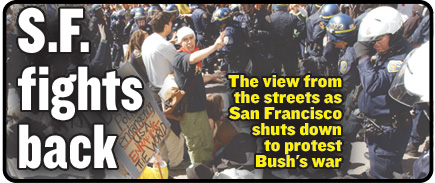
Nowhere was the clash of people power and government will more acute than on the streets of San Francisco, where a series of massive marches, some drawing nearly 100,000 people, filled the streets prior to the invasion of Iraq on March 19, 2003. The onset of war led protesters to effectively shut down the city, resulting in about 2,300 arrests and millions of dollars in costs to the city.

President George W. Bush dismissed the protests, of course, but he wasn’t the only one. Political leaders such as Rep. Nancy Pelosi, then-Mayor Willie Brown and soon-to-be Mayor Gavin Newsom (who didn’t attend any of the marches, unlike progressives on the Board of Supervisors) condemned the peace movement for hurting an innocent city. But with the “battle for San Francisco” making international news, the protesters were more concerned with the global audience.

A month earlier, on the weekend of Feb. 15 and 16, there were coordinated protests against the impending war in about 800 cities around the world, drawing around 10 million people. The peace march in Rome included about 3 million people, earning a listing in the Guinness Book of World Records as the largest anti-war rally in history. People have never made such a loud and clear statement against an incipient war.

Beyond the numbers, the antiwar movement was also right. On every major issue and prediction, the messages from the street proved correct while those from the White House were wrong. The US wasn’t welcomed as liberators. There were no weapons of mass destruction. Iraq after the invasion isn’t a stable democracy or shining beacon to anyone but the new generation of jihadis Bush created.

We can blame a hard-headed president, ineffectual opposition party, failure of the national media, or the national climate of fear following Sept. 11. But rather than refighting that lost battle, now is the time to gain perspective on the events of five years ago and determine what it means for democracy and the post-Bush national agenda.


TO THE STREETS

There were two main umbrella groups organizing protests before the war: Direct Action to Stop the War (DASW) and International ANSWER (Act Now to Stop War and End Racism). ANSWER has remained active and DASW has recently been reconstituted for the fifth anniversary of the war, using direct action in San Francisco as well as other urban centers and outposts like Chevron’s refinery in Richmond, which has reportedly been processing Iraqi oil.

“With the fifth anniversary coming up, we’re going back to direct action on the streets,” said Henry Norr of DASW. “But I don’t have any illusions that it’s going to be like it was five years ago.”

The maddening march to an ill-advised war created a political dynamic in which a broad cross-section of Americans was willing to hit the streets.

“We had a wonderfully diverse group of people, from soccer moms to anarchists,” said Mary Bull, who cofounded DASW, a collective of various affinity groups and concerned individuals formed in October of 2002 as Bush started beating the drums of war.

It was a group fiercely determined to prevent the war — and really believed that was possible. In fact, Bull recalls how she and other members of the group burst out crying at one meeting when a key activist said the war was going to happen.

Richard Becker, who cofounded ANSWER and serves as its West Coast coordinator, said that in the summer of 2002, “we came to the conclusion that [the war] was going to happen.” The group called its first big protest for Sept. 15, 2002, and another one two weeks later. But the movement really exploded on Oct. 26 when almost 100,000 people took to Market Street, much of it a spontaneous popular uprising.

“We were overwhelmed,” Becker said. “We were in a perpetual state of mobilization to keep up with what was going on. But then it didn’t stop the war.”

Did he think they could?

“I think a lot of people thought maybe it was possible to stop it. And we thought maybe it was possible to stop it,” Becker said.

The high point, according to Becker and Norr, was Feb. 17, 2003, when the New York Times ran a front page analysis piece entitled “A new power in the streets” that claimed “the huge anti-war demonstrations around the world this weekend are reminders that there may still be two superpowers on the planet: the United States and world public opinion.” But then Colin Powell went to the United Nations to argue for the invasion, and the Democrats in Congress did nothing, and it became clear war was coming.

Norr stayed out there protesting, being arrested several times and even shot in the leg by Oakland police with a rubber bullet during a protest at the Oakland docks. And he thinks some good came from the experience.

“The lesson for people is the political and economic elites are committed to preserving and extending empire. And they basically say as much in their own writing,” Norr said. “Wars are not anomalies.”

Despite being a frustrating and depressing exercise, most saw benefits to the failed movement. “People got an incredible education about how the system really worked,” Becker said. “Building a movement is mostly about a series of setbacks.”

Medea Benjamin, cofounder of both Global Exchange and CodePink and fixture of the anti-establishment peace movement for years, was upbeat about the protests. “We did our job as citizens. We did what we were supposed to do: organize, get people to take action, get people onto the streets,” she said. “We did everything we could think of.

“What you take from it is we don’t have a very well-developed democracy because the people spoke and the government didn’t listen.”

25war2_Lars1.jpg The ever-evolving “Democracy Wall” on Valencia Street, March 2003, helped stir up debate (Photo by Lars Howlett)


FACING ARREST

The collective action of five years ago starts with a series of personal stories — tens of thousands of them — so let me briefly begin with mine.

My arrival in San Francisco was closely tied to the march to war. I was living in Sacramento and working as the news editor of the Sacramento News & Review when Bush began his saber rattling against Saddam Hussein, but by the end of 2002 I had a falling out with my boss and found myself jobless.

Like most Northern Californians who opposed the war, I came to San Francisco on Jan. 18 to make my voice heard and experienced a bit of serendipity on my way to Justin Herman Plaza: while reading the Guardian on Muni, I saw their advertisement for a city editor, a job that was ideal for me at a paper I’ve always loved. Needless to say, it was a great day, empowering and full of possibilities.

Less than two months later I was on the job, and on the second week of that job I was back on the turbulent streets of San Francisco, part of a Guardian team covering the eruption of this city on the first full day of war. When I stepped off the cable car just after 7 a.m., people were streaming up Market Street and I joined them.

When a large group stopped at the intersection of Market and Beale, I stopped too, taking notes and bearing witness to this historic, exciting event. I had a press pass issued by the California Highway Patrol that allowed me to cross police lines, so when police in riot gear surrounded us and threatened arrest, I held my ground with 100 or so protesters.

After interviewing about a dozen people about why they were there and that they hoped to accomplish (see “On the bus: Journalists, lawyers, four-year-olds — the cops were ready to bust anyone Thursday morning“), I was arrested with the others and taken to a makeshift jail and processing center at Pier 27 (no charges were filed in my case, and charges against all of the 2,300 people arrested here in those first few days of the war were later dropped).

I recently tracked down a few of the people who appeared in my article, including Daphne and Ross Miller, who were at the center of the most interesting drama to play out during our standoff with the police. She’s a family practice physician, he’s an architect, and they live in Diamond Heights with their two children, Emet, who is almost 9, and Arlen, 12, who was away on vacation when the war began.

“We were genuinely shocked that the war started,” Ross told me. “We were at some of the earlier protests and really thought there was no way [Bush] could do it.”

They woke up March 20, 2003, to news that the war had begun and immediately walked to the BART station with Emet and rode to the Embarcadero station, not really planning for the day ahead but just knowing that they had to make themselves heard.

“We were pissed as hell. I don’t think I’ve ever been so angry in my life,” Daphne said.

They quickly came up with a plan. “We basically decided that if anyone was going to be arrested, it was going to be Ross and I’d stay with Emet. But it didn’t end up that way and I ended up in the arrest circle.”

Daphne had their house keys and threw them over the police line to Ross at one point. A photographer in the circle had gotten shots of a man named Roman Fliegel being roughed up by police as they pulled him off his bicycle, which was towing a trailer with a sound system, and decided to throw his backpack with camera gear out as well. When Ross — who had four-year-old Emet on his shoulders — caught it and refused police orders to give it to them, police grabbed Emet and roughly arrested Ross, leaving a gash on his forehead.

“Rage surged through the crowd, and it seemed as if things might get ugly, but the police kept a tight lid on the situation, using their clubs to shove back protesters who had moved forward,” I wrote at the time.

Emet was delivered into the circle with Daphne as the arrests continued, many quite rough. “At that point, as a mom, I had to exercise the most restraint ever,” said Daphne, who was angry about the situation but fearful about what she was exposing her son to. “Please, don’t let any violence happen here,” she pleaded with the crowd. Eventually, commanders on the scene let the mother and child go.

“The officer who let me go said that if he saw me again out there, he would call Child Protective Services on me,” Daphne said. But two days later, still brimming with outrage at her country’s actions, she ditched a downtown medical conference to rejoin the street protests, this time solo.

The couple say they’ve lost friendships over the war and have become more engaged with politics, coming to believe that Bush and the neocons are malevolent figures who knew how badly the war would go and did it anyway to establish a large, permanent military base in Iraq.

“Since that day, we’ve been far more active,” Ross said. “We realized you can’t just trust the system. You have to push.”

But that determination was mixed with feelings of disempowerment and depression. They attended some of the protests that following year, but the couple — like most people — just stopped going at some point because they seemed so futile.

“There was a horrible sense of resignation and a genuine depression that followed,” Ross told me.

The nadir was when Bush was reelected and they considered leaving the country. But then, Ross said, “we decided we’re not just going to run away and we’re not going to accept this.” Looking back, even with the scare over Emet, they express no regrets.

“It was the right thing to do because it was the wrong war to have. I’d do it again and again and again if I had to,” Ross said

They’re guardedly hopeful that Barack Obama could begin to turn things around if he’s elected. “I think the right president can at least start to dismantle this,” Daphne said. “I think thousands of people marching in the streets is something he would listen to.”

25war3_Charles1.jpg A die-in on the streets of San Francisco in March 2007 marked the fourth anniversary of the invasion (Photo by Charles Russo)


WITNESS TO HISTORY

Covering the peace movement in those early days was a heady experience, like reporting on a revolutionary uprising or working in a foreign country where the people are organized and active enough to be able to shut down society and brave enough to risk bodily injury for their beliefs.

I was at the founding meeting of CodePink — which became the most effective group at personally confronting the warmongers and keeping the war in the public eye — one evening at Muddy Waters in the Mission District shortly after the war started.

Looking back, Benjamin rattled off a long list of the alliances the group built — with labor, churches, businesses, and a wide array of social movements — and creative actions intended to build and demonstrate popular support for ending the war.

“We’ve done so many things and what did we get? We got a surge,” she said. “It shows the crisis in our democracy, the crisis of the two-party system, the crisis of a dysfunctional opposition party.”

Yet she said the peace movement has been remarkably successful in convincing the public that the war was a mistake and that it’s time for the troops to come home, even if the Democrats have been slow to respond to that shift.

“The progress we’ve made is turning around public opinion and that’s going to play a big role in the upcoming elections,” she said. For Norr, the role of the news media is a particular sore spot. He was a technology reporter for the San Francisco Chronicle who called in sick on the first full day of war and was arrested on Market Street with his wife and daughter, resulting in suspension by editor Phil Bronstein for his actions.

I wrote several stories on the issue, which culminated in Norr being fired and Bronstein unilaterally banning Chron employees from peace protests. I even borrowed CodePink’s guerilla tactics when Bronstein repeatedly refused to return my calls or address why he had singled out antiwar protesters for uniquely punitive treatment. I confronted him during a speech he gave at the Commonwealth Club (see “Lies and half-truths,” 5/7/03). That was the tenor of the times: we were all tired of being lied to and we decided to push back.

Norr was particularly frustrated with his own paper’s reporting of the war and started sending articles by the foreign press to his paper’s news desk, trying to wake his colleagues up to the pro-war propaganda being passed off as journalism in this country.

He was also disappointed with the country and with the Chronicle — both the management and his fellow reporters, who did little to support him — but the experience caused him to return to his roots as a progressive activist.

“The war and losing the job and everything brought an abrupt end to my consumerist phase and dumped me back into the world of being an activist,” said Norr, who serves on the KPFA 94.1 FM local station board and has made three recent trips to the Palestinian territories while working with the International Solidarity Movement.

Benjamin said Americans shouldn’t expect the next president to end the war — not without lots of pressure from a renewed and vocal peace movement. “This is the time to set the stage for the post-Bush agenda,” Benjamin said. “Don’t put your hopes in Barack Obama in getting us out of Iraq. Put your hopes in the people.”

25war4_Lane1.jpg A rally and nonviolent direct action at the Richmond refinery targeted Chevron on March 15 (Photo by Lane Hartwell)


THE AFTERMATH

The San Francisco Police Department, which spent more than $2 million on overtime costs responding to peace protests between March 15 and April 16, 2003, generally behaved with restraint and professionalism, but there were several exceptions.

The most costly and disturbing incident came when Officer Anthony Nelson began aggressively swinging his long riot baton at protesters, badly shattering the arm of peaceful protester Linda K. Vaccarezza, who suffered a permanent disability in her career as a court reporter.

Nelson’s incident report falsely stated that Vaccarezza had threatened him with a sign attached to a solid pole, but video of the incident later clearly showed there was no pole and that she was retreating when he teed off on her (see “The home front,” 05/19/04).

Vaccarezza received an $835,000 settlement from the city in November of 2004. On Oct. 5, 2005, two and a half years after the incident, SFPD fired Nelson for lying about what happened that day, and the City Attorney’s Office has been successfully fighting Nelson’s appeals in court ever since, putting in more than $100,000 in attorney time and costs into the Nelson and Vaccarezza cases.

The other significant ongoing litigation from the antiwar protests involved Mary Bull, who was arrested during an early protest for pouring fake blood in front of the entrance to Chevron’s San Francisco office before being allegedly strip searched and left naked in her San Francisco Jail cell for 36 hours.

Ironically, Bull was among those who brought a successful class action lawsuit against Sacramento County after she and others protesting a logging plan were strip searched, setting a precedent and led most counties to reform their strip-search policies. She used her share of the $15 million judgment to buy an organic permaculture farm in Sebastopol.

Her San Francisco case, in which Bull won a multimillion-dollar judgment, is still under appeal and now in mediation. Bull said the protests five years ago did make a difference, something she tells those who fret about its apparent failure. “I tell them to look at what issues the candidates are talking about now and I thank them for protesting then.”

“Even though we had millions throughout the world, we were sort of blocked, but now we’re regaining that momentum,” Melodie Barclay, a massage therapist who was also arrested with me on the first day of the war, told me recently. “We can’t judge it by the fact that we didn’t get the momentum we wanted.”

Norr started his antiwar activism working with Students for a Democratic Society in Boston, protesting the Vietnam War, which he said shares many similarities with the current situation, for good or for ill. He said that people tend to forget that while the protests then were huge and helped end the war, the movement did wane after Nixon ended the draft and substituted massive aerial bombardment for boots on the ground.

“The protests dropped off considerably,” he said. “A lot of the things that drove people to take risks in the late ’60s had faded by the early ’70s.”

He thinks the current administration learned a lesson from those days: it’s easier to maintain a war effort if the average citizen isn’t affected.

But there are other factors as well keeping a lid on the antiwar outrage.

“The culture has changed too. Young people are oversaddled with debt. People in schools seem to be docile. The culture as a whole seems to be more individualist and consumerist,” Norr said.

Yet some young people have woken up and many of them are funneling their energies into a peace group that was formed in the summer of 2005: World Can’t Wait, as in: the world can’t wait for the end of Bush’s second term before we change our direction and leadership.

“We don’t just want them gone, we need to repudiate their program,” said Giovanni Jackson, a 26-year-old WCW student organizer. “If we’re going to change anything, we need the youth.”

Jackson was at WCW’s founding convention in New York City, which came just as New Orleans was being flooded and then essentially abandoned by the federal government.

“When [Kerry] lost, people felt demoralized and World Can’t Wait kind of stepped into that situation,” Jackson said. “There was a lot of demoralization in the antiwar movement at that time.”

The group organized protests and student walkouts on Nov. 2, 2005.

“Everyone has their moments of doubt,” he said, “but I’m motivated by the crimes we see everyday.”


THE LESSONS

One of the biggest barriers to galvanizing people and turning the fifth anniversary of the war into something that might make a difference is the presidential election, which is diverting the energy of many potential protesters — and at the same time, offering some hope that a new president may lead to peace.

After all, every single one of the Democratic presidential candidates has promised to withdraw troops from Iraq, with varying timelines and numbers of US personnel left behind. And with enough encouragement, they might be willing to help change the status quo.

Many of the activists who volunteered their time and money to help move the Obama campaign into its front-runner position came out of the antiwar movement, and Obama’s strong stand against the war has been a key factor in his popularity.

Becker and some other activists don’t have much faith that a change in presidents will change the course in Iraq, although he agrees that much of the energy now surrounding Barack Obama derives directly from the antiwar movement.

“There’s been a huge upsurge of hope for Obama and that he might bring about the kind of change we need,” Bull said, adding that she doesn’t share that hope, believing the only path to peace is to pressure Obama and other leaders to commit to more progressive positions.

Norr said, “On one level, people have illusions about the power of peaceful protests. People believe in democracy, as well they should. We feel like the rulers should be paying attention to public opinion.

“It’s a remarkable story how broadly and quickly the American people have turned against the war. Public opinion was certainly ahead of the Democrats.”

And people will only grow more disenchanted with Iraq and its multitude of costs. “The people here are paying for this war, and everyday we have new stories about health clinics being shut down,” Becker said.

Becker was amazed last March as massive demonstrations for immigrant rights seemed to explode out of nowhere. “We think there will be more things like that,” he said.

Because after five years of organizing communities to resist the military-industrial complex’s plans, Becker thinks there’s been some visible progress.

“There isn’t a town or hamlet in the US that doesn’t have activism going on, but you wouldn’t know it from the corporate media,” Becker said. “It’s a mistake for people to feel discouraged.”

Brand spankin’

0

› superego@sfbg.com

Ah, spring. Strange birds are chirping, cherry trees are blossoming, pretty but misguided girls are puking on their Luichiny strappies outside North Beach bars, and adorable elderly gentlemen are grabbing my unmentionables on the Muni. Time for a couple of pomegranate liqueur shots and some neon butterfly nail decals. Or fuck it, just hand me the Chivas and let’s go dancing. Party time.

In my fondest dreams, the floors always hop, the clubbers look fierce, the jams never stop, and last call’s just past dawn. (Also: butch unicorns.) But dreams are for sleepers, gorgeous, and who would ever admit to being one of those? It’s almost worse than saying you’re tired and want to go home. Quel tragique. If you want it, you’ve got to stay up for it, we say, and for a year now, Scene has been toasting the amazing people, places, and parties that give their very all to make those dreams a reality, however creatively (wink).

Cosmic local nightlife, cocktails, fashion, music, art, expression — not necessarily in that order, and preferably all at once with a little kiss-kiss afterward — that’s what spurred us to launch this thing. And sometimes we put down our caipirinha glasses and stop twirling long enough to actually put out another issue. Thus, welcome to the spring 2008 Scene! From fresh drinks to fab threads to hot freaks, it’s positively aching with enjoyment. Much like spring itself.

Refill!

Marke B.

Freedom of Information: 2007 James Madison Award winners

0

Click here for details on the First Amendment Awards Dinner.

Norwin S. Yoffie Career Achievement Award

DAN NOYES (COFOUNDER, CENTER FOR INVESTIGATIVE JOURNALISM)


If journalists were the subjects of trading cards like baseball players, the Dan Noyes rookie card would be just as impressive as a 2008 career highlights card. Think Reggie Jackson: a long, impressive career, spanning multiple organizations and a propensity to come out swinging big at the end of a hard-fought battle.

Over a career spanning 30 years, Noyes has pursued serious investigations, some lasting as long as a year, into everything from questionable Liberian timber imports to illicit gun trafficking from United States suppliers to the Nuestra family gang. Journalism first interested Noyes during the crucial investigative reporting that sparked Watergate scandal in the early 1970s.

In 1977 Noyes cofounded the Berkeley-based Center for Investigative Reporting (CIR), an independent news organization which produces in-depth stories and documentaries for all major news outlets. In 1979, reporting for the ABC News program 20/20, CIR broke a story on a swindling United Nations charity organization and its connections to international drug trafficking.

More recently, Noyes has done a series of print and broadcast pieces concerning gang violence in California and its effect on the lives of those surrounding the lifestyle. Noyes still holds an executive position at the CIR and continues to contribute to the world of investigative journalism.

Beverly Kees Educator Award

CLIFF MAYOTTE


Cliff Mayotte sees his Advanced Acting Class at Lick-Wilmerding High School as one that merges students’ "consciousness and awareness as young adults with their skills and energies as performance artists."

The subtitle of the course is "Theatre as Civic Dialogue," and the eight students enrolled during the 2007 spring semester used all their abilities to pull off a notable show.

After an introduction to Documentary Theatre — a form he described as "oral history turned into performance" — the group selected a topic that was important to them, giving birth to the "Censorship Project."

The students interviewed their peers, teachers, and administrators to gather perspectives on the ways in which expression and opinion can be muted or altered, both voluntarily and involuntarily. They reached out to organizations such as Project Censored, the First Amendment Project, and the Ella Baker Center for Human Rights. They transcribed interviews and studied subjects in order to capture statements, word patterns, and mannerisms of interviewees, then shaped the themes into a 60-minute performance.

Professional Journalists

WILL DEBOARD


"Being a high school sports guy, I don’t get to do this very often," the Modesto Bee‘s Will DeBoard said of his first major foray into investigative reporting. He had gotten a tip that the California Interscholastic Federation was investigating recruiting violations by the football program at Franklin High School in Stockton, which competed with schools in his area. DeBoard asked the school and CIF about recruiting violations, but the football coach flatly denied the allegations and the CIF wasn’t much more helpful.

So DeBoard decided to make formal requests for public records with the help of business reporter Joanne Sbranti, and after fighting through some initial denials, he obtained hundreds of pages of investigatory documents from CIF showing how the school was recruiting players from American Samoa. "It really was a treasure trove of great stuff. We got two weeks’ worth of stories out of these documents," DeBoard said. "It really showed us that what the school was telling us just wasn’t true."

The documents detailed the recruiting scheme and gave DeBoard tons of leads for follow-up stories, including the address of "a home owned by the coach where there were all these gigantic Samoan linemen living there." DeBoard called the effort an "adrenaline rush" better than that caused by the best game he’s covered and a high point of his journalism career.

THOMAS PEELE


Contra Costa Times investigative reporter Thomas Peele has a long history of battling for public records access on behalf of both reporters and private citizens. Peele, who helps with projects for all the newspapers under the Bay Area News Group-East Bay ownership, helped ensure the recovery of thousands of e-mails from the Oakland mayoral tenure of Jerry Brown when he left office to become the state’s attorney general in 2006. Peele also helped conduct a statewide audit of Public Records Act compliance by law enforcement agencies with the nonprofit Californians Aware, which revealed glaring inconsistencies in how police across the state make information about their activity available to the public. And he’s been a major figure in helping the Chauncey Bailey Project pry out new information about Bailey’s murder last year and it’s connection to Your Black Muslim Bakery. He began his career in 1983 at a small weekly in Bridgehampton, N.Y., and moved from there in 1988 to the Ocean County Observer in New Jersey before joining the CCT in 2000.

ROLAND DE WOLK


KTVU-TV producer Roland De Wolk is leading the investigative team of photographer Tony Hedrick and video editor Ron Acker in a quest to get the names of drivers who regularly use FasTrak lanes but don’t pay anything. But to date, says De Volk, the Metropolitan Transportation Commission has been blocking his team’s quest.

De Wolk told the Guardian that his team filed a California Public Records request when the MTC wouldn’t provide information on the amount of money it was losing thanks to drivers who don’t pay tolls when they use FasTrak lanes.

"We asked MTC for specific numbers last summer and got little information. That makes a reporter’s antennae quiver," said De Wolk.

But when he and his team asked for the numbers of people obstructing their plates, the MTC started acting squirrelly, De Wolk said.

"Finally, after six to eight weeks of asking we got an answer: a photo of a car whose plate was blank," fumed De Wolk, whose team continues to push for the names of the 10 most frequent FasTrak violators.

Broadcast News Outlet

KGO-TV


When KGO-TV reporter Dan Noyes and producer Steve Fyffe asked Muni to turn over records of public complaints against its drivers, they were ready for some bureaucratic foot dragging. But they never expected the yearlong grudge match that followed. First, the union representing Muni drivers sued to keep the records sealed. Then Muni’s parent department, the Municipal Transportation Agency, made a backroom deal with the union and released a blizzard of confusing and heavily redacted paperwork that would have made the Pentagon blush.

"It was essentially a big document dump," Fyffe told us. "There was no way to tell one form from another or which driver was which."

Noyes and Fyffe convinced their bosses at KGO-TV to file a lawsuit for full access to the records. The station prevailed, after which Noyes and Fyffe received over 1,200 pages of public complaints about 25 drivers. Recently, the station went back to court after Muni refused to release surveillance tapes of the drivers. As in the previous case, the judge ruled that the public had a right to the materials and forced the transit agency to hand the tapes over.

Fyffe said he sees KGO’s legal successes as small victories in a much larger fight. "I hope in the future that this case will make Muni and other city departments more [responsive] to records requests … these kinds of incremental victories hopefully lead, little by little, to a more open government."

Print News Outlet

SACRAMENTO BEE


The Sacramento Bee operates in a city run by top-tier politicians and their spinmeisters, so the editors and reporters there have placed increasingly high value on using documents to support their stories.

"We’ve always used public records here. Being in a state capital, we’re a little more aware of the necessarily of that," managing editor Joyce Terhaar said. "You just need to be able to tell a story about what’s really happening."

Yet she said that in recent years, the Bee has made a concerted effort to hire public-records experts and to have them share their knowledge with the paper’s staff through regular workshops. And last year, those efforts paid off with a string of big, impactful investigative stories.

Among them was Andy Furillo’s look at how much the state was spending to fight inmate care lawsuits, Andrew McIntosh’s exposé on the lack of oversight for paramedics and emergency medical technicians, and stories by John Hill and Kevin Yamamura on misconduct by the state’s Board of Chiropractic Examiners.

In selecting the Bee, Society of Professional Journalists judges recognized these individual efforts as well as the Bee‘s "institutional support of reporters and their use of public records for numerous stories."

Community Media

THE BERKELEY DAILY PLANET


One of the only ways to uncover corporate wrongdoing is to dig through court records, and it’s the job of the press to report what it discovers, said Becky O’Malley, executive editor for the Berkeley Daily Planet. She was convinced that a prior court order violated the public’s constitutional rights to see court documents, so the small daily newspaper sued and won in a California appeals court last year, making public 15,000 pages of records from a class-action suit filed against Wal-Mart in 2001.

The documents included allegations that the company had denied rest breaks to its workers and deleted hours from paychecks. In the Planet‘s freedom of information suit, the appeals court judges agreed with the paper’s attorneys that the case could set a dangerous precedent where the public would have to prove its right to access court records. "It’s becoming more of a trend for judges to grant permanent seals on court records," said O’Malley. That’s unfortunate, she added, since "the only way the public finds out about bad things going on in society is through court records."

Special Citation Award

CHAUNCEY BAILEY PROJECT


After Oakland journalist Chauncey Bailey was murdered last August, a large group of Bay Area media organizations formed a rare coalition to investigate his death and the activities of Your Black Muslim Bakery, a long-time East Bay institution believed by police to be involved in the killing. Since then, the group has produced several stories complete with audio, video, and photo presentations, the most recent of which is a series by retired Santa Rosa Press-Democrat reporter Mary Fricker detailing the sexual assault allegations made by young women once in the custody of Yusuf Bey Sr., founder of the bakery. Fricker received help from independent radio journalist Bob Butler, investigative reporter A.C. Thompson, and MediaNews staff writers Cecily Burt, Thomas Peele and Josh Richman. Other stories have reported allegations of real estate fraud against bakery associates, explored potential coconspirators in Bailey’s death, and examined the bakery’s ties to several prominent politicians. More about the project — the first of its kind since a group of journalists investigated the murder of Don Bolles more than 30 years ago in Arizona — can be found at chaunceybaileyproject.org, or at www.sfbg.com/news/chaunceybailey.

Public Official

MARK LENO


It was a staff member, Kathryn Dresslar, who told Assemblymember Mark Leno how horrible state agencies had become at complying with the California Public Records Act. Dresslar served on the board of Californians Aware, a group that advocates for open government, and she described to her boss how a 1986 audit by the organization had given every one of the 33 agencies in California government a failing grade.

Ryan McKee, then a high-school student and the son of CalAware board president Rich McKee, had visited each agency and asked for a few simple things. He wanted to see each agency’s guidelines for public access, and he requested some basic information, including the salary of the agency director. Agency after agency refused to follow the law.

So Leno introduced legislation that would have mandated that every agency post its access guidelines on the Web — and included stiff fines for agencies that violated the Public Records Act. "It put some teeth into the law," Leno told us. "And I got 120 of 120 members of the state Legislature to vote for it.

That wasn’t enough for Gov. Arnold Schwarzenegger, who vetoed the bill, saying it wasn’t needed. The governor insisted that he had already ordered state agencies to fix the problem.

"It was a great eye-opener for me, and showed me the resistance this administration has to allowing public access to state government," Leno said. "Without that access the public is at a great disadvantage."

Library

UC BERKELEY’S BANCROFT LIBRARY LOYALTY OATH PROJECT


It might be hard to believe, but in 1949 the University of California Regents, a bastion of higher education, rode the wave of anticommunist fervor and McCarthyism, forcing all UC employees to take a loyalty oath. The Board of Regents adopted the rule that UC administrators pushed forth: denounce communism and swear loyalty to the state, or face losing your job.

As could be expected, people resisted and 31 faculty, workers, and student employees lost their jobs. They appealed the case to the California Supreme Court and eventually were reinstated in 1952, but the controversy cast a pall over the UC’s reputation and divided campuses. With the help of a grant from UC President Emeritus David Gardner, archivists from UC Berkeley’s Bancroft Library and other researchers painstakingly compiled 3500 pages of text, many audio statements, and photos from four UC collections.

The online collection, which went live in December 2007, serves as primary source material for students and researchers who want to understand how UC administrators got embroiled in and came to terms with the McCarthy-era tensions that rocked the country.

Legal Counsel

RACHEL MATTEO-BOEHM


Electronic data is the new frontier for public-records law, and Rachel Matteo-Boehm, a lawyer with Holme, Roberts and Owen, last year won a key case preserving the public’s right to access to what some public agencies have tried to claim was proprietary data.

The county of Santa Clara produced a digital map showing property lines, assessors parcels and other key real-estate data, and that became the basis for a geographic information system tool. The GIS would allow users to plot everything from property taxes to street repairs, public investment, political party registration, school test scores and other trends. But Santa Clara wasn’t giving it out to the public: The database cost more than $100,000, which meant only big businesses could use it.

Boehm went to court on behalf of the California First Amendment Coalition to argue that the data was public, and must be made available without high charges. "As information begins to be collected in electronic form, and governments choose to put information in sophisticated electronic formats, you can run into real public-access problems," Boehn told us.

Boehm convinced a Santa Clara Superior Court judge that the data was indeed covered under the California Public Records Act. Now Santa Clara must make the map available to the public — and other counties with similar data, seeing the results of the suit, are following that rule.

The decision was a key one, Boehm said: "One day we’re going to wake up and all there will be is electronic records," she noted. And if governments can apply different rules to those documents, "you can kiss the Public Records Act goodbye."

Whistleblower

DAN COOKE


When Dan Cooke shared details of an alleged sewage spill on Alcatraz Island with the Guardian, the health of the national park — where he’d been working as an historical interpreter for over a decade — was foremost on his mind. But he lost his job after the story was published — apparently for taking a proactive role in noting details of the spill in the island’s log book and speaking candidly to the press about what he’d seen. Wanting nothing more than a return to his job leading educational tours of the island, he filed an administrative claim with the US Department of Labor against the Golden Gate National Park Conservancy and the National Park Service. And he called the Guardian. We reported his firing. The next time Cooke called, it was to happily report he was back on the job.

Citizen

SUPERBOLD (BERKELEYANS ORGANIZED FOR LIBRARY DEFENSE)


SuperBOLD has accomplished something entirely different from what it set out to do. Originally, the small group of devoted Berkeley public library users organized to oppose the installation of RFID tags in books. "In the process of going to library board of trustees meetings, we discovered they were vioutf8g the Brown Act," said Gene Bernardi, who heads SuperBOLD’s steering committee with Jane Welford, Jim Fisher, and Peter Warfield. They found, among other things, that certain documents were only made available to trustees and a lottery system was employed in selecting speakers during public comment. They took their complaints to the Berkeley city attorney and joined up with the First Amendment Project, which threatened a lawsuit. Things have changed, though it’s still not perfect — city council meetings only allow 10 speakers and the library trustees still play the lottery for public comment, but marginal improvements portend better days.

"Now you can speak more than once," said Bernardi. "Now you can speak on consent calendar and agenda items. So there are more opportunities to speak … if the Mayor [Tom Bates] remembers to call public comment."

Electronic Access

CARL MALAMUD, PUBLIC.RESOURCE.ORG


For years, web pioneer Carl Malamud has sought ways to use the Internet to connect average citizens with their government. His new Web site public.resource.org helps that cause by excavating buried public domain information and posting it online. Though still in its early stages, the site already allows users to tap into hard-to-find records from places like the Smithsonian, Congress, and the federal courts system.

Even though most government records are part of the public domain, fishing them out from the bureaucratic depths can be a daunting and expensive task, even for someone like Malamud. During a lecture at UC Berkeley last year, he related his recent difficulties in acquiring a simple database from the Library of Congress. Instead of turning over the materials, officials at the Library cited dubious copyright protections and presented Malamud with a bill for over $85,000 — all for access to supposedly public information.

Thanks to Malamud’s Web site, that database and millions of other documents are now available with the click of a mouse. Ultimately, Malamud hopes public.resource.org will help bring about an age of "Internet governance," in which every last byte of public data winds up online for all to see, free of charge.

THE SOCIETY OF PROFESSIONAL JOURNALISTS
NORTHERN CALIFORNIA CHAPTER presents the 23RD ANNUAL JAMES MADISON FREEDOM OF INFORMATION AWARDS DINNER

MARCH 18, 2008
NEW DELHI RESTAURANT
160 ELLIS STREET
SAN FRANCISCO
No-host bar @ 5:30 p.m.
Dinner/Awards @ 6:30 p.m.

TICKETS:
$50 SPJ members & students
$70 General public
For more information, contact David Greene (dgreene@thefirstamendment.org)

>

Muni’s makeover

0

› news@sfbg.com

GREEN CITY San Francisco’s streets are some of the most congested in the nation, our gasoline prices are reaching record highs, and parking is both scarce and expensive (particularly given the rising cost of parking tickets). But most drivers still haven’t been willing to switch to public transit, something that Muni officials hope to change with the help of a highly anticipated study that’s just been released.

The Transit Effectiveness Program (TEP) is a systemic proposal to make Muni faster and more attractive, mostly by focusing resources on the busiest routes. The study kicks off what could be a transformative year for the Municipal Transportation Agency, which got another $26 million annually through the passage of Proposition A in November 2007 and has been struggling for years to meet its on-time performance goals and win back lost riders.

It has been over two decades since Muni had its last major overhaul. The TEP boasts "hundreds of changes" in the works, from larger buses to route additions. The current draft of the proposal reflects 18 months of data collection on rider trends and community input. Officials found residents citywide were most concerned with reliability in the system.

"We have some schedules that are up to 10 minutes short of how long the line actually takes," said Julie Kirschbaum, program manager of the TEP. "We also need to reduce the number of breakdowns. We need more mechanics."

Data also showed 75 percent of Muni passengers board in the system’s 15 busiest corridors, which include the 49 Mission/Van Ness, 38 Geary, and 30 Stockton routes. TEP calls for increasing service on these corridors by 14 percent and cutting wait times to five minutes or less.

The study also proposed new routes to better reflect changing growth patterns and travel needs. For the first time, a bus would directly connect Potrero Hill with downtown. A new "downtown circulator" would loop Market Street on Columbus, Polk, and Folsom streets, replacing the 19 Polk and 12 Folsom. Some proposals would increase service between neighborhoods in the western and southern parts of the city as well as create better connections to BART and Caltrain for those who commute to or from the city.

University students and employees could also benefit from the TEP, as increased service to destinations such as San Francisco State University and University of San Francisco were high priorities for the project team. In order to maximize resources, some routes could be scaled back or removed, potentially making the walk to the bus stop a few blocks longer for some city residents. For example, in the Mission District, there is a proposal to fold the existing routes on Folsom and Bryant into a faster, higher-capacity route on Harrison. A proposal to end the 56 Rutland route would leave Visitation Valley even more isolated.

Once the TEP’s environmental impact report is complete sometime next year, there will be public hearings before the MTA board decides which recommendations to adopt. The Board of Supervisors could ultimately vote to overrule controversial route changes.

The TEP is one of many high profile green initiatives Mayor Gavin Newsom has rolled out, from a solar panel initiative he introduced with Assessor Phil Ting to the controversial appointment of Wade Crowfoot as the director of climate protection initiatives, whose salary is paid with MTA funds.

"The best thing we can do is get people out of single occupancy vehicles…. This mode shift is my primary goal," Crowfoot said at a Feb. 27 public information workshop, one of many planned throughout the coming months to educate and receive feedback from residents on the TEP.

Yet like many of Newsom’s splashier initiatives, the plan lacks clear funding sources and commitments. "There’s a whole capital piece to the TEP that’s been missing the whole time," Tom Radulovich, executive director of Livable City and a member of the TEP’s policy advisory board, told us. "Without this capital element, TEP won’t happen."

Many of the proposals could be covered by reallocating operational costs, yet some expensive projects remain without a clear source of financing. Despite the price tag, Radulovich said ambitious investments now could more than pay for themselves in the long run: "If you’re smart about how you spend money, you can use capital money to save money in operating costs down the line."

Building green in SF

0

› news@sfbg.com

GREEN CITY Wind turbines and solar panels may soon sprout on San Francisco rooftops as the city considers rival plans to implement mandatory green design standards for new residential and commercial buildings.

One ordinance proposed by Mayor Gavin Newsom’s Green Building Task Force would require new commercial construction of more than 5,000 square feet, residential buildings above 75 feet, and renovations to buildings of more than 25,000 square feet to be Leadership in Energy and Environmental Design (LEED) Gold certified by 2012, the second-highest designation.

The U.S. Green Building Council developed the point-based LEED system based on numerous green factors. The lowest green standard is LEED Certified, followed by Silver, Gold, and Putf8um. The new Academy of Sciences building, with the country’s largest living roof, is LEED Putf8um.

Newsom’s legislation would start off by mandating requiring only the lowest standard, LEED Certified, which requires 26 points, and gradually move to LEED Gold by 2012. But Board of Supervisors president Aaron Peskin has introduced an ordinance that would require the same buildings to immediately earn LEED Gold certification.

According to the LEED system, most existing buildings already have between 18 to 22 points, so Newsom’s proposed goal should be fairly easily attainable. A bike rack outside a building qualifies for 1 point. Proximity to mass transit gains another point, and Muni runs within two blocks of 90 percent of all San Francisco residences, according to the Municipal Transportation Agency.

At a green building standards workshop Feb. 20 at the San Francisco Green Party’s office, about 20 people voiced their concerns with the ordinances in front of three city commissioners.

"We need to correct the language to include all buildings," said panelist Patricia Gerber, a member of the city’s Peak Oil Preparedness Task Force. The San Francisco Office of Economic Analysis last year concluded both proposed ordinances would impact only 38 percent of the construction industry. "We should look to Europe for inspiration," Gerber recommended. "They have much stricter standards."

Some European nations started mandatory green construction in the mid-’90s, but critics say the United States has lagged.

"There are no minimum requirements on windows, insulation, and leaks," Gerber told the Guardian, describing the proposed ordinances. "LEED is a joke."

But Mark Westlund, spokesman for the Department of the Environment, defended Newsom’s longer LEED certification timeline. "We want to develop a green building plan that business can work with," he told us.

The Green Building Task Force claims that businesses need time to adjust to the higher costs associated with green materials, such as EnergyStar windows, can reduce heating costs by 30 to 40 percent. "They’re expensive because they’re used on a small scale. The minute they require it, it will become cheaper," John Rizzo, Green Party member and City College Trustee, told the audience. "It would be great if this could be done on a statewide level."

Panelists noted that green buildings save money in energy costs over the long run. Another criticism raised at the workshop was the Newsom plan’s loopholes. "Even if a project is approved green, it might not end up green," Gerber told us. If a construction company runs out of money for example, it can ask the planning director to waive LEED certification.

In addition, the event attendees questioned the credibility of the mayor’s Green Building Task Force, which does not include any environmentalists. Rather, it is composed of developers, financiers, architects, and engineers.

"We feel it represents a good variety of industry people, and so far we haven’t received any negative responses on the ordinance," Mark Palmer, San Francisco’s green building coordinator, told us.

Smaller residential buildings in San Francisco will not require LEED certification, but could be required to follow a GreenPoint scorecard developed by Berkeley nonprofit Build It Green.

Newsom’s ordinance will be presented March 19 at the Building Inspection Commission, which has already forwarded Peskin’s measure to he Board of Supervisors’ Land Use Committee. According to Peskin’s office, the two ordinances will likely be combined once supervisors decide which standard to seek.

Solo budgeting

0

› sarah@sfbg.com

Mayor Gavin Newsom is giving his department heads until Feb. 21 to draw up a list of services and positions to be reduced and eliminated, but Board of Supervisors president Aaron Peskin notes this isn’t how city government is supposed to work.

"Technically, things aren’t being cut," Peskin told the Guardian. "Instead, the mayor is signaling that he is refusing to spend the money that has been appropriated by the board in the budget that was voted on and signed last year."

Last summer the Board of Supervisors used the add-back process to appropriate funds the mayor hadn’t sought, thus funding services such as the Workers Compensation Clinic at San Francisco General Hospital and Buster’s Place, the city’s only 24-hour homeless shelter, until the end of fiscal year 2007–08.

But now these same services are being targeted midyear. The mayor announced last November, shortly after he was reelected, that the city faces a projected $229 million budget, so he was demanding an immediate hiring freeze and across-the-board cuts.

As mayoral spokesperson Nathan Ballard reportedly told the San Francisco Chronicle last fall, "Although he wants to trim the fat, the mayor made it abundantly clear he doesn’t want to see a reduction in people sweeping streets or police officers walking beats."

But while city department heads spent the past few months trying to tighten belts, the mayor apparently expanded his, according to budget analyst Harvey Rose’s Feb. 13 report, which details the monetary impact of changes to Newsom’s staff — changes the mayor first announced Jan. 4.

"Don’t think that the irony of the revelations that have been made over the past few weeks has been lost on anyone," Peskin told us, referring to how Newsom added two entirely new positions, increased the pay of senior staff and newly appointed department heads in the Mayor’s Office, and raided the budgets of other agencies to pay for it all.

According to Rose’s report, the budgetary impact of Newsom’s staff changes amounted to an increase of $553,716, with other city departments funding about $1.34 million in annual salaries and benefits for 10 positions assigned to the Mayor’s Office.

These include two newly created jobs — namely, the mayor’s climate change director, Wade Crowfoot, and the mayor’s homelessness policy director, Dariush Kayhan.

Peskin admits that the spending Rose identified is a relative drop in the bucket, compared to the city’s $229 million deficit. "Yes, it’s not enough to significantly close the gap or save a significant number of services, but it’s symbolic," Peskin said, noting that even as homeless shelters are being fingered for elimination, the Human Services Agency is paying $169,624 annually for the mayor’s new homelessness policy director.

"And when voters approved more money for Muni, the mayor used it to hire people to pound out messages about climate change, when the best way to reduce greenhouse gases is to get people out of their cars," Peskin said, referring to Newsom’s new climate change director, hired at an annual cost of $130,112, using the Municipal Transportation Authority’s Safety and Training funds.

"It’s very frustrating and unfortunate," Peskin said, further noting that the $401,392 to terminate Susan Leal without cause as general manager of the San Francisco Public Utilities Commission will come from the city’s water fees.

"This is indicative of the misplaced priorities of the mayor," said Peskin, who doesn’t deny that spending control is required in the face of a looming deficit but resents how the mayor has been trying to do it unilaterally and not in cooperation with the board.

"The budget, by design, is a two-way street," Peskin observed.

Sup. Chris Daly claimed the services being targeted for Newsom’s midyear elimination are "a who’s who of the board’s priorities…. These are human and health services that the mayor has proposed be cut multiple times."

Daly’s legislative aide, John Avalos, who is running for District 11 supervisor, notes that while Daly wanted $33 million for affordable housing, a onetime amount, the mayor took a budget surplus and used it for multiple years, with the police, firefighters’, and nurses’ contracts accounting for his biggest expenditures.

Asked why the city’s deficit has ballooned by $144 million — from the $85.3 million the Controller and Budget Analyst’s offices identified in March 2007 to the $229 million that Newsom’s administration was suddenly projecting last fall — Tom DiSanto, budget and revenue manager for the Controller’s Office, cites an extra $82 million in salaries and benefits.

These include the four-year contracts that nurses and police and fire departments secured last summer, along with five extra police academies, said DiSanto, who also listed $7 million in police crime laboratory debt service, $7.4 million for sheriff inmate housing (required by last year’s Supreme Court order that prisoners can’t sleep on floors), and the $29 million transit set-aside that voters approved last November when they passed Proposition A.

But as DiSanto explains, the city’s budget problem is due not to lack of revenue but to baseline funding and rainy-day reserve requirements, not to mention the political process.

"Right now, with baselines and reserves, 96¢ out of every dollar goes into set-asides, and we’re required to adopt a balanced budget," DiSanto said. "That’s where the cuts come in. If we could access all the city’s revenues, we wouldn’t have a $229 million projected deficit," he added, noting that revenues are up, property taxes are higher than budgeted, and the hotel tax continues to be strong.

Ken Bruce, senior manager at the Budget Analyst’s Office, notes that unlike the federal government, the city of San Francisco has to balance the budget. He also says the current deficit projection comes from the Controller’s and the Mayor’s offices, not the Budget Analyst’s Office.

"In mid-March we get to do a joint forecast," Bruce told the Guardian. "It may paint a better picture, less of a doomsday scenario, but it still leaves us facing difficult policy choices. [The deficit] won’t drop from $230 million to $100 million."

Peskin envisions several long-term solutions, hopefully including positive changes in the White House this fall.

"With every passing year, as the federal government has abandoned the cities, we’ve taken more of a burden, and labor and capital costs have increased," says Peskin, who is mulling changes to the real estate transfer tax and closing a loophole whereby lawyers and accountants in limited liability partnerships have escaped paying payroll taxes.

That said, Peskin sees no easy fixes in the city’s upcoming budget hearings:

"It’s a fluid situation, and it’s all bad."

Newsom needs to return the MTA’s money

0

19-NewsomMuni_web.jpg
What is Gavin looking for? A way off the train? Or a way to spend MTA money on hiring himself a climate change director?

“Crashes involving MUNI and pedestrians have nearly doubled in the past two years: in 2005, there were 34 crashes involving a MUNI vehicle and a pedestrian; while 2007 saw 62. These numbers include 3 fatalities in 2005 and 7 fatalities in 2007. This is a disturbing statistic.”

Manish Champsee of Walk For San Francisco, a pedestrian advocacy group, included this stat in an email to Mayor Newsom, by way of explaining his group’s concerns with the Mayor using MTA safety money to hire a climate change director.

Champsee’s email (included below) is worth reading for the way he avoids denigrating anyone working in the Mayor’s Office. Yes, those folks are doubtless trying to do great and wonderful things for the planet, but could they please do that with money from the Mayor’s budget, not from overloaded public transportation agencies?

Subject: Restore Funding for a Safety and Training Manager
To: gavin.newsom@sfgov.org
Cc: boardofsupervisors@sfgov.org, Nathaniel Ford

Dear Mayor Newsom:

This letter is to voice our concern regarding reports that staff in your office are being paid for by MTA funds meant for the hiring of a Safety and Training Manager for the SFMTA.

With a downward safety record at the MTA regarding collisions with pedestrians, we advocate that this MTA funding in particular be applied to Safety and Training Management. As advocates for a walkable, more livable city,
we strongly support the role of a Greening Director.

We welcome an opportunity to speak with you regarding the current spike in injuries to pedestrians.

Sincerely,

Manish Champsee
Walk San Francisco President

On the waterfront: an epic

0

The city of night on a night of rain still offers its spectacles, and one of them must be the Bay Bridge as viewed from Epic Roasthouse, the brand-new restaurant (starring Pat Kuleto and Jan Birnbaum) that, with its sibling, Waterbar, sits on the narrow strip of land between the Embarcadero and the water. The bridge soars through the mists overhead, like the arc of a rainbow, and one has the sense of inspecting it — peeking at its underbelly, as if at a used car that might or might not be leaking coolant.

Not even a generation ago this neighborhood was entombed by an overhead freeway, and when Boulevard opened in the Audiffred Building just a few blocks away in 1993, the Embarcadero consisted mostly of granulated, ghost-town asphalt. But the visionaries could see what was bound to happen — what indeed was already happening, slowly but inexorably, because of the 1989 earthquake — and in that crumbled pavement a farmers market took root. Eventually it found a home in the resurrected Ferry Building, while on other plots of land liberated from elevated-freeway strangulation, hotels and parks and housing developments sprouted; restaurants too. What was an urban wilderland is now a glossy district both commercial and residential, a crown for the city, with a couple of gaudy new jewels.

Like all view restaurants, Epic Roasthouse is bound to attract tourists, both out-of-towners and suburbanites, but it also stands to develop a city constituency. Although parking in the area is hellish, Muni’s T line stops just steps away, and meanwhile, the blocks immediately behind the waterfront are filling up with residential towers, which will soon fill up with people of means who will be able to walk over to the Embarcadero for dinner.

With all due respect to the bicycle lobbies, the great city pleasure is walking — and the great luxury of our time is also walking, since it frees us from the tyranny of machines, at least if we’re not listening to an iPod or yakking into a cell phone as we stroll. Walking to or from work? Priceless! Walking to or from Epic Roasthouse? Also priceless, with appetite kindled on the inbound leg and calories usefully spent on the other.

Paul Reidinger

› paulr@sfbg.com

Super lessons

0

› news@sfbg.com

The Super Fat Tuesday presidential primary election in San Francisco was marked by some portentous trends and factors that could have a big impact on who becomes the Democratic Party nominee — and whether that person will be accepted as the people’s legitimate choice.

Consider the scene the night before the election. A small army of young people made its way up Market Street carrying signs and pamphlets supporting their candidate, Barack Obama, taking up positions outside Muni and BART stations and on high-profile corners to spread the message of change.

Meanwhile, inside the Ferry Building, Mayor Gavin Newsom and former president Bill Clinton convened one of several "town hall meetings" held simultaneously around the country to promote the presidential campaign of Hillary Clinton, who checked in on a satellite feed.

Among the many luminaries on hand was State Sen. Carole Migden, a superdelegate (one of 71 from California) who has not yet pledged her support to either Clinton or Obama and who could ultimately play a huge role in determining the nominee. Migden made a show of exchanging pleasantries with the former president, warmly embracing him in front of a crowd of about 250 people and more than a dozen news cameras before taking a seat nearby.

But Election Day was for the regular citizens, and once their votes were counted and analyzed, a couple of things became clear. Clinton won California with the absentee ballots that she had been banking for weeks thanks to her deeply rooted campaign organization. Her margin of victory among early voters was about 20 percentage points.

Yet a late surge of support for Obama caused him to win at the polls on Election Day, leading to his outright victory in San Francisco by a margin of about 15,000 votes, or almost 8 percentage points. It was a symbolic victory for progressives on the Board of Supervisors, who backed Obama while Newsom campaigned heavily for Clinton (see "Who Wants Change?," 1/30/08).

Obama and Clinton were close enough in California and the rest of the Super Fat Tuesday states that they almost evenly split the pledged delegates (those apportioned based on the popular vote). But if present trends continue, even after Obama’s sweep of four states that voted the weekend after California, neither he nor Clinton will have captured the 2,025 delegates they need to secure the nomination before August, when the Democratic National Convention convenes in Denver.

That means the nomination could be decided by superdelegates such as Migden, a group comprising congresspeople and longtime Democratic Party activists, from party chair Art Torres down to those with key family connections, such as Christine Pelosi and Norma Torres.

And that could be a nightmare scenario for a party that hopes to unify behind a campaign to heal the country’s divisions.

Political analyst David Latterman, president of Fall Line Analytics in San Francisco, said this election was marked by a higher than expected turnout and more people than usual voting on Election Day rather than earlier. In San Francisco turnout was more than 60 percent, including an astounding 88.4 percent among Democrats.

"In the last couple weeks there was a strong get-out-the-vote push by Obama’s people," Latterman said during a postelection wrap-up at the downtown office of the San Francisco Planning and Urban Research Association (SPUR), which he delivered along with campaign consultant Jim Stearns.

Latterman said that Obama surge, which drew out voters who were generally more progressive than average, may have been the margin that pushed Proposition A, the $185 million parks bond, to victory. It trailed among absentee voters but ended up less than five points above the 66.6 percent threshold it needed to pass.

"I don’t know if this would have passed or not if it had not been for the Obama push at the end," Latterman said.

Stearns agreed, saying, "In some ways, we should name every park in the city Obama Park."

At the measure’s election-night party at Boudin Bakery on Fisherman’s Wharf (where some of the bond money will renovate Pier 43), Yes on A campaign consultant Patrick Hannan told us he was worried as the initial results came in.

"That is a high threshold to hit," he said of the two-thirds approval requirement for bond measures.

But as the crowd nibbled on crab balls and sourdough bread, the results moved toward the more comfortable level of around 72 percent support, prompting great joyful whoops of victory.

Recreation and Park Department executive director Yomi Agunbiade acknowledged that the decision to place the measure on the February ballot rather than June’s was a leap of faith made in the hopes that the presidential election would cause a high turnout of Democrats.

"We’re excited," Agunbiade said at the party. "This was a hard-fought race that involved getting a lot of people out in the field and letting folks know what this was about — and we’re definitely riding the wave of high voter turnout."

The strong turnout helped Obama win half of the Bay Area counties, Sacramento, and much of the coast, including both the liberal north coast and the more conservative Santa Barbara and San Luis Obispo counties.

But Clinton’s advantages of socking away early absentee votes and her popularity with certain identity groups — notably Latino, Asian, and LGBT — helped her win California.

Yet Obama’s appeal reaches beyond Democratic Party voters. He got some late support from prominent local Green Party leaders, even though their party’s candidates include former Georgia congressional representative Cynthia McKinney and maybe Ralph Nader (see "Life of the Party," 1/16/08).

Sup. Ross Mirkarimi, a founder of the California Green Party who also worked on Nader’s 2000 presidential campaign, announced his endorsement of Obama at the candidate’s Super Fat Tuesday event at the Fairmont San Francisco. Mirkarimi also noted the support of Greens Mark Sanchez, president of the San Francisco Board of Education, and Jane Kim, the highest vote getter in the school board’s last race.

"I registered Green because I felt their values were closer to mine," Kim, who left the Democratic Party in 2004, later told the Guardian. "But I’ve always endorsed whoever I thought was the best candidate for any office…. I saw Obama as a candidate taking politics in a different direction that I hadn’t seen a national candidate take things before."

If Obama’s campaign can continue to develop as a growing movement running against the status quo, he could roll all the way into the White House. But it’s equally possible to imagine the Clintons using their deep connections with party elders to muscle the superdelegates into making Hillary the nominee.

Stearns said this scenario could hurt the party and the country: "I can’t imagine a worse outcome for the Democratic Party than to have Obama go into the convention ahead on delegates he’s won and have Hillary Clinton win on superdelegates."

Amanda Witherell and David Carini contributed to this report.

Cleaning up the shelter mess

0

EDITORIAL Shelters aren’t a solution to homelessness. Everybody knows that; everyone agrees. But in San Francisco the shelter system that was set up as a short-term patch to address the growing number of homeless people on the streets in 1982 has, over a quarter century, become a fixture of city life. And as long as the federal government continues to abandon cities and affordable housing and create poverty, this is not likely to change any time in the immediate future. Even the most ambitious local housing program — and there will be a fairly ambitious one on the November ballot — isn’t going to create an immediate and permanent place for all of the 8,000 or so people in this city who can’t afford a place to live.

So shelters are going to be with us for a while — and it’s inexcusable that the city continues to operate them under such horrible conditions.

As Amanda Witherell reports in this week’s cover story, the shelter network is a bureaucratic nightmare. Clients get bounced all over town, it’s almost impossible to reach any of the shelters by phone, and the directions you have to follow to get a bed are complicated and confusing. Although everyone knows that shelters are now more than temporary housing, it’s hard at some shelters to get a bed for more than one night; lots of homeless people spend four or five hours per day waiting in lines for a shot at a bed (and even after that, some wind up not getting a place to sleep). The shelters — mostly run by nonprofits under city contracts — have the feel of prisons; they are strictly regimented and often unsafe and lack even basic amenities like soap. Clients often have to ask for toilet paper.

In 2006 the city’s Shelter Monitoring Committee found that only 6 of the 19 San Francisco homeless facilities met even basic standards for hygiene and sanitation. Fifty-five percent of shelter clients who participated in a May 2007 survey by the Coalition on Homelessness reported some kind of physical, sexual, or verbal abuse. One-third had no access to information in their native language. Thirty-five percent had nothing to eat.

It’s no surprise that many homeless people would rather sleep in Golden Gate Park — and as long as the abysmal conditions persist, that problem will continue.

The city’s not in the position to create luxury hotels, but it can make the shelters a lot less degrading, dehumanizing, and unpleasant. Sup. Tom Ammiano has already vowed to introduce legislation that would mandate minimal standards of care, and the Board of Supervisors needs to pass a tough bill as soon as possible.

Among the things that need to be addressed:

Basic public health The Department of Public Health is concerned that the shelters can be breeding grounds for disease, and that’s a serious problem: there have been some close calls with tuberculosis, and bedbugs are a chronic issue. Many of the shelters lack such basic supplies as hand sanitizer, soap, rubber gloves, and clean towels. For just $15,000, public health nurses from the city’s Tom Waddell Health Center, working on a pilot project, were able to make significant inroads in hygiene and sanitation in two shelters. They’re now moving on to attack bedbugs and scabies. That approach should immediately be expanded to every shelter in the city.

Safety Some of the shelters, particularly the men’s shelters, are lacking in basic security measures. It would be nice to have full-time security staff in every facility, but that might be expensive. At the very least, the staffs need more security and violence-deescalation training, the centers need to have operating and functional locks, and the city needs to mandate that the places are safe enough that clients aren’t afraid to stay there.

A ridiculous bureaucratic labyrinth and lack of coordination Nobody should have to stand in line for three hours per day just to get a reservation for a shelter bed. Nobody should have to trek across town (on foot or on Muni, without the bus vouchers that the shelters ought to be giving out) from one shelter or homeless service center to another just to find out where to stay. There ought to be a one-stop shop (or a series of them) where a person can check in anytime during the day, find a shelter, line up a bed, get a ticket, and be on his or her way. City officials don’t talk much about this, but many of the shelter residents have jobs; they go to work all day but still can’t afford a place to live in San Francisco. The hoops they have to jump through make the system brutally unfair.

A lack of reality Mayor Gavin Newsom says he wants to get beyond the shelters, to use them only as entry points into a system that will find treatment, counseling, job training, and permanent housing for all homeless people. We want that too. So does just about everyone who cares about this issue.

But the mayor also talks about getting rid of aggressive panhandling, and he and his supporters complain about the people on the streets who hassle tourists. And nobody seems to want to admit that many of the folks who are typically lumped under the term homeless actually have homes.

The city has managed to lease, renovate, and otherwise make available hundreds of single-room-occupancy rooms, and quite a few formerly homeless people have found long-term residences there. But the mayor’s Care Not Cash policy ensures that most of the modest welfare payments these people get are seized by the city for their housing, leaving them with nowhere near enough to survive. So they panhandle — is anyone surprised?

It may sound radical, but if the city, state, and federal cash grants to people who for whatever reason can’t find work were increased to a level that would support a tolerable lifestyle in one of the world’s most expensive cities, a lot of the quality-of-life problems Newsom bemoans — and that the city spends millions trying to mitigate with law enforcement resources — might go away.

Meanwhile, the shelter residents who do have jobs or who are looking for jobs spend so much of their lives trying to navigate a Byzantine system that they have little in the way of waking hours to improve their economic prospects.

The disaster that is San Francisco’s shelter system is the legacy of many years of public policy that allowed the interests of developers, landlords, and speculators to trump the needs of the city as a whole. The housing crisis isn’t going away tomorrow — but the victims have a right to a basic level of human decency. The supervisors need to make that happen, with dispatch.

Editor’s Notes by Tim Redmond

0

› tredmond@sfbg.com

Mayor Gavin Newsom is all hot and bothered about the report by the Board of Supervisors budget analyst saying Newsom has taken $1 million that is supposed to pay for homeless services and Muni and used it to pay his own staff. The mayor says it’s all just a personal attack on him by the supervisors. He also says other mayors have done the same thing. According to the San Francisco Chronicle, Phil Ginsberg, the mayor’s chief of staff, called the report "bullshit." (Actually, the Chronicle, in its infinite decorum, used the term "bull-," to avoid offending the tender values of its readers.)

OK, look: there are politics going on here. The supervisors and the mayor aren’t getting along, the mayor has unleashed a rather savage attack on board president Aaron Peskin, Peskin is going after some of the mayor’s commissioners, and maybe Sup. Jake McGoldrick, who asked for the report, had some sort of political motivation. Or perhaps McGoldrick, who doesn’t tend to like this sort of bullshit, just got mad that the mayor was doing something funky with the taxpayers’ money.

Whatever. Nobody is denying the factual accuracy of the report. And if Newsom wants to make an issue of it, he ought to get beyond the politics and the accusations and just tell us:

Does he really think this is a good way to spend city funds?

Should the Human Services Agency, which is responsible for the most needy and broke people in town, be spending $95,000 per year to pay for a mayoral press aide? Does that money really help the homeless? Is there a good argument that having a media flack in Newsom’s shop defending the mayor’s homeless policies helps save lives, provide housing, or get substance abusers into recovery?

Fine, Mr. Mayor: perhaps you can elucidate it.

Was Stuart Sunshine, until recently Newsom’s chief transportation aide, really worth $203,000 per year? Did paying him that salary out of Muni’s budget help improve bus service? I dunno, maybe it did. But I haven’t heard Newsom tell me how.

Is it fair — and is it a good idea — at a time when every city department is being asked to cut back, when crucial city programs are being reduced or eliminated, when it’s going to be an ugly year for the public sector in general and San Francisco in particular, for the mayor to be filling his staff jobs on someone else’s dime?

That’s the real issue here: if Newsom thinks his high-paid staffers in his newly renovated office are doing such a bang-up job that two underfunded city agencies ought to be writing their paychecks, then the public is welcome to listen to his pitch. But there is nothing political or personal about asking the questions; that’s exactly what the supervisors ought to be doing.

Newsom is the chief executive of San Francisco. He sets the policies; he hires the senior staff. He can be upset with the legislators who are the checks and balances of his power, and he can disagree with the conclusions of a report that the board’s budget analyst has produced. But to call it bullshit when he knows it’s true (and when he knows from his own experience that Harvey Rose, the budget analyst, is widely respected for his fairness) … well, that just sounds defensive. Bad place to be, Mr. Mayor.

Political football season

0

› sarah@sfbg.com

With Mayor Gavin Newsom predicting a big budget deficit and seven Board of Supervisors seats up for grabs, everyone knew 2008 would be acrimonious.

But few suspected the war between Newsom and the supervisors would get so nasty so soon, even before the lunar Year of the Rat had officially dawned. The most telling development was the swift and nasty retaliation board president Aaron Peskin endured after he requested that Newsom return the $750,000 the mayor siphoned from the San Francisco Municipal Transportation Agency to pay the salaries of seven mayoral aides.

At the Jan. 29 Board of Supervisors meeting, Peskin publicly called for "an end to the budget shell game that has resulted in monies being shifted from Muni and other city departments to fund political employees who do not work for or directly improve services for the departments paying for their positions." Newsom’s predecessor, Willie Brown, was the master of such budget games, but Peskin said, "There are those who defend this shell game by saying it is a long-standing practice here at City Hall. That may be true. But it doesn’t make it right."

Peskin’s demands came at a horribly awkward moment for Newsom: two months earlier the newly reelected mayor announced an immediate hiring freeze and across-the-board cuts to city departments, citing a projected $229 million budget deficit in fiscal year 2008–09. His administration blamed this looming deficit in part on the creation of 700 new city positions, including 100 new police officers and 200 public health nurses, plus pay raises for nurses, firefighters, and police officers.

Also blamed were a projected windfall loss of property transfer taxes and a bunch of voter-approved spending requirements, including the November 2007 voter-approved and Peskin-authored Proposition A, which transfers $26 million more annually from the city’s General Fund to the MTA.

Newsom press secretary Nathan Ballard defended the use of MTA funds to pay mayoral staff salaries, claiming that all but one of the positions have a direct relationship to the work of the MTA, including the new director of climate change initiatives, Wade Crowfoot. "I know it’s not pretty, but it is an efficient way of getting city business done. We are following the letter and the spirit of the law," Ballard reportedly told the San Francisco Chronicle.

But within a week the mayor’s point person on transportation, Stuart Sunshine, announced he’ll be leaving City Hall in February, while the Mayor’s Office scrambled to explain why Brian Purchia, who developed Newsom’s reelection campaign Web site last year and who last month started working in Newsom’s press office for $85,000 per year, was hired as an MTA employee.

"The MTA has not and will not be paying any part of his salary," Ballard responded by e-mail Jan. 24 to a Guardian inquiry. "As of January 28, Purchia will be on a Mayor’s office requisition." Ballard also blasted Peskin in the Chronicle and the San Francisco Examiner, using incendiary language normally reserved for political campaigns and rarely employed by city employees talking about the president of the Board of Supervisors.

Retaliation for Peskin’s publicly announced MTA refund request has also included two splashy Chronicle hit pieces attacking Peskin and the board that ran on the front page, above the fold, on two consecutive days. One includes a photo of Peskin alongside extracts from a five-month-old letter that was possibly leaked by the Mayor’s Office (the confidential letter was copied to Newsom chief of staff Phil Ginsburg) in which Port of San Francisco director Monique Moyer alleges that Peskin made bullying late-night phone calls last August, when the Port was trying to get a measure passed to increase building heights along the Embarcadero — a land-use issue that was resolved last year.

But Peskin isn’t the only elected official to get his wrists slapped by the mayor in recent weeks.

In mid-January, Newsom upbraided San Francisco’s entire delegation in Sacramento for lending their support to the board-approved affordable-housing City Charter amendment, which will be on the November ballot and seeks to set aside $33 million annually in affordable-housing funds for the next 15 years.

As Sens. Carole Migden and Leland Yee and Assemblymembers Fiona Ma and Mark Leno noted in a Jan. 7 letter to Peskin, local voters have not approved a renewal of the 1996 housing bond, and the board’s proposed amendment builds on prior successful ballot measures to fund libraries, parks, and children’s programs, which have been successfully implemented without significant budget impacts.

But Newsom wrote the delegation Jan. 11 to express his "disappointment."

"I cannot support the Charter Amendment, because it has significant implications for the future fiscal health of our City and the backbone of our public health care system — San Francisco General Hospital," Newsom claimed, noting that the General Hospital bond is also on the November ballot. Then again, Newsom is also backing a Lennar Corp.–financed measure that would approve the building of 10,000 housing units at Candlestick Point but wouldn’t guarantee affordability levels (see "Signature Measures," page 10).

Meanwhile, fearing that Newsom is seeking to exert excessive control over several key commissions, the Board of Supervisors’ progressive majority is seeking to ensure that the seven members of the MTA board are elected officials beginning November 2009 and to divide the power to nominate members of the San Francisco Public Utilities Commission between the supervisors and the mayor.

These moves are coming at a time when Newsom has decided to replace three members of the MTA board who had alternative-transportation credibility but whose loyalty he apparently questioned: San Francisco Bicycle Coalition executive director Leah Shahum, Peter Mezey, and Wil Din. To fill those slots, Newsom appointed disabled-rights activist Bruce Oka, attorney Malcolm Heinicke (both of whom served on the Taxi Commission, which Newsom hopes to merge into the MTA this year), and Jerry Lee, a member of the Transportation Authority’s Citizen Advisory Committee.

But the Board of Supervisors can block the mayor’s MTA picks — and that showdown looks likely, in light of Newsom’s alleged misuse of MTA funds and his refusal to heed Peskin’s call for a mayoral representative to appear before the board to explain Newsom’s vision for the MTA.

Meanwhile, Sup. Jake McGoldrick told the Guardian he introduced a Charter amendment to make the MTA board seats elected positions. He argues that Prop. A not only increased the MTA’s budget but also reduced the board’s MTA oversight, so the body now needs to be more answerable to San Franciscans.

"It’s about not having accountability at the legislative branch," McGoldrick said. "The MTA ridership and residents need to have a way to voice their concerns."

McGoldrick said the mayor’s early removal of MTA members and his raid on MTA funds are troubling.

"Their removal reinforces what’s going on, how the MTA is viewed as a milking machine for the Mayor’s Office," McGoldrick said, noting that he asked for a budget analyst’s report on the MTA several weeks ago to keep the discussion objective and that he also asked for an accounting of the 1,600 to 1,700 jobs that Newsom declared frozen last fall. That report should be available at any time.

"I wanted to see which jobs were frozen and which were defrosted," McGoldrick said, "but I didn’t want it to become a political football."

However, with battles between the board and the mayor likely to get even intenser during the coming budget and election seasons, it’s starting to look like 2008 could be one long political football season.

Standing up to the mayor

0

EDITORIAL Mayor Gavin Newsom spent a fair amount of time this winter on the presidential primary — but he’s gearing up to spend far more time on the local supervisorial elections this fall. He’s showing a much more aggressive attitude toward the board, particularly President Aaron Peskin, and will be looking for ways to either embarrass or undermine the progressive majority over the next few months. Then he’ll push hard for his more moderate slate this fall.

That’s what this whole flap over Peskin calling Port of San Francisco director Monique Moyer and berating her over a policy disagreement is about. Remember: the incident she’s complaining about happened more than five months ago. Moyer’s letter went to the city’s Department of Human Resources, which took it as a complaint against a city employee and kept it strictly confidential. The City Attorney’s Office also said it was a confidential personnel matter and wouldn’t release it. But Moyer copied Phil Ginsberg, the mayor’s chief of staff, on the letter, and Newsom’s office doesn’t deny that it was the source of the leak.

We aren’t excusing Peskin’s behavior; if he was abusive to Moyer or her staff, that’s a problem. (He says he called and yelled at her over the Port’s development plans, and we don’t doubt he could have been more diplomatic.) But it hardly seems to rise to the level of a major political scandal.

It is, however, plausible payback for Peskin’s very public attack on the mayor’s dubious budget moves (including the diversion of money from Muni to pay for mayoral office staffers) and for the board’s attempt to remove two of Newsom’s public utilities commissioners from office.

With this kind of pressure (and nastiness) coming from the Mayor’s Office, some of the supervisors may be tempted to avoid conflict with the still-popular Newsom, but that would be a mistake: the board needs to fight back on several key fronts.

For starters, the supervisors need to stand up to the increasingly intense lobbying campaign and vote Feb. 12 to remove Dick Sklar and Ryan Brooks from the San Francisco Public Utilities Commission. The stakes are immense, with public power and the city’s energy future on the line, and Brooks and Sklar have been on the wrong side of the key issues. The lobbying effort to save Sklar and Brooks has been unprecedented: Sup. Gerardo Sandoval, who is still officially undecided, told us that "in all my seven years on the board, I’ve never seen such intense lobbying on anything, including multibillion-dollar development projects." Sklar has pulled out all the stops, and at one point his supporters offered to have US Sen. Ted Kennedy speak to the supervisors on his behalf. It will take eight votes to oust Sklar and Brooks — and the vote will be close — but the supervisors should ignore the pressure and stand up to Newsom.

And the PUC should hold off on any decision on general manager Susan Leal until new commissioners are in place.

The board needs to keep pushing on the Muni money and Mayor’s Office staffing too — and take a hard look at the three people Newsom wants to put on the Municipal Transportation Agency. Since the mayor has fired three sustainable-transportation advocates, including Bicycle Coalition director Leah Shahum, the board should insist that the mayor or one of his top deputies appear at a hearing and explain the administration’s long-term plans for the MTA and public transit in San Francisco.

Ammiano: Super Bowl at City Hall

0

Today’s Ammianoliner:

Super Bowl at City Hall. The mayor fumbles, illegal use of hands on Muni funds.

Peskin stumbles, phone it in.

(From the home answering machine of Sup. Tom Ammiano on Jan. 31, 2008). B3

Personal note to Tom: Watch your enunciation. You are going to back to your old bad habits.

Top o’ the world, ma

0

› duncan@sfbg.com

My ex-girlfriend hipped me to TopR, short for Top Ramen, around 2003. We were driving in her car, and she cracked open the newly released Burning the Candle at Both Ends (Earthlings/DWA) and slid it into the dash. I’d like to say it changed my life, but to be honest, I can’t remember it. I do remember that she described TopR as this homeless, couch-surfing rapper who’d slept on her previous boyfriend’s couch. It was classic case of his reputation and lifestyle preceding his music.

Later I met TopR — or Topper Holiday, as he’s ceased using his first name — at 111 Minna Gallery, where I still work a side gig as a doorman. Throughout my years there he’s been a semiregular fixture, posted at the end of the bar, skeezing free drinks. He’s well loved but has this Dennis the Menace air surrounding him, like, "Oh, Topper’s here. Here comes trouble." One night in Minna alley, I remember him — a big, bescruffed white dude in a fitted New Era cap, somewhat rotund and more than a little faded — striking up a conversation with some bland, buttoned-down types, telling them he was a rapper and following up with a drunken freestyle. I came away feeling that it was a little sad, like he was busking in a BART station, trying to impress the squares.

"Fuck being glamorous — I’m cantankerous." So goes the first line on "Frankenstein’s Topster," the opener off his latest, fifth album, Marathon of Shame (Gurp City). It was playing when I walked into Dalva on 16th Street to say hello to my friend Toph One and reintroduce myself to TopR. And quite a reintroduction it was: even before Top starts rapping, the track is a fucking winner, anchored by a sample of Black Sabbath’s "A National Acrobat," the driving guitar riff married to an überfunky drumbeat by producer Dick Nasty.

A good hip-hop album is like a good comedy record: the shit’s got to be so sharp that you want to listen to it more than once, want to scan back on the CD and point out lines to your friends who are riding with you. In Top’s case it’s an apt comparison since he’s influenced by stand-up comedians as much as by other rappers and samples Sam Kinison and Bill Hicks on his previous disc, Cheap Laughs for Dead Comedians (Gurp City, 2006). Marathon is packed with lines that’ll make other rappers wish they’d written them, from favorite one-liners like "Puttin’ squares in their place like Tetris" to heartfelt couplets such as "I don’t want to fit into this banality factory / Where together we can all make profit from tragedy."

It stands to reason that TopR can come up with witty rhymes: he’s been rapping since he was 12. Now 30, he gained his rep as a battle rapper at parties and clubs. "From ’93 until 2000 all I did was battle," he says over a pint at the Richmond District’s 540 Club. "I didn’t record music. I didn’t put out anything. I just made a reputation for myself through battling. If I was putting out albums in ’95, ’96, I might’ve been an actual artist like Living Legends, Atmosphere, and Hieroglyphics. You can only be a battle rapper for so long. After a while there’s not very much creative outlet for it. You can only make fun of someone for so long before you actually want to express your real problems and your real feelings about life. And you do that through writing songs."

In a time when your average radio rap track has more advertisements for sneakers and pricey booze than a copy of GQ, TopR represents a more compelling side of the hip-hop spectrum: the storied tradition of rapper as traveling salesman, hawking CDs "out the trunk," or in his case, out the messenger bag, since, as he says on "Siren Song," "the Muni is my chariot." And while he often calls himself out as lazy in his songs, TopR’s tale is a cross between the 1984 runaway-punk movie Suburbia and the classic Horatio Alger story.

A self-described "troubled kid," TopR left his parents’ home in Santa Cruz at 15, living in squats and hitchhiking to San Francisco to hit open mics and do graffiti. He was arrested for vandalism, went back home, and left again, sleeping on couches if he was lucky and outside if he wasn’t. He attributes his notoriety in the bar scene to necessity: "The fact that I was homeless — I had to be in bars every goddamned night, looking for places to stay. I had nothing better to do."

Slumming, bumming, and battling eventually led to some Greyhound cross-country tours and a devoted following of party kids and misfits, unhappy with the status quo and, like him, struggling to get by. There’s no shortage of the usual hip-hop bravado on Marathon: "I’m a piss artist who spits darkness at bitch targets," TopR raps on "Siren Song," "<0x2009>’cause the music that’s honest is the music that hits hardest." True, but the track isn’t merely empty braggadocio: it’s nothing less than an existentialist crisis with a beat, one rapper’s The Sickness unto Death, asking the eternal questions of the artist and, ultimately, everyone who’s been "up against it."

And while it’s the struggle — and the willingness to cop to it — that makes Marathon so compelling, it seems TopR might finally be on the bus toward Figuring It All Out. On a tour in 2005 he met his fiancée, Kelly-Anne, perhaps the muse of "Siren’s Song," bartending at one of his shows in Asheville, NC. He stayed in the South for more than a year before getting an apartment, with a couch and a bed, in San Francisco’s Sunset District. "I came up as ‘the homeless kid who slept on couches,’<0x2009>" he explains. "But I was good at graffiti young, and I was a good rapper. I got away with a lot of stuff that some punk little kid wouldn’t because people respected me for my talents or whatever. But I’ve mellowed out." Here Top takes a contemplative pull on his pint. "I mean, I’m fuckin’ 30. I’ve got a dog now."

I’m going to do my part to go tell it on the mountain, to put this disc on when we’re cruising down the street, to make sure you hear the hilarious lines and crucial cuts. But on the other hand, one reason why it’s so good is because you ran into him in the bar and bought a disc so he could have beer money. TopR may have reached escape velocity from his day job, but he’s still orbiting the homelessness of his recent past. The line that sums up TopR for me is from "I’m on One" on Cheap Laughs: "It doesn’t take a genius to see that we’re livin’ stressful / The secret to my success is that I’m unsuccessful." It might be better for him if he got the juice to leave orbit altogether and rocket into the outer galaxies of hip-hop superstardom, but would it be better for his music if he weren’t "livin’ stressful?" Living hand to mouth myself, I’m heartened to see someone who keeps grindin’, who tries to live a creative life in the face of SF-size rent, the approaching years, and a music industry that may never give a shit. To quote TopR’s MySpace page, "Even when nothing goes right I still prevail."

TOPR CD RELEASE PARTY

With DJ Quest, Conceit, Delinquent Monastery, Thunderhut Project, Ras One, and DJ Delivery

Fri/1, 9 p.m., $10

12 Galaxies

2565 Mission, SF

(415) 970-9777

www.12galaxies.com

Setting standards

0

› amanda@sfbg.com

Toilet paper. First aid kits. Drinking water. These are just a few of the essential supplies one might expect to find in high-traffic facilities owned or paid for by the city that serve more than a thousand people per night.

But San Francisco’s homeless shelters, which have been around for about 25 years, have repeatedly fallen short of meeting basic standards or even living up to the policies outlined in their city contracts.

Since 2004, regularly scheduled and surprise spot checks conducted by the 13-member Shelter Monitoring Committee have turned up a range of deplorable and deteriorating conditions in regard to cleanliness, nutrition, and humane treatment of residents — from bloody shower curtains and broken toilet seats to clogged drains and kitchen counters cluttered with dirty dishes. A survey of health and hygiene conditions — from functional sinks to the posting of proper hand-washing techniques — found that only 6 of 19 facilities met basic requirements.

"The Shelter Monitoring Committee makes reports to the Rules Committee, and their reports about conditions in the shelters were very, very disturbing," Sup. Tom Ammiano told the Guardian.

To fix that, Ammiano and a cadre of city staff, homeless-rights advocates, and Shelter Monitoring Committee members are drafting legislation that would require shelters to meet basic standards of care, force compliance through $2,500 fines, and formalize a swifter complaint process.

The Health Services Agency last year had $69 million to spend on housing and the homeless, a portion of which funds nine year-round single adult shelters and four family shelters, as well as four resource centers where homeless people may not find a bed but should be able to access other services, like showers, laundry, phones, and the shelter reservation system.

The management of the facilities is contracted out by the HSA to different nonprofit organizations, including some well-known national groups like the St. Vincent de Paul Society and Episcopal Community Services. The Department of Public Health also handles two of the contracts.

Those contracts stipulate a number of policies, including providing clients with access to electricity for cell phone charging, a guaranteed eight hours of sleep per night, toiletries and feminine hygiene products, first aid supplies, and Spanish translations of printed materials; and a mandate to treat all clients with "dignity and respect."

That doesn’t always happen, and the monitoring committee isn’t the only watchdog saying so.

The Coalition on Homelessness has been fielding complaints from shelter residents for more than 20 years. A recent increase prompted it to investigate deeper. In May 2007 the group published Shelter Shock, a report based on surveys of 215 shelter residents. The findings: 55 percent of people reported some kind of physical, sexual, or verbal abuse. One-third had no access to information in their native language. Thirty-five percent had nothing to eat.

"The Mayor has actually pointed to these problems as reasons to close the shelters," the report states. "Responsible bodies — the Board of Supervisors and the HSA — have failed to take corrective action. There has been a silence around shelters, giving the impression that shelter residents have been forgotten by the administration and the public at large."

Mayor Gavin Newsom, in his Jan. 8 inaugural speech, identified chronic homelessness and panhandling as high priorities of his second term and promised he’d be "redesigning our city shelter system so that they are no longer just refuges of last resort but spaces where homeless San Franciscans can find job training, drug treatment, and encouragement they need to exit homelessness. We’re getting out of the shelter business." At no point did he mention implementing shelter health and safety standards.

James Leonard, a member of the Shelter Monitoring Committee who has spent the past 18 months homeless in San Francisco and San Diego, won’t stay in the shelters anymore. All of his possessions were stolen three times. He missed several job interviews because he couldn’t charge his cell phone. Frustrated, he hit the streets again. The Homeless Outreach Team found him, officially dubbed him "shelter challenged," and gave him a stabilization bed, which he hopes will eventually transition into a lease in a single-room-occupancy hotel.

He told us the lack of standards contributes to the problem of chronic homelessness because more people would stay in the shelters, off the street, if they were safe and treatment were consistent from facility to facility.

"People keep looking at what’s wrong with those homeless people and keep skipping over what’s wrong with those shelters and some of those staff members," he said. "It’s a system set up to fail unless it has standards."

The issues extend beyond each shelter’s four walls. It’s a matter of public health for all San Franciscans. "Even if the shelters exist for a minute, they have to be healthy and humane," said Dr. Deborah Borne, medical director of homeless programs at the HSA’s Tom Waddell Health Center. "Because if they aren’t, they’re a danger to themselves and to others."

She cited the example of sitting on a Muni bus beside someone whose bag may be carrying bedbugs. "Everyone in San Francisco is affected by the fact that we have health issues in the shelters."

Borne moved from New York to San Francisco about a year and a half ago. On her fourth day on the job at Tom Waddell, a resident died at Next Door, which houses about 250 people per night and is one of the city’s largest shelters. She said the death was not the fault of any specific department, agency, or person, but it could have been avoided if some basic health and hygiene practices were standard for shelter staff and residents.

She brought together several key people, secured $300,000 in funding through HSA director Trent Rhorer, and launched the Shelter Health Initiative, a pilot project that included some of the standards that are part of Ammiano’s legislation specifically targeting health and hygiene.

Next Door and Hamilton Family Center participated, were surveyed on needs, and received adequate supplies of things like soap, hand towels, sanitizer, and gloves. "Up to the date of the training, they still didn’t have available the basic equipment required to protect themselves," said Jill Jarvie, a public health nurse from Tom Waddell who ran the pilot program.

It’s not enough to have cases of rubber gloves and hand sanitizer. They have to be used, and used properly. "Something like a cold virus can stay alive for a couple of days," Jarvie said. Close conditions in shelters compound the risk. "When you’re working in a place that sees 300 people a day, how you wash your hands can really make a difference," she added.

Thorough hand-washing techniques and procedures for cleaning up bodily fluids taught to staff trickle down to residents, and so far, it’s working. According to Jarvie, Next Door has reported a decrease in illnesses. "It’s been exciting to see we can actually do this," she said. The price of the pilot was about $15,000, a cost that would fall over time through bulk purchasing of supplies and as training becomes more standardized. Soon public health officials will be launching another phase, focused on bedbugs and scabies.

An initial budget analyst’s report, based on information provided by the HSA, predicted a $6.2 million price tag to fully implement standards throughout the city’s shelter system. Many say it’s an overinflated estimate based on assumptions that need more vetting.

"We were all stunned by the budget analyst’s report," said Quintin Mecke, secretary of the Shelter Monitoring Committee and head of its subsidiary work group on the legislation. "When you look at some of the assumptions, they’re just not true." For example, the HSA interpreted security to mean staffing all the shelters with full-time guards, when other mitigations like locks and staff training could be implemented instead.

Mecke and the work group believe that although there will be hard costs associated with the legislation, many are onetime and others are simply the price of complying with what’s supposed to exist already. Ammiano’s aide Zach Tuller said, "We expect the cost to come in under half a million because HSA claims so many of the services are already being provided. We’re looking to prevent slippage."

Dave Curto, head of contract compliance for the HSA, said the department agreed with some of the legislation and was still talking through specifics. He confirmed that policies do exist and shelters are provided with training manuals to enforce them.

"I think they are happening," he said of the HSA policies. "That’s why we’re a little confused."

A list of those policies is included in the budget analyst’s report, which Mecke said sent a conflicting message. "It creates the impression that things in the shelter system are other than what we found," he told a recent meeting of the standard of care work group, which is redrafting some of the legislation in preparation for a February hearing of the Budget and Finance Committee. "We want to be very clear at the Board of Supervisors that they don’t come away with the impression that these things exist, because they don’t."

Ammiano said this is a necessary first step toward making the shelters more humane, at a time when many assume they already are.

"I think one of the most annoying things that I read was C.W. Nevius [in the San Francisco Chronicle] taking this rather orchestrated Disneyland tour with Trent Rhorer and saying how wonderful the shelters were and then blaming the homeless for not wanting to be in them," Ammiano said. "But obviously C.W. Nevius and Trent Rhorer have something to wipe their ass with."

Newsom’s fixers

0

EDITORIAL Mayor Gavin Newsom is acting more and more like his predecessor, Willie Brown. It’s an alarming trend, and Newsom needs to take some steps right away to assure the public that he’s not letting political fixers run the city.

We’ve been seeing signs that Newsom is becoming more of an imperial mayor for months, ever since he launched his new administration with a demand that all of the department heads and commissioners resign. The idea, he said, was to bring a fresh start and new ideas to his second term — but he never explained exactly what those new ideas were or why the current city officials weren’t living up to them. And it was clear that some of his moves were motivated by nothing but politics: ousting Susan Leal as head of the Public Utilities Commission had nothing to do with her job performance and everything to do with the fact that she had been willing to challenge Pacific Gas and Electric Co.’s power monopoly.

The shenanigans continue. As Sarah Phelan reported on sfbg.com last week, Newsom just attempted a coup at the Planning Commission, moving behind the scenes to oust Christina Olague, a progressive appointed by the supervisors, from her post as vice president. Newsom and his crew wanted to install his loyalists, Sue Lee and Mike Antonini, as president and vice president of the panel.

That move, sources told us, was orchestrated through Dean Macris, the former planning director who needs to get the hell out of that department. Macris still has his fingers firmly planted in the planning pie; he maintains an office in the department as a "liaison to the mayor."

The mayor has also managed to pad his own office’s budget while cutting key city services — and has, as the San Francisco Chronicle reported Jan. 25, used funny accounting to divert money from Muni to the Mayor’s Office payroll. And he continues to use the San Francisco International Airport as a place to put highly paid employees who have, at best, unclear job descriptions.

This is the sort of thing that led to Brown’s downfall: the voters, infuriated by backroom deals, voted nearly all of Brown’s allies out of office in 2000 and elected a Board of Supervisors that had a mandate to block the mayor’s worst initiatives.

Newsom has always insisted he’s a different type of politician than his predecessor and onetime mentor, and his future political career will depend on his ability to make that image stick. Brown’s reputation for corruption was the main reason he never had any hope of seeking or winning a statewide office.

If Newsom wants to avoid that fate, he can start with a few significant changes:

<\!s>Knock off the secrecy and sleaze. If Newsom has a reason to replace a department head or commissioner — and there are good reasons to fire a bunch of them — he needs to make that public. If someone isn’t carrying out his policies, fine: explain what the policies are and where he and the official in question part ways. Don’t pull out the knives and do the dirty work of PG&E and the developers behind closed doors.

<\!s>Be open about the jobs and the money. If the mayor really believes he needs a bunch of new $150,000-per-year aides, fine: take that money out of the General Fund and tell the public where it’s coming from. Budgets are displays of political priorities, especially in tight years, and the voters have a right to know what the mayor cares about most.

<\!s>Keep the operatives out of City Hall. Brown had lobbyists and consultants cutting deals in room 200 almost every day. Newsom needs to make it clear that campaign advisors aren’t making policy or personnel decisions.

We have four more years of Newsom to go, and if he keeps up this kind of crap, he’s going to find himself fighting the board — and the voters — at every step.

Tale of two transportation agencies

0

The Mayor on Muni small.jpg
While the San Francisco Metropolitan Transportation Agency’s politically intimidated leaders have allowed public transit funds to be used as Mayor Gavin Newsom’s personal piggy bank, the city’s other major transportation agency has been quietly advancing plans to improve traffic flow and make drivers pay their full costs (thus encouraging alternative forms of transportation such as bikes and Muni).
The San Francisco County Transportation Authority — which administers transportation projects for the city and is governed essentially by the Board of Supervisors, albeit with Sup. Jake McGoldrick as chair and Sup. Bevan Dufty as vice chair — held a quarterly press breakfast this morning. McGoldrick, Executive Director Jose Luis Moscovich, and SFTA staffers detailed the agency’s progress on Bus Rapid Transit plans for Geary Boulevard and Van Ness Avenue (which would decrease transit travel times by 30 percent), $20 million worth of signal upgrades and pedestrian improvements along dangerous 19th Avenue, and congestion pricing initiatives that will be coming forward this summer.
“We are at a very important moment in terms of national transportation policy,” Moscovich warned, describing ongoing efforts in Washington D.C. to set new standards for how federal transportation funds get allocated over the next 30 years. Are you listening, Mr. Mayor? It’s time to stop playing games and start working with other city leaders and our congressional delegation to build a 21st century transportation system for San Francisco.

Ammiano: Newsom hires the Pope

0

Today’s Ammianoliner:

Mayor justifies MTA funds to hire Pope. “I wanna save people from Muni hell.”
Yeah.

(From the home answering machine of Sup. Tom Ammiano on Friday, Jan. 25, 2008.) B3

From fryers to fuel

0

› news@sfbg.com

GREEN CITY At Ar Roi Thai in Nob Hill, about 75 gallons of oil are left over every month from the creation of the restaurant’s deep-fried cuisine, according to manager Theresa Shotiveyaratana. But instead of dumping it, the business donates its gunk to the newly established SFGreasecycle, which converts it into biodiesel that is now used to power San Francisco city vehicles such as Muni buses and fire engines.

As of Dec. 31, 2007, the city completed a yearlong project proposed in Mayor Gavin Newsom’s Biodiesel Initiative, which called for all 1,600 municipal vehicles to run exclusively on B20, a mixture of 20 percent pure biodiesel and 80 percent traditional petroleum diesel. The blend is compatible with most modern-day diesel engines and reduces carbon monoxide emissions by 12 percent and the particulate matter found in smog by 20 percent.

But most of that biodiesel hasn’t been generated locally: the city is halfway through its three-year master fuel contract with San Francisco Petroleum, which gets the stuff from soybean oil produced in the Midwest.

"It’s really not enough that a city looks at using biofuels to offset fossil fuels," said Karri Ving, the San Francisco Public Utilities Commission’s biofuels coordinator and one of SFGreasecycle’s three staff members. "We don’t want to go from one environmentally disastrous fuel to another. We want less shipping miles from the middle of the country."

That’s where SFGreasecycle, a $1.3 million program put into action by the SFPUC last month, comes in. It picks up used fats, oils, and grease (known in the program as FOG) at no charge from wherever people are willing to spare them. The list currently comprises mostly eateries, from chains like Baja Fresh and locals like Ar Roi, but also households, high schools, a synagogue, and museums such as the de Young.

About 170 restaurants have signed up so far, allowing the organization to collect an average of 5,000 gallons of so-called yellow grease — or what comes straight from the frying pan — per month. Furthermore, its efforts are a way of keeping congealed grease out of sewer pipes, which costs the city roughly $3.5 million in cleanup efforts per year, according to the SFPUC.

Ving said the organization has even loftier goals in mind. By the beginning of 2010 it aims to collect 100,000 gallons of grease per month. That’s about 20 percent of the five to six million gallons of diesel that the Department of the Environment estimates the municipal fleet burns per year.

Mark Westlund, the spokesperson for the Department of the Environment, said using the grease as a replacement for the imported fuel is a real possibility as they have "an almost one-to-one conversion rate."

SFGreasecycle uses four biodiesel treatment plants in the Bay Area to convert the grease to usable fuel. And sticking with its zero-waste goals, it donates the small amount of unusable, low-quality grease to the plants, which convert it into methane, which in turn powers these facilities.

Eric Bowen, chair of the city’s Biodiesel Access Task Force, shares Ving’s sentiment that "not all biodiesel is created equal," he told us. The task force is working with the Board of Supervisors to expand the local sources of biodiesel when the fuel contract expires in 18 months and to look into building a production facility in the city, where none currently exist.

The United States Department of Energy estimates that biodiesel contains roughly 8 percent less energy per gallon than petroleum diesel, although that translates into only about a 1 percent difference in mileage and performance.

Bowen said using biodiesel is a win-win situation since it acts as a natural solvent to clean fuel filters. And "the improved lubricity extends the vehicle life," he said. But before they use biodiesel for the first time, diesel tanks must be cleaned out, which the Fire Department found costs $2,000 to $3,000 per tank.

SFGreasecycle also complements the city’s Climate Action Plan, which aims to reduce greenhouse gas emissions to 20 percent below 1990 levels by 2012. "The goal is not just to make San Francisco sustainable," Ving told us, "but to develop a program that can be implemented by other municipalities."

Comments, ideas, and submissions for Green City, the Guardian‘s weekly environmental column, can be sent to news@sfbg.com.

Editor’s Notes

0

› tredmond@sfbg.com

There’s a January report from the San Francisco Controller’s Office that says the city’s transportation policy is failing.

It doesn’t say that in so many words — that might have gotten some media attention — but the implication is clear.

The report is on the taxicab industry, always a fascinating topic, and it’s filled with charts and graphs discussing how much money the cab companies make and how little the drivers make. But in the middle of all of that is a remarkable paragraph that says:

"The resident population in San Francisco appears to be increasing. Since 2000, the Department of Finance reports it has grown by 4.7 percent, or by approximately 0.6 percent per year. Although the Census Bureau believes San Francisco lost population from 2000 to 2005, it too has reported population increase since 2005. Muni trips have slightly declined over the same period — a cumulative negative change of 2.5 percent — while vehicle registrations in San Francisco have increased by 1.5 percent. This suggests that residents may be substituting away from mass transit and into private and personal transport modes."

That reads like, well, a Controller’s Office report, but here’s the translation: More San Franciscans are driving cars. Fewer are taking Muni. It’s not exactly shocking news to anyone who pays attention to traffic patterns in town, but it’s a serious indictment of city policy.

The statistics show a couple of things. One is that the city is, indeed, getting richer — generally speaking, wealthier people are more likely to use private cars. Another is that Muni hasn’t been performing: all of the national and local data show there’s a direct correlation between on-time transit service and ridership (and of course there’s a direct, or rather inverse, correlation between the number of people riding Muni and the number of cars on the streets.)

But what it says to me is that city hall doesn’t really consider the car glut a top priority.

There is no official city goal to reduce the number of cars in town or the number of car miles traveled or the number of vehicles on the streets. The city Planning Department continues to base its land-use decisions on projections of increased car traffic (which has to be accommodated with more garages). Nobody’s calling for a five-year plan to turn the trend around.

It’s going to be a big year for transit policy: the city’s Transit Effectiveness Study comes out in February, and the report on congestion management should be done in June. Perhaps the supervisors can use that information to create goals, timelines, and programs that will reduce — instead of accommodate — cars on the streets.

I’m part of the problem, and I know it: I drive a car, and I drive it too often. I do it because it’s difficult to get my kids to and from school on a bus.

That’s one of the tricky parts of this equation (school buses in a city where everyone has choice and kids from any neighborhood can go to any school), but I have to say, the parking lot at McKinley Elementary School is packed every single morning with people driving schoolkids. You’d think the city could work with the San Francisco Unified School District — maybe organize car pools. Maybe the mayor’s $130,000 per year global warming coordinator could get involved.

We could start with a citywide survey: Why do you drive? Where? What would get you out of your car? Aim for 5 percent per year. It’d be better than what we’re doing now.

Offies!

0

› tredmond@sfbg.com

It’s gotten to the point where you don’t have to make fun of the president anymore — the rest of the country has gotten so insane that George W. Bush almost looks normal. Just think about 2007:

One presidential candidate said aborted fetuses could have replaced immigrant workers. One said he wanted to be sure to shoot Osama bin Laden with American-made bullets. One said he’d seen a UFO. One said he wanted to deport 400,000 immigrants but was too busy.

A prominent conservative writer said Jewish people need to be "perfected." A bathroom stall in Minneapolis became a tourist attraction.

And Gavin Newsom screwed his secretary, Ed Jew didn’t know where he lived, people ran naked for mayor, Halloween was cancelled … It was, by any standard, a banner year for the Offies.

YES, I SLEPT WITH MY SECRETARY. YES, SHE WAS MARRIED TO MY CAMPAIGN MANAGER. YES, I AM AN ASSHOLE. THE NEWSPAPERS GOT THAT RIGHT.

Gavin Newsom, faced with news of his sordid affair with Ruby Rippey-Tourk, told reporters that "everything you’ve read is true."

SISTERHOOD IS POWERFUL

Jennifer Siebel, Newsom’s girlfriend who said "the woman is the culprit" in the mayor’s notorious affair, posted a message on SFist.com insisting she’s a "gal’s gal."

GOOD ONE, JEN — WAY TO ACCUSE YOUR BOYFRIEND OF DATE RAPE

Siebel said Newsom’s affair with Rippey-Tourk "was nothing but a few incidents when she showed up passed out outside of his door."

THE TRUTH, NEWSOM STYLE

Newsom’s press secretary, Peter Ragone, admitted to posting fake pro-Newsom comments on the SFist blog under a friend’s name.

AND NOW HE CAN CLAIM HE’S REALLY A CELEBRITY

Newsom announced he would go into rehab.

YOU’D THINK A SECRETIVE MAYOR WHOSE PRESS SECRETARY LIES COULD AT LEAST MAKE THE TRAINS RUN ON TIME

The Muni Metro T line opened for business with delays that crashed the entire underground train system.

JEEZ, CAN’T YOU TV PEOPLE FIND A REPORTER WHO WILL STOP ASKING THE MAYOR SO MANY EMBARRASSING QUESTIONS?

Newsom announced on camera that he wasn’t going to talk to ABC’s Dan Noyes anymore, saying, "You just send some other reporters. It’s going to be a lot easier now."

WAIT — ISN’T THERE SOME STATE LAW ABOUT USING YOUR CELL PHONE WHEN YOU’RE DRIVING?

State senator Carole Migden crashed her state-owned SUV into another car in Marin when she took her eyes off the road to answer a cell phone call.

COME TO THINK OF IT, HE DOES HAVE THAT HOLLYWOOD SMILE GOING ON. AND THOSE EYES …

Sup. Chris Daly set off a press furor when he said Newsom was refusing to answer questions about his alleged cocaine use.

THAT’S OK — IT’S HARD TO GET THOSE COSTUMES OFF TO PEE ANYWAY

Newsom’s press office announced that Halloween was cancelled, and the mayor refused until the last minute to allow portable toilets to be set up in the Castro.

CHARITABLE ORGANIZATIONS NEED A LITTLE BRIBERY MONEY TOO

Suspended Sup. Ed Jew, who was charged with accepting $40,000 in cash from a tapioca store chain, insisted he was going to give half the money to a neighborhood parks program.

APPARENTLY, THE MONEY WASN’T THE ONLY THING THAT SMELLED

Jew insisted he lived in a Sunset District house that had no water service and said he showered at his flower store (where reporters were never shown an actual shower).

BY SAN FRANCISCO STANDARDS, HE’S EMINENTLY QUALIFIED FOR PUBLIC OFFICE

Mayoral candidate Grasshopper Alec Kaplan stole Jew’s house numbers, was arrested for playing his guitar naked on top of his purple taxicab, and was sentenced to nine months in jail for threatening a passenger.

AND FRANKLY, IT’S JUST AS WELL THEY GOT HIM OFF THE STREET; NOBODY WANTS TO LOOK AT THAT SHIT

Yoga instructor George Davis was arrested four times while campaigning for mayor in the nude.

UNFORTUNATELY, HE CAME IN FIFTH

Chicken John Rinaldi insisted he was running for second place and considered using the slogan "The other white mayor."

YOU HAVE TO GIVE IT TO HIM: THE GUY CAN PICK HIS ICONS

Paul David Addis was arrested for setting fire to the Burning Man icon four days before it was supposed to be burned, then was later charged with attempting to burn down Grace Cathedral.

POOR JERRY — CAN’T SOMEBODY DONATE SOME MONEY TO HAVE HIM PUT IN A HOME FOR THE TERMINALLY MORONIC?

Jerry Lewis created an imaginary character for his muscular dystrophy telethon called Jesse the illiterate fag.

UNLIKE LUNATIC RIGHT-WING CHRISTIANS, WHO SEEM TO BE DOING JUST FINE

Ann Colbert said that Jews need to be "perfected."

HEY MARTHA, CHECK IT OUT! LET ME POSE FOR A PHOTO! I GOT MY WIDE STANCE ALL READY!

The bathroom stall where Larry Craig was arrested for public sex became a tourist attraction.

AND NOW, THE CELEBRITY NEWS FOR THE SEVEN OR EIGHT PEOPLE WHO STILL ACTUALLY CARE

Britney Spears shaved her head. Paris Hilton went to jail.

THE WORLD JUST GOT A TINY BIT SAFER FOR HUMANITY

Spears’s mother lost her contract for a book on parenting after her 16-year-old daughter Jamie Lynn became pregnant.

NOW IF THE SCALPERS COULD JUST DO A JOB ON THAT WIG

Tickets to the Hannah Montana concert in Oakland were sold for as much as $1,000.

OF COURSE, SHE MAY HAVE SIMPLY BEEN TRYING TO FIT IN THOSE TINY SEATS

Southwest Airlines kicked a woman off a flight for wearing too short a skirt.

WAIT, WE MISSED THE ONE ABOUT FUCKING THINE OWN GENDER. MAYBE HE LEFT IT IN THE TENT

Arkansas governor Mike Huckabee said he would oppose same-sex marriage "until Moses comes down with two stone tablets from Brokeback Mountain saying he’s changed the rules."

WHY EXPLOIT IMMIGRANTS WHEN WE CAN EXPLOIT KIDS OF OUR OWN?

Huckabee announced that if all of the nation’s aborted fetuses had gone to term, the United States wouldn’t need low-cost immigrant labor.

OF COURSE, IF HE’D BEEN GAY OR HAD AN ABORTION, HE WOULD HAVE WOUND UP IN PRISON

Huckabee told Rolling Stone he’d pardoned Keith Richards for a 1975 traffic ticket.

WE LIKE A PRESIDENTIAL CANDIDATE WHO HAS HIS PRIORITIES STRAIGHT

Former New York mayor Rudy Giuliani said he would have liked to have kicked all 400,000 undocumented immigrants out of the city, but he was too busy fighting crime.

OF MAYBE IT WAS JUST THE VULCANS, COME TO MAKE FIRST CONTACT AND CONVINCE US TO SUPPORT SINGLE-PAYER HEALTH INSURANCE

Rep. Dennis Kucinich said he’d seen a UFO.

WE’D HAPPILY PAY $999 NOT TO HAVE TO KNOW

A Los Angeles company called 23andMe offered to test your DNA for $999 and tell you if you’re related to Marie Antoinette, Jesse James, or Jimmy Buffet.

WITH THE CUBAN HEALTH CARE SYSTEM, HE’LL PROBABLY OUTLIVE US ALL

Police in south Florida were put on alert after blogger Perez Hilton falsely announced the death of Fidel Castro.

KILL THE BASTARDS — BUY AMERICAN

Sen. John McCain told workers at a small-arms factory in New Hampshire he would "follow Osama bin Laden to the gates of hell" and "shoot him with your products."

OF COURSE NOT — THEY’VE ALL BEEN TORTURED, BEATEN, OR STONED TO DEATH

Iran’s president said there are no homosexuals in his country.

BUT THEN, SHE TORTURED US FOR 10 YEARS AS MAYOR

Sen. Dianne Feinstein voted to confirm Michael Mukasey as attorney general even though he refused to say that waterboarding is torture.

IT’S NOT IN YOURS EITHER

President Bush said democracy might not be in the "Russian DNA."

WHEN A SIMPLE "CUNT" OR "PUSSY" JUST ISN’T GOOD ENOUGH

A Florida production of The Vagina Monologues sought to avoid controversy by changing its name to The Hoohaa Monologues.

THE 41ST PRESIDENT STARTS WORKING ON HIS PLACE IN HISTORY

President Bush predicted a "nuclear holocaust" if Iran develops weapons of mass destruction.

QUICK, GIVE ME THE BUTTON BEFORE THE BOSS GETS THAT PROBE OUT OF HIS ASS

Vice President Dick Cheney had executive power for two hours and five minutes while President Bush was under sedation for a colonoscopy.

GREAT MOMENTS IN FOREIGN CINEMA

The European Commission put a video clip on YouTube promoting European films by showing 18 couples having sex with the tagline "Let’s come together."

STANCE IS TOO WIDE … STANCE IS TOO WIDE … MALFUNCTION … DOES NOT COMPUTE …

The mayor of Fort Lauderdale, Fla., suggested the city create a robot toilet to combat gay sex in public bathrooms.

COME ON, YOUR HOLINESS — THEY JUST NEED TO BE "PERFECTED"

Pope Benedict XVI declared that Protestants don’t have real churches and their ministers are all phonies.

PERHAPS THE KID CAN’T GO TO SCHOOL ANYMORE, BUT AT LEAST HE WON’T HAVE TO BE PERFECTED BY ANN COULTER

The Supreme Court ruled that a high school student could be suspended for displaying a sign that read "Bong Hits 4 Jesus."

THE OFFIES, OF COURSE, ARE PRODUCED LOCALLY, AND YOU CAN SEE THE QUALITY CONTROL …

A news Web site in Pasadena outsourced its local reporting to India.

BOOM GOES LONDON, BOOM PAREE

Former senator Mike Gravel announced during a presidential candidates debate that the other Democrats frightened him and asked Barack Obama whom he wanted to nuke.

WELL, AT LEAST WE KNOW WHO THE REPUBLICANS ARE GOING TO NUKE

Sen. McCain changed the lyrics of the Beach Boy’s "Barbara Ann" to "Bomb bomb bomb, bomb bomb Iran."

APPARENTLY, MEMBERS OF THE US SENATE DON’T GET OUT MUCH

Sen. Joe Biden declared Obama is "the first mainstream African American who is articulate and bright and clean and a nice-looking guy."

Bike ballot measure shelved

0

The San Francisco Bicycle Coalition has abandoned plans for a June ballot measure that would approve some bicycle projects and bypass the court injunction that is blocking all bike system improvements until 2009 at the earliest. SFBC director Leah Shahum tells us the group had been working hard on the ballot measure, enjoying good political support and doing a poll that showed wide public support. “But it started to look uglier and uglier from a legal perspective,” she said. Lawyers working with the SFBC worried that the ballot measure would need to be extremely specific in identifying all aspects of every project it proposed — right down to which parking spots might be lost and exactly where a bike rack would be placed — and that specificity would create lots of opportunities for the measure to be challenged later. Ironically, the Muni-reform Prop. A that the SFBC helped win approval on also created other legal hurdles by transferring control over bike projects from the Board of Supervisors to the MTA. And with the SFBC needing to gather signatures in January, there just wasn’t enough time to make the measure bullet-proof.
But Shahum said the SFBC is still considering doing some kind of measure on the November ballot and pushing the city hard to expedite work on the Bike Plan as much as possible.