Military

The Guardian Iraq War casualty report (5/16/07)

0

The Guardian Iraq War casualty report (5/16/07): 32 Iraqi civilians were killed today.

Compiled by Paula Connelly

Casualties in Iraq

Iraqi civilians:

32 Iraqi civilians were killed today when a car bomb was detonated in a busy market just outside of Baghdad, according to the Associated Press.

98,000
: Killed since 3/03

Source: www.thelancet.com

63,796 – 69,850: Killed since 1/03

For a week by week assessment of significant incidents and trends in Iraqi civilian casualties, go to A Week in Iraq by Lily Hamourtziadou. She is a member of the Iraq Body Count project, which maintains and updates the world’s only independent and comprehensive public database of media-reported civilian deaths in Iraq.

Source: http://www.iraqbodycount.net

A Week in Iraq: Week ending 13 May 2007:
http://www.iraqbodycount.org/editorial/weekiniraq/44/

For first hand accounts of the grave situation in Iraq, visit some of these blogs:
www.ejectiraqikkk.blogspot.com
www.healingiraq.blogspot.com
www.afamilyinbaghdad.blogspot.com

U.S. military:

3,642: Killed since the U.S. invasion of Iraq 3/20/03

Source: http://www.icasualties.org/

At least 3,398 members of the U.S. military have died since the beginning of the Iraq war in March 2003, according to an Associated Press count.

107 : Died of self-inflicted wounds, according to http://www.icasualties.org/.

For the Department of Defense statistics go to: http://www.defenselink.mil/

For a more detailed list of U.S. Military killed in the War in Iraq go to: www.cnn.com

Iraq Military:

30,000: Killed since 2003

Source: http://www.infoshout.com

Journalists:

153 journalists have been killed in Iraq since the start of the war four years ago, making Iraq the world’s most dangerous country for the press, according to Reporters without borders.

156: Killed since 3/03

Source: http://www.infoshout.com/

Refugees:

The Bush administration plans to increase quota of Iraqi refugees allowed into the U.S. from 500 to 7,000 next year in response to the growing refugee crisis, according to the Guardian Unlimited.

Border policies are tightening because one million Iraqi refugees have already fled to Jordan and another one million to Syria. Iraqi refugees who manage to make it out of Iraq still can’t work, have difficulty attending school and are not eligible for health care. Many still need to return to Iraq to escape poverty, according to BBC news.

1.6 million: Iraqis displaced internally

1.8 million: Iraqis displaced to neighboring states

Many refugees were displaced prior to 2003, but an increasing number are fleeing now, according to United Nations High Commissioner for Refugees’ estimates.

U.S. Military Wounded:

50,502: Wounded since 3/19/03 to 1/6/07

Source: http://www.icasualties.org/

The Guardian cost of Iraq war report (5/16/07): So far, $426 billion for the U.S., $54 billion for California and $1 billion for San Francisco.
Compiled by Paula Connelly

Here is a running total of the cost of the Iraq War to the U.S. taxpayer, provided by the National Priorities Project located in Northampton, Massachusetts. The number is based on Congressional appropriations. Niko Matsakis of Boston, MA and Elias Vlanton of Takoma Park, MD originally created the count in 2003 on costofwar.com. After maintaining it on their own for the first year, they gave it to the National Priorities Project to contribute to their ongoing educational efforts.

To bring the cost of the war home, please note that California has already lost $46 billion and San Francisco has lost $1 billion to the Bush war and his mistakes. In San Francisco alone, the funds used for the war in Iraq could have hired 21,264 additional public school teachers for one year, we could have built 11,048 additional housing units or we could have provided 59,482 students four-year scholarships at public universities. For a further breakdown of the cost of the war to your community, see the NPP website aptly titled “turning data into action.”

Out of downtown

0

› steve@sfbg.com

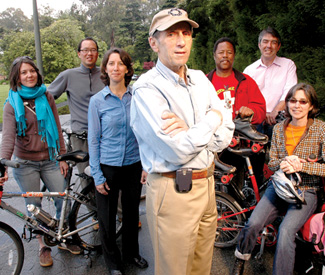
It wasn’t going well for Ted Strawser, predictably. The alternative transportation activist faced an uphill battle March 14 trying to convince a San Francisco Chamber of Commerce committee to endorse Healthy Saturdays, a plan to ban cars from part of Golden Gate Park.

Representatives of the park’s museums and Richmond District homeowners had just argued their case against the measure. “Visitors want access to our front door, and we want to give it to them,” Pat Kilduff, communications director for the Fine Arts Museums of San Francisco, indignantly told the group of two dozen business leaders gathered around a large conference table.

Strawser gave it his best shot: he talked about following the lead of other great cities to create car-free spaces; he said, “Golden Gate Park is one of the best parks in the nation, if not the world”; and he made a detailed case for closure. But around the table there were scowls, eye rolls, and other obvious signs that Strawser was being tolerated, not welcomed. Some — including chamber vice president Jim Lazarus — even started to interrupt and argue with him.

Then the man sitting next to Strawser spoke up. “I don’t think this is fair,” he said. And suddenly, everyone in the room shaped up. Strawser’s ally — his only supporter in the room — was somebody no chamber member could or would dismiss. Warren Hellman doesn’t shout or bang the table — but when he speaks, downtown pays attention.

Hellman, a prominent investment banker, told the committee members that he expected them to show the same respect for Strawser that they had for the previous two speakers. The nonsense ended, immediately.

And by the time Strawser turned the floor over to Hellman, the mood had changed. The group listened raptly, smiled, and nodded as Hellman spoke in his usual folksy, familiar, disarming style.

“It’s not a lot of fun when friends fall out,” he began, “because the previous speakers and many of you all agreed on the necessity of the garage [that was built in Golden Gate Park], and we worked together.”

He pointed out that many in the group had promised during the fall 2000 election to support Healthy Saturdays once the garage was built, although Hellman was now the only member of the coalition honoring that commitment. But he didn’t chide or shame his colleagues. That isn’t Hellman’s style.

Instead, he spoke their language. The garage has never been full and needs the money it can charge for parking to repay the bonds. This isn’t a fight that’s going away, since “part of the conflict is because this park is everybody’s park.” But there are “about 100 compromises not acceptable to either side that would move this forward.” And if a solution can’t be found, there will probably be an expensive ballot fight that nobody wants.

“My conclusion is we should attempt this test,” Hellman told the group. Ultimately, when the vote was later taken in secret, the chamber didn’t agree, although it did vote to back a trial closure after the California Academy of Sciences reopens next year.

At the meeting, Hellman openly called for Mayor Gavin Newsom to get involved in seeking a compromise, something Hellman said he had also just requested of the mayor at a one-on-one breakfast meeting. A couple of weeks later Newsom — who had already indicated his intention of vetoing the measure — did broker a compromise that was then approved by the Board of Supervisors.

As usual, Hellman didn’t take credit, content to quietly play a role in making San Francisco a better place.

Healthy Saturdays isn’t the most important issue in local history — but the significance of Hellman’s involvement can’t be underestimated. His alliance with the environmentalists and park advocates might even signal a sea change in San Francisco politics.

Warren Hellman represents San Francisco’s political and economic past. And maybe — as his intriguing actions of recent years suggest — its future.

This guy is a rich (in all senses of the word) and compelling figure who stands alone in this town. And even though his leadership role in downtown political circles has often placed him at odds with the Guardian, Hellman consented to a series of in-depth interviews over the past six months.

“Our family has been here since early in the 19th century, so we had real roots here,” Hellman told us. His great-grandfather founded Wells Fargo and survived an assassination attempt on California Street by a man who yelled, “Mr. Hellman, you’ve ruined my life,” before shooting a pistol and barely missing.

The Hellman family has been solidly ruling class ever since, rich and Republican, producing a long line of investment bankers like Warren.

Yet the 72-year-old comes off as more iconoclast than patrician, at least partly because of the influence of his irreverent parents, particularly his mother, Ruth, who died in 1971 in a scuba-diving accident in Cozumel, Mexico, at the age of 59. “She was entirely nuts,” Hellman said, going on to describe her World War II stint as a military flier in the Women’s Auxiliary Service Pilots and other colorful pursuits. “She just loved people, a little like I do. She collected people.”

Hellman grew up wealthy and cultured, but he also attended public schools, including Grant Grammar School and Lowell High School. In between, the young troublemaker did a stint at San Rafael Military Academy — “reform school for the rich,” as he called it — for stunts such as riding his horse to Sacramento on a whim.

After doing his undergraduate work at UC Berkeley, Hellman got his MBA from Harvard and went on to become, at the age of 26, the youngest partner ever at the prestigious Manhattan investment firm Lehman Bros. He developed into an übercapitalist in his own right and eventually returned home from New York and founded Hellman and Friedman LLC in San Francisco in 1984, establishing himself as the go-to financier for troubled corporations.

“He is really one of the pioneers of private equity,” said Mark Mosher, a longtime downtown political consultant and the executive director of Gov. Arnold Schwarzenegger’s California Commission on Jobs and Economic Growth, on which Hellman sits.

Hellman became what Business Week called “the Warren Buffett of the West Coast,” a man of extraordinary wealth and power. Among other accomplishments, Hellman took Levi Strauss private, recently made billions of dollars in profits selling DoubleClick to Google, and manages the assets of the California public employee retirement funds (CalPERS and CalSTRS), which are among the largest in the world.

Like many financial titans, Hellman has always been a generous philanthropist, giving to the arts, supporting schools in myriad ways, and funding the San Francisco Foundation and the San Francisco Free Clinic (which his children run). He vigorously competes in marathons and endurance equestrian events, often winning in his age bracket. And he has his humanizing passions, such as playing the five-string banjo and creating the popular Hardly Strictly Bluegrass festival.

But he’s also been a prime facilitator of downtown’s political power, which regularly flexes its muscle against progressive causes and still holds sway in the Mayor’s Office and other city hall power centers.

Hellman founded, funds, and is a board member of the Committee on Jobs, which is perhaps the city’s most influential downtown advocacy organization. Hellman and his friends Don Fisher, the founder of the Gap, and Sen. Dianne Feinstein also started SFSOS, which now wages the most vicious attacks on left-of-center candidates and causes.

When the de Young Museum and other cultural institutions were threatening to leave Golden Gate Park, Hellman almost single-handedly had an underground parking garage built for them, in the process destroying 100-year-old pedestrian tunnels and drawing scorn from the left. The Guardian called it “Hellman’s Hole.”

“We at the Bike Coalition very much started out on the opposite side of Warren Hellman,” San Francisco Bicycle Coalition executive director Leah Shahum told us. “We couldn’t have been more like oil and water on the garage issue.”

But over the past two years or so, Hellman’s profile has started to change. He went on to become an essential ally of the SFBC and other environmentalists and alternative transportation advocates who want to kick cars off JFK Drive in Golden Gate Park on weekends, crossing the downtown crowd in the process. He has shared his wealth with progressive groups such as Livable City, which often fights downtown, and has stuck up for edgy fun seekers over more conservative NIMBY types. He has also publicly repudiated the attacks of SFSOS and its spokesperson, Wade Randlett, and withdrawn his support from the group.

Hellman is still a Republican, but a thoughtful and liberal-minded one who opposed the Iraq War and wrote an article for Salon.com in February titled “If the United States Were a Company, Would George Bush Be Our CEO?” (His answer: hell no.) And to top it all off, Hellman sports a few tattoos and even attended 2006’s Burning Man Festival and plans to return this year.

Unguarded and reflective, Hellman’s comments to the Guardian foreshadow the possible future of capitalism and influence in San Francisco and point to potential political pathways that are just now beginning to emerge.

Our first conversation took place at the Guardian office two weeks before the November 2006 election, when it was starting to look like Nancy Pelosi had a good shot at becoming speaker of the House of Representatives.

“I think this election in two weeks is going to be really interesting,” Hellman told us.

This Republican was cheering for the Democrats to win. “They aren’t my kind of Republicans,” he said of the people in power. Hellman didn’t support the war or approve of how the Bush administration sold it, and he wanted Pelosi and the Democrats to hold someone accountable.

“What I’d like her to do is admit that we can’t get out [of Iraq immediately], but start to talk about what the fallout has been. Discuss the enormous cost in human life as well as money, and how it’s possible the war united the Middle East against us,” Hellman said.

The one thing he can’t abide is disingenuousness. Hellman speaks plainly and honestly, and he asked us to keep particularly caustic comments off the record only a few times during almost six hours’ worth of interviews. He was self-effacing about his political knowledge and seemed most interested in working through the problems of the day with people of goodwill.

Asked what he values most in the people he deals with, Hellman said, “It’s authenticity. Do they believe things because they believe in them, or do they believe in things because they’re cynical or they’re just trying to gain something?”

Locally, Hellman has reached out to people with varying worldviews and come to count many friends among those who regularly battle against downtown.

“I love to know people,” he said. “That’s probably the single thing that motivates me. When someone says to me, ‘How can you be friends with [then–head of SEIU Local 790] Josie Mooney?’ I say, ‘Look, I want to know Josie Mooney. And if she’s awful, then we won’t be friends.’ I’m just fascinated by getting to know people. And virtually always, they’re a little like Wagner operas: they’re better than they sound.”

Hellman was the chair of the Committee on Jobs when he got to know Mooney, who chaired the San Francisco Labor Council and was a natural political adversary for the pro-business group, particularly when Hellman was leading the fight to do away with the city’s gross receipts tax, which has proved to be costly for the city and a boon for downtown.

But after that victory, Hellman turned around and cochaired a campaign with Mooney to retool and reinstate the gross receipts tax in a way that he believed was more fair and helped restore the lost revenue to the city.

“We lost, but he put $100,000 of his own money into that campaign,” Mooney told us, noting that the proposed tax would have cost Hellman and Friedman around $70,000 a year. “I think he just thought the city needed the money. It was a substantive point of view, not a political point of view.”

Mooney considers Hellman both a friend and “an extraordinary human being…. He has made a huge contribution to San Franciscans that doesn’t relate to ideological issues. A tremendous thing about Warren is he’s not ideological, even in his political point of view…. On politics, I’d say he is becoming more progressive as he understands the issues that confront ordinary people.”

Mooney is one of the people who have helped bring him that awareness. When they first met, Mooney said, Hellman told her, “You’re the first union boss I ever met.” That might have been an epithet coming from some CEOs, but Hellman had a genuine interest in understanding her perspective and working with her.

“In a sense, I think that was a very good era in terms of cooperation between the Committee on Jobs and other elements of the city,” Hellman said. “Josie and I had already met, and we’d established this kind of logic where 80 percent of what we both want for the city we agree on, and 20 percent [of the time, we agree to disagree].”

Committee on Jobs executive director Nathan Nayman — who called Hellman “one of my favorite people in the world” — told us that Hellman feels more free than many executives to be his own person.

“He’s not with a publicly held company, and he doesn’t have to answer to shareholders,” Nayman said. “He takes a position and lives by his word. You don’t see many people like him in his income bracket.”

Hellman has become a trusted hub for San Franciscans of all political persuasions, Nayman said, “because he’s very genuine. He’s fully transparent in a city that likes to praise itself for transparency. What you see is what you get.”

Hellman expects the same from others, which is why he walked away from SFSOS (and convinced Feinstein to bolt as well) in disgust over Randlett’s scorched-earth style. Among other efforts, SFSOS was responsible for below-the-belt attacks on Sups. Chris Daly, Jake McGoldrick, and Gerardo Sandoval (whom a mailer inaccurately accused of anti-Semitism).

“If all things were equal, I’d just as soon that SFSOS went away,” Hellman said. “SFSOS started doing the opposite of what I thought they would be doing, so it was fairly easy for me to part company with them. What I thought we were doing is trying to figure out ways to make the city better, not just being an antagonistic, nay-saying attack organization. I’m not a huge fan of Gerardo Sandoval, but I thought the attacks on him were beyond anything I could imagine ever being in favor of myself. And it was a series of things like that, and I said I don’t want anything more to do with this.”

Downtown, they’re not always quite sure what to make of Hellman.

“Every once in a while, he does things that irritate people who are ideologically conservative,” Mosher said. “He took an immense amount of heat for supporting the Reiner initiative [which would have taxed the rich to fund universal preschool].”

He’s given countless hours and untold riches to public schools, doing everything from endowing programs to knocking on doors in support of bond measures and often pushing his colleagues to do the same.

“My connection to him has been through the school district, and he’s really been a prince,” Sup. Tom Ammiano said. “He has even stopped calling me antibusiness. He put a lot of his energy into improving public education, and so he shows it can be done.”

Progressives don’t always agree with Hellman, but they feel like they can trust him and even sometimes win him over. “If you get a relationship with him and you’re always honest about the facts and your own interests, he will listen, and that’s pretty remarkable,” Mooney said. “He shows a remarkable openness to people who have good ideas.”

His appreciation for people of all stripes often causes him to reject the conventional wisdom of his downtown allies, who viciously attacked the Green Party members of the Board of Education a few years ago.

“Everybody said, ‘Oh my god, Sarah Lipson, you know, she’s a Green Party member, she’s the furthest left-wing person on the board,’ blah, blah, blah,” he said. “And I phoned her up one day and said, ‘I’d really like to meet you.’ And she’s — leave aside the fact that I think she’s a very good person as a human being, but she’s a very thoughtful, analytic person. Listening to her opinions about things that are happening in the school district, I really respect that. I mean, what do I know about what’s going on in the school district? I know more now than I did then. But just getting to know people, and maybe get them to understand my point of view, which isn’t that penetrating.”

Many of his efforts have received little publicity, as when he saved the Great American Music Hall from closure by investing with Slim’s owner Boz Scaggs and helping him buy the troubled musical venue. “There are things that you and I don’t even have a clue that he has done,” Nayman said.

“He’s an interesting guy,” Mosher said. “He’s one of a dying breed, a liberal Republican. He has a social conscience and wants to use his money to do good.”

Actually, calling Hellman liberal might be going too far. In the end, he’s still very much a fiscal conservative. He doesn’t support rent control, district elections for the Board of Supervisors, taxing businesses to address social problems such as the lack of affordable health care, or limits on condo conversions.

He also opposes the requirement that employers provide health care coverage, which downtown entities are now suing the city to overturn, telling us, “In general, I don’t think it’s a good idea, because I’m still, even in my aging years, a believer that the marketplace works better than other things…. Universal health care I do believe in, but what I worry is that it’s going to be another damned bureaucracy and that it’s not going to work.”

Yet he doesn’t believe wealth is an indicator of worth, saying of his fortune, “It is luck. Most of what you do you aren’t better at than everyone.”

He doesn’t believe in the law of the jungle, in which the poor and weak must be sacrificed in the name of progress. In fact, he feels a strong obligation to the masses.

As he told us, “My mantra for capitalism — and I didn’t invent this, but I think it’s pretty good — is that capitalism won, and now we need to save the world from capitalism.”

Hellman looms large over downtown San Francisco. His Financial District office offers a panoramic view of the Bay Bridge, Treasure Island, the Ferry Building, and the rest of the city’s waterfront. He likes to be personally involved with his city and the companies in which Hellman and Friedman invests.

“Usually I’m directly involved,” he told us in an interview earlier this year. “I’ve always said that I don’t like to go to the racetrack to just look at the horses. The fun of being a principal is that you’re standing at the track and not saying, ‘Gee, that’s a beautiful gray horse.’ You’re saying, ‘Come on, he’s got to win!’ So I’m almost always invariably invested in the companies that we work with, either individually or through the firm.”

Unlike many Wall Street barons who strive to control a company and bring in new executives, flip it for a quick profit, or liquidate it, Hellman said his firm tries to identify solid companies and help facilitate what they do. “We don’t usually take over companies. I always think that we provide a service to help the businesses,” he said. “Our job is kind of the opposite of owning a factory. Our job is to be sure the people who run the business feel like it’s their business.”

Similarly, he thinks capitalists need to feel a sense of ownership over society’s problems, something he thinks is taking root in San Francisco and other economic centers, particularly among the younger generations. “It’s about understanding how much suffering there is on the other side and trying to figure out how that suffering can be alleviated,” he said. “I think it’s partly good economics that as you bring people up, they’re able to do more for society. If nothing else, they’re able to buy more and shop at a Wal-Mart or something — probably someplace you would wildly disapprove of — and buy goods and services. But I don’t think it’s that narrow.”

Rather, he believes that everyone has a little progressive in them, a little desire to cooperatively solve our collective problems rather than pass them off to future generations. He sees a marked change from his days at Lehman Bros.

“Everybody was into making it,” he said, noting that many capitalists then did charity work as a means of attaining social status but focused mostly on the accumulation of wealth. But, he said, the new generation of capitalists seems genuinely interested in improving the world.

“The feeling for giving back in the next generation, in the now 25- to 35-year-olds, it’s just an order-of-magnitude difference than it was for people who are now in their 40s and early 50s,” Hellman said. “I’m very encouraged.”

Yet the flip side is that, in Hellman’s view, downtown doesn’t wield as much power as it once did. Low political contribution limits have made politicians less dependent on downtown money, creating fewer shot callers, while democratizing tools such as the Internet have broadened the political dialogue.

“For the last 30 years we have become an increasingly tolerant city, and that’s great,” he said. “In the old days, [the Guardian] complained about downtown, and yeah, no shit, downtown really did control the city. The benefit was as that slipped away, the city became fairer and more open to argument. So now downtown hardly has any power at all anymore. In a sense, that’s a good thing. Tolerance grew tremendously when the city wasn’t dictated to.”

That tolerance caused street fairs to pop up all over town and festivals such as Hellman’s Hardly Strictly Bluegrass to blossom in Golden Gate Park. Bike lanes have taken space from cars, events such as Halloween in the Castro have gotten crazier, street protests have gotten bigger and more frequent, and people have felt more free to fly their freak flags. And all that freedom eventually triggered a backlash from groups of isolated NIMBYs who complain and often find sympathetic ears at city hall.

“Sometimes you get the feeling in this city that in the land of the tolerant, the intolerant are king,” said Hellman, whose festival has endured noise complaints even though the music is shut off by 7 p.m. “There is a continuing pressure to do away with fun, because fun is objectionable to someone, [but] we need to think about not creating a new dictatorship of a tiny group of people whose views are not in line with the opinion of most of the people of San Francisco…. You should try to balance the good of a lot of people versus the temporary annoyance of a few people.”

Preserving fun and a lively urban culture is a personal issue for Hellman, who plays the five-string banjo and calls his festival “the most enjoyable two days of the year for me.” He helps draw the biggest names in bluegrass music and acts like a kid in a candy shop during the event.

“I feel very strongly that an important part of our culture is built on the type of music and type of performance that goes on at Hardly Strictly Bluegrass,” Hellman said. From parables set to music to songs of struggle and the old union standards, “that kind of music is the conscience of our country.”

He considers bluegrass a vital and historically important form of political communication, more so than many of the upscale art forms that the rich tend to sponsor. “I’m glad that we have first-rate opera, but it’s equally important that we foster the kind of music, lyrics, etc., that support all this,” he said. “Somebody once said that most of the great Western philosophy is buried in the words of country songs. And that’s closer to the truth than most people think. A big passion of mine is to try to help — and people have defined it too narrowly — the kinds of music that I think have a hell of a lot to do with the good parts of our society.”

Perhaps surprisingly for a Republican venture capitalist from the older generation, Hellman also considers the countercultural freaks of San Francisco to be some of the “good parts of our society.” That’s why he attended Burning Man for the first time last year and why, he said, he loved it, as much for the culture and community as for the art.

“I went to Burning Man because as much as possible I want to experience everything,” he said. “I want to just see directly what it’s like. I knew I’d enjoy it. I never doubted that. But what really overwhelmed me is it was 40,000 people getting along with each other. I mean, it’s pretty intense. There were dust storms and the world’s most repulsive sight: nude men over 70 just dangling along. But I never saw an argument. It was 40,000 people just enjoying each other.”

It was most striking to Hellman because of the contrast with the rest of society. As he said, “I’ve never seen this country so divided.”

While Hellman supports Schwarzenegger — calling him “a good advertisement to California” — he has nothing good to say about his fellow Republican in the Oval Office. He calls Bush’s tenure “an absolute four-star disaster.” The invasion of Iraq is the most obvious problem, he said. “Our war policy has slowly veered from being ‘Don’t tread on me’ to we’re going to jump on your neck.”

But his antipathy to certain aspects of the Republican Party began even earlier, when the religious right began to take over.

“I thought we were not that polarized during the Clinton administration. I was somewhat encouraged,” Hellman said. “Maybe there was an undercurrent of strident religious behavior or strident conservatism, but not the conservatism that I think the Republican Party used to stand for, which was fiscal conservatism instead of social conservatism. Somehow, there was this angst in this country on the part of religious people who I guess felt this country was being taken away from them, and they were the kind of stalwart or underpinnings of society. And they took it back.”

But in the wake of that disaster, Hellman thinks, there is an opportunity for reasonable people of goodwill to set the future political course. As Nayman said of Hellman, “He does believe there is a middle way pretty much all the time.”

Politically, that’s why Hellman gravitates toward the moderates of both major parties, such as Schwarzenegger and Newsom. He looks for people who will marry his economic conservatism with a regard for things such as environmentalism and social justice.

“It’s very tough to be a big-city mayor,” Hellman said. “[Newsom is] probably the best mayor we’re entitled to. He’s got this fantastic balancing act.”

Hellman said downtown hasn’t been terribly happy with Newsom for supporting striking hotel workers, getting behind Ammiano’s health insurance mandate, supporting tax measures, and generally letting the Board of Supervisors set the city’s agenda for the past two years.

“Their measure is he has 80-percent-plus popularity, and he ought to spend some of it. Well, they might not agree with what he would spend it on. And he’s been unwilling to spend very much of it. In some parts of the business community there is disappointment with him, but I don’t think that’s right. He didn’t hide what he would be like.”

What Newsom said he would be — a big reason for his popularity — is a mayor for the new San Francisco, a place where the city’s traditional economic conservatism has been tempered by a greater democratization of power and an ascendant progressive movement that expects its issues to be addressed.

“I don’t like people who are intolerant,” Hellman said. “I don’t like people that are telling you something to get some outcome that, if you understood it, you probably wouldn’t want. I like people that are passionate.”

Asked, then, about Sup. Chris Daly, the nemesis of downtown and most definitely a man of strong political passions, he said, “I admire Chris Daly. I disagree with Chris on a lot of things he believes, but there are also probably a lot of things I would agree with Chris on. And I respect him.”

Hellman is the rare downtown power broker who wants to bridge the gap between Newsom — whom he calls a “moderate to conservative establishment person” — and progressives such as Daly, Mooney, and the Bicycle Coalition. The middle ground, he said, is often a very attractive place, as it was with Healthy Saturdays.

“I’m sure you spend time in the park on Sunday, and it’s a hell of a lot nicer in there on Sundays than Saturdays,” Hellman said. But even more important to him, this is about integrity and being true to what Golden Gate Park garage supporters promised back in 2000.

“They were proposing Saturday closing at that time, which I’ve always thought was a good idea,” he said. “And we made a commitment to them, or I thought we made a commitment to them, that let’s not have Saturday closure now, but as soon as the garage was done, we’d experiment with Saturday closure.”

We brought up what Fine Arts Museums board president Dede Wilsey has said of that pledge, that it was under different circumstances and that she never actually promised to support Saturday closure after the garage was completed.

“There’s a letter. She put it in writing,” he said of Wilsey. “She signed a letter on behalf of the museums saying that when the de Young is done, we should experiment with Saturday closings.”

The Bike Coalition’s Shahum said that even when Hellman was an enemy, he was a reasonable guy. But it’s in the past couple of years that she’s really come to appreciate the unique role he plays in San Francisco.

“He showed decency and respect toward us,” she said. “We never saw him as a villain, even though we disagreed completely. Later he really stepped up and has been a leader on Healthy Saturdays. And what I was most impressed with is that he was true to his word.”

Supervisor McGoldrick, who sponsored the measure, echoed the sentiment: “Hellman was certainly a man of his word who acted in a highly principled way.”

So why does Hellman now stand apart from the downtown crowd? Has he parted ways with the economic and cultural power brokers who were once his allies?

No, he said, “I think they parted ways with me.” *

 

The Guardian Iraq War casualty report (5/14/07)

0

The Guardian Iraq War casualty report (5/14/07): 145 Iraqi civilians were killed yesterday. 5 U.S. soldiers were killed today.

Compiled by Paula Connelly

Casualties in Iraq

Iraqi civilians:

145 Iraqi civilians were killed yesterday, according to Anti war.com.


98,000
: Killed since 3/03

Source: www.thelancet.com

63,610 – 69,658: Killed since 1/03

Source: http://www.iraqbodycount.net

For a week by week assessment of significant incidents and trends in Iraqi civilian casualties, go to A Week in Iraq by Lily Hamourtziadou. She is a member of the Iraq Body Count project, which maintains and updates the world’s only independent and comprehensive public database of media-reported civilian deaths in Iraq.

A Week in Iraq: Week ending 13 May 2007:
http://www.iraqbodycount.org/editorial/weekiniraq/44/

For first hand accounts of the grave situation in Iraq, visit some of these blogs:
www.ejectiraqikkk.blogspot.com
www.healingiraq.blogspot.com
www.afamilyinbaghdad.blogspot.com

U.S. military:

Five U.S. Soldiers were killed today according to the Associated Press.

Three U.S. Soldiers were abducted Saturday and an al-Qaida front group claims it has captured them and has warned the United States to stop searching for them, according to the Associated Press.

3,643: Killed since the U.S. invasion of Iraq 3/20/03

Source: http://www.icasualties.org/

At least 3,398 members of the U.S. military have died since the beginning of the Iraq war in March 2003, according to an Associated Press count.

For the Department of Defense statistics go to: http://www.defenselink.mil/

For a more detailed list of U.S. Military killed in the War in Iraq go to:
http://www.cnn.com/SPECIALS/2003/iraq/forces/casualties/2007.04.html
Iraq Military:

30,000: Killed since 2003

Source: http://www.infoshout.com

Journalists:

153 journalists have been killed in Iraq since the start of the war four years ago, making Iraq the world’s most dangerous country for the press, according to Reporters without borders.

156: Killed since 3/03

Source: http://www.infoshout.com/

Refugees:

The Bush administration plans to increase quota of Iraqi refugees allowed into the U.S. from 500 to 7,000 next year in response to the growing refugee crisis, according to the Guardian Unlimited.

Border policies are tightening because one million Iraqi refugees have already fled to Jordan and another one million to Syria. Iraqi refugees who manage to make it out of Iraq still can’t work, have difficulty attending school and are not eligible for health care. Many still need to return to Iraq to escape poverty, according to BBC news.

1.6 million: Iraqis displaced internally

1.8 million
: Iraqis displaced to neighboring states

Many refugees were displaced prior to 2003, but an increasing number are fleeing now, according to United Nations High Commissioner for Refugees’ estimates.

U.S. Military Wounded:

50,502: Wounded since 3/19/03 to 1/6/07

Source: http://www.icasualties.org/

The Guardian cost of Iraq war report (5/14/07): So far, $425 billion for the U.S., $53 billion for California and $1 billion for San Francisco.
Compiled by Paula Connelly

Here is a running total of the cost of the Iraq War to the U.S. taxpayer, provided by the National Priorities Project located in Northampton, Massachusetts. The number is based on Congressional appropriations. Niko Matsakis of Boston, MA and Elias Vlanton of Takoma Park, MD originally created the count in 2003 on costofwar.com. After maintaining it on their own for the first year, they gave it to the National Priorities Project to contribute to their ongoing educational efforts.

To bring the cost of the war home, please note that California has already lost $46 billion and San Francisco has lost $1 billion to the Bush war and his mistakes. In San Francisco alone, the funds used for the war in Iraq could have hired 21,264 additional public school teachers for one year, we could have built 11,048 additional housing units or we could have provided 59,482 students four-year scholarships at public universities. For a further breakdown of the cost of the war to your community, see the NPP website aptly titled “turning data into action.”

The waiting wife

0

While Chief Warrant Officer 2 Shurd Rice pilots a helicopter over bloodbaths in Iraq, his wife, Jane, peers at crustaceans through a microscope in a Tiburon laboratory 7,500 miles away and tries not to think about what’s happening to her husband.

"I worry more about Shurd’s sanity than his safety," said Rice, a research technician, who recently learned her husband won’t be home from Iraq until Halloween, thanks to a three-month extension of his tour of duty that he found out about on CNN.

"Just like that, they pull the finishing line away," Rice told the Guardian. "It’s soul destroying. I can’t watch the news anymore, waiting for a withdrawal time line that just turns into dust."

Rice, who was born in Zimbabwe and raised in South Africa, says she’s "used to crazy leaders…. So Bush made an error, but to do it over and over again? And his refusal to discuss getting out of Iraq leaves me speechless."

Losing herself in the world of science doesn’t protect Rice from learning about day-to-day horrors in Iraq, since the details spill into her husband’s frequent calls and e-mails.

In a recent e-mail, he wrote about atrocities that happened in an Iraqi village after an improvised explosive device blew up one of the commanders in the Iraqi Army.

"Somehow [the Iraqi Army] knew [whoever detonated the IED] was from a nearby Iraqi village," Shurd wrote, "so they rolled in there to ‘interrogate’ the village and find the trigger man." The interrogation consisted of "beating the women and children of the village, until they finally gave up the fella," he wrote. "But the original call for medivac came in for the trigger man himself, and the injuries were as follows: multiple gun shot wounds to the feet and hands, and rectal bleeding. That’s business Iraqi style."

For Rice, living in the Bay Area, where Shurd grew up and used to be a musician, means she faces painful judgments of her husband’s decision to enlist.

"This attitude that because you signed up, you must deserve it, you have it coming — that’s hard to field, but people like Shurd are the only ones standing between the self-righteous people and the draft," she says. "And Shurd turns all judgments on their heads. He’s the most nonjudgmental person I know. He’s always giving me a hard time for judging, so when people say, ‘Where’s your husband?’ and I say, ‘Iraq,’ and I see that look in their eyes, I think, oh my god! They’re judging him."

Rice met Shurd in South Africa when she was 18 and two weeks out of high school.

"I was working at a restaurant where I had to wear a big old 16th-century dress, and Shurd was painting a mural on the wall. He was so impressive, this world-traveling artist guy."

As a South African, Rice said, she didn’t have any preconceived notions about the military when Shurd joined the US Army two years after they met.

"It sounds naive now, but at the time it seemed like an adventure," says Rice, who, along with her husband, never imagined that Sept. 11, 2001, was lurking around the corner.

As Shurd wrote in a recent e-mail, "Guess I wasn’t paying attention enough to politics to see that coming. But I knew a vehicle for blind patriotism when I saw it and was sure someone was gonna pay, and a lot of people were gonna get paid because of it, and not only was I gonna be along for the ride, like it or not, I was sure to have a front row to see us do something foolish."

The Guardian Iraq War casualty report (5/7/07)

0

The Guardian Iraq War casualty report (5/7/07): 8 U.S. soldiers killed yesterday. 42 Iraqi civilians killed yesterday.

Compiled by Paula Connelly

Casualties in Iraq

U.S. military:

8 U.S. soldiers were killed in a roadside bomb attack in Iraq yesterday, according to the Washington Post.

3,618: Killed since the U.S. invasion of Iraq 3/20/03

Source: http://www.icasualties.org/

For the Department of Defense statistics go to: http://www.defenselink.mil/

For a more detailed list of U.S. Military killed in the War in Iraq go to:
http://www.cnn.com/SPECIALS/2003/iraq/forces/casualties/2007.04.html

Iraqi civilians:

At least 42 Iraqi civilians were killed yesterday when a car bomb exploded in a busy market in Bayaa, according to the Washington Post.

98,000
: Killed since 3/03

Source: www.thelancet.com

62,841 – 68,868: Killed since 1/03

For a week by week assessment of significant incidents and trends in Iraqi civilian casualties, go to A Week in Iraq by Lily Hamourtziadou. She is a member of the Iraq Body Count project, which maintains and updates the world’s only independent and comprehensive public database of media-reported civilian deaths in Iraq.

Source: http://www.iraqbodycount.net

A Week in Iraq: Week ending 6 May 2007:
http://www.iraqbodycount.org/editorial/weekiniraq/43/

For first hand accounts of the grave situation in Iraq, visit some of these blogs:
www.ejectiraqikkk.blogspot.com
www.healingiraq.blogspot.com
www.afamilyinbaghdad.blogspot.com

Iraq Military:

30,000: Killed since 2003

Source: http://www.infoshout.com

Journalists:

153 journalists have been killed in Iraq since the start of the war four years ago, making Iraq the world’s most dangerous country for the press, according to Reporters without borders.

156: Killed since 3/03

Source: http://www.infoshout.com/

Refugees:

The Bush administration plans to increase quota of Iraqi refugees allowed into the U.S. from 500 to 7,000 next year in response to the growing refugee crisis, according to the Guardian Unlimited.

Border policies are tightening because one million Iraqi refugees have already fled to Jordan and another one million to Syria. Iraqi refugees who manage to make it out of Iraq still can’t work, have difficulty attending school and are not eligible for health care. Many still need to return to Iraq to escape poverty, according to BBC news.


1.6 million:
Iraqis displaced internally

1.8 million: Iraqis displaced to neighboring states

Many refugees were displaced prior to 2003, but an increasing number are fleeing now, according to United Nations High Commissioner for Refugees’ estimates.

U.S. Military Wounded:

50,502: Wounded since 3/19/03 to 1/6/07

Source: http://www.icasualties.org/

The Guardian cost of Iraq war report (5/7/07): So far, $423 billion for the U.S., $53 billion for California and $1 billion for San Francisco.

Compiled by Paula Connelly

Here is a running total of the cost of the Iraq War to the U.S. taxpayer, provided by the National Priorities Project located in Northampton, Massachusetts. The number is based on Congressional appropriations. Niko Matsakis of Boston, MA and Elias Vlanton of Takoma Park, MD originally created the count in 2003 on costofwar.com. After maintaining it on their own for the first year, they gave it to the National Priorities Project to contribute to their ongoing educational efforts.

To bring the cost of the war home, please note that California has already lost $46 billion and San Francisco has lost $1 billion to the Bush war and his mistakes. In San Francisco alone, the funds used for the war in Iraq could have hired 21,264 additional public school teachers for one year, we could have built 11,048 additional housing units or we could have provided 59,482 students four-year scholarships at public universities. For a further breakdown of the cost of the war to your community, see the NPP website aptly titled “turning data into action.”

The Guardian Iraq War casualty report (4/30/07)

0

The Guardian Iraq War casualty report (4/30/07): At least 98 Iraqi civilians were killed today. 14 U.S. Soldiers were killed in Iraq in the past 72 hours.

Compiled by Paula Connelly

Casualties in Iraq

Iraqi civilians:

At least 98 Iraqi civilians were killed today in violence across the country, according to the Associated Press:
32 civilian mourners killed today in a bombing of a Shiite funeral in Diyala.
5 civilians killed today in a car bombing in Baghdad.
4 civilians killed today in checkpoint bombing in Baghdad
4 cilvilians killed today when a tanker truck exploded near a restaurant in Ramadi.

98,000: Killed since 3/03

Source: www.thelancet.com

62,570 – 68,593: Killed since 1/03

For a week by week assessment of significant incidents and trends in Iraqi civilian casualties, go to A Week in Iraq by Lily Hamourtziadou. She is a member of the Iraq Body Count project, which maintains and updates the world’s only independent and comprehensive public database of media-reported civilian deaths in Iraq.

Source: http://www.iraqbodycount.net

A Week in Iraq: Week ending 29 April 2007:
http://www.iraqbodycount.org/editorial/weekiniraq/42/

For first hand accounts of the grave situation in Iraq, visit some of these blogs:
www.ejectiraqikkk.blogspot.com
www.healingiraq.blogspot.com
www.afamilyinbaghdad.blogspot.com

U.S. military:
Fourteen U.S. soldiers and Marines were killed in Iraq during the past 72 hours, making April the sixth deadliest month of the Iraq war, according to CNN.

3,590
: Killed since the U.S. invasion of Iraq 3/20/03

Source: http://www.icasualties.org/

For the Department of Defense statistics go to: http://www.defenselink.mil/

For a more detailed list of U.S. Military killed in the War in Iraq go to:
http://www.cnn.com/SPECIALS/2003/iraq/forces/casualties/2007.04.html

Iraq Military:

30,000: Killed since 2003

Source: http://www.infoshout.com

Journalists:

153 journalists have been killed in Iraq since the start of the war four years ago, making Iraq the world’s most dangerous country for the press, according to Reporters without borders.

156: Killed since 3/03

Source: http://www.infoshout.com/

Refugees:

The Bush administration plans to increase quota of Iraqi refugees allowed into the U.S. from 500 to 7,000 next year in response to the growing refugee crisis, according to the Guardian Unlimited.

Border policies are tightening because one million Iraqi refugees have already fled to Jordan and another one million to Syria. Iraqi refugees who manage to make it out of Iraq still can’t work, have difficulty attending school and are not eligible for health care. Many still need to return to Iraq to escape poverty, according to BBC news.

1.6 million: Iraqis displaced internally

1.8 million
: Iraqis displaced to neighboring states

Many refugees were displaced prior to 2003, but an increasing number are fleeing now, according to United Nations High Commissioner for Refugees’ estimates.

U.S. Military Wounded:

50,502: Wounded since 3/19/03 to 1/6/07

Source: http://www.icasualties.org/


The Guardian cost of Iraq war report (4/30/07): So far, $421 billion for the U.S., $53 billion for California and $1 billion for San Francisco.

Compiled by Paula Connelly

Here is a running total of the cost of the Iraq War to the U.S. taxpayer, provided by the National Priorities Project located in Northampton, Massachusetts. The number is based on Congressional appropriations. Niko Matsakis of Boston, MA and Elias Vlanton of Takoma Park, MD originally created the count in 2003 on costofwar.com. After maintaining it on their own for the first year, they gave it to the National Priorities Project to contribute to their ongoing educational efforts.

To bring the cost of the war home, please note that California has already lost $46 billion and San Francisco has lost $1 billion to the Bush war and his mistakes. In San Francisco alone, the funds used for the war in Iraq could have hired 21,264 additional public school teachers for one year, we could have built 11,048 additional housing units or we could have provided 59,482 students four-year scholarships at public universities. For a further breakdown of the cost of the war to your community, see the NPP website aptly titled “turning data into action.”

Do you remember your first time?

0

Of the hundreds of thousands of feature movies made in the past century, how many were spectacular debuts? Maybe 30? Reason decrees that we can’t expect the 11 first features that make up this year’s SKYY Prize nominees to be brilliant; frankly, they’re not. Yet it was little more than a handful of years ago that the San Francisco International Film Festival’s SKYY jury awarded its prize to Jia Zhang-ke’s Xiao Wu, a debut that marked the beginning of one of the most masterful filmmaking careers in the world today.

Two of this year’s nominees, Kim Rossi Stuart’s Along the Ridge, from Italy, and Pavel Giroud’s The Silly Age, from Cuba, owe a debt to one of the great debut films, Francois Truffaut’s The 400 Blows. Truffaut’s look at boyhood gone awry has secured the template for a half century of coming-of-age films, but like the biopics that overtake screens and vie for awards at the end of each year, such efforts have become too familiar. Aren’t personal stories supposed to be one of a kind, like snowflakes? Perhaps if you’ve seen one snowflake, you’ve seen ’em all.

Nominating Horace Ahmad Shansab’s Zolykha’s Secret, from Afghanistan, was probably some big-hearted gesture of goodwill, but by Western standards, it’s a painfully clumsy affair. Similarly, Xiaolu Guo’s How Is Your Fish Today?, from China, and John Barker’s Bunny Chow, from South Africa, go nowhere fast.

Bay Area native and Golden Horse Award winner Daniel Wu has turned from acting to a comedic directing debut, The Heavenly Kings. Though he treads on sacred Spinal Tap territory with his phony rockumentary idea, he and his friends Conroy Chan Chi-Chung, Andrew Lin, and Terence Yin actually went through with the indignity of being in a boy band called Alive, recording and performing to conjure up material for this film. Only one of them can sing, and none of them can dance, but that doesn’t matter in today’s music industry, which relies on stylists, choreographers, and hired fans – not to mention Internet scandals – for success. The Heavenly Kings is certainly scathing, even if it’s only sporadically funny. (The best line involves African rainforests.)

I suspect that Marwan Hamed’s The Yacoubian Building, from Egypt, is also trying to be funny, but it tries to be too many other things as well. Based on a beloved novel by Alaa’ al-Aswany and sprawling to almost three hours, it’s stuck between pleasing the novel’s fans and appealing to new audiences, an impasse that results in heavy exposition and a kind of middling pace that makes time crawl. But it’s also full of sweeping crane and dolly shots, and as with films such as The English Patient, its gargantuan scale will impress some viewers. Jean-Pascal Hattu’s 7 Years, from France, is a bit more daring in its depiction of a woman who falls in love with her incarcerated husband’s prison warden. But it dabbles in Bressonian artificiality without achieving a Bressonian sense of grace.

In surveying this year’s SKYY Prize nominees, perhaps it’s best to search for glimpses of genius or inspiration that could possibly lead to more interesting follow-ups. Joachim Trier’s Reprise, from Norway, has many such glimpses, thanks to frenetic flashbacks that recall everything from Run Lola Run to Snatch and Human Traffic and also due to its discriminating taste in vintage punk music. But when the film’s narrative returns to the present, it begins to wallow in a kind of maudlin, navel-gazing dopiness that kills the initial buzz. Tariq Teguia’s Rome Rather Than You, shot in Algeria, couples startling cinematic brilliance with highly irritating patches of indulgence. Its tale of an Algerian pizza chef who applies for a visa to move to Italy is like a tantalizing mystery house with long, winding passages that lead nowhere. Unfortunately, even Teguia appears to get confused from time to time.

Finally, on the very crest of the much-discussed Mexican new wave, Francisco Vargas outplays all first-time peers with his magnificent The Violin, set in the 1970s. Violinist Don Plutarco (Don Angel Tavira) can only play by strapping his bow to his handless stump. As his guerrilla son fights a secret battle against the ruling military regime, Plutarco winds up serenading a sensitive (but still sinister) captain. Vargas shoots in luscious black-and-white, switching between handheld camera for tense moments and static shots during rest periods that still manage to be breathtaking. In one amazing sequence, Plutarco sits by a campfire and explains the origin of war to his grandson while Vargas slowly, slowly tracks over smoldering coals. But it’s Tavira’s gaping, withered face that gives the movie its mileage. He’s 81, and it’s his first acting job. How’s that for a debut? (Jeffrey M. Anderson)

ALONG THE RIDGE (Kim Rossi Stuart, Italy, 2006). May 5, 4:15 p.m., Clay. Also May 7, 3:30 p.m., Kabuki; May 9, 9 p.m., Kabuki

BUNNY CHOW (John Barker, South Africa, 2006). Sat/28, 9:45 p.m., Kabuki. Also Sun/29, 6:45 p.m., Kabuki; May 4, 9:30 p.m., Kabuki

THE HEAVENLY KINGS (Daniel Wu, Hong Kong, 2006). Fri/27, 9:45 p.m., Castro. Also Sun/29, 6 p.m., Kabuki; May 4, 5 p.m., Kabuki

HOW IS YOUR FISH TODAY? (Xiaolu Guo, China/UK, 2007). Sun/29, 8:15 p.m., PFA. Also May 5, 12:30 p.m., SFMOMA; May 7, 9:45 p.m., Kabuki

REPRISE (Joachim Trier, Norway, 2006). Fri/27, 5 p.m., Kabuki. Also May 6, 9:30 p.m., Kabuki; May 4, 9 p.m., Clay; May 8, 9:30 p.m., Aquarius

ROME RATHER THAN YOU (Tariq Teguia, Algeria/France/Germany, 2006). Fri/27, 9:15 p.m., Kabuki. Also May 5, 2 p.m., Kabuki; May 6, 8:45 p.m., Kabuki; May 8, 6:30 p.m., Aquarius

7 YEARS (Jean-Pascal Hattu, France, 2006). May 5, 9:30 p.m., Clay. Also May 7, 7 p.m., Kabuki; May 9, 1 p.m., Kabuki

THE SILLY AGE (Pavel Giroud, Cuba/Spain/Venezuela, 2006). Sun/29, 8:15 p.m., SFMOMA. Also May 2, 9:30 p.m., Kabuki; May 3, 1 p.m., Kabuki; May 5, 9:45 p.m., Kabuki

THE VIOLIN (Francisco Vargas, Mexico, 2006). May 4, 3:15 p.m., Clay. Also May 6, 6 p.m., Kabuki; May 8, 3:30 p.m., Kabuki

THE YACOUBIAN BUILDING (Marwan Hamed, Egypt, 2006). May 6, 2 p.m., Kabuki. Also May 9, 1:30 p.m., Kabuki; May 10, 7 p.m., Kabuki

ZOLYKHA’S SECRET (Horace Ahmad Shansab, Afghanistan, 2006). May 5, 5:45 p.m., Kabuki. Also May 8, 4:15 p.m., Kabuki; May 6, 5 p.m., SFMOMA

The Guardian Iraq War casualty report (4/24/07)

0

The Guardian Iraq War casualty report (4/24/07): 9 U.S. soldiers killed. 25 Iraqi civilians killed.

Compiled by Paula Connelly

Today the House Committee on Oversight and Government Reform heard testimony from U.S. military personnel and their family members as part of the Democratically-controlled Congress’s effort to hold the Bush Administration accountable for its conduct of the wars in Iraq and Afghanistan, according to the New York Times. The hearings were intended to determine the “sources and motivations” for the erroneous accounts of the events that lead to the injury and death of specific U.S. soldiers.

Casualties in Iraq

U.S. military:

9 U.S. soldiers were killed in a car bomb attack that an insurgent group that includes al-Qaida claims responsibility for, according to the Associated Press.
http://sfgate.com/cgi-bin/article.cgi?f=/n/a/2007/04/24/international/i042336D17.DTL

3,570
: Killed since the U.S. invasion of Iraq 3/20/03

Source: http://www.icasualties.org/

For the Department of Defense statistics go to: http://www.defenselink.mil/

For a more detailed list of U.S. Military killed in the War in Iraq go to:
http://www.cnn.com/SPECIALS/2003/iraq/forces/casualties/2007.04.html

Iraqi civilians:

25 Iraqi civilians were killed today when a suicide bomber attacked a makeshift football field and market in the Albufarraj area east of Ramadi, according to the Brisbane Times.

98,000
: Killed since 3/03

Source: www.thelancet.com

62,281 – 68,289
: Killed since 1/03

For a week by week assessment of significant incidents and trends in Iraqi civilian casualties, go to A Week in Iraq by Lily Hamourtziadou. She is a member of the Iraq Body Count project, which maintains and updates the world’s only independent and comprehensive public database of media-reported civilian deaths in Iraq.

Source: http://www.iraqbodycount.net

A Week in Iraq: Week ending 15 April 2007:
http://www.iraqbodycount.org/editorial/weekiniraq/41/

For first hand accounts of the grave situation in Iraq, visit some of these blogs:
www.ejectiraqikkk.blogspot.com
www.healingiraq.blogspot.com
www.afamilyinbaghdad.blogspot.com

Iraq Military:

30,000: Killed since 2003

Source:http://www.infoshout.com

Journalists:

153 journalists have been killed in Iraq since the start of the war four years ago, making Iraq the world’s most dangerous country for the press, according to Reporters without borders.

156: Killed since 3/03

Source: http://www.infoshout.com/

Refugees:

The Bush administration plans to increase quota of Iraqi refugees allowed into the U.S. from 500 to 7,000 next year in response to the growing refugee crisis, according to the Guardian Unlimited.

Border policies are tightening because one million Iraqi refugees have already fled to Jordan and another one million to Syria. Iraqi refugees who manage to make it out of Iraq still can’t work, have difficulty attending school and are not eligible for health care. Many still need to return to Iraq to escape poverty, according to BBC news.

1.6 million: Iraqis displaced internally

1.8 million: Iraqis displaced to neighboring states

Many refugees were displaced prior to 2003, but an increasing number are fleeing now, according to United Nations High Commissioner for Refugees’ estimates.

U.S. Military Wounded:

50,502: Wounded since 3/19/03 to 1/6/07

Source: http://www.icasualties.org/

The Guardian cost of Iraq war report (4/24/07): So far, $419 billion for the U.S., $53 billion for California and $1 billion for San Francisco.

Compiled by Paula Connelly

Here is a running total of the cost of the Iraq War to the U.S. taxpayer, provided by the National Priorities Project located in Northampton, Massachusetts. The number is based on Congressional appropriations. Niko Matsakis of Boston, MA and Elias Vlanton of Takoma Park, MD originally created the count in 2003 on costofwar.com. After maintaining it on their own for the first year, they gave it to the National Priorities Project to contribute to their ongoing educational efforts.

To bring the cost of the war home, please note that California has already lost $46 billion and San Francisco has lost $1 billion to the Bush war and his mistakes. In San Francisco alone, the funds used for the war in Iraq could have hired 21,264 additional public school teachers for one year, we could have built 11,048 additional housing units or we could have provided 59,482 students four-year scholarships at public universities. For a further breakdown of the cost of the war to your community, see the NPP website aptly titled “turning data into action.”

The Guardian Iraq War casualty report (4/23/07)

0

The Guardian Iraq War casualty report (4/23/07): 46 Iraqi civilians killed.

Compiled by Paula Connelly

Casualties in Iraq

Iraqi civilians:

At least 46 Iraqi civilians were killed today in suicide bombings across the country, according to the Associated Press.

98,000: Killed since 3/03

Source: www.thelancet.com

62,281 – 68,289: Killed since 1/03

Source: http://www.iraqbodycount.net

For a week by week assessment of significant incidents and trends in Iraqi civilian casualties, go to A Week in Iraq by Lily Hamourtziadou. She is a member of the Iraq Body Count project, which maintains and updates the world’s only independent and comprehensive public database of media-reported civilian deaths in Iraq.

A Week in Iraq: Week ending 15 April 2007:
http://www.iraqbodycount.org/editorial/weekiniraq/41/

For first hand accounts of the grave situation in Iraq, visit some of these blogs:
www.ejectiraqikkk.blogspot.com
www.healingiraq.blogspot.com
www.afamilyinbaghdad.blogspot.com

U.S. military:

3,570: Killed since the U.S. invasion of Iraq 3/20/03

Source: http://www.icasualties.org/

For the Department of Defense statistics go to: http://www.defenselink.mil/

For a more detailed list of U.S. Military killed in the War in Iraq go to:
http://www.cnn.com/SPECIALS/2003/iraq/forces/casualties/2007.04.html

Iraq Military:

30,000: Killed since 2003

Source:http://www.infoshout.com

Journalists:

153 journalists have been killed in Iraq since the start of the war four years ago, making Iraq the world’s most dangerous country for the press, according to Reporters without borders.

156: Killed since 3/03

Source: http://www.infoshout.com/

Refugees:

The Bush administration plans to increase quota of Iraqi refugees allowed into the U.S. from 500 to 7,000 next year in response to the growing refugee crisis, according to the Guardian Unlimited.

Border policies are tightening because one million Iraqi refugees have already fled to Jordan and another one million to Syria. Iraqi refugees who manage to make it out of Iraq still can’t work, have difficulty attending school and are not eligible for health care. Many still need to return to Iraq to escape poverty, according to BBC news.

1.6 million: Iraqis displaced internally

1.8 million: Iraqis displaced to neighboring states

Many refugees were displaced prior to 2003, but an increasing number are fleeing now, according to United Nations High Commissioner for Refugees’ estimates.

U.S. Military Wounded:

50,502: Wounded since 3/19/03 to 1/6/07

Source: http://www.icasualties.org/

The Guardian cost of Iraq war report (4/23/07): So far, $419 billion for the U.S., $53 billion for California and $1 billion for San Francisco.

Compiled by Paula Connelly

Here is a running total of the cost of the Iraq War to the U.S. taxpayer, provided by the National Priorities Project located in Northampton, Massachusetts. The number is based on Congressional appropriations. Niko Matsakis of Boston, MA and Elias Vlanton of Takoma Park, MD originally created the count in 2003 on costofwar.com. After maintaining it on their own for the first year, they gave it to the National Priorities Project to contribute to their ongoing educational efforts.

To bring the cost of the war home, please note that California has already lost $46 billion and San Francisco has lost $1 billion to the Bush war and his mistakes. In San Francisco alone, the funds used for the war in Iraq could have hired 21,264 additional public school teachers for one year, we could have built 11,048 additional housing units or we could have provided 59,482 students four-year scholarships at public universities. For a further breakdown of the cost of the war to your community, see the NPP website aptly titled “turning data into action.”

The end of the Blue Angels

0

fa18_hornet.gif

By Tim Redmond

I know the show is cool (even though I’m never chosen as the journalist who gets to fly in one of the planes). And I hate to be a killjoy or anything. But I’ve always wondered why these high-performance Hornet F/A 18 military jets loaded with fuel get to perform dangerous maneuvers right over the third-densest urban area in the country.

There is, of course, the fact that the Blue Angels are really nothing more than a very expensive celebration of military might and a recruiting tool for the U.S. Navy — not somthing you’d think would be terribly approrpiate in a city that’s one of the leading anti-war centers in America.

But as we are now reminded, accidents happen — and if one of those flying bomblets crashed into, say, North Beach, the carnage would be really ugly.

The Guardian Iraq War casualty report (4/18/07): 171 Iraqi civilians killed today in the deadliest day since the latest American-led security plan took effect.

0

The Guardian Iraq War casualty report (4/18/07): 171 Iraqi civilians killed today in the deadliest day since the latest American-led security plan took effect.

Compiled by Paula Connelly

Casualties in Iraq

Iraqi civilians:

171 Iraqi civilians were killed today in Baghdad in a series of attacks targeting Shiites. This was the deadliest day in Iraq since the most recent American-led security plan was implemented, according to the New York Times.

98,000
: Killed since 3/03

Source: www.thelancet.com

61,728 – 67,703: Killed since 1/03

For a week by week assessment of significant incidents and trends in Iraqi civilian casualties, go to A Week in Iraq by Lily Hamourtziadou. She is a member of the Iraq Body Count project, which maintains and updates the world’s only independent and comprehensive public database of media-reported civilian deaths in Iraq.

Source: http://www.iraqbodycount.net

A Week in Iraq: Week ending 15 April 2007.

For first hand accounts of the grave situation in Iraq, visit some of these blogs:
www.ejectiraqikkk.blogspot.com
www.healingiraq.blogspot.com
www.afamilyinbaghdad.blogspot.com

U.S. military:

3,546: Killed since the U.S. invasion of Iraq 3/20/03

Source: http://www.icasualties.org/

For the Department of Defense statistics go to: http://www.defenselink.mil/

For a more detailed list of U.S. Military killed in the War in Iraq go to:
http://www.cnn.com/SPECIALS/2003/iraq/forces/casualties/2007.04.html

Iraq Military:

30,000: Killed since 2003

Source:http://www.infoshout.com

Journalists:

153 journalists have been killed in Iraq since the start of the war four years ago, making Iraq the world’s most dangerous country for the press, according to Reporters without borders.

156: Killed since 3/03

Source: http://www.infoshout.com/

Refugees:

The Bush administration plans to increase quota of Iraqi refugees allowed into the U.S. from 500 to 7,000 next year in response to the growing refugee crisis, according to the Guardian Unlimited.

Border policies are tightening because one million Iraqi refugees have already fled to Jordan and another one million to Syria. Iraqi refugees who manage to make it out of Iraq still can’t work, have difficulty attending school and are not eligible for health care. Many still need to return to Iraq to escape poverty, according to BBC news.

1.6 million: Iraqis displaced internally

1.8 million: Iraqis displaced to neighboring states

Many refugees were displaced prior to 2003, but an increasing number are fleeing now, according to United Nations High Commissioner for Refugees’ estimates.

Source: http://www.unhcr.org/iraq.html

U.S. Military Wounded:

50,502: Wounded since 3/19/03 to 1/6/07

Source: http://www.icasualties.org/

The Guardian cost of Iraq war report (4/18/07): So far, $418 billion for the U.S., $52 billion for California and $1 billion for San Francisco.

Compiled by Paula Connelly

Here is a running total of the cost of the Iraq War to the U.S. taxpayer, provided by the National Priorities Project located in Northampton, Massachusetts. The number is based on Congressional appropriations. Niko Matsakis of Boston, MA and Elias Vlanton of Takoma Park, MD originally created the count in 2003 on costofwar.com. After maintaining it on their own for the first year, they gave it to the National Priorities Project to contribute to their ongoing educational efforts.

To bring the cost of the war home, please note that California has already lost $46 billion and San Francisco has lost $1 billion to the Bush war and his mistakes. In San Francisco alone, the funds used for the war in Iraq could have hired 21,264 additional public school teachers for one year, we could have built 11,048 additional housing units or we could have provided 59,482 students four-year scholarships at public universities. For a further breakdown of the cost of the war to your community, see the NPP website aptly titled “turning data into action.”

Meeting acute

0

› a&eletters@sfbg.com

REVIEW In the aftermath of the Oklahoma City bombing, one of the only voices raised on behalf of understanding Timothy McVeigh — that is, as someone slightly more complicated than a Hollywood-style incarnation of pure evil — was that of Gore Vidal. Vidal insisted on pointing to the obvious: the bombing of offices that included the local headquarters of the FBI and the ATF — although utterly cruel and misguided in leading to 168 deaths — was not arbitrary wickedness but a carefully considered act of revenge. As Vidal put it in his article on McVeigh for Vanity Fair, the bombing of the federal building in Oklahoma City "was the greatest massacre of Americans by an American since two years earlier, when the federal government decided to take out the compound of a Seventh-Day Adventist cult near Waco, Texas."

McVeigh — a decorated military hero of the Gulf War, as it turned out — had counterattacked a government he claimed was waging war against the American people. In this opinion, McVeigh, who insisted he had no accomplices, was not alone. He represented a growing libertarian movement afoot in the American heartland. Moreover, as Vidal, a critic from the left of federal tyranny, pointed out in a 1998 piece for Vanity Fair, "Shredding the Bill of Rights," the government had violated Posse Comitatus in laying its siege of the Branch Davidians.

For Vidal’s attention to the matter, McVeigh began a correspondence with him, even inviting the writer to attend his execution — an invitation Vidal declined. This immediately sounds like a fascinating, even dramatic dialogue. But stageworthy? Edmund White’s two-hander, Terre Haute, shrewdly ups the ante a bit, imagining an actual date between Vidal and McVeigh — respectively cast as the lightly fictionalized writer James Brevoord (a fine John Hutchinson) and the transparently McVeigh-like terrorist Harrison (a fiercely magnetic Elias Escobedo, who even bears a strong physical resemblance to the original). They encounter each other in the flesh in a series of brief meetings across a plastic security screen in the maximum-security prison in Terre Haute, Ind., during the days preceding Harrison’s execution.

On death row Harrison has had time to think over his actions. Neighbor Ted Kaczynski, we learn, has suggested he would have done better to blow the building up at night, when it was empty of innocents. But Harrison remains unrepentant, even if we see the burden of responsibility close over him when the lives of innocent "collaterals," particularly the children at the day care center, get mentioned. Brevoord — who is there to write on the meaning of Harrison’s act and to boldly ask the whys so studiously erased in the media — sympathizes with Harrison’s anti-imperialism while provoking the younger man with mounting scorn for his embrace of feeble right-wing conspiracy theories.

Besides a political tête-à-tête, the meeting is the occasion for a clash of personalities, temperaments, and backgrounds, all of which White brings out starkly in the dialogue: Brevoord, for instance, is the kind of man who has no trouble using kerfuffle in an idle sentence, although an indeed is more than enough to throw Harrison for a loop. The tension here is often lightly comical, but the point about education, intellect, and political opposition (and the art of the interviewer) is well made. And if the script feels overly expositional at times, the actors offer strong and credible performances throughout.

The New Conservatory Theatre Center’s US premiere is a sharp and intimate production, staged by director Christopher Jenkins with intelligent assurance, including a concentration on character that garners moments of alternately subtle and electric intensity between two men negotiating an extraordinary situation. Yet the director can’t resist kitschy flourishes, introducing the McVeigh character, for instance, with a short piercing scream of sound and a light that illuminates Harrison standing like Hannibal Lecter behind the see-through wall of the visiting cell. Scenic designer Bruce Walters’s visiting room, meanwhile, is a simple but convincingly dire arrangement of wire-woven Plexiglas walls, yellow-taped borders, and blinking security cameras.

White draws the facts of the case, as well as the style and argument from Vidal’s relevant essays, into well-crafted if sometimes information-laden dialogue. It can be too clashing and unnecessarily confrontational, but it is generally graceful and filled with absorbing ideas, especially in the monologues given to the Vidal character. Unfortunately, the play gets distracted from the meat of its story. That tale not only sports an intriguing tension between two very different sorts of rebels but is politically urgent and deep, ranging from the correct response to a truly totalitarian encroachment on fundamental liberties to the dissolving relation between cause and effect in a culture dominated by mind-numbingly interchangeable images of good and evil.

Instead, the play ends up veering off into carnal considerations of repressed desires, a layer to the characters’ relationship that was probably best left hinted at. The best you might say about it is that it further humanizes a figure too quickly passed off as a cartoon rather than a riddle that needs solving. But in practice it tends to trivialize what’s gone before, inevitably mixing an unhelpful pinch of Freud into the media-repressed why of a terrible public act. *

TERRE HAUTE

Through May 6

Wed.–Sat., 8 p.m.; Sun., 2 p.m.; $22–$40

New Conservatory Theatre Center

25 Van Ness, SF

(415) 861-8972

www.nctcsf.org

>

Green city, part one: cut back cars

0

EDITORIAL San Francisco needs a real green city agenda — not something that comes out of Pacific Gas and Electric Co.’s corrupt propaganda operation or from the timid folks in the Mayor’s Office but a comprehensive environmental plan for the next 10 years that aims at making San Francisco the nation’s number one city for green policy.

There’s no point in thinking small: this is the year for dramatic talk about real environmental action. And it doesn’t have to be overwhelmed by global problems; there’s so much to be done right here at home.

We will be laying out a much longer, more detailed platform over the next few months, but here’s one way to start:

San Francisco ought to commit to cutting car use in the city by at least 50 percent in the next five years.

How do you do that? By making cars unnecessary and slightly more expensive.

The nation’s addiction to oil didn’t come by accident. As Thomas Friedman wrote in the April 15 New York Times, then-president Dwight Eisenhower responded to the cold war in part by building the Interstate Highway System, which allowed the military to move people and weapons quickly — but also set the nation on a path to the car-driven development and land use that are now poisoning the environment and global politics. Turning that around requires tremendous dedication and political leadership, but San Francisco shouldn’t have to wait for the rest of the country.

A citywide auto-reduction plan would involve sweeping land-use changes. Some streets, such as Market, should be closed to cars entirely. Much downtown parking should be eliminated. More bike lanes and transit-only roads, more pedestrian-friendly shopping areas, and other measures of that sort would not only help discourage car use but also make the city a more livable place.

But there’s more: a city that discourages car use has to build housing for local workers — that means affordable housing for the city’s service-industry and public-sector workforce. All new housing needs to be evaluated on that basis: will people who work in San Francisco be able to live here — and avoid long commutes? Most housing currently in the planning pipeline utterly fails that test.

To make cars irrelevant, public transportation has to be vastly improved. As Sups. Chris Daly and Aaron Peskin point out in the Opinion on page 7, that means better management. But more than anything, it means money — big money. Muni fares ought to be reduced dramatically (or eliminated altogether) — but in exchange, Muni needs a dedicated funding source. A special fee on downtown businesses makes sense. A citywide transit assessment on property owners might be necessary.

It’s not fair to place a burdensome tax on cars that makes it possible only for the rich to drive — but simply restoring in San Francisco the vehicle fee Gov. Arnold Schwarzenegger wiped out would cover Muni’s deficit. Assemblymember Mark Leno is working on this, and it should be a top civic priority. So should pushing high-speed rail (see page 19), which would eliminate tens of thousands of car trips between San Francisco and Los Angeles.

There are lots of ways to approach this goal; the supervisors and the mayor just need to set it and enforce it. *

The Guardian Iraq War casualty report (4/16/07): 34 Iraqi civilians killed in 6 separate bomb attacks Sunday.

0

The Guardian Iraq War casualty report (4/16/07): 34 Iraqi civilians killed in 6 separate bomb attacks Sunday.

Compiled by Paula Connelly

Casualties in Iraq

Iraqi civilians:

At least 34 Iraqi civilians were killed in six different bomb attacks Sunday, according to the New York Times.

98,000
: Killed since 3/03

Source: www.thelancet.com

61,391 – 67,364: Killed since 1/03

For a week by week assessment of significant incidents and trends in Iraqi civilian casualties, go to A Week in Iraq by Lily Hamourtziadou. She is a member of the Iraq Body Count project, which maintains and updates the world’s only independent and comprehensive public database of media-reported civilian deaths in Iraq.

Source: http://www.iraqbodycount.net

A Week in Iraq: Week ending 15 April 2007:
http://www.iraqbodycount.org/editorial/weekiniraq/40/

For first hand accounts of the grave situation in Iraq, visit some of these blogs:
www.ejectiraqikkk.blogspot.com
www.healingiraq.blogspot.com
www.afamilyinbaghdad.blogspot.com

U.S. military:

3,542: Killed since the U.S. invasion of Iraq 3/20/03

Source: http://www.icasualties.org/

For the Department of Defense statistics go to: http://www.defenselink.mil/

For a more detailed list of U.S. Military killed in the War in Iraq go to:
http://www.cnn.com/SPECIALS/2003/iraq/forces/casualties/2007.04.html

Iraq Military:

30,000: Killed since 2003

Source:http://www.infoshout.com

Journalists:

153 journalists have been killed in Iraq since the start of the war four years ago, making Iraq the world’s most dangerous country for the press, according to Reporters without borders.

156: Killed since 3/03

Source: http://www.infoshout.com/

Refugees:

The Bush administration plans to increase quota of Iraqi refugees allowed into the U.S. from 500 to 7,000 next year in response to the growing refugee crisis, according to the Guardian Unlimited.

Border policies are tightening because one million Iraqi refugees have already fled to Jordan and another one million to Syria. Iraqi refugees who manage to make it out of Iraq still can’t work, have difficulty attending school and are not eligible for health care. Many still need to return to Iraq to escape poverty, according to BBC news.

1.6 million: Iraqis displaced internally

1.8 million: Iraqis displaced to neighboring states

Many refugees were displaced prior to 2003, but an increasing number are fleeing now, according to United Nations High Commissioner for Refugees’ estimates.

Source: http://www.unhcr.org/iraq.html

U.S. Military Wounded:

50,502: Wounded since 3/19/03 to 1/6/07

Source: http://www.icasualties.org/


The Guardian cost of Iraq war report (4/16/07): So far, $417 billion for the U.S., $52 billion for California and $1 billion for San Francisco.

Compiled by Paula Connelly

Here is a running total of the cost of the Iraq War to the U.S. taxpayer, provided by the National Priorities Project located in Northampton, Massachusetts. The number is based on Congressional appropriations. Niko Matsakis of Boston, MA and Elias Vlanton of Takoma Park, MD originally created the count in 2003 on costofwar.com. After maintaining it on their own for the first year, they gave it to the National Priorities Project to contribute to their ongoing educational efforts.

To bring the cost of the war home, please note that California has already lost $46 billion and San Francisco has lost $1 billion to the Bush war and his mistakes. In San Francisco alone, the funds used for the war in Iraq could have hired 21,264 additional public school teachers for one year, we could have built 11,048 additional housing units or we could have provided 59,482 students four-year scholarships at public universities. For a further breakdown of the cost of the war to your community, see the NPP website aptly titled “turning data into action.”

The Guardian Iraq War casualty report (4/12/07): 8 Iraqi parliament members killed in Green Zone. 10 Iraqi civilians killed in bridge bombing.

0

The Guardian Iraq War casualty report (4/12/07): 8 Iraqi parliament members killed in Green Zone. 10 Iraqi civilians killed in bridge bombing.

“How the president and people around him can say things are going well is really hard to comprehend,” said Senate Majority Leader Harry Reid.

Compiled by Paula Connelly

A suicide bomber killed at least 8 Iraqi parliament members today after slipping through the tightest security net in Baghdad, according to the Associated Press.

To read a daily reports of violence and military operations in Baghdad, click here.

Casualties in Iraq

Iraqi civilians:

At least 10 Iraqi civilians were killed when a bridge in northern Baghdad was demolished by a suicide truck bomb, according to CNN.com.

98,000: Killed since 3/03

Source: www.thelancet.com

61,294 – 67,243: Killed since 1/03

For a week by week assessment of significant incidents and trends in Iraqi civilian casualties, go to A Week in Iraq by Lily Hamourtziadou. She is a member of the Iraq Body Count project, which maintains and updates the world’s only independent and comprehensive public database of media-reported civilian deaths in Iraq.

Source: http://www.iraqbodycount.net

A Week in Iraq: Week ending 8 April 2007:
http://www.iraqbodycount.org/editorial/weekiniraq/39/

For first hand accounts of the grave situation in Iraq, visit some of these blogs:
www.ejectiraqikkk.blogspot.com
www.healingiraq.blogspot.com
www.afamilyinbaghdad.blogspot.com

U.S. military:

3,526: Killed since the U.S. invasion of Iraq 3/20/03

Source: http://www.icasualties.org/

For the Department of Defense statistics go to: http://www.defenselink.mil/

For a more detailed list of U.S. Military killed in the War in Iraq go to:
http://www.cnn.com/SPECIALS/2003/iraq/forces/casualties/2007.04.html

Iraq Military:

30,000: Killed since 2003

Source:http://www.infoshout.com

Journalists:

153 journalists have been killed in Iraq since the start of the war four years ago, making Iraq the world’s most dangerous country for the press, according to Reporters without borders.

Source: http://www.rsf.org/

156: Killed since 3/03

Source: http://www.infoshout.com/

Refugees:

The Bush administration plans to increase quota of Iraqi refugees allowed into the U.S. from 500 to 7,000 next year in response to the growing refugee crisis, according to the Guardian Unlimited.

Border policies are tightening because one million Iraqi refugees have already fled to Jordan and another one million to Syria. Iraqi refugees who manage to make it out of Iraq still can’t work, have difficulty attending school and are not eligible for health care. Many still need to return to Iraq to escape poverty, according to BBC news.

1.6 million: Iraqis displaced internally

1.8 million:
Iraqis displaced to neighboring states

Many refugees were displaced prior to 2003, but an increasing number are fleeing now, according to United Nations High Commissioner for Refugees’ estimates.

Source: http://www.unhcr.org/iraq.html

U.S. Military Wounded:

50,502: Wounded since 3/19/03 to 1/6/07

Source: http://www.icasualties.org/

The Guardian cost of Iraq war report (4/12/07): So far, $416 billion for the U.S., $52 billion for California and $1 billion for San Francisco.

Compiled by Paula Connelly

Here is a running total of the cost of the Iraq War to the U.S. taxpayer, provided by the National Priorities Project located in Northampton, Massachusetts. The number is based on Congressional appropriations. Niko Matsakis of Boston, MA and Elias Vlanton of Takoma Park, MD originally created the count in 2003 on costofwar.com. After maintaining it on their own for the first year, they gave it to the National Priorities Project to contribute to their ongoing educational efforts.

To bring the cost of the war home, please note that California has already lost $46 billion and San Francisco has lost $1 billion to the Bush war and his mistakes. In San Francisco alone, the funds used for the war in Iraq could have hired 21,264 additional public school teachers for one year, we could have built 11,048 additional housing units or we could have provided 59,482 students four-year scholarships at public universities. For a further breakdown of the cost of the war to your community, see the NPP website aptly titled “turning data into action.”

The Guardian Iraq War casualty report (4/10/07): 36 Iraqi civilians killed. 4 U.S. soldiers killed yesterday.

0

The Guardian Iraq War casualty report (4/10/07): 36 Iraqi civilians killed. 4 U.S. soldiers killed yesterday.

Compiled by Paula Connelly

To read a daily reports of violence and military operations in Baghdad, click here.

Casualties in Iraq

Iraqi civilians:

Today Baghdad experienced some of the worst fighting since the intensified Baghdad security plan began nearly two months ago. 36 Iraqi civilians were killed in a suicide bombing, according to the New York Times.

Source.

98,000: Killed since 3/03

Source: www.thelancet.com

61,074 – 67,015: Killed since 1/03

For a week by week assessment of significant incidents and trends in Iraqi civilian casualties, go to A Week in Iraq by Lily Hamourtziadou. She is a member of the Iraq Body Count project, which maintains and updates the world’s only independent and comprehensive public database of media-reported civilian deaths in Iraq.

Source: http://www.iraqbodycount.net

A Week in Iraq: Week ending 8 April 2007:
http://www.iraqbodycount.org/editorial/weekiniraq/39/

For first hand accounts of the grave situation in Iraq, visit some of these blogs:
www.ejectiraqikkk.blogspot.com
www.healingiraq.blogspot.com
www.afamilyinbaghdad.blogspot.com

U.S. military:

4 U.S. soldiers were killed yesterday, according to the New York Times.
Source.

3,524
: Killed since the U.S. invasion of Iraq 3/20/03

Source: http://www.icasualties.org/

For the Department of Defense statistics go to: http://www.defenselink.mil/

For a more detailed list of U.S. Military killed in the War in Iraq go to:
http://www.cnn.com/SPECIALS/2003/iraq/forces/casualties/2007.01.html

Iraq Military:

30,000: Killed since 2003

Source:http://www.infoshout.com

Journalists:

153 journalists have been killed in Iraq since the start of the war four years ago, making Iraq the world’s most dangerous country for the press, according to Reporters without borders.

Source.

156: Killed since 3/03

Source: http://www.infoshout.com/

Refugees:

The Bush administration plans to increase quota of Iraqi refugees allowed into the U.S. from 500 to 7,000 next year in response to the growing refugee crisis, according to the Guardian Unlimited.

Source.

Border policies are tightening because one million Iraqi refugees have already fled to Jordan and another one million to Syria. Iraqi refugees who manage to make it out of Iraq still can’t work, have difficulty attending school and are not eligible for health care. Many still need to return to Iraq to escape poverty, according to BBC news.

Source.

1.6 million: Iraqis displaced internally

1.8 million: Iraqis displaced to neighboring states

Many refugees were displaced prior to 2003, but an increasing number are fleeing now, according to United Nations High Commissioner for Refugees’ estimates.

Source: http://www.unhcr.org/iraq.html

U.S. Military Wounded:

47,657: Wounded since 3/19/03 to 1/6/07

Source: http://www.icasualties.org/

The Guardian cost of Iraq war report (4/10/07): So far, $415 billion for the U.S., $52 billion for California and $1 billion for San Francisco.

Compiled by Paula Connelly

Here is a running total of the cost of the Iraq War to the U.S. taxpayer, provided by the National Priorities Project located in Northampton, Massachusetts. The number is based on Congressional appropriations. Niko Matsakis of Boston, MA and Elias Vlanton of Takoma Park, MD originally created the count in 2003 on costofwar.com. After maintaining it on their own for the first year, they gave it to the National Priorities Project to contribute to their ongoing educational efforts.

To bring the cost of the war home, please note that California has already lost $46 billion and San Francisco has lost $1 billion to the Bush war and his mistakes. In San Francisco alone, the funds used for the war in Iraq could have hired 21,264 additional public school teachers for one year, we could have built 11,048 additional housing units or we could have provided 59,482 students four-year scholarships at public universities. For a further breakdown of the cost of the war to your community, see the NPP website aptly titled “turning data into action.”

The Guardian Iraq War casualty report (4/6/07): 20 Iraqis killed today.

0

The Guardian Iraq War casualty report (4/6/07): 20 Iraqis killed today.

To hear how the war in Iraq has effected some Midwest families of soldiers, click here.

Compiled by Paula Connelly

Casualties in Iraq

Iraqi civilians:

At least 20 people were killed when a chlorine bomb was detonated in Ramadi today, according to the New York Times.
Source:

98,000:
Killed since 3/03

Source: www.thelancet.com

60,835 – 66,757
: Killed since 1/03

For a week by week assessment of significant incidents and trends in Iraqi civilian casualties, go to A Week in Iraq by Lily Hamourtziadou. She is a member of the Iraq Body Count project, which maintains and updates the world’s only independent and comprehensive public database of media-reported civilian deaths in Iraq.

Source: http://www.iraqbodycount.net

A Week in Iraq: Week ending 1 April 2007:
http://www.iraqbodycount.org/editorial/weekiniraq/38/

For first hand accounts of the grave situation in Iraq, visit some of these blogs:
www.ejectiraqikkk.blogspot.com
www.healingiraq.blogspot.com
www.afamilyinbaghdad.blogspot.com

U.S. military:


3,499
: Killed since the U.S. invasion of Iraq 3/20/03

Source: http://www.icasualties.org/

For the Department of Defense statistics go to: http://www.defenselink.mil/

For a more detailed list of U.S. Military killed in the War in Iraq go to:
http://www.cnn.com/SPECIALS/2003/iraq/forces/casualties/2007.01.html

Iraq Military:

30,000: Killed since 2003

Source:http://www.infoshout.com

Journalists:

153 journalists have been killed in Iraq since the start of the war four years ago, making Iraq the world’s most dangerous country for the press, according to Reporters without borders.

Source: http://www.rsf.org/article.php3?id_article=21339

155
: Killed since 3/03

Source: http://www.infoshout.com/

Refugees:

The Bush administration plans to increase quota of Iraqi refugees allowed into the U.S. from 500 to 7,000 next year in response to the growing refugee crisis, according to the Guardian Unlimited.

Source:

Border policies are tightening because one million Iraqi refugees have already fled to Jordan and another one million to Syria. Iraqi refugees who manage to make it out of Iraq still can’t work, have difficulty attending school and are not eligible for health care. Many still need to return to Iraq to escape poverty, according to BBC news.

Source:
1.6 million: Iraqis displaced internally

1.8 million: Iraqis displaced to neighboring states

Many refugees were displaced prior to 2003, but an increasing number are fleeing now, according to United Nations High Commissioner for Refugees’ estimates.

Source: http://www.unhcr.org/iraq.html

U.S. Military Wounded:

47,657: Wounded since 3/19/03 to 1/6/07

Source: http://www.icasualties.org/

The Guardian cost of Iraq war report (4/6/07): So far, $414 billion for the U.S., $52 billion for California and $1 billion for San Francisco.

Compiled by Paula Connelly

On the fourth anniversary of the start of the Iraq war, Bush asks congress to pass an emergency war-spending bill, according to the New York Times.

Source:

Bush asked congress to approve $622 billion for defense spending, most for the wars in Iraq and Afghanistan, in a $2.9 trillion budget request for 2008, according to Reuters.
Source: http://today.reuters.com/

Here is a running total of the cost of the Iraq War to the U.S. taxpayer, provided by the National Priorities Project located in Northampton, Massachusetts. The number is based on Congressional appropriations. Niko Matsakis of Boston, MA and Elias Vlanton of Takoma Park, MD originally created the count in 2003 on costofwar.com. After maintaining it on their own for the first year, they gave it to the National Priorities Project to contribute to their ongoing educational efforts.

To bring the cost of the war home, please note that California has already lost $46 billion and San Francisco has lost $1 billion to the Bush war and his mistakes. In San Francisco alone, the funds used for the war in Iraq could have hired 21,264 additional public school teachers for one year, we could have built 11,048 additional housing units or we could have provided 59,482 students four-year scholarships at public universities. For a further breakdown of the cost of the war to your community, see the NPP website aptly titled “turning data into action.”

The Guardian Iraq War casualty report (4/5/07): 7 U.S. soldiers killed.

0

The Guardian Iraq War casualty report (4/5/07): 7 U.S. soldiers killed.

Compiled by Paula Connelly

Casualties in Iraq

U.S. military:

7 U.S. soldiers were killed in the Baghdad area over the past two days, according to the Associated Press.

Source.

3,498: Killed since the U.S. invasion of Iraq 3/20/03

Source: http://www.icasualties.org/

For the Department of Defense statistics go to: http://www.defenselink.mil/

For a more detailed list of U.S. Military killed in the War in Iraq go to:
http://www.cnn.com/SPECIALS/2003/iraq/forces/casualties/2007.01.html

Iraqi civilians:

98,000: Killed since 3/03

Source: www.thelancet.com

60,480 – 66,383: Killed since 1/03

Source: http://www.iraqbodycount.net

For a week by week assessment of significant incidents and trends in Iraqi civilian casualties, go to A Week in Iraq by Lily Hamourtziadou. She is a member of the Iraq Body Count project, which maintains and updates the world’s only independent and comprehensive public database of media-reported civilian deaths in Iraq.

A Week in Iraq: Week ending 1 April 2007:
http://www.iraqbodycount.org/editorial/weekiniraq/38/

For first hand accounts of the grave situation in Iraq, visit some of these blogs:
www.ejectiraqikkk.blogspot.com
www.healingiraq.blogspot.com
www.afamilyinbaghdad.blogspot.com

Iraq Military:

30,000: Killed since 2003

Source:http://www.infoshout.com

Journalists:

153 journalists have been killed in Iraq since the start of the war four years ago, making Iraq the world’s most dangerous country for the press, according to Reporters without borders.

Source: http://www.rsf.org/article.php3?id_article=21339

155: Killed since 3/03

Source: http://www.infoshout.com/

Refugees:

The Bush administration plans to increase quota of Iraqi refugees allowed into the U.S. from 500 to 7,000 next year in response to the growing refugee crisis, according to the Guardian Unlimited.

Source.

Border policies are tightening because one million Iraqi refugees have already fled to Jordan and another one million to Syria. Iraqi refugees who manage to make it out of Iraq still can’t work, have difficulty attending school and are not eligible for health care. Many still need to return to Iraq to escape poverty, according to BBC news.

Source.

1.6 million: Iraqis displaced internally

1.8 million: Iraqis displaced to neighboring states

Many refugees were displaced prior to 2003, but an increasing number are fleeing now, according to United Nations High Commissioner for Refugees’ estimates.

Source: http://www.unhcr.org/iraq.html

U.S. Military Wounded:

47,657: Wounded since 3/19/03 to 1/6/07

Source: http://www.icasualties.org/


The Guardian cost of Iraq war report (4/5/07): So far, $414 billion for the U.S., $52 billion for California and $1 billion for San Francisco.

Compiled by Paula Connelly

On the fourth anniversary of the start of the Iraq war, Bush asks congress to pass an emergency war-spending bill, according to the New York Times.

Source.

Bush asked congress to approve $622 billion for defense spending, most for the wars in Iraq and Afghanistan, in a $2.9 trillion budget request for 2008, according to Reuters.

Source: http://today.reuters.com/

Here is a running total of the cost of the Iraq War to the U.S. taxpayer, provided by the National Priorities Project located in Northampton, Massachusetts. The number is based on Congressional appropriations. Niko Matsakis of Boston, MA and Elias Vlanton of Takoma Park, MD originally created the count in 2003 on costofwar.com. After maintaining it on their own for the first year, they gave it to the National Priorities Project to contribute to their ongoing educational efforts.

To bring the cost of the war home, please note that California has already lost $46 billion and San Francisco has lost $1 billion to the Bush war and his mistakes. In San Francisco alone, the funds used for the war in Iraq could have hired 21,264 additional public school teachers for one year, we could have built 11,048 additional housing units or we could have provided 59,482 students four-year scholarships at public universities. For a further breakdown of the cost of the war to your community, see the NPP website aptly titled “turning data into action.”

Feinstein Resigns

0

by Amanda Witherell

Looks like Senator Dianne Feinstein has stepped down from her seat on the Military Construction Appropriations subcommittee, where she’s spent the last six years as chairperson and ranking member.

While serving on that committee, which is tasked with reviewing and supervising federal military contracts, her hubby Richard Blum was making millions of dollars on the same deals his wife was overseeing.

No statement or press release yet from Feinstein on why she quit, and the right-wing bloggers are going nutty for an investigation, perhaps to vindicate their champ, Dick Cheney, who made a pretty penny with Halliburton. What can we say: greed is a universal human ailment and war profiteering is certainly a non-partisan sport.

The Martin Luther King you don’t see on TV

0

It’s become a TV ritual: Every year on April 4, as Americans commemorate Martin Luther King’s death, we get perfunctory network news reports about “the slain civil rights leader.” The remarkable thing about these reviews of King’s life is that several years – his last years – are totally missing, as if flushed down a memory hole. What TV viewers see is a closed loop of familiar file footage: King battling desegregation in Birmingham (1963); reciting his dream of racial harmony at the rally in Washington (1963); marching for voting rights in Selma, Alabama (1965); and finally, lying dead on the motel balcony in Memphis (1968). An alert viewer might notice that the chronology jumps from 1965 to 1968. Yet King didn’t take a sabbatical near the end of his life. In fact, he was speaking and organizing as diligently as ever. Almost all of those speeches were filmed or taped. But they’re not shown today on TV. Why? It’s because national news media have never come to terms with what Martin Luther King Jr. stood for during his final years. In the early 1960s, when King focused his challenge on legalized racial discrimination in the South, most major media were his allies. Network TV and national publications graphically showed the police dogs and bullwhips and cattle prods used against Southern blacks who sought the right to vote or to eat at a public lunch counter. But after passage of civil rights acts in 1964 and 1965, King began challenging the nation’s fundamental priorities. He maintained that civil rights laws were empty without “human rights” – including economic rights. For people too poor to eat at a restaurant or afford a decent home, King said, anti-discrimination laws were hollow. Noting that a majority of Americans below the poverty line were white, King developed a class perspective. He decried the huge income gaps between rich and poor, and called for “radical changes in the structure of our society” to redistribute wealth and power. “True compassion,” King declared, “is more than flinging a coin to a beggar; it comes to see that an edifice which produces beggars needs restructuring.” By 1967, King had also become the country’s most prominent opponent of the Vietnam War, and a staunch critic of overall U.S. foreign policy, which he deemed militaristic. In his “Beyond Vietnam” speech delivered at New York’s Riverside Church on April 4, 1967 –– a year to the day before he was murdered –– King called the United States “the greatest purveyor of violence in the world today.” (Full text/audio here: http://www.informationclearinghouse.info/article2564.htm) From Vietnam to South Africa to Latin America, King said, the U.S. was “on the wrong side of a world revolution.” King questioned “our alliance with the landed gentry of Latin America,” and asked why the U.S. was suppressing revolutions “of the shirtless and barefoot people” in the Third World, instead of supporting them. In foreign policy, King also offered an economic critique, complaining about “capitalists of the West investing huge sums of money in Asia, Africa and South America, only to take the profits out with no concern for the social betterment of the countries.” You haven’t heard the “Beyond Vietnam” speech on network news retrospectives, but national media heard it loud and clear back in 1967 – and loudly denounced it. Time magazine called it “demagogic slander that sounded like a script for Radio Hanoi.” The Washington Post patronized that “King has diminished his usefulness to his cause, his country, his people.” In his last months, King was organizing the most militant project of his life: the Poor People’s Campaign. He crisscrossed the country to assemble “a multiracial army of the poor” that would descend on Washington – engaging in nonviolent civil disobedience at the Capitol, if need be – until Congress enacted a poor people’s bill of rights. Reader’s Digest warned of an “insurrection.” King’s economic bill of rights called for massive government jobs programs to rebuild America’s cities. He saw a crying need to confront a Congress that had demonstrated its “hostility to the poor” – appropriating “military funds with alacrity and generosity,” but providing “poverty funds with miserliness.” How familiar that sounds today, nearly 40 years after King’s efforts on behalf of the poor people’s mobilization were cut short by an assassin’s bullet. In 2007, in this nation of immense wealth, the White House and most in Congress continue to accept the perpetuation of poverty. They fund foreign wars with “alacrity and generosity,” while being miserly in dispensing funds for education and healthcare and environmental cleanup. And those priorities are largely unquestioned by mainstream media. No surprise that they tell us so little about the last years of Martin Luther King’s life. ___________________________________________ Jeff Cohen is the author of “Cable News Confidential: My Misadventures in Corporate Media.” Norman Solomon’s book “War Made Easy: How Presidents and Pundits Keep Spinning Us to Death” is out in paperback.

From Iraq and back

0

› amanda@sfbg.com

Omar Fekeiki sits alertly at a café table on the terrace of International House, his dorm at UC Berkeley. His straight posture belies his relative ease. It’s the only sign that he may not be entirely at home.

Like any other 28-year-old graduate student, he’s wearing jeans — not the pressed slacks necessary for a meeting with Iraqi officials. His hands are resting on his knees, rather than poised with a pen and a reporter’s notepad, scribbling Arabic words from an informed source. His smooth, tan face, with just a hint of unshorn shadow, is turned up toward a mild afternoon sun, not away from the heat of a Baghdad noon. The dark stubble on his head is no longer covered by a helmet. His slim chest is free to breathe without the pressure of a flak jacket. His heart may or may not be racing, but it’s definitely beating.

It’s difficult to believe that the quiet cell phone on the table in front of him once rang regularly with field reports of car bombings, kidnappings, and execution-style shootings. It’s unsettling to think it could ring now, that something irrevocable could be happening at home, 7,500 miles away, as he sits in this idle sunshine.

What does Fekeiki find unbelievable? That he’s in the United States, that he’s finally on his way toward a real life, studying journalism at one of the best universities in the world.

"It was not even a dream," he told the Guardian with the careful pronunciation that can sound like a proclamation often heard in the voices of nonnative English speakers. "It’s something beyond a dream. It was such an impossible thing to do. Now I flash back memories of when I spent hours on the phone with my best friend. We would say, ‘Could you imagine if we could go to the States and find work and live there?’ I always think about this and say, ‘Wow, I’m lucky.’ "

According to the Office of the United Nations High Commissioner for Refugees, at least 3.9 million Iraqis have fled their homes since the US invasion. Half are displaced within their country, and the other two million have crossed borders, with 700,000 in nearby Jordan, 100,000 in Egypt, and 60,000 finding a sort of solace in Sweden.

By contrast, in four years only 692 Iraqis have been resettled in the United States. Despite the danger at home and a flood of applications, the State Department routinely denies Iraqi visa applications, apparently believing Iraqis need to stay home to rebuild their tattered country. Of the record 591,000 student visas given last year, only 112 went to Iraqis, an increase from 46 in 2005.

"I waited months," said Fekeiki, who thinks his affiliation as a special correspondent with the Washington Post is what got him the necessary piece of paper in the nick of time.

But his status here is temporary, and even though a civil war rages in the streets of his hometown and no US, UN, or Iraqi politician has yet to forcefully present a viable solution to the quagmire, he has no plans to apply for citizenship.

"Every Iraqi I know in the States now doesn’t want to go back. I don’t blame them," he said. But staying here is not for him. And that’s the other unbelievable thing about Fekeiki: he can’t wait to return to Baghdad.

"I belong in Iraq."

FINDING HIS POST


Fekeiki says he’s always been lucky, and April 2003 was no exception. The day after the fall of Saddam Hussein’s government, Fekeiki was hoping to track down a BBC reporter at the Palestine Hotel who might lend him a phone to make a "we’re alive" call to his uncle in London. He noticed a Washington Post reporter struggling to interview a civilian and stopped to lend a hand. The reporter was impressed with Fekeiki’s translation and suggested he go to the paper’s offices and see about a job.

He did and was temporarily hired by bureau chief Rajiv Chandrasekaran, but after a week he was let go. The Post had enough translators. "He was pretty young, just out of school," Chandrasekaran told the Guardian. The Post did, however, make a point of noting the directions to the young man’s house in case it ever needed him. In a matter of days the paper was knocking on his door.

Initially, Fekeiki continued working as a translator but quickly graduated to fixer, a sort of guide to the Post journalists — scouting out stories, digging up contacts, arranging transportation and interviews. Within weeks he was the bureau’s office manager, overseeing a busy newsroom of 42 American and Iraqi journalists who were all older than him and vastly more experienced.

Chandrasekaran says one thing he always told his Post colleagues was to listen to the Iraqi staff. "They have a better sense of when something is going bad. I empowered people like Omar to put their foot down, to say no."

That empowerment, coupled with the important tasks of monitoring news wires and Iraqi and American television stations, dispatching staff to daily disasters, and maintaining order in the office, suited Fekeiki. He rose to the challenge and fell in love with his job. Pretty soon he was contributing to stories, then writing his own and, to his surprise, really enjoying the work.

Raised by a family of journalists and writers, Fekeiki never thought he’d be one. His father, a former politician and vocal critic of Hussein, had lived the nomadic life of an exile as a punishment for his writing. Fekeiki grew up with wiretapped phones, regular house searches, and a father with his neck in a threatened noose. He was taught that if you wrote what the government approved, you’d be wasting your time. If you didn’t, you’d be killed.

The motives have changed, but the risk remains. Life was always dicey. Fekeiki was raised with the fear that he would "disappear" if he weren’t carrying the proper card identifying him as a student, not a soldier. Censorship was part of life.

"If you repeat what we say in this house, you will get killed," he was told by his parents. "Imagine saying that to a five-year-old?" he asks. "I had to live with fear all the time."

He could never slip — it would put his family in grave risk. But now, taking up the family tradition and being a journalist in his native country is almost like asking to die.

DEADLY PROFESSION


Targeted violence toward news gatherers is on the rise everywhere, and 2006 was the deadliest year for journalists since 1994, mostly because of Iraq. Though statistics vary depending on the definition of journalist, Reporters Without Borders says 155 journalists and media staff have been killed during the four years of Iraq War coverage. The Committee to Protect Journalists, which investigates every claim and only counts confirmed deaths of credentialed reporters, puts the figure at 97. Both counts already lap the Vietnam War’s 20-year tally of 66, and both organizations say the fallen are overwhelmingly Iraqi.

"I’m hard-pressed to think of a more dangerous profession in the world today than being an Iraqi journalist in Iraq," said Chandrasekaran, who was bureau chief there for 18 months and has covered past conflicts in Afghanistan, Indonesia, and the Philippines. "By spring of 2004 it was too dangerous for Western reporters out in the street."

So journalists came to depend even more on the Iraqis, who were about the only ones able to do on-the-ground reporting after anti-American sentiments and violence took hold.

"You cannot stand in a Baghdad street and do a piece for camera," Robert Mahoney, deputy director of the Committee to Protect Journalists, told us. "An Iraqi journalist can blend in with the local population. They’re the only ones that can literally move around…. I think the only good news is we’re getting any news at all."

Iraqis are the only bridge for any respectable news organization attempting to gain access to what’s going on, but alliances with Americans paint clear targets on their backs. "One of the things that distinguishes this war from others is that most journalists are not being caught in cross fire. They are being murdered," Mahoney said. Murders account for about two-thirds of the Iraqi journalist deaths, and without those reporters, he said, the American public "doesn’t have all the information it should have at their fingertips to make informed decisions."

One wonders if the military and the administration do either. Camille Evans, an Army intelligence sergeant, said during a March 20, 2007, panel of Iraq war veterans at the Commonwealth Club, "For most of our intelligence, we did use CNN."

Though affiliations with Americans put all Iraqi journalists in peril, other risks lie along the sectarian divides. If they work for an independent Iraqi newspaper attempting unbiased journalism, they’re just as bad as Americans. If they spin for one side, they’re targeted by the other. In short, the only agreement between Sunni insurgents and Shiite militias could be their shared attitude toward journalists: work for us or you’re dead.

There were many times Fekeiki believed he would die — when he was covering the November 2004 assault in Fallujah as mortars hummed over his tent, or when he was kidnapped by Mahdi Army fighters who told him, "You will disappear behind the sun," before he managed to escape into a passing ambulance. And then there were the straight-up death threats.

"I was threatened three times," he told us. "The first time, my bureau chief was Karl Vick, and he said, ‘We’ll fly you out to any place you want. We’ll take care of you,’ and I said no. He said, ‘We have to do something. We can’t risk your life.’ I said, ‘OK, I’ll go embed with the Marines in Fallujah, to cover the assault.’ "

Fekeiki saw this as a way to disappear from his neighborhood for a little while but still be involved at the Post and give the paper something he thought it needed — an Iraqi to cover the Iraqi side of the story. "They didn’t have one. The Iraqis in our office didn’t want to do it."

Fekeiki didn’t tell a soul about the second death threat, a letter on his doorstep. "I didn’t want them to fly me out of Iraq. I wanted to stay. I knew that if I told the Post, they would ask me to leave, give me another job somewhere else. I didn’t want that."

He had dreams of using this opportunity at the Post to eventually start a newspaper in Iraq and, if that went well, perhaps a career in politics. First he would need the hard currency of an American education. Reluctant to leave his family, Fekeiki bargained with himself and decided he would only apply to UC Berkeley, where some of his Post friends had attended journalism school. If he didn’t get in, he would stay in Iraq.

The final death threat came June 15, 2006. "A car chased me from the office to my house," he recalls. Flooring the gas pedal of his Opal, he managed to get away.

By then he’d received his acceptance letter to Berkeley and had a scholarship fund started by Post owner Don Graham and continued by his colleagues at the paper. All he needed was a student visa, but the risks were mounting. "I was supposed to leave early August. I thought, why would I risk two months? Let’s just leave now," he said. He hid in the Post office for four days until he could catch a flight to Amman, Jordan, where he waited two more weeks for his ticket to the States.

LOOKING BACK


Just three months after he left Iraq for Berkeley, he received a phone call from his aunt, telling him that a recent raid of an insurgent house had turned up a "to kill" list for assassins. Fekeiki’s name was near the top.

It’s incomprehensible to many that he’d want to be back in Baghdad, but to a seasoned war correspondent, it’s not entirely unbelievable. Chris Hedges spent 15 years as a foreign bureau chief for the New York Times covering conflicts around the world and is the author of the 2002 book War Is a Force That Gives Us Meaning. He describes the typical war reporter as an "adrenaline junkie," hooked on a certain kind of bravado. "They’re people who don’t have a good capacity to remember their own fear," he told the Guardian.

"The enduring attraction of war is this: Even with its destruction and carnage it can give us what we long for in life. It can give us purpose, meaning, a reason for living," Hedges wrote in the introduction to his book.

"I never felt safe, but I always felt productive," Fekeiki said. "If I wanted productive or safe, I chose productive. I never thought about being safe or not. That’s why I was the only Iraqi in the Washington Post to embed with the military and Marines, because the others feared for their lives. I did fear for my life. I just didn’t let it stop me. If I fear for my life, I shouldn’t be a journalist in Iraq."

In one sense the war was a blessing for Fekeiki. Before the war began in 2003, he says, "I didn’t have a future."

Although he had a college degree in English language and literature from Al-Turath University College, he was denied admission to grad school at Baghdad University. "He doesn’t meet the security requirements," Fekeiki quotes wryly from the code language of the blacklist, for his family doesn’t play nice with Hussein’s.

Fekeiki supported the American invasion, and once the war began he had no intention of leaving. After Hussein’s regime was eradicated, he knew that smart young people with local knowledge and solid English skills would be in high demand from American businesses, reconstruction contractors, and government workers.

"My last thought was to leave Iraq after the invasion, because here’s a country that needs to be rebuilt. We’ll have all the foreign companies working in Iraq. I’ll use the language I studied for four years, English, and I’ll have the best job in Iraq," he recalled.

And eventually, he did. Offers came in from the New York Times for double his Post salary and from Fox News for triple, but he admired the ethics of the Post, which made a point of encouraging its Iraqi writers and crediting their work, so he stuck with that paper.

Fekeiki found more than money and a ticket out of the crippled country. He found his calling. His enthusiasm for his job at the Post sounds like that of a classic American workaholic.

"I miss my office," he said, remembering his desk at the center of the newsroom. "I called it the throne. I spent at least 14 hours a day there, for two years, nonstop. Not one single day off. After two years, in theory, I had a chance to take a day off every week. I spent it in the office, not working but in the office with people."

"My only motivation now is that desk," he says. He hopes to return to it after school. "I’m going to help journalists in Iraq and the future of Iraq."

Without this thought, he says, "I don’t think I’d be able to endure what I’m going through now. It’s just dull. The boredom is hard. In Baghdad I had fun not knowing what was going to happen every day. Here, I wake up, go to school, reply to e-mails on my blog, go to dinner, go to sleep. That’s not a life. That’s retirement."

He feels guilty that his life is now so easy when his family and friends are still threatened back home.

"Being safe terrifies me. I can’t get used to it."

WAR JUNKIE


For Fekeiki, staying abreast of the violence is like keeping in touch with reality, though here in the States he has to turn to fiction to find his fix.

The Situation, a film about an American journalist covering the war in Iraq, recently screened at the Lumiere Theatre in San Francisco. One of the first dramas about the war, it opens with a scene of two young Iraqis being thrown off a bridge in Samarra by US troops. One of them drowns, causing a stir in the province.

"That actually happened," Fekeiki says. Throughout the film, his eyes rarely left the screen, except for fleeting moments to scribble a few notes on a pad and near the end to wipe away a couple tears. Though the characters are fictional, the plot is very real, centering on misguided US intelligence, the schism between Iraqis and Americans, and the overall futility of war.

"Wow," he said, getting up from his seat as the last credit rolled and the screen went completely black. "I could identify with every aspect of that movie."

The violence doesn’t bother him as much as it reminds him of where he’s come from, where his family is, and what his friends are doing. "I want to still feel connected," he says.

In Berkeley he doesn’t. The first semester of basic reporting, de rigueur for all journalism students, was difficult for Fekeiki. He found the Bay Area beat more terrifying than Baghdad. "Some people think reporting in a war zone is difficult, but I did it, and I know how to do it," he says.

"In Iraq everything you think about is a story. Here you have to squeeze your mind to find a story that interests the readers. That’s really challenging. I don’t know the place. It’s not my culture. I don’t know the background. I need a fixer," he says, laughing.

He was as lost working on a story about Merrill Lynch as an American reporter might have been covering the Al-Askari Mosque in Samarra. "At 7 a.m. I get an assignment to go write about Merrill Lynch in San Francisco. What’s Merrill Lynch?"

Lydia Chavez, Fekeiki’s professor for basic reporting, said she usually pushes her students to cover stories they wouldn’t normally choose. But she told us, "Someone like Omar, I was trying to find something that would be comfortable because everything is so foreign."

His turning point came when he covered a psychic fair in Berkeley. "He came back with something I never would have expected," she said.

"They didn’t want me to write anything," Fekeiki said of the psychics he encountered at the fair. "They wouldn’t let me interview the people there who came to heal their aura. So I was, like, ‘OK, can I heal my aura and take notes?’ They said, ‘Yes, why not?’ So I did it, and it turned into a personal piece."

The amazing part of the story is what the healer saw about him even though he hadn’t told her his name, let alone that he was from Baghdad. "The woman just shocked me with her information about me. She started to talk about how my family is in danger and how I am terrified about being in a place I don’t think I belong to and have to compete with other people. It was amazing," he says, still somewhat aghast.

"She couldn’t heal my aura, though. She said I have conflicting thoughts: ‘You’re very protective of your thoughts, and you’re confused, and it’s messed up.’ Which is true."

IRAQ’S FUTURE


Fekeiki has the cockiness of youth and the undaunted faith of a survivor but also a certain attitude toward life he doesn’t always see in his fellow Iraqis. "I tell people I will live to be 94. And I will," he says, believing that all it takes to succeed is to say that you will.

He states his ambitions solidly: to be the charming dictator of his own newspaper, to rise through the ranks of parliamentary politics, to one day rule the country as a prime minister. To stay in this country, to be "nothing" in Berkeley, is just not satisfying enough.

"I’m Iraqi," he says. "I just want to feel that I’m spending my time doing something to benefit my country. If everyone leaves Iraq, we’ll not have an Iraq on the map in the future. I don’t want that to happen."

The newspaper he hopes to own and manage will be fiercely independent and printed daily in Arabic, Kurdish, and English. It will be called Al Arrasid (The Observer), after the publication his family used to run, which folded in 1991 for lack of subscribers. Beyond bringing the truth to the people of Baghdad and penning editorials from his secular point of view, he’s looking forward to being in power once again.

"I can’t wait to have my own newspaper," he said. "I can’t wait to sit behind my desk and tell people what to do."

Yet he has a strong sense of morality. Fekeiki said his personal mantra is a proverb his father often told him: "Harami latseer min el sultan latkhaf…. Don’t be a thief. You will fear no judge."

He says these words have always made his life easy and kept his choices simple. Chavez says she saw the same spirit in him when he passed the bulk of the credit to his cowriter, David Gelles, for a story about jihad videos on YouTube that they contributed to the front page of the New York Times, a near-impossible feat for a first-year journalism student.

"It’s so rare to see someone that generous, that honest," said Chavez, who actively worries about him returning to Iraq.

Berkeley’s curriculum demands a summer internship in the field, and Fekeiki pressed the Post to put him back at the Baghdad bureau this June. He planned to report without telling his family he’d returned to the country, so they would be safe. However, the hands of American bureaucracy are holding him here. His one-entry visa status means if he leaves the United States, he can’t come back without restarting the application process. On top of that, the United States is only accepting the newest Iraqi passports, the G series. They’re so new that most Iraqi embassies aren’t even making them, and Fekeiki doesn’t have one.

"It’s frustrating," he says. Besides being unable to report from home this summer, if something were to happen to his family, he wouldn’t be able to respond beyond a phone call or an e-mail. "My father is 77 years old. I don’t know when he’s going to farewell us. And if it happens, I can’t go and be with my family. It’s not fair," he says. Instead, he’ll be spending the summer break in Washington, DC, reporting for the Post‘s metro desk.

"I’m very glad for the visa problems," Chavez said. "It really scares me. I couldn’t convince him to stay at all."

What would keep him in the States? "If going back to Iraq is not going to help me get my newspaper started, I’m not going to do it," he says. What might not make his paper succeed? "People wouldn’t buy it. They just bomb the place where it’s published. The government turns against me." He knows he could speak his mind outside Iraq, but the whole point is to do it in Iraq, and he feels very strongly that solutions will only come from within, that his country needs people like him.

"The toughest moments I have to deal with," he says, pausing, "are when I think maybe I’m not going back." *

The Guardian Iraq War casualty report (4/2/07): 500 Iraqis killed this week.

0

The Guardian Iraq War casualty report (4/2/07): 500 Iraqis killed this week.

Compiled by Paula Connelly

Suicide bombings in Iraq against Iraqi civilians have increased since the start of the year and are deadlier than ever, according to the Associated Press.

Source.

Casualties in Iraq

Iraqi civilians:

At least 500 Iraqi civilians killed this week, according to the Los Angeles Times.
Source.

98,000: Killed since 3/03

Source: www.thelancet.com

60,411 – 66,280: Killed since 1/03

For a week by week assessment of significant incidents and trends in Iraqi civilian casualties, go to A Week in Iraq by Lily Hamourtziadou. She is a member of the Iraq Body Count project, which maintains and updates the world’s only independent and comprehensive public database of media-reported civilian deaths in Iraq.

Source: http://www.iraqbodycount.net

A Week in Iraq: Week ending 1 April 2007:
http://www.iraqbodycount.org/editorial/weekiniraq/38/

For first hand accounts of the grave situation in Iraq, visit some of these blogs:
www.ejectiraqikkk.blogspot.com
www.healingiraq.blogspot.com
www.afamilyinbaghdad.blogspot.com

U.S. military:

7 U.S. soldiers were killed this weekend in Iraq, according to the Los Angeles Times.
Source.

3,484: Killed since the U.S. invasion of Iraq 3/20/03

Source: http://www.icasualties.org/

For the Department of Defense statistics go to: http://www.defenselink.mil/

For a more detailed list of U.S. Military killed in the War in Iraq go to:
http://www.cnn.com/SPECIALS/2003/iraq/forces/casualties/2007.01.html

Iraq Military:

30,000: Killed since 2003

Source:http://www.infoshout.com

Journalists:

153 journalists have been killed in Iraq since the start of the war four years ago, making Iraq the world’s most dangerous country for the press, according to Reporters without borders.

Source: http://www.rsf.org/article.php3?id_article=21339

155: Killed since 3/03

Source: http://www.infoshout.com/

Refugees:

The Bush administration plans to increase quota of Iraqi refugees allowed into the U.S. from 500 to 7,000 next year in response to the growing refugee crisis, according to the Guardian Unlimited.

Source.

Border policies are tightening because one million Iraqi refugees have already fled to Jordan and another one million to Syria. Iraqi refugees who manage to make it out of Iraq still can’t work, have difficulty attending school and are not eligible for health care. Many still need to return to Iraq to escape poverty, according to BBC news.

Source: http://news.bbc.co.uk/2/hi/middle_east/6293807.stm

1.6 million: Iraqis displaced internally

1.8 million: Iraqis displaced to neighboring states

Many refugees were displaced prior to 2003, but an increasing number are fleeing now, according to United Nations High Commissioner for Refugees’ estimates.

Source: http://www.unhcr.org/iraq.html

U.S. Military Wounded:

47,657: Wounded since 3/19/03 to 1/6/07

Source: http://www.icasualties.org/


The Guardian cost of Iraq war report (4/2/07): So far, $413 billion for the U.S., $52 billion for California and $1 billion for San Francisco.

Compiled by Paula Connelly

On the fourth anniversary of the start of the Iraq war, Bush asks congress to pass an emergency war-spending bill, according to the New York Times.

Source.

Bush asked congress to approve $622 billion for defense spending, most for the wars in Iraq and Afghanistan, in a $2.9 trillion budget request for 2008, according to Reuters.

Source: http://today.reuters.com/

Here is a running total of the cost of the Iraq War to the U.S. taxpayer, provided by the National Priorities Project located in Northampton, Massachusetts. The number is based on Congressional appropriations. Niko Matsakis of Boston, MA and Elias Vlanton of Takoma Park, MD originally created the count in 2003 on costofwar.com. After maintaining it on their own for the first year, they gave it to the National Priorities Project to contribute to their ongoing educational efforts.

To bring the cost of the war home, please note that California has already lost $46 billion and San Francisco has lost $1 billion to the Bush war and his mistakes. In San Francisco alone, the funds used for the war in Iraq could have hired 21,264 additional public school teachers for one year, we could have built 11,048 additional housing units or we could have provided 59,482 students four-year scholarships at public universities. For a further breakdown of the cost of the war to your community, see the NPP website aptly titled “turning data into action.”

While McCain Walks in McNamara’s Footsteps

0

The media spectacle that John McCain made of himself in Baghdad on April 1 was yet another reprise of a ghastly ritual. Senator McCain expressed “very cautious optimism” and told reporters that the latest version of the U.S. war effort in Iraq is “making progress.”

Three years ago, in early April 2004, when an insurrection exploded in numerous Iraqi cities, U.S. occupation spokesman Dan Senor informed journalists: “We have isolated pockets where we are encountering problems.” Nine days later, President Bush declared: “It’s not a popular uprising. Most of Iraq is relatively stable.”

For government officials committed to a war based on lies, such claims are in the wiring.

When Defense Secretary Robert McNamara visited Vietnam for the first time, in May 1962, he came back saying that he’d seen “nothing but progress and hopeful indications of further progress in the future.”

In October 1966, when McNamara held a press conference at Andrews Air Force Base after returning from a trip to Vietnam, he spoke of the progress he’d seen there. Daniel Ellsberg recalls that McNamara made that presentation “minutes after telling me that everything was much worse than the year before.”

Despite the recent “surge” in the kind of media hype that McCain was trying to boost in Baghdad, this spring has begun with most news coverage still indicating that the war is going badly for American forces in Iraq. Some pundits say that U.S. military fortunes there during the next few months will determine the war’s political future in Washington. And opponents of the war often focus their arguments on evidence that an American victory is not possible.

But shifts in the U.S. military role on the ground in Iraq, coupled with the Pentagon’s air war escautf8g largely out of media sight, could enable the war’s promoters to claim a notable reduction of “violence.” And the American death toll could fall due to reconfiguration or reduction of U.S. troop levels inside Iraq.

Such a combination of developments would appeal to the fervent nationalism of U.S. news media. But the antiwar movement shouldn’t pander to jingo-narcissism. If we argue that the war is bad mainly because of what it is doing to Americans, then what happens when the Pentagon finds ways to cut American losses — while continuing to
inflict massive destruction on Iraqi people?

American news outlets will be inclined to depict the Iraq war as winding down when fewer Americans are dying in it. That happened during the last several years of the Vietnam War, while massive U.S. bombing — and Vietnamese deaths — continued unabated.

The vast bulk of the U.S. media is in the habit of defining events around the world largely in terms of what’s good for the U.S. government — through the eyes of top officials in Washington. Routinely, the real lives of people are noted only as shorthand for American agendas. The political spin of the moment keeps obscuring the human moment.

Awakening from a 40-year nap, an observer might wonder how much has changed since the last war that the United States stumbled over because it could not win. The Congressional Record is filled with insistence that the lessons of Vietnam must not be forgotten. But they cannot be truly remembered if they were never learned in the
first place.

______________________________________

Norman Solomon’s book War Made Easy: How Presidents and Pundits Keep
Spinning Us to Death
is out in paperback. For information, go to:
www.normansolomon.com

The Guardian Iraq War casualty report (3/29/07)

0

The Guardian Iraq War casualty report (3/29/07): 70 Iraqi civilians killed in civil massacre.

Compiled by Paula Connelly

The Senate voted today to keep a withdrawal date of March 31, 2008 in the $122 billion bill for war funding.

Source: http://www.nytimes.com/2007/03/27/washington/28cnd-cong.html?_r=1&hp&oref=slogin

Congress passes bill requiring troop withdrawal from Iraq by fall 2008. Bush promises veto, according to NPR.

Souce: http://www.npr.org/templates/story/story.php?storyId=9104337

More than 770 U.S. civilians working for U.S. firms have lost their lives supporting the U.S. military in Iraq, according to the Chicago Tribune.

Source: http://www.chicagotribune.com/news/nationworld/chi-0703260081mar26,1,5984421.story?coll=chi-newsnationworld-hed

Casualties in Iraq

Iraqi civilians:

At least 70 Iraqi Sunni civilians were killed this week in a massacre that was meant as a retaliation for Tuesday’s bombings, according to the New York Times.

Source: http://www.sfgate.com/cgi-bin/article.cgi?f=/c/a/2007/03/29/MNGUHOTSGR1.DTL

At least 65 Iraqi Shiite civilians were killed Tuesday when car bombs exploded in Tal Afar markets, according to the Associated Press.

Source: http://www.sfgate.com/cgi-bin/article.cgi?f=/n/a/2007/03/27/international/i145909D65.DTL

98,000: Killed since 3/03

Source: www.thelancet.com

60,187 – 66,050: Killed since 1/03

For a week by week assessment of significant incidents and trends in Iraqi civilian casualties, go to A Week in Iraq by Lily Hamourtziadou. She is a member of the Iraq Body Count project, which maintains and updates the world’s only independent and comprehensive public database of media-reported civilian deaths in Iraq.

Source: http://www.iraqbodycount.net

A Week in Iraq: Week ending 25 March 2007:
http://www.iraqbodycount.org/editorial/weekiniraq/37/

For first hand accounts of the grave situation in Iraq, visit some of these blogs:
www.ejectiraqikkk.blogspot.com
www.healingiraq.blogspot.com
www.afamilyinbaghdad.blogspot.com

U.S. military:

3,470: Killed since the U.S. invasion of Iraq 3/20/03

Source: http://www.icasualties.org/

For the Department of Defense statistics go to: http://www.defenselink.mil/

For a more detailed list of U.S. Military killed in the War in Iraq go to:
http://www.cnn.com/SPECIALS/2003/iraq/forces/casualties/2007.01.html

Iraq Military:

30,000: Killed since 2003

Source:http://www.infoshout.com

Journalists:

153 journalists have been killed in Iraq since the start of the war four years ago, making Iraq the world’s most dangerous country for the press, according to Reporters without borders.

Source: http://www.rsf.org/article.php3?id_article=21339

155: Killed since 3/03

Source: http://www.infoshout.com/

Refugees:

The Bush administration plans to increase quota of Iraqi refugees allowed into the U.S. from 500 to 7,000 next year in response to the growing refugee crisis, according to the Guardian Unlimited.

Source: http://www.guardian.co.uk/Iraq/Story/0,,2013034,00.html

Border policies are tightening because one million Iraqi refugees have already fled to Jordan and another one million to Syria. Iraqi refugees who manage to make it out of Iraq still can’t work, have difficulty attending school and are not eligible for health care. Many still need to return to Iraq to escape poverty, according to BBC news.

Source: http://news.bbc.co.uk/2/hi/middle_east/6293807.stm

1.6 million: Iraqis displaced internally

1.8 million: Iraqis displaced to neighboring states

Many refugees were displaced prior to 2003, but an increasing number are fleeing now, according to United Nations High Commissioner for Refugees’ estimates.

Source: http://www.unhcr.org/iraq.html

U.S. Military Wounded:

47,657: Wounded since 3/19/03 to 1/6/07

Source: http://www.icasualties.org/

The Guardian cost of Iraq war report (3/29/07): So far, $412 billion for the U.S., $52 billion for California and $1 billion for San Francisco.

Compiled by Paula Connelly

On the fourth anniversary of the start of the Iraq war, Bush asks congress to pass an emergency war-spending bill, according to the New York Times.

Source: http://www.nytimes.com/2007/03/19/washington/19cnd-prexy.html?hp

Bush asked congress to approve $622 billion for defense spending, most for the wars in Iraq and Afghanistan, in a $2.9 trillion budget request for 2008, according to Reuters.
Source: http://today.reuters.com/

Here is a running total of the cost of the Iraq War to the U.S. taxpayer, provided by the National Priorities Project located in Northampton, Massachusetts. The number is based on Congressional appropriations. Niko Matsakis of Boston, MA and Elias Vlanton of Takoma Park, MD originally created the count in 2003 on costofwar.com. After maintaining it on their own for the first year, they gave it to the National Priorities Project to contribute to their ongoing educational efforts.

To bring the cost of the war home, please note that California has already lost $46 billion and San Francisco has lost $1 billion to the Bush war and his mistakes. In San Francisco alone, the funds used for the war in Iraq could have hired 21,264 additional public school teachers for one year, we could have built 11,048 additional housing units or we could have provided 59,482 students four-year scholarships at public universities. For a further breakdown of the cost of the war to your community, see the NPP website aptly titled “turning data into action.”