Media

Your world, in toothpicks

0

I rolled underneath the Rice A Roni cable car, dodged security at the Transamerica Pyramid, ricocheted down the curves of Lombard. Passing the Cliff House, I waved at the ocean, but all too soon I’m back by the dragons of Chinatown, still spinning. Oh hey, there’s the Palace of Fine Arts, enclosing the heart Tony Bennett left behind (there it is!). My tour ricocheted me by the windmills near Ocean Beach, and then I’m somersaulting (rapidly! picking up speed!) til I hit the Golden Gate Bridge, where Humphrey the Whale flipped me an appreciative hey-ho with his tail. Nearing the end of the journey, I hit Alcatraz en route to my resting place in Fleishhacker Pool. 

Oh, to be a ping pong ball in the thrall of Scott Weaver‘s universe.

Weaver is the father of “Rolling Through the Bay,” a towering testament to the romance of San Francisco now on view at the Exploratorium that has taken Weaver approximately 3,000 hours to complete. The epic video in which Weaver — a long time Bay resident whose great-grandpappy owned a vineyard a block from where the Transamerican Pyramid now stands — genially describes his work of art has scored the discovery museum big points with media outlets throughout the city (seriously, this video — this video is blog GOLD). 

The video proved so popular, in fact, that it spawned a follow-up focusing on the charismatic Weaver and the tricks of his trade themselves. Spoiler: his preferred toothpick brand to work with is Diamond.

The sculpture, Weaver estimates, is the third or fourth largest in the world, but the other guys don’t have the finely tuned kinetic features of his creation. Or, one imagines, the intricately worked personal references to the artist himself: Tony Bennett’s heart is made from toothpicks thrown at Weaver’s wedding. Golden Gate Park’s shubbery is partially composed of toothpicks Weaver has collected from around the world, including some bizarro ones from Morocco. Weaver’s built sculptures of his face into the wooden, pointy metropolis, and the toll booth on the Golden Gate Bridge proudly displays the time his son was born.

Anyways, major claps to the Exploratorium for putting the whole shebang on display. Kudos also to toothpicks for impeling me to revisit the Exploratorium website, which is totally chockful of ridiculously scientifical content like this

Click here to see a large-size image of the sculpture and revel in its majesty.

Scott Weaver’s “Rolling Through the Bay”

Through June 18

Exploratorium

3601 Lyon, SF

(415) 561-0363

www.exploratorium.edu


5 Things: April 22, 2011

1


>>BLACK WHEELS Three reasons why African-Americans should ride bicycles, brought to you courtesy of community two-wheeler group Red Bike and Green. One, health: the exercise can counter obesity and chronic disease. Two, economics: why drop all your cash into a car pit when you can put it to brightening your present and future? Three, environment: environmental racism — including pollution in low-income communities — has gone on too long, and you can do you part to change it. Now that we have that out of the way, check out Red Bike and Green’s first “black Critical Mass” of the year in Oakland on Sat/23. Bikes: too many good reasons to ride them.

>>LOCAL BOY DONE GOOD Reynaldo Cayentano Jr. grew up on Sixth Street, and he’s not going anywhere. The City College student and photographer recently opened up gallery space with cohort Chris Beale in the old District Attorney’s office, but the two will be throwing their Sat/23 “Native Taste” party at the House Kombucha factory, where they’ll showcase the work of 13 local artists and the hip-hop stylings of Patience. Speaking of local boys, have you heard the new SF anthem by Equipto and Mike Marshall?

Equipto ft. Mike Marshall, “Heart and Soul”:

http://www.youtube.com/watch?v=F3Fh0dXpuco&feature=player_embedded

>>GOOD & PLENTY CHEAP There’s nothing we like better than good, cheap stuff. Not the cheap, cheap stuff of a Walmart or Kmart, or the good, pricey stuff of a Neiman Marcus or Bloomingdale’s. Good. Cheap. Stuff. And in pursuit of said stuff, we know that many of our fellow city dwellers have checked out a City Car Share car for the express purpose of driving to Serramonte Shopping Center in Daly City and hitting the Daiso store. Put away that gas tank: now we have our own Daiso store, newly opened in Japantown. Since most of the items cost $1.50, a $20 bill will get you a Santa Claus-size bagful of beautiful origami paper, clever lunch boxes, kitchenware, or whatever strikes your fancy from Daiso’s — no jive — selection of 70,000 good, cheap goods.

>>THEY WALK AMONG US It isn’t often that we indulge in a little unabashed fandom when a celebrity comes to our city/ashram. After all, we have our standards (smart, funny, left-leaning, maybe a pot bust or two), which rules out your Biebers, your Gagas, your Cruises ‘n’ Holmeses. We also believe that a man with a three-day stubble muttering to himself as he walks down the street has a right to his private musings. But when that man is Alec Baldwin, well, we have to stop, give him a deep Zen bow, tell him he’s welcome here, and report back. We have no idea why Baldwin is here – a Giants game? No, they’re on the road. SFIFF? No, we would have heard. Filming an episode of 30 Rock, Alcatraz Edition? Possibly –- and truthfully, we don’t care. We will take this no further. No tweets, no nothing. Because we want him to come back -– with Tina Fey.

>>THE GOOD BOOKS
A few minutes spent reading a good, cheap book can add some insight and perspective to anyone’s day, and this weekend presents a reason to look for said books. The San Francisco Public Library’s 50th Anniversary Book Sale is going on at the Fort Mason Center Festival Pavilion until Sun/24, with everything on sale for three dollars or less. Books, DVDs, CDs, tapes, and other media are available, and on the sale’s final day, nothing will cost more than a dollar.

Our Weekly Picks: April 20-26

0

WEDNESDAY 20

DANCE

“MOVE(MEN)T4”

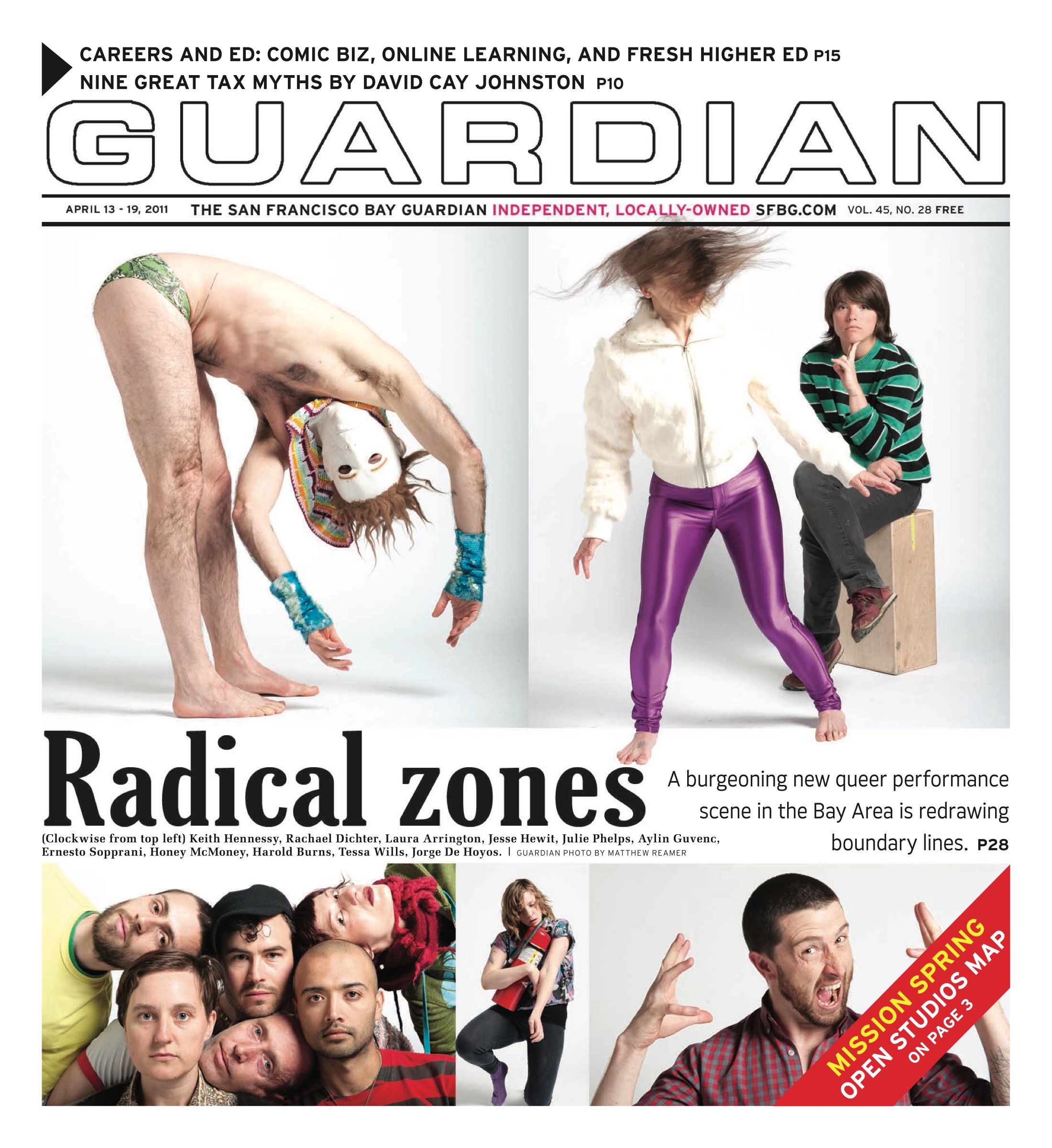
The “MOVE(MEN)T” concerts plug into a men-only choreography tradition from the 1980s (although women do perform in them. Joe Landini revived the idea four years ago because the guys so clearly enjoyed the camaraderie that comes from working together. The artists for the second week’s program include Tim Rubel, who creates text-heavy pieces notable for their humor, and Honey McMoney and Kowal in what Landini calls “very queer” work. Jesse Bie has been dancing with and choreographing for Steamroller for more than 10 years while Michael Velez, a stunningly beautiful dancer, is a still-young choreographer. Todd McQuade is creating an installation in the basement; he will later perform it with Sasha Waltz and Guests in Berlin. (Rita Feliciano)

Wed/20-Thurs/21 8 p.m., $10-20

Garage

957 Howard, SF

(415) 518-1517

www.brownpapertickets.com


MUSIC

Dengue Fever

In trying to deal with the challenge Dengue Fever poses — singer Chhom Nimol belting out 1960s-style Cambodian pop played by L.A.-based musicians — critics have appealed to a unifying element: funk. Whether you’re Sharon Jones and the Dap-Kings, Antibalas Afrobeat Orchestra, or Dengue Fever, anachronism doesn’t matter, if you make the beat move. On its newest album, Cannibal Courtship, Dengue Fever twists the cultural novelty out of their lyrics, turning songs unexpectedly strange. (In the first track, Nimol shakes up the bored, hand-clapping back-up singers, transitioning from “you wouldn’t understand” to “be my sacrificial lamb.”) Funk is universal, and makes for a hell of a party. Just like LSD. (Ryan Prendiville)

With Maus Haus and DJ Felina

8 p.m., $22.50

Fillmore 

1850 Geary, SF

(415) 346-6000

www.livenation.com


THURSDAY 21

EVENT

“Salmon in the Trees”

What are fish doing up in the leafy branches of trees? The punch line (spoiler alert!) requires thinking web-of-life style. Salmon swim upstream from the ocean to spawn and then die, having successfully laid the next generation. In the process, some are hunted by hungry bears — among 50 other salmon-eating animals, including us — who consequently spread carcasses and salmon-fortified poop far and wide on the forest floor. Nutrients are absorbed, reaching the tops of even the oldest-growth trees. Learn about this phenomenon and more with award-winning conservation photographer and author Amy Gulick, who talks about her adventures documenting this wild interconnectivity in Alaska’s Tongass National Forest, one of the rarest ecosystems on the planet. (Kat Renz)

5:30 p.m., $20

Commonwealth Club

595 Market, SF

(415) 597-6700

www.commonwealthclub.org


PERFORMANCE

The Lily’s Revenge

What happens when a flower goes on a quest to become a man in order to wed his beloved bride? Or rather, what doesn’t happen, during this five-hour theater extravaganza in which playwright and burlesque performer Taylor Mac — along with dozens of local Bay Area artists — tackles love, marriage, and Prop. 8 using vaudeville, haiku, drag queens, ukuleles, feminist theories, dream ballets, and public dressing rooms, culminating in an interactive town hall. You heard right. Five hours. The first of three intermissions serves as a communal dinner, and wine and snacks are available for the long journey. Get ready for a spectacular adventure. (Julie Potter)

Through May 22

Tues-Sat 7 p.m.; Sun 2:30 p.m., $20-150

Magic Theatre

Fort Mason Center, SF

(415) 441-8822

www.magictheatre.org


FRIDAY 22

FILM

“John Waters’ Birthday Weekend”

John Samuel Waters was born April 22, 1946, which means he’s 65 today — but let’s hope one of America’s most daringly creative, bitingly hilarious, boundary-pushing filmmakers (not to mention authors, visual artists, and stand-up performers) has no intention of retiring anytime soon. The Castro pays tribute to “the Pope of Trash” with a quartet of essential early films (1972’s Pink Flamingos, 1974’s Female Trouble, 1981’s Polyester, and 1977’s Desperate Living), plus the (slightly) more mainstream 1994 Serial Mom and the movie that spawned the musical that spawned the movie musical, 1988’s Hairspray. True fiends will want to rush home post-weekend to watch all the movies not contained here, plus the DVD edition of 1981’s Mommie Dearest that contains Waters’ brilliant commentary, “Filth is my life!” (Cheryl Eddy)

Fri/22-Sun/24 $7.50-$10 

Castro Theatre

429 Castro, SF

(415) 621-6120

www.castrotheatre.com


MUSIC

Amon Amarth

Though they’ve been a band since 1992, the five burly Vikings in Sweden’s Amon Amarth didn’t really hit their stride for a decade. While headlining a U.S. tour in 2002, the quintet introduced stateside death metal maniacs to its untrammeled beards, overflowing, belt-mounted drinking horns, and soaring, harmonized riffs. With Oden on Our Side (2006) cemented the band’s status as standard bearers for the now-burgeoning Viking metal subgenre, partially on the strength of two hair-whipping music videos. New release Surtur Rising marks a historic chapter in the band’s career — one without headliners. This year’s “An Evening with Amon Amarth” tour features the band playing the new platter in its entirety, before launching into another set’s worth of old favorites. (Ben Richardson)

9 p.m., $22.50

Regency Ballroom

1300 Van Ness, SF

(415) 673-5716

www.theregencyballroom.com


DANCE

Bay Area National Dance Week

Free. Dance. Everywhere. Kicking off with the participatory “One Dance” in Union Square Plaza at noon today, Bay Area National Dance Week, presented by Dancers’ Group, encourages everyone to bust a move with classes, workshops, performances, and events across the region. Head to ODC Dance Commons for free classes from bhangra and ballet to the Rhythm and Motion dance workout. Impress your friends with new fire dancing skills learned at Temple of Poi. Or get close to your favorite performers during an open rehearsal. Whatever your style, be sure to enjoy some of the more than 400 events taking place as part of this dance celebration. (Potter)

Through May 1, free

Various Bay Area locations

(415) 920-9181

www.bayareandw.org


MUSIC

Questlove

From busking on the streets of Philadelphia in the late 1980s to a nightly gig on Late Night With Jimmy Fallon (with more than 12 albums in between), the Roots have never slowed down. It’s no blind guess that Ahmir Thompson, a.k.a. Questlove (a.k.a. ?uestlove), is a driving force behind its success (particularly if you’ve ever seen the look on his face when someone dropped the beat). A talented drummer with few peers, Questlove is the major reason the band is credited with not using recorded samples; he keeps them in his head and plays them with his hands. His deep knowledge of music, hip-hop, and beyond will be on display in an extensive four-hour DJ set. (Prendiville)

9 p.m., $20

Mezzanine

444 Jessie, SF

(415) 625-8880

www.mezzaninesf.com


SATURDAY 23

EVENT

“Cycles of History: Ecological Tour”

Feel the shape of San Francisco imprinted on your ass during a four-hour bike tour pedaling through the ecological past and present of the city’s northern neighborhoods. Sponsored by Shaping San Francisco, a living archive of lost local history, the two-wheeled trip explores the nature currently occupied by the towers of downtown, the landfilled waterfront, and the Presidio’s culturally-constructed forest, among other buried treasures. The tour is one of several offered throughout the year on everything from dissent to cemeteries, organized and led by the excessively knowledgeable and accessible Chris Carlsson, one of San Francisco’s premier activists and visionaries. An afternoon that’s good for the brain and the butt. (Renz)

Noon, $15-$50 sliding scale

Meet at CounterPULSE

1310 Mission, SF

(415) 608-9035

www.shapingsf.org


TUESDAY 26

MUSIC

tUnE-YarDs

It should be clear by now, given that name, its punctuation, the previous album (BiRd-BrAiNs) and the new one (w h o k i l l), plus the cover art, that Merrill Garbus has a thing for collage. Without hearing the music, you see it’s going to be a strange assembly. Sure as hell isn’t going to fit set styles in any easy way. But. Oh, she put that there? Kind of works. And those clippings on top of that image? It’s actually a little inspired (the glitter in particular.) Is she one of these crazy bedroom producers? Would explain the uncanny intimacy. The live show should explain how she puts it all together. (Prendiville)

With Buke and Gass, Man/Miracle

8 p.m., $15

Great American Music Hall

859 O’Farrell, SF

(415) 885-0750

www.gamh.com


FILM

Valley Girl

OK, so Nicolas Cage’s career of late has taken a strange turn. Bad Lieutenant: Port of Call New Orleans (2009) showed that under the right conditions, he can still contain his spiraling zaniness, but films like Season of the Witch, The Sorcerer’s Apprentice (2010), Knowing (2009), and Next (2007) — not to mention 2006’s remake of The Wicker Man — show that often he’d simply prefer not to. With Drive Angry 3-D and, Lord help us, an upcoming Ghost Rider (2007) sequel hinting that won’t be changing soon, take the time to revisit 1983’s Valley Girl, featuring a teenage Cage as a Hollywood demi-punk wooing adorable, mall-fixated Valley gal Deborah Foreman. The “I Melt With You” sequence is the gold standard for teen-dream falling-in-love montages; the dialogue, as always, remains totally tripendicular. (Eddy)

Tues/26-Weds/27 7:15 p.m., 9:25 p.m. (also April 27, 2 p.m.), $6-$10

Red Vic Movie House

1727 Haight, SF

(415) 668-3994

www.redvicmoviehouse.com


The Guardian listings deadline is two weeks prior to our Wednesday publication date. To submit an item for consideration, please include the title of the event, a brief description of the event, date and time, venue name, street address (listing cross streets only isn’t sufficient), city, telephone number readers can call for more information, telephone number for media, and admission costs. Send information to Listings, the Guardian Building, 135 Mississippi St., SF, CA 94107; fax to (415) 487-2506; or e-mail (paste press release into e-mail body — no text attachments, please) to listings@sfbg.com. Digital photos may be submitted in jpeg format; the image must be at least 240 dpi and four inches by six inches in size. We regret we cannot accept listings over the phone.

Film Listings

0

Film listings are edited by Cheryl Eddy. Reviewers are Kimberly Chun, Michelle Devereaux, Peter Galvin, Max Goldberg, Dennis Harvey, Johnny Ray Huston, Louis Peitzman, Lynn Rapoport, Ben Richardson, and Matt Sussman. For rep house showtimes, see Rep Clock. For first-run showtimes, see Movie Guide.

SAN FRANCISCO INTERNATIONAL FILM FESTIVAL

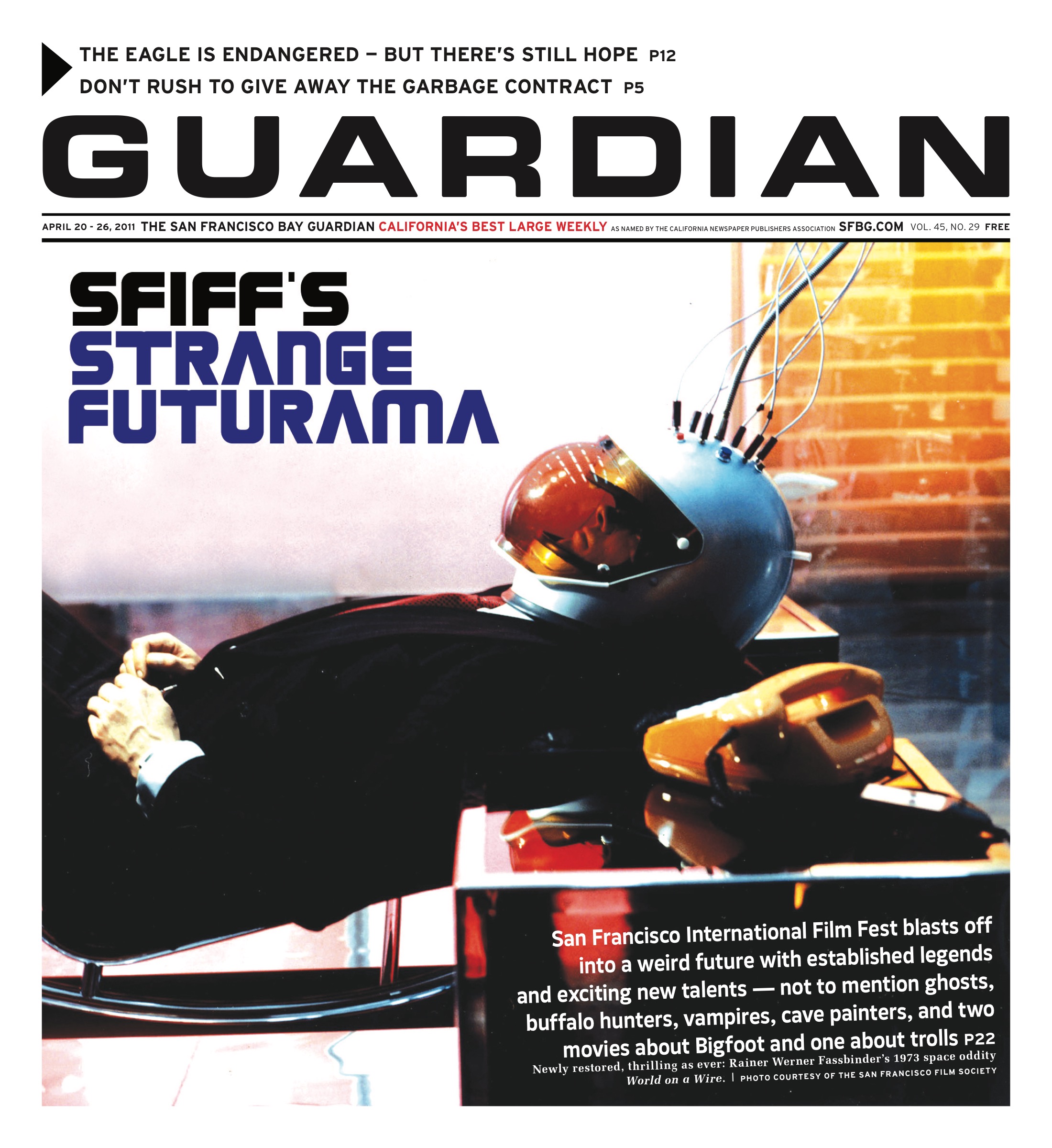
The 54th annual San Francisco International Film Festival runs April 21–May 5. Venues are the Sundance Kabuki, 1881 Post, SF; Castro, 429 Castro, SF; New People, 1746 Post, SF; San Francisco Museum of Modern Art, 151 Third, SF; and Pacific Film Archive, 2575 Bancroft, SF. For tickets (most shows $13) and complete schedule visit www.sffs.org.

THURS/21

Castro Beginners 7.

FRI/22

Kabuki The Place In Between 2. “Irresistable Impulses” (shorts program) 3:15. The Good Life 3:45. Miss Representation 6. Hahaha 6:15. I’m Glad My Mother is Alive 6:45. Attenberg 7. Walking Too Fast 8:45. Meek’s Cutoff 9. Microphone 9:15. The City Below 9:30. Stake Land 11:30.

New People Hot Coffee 6:30. Nainsukh 9:15.

PFA Silent Souls 7. Jean Gentil 8:40.

SAT/23

Kabuki “Youth Media Mash-Up” noon. Mysteries of Lisbon 12:15. The Autobiography of Nicolae Ceausescu 12:45. The Colors of the Mountain 1. Year Without a Summer 3. Life, Above All 4. “Mind the Gap” (shorts program) 4:45. Better This World 6. The Future 6:15. Le Quattro Volte 6:45. The Light Thief 7:15. World on a Wire 8:45. Living On Love Alone 9:30. “Get With the Program” (shorts program) 9:45. The Troll Hunter 11:30.

New People Pink Saris 1. The Last Buffalo Hunt 3:20. The Pipe 6. Hospitalité 9.

SFMOMA The Mill and the Cross 12:30. !Women Art Revolution 3.

PFA Foreign Parts 2:15. The Green Wave 4. Autumn 6:15. The High Life 8:40.

SUN/24

Kabuki “Irresistable Impulses” (shorts program) noon. A Cat in Paris 12:30. Jean Gentil 1. Nainsukh 2:30. The Green Wave 2:45. Walking Too Fast 3. “Cupid With Fangs” (shorts program) 3:15. Silent Souls 4:45. Crime After Crime 6. At Ellen’s Age 6:15. The Colors of the Mountain 6:30. “The Deep End” (shorts program) 7. Asleep in the Sun 8:45. “State of Cinema: Christine Vachon” 9. The Stool Pigeon 9:15. “From A to Zellner” (shorts program) 9:45.

New People A Useful Life noon. Microphone 2. The Autobiography of Nicolae Ceausescu 5:15. The Future 9:15.

PFA Something Ventured 2. Children of the Princess of Cleves 4:15. Chantrapas 6:15. The Arbor 8:45.

MON/25

Kabuki Children of the Princess of Cleves 2. The City Below 4. Meek’s Cutoff 4:30. Hot Coffee 6:30. Autumn 6:45. Cave of Forgotten Dreams 7. She Monkeys 7:15. Salon: The Social Justice Documentary 8:30. Hahaha 9. The Light Thief 9:15. I’m Glad My Mother is Alive 9:30. Stake Land 9:45.

New People The Troll Hunter 6:15. Year Without a Summer 9:15.

PFA A Useful Life 7. !Women Art Revolution 8:40.

TUES/26

Kabuki Hot Coffee 2. Hahaha 3:30. Ulysses 4. Chantrapas 6. Jean Gentil 6. The Sleeping Beauty 6:15. Nostalgia for the Light 6:30. She Monkeys 8:45. New Skin For the Old Ceremony 9. The Whistleblower 9:15. Cave of Forgotten Dreams 9:30.

New People The Last Buffalo Hunt 6:30. “Cupid With Fangs” (shorts program) 9.

PFA Better This World 6:30. Position Among the Stars 8:50.

OPENING

African Cats This Earth Day release, narrated by Samuel L. Jackson, follows cheetah and lions on the African savanna. (1:40) Shattuck.

Ceremony It’s easy to dismiss Ceremony as derivative. The plot isn’t exactly original. But recycled material aside, it’s an entertaining indie diversion and a promising feature-length debut from writer-director Max Winkler. The underrated Michael Angarano stars as Sam Davis, a pretentious shit who owes a lot to Holden Caulfield by way of Rushmore‘s Max Fischer. Sam tricks his best friend Marshall (Reece Thompson) into accompanying him on a weekend getaway, with the real objective of winning back his lost love Zoe (Uma Thurman). But Zoe is all set to marry blowhard Whit Coutell (Lee Pace) and is not too keen on blowing off her wedding. None of the characters are all that likable — a quirky indie comedy must — and there are few surprises. But Winkler’s script is cute, and his cast is charming enough to carry the material along. The scenes between Angarano and Thompson are the film’s best. Here’s hoping they stand out enough to earn these young actors the recognition they deserve. (1:40) Lumiere. (Peitzman)

Pom Wonderful Presents: The Greatest Movie Ever Sold Don’t even think about shortening the title: Morgan Spurlock’s new documentary POM Wonderful Presents: The Greatest Story Ever Sold is ingenious, bitingly funny, and made possible by corporate sponsorship. POM paid good money to earn a spot about the title, so damned if I’m going to leave them out. Instead of keeping product placement subliminal — or at least trying — Spurlock shows exactly what goes into the popular marketing practice. His film isn’t so much critical as it is honest: he doesn’t fight product placement, but rather embraces it to his own advantage. It’s win-win. Spurlock gets to make his movie without losing any cash, and the audience gets a hilarious insider look into a mostly hidden facet of advertising. As he says, it’s about transparency, and no one can claim Spurlock is trying to go behind our backs. And what of the advertising that pops up throughout the film? I can only speak to my own experience, but yes, I’m drinking POM as I write this. (1:26) SF Center. (Peitzman)

Red, White and Blue Noah Taylor stars in this mystery punctuated by shocking twists. (1:42) Roxie.

Trust A teenager is victimized by an internet predator in this drama. Clive Owen and Catherine Keener play her horrified parents. (1:55) Opera Plaza.

Tyler Perry’s Madea’s Big Happy Family She’s baaack. (2:00) Shattuck.

Water for Elephants A young man (Robert Pattinson) joins a circus (populated by the likes of Reese Witherspoon and Christoph Waltz) in this drama based on the best-selling novel. (2:00) Balboa, Marina.

White Irish Drinkers What is 20-year TV veteran John Gray (of series The Ghost Whisperer) doing writing-directing yet another indie Mean Streets (1973) knockoff? That’s fresh-outta-film-school business. Why is anyone doing one of those so long after the expiration date for that second (or by now third) generation shit? This trip down some very familiar roads — 1997’s Good Will Hunting and 1977’s Saturday Night Fever being others — stars SF native Nick Thurston as a 1975 Brooklyn youth with a violent alcoholic father (Stephen Lang), long-suffering mother (Karen Allen), and an older brother drifting into criminality (Geoffrey Wigdor). As outside influences this talented closet artist has the requisite upscaling girl (Leslie Murphy) urging him to dream big, and a wistfully downtrodden employer (Peter Riegert) providing the plot gimmick as a failing movie-palace owner who hopes to turn around his fortunes with a one-night-stand by the Rolling Stones. Everything about White Irish Drinkers feels recycled from other movies. Though the performers work hard and the progress is entertaining enough, there’s way too much déjà vu here for one film to bear and still stand on its own punch-drunk legs. (1:49) Lumiere, Shattuck. (Harvey)

ONGOING

The Adjustment Bureau As far as sci-fi romantic thrillers go, The Adjustment Bureau is pretty standard. But since that’s not an altogether common genre mash-up, I guess the film deserves some points for creativity. Based on a short story by Philip K. Dick, The Adjustment Bureau takes place in a world where all of our fates are predetermined. Political hotshot David Norris (Matt Damon) is destined for greatness — but not if he lets a romantic dalliance with dancer Elise (Emily Blunt) take precedence. And in order to make sure he stays on track, the titular Adjustment Bureau (including Anthony Mackie and Mad Men‘s John Slattery) are there to push him in the right direction. While the film’s concept is intriguing, the execution is sloppy. The Adjustment Bureau suffers from flaws in internal logic, allowing the story to skip over crucial plot points with heavy exposition and a deus ex machina you’ve got to see to believe. Couldn’t the screenwriter have planned ahead? (1:39) Balboa, Shattuck. (Peitzman)

Arthur (1:45) Empire, 1000 Van Ness, SF Center.

Atlas Shrugged (1:57) Shattuck, SF Center.

*Bill Cunningham New York To say that Bill Cunningham, the 82-year old New York Times photographer, has made documenting how New Yorkers dress his life’s work would be an understatement. To be sure, Cunningham’s two decades-old Sunday Times columns — “On the Street,” which tracks street-fashion, and “Evening Hours,” which covers the charity gala circuit — are about the clothes. And, my, what clothes they are. But Cunningham is a sartorial anthropologist, and his pictures always tell the bigger story behind the changing hemlines, which socialite wore what designer, or the latest trend in footwear. Whether tracking the near-infinite variations of a particular hue, a sudden bumper-crop of cropped blazers, or the fanciful leaps of well-heeled pedestrians dodging February slush puddles, Cunningham’s talent lies in his ability to recognize fleeting moments of beauty, creativity, humor, and joy. That last quality courses through Bill Cunningham New York, Richard Press’ captivating and moving portrait of a man whose reticence and personal asceticism are proportional to his total devotion to documenting what Harold Koda, chief curator at the Costume Institute at the Metropolitan Museum of Art, describes in the film as “ordinary people going about their lives, dressed in fascinating ways.” (1:24) Embarcadero, Shattuck. (Sussman)

Certified Copy Abbas Kiarostami’s beguiling new feature signals “relationship movie” with every cobblestone step, but it’s manifestly a film of ideas — one in which disillusionment is as much a formal concern as a dramatic one. Typical of Kiarostami’s dialogic narratives, Certified Copy is both the name of the film and an entity within the film: a book written against the ideal of originality in art by James Miller (William Shimell), an English pedant fond of dissembling. After a lecture in Tuscany, he meets an apparent admirer (Juliette Binoche) in her antique shop. We watch them talk for several minutes in an unbroken two-shot. They gauge each other’s values using her sister as a test case — a woman who, according to the Binoche character, is the living embodiment of James’ book. Do their relative opinions of this off-screen cipher constitute characterization? Or are they themselves ciphers of the film’s recursive structure? Kiarostami makes us wonder. They begin to act as if they were married midway through the film, though the switch is not so out of the blue: Kiarostami’s narrative has already turned a few figure-eights. Several critics have already deemed Certified Copy derivative of many other elliptical romances; the strongest case for an “original” comes of Roberto Rossellini’s Voyage to Italy (1954). The real difference is that while Rossellini’s masterpiece realizes first-person feelings in a third-person approach, Kiarostami stays in the shadow of doubt to the end. (1:46) Opera Plaza, Smith Rafael. (Goldberg)

*Circo The old notion of “running away with the circus” seldom seemed appealing — conjuring images of following an elephant around with a shovel — and it grows even less so after watching Aaron Schock’s warm, touching documentary. The kids here might one day run away from the circus. They’re born into Grand Circo Mexico, one of four circuses run by the Ponce family, which has been in this business for generations; if they’re old enough to walk, they’re old enough to perform, and help with the endless setup and breakdown chores. (Presumably child labor laws are an innovation still waiting to happen here.) Touring Mexico’s small towns in trucks with a variety of exotic animals, it’s a life of labor, with on-the-job training in place of school — arguably not much of a life for child, as current company leader Tino’s wife Ivonne (who really did run away with the circus, or rather him, at age 15) increasingly insists. Other family members have split for a normal life, and Tino is caught between loyalty to his parents’ ever-struggling business and not wanting to lose the family he’s raised himself. This beautifully shot document, scored by Calexico and edited by Mark Becker (of 2005’s marvelous Romantico), is a disarming look at a lifestyle that feels almost 19th century, and is barely hobbling into the 21st one. (1:15) Lumiere, Shattuck. (Harvey)

The Conspirator It may not be your standard legal drama, but The Conspirator is a lot more enjoyable when you think of it as an extended episode of Law & Order. The film chronicles the trial of Mary Surratt (Robin Wright), the lone woman charged in the conspiracy to assassinate Abraham Lincoln. It’s a fascinating story, especially for those who don’t know much of the history past John Wilkes Booth. But while the subject matter is compelling, the execution is hit-or-miss. Wright is sympathetic as Surratt, but the usually great James McAvoy is somewhat forgettable in the pivotal role of Frederick Aiken, Surratt’s conflicted lawyer. It’s hard to say what it is that’s missing from The Conspirator: the cast — which also includes Evan Rachel Wood and Tom Wilkinson — is great, and this is a story that’s long overdue to be told. Still, something is lacking. Could it be the presence of everyone’s favorite detective, the late Lennie Briscoe? (2:02) Embarcadero, Empire, 1000 Van Ness, Piedmont, Presidio. (Peitzman)

*Hanna The title character of Hanna falls perfectly into the lately very popular Hit-Girl mold. Add a dash of The Boys from Brazil-style genetic engineering — Hanna has the unfair advantage, you see, when it comes to squashing other kids on the soccer field or maiming thugs with her bare hands — and you have an ethereal killing/survival machine, played with impassive confidence by Atonement (2007) shit-starter Saoirse Ronan. She’s been fine-tuned by her father, Erik (Eric Bana), a spy who went out into the cold and off the grid, disappearing into the wilds of Scandinavia where he home-schooled his charge with an encyclopedia and brutal self-defense and hunting tests. Atonement director Joe Wright plays with a snowy palette associated with innocence, purity, and death — this could be any time or place, though far from the touch of modern childhood stresses: that other Hannah (Montana), consumerism, suburban blight, and academic competition. The 16-year-old Hanna, however, isn’t immune from that desire to succeed. Her game mission: go from a feral, lonely existence into the modern world, run for her life, and avenge the death of her mother by killing Erik’s CIA handler, Marissa (Cate Blanchett). The nagging doubt: was she born free, or Bourne to be a killer? Much like the illustrated Brothers Grimm storybook that she studies, Hanna is caught in an evil death trap of fairytale allegories. One wonders if the super-soldier apple didn’t fall far from the tree, since evil stepmonster Marissa oversaw the program that produced Hanna — the older woman and the young girl have the same cold-blooded talent for destruction and the same steely determination. Yet there’s hope for the young ‘un. After learning that even her beloved father hid some basic truths from her, this natural-born killer seems less likely to go along with the predetermined ending, happy or no, further along in her storybook life. (1:51) Empire, Four Star, 1000 Van Ness, SF Center. (Chun)

Henry’s Crime Keanu Reeves is one of those actors who’s spectacularly franchise-wealthy — due to those Matrix movies wherein his usual baffled solemnity was ideal — yet whom the public otherwise feels scant evident loyalty toward, and producers don’t know what to do with. Now that he’s aging out of his looks, can he transform into a character actor? Maybe. Reeves played charming suitors in Something’s Gotta Give (2003) and The Private Lives of Pippa Lee (2009), both very much supporting roles. He seems increasingly interested in indie films, which he surely doesn’t need to pay the rent, and he’s certainly the best reason to see Henry’s Crime, a pleasant, middling, retro crime caper costarring frequently better actors at dimmer wattage than usual. The film is an old hat out of the Damon Runyon trunk, in which lovable crooks mix it up with hoity theatrical types and nobody gets hurt except (barely) the really bad guys. James Caan — who starred in similar enterprises during their post-The Sting heyday plays the veteran convict-conman who schools Reeves’ hapless Buffalo, N.Y., toll-taker Henry after our hero is slammer-thrown for an armed robbery he didn’t know he was embroiled in until it was over. Upon release, Henry discovers the targeted bank and nearby theater had a Prohibition-era secret tunnel between them. Having already done the time, he figures he might as well do the crime by finishing the aborted bank job for real. He enlists local stage diva Julie (Vera Farmiga) as well as Caan’s parole-coaxed Max. Resulting wacky hijinks render Max a theater “volunteer” and Henry as Julie’s Cherry Orchard costar, all so they can access the walled-up passageway to the bank vault. Much of this is ridiculous, of course, and not intentionally so. The climax is classic movies-getting-how-theater-works-wrong. But its contrivance functions to some extent because the lead actor convinces us it should. (1:48) Embarcadero. (Harvey)

Hop (1:30) 1000 Van Ness, Shattuck.

*In a Better World Winner of this year’s Best Foreign Language Film Oscar, this latest from Danish director Susanne Bier (2004’s Brothers, 2006’s After the Wedding) and her usual co-scenarist Anders Thomas Jensen (2005’s Adam’s Apples, 2003’s The Green Butchers) is a typically engrossing, complex drama that deals with the kind of rage for “personal justice” that can lead to school and workplace shootings, among other things (like terrorism). Shy, nervous ten-year-old Elias (Markus Rygaard) needs a confidence boost, but things are worrying both at home and elsewhere. His parents are estranged, and his doting father (Mikael Persbrandt) is mostly away as a field hospital in Kenya tending victims of local militias. At school, he’s an easy mark for bullies, a fact which gets the attention of charismatic, self-assured new kid Christian (William Jøhnk Nielsen), who appoints himself Elias’ new (and only) friend — then when his slightly awed pal is picked on again, intervenes with such alarming intensity that the police are called. Christian appears a little too prone to violence and harsh judgment in teaching “lessons” to those he considers in the wrong; his own domestic situation is another source of anger, as he simplistically blames his earnest, distracted executive father (Ulrich Thomsen) for his mother’s recent cancer death. Is Christian a budding little psychopath, or just a kid haplessly channeling his profound loss? Regardless, when an adult bully (Kim Bodnia as a loutish mechanic) humiliates Elias’ father in front of the two boys, Christian pulls his reluctant friend into a pursuit of vengeance that surely isn’t going to end well. With their nuanced yet head-on treatment of hot button social and ethical issues, Bier and Jensen’s work can sometimes border on overly-schematic melodrama, meting out its own secular-humanist justice a bit too handily, like 21st-century cinematic Dickenses. But like Dickens, they also have a true mastery of the creating striking characters and intricately propulsive plotlines that illustrate the points at hand in riveting, hugely satisfying fashion. This isn’t their best. But it’s still pretty excellent, and one of those universally accessible movies you can safely recommend even to people who think they don’t like foreign or art house films. (1:53) Embarcadero, Shattuck. (Harvey)

Insidious (1:42) 1000 Van Ness.

*Jane Eyre Do we really need another adaptation of Jane Eyre? As long as they’re all as good as Cary Fukunaga’s stirring take on the gothic romance, keep ’em coming. Mia Wasikowska stars in the titular role, with the dreamy Michael Fassbender stepping into the high pants of Edward Rochester. The cast is rounded out by familiar faces like Judi Dench, Jamie Bell, and Sally Hawkins — all of whom breathe new life into the material. It helps that Fukunaga’s sensibilities are perfectly suited to the story: he stays true to the novel while maintaining an aesthetic certain to appeal to a modern audience. Even if you know Jane Eyre’s story — Mr. Rochester’s dark secret, the fate of their romance, etc. — there are still surprises to be had. Everyone tells the classics differently, and this adaptation is a thoroughly unique experience. And here’s hoping it pushes the engaging Wasikowska further in her ascent to stardom. (2:00) Albany, Embarcadero, Piedmont, Presidio. (Peitzman)

Kill the Irishman If you enjoy 1970s-set Mafia movies featuring characters with luxurious facial hair zooming around in Cadillacs, flossing leather blazers, and outwitting cops and each other — you could do a lot worse than Kill the Irishman, which busts no genre boundaries but delivers enjoyable retro-gangsta cool nonetheless. Adapted from the acclaimed true crime book by a former Cleveland police lieutenant, the film details the rise and fall of Danny Greene, a colorful and notorious Irish-American mobster who both served and ran afoul of the big bosses in his Ohio hometown. During one particularly conflict-ridden period, the city weathered nearly 40 bombings — buildings, mailboxes, and mostly cars, to the point where the number of automobiles going sky-high is almost comical (you’d think these guys would’ve considered taking the bus). The director of the 2004 Punisher, Jonathan Hensleigh, teams up with the star of 2008’s Punisher: War Zone, Ray Stevenson, who turns in a magnetic performance as Greene; it’s easy to see how his combination of book- and street smarts (with a healthy dash of ruthlessness) buoyed him nearly to the top of the underworld. The rest of the cast is equally impressive, with Vincent D’Onofrio, Val Kilmer, Christopher Walken, and Linda Cardellini turning in supporting roles, plus a host of dudes who look freshly defrosted from post-Sopranos storage. (1:46) Opera Plaza. (Eddy)

The King’s Speech Films like The King’s Speech have filled a certain notion of “prestige” cinema since the 1910s: historical themes, fully-clothed romance, high dramatics, star turns, a little political intrigue, sumptuous dress, and a vicarious taste of how the fabulously rich, famous, and powerful once lived. At its best, this so-called Masterpiece Theatre moviemaking can transcend formula — at its less-than-best, however, these movies sell complacency, in both style and content. In The King’s Speech, Colin Firth plays King George VI, forced onto the throne his favored older brother Edward abandoned. This was especially traumatic because George’s severe stammer made public address tortuous. Enter matey Australian émigré Lionel Logue (Geoffrey Rush, mercifully controlled), a speech therapist whose unconventional methods include insisting his royal client treat him as an equal. This ultimately frees not only the king’s tongue, but his heart — you see, he’s never had anyone before to confide in that daddy (Michael Gambon as George V) didn’t love him enough. Aww. David Seidler’s conventionally inspirational script and BBC miniseries veteran Tom Hooper’s direction deliver the expected goods — dignity on wry, wee orgasms of aesthetic tastefulness, much stiff-upper-lippage — at a stately promenade pace. Firth, so good in the uneven A Single Man last year, is perfect in this rock-steadier vehicle. Yet he never surprises us; role, actor, and movie are on a leash tight enough to limit airflow. (1:58) Shattuck. (Harvey)

*Limitless An open letter to the makers of Limitless: please fire your marketing team because they are making your movie look terrible. The story of a deadbeat writer (Bradley Cooper) who acquires an unregulated drug that allows him to take advantage of 100 percent of his previously under-utilized brain, Limitless is silly, improbable and features a number of distracting comic-book-esque stylistic tics. But consumed with the comic book in mind, Limitless is also unpredictable, thrilling, and darkly funny. The aforementioned style, which includes many instances of the infinite regression effect that you get when you point two mirrors at each other, and a heavy blur to distort depth-of-field, only solidifies the film’s cartoonish intentions. Cooper learns foreign languages in hours, impresses women with his keen attention to detail, and sets his sights on Wall Street, a move that gets him noticed by businessman Carl Van Loon (Robert DeNiro in a glorified cameo) as well as some rather nasty drug dealers and hired guns looking to cash in on the drug. Limitless is regrettably titled and masquerades in TV spots as a Wall Street series spin-off, but in truth it sports the speedy pacing and tongue-in-cheek humor required of a good popcorn flick. (1:37) California, Four Star, 1000 Van Ness, SF Center. (Galvin)

*The Lincoln Lawyer Outfitted with gym’d-tanned-and-laundered manly blonde bombshells like Matthew McConaughey, Josh Lucas, and Ryan Phillippe, this adaptation of Michael Connelly’s LA crime novel almost cries out for an appearance by the Limitless Bradley Cooper — only then will our cabal of flaxen-haired bros-from-other-‘hos be complete. That said, Lincoln Lawyer‘s blast of morally challenged golden boys nearly detracts from the pleasingly gritty mise-en-scène and the snappy, almost-screwball dialogue that makes this movie a genre pleasure akin to a solid Elmore Leonard read. McConaughey’s criminal defense attorney Mickey Haller is accustomed to working all the angles — hence the title, a reference to a client who’s working off his debt by chauffeuring Haller around in his de-facto office: a Lincoln Town Car. Haller’s playa gets truly played when he becomes entangled with Louis Roulet (Phillippe), a pretty-boy old-money realtor accused of brutally attacking a call girl. Loved ones such as Haller’s ex Maggie (Marisa Tomei) and his investigator Frank (William H. Macy) are in jeopardy — and in danger of turning in some delightfully textured cameos — in this enjoyable walk on the sleazy side of the law, the contemporary courtroom counterpart to quick-witted potboilers like Sweet Smell of Success (1957). (1:59) Four Star, 1000 Van Ness. (Chun)

Miral (1:42) California.

*Of Gods and Men It’s the mid-1990s, and we’re in Tibhirine, a small Algerian village based around a Trappist monastery. There, eight French-born monks pray and work alongside their Muslim neighbors, tending to the sick and tilling the land. An emboldened Islamist rebel movement threatens this delicate peace, and the monks must decide whether to risk the danger of becoming pawns in the Algerian Civil War. On paper, Of Gods and Men sounds like the sort of high-minded exploitation picture the Academy swoons over: based on a true story, with high marks for timeliness and authenticity. What a pleasant surprise then that Xavier Beauvois’s Cannes Grand Prix winner turns out to be such a tightly focused moral drama. Significantly, the film is more concerned with the power vacuum left by colonialism than a “clash of civilizations.” When Brother Christian (Lambert Wilson) turns away an Islamist commander by appealing to their overlapping scriptures, it’s at the cost of the Algerian army’s suspicion. Etienne Comar’s perceptive script does not rush to assign meaning to the monks’ decision to stay in Tibhirine, but rather works to imagine the foundation and struggle for their eventual consensus. Beauvois occasionally lapses into telegraphing the monks’ grave dilemma — there are far too many shots of Christian looking up to the heavens — but at other points he’s brilliant in staging the living complexity of Tibrihine’s collective structure of responsibility. The actors do a fine job too: it’s primarily thanks to them that by the end of the film each of the monks seems a sharply defined conscience. (2:00) Albany, Opera Plaza. (Goldberg)

*Poetry Sixtysomething Mija (legendary South Korean actor Yun Jung-hee) impulsively crashes a poetry class, a welcome shake-up in a life shaped by unfulfilling routines. In order to write compelling verse, her instructor says, it is important to open up and really see the world. But Mija’s world holds little beauty beyond her cheerful outfits and beloved flowers; most pressingly, her teenage grandson, a mouth-breathing lump who lives with her, is completely remorseless about his participation in a hideous crime. In addition, she’s just been disgnosed with the early stages of Alzheimer’s, and the elderly stroke victim she housekeeps for has started making inappropriate advances. Somehow writer-director Lee Chang-dong (2007’s Secret Sunshine) manages not to deliver a totally depressing film with all this loaded material; it’s worth noting Poetry won the Best Screenplay Award at the 2010 Cannes Film Festival. Yun is unforgettable as a woman trying to find herself after a lifetime of obeying the wishes of everyone around her. Though Poetry is completely different in tone than 2009’s Mother, it shares certain elements — including the impression that South Korean filmmakers have recognized the considerable rewards of showcasing aging (yet still formidable) female performers. (2:19) Shattuck, Smith Rafael. (Eddy)

Potiche When we first meet Catherine Deneuve’s Suzanne — the titular trophy wife (or potiche) of Francois Ozon’s new airspun comedy — she is on her morning jog, barely breaking a sweat as she huffs and puffs in her maroon Adidas tracksuit, her hair still in curlers. It’s 1977 and Suzanne’s life as a bourgeois homemaker in a small provincial French town has played out as smoothly as one of her many poly-blend skirt suits: a devoted mother to two grown children and loving wife who turns a blind eye to the philandering of husband Robert (Fabrice Luchini), Suzanne is on the fast track to comfortable irrelevance. All that changes when the workers at Robert’s umbrella factory strike and take him hostage. Suzanne, with the help of union leader and old flame Babin (Gerard Depardieu, as big as a house), negotiates a peace, and soon turns around the company’s fortunes with her new-found confidence and business savvy. But when Robert wrests back control with the help of a duped Babin, Suzanne does an Elle Woods and takes them both on in a surprise run for political office. True to the film’s light théâtre de boulevard source material, Ozon keeps things brisk and cheeky (Suzanne sings with as much ease as she spouts off Women’s Lib boilerplate) to the point where his cast’s hammy performances start blending into the cheery production design. Satire needs an edge that Potiche, for all its charm, never provides. (1:43) Clay, Shattuck, Smith Rafael. (Sussman)

Rio (1:32) 1000 Van Ness, Presidio, SF Center.

Scre4m Back in 1996, Wes Craven’s Scream revitalized the slasher genre with a script (by Kevin Williamson) that poked fun at horror clichés while still delivering genuine scares. The sequels offered diminishing returns on this once-clever formula; Scream 4 arrives 11 years past Scream 3, presumably hoping to work that old self-referential yet gory magic on a new crop of filmgoers. But Craven and Williamson’s hall-of-mirrors creation (more self-satisfied than self-referential, scrambling to anticipate a cynical audience member’s every second-guess) is barely more than than a continuation of something that was already tired in 2000, albeit with iPhone and web cam gags pasted in for currency’s sake. Eternal Ghostface target Sidney Prescott (Neve Campbell) returns to her hometown to promote what’s apparently a woo-woo self-help book (Mad Men‘s Alison Brie, as Sidney’s bitchy-perky publicist, steals every scene she’s in); still haunting Woodsboro are Dewey (David Arquette), now the sheriff, and Gale (Courteney Cox), a crime author with writer’s block. When the Munch-faced one starts offing high school kids, local movie nerds (Rory Culkin, Hayden Panettiere) and nubile types (Emma Roberts, Hayden Panettiere) react by screening all seven Stab films, inspired by the “real-life” Woodsboro murders, and spouting off about the rules, or lack thereof in the 21st century, of horror sequels. If that sounds mega-meta exhausting, it is. And, truth be told, not very scary. (1:51) 1000 Van Ness. (Eddy)

Some Days Are Better Than Others First-time director Matt McCormick doesn’t break any new stylistic or thematic ground with his ensemble drama, but Some Days Are Better Than Others does boast an interesting bit of stunt casting. Indie rock fans will recognize the Shins’ James Mercer as mopey Eli, who drifts between temp jobs trying to earn enough money to go back to school because he hates working so much; fellow musician Carrie Brownstein appears as Katrina, a recently-dumped, reality TV-obsessed dog-shelter worker; her character is the kind of emo thrift-shopper that Portlandia would had no trouble poking fun at. Other points on this sad-sack square are a lonely woman ((Renee Roman Nose) who finds an erstwhile cremation urn, and an elderly man (David Wodehouse) obsessed with the kaleidoscope-like patterns he captures while filming soap bubbles. Moments of wry humor (Katrina checks messages at “mumblemail.net”) and some Ghost World-ish jabs at mainstream go-getters (including a moving-company douchebag who hires Eli to help clean out a recently-deceased woman’s house) keep Some Days from being a total downer, but be warned: this is one melancholy movie. Shins fans will enjoy the scene where Eli, alone in his room, rehearses for a yearned-for karaoke date with a Bonnie Tyler classic. (1:33) Roxie. (Eddy)

Soul Surfer (1:46) 1000 Van Ness, SF Center.

*Source Code A post-9/11 Groundhog Day (1993) with explosions, Inception (2010) with a heart, or Avatar (2009) taken down a notch or dozen in Chicago —whatever you choose to call it, Source Code manages to stand up on its own wobbly Philip K. Dick-inspired legs, damn the science, and take off on the wings of wish fulfillment. ‘Cause who hasn’t yearned for a do-over — and then a do-over of that do-over, etc. We could all be as lucky — or as cursed — as soldier Colter Stevens (Jake Gyllenhaal), who gets to tumble down that time-space rabbit hole again and again, his consciousness hitching a ride in another man’s body, while in search of the bomber of a Chicago commuter train. On the upside, he gets to meet the girl of his dreams (Michelle Monaghan) — and see her getting blown to smithereens again and again, all in the service of his country, his commander-cum-link to the outside world (Vera Farmiga), and the scientist masterminding this secret military project (Jeffrey Wright). On the downside, well, he gets to do it over and over again, like a good little test bunny in pinball purgatory. Fortunately, director Duncan Jones (2009’s Moon) makes compelling work out of the potentially ludicrous material, while his cast lends the tale a glossed yet likable humanity, the kind that was all too absent in Inception. (1:33) Balboa, Marina, 1000 Van Ness. (Chun)

*Win Win Is Tom McCarthy the most versatile guy in Hollywood? He’s a successful character actor (in big-budget movies like 2009’s 2012; smaller-scale pictures like 2005’s Good Night, and Good Luck; and the final season of The Wire). He’s an Oscar-nominated screenwriter (2009’s Up). And he’s the writer-director of two highly acclaimed indie dramas, The Station Agent (2003) and The Visitor (2007). Clearly, McCarthy must not sleep much. His latest, Win Win, is a comedy set in his hometown of New Providence, N.J. Paul Giamatti stars as Mike Flaherty, a lawyer who’s feeling the economic pinch. Betraying his own basic good-guy-ness, he takes advantage of a senile client, Leo (Burt Young), when he spots the opportunity to pull in some badly-needed extra cash. Matters complicate with the appearance of Leo’s grandson, Kyle (newcomer Alex Shaffer), a runaway from Ohio. Though Mike’s wife, Jackie (Amy Ryan), is suspicious of the taciturn teen, she allows Kyle to crash with the Flaherty family. As luck would have it, Kyle is a superstar wrestler — and Mike happens to coach the local high school team. Things are going well until Kyle’s greedy mother (Melanie Lynskey) turns up and starts sniffing around her father’s finances. Lessons are learned, sure, and there are no big plot twists beyond typical indie-comedy turf. But the script delivers more genuine laughs than you’d expect from a movie that’s essentially about the recession. (1:46) Bridge, California, Piedmont. (Eddy)

Your Highness One of the dangers of reviewing a film like Your Highness is that stoner comedies have a very specific intended audience. A particular altered state is recommended to maximize one’s enjoyment. I tend not to show up for professional gigs with Mary Jane as my plus-one, so I had to view the latest from Pineapple Express (2008) director David Gordon Green through un-bloodshot eyes. While Express was more explicitly ganja-themed, Your Highness is instead a comedy that approximates the experience of getting as high as possible, then going directly to Medieval Times. Never gut-bustingly funny, Your Highness still reaps chuckles from its hard-R dialogue and plenty of CG-assisted sight gags involving genetalia. James Franco and Danny McBride star as princes, one heroic and one ne’er-do-well, who quest to save a maiden kidnapped by an evil wizard (Justin Theroux). Natalie Portman turns up as a thong-wearing warrior, just ’cause it’s that kind of movie. Forget the box office; only time and the tastes of late-night movie watchers will dictate whether Your Highness is a success or a bust. Case in point: nobody thought much of Half Baked (1998) when it was released, but in certain circles, it’s become a bona fide classic. Say it with me now: “Fuck you, fuck you, fuck you, you’re cool, and fuck you. I’m out!” (1:42) 1000 Van Ness, SF Center. (Eddy) 

 

Behind the panel

2

caitlin@sfbg.com

CAREERS AND ED Graphic novelist Gene Yang has a theory about how the comic industry came to be home to more Asian American artists than probably any other North American media form. “American comics have always been an outsider’s medium,” he wrote in a recent e-mail correspondence with the Guardian. “Most of the American comic book icons — Superman, Batman, the Hulk, Captain America — were created by poor Jewish boys living in the ghettos of New York. All you needed was a pencil, some paper, and a tiny bit of talent. Asian Americans took advantage of the same dynamic.”

Suppositions aside, Yang’s point is this: these days, Asian Americans are at the top of the comic book game. Yang has published many comic titles that creatively explore what it was like for him and his siblings growing up in the Bay Area (he was born in Alameda). American Born Chinese pits a high schooler against a monkey king from Chinese folklore who compels him to face his discomfort with his family’s heritage. Level Up looks at a video game fanatic’s transition to med school, a journey undertaken by Yang’s brother in real life.

Yang is by no means the only Asian American excelling in the comic industry. Jim Lee, a Korean American who was named copublisher of DC Comics last year, is often regarded as the modern era’s quintessential comic artist. And many of the genre’s biggest names — including the man behind DC’s Supergirl series; Bernard Chang, creator of the syndicated strip Liberty Meadows Frank Cho; and Human Target illustrator Cliff Chiang (all interviewed via e-mail for this article) — are first- or second-generation Asian Americans.

“If you were to ask any comic book fan who their favorite artists are, odds are there will be an Asian American creator — or two, or three, if not four — on that list,” Chang says.

This wasn’t always the case. When most of today’s comic book artists were growing up, there were few stories being told about Asian Americans in popular entertainment. Chang moved to Miami from Taiwan as a child, and apart from comic books sent to him by relatives overseas, saw very little in the mass media that could relate to his own experience. “For the most part, you had the Bruce Lee kung fu movies that played on the secondary television stations on the weekends,” he says.

“Everything seemed to be about people in Asia or recent immigrants,” remembers American-born Chiang. “I didn’t go out of my way to seek out those stories. What I did respond to was art and animation created by Asians in the form of cartoons like Speed Racer or Battle of the Planets.”

He wasn’t the only one who turned to cartoons as a child. Yang fondly remembers the commonalities he found in superhero comics, even going as far as attributing his and other Asian American boys’ attraction to Superman to a subconscious recognition of a kindred soul. It was a connection he copped from Jeff Yang, editor of Secret Identities: The Asian American Superhero Anthology, a collection that assembled some of today’s top comic art talent in creating an illustrated shadow history of the United States.

To wit: “Here’s a guy with two identities, one American and the other foreign — Kryptonian. He has two names, one American — Clark — and the other foreign with a hyphen in the middle, Kal-El. He came to America at a young age. He’s black haired, mild-mannered, and wears glasses. All of his superpowers derive from the fact that he’s a foreigner.”

And there’s the art form itself, Yang continues: words and pictures side by side, typically avoided in Western art save in children’s books and advertising but embraced in Asian tradition. “You could have the best brush-painted image in the world,” Yang says, “but if the poem paired with it sucked, the whole piece sucked.”


THE SAGA OF RYAN CHOI

But if so many of the genre’s artists are Asian American, why are so few of its protagonists? Despite the prevalence of minority fans at comic conventions and the ever-diversifying profile of the people who create comics, their characters — with the important exception of those in manga — are mainly Caucasian.

And the big publishing houses in comics appear to sticking with this monotone. For a time, Marvel and DC experimented with retiring their big name heroes, replacing them — in the words of Yang — with “younger, hipper, often ethnic versions.” As an example, he offers the saga of the Atom, originally a white guy named Ray Palmer. Palmer was made to disappear mysteriously, and in the logic of the comic universe, was replaced by his
Chinese protégé, Ryan Choi.

But “the young ones just weren’t selling,” says Yang. Ryan Choi got a blade to the chest and Ray Palmer got his job back.

Most of the widely-known artists we spoke to think diversifying the superhero world wasn’t something that could happen overnight. Most fans, they said, are attracted to comics out of a sense of nostalgia that doesn’t hold up well with change, especially one as drastic as switching up a character’s race.

“Supergirl is an established character with years of history and story lines,” Chang says. “I can’t simply come in and change her to be an Asian girl, that wouldn’t make sense. But I make an effort to draw new supporting characters with different ethnicities, not just Asians but blacks, Latinos, and others.”

Cho thinks the reason Asians have thrived in the comics industry is the genre’s relative anonymity. “You have to understand there’s a strong and subtle undercurrent of racism in America. But comics are color-blind. It’s the ideas, art, and stories that matter — not how you look or who you are.” And he wants to keep it that way. “I don’t want to read any Asian-centric stories, or any black stories. I just want to read a good story.”


“I DEMAND SOME REPRESENTATION!”

Of course, not everyone shares his views. Hellen Jo is a SF comic artist who draws because she considers comics “a beautiful narrative medium with boundless potential.”

“Despite the ‘enlightened’ age we live in, I still can’t find many Asian American narratives that resonate with me personally,” Jo says. So she makes her own gorgeous comic strips and books that tell stories that fall far outside the standard comic canon, distinct even from the genre’s occasional tries at depicting Asian women.

“We don’t often see Asian American women shown as brash, plain, ugly, dirty, and without ambition — and it certainly isn’t because those types of API [Asian Pacific Islander] women don’t exist,” Jo says. “I identify as a gross, stupid, ugly Asian American girl and I demand some representation!”

But she’s not waiting for Marvel to release Gross, Stupid, Ugly API No. 1. Jo is taking the bull by the horns — just like Yang, who draws his own works, and the many mainstream artists we spoke with who contribute to books like Secret Identities and have side projects that speak more directly to the API experience. Sure, these books don’t sell as much as the blockbuster Batman and Avengers titles — but at least they exist now.

As do more and more Asian Americans and other minorities among the genre’s most talented creators. It’s hard not to believe that Ryan Choi will rise again, in his own series this time, with a decidedly unambitious API girl at his side.


The failed experiment

27

news@sfbg.com

For three decades we have conducted a massive economic experiment, testing a theory known as supply-side economics. The theory goes like this: Lower tax rates will encourage more investment, which in turn will mean more jobs and greater prosperity — so much so that tax revenues will go up, despite lower rates.

The late Milton Friedman, the libertarian economist who wanted to shut down public parks because he considered them socialism, promoted this strategy. Ronald Reagan embraced Friedman’s ideas and made them into policy when he was elected president in 1980.

For the past decade, we have doubled down on this theory of supply-side economics with the tax cuts sponsored by President George W. Bush in 2001 and 2003, which President Barack Obama has agreed to continue for two years.

You would think that whether this grand experiment worked would be settled after three decades. You would think the practitioners of the dismal science of economics would look at their demand curves and the data on incomes and taxes and pronounce a verdict, the way Galileo and Copernicus did when they showed that geocentrism was a fantasy because the Earth revolves around the sun (known as heliocentrism). But economics is not like that. It is not like physics with its laws and arithmetic with its absolute values.

Tax policy is something the framers of the Constitution left to politics. And in politics, the facts often matter less then who has the biggest bullhorn.

The Mad Men who once ran campaigns featuring doctors extolling the health benefits of smoking are now busy marketing the dogma that tax cuts mean broad prosperity, no matter what the facts show.

As millions of Americans prepare to file their annual taxes, they do so in an environment of media-perpetuated tax myths. Here are a few points about taxes and the economy that you may not know, to consider as you prepare to file your taxes. (All figures are inflation adjusted.)

1. Poor Americans do pay taxes.

Gretchen Carlson, the Fox News host, said last year “47 percent of Americans don’t pay any taxes.” John McCain and Sarah Palin both said similar things during the 2008 campaign about the bottom half of Americans.

Ari Fleischer, the former Bush White House spokesman, once said “50 percent of the country gets benefits without paying for them.”

Actually, they pay lots of taxes — just not lots of federal income taxes.

Data from the Tax Foundation shows that in 2008, the average income for the bottom half of taxpayers was $15,300.

This year the first $9,350 of income is exempt from taxes for singles and $18,700 for married couples, just slightly more than in 2008. That means millions of the poor do not make enough to owe income taxes.

But they still pay plenty of other taxes, including federal payroll taxes. Between gas taxes, sales taxes, utility taxes and other taxes, no one lives tax free in America.

When it comes to state and local taxes, the poor bear a heavier burden than the rich in every state except Vermont, the Institute on Taxation and Economic Policy calculated from official data. In Alabama, for example, the burden on the poor is more than twice that of the top 1 percent. The one-fifth of Alabama families making less than $13,000 pay almost 11 percent of their income in state and local taxes, compared with less than 4 percent for those who make $229,000 or more.

2. The wealthiest Americans don’t carry the burden.

This is one of those oft-used canards. Senator Rand Paul, the tea party favorite from Kentucky, told David Letterman recently that “the wealthy do pay most of the taxes in this country.”

The Internet is awash with statements that the top 1 percent pays, depending on the year, 38 percent or more than 40 percent of taxes.

It’s true that the top 1 percent of wage earners paid 38 percent of the federal income taxes in 2008 (the most recent year for which data is available). But people forget that the income tax is less than half of federal taxes and only one-fifth of taxes at all levels of government.

Social Security, Medicare, and unemployment insurance taxes (known as payroll taxes) are paid mostly by the bottom 90 percent of wage earners. That’s because, once you reach $106,800 of income, you pay no more for Social Security, though the much smaller Medicare tax applies to all wages. Warren Buffett pays the exact same amount of Social Security taxes as someone who earns $106,800.

3. In fact, the wealthy are paying less taxes.

The Internal Revenue Service issues an annual report on the 400 highest income-tax payers. In 1961, there were 398 taxpayers who made $1 million or more, so I compared their income tax burdens from that year to 2007.

Despite skyrocketing incomes, the federal tax burden on the richest 400 has been slashed, thanks for a variety of loopholes, allowable deductions and other tools. The actual share of their income paid in taxes, according to the IRS, is 16.6 percent. Adding payroll taxes barely nudges that number.

Compare that to the vast majority of Americans, whose share of their income going to federal taxes increased from 13.1 percent in 1961 to 22.5 percent in 2007.

(By the way, during seven of the eight Bush years, the IRS report on the top 400 taxpayers was labeled a state secret, a policy that the Obama overturned almost instantly after his inauguration.)

4. Many of the very richest pay no current income taxes at all.

John Paulson, the most successful hedge fund manager of all, bet against the mortgage market one year and then bet with Glenn Beck in the gold market the next. Paulson made himself $9 billion in fees in just two years. His current tax bill on that $9 billion? Zero.

Congress lets hedge fund managers earn all they can now and pay their taxes years from now.

In 2007, Congress debated whether hedge fund managers should pay the top tax rate that applies to wages, bonuses and other compensation for their labors, which is 35 percent. That tax rate starts at about $300,000 of taxable income; not even pocket change to Paulson, but almost 12 years of gross pay to the median-wage worker.

The Republicans and a key Democrat, Sen. Charles Schumer of New York, fought to keep the tax rate on hedge fund managers at 15 percent, arguing that the profits from hedge funds should be considered capital gains, not ordinary income, which got a lot of attention in the news.

What the news media missed is that hedge fund managers don’t even pay 15 percent. At least, not currently. So long as they leave their money, known as “carried interest,” in the hedge fund, their taxes are deferred. They only pay taxes when they cash out, which could be decades from now for younger managers. How do these hedge fund managers get money in the meantime? By borrowing against the carried interest, often at absurdly low rates — currently about 2 percent.

Lots of other people live tax-free, too. I have Donald Trump’s tax records for four years early in his career. He paid no taxes for two of those years. Big real-estate investors enjoy tax-free living under a 1993 law President Clinton signed. It lets “professional” real-estate investors use paper losses like depreciation on their buildings against any cash income, even if they end up with negative incomes like Trump.

Frank and Jamie McCourt, who own the Los Angeles Dodgers, have not paid any income taxes since at least 2004, their divorce case revealed. Yet they spent $45 million one year alone. How? They just borrowed against Dodger ticket revenue and other assets. To the IRS, they look like paupers.

In Wisconsin, Terrence Wall, who unsuccessfully sought the Republican nomination for U.S. Senate in 2010, paid no income taxes on as much as $14 million of recent income, his disclosure forms showed. Asked about his living tax-free while working people pay taxes, he had a simple response: everyone should pay less.

5. And (surprise!) since Reagan , only the wealthy have gained significant income.

The Heritage Foundation, the Cato Institute, and similar conservative marketing organizations tell us relentlessly that lower tax rates will make us all better off.

“When tax rates are reduced, the economy’s growth rate improves and living standards increase,” according to Daniel J. Mitchell, an economist at Heritage until he joined Cato. He says that supply-side economics is “the simple notion that lower tax rates will boost work, saving, investment, and entrepreneurship.”

When Reagan was elected president, the marginal tax rate for income was 70 percent. He cut it to 50 percent and then 28 percent starting in 1987. It was raised by George H.W. Bush and Clinton and then cut by George W. Bush. The top rate is now 35 percent.

Since 1980, when President Reagan won election promising prosperity through tax cuts, the average income of the vast majority — the bottom 90 percent of Americans — has increased a meager $303, or 1 percent. Put another way, for each dollar people in the vast majority made in 1980, in 2008 their income was up to $1.01.

Those at the top did better. The top 1 percent’s average income more than doubled to $1.1 million, according to an analysis of tax data by economists Thomas Piketty and Emmanuel Saez. The really rich, the top 10th of 1 percent, each enjoyed almost $4 in 2008 for each dollar in 1980.

The top 300,000 Americans now enjoy almost as much income as the bottom 150 million, the data show.

6. When it comes to corporations, the story is much the same — less taxes.

Corporate profits in 2008, the latest year for which data is available, were $1.8 billion, up almost 12 percent from $1.6 billion in 2000. Yet even though corporate tax rates have not been cut, corporate income-tax revenues fell to $230 billion from $249 billion — an 8 percent decline, thanks to a number of loopholes. The official 2010 profit numbers are not added up and released by the government, but the amount paid in corporate taxes is: in 2010 they fell further, to $191 billion — a decline of more than 23 percent compared with 2000.

7. Some corporate tax breaks destroy jobs.

Despite all the noise that America has the world’s second highest corporate tax rate, the actual taxes paid by corporations are falling because of the growing number of loopholes and companies shifting profits to tax havens like the Cayman Islands.

And right now America’s corporations are sitting on close to $2 trillion in cash that is not being used to build factories, create jobs or anything else, but act as an insurance policy for managers unwilling to take the risk of actually building the businesses they are paid so well to run. That cash hoard, by the way, works out to nearly $13,000 per taxpaying household.

A corporate tax rate that is too low actually destroys jobs. That’s because a higher tax rate encourages businesses (who don’t want to pay taxes) to keep the profits in the business and reinvest, rather than pull them out as profits and have to pay high taxes.

The 2004 American Jobs Creation Act, which passed with bipartisan support, allowed more than 800 companies to bring profits that were untaxed but overseas back to the United States. Instead of paying the usual 35 percent tax, the companies paid just 5.25 percent.

The companies said bringing the money home — “repatriating” it, they called it — would mean lots of jobs. Sen. John Ensign, the Nevada Republican, put the figure at 660,000 new jobs.

Pfizer, the drug company, was the biggest beneficiary. It brought home $37 billion, saving $11 billion in taxes. Almost immediately it started firing people. Since the law took effect, it has let 40,000 workers go. In all, it appears that at least 100,000 jobs were destroyed.

Now Congressional Republicans and some Democrats are gearing up again to pass another tax holiday, promoting a new Jobs Creation Act. It would affect 10 times as much money as the 2004 law.

8. Republicans like taxes too.

President Reagan signed into law 11 tax increases, targeted at people down the income ladder. His administration and the Washington press corps called the increases “revenue enhancers.” Among other things, Reagan hiked Social Security taxes so high that by the end of 2008, the government had collected more than $2 trillion in surplus tax.

George W. Bush signed a tax increase, too, in 2006, despite his written ironclad pledge to never raise taxes on anyone. It raised taxes on teenagers by requiring kids up to age 17, who earned money, to pay taxes at their parents’ tax rate, which would almost always be higher than the rate they would otherwise pay. It was a story that ran buried inside The New York Times one Sunday, but nowhere else.

In fact, thanks to Republicans, one in three Americans will pay higher taxes this year than they did last year.

First, some history. In 2009, President Obama pushed his own tax cut—for the working class. He persuaded Congress to enact the Making Work Pay Tax Credit. Over the two years 2009 and 2010, it saved single workers up to $800 and married heterosexual couples up to $1,600, even if only one spouse worked. The top 5 percent or so of taxpayers were denied this tax break.

The Obama administration called it “the biggest middle-class tax cut” ever. Yet last December the Republicans, poised to regain control of the House of Representatives, killed Obama’s Making Work Pay Credit while extending the Bush tax cuts for two more years — a policy Obama agreed to.

By doing so, Congressional Republican leaders increased taxes on a third of Americans, virtually all of them the working poor, this year.

As a result, of the 155 million households in the tax system, 51 million will pay an average of $129 more this year. That is $6.6 billion in higher taxes for the working poor, the nonpartisan Tax Policy Center estimated.

In addition, the Republicans changed the rate of workers’ FICA contributions, which finances half of Social Security. The result:

If you are single and make less than $20,000, or married and less than $40,000, you lose under this plan.

But the top 5 percent, people who make more than $106,800, will save $2,136 ($4,272 for two-career couples).

9. Other countries do it better.

We measure our economic progress, and our elected leaders debate tax policy, in terms of a crude measure known as gross domestic product. The way the official statistics are put together, each dollar spent buying solar energy equipment counts the same as each dollar spent investigating murders.

We do not give any measure of value to time spent rearing children or growing our own vegetables or to time off for leisure and community service.

And we do not measure the economic damage done by shocks, such as losing a job, which means not only loss of income and depletion of savings, but loss of health insurance, which a Harvard Medical School study found results in 45,000 unnecessary deaths each year

Compare this to Germany, one of many countries with a smarter tax system and smarter spending policies.

Germans work less, make more per hour and get much better parental leave than Americans, many of whom get no fringe benefits such as health care, pensions or even a retirement savings plan. By many measures the vast majority live better in Germany than in America.

To achieve this, single German workers on average pay 52 percent of their income in taxes. Americans average 30 percent, according to the Organizations for Economic Cooperation and Development.

At first blush, the German tax burden seems horrendous. But in Germany (as well as Britain, France, Scandinavia, Canada, Australia, and Japan), tax-supported institutions provide many of the things Americans pay for with after-tax dollars. Buying wholesale rather than retail saves money.

A proper comparison would take the 30 percent average tax on American workers and add their out-of-pocket spending on health care, college tuition, and fees for services and compare that with taxes that the average German pays. Add it all up and the combination of tax and personal spending is roughly equal in both countries, but with a large risk of catastrophic loss in America, and a tiny risk in Germany.

Americans take on $85 billion of debt each year for higher education, while college is financed by taxes in Germany and tuition is cheap to free in other modern countries. While soaring medical costs are a key reason that since 1980 bankruptcy in America has increased 15 times faster than population growth, no one in Germany or the rest of the modern world goes broke because of accident or illness. And child poverty in America is the highest among modern countries — almost twice the rate in Germany, which is close to the average of modern countries.

On the corporate tax side, the Germans encourage reinvestment at home and the outsourcing of low-value work, like auto assembly, and German rules tightly control accounting so that profits earned at home cannot be made to appear as profits earned in tax havens.

Adopting the German system is not the answer for America. But crafting a tax system that benefits the vast majority, reduces risks, provides universal health care and focuses on diplomacy rather than militarism abroad (and at home) would be a lot smarter than what we have now.

Here is a question to ask yourself: We started down this road with Reagan’s election in 1980 and upped the ante in this century with George W. Bush.

How long does it take to conclude that a policy has failed to fulfill its promises? And as you think of that, keep in mind George Washington. When he fell ill his doctors followed the common wisdom of the era. They cut him and bled him to remove bad blood. As Washington’s condition grew worse, they bled him more. And like the mantra of tax cuts for the rich, they kept applying the same treatment until they killed him.

Luckily we don’t bleed the sick anymore, but we are bleeding our government to death.


ABOUT THE AUTHOR:

David Cay Johnston is a columnist for tax.com and teaches the tax, property, and regulatory law of the ancient world at Syracuse University College of Law and Whitman School of Management. He has also been called the “de facto chief tax enforcement officer of the United States” because his reporting in The New York Times shut down many tax dodges and schemes, just two of them valued by Congress at $260 billion.

Johnston received a 2001 Pulitzer Prize for exposing tax loopholes and inequities. He wrote two bestsellers on taxes, Perfectly Legal and Free Lunch. Later this year David Cay Johnston will be out with a new book, The Fine Print, revealing how big business, with help from politicians, abuses plain English to rob you blind.


The tale of two trials

1

news@sfbg.com

Since March 21, reporters representing the cream of American journalism have been camped out in the Bay Area covering two high-profile trials.

In an Oakland courtroom, two men are accused of being involved in three murders, including that of Chauncey Bailey, a journalist who was writing a story about Your Black Muslim Bakery. In San Francisco, baseball home run king Barry Bonds is accused of telling a federal grand jury that he never knowingly took steroids.

Apart from the fact that both trials are taking place simultaneously and all the defendants are African American, there is a disparity in how these cases are being treated by the media, both local and national.

The Bailey trial is being covered by fewer than a dozen reporters from mostly local media: the Oakland Tribune, the San Francisco Chronicle, KTVU, American Urban Radio Networks, CBS Radio, NPR, the Guardian, the Associated Press, ABC 7 News, several websites, and bloggers. Some are there every day, others are not. To be fair, there was more media coverage for the first few days of the trial.

According to KCBS reporter Doug Sovern, who is covering the Bonds trial, the press list includes “KCBS, KGO Radio (some of the time), KQED (occasionally), Westwood One, Channels 2 (KTVU), 4, 5, 7, 11, Comcast Sports Net, ESPN, CNN, Bloomberg, the Associated Press, Agency France Presse, the Chronicle (a reporter and a columnist every day; sometimes two columnists,) the New York Times, the Wall Street Journal, the Bay Area News Group (including the San Jose Mercury News), Reuters, the Los Angeles Times, Sports Illustrated, a few other bloggers, stringers, and people I don’t recognize,” writes Sovern in an e-mail. “I would say that adds up to about 30, plus still photographers. Probably close to 40 in all, plus THREE sketch artists!”

Media experts say the Bailey trial is far more significant when you look at how both cases affect society.

“Obviously Barry Bonds is one of the greatest baseball players of all time,” said Louis Freedberg, senior reporter for California Watch, one of the units at the Center for Investigative Reporting in Berkeley. “You add to that the celebrity factor in a society that is completely obsessed with celebrities, regardless if they do good or bad, I can see how it’s easy to define this (Bailey) as a local story and shunt it aside.”

But the problem is that society depends on journalists to provide truth and information and to hold those in power accountable. There are many countries where journalists are arrested and/or killed for writing stories that someone doesn’t like.

An independent press was a top priority for America’s founding fathers, right behind establishing the military.

“Establishing a free press was viewed as fundamental,” said Freedberg. “I don’t think they talked about baseball players at that time, so when you have a journalist being assassinated, that strikes at the core of what this society stands for — or should stand for.”

That belief was so strong after Bailey was killed that journalists, including the author, came together to form the Chauncey Bailey Project to finish Bailey’s work and make sure that everyone who was involved in the assassination was brought to justice.

“Some media are covering this deeply — the ones that covered it here — so I don’t want to make a blanket condemnation. But, yeah, I think the Bailey trial has much broader symbolism and importance to the United States than the trial of Barry Bonds,” said Robert Rosenthal, executive director of the Center for Investigative Reporting and executive editor of the Chauncey Bailey Project.

Another issue that has caused concern in the African American community is how boys and men of color are portrayed in the news media. “Usually when you see this demographic in the press, they are accused of crime, victims of crime, or playing sports,” said Dori Maynard, president of the Maynard Institute for Journalism Education.

In the Bonds case, the media are hitting two out of three — a great average for baseball, but a Bonds conviction will have virtually no impact on American democracy.

The media should cover the Bonds trial, but it should not forget about the Bailey trial, which will still be going when the Bonds trial ends.

If those who are on trial for killing Bailey are indeed guilty but are allowed to go free, it will send a message that journalists — the people who keep society informed and hold those in power accountable — are fair game. (Bob Butler)

This story first appeared at www.maynardije.org, the website of the Maynard Institute, a member of the Chauncey Bailey Project, of which the Guardian is also a member.

LATEST TRIAL NEWS: JUDGE DENIES DEFENSE MOTION AFTER REPORTER RECEIVES DEATH THREAT

On April 11, a defense attorney in the Chauncey Bailey murder trial asked the judge to ban jurors from reading newspapers or using the Internet for the duration of the trial after the Bay Area News Group and the Chauncey Bailey Project reported that a journalist had received a death threat while reporting a story related to the now defunct Your Black Muslim Bakery.

Gary Sirbu, who is representing codefendant Antoine Mackey, made the request as the trial resumed Monday, April 11. Articles about the threat were published Saturday, April 9 on the front page of Bay Area News Group publications, including the Oakland Tribune.

Judge Thomas Reardon asked jurors if they had read any news stories over the weekend about the telephone threat made to reporter Josh Richman. By a show of hands, jurors indicated they had not read the articles.

Reardon denied Sirbu’s request, saying he did not want to make such an order. But the judge again cautioned jurors to avoid any news coverage about the case or anything related to Your Black Muslim Bakery. (Thomas Peele)


Our Weekly Picks: April 13-19, 2011

0

THURSDAY

APRIL 14

MUSIC


Two Door Cinema Club

Featured as a “You Oughta Know” artist on VH1, Northern Ireland’s Two Door Cinema Club is an indie electropop trio comprised of Alex Trimble (lead vocals/guitar), Sam Halliday (vocals/guitar), and Kevin Baird (bass/vocals). (What of the drummer, you ask? Sometimes human, sometimes a computer.) The band’s Tourist History recently picked up the 2010 Choice Music Prize for Irish album of the year, suggesting its making good on the promise shown by opening for indie rock greats like Foals, Phoenix, and Delphic. If you’re one of the working schmucks who can’t take the time off for Coachella, catch Two Door Cinema Club before it goes to Indio. (Jen Verzosa)

With Globes and Work Drugs

8 p.m., $20

Fillmore

1850 Geary, SF

(415) 346-6000

www.livenation.com

EVENT


“Charles Phoenix Retro Slide Show”

Oddball Americana guru Charles Phoenix has explored and celebrated the best in kitschy, cool, kooky artifacts and history for many years now, having written several books on mid-20th century deep-fried pop culture, fashion, lifestyles, and more. The author of tomes such as Southern California In The ’50s and Americana The Beautiful brings his hilarious slide show and talk to the city, set to roast the imagery found in some of the thousands of vintage Kodachrome slides has collected at flea markets over the years. Be sure to keep an eye out for some familiar places and things — Phoenix has promised to include a bevy of vintage San Francisco slides for this entertaining ode to the odd and unique. (Sean McCourt)

8 p.m., $25

Roxie Theater

3117 16th St., SF

(415) 863-1087

www.roxie.com

PERFORMANCE


Our Daily Bread

Carb load on this: in a collaboration between Amara Tabor-Smith’s Deep Waters Dance Theater, director Ellen Sebastian Chang, and visual artist Lauren Elder, Our Daily Bread delves into the folklore and stories surrounding food traditions. The socially conscious hybrid theater experience draws from a family gumbo tradition, examining how industrialized agriculture, fast food culture, and our global food crisis affect current food practices. In addition, CounterPulse resident artist Tabor-Smith also considers who is missing from the sustainable food movement. With red beans and rice on the mind, expect to fill your plate with individual food legacies and questions regarding your own relationship to food. You are what you eat. (Julie Potter)

Thurs/14–Sun/17, 8 p.m., $18–$22

CounterPulse

1310 Mission, SF

(415) 626-2060

www.counterpulse.org

EVENT


Nikki Sixx

Known not only for his fiery stage presence and key songwriting contributions as bassist for Mötley Crüe, Nikki Sixx also gained a notorious reputation for his off-stage antics, particularly his legendary appetite for drugs and debauchery. Sober now for several years, Sixx detailed many of these early escapades and horrors in his 2007 book The Heroin Diaries. He returns — just before a major summer tour, which includes a June stop in SF — with the follow-up, This Is Gonna Hurt: Music, Photography, and Life through the Distorted Lens of Nikki Sixx, a look at his post-addiction life that finds him a successful author, radio host, and of course, still rocking the stage with the Crüe. (McCourt)

6 p.m., $29.99 (includes book)

Book Passage

One Ferry Building, SF

(415) 835-1020

www.bookpassage.com

FRIDAY

APRIL 15

DANCE


Alonzo King’s Lines Ballet

The longer I watch Alonzo King’s Lines Ballet, the more this choreographer manages to surprise me. What intrigues is not so much his language — intricate, idiosyncratic, and demanding — or even the way he uses it on his dancers. But there is a vision, a philosophy behind his work, that we get glimpses of in every new piece. That’s what good dance is supposed to do. King also goes out of his way to find collaborators who can envelop his choreography in the mantle of new contexts. Of course, it helps that these other-than-dance contributions, in particular, are often spectacular on their own. But to get Mickey Hart, who actually is philosophically pretty close to King, create a score for Lines Ballet is a coup even for a choreographer with a growing international reputation. Architect Christopher Haas, who worked on the de Young Museum, created the set. (Rita Felciano)

Through April 24

Fri.–Sat., 8 p.m.; April 20–21, 7:30 p.m.;

April 24, 5 p.m., $25–$65

Yerba Buena Center for the Arts

Novellus Theater

700 Howard, SF

(415) 978-2787

www.linesballet.org

MUSIC


The Residents

Hang on to your eyeballs, San Francisco’s most enigmatic art-rock collective the Residents will storm the stage at Bimbo’s in support of its for-no-particular-reason, ghost-story themed “Traveling Light” tour. The calculatedly anonymous group (currently a trio), as well known for its elaborately costumed stage personae and mixed-media presentations as for its deconstructed lyrics and dystopian musical baditude, is fast approaching its fourth decade. But don’t expect a set stuffed merely with humdrum nostalgia. Actually, don’t expecting any particular thing, because defying expectations is what the Residents do best. Word is the group will be recording the proceedings in three (possibly four ) dimensions, so wearing your very best top hat to the show might not be a bad idea. (Nicole Gluckstern)

Fri/15–Sat/16, 9 p.m., $30

Bimbo’s

1025 Columbus, SF

(415) 474-0365

www.bimbos365club.com

PERFORMANCE


Zaccho Dance Theatre

With a title — The Monkey and the Devil — taken from racial slurs, Joanna Haigood’s dance theater performance installation, performed by Zaccho Dance Theatre, addresses lingering contemporary racism, rooted in the lasting effects of America’s slave trade. Even in the age of Obama, the performance acknowledges how Americans grapple with the residue of slavery and reunite a split house. Surrounded by two massive, rotating set pieces designed by visual artist Charles Trapolin, audience members are free to navigate the continuously running performance installation in the Yerba Buena Center for the Arts Forum. A post-performance discussion follows Friday’s installment. Don’t miss this immersive, compelling work. (Potter)

Fri/15, 8–10 p.m.;

Sat/16-Sun/17, 12-2 p.m. and 3–5 p.m., free

Yerba Buena Center for the Arts Forum

701 Mission, SF

(415) 978-5210

www.ybca.org

SATURDAY

APRIL 16

EVENT


“How-to Homestead: 11 in 11 Tour”

You can go on tour without ever leaving your city. That’s the idealistic message of How-to Homestead’s “11 in 11 Tour,” a yearlong barnstorming series with dates planned for each of San Francisco’s districts. Spearheaded by Melinda Stone, a University of San Francisco professor equally knowledgeable in matters of celluloid and soil, How-to Homestead’s homebrew of entertainment and education draws on alternative cinema, practical workshops, and live music to create a distinctly flavorful commons. The fourth “11 in 11” program takes place at the historic Bayview Opera House and features a “Chickens in the City” workshop and contra dance call, in addition to the usual potluck dinner and film treats. With spring in the air, it should be an especially lively installment. (Max Goldberg)

4–10:30 p.m., $5 suggested donation

Bayview Opera House

4705 Third St., SF

www.howtohomestead.org

DANCE


ODC Dance Jam

At first the ODC Dance Jam consisted of half a dozen cute kids showing their prowess on an ODC/Dance opening night. Today ODC’s youth program is much too big for such capers, and the tables have been turned. This year the professional company will make an appearance — with Brenda Way’s John Somebody — at ODC Dance Jam’s own concert, “Make the Road by Walking.” Taking classes five times in addition to rehearsing, the 14-member troupe, ages 13-18, may not call itself pre-professional, but its dancers surely are on the way. KT Nelson, Kimi Okada, Bliss Kohlmeyer-Dowman, Greg Dawson, and Kim Epifano, about as professional a group as any, created choreography for them. (Felciano)

Sat/16, 8 p.m.; Sun/17, 4 and 7 p.m., $12

ODC Dance Commons

351 Shotwell, SF

(415) 863-9830

www.brownpapertickets.com/event/166923

SUNDAY

APRIL 17

MUSIC


Foxtails Brigade

(((folkYeah!))) and Antenna Farm Records host a release party in honor of San Francisco duo Foxtails Brigade’s full-length debut, The Bread and the Bait. On its surface, The Bread and the Bait is as delicate as lace — the album art depicts a ladylike tea party in progress. But look closer (why are two of the women blindfolded? And why is one clutching a knife?) and listen closely: there’s an underlying darkness cloaked in those ethereal vocals set against simple cello and violin melodies. Join in the celebration with musical performances by ‘Tails and Rachel Fannan of Sleepy Sun, plus comedy by Brent Weinbach and Moeshe Kasher, and a fashion show featuring designs by Verriers and Sako, Lecon de Vetement, and Zoe Hong. (Verzosa)

With Rachel Fannan

8 p.m., $15

Swedish American Music Hall

2174 Market, SF

(415) 861-5016

www.swedishamericanhall.com MUSIC


Wire

On a recent trip to New York City, I won tickets to watch Wire from the “Band Bench” on Late Night with Jimmy Fallon. Arriving at 30 Rock, I found a few other awkward music nerds who refused to take off their jackets looking forward to the performance. In a bit of TV magic, they filled out the 30 or so “hardcore fans” with tourists eager for a glimpse of Fallon guest Keanu Reeves. It could just be the standard practice, but it’s also typical of the U.K. band’s U.S. reception, remaining relatively unknown despite being perpetual critical darlings and inspiring alternative rock bands throughout a career spanning from the release of 1977’s influential punk album, Pink Flag, to their most recent, Red Barked Tree. (Ryan Prendiville) With Lumerians and DJ Callum McGowan

8 p.m., $21

Slim’s

333 11th St., SF

(415) 255-0333

www.slims-sf.com 

The Guardian listings deadline is two weeks prior to our Wednesday publication date. To submit an item for consideration, please include the title of the event, a brief description of the event, date and time, venue name, street address (listing cross streets only isn’t sufficient), city, telephone number readers can call for more information, telephone number for media, and admission costs. Send information to Listings, the Guardian Building, 135 Mississippi St., SF, CA 94107; fax to (415) 487-2506; or e-mail (paste press release into e-mail body — no text attachments, please) to listings@sfbg.com. Digital photos may be submitted in jpeg format; the image must be at least 240 dpi and four inches by six inches in size. We regret we cannot accept listings over the phone.

Free online learning

0

Some of the nation’s — and the world’s — top universities now make classes available free on the web. You won’t get credit or a degree — but you can, in effect, audit classes on a wide range of subjects.

UC Berkeley has an official YouTube channel. Catch up with students taking classes this semester on astrophysics, computer science, or the “Dynamics of Romantic Core Values in East Asian Premodern Literature.” One of the top rated and most viewed videos is a class on gravity and satellites. One viewer frankly commented, “Thank you for making me less dumb.”

It’s easy enough to hop over to other coast if you are curious about what Ivy League classes look like — and Yale’s online access offers more than just video. You even have the syllabus as well as the actual homework assignments.

Popular among Yale undergraduates is a philosophy class titled “Death.” You can also check out an advanced Literary Theory class with on lecture focusing on Queer Theory and Gender Performativity.

Universities all over the world are plugging in to the open education movement. At the University of Southern Queensland in Australia, the selection is slimmer, but who can pass up the opportunity to take “Object Oriented Programming in C++.” Seriously, though, how about “Creating Interactive Media”?


Bloggers sue over $315 m HuffPo deal

4

The Guardian UK has some great quotes in its story about how Arianna Huffington, her website and AOL have been slapped with a $105 million class action suit. The suit was brought by a bunch of bloggers who are majorly pissed that she sold the Huffington Post for $315 without sparing them a dime. And the story shines more light on the growing dilemma facing members of the “new media,” a world in which a “full-time employee” is as rare as a 100-page issue of a print newspaper.

“Huffington bloggers have essentially been turned into modern day slaves on Arianna Huffington’s plantation” complained Jonathan Tasini, who humself wrote hundreds of unpaid posts for HuffPo until the website was sold to AOL this year.

“People who create content … have to be compensated,” Tasini argued. He and his attorneys contend that some 9,000 people also wrote for the site on an unpaid basis – and their work helped contribute a third of HuffPo’s eventual sale price.

Tasini reportedly led a successful suit on behalf of freelancers against the New York Times a decade ago, winning a 2001 supreme court ruling that copyright for print and online versions of an article are separate. And now he’s taking on Huffington and Ken Lerer, who founded HuffPo in 2005, featured some well-known writers, but relied heavily on unpaid bloggers, too.

In a press release, HuffPo said the lawsuit was “completely baseless”.
“Our bloggers utilise our platform to connect and ensure that their ideas and views are seen by as many people as possible,” the website claimed. “It’s the same reason hundreds of people go on TV shows – to broadcast their views to as wide an audience as possible.”

But Tasini vows to “picket” Huffington’s home.

WonderCon: Saturday’s sociology

0

All photos by Luis Allen

“You gotta get down here,” my roommate texted me bright and early (11 a.m.) on WonderCon Saturday. “Oh my goodness, the costumes!” The costumes indeed! As you can see from photographer Luis Allen’s snaps from the day, Saturday was all about the clothes — the comic convention’s annual WonderCon Masquerade was slated as the day’s grand finale, so all the superfans were out in their homemade Wolverine-Boba Fett concotions and the like. Groups of manga characters lounged in the Moscone Center’s hallways, and Alien swung his crowd-defying tail about the artist alley as though he (she? It?) owned the place. Wide load, folks.

There are various trails one can follow through an event of the size, complexity, and passion of WonderCon. To choose your own adventure, you must introspect to find out in what field one’s nerdery lies. Are you a sci-fi series nerd? A DIY ambitious nerd looking to sharpen your animation/armor construction/intellectual property rights knowledge, perhaps network your way into the world of indie sci-fi? You may be a superhero nerd, or a comic gossip nerd. For each brand of enthusiasm there was a corresponding weekend’s worth of expert panels, celebrity sightings, movies, and artist booths to plan out.

Quickly, I pegged myself a sociology nerd, which meant that after getting my foodie fix from Chris Cosentino’s entry into the Marvel universe, I dove into the convention’s thick programming booklet, circling away on events entitled “Comics for Social Justice,” “Alt Weekly Political Cartooning” (note to organizers of this panel: although we enjoy Bad Reporter, the Chronicle does not qualify as an alt weekly. Clearly, the heyday of alt weekly cartoon budgets is long past, but please, rename or reconsider your premise), “Writing Queer,”  and “Geek Slant: Pop Culture from an Asian American Perspective.”

Dammit if they weren’t all fantastic – minus aforementioned reference to the Chronicle as an alt weekly – but they did set me to thinking outside of the DC/Marvel brand of bicep-bulgers. Because as utterly exciting and vein-poppingly entertaining as the headlining comics at WonderCon are, there are few forms of media today that are more stuck in the Stone Age than the missives we receive from the superhero universe. Pertinent exceptions notwithstanding, superheroes are hard-bodied, white, heterosexual men, and (how could we forget) women who surely must number among their superpowers the ability to stay agile despite extraordinarily uneven bust-to-waist ratios. 

I found this somewhat limited state of affairs incongruous particularly considering the diversity of the WonderCon attendees, who represented all ends and middles of the age, race, gender, and body type spectrums. Underneath the posters proclaiming frat boy-extraordinaire Ryan Reynolds’ upcoming cinematic turn as the Green Lantern, thousands of these enthusiastic, knowlegable souls strode mindfully (or wandered aimlessly) down their particular superfan track, unconcerned with what others thought of their baby’s Batman mask, or whether three straight hours spent in the anime movie room was overdoing it. 

Haykel S. Aria, an Indonesian eight year old wearing an island print shirt and becoming pony tail, quietly sketched away at his booth in the small press section of the convention floor. Even when a crowd gathers to check out his drawings, priced at a reasonable $5 for a color sketch of a comic god, he barely looked up from his pencil and paper even when being grilled by a local alternative journalist.

“Since pre-school,” he’s been drawing comic art. “Yes,” he wants to do this for a living when he grows up. When asked what it is about comics he finds inspiring, no visible response is forthcoming. That’s right kid, make ’em work for it!

That night, a darkened Esplanade Ballroom screened previews to upcoming summer blockbusters. A blonde Thor battled monsters to save a town (the townspeople featuring a becoming young lady who gazes appreciatively at the he-man’s juiced musculature), all the various tropes of who-will-save-us flashing across the double big screens on either side of the stage.

But then the costume show began, and I totally forget about gender stereotyping, monocultures, and hegemony (told you, sociology nerd). Men and women strut and kick and quip across the stage in their own creations – and though there are some storyboard-ready bodies present, by no means are all the contestants reflections of their surrealistically bulging print counterparts. Towards the end, a curvy woman in a tutu and heart-shaped sunglasses burst on stage, the announcer proclaiming that her super power is “to spread love.” She pauses her blissful jumping about and pulls her hands into a prayer position, still for a moment before bursting back into movement, to uproarious applause and only a smattering of heckler Haterade from the back of the room. 

I guess comics are like all other forms of mass media art: there’s a big difference between what goes on in the bright lights and the power that fans can take from it. WonderConventioneers, I salute you. 

Tomorrow: more of Luis Allen’s WonderCon photos and a run-down of dope local comics


Working on it

4

caitlin@sfbg.com

GREEN ISSUE With the recession fast seeping into the everyday fabric of American life (or at least Monday through Friday’s fabric), the enthusiasm that the term “green jobs” generates can be well understood. But can we really call a $10 hourly pay rate for installing solar panels sustainable? And what would be the bigger of the two triumphs: creating a carbon-free country or a more equitable nation? With partnerships springing up across the country like the Blue Green Alliance, created by the United Steelworkers and the Sierra Club, maybe the two goals aren’t so separate after all. Here are some West Coast organizations fighting to make sure that the environmentally-friendly jobs that do exist — and have yet to be created — pay a decent wage.


OAKLAND GREEN JOBS CORPS

Created by the long-time civil rights champions at the Ella Baker Center and other community partners, this program recruits poor young adults to a 38-week course of study that recognizes what it takes to break the cycle of unemployment. Participants begin with classes in basic job skills, literacy, and substance abuse counseling, then continue on to classes at Laney College in basic construction skills, eco-literacy, and specialized green building practices. At graduation, participants are hooked up with well-paying jobs in the green construction sector or traditional building trade union apprenticeships — where their newfound environment-saving skills will make them leaders in the years to come.

www.ellabakercenter.org


CALIFORNIA INTERFAITH POWER AND LIGHT

Pray for change — or change the way you pray? Created 10 years ago in SF, CIPL, whose work has since spread to 38 state affiliates, aides faith communities of all denominations in greening their place of worship. Greatest hits include installing a geothermal heating system in a Berkeley synagogue, work on First Chinese Baptist Church in San Francisco, and tricking out a Bayview-Hunters Point church with solar panels on the congregation’s extremely limited budget. Workers hired to make the holy places sing a song of sustainability are usually sourced from organizations like Richmond Build, which provides training to many people living in public housing and with criminal records.

www.interfaithpower.org


APOLLO ALLIANCE

Apollo Alliance, another nationwide coalition-building organization that got its start in SF, is making green jobs happen in Los Angeles — with or without federal dollars. The group sponsored the city’s Green Retrofit and Workforce ordinance, which required that municipal buildings achieve LEED certification at the silver level or higher, prioritizing updates on the buildings that were near areas with low income and high unemployment rates. Linked directly to workforce training programs, the ordinance is already under attack in Washington by H.R.1, a bill that would strip its funding. But L.A. is making the first move on the threat — the city is hoping to fund the successful program through energy conservation bonds.

www.apolloalliance.org


GREEN FOR ALL

Erstwhile Obama appointee, environmental rock star, and Ella Baker Center founder Van Jones started this organization in 2008 to place the war on poverty at the heart of the sustainability movement. Sure, with offices around the country, it’s not exactly local. But the group plays an important role supporting nationwide policies that will make green jobs fair and just for workers. Plus, it led the charge against last year’s Prop. 23 challenge to the growth of green technologies, taking to the road in a bus that interviewed community members and green energy experts in 10 Californian cities. Plus, it kicked ass with a media campaign smart enough to best the bummers at PG&E and other public utilities.

www.greenforall.org


Our Weekly Picks: April 6-12, 2011

0

THURSDAY 7

FILM

“An Evening with Les Blank”

The man who held Werner Herzog to a bet that involved the consumption of footwear (and filmed it, in 1980’s literally-titled Werner Herzog Eats His Shoe) comes to the Red Vic to present two of his best-loved films: 1969’s The Blues Accordin’ to Lightnin’ Hopkins and 1978’s Always for Pleasure. The Bay Area resident is famed for his ability to seek out and artfully capture American folkways, and this screening includes intimate looks at Texas blues and New Orleans street parties. The latter will be presented in “Smellaround!,” which I think is the Red Vic’s way of suggesting you’ll be unable to resist the rice and beans cooking up free for each attendee — using “Les’ own special recipe.” Let’s hope no boots are in the pot! (Cheryl Eddy)

7:30 p.m., $15

Red Vic Movie House

1727 Haight, SF

(415) 668-3994

www.redvicmoviehouse.com DANCE


DANCE

Lemi Ponifasio

You have never heard of Lemi Ponifasio, the Samoan chief with a full-body tattoo who now lives and works primarily in New Zealand? If you had been lucky enough to attend recent Edinburgh, Sidney, Lincoln Center, or Holland festivals, you might have encountered his Mau (“Vision”) company, which earned accolades in ceremonial dance theater that may be culturally-specific but is not culturally-limited. Ponifasio has said that his work always explores issues around “power and life.” Tempest: Without A Body draws on Shakespeare, Paul Klee, and political philosopher Giorgio Agamben. A Maori activist, Tami Iti, appears in the piece to make a case for his people and for social change. On opening night, director Peter Sellars engages Ponifasio in a pre-performance conversation. (Rita Felciano)

Thurs/7, 8:15 p.m. (pre-performance conversation, 7:15 p.m.);

Fri/8–Sat/9, 8 p.m., $30

Yerba Buena Center for the Arts

701 Mission St., SF

(415) 978-2787

www.ybca.org


EVENT

“Wicked Plants”

Inspired by Northern California writer Amy Stewart’s 2009 New York Times bestseller about deadly plants and their place in human history, the new exhibit “Wicked Plants: Botanical Rogues and Assassins” features a bevy of beautiful (but dangerous and sometimes lethal) flora. Poison hemlock, white snakeroot, castor bean, and more are among the living examples of plants whose effects on people can range from skin irritation, severe pain, and even agonizing death. Explore more than 30 species of this mysterious greenery, all displayed in a spooky Victorian garden — a setting that would make Agatha Christie proud — if you dare. (Sean McCourt)

Through Oct. 30

Tues.–Sun., 10 a.m.–4 p.m., $1.50–$7

Conservatory of Flowers

100 John F. Kennedy Drive

Golden Gate Park, SF

(415) 831-2090

www.conservatoryofflowers.org


DANCE

San Francisco Ballet

The exquisite range of the San Francisco Ballet will be on display this week as it continues its spring season by opening two mixed programs. Program 6 features the company’s premiere of Wayne McGregor’s Chroma, set to compositions by Joby Talbot and arrangements by Jack White (best known for the recently-disbanded White Stripes, though his musical outlets are legion), along with works by Christopher Wheeldon (with a score by erstwhile Winger frontman-turned-composer Kip Winger), and artistic director Helgi Tomasson. Program 7 includes Michel Fokine’s Petrouchka, the tragic tale of a puppet who possesses a human soul. Choreographed to Stravinsky’s mysterious and haunting score, this century-old ballet was originally danced by Sergei Diaghilev’s Ballet Russes. (Julie Potter)

Through April 20

Performance times vary, $20–$135

War Memorial Opera House

301 Van Ness, SF

(415) 865-2000

www.sfballet.org PERFORMANCE


COMEDY

Brian Posehn

After getting his start doing stand-up in Northern California, comedian Brian Posehn has since gone on to lend his many talents to a wide variety of other media: TV shows such as The Sarah Silverman Program, films including Rob Zombie’s The Devil’s Rejects (2005), and albums like 2006’s Live In: Nerd Rage. The album featured the side-splitting parody song “Metal By Numbers,” where he skewered modern “false metal” with his searing lyrics and growled incantations of “Cookie Cookie Cookie!” Fans are sure to be in for a treat when Posehn returns to the live stage, free to riff on whichever hilarious subjects — music, pop culture, and more — he chooses. (McCourt)

Thurs/7–Sun/10, 8 p.m.

(also Fri/8–Sat/9, 10:15 p.m.), $17.50–$20.50

Cobb’s Comedy Club

915 Columbus, SF

(415) 928-4320

www.cobbscomedyclub.com


MUSIC

Big Freedia and Rusty Lazer

Words fail. One would be best served by simply looking live videos of “Azz Everywhere” up on YouTube, to be greeted by the sight of sweaty dancers in booty shorts shaking it for the MC, to the call of “Ass all over/ Like I told ya/ Bend over/ Like I told ya.” This indelible image comes courtesy of bounce (or “sissy bounce”), a New Orleans-regional, bass-heavy, call-and-response style of hip-hop. And Big Freedia is its “Queen Diva.” Too heavy for radio, too sexual for TV, but just right for a killer night on the floor. (Ryan Prendiville)

With Richie Panic, Hot Tub DJs, and more

9 p.m., $10

Public Works

161 Erie, SF

www.publicsf.com


FRIDAY 8

DANCE

“Triptych: New work by Kelly Bowker, Gretchen Garnett, Ishika Seth”

If you look at the history of modern dance, you’ll encounter a group of (mostly) women passionate about their discoveries of the body’s expressive potential. They scraped by financially and danced for and with each other, getting paid if there was money — which was rarely the case. Guess what? Not that much has changed. The Bay Area is still a welcoming place for young artists who just have to do what they have to do. Kelly Bowker, Gretchen Garnett, and Ishika Seth are familiar to those who hunt out the less familiar performance venues. That’s probably how they met and found that they could share precious resources. Bowker calls her piece Parallel Uncertainties; Garnett’s is Six Years Dreaming; and Seth’s two works are Death and Other Things and Khwaish. (Felciano)

Fri/8–Sat/9, 8 p.m., $15–$20

CounterPULSE

1310 Mission, SF

www.brownpapertickets.com


FILM

“Jane Russell 1921-2011”

Don’t let Elizabeth Taylor hog the dead non-blonde former sex symbol spotlight. Jane Russell was so hot she changed censorship in the United States. The promotional pictures for 1943’s The Outlaw got director Howard Hughes in trouble with the Hollywood Production Code and the film was delayed for years until cleavage cuts were made. (Not to mention giving new meaning to the term “double feature” — rim shot!) Sure, Marilyn gets the titular nod with 1953’s Gentlemen Prefer Blondes, but the alluring Russell proves that not all men are gentlemen. (Prendiville) The Outlaw, 1, 5, and 9 p.m.;

Gentlemen Prefer Blondes, 3:15 and 7:15 p.m., $7.50–$10

Castro Theatre

429 Castro, SF

www.castrotheatre.com


MUSIC

Akron/Family

True or false: band monikers that contain punctuation marks are penned just to screw with the minds of music and copy editors. Either way, the bicoastal trio Akron/Family is undoubtedly a genre-fuck. It’s avant-garde sans the pretentiousness, combining folk, Japanese noise, fuzzed-out rock, and psychedelic elements. To boot, it injects found-sounds like the creaking of a chair into its music à la The Books. While accusations of it being a cult have been refuted, its newest LP, S/T II: The Cosmic Birth and Journey of Shinju TNT, was purportedly written in a cabin perched upon an active volcano on a Japanese island. The album’s origins are simultaneously weird and awesome, just like the band. (Jen Verzosa)

With Delicate Steve, Honeymoon, and DJ Britt Govea

9 p.m., $15

Independent

628 Divisadero, SF

www.theindependentsf.com


DANCE

Fact/SF

With a sense of humor and a solid group of daring, theatrical performers, Charles Slender’s Fact/SF burst onto San Francisco’s dance scene with a steady output of new work. Prior to founding his company in 2008, the U.C. Berkeley graduate danced abroad, spending time in Russia studying with choreographer Tatiana Baganova and performing in her Provincial Dances Theatre company. Slender creates with a dance-theater edge, resulting in compositions that range from the minimal to highly physical, some serious and others lighthearted. His company’s third home season, running for two consecutive weekends, features company repertory as well as a premiere. (Potter)

Fri/8–Sun/10, 8 p.m., $20

Garage

975 Howard, SF

(800) 838-3006

www.975howard.com


SATURDAY 9

MUSIC

Cold War Kids

With overwhelmingly positive cyberspace reviews of self-released EPs With Our Wallets Full and Up in Rags, Long Beach indie-rock foursome Cold War Kids has music bloggers to thank for its popularity — and notoriety. (Pitchfork famously described the band as “skinny-jeaned Christians” because three members attended a Los Angeles bible college). But Cold War Kids has withstood the so-called damnation of this label; newest release Mine Is Yours is more polished than past albums, and the band has joined the ranks of other indie-turned-mainstream greats like Kings of Leon. As they say, bigger is better. (Verzosa)

With Sean Hayes

8 p.m., $25

Fox Theatre

1807 Telegraph, Oakl.

www.thefoxoakland.com


MUSIC

Papercuts

Frequently revered by critics but never quite matching the praise with comparable commercial success, Papercuts frontman Jason Robert Quever may finally break the pattern with Fading Parade, a beautiful new album that marks his first release on Sub Pop. The San Francisco songwriter creates lush, ethereal music full of 1980s dream-pop touchstones and traces of the shimmering lo-fi of artists such as Ariel Pink and Wild Nothing. A healthy dose of reverb surrounding Quever’s melancholic delivery, and the sustained organ and synth lines buried underneath, help evoke the feelings of nostalgic longing he’s no doubt shooting to convey. He may be more than a decade into his career, but one listen to Fading Parade makes it seem like Quever is just starting to get warmed up. (Landon Moblad)

With Banjo or Freakout

9:30 p.m., $14

Café Du Nord

2170 Market, SF

(415) 861-5016

www.cafedunord.com


MONDAY 11

EVENT

“The Spirit of Montmartre: Cafes, Cabarets, and Other Cacophony”

You don’t have to go to Paris to delve into the Moulin Rouge lifestyle and bohemian pleasures. Indeed, you can check out this multimedia presentation by professor William Eddelman, a costume designer and theater historian, exploring the rise of the Paris avant-garde. The evening reveals the world of Toulouse- Lautrec and his contemporaries, a hotbed of collaborative performance art, bold design, laughter, and high spirits in the early 20th century. Francophiles won’t want to miss this sensory event, which includes corset fashions by Dark Garden and an absinthe tasting. (Potter)

7 p.m., $15–$20

Museum of Performance and Design

401 Van Ness, SF

(415) 255-4800

www.mpdsf.org 

The Guardian listings deadline is two weeks prior to our Wednesday publication date. To submit an item for consideration, please include the title of the event, a brief description of the event, date and time, venue name, street address (listing cross streets only isn’t sufficient), city, telephone number readers can call for more information, telephone number for media, and admission costs. Send information to Listings, the Guardian Building, 135 Mississippi St., SF, CA 94107; fax to (415) 487-2506; or e-mail (paste press release into e-mail body — no text attachments, please) to listings@sfbg.com. Digital photos may be submitted in jpeg format; the image must be at least 240 dpi and four inches by six inches in size. We regret we cannot accept listings over the phone.

How to move 200,000 people around America’s Cup

3

I’ve been wondering how the city plans to move the thousands of spectators expected to show up for a series of regattas in 2012 and 2013, leading up to and including the 34th America’s Cup Final.

And today I had a chance to start perusing the city’s draft People Plan which aims to move up to 200,000 residents and visitors daily to the city’s waterfront and is promising to be “the most transit, bicycle and pedestrian-friendly major sporting event in history.”

(Note to compulsive printers of online government documents: thanks to some nifty maps in this document, your printer may experience replication difficulties. For instance, I had to print everything but the maps on pages 13 and 14 of the document.)

Anyways, my preliminary review revealed that there is a special section in the draft dedicated to the “special transportation needs” of America’s Cup “participants” and that these participants include teams, event staff and, ta da!, accredited media.

“Special transportation needs for the ‘participant” group include but are not limited to staff access to race-related areas and other constricted waterfront areas,” states the plan. “These activities may require unique and frequent vehicle access to various sites.”

[Note to self: Remember to check out what is required to qualify as “accredited media” for a seat in one of the vehicles frequently accessing the area.]

Just kidding, and now, back to the needs of regular people who want to see the event.

“Part of the appeal that brought the Events to San Francisco Bay was the opportunity to create a new kind of viewing experience for the highest level of competitive sailing, with races held in close proximity to urban areas and accessible shoreline instead of open seas,” states the plan’s “Strategic Adaptability” section.

“The novelty of this concept creates excitement but it also creates uncertainty, in that there are few instructive examples of how spectators will choose to attend an America’s Cup Final-level sailing event in the middle of a weekend day, or how a large event in San Francisco Bay during a weekday will affect the ability of Bay Area residents to commute to work or their other daytime destinations,” the section notes.

{This sounds like the city is trying to figure out how many of us will choose to be anywhere but San Francisco on the weekends in question, how many of us who work in San Francisco are planning to play hookey to attend week day events, and how many will show up even if the Bay is swathed in fog.]

Un its draft plan,  the city promises  “to seed the strategies set forth in the People Plan with a measure of adaptability to allow for the strategic deployment of a finite amount of transportation resources across the spectrum of transportation demands associated with the Events in accordance with the expected demands of each day.”

Beyond that, the document is divided into three main parts. One itemizes likely destinations, the next describes transportation strategies to serve these key destinations, and the final section describes “additional considerations and strategies.”

To learn a) which race facilities, waterfront locations, and race viewing locations will be accessible to the public, b) which bus, rail, cable car, bike, automobile and ferry routes will be modified, and c) which parking and special locations will be added, be sure to check out the plan. And then eave your comments at the city’s feedback site here.

For, as the city’s website warns, “The early draft of the People Plan is the product of analysis by city and SFMTA staff, with early input from stakeholder groups. The draft People Plan announced today will also undergo significant and further revisions, following input from members of the public, advocates, city and agency staff, the environmental community and other stakeholders in the coming months. Final approval and consideration will occur following the completion of environmental review.”

In other words, review the documents now and speak your piece soon, otherwise your ideas won’t have any chance of making it into the final plan.

Or at Mayor Ed Lee put it in a press release, “We are moving rapidly to meet our commitments to host a spectacular 34th America’s Cup in 2013 and set a new standard for sustainable event-planning. The America’s Cup is a unique opportunity to leverage our region’s transportation resources and our enthusiasm to deliver the most transit, bicycle and pedestrian-friendly international major sporting event in history for residents and visitors alike.”

And here’s hoping that we will all be “moving rapidly” when the regatta finally rolls into town…

Remembering Peter L. Petrakis, the pioneering Guardian investigative reporter who exposed the biggest urban scandal in U.S. history

2

Peter L. “Pete” Petrakis was the Guardian investigative reporter who developed the stories in the mid-1970s that became known to Guardian readers as the PG&E/Raker Act scandal.

Pete died Feb. 28 in Everett, Washington.

In story after story, Pete laid out the scandal that the local media had buried for generations: how PG&E had in effect stolen San Francisco’s electrical power supply from the Hetch Hetchy dam in violation of the public power mandates of the federal Raker Act of 1913. The act allowed the city an unprecedented concession, to build a dam in a national park (Yosemite), on condition that the city have a public water and public power system. Pete detailed how PG&E used its corporate and political muscle to keep the cheap, green, hydro power from city residents and businesses and instead forced them to buy PG&E’s expensive private power, at a cost through the years of billions of dollars.

Pete learned of the scandal in the mid-1960s as a student of Prof. J. B. Neilands, a biochemistry professor and citizen activist at the University of California-Berkeley.

Joe Neilands had in the late 1950s started the campaign in his living room in the Berkeley Hills that ended up stopping PG&E from building a nuclear power plant upwind of San Francisco at Bodega Bay.

This was a truly historic victory of citizens fighting the local private utility, as recent events have demonstrated with the nuclear disaster in Japan.

In the process of researching the Bodega Bay story, Joe came upon an even bigger scandal: the PG&E/Raker Act scandal. After winning at Bodega Bay, Joe did the research into the scandal and then brought it to me shortly after the Guardian began publication in 1966.

This was a huge story and I remember saying, “Joe, why are you bringing a big story like this to me?” He replied, “Nobody else will print it, because of PG&E. You’re my only hope. If you don’t print the story, nobody will.”

I was happy to publish Joe’s story and it appeared in our March 27, 1969 edition, pretty much as Joe wrote it. The story was solid, and created ripples, but it was only a start because PG&E had successfully managed to bury the scandal over the years, and had used its political muscle to keep San Francisco’s City Hall  as a virtual PG&E subsidiary. The story needed much more research and development on several levels.

A few weeks after Joe’s story appeared, Pete came to me at the Guardian with the big new angle. He had figured out that the city’s charter revision committee was about to gut quietly the provision in the 1932 charter that updated the Raker Act and mandated the city to “gradually acquire” and “ultimately own” its own power system.  Pete swung into action with a three page story on Sept. 30, 1969,  that detailed the capitulation to PG@E  under the headline: “The Charter Board–afraid to enforce the Raker Act and bring cheap public power to San Francisco.”

He added a timeline: “How to Hetch Hetchy the city charter.” And he explained that “to Hetch Hetchy” meant to “confuse and confound the public by adroit acts and deceptive words in order to turn to private corporate profit a trust set up for the people” This was a quote used by U.S. Interior Secretary Harold Ickes in a speech to the Commonwealth Club in 1941 in support of a bond issue to buy out PG&E. PG&E Hetch Hetchyed the bond campaign to death and it lost.

In short, Pete dug into the scandal  with gusto and research skill and wicked wit. He  produced several major stories over a five year period  with shocking new information on how  PG&E was systematically screwing the city by stealing its Hetch Hetchy power. Each year, we would turn Pete’s  stories over to the civil grand jury, with his documentation, and formally ask  the grand jury to investigate the Hetch Hetchy scandal and make a report and recommendation.

Finally, in 1974, the grand jury to our great surprise came out with a report that corroborated Pete’s reporting. As our editorial put it in our Jan. 17, 1974 edition, “In short, the grand jury has corroborated almost everything the Guardian has been saying about the Hetch Hetchy scandal for the past five years…
What the grand jury did was to independently review the history of the Raker Act and the performance of the city in fulfilling its conditions. The jury retraced our steps, read documentation we have read and some we haven’t, never once quoted us or cited us and still came to the same conclusion–that San Francisco is forbidden to transfer Hetch Hetchy power to private utilities.but is nonetheless doing so, and that PG&E must be replaced in San Francisco by a municipal power and light department.”

As it had for years, City Hall and the local media promptly buried the story. And PG&E quietly put its surrogates into succeeding grand juries to bury the report and see that it would never again see the light of day.

As Pete noted wryly, “Are San Franciscans too dumb to run their own electricity system? As the grand jury pointed out in the relevant point of comparison, our water bills are lower today than they were 40 years ago before the city acquired the Spring Valley Water Company. How high are our utility bills after seven PG&E rate increases just this last year?”

Pete was an editor’s dream, using his science training to be thorough, accurate, fair, and on point.  Not once did a story “bounce” and never did anyone catch him in a factual mistake. He put legs and muscle on the the PG&E/Raker Act story that helped inspire three public power campaigns and a  strong public power movement in the city with a passion to enforce the Raker Act, kick PG&E out of City Hall, and bring our own Hetch Hetchy power to our citizens and businesses in San Francisco.

Pete was born on July 9, 1928, in Sioux Falls, South Dakota, the second son of first generation Greek immigrants. Pete served in the U.S. Air Force during the Korean War at the military hospital in Rantoul, Illinois. He received a Bachelor of Science degree in Zoology from the University of South Dakota, a Master of Science in Biochemistry from the University of Oklahoma, a PHD in Biochemistry from the University of California, San Francisco Medical Center, and an MPH from the UC Berkeley School of Public Health. He taught biochemistry at San Francisco State University.

Pete married Lorraine (Mardie) Tecklenberg in 1953. They moved to San Francisco in l959 where they raised two daughters.

Pete left the Guardian in the mid-1970s and went to Washington, D.C. to use his new journalistic skills to start a new career as a technical writer and editor.

He worked first as the editor of AMINCO (American Instrument Company) News and later as a writer-editor for many U.S. government agencies. He was an award-winning science writer for the National Institutes of Health. Pete met and married his second wife, Julia, in 1982, and the couple lived in Annapolis, Maryland, before relocating to Camano, Island, Washington where they lived for 20 years. Using online technology, Pete continued the editorial work of his one-man company, Life Sciences Editorial Services. Earlier, Pete had purchased one of the first home computers a VectoGraphic, taught himself programming and in the 1990s wrote and distributed commercially a DOS software program, TimeSet.

Pete was something of a renaissance man. His formal education was in the sciences, but he was an enthusiastic self-learner and student of American culture, politics, and history. Most recently, he was researching climate change. He enjoyed taking his family traveling and camping throughout the U.S., working to ensure his daughters had outdoor survival skills and and an appreciation of national parks. He loved jazz and bluegrass music. With no formal musical training, he taught himself to play banjo, guitar, fiddle and mandolin, and he designed and hand-crafted 5-string banjos.

He was also an avid astronomer and built several reflecting telescopes and enjoyed participating in neighborhood “star” parties. In 1973, he took his family to Africa to witness and record on film one of the longest total solar eclipses of modern times.

Pete is survived by his wife Julia of Camano Island; daughters Sonya Lee Petrakis and her husband Bruce Couch of Lake Oswego, Oregon; Tina Petrakis and her son, Lorenzo of Pacifica; brother Nicholas and his wife Patricia of San Francisco; step-daughter, Elizabeth Stam, her husband, Randy Kinnunen, and their two daughters, Julia and Caitlin, all of Camano Island; step-son, Allan Stam, his wife Eileen, and their three sons of Saline, Michigan.

At Pete’s request, a Celebration of Life service was held privately at the family home on March 13. Pete requested memorial contributions be made to the American Red Cross. Condolences can be sent to Julia Petrakis at petrakisjw@yahoo.com.

So long, Pete, you left the Guardian and San Francisco with one helluva story. B3


Early Peter Petrakis articles, from 1969 to 1973

The Charter Board–afraid to enforce the Raker Act and bring cheap public power to San Francisco

Sept. 30, 1969

SF power — in the great tradition of Abe Ruef and Candlestick

Feb. 28, 1970

PG&E keeps public power out of UC-Berkeley

April 17, 1970

PG&E, staunch defender of private enterprise, is the biggest welfare recipient

Oct. 26, 1970

The great 1965 James K. Carr public power disaster

Dec. 23, 1970

PG&E steals $40 million a year from San Francisco

June 7, 1971

If they ration our gas and our heat, why not ration PG&E and Standar Oil Profits?

Nov. 28, 1973


Chauncey Bailey Project reports

0

Following the murder of Oakland journalist Chauncey Bailey in 2007, allegedly to prevent him from exposing the financial dealings of Your Black Muslim Bakery, the Guardian joined with other Bay Area media outlets in an award-winning investigative project known as the Chauncey Bailey Project. The murder trial of two men accused of ordering the killing by admitted shooter Devaughndre Broussard began March 21, and we’ve been running coverage from the project on the SFBG Politics blog. Here are some excerpts, written by Thomas Peele, an investigative reporter with the project who works at the Contra Costa Times (with reporter Josh Richman contributing to some reports).


BROUSSARD BURST INTO LAUGHTER DESCRIBING 2007 SLAYING — MARCH 28

Devaughndre Broussard burst into laughter before jurors as he described how he shot and killed the relative of the man who had killed Yusuf Bey IV’s brother.

Broussard described how the man, Odell Roberson, started to run when he saw Broussard come at him with a shotgun in summer 2007.

“I said, ‘Stop or I’m going to fire!’ ” Broussard said, before bursting into laughter, then turning his head and stifling his laughs into his arm.

He said he fired eight to 10 assault rifle rounds into Roberson’s chest. “I think I shot him face forward,” Broussard testified. “He hit the ground. I think he fell backward.”

Broussard is on the witness stand for the second day in the triple-murder trial of Your Black Muslim Bakery leader Yusuf Bey IV and bakery member Antoine Mackey. Broussard said he killed Roberson and a second man, journalist Chauncey Bailey, at Bey IV’s order. Mackey is charged with helping in both those killings and with the murder of a third man, Michael Wills. Bey IV and Mackey, both 25, have pleaded not guilty.

Broussard is the prosecution’s star witness in the case. He has pleaded guilty to killing Roberson and Bailey and will receive a 25-year sentence in exchange for his testimony.


CONFESSED GUNMAN BROUSSARD TAKES THE STAND — MARCH 24

Broussard first entered Judge Thomas Reardon’s crowded courtroom at 11:39 a.m. wearing shackles and a red jail jumpsuit. He passed in front of the defense table where Bey IV and codefendant Antoine Mackey sat staring at him intently; he didn’t meet their eyes. Bey IV wore a tan suit and a bow tie — the symbol of the Black Muslim movement that Broussard said he joined in 2006.

During afternoon testimony, Broussard described participating in a 2006 shooting of an unoccupied car with other members of Your Black Muslim Bakery. Prosecutor Melissa Krum contends that shooting illustrates the bakery’s command structure: Bey IV issued orders to others to commit crimes on his behalf.

Broussard described being in a room at the bakery when Bey IV’s half-brother, Yusuf Bey V, came to him, gave him a pistol-grip shotgun, and told him Bey IV wanted a car shot to bits. The car belonged to a man with whom the Bey brothers had a dispute.

“I fired it until it was empty five or six times,” Broussard said of the shotgun. He would later use it, Broussard told a grand jury in 2009, to kill Bailey, also on Bey IV’s order.


LOADED SHOTGUNS TAKEN FROM BAKERY COMPOUND, OFFICER SAYS — MARCH 23

A police officer is testifying in the murder trial of journalist Chauncey Bailey that he seized two loaded, sawed-off shotguns from the bedrooms of key players in the case.

One, a 12-gauge Remington, was under a bed in defendant Antoine Mackey’s bedroom, Officer Bruce Christensen of the Oakland Police Department, told jurors.

The other, a 12-gauge Mossberg, was found outside a bedroom window. Bailey’s confessed killer, Devaughndre Broussard, told a grand jury that was the Bailey murder weapon. It was loaded with five rounds, Christensen said.


MURAL FOR SLAIN JOURNALIST UNVEILED AT HIS ALMA MATER — FEB. 26

As a teenager with a stutter, Bailey spent a lot of time in the library at Hayward High School immersing himself in books so he wouldn’t have to talk to people.

The stutter went away, but Bailey’s love of the written word did not. He spent nearly 40 years in journalism before being gunned down as he walked to his job as editor of the Oakland Post on Aug. 2, 2007. 

Compiled by Guardian staff. View more at www.chaunceybaileyproject.org

The world Maclaine made

2

arts@sfbg.com

FILM For a biographical abstract of Christopher Maclaine, try the famous first lines of Allen Ginsberg’s Howl. For greater precision, observe poet David Meltzer’s letter to film historian P. Adams Sitney (reproduced in Radical Light: Alternative Film and Video in the San Francisco Bay Area, 1945-2000): “Poet, filmmaker, stand-up comic, bagpiper, chaser of mysteries.” Meltzer’s letter continues, “In the mid-’60s sacrificed his nervous system to methedrine.” Stan Brakhage wrote of Maclaine, “He courted madness and he finally got it.” Before he did, he completed four films, the first of which — his preemptive magnum opus, The End (1953) — flattened a very young Brakhage at its infamous Art in Cinema premiere. Sixty-seven years after the museum crowd balked at Maclaine’s celluloid testament, the film is back at the San Francisco Museum of Modern Art.

We still haven’t found the categories that will contain Maclaine’s non-sync film of revelations: a found-footage narrative composed of original materials; a lettrist pulp fiction; a proto-punk murder ballad radioed to the void; a hipster “duck and cover” drill with time enough for Beethoven and Bartok. Like Sunset Blvd. (1950), The End is narrated from beyond the grave — only this voice (Maclaine’s) speaks behind nuclear holocaust rather than mere murder. First thing, we see the mushroom cloud (annihilation was in the air: America had recently tested the hydrogen bomb in the Pacific). Maclaine insinuates us over extended black leader: “Soon we shall meet the cast. Observe them well. See if they are not yourselves. And if you find none of them to be so, then insert yourself into this revue.” The cast, he explains, were his friends: “They all have stories. We shall be able to learn a little about each of them before our time runs out.”

The following 30 minutes snakes through six sections and four clearly identified characters. Though the cast is unwitting of the coming apocalypse, they are not innocent of its destructive energies. Before the blast, two die by their own hand and one on the wrong side of a stranger’s gun. The fourth, an innocent poet in a cruel world (played by Wilder Bentley II, who will be in attendance for the Thurs., March 31 screening), seeks redemption as a leper. They are all on the run from America — each “couldn’t face the 20th century.” Maclaine’s montage scatters images from the different mini-narratives and pulls together a mash of insert motifs that function as another layer of poetic commentary — a lyrical compliment to the voice-over’s epic address.

The cubist construction of these episodes is such that you would know a bomb had gone off even if you hadn’t seen the mushroom cloud. Scholar J.J. Murphy helpfully suggests Charlie Parker’s phrasing as a possible influence on Maclaine’s frenzied cutting, though the North Beach Scotsman also seems to anticipate the rhythms of Blank Generations to come. There are many jolting connections throughout The End, some delightfully unforeseen (the Powell Street trolley turnaround next to a gun barrel’s spin) and others simply damning (dramatization of a suicide’s collapse intertwined with documentary footage of a homeless man flat on the street). The montage reaches its zenith in the film’s closing moments, when a tumble of images registering sexual release and last-gasp poignancy are set to “Ode to Joy” as final shards of the known world.

It’s hard to fathom The End‘s originality now that so many of its techniques have become familiar avant-garde strategies. At the time, most experimental films strove for self-conscious lyricism, drawing on abstraction, silence, and psychosexual expressionism to articulate a space outside society. Maclaine dramatizes the break, never more explicitly than when he directly addresses the audience (“The person next to you is a leper!”) With its strong conviction that death itself has changed, The End is often discussed as an expression of atomic-age nihilism. Even more radical is the way Maclaine channels what was then still a new mode of address: the live television feed, which Sen. Joe McCarthy was just then exploiting in his Voice of America hearings. A decade before Marshall McLuhan’s Understanding Media, Maclaine intuits the connections between medium and message — the mushroom cloud and television being two sides of the same terrifying totality.

Maclaine made only three short films after The End, all of which will be shown Thursday night: The Man Who Invented Gold (1957), Beat (1958), and Scotch Hop (1959). None of these match The End‘s x-ray vision, although The Man Who Invented Gold and Beat both unfold the same vivid imagination of the San Francisco terrain. Scotch Hop is something different and, on first viewing, my favorite of the later works: the Scotsman’s equivalent of Olympia (1938), with low angles and slow motion placing bagpipers, log-throwers, and fiercely proud dancers on a heroic plain. Brakhage claims it a masterpiece in his poignant remembrance of Maclaine in his book Film at Wit’s End, but there’s little doubt that The End had the more profound impact on his own filmmaking — specifically in the way it demonstrated the liberating effects of a film grammar built of “mistakes.”

Meanwhile, the search for Maclaine continues in a serial analysis of The End on SFMOMA’s Open Space blog by filmmaker and projectionist Brecht Andersch in collaboration with Hell on Frisco Bay blogger Brian Darr. As of this writing, “The The End Tour” has reached its 15th installment. All together, it constitutes a supremely dedicated work of media archaeology, and one of the liveliest works of film criticism I’ve encountered in some time. Andersch and Darr’s spirited dissection of the film’s psychogeographic dynamics has illuminated the film’s subliminal operations as well as its creative mapping of the local landscape. Most remarkable is their discovery that a prominent patch of graffiti (“PRAY”) that appears in the film is still tattooed on a China Beach wall — as if Maclaine’s imagined nuclear blast fixed it there for all time.

IN SEARCH OF CHRISTOPHER MACLAINE: MAN, ARTIST, LEGEND

Thurs/31, 7 p.m., $10

San Francisco Museum of Modern Art

151 Third St., SF

(415) 357-4000

www.sfmoma.org


Our Weekly Picks: March 30-April 5, 2011

0

WEDNESDAY 30

DANCE

Paul Taylor Dance Company

Forget retirement. Choreographer Paul Taylor is going strong, continuing to make new work at 80, and his illustrious company brings to the West Coast eight dances between three different repertory programs, presented by San Francisco Performances. A cornerstone of American dance, the company showcases newer works like the heralded Promethean Fire alongside Taylor’s classic dances such as the iconic Cloven Kingdom and the radiant Brandenburgs. The April 2 performance features a “Dance With the Dancers” soiree immediately following the concert, an opportunity to meet the artists who make the work of this dance master come to life (event ticket required). (Julie Potter)

Wed/30–Sat/2, 8 p.m.; Sun/3, 2 p.m., $35–$60

Yerba Buena Center for the Arts

Novellus Theater

701 Mission, SF

(415) 392-2545

www.sfperformances.org


THURSDAY 31

DANCE

Nrityagram Dance Ensemble

Hailing from a true dance village built on 10 acres of converted farmland in Bangalore, the Nrityagram Dance Ensemble considers dance a way of life and practices the art of transferring knowledge from guru to disciple. In addition to training skilled performers, the intentional community, founded by Odissi dancer Protima Gauri, requires each dancer to closely study mythology and the epics, Sanskrit, yoga, meditation, and the martial arts. This haven for the study, practice, and teaching of classical dance leads to a brilliant ensemble. Watch the layers of tradition and driving rhythms of hands, feet, and ankle bells unfold onstage in the their latest work, Pratima: Reflection. (Potter)

8 p.m., $25––$75

Palace of Fine Arts Theater

3301 Lyon, SF

(415) 392-4400

www.palaceoffinearts.org


EVENT

“The State of Sex and Dating in SF”

Although it’s touted as one of the most romantic cities in the U.S., San Francisco is overrun with single folk. Sure, our fair city is sex-positive and open-minded — but a seemingly endless number of possibilities can mean that hook-ups and relationships can be more complicated here than in other places. Examining the state of the union(s) — and the happily unattached — is a panel of dating gurus and sexperts, including San Francisco Writer’s Grotto cofounder Ethan Watters, Sasha “Quirkyalone” Cagen, OneTaste founder Nicole Daedone, author N.W. Smith, and sex blogger Violet Blue. (Jen Verzosa)

6:30 p.m., $7–$20

Commonwealth Club

595 Market, SF

(After party 7:30 p.m., Eve, 575 Howard, SF)

www.tickets.commonwealthclub.org


FRIDAY 1

EVENT

WonderCon

The world of superheroes, monsters, fantasy, science fiction, and other realms of the imagination come to life in San Francisco as the 25th annual WonderCon gets underway, attracting thousands of fans to one of the largest such gatherings in the country. A variety of special events, including panel discussions, meet and greets, screenings, and workshops accompany the hundreds of vendors, comic book artists, and writers who turn the Moscone Center into a geek paradise. Highlights this year include a sneak peak at the new Green Lantern film, a talk with The Walking Dead writer Robert Kirkman , and local filmmaker Tom Wyrsch’s new documentary Back To Space-Con, about the roots of Bay Area sci-fi conventions. (Sean McCourt)

Fri/1, noon–-7 p.m.; Sat/2, 10 a.m.–7 p.m.;

Sun/3, 11 a.m.–5 p.m., $5–$40

Moscone Center South

747 Howard, SF

www.comic-con.org/wc


PERFORMANCE

“Roccopura: The Misadventures of Pancho Sanza”

Mash together circus zaniness, a rock opera, and gratuitous audience immersion and you get Roccopura: The Misadventures of Pancho Sanza. Boenobo the Klown, frontman of the band Gooferman, has been writing this show for two years and intensively developing the production for the last five months, working with his cohorts in Gooferman, Sisters of Honk, Vau de Vire Society, Circus Metropolus, and the Burley Sisters. The resulting two-act extravaganza promises to take SF’s burgeoning indie circus scene (see “Cue the clowns,” 12/3/08) higher heights and more decadent depths at the same time. It appropriately premieres on April Fool’s Day, but these fools also hope for a longer run, so catch it now and give them the bounce they need. (Steven T. Jones)

8 p.m., $25–$45

DNA Lounge

375 11th St, SF

www.roccopura.com


MUSIC

Lozen

With arms outstretched and praying, the Apache warrior, Lozen, could ascertain the movements of her enemies, be they U.S. or Mexican cavalries — a useful prophetic power as she fought alongside the likes of Geronimo. It’s doubtful the band Lozen has any foes, for the Tacoma, Wash., twosome synergistically embodies more raw force than most bands twice its size. Sometimes recalling a weirder side of the Breeders, or a sludgy-drudgy Luscious Jackson, or the Melvins (but with roaming female harmonies), the power of Lozen is in being experimental and fun while still super-heavy. As for their namesake fighter, she died of tuberculosis as a P.O.W. in an Alabama jail. (Kat Renz)

With Walken, Dog Shredder, Pins of Light

9 p.m., $8

Hemlock Tavern

1131 Polk, SF

(415) 923-0923

www.hemlocktavern.com


SATURDAY 2

MUSIC

Baseball Project

Just in time for the start of the 2011 baseball season and the Giants’ home opener comes the Baseball Project, an all-star band that sings about — you guessed it — America’s favorite pastime. Featuring Peter Buck (R.E.M.), Steve Wynn (Gutterball), Scott McCaughey (Young Fresh Fellows), and Linda Pitmon (The Miracle 3), these heavy hitters of rock just released their second album, Vol. 2: High and Inside, featuring loving odes to players of the past, as well as an infectious tribute track to San Francisco’s own World Series Champions, “Panda and The Freak.” (McCourt)

With Minus 5 and Steve Wynn

9 p.m., $17

Slim’s

333 11th St., SF

(415) 255-0333

www.slims-sf.com


MUSIC

Sonny Smith

A massive undertaking that reads like something Stephin Merritt would have dreamed up, Sonny Smith’s 100 Records project is a clever exercise in songwriting and a reminder of just how cool music packaging can be. Writing 100 in whatever style he felt like at the time, Smith created fictional bands with fully fleshed-out bios to accompany them. He’s slowly since been releasing them in beautiful 45 box-sets with sleeves and artwork assigned to each group. Psych-rock, surf, reggae, garage … all are touched on, and this will be your chance to see Smith embody some of these personas (Loud Fast Fools, Fuckaroos, Earth Girl Helen) live. If that wasn’t enough, he’ll be throwing in a set with his main project, Sonny and the Sunsets. (Landon Moblad)

With Sandwitches

9 p.m., $15

Amnesia

853 Valencia, SF

(415) 970-0012

www.amnesiathebar.com


SUNDAY 3

MUSIC

Crowbar

Few bands are as instantly recognizable as Crowbar. Hear a couple depressing, chromatic bars of guitarist Kirk Windstein’s impossibly low, grinding tone, and you’ll know immediately who you’re dealing with. After staggering out of the swamp of New Orleans’ fertile early-’90s sludge metal scene, the band has clung to survival for two decades, churning out an inexhaustible repertoire of ugly, Sabbath-derived riffs, muddying them liberally with hardcore’s urgency and anger. Crowbar’s dirge-like compositions are a musical representation of its members’ often harrowing lives, and the band’s lyrics speak unflinching truth on many subjects, including Windstein’s struggle with addiction. Unadorned, unvarnished, and unapologetic, the band also leaves no head un-banged. (Ben Richardson)

With Helmet, Saint Vitus, Kylesa, Red Fang, Howl, and Atlas Moth

8 p.m., $25

Mezzanine

444 Jessie, SF

(415) 625-8880

www.mezzaninesf.com


FILM

“Fearless: Chinese Independent Documentaries”

There is a long history of radical documentaries that contest official histories and sanctioned depictions of everyday life, but rare is the concentrated activism we see in the Yerba Buena Center for the Arts series “Fearless: Chinese Independent Documentaries.” These risk-taking records of injustice bear no resemblance to the easy history lessons and celebrity profiles that pass for documentary in the HBO/Sundance sphere. With extended running times and steadfast dedication to witnessing people, places, and histories the Chinese government would just as soon erase, the films are monumental in the deepest sense. “Fearless” opens with Karamay, Xu Win’s six-hour examination of a tragic fire that killed 323 people while leaving several officials unharmed. As with several of the films that follow, the exhaustiveness of the treatment is itself a rebuke to the government’s suppression of the facts. (Max Goldberg)

April 3–21

Karamay today, 1 p.m., $8

Yerba Buena Center for the Arts

701 Mission, SF

(415) 978-2700

www.ybca.org


MONDAY 4

PERFORMANCE

Los Muñequitos de Matanzas

Cuba’s biggest export used to be sugar. These days what the country sends abroad — or at least tries to — is much sweeter and much healthier: dance and music. Whether ballet or folklórico, the product is consistently astounding. Yet our benighted government does everything it can to “protect” us — from what? Professionalism made possible by a government that believes arts education is integral to the GNP? What’s wrong about getting to know expressions of a country’s soul? Last time Los Muñequitos de Matanzas performed here, to huge acclaim, was in 1992. Now, as a kind of preview, the San Francisco International Arts Festival (coming up May 18-June 5) brings these master percussionists back. Of course, they’ll bring dancers — six of them. Have you ever heard of rumbas and sambas without dancers? (Rita Felciano)

7 p.m., $15–$50

Mission High School

3750 18th St. SF

1-800-838-3006

www.sfiaf.org


TUESDAY 5

MUSIC

Ben Kweller

Hate to break it to you, but the heyday of emo music is long gone. But before you rip your heart out of your chest, cheer up, emo kid: singer, songwriter, and multi-instrumentalist Ben Kweller is back in town to rock your striped socks off. In 2002, Kweller released his first full length album, Sha Sha (with the hit “Wasted and Ready”), showcasing the versatility of his pop-to-folk-to-punk sound. Although he has the astonishing aptitude for challenging the limitations of these genres, Kweller comes full circle in 2009’s Changing Horses as he returns to his small-town roots. Isn’t country kind of the original emo, anyway? (Verzosa)

With Pete Yorn and Wellspring

8 p.m., $25

Regency Ballroom

1300 Van Ness, SF

1-800-745-3000

www.theregencyballroom.com 


The Guardian listings deadline is two weeks prior to our Wednesday publication date. To submit an item for consideration, please include the title of the event, a brief description of the event, date and time, venue name, street address (listing cross streets only isn’t sufficient), city, telephone number readers can call for more information, telephone number for media, and admission costs. Send information to Listings, the Guardian Building, 135 Mississippi St., SF, CA 94107; fax to (415) 487-2506; or e-mail (paste press release into e-mail body — no text attachments, please) to listings@sfbg.com. Digital photos may be submitted in jpeg format; the image must be at least 240 dpi and four inches by six inches in size. We regret we cannot accept listings over the phone.