Mayor

Ed Lee is San Francisco’s interim mayor

After a unanimous vote by San Francisco’s newly installed Board of Supervisors on Jan. 11, City Administrator Edwin M. Lee was sworn in as interim mayor of San Francisco. The swearing-in was regal affair staged in the rotunda of City Hall. A host of prominent political figures, including Oakland Mayor Jean Quan, congregated to witness the changing of the guard.

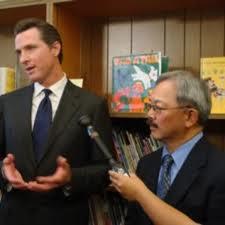
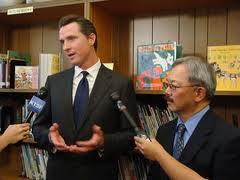
Former Mayor Willie Brown served as master of ceremonies, standing behind a podium on the grand staircase with members the newly elected board to his right and former Mayor Gavin Newsom and Mayor-elect Ed Lee to his left.

Newsom offered advice to Lee on how to govern the city, saying, “Figure out what it is you want to accomplish, and work backward from there.”

Rose Pak, the powerful head of the Chinatown Chamber of Commerce, was seated near the front row for a close-up view of the ceremony. Speaking to the historic nature of the first Asian American holding the office of mayor in San Francisco, Lee singled out Pak, whom he called his good friend, saying, “Today, Rose, our struggle is here, and it’s succeeding.”

Newly anointed as mayor, Lee expressed gratitude to Brown, Newsom, Pak, and the members of the Board of Supervisors who supported him.

He also noted that several weeks ago, he hadn’t even anticipated such a momentous change. “It’s been a whirlwind for me,” he said.

Lee promised to be “a mayor who tackles things head on, and moves the bar forward.” He also vowed to be inclusive – and if he is true to his word, it will mark a dramatic difference from Newsom’s administration, which tended to exclude anyone who disagreed with the mayor.

“I want to say to all of you: I will do my very best to represent all the communities,” Lee said. “I’m going to open up that Room 200 to everybody.”

Following the swearing-in was a reception featuring tables piled high with sushi, gourmet finger foods, and fancy cheese, plus a bar serving wine and beer. Several observers remarked to the Guardian that they had never seen such a feast offered up to the public at City Hall.

The agenda for Mayor Lee

0

EDITORIAL San Francisco has its first Chinese American mayor, and that’s a major, historic milestone. Let’s remember: Chinese immigrants were among the most abused and marginalized communities in the early days of San Francisco. In 1870, the city passed a series of laws limiting the rights of Chinese people to work and live in large parts of the city. Chinese workers built much of the Transcontinental Railroad — at slave wages and in desperately unsafe conditions that led to a large number of deaths. The United States didn’t even repeal the Chinese Exclusion Act (an anti-immigration law) until 1943, and for years, Chinatown was one of the poorest and most neglected city neighborhoods.

So there’s good reason for Asians to celebrate that the last door in San Francisco political power is now open. And Mayor Ed Lee comes from a civil rights background; he got his start in politics working as a poverty lawyer and tenant organizer.

Unfortunately, his path to Room 200 was badly marred by some ugly backroom dealing involving Willie Brown, the most corrupt mayor in modern San Francisco history. Even Lee’s supporters agree the process was a mess and that it undermines Lee’s credibility. So it’s important for Mayor Lee to immediately establish that he’s independent of Brown and his cronies, that his administration will not just be a Gavin Newsom rerun, and that progressives can and should support him.

He has a tough job ahead. We urge him to make a clean break with the past and set the city in a new direction. Here are a few ways to get started.

Clear out the Newsom operatives and bring some new people with progressive credentials into the senior ranks. Newsom’s chief of staff, Steve Kawa, has been a shadow mayor for the past year while Newsom was on the campaign trail, and is the architect of much of what the outgoing administration has done to sow political division and cripple city government. Lee needs his own chief advisor.

Show up for question time and work with the district-elected supervisors. Newsom was openly dismissive of the board and refused to take the supervisors seriously as partners in city government. Lee should appear once a month to answer questions from the board in public, should meet regularly with all the supervisors and appoint a liaison that the board can work with and trust. He needs to make his administration as transparent and open as possible and ensure that everyone at City Hall follows the letter and spirit of the Sunshine Ordinance.

Make it clear that the next city budget includes substantial new revenue. Newsom offered nothing but Republican politics when it came to city finance; his only solutions to the massive structural deficit involved service cuts.

The deficit will be even worse than projected this year, since Gov. Jerry Brown wants to transfer much of the state’s responsibility for public safety and public health back to local government — and there won’t be enough state money attached to handle the new burden. Lee needs to publicly call on Brown and the Legislature to give cities more ability to raise taxes on the local levee. Then he should start planning for a June ballot package that will raise as much as $250 million in new revenue for the city.

A substantially higher vehicle license fee on expensive cars, a congestion management fee, a significant annual transit impact fee on downtown offices, a restructured business tax, and a progressive tax on income of more than $50,000 a year would more than eliminate the structural deficit.

There are plenty of other revenue ideas out there; not all can or would pass on a single ballot. But Lee needs to make it clear that revenue will be part of the solution — and that he will use all the political capital he can muster to convince the voters to go along.

<\!s> Get serious about community choice aggregation. Newsom loved to talk about his environmental agenda, but when it came to challenging the hegemony of Pacific Gas and Electric Co. and its dirty power portfolio, he ran for cover. His hand-picked Public Utilities Commission director, Ed Harrington, has been an obstacle to implementing the city’s CCA plan. Lee needs to get rid of Harrington or direct him to cooperate with the supervisors and get San Francisco on the path to clean public power.

<\!s> Establish a real affordable housing program. The city plans to build housing for as many as 60,000 new residents in the southeast neighborhoods — but only a fraction of them will be affordable. This city is already well on its way to becoming a high-end bedroom community for Silicon Valley; only a clear policy that limits new market-rate condos until there’s a plan for adequate affordable housing will turn things around.

<\!s> Support Sanctuary City and quit helping federal immigration authorities break up families. Newsom was just awful on this issue; Lee needs to work with Sup. David Campos to implement more humane laws.

<\!s> End the demonization of homeless people and public employees. Newsom came to power attacking the homeless (with Care Not Cash) and went out attacking the homeless (with the sit-lie law). Lee ought to tell the Police Department not to aggressively enforce the ordinance.

<\!s> Take on the sacred cows of the Police and Fire departments. The biggest salary and pension problems in the city are in the two public safety departments. The Fire Department budget has been bloated for years. If everyone else is taking cuts, so should the highest-paid cops and the overstaffed fire stations.

Some of Lee’s supporters insist he’s a solid progressive and that we shouldn’t hold the details of his selection — or the fact that he was chosen by people who are openly hostile to the progressive agenda — against him. We’re open to that — but the progressive community will judge him on his record. And he has to start right away.

Editor’s Notes

2

tredmond@sfbg.com

Former Mayor Willie Brown says that choosing a person of color for a leadership position should be a progressive value. Board of Supervisors President David Chiu says the new mayor, Ed Lee, is a progressive. Several supervisors and other political observers say the six-vote progressive majority on the board is gone.

And nobody really talks about what that word means.

Progressive is a term with a long political vintage, but it’s changed (as has the political context) since the 1920s. (Progressives these days aren’t into Prohibition.) So I’m going to take a few minutes to try to sort this out.

I used to tell John Burton, the former state senator, that a progressive was a liberal who didn’t like real estate developers. But that was in the 1980s, when the Democratic Party in town was funded by Walter Shorenstein and other developers who were happy to be part of the party of Dianne Feinstein, happy to be liberals on some social issues (Shorenstein insisted that the Chamber of Commerce hire and promote more women), and happy to promote liberal candidates like John and Phil Burton for state and national office — as long as they didn’t mess with the gargantuan money machine that was high-rise office development in San Francisco.

But these days it’s not all about real estate; it’s that the level of economic inequality in the United States has risen to levels unseen since the late 1920s. So I sat down on a Saturday night when the kids went to bed(yeah, this is my social life) and made a list of what I think represent the core values of a modern American progressive. It’s a short list, and I’m sure there’s stuff I’ve left off, but it seems like a place to start.

This isn’t a litmus test list (we’ve endorsed plenty of people who don’t agree with everything on it). It’s not a purity test, it’s not a dogma, it’s not the rules of entry into any political party … it’s just a definition. My personal definition.

Because words don’t mean anything if they don’t mean anything, and progressive has become so much of a part of the San Francisco political dialogue that it’s starting to mean nothing.

For the record: when I use the word "progressive," I’m talking about people who believe:
1. That civil rights and civil liberties need to be protected for everyone, even the most unpopular people in the world. We’re for same-sex marriage, of course, and for sanctuary city and protections for immigrants who may not have documentation. We’re also in favor of basic rights for prisoners, we’re against the death penalty, and we think that even suspected terrorists should have the right to due process of law.
2. That essential public services — water, electricity, health care, broadband — should be controlled by the public, not by private corporations. That means public power and single-payer government run health insurance.
3. That the most central problem facing the city, the state, and the nation today is the dramatic upward shift of wealth and income and the resulting economic inequality. We believe that government at every level — including local government right here in San Francisco — should do everything possible to reduce that inequality. That means taxing high incomes, redistributing wealth, and using that money for public services (education, for example) that tend to help people achieve a stable middle-class lifestyle. We believe that San Francisco is a rich city, with a lot of rich people, and that if the state and federal government won’t try to tax them to pay for local services, the city should.
4. That private money has no place in elections or public policy. We support a total ban on private campaign contributions, for politicians and ballot measures, and support public financing for all elections. Corruption — even the appearance of corruption — taints the entire public sector and helps the fans of privatization, and progressives especially need to understand that.
5. That the right to private property needs to be tempered by the needs of society. That means you can’t just put up a highrise building anywhere you want in San Francisco, of course, but it also means that the rights of tenants to have stable places for themselves and their families to live is more important than the rights of landlords to maximize return on their property. That’s why we support strict environmental protections, even when they hurt private interests, and why be believe in rent control, including rent control on vacant property, and eviction protections and restrictions on condo conversions. We think community matters more than wealth, and that poor people have a place in San Francisco too — and if the wealthier classes have to have less so the city can have socioeconomic diversity, that’s a small price to pay. We believe that public space belongs to the public and shouldn’t be handed over to private interests. We believe that everyone, including homeless people, has the right to use public space.
6. That there are almost no circumstances where the government should do anything in secret.
7. That progressive elected officials should use their resources and political capital to help elect other progressives — and should recognize that sometimes the movement is more important that personal ambitions.

I don’t know if Ed Lee fits my definition of a progressive. He hasn’t taken a public position on any major issues in 20 years. We won’t know until we see his budget plans and learn whether he thinks the city should follow Gavin Newsom’s approach of avoiding tax increases and simply cutting services again. We won’t know until he decides what to tell the new police chief about enforcing the sit-lie law. We won’t know until we see whether he keeps Newsom’s staff in place or brings in some senior people with progressive values.
I agree that having an Asian mayor in San Francisco is a very big deal, a historic moment — and as Lee takes over, I will be waiting, and hoping, to be surprised.

Power and pragmatism

5

steve@sfbg.com

After an epic week at City Hall, the political dynamics in San Francisco have undergone a seismic shift, with pragmatism replacing progressivism, longtime adversarial relationships morphing into close collaborations, and Chinese Americans as mayor and board president.

It was a week of surprises, starting Jan. 4 when City Administrator Ed Lee came out of nowhere to become the consensus choice for interim mayor, and ending Jan. 9 when Mayor Gavin Newsom appointed Police Chief George Gascón to be the new district attorney, Newsom’s last official act as mayor before belatedly taking his oath of office as lieutenant governor on Jan. 10.

In between, the outgoing Board of Supervisors held a special final meeting Jan. 7, at which progressive supervisors fell into line behind Lee, some of them reluctantly, and accepted the new political reality. The next day, the new Board of Supervisors took office and overwhelmingly reelected David Chiu as board president, with only the three most progressive supervisors in dissent.

After Chiu played kingmaker as the swing vote for making Lee the new mayor, the board and Mayor’s Office are likely to enjoy far closer and more cooperative relations than they’ve had in many years. And the sometimes prickly, blame-game relations between the Police Department and D.A.’s Office should also get better now that the top cop has switched sides. But what it all means for the average San Franciscan, particularly the progressive voters who created what they thought was a majority on the Board of Supervisors, is still an open question.

One thing that is clear is the ideological battles that have defined City Hall politics — what Chiu called the “oppositional politics of personality” during his closing remarks on Jan. 8 — have been moved to the back burner while the new leaders try a fresh approach.

Newsom — with his rigid fiscal conservatism and open disdain for the Board of Supervisors, particularly its progressive wing — is gone. Also leaving City Hall is Sup. Chris Daly, a passionate and calculating progressive leader whose over-the-top antics caused a popular backlash against the movement.

In a way, Newsom and Daly were perfect foils for one another, caustic adversaries who often reduced one another to two-dimensional caricatures of themselves. But they were each strongly driven by rival ideologies and political priorities, despite Newsom’s rhetorical efforts to turn “ideology” into a dirty word applied only to his opponents.

“This year represents a changing of the guard, a transition,” Chiu said, pledging to continue pushing for progressive reforms, only with a more conciliatory approach, a theme also sounded by Sups. Eric Mar and Jane Kim, who each broke with their progressive colleagues to support Chiu over rival presidential nominee Sup. John Avalos.

“I will always support policies that will make our city more equitable and just,” Kim said after being sworn in to replace Daly, although she also made a claim about the new board with which her predecessor probably wouldn’t agree: “I think we have a lot more in common than we don’t.”

With a focus on diversity and compromise, “respect and camaraderie,” Mar said, “I think this new board represents the evolution of the progressive movement in San Francisco.”

If indeed City Hall is enjoying a “Kumbaya” moment, the path to this point was marred by backroom deal-making and old-school power politics, much of it engineered by a pair of figures from the previous era who are by no means progressives: former Mayor Willie Brown and Rose Pak, head of the Chinatown Chamber of Commerce.

Pak was seated front and center — literally and figuratively — during the board’s Jan. 7 vote for Lee and its Jan. 8 vote for Chiu, following media reports that it was she and Brown who persuaded Lee to take the job and city leaders (particularly Newsom, Chiu, and outgoing Sups. Bevan Dufty and Sophie Maxwell) to give it to him.

It all seemed sneaky and unsettling to board progressives, who questioned what kind of secret deal had been cut, even as they voiced their respect for Lee’s progressive roots and long history of service to the city. The sense that something unseemly was happening was exacerbated on Jan. 4 when Dufty abandoned a pledge of support for Sheriff Michael Hennessey — who five progressive supervisors supported for interim mayor — and left the meeting to confer with the Mayor’s Office before returning to announce his support for Lee.

Sups. David Campos, Ross Mirkarimi, and Avalos pleaded with their colleagues for time to at least talk with Lee, who was traveling in China since he reportedly changed his mind about wanting the interim mayor job. Maxwell was the only Lee supporter in the 6-5 vote for delaying the interim mayor item by a few days so the supervisors could speak with Lee by phone.

Pak and other Chinatown leaders put together a strong show of force by the Chinese American community at that Jan. 7 meeting, where the board voted 10-1 for Lee, with only Daly in dissent. Afterward, some of Lee’s strongest supporters — including the Rev. Norman Fong and Gordon Chin with the Chinatown Community Development Center — admitted that the process of picking Lee was flawed.

“Part of the problem was Ed’s because he couldn’t make up his mind. The process was bad,” Fong told the Guardian after the vote. Although Fong said he knows Lee to be a strong and trustworthy progressive, he admitted that the way it went down raised questions: “Some people were concerned about who he’ll listen to.”

Specifically, the concern is that Lee will be unduly influenced Brown and Pak, who each represent corporate clients whose interests are often at odds with those of the general public. And both operate behind the scenes and play a kind of political hardball that runs contrary to progressive values on openness, inclusion, and accountability.

“If there is a phone call from Willie Brown to Rose Pak, Ed Lee is going to go along with it,” predicted a knowledgeable source who has worked closely with all three, recalling the way they did business during Brown’s mayoral administration. “There was no real discussion of issues. The fix was always in.”

But Pak insisted that there was nothing wrong with the process of selecting Lee, and that all concerns about the nomination were driven by anti-Asian racism. “You have a plantation mentality,” Pak told the Guardian as she held court in front of a crowded press box before the Jan. 8 meeting. “The Bay Guardian has never given people of color a fair shot.”

While Newsom, Chiu, and Pak-allied political consultant David Ho all insisted “there was no deal” to win support for Lee, Pak seemed to revel in the high-profile role she played, with Bay Citizen reporter Gerry Shih labeling her “boastful” in his Jan. 6 article “Behind-The-Scenes Power Politics: The Making of Ed Lee,” which ran the next day in The New York Times.

“This was finally our moment to make the first Chinese mayor of a major city,” Pak reportedly told Shih. “How could you let that slip by?”

Chiu downplayed Pak’s influence, telling the Guardian that Lee was his top choice since November, and telling his colleagues before the Jan. 7 vote, “Ed is someone who does represent our shared progressive values.” But he also made it clear that helping the city’s progressive movement wasn’t what drove his decision.

“This is a decision beyond who were are as progressives and who we are as moderates. It’s about who we are as San Franciscans,” Chiu said. “This is a historic moment for the Chinese-American community,” calling it “a community that has struggled, a community that has seen discrimination.”

The next day, shortly after being elected to a second term as board president, Chiu acknowledged the “very real differences” in ideology among the supervisors, “but leadership is about working through those differences.” Ultimately, he said, “none of us were voted into office to take positions. We were voted into office to get things done.”


EDITORIAL: The Agenda for Mayor Lee

6

San Francisco has its first Chinese American mayor, and that’s a major, historic milestone. Let’s remember: Chinese immigrants were among the most abused and marginalized communities in the early days of San Francisco. In 1870, the city passed a series of laws limiting the rights of Chinese people to work and live in large parts of the city. Chinese workers built much of the Transcontinental Railroad at slave wages and in desperately unsafe conditions that led to a large number of deaths. The United States didn’t even repeal the Chinese Exclusion Act (an anti-immigration law) until 1943, and for years, Chinatown was one of the poorest and most neglected city neighborhoods.

So there’s good reason for Asians to celebrate that the last door in San Francisco political power is now open. And Mayor Ed Lee comes from a civil rights background; he got his start in politics working as a poverty lawyer and tenant organizer.

Unfortunately, his path to Room 200 was badly marred by some ugly backroom dealing involving Willie Brown, the most corrupt mayor in modern San Francisco history. Even Lee’s supporters agree the process was a mess and that it undermines Lee’s credibility. So it’s important for Mayor Lee to immediately establish that he’s independent of Brown and his cronies, that his administration will not just be a Gavin Newsom rerun, and that progressives can and should support him.

He has a tough job ahead. We urge him to make a clean break with the past and set the city in a new direction. Here are a few ways to get started.

Clear out the Newsom operatives and bring some new people with progressive credentials into the senior ranks. Newsom’s chief of staff, Steve Kawa, has been a shadow mayor for the past year while Newsom was on the campaign trail, and is the architect of much of what the outgoing administration has done to sow political division and cripple city government. Lee needs his own chief advisor.

Show up for question time and work with the district-elected supervisors. Newsom was openly dismissive of the board and refused to take the supervisors seriously as partners in city government. Lee should appear once a month to answer questions from the board in public, should meet regularly with all the supervisors and appoint a liaison that the board can work with and trust. He needs to make his administration as transparent and open as possible and ensure that everyone at City Hall follows the letter and spirit of the Sunshine Ordinance.

Make it clear that the next city budget includes substantial new revenue. Newsom offered nothing but Republican politics when it came to city finance; his only solutions to the massive structural deficit involved service cuts.

The deficit will be even worse than projected this year, since Gov. Jerry Brown wants to transfer much of the state’s responsibility for public safety and public health back to local government and there won’t be enough state money attached to handle the new burden. Lee needs to publicly call on Brown and the Legislature to give cities more ability to raise taxes on the local levee. Then he should start planning for a June ballot package that will raise as much as $250 million in new revenue for the city.

A substantially higher vehicle license fee on expensive cars, a congestion management fee, a significant annual transit impact fee on downtown offices, a restructured business tax, and a progressive tax on income of more than $50,000 a year would more than eliminate the structural deficit.

There are plenty of other revenue ideas out there; not all can or would pass on a single ballot. But Lee needs to make it clear that revenue will be part of the solution and that he will use all the political capital he can muster to convince the voters to go along.

Get serious about community choice aggregation. Newsom loved to talk about his environmental agenda, but when it came to challenging the hegemony of Pacific Gas and Electric Co. and its dirty power portfolio, he ran for cover. His hand-picked Public Utilities Commission director, Ed Harrington, has been an obstacle to implementing the city’s CCA plan. Lee needs to get rid of Harrington or direct him to cooperate with the supervisors and get San Francisco on the path to clean public power.

Establish a real affordable housing program. The city plans to build housing for as many as 60,000 new residents in the southeast neighborhoods but only a fraction of them will be affordable. This city is already well on its way to becoming a high-end bedroom community for Silicon Valley; only a clear policy that limits new market-rate condos until there’s a plan for adequate affordable housing will turn things around.

Support Sanctuary City and quit helping federal immigration authorities break up families. Newsom was just awful on this issue; Lee needs to work with Sup. David Campos to implement more humane laws.

End the demonization of homeless people and public employees. Newsom came to power attacking the homeless (with Care Not Cash) and went out attacking the homeless (with the sit-lie law). Lee ought to tell the Police Department not to aggressively enforce the ordinance.

Take on the sacred cows of the Police and Fire departments. The biggest salary and pension problems in the city are in the two public safety departments. The Fire Department budget has been bloated for years. If everyone else is taking cuts, so should the highest-paid cops and the overstaffed fire stations.

Some of Lee’s supporters insist he’s a solid progressive and that we shouldn’t hold the details of his selection or the fact that he was chosen by people who are openly hostile to the progressive agenda against him. We’re open to that but the progressive community will judge him on his record. And he has to start right away.

What progressive means

85

Willie Brown says that choosing a person of color for a leadership position should be a “progressive” value. David Chiu says Ed Lee is a progressive. Several supervisors, and other political observers, say the six-vote progressive majority on the board is gone.

And nobody really talks about what that word means.

Progressive is a term with an excellent political vintage, but it’s changed (as has the political context) since the 1920s. (Progressives these days aren’t into prohibition.) So I’m going to take a few minutes to try to sort this out.

I used to tell John Burton that a progressive was a liberal who didn’t like real estate developers, but that was in the 1980s, when the Democratic Party in town was funded by Walter Shorenstein and other developers, who were happy to be part of the party of Dianne Feinstein, happy to be liberals on some social issues (Shorenstein insisted that the Chamber of Commerce hire and promote more women) and happy to promote liberal candidates like John and his brother Phil for national office – as long as they didn’t mess with the gargantuan money machine that was highrise office development in San Francisco.
Arguing that Shorenstein’s economic agenda was driving up housing prices, destroying low-income neighborhoods and displacing tenants was a waste of time; the liberals like Burton (who also represented real estate developers as a private attorney) weren’t interested.

But these days it’s not all about real estate; it’s about the fact that the level of economic inequality in the United States has risen to levels unseen since the late 1920s, and the impacts are all around us. And it’s about (Democratic) politicians in San Francisco blaming Sacramento, and (Democratic) politicians in Sacramento blaming Washington, and the Democratic Party in the United States abandoning economic equality as a guiding principle.

So I sat down on a Saturday night when the kids went to be (yeah, this is my social life) and made a list of what I think represent the core values of a modern American progressive. It’s a short list, and I’m sure there’s stuff I’ve left off, but it seems like a place to start.

For all the people who are going to blast me in the comments, let me say very clearly: This isn’t a litmus-test list (we’ve endorsed plenty of people who don’t agree with everything on it). It’s not a purity test, it’s not a dogma, it’s not the rules of entry into any political party … it’s just a definition. My personal definition.

Because words don’t mean anything if they don’t mean anything, and progressive has become so much of a part of the San Francisco political dialogue that it’s starting to mean nothing.
For the record: When I use the word “progressive,” I’m talking about people who believe:

1. That civil rights and civil liberties need to be protected for everyone, even the most unpopular people in the world. We’re for same-sex marriage, of course, and for Sanctuary City and protections for immigrants who may not have documentation. We’re also in favor of basic rights for prisoners, we’re against the death penalty, and we think that even suspected terrorists should have the right to due process of law.

2. That essential public services – water, electricity, health care, broadband – should be controlled by the public and not by private corporations. That means public power and single-payer government run health insurance.

3. That the most central problem facing the city, the state and the nation today is the dramatic upward shift of wealth and income and the resulting economic inequality. We believe that government at every level – including local government, right here in San Francisco – should do everything possible to reduce that inequality; that means taxing high incomes, redistributing wealth and using that money for public services (education, for example) that tend to help people achieve a stable middle-class lifestyle. We believe that San Francisco is a rich city, with a lot of rich people, and that if the state and federal government won’t try to tax them to pay for local services, the city should.

4. That private money has no place in elections or public policy. We support a total ban on private campaign contributions, for both politicians and ballot measures, and support public financing for all elections.

5. That the right to private property needs to be tempered by the needs of society. That means you can’t just put up a highrise building anywhere you want in San Francisco, of course, but it also means that the rights of tenants to have stable places for themselves and their families to live is more important than the rights of landlords to maximize return on their property. That’s why we support strict environmental protections, even when they hurt private interests, and why be believe in rent control, including rent control on vacant property, and eviction protections and restrictions on condo conversions. We think community matters more than wealth and that poor people have a place in San Francisco too — and if the wealthier classes have to have less so that the city can have socio-economic diversity, that’s a small price to pay. We believe that public space belongs to the public, and shouldn’t be handed over to private interests; we believe that everyone, including homeless people, has the right to use public space.

6. That there are almost no circumstances where the government should do anything in secret.

7. That progressive elected officials should use their resources and political capital to help elect other progressives – and should recognize that sometimes the movement is more important that their own personal ambitions.

I could add a lot more, but I think those six factors are at the heart of what I mean when I talk about progressives. We support a lot of other things; I put the right of workers to unionize under Number 3, since unions (along with public schools and subsidized higher education) are one of the major forces behind a stable middle class and a more equal society. We think racism and homophobia are never acceptable, and we support affirmative action, but that goes under Number 1.

This is not a socialist manifesto; I never mentioned worker control of the means of production. Progressives don’t oppose private enterprise; they just think that some things essential for the good of society don’t belong in the private sector, and that the private sector should be regulated for the good of all of us. We trust and support small businesses much more than big corporations – and we think their interests are not the same.

I don’t know if Ed Lee fits my definition of a progressive. We won’t know until we see his budget plans, and learn whether he thinks the city should follow Gavin Newsom’s approach of avoiding tax increases and simply cutting services again. We won’t know until he decides what the tell the new police chief about enforcing the sit-lie law. We won’t know until we see whether he keeps Newsom’s staff in place or brings in some senior people with progressive values. We know that the people who pushed him to take the job aren’t progressives by any definition, but you never know. I agree that having an Asian mayor in San Francisco is a very big deal, an historic moment — and when Lee takes office, I will be waiting, and hoping, to be surprised.

Chiu and pragmatism win over the new board

13

Despite the re-election of David Chiu as president of the Board of Supervisors today, there was a palpable shift in the political dynamics at City Hall. “Ideology” has been deemed a dirty word by a majority of the Board of Supervisors, while the politics of identity and “getting things done” is the new imperative.
That shift was most evident in the 8-3 vote for Chiu, with progressive Sups. John Avalos, David Campos, and Ross Mirkarimi supporting Avalos for the post through two rounds of voting. Chiu won it on the second round after fiscal conservative Sup. Sean Elsbernd withdrew his nomination, with he and his other three backers – Sups. Carmen Chu, Scott Wiener, and Mark Farrell – all supporting Chiu in the second round.
“This year represents a changing of the guard, a transition,” Chiu told us, noting the departure of both Mayor Gavin Newsom and supervisors that include Chris Daly. “We’re going to have to get past the oppositional politics of personality.”
In place of a progressive politics based on principled positions and aggressively challenging the influence that powerful downtown interests still exert on City Hall, Chiu is advocating for more pragmatic solutions to the considerable challenges facing the city, starting with a projected budget deficit of almost $400 million.
“None of us were voted into office to take positions, we were voted into office to get things done,” Chiu said.
His approach has occasionally earned him the scorn of progressives over the last two years, particularly in Chiu’s high-profile compromises with Newsom over cuts to Muni and city programs, business tax breaks, and other issues, as Avalos noted. But as Avalos told Chiu, “Clearly today, you have been validated in your hard work.”
Chiu was backed in both rounds of voting by progressive Asian-American Sups. Jane Kim and Eric Mar, both of whom also struck pragmatic notes in their comments. But they also noted that the board’s new civility and diversity are progressive values. “I think this new board represents the evolution of the progressive movement in San Francisco,” Mar said.
Newsom has been pointedly criticizing the notion of ideology for years – apparently unaware that his anti-tax, pro-business philosophy is an ideology – and it was echoed by several supervisors, including Farrell, who said he wants “to turn City Hall into a place based on issues and ideas and not ideology.”
Now, we’re all left to wait and see what kinds of issues and ideas take root. We’ll have much more on an extraordinary week at City Hall – with a new board and new incoming Mayor-select Ed Lee – in next week’s Guardian.

Highlights of Ed Lee’s nomination

25

An awful lot went down at City Hall today: four Board members were termed out, new Board members were moving into their offices, the old Board nominated Ed Lee as interim mayor, and Gavin Newsom revealed he’ll be gone as mayor by Monday afternoon. Here in no particular order are some of the highlights:


When termed-out D6 Sup. Chris Daly suggested that Rose Pak be nominated mayor, since she apparently managed to broker the Lee deal in three short days, Pak shot back, “I would do it, only if Chris Daly would be my Chief of Staff.”


Pak told me that she persuaded Lee to take the job, over the cell phone, while he was at the airport in Hong Kong.


Pak outlined her reasons for supporting Ed Lee as mayor. “Ed Lee has devoted 35 years to San Francisco. He’s earned his stripes. He’s the most qualified, the most unifying agent, and the most talented.”


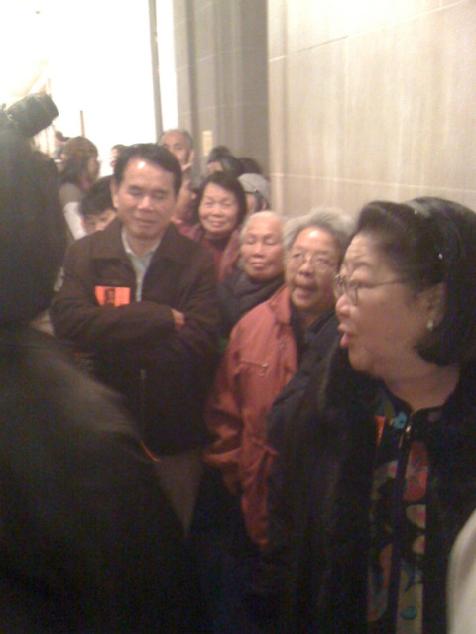
 The crowd of seniors from the Self Help for the Elderly non-profit who crammed City Hall today are a likely preview of things to come during the mayor’s race.


 Board President David Chiu’s insistence that there were no back room deals. “Shortly after Gavin Newsom was elected Lt. Governor, I said Ed Lee should be considered as a candidate,” Chiu told me. “There was never a deal.”


The strong sense that Chiu is running for mayor in November, though he hasn’t filed. Asked if he was running, Chiu said. “I’m here at the Board focused on the work.” Asked if he wasn’t running, Chiu said, “I’m here at the Board focused on the work.” (That’s not a very convincing denial, David!)


On being reminded that the Year of the Rabbit kicks off in February, Chiu added,  “Hopefully, this will be a very fortunate year for San Francisco.”


Oakland and San Francisco will both have Asian American mayors—160 years after Chinese immigrants first settled in San Francisco and 129 years after the Chinese Exclusion Act sought to prevent these immigrants from rising to the top.


The rejoicing that reportedly is going in the Asian community, right now.“Chinatown is excited,” a reporter for Sing Tao Daily told me. “Ed Lee is a low-key kinda guy. No one really knows him, but as former DPW director, he was always filling up pot holes.”


The stated hope that Lee will support Sup. Avalos local hire ordinance, which kicks in Feb. 23, implement Sup. David Campos’ due process for immigrant youth ordinance, and enforce the recommendations of the Mayor’s African American Out Migration Task Force.


The growing sense that Sup. John Avalos is a strong contender as new Board President.


Sharen Hewitt’s observation that burgeoning racial tensions between African Americans, Asian Americans and Latinos need to be addressed. Now.


Julian Davis’ observation that while the way Lee was appointed is not something San Francisco should be proud of, the fact that we now have an Asian American mayor with the almost unanimous support of the old Board is (Daly was the lone dissenter).


Newsom’s reminder that the old Board’s vote was symbolic.“Today was an extraordinary historic vote,” Newsom said. “But remember, it’s symbolic. The new Board will make the appointment.”


 Newsom’s description of Lee as a ‘recruitment” as he, too, insisted there were no backroom deals. “There were no deals, no backroom deals,” Newsom insisted. “He’s the right person at the right time.”


Newsom’s claim that this isn’t about Lee (or anyone else who’d been nominated.) “It’s not about you,” Newsom said, recreating a conversation he allegedly recently had to convince Lee, who’d just been guaranteed five more years employment as City Administrator, to become interim mayor for the rest of 2011. “You are that something more, that something better. You’re the one guy who can pull it altogether, including if disaster strikes, which is my biggest fear.”


Newsom’s relief that he only needs to prepare a 3-page budget brief. “Someone who understands so much of the process doesn’t need 20 pages,” he said.


Newsom’s claim that ideologues make terrible mayors.”If this city gets off track, plays some ideological game, it impacts the entire region,” he said. “I love that Lee is not even in the country. If he had been here, he’d probably have been convinced not to do it. Ideologues make terrible mayors, and mayors make terrible ideologues.”


Newsom’s explanation of how Lee will be able to get back his job, though the charter prohibits people who served in elected office from working for the city for at least a year.
”Hopefully, the Board will make it easy for him. Four members of the Board can put a charter amendment on the ballot. Or Lee can do it himself.”


Newsom’s revelation that he will be sworn in as Lt. Governor at 1:30 p.m, Jan. 10, and San Francisco will find out who the next District Attorney is by then.


Newsom’s claim that 2010 was an “incredible” year. “The Shipyard, Treasure Island, the America’s Cup, Doyle Drive, the Transbay Terminal. All these things are groundbreaking,” he said.


Historic mayoral vote followed a flawed process

6

Ed Lee would be San Francisco’s first Chinese-American mayor right now – if Mayor Gavin Newsom wasn’t delaying his swearing in as lieutenant governor. And Lee might also have had 10 votes on the Board of Supervisors on Tuesday, as he had today, if the process hadn’t involved backroom deals and moderate, lame-duck supervisors kowtowing to the outgoing mayor. In other words, this historic occasion just didn’t need to be sullied the way it was this week.
There was real jubilation at City Hall when I left there a few minutes ago, and for good reason, even though today’s vote will have to be repeated by the new board after Newsom officially resigns. “This is a historic moment for the Chinese-American community,” Board President David Chiu told a packed board chambers, calling it, “a community that has struggled, a community that has seen discrimination.”
Chiu braved the taunts of Sup. Chris Daly and some progressive activists for supporting Lee on Tuesday, steadfastly maintaining that Lee is progressive and the best candidate for this job, despite his five progressive colleagues voting for Sheriff Michael Hennessey. And Lee does have progressive roots and support, as the progressive supervisors have attested publicly.
Once the progressive supervisors were given the chance to talk to Lee – whose openness to accepting the nomination came out of nowhere, reportedly at the urging of Chinatown power broker Rose Pak and former Mayor Willie Brown – all but Daly voted to support Lee.
Yet all of them also publicly noted how the process was deeply flawed and contrary to progressive principles of openness and accountability. “I have questions about the process and how we got to this point,” Sup. John Avalos said before announcing his support for Lee based on a half-hour telephone conversation yesterday (Lee has been in China through his public consideration as interim mayor).  
Sup. David Campos said he nominated Hennessey as a compromise caretaker mayor based on the representation from Newsom that he was acceptable and after being told by Sup. Bevan Dufty that he would support Hennessey. Instead, Dufty refused to vote until calling for a recess and marching down to the Mayor’s Office on Tuesday, returning to be the swing vote for Lee.
“I’m very disappointed in the way this process has gone down,” Campos said, adding that Hennessey “did not deserve the kind of treatment he received.” Sups. Ross Mirkarimi and Eric Mar echoed the point, with Mirkarimi saying he still doesn’t understand why Dufty flipped or what happened when he went to visit the Mayor’s Office.
Through the whole hearing, Dufty – a candidate for mayor himself – didn’t say a word. At one point, he even started clearing out his desk in Board Chambers, throwing away recycled papers and filling a big envelope full of paper clips. He didn’t stick around the hallway for the celebration that he helped enable, instead going straight into his office, where I found him and asked for a reaction to his colleagues’ questioning of his motives and integrity.
“My actions speak for themselves,” was all Dufty would say.
Perhaps they do, but even Lee’s strongest supporters acknowledged that the process of picking him was flawed. “Part of the problem was Ed’s because he couldn’t make up his mind,” Rev. Norman Fong told the Guardian. “The process was bad.”
Without a public discussion or the ability of reporters or supervisors to talk to Lee, Fong acknowledged why some progressives worried that a deal had been cut to continue with Newsom’s policies and personnel. “Some people were concerned about who he’ll listen to,” Fong said, but he said, “I’ve fought with Ed Lee and I know his heart…He’ll do the right thing.”
Gordon Chin of Chinatown Community Development Center said he has worked closely with both Lee and Hennessey and both would have been good interim mayors, and he said this should not have been a partisan fight. “Who nominated Mike Hennessey as the nominee of all of progressive San Francisco?” Chin asked, noting that few progressive constituencies were consulted on the choice or offered their buy-in.
Yet he also acknowledged the unseemly way in which Lee came out of nowhere to get the nomination, with little public vetting, “If Ed was out there a week earlier, it would have been a lot better. It was a flawed process,” Chin said.
So flawed that Daly and many progressive activists are still smarting about what happened and wary of what kind of mayor Lee will be. “No more backroom deals,” queer activist and blogger Michael Petrelis repeatedly shouted at Rose Pak as she was being interviewed outside board chambers.
But Fong just shrugged and told me, “There’s backroom deals on the left too.”

Congratulations to Ed Lee

5

Congratulations to Ed Lee, who, unless Gavin Newsom still refuses to leave or the next board does something terribly surprising, will be the city’s first Asian mayor. This, as Sup David Chiu pointed out, is an historic moment, a watershed event in San Francisco history. And we shouldn’t forget that.


Now Lee will face a massive challenge, starting with a terrifying city budget — and a need to reassure progressives that he can be trusted. It’s not Lee’s fault that Rose Pak and Willie Brown settled on him as their candidate — but starting from Day One, he is going to have to demonstrate independence.


I have no doubt that, true to his roots, he will be solid on sanctuary city and local hire — two major issues that the supervisors mentioned today. And on those issues, and on civil rights in general, he will be vastly better than Newsom. He won’t deport high school kids and break up families.


But I have to wonder if he’ll be true to progressive values on the city budget — because the willingness to accept that, as Chris Daly just said, something is very wrong in this country and this world, and it includes (perhaps starts with) the vast income and wealth disparities that are making our society unsustainable, and that it’s the responsibility of every official at the federal, state AND local level to try to address that problem … that’s what separates out the real progressives.


Good luck, Mayor Lee, we sincerely wish you the best, look forward to working with you and can’t wait to hear your ideas on new city revenues.

It looks like Ed Lee — but will that hold tomorrow?

1

Well, Campos says he’s with Ed Lee — and that means it’s over. For now, anyway. There’s a new board in place tomorrow; it’s hard to imagine that the new supes will change this vote, but they’ll have to reaffirm it.


So Mayor Ed Lee will have a tough job ahead of him — starting with the fact that there’s no question he came to office at least to some degree because of Willie Brown and Rose Pak. And that’s going to hurt his credibility. He doesn’t need to convince us that he’s no Gavin Newsom; ne needs to convince us that he’s not going to take directions from Willie Brown.  

Leno will not run for mayor

1

Just as the supervisors were meeting to select a successor mayor, Mark Leno called me to tell me that, after a lot of thought, he has decided he won’t be a candidate for mayor in November. He’s going to be running the state Senate Budget Committee, dealing with the worst fiscal crisis in California history, and “I just wouldn’t have the time to run a campaign.”


Leno would have brought a lot to the race, particularly as it’s shaking down now, but I certainly understand his choice.

Chinese community out in force for Lee

5

Well, Rose Pak promised a big demonstration and she’s got one: City Hall is mobbed with Ed Lee supporters pushing the supervisors to vote for the city’s first Asian mayor. Lee is still out of town, so he can’t answer questions, although he’s talked to several supervisors by phone. One said he seemed a little overwhelmed by all of this; he wasn’t even sure he wanted the job until Pak and Willie Brown talked him into it.


The revelations that the vote for Lee was a backroom deal orchestrated by Pak and Willie Brown (and from years of Brown watching, I can you this was a classic Brown move) will put Lee supporters like David Chiu and Eric Mar in a tough situation. Aaron Peskin, former supervisor, wasn’t mincing words when I talked to him jost before the meeting started:


“This is no so much about left and right, it’s about democracy and how power is transitioned,” he said. “This is disgusting, not because Ed Lee is or isn’t left or right or a progressive or a liberal. This is about the politics of power, and conservatives and moderates should be just as revolted as anyone.”


Meanwhile, my old friend Rev. Norman Fong, a leading Chinatown progressive, says he supports Ed Lee, as do a lot of progressives in the Asian communtity. I get that, and he’s a decent guy with a good history as a civil rights and housing lawyer, and he might even be a decent mayor. But this process stinks. There’s no other way to put it.

Elsbernd defends Lee (but ducks the Tapas)

4

Well, Sean didn’t stop by for tapas at Que Syrah last night, but he did take the time to send me a long letter answering my questions about why he “mysteriously”  nominated CAO Ed Lee for interim mayor in Tuesday’s Board of Supervisors meeting.

I appreciate the letter and it’s to Sean’s credit that this is his modus operandi with the Guardian (and others) in answering questions, even pesky ones.

I am printing his letter in full below and offering him the opportunity to continue this illuminating conversation since his letter raises even more questions about his nomination of Lee.

For example, the Bay Citizen section of today’s New York Times, on the morning of the followup supervisors’ meeting this afternoon, laid out a detailed story by Gerry Shih  of how former Mayor Willie Brown, Rose Pak, a powerful Chinatown political operative, and Mayor Newsom orchestrated the Lee nomination to keep the mayor’s office safe for PG&E, the downtown gang, and Willie/Pak’s clients and allies.

The headline: “Behind-the-Scenes Power Politics: The Making of a Mayor,” with  pictures of Newsom, Willie, and Pak. The motivation for the orchestration, according to the story, was that on Sunday afternoon “Word had  trickled out that the main contenders for the job were Sheriff Michael Hennessey, former Mayor Art Agnos and former board chairman Aaron Peskin” and the three were “deemed too liberal” by Pak, Brown and Newsom.

Then, the story said that over the next 48 hours, Pak, Brown and the Newsom administration “engaged in an extraordinary political power play, forging a consensus” on the board, “outflanking the board’s progressive wing” and persuading Lee at the last moment  shortly before he boarded  a plane to  Taiwan to agree “to become San Francisco’s first Asian-American mayor, even though he had told officials for months that he had no interest in the job.”

The story noted that Pak was “in a boastful mood the next day, several hours before she planned to have celebratory drinks with Brown at the Chinese Hilton,” (Willie, last time I checked, was on an annual PG&E retainer of $200,000 plus.) The story ended with a telling quote from Pak: “Now you know why they say I play politics like a blood sport.”

So the new questions I have for Sean (and other supervisors who voted for Lee) is what did they know and when did they know it? Or were they even informed about the deal and how it came down? Is this the West Portal supervisor’s idea of how to choose a mayor?

P.S. Sean and his fellow Lee supporters may not think it’s important for the Guardian (or other media or citizens) to be able to ask questions of Lee or other candidates  before making him mayor.

Well, I think  it’s important and I have some basic questions: What is Lee’s position on rent control? On progressive taxation to help solve the crushing budget crisis? On rubberstamping Newsom/Pak/Brown policies as mayor? And on community choice aggregation and public power and kicking PG&E out of the mayor’s office?  The last question on PG&E  is critical, because this is the key litmus test in political San Francisco.  Any politician, elected or appointed or emerging,  who supports PG&E and opposes public power/CCA is not to be trusted.  Did anybody get to ask Lee any of these questions or any others? Let’s lay out the questions and Lee’s answers before making him the reluctant mayor.

Here’s Elsbernds letter to me:

Bruce,

Good to hear from you.  As always, I enjoy the conversation, particularly
with those District 7 constituents who so often and consistently advocate
positions contrary to the vast majority of residents in District 7 (e.g.
the Guardian’s endorsement against Proposition G, which received over 70%
of the vote in District 7), but every now and then, present a fresh
perspective worth analysis.


I believe Ed Lee will make an outstanding Interim Mayor. You asked me the
following questions to justify this.  Let me give it my best shot.

Why did I nominate Ed Lee for Interim Mayor when he was out of town?  His
presence was immaterial to me.  I had the opportunity to discuss his
interest in the position with him prior to the vote, and I have worked with
him for nearly 10 years, and know where he stands on various positions.  I
did not need him in the room on Tuesday evening to answer questions as I
had done my homework before showing up to class.


Why did I nominate Ed Lee when he was not publicly “out there” or “in
public discussion” as a candidate or even known by the Supervisors to be a
legitimate candidate?  Whether or not Ed Lee’s name was known to you, your
readers, or other Supervisors, is not a fact to which I can speak.  After
all, I do not fit any one of those 3 criteria.  Ed was always a candidate
to me, and, most importantly, the qualities of an Interim Mayor were “in
public discussion.”  These qualities, which I heard from residents in
district 7 and throughout the City, were that the individual be someone not
wanting to run for re-election, someone, who had a demonstrated ability to
appeal to all cross sections of the political spectrum, someone who knows
the City (both how it functions as a government as well as its many
neighborhoods), and, someone with demonstrated experience in a variety of
areas of public policy.


Why did I nominate Ed Lee when he has not publicly stated his views on any
of the major issues coming before the Mayor?  Yes, it’s true he has not
filled out a Bay Guardian questionnaire, or been grilled by your editorial
Board.  However, an astute observer of Ed’s career can decipher well his
positions.  Moreover, Ed was most recently confirmed unanimously to serve
as CAO of the City and County, for the second time.  During that
confirmation process, I had the opportunity, as did every other member of
the Board and the public to present issues to Ed for his analysis.  The
tough issues facing the Mayor, are the same tough issues facing the CAO,
the Supervisors, and everyone else charged with the duty of serving the
public.


Why did I nominate Ed Lee when he was not available for questioning by the
Board when the discussion and vote came down?  Yes, Ed was not present.
However, as I stated earlier, Ed had always been available to talk prior to
his departure.  I was able to ask my questions before he left.


Why did I nominate Ed Lee when he is not as qualified for this tough post
in these tough times as the other public candidates?  Well, this question
implies a bit of a comparison to the other candidates.  I respect the other
candidates too much to say anything negative about them.  Simply put, I
believe Ed is the lone candidate with the sufficient breadth, most
relevant, and most timely experience across City government, and the one
who had the greatest ability to bring all sides of the political spectrum
together.


Why did I nominate Ed Lee when he was obviously part of a backroom deal
orchestrated by Mayor Newsom and his downtown allies?  I love questions
based on evidence and fact.  This question, however, is merely a question
based on your opinion.  I disagree with that opinion.  Ed Lee was elected
Interim Mayor because he is the most qualified candidate.


Finally, thanks for the invitation to Que Syrah this evening.
Unfortunately, as a working parent, my weeknight evenings do not belong to
me – they belong to my son.  I’ll be with him tonight.  I hope you’re still
able to enjoy yourself without me.


All the best,
Sean


P.S.  It’s the “Village Grill,” not the “Village Inn .”  Perhaps you need
to get out on West Portal a bit more and learn the name of the
establishments along the street.


City Hall’s mad political swirl

1

It was common knowledge around City Hall that Chinatown power broker Rose Pak and former Mayor Willie Brown were lurking behind the sudden emergence of Ed Lee as the pick for interim mayor, but Bay Citizen reporter Gerry Shih does an excellent job showing how it actually went down in a story that appeared in today’s New York Times.

Pak is also expected to orchestrate a big show of Chinese-American power during this afternoon’s Board of Supervisors meeting, and progressive supervisors tell the Guardian that they have been personally lobbied by Pak to get behind Lee. Some supervisors hold out the hope that Michael Hennessey might still have a shot, or that Ed Harrington might be put back in play, but I wouldn’t bet on it. Lee seems like he’ll be the guy, at least with this board.

In addition, the rumor mill is buzzing that David Chiu will declare his candidacy for mayor in the coming weeks, although other sources indicate he hasn’t made a final decision yet. And given that the new board still has to confirm the current board’s selection, don’t be too surprised if someone makes a play to name Chiu as interim mayor, but that’s a longshot.

Following right on the heels of today’s interim mayor vote will be tomorrow’s swearing in of the new board and vote on president, which Chiu would like to hold onto. But after crossing his progressive colleagues on Tuesday to support Lee over Hennessey, most progressives are expected to push for Sup. John Avalos, while fiscal conservative Sup. Sean Elsbernd is also expected to make a bid for the presidency. None appear to have six votes yet.

Despite media reports about the board’s “progressive majority,” the current political dynamics don’t really give any faction a majority, with identity politics holding heavier sway than ideology right now. So the only prediction that political watchers can make right now is that it’s going to be interesting.

Daly goes down swinging

7

The League of Pissed of Voters made a Daly roast video honoring the “biggest asshole in San Francisco politics”

Between last night’s epic Chris Daly Roast and Daly’s crazy-man antics on Tuesday night, Daly is ending his 10-year tenure on the Board of Supervisors in fitting fashion: as a passionate leader of the progressive movement who has also been its – and his own – worst enemy.

A huge crowd packed The Independent to honor and make fun of Daly and other political figures, and it definitely had the feel of an alcohol-fueled progressive love-fest, right down to conservative Chronicle columnist CW Nevius taking a pie in the face after stepping off the stage for the evening’s most tedious session behind the microphone.

Well, at least it was until Daly took the mike, going on and on in often tasteless fashion and resisting efforts by his wife, Sarah Low, and others to get him to give up the spotlight. Daly just isn’t ready to leave the stage yet, despite buying and running the Buck Tavern, soon to be renamed Daly’s Dive. He’s even half seriously talking about running for mayor.

But for all of Daly’s many accomplishments – he is the most productive supervisor of his era and the most passionately progressive – his personal grudges also create problems for the movement. On Tuesday, Daly led the effort to name Sheriff Michael Hennessey as interim mayor, twisting Sup. Eric Mar’s arm to get him to come along, only to fall one vote short.

Even though Hennessey and Ed Lee are similar figures, Daly turned Board President David Chiu’s support for Lee into an act of epic ideological betrayal, aggressively menacing Chiu at the meeting and shouting at him, “I will haunt you! I will politically haunt you! It’s on like Donkey Kong.” He spoke over his colleagues as they had the floor and tried to talk, including repeatedly yelling at Sup. Michela Alioto-Pier, “You are a representative of the rich!” And when the board reconvened after a short recess, Daly remained in the audience, periodically flipping the bird to the board.

But for all Daly’s current ire toward Chiu, it should be noted that Chiu became board president two years ago because Daly led the opposition to Sup. Ross Mirkarimi becoming board president, giving Chiu far more political power than he would otherwise have. Daly has long prided himself on his good political instincts, and at times he has indeed been a masterful political tactician, but his ego sometimes gets the better of him. He’s hyper competitive and just wants to win, even when victory carries an unacceptable price.

When the new Board of Supervisors takes the oath of office at noon on Saturday, the progressive movement will lose a passionate leader in Chris Daly. But as it elects a new president and its political dynamics take shape, someone will need to take Daly’s role as the whip and conscience of the board, a role even his enemies acknowledged that he played.

“Chris, I think San Francisco is better because you served,” Sup. Sophie Maxwell said on Tuesday, gritting her teeth in praising someone who has at times scorned and belittled her. It will be interesting to see how Daly’s role is filled on the new board, and whether we can still have the passion without its pitfalls.

Chiu rejects DA job and defends his support for Lee

22

Amid speculation that he was angling to be appointed district attorney – and questions about whether that goal influenced his support for Ed Lee to be named interim mayor – Board of Supervisors President David Chiu has issued a press release announcing that he’s withdrawing from consideration for the DA’s job.

“Right now my strong belief is that I can best serve San Francisco from City Hall. The challenges ahead of us will require a new level of collaboration between our elected leaders—many of them new to office—and all San Franciscans who care about the future of our incredibly diverse and inclusive City,” Chiu said in the prepared statement, thanking Mayor Gavin Newsom and Attorney General Kamala Harris for their consideration and for recent meetings with Chiu on the appointment.

When I spoke with Chiu yesterday afternoon, he said that he was leaning against taking the job, partly out of concern that Newsom would replace him with a fiscal conservative like Joe Alioto Jr. “I would not want to leave my seat to someone whose perspective on issues is drastically different than mine,” Chiu told me.

He also strongly emphasized that there was no connection at all between his discussion with Newsom over the DA appointment and with Chiu’s pivotal support for Lee, and Chiu said Newsom did not raise the issue during their conversations. On Tuesday, Chiu broke with his progressive colleagues to be the sixth vote in favor of Lee.

Chiu said that he has long been supportive of Lee and Chiu disagrees with the assertion that Lee is a less progressive pick than Sheriff Michael Hennessey, who had the support of five progressive supervisors. “He’s someone who has tremendous progressive roots,” Chiu said of Lee, noting that Chinese-American progressives have long considered him one of their own. “We have been working with Ed Lee for years and we know where his heart is.”

Chiu argued that Lee is experienced in a broad range of city functions and issues while Hennessey’s knowledge of city government issues is limited mainly to law enforcement. While the strong and sudden support for Lee among fiscal conservatives has been worrisome to many progressives, Chiu noted that “unfortunately, the moderates are far more disciplined than we are on the progressive side.”

“We have many competing and diverse constituencies that led us to be unable to get to consensus around one candidate,” Chiu said.

The current Board of Supervisors will convene for a final time at 3 p.m. tomorrow to vote on Lee after progressive supervisors successfully pushed for a delay in the vote on Tuesday. In addition to Chiu and the five supervisors to his ideological right, Sup. Eric Mar has announced that he will also support Lee, and Sups. John Avalos and David Campos said they are open to backing Lee after they get the chance to speak with him.

Tapas with Sean: Some modest questions for a West Portal supervisor

9

Ever since the Brugmann family moved into the West Portal area in 1964 (with the help of local realtor John Barbagelata), I have been annoyed with the fact that many of our West of Twin Peaks supervisors prance around in their neighborhoods as “neighborhood supervisors,” then go to City Hall and vote to protect PG&E and vote the downtown/bigdeveloper/real estate line without blushing.

Barbagelata and  Quentin Kopp were notable exceptions. Barbagelata, when he was elected supervisor, even refused to go downtown to the election night parties and staged his own party in his West Portal real estate office and made the statement that there was a big difference between neighborhood and downtown issues.

Sean Elsbernd, my current supervisor, is good on some issues, shows some independence on occasion, and comes to the phone and answers emails and comes to the Guardian for interviews. In fact, I was emailing back and forth with him on Tuesday afternoon over my annual holiday card (and my note to “fear the beard in 2011″) shortly before the historic board meeting on the interim mayor. I asked him why he wasn’t more visible in West Portal and that I didn’t see him in the Manor coffee shop (he replied he was a Village Inn type of guy) and that I didn’t see him at Que Syrah, our local Best Of wine tasting gem. (He said he and his wife had gone to Que Syrah over the holidays but they were closed.) I explained that proprietors Stephanie and Keith McCardell had taken a week off.)

Anyway, a few hours later, Sean “mysteriously” nominated Ed Lee, the CAO traveling in Hong Kong, to take on the key city post of interim mayor. How in the world did this happen?

Was Sean once again demonstrating he was a neighborhood guy out in West Portal, but at City Hall the mayor’s go-to -guy in the smelly deal to preserve the mayor’s office and take control of the Board of Supervisors for PG@E and the mayor’s downtown allies?

So I sent him an email with my questions as his constituent. And I invited him to come as guests of my wife Jean and I for the Thursday night special at Que Syrah (230 West Portal Ave), with flights of small production wines and tapas by Val, styled in wondrous Barcelona fashion. I gave him a deadline (noon today) to answer my questions and I invited him to comment on my Bruce blog or send me a letter or email that I would be happy to publish on my blog. Stay alert for news on what my West Portal supervisor is really up to at City Hall.

To Sup. Sean Elsbernd:

You baffle me once again.

I am curious, as a constituent,  why you nominated Ed Lee for interim mayor when he was (a) out of town in Hong Kong, (b) not publicly “out there” or “in public discussion” as a candidate or even known by the supervisors to be a legitimate candidate, (c) has not publicly stated his views on any of the major tough issues coming before the mayor, (d) was not available for questioning by the board when the discussion and vote came down, (e) is not as qualified for t his tough post in these tough times as the other public candidates, and (f) was obviously part of a backroom deal orchestrated by Mayor Newsom and his downtown allies?

I wait patiently  for  your reply.  And I hope you drop by Que Syrah Thursday night,  for tapas and wine flights, so you can explain personally  to the West Portal throngs what you are really  up to at City Hall these days. Jean and I will be there to host you.

Respectfully, Bruce B. Brugmann, 2262 14th Ave, West Portal

Hennessey, Lee and change

8

I’m not surprised that Randy Shaw is defending Ed Lee and arguing that either Lee or Mike Hennessey would be fine as interim mayor:


Ed Lee is not Gavin Newsom. Lee has dedicated his life to public service, spent years as a poverty lawyer, and has proved an outstanding administrator over the past two decades.


Shaw worked with Lee way back in the 1980s, when they were both young, underpaid lawyers doing housing work for some of the poorest San Franciscans. Both of them were doing crucial work that nobody else would handle; both of them were making San Francisco a better place. While I sometimes disagree with Shaw (and he seems to be all about attacking the Guardian these days) we have been close allies over the years on almost all the issues that matter. And I’m not going to attack Ed Lee or suggest that he’s forgotten his roots in immigrant rights and poverty law.


Here’s what I will say: If Ed Lee is interim mayor, you can expect very little change in Room 200. There’s a reason that Newsom wants Lee in office, and it’s not that he was a great progressive lawyer once. Newsom (and Sean Elsbernd, who nominated Lee) don’t want to see the mayor’s staff infrastructure — the people really running the city — dismantled. They don’t want any real changes in how business is done — and how the budget is addressed — from the way things worked the past seven years.


Lee hasn’t survived (and thrived) under so many different mayors by rocking the boat. He would be a cautious administrator who, I suspect, would avoid anything controversial (like tax increases on the wealthy or big cuts in the bloated Fire Department). Ed Lee is not Gavin Newsom — but his staff will be Gavin Newsom’s staff and, through the inertia that is San Francisco bureaucracy, not much will change in the next 11 months.


That’s what the conservatives on the board want, and I understand that. I don’t think Hennessey would make dramatic changes, either — the whole idea of a caretaker mayor is that the person who fills out Newsom’s term won’t try to put his own stamp on city government. (And let’s remember, Hennessey sided with Newsom on privatizing jail health services) But I think Hennessey would bring some new blood into the office and would be more likely to consider an approach to the budget that differs significantly from what Newsom has offered.


Everyone agrees that Lee is a smart, competent manager; that’s why he won unanimous approval as the City Administrator, an office that doesn’t involve major policy initiatives. So if you think things are basically okay in San Francisco, and you don’t want any major policy shifts out of the Mayor’s Office until after the next election, Ed Lee will do a fine job for you. That’s not demonizing him; that’s just explaining the reality here.


Me, I don’t think things are okay in this city at all. I’m looking for dramatic, profound, radical change in the next mayor. I’m not going to get it from either of these interim candidates, but after talking to Hennessey, I think if the supervisors pushed for a better, more progressive budget, he’d go along. I’m not so sure about Lee. And the fact that Newsom and every member of the conservative wing of the board wants Lee over Hennessey says something to me. These people aren’t fools; they don’t want any surprises. That’s why they’re making this move.


I’ve been wrong before. Hope I’m wrong this time. Maybe Mayor Ed Lee will support $250 million worth of new revenue measures, like a city income tax and a business tax overhaul that makes the biggest companies pay more. But if that was part of his agenda, I suspect Elsbernd and Newsom would have a clue — and then he wouldn’t be their choice.


Is Chiu really set to roll into D.A.’s office?

15

Last month, when I wrote about the game of musical chairs in the D.A.’s office that Kamala Harris’ victory in the Attorney General’s race triggered, Board President David Chiu said he wanted to stay put, “for now.”

But is it possible that Chiu was referring to December 2010, or the first week of January 2011, when he said “now”.

Today, his chief of staff Judson True acknowledged that Chiu’s name “is in the mix” when it comes to the conversation about appointing someone to replace Harris. But True also noted that Chiu’s “focus is still on the Board.”

And if I were Chiu, I’d be biting my nails over the prospect of trading my seat as an elected official for an appointment that only lasts until year’s end. Especially since this trade-off would be happening against the backdrop of the November election in which Harris’ chief of staff Paul Henderson and criminal justice reform advocate David Onek have already filed paperwork.

Either way, True says not to expect any announcement about the D.A. appointment until an interim mayor has been selected, so stay tuned.

And Chiu just told Guardian city editor Steve Jones that the D.A.’s office isn’t where his head right now.

“Chiu told me he doesn’t think he wants it and wouldn’t take it without assurances that someone who didn’t share his values would be appointed to D3,” Jones just told me, as he prepared to head for Daly’s roast at the Independent tonight.


Chris Daly’s Final Say

18

As part of my effort to compile a list of most roastable moments of Sup. Chris Daly‘s decade-long career at City Hall, I asked the termed-out D6 supervisor if he would sit down for an exit interview. And shortly before Christmas, when there was still hope the Board would select a progressive interim mayor, and Daly had not yet vowed to politically haunt Board President David Chiu with shouts of, “It’s on like Donkey Kong” , we arranged to meet me at the Buck Tavern on Market Street, which Daly, who now holds the liquor license, is threatening to rename “Daly’s Dive.”

As it happens, the lion’s share of our conversation ended up taking place by cell, since Daly got stuck in late afternoon commuter traffic, as he drove to San Francisco from Fairfield, where his wife and children have lived since April 2009, making him a fitting symbol of the East-Bay-and-beyond migration pattern of couples who live in San Francisco, until they have more than one kid.

Except not all couples with two small kids get to move into one of two foreclosed properties that the in-laws bought with $545,000 cash in spring 2009. At the time, Daly’s critics accused him making such a mess of governing the city that he had decided against raising his own family here. Daly predictably disagreed. “There are few people who think about the future of San Francisco and the health of the city more than me,” Daly told reporters, explaining that his wife wanted family support raising their children, so she had moved to the same cul-de-sac as her parents, as Daly continued to live in a condo in San Francisco with roommates and to see his family on weekends.

Anyways, on the dark and stormy night that I interviewed Daly in mid-December, he acknowledged that he was going to be in for one helluva roast at the Independent on Jan. 5. in the worst possible sense of the tradition.
“Will there be controversial subjects, things that on the face of it, are not very nice? Yes,” Daly said.

And then he claimed he had agreed to this ordeal, because, under the roast’s traditional format , he would get to go last—and thus would get to have the last word.
“Why would I want to end my City Hall career like this? Because I get to go last, and can really say what’s on my mind,” Daly said. “Unless the D.J. wants to say something as he’s spinning.”

Daly’s comment suggests that folks who attend his roast at the Independent will witness a historically vicious verbal drubbing on all sides, since no one has ever accused Daly of holding back from saying what was on his mind. Even if it has led to seemingly counterproductive “We are shocked, SHOCKED!” responses. Like the time Sup. Michela Alioto Pier introduced an ultimately doomed etiquette ordinance, after Daly swore at a constituent during a City Hall meeting, in 2004.

Daly said at the time that he comes from a background as a housing-rights organizer on the streets of Philadelphia and San Francisco, where confrontation was an effective political tool. But he also claimed that he had learned an important lesson.
“In the future it’s going to be better for me personally and politically to focus my energy positively on the people I care about instead of negatively on the people I think are doing them harm,” Daly reportedly said.

Fast forward six years, and Daly is unrepentant about his record of fighting for low-income people, while openly defying City Hall’s unwritten rules of etiquette.
“Etiquette always seemed a little silly, something for the ‘other’ San Francisco, for the prim and the proper and that’s not what I am concerned about,” Daly said. “I’m aware of the turn-the-other-check philosophy, and, if I were religious, I’d be out of the Old Testament. I’d be, if someone pokes you in the eye, I’d poke back.”

Daly says he stopped caring about etiquette towards the end of his first year in office. “When those in power use that power to put down those who are less advantaged, when I see that, I respond quickly and with as much force as I can to prevent them from doing that kind of thing again,” he said. “ If you want to attack homeless people for political advantage, I’m going to attack you right back. That’s not ‘proper,’ but I think it’s just.”

Daly says he also soon realized tthat the truth wasn’t the driver.
“I already knew that money, power and significant forces would be pushing back against me but then I discovered that the actual truth wasn’t what played out there in the world of spin. It’s like when the Examiner’s Josh Sabatini asked me how I want to be remembered, and I said, “Not as the caricature the Examiner created of me.”

Daly, who moved to San Francisco in 1993 to work on homeless and affordable housing issues, was at the heart of the movement around Ammiano’s 1999 write-in campaign for mayor, and part of the progressive sweep onto the Board, in 2000.

“For me, it’s never been about being a ‘good’ vote. I breathe leftist progressive politics,” Daly said. “Where I can make more of a mark is in terms of setting the stage for those votes and holding the line in districts that are not progressive. I’m very proud of my attempts to hold the line on issues, but the work doesn’t make any friends.”

Daly noted that after he made comments about Newsom’s alleged cocaine use during the 2007 Mayor’s race, downtown interests threw everything they had left at him.
‘They got a lot of hits in, but no total blows,” he opines. “Last time I checked, I saved the city $150 million on the Americas Cup deal that they were going to ram rod through.”

And so, as he prepares to begin life as a bar owner, don’t expect Daly to pass up opportunities to launch verbal attacks, if he believes they are warranted, political consequences be damned.

“People want to have the power without any of the negativity they associate with all the shit we have to deal with to build this power,” Daly added. “So, it’s all, Daly and [former Board President Aaron] Peskin took control of the Democratic Party at midnight. Well, how did you want us to take over? “

Daly claims if you take away “negatives” attributed to him, you take away his wins. “People call me a lot of things, but I’m not a loser, I win a lot” Daly added, noting that Democrats being nice to Republicans has led to losses in D.C., not gains. “So, yes, I’ve got a lot of negatives, and they’ve clearly been made into a target, but if I can take the hits, and help people I care about, I’m happy to do it. That’s what I’ve done for ten years.”

Daly says he’s become “pretty desensitized to criticism,” even as he admits to being a sensitive person, deep inside. “I don’t think I’d have quite the visceral response to poverty and oppression, if I wasn’t sensitive,” he said. “I care deeply about people’s struggles. That’s why I’m here, but I also have a pretty solid critique of capitalism and I know how to follow the money, so when I get criticized by some downtown mouthpiece, I know what time it is.”

Daly says he started the Daly Blog several years ago, to push back against what he felt was unfair treatment in the media. And he says he endorsed outgoing mayor Newsom for Lt. Governor, despite their long and antagonistic history, so progressives could have a shot at installing a mayor in Room 200.

“My money now is on the selection of the mayor going to the new Board, and Avalos getting it in the 13th round of voting,” Daly said.

Daly made that prediction three weeks before the progressives on the Board seem poised to hand the keys to R.200 to City Administrator Ed Lee—thereby eliciting Daly’s ballistic “Donkey Kong” outburst.

With the outgoing Board set to meet Friday to make a selection, here’s another Daly roastable moment, this time from Peskin, related to the fall-out that ensued after Daly made two appointments to the SFPUC, while serving as acting mayor for one day, while then Mayor Willie Brown was out of the country, on a trip to Tibet.

“When Mayor Willie Brown left office, Charlotte Schultz had an unveiling ceremony of Brown’s picture. Newsom, who by then was mayor, was presiding. And Charlotte had a beautiful easel with a golden drape over it. When she pulled back the curtain there was a picture of Daly, who was listed as “41st and a half” mayor presiding from 9 a.m. to 2 p.m. on October 22,” Peskin recalled, noting that under Daly’s picture there was another curtain that contained Brown’s actual portrait.”

And while Daly’s controversial statements and outbursts always make headlines, there is no denying that he helped make the progressive agenda, including establishing mandatory paid sick days, universal healthcare, and forcing developers to contribute in affordable housing or services for poor, an integral part of city policy.
 “The Chronicle used him as the poster child to try and dissuade anyone from supporting a progressive agenda,” former Sup. Jake McGoldrick observed. “He was used to smear any of our good ideas. And Chris never seemed to understand that some of us needed to be a little more sensitive, since we needed to get re-elected and didn’t represent districts that were as progressive as his. Personal attacks make the whole situation smell bad.”

Sup. John Avalos, who served as Daly’s legislative aide until he was elected as D11 supervisor, acknowledged that a lot of folks have accused Daly of doing irreparable harm to the progressive movement and being a gift to Newsom and the moderates at City Hall.
“People try and make hay out of it,” he said. “But his antics have probably hurt him more than anyone,” Avalos added, noting that he ran in 2008 as Daly’s former legislative aide.
‘And it didn’t hurt me, and I made no bones about where I came from.”

And then there’s the fact Daly defeated the Chamber ’s Rob Black in the 2006 election. “We don’t do enough to have better relationships between ourselves,” Avalos added , reflecting on the divided progressive movement. “It’s more than just one person.”
 
Peskin for his part acknowledges that Daly will be missed on the Board.
 “He sucked the oxygen out of the room and made it all super lefty and caustic, and it certainly did not allow a better conversation to evolve,” Peskin said. “But it’s still going to be a pretty profound loss.”

Backroom Ed Lee mayoral deal raises suspicions

11

Last night’s dramatic eight-hour Board of Supervisors meeting, at which six supervisors suddenly came together around naming City Administrator Ed Lee to succeed Gavin Newsom as mayor, was a classic case of backroom dealing making, the full results of which the public still doesn’t know. And it is those unknowns that have progressives rightfully pissed off and distrustful of the choice.
On the surface, both Lee and the progressives’ preferred pick, Sheriff Michael Hennessey, are similar figures who fit Newsom’s demand for a nonpolitical caretaker mayor. He has publicly said both would be acceptable, and both have some impressive progressive credentials as well.
Lee was a civil rights attorney who help run the Asian Law Caucus before being hired by then-Mayor Art Agnos as an investigator for whistleblower complaints, and he’s worked for the city ever since, serving as executive director of the Human Rights Commission and director of the Department of Public Works. Newsom moved him in the powerful post of city administrator in 2005 and he was recently approved for a second five-term for that job, unanimously approved by the Board of Supervisors.
Sup. Bevan Dufty and other supervisors had even talked to Lee about being interim mayor, and he has consistently said that he didn’t want it – until a couple days ago. That’s when Newsom and the fiscal conservatives on the board suddenly coalesced around Lee, who apparently changed his mind while on a trip to China, from which he is scheduled to return on Sunday, although that might be moved up now that the board has delayed the vote choosing him until Friday afternoon.
That delay was won on a 6-5 vote, with moderate Sup. Sophie Maxwell heeding progressive requests for an opportunity to at least be able to speak with Lee before naming him the city’s 43rd mayor. “I don’t think we should make such a decision blindly,” Sup. John Avalos said.
It was a reasonable request that neither the fiscal conservatives nor Board President David Chiu, the swing vote for Lee in what his progressive supporters angrily call a betrayal, would heed. And the question is why. What exactly is going on here? Because it’s not just progressive paranoia to think that a deal has been cut to maintain the status quo in the Mayor’s Office, as Newsom’s downtown allies have desperately been seeking.
Just consider how all of this went down. Sources have confirmed for the Guardian that Chiu met with Newsom at least twice in recent days, and that Newsom offered Chiu the district attorney’s job, hoping to be able to put a fiscal conservative into the D3 seat and topple a bare progressive majority on the board. Chiu reportedly resisted the offer and tried to influence who Newsom would name to succeed him, and we’ll find out as soon as today who the new district attorney will be.
Closed door meetings also apparently yielded Lee as Newsom’s choice for successor mayor, with both Chiu and Sup. Eric Mar initially inclined to back Lee, who would be the city’s first Chinese-American mayor. After pushing his colleagues for weeks to name a new mayor, Daly tried to thwart the Lee pick by initially seeking a delay, then finally persuading Mar to go with Hennessey as his first choice.
“Politically, he will work for the other side, my progressive colleagues,” Daly said at the hearing, calling it “the biggest fumble in the history of progressive politics in San Francisco.”
As the deliberations began, Mar called Lee his mentor at the Asian Law Caucus and someone whom he respects, but that he preferred to keep Lee in his current post and to support Hennessey, who got five votes on the first round, while Lee got four, including Chiu.
Dufty – who said that he would be supportive of Hennessey for mayor – and Sup. Sophie Maxwell abstained from voting for anyone during the first round. On the second round, Maxwell went with Lee, leaving Dufty as the kingmaker. But rather than decide, he asked for a recess at 8:45 pm, and he and Maxwell went straight to Room 200 to confer with Newsom.
When the board reconvened, Dufty announced his support for Lee. Dufty denies that Newsom offered him anything, but he did confirm that Newsom indicated a preference for Lee and a willingly to help Lee return to his current post next year, which requires some tricky maneuvering around city ethics laws. Similarly, Chiu denies that his support for Lee was anything less than his unconditional preference.
But it’s hard to know. After weeks of Newsom playing games with leaving the Mayor’s Office to assume his duties at lieutenant governor (a stand egged on by his downtown allies and Chronicle editorial writers), it seems likely that Lee has given them some kind of assurance that he won’t rock the boat or side with board progressives on key issues.
Some progressives aren’t ready to accept that Lee will be our next mayor, believing that Chiu, Dufty, or Maxwell can still be shamed into changing their minds, but that seems unlikely. Instead, progressive Sups. John Avalos, David Campos, and Ross Mirkarimi just want to talk to Lee and they hope to be convinced that he’ll work cooperatively with the board and not simply be a Newsom puppet.
“I have been open and I remain open to supporting Ed Lee,” Campos said in support of the motion to continue the meeting to Friday at 3 pm, the day before the new Board of Supervisors is sworn in.
But he and the other progressives are openly questioning the Lee power play. After all, Campos said, his nomination of Hennessey was already an olive branch to Newsom’s side, saying he wasn’t the progressives’ first choice but simply the most acceptable from Newsom’s list. “It was in the spirit of one side of the political spectrum saying to the other side, ‘We want to come together,’” Campos said.
Instead, it was a backroom political deal with carried the day, a deal that Chiu went along with.
“I feel amazingly betrayed right now,” Jon Golinger, Chiu’s campaign manager, told us after the meeting. “It’s a shock…Process-wise, Ed Lee came out of nowhere.”
And that’s antithetical to the progressive values on transparency and public process. So now, it’s up to Lee, Chiu, and the other involved in this deal to fill in a few of the many blanks, and to assure the public that this choice is in the best interests of the whole city.

The problem with Ed Lee

3

Is not just that he’s the candidate of the conservatives on the board; I don’t even know at this point how to describe his political inclinations, and Eric Mar thinks he’s got progressive credentials (from the past, though, not from anything recent.) The problem is that we don’t have any idea how he would handle any of the central issues facing the city, starting with the budget mess.

Although I’m pissed that the other candidates didn’t show up for a Milk Club forum, at least Art Agnos and Mike Hennessey have been talking to people, meeting with supervisors and activists and giving some indication of how they might handle the job. If Ed Lee has been doing that, it’s been very, very quiet — and if he wants to be mayor of the entire city, he can’t just ignore the progressives.

So at the very least, David Chiu ought to allow the board to recess until tomorrow so a few of the people who will be voting for the next mayor can talk to the guy they may be electing.