Mayor

93 percent of the votes are in

22

And it doesn’t look good for anyone except Ed Lee.

John Avalos has done really well — he’s in solid second place, almost 10,000 votes ahead of Dennis Herrera, who is in third. But he’s also 15,000 votes behind Lee — and that margin is entirely the absentee vote. Lee was 20,000 votes ahead in the absentees; if Avalos had been able to stay close in the early-vote race, he’d be very competitive right now. But it’s going to be hard for him, or anyone else, to make up the vote difference.

Too early to tell for sure — there could be a strong “anyone but Ed” vote that shows up in the second-place selections. But it would have to be far stronger than the polls have shown so far.

It looks tonight as if Lee has a commanding lead. He did what he had to do — he had an effective absentee effort that got his votes out and in the bank. If he wins in the RCV calculation and become the next mayor, that will be the deciding factor.

The sheriff’s race is a very different story. It’s going to be close — but Mirkarimi is looking very strong. He’s not only in first place — he’s getting almost 50 percent of the election-day vote.

The DA’s race is tighening a bit — but Gascon is still 20 points ahead at 42 percent and needs only a few seconds from the other three to make it over the top.


New mumbers: Mirkarimi, Avalos surge

3

The next round of numbers are in, and the first clear trend is the Ross Mirkarimi is surging. Mirkarimi is 36 percent, to 28 percent for Miyamoto — but when you back out the absentee vote, he’s getting 45 percent of the election-day votes. Cunnie is going to finish second. If turnout is good, Mirkarimi’s in very good shape.

The mayor’s race is tightening up quite a bit, but Lee is still well ahead. He’s at 33 percent with Avalos at 16 percent — but here’s what’s interesting. In the election day (non absentee) votes, Avalos has gained 11,416 votes; Lee has gained 14,225. So in terms of the election day turnout, Avalos is only a few thousand votes behind.

Herrera, in third, has picked up 5,640 votes on election day.

So right now it looks like Lee first, Avalos second — and if Lee finishes with more than 30 percent, it’s going to be hard for anyone to catch him.

What the early numbers show

0

For starters, they show that turnout is going to be low. Some people predict that the absentees will represent almnost half the votes cast; if that’s the case, then total turnout will be around 30 percent. I think that’s low — but it’s a safe bet that fewer than half the registered voters have gone to the polls.

If the low turnout trend continues, then Ed Lee’s lead is insurmountable.

The numbers suggest that Michela Alioto-Pier — who is in seventh place, only a few votes ahead of the widely discredited Tony Hall — is going nowhere. The same goes for Jeff Adachi, who is in sixth place.

Interesting also that David Chiu is ahead of Leland Yee (only by a handful of votes, but still ahead) in what looks like a westside and Chinatown absentee turnout. 

Scott Wiener isn’t faring well tonight; both of his measures (Prop. E, which would allow the supervisors to amend some ballot initiatives) and Prop. F (which would change the registration requirements for political consultants) are losing badly.

I’m a little nervous about the sales tax, Prop. G., which needs a two-thirds vote and is now trailing 57-42. That’s a lot of ground to make up — and if it loses, it blows a big hole in the mayor’s budget.

Sharmin Bock gets jazzed up

0

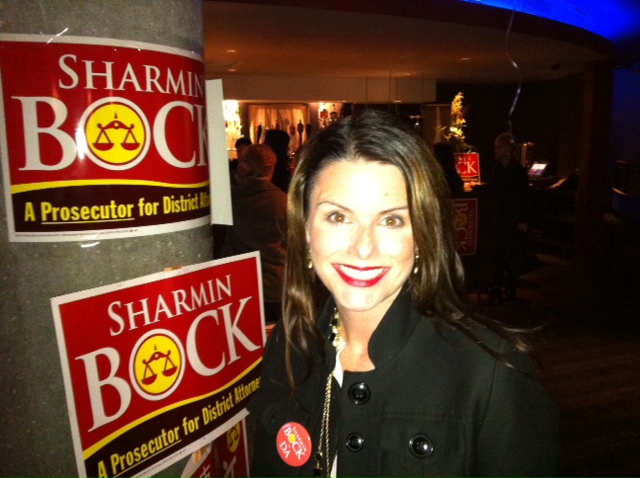
The first DA numbers have just come in: Gason 48%, Bock 21%, Onek 15%. But so far a smoking little jazz trio downstairs is about the only real excitement at DA candidate Sharmin Bock’s campaign party at Yoshi’s on Fillmore. No big reaction yet, and the candidate isn’t expected to arrive until 9:30.

Yet campaign coordinator Kimberly Walz Abando tells me there’s been a lot of energy in the Bock campaign. It even reminds her a little of Chicago, where she worked on Mayor Rahm Emmanuel’s last campaign before moving to San Francisco.

Rough-and-tumble Chicago is a very different place, she said, “but what’s the same is you get a lot of passionate volunteers who believe in the candidate and will work 15 hour days.”
She also has a policy background and liked how Bock raised big issues: “She was able to bring forward the issue of unsolved murders and rapes.”

The first numbers

0

The absentees are in, and it’s no surprise that Mayor Ed Lee is in the lead. In fact, he’s way in the lead — he’s got 39 percent of the 67,000 absentees. I expected him to have a big advantage here, since he did a lot of early GOTV.

Worth noting: John Avalos, the most progressive of the major candidates, is in second in the absentees. That’s a very good sign for the Avalos campaign. But Lee is almost 20,000 votes ahead of Avalos and Dennis Herrera, and that, folks, will be very hard to make up.

The district attorney’s race is over; George Gascon has won.

The sheriff’s race is interesting; Ross Mirkarimi — again, the most progressive candidate — is actually ahead in what is looking like a very conservative absentee vote. He’s only got a slight lead over Chris Cunnie (31.7 percent to 31.4 percent, a total of a couple hundred votes) but that margin will grow as the night moves on. Mirkarimi, it appears, will finish first.

Here’s why I say it’s a conservative absentee turnout: The sales tax, Prop G, is losing 57-42 and Prop. H, the neighborhood schools measure, is ahead 58-41. Both results suggest a strong westside turnout in the absentees.

I’m surprised that Mirkarimi is doing so well with this bunch.

And I’m a little surprised that Prop. C (the “consensus”) pension reform is so far ahead of Prop. D (the Adachi pension reform). Even in the conservative areas, C is leading by 7 percent.

By the way, the school and street bonds have won. If they’re over 66 percent (and both are) in this batch of votes, they’ll win handily.


It’s all about turnout

0

Turnout in my Bernal Heights precinct tonight was pretty light, and that’s consistent with what I’ve been hearing all over town — except in Chinatown, where absentee turnout is high and the Ed Lee folks have done a great job of getting out the vote. This election may be a referendum on Ed Lee, it may be about whether any of the challengers can make a case for a change, it may be about how ranked-choice-voting works — but more than anything else, it’s going to be about who votes.

The flood of mailers was so overwhelming in the final days that I’m not sure how many people actually read them; the campaigns that put real resources into GOTV operations will probably fare better than the ones that relied on mail to reach the voters. And, of course, it’s likely that half the votes cast will be absentees.

So one of the numbers to watch tonight is total turnout. The lower that number, the better for Mayor Lee, who got a lot of votes in the bank early.

Another number to watch, and I’ll be running this for you as soon as I have data, is how the election-day votes contrast with the typically more conservative absentees. The absentees will be out soon, shortly after 8 p.m.; that will give us a sneak preview. But once the election-day votes come in about half an hour later, we’ll know where the trends are going.

The Department of Elections says the vote count will go quickly, since it’s a short ballot (only two cards).

The Guardian–and the historic elections of 1966 and 2011

2

(Written on election day before the polls closed. Scroll down for our editorial positions of 1966 and 2011)

In the second edition of the Guardian, dated Nov. 7, 1966, we published our first set of editorial endorsements that were to become a trademark of our form of alternative journalism.  (Our 1966 editorial in pdf form.)

We strongly endorsed then Gov. Pat Brown, going for his third term as a progressive governor, over Ronald Reagan, making his first run at elective office as the voice of the new Republican conservatism, in what we called “our historic election.” In reading the editorial over on the eve of our current “historic election,” it was remarkably prescient.

“For the repudiation of Brown and the election of Reagan,” we noted gloomily,  “would mean that a generation of progressive legislation—in medicare, in education, in welfare, in conservation, in water resources, in bringing to account the dreadful problems of growth, population, and sprawl—would be in grave jeopardy.

“It isn’t difficult to imagine, for example, what will happen to the conservation movement at the hands of a man who talks loudly about selling off ‘unused park land.’ It is this sort of statement that shows Reagan’s naivete, his total lack of qualification for any responsible government job and his complete misunderstanding of what is happening in our state.”

We pointed out that Brown had continued the progressive policies of Govs.Warren and Knight but that this forward movement would end abruptly with Reagan as governor. Well, alas, we were right. Reaganomics was born and the Guardian and everybody else have ever since been fighting the doctrine of tax cuts, deregulation, privatization, and the economics of greed is good and greed is legal.

The result can be seen in today’s election in San Francisco and other California cities and counties.

The mayoral regimes of Brown, Newsom and Ed Lee have carried on the key elements of Reaganomics: endless budget cuts and a bushelbasket of  higher fees, no new revenue initiatives, no moves to tax the Warren Hellmans and the Gordon Gettys on the same basis as the middle class, no moves to tax the big realtors and banks and big downtown companies on the same basis as small businesses, maintaining and facilitating the galloping inequalities of income, keeping the corrupting PG&E/Raker scandal intact at City Hall and thus allowing PG&E to operate as an illegal private utility in San Francisco. On and on.

 The sad thing is that if Lee wins and the tide of sleaze keeps rising in his office, and the progressives lose even more power, things are likely  to get much worse and fast. If Avalos or Herrera win, things are likely to get better but slowly if at all. If Mirkarimi wins, he will make an excellent sheriff in the Mike Hennessey tradition and will immediately be a candidate in waiting to run for mayor as a progressive sheriff and keep PG&E and the Chamber of Commerce gang on edge. (Our position as  outlined by Executive Editor Tim Redmond in “The bad old days” in   our 45th anniversary issue of Oct. 19, 2011.) 

 In any event, the Guardian will be here to “print the news and raise hell for good causes,” to update our masthead motto of 45 years. B3


Why Occupy? Here’s why

2

The Chron buried the story below an item about Chevron cutting its grants to PBS, but if you want to see the case for the Occupy movement, it’s laid out perfectly in a powerful new report by the California Budget Project. Read it here (PDF) The data is solid; the policy impacts are clear.

For starters, California’s 33,900 millionaire taxpayers (people reporting more than $1 million in income in 2010) — that’s two-tenths of the top one percent — earned $104 billion — 11 times the amount needed to lift every single California out of poverty. That’s right — a ten-percent surtax on incomes of more than $1 million could end poverty in California.

California, the report states, has the 7th worst income gap in the nation, between Alabama and Texas.

The San Francisco/Marin/Oakland metropolitan area has the 7th worst income disparity of any major urban area in America.

And it’s not the Invisible Hand of Adam Smith that caused the problem: “Public policy,” the report states, “narrow income gaps less today than they did a generation ago.”

San Francisco’s electing a new mayor today. When you go to the polls, think about economic justice. And when you hear complaints about Occupy SF, think about the fact that before the Occupy movement, the wealth and income gap was barely on the political agenda.


Election night coverage and parties

7

As always, the Guardian will have a team of reporters in the field tonight covering the election parties and doing regular posts here on the Politics blog, where Executive Editor Tim Redmond will also be analyzing the results as they come in. But if you want to get out there mix and mingle with the campaigns yourself, here’s a list of the parties around San Francisco, most of which start around 8:30 and last until around 11. 

John Avalos for Mayor, Roccapulco, 3140 Mission St.

Dennis Herrera for Mayor, Club Mighty, 119 Utah St.

Leland Yee for Mayor, Rasselas Jazz Club, 1534 Fillmore St.

Jeff Adachi for Mayor, Harbour Court Hotel 165 Steuart St.

David Chiu for Mayor, Rendezvous Tapas, 2080 Van Ness

Bevan Dufty for Mayor, Don Ramon’s Mexican Restaurant, 225 11th St.

Ed Lee for Mayor, Tres, 130 Townsend St.

Tony Hall for Mayor, Campaign HQ, 99 West Portal Avenue

Joanna Rees for Mayor, Eastside West, 3154 Fillmore

Michela Alioto-Pier for Mayor, The Brick  Yard, 1787 Union St.

League of Pissed Off Voters, El Rio, 3158 Mission St. (mayoral candidate Terry Baum in attendance)

Yes on A, Mercury Lounge, 1582 Folsom St.

Yes on C/No on D, Slim’s, 333 11th St.

David Onek for DA, Pilsner Inn, 225 Church

Sharmin Bock for DA, Yoshi’s Jazz Club, 1330 Fillmore

Bill Fazio for DA, Tony Nik’s Cafe, 1534 Stockton

George Gascon for DA/Chris Cunnie for Sheriff, Delancey Street, 600 The Embarcadero

Ross Mirkarimi for Sheriff, Carnelian by the Bay, 1 Ferry Plaza

Paul Miyamoto for Sheriff, Pete’s Tavern, 128 King Street


Will all those mailers really work?

19

Political consultants love direct mail. It’s a perfect way to target your message. You buy an ad in the Chronicle, you have to pay to reach all of the readers — the ones outside of San Francisco, the ones who will never vote for your candidate anyway — and the ones who almost certainly won’t vote. With the Department of Elections database and a good computer, you can limit your mailings to people who vote regularly. You can mail only to Democrats, or you can mail only to women, or only to people in certain neighborhoods. “You want gay Lithuanians who are betwen 30 and 50 years old, voted in 4 of the last 5 local elections and live on the East side of town? I can give you that list,” one consultant told me a few years ago.

Direct mail not only ensures that your message goes to the people who matter — the actual voters — but it allows you to tell any population or demographic exactly what it wants to hear. A candidate for mayor may want to talk about liberal positions to voters in the Haight and more moderate stands to people West of Twin Peaks.

And unlike door hangers and hand-delivered pieces, things that arrive in the mail tend to get read. At least, they usually do.

Over the past few days, I’ve received about 30 mailers. Some people got even more. The stack has piled up so quickly that even someone like me, who loves all fo this stuff and pays close attention to all the messages, couldn’t get to it all. Most of my neighbors just chucked it all in the recycling.

When you have this many candidates, with this much money, and all of the independent expenditure groups, the mailers all start to look and sound the same. Nothing jumped out at me; nothing made me pay attention. There was just too much of it, total overload. So I fear that a lot of the money spent on mail this year wasn’t terribly effective.


Impertinent questions to Sup. Sean Elsbernd

9

 At Tuesday’s Board of Supervisors meeting, Sup. Sean Elsbernd voted against a sensible resolution supporting regulated and safe patient access to medical cannabis in San Francisco.

He was on the losing end of an an 8-3 vote, with Sups. Carmen Chiu and Mark Farrell also voting against.

I was curious why, in San Francisco in November of 2011, he would vote against what I and many others considered a sensible but restrained resolution supporting local small businesses that are regulated and paying taxes and about the only business showing growth in the city.

So I emailed him some Impertinent Questions:

“Why do you continue to support a federal crackdown on medical marijuana? Why do you do this as a purported advocate of small business and bringing in more tax revenue to the city?”

I  also asked Elbernd who he now supported for mayor, since the last time I heard from him he said he would support Mayor Ed Lee only if there were no other candidate who could beat State Sen. Leland Yee. He replied that had not endorsed a candidate for mayor, but if I contacted him after the election he would tell me who he voted for. “Rest assured,” he said, “the Bay Guardian endorsements will certainly influence my decision making process.”

On the marijuana issue, Elsbernd objected strenuously to my statement that he “supported the federal crackdown. Please send me the recording, clip, reporter’s notes, or any other documentation you have that demonstrates t hat I specifically said I supported the federal crackdown.”

Elsbernd asked if I was referring to his note vote on the resolution. (B3 answer: I was.)

“Are you erroneously extrapolating an opinion of mine based on my ‘no’ vote. Is that journalism or is that political spin? Would not a journalist simply ask the question like this, ‘Why did you vote no” on the resolution Making assumptions without any fact to back it up seems a bit irresponsible and lazy for a journalist. While you e-mail me under the guise of being a constituent, and your certainly live in District 7, we both know that this email discussion will be posted very soon on your Bay Guardian website (hello to all of who have time in your day to read Bruce’s blog) with additional edits and snide comments to which you will not me the opportunity to respond. (B3 comment: Elsbernd knows that I send him Impertinent Questions from time to time and that the Q and A will appear on my blog. And he knows he can answer in the blog comments or in a letter to the Guardian. To his credit, Elsbernd always answers me and I enjoy hearing from him. And I keep inviting him to talk things over at tapas night on Thursday night at the Que Syrah wine bar in West Portal in his district. I even offer to buy the first flight, but alas  he never shows.)

Elsbernd then says he will answer my real question. “Why did I vote ‘no’ on the resolution?

Did you read the entire resolution? (B3 answer: yes.) Did you agree with every ‘whereas’ clause and every ‘resolved’ clause? (B3 answer: Yes.) Elsbern continued, “I do not. In particular, I strenuously object to the ‘whereas’ clause on page l, line 12-16, which implies that all licensed medical cannabis dispensaries in San Francisco are ‘clearly acting in good faith,’ and that they ‘take every measure possible to be safe and professional members of the community.’

Elsbernd then gets specific: “I suggest you talk to your neighbors on the other side of Portola/Junipero Serra who live near the dispensary on Ocean Avenue and ask them if ‘every measure’ has been taken to to be safe and professional members of their community. I suggest you read the police reports in and around the area over the last five years and compare those same reports o before the opening of the dispensaries and ask whether or not ‘every measure possible’ has indeed been taken. If you take the time and do that work, I think you’ll understand, why, as the representative of those neighborhoods, I voted against that resolution. (B3 answer: I am always take note  when Elsbernd purports to represent his constituents in his district. But he could have amended the motion in committee (he was absent on the committee vote) or at the board. Instead, he used this single example to justify his opposition to a timely resolution putting the city squarely on record as being opposed to the ridiculous, expensive, job-killing, and tax-killing crackdown by the federal government on medical marijuana and its use in treating debilitating diseases and chronic pain in thousands of patients in San Francisco and throughout the state. The resolution also resolved that the supervisors “encourage the President and Congress of the United States to enact legislation requiring federal law enforcement to respect state medical cannabis laws.”)

Elsbernd also argued that the resolution called “for a massive tax reduction for all dispensaries in its resolved clause to support HR 1985, a bill by Rep.Stark granting a tax exemption for all such businesses? I know the Guardian typically opposes all business tax exemptions. Do you guys support this one.” (B3 answer: The Stark bill is not a a tax reduction bill. It is a bill aimed at reversing an IRS crackdown on many large dispensaries—including Harborside Health Center in Oakland, the largest in Northern California, that they cannot write off normal business expenses and must pay a 35 per cent levy on those claims going back for three years. Harborside’s Steve DeAngelo told the Guardian that this IRS attack would put Harborside—or any company with high overhead costs—out of business.  http://www.sfbg.com/2011/10/11/feds-crack-down

Stark’s bill would reverse that IRS decision and allow dispensaries to deduct expenses according to state law just like all other businesses in California.
http://americansforsafeaccess.org/downloads/Stark_bill_2011.pdf

And so my original Impertinent Question remains: why is Elsbernd (and Chiu and Farrell)  supporting in effect a federal crackdown aimed at killing off marijuana dispensaries and killing off a growing sector of small business and a valuable source of tax revenue? If he isn’t supporting the federal crackdown with this vote, what is his position on medical marijuana dispensaries?  Wine and tapas, Sean?  B3)

Dick Meister: Searching for Joe

2


By Dick Meister

Dick Meister, former labor editor of the SF Chronicle and KQED-TV Newsroom, has covered labor and politics for more than a half-century. Contact him through his website, www.dickmeister,com, which includes more than 300 of his columns.

San Francisco’s unions have been looking for another Joe Alioto ever since he left the mayor’s office in 1976 after eight years of being one of the best political friends organized labor ever had – anywhere.

Unions certainly have no chance of finding such a staunch supporter among the candidates for mayor in Tuesday’s election – not even in former Supervisor Michela Alioto-Pier, Alioto’s granddaughter. She reflects the conservative views of her former supervisorial district, which encompasses the upscale Pacific Heights and Marina neighborhoods.

Some of the other candidates claim to be labor-friendly, and some actually are. But none have gained anything approaching the all-out, almost unprecedented support that unions gave Alioto. Not surprisingly, unions have in turn been promised only relatively little post-election support by Tuesday’s candidates.

Alioto’s rewards to labor were based in part on the fact that, as he declared, “the controlling and decisive factor in my election was the support of organized labor.”

His administrations, he said, were “first of all sympathetic to labor.”

Alioto appointed union representatives to all of the city’s boards and commissions, some of which previously had little or no union representation, and helped unions in major strikes against recalcitrant employers, often stepping in to convince the employers to settle.

Probably the greatest benefits to union members came from the downtown building boom that Alioto launched, creating thousands of construction jobs.

So, with no Alioto-like union supporter in this year’s mayoral race, who are unions supporting? And how is labor likely to influence the outcome as well as the votes for ballot propositions, particularly Props C and D that involve the pensions and health care of public employees that have come to preoccupy municipal and state governments everywhere?

It seems clear that labor’s influence on the election outcome will turn out to be relatively slight, certainly considerably less than in Alioto’s time – less, in fact than in just about any other city election since the 1930s, when San Francisco was celebrated as one of the country’s premier “union towns.”

But no more. It’s sometimes hard to believe that San Francisco was ever a union town in the same league as New York, Chicago and Detroit.

The general public hardly hears from the city’s once vibrant and highly influential Labor Council and its leaders these days. Individual unions such as the Service Employees, Longshore and Warehouse Union, Nurses Association and Unite-Here, the hotel workers union, still have considerable clout, as do a few others. But that’s about it.

It’s partly the fault of the news media, but their scant coverage of organized labor reflects the failure of unions to take the leading position in politics as in economics that they once had, and must have if they are to prosper.

Unions are staging something of a comeback with the growth of public employee unions, which now dominate organized labor in numbers and influence – though locally unions probably do not yet have enough influence to play the role that once put them in a position to help elect politicians who considered them indispensable.

Public Defender and mayoral candidate Jeff Adachi and his conservative backers are trying hard to seriously weaken the growing strength of San Francisco’s public employee unions and their members, mainly through Proposition D. The apparent frontrunner in the mayor’s race, acting Mayor Ed Lee, is no particular friend of labor, either. Neither was Lee’s predecessor, Gavin Newsom.

Labor wasn’t helped by last year’s elections that gave the Board of Supervisors a strong minority of members on the political right who are at best indifferent to unions. Only five of the 11 supervisors can be legitimately considered pro-labor progressives.

It would help labor greatly to have a strong pro-union mayor, but none of the major candidates would play that role. The Labor Council endorsed Dennis Herrera and Leland Yee. The Building and Construction Trades Council went with Alioto-Pier and Yee.

But what about me? Glad you asked. I say it should be Herrera, who’s an excellent city attorney, has a broad base of supporters and, as a Hispanic, would give that underrepresented minority an important voice in City Hall. All the major candidates for sheriff and district attorney have solid credentials, and I’m sure any of them would do a good job.

Can’t see any reason not to vote for Prop A, a much needed school bond measure, and Prop B that would authorize bonds to pay for needed road and street repair. A big no on the foolish Prop E that would allow the Board of Supervisors to undo measures previously approved by voters.

No on F, another foolish and unnecessary measure. But Prop. G’s a good one. It raises the sales tax by half a percent to finance public safety programs and services to children and seniors.

Prop H is bad news. It would take away parental choice of schools and force students to attend only their neighborhood schools. Since many neighborhoods are still segregated by race or along socio-economic lines, it also would re-segregate schools citywide.

The main event includes, of course, Props C and D, and we should reject both measures. Don’t be confused by those who say, “I can’t vote no on C, because if D gets more votes, Adachi will win.” That ain’t necessarily so, for if neither measure gets at least 50 percent+one of the votes, then both would be defeated.

Make no mistake: Both propositions would be extremely harmful, because both would needlessly increase the financial burden of city employees by limiting the pensions of many new employees, while at the same time requiring them to make higher contributions to city pension funds. Both measures would also require some current employees to contribute more, although Prop D’s rates are somewhat higher, especially for higher income employees. Both C and D would also limit cost-of-living raises for current retirees.

Ever since voters in 2004 approved a badly needed reform of the City Health Service System that oversees the health care of employees and retirees, their elected representatives have had a genuine voice, with four members on the service’s seven-member governing board. The other three have been City Hall appointees.

Prop C would reverse the numbers, substituting another City Hall appointee for one of the elected members and otherwise limiting the voice of the elected members. Sponsors of Prop C would have you believe that the proposition is a “consensus” measure agreed to by all parties. But don’t you believe it.

Retirees, who make up a large part of those in the Health Service System, were not allowed to be part of the consensus negotiations, presided over by acting Mayor Lee.

It’s certain Joe Alioto would never have allowed that to happen.

Dick Meister, former labor editor of the SF Chronicle and KQED-TV Newsroom, has covered labor and politics for more than a half-century. Contact him through his website, www.dickmeister,com, which includes more than 300 of his columns.

Powerful, mostly peaceful Oakland action ends badly

19

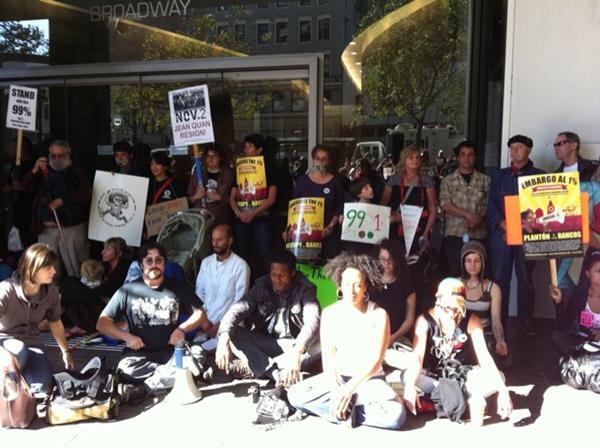
After a long day of mostly peaceful demonstrations by thousands of protesters who joined OccupyOakland’s General Strike and Day of Action yesterday, it’s still unclear why the Oakland Police – which had stood down the entire day, leaving the movement to self-police – massed in riot gear around midnight and used tear gas and other projectiles to clear the streets and make a reported 80 arrests.

Spokespersons for the Oakland Police Department and Mayor Jean Quan haven’t returned Guardian phone calls, and reports in the Oakland Tribune and other media outlets don’t indicate exactly what prompted police to change tactics and aggressively confront the demonstration. Protesters had taken over a vacant building and erected barricades in the streets shortly before riot police showed up, and it appears from a Tribune video that a dumpster was set on fire after the police showed up.

Before the standoff between city officials and demonstrators in Oakland again took a violent turn, the day was notable for its lack of police presence around the occupied Oscar Grant Plaza and nearby 14th and Broadway epicenter. And despite a small number of masked agitators who broke bank windows and sprayed graffiti – much to the chagrin of most protesters who actively opposed such tactics – the movement was remarkably nonviolent and self-policing, particularly given a crowd of what seemed to be around 10,000 people at its peak. Protesters even handled traffic control, using a megaphone to help motorists through intersections congested with passing demonstrators.

“This is an extraordinarily peaceful collection of diverse people,” Sen. Loni Hancock (D-Oakland) told the Guardian just after 5 pm as a massive march left the encampment to shut down the Port of Oakland. “I feel like they’re doing what no elected person can do: they’re putting economic equity issues in front of the American people.”

“This is beautiful and powerful. This I love,” agreed Oakland City Council member Libby Schaaf, beaming as the peaceful march took off, although she told us that she was disappointed to see Oakland businesses vandalized, including her beloved Noah’s Bagels. “Fight greed, not bagels.”

Most of the crowd condemned the violence, and many openly worried that it would undercut the positive demonstration of people power and the airing of frustration with economic injustices in the country. But even Hancock said a few bad apples shouldn’t spoil people’s understanding of what an important day it was.

“I’m very grateful to them for calling attention to economic inequality. It is in the interests of cities that this issue take center stage,” Hancock told us. “There are so many things that have been talked about that are now on the stage and it’s a very important conversation to have.”

But many in the movement were disappointed nonetheless, despite the myriad successes in shutting down business nonviolently. Around 3 pm, a crowd of thousands marched past a Chase Bank at 20th and Berkeley streets where the front window had been shattered, as was the case with at least six other businesses. Taped to the windows were signs reading “We are better than this” and “This is not the 99%. Sorry, the 99%”.

As the huge crowd repeatedly chanted “peaceful protest,” Ryan, a 31-year-old Oakland resident, expressed his frustration over vandalism he blamed on out-of-town instigators. “People from Oakland would not damage their city like that,” he told me. “Last week was beautiful, we were dancing and singing in the streets,” he said, referring to the largely nonviolent response to police violence, “but this is bullshit.”

Large protests almost always have members who want to escalate the conflict and who see breaking windows as a legitimate tactic, and yesterday there were sometimes tense conflicts between protesters who disagreed on the issue. Another complex issue is how to now view Oakland Mayor Jean Quan, whose support for last week’s violent police crackdown prompted calls for her recall or resignation, although her subsequent apology, the re-encampment of Frank Ogawa Plaza, and yesterday’s police stand down caused some to rethink whether to actively oppose her.

“My goal for today is to spur the international movement forward and to show what we’re capable of,” said 23-year-old Iris Brilliant, who got more actively involved in OccupyOakland after the crackdown and said she was happy to see the police kept at bay. “It’s important to push this forward.”

But Tania Kappner, a 41-year-old teacher from Oakland, still hadn’t forgiven Quan or the police for the violent excesses in last week’s raid. She was camped out in Oscar Grant Plaza in a tent with the sign “Mayor Quan Must Go!”

“It’s good she’s not sending them in on us today, but she never should have done it in the first place,” Kappner told us. “We’re calling for her to go and the police who did it to be jailed.”

With the decision to again unleash the riot police and tear gas and arrest big numbers of people – which was the very thing that prompted such huge numbers of people to turn out yesterday, giving OccupyOakland the numbers and power to easily shut down the port and dozens of businesses – Oakland and the larger Occupy movement might again find itself back at square one.

The National Lawyer’s Guild, which had observers on hand to witness the late-night police crackdown, issued a statement today condemning the city’s actions and saying they violate a crowd control police the NLG helped the city write to settle lawsuits stemming from the OPD’s use of rubber bullets to clear anti-war protesters from the Port of Oakland back in 2003.

“Like we saw last Tuesday, the OPD actions in the late night hours violated numerous provisions of the Crowd Control Policy and the Constitutional rights of activists,” explained NLG’s San Francisco Bay Area chapter president Michael Flynn. “Our legal observers did not disobey any police orders and neither did many of the other arrestees.”
“The Crowd Control Policy clearly prohibits shooting munitions into a crowd,” added NLG attorney Rachel Lederman. “While the police are allowed to use tear gas, they are supposed to use a minimum amount and only where other crowd control tactics have failed.  It is not at all clear that less violent and less provocative measures would not have sufficed to achieve any legitimate law enforcement objectives last night.”

Meanwhile, in San Francisco, Mayor Ed Lee has reportedly assured OccupySF that he won’t follow through on threats to raid the camp if tents aren’t removed, at least not anytime soon (many observers speculate that he’ll at least wait until after next week’s mayoral election). But Lee has been unwilling to make a clear public statement that raids are now off the table.

When we sought to clarify Lee’s position and get his reaction to a Board of Supervisors resolution calling for the city to allow a 24/7 encampment, his Press Secretary Christine Falvey wrote: “The mayor has not focused on the resolution, but has been focusing on meeting with clergy, labor, occupysf demonstrators and his department heads to make sure that the site is kept clean, safe and accessible for everyone. He remains concerned about overnight camping and the public health and safety issues that brings. That said, he has seen some good progress over the last few days because of his open communication with the group. DPW cleaned up the site over the weekend and the demonstrators helped facilitate the cleanup. Tents were moved off the Bocce Ball Court as well. The group is working with Fire and Public Health officials to make some improvements. The dialogue is ongoing.”

Photos by Steven T. Jones

The problem with the Lee investigations

55

Six major mayoral candidates, including John Avalos, Dennis Herrera and Leland Yee, have once again called on the Fair Political Practices Commission to investigate the Ed Lee voter-fraud charges. That’s what needs to happen, of course. And the district attorney should do a thorough investigation and file criminal charges if warranted.

But there’s a basic problem here, and it goes to the heart of what’s wrong with the Lee campaign and with his whole approach to running for office. See, even if the FPPC finds a problem, what’s going to happen? The campaign will have to pay a fine (which, given all of the rich supporters of Lee, will be easy to pay).  If the D.A. finds that laws have been broken, some low-level folks or people who solicited contributions improperly will face prosecution — and most likely cut a deal and pay a fine and get probation.

By then, of course, if all goes as predicted, Lee will have won the election. So as far as he and his key allies are concerned, none of this really matters.

Once he’s elected mayor, he figures (probably correctly) that this will all blow over. The FPPC investigation won’t be concluded for months. The D.A. clearly isn’t going to file charges against anyone before Election Day. Besides, according to the Department of Elections, 44,000 people had already voted by the time the latest stories broke Nov. 2. Many of them are Lee votes.

No matter how flawed the election, how much sleazy, inappropriate or criminal activity was involved, there’s no way the results will be thrown out. There’s no way the election of Ed Lee will be voided. If all of the tactics of Lee supporters work and he comes out on top, there will be no consequences for him. When it comes to San Francisco elections, cheating works — Willie Brown learned that long ago.

That’s why Ed Lee scares me: He’s allowing his supporters to use a corrupt playbook that assumes that the rules don’t matter, that winning at all costs is the only issue, that ethics and clean government can be dismissed as side issues. Once you start down that road, there’s no going back. Once you set that tone at City Hall, every half-assed crook and con artist will be convinced it’s open season. And I just don’t see Lee as strong enough to stop it.

UPDATE: Avalos just called and told me he wasn’t aware that the other candidates were calling on the FPPC to investigate and wasn’t at the press conference where that announcement was made. Sorry ’bout that, a miscommunication.


The latest Lee voter fraud charges

18

The Ed Lee campaign is, of course, distancing itself from the latest voter fraud allegations. Spokesperson Tony Winnicker says nobody on the Lee team knew anything about it, that the idea of eight low-level associates at a property firm each giving the maximum $500 didn’t ring any alarm bells:

“If this is true, then these people have perjured themselves,” Lee campaign spokesman Tony Winnicker said when The Chronicle informed him about the donations. “They looked directly into the eyes of our campaign staff and lied, and they should be held accountable.

And honestly, I don’t think anyone on Lee’s team directly solicited the illegal contributions. I could be wrong, but let’s give them the benefit of the doubt. But the notion that Winnicker is shocked — shocked — that this sort of behavior was going on doens’t quite pass the sniff test. The problem is that Lee refused to take public financing, got in the race late and decided to raise a buttload of money really fast — and when you do that, and you take cash from the likes of Andrew Hawkins, you’re almost guaranteed to run into trouble.

I think Dennis Herrera has it right; his press statement makes the point:

“Too many of Ed Lee’s supporters act as though they’re above the law — on money laundering, on ballot tampering, and more — and Ed Lee isn’t strong enough to stop it.  If this is how they behave before an election, just imagine how they’ll behave after the election, if Ed Lee wins.

This has always been the danger with Mayor Lee — he’s surrounded by some very bad actors, he can’t keep them under control — and if he wins, they’ll have the run of City Hall.

Is this enough — or the cumulative impacts of this enough — to allow someone else to win the election? I don’t know. Around 30,000 people have already voted. Some of Lee’s hard-core supporters will ignore the problems and vote for him anyway. But maybe, just maybe, the stench surrounding the campaign will convince a lot of the people who were considering putting Lee second or third to vote for someone else. That’s what would turn the tide in the Nov. 8 election.

UPDATE: Bill Barnes, who reviews the contributions for the Lee campaign, told me that since Hawkins had used a different name (Dr. Andrew Hawkins-Cohen) and since the eight donors all listed occupations that seemed plausible for a large donation and all signed the document saying it was their own money, nothing set off any alarms. “We’ve gotten about 4,000 checks,” he said.

But still: If Andrew Hawkins wants Lee to be mayor that badly, there’s plenty to worry about.

Anyone but Lee

198

tredmond@sfbg.com

Two weeks ago, the race for mayor of San Francisco seemed in the bag. Mayor Ed Lee was so far ahead in most polls that everyone else looked like an also-ran. A Bay Citizen simulation of ranked-choice voting showed Lee getting enough seconds and thirds to emerge easily as the winner. His approval rating with voters was above 70 percent. The money was pouring in to his campaign and to the coffers of independent expenditure committees promoting him.

But that was before the voter-fraud scandals, OccupySF, Sup. John Avalos appearing on national TV, a controversial veto, Sup. David Chiu getting the endorsement of the San Francisco Chronicle, and an attack on City Attorney Dennis Herrera backfiring.

“It’s changing,” Corey Cook, a political scientist at the University of San Francisco, told us. “I don’t know whether it’s tightening up, but it’s certainly changing.”

One campaign consultant, who asked not to be named, was more blunt: “The Lee campaign is one bad news story away from free-fall.”

That’s not to say Lee is going to lose, or even that he’s anything but the clear front-runner. But over the past week, as Lee has taken a series of hits, supporters of the other candidates — particularly Herrera and Avalos — are starting to wonder: Could somebody else really win?

The answer, of course, is yes — anything can happen in the week before an election. But defeating Mayor Lee will take a confluence of events and strategies that starts with a big progressive turnout — and with voters who don’t like the idea of an incumbent with ties to a corrupt old political machine carefully allocating their three ranked choices.


NO SURPRISE

So far, there’s been no crushing “October surprise” — no single event or revelation that can change the course of the election. And the impact of anything that happens in the next few days will be blunted by the fact that 27,000 absentee ballots have already arrived at the Department of Elections.

By all accounts, Lee’s campaign and the somewhat sketchy independent expenditure groups that are working in parallel, if not in concert, have done an impressive job of identifying and turning out absentee voters. Local consultants from most of the campaigns agree that at least 20 percent of the final turnout will be Chinese voters — and Lee will get at least 75 and as much of 90 percent of that vote.

But as Cook notes, there are still “huge undecideds” for this late in a race. And while Lee was polling above 30 percent a few weeks ago, by most accounts his numbers have been dropping steadily. One recent poll shows him falling 10 points in the past two weeks, leaving him closer to 20 percent than 30 percent.

“If the election were held three weeks from now, he’d lose,” said one consultant who asked not to be identified by name.

What’s happened? A confluence of factors have put the incumbent in a bad light.

The voter-fraud allegations have made headlines and the district attorney is discussing a criminal investigation. Although Lee and his campaign weren’t directly involved — the possibly illegal efforts to steer voters to Lee were run by one of the IEs — the last thing a politician wants to see in the waning days before an election are the words “voter fraud” and “criminal investigation.”

And the allegation — that Lee supporters in Chinatown filled out ballots for absentee voters then collected them for later delivery — play right into Lee’s weakness. While voters generally have good impressions of his work at City Hall, the fact that he’s connected to sleazy operators and tied to the old discredited Brown machine continues to haunt him. And this sort of activity simply re-enforces that perception.

The Leland Yee campaign has taken direct advantage of that perception, releasing a parody of the hagiographic Lee biography written by political consultant Enrique Pearce. “The Real Ed Lee story,” which repeatedly talks of his connections to unethical power brokers, hit the streets this past weekend.

Lee also sided with the San Francisco Chamber of Commerce over a coalition of labor and consumer groups with his veto of legislation by Sup. David Campos that would have prevented employers from draining $50 million per year from health savings accounts set up to comply with city law. Many restaurants even tack a 3-5 percent surcharge onto customers’ bills, making it essentially consumer fraud.

“It’s important for us to take a stance on the issue and say that what the mayor did was wrong,” Campos told us. “It’s a defining issue for us in City Hall.”

Then there’s OccupySF. Nobody knows for sure, but it’s likely that a majority of San Franciscans are at least somewhat sympathetic to the group’s message. And Lee has so far avoided the public relations disaster of Oakland’s crackdown.

But the left is unhappy with Lee’s constant threats to clear out the encampment, and the right is unhappy that he hasn’t sent in the cops already — and even the San Francisco Chronicle has denounced his lack of decisiveness.

Lee put the police on high alert and had them moving around in buses, ready to move in — than at the last minute changed his mind. “What this shows,” said former Supervisor Aaron Peskin, “is that we don’t have a mayor with a firm hand on the tiller.”

Most observers expected that the Chronicle would join the San Francisco Examiner and endorse Lee. But the paper came down on the side of Supervisor David Chiu. Chiu is still running well behind in the polls, and not that many voters follow the Chron’s advice, but the endorsement was a huge boost to his campaign.

“Ed Lee’s had a bad couple of weeks, and some of the others have had a good couple of weeks,” Cooks said.


RANKED CHOICE

Ranked-choice voting puts an interesting twist into all of this. Several consultants and election experts I talked to this week said that Lee would be far more vulnerable in a traditional election. “He would lose a runoff against almost any of the top challengers,” one person said.

But every poll that’s tested the ranked-choice scenario — even recent polls that show Lee faltering — still put him on top after the votes are all tallied and allocated. That’s in part because supporters of candidates who are lower in the pack — Chiu, for example — tend to put Lee as a second or third choice. The Bay Citizen/USF poll showed that when Chiu was eliminated, most of his votes wound up going to Lee.

“Ranked-choice voting clearly favors incumbents,” Cook told me.

And, people walking precincts say, there are still some Herrera and even Avalos voters who put Lee second or third. And the only way Avalos — or anyone other than Lee — can win the election is if progressive and independent voters stick to a clear “anyone but Lee” voting strategy.

Avalos is doing well in recent polls; in fact, one shows him ahead of Herrera in first-place votes. Herrera does better when seconds and thirds are counted. Michela Alioto-Pier gets a fair number of first-place votes, which isn’t surprising since she’s one of only three women in the race, the only woman with citywide name recognition — and the only real credible conservative.

Yee and Chiu are both in the running, and Yee has come out strong attacking Lee and is running hard for progressive votes. He showed up at OccupySF the night a police raid was threatened and has been the leading critic of the alleged voter fraud.

Cook says a scenario where somebody beats Lee is still “an inside straight” — but it’s not at all impossible.

If Lee gets 30 percent of the first-place votes, most observers (including his opponents) agree that he’s going to cruise to victory. But if his first-place total is closer to 20 percent, and one or more of the other candidates are within five points, it’s going to be a lot closer.

Here’s the bottom line: If you don’t want to see a repeat of the late 1990s, when Willie Brown was mayor and City Hall was for sale to the highest bidder, vote for anyone but Lee — and use your three votes strategically. If you like John Avalos, put him first — but give your second-place vote to Herrera, who seems positioned right now to be the other strongest challenger. If you like Herrera, give your second to Avalos. If you like Leland Yee or David Chiu, make sure that Avalos and Herrera are also on your slate.

Fill out all three votes. And get your friends and family to the polls. Because turnout is projected to be low, which helps Lee — and the race may well be decided on the basis of who shows up November 8th.

On Guard!

4

news@sfbg.com


VICTORY’S MUDSLINGING

Hit pieces are common in San Francisco politics. So, sadly, are negative mailers funded by outside independent expenditure committees that can raise unlimited money.

But it’s highly unusual for an organization devoted to electing queer candidates to fund an attack on a candidate who is endorsed by both leading LGBT organizations and is, by all accounts, an ally of the community.

That’s what happened last week when the Washington-based Victory Fund — the leading national organization for LGBT political candidates — sent out a bizarre mailer blasting City Attorney Dennis Herrera for taking money from law firms that do business with the city.

The Victory Fund has endorsed former Sup. Bevan Dufty, who is the most prominent LGBT candidate in the mayor’s race. That’s to be expected; it’s what the Victory Fund does.

But why, in a race with 16 candidates, would the fund go after Herrera, who has spent much of the past seven years fighting in court for marriage equality? Why try to knock down a candidate who has the support of both the Harvey Milk Club and the Alice B. Toklas Club?

It’s baffled — and infuriated — longtime queer activist Cleve Jones, who is a Herrera supporter. “I have long respected the Victory Fund,” Jones told us. “But I’ve never seen them do what they did here. And it’s going to undermine the fund’s credibility.”

Jones dashed off an angry letter to the fund’s president, Chuck Wolfe, saying he was “appalled that this scurrilous attack, in the waning days of a mayoral campaign, would go out to the San Francisco electorate under the name of the Victory Fund.

“You really screwed up, Chuck, and I am not alone in my anger.”

We couldn’t get Wolfe on the phone, but the fund’s vice president for communications, Denis Dison, told us that the mailer “is all about fighting for our endorsed candidates.”

So how does it help Dufty, in a ranked-choice election, to attack Herrera? (In fact, given the dynamics of this election, the person it helps most is probably Mayor Ed Lee). Dison couldn’t explain. Nor would he say who at the fund decided to do the attack mailer.

But there are a couple of interesting connections that might help explain what’s going on. For starters, Joyce Newstat, a political consultant who is working for the Dufty campaign, is active in the Victory Fund, sits on the board of the fund’s Leadership Institute, and, according to a March 24 article in the Bay Area Reporter, was among those active in helping Dufty win the Victory Fund endorsement.

But again: Supporting Dufty is one thing. Attacking Herrera is another. Who would want to do that?

Well, if there’s one single constituency in the city that would like to sink Herrera, it’s Pacific Gas and Electric Co. And guess what? PG&E Governmental Affairs Manager Brandon Hernandez chairs the Victory Fund’s Leadership Institute. PG&E’s corporate logo appears on the front page of the fund’s website, and the company gave the Victory Fund more than $50,000 in 2010, according to the fund’s annual report.

Dison insisted that neither Hernadez nor anyone else from PG&E was involved in making the decision to hit Herrera and said the money went to the Leadership Institute, which trains LGBT candidates, not directly to the campaign fund.

Maybe so –- but the folks at the private utility, who are among the top three corporate donors to the Victory Fund, have to be happy. (Tim Redmond)


HERRERA HIT BACKFIRES

Herrera was also the target of another attack on his LGBT credentials last week, this one by the San Francisco Chronicle, which ran a front page story on Oct. 26 in which anonymous sources said he raised doubts in private City Hall meetings about San Francisco’s decision to issue same-sex marriage licenses in 2004. It was entitled, “Fight turns ugly to win gay votes in mayor’s race.”

Despite trying to couch the hit in passive language, writing that ” a surprise issue has emerged” based on accusations “leveled by several members of former Mayor Gavin Newsom’s administration,” it was clear that it was the Chron that made it an issue, for which the newspaper was denounced by leaders of the LGBT community from across the political spectrum at a rally the next day.

“Those who are saying this now anonymously are as cowardly as Dennis and Gavin were courageous back then,” said Deputy City Attorney Theresa Stewart, the lead attorney who defended San Francisco’s decision in 2004 to unilaterally issue marriage licenses to same-sax couples, in defiance of state and federal law, which eventually led to the legalizing of such unions. “We can’t have our community turn on us for petty political gain.”

“WTF, Chronicle?” was how Assemblymember Tom Ammiano began his speech, going on to lay blame for the attack on surrogates for Mayor Ed Lee. Ammiano also called out the mayor for campaign finance violations by his supporters, for undermining the Healthy San Francisco program that was created by Ammiano’s legislation, and for repeatedly ordering police raids on the OccupySF encampment.

“How about some fucking leadership?!” Ammiano said.

Cleve Jones, an early gay rights leader who marched with Harvey Milk, also denounced Lee and his supporters for cronyism, vote tampering, money laundering, and the “fake grassroots” efforts of the various well-funded independent expenditure campaigns, which he said have fooled the Chronicle.

“To the Chronicle and that reporter — really? — this is what you do two weeks before the election? You should be ashamed of yourself,” Jones said. “How stupid do you think we are?”

Yet Chronicle City Editor Audrey Cooper defended the article. “Clearly, I disagree [with the criticisms],” she told the Guardian. “I personally vetted every one of the sources and I’m confident everything we printed is true.” She also tried to cast the article as something other than a political attack, saying it was about an issue of interest to the LGBT community, but no LGBT leaders have stepped up to defend the paper.

Beyond criticizing the obvious political motivations behind the attack, speakers at the rally called the article bad journalism and said it was simply untrue to suggest that Herrera didn’t strongly support the effort to legalize same-sex marriage from the beginning.

“I can tell you that Dennis never once shrank from this fight. I was there, I know,” Stewart said, calling Herrera “a straight ally who’s devoted his heart and soul to this community.”

Sen. Mark Leno, who introduced the first bill legalizing same-sex marriage to clear the Legislature, emphasized that he isn’t endorsing any candidates for mayor and that he didn’t want to comment on the details of the article’s allegations. But he noted that even within the LGBT community, there were differences of opinion over the right timing and tactics for pushing the issue, and that Herrera has been a leader of the fight for marriage equality since the beginning.

“I am here to speak in defense of the character and integrity of our city attorney, Dennis Herrera,” Leno said, later adding, “I do not appreciate when the battle for our civil rights is used as a political football in the waning days of an election.”

Molly McKay, one of the original plaintiffs in the civil lawsuit that followed San Francisco’s actions, teared up as she described the ups and downs that the case took, working closely with Herrera throughout. “But this is one of the strangest twists I can imagine,” she said of the attack by the Chronicle and its anonymous sources. “It’s ridiculous and despicable.”

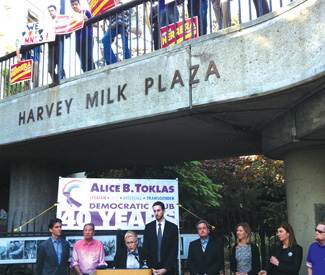
Representatives for both the progressive Harvey Milk LGBT Democratic Club and fiscally conservative Alice B. Toklas LGBT Democratic Club also took to the microphone together, both saying they often disagree on issues, but they were each denouncing the attack and have both endorsed Herrera, largely because of his strong advocacy for the LGBT community.

Sup. Scott Wiener called Herrera, “One of the greatest straight allies we’ve every had as a community.”

When Herrera finally took the microphone, he thanked mayoral opponents Joanne Rees and Jeff Adachi for showing up at the event to help denounce the attack and said, “This is bigger than the mayor’s race. It’s bigger than me.”

He criticized those who would trivialize this issue for petty political gain and said, “It was my pleasure and honor to have been a part of this battle from the beginning — from the beginning — and I’ll be there in the end.” (Steven T. Jones)


BUYING REFORM

UPDATE: THIS ITEM HAS BEEN CHANGED FROM THE PRINT VERSION TO CORRECT INACCURATE INFORMATION DEALING WITH WHETHER PAST INIATIVES CAN BE CHANGED

October yielded tremendous financial contributions from real estate investors and interest groups for Yes on E, feeding fears that the measure will be used to target rent control and development standards in San Francisco.

Sup. Scott Wiener has been the biggest proponent for Prop E since May 2011. He argues that the Board of Supervisors should be able to change or repeal voter-approved ballot measures years after they become law, saying that voters are hampered with too many issues on the ballot. Leaving the complex issues to city officials rather than the voters, makes the most sense of this “common sense measure”, Wiener calls it.

But how democratic is a board that can change laws approved by voters? Calvin Welch, a longtime progressive and housing activist, has his own theory: Wiener is targeting certain landlord and tenant issues that build on the body of laws that began in 1978, when San Francisco voters first started adopting rent control and tenants protection measures. Yet the measure will only allow the board to change initiatives approved after January 2012.

“That is what the agenda is all about — roughly 30 measures that deal with rent control and growth control,” he said. Critics say  the measure will leave progressive reforms vulnerable to a board heavily influence by big-money interests. Although Wiener denies Prop E is an attack on tenants, who make up about two-thirds of San Franciscans, the late financial support for the measure is coming from the same downtown villains that tenant and progressive groups fight just about every election cycle. High-roller donations are coming straight from the housing sector, which would love a second chance after losing at the ballot box.

Contributions to Yes on E include $15,000 from Committee on Jobs Government Reform Fund, $10,000 from Building Owners and Managers Association of SF PAC, another $10,000 from high-tech billionaire Ron Conway, and $2,500 from Shorenstein Realty Services LP. Then — on Oct. 28, after the deadline for final pre-election campaign reporting — the San Francisco Association of Realtors made a late contribution of another $18,772, given through the front group Coalition for Sensible Government.

Prop. E is organized so that the first three years, an initiative cannot be subject to review. However after four years, a two-thirds majority vote by the board could make changes, and after sevens years, a simple majority could do so.

 (Christine Deakers)

Lee benefits from vetoing health care reform

25

Downtown groups that pressured Mayor Ed Lee to veto legislation that would have prevented businesses from raiding their employees’ health savings accounts have been funneling big bucks into independent expenditure campaigns formed to keep Lee in the Mayor’s Office.

Meanwhile, the Board of Supervisors today strengthened a weak alternative to the vetoed legislation by Board President David Chiu, which it then continued for two weeks. The amendments by Sup. Malia Cohen were unanimously approved by the board, but her five allies in supporting the vetoed legislation – David Campos, John Avalos, Ross Mirkarimi, Jane Kim, and Eric Mar – preferred that the measure be returned to committee for more analysis, losing on a 6-5 vote.

“We need more time to understand the implications of the amendments. We’re not sure if it actually closes the loophole,” Campos, the vetoed measure’s sponsor, said of provisions in the Health Care Security Ordinance – the city’s landmark measure that required employers to provide some health coverage to employees – that allowed businesses last year to pocket more than $50 million from health savings accounts they created for their employees.

One Cohen amendment specifically addressed one of the more egregious violations – restaurants that charge customers at 3-5 percent surcharge for employee health care and than pocket that money at the end of the year – which Chiu had addressed only by calling for more scrutiny of the tactic by the Office of Labor Standards. She also would require businesses to keep two years worth of contributions in the account, rather than the one year sought by Chiu to address the so-called “January problem” of businesses draining the account at the end of every year and leaving nothing for employees who get sick or injured at the start of the year.

It was perhaps a sign of the heat that Lee took from labor and consumer groups for his veto that he quickly issued a press release today praising the supervisors for addressing the issue. “I applaud President Chiu, Supervisor Cohen, organized labor, small business owners, and the Department of Public Health for finding the solutions to this important public policy that can strengthen our City’s landmark Health Care Security Ordinance. By closing the loophole through these proposed amendments, we can increase access to health care, protect jobs in our small businesses and protect consumers while growing our economy at the same time,” it read.

But Lee appears to have already benefited from heeding the demands of downtown – particularly the San Francisco Chamber of Commerce and Golden Gate Restaurant Association (GGRA) – who made defeating the Campos legislation a top priority, casting it as a new “fee” that would drain $50 million from the local economy.

The San Francisco Alliance for Jobs and Sustainable Growth PAC, created by notorious downtown bagman Jim Sutton, is the best-funded on the four independent expenditure groups that are supporting Lee, taking in $390,000 this fall, including $27,000 from the GGRA and $25,000 from the Chamber’s SF Forward group. Both groups also support the Committee on Jobs, which kicked in $110,000 to the Alliance campaign. GGRA also gave another $10,000 to the pension reform campaign that Lee is pushing, support the Chamber had threatened to withhold if the Campos measure was approved.

GGRA Executive Director Rob Black denied this was pay-to-play politics, noting that the Alliance is also supporting DA George Gascon, Sheriff candidate Chris Cunnie and two ballot measures. “But absolutely, the mayor’s name is on there and the organization voted to endorse him,” Black said.

GGRA voted in August to endorse Lee, Chiu, and Michela Alioto-Pier for mayor. Black said the organization is “generally supportive of Sup. Chiu’s approach to reforming the Health Care Security Ordinance,” and Black specifically said it supports improving requirements that businesses notify employees about the health savings accounts and how to use them.

The GGRA led the original fight against the HCSO in 2006, which was sponsored by then-Sup. Tom Ammiano, who lined up a veto-proof majority on the progressive-dominated board and eventually persuaded then-Mayor Gavin Newsom to support it. The measure created the Healthy San Francisco program and required employers to spend a minimum amount per employee on health care, although federal ERISA law bars cities from prescribing how that money is spent.

GGRA challenged the employer mandate all the way to the U.S. Supreme Court on the grounds that it violated ERISA, losing the case. Many of its members restaurants then opted to use health savings accounts rather than paying into Healthy San Francisco or private health insurance, even though health experts say such accounts are the worst option.

Campos and his allies have maintained that money in these health savings accounts belongs to employees and that businesses that use and raid them gain an unfair competitive advantage at the expense of their employees, customers, and city taxpayers, who are often forced to foot the bill for the uninsured.

Campos and the coalition that supports him has said they may take this issue to voters if the Chiu/Lee legislative fix doesn’t address their concerns.

SF supervisors support OccupySF’s 24/7 encampment

56

The San Francisco Board of Supervisors today approved a resolution supporting Occupy Wall Street and the right of OccupySF to maintain a 24/7 encampment in Justin Herman Plaza, although sponsors of the measure narrowly lost a fight over amending the measure to allow police to use force if “there is an objective threat to safety or health.”

The sponsors of the measure – Sups. John Avalos, David Campos, Eric Mar, and Jane Kim – noted that heath and safety concerns were used as a pretext for both police raids on OccupySF and for last week’s violent police crackdown on the Occupy Oakland encampment, something San Francisco officials uniformly say they want to avoid here. Those four sponsors were joined by Sup. Ross Mirkarimi in opposing the amendment by Sup. Scott Wiener, which passed on a 6-5 vote.

But the overall measure – which urges Mayor Ed Lee to drop his opposition to tents and other camping infrastructure and not order another police raid on the camp – was then approved on an 8-3 vote, with Sups. Mark Farrell, Carmen Chu, and Sean Elsbernd in dissent. Farrell and Chu both expressed support for the movement’s call for addressing severe economic inequities in the country, but they oppose the tactic of occupation.

Board President David Chiu, the swing vote on allowing the resolution to be watered down, said his vote was an effort to get as much support for the measure as possible. “For me, it was important to build consensus here at the board,” he said, praising the work that city officials and OccupySF participants have done to resolve their differences. “I have been very impressed with the behavior of individuals involved in this movement.”

Wiener had made a number of amendments to the resolution that Avalos accepted without objection, drawing the line only at the change that would specifically allow for police to use force to dislodge the protesters. While the nonbinding resolution doesn’t compel any action by Lee or the SFPD, Avalos praised the mayor for meeting privately with OccupySF members after he seemed to take a firm public stand again allowing camping.

“I do want to thank the mayor for coming to the table on how our public spaces can be used,” Avalos said. Kim echoed the point, noting that, “A ton of progress has been made.” The Mayor’s Office has not yet responded to Guardian requests for comment on the resolution or his current position on OccupySF, but we’ll update this post when we hear back.

Wiener and others also thanked Avalos for taking the lead role in addressing this issue. “I want to thank Sup. Avalos for being so open and collaborative,” Wiener said, noting that he’s been very impressed with how OccupySF has handled itself throughout the standoff. “I’m very supportive of OccupySF…It’s been incredibly peaceful and people have been friendly and passionate.”

Vote for three but not Ed Lee

16

OPINION Halloween 2011. Next week San Francisco will choose a new mayor. Is this a masquerade? Who is behind Mayor Ed Lee’s mask?

I’ll call it exactly how I see it: I am disappointed in Ed Lee. I’ve known him since before I was first elected to the Board of Supervisors in 2000. I wanted to be hopeful, but I actually can’t say that I’m surprised. Ed Lee has always been a go-along-to-get-along bureaucrat who has moved up the feeding chain by doing the bidding of former Mayor Willie Brown and Willie’s loyal lieutenant Rose Pak. I had a fantasy that maybe Ed would rise to the occasion, become his own person, and emerge as an independent leader free of those that orchestrated his appointment to “interim” mayor.

But in the first year since appointment (in one of the most masterful political plays since Abe Ruef got Eugene Schmitz installed as mayor in 1902), Ed has consistently sided with the powers and their “City Family” that “made” him. Even I was astounded when Ed moved legislation to displace hundreds of hotel workers at San Francisco’s Fairmont Hotel. And I was actually shocked when he did the bidding of the right-wing Restaurant Association and vetoed common-sense legislation to stop the exploitation of local restaurant workers.

His list of disappointments grow. He orchestrated the demolition of more than 1,500 units of rent controlled housing at Park Merced. Then he had the audacity to laud Pacific Gas and Electric Co. as a “great local corporation” on the anniversary of the lethal San Bruno pipeline explosion.

Several pols have been credited with the statement that “money is the mother’s milk of politics.” Well, Willie and Rose and their friends at the Chamber of Commerce got milk! Willie Brown is fundraising for three different committees to get Lee elected, Rose Pak started two different fundraising committees of her own, and right-wing Republican billionaires like Ron Conway and right wing corporations like Pacific Gas and Electric are lining up to throw money into the coffers.

Why? Because Ed is their guy.

The proof is right in front of us. All of Willie’s trademark slights of hand are resurfacing in Ed Lee’s friends’ bag of tricks: money laundering, pay to play politics, allegations of voter fraud. These are all hallmarks of Brown and his cronies, all executed under the visage of the supposedly humble Ed Lee. And voters shouldn’t fall for it. Because if we do, we’ll go back to the days before Gavin Newsom when backroom deals, self-dealing, cronyism and out-and-out corruption were the rule of the day.

It is no coincidence that in a year gripped by the divide between the 99 and 1 percent, the latter is working feverishly to elect Lee. If you don’t believe me, look it up on the Ethics Commission website (sfgov.org/ethics). PG&E alone has contributed at least $50,000 to one such “independent” committee.

I know this is the first race for mayor with ranked choice voting—and it is confusing. That’s a concern. But frankly, at this point all I care about is that voters understand not to mark Ed Lee anywhere on their ballot.

The good news? The outcome of the Mayor’s race is far from a foregone conclusion. San Franciscans are seeing through the millions of corporate dollars being spent on behalf of Lee.

You have a choice—three, in fact. And you should use them strategically, because you can make a difference by voting not just with your heart, but also with your mind. That means making sure you do your research and vote for three candidates who represent your values—and have a chance to win.

The Guardian has endorsed three candidates—Avalos, Herrera, and Yee—who have demonstrated enough of a commitment to progressive values and an aversion to the powers of the once-dormant machine that, like a vampire, is attempting to rise from the crypt. These three candidates also happen to have the best shot to beat Lee. Your votes for all three—in any order—are your best guarantee not to elect Ed Lee.

Vote for three and don’t vote for Lee!

Aaron Peskin chairs the San Francisco Democratic County Central Committee.


Leave the occupiers alone

0

EDITORIAL With all of the police raids and arguments over messages and demands and tactics, it’s easy to forget that the Occupy Wall Street movement has a clear political point — and it’s right.

The movement is about the devastating and unsustainable direction of the American economy, about the fact that a tiny elite controls much of the nation’s wealth, that virtually all of the income growth over the past 20 years has gone to the very top, about the collapse of the middle class and the rise of economic inequality that would have been unthinkable a generation ago. Those are the central issues facing the United States, the state of California and the cities of San Francisco and Oakland today — and instead of trying to crack down on the protests, city officials ought to be endorsing the occupy movement and talking about cracking down on the financial institutions and the wealthy.

A few things worth noting:

1. The protesters are almost entirely nonviolent. Although there have been a few isolated incidents in Oakland and SF, the overwhelming majority of the thousands of people at Justin Herman Plaza and Frank Ogawa Plaza are actively promoting and insisting on nonviolence. This is not a crowd that is a threat to anyone.

2. There’s a precedent for long-term political protest camps in San Francisco. The AIDS Vigil remained at U.N. Plaza — with tents, tarps, and cooking gear — for ten years, from 1985 to 1995.

3. The city of San Francisco’s citations — reported without question in the daily newspapers — about health and sanitation problems are way overblown. The OccupySF protesters are making extraordinary efforts to keep the place clean. When the city failed to live up to its promise to provide portable toilets, the protesters ordered (and paid for) their own. As state Sen. Leland Yee (not known as a crazy radical) noted after a visit Oct. 26: “While hundreds gathered, there was not one incident of violence. If the interim mayor thinks there are health issues, I certainly didn’t see them.” We visited Oct 31, and the place was clean and peaceful.

4. The cat-and-mouse game with the San Francisco police is the equivalent of psychological warfare; protesters have to be on edge at all times for fear of a crackdown that may or may not come.

5. Mayor Jean Quan made a bad mistake sending in the cops to roust Occupy Oakland. Nothing good at all can come of any further police eviction action.

Frankly, we don’t see why the protesters — who are well-behaved, represent no threat to anyone, and are doing a huge civic and national service by bringing attention to an issue that the powers that be in Washington, Sacramento and (sadly) San Francisco have largely ignored — can’t stay where they are. If there are health issues, let the Department of Public Health work with the occupiers. If there’s a problem with a portable kitchen, let the Fire Department show the protesters how to run it safely and legally (there are portable cooking devices at every street fair, in dozens of food trucks and in probably 100 other places around town).

The people at OccupySF and Occupy Oakland have done an amazing job of building a safe, respectful and inclusive community. They are the political heros of 2011. If there’s anyplace in America where the movement ought to be allowed to grow and thrive, it’s here in the Bay Area.

Editor’s notes

0

tredmond@sfbg.com

One cool October day in 1985, when I was a young reporter at the Guardian, a friend who was visiting from New York where she was working with Gay Men’s Health Crisis, called me with an urgent message:

City employees were out with water hoses, trying to force a couple of HIV-positive men from camping in front of a federal office building at U.N. Plaza. I ran down there; she had photos. I talked to the men, who were tired and wet, but determined not to leave — and within a few days after my story ran (“AIDS vigil under attack,” 11/6/85), they were joined by dozens more.

And as the months passed, the AIDS vigil grew and grew. It raised awareness of the federal government’s criminal lack of attention to the epidemic. It became a tent city, a small community in the middle of San Francisco with donated food and supplies. Every once in a while, a politician or a media celebrity would spend a night there.

The feds backed off with the hoses and the city figured out that the encampment was no danger to anyone and was making an important political statement. And it remained there — with tents and tarps — for ten years.

I was at the OccupySF camp Oct. 3rd to do a live KPFA broadcast with Mitch Jeserich, and the place was clean, peaceful and well-organized. A couple of cops walked through while we were on the air; they were smiling and chatting with the protesters, who were negotiation with the Department of Public Works about vacating the grassy areas to allow watering. I saw none of the filth that the daily newspapers have talked about.

The only real health and safety problem was the lack of portable toilets — the seven on site weren’t enough for the number of people there. So if the city wants to keep things sanitary, Mayor Ed Lee ought to send in some more. Oh, and the medical tent needs supplies, particularly ice packs and sterile gauze.

A woman from Occupy Vancouver was down visiting and showing solidarity; she said that protesters all over the continent were looking to San Francisco and Oakland for inspiration.

This is a good thing. The protests may not have an agenda, but they have a message, and it’s getting to big and too loud to ignore. I hope it doesn’t take ten years for politicians at the local, state and federal level to respond — but as long as nobody’s addressing economic inequality, OccupySF is and ought to be here to stay.

David Chiu, the fashion mayor

22

There’s a new fashion in the mayor’s race, and it’s … accessories! This new mailer says to vote for Sup. David Chiu because he knows how to accessorize — check out the cool glasses, and the sensible yet snazzy shoes and the high-tech wristwatch. Oh, and there’s a laptop/cell phone/ipad, a checkbook, a scissors, a red pen, a calculator and a set of scales, which I assume are to measure out justice and not medical marijuana. Although that’s fashionable, too. On the back of the mailer a nicely-dressed line of people stands out in front of City Hall in some sort of synchronized dance step; they all have their left hands pointed up. Cute.