Mayor

Criminals of poverty

0

OPINION The morning I got out of jail, I walked through the icelike streets of Oakland touching ivy and running my fingers along the sides of buildings and cars and the trunks of trees. It wasn’t that I had forgotten how they felt. It was just that knowing that these things were still there, even when I wasn’t, helped to ease the shudder, the ache, and the tension that were now permanently lodged in my head.

Due to some extremely innovative legal work by a local civil rights attorney, I was given a chance to write as a way of working off my several thousand dollars of fines and months of jail time for crimes of poverty. In my and my poor mixed-race mama’s case, this was for the sole act of being homeless in the United States — a citable offense.

The most recent invention in the march toward increasing the criminalization of poverty in San Francisco is Mayor Gavin Newsom’s proposed Community Courts — or what the Coalition on Homelessness so aptly renamed poverty courts.

These courts would focus on status crimes — crimes like the ones I was charged with not so many years ago, crimes that are unavoidable for people who are poor and living on the streets.

These courts represent a further step toward the permanent criminalization of poor and homeless people, disguised as a more compassionate approach to so-called quality-of-life issues.

But the reason this is inane and a serious waste of resources is that no amount of punishment will ever succeed in lifting people out of poverty.

As a youth raised in a houseless family who was cited and arrested countless times for the act of sleeping in our broken-down vehicle, I was given referrals to community service agencies for several thousand hours of community service (free work), none of which I could ever complete, which then led to jail sentences and a criminal record — yet I was never offered housing. Instead I was continually criminalized for the fact that we didn’t have housing or the money to acquire it.

The proposed price tag for the poverty courts is $1.3 million. That’s money that could be funding permanent housing, mental health services, and drug treatment that would actually improve the quality of life for poor people.

The information gathered by the Coalition on Homelessness and Poor magazine indicates that the city plans to redline a portion of the poorest neighborhood in San Francisco (the Tenderloin), and any sleeping, sitting, vending, camping, graffiti, and prostitution tickets received in this area will be sent to a special court.

This is consistent with the massive increase in sweeps, arrests, and citations of homeless folks since Newsom came to office.

My writing–media production assignment was eventually completed, albeit slowly, while I lived through the devastating experience of being a youth in a homeless family. Had I not received this innovative work-around, I would not have made it out of the criminal injustice system and in the end would not have made it out alive. *

Tiny

Tiny, a.k.a. Lisa Gray-Garcia, is the cofounder of Poor magazine and PoorNewsNetwork and the author of Criminal of Poverty: Growing up Homeless in America.

Hole in the street

0

› news@sfbg.com

It was warmer than usual that Saturday morning in Golden Gate Park. Peter Cummings woke up behind a bush, took his shirt and shoes off, put on his headphones, and staggered down the hill with a bottle of whiskey and a big smile on his bearded, dirt-stained face. He sat down on the bench at Stanyan and Hayes and greeted passersby in his usual charmingly rambunctious way. For the past seven years, this had more or less been his daily routine.

The only thing that made this day different was the food and the heroin. That morning Cummings skipped breakfast. He usually went to the corner deli to buy some bread and soup, but not this particular Saturday. Then, around 2 p.m., a couple guys walking down the hill found Cummings convulsing in a quiet nook behind a fallen log. One of them gave him CPR and a Narcan shot, and a couple others ran across the street to St. Mary’s Medical Center to get the paramedics. But it was too late.

Hundreds of homeless people die every year in San Francisco, and many of them leave our world silently and with little impact on the city. But the loss of this particular alcoholic, bipolar, homeless man changed the landscape of one San Francisco neighborhood. As Gavin Newsom’s administration aggressively pursues its 10-year plan to abolish chronic homelessness, this man’s legacy shows how someone living in the park may actually be a good thing — if not for himself, then at least for the community.

"He watched out for me," Cirrus Blaafjell, who lives in the neighborhood, told the Guardian. "Some of the guys would harass me when I came out here at night to walk the dogs, and Pete would yell at them, ‘Leave her alone. She’s a nice person!’" When University of San Francisco student Amanda Anderson was followed through the park one day by a seedy character, Cummings launched his own inquiry. "Who tried to hurt Amanda? I’m gonna beat his ass when I find him!" Cummings yelled into the trees.

Even certain city officials agree. "He did seem to keep all the other drunks in line," Officer John Andrews of the San Francisco Police Department told us. "A lot of times when we had a problem, he’d come around and say, ‘Hey, Andrews, we’re taking care of things. Don’t worry.’ If someone was really intoxicated, he’d take them into the bushes. And he never argued with anyone."

The federal Department of Housing and Urban Development considers people to be chronically homeless if they’re alone, disabled, and have been sleeping on the streets or in shelters for a year straight or intermittently for three years. Newsom’s initiatives aim to put all 3,000 chronically homeless residents of San Francisco into permanent homes by 2014. "It’s a concept based on Malcolm Gladwell’s Tipping Point," Angela Alioto, the chairperson of the 10-year plan, explained. "If you take care of those who are the most chronic and use the most resources first, you will tip the scale of the whole problem."

But the Coalition on Homelessness, a nonprofit advocacy group, disagrees. "The phrase chronically homeless is misleading," director Juan Prada told us. "Chronic makes you think of general health issues, so you create an impression that homelessness is a condition. We see homelessness as a systemic failure to address poverty and the lack of housing."

Cummings, who lived in the park for the past seven years, was definitely chronically homeless. But had he survived another seven years to see the mayor’s initiative come to fruition, he may not have ever accepted the helping hand. "I live here by choice," Cummings once told me. "I have money, I have a place to go. I just like it here."

The corner of Stanyan and Hayes is almost never quiet. Belligerent drunks, ambulances speeding to the emergency room half a block north, and road-raged drivers blaring their horns at a badly designed left turn are part of the daily ruckus. Cops show up regularly. "People would call us about trash and shopping carts or about drunks yelling and screaming and fighting each other," Andrews told us. "And you have all types of guys up there in the horseshoe pit."

Hidden amid the trees in the northeast corner of Golden Gate Park, the horseshoe pit is known as a gathering place for hardcore drug users. Nothing remains of its original incarnation except some rusty equipment and a faded life-size mural of a horse. Today it’s a haphazard jumble of used needles, sleeping bags, and seedy characters often too messed up to talk. Despite having this hub as his home, Cummings stayed relatively drug-free for the past four years. And between his Veterans Affairs and Social Security checks, he was bringing home about $3,000 a month. Instead of paying rent, Cummings used his income to buy liquor for himself and food for everyone in the park. "Where does all my money go?" he used to ask people walking their dogs as his friends munched on hot dogs and piroshkis on the grass behind him.

"He used to buy cartons of milk and leave them quietly next to people who he thought would need it," remembers Jerry, a 52-year-old chronically homeless man and one of Cummings’s best friends.

Cummings kept his past well hidden from his park friends, but when he died, dozens of people in the Upper Haight–North Panhandle area came out with stories about him from the past two decades, back to a time when he was sober, happily married, and a model member of the community.

"People used to call him the mayor of Cole Valley," said Jacob Black, a cab driver. "He knew everybody in town."

Cummings was born in Melrose, Mass., on March 11, 1954. He lived there with his parents and two siblings until his father, an engineer at a forklift company, was transferred to Oregon in 1971. "[Peter] picked on me a lot, but I always outsmarted him," younger brother Rick Cummings, who is a sales rep in the health care industry, told us. "It was a typical brotherly thing." Cummings joined the Coast Guard at age 20 and developed a lifelong love for the ocean while stationed in Hawaii and Guam. He was honorably discharged in 1978 when he injured his knee on an open hatch cover.

For the next couple years, Cummings wandered around Northern California, growing pot and mushrooms in the mountains and sleeping on the beach. "He always attacked me for my middle-class, suburban lifestyle," Rick says. "He never wanted that." For most of the ’80s, Cummings lived under a seedy bridge in downtown Portland, with a heroin addiction and early symptoms of bipolar disorder. He ended up in San Francisco, where he decided to give sobriety a shot. As Rick said, "He had it together enough mentally to know that he had to either get cleaned up or die."

Once in San Francisco, Cummings took lithium for his bipolar disorder, joined Alcoholics Anonymous and Narcotics Anonymous, and by all accounts stayed sober for almost 14 years. For the first time in his adult life, everything was going really well. He got married to a beautiful Peruvian woman, rented an apartment in Cole Valley, bought a used Jaguar and a Boston whaler, which he took out for salmon fishing in the bay, and was constantly surrounded by a solid group of friends. He even worked as a drug rehab counselor at the Haight Ashbury Free Clinics.

Cummings was known among AA and NA circles as a handsome, spiritual role model with a killer sense of humor who always brought fresh fish to barbecues. "When I got sober, I was living on the streets and hated life," friend Dana Scheer says. "Pete reached out to me as he did to countless people. He was like a sober guru to me — I knew him as a very stable, rock-solid person."

Then, around 1998, things started to go downhill. His AA sponsor died of cancer; his wife left him; and the VA screwed up his bipolar meds. Cummings became increasingly isolated. He stopped attending meetings and moved out of the Haight, first to work as a building manager in SoMa and then to pursue a love interest in Mill Valley. "I went over to visit him one day, and he was drinking Coors," Scheer says. "This was my mentor from AA, so it was a little bit shocking." When Scheer left that evening, Cummings gave her a few of his belongings, including a stack of blankets. "I thought that was significant, because he always took care of me," Scheer says. "Blankets symbolize warmth and comfort, and he had always given me that. That was the last time I saw him before he ended up on the street again."

Cummings returned to the Haight around 2000, but this time he was drunk and high and incoherent. "When you’re that kind of addict, you don’t just start drinking a little wine," Scheer says. Cummings eventually ended up at the horseshoe pit, where he was reunited with some old AA friends who had also relapsed. And that’s where he lived for the last seven years of his life.

Despite recent city efforts to abolish camping in Golden Gate Park, Cummings continued to live in the bushes, often changing location to avoid getting caught. "It’s completely illegal for people to live in the park," Rose Dennis, director of communications at San Francisco’s Recreation and Park Department, told us. "But if you’ve been on the streets for seven years, you become resilient."

Alioto told us she has no problem with homeless people not wanting a roof over their heads. "If a person truly wanted to live on the street, there is nothing we can or should do," she told us. "They have a constitutional right to live and travel."

On the outside, Cummings the homeless guy was nothing like Cummings the sober guru, but he continued to help people with drug and alcohol problems. "Peter helped a lot of kids get out of bad situations," Jerry told us. "He was in the Coast Guard, so he knew all the vital signs. He saved a lot of lives, including mine — twice. I owe him a pair of Levi’s from the time I bled all over his after falling down a 30-foot cliff."

Cummings apparently overdosed just a few feet south of the horseshoe pit that had seduced him back into this lifestyle. The week after Cummings died, the Hayes entrance of Golden Gate Park was eerily quiet. "The park is like a cemetery," Jerry said with tears in his eyes. "Everyone’s walking around like corpses." His homeless friends scattered to mourn the loss of a friend and source of nourishment in their own way. "When you’re living on the streets, people are dying left and right," Scheer says. "And when that happens, you just want to get loaded and forget about everything."

Residents of the North Panhandle didn’t have a reason to stop here anymore either." I used to sit on the bench and just talk to him," Christian Blaafjell says. "He was crazy, but he was great. I miss him." Even Andrews is well aware of the impact Cummings’s passing will have on the community. "He was the leader of this pack," he says. "I don’t know what’s going to happen to these guys over here." He pauses. "Hopefully, they’ll leave."

The sight of Cummings limping down Hayes Street might have looked bad for the city, but the services he offered to its most fallen people were indispensable. "Maybe he was just doing his job," says James Warren, a friend from Cummings’s AA days. "Maybe what he learned from the program, he took to the streets. Pete took his legacy, generosity, love, and compassion back to the streets so that they might know that there was a better place and that he’d been there. I know I wouldn’t have made it through if it wasn’t for him." *

Peter S. Cummings died May 5 in San Francisco. He is survived by his parents, Richard and Nancy; his sister, Pam; his brother, Rick; and dozens of friends.

Little green burners

0

› steve@sfbg.com

GREEN CITY Today’s environmental problems — global warming, peak oil, drastically dwindling biodiversity, an unsustainable economic system that pollutes and consumes too much — are big. And there are many big solutions proposed by big governmental bodies, big individuals, and big corporations.

A major commitment is truly needed, but perhaps it’s the million small innovators and gestures that are most likely to add up to the most fundamental shift. Could these people, linked together, with enough freedom and support to pursue their visions, save the planet?

Burning Man founder Larry Harvey threw a stone into this pond last September when he chose Green Man as the theme for this year’s event, a decision that has rippled through the thousands of creative, capable people who spend much of the year tinkering in workshops around the Bay Area and across the country. People like Jim Mason.

Mason heeded Harvey’s call in his typically exuberant fashion, developing an innovative gasification system that turns biomass waste products into a usable fuel similar to natural gas. Collaborating with fellow artists and engineers in the Shipyard space that he created in Berkeley, Mason has been doing groundbreaking work.

The group converted a 1975 pickup truck owned by impresario Chicken John to run on substances like wood chips and coffee grounds, and Mason and John have been working principally with artists Michael Christian and Dann Davis to develop a fire-spewing, waste-eating, carbon-neutral slug called Mechabolic for Burning Man this year.

"Chicken’s shitty truck is going to be sitting in front of the Silicon Valley’s big alternative-energy conference for venture capitalists," Mason told the Guardian on May 22 as he headed to the Clean Technology 2007 confab, an illustration of the place little innovators are starting to find amid the big.

The New York Times featured Mechabolic in a technology article it ran earlier in May about the Green Man theme, and the project has been a centerpiece of the green evangelizing being done by Burning Man’s new environmental director, Tom Price.

Price has been working with hundreds of innovators like Mason to turn this year’s Burning Man, at least in part, into a green-technology exposition where creative types from around the world can exchange ideas. "It’s the Internet versus the big three networks" was how Price compared the big and small approaches to environmental solutions. "The goal is to show how easy and do-it-yourself profound solutions can be."

But ragtag approaches like Mason’s don’t fit well into institutional assumptions about art and technology, as he discovered May 11 when Berkeley city officials ordered him to shut down the Shipyard or bring it into immediate compliance with various municipal codes.

"They need to temporarily leave while they seek the permits that ensure it’s safe to be there," Berkeley planning director Dan Marks told us May 18. He criticized the Shipyard for using massive steel shipping containers as building material, doing electrical work without permits, and not being responsive to city requests.

The move stopped work on gasification and other projects as the Shipyard crew scrambled to satisfy bureaucratic demands — but it also prompted a letter-writing campaign and offers of outside help and collaboration that convinced Mayor Tom Bates and city council member Darryl Moore to meet with Mason on May 21 and agree to help the Shipyard stay in business.

Berkeley fire chief David Orth and other officials fighting the Shipyard say that Bates has asked for their cooperation. "A request has been made to see what can be done to keep the facility there but bring it into compliance," Orth told us.

All involved say the Shipyard has a long way to go before it’s legal and accepted by the city. Among other things, Mason must prove that the old, recycled oceangoing shipping containers (which enclose the Shipyard and other Bay Area artists’ collectives) are safe. But he and others are hopeful, driven, and convinced that they’re onto something big.

"Places like the Shipyard, which is a cauldron of ideas, don’t fit into the traditional model of how a city should work," Price told us. "The fringes, where the rules are a little fuzzy, is where surprisingly creative things happen." *

Comments, ideas, and submissions for Green City, the Guardian‘s weekly environmental column, can be sent to news@sfbg.com.

A chance to end police secrecy

0

EDITORIAL There’s still a chance to restore sunshine to police disciplinary records, but it’s going to take strong and visible support from public officials around the Bay Area.

A bill authored by Sen. Gloria Romero (D–Los Angeles), SB 1019, would allow the public limited access to hearings and reports on police misconduct. That’s nothing new; the San Francisco Police Commission has held disciplinary hearings in public for years. But a 2006 state Supreme Court decision, Copley v. Superior Court, barred that practice, giving peace officers a stunning and unprecedented level of protection from public oversight.

All the Romero bill would do is restore the law to where it was pre-Copley. It makes perfect sense: cops have immense authority and power, and when they abuse it, the public loses faith in the law enforcement process. As San Francisco sheriff Mike Hennessey points out in a letter supporting SB 1019, shedding some light on the system and ensuring that officers who are suspended or terminated for misconduct can’t avoid public scrutiny "will help law enforcement by allowing it to inform the public that internal discipline within public safety agencies is a serious matter and that steps are being taken to maintain that discipline."

Assemblymember Mark Leno (D–San Francisco) tried earlier this year to overturn the Copley decision, but his bill was bottled up in the Assembly Committee on Public Safety. Even his San Francisco colleague, Fiona Ma, wouldn’t vote in favor of the bill. Romero, the Senate majority leader, has done a bit better: SB 1019 squeaked through the Public Safety Committee on a 3–2 vote and is now headed for the Senate floor.

The vote there will be close too: the police secrecy lobby has pulled out all the stops to fight this, and even Democrats in Sacramento are afraid of offending police organizations. That’s why it’s important that community leaders around the Bay stand up and make clear that this is a bill with broad-based support.

The San Francisco Police Commission has endorsed it, as have the San Francisco supervisors. The city councils of Oakland and Berkeley are on record as supporting it. But we haven’t heard from Mayor Gavin Newsom or Oakland mayor Ron Dellums; both need to speak out in favor of the bill and let Romero know that she has their support.

Sen. Leland Yee told us he fully supports the bill; so does Sen. Carole Migden. So far, though, Don Perata, the State Senate president pro tem who represents Berkeley and Oakland — cities that have long-established police oversight agencies — hasn’t take a position. He needs to not only endorse the bill but use the considerable power of his office to push for its passage. Every vote will count on this one, and Perata’s constituents should let him know that they’re watching. *

Candidates and non-candidates

0

By Tim Redmond

So much going on right now in the local political world — and some of it so ephemeral.

Chris Daly’s progressive convention is June 2, coming right up, and we still don’t have a candidate for mayor. Matt Gonzalez gives an interview to BeyondChron and says he’s not ruling out a run, but won’t be making any announcement in time for the June 2 event. Will anyone? Or is this going to be a convention without a candidate?

The 08 supes races, on the other hand, are heating up and full of candidates. Cecilia Chung just announced she’s running in district 11, creating the possibility for a fascinating bit of history: As Chung just told me, It will be 30 years next fall since the assissination of Harvey Milk, and his killer, Dan White, represented what is now D-11. Electing a transgender woman from that district would make big national news.

Chung won’t be the only candidate: I’m told John Avalos, aide to Sup. Chris Daly, is also planning to run, as is Community College Board member Julio Ramos.

And in District Nine, Police Commission member David Campos is clearly running to replace Tom Ammiano, as is housing activist Eric Quezada, who will have a kick-off event at Galleria de la Raza June 1.

It’s the environment, stupid

0

› paulr@sfbg.com


You must be a pretty good orator if you can bewitch a roomful of people who can’t understand a word you’re saying — except for, perhaps, your incantatory "stupido!"s while discussing America’s many foolish agricultural policies — and by this standard Carlo Petrini, founder of Slow Food, is a pretty good orator. He held a media crowd rapt at a lunch recently at Greens, the point of which gathering was to proclaim the advent of Slow Food Nation a year hence at Fort Mason. Dutifully I cheer and huzzah the news, though I continue to think the word "slow" is all wrong for this country. In America, "slow" means "stupid" — or, as Petrini and his fellow Italians would say, "stupido."

"Stupido" — operatic accent on the first syllable — is great fun to say, much more fun than "biodiesel," which seemed to be Mayor Gavin Newsom’s mantra as he addressed the same crowd in its native English. Why, you ask, would the mayor be discussing biodiesel at a food-related gathering? Was he planning to haul away some of the restaurant’s used cooking oil for use in Muni buses? Or was he reminding us of the deeper political tectonics at work beneath Slow Food? Food is politics, and a rising theme in politics these days is the fate of the earth itself.

Newsom, despite the travails of the past few months, looked like one of the youngest people in the room — the man with the most tomorrows in the bank. The likelihood is that most of his political career is still ahead of him, and what does a politician of his age see when scanning the prospect? Crisis, of course, since that is the nature of politics and indeed of human beings, but crisis of a new sort, one in which the livability of this globe and the survival of its inhabitants can no longer be assumed. The younger you are, the more acutely you sense that the consequences of our poor planetary stewardship will make your stay here less pleasant — and maybe to suppose that biomass fuels and sustainable agriculture are important pieces of the same big puzzle.

I love slow food by any name, and I am older than the mayor by more years than please me, but on the matter of ecopolitics: faster is better.

Holdin’ the weight of the Bay

0

› a&eletters@sfbg.com

Still looks like slavery

But it’s the black legacy

Mistah FAB, "100 Bars"

One night last September, I hitch a ride with G-Stack of the Delinquents and Dotrix of Tha Mekanix to Dem Hoodstarz’s album release party in San Francisco. As we park outside the club, Mistah FAB rolls up with a modest posse. In contrast to his usual iced-out Technicolor clubwear, the man also known as Fabby Davis Jr. is low-key, dressed all in black, a pair of designer stunna shades supplying the main clue to his identity. He hops in Stack’s car to hear a newly laid track for the latter’s upcoming Purple Hood, then we set out for the club, a less than half block journey whose distance is lengthened interminably by a series of well-wishers and business consultations. It’s like following two CEOs across the floor of the stock exchange: Stack is on two cell phones, trying to shake hands with someone. FAB, meanwhile, handles minor transactions, poses for a photo, and takes a call, all while briefing me on the deal he had just signed with Atlantic Records for Da Yellow Bus Rydah, the much-anticipated follow-up to his 2005 disc, Son of a Pimp (Thizz Ent.).

Near the door, a man takes FAB aside. "FAB, you gotta do something about the violence," he says, meaning specifically the 141 homicides in Oakland in 2006 under former mayor and present attorney general Jerry Brown. FAB nods at what is clearly an unreasonable request, albeit one that reflects the disproportionate political burden borne by black entertainers in America. No one would turn to, say, Justin Timberlake to stop violence. Then again, I imagine no one asks Keak Da Sneak either. FAB’s position, in other words, is unique.

Though he made his early reputation as a freestyle battle rhymer and owes his success to hyphy hits like "Super Sic Wit It," FAB’s lyrics seldom stray into gangsta or pimp terrain — the title of his last album is simply literal. Yet he can get down on a track with the most thugged-out MCs. Aside from the giants Too $hort and E-40 and on par with the perpetually hot Keak, FAB is the rapper all Bay Area rappers want on their albums, because he has the biggest buzz on the radio and in the streets. His popularity gives him influence, but FAB commands respect in the hood because he’s from the hood: his compass-based hit "N.E.W. Oakland" was the first major rap recognition of his native North Oakland as a hood. This rapport with the alienated and isolated ghetto youth who constitute hyphy’s core audience separates him from the vast majority of MCs to whom the label "conscious" may be applied.

"You go up to someone in the hood and be, like, ‘Dick Cheney had a heart attack,’ they be, like, ‘Who the fuck is Dick Cheney?’" FAB says later. "But you tell him, ‘Jay-Z donated a million dollars to improve water in Africa,’ they be, like, ‘For real?’ That’s something of their world. Being a Bay Area artist, I’m of their world. So you have the opportunity to teach without them knowing."

"People who have influence," FAB continues, "have an obligation to tell people, ‘Preserve life. Save lives. Help lives.’ But it’s hard to reach people if you’re not giving them something they relate to. The hyphy movement is something they relate to. Hyphy gets you in the door, to open their ears to what I’m saying. It’s up to them to digest it."

That night at the club, FAB exerts his influence. When things get salty between security and Dem Hoodstarz’s East Palo Alto associates, the group calls FAB to the stage to perform their collaboration "Ugh." Things chill out. FAB issues an impromptu plea against violence and murders. These are problems no single person can solve, but FAB is doing his part. Yet by the show’s finale — the "Getz Ya Grown Man On" remix, on which he has a verse — Fabby Davis has left the building. Being Mistah FAB, I realize, can be exhausting.

FOLLOW THE YELLOW BUS ROAD


Mistah FAB’s deal with Atlantic is a landmark in a scene long neglected by the majors. Along with Clyde Carson’s signing with Capitol, FAB’s arrangement — including distribution for his Faeva Afta Entertainment — is the first serious acknowledgment of the renaissance Bay Area rap has undergone in the past three years. Unlike E-40, a regional star who’d already achieved putf8um sales on Jive before his push last year by Warner Bros., FAB’s an unknown quantity outside the Bay. And in contrast to Frontline or the Federation — whose deals came through the respective backing of nationally known producers E-A-Ski and Rick Rock — FAB is the first evidence for a new generation of local rappers that enough talent and dedication can get you signed. It’s another weight on the shoulders of the man born Stanley Cox Jr.

"Lots of people are putting their hopes into the album," he acknowledges. "They’re, like, ‘I hope FAB do it, because it’ll kick in the door for all of us.’ I realized when I was creating this album it’s not just something I want to do. It’s something my whole region depends on."

Da Yellow Bus Rydah‘s journey has been anything but smooth, however. Bottom line: Atlantic has postponed the album’s tentatively scheduled spring release, due to controversy surrounding the Ghostbusters-themed advance single, "Ghost Ride It." A tribute to the hood-invented practice of throwing your car in neutral as you walk alongside and steer, "Ghost Ride It" was generating a buzz through its a video on YouTube and the minor-league MTVs when a Dec. 29, 2006, Associated Press story ("Hip-Hop Car Stunt Leaves 2 Dead") linked the song with a pair of unrelated deaths: Davender Gulley, 18, of Stockton, who "died after his head slammed into a parked car while he was hanging out the window of an SUV," and an unnamed "36-year-old man dancing on top of a moving car [who] fell off, hit his head and died in what authorities said was Canada’s first ghost riding fatality." While the scant details obscure whether these incidents stemmed from ghost riding or more traditional automotive horseplay, Fox News’s Hannity and Colmes found the trend alarming enough to call FAB on the carpet in January.

"You understand that a lot of kids look up to you?" Sean Hannity accused rather than asked FAB. "They sing your songs. They dress like you. They talk like you — they wanna be you!" Aside from displaying an oversimplified sense of the relationship between artist and audience, Hannity’s remark reveals a comic lack of familiarity with hip-hop and their guest in particular: what part of "Super Sic Wit It" do you sing? Moreover, while rap fans undoubtedly draw from the same well of slang, the idea that they all talk the same — or even like FAB, for that matter — is a stereotype.

"I don’t think they expected me to be so articulate," FAB recalls with a laugh. Yet among MCs, FAB is singular interview subject. While he has a clear sense of his talent and importance, he’s more apt to discuss his personal relationship with God or how his lonely childhood as a latchkey kid inspired him to create rather than brag about how real he is. His power to articulate the struggle of urban youth — to explain the rage that motivates, say, ghost riding — is the very reason he’s often labeled the spokesperson for a hyphy movement otherwise devoted to "going dumb."

Hannity treated FAB like he’s dumb, but FAB turned the tables. Hannity’s denunciation of his effect on the "kids" prompted the rapper to question whether his influence rightly extends to a Canadian 11 years his senior, which Hannity countered by accusing FAB of wanting as much "money and controversy" as he can get. When FAB speculated on the influence of turning on the TV and seeing 3,000 soldiers die in Iraq, Alan Colmes was sent in as a balm, ending the segment.

"Both those people were adults," FAB says later of the ghost-riding deaths. "I feel bad for the families, but at the end of the day, an adult has to take responsibility for his actions."

GHOSTBUSTED


The next pothole for Yellow Bus was a late March cease and desist letter from Columbia Pictures for copyright infringement in the "Ghost Ride It" video — just as it was about to debut on MTV’s 106 and Park. "We had permission [to use the Ghostbusters van] from the man who built it and owns it," FAB explains. "But Columbia owns the logo." The video was immediately pulled from all media outlets, impairing Atlantic’s ability to market the single nationally. As a result, the Yellow Bus has been parked. The official explanation, from Atlantic VP Mike Carin, is that the label is focusing on FAB’s "artistic development." Despite the inevitable rumor that the rapper was dropped, Carin confirms that "the deal is still in place."

Still, such delays have silenced many MCs’ buzz: witness how the delay of Raekwon’s album on Aftermath has converted excitement into skepticism, or how the Team’s World Premiere (Moedoe/Koch, 2006) dropped too long after its singles had peaked, leading to lower-than-expected sales. Fortunately, the structure of FAB’s distribution deal allows him an unusual degree of freedom.

"They were willing to sacrifice certain things," he says of his initial decision to sign with Atlantic among competing offers. "They allowed me to do what I want to do — if I want to drop an independent album, I can."

ENTER DA BAYDESTRIAN


This flexibility has allowed the prolific FAB to immediately walk out another new album, Da Baydestrian, on May 15, through SMC/Fontana. Although, according to SMC cofounder Will Bronson, Atlantic has options to include as many as five of its songs on Yellow Bus, Baydestrian is an otherwise distinct project intended to satisfy the demand for a follow-up to Son of a Pimp. FAB’s also preparing a series of summer releases, including a second installment of the all-freestyle Tonite Show with DJ Fresh. (Fresh, incidentally, edited FAB’s 2005 DVD, The Freestyle King, now packaged with Baydestrian as a bonus.) With Beeda Weeda and J-Stalin, representing the East and West respectively, FAB’s formed the multihood group N.E.W. Oakland, whose mixtape is nearing completion. Prince of Da Bay (In Yo Face/Hooker Boy Filmz), a documentary on FAB by local hip-hop director Dame Hooker, should be out by press time, while FAB’s next DVD, Shoobalaboobie TV, is in the works.

"You do what you have to do to keep the buzz going," FAB says. "Also sales — on the independent level, your numbers are what’s important [to major labels]." Da Baydestrian thus has Atlantic’s blessing, but its commercial success will determine the fate of his deal.

Yet the need to appeal to the marketplace hasn’t inhibited FAB’s creativity, and Da Baydestrian refuses to play it safe. Rather than exploit the hyphy sound he helped establish, FAB only sprinkles it in, most obviously on the remix of the Traxamillion-produced "Sideshow" and the opening title track, one of six bangers produced by FAB protégé Rob-E. The young Martinez-born producer proves his versatility on tracks like the triumphant "Get This Together" and the melancholy "Life on Track," featuring Faeva Afta vocalist J-Nash, whose Hyphy Love drops in August. Another four productions by Son of a Pimp collaborator Genessee contribute to Baydestrian‘s in-house feel even as the family breaks new ground: "Can’t Wait," say, evokes Andre 3000’s explorations of go-go, filtered through FAB’s hyphy sensibility, while "Shorty Tryin’ 2 Get By" is a contemporary "Keep Ya Head Up" spiced with Bay Area R&B. The album is refreshingly free of skits, and guest stars are kept to a minimum, but Too $hort blesses the disc three times, an unambiguous stamp of approval from Bay rap’s founder.

What makes Da Baydestrian one of the most extraordinary albums since hyphy’s inception, however, is its social consciousness. "Deepest Thoughts," for example, hits out at President George W. Bush, but even more pointedly at Gov. Arnold Schwarzenegger for expanding the prison system instead of aiding the poor. The Sean T–produced "Crack Baby Anthem" addresses teen dope dealers, seeking to uplift without castigating or glorifying their activities — for the nonghetto audience, the song connects the dots between poverty, crime, and the present political climate. FAB describes his approach as "hip-hyphy," presenting an alternative to hip-hop fans who consider hyphy juvenile or incomprehensible. Granted, the disc’s school bus and helmet imagery — referring to the hyphy concept of acting "retarded" — is hardly p.c. Nonetheless, FAB’s lunchbox-wielding Baydestrian is a welcome change from the exaltation of guns and dope adorning your average rap album.

"In no way am I trying to say I’m like Martin Luther King or Malcolm X," FAB explains. "But I realized I could create nonsense and seem to support ignorance, or I can get people to start looking at the reality of it, and the reality of it is that young blacks are dying, not only in the Bay; they’re dying everywhere. We’ve been raised in a warlike civilization. We’ve been brainwashed to accept war as the proper thing to do when things don’t go right."

"Tupac [Shakur] said it himself," FAB concludes. "He said, ‘I’m not going to be the one to change the world. But I guarantee I’ll plant a seed in the mind of someone who does.’ We’re all the Tupac generation. Pac was hyphy."

While I don’t think it’s my place to declare FAB the next Tupac, I can’t fail to be struck by his invocation of the Bay Area icon. On a superficial level, of course, with all his non-thugged-out, cartoonish imagery, FAB is nothing like Pac, just as the hyphy movement differs from the Bay’s mid-’90s sound. Yet locally, if not nationally, the two rappers occupy the same position on the map of hip-hop: like Pac, FAB has cred with nearly everyone, he has a positive message within an utterly street aesthetic, and he makes tunes everyone wants to hear. No rapper has embodied all three attributes since Pac, and that combination makes FAB extraordinary. *

Selling wi-fi

0

› sarah@sfbg.com

Just before a Board of Supervisors committee finally considered Mayor Gavin Newsom’s controversial free wireless Internet plan May 14, supporters of the mayor staged a rally on the steps of City Hall. The event featured African American ministers, Latino students, and Chinese senior citizens demanding that the city hurry up and bridge the digital divide by approving Newsom’s deal with Google and EarthLink.

"Wi-fi for All" was part of an aggressive push for the plan by Newsom’s reelection campaign team — which organized the rally and a letter-writing campaign aimed at supervisors — yet one that has been denounced as a race-baiting fraud by critics who have long argued that the deal does little to put connected computers in the hands of poor folks and that it’s a better deal for the corporate partners than it is for city residents.

"Chinatown is at the bottom of the line," Self Help for Seniors president Annie Chung announced as busloads of seniors stood up and silently waved their "Wi-fi for All" signs on cue.

"Forty percent of the Latino community do not own or have access to a computer," city resident Ricardo Alva added, while Rev. Arnold Townsend thundered, "Everybody who is opposed to this is going home and online."

Yet Newsom’s contract effectively creates a world of first- and second-class cybercitizens. Those who can afford to pay $22 a month can sign up for EarthLink’s premium service, which gives them a competitive and fast connection speed of 1,000 kilobits per second, plus free relay equipment (such as an antenna if they have reception problems). But those who can’t afford to pay get an account that lets Google do free market research in exchange for slow-speed (300 kbps) service that does not cover the $50 to $200 cost of equipment they might need to receive a connection indoors.

A new study by the Office of the Controller finds that 82 percent of city residents use a computer at home and 80 percent of those use it to access the Internet. So the service is aimed primarily at the 20 percent of folks who have a computer but no Internet access, those who might want to drop their existing service, or those who want to Web-surf in parks and other public spaces. The controller’s City Survey 2007 also notes that while more than 80 percent of the north, central, and west regions are connecting to the Internet at home, only 70 percent of the southeastern neighborhoods do so.

"Between 1998 and 2007, Southeast residents bought home PCs at a slower pace," the survey states, observing that whites are "2.1 times more likely to have Internet access than African Americans." Of non–college graduates, "those over 60 years and particularly Latinos, those without access are even less likely now to get online."

So there’s a certain logic to the mayor’s use of the race card, at least until the public scrutinizes whether universality of access, speed, service, equipment, support, and training are guaranteed under his deal. But Newsom has been unwilling to discuss the proposal with the Board of Supervisors or entertain modifying the deal since he emerged from a Google-chartered Bombardier corporate jet with visions of free wi-fi dancing in his head following an economic summit in Davos, Switzerland.

But supervisors have pushed the city’s Department of Telecommunications and Information Services (DTIS) to investigate the feasibility of city-owned wi-fi and high-speed fiber optics. Those reports, finally made available this spring, confirmed what wi-fi experts had been saying all along: municipal wi-fi is feasible, and fiber is a necessary backbone and complementary service in a city whose famed fog and hills make wireless Internet access a spotty proposition at best and a nonexistent one at worst.

Tim Pozar, CEO of United Layer, which installed free Internet at the Alice Griffith housing project, told us, "The extreme difficulty of reaching users inside of buildings makes the Google-EarthLink wi-fi strategy the worst possible model for bringing Internet to low-income communities which don’t have it yet."

Eric Brooks, a member of PublicNet San Francisco, a newly formed coalition of community groups and Internet professionals, dismisses as "ludicrous" the notion that people will cancel cable and DSL to sign up for EarthLink’s premium service, which the controller’s report said would save city residents $9 million to $18 million annually.

"I have dial-up, and I’m on the third floor of my building, so I’m not gonna cancel my dial-up, because the wi-fi won’t be reliable," Brooks says. And Ralf Muehlen, director of SFLan, a nonprofit that already provides free wi-fi Internet access to hundreds of San Franciscans, wonders who is going to want to pay EarthLink $22 a month "when AT&T sells a 50 percent faster service for $20."

Asked about these concerns, Emy Tseng, project director of the city’s Digital Inclusion program, acknowledges that wi-fi is like cell phones and broadcast TV when it comes to spotty, unreliable reception.

"You might get a stronger signal if your window is facing a light pole or if you have a wireless router, like an antenna or rabbit ears," says Tseng, who is currently talking to manufacturers about getting discounts on computers and relay equipment in an effort to reach an estimated 150,000 underserved residents.

According to the Newsom-negotiated contract, EarthLink will pay the city 5 percent of gross revenues from its subscription services, and these funds will allow the city to try to bridge the gaps in the city’s ever-widening digital divide. Brian Roberts of the DTIS says the city anticipates receiving a minimum of $75,000 in digital inclusion funds per quarter if all goes well and at least $200,000 if the deal breaks down.

"Cost is becoming less of a factor as computer equipment prices fall," says Tseng, who is trying to build community-based support programs within neighborhoods. She believes the two-square-mile pilot project required of EarthLink to prove that its network is feasible will be built in underserved neighborhoods, not downtown, as some critics have feared.

Yet the American Civil Liberties Union warns that Newsom’s deal raises unresolved security and privacy concerns. Blogger Sasha Magee of www.leftinsf.com gives Newsom credit for having opened up a serious discussion about digital inclusion and the government’s role in trying to ensure that everyone has access to the opportunities the Internet represents: "To his credit, the contributions of activists and service providers around digital inclusion programs have been listened to," Magee wrote. "What has not been listened to, however, is the input on what the network should be." *

Public power, underground

0

› amanda@sfbg.com

Public power advocates are looking for new ways to lay the groundwork for city-owned electricity — by just opening up the ground.

The plan could be a significant step forward for the public power movement and may open a new front in the long campaign to replace Pacific Gas and Electric Co. with a city-run agency.

Sup. Chris Daly has asked the city attorney to draft legislation that would require anyone who digs up a city street, for any reason, to install city-owned power and fiber-optic cables in the hole. That would mean, for example, that when PG&E replaces natural gas lines, as it’s doing all over the city right now, the company would also have to install (or allow the city to install) the infrastructure for a municipal power and communications system.

And since the city will be paying to tear up every single street to replace water and sewer pipes over the next two decades, the plan would eventually create a complete network that could be used to deliver public electricity — and Internet and cable TV — to residents and businesses.

"In 15 to 20 years’ time, we would have an electric grid that’s underground and owned by the city," Daly told the Guardian.

The advantage of the plan is that it may be far cheaper (and more practical) to build an underground city network than to condemn and buy out PG&E’s existing, aging system.

The idea isn’t new: Back in 2004, Sup. Tom Ammiano proposed a similar plan and held hearings on it. Ammiano talked about burying electrical cable as well as fiber-optic lines, which he said would be a far better solution to the digital divide than Mayor Gavin Newsom’s wi-fi plan.

Daly’s idea is to use a special tax program to purchase the equipment at bulk prices and have it on hand for whenever the jackhammers come out.

"The beauty of this proposal is you’re getting the efficiency of the streets being dug up," Daly said, which would reduce costs for the overall plan.

And of course, the final system would be all underground — much more aesthetically pleasing and safer during earthquakes than PG&E’s aboveground grid.

The cable itself isn’t cheap, but Daly suggests the city could take advantage of the Mello-Roos Community Facilities Act of 1982, passed by voters in response to the belt-tightening implications of Proposition 13. With Mello-Roos, local officials designate an area — from as small as a house lot to as large as an entire city — as a community facilities district and levy a tax to pay for improvements to the infrastructure in that area. Similar to a "community benefit district," it must be approved by the property owners, and the funds typically go toward better streets, services, and facilities — including electricity.

It costs the city as much as $380 a foot to dig trenches, then backfill them after installing conduit. But if the street is already torn up, the price of laying electric cable is only about $100 a foot, figures we’ve obtained show. The cost for wiring all 900-odd miles of San Francisco streets would run close to $500 million — less than half of what PG&E insists the city would have to pay to buy out its old lines. And individual neighborhoods could be wired for relatively modest amounts of money.

Daly said CFDs could be established by neighborhood or district and coupled with the installation of renewable energy sources, which the city is planning to do through community choice aggregation. For example, residents in Bernal Heights could decide to add a 2 percent property tax to their bills to buy the power lines, the Public Utilities Commission could put a solar array on the nearby reservoir — and a percentage of that neighborhood’s power would be locally owned and operated and cleaner than putting up a peaker plant on Potrero Hill.

"We’re undergoing a dramatic expansion of our renewables in the city," PUC spokesperson Tony Winnicker said. "If we could move our renewables through our own distribution system, there would be enormous cost savings for our ratepayers."

The Department of Public Works would coordinate the work. "We’ve been running the Street Construction Coordination Center for as long as I’ve been here," said spokesperson Christine Falvey, who’s been with the DPW for more 10 years. The center manages the permits for digging up the rights-of-way and tracks construction projects five years into the future to make sure streets aren’t continually wracked with potholes.

A fiber optics feasibility study prepared for the city by Columbia Telecommunications Corp. and released this past January also recommended that the city take advantage of open holes in the roads. "Opportunities for cost-effective installation of fiber arise each day as City crews work in the right of way. At a minimum, San Francisco should immediately adopt a future-looking policy to add to existing fiber and conduit infrastructure at every opportunity to build up critical mass," the report reads.

About half of PG&E’s lines are already underground, and the company is slowly moving to comply with state mandates that call for more buried cables. But the city’s Utility Undergrounding Task Force reported that at PG&E’s current rate, undergrounding the remaining 470 miles of wires would take 50 years.

San Francisco activists have tried repeatedly to take over PG&E’s system and enforce the federal Raker Act, which requires the city to operate a public power system. But every attempt has required a citywide vote to create a new power agency and to authorize the sale of bonds to buy out the utility’s system — and every time that’s gone on the ballot, PG&E has spent millions to defeat it.

The Daly plan would also require a ballot fight — but perhaps not an expensive citywide campaign. The Mello-Roos taxes could be approved neighborhood by neighborhood. The price would most likely be in the millions, not the hundreds of millions it would cost to buy PG&E’s entire system at once. *

A new route to public power

0

EDITORIAL Public power isn’t a hard sell in principle. For starters, public electric utilities in California offer consistently lower rates than private companies, and in many cases, the rates are far lower. Municipal utilities are more likely to be environmentally responsible and seek better conservation measures and renewable energy sources. San Francisco’s under the thumb of Pacific Gas and Electric Co., which has soaring rates, is plagued by reliability problems, and operates a nuclear power plant.

Besides, this is the only city in the nation that has a federal mandate, the Raker Act, requiring public power.

But the politics are tough: cities that want to go into the power business traditionally buy out the private company’s existing wires, polls, and meters — but that costs a big chunk of money. And any bond act to buy out PG&E’s system requires a citywide vote — which means fighting PG&E’s tens of millions of dollars in campaign cash. Over and over again since the 1930s, the company has defeated citywide bond acts with the pure power of money.

But now Sup. Chris Daly has an approach that might change the calculus.

As Amanda Witherell reports ("Public Power, Underground," page 13), every street in San Francisco is going to be torn up in the next few years, either by PG&E, which is replacing gas lines, or by the city, which is replacing water and sewer lines. Daly wants to require everyone who digs a ditch in a San Francisco street to allow the city to run electric wire and fiber-optic cable at the same time. Since the main cost of burying power lines is the excavation, the city would be able, over the course of 15 years or so, to create a cost-effective, safe, and modern underground utility system. Then there would be no need to buy out PG&E; city officials could simply start selling power on the public lines.

It’s not that simple, of course: the wire itself isn’t cheap — and Daly is looking at a finance system that would require property owners to vote to tax themselves to pay for it. And it’s going to take a long time to complete.

But the system could be built one neighborhood at a time and could be connected to new solar generating systems that the city is planning to construct anyway. So the residents of, say, Bernal Heights or the Haight or the Mission or Bayview could agree to pay for a local city-run electric project. The solar panels would generate power (cheaply), the city-owned lines would carry them, and the savings in energy costs would more than compensate for the modest tax increase.

The city’s Public Utilities Commission has only begun to look into the idea, but staffers there say it’s entirely feasible.

This proposal needs to move forward with all possible dispatch. The supervisors should authorize money for a full-scale feasibility study to look at the costs, the schedule, and the ways neighborhood-based public power projects can be started as soon as possible. The board should approve Daly’s legislation, and the mayor should sign it.

And the public power movement ought to get behind this plan. It’s not an instant answer — but then, neither is buying out PG&E’s system; the litigation alone might take a decade. And if San Francisco can create green public power in even one district, the idea is going to spread. *

Editor’s Notes

0

› tredmond@sfbg.com

Ken Garcia, who just loves to bash the left, announced in his Examiner column May 15 that the progressives in San Francisco are in disarray because we don’t have a candidate for mayor. That’s one way to look at it.

The other way — and, like many things in politics, it’s not entirely true but certainly not false — is that the process for choosing a candidate in this wonderful yet still pretty young progressive movement isn’t like anything Garcia would understand.

These days most candidates for public office tend to select themselves. You want to run, you go get the money and the initial support, and you announce. But it’s a little more complicated than that for San Francisco progressives. A lot of people — some elected officials, some community leaders, some hotheaded (and hardheaded) activists — want to be consulted and want a say in the decision. It’s not perfect democracy by any means, and it’s true that the lack of an obvious front-runner speaks to a certain degree of disorganization. But I’m also somewhat pleased that we don’t have a 600-pound gorilla demanding that the field be cleared. And Sup. Chris Daly’s proposed progressive convention may not work perfectly, but at least it’s a nod in the direction of the grass roots helping decide who will carry the torch.

Let’s remember: it’s been only seven years since the progressives finally ended three decades of stifling machine politics and cracked open the local system. Let’s remember: for much of the 1980s and ’90s, we had only self-selected candidates and unaccountable candidates for mayor. And now that the people who broke Willie Brown’s iron grip on San Francisco politics in 2000 are ready to run for higher office, it’s not surprising that they’re a bit cautious about jumping the gun.

We all know what’s going on: Aaron Peskin, Ross Mirkarimi, Chris Daly, and Matt Gonzalez have been approached and courted by all sorts of organizations and people. Peskin and Mirkarimi have said pretty flatly that they aren’t going to run. Daly will if he has to. And in the Chronicle on May 16, Matier and Ross proclaimed that Gonzalez is out of the picture.

I’m not so sure that’s true. I think Gonzalez — who starts off with the highest name recognition, poll numbers, and fundraising potential — is still taking a serious look at the race. I know he’s holding some preliminary house meetings this week and talking to people who aren’t among the traditional progressive voters. He’s also talking to his friends and allies. And I think it’s entirely possible that he could wind up deciding to go for it.

One very good thing that Daly has done is force that issue; if nobody else comes forward, Daly will announce at the convention, and then it will look lame and divisive for anyone else to join the race.

There are, of course, egos and personal agendas playing here; these are, after all, politicians, and (unfortunately) all of our major contenders are guys, which probably makes it worse. But again, let us remember: Daly, Peskin, Mirkarimi, and Gonzalez would all be good candidates. I’d be happy with any of them in room 200. They should all be happy with the idea that one of them could be the next mayor. And if we can all work together to pick a winner, then perhaps we can show the Ken Garcias of the world that this is a movement with legs. *

Rescuing the sinking Shipyard

0

smallslug.jpg
Artist’s rendering of Jim Mason’s Mechabolic project
By Steven T. Jones
For the last two weeks, Berkeley bureaucrats have been clashing with The Shipyard‘s countercultural artists and engineers, ordering facility owner Jim Mason to shut the place down or jump through some difficult hoops to bring it up to code.
Mason had threatened to follow in the Crucible‘s footsteps and leave Berkeley for what he saw as more hospitable environs next door in Oakland. But first, he had a meeting yesterday with Berkeley Mayor Tom Bates that by all accounts went well. The upshot: Bates told city fire, building, and planning officials to find a way to let the Shipyard stay.

Ed Jew and the FBI

0

By Tim Redmond

I’m not going to jump to any conclusions here; I’m an innocent-until-proven-guilty kind of guy. But I will say that there’s some very funky looking stuff in the daily papers right now about Sup. Jew. The Chron had the basics in its first-day story, but raised more questions than it answered, especially around the fact that Jew doesn’t seem to be living in the house that he owns in the Sunset. The Sunday Chron story follows that up a bit, exploring the fact that Jew’s wife and daughter apparently live in Burlingame.

But the Examiner had the most juicy bit of the scoop, something that somehow got left out the the Chron story (and now is not, apparently, on the Ex website, or at least I couldn’t find it.)

Here’s the Ex:

“Jew said the storeowners [who needed help with permits] paid $40,000 for [consulting] services, half of which ended up in his safe and which, he said, he planned to spend on community needs in his district, including playgrounds. Jew said FBI agents Friday confiscated the $20,000. He did not elaborate on how the money came to be in his safe.”

Whoa. $20,000 in cash in his safe, and he “did not elaborate” on it. That’s a question I would have pushed a bit more if I were the Ex reporter on that story, but it’s too late now: Jew has a lawyer, and won’t be making any more comments.

But we do know the FBI search warrent mentioned that the agents were looking for cash, and had a long list of currency serial numbers.

So let’s see if I’ve got this right: Jew sends some constituents to a consultant, the constitutents pay him — not the consultant — $40,000 cash, and $20,000 ends up in his safe. If that’s true — and again, I’m basing this on one Examiner story that seems to have vanished from the web (the paper is now using a brief AP report on its site) — it sure looks bad.

And to answer the question Brian poses at Calitics — if Jew was forced to resign over this, who would replace him? — that’s easy. The mayor gets the appointment, and it will be Newsom’s buddy, Doug Chan.

Bikes rule!

0

Newsom and me on bikes.jpg
Me and Newsom at last year’s Bike to Work Day
By Steven T. Jones
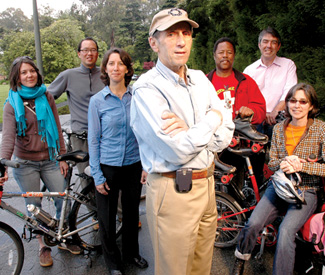
San Franciscans pedaled past an important milestone during yesterday’s Bike to Work Day: on the morning commute along Market Street, bicycles outnumbered cars for the first time. Traffic engineers counted 647 cyclists riding eastbound on Market near Van Ness from 8-9 a.m., or 54 percent of the total traffic. That number was also a 27 percent increase over last year’s bike tally. Bike advocates were thrilled with the turnout and further elated when Mayor Gavin Newsom, fresh off his ride to City Hall, announced his Bike SF 2010 Milestones. He promised to shepherd the bike plan to completion next year and ensure it studies 50 projects, including some key missing links in the current network. And to reach the plan’s goal of 10 percent of all vehicle trips being by bike by 2010, he promised to create 20 new bike lanes by then, reduce bike collision injuries by 50 percent, and to actively support so-called LOS reform, which could exempt many new bike projects from needing detailed environmental studies. It was a big day for bicycling and great first step to making San Francisco the greenest big city in the country.

Bikes rule!

0

Newsom and me on bikes.jpg
Me and Newsom at last year’s Bike to Work Day
By Steven T. Jones
San Franciscans pedaled past an important milestone during yesterday’s Bike to Work Day: on the morning commute along Market Street, bicycles outnumbered cars for the first time. Traffic engineers counted 647 cyclists riding eastbound on Market near Van Ness from 8-9 a.m., or 54 percent of the total traffic. That number was also a 27 percent increase over last year’s bike tally. Bike advocates were thrilled with the turnout and further elated when Mayor Gavin Newsom, fresh off his ride to City Hall, announced his Bike SF 2010 Milestones. He promised to shepherd the bike plan to completion next year and ensure it studies 50 projects, including some key missing links in the current network. And to reach the plan’s goal of 10 percent of all vehicle trips being by bike by 2010, he promised to create 20 new bike lanes by then, reduce bike collision injuries by 50 percent, and to actively support so-called LOS reform, which could exempt many new bike projects from needing detailed environmental studies. It was a big day for bicycling and great first step to making San Francisco the greenest big city in the country.

Tomorrow’s honorees

0

sft.jpg
By Steven T. Jones
Last night’s San Francisco Tomorrow 37th annual dinner on Fisherman’s Wharf offered a who’s who list of environmentally engaged political leaders and activists — a testament to the important role this venerable organization has played in creating the San Francisco of today (full disclosure: my sweetie, Alix Rosenthal, recently joined the SFT board).

Supervisors Chris Daly, Aaron Peskin, and Tom Ammiano all showed up, as did Sen. Carole Migden, Assessor Phil Ting, and Democratic Party stalwart Jane Morrison. Activists being honored by the group were filmmaker Judy Irving (who made “Wild Parrots of Telegraph Hill” and other films focus on SF urban environment), recycling scold and innovator Denise D’Anne, and Amy Meyer and Dr. Edgar Wayburn, who have worked for more than 30 years to create the Golden Gate National Recreation Area.

Yet to me, the most interesting award and resulting speeches were for the special award that Ammiano received for creating a universal health care program for the city, in the process braving aggressive attacks by downtown and finally winning over Mayor Gavin Newsom.

Newsom’s personal columnist

0

By Steven T. Jones
The Examiner’s Ken Garcia just loves to sneer at progressives and puff up Mayor Gavin Newsom, as he did again yesterday. In fact, this seems to be Garcia’s sole raison d’etre. Yet the problem with Garcia disguising his mayoral flackery as independent journalism is that some ill-informed readers might actually believe what he has to say, no matter no bogus his points or flawed his logic.

Why I’m with Carole Migden

0

OPINION With the election on the horizon, declared candidates have hired their campaign consultants, tested the field with expensive polls, and hit the city’s political club circuit hoping to lock up early endorsements. Unfortunately, the race getting the bulk of the attention is not San Francisco’s political watermark, November’s mayoral contest. It’s not even the new super-duper Tuesday presidential primary in February. As crazy as it may seem, the election getting the most attention in San Francisco right now is the June 2008 California State Senate primary.

After several months of polling and speculation, on March 2 Assemblymember Mark Leno announced that he would be challenging former ally and incumbent senator Carole Migden.

Make no mistake about it: Migden is one of the most fearsome politicians in Sacramento. She knows how to stand up to the governor, and she has a long list of progressive accomplishments, including authoring the state Clean Water Act, enabling local governments to do community choice aggregation, and protecting the vulnerable from predatory lending. Migden is already endorsed by progressive supervisors Jake McGoldrick and Gerardo Sandoval, progressive school board commissioner Eric Mar, former president of the Board of Supervisors Harry Britt, and progressive activists Debra Walker and Michael Goldstein. She’s also up double digits, so it’s time we call this one for Migden and get on with the job of putting a progressive in the Mayor’s Office.

Progressives know that to defeat Mayor Gavin Newsom this year, we will have to mount a significant and focused grassroots campaign. Any distractions will be costly. Migden-Leno is clearly a major distraction. Leno’s challenge takes both Leno and Migden off the progressive list of possible mayoral candidates. And more important, progressive energy, volunteers, and money that should be going into the effort to defeat Newsom will be gobbled up by the State Senate race.

Leno’s longtime political consulting firm, Barnes, Mosher, Whitehurst, and Lauter, is probably best known for its role in successfully challenging San Francisco’s soft-money regulations and then managing the record-shattering $3.2 million soft-money operation to reelect Mayor Willie Brown in 1999. BMW went on to help elect Newsom in 2003.

BMW not only provides the money and operations to get its candidates elected; the firm also — by its own proud account — seeks to influence these elected officials to get deals done for its corporate clients.

One of BMW’s biggest corporate clients is the Golden Gate Restaurant Association, which opposed San Francisco’s minimum-wage and paid-sick-leave laws and is now suing the city to stop it from enacting our universal health care plan. Progressives shouldn’t allow Leno and BMW to advance up the political ladder. *

Chris Daly

Supervisor Chris Daly represents District 6.

Next week: "Why we’re with Mark Leno," by Theresa Sparks and Cecilia Chung.

Editor’s Notes

0

› tredmond@sfbg.com

Sup. Chris Daly has kind of a cool idea: he wants to hold a progressive convention to pick a candidate and a platform for mayor. The date is June 2, from 10 a.m. to 5 p.m. The place is the Tenderloin Community School. The idea is for hundreds of grassroots activists to gather, nominate someone to take on Gavin Newsom, and kick off a citywide campaign that will, at the very least, force the carefully protected mayor to come out from behind his handlers and answer some tough questions.

Not everyone thinks this is a good concept — and I’m the first to agree it’s a bit of a risk. It assumes, for example, that there’s a serious candidate for mayor whom we can all agree on and who actually wants to run for the job. And it assumes that we all really want to put the effort into a full-scale campaign against an incumbent who looks pretty close to unbeatable right now.

Neither of these is a trivial issue.

In theory, a nomination convention is a chance for constituents to choose among candidates who are competing for the right to seek office. Four years ago, when we had Tom Ammiano, Angela Alioto, and Matt Gonzalez in the race, a convention would have been fun, if not terribly useful; none of those people would have dropped out in favor of another based on one convention vote. But right now there’s not a lot of competition: nobody who has the profile to launch a credible race has stepped forward and volunteered for the mission. And it would look pretty lame to have the People speak and call for a candidate who then took the stage and declined.

If this is going to work, the situation has to change in the next few weeks. The folks who really don’t want to see Newsom get a bye are talking, and one of them is going to accept the responsibility. Me, I’d be happy with Daly, Matt Gonzalez, Aaron Peskin, or Ross Mirkarimi, but Gonzalez isn’t ready to announce anything at this point, Peskin has told me he’s not going to run, Mirkarimi is being awfully coy, and Daly seems pretty reluctant (although he hasn’t ruled it out, he says he’ll do it only if nobody else will).

Not everyone thinks it’s even worth the fight. Paul Hogarth, writing in BeyondChron.org, argued May 14 that it’s better to save our energy and let Newsom be a weak lame duck for another five years. After all, he hasn’t been able to do much harm — and now and then, he does something decent.

The problem is that the city has serious problems, and it’s not OK for a mayor to be missing in action this long. Think about the murder rate. Think about Muni. Think about the future of blue-collar jobs, affordable housing, and the eastern neighborhoods. Think about the fact that in the next four years, the last big piece of land where San Francisco can preserve blue-collar jobs and build affordable housing will be up for grabs. Think about the city’s soul. Because it really is on the line here — and I’m not ready to hand it over to Newsom again without a fight. *

Newsom’s huge housing failure

0

EDITORIAL The single biggest issue facing San Francisco today is affordable housing. Nothing else even comes close. Housing costs are displacing, at a rapid pace, the people who make San Francisco such a great city — artists, writers, musicians, small-business owners and employees, families with kids, blue-collar workers, municipal workers, service-sector workers … basically, anyone who isn’t rich. And the vast majority of the new housing that’s getting built is selling at such high prices that it does nothing to help the situation.

That’s why it was crazy for Mayor Gavin Newsom to refuse to sign a modest $28 million affordable-housing allocation — and why the supervisors need to pursue this, push back, demand that the money be spent, and make it clear that Newsom’s budget proposals will be in trouble if it isn’t.

And this veto ought to be a huge issue in the mayor’s race.

It’s also why progressives need to start thinking big about how to address the housing crisis.

Let’s start with a simple fact: Newsom has done next to nothing for affordable housing in this city. All the important initiatives have come out of the Board of Supervisors and the nonprofits. He’s been willing to let private for-profit developers get away with giving the city only a pittance of affordable units in exchange for immensely valuable project approvals; only because the supervisors forced the issue has the city increased the inclusionary housing requirement. And it’s still way too little.

In fact, linking all affordable-housing money to market-rate projects is a losing game for San Francisco. Even if the city forced developers to make half of their new units affordable, that wouldn’t meet the current need as laid out in the city’s own documents. San Francisco’s General Plan states that two-thirds of all new housing built in this town needs to be below market rate.

Every time the city approves a major new project that’s (at best) 20 percent affordable, that ratio gets worse. If city officials keep approving projects with small set-asides, the city will continue to get richer, whiter, and more boring; the end game — a city population inching close to 80 percent millionaires — isn’t something anyone should consider acceptable.

The allocation Sup. Chris Daly proposed wouldn’t put more than a dent in the problem. But it would be money coming from the city’s General Fund, not money tied to more luxury condos — and that’s an important step. It reflects how the city needs to be thinking over the next few years.

Redevelopment money has funded affordable housing in the past, but much of that will run out soon. Finding other sources for the hundreds of millions of dollars San Francisco needs every year to even begin to keep pace with the need has to be a top priority — and Newsom and his opponent (and we’re convinced there has to be and will be a serious opponent) need to tell us where that money’s going to come from.

Meanwhile, San Francisco activists need to start looking at long-term planning priorities for housing that include some tight limits on how many new market-rate units can be built. Combining a cap on luxury condos and a new source of affordable-housing money can change the entire development equation in San Francisco.

And if Newsom won’t go along, then the supervisors need to make very clear that his budget is dead on arrival. *

Moving the bike plan forward

0

EDITORIAL It’s an odd year for Bike to Work Day: San Francisco is in the middle of an ambitious plan to improve the city’s bicycle infrastructure — and it’s utterly stalled. The city can’t add a single new bike rack, can’t add a single bicycle route sign, can’t take a single step to improve bike safety, and can’t move forward on any of the 60 projects that are in the hopper. Every single transportation improvement that involves bicycles is on hold for at least a year.

For that you can thank Rob Anderson, a dishwasher and blogger who thinks bikes are unsafe in the city and recently wrote on his blog that "if the Bike Nut Community (BNC) gets its way on city streets, traffic in the city will be made unnecessarily worse for everyone, with more air pollution as a result, as motorized traffic idles in traffic jams, squeezed into fewer lanes after the BNC creates bike lanes by eliminating traffic lanes and street parking."

The lone antibike nut filed a lawsuit claiming that the city’s bicycle plan lacked adequate environmental review, and in a departing slap at San Francisco, Judge James Warren signed off on an injunction blocking all bike improvements just before he retired. Now the city has to complete its entire plan — at least another year’s work — then complete an environmental impact report (EIR) on it, and then return to court to get the injunction lifted. It’s costing money and time, and it’s making it harder for what should be a safe, healthy, pollution-free method of transportation to pick up more adherents in what ought to be the nation’s most bike-friendly city.

But there’s not a lot anyone can do about Anderson and his pro-car crusade (yes, he says very clearly on his blog, district5diary.blogspot.com, that he’s pro-car and that "cars are a great invention, and they are here to stay"). In another year a judge will toss out this ridiculous injunction, and the city can get on with its planning.

But it’s critical right now that city hall not sit back and wait. The bicycle plan needs to be funded, and the project planning needs to continue moving forward at full speed, so that when the EIR is completed and the city is allowed once again to implement new programs, the projects will be ready to go. This lunatic lawsuit shouldn’t give Mayor Gavin Newsom an excuse to defund bicycle programs for the next year.

The truth is, thousands of additional people have begun to ride bikes to work over the past few years, and that’s had nothing but a positive impact on the environment. Bikes can and should be a central part of the city’s transportation infrastructure. That’s the lesson for Bike to Work Day. *

Out of downtown

0

› steve@sfbg.com

It wasn’t going well for Ted Strawser, predictably. The alternative transportation activist faced an uphill battle March 14 trying to convince a San Francisco Chamber of Commerce committee to endorse Healthy Saturdays, a plan to ban cars from part of Golden Gate Park.

Representatives of the park’s museums and Richmond District homeowners had just argued their case against the measure. “Visitors want access to our front door, and we want to give it to them,” Pat Kilduff, communications director for the Fine Arts Museums of San Francisco, indignantly told the group of two dozen business leaders gathered around a large conference table.

Strawser gave it his best shot: he talked about following the lead of other great cities to create car-free spaces; he said, “Golden Gate Park is one of the best parks in the nation, if not the world”; and he made a detailed case for closure. But around the table there were scowls, eye rolls, and other obvious signs that Strawser was being tolerated, not welcomed. Some — including chamber vice president Jim Lazarus — even started to interrupt and argue with him.

Then the man sitting next to Strawser spoke up. “I don’t think this is fair,” he said. And suddenly, everyone in the room shaped up. Strawser’s ally — his only supporter in the room — was somebody no chamber member could or would dismiss. Warren Hellman doesn’t shout or bang the table — but when he speaks, downtown pays attention.

Hellman, a prominent investment banker, told the committee members that he expected them to show the same respect for Strawser that they had for the previous two speakers. The nonsense ended, immediately.

And by the time Strawser turned the floor over to Hellman, the mood had changed. The group listened raptly, smiled, and nodded as Hellman spoke in his usual folksy, familiar, disarming style.

“It’s not a lot of fun when friends fall out,” he began, “because the previous speakers and many of you all agreed on the necessity of the garage [that was built in Golden Gate Park], and we worked together.”

He pointed out that many in the group had promised during the fall 2000 election to support Healthy Saturdays once the garage was built, although Hellman was now the only member of the coalition honoring that commitment. But he didn’t chide or shame his colleagues. That isn’t Hellman’s style.

Instead, he spoke their language. The garage has never been full and needs the money it can charge for parking to repay the bonds. This isn’t a fight that’s going away, since “part of the conflict is because this park is everybody’s park.” But there are “about 100 compromises not acceptable to either side that would move this forward.” And if a solution can’t be found, there will probably be an expensive ballot fight that nobody wants.

“My conclusion is we should attempt this test,” Hellman told the group. Ultimately, when the vote was later taken in secret, the chamber didn’t agree, although it did vote to back a trial closure after the California Academy of Sciences reopens next year.

At the meeting, Hellman openly called for Mayor Gavin Newsom to get involved in seeking a compromise, something Hellman said he had also just requested of the mayor at a one-on-one breakfast meeting. A couple of weeks later Newsom — who had already indicated his intention of vetoing the measure — did broker a compromise that was then approved by the Board of Supervisors.

As usual, Hellman didn’t take credit, content to quietly play a role in making San Francisco a better place.

Healthy Saturdays isn’t the most important issue in local history — but the significance of Hellman’s involvement can’t be underestimated. His alliance with the environmentalists and park advocates might even signal a sea change in San Francisco politics.

Warren Hellman represents San Francisco’s political and economic past. And maybe — as his intriguing actions of recent years suggest — its future.

This guy is a rich (in all senses of the word) and compelling figure who stands alone in this town. And even though his leadership role in downtown political circles has often placed him at odds with the Guardian, Hellman consented to a series of in-depth interviews over the past six months.

“Our family has been here since early in the 19th century, so we had real roots here,” Hellman told us. His great-grandfather founded Wells Fargo and survived an assassination attempt on California Street by a man who yelled, “Mr. Hellman, you’ve ruined my life,” before shooting a pistol and barely missing.

The Hellman family has been solidly ruling class ever since, rich and Republican, producing a long line of investment bankers like Warren.

Yet the 72-year-old comes off as more iconoclast than patrician, at least partly because of the influence of his irreverent parents, particularly his mother, Ruth, who died in 1971 in a scuba-diving accident in Cozumel, Mexico, at the age of 59. “She was entirely nuts,” Hellman said, going on to describe her World War II stint as a military flier in the Women’s Auxiliary Service Pilots and other colorful pursuits. “She just loved people, a little like I do. She collected people.”

Hellman grew up wealthy and cultured, but he also attended public schools, including Grant Grammar School and Lowell High School. In between, the young troublemaker did a stint at San Rafael Military Academy — “reform school for the rich,” as he called it — for stunts such as riding his horse to Sacramento on a whim.

After doing his undergraduate work at UC Berkeley, Hellman got his MBA from Harvard and went on to become, at the age of 26, the youngest partner ever at the prestigious Manhattan investment firm Lehman Bros. He developed into an übercapitalist in his own right and eventually returned home from New York and founded Hellman and Friedman LLC in San Francisco in 1984, establishing himself as the go-to financier for troubled corporations.

“He is really one of the pioneers of private equity,” said Mark Mosher, a longtime downtown political consultant and the executive director of Gov. Arnold Schwarzenegger’s California Commission on Jobs and Economic Growth, on which Hellman sits.

Hellman became what Business Week called “the Warren Buffett of the West Coast,” a man of extraordinary wealth and power. Among other accomplishments, Hellman took Levi Strauss private, recently made billions of dollars in profits selling DoubleClick to Google, and manages the assets of the California public employee retirement funds (CalPERS and CalSTRS), which are among the largest in the world.

Like many financial titans, Hellman has always been a generous philanthropist, giving to the arts, supporting schools in myriad ways, and funding the San Francisco Foundation and the San Francisco Free Clinic (which his children run). He vigorously competes in marathons and endurance equestrian events, often winning in his age bracket. And he has his humanizing passions, such as playing the five-string banjo and creating the popular Hardly Strictly Bluegrass festival.

But he’s also been a prime facilitator of downtown’s political power, which regularly flexes its muscle against progressive causes and still holds sway in the Mayor’s Office and other city hall power centers.

Hellman founded, funds, and is a board member of the Committee on Jobs, which is perhaps the city’s most influential downtown advocacy organization. Hellman and his friends Don Fisher, the founder of the Gap, and Sen. Dianne Feinstein also started SFSOS, which now wages the most vicious attacks on left-of-center candidates and causes.

When the de Young Museum and other cultural institutions were threatening to leave Golden Gate Park, Hellman almost single-handedly had an underground parking garage built for them, in the process destroying 100-year-old pedestrian tunnels and drawing scorn from the left. The Guardian called it “Hellman’s Hole.”

“We at the Bike Coalition very much started out on the opposite side of Warren Hellman,” San Francisco Bicycle Coalition executive director Leah Shahum told us. “We couldn’t have been more like oil and water on the garage issue.”

But over the past two years or so, Hellman’s profile has started to change. He went on to become an essential ally of the SFBC and other environmentalists and alternative transportation advocates who want to kick cars off JFK Drive in Golden Gate Park on weekends, crossing the downtown crowd in the process. He has shared his wealth with progressive groups such as Livable City, which often fights downtown, and has stuck up for edgy fun seekers over more conservative NIMBY types. He has also publicly repudiated the attacks of SFSOS and its spokesperson, Wade Randlett, and withdrawn his support from the group.

Hellman is still a Republican, but a thoughtful and liberal-minded one who opposed the Iraq War and wrote an article for Salon.com in February titled “If the United States Were a Company, Would George Bush Be Our CEO?” (His answer: hell no.) And to top it all off, Hellman sports a few tattoos and even attended 2006’s Burning Man Festival and plans to return this year.

Unguarded and reflective, Hellman’s comments to the Guardian foreshadow the possible future of capitalism and influence in San Francisco and point to potential political pathways that are just now beginning to emerge.

Our first conversation took place at the Guardian office two weeks before the November 2006 election, when it was starting to look like Nancy Pelosi had a good shot at becoming speaker of the House of Representatives.

“I think this election in two weeks is going to be really interesting,” Hellman told us.

This Republican was cheering for the Democrats to win. “They aren’t my kind of Republicans,” he said of the people in power. Hellman didn’t support the war or approve of how the Bush administration sold it, and he wanted Pelosi and the Democrats to hold someone accountable.

“What I’d like her to do is admit that we can’t get out [of Iraq immediately], but start to talk about what the fallout has been. Discuss the enormous cost in human life as well as money, and how it’s possible the war united the Middle East against us,” Hellman said.

The one thing he can’t abide is disingenuousness. Hellman speaks plainly and honestly, and he asked us to keep particularly caustic comments off the record only a few times during almost six hours’ worth of interviews. He was self-effacing about his political knowledge and seemed most interested in working through the problems of the day with people of goodwill.

Asked what he values most in the people he deals with, Hellman said, “It’s authenticity. Do they believe things because they believe in them, or do they believe in things because they’re cynical or they’re just trying to gain something?”

Locally, Hellman has reached out to people with varying worldviews and come to count many friends among those who regularly battle against downtown.

“I love to know people,” he said. “That’s probably the single thing that motivates me. When someone says to me, ‘How can you be friends with [then–head of SEIU Local 790] Josie Mooney?’ I say, ‘Look, I want to know Josie Mooney. And if she’s awful, then we won’t be friends.’ I’m just fascinated by getting to know people. And virtually always, they’re a little like Wagner operas: they’re better than they sound.”

Hellman was the chair of the Committee on Jobs when he got to know Mooney, who chaired the San Francisco Labor Council and was a natural political adversary for the pro-business group, particularly when Hellman was leading the fight to do away with the city’s gross receipts tax, which has proved to be costly for the city and a boon for downtown.

But after that victory, Hellman turned around and cochaired a campaign with Mooney to retool and reinstate the gross receipts tax in a way that he believed was more fair and helped restore the lost revenue to the city.

“We lost, but he put $100,000 of his own money into that campaign,” Mooney told us, noting that the proposed tax would have cost Hellman and Friedman around $70,000 a year. “I think he just thought the city needed the money. It was a substantive point of view, not a political point of view.”

Mooney considers Hellman both a friend and “an extraordinary human being…. He has made a huge contribution to San Franciscans that doesn’t relate to ideological issues. A tremendous thing about Warren is he’s not ideological, even in his political point of view…. On politics, I’d say he is becoming more progressive as he understands the issues that confront ordinary people.”

Mooney is one of the people who have helped bring him that awareness. When they first met, Mooney said, Hellman told her, “You’re the first union boss I ever met.” That might have been an epithet coming from some CEOs, but Hellman had a genuine interest in understanding her perspective and working with her.

“In a sense, I think that was a very good era in terms of cooperation between the Committee on Jobs and other elements of the city,” Hellman said. “Josie and I had already met, and we’d established this kind of logic where 80 percent of what we both want for the city we agree on, and 20 percent [of the time, we agree to disagree].”

Committee on Jobs executive director Nathan Nayman — who called Hellman “one of my favorite people in the world” — told us that Hellman feels more free than many executives to be his own person.

“He’s not with a publicly held company, and he doesn’t have to answer to shareholders,” Nayman said. “He takes a position and lives by his word. You don’t see many people like him in his income bracket.”

Hellman has become a trusted hub for San Franciscans of all political persuasions, Nayman said, “because he’s very genuine. He’s fully transparent in a city that likes to praise itself for transparency. What you see is what you get.”

Hellman expects the same from others, which is why he walked away from SFSOS (and convinced Feinstein to bolt as well) in disgust over Randlett’s scorched-earth style. Among other efforts, SFSOS was responsible for below-the-belt attacks on Sups. Chris Daly, Jake McGoldrick, and Gerardo Sandoval (whom a mailer inaccurately accused of anti-Semitism).

“If all things were equal, I’d just as soon that SFSOS went away,” Hellman said. “SFSOS started doing the opposite of what I thought they would be doing, so it was fairly easy for me to part company with them. What I thought we were doing is trying to figure out ways to make the city better, not just being an antagonistic, nay-saying attack organization. I’m not a huge fan of Gerardo Sandoval, but I thought the attacks on him were beyond anything I could imagine ever being in favor of myself. And it was a series of things like that, and I said I don’t want anything more to do with this.”

Downtown, they’re not always quite sure what to make of Hellman.

“Every once in a while, he does things that irritate people who are ideologically conservative,” Mosher said. “He took an immense amount of heat for supporting the Reiner initiative [which would have taxed the rich to fund universal preschool].”

He’s given countless hours and untold riches to public schools, doing everything from endowing programs to knocking on doors in support of bond measures and often pushing his colleagues to do the same.

“My connection to him has been through the school district, and he’s really been a prince,” Sup. Tom Ammiano said. “He has even stopped calling me antibusiness. He put a lot of his energy into improving public education, and so he shows it can be done.”

Progressives don’t always agree with Hellman, but they feel like they can trust him and even sometimes win him over. “If you get a relationship with him and you’re always honest about the facts and your own interests, he will listen, and that’s pretty remarkable,” Mooney said. “He shows a remarkable openness to people who have good ideas.”

His appreciation for people of all stripes often causes him to reject the conventional wisdom of his downtown allies, who viciously attacked the Green Party members of the Board of Education a few years ago.

“Everybody said, ‘Oh my god, Sarah Lipson, you know, she’s a Green Party member, she’s the furthest left-wing person on the board,’ blah, blah, blah,” he said. “And I phoned her up one day and said, ‘I’d really like to meet you.’ And she’s — leave aside the fact that I think she’s a very good person as a human being, but she’s a very thoughtful, analytic person. Listening to her opinions about things that are happening in the school district, I really respect that. I mean, what do I know about what’s going on in the school district? I know more now than I did then. But just getting to know people, and maybe get them to understand my point of view, which isn’t that penetrating.”

Many of his efforts have received little publicity, as when he saved the Great American Music Hall from closure by investing with Slim’s owner Boz Scaggs and helping him buy the troubled musical venue. “There are things that you and I don’t even have a clue that he has done,” Nayman said.

“He’s an interesting guy,” Mosher said. “He’s one of a dying breed, a liberal Republican. He has a social conscience and wants to use his money to do good.”

Actually, calling Hellman liberal might be going too far. In the end, he’s still very much a fiscal conservative. He doesn’t support rent control, district elections for the Board of Supervisors, taxing businesses to address social problems such as the lack of affordable health care, or limits on condo conversions.

He also opposes the requirement that employers provide health care coverage, which downtown entities are now suing the city to overturn, telling us, “In general, I don’t think it’s a good idea, because I’m still, even in my aging years, a believer that the marketplace works better than other things…. Universal health care I do believe in, but what I worry is that it’s going to be another damned bureaucracy and that it’s not going to work.”

Yet he doesn’t believe wealth is an indicator of worth, saying of his fortune, “It is luck. Most of what you do you aren’t better at than everyone.”

He doesn’t believe in the law of the jungle, in which the poor and weak must be sacrificed in the name of progress. In fact, he feels a strong obligation to the masses.

As he told us, “My mantra for capitalism — and I didn’t invent this, but I think it’s pretty good — is that capitalism won, and now we need to save the world from capitalism.”

Hellman looms large over downtown San Francisco. His Financial District office offers a panoramic view of the Bay Bridge, Treasure Island, the Ferry Building, and the rest of the city’s waterfront. He likes to be personally involved with his city and the companies in which Hellman and Friedman invests.

“Usually I’m directly involved,” he told us in an interview earlier this year. “I’ve always said that I don’t like to go to the racetrack to just look at the horses. The fun of being a principal is that you’re standing at the track and not saying, ‘Gee, that’s a beautiful gray horse.’ You’re saying, ‘Come on, he’s got to win!’ So I’m almost always invariably invested in the companies that we work with, either individually or through the firm.”

Unlike many Wall Street barons who strive to control a company and bring in new executives, flip it for a quick profit, or liquidate it, Hellman said his firm tries to identify solid companies and help facilitate what they do. “We don’t usually take over companies. I always think that we provide a service to help the businesses,” he said. “Our job is kind of the opposite of owning a factory. Our job is to be sure the people who run the business feel like it’s their business.”

Similarly, he thinks capitalists need to feel a sense of ownership over society’s problems, something he thinks is taking root in San Francisco and other economic centers, particularly among the younger generations. “It’s about understanding how much suffering there is on the other side and trying to figure out how that suffering can be alleviated,” he said. “I think it’s partly good economics that as you bring people up, they’re able to do more for society. If nothing else, they’re able to buy more and shop at a Wal-Mart or something — probably someplace you would wildly disapprove of — and buy goods and services. But I don’t think it’s that narrow.”

Rather, he believes that everyone has a little progressive in them, a little desire to cooperatively solve our collective problems rather than pass them off to future generations. He sees a marked change from his days at Lehman Bros.

“Everybody was into making it,” he said, noting that many capitalists then did charity work as a means of attaining social status but focused mostly on the accumulation of wealth. But, he said, the new generation of capitalists seems genuinely interested in improving the world.

“The feeling for giving back in the next generation, in the now 25- to 35-year-olds, it’s just an order-of-magnitude difference than it was for people who are now in their 40s and early 50s,” Hellman said. “I’m very encouraged.”

Yet the flip side is that, in Hellman’s view, downtown doesn’t wield as much power as it once did. Low political contribution limits have made politicians less dependent on downtown money, creating fewer shot callers, while democratizing tools such as the Internet have broadened the political dialogue.

“For the last 30 years we have become an increasingly tolerant city, and that’s great,” he said. “In the old days, [the Guardian] complained about downtown, and yeah, no shit, downtown really did control the city. The benefit was as that slipped away, the city became fairer and more open to argument. So now downtown hardly has any power at all anymore. In a sense, that’s a good thing. Tolerance grew tremendously when the city wasn’t dictated to.”

That tolerance caused street fairs to pop up all over town and festivals such as Hellman’s Hardly Strictly Bluegrass to blossom in Golden Gate Park. Bike lanes have taken space from cars, events such as Halloween in the Castro have gotten crazier, street protests have gotten bigger and more frequent, and people have felt more free to fly their freak flags. And all that freedom eventually triggered a backlash from groups of isolated NIMBYs who complain and often find sympathetic ears at city hall.

“Sometimes you get the feeling in this city that in the land of the tolerant, the intolerant are king,” said Hellman, whose festival has endured noise complaints even though the music is shut off by 7 p.m. “There is a continuing pressure to do away with fun, because fun is objectionable to someone, [but] we need to think about not creating a new dictatorship of a tiny group of people whose views are not in line with the opinion of most of the people of San Francisco…. You should try to balance the good of a lot of people versus the temporary annoyance of a few people.”

Preserving fun and a lively urban culture is a personal issue for Hellman, who plays the five-string banjo and calls his festival “the most enjoyable two days of the year for me.” He helps draw the biggest names in bluegrass music and acts like a kid in a candy shop during the event.

“I feel very strongly that an important part of our culture is built on the type of music and type of performance that goes on at Hardly Strictly Bluegrass,” Hellman said. From parables set to music to songs of struggle and the old union standards, “that kind of music is the conscience of our country.”

He considers bluegrass a vital and historically important form of political communication, more so than many of the upscale art forms that the rich tend to sponsor. “I’m glad that we have first-rate opera, but it’s equally important that we foster the kind of music, lyrics, etc., that support all this,” he said. “Somebody once said that most of the great Western philosophy is buried in the words of country songs. And that’s closer to the truth than most people think. A big passion of mine is to try to help — and people have defined it too narrowly — the kinds of music that I think have a hell of a lot to do with the good parts of our society.”

Perhaps surprisingly for a Republican venture capitalist from the older generation, Hellman also considers the countercultural freaks of San Francisco to be some of the “good parts of our society.” That’s why he attended Burning Man for the first time last year and why, he said, he loved it, as much for the culture and community as for the art.

“I went to Burning Man because as much as possible I want to experience everything,” he said. “I want to just see directly what it’s like. I knew I’d enjoy it. I never doubted that. But what really overwhelmed me is it was 40,000 people getting along with each other. I mean, it’s pretty intense. There were dust storms and the world’s most repulsive sight: nude men over 70 just dangling along. But I never saw an argument. It was 40,000 people just enjoying each other.”

It was most striking to Hellman because of the contrast with the rest of society. As he said, “I’ve never seen this country so divided.”

While Hellman supports Schwarzenegger — calling him “a good advertisement to California” — he has nothing good to say about his fellow Republican in the Oval Office. He calls Bush’s tenure “an absolute four-star disaster.” The invasion of Iraq is the most obvious problem, he said. “Our war policy has slowly veered from being ‘Don’t tread on me’ to we’re going to jump on your neck.”

But his antipathy to certain aspects of the Republican Party began even earlier, when the religious right began to take over.

“I thought we were not that polarized during the Clinton administration. I was somewhat encouraged,” Hellman said. “Maybe there was an undercurrent of strident religious behavior or strident conservatism, but not the conservatism that I think the Republican Party used to stand for, which was fiscal conservatism instead of social conservatism. Somehow, there was this angst in this country on the part of religious people who I guess felt this country was being taken away from them, and they were the kind of stalwart or underpinnings of society. And they took it back.”

But in the wake of that disaster, Hellman thinks, there is an opportunity for reasonable people of goodwill to set the future political course. As Nayman said of Hellman, “He does believe there is a middle way pretty much all the time.”

Politically, that’s why Hellman gravitates toward the moderates of both major parties, such as Schwarzenegger and Newsom. He looks for people who will marry his economic conservatism with a regard for things such as environmentalism and social justice.

“It’s very tough to be a big-city mayor,” Hellman said. “[Newsom is] probably the best mayor we’re entitled to. He’s got this fantastic balancing act.”

Hellman said downtown hasn’t been terribly happy with Newsom for supporting striking hotel workers, getting behind Ammiano’s health insurance mandate, supporting tax measures, and generally letting the Board of Supervisors set the city’s agenda for the past two years.

“Their measure is he has 80-percent-plus popularity, and he ought to spend some of it. Well, they might not agree with what he would spend it on. And he’s been unwilling to spend very much of it. In some parts of the business community there is disappointment with him, but I don’t think that’s right. He didn’t hide what he would be like.”

What Newsom said he would be — a big reason for his popularity — is a mayor for the new San Francisco, a place where the city’s traditional economic conservatism has been tempered by a greater democratization of power and an ascendant progressive movement that expects its issues to be addressed.

“I don’t like people who are intolerant,” Hellman said. “I don’t like people that are telling you something to get some outcome that, if you understood it, you probably wouldn’t want. I like people that are passionate.”

Asked, then, about Sup. Chris Daly, the nemesis of downtown and most definitely a man of strong political passions, he said, “I admire Chris Daly. I disagree with Chris on a lot of things he believes, but there are also probably a lot of things I would agree with Chris on. And I respect him.”

Hellman is the rare downtown power broker who wants to bridge the gap between Newsom — whom he calls a “moderate to conservative establishment person” — and progressives such as Daly, Mooney, and the Bicycle Coalition. The middle ground, he said, is often a very attractive place, as it was with Healthy Saturdays.

“I’m sure you spend time in the park on Sunday, and it’s a hell of a lot nicer in there on Sundays than Saturdays,” Hellman said. But even more important to him, this is about integrity and being true to what Golden Gate Park garage supporters promised back in 2000.

“They were proposing Saturday closing at that time, which I’ve always thought was a good idea,” he said. “And we made a commitment to them, or I thought we made a commitment to them, that let’s not have Saturday closure now, but as soon as the garage was done, we’d experiment with Saturday closure.”

We brought up what Fine Arts Museums board president Dede Wilsey has said of that pledge, that it was under different circumstances and that she never actually promised to support Saturday closure after the garage was completed.

“There’s a letter. She put it in writing,” he said of Wilsey. “She signed a letter on behalf of the museums saying that when the de Young is done, we should experiment with Saturday closings.”

The Bike Coalition’s Shahum said that even when Hellman was an enemy, he was a reasonable guy. But it’s in the past couple of years that she’s really come to appreciate the unique role he plays in San Francisco.

“He showed decency and respect toward us,” she said. “We never saw him as a villain, even though we disagreed completely. Later he really stepped up and has been a leader on Healthy Saturdays. And what I was most impressed with is that he was true to his word.”

Supervisor McGoldrick, who sponsored the measure, echoed the sentiment: “Hellman was certainly a man of his word who acted in a highly principled way.”

So why does Hellman now stand apart from the downtown crowd? Has he parted ways with the economic and cultural power brokers who were once his allies?

No, he said, “I think they parted ways with me.” *

 

Stationary biking

0

› steve@sfbg.com

This year’s Bike to Work Day, set for May 17, comes as San Francisco’s cycling network lies dormant in a court-imposed coma. The city isn’t allowed to make any physical improvements to promote safe bicycling until late next year at the earliest, more than two years after the injunction began. Yet that setback could be followed by the most rapid expansion of bike lanes in the city’s history.

At issue is the San Francisco Bicycle Plan and its stated goal of making "bicycling an integral part of daily life in San Francisco." City resident Rob Anderson and attorney Mary Miles don’t share that goal — particularly when it translates to taking lanes and parking spaces from cars — and they challenged the plan in court last year after it won unanimous approval from the Board of Supervisors and Mayor Gavin Newsom.

Ironically, this environmentally benign mode of transportation was attacked under the state’s landmark California Environmental Quality Act (CEQA), which requires detailed studies of projects that might have impacts on the environment and measures that can be taken to offset those impacts.

City officials and bike advocates were shocked last June when Judge James Warren — in his final ruling before his retirement — issued a sweeping injunction against bike projects in the city, which was upheld and reinforced when Judge Peter Busch heard the case in September.

The judges found that city officials had taken an impermissible shortcut around CEQA by claiming the bike plan was exempt from its strictures. As the plan was being developed, some bike advocates and city officials had called for more resources to be put into doing the detailed studies CEQA calls for, and that’s what now appears to be happening.

"The good thing about the lawsuit is it is forcing the city to do the traffic analysis that it should have done with the bike plan and it reveals the absurdity of our interpretation of environmental laws," Dave Snyder, the former executive director of the San Francisco Bicycle Coalition (SFBC), who is now a planner with the San Francisco Planning and Urban Research Association, told the Guardian.

Now city planners and consultants are preparing environmental impact reports (EIRs) on up to 60 proposed bike projects in the city, which will be queued up and ready to begin once the bike plan is approved. "The projects can be approved all at once," Snyder said.

At least, that’s what could happen if the city’s political leaders don’t lose their will to create a more bicycle-friendly city.

Oddly enough, it was the vague, feel-good nature of the plan that created all the problems.

Cities are required to have a bike plan, updated every five years, to qualify for certain state funding. San Francisco did its first plan in 1997, and in 2001 transportation officials and bike advocates set out to develop an updated version.

From the beginning, there were divisions between those who wanted to focus on completing the bike network with ready-to-go projects and those who wanted a more comprehensive and innovative plan laying out policies for education, enforcement, safety, new traffic models, integration with public transit, and everything else associated with cycling.

Responsibility for developing the plan was shared by the Metropolitan Transportation Authority (MTA), the San Francisco Planning Department, and the San Francisco Department of Parking and Traffic, with significant input from the city’s Bicycle Advisory Committee, the SFBC, and other groups. For reasons of expediency, the decision was made to focus on a relatively vague plan, one that made all sorts of high-minded statements and offered lofty goals.

The plan was presented as an effort to radically transform the roadways to make bicycling a more attractive option, but it didn’t include the detailed transportation analysis needed to support that effort — nor did it draw any conclusions about which car spaces to give over to bikes.

"The plan makes no decisions…. The plan has no measurable objectives anywhere in it," Snyder said, noting that the vague nature of the final product was the reason it was so uncontroversial. "Anytime anything passes unanimously, you know you didn’t ask for enough."

Andy Thornley was chair of the Bicycle Advisory Committee when work on the plan got under way and now serves as program director for the SFBC, which was heavily involved on outreach for the plan. SFBC officials were shocked by the injunction but said the city should have devoted more resources to the project.

"It was a logical outcome to the city’s undercommitment to the bike plan," Thornley said of the lawsuit. "There wasn’t the commitment from the mayor on down to doing this right."

"We had discussions about what it means that the plan doesn’t have any benchmarks," said Leah Shahum, executive director of the SFBC and a member of the MTA board. Sure, it had the goal of having 10 percent of all vehicle trips be by bicycle by the year 2010. "Only later did we realize that the 100 pages behind it didn’t support that goal."

MTA public affairs managers wouldn’t allow the Guardian to speak directly to Oliver Gajda, the main staffer on the bike plan then and now. They required questions in writing and answered the one about lack of city support for the initial plan by writing that "the court’s decision was not based on resource issues."

Newsom’s press secretary, Nathan Ballard, also resisted admitting that the city did anything wrong, responding in writing to a written question by saying, "Actually, the City moved forward drafting and implementing this bike plan quite ambitiously, even though there was a risk it would be challenged in court."

Yet it was clear to all involved that doing the traffic analysis and other work would have headed off the injunction.

"Dave Snyder was always an advocate that the bike plan should be a bike plan and lay out what we’ll see for bicyclists," Tom Radulovich, executive director of Livable City, told the Guardian. "But the decision was made to do a bike plan in the abstract, not laying out specific routes."

Nonetheless, bike advocates say they’re happy with the commitment that city officials are now showing. "Now we’re clearly and unequivocally doing a bike plan," Radulovich said. "To some degree, the city has had to commit itself."

Bevan Dufty, chair of the Transportation Authority’s Plans and Programs Committee, has been demanding that bureaucrats report to him regularly to show progress on the plan.

"I think the fact that we’re seeing them regularly trotted out before the committee is a good thing, because it makes them hit their benchmarks," he told us.

Dufty also overcame the MTA’s restrictive approach to public relations and facilitated our interview with Peter Albert, who took on the job of deputy director of planning for the MTA 10 months ago.

"Right now we’re just looking to do the environmental review to clear the bike plan," Albert told us.

He said that staff and consultants are now going through 60 proposed projects to determine what their environmental studies will entail. Later this month that work will be presented during a scoping meeting, at which planners and advocates will decide whether some of the more complex projects will be eliminated from the plan.

"Our goal is to make sure this is as solid an environmental review as possible. We don’t want to deal with any more legal issues," Albert said. "I feel right now there is a huge will to have this done correctly."

Yet advocates have a slightly different view of that political will, particularly given the projection of completed EIRs by July 2008, followed by the approval process, and maybe more court fights.

"We’re not crazy about the timing, but the scope is good. We’ve moved to projects that we’re planning to do," Thornley said. "So, in a backwards way, the commitment has come to the plan from the gun of the injunction."

"But we have real concerns about the timeline and scope getting shrunk," Shahum said. "Our fear is that we’ll go from 60 projects down to 16."

That’s because the plan will now look at the physical changes to roadways that are bound to get controversial once neighborhood groups grapple with the idea of losing traffic lanes or parking spaces.

"You’ve got a lot of people who are afraid of NIMBY opposition, and that goes from the mayor and the supervisors to the bureaucrats working on the plan," Shahum said. She added that the political leadership of San Francisco is more supportive of bicycling than it’s ever been, "but you still have to work really hard for them to do the right thing in the end."

"Why did it take four years to get the Valencia Street bike lanes?" she asked, noting that the project has proved to be an unqualified success.

"They changed Valencia Street, and nothing [bad] happened, so that opened them up a little," Radulovich said of city officials. But only a little. "There is still a certain ad hoc quality to what they’re doing, rather than being standards-based in how streets are designed."

City policy regarding bike projects — which the Planning Commission will revisit this summer when it considers changes to how it interprets traffic level-of-service (LOS) impacts under CEQA — is that anything that slows car traffic is considered a significant environmental impact that requires extensive study and mitigation.

"It’s imperative for them to fix the way they do CEQA," Radulovich said. "LOS reform would help us in future projects."

Radulovich said that most California cities were built with a focus on automobiles before CEQA was even approved. Yet the law now requires expensive and time-consuming studies before those spaces can be converted to use by public transit, bicycles, or pedestrians.

"That’s why, in some ways, CEQA has become an impediment to making us environmentally sustainable," Radulovich said. "It’s turned into a tool that slows down the taking of spaces back from cars."

While the detailed EIR work is being done, Albert and others say the city is still committed to doing bicycling planning work, applying for grants, and making sure San Francisco can move forward quickly once the injunction is lifted. "We’ve been set back, but we’re not stopped," he told us.

"The current injunction is frustrating because we want to be moving forward with bike improvements each month. While we cannot make physical changes such as bike lanes and bike racks, planning and design are continuing," Ballard said, also noting that the Mayor’s Office is doing regular conference calls to ensure the bike plan moves forward quickly.

"I and the bike advocates are pushing to use this time to do the planning work so we’re ready to go once we have an approved plan," said Sup. Chris Daly, the only regular cyclist on the Board of Supervisors. Once the injunction is lifted, he said, "You will have the most rapid striping of bike lanes in the history of the city." *

The War on WiFi

0

By Sarah Phelan

images-war lies.jpg

Mayor Gavin Newsom’s tactics to push through a Google Earthlink Wifi franchise are beginning to look a lot like Bush’s efforts to invade Iraq: only this time the invasion is of Internet privacy, the big lie is that the Google Earthlink deal will bridge the digital divide, and critics of the deal are being smeared as racists.

Nothing of course could be further from the truth behind why the Board has been questioning Newsom’s Google-Earthlink deal for years, but trying getting that message through when the Mayor’s PR machine is set on a deafening pre-election spin cycle of false messaging.