Mayor

596 reasons not to make $150K in San Fran

0

Here’s something juicy: a PDF file that lists the 596 people who work for the City of San Francisco and earn over $150,000 a year.

imagesramen.jpg
Imagine how many packets of Ramen you could buy if you made over $150K a year? Better yet, imagine what you could eat, instead?

This list was procured following Sup. Aaron Peskin’s announcement that he wants to eliminate such positions, unless they are absolutely essential, rather than simply slash and burn from the bottom up, as Mayor Gavin Newsom appears to be proposing.

As it happens, most of these jobs are safe from cuts, thanks to a bunch of charter mandates that say, the City needs department heads, and lawyers and doctors.

But the list makes for interesting reading especially if you are sitting in a cramped apartment, huddled over a space heater and eating Ramen noodles for the 596th time!

Closing time

0

› amanda@sfbg.com

The sign on the door speaks the truth to the 200 people who pass through it everyday: "Buster’s Place/13th Street Drop-In will be permanently closing Monday March 31 at 5 p.m."

Will, a trim, soft-spoken man seated inside Buster’s on a Monday afternoon, reading a paper and waiting for his laundry to finish spinning, says that starting April 1, "The street is going to be where I go. The Safeway sink is going to be my shower."

Buster’s Place, a homeless services facility run by Haight Ashbury Free Clinics, is on Mayor Gavin Newsom’s midyear budget chopping block. But recently passed legislation says the city must provide a 24-hour drop-in center accessible to anyone. On March 18, the Board of Supervisors, by a vote of 9-2, passed "standards of care" mandating that all city-funded homeless shelters meet a basic level of sanitation and service, stocking facilities with toilet paper, soap, and nutritious food, as well as keeping at least one open 24 hours a day for anyone to walk in the door. (See "Setting Standards," 1/30/08 and "Shelter Shuffle," 2/13/08.)

Newsom tacitly supported the new law, but took issue with the $160,000 price tag — which does not include the $1 million it takes to run Buster’s for a year.

The Human Services Agency plans to temporarily fill Buster’s void with 150 Otis, a city-owned building across the street where storage and shelter reservations are provided for homeless people. In the past, it’s been an emergency shelter for men, but it is only permitted to operate nine months out of the year. On April 1 it will reopen with about 30 beds and 30 to 40 chairs — all for men — and will only be open until June 30, the end of the fiscal year. HSA did not respond before press time to multiple requests for more details on the plan.

Beyond trying to fix a permanent problem with a temporary solution, 150 Otis will be a shadow of Buster’s.

"Buster’s definitely handles more than 30 to 40 people a night," said the Department of Public Health’s David Nakanishi. On March 20, for example, Buster’s staff reported to Nakanishi that 98 people were on-site at 3 a.m. — 90 males and eight females. They also reported 30 people at 3 p.m. and 80 at 8 p.m.; 90 was the average between midnight and 7 a.m. Overall, the staff sees 150-200 people a day.

The drop-in center is often the first place a newly homeless person goes for help. But now those people — especially women — will have one less option.

Buster’s manager, Carolyn Akbar, has been telling clients to go to the Free Clinics’ Oshun Center, which has 24-hour drop-in services for women. But, she said, "A lot of women don’t like to go there because it’s right in the heart of the Tenderloin."

Funding for 150 Otis is coming from an HSA budget surplus. "They’re not saving any money. They said as much at the budget hearing," said Sup. Chris Daly.

Already, other city-funded facilities are feeling the strain of one less helping hand. The Mission Neighborhood Resource Center has many of the same services as Buster’s, but is only open weekdays and already operating at capacity. Still, "I’m seeing my numbers spike up," said director Laura Guzman. Contracted to serve 100 people a day, her staff tries to keep the number under 200, but lately it’s been closer to 250. "We had an incidence of violence last week as a result of more people in the facility," Guzman said. Guzman called drop-in facilities "critical players in our system of care. "When everything else fails, the drop-in is there."

Necessities like showers, laundry, restrooms, telephones, and access to medical and dental services can be found at Buster’s. Also, unlike any of the 15 other city-funded places for homeless people, it’s open 24 hours a day, seven days a week, and is "low threshold," meaning there are no basic requirements to come in.

Nakanishi listed several reasons why a drop-in center aids in overall public health, from preventing deaths on the street to providing a place to take a shower and use the bathroom. A Request for Proposals put out by DPH to continue the 24-hour drop-in services next year is also on hold, shaving a slim million from the city’s budget.

Tenderloin Health, which operates a drop-in center on Golden Gate Avenue, was one of the respondents to DPH’s RFP for a 24-hour center and said it was more than willing to extend operating hours past the current 11:30 p.m. closing time.

"The funding was pulled the same day we submitted the proposal," said Colm Hegarty, director of development for the nonprofit. "We would do it. Our proposal was very specific."

Drop-in centers have been criticized as places where people hang out and avoid the shelter systems and services they provide, but that was never the intention for Buster’s, which has only been open for 13 months. "The program was designed to really have around the clock case management," said Nakanishi, who wrote the RFP.

Akbar said Homeless Outreach Team officers were supposed to be working with center staff to move people deeper into the care system, but she’s been told they’re too busy working with people on the streets.

Which is what Buster’s is all about. Most of the people still on the streets aren’t interested in doing something to change their situations, points out Keith Bussey, deputy director of integrated health services for the Haight Ashbury Free Clinics. "But people who come into a drop-in are in that pre-contemplative stage of change. They’re venturing inside for maybe the first time."

Will is unequivocal about Buster’s proposed replacement: "Not 150 Otis. I don’t want anything to do with 150 Otis because of the people who work there." Claiming he’s received rude treatment there too many times, Will even stopped using the storage facility there. Middle-aged and homeless in San Francisco for the past couple of months, he sleeps outside and after two stays in the city’s shelters said, "Never again."

"Ultimately it’s going to hurt the city," said Hegarty of the closing. "You’ll see more of a presence on the streets. People will want to see something done about it, so there will be more police responding. The criminal justice system is going to become burdened. The emergency room at San Francisco General is going to become burdened. People will go anywhere they can just to get off the streets."

Don’t stop the torch protests

0

EDITORIAL We (almost) sympathize with Mayor Gavin Newsom: The Olympic torch is a political nightmare. House Speaker Nancy Pelosi is pushing in one direction; Senator Dianne Feinstein is pushing in another. The local Chinese community is far from unanimous — many residents are proud of the Beijing Olympics and don’t want politics to mar the celebration, while others think the Chinese government’s actions in Tibet are inexcusable and need to be publicized. The mayor has tried to split the difference, welcoming the torch but promising (for now) to keep it out of Chinatown — and to limit protest.

In fact, the Mayor’s Office has talked of establishing isolated "free-speech zones" — an oxymoron if there ever was one — to keep the more vocal demonstrators away from the feel-good imagery of the torch passing through this city.

That’s a bad mistake.

Olympic officials and their allies like to say the games are not about politics, and that’s fine, as far as it goes — but it really doesn’t go that far. China, which has a long list of political problems, wants to use the games to burnish its international reputation. We’re not for boycotting the games (the United States’ boycott of the Moscow Olympics in 1980 was foolish, as was the Soviet Union’s retaliation in Los Angeles four years later). But it’s entirely appropriate for critics of the host nation’s government to use the occasion to make some points.

And there’s plenty to talk about: China has sealed off Tibet to the news media, preventing the world from learning anything beyond the official line. The oppression and human-rights issues are hard to hide, though, and reminding a world audience of that battle for justice and self-determination is a worthy goal of Olympic protests. So is the situation in Darfur, where New York Times columnist Nicholas Kristof writes that "in exchange for access to Sudanese oil, Beijing is financing, diplomatically protecting and supplying the arms for the first genocide of the 21st century."

We’re a little baffled at why Newsom is so worried about the torch passing through Chinatown (where there are at least as many people who would cheer as would protest) and why he’s trying to prevent visible demonstrations as the icon is carried along the streets of one of the world’s most politically active cities. As Vincent Pan, executive director of Chinese for Affirmative Action, told us, "we want to allow dissent and model it for the rest of the world."

The politics are tricky, but the answer ought to be simple: forget the "free-speech zones." Bring the torch to town, publicize the route — and allow anyone who has a strong opinion on any side of the issue to show up and be heard.

Editor’s Notes

0

› tredmond@sfbg.com

A couple of decades ago, the American Civil Liberties Union sued San Francisco over the cross on Mount Davidson. The issue was pretty simple — a religious symbol on public land — but the furor was insane: critics attacked the ACLU up, down, and sideways and acted as if the separation of church and state was some form of blasphemy.

Yes: even in this tolerant, secular city, people get amazingly bent out of shape over this stuff. In fact, when I called Mission Police Station this week and asked why churches are allowed to use the middle of Guerrero Street for free parking on Sundays, Sgt. Larry Gray tried to talk me down.

"Tim, Tim, you don’t want to go up this tree," Gray, who is a charming and funny man, told me.

Sorry, Sarge, but I’m going there.

See, if you live in the Mission, it’s pretty hard to ignore. Double parking and parking in the medians is strictly illegal, and people get stiff tickets for it — except on Sunday morning, when churchgoers get a complete pass.

The churches don’t have to get permits or pay the city a fee or anything. According to Gray, there really aren’t any rules. The cops just look the other way.

"It’s a San Francisco tradition that goes back a hundred years," Gray told me. "They used to do the same thing with horses and buggies."

I know, I know, tradition and all. Last Sunday was Easter, for Christ’s sake, and I ought to give the believers a break. And on one level, it’s not that big a deal at all. The streets are still passable, mostly, although it’s a little more dicey for bikes and cars to coexist on a narrower strip of pavement. Traffic isn’t a big deal on Sundays (mostly), and if it is, people shouldn’t be driving so much anyway.

But nobody else gets to do this.

If you go to see the (secular) Mime Troupe in Dolores Park and you stick your car in the middle of the street, you get a ticket. If you drink at a (secular) bar or eat at a (secular) restaurant and you leave your car in the Valencia Street median, you get cited. You can’t double park while you run in for a (secular) cup of coffee at Muddy Waters.

So, with all due apologies to Sgt. Gray and the good people of faith, I have to ask again: Why do the churches get something nobody that else does? Am I the only one who thinks this is a bit sketchy?

I continue to get calls from people who are furious about the state’s plan to spray chemical pheromones from helicopters over San Francisco in August as a way to wipe out the Light Brown Apple Moth. Assemblymember Mark Leno and state Senator Carole Migden both are fighting it. Mayor Gavin Newsom wrote the governor this week to urge a health study before the spraying starts.

An environmental impact report is underway, but the state and the feds are calling this an emergency (the LBAM damages crops) and they’re planning to go forward no matter what.

I fear the only way to stop this is in court, with a challenge to the EIR — its timing, validity, the emergency declaration, etc. City Attorney Dennis Herrera ought to take this on. Thousands of people with young kids in the path of the spray would be immensely grateful.

Buster’s axed: City’s top earners next?

0

imagesdoubleax.jpg
Anyway you cut it, the city budget deficit is going to be painful

Sup. Chris Daly failed to save Buster’s Place from the budgetary chopping board today—a quest Sup. Tom Ammiano deemed “a Sophie’s Choice,” since it involved disappropriating funds that had been earmarked for making the Board’s Chambers wheelchair accessible.

“But I applaud Daly for trying to do an Immaculate Conception, a Hail Mary to make it work,” said Ammiano, as he joined Sups. Sean Elsbernd, Sophie Maxwell, Jake McGoldrick, Carmen Chu and Bevan Dufty to defeat Daly’s plan.

But by meeting’s end, the homeless weren’t the only ones feeling the city’s budget pain. Hundreds of highly paid city employees were surely chewing their nails, following Board President Aaron Peskin’s announcement that in light of the city’s $338 million deficit, he is drafting an ordinance to eliminate all base salaries over $150,000.

596 city employees make over $150,000 a year, according to the Controller’s Office.

But while the MTA’s Nathaniel Ford tops the list ($297,999), with the Retirement System’s David Kushner ($289,478) and Administrative Services’ Amy Hart ($264,524) in second and third place, followed by the Airport’s John Martin ($256,565), Controller Ed Harrington ($256,553) and DPH’s Dr Mitch Katz ($256,553), don’t expect them to be laid off any time soon.
imagesmultipleax.jpg
You can try dealing with the deficit with lots of little cuts from the bottom up.

As Peskin told the Guardian, the Board is not allowed to tinker with some positions, because of charter mandates.

“Some people are constitutionally protected, such as department heads,” Peskin said, “and Proposition D arguably protects police personnel who make over $150,000. And others are doctors at San Francisco General Hospital.”

But beyond those restrictions, a lot of folks could be standing in Peskin’s potential firing line.

“All of them, regardless of pay, perform an important function in the government,” Peskin observed, “but rather than do what the Mayor is doing and make 8 percent across-the-board cuts, we’re making sure that the most vulnerable people don’t get hurt.”
“And we don’t need public information officers in every department,” Peskin added, noting that their elimination would save the City about $50 million a year.
imagesexax.jpg
Or try attacking the problem from the top down.

Peskin admitted that the police, fire and nurses MOUs, which Mayor Gavin Newsom negotiated last summer in the run up to his 2007 mayoral reelection, explain a large part of the City’s 2007-2008 budgetary woes.

“We are all to blame for that. The Board signed off on them, I’m not going to pretend we didn’t,” Peskin said, observing that this month’s axing of Buster’s Place and the Workers Compensation Clinic are “just the tip of the iceberg.”

“Come the Mayor’s budget, we’ll be crying over much larger things,” Peskin explained. “That’s why we need to take some radical steps now to lessen the impact.”

Monique Zmuda of the Controllers Office told the Guardian that the City will need to determine if the functions performed by folks who make over $150,000 are “mandated”. From the remaining sublist, Peskin will have to decide, “if he is truly intending to delete those jobs,” said Zmuda, noting that many of the remaining positions are lawyers, and that “it’s not Peskin’s intention to stop city departments from being able to do business.”

Pointing to the 8 percent cut that the mayor asked of departmental baseline budgets last November, and the additional 8 percent personnel cut that Newsom just announced, Zmuda said, “Peskin’s request means the Boad has additional options to consider, that it’s not just reacting to the Mayor’s proposal. If we have a $338 million gap, it’s better if the options add up to more than that, so that the Board can pick and choose and decide what is the highest priority to save and to cut.”

Or as Sup. Jake McGoldrick told the Guardian” I think Peskin is trying to invigorate a dynamic dialogue and debate.”

imageschinesetoyaxe.jpg
And then, of course, there’s the Chinese toy axe.

In other Board-related news, the Olympic Torch debate continues to burn.
As protesters chanted ‘Mayor Newsom reject China’s bloody torch” outside City Hall, Sup.Tom Ammiano introduced a resolution urging the Mayor, the Mayor’s Office of Criminal Justice and the San Francisco Police Department to comply with the City’s Sunshine ordinance and immediately release the route of the April 9 torch run, along with other documents that the American Civil Liberties Union of Northern California requested on March 13.

And Board President Aaron Peskin sent Supervisor Chris Daly’s resolution, which proposes to accept the Olympic Torch with “alarm” in light of China’s Tibetan crackdown, to the Rules Committee this Thursday.

You got torched

0

Reporting by SFBG intern Emma Rae Lierley and SFBG reporter Sarah Phelan

Amid a backdrop of increased bloodshed in Tibet, and an early morning March 20 arson attack on the Chinese Consulate in San Francisco, Tibetan supporters gathered last Thursday outside City Hall for a candlelight vigil to protest San Francisco’s April 9 Olympic torch relay.

Inside City Hall, Mayor Gavin Newsom spoke to a semi-circle of news cameras, claiming that hosting the torch brings “pride” to many in the city, including San Francisco’s Chinese community, and stressing that the torch should be seen as a symbol of unity, both for the city and the world.

But during the Olympic Torch’s April 9 relay through San Francisco—its only North American touchdown as it travels from Greece to Beijing—the torch will be run along San Francisco’s waterfront, not through the narrow streets of the city’s Chinatown. And that Tibetan critics of China’s continuing human rights abuses would like to stamp out the torch’s relay through San Francisco entirely, claiming China has stained the flame’s original symbolism

“We, the Tibetans in San Francisco, see the torch as a tainted torch, a Chinese torch tainted in Tibetan blood,” said Tsering Gyurmey, an organizer of the March 20 vigil and an activist with SF TeamTibet, a collection of local organizations.

“The people of San Francisco don’t want the torch,” Gyurmey added. “It’s against the values of the city, against human rights and democracy. This torch comes from the communist Chinese government, where Tibetan people are being killed on their own land.”

A few hours earlier, Gyurmey was one of over a hundred speakers at a Board of Supervisors committee meeting, as Sups. Carmen Chu and Sean Elsbernd, Newsom’s closet allies on the Board, helped strike down a resolution, authored by Sup. Chris Daly, that took a critical stance of China and the Olympic torch.

Public comment lasted over two hours on the item, and was largely in favor of the resolution introduced by Supervisor Chris Daly. Calling for a solemn acceptance of the torch, the resolution asked for the city to receive it with “alarm and protest.”

Supervisor Daly also decried the city’s consideration of “free speech zones,” or special areas where anti-Chinese demonstrations would be limited to during the torch run.

“When our administration was asked to set up these zones, they should have said no,” Daly said during the meeting. “We can not be told to compromise our democracy as we ask others to expand theirs.”

Daly has pledged to try and reinsert his criticisms, when the resolution comes before the full Board on April 2, the week before the Olympic Torch relay is scheduled.

Meanwhile, China has lashed out at US House Speaker Nancy Pelosi, calling her a “defender of arsonists, looters and killers” according to international news reports, after she visited the Dalai Lama and criticized Chinese oppression in Tibet.

“If freedom-loving people throughout the world do not speak out against China’s oppression in Tibet, we have lost our moral authority to speak on behalf of human rights anywhere in the world,” said Pelosi. who came out punching when evidence of China’s pre-Olympic crackdown on religious leaders, journalists and lawyers first emerged.

“The Olympic Games in Beijing this summer should provide an opportunity for more free expression, not less,” Pelosi said. MArch 12.

But now US Senator Dianne Feinstein is weighing in on the side of caution, telling the Board of Supervisors not to use the Olympic torch relay to condemn China, claiming that doing so, will make it harder to resolve the Tibet issue.

As for San Francisco’s plan to try to contain protesters in “free speech zones” – located at the start and end of the torch run – Feinstein reportedly doesn’t have a problem with it. That’s the way she handled demonstrations at Democratic National Convention in San Francisco back in 1984 when she was mayor.

Ammiano: Olympic torch for wheelchair ramp

0

Today’s Ammianoliner:

Mayor declares Olympic torch route to take wheelchair ramp. No bottles of water or anchor.

(From the home answering machine of Sup. Tom Ammiano on Friday March 21, 2008.) B3

FINALLY: T.P. A GUARANTEE

0

by Bryan Cohen

We hope. We really hope. After nearly two years of collaboration from a variety of homeless service providers, city officials, and activists, the standards of care legislation for city-funded homeless shelters was finally passed in a quick roll call vote by the Board of Supervisors on Tuesday, March 18.

The legislation is considered a major victory for homeless rights advocates and groundbreaking for homeless programs across the country. The legislation, sponsored by Supervisor Tom Ammiano and co-signed by Supervisors Ross Mirkarimi and Gerardo Sandoval, was initiated after investigations by the city’s Shelter Monitoring Committee found many shelters lacking in basic hygiene products. Over half of shelter residents reported some form of abuse during their stays. Key components of the legislation require shelters to provide toilet paper, clean sheets and towels, sanitary bathrooms, and eight hours of sleep a night.

Over the past few weeks the legislation has caused some tension between Supervisors and supporters of the bill and the Mayors office. One of the biggest points of contention was the pricetag of the legislation, initially ballparked at $6 million by the Budget Analyst’s office. However, members of the Standards of Care work group, which wrote much of the legislation, argued the estimates were far too high. In fact, the final bill passed with an estimated $165,000 per year cost to the city.

The legislation also includes a mandate for a 24-hour drop-in center, another departure from Mayor Gavin Newsom’s fiscal priorities. In his recent mid-year de-funding spree, the Mayor pulled Buster’s Place, the city’s only centrally located 24-hour drop-in center. Read this if you want to know why Buster’s is often the only places to go if you’re looking for a shelter bed. While the legislation requires a 24-hour center, it is not clear who will run the center and where.

Supervisors Carmen Chu (District 4) and Sean Elsbernd (District 7) were the only supervisors present who voted against the legislation. Both were appointed to the Board by the Mayor.

Newsom’s commission games

0

EDITORIAL Mayor Gavin Newsom didn’t want Debra Walker, an artist and activist, running the Building Inspection Commission. He doesn’t want Theresa Sparks, a transgender woman and community leader, running the Police Commission. And now, we’ve learned, he doesn’t want Robert Haaland, a labor activist and one of the city’s most visible transgender leaders, to serve as vice president of the Board of Appeals.

But of course, the mayor thinks it’s perfectly fine to put two employees of Pacific Gas and Electric Company — an outfit that is suing the city, breaking the law, trying to subvert public power and cheating the public out of hundreds of millions of dollars a year — on city commissions.

This is what the second term of Mayor Newsom, who is now openly running for governor, looks like. It’s not pretty.

We knew the mayor had his sights on higher office, but now that it’s out in the open, almost everything he does at City Hall seems to be aimed not at improving San Francisco but at increasing his odds of moving up in the political world. Why, for example, would Newsom appoint Mary Jung, a PG&E customer services manager, to the Civil Service Commission, and Darlene Chiu, a PG&E City Hall flak, to the Small Business Commission? What possible qualifications could someone whose job involves promoting the interests of a giant corporation that routinely screws small business people have as an advocate for the city’s local merchants? Why would the Civil Service Commission, which deals with city employee issues, need the expertise of someone whose employer wants to prevent the city from creating more public jobs?

Why would Newsom be doing this — if he didn’t need the support of PG&E and its allies for his next political step?

Why would he be directing his appointees to keep out of leadership posts anyone with strong progressive credentials if he weren’t trying to build new bridges to the developers, the big employers, the police unions, and the more conservative interest groups he’ll need for a statewide campaign?

The bottom line is, Newsom needs to stop thinking about running his next campaign and start running the city — because this sort of commission funny business, this practice of treating important agencies that manage key city departments as nothing more than political patronage posts for rewarding allies and punishing enemies, is terrible for San Francisco.

It’s too late to do anything about Mary Jung, but the supervisors can, and should, overturn the Chiu appointment — and let the mayor know that putting PG&E executives on city commissions is unacceptable under any circumstances.

Meanwhile, the Board of Appeals votes for new officers March 19. By tradition, the top posts on the five-member panel rotate based on seniority, with an appointee of the mayor holding one job, and a board appointee the other. But Newsom’s three members have indicated that they won’t allow Haaland — a conscientious commissioner with an excellent record — to serve as vice president. That’s a slap in the face to labor, the queer community, and the supervisors. Newsom ought to show some political integrity and tell his appointees not to suddenly change the rules.

Resistance is futile — or is it?

0

It was a time without precedent in American history. The commander-in-chief voiced his intention to take the country to war — a voluntary, preemptive war with no clear catalyst, no faraway invasion or Pearl Harbor or sinking of the Maine and millions of people shouted their opposition. With plenty of time to avert war, the protesters warned the invasion would be a costly disaster.

They were right. And it didn’t matter.

The war in Iraq was a test of our democratic ideals. It was a test that this country failed, a failure that has been felt by the people of the United States, Iraq, and elsewhere for the last five years. For many, the refusal of the US government to heed the demands of its citizens left them disillusioned and disempowered.

But others say it sparked a political change that woke up an apathetic citizenry, pulled the Democratic Party back to the left, and may have averted war with Iran.

It’s certainly arguable that the presidential campaign of Barack Obama owes its energy and success in part to the antiwar movement — and if Obama wins, he will be the first president in a long time who took office thanks to the support of a strong grassroots progressive movement.

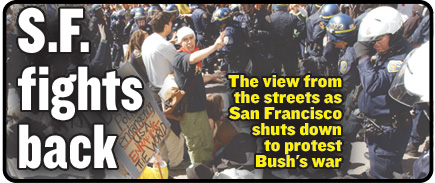
Nowhere was the clash of people power and government will more acute than on the streets of San Francisco, where a series of massive marches, some drawing nearly 100,000 people, filled the streets prior to the invasion of Iraq on March 19, 2003. The onset of war led protesters to effectively shut down the city, resulting in about 2,300 arrests and millions of dollars in costs to the city.

President George W. Bush dismissed the protests, of course, but he wasn’t the only one. Political leaders such as Rep. Nancy Pelosi, then-Mayor Willie Brown and soon-to-be Mayor Gavin Newsom (who didn’t attend any of the marches, unlike progressives on the Board of Supervisors) condemned the peace movement for hurting an innocent city. But with the “battle for San Francisco” making international news, the protesters were more concerned with the global audience.

A month earlier, on the weekend of Feb. 15 and 16, there were coordinated protests against the impending war in about 800 cities around the world, drawing around 10 million people. The peace march in Rome included about 3 million people, earning a listing in the Guinness Book of World Records as the largest anti-war rally in history. People have never made such a loud and clear statement against an incipient war.

Beyond the numbers, the antiwar movement was also right. On every major issue and prediction, the messages from the street proved correct while those from the White House were wrong. The US wasn’t welcomed as liberators. There were no weapons of mass destruction. Iraq after the invasion isn’t a stable democracy or shining beacon to anyone but the new generation of jihadis Bush created.

We can blame a hard-headed president, ineffectual opposition party, failure of the national media, or the national climate of fear following Sept. 11. But rather than refighting that lost battle, now is the time to gain perspective on the events of five years ago and determine what it means for democracy and the post-Bush national agenda.


TO THE STREETS

There were two main umbrella groups organizing protests before the war: Direct Action to Stop the War (DASW) and International ANSWER (Act Now to Stop War and End Racism). ANSWER has remained active and DASW has recently been reconstituted for the fifth anniversary of the war, using direct action in San Francisco as well as other urban centers and outposts like Chevron’s refinery in Richmond, which has reportedly been processing Iraqi oil.

“With the fifth anniversary coming up, we’re going back to direct action on the streets,” said Henry Norr of DASW. “But I don’t have any illusions that it’s going to be like it was five years ago.”

The maddening march to an ill-advised war created a political dynamic in which a broad cross-section of Americans was willing to hit the streets.

“We had a wonderfully diverse group of people, from soccer moms to anarchists,” said Mary Bull, who cofounded DASW, a collective of various affinity groups and concerned individuals formed in October of 2002 as Bush started beating the drums of war.

It was a group fiercely determined to prevent the war — and really believed that was possible. In fact, Bull recalls how she and other members of the group burst out crying at one meeting when a key activist said the war was going to happen.

Richard Becker, who cofounded ANSWER and serves as its West Coast coordinator, said that in the summer of 2002, “we came to the conclusion that [the war] was going to happen.” The group called its first big protest for Sept. 15, 2002, and another one two weeks later. But the movement really exploded on Oct. 26 when almost 100,000 people took to Market Street, much of it a spontaneous popular uprising.

“We were overwhelmed,” Becker said. “We were in a perpetual state of mobilization to keep up with what was going on. But then it didn’t stop the war.”

Did he think they could?

“I think a lot of people thought maybe it was possible to stop it. And we thought maybe it was possible to stop it,” Becker said.

The high point, according to Becker and Norr, was Feb. 17, 2003, when the New York Times ran a front page analysis piece entitled “A new power in the streets” that claimed “the huge anti-war demonstrations around the world this weekend are reminders that there may still be two superpowers on the planet: the United States and world public opinion.” But then Colin Powell went to the United Nations to argue for the invasion, and the Democrats in Congress did nothing, and it became clear war was coming.

Norr stayed out there protesting, being arrested several times and even shot in the leg by Oakland police with a rubber bullet during a protest at the Oakland docks. And he thinks some good came from the experience.

“The lesson for people is the political and economic elites are committed to preserving and extending empire. And they basically say as much in their own writing,” Norr said. “Wars are not anomalies.”

Despite being a frustrating and depressing exercise, most saw benefits to the failed movement. “People got an incredible education about how the system really worked,” Becker said. “Building a movement is mostly about a series of setbacks.”

Medea Benjamin, cofounder of both Global Exchange and CodePink and fixture of the anti-establishment peace movement for years, was upbeat about the protests. “We did our job as citizens. We did what we were supposed to do: organize, get people to take action, get people onto the streets,” she said. “We did everything we could think of.

“What you take from it is we don’t have a very well-developed democracy because the people spoke and the government didn’t listen.”

25war2_Lars1.jpg The ever-evolving “Democracy Wall” on Valencia Street, March 2003, helped stir up debate (Photo by Lars Howlett)


FACING ARREST

The collective action of five years ago starts with a series of personal stories — tens of thousands of them — so let me briefly begin with mine.

My arrival in San Francisco was closely tied to the march to war. I was living in Sacramento and working as the news editor of the Sacramento News & Review when Bush began his saber rattling against Saddam Hussein, but by the end of 2002 I had a falling out with my boss and found myself jobless.

Like most Northern Californians who opposed the war, I came to San Francisco on Jan. 18 to make my voice heard and experienced a bit of serendipity on my way to Justin Herman Plaza: while reading the Guardian on Muni, I saw their advertisement for a city editor, a job that was ideal for me at a paper I’ve always loved. Needless to say, it was a great day, empowering and full of possibilities.

Less than two months later I was on the job, and on the second week of that job I was back on the turbulent streets of San Francisco, part of a Guardian team covering the eruption of this city on the first full day of war. When I stepped off the cable car just after 7 a.m., people were streaming up Market Street and I joined them.

When a large group stopped at the intersection of Market and Beale, I stopped too, taking notes and bearing witness to this historic, exciting event. I had a press pass issued by the California Highway Patrol that allowed me to cross police lines, so when police in riot gear surrounded us and threatened arrest, I held my ground with 100 or so protesters.

After interviewing about a dozen people about why they were there and that they hoped to accomplish (see “On the bus: Journalists, lawyers, four-year-olds — the cops were ready to bust anyone Thursday morning“), I was arrested with the others and taken to a makeshift jail and processing center at Pier 27 (no charges were filed in my case, and charges against all of the 2,300 people arrested here in those first few days of the war were later dropped).

I recently tracked down a few of the people who appeared in my article, including Daphne and Ross Miller, who were at the center of the most interesting drama to play out during our standoff with the police. She’s a family practice physician, he’s an architect, and they live in Diamond Heights with their two children, Emet, who is almost 9, and Arlen, 12, who was away on vacation when the war began.

“We were genuinely shocked that the war started,” Ross told me. “We were at some of the earlier protests and really thought there was no way [Bush] could do it.”

They woke up March 20, 2003, to news that the war had begun and immediately walked to the BART station with Emet and rode to the Embarcadero station, not really planning for the day ahead but just knowing that they had to make themselves heard.

“We were pissed as hell. I don’t think I’ve ever been so angry in my life,” Daphne said.

They quickly came up with a plan. “We basically decided that if anyone was going to be arrested, it was going to be Ross and I’d stay with Emet. But it didn’t end up that way and I ended up in the arrest circle.”

Daphne had their house keys and threw them over the police line to Ross at one point. A photographer in the circle had gotten shots of a man named Roman Fliegel being roughed up by police as they pulled him off his bicycle, which was towing a trailer with a sound system, and decided to throw his backpack with camera gear out as well. When Ross — who had four-year-old Emet on his shoulders — caught it and refused police orders to give it to them, police grabbed Emet and roughly arrested Ross, leaving a gash on his forehead.

“Rage surged through the crowd, and it seemed as if things might get ugly, but the police kept a tight lid on the situation, using their clubs to shove back protesters who had moved forward,” I wrote at the time.

Emet was delivered into the circle with Daphne as the arrests continued, many quite rough. “At that point, as a mom, I had to exercise the most restraint ever,” said Daphne, who was angry about the situation but fearful about what she was exposing her son to. “Please, don’t let any violence happen here,” she pleaded with the crowd. Eventually, commanders on the scene let the mother and child go.

“The officer who let me go said that if he saw me again out there, he would call Child Protective Services on me,” Daphne said. But two days later, still brimming with outrage at her country’s actions, she ditched a downtown medical conference to rejoin the street protests, this time solo.

The couple say they’ve lost friendships over the war and have become more engaged with politics, coming to believe that Bush and the neocons are malevolent figures who knew how badly the war would go and did it anyway to establish a large, permanent military base in Iraq.

“Since that day, we’ve been far more active,” Ross said. “We realized you can’t just trust the system. You have to push.”

But that determination was mixed with feelings of disempowerment and depression. They attended some of the protests that following year, but the couple — like most people — just stopped going at some point because they seemed so futile.

“There was a horrible sense of resignation and a genuine depression that followed,” Ross told me.

The nadir was when Bush was reelected and they considered leaving the country. But then, Ross said, “we decided we’re not just going to run away and we’re not going to accept this.” Looking back, even with the scare over Emet, they express no regrets.

“It was the right thing to do because it was the wrong war to have. I’d do it again and again and again if I had to,” Ross said

They’re guardedly hopeful that Barack Obama could begin to turn things around if he’s elected. “I think the right president can at least start to dismantle this,” Daphne said. “I think thousands of people marching in the streets is something he would listen to.”

25war3_Charles1.jpg A die-in on the streets of San Francisco in March 2007 marked the fourth anniversary of the invasion (Photo by Charles Russo)


WITNESS TO HISTORY

Covering the peace movement in those early days was a heady experience, like reporting on a revolutionary uprising or working in a foreign country where the people are organized and active enough to be able to shut down society and brave enough to risk bodily injury for their beliefs.

I was at the founding meeting of CodePink — which became the most effective group at personally confronting the warmongers and keeping the war in the public eye — one evening at Muddy Waters in the Mission District shortly after the war started.

Looking back, Benjamin rattled off a long list of the alliances the group built — with labor, churches, businesses, and a wide array of social movements — and creative actions intended to build and demonstrate popular support for ending the war.

“We’ve done so many things and what did we get? We got a surge,” she said. “It shows the crisis in our democracy, the crisis of the two-party system, the crisis of a dysfunctional opposition party.”

Yet she said the peace movement has been remarkably successful in convincing the public that the war was a mistake and that it’s time for the troops to come home, even if the Democrats have been slow to respond to that shift.

“The progress we’ve made is turning around public opinion and that’s going to play a big role in the upcoming elections,” she said. For Norr, the role of the news media is a particular sore spot. He was a technology reporter for the San Francisco Chronicle who called in sick on the first full day of war and was arrested on Market Street with his wife and daughter, resulting in suspension by editor Phil Bronstein for his actions.

I wrote several stories on the issue, which culminated in Norr being fired and Bronstein unilaterally banning Chron employees from peace protests. I even borrowed CodePink’s guerilla tactics when Bronstein repeatedly refused to return my calls or address why he had singled out antiwar protesters for uniquely punitive treatment. I confronted him during a speech he gave at the Commonwealth Club (see “Lies and half-truths,” 5/7/03). That was the tenor of the times: we were all tired of being lied to and we decided to push back.

Norr was particularly frustrated with his own paper’s reporting of the war and started sending articles by the foreign press to his paper’s news desk, trying to wake his colleagues up to the pro-war propaganda being passed off as journalism in this country.

He was also disappointed with the country and with the Chronicle — both the management and his fellow reporters, who did little to support him — but the experience caused him to return to his roots as a progressive activist.

“The war and losing the job and everything brought an abrupt end to my consumerist phase and dumped me back into the world of being an activist,” said Norr, who serves on the KPFA 94.1 FM local station board and has made three recent trips to the Palestinian territories while working with the International Solidarity Movement.

Benjamin said Americans shouldn’t expect the next president to end the war — not without lots of pressure from a renewed and vocal peace movement. “This is the time to set the stage for the post-Bush agenda,” Benjamin said. “Don’t put your hopes in Barack Obama in getting us out of Iraq. Put your hopes in the people.”

25war4_Lane1.jpg A rally and nonviolent direct action at the Richmond refinery targeted Chevron on March 15 (Photo by Lane Hartwell)


THE AFTERMATH

The San Francisco Police Department, which spent more than $2 million on overtime costs responding to peace protests between March 15 and April 16, 2003, generally behaved with restraint and professionalism, but there were several exceptions.

The most costly and disturbing incident came when Officer Anthony Nelson began aggressively swinging his long riot baton at protesters, badly shattering the arm of peaceful protester Linda K. Vaccarezza, who suffered a permanent disability in her career as a court reporter.

Nelson’s incident report falsely stated that Vaccarezza had threatened him with a sign attached to a solid pole, but video of the incident later clearly showed there was no pole and that she was retreating when he teed off on her (see “The home front,” 05/19/04).

Vaccarezza received an $835,000 settlement from the city in November of 2004. On Oct. 5, 2005, two and a half years after the incident, SFPD fired Nelson for lying about what happened that day, and the City Attorney’s Office has been successfully fighting Nelson’s appeals in court ever since, putting in more than $100,000 in attorney time and costs into the Nelson and Vaccarezza cases.

The other significant ongoing litigation from the antiwar protests involved Mary Bull, who was arrested during an early protest for pouring fake blood in front of the entrance to Chevron’s San Francisco office before being allegedly strip searched and left naked in her San Francisco Jail cell for 36 hours.

Ironically, Bull was among those who brought a successful class action lawsuit against Sacramento County after she and others protesting a logging plan were strip searched, setting a precedent and led most counties to reform their strip-search policies. She used her share of the $15 million judgment to buy an organic permaculture farm in Sebastopol.

Her San Francisco case, in which Bull won a multimillion-dollar judgment, is still under appeal and now in mediation. Bull said the protests five years ago did make a difference, something she tells those who fret about its apparent failure. “I tell them to look at what issues the candidates are talking about now and I thank them for protesting then.”

“Even though we had millions throughout the world, we were sort of blocked, but now we’re regaining that momentum,” Melodie Barclay, a massage therapist who was also arrested with me on the first day of the war, told me recently. “We can’t judge it by the fact that we didn’t get the momentum we wanted.”

Norr started his antiwar activism working with Students for a Democratic Society in Boston, protesting the Vietnam War, which he said shares many similarities with the current situation, for good or for ill. He said that people tend to forget that while the protests then were huge and helped end the war, the movement did wane after Nixon ended the draft and substituted massive aerial bombardment for boots on the ground.

“The protests dropped off considerably,” he said. “A lot of the things that drove people to take risks in the late ’60s had faded by the early ’70s.”

He thinks the current administration learned a lesson from those days: it’s easier to maintain a war effort if the average citizen isn’t affected.

But there are other factors as well keeping a lid on the antiwar outrage.

“The culture has changed too. Young people are oversaddled with debt. People in schools seem to be docile. The culture as a whole seems to be more individualist and consumerist,” Norr said.

Yet some young people have woken up and many of them are funneling their energies into a peace group that was formed in the summer of 2005: World Can’t Wait, as in: the world can’t wait for the end of Bush’s second term before we change our direction and leadership.

“We don’t just want them gone, we need to repudiate their program,” said Giovanni Jackson, a 26-year-old WCW student organizer. “If we’re going to change anything, we need the youth.”

Jackson was at WCW’s founding convention in New York City, which came just as New Orleans was being flooded and then essentially abandoned by the federal government.

“When [Kerry] lost, people felt demoralized and World Can’t Wait kind of stepped into that situation,” Jackson said. “There was a lot of demoralization in the antiwar movement at that time.”

The group organized protests and student walkouts on Nov. 2, 2005.

“Everyone has their moments of doubt,” he said, “but I’m motivated by the crimes we see everyday.”


THE LESSONS

One of the biggest barriers to galvanizing people and turning the fifth anniversary of the war into something that might make a difference is the presidential election, which is diverting the energy of many potential protesters — and at the same time, offering some hope that a new president may lead to peace.

After all, every single one of the Democratic presidential candidates has promised to withdraw troops from Iraq, with varying timelines and numbers of US personnel left behind. And with enough encouragement, they might be willing to help change the status quo.

Many of the activists who volunteered their time and money to help move the Obama campaign into its front-runner position came out of the antiwar movement, and Obama’s strong stand against the war has been a key factor in his popularity.

Becker and some other activists don’t have much faith that a change in presidents will change the course in Iraq, although he agrees that much of the energy now surrounding Barack Obama derives directly from the antiwar movement.

“There’s been a huge upsurge of hope for Obama and that he might bring about the kind of change we need,” Bull said, adding that she doesn’t share that hope, believing the only path to peace is to pressure Obama and other leaders to commit to more progressive positions.

Norr said, “On one level, people have illusions about the power of peaceful protests. People believe in democracy, as well they should. We feel like the rulers should be paying attention to public opinion.

“It’s a remarkable story how broadly and quickly the American people have turned against the war. Public opinion was certainly ahead of the Democrats.”

And people will only grow more disenchanted with Iraq and its multitude of costs. “The people here are paying for this war, and everyday we have new stories about health clinics being shut down,” Becker said.

Becker was amazed last March as massive demonstrations for immigrant rights seemed to explode out of nowhere. “We think there will be more things like that,” he said.

Because after five years of organizing communities to resist the military-industrial complex’s plans, Becker thinks there’s been some visible progress.

“There isn’t a town or hamlet in the US that doesn’t have activism going on, but you wouldn’t know it from the corporate media,” Becker said. “It’s a mistake for people to feel discouraged.”


Newsom to small business: Drop dead!

0

By Bruce B. Brugmann

And so Mayor Newsom, who wants to run for governor when he still hasn’t learned to manage the city as mayor,
has bestowed the ultimate insult to small business in the City and County of San Francisco.

He has named a City Hall lobbyist for PG@E to the Small Business Commission.

Yes, you read correctly, Mayor Gavin Newsom has appointed Darlene Chiu, a PG@E lobbyst in City Hall, to the SBC.

How in the world does a company that has been screwing small business for decades inside and outside City Hall, stealing our cheap Hetch Hetchy public power for decades and forcing small business and residents to buy its expensive private power, yanking upwards of $650 million a year out of the city’s economy with its high rates, corrupting City Hall for decades with its lobbying muscle, qualify as a member of the Small Business Commission?

We put the issue in a diplomatic question and emailed it to the mayor. His press secretary, Nathan Ballard,
issued this statement this afternoon on Chiu’s glowing qualifications:

“Darlene Chiu was appointed to replace Florence Alberts after her term expired. Darlene has first hand knowledge of the challenges facing small businesses in San Francisco. She grew up working in her family’s these retail businesses in Chinatown, managing nine to l5 employees. She will also bring her knowledge of City government and communications to the Commission, which will be important to the successful operations and promotion of the assistance center.” (As one small business leader told me, “I don’t recall in the requirements of being on the commission that growing up as a child of small business owners quite meets the criteria.”)

No, no, no: PG@E is placing Chiu, via Newsom, on the SBC to help PG@E continue to facilitate the “successful operations and promotion” of further PG@E corruption in City Hall to protect its illegal private power utility in San Francisco. The supervisors can and should move quickly to reject the PG@E appointment.

More: Newsom to the Civil Service Commission: Drop dead. He appointed Mary Jung, a PG@E customer services manager, to the Civil Service Commission.

Meanwhile, as he further cemented PG@E power inside City Hall, he whacked three well qualified and conscientious commissioners: Debra Walker, an artist and activist, from heading the Building Iinspection Commission, Theresa Sparks, a transgender woman and community leader, from running the Police Commission, and Robert Haaland, a labor activist and one of the city’s most visible transgender leaders, from serving as vice president of the Board of Appeals.

Newsom is running for higher office and, as our editorial in tomorrow’s Guardian puts it, “almost everythihg he does at City Hall seems to be aimed not at improving San Francisco but at increasing his odds of moving up in the political world…Why would Newsom be doing this–if he didn’t need the support of PG@E and its allies for his next political step.

“Why would he be directing his appointees to keep out of leadership posts anyone with strong progressive credentials if he wasn’t trying to build new bridges to the developers, the big employers, the police unions and the more conservative interest groups he’ll need for a statewide campaign?” B3

Ammiano on Newsom: OMG LOL

0

Today’s Ammianoliner:

The mayor is not coming to the board, but he agrees to text the board.

OMG. LOL.

(From the home answering machine of Sup. Tom Ammiano on Wednesday, March 12, 2008.)

Note to the Ammianoline constituency: Tom is threatening to stop doing the Ammianoliners for awhile, mumbling that he needs a new answering machine. So petition him to keep going. B3

Ammiano gets no respect

0

Supervisor Tom Ammiano has been all over the news recently and has a couple of major accomplishments, including a restaurant-nutrition requirement and legislation that sets standards for care in homeless shelters.

And yet he’s still getting a beating from the Chronicle, which seems to think that something as basic as asking chain restaurants like McDonalds to tell you how unhealthy their food is could somehow harm the city’s business climate.

The restaurant disclosure bill got a lot of press, but the homeless shelter standards was more of a political challenge – Ammiano had to get the mayor, who has been reluctant to admit that any part of his homeless program is a failure, to sign on to the program.

The conditions in the shelters are, and for a long time have been, deplorable. So this may actually make the lives of a lot of human beings a lot better.

And of course, Newsom made a bit point the other day of talking about how he was going to use the city’s rainy day fund to bail out the city’s schools – without ever mentioning the Ammiano was the one who wrote that bill (without any help from then-Sup. Gavin Newsom.)

Ammiano’s going to leave the Board of Supes next year with one of the longest and most distinguished legislative records in memory. He deserves a little more respect.

Freedom of Information: Virtual meeting

0

› news@sfbg.com

Forget smoke-filled rooms and paper shredders — today’s government officials can elude public scrutiny from the comfort of their own e-mail accounts, conducting virtual meetings to do the public’s business.

To curb such activity, provisions in both the Brown Act (the state law governing open meetings) and the San Francisco Sunshine Ordinance have been interpreted as prohibiting the use of electronic communication between members of policy bodies. But not everyone has been heeding the rules, particularly in this hyperconnected age.

The TechConnect Task Force, a now disbanded advisory body charged by Mayor Gavin Newsom with creating a plan to bridge the city’s digital divide with free wireless Internet service, frequently used an e-mail listserv to conduct its business.

"Since these things were publicly posted right away, I should think there would be a transparency that advocates would like," said Emy Tseng, a member of the task force. "It was useful in the way e-mails and listservs are useful to anyone."

However, many contend the task force was engaging in activities prohibited under the city’s Sunshine Ordinance, even if the intent was to provide greater public access to the group’s work. Tseng, who claims to have never been informed by the City Attorney’s Office that the group might have been in violation of Sunshine laws, expressed the frustrations of many throughout the city who must comply with open-meeting policies.

"If you don’t use e-mail in this day and age, what can you do?" she asked. The answer, according to state and local laws, is to conduct public business in a public meeting, with the agenda posted in advance and where anyone can attend.

State and city public-disclosure laws apply to all "policy bodies," which can include nearly every government-sanctioned board, commission, or task force. Some members of these bodies have been suspected of vioutf8g open-meeting and public-disclosure laws through the use of online communication.

Seriatim meetings are presumably the most common illegal activity occurring under both open-information laws, although they are the hardest to detect. A seriatim meeting occurs when one member of a policy body privately contacts another, who then contacts another, in a chain of communication that eventually constitutes a quorum of the group.

An e-mail that is forwarded along to enough individuals, or a round of mass e-mails, would constitute a seriatim meeting, according to attorneys who spoke with the Guardian. While e-mail forwarding is a common practice for any office worker, some are just an unassuming click away from breaking the law.

"I would absolutely make it clear that anybody subject to the Brown Act or Sunshine [should] not communicate through e-mail," said Thomas Burke, a San Francisco-based attorney who specializes in media and Internet law and has represented the Guardian. "This could go on for years because people are not in the loop."

The Brown Act, passed in 1953 by the California Legislature, expressly bans a legislative body from using "technological devices" in order to communicate about topics relevant to the work of that body.

"The Brown Act itself forbids the majority of ‘technological devices’ — which is essentially anything you could imagine," said Terry Francke, director of Californians Aware, who also drafted amendments to the act in the early ’90s. Under the Brown Act, a committee member can be slapped with a misdemeanor for the intent to withhold information from the public or conduct prohibited meetings.

Many of the same issues are also addressed in the San Francisco Sunshine Ordinance, filling in more restrictions and open information requirements. Ironically, the TechConnect Task Force was charged with creating universal access to online discussions like theirs, although few legal experts think even that would nullify the requirement for open, public meetings in a physical – rather than virtual – setting.

According to a report released by the San Francisco TechConnect Task Force, 32 percent of Americans do not have access to the Internet. In San Francisco, certain populations are even worse off compared to national averages — for instance, women and the elderly.

"You have to consider if people are going to have equal access to meetings," Burke told the Guardian. "There is still a digital divide. As a public entity they have to be sensitive to this."

Recently, members of the city’s Peak Oil Task Force inquired with the City Attorney’s office about using Yahoo! Groups or a blog to increase efficiency on the all volunteer committee. Attorneys advised the group to stay away from Internet communication, as it can easily lead to prohibited seriatim meetings. Jeanne Rosenmeier, who is the chairperson of the task force, now spends more committee time trying to determine alternative ways to engage the public.

"It is certainly something that should be rewritten, to deal with modern technology so it corresponds with today’s reality," Rosenmeier told the Guardian. "If we have a public e-mail listserv that anyone can sign on to, that seems transparent; or if we have a blog, that’s pretty transparent."

In other cities that do not have sunshine ordinances, teleconferencing may be used legally under the Brown Act to conduct meetings. In Los Angeles, for instance, some boards and commissions teleconference when members would need to drive a few hours just to meet. There is some speculation that the language of the Brown Act could be augmented under this provision to allow for online communication, but there are no major groups pursuing the amendment.

In 2001, former California Attorney General Bill Lockyer wrote an opinion declaring the use of e-mail between policy-body members as an infraction of the Brown Act, even if the e-mails were made publicly available. "Members of the public who do not have Internet access would be unable to monitor the deliberations as they occur," the opinion states. "All debate concerning an agenda item could well be over before members of the public could [participate]."

According to the Sunshine Ordinance Task Force, there have been no complaints filed concerning prohibited online meetings, however there have been public information disclosures of private e-mail messages over the years. Recently, a group of deputy city attorneys were required to turn over an e-mail correspondence when a member of the public filed a complaint.

While Peter Scheer, director of the California First Amendment Coalition, understands the frustration of government officials who must abide by the cumbersome laws, he thinks the tradeoff is well worth it.

"The whole rest of society uses the power of e-mail and the only business that can’t use it is government, because they’re subject to the Brown Act," Scheer told the Guardian. "But we made the tradeoff already in efficiency versus accountability, to force all meetings and information to be open to the press and public."

>

Freedom of Information: More sunshine — easily and at no cost

0

› news@sfbg.com

Imagine sitting at home — or in your office, or in your favorite café — and listening in on what are now secret, backroom policy discussions and decisions in the San Francisco mayor’s office. Imagine having access to an immediate transcript of the talks. Imagine being able to read internal e-mail discussions among city staffers about issues that affect you — without ever filing a public records request. In fact, imagine never having to file another written request for public documents; imagine just going to a city Web site, entering a search term, and finding all of the records yourself.

Imagine filing a complaint with a city agency and tracking the issue, minute by minute, as it works its way through the system.

Imagine listening on your cell phone to any policy body as it meets in city hall.

All of this is possible, today. Much of it is not only consistent with but actually required by local law. And it won’t cost the city more than a modest amount of money.

Transparency is a common buzzword during this presidential campaign; the Barack Obama campaign has even issued a white paper describing policy and technological ways to embrace it. He’s talking about live Internet feeds of meetings about significant issues involving executive branch appointees as well as for those of regulatory departments (a program that would go far beyond what you see on C-SPAN).

So there’s no reason San Francisco can’t take the lead in using technology — generally simple, off the shelf, existing technology — to dramatically increase sunshine at City Hall and public participation in local government.

Proposition G, the city’s 1999 sunshine law, mandates that San Francisco use "all technological and economical means to ensure efficient, convenient and low cost access to public information on the Internet." Here are five easy ways to do that:

1. Fully adopt the voyeur concept for city meetings. This is the idea that the public should be able to observe and engage in government decision making — all government decision making.

All policy meetings in City Hall should at the very least be broadcast as audio on the Web and available via phone teleconference. In other words, the meetings should be streamed online, and that stream should be accessible by calling a free conference line. This is already standard practice in the business world and is working well for many investors in public companies that disclose financial information in compliance with Securities and Exchange Commission rules. It can be done for little or no cost with services like blogtalkradio.com, skype.com, freeconferencecalls.com, and webex.com.

Today only a limited number of public meetings are broadcast, mostly because the only outlet is SFG-TV and resources are limited. But audio streaming is a no-brainer — there’s no need for a staffer to control cameras, the microphones are already set up, and these days just about every room has a speakerphone.

Currently, the SFG-TV video coverage isn’t posted on the city’s Web site, sfgov.org, until two or three days after a meeting. That’s too long; the audio should be made immediately available online. And the Internet URL and dial-in options should be listed on the meeting agenda so that news media and citizen bloggers can instantly refer back to the URL with timecodes to point out specifics, and include them in their stories and blog postings.

With streaming, you can follow along in real time when you are stuck at home taking care of a sick relative, or at the office listening with headphones, or you are disabled and can’t cross town to attend in person.

The city already has a great contract for real time captioning — the text you see at the bottom of the screen for video. It’s not 100 percent accurate, but it’s pretty decent. That could be expanded to cover streaming audio, and the text could be computer translated (or translated by bilingual typists) into other common languages. The advantage of media integrated with RTC is that specialized search engines like blikx.com and everyzing.com can be used to find relevant phrases and begin playback directly at that spot. And transcriptions can be posted online in real time (somewhat like live blogging!) so that if you are late for a meeting you can quickly scan what has already transpired, and by the end of the meeting you will effectively have a draft of minutes. That saves a lot of staff time and provides an immeasurably more useful historic record.

Today, video recordings of city meetings can’t be downloaded — the only way to review it or post a clip to YouTube is to order a $10 DVD, which arrives a week after you send a check (and no, they don’t take PayPal). And while many other city meetings make audio recordings, you have to pay $1 for an audio tape and pick it up during business hours or pay more for postage. They all should be available as free podcasts.

The SFG-TV video shows more than just the speakers and officials; there are other angles, and they ought to be available too. It’s important to know who attended the meeting but never said anything, who greeted whom, and even who ignored whom.

2. Let the public do the broadcasting. All City Hall meeting rooms should provide wi-fi (and electrical outlets), and the system ought to have enough speed to allow bloggers or activists to upload high-quality video broadcasts of meetings that SFG-TV can’t afford to cover. It can be done using existing services like Justin.tv, Upstream.tv, and live.yahoo.com. This would also allow live blogging — and let people preparing to testify on an issue have access to the Web to do research on the spot. If the room had a projector and a screen, people who were unable to attend the meeting could still comment, either through video or just by posting text messages that the decision makers could read.

The audio broadcasting of meetings should be expanded to include all meetings between the mayor (or supervisors) and city staff. The law already requires public access to so-called passive meetings — those between the mayor or department heads and outside parties that influence city policy.

3. Make public most city emails and other documents as soon as they are produced.

San Francisco city employees produce thousands of records a day — e-mails, memos, reports, etc. — and the vast majority of them are and should be public record. But many are deleted and others never see the light of day. When a member of the public asks for all the records on a topic, just finding those documents can be a sizable task.

But it’s technologically simply to solve that problem: every time a city employee produces a document, the computer system should automatically send a back-up copy to a public web server. That way nothing would get lost or erased, and anyone looking for public information could simply go to that site and search for it him or herself.

For e-mails sent by city staff, one way might be to CC (carbon copy) an online message board (for example Google or Yahoo groups, which would be available at no cost to the city). Other approaches for instant messages, text messages and voicemails could be adopted as well. The Palo Alto City Council is already doing something like this for a narrow collection of e-mails (although not in real time).

We all know there are some city communications that must remain private or be redacted — for example Attorney Client discussions or human-resource conversations regarding personnel. But there are simply ways to make sure those stay confidential: one approach might simply have the user tick a flag or answer a Yes/No Possible Redaction popup when the message is sent. Certain employees — like the people who handle sensitive employee health records and certain litigators in the city attorney’s office — could have software that defaults to a confidential server.

The added advantage, of course, is that the computers could also make a record of the title and date of every confidential document — and that information could be made public. If a dispute arose over whether the city was improperly withholding records, the public would at least know that certain documents existed.

All city files could be stored on network drives (not on local drives) with one location for default public files that would not allow overwriting or deletions and would be mirrored to a Web server and another drive for the few that may require redaction first.

4. Save all the old records. After a very embarrassing lawsuit that is threatening the Missouri governor’s job, that state in January adopted an email retention system that preserves all email for at least seven years (based on federal requirements for financial records). And e-mail/instant message/text/fax retention systems are standard practice now in the financial industry (Morgan Stanley lost a $1.45 billion judgment because the company failed to preserve e-mail).

In fact, we all know storage continues to get cheaper and smaller — so San Francisco should abolish any retention timeframes for electronic records and keep them all into the foreseeable future. The world-famous Internet Archive is right here in the Presidio: I suspect that group would love to archive all the city information, and keep it online, free and forever.

When paper documents are part of the public record, they should be scanned and converted to text and posted within two days. This would include discussions between staff and individual members of policy bodies and the creation of the draft agenda and supporting materials as they are obtained.

All these methods would significantly reduce the number of public records requests to the city staff and thus save the city money.

5. Make calendars public — and keep communications public. Mayor Gavin Newsom won’t provide detailed daily calendars — even after the fact, when there is no possible security reason for keeping his workday itinerary secret. All top officials should post their calendars on the web so the public can track what they are doing.

The city needs to adopt a global policy that city business should be performed on city devices (computers, email accounts, phones) whenever possible — and when city employees or officials use their own computers or hand-held communications tools, those should be forwarded immediately to the city system and made public.

San Francisco has one of the best local Sunshine laws in the country — and at a time when activists at every level are looking for ways to use technology to expand public access, the city should be in the forefront. All it takes is some political will.

———————————————————-

Here are some more ways that the city could use technology to improve public access:

1. Use a program like govtrack.us to follow legislative changes.

2. Explore ways to bring nonprofits that perform traditional government services under sunshine laws.

3. Significantly improve the city’s Crimestats system (more real-time allow alerts for crimes near you) – google mashup et al. See http://chicago.everyblock.com/crime/

4. Embrace e-rulemaking technology – similar to federal rulemaking use technology to get ideas online and generate more participation for those who can’t show up in a meeting.

5. Require the Police Department to issue press credentials to bloggers.

6. Fund a few open-government lawsuits to expand the boundaries on access to public records (the law provides for attorney’s fees if the suit is successful).

7. Require city agencies to post the method for obtaining public records online. Require posting of all negative determinations on home pages.

8. At budget time, mandate that each agency provide statistics as determined by SOTF on sunshine responsiveness.

9. Require an assessment of sunshine compliance as a mandatory item for all Financial/Management audits.

10. Televise SOTF and Ethics Commission formal hearings.

11. Require active Ethics investigative files to be open.

12. Embrace fully the much-improved but incomplete example of posting online all interactions as part of large contract negotiations – as was partially done with TechConnect.

13. Host accounts payable/receivables online with the scanned images of invoices paid.

———————————————————

>

Freedom of Information: 2007 James Madison Award winners

0

Click here for details on the First Amendment Awards Dinner.

Norwin S. Yoffie Career Achievement Award

DAN NOYES (COFOUNDER, CENTER FOR INVESTIGATIVE JOURNALISM)


If journalists were the subjects of trading cards like baseball players, the Dan Noyes rookie card would be just as impressive as a 2008 career highlights card. Think Reggie Jackson: a long, impressive career, spanning multiple organizations and a propensity to come out swinging big at the end of a hard-fought battle.

Over a career spanning 30 years, Noyes has pursued serious investigations, some lasting as long as a year, into everything from questionable Liberian timber imports to illicit gun trafficking from United States suppliers to the Nuestra family gang. Journalism first interested Noyes during the crucial investigative reporting that sparked Watergate scandal in the early 1970s.

In 1977 Noyes cofounded the Berkeley-based Center for Investigative Reporting (CIR), an independent news organization which produces in-depth stories and documentaries for all major news outlets. In 1979, reporting for the ABC News program 20/20, CIR broke a story on a swindling United Nations charity organization and its connections to international drug trafficking.

More recently, Noyes has done a series of print and broadcast pieces concerning gang violence in California and its effect on the lives of those surrounding the lifestyle. Noyes still holds an executive position at the CIR and continues to contribute to the world of investigative journalism.

Beverly Kees Educator Award

CLIFF MAYOTTE


Cliff Mayotte sees his Advanced Acting Class at Lick-Wilmerding High School as one that merges students’ "consciousness and awareness as young adults with their skills and energies as performance artists."

The subtitle of the course is "Theatre as Civic Dialogue," and the eight students enrolled during the 2007 spring semester used all their abilities to pull off a notable show.

After an introduction to Documentary Theatre — a form he described as "oral history turned into performance" — the group selected a topic that was important to them, giving birth to the "Censorship Project."

The students interviewed their peers, teachers, and administrators to gather perspectives on the ways in which expression and opinion can be muted or altered, both voluntarily and involuntarily. They reached out to organizations such as Project Censored, the First Amendment Project, and the Ella Baker Center for Human Rights. They transcribed interviews and studied subjects in order to capture statements, word patterns, and mannerisms of interviewees, then shaped the themes into a 60-minute performance.

Professional Journalists

WILL DEBOARD


"Being a high school sports guy, I don’t get to do this very often," the Modesto Bee‘s Will DeBoard said of his first major foray into investigative reporting. He had gotten a tip that the California Interscholastic Federation was investigating recruiting violations by the football program at Franklin High School in Stockton, which competed with schools in his area. DeBoard asked the school and CIF about recruiting violations, but the football coach flatly denied the allegations and the CIF wasn’t much more helpful.

So DeBoard decided to make formal requests for public records with the help of business reporter Joanne Sbranti, and after fighting through some initial denials, he obtained hundreds of pages of investigatory documents from CIF showing how the school was recruiting players from American Samoa. "It really was a treasure trove of great stuff. We got two weeks’ worth of stories out of these documents," DeBoard said. "It really showed us that what the school was telling us just wasn’t true."

The documents detailed the recruiting scheme and gave DeBoard tons of leads for follow-up stories, including the address of "a home owned by the coach where there were all these gigantic Samoan linemen living there." DeBoard called the effort an "adrenaline rush" better than that caused by the best game he’s covered and a high point of his journalism career.

THOMAS PEELE


Contra Costa Times investigative reporter Thomas Peele has a long history of battling for public records access on behalf of both reporters and private citizens. Peele, who helps with projects for all the newspapers under the Bay Area News Group-East Bay ownership, helped ensure the recovery of thousands of e-mails from the Oakland mayoral tenure of Jerry Brown when he left office to become the state’s attorney general in 2006. Peele also helped conduct a statewide audit of Public Records Act compliance by law enforcement agencies with the nonprofit Californians Aware, which revealed glaring inconsistencies in how police across the state make information about their activity available to the public. And he’s been a major figure in helping the Chauncey Bailey Project pry out new information about Bailey’s murder last year and it’s connection to Your Black Muslim Bakery. He began his career in 1983 at a small weekly in Bridgehampton, N.Y., and moved from there in 1988 to the Ocean County Observer in New Jersey before joining the CCT in 2000.

ROLAND DE WOLK


KTVU-TV producer Roland De Wolk is leading the investigative team of photographer Tony Hedrick and video editor Ron Acker in a quest to get the names of drivers who regularly use FasTrak lanes but don’t pay anything. But to date, says De Volk, the Metropolitan Transportation Commission has been blocking his team’s quest.

De Wolk told the Guardian that his team filed a California Public Records request when the MTC wouldn’t provide information on the amount of money it was losing thanks to drivers who don’t pay tolls when they use FasTrak lanes.

"We asked MTC for specific numbers last summer and got little information. That makes a reporter’s antennae quiver," said De Wolk.

But when he and his team asked for the numbers of people obstructing their plates, the MTC started acting squirrelly, De Wolk said.

"Finally, after six to eight weeks of asking we got an answer: a photo of a car whose plate was blank," fumed De Wolk, whose team continues to push for the names of the 10 most frequent FasTrak violators.

Broadcast News Outlet

KGO-TV


When KGO-TV reporter Dan Noyes and producer Steve Fyffe asked Muni to turn over records of public complaints against its drivers, they were ready for some bureaucratic foot dragging. But they never expected the yearlong grudge match that followed. First, the union representing Muni drivers sued to keep the records sealed. Then Muni’s parent department, the Municipal Transportation Agency, made a backroom deal with the union and released a blizzard of confusing and heavily redacted paperwork that would have made the Pentagon blush.

"It was essentially a big document dump," Fyffe told us. "There was no way to tell one form from another or which driver was which."

Noyes and Fyffe convinced their bosses at KGO-TV to file a lawsuit for full access to the records. The station prevailed, after which Noyes and Fyffe received over 1,200 pages of public complaints about 25 drivers. Recently, the station went back to court after Muni refused to release surveillance tapes of the drivers. As in the previous case, the judge ruled that the public had a right to the materials and forced the transit agency to hand the tapes over.

Fyffe said he sees KGO’s legal successes as small victories in a much larger fight. "I hope in the future that this case will make Muni and other city departments more [responsive] to records requests … these kinds of incremental victories hopefully lead, little by little, to a more open government."

Print News Outlet

SACRAMENTO BEE


The Sacramento Bee operates in a city run by top-tier politicians and their spinmeisters, so the editors and reporters there have placed increasingly high value on using documents to support their stories.

"We’ve always used public records here. Being in a state capital, we’re a little more aware of the necessarily of that," managing editor Joyce Terhaar said. "You just need to be able to tell a story about what’s really happening."

Yet she said that in recent years, the Bee has made a concerted effort to hire public-records experts and to have them share their knowledge with the paper’s staff through regular workshops. And last year, those efforts paid off with a string of big, impactful investigative stories.

Among them was Andy Furillo’s look at how much the state was spending to fight inmate care lawsuits, Andrew McIntosh’s exposé on the lack of oversight for paramedics and emergency medical technicians, and stories by John Hill and Kevin Yamamura on misconduct by the state’s Board of Chiropractic Examiners.

In selecting the Bee, Society of Professional Journalists judges recognized these individual efforts as well as the Bee‘s "institutional support of reporters and their use of public records for numerous stories."

Community Media

THE BERKELEY DAILY PLANET


One of the only ways to uncover corporate wrongdoing is to dig through court records, and it’s the job of the press to report what it discovers, said Becky O’Malley, executive editor for the Berkeley Daily Planet. She was convinced that a prior court order violated the public’s constitutional rights to see court documents, so the small daily newspaper sued and won in a California appeals court last year, making public 15,000 pages of records from a class-action suit filed against Wal-Mart in 2001.

The documents included allegations that the company had denied rest breaks to its workers and deleted hours from paychecks. In the Planet‘s freedom of information suit, the appeals court judges agreed with the paper’s attorneys that the case could set a dangerous precedent where the public would have to prove its right to access court records. "It’s becoming more of a trend for judges to grant permanent seals on court records," said O’Malley. That’s unfortunate, she added, since "the only way the public finds out about bad things going on in society is through court records."

Special Citation Award

CHAUNCEY BAILEY PROJECT


After Oakland journalist Chauncey Bailey was murdered last August, a large group of Bay Area media organizations formed a rare coalition to investigate his death and the activities of Your Black Muslim Bakery, a long-time East Bay institution believed by police to be involved in the killing. Since then, the group has produced several stories complete with audio, video, and photo presentations, the most recent of which is a series by retired Santa Rosa Press-Democrat reporter Mary Fricker detailing the sexual assault allegations made by young women once in the custody of Yusuf Bey Sr., founder of the bakery. Fricker received help from independent radio journalist Bob Butler, investigative reporter A.C. Thompson, and MediaNews staff writers Cecily Burt, Thomas Peele and Josh Richman. Other stories have reported allegations of real estate fraud against bakery associates, explored potential coconspirators in Bailey’s death, and examined the bakery’s ties to several prominent politicians. More about the project — the first of its kind since a group of journalists investigated the murder of Don Bolles more than 30 years ago in Arizona — can be found at chaunceybaileyproject.org, or at www.sfbg.com/news/chaunceybailey.

Public Official

MARK LENO


It was a staff member, Kathryn Dresslar, who told Assemblymember Mark Leno how horrible state agencies had become at complying with the California Public Records Act. Dresslar served on the board of Californians Aware, a group that advocates for open government, and she described to her boss how a 1986 audit by the organization had given every one of the 33 agencies in California government a failing grade.

Ryan McKee, then a high-school student and the son of CalAware board president Rich McKee, had visited each agency and asked for a few simple things. He wanted to see each agency’s guidelines for public access, and he requested some basic information, including the salary of the agency director. Agency after agency refused to follow the law.

So Leno introduced legislation that would have mandated that every agency post its access guidelines on the Web — and included stiff fines for agencies that violated the Public Records Act. "It put some teeth into the law," Leno told us. "And I got 120 of 120 members of the state Legislature to vote for it.

That wasn’t enough for Gov. Arnold Schwarzenegger, who vetoed the bill, saying it wasn’t needed. The governor insisted that he had already ordered state agencies to fix the problem.

"It was a great eye-opener for me, and showed me the resistance this administration has to allowing public access to state government," Leno said. "Without that access the public is at a great disadvantage."

Library

UC BERKELEY’S BANCROFT LIBRARY LOYALTY OATH PROJECT


It might be hard to believe, but in 1949 the University of California Regents, a bastion of higher education, rode the wave of anticommunist fervor and McCarthyism, forcing all UC employees to take a loyalty oath. The Board of Regents adopted the rule that UC administrators pushed forth: denounce communism and swear loyalty to the state, or face losing your job.

As could be expected, people resisted and 31 faculty, workers, and student employees lost their jobs. They appealed the case to the California Supreme Court and eventually were reinstated in 1952, but the controversy cast a pall over the UC’s reputation and divided campuses. With the help of a grant from UC President Emeritus David Gardner, archivists from UC Berkeley’s Bancroft Library and other researchers painstakingly compiled 3500 pages of text, many audio statements, and photos from four UC collections.

The online collection, which went live in December 2007, serves as primary source material for students and researchers who want to understand how UC administrators got embroiled in and came to terms with the McCarthy-era tensions that rocked the country.

Legal Counsel

RACHEL MATTEO-BOEHM


Electronic data is the new frontier for public-records law, and Rachel Matteo-Boehm, a lawyer with Holme, Roberts and Owen, last year won a key case preserving the public’s right to access to what some public agencies have tried to claim was proprietary data.

The county of Santa Clara produced a digital map showing property lines, assessors parcels and other key real-estate data, and that became the basis for a geographic information system tool. The GIS would allow users to plot everything from property taxes to street repairs, public investment, political party registration, school test scores and other trends. But Santa Clara wasn’t giving it out to the public: The database cost more than $100,000, which meant only big businesses could use it.

Boehm went to court on behalf of the California First Amendment Coalition to argue that the data was public, and must be made available without high charges. "As information begins to be collected in electronic form, and governments choose to put information in sophisticated electronic formats, you can run into real public-access problems," Boehn told us.

Boehm convinced a Santa Clara Superior Court judge that the data was indeed covered under the California Public Records Act. Now Santa Clara must make the map available to the public — and other counties with similar data, seeing the results of the suit, are following that rule.

The decision was a key one, Boehm said: "One day we’re going to wake up and all there will be is electronic records," she noted. And if governments can apply different rules to those documents, "you can kiss the Public Records Act goodbye."

Whistleblower

DAN COOKE


When Dan Cooke shared details of an alleged sewage spill on Alcatraz Island with the Guardian, the health of the national park — where he’d been working as an historical interpreter for over a decade — was foremost on his mind. But he lost his job after the story was published — apparently for taking a proactive role in noting details of the spill in the island’s log book and speaking candidly to the press about what he’d seen. Wanting nothing more than a return to his job leading educational tours of the island, he filed an administrative claim with the US Department of Labor against the Golden Gate National Park Conservancy and the National Park Service. And he called the Guardian. We reported his firing. The next time Cooke called, it was to happily report he was back on the job.

Citizen

SUPERBOLD (BERKELEYANS ORGANIZED FOR LIBRARY DEFENSE)


SuperBOLD has accomplished something entirely different from what it set out to do. Originally, the small group of devoted Berkeley public library users organized to oppose the installation of RFID tags in books. "In the process of going to library board of trustees meetings, we discovered they were vioutf8g the Brown Act," said Gene Bernardi, who heads SuperBOLD’s steering committee with Jane Welford, Jim Fisher, and Peter Warfield. They found, among other things, that certain documents were only made available to trustees and a lottery system was employed in selecting speakers during public comment. They took their complaints to the Berkeley city attorney and joined up with the First Amendment Project, which threatened a lawsuit. Things have changed, though it’s still not perfect — city council meetings only allow 10 speakers and the library trustees still play the lottery for public comment, but marginal improvements portend better days.

"Now you can speak more than once," said Bernardi. "Now you can speak on consent calendar and agenda items. So there are more opportunities to speak … if the Mayor [Tom Bates] remembers to call public comment."

Electronic Access

CARL MALAMUD, PUBLIC.RESOURCE.ORG


For years, web pioneer Carl Malamud has sought ways to use the Internet to connect average citizens with their government. His new Web site public.resource.org helps that cause by excavating buried public domain information and posting it online. Though still in its early stages, the site already allows users to tap into hard-to-find records from places like the Smithsonian, Congress, and the federal courts system.

Even though most government records are part of the public domain, fishing them out from the bureaucratic depths can be a daunting and expensive task, even for someone like Malamud. During a lecture at UC Berkeley last year, he related his recent difficulties in acquiring a simple database from the Library of Congress. Instead of turning over the materials, officials at the Library cited dubious copyright protections and presented Malamud with a bill for over $85,000 — all for access to supposedly public information.

Thanks to Malamud’s Web site, that database and millions of other documents are now available with the click of a mouse. Ultimately, Malamud hopes public.resource.org will help bring about an age of "Internet governance," in which every last byte of public data winds up online for all to see, free of charge.

THE SOCIETY OF PROFESSIONAL JOURNALISTS
NORTHERN CALIFORNIA CHAPTER presents the 23RD ANNUAL JAMES MADISON FREEDOM OF INFORMATION AWARDS DINNER

MARCH 18, 2008
NEW DELHI RESTAURANT
160 ELLIS STREET
SAN FRANCISCO
No-host bar @ 5:30 p.m.
Dinner/Awards @ 6:30 p.m.

TICKETS:
$50 SPJ members & students
$70 General public
For more information, contact David Greene (dgreene@thefirstamendment.org)

>

Rally Against Pink Slips

0

Hundreds of people– teachers, administrators, school staff, parents, children, union members, state and city officials– gathered in front of the State Building at McAllister and Van Ness, to demand job security for educators and to put education at the top of California’s priority list.
Governor Schwarzenegger’s 2008-09 budget proposes a $4.8 billion cut in state education funds. This would create a $40 million deficit for the San Francisco Unified School District and, in anticipation, the City’s Board of Education sent out 535 pink slips to administrators and certified teachers this week. Paraprofessionals and support staff wait in limbo to learn how many of their positions are on the chopping block.
Organization and activism were in full effect at the rally: participants wore pink clothes, and carried pink balloons and signs to flaunt their opposition to termination notices; letters were written to Schwarzenegger; people carried signs reading ‘Sell a Hummer, Fund a School’ and ‘Terminate the Terminator’; chants of ‘Books Not Bombs!’ rang out; car horns blared in support.
Superintendent Carlos Garcia, who was in Sacramento yesterday with 100 state superintendents and 60 City principals to speak out against the cuts, displayed an oversized pink slip addressed to Arnold, and incited the crowd with the statement, “The fight is just starting…let’s keep the fight going!”
A number of local politicians offered words of outrage towards Schwarzenegger, as well as support of educators. Mayor Gavin Newson stated, “It goes without saying that we are opposed to the governor’s cuts.” He added that the city is not going to sit back and wait for the state to solve its woes, noting “There’s a $40 million problem, but we have a $30 million solution in our back pocket.” This refers to the City’s current $122 million rainy day fund that would divert 25% one-time infusion to SFUSD during a crisis.
State Assembly members Mark Leno and Fiona Ma also spoke. Both made specific mention of a bill, to be introduced tomorrow by Democrats in Sacramento, proposing a 6% severance tax on oil production in the state, as well as well as a 2% windfall profits tax on oil companies that could create $1.2 billion in funds to mitigate budget cuts. State Senator Carole Midgen vowed “We will never let them cut our schools”, and Supervisor Ross Mirkarimi called this endeavor a “Fight against the lack of common sense” of the Governor.
The stars of the day were the teachers, and one who received a pink slip is Tara Ramos. She is a second year probationary teacher of Spanish in 4th and 5th grades at Paul Revere Elementary in Bernal Heights. Revere is one of eight Dream Schools in SFUSD, which face especially rigorous standards in the No Child Left Behind era because a majority of students are at-risk, non-native speakers, and low proficiency.
Ramos said, “100% of the staff told the principal they want to come back,” in a recent staff meeting, yet 21 of 30 certified teachers got served notices this week, and many paraprofessionals have job insecurity.
While explaining the ‘Program Improvement’ requirements of NCLB–where standardized test scores are analyzed by factors such as race–Ramos stated, “Look at our population of kids at Paul Revere…the number of white kids you can count on one hand.” The irony of the whole situation is not lost on her or her colleagues: the tough schools that are full of young teachers face the most uncertainty; layoffs and rehirings create a cyle of shortages and voids; teachers are under constant scrutiny to raise test scores, and now have to worry about their jobs.
“It’s not fair,” Ramos said adamantly. Yet, her priority remains the children. “I’m not so worried about my job. I’m here for the kids…I can get another job.”
As Superintendent Garcia stated, the fight is just starting, so pay attention to this important issue. Write, call, or email the Governor’s office if you are opposed to his cuts, and hold all the officials accountable to their promises of support and finances. This is a social justice issue at its core.

Progressive power play for the DCCC

0

sfdemo_logo2.gif
The word from the San Francisco Elections Office is that all hell has broken loose as the city’s top progressive political leaders file to run for the Democratic County Central Committee in a bold and surprising move to seize control of the political body from moderates like Mayor Gavin Newsom, Rep. Nancy Pelosi, and U.S. Sen. Dianne Feinstein. And the word is that Team Newsom was caught flat-footed, able to get only a couple administration loyalists — Mike Farrah and Catherine Dodd — to file before today’s 5 p.m. deadline.

But the lineup on the left is a who’s who list of top progressives: supervisors Chris Daly, Jake McGoldrick and Aaron Peskin, Public Defender Jeff Adachi, school board members Eric Mar and Kim-Shree Maufis, likely supervisorial candidates Debra Walker and Eric Quesada, mayoral runner-up Quintin Mecke, and McGoldrick’s son Jamie. If elected, they would join incumbent progressives such as Robert Haaland, Michael Goldstein, and Rafael Mandelman.

“I think what you’ll see is a more progressive central committee,” said Bill Barnes, chief of staff for Assembly member Fiona Ma and a progressive member of the DCCC who is also running for reelection.
Control of the DCCC would allow local progressives, most of whom have endorsed Barack Obama for president, to take advantage of the opportunity to push a more innovative political agenda and try to pressure the party to move to the left.

They are also likely to use a coordinated campaign this year to present progressive policy options to San Franciscans just as Newsom is working to sell a Lennar-sponsored development proposal on the June ballot and using a power grab on city committees to try to take control of the public agenda.

Has Newsom lost his mind?

0

newsom crazy.jpg
It’s one thing for Mayor Gavin Newsom to bash the Board of Supervisors, something we’re likely to see a lot of this year as he angles to get a few more allies on the board this fall. But it’s quite another thing for the city’s top elected leader to urge his business community buddies to sue the city, which is just downright irresponsible and could even be considered official misconduct. And how ironic is it that little miss civility, Sup. Michela Alioto-Pier, is beating the drum for the most uncivil of acts, a civil lawsuit against a city that’s she’s taken an oath to serve and protect. Have these people lost their minds?
Maybe so, because this latest outrage comes just two days after Newsom took a facts-be-damned approach to pushing tidal power, which a study concludes would be an expensive and inefficient boondoggle, but Newsom wants to do anyway, probably because it would make such a whiz-bang press release. His quote to the Chron was priceless: “I don’t care about the arguments against it. I care about the arguments for it.”
George W. Bush couldn’t have said it better himself.

Moth Protest Rally and Hearing

0

Opposition to the aerial spraying of Light Brown Apple Moth pheromones continues to grow.

adultLBAMoth.jpg

Hard on the heels of a report that claims the moth threat has been overstated comes the news that Sen. Carole Migden will be heading up a protest rally Monday, March 10 in Sacramento, as well as a hearing March 13 in Marin, about state plans to aerially spray the Bay Area with Light Brown Apple Moth pheromones.

The March 10 rally begins at 11 am, on east side of the Capitol, lawn area, adjacent to fishpond (Area 22).

The rally features Sen. Carole Migden, Assemblymember Jared Huffman (D-San Rafael), Paul Schramski of Pesticide Watch, Emily Levy of the California Alliance to Stop the Spray, John Russo of stopthespray.org and Albany mayor Robert Lieber. Plus a bunch of community activists bearing signs that protest government plans to spray urban area without first proving that the spray is both safe and effective.
adultLBAMoth.jpg

And on Thursday, March 13, Midgen joins forces with Senate Environmental Safety Committee chair Sen. Joe Simitian (D-Santa Cruz) at a oversight hearing in Marin to analyze the state’s LBAM plans.

The March 13 hearing takes place at the Marin County Civic Center, 3501 Civic Center Drive, Room 330, San Rafael from 1-3 PM. It will feature state officials who support the spraying alongside scientists who oppose it, and include an opportunity for the public to comment.
adultLBAMoth.jpg

Affordable Housing Initiative on June ballot

0

It’s official. The Affordable Housing requirement for the Candlestick Point and Hunters Point Shipyard Mixed Use Development Project Initiative, has qualified for the June 3 ballot.

This means that voters will decide on two BVHP-related measures this summer: the Lennar-led Mixed Use Project for Candlestick Point and the Shipyard, and the community-led Affordable Housing requirement, which demands that 50 percent of housing to be built as part of the Lennar led project, be affordable

Michael Cohen of the Mayor’s Office of Economic and Workforce Development complained, at a SF4Democracy presentation last night. that the community initiative has been drawn up without an economic feasibility report. Cohen also told the Guardian, when I asked about Lennar’s troubled financial picture, that it’s not written in stone that Lennar would be the Candlestick/Shipyard project developer.

Either way, it looks like issues around Lennar’s less than perfect environmental monitoring performance at the Shipyard won’t be going away any time soon.

Chemicals and quarantines

0

› sarah@sfbg.com

As the California Department of Food and Agriculture (CDFA) pushes ahead with plans to aerially spray the Bay Area with pheromones to eradicate the light brown apple moth (LBAM), the San Francisco Board of Supervisors has signed onto state senator Carole Migden’s efforts to ask CDFA to put a moratorium on the spraying.

"We haven’t seen this level of concern and debate since the medfly days of then governor Jerry Brown," Sup. Ross Mirkarimi told the Guardian. "At this point, spraying sounds premature and reckless, even though I understand this is a nasty invasive pest."

Meanwhile, four members of the California State Assembly, including San Francisco’s Mark Leno, are working collaboratively on a group of LBAM-related measures to address health, scientific, and efficacy issues that remain unresolved since the agency’s multimillion-dollar eradication campaign began last year.

Leno’s part in this collaboration with fellow assembly members John Laird, Loni Hancock, and Jared Huffman involves demanding that CDFA complete an environmental impact report (EIR) before being able to apply pesticide in an urban area for LBAM eradication, which can be a lengthy process.

"By making this an urgency measure, it would take immediate effect," Leno told the Guardian. "We recognize that urban areas are concerned about health and safety, that LBAM is a real threat to the agricultural industry, and that the other side must be considered."

Last year, the United States Department of Agriculture (USDA) and CDFA both gave LBAM emergency status after the tiny, leaf-rolling Australian native was found in a Berkeley backyard, the first time it was confirmed in the continental United States.

As the USDA’s Larry Hawkins told the Guardian, the federal declaration of emergency allowed his department to access the Commodity Credit Corporation, a federally owned and operated entity within the USDA that supports and protects farm income and prices.

So far, the USDA has allocated $90 million to cover the costs of what Hawkins called "an expensive regulatory program," along with those of developing suitable pesticides and a nationwide survey to see if the moth has spread beyond California.

Hawkins claims the state separately declared an LBAM emergency — a move that allowed CDFA to go ahead and abate the pest — and that impacted the state’s normal EIR process.

"Emergency status doesn’t relieve [CDFA] of EIR requirements, but it allows them to do it simultaneously," Hawkins explained.

Since then some citizen activists have challenged the moth’s emergency status, claiming that there is no evidence that LBAM has severely damaged or infested local crops. But Hawkins says this purported lack of evidence proves that the government’s eradication program is working.

"We know the insect exists, that it destroys crops in other countries, and now you find the same insect here," said Hawkins, whose department has predicted that LBAM could inhabit 80 percent of the United States and nibble on 2,000 plant species.

"So, we can logically conclude it will cause damage here. The reason you haven’t seen major damage here is because we’ve found it early enough to deal with it before it becomes substantial. And the reason you won’t find reports of major LBAM damage in New Zealand or Australia is because they are constantly using pesticides," Hawkins said.

Asked if the USDA will fully disclose the ingredients of any product the state plans to use aerially, Hawkins said, "We cannot force a private company to reveal all their ingredients. But we have told all those companies that hope to provide products that they should expect to reveal them all."

Critics of the state’s pheromone spraying program observe that Suterra LLC, which manufactured the spray used over Santa Cruz and Monterey counties, refused to release the full ingredients until it was sued — and Gov. Arnold Schwarzenegger demanded immediate full disclosure.

These same critics also note that Schwarzenegger, who continues to support CDFA’s LBAM-eradication program, received $144,600 in campaign contributions from Los Angeles–based Roll International owners Stewart and Lynda Resnick, who control Suterra, Fiji Water, Paramount Agribusiness, and the Franklin Mint.

Records show the Resnicks donate broadly, mostly to Democrats — including the gubernatorial campaigns of Steve Westly and Phil Angelides, and US Sens. Hillary Clinton, John Edwards, and Barack Obama — with a lesser-size donation to Republican presidential front-runner John McCain, proving they play both sides of the fence.

With researchers testing a variety of LBAM-related products in New Zealand, Hawkins hopes to have a product formulated for California by June 1, which is when spraying is scheduled to resume in Santa Cruz and Monterey; spraying in the Bay Area is set for Aug. 1.

"We would like to give communities maximum notice, but we’re also working towards a beginning-of-June date, and as much as we’d like to insert artificial time frames, the insect couldn’t care less. It’s on a biological time table and is multiplying every day," Hawkins said.

David Dilworth of the Monterey nonprofit group Helping Our Peninsula’s Environment, which advocates the use of targeted pheromone-baited sticky traps, conceded that even if CDFA was forced to stop the aerial spraying, the USDA could spray anyway.

"But it would take them several months to organize, and we don’t believe they have the constitutional power," claimed Dilworth, whose organization is preparing a 60-day notice of intent to sue the USDA and the United States Environmental Protection Agency.

Meanwhile, organic farmers find themselves in an uncomfortable limbo that continues to shift. Take the Santa Cruz–based California Certified Organic Farmers (CCOF). Last fall, CCOF supported the aerial pheromone spray after the National Organics Program approved it, meaning sprayed farmers didn’t lose organic certification

But March 4, CCOF spokesperson Viella Shipley told the Guardian that the group is about to release a revised position on the spraying, and could not comment further "because CCOF’s government affairs committee has not yet approved this revised position."

"We lobbied for an organically approved product and supported it last fall when lots of our members were suffering because they were in quarantine and couldn’t sell beyond county lines," was all Shipley would say.

Meanwhile, organic farmers who spoke on condition of anonymity largely supported aerial spraying for economic and environmental reasons.

"If the moth isn’t dealt with now, it’ll become a bigger problem, from both an environmental and toxic perspective," one farmer told us, citing the already high costs of controlling such bugs as coddling moths and medflies.

"This is somebody else’s pest at the moment, a nonnative pest," he said. "If farmers have to start dealing with LBAM as well, they’ll be ruined."

He also cited his belief that there aren’t 40 million pheromone-soaked twist ties on the market, which is what the CDFA claims is needed to blanket infested counties from the ground up with female pheromones to confuse the males.

Nigel Walker, an organic farmer in Dixon, recalled the devastating costs of quarantine thanks to a medfly-infested mango that someone brought back from Hawaii.

"Their vacation cost me $60,000 because of lost sales," Walker said. "So, for God’s sake, don’t bring, mail, or FedEx fruit and vegetables into California, because border inspectors are looking for bombs and terrorists, not produce and moths.

"We live in a global economy, and we have trade agreements that say if one person gets a pest, you have to do something about it," Walker added. "Nobody wants to be sprayed. Even when I spray organic seaweed on my fruit trees, I wear a mask. So I understand the gut reaction. But by refusing to be sprayed, you’re punishing the wrong person — the farmer — who already has to deal with the vagaries of the weather, the marketplace, and pests like the medfly."

Chris Mittelstaedt, who lives in San Francisco with his family and runs Fruitguys, a small business that delivers organic fruit to offices, said he’s personally against the spraying. "But as a company, we are going to wait a few weeks before letting people know what we officially think or endorse as a plan of action," Mittelstaedt told us.

Other city dwellers are less ambivalent. Frank Eggers, a former Fairfax mayor who is organizing a group called Stop the Spray, said, "[World Trade Organization] stuff is driving this so-called moth emergency.

"We’re allowing other countries to quarantine our produce. And with the global economy, climate change, and travel, we’re going be facing this issue continuously. But we can’t keep putting poison on our land, or say we’ll put you in quarantine if you don’t accept our aerial bombardment," he said.

Paul Schramski, state director of Pesticide Watch, worries that the state and federal agencies are still not listening to the people of California.

"If this is not being driven by trade agreements, then I’m not sure what is the driver. We don’t have all the facts. But it’s not being driven by actual crop damage," Schramski said. "We agree that this invasive moth should be controlled, but it’s a false premise to believe that the choice is between aerial spraying or nothing. The state has known since August that the public was opposed to spraying, so why aren’t we producing more twist ties?"

CDFA, which used $500,000 in USDA funds to hire PR agency Porter Novelli last November at the height of public outcry, is currently researching pheromone products that last up to 90 days and is also planning to use pheromone-loaded twist ties, sticky traps, and stingerless parasitic wasps in its LBAM program.

"We believe this to be a biological emergency," CDFA public affairs supervisor Steve Lyle told us. "If we waited a year or two, so we could first do an EIR, we would lose the battle and become generally infested."

Ironically, California’s best hope for not being sprayed ad infinitum may lie in the discovery that the moth has spread to other states.

"It would make a significant impact if we were to find the insect established in other places," the USDA’s Hawkins told us. "It doesn’t mean we would throw up our hands and walk away, but it would remove some of the argument that the rest of America is at risk from California if other states already have it."

But until that time, Hawkins warned that if state legislators demand a moratorium, forced spraying won’t be the federal government’s only option: "Maybe California would have to be quarantined. And now we are talking about hundreds of millions of dollars."

Questioning Matt

0

Matt Gonzalez consulted few of his colleagues in San Francisco’s progressive political community before announcing Feb. 28 at the National Press Club in Washington, DC, that he’ll be Ralph Nader’s running mate on another quixotic run for president.

That’s fairly typical for Gonzalez, who has tended to keep mostly his own counsel for all of his big political decisions: switching from Democrat to Green in 2000; successfully running for president of the San Francisco Board of Supervisors in 2002; jumping into the mayor’s race at the last minute the next year; abruptly deciding not to run for reelection to his supervisorial seat in 2004; and — last year — deciding against another run for mayor while being coy about his intentions until the very end.

But if he had polled those closest to him politically, Gonzalez would have learned what a difficult and divisive task he’s undertaken (something he probably knew already given what a polarizing figure Nader has become). Not one significant political official or media outlet in San Francisco has voiced support for his candidacy, and some have criticized its potential to pull support away from the Democratic Party nominee and give Republican John McCain a shot at the White House.

In fact, most of his ideological allies are enthusiastically backing the candidacy of Barack Obama, who Gonzalez targeted with an acerbic editorial titled “The Obama Craze: Count Me Out” on the local BeyondChron Web site on the eve of his announcement (while not telling BeyondChron staffers of his impending announcement, to their mild irritation).

It’s telling that all of the top Green Party leaders in San Francisco — including Sup. Ross Mirkarimi, school board president and supervisorial candidate Mark Sanchez, and Jane Kim, who got the most votes in the last school board election after Gonzalez encouraged her to run — have endorsed Barack Obama.

Mirkarimi, who ran Nader’s Northern California presidential effort in 2000 and ran Gonzalez’s 2003 mayoral campaign, has had nothing but polite words for Gonzalez in public, but he reaffirmed in a conversation with the Guardian that his support for Obama didn’t waver with news of the Nader-Gonzalez ticket.

Mirkarimi has a significant African American constituency in the Western Addition and has worked hard to build ties to those voters. He’s also got a good head for political reality — and it’s hard to blame him if he thinks that the Nader-Gonzalez effort is going nowhere and will simply cause further tensions between Greens and progressive Democrats.

Sup. Chris Daly is strongly supporting Obama and said the decision of his former colleague to run didn’t even present him with a dilemma: “It’s unfortunately not a hard one — or fortunately, depending on how you look at it.”

Daly doesn’t think the Nader-Gonzalez will have much impact on the presidential race or the issues it’s pushing. “The movement for Obama is so significant that it eclipses everything else,” Daly told us. “This is a once-in-a-lifetime opportunity to change how politics happens in this country.”

While few San Francisco progressives argue that Obama’s policy positions are perfect, Daly doesn’t agree with Gonzalez’s critique of Obama’s bad votes and statements. “I don’t understand the argument that you should only back a candidate that you agree with all the time,” Daly said. “If that was the case, I would only ever vote for myself.”

On the national level, Gonzalez told us that he was running to challenge the two-party hold on power and to help focus Nader’s campaign on issues like ballot access for independent candidates. “If I’m his running mate, then we’ll be talking about electoral reform,” he said.

On a local level, the Gonzalez move will have a complicated impact. It will, in some ways, damage his ability to play a significant role in San Francisco politics in the future. That’s in part because Gonzalez has taken himself out of the position of a leader in the local progressive movement.

San Francisco progressives don’t like lone actors: the thousands of activists in many different camps don’t always agree, but they like their representatives to be, well, representative. That means when housing activists — one of Daly’s key constituencies — need someone to carry a major piece of legislation for them, they expect Daly to be there.

Sup. Tom Ammiano hasn’t come up with his landmark bills on health care, public power, and other issues all by himself; he’s been part of a coalition that has worked at the grassroots level to support the work he’s doing in City Hall.

Daly sought to find a mayoral candidate last year through a progressive convention. That seemed a bit unorthodox to the big-time political consultants who like to see their candidates self-selected and anointed by powerful donors, but it was very much a San Francisco thing. This is a city of neighborhoods, coalitions, and interest groups that try to hold their elected officials accountable.

Obama’s politics are far from perfect, and Nader and Gonzalez have very legitimate criticisms of the Democratic candidates and important proposals for electoral reform. But right now the grassroots action in San Francisco and elsewhere in the country the movement-building excitement — is with Barack Obama. The activists who made the Gonzalez mayoral effort possible are now working on the Obama campaign.

In fact, Daly has repeatedly voiced hope that an Obama victory could help empower the progressive movement in San Francisco and give it more leverage against moderates like Mayor Gavin Newsom who support Hillary Clinton (see “Who Wants Change?” 1/30/08).

Daly said the Gonzalez decision complicates that narrative a little. “I don’t think it’s undercut,” Daly said, “but I think it’s confused a bit.”