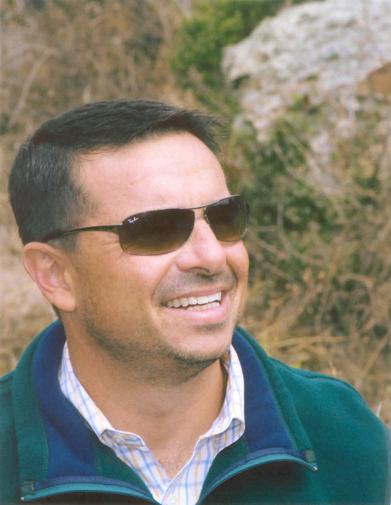
Mayor Ed Lee

Fixing Care not Cash

18

I will admit to a bias up front: I was against Care Not Cash in 2002, when Gavin Newsom used it as a cynical play to get elected mayor by bashing the homeless. I always argued that the city would be taking away the already-tiny welfare payments from people in exchange for housing that isn’t there. Imagine living on $422 a month in San Francisco. Now imagine that’s been cut to $59 a month — because the city’s determined that you can sleep in a shelter bed. Great fucking deal.


And that’s what happens. Care not Cash allows the city to reduce a homeless person’s general assistance grant to $59 a month as soon as the city finds housing for the person. And a shelter counts as housing.


There are lots of problems with the scenario — like this and and this. In essence, the city sets aside a certain number of shelter beds for people in the CNC program, but they don’t all show up, so there are empty beds — and people who need a place to sleep can’t get them because they’re earmarked as “housing” for an anti-homeless program.


So five supervisors have come up with a ballot initiative that would make one small, but significant change in the Care Not Cash legislation. It would specify that shelters don’t count as housing. That’s it. That’s the entire amendment. (You can read the proposed law here (pdf)


It makes perfect logical sense. You want to tell a homeless person that instead of giving you welfare payments, we’re going to give you housing? Fine. Then make it housing. Wasn’t that the premise of CNC from the start?


But somehow, CNC stalwarts (including those who make money off the program) are outraged, claiming this will gut the entire effort. In the Chronicle story, Mayor Ed Lee notes that


“By removing the shelter system from the available benefits provided to Care Not Cash recipients, we dismantle this path to getting people housed, ultimately undermining the success of the nationally recognized, award-winning program.”


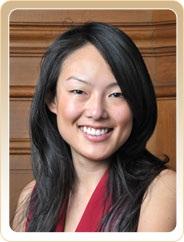
Of course, the proposal doesn’t remove the shelter system from the available benefits. Sup. Jane Kim, the sponsor, and her colleagues aren’t talking about shutting down shelters or kicking homeless people out. The measure just says you can’t take someone’s welfare grant away just because you found him or her a temporary cot in a noisy, often unsafe shelter that offers no privacy and operates under random rules that at lot of us would find intolerable. 


Again, my bias is against the entire premise of Care Not Cash. I think the city (and the state and the feds) ought to be providing homeless people with enough money to get a place to live and enough to eat. That’s the way it used to work — when I arrived in San Francisco, you could actually afford to rent a room in a shared house with General Assistance money, and you could live reasonably — not in luxury, but reasonably — on federal SSI payments. But the cost of housing has so outstripped the increase in welfare payments that people wind up on the streets. 


But if we’re going to do the Care Not Cash thing, shouldn’t the city be required to provide real housing before the grants get cut off?


Randy Shaw, who runs a bunch of Care Not Cash hotels under city contract, doesn’t think so. He argues that


[T]he measure repeals CNC’s central premise that homeless single adults on welfare should not get $422 per month if they refuse SRO housing. The initiative also dramatically reverses San Francisco homeless policy: it replaces a system designed to get homeless people housed with one subsidizing homeless people to live permanently in shelters. The measure increases homelessness and provides no alternative funding to make up for the millions of CNC dollars that would be eliminated from the city’s supportive housing budget.


 I understand the concern about the CNC money (some of which, again, goes to Shaw’s operation). If the city starts paying $422 a month to some people who are now only getting $59, that money will have to come from someplace. But this whole notion that the proposed change will allow the city to give cash grants to people who “refuse SRO housing” seems a bit off.


“We haven’t changed that part at all,” Jennifer Freidenbach, who runs the Coalition on Homelessness and was involved in drafting the measure, told me. “People who refuse SRO housing would still get their grants cut.”


I asked Shaw about this — and also about my understanding that there isn’t enough SRO housing for every homeless person who wants a place to live. Should people on the waiting list get their grants cut off because the city can stick them in a shelter in the meantime?


For whatever reason, my old pal Randy hasn’t responded. (I continue to be boggled by two things — Shaw never calls people before he trashes them, and he seems unwilling to have substantive debates with me when I want to talk to him. That last time I emailed him to ask why he didn’t call people for comment, he responded: “I see the issue very differently and disagree with your premise.” How is that helpful? This time he didn’t answer at all.)


The oddest thing is that Shaw — a longtime housing advocate who has spent 30 years working to help low-income people — has adopted a remarkably strident, even harsh tone that reminds me of the rhetoric that Newsom and his allies used to use. Consider:


Understand we are talking about people who have the option of accepting permanent housing but refuse. People who want to get a full city grant, live in a city-funded shelter, but want the right to pay nothing.


Jeez. Those lazy welfare bums who want “the right” to a place to live and a miniscule, tiny cash grant.


There was a time when liberals used to talk about a guaranteed national income. Now the debate in progressive San Francisco involves bashing poor people. Wow. 


Will partisan agendas shape the redrawing of political lines? — UPDATED

14

UPDATED BELOW In the midst of a political realignment at City Hall that is still shaking out, the Board of Supervisors Rules Committee is today (Thurs/23) considering appointments to the Redistricting Task Force, the body that will redraw supervisorial districts using the latest census data. And its choices will say a great deal about the role of integrity and impartiality in the new “politics of civility.”

This commission will arguably have more influence on the city’s political dynamics over the next decade than any other, so overtly partisan appointees should be viewed with great suspicion. Larry Bush at CitiReport did a nice rundown of the applicants and their backgrounds, but the Rules Committee will be where the real action is.

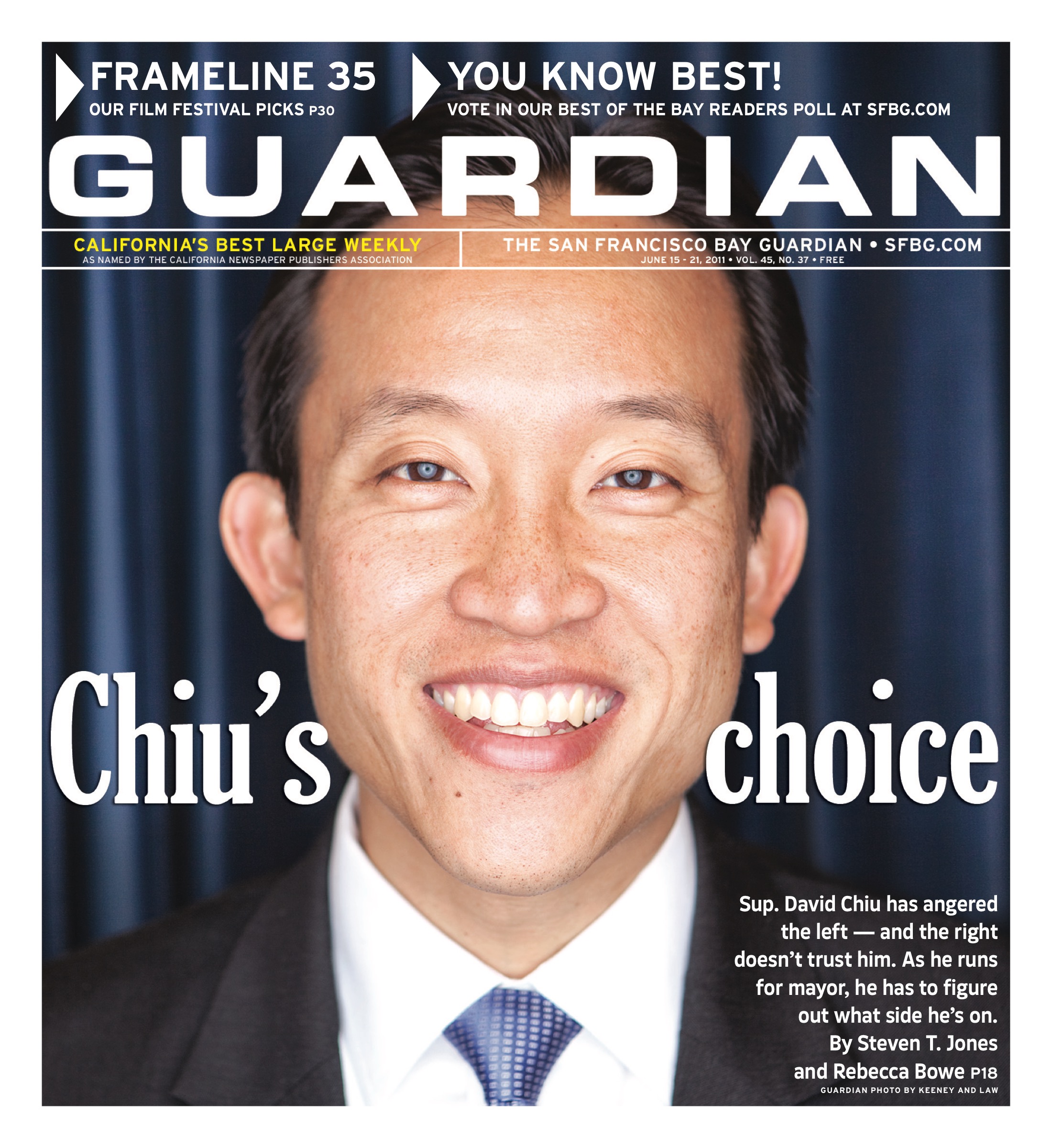
President David Chiu stacked the committee with a conservative majority (Sups. Mark Farrell and Sean Elsbernd) and named a chair (Sup. Jane Kim) whose political loyalties are tough to peg right now. Will she seek an appointee who doesn’t have a political agenda, or will she seek to reward a partisan ally like applicant Paul Hogarth, who worked on her campaign and writes for BeyondChron.org, a propaganda outlet for Kim-backers Randy Shaw and the Willie Brown/Rose Pak/David Ho cabal that elevated Ed Lee into Room 200 and is desperately trying to keep him there.

There are other problematic applicants as well, including Potrero View Publisher Steven Moss, who ran for supervisor in D10 last year and has shown a penchant for seeking payback against his perceived enemies (including the Guardian, which ran articles questioning his residency status). Applicant Ron Dudum has also shown a vindictive streak – following up his failed D2 supervisorial campaigns with an unsuccessful lawsuit challenging the ranked-choice voting system – that would make him a worrisome figure to have on this task force.

So far, three people have been named to the body by the Elections Commission: gadfly/policy wonk David Pilpel, Google attorney Melissa Tidwell, and Mark Schreiber, the managing general partner of Cooper White & Cooper. So already, this is tilting toward a business community bias that will probably get worse once Mayor Ed Lee makes his three appointments to the nine-member commission.

Given how the Rules Committee is stacked, its three recommendations are likely to raise questions that the full board will need to put to rest when it takes the matter up on Tuesday. Voters need to have faith that partisan agendas aren’t shaping the city’s most important political lines, and now is the moment to ensure they have that confidence.

UPDATE: The committee voted unanimously to recommend Eric McDonnell, the chief operating officer of United Way of the Bay Area; Jenny Lam, director of community initiatives for Chinese for Affirmative Action and a board member of Chinatown Community Children’s Center; and Mike Alonso, a “security professional” with Corporate Security Services who got his law degree from New College in 2007 but never worked as a lawyer.

Measure would make getting a shelter bed easier and more fair

3

More than three years after a Guardian investigation found that San Francisco’s homeless shelter system is an unnecessarily confusing, difficult to navigate, and inequitable boondoggle that routinely denies people use of even vacant shelter beds, voters in November will get a chance to change a system created largely by former Mayor Gavin Newsom’s Care Not Cash program.

Care Not Cash was sold to voters in 2002 as a program that reduced the general assistance payments to homeless individuals in exchange for the city giving them housing and support services. But that housing often turned out to be simply a shelter bed, and after years of city budget cutting closed homeless shelters, nearly half the remaining beds were set aside for Care Not Cash clients whether they used them or not.

So Sup. Jane Kim and four progressive supervisors, working with the Coalition on Homelessness, yesterday approved the creation of a “Fair Shelter” ballot measure to require that Care Not Cash clients get more than simply a shelter bed and that shelter beds be opened up to all who need them on a more equitable and sensible basis.

But Mayor Ed Lee and others who helped create the current system are criticizing the measure and using the same deceptive claims that have masked the problem for years. “Care Not Cash is premised on providing a path to housing and services. That path begins with shelter for those who need it. By removing the shelter system from the available benefits provided to Care Not Cash recipients, we dismantle this path to getting people housed, ultimately undermining the success of this nationally recognized, award-winning program,” Lee said in a statement issued yesterday.

Human Services Agency Director Trent Rhorer, Newsom’s point person in creating the system, told the Chronicle that the measure would threaten Care Not Cash and attract more homeless people to the city by making it easier to get into shelters. He also denied there was a problem, noting that about 100 of the city’s 1,100 shelter beds are vacant each night.

But there’s a gaping contradiction at the heart of Rhorer’s rhetoric, demonstrating that the city’s real intention is to make life as difficult as possible for the homeless in the hopes that they’ll simply leave the city, as Guardian reporters found when they spent a week trying to sleep in the shelters. Vacant beds are only made available late at night, and claiming one often involves long uncertain waits and crosstown run-arounds between where people register and where they might ultimately sleep.

It’s a dehumanizing and deceptive system that COH and the city’s Homeless Shelter Monitoring Committee have long been seeking to change. “The inclusion of shelter in the original ordinance has resulted in an unintended negative consequence of wreaking havoc on the city’s publicly funded shelter system. People with disabilities, seniors, working homeless people and undocumented people have a disadvantage in garnering access to shelter beds under the current system,” Shelter Monitoring Committee Chair LJ Cirilo said in a statement put out by COH, which noted that 43 percent of shelter beds are reserved by Care Not Cash recipients, although they represent only about 14 percent of the city’s homeless population.

Ford says goodbye at Golden Wheel Awards

2

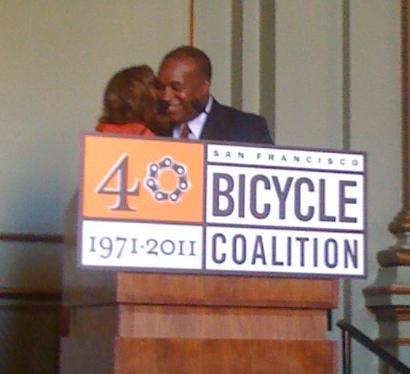
Just hours after being asked to leave the San Francisco Municipal Transportation Agency, director Nat Ford was at the San Francisco Bicycle Coalition’s annual Golden Wheels Awards accepting an award for the MTA’s Livable Streets Team. But that potentially awkward moment was eased by the universal political support for making the streets of San Francisco safer and more inviting for pedestrians and bicyclists.

Coming from car-centric Atlanta in 2006, Ford admitted he was an unlikely champion of turning San Francisco into one of the country’s best cities for biking. But he said the SFBC was “very persistent and worked with us.” While the bike injunction hurt progress, Ford said the support of SFBC and city officials allowed the agency to beef up the program from just a couple of staffers to “a dozen of the best bike planning and engineering folks in this country.”

“It was great working with all of you to get the MTA where it is today in terms of biking,” Ford told the capacity crowd in the War Memorial Building’s second floor event space, where the balcony overlooked City Hall and a sea of hundreds of bikes parked on the sidewalk out front.

Mayor Ed Lee spoke next, pledging to continue the progress and telling the crowd, “I want to give my very special thanks to Nat Ford for his five years of very dedicated service.”

Both Ford and MTA members told the Guardian that the split was a “mutual decision.” Ford told us, “Now’s a good time to go,” and that he’s still figuring out his next move. MTA board chair Tom Nolan told us, “It’s something we arrived at together. It’s good for his family and him.”

Indeed, it seems very good for Ford. The board approved a $385,000 severance package to go with its request that he resign before his contract expires, a payout that is drawing some criticism. “I am deeply disappointed that MTA would approve a nearly $400,000 golden parachute for an outgoing city executive. At a time when our budget is cutting critical social services for our kids and the most vulnerable in our city, we can ill-afford to be paying excessive payouts to administrators who are no longer working for the public. I have fought these exorbitant sweetheart deals at UC and CSU, and as mayor I will reform these practices,” Sen. Leland Yee, a candidate for mayor, said in a prepared statement.

Nolan says it’s time to restore the agency. “I’ve talked about wanting to restart what we do,” he told us. While Ford’s reported job hunting was one reason for the split, Nolan also alluded to mismanagement of the agency and the mistrust of its administration by Transport Workers Union Local 250A and other employees.

“We clearly have a problem when the drivers turn down a contract two-to-one,” Nolan said of the union’s rejection of its latest contract, which has since been approved by an outside arbitrator. “We can do a lot better.”

But the Ford saga was just a sideshow during an evening devoted to celebrating the improvements to the city’s bicycle network and selling the SFBC’s vision of what’s next, which it calls “Connecting the City.” The plan calls for three, green, separated bikeways (like those now on a stretch of Market Street) bisecting the city by 2015 (with the first Bay To Beach route done by next year) and a fully connected network of 100 miles of bikeways by 2020.

“Safe, comfortable, crosstown bikeways for everyone,” was how MTA Commissioner Cheryl Brinkman put it in slick video that the SFBC premiered at the event to promote the plan.

SFBC Director Leah Shahum told the crowd the idea is to connect and promote the city’s various neighborhoods and encourage “regular San Franciscans” to take more frequent trips by bike. “Seven in 10 of us, that’s how many people are already riding a bike,” she said, citing a survey of how many city residents own or have access to bikes. “We’re developing a vision where people are connected by safe, family-friendly bikeways.”

Shahum praised how engaged Mayor Lee has been with the plan and the need to improve the city’s cycling infrastructure. “Let me tell you how impressed I am with the level of involvement from Room 200,” she said.

Lee pledged to make cycling safer on dangerous sections of Oak and Fell streets that connect the Panhandle with the Lower Haight – sections Shahum took Lee on during Bike to Work Day this year – and to complete a new green bike lane on JFK Drive this year.

“We can get a lot of the goals of the Bicycle Coalition done together. We need your help in November,” Lee told the crowd, calling for them to support a street improvement bond measure on the fall ballot. He said the bicycling community has made the streets more fun and inviting, telling the crowd that at this weekend’s Conference of Mayors, he is “going to brag about our bike lanes and our way of living.”

CPMC’s stunning arrogance

0

The San Francisco City Planning Commission hearing June 9 on California Pacific Medical Center’s expansion plans was remarkable — both in the comments that the commissioners had and in the mind-boggling arrogance of the giant hospital chain.

CPMC wants to build a massive new hospital and medical office building on Van Ness Avenue and rebuild St. Luke’s Hospital in the Mission. The plans aren’t even close to complying with city planning codes — the Sutter Health affiliate will need city approval to exceed height limits on Van Ness (by more than 100 feet); a modification of the housing construction requirement for new offices; permission to demolish existing housing units; permission to take over a part of San Jose Avenue — and a lot more. In other words, CPMC is asking a lot from the city.

And since this nonprofit controls four major hospitals in the city, its future development decisions need to be considered in the context of San Francisco’s overall health care needs.

It’s entirely reasonable that the city ask CPMC for a development agreement that provides benefits to city residents. Mayor Ed Lee has made it clear that the approval of this project will depend on whether CPMC can address affordable housing, healthcare access for low-income people, a secure future for St. Luke’s, workforce development, and transportation impacts. Lee’s proposals are more than reasonable: he’s asking that CPMC pay the standard fee for affordable housing required of any major commercial developer; increase its level of charity care (now an abysmal 0.99 percent) to the average of other regional hospitals (2.3 percent); increase its Medical acceptance rate; and maintain St. Luke’s as an acute care facility with an emergency room. Union nurses are asking that Sutter deal with them in good faith.

But Dr. Warren Browner, CEO of CPMC, showed little interest in working with the city. The demands are way too high, he told the commissioners, insisting that it was unreasonable to ask the hospital to contribute that much to affordable housing. He acted as if CMPC was somehow entitled to move forward — at its own proposed schedule — and that all of these city demands were nonsense.

That’s not going to work.

A clear majority of the commissioners got the point. As Ron Miguel pointed out, Sutter is a nonprofit — and its tax-exempt status mandates a certain level of social responsibility. Every big commercial developer has to pay for housing and transit impacts. Gwyneth Borden and Bill Sugaya noted that hospital officials knew full well what the planning rules were when they bought the Van Ness site.

This is a $2.5 billion project. Community benefits need to be a significant part of the final plan. If anything, Lee’s proposals are too limited (Sutter should agree to protect St. Luke’s for 50 years, not 20). The planning commissioners should stick to their positions — this project is out of control, and if Browner wants to see it built, he needs to come back with a new set of numbers, and a new attitude.

Editorial: CPMC’s stunning arrogance

3

The San Francisco City Planning Commission hearing June 9 on California Pacific Medical Center’s expansion plans was remarkable — both in the comments that the commissioners had and in the mind-boggling arrogance of the giant hospital chain.

CPMC wants to build a massive new hospital and medical office building on Van Ness Avenue and rebuild St. Luke’s Hospital in the Mission. The plans aren’t even close to complying with city planning codes — the Sutter Health affiliate will need city approval to exceed height limits on Van Ness (by more than 100 feet); a modification of the housing construction requirement for new offices; permission to demolish existing housing units; permission to take over a part of San Jose Avenue — and a lot more. In other words, CPMC is asking a lot from the city.

And since this nonprofit controls four major hospitals in the city, its future development decisions need to be considered in the context of San Francisco’s overall health care needs.

It’s entirely reasonable that the city ask CPMC for a development agreement that provides benefits to city residents. Mayor Ed Lee has made it clear that the approval of this project will depend on whether CPMC can address affordable housing, healthcare access for low-income people, a secure future for St. Luke’s, workforce development, and transportation impacts. Lee’s proposals are more than reasonable: he’s asking that CPMC pay the standard fee for affordable housing required of any major commercial developer; increase its level of charity care (now an abysmal 0.99 percent) to the average of other regional hospitals (2.3 percent); increase its Medical acceptance rate; and maintain St. Luke’s as an acute care facility with an emergency room. Union nurses are asking that Sutter deal with them in good faith.

But Dr. Warren Browner, CEO of CPMC, showed little interest in working with the city. The demands are way too high, he told the commissioners, insisting that it was unreasonable to ask the hospital to contribute that much to affordable housing. He acted as if CMPC was somehow entitled to move forward — at its own proposed schedule — and that all of these city demands were nonsense.

That’s not going to work.

A clear majority of the commissioners got the point. As Ron Miguel pointed out, Sutter is a nonprofit — and its tax-exempt status mandates a certain level of social responsibility. Every big commercial developer has to pay for housing and transit impacts. Gwyneth Borden and Bill Sugaya noted that hospital officials knew full well what the planning rules were when they bought the Van Ness site.

This is a $2.5 billion project. Community benefits need to be a significant part of the final plan. If anything, Lee’s proposals are too limited (Sutter should agree to protect St. Luke’s for 50 years, not 20). The planning commissioners should stick to their positions — this project is out of control, and if Browner wants to see it built, he needs to come back with a new set of numbers, and a new attitude.


Lee should veto Parkmerced

0

EDITORIAL Mayor Ed Lee got his start as a lawyer working on tenant issues. He understands the city’s rent laws and the shortage of affordable housing. He also knows — or ought to know — that when the city’s tenant groups are unanimously opposed to a project, elected officials who care about tenant rights should pay attention.

The Parkmerced project will be a clear test: Does he follow his activist roots, stick with the people he started with and show his independence — or side with the big out-of-town developer and allow the project to move forward?

The supervisors approved the project by the narrowest of margins, 6-5. All of the progressives voted to reject the development agreement and rezoning — and for good reason. The deal would lead to the demolition of 1,500 units of rent-controlled housing. And while the developer says it will abide by the rent laws for the newly built replacement units, that’s a shaky legal guarantee. The larger point, tenant advocates say, is that demolishing existing affordable housing is always a bad idea.

In the end, 1,500 people will have to leave the homes they’ve lived in for years — in some cases, many years. They will be offered replacement units in a high-rise — very different from the garden apartments (with, yes, gardens) that they’ve occupied. And if the developer decides that there’s more money to be made by jacking up the rents on those units, it’s a safe bet that an army of lawyers will arrive attempting to undermine the questionable guarantees now in the deal.

There’s also the problem of transportation and traffic. The project will include a new parking space for every new unit, meaning 6,000 new cars in an area already overwhelmingly congested. Since the vast majority of the units will be market-rate (the developer will provide 15 percent affordable units, under city law, which means 85 will be sold or rented to rich people) the development will transform what is now still something of a working-class neighborhood into another enclave for the wealthy.

When we talked to Mayor Lee, he was noncommittal on the deal. At the same time, he noted that the garden apartments are old and will have to be replaced at some point. We don’t dispute that there are ways to add more density at Parkmerced. But wholesale demolition of affordable housing isn’t the answer.

This deal is bad for tenants and bad for the city. Mayor Lee ought to recognize that then tenant groups opposing this have analyzed it carefully and come to an entirely reasonable conclusion.

Sup. David Chiu, the swing vote in favor of the project, did serious damage to his reputation as a progressive and lost thousands of tenant votes by siding with the developer. Lee, who insists he isn’t running in November, ought to demonstrate that he hasn’t forgotten his roots, that he listens to activists, and doesn’t simply go along with poorly conceived development projects. He should veto the development agreement and zoning changes and send this thing back to the drawing board.

Behind the all-smiles budget

2

news@sfbg.com

When Mayor Ed Lee released his 2011-12 budget proposal June 1, all was sweetness and light at City Hall.

The mayor delivered the document in person, to the supervisors, in the board chambers. Sup. Carmen Chu, chair of the Budget Committee, was standing to the mayor’s right. Board President David Chiu was to his left. There was none of the imperious attitude we’d come to expect in the Gavin Newsom era — and little of the typical hostility from the board.

As Sup. David Campos, who was elected in November 2008, remarked afterward: “It’s the first time since I’ve been elected that the mayor has taken the time to come to chambers. It’s reflective of how this has been a lot more of an inclusionary process.”

Lee went even further. “This is a pretty happy time,” he said. “There are no layoffs, and instead of closing libraries we’ll be opening them.” That earned him an ovation from assembled city leaders, including mayoral candidates City Attorney Dennis Herrera and Assessor-Recorder Phil Ting along with District Attorney George Gascón. “I think this budget represents a lot of hope.”

It’s true that this year’s cuts won’t be as bad as the cuts over the past five years. It’s also true that the pain is spread a bit more — the police and fire departments, which Newsom, always the ambitious politician, wouldn’t touch, are taking their share of cuts.

But before everybody stands up and holds hands and sings “Kumbaya,” there’s some important perspective that’s missing here.

Over the past half-decade, San Francisco has cut roughly $1 billion out of General Fund spending. The Department of Public Health has eliminated three- quarters of the acute mental health beds. Six homeless resource centers have closed. The waiting list for a homeless family seeking shelter is between six and nine months. Muni service has been reduced and fares have been raised. Recreation centers have been closed. Library hours have been reduced.

In other words, services for the poor and middle class have been slashed below acceptable levels, year after year — and Mayor Lee’s budget doesn’t even begin to restore any of those cuts.

“We’re not ready yet to restore old cuts,” Lee told the Guardian in a June 2 interview. “It was enough for us to accomplish a pretty steady course and keep as much. Particularly with the critical nonprofits that provide services to seniors and youth and homeless shelters, we kept them as close as we could to what last year’s funding was.”

But the current level of funding is woefully inadequate. As Debbi Lerman, administrator of the Human Services Network, noted, the people who work in the nonprofits Lee was talking about haven’t had a pay raise in four years — even though the cost of living continues to rise. “Our costs have gone up with cost of inflation,” she noted.

She said the cuts over the past few years have deeply eroded services for children, homeless people, substance abuse programs, and others. “There have been significant cuts to every area of health and human services.”

And in a city with 14 billionaires and thousands more very wealthy people, Lee’s budget is distinctly lacking in significant new ways to find revenue.


THE GOOD NEWS

Just about everyone agrees that the budget process this year has been far better than anything anyone experienced under Newsom. “He [Mayor Lee] listened to everybody,” Lerman said. “That doesn’t mean they fixed everything. Mayor Lee fixed as much as he could.”

At his press conference announcing the release of the budget, Lee thanked Police Chief Greg Suhr for having already made significant cuts through management restructuring and for considering an additional proposed cut of $20 million.

“We want to thank you for that great sacrifice,” Lee said, addressing Suhr, who sat in front row of public benches, dressed in uniform. Lee next acknowledged that adequate funding for social services also helps public safety. “Without those services, officers on the street would have a harder job,” he said.

Lee also praised the departments of Public Health and Human Services for helping to identify $39 million in federal dollars and $16 million in state dollars, to help keep services open and the city safer.

Lee noted that San Francisco no longer has a one-year budget process and has just released its first five-year financial plan as part of its decision to go in five-year planning cycles.

“To address this, I’ve asked for shared sacrifice, ” Lee continued, adding that he recently released his long-awaited pension reform charter amendment, emphasizing that it was built through a consensus and collaborative-based approach.

Lee also said he would consider asking voters to approve what he called “a recovery sales tax” in November if Gov. Jerry Brown is unable to extend the state’s sales tax. That would bring in $60 million — but it is only on the table as a way to backfill further state budget cuts.

Lee observed that San Francisco is growing, the economy is looking brighter, and unemployment is down from more than 10 percent last January to 8.5 percent today. He plugged the America’s Cup, the city’s local hire legislation, the Department of Public Works’ apprenticeship programs, and tourism, both in terms of earmarking funding in the budget for these programs and their potential to boost city revenues.

He said his budget proposed $308 million in infrastructure investments that include enhanced disability access, rebuilding jails, and energy efficiency, and is proposing a $248 million General Obligation bond for the November ballot to reduce the street repair backlog.

“We will get these streets repaired,” he promised.

“This submission of a budget is not an end at all, it’s the beginning of the process,” he continued, going on to recognize Chu for her work getting the process rolling and thanking Budget Analyst Harvey Rose in advance. “I do know his cooperation is critical.”

And he concluded by thanking each of the supervisors. “I will continue enjoying working with you — we need to keep the city family tight and together.”

The sentiment was welcomed by supervisors. “As he said, this is the beginning of the process, and it’s an important and symbolic step” Campos said. “The budget shows that a lot of good programs have been saved. But there is still work to do.

“There are still gaps in the safety network,” he added, singling out cuts to violence-prevention programs. “It’s my hope they will be restored.”


THE BAD NEWS

But even if the cuts for this year are restored, the city budget is nowhere near where it ought to be. “We still had to make cuts,” Lee acknowledged.

“We did consider very seriously a whole host of revenue ideas that we had,” he said. “They were not off the agenda at all.” At the same time, he noted that state law requires a two-thirds vote for new taxes (although that threshold drops to 50 percent in presidential election years). “We decided that it’s not that they were bad ideas, but that we wouldn’t be able to sell them at this time.”

Lee praised some of the revenue ideas that have been suggested in the past year, including the alcoholic beverage fee proposal by Sup. John Avalos, which Lee called “a pretty good idea.” He said that “a year or two from now” an additional sales tax and a parcel tax (for the police or for schools and open space) might be on the agenda.

The city now has a multiyear budget process and projections are supposed to go beyond a single year. But what’s missing — and what nobody is talking about — is a long-term plan to restore critical city services to a sustainable level. That means talking — now — about tax proposals for 2012 and beyond and including those revenue streams in long-term budget planning.

Because the city parks, the public health system, the libraries, the schools, affordable housing programs, and the social safety net are in terrible condition today, the result of year after year of all-cuts budgets. And while the supervisors and the mayor wrangle over the final details, and advocates try to win back a few dollars here and a few dollars there, it’s important to recognize that this budget does nothing to fix the damage.

“We’re about $10 million short of what we need right now to keep service providers at current levels,” noted Jennifer Freidenbach, who runs the Coalition on Homelessness. “But we also need to restore the health and human services system that was slaughtered under Gavin Newsom.”

Around the bay, around the world

0

arts@sfbg.com

DANCE “When one door closes, another opens” is the kind of cliché that drives you batty when you’ve been fired, or your lover has literally showed you the door. But once in a while even clichés prove their right to exist. Take the San Francisco Ethnic Dance Festival, which last year faced homelessness when Caltrans requisitioned the Palace of Fine Arts’ parking lot for the duration of the Doyle Drive reconstruction. With poor access to MUNI and no parking lot, EDF had no choice but to start a frantic search for another venue. The crisis challenged them to rethink a format that has worked for them since 1989 — potentially very risky, because, to quote another cliché: “Don’t mess with success.”

With a need to move from one temporary shelter to another, EDF took the opportunity to reshape its offerings in a way that might yet prove beneficial to both audiences and performers.

For one group of dancers, however, this year’s EDF is a homecoming. For the first time in more than 200 years, dancers and musicians from the Rumsen Ohlone Tribe will perform on their own land. Decimated by disease and dispersed because of persecution and discrimination, most live in a diaspora in their own country. But they did not, as popular history and the federal government would have it, die out; the tribe is 2,000 members strong. Many, including tribal chief Tony Cerda have settled in the Pomona area. But their ancestors are buried below what is now Yerba Buena Center for the Arts.

On Friday, June 3, in the presence of tribal dancers and musicians, San Francisco Mayor Ed Lee presented Cerda with the EDF’s annual Malonga Casquelourd Lifetime Achievement Award. The homecoming festivities continue on June 18, when a half-dozen other California tribes join the Ohlones for an all-day “California Indian Big Time Gathering” at Yerba Buena Gardens.

Two other aspects of this year’s program deserve special attention. June 11 and 12, eight companies will perform at Zellerbach Hall in Berkeley for the first time. For dancers used to showing their work in community halls, stepping onto a generous professional stage (and in front of a potential audience of 2,000) will be both a challenge and a delight. In January, EDF held its auditions at Zellerbach to an enthusiastic response from the primarily East Bay crowd. The word clearly had gotten out about how much fun these auditions are. In previous years at the Palace, the events regularly sold out.

The Zellerbach lineup aims to offer a similarly broad perspective of world dance. The eight companies will present taiko and Bharatanatyam contextualizing each other; African music and dance as practiced in Benin and Ghana; ancient belly dancing with a modern twist; and theatrically appropriate rituals from the Philippines and Bali. It also includes a barefoot version of flamenco, dances from a multicultural Veracruz, and, to top off the evening, a premiere for 100 celebrating Tahitian culture.

This year’s other innovation relates to performances June 19, 25, and 26 at YBCA’s Forum, where audience members will have the opportunity to enter the world of these dances. It makes sense. Culturally-rooted dance is integral to a community’s sense of well-being. It enhances milestones — courting, funerals, the changing of seasons, coming-of-age ceremonies, and thanksgiving practices.

These dances are not primarily meant to entertain — although of course they do — and many are participatory. When divorced from their contexts and put on a proscenium stage, something is inevitably lost. The Forum performances will restore some of the communal aspect of world dance. Each program offers a different quartet of companies that will perform a short piece, then invite the audience to join them in one aspect of their practice. You can choose among Balinese, Polish, square, Filipino, capoeira or African dance.

Or how about a piece of poppy seed cake served on a sword?

SAN FRANCISCO ETHNIC DANCE FESTIVAL

Through July 3, $18–$58

Various venues

www.sfethnicdancefestival.org


Hall blasts Treasure Island deal

27

Mayoral candidate Tony Hall, who also happens to be a former executive director of the Treasure Island Development Authority, just blasted Mayor Ed Lee’s endorsement of the Treasure Island deal:

“This deal will never benefit San Franciscans because no banker will advance a billion dollars in pre-development costs that are necessary to shore up and detoxify a man-made island that sits in the middle of a bay on top of one of the strongest earthquake faults in Northern California,” Hall claimed in a June 7 press release. “The developers themselves are nearly bankrupt. I’m very disappointed in Mayor Lee for promoting this deal. As an administrator, he should know better and be strong enough to tell the people the truth.”

Hall went on to vent about the “City Family,” referring to a phrase that Mayor Ed Lee seems to be fond of using anytime he is trying to build consensus at City Hall.

“In the past few weeks, we have seen a trend developing from the so-called ‘City Family,’” Hall observed. “In May, they proposed a hasty pension deal that barely scratches the surface of the problem. Now in June they are ready to pass a phony Treasure Island deal that benefits the connected developers and their consultants, but will probably never benefit San Franciscans. All these celebrated agreements seem timed to paper over important issues with hasty solutions right before the Mayoral election.  What’s next for July? An agreement to build a permanent rainbow across the Bay? The ‘City Family’ might try to take these issues off the table, but my mayoral campaign is going to put these issues right back squarely in front of the voters.”

Avalos introduces SF-San Mateo Local Hire agreement

7

Last year, when Sup. John Avalos introduced and eventually won passage of the city’s landmark local hiring ordinance, a number of battles broke out, as folks in neighboring municipalities began fretting that the new law could shut them out of construction jobs in San Francisco. Avalos worked hard to make sure their concerns were addressed, but he continued to encounter resistance from San Mateo County.
And in February Assemblymember Jerry Hill (D-San Mateo) who is facing term limits and reapportionment, introduced a bill in Sacramento that was intended to limit the reach of the Avalos legislation, which aimed to put more San Francisco residents to work on city-funded construction projects.
Hill’s legislation, AB 356, sought to prohibit the use of state money on local-hire projects and prevent Avalos’ legislation from being applied to the city’s projects in counties within 70 miles of San Francisco, including upgrades to the Hetch Hetchy water system on the Peninsula.
“San Francisco can use its own money any way it wants,” Hill said at the time, “Taxpayers from San Mateo, Ventura, Solano and other California counties shouldn’t have to pay for the increased construction costs that will result from San Francisco’s local-hire ordinance.”
Plus, he said the city should be thinking regionally, not hyper-local.
But, as Avalos repeatedly pointed out, his local hire law doesn’t apply to projects funded with state money, and it only mandates 20 percent local hire this year, gradually increasing to 50 percent local hire over the next seven years.
At the time, the Guardian predicted that Hill’s bill would “probably go down the crapper because the San Francisco legislators, who have a fair amount of clout up in Sacramento these days, aren’t going to support it. Assemblymember Tom Ammiano and state Sens. Mark Leno and Leland Yee have all signed a letter supporting the city’s local hire law.”
And sure enough, after the mayors of San Francisco and Los Angeles, not to mention organizations from San Francisco, Oakland, Los Angeles and San Diego, and the State Building Trades Council made their views known, Assemblymember Charles Calderon requested June 3 that Hill’s legislation by ordered to the inactive file.
Local supporters of Avalos’ legislation say Hill’s bill got pulled because there was no chance in hell that it would ever get out of the State Assembly.
But Hill’s office claims it was because San Francisco and San Mateo reached a deal last week, and that this outcome was Hill’s intention all along.
“What happened was that the Assemblymember Jerry Hill put together a bill and his intention was to get his constituents in San Mateo a memorandum of understanding with San Francisco—and that MOU was signed last Friday (June 3) by San Francisco Mayor Ed Lee and San Mateo County Board President Carole Groom,” Hill’s legislative aide Aurelio Rojos told the Guardian.
And according to a statement that Hill’s office released June 3, Hill welcomed the signing of a reciprocity agreement that “ends a dispute between the counties of San Mateo and San Francisco by creating a level playing field for San Mateo County residents working on construction  projects in the county funded by San Francisco.”
Hill’s press release claims the MOU was “forged following weeks of negotiations that began in February after Hill introduced legislation that would have limited San Francisco’s recently enacted local hire ordinance to its geographic boundaries. The agreement allows contractors working on San Francisco public works projects located in San Mateo County to hire an equal number of workers from the two counties.  As a result of the agreement, Hill has agreed not to move forward with his legislation, Assembly Bill 356.”
 “San Mateo County construction workers will no longer be penalized by San Francisco’s local hire ordinance as a result of the agreement,” Hill said.  “I applaud Mayor Lee and Supervisor Groom for creating a level playing field that will enable San Mateo residents to work on construction projects within their county.”
 Hill claims that  with San Francisco scheduled to award $27 billion in public contracts during the next decade, the city’s local hire  provision would have impacted the ability of San Mateo County residents to work on construction projects in their county, including the San Francisco International Airport, the jail in San Bruno, Hetch Hetchy waterworks and other facilities on the Peninsula.”
Either way, today, Avalos, who has long maintained that Hill either didn’t understand his legislation or was refusing to understand the legislation, and Mayor Ed Lee are introducing a resolution, “approving a local hiring agreement between San Francisco and San Mateo County,” and reinforcing equal opportunity guaranteed under San Francisco’s Local Hire Policy and community-labor partnerships
Avalos, who is running for mayor, apparently led the negotiations alongside Lee to forge the agreement which allows contractors performing San Francisco public works projects in San Mateo County to equally draw workers from San Francisco and San Mateo to meet required staffing levels under the local hiring ordinance.
The agreement covers San Francisco-funded projects located in San Mateo County, including the San Francisco airport.  Under the agreement, San Mateo workers are included by the local hiring requirement for projects  in San Mateo County, and will be able to fill up to half of the local hiring requirement.
“This is a win-win for workers in San Francisco and San Mateo. Whatever we can do to support job creation in the Bay Area region during this very long recession is going to be very meaningful to the families that are struggling to stay in this area,” Avalos said.
“The achievement in securing this resolution is really a testament to the strength of communities united,” said Brightline executive director Joshua Arce. “Sup. Avalos always intended that his legislation would expand, in terms of opportunities on city-funded projects, outside San Francisco. On San Francisco-funded work in San Mateo, San Francisco and San Mateo workers will be working side by side, taking advantage of the local and regional aspects of the legislation.”
Or as Avalos put it,  “The local hiring ordinance is about making sure we create job opportunities in San Francisco when the city invests taxpayer dollars in construction projects. We included the flexibility to craft reciprocal agreements with other cities and counties, and that’s exactly what was accomplished in the deal that was reached between San Francisco and San Mateo.”

Editorial: Mayor Ed Lee should veto the Parkmerced development agreement

20

 Mayor Ed Lee got his start as a lawyer working on tenant issues. He understands the city’s rent laws and the shortage of affordable housing. He also knows — or ought to know — that when the city’s tenant groups are unanimously opposed to a project, elected officials who care about tenant rights should pay attention.

The Parkmerced project will be a clear test: Does he follow his activist roots, stick with the people he started with and show his independence — or side with the big out-of-town developer and allow the project to move forward?

The supervisors approved the project by the narrowest of margins, 6-5. All of the progressives voted to reject the development agreement and rezoning — and for good reason. The deal would lead to the demolition of 1,500 units of rent-controlled housing. And while the developer says it will abide by the rent laws for the newly built replacement units, that’s a shaky legal guarantee. The larger point, tenant advocates say, is that demolishing existing affordable housing is always a bad idea.

In the end, 1,500 people will have to leave the homes they’ve lived in for years — in some cases, many years. They will be offered replacement units in a high-rise — very different from the garden apartments (with, yes, gardens) that they’ve occupied. And if the developer decides that there’s more money to be made by jacking up the rents on those units, it’s a safe bet that an army of lawyers will arrive attempting to undermine the questionable guarantees now in the deal.

There’s also the problem of transportation and traffic. The project will include a new parking space for every new unit, meaning 6,000 new cars in an area already overwhelmingly congested. Since the vast majority of the units will be market-rate (the developer will provide 15 percent affordable units, under city law, which means 85 will be sold or rented to rich people) the development will transform what is now still something of a working-class neighborhood into another enclave for the wealthy.

When we talked to Mayor Lee, he was noncommittal on the deal. At the same time, he noted that the garden apartments are old and will have to be replaced at some point. We don’t dispute that there are ways to add more density at Parkmerced. But wholesale demolition of affordable housing isn’t the answer.

This deal is bad for tenants and bad for the city. Mayor Lee ought to recognize that the tenant groups opposing this have analyzed it carefully and come to an entirely reasonable conclusion.

Sup. David Chiu, the swing vote in favor of the project, did serious damage to his reputation as a progressive and lost thousands of tenant votes by siding with the developer. Lee, who insists he isn’t running in November, ought to demonstrate that he hasn’t forgotten his roots, that he listens to activists, and doesn’t simply go along with poorly conceived development projects. He should veto the development agreement and zoning changes and send this thing back to the drawing board.


Sneaky campaign to draft Lee sullies political environment

92

At a time when City Hall is taking on several important issues – from the budget and pension reform to massive projects such CPMC’s mega hospital and housing project and the redevelopment of Parkmerced and Treasure Island – an ambitious cabal of political operators bent of convincing Mayor Ed Lee to break his word and run for office is poisoning the environment under the dome.

A series of unfolding events over the last week makes it clear that Sup. Jane Kim’s campaign team – political consultants Enrique Pearce and David Ho, Tenderloin shot-caller Randy Shaw, and their political benefactors Willie Brown and Rose Pak – are orchestrating another campaign to convince Lee to run for office, apparently abandoning the mayoral campaign of Board President David Chiu.

The Bay Citizen reported that Pearce was pursuing creation of a mayoral campaign that Lee could simply step into, while blogger Michael Petrelis caught Pearce creating fake signs of a grassroots groundswell for Lee over the weekend. That effort joins another one by the Chronicle and a couple of downtown politicos to create the appearance of popular demand for Lee to run despite a large field of well-qualified mayoral candidates representing a wide variety of constituencies.

And then today, Shaw joined the effort with a post in his Beyond Chron blog that posed as political analysis, praising the John Avalos campaign – an obvious effort to ingratiate himself to the progressive movement that Shaw alienated by aggressively pushing the Twitter tax break deal and Kim’s candidacy – while trying to torpedo the other mayoral campaigns, calling for Lee to run, and offering a logic-tortured take on why the public wouldn’t care if Lee breaks his word.

Pearce and Ho – who sources say have been aggressively trying to drum up support for Lee in private meetings around town over the last couple weeks – didn’t return our calls. Kim, who is close to both Chiu and Avalos, told us she is withholding her mayoral endorsement until after the budget season – which, probably not coincidentally, is when Lee would get into the race if he runs.

Fog City Journal owner Luke Thomas, who Petrelis caught taking photos for Pearce over the weekend – told us Pearce’s Left Coast Communications, “hired me in my capacity as a professional photographer to take photographs of people holding ‘Run Ed Run!’ signs and should not be construed as an endorsement of the effort to draft Ed Lee into the mayor’s race.”

In an interview with the Guardian last week, Lee reiterated his pledge not to run for mayor – which was the basis for his appointment as a caretaker mayor to finish the last year of Gavin Newsom’s term – but acknowledged that Pak and others have been actively trying to convince him to run. Pak has an open disdain for candidate Leland Yee and fears his ascension to Room 200 would end the strong influence that Pak and Brown have over the Mayor’s Office and various department heads.

“I am not running. I’ve told people that. Obviously, there is a group of good friends and people who would be happy for me to make a different decision, so they’re going to use their time trying to persuade me. I’ve told them I’m not interested and I have my personal reasons for doing that but they’re not convinced that someone who has held this office for five months and not fallen into a deep abyss would not want to be in this office and run for mayor. I’ve been honest with people that I’m not a politician. I’ve never really run for office nor have I ever indicated to people that I’d like to run for mayor of San Francisco. That’s just not in my nature so it’s been a discussion that is very foreign to me that has been very distracting for me in many ways because I set myself a pretty aggressive piece of work that this office has to get to. The way I do it is very intensely. I do meet a lot of people and seek their input before I made a decision,” Lee told us.

Even Sup. Sean Elsbernd, who nominated Lee for mayor, told the Chronicle that he doesn’t support the effort to pressure Lee into running and he feels like it could hurt sensitive efforts to craft compromises on the budget and pension reform. When asked by the Guardian whether he would categorically rule out a run for mayor, Lee told us he would.

“I’ve been very adamant about that yet my friends will still come up to me and they’ll spend half their time talking to me about it. And I say thank you, I’m glad you’re not calling me a bum and trying to kick me out,” Lee told us, noting that Pak – a longtime ally who helped engineer the deal to get Lee into office, for which Chiu was the swing vote, parting from his five one-time progressive supervisorial allies in the process – has been one of the more vociferous advocates on him running.

Asked whether there are any conditions under which he might change his mind, Lee told us, “If every one of the current supervisors in office asked me to run and those supervisors who are running voluntarily dropped out.” But Avalos says he’s committed to remain in the race, and his campaign has been endorsed by three other progressive supervisors.

A different Mayor’s Office

10

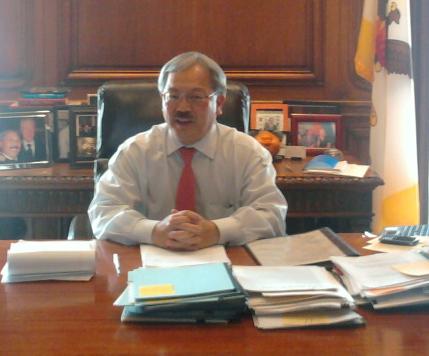
A group of Guardian reporters and editors met with Mayor Ed Lee June 2, and while the mayor and I don’t agree on everything, I have to say: It was refreshing.


Refreshing because the mayor has a sense of humor and doesn’t act like an infallible monarch. Refreshing because his office looks like, well, a working office. Refreshing because he smiled, was polite and never said “I dispute the premise of your question.”


What a difference.


Under Willie Brown, the mayor’s office was an imperial sanctum. If His Royal Williness deigned to favor one of his servants or subjects with the boon of a royal visit, you were expected to crawl on your hands and knees and kiss the floor. 


When Gavin Newsom was the occupant, the place was a cross between a museum and an Architectural Digest showplace — not a scrap of paper on the desk, every hair perfectly in place, the Robert Kennedy pictures and books lined up perfectly for the visitor to admire.


Both mayors treated the press with hostility. Both expected to be treated as potentates. The mayor was better than you and I — and you needed to understand that right away, or risk disdain and dimissal.


Ed Lee isn’t doing what I want with the budget. He’s not talking about raising taxes on the rich. He’s probably going to go along with ParkMerced and maybe even Treasure Island. He signed the Twitter tax break. I worry (a lot) about his ties to past corrupt regimes.


But he’s happy to have reporters in his office. He’s got stacks of reports on his desk and a notepad that suggests he’s actually reading them. He showed us his private “man cave” in the back, and offered us walnuts. He’s not always right on policy, and I don’t think he should run in the fall … but he’s not a jerk. And given the recent history of San Francisco mayors, that’s pretty radical.


FBI spying will be an issue for new Police Commissioner

1

When Police Chief Greg Suhr got sworn in at City Hall a month ago, reporters each got to ask one question during a hastily convened media roundtable inside Mayor Ed Lee’s office. And since the Guardian’s story about the FBI’s secret agreement with the San Francisco Police Department had just hit the streets, I asked the new Chief, if he would welcome clarification around the duties of SFPD officers assigned to the FBI’s Joint Terrorism Taskforce.

Chief Suhr said he believed an examination of the wording of the FBI’s most recent memorandum of understanding (MOU) with the department was already under way. “I believe that the MOU is being revisited,” Suhr said. “I have not been a part of that, but again I think we have a real good policy with regard to our intelligence gathering and that does supercede any ask of any other agency. The officers are bound by policies and procedures. And that policy was well thought out with tremendous community and group input years and years ago, from situations that have not since repeated themselves. I think a lot of people back then couldn’t believe they happened in the first place, but I think measures were well thought out and put in place to make sure we don’t have a problem again.”

Fast forward three weeks, and Suhr found himself in the hot seat at a May 18 joint meeting of the Human Rights Commission and the Police Commission, where commissioners got an update about the Police Department’s response to community concerns about surveillance, racial and religious profiling of Arab, Middle Eastern, Muslim, and South Asian Communities and the potential reactivation of SFPD Intelligence Gathering.

After Suhr introduced his new Command Staff—and stressed their great diversity–Police Commission President Thomas Mazzucco, who was Suhr’s football coach in high school, tried to assure folks that the Police Commission, the Human Rights Commission, the FBI, the SFPD, the American Civil Liberties Union and the Asian Law Caucus had already addressed the community’s intelligence-gathering concerns, in part through a bureau order that Chief Suhr then introduced during the hearing, in which Suhr clarified that SFPD policies trump FBI guidelines every time.

And Mazzucco,  a former Assistant U.S. Attorney for the Northern District of California and a former Assistant District Attorney for San Francisco, before Mayor Gavin Newsom appointed him to the Commission in 2008, noted that the community’s concerns were based on allegations. not factual findings.

But his comments got folks wondering whether Mazzucco’s prior involvement with the feds left him with a blind spot that is preventing the Police Commission from dealing with the issue in a timely and effective manner, particularly since Commissioner Jim Hammer’s term has expired, and the rest of the Commission is waiting for the Board’s Rules Committee to decide between nominating David Waggoner, L. Julius Turman, Phillip Hogan or Vanessa Jackson as the next new Police Commissioner.

For, as members of the public observed during the meeting, if the Police Commission President himself expresses no outrage at finding that the Commission’s policies have been undercut for the past four years by secret agreements between SFPD and the FBI, how can San Francisco claim to have a credible system of civilian oversight?

Instead, they felt that Mazzucco seemed more concerned about defending federal practices and officials, who were unwilling to show up at the May 18 hearing, than worrying about the role and authority of the civilian oversight body he now represents. And attorneys with the ACLU and the Asian Law Caucus noted that though Suhr characterized his new order as being based on the Portland resolution and a prior proposal from community advocates, they believe Suhr’s approach can only work with the written consent of the FBI, (which SFPD doesn’t have) if the FBI’s 2007 contract is left in place.

“That’s why there is a need for a transition to a non-MOU, Portland-style resolution,” ACLU’s John Crew told the Guardian, noting that ACLU’s willingness to work collaboratively with the commissioners and the new Chief should not be confused with a willingness on ACLU’s part to roll over and accept an approach that is based on wishful thinking rather than the realities of the MOU that’s still in place.

During the May 18 joint hearing, Chief Suhr acknowledged “the validity of the perceptions raised by the community,” even as he insisted that SFPD has “very strict policies” in place to ensure appropriate oversight for investigation- involving activities.

Suhr summarized the history of those policies, including ACLU’s John Crew’s involvement in creating Department General Order (DGO) 8.10, which establishes that there must be reasonable suspicion before SFPD intelligence gathering can occur.

Suhr noted that SFPD joined FBI’s Joint Terrorism Taskforce (JTTF) after the September 11, 2001 attacks, and SFPD officers assigned to the JTTF subsequently came under control of the Department of Homeland Security unit, but starting now, they are back under SFPD’s special investigations.

“I gave the order today that JTTF will be moved back under SFPD’s special investigation unit,” Suhr said. “They will have the security clearance necessary to oversee the activities. The members are required to comply with all department policies, even if they can conflict with FBI policies. Simply said, San Francisco policies, procedures, laws, and statute trump any federal policy or procedure. Our officers are bound by those.”

Suhr said that to ensure everyone is clear about the chain of command, he’d drafted his May 18 bureau order. “It essentially turns back the clock and emphasizes that officers are responsible for our policies and procedures first, and our officers are bound to identify themselves as San Francisco police officers,” Suhr said, further noting that he’d be happy to further amend his new order as needed.

And Mazzucco noted that SFPD has absolutely no jurisdiction whatsoever over the Transportation Security Administration’s activities at the airport.

But while Human Rights Commission Chair Michael Sweet said Suhr’s new bureau order,  “goes a long way toward helping to alleviate some of the concerns,” he and many commissioners noted that this was their first chance to read the order. And Sweet said he saw the May 18 joint hearing “as by no means the end of the discussion.”

HRC director Theresa Sparks, who was on the Police Commission when the FBI drafted its 2007 JTTF MOU, noted that the issue is not whether we should opt out, but what we can do to ensure that officers involved in activities have “strong civilian oversight of their activities and report activities through the established civilian oversight mechanisms and procedures defined in DGO 8.10.”

” Our approach to achieve this objective is to publish internal directives ensuring our officers only participate in activities that meet our local standards of reasonable suspicion,” Sparks stated, claiming that Suhr’s order will “ give the city control over misconduct charges and allegations of misconduct charges.”

Sparks noted that the May 18 hearing was a status report about “alleged violations by the FBI and SFPD, as well as airport police,” and that the HRC “did no independent investigation” to verify these allegations.

Sparks added that HRC and the Immigrant Rights Commission has a tentative agreement to move forward with townhall meetings to address community concerns, and will encourage the Board to appoint a special prosecutor to determine if the prosecution of terrorism cases is valid and fair, and discuss the need for an Ombudsman at the airport. And she talked about the need for SFPD to establish legal safeguards, mechanisms for greater transparency and oversight, and conduct more detailed yearly audits.

“Tonight was a real dialogue about the issues,” Sparks said, further noting that civilian oversight of local JTTFs is also a popular discussion in Oakland and in Portland, Oregon, which has decided to rejoin its local JTTF after opting out in March 2005. But she didn’t mention that Portland had entered into a resolution with the FBI, instead of signing a new MOU with the feds.

That explanation was left to Veena Dubal of the Asian Law Caucus and ACLU’s Crew– in between explaining why they believe Suhr’s Bureau Order isn’t enough. “The good news is that we all collectively agree that SFPD policies should apply to SFPD officers assigned to the JTTF,” Dubal said. “The bad news is that the recently released MOU, which was secret for four years, doesn’t reflect our collective desires.”

Dubal stated that the FBI won’t amend its 2007 MOU with the SFPD.
“And that is why the Chief issued the bureau order,” Dubal stated, claiming that the FBI Special Agent in Charge of JTTF involvement recently told ALC and the ACLU that the FBI will continue to block key parts of local policy central to accountability and oversight.

“But there’s a solution and it doesn’t necessitate a divorce from the joint terrorism task force,” Dubal continued, noting that there are now two ways for local law enforcement officers to participate in JTTFs: an MOU, in which SFPD resources are put into the hands of FBI with relatively no local control, as in the SFPD’s 2007 agreement with the FBI. Or via a resolution which the federal government just approved in Portland, which allows participation in the JTTF, but provides much better protection for civil rights and gives the police department and the police commission more control of the relationship.

Dubal noted that in the decade since 9/11, the FBI has expanded its intelligence powers, and its agents are now allowed to conduct intelligence without a factual connection to criminal activity.

“Given these massive shifts in FBI activity, the question is, what should the relationship between the SFPD and the FBI look like?” Dubal said.

“Unlike the FBI, the SFPD is not a national security organization, “ Dubal continued, noting that when SFPD signed up to work with the JTTF under an MOU that preserved local control and policies, “it wasn’t assuming that some of its officers, paid for by San Francisco taxpayers, could be transformed into national security agents.”

”The SFPD signed on without telling anyone, not even the police commission,” Dubal said, noting that SFPD cannot afford to participate in these practices. “We need community trust to keep all of our communities safe.”

ACLU’s Crew noted that the FBI came to the SFPD in 2007 with a new MOU. “And perhaps inadvertently, there was no review by the City Attorney, and no notice to the police commission,” Crew said. “And it’s a drastically different MOU, unfortunately.”

“Now, we didn’t know about that MOU because it was kept secret at the insistence of the FBI for four years,” Crew continued, further noting that when ACLU and ALC met with the SFPD in 2010, they were suddenly told that the police department couldn’t talk about these issues without FBI permission.

“That set off a warning sign,” Crew observed, noting that in early April, when the ACLU and ALC finally got the MOU released, their worst suspicions were confirmed.

“There was no public discussion of transforming the SFPD into a national intelligence gathering association,” Dubal said. “The problem is that the FBI changed the deal, and the SFPD signed it, without telling anyone.”

Dubal noted stark differences between the FBI’s 2002 MOU and the one the SFPD signed in 2007, along with stark changes to FBI guidelines that occurred in 2008, in the dying days of the Bush administration, and that now allow a new assessment category, that does not require reasonable suspicion and has been criticized by civil liberties groups.

And according to Crew, the FBI’s new MOU “puts at risk the very concept of civilian control.” As Crew noted, between the mid 1990s, when the SFPD developed DGO 8.10, which governs its officers’ intelligence-gathering policies and procedures, and 2007, when the FBI prepared a new JTTF MOU, there’d been little controversy over intelligence-gathering in San Francisco.

 “And then, perhaps inadvertently, the SFPD signed that MOU and it was drastically different and kept secret at the insistence of the FBI for four years,” Crew observed.

And in 2010, the SFPD suddenly said it couldn’t talk about the issue without the permission of the FBI, Crew added, noting that “Unnecessary secrecy breeds suspicion.”

“We don’t think the Bureau Order is sufficient,” Crew concluded. “This is an issue that has to be dealt with at the Police Commission level.”

Crew noted that the Portland City Council chose not to enter into an MOU, “specifically because it restricts the ability to provide local control and local oversight. “

“So, we are not saying opt out, but we are saying there needs to be a transition to a resolution that maintains local control over the assignment of officers and provides all these elements of civilian oversight,” Crew continued.

He claimed that the federal government says a resolution is possible, as long as you’re not doing it under an MOU.
“So the question is, if that level of protection is available now to the people in Oregon, why would San Francisco not take the same deal?” Crew said. “All you have to do is give 60 days’ notice to the FBI that are you going to start this transition to a resolution. That notice period allows the FBI to have any comments or express any concerns they want, I think it’s very regrettable that they chose not to participate tonight and unfortunately I think it says something in terms of how seriously they take these concerns.”

Crew concluded that such a transition would be a win-win situation.

”If we went to a resolution that merely asserted local policy, then they could keep doing exactly what they’re doing now,” Crew said. “On the other hand, if it turns out that there’s activities SFPD is involved in that they shouldn’t be involved in, don’t we want those stopped?

“The one comment I will make of the bureau of general order is that I’m thankful to hear it’s a work in progress,” Crew added, noting that ACLU and ALC “don’t think a bureau order is sufficient. That’s because it can be changed at any time without the notice of the police commission, without a public hearing.”

But Mazzucco disagrees with ACLU and ALC’s claims that FBI intelligence-gathering guidelines have been relaxed since 2008.
 “There are no random assessments, and there has to be a predicate of a criminal violation,” Mazzucco told commissioners, noting that ” with honorable people like Bob Mueller” (Mazzucco’s former boss) “running the FBI, there should be a level of confidence that there will not be any violations.

And in a follow-up call, Mazzucco told the Guardian that he thought Suhr’s bureau order clarifies that “local officers follow SFPD rules.”

Mazzucco also suggested that Police Commission oversight, “is more over policy and procedures and less about operations,” by way of explaining how the SFPD’s 2007 MOU  with the FBI never came before the Commission.
“But I suggested that we see the next MOU in this area,” Mazzucco added.

And he proposed “a simple solution” moving forward, namely transparency and educating the public,” about the JTTF.

“SFPD is probably the most diverse police department in the country,” Mazzucco said. “And there is civilian oversight. We won’t let anything untoward happen.”

And he praised the new US Attorney for Northern California Melinda Haag, and FBI Special Agent Stephanie Douglas for their participation in recent meetings with city officials about the community’s intelligence-gathering concerns.
“The good news is that nothing controversial is going on here,” he said, noting that out of the broad array of community advocates who showed up at the May 18 joint hearing, there were maybe five citizens who spoke about encounters with the FBI, and only one from the Bay Area. ”My goal is to make everyone feel comfortable,” he said.
 
But HRC Chair Sweet acknowledged at the May 18 joint hearing that it was “very difficult” to know from a first reading of Suhr’s Bureau Order if it fully addressed the community’s intelligence-gathering concerns. “I think a great deal of discussion really needs to take place on that particular issue,” he said.

And HRC Vice Chair Douglas Chan dug into the details, starting with the apparently now classified question of how many SFPD officers are currently assigned as deputized FBI officers.
”We don’t generally discuss the specific numbers, but I will tell that you we’ve never had less than two officers assigned to the JTTF,” Suhr replied.

And he told Chan more work can be done on the Bureau Order. 
“The intent of the order was to align it with DGO 8.10 and to close any gap that was in the 2007 MOU,” Suhr said.

Chan asked if SFPD has in mind “ a framework or an approach” if a case arises, wherein an officer, in order to defend himself against an allegation of misconduct, or a citizen seeking to discover facts and other evidence relating to an incident, bumps up against this need to know and the fact that apparently JTTF activities are, “under a federal classified information.”

“I think that would probably need to be flushed out in subsequent drafts of the bureau order,” Suhr replied. “I think we could turn the clock back to where the officers are ultimately accountable to the police department, the commission and the citizens of San Francisco.  I think that the most recent MOU, as has been discussed, there was somehow a mishap where it was not reviewed.”

 And while Police Commissioner Petra DeJesus said Suhr’s Bureau Order was, “a step in the right direction,” she added that she felt it needs to be amended to clarify how the Police Commission would truly have oversight of SFPD officers’ JTTF activities.
‘Even though a commissioner is going to look at what’s been done monthly, that commissioner doesn’t have the clearance, and we’d only see a sanitized version of the events,” she observed. “And we need to look at the auditing report part of it.”
 
 And Police Commissioner R. James Slaughter said he thought everyone was “frustrated that the FBI is not here to answer some of these questions.” I think that would help us.”

And now, with four candidates vying to replace Jim Marshall as the seventh Police Commissioner, it’s not clear what the Police Commission will do beyond Suhr’s Bureau Order. But clearly that question now becomes part of the commission selection process.

And so here is the basic direction of Suhr’s new Bureau Order:

 
Under Suhr’s new Bureau Order (not to be confused with an FBI order) SFPD officers assigned to the FBI’s terrorism task force must abide by local policies protecting civil rights rather than looser federal rules.

 “It is the responsibility of the Federal Bureau of Investigations (FBI) to prevent, investigate and respond to terrorism in the United States.” Suhr’s May 18 order states. “The FBI has established local Joint Terrorism Task Forces (JTTF) to share resources and coordinate among federal, state, tribal and local governments. It is the policy of the [San Francisco Police] Department to help prevent and investigate acts of terrorism, protect civil rights and civil libertes under United States and California law, and promote San Francisco as an open and inclusive community by participating in the FBI Joint Terrorism Task Force.”

“The Chief may assign SFPD offices to work on JTTF investigations that comply with the requirements stated above regardless of whether or not the investigation is based in the City & County of San Francisco,” Suhr’s order, which was issued by Deputy Chief Kevin Cashman, continued.

 “SFPD offices shall work with the JTTF only on investigations of suspected terrorism that have a criminal nexus,” Suhr’s Bureau Order concludes. “In situations where the statutory law of California is more restrictive of law enforcement than comparable federal law, the investigative methods employed by SFPD officers working on JTTF investigations shall conform to the requirements of such California statutes. While cross-designated and deputized as federal officers for the purposes of their JTTF assignments, when not operating in a covert or undercover capacity, SFPD officers shall always identify themselves to members of the public as SFPD officers.”

Or as Suhr told commissioners May 18, “Our officers will follow our department orders.”
.

 

Bliss Dance grooves on Treasure Island

0

Dancing against the San Francisco skyline, perhaps looking even more vibrant and beautiful that she did at Burning Man last year, Bliss Dance – a 40-foot steel sculpture by Marco Cochrane and company of a nude woman feeling her musical bliss – was feted by city leaders and residents during a reception at its temporary new home on Treasure Island last night.

Mayor Ed Lee thanked the Black Rock Arts Foundation, a nonprofit offshoot of Burning Man that helps place art in San Francisco and other cities, for its work on this and other local projects. “You’re really helping us revitalize so many areas,” Lee said, adding, “I know there will be many more sculptures on this island.”

Lee pledged to extend the six-month temporary placement, telling the crowd of hundreds, “It will go beyond October out here,” And he even expressed an interest in visiting Black Rock City when he said, “Perhaps I will join you one day at Burning Man.”

Cochrane and his crew built Bliss Dance for Burning Man right there in a Treasure Island warehouse, where an increasing number of projects for the event have been built in recent years. His latest piece, Truth and Beauty, is now under construction on the island, as is artist Peter Hudson’s latest work, Charon, and many others.

After being introduced by Lee, Cochrane said he appreciated being raised in California by hippie parents who encouraged his “puppy-like optimism…And I was fortunate enough to be able to keep it.” They encouraged him to “follow your bliss to the fullest” and “to believe that you have an inherent nature and to believe that it’s good.”

Cochrane was drawn to express his artistic vision by conveying the mysterious beauty and fire of women because “their energy is difficult to quantify in this world.” It is also difficult to explain the impact this sculpture has on those who see it, particularly during an event like last night’s when it spectacular lighting effects were on full display, a vivid and inspiring image when set against our scenic city.

“Follow your bliss and it will open doors where you didn’t know doors existed,” Cochrane told the crowd before restarting the dance party with a musical performance by Deja Solis, the model for both Bliss Dance and Cochrane’s latest work, Truth and Beauty, in which the nude woman will be stretching her arms to the sky, 55-feet into the air.

SEIU 1021 withholds support for newly unveiled pension proposal

San Francisco’s largest labor union, Service Employees International Union 1021, is not on board with a proposed charter amendment that would reform the city’s pension system for public employees.

The pension reform proposal was unveiled by a coalition of city officials, labor representatives, and business leaders at a press conference in the mayor’s office in City Hall this morning, May 24. The plan would yield an estimated savings of $800 million to $1 billion in savings over the course of a decade, the bulk of it coming from increased employee contributions to retirement funds of up to six percent for future and current employees. The proposal would raise the retirement ages from 62 to 65, or 55 to 58 for public-safety workers, and impose caps on pensionable salaries for new employees. Mayor Ed Lee described the plan as “a serious, comprehensive plan and one that reflects the consensus.” The proposed charter amendment must go through the Board of Supervisors’ Rules Committee and win the approval of the full board before it can be placed on the ballot in November.

Lee emphasized that the pension plan had been crafted with a consensus-building approach over the course of several months, which brought business, labor, and city officials together. Billionaire Warren Hellman delivered comments about the historic nature of the proposal, and Rebecca Rhine from the Municipal Executives Association and Steve Falk from the San Francisco Chamber of Commerce each voiced support for the plan.  Sups. Sean Elsbernd and Board President David Chiu spoke of the collaborative and democratic process that had brought everyone in the city family under one tent.

Well, almost everyone.

“We’re stuck on one issue,” noted SEIU 1021 Vice President Larry Bradshaw. Under the plan, a pay cut would go into effect for three groups of lower-paid workers on the same date that they would be responsible for making new pension contributions, July 1, 2012, he explained. The affected workers include nursing assistants, security guards, and clerical workers, he said. While the mayor’s proposal requiring new pension contributions builds in an exemption for city workers making less than $50,000 per year, many of these SEIU employees would fall just above that cutoff mark, Bradshaw said.

“We’ve got workers that are just about at the $50,000 threshold … so they’re going to be paying about $2,000 a year out of their pocket,” toward new pension contributions, he said. “So the mayor’s plan has these workers, who are our lowest-paid workers, taking this huge pay cut, and then they want us to agree to this increase in contributions. And the scale of these pay cuts are just enormous. For someone who’s making $50,000 a year, to ask them to take $2,000 or $3,000 on top of $12,000 in a pay cut, is impossible.”

The pay cut is a leftover from the administration of former Mayor Gavin Newsom. For certified nursing assistants, the shift would amount to a roughly $12,000 annual pay cut, Bradshaw said. Security guards would face an estimated $5,000 per year cut, and clerical workers could face anywhere from $1,000 to $11,000 per year. Bradshaw estimated that a total of about 570 city employees would be affected. The workers faced getting fired and re-hired at lower-paid classifications in a prior budget year to make up for a revenue shortfall, but the union reached an agreement to stave off the worst pay cuts for those “de-skilled” employees by imposing a one percent across-the-board cut for all members in order to restore the salary cuts.

“This was such a sore point with our membership, the membership would not allow us to turn our backs on these workers, and we couldn’t get the city to restore the pay cuts,” Bradshaw said. “So we voluntarily took a one percent pay cut for every member to make up the loss in pay that these workers suffered.”

This arrangement would no longer be possible under the pension reform proposal, he said, because most union members would be asked to contribute 3.5 to 5 percent toward their pensions. “We’re already paying one percent more, so we’re not going to have that option of asking our members to keep funding these workers who have taken this 20 percent pay cut,” he said. “So the same day this goes into effect, these people take this horrible hit in their pay. And these are primarily women and people of color. Our problem is, we can’t leave these workers behind.”

Until that issue is resolved, the union cannot get on board with the plan, he said. “We’ve been waiting three weeks to meet with the mayor, and we can’t fix the problem if we can’t sit down with the mayor and talk about it,” he said, noting that  union representatives had been able to sit down with mayoral chief of staff Steve Kawa. Restoring the pay cut would have an estimated financial impact of $5 to $6 million.

Bradshaw said SEIU 1021 had hoped to fix the problem in order to be able to get on board and voice their support during the announcement this morning. “We were at the table until 11:30 last night,” he said. “We called the mayor, we had Tim Paulson at the [San Francisco Labor Council] text the mayor, we asked the city team to ask the mayor to come in. The mayor was a no show.” The Guardian has placed calls to the mayor’s office seeking comment, but hasn’t yet heard back.

Asked what he thought the outcome might be, Bradshaw said, “We think this situation cries out for justice. We think there are lots of ways to solve this problem, and we keep putting ideas on the table that are rejected by the mayor’s office. We’re hopeful. But, until we sit down with the mayor, it’s kind of a big question mark.”

SEIU 1021 represents around 17,000 city workers, making it the largest and one of the most politically powerful labor unions in the city.

Pattie Tamura attended the press conference on behalf of SEIU 1021, but stopped short of voicing support for the proposal when reporters questioned whether the union was on board with the plan, saying only that negotiations were ongoing. Bradshaw said they sent a representative as a sign of respect for the collaborative process that had been spearheaded by coalition leaders, particularly Warren Hellman.

Chronicle pushes fake campaign to “draft” Ed Lee

83

Downtown is clearly nervous about not having a reliable horse in the mayor’s race, so much so that a few power brokers are using the Chronicle to drum up a fake “campaign” to convince Mayor Ed Lee to break his word and run to keep the job. And the fact that these liars – those who just six months ago earnestly argued we need a caretaker mayor who won’t run for the office – are pushing this with a front-page, above-the-fold “news” story shows just how shameless they are.

Say what you will about this year’s field of mayoral candidates, but they do represent a broad range of constituencies and they include several seasoned politicians who are well-qualified to be mayor. Sen. Leland Yee has served in a variety of public offices for decades, Sup. John Avalos is a reliable progressive intimately familiar with the workings of City Hall, Dennis Herrera and Phil Ting each hold citywide offices to which the Mayor’s Office is the logical next step, Michela Alioto-Pier is a consistent supporter of ruling class interests, and David Chiu has proven his political skills by engineering his reelection as board president and installing Lee as mayor.

So why exactly do people want to convince Lee to go back on his word, as well as giving up the city administrator position that the board just cleared the way for him to return to with an ethics exemption? Well, the Chronicle article doesn’t really make that clear, all it makes clear is that’s what Willie Brown and Rose Pak – as well as their errand boys, former Sup. Michael Yaki and downtown consultant Jim Ross – want.

And why do they want Lee to remain in the Mayor’s Office? Because they’re the ones who put him there and he has done nothing to challenge the corrupt status quo at City Hall, where corporate desires trump people’s needs every time. Chief-of-staff Steve Kawa is still calling the shots, Brown’s clients and developer buddies are still getting what they want, and Pak still gets to be the de facto leader of Chinese-American interests in City Hall.

They desperately fear that Yee will win the mayor’s race and clean house, kicking out Kawa and all of the Brown and Pak cronies, greatly reducing their power in San Francisco. And the rest of the candidates are too independent and broad-based to guarantee the continued power of Brown and Pak and the downtown interests they represent. Their only hope is that they can cut some kind of deal with Chiu to maintain their influence in the next administration by applying pressure through this article and the others likely to follow in this fake draft-Lee campaign.

To his credit, Sup. Sean Elsbernd isn’t taking part in this shameless charade, instead sticking by the statements he made when he nominated Lee to be mayor, telling the Chronicle that in a year with tough political decisions on the budget, pension reform, and other pressing issues, “this city desperately needed someone who wasn’t going to play election-year politics,” and that, “if he files papers to run for mayor, all that goes away.”

That’s true, along with any illusions that Lee and those who back him have any integrity.

City officials pedal and praise on Bike to Work Day

6

photos by Luke Thomas/Fog City Journal

Almost every top city official pedaled up to City Hall this morning for the 17th annual Bike to Work Day, all pledging their support for expanding safe cycling opportunities in San Francisco and declaring the bike to be a vital part of the city’s transportation infrastructure that will only grow in importance in the coming years.

“We should all feel proud that we have more to celebrate than ever in the history of Bike to Work Day,” said Leah Shahum, executive director of the San Francisco Bicycle Coalition, which sponsored the event and facilitated the rides by city officials, including riding Sups. Jane Kim and Carmen Chu to work on tandem bikes. Shahum praised the city for rapidly expanding the network of bike lanes and facilities over the last year.

Shahum accompanied Mayor Ed Lee on a ride along JFK Drive in Golden Gate Park (which Lee announced will soon get the city’s next separated green bikeway), along car-clogged Fell and Oak streets, through the Wiggle, and along Market Street toward City Hall.

Lee told us, “I feel good, exhilarated,” as he neared City Hall, where he and officials gave speeches praising bikes and calling for improvements to the system. “I want to experiment with ways to have detached bike lanes on Fell and Oak,” Lee said to the applause of cyclists familiar with competing with cars on those fast-moving streets.

Lee also declared his support for the goals of SFBC’s Connecting the City initiative, which calls for a system of safe, crosstown bikeways, connecting the bay to the ocean and the northern waterfront to the south side of the city. He also called for continuing the green bike lanes on Market Street all the way to the Ferry Building and said, “I’m dedicated to it.”

Board President David Chiu, who sponsored the legislation that set the goal of achieving 20 percent of all vehicle trips by bicycle by the year 2020, said he was proud to see so many bikes on the streets today. “Thank you for showing the world how we roll,” he told the crowd, also voicing his support for the crosstown bike route plan. “We have to imagine safe enough conditions for 8- and 80-year-olds to bike.”

“It makes us a healthier, happier, and more vibrant city when we bike together,” Sup. Eric Mar told the gathering.

Sup. Sean Elsbernd was the only member of the board not to bike today, but his fellow fiscal conservative Sup. Mark Farrell biked in from District 2 and told the gathering that improving the city’s bicycling infrastructure “is critical to our future.”

Chu doesn’t ride a bike, but she hoped on a tandem bike with SFBC board member Amandeep Jawa and told him, “Thanks for helping me see San Francisco in a new way,” noting her new appreciation for the sights, smells, and small details that opened up along a route to work that she usually drives.

Sup. Ross Mirkarimi called his District 5 the “epicenter” for cycling in the city and declared, “It’s time that we take back Masonic Boulevard…to make sure it’s safe for bicyclists and pedestrians.”

Sup. Jane Kim told the crowd, “I grew up a city girl and I never learned how to ride a bike,” but said that former SFBC director Dave Snyder and others have been trying to teach her recently. In her ride in on the back of a tandem bike, “I got to feel how unsafe it is to have cars and buses jostle around you.”

Sup. Scott Wiener told the gathering, “This was my first Bike to Work Day and it’s not going to be my last.”

Sup. David Campos told us he really enjoyed his ride up Valencia Street, where the stoplights are timed to the pace of bicyclists. “It’s the best ride in the city. If we can make more streets like Valencia we’d be in better shape,” Campos told us.

In his speech, Campos said, “We have so much happening around bicycling, bu we also have a long way to go.”

Sup. Malia Cohen said she biked the longest way in to City Hall, all the way from 3rd Street and Thomas, and that she was happy about both the bike infrastructure improvements and carfree events like Sunday Streets. “I want to encourage you all to come out to the Bayview for Sunday Streets [on June 12],” she said.

For all the celebration and improvements to the system, Sup. John Avalos said it’s important to continue establishing respect on the roads for bicyclists. “We have to change many minds about biking in San Francisco,” he said.

To illustrate the increasingly important role that bicycling is playing in San Francisco, SFMTA Commissioner Cheryl Brinkman cited city studies showing a 58 percent increasing in the number of cyclists on the streets of San Francisco over the last four years, noting a comparable increase in Muni ridership or in motorists on the roads would have resulted in gridlock in those systems.

“It’s a good lesson for us,” Brinkman said, voicing support for the goal to creating 100 miles of dedicated bikeways throughout the city in order to promote safe cycling.

Campos urges Lee to implement entire due process law

12

Text by Sarah Phelan. Photographs by Luke Thomas


After the Guardian broke the news that Mayor Ed Lee was planning to only partially implement Sup. David Campos’ due process legislation, we headed to City Hall to witness Lee announce his partial shift during question time. And afterwards, Lee told reporters that he spent the months since he was appointed reviewing the policy and talking with leaders in the city’s juvenile justice departments.


“I looked at the difference between youth with family here and youth who did not,” Lee said, noting that his decision to let youth that have family here to have their day in court is in keeping with his policy of focusing on family reunification and getting families more involved.


Lee stressed that youth with family here will still need to be enrolled in school and not be repeat offenders in order to have their day in court.


“It will be decided upon on a case by case basis,” he said.


Lee said he has had conversations with the federal government and US Immigration and Customs Enforcement (ICE) about the policy shift. “We have discussed this,” Lee said. “And we did get a very strong feeling that the federal government is a bit confused.”


Asked how far he is willing to go to defend this latest policy shift, Lee said, “I’ll take that up as it comes. President Obama is struggling with immigration right now.”


Reminded that his predecessor Mayor Gavin Newsom refused to implement any aspect of Campos’ due process legislation, even though a super-majority of the Board passed the ordinance in 2009, Lee said, “I don’t compare myself with the former mayor.”


Asked what percentage of immigrant youth that end up getting booked are “unaccompanied,” Lee said he did not have those statistics. “Check with Siffermann,” he said, referring to the head of the city’s Juvenile Probation Department.”


Lee’s announcement was met with mixed reviews among immigrant advocates.


Civil rights groups applauded Lee’s decision to immediately begin implementation of Campos’ legislation, which was passed in November 2009, restores due process for immigrant youth in the city’s juvenile justice system and ensures that innocent youth are not torn from their families for deportation.  But they also expressed disappointment that Lee will only be implementing the policy for youth who have immediate family here, and not for unaccompanied youth.  And they all urge him to fully implement what they described as Campos’ “duly-enacting, common-sense law so that all innocent youth receive protections.”


They noted that implementation of Campos’ broadly-supported law, which has been endorsed by over 70 organizations, had been stalled until today due to former Mayor Newsom’s refusal to enact the law. 


Under Newsom’s direction, Juvenile Probation reported over 160 youth to ICE at the point of arrest, prior to the youth receiving due process, based only on a juvenile probation officer’s “reasonable suspicion” that a youth is undocumented. 


Civil rights advocates note that Newsom’s problematic policy was responsible for tearing innocent youth from their families and spreading fear among immigrant residents around coming forward to cooperate with police, either as witnesses or victims of crime.  


And they observe that the policy that Juvenile Probation Department has been enforcing since the summer of 2008, and which involved reporting youth for life-altering deportation at arrest, went well above and beyond any obligations under federal law. 


They noted that, as a cadre of legal scholars, including University of San Francisco Law Professor Bill Ong Hing, have repeatedly made clear, there is no requirement imposed on city officials under federal law to ask about immigration status or to report individuals suspected of being undocumented.”


Ana Perez, executive director of Central American Resource Center, agreed.“While we appreciate Mayor Lee taking action to finally begin implementation, we are concerned that he is only implementing the policy for accompanied youth and not for youth who may be unaccompanied because they are trafficked to this country, are orphans, or are escaping persecution.”


“I’m certain it’s not for all youth,” Pérez continued. “So, it’s a small win. But what about the kids who are victims of human trafficking? The fact is we spent so much time developing a policy that was approved by a majority of the Board. So, this is bitter sweet.”


Asked what became of the criminal grand jury investigation that then US Attorney Joe Russoniello initiated in 2008, when Mayor Gavin Newsom was running for governor, and news first broke that the city was accompanying youth who weren’t here with family back to their home country, Pérez suppressed a snort. “It seems that was a bunch of empty threats to try and get the city to move to a more conservative position,” she said. “It’s been a whole new day with Obama.”


Angela Chan, staff attorney at the Asian Law Caucus said that Juvenile Probation’s prior policy of reporting innocent youth exacerbated the impact of a broken federal immigration system on local immigrant families. “We appreciate that Mayor Lee has taken this long awaited step forward because he values family unity and due process for youth,” Chan said. “However, we ask that the Mayor not exclude unaccompanied youth from receiving due process protections.”


Patricia Lee, managing attorney in the Juvenile Unit at the Public Defender’s Office also supported the demand for complete implementation of Campos’ legislation. “If you want the immigrant community to feel safe enough to cooperate with police and probation, then those agencies should not be viewed as representatives of immigration,” she said. “My clients and their families are scared of probation, they are scared of police. Selective implementation of the due process policy for only accompanied youth and not to unaccompanied youth does not solve this problem.” 


And Charles Washington, the Muni bus driver and longtime San Francisco resident, whose wife and 14 year old son were almost separated from him as a result of the prior Juvenile Probation policy, expressed concern that the policy would only be implemented for some youth. “I’m glad to see Mayor Lee is doing the right thing by implementing the due process policy,” he said. “However, he should not leave any youth, especially those who are most vulnerable, behind.”


Sup. Campos applauded the Mayor for implementing the policy while expressing disappointment that it is only partial implementation. As Campos’ stated during the Board meeting, but after Lee had already left, “This body enacted that law and that law needs to be respected.  It is not up to the executive branch to second guess the legislative branch.” 


Sup. Eric Mar added that he supports full implementation for all youth.


 And Sup. Jane Kim, who asked the Mayor during the Board’s Question Time about his plans for implementation, stated, “My hope is that he will commit to full implementation of this policy.”


But in the end, the burden fell on Campos to explain why partial due process is unjust. “This is a good first step, but it doesn’t go far enough,” Campos explained. “As I understand it, the decision Mayor Lee has taken is, that if you are a minor, and are accused of a felony, you will be given due process if you have family here. But if you are charged with a felony, but don’t have family here, then you will not be given due process. Let me begin by thanking Mayor Lee for at least taking one step in the right direction. That said, we still will not have full compliance with a law that was duly enacted by this body. Full compliance means giving every child that interacts with the juvenile justice system due process. So, {Mayor Lee’s first step] is simply not sufficient.”


Campos noted that when mayors are sworn in, they agree to uphold laws that the Board enacts. “So, the law needs to be respected,” Campos said. “It’s not up to the executive branch to second guess the legislative body. That second guessing can only be done by the courts. Therefore, we, once again, ask the mayor of San Francisco to comply with full implementation.”


Noting that a bedrock of the U.S.’ justice system is the principle that we are innocent until proven guilty, Campos said that if the mayor does not fully implement the law, as approved by the Board, “There’s a very real possibility that children that we are reporting [to ICE for possible deportation] are not guilty of what they have been accused of. So, once again, I ask the mayor to reconsider his opinion.”


Campos also noted that there are already procedures in place, within the existing juvenile justice system, to ensure that “we do not have individuals released who should not be.”


After the meeting, Campos noted that the format for the Board’s question time with the mayor currently leaves something to be desired: an opportunity for the Board to reply.


“It would be better if it would allow for some exchange, though obviously, we don’t want it to be a ‘gotcha’ game. But at this moment, it’s too rigid.”


 Asked who drafted the current Question Time format, Campos replied, “Board President David Chiu.”

Mayor Lee to partially implement Campos’ due process ordinance

1

Today at question time, Sup. Jane Kim will ask Mayor Ed Lee what his plan is to implement a due process ordinance that Sup. David Campos authored and a super majority of the Board approved in 2009, prohibiting the Juvenile Probation Department from reporting undocumented youths at the time of arrest. And according to an anonymous source, Lee will say he has decided to implement the policy, if the youth in question are “accompanied,” which means they have family here.

Immigrant advocates say Mayor Lee should be commended for his leadership in implementing the due process policy to keep immigrant families together. But they believe that Lee needs to go the whole way. “Immigrant and civil rights groups are adamant that the policy must be implemented for all youth, accompanied and unaccompanied, and this has to be immediately,” our source said. “The due process policy does not discriminate between these two groups and the policy cannot be selectively enforced.”
 
As Kim planned to point out during the Board’s question time, voters approved San Francisco’s Sanctuary City Ordinance in 1989. That ordinance prohibits our Police Department and local government officials from assisting in the prosecution of immigration enforcement unless it is required under federal or state law.

In 2009, the Board, under Campos’ leadership, passed-by a supermajority-a clarification to that ordinance to prohibit local law enforcement from reporting undocumented youths unless they are convicted of a felony. To date, this ordinance has not been followed by the City.

But in a May 9 memo to the city’s Probation Department personnel, Juvenile Probation Department Chief Probation Officer William Siffermann and Assistant Chief Probation Officer Allen Nance wrote that since revising JPD’s policy 8.12 nearly three years ago [per Mayor Gavin Newsom’s instructions], they have closely monitored JPD’s implementation of its protocols.

And after considering all perspectives and after careful review, they have decided to “modify our existing policy in a manner that aligns our Departmental policies more closely with the values inherent within San Francisco’s Sanctuary City ordinance, without compromising our balanced commitment to public safety and the best interests of the minor.”

“Effective immediately, San Francisco Juvenile Probation Department notices to the federal authorities of minor/persons booked on felonies who are suspected of being undocumented AND are accompanied (lives with a verifiable parent, guardian or blood relative in the immediate Bay Area and is enrolled in school) will be made only upon a felony adjudication, upon apprehension on an outstanding warrant, or upon issuance of a new warrant following release from custody pending adjudication,” the JPD memo reads. “Minor/persons booked on felonies who are suspected as being undocumented, AND are verified adults or unaccompanied by any verifiable parent, guardian or blood relative residing in the Bay Area, whether or not enrolled in school, will continue to be reported to the federal authorities upon determination of this status.”

“Policy 8.12 will continue to ensure that all suspected undocumented minors booked and convicted of committing a felony will continue to be reported to the federal authorities,” the JPD memo continues. ‘While the Department will neither assist nor interfere with the federal authorities’ overwhelming duties and responsibilities related to the enforcement of immigration laws, we will continue to honor their lawful detainers regarding suspected illegal immigrants.”

“We are confident that your uniform compliance with this policy adjustment will continue to reflect the Department’s interest and your professional commitment to preserving families while we discharge all of our many duties that protect public safety,” the JPD memo concludes.

You, too, can run the Rec-Park department

1

At least, this Craigslist ad suggests you can. It doesn’t sound like Mayor Ed Lee wrote it himself:


For the past several years the Department of Recreation and Parks has been recognized as leader in the development of innovative programs to prevent the public from enjoying either recreation or parks. However, in a time of increasing budget shortfalls and political uncertainty, new directions must be found to preserve our civic treasures from our civic body.

Several recent initiatives, including privatization of parks, closing recreation centers, and placing advertising on every available public surface, have failed to keep people from going outdoors for free. We need bold ideas.

The qualified candidate will:

· Own a stun gun
· Possess strong ties to the business community
· Exhibit rudimentary math skills


And I can’t imagine who would have posted an ad like that. Certainly not some guy who threatened to barf in Dolores Park.