Local

Ditching the paper cup

0

› news@sfbg.com

GREEN CITY Statistics show that Americans drink more than 400 million cups of coffee a day. While most buy the average Starbucks and Folgers blends, a growing number of consumers are beginning to care more about what’s in their cup and where it comes from.

I work part-time at Coffee to the People in the Haight, which specializes in high quality, Fair Trade products, and I often field questions from customers about the origin and certification of the shop’s java. But no one ever asks about the flush capacity of our toilets, or the environmental impact of our cleaning products, or whether all of our appliances meet Energy Star standards.

In the past, if they’d asked about such things, I would have told them that the toilet ran constantly, the petroleum-based dish soap we used probably killed fish in the Bay, and that the two refrigerators behind the counter had been around since before I was born.

It’s not that the owners never cared about having a greener business — they just couldn’t afford to pay attention. Stocking gourmet coffee and tea is costly, not to mention the astronomical rent and power bills they have to pay every month.

That’s where the Green Café Network comes in.

Environmental educator Kirstin Henninger founded the nonprofit collective a year ago to help its members achieve higher standards of environmental stewardship. So far, the network is composed of 10 cafés, including Coffee to the People. Owners meet periodically to discuss and share business strategies. Recently they went in together to purchase compostable to-go containers. They hope to do the same with eco-friendly cleaning supplies in the near future.

Henninger, 39, originally wanted to open a green coffee shop of her own. After surveying shop owners on their business practices, however, she saw a better way to make a difference. Many owners told her they had the desire to be more environmentally responsible, but not the know-how, staff, or money to put anything into action. So Henninger decided to do something to help them.

"Instead of me opening one more café, I realized a way I could have much more of an impact," she told the Guardian. "I saw potential to actually support a new movement toward a green economy, and that was much more possible by affecting multiple cafés instead of my one café."

Henninger said she chose to focus on neighborhood coffeehouses because they are often the center of close-knit communities. "By the process of cafés becoming green businesses, we aim to educate everyone in the mix," she said. "The owners, staff, customers, neighbors, other local businesses — this is a necessary part of the process of supporting a local, green economy." She also offers consulting to any business, coffee shop or not, that requests it.

Joining the group didn’t make Coffee to the People’s toilet stop running, but we are at least heading in the right direction. Henninger acknowledged that while customers notice changes in the products they pay for, other aspects of a green business go unappreciated. The ultimate goal for cafés in the group is to become certified green businesses (all Bay Area counties have a green business program). But the certification process can be misleading. Most localities only require that a business conform to five out of 20 guidelines, and once the placard is placed in the window, the motivation to complete the next 15 steps can tend to flag. Henninger hopes the members of her network, by working together and helping each other, will be as green as they can be.

"We need people striving to make the extra effort because it’s the right thing to do," she said. "I think that’s the challenge of the entire environmental movement."

Comments, ideas, and submissions for Green City, the Guardian‘s weekly environmental column, can be sent to news@sfbg.com.

Editor’s Notes

0

› tredmond@sfbg.com

I was away with the kids and missed the state Democratic convention in San Jose, but from what I hear, it was quite the show. The big local news, of course, was that Assemblymember Mark Leno blocked State Senator Carole Migden from winning the party’s endorsement for her reelection bid. That’s a big victory for Leno, who is trying to unseat her.

And the way a lot of my favorite blogs told the story, it was also a victory for the grassroots activists in the party: the Sacramento establishment, they say, was working for Migden.

I don’t think that’s entirely true; both sides had their heavy hitters. And I’m going to sound a note of caution here: Leno and his team papered the hall with some nasty negative fliers attacking Migden, not just for her travails with the Fair Political Practices Commission but for her driving record.

Leno told me he had to educate the delegates in a short period of time and that the fliers contained "nothing but facts." Which is true. But I don’t think he needs to go negative on Migden; she’s doing a fine job of that herself. And the attacks open ugly wounds in the community and could help the third candidate, Marin’s Joe Nation.

Leno needs to keep a tight leash on his campaign team as this heads for the finish.

And now we pause for a brief reflection on the First Amendment.

Matt Smith over at the SF Weekly took a shot at us last week, arguing that our lawsuit would somehow damage his paper’s ability to produce good journalism. Migden was in court this week to argue that the state shouldn’t prevent her from spending campaign money in violation of campaign-finance rules. Both claims rely on a dangerous interpretation of one of the most important pieces of law in the history of the world.

Smith’s theory: since we nailed the Weekly and its corporate parent for predatory pricing violations, we are somehow guilty of seeking to force the chain to cut back its editorial staff.

We heard the same sort of argument in court, and I suspect the Weekly‘s lawyers will trot out the First Amendment on appeal. Gee, they will say, the government can’t tell a newspaper how much to charge for its ads. That’s unconstitutional.

In fact, I think it’s pretty clear that the Weekly, not the Guardian, has been the paper attacking the First Amendment. The whole notion that James Madison had in mind when he introduced the Bill of Rights was that a free marketplace of ideas made for a more free and democratic society. Big chains that swallow independent papers limit that marketplace, particularly if, like the SF Weekly‘s owners, they enforce ideological consistency. Chains that try to kill other papers are even worse. That’s what our lawsuit was about.

Then there’s Senator Migden, whose legal papers cite one of the worst Supreme Court decisions of my lifetime, Buckley v. Valeo, which says that money is speech and that the rich can spend whatever they want on political campaigns. Again, the problem is the marketplace of ideas: if one side can corner the market with cash, there’s no free exchange. Campaign finance laws, properly written, don’t diminish the First Amendment; they enhance it. So do fair-competition laws in the media. Because both promote what Madison had in mind — a level (or at least relatively fair) playing field of ideas.

Careers & Ed: Pedalheads

0

› culture@sfbg.com

For many of us, reminiscing to the warm spring days of childhood can be a tour adorned with dreamy bike rides through old neighborhoods or feverish races in back lot trails. But at some point, sadly, those plywood jumps crumbled, the mudholes dried up, our skinned knees healed, and ultimately, we bought cars and began our lifelong battles for parking. Well, at least some of us did. Others, such as the Oakland-based founders of Broakland Bicycles — Jason Grove, Jason Montano, and Steve Radonich — made biking their passion, zipping past the norm and into the bipedal future of urban transportation.

Handmade in Oakland, Broakland bicycles are fixed-gear bikes professionally designed to be sold for both the track and for everyday commutes. Reviving the triple-triangle frame made famous by GT Bicycles, the boys at Broakland have unleashed a uniquely Bay Area flavor of bike, complete with custom paint jobs by local graffiti artists. The old-school style and unquestionable quality of the work entrusted into these bikes dial them into that nexus where "great" separates itself from "good." But what really makes these cycles so special is the way the three unique personalities of Broakland’s classically East Bay designers shine through in their finished product.

BIKES BY THE NUMBERS


Jason Montano, also owner and chief mechanic of upbeat Oakland bike shop Montano Velo, is the numbers guy. He tweaks the fork rakes, offsets, bottom bracket drops, head angles, and seat angles, even if you don’t know what those things are. He hasn’t owned a car in eight years.

He’s as unlikely to be behind the wheel of a car as he is behind a desk. He’s more likely to be out riding his beauties or working on bikes at the shop. He admits that he doesn’t fit the classic model of a businessowner. "I don’t wear a suit," he said. "I am who I am. But if I couldn’t live doing what I’m doing, I wouldn’t do it."

So far, so good. The shop’s been open for four years and is doing well. And the Broakland line, unveiled a little over a year ago, has been garnering great reviews.

BIKE BUILDING AS SCIENCE


The ridiculously talented craftsman of the Broakland crew is Jason Grove, who is also the man behind Emeryville’s El Camino Fabrications. A welder who developed and refined his skills at the Seattle aerospace juggernaut Boeing, and he’s been building bikes for almost 18 years. Armed with his TIG welder, Jason prudently fashions the Broakland frames from high-grade aluminum and titanium tubing, utilizing a technique that fills the tubes with argon during welds to ensure extra durability and a longer shelf life.

His solar-powered shop, which doubles as his studio apartment, is impressively clean. He claims that clean air helps the welds gel. Confucians claim that a clean house creates good energies that help the mind think. In that vein, Grove prides himself on putting good energy into his product. "It’s all about good karma," he said. "And I think that goes into these bikes and makes them better for it."

THE ART OF THE BICYCLE


Broakland’s jack-of-all-trades is Steven "Stevie" Radonich. He’s the energetic hype man who makes sure that the bikes are as stylish as they are functional. Stevie, rider and art consultant for Broakland, has brought in East Bay graffiti artists Soul from the TDK crew and widely-known Goser to create custom paint jobs for these rides. Sleek marble, quintessential custom flame paint jobs, or graffiti-style lettering topped off with a beautiful finish elevate these high-end bikes beyond transportation or sport: they ascend into the realm of art.

THE PRODUCT


The prices on these masterpieces start with the Street Fighter model, a traditional track bike that runs about $1,350, including a base paint job. Things get pricier as you continue to trick them out. In the past, naysayers argued that spending so much moolah on a street bike is a fool’s errand for gearheads and overgrown kids whose cash burns a hole in their messenger bags. But that was before gas hit $4 a gallon. Now it makes as much sense to shell out for a bike you love as it ever did to do the same for a car.

And these designers are making sure their products are worth it. "Our bikes have to live up to our standards," Montano said. "If we build a bike we like to ride, then other people will like to ride them too."

The Broakland crew unveiled their first design in San Jose just over a year ago at the 2007 North American Handmade Bicycle Show, the four-year-old exhibition of the nation’s top designers and bikemakers. In February, the Broakland crew set up a display, including the cream-and-magenta-marbled Meat Wagon, now on exhibit in the window of Montano Velo, at the 2008 NAHBS in Portland, Ore.

When asked what these bikes mean to him, Jason Grove just laughed. "It’s nice having a solid ride."

Check out Broakland’s designs or pick up some gear at Montano Velo, 4266 Piedmont Ave., Oakl., (510) 654-8356, or at www.myspace.com/broaklandbicycles

Home Depot, good riddance

0

So Home Depot has pulled out of its plans to build a giant store on Bayshore Boulevard. I hope Gavin Newsom, Sophie Maxwell, Aaron Peskin and all the others who supported this terrible deal are paying attention and get the point: You do business with big national chains and you’re more than likely to get screwed.

It’s the same thing that happened with the mayor’s wi-fi proposal: City officials got all excited about a promise from a big private-sector operator that cares nothing for San Francisco – and when the dollars didn’t add up, the vendor bailed.

In both cases, the deal was bad for the city. Home Depot would have hurt small businesses, brought horrible traffic to nearby neighborhoods and done little for the local economy.

And the whole thing stunk of sleaze: Former mayor Willie Brown began pushing the deal after his political consultant, Jack Davis, was hired by the company to lobby him.

But the supervisors went along with it, by a 6-5 vote (with Peskin casting the swing vote for the chain) – and now the city is back to the drawing board. If the supes had rejected Home Depot, we could be well underway toward creating a community-based alternative for the site.

That’s what Sup. Tom Ammiano wants to start working on now. “We need to get a collaborative effort going to find the proper use for that site,” he told me.

Meanwhile, Newsom is calling Home Depot to make one last push. He wants to company to put its plans on hold, instead of abandoning them. In other words, he’s asking that the site be left empty for as long as Home Depot wants.

Talk about a stupid idea.

Give me a break, Matt Smith

0

I’m starting to wonder how many times I’m going have to fight this battle.

For five weeks, as our predatory-pricing case against the SF Weekly was in trial, Andy Van De Voorde, the Denver-based hit man who works for Village Voice Media, attacked me, attacked the Guardian, attacked our witnesses and attacked the whole idea that an independent paper had the right to go to court to fight a predatory attack by a national chain.

When a San Francisco jury found (by an 11-1 margin) that VVM and its local outlet, the SF Weekly, had sold ads below cost for seven years with the intent to harm the Guardian – a violation of state law – Van De Voorde attacked the judge, the jury and the law itself.

Then when we started to talk about what the verdict meant, the hit man retailed the same old arguments all over again, in yet another blog post.

And now Matt Smith, the Weekly columnist who is often wrong on the issues but generally has some sense, has jumped in with what appears to be a preview of the arguments we can expect when the Weekly pursues its appeals.

Guardian Eye: Mission melee

0

We’ve invited fab local photog Darwin Bell to share some of his photos with us throughout the next month, and tell us what the heck he was thinking when he took them.

Fighting With Each Other

———————————————————-

fightinga.jpg

———————————————————-

Darwin Bell: “This was taken in The Mission and it is really just a picture of blockage sawhorse with a warning light on it in front of a dumpster. But the colors were so contrasting that it caught my eye — all I had to do was compose it to make it look more graphic.”

Clubs: Acieeed on Sfire

0

Gurl, I was brought to. The inimitable DJ Jeffrey Sfire from NYC (2 cute!)

sfire2.jpg

blasted classic Bam Bam acid house track “Give It To Me” from 1988 at Sunday’s Honey Soundsystem Dancer From the Dance party at 103 Harriet — underneath 1015 Folsom, and the new party hotspot — and the roof burnt down. Yes, I’m ancient/legendary enough to have been there when this was originally tearing up the floors (at London’s Second Summer of Love, no less), but the kids went wild last weekend as well. Time for another acid revival? (DJs Derek B and Silence Fiction tried this a few years back with their Jack the Club night in 2005, and it was awesome, bring it back). No real vid, but song below:

Sfire, who also specializes in gritty Italo Disco and slinky rare Euro tracks, will be on local-hottie DJ Josh Cheon‘s West ADD Slave to the Rhythm show tonite 9pm-11pm, www.westaddradio.com and then live tonite at Booty Call, an actually pretty great party at Bar on Castro (I know, gag, but go! Juanita More hosts!)

PS Rumor has it Sfire will also be making many guest appearances throughout the weekend at select Portland underground venues …

Superlists 2008

0

What’s with the obsession to possess every Daniel Johnston cassette, need to surf every beach, or desire to watch a game at every baseball stadium in America, as Stanford grads Brad Null and Dave Kaval did in 1998? Why don’t just a few do? It must have something to do with our human urge to make things complete. Isn’t that why people spend their free time updating wikis instead of, say, taking a nap?

Here at the Guardian, we have something similar: an impassioned group of listmakers bringing you this one-of-a-kind Superlist issue. Our Superlist 2008 doesn’t just give you a smattering of things to do or a hint of places to go in a category, it gives you every single screaming last one of them — the better to assist you in crossing your own personal finish line. We bring you every restaurant in the city that serves oysters for a buck during happy hour, each bar that has a karaoke night, all the marching bands looking for new members that you can shake a slogan at, barbers who will help remove your face animal, and so on. If we screwed up, write us at superlists@sfbg.com and set us straight. (Deborah Giattina)

>>Superlist No. 832: Dive karaoke bars
Increase the fame, reduce the shame

>>Superlist No. 833: One buck shucks
Dollar oyster happy hours

>>Superlist No. 834: Cultural center dining
Home cooking without the family

>>Superlist No. 835: Youth record labels
Where local kids make beats and rhymes

>>Superlist No. 836: Hot shaves
Barber shops that give a close one

>>Superlist No. 837: Step up!
Ditch your tired Chucks for new soles

>>Superlist No. 838: Queer partner dancing
Lead, follow … your choice

>>Superlist No. 839: Make some noise
Street bands you can join

>>Minilist: Organic U-pick farms
Harvest your own yummies

Minilist: Organic U-pick farms

0

Can you even really call the pale hothouse imposters our supermarkets stock "fruit"? A visit to one of the local pick-it-yourself orchards might be in order to score you some succulent goodies at unbeatable prices. All of them are local, beautiful, and 100 percent organic — so make sure to bring your camera as well as your work ethic (and a few friends to help you carry it all).

A trip north to Sebastopol on Highway 101 brings you to Gabriel Farm (3175 Sullivan Road, Sebastopol; 707-829-0617, www.gabrielfarm.com), a u-pick where a fruit seeker can find 15 varieties of apples, blackberries, and Asian pears. The family-run farm uses solar energy, and each visitor receives a tour of the entire facility free. Call ahead to set a time.

An official site honored by the Landmark Society of Napa, Hoffman Farms (2125 Silverado Trail, Napa; 707-226-8938) offers a daily u-pick from August until early December. Originally the farm grew only pears, but now visitors can pick sugar prunes, peaches, persimmons, quinces, and walnuts. Though the farm is not certified organic, the Hoffmans do follow organic practices. Visitors should call ahead to make certain the owners are home.

The 200-acre spread at Swanton Berry Farm (Highway 1 at south end of Swanton Road loop, Davenport; 831-469-8804, www.swantonberryfarm.com) offers two kinds of berries for the intrepid u-picker: strawberries and olallieberries, which are a blackberry-raspberry crossbreed. Both are organically grown and both a steal at $2 a pound. These u-pick sites are run by unionized workers, and biking to either will earn you a 10 percent discount off their already low price. Strawberry seekers should report to the Swanton Berry Farm Stand, while those on the hunt for olallieberries or, in the fall and winter, fresh kiwis and Christmas trees, need to go to the Coastways Ranch (640 Cabrio Highway, Pescadero), across from Año Nuevo State Park.

Since 1922, Webb Ranch Farm (2720 Alpine Rd., Portola Valley; 650-854-5147, www.webbranchfarm.com) and the Webb family have been supplying San Mateo County with fresh produce. They now operate a weekends-only u-pick in the spring. Produce available during the summer includes raspberries, peppers, tomatoes, eggplants, and melons, ranging from $1–$2.50 a pound (eggplants, $2 each).

Superlist: Youth record labels

0

› superlists@sfbg.com

Youth record labels are fast becoming one of the most innovative and effective ways to combine job development, skills training, and music production for many working-class youth of color. At these programs, there are no holier-than-thou "back when I was a kid" lectures from out-of-touch old fogies. Instead, kids study DJ’ing under DJ Quest and get stage-presence tips from Zion I. Teens also take an active role in the creation, production, and management of their projects and think about their work as something larger than simply entertainment. From beat-making classes to benefit concerts for immigrant rights, young folks are helping lead the cry for transformation at every level of society — all to an intricately produced soundtrack. What follows are the heavy-hitting youth record labels in the Bay.

The DJ Project (440 Potrero, SF; 415-487-6700, info@thedjproject.com) is a youth entrepreneurship program built on the foundations of hip-hop and community empowerment. As part of Horizons Unlimited, the DJ Project offers classes in DJ’ing, music production, and promotions taught by some of the Bay’s finest independent hip-hop artists. Aside from simply making hip-hop, young artists discuss how such forces as racism, love, homophobia, and anger inform their lyrics. After they record their first CD, the students learn graphic design skills in order to create their own cover art. Recently, the project produced the film Grind & Glory (2007), which showcased local young hip-hop artists competing for a chance to play at the annual hip-hop festival Rock the Bells.

Youth Movement Records (368 24th St., Oakl.; 510-832-4212, contact@youthmovementrecords.org) is one of the more popular youth record labels around. Their program offers classes such as music production and entertainment law and boasts a stellar success rate, with over 90 percent of its graduates earning their high school diplomas. Already, YMR acts have toured the country in support of Amnesty International. The program features tutelage from folks such as Zion I and Brotha Los of Company of Prophets.

Bay Unity Music Project (BUMP) Records (1611 Telegraph, Oakl.; 510-836-1056, bump@bavc.org), a Bay Area Video Coalition (BAVC) program, is a youth-run record label that gives its participants hands-on experience with music making. BUMP Beats is an introductory music production and composition program geared toward youth with little or no previous experience. Students get the opportunity to perform and distribute their work with local Bay Area promoters.

Cov Records (220 Harrison, Oakl.; 510-625-7800, www.myspace.com/covrecords) is a community-based music and production center serving young adults in Oakland between the ages of 13 and 25. As a project of the Covenant House community center and homeless shelter, Cov Records has produced documentaries, offered classes in video and music production, and teamed up with the Stop the Violence campaign to organize Turf Unity shows, which get young folks from rival neighborhoods to create art together.

Superlist: Step up!

0

› superlists@sfbg.com

It’s a fact: when your sneakers are fresh, random people from the street will ask you where you got ’em. So for all the bus drivers and friends of friends who have asked, here is a list of Bay Area shops where you too can score an exclusive pair of kicks.

Female sneakerheads are usually at a disadvantage when trying to find limited-edition athletic footwear in their size, but Bows & Arrows (2513 Telegraph, Berk.; 510-649-6683, www.bowsandarrowsberkeley.com) owner Jerry Harris acknowledges the demand for smaller shoes and orders small men’s sizes whenever he can. Definitely a stop to make for all genders who are looking for Quickstrikes on the other side of the Bay Bridge.

Virtually invisible from the denser streets of North Beach, the remodeled shop formerly known as Recon/NORT, now called the Darkside Initiative (1827 Powell, SF; 415-837-1909), is too easy to miss but a pleasure to find. The downstairs sneaker heaven is closed off now, but you can still find Quickstrikes and other limited-edition styles on the main floor, such as the bright, primary-colored Nike Tier Zero "Be True" Dunks.

Along with Nike SBs and the occasional Quickstrikes, DLX (1831 Market, SF; 415-626-5588, www.dlxsf.com) also carries Vans Syndicates, which are exclusive to skate shops. Drino Man may have ranted that Vans aren’t real sneakers in his song "Fuck Vans," but the Syndicates collabo with Japanese brand W)Tap would be a nice addition to any sneakerphile’s collection.

The security glass cases at First Step (948 Market, SF; 415-693-9720, www.firststepsf.com) display unworn, retro, upper-tier Nikes and Jordans that can be purchased in their original boxes. With an average price of $500 a pair, these shoes end up in the hands of true collectors or those endowed with deep pockets. Also check out their Sneaker Art display — Air Force 1s and other favorites that have met with local artists’ paintbrushes.

While most skate shops shied away from adopting Nike’s first foray into manufacturing skateboarding shoes, 510 (2500 Telegraph, Berk.; 510-849-8600, www.510skateboarding.com) was one of only three shops in the Bay Area to carry Nike SBs when the line debuted in 2001. Its early interest in Nike SBs is the reason that the store has a premium account with Nike. Good news, ladies: 510 orders men’s sizes as small as 4, so now you can be as fresh as the fellas.

In 2006, two companies each designed a pair of shoes specifically for FTC (1632 Haight, SF; 415-626-0663, www.ftcskate.com) in honor of its 20th anniversary. And because the store has been around for 21 years, a lot of brands send it color combos that aren’t otherwise available in the United States. FTC’s obviously got clout in the footwear game, and female clients can’t complain: they’ve carried some styles in a men’s size 3.5.

It’s like stepping into a 1980s stockroom — Harput’s (1527 Fillmore, SF; 415-922-9644, www.harputs.com) has been collecting Adidas shoes for the last 20 years. That vintage pair on display that just caught your eye? They’ve been marinating in storage for decades and are no longer available anywhere else but here. To get the most out of your visit, ask Bootsy Harput about the true origin of sneaker culture.

You can’t be a self-proclaimed sneaker fiend if you’ve never been to Huf (808 Sutter, SF; 415-614-9414, www.hufsf.com). The Sutter location has top accounts with all the popular brands — Nike, Air Jordan, Adidas, and Vans — and it’s the only authorized dealer in northern California for Japanese brand Vizvim and quirky Ice Cream lace-ups. The store’s resemblance to an art gallery shows off its shoe selection nicely, and the signature lime-green bag with the Etch A Sketch city skyline is as official as your new kicks.

Only 80 pairs of the Yo! MTV Raps Pumas were made worldwide, and Shoe Biz II (1553 Haight, SF; 415-861-3933, www.shoebizsf.com) was one of the few stores deemed worthy of carrying a few pairs when they debuted this past fall. Online manager Levi Beutler invites sneakerheads to check out this Upper Haight location for limited-edition steps in various brands ranging from Asics to Pumas, and of course Nikes.

Superlist: Hot shaves

0

Oh, the beard. You’ve seen it all over the city on all kinds of faces. It’s both the Scandinavian overgrowth of a hipster on a fixie and the trimmed-up, yuppified smarm of the suit sitting next to you on the 47. The bald 43-year-old in the Ozzfest T-shirt: he wears the hell out of it in an attempt to distract attention from his retired scalp.

We love it. Eventually, though, it starts to itch or begins to rub your significant other the wrong way. Here’s your answer: ooh, the hot shave. Many barbers will tell you they no longer perform this time-consuming yet important service. But the following will gladly and skillfully remove your chinstrap and leave you feeling smooth again.

A shave is a bit pricier at the Art of Shaving (845 Market, SF; 415-541-9801, www.theartofshaving.com), located inside the Westfield Mall, than at a typical barber shop. Last shave starts at 8:30 p.m., so they’re great in a pinch.

Everything, including your shave, seems to cost $16 at Asano (3312 Sacramento, SF; 415-567-3335), an appointment-only hole in the wall off Presidio Ave. With only one or two chairs going at any given time in this tiny space, you’d better call ahead.

Say bye-bye in style to last year’s neck-beard trend at the Barber Lounge (854 Folsom, SF; 415-934-0411, www.barberlounge.com). With two barbers on deck, including San Francisco Barber College graduate Rick Cortezzo, this self-described "ultrahip" full-service salon in an artsy SoMa loft can provide all the requisite new-school pamper while giving you a hot-towel shave that would make Gramps proud.

Dwayne Robinson, founder and executive director of Bayview Barber College (4912 Third St., SF; 415-822-3300, www.bayviewbarbercollege.com), teaches his young pupils everything they need to know to pass the state exam, with a five-hour evaluation that includes a practical on the hot shave. On top of such fundamentals as foot position, lather control, the 14-stroke sequence, and the all-important hot-towel finish, Dwayne stresses the importance of a polished customer-service approach to all aspects of the barbering craft. You can come in and get a super-affordable shave from one of his students any time after 10 a.m., when class instruction ends. Stick around for the joke-cutting and some half-reliable dating tips.

Ask for Victor at Exchange (435 Pine, SF; 415-781-9658). He’s the only one who performs the hot shave at this classic establishment, which is built into the side of a downtown Pine Street slope. Barber rumor has it that Victor’s shaves are the best in the city, so it’s probably worth the wait.

Founders Kumi Walker and Sean Heywood designed MR. (560 Sacramento, SF; 415-291-8800, www.mrthebarbershop.com) as a high-end local service for the manly needs of Financial District execs and other fine gents. Featuring huge plasma TVs, a shoeshine bench, plush seating, and a full-service bar, MR. provides its clientele with all the trappings of an upscale lounge. Though one-off shave arrangements can be made, MR. also offers a monthly membership, at a steep price, in exchange for 24 hours’ worth of styling service.

Ask your Mission bartender, he’ll tell you that at Willy’s (3227 22nd St., SF; 415-826-2344) they still do things the old way: a close shave, a nice hot towel, and good conversation. Although Willy no longer runs the shop, this spot is a surefire bet, and walk-in friendly.

The newly remodeled space at Sunset Barber Service (1374 Ninth Ave., SF; 415-564-4744) feels like home, what with its hardwood floors, finished counters, warm color scheme, and "mature" reading material. Jay and his father have been running this neighborhood outlay for 40 years and have seen all the fads come and go: the Faux Manchu, the Lonely Mennonite, the Mandlebar, and let us all wistfully recall the Amorous Marine.

Don’t stop the torch protests

0

EDITORIAL We (almost) sympathize with Mayor Gavin Newsom: The Olympic torch is a political nightmare. House Speaker Nancy Pelosi is pushing in one direction; Senator Dianne Feinstein is pushing in another. The local Chinese community is far from unanimous — many residents are proud of the Beijing Olympics and don’t want politics to mar the celebration, while others think the Chinese government’s actions in Tibet are inexcusable and need to be publicized. The mayor has tried to split the difference, welcoming the torch but promising (for now) to keep it out of Chinatown — and to limit protest.

In fact, the Mayor’s Office has talked of establishing isolated "free-speech zones" — an oxymoron if there ever was one — to keep the more vocal demonstrators away from the feel-good imagery of the torch passing through this city.

That’s a bad mistake.

Olympic officials and their allies like to say the games are not about politics, and that’s fine, as far as it goes — but it really doesn’t go that far. China, which has a long list of political problems, wants to use the games to burnish its international reputation. We’re not for boycotting the games (the United States’ boycott of the Moscow Olympics in 1980 was foolish, as was the Soviet Union’s retaliation in Los Angeles four years later). But it’s entirely appropriate for critics of the host nation’s government to use the occasion to make some points.

And there’s plenty to talk about: China has sealed off Tibet to the news media, preventing the world from learning anything beyond the official line. The oppression and human-rights issues are hard to hide, though, and reminding a world audience of that battle for justice and self-determination is a worthy goal of Olympic protests. So is the situation in Darfur, where New York Times columnist Nicholas Kristof writes that "in exchange for access to Sudanese oil, Beijing is financing, diplomatically protecting and supplying the arms for the first genocide of the 21st century."

We’re a little baffled at why Newsom is so worried about the torch passing through Chinatown (where there are at least as many people who would cheer as would protest) and why he’s trying to prevent visible demonstrations as the icon is carried along the streets of one of the world’s most politically active cities. As Vincent Pan, executive director of Chinese for Affirmative Action, told us, "we want to allow dissent and model it for the rest of the world."

The politics are tricky, but the answer ought to be simple: forget the "free-speech zones." Bring the torch to town, publicize the route — and allow anyone who has a strong opinion on any side of the issue to show up and be heard.

Stop the Cow Palace land grab

0

EDITORIAL Technically, the Cow Palace isn’t in San Francisco, but it’s part of the larger city’s history. It was the site of two historic political conventions, a string of historic concerts, and lots of less memorable smaller events. It’s home to the Grand National Rodeo. For a lot of people who care about links to the city’s past, it’s a treasure. For the half-million or so folks who pass through the doors every year, and the dozens of promoters who use the cavernous hall for expositions, shows, and performances that don’t fit anywhere else, it’s an invaluable part of the local cultural scene.

For people who worry about earthquakes and catastrophes, it has immense appeal — the place could serve as a gigantic shelter, with beds, showers, a huge parking lot for staging, and room to land helicopters in the event of a disaster.

To real estate developers, it’s a potential gold mine. And to Daly City, where the Cow Palace sits, it’s an opportunity to create a huge new complex of condos and retail stores that would bring in millions in new taxes.

So when state Sen. Leland Yee introduced a bill that would force the state to declare the Cow Palace surplus property and sell it to Daly City, the battle lines were drawn. A front-page story in the San Francisco Chronicle suggested that the venerable place could be razed for redevelopment. Supporters have come forward to talk about its role in the community and its value as a venue. The Daly City manager, Pat Martel, argued that the place gives her city nothing whatsoever in terms of taxes and hosts some events — like a gun show and the Exotic Erotic Ball — that her constituents find offensive.

What’s missing from most of this debate is the fact that this is 68 acres of prime real estate that’s still publicly owned. Declaring it surplus would almost certainly lead to the privatization of an immense block of potentially priceless urban land.

Yee’s bill, SB 1527, is just the latest chapter in a battle over the Cow Palace that goes back several years. The board that oversees the facility, which reports to the state Department of Agriculture, has been negotiating with Daly City to lease 13 acres of parking lot and underused land for development. That would allow the city to build some new housing, seek a supermarket that the neighborhood badly needs, and add to the local tax base. But the talks have stalled — and after Daly City hired powerhouse lobbyist and former assemblymember Bill Duplissea to take the case to the Legislature, and Daly City’s council asked for help, Yee stepped up.

SB 1527 mandates that the state sell the property to Daly City, with the proceeds going to pay off some of the debt the state incurred through the governor’s misguided deficit-recovery bonds. Yee argues that the state needs the money in this brutal year to save public education, and we understand how powerful that message can be — but selling off public land to cover budget shortfalls is almost always a terrible idea.

There’s little doubt what the endgame is here: Daly City doesn’t have the cash to buy 68 acres that will be worth hundreds of millions of dollars at fair market value. All the small municipality will be is a conduit — the land will be quickly flipped and sold (or leased for very long terms) to private developers.

The Yee bill is designated an "urgency measure," which means it could be approved as early as April. That’s ridiculous; there is no urgency here. This is a huge decision, and needs a lot more public discussion and debate.

We suspect that there’s a way to meet Daly City’s needs for development without turning over the entire 68 acres. There’s almost certainly a way for the Cow Palace to remain and for some of its land to be used for housing and retail.

But we haven’t even seen a template for what sort of project would go on the site. How much of the housing would be affordable? How much of the retail would serve the community? Would this become another chain-store-and-luxury-condo site with gated homes in an economically depressed area? What will the San Francisco neighborhoods that border on the site get out of it? Will there be any new parkland or open space? How will a large commercial complex there affect traffic, noise, pollution, displacement, and other environmental factors in the surrounding areas?

How on earth can you talk about selling off such a huge chunk of public land without even talking about how it will be used?

This is nuts. Yee’s bill needs to be defeated, and all the parties (including the San Francisco city planners and supervisors) need to start cautious, long-term discussions about the Cow Palace, its land, and the needs of the public. Otherwise this will appear — with justification — to be nothing but a sellout of gargantuan proportions.

You got torched

0

Reporting by SFBG intern Emma Rae Lierley and SFBG reporter Sarah Phelan

Amid a backdrop of increased bloodshed in Tibet, and an early morning March 20 arson attack on the Chinese Consulate in San Francisco, Tibetan supporters gathered last Thursday outside City Hall for a candlelight vigil to protest San Francisco’s April 9 Olympic torch relay.

Inside City Hall, Mayor Gavin Newsom spoke to a semi-circle of news cameras, claiming that hosting the torch brings “pride” to many in the city, including San Francisco’s Chinese community, and stressing that the torch should be seen as a symbol of unity, both for the city and the world.

But during the Olympic Torch’s April 9 relay through San Francisco—its only North American touchdown as it travels from Greece to Beijing—the torch will be run along San Francisco’s waterfront, not through the narrow streets of the city’s Chinatown. And that Tibetan critics of China’s continuing human rights abuses would like to stamp out the torch’s relay through San Francisco entirely, claiming China has stained the flame’s original symbolism

“We, the Tibetans in San Francisco, see the torch as a tainted torch, a Chinese torch tainted in Tibetan blood,” said Tsering Gyurmey, an organizer of the March 20 vigil and an activist with SF TeamTibet, a collection of local organizations.

“The people of San Francisco don’t want the torch,” Gyurmey added. “It’s against the values of the city, against human rights and democracy. This torch comes from the communist Chinese government, where Tibetan people are being killed on their own land.”

A few hours earlier, Gyurmey was one of over a hundred speakers at a Board of Supervisors committee meeting, as Sups. Carmen Chu and Sean Elsbernd, Newsom’s closet allies on the Board, helped strike down a resolution, authored by Sup. Chris Daly, that took a critical stance of China and the Olympic torch.

Public comment lasted over two hours on the item, and was largely in favor of the resolution introduced by Supervisor Chris Daly. Calling for a solemn acceptance of the torch, the resolution asked for the city to receive it with “alarm and protest.”

Supervisor Daly also decried the city’s consideration of “free speech zones,” or special areas where anti-Chinese demonstrations would be limited to during the torch run.

“When our administration was asked to set up these zones, they should have said no,” Daly said during the meeting. “We can not be told to compromise our democracy as we ask others to expand theirs.”

Daly has pledged to try and reinsert his criticisms, when the resolution comes before the full Board on April 2, the week before the Olympic Torch relay is scheduled.

Meanwhile, China has lashed out at US House Speaker Nancy Pelosi, calling her a “defender of arsonists, looters and killers” according to international news reports, after she visited the Dalai Lama and criticized Chinese oppression in Tibet.

“If freedom-loving people throughout the world do not speak out against China’s oppression in Tibet, we have lost our moral authority to speak on behalf of human rights anywhere in the world,” said Pelosi. who came out punching when evidence of China’s pre-Olympic crackdown on religious leaders, journalists and lawyers first emerged.

“The Olympic Games in Beijing this summer should provide an opportunity for more free expression, not less,” Pelosi said. MArch 12.

But now US Senator Dianne Feinstein is weighing in on the side of caution, telling the Board of Supervisors not to use the Olympic torch relay to condemn China, claiming that doing so, will make it harder to resolve the Tibet issue.

As for San Francisco’s plan to try to contain protesters in “free speech zones” – located at the start and end of the torch run – Feinstein reportedly doesn’t have a problem with it. That’s the way she handled demonstrations at Democratic National Convention in San Francisco back in 1984 when she was mayor.

Guardian Eye: Downtown squiggle

1

We’ve invited fab local photog Darwin Bell to share some of his photos with us throughout the next month, and tell us what the heck he was thinking when he took them.

Study in Curves

———————————————————————–

curves.jpg

————————————————————————

Darwin Bell: “This is probably my favorite building in San Francisco, located at First and Market. The curves and lines are just amazing and so fascinating to photograph. “

A small beef

0

WITHOUT RESERVATIONS In my years of traversing the Divisadero Summit, that land of cloud-minders at the very crest of Pacific Heights, I have sometimes wondered who actually lives in all the pretty houses. Well, Danielle Steele, of course, and her bevy of automobiles, which she seems to collect the way Imelda Marcos once collected shoes. But I don’t quite know which palace is hers, nor am I sure which belongs to the writer Robert Mailer Anderson and his Oracle heiress wife. Maybe I’m on the wrong street altogether. But I can tell you that the Japanese Consulate is up there, at the corner of Divis and Vallejo, in a beautiful Italianate mansion, and I know this because I was there a few days ago for a high-end cookout that filled the terrace with charcoal perfume and the large foyer with the faintly briny scent of a whole sea bream on display.

The point of the cookout was to remind the local food cognoscenti that Japan, like Europe, has its venerated, slow food-style traditions, and while sea bream makes lovely sushi, no Japanese foodstuff is more venerated than wagyu, the famous, and famously expensive, beef. Slabs of raw wagyu — the real stuff, not the US-produced knockoff kind — were on display beside the reddish sea bream, but they gave off no odor; the beefy smells were coming from the charcoal grills outside, where slivers of the meat were being barbecued while the hungry mob waited.

But you could have your wagyu raw, too, if you preferred: arranged atop a little rice ball as a form of beef sushi. Either way, you tasted the intense fattiness of the meat. "Marbling" — strata of fat within the muscle itself — is the term often used to describe this effect, but wagyu seems to be beyond marbled. The muscle and fat aren’t easily distinguishable. Naturally, small portions are in order, since wagyu is to ordinary beef what cognac is to wine. It’s concentrated and potent, and a tiny amount is plenty. You don’t eat wagyu, you savor it.

In America, where beef is king and is generally scarfed in large quantities, selling this proposition could be tricky, but the subtle culinary wisdoms of Japan do advise us that slow versus fast food is just one axis of a multipolar conflict. Instead of big food, how about … small food?

Paul Reidinger

› paulr@sfbg.com

Ribbons and signs

0

› sarah@sfbg.com

The hardest thing I’ve ever done was take my son to the airport the day he deployed to Iraq.

We set off at dawn, the hour that most dates with the Army begin, exhausted after a sleepless night in which my son packed his gear, put on his military fatigues and assumed what my daughter calls his "soldier’s face," an expressionless, unnaturally calm look.

The sun rose, Led Zeppelin began to sing, Dancing days are here again / As the summer evenings grow / I got my flower / I got my power / I got my woman who knows on my car radio — and I began to wonder how I could be helping my son in joining Bush’s surge.

Isn’t this kind of dysfunctional? I thought, wondering if my son’s militaristic tendencies were the universe’s way of jokingly paying me back for a lifetime of peacenik activities.

I know he says he wants to go, but he is young and innocent and doesn’t know what he is getting into, I thought, glancing at my son, who had always shown an interest in war since he was a small child, and was already looking like some kind of psycho-killer, thanks to a pair of black-rimmed, ballistic glasses he insisted on wearing on the plane.

And now he was reminiscing about the time he almost melted a machine gun barrel.

"I let off 300 rounds out of a machine gun without a break," he explained, his newly shaved head as fuzzy as a chick. "By the time I was done, the barrel was glowing orange and red at the tip. They were blanks, but they still create that much heat."

For a moment I wanted to turn and drive in the opposite direction. But I knew that there was nothing I could do to stop my son from going on his mission, the modern day version of the medieval knight’s quest.

It wasn’t until after we’d hugged and he’d disappeared into airport security that I broke down and cried.

When I got home, I took out the yellow ribbon magnet I got at the Camp Roberts PX store. I bought it last summer, when I attended the California National Guard farewell ceremony. And now I wrote on it, in black marker, "Til they all come home."

Then I stuck the magnet on my car, between the "Prune the Shrub" and the "Yes to Coexistence, No to Violence" bumper stickers. I’d finally come out as a military mom.

A few weeks later, I was filling up my car, when the guy behind me at the gas station commented on my bumper sticker collection.

"Don’t you think that sometimes there has to be violence for there to be coexistence?" said this guy, who looked younger than me, but older than my son.

"Last weekend 14 US soldiers were killed by roadside bombs," I said, my voice suddenly on the edge of tears. "What good does that do anybody?"

"Nobody," the guy agreed, evidently attuned to my distress. "What’s your son’s name? I’ll pray for him."

PRECIOUS TREASURE


These days, I pray for my son all the time, and all the people who are in Iraq, too. I pray in elevators and bathrooms and coffee stores. I pray when I’m driving across the Bay Bridge toward San Francisco and the towers on the bridge’s western span loom like archangels.

"Protect him, protect them all," I say to the towers, the angels, and anyone else who might be listening.

Until my son enlisted, I had no idea of the daily nightmare that military families endure. The pain they feel when they read the paper or see the news and hear that some soldiers have been killed, and wonder if folks in uniform will show up at the door with bad news.

And until I went to the National Guard’s farewell ceremony last summer, I had no idea what the 800 guardsmen, who were deploying with my son, were like. Then I saw them marching in formation toward me across a dusty parade field under the anxious gaze of their families. A shiver went up my spine.

They were so young, these soldiers — boys, most of them, just like my son. And they were so representative of the racial demographics of California, so many colors and ethnicities gathered there that day. And most of them didn’t seem to be rolling in money.

But they were precious treasure in the eyes of their wives and children, siblings and parents, who all would really rather not see them leave. And they continue to be a mighty rare resource in these days of no military draft, a body of soldiers who should be only be deployed when all other avenues have been exhausted.

Most of us are disconnected from these soldiers, their families and this war. We see images of burning tanks, charred buildings, and stunned Iraqis on the television. But there is no smell of burning flesh. No fear that the person walking toward us is a bomb, about to go off.

And without the draft, most Americans aren’t worrying that Iraq will devour their children. It’s a dangerous disconnect that could allow this war to drag on for decades — its burden to fall on the backs of the same soldiers and their families, over and over again.

Watching these young men prepare to deploy, I felt sick, remembering that when Bush first tried to make his case for the invasion, I naively believed this war could be averted. All it would take, so I thought, was people listing the many reasons why a preemptive invasion was illegal and how it would have long-term counterproductive repercussions for Iraq.

I also remembered how I began to grow desperate in December 2002, when Bush continued to talk about assassination, regime change, and first-strike nuclear attacks, despite the fact that inspectors found no evidence that Saddam had weapons of mass destruction and despite the fact that millions were marching against an invasion.

I helped organize and participate in a naked peace sign on a beach in Santa Cruz County, along with my friend and fellow peacenik Jane Sullivan.

I know that getting naked to stop the invasion sounds terribly lame in retrospect. As Jay Leno joked at the time, "Good idea. Wrong president." But it wasn’t likely to trigger any nuclear build-ups, either.

At the time, my son was 16 and wasn’t talking about joining the military. That happened in his first year at college. It was January 2006, and I was hopeful that since the war was becoming increasingly unpopular, the Democrats would be able to take control of Congress and force Bush to bring the troops home, before my son could be deployed.

My son’s recruiters apparently had no such illusions

"Run away, boy! They’ll send you to Iraq!" they said, when my son showed up to enlist.

"I couldn’t expect you to understand," he said, the day he broke the news of his enlistment, adding that he believed his ensuing experience would be "like a crucible."

Crucible is certainly an accurate metaphor describing my odyssey as a newborn military mom. As I wrote in my diary in Spring 2007, when my son got his deployment orders and came home on leave for a week, "Since last week, I have learned the difference between the cavalry, the field artillery and the infantry. I have helped my son draw up a living will and power of attorney documents. We have had conversations about death, maiming, and vegetative conditions."

We also had plenty of sweet and funny times, the way people do when they don’t know how much time they have left together. Like the day we took a road trip to Mount Tam. We laughed ourselves silly when the person in the passenger seat of the car ahead of us turned out to be a giant poodle. After we climbed to the top of the mountain and looked out at stunning views of the Bay and ocean, my son said, "If everyone could go into space and see the planet Earth from a distance, they’d probably become very spiritual."

Then he skipped down the path with a hop and jump, like a leprechaun on vacation.

The next morning we delivered him to the National Guard Armory in Walnut Creek (at dawn, of course,) so he could hurry up and wait until he and his fellow soldiers were bussed away to Paso Robles for three months of predeployment training.

The streets were deserted, except for a TV crew filming families like ours saying goodbye. This was the biggest deployment of the local Guard in a long time, and it was making prime time news. I didn’t feel much like talking, and afterwards, my daughter and I caught BART to San Francisco. The first stop was Lafayette. When we looked out the window, we saw a hillside covered with white crosses, one for each US soldier who has died in Iraq, so far.

It was May 9, 2007. The sign said 3,367.

"Unspeakable pain, grief, and discombobulation," was all I wrote in my diary that night.

THE PAIN GOES ON


By June 5, 2007, I noted that the number of US casualties had risen to 3,495.

Today, it’s creeping toward 4,000 soldiers, and no one even knows for sure how many thousands of Iraqis have been killed, maimed, or displaced by this war.

During the months my son has been gone, I have reached out to the other military moms and wives I know in the Bay Area. To them, I offer my profound thanks. They alone understand what it’s like to go weeks without hearing anything, then learn nothing of what is going on when you do get to speak with your soldier by phone.

When I told Kim Mack, whose 23-year-old son Bobby just returned from a yearlong tour in Iraq, that my son hopes to be home by the end of April, she said, "People don’t understand what it does to the family. I know what you are going through."

Mack is executive director for Sacramento for Obama and supports his candidacy in large part because she believes he’s the only Democratic front runner who is serious about withdrawing combat troops from Iraq as soon as possible.

Cindy Sheehan, whose son Casey died in Iraq on April 4, 2004, observes that none of the presidential front-runners are talking about a complete troop withdrawal.

"I cannot bring my son back to life, but your story is what keeps me motivated to get the troops out of Iraq and start the reconciliation process with the people of Iraq," Sheehan said.

So, here I sit, tortured by unspeakable worries as the fifth anniversary of the invasion approaches. Does the trail mix in my son’s care packages soothe his nerves or fuel random acts of violence? Will he and his buddies get the care they need when they come home? Will we be out of Iraq by 2009? When will the Iraqis get their country back?

I don’t know, but I’ll keep pushing until I have answers, and all the troops are home, and the black marker pen is completely worn off from my yellow ribbon magnet.

Discounts that do good

0

› news@sfbg.com

GREEN CITY Coupon books don’t tend to be of much use to green-minded consumers or businesses. They’re usually just chock full of special offers from fast food restaurants and wasteful chain stores. That’s why former credit auditors Anne Fisher Vollen and Sheryl Cohen started the Green Zebra Savings Guide. They wanted to use the good old-fashioned clip-outs to draw customers to, and educate them about, environmentally conscious companies.

"It is our hope that discounts will give Green Zebra users incentive to try out a new green alternative to a traditional product or service," Vollen told the Guardian. "Then if it lives up to their expectations, [we hope] they will continue to patronize that business even without the discount."

First published in San Francisco in 2007, Green Zebra promotes bargains for enterprises such as green retailers, bike shops, and independent bookstores. It also offers useful educational tips on topics such as greening your home, purchasing eco-friendly beauty products, and creating a zero-waste lunch. To make it into the book, companies have to meet two of the following criteria: they must offer a discount on a green product or service, run their business in a sustainable manner, be locally owned, and/or contribute significantly to the community.

This past year, Vollen and Cohen expanded the guide to include separate editions for Marin County and the peninsula. Helping people buy from Bay Area businesses rather than larger chains is a critical aspect of Green Zebra’s mission. By promoting independent, locally owned firms, Vollen said, "We are not only strengthening the local economy but also helping preserve the uniqueness of San Francisco, rather then contributing to the strip-mallization that has become so rampant in the US."

Vollen understands that living in modern day America makes it hard, if not impossible, to reform everything about our lives. But she hopes Green Zebra will encourage people to start with small steps, inspired by issues they’re passionate about. The mother of two and MBA graduate told us her own personal passion of late has been finding ways to eliminate water bottle waste. "Less than 10 percent of bottles get recycled, and it’s a petroleum product," she said.

The guide’s mode of production also embodies the spirit of doing what we can to minimize our impact on the planet. Each edition, Vollen said, is printed on "100 percent recycled fiber, 98 percent postconsumer waste paper, processed chlorine-free." In addition, Green Zebra offsets its carbon emissions by helping to fund a methane digester at a family farm. The digester not only takes climate-warming methane out of the atmosphere, it turns the gases into renewable electricity. Another way Vollen and Cohen hope to lead by example is by donating roughly 50 percent of the guide’s proceeds to charity. A portion of this year’s profits went to the San Francisco Green Schoolyard Alliance, an organization that teaches children eco-friendly gardening, architecture, and design skills.

Most Green Zebra sales are through public and private school fundraisers, but copies of the guide are available for purchase online at www.thegreenzebra.org.

Newsom’s commission games

0

EDITORIAL Mayor Gavin Newsom didn’t want Debra Walker, an artist and activist, running the Building Inspection Commission. He doesn’t want Theresa Sparks, a transgender woman and community leader, running the Police Commission. And now, we’ve learned, he doesn’t want Robert Haaland, a labor activist and one of the city’s most visible transgender leaders, to serve as vice president of the Board of Appeals.

But of course, the mayor thinks it’s perfectly fine to put two employees of Pacific Gas and Electric Company — an outfit that is suing the city, breaking the law, trying to subvert public power and cheating the public out of hundreds of millions of dollars a year — on city commissions.

This is what the second term of Mayor Newsom, who is now openly running for governor, looks like. It’s not pretty.

We knew the mayor had his sights on higher office, but now that it’s out in the open, almost everything he does at City Hall seems to be aimed not at improving San Francisco but at increasing his odds of moving up in the political world. Why, for example, would Newsom appoint Mary Jung, a PG&E customer services manager, to the Civil Service Commission, and Darlene Chiu, a PG&E City Hall flak, to the Small Business Commission? What possible qualifications could someone whose job involves promoting the interests of a giant corporation that routinely screws small business people have as an advocate for the city’s local merchants? Why would the Civil Service Commission, which deals with city employee issues, need the expertise of someone whose employer wants to prevent the city from creating more public jobs?

Why would Newsom be doing this — if he didn’t need the support of PG&E and its allies for his next political step?

Why would he be directing his appointees to keep out of leadership posts anyone with strong progressive credentials if he weren’t trying to build new bridges to the developers, the big employers, the police unions, and the more conservative interest groups he’ll need for a statewide campaign?

The bottom line is, Newsom needs to stop thinking about running his next campaign and start running the city — because this sort of commission funny business, this practice of treating important agencies that manage key city departments as nothing more than political patronage posts for rewarding allies and punishing enemies, is terrible for San Francisco.

It’s too late to do anything about Mary Jung, but the supervisors can, and should, overturn the Chiu appointment — and let the mayor know that putting PG&E executives on city commissions is unacceptable under any circumstances.

Meanwhile, the Board of Appeals votes for new officers March 19. By tradition, the top posts on the five-member panel rotate based on seniority, with an appointee of the mayor holding one job, and a board appointee the other. But Newsom’s three members have indicated that they won’t allow Haaland — a conscientious commissioner with an excellent record — to serve as vice president. That’s a slap in the face to labor, the queer community, and the supervisors. Newsom ought to show some political integrity and tell his appointees not to suddenly change the rules.

Resistance is futile — or is it?

0

It was a time without precedent in American history. The commander-in-chief voiced his intention to take the country to war — a voluntary, preemptive war with no clear catalyst, no faraway invasion or Pearl Harbor or sinking of the Maine and millions of people shouted their opposition. With plenty of time to avert war, the protesters warned the invasion would be a costly disaster.

They were right. And it didn’t matter.

The war in Iraq was a test of our democratic ideals. It was a test that this country failed, a failure that has been felt by the people of the United States, Iraq, and elsewhere for the last five years. For many, the refusal of the US government to heed the demands of its citizens left them disillusioned and disempowered.

But others say it sparked a political change that woke up an apathetic citizenry, pulled the Democratic Party back to the left, and may have averted war with Iran.

It’s certainly arguable that the presidential campaign of Barack Obama owes its energy and success in part to the antiwar movement — and if Obama wins, he will be the first president in a long time who took office thanks to the support of a strong grassroots progressive movement.

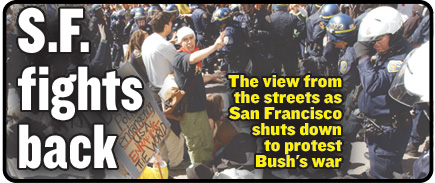
Nowhere was the clash of people power and government will more acute than on the streets of San Francisco, where a series of massive marches, some drawing nearly 100,000 people, filled the streets prior to the invasion of Iraq on March 19, 2003. The onset of war led protesters to effectively shut down the city, resulting in about 2,300 arrests and millions of dollars in costs to the city.

President George W. Bush dismissed the protests, of course, but he wasn’t the only one. Political leaders such as Rep. Nancy Pelosi, then-Mayor Willie Brown and soon-to-be Mayor Gavin Newsom (who didn’t attend any of the marches, unlike progressives on the Board of Supervisors) condemned the peace movement for hurting an innocent city. But with the “battle for San Francisco” making international news, the protesters were more concerned with the global audience.

A month earlier, on the weekend of Feb. 15 and 16, there were coordinated protests against the impending war in about 800 cities around the world, drawing around 10 million people. The peace march in Rome included about 3 million people, earning a listing in the Guinness Book of World Records as the largest anti-war rally in history. People have never made such a loud and clear statement against an incipient war.

Beyond the numbers, the antiwar movement was also right. On every major issue and prediction, the messages from the street proved correct while those from the White House were wrong. The US wasn’t welcomed as liberators. There were no weapons of mass destruction. Iraq after the invasion isn’t a stable democracy or shining beacon to anyone but the new generation of jihadis Bush created.

We can blame a hard-headed president, ineffectual opposition party, failure of the national media, or the national climate of fear following Sept. 11. But rather than refighting that lost battle, now is the time to gain perspective on the events of five years ago and determine what it means for democracy and the post-Bush national agenda.


TO THE STREETS

There were two main umbrella groups organizing protests before the war: Direct Action to Stop the War (DASW) and International ANSWER (Act Now to Stop War and End Racism). ANSWER has remained active and DASW has recently been reconstituted for the fifth anniversary of the war, using direct action in San Francisco as well as other urban centers and outposts like Chevron’s refinery in Richmond, which has reportedly been processing Iraqi oil.

“With the fifth anniversary coming up, we’re going back to direct action on the streets,” said Henry Norr of DASW. “But I don’t have any illusions that it’s going to be like it was five years ago.”

The maddening march to an ill-advised war created a political dynamic in which a broad cross-section of Americans was willing to hit the streets.

“We had a wonderfully diverse group of people, from soccer moms to anarchists,” said Mary Bull, who cofounded DASW, a collective of various affinity groups and concerned individuals formed in October of 2002 as Bush started beating the drums of war.

It was a group fiercely determined to prevent the war — and really believed that was possible. In fact, Bull recalls how she and other members of the group burst out crying at one meeting when a key activist said the war was going to happen.

Richard Becker, who cofounded ANSWER and serves as its West Coast coordinator, said that in the summer of 2002, “we came to the conclusion that [the war] was going to happen.” The group called its first big protest for Sept. 15, 2002, and another one two weeks later. But the movement really exploded on Oct. 26 when almost 100,000 people took to Market Street, much of it a spontaneous popular uprising.

“We were overwhelmed,” Becker said. “We were in a perpetual state of mobilization to keep up with what was going on. But then it didn’t stop the war.”

Did he think they could?

“I think a lot of people thought maybe it was possible to stop it. And we thought maybe it was possible to stop it,” Becker said.

The high point, according to Becker and Norr, was Feb. 17, 2003, when the New York Times ran a front page analysis piece entitled “A new power in the streets” that claimed “the huge anti-war demonstrations around the world this weekend are reminders that there may still be two superpowers on the planet: the United States and world public opinion.” But then Colin Powell went to the United Nations to argue for the invasion, and the Democrats in Congress did nothing, and it became clear war was coming.

Norr stayed out there protesting, being arrested several times and even shot in the leg by Oakland police with a rubber bullet during a protest at the Oakland docks. And he thinks some good came from the experience.

“The lesson for people is the political and economic elites are committed to preserving and extending empire. And they basically say as much in their own writing,” Norr said. “Wars are not anomalies.”

Despite being a frustrating and depressing exercise, most saw benefits to the failed movement. “People got an incredible education about how the system really worked,” Becker said. “Building a movement is mostly about a series of setbacks.”

Medea Benjamin, cofounder of both Global Exchange and CodePink and fixture of the anti-establishment peace movement for years, was upbeat about the protests. “We did our job as citizens. We did what we were supposed to do: organize, get people to take action, get people onto the streets,” she said. “We did everything we could think of.

“What you take from it is we don’t have a very well-developed democracy because the people spoke and the government didn’t listen.”

25war2_Lars1.jpg The ever-evolving “Democracy Wall” on Valencia Street, March 2003, helped stir up debate (Photo by Lars Howlett)


FACING ARREST

The collective action of five years ago starts with a series of personal stories — tens of thousands of them — so let me briefly begin with mine.

My arrival in San Francisco was closely tied to the march to war. I was living in Sacramento and working as the news editor of the Sacramento News & Review when Bush began his saber rattling against Saddam Hussein, but by the end of 2002 I had a falling out with my boss and found myself jobless.

Like most Northern Californians who opposed the war, I came to San Francisco on Jan. 18 to make my voice heard and experienced a bit of serendipity on my way to Justin Herman Plaza: while reading the Guardian on Muni, I saw their advertisement for a city editor, a job that was ideal for me at a paper I’ve always loved. Needless to say, it was a great day, empowering and full of possibilities.

Less than two months later I was on the job, and on the second week of that job I was back on the turbulent streets of San Francisco, part of a Guardian team covering the eruption of this city on the first full day of war. When I stepped off the cable car just after 7 a.m., people were streaming up Market Street and I joined them.

When a large group stopped at the intersection of Market and Beale, I stopped too, taking notes and bearing witness to this historic, exciting event. I had a press pass issued by the California Highway Patrol that allowed me to cross police lines, so when police in riot gear surrounded us and threatened arrest, I held my ground with 100 or so protesters.

After interviewing about a dozen people about why they were there and that they hoped to accomplish (see “On the bus: Journalists, lawyers, four-year-olds — the cops were ready to bust anyone Thursday morning“), I was arrested with the others and taken to a makeshift jail and processing center at Pier 27 (no charges were filed in my case, and charges against all of the 2,300 people arrested here in those first few days of the war were later dropped).

I recently tracked down a few of the people who appeared in my article, including Daphne and Ross Miller, who were at the center of the most interesting drama to play out during our standoff with the police. She’s a family practice physician, he’s an architect, and they live in Diamond Heights with their two children, Emet, who is almost 9, and Arlen, 12, who was away on vacation when the war began.

“We were genuinely shocked that the war started,” Ross told me. “We were at some of the earlier protests and really thought there was no way [Bush] could do it.”

They woke up March 20, 2003, to news that the war had begun and immediately walked to the BART station with Emet and rode to the Embarcadero station, not really planning for the day ahead but just knowing that they had to make themselves heard.

“We were pissed as hell. I don’t think I’ve ever been so angry in my life,” Daphne said.

They quickly came up with a plan. “We basically decided that if anyone was going to be arrested, it was going to be Ross and I’d stay with Emet. But it didn’t end up that way and I ended up in the arrest circle.”

Daphne had their house keys and threw them over the police line to Ross at one point. A photographer in the circle had gotten shots of a man named Roman Fliegel being roughed up by police as they pulled him off his bicycle, which was towing a trailer with a sound system, and decided to throw his backpack with camera gear out as well. When Ross — who had four-year-old Emet on his shoulders — caught it and refused police orders to give it to them, police grabbed Emet and roughly arrested Ross, leaving a gash on his forehead.

“Rage surged through the crowd, and it seemed as if things might get ugly, but the police kept a tight lid on the situation, using their clubs to shove back protesters who had moved forward,” I wrote at the time.

Emet was delivered into the circle with Daphne as the arrests continued, many quite rough. “At that point, as a mom, I had to exercise the most restraint ever,” said Daphne, who was angry about the situation but fearful about what she was exposing her son to. “Please, don’t let any violence happen here,” she pleaded with the crowd. Eventually, commanders on the scene let the mother and child go.

“The officer who let me go said that if he saw me again out there, he would call Child Protective Services on me,” Daphne said. But two days later, still brimming with outrage at her country’s actions, she ditched a downtown medical conference to rejoin the street protests, this time solo.

The couple say they’ve lost friendships over the war and have become more engaged with politics, coming to believe that Bush and the neocons are malevolent figures who knew how badly the war would go and did it anyway to establish a large, permanent military base in Iraq.

“Since that day, we’ve been far more active,” Ross said. “We realized you can’t just trust the system. You have to push.”

But that determination was mixed with feelings of disempowerment and depression. They attended some of the protests that following year, but the couple — like most people — just stopped going at some point because they seemed so futile.

“There was a horrible sense of resignation and a genuine depression that followed,” Ross told me.

The nadir was when Bush was reelected and they considered leaving the country. But then, Ross said, “we decided we’re not just going to run away and we’re not going to accept this.” Looking back, even with the scare over Emet, they express no regrets.

“It was the right thing to do because it was the wrong war to have. I’d do it again and again and again if I had to,” Ross said

They’re guardedly hopeful that Barack Obama could begin to turn things around if he’s elected. “I think the right president can at least start to dismantle this,” Daphne said. “I think thousands of people marching in the streets is something he would listen to.”

25war3_Charles1.jpg A die-in on the streets of San Francisco in March 2007 marked the fourth anniversary of the invasion (Photo by Charles Russo)


WITNESS TO HISTORY

Covering the peace movement in those early days was a heady experience, like reporting on a revolutionary uprising or working in a foreign country where the people are organized and active enough to be able to shut down society and brave enough to risk bodily injury for their beliefs.

I was at the founding meeting of CodePink — which became the most effective group at personally confronting the warmongers and keeping the war in the public eye — one evening at Muddy Waters in the Mission District shortly after the war started.

Looking back, Benjamin rattled off a long list of the alliances the group built — with labor, churches, businesses, and a wide array of social movements — and creative actions intended to build and demonstrate popular support for ending the war.

“We’ve done so many things and what did we get? We got a surge,” she said. “It shows the crisis in our democracy, the crisis of the two-party system, the crisis of a dysfunctional opposition party.”

Yet she said the peace movement has been remarkably successful in convincing the public that the war was a mistake and that it’s time for the troops to come home, even if the Democrats have been slow to respond to that shift.

“The progress we’ve made is turning around public opinion and that’s going to play a big role in the upcoming elections,” she said. For Norr, the role of the news media is a particular sore spot. He was a technology reporter for the San Francisco Chronicle who called in sick on the first full day of war and was arrested on Market Street with his wife and daughter, resulting in suspension by editor Phil Bronstein for his actions.

I wrote several stories on the issue, which culminated in Norr being fired and Bronstein unilaterally banning Chron employees from peace protests. I even borrowed CodePink’s guerilla tactics when Bronstein repeatedly refused to return my calls or address why he had singled out antiwar protesters for uniquely punitive treatment. I confronted him during a speech he gave at the Commonwealth Club (see “Lies and half-truths,” 5/7/03). That was the tenor of the times: we were all tired of being lied to and we decided to push back.

Norr was particularly frustrated with his own paper’s reporting of the war and started sending articles by the foreign press to his paper’s news desk, trying to wake his colleagues up to the pro-war propaganda being passed off as journalism in this country.

He was also disappointed with the country and with the Chronicle — both the management and his fellow reporters, who did little to support him — but the experience caused him to return to his roots as a progressive activist.

“The war and losing the job and everything brought an abrupt end to my consumerist phase and dumped me back into the world of being an activist,” said Norr, who serves on the KPFA 94.1 FM local station board and has made three recent trips to the Palestinian territories while working with the International Solidarity Movement.

Benjamin said Americans shouldn’t expect the next president to end the war — not without lots of pressure from a renewed and vocal peace movement. “This is the time to set the stage for the post-Bush agenda,” Benjamin said. “Don’t put your hopes in Barack Obama in getting us out of Iraq. Put your hopes in the people.”

25war4_Lane1.jpg A rally and nonviolent direct action at the Richmond refinery targeted Chevron on March 15 (Photo by Lane Hartwell)


THE AFTERMATH

The San Francisco Police Department, which spent more than $2 million on overtime costs responding to peace protests between March 15 and April 16, 2003, generally behaved with restraint and professionalism, but there were several exceptions.

The most costly and disturbing incident came when Officer Anthony Nelson began aggressively swinging his long riot baton at protesters, badly shattering the arm of peaceful protester Linda K. Vaccarezza, who suffered a permanent disability in her career as a court reporter.

Nelson’s incident report falsely stated that Vaccarezza had threatened him with a sign attached to a solid pole, but video of the incident later clearly showed there was no pole and that she was retreating when he teed off on her (see “The home front,” 05/19/04).

Vaccarezza received an $835,000 settlement from the city in November of 2004. On Oct. 5, 2005, two and a half years after the incident, SFPD fired Nelson for lying about what happened that day, and the City Attorney’s Office has been successfully fighting Nelson’s appeals in court ever since, putting in more than $100,000 in attorney time and costs into the Nelson and Vaccarezza cases.

The other significant ongoing litigation from the antiwar protests involved Mary Bull, who was arrested during an early protest for pouring fake blood in front of the entrance to Chevron’s San Francisco office before being allegedly strip searched and left naked in her San Francisco Jail cell for 36 hours.

Ironically, Bull was among those who brought a successful class action lawsuit against Sacramento County after she and others protesting a logging plan were strip searched, setting a precedent and led most counties to reform their strip-search policies. She used her share of the $15 million judgment to buy an organic permaculture farm in Sebastopol.

Her San Francisco case, in which Bull won a multimillion-dollar judgment, is still under appeal and now in mediation. Bull said the protests five years ago did make a difference, something she tells those who fret about its apparent failure. “I tell them to look at what issues the candidates are talking about now and I thank them for protesting then.”

“Even though we had millions throughout the world, we were sort of blocked, but now we’re regaining that momentum,” Melodie Barclay, a massage therapist who was also arrested with me on the first day of the war, told me recently. “We can’t judge it by the fact that we didn’t get the momentum we wanted.”

Norr started his antiwar activism working with Students for a Democratic Society in Boston, protesting the Vietnam War, which he said shares many similarities with the current situation, for good or for ill. He said that people tend to forget that while the protests then were huge and helped end the war, the movement did wane after Nixon ended the draft and substituted massive aerial bombardment for boots on the ground.

“The protests dropped off considerably,” he said. “A lot of the things that drove people to take risks in the late ’60s had faded by the early ’70s.”

He thinks the current administration learned a lesson from those days: it’s easier to maintain a war effort if the average citizen isn’t affected.

But there are other factors as well keeping a lid on the antiwar outrage.

“The culture has changed too. Young people are oversaddled with debt. People in schools seem to be docile. The culture as a whole seems to be more individualist and consumerist,” Norr said.

Yet some young people have woken up and many of them are funneling their energies into a peace group that was formed in the summer of 2005: World Can’t Wait, as in: the world can’t wait for the end of Bush’s second term before we change our direction and leadership.

“We don’t just want them gone, we need to repudiate their program,” said Giovanni Jackson, a 26-year-old WCW student organizer. “If we’re going to change anything, we need the youth.”

Jackson was at WCW’s founding convention in New York City, which came just as New Orleans was being flooded and then essentially abandoned by the federal government.

“When [Kerry] lost, people felt demoralized and World Can’t Wait kind of stepped into that situation,” Jackson said. “There was a lot of demoralization in the antiwar movement at that time.”

The group organized protests and student walkouts on Nov. 2, 2005.

“Everyone has their moments of doubt,” he said, “but I’m motivated by the crimes we see everyday.”


THE LESSONS

One of the biggest barriers to galvanizing people and turning the fifth anniversary of the war into something that might make a difference is the presidential election, which is diverting the energy of many potential protesters — and at the same time, offering some hope that a new president may lead to peace.

After all, every single one of the Democratic presidential candidates has promised to withdraw troops from Iraq, with varying timelines and numbers of US personnel left behind. And with enough encouragement, they might be willing to help change the status quo.

Many of the activists who volunteered their time and money to help move the Obama campaign into its front-runner position came out of the antiwar movement, and Obama’s strong stand against the war has been a key factor in his popularity.

Becker and some other activists don’t have much faith that a change in presidents will change the course in Iraq, although he agrees that much of the energy now surrounding Barack Obama derives directly from the antiwar movement.

“There’s been a huge upsurge of hope for Obama and that he might bring about the kind of change we need,” Bull said, adding that she doesn’t share that hope, believing the only path to peace is to pressure Obama and other leaders to commit to more progressive positions.

Norr said, “On one level, people have illusions about the power of peaceful protests. People believe in democracy, as well they should. We feel like the rulers should be paying attention to public opinion.

“It’s a remarkable story how broadly and quickly the American people have turned against the war. Public opinion was certainly ahead of the Democrats.”

And people will only grow more disenchanted with Iraq and its multitude of costs. “The people here are paying for this war, and everyday we have new stories about health clinics being shut down,” Becker said.

Becker was amazed last March as massive demonstrations for immigrant rights seemed to explode out of nowhere. “We think there will be more things like that,” he said.

Because after five years of organizing communities to resist the military-industrial complex’s plans, Becker thinks there’s been some visible progress.

“There isn’t a town or hamlet in the US that doesn’t have activism going on, but you wouldn’t know it from the corporate media,” Becker said. “It’s a mistake for people to feel discouraged.”


March on the governor’s house

0

I’m usually the one who talks about how we have to solve financial problems locally, since the state and the feds won’t give us what we need. And I still believe that, and I support a parcel tax for the local schools and I support using the rainy day fund and if we were allowed to raise property taxes in San Francisco, I’d support that.

But right now, while teachers and parents and students are flooding school board meetings around the state denouncing cuts, the real problem is in Sacramento, where the governor doesn’t seem to care.

So maybe all of those angry people should take a little trip to Los Angeles and march on Schwarzenegger’s house. He’s home most weekends, I’m told. I think he lives in Brentwood.

50,000 protesters in Brentwood? Maybe he’d have to listen.

Brand spankin’

0

› superego@sfbg.com

Ah, spring. Strange birds are chirping, cherry trees are blossoming, pretty but misguided girls are puking on their Luichiny strappies outside North Beach bars, and adorable elderly gentlemen are grabbing my unmentionables on the Muni. Time for a couple of pomegranate liqueur shots and some neon butterfly nail decals. Or fuck it, just hand me the Chivas and let’s go dancing. Party time.

In my fondest dreams, the floors always hop, the clubbers look fierce, the jams never stop, and last call’s just past dawn. (Also: butch unicorns.) But dreams are for sleepers, gorgeous, and who would ever admit to being one of those? It’s almost worse than saying you’re tired and want to go home. Quel tragique. If you want it, you’ve got to stay up for it, we say, and for a year now, Scene has been toasting the amazing people, places, and parties that give their very all to make those dreams a reality, however creatively (wink).

Cosmic local nightlife, cocktails, fashion, music, art, expression — not necessarily in that order, and preferably all at once with a little kiss-kiss afterward — that’s what spurred us to launch this thing. And sometimes we put down our caipirinha glasses and stop twirling long enough to actually put out another issue. Thus, welcome to the spring 2008 Scene! From fresh drinks to fab threads to hot freaks, it’s positively aching with enjoyment. Much like spring itself.

Refill!

Marke B.

Fresh sips

0

› culture@sfbg.com

Spring is positively bursting with wacky holidays. Arbor Day? April Fool’s Day? Patriot’s Day? How the heck are you supposed to celebrate those with a cocktail or two? Figuring out what drink to pair with which spring holiday can become an overwhelming ordeal. Sure, the first few are easy: St. Patrick’s Day and green beer, Passover and four glasses of kosher wine. But what about the others? After a careful and tipsy review, I’ve paired some of my favorite local cocktails with these unusual days of celebration.

Rusty Robot Of all the major Christian holidays, Palm Sunday seems the least alcoholically celebrated, even though feasting is the order of the day. Why not figure in a Rusty Robot from Homestead? A combination of Wild Turkey, Tuaca, lemon, and bitters, it’s perfect for vigorous consumption. The lemon flavor is as wild as the Turkey, but the drink achieves a simplicity missing from most cocktails — the tastes don’t just augment one another; they smack together, almost like two palms. Get it? Homestead, 2301 Folsom, SF; (415) 282-4663.

Green Man Tea Just as we’re getting over our green St. Paddy’s Day hangover, we’re immediately hit with St. Joseph’s Day on March 19 — or more familiarly, the day the swallows return to Mission San Juan Capistrano. Bird lovers across California, rejoice! But with what? I encourage you to stick to something green-related, like Green Man Tea at Nihon Whisky Lounge; your system may not yet be ready for other colors. Made with lime and pineapple juices, green tea liquor, and single malt Scotch, this drink brings together two distinctly different flavors — the Scotch’s smokiness and the other ingredients’ fruity tang — to take delicious flight. Nihon Whisky Lounge, 1779 Folsom, SF; (415) 552-4400, www.nihon-sf.com.

Vieux Carre How do you raise a glass to a good April’s Fools Day prank? Since only rush-hour radio hosts and nine-year-olds actually carry out pranks, you probably don’t. So relax, there’s no need to fuss over this "holiday." Instead, take the time to savor a fine local drink. The Vieux Carre is a version of a classic New Orleans cocktail with its amalgam of rye, cognac, and sweet vermouth. It tastes more like Manhattan in 3-D, however, than it does an Old-Fashioned, Sazerac, or Sidecar — a high-powered, cheek-parching blast. Alembic, 1725 Haight, SF; (415) 666-0822, www.alembicbar.com

Take Your Pick Few outside Massachusetts, Maine, or Wisconsin celebrate Patriot’s Day, which falls on the first Monday in April. But it’s a great excuse to patriotically hoist one. Head to Dimples on Post and order whatever. The mirrored-out decor and neon light overload is so dazzling that your cocktail choice won’t matter — it’ll be like an early Fourth of July, but indoors. Go, USA! Dimples, 1700 Post, SF; (415) 775-6688.

Blue Tokyo Come Earth Day, the Blue Tokyo at Festa Wine and Cocktails should be the perfect drink to remind you that our island cities will soon be submerged, once the sea levels rise high enough. An unfussy mix of vodka, pineapple, and Curaçao amid Festa’s menu of ostentatious pear cosmos and pomegranate martinis, the drink is a useful aid to celebration — it’s almost a frat house cocktail in its simplicity. It wouldn’t jive at most bars, but at this kitschy lounge overlooking Webster — complete with fake skyline behind the karaoke stage — it works perfectly. Festa Wine and Cocktails, 1581 Webster, suite 207, (415) 567-5866.

Bohemian Forget the corporate beer and margarita mix branding that’s attached itself to Cinco de Mayo. Do something different, dammit, and head to Blondie’s Bar and No Grill in the Mission for a Bohemian. Along the same taste lines as, but more full-bodied than, a Cosmo, this well-balanced drink contains a generous dose of 151, so you can feel sunny and in sync with Cinco. Blondie’s Bar and No Grill, 540 Valencia, SF; (415) 864-2419, www.blondiesbar.com.

Sangre Amado Few complicated cocktails are as rooted in earthy flavor as the Sangre Amado, and no place in town makes it better than Catalyst Cocktails. After a fulfilling, tree-hugging Arbor Day, cozy up with this drink made with either vodka or gin, rosehips-hibiscus syrup, grapefruit juice, and fresh strawberries. For all its contents, the concoction is far from overwhelming, and it easily plants the seeds for another round. Catalyst Cocktails, 312 Harriet, SF; (415) 621-1722, www.catalystcocktails.com

Dark and Stormy Despite its name, this semiclassic cocktail — which gets its best treatment at Koko Cocktails — is the perfect way to kick off Memorial Day weekend and ease into the summer season. The taste brings to mind yachting through the Caribbean, which is why I hope the name is ironic. A smooth mix that falls halfway between a mojito and a whiskey ginger, this bevvie consists of ginger beer, lime, and a mild rum that makes it soar. KoKo Cocktails, 1060 Geary, SF; (415) 885-4788