Local

Quick Lit: April 14-April 20

0

Literary readings, book tours, and talks this week — including Alice Walker, Men and Dogs, Marin Poetry Festival, “Adapting to Climate Change,” and more

Wednesday, April 14

Louann Brizendine

Hear Neuropsychiatrist, author, and media commentator Dr. Louann Brizendine discuss her theories on the relationship dynamics that result from the neurobiology of the male and female brains, as outlined by her bestselling books, The Male Brain, and The Female Brain.

8 p.m., $20

Herbst Theater

401 Van Ness, SF

www.cityboxoffice.com


“Let Our Words Be Heard”

Attend this queer writing workshop and open mic that will take on the empowering, interactive process of discovering the use of words for healing, sharing histories, and celebrating community. Part of CUAV’s Safetyfest.

6 p.m., free

Modern Times Bookstore

888 Valencia, SF

www.mtbs.com


The Long Man

Best known for his work on DC Comics’ Detective Comics series in the 1970’s that produced many memorable Batman stories, Steve Englehart discusses his writing career and his new novel, The Long Man, a follow up to his first novel, The Point Man.

7 p.m., $5 suggested donation

Cartoon Art Museum

655 Mission, SF

(415) CAR-TOON


Men and Dogs

Hear San Francisco resident and author Katie Crouch discuss her new book about a girl who’s father went missing on a fishing trip in Charleston and how the mystery of his disappearance tests the whole family’s concept of loyalty and faith years later.

7:30 p.m., free

The Booksmith

1644 Haight, SF

(415) 863-8688


The Montefeltro Conspiracy

Join a humanities forum to discuss Marcello Simonetta’s The Montefeltro Conspiracy, a Renaissance mystery uncovering a nefarious plot, a murder, and a coded letter. In conjuction with the upcoming Humanities West 25th anniversary program, The Florence of the Medici: Commerce, Power, and Art in Renaissance Italy, starting April 30.

5:30 p.m., free

Commonwealth Club

595 Market, 2nd floor, SF

www.humanitieswest.org  


Thursday, April 15

If You Can Read This: The philosophy of bumper stickers

At this reading of his new book, Jack Bowen explores the philosophical ideals reflected in the most popular bumper stickers and claims that every bumper sticker holds at least a kernel of truth.

7:30 p.m., free

The Booksmith

1644 Haight, SF

(415) 863-8688


Noe Valley Celebrates the Book

Celebrate the 25th anniversary of Phoenix Books, an independent bookstore in Noe Valley, at this reading by local authors Allison Hoover Bartlett, Tony DuShane, Clare Willis, Lisa Gluskin Stonestreet and with music by Ted Savarese.

6 p.m., free

Phoenix Books

3957 24th St., SF

(415) 821-3477


Friday, April 16

Offbeat Bride

Hear Ariel Meadow Stallings discuss her new book, Offbeat Bride: Creative Alternatives for Independent Brides, where she offers inspiration, encouragement, and advice for brides on a budget.

7:30 p.m., free

The Booksmith

1644 Haight, SF

(415) 863-8688


Saturday, April 17

Adapting to Climate Change”

Attend this daylong “BioForum” about the challenges of climate change and prospective actions California could take to make a difference. Experts from UC Davis, NOAA, PG&E, and the California Academy of Sciences will be on hand to talk about impacts on local agriculture, fisheries, and energy policies. You might want to ask the PG&E representative why their company is trying to kill progressive, local Community Choice Aggregation efforts for the sake of preserving profits. 

9 a.m.; $25, lunch and coffee included

Pacific Energy Center

851 Howard, SF

1-800-794-7576


Melissa Broder

Hear Broder read from her first collection of poems, When You Say One Thing But Mean Your Mother.

6 p.m., free

Elbo Room

647 Valencia, SF

(415) 552-7788


Poetry at Pegasus

Celebrate National Poetry Month at this reading with poets Stephen Ratcliffe, Erica Lewis, and Benjamin Perez.

7:30 p.m., free

Pegasus Books Downtown

2349 Shattuck, Berk.

(510) 649-1320


“The Revolution Starts at Home”

Attend this workshop on practicing community accountability in real life with Leah Lakshmi Piepzna-Samarasinha discussing partner abuse within queer, politicized communities. Part of CUAV’s Safetyfest.

2 p.m., free

Modern Times Bookstore

888 Valencia, SF

www.mtbs.com


2048: Humanity’s Agreement to Live Together

Hear about author Kirk Boyd’s plant to draft an enforceable international agreement that could allow the people of the world to create a social order based on human rights.

7:30 p.m., free

The Booksmith

1644 Haight, SF

(415) 863-8688


Sunday, April 18

Marin Poetry Festival

Enjoy a free afternoon of poetry and music featuring Avotcja and Pedro Rosales, Dancing Bear, C.J. Sage, Adam David Miller, Michelle Baynes, and more.

2 p.m., free

Old Mill Park Amphitheater

300 Throckmorton, Mill Valley

Later in the evening, attend readings featuring San Francisco Poet Laureate Diane di Prima, winner of the 2006 National Book Award in poetry Nathaniel Mackey, and award winning poet Branda Hillman.

7 p.m., $20

Dominican University Campus

Angelico Hall

50 Acacia, San Rafael

marinpoetryfestival.com


“Writing and Publishing the Novel”

Attend this adult writers’ seminar lead by author Jason Roberts with panelists Vendela Vida, Daniel Alarcón, Rabih Alameddine, Andrew Foster Altschul, and Danielle Svetcov discussing the writing process, and issues relating to publishing, agents, and publishing houses.

6:30 p.m., $75

826 Valencia, SF

www.826valencia.org


Monday, April 19

Get Lit!

Bring your own literary contributions or those of your favorite authors to share at this candle lit, wine bar literary salon.

7 p.m., free

1550 Hyde Café and Wine Bar

1550 Hyde, SF

(415) 775-1550


Poetry at Pegasus

Celebrate National Poetry Month at this reading with poets Cheryl Dumesnil, Judy Halebsky, and Tiffany Higgins.

7:30 p.m., free

Pegasus Books Downtown

2349 Shattuck, Berk.

(510) 649-1320


Tuesday, April 20

Diane di Prima

Hear San Francisco Poet Laureate Diane di Prima discuss her career as an activist in the 1960’s, a writer of the Beat movement, author of 43 books of poetry and prose, and many more accomplishments in conversation with Alan Kaufman.

6 p.m., $12

Mechanics Institute

57 Post, SF

(415) 393-0100


For you Mom, Finally

In her latest book, food magazine editor, restaurant critic, and memoirist Ruth Reichl examines her mother’s life, giving voice to the painful truth that many women of our mothers’ generation had to sacrifice their dreams.

11 a.m., $10-18

Jewish Community Center of San Francisco

Kanbar Hall

3200 California, SF

(415) 292-1233


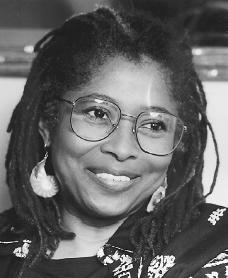
Alice Walker

Essayist, poet, fiction writer, and ardent social activist Alice Walker will discuss her upcoming book, Overcoming Speechlessness: A Poet Encounters “the horror” in Rwanda, Eastern Congo, and Palestine/Israel, about her travels to each of those three regions, charting the aftermath of violent conflict and political upheaval. In conversation with Michael Krasny.

8 p.m., $20

Herbst Theater

401 Van Ness, SF

www.cityboxoffice.com


Events listings

0

Events listings are compiled by Paula Connelly. Submit items for the listings at listings@sfbg.com.

WEDNESDAY 14

How to Grow Veggies Baazar Café, 5927 California, SF; (415) 831-5620. 7pm, free. Just because you live in a small apartment in San Francisco with no backyard doesn’t mean you can’t grow fruits and vegetables. Pam Pierce, author of Golden Gate Gardening, will be on hand to teach attendees how to do just that.

Mission Bay Farmers’ Market 3rd Street between 4th and 5th Streets on Campus Way, SF; 1-800-949-FARM, or www.pcfma.com. 10am-2pm, free. Check out the opening of the weekly Mission Bay Farmers’ Market and take home some produce, flowers, seafood, tofu, and more from over two dozen vendors.

THURSDAY 15

“The Americanitis Elixir” Southern Exposure, 3030 20th St., SF; (415) 863-2141. 7pm, free. If you are suffering from Americanitis, the cure may be in your own backyard. Bring some hand picked fruits or herbs to share and watch as artist Alison Pebworth and collaborator Jerome Waag debut a San Francisco Americanitis Elixir, distilled from the vital spirits of collected native ingredients.

BAY AREA

Jewish Jokes JCC of the East Bay, 1414 Walnut, Berk.; (510) 848-0237. 7:30pm, $9. Hear performers and scholars tell jokes, look at the history of Jewish humor, and explore the future featuring Jewish comedian Joseph Nguyen, Jewish clown Jeff Raz, and Jewish joke expert Mel Gordon. Jewish joke open mic to follow.

Strictly Sail Pacific Jack London Square, 1956 Webster, Oak.; www.strictlysailpacific.com. Thurs.-Fri. 10am-6pm, $12; Sat. 10am-7pm, $15; Sun. 10am-5pm, $15. Join other sailing enthusiasts for this four day sailing show featuring the hottest new sailboats, gear, and accessories, including the latest in green sailing, and activities, demonstrations, and seminars.

FRIDAY 16

CubaCaribe Dance Mission Theater, 3316 24th St., SF; (415) 273-4633. Fri. and Sat. 8pm, Sun. 7pm; $15. Through May 2, visit cubacaribe.org for full schedule. Enjoy this festival of dance and music “From Katrina to Port-au-Prince” celebrating the spirit of the Caribbean with artists from Haiti, New York, New Orleans, and Cuba.

World Wide Hustle[rs] Luggage Store Annex, Cohen Alley, 509 Ellis, SF; (415) 255-5971. 6pm, free. Attend the opening reception of collaborative work by Robin David and Angela Angel that pays homage to markets and workers across the globe, inspired by true narratives from Chile, India, Mexico, the Philippines, and Tanzania.

SATURDAY 17

Bug Day Randall Museum, 199 Museum Way, SF; (415) 554-9600. 10am, $3 suggested donation. Bring your family or date and explore the incredible worlds of arthropods, creepy crawlies, hoppers, and slitherers. Learn how important bugs are to the earth and our survival, enjoy love entertainment, make bug-related crafts, play bug games, and bring a picnic lunch to enjoy with the view.

Goat Cheese Festival Ferry Plaza Farmers’ Market, Ferry Building, One Ferry Building, SF; (415) 291-3276. 10am-1pm, free. Celebrate all things goat at this festival sponsored by the Center for Urban Education about Sustainable Agriculture (CUESA) featuring samples, cooking demonstrations, a reading by Gordon Edgar, author of Cheesemonger: A life on the wedge, a chance to pet baby goats, and more.

“Insight and Inspiration” de Young Museum, Koret Auditorium, 50 Hagiwara Tea Garden, Golden Gate Park, SF; (415) 750-3627. 10am, $10. Attend this panel discussion with Bay Area fiber artist Judith Content, and Studio Art Quilt associates Marion Coleman, Charlotte Bird, and more discussing fiber art, different creative processes for making fiber art, and the history of contemporary fiber art.

Swankety Swank Trunk Sale 289 Divisadero, SF; (415) 932-6615. 11am, free. Part of San Francisco’s “Shop Local SF” program, Swankety Swank will be hosting monthly trunk sales through Labor Day. This month’s sale features DJ Sunshine Jones spinning smooth music and art, furniture, accessories, and clothes made by local artists.

SUNDAY 18

American College of Traditional Chinese Medicine San Francisco War Memorial Building, Green Room, 401 Van Ness, SF; (415) 355-1601 ext. 12. 2pm, free. Celebrate the 30th anniversary of the ACTCM with local politicians, community health organizers, and other members of the community and enjoy performances by the renowned Monks of the Shaolin Temple, Chinese folk dancers, a traditional Lion Dance performance, and more.

Northern California Book Awards San Francisco Public Main Library, Koret Auditorium, 100 Larkin, SF; (510) 525-5476. 1pm, free. Find out the winners of this year’s book awards at this ceremony, where all nominated books will be saluted, but only a few will win. Nominees are entered in categories for fiction, general nonfiction, creative nonfiction, poetry, translation, and children’s literature and include Michael Chabon, Dave Eggers, Joseph Stroud, Catherine Brady, Yiyun Li, and more. To view a full list of nominees, visit www.poetryflash.org.

Tequila and Tamales by the Bay Fort Mason Center, Conference Center, Buchanan at Marina, SF; (415) 695-9296. Noon, $40. Sample tamales from Cocina Poblana, La Espiga de Oro, Tamale Factory, the Whole Tortilla, and Evelia and sip tequilas from Don Julio, Jose Cuervo, and El Relingo at this festival featuring contests, craft vendors, and more to benefit the Benchmark Institute.

MONDAY 19

No


TUESDAY 20

“Cool Cuisine” San Francisco Main Library, 100 Larkin, SF; (415) 557-4484. 6pm, free. Hear chef Laura Stec and atmospheric scientist Eugene Cordero, Ph.D., discuss how to move to a diet that counters the biggest environmental problems while also eating more healthy and getting more pleasure out of food at this talk titled, “Cool Cuisine: Taking a bite out of global warming.

Editor’s Notes

0

tredmond@sfbg.com

We’ve been talking to people who want to be judges, seven of them. One is already a judge and wants to keep his job; two are challenging him; and four are competing for an open seat. They all talk about their impressive legal backgrounds, life experience, desire to be fair and impartial, and to make the system of justice work for all.

The two who emerge as the winners will take their seats on the bench, and the presiding judge of the San Francisco Superior Court will decide what happens to them next — whether they handle felony murder trials, or juvenile hearings, or family court, or complex civil litigation, or small claims court. The P. J. oversees the court budget and things like the indigent defendant fund. So I asked them all: how does the presiding judge get chosen, anyway?

And all of them, including the sitting judge, said: Dunno.

Now, how can it be that six of the top attorneys in the city and one incumbent jurist don’t know how the person who runs the local courts gets that job? Well, maybe nobody cares — or maybe the whole process is so secretive nobody gets to learn about it.

See, the courts aren’t covered by the Brown Act, which mandates public meetings. So when the judges get together and meet (bimonthly in San Francisco), there’s no meeting notice and no press or public allowed.

I’m told by reliable sources that the P.J. is typically elected by acclamation when there’s only one candidate, and by secret written ballot when there’s competition. The ballots are tallied by the outgoing P.J., then discarded. Nobody knows who voted for whom.

Years ago, when the state Legislature (led by SF senators John Burton and Quentin Kopp) was updating the Brown Act, Ralph Grace, the publisher of a Los Angeles legal paper the Metropolitan News, went to Sacramento to argue that the courts, like any public agency, should operate openly. He got nowhere. "When you’re talking about running a public institution, you should do it in public," Grace told me this week.

There’s no law saying the P.J. has to be elected privately. The California Rules of Court say that local courts can set their own policies and procedures. So it appears that the San Francisco Superior Court could — if the judges wanted — open the doors.
They could. If they wanted to.

The Daily Blurgh: That cat should have won the prize

0

Curiosities, quirks, oddites, and items from around the Bay and beyond

“We offer a kind of grittiness you can’t find much anymore,” said Randy Shaw, a longtime San Francisco housing advocate and a driving force behind the idea of Tenderloin tourism. “And what is grittier than the Tenderloin?”

Now that San Francisco is going to court the tourist dollars of baby boomers descending upon the TL in search of reawakening the pleasure centers of their youth – the music! the drugs! the picturesque squalor! – perhaps City Hall should also consider starting up tourism franchises in other “gritty” parts of the city? 

(But gawking humorously at the poor, addicted, and metally challenged makes for such a sensational blog post! –Ed.)

Also: Drubbing! This headline is the second Google hit that comes up for the search: “slumming San Francisco.” Take that, spendy New York Times (which seems to have a long history of reporting on slumming in other cities).


There are too many golden nuggets to choose from in Roger Ebert’s account of working on the Russ Meyer-directed Sex Pistols film that never was, but this exchange is one of them:
 
Meyer opened up by informing Johnny Rotten that with his stovepipe arms he wouldn’t have survived one day in the army.

“What do I want with the fucking army?” Rotten said.

 “You listen to me, you little shit. We won the Battle of Britain for you!”

I reflected that America had not been involved in the Battle of Britain, and that John Lydon (his real name) was Irish, and therefore from a non-participant nation. I kept these details to myself.


The anxiety of influence: The debate going on in the comments on this Fecal Face interview with local artist Maxwell Loren Holyoke-Hirsch is heated. Holyoke-Hirsch doesn’t seem to lack faith in his abilities (he is quoted as referring to himself as, “the hardest working illustrator and artist based in San Francisco, California”), although irony is sometimes lost in transcription. Hubris aside, there is still the question of whether or not his art, as some comments posit, swagger-jacks Chris Johansson and Barry McGee. But kids, it’s OK. Put down those rocks! Didn’t you know street art has already jumped the balaclava’d shark?

(Kidding!)


We love our cat
for her self
regard is assiduous
and bland

 
Congrats to personal fave Rae Armantrout for winning this year’s Pulitzer Prize in poetry. Cat people, this may be finally be your salve for the incredibly raw wounds from our canine-centric Pets issue.

Appetite: 3 non-whisk(e)y highlights from Whiskies of the World

0

Whiskies of the World is a little smaller in scope and selection than Whiskyfest, both of which come to few cities in America — and we’re lucky to always be one of them. On March 27, WoW, as Whiskies of the World is known, was chaotic and overly packed in a Hotel Nikko ballroom. Bushmills Pipe and Drum band kept it festive walking through once an hour with rousing bagpipes, while classes, like the Craft Panel Discussion (led by craft distilling masters, including our own Fritz Maytag of Anchor Steam), were an educational high point.

Read more about the event and whisk(e)y tasting highlights in the upcoming 4/15 edition of The Perfect Spot; overview and vendor list link in my 3/22 Guardian column.

For your imbibing pleasure, I’m highlighting just three of the non-whisk(e)y treasures at this year’s WoW:

Bend Distillery: Already a favorite and properly stocked in my home bar, Oregon’s Bend Distillery makes award-winning vodka and gin —  but do what you must to get your hands on these unique, wonderful vodkas they’ve created: Cofia is a lush blend of roasted hazelnuts and fresh-brewed coffee. Only lightly sweet, it’s aromatic, robust, dark. Mazama-infused Pepper Vodka is named after a volcano that erupted to become Crater Lake. A blend of six different sweet and hot peppers, blissfully hot (as in spicy) it also tastes of fresh pepper skins. Recommended in cocktails or with mango juice on the site (and even for cooking), I actually love a splash of it on its own.

Death’s Door Spirits: I’m quite taken with Death’s Door Spirits, a small-batch distiller out of Wisconsin (Washington Island, to be specific, near Madison). Their latest packaging is elegant, turn-of-the-century classic, and their spirits are made sustainably and from local grain. Reflecting the terroir and ingredients of Washington Island, their awesome white whiskey is one of the best in the genre. But in the non-whiskey category, its gin, is amazing – a recent favorite. Plenty of juniper and botanical notes dominate in this clean, beautiful gin.

Corsair – This is a small artisan distiller out of Kentucky, I’m at first titillated by the hip packaging. While Corsair’s Wry Moon rye may not be the stand-out for me, I find the Pumpkin Spice Moonshine a playful white whiskey with the spirit of a pumpkin ale. RED Absinthe particularly intrigued with a pinkish-red hue from hibiscus and floral fennel notes on the tongue.

Where can you get it? Bend has a Web site list. Death’s Door is on its way to California but is already served in savvy, local bars like Nopa and The Alembic. Corsair is tougher to locate as its only available in four states at the moment.

Uncovering visions with SFMAPP

0

Maybe we’re a little too old to go searching for chocolate eggs and ginormas white bunnies in grassy fields, but last weekend there was an alternative Easter scavenger hunt for grown-ups, thanks to SFMAPP, the San Francisco Mission Arts & Performance Project. This bi-monthly art event brings together artists, musicians and poets and scatters them among cafes, backyards, and galleries for a diverse evening of music and art in sometimes the most unexpected places.

With my buddy Clairebear, we headed out into the cold April night. First we stopped at Red Poppy Art House where we listened to Benn Bacot sing some classy jazz tunes, while we mused over our recently acquired treasure map. After consulting our map we both agreed that our next stop must be the Secret Garden. I mean how cool is that — we were off to a Secret Garden and, yes, we got lost on the way. It was that secret.

After a few wrong turns, we finally walked down a sweet smelling path to the garden and found a small crowd of people (or should we call them garden elves?) listening to Jonathan Stephen and his friend Josh play a lovely cover of a well-known mandolin piece by Chris Thile. The stage was perfectly centered under a canopy of trees draped in twinkling lights, which created a truly magical ambiance.

Back en-route, we headed to Area 2881, where we were greeted with a sign that read “Rotating Amusement Devices by Carl Pisaturo.” Sweet. What the heck does that mean? When we got inside the gallery, we encountered metallic sculptures whirling and twirling at varying velocities that were incredibly entertaining to look at. With added spacey music and pink and purple light filling the room, it was a totally awesome experience.

Back to the mapp! Trotting along, we stopped at Galeria de la Raza for a movie overload in a piece called “Hollywoodpedia” by Mexican artist Artemio, that collaged together clips from thousands of popular films, based on themes like Love, Failure, and War. The project took years to make and millions of hours of movie-watching to complete, but was definitely worth the oh-so-clever final product.

By that time, Clairebear and I were hungry, but luckily there was a foodie stop on the mapp, so we headed to La Victoria Bakery for live music and snacks from “Sweet Corazon De La Mission” that included delightful edibles by local food cart vendors. We ended the evening at Precita Eyes, to gaze over the colorful mural-style art pieces filling their gallery. Clairebear and I both agreed, it was best scavenger hunt we’d even been on, despite the lack of chocolate bunnies.

Cut to the core: the sweet and the Splinters

0

Didja hear? There’s a mini-girl-band revolution going on. Embracing the rawest of rawk, the lowest of fi, the Splinters haven’t been lumped into the current wavelet of female-centric Bay Area ensembles ala Brilliant Colors and Grass Widow. And perhaps rightfully so. Gender aside, the bands are coming from way different places sonically. On its 12-track debut, Kick (Double Negative), the Splinters hew to the sweet harmonies of yesterday’s girl-group gangs, with nary a Phil Spector nor Calvin Johnson in earshot — though the spare arrangements and muy-primitivo grrrl-punk of “Mysterious” and “Dark Shades” seem more indebted to the K Kamp than any fortress built with Walls of Sound.

As an engineer, Maus Haus frontperson Jason Kick does a bang-up job of clearing the clutter, foregrounding the prettily droning harmonies of “Electricity,” and making the acoustic guitars glitter above a soulful bassline on “Sea Salt Skin.” Still, the pared-down aesthetic — not to mention the four UC Berkeley alums’ unpretentiously thoughtful preoccupations with such topics as girl-on-girl malice (“Oranges”) and the act of posturing beneath the heat of a gaze (“Cool”) — sounds like its all coming very organically from the Splinters themselves. Too few are fearless enough to write an on-the-verge-of-breakup song as bare-throated yet brutally honest, vulnerable, and unadorned as the guitar-and-tambourine-tinted “Sorry” — more power to the Splinters. 

THE SPLINTERS
With Psychedelic Horseshit and Outlaw
April 14, 9 p.m.
Ghosttown Gallery
2519 San Pablo, Oakl.
www.myspace.com/ghosttowngallery

Verdict leaves SEIU-NUHW fight unresolved

44

By Christopher D. Cook

In a mixed ruling this morning (April 9), a nine-member U.S. District Court jury awarded $1.5 million to the Service Employees International Union in its ongoing campaign to stymie a rival union created by former SEIU staffers, in a mixed ruling that’s unlikely to resolve the unions’ protracted battle over members and leadership in the labor movement. 

Coming after a tense and bruising two-week trial and several days of jury deliberations, the verdict includes a $724,000 penalty against the insurgent National Union of Healthcare Workers, led by Sal Rosselli, former long-time president of SEIU’s United Healthcare Workers West (UHW). Rosselli and 15 of his NUHW colleagues were also hit with smaller penalties ranging from $30,000 to $74,000.

The SEIU lawsuit originally sought $25 million in damages for an array of allegations that its former staffers, who launched NUHW a day after the local was put in trusteeship, had stolen union funds and used SEIU resources and staff time to build their rival organization.

In the process of litigating the case, SEIU deployed four law firms at an expense of $5 million, according to SEIU-UHW communications director Steve Trossman (NUHW’s attorneys estimate the figure at closer to $10 million)—so if the award is upheld, SEIU stands to lose at least $3.5 million on the case. 

“It’s absolutely worth it,” said Michelle Ringuette, SEIU’s strategic affairs director.  “There’s no price tag on justice.”  She called the verdict “an enormous slam-dunk victory for SEIU members, who wanted to hold [NUHW] accountable…they are exhilarated today.”

But in an interview a few hours after the verdict, Rosselli said he and NUHW are undaunted by the ruling.  “Their goal was to destroy NUHW, and they failed,” he said.  “They wanted us to walk away from NUHW, that’s what this is all about…This will go on for more than a year before they can try to see a dime” of NUHW money, Rosselli added, noting NUHW’s attorneys will ask Judge William Alsup to set aside the verdict, and if he doesn’t they’ll press on to the U.S. Court of Appeals.

According to Rosselli, SEIU “said I was in jail, they said that I stole $3 million, and it hasn’t resonated…This has the potential to backfire on them—what we got dinged for is fighting the trusteeship, fighting for democracy, and fighting for a voice.”

Meanwhile, on the ground, where the two unions are locked in a tough fight for members, a different verdict is playing out.  In nine hospital elections over the past year, NUHW has won seven, mostly by resounding margins. The new union has won elections for more than 3,000 workers so far, while more than 100,000 have signed petitions requesting NUHW representation. The biggest organizing prize is Kaiser, where 50,000 workers will decide which union they want in an election this June.  “Once we win the Kaiser election, it’s going to be all over for SEIU healthcare,” Roselli said.

Rosselli said there are 100 union elections pending, and SEIU has moved to block all but 30 elections at nursing homes where staff turnover has been nearly 100 percent in the past year.  “The only reason they’re blocking is because they think they’re going to lose,” he said.

As the ruling came down, prominent California leaders such as United Farm Workers co-founder Dolores Huerta and former California State Senate pro tem John Burton issued statements supporting NUHW. “Tens of thousands of healthcare workers are organizing with NUHW for a real voice at work and a democratic voice in their union, and that will continue in spite of this verdict,” Huerta said. “These reformers stood up for workers’ right to vote when SEIU tried to take it away, and that’s the only thing they’re guilty of.”

SF smokers kicked to curb, by the cars

9

By Adam Lesser

San Francisco smokers will be hit with the latest in a long lines of restrictions starting April 25, when they’ll be kicked to the curb, out by the cars whose tailpipes are at least as dangerous as secondhand smoke.

But drivers haven’t been as easy to demonize as smokers. Light up within 15 feet of a building entrance and you’ll be breaking the law. Other spots where smokers will be barred include outdoor areas at cafes and restaurants, farmer’s markets, and charity bingo games (grandma can take her wheelchair to the curb if she needs a puff).

But pot smokers need not fear. The new law maintains a provision allowing you to light up in licensed dispensaries. Smoking patios at bars are still okay, though smokers probably shouldn’t get too comfortable.

            The San Francisco Department of Public Health frames the smoking debate in terms of the impacts of secondhand smoke. And there’s some good data there. People tend to think lungs and cancer when they think smoking, but the real problem with second hand smoke is heart attacks.  A 2005 estimate from the California EPA put the number of heart attack deaths from second hand smoke at 3,600 annually. Second hand smoke contains a host of toxins from benzene to arsenic.

But it’s hard to know the incremental benefits of moving smokers to the curb. Almost all of the positive data on public health improvements from smoking bans has come from measures the city has already taken. But Mele Lau-Smith of DPH gave me a preview of the potential next battleground: third hand smoke.

“The new science that’s coming out on third hand smoke is interesting. Third hand smoke is everything that clings to furniture and hair and takes longer to dissipate. They’re smaller particles that get deeper into the lungs,” she says. The term was coined last year in the journal Pediatrics and a 2010 paper showed that nicotine reacts with nitrous acid to form carcinogenic molecules that hang around long after a smoker has left the room.

            So the news gets worse for smokers, and the anti-smoking crusade to completely eliminate smoking gains an inch. The smoking prevalence rate in California is among the lowest in the country at 14.3 percent. Most states are in the 18-20 percent range.

            And while it’s all well and good, one wonders if there are other problems in the air besides second hand smoke. Choosing to live in an urban area like San Francisco lowers one’s life expectancy by two years, and one of the major reasons for that is auto exhaust and illnesses related to poorer air quality.

            Mark Jacobson, Professor of Civil and Environmental Engineering at Stanford University, believes the government should keep regulating until smoking is eliminated. But when comparing deaths from automobile emissions versus second hand smoke, he added, “If you look at the mass of the automobile exhaust, then you’re looking at a much bigger figure than second hand smoke. Vehicle exhaust is still way under regulated for addressing health concerns.” Over 2 million people die globally from air pollution each year. About 500,000 die from second hand smoke.

            In the end, Jacobson says it comes down to combustion. When you start burning, you release toxins that eventually hurt or kill people. It doesn’t matter if it’s diesel fuel, gasoline, or tobacco. Combustible products harm public health, and in the case of oil, the environment.

Smokers have proven ideal targets for taxes. San Francisco smokers pay $2.08 in taxes on every pack of cigarettes. When you’re in the minority and the government needs cash, it’s a political no brainer. A 20 cent cigarette tax was tacked on by the Board of Supervisors last October, done under the argument that the money was needed to clean up cigarette butts. Recent proposals to add a local 10 cent tax on gasoline in order to help various cash strapped public transit agencies haven’t found much traction.

So smokers, enjoy the summer. It’ll be the last summer you can light up after an outdoor sunset meal. The smoking ban at restaurants won’t be implemented for another six months.

But come November you’ll be enjoying that smoke out by the curb, where you’ll also be treated to some car exhaust. But, hey, at this point you’re probably all in anyways.

The Daily Blurgh: Stick a Bjork in it

0

Curiosities, quirks, oddites, and items from around the Bay and beyond

So what if the Fader posted this last week? Vallejo royalty E-40’s new Bjork-sampling track, the Droop-E produced, “Spend the Night” is too fabulous not to share (and it looks like the NY Times likes it too). The icing on the cake is that Bjork cleared the samples, taken from “Oceanea” off of her, IMHO severely underrated, acapella album Medulla. And as Fader commenter bollocks noted, this isn’t the first time Queen B has appeared on a local hip-hop track. The timpani-heavy riff from “Human Behavior” was used back in 2003, “by Bay Area legends Hieroglyphics, for ‘Let It Roll,’ off their classic album Full Circle.” Thanks for the knowledge.


I bet I can guess what you’re doing on your coffee break. Wheee!


Slog nicely sums up the cases of Gregory Lee Giusti, who was arrested yesterday for allegedly threatening House Speaker Nancy Pelosi over her support of the health care reform bill (he threatened us too), and Charles Alan Wilson, who allegedly threatened to kill Washington Senator Patty Murray over her support of the health care reform bill, best: “Powerful Women, and the Men Who Threaten Them.”


 “Let’s just say that if Malcolm breathes, it’s too much for me to stomach.” Johnny Rotten on the Sex Pistols’ former manager Malcom McLaren. RIP, Madame Butterfly Buffalo Gal Duck Rock. (Watch all three simultaneously for our version of heaven?)


Researchers at UCSF School of Pharmacy want you to know that the bacteria in that tainted burger patty could become the next Monet.


Tonight, SFMOMA presents “Streets of San Francisco: Filmic Journeys,” a program of over 50 years of footage of SF’s streets as filmed by the many wonderful experimental filmmakers – including Martha Rosler, Hollis Frampton, Lawrence Jordan, and more – who have called this city home and muse. 50 footage!

The Daily Blurgh: The true price of free food tattoos

0

Curiosities, quirks, oddites, and items from around the Bay and beyond

A. E. Housman (who once deliciously referred to poetry as a “morbid secretion”) said, “Perfect understanding will sometimes almost extinguish pleasure. ” And as John McWhorter so ably demonstrates, Sarah Palin’s words — or at least the art of parsing them — can be extremely pleasurable:
 
“This reminds me of toddlers who speak from inside their own experience in a related way: they will come up to you and comment about something said by a neighbor you’ve never met, or recount to you the plot of an episode of a TV show they have no way of knowing you’ve ever heard of. Palin strings her words together as if she were doing it for herself — meanings float by, and she translates them into syntax in whatever way works, regardless of how other people making public statements do it.”


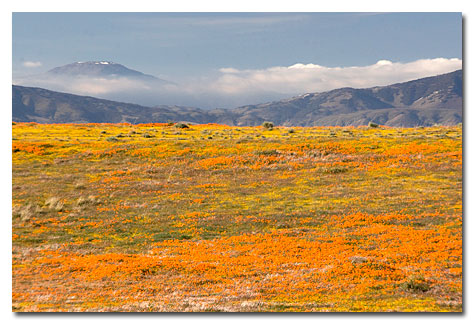
She’s no delicate petal-pusher. How pretty are the state’s highway medians at this time of year? Check the Desert Wildflower report for daily updates.


No it’s not clip art. That twilight landscape on your iPad desktop was actually shot by a local. (h/t to Boing Boing)


“A San Francisco eatery has convinced some customers to get tattoos in exchange for free food for life.” Hint: It’s not Michael Mina — but possibly a replay of the great burrito tattoo “disaster” of 1999.

This was supposed to be worth $5.8 million at the time. Like Gezundheit.com


An addendum to yesterday’s esteemed guest columnist: the New York Times’ Bay Area blog (the nerve!) ran a profile yesterday of Glendon Hyde, aka our favorite punk rock dragtavist, Anna Conda. She knows from first hand experience what gets lost – and more importantly, who gets displaced — when a gayborhood becomes just a neighborhood. Granted, Polk Street’s de-gayification has been happening for decades now (the pink flight to the Castro began around the mid-to-late 60s), and is just one part of the long, ongoing story of gentrification in the TL. Still, Anna/Glendon’s efforts to “Take back the Polk,” and now, her current campaign for the District 6 supervisor’s seat, should serve as rebukes to Katz’s patronizing mourning of communities that he was only superficially invested in.


Finally, in honor of Lady Day would have been 95 today I’ll leave you with this:

http://www.youtube.com/watch?v=h4ZyuULy9zs

Hot sex events: April 7-13

0


Dear Good Vibrations,

Please stop putting on such awesome classes, you’re making me look like I don’t have anything else to write about for sex events.

Thanks,

Caitlin

Just kidding, Good Vibes! But honestly, a quick shout out to our local legendary sex toy company. This place was started in 1977 by sex educator Joani Blank, and since then has made lovers of all kinds of sexual persuasions very, very happy with it’s high quality toys, classes and videos. But you already knew that. Onto this week’s sex events! Not coincidentally, they feature three Good Vibes lessons for very bad girls and boys. But it would appear the rest of the Bay has caught the fever for some bedroom education as well… 


Prostate Play and Pleasure

Dr. Charles Glickman knows what it takes to make your little prostate guy happy. In this free hour long class, he’ll run down the toys, tips, and techniques to shed some love on you or your partner’s gland of love.

Wed/7 6:30-7:30 p.m., free

Good Vibrations

2504 San Pablo, Berkeley

(510) 841-0171

www.goodvibes.com


The Sexuality of Pregnancy and Birth

The store continues it’s non stop sex ed blockbusting with this class, which takes away the confusion and uncertainty regarding pregnancy and sexual activity. Sexual pleasure as a labor enhancer? Which positions will show love for that belly of joy? Carrie Flemming, birth advocate/artist/health worker shows the way.

Wed/7 8 p.m.-10 p.m., $25-30

Good Vibrations

603 Valencia 

www.goodvibes.com


Freedom Dreams

Don’t miss the kick off party for Safetyfest, Community United Against Violence’s educational workshop series on avoiding domestic violence in queer/trans relationships. The party will feature queer performance group Mango with Chili, bangin’ DJs, a kissing booth, and of course, lots of learnin’ on how to keep your honey and yourself safe.

Thur/8 7-10 p.m., $5-20 sliding scale

Bench and Bar

510 17th St., Oakland

 www.cuav.org


Booze, Broads and Hotrods

For all those into the smoothness of curves, the rev of the engine, the smell of hot grease… the 12th annual car show/jive dance party/burlesque showcase, Booze, Broad and Hotrods. Get you out to Milbrae for cheap hotel rooms at the Clarion, a pre 1965 classic car show, and front row seats for La Cholita, the infamous burlesqueteer who will be performing throughout the evening.

Sat/10 3 p.m. – 1:30 a.m., $18-20

Clarion Hotel

401 East Milbrae, Millbrae


Secret Desires: Playing with Erotic Edges

On how to bring what you’ve always thought would remain a fantasy in your head to the fore of your lovemaking. Cleo DuBois shows the way to “deeply authentic sex.” And perhaps a little more honesty in the bedroom, to boot.

Tues/13 8-10 p.m., $25-30

Good Vibrations

1620 Polk, SF

www.goodvibes.com


Girl Sex 101

Allison Moon wants to teach you the same lessons on licking, grinding, and girl on girl sexual communication that she dispenses at Burning Man’s Camp Beaverton for Wayward Girls. Won’t you let her?

Tues/13 7-9 p.m.

Center for Sex and Culture

1519 Mission, SF

(310) 694-4895 

www.sexandculture.org


School of Shimmy: Burlesque 101

I’m unclear on whether it’s B.Y.O.P. (Bring Your Own Pasty), but regardless, you should get your shakable ass down to El Rio for Red Hot Burlesque’s crash course on that classiest form of clothes shucking. Important: will there be $1 Pabsts?

Tues/13 7-9 p.m., $30 (reservations recommended)

El Rio 

3158 Mission, SF

(201) 615-9245 

www.redhotsburlesque.com


Dolores Park Movie Night starts a fresh season of flicks

0

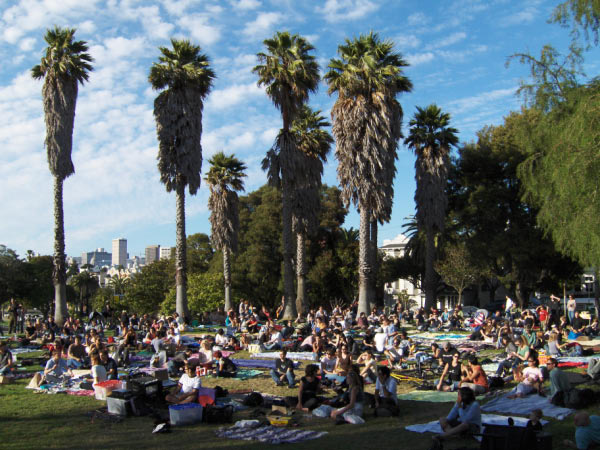
Blanket. Booze in a paper sack. Treats. Those are probably the ingredients to any adventure at Dolores Park, but wouldn’t it be better if Michael J Fox was there, too? Maybe not the real guy, but the cute ’80s version in Back to the Future [Universal Pictures, 1985] could be cool, or at least it will be when Dolores Park Movie Night starts up this Thursday. 

Come spring, some nice guys who live near Dolores Park put on a free movie the second Thursday each week, with a promise of zero affiliations, no causes, no politics and minimal organization. Just a community movie in the great outdoors. They pay their permits and costs with the help of donations and popcorn sales– eat up, hipsters!

The event is meant to be local, meaning the crew in charge urges you to bring your family and friends, neighbors, behaved children and happy dogs. I think East Bay inhabitants are still OK, but I wouldn’t invite that blondie and her pack visiting from the Midwest. And for this specific showing, people from the future are OK, too. 


Back to the Future 

Thurs/8, 7:30pm, Free

Dolores Park

Dolores & Church and 18th & 21st, SF

www.doloresparkmovie.org


Way out Middle East

0

arts@sfbg.com

FILM One frontier in which Israel remains politically left-forward is that of gay rights. Civil marriage, military service, foreign-partner naturalization, and job discrimination issues are all much more progressively legislated than in the U.S. — let alone the rest of the Middle East, where flogging, prison, or even execution punish homosexual "crimes." Nonetheless, as in much of the world today, fundamentalist religious currents endanger progress already made and still being worked toward.

Three out of five films in the "Out in Israel" series at the Roxie deal with strife between gay and Orthodox religious communities. Copresented by San Francisco’s Jewish Film Festival, they’re all part of a larger lineup of April events assembled by the Israeli Consulate in honor of Israel’s Gay Pride Month.

The oldest feature here is from 1992, though it feels like 1972 — Amos Guttman’s 16mm-shot Amazing Grace has the technical simplicity and variably professional acting of early gay-themed movies from just about any nation, whatever their era. And like most such, it’s a downer in which everyone is depressed, isolated, and broke. Young Jonathan (Gal Hoyberger) is fed up, especially with his quarrelsome family and slutty ex-boyfriend, when he meets handsome new neighbor Thomas (Sharon Alexander). Unfortunately the New York City-returned older musician is more interested in using drugs than love to drown his HIV-positive self-pity.

Israel’s gay cinema pioneer, Guttman died of AIDS the following year at age 38 without achieving anything like the popular success that greeted Eytan Fox a decade later. Fox’s 2002 international breakthrough Yossi and Jagger, originally made for local TV, stars Ohad Knoller and Yehuda Levi as IDF officers stationed in a mountain bunker on the Lebanon border. They’re carrying on a giddy affair almost no one knows about till tragedy intervenes. But Avner Bernheimer’s astute screenplay is still only half done: the rest of Fox’s finest effort to date finds closeted grief exacerbated by psychological theft and stinging injustice.

Moving from secular to religious conflict, the remaining "Out in Israel" features focus on clashes with those who view homosexuality’s mere existence as an affront to God. Nitzan Giladi’s documentary Jerusalem Is Proud to Present (2007) opens with Jewish, Muslim, and Christian clerics — united at last — condemning the city’s planned hosting of the 2006 International World Pride Parade as "nothing less than the attempted spiritual rape of this holy city." Violent rioting by Orthodox sects, death threats to gay leaders, and more attempts to shut down the event before it happens, succeeding somewhat yet also prompting righteous obstinacy from the LGBT community. One can laugh queasily at the grandmotherly type who claims HIV infection will jump 300 percent because those gays "just grab people" for their "orgies." But you’ll want to sucker-punch the loudmouthed Brooklyn rabbi who flies in just to spew his smirking homophobia.

Two recent features illustrate the impasse between homosexuality and ultra-Orthodox values in intimate dramatic terms. Haim Tabakman’s debut feature, 2009’s Eyes Wide Open (the only series program with a ticket charge; all others are free), watches trouble brew when a kosher butcher (Zohar Shtrauss) grows dangerously fond of the alluring new assistant Ezri (Ran Danker), whose reputation as a "curse to righteous men" precedes him. While borderline mannered in its minimalist dialogue and direction, the film packs a potent
punch.

Contrastingly not at all interested in restraint is Avi Nesher’s The Secrets (2007), about two girls (Ania Bukstein, Michal Shtamler) discovering Sapphic love at a women’s seminary. They also embark on a secret program of ritual cleansings for a prison-released French murderess (Fanny Ardant, atypically hammy) dying of both cancer and heart disease. It’s too bad the series’ sole lesbian feature is so melodramatically over the top. Then again, it’s probably pretty tasteful by the standards of a director previously associated with schlock like 2000’s Raw Nerve (Mario Van Peebles meets Nicollette Sheridan!) and 2001’s Tales from the Crypt Presents: Voodoo.

OUT IN ISRAEL

April 8–29, free–$8

Roxie

3117 16th St, SF

Whatever it takes

0

culture@sfbg.com

CAREERS AND ED It’s not everyone’s idea of a good time to be choked from behind and thrown into a wall repeatedly, although this is San Francisco. But this is no kinkster playground; rather, it’s an unprepossessing mirrored studio on the Nob end of the Tenderloin where a diverse group encompassing just about every age, gender, and athletic quotient gathers to learn the hand-to-hand combat and self-defense techniques of Krav Maga. Krav is martial without the art: crude but effective street-fighting techniques and counter-weight defenses honed into body memory through repetition, use of full force, and peer coaching. Unlike more rigidly codified martial arts systems, which put an emphasis on form and fair play, Krav puts an emphasis on “whatever it takes.” Whatever it takes to get home alive.

And the tradition of Krav Maga — “contact combat” in Hebrew — takes that mantra very seriously. Developed in the 1930s by Slovakian boxer Imi Lichtenfeld to help Jews defend themselves from anti-Semitic attacks, the “Israeli jujitsu” technique was honed by the Israeli Defense Forces for military purposes. Krav Maga San Francisco, founded in 1999 and owned by brown belt Barny Foland, offers 70 classes, and prepares you for any untoward situations.

A relative newcomer, I attend level one classes at Krav Maga San Francisco once or twice a week, schedule permitting. This week we’re learning to break free from a choke from behind, followed by a push. The first thing we learn when being thrown into a wall from behind is how to protect the face, blocking the impact with our forearms and turning our heads to the side. “That part’s pretty important,” our instructor quips. “You can’t see them now, because we painted over them, but there used to be blood spots on the wall where people bashed their noses.” Good to know.

The next step is breaking the choke, and though the movement itself is not complicated, training it to feel intuitive takes longer. Basically, the chokee shoots an arm straight into the air and quick turns, breaking the hold through leverage. Of equal importance to the choke-break is the follow-though, defensive moves morphing into offense: hammer strikes, groin kicks, a few rapid-fire punches to the soft tissues. Without pads, we mime the strikes, which earlier we practiced at full force on unwieldy foam “shields”. The choking is real enough, though, as is the body-slam, and two days later, a tender spot the size of a thumb rests below my jawline, and bruises on my elbows attest to how I finally learned to not block with them.

The hardwiring process and use of full-force is what inspired me to take Krav in the first place. I had already taken an IMPACT (www.impactbayarea.org) self-defense seminar, which taught me how to take a fall and fight hard from the ground. But Krav aims to keep students on their feet. I find the benefit to training face-to-face against my peers (instead of a “padded suit”) is two-fold. Firstly I learn to strike with force against a person whose face I can see, and secondly, I learn to absorb their blows, a crucial key to surviving a real-life attack. Taking the time to help each class member master every skill genuinely is a top priority at Krav Maga SF. I’ve attended aerobics classes that were more competitive.

Foland assures me it’s the norm. “Anybody who wants to come in and train for competition, we send them down the street to the local kickboxing gym. You can be in a level one class and have level four students in there with you, and the only reason you would know it is because they’re really good, and they’re trying to help you learn. You show your skill by how much you help your partner.”

Of course, folks looking for a more graceful, philosophy-based martial art might ultimately decide that Krav Maga is just too rough around the edges. I think of the earnest man who attended an intro session about a month ago. He’d been blocking well all night, but balked when our instructor urged us to aim our punches for the throat, in order to cause “the most amount of damage in the quickest amount of time.”

“But couldn’t you damage someone permanently if you hit them in the Adam’s apple,” the man asked, concerned.

“I didn’t start the fight, remember,” our instructor said firmly. “But I’m going to finish it.”

KRAV MAGA SAN FRANCISCO

1455 Bush, SF

(415) 921-0612

www.kravmaga-sf.com


Dreams on 45

0

johnny@sfbg.com

MUSIC Sonny Smith is sitting at a window table at the Latin with a cap on his head and a small glass of red wine and some 7-inch single cover art by Stephanie Syjuco in front of him. I get a whiskey and sit down to talk about the matter at hand: art, music, mythologies, and “100 Records,” the gargantuan yet in some ways quite local show of sounds and images he’s putting together at Gallery 16. One man, 100 records — with help from dozens of artists, a number of musicians, a carpenter, and an electrician, Smith not only has created a number of 45s by fictional musicians and bands, he’s built a jukebox to play them.

The due date for Smith’s mammoth creation is a week away, and he’s in the final stages of assembling it. “I’ve been struggling to write down all the bios,” he says, as we talk about some of his imaginary recording acts, which range from New Orleans drag queens to Utah nature lovers. “They’re not Wikipedia-esque, but more like entries in a Rolling Stone Encyclopedia [of Rock & Roll]. At the beginning, I was swapping names and titles all the time — if a surf jam turned out to be a folk song, I could give it to another character. But now, with the last three [records], it has to be what it is.”

What is it? An open-ended project, not solo and self-enclosed in the manner of the Magnetic Fields’ 1998 69 Love Songs, where Stephin Merrit’s formulaic writing reached its apex. Instead, Smith is allowing “100 Records” to form itself as he assembles it. “I’ve only brushed up against the edges of it all becoming interwoven,” he explains over the post-work barroom din. “It’s almost as if I’d rather it not be — if you read the Harry Smith Anthology [of American Folk Music], or a biography of a musician, it’s enjoyable that there are so many loose ends.”

The visual artists contributing to “100 Records” — including William T. Wiley, Alicia McCarthy, Harrell Fletcher, Paul Wackers, and Mingering Mike (who knows a thing or two about creating folk musical figures) — have responded to Smith’s call for cover art in a variety of ways. “Alice Shaw was this character Carol Darger, and I was Jackie Feathers,” Smith says, to give one country-tinged example. “Their biography is that they’ve gotten married and been divorced twice. We took photos together for cover art. And Jackie Feathers also has solo records with art by different artists.”

When one thinks of Sonny Smith, band names don’t come to mind, though his latest endeavor Sonny and the Sunsets plays wittily off of his current San Francisco neighborhood. For years, Smith has put his plain name forward rather than come up with musical monikers. “100 Records” changed all that. “What’s weird is that I tried for years to come up with cool band names,” he says. “I’d come up with one and think, ‘That’s dumb.’ I’ve never had a knack for it. But because [the acts in “100 Records” are] fictional, it was easy to come up with band names — the names came left and right. A lot of the names that came to me I’d be happy to use as real band names. In fact, I’m trying to get a couple of the bands to become real bands.”

Indeed, one of the groups on “100 Records,” the Loud Fast Fools, will soon make the transition from fiction to the reality of today with a gig at the Knockout. Smith’s recording process for the project has been varied. He’s taken instrumental passages from obscure ’50s, ’60s, and ’80s songs, patched and lopped them with Guitar Hero, and put vocals on top. He’s recorded solo. He also knocked out dozens of songs with a multi-instrumentalist group of largely San Francisco musicians, some of whom he refers to by last name: Stoltz, Dwyer.

“There are a couple of balls-out, crazy ‘Louie Louie’-type numbers, and Spencer [Owen] played drums on those,” Smith says, describing the sessions. “It was some of the best drumming I’ve ever played with. He had these bizarre beats and fills. I thought, ‘This is so perfect — this is probably how a song like “Louie Louie” happened.'”

A spaghetti-narrative project like “100 Records” is a natural for Smith, a storyteller who has documented his life in comic book form and written plays. Later in the interview, with the Rolling Stones’ Tattoo You on the stereo at my apartment, he tells me that one of the first singles he bought was by Mick Jagger. “I didn’t buy it because I knew anything — the guy at the record store just told me to buy it,” he says. “It was a record store in Fairfax that was Van Morrison’s parents’ record store. He just bought the store and put his parents there to run it.” This anecdote then spirals into a funny one that a member of Morrison’s band told him about being stuck playing an endless version of “Domino” on a darkened arena concert stage while Morrison secretly caught a cab and a plane to L.A.

Smith has a keen eye for the mythologizing involved in music, and how a college radio DJ can build the guy down the street into a mysterious cult figure. Around the release of one album, his label pestered him to write a fake Pitchfork review, but he declined. “I’d be more into writing a fake Playboy interview,” he says. Ironically, Pitchfork has come calling of late, writing about Sonny and the Sunsets.

Internet career-makers come and go. For now, Smith is more concerned with opening night of “100 Records” and the debut of his own art contribution to the show, a customized jukebox. “It’s a hell of a thing, ” he says, after breaking down the differences between Wurlitzers and other brands, and explaining that a rat-infested jukebox buried under stacks at Adobe Books first inspired the idea. “My friend who is a master carpenter used this German ’50s jukebox as a reference. It’s almost like a joke — like making a stove from scratch. Why would someone do that? But someone did.” That someone is Smith, and he’s hosting a jukebox party this week.

SONNY SMITH: 100 RECORDS

With music by the Sandwitches and Sonny and the Sunsets

Fri/9, 6–9 p.m. (through May 14), free

Gallery 16

501 Third St., SF

(415) 626-7495

Inside the squat

1

By Evan DuCharme

news@sfbg.com

Homes Not Jails (HNJ) has fought diligently for two decades to shed light on the economic disparity that exists in San Francisco, where the number of homeless people would fit almost perfectly into the supply of vacant homes.

So on a cold Saturday night, April 3, as I sit shivering in the back of a van waiting for my group’s turn to covertly enter a vacant house, I’m surprised at the calmness on some of the members’ faces. This group of eight is planning to enter and occupy apartments at 572 and 572A San Jose Avenue. And while only a few have been through this before, the rest make up for their lack of experience with a passion for the cause.

Around 2 a.m., the group somehow manages to enter the building without being caught, but it’s not easy. Between the drunken couple arguing on the street, the cops breaking up a bar fight nearby, and a neighboring couple who keep shining flashlights at the units, the group should never have made it in. But it does, and at the moment there’s no time to dwell on luck because there’s food and water to unpack, entrances to secure, and rooms to search, all while remaining perfectly silent and unseen.

Typically HNJ, a project of the San Francisco Tenants Union, conducts weekly searches it calls “urban exploring” in the hopes of finding useable vacant property to set up as a “squat” for people looking for a place to live rent-free. Every so often, its activism goes mainstream in the form of public occupations like this one, when the media is notified.

The immediate goal is to simply enter, secure, and occupy the apartment until noon the next day when a rally starting at 24th and Mission streets will march right in front of the building. Once there, they are supposed to let fly a couple HNJ banners while the rally outside features speeches, chants, and music by the Brass Liberation Orchestra.

But the catch is that the squatters cannot be seen before the rally arrives outside, otherwise their cover will be blown, they could be arrested, and the goal of shedding light on this waste of vacant housing will be ruined.

After attending HNJ meetings and events for a few weeks, I was allowed to follow the group into the apartment and report on their occupation from the inside as long as I protected the anonymity of those who wanted it. With that in mind, the group included Tim, one of the most experienced HNJ members; SFSU grad-student Aaron Buchbinder; Elihu Hernandez, a candidate for the District 6 seat on the Board of Supervisors; Matt, another experienced HNJ member; and local activists Carling, Scott, and a seventh member who asked to remain anonymous.

The building they targeted had strong symbolic value; it was where an elderly man was forced out by the landlord using the Ellis Act, which for the past decade has been the root cause of a large number of what the group sees as unjust and immoral evictions.

The Ellis Act was adopted in 1985 to give landlords the right to clear their rent-controlled buildings of tenants and get out of the rental business, expanding their previous rights to evict tenants through Owner Move-In (OMI) evictions, which allowed landlords and their immediate family members to oust renters.

Once a landlord invokes the Ellis Act, tenants in the building are given 120 days to move out, although seniors and those with disabilities must be given a year’s notice. Tenants are entitled to almost $5,000 each in relocation costs, or a maximum of almost $15,000 per unit. Seniors and those with disabilities get an extra $3,300 each.

After the building is vacated, it is usually taken off of the rental market for at least five years. During that time, the former tenants retain the right to reoccupy their old units at their original rent for 10 years. If the building is re-rented within five years, the landlord can only charge what the previous tenants were paying. These restrictions are attached to the deed and apply to subsequent property owners as well.

Although the restrictions were meant to discourage the eviction of tenants from rent-controlled units, they also have encouraged some property owners to keep buildings vacant while they wait for property values to increase or to re-rent their units at higher prices. If the landlord wants to convert, remodel, or add any additions to the property, they still must seek the city’s approval.

This landlord power is the primary reason HNJ chose to occupy 572 and 572A San Jose Avenue. A few years ago, the property was purchased by Ara Tehlirian, who sought to remodel it and live there himself, evicting 82-year-old Jose Morales in the process. Morales had been legally renting the property since 1965 and challenged his eviction in court.

Morales won when the judge ruled that it was illegal to evict him for the sole purpose of renovating the building for the new landlord. But Morales’ success was short-lived. Tehlirian invoked the Ellis Act, so Morales was no longer legally able to live in his home. When Tehlirian subsequently asked for permission to renovate his house as he had initially planned, the judge denied the request citing that landlords cannot invoke the Ellis Act for an OMI eviction.

One reason the Ellis Act is used so frequently traces back to the passage of Proposition G in 1998, which prevented the type of eviction initially tried on Morales. Prop. G requires landlords invoking an OMI eviction to move into the evicted tenant’s unit within three months of the eviction and to stay for a minimum of three years.

Furthermore, it limited such evictions to one person per building and banned them if a comparable unit was open in the building. Finally, and the reason cited in Morale’s case, it made permanent an existing law that was set to expire in June of that year that prohibited any OMI eviction of senior, disabled, or catastrophically ill tenants.

Tehlirian, like many others before him, decided to use the Ellis Act to bypass these OMI restrictions. Ted Gullicksen, director of the Tenants Union, said Prop. G had the unintended effect of encouraging property owners to clear their buildings of tenants, a requirement of Ellis Act.

“A vacant building is generally worth 20 to 30 percent more than a building occupied with tenants because the landlord can do whatever he wants with the units, including selling them or renting at market rate,” he told us.

So Morales was forced out of what remains a vacant building. This is why HNJ illegally occupied the property, arguing that trying to effect change through legal avenues is at times just as difficult as Morales’ individual struggle against the Ellis Act. It highlighted the human cost of property rights.

“People who keep vacant buildings for profit tend to be the same ones who donate money to political campaigns,” Tim said. Which is why he is resorting to a form of civil disobedience that is very likely to end with him in handcuffs.

Around 1 p.m. Sunday, April 4, the rally met in front of the property and the occupiers frantically rushed to hang banners and secure any entrance the San Francisco police might find. As the first drops of rain fell, the Brass Liberation Orchestra played, speakers including Gullicksen and Morales said a few words, and the Food Not Bombs organization supplied free food to occupiers and members of the rally.

After a few hours, the rally dispersed with much appreciation from those inside the apartment and what started as a group of seven SFPD squad cars dwindled to two. Tim, Elihu, Scott, Aaron, and Matt decided to remain in the building while the rest of us said goodbye and climbed out an open window.

The remaining members spent their second night in the building, but this time they didn’t have to be quiet. Supporters brought the group pizzas and a neighbor offered to supply water to the group as long as they didn’t mind if it came from her tap. They huddled in the same room playing cards and joking until Tehlirian and the SFPD made it through the front door, ending the occupation.

Each member was cited and released on the premises at 1:35 p.m. April 5 under penal code 602m for trespassing. Tehlirian stood by and observed while his lawyer, Zach Andrews, unsuccessfully pressed him to charge the group with breaking and entering. When the group dispersed, Tehlirian and a few members of the SFPD broke through a second door to gain access to the bottom level of the property.

When Tehlirian came out for a break, I tried to speak with him but he refused to answer my questions. Shortly afterward, I met up with the HNJ group at the Tenants Union and asked Tim if he thought they were successful in accomplishing their goals. “Not completely,” he said. “But we made the most with what we had.”

Tenants may not have the law on their side in many cases, but in a city that is two-thirds renters, they have each other. And for a few days, they had one more home. The group’s feelings seemed to be summed up by this quote on a HNJ pamphlet: “We are too valuable to live huddled in the rain, in the parks, in dangerous unhealthy shelters. Freezing, dying so that others can realize profits.”

Original synth

33

marke@sfbg.com

MUSIC “In a time when people are becoming more and more isolated every day by the Internet, alone at their computers and staring at the tiny, sad glowing screens in their cellular hands, it only makes sense to me that we are all feeling a slight sense of loneliness and (hopefully) the desire for connection with others … Whereas 1980s groups responded to implicit cold, colorless alienation of the repressive regimes of Reagan-Thatcher-era politics and culture, today’s groups I think express a similar frustration responding to what I call ‘the culture of isolation.'”

That’s Pieter Schoolwerth, founder of Wierd Records, a New York City label dedicated to releasing records by contemporary acts that eerily mimic the sounds of obscure electronic new wave, in a recent interview with Austrian music journal Skug. Oddly in the context of connection, he’s talking about some of the most deliberately cold, enigmatic, bleak yet beguiling music ever produced — “lost” underground European and American music that came out roughly between 1979 and 1986 (if it came out at all), was inspired by goth, industrial, and synthpop giants like Throbbing Gristle, Joy Division, Bauhaus, the Cure, and Depeche Mode, and is only being rediscovered now.

It’s igniting fierce interest, with musicological fanatics digging up spooky swaths of unknown angular gems and a slew of current bands channeling the sound. Originally made in decaying urban centers with then-newly-affordable analog synthesizers and drum machines by dozens of often untraceable musical mavericks — Ausgang Verboten, Esplendor Geometrico, Das Kabinette, Eleven Pond, Nine Circles, Zwischenfall, Gerry and the Holograms — these unearthed and unearthly tunes from decades ago are beginning to seep into the Bay Area scene via a handful of excellent compilations, club nights, and musical visionaries. Can something be retro if hardly anyone heard it the first time? That’s just one of the intriguing questions that springs to mind. Meanwhile, humans are dancing. Here’s a mix of some of the originals:

ANGULAR COLDWAVE LAUNCH MIX by Angular Recording Co

COLD CONNECTION, CHAIN REACTION

This bracingly unfamiliar music (or rather, slightly familiar — you think you’re hearing some bizarre 1981 B-side by Soft Cell or Visage but it turns out to be a crazy one-off from Columbus, Ohio from that same year) was usually grouped at the time into three fuzzy genres that overlapped at many points, sharing among them a DIY spirit, a dystopian view of the future, an urge to map the melodramatic onto the automatic, erotic astringency, and pretension without pretentiousness. Yes, much of it veers into “Sprockets” territory, but that’s actually part of the appeal.

Dark wave was an umbrella term for goth rock, early industrial, and darker synthpop. It grafted lamentation and cavernous basslines over post-punk’s angular angst and icebox oddity, and was popularized by groups like Fad Gadget, Front 242, and Chris and Cosey and at clubs like London’s seminal Batcave. Cold wave was the French version of dark wave that skewed toward more Pong-like synth figures, fizzling chords, studied malaise, and gnomic haiku. (“Business man/Yet you kill the boss/Computer programs/Shadows in the night,” Lyonnaise duo Deux disaffectedly intone on 1983’s unshakeable “Game and Performance.”) Synth wave, or minimal synth, was a kind of prickly disco: chromatic, sparsely produced, brooding and moody, yet often quite catchy and dance floor-oriented.

All three genres are now generally lumped together as “wave” (or sometimes “retrograde”), which can include a vast array of other period sounds, from John Zorn-like no-wave jazz explosions to Dead Can Dance spooky-tribal incantations. Basically, if it feels like you’re listening to a late-night college radio program somewhere in the Midwest in 1984, one possibly called “Flash Frequencies” or “Shadow Talk,” you’ve caught the uncanny wave gist. If you imagine yourself a fishnet-gloved extra in the movie Liquid Sky who pronounces “paradise” as “pah-rahd-eyes,” then you definitely have.

Dark wavers Brynna and Domini at Club Shutter. Photo by Sadie Mellerio

But just because the sound aimed for frigidity doesn’t mean it didn’t build community. Wave acts may have been what some would call “unbranded,” but they operated within close-knit networks: cassettes were passed hand-to-hand, recording studios were shared in warehouse-based artists’ communes, fans around the world braved dangerous parts of town to attend wave-centric club nights. The music itself attempted to humanize the arctic pitch of analog synths by infusing it with longing, restlessness, ennui, and gloom.

Vice Angular “This is Cold Wave” Mix

Today, that naive sincerity, refreshing lack of self-conscious irony, and marketplace virginity translate into authenticity, appealing to retro aficionados who vomit a tad at goth’s Hot Topicality, the macho posturing that torpedoed industrial, or the Polly Estherization of new wave. (Like techno, soul, and disco before it, new wave retro is finally purging itself of excess baggage and mainstream complications by going minimal and original.) Dusted-off waveforms and hyperactive web forums attract a network of virtual seekers and posters who salivate at each discovery. Schoolwerth may be right about wave’s cry against a culture of Internet isolation — and the turn toward analog is a specific rejection of the digital — but like an anxious clan gathered around a silicon-chip fire, its current fans watch anxiously online for freshly exhumed and re-chilled visions to appear. Then they go play them at clubs. Here is something old that seems truly new.

FOREVER EXHUMED, FOREVER ORANGE EYES

Wierd Records’ contemporary roster of disquieted simulators, including the almost paranormally attuned Xeno and Oaklander and Led er Est, has been gaining global club-play traction — something many of the original artists, who drifted off into other, often fascinatingly mundane lives, could only have hoped for. (One example: Lidia the Rose, one half of Dutch act Nine Circles, abandoned musicmaking in the early ’80s to raise “a half dozen” children in a commune-like setting. It was only after one of her sons Googled her name that she realized there were fans of her extremely limited, cassette-only output. She has since started making music again.) And wave affectations have garnered larger attention from the breakthrough of experimental synthpop band Cold Cave, which draws on the sound’s pallid idiosyncrasies. “Hear sounds about yesterday’s pain today,” the band’s MySpace deadpans.

Notable contemporary Bay Area wave acts include the excellently jerky Muscle Drum, founded by long-term wave-proponent Rob Spector of the group Bronze, fog-shrouded darkwave duo Sleeping Desiress, cinematic dirgers After Dark, and exquisitely anguished quintet Veil Veil Vanish. The East Bay’s Katabatik Sound System has been producing lurching experimental-industrial music and events for a while, and V. Vale’s Re/Search crew has been exhuming rare tunes forever. A particular favorite around the Bay Guardian office lately is the Soft Moon, a melancholic, pitch-perfectly crepuscular project of punk veteran and graphic designer Luis Vasquez.

The Soft Moon

“Honestly, being associated with the wave phenomenon was a little surprising to me at first,” Vasquez told me, balking, like many retro-contemporizers I talked to, at being associated with any kind of scene. “But I think I understand why. My instrumental formula is similar because of the use of drum machines, synthesizers, rhythmic bass lines, and somber melodies. It could also just be the overall feeling my music has. I’m still not quite sure.”

http://www.youtube.com/watch?v=Ufcfo9K1yfI

On the classic side of things, two just-released, high profile compilations — The Minimal Wave Tapes (Minimal Wave/Stones Throw) and Wierd-curated Cold Waves and Minimal Electronics Volume 1 (Angular) — along with recent German comp Genotypes (Genetic Records) have made underground synth rarities more accessible to potential wavers.

“I was exposed to new wave at a young age via my older brother’s small collection of cassettes,” NYC’s Veronica Vasicka of the Minimal Wave label wrote in an e-mail. “Later I’d sneak out of my parents’ apartment at night to go dancing in the East Village. I really associate those teenage days of first discovering record shops and old VHS tapes of bands like Throbbing Gristle with the inspiration that led me to launch the Minimal Wave label.”

Vasicka coined the term minimal wave to encompass her fascination with both cold wave and minimal synth sounds. Her long-running Sunday night East Village Radio show has served as a beacon for American synth fans, and the incredible response to her extensive Web site (www.minimal-wave.org) has established her as the point-person for the movement. She has her own theory about why the sound seems right:

“On one hand, I am surprised that minimal wave has been so easily welcomed in this day and age. But on the other, and when looking at things from an economic standpoint, there’s a distinct parallel between what was happening during the late 1970s and early ’80s and now. The weak economy that led to the recession peak in 1983 is similar to what has been happening during the past several years. And it seems that cultural and artistic output tend to be affected by economic and social struggle. So perhaps this context has provided the openness necessary to embrace minimal, DIY synthesizer music.”

PASSING FIRES, STRANGE DESIRES

I’ve just entered Sub Mission Gallery for underground queer punk party Sissy Fit. The energy is edgy. Clouds of smoke drift in from outside. Patrons in black sway on the dance floor and eye each other from the benches lining the bare walls. DJ Pickle Surprise, whose style ranges from hardcore blasts to camp classics, puts on a throbbing track by early ’80s Marseille synthers Martin Dupont and I’m instantly transported back to my shadowy youth, spent skulking around the checkerboard dance floors of downtown Detroit clubs Bookie’s, Todd’s, and Liedernacht. I whip an imaginary cigarette holder to my pursed lips, checking to make sure my phantom pillbox hat is properly tilted. He follows that up with a selection of wave tracks old and new, including Storüng, Oppenheimer Analysis, and 2VM, that transforms the joint into an electro-sepulchral time portal. The added twist to this nostalgia trip is mystery — the music ventures beyond the “‘remember the 80s party” canon and into some uncanny partial-recall state.

DJ Pickle Surprise

“I find I’m playing this sound more and more,” Pickle Surprise, a.k.a. Joe Krebs, told me. He got into wave after attending one of the parties Wierd has been throwing in Brooklyn since 2003. “It can call up visions of lasers and line-dancing robots, but after getting to know it more, there’s something less cold or android about it, more of a human touch. It’s analog. There’s something supernatural as well. Like Videodrome, where you’re up in the middle of the night and get pulled into something on television. Something haunting that recalibrates you.”

“Did the passions of the artists shape the way the technology was used, or did the technology shape the people using it? NERD!” DJ Nary Guman, a.k.a. Joe Polastri, teased over e-mail. Along with DJ Inquilab, a.k.a. Nihar Bhatt, he puts on the monthly wave-friendly Warm Leatherette. They started their own party early last year because they found their tastes didn’t quite fit in anywhere. “Once I started digging I found out just how vast the field was,” Bhatt added. “It’s exciting to have something that can be danceable, experimental, popular, and punk at the same time.”

Other San Francisco parties that have embraced the sound include the monthly Shutter (www.myspace.com/clubshutter) at Elbo Room, which packs in the kohled and the beautiful with hits from Sisters of Mercy and Fields of the Nephilim among rarer tracks. Local band Jonas Reinhardt’s Synth City, every last Thursday of the month at the Attic (www.jonasreinhardt.com) mixes a wave feel into atmospheric krautrock and new age rambles. And the Radioactivity happy hour at 222 Hyde (www.222hyde.com) celebrates “low-budget synths and Cold War dance parties.”

LE DECADENCE ELECTRONIQUE

The party most faithful to the retrograde spirit, however, is the energetically opaque Nachtmusik, put on by DJs Josh Cheon, Justin, and Omar. Chilly green lasers strobe live performers, wave-o-philes gather in corners to trade track knowledge, and open-minded dancers try out new-old moves to alien beats. (Surprisingly, this insular music sounds really good loud in a crowd.)

Josh Cheon of Dark Entries Records. Photo by Jon Rivera

If anyone’s the heart of the Bay wave scene, it’s Cheon. One of our most important amateur musicologists, he was integral to the disco revival of the ’00s, tracking down and conducting in-depth interviews with gay bathhouse-era survivors and then moving on to international wave. For him, the music summons youthful memories of dancing at NYC’s the Bank to Clan of Xymox, Q Lazzarus, Cetu Javu, Wolfshiem, Beborn Beton, and VNV Nation. “From the first notes of Ministry’s With Sympathy and Depeche Mode’s Speak and Spell, I’ve been a sucker for synths,” he told me, laughing.


Death Domain by darkentriesrecords

In 2009, Cheon started Dark Entries Records (www.darkentriesrecords.com) to release some of his finds, including Second Decay, Zwischenfall, Those Attractive Magnets, and upstate New York’s Eleven Pond, whose “Watching Trees” has become a wave anthem of sorts. (He found Eleven Pond through a comment one of the members posted on SF synth collector Goutroy’s A Viable Commercial blog, goutroy.blogspot.com.)

Staying true to the “DIY vinyl retrograde” spirit, Dark Entries releases come in hand-numbered batches of 500, and for the most part the digital rights are kept by the artists themselves. There are no CDs.

He shrugs off the possibility that there’s little left to discover. “It’s like gold mine after gold mine,” Cheon told me. “There’s just so much out there — even the artists themselves are surprised to be reminded of this time in their lives that they’d mostly forgotten. It’s actually really touching when they find out there’s an intense interest in what they did in their youth. They’re just amazed.”

Later this year he’ll be releasing a Bay Area Retrograde (BART) compilation, highlighting our own historical wave purveyors. “What many people forget is San Francisco’s rich synthpop and new wave history, with bands like Voice Farm, Tuxedomoon, the Units, and the Club Foot scene for starters. [Factrix, Minimal Man, and Los Microwaves are some others.] But that’s just scratching the surface. I mean, who knows what great tracks are waiting to be heard? And what amazing stories behind them.”

NACHTMUSIK

Wed/14 and second Wednesdays, 10 p.m., $3

The Knockout

3223 Mission, SF

www.theknockoutsf.com

WARM LEATHERETTE

Fri/16 and third Fridays, 9 p.m., free

Space Gallery

1141 Polk, SF

www.myspace.com/warmleatherettesf

THE SOFT MOON

Tue/20, 8 p.m., pay what you can

21 Grand

416 25th St., Oakl.

www.myspace.com/thesoftmoon


The Daily Blurgh: Howdy, gaybor!

0

Tuesdays will occasionally be given over to a guest columnist. This week, please welcome a bitter queen.

Have you heard? Gayboorhoods are becoming extinct. So sayeth Matt Katz tosday in Obit mag, a self identified straight man who has spent enough time among that mythic fairy land, “where gay people lived and hung out, somehow fulfilling stereotypes while simultaneously stimulating social justice” (via hand jobs?) to tell us of the local color that once flourished there and to lament their passing.

Thank God we have intrepid Margaret Meads like Katz  — who even once let a gay squeeze his bicep at the gym (no homo!) — to wax nostalgic about the good old days of double dutch jumping trannies on the corner. You see, children, the gayborhood was a wonderful, rainbow-hued place of escape “where cleverness, artistry and merriment is applauded.” Huzzah! You know, I still can’t go out in the Castro without some Oscar Wide wannabe vomiting bon mots onto my chinchilla gilette to the applause of onlookers.

But seriously, even though Katz’s commentary on the changing face of urban gay life has as much nuance as a college freshman’s five paragraph essay (to wit: “The demise of the gayborhood indicates that America is more mixed – ethnically, economically, sexually — than ever before.”), his overall thesis is true, to some degree. Yes, there is greater social acceptance of homosexuality and thus less need for the self preservation of a ghetto. Yes, the Internet is a factor, at least in the demise of bar culture — even though bars continue to be perhaps the only reason anyone still frequent gayborhoods (see the Katz’s final ‘graph). And yes, the Castro is a Pottery Barn-upholstered shell of its former hedonistic self blah blah blah.

But to applaud gayborhoods as the superficial pleasure domes of memory where “people don’t pretend that the real world is anything all that important” is to wholly ignore their historical importance as sites of political organizing and resistance (that’s “stimulating social justice”). Oh, and speaking of queer political activism, there’s that other factor that shook up the gayborhood. You know, AIDS. But don’t go looking for any mention of it in Katz’s obit. Why would he want to talk about an unattractive thing like that? Get Lil Miss Ally another Long Island Iced Tea. I’m going back to dusting my Erte lamps.

Benefits: April 7-April 13

0

Ways to have fun while giving back this week

Thursday, April 8

1369 Lights
Be among the first to get a copy of the new Moholy Ground Magazine, the New Photography Journal. Meet Moholy Ground staff and featured artists and enjoy cocktails and music from DJ BoomBostic spinning soul, motown, and funk. The Moholy Ground Project publishes nonprofit art journals and books and provides low cost promotions and marketing to art organizations and individuals involved in the art community.
7 p.m., $5
Blue Six Acoustic Room
3043 24th St., SF
www.moholyground.org

Friday, April 9

FACT/SF

Grab some gloves, hats, or any other costumes you feel like wearing  and head to this fundraiser party for the dance troupe FACT/SF featuring a silent auction, drinks, snacks, performances by Light Fiction, Lily Taylor, Emily Woo Zeller, DJ Nuxx, and more, including a sneak preview of FACT/SF’s new project, The Consumption Series.
8 p.m., $20-100 sliding scale
Mama Calizo’s Voice Factory
1519 Mission, SF
www.factsf.org

Saturday, April 10

Catwalk 2010
Watch as aspiring male to female transgender models from all over the country compete for the Catwalk 2010 crown in categories such as cocktail wear, swimwear, and evening wear. Proceeds from the event go to the AIDS Housing Alliance.
7 p.m., $40
SOMArts Gallery
934 Brannan, SF
catwalkusa.com

Poker Tounament
Attend this poker tournament to benefit Bay Area Women Against Rape (BAWAR), an organization that provides 24 hour services for survivors of sexual assault and their significant others. First, second, and third place winners will receive prizes and there will be raffle drawings throughout the night.
7:30 p.m., $50 buy in
Station Barber Shop
Suite 100
4400 Grand, Oak.
(510) 214-2299
poker@bawar.org, call or email to register

Soiree 8
Celebrate the San Francisco LGBT Community Center’s eighth anniversary with a night of decadent foods from San Francisco restaurants, entertainment from queer artists, and flowing cocktails featuring special guests Theresa Sparks and David Campos. The evening is scheduled to end with a dance party with music by local DJs.
7 p.m., $95
Terra Gallery
511 Harrison, SF
soiree.sfcenter.org

Sunday, April 11

Rose Pistola Cooks for North Beach
Enjoy a bountiful family style dinner, served at long tables, and accompanied by wines by Fancis Coppola Wines to benefit the North Beach Citizens, a neighborhood organization for the homeless. The hosts of the evening will be Lawrence Ferlinghetti and Jeanette Etheredge, so expect poetry  readings, film screenings, dancing, and other suprises.
6 p.m., $125
Basement of Sts. Peter and Paul Church
666 Filbert, SF
www.northbeachcitizens.org

Saturday voting — and how to fund it

9

Alex Tourk, a local political consultant who was once Gavin Newsom’s campaign manager, came by today to pitch us on his latest project: Saturday voting. He’s generated a fair amount of press on the concept, and it sounds like one of those thing nobody could oppose; why not open the polls an extra day? In fact, why not open the polls from Friday until Monday? Why Tuesday, anyway?


Well, Tuesday voting is a creature of the mid-1800s, when it took a couple of days to get from the farm to the town center, and nobody wanted to start out on a Sunday. Now it’s in the California constitution. But there’s no law that says you can’t vote Saturday AND Tuesday.


What Tourk is proposing is fairly simple: Voting places would be open Saturday, but there would be no voting machines. You’d just go there and fill out an absentee ballot. Which you could also do at home, of course, and a citywide vote-by-mail effort might increase turnout even more. (Or maybe it wouldn’t, given the low rate at which census forms are getting returned.)


Tourk says he wants to build excitement about elections and community interest; that’s why he wants the polls open an extra day — and a day when more people are off work and thus, in theory, would have more time to vote. He’s circulating an initiative that would set up a one-time pilot project, for the 2011 mayor’s race. If it works, maybe the supervisors and the mayor will want to continue it.


Here’s my big concern: Tourk doesn’t want to ask for public money from a city that’s deep in the red, so he’s proposing to raise the $1 million or so it would cost for Saturday voting from private interests.


Of course, the names of the donors would all be public, but still: Managing elections is about the most central democratic function of a government — and I really don’t want to see private interests involved. It seems to me that if this is worth doing, it’s worth paying for with public funds.


Where would that money come from? Here’s an idea: Prop. 15, the California Fair Elections Act, would set up a pilot program for public funding for statewide elections. The money would come from fees on lobbyists. Why can’t we do the same thing in San Francisco? Fund Saturday elections with a lobbyist fee — and a tax on political consultants.


Seriously: Consultants make money by manipulating democracy. They represent, on a deep philosophical level, the privatization of American politics. I’m not saying all consultants are bad or that they should be outlawed or anything like that — but a modest levy on political consultant fees would more than fund a Saturday election pilot program.


Tourk smiled when I suggested this, and would only say it was “an interesting idea.” Now, which supervisor is going to pick up on a tax that will only offend the small number of people who help get all our local officials elected?

Live Shots: Edible Art Contest, Omnivore Books, 04/01/10

0

Foodies filled Omnivore Books in Noe Valley on Thursday night, some to compete and some to eat, for the first Edible Art Contest. The competitors were judged on taste and creativity and the mix of entries were quite impressive. 

There were “still-life” cookies, a “swimming pool” of chocolate pudding complete with a paddling pup and orange inner-tube, and “salumi” made with dried fruit and nuts created by local gluten-free cookbook writer Jacqueline Mallorca.

Once everyone had sampled each entry, it was time to vote. The runner-up of the contest was an amazing three tiered princess cake covered in edible cameos and gold icing, but the winner was the “Alabama Lane Cake,” inspired by To Kill A Mockingbird and said to have enough bourbon in it to have actually been the culprit of the poor bird’s demise. All the entries were decadent desserts and after several kinds of cakes, cookies and pudding, I was on a major sugar high and just grateful I could actually hold my camera steady with all that sweetness rushing through my veins.

Omnivore Books, with its incredible collection of awesome new and old food books, hosts all sorts of other cool events (Alice Waters will be there on April 10th) and food contests, making it pretty much a foodie’s idea of heaven.

Stage listings

0

Stage listings are compiled by Guardian staff. Performance times may change; call venues to confirm. Reviewers are Robert Avila, Rita Felciano, and Nicole Gluckstern. Submit items for the listings at listings@sfbg.com.

THEATER

OPENING

"DIVAfest" Exit Theatre, 156 Eddy; 673-3847, www.theexit.org. Opens April 8, check website for dates and times. Through May 1. The ninth annual festival features plays and performances by women artists.

BAY AREA

Girlfriend Berkeley Repertory Theatre, Thrust Stage, 2025 Addison, Berk; (510) 647-2949, www.berkeleyrep.org. $27-71. Previews Fri/9-Sat/10 and Tues/13, 8pm; Sun/11, 7pm. Opens April 14, 8pm. Runs Wed, 7pm; Thurs-Sat and Tues, 2pm (also Sat, 2pm); Sun, 2 and 7pm. Through May 9. Berkeley Rep presents a new musical written around Matthew Sweet’s love songs.

A History of Human Stupidity LaVal’s Subterranean Theatre, 1834 Euclid, Berk; (510) 499-0356, www.randt.org. $16-20. Previews Thurs/8, 7:30pm. Opens Fri/9, 8pm. Runs Thurs-Sat, 8pm; Sun, 7pm. Through April 25. Rough and Tumble performs Andy Bayiates’ intellectual vaudeville, an examination of stupidity.

The Lysistrata Project Regent House, 2836 Regent, Berk; www.crowdedfire.org. $10-15. Opens Thurs/8, 8pm. Runs Thurs-Sat, 8pm. Through April 23. Crowded Fire presents Elana McKernan’s Aristophanes-inspired tale as part of its Matchbox Production development program for new works.

To Kill a Mockingbird Mountain View Center for the Performing Arts, 500 Castro, Mtn View; (650) 463-1960, www.theatreworks.org. $27-62. Previews Wed/7-Fri/9, 8pm. Opens Sat/10, 8pm. Runs Tues-Wed, 7:30pm; Thurs-Sat, 8pm (also Sat, 2pm); Sun, 2 and 7pm. Through May 9. TheatreWorks performs Christopher Sergel’s adaptation of Harper Lee’s literary masterpiece.

ONGOING

*…And Jesus Moonwalks the Mississippi Cutting Ball Theater, 277 Taylor; 1-800-838-3006, www.cuttingball.com. $15-30. Thurs-Sat, 8pm; Sun, 5pm. Through April 25. In this inspired poetical-historical counter-narrative from Bay Area playwright Marcus Gardley, Greek mythology, African American folklore, personal family history, and Christian theology are all drawn irresistibly along in a great sweep of wild and incisive humor, passion, pathos and rousing gospel music as buoyant and wide as the Mississippi — or rather Miss Sippi (the impressive Nicole C. Julien), personification of the mighty and flighty river. The Cutting Ball-Playwrights Foundation coproduction, lovingly directed by Amy Mueller, sports exquisite design touches from Cutting Ball regulars like Michael Locher, whose gorgeous plank-wood set serves as the ideal platform for a work both magnificently simple and eloquently evocative. (Avila)

Baby: A Musical Off-Market Theatres, 965 Mission; 1-800-838-3006, www.roltheatre.com. $20-32. Thurs-Sat, 8pm; Sun, 2pm. Through April 18. Ray of Light Theatre performs a comedy about pregnancy.

*Den of Thieves SF Playhouse, 533 Sutter; 677-9596, www.sfplayhouse.org. $40. Tues, 7pm; Wed-Sat, 8pm (also Sat, 3pm). Through April 17. Stephen Adly Guirgis has been good to SF Playhouse. The company already scored big with two of the New Yorker’s gritty, dark and sharply funny plays, Our Lady of 121st Street and Jesus Hopped the ‘A’ Train. Director Susi Damilano continues the streak with SF Playhouse’s latest, the less heavy but very funny Den of Thieves, about an unlikely foursome of inept bandits caught trying to heist a Mafioso’s safe under a discotheque in Queens — a simple tale that gives plenty of scope to Guirgis’s muscular way with dialogue and the clash of characters. It’s a meaty comedy, and the exceptional cast sells the conceit so beautifully they make it a crime to miss. (Avila)

Desperate Affection Royce Gallery, 2901 Mariposa; www.expressionproductions.com. $28. Thurs/8-Sat/10, 8pm. Expression Productions presents a dark comedy by Bruce Graham.

The Diary of Anne Frank Next Stage, 1620 Gough; 1-800-838-3006, www.custommade.org. $10-28. Thurs-Sat, 8pm; Sun, 7pm. Through May 1. Custom Made performs Wendy Kesselman’s modern take on the classic.

Eat, Pray, Laugh! Off-Market Theaters, 965 Mission; www.brownpapertickets.com. $20. Wed, 8pm. Through April 28. Off-Market Theaters presents stand up comic and solo artist Alicia Dattner in her award-winning solo show.

An Enemy of the People Eureka Valley Recreation Center Auditorium, 100 Collingwood; http://sffct.wordpress.com. Free. Fri/9-Sat/10, 7:30pm; Sun/11, 3pm. San Francisco Free Civic Theatre performs Henrik Ibsen’s drama.

Frau Bachfeifengesicht’s Spectacle of Perfection Stage Werx Theatre, 533 Sutter; 1-800-838-3006, www.circusfinelli.com. $15-20. Fri-Sun, 8pm. Through April 25. San Francisco’s all-women clown troupe, Circus Finelli, performs their comedy show inspired by European circus acts and American vaudeville.

Lady, Be Good! Eureka Theatre, 215 Jackson; 255-8207, www.42ndstmoon.org. $8-44. Wed, 7pm; Thurs-Fri, 8pm; Sat, 6pm (also Sat/10, 1pm); Sun, 3pm. Through April 18. 42nd Street Moon presents George and Ira Gershwin’s madcap tale of a brother-sister vaudeville team in the 1920s.

*Legs and All Climate Theater, 285 Ninth St; 346-1411. $15-20. Thurs/8-Sat/10, 8pm (also Sat/10, 3pm). After last year’s SF Fringe run and fresh from a roundly lauded New York appearance, San Francisco–based physical comedienne Summer Shapiro brings her cheeky-fresh show back to the Climate Theater. Since last appearing in workshop form at the Climate, a solo piece has bloomed into a pas de deux between Shapiro and Brooklyn-based performer and co-creator Peter Musante (Blue Man Group, New York), becoming a sassy and shrewd physical-comic deconstruction of romance by two hapless, winsome characters — an eat-drink-man-woman-pie sort of thing. The show’s series of short vignettes hits all the right notes in its playful skewering of love’s half-bemused pleasures and general panic. I wept copiously at the precision here, but most people will likely laugh and reach out for their loved ones, or at least warmly squeeze the knee of the patron seated next to them. Deft physical comedy to an eclectic and bouncy soundscape (from Musante and Jeremy Shapiro, and including an original score by local composer-musician Brandi Brandes) substitute quite nicely for the usual he-she dialogue, though there’s a brief, absurdist version of that too. Just shy of an hour in length, psycho-romantic Legs offers a swift all-ages kick in the funny groin. (Avila)

*Loveland The Marsh, 1074 Valencia; 826-5750, www.themarsh.org. $15-50. Sat, 8:30pm; Sun, 7pm. Through April 25. Starting May 8, runs Sat, 5pm and Sun, 2pm at the Marsh Berkeley, 2120 Allston, Berk. Through June 13. Los Angeles–based writer-performer Ann Randolph returns to the Marsh with a new solo play partly developed during last year’s Marsh run of her memorable Squeeze Box. Randolph plays loner Frannie Potts, a rambunctious, cranky, and libidinous individual of decidedly odd mien, who is flying back home to Ohio after the death of her beloved mother. The flight is occasion for Frannie’s own flights of memory, exotic behavior in the aisle, and unabashed advances toward the flight deck brought on by the seductively confident strains of the captain’s commentary. The singular personality and mother-daughter relationship that unfurls along the way is riotously demented and brilliantly humane. (Avila)

Macho Bravado Thick House, 1695 18th St; http://machobravado.eventbee.com. $15-25. Thurs-Sat, 8pm; Sun, 5pm. Through April 24. Asian American Theater Company performs Alex Park’s drama about a Korean-American soldier dealing with life on the home front after fighting in the Middle East.

Othello African American Art and Culture Complex, 762 Fulton; 1-800-838-3006, www.african-americanshakes.org. $20-30. Wed-Thurs, 10am (school matinees); Sat, 8pm; Sun, 3pm. Through April 18. African-American Shakespeare Company closes its 15th season with this adaptation of Shakespeare’s play, set during a modern-day military tribunal in Iraq.

Pearls Over Shanghai Hypnodrome, 575 Tenth St.; 1-800-838-3006, www.thrillpeddlers.com. $30-69. Fri-Sat, 8pm; starting July 10, runs Sat, 8pm and Sun, 7pm. Extended through August 1. Thrillpeddlers presents this revival of the legendary Cockettes’ 1970 musical extravaganza.

The Real Americans The Marsh, 1062 Valencia; 826-5750, www.themarsh.org. $18-50. Wed-Fri, 8pm (April 16, show at 9pm; starting April 24, no Fri shows except May 28, 8pm); Sat, 5pm; Sun, 3pm. Through May 30. The Marsh presents the world premiere of Dan Hoyle’s new solo show.

Scalpel! Brava Theater Center, 2781 24th St; 647-2822, www.brava.org. $20-35. Thurs-Sat and April 14, 8pm; Sun/11, 3pm. Through April 17. Writer-director D’arcy Drollinger’s world premiere is a comedic rock thriller that satirizes the pursuit of plastic-surgery perfection.

Shopping! The Musical Shelton Theater, 533 Sutter; 1-800-838-3006, www.brownpapertickets.com. $27-29. Fri-Sat, 8pm. Ongoing. The musical is now in its fifth year at Shelton Theater.

Suddenly Last Summer Actors Theatre, 855 Bush; 345-1287, www.actorstheatresf.org. $15-35. Thurs/8-Sat/10, 8pm. Actors Theatre presents one of Tennessee Williams’ finest and most famous plays.

Vigil American Conservatory Theater, 415 Geary, SF; 749-2228, www.act-sf.org. $10-82. Tues-Sat, 8pm (also Wed and Sat, 2pm); Sun, 2pm (also Sun/11, 7pm). Through April 18. Olympia Dukakis and Marco Barricelli star in Morris Panych’s comedy about a self-involved bachelor and his dying aunt.

What Mama Said About Down There Our Little Theater, 287 Ellis; 820-3250, www.theatrebayarea.org. $15-25. Thurs-Sun, 8pm. Through July 30. Writer-performer-activist Sia Amma presents this largely political, a bit clinical, inherently sexual, and utterly unforgettable performance piece.

BAY AREA

*Concerning Strange Devices from the Distant West Roda Theatre, 2015 Addison, Berk; (510) 647-2949, berkeleyrep.org. $13.50-27. Wed/7 and Sun/11, 7pm (also Sun/11, 2pm); Thurs/8-Sat/10, 8pm (also Thurs/8 and Sat/10, 2pm). Using the medium of photography as its unifying thread, Naomi Iizuka’s Strange Devices ties together two moments in time — the 19th century and the present — as a collector of rare Meiji-era photographs (Bruce McKenzie) comes to modern Yokohama to make a buy, eager to believe in the constructed reality their images represent. But as the tantalizing fragments of a mystery of birthright unfold within an elaborate web of forgery, fraud, and blackmail, so does the realization that, even posed, the truth of a photograph lies within the moment of time it captures, even when misinterpreted by the viewer. (Gluckstern)
*East 14th: True Tales of a Reluctant Player Marsh Berkeley, 2120 Allston, Berk; www.themarsh.org. $20-35. Fri/9, April 16, 30, and May 7, 9pm; Sat/10, May 1, and May 8, 8pm; April 18 and 25, 2pm. Through May 8. Don Reed’s solo play, making its Oakland debut after an acclaimed New York run, is truly a welcome homecoming twice over. (Avila)

Equivocation Marin Theatre Company, 397 Miller, Mill Valley; (415) 388-5208, www.marintheatre.org. $34-54. Tues and Thurs-Sat, 8pm (also April 17 and 24, 2pm); Wed, 7:30pm; Sun, 2 and 7pm. Through April 25. Marin Theatre Company performs Bill Cain’s drama, set behind the scenes during Shakespeare’s time at the Globe Theatre.

John Gabriel Borkman Aurora Theatre, 2081 Addison, Berk; (510) 843-4822, www.auroratheatre.org. $34-55. Opens Thurs/8, 8pm. Runs Tues and Sun, 7pm (also Sun, 2pm); Wed-Sat, 8pm. Through May 9. Aurora Theatre Company performs Henrik Ibsen’s pointed indictment of capitalism.

*A Seagull in the Hamptons Ashby Stage, 1901 Ashby, Berk; www.shotgunplayers.org. $15-30. Wed, 7pm; Thurs-Sat, 8pm; Sun, 5pm. Through April 25. Emily Mann’s free adaptation of Chekhov’s Seagull captures the essence of his early "comedy" — very much a human comedy, brimming with pain, turmoil and tragedy in equal measure with laughter, love and folly — and yet manages to be completely of its own (our own) time and place, so effortlessly as to seem a little miraculous. It helps, naturally, that director Reid Davis has assembled a very solid and enjoyable ensemble cast for this wonderfully tailored Shotgun Players production. (Avila)

PERFORMANCE/DANCE

"Bijou" Martuni’s, Four Valencia; www.dragatmartunis.com. Sun, 7pm. $5. Cabaret showcase with Alyssa Stone and others.

"Catwalk 2010" Somarts, 934 Brannan; www.brownpapertickets.com. Sat, 7pm. $35. Tita Aida hosts this search for the next transgender supermodel.

Mario Cantone Castro, 429 Castro; 392-4400, www.cityboxoffice.com. Sat, 8pm, $27.50-49.50. The Broadway and Sex in the City star performs.

"The Dance Hour" CounterPULSE, 1310 Mission; www.brownpapertickets.com. Thurs-Sat, 8pm, $20. Stephen Pelton Dance Theater performs new works and audience favorites.

"A Funny Night for Comedy" Actors Theatre of San Francisco, 855 Bush; www.brownpapertickets.com. Sun, 7pm. $10. Marga Gomez headlines, with Morgan, Ronn Vigh, Tom Smith, and Katie Compa.

"Gotta Dance" Novellus Theatre, Yerba Buena Center for the Arts, 700 Howard; (510) 526-8474. Sat, 8pm; Sun, 2pm. $12-20. Gil Chun presents this eclectic program of tap, hula, jazz, and ethnic dances.

"Hysteresis" Dance Mission Theater, 3316 24th St; 287-0192, www.double-vision.biz. Fri-Sun, 8pm, $15. Double Vision presents this evening-length dance work with choreography by Pauline Jennings.

"Kung Pao Kosher Comedy presents Comedy Returns to El Rio!" El Rio, 3158 Mission; www.brownpapertickets.com. Mon, 8pm. $7-20. Lisa Geduldig presents and performs at this comedy show, also featuring Maureen Langan, Dhaya Lakshminarayanan, Bob McIntyre, and Erin Souza.

"ODC Theater presents SCUBA" ODC Dance Commons Studio B, 351 Shotwell; 863-9834, www.odctheater.org. Sat-Sun, 8pm. $18. This dance series includes new work by Megan Mazarick, Locust, and the Foundry.

"Previously Secret Information" StageWerx Theatre, 533 Sutter; www.brownpapertickets.com. Wed/7, 8pm; May 16 and June 13, 7pm. $10. Joe Klocek hosts this storytelling series.

Slomski Brothers with Red Hots Burlesque El Rio, 3158 Mission; www.elriosf.com. Fri, 7:30pm. $5-10. Vaudeville and burlesque performers.

"Snob Theater" Dark Room, 2263 Mission; www.darkroomsf.com. Thurs, 8pm, $10. Music and comedy with Mary Van Note, Natasha Muse, Emily Heller, and more.

"Three Stories" Mission Dolores School Auditorium, 3320 16th St; sixteenthstreetplayers@yahoo.com. Fri, 7:30; Sat-Sun, 3pm. Through April 18. Free. 16th Street Players perform one-act plays by Anton Chekhov, Susan Glaspell, and Jean Giraudous.

"Ungrateful Daughter: One Black Girl’s Story of Being Adoped Into a White Family … That Aren’t Celebrities" StageWerx Theatre, 533 Sutter; www.brownpapertickets.com. Thurs/8 and April 22, 8pm. $15-25. Lisa Marie Rollins performs her solo show.