Local

Who’s next?

39

steve@sfbg.com and tredmond@sfbg.com

The seven serious candidates who have announced plans to run for mayor extends from moderate to conservative at this point, but it’s an unusual field for San Francisco: there is no clear progressive standard-bearer, and no clear downtown candidate.

But it probably won’t stay that way. Sources say others are likely to join the lackluster race in the coming months, and there’s a strong likelihood that some progressive candidate will decide to the take plunge.

Also unlike the last few mayor’s races, there appears to be no clear frontrunner — either in fundraising or in having a clear constituency base — a new dynamic that creates an unpredictability that will be exacerbated because this is the first contested mayor’s race using the ranked-choice voting system and public financing of candidates.

There was a weak field of challengers to Gavin Newsom in 2007 and no one qualified for public financing or presented a strong threat. But this time City Attorney Dennis Herrera and former Sup. Bevan Dufty already have indicated they will take public financing, and others are expected to follow suit.

In addition to Herrera and Dufty, the field includes Sen. Leland Yee, Assessor-Recorder Phil Ting, venture capitalist Joanna Rees, and former Sups. Tony Hall and Michela Alioto-Pier. Those close to Board President David Chiu also say he is “seriously considering” jumping into the race and talking to friends and supporters about that possibility now.

But so far none come from the progressive political community that has controlled the Board of Supervisors for the past decade. Although Chiu is the only candidate in the field to self-identify as a progressive, he has adopted a more moderate governing style that has frustrated many progressive activists and supervisors. So that leaves voters on the left without a candidate right now.

“If a credible progressive candidate doesn’t get into the race, then we’ll see the top-tier candidates — which so far Leland Yee and Dennis Herrera — try to make friends with progressive San Francisco. And it would appear they have a lot of work to do,” Aaron Peskin, the former board president who chairs the San Francisco Democratic Party, told us.

Both Yee and Herrera have taken some progressive positions, and Yee has consistently endorsed more progressive candidates than anyone else in the mayoral field, but they have also taken many positions that have alienated them from progressives. And both have been taking in lots of campaign cash from interests hostile to the progressive base of renters, environmentalists, and advocates for social and economic justice.

“Nobody who has put their hats in the ring is really exciting anyone, so there is plenty of room for new entrants,” Peskin said, noting the progressives are actively discussing who should run. Peskin wouldn’t identify whom they’re courting, but some of the names being dropped are Sups. John Avalos, Ross Mirkarimi, and David Campos, as well as former Sup. Chris Daly and Peskin.

But Mirkarimi shifted some of that talk this week when he announced that he intends to run to replace the retiring Mike Hennessey as sheriff.

Political consultant Jim Stearns, who is representing Yee, also expects others to get into the race. “I don’t think the field is complete yet. Historically, the strong self-identified progressive candidate has come in late or surged late, like [Tom] Ammiano and [Matt] Gonzalez,” Stearns said.

Ammiano launched his write-in mayoral bid in September 1999 and Gonzalez jumped into the race just before the filing deadline in August 2003, so there’s plenty of time for progressive candidates to get in. “It’s never too late in San Francisco,” Stearns said. And unlike those two races when the upstarts were seriously outspent by the well-heeled frontrunners, Stearns said this year’s field will likely be on a fairly even financial footing.

“It’s likely every candidate will have $1.5 million to $2 million to spend,” he said. That means the keys to the race are likely to be name ID with voters and “which campaign can do the most with the least dollars,” Stearns said.

Already, some of the candidates who will be running to the center are looking for progressive support. Yee, for example, has given substantial amounts of money to progressive groups and candidates and has endorsed progressives for office.

Yee told us he’s positioning himself as “the candidate of the regular folks of San Francisco — the people who are trying to raise their families and live in this city.” He added: “To the extent that the progressive agenda fits that, we’ll be part of it.”

But he already has the endorsement of the Building Trades Council, which has often been at war with progressives, particularly over development issues.

Yee said he hasn’t yet weighed in on the local budget, but he agreed that new revenue “shouldn’t be off the table.” He said he thinks the current pension reform discussions at City Hall, involving Mayor Ed Lee, Sup. Sean Elsbernd, financier Warren Hellman, and union representatives are “the right way to go.”

Herrera said he’s going to run on his record — which includes a long list of progressive legal actions (along with his gang injunctions, which a lot of progressives question). He also told us that he’s involved in the pension reform discussions but thinks that new revenue absolutely ought to be a part of the budget debate.

Meet the new boss

3

news@sfbg.com

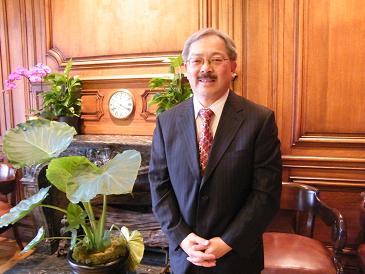
The Guardian hasn’t been invited into City Hall’s Room 200 for a long time. Former Mayor Gavin Newsom, who frequently criticized this newspaper in his public statements, had a tendency to freeze out his critics, adopting a supercilious and vinegary attitude toward any members of the press who questioned his policy decisions. So it was almost surreal when a smiling Mayor Ed Lee cordially welcomed two Guardian reporters into his stately office Feb. 15.

Lee says he plans to open his office to a broader cross-section of the community, a move he described as a way of including those who previously felt left out. Other changes have come, too. He’s replaced Newsom’s press secretary, Tony Winnicker, with Christine Falvey, former communications director at the Department of Public Works (DPW). He’s filled the Mayor’s Office with greenery, including giant tropical plants that exude a calming green aura, in stark contrast to Newsom — whose own Room 200 was sterile and self-aggrandizing, including a portrait of Robert Kennedy, in whose footsteps Newsom repeatedly claimed to walk.

When it comes to policy issues, however, some expect to see little more than business-as-usual in the Mayor’s Office. Democratic Party chair Aaron Peskin, a progressive stalwart, said he sees no substantive changes between the new mayor and his predecessor. “It seems to me that the new administration is carrying forward the policies of the former administration,” Peskin said. “I see no demonstrable change. And that makes sense. Lee was Willie Brown and former Mayor Gavin Newsom’s handpicked successor. So he’s dancing with the guys that brought him in.”

Sup. David Campos, viewed as part of the city’s progressive camp along with Peskin, took a more diplomatic tack. “So far I’ve been very pleased with what I’ve seen,” Campos noted. “I really appreciate that he’s reached out to the community-based organizations and come out to my district and done merchant walks. I think we have to wait to see what he does on specific policy issues.”

But while Lee has already garnered a reputation for being stylistically worlds apart from Newsom, he still hews close to his predecessor’s policies in some key areas. In our interview, Lee expressed an unwillingness to consider tax-revenue measures for now, but said he was willing to take condo conversions into consideration as a way to bring in cash. He was unenthusiastic about community choice aggregation and dismissive of replacing Pacific Gas & Electric Co. with a public-power system. He hasn’t committed to overturning the pending eviction of the Haight Ashbury Neighborhood Council’s recycling center, and he continued to argue for expanding Recology’s monopoly on the city’s $206 million annual trash stream, despite a recent Budget and Legislative Analyst’ report that recommended putting the issue to the voters.

Public Defender Jeff Adachi, who met Lee in 1980 through the Asian Law Caucus, said Lee would be facing steep challenges. “It’s a fascinating political karmic outcome that he is now our appointed mayor. He didn’t seek it out, as he says, but the opportunity he has now is to focus his efforts on fixing some of the problems that have gone unaddressed for decades, pension reform being one of them. I think he realizes he has a limited time to achieve things of value. The question I and others have is, can he do it?”


THE RELUCTANT MAYOR

Lee identified as a non-politician, patently rejecting the notion that he would enter the race for mayor. In meetings with members of the Board of Supervisors at the end of 2010, he said he didn’t want the job.

Yet while vacationing in Hong Kong, Lee became the subject of a full-court press. “When the lobbying and phone calls started … clearly they meant a lot to me,” Lee told us, adding that the choice “was very heavy on my mind.” He finally relented, accepting the city’s top post.

Although rumors had been circulating that Lee might seek a full term, he told the Guardian he’s serious about serving as a caretaker mayor. “If I’m going to thrust all my energy into this, I don’t need to have to deal with … a campaign to run for mayor.”

Adachi offered an interesting take on Lee as caretaker: “Somewhere along the way, [Lee] became known as the go-to guy in government who could take care of problems,” Adachi said, “like the Wolf in Pulp Fiction.”

Sounding rather unlike Harvey Keitel’s tough-talking character, Lee noted, “One of my goals is to rebuild the trust between the Mayor’s Office and the Board of Supervisors. I think I can do that by being consistent with the promises I make.”

Lee’s vows to keep his promises, mend rifts with the board, and stay focused on the job could be interpreted as statements intended to set him apart from Newsom, who was frequently criticized for being disengaged during his runs for higher office, provoking skirmishes with the board, and going back on his word.

The new mayor also said he’d be willing to share his working calendar with the public, something Newsom resisted for years. Kimo Crossman, a sunshine advocate who was part of a group that began submitting requests for Newsom’s calendar in 2006, greeted this news with a wait-and-see attitude. “I’ve already put in a request,” Crossman said. “Politicians are always in support of sunshine — until they have to comply with it.”


THE ELEPHANT IN THE ROOM

Pointing to the tropical elephant-ear plants adorning his office, Lee noted that elephants are considered lucky in Chinese culture. With the monstrous issues of pension reform and a gaping budget deficit hitting his mayoral term like twin tornadoes, it might not hurt to have some extra luck.

Pension reform is emerging as the issue du jour in City Hall. A round of talks on how to turn the tide on rising pension costs has brought labor representatives, Sup. Sean Elsbernd, billionaire Warren Hellman, City Attorney Dennis Herrera, labor leaders, and others to the table as part of a working group.

Gabriel Haaland, who works for SEIU Local 1021, sounded a positive note on Lee. “He’s an extraordinarily knowledgeable guy about government. He seems to have a very collaborative working style and approach to problem-solving, and he is respectful of differing opinions,” Haaland said. “Where is it going to take us? I don’t know yet.”

Lee emphasized his desire to bring many stakeholders together to facilitate agreement. “We’re talking about everything from limiting pensionable salaries, to fixing loopholes, to dealing with what kinds of plans we can afford in the health care arena,” he noted. Lee said the group had hashed out 15 proposals so far, which will be vetted by the Controller’s Office.

A central focus, Lee said, has been “whether we’ve come to a time to recognize that we have to cap pensions.” That could mean capping a pension itself, he said, or limiting how much of an employee’s salary can be counted toward his or her pension.

Since Lee plans to resume his post as city administrator once his mayoral term has ended, he added a personal note: “I want to go back to my old job, do that for five years, and have a pension that is respectable,” he said. “At the same time, I feel others who’ve worked with me deserve a pension. I don’t want it threatened by the instability we’re headed toward and the insolvency we’re headed toward.”


BRACING FOR THE BUDGET

If pension reform is shaping up to be the No. 1 challenge of Lee’s administration, tackling the city budget is a close second. When Newsom left office, he passed Lee a budget memo containing instructions for a 2.5 percent reduction in most city departments, part of an overarching plan to shave 10 percent from all departments plus another 10 percent in contingency cuts, making for a bruising 20 percent.

Lee said his budget strategy is to try to avert what Sup. David Chiu once characterized as “the typical Kabuki-style budget process” that has pitted progressives against the mayor in years past. That means sitting down with stakeholders early.

“I have opened the door of this office to a number of community groups that had expressed a lot of historical frustration in not being able to express to the mayor what they feel the priorities of their communities are,” Lee said. “I’ve done that in conjunction with members of the Board of Supervisors, who also felt that they weren’t involved from the beginning.”

Affordable-housing advocate Calvin Welch said Lee’s style is a dramatic change. “I think he’s probably equaled the total number of people he’s met in six weeks with the number that Newsom met in his seven years as mayor,” Welch said.

Sup. Carmen Chu, recently installed as chair of the Budget & Finance Committee, predicted that the budget will still be hard to balance. “We are still grappling with a $380 million deficit,” Chu told us, noting that there are some positive economic signs ahead, but no reason to expect a dramatic improvement. “We’re been told that there is $14 million in better news. But we still have the state budget to contend with, and who knows what that will look like.”

Sup. John Avalos, the former chair of the Board’s powerful Budget Committee, said he thinks the rubber hasn’t hit the road yet on painful budget decisions that seem inevitable this year — and the outcome, he said, could spell a crashing halt to Ed Lee’s current honeymoon as mayor.

“We are facing incredible challenges,” Avalos said, noting that he heard that labor does not intend to open up its contracts, which were approved in 2010 for a two-year period. And federal stimulus money has run out.


DID SOMEONE SAY “CONDO CONVERSIONS”?

Asked whether he supported new revenue measures as a way to fill the budget gap, Lee initially gave an answer that seemed to echo Newsom’s inflexible no-new-taxes stance. “I’m not ready to look at taxes yet,” he said.

He also invoked an idea that Newsom proposed during the last budget cycle, which progressives bitterly opposed. In a conversation with community-based organizations about “unpopular revenue-generating ideas,” Lee cautioned attendees that “within the category of unpopular revenue-generating ideas are also some that would be very unpopular to you as well.”

Asked to explain, Lee answered: “Could be condo conversion. Could be taxes. I’m not isolating any one of them, but they are in the category of very unpopular revenue-generating ideas, and they have to be carefully thought out before we determine that they would be that seriously weighed.”

Ted Gullicksen, who runs the San Francisco Tenants Union, said tenant advocates have scheduled a meeting with Lee to talk about condo conversions. Thanks to Prop. 26’s passage in November 2010, he said, any such proposal would have to be approved by two-thirds of the board or the voters. “It’s pretty clear that any such measure would not move forward without support from all sides,” Gullicksen said. “If anyone opposes it, it’s going to go nowhere.”

Gullicksen said he’d heard that Lee is willing to look at the possibility of significant concessions to renter groups in an effort to broker a condo conversion deal, such as a moratorium on future condo conversions. “If, for example, 1,000 TICs [tenants-in-common] became condos under the proposal, then we’d need a moratorium for five years to minimize and mitigate the damages,” Gullicksen explained.

More important, some structural reform of TIC conversions may be on the table, Gullicksen said. “And that would be more important than keeping existing TICs from becoming condos.”

Gullicksen acknowledged that Lee has the decency to talk to all the stakeholders. “Newsom never attempted to talk to tenants advocates,” he said.


GREEN, WITHIN LIMITS

Lee’s two children are in their early 20s, and the mayor said he takes seriously the goal of being proactive on environmental issues in order to leave them with a more sustainable San Francisco. He trumpeted the city’s green achievements, saying, “We’re now on the cutting edge of environmental goals for the city.”

Leading bicycle activist Leah Shahum of the San Francisco Bicycle Coalition had praise for Lee on bike issues. “I’m really encouraged by his very public support of the new green separate bikeways on Market Street and his interest and commitment to creating more,” she said. “I believe Mayor Lee sees the value of connecting the city with cross town bicycle lanes, which serve a wide range of folks, including business people and families.”

Yet some proponents of green causes are feeling uncertain about whether their projects will advance under Lee’s watch.

On the issue of community choice aggregation (CCA), the ambitious green-energy program that would transfer Pacific Gas & Electric Co. customers to a city-run program with a cleaner energy mix, Lee — who helped determine rates as city administrator — seemed lukewarm. “I know Mr. [Ed] Harrington and his staff just want to make sure it’s done right,” he said, referring to the general manager of the city’s Public Utilities Commission, whose tepid attitude toward the program has frequently driven him to lock horns with the city’s chief CCA proponent, Sup. Ross Mirkarimi.

Lee noted that CCA program goals were recently scaled back. He also said pretty directly that he opposes public power: “We’re not in any day getting rid of PG&E at all. I don’t think that is the right approach.”

The controversial issue of the Haight Ashbury Neighborhood Council Recycling Center’s pending eviction from Golden Gate Park still hangs in the balance. The Recreation and Park Commission, at Newsom’s behest, approved the eviction despite overwhelming community opposition.

Lee said he hadn’t looked at the issue closely. “I do know that there’s a lot of strong debate around the viability, what that operation attracts and doesn’t attract,” he said. “I had the owner of HANC here along with a good friend, Calvin Welch, who made a plea that I think about it a bit. I agreed that I would sit down and talk with what I believe to be the two experts involved in that decision: Melanie Nutter at the Department of the Environment and then Phil Ginsburg at the Rec and Park.” Nutter and Ginsburg supported HANC’s eviction.

Welch, who is on the board of HANC, noted that Lee could be swayed by his staff. “The bunch around Newsom had old and bad habits, and old and bad policies. In dealing with mayors over the years, I know how dependent they are on their staff. They’re in a bubble, and the only way out is through a good staff. Otherwise, Lee will come to the same conclusions as Newsom.”

HANC’s Jim Rhoads told the Guardian he isn’t feeling reassured. “He said he would keep asking people about it. Unfortunately, if he asked his own staff, it would be a problem because they’re leftovers from Newsom.”

Speaking of leftovers, Lee also weighed in on the debate about the city’s waste-management contract — and threw his support behind the existing private garbage monopoly. Campos is challenging a perpetual waste-hauling contract that Recology has had with the city since 1932, calling instead for a competitive-bidding process. When the Department of the Environment recommended awarding the city’s landfill disposal contract to Recology last year, it effectively endorsed a monopoly for the company over managing the city’s entire waste stream, at an estimated value of $206 million per year.

The final decision to award the contract was delayed for two months at a February Budget & Finance Committee hearing. Campos is contemplating putting the issue to the voters this fall, provided he can find six votes on the Board.

“I know that Sup. Campos had given his policy argument for why he wants that revisited,” Lee said. “I have let him know that the Recology company in its various forms has been our very dependable garbage-hauling company for many, many decades. … I feel that the company has justified its privilege to be the permit holder in San Francisco because of the things that it has been willing to do with us. Whether or not we want to use our time today to revisit the 1932 ordinance, for me that wouldn’t be a high priority.”


UNFINISHED BUSINESS

In the last week of 2010, Avalos pushed through groundbreaking local-hire legislation, without the support of then Mayor Gavin Newsom or his chief of staff, Steve Kawa, who wanted Avalos to back off and let Newsom takeover the task.

With Lee now in Room 200, things appear to be moving forward on local hire, in face of misleading attacks from Assemblymember Jerry Hill (D-San Mateo), who wants to make sure no state money is used on local-hire projects, presumably because the building trades are upset by it. And Kawa, whom Lee has retained as chief of staff, doesn’t really support the legislation. Indeed, Kawa’s presence in the Mayor’s Office has his detractors believing that the new boss in Room 200 is really the same as the old boss.

“I feel like things are moving forward in the right direction around local hire, though a little more quietly than I’d like,” Avalos told the Guardian. Avalos noted that he is going to hold a hearing in March on implementing the legislation that should kick in March 25.

Welch said he believes that if Lee starts replacing staff wholesale, it could indicate two things: he’s a savvy guy who understands the difficulties of relying on Newsom’s chief of staff Steve Kawa for a budget, and he’s not ruling out a run for mayor.

“If I was in his position, the first thing out of my mouth would be, ‘I’m not running.’ I think he’s very focused in the budget. And it’s going to make or break him. But if he starts overriding Kawa and picks staff who represent him … well, then I’d revisit the question of whether he’s contemplating a run for mayor, say, around June.”

Where were you?

1

marke@sfbg.com

FILM Amid the worshipful bromides that attended the 100th birthday of zombie Ronald Reagan on Feb. 6, gay blogger Joe.My.God. helped bring back to light a transcript of a 1982 press briefing Q&A session between Reagan administration spokesman Larry Speakes and journalist Lester Kinsolving. It’s the first known time that AIDS was brought up at the White House.

Lester Kinsolving: Larry, does the president have any reaction to the announcement — the Centers for Disease Control in Atlanta, that AIDS is now an epidemic and have over 600 cases?

SPEAKES: What’s AIDS?

LK: Over a third of them have died. It’s known as “gay plague.” (Laughter.) No, it is. I mean it’s a pretty serious thing that one in every three people that get this have died. And I wondered if the president is aware of it?

SPEAKES: I don’t have it. Do you? (Laughter.)

LK No, I don’t …

SPEAKES: How do you know? (Laughter.)

LK: In other words, the White House looks on this as a great joke?

The answer, as the briefing spiraled into hysterics, was yes. It’s long been a source of bitterness that Reagan didn’t publicly refer to AIDS until 1987, after the disease had officially killed 20,849 Americans, been identified in 113 countries, and started to be “normalized” by the infection of young white children and closeted Hollywood superstars. But it was the laughter as gays lay dying that brought an angry population together, and that still rings in the ears of those who survived.

Reagan isn’t mentioned in David Weissman’s important and moving new documentary about San Francisco’s early response to the AIDS epidemic, We Were Here — although his communications director Pat Buchanan and Moral Majority leader Jerry Falwell get split-second references, as does the heinous Proposition 64, the heroically defeated 1986 California ballot measure that could have led the way to quarantining gays. We Were Here isn’t a political polemic about the lack of governmental support that greeted the onset of the disease. Nor is the film a kind of cinematic And the Band Played On, exhaustively laying out all the historical and medical minutiae of HIV’s dawn. (See PBS Frontline’s engrossing 2006 The Age of AIDS for that.) There’s no mention of crystal meth, the Internet, the HIV denialist movement, protease inhibitors, depression, or survivor guilt. ACT-UP and the AIDS quilt are discussed only briefly. And you’ll find virtually nothing about the infected world outside the United States or the ongoing fight against the disease.

A satisfying 90-minute documentary couldn’t possibly cover all the aspects of AIDS, of course, even the local ones. Instead, Weissman’s film, codirected with Bill Weber and full of often astonishing tidbits, concentrates mostly on AIDS in the 1980s and tells a more personal and, in its way, more controversial story. What happened in San Francisco when gay people started mysteriously wasting away? And how did the epidemic change the people who lived through it?

The first question provides the narrative framework of the film. In the beginning, we’re introduced to five quintessentially San Franciscan characters, identified only by their first names: Ed, Paul, Daniel, Guy, and Eileen. As they tell their stories about how and why they came to San Francisco, and familiar-yet-still-striking archival photos of an unfettered 1970s Castro District fill the screen, you begin to realize Weissman’s impressive canniness in choosing to focus on these wise and almost preternaturally calm people, who turn out to be major players in the horror that slowly engulfs the film. (And We Were Here is indeed structured like a horror flick, with subtle early notes of discord foreshadowing the graphic images to come. The only thing missing is the screaming.)

Guy, for example, is Guy Clark of the legendary Guy’s Flowers in the Castro. He leads the story from the “San Francisco (Be Sure to Wear Flowers in Your Hair)” era through the flower-bedecked funerals of the stricken — touching for a moment on the reaction in SF’s African American community — before bearing witness to a recent miraculous recovery, a man actually rising from a wheelchair to walk again. Other participants tell the stories of SF General Hospital’s groundbreaking AIDS Ward 5B/5A, the Shanti Project, Visual AIDS, and the “San Francisco model” of multifaceted, compassionate care for people with AIDS* before contemporary treatments became available.

The tales are well told and expertly woven together, as in Weissman’s earlier doc The Cockettes. Most of these people necessarily focused on the daily work of trying to help in order to stay sane. But where We Were Here really hits home is in its foregrounding of many unspoken or buried truths about that specific AIDS period that are in danger of being lost (one of which is that people who lived with HIV back then were often scaldingly candid about what was happening to their bodies.)

AIDS was annoying — it just went on and on. Participant Ed talks honestly about how he had to give up caring for patients out of exhaustion. AIDS got gay people where it really hurt: their vanity. The whole thing really fucked with your look. AIDS was bewildering. Suddenly people who had dropped out and run away to the Gay Mecca had to become medical experts, their recreational chemicals replaced with excruciating concoctions of exotic panic treatments. And women actually existed during AIDS. One of the most touching stories is about how the lesbian community rushed to donate blood.

The biggest act of emotional archeology, however, is the acknowledgement that some good came of AIDS. Not just in the well-known sense that it brought a marginalized community together and showed gay people as humans. It also personally transformed the narrators. Most of them found their calling, maybe lifelong satisfaction, during the AIDS crisis. We Were Here will affect viewers on a deep level, perhaps allowing many to weep openly about what happened for the first time. But it’s no mere sobfest. (My dead friends would have hated that.) It’s a testament to the absolute craziness of life, and the strange places it can take you — if you survive it.

WE WERE HERE OPENING PARTY with Rufus Wainwright Fri/25, 7:30 p.m., $25. Castro Theatre, 429 Castro, SF. Film plays the Castro Theatre through March 3. www.castrotheatre.com, www.wewereherefilm.com

*An earlier version of this article used the term “AIDS victims” to refer to those who had passed away from the disease. That term has a long and derogatory history, and still offended some readers, even when not used to refer to persons living with AIDS (PWAs), so we have replaced it above. It’s good evidence of how this film is re-enlivening debates. 

Is Adachi’s pension reform a Tea Party initiative?

54

With all eyes on Wisconsin, local labor leaders are suggesting that Public Defender Jeff Adachi’s proposed retirement/health plan reforms are really Tea Party initiatives, even as Adachi threatens to place another Measure B-like initiative on the fall ballot if city leaders can’t agree on a fix for the city’s fiscal problems

Last fall, Adachi started a war with the local labor movement when he placed Measure B on the November ballot. Measure B proposed increasing employee contributions for retirement benefits, decreasing employer contributions for heath benefits for employees, retirees and their dependents, and changing rules for arbitration proceedings about city collective bargaining agreements,

Measure B ultimately failed, but not after both sides spent a ton of cash. And now labor is refusing to have Adachi sit in on their pension reform talks with Mayor Ed Lee, former SEIU President Andy Stern is describing the fight in Wisconsin as a ’15 state GOP Power grab,” and SEIU Local 1021 leader Gabriel Haaland is pointing to Wisconsin as a reason for excluding Adachi from pension reform talks

“Adachi’s obviously scapegoating a group that’s part of a national agenda,” Haaland said, noting that in the states where Republicans gained statehouse control in 2010, there’s talk about eliminating collective bargaining, and ending defined benefit plans and paycheck protection.

“The problem is that pension reform has been blowing on the anti-public sector worker winds that are blowing in Wisconsin and other states, whether progressives want to acknowledge it or not,” Haaland continued. “There is a reason that Adachi got so much money last year, and the corporate interests behind him are part of this effort to bash public sector workers.”

Prop. B’s campaign finance records show the campaign raised $1.125 million in 2010, and that the lion’s share came from wealthy individuals.

Billionaire venture capitalist, former Google board member and Obama supporter Michael Moritz gave $245,000. Author Harrier Heyman, Moritz’ wife, donated $172,500. financial analyst Richard Beleson donated $110,000. George Hume of Basic American Foods donated $50,000. Gov. Schwarzenegger’s former economic policy advisor David Crane gave $37,500. Philanthropist Warren Hellman donated $50,000. Republican investor Howard Leach, who co-hosted a Prop. B fundraiser with former Mayor Willie L. Brown, gave $25,000. Investor Joseph Tobin gave $15,750. Maverick Capital partner David Singer gave $15,000. JGE Capital Partners donated  $15,000; Bechtel owner  Stephen Bechtel Jr gave $10,000: Matthew Cohler, a general partner of Benchmark Capital, donated $10,000; the California Chamber of Commerce donated $5,000 and philanthropist Dede Wilsey gave $1,000.

But records also show that Measure B opponents, which included San Francisco Firefighters, SF Police Officers Association, SF First Responders, the California Nurses Association, United Educators, San Francisco Gardeners, San Francisco Teachers, Library Workers, laguna Honda Workers, donated over $1 million in their successful bid to squash Adachi’s reform. And that just about every elected Democrat, including Assemblymember Tom Ammiano, then mayor Gavin Newsom, Sheriff Mike Hennessey, and Board President David Chiu, came out against Adachi’s original plan.
 
Haaland acknowledged that the argument could be made that the progressives’ version of the hotel tax didn’t pass and less attention was paid to the district elections last fall, because labor focused primarily on defeating Adachi’s Measure B.

“But at the end of the day, we did get the real estate transfer tax and we defeated Measure B,” Haaland observed. “So, we need to keep fighting anti-worker pressure. It’s challenging times, but I feel like the connections need to be made.”

Adachi was swift to refute Haaland’s claim that his Measure B pension reform is and was a Tea Party initiative.
“What’s not been reported is the fact that there are all these people supporting pension reform who are progressive Democrats,” Adachi said, pointing to Moritz, Crane and former Board President and Green Party member Matt Gonzalez, who all supported Measure B last fall.

“You are talking about saving basic services and that’s a progressive cause,” Adachi continued. “You might argue that pension reform isn’t a progressive solution. But then you are saying that the needs of one group of workers are subservient to the needs of other workers. And even if you raised every tax in the city, you’d not be able to keep up with pension and healthcare costs.”

“Even if we could raise parking tickets to $200 a pop, and tax folks who make more than $100,000 a year, that still wouldn’t solve the problem, because the problem is so huge,” Adachi added. “When you look at this crisis, you can’t simply redbait and say, you are a Republican, or Sarah Palin. Matt Gonzales has always spoken for progressive values, but because he supports pension reform, he’s suddenly a member of the Tea Party? At a certain point, it begins to become absurd.”

Haaland countered that he’s  “challenged by the notion that thousands show up in Wisconsin to fight some of the same people behind Measure B, but our discourse has lowered to whether or not Jeff Adachi is a good guy.”

And Adachi expressed doubt that Mayor Ed Lee can come up with a suitable pension reform plan.

“I’ve heard Lee say there has to be a solution involving pension reform and underfunded healthcare benefits that would save $300 million to $400 million in annual savings, and that corresponds with the solution he needs to come up with to close the budget deficit,” Adachi said.

Adachi said that he has met with Lee on his own to discuss pension reform, but the new mayor did not list specifics.
“He didn’t tell me what his plan was,” Adachi said, “The Prop. B supporters have a plan, but Lee did not ask what that was. But he said he sincerely wants to solve that problem, and that his preference would be one ballot initiative that everyone would agree on. And I fully support a solution that is going to truly solve the problem. I’ve always believed it’s important for the public to understand the gravity of the situation. For too long, it’s been the elephant in the room and there hasn’t been enough public information.”

Adachi said he had a beef with the idea of “groups of labor unions holding meetings at City Hall and deciding who can participate.”

“It’s also troubling that there is no information publicly available about what the ideas on the table are, no explanation of how they got there, and no documenting of the extent of the problem,” Adachi continued. “And that’s what got us here in the first place: a lack of transparency, and voters being asked to weigh in without the full information.”

Adachi said he has an upcoming meeting with Lee, the Department of Human Resources and Sup. Sean Elsbernd about pension reform that is separate from the working group that includes labor and philanthropist Warren Hellmann.

And Elsbernd told the Guardian he believes the pension reform process would go smoother if Adachi were at the table.
“I have no problem with Jeff at the table, it makes sense to have him there to avoid two ballot measures,” Elsbernd said.

Elsbernd added that it was too early to cite numbers when it comes to talk of capping pensions.
“It’s a mistake to pick a number right now because you don’t know what it’s worth,” he said, noting that the pension reform working group has sent a bunch of different scenarios to retirement actuaries to crunch the numbers to see how much they would save the city.

“I can see a case being made for asking the highest paid city workers to contribute higher amounts for healthcare benefits,” Elsbernd said. “But I’m not sure that’s equitable on retirement benefits, though I could see a situation where safety pays more, regardless, because they have better pensions.”

On the Cheap Listings

0

WEDNESDAY 2

Hasan Elahi solo exhibition Intersection for the Arts, 925 Mission, SF; (415) 626-2787, www.theintersection.org 7-9pm, free. After being falsely accused of involvement in the 9/11 terrorist plot, Elahi took the route of total transparency, personally tracking everything from his daily comings and goings via GPS, foods eaten, bank data, and other seemingly mundane information for his solo exhibition “Hiding in Plain Sight,” a series of snippets from the banal realities of everyday life that makes its debut in SF tonight. This show is Elahi’s latest installment of a much larger online project called “Tracking Transience” that began in 2004 and provocatively blurs the line that separates life and art.


THURSDAY 3

Mark Twain Project Mechanics’ Institute, 57 Post, SF; (415) 393-0100, www.mililibrary.org. 6pm, free-$12. Finally, 100 years after his death, UC Press is publishing as promised the memoirs of Mark Twain, compiled from 5,000 pages of notes and jam-packed into just three volumes of even more candid humor, as well as insights into his personal relationships and the truth behind his fiction. Volume one is hot off the presses, so come celebrate the life and work of an American icon as Benjamin Griffin, associate editor, presents part one of this literary milestone. Become a member of the institute, and you can attend this event as well as future literary events for free.

Sun Yat-sen in pictures Pacific Heritage Museum, 608 Commercial, SF; (415) 399-1124. 6-8pm, free. Follow the life of Sun Yat-sen, the father of the Chinese Revolution and one of the most influential figures of the 20th Century, from his childhood and rise to guiding his people toward democratic change, told through the numerous photographs taken of him throughout his life. Present will be speakers — including noted journalist, professor and author Orville Schell — as well as Sue Lee from the Chinese Historical Society and Prof. Tai-chun Kuo of Stanford University.


FRIDAY 4

Seed swap Ecology Center, 2530 San Pablo, Berk. www.ecologycenter.org/basil 7-9pm, free-$10. Join local urban agrarians for a night of celebrating seed diversity with a potluck dinner and music, ho-down style. This is the 12th annual seed swap put on by a growing network of concerned community farmers and fellow horticulture nerds who are committed to preserving the genetic diversity of the world’s seed stock. They have also created a library of seeds that will be made free to the public. Yee-haw! Bring a dish to share or seeds to swap, and get in for free.


SATURDAY 5

Performance of The Prospect Bear Cartoon Art Museum, 655 Mission, SF; (415) CAR-TOON, www.cartoonart.org. 1 and 2pm, free with museum admission. Join the Cartoon Art Museum and DJ Scientific for a unique live performance of The Prospect Bear, the super cute children’s “music book” about a curious cub who follows her dream to become a DJ. The show will feature live music and narration with projected images, as well as a couple of educational presentations on Black Bears and the unique instruments used in the show.

Bay Area Now 6 conversation series Yerba Buena Center for the Arts, 701 Mission, SF; (415) 978-2787, www.ybca.org. 1-4pm, free. Bay Area Now 6 is the sixth installment of YBCA’s celebration of local artists, and usually kicks off with conversations about Bay Area culture and diversity. This time around, expect to hear thought-provoking discussions with Marina Gorbis of the Institute for the Future, Neal Gorenflo of Sharable Magazine, and BAN6 artists on the possible economic paradigms for a sustainable environment in “Upward Spirals: New Economic Models for a Thrivable Future.”


TUESDAY 8

Conversations with radical thinkers The Green Arcade, 1680 Market, SF; (415) 431-6800, www.thegreenarcade.com. 7pm, free. Tonight, Sasha Lilly and Andrej Grubacic discuss the new book, Capitalism and Its Discontents for those of you concerned with a thawing planet, the market-driven ideologies of neo-liberalism, the inherent vulnerabilities of a capitalist system and other current pressing issues. The book is a series of conversations with radical thinkers such as co-presenter Andrej Grubacic, as well as Noam Chomsky, Leo Panitch, Tariq Ali, and more, so expect some heavy content, with definite inspiration and hope for the future.

Suong Yangchareon opening reception Paul Thiebaud Gallery, 645 Chestnut, SF. www.paulthiebaudgallery.com. 5-7pm, free. Check out new works by Los Angeles-based artist Suong Yangchareon at the opening reception for his San Francisco show, “Suong Yangchareon: Paintings,” that features the artist’s established brand of realism depicting the kitsch and splendor of LA’s urban landscape. Working from his own photographs and inspiration from the likes of Hopper and Diebenkorn, Yangchareon’s work beautifully illustrates a melancholy stillness rarely found in metropolitan areas.


On the Cheap listings are compiled by Jackie Andrews. Submit items for the listings at listings@sfbg.com. For further information on how to submit items for the listings, see Picks.

Alerts

0

THURSDAY 24

Benefit for Bradley Manning

Raise funds to support U.S. Army soldier and accused WikiLeaks whistleblower Bradley Manning at this events, which features discussions, updates, and special guests, including Daniel Ellsberg and former Sen. Mike Gravel of Alaska.

7–9 p.m., $5–10 donation

Berkeley Fellowship of Unitarian Universalists

1924 Cedar, Berk.

www.couragetoresist.org


Eyewitness to Egyptian revolt

Ahmed Shawki, editor of the International Socialist Review and a Cairo native, shares his eyewitness account of the revolution that toppled Egyptian President Hosni Mubarak.

7:30–9 p.m., free

The Women’s Building Auditorium

3543 18th St., SF

Facebook: Eye-Witness to the Egyptian Revolution in SF


FRIDAY 25

Progressive senator in town

Vermont Sen. Bernie Saunders, an independent and arguably the most progressive U.S. senator, will give an overview of his work, from his historic filibuster against the continuation of George H. Bush-era tax cuts for the rich to his fight against big money interests in Washington.

7–9:30 p.m., $15

First Unitarian Universalist Church

1187 Franklin., SF

www.brownpapertickets.com/event/156941


SATURDAY 26

Iraqi solidarity

Stand in peaceful solidarity with the people of Iraq, including the many who are protesting the Maliki regime, and call for an end the U.S. occupation and demand that our troops come home.

2:30–3:30 p.m., free

Ferry Building

Embarcadero and Market, SF

www.codepinkalert.com


Coffee Party meeting

The progressive answer to the widely publicized Tea Party, this nonpartisan grassroots movement calls for more accountability from our corporate-sponsored, conflict-based political system. This meeting will focus on organizing outreach strategies and the proposed landfill in the San Francisco Bay. But anything goes, so come and exchange ideas over coffee and help take back the democratic process.

11 a.m.–12:30 p.m., free with drink purchase

Cafe La Tartine

830 Middlefield, Redwood City

www.coffeepartyusa.com


Panel discussion on censorship

This public forum titled “Censorship in the Arts: A Trend or Just a Passing Fad” is about exploring the current rise in censorship and the renewed threats to defund the National Endowment for the Arts, the National Endowment of the Humanities, and the Public Broadcasting Service. Join the panelists and learn about the recent efforts toward censorship in the arts.

2:30 p.m.-5:30 p.m., free

Performance Art Institute

575 Sutter, SF

www.theperformanceartinstitute.org


SUNDAY 27

Who inspires you?

Attend the fourth round of the Bay Area Inside the Activists’ Studio, where you will surely be inspired by the many change-makers and leaders of local Jewish social organizations on the panel. Celebrate the many ways change that can be brought about through skill-building workshops, panel discussions, and more. A catered lunch will be provided.

10:30 a.m.–4:30 p.m., $8–$18 sliding scale

Contemporary Jewish Museum

736 Mission, SF

www.pursueaction.org

Mail items for Alerts to the Guardian Building, 135 Mississippi St., SF, CA 94107; fax to (415) 437-3658; or e-mail alert@sfbg.com. Please include a contact telephone number. Items must be received at least one week prior to the publication date.

Mirkarimi running for sheriff

17

Sup. Ross Mirkarimi is going to file papers today (Feb 22) to begin his campaign for sheriff.

Mirkarimi told us he wants to continue the progressive legacy of Mike Hennessey and to work to reduce recidivism. “Eventually, almost everyone who’s incarcerated comes back to the community,” he said, noting that more than 60 percent of people released from the county jail are re-arrested at some point. “We have to work on re-entry programs to lower that number,” he said. “It’s about keeping communities safe.”

Hennessey, long regarded as one of the city’s most progressive elected officials, has served as sheriff for 31 years. He’s been a national leader in progressive law-enforcement programs, and last year made headlines by fighting the federal mandate that local authorities turn over to immigration offices anyone arrested in the city without proper documentation. He announced recently that he won’t seek another term in November.

Since nobody else has announced an interest in the job — and nobody with Mirkarimi’s record and name recognition is even being mentioned — he becomes the instant front-runner. But it won’t be an easy campaign — the last thing downtown wants is another progressive in citywide office — particularly someone who, like Mirkarimi, could one day use the sheriff’s office as a platform to run for mayor.

Mirkarimi is a graduate of the San Francisco Police Academy and former investigator in the district attorney’s office. He’s been a champion of community policing and antiviolence programs — but as someone who has never been part of the local law-enforcement community, he comes to the race with political independence.

“One of the greatest successes of Mike Hennessey was that he was an independent sheriff,” Mirkarimi noted.

We’ll have more details in the Feb. 23 issue.

Herrera’s crackpipe crackdown

45

I lived at Hayes and Fillmore in the 1980s, at the height of the crack epidemic, and a spectacularly unsuccessful dealer hung out on my corner. He was so bad at selling the stuff (or else was smoking so much of it) that he was constantly broke and used to knock on my door late at night ask to borrow a buck to buy a can of beer.


At one point he owed me about $10, and offered to pay me back with “some hubba.” He proceded to open his fist and show me a couple of grimy rocks rolling around in his filthy, sweaty palm.


It looked so appealing. I politely declined.


That was my one and only chance to smoke crack, and I passed it up. So when I heard that city attorney Dennis Herrera was going to sue a bunch of local stores for selling crack pipes, I must admit I was curious: What’s the definition of a “crack pipe?” How can you tell what a piece of smoking apparatus is going to be used for?


I asked Jack Song, a spokesperson for Herrera, and he told me it was pretty clear. “They’re glass, and they have certain characteristics,” he said.


Again: I’ve never actually smoked crack, so I have no personal experience with crack pipes. But I used to have a really nice glass pot pipe, which unfortunately was seized by the police in upstate New York many years ago. I went on Google images, the source for all truth, and checked out “crack pipes,” and some of them looked a little like the one I used to use for what we now consider a legal medical treatment.


According to the press reports, an undercover cop went into these stores and asked to buy a crack pipe. The store owners allegedly offered up a specific device, which would not have been terrible smart; when we used to buy bongs in Connecticut, where selling any sort of drug paraphernalia was illegal, the salespeople would talk loudly about how to load “the tobacco.”


In this case, Herrera’s even going a bit beyond crack pipes:


At all times relevant to this Complaint, up to and including the present, in addition to
the permitted tobacco products, Defendants have also displayed and sold smoking paraphernalia, including a large array of pipes and devices commonly referred to as “bongs.”


But Song told me marijuana devices wouldn’t be targeted.


At any rate, the legal case is now going to rest, I guess, on what defines a “crack pipe.” (Apparently there are “meth pipes,” too, which are a little different from crack pipes. I feel so old and uninformed.)


And while I understand the neighbors griping about the stores attracting a nasty element (my old pal on Hayes and Fillmore was harmless enough, but your typical crackhead isn’t great company), I wonder about the ultimate impact of this particular, uh, crackdown.


Herrera’s lawsuit notes:


By providing their customers with a way to ingest illegal and dangerous narcotics, Defendants are creating and contributing to conditions which are injurious to the health, safety and welfare of their customers, neighbors, and the community at large. Defendants’ conduct causes or contributes to offensive and annoying conditions, including, but not limited to: illegal and dangerous trafficking of controlled substances, illegal and dangerous use and abuse of controlled substances, public intoxication, and the crime and nuisance related thereto.


I get that the city attorney considers these stores a community nusiance, and he may well be right. But I don’t think this is going to do much about crack and meth use.


I mean, can’t you smoke crack out of a pot pipe? Can’t you pretty much smoke it out of anything? When I was in high school people stuck their pencils into apples and made holes to smoke pot out of; in college, I learned that, in a pinch, Tampax wrappers made perfectly adequate rolling papers.


Druggies (of the sort who use crack pipes, anyway) may be violent and otherwise fucked up, but they’re notoriously creative. They may stop hanging around these particular stores in these particular neighborhoods, but they’ll find someplace else.


It seems likely that the only ones who are going to suffer for this are the store owners; the crackheads will be just fine. In a manner of speaking.


The Performant: Enter the Platypus

0

French “Art” and Fringe wins at the EXIT Theatre

Of all the theatre companies in the Bay Area currently operating, the most specifically focused may well be our premiere (or rather only) amateur Francophone company Le Theatre Platypus. Though the Goethe-Institut sometimes hosts touring productions, such as Bridge Marklund’s “Faust in the Box” which will play in the Institut auditorium March 3 and The Mission Cultural Center hosts occasional Spanish-language plays such as Dolores Prida’s “Coser y Cantar” (playing March 17-19), dedicated multi-lingual local troupes are unfortunately scarce. This makes going to see a Platypus play more than just a night out, but a bona-fide cultural immersion experience.

Thursday night at The EXIT Theatre Mainstage is not usually where you’d expect to find a sold-out house, but Platypus pulled it off with their French language presentation of Yasmina Reza’s “Art” a satirical look at the world of art commerce as well as an exploration of the relationship between three friends whose differing feelings about an art piece underscores the divide in their characters.

There are many things about watching the play in French that are just the same as watching it in English—or any other translation. The appearance-driven shallowness of Serge (Michel Tassetto) is no less shallow in French than in English, and the zealous arguments against “the modern” of his acerbic buddy Marc (Arnaud Merceron) are no less self-righteous. The insecure hypochondriac Yvan (Thomas Marigne), who wobbles between trying to placate the feelings of both and obsessing over his pending marriage, is no less a schlub en Francais, and the piece of art in question—a $40,000 canvas painted all in white—is no less an eyesore.

The difference definitely lay in the crowd, half of whom appeared to be bona-fide expats, half of whom appeared to be French American International School scholars out for extra credit, and all of whom most certainly appeared to be having a great time. It surprises me that there aren’t more dedicated non-English Language theatre companies in the Bay Area, considering our diverse population, and while the Bay Area is a breeding ground for new translations, it’s interesting to consider what sort of impact these same companies might have mounting a non-translated work.

Because it’s never too early to start obsessing over the San Francisco Fringe Festival, which will be celebrating it’s 20th year in September, a hard-core crew gathered at the EXIT café on Saturday to witness the annual lottery — the process by which all entrants are chosen. This year 25 out-of-town companies, 10 of whom were alternates, and 35 locals, ditto, were drawn out of the “hat” by Christian “Nothing-up-my-sleeves” Cagigal and Michelle Talgarow. The San Francisco Fringe, as well as all Fringe Festivals part of the Canadian Association of Fringe Festivals are 100% non-curated, which means literally anything goes. Working titles of this year’s chosen productions include “Hamlet vs. Zombies,” by The Skinny Improv, “Hitler’s L’il Abomination,” by Annette Roman, and “I Love You, We’re F*#ked,” by Kevin J. Thornton, worthy Fringe titles all. The only question now—how do I wait six more months to see them?

Ammiano goes after tax cheats

3

Assemblymember Tom Ammiano is moving to close a huge tax loophole that costs state and local government millons — and while his last attempt failed, this year he has a much better shot. The measure will probably make it out of the Legislature (hard to argue against something that doesn’t raise taxes at all but just makes sure nobody cheats) and I can’t imagine Jerry Brown deciding to veto it.


The bill, AB 448, would force companies that sell or transfer propetry to report it as an ownership change, which triggers a new assessment under Prop. 13. It’s one of the oldest loopholes in the book: I create a corporation or LLC to hold a piece of property, and when I want to sell, I simply transfer stock in the corporation or membership in the LLC to the buyer — and the property deed isn’t changed.


The California Tax Reform Association tracks this stuff, and you can see some examples here.


Ammiano’s been working with San Francisco Assessor Phil Ting, who told me “it’s a simple issue of fairness. Homeowners face reassessment when they buy property; why shouldn’t corporations?”


The stakes are high. It’s impossible to say how much San Francisco would pick up every year, but over time, it could be many millions of dollars (and about 57 percent of property tax revenue goes to the General Fund, the rest to the state, which returns most of it it the public schools).


Perhaps the Democrats should simply include this projected revenue in their budget; that way, Brown would have an even greater incentive to sign it.

Printed matters: A specific glance at the 44th California International Book Fair

0

Do you want the pristine first edition of Bram Stoker’s Dracula for 45 grand, or the slightly worn copy for 25 grand? Such were the questions that presented themselves at the 44th Annual California Antiiquarian Book Fair, which took place at SF’s Concourse Exhibition Center from February 11 through 13. A special shout out to local merchants Serendipity Books and Bolerium Books, both of whom had some of the event’s most interesting and affordable pleasures and treasures on display.

Work the throne: Interviews with the San Francisco Empress 2011 candidates

25

Update: Saybeline has been crowned the new Empress. Congratulations to both the outstanding candidates, and warm wishes for the future.

In this week’s Super Ego column in the paper, I give a grateful nod to our esteemed – if little acknowledged — Imperial Court system, an incredible, drag-based 45-year-old institution that raises tens of thousands of dollars for charitable Bay Area causes. (Really, do yourself a historical favor and check out the recently revamped Imperial website.) Below are my full interviews with the candidates, Saybeline and Monistat.

The annual elections for Empress of San Francisco are coming fast upon us (Sat/19, free. Noon–7 p.m. at Castro Muni Station, Castro and Market, and 11 a.m.–6 p.m. at Project Open Hand, 730 Polk, SF.) The winner will devote the next year of her life to raising funds and repping SF — after she graciously endures a daylong coronation ceremony on Sat/26, one of the city’s true mind-blowing spectacles. (The winner will be announced at Coronation.)

I emailed a series of questions to both candidates in order to get a better sense of who they are and why we should vote for them. They each bring a different, welcome perspective to the competition that ultimately helps refresh this cherished local tradition.

SFBG  What is your Empress platform?

MONISTAT My mission to become Empress is to bridge communities together. We all know that Marlena’s [Bar in Hayes Valley] is the seat of power for the Imperial Court of San Francisco, and I being the outsider candidate promise to outreach to the members of this community. As Empress, I will be the Empress of San Francisco, not just the Castro, but the entire city. There are so many great facets of this town, and so much talent that I can use at my disposal to do some really good work! Being part of an amazing club scene in this town, I have been fortunate enough to work with some of the best promoters, DJs, performance artists, and venues, so why not refresh their eyes and give them something a little different.

SAYBELINE First and foremost, I offer an experienced continued commitment to service in our community. Additionally, I offer a continued commitment to honoring the 45-year history and traditions of the Imperial Council of San Francisco and the many Empresses and Emperors that have paved the way for many like myself, making a difference and serving in our community. Most importantly, my motivation comes from wishing to take on an expanded leadership role spearheading much needed grass roots community fundraising for our local network of diverse community based charitable organizations struggling to make ends meet.

I have actively been involved (both as a gay man and the persona of Saybeline Fernandez) in some way serving the LGBT community of San Francisco for over two decades. In those 20-plus years, I have giving my own money and served the community volunteering on the front lines for our LGBT political and human rights causes, volunteering for HIV/AIDS support services, services for our LGBT youth and services for our marginalized diverse communities. Additionally, I have lent my professional experience in event-planning to many fundraising events that have raised thousands of dollars and awareness, supporting and serving San Francisco. I also feel that one of the biggest differences in this campaign is that I have the ability and experience to energize and engage younger members of our community to become more actively involved in serving the community.

SFBG What would your first act as Empress be?

MONISTAT OMG Coronation is usually six hours long, and ends at midnight with the crowning of the new Empress. Its a long-held tradition. But of course win or lose, I’ll be out that night after the ball partying my brains out, to thank myself for finishing this amazing campaign. I will probably never sleep that night if I win, because usually I have to cart myself to all the bars that have sponsored me with the crown on my head, then have to be up and ready by 7am to go the Emperor Norton’s Cemetery all the way in Colma, in full mourning drag, with a veil on and everything (I secretly love all this pomp and circumstance). Then after a round of partying for three more days, I have to get working on my official Investiture, which naturally will be a fundraiser.

SAYBELINE This is easy for me. It’s sooo important to me that we get more younger members of our community actively involved in serving our community…. So many want to be involved but don’t know how. We have to open the doors, and engage and encourage them to have a greater presence in being of service.

SFBG How long have you wanted to be Empress?

MONISTAT What a loaded question. I believe that every queen is royalty and should be treated that way. The title of Empress just means you have to be in drag more than everyone else. I went to coronation last year. I’ve never won a title in my entire my life — all of my friends have kind of created their own niches and scenes in the city, so I thought, “Hey, why not do something my friends will never do?” So after talking to my closest pals, I decided to go for it and take the bull by the horns. Trust me, running for Empress is harder than most people think.. and it has taught me a lot of lessons about myself and growing up. It’s incredibly challenging to be put under a microscope 24/7 when everyone is watching you and every mistake you make is blown up 20,000 percent.

SAYBELINE I have been actively involved with the Imperial Council of San Francisco for a little over five years. And the thought of becoming Empress first crossed my mind some three years ago. As much as I may have wanted to run in previous years, I knew it was important to gain more experience within the court of San Francisco and the International Court System. Being Empress means both making a large personal financial committment and an expanded committment of one’s personal time. One has to have both in place in order to be successful. And after planning and getting things in order personally, the timing was finally right for me to throw my hat in and become a candidate and with the support of our community hopefully become the next elected Empress.

SFBG In one sentence, why should we vote for you as empress?

MONISTAT I’m young — my youthful energy combined with fresh ideas and the willingness to learn, plus my hands-on approach to things, is the perfect cure to a traditional court that needs to be shaken up a bit. My experience as a club promoter and my connections in this city will make for a great year as Empress. the Imperial Court is nearing its 50th year, there is need for new blood. I’m that queen. Oh yeah, I was also voted Best Drag Queen by the readers of SF Bay Guardian, enough said.

SAYBELINE A vote for Saybeline Fernandez is a vote for someone that offers leadership and experience — and someone committed to welcoming and encouraging younger members of our community to become more actively involved serving the community, raising much-needed funding for our local network of community-based charitable organizations.

A better option for trash

6

EDITORIAL One of the biggest, most important municipal contracts in San Francisco is never put out to bid. It’s awarded to the same company, automatically, and has been since 1932. Recology Inc. (formerly known as Sunset Scavenger, Envirocal, and Norcal Solid Waste Systems) is the only outfit licensed to pick up trash in the city. It’s also the only company that has a monopoly guaranteed in the City Charter. Its residential rates are set every five years by an agency almost nobody’s ever heard of, the Refuse Collection and Disposal Rate Board, which consists of the city administrator, the controller, and the general manager of the San Francisco Public Utilities Commission. Commercial rates are set by Recology alone; there’s no appeal or oversight.

San Francisco is the only major city in the United States that contracts out solid waste collection to a private company. And it may be the only city of any size that does it without competitive bidding.

Now that city officials are discussing where the garbage should go — that is, what landfill should hold it — there’s a perfect opportunity to open up the 1932 deal, amend the charter, and fix this.

Sups. David Campos and Ross Mirkarimi are working on a measure that would mandate competitive bidding for the contract to pick up commercial and residential trash. “It’s not in the interest of the ratepayers to have a monopoly,” Campos told us.

It’s true that Recology has worked with the city on reducing the waste stream and developing a curbside compost and recycling plan. And Recology is an employee-owned company.

But that doesn’t mean the city or its residents and businesses are getting the best possible deal. Could another company do the same job better — and for less? Maybe. Would the prospect of a competitive bid drive Recology to improve service and cut rates? Absolutely. That why most municipal contracts are put out to bid on a regular basis.

But there’s a larger question here, one that the supervisors also should consider. Why does San Francisco have private garbage collection anyway? All over the country, cities handle that task as a part of the function of government.

There are several distinct advantages to evaluating a public option for refuse. For starters, the city is in desperate need of money — and Recology is making a nice profit off its local gig. It’s entirely possible, even likely, that the city could take over garbage collection, keep the rates at the same level, and bring in millions to the general fund. It’s also possible that city officials would decide to forego some of that income and cut rates to make life easier for residents and businesses.

Since the 1932 charter provision is getting a new look anyway, the supervisors at least ought to look at the possibility of ending private garbage collection. A fairly basic study should be able to establish how much revenue Recology takes in, what expenses are involved, and whether it’s worth pursuing municipalization.

Our Weekly Picks: February 16-22

0

WEDNESDAY 16

MUSIC

Dum Dum Girls

Dee Dee, bandleader of Dum Dum Girls, a 1960s pop-meets-early punk, all-girl four piece, is no dummy. Named not for the lollipops, but after the Vaselines’ album Dum-Dum and the Iggy Pop song “Dum Dum Boys,” DDG was initially a solo project on Dee Dee’s DIY record label, Zoo Music. To take her music beyond her bedroom, she called on the help of her friends: Jules (guitar and vocals), Bambi (bass), and Sandy (drums and vocals). DDR’s most recent album, Sub Pop release I Will Be, features Nick Zinner of the Yeah Yeah Yeahs, Crocodiles’ Brandon Welchez, and Los Angeles musician Andrew Miller. (Jen Verzosa)

With Minks and Dirty Beaches

9 p.m., $12

Bottom Of The Hill

1233 17th St., SF

(415) 621-4455

www.bottomofthehill.com


THURSDAY 17

EVENT

The Tribes of Burning Man

Either you are or you aren’t: I’m an aren’t. As in, not a Burning Man person. But that won’t stop me from trumpeting the release of The Tribes of Burning Man, the end result of six years of work by Steven T. Jones, known around the Guardian as Steve the City Editor and on Burning Man’s playa as “Scribe.” Chances are you’ve seen Jones’ Burning Man coverage in the Guardian’s pages over the years; his new book examines the history and philosophy of the annual event, as well as the ways that Burning Man has become a year-round lifestyle for some and a (counter-) cultural touchstone for hundreds of thousands of desert-goers. The Tribes launch party features readings by Jones and appearances by Burning Man leader Larry Harvey, circus performers Fou Fou Ha, beat boxer Kid Beyond, and other colorful characters from the book. (Cheryl Eddy)

7 p.m., $5 ($20 with book)

Project One

251 Rhode Island, SF

www.p1sf.com


MUSIC

3 Inches of Blood

Though it has endured many lineup changes, 3 Inches of Blood is always instantly recognizable, thanks to the falsetto assault of vocalist Cam Pipes (his real name). Drawing on power metal and thrash but hewing closely to the classic sounds of the New Wave of British Heavy Metal, Pipes and his Vancouver-based band have plied their rock the world over. Fire Up the Blades (2007) experimented with polished, immaculate production, with Slipknot drummer Joey Jordison producing, but 2009 release Here Waits Thy Doom stripped away the gloss, returning the band to its raw, urgent roots. Now that it’s coming to town, you won’t have to wait for your doom any longer. (Ben Richardson)

With Eluveitie, Holy Grail, System Divide

7:30 p.m., $20

Slim’s

333 11th St., SF

(415) 255-0333

www.slims-sf.com


FILM

“Around the World in 33 Films: The Jeonju Digital Project”

The still-young Jeonju International Film Festival is exceptional for privileging film culture over film markets. To take one significant example of this emphasis, for each edition the festival commissions three half-hour digital films by major auteurs. It’s almost impossible to imagine an American festival apportioning funds in this internationalist, art-first manner. Yerba Buena Center for the Arts screens all 33 Jeonju commissions from 2000-10 over the next two weeks. It’s an ambitious — and, one imagines, costly — program, so make it count. This first show features an especially strong class of 2010 (James Benning, Denis Côté, and Matías Piñeiro), with works by the new century’s preeminent film artists (Pedro Costa, Apichatpong Weerasethakul, Jia Zhangke, etc.) waiting in the wings. (Max Goldberg)

Feb 17–27 (2010 program: tonight, 7:30 p.m.), $8

YBCA Screening Room

701 Mission, SF

(415) 978-2700

www.ybca.org


FRIDAY 18

MUSIC

Chromeo

At first listen, Chromeo’s music would seem to run the risk of being a little tough to take seriously — if only it wasn’t so damn well-executed. Instead, the Montreal-based electro-funk duo creates perfectly retro-minded jams that skimp refuse to scrimp on creative songcraft or purely visceral dance floor diversion. The fantastic talk box solos don’t hurt either. Taking its cues from classic era funk, Hall and Oates-style blue-eyed soul, and modern synthpop, Chromeo’s 2010 album Business Casual has led to a slew of strong reviews, festival appearances, and a top 10 slot on Billboard’s dance/electronic chart. (Landon Moblad)

With MNDR and the Suzan

8 p.m., $25

Fox Theater

1807 Telegraph, Oakl.

(510) 548-3010

www.thefoxoakland.com


MUSIC

Bart B More

How old is Bart B More? In videos from his recent Asian tour, he’s got the pallid complexion that my friends did in high school. Maybe a result of the DJ lifestyle, spending too much time in clubs around 2 a.m. (or being Danish). The rest of Bart B’s existence, from what I can tell, consists of lifting weights and looking at Lamborghinis. Ah, to be an international beat maker, an up-and-comer who’s reputedly worth checking out. Anyway, Blasthaus resident Nisus has proven himself a reliable dance floor driver, delivering a binaural set at the Treasure Island Music Festival and excellently setting up the Twelves earlier this month. (Ryan Prendiville)

With Nisus and Tron Jeremy

9 p.m., $12.50

Rickshaw Stop

155 Fell, SF

(415) 861-2011

www.rickshawstop.com


MUSIC

Mark Growden

Back from another long stretch of touring and recording, wandering minstrel Mark Growden lands at the Brava Theatre with a brand new album Lose Me in the Sand and a posse of old-school Tucson troubadours as the backing band. Less sweepingly-thematic than 2010’s Saint Judas, the new album combines oddments of philosophy, romance, humor, and reminiscence, covering familiar tunes in startlingly unfamiliar ways, plus a handful of originals including a breakneck-paced courting song “Settle in a Little While” and a sepia-toned hometown lament “Killing Time.” Growden’s long-time collaborator and Porto Franco labelmate Seth Ford Young opens and also releases his eponymous debut album. (Nicole Gluckstern)

With Seth Ford Young

Fri/18–Sat/19, 8 p.m., $20–$50

Brava Theatre

2781 24th St., SF

(415) 641-7657

www.brava.org


PERFORMANCE

Move Thru Me

“I’m with the band” may sound smoother than “I’m with the dance company,” although either could be stated by the performers of Move Thru Me, a collaboration of Christine Cali’s Cali & Co Dance and Matthew Langlois’ the Welcome Matt band. A hybrid of rock ‘n’ roll and modern dance, the performance responds to the pursuit of a creative life and ongoing artistic practice. Prior to joining forces, Cali and Langlois each worked as independent artists for more than 15 years. The work includes a soundtrack of original music as well as online dance videos. As with any good concert tour — T-shirts! (Julie Potter)

Fri/18–Sat/19, 8 p.m. (also Sun/20, 5 p.m.), $10–$20

Dance Mission Theater

3316 24th St., SF

(415) 826-4441

www.dancemission.com


SATURDAY 19

EVENT

“From Produce to Production: New Traditions in Bay Area Food Culture”

Bay Area Now (BAN6), a triennial celebrating local artists from diverse disciplines, begins with a series of Bay Area-centric conversations about food, environmentalism, futurism, community activism, radical identities, and technology. The first roundtable discussion addresses new practices for growing, preparing and shopping for food, during which YBCA Executive Director Ken Foster will speak with food luminaries Bryant Terry, eco-chef and activist from Oakland and author of Vegan Soul Kitchen; Novella Carpenter, journalist, farmer and author of Farm City; and Leif Hedendal, a self-educated chef at San Francisco’s Greens and Oakland’s Citron restaurants, whose Bay Area culinary events combine art and food. (Potter)

1 p.m., free

Yerba Buena Center for the Arts

701 Mission, SF

(415) 987-2787

www.ybca.org


EVENT

The Fortune Cookie Chronicles

Planning on consuming a little New Year’s nosh during this weekend’s bunny-fueled festivities? Then you might be interested to know that the Japanese — not Chinese — invented the fortune cookie; Chinese takeout cartons can be found everywhere but China; and chop suey may or may not be an elaborate American hoax. I see all you smartphone nerds plinking “chop suey” into snopes.com right now, but save yourselves the trouble: New York Times reporter and author of The Fortune Cookie Chronicles Jennifer 8. Lee is here to unravel the history of Chinese cookery — and just in time for the Chinese New Year. The book is also seasoned with a healthy smattering of SF history to spice things up. (Emily Appelbaum)

2:30–4 p.m., free

San Francisco Public Library

Chinatown Branch

1135 Powell, SF

(415) 557-4400

www.sfpl.org


SUNDAY 20

EVENT

“San Francisco Mixtape Society presents Guilty Pleasures”

Listening to Ke$ha on repeat? Excited about Britney Spears’ upcoming release, Femme Fatale? Love to share music? Then the San Francisco Mixtape Society has you covered. It presents “Guilty Pleasures,” a night of music mixtape exchanges. Assemble a mixtape according to the theme in any format — cassette, CD, or USB — and leave with a fellow attendee’s mixtape; they’ll be exchanged throughout the evening via a raffle. Those who come armed with tunes will receive a free drink — and all the joy guilty pleasures can provide. (Verzosa)

4–6 p.m., free

Make-Out Room

3225 22nd St., SF

(415) 647-2888

www.sfmixtapesociety.com


MONDAY 21

EVENT

“The Cleveland Confidential Book Tour”

As the guitarist for Rocket from the Tombs and the Dead Boys, Cheetah Chrome helped write the sonic blueprint for punk rock — and now he’s written an autobiography, Cheetah Chrome: A Dead Boy’s Tale From The Front Lines of Punk Rock, which chronicles his explosive life and his role in one of the most infamous movements in modern pop culture. Joining him for “The Cleveland Confidential Book Tour” are Mike Hudson from the Pagans and Bob Pfeifer from Human Switchboard; don’t miss your chance to hear the story straight from the mouths of a triumvirate of punks’ founding fathers. (Sean McCourt)

Tonight, 6 p.m., $10

Hemlock Tavern

1131 Polk, SF

(415) 923-0923

www.hemlocktavern.com.

Tues/22, 7 p.m., free

Moe’s Books

2476 Telegraph, Berk.

(510) 849-2087

www.moesbooks.com

Feb. 23, 7 p.m., free

Gallery Fifty24

218 Fillmore, SF

www.noisepop.com


TUESDAY 22

MUSIC

Odd Future

The Internet has birthed yet another rap group with disturbing lyrics (see also: Die Antwoord), but this time there’s no doubt regarding the collective’s genuine intentions. Members of Los Angeles hip-hop skate crew Odd Future Wolfgang Kill Them All (OFWKTA) range in age from 16 to 23 and wax philosophical about typical teenage concerns, from school and love to murder and bondage. Sometimes the music comes off like a hip-hop parallel to horror metal, but ultimately Odd Future is less about fetishizing violence than it is about offering an unfettered forum for the group’s personalities. Though their ages imply novelty, listening to the sharp, dense flow of Earl Sweatshirt or the lo-fi contorted funk of Tyler the Creator confirms there can be no doubt that these kids are headed for big, big things. (Peter Galvin)

9 p.m., $16

Slim’s

333 11th St., SF

(415) 255-0333

www.slims-sf.com

The Guardian listings deadline is two weeks prior to our Wednesday publication date. To submit an item for consideration, please include the title of the event, a brief description of the event, date and time, venue name, street address (listing cross streets only isn’t sufficient), city, telephone number readers can call for more information, telephone number for media, and admission costs. Send information to Listings, the Guardian Building, 135 Mississippi St., SF, CA 94107; fax to (415) 487-2506; or e-mail (paste press release into e-mail body — no text attachments, please) to listings@sfbg.com. Digital photos may be submitted in jpeg format; the image must be at least 240 dpi and four inches by six inches in size. We regret we cannot accept listings over the phone.

Editorial: Better options for garbage

9

One of the biggest, most important municipal contracts in San Francisco is never put out to bid. It’s awarded to the same company, automatically, and has been since 1932. Recology Inc. (formerly known as Sunset Scavenger, Envirocal, and Norcal Solid Waste Systems) is the only outfit licensed to pick up trash in the city. It’s also the only company that has a monopoly guaranteed in the City Charter.

Its residential rates are set every five years by an agency almost nobody’s ever heard of, the Refuse Collection and Disposal Rate Board, which consists of the city administrator, the controller, and the general manager of the San Francisco Public Utilities Commission. Commercial rates are set by Recology alone; there’s no appeal or oversight.

San Francisco is the only major city in the United States that contracts out solid waste collection to a private company. And it may be the only city of any size that does it without competitive bidding.

Now that city officials are discussing where the garbage should go — that is, what landfill should hold it — there’s a perfect opportunity to open up the 1932 deal, amend the charter, and fix this.

Sups. David Campos and Ross Mirkarimi are working on a measure that would mandate competitive bidding for the contract to pick up commercial and residential trash. “It’s not in the interest of the ratepayers to have a monopoly,” Campos told us.

It’s true that Recology has worked with the city on reducing the waste stream and developing a curbside compost and recycling plan. And Recology is an employee-owned company.

But that doesn’t mean the city or its residents and businesses are getting the best possible deal. Could another company do the same job better — and for less? Maybe. Would the prospect of a competitive bid drive Recology to improve service and cut rates? Absolutely. That why most municipal contracts are put out to bid on a regular basis.

But there’s a larger question here, one that the supervisors also should consider. Why does San Francisco have private garbage collection anyway? All over the country, cities handle that task as a part of the function of government.

There are several distinct advantages to evaluating a public option for refuse. For starters, the city is in desperate need of money — and Recology is making a nice profit off its local gig. It’s entirely possible, even likely, that the city could take over garbage collection, keep the rates at the same level, and bring in millions to the general fund. It’s also possible that city officials would decide to forego some of that income and cut rates to make life easier for residents and businesses.

Since the 1932 charter provision is getting a new look anyway, the supervisors at least ought to look at the possibility of ending private garbage collection. A fairly basic study should be able to establish how much revenue Recology takes in, what expenses are involved, and whether it’s worth pursuing municipalization.


Political activists still oppose Chiu’s handbill regulation

12

Progressive political activists and First Amendment advocates continue to have concerns about how Sup. David Chiu’s legislation to regulate handbill distribution will affect low-budget political campaigns, despite Chiu’s efforts to address the criticism.

Two weeks ago, he delayed deliberation on the measure, saying it wasn’t his intention to curtail political speech. The measure returns to the Board of Supervisors tomorrow (Tues/15), but the activists are asking that it be sent back to committee for more work.

Chiu and the Department of Public Works Menu and Flyer Littering Task Force introduced the legislation in an effort to clean up littering and to effectively penalize handbill distribution that doesn’t meet the new regulations of securing literature and ensuring it does not become litter. The new law would require handbills to be securely fastened on doorways or placed under doormats preventing them from becoming litter on the sidewalks and streets.

“You can’t just throw something on a stoop that can be blown away,” Catherine Rauschuber, one of Chiu’s legislative aides who worked on the measure, told us. Handbills can be anything from a menu for a local restaurant to a flyer promoting a community event to campaign advertising and political information. Newspapers are exempt.

But critics of the measure, including California First Amendment Coalition Director Peter Scheer, say it needs a lot more work to pass constitutional muster and safeguard free speech rights.

“The proposed amendment to the San Francisco ordinance is not a ‘reasonable’ regulation of handbills and leaflets because it leaves the distributor of such constitutionally protected materials in doubt as to how to comply,” he told the Guardian. “Specifically, the materials are required to be ‘secured.’ However, the most efficient means of doing so—using tape or other adhesive—is itself prohibited.”

Littering a neighborhood with unsecured handbills is already a criminal infraction, one that is rarely enforced, and Chiu’s legislation would make it an administrative penalty managed at the discretion of DPW. Rauschuber said the penalty would usually be a fine of around $100.

The DPW requested the authority to administer the penalties because it wasn’t a priority of the District Attorney’s Office to prosecute violators, and DPW officials said it would be more effective in lowering the instances of littering, Rauschuber told us.

Political activists such as Karen Babbitt worry about the effect the new legislation will have on grassroots campaigns. She believes that the language of the ordinance creates a disadvantage to political candidates with low-budget campaigns.

“If you place a piece of literature under a doormat and it still somehow ends up on the sidewalk, the campaign can be fined,” she told the Guardian. “I can’t think of a way that I, as a volunteer, could prove that I’d initially placed the piece of lit securely. I try to place them securely, but the wind sometimes still blows them away—especially in windy neighborhoods like Diamond Heights.”

The board’s Land Use and Economic Development Committee approved the measure on Jan. 24, and while political activists say it needs more work, those concerned about litter welcome the change.

Dawn Trennart, a member of the Middle Polk Neighborhood Association and the Menu and Flyer Littering Task Force, saw the handbills become a litter problem in her neighborhood last spring and brought it to Chiu’s attention.

“It is a litter and security problem,” said Trennart said. “The handbills get stuck in doors and cannot lock properly.”

The law would also allow buildings to post a smaller “no handbills” sign with 30-point font, instead of the current requirement of eight square inches, to prohibit distribution. Babbitt believes the ordinance is superfluous to the efforts political volunteers already make.

“Most folks I’ve volunteered with over the years already try to place pieces of literature in ways that keep them from blowing away. It makes your candidate look bad, after all, to have her or his literature blowing all over the neighborhood,” she said.

But she and other activists complain that the new law would presume the campaigns are guilty without offering proof. Scheer also pointed to a 1943 U.S. Supreme Court ruling in the case of Martin v. City of Struthers, which found that litter is not a compelling enough argument to regulate handbill distribution.

Scheer believes that, in order to satisfy the First Amendment, the ordinance should not only state what handbill distributors cannot do, but also state what they can do to avoid penalties, which is commonly called a “safe harbor” provision.

Still, political activists complain that they were not involved in the drafting of the ordinance. While the Sierra Club, ACLU, SF Labor Council, and other groups that distribute political handbills were not consulted, the activists note that Golden Gate Restaurant Association and other business groups were brought in to help shape the legislation.

By asking for the measure to be sent back to committee, where public testimony is taken, the political activists hope their concerns will finally be addressed.

Obama’s going to screw California

6

The giant cuts proposed by the Obama Administration (and worse ones suggested by the GOP) will hurt the economic recovery, hurt the poor, hurt the nation’s future — and hurt California. Let’s remember, as Brian Leubitz notes at Calitics, we live in a net donor state — for every dollar Californians send to Washington, the state gets 80 cents back. And now the president wants to make cuts that will further mess up the state budget — and since Gov. Jerry Brown is sending a lot of Sacramento’s work back to the counties, the shit will keep rolling downhill.


It’s true that Obama is also talking about tax hikes, but that’s going to be hard to get through the House. And even if he gets his higher taxes on oil and gas producers and high-income individuals, he still wants to cut spending — that is, non-military spending.


So over the next few months, as Washington politicians try to out-cut each other and talk about “living within our means” (except for wars that nobody wants to pay for but we keep fighting anyway), look for the budget crisis in Sacramento and San Francisco to get worse.


One ray of hope: If Jerry Brown is willing to back up his “local-government-does-it-better” campaign by giving local government the right to raise taxes abit more easily, then he’ll support Sen. Mark Leno’s bill to allow counties to raise the Vehicle License Fee. That might even come close to saving SF what Washington and Sacramento take away.

Appetite: 1 Bourbon, 1 Scotch, 1 Beer

0

We San Franciscans are lucky to have a place like the Boothby Center for the Beverage Arts. Debuting last year at SF Cocktail Week as home base for the Barbary Coast Conservancy of the American Cocktail, this year sees the launch of Boothby classes, tastings and events on all things drink.

Naturally, there’s cocktails and spirits heavily represented. But there’s also going to be coffee classes from many of our local favorites on everything from brewing to roasting. There will also be tea and wine seminars, and founder H. Joseph Ehrmann’s Mixology 101 series (with three levels of advancement) for budding and experienced bartenders. 

Price ranges will vary but at this week’s cognac class, a mere $20 provided over an hour and a half of cognac education from New York experts, a side-by-side sampling of four cognacs, and three well-made cocktails from classics to modern inventions. The room was a mix of bartending industry folk and curious tasters, all with a hunger to learn (and imbibe).

Watch for Boothby Center parties during big drink weeks like a whisky-themed event around Whiskies of the World next month. This week clear your calender on Saturday night for 1 Bourbon, 1 Scotch, 1 Beer, a special SF Beer Week tasting where you’ll sample 15 beers and 15 whiskies (from rye to white dog) for the mere sake of discovering their complimenting flavors. Oh, and because they taste good.

1 Bourbon, 1 Scotch, 1 Beer
Sat/19, 6:30-9:30pm
$45 ticket
1161 Mission Street, Suite 120
bourbonscotchbeer-eorg.eventbrite.com 
www.sfcocktailweek.com

–Subscribe to Virgina’s twice monthly newsletter, The Perfect Spot: www.theperfectspotsf.com