Live

The clue master takes it down to Chinatown

2

It was a casual question to end a brief interview with SF Treasure Hunts clue master Jayson Wechter. “What’s something about San Francisco’s history that most people who live in the city don’t know about?” “Hmm, let’s see,” Wechter begins, whose Chinese New Year hunt this weekend (Sat/27) is his mostly highly attended event of the year. Before I can apologize for putting him on the spot, he starts reeling off the following:

1. The CIA used a house on Telegraph Hill in the 1950s to perform unauthorized LSD trials on men they hired prostitutes to bring home from bars.

2. The bay used to come all the way up to Montgomery Street on the east side of the city before it was filled in. Land being in such short supply back then, dud ships were converted to hotels, saloons and warehouse space.

3. William Tecumseh Sherman was a banker in SF before the Civil War.

4. In 1845, newspaper man and devote Mormon, Sam Brannan chartered a boat to take him and his Latter Day Saint brethren from the east coast to San Francisco (still part of Mexico when their journey began). They eventually migrated away from the city, but not before good old Sam had a street downtown named after him. “Had they stayed,” concluded Wechter solemnly “the SF sound would not have been Jefferson Airplane or the Grateful Dead but the Mormon Tabernacle Choir.”

Clearly, this man trivias.

Gleening post-collegiate inspiration from Keroauc’s On the Road, Wechter moved to San Francisco to work as a freelance journalist, taxi driver and eventually, private investigator. But a quick mind and a knack for knowing “a little bit about everything” had led Wechter to creating treasure hunts for his friends from the time he was 11 years old. He began in earnest with the SF hunts 20 years ago, to the delight of history/culture knick-knackery aficionados. Nowadays, the games attract clue hunters from all over the country, none more so than for the annual Chinese New Year hunt.

“There’s a great sense of joy in discovering something new… It’s a team activity for people that don’t have any athletic prowess,” he says of the events’ popularity today. Just make sure you’re ready to take the ‘me’ out of ‘team.’ Many of the groups at the fast paced, high pressure event are made of friends and couples- at least, before the competition starts. “Let’s just say the treasure hunts accentuate the ‘dynamics’ of a relationship,” chuckles Wechter.

Saturday’s Chinese New Year hunt will involve participants in a sort of noir mystery of their own making, racing in and out of parade routes, answering questions on the city’s landmarks, cultural history and general knowledge to win the competition’s big pay-off. “People have the ability to see things they normally wouldn’t [during Chinese New Year celebrations], says Wechter. “It’s a pedestrian focused event and has a festival, carnival like atmosphere- like Mardi Gras without the alcohol!”

The competition is broken into four levels of play; beginner, regular, master’s and “thinks faster than runs” for the competition’s less mobile participants. Already, 1,500 players are signed up for this weekend’s event.

So pop quiz: do you have what it takes to match wits with Jayson Wechter?

Sat/27 4:30 p.m., $35 pre order, $40 at event

Justin Herman Plaza

1 Market, SF

(925) 866-9599

www.sftreasurehunts.com

Live Shots: K.Flay, Bottom of the Hill, 02/21/2010

4

After braving crummy weather and the odd timing of her Sunday night show, I finally got to see my new favorite female rapper K.Flay live. To be honest, K.Flay a San Franciscan by way of Illinois, is way more than just a rapper. She makes her own beats, mash-ups, and plays guitar, in addition to rocking a mic and a party.


I originally stumbled across her mixtape “Mashed Potatoes,” a 12 song mash-up album in which she tweaked some classics for exciting results. Put it in your CD player while driving across the Bay Bridge and you’ll discover that a Red Hot Chili Peppers’ classic was ripe for K.Flay’s interpetation in “On the Bridge.” She also flips Eminem’s “Crack a Bottle,” as a dedication to her favorite drink, Vanilla Coke (in a bottle not a can).

The show had a pretty good turnout for a rainy Sunday night. While I showed up a little late, K.Flay already had the crowd jumping around by switching off between rapping, making live beats, and playing guitar. Despite a few technical difficulties, she moved the show along, held the crowd’s attention, and kept her cool at the same time. Go, K.Flay.

Hot sex events: Feb 24-March 2

0

It’s all bondage, bodies, and polys in the Bay this week.

————-

Get Your Kink On – BDSM 101
Selina Raven, voted Best Dang Dominatrix in our 2007 Best of the Bay issue, hosts this workshop on everything you need to know about BDSM, including common kinky desires and activities, BDSM anatomy, and basics about introducing kink into relationships.

Wed/24, 8pm
$25-$30
Good Vibrations Valencia
603 Valencia, SF

www.goodvibes.com

————-

Relationship Mapping/Poly 101
Shanna Katz presents a basic training on the types of relationships people have, how we can map them, and what we can get out of these maps. Katz will talk about polyamory and its various facets, including how to make it work, and how negotiation can play a huge role in creating sustaining healthy relationships.

Thurs/25, 6pm
$10-$20
Culture for Sex and Culture
1519 Mission, SF
sexandculture.org

————-

Love Your Body Now!
Join Catherine Toyooka for a thought-provoking, interactive workshop meant to allow participants to explore the root of their body issues and how that’s prevented them from fully embracing their sexuality. The session also will explore the reality of genital shame.

Thurs/25, 7:30pm
$20-$30
Culture for Sex and Culture
1519 Mission, SF
sexandculture.org

————-

Red Hots Burlesque

Trauma Flintstone hosts and performs at a special edition of this weekly burlesque review, alongside Bunny Pistol, sASSy Hotbuns, Dottie Lux, The Empress, and Honey Lawless (who’s performing a brand new number).

Fri/26, 7:30pm
$5-$10
El Rio
3158 Mission, SF
www.redhotsburlesque.com

————-

Vaginal Fisting for One and All!
Learn what fisting is, how to introduce it into your relationships, and how to do it safely with this workshop by Shanna Katz, which includes a live-action, hands-in demo.


Fri/26, 7pm
$20-$30
Culture for Sex and Culture
1519 Mission, SF
sexandculture.org

————-

Sizzle
Femina Potens’ award-winning literary erotica series features Essin Em, Rita Seagrave, and Patrick Califia for a night of readings exploring sexuality as it concerns people who are differently abled.

Sat/27, 8pm
$10
Femina Potens
2199 Market, SF
www.feminapotens.org

————-

BDSM 101 Workshop
Perfect for the beginner, this workshop with Essin Em will help the curious find their way into the local scene, or simply into a spicier homelife.

Sat/27, 2pm
$5-$10
Femina Potens
2199 Market, SF
www.feminapotens.org

————-

Sexability Workshop
Following her 2 p.m. beginners’ class, Essin Em hosts this part workshop/part support group geared towards people who are differently abled and their partners. Participants are encouraged to share suggestions and trade ideas.

Sat/27, 4pm
$5-$10
Femina Potens
2199 Market, SF
www.feminapotens.org

————-

Eyes Wide Open
Club Exotica presents a night of interactive, participatory, sexy discovery and exploration inside Kink’s Armory. Explore respectful touch, sensual or sexy play, pushing boundaries, and exhibitionism in a luxurious Edwardian Room (which will be filmed until 2 a.m.) or lounge room while enjoying drinks, snacks, DJs, performances, and special permissive slaves. To be involved, you must RSVP/apply and sign a model release, and be willing to come dressed to impress in Edwardian, Victorian, burlesque, steam punk, cocktail, or fetish costume.

Sat/27
The Armory
1800 Mission, SF
For info and to RSVP, click here

————-

Lap Dancing 101
Rita Seagrave teaches the moves youneed to feel confident seducing a new lover or rekindling lust with a longtime partner. This participatory course is open to people of all sizes, genders, and sexual orientations. No partner necessary.

Sun/28, 1pm
$20
Femina Potens
2199 Market, SF
www.feminapotens.org

————-

Exotic Dance Smorgasbord: Intro to Pole-Lap-Floor and More
Explore the ways our body naturally loves to move and demystify exotic dance concepts throug a series of exercises, demonstrations, and practice time.

Sun/28, 12-6pm
$149
Culture for Sex and Culture
1519 Mission, SF
sexandculture.org

————-

Hubba Hubba @ Uptown
Kingfish and Eddie kick off a new month with Sugar La Vie, Desiree DuBois, Teresa Camp, Kiss Me Kate, Zip the What-Is-It?!, and a special full-set performance by Onkel Woland and The Black Forest Menagerie.

Mon/1, 9pm
$5
Uptown Club
1928 Telegraph, Oakl
www.hubbahubbarevue.com

————-

Reconnect with Pleasure: A Physical Therapist’s Approach to Overcoming Pelvic Pain
Painful intercourse is more common that most people think. Elizabeth McBride, MSPT, explains how the pelvic floor muscles can cause pain during sex, erectile dysfunction, pain with orgasm, and more.

Tues/2, 8-10pm
$25-$30
Good Vibrations Polk
1620 Polk, SF
www.goodvibes.com

————-

A look back at the 2010 Sundance Film Festival (part three: docs!)

2

Check out Jesse’s two-part take on Sundance’s narrative side here and here.

Sporting the revamped tagline “This is the renewed rebellion. This Sundance, reminded,” the festival’s always-stellar documentary selections most often live up to their astonishing subject matter. This year was no different. First up for me was the controversial 8: The Mormon Proposition by Reed Cowan and Steven Greenstreet. The film explores the Mormon Church’s involvement (and sneaky double-dealings) in the pro-Prop 8 campaign in California, as well as exploring how many Mormon leaders use God’s will as a manipulation tatic towards preventing (or in this case, taking away) civil rights. The film’s most jaw-dropping revelation, which draws a connection between the persecution of a follower of Mormon Church founder Joseph Smith and today’s struggle for same-sex marriage, will chill your bones with irony.

But while the audience at 8‘s world premiere gave the film a five-minute standing ovation (the crowd included everyone from Dustin Lance Black, Oscar-winning screenwriter of 2008’s Milk, to San Francisco mayor Gavin Newsom), the filmmakers make a major misstep by undercutting an otherwise powerful and damning interview from a Mormon leader with gurgling, demon-like sounds and a backdrop cartoon of the man as the devil. This Michael Moore-esque technique of falling prey to “emotional ranting” not only contradicts Sundance director John Cooper’s catalog description of the film, but helps shuts down the “conversation” (which both filmmakers stressed numerous times during the Q&A) with people who voted for Prop 8. Unfortunately, this cheap shot lowers the film’s credibility and when questioned by an audience member (who had voted for Prop 8) why they had used such tactics as “altering the [Morman man’s] voice,” the filmmakers quickly became defensive, shouting, “We didn’t alter anything!” and “Listen to the words!” When re-questioned, they stated, without a doubt, that they “stood by” how they had presented the information. Where was that conversation again?

Expanding on a six-minute short co-directed by Alfonso Cuaron (2008’s Children of Men), The Shock Doctrine (an adaptation of Naomi Klein’s book about economist Milton Friedman’s “Free Market” idea), is a 79-minute whirlwind of film. Directors Michael Winterbottom and Matt Whitecross disturbingly deconstruct this “marginalized backwater economic theory” and expose it as the main philosophy applied towards many of the U.S. and U.K’s current international (mis)handlings. While it may be a simplification in many areas (and filled with George W. Bush and conservative bashing), this doc sheds light on deregulated trading between countries, and how it has had devastating aftereffects on the rest of the world.

Also expanding on a previous short film (2006’s A Conversation with Basquiat), Tamra Davis’ Jean-Michel Basquiat: The Radiant Child is a tightly woven overview of his life combined with poignant interviews with friends and ex-lovers, topped off with very personal footage that Davis herself conducted in the early 1980s. With an outstanding soundtrack of early 80s no-wave tracks as well as classic hip-hop tunes, this tribute is a genuine crowdpleaser for fans and the uninitiated alike.

Leon Gast’s Smash His Camera uncovers villified 1970s paparazzo Ron Galella in a deliciously contradictory manner. Exploring the constant battles revolving around privacy rights (claimed by both Galella and his subjects), freedom of the press, and obsession with fame, the film asks viewers to question our own fascination with stars. It raises the revolutionary, contemporary question as to how legit Galella actually might be as an artist. With priceless moments signed and delivered by Galella himself, you may find yourself walking out of the film wanting to scapegoat and demonize an individual for showing us exactly what we are captivated by and are constantly seeking out.

The latest doc from Stanley Nelson’ (2006’s Jonestown: The Life and Death of the Peoples Temple), Freedom Riders, delivers the type of archival footage that we’ve forgotten history is made of. Beginning in 1961, if follows a few groups of devoted individuals who were brave enough to take buses into the deepest of the segregated South, with hopes of ending racial discrimination. Nelson’s film is a genuine tribute to the audacious and non-violent struggle by protestors who even Martin Luther King Jr, John F. Kennedy, and Robert Kennedy didn’t know how to support. With the current civil rights struggles in the United States, Freedom Riders strikes more than a few heartbreaking chords, making it a must-see.

Yael Hersonski’s A Film Unfinished deconstructs an infamous Nazi-produced documentary about the Warsaw ghetto, incorporating a newly-discovered reel of outtakes and contradictory footage. What was meant to be a document of how happy the Jewish people supposedly were in the ghetto is overwhelmingly exposed as nothing but reenactments and revisionism. The importance of A Film Unfinished goes beyond the subject matter, for it not only examines the misrepresentation of certain historical documents and the long-standing destructive side effects of doing so, but also directly correlates to so many dilemmas we currently have with the delivery of information through cinema, TV, and online media. The film picked up Sundance’s World Cinema Documentary Editing Award.

Tim Hetherington and Sebastian Junger’s Restrepo, which won the festival’s Documentary Grand Jury Prize, chronicles the deployment of a platoon of U.S. soldiers in Afghanistan’s Korengal Valley. The visceral footage is quiet, haunting, and surprisingly non-judgemental. Interspersed with interviews with the soldiers after they’ve returned home from their 15-month outing, the audience gets to experience not just individual journeys, but also the contrasting after effects on the group, post-tour of duty. As Hetherington and Junger spoke after the screening, the revelation of how close they become with the battalion (during the ten trips they made with the soldiers) brought up a valid question about the filmmaker’s impartiality. These soldiers saw and did things in Afghanistan they don’t seem to understand and I left the theater with the same confusion. Since seeing Restrepo, I haven’t been able to stop thinking it.

Christian Frei’s Space Tourists follows the spectacular quest of 40-year-old Anousheh Ansari, an Iranian-American millionaire whose dreams of becoming a space traveler came true. The film does not use narration, allowing its images to connect with the audience as opposed to telling them what and how to feel. This filmmaking choice (reminiscent of documentarian Frederick Wiseman) is risky business nowadays (more than two thirds of the audience filed out of the theater mid-film), but has the possibilty of achieving a transcendental feeling if you stick with it. Watching Ansari live out her fantasies (at a cost of $20 million) in real life, in slow motion on board the space shuttle is truly mesmerizing. But makes Frei’s film so profound is his attention to the world below, focusing on people like a gang of junk collectors who survive by scavenging the hills, retrieving the shuttle’s segmented remains. How rare that a film can provide so much insight to the world’s dichotomies while at the same time exploring (wo)man’s final frontier.

Heidi Ewing and Rachel Grady’s follow-up to their Oscar-nominated Jesus Camp (2006), finds them on a corner in Florida: 12th & Delaware. This intersection has a pro-choice abortion clinic on one side of the street — and on the other, a pro-life pregnancy care center. Using the same techniques as their previous documentary (no narration, very few statistics, and no talking head interviews), Ewing and Grady get astoundingly up close and personal with both centers’ employees and clients. Unbiased, respectful, and remarkably candid, 12th & Delaware offers insight and clarity into both sides’ passion. While most will leave the theater with the same belief system as they had before going in (though I have to say that I sure believe the other side’s dedication a whole lot better now), there’s no doubting that this is genuine journalistic cinema at its best.

And finally: Waiting For Superman, Davis Guggenheim’s follow-up to his Oscar-winning An Inconvenient Truth (2006), deftly explores the American education system in grueling detail, from the horrifying statistics of “academic sinkholes” and “drop-out factories” that plague our nation to the specific children, parents, and teachers that are caught in the middle. The incredible amount of research, follow-through, and devastating footage that Guggenheim has skillfully combined  is enough to open anyone’s eyes. The film suggests that while we all are waiting for a Superman figure to come and magically fix it all, every one of us is somehow involved with and affected by this nightmare. Along the way, this apolitical film becomes inspired, accountable, and motivational cinema. Rightfully, it won Sundance’s Audience Award for Best Documentary Feature.

Our weekly picks

0

WEDNESDAY (24th)

MUSIC

Noise Pop: The Ghost of a Saber Toothed Tiger

Noise Pop is in full effect, and Sean Lennon manages to pull double duty with the most important ladies in his life, performing with Plastic Ono Band as well as a group that includes his girlfriend Charlotte Kemp Muhr. The latter project, dubbed Ghost of a Saber Toothed Tiger, presents lavish folk songs not too far-flung from Lennon’s solo output, including a few spaced-out covers of that material. But Muhl’s harmonies lend a new depth and tone to the sublime psych gems. Performing under the pseudonyms Amatla and Zargifon, the duo is joined at this performance by members of Cornelius’s band (Keigo Oyamada, Shimmy Hirotaka Shimizu, Yuko Araki), adding to the full sound. (Peter Galvin)

With If By Yes (Petra Hayden and Yuka Honda)

8 p.m., $20

The Independent

628 Divisadero, SF

(415) 771-1421

www.theindependentsf.com

MUSIC

Noise Pop: Harlem, Young Prisms

Best party of Noise Pop probably has to be the Harlem show. The Bay Area isn’t trifling when it comes to garage rock, but the Texan trio can hang with the best of them (and in fact, they have some ties to them). They’ve got the best rock ‘n’ roll invocation of Caspar the Friendly Ghost since fellow Austin boy Daniel Johnston, and a handsome guitar sound. And yeah, they have a song called “Psychedelic Tits” that Jayne Mansfield would be proud to dance to regardless of whether Frank Tashlin was watching. They can write about unhappily blasting ABBA in the rain in the South of France and make it sound like the best time. Opening for them are Mexican Summer signees Young Prisms, one of the best new bands in San Francisco. (Johnny Ray Huston)

With Best Coast, the Sandwitches

8 p.m., $12

Cafe Du Nord

2170 Market, SF

(415) 861-5016

www.cafedunord.com

MUSIC

Jimmy Scott and the Jazz Expressions

There is nothing quite like Jimmy Scott singing “Sometimes I Feel Like a Motherless Child.” I’ve seen Scott testify when singing this song — even at 85 years old, he grabs hold of it with ferocity. That’s how it is when a song tells the story of your life, and Scott, well he’s the kind of singer who turns a song into a story. Back in the ’60s, Scott brought fearless singing on songs such as “Day By Day.” In recent years, his takes on standards like “All of Me” have had an increased sense of mischievous humor. If you haven’t seen Jimmy Scott live, you should, because there is no one quite like him, and no document of a concert in Tokyo, no matter how enjoyable, can match the experience. (Huston)

8 p.m., $18

Yoshi’s San Francisco

1330 Fillmore, SF

(415) 655-5600

www.yoshis.com

THURSDAY (25th)

FOOD/SPOKEN WORD

“In the Defense of Food”

Food. It’s one thing that can bring people together, create tears of joy, make mouths water, and conjure dreams. Although many of us try to fight the temptation to indulge in delectable bites, we are, in fact a society obsessed with savory morsels that bring us to our knees, and keep us begging for more. So let’s talk about it. Poetri, the star of the original Def Poetry Jam on Broadway, will unleash his inner love for food, and top spoken word artists from the Bay Area will also spend the evening praising unforgettable treats. And yes, food sampling and wine tasting are on the menu. (Elise-Marie Brown)

6 p.m., $20 (RSVP required)

Museum of the African Diaspora

685 Mission, SF

(415) 358-7200

www.moadsf.org

DANCE

Robert Moses’ Kin: The Cinderella Principle

When Robert Moses formed his dance company 15 years ago, he called it Robert Moses’ Kin. Moses knows that families today no longer just run along bloodlines. Nontraditional, blended, interracial, same-sex, single parent, no-kids families have become common. Hence The Cinderella Principle: Try These On to See If They Fit, an hour-long, full company work for which he collaborated with playwright Anne Galfour. The choreographic impetus came from interviews with people who are engaged in redefining kinship. Since dance companies often refer to themselves as family, Cinderella seems a particularly appropriate subject for a choreographer to undertake. The live music by Todd Reynolds includes beat boxer Kid Beyond. Cinderella will be joined by two works from 2008, Toward September and Hush. (Rita Felciano)

8 p.m (also Fri/26-Sat/27), $20-35.

Yerba. Buena Center for the Arts

701 Mission, SF

(415) 978-2787

www.ybca.org

VISUAL ART

Jill Storthz: Woodcuts

San Francisco has a lot of artists, but how many artists have San Francisco in heart and mind? Jill Storthz does — she’s written about the city’s influence on her work’s “splintered ramshackle quality entwined with colored light, earth, and space. Points for use of the word ramshackle, no doubt, but Storthz’s woodcuts have a lightness and grace to them, and the piece on the postcard for her latest show is rich with color in a manner that doesn’t listlessly parrot Mission School motifs. Storthz doesn’t draw within the lines of color theory — in other words, her art is distinct, not derivative. (Huston)

5:30–7 p.m. (through March), free

The Grotto

490 2nd St, SF

www.jillstorthz.com

www.sfgrotto.org

FRIDAY (26th)

ART/PHOTOGRAPHY

Third Annual International Juried Plastic Camera Show

What happened to the days when a basic point-and-shoot camera with film could make life exciting? We didn’t have the option of viewing photos instantly — instead, we had to march over to the one-hour photo and wait as our roll of film was developed. Whether the pictures came out in focus or not, the whole point was to document a moment in time when something worthy of a photo took place. At the Juried Plastic Camera Show, renowned photographers will showcase their work with the use of low-grade cameras — sans all the fancy equipment — and unveil beautiful pieces at that. (Brown)

6 p.m., free

RayKo Photo Center

428 Third St., SF

(415) 495-3773

www.raykophoto.com

MUSIC

Noise Pop: Atlas Sound

Buffalo Springfield died so that we might have Neil Young, and Peter Gabriel gave up the ghost with Genesis so his angelic 1980s pipes could blast from the boombox of an adolescent John Cusack. Sometimes branching off is a good idea. So it is with the music of Atlas Sound, the more-than-side project of Deerhunter’s Bradford Cox. The group’s recent album Logos (Kranky/4AD, 2009) is a hodgepodge of druggy, reverbed, and blissed-out beauty recorded whenever, wherever, and with whatever from 2007 to 2009. (Brady Welch)

With Geographer, Magic Wands, Nice Nice

8 p.m., $16-18

Great American Music Hall

859 O’Farrell, SF

(415) 885-0750

www.noisepop.com

FILM

Downstream

As recent entries The Book of Eli, The Road (2009), and I Am Legend (2007) have demonstrated, it’s easy to nuke a fascinating sci-fi genre into ponderous, sentimental meh-ness. (Not every postapocalyptic film can be as cool as 1979’s Mad Max.) Self-distributed Downstream avoids the heart-tugging route, for the most part: after his scientist father is killed, a boy grows up to be a straggly-haired drifter in a ravaged world where there’s no gas and very few women (thanks to cancers caused by genetically altered food). His one hope is of finding a rumored city kept civilized by clean energy. Its over-reliance on split-screen can be distracting, but Downstream deserves props for approaching dystopia from an intriguingly green perspective. (Cheryl Eddy)

Fri/26-Sat/27, 8 p.m.; Sun/28, 7 p.m.; $12

Victoria Theatre

2961 16th St., SF

(415) 863-7576

www.downstreamthemovie.com

MUSIC

Brian McKnight, Lalah Hathaway

Tonight, two respected R&B singers come together in one of the most soulful towns. Brian McKnight has made an imprint with his singing and songwriting on such hits as “Back at One” and “Anytime.” He also plays nine instruments. His timeless voice is an inspiration to several of today’s R&B singers. Opening for McKnight is Lalah Hathaway, daughter of the legendary Donny Hathaway. Her buttery alto tone is reminiscent of her father’s voice, but she injects her own timbre and control into every note. (Lilan Kane)

8pm, $50–$75

Fox Theater

1807 Telegraph, Oakl.

(510) 302-2277

www.thefoxoakland.com

SATURDAY (27th)

EVENT

Monster Jam

A stampede of horsepower comes thundering into the Bay Area today as the Monster Jam series of monster truck races and events hits Oakland, featuring ground-shaking custom creations such as “Iron Man,” “Donkey Kong,” “Maximum Destruction,” and the long-running fan favorite “Grave Digger.” Spectators will be treated to both races and full-on “freestyle” events — where the 10,000 pound muscle machines fly through the air at distances up to 130 feet and reach heights up to 35 feet in the air — not to mention crushing cars aplenty. Get in touch with your inner gear-head and speed on over to the Coliseum early, where a pit party precedes the night’s main events, allowing fans to get up close and personal with the burly beasts. (Sean McCourt)

3 p.m. pit party, 7 p.m. main event; $7.50–$30 ($125 for an all access pass)

Oakland Coliseum

7000 Coliseum Way, Oakl.

(800) 745-3000

www.monsterjam.com

MUSIC

California Honeydrops

It’s cold season, so if you are experiencing a sore throat, grab some California Honeydrops. Their music makes you feel good. Originating in the Oakland subway stations in 2007, California Honeydrops has played worldwide. Led by vocalist and trumpeter Lech Wierzynski, the band embraces roots, blues, and New Orleans-style horn lines to create a modern sound with a traditional influences. The playful rhythm section includes Chris Burns on the keys, drummer Ben Malament, and bassist Seth Ford-Young, with spicy shouts from saxophonist Johnny Bones. Bring your dancing shoes. (Kane)

$10–$15, 7:30 and 9 p.m.

Red Poppy Art House

2698 Folsom, SF

(415) 826-2402

www.redpoppyarthouse.org

ART/FILM

Cartune Xprez: 2010 Future Television

Combine images of old Sunday morning cartoons, live video theater, and psychedelic colors and shapes into a cosmic video and you’ve got Cartune Xprez: an out-of-body dream sequence come to life. Many of the directors will be on hand to explain the concepts for their work, so don’t be scared if you misinterpret their tour de force. Artists who have presented at Cartune Xprez in the past include Shana Moulton, Day-Glo maniacs Paper Rad, and collage visionary Martha Colburn. (Brown)

8 p.m., $5

LoBot Gallery

1800 Campbell, Oakl.

www.lobotgallery.com

SUNDAY (28th)

EVENT/LIT

“Meet Ann Bannon: Queen of Lesbian Pulp Fiction”

Pulp fiction isn’t just Tarantino kitsch. For pre-Stonewall gay and lesbian writers, the creation of pulp titles with something more — a way to forge community, share desires, and spark imagination. For some, if not all, this meant pulp was a political act. It would be difficult to find a better representative of lesbian pulp fiction than Ann Bannon, whose five-volume Beebo Brinker Chronicles has seen numerous reprints and recently inspired a stage play. In conjunction with the West Coast premiere of the stage version of Beebo Brinker, Bannon is coming to town for a tea party. Heat it up and add honey. (Huston)

1 p.m., $20–$40

Brava Theater Center

2789 24th St., SF

(415) 641-7657

www.brava.org The Guardian listings deadline is two weeks prior to our Wednesday publication date. To submit an item for consideration, please include the title of the event, a brief description of the event, date and time, venue name, street address (listing cross streets only isn’t sufficient), city, telephone number readers can call for more information, telephone number for media, and admission costs. Send information to Listings, the Guardian Building, 135 Mississippi St., SF, CA 94107; fax to (415) 487-2506; or e-mail (paste press release into e-mail body — no text attachments, please) to listings@sfbg.com. We cannot guarantee the return of photos, but enclosing an SASE helps. Digital photos may be submitted in jpeg format; the image must be at least 240 dpi and four inches by six inches in size. We regret we cannot accept listings over the phone.

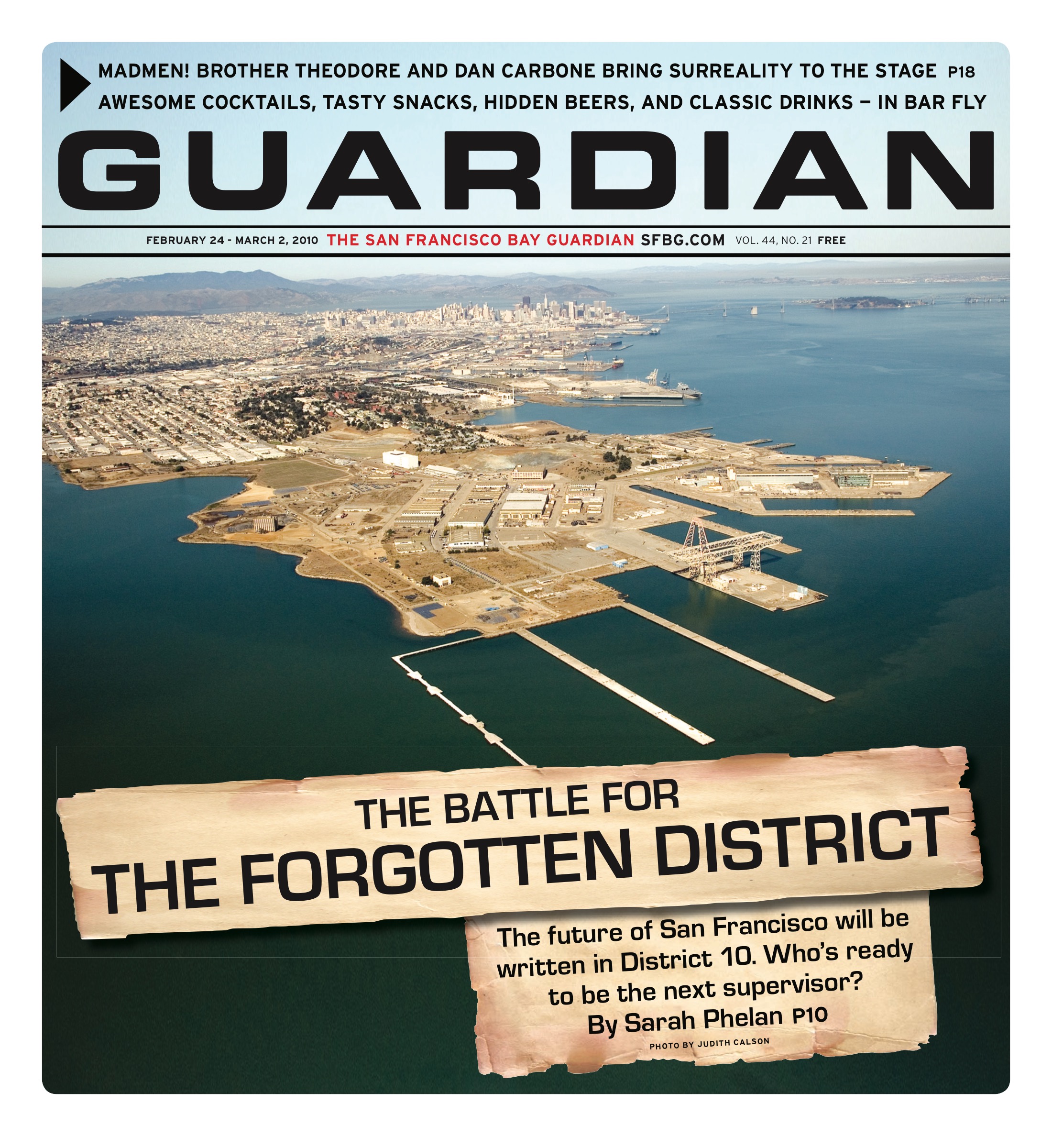
The battle for the forgotten district

24

sarah@sfbg.com

This November, when voters in District 10 — the largest, sunniest, and most diverse of the city’s 11 supervisorial districts — replace termed out Sup. Sophie Maxwell, they’ll be making a selection that could have pivotal implications for the entire city.

That’s because the next supervisor from southeast San Francisco inherits a district that is home to some of the city’s biggest environmental and public health challenges, as well as the most potential for development that will determine what kind of city San Francisco becomes.

District 10 is where you’ll find the most polluted and most underdeveloped lands in San Francisco, areas that could either be transformed into models of a sustainability or, in the words of Tony Kelly, the president of Potrero Boosters Neighborhood Association, “be turned into a toxic Foster City.”

District 10 is where the slaughterhouses, tanneries, and glue factories set up shop and used the bay as a dumping ground. It’s where the smokestacks of coal and oil fired power plants polluted the air. It’s where the Navy filled the Bay, built a shipyard at Hunters Point and loaded parts of the first atomic bomb onto the USS Indianapolis in 1945.

District 10 is where the bottom fell out of this industrial economy in 1974, when the Navy left, taking with it people’s jobs, pay, and hopes for a home of their own and a better future, particularly for what was then a predominantly African American population.

And District 10 is ground zero for plans that will triple the population and double the number of homes — homes that likely will only be “affordable” to Google executives and retirees from Marin, forever changing the face of San Francisco’s southeast sector. Critics fear that will accelerate what has been a steady exodus of black residents, replaced by megadeveloper Lennar’s vision for a new D10.

It’s against this dark history and difficult present that a wide open field of more than a dozen candidates are vying to replace Maxwell, who came to power in 2000 and has had a mixed voting record in her decade on the board. Sometimes, Maxwell was the eighth vote that let the progressive majority on the Board override Mayor Gavin Newsom’s veto and pass trailblazing legislation. Other times, she was the swing vote that allowed the moderate minority to carry Newsom’s water.

So, in addition to D10’s many internal challenges, this seat could determine the political balance of power on the Board of Supervisors, placing all the more importance on voters in this long-marginalized part of town.


DISTRICT OF DISCONTENT

Eric Smith, a biodiesel activist who has thrown his hat in the D10 ring, says that there is a lot of frustration in the air, and looking at the problems the district is facing, it’s hardly surprising that it has what nearly every candidate agrees is a fractured political culture.

“The Bayview, the Hunters Point Shipyard’s toxic Superfund site, the homicide rate, unemployment, poor public transportation, dwindling services and community resources have made D10 one of the city’s largest melting pots of discontent,” Smith said.

Smith’s words were spoken while the Elections Department was verifying signatures earlier this month on a second failed effort to qualify a petition to recall Maxwell.

Bayview resident and D10 candidate Marie Franklin didn’t support the attempt to recall Maxwell, but she understood it as “a frustration movement.”

“People are sinking in the sand, we’ve already lost so many of them, and they felt Sophie wasn’t doing anything for them,” said Franklin, who praised Maxwell for helping get Franklin’s apartment building complex renovated — a job that was completed 18 months ago, at a cost of $65 million, creating 500 local jobs.

“There are 654 units here, and they were uninhabitable,” Franklin said. “There was black mold, rain falling inside. We had people living worse than Haiti.”

Franklin, who said she is running because she “knows the history,” came here in 1978, when she and her son were living in a car after a fire left them homeless. She said the Bayview was a totally isolated area, barely part of mainstream San Francisco.

“There were no taxis, no services,” she recalled. “Nobody would come here, it was the stigmatized area where no one was accountable to provide services.”

The Bayview — which in some ways is the heart of D-!0 — wasn’t always a black community. But African Americans have been living here for 70 years, dealing with all the racism, denial of services, poverty, and pollution. And it bothers Franklin that 85 percent of the 10,500 homes that Lennar plans to develop won’t be affordable to the elderly, disabled, unemployed and low-income people who currently live in the Bayview.

“We need to preserve the diversity of the community and make sure their issues and information will flow to City Hall,” she said. “You must give the people a handle. If you don’t reach out, they’ll slip. That’s why folks out migrated.

Whoever succeeds Maxwell will be a central player in addressing some very big and dirty issues: the future of the Navy’s radiologically impacted shipyard at Hunters Point, Lennar’s massive redevelopment plan for the Shipyard and Candlestick Point, the polluting power plants, replacement of stinky digesters at the sewage plant, and the SF Hope public lousing rebuild.

There’s also the chance to address violence and crime. James Calloway, a candidate who has long worked in Bay Area schools, told us he believes that education and jobs are part of the keys to rejuvenating the district.

“Job opportunities are not as plentiful in the district,” Calloway said. “When I was a kid, you could walk down Third Street at 2 a.m. Now I wouldn’t walk down it at 9 p.m., and I know the area.”

Calloway is hopeful that the massive redevelopment plan, if done correctly, could start the district’s comeback. “Not a lot of black folks stay here when they have extensive education,” he said. “But it’s not only them. Many were displaced by redevelopment and had no way to go back.”


ELECTION UP FOR GRABS

The largest of the city’s 11 electoral districts, D10 is a huge triangular piece of land in the city’s southeast sector that was used as an industrial dumping zone for decades. Today, the district runs from the Giants stadium at AT&T Park to the 49ers stadium at Candlestick Point and encompasses Mission Bay, Potrero Hill, Dogpatch, India Basin, Portola, Little Hollywood, and Visitacion Valley. It’s also crossed by two freeways that isolate it from the rest of the city, and is home to a large number of crumbling housing projects that are in the process of being rebuilt.

Candidate Ed Donaldson grew up in the projects until he was 10 years old, when the Redevelopment Agency kicked his family out in the 1970s. “We landed on our feet, but others weren’t so lucky,” said Donaldson, who works as a housing counseling director at the San Francisco Housing Development Corporation.

“There is a sense that the Bayview and Visitacion Valley have not been included within the San Francisco family,” Donaldson said. “There is a sense of being forgotten.”

In 2007, Donaldson co-founded the Osiris Coalition to tackle the city’s dormant Certificate of Preference program, in which the Redevelopment Agency issued a document to displaced residents and businesses in the 1960s promising that they could return.

He also tried to rescue some 700 foreclosed properties and recycle them as affordable housing stock. And now he is trying to prevent the city from bulldozing seven SF Hope projects without guaranteeing residents that they have right to remain.

In 2007, Mayor Gavin Newsom and Maxwell convened an African American Outmigration Task Force that didn’t get a public hearing about its findings until August 2008. The timing angered some, who questioned why the report’s findings and implications for urban planning weren’t released before June 2008, when the residents of San Francisco voted for the Lennar-led Proposition G, a proposal to build 10,000 market rate homes at one of San Francisco’s last remaining black communities, which Newsom and Maxwell endorsed.

The taskforce didn’t publish its recommendations until the end of 2009, allegedly because of insider squabbling. Meanwhile, gentrification was going on actively, and many blamed Newsom, and by extension Maxwell, for failing to do anything with the group’s findings as D10 residents continued to suffer from high rates of asthma, cancer, unemployment and an ongoing black exodus.

It wasn’t always this way. In the 1940s, the district’s black population exploded when migrants from the south and World War II veterans came to work at the Hunters Point Naval Shipyard. Some moved to Alice Griffith Public Housing complex, or Double Rock, which was built as military housing in 1962. Others relocated to the Bayview when the Redevelopment Agency took over the Fillmore/Western Addition in the ’60s and ’70s as part of a controversial urban renewal effort.

But when the Navy abandoned the shipyard in 1974, unemployment hit the black community hard. Today, hundreds of the city’s lowest income residents live in Alice Griffith’s crumbling units and endure sewage backups, no heat, cloudy drinking water and leaking ceilings, as they wait for the projects to be rebuilt.

“Generations have been trapped in the silo of public housing and cannot get out, because of lack of opportunity and education, so when we legislate, we need to take that into consideration,” said candidate Malia Cohen, whose grandfather came from Texas to work at the shipyard where he met her grandmother, whose family came from New Orleans.

“My grandfather’s father was a longshoreman. He worked with the infamous Leroy King [a commissioner at the city’s Redevelopment Agency] and he has fantastically vivid stories of racism,” said Cohen, who works for the Federal Reserve Bank of San Francisco, previously served on the executive staff of Mayor Gavin Newsom, and has already raised over $18,000 in the D10 race and qualified for public matching funds.

“My family came here to work hard, they lived on Navy road in the projects, and then they bought a house here. My parents were born here, and we were all public schooled,” Cohen recalled as she took me on a tour of D10 that ended up in Visitacion Valley, an increasingly Chinese-American neighborhood that reflects a district-wide trend.

Census data show that by 2000, Asians were the largest racial group in the district (30 percent), followed by blacks (29 percent), whites (26 percent), and Latinos (19 percent). By 2003, according to the California Urban Issues project, the trend continued. Asians were the largest racial group (32 percent), followed by blacks (27 percent), whites (21 percent) and Latinos (17 percent) of the population.

This means that D10 candidates will have to garner support from more than one ethnic group to win. Over a dozen candidates have already filed papers in the race, but so far there is no clear front-runner.

Also frustrating the prognosticators is that fact that D10 has had the lowest voter turnout in the city, so the winner will also depend on who goes to the polls.

D10 candidate Geoffrea Morris, who is the grand daughter of longtime Bayview activist Charlie Walker, has been knocking on doors and participating in voter registration drives.

“We need new blood,” Morris said

Getting elected will be a complicated equation. Although Bayview’s population was 50 percent African American at the time of the 2000 census, it didn’t turn out the vote. In the 2006 election, only 14,000 of the district’s 37,000 registered voters went to the ballot, and 50 percent were from whiter, richer, and more Asian neighborhoods.

“It’s very important to the future of the city that the ethnicity diversity of the board be maintained and that the African American community have representation,” former Board President and current Democratic Party chair Aaron Peskin told the Guardian.

Maxwell recently told the Guardian that she’s not ready to endorse any D10 candidates yet. “I’m waiting for people to have a better understanding of what this community is, what the common thread running through it is, and how to use rank choice voting,” she told us.

The only candidate who currently holds elected office is BART director Lynette Sweet, who had her answers down pat when we reached her by phone, and even used wording that was eerily similar to Maxwell’s words.

“D10 is a pretty diverse district, but there is only one common thread: the need for economic development,” Sweet told me. “That’s true in Potrero Hill, Portola, Dog Patch and the Bayview. It’s the same mantra: a lot of small businesses need help, and the only way to help them is through economic development. In Potrero Hill it’s about land use. In the Bayview, it’s about the shipyard and better transportation and truancies.”


THE COMMON THREAD

District 10 is ground zero for the Lennar’s $2.2 billion plan to develop 10,500 market rate condos at the Shipyard and Candlestick Point. The plan will allegedly create thousands of jobs and new parks, deliver on an historic community benefits agreement that labor groups claim is so “lawyered up” that the developer can’t renege on its promises.

The package is framed as the one and only way to revitalize the southeast’s formerly vibrant economic engine. Indeed, any time anyone tries to slow down the process—to take time to thoroughly read the draft EIR and see if it adequately addresses the impacts of this massive urban reengineering project — a chorus of “no delays” starts up, either from residents of the housing projects desperate to see their homes rebuilt, or the labor contractors who hope to get jobs.

“It’s as if the city is playing checkers, while Lennar is playing three-dimensional chess,” Eric Smith observed.

Lennar has stated that it will contribute $711 million to finance this massive project. The remainder will be leveraged by Mello-Roos bonds, state taxes based on the use and size of a property and intended to raise money for needed services, and tax increment financing, which creates funding for projects by borrowing against future property tax revenues.

The conceptual plan won Maxwell’s backing but environmental groups are critical of the draft EIR.

During DEIR hearing, environmentalists questioned the wisdom and the cost of filling the Bay to build a bridge over Yosemite Slough, and building condos on Candlestick Point state recreation area, the only open major open space in the district.

But the city’s Planning Department also has 20,000-30,000 units of housing in its pipeline. This means that if all these plans get approved in the next decade, they’d account for 80 percent of residential development citywide. And D10’s population could triple, further skewing the district’s already shifting demographics.

In other words, D10 as we know it could become nothing more than a historic relic in a few years, and the next supervisor will play a key role in deciding whether that happens. SFHDC’s Ed Donaldson warns that any supervisor who does not understand the complexity of the city’s largest district can expect a similar recall backlash in future.

“There is no one homogenous voice in the community,” Donaldson said. “The grass-roots organizing that brought about the recall effort was a result of a changing political structure in the area, but is not yet on par with other districts in town. We still allow our politics to be controlled from downtown.”

Fellow candidate Eric Smith warns that the issues—and politics—are complex.

“People were emotional, angry, and desperate because they feel no one listens to them,” Smith said. “That’s part of the problem here; they would rather have a supervisor go down swinging for them, rather than watch one seemingly side with Lennar, PG&E and the mayor on issues contrary to their interests. That’s the terrible irony and one of the biggest problems in District 10. Folks are so mad, they’re willing to do whatever it takes to make them feel they have a voice in the outcome, even if it’s potentially worse.”

Smith cited the sequence of events that culminated last year in the Navy dissolving the community-based shipyard Restoration Advisory Board (RAB), which for years has reviewed technical documents and commented on the Navy’s clean-up proposals. But in December, the Navy made its official decision to disband the RAB, citing dysfunctional behavior and off-topic discussions that got in the way.

“Some of the same folks who were frustrated by the process, tried to send a signal to the Navy that they weren’t being heard and for all their well-intentioned efforts got the RAB dissolved,” Smith said. “I truly feel for them, it’s absolutely heartbreaking, but at times, they can be their own worst enemy.”

One of the looming issues about the shipyard is that the land has been polluted and needs to be cleaned. The shipyard contains radioactive debris from ships towed to the shipyard, after a 90-foot wave washed over them during an atomic test gone awry. The Navy burned 610,000 gallons of radioactively contaminated ship fuel at the shipyard, and workers showered on the shipyard, raising concerns that radioactive materials got into the drains and sewers. And questions have been raised about radiological tests on animals at the yard.


LEAKS AND FLOODS

It’s not just the shipyard that’s toxic. Even the buildings that were constructed to house workers 50 years ago are a serious mess.

Realtor Diane Wesley Smith, who grew up in public housing projects, took me on a walking tour of Alice Griffith last week to see conditions that tenants will likely have to endure until at least 2014, if the city sticks to its plan to relocate people into a new replacement unit in the same geographical area, if not the exact same site.

What we found was pretty messed up.

“The water sometimes comes out brown and feels like sand. It’s been like that for a year,” one resident said.

“The water is cloudy, the bath tub isn’t working and the sink keeps stopping up,” said another.

A woman named Silvia showed us how the water from the tap in her elderly mother’s kitchen flows out cloudy and then doesn’t settle properly, like foamy beer.

“The roof’s been leaking for years, the sewage backs up, but they just fixed the lights,” Silvia said. A neighbor named Linda was using her oven as a heater.

“The toilet backs up a lot, and my grandson’s been coughing a lot from asthma,” Linda said.

“Roaches is always a problem,” said a woman named Stormi, dressed in black sweats and a black T-shirt that read, “Can’t knock the hustle.”

“They’re trying,” said Stormi, a member of the Alice Griffith Residents Association, as a couple of Housing Authority trucks pulled up to do repairs.

“They promise that you will not have to leave your unit, but if they try to move us down to the waterfront, well, there’s a reason there’s no housing there, and it’s because the land will flood,” Stormi said.

“If we don’t end up at the table, we’ll end up on the menu,” Wesley Smith warned, as she stopped to chat with a group of young men, who were worried they would pushed out of the Alice Griffith rebuild through the criteria being established.

“Fred Blackwell, the executive director of the Redevelopment Agency, assures me that’s not the case, but Alice Griffith is a Housing Authority property, and empty promises have the potential to be great promises provided they are made in writing,” Wesley Smith said as we walked out of the projects and onto the road where a yellow and black sign announced “flooded” next to Candlestick Point park, where Lennar wants to build.

Malia Cohen expressed concern about Hope SF residents, as we drove through the Sunnydale housing project.

“We have to be diligent and mindful that people are not pushed out,” Cohen said, noting the sweeping views at Gleneagles golf course above Sunnydale, and the value of housing for a golf course community. “When public housing gets taken offline, we must work with Redevelopment and the Housing Authority to make sure no one is changing the rules halfway. We have to make sure the talks and walks line up. We need to be equal partners. We cannot be bulldozed by City Hall.”

Geoffrea Morris is a Calworks employee, at the Southeast Community College facility on Oakdale, which was built to mitigate the city’s expansion of the sewage plant in 1987. She cited concerns about the literacy levels of people who live in the 2200 public housing units that cluster D10. “A lot of people in Alice Griffith don’t even know the dates or when it’s going to be reconstructed,” Morris said. “Folks like to be told stuff like that, but the city gives you a stack of papers. Some will read them, but others rely on folks they think are trustworthy. They need stuff in layman’s terms written on one sheet of paper.”

Morris is a fan of the Internet who posted a community survey online, and made sure every housing project got some literature telling people to get informed. She worries about the digital divide in D10:

“A lot of folks don’t have computers and access to important information,” Morris said. “And let’s talk about the way ‘affordable’ is used to trick people.”

Michael Cohen, Newsom’s top economic adviser, recently stated in a memo that over the expected 15-20 year phased build out, Lennar’s Candlestick-Shipyard development would include, “up to 10,500 residential units, about 32 percent of which (3,345) will be offered at below market rates.”

“But 892 units of this ‘affordable category’ will be sold to folks earning $100,000,” Morris said. “So if you subtract 892 units from affordable unit category, you’re back to 25 percent affordable.”

Candidate Kristine Enea, an attorney and a former RAB member, chairs the India Basin Neighborhood Association, which administers a US EPA grant to hire experts to translate the Navy’s cleanup documents into plain English and comment on them She was frustrated by the Navy’s decision to dissolve the RAB.

“The lack of a forum does nothing to bolster the community’s trust in the cleanup or the redevelopment process,” Enea said.

Enea generally supports the Lennar project, but has concerns about whether it will adequately mitigate increased car traffic, or result in commercial development that benefits her neighborhood.

“India basin is a pocket of Hunters Point right along the shoreline,” Enea said. “Right now, we have no shops or restaurants, no ATM, no groceries, nothing beyond one liquor store and a few industrial businesses.

Potrero Boosters president Tony Kelly told us that District 10 residents can think for themselves. “D10 residents don’t need to rely on corporations to solve their problems,” he said.

“Folks in the eastern neighborhoods came up with a better revitalization plan than what the city proposed and community activists managed to close the power plant, after the city said it was impossible,” Kelly recalled.

And there’s no shortage of good ideas.

Kelly suggested that an urban agriculture center could immediately put low-skilled folks to work by erecting greenhouses on unused land. Smith said the industrial zone could be “incredible eco-park made from sustainable sources.

‘D 10 is the dumping ground for everything, including all the city’s waste,” he said. “We could be a shining example, not just for D 10, but the rest of the state.”

The D 10 candidate line up includes Calloway, Cohen, Donaldson, Smith, Enea: civil rights attorney Dewitt Lacy, Morris, Potrero View publisher Steve Moss; District 7 BART director Lynette Sweet, Wesley-Smith. Bill Barnes, who works for Sup. Michela Alioto-Pier, and Linda Richardson, who was appointed to the Human Rights Commission in 2007 by Mayor Newsom, have also expressed interest in the race.

In such a huge field, name identification will play a major role. Sweet is in office, but BART Board is not a high-profile job and won’t give her a huge advantage.

Cohen has a slight edge right now in that she’s raised $18,505, including $500 from former Newsom flak Peter Ragone, making her the first D. 10 candidate to qualify for campaign financing. The oldest of five girls, Cohen recalls how her mother got laid off from her city job as a school-based mental health worker and then rehired, as part of the city’s budget cuts.

“We felt that pinch and the frustrating games that are played out between the leadership and the rank and file,” she said.

Cohen who worked for Newsom in his first term as mayor, but has since left his administration , said she is uncomfortable at being framed as Newsom’s candidate.

“Because I’m not, but I am one of the few candidates who has seen how the mayor and the Board work—and don’t work—together,” she said.

Moss sees the city’s southeast as a “district in transition.” Over coffee at Farley’s in Potrero Hill, he told me that the southeastern neighborhoods could be “launching pads for environmentally sustainable growth.”

“The district’s been in a frozen period for 30 years, But despite the problems, people are deeply committed to and in love with their community.

“This district is the future of San Francisco and its social fabric—the diversity, income –and its problems are leftovers from the city’s industrial age.”


DISTRICT 10, BY THE NUMBERS

Total Acres: 5,650

Average household income: $85,000

Population: 73,000

Registered voters: 37,700

Average housing price: $335,000

Ethnicity (2003 figures): Asian 32%, African American, 27%, white 21%, Hispanic 17%

Development status of land: 18% residential, 38% is commercial, 38% undevelopable

All figures the latest available. Sources: SFGIS, Association of Bay Area Governments, U.S. Census, California Urban Issues Project. Ethnicity and income data is from 2003 and almost certainly has changed.

Changes/chances

0

superego@sfbg.com

SUPER EGO Sorry to put a slight damper on the socks-knocking, thrillingly complex, and exuberant nightlife decade we’re just rafting into. (Listen to Tensnake, Move D, Matías Aguayo, Minimal Wave, Zombie Disco Squad, and recently reinvigorated legends Jeff Mills, Greg Wilson, and Todd Edwards for clues to the new.) But I’ve got to launch some shout-outs to some Bay club people and places no longer with us. Clubwise, the consistently excellent techno-plus happy hour Qoöl (www.qoolsf.com) ended its 15-year run at 111 Minna last month, so founders Spesh and Jondi et al could concentrate on their label, Loöq, and larger affairs. And high-voltage, bare-fleshed electro blackout BlowUp (www.blowupsf.com) quit after five years due to capacity overflow at the Rickshaw Stop.

On sadder notes, promoter Chantal Salkey, who revolutionized the womens club scene with her summer Mango tea-dances, upping the party power of lesbians of color into global sounds, passed away, as did David Kapp, the former manager of Deco (and several pre-gentrification Polk Street bars), who brought conceptual disco and wet alternaqueers to the Tenderloin. Let’s dedicate an extra twirl this week to the pioneers.


BASS GAMES: MARIJUANA CHANCES

Light one up and get pixilated with the true-electro kids of Party Effects (www.partyeffects.biz), as they skunk out swank palace Otis with unthinkable low-end roll and passionate blips. Live P.A.s from Adeptus, Dade Elderon, Marnacle, and Tarythyas dust it, while glamourpuss hostesses Domonique and Alexis pinch it tight. With $10 bottomless drafts, it’ll be slow-motion anarchy.

Thu/25 and last Thursdays, 10 p.m., free. Otis, 25 Maiden Lane, SF. www.otissf.com


KISS MY BLACK ASS

New York City’s great and kiki classic-house KMBA party, helmed by Quentin Harris — my vote for house producer of the ’00s — is landing at Triple Crown with Harris and SF’s David Harness. Expect energetic cuts with generous dollops of sass: at the last KMBA I attended, Quentin dropped all eight minutes of his slinky edit of DJ DeMarko’s “Drop a House.” The red lights flashed.

Fri/26, 10 p.m.–4 a.m., $10. Triple Crown, 1760 Market, SF. www.triplecrownsf.com


REBEL RAVE

This party, put on by the Crosstown Rebels label, confuses yet delights me. The intriguing featured players — Damian Lazarus, Deniz Kurtel, Jamie Jones, and Seth Troxler — possess unassuming demeanors and ravaging musical intellects that span the neo-edit, house revival, minimal, and techno-pop genres. Yet the joint’s being marketed harder than a Steve Aoki appearance in 2k7. TV cameras! Hookah room! Wear your “Rebel Rave” gear! Fortunately, the potential greatness and actual fun of the music should cut through the hype static.

Fri/26, 10 p.m.–4 a.m., $20. Mighty, 119 Utah, SF. www.mighty119.com


CUTE FANG

Possibly no one has done more to sustain the classic SF techno sound — chunky, funky, sample-heavy, breaks-laced, and often unabashedly rave-y — than homegirl Forest Green. Her recent, bass-blasting productions on Daly City Records and her own Cute Fang recordings have bravely updated the groove, prepping it for its inevitable third or fourth comeback. She’ll be celebrating her birthday with a roiling lineup, including Clairity, Ethan Miller, Dragn’fly, Triple D, Raydeus, and more.

Sat/27, 8 p.m., $5. Shine, 1337 Mission, SF. www.forestgreen.org


MARTIN KEMP

Is UK Funky a trap? One of the most exciting sounds of the past couple years, the British genre revived two-step beats, added dubstep atmospherics, and incorporated R&B, tribal, and Latin flourishes. But the organic sheen of the music — bongos, vibes, strings — soon rubbed off, leaving UK Funky in a strange electro No Man’s Land (full of men, of course). Future-eared brothers Martin Kemp and Brackles are the best current candidates to move the movement forward, infusing their DJ sets with enough experiment to keep it fresh while playing with UK Funky’s natural air of loveliness that grabbed ears and asses in the first place. Kemp will turn up the gas at the banging new Icee Hot party.

Sat/27, 10 p.m., $5. 222 Hyde, SF. www.222hyde.com

Meaning what?

0

MUSIC Michael Sempert, frontman of Oakland synth-folk outfit Birds & Batteries, has a talent for avoiding questions. Sitting across from me in a Mission District café near the studio on Cesar Chavez where his band practices, he evades my hardly tactful attempts to adhere a concise creative vision to his efforts as a songwriter, producer, and multiinstrumentalist. "I think that meaning isn’t fixed, no matter the intention of the artist," he resolves. "The same song can mean something different even to the same person every time."

Well, Sempert’s right, and I might qualify that my predicating Birds & Batteries as synth-folk at the beginning of this article only begins to hone in on the project’s constantly evolving hybrid aesthetic. The 2007 full-length I’ll Never Sleep (eightmaps) contains robust, electronic toned folk-rock, including a crackling cover of Neil Young’s "Heart of Gold." In contrast, last fall’s EP Up To No Good (eightmaps) pulls as much from "Atomic Dog" electro-funk as from warm 1970s studio pop. Most hybrid bands experimenting with pastiche tend to get lost in the process, but Birds & Batteries finds ways to craft strangely charming and captivating music.

A brief tale at just short of 20 minutes, Up To No Good summons a playfully dystopian mood and story line. At first, we follow a roguish protagonist in the wake of some apocalyptic catastrophe that struck the heart of a sprawling city. "Now I believe in the villain/ I believe in the thief/ Who steals what he is given/ Keeps it in his teeth," a husky-voiced Sempert croons during "The Villain."

Eschewing conventional choruses, Sempert lets rhythmic tides carry the songs forward in alternating patterns, layering them with haunting synth arpeggios and mellifluous string cords. An enchantingly ominous world emerges — one populated by verdant creatures that shape-shift among the animate and robotic and ghostly — inciting revelry more than any horror. The effect is similar to that of watching a John Carpenter film or reading a Phillip K. Dick novel, where we can drop our critical guard, at least for a moment, to take ironic pleasure in the evils of the world and a less than promising-looking future. That pleasure might also arise from the numerous strands of the familiar that ring in Up To No Good, sparking nostalgia for a sort of childlike innocence before we had to be so crafty in our coping.

The climax takes a propulsive turn in "Out in the Woods." A bubbling, boogie-funk bass line quickens and slows as the melodic chords warp unexpectedly, mirroring the racing thoughts of the supposed villain who loses himself in an enigmatic black forest. "Up to no good/ But we’re up to no bad/ We are only what we are," Sempert sings over a howling whistle that sounds like a synthetic gust of wind.

"With music, I try to get at the unexplainable," Sempert says. "The lyrical content deals with the climate of moral ambiguity." Such conceptual play on the notions of good and evil casts the Up to No Good EP with the aura of a pensive and cautionary fable, despite its tongue-in-cheek facets.

Birds & Batteries’ oncoming third full-length — set for release this summer with the tentative title Panorama — will follow similar explorations into right and wrong. However, that might be the only solid thread linking it to the highly polished Up To No Good, even though the tracks were recorded during the same time frame. "[Panorama] is informed a lot more by the live show and live process," Sempert says. "It’s a shift back to earnest and uplifting music."

The dynamic nature of Birds & Batteries is born from Sempert’s restless character and overarching creative control. "It takes months to make music," he says. "Over the course of that period, I’m grappling with all the possibilities and all the different potential meanings. My relationship with the music is fluid. That’s why I hesitate to pin down a meaning."

BIRDS & BATTERIES

With Memory Tapes, Loquat, Letting Up Despite Great Faults

Sat./27, 9 p.m., $12

Bottom of the Hill

1233 17th St., SF

(415) 621-4455

www.bottomofthehill.com

Brick by brick

0

TOY-NAMATION Denmark has given us so much. In the past few decades alone it has gifted the world with live-sex club acts, Brigitte Nielsen, breakfast pastries, and Lars “Antichrist” von Trier. In 1969 it became the first country to legalize pornography, and two decades later did likewise for same-sex marriage. It is also currently designated the least corrupt nation on earth, with the greatest income equality.

But predating all these wonders was that cultural juggernaut we call Lego. Toymaker Ole Kirk Christiansen named his company that in 1934; 15 years later, he began producing interlocking plastic bricks, though it was not until 1958 that the perfected current design debuted. (Thus, 52-year-old blocks remain compatible with ones you could buy today.) In 1988, Lego Group’s last patent on its fortune’s literal building block expired, resulting in a rash of cheap imitations, most manufactured in (surprise) China. But a Lego is a Lego is a Lego. Like Kleenex, it is a brand name more familiar than the object’s literal description. What five-year-old wants his “interlocking plastic brick”?

This week sees the (direct-to-DVD) release of the first feature-length Lego movie. The first thing you notice about Lego: The Adventures of Clutch Powers is that there’s been some heinous error: how can this not be stop-motion animation, but CGI?! What’s the point if we’re not seeing actual crazy Legos-constructed figures moving around an all Lego-landscape?

That said, it does sport a certain blocky design theme, and the early-1980s Cars-type songs with handclaps and synths seem just right. Clutch is an all-American, thrill-seeking, planet-saving blowhard who learns the value of teamwork by being forced to cooperate with a girl (plucky!), musclehead (jerky!), and egghead (German!) on an intergalactic voyage to defeat an evil wizard and his army of skeleton warriors. There’s a little Indiana Jones here, a little Shrek there, a lotta Lord of the Rings hither and yon.

But these 82 innocuous minutes are just a blip in the ever-widening Lego cosmos, which includes umpteen subsidiary toy franchises, clothes, video games, books, theme parks, “Lego Serious Play” (for business consensus-building!), and independent uses that run from elaborate Lego reconstructions of live action movies to epic online biblical illustration The Brick Testament.

Legos are timeless and cool. The company is laudable, not just for inviting action and imagination from kids, but for being a good global citizen. Lego’s corporate responsibility bylaws regarding environmental impact, charitable contributions, and treatment of workers are the sort of “socialist” stuff that would be lobbied out of existence here in five seconds. Oh, those Scandinavians — when will they realize all their prosperity, public benefits, and high overall happiness index is really a living hell in sheep’s clothing? Surely they need an angry Tea Party movement to protest a society that actually takes care of its own. 

www.legoclutchpowers.com

Rep Clock

0

Schedules are for Wed/24–Tues/2 except where noted. Director and year are given when available. Double features are marked with a •. All times are p.m. unless otherwise specified.

AUTOBODY FINE ART GALLERY 1517 Park, Alameda; www.autobodyfineart.com. $5. "Hunger," short zombie films by Bay Area filmmakers, Sat, 8.

ARTISTS’ TELEVISION ACCESS 992 Valencia, SF; www.atasite.org. $6-10. Zeitgeist Addendum: The Resource-Based Economy, Thurs, 7. "Noise Pop Film Festival:" Blood Into Wine (Page and Pomerenke), Fri, 7; Downtown Calling (Nicholson), Fri, 9; •Lou Barlow: Goodnight Unknown (Harding) and The Mountain Goats: Life of the World to Come (Johnson), Sat, 2; Woodstock: Now and Then (Kopple), Sat, 4; The Secret to a Happy Ending (Weissman), Sun, 2; All My Friends Are Funeral Singers (Rutili), Sun, 4:15. For info on these screenings, visit www.noisepop.com.

CAFÉ OF THE DEAD 3208 Grand, Oakl; (510) 931-7945. Free. "Independent Filmmakers Screening Nite," Wed, 6:30.

CASTRO 429 Castro, SF; (415) 621-6120, www.castrotheatre.com. $7.50-10. My Son, My Son, What Have Ye Done (Herzog, 2009), Wed-Thurs, 7, 9:15 (also Wed, 2:30, 4:45). •Fight Club (Fincher, 1999), Fri, 7, and Donnie Darko (Kelly, 2001), Fri, 9:40. Up (Docter, 2009), Sat, 2, 4:30, 7, 9:15. "German Gems:" Tender Parasites (Becker and Schwabe, 2009), Sun, noon; Miss Stinnes (von Moeller, 2009), Sun, 2; Being Mr. Kotschie (Baumgarten, 2009), Sun, 4:15; Vision (von Trotta, 2009), Sun, 7; The Bone Man (Murnberger, 2009), Sun, 9:15. Call for Mon-Tues program information.

CHRISTOPHER B. SMITH RAFAEL FILM CENTER 1118 Fourth St, San Rafael; (415) 454-1222, www.cafilm.org. $6.50-10. Broken Embraces (Almodóvar, 2009), call for dates and times. An Education (Scherfig, 2009), call for dates and times. Fish Tank (Arnold, 2009), call for dates and times. North Face (Stölzl, 2008), call for dates and times. "2010 Oscar Nominated Short Films," Wed-Thurs, call for times. "The Cinema of Jan Troell:" Everlasting Moments (2008), Sat, 7:15; The Emigrants (1971), Sat, 2 and March 6, 2; The New Land (1972), Sun, 2 and March 6, 7; "Dancing," "Reflexion 2001," and "Their Frozen Dream," Sun, 7; As White as Snow (2001), Mon and March 4, 7; Il Capitano (1991), Tues, 7.

HERBST THEATRE 401 Van Ness, SF; (415) 392-4400. $20. Examined Life (Taylor, 2008), Thurs, 7:30.

HUMANIST HALL 390 27th St, Oakl; www.humanisthall.org. $5. •Shellmound and In the Light of Reverence, Wed, 7:30.

MECHANICS’ INSTITUTE 57 Post, SF; (415) 393-0100, rsvp@milibrary.org. $10. "CinemaLit Film Series: Reel Criminals — The Heist:" A Fish Called Wanda (Crichton, 1988), Fri, 6.

MEZZANINE 444 Jessie, SF; www.sffs.org. $15. "SF360 Film + Club," sneak preview of a film about Stephin Merritt of the Magnetic Fields, Sun, 8.

PACIFIC FILM ARCHIVE 2575 Bancroft, Berk; (510) 642-5249, www.bampfa.berkeley.edu. $5.50-9.50. "Film 50: History of Cinema:" Pursued (Walsh, 1947), Wed, 3. "African Film Festival:" In My Genes (Nyong’o, 2009), Wed, 7. "Before ‘Capraesque:’ Early Frank Capra:" The Younger Generation (1929), Thurs, 7; So This Is Love (1928), Fri, 7; The Bitter Tea of General Yen (1933), Fri, 8:30; It Happened One Night (1934), Sat, 6:30. "The Kids Are Alright: Post-Fifties Musicals and the Rise of Youth Culture:" Pink Floyd the Wall (Parker, 1982), Thurs, 8:35; True Stories (Byrne, 1986), Sat, 8:35; Fruit Fly (Mendoza, 2008), Sun, 5:30. "L@te: Friday Nights at BAM/PFA:" "Paul Clipson and Gregg Kowalsky; Keith Evans," Fri, 7:30. This event at the Berkeley Art Museum, 2626 Bancroft, Berk. "Celebrating Amateur Film:" "Sid’s Cinema: A Tribute to Amateur Filmmaker Sid Laverents (1963-85)," Sun, 3.

RED VIC 1727 Haight, SF; (415) 668-3994. $6-10. The Yes Men Fix the World (Ollman, Price, and Smith, 2009), Wed, 2, 7:15, 9:15. The Bad Lieutenant: Port of Call New Orleans (Herzog, 2009), Thurs-Sat, 7, 9:35 (also Sat, 2, 4:30. Small Change (Truffaut, 1976), Sun-Mon, 7:15, 9:30 (also Sun, 2, 4). The Beaches of Agnès (Varda, 2008), March 2-3, 7, 9:20 (also March 3, 2).

ROXIE 3117 and 3125 16th St, SF; (415) 863-1087, www.roxie.com. $5-9.75. "Noise Pop Film Festival:" Austin, TX: Live Music Capital of the World? (Christ), Wed, 7; P-Star Rising (Noble), Wed, 9:15. For info on these screenings, visit www.noisepop.com. Leonard Cohen: Live at the Isle of Wight 1970 (Lerner), Wed-Thurs, 6:40, 8, 9:30. Precious: Based on the Novel Push by Sapphire (Daniels, 2009), Thurs, 6:45. The Cove (Psihoyos, 2009), Thurs, 8:50. Call for Fri-Tues program information.

SAN FRANCISCO CINEMATHEQUE Yerba Buena Center for the Arts, 701 Mission, SF; www.sfcinema.org. $10. "Darkest Americana and Elsewhere: Films, Video, and Words of James Benning:" "James Benning: American Dreams," Fri, 7; "James Benning: Landscape Suicide," Fri, 8:15. "Australian Avant-Garde: A Historical Overview," Tues, 7:30. Presentation Theater, University of San Francisco, 2350 Turk, SF. Same price and contact info. "James Benning:" Ruhr (2009) with "Fire and Rain" (2009), Sat, 7:30. McBean Theater, Exploratorium, 3601 Lyon, SF. Same price and contact info. "James Benning: Milwaukee to Lincoln, Montana Lecture," Sun, 3.

SAN FRANCISCO PUBLIC LIBRARY Koret Auditorium, 100 Larkin, SF; www.sfpl.org. Free. "The Story of India:" Freedom (2007), Thurs, noon. Large-screen video presentation.

VICTORIA 2961 16th St, SF; www.downstreamthemovie.com. $12. Downstream (Bartesaghi, 2009), Fri-Sat, 8; Sun, 7.

VIZ CINEMA New People, 1746 Post, SF; www.newpeopleworld.com/films. $10-25. La Maison De Himiko (2005), through March 4, call for times. "Noise Pop Film Festival:" Blood Into Wine (Page and Pomerenke), Thurs, 7:30; The Heart is a Drum Machine (Pomerenke), Thurs, 9:30. For info on these screenings, visit www.noisepop.com.

YERBA BUENA CENTER FOR THE ARTS 701 Mission, SF; (415) 978-2787, www.ybca.org. $6-8. "Freaks, Punks, Skanks, and Cranks:" To My Great Chagrin: The Unbelievable Story of Brother Theodore (Sumerel, 2008), Thurs, 7:30; Gold (Levis, 1968), Sat, 7:30.

Music listings

0

Music listings are compiled by Paula Connelly and Cheryl Eddy. Since club life is unpredictable, it’s a good idea to call ahead to confirm bookings and hours. Prices are listed when provided to us. Submit items at listings@sfbg.com.

WEDNESDAY 24

ROCK/BLUES/HIP-HOP

Kasey Anderson, Matthew Ryan, Allen Stone, Andrew Belle Hotel Utah. 8pm, $8.

Foreign Born, Fresh and Onlys, Free Energy, Splinters Rickshaw Stop. 8pm, $14.

Ghost of a Saber Toothed Tiger, Cornelius, If By Yes, Hirotaka Shimizu Independent. 8pm, $20.

Pepi Ginsberg, Pepper Rabbit Hemlock Tavern. 9pm, $7.

Harlem, Sandwitches, Young Prisms Café du Nord. 8pm, $12.

Left Alone, Bum City Saints, Hounds and Harlots Thee Parkside. 8pm, $8.

Richard Thompson Band Great American Music Hall. 8pm, $28.

Rogue Wave, Princeton, Man/Miracle, Two Sheds Bottom of the Hill. 8pm, $15.

Sideshow Fiasco, Kajillion, Illness El Rio. 7pm, $5.

Sioux City Kid, Vandella, Landlords Red Devil Lounge. 8pm, $8.

FOLK/WORLD/COUNTRY

Michael Abraham Jazz Session, Gaucho Amnesia. 8pm, free.

Michael Rose with Dubtronic Kru Rockit Room. 9pm, $25.

DANCE CLUBS

Booty Call Q-Bar, 456 Castro; www.bootycallwednesdays.com. 9pm. Juanita Moore hosts this dance party, featuring DJ Robot Hustle.

Club Shutter Elbo Room. 10pm, $5. Goth with DJs Nako, Omar, and Justin.

Hands Down! Bar on Church. 9pm, free. With DJs Claksaarb, Mykill, and guests spinning indie, electro, house, and bangers.

Jam Wednesday Infusion Lounge. 10pm, free. DJ Slick Dee.

Mary-Go-Round LookOut, 3600 16th St., SF; (415) 431-0306. 10pm, $5. A weekly drag show with hosts Cookie Dough, Pollo Del Mar, and Suppositori Spelling.

RedWine Social Dalva. 9pm-2am, free. DJ TophOne and guests spin outernational funk and get drunk.

Respect Wednesdays End Up. 10pm, $5. Rotating DJs Daddy Rolo, Young Fyah, Irie Dole, I-Vier, Sake One, Serg, and more spinning reggae, dancehall, roots, lovers rock, and mash ups.

Synchronize Il Pirata, 2007 16th St.; (415) 626-2626. 10pm, free. Psychedelic dance music with DJs Helios, Gatto Matto, Psy Lotus, Intergalactoid, and guests.

Yoruba Dance Sessions Bacano! Som., 2925 16th St., SF; (415) 558-8521. 9pm, free. With resident DJ Carlos Mena and guests spinning afro-deep-global-soulful-broken-techhouse.

THURSDAY 25

ROCK/BLUES/HIP-HOP

Dan Black, Free Energy 330 Ritch. 9pm, $10-13.

Curtis Bumpy Coda. 9pm, $7.

Citay, Scout Niblett, Greg Ashley, Tape Deck Mountain Café du Nord. 8pm, $14.

*Cute Lepers, Clorox Girls, Primitivas, Boats! Thee Parkside. 9pm, $8.

Dodos, Magik*Magik Orchestra Palace of Fine Arts, 3301 Lyon, SF; www.ticketmaster.com. 8pm, $25.

Shane Dwight Biscuits and Blues. 8pm, $15.

Far, Stomacher, Picture Atlantic, Trophy Fire Bottom of the Hill. 8pm, $14.

Robert Grashaw Amnesia. 7pm, free.

Bill Kreutzmann with Oteil Burbridge and Scott Murawski Independent. 9pm, $25.

Moe. Fillmore. 8pm, $37.50.

Richard Thompson Band Great American Music Hall. 8pm, $28.

Slow Children, Wobbly and Preshish Moments, Maleficia, Alexandra Buschman Amnesia. 9pm, $5.

Space Monkey Gangstas, RU36, 5 Days Dirty, Release Slim’s. 8:30pm, $13.

*Toasters, Inciters, Monkey Red Devil Lounge. 8pm, $12.

*"Tribute to Johnny Cash" Knockout. 8pm, $10. With Glen Earl Brown Jr., B Stars, Royal Deuces, Big B and His Snake Oil Saviors, and more.

Zaimph, Vodka Soap, Bill Orcutt, Stellar OM Source Hemlock Tavern. 9pm, $7.

Zee Avi, Hot Toddies, Leslie and the Badgers Rickshaw Stop. 8pm, $14.

FOLK/WORLD/COUNTRY

Bluegrass and Old Time Jam Atlas Café. 8pm, free.

DANCE CLUBS

Afrolicious Elbo Room. 9:30pm, $5-6. DJs Pleasuremaker and Señor Oz spin Afrobeat, Tropicália, electro, samba, and funk.

Caribbean Connection Little Baobab, 3388 19th St; 643-3558. 10pm, $3. DJ Stevie B and guests spin reggae, soca, zouk, reggaetón, and more.

Drop the Pressure Underground SF. 6-10pm, free. Electro, house, and datafunk highlight this weekly happy hour.

Ejector DNA Lounge. 9pm, $10. Synthpop with Robot Bomb Shelter and DJs Chris Zachos, Dabecy, and Papa Tony.

Funky Rewind Skylark. 9pm, free. DJ Kung Fu Chris, MAKossa, and rotating guest DJs spin heavy funk breaks, early hip-hop, boogie, and classic Jamaican riddims.

Good Foot Yoruba Dance Sessions Bacano! Som., 2925 16th St., SF; (415) 558-8521. 9pm, free. A James Brown tribute with resident DJs Haylow, A-Ron, and Prince Aries spinning R&B, Hip hop, funk, and soul.

Gymnasium Matador, 10 6th St., SF; (415) 863-4629. 9pm, free. With DJ Violent Vickie and guests spinning electro, hip hop, and disco.

Heat Icon Ultra Lounge. 10pm, free. Hip-hop, R&B, reggae, and soul.

Kick It Bar on Church. 9pm. Hip-hop with DJ Jorge Terez.

Koko Puffs Koko Cocktails, 1060 Geary; 885-4788. 10pm, free. Dubby roots reggae and Jamaican funk from rotating DJs.

La Riots Manor West, 750 Harrison, SF; (415) 407-4565. 10pm, $10.

Mestiza Bollywood Café, 3376 19th St., SF; (415) 970-0362. 10pm, free. Showcasing progressive Latin and global beats with DJ Juan Data.

Peaches Skylark, 10pm, free. With an all female DJ line up featuring Deeandroid, Lady Fingaz, That Girl, and Umami spinning hip hop.

Popscene 330 Rich. 10pm, $10. Rotating DJs spinning indie, Britpop, electro, new wave, and post-punk.

Represent Icon Lounge. 10pm, $5. With Resident DJ Ren the Vinyl Archaeologist and guest.

Solid Club Six. 9pm, $5. With resident DJ Daddy Rolo and rotating DJs Mpenzi, Shortkut, Polo Mo’qz and Fuze spinning roots, reggae, and dancehall.

FRIDAY 26

ROCK/BLUES/HIP-HOP

Atlas Sound, Geographer, Magic Wands, Nice Nice Great American Music Hall. 8pm, $18.

Bikefight, Sopors, Overns, Bobby Joe Ebola Pissed Off Pete’s, 4456 Mission, SF; www.pissedoffpetes.com. 9pm, $5.

Blank Stares, Wild Yaks Hemlock Tavern. 9:30pm, $7.

Rick Estrin and the Night Cats Biscuits and Blues. 8 and 10pm, $20.

Expendables, Iration, Passafire, Pour Habit, Roots Down Below Fillmore. 9pm, $19.50.

Four Tet, Nathan Fake, Rainbow Arabia, NewVillager Independent. 8pm, $18.

Judgement Day, Scissors for Lefty, Ghost and the City, Glaciers Bottom of the Hill. 9pm, $12.

Limousines, Butterfly Bones, Battlehooch Slim’s. 8pm, $14.

*Mumlers, Growlers, Sonny and the Sunsets, Ferocious Few Café du Nord. 8pm, $14.

Notorious, Darkwave Red Devil Lounge. 8pm, $10-20. Benefit for victims of the earthquake in Haiti.

Sons of Doug, Crazy Famous, Scar Pin, West Of Hotel Utah. 9pm, $6.

Thrashers Broadway Studios. 8pm.

John Vanderslice, Nurses, Honeycomb, Conspiracy of Venus Swedish American Hall (upstairs from Café du Nord). 8pm, $15.

JAZZ/NEW MUSIC

Audium 9 1616 Bush, SF; (415) 771-1616. 8:30pm, $15.

David Benoit Yoshi’s San Francisco. 8pm, $28.

Black Market Jazz Orchestra Top of the Mark. 9pm, $10.

Bryan Girard Quartet Cliff House, 1090 Point Lobos, SF; (415) 386-3330. 7pm, free.

Eric Kurtzrock Trio Ana Mandara, Ghirardelli Square, 891 Beach, SF; (415) 771-6800. 8pm, free.

Jim Butler Quartet Savanna Jazz. 8pm, $8.

"Kronos: Music from 4 Fences" Z Space, 450 Florida, SF; www.kronosquartet.org. 8pm, $25.

Joshua Redman Grace Cathedral, 1100 California, SF; www.sfjazz.org. 8pm, $25-50.

FOLK/WORLD/COUNTRY

Dogman Joe, La Gente, Justin Ancheta Elbo Room. 10pm, $10.

Lucky Road Amnesia. 9pm, $5.

Pellejo Seco Cigar Bar and Grill, 850 Montgomery, SF; www.cigarbarandgrill.com. 9pm, $7.

Pickpocket Ensemble Red Poppy Art House. 8pm, $12-$15.

Rob Reich and Craig Ventresco Amnesia. 7pm, free.

Sila presents Sahara Coda. 10pm, $10.

DANCE CLUBS

Activate! Lookout, 3600 16th St; (415) 431-0306. 9pm, $3. Face your demigods and demons at this Red Bull-fueled party.

Bar on Church 9pm. Rotating DJs Zax, Zhaldee, and Nuxx.

Blow Up Rickshaw Stop. 10pm, $10-15. With guests All Leather and Dan Sena.

Bohemian Carnival DNA Lounge. 9pm, $20. With Vau de Vire Society, Gooferman, Gun and Doll Show, DJ Smoove, and more.

Exhale, Fridays Project One Gallery, 251 Rhode Island; (415) 465-2129. 5pm, $5. Happy hour with art, fine food, and music with Vin Sol, King Most, DJ Centipede, and Shane King.

Fat Stack Fridays Koko Cocktails, 1060 Geary, SF; (415) 885-4788. 10pm, free. With rotating DJs Romanowski, B-Love, Tomas, Toph One, and Vinnie Esparza.

Gay Asian Paradise Club Eight, 1151 Folsom, SF; www.eightsf.com. 9pm, $8. Featuring two dance floors playing dance and hip hop, smoking patio, and 2 for 1 drinks before 10pm.

Good Life Fridays Apartment 24, 440 Broadway, SF; (415) 989-3434. 10pm, $10. With DJ Brian spinning hip hop, mashups, and top 40.

Gymnasium Stud. 10pm, $5. With DJs Violent Vickie and guests spinning electro, disco, rap, and 90s dance and featuring performers, gymnastics, jump rope, drink specials, and more.

Hot Chocolate Milk. 9pm, $5. With DJs Big Fat Frog, Chardmo, DuseRock, and more spinning old and new school funk.

House of Voodoo Medici Lounge, 299 9th St, SF; (415) 501-9162. 9pm, $5. With DJs Voodoo and Purgatory spinning goth, industrial, deathrock, and glam.

Look Out Weekend Bambuddha Lounge. 4pm, free. Drink specials, food menu and resident DJs White Girl Lust, Swayzee, Philie Ocean, and more.

M4M Fridays Underground SF. 10pm-2am. Joshua J and Frankie Sharp host this man-tastic party.

Rockabilly Fridays Jay N Bee Club, 2736 20th St., SF; (415) 824-4190. 9pm, free. With DJs Rockin’ Raul, Oakie Oran, Sergio Iglesias, and Tanoa "Samoa Boy" spinning 50s and 60s Doo Wop, Rockabilly, Bop, Jive, and more.

Suite Jesus 111 Minna. 9pm, $20. Beats, dancehall, reggae and local art.

Teenage Dance Craze Party Knockout. 10pm, $3. Teen beat, twisters, and surf tunes with DJs Sergio Iglesias, Russell Quann, and dX the Funky Gran Paw.

SATURDAY 27

ROCK/BLUES/HIP-HOP

!!!, Maus Haus, Sugar and Gold, My First Earthquake Mezzanine. 8pm, $20.

A Band Called Pain, Punk Funk Mob, Sistas in the Pit Pissed Off Pete’s, 4456 Mission, SF; www.pissedoffpetes.com. 9pm, $5.

Black Prairie, Trainwreck Riders, Billy and Dolly Rickshaw Stop. 8pm, $14.

Bitter Mystics, Form of Transport El Rio. 7pm, free.

*Chain and the Gang, Strange Boys, Ty Segall, Nodzzz Elbo Room. 9pm, $10.

Children of the Damned, Hangar 18, Strangers in the Night Red Devil Lounge. 8pm, $10.

Shelby Cobra, Get Dead, Sore Thumbs, New York Ninja Thee Parkside. 9pm, $6.

*Dan the Automator presents Audio Alchemy Yoshi’s San Francisco. 10:30pm, $20. With DJ Qbert, DJ Shortkut, Jazz Mafia All-Stars, and Mars-1.

Dead Souls, Luv ‘n’ Rockets Knockout. 9pm, $8. Joy Division and Love and Rockets tribute bands.

Eyes Speak Treason, Annonimato, Hemorage Thee Parkside. 3pm, free.

*Mark Kozelek, Laura Gibson, Paula Frazer, Fences Great American Music Hall. 8pm, $30.

Memory Tapes, Loquat, Birds and Batteries, Letting Up Despite Great Faults Bottom of the Hill. 9pm, $12.

PEE, True Widow, Ovens, Grass Widow Café du Nord. 8pm, $14.

*Shannon and the Clams, Pharmacy, Rantouls, Bebe McPhereson Hemlock Tavern. 9:30pm, $7.

Soundtrack of Our Lives, Nico Vega, Music for Animals, Imaad Wasif Independent. 8pm, $16.

Super Adventure Club, Blammos, Felsen Hotel Utah. 9pm, $8.

Sweedish, Sean Tabor Band, Blue Natron Kimo’s. 9pm, $8. Benefit for the Red Cross’s relief efforts in Haiti.

Earl Thomas unplugged Biscuits and Blues. 8 and 10pm, $22.

Turbonegra, Grannies, Shootin’ Lucy, Sioux City Pete and the Beggars El Rio. 10pm, $7.

We Were Promised Jetpacks, Lonely Forest, Bear Hands, Tempo No Tempo Slim’s. 8pm, $16.

JAZZ/NEW MUSIC

Al Di Meola’s World Sinfonia Palace of Fine Arts Theatre, 3301 Lyon, SF; www.sfjazz.org. 8pm, $25-65.

Audium 9 1616 Bush, SF; (415) 771-1616. 8:30pm, $15.

David Benoit Yoshi’s San Francisco. 8pm, $28.

Eric Kurtzrock Trio Ana Mandara, Ghirardelli Square, 891 Beach, SF; (415) 771-6800. 8pm, free.

Jazz Mafia presents Remix: Live Coda. 10pm, $10.

Josh Jones Cigar Bar and Grill, 850 Montgomery, SF; www.cigarbarandgrill.com. 9pm, $7.

"Kronos: Music from 4 Fences" Z Space, 450 Florida, SF; www.kronosquartet.org. 8pm, $25.

Ricardo Scales Top of the Mark. 9pm, $15.

Marlena Teich and Pete Yellin Savanna Jazz. 8pm, $8.

FOLK/WORLD/COUNTRY

California Honeydrops Red Poppy Art House. 7:30pm and 9pm, $10-$15.

Karina Denike, Lauren Cameron Klein, Aaron Novik’s Thorny Brocky Amnesia. 6pm, $5. Part of the Songbird Festival.

Killabossa, Mihaly’s Shimmering Leaves, Peace of Mind Orchestra Amnesia. 9pm, $7.

Quinteto Latino Community Music Center, 544 Capp, SF; (415) 647-6015. 8pm, free.

DANCE CLUBS

Area Codes Etiquette Lounge, 1108 Market, SF; (415) 863-3929. 10pm, $10. Celebrating the birthplace of hop hop, New York, with DJs Blaqwest and White Mike.

Bar on Church 9pm. Rotating DJs Foxxee, Joseph Lee, Zhaldee, Mark Andrus, and Niuxx.

Barracuda 111 Minna. 9pm, $5-10. Eclectic 80s music with Djs Damon, Phillie Ocean, VeeJay Satva, and Javier, plus free 80s hair and make-up by professional stylists.

Bootie DNA Lounge. 9pm, $6-12. Mash-ups with Adrian, Mysterious D, and more.

Dead After Dark Knockout. 6-9pm, free. With DJ Touchy Feely.

Fog City Wrestling DNA Lounge. 1:30pm, $5. Live wrestling show.

Go Bang! Deco SF, 510 Larkin St; (415) 346-2025. 9pm, $5. Recreating the diversity and freedom of the 70’s/ 80’s disco nightlife with DJs Stanley Frank, Steve Fabus, Nicky B., Sergio and more.

HYP Club Eight, 1151 Folsom, SF; www.eightsf.com. 10pm, free. Gay and lesbian hip hop party, featuring DJs spinning the newest in the top 40s hip hop and hyphy.

M.A.N.D.Y. Paradise Lounge. 9pm, $12.

Reggae Gold Club Six. 9pm, $15. With DJs Daddy Rolo, Polo Mo’qz, Tesfa, Serg, and Fuze spinning reggae, dancehall, and remixes.

Social Club LookOut, 3600 16th St., SF; (415) 431-0306. 9pm. Shake your money maker with DJs Lee Decker and Luke Fry.

Spirit Fingers Sessions 330 Ritch. 9pm, free. With DJ Morse Code and live guest performances.

SUNDAY 28

ROCK/BLUES/HIP-HOP

*Cannabis Corpse, Stormcrow, Voetsek, Wasteoid, Sorrower Thee Parkside. 8:30pm, $8.

Crack Sparkle El Rio. 5pm, free.

Evan Dando, Milo Jones Café du Nord. 8pm, $16.

Dizzy Balloon, Hounds Below, Visqueen, Laarks Bottom of the Hill. 1pm, $12.

Heel Draggers Thee Parkside. 4pm, free.

Valerie Orth, Theresa Perez, London Street Red Devil Lounge. 8pm, $10. Benefit for Partners in Health’s efforts to aid victims of the earthquake in Haiti.

"School of Rock Alumni Present: Haitian Relief Benefit" Café du Nord. 1pm, $15.

Edward Sharpe and the Magnetic Zeros, Watson Twins, A B and the Sea, Northern Key Bimbo’s 365 Club. 7:30pm, $22.

Chantelle Tibbs, Emily Bonn, Sirens El Rio. 7pm, $5.

FOLK/WORLD/COUNTRY

Heather Klein’s Inextinguishable Trio Red Poppy Art House. 7pm, $12-$15.

Latin Jazz Youth Ensemble of SF, Sandy Cressman and Sombra y Luz, Ray Obiedo and Mamba Caribe, Bay Area Latin Jazz All-Stars Pier 23. 3pm, $25. Proceeds to benefit Sionfonds for Haiti.

Orchestra Nostalgico, Tango No. 9 Amnesia. 8pm, $8-$10.

DANCE CLUBS

DiscoFunk Mashups Cat Club. 10pm, free. House and 70’s music.

Dub Mission Elbo Room. 9pm, $6. Dub, roots, and classic dancehall with DJ Sep, Maneesh the Twister, and guest Antiserum.

45 Club Knockout. 10pm, free. The funky side of soul with DJs dX the Funky Grandpaw, Dirty Dishes, and English Steve.

Gloss Sundays Trigger, 2344 Market, SF; (415) 551-CLUB. 7pm. With DJ Hawthorne spinning house, funk, soul, retro, and disco.

Good Clean Fun LookOut, 3600 16th St., SF; (415) 431-0306. 3pm, $2. With drink specials, DJs and tasty food.

Honey Soundsystem Paradise Lounge. 8pm-2am. "Dance floor for dancers – sound system for lovers." Got that?

Jock! Lookout, 3600 16th; 431-0306. 3pm, $2. This high-energy party raises money for LGBT sports teams.

Kick It Bar on Church. 9pm. Hip-hop with DJ Zax.

Religion Bar on Church. 3pm. With DJ Nikita.

Stag AsiaSF. 6pm, $5. Gay bachelor parties are the target demo of this weekly erotic tea dance.

MONDAY 1

ROCK/BLUES/HIP-HOP

*Magnetic Fields, Mark Eitzel Herbst Theatre, 401 Van Ness, SF; www.ticketmaster.com. 8pm, $32.50.

DANCE CLUBS

Bacano! Som., 2925 16th St., SF; (415) 558-8521. 9pm, free. With resident DJs El Kool Kyle and Santero spinning Latin music.

Black Gold Koko Cocktails, 1060 Geary; 885-4788. 10pm-2am, free. Senator Soul spins Detroit soul, Motown, New Orleans R&B, and more — all on 45!

Death Guild DNA Lounge. 9:30pm, $3-5. Gothic, industrial, and synthpop with Decay, Joe Radio, and Melting Girl.

Dressed in Black Elbo Room. 10pm, $5. Music from the shadows with DJs Deathboy and Fact.50.

King of Beats Tunnel Top. 10pm. DJs J-Roca and Kool Karlo spinning reggae, electro, boogie, funk, 90’s hip hop, and more.

M.O.M. Madrone Art Bar. 6pm, free. With DJ Gordo Cabeza and guests playing all Motown every Monday.

Manic Mondays Bar on Church. 9pm. Drink 80-cent cosmos with Djs Mark Andrus and Dangerous Dan.

Monster Show Underground SF. 10pm, $5. Cookie Dough and DJ MC2 make Mondays worth dancing about, with a killer drag show at 11pm.

Network Mondays Azul Lounge, One Tillman Pl; www.inhousetalent.com. 9pm, $5. Hip-hop, R&B, and spoken word open mic, plus featured performers.

Spliff Sessions Tunnel Top. 10pm, free. DJs MAKossa, Kung Fu Chris, and C. Moore spin funk, soul, reggae, hip-hop, and psychedelia on vinyl.

TUESDAY 2

ROCK/BLUES/HIP-HOP

Fat Tuesday Band Biscuits and Blues. 8pm, $15.

Hold Up, Jhameel, Midnight Sun Bottom of the Hill. 9pm, $8.

Inner Ear Brigade, George Hurd Ensemble, William S. Braintree Elbo Room. 9pm, $6.

Lunar Sway, Selena Garcia, See Green Red Devil Lounge. 8pm, $7.

Taken By Trees, El Perro Del Mar Café du Nord. 9pm, $15.

Unko Atama, Started-Its, Custom Kicks Knockout. 9:30pm, free.

DANCE CLUBS

Alcoholocaust Presents Argus Lounge. 9pm, free. With DJs What’s His Fuck, Taypoleon, and Mackiveli.

Eclectic Company Skylark, 9pm, free. DJs Tones and Jaybee spin old school hip hop, bass, dub, glitch, and electro.

La Escuelita Pisco Lounge, 1817 Market, SF; (415) 874-9951. 7pm, free. DJ Juan Data spinning gay-friendly, Latino sing-alongs but no salsa or reggaeton.

Rock Out Karaoke! Amnesia. 7:30pm. With Glenny Kravitz.

Share the Love Trigger, 2344 Market, SF; (415) 551-CLUB. 5pm, free. With DJ Pam Hubbuck spinning house.

Womanizer Bar on Church. 9pm. With DJ Nuxx.

Film listings

0

Film listings are edited by Cheryl Eddy. Reviewers are Kimberly Chun, Michelle Devereaux, Max Goldberg, Dennis Harvey, Johnny Ray Huston, Erik Morse, Louis Peitzman, Lynn Rapoport, Ben Richardson, and Matt Sussman. The film intern is Peter Galvin. For rep house showtimes, see Rep Clock. For first-run showtimes, see Movie Guide.

OPENING

Cop Out Kevin Smith directs Tracy Morgan and Bruce Willis in this buddy-cop comedy. (1:50) Oaks.

The Crazies Remake alert! This time, it’s a revisiting of George A. Romero’s 1973 cult flick about a town whose residents suddenly start going insane. (1:41)

Formosa Betrayed The turbulent modern history of Taiwan is certainly deserving of increased international attention, but writer-producer Will Tao’s strategy of structuring Formosa Betrayed as a political thriller is too often at odds with imparting facts and information. Set in the early 80s, the film thrusts viewers into an unraveling government conspiracy that has FBI agent Jake Kelly (James Van Der Beek) trailing the suspected murderers of a Chicago professor to Taipei. Initially, selling Dawson’s Creek alum Van Der Beek as an FBI agent seems a strange choice, but undoubtedly his name will fill seats, and Formosa Betrayed is shooting for maximum awareness. There are some scenes of real tension, but just when you are beginning to get wrapped up in the inherent drama of conspiracy and murder, the suspense is interrupted by a long-winded bout of soapboxing. Formosa Betrayed might enlighten some audiences about Taiwan’s controversial history, but it too often does so at the expense of its own watchability. You start to wonder why Tao didn’t just make a documentary. (1:43) Shattuck. (Galvin)

*"German Gems" Berlin and Beyond film festival founder Ingrid Eggers programmed this slate of 2009 German-language releases, which range in content and tone from a quirky documentary of a female-helmed, around-the-world adventure by automobile in 1927, Miss Stimmes, to the not-quite-dark-nor-funny enough "noir comedy" about extortion, cannibalism, and revenge, The Bone Man. But it’s the two featured dramas that will likely garner the most attention: Being Mr. Kotschie, by Norbert Baumgarten, and Vision, by Margarethe von Trotta. As Jürgen Kotschie wearily anticipates his fiftieth birthday, his rather bland, suburban life begins to fracture almost imperceptibly; imperceptibly, at least, to others. But from Kotschie’s point of view, the tenuous line between reality and dreams begins to blur, and he becomes increasingly alienated from his uneventful existence. A fevered, hallucinogenic road-trip to an equally uneventful village in search of an old flame ensues, and, somewhat remarkably for a modern German film, he learns to gratefully accept the simple pleasure of being alive. Being Mr. Kotschie offers a dose of existential-crisis-lite, neurotically embodied by a thoroughly likeable lead (Stefan Kurt), whose minor resemblance to Basil Fawlty adds a sense of physical playfulness to the role. In Vision, the remarkable life of Hildegard von Bingen is given the biopic treatment by von Trotta with mixed results. On the one hand, the subject matter of a multi-talented, visionary "renaissance woman" who lived 300 years before the Renaissance even began, is truly compelling. But von Trotta can’t help but throw a little Sapphic mystery into the mix, and the powerful bond between Hildegard (Barbara Sukowa) and the spirited Richardis (Hannah Herzsprung) plays out like a not entirely convincing hot-for-teacher melodrama. Fortunately, Sukowa plays the headstrong Hildegard with just the right amount of compassion and self-importance, and Heino Ferch is rock-solid as her confidante, scribe, and confessor, Brother Volmar. Castro. (Nicole Gluckstern)

The Ghost Writer Embattled filmmaker Roman Polanski’s latest is a thriller starring Ewan McGregor, Pierce Brosnan, and Olivia Williams. (1:49) Embarcadero.

*"Red Riding Trilogy" There’s a "wolf" of sorts and several unfortunate little girls, but no fairy tale whimsy whatsoever in this trilogy of features originally made for U.K. broadcast. Based on David Pearce’s literary mystery quartet (the second volume goes unadapted here), it’s a complicated dive into conspiracy, cover-up, and murder in England’s North Country. Directed by Julian Jarrold (2008’s Brideshead Revisited), first installment Red Riding: 1974 centers on ambitious young journalist Eddie (Andrew Garfield), who at first sees a string of abducted, then grotesquely mutilated children as a career-making opportunity. The deeper in he gets, though, the more troubling are the case’s murky connections to police and private-sector corruption. 1980, directed by James Marsh (2008’s Man on Wire), finds a new protagonist in Hunter (Paddy Considine). Now local fears are focused on the "Yorkshire Ripper" a savage (real-life) killer of at least 13 women between 1975 and 1981 whose so-far hapless police investigation Hunter has been assigned to audit. Finally, 1983 (directed by Anand Tucker of 2005’s Shopgirl) divides its attention between Yorkshire chief detective Jobson (David Morrissey) and low-rent lawyer Piggot (Mark Addy). After the first copycat child slaying in years occurs, both become convinced a mentally challenged man (Daniel Mays) was framed for the original murders. The nearly six hours this serpentine tale takes can’t help but impress as a weighty experience (at least on your posterior), and it’s duly won some sky-high critical acclaim ("better than the Godfather trilogy", etc.) Certainly Red Riding is rich in period detail, fine characterizations, and bleak atmospherics. But the cumulative satisfaction expected of a true epic is broken up by the sole ongoing characters being supporting ones — heroes who eventually "know too much" don’t survive long. In each segment (Marsh’s Super-16-shot one being most stylistically distinctive), women deployed as romantic interests seem largely superfluous. The whole fussy, cipherous narrative points toward a heart of jet-black darkness its climactic revelations are at once too banal and implausible to deliver. So, worthwhile? Yes, if you’ve got the time to spare. A hype-justifying masterpiece? No. (1974, 1:45; 1980, 1:36; 1983, 1:44) Lumiere, Shattuck. (Harvey)

ONGOING

*"Academy Award-Nominated Short Films: Animated" Just because it’s animation doesn’t mean it’s just for kids. Like the live-action Oscar-nominated shorts, this year’s animated selections have got range, from the traditionally child-friendly to downright vulgar. Skewing heavily towards CG fare, the shorts vary from a Looney Tunes-style chase for an elderly woman’s soul (The Lady and the Reaper) to the Wallace and Gromit BBC special, A Matter of Loaf and Death. Most entertaining by far is Logorama, an action-packed tale set in a world populated by familiar trademarked logos. Any film that casts the Michelin man as a garbage-mouthed cop on the case of a renegade Ronald McDonald deserves to win all the awards in the universe. (1:35) Lumiere, Opera Plaza, Shattuck. (Galvin)

*"Academy Award-Nominated Short Films: Live Action" Aren’t you tired of wondering what all the fuss is about when the Academy awards their Oscar for Best Short? In an effort to give audiences a chance to play along, Shorts International is screening these less-seen works together. Though one or two of the five nominated films threaten to adhere to the Academy’s penchant for either heartbreaking or heartwarming, the majority are surprisingly oddball picks. Perhaps most odd of all is Denmark/U.S. submission The New Tenants. Feeling a tad forced but no less funny for it, Tenants draws on celebrities like Vincent D’Onofrio and comedian Kevin Corrigan to bring life to this surreal adaptation by Anders Thomas Jensen (2006’s After the Wedding). My pick would be Sweden’s gloriously goofy Instead of Abracadabra, which stars a stay-at-home slacker as he puts on a magic show for his father’s birthday. Obviously, some selections are going to be better than others, but hey, they’re shorts. If you don’t like one, just wait 10 minutes and you’ll find yourself somewhere completely different. (1:35) Lumiere, Opera Plaza, Shattuck. (Galvin)

Avatar James Cameron’s Avatar takes place on planet Pandora, where human capitalists are prospecting for precious unobtainium, hampered only by the toxic atmosphere and a profusion of unfriendly wildlife, including the Na’vi, a nine-foot tall race of poorly disguised cliches. When Jake Sully (Sam Worthington), a paraplegic ex-marine, arrives on the planet, he is recruited into the "Avatar" program, which enables him to cybernetically link with a part-human, part-Na’vi body and go traipsing through Pandora’s psychedelic underbrush. Initially designed for botanical research, these avatars become the only means of diplomatic contact with the bright-blue natives, who live smack on top of all the bling. The special effects are revolutionary, but the story that ensues blends hollow "noble savage" dreck with events borrowed from Dances With Wolves (1990) and FernGully: The Last Rainforest (1992). When Sully falls in love with a Na’vi princess and undergoes a spirit journey so he can be inducted into the tribe and fight the evil miners, all I could think of was Kevin Bacon getting his belly sliced in The Air Up There (1994). (2:42) 1000 Van Ness, Sundance Kabuki. (Richardson)

The Blind Side When the New York Times Magazine published Michael Lewis’ article "The Ballad of Big Mike" — which he expanded into the 2006 book The Blind Side: Evolution of a Game — nobody could have predicated the cultural windfall it would spawn. Lewis told the incredible story of Michael Oher — a 6’4, 350-pound 16-year-old, who grew up functionally parentless, splitting time between friends’ couches and the streets of one of Memphis’ poorest neighborhoods. As a sophomore with a 0.4 GPA, Oher serendipitously hitched a ride with a friend’s father to a ritzy private school across town and embarked on an unbelievable journey that led him into a upper-class, white family; the Dean’s List at Ole Miss; and, finally, the NFL. The film itself effectively focuses on Oher’s indomitable spirit and big heart, and the fearless devotion of Leigh Anne Tuohy, the matriarch of the family who adopted him (masterfully played by Sandra Bullock). While the movie will delight and touch moviegoers, its greatest success is that it will likely spur its viewers on to read Lewis’ brilliant book. (2:06) Marina, Oaks. (Daniel Alvarez)

The Book of Eli The Book of Eli isn’t likely to win many prizes, but it could eventually be up for a lifetime achievement award in the "most sentimental movie to ever feature multiple decapitations by machete" category. Denzel Washington plays the titular hero, displaying scant charisma as a post-apocalyptic drifter with a beatific personality and talent for dismemberment. Eli squares off against an evil but urbane kleptocrat named Carnegie (Gary Oldman phoning in a familiar "loathsome reptile" performance). Convinced that possession of Eli’s book will place humanity’s few survivors in his thrall, Carnegie will do anything to get it, even pimping out the daughter (Mila Kunis, utterly unconvincing) of his blind girlfriend (Jennifer Beals, who should stick to playing people who can see). The two slumming lead actors chase each other down the highway, pausing for some spiritual hogwash and an exchange of gunfire before limping towards an execrable twist ending. At least there’s a Tom Waits cameo. (1:58) 1000 Van Ness. (Richardson)

Broken Embraces Pedro Almodóvar has always dabbled in the Hitchcockian tropes of uxoricide, betrayal, and double-identity, but with Broken Embraces he has attained a polyglot, if slightly mimicking, fluency with the language of Hollywood noir. A story within a story and a movie within a movie, Embraces begins in the present day with middle-aged Catalan Harry Caine (Lluís Homar), a blind screenwriter who takes time between his successful writing career to seduce and bed young women sympathetic to his disability. "Everything’s already happened to me," he explains to his manager, Judit (Blanca Portillo). "All that’s left is to enjoy life." But this life of empty pleasures is brought to a sudden halt when local business magnate Ernesto Martel (José Luis Gómez) has died; soon after, Ernesto Jr. (Rubén Ochandiano), who has renamed himself Ray X, visits Caine with an unusual request. The action retreats 14 years when Caine was a young (and visually abled) director named Mateo Blanco; he encounters a breathtaking femme fatale, Lena (Penelope Cruz) — an actress-turned-prostitute named Severine, turned secretary-turned-trophy wife of Ernesto Martel — when she appears to audition for his latest movie. If all of the narrative intricacies and multiplicitous identities in Broken Embraces appear a bit intimidating at first glance, it is because this is the cinema of Almodóvar taken to a kind of generic extreme. As with all of the director’s post-’00 films, which are often referred to as Almodóvar’s "mature" pictures, there is a microscopic attention to narrative development combined with a frenzied sub-plotting of nearly soap-operatic proportions. But, in Embraces, formalism attains such prominence that one might speculate the director is simply going through the motions. The effect is a purposely loquacious and overly-dramatized performance that pleasures itself as much by setting up the plot as unraveling it. (2:08) Shattuck, Smith Rafael. (Morse)

Crazy Heart "Oh, I love Jeff Bridges!" is the usual response when his name comes up every few years for Best Actor consideration, usually via some underdog movie no one saw, and the realization occurs that he’s never won an Oscar. The oversight is painful because it could be argued that no leading American actor has been more versatile, consistently good, and true to that elusive concept "artistic integrity" than Bridges over the last 40 years. It’s rumored Crazy Heart was slotted for cable or DVD premiere, then thrust into late-year theater release in hopes of attracting Best Actor momentum within a crowded field. Lucky for us, this performance shouldn’t be overlooked. Bridges plays "Bad" Blake, a veteran country star reduced to playing bars with local pickup bands. His slide from grace hasn’t been helped by lingering tastes for smoke and drink, let alone five defunct marriages. He meets Jean (Maggie Gyllenhaal), freelance journalist, fan, and single mother. They spark; though burnt by prior relationships, she’s reluctant to take seriously a famous drunk twice her age. Can Bad handle even this much responsibility? Meanwhile, he gets his "comeback" break in the semi-humiliating form of opening for Tommy Sweet (Colin Farrell) — a contemporary country superstar who was once Bad’s backup boy. Tommy offers a belated shot at commercial redemption; Jean offers redemption of the strictly personal kind. There’s nothing too surprising about the ways in which Crazy Heart both follows and finesses formula. You’ve seen this preordained road from wreckage to redemption before. But actor turned first-time director Scott Cooper’s screenplay honors the flies in the windshield inherited from Thomas Cobb’s novel — as does Bridges, needless to say. (1:51) California, Embarcadero, Empire, Piedmont, Presidio, 1000 Van Ness, Sundance Kabuki. (Harvey)

Dear John As long as you know what you’re getting yourself into, Dear John is a solid effort. Not extraordinary by any means, it’s your standard Nicholas Sparks book-turned-film: boy meets girl — drama, angst, and untimely death ensue. Here, Channing Tatum stars at the titular John, a soldier on leave who falls in love with the seemingly perfect Savannah (Amanda Seyfried). Both actors are likable enough that their romance is charming, if not always believable. And Dear John‘s plot turns, while not quite surprising, are at least dynamic enough to keep the audience engaged. But at the end of the day, this is still a Nicholas Sparks movie — even with the accomplished Lasse Hallström taking over directorial responsibilities. There are still plenty of eye-roll moments and, more often than not, Dear John employs the most predictable tearjerking techniques. By the time you realize why the film is set in 2001, it’s September 11. Sad? Surely. Cheap? You betcha. (1:48) 1000 Van Ness, SF Center. (Peitzman)

Edge of Darkness (1:57) 1000 Van Ness, SF Center.

*An Education The pursuit of knowledge — both carnal and cultural — are at the tender core of this end-of-innocence valentine by Danish filmmaker Lone Scherfig (who first made her well-tempered voice heard with her 2000 Dogme entry, Italian for Beginners), based on journalist Lynn Barber’s memoir. Screenwriter Nick Hornby breaks further with his Peter Pan protagonists with this adaptation: no man-boy mopers or misfits here. Rather, 16-year-old schoolgirl Jenny (Carey Mulligan) is a good girl and ace student. It’s 1961, and England is only starting to stir from its somber, all-too-sober post-war slumber. The carefully cloistered Jenny is on track for Oxford, though swinging London and its high-style freedoms beckon just around the corner. Ushering in those freedoms — a new, more class-free world disorder — is the charming David (Peter Sarsgaard), stopping to give Jenny and her cello a ride in the rain and soon proffering concerts and late-night suppers in the city. He’s a sweet-faced, feline outsider: cultured, Jewish, and given to playing fast and loose in the margins of society. David can see Jenny for the gem she is and appreciate her innocence with the knowing pleasure of a decadent playing all the angles. The stakes are believably high, thanks to An Education‘s careful attention to time and place and its gently glamored performances. Scherfig revels in the smart, easy-on-eye curb appeal of David and his friends while giving a nod to the college-educated empowerment Jenny risks by skipping class to jet to Paris. And Mulligan lends it all credence by letting all those seduced, abandoned, conflicted, rebellious feelings flicker unbridled across her face. (1:35) Opera Plaza, Presidio, Shattuck, Smith Rafael. (Chun)

*Fish Tank There’s been a string of movies lately pondering what Britney once called the not-a-girl, not-yet-a-woman syndrome, including 2009’s An Education and Precious: Based on the Novel Push By Sapphire. Enter Fish Tank, the gritty new drama from British filmmaker Andrea Arnold. Her films (including 2006’s Red Road) are heartbreaking, but in an unforced way that never feels manipulative; her characters, often portrayed by nonactors, feel completely organic. Fish Tank‘s 15-year-old heroine, Mia (played by first-time actor Katie Jarvis), lives with her party-gal single mom and tweenage sister in a public-housing high-rise; all three enjoy drinking, swearing, and shouting. But Mia has a secret passion: hip-hop dancing, which she practices with track-suited determination. When mom’s foxy new boyfriend, Connor (Michael Fassbender, from 2008’s Hunger) encourages her talent, it’s initially unclear what Connor’s intentions are. Is he trying to be a cool father figure, or something far more inappropriate? Without giving away too much, it’s hard to fear too much for a girl who headbutts a teenage rival within the film’s first few minutes — though it soon becomes apparent Mia’s hard façade masks a vulnerable core. Her desire to make human connections causes her to drop her guard when she needs it the most. In a movie about coming of age, a young girl’s bumpy emotional journey is expected turf. But Fish Tank earns its poignant moments honestly — most coming courtesy of Jarvis, who has soulfullness to spare. Whether she’s acting out in tough-girl mode or revealing a glimpse of her fragile inner life, Arnold’s camera relays it all, with unglossy matter-of-factness. (2:02) Smith Rafael. (Eddy)

From Paris with Love Every so often, I walk out of a film feeling like I’ve been repeatedly buffeted by blows to the face. Transformers 2: Revenge of the Fallen (2009) had this effect, and it is now joined by From Paris With Love, a movie so aggressively stupid that the mistaken assumption that it was adapted from a video game could be construed as an insult to video games. John Travolta shows up chrome-domed as Charlie Wax, a loose-cannon CIA operative with a lot of transparently screenwritten machismo and an endless appetite for violence. He is joined by Jonathan Rhys Meyers, sporting a risible American accent, and the two embark on a frantic journey across the French capital that is almost as racist as it is misogynistic. I could fill an entire issue of this newspaper eviscerating this movie —suffice to say, don’t see it. (1:35) 1000 Van Ness, SF Center. (Richardson)

The Hurt Locker When the leader of a close-knit U.S. Army Explosive Ordnance Disposal squad is killed in action, his subordinates have barely recovered from the shock when they’re introduced to his replacement. In contrast to his predecessor, Sgt. James (Jeremy Renner) is no standard-procedure-following team player, but a cocky adrenaline junkie who puts himself and others at risk making gonzo gut-instinct decisions in the face of live bombs and insurgent gunfire. This is particularly galling to next-in-command Sanborn (Anthony Mackie). An apolitical war-in-Iraq movie that’s won considerable praise for accuracy so far from vets (scenarist Mark Boal was "embedded" with an EOD unit there for several 2004 weeks), Kathryn Bigelow’s film is arguably you-are-there purist to a fault. While we eventually get to know in the principals, The Hurt Locker is so dominated by its seven lengthy squad-mission setpieces that there’s almost no time or attention left for building character development or a narrative arc. The result is often viscerally intense, yet less impactful than it would have been if we were more emotionally invested. Assured as her technique remains, don’t expect familiar stylistic dazzle from action cult figure Bigelow (1987’s Near Dark, 1989’s Blue Steel, 1991’s Point Break) — this vidcam-era war movie very much hews to the favored current genre approach of pseudo-documentary grainy handheld shaky-cam imagery. (2:11) Opera Plaza, Shattuck. (Harvey)

*The Imaginarium of Doctor Parnassus From the title to the plot to the execution, The Imaginarium of Doctor Parnassus is the kind of movie you’re told not to see sober. This is a film in which Tom Waits plays the Devil, in which characters’ faces change repeatedly, in which Austin Powers‘ Verne Troyer makes his triumphant big-screen return. The story is your basic battle between good and evil, with Doctor Parnassus (Christopher Plummer) struggling to save souls from Mr. Nick (Waits) in order to protect his daughter Valentina (Lily Cole). Meanwhile, Valentina is wooed by the mysterious Tony, played by Heath Ledger in his final film role — along with Johnny Depp, Jude Law, and Colin Farrell. There are plenty of big important themes to be analyzed here, but it’s honestly more fun to simply get lost in Doctor Parnassus’ Imaginarium. Director and co-writer Terry Gilliam has created a world and a mythology that probably takes more than one viewing to fully comprehend. Might as well let yourself get distracted by all the shiny colors instead. (2:02) Shattuck. (Peitzman)

Invictus Elected President of South Africa in 1995 — just five years after his release from nearly three decades’ imprisonment — Nelson Mandela (Morgan Freeman) perceives a chance to forward his message of reconciliation and forgiveness by throwing support behind the low-ranked national rugby team. Trouble is, the Springboks are currently low-ranked, with the World Cup a very faint hope just one year away. Not to mention the fact that despite having one black member, they represent the all-too-recent Apartheid past for the country’s non-white majority. Based on John Carlin’s nonfiction tome, this latest Oscar bait by the indefatigable Clint Eastwood sports his usual plusses and minuses: An impressive scale, solid performances (Matt Damon co-stars as the team’s Afrikaaner captain), deft handling of subplots, and solid craftsmanship on the one hand. A certain dull literal-minded earnestness, lack of style and excitement on the other. Anthony Peckham’s screenplay hits the requisite inspirational notes (sometimes pretty bluntly), but even in the attenuated finals match, Eastwood’s direction is steady as she goes — no peaks, no valleys, no faults but not much inspiration, either. It doesn’t help that Kyle Eastwood and Michael Stevens contribute a score that’s as rousing as a warm milk bath. This is an entertaining history lesson, but it should have been an exhilarating one. (2:14) Oaks. (Harvey)

*The Last Station Most of the buzz around The Last Station has focused on Helen Mirren, who takes the lead as the Countess Sofya, wife of Leo Tolstoy (Christopher Plummer). Mirren is indeed impressive — when is she not? — but there’s more to the film than Sofya’s Oscar-worthy outbursts. The Last Station follows Valentin Bulgakov (James McAvoy), hired as Tolstoy’s personal secretary at the end of the writer’s life. Valentin struggles to reconcile his faith in the anarchist Christian Tolstoyan movement with his sympathy for Sofya and his budding feelings for fellow Tolstoyan Masha (Kerry Condon). For the first hour, The Last Station is charming and very funny. Once Tolstoy and Sofya’s relationship reaches its most volatile, however, the tone shifts toward the serious — a trend that continues as Tolstoy falls ill. After all the lighthearted levity, it’s a bit jarring, but the solid script and accomplished cast pull The Last Station together. Paul Giamatti is especially good as Vladimir Chertkov, who battles against Sofya for control of Tolstoy’s will. You’ll never feel guiltier for putting off War and Peace. (1:52) Albany, Embarcadero, Piedmont, Sundance Kabuki. (Peitzman)

*Leonard Cohen: Live at the Isle of Wight 1970 The dawn of the Me Decade saw the largest-ever music festival to that date —albeit one that was such a logistical, fiscal and hygenic disaster that it basically killed the development of similar events for years. This was the height of "music should be free" sentiments in the counterculture, with the result that many among the estimated six to eight hundred thousand attendees who overwhelmed this small U.K. island showed up without tickets, refused to pay, and protested in ways that included tearing down barrier walls and setting fires. It was a bummer, man. But after five days of starry acts often jeered by an antsy crowd — including everyone from Joni, Hendrix, Dylan, Sly Stone, the Who and the Doors to such odd bedfellows as Miles Davis, Tiny Tim, Voices of East Harlem, Supertramp, and Gilberto Gil — Canadian troubador Cohen appeared at 4 a.m. on a Monday to offer balm. Like director Murray Lerner’s 1995 Message to Love, about the festival as a whole, this footage has been shelved for decades, but it bounces right back from the dead — albeit soothingly. Cohen seems blissed out, pupils like black marbles, his between-song musings are as poetical as those fascinating lyrics, and his voice is suppler than the rasp it would soon become. Kris Kristofferson, Judy Collins, Joan Baez, and bandmate Bob Johnson offer reflections 40 years later. But the main attraction is obviously Cohen, who is magnetic even if an hour of (almost) nothing but ballads reveals how stylistically monotone his songwriting could be. (1:04) Roxie. (Harvey)

*The Most Dangerous Man in America: Daniel Ellsberg and the Pentagon Papers For many, Daniel Ellsberg is a hero — a savior of American First Amendment rights and one of the most outspoken opponents of the Vietnam war. But as this documentary (recently nominated for an Academy Award) shows, it’s never an an easy decision to take on the U.S. government. Ellsberg himself narrates the film and details his sleepless nights leading up to the leak of the Pentagon Papers — the top secret government study on the Vietnam war — to the public. Though there are few new developments in understanding the particulars of the war or the impact the release of the Papers had on ending the conflict, the film allows audiences to experience the famous case from Ellsberg’s point of view, adding a fresh and poignantly human element to the events; it’s a political documentary that plays more like a character drama. Whether you were there when it happened or new to the story, there is something to be appreciated from this tale of a man who fell out of love with his country and decided to do something about it. (1:34) Embarcadero, Shattuck. (Galvin)

My Son, My Son, What Have Ye Done "David Lynch presents a Werner Herzog film" — there’s a phrase guaranteed to titillate a certain percentage of the filmgoing public. Anyone still reeling from last year’s The Bad Lieutenant: Port of Call New Orleans may not be ready for My Son, My Son, What Have Ye Done, a less accessible tale imprinted with trademark quirks from both its producer and director. Loosely based on a true case of matricide in San Diego, My Son begins as Brad McCullum (Michael Shannon of 2008’s Revolutionary Road) has just used a sword to slay his mother (Grace Zabriskie). As police, led by Detective Hank Havenhurt (Willem Dafoe), gather ’round Mark’s pink, flamingo-festooned home — where he’s barricaded himself, apparently with hostages — the tale of a son’s bizarre downfall is pieced together via flashbacks courtesy of his fiancée, Ingrid (Chloë Sevigny), and ascot-wearing theater director Lee (Udo Kier). The whole thing, as Brad might say, is a "cosmic melodrama" imbued with just enough surreal and off-putting stylistic choices to alienate general audiences. Ernst Reijseger’s score is haunting, often to the point of distraction. A tuxedo-wearing little person appears, maybe as a shout-out to Lynch fans. A dinner scene involving Jell-O is capped by a frozen tableau, actors motionless even as the dessert jiggles. Ostriches, only slightly more integrated into the plot than Bad Lieutenant‘s iguanas, stalk across the screen. Herzog, ever the outsider auteur, may win no new fans with My Son. One senses he’s just fine with that. (1:31) Castro. (Eddy)

*North Face You’ll never think of outerwear the same way again — and in fact you might be reaching for your fleece and shivering through the more harrowing climbing scenes of this riveting historical adventure based on a true tale. Even those who consider themselves less than avid fans of outdoor survival drama will find their eyes frozen, if you will, on the screen when it comes to this retelling/re-envisioning of this story, legendary among mountaineers, of climbers, urged on by Nazi propaganda, to tackle the last "Alpine problem." At issue: the unclimbed north face of Switzerland’s Eiger, a highly dangerous and unpredictable zone aptly nicknamed "Murder Wall." Two working-class friends, Toni Kurz (Benno Fürmann of 2008’s Jerichow) and Andi Hinterstoisser (Florian Lukas) — here portrayed as climbing fiends driven to reach summits rather than fight for the Nazis — take the challenge. There to document their achievement, or certain death, is childhood friend and Kurz’s onetime sweetheart Luise (Johanna Wokalek, memorable in 2008’s The Baader Meinhof Complex), eager to make her name as a photojournalist while fending off the advances of an editor (Ulrich Tukur) seeking to craft a narrative that positions the contestants as model Aryans. But the climb — and the Eiger, looming like a mythical ogre — is the main attraction here. Filmmaker Philipp Stölzl brings home the sheer heart-pumping exhilaration and terror associated with the sport — and this specific, legendarily tragic climb — by shooting in the mountains with his actors and crew, and the result goes a way in redeeming an adventure long-tainted by its fascist associations. (2:01) Bridge, Shattuck, Smith Rafael. (Chun)

*Percy Jackson and the Olympians: The Lightning Thief It would be easy to dismiss Percy Jackson and the Olympians: The Lightning Thief as an unabashed Harry Potter knock-off. Trio of kids with magic powers goes on a quest to save the world in a Chris Columbus adaptation of a popular young adult series — sound familiar? But The Lightning Thief is sharp, witty, and a far cry from Columbus’ joyless adaptation of Harry Potter and the Sorcerer’s Stone (2001). Logan Lerman stars as Percy Jackson, the illegitimate son of Poseidon and Catherine Keener. Once he learns his true identity at Camp Half-Blood, he sets off on a quest with his protector, a satyr named Grover, and potential love interest Annabeth, daughter of Athena. Along the way, they bump into gods and monsters from Greek mythology — with a twist. Think Percy using his iPhone to fight Medusa (Uma Thurman), or a land of the Lotus-Eaters disguised as a Lady Gaga-blasting casino. A worthy successor to Harry Potter? Too soon to say, but The Lightning Thief is at least a well-made diversion. (1:59) 1000 Van Ness. (Peitzman)

*Precious: Based on the Novel Push By Sapphire This gut-wrenching, little-engine-that-could of a film shows the struggles of Precious, an overweight, illiterate 16-year-old girl from Harlem. Newcomer Gabourey Sidibe is so believably vigilant that her performance alone could bring together the art-house viewers as well as take the Oscars by storm. But people need to actually go and experience this film. While Precious did win Sundance’s Grand Jury and Audience Award awards this year, there is a sad possibility that filmgoers will follow the current trend of "discussing" films that they’ve actually never seen. The daring casting choices of comedian Mo’Nique (as Precious’ all-too-realistically abusive mother) and Mariah Carey (brilliantly understated as an undaunted and dedicated social counselor) are attempts to attract a wider audience, but cynics can hurdle just about anything these days. What’s most significant about this Dancer in the Dark-esque chronicle is how Damien Paul’s screenplay and director Lee Daniels have taken their time to confront the most difficult moments in Precious’ story –- and if that sounds heavy-handed, so be it. Stop blahging for a moment and let this movie move you. (1:49) Presidio, Roxie, Shattuck. (Jesse Hawthorne Ficks)

*Sherlock Holmes There is some perfunctory ass-kicking in director Guy Ritchie’s big-ticket adaptation of the venerable franchise, but old-school Holmes fans will be pleased to learn that the fisticuffs soon give way to a more traditional detective adventure. For all his foibles, Ritchie is well-versed in the art of free-wheeling, entertaining, London-based crime capers. And though Sir Arthur Conan Doyle’s legendary characters have been freshened up for a contemporary audience, the film has a comfortingly traditional feel to it. The director is lucky to have an actor as talented as Robert Downey Jr. in the title role, and the pair make good use of the American’s talents to create a Holmes resplendent in diffident, pipe-smoking, idiosyncratic glory. Though the film takes liberal creative license with the literary character’s offhand reference to martial prowess, it’s all very English, very Victorian (flying bowler hats, walking sticks, and bare-knuckle boxing), and more or less grounded in the century or so of lore that has sprung up around the world’s greatest detective. Jude Law’s John Watson is a more charismatic character this time around, defying the franchise’s tradition, and the byzantine dynamics of the pair’s close friendship are perfectly calibrated. The script, by Michael Robert Johnson, Anthony Peckham, and Simon Kinberg, suffers a little by borrowing from other Victorian crime fictions better left untouched, but they get the title character’s inimitable "science of deduction" down pat, and the plot is rife with twists, turns, and inscrutable skullduggery. (2:20) SF Center. (Richardson)

Shutter Island Director Martin Scorsese and muse du jour Leonardo DiCaprio draw from oft-filmed novelist Dennis Lehane (2003’s Mystic River, 2007’s Gone Baby Gone) for this B-movie thriller that, sadly, offers few thrills. DiCaprio’s a 1950s U.S. marshal summoned to a misty island that houses a hospital for the criminally insane, overseen by a doctor (Ben Kingsley) who believes in humane, if experimental, therapy techniques. From the get-go we suspect something’s not right with the G-man’s own mind; as he investigates the case of a missing patient, he experiences frequent flashbacks to his World War II service (during which he helped liberate a concentration camp), and has recurring visions of his spooky dead wife (Michelle Williams). Whether or not you fall for Shutter Island‘s twisty game depends on the gullibility of your own mind. Despite high-quality performances and an effective, if overwrought, tone of certain doom, Shutter Island stumbles into a third act that exposes its inherently flawed and frustrating storytelling structure. If only David Lynch had directed Shutter Island — it could’ve been a classic of mindfuckery run amok. Instead, Scorsese’s psychological drama is sapped of any mystery whatsoever by its stubbornly literal conclusion. (2:18) California, Four Star, 1000 Van Ness, Presidio, Sundance Kabuki. (Eddy)

A Single Man In this adaptation of Christopher Isherwood’s 1964 novel, Colin Firth plays George, a middle-aged gay expat Brit and college professor in 1962 Los Angeles. Months after the accidental death of Jim (Matthew Goode), his lover for 16 years, George still feels worse than bereft; simply waking each morning is agony. So on this particular day he has decided to end it all, first going through a series of meticulous preparations and discreet leave-takings that include teaching one last class and having supper with the onetime paramour (Julianne Moore) turned best friend who’s still stuck on him. The main problem with fashion designer turned film director Tom Ford’s first feature is that he directs it like a fashion designer, fussing over surface style and irrelevant detail in a story whose tight focus on one hard, real-world thing — grief — cries for simplicity. Not pretentious overpackaging, which encompasses the way his camera slavers over the excessively pretty likes of Nicholas Hoult as a student and Jon Kortajarena as a hustler, as if they were models selling product rather than characters, or even actors. (In fact Kortajarena is a male supermodel; the shocker is that Hoult is not, though Hugh Grant’s erstwhile About a Boy co-star is so preening here you’d never guess.) Eventually Ford stops showing off so much, and A Single Man is effective to the precise degree it lets good work by Goode, Moore and especially the reliably excellent Firth unfold without too much of his terribly artistic interference. (1:39) Embarcadero, 1000 Van Ness, Piedmont, Shattuck. (Harvey)

*Terribly Happy The Coen Brothers’ Blood Simple (1984) is the obvious corollary for this coolly humorous Danish import, though director/co-writer Henrik Ruben Genz’s firmly dampened-down thriller of sorts is also touched by David Lynch’s parochial surrealism and Aki Kaurismäki’s backwater puckishness. Happy isn’t quite the word for handsome, seemingly upstanding cop Jakob (Robert Hansen), reassigned from the big city of Copenhagen to a tiny village in South Jutland. There he slowly learns that the insular and self-sufficient locals are accustomed to fixing problems on their own and that cows, trucks, and other troubles have a way of conveniently disappearing into the bog. When buxom blonde Ingerlise (Lene Maria Christensen) whispers to him that her husband Jørgen (Kim Bodnia) beats her, Jakob begins to find his moral ground slipping away from him — while his own dark secrets turn out to be not so secret after all. More of a winkingly paranoid, black-hearted comedy about the quicksand nature of provincial community and small-town complicity than a genuine murder mystery, Terribly Happy wears its inspirations on its sleeve, but that doesn’t stop this attractively-shot production from amusing from start to finish, never tarrying too long to make a point that it gets mired in the bog that swallows all else. (1:42) Opera Plaza. (Chun)

Up in the Air After all the soldiers’ stories and the cannibalism canards of late, Up in the Air‘s focus on a corporate ax-man — an everyday everyman sniper in full-throttle downsizing mode — is more than timely; it’s downright eerie. But George Clooney does his best to inject likeable, if not quite soulful, humanity into Ryan Bingham, an all-pro mileage collector who prides himself in laying off employees en masse with as few tears, tantrums, and murder-suicide rages as possible. This terminator’s smooth ride from airport terminal to terminal is interrupted not only by a possible soul mate, fellow smoothie and corporate traveler Alex (Vera Farmiga), but a young tech-savvy upstart, Natalie (Anna Kendrick), who threatens to take the process to new reductionist lows (layoff via Web cam) and downsize Ryan along the way. With Up in the Air, director Jason Reitman, who oversaw Thank You for Smoking (2005) as well as Juno (2007), is threatening to become the bard of office parks, Casual Fridays, khaki-clad happy hours, and fly-over zones. But Up in the Air is no Death of a Salesman, and despite some memorable moments that capture the pain of downsizing and the flatness of real life, instances of snappily screwball dialogue, and some more than solid performances by all (and in particular, Kendrick), he never manages to quite sell us on the existence of Ryan’s soul. (1:49) Marina, 1000 Van Ness, Piedmont, SF Center, Shattuck, Sundance Kabuki. (Chun)

Valentine’s Day Genre moviemaking loves it a gimmick — and nothing gets more greeting-card gimmicky or sell-by-date corny than the technique of linking holidays and those mandatory date nights out. You’re shocked that nobody thought of this chick flick notion sooner. Valentine’s Day is no My Bloody Valentine (1981, 2009) — it aspires to an older, more yupscale lady’s choice-crowd than the screaming teens that are ordinarily sought out by horror flicks. And its A-list-studded cast — including Oscar winners Julia Roberts, Jamie Foxx, and Kathy Bates as well as seemingly half of That ’70s Show‘s players — is a cut above TV tween starlets’ coming-out slasher slumber parties. It partly succeeds: bringing Valentine’s haters into the game as well as lovers is a smart ploy (although who believes that the chic-cheekbones-and-fulsome-lips crew of Jessica Biel and Jennifer Garner would be dateless on V-Day?), and the first half is obviously structured around the punchlines that punctuate each scene — a winning if contrived device. Juggling multiple storylines with such a whopping cast lends an It’s a Mad Mad Mad Mad World (1963) quality to the Jessica- and Taylor-heavy shenanigans. And some tales get a wee bit more weight than others (the charisma-laden scenes with Bradley Cooper and Roberts cry out for added screentime), creating a strangely lopsided effect that adds unwanted tedium to an affair that should be as here-today-gone-tomorrow as a Whitman’s Sampler. (1:57) Empire, Marina, 1000 Van Ness, SF Center, Shattuck. (Chun)

*The White Ribbon In Michael Haneke’s The White Ribbon, his first German-language film in ten years, violence descends on a small northern German village mired in an atmosphere of feudalism and protestant repression. When, over the course of a year, a spate of unaccountable tragedies strikes almost every prominent figure as well as a powerless family of tenant farmers, the village becomes a crucible for aspersion and unease. Meanwhile, a gang of preternaturally calm village children, led by the eerily intense daughter of the authoritarian pastor, keep appearing coincidentally near the sites of the mysterious crimes, lending this Teutonic morality play an unsettling Children of the Corn undertone. Only the schoolteacher, perhaps by virtue of his outsider status, seems capable of discerning the truth, but his low rank on the social pecking order prevent his suspicions from being made public. A protracted examination on the nature of evil — and the troubling moral absolutism from which it stems. (2:24) Albany, Clay. (Nicole Gluckstern)

The Wolfman Remember 2000’s Hollow Man, an update of 1933’s The Invisible Man so over-the-top that it could only have been brought to you by a post-Starship Troopers (1997) Paul Verhoeven? Fear not, Lon Chaney, Jr. fanclub members — The Wolfman sticks fairly true to its 1941 predecessor, setting its tale of a reluctant lycanthrope in Victorian England, where there are plenty of gypsies, foggy moors, silver bullets, angry villagers, and the like. Benicia Del Toro plays Lawrence Talbot, who’s given an American childhood backstory to explain his out-of-place stateside accent (and a Mediterranean-looking mother to make up for the fact that he’s supposed to be the son of Anthony Hopkins). Soon after returning to his estranged father’s crumbling manor, Lawrence is chomped by a you-know-what. Next full moon, Lawrence realizes what he’s become; murderous rampages and much angst ensue. (He’s kind of like the Incredible Hulk, except much hairier). Director Joe Johnston (a tech whiz who worked on the original Star Wars movies, and helmed 2001’s Jurassic Park III), doesn’t offer much innovation on the werewolf legend (or any scares, for that matter). But the effects, including transformation scenes and claw-tastic gore, are predictably top-notch. (2:05) Empire, 1000 Van Ness, SF Center, Sundance Kabuki. (Eddy)

REP PICKS

*"Darkest Americana and Elsewhere: Films, Video, and Words of James Benning" See "Siteseeing." McBean Theater, Presentation Theater, Yerba Buena Center for the Arts.

*To My Great Chagrin: The Unbelievable Story of Brother Theodore See "tk feature." (1:10) Yerba Buena Center for the Arts.

Stage listings

0

Stage listings are compiled by Molly Freedenberg. Performance times may change; call venues to confirm. Reviewers are Robert Avila, Rita Felciano, and Nicole Gluckstern. Submit items for the listings at listings@sfbg.com. For further information on how to submit items for the listings, see Picks. For the complete listings, go to www.sfbg.com.

THEATER

OPENING

Mirrors In Every Corner Intersection for the Arts, 446 Valencia; 626-2787, www.theintersection.org. Opens Thurs/25. Runs Thurs-Sun, 8pm. Through March 21. Intersection for the Arts, Campo Santo, and the Living Word Project present the world premiere of Chinaka Hodge’s provocative show exploring race and identity from new perspectives.

BAY AREA

Beebo Brinker Chronicles Brava Theater Center, 2781 24th St; 641-2822, www.brava.org. $20-$30. Opens Thurs/25. Runs Thurs-Sun and March 6, 8pm, through March 13. The regional premiere of Kate Moira Ryan and Linda S. Chapman’s play adapted from a series of pulp novels.

Concerning Strange Devices from the Distant West Roda Theatre, 2015 Addison, Berk; (510) 647-2949, berkeleyrep.org. $13.50-$27. Berkeley Rep presents a sexy and intriguing new show from Naomi Iizuka.


ONGOING

Animals Out of Paper SF Playhouse, 533 Sutter; 677-9596, www.sfplayhouse.org. $30-$40. Wed/24-Fri/26, 8pm; Sat/27, 3 and 8pm. SF Playhouse presents Rajiv Joseph’s quirky comedy.

Bay One Acts Festival Boxcar Theatre, 505 Natoma; 776-7427, www.threewisemonkeys.org. $12-$24. Dates and times vary. Through March 13. Three Wise Monkeys presents eleven short plays by Bay Area playwrights, including Cris Barth, Stuart Bousel, and Lauren Yee.

Beauty of the Father Phoenix Theatre, 414 Mason; (800) 838-3006, www.offbroadwaywest.org. $30. Thurs-Sat, 8pm. Through March 13. Off-Broadway West’s season opener offers the Bay Area a first look at the somewhat messy but ultimately rewarding 2006 drama by Cuban American Pulitzer Prize–winner Nilo Cruz ("Anna in the Tropics"). Set in contemporary Andalusia, in the south of Spain, it’s the story of an aging painter named Emiliano (Durand Garcia) whose best friend and near-constant companion is the ghost of Federico García Lorca (Michael Carlisi), poet and playwright long ago murdered by the fascists during the Spanish Civil War. Emiliano also lives with his mostly platonic sweetheart (Jeanette Sarmiento), whom he plans to marry after she divorces his other housemate, a young Moroccan immigrant named Karim (Chris Holland) who is tied to her for the green card but is also Emiliano’s sometime lover. When his long-estranged ex-wife back in the U.S. dies, he invites his grown daughter (Natasha Chacon) to come live with him, feeling the urge "to father her" again. She arrives for an indefinite stay instead, shedding the gloom of her mother’s death in the embrace of life under the Andalucian sun—and a smitten Karim in particular. There’s some piquancy to the unraveling of this romantic ménage, and real poetry in the language and perspective afforded through the magical realistic presence of Lorca, but despite Cruz’s muscular writing and ambitious thematic canvas, the drama flags at points and sometimes seems unsure of where it would take us or even the proper tone or color to employ. Nevertheless, artistic director Richard Harder helms a strong cast, which helps make the going worthwhile. (Avila)

Don’t Feel: The Death of Dahmer Mama Calizo’s Voice Factory, 1519 Mission; mcvf.org. $20. Thurs/25-Sat/27, 8pm.For most of us, Jeffrey Dahmer is a set-up and punch line in one, a byword for the macabre phenomenon of serial killing, as mundane as cereal eating (at least in pop culture terms). He’s the inhuman incarnate, hiding behind boyish white male normality. But what does it mean to us that he was also homosexual? That’s an animating question behind Evan Johnson’s "Don’t Feel: The Death of Dahmer," whose great power lies in its rigorous seriousness, the skill and depth it brings to its subject that makes it unexpectedly complicated, fascinating, terrible, tragic—an altogether human and social drama, centered on a terrifyingly isolated figure, but including many others from immediate family to those of us in the room listening to Dahmer’s shy, earnest, enraged postmortem testimony. The eerie, shadowy setting, perfectly augmented by Sean Malroy’s buzzingly jarring soundscape, has Dahmer still in his orange penitentiary garb, his forehead soaked with blood from the fatal blow received from a fellow inmate nicknamed Christ. The impressive result of writer-performer Johnson’s DIY residency at Mama Calizo’s Voice Factory, beautifully directed by Eric Wilcox, "Don’t Feel" humanizes its subject without recourse to crass sentiment or apology. And Johnson’s supple, multifaceted performance is passionately committed, deft and fearless. It’s a riveting communion with the dead, in several directions at once, and it will leave you troubled and moved. (Avila)

Eat, Pray, Laugh! Off-Market Theaters, 965 Mission; www.brownpapertickets.com. $20. Wed/24, 8pm. Off-Market Theaters presents stand up comic and solo artist Alicia Dattner in her award-winning solo show.

Eccentrics of San Francisco’s Barbary Coast: A Magical Escapade San Francisco Magic Parlor, Chancellor Hotel Union Square, 433 Powell; 1-800-838-3006. $30. Fri-Sat, 8pm. Ongoing. This show celebrates real-life characters from San Francisco’s colorful and notorious past.

Fabrik: The Legend of M. Rabinowitz Jewish Theatre, 470 Florida; 292-1233, www.tjt-sf.org. $20-$45. Thurs/25-Sat/27, 8pm; Sun/28, 2 and 7pm. The Jewish Theatre San Francisco presents a Wakka Wakka Productions presentation of this story of a Polish Jew who immigrated to Norway, told with hand-and-rod puppets, masks, and original music.

The Gilded Thick House, 1695 18th St. www.thegilded.com. $18-$30. Thurs, 7pm; Fri-Sat, 8pm; Sun, 2pm. Through March 7. The Curiouser Group presents a new musical by Reynaldi Lolong.

The Greatest Bubble Show on Earth Marsh, 1062 Valencia. (800) 838-3006, www.themarsh.org. $7-$50. Sun, 11am. Through April 3. The Amazing Bubble Man returns with his extraordinary family-friendly show.

Hearts on Fire Teatro ZinZanni, Pier 29; 438-2668, www.zinzanni.org. $117-$145. Wed-Sat, 6pm; Sun, 5pm. Through May 16. Teatro ZinZanni celebrates its 10th anniversary with this special presentation featuring Thelma Houston, El Vez, and Christine Deaver.

*Loveland The Marsh, 1074 Valencia; 826-5750, www.themarsh.org. $15-$50. Sat, 8:30pm; Sun, 7pm. Through April 11. Los Angeles–based writer-performer Ann Randolph returns to the Marsh with a new solo play partly developed during last year’s Marsh run of her memorable Squeeze Box. Randolph plays loner Frannie Potts, a rambunctious, cranky and libidinous individual of decidedly odd mien, who is flying back home to Ohio after the death of her beloved mother. The flight is occasion for Frannie’s own flights of memory, exotic behavior in the aisle, and unabashed advances toward the flight deck brought on by the seductively confident strains of the captain’s commentary. The singular personality and mother-daughter relationship that unfurls along the way is riotously demented and brilliantly humane. Not to be missed, Randolph is a rare caliber of solo performer whose gifts are brought generously front and center under Matt Roth’s reliable direction, while her writing is also something special—fully capable of combining the twisted and macabre, the hilariously absurd, and the genuinely heartbreaking in the exact same moment. Frannie Potts’s hysteria at 30,000 feet, as intimate as a middle seat in coach (and with all the interpersonal terror that implies), is a first-class ride. (Avila)

Mahalia Lorraine Hansberry Theatre, 450 Post; 474-8800, www.lhtsf.org. $18-$40. Thurs/25-Sat/27, 8pm; Sun/28, 4pm. Lorraine Hansberry Theatre presents the inaugural production of Tom Stolz’s gospel musical.

Oedipus el Rey Magic Theatre, Building D, Fort Mason Center; 441-8822, www.magictheatre.org. $20-$55. Days and times vary. Through March 14. Luis Alfaro transforms Sophocles’ ancient tale into an electrifying myth, directed by Loretta Greco.

Pearls Over Shanghai Hypnodrome, 575 Tenth St.; 1-800-838-3006, www.thrillpeddlers.com. $30-69. Sat, 8pm; Sun, 7pm. Through April 24. Thrillpeddlers presents this revival of the legendary Cockettes’ 1970 musical extravaganza.

*The Position Studio 250, 965 Mission; www.applyfortheposition.com. $20. Thurs/25-Sat/27, 8pm; Sun/28, 7pm. From the ready pen of local playwright William Bivins comes a witty dystopic thriller too good not to be (essentially) true: In the USA’s not-too-distant future, after "the Great Downturn," there’s 80% unemployment, the population lives by scavenging, despair is in the water and air, and there are no more dogs (those little four-legged ambassadors of hope). But there are still one or two job openings in the ultra-powerful, totemic, life-giving corporate universe of The Concern. A search narrows the candidates down to six (types played with palpable soul by Kate Jones, Asher Lyons, Gabi Patacsil, Eric Reid, Dan Williams, and Laura Zimmerman). They’re flown to an exclusive island, paradisial in its accommodations, totalitarian in its panoptic surveillance and haughty obscurantism. Greeted by icy hot Mrs. Radcliffe (Jessica Cortese) and her deliriously agreeable man-servant Baylian (a joyously loopy Even Winchester)—both nattily futuristic in coordinated turquoise outfits—the candidates learn there are no rules but two over the course of the evaluation, and no clue to what’s being evaluated. The contest begins and, in PianoFight’s high-spirited low-budget production, it makes no difference how familiar the themes or scenario. Adeptly suggesting classics new and hoary, from "Survivor" and "The Apprentice" to "The Most Dangerous Game," "The Position" never feels merely derivative, let alone dull or predictable. It’s inspired, rebellious lovemaking with our doom-clouded moment, engrossingly directed by PianoFight’s Christy Crowley. (Avila)

The Real Americans The Marsh, 1062 Valencia; 826-5750, www.themarsh.org. $15-$50. Thurs-Fri, 8pm; Sat, 5pm. Through April 18. The Marsh presents the world premiere of Dan Hoyle’s new solo show.

Suddenly Last Summer Actors Theatre, 855 Bush; 345-1287, www.actorstheatresf.org. $15-$35. Thurs-Sat, 8pm. Through March 27. Actors Theatre presents one of Tennessee Williams’ finest and most famous plays.

Tick, Tick&ldots;Boom! Eureka Theatre, 215 Jackson. (800) 838-3006, www.therhino.org. $15-$30. Wed/24-Sat/27, 8pm; Sun/28, 3pm. "Rent" creator Jonathan Larson’s small autobiographical musical theater piece receives a modestly scaled but enthusiastic, generally sound staging from Theatre Rhinoceros and director Christopher Herold. The play, set in 1990 and written as Larson was still struggling to make a name for himself, revolves around the protagonist’s (Scott Gessford) impending 30th birthday and the crisis of confidence it triggers, as girlfriend (Holly Nugent) drifts away and best friend (Brian Yates Sharber)—in a supreme wake-up call to the heretofore self-absorbed artist—gets diagnosed with AIDS. The music—despite some sour notes and body mic problems on opening night—comes across most forcefully, especially one or two devilishly clever songs, but the storyline is thin and hard to care too much about on its own (it’s real dramatic power coming from the knowledge we have of Larson’s poignant end a few years later, dying on the eve of "Rent"’s phenomenal take-off). (Avila)

What Just Happened? The Marsh, 1062 Valencia; (800) 838-3006, www.themarsh.org. $20-$50. Fri-Sat, 8pm. Through March 13. The Marsh presents Nina Wise’s improvisation-based sow about personal and political events which have transpired over the previous 24 hours.

What Mama Said About ‘Down There Our Little Theater, 287 Ellis; 820-3250, www.theatrebayarea.org. $15-$25. Thurs-Sun, 8pm. Through July 30. Writer/performer/activist Sia Amma presents this largely political, a bit clinical, inherently sexual, and utterly unforgettable performance piece.

Wicked Orpheum Theatre, 1182 Market; 512-7770, www.shnsf.com. $30-$99. Tues, 8pm; Wed, 2pm; Thurs-Fri, 8pm; Sat, 2 and 8pm; Sun, 2pm. Ongoing. Assuming you don’t mind the music, which is too TV-theme–sounding in general for me, or the rather gaudy décor, spectacle rules the stage as ever, supported by sharp performances from a winning cast. (Avila)


BAY AREA

An Anonymous Story by Anton Chekhov Berkeley City Club, 2315 Durant, Berk; (510) 558-1381, centralworks.org. $14-$25. Thurs-Sat, 8pm; Sun, 5pm. Central Works presents a new play adapted from the Checkhov novella.

Coming Home Thrust Stage, Berkeley Repertory Theatre, 2025 Addison; (510) 647-2917, www.berkeleyrep.org. Wed/24, 7pm; Thurs/25-Sat/27, 8pm; Sun/28, 2 and 7pm. $33-$71. The rags to riches fantasy of the small town girl who hits the big time after abandoning her hometown for the brighter lights of a big city is one of the most well-worn yet perennially beloved plotlines. Less popular are the tales of the girls who return to their hometowns years later still in rags, their big city dreams crumbled and spent. Such a tale is Athol Fugard’s Coming Home, a cautious sequel to Valley Song, which follows Veronica Jonkers (a versatile Roslyn Ruff) to her childhood home in the Karoo, her own small child in tow and little else. The tragedy of her ignominious return is further compounded by her secret knowledge that she is HIV-positive, and her young son’s future therefore precarious. The slow-moving yet tenacious script stretches over a period of four years, following both the progression of Veronica’s dread decline in health, and the flowering intellectual development of her son, Mannetjie (played by Kohle T. Bolton and Jaden Malik Wiggins), who keeps his "big words" in his deceased Oupa’s pumpkin seed tin. Almost superfluous appearances by the ghost of Oupa (Lou Ferguson) are made enjoyable by Ferguson’s quiet mastery of the role, and Thomas Silcott parlays great empathy and range in his performance as Veronica’s irrepressible childhood companion and circumstantial caretaker Alfred Witbooi. (Gluckstern)

*East 14th Laney College Theatre, 900 Fallon St, Oakl. www.east14thoak.eventbrite.com. $10-$50. Fri/26-Sat/27, 8:30pm. Also at the the Marsh Berkeley in March. Don Reed’s solo play, making its Oakland debut after an acclaimed New York run, is truly a welcome homecoming twice over. It returns the Bay Area native to the place of his vibrant, physically dynamic, consistently hilarious coming-of-age story, set in 1970s Oakland between two poles of East 14th Street’s African American neighborhood: one defined by his mother’s strict ass-whooping home, dominated by his uptight Jehovah’s Witness stepfather; the other by his biological father’s madcap but utterly non-judgmental party house. The latter—shared by two stepbrothers, one a player and the other flamboyantly gay, under a pimped-out, bighearted patriarch whose only rule is "be yourself"—becomes the teenage Reed’s refuge from a boyhood bereft of Christmas and filled with weekend door-to-door proselytizing. Still, much about the facts of life in the ghetto initially eludes the hormonal and naïve young Reed, including his own flamboyant, ever-flush father’s occupation: "I just thought he was really into hats." But dad—along with each of the characters Reed deftly incarnates in this very engaging, loving but never hokey tribute—has something to teach the talented kid whose excellence in speech and writing at school marked him out, correctly, as a future "somebody." (Avila)

The First Grade Aurora Theatre, 2081 Addison, Berk; (510) 843-4822, auroratheatre.org. $15-$55. Wed/24-Sat/27, 8pm; Sun/28, 2 and 7pm. Aurora Theatre Company presents the world premiere of Joel Drake Johnson’s new play.

*Learn to be Latina La Val’s Subterrnean, 1834 Euclid, Berk. impacttheatre.com. $10-$20. Thurs-Sat, 8pm. Impact Theatre continues its 14th season with the world premiere of Enrique Urueta’s play.


DANCE

"The Butterfly Lovers" Palace of Fine Arts Theatre; 392-4400, www.cityboxoffice.com. Wed, 7:30pm. $35-$70. Chinus Cultural Productions and China Arts and Entertainment Group present the U.S. premiere of China’s Romeo and Juliet, performed by the Beijing Dance Academy Youth Dance.

"Intercontinental Collaborations" CounterPULSE, 1310 Mission; (800) 838-3006, www.counterpusle.org. Thurs-Sun, 8pm. Check for ticket prices. This evening features the U.S. premiere of Claire Cunninghma’s award-winning solo and a preview excerpt of Jess Curtis/Gravity’s Dances for Non-Fictional Bodies.

"Olympus Rising" Dance Mission Theater, 3316 24th St. www.dancewright.com. Sun, 7pm. DanceWright Project appears in the Black Choreographers Festival to preview an excerpt from this sci-fi rock ballet.

"When Dreams are Interrupted" City Hall Rotunda. Wed, noon. Purple Moon Dance Project presents a special performance of this inspiring work about the forced removal of Japanese Americans in San Francisco.


BAY AREA

"Ecstatic Dance" Sweets Historic Ballroom, 1933 Broadway, Oakl; 505-1112, info.ecstaticdance@gmail.com. Sun, 9:30am; Wed, 7pm. Ongoing. Move however you feel inspired with this freeform journey of movement.

"here, look" Shawl-Anderson Dance Center, 2704 Alcatraz, Berk; (510) 654-5921, www.shawl-anderson.org. Fri-Sat, 8pm; Sun, 6pm. The Shawl-Anderson’s Dance Up Close/East Bay Series, ahdanco, presents an evening of new works by Abigail Hosein.

"Saints and Angels" Temescal Arts Center, 511 48th St, Oakl. www.danceelixir.org. Fri, 6:30 and 9pm. Dance Elixir presents an evening of beautiful, austere, athletic, and comic contemporary dance.


PERFORMANCE

"All Star Magic & More" SF Playhouse, Stage 2, 533 Sutter; 646-0776, www.comedyonthesquare.com. Sun, 7pm. Ongoing. Magician RJ Owens hosts the longest running magic show in San Francisco.

30th Anniversary Celebration of New Works African American Art and Culture complex, 762 Fulton; 292-1850, www.culturalodyssey.org/tickets. Thurs-Sat, 8pm; Sun, 3pm. Through March 14. $20. In celebration of Black History Month and National Women’s Month, Cultural Odyssey presents a festival featuring The Love Project, The Breach, and Dancing with the Clown of Love.

BATS Improv Theatre Bayfront Theater, Fort Mason Center, B350 Fort Mason; 474-6776, www.improv.org. Fri-Sat, 8pm. $17-$20. The Theatresports show format treats audiences to an entertaining and engaging night of theater and comedy presented as a competition.

Bijou Martuni’s, 4 Valencia; 241-0205, www.dragatmartunis.com. Sun, 7pm. $5. The eclectic live cabaret showcase features a night of love songs in honor of Valentine’s Day.

"Black History Month Blacktacular&ldots; Black!" StageWerx Theatre, 533 Sutter. Thurs-Fri, 8pm. $20-$50. W. Kamau Bell aims to finally figure out what the big deal is about BHM.

Don Carbone and Rick Shapiro Dark Room, 2263 Mission; 401-7987, darkroomsf.com. Sat. The Bay Area absurdist writer/performer shares an evening with the comic.

"La Cenerentola" Legion of Honor; 972-8930, www.pocketopera.org. Sat-Sun, 2pm. Also March 7 in Napa. $31-$37. Pocket Opera presents Rossini’s twist on Cinderella.

"The Cinderella Principle" Yerba Buena Center for the Arts, 701 Mission; 978-2787, www.ybca.org. Thurs-Sat, 8pm. $20-$35. Robert Moses’ Kin presents the world premiere of this show with Hush and Toward September.

"The Legendary Lions vs. the Fists of Fury" Southern Exposure, 3030 20th St; 963-2141, www.soex.org. Fri, 8pm. Free. Mike Lai presents a one-night performance that juxtaposes traditional and contemporary Chinese culture.

PianoFight Studio 250 at Off-Market, 965 Mission; www.painofight.com. Mon, 8pm. Through March 29. $20. The female-driven variety show Monday Night ForePlays returns with brand new sketches, dance numbers, and musical performances.

"Talk to Me" The Marsh, 1062 Valencia; (800) 838-3006, www.themarsh.org. Wed, 7:30pm. $10-$15. The Marsh presents a performance of Hernan Ximenez’ funny and riveting play.

"Unscripted: unscripted" Off-Market Theater, Studio 205, 965 Mission; 869-5384, www.un-scripted.com. Thurs-Sat, 8pm. Through March 13. The Un-Scripted Theater Company kicks off its eighth season with an improvised improv show.

"Six" Commonwealth Club, 595 Market. www.magictheatre.org. Mon, 6pm. Free. Magic Theatre presents the Martha Heasley Cox Virgin Play Series, this time featuring a piece by Zohar Tirosh-Polk.


BAY AREA

"Come Home" La Pena, 3105 Shattuck, Berk; (510) 849-2568, www.lapnea.org. Sat, 8pm. $15-$18. In celebration of Black History Month, La Pena Cultural Center presents Jovelyn Richards in her solo performance theater piece.

"Once Upon a Mattress" Julia Morgan Center for the Arts, 2640 College Ave, Berk; (510) 595-5514, www.ymtcberkeley.org. Feb 26, and 27, 7:30pm; Feb 21, 27, 2pm; Feb 28, 3pm. $10-$20. Young Musical Theater Company presents the Broadway classic.

Upright Citizens Brigade Pan Theater, 2135 Broadway, Oakl; www.pantheater.com. Fri, 8 and 9:10pm. Ongoing. $14-$18. Upright Citizens Brigade Touring Co. brings the NYC funny to Oakland with this improve comedy show with guest performing troupes.


COMEDY

Annie’s Social Club 917 Folsom, SF; www.sfstandup.com. Tues, 6:30pm, ongoing. Free. Comedy Speakeasy is a weekly stand-up comedy show with Jeff Cleary and Chad Lehrman.

"All Star Comedy and More with Tony Sparks" SF Playhouse, 533 Sutter; 646-0776, www.comedyonthesquare.com. Sun, 8:30pm. Ongoing. SF’s favorite comedy host brings a showcase of the Bay’s best stand-up comedy and variety.

"Big City Improv" Shelton Theater, 533 Sutter; (510) 595-5597, www.bigcityimprov.com. Fri, 10pm, ongoing. $15-$20. Big City Improv performs comedy in the style of "Whose Line Is It Anyway?"

Brainwash 1122 Folsom; 861-3663. Thurs, 7pm, ongoing. Free. Tony Sparks hosts San Francisco’s longest running comedy open mike.

Club Deluxe 1511 Haight; 552-6949, www.clubdeluxesf.com. Mon, 9pm, ongoing. Free. Various local favorites perform at this weekly show.

Clubhouse 414 Mason; www.clubhousecomedy.com. Prices vary. Scantily Clad Comedy Fri, 9pm. Stand-up Project’s Pro Workout Sat, 7pm. Naked Comedy Sat, 9pm. Frisco Improv Show and Jam Sun, 7pm. Ongoing.

Cobbs 915 Columbus; 928-4320.

"Comedy Master Series" Blue Macaw, 2565 Mission; www.comedymasterseries.com. Mon, 6pm. Ongoing. $20. The new improv comedy workshop includes training by Debi Durst, Michael Bossier, and John Elk.

"Danny Dechi and Friends" Rockit Room, 406 Clement; 387-6343. Tues, 8pm. Free. Danny Dechi hosts this weekly comedy showcase through October.

"Frisco Fred’s Comedy Hour" Chancellor Hotel in the Luques Restaurant, 433 Powell; 646-0776, www.comedyonthesquare.com. Sat, 7 and 8:30pm. Through March 27. $25. Frisco Fred presents this fun-filled hour of comedy, magic, crazy stunts and special guests.

"The Howard Stone Show – 100th Show Celebration" SF Playhouse, 533 Sutter; 646-0776, www.comedyonthesquare.com. Sun, 8:30pm. $20. The Playhouse presents an off-beat comedy talk show hosted by Howard Stone and featuring the Danny Detchi Orchestra.

"Improv Society" Shelton Theater, 533 Sutter; www.improvsociety.com. Sat, 10pm, ongoing, $15. Improv Society presents comic and musical theater.

Punch Line San Francisco 444 Battery; www.punchlinecomedyclub.com.

Purple Onion 140 Columbus; (800) 838-3006, www.purpleonionlive.com. Featuring Brent Weinbach and Will Franken Thurs.

Rrazz Room Hotel Nikko, 222 Mason; 781-0306, www.therrazzroom.com.

"Raw Stand-up Project SFCC, 414 Mason, Fifth Flr; www.sfcomedycollege.com. Sat, 7pm, ongoing. $12-15. SFCC presents its premier stand-up comedy troupe in a series of weekly showcases.

"SF State Comedy Night" Creative Arts Building, McKenna Theatre, San Francisco Stat University; 338-2467, creativearts.sfsu.edu. Sat, 7:30pm. $35-$70. Ronnie Schell brings comedy back to the campus for the 10th annual comedy night.


BAY AREA
"Comedy Off Broadway Oakland" Ms. Pearl’s Jam House, 1 Broadway, Oakl; (510) 452-1776, www.comedyoffbroadwayoakland.com. Thurs-Fri, 9pm. Ongoing. $8-$10. Comedians featured on Comedy Central, HBO, BET, and more perform every week.
"Sick Comedy" Berkeley Central Library, 2090 Kittredge, Berk; (510) 981-6100. Sun, 2pm. Free. See four professional comedians tell stories of the emotional and mental challenges brought on by illness.

SPOKEN WORD
"Black History Month Open Mic" Revolution Books, 2425 Channing Way, Berk; (510) 848-1196. Thurs, 7pm. Free. The theme is "What does liberation look like?" for tonight’s performance and discussion.
"Grateful Tuesday" Ireland’s 32, 3920 Geary; 386-6173, www.myspace.com/thegrasshoppersongs. Tues, 8pm. Ongoing. Grasshopper hosts this weekly open mic featuring folk, world, and country music.

A look back at the 2010 Sundance Film Festival (part two)

0

For part one of Jesse’s Sundance report, click here.

Rounding out the mumblecore minions was Cyrus from the genre-defining Duplass Brothers. Even while having name actors (John C. Reilly, Marisa Tomei, Catherine Keener, and Jonah Hill) as well as a seven million dollar budget to play around with (by comparison, their first film, 2005’s The Puffy Chair, cost $15,000), the siblings have not lost one iota of their charm or sincere humor. And most importantly, these characters and situations (no matter how complicated things get) are explored with depth and honesty. Jonah Hill is still the Jonah Hill from Judd Apatow films, but here he’s finally been allowed to explore his creepy-sad side, enabling a viewer to truly relate to his character, a son who’s a little too overprotective of his single mom. During what was one of Sundance’s greatest 9 a.m. Q&As, the hung-over directors and cast laughed about how they have no clue how to market this film. My suggestion: don’t miss Cyrus, sure to be one of the funniest, and most unexpectedly poignant, films of 2010. Derek Cianfrance’s Blue Valentine features a John Cassavetes-esque relationship that places a couple in the defining moments of their six-year marriage, including flashbacks to their initial meeting. The near-bipolar fluctuations that occur during fights are perfectly captured in this entirely improvised accomplishment. In a New York Times article about the film, star Ryan Gosling said, “It was really important to [Cianfrance] that we build an archive of home video of actual memories, and that we not really discuss or rehearse the scenes. We had fighting days where we just fought all day, and then we’d have to go have family fun day, and just pretend like we hadn’t been fighting all day, trying to have a good time.” Brooklyn folk-rockers Grizzly Bear provide a pitch-perfect soundtrack to the film. Make all efforts to experience Gosling and co-star Michelle Williams at the top of their games, allowed the freedom to dig down deep. Just be prepared for the experience to pull some serious hurt from your heart.

Debra Granik’s Winter Bone is a jaw-dropping study of backwoods meth-makers in the Ozark Mountains (between Southern Missouri and Northern Arkansas). The film has the feel of the Dardenne Brothers (2005’s L’enfant): a young girl attempts to locate her missing father, while her (literally) extended family seem to be hiding something much darker than their meth labs. Genuinely gripping, Winter Bone offered more suspense than I’ve felt in years. I didn’t want this film to end. No wonder it won the Grand Jury Prize and screenwriting award (with co-writer Anne Rosellini), furthering the trend of female filmmakers being recognized for their work (see also: Kathryn Bigelow). The film is an astounding way to kick off a new decade of American independant cinema.

Nothing can prepare you for the ADD insanity of Daddy Longlegs, directed by another team of brothers, fraternal twins Benny and Josh Safdie. This hyper clusterfuck contains an array of randoms, from Abel Ferrara to the children of Sonic Youth guitarist Lee Ranaldo. The film follows a NYC father who’s taking care of his kids for two weeks. Ronnie Bronstein (who directed the equally obsessive and uncomfortable 2007 triumph Frownland) encapsulates everything that our contemporary psychotic and distracted nervous systems are experiencing these days. I can’t think of a more disturbing film that also made me laugh so hard. 

When I heard Juan Carlos Valdivia’s Southern District being compared to the work of Argentinian master Lucretia Martel (2008’s The Headless Woman), I rearranged my entire schedule to see it — most thankfully, as it turned out to be the best film of Sundance 2010. This quiet study of an upper-class Bolivian family and their day-to-day interactions with their butler is captured gorgeously by a hypnotic rotating camera. While making some audience members dizzy (indeed, the film is not for everyone; walkouts ensued), Valdivia and cameraman Paul de Lumen’s brilliance allows the viewer to feel as if they are actually living in the house, feeling the minutes and hours slip by. How they were able to construct such complex camerawork, working within a house filled with so many reflective surfaces, combined with all of the actors improvising, is beyond comprehension. Winner of Sundance’s awards for excellence in world cinema for dramatic directing and screenwriting, Southern District may well be this year’s minimalist cinematic treasure..

And, for good measure, some honorable mentions (and misses):

Spencer Susser’s Hesher was one of the festival’s most-anticipated films. Joseph Gordon-Levitt delivers a performance so memorable that it may kick start a whole new generation of headbangers. His surprisingly crass dialogue sent many older audiences heading for the snowy outdoors, while that only made things all the more intriguing for those who stayed. The film does have some awkward shifts in tone from one scene to the next; at times, Hesher feels like it’s caught in between a pissed-off teenager and the baffled parent who’s trying to teach him a lesson.

Diane Bell’s Obselidia won not only Sundance’s award for best cinematography (for lensman Zak Mulligan), but also the Alfred P. Sloan award, which goes to films that focus on themes of science or technology. Previous awards have gone to Werner Herzog’s Grizzly Man (2005) and Shane Carruth’s Primer (2004). The film explores our ever-changing realtionship with “stuff.” As we throw out perfectly good items for whatever the newest model or invention is, what will happen to these old things that not only are still working but may even be better in quality and usefulness, like LPs, rotary phones, VHS videos, pens and paper? Ironically the film is shot using a Red Camera system which brings a level of High Definition so striking that you may have already thrown away your Canon GL-2 miniDV cameras and Sony HDCAMs to get one. This quirk-fest poses wonderful questions on the turn of a new decade, but unfortunately, the film slips into that dreaded, curmudgeony-elitist blabber (“Kids today just don’t understand Robert Bresson!”) that often comes from older generations who cling to ye olden times — as if their “walking uphill both ways” methods are somehow better than anything new.   

Adam Green’s low-budget Frozen hypnotized midnight audiences. The horror film strands three snowboarders on a ski lift and forces the audience to watch them die slowly. The truly screamworthy surprises balance out the awkward mistakes of discontinuity, including some irregular frozen-face ice (and the the lack of seeing the characters’ breath throughout the film). In any case, Green has proven he can freak an audience out. Can’t wait to see what comes next from him.
And lastly, Danny Perez’s hourlong music video for psych-folksters Animal Collective, Oddsac, felt like an amalgamation of images that play behind the band while they play live. As it happens, Perez is the tour manager for Black Dice and has gone on tour as the image designer for Animal Collective’s tours.

Stay tuned for Jesse Hawthorne Ficks’ take on Sundance 2010’s documentaries, coming soon!

Live Shots: De La Soul, Yoshi’s Fillmore, 02/12/2010

1

By Chhavi Nanda

Word came that De La Soul’s flight was delayed, but they’d still make it. Anticipation levels rose to a fever pitch in the crowd. Fumes from the blunt smoke hazed the faces of the eager fans. Then finally, they made their entrance on to stage chanting “De La” with the audience responding with a unison scream “Soul!”

Hip-hop legends and creators of one of the greatest albums ever (1989’s 3 Feet High and Rising), De La Soul put on a gonzo show at Yoshi’s in the Fillmore. As soon as I arrived, I got on to the dance floor and scurried to the front. I was standing next to two men, one of whom told me, “We’ve been waiting for this shit for 10 years.” They came ready to wave their hands in the air, and were well-equipped with all the necessary paraphernalia for a De La Soul gig. The man next to me had a pair of De La Soul Nikes in his bag, never worn, and a silver sharpie, which the band members used to autograph them.  He was accompanied by his cousin with an old cassette of Buhloone Mindstate, De La Soul’s third full-length, produced by Prince Paul, which was also signed.

De La Soul worked the nostalgia hard, summoning the golden age of hip-hop with its characteristic innovative wordplay and almost hallucinogenic diversity of metaphor.The crowd was reminded how far back (and ahead) we all were from Gucci Mane.

The V.I.P.’s may have revelled in their loft seats, but the heart and soul of the show was on the dance floor. De La Soul set a reminiscent feeling through everyone’s bodies, singing and flowing joints we hadn’t heard in years. Tracks from 2009 mixtape Are you In: Nike + Original Run, produced by Flosstradamus, fit seamlessly into the flow and got the crowd crazy. The effect was timeless — and sweat-drenched.

Hey Matier & Ross — PG&E is no security blanket

8

Today’s San Francisco Chronicle piece by Phillip Matier and Andrew Ross brought to mind a Pacific Gas & Electric Co.-sponsored Web site that was set up to undermine the city’s fledgling Community Choice Aggregation (CCA) program.

That’s because one of the key points in the story was that San Francisco’s CCA could result in higher customer bills. According to the Chronicle:

“A 2007 city controller’s report concluded that a typical residential utility bill under this type of plan could go up by 24 percent if only half the purchased energy is green. The cost would almost certainly go even higher if the city went totally green, the report said.”

This city controller’s report is referenced on the PG&E-funded Web site, too, and this supposed 24 percent increase was splashed prominently across colorful outsized postcards that the PG&E-sponsored “Common Sense Coalition” sent to businesses and residences throughout the city last December. However, San Francisco’s Local Agency Formation Commission (LAFCo), a city commission responsible for setting CCA in motion, maintains that the claim is misleading.

Why?

The controller’s was drafted in 2007, making it an outdated and unreliable source for an economic-impact projection at this time, according to LAFCo Senior Program Officer Jason Fried.

“PG&E is trying to confuse people now … because they know that in a month or two more, we’ll have a contract” with actual figures to go by, Fried told the Guardian. The city is still in negotiations with Power Choice LLC, the firm selected to handle power purchases, and so it has yet to determine a long-term pricing plan. Fried also pointed out that the 24-percent increase noted in the controller’s report only pertains to electricity generation charges, and not the entire customer bill.

While the report did caution against a potential increase in prices, it also made it clear that the figures were preliminary. Here’s an excerpt:

“San Francisco’s CCA process has not yet advanced to the stage where any definitive economic impact statement can be made. A detailed economic impact assessment will not be possible until the RFP process is complete, a structured long-term rate plan has been submitted, and an opt-out penalty has been set. [NOTE: As of February 2010, the RFP process is complete, but the other two steps haven’t been definitively nailed down yet.]

The proposed implementation of CCA could lead to greater competition in the City’s electricity markets, lower rates for consumers, and a greater reliance on local sources of renewable energy and conservation. Such an outcome would benefit the San Francisco economy and the global environment.”

Since this PG&E-sponsored propaganda campaign got underway, a figure unearthed from this three-year-old report is popping up everywhere, including in the Chronicle.

More importantly, the focus on a potential rate increase under CCA ignores an important question: Is the status quo any better?

Even if CCA did drive up prices, it seems that sticking with PG&E as the region’s sole electricity provider might not be any cheaper in the long run. For example, the following appeared a Feb. 19 article in the Wall Street Journal:

“In December, [PG&E] asked state regulators for permission to raise customer rates 19% or $1 billion in 2011, with additional rate hikes of about $550 million from 2012-13. … The outlook for the increases is unclear, as consumer advocates have vowed to fight them, citing PG&E’s already higher-than-average utility rates, California’s relatively high 12.4% unemployment rate and the state’s ailing economy.”

There are other factors to think about, too, like the dynamic environment we live in and how the cost of a finite energy resource will fluctuate in the long run. The Chronicle piece quotes Severin Borenstein, co-director of the Energy Institute at UC Berkeley’s Haas School of Business, as saying San Francisco’s CCA is “fraught with danger.” This statement seems to ignore what environmentalists have been saying for years, which is that the status quo itself is a treacherous path to go down.

A key difference between San Francisco’s CCA and PG&E’s energy mix is that CCA would rely more heavily on green energy sources, with a goal of offering 51 percent of its energy from renewable resources by 2017 with the plan to transition eventually to 100 percent renewable power. Meanwhile, PG&E is making snail-like progress toward a 33 percent renewable-energy standard by 2020 that is mandated by state law.

In the long run, many experts tell us that energy derived from fossil fuels will be more susceptible to price volatility than wind and solar — especially with added environmental pressures that scientists predict will result from climate change. A future characterized by less rainfall threatens to drive up energy prices, according to the Union of Concerned Scientists, because California gets about 20 percent of its electricity from hydropower, and could be forced to purchase from an outside provider in years of extreme drought. Hotter summers are also expected, which could lead to a higher demand for electricity when everyone is running air conditioners.

Energy analyst Laura Wisland of the California office of the Union of Concerned Scientists put it this way: “We can’t afford not to take advantage of the renewable-energy resources in our own backyard. We will save money, because we will become less dependent on fuels that have more volatile prices.

“We know that we have an exhaustible supply of fossil fuels,” Wisland added. “We know that we have an inexhaustible supply of wind and sun. In the long term, we see renewable energy as investing in … more price certainty and cleaner air — and that can benefit all Californians.”

Timothy Leary: now for cats

0

Olympic ice dancing had me in its graceful, creepy thrall last night — until this freaky Friskies psychedelic ash-id trip took all that gliding glitter to a whole nutha level. Yes, The Awl has live-blogged it.

Live Shots: Erykah Badu with Dave Chapelle and Goapele, Fox Theater, 02/19/2010

1

It’s 1998 and I’m on a trans-Pacific flight to Japan with my mom to visit my “Japanese grandma” Kiyo. I’ve just received my first mix tape from my super-cool older “sister” Leenie, with cuts on it that range from the Runaway Bride soundtrack to Sash!’s Encore Une Fois. And then there’s one of the last tracks, “On and On” by Erykah Badu. I blast this tape on my walkman for almost the whole 17-hour flight and play it throughout the trip, from bullet train rides through lush fields of tea plants to visually overstimulating jaunts in the neon-saturated neighborhood of Shinjuku in Tokyo.


So when Erykah Badu performed on Friday night at the Fox Theater, to a sold-out audience, nostalgia was running through me at full force — and probably not just for me, but also for a few others in the audience. Dressed in an excessive amount of layers, Badu took the stage with poise and energy, after a surprise introduction by Dave Chapelle. With her fifth album coming out in March, titled New Amerykah Part Two (Return of the Ankh), Badu had a confidence on stage that can only come after years of performing in front of adoring audiences. She also seemed to be having a lot fun with her music, introducing the eerie sound of the theremin into her pieces.

http://www.youtube.com/watch?v=-CPCs7vVz6s

Goapele, hailing from Oakland, opened for Badu and got the evening started with some cool R&B tunes, including songs from her new album Milk and Honey, which comes out this spring. Goapele not only had a blast on stage, but her outfit was beyond sexy and her hat was an art piece unto itself.

Badu sang On and On at Friday’s concert and there I was, totally 14 again, running around Japan. So now I must ask: Where does Badu take you?

Tuareg rebel rock, the Tinariwen way

0

The awesome group of hypnotic rockers known as Tinariwen — from “Kel Tinariwen,” or “desert boys” — dress in traditional costume for performances, have one of the most amazing political and social backstories of any band, and write songs that seek to convey the sorrows, longing, and occasional joys of living in exile. (They’ll be performing Sun/21 at the Palace of Fine Arts as part of the SF Jazz Festival.) That backstory story begins:

In 1963, an uprising of the nomadic Tuareg people began in the Adrar des Iforas desert region against the new independent government of Mali. During the revolt, a mason and trader by the name of Alhabib Ag Sidi was executed for aiding the rebels. The army then destroyed his herd of camels, cattle, and goats while his four-year old son Ibrahim watched. Ibrahim and his family travelled into exile in Algeria with his family and their one remaining cow.

It goes on to incorporate a number of rebellions, several diasoporas, Muammar Gaddafi, and founding member Ibrahim Ag Alhabib’s love for American blues. 

But there’s something even more compelling going on about Tinariwen than any gonzo global-folk narrative, however remarkable, suggests.

These savvy Saharans, whose numbers encompass two generations of musicians (lIbrahim Ag Alhabib will make a rare appearance at the SF date), have a multi-tentacled Web presence that just won’t quit, enthusiastically embrace the psychedelic indie-god status bestowed upon them by Pitchfork and the Uncut Music Awards, and aren’t afraid to defy exotic expectations by dressing down a bit.

Those are the kinds of things that can still shock Westerners when it comes to “world music” — we like our Putumayo heroes to stay in their Starbucks-ready niche — but Tinariwen plays it cool, walking a deliciously fine line between cutting-edge musicality and encapsulation of the past. (Perhaps the pitch-perfect duality of their image is what’s prevented their releases from being subjected to dance remixes — a requirement for almost every other “world musician” to increase Western accessibility. Or maybe we’re just finally getting over all that.)

Enough image analysis — what about the music? We’re dealing with several bluesy electric guitars (no bass), some lovely and innovative percussion, a single woman’s voice that can sometimes sound like several, and a throaty main vocal by Ibrahim Ag Alhabib that chant-croons and sometimes soars. Grooves are shuffled into slowly, and then amped up to dynamic effect, although noisy catharsis is saved only for key moments. It’s a heady, jam-band-sounding combination that often enraptures, and even without the backstory trappings (live, the group sometimes greets audiences with “Welcome to the desert”) still tells a story rarely heard, one of a new, unselfconscious fusion of global styles.

For the group’s fourth album, Imidiwan: Companions (World Village, 2009), Tinariwen took a break from all the world travelling and got back to its roots, recording in its hometown of Tessalit in Mali and attempting to channel the desert blues on a more intimate scale. The result is communal and virtuosic, and although a bit less visceral than past releases, it exudes a sense of relief — to be home, to have seen the world, perhaps to have reaped so much acclaim. Opener “Imidiwan Afrik Temdam” is a chuffing sway that Neil Young could easily cover, and shoulder-shaker “Tahult In” is an earworm that could serve as an authentic riposte to Sade’s desert-chic “Soldier of Love.” “Tenhert” is a handclapping dose of Tuareg rap.  

Tinariwen’s vast-yet-intimate sound translates equally well to venues as huge as the Glastonbury Festival and as cozy(ish) as Yoshi’s and the Palace of Fine Arts, where they’ve performed several times before. Whether you’re there to expand your sonic horizons, take some technical notes from riff-pros, or just whirl about to great tunes, you’ll probably be surprised at how many parts of you the music takes hold of and transports, no anthropology course required.

Tinariwen

Sun/21, 7 p.m., $25-$65

Palace of Fine Arts Theater

3301 Lyon, SF.

www.palaceoffinearts.org

Click here for more details and tickets

Check out Kandia Crazy Horse’s article for the Guardian on Tinariwen

Rambling Jerry Brown speech raises fear among Dems

22

If Jerry Brown’s keynote speech last night to a gala environmentalist dinner is any indication, the Democratic Party faces an uphill battle to win this year’s governor’s race. The rambling, alternately vague and academic, and often pointless address did little to inspire or excite a large, sympathetic crowd that was loaded with top Democrats. In fact, some party luminaries were openly aghast at the poor performance, with one making this succinct (if off-the-record) assessment: “We’re fucked.”

Brown has never been a dynamic speaker, but the unscripted, half-hour speech – given at the Sierra Club San Francisco Bay Chapter’s David Brower Dinner in San Francisco, a $250 per head affair that drew top Bay Area Democrats – illustrates the danger of letting a primary be decided by legend and money rather than political persuasion.

Brown’s fundraising prowess and strong poll numbers chased Gavin Newsom and other potential rivals out of the Democratic Party gubernatorial primary, even though Brown hasn’t really outlined his political vision for California, given many extended speeches since being discussed as a candidate for governor, or even officially declared his candidacy (he and others have until March 12 to do so).

“This thing is really daunting,” Brown said of the governor’s race toward the end of the speech, seemingly unsure that he was ready to run, but saying he would make an announcement sometime in the next couple weeks.

Brown started his speech by telling the crowd that he didn’t know what he was going to talk about, so when he arrived (late) for the speech, he asked San Francisco Democratic Party chair Aaron Peskin what he should say, and Peskin told him to talk about how there were more salmon in the streams and better overall environmental health back when Brown was governor in the ‘70s.

But rather than taking that advice and giving a forceful call to strengthen environmental regulation or conjure up California’s better days, Brown meandered around and mused on that and other topics, feeding fears that the 71-year-old candidate might come off as a nostalgic, slightly senile former-Governor Moonbeam rather than an effective agent of needed change.

“During that period when I was governor, I’m not going to call it the golden age because some people think I’m in the golden age, so I don’t want to get people confused. That’s why I don’t want to talk about way back then, because there are a number of people I can see weren’t even born then, so it gets a little embarrassing and I like to pretend it was just yesterday. But in that period, California created almost twice as many jobs as the nation did. We created jobs at about 24 percent over eight years and the nation grew jobs at 13 percent, so almost twice as much. And then Deukmejian did pretty good, he had about the same, maybe half a percent more,” Brown rambled, ticking off statistics, hedging his point by noting how little governors can really do to create jobs, before working up to a decent line that was flatly delivered: “It was a time when the environment got its biggest boost, as far as public policy.”

Nobody applauded, so he continued. “I was thinking tonight, I was trying to figure out that if I did announce, what the hell would I say? And so I decided to go back and read my first announcement, January 24, 1974. I was 35 then, it was another time, I’m now a little older than that. But I talked about clean air, I talked about the energy crisis and getting new sources of energy. I talked about statewide land use planning” – that last item drawing some applause – “and I talked about jobs. And I was thinking, wow, we still got a jobs problem, we got an energy problem, we have a land use problem that feeds into the energy problem, and while the air is cleaner in many respects, it’s not clean enough, or it isn’t healthy enough.”

On substance, Brown had his moments. But even on the need for better statewide land use planning, he went off on a tangent, saying he didn’t even know what that meant when he filled out a Sierra Club questionnaire back in the ‘70s, and he’s not sure how to accomplish it now. 

“You have to make it easier to live closer to where you work,” Brown said in what of his few lines of the night that drew applause, although he didn’t begin to explain how he might achieve this goal. And on a controversial subject that is easily attacked by the right – big government wants more control over private property – Brown’s lackadaisical discussion of the issue was disconcerting.

He even rankled a few Sierra Club members by vaguely criticizing East Bay growth controls designed to reduce sprawl, which the Attorney General’s Office is seeking to overturn: “Pleasanton wants to create 50,000 jobs, but they have a housing cap – for all I know, Sierra Club probably supported that housing cap, so I want to just rub your nose in the housing cap for just a minute – the trouble with the housing cap is they want to create all these jobs.”

Brown tried to argue that allowing more housing in Pleasanton is a strategy for combating global warming because there are jobs there and it would reduce commutes, but he’s going to need to be more on his game than he is right now to win that argument. Instead, we get his fairly dismissive summary of this important issue: “Land use is a big deal, it’s difficult, lots to do on that.”

Against businesswoman Meg Whitman, the Republican gubernatorial primary frontrunner, there is real potential in Brown’s basic belief that markets need to be regulated and that running the government isn’t just like running a business. And somehow, Brown will need to find a way to better distill and deliver that message to counter the right’s pro-business sound bites. 

“There are people saying business knows best,” Brown said, meandering off about companies and widgets for a minute before continuing his point. “But when you look at what we really have to deal with, it’s not just about economics and the market. It’s also about ecology and morality, and morality is about customs, it’s about traditions, it’s about our deepest patterns of how we all relate to one another and that can’t just be assimilated into market incentives. The market assumes honesty, you meet your promises, and also assumes there’s a framework, because things can just run off the cliff and that’s exactly what’s happening. As you add more people, you have more cars, and when you have more cars, they burn fossil fuel and what’s happening in California is you have cars reproducing faster than people…That’s the real challenge here, that we’re trying to get the idea out that we’re trying to save the future.”

Bay Area faith leaders gather to call for immigration reform

2


By Rebecca Bowe

An event will be held this evening (2/18) at the Mission Dolores Basilica to urge Sens. Barbara Boxer and Diane Feinstein to push for nationwide immigration reform. The gathering of people from the immigrant community and faith-based organizations, which is being put together by the San Francisco Organizing Project, will be held in conjunction with the national Reform Immigration for America campaign.

Pat Bregant of SFOP told the Guardian that a turnout of around 1,000 is expected. Several families whose lives have been turned upside down by deportations will share their stories.

More than 35 clergy members from throughout the Bay Area will attend, including Bishop William Justice, Archdiocese of San Francisco. Others who are expected include Jim Molinari, state director for the office of Sen. Diane Feinstein, and San Francisco Supervisors David Chiu and David Campos.

Myrna Godinez, who came to the United States from war-torn El Salvador 26 years ago, said immigrants face steep challenges such as accessing health care and obtaining education. “They come here to work,” she said, “and to live in peace.” She said she faced many challenges trying to build a life here, but in her case, coming to the United States also meant being able “to go outside without being afraid of getting killed.”
The Mission Dolores Basilica is located at 3321 16th Street in San Francisco.

The event will be held from 7 to 8:30 p.m. and is free and open to the public.

Someone wonderful

0

Written with Cedar Sigo

Nancy Wilson has been quoted as saying that she doesn’t play clubs, she plays Yoshi’s. That’s the truth this weekend, especially on Feb. 20, when Miss Wilson will be celebrating her 73rd birthday on stage with a pair of shows. There is only one Nancy Wilson, only one singer who can bring a fusion of longing and attractiveness to a recording such as “He’s My Guy.” On the occasion of her birthday and upcoming Bay Area visit, I asked someone near and dear to me, the poet Cedar Sigo, if he’d like to interview Miss Wilson. He did.

SFBG It’s always a pleasure to hear you live. I have so many of your recordings, from the Capitol and Columbia albums to the more recent ones, and some of the live tracks really stand out to me.

NANCY WILSON I love [The Nancy Wilson Show] Live at the Coconut Grove (1965, Capitol).

SFBG Listening to “Don’t Take Your Love From Me” [off The Nancy Wilson Show], it’s a recording, nothing visual, but I can see you under the spotlight.

NW I understand what you’re saying.

SFBG Over the years, have you gotten a lot of crazy fan mail?

NW No, it’s been calm. I haven’t had a lot of crazies in my career.

SFBG Have fans painted portraits of you?

NW I’ve gotten some portraits [laughs]. Some of which were quite good. One was not at all good.

SFBG I’ve always been fascinated by your image, particularly during your albums with Columbia. Did you work with one particular stylist?

NW I never had a stylist.

SFBG The cover of Something Wonderful (Capitol, 1960) is terrific.

NW Oh yeah. My hands on my knees, right?

SFBG That’s the kind of music I put on when I’m trying to look totally hot and go out for the night. More recently, I like R.S.V.P. (MCG, 2004).

NW It’s hard to find songs, in fact I was just talking to MCG the other day and saying, ‘Just go through Gershwin and Cole Porter and Billy Strayhorn — is there anything I haven’t done?’ Finding something I have not recorded, that’s the hardest thing. I’ve done so many of the really great things already, and finding things of the same caliber is difficult.

SFBG When you were recording for Capitol, would you do many albums in a year?

NW At Capitol, we’d record every six months. Myself, Nat Cole, Peggy Lee, Tennessee Ernie Ford.

SFBG Are you still a quick study with a song? The impression I get is that you can instinctively or innately put your stamp on a song.

NW I just sing. I am what I am. It’s painless, it’s not a painful process.

SFBG When I listen to “Blame It on My Youth” [on R.S.V.P.], I think that your voice is not that different from when you first recorded. How do you account for that?

NW I don’t!

SFBG The same applies regarding your face, your body, your spirit.

NW Hey, listen, it is what it is!

SFBG I’ve heard you acknowledge Dinah Washington and Jimmy Scott as vocal influences.

NW Dinah — more the humor. Jimmy Scott, the sound and the phrasing. I guess my dad had recordings of when Jimmy was with Lionel Hampton. I was about 10, I guess. When he came out with his own album, my dad bought that, and I loved it. It just so happens that we phrase similarly, not so much that we sound alike. We phrase alike.

SFBG Yes, the long notes. Are there others besides Dinah Washington and Jimmy Scott you’d name?

NW Lena Horne.

SFBG What about instrumentalists?

NW I don’t know that any instrumentalists have influenced my vocal style. I don’t know that anyone has influenced my vocal style. I don’t recall wanting to be like or sound like anybody. It’s just been there.

SFBG That is completely true of you. It’s common for people to talk about a singer sounding like an instrument, but you’ve always brought a sense of drama.

NW I’m a lyric person. I’m not interested in vocalizing. I want to get the story across.

SFBG It seems now that the art of being an entertainer as well as a great singer is being lost. You bring that.

NW Yes. Hopefully it will come back, and there will be places for people to learn and hone their craft. It’s out there, you just have to hunt for it, whereas what I sing today was the pop music back in the day.

SFBG Lena Horne, whom you mentioned earlier, is an example of someone who could sing but also entertain.

NW Exactly.

SFBG One of my favorite of your albums is I Know I Love Him (Capitol, 1973). That one has “Don’t Misunderstand,” by Gordon Parks.

NW I’m the godmother to one of his children. I love Gordon.

SFBG Did he write a lot of music?

NW No. I don’t know where that one came from. But it’s a goodie.

SFBG Do you enjoy playing in the Bay Area?

NW I love Yoshi’s. I love that club.

SFBG It’s a nice size.

NW It’s the perfect size. If you’re going to choose a place to hang out and have some fun with a guy, that’s the place to do it.

SFBG I’m looking forward to seeing and hearing you there again.

NW There are certain songs I’ll have to sing — “I Can’t Make You Love Me” and “Guess Who [I Saw Today]?” Certain songs, you’ve just got to do them.

SFBG I don’t think people would let you off stage until you’ve done “Guess Who [I Saw Today]?” [Laughs] Songs like that one and “Face It Girl, It’s Over” have a gay appeal. Have you always had a strong gay following?

NW I would assume so. [Laughs]

SFBG Going to see you, one of the best things is the audience — they’re usually a great group of people who seem happy to be together.

NW I’ve been blessed, I’ve been fortunate.

SFBG Thank you. It’s an honor to talk with you after appreciating your music for so long.

NW I’m glad you called. It was enjoyable just to talk with someone who knows the body of work and appreciates it.

NANCY WILSON

Thurs/18–Sat/20, 8 and 10 p.m., $50

Yoshi’s Oakland

510 Embarcadero West, Oakl.

(510) 238-9200

www.yoshis.com

Event Listings

0

Events listings are compiled by Paula Connelly. Submit items for the listings at listings@sfbg.com. For further information on how to submit items for the listings, see Picks.

WEDNESDAY 17

LGBT Job Fair SF LGBT Center, 1800 Market, SF; (415) 865-5555. 11am, free with registration at jobfair.sfcenter.org. All levels of job seekers are welcome at this Bay Area diversity LGBT workforce recruitment event.

THURSDAY 18

Trotsky: Downfall of a Revolutionary Mechanics’ Institute, 57 Post, SF; (415) 393-0100. 6pm, $12. Hear Stanford University lecturer and author Bertrand M. Patenaude discuss the dark and tumultuous last days of revolutionary Leon Trotsky in Mexico, while hiding from Stalin’s secret police.

BAY AREA

“Teaching What Really Happened” First Unitarian Church of Oakland, 685 14th St., Oak.; (510) 601-0182 ext. 302. 7pm, $10-15 sliding scale. Hear author James W. Loewen discuss his new book Teaching What Really Happened: How to avoid the tyranny of textbooks and get students excited about history, a book that attempts to overturn myths and misinformation that pass for U.S. history.

FRIDAY 19

California Media in Crisis Commonwealth Club, 2nd floor, 595 Market, SF; (415) 597-6700. Noon, $15. Hear a panel of experts from New American Media, Oakland Tribune, Los Angeles Times, and more discuss “Who will hold California institutions accountable” at a time when traditional media is in a state of crisis.

SATURDAY 20

Jamaica Dyer Cartoon Art Museum, 655 Mission, SF; (415) CAR-TOON. Noon, free. Hear Bay Area native Jamaica Dyer talk about cartooning and view some of her work, including her recent book Weird Fishes about two outsider kids coming to terms with their identities.

Found Art Workshop Meet at Mina Dresden Gallery, 312 Valencia, SF; (415) 863- 8312. 10am, $40. Learn how to reuse, reimagine, and repurpose found objects with artists Truong Tran, who will begin by discussing his own process followed by a treasure hunt throughout the streets and thrift stores in the Mission.

BAY AREA

“Art of Revolution” Joyce Gordon Gallery, 406 14th St., Oak.; (510) 465-8928. Sat. and Sun. 3pm, $5-10 sliding scale. In honor of Black History Month hear featured poets Tureeda Mikell as the storyteller, Michael Lange as Malcolm X, Dough Howerton performing readings from “Firing Banks and Moving Targets”, and Charles Dubois performing the “History of the Black Panther Party”.

“Do It for Haiti” NIMBY, 8410 Amelia, Oak.; (510) 633-0506. 2pm, $10. Enjoy live music, art installations, and performances at this benefit and clothing drive for Bay Area organizations working in Haiti. Donations of summer clothing for children and adults welcome.

SUNDAY 21

Evolutionary Biology Today Humanist Hall, 390 27th St., Oak.; (510) 681-699. 1pm, $5 suggested donation. In honor of Darwin Day, attend this talk led by evolutionary biologist David Seaborg on what science knows today about adaptation, the evolution of altruistic behavior, sexuality and mating behavior, mass extinctions, and more.

WordUp Wine Tasting Fort Mason Center, Conference Center, Beach at Laguna, SF; (415) 626-7512 ext. 107. 2pm, $50. Meet artisan winemakers from the Richmond, Presidio, Marina, Excelsior, and more and enjoy handcrafted wines, hors d’oeuvres, and a silent auction. All proceeds to benefit the Neighborhood Library Campaign.

BAY AREA

Try! Magazine 21 Grand, 416 25th St., Oak.; newyipes.blogspot.com. 6pm, $10. Attend this fundraiser for Try! Magazine, celebrating their first two years as a voice for the Bay Area writing community. Featuring presentations from past issues by readers, DJs, drinks, and plenty of things to look at, listen to, and purchase.

MONDAY 22

Community Benefit Districts AIA San Francisco, Suite 600, 130 Sutter, SF; (215) 546-4128 to RSVP. Noon, free. Attend this Next American City lecture titled, “Community Benefit Districts: The Future of San Francisco Development?,” featuring a panel discussion with planning and development professionals that will explore what implications CBDs may have beyond streetscape improvement and beautification.

Joseph Stiglitz Commonwealth Club, 2nd floor, 595 Market, SF; (415) 597-6700. 6pm, $18. Hear Nobel Prize winner and economist Joseph Stiglitz speak about restoring the balance between markets and governments and addressing the inequalities of the global financial system.

TUESDAY 23

Reimagining Market Street San Francisco Planning and Urban Research, 654 Mission, SF;

(215) 546-4128. 6pm, $20. Take part in this interactive design collaboration from Next American City, SPUR, and the American Institute of Architecture titled, “Reimagining Market Street: Creating our own Champs-Elyssees.” Participants will discuss what it takes to make a great street before breaking into groups facilitated by leaders in local public space projects, transit, public art, bike activism, and more.

Film Listings

0

Film listings are edited by Cheryl Eddy. Reviewers are Kimberly Chun, Michelle Devereaux, Max Goldberg, Dennis Harvey, Johnny Ray Huston, Erik Morse, Louis Peitzman, Lynn Rapoport, Ben Richardson, and Matt Sussman. The film intern is Peter Galvin. For rep house showtimes, see Rep Clock. For first-run showtimes, see Movie Guide. Due to the Presidents’ Day holiday, theater information was incomplete at presstime.

SF INDIEFEST

The 12th San Francisco Independent Film Festival runs through Thurs/18 at the Roxie, 3117 16th St, SF. For tickets (most shows $11), visit www.sfindie.com. All times pm.

WED/17

Down Terrace 7:15. No One Knows About Persian Cats 7:15. Godspeed 9:30. At the Foot of a Tree 9:30.

THURS/18

Art of the Steal 7:15. TBA 7:15. Harmony and Me 9:30. TBA 9:30.

OPENING

*”Academy Award-Nominated Short Films: Animated” Just because it’s animation doesn’t mean it’s just for kids. Like the live-action Oscar-nominated shorts, this year’s animated selections have got range, from the traditionally child-friendly to downright vulgar. Skewing heavily towards CG fare, the shorts vary from a Looney Tunes-style chase for an elderly woman’s soul (The Lady and the Reaper) to the Wallace and Gromit BBC special, A Matter of Loaf and Death. Most entertaining by far is Logorama, an action-packed tale set in a world populated by familiar trademarked logos. Any film that casts the Michelin man as a garbage-mouthed cop on the case of a renegade Ronald McDonald deserves to win all the awards in the universe. (1:35) (Galvin)

*”Academy Award-Nominated Short Films: Live Action” Aren’t you tired of wondering what all the fuss is about when the Academy awards their Oscar for Best Short? In an effort to give audiences a chance to play along, Shorts International is screening these less-seen works together. Though one or two of the five nominated films threaten to adhere to the Academy’s penchant for either heartbreaking or heartwarming, the majority are surprisingly oddball picks. Perhaps most odd of all is Denmark/U.S. submission The New Tenants. Feeling a tad forced but no less funny for it, Tenants draws on celebrities like Vincent D’Onofrio and comedian Kevin Corrigan to bring life to this surreal adaptation by Anders Thomas Jensen (2006’s After the Wedding). My pick would be Sweden’s gloriously goofy Instead of Abracadabra, which stars a stay-at-home slacker as he puts on a magic show for his father’s birthday. Obviously, some selections are going to be better than others, but hey, they’re shorts. If you don’t like one, just wait 10 minutes and you’ll find yourself somewhere completely different. (1:35) (Galvin)

Happy Tears Director Mitchell Litchenstein’s second film attempts to take on the family drama in the similarly warped fashion that his 2007 debut Teeth skewed the horror genre. Unfortunately, his thoroughly offbeat humor continues to be as much of a liability as a asset, and in this case the genre isn’t nearly as forgiving of clumsiness. Parker Posey and Demi Moore star as dissimilar sisters tasked with caring for their father (Rip Torn), who copes with dementia. Posey turns in an animated performance that will gain her as many fans as it alienates, and Moore is surprisingly pleasant as a level-headed hippie. As the sisters interrogate a flighty nurse (Ellen Barkin) who may or may not be a crackhead, clean up after their incontinent father, and dig for treasure in the backyard, the restless plot creates a murky mix of flat humor, heavy drama and conventional whimsy. A subplot involving Posey’s fiance dealing with the legacy of his famous father’s art feels tangential, but may provide the most autobiographical moments in the film. The title Happy Tears is borrowed from the record-selling 1964 painting and Lichtenstein is indeed the son of legendary pop-art painter Roy Lichtenstein. Perhaps these moments function as catharsis for the director, but until he learns to better manage his impulses, his films will continue to be more awkward than funny. (1:36) (Galvin)

*Leonard Cohen: Live at the Isle of Wight 1970 The dawn of the Me Decade saw the largest-ever music festival to that date —albeit one that was such a logistical, fiscal and hygenic disaster that it basically killed the development of similar events for years. This was the height of “music should be free” sentiments in the counterculture, with the result that many among the estimated six to eight hundred thousand attendees who overwhelmed this small U.K. island showed up without tickets, refused to pay, and protested in ways that included tearing down barrier walls and setting fires. It was a bummer, man. But after five days of starry acts often jeered by an antsy crowd — including everyone from Joni, Hendrix, Dylan, Sly Stone, the Who and the Doors to such odd bedfellows as Miles Davis, Tiny Tim, Voices of East Harlem, Supertramp, and Gilberto Gil — Canadian troubador Cohen appeared at 4 a.m. on a Monday to offer balm. Like director Murray Lerner’s 1995 Message to Love, about the festival as a whole, this footage has been shelved for decades, but it bounces right back from the dead — albeit soothingly. Cohen seems blissed out, pupils like black marbles, his between-song musings are as poetical as those fascinating lyrics, and his voice is suppler than the rasp it would soon become. Kris Kristofferson, Judy Collins, Joan Baez, and bandmate Bob Johnson offer reflections 40 years later. But the main attraction is obviously Cohen, who is magnetic even if an hour of (almost) nothing but ballads reveals how stylistically monotone his songwriting could be. (1:04) Roxie. (Harvey)

*The Most Dangerous Man in America: Daniel Ellsberg and the Pentagon

Papers For many, Daniel Ellsberg is a hero — a savior of American First Amendment rights and one of the most outspoken opponents of the Vietnam war. But as this documentary (recently nominated for an Academy Award) shows, it’s never an an easy decision to take on the U.S. government. Ellsberg himself narrates the film and details his sleepless nights leading up to the leak of the Pentagon Papers — the top secret government study on the Vietnam war — to the public. Though there are few new developments in understanding the particulars of the war or the impact the release of the Papers had on ending the conflict, the film allows audiences to experience the famous case from Ellsberg’s point of view, adding a fresh and poignantly human element to the events; it’s a political documentary that plays more like a character drama. Whether you were there when it happened or new to the story, there is something to be appreciated from this tale of a man who fell out of love with his country and decided to do something about it. (1:34) (Galvin)

My Son, My Son, What Have Ye Done See “Ain’t No Iguana.” (1:31) Castro.

*North Face You’ll never think of outerwear the same way again — and in fact you might be reaching for your fleece and shivering through the more harrowing climbing scenes of this riveting historical adventure based on a true tale. Even those who consider themselves less than avid fans of outdoor survival drama will find their eyes frozen, if you will, on the screen when it comes to this retelling/re-envisioning of this story, legendary among mountaineers, of climbers, urged on by Nazi propaganda, to tackle the last “Alpine problem.” At issue: the unclimbed north face of Switzerland’s Eiger, a highly dangerous and unpredictable zone aptly nicknamed “Murder Wall.” Two working-class friends, Toni Kurz (Benno Fürmann of 2008’s Jerichow) and Andi Hinterstoisser (Florian Lukas) — here portrayed as climbing fiends driven to reach summits rather than fight for the Nazis — take the challenge. There to document their achievement, or certain death, is childhood friend and Kurz’s onetime sweetheart Luise (Johanna Wokalek, memorable in 2008’s The Baader Meinhof Complex), eager to make her name as a photojournalist while fending off the advances of an editor (Ulrich Tukur) seeking to craft a narrative that positions the contestants as model Aryans. But the climb — and the Eiger, looming like a mythical ogre — is the main attraction here. Filmmaker Philipp Stölzl brings home the sheer heart-pumping exhilaration and terror associated with the sport — and this specific, legendarily tragic climb — by shooting in the mountains with his actors and crew, and the result goes a way in redeeming an adventure long-tainted by its fascist associations. (2:01) Smith Rafael. (Chun)

Shutter Island Martin Scorsese directs Leonardo DiCaprio in this adaptation of the Dennis Lehane novel, a mystery set at an isolated 1950s insane asylum. (2:18)

ONGOING

Avatar James Cameron’s Avatar takes place on planet Pandora, where human capitalists are prospecting for precious unobtainium, hampered only by the toxic atmosphere and a profusion of unfriendly wildlife, including the Na’vi, a nine-foot tall race of poorly disguised cliches. When Jake Sully (Sam Worthington), a paraplegic ex-marine, arrives on the planet, he is recruited into the “Avatar” program, which enables him to cybernetically link with a part-human, part-Na’vi body and go traipsing through Pandora’s psychedelic underbrush. Initially designed for botanical research, these avatars become the only means of diplomatic contact with the bright-blue natives, who live smack on top of all the bling. The special effects are revolutionary, but the story that ensues blends hollow “noble savage” dreck with events borrowed from Dances With Wolves (1990) and FernGully: The Last Rainforest (1992). When Sully falls in love with a Na’vi princess and undergoes a spirit journey so he can be inducted into the tribe and fight the evil miners, all I could think of was Kevin Bacon getting his belly sliced in The Air Up There (1994). (2:42) (Richardson)

The Blind Side When the New York Times Magazine published Michael Lewis’ article “The Ballad of Big Mike” — which he expanded into the 2006 book The Blind Side: Evolution of a Game — nobody could have predicated the cultural windfall it would spawn. Lewis told the incredible story of Michael Oher — a 6’4, 350-pound 16-year-old, who grew up functionally parentless, splitting time between friends’ couches and the streets of one of Memphis’ poorest neighborhoods. As a sophomore with a 0.4 GPA, Oher serendipitously hitched a ride with a friend’s father to a ritzy private school across town and embarked on an unbelievable journey that led him into a upper-class, white family; the Dean’s List at Ole Miss; and, finally, the NFL. The film itself effectively focuses on Oher’s indomitable spirit and big heart, and the fearless devotion of Leigh Anne Tuohy, the matriarch of the family who adopted him (masterfully played by Sandra Bullock). While the movie will delight and touch moviegoers, its greatest success is that it will likely spur its viewers on to read Lewis’ brilliant book. (2:06) (Daniel Alvarez)

The Book of Eli The Book of Eli isn’t likely to win many prizes, but it could eventually be up for a lifetime achievement award in the “most sentimental movie to ever feature multiple decapitations by machete” category. Denzel Washington plays the titular hero, displaying scant charisma as a post-apocalyptic drifter with a beatific personality and talent for dismemberment. Eli squares off against an evil but urbane kleptocrat named Carnegie (Gary Oldman phoning in a familiar “loathsome reptile” performance). Convinced that possession of Eli’s book will place humanity’s few survivors in his thrall, Carnegie will do anything to get it, even pimping out the daughter (Mila Kunis, utterly unconvincing) of his blind girlfriend (Jennifer Beals, who should stick to playing people who can see). The two slumming lead actors chase each other down the highway, pausing for some spiritual hogwash and an exchange of gunfire before limping towards an execrable twist ending. At least there’s a Tom Waits cameo. (1:58) (Richardson)

Broken Embraces Pedro Almodóvar has always dabbled in the Hitchcockian tropes of uxoricide, betrayal, and double-identity, but with Broken Embraces he has attained a polyglot, if slightly mimicking, fluency with the language of Hollywood noir. A story within a story and a movie within a movie, Embraces begins in the present day with middle-aged Catalan Harry Caine (Lluís Homar), a blind screenwriter who takes time between his successful writing career to seduce and bed young women sympathetic to his disability. “Everything’s already happened to me,” he explains to his manager, Judit (Blanca Portillo). “All that’s left is to enjoy life.” But this life of empty pleasures is brought to a sudden halt when local business magnate Ernesto Martel (José Luis Gómez) has died; soon after, Ernesto Jr. (Rubén Ochandiano), who has renamed himself Ray X, visits Caine with an unusual request. The action retreats 14 years when Caine was a young (and visually abled) director named Mateo Blanco; he encounters a breathtaking femme fatale, Lena (Penelope Cruz) — an actress-turned-prostitute named Severine, turned secretary-turned-trophy wife of Ernesto Martel — when she appears to audition for his latest movie. If all of the narrative intricacies and multiplicitous identities in Broken Embraces appear a bit intimidating at first glance, it is because this is the cinema of Almodóvar taken to a kind of generic extreme. As with all of the director’s post-’00 films, which are often referred to as Almodóvar’s “mature” pictures, there is a microscopic attention to narrative development combined with a frenzied sub-plotting of nearly soap-operatic proportions. But, in Embraces, formalism attains such prominence that one might speculate the director is simply going through the motions. The effect is a purposely loquacious and overly-dramatized performance that pleasures itself as much by setting up the plot as unraveling it. (2:08) Smith Rafael. (Morse)

Crazy Heart “Oh, I love Jeff Bridges!” is the usual response when his name comes up every few years for Best Actor consideration, usually via some underdog movie no one saw, and the realization occurs that he’s never won an Oscar. The oversight is painful because it could be argued that no leading American actor has been more versatile, consistently good, and true to that elusive concept “artistic integrity” than Bridges over the last 40 years. It’s rumored Crazy Heart was slotted for cable or DVD premiere, then thrust into late-year theater release in hopes of attracting Best Actor momentum within a crowded field. Lucky for us, this performance shouldn’t be overlooked. Bridges plays “Bad” Blake, a veteran country star reduced to playing bars with local pickup bands. His slide from grace hasn’t been helped by lingering tastes for smoke and drink, let alone five defunct marriages. He meets Jean (Maggie Gyllenhaal), freelance journalist, fan, and single mother. They spark; though burnt by prior relationships, she’s reluctant to take seriously a famous drunk twice her age. Can Bad handle even this much responsibility? Meanwhile, he gets his “comeback” break in the semi-humiliating form of opening for Tommy Sweet (Colin Farrell) — a contemporary country superstar who was once Bad’s backup boy. Tommy offers a belated shot at commercial redemption; Jean offers redemption of the strictly personal kind. There’s nothing too surprising about the ways in which Crazy Heart both follows and finesses formula. You’ve seen this preordained road from wreckage to redemption before. But actor turned first-time director Scott Cooper’s screenplay honors the flies in the windshield inherited from Thomas Cobb’s novel — as does Bridges, needless to say. (1:51) (Harvey)

Creation Critically drubbed in its high-profile slot as the 2009 Toronto International Film Festival’s opening-night film, this handsome costume drama isn’t all that bad — but neither is it very good. Offscreen married couple Paul Bettany and Jennifer Connelly play Mr. and Mrs. Darwin in the mid-1850s, just as he’s about to incite a still-active public firestorm with The Origin of the Species. Charles is hardly in any shape to face such controversy, as the death of favorite daughter Annie (Martha West) has had a grave impact on both his psychological and physical health. That event has only strengthened wife Emma’s Christian faith, while destroying his own. Also arguing against the evolutionary tract’s publication is their close friend Reverend Innes (Jeremy Northam); contrarily urging Darwin to go ahead and “kill God” are fellow scientitific enthusiasts played by Toby Jones and Benedict Cumberbatch. Director Jon Amiel lends considerable visual panache, but Creation ultimately misses the rare chance to meaningfully scrutinize rationalism vs. religious belief perhaps the industrial era’s most importantly divisive issue — in favor of conventional dramatic dwelling on grief over a child’s loss. The appealing Bettany is somewhat straitjacketed by a character that verges on being a sickly bore, while Connolly is, as usual, a humorless one. (1:58) (Harvey)

Dear John As long as you know what you’re getting yourself into, Dear John is a solid effort. Not extraordinary by any means, it’s your standard Nicholas Sparks book-turned-film: boy meets girl — drama, angst, and untimely death ensue. Here, Channing Tatum stars at the titular John, a soldier on leave who falls in love with the seemingly perfect Savannah (Amanda Seyfried). Both actors are likable enough that their romance is charming, if not always believable. And Dear John‘s plot turns, while not quite surprising, are at least dynamic enough to keep the audience engaged. But at the end of the day, this is still a Nicholas Sparks movie — even with the accomplished Lasse Hallström taking over directorial responsibilities. There are still plenty of eye-roll moments and, more often than not, Dear John employs the most predictable tearjerking techniques. By the time you realize why the film is set in 2001, it’s September 11. Sad? Surely. Cheap? You betcha. (1:48) (Peitzman)

District 13: Ultimatum Often cited by the uninformed as a wellspring of all that is artsy and pretentious about film, France is also home to some quality action movies. District 13: Ultimatum is the second in a series of breezy, adrenalized crime capers about a Parisian housing project and the politicians that secretly crave its destruction, and it succeeds as a satisfying reprise of the original’s inventive stunt-work and good-natured self-mockery. Cyril Raffaeli (a sort of Frenchified Bruce Willis) returns as Captain Damien Tomasso, a principled super-cop whose friendship with hunky petty criminal Leito (David Belle) carries over from the first film. Belle is widely acknowledged as the inventor of parkour, the French martial art of death-defying urban gymnastics, and an avalanche of clever fight choreography ensues as the pair karate kick their way toward the bottom of the conspiracy and a showdown with the forces of evil: an American conglomerate called “Harriburton.” (1:41) (Richardson)

Edge of Darkness (1:57)

*An Education The pursuit of knowledge — both carnal and cultural — are at the tender core of this end-of-innocence valentine by Danish filmmaker Lone Scherfig (who first made her well-tempered voice heard with her 2000 Dogme entry, Italian for Beginners), based on journalist Lynn Barber’s memoir. Screenwriter Nick Hornby breaks further with his Peter Pan protagonists with this adaptation: no man-boy mopers or misfits here. Rather, 16-year-old schoolgirl Jenny (Carey Mulligan) is a good girl and ace student. It’s 1961, and England is only starting to stir from its somber, all-too-sober post-war slumber. The carefully cloistered Jenny is on track for Oxford, though swinging London and its high-style freedoms beckon just around the corner. Ushering in those freedoms — a new, more class-free world disorder — is the charming David (Peter Sarsgaard), stopping to give Jenny and her cello a ride in the rain and soon proffering concerts and late-night suppers in the city. He’s a sweet-faced, feline outsider: cultured, Jewish, and given to playing fast and loose in the margins of society. David can see Jenny for the gem she is and appreciate her innocence with the knowing pleasure of a decadent playing all the angles. The stakes are believably high, thanks to An Education‘s careful attention to time and place and its gently glamored performances. Scherfig revels in the smart, easy-on-eye curb appeal of David and his friends while giving a nod to the college-educated empowerment Jenny risks by skipping class to jet to Paris. And Mulligan lends it all credence by letting all those seduced, abandoned, conflicted, rebellious feelings flicker unbridled across her face. (1:35) Smith Rafael. (Chun)

*Fantastic Mr. Fox A lot of people have been busting filmmaker Wes Anderson’s proverbial chops lately, lambasting him for recent cinematic self-indulgences hewing dangerously close to self-parody (and in the case of 2007’s Darjeeling Limited, I’m one of them). Maybe he’s been listening. Either way, his new animated film, Fantastic Mr. Fox, should keep the naysayer wolves at bay for a while — it’s nothing short of a rollicking, deadpan-hilarious case study in artistic renewal. A kind of man-imal inversion of Anderson’s other heist movie, his debut feature Bottle Rocket (1996), his latest revels in ramshackle spontaneity and childlike charm without sacrificing his adult preoccupations. Based on Roald Dahl’s beloved 1970 book, Mr. Fox captures the essence of the source material but is still full of Anderson trademarks: meticulously staged mise en scène, bisected dollhouse-like sets, eccentric dysfunctional families coming to grips with their talent and success (or lack thereof).(1:27) (Devereaux)

*Fish Tank There’s been a string of movies lately pondering what Britney once called the not-a-girl, not-yet-a-woman syndrome, including 2009’s An Education and Precious: Based on the Novel Push By Sapphire. Enter Fish Tank, the gritty new drama from British filmmaker Andrea Arnold. Her films (including 2006’s Red Road) are heartbreaking, but in an unforced way that never feels manipulative; her characters, often portrayed by nonactors, feel completely organic. Fish Tank‘s 15-year-old heroine, Mia (played by first-time actor Katie Jarvis), lives with her party-gal single mom and tweenage sister in a public-housing high-rise; all three enjoy drinking, swearing, and shouting. But Mia has a secret passion: hip-hop dancing, which she practices with track-suited determination. When mom’s foxy new boyfriend, Connor (Michael Fassbender, from 2008’s Hunger) encourages her talent, it’s initially unclear what Connor’s intentions are. Is he trying to be a cool father figure, or something far more inappropriate? Without giving away too much, it’s hard to fear too much for a girl who headbutts a teenage rival within the film’s first few minutes — though it soon becomes apparent Mia’s hard façade masks a vulnerable core. Her desire to make human connections causes her to drop her guard when she needs it the most. In a movie about coming of age, a young girl’s bumpy emotional journey is expected turf. But Fish Tank earns its poignant moments honestly — most coming courtesy of Jarvis, who has soulfullness to spare. Whether she’s acting out in tough-girl mode or revealing a glimpse of her fragile inner life, Arnold’s camera relays it all, with unglossy matter-of-factness. (2:02) Smith Rafael. (Eddy)

44 Inch Chest You couldn’t ask for a much better cast than the one 44 Inch Chest offers. The film’s a veritable who’s who of veteran British actors: Tom Wilkinson, Ray Winstone, John Hurt, Ian McShane. The story’s a bit less exceptional, though kudos to director Malcolm Venville and co-writers Louis Mellis and David Scinto for subverting expectations. While the movie’s poster suggests a gritty crime thriller, 44 Inch Chest is actually a somewhat subtle character drama. Winstone stars as Colin, a man devastated after his wife Liz (Joanna Whalley) leaves him for a younger man. His mobster friends encourage him to kidnap her new squeeze, nicknamed Loverboy (Melvil Poupaud), as revenge. But don’t expect any Tarantino-esque torture scenes: 44 Inch Chest spends most of its time revealing what’s going on in Colin’s head while he struggles to make sense of his friends’ conflicting philosophies. Hurt’s Old Man Peanut is the obvious standout, but McShane should also be commended for playing a character who is suave and confident, despite being a gay man named Meredith. (1:34) (Peitzman)

From Paris with Love Every so often, I walk out of a film feeling like I’ve been repeatedly buffeted by blows to the face. Transformers 2: Revenge of the Fallen (2009) had this effect, and it is now joined by From Paris With Love, a movie so aggressively stupid that the mistaken assumption that it was adapted from a video game could be construed as an insult to video games. John Travolta shows up chrome-domed as Charlie Wax, a loose-cannon CIA operative with a lot of transparently screenwritten machismo and an endless appetite for violence. He is joined by Jonathan Rhys Meyers, sporting a risible American accent, and the two embark on a frantic journey across the French capital that is almost as racist as it is misogynistic. I could fill an entire issue of this newspaper eviscerating this movie —suffice to say, don’t see it. (1:35) (Richardson)

The Hurt Locker When the leader of a close-knit U.S. Army Explosive Ordnance Disposal squad is killed in action, his subordinates have barely recovered from the shock when they’re introduced to his replacement. In contrast to his predecessor, Sgt. James (Jeremy Renner) is no standard-procedure-following team player, but a cocky adrenaline junkie who puts himself and others at risk making gonzo gut-instinct decisions in the face of live bombs and insurgent gunfire. This is particularly galling to next-in-command Sanborn (Anthony Mackie). An apolitical war-in-Iraq movie that’s won considerable praise for accuracy so far from vets (scenarist Mark Boal was “embedded” with an EOD unit there for several 2004 weeks), Kathryn Bigelow’s film is arguably you-are-there purist to a fault. While we eventually get to know in the principals, The Hurt Locker is so dominated by its seven lengthy squad-mission setpieces that there’s almost no time or attention left for building character development or a narrative arc. The result is often viscerally intense, yet less impactful than it would have been if we were more emotionally invested. Assured as her technique remains, don’t expect familiar stylistic dazzle from action cult figure Bigelow (1987’s Near Dark, 1989’s Blue Steel, 1991’s Point Break) — this vidcam-era war movie very much hews to the favored current genre approach of pseudo-documentary grainy handheld shaky-cam imagery. (2:11) (Harvey)

*The Imaginarium of Doctor Parnassus From the title to the plot to the execution, The Imaginarium of Doctor Parnassus is the kind of movie you’re told not to see sober. This is a film in which Tom Waits plays the Devil, in which characters’ faces change repeatedly, in which Austin Powers‘ Verne Troyer makes his triumphant big-screen return. The story is your basic battle between good and evil, with Doctor Parnassus (Christopher Plummer) struggling to save souls from Mr. Nick (Waits) in order to protect his daughter Valentina (Lily Cole). Meanwhile, Valentina is wooed by the mysterious Tony, played by Heath Ledger in his final film role — along with Johnny Depp, Jude Law, and Colin Farrell. There are plenty of big important themes to be analyzed here, but it’s honestly more fun to simply get lost in Doctor Parnassus’ Imaginarium. Director and co-writer Terry Gilliam has created a world and a mythology that probably takes more than one viewing to fully comprehend. Might as well let yourself get distracted by all the shiny colors instead. (2:02) (Peitzman)

Invictus Elected President of South Africa in 1995 — just five years after his release from nearly three decades’ imprisonment — Nelson Mandela (Morgan Freeman) perceives a chance to forward his message of reconciliation and forgiveness by throwing support behind the low-ranked national rugby team. Trouble is, the Springboks are currently low-ranked, with the World Cup a very faint hope just one year away. Not to mention the fact that despite having one black member, they represent the all-too-recent Apartheid past for the country’s non-white majority. Based on John Carlin’s nonfiction tome, this latest Oscar bait by the indefatigable Clint Eastwood sports his usual plusses and minuses: An impressive scale, solid performances (Matt Damon co-stars as the team’s Afrikaaner captain), deft handling of subplots, and solid craftsmanship on the one hand. A certain dull literal-minded earnestness, lack of style and excitement on the other. Anthony Peckham’s screenplay hits the requisite inspirational notes (sometimes pretty bluntly), but even in the attenuated finals match, Eastwood’s direction is steady as she goes — no peaks, no valleys, no faults but not much inspiration, either. It doesn’t help that Kyle Eastwood and Michael Stevens contribute a score that’s as rousing as a warm milk bath. This is an entertaining history lesson, but it should have been an exhilarating one. (2:14) (Harvey)

It’s Complicated Allow me to spoil one line in It’s Complicated, because I believe it sums up — better than I ever could — everything right and wrong with this movie: “I prefer a lot of semen.” Bet you never thought you’d hear Meryl Streep say that. The thrill of movies like It’s Complicated (see also: Nancy Meyer’s 2003 senior romance Something’s Gotta Give) is in seeing actors of a certain age get down and dirty. There is something fascinating (and for audiences of that same age, encouraging) about watching Alec Baldwin inadvertently flash a webcam or Streep and Steve Martin making croissants while stoned. Once the novelty wears off, however, It’s Complicated is a fairly run-of-the-mill romcom. Sure, the story’s a bit more unusual: 10 years after their divorce, Jane (Streep) and Jake (Baldwin) begin having an affair. But the execution is full of the same clichés you’ve come to expect from the genre, including plenty of slapstick, miscommunication, and raunchy humor. It’s delightful to see such talented actors in a film together. Less delightful when they’re shotgunning weed and saying “oh em gee.” (2:00) (Peitzman)

*The Last Station Most of the buzz around The Last Station has focused on Helen Mirren, who takes the lead as the Countess Sofya, wife of Leo Tolstoy (Christopher Plummer). Mirren is indeed impressive — when is she not? — but there’s more to the film than Sofya’s Oscar-worthy outbursts. The Last Station follows Valentin Bulgakov (James McAvoy), hired as Tolstoy’s personal secretary at the end of the writer’s life. Valentin struggles to reconcile his faith in the anarchist Christian Tolstoyan movement with his sympathy for Sofya and his budding feelings for fellow Tolstoyan Masha (Kerry Condon). For the first hour, The Last Station is charming and very funny. Once Tolstoy and Sofya’s relationship reaches its most volatile, however, the tone shifts toward the serious — a trend that continues as Tolstoy falls ill. After all the lighthearted levity, it’s a bit jarring, but the solid script and accomplished cast pull The Last Station together. Paul Giamatti is especially good as Vladimir Chertkov, who battles against Sofya for control of Tolstoy’s will. You’ll never feel guiltier for putting off War and Peace. (1:52) (Peitzman)

Legion (1:40)

The Lovely Bones There comes a point when the boy with every toy should have some taken away, in order to improve focusing skills. Ergo, it seemed like a good idea when Peter Jackson became attached to The Lovely Bones. A (relatively) “small” story mixing real-world emotions with the otherworldly à la 1994’s Heavenly Creatures? Perfect. His taste for the grotesque would surely toughen up the hugely popular novel’s more gelatinous aspects. But no: these Bones heighten every mush-headed weakness in the book, sprinkling CGI sugar on top. Alice Sebold’s tale of a 1970s suburban teenager murdered by a neighbor is one of those occasional books that becomes a sensation by wrapping real-world horror (i.e. the brutal, unsolved loss of a child) in the warm gingerbread odor of spiritual comfort food. Susie Salmon (Saoirse Ronan of 2007’s Atonement) narrates from a soft-focus wish-fulfillment afterlife in which she can watch (and occasionally be seen by) those left behind. Bones is sentimentally exploitative in an ingenious way: it uses the protagonist’s violent victimization to stir a vague New Age narcissism in the reader. Susie is, yes, an “ordinary” girl, but she (and we) are of course so loved and special that all heavenly rules must be suspended just for her. Ultimately, divine justice is wrought upon her killer (Stanley Tucci, whose appropriately creepy scenes are the film’s best) — but why didn’t it intervene in time to save his prior victims? Guess they weren’t special enough. This is specious material — powerful in outline, woozy in specifics — that needed a grounding touch. But Jackson directs as if his inspirations were the worst of coproducer Steven Spielberg (i.e., those mawkish last reels) and Baz Luhrmann (in empty kitsch pictorialism). Seriously, after a while I was surprised no unicorns jumped o’er rainbows. (2:15) (Harvey)

Me and Orson Welles It’s 1937, and New York City, like the rest of the nation, presumably remains in the grip of the Great Depression. That trifling historical detail, however, is upstaged in Richard Linklater’s Me and Orson Welles (adapted from the novel by Robert Kaplow) by the doings at the newly founded Mercury Theatre. There, in the equally tight grip of actor, director, and company cofounder Orson Welles — who makes more pointed use of the historical present, of Italian fascism — a groundbreaking production of Shakespeare’s Julius Caesar hovers on the brink of premiere and possible disaster. Luckily for swaggering young aspirant Richard (High School Musical series star Zac Efron), Welles (Christian McKay), already infamously tyrannical at 22, is not a man to shrink from firing an actor a week before opening night and replacing him with a 17-year-old kid from New Jersey. Finding himself working in perilous proximity to the master, his unharnessed ego, and his winsome, dishearteningly pragmatic assistant, Sonja (Claire Danes), our callow hero is destined, predictably, to be handed some valuable life experience. McKay makes a credible, enjoyable Welles, presented as the kind of engaging sociopath who handles people like props and hails ambulances like taxicabs. Efron projects a shallow interior life, an instinct for survival, and the charm of someone who has had charming lines written for him. Still, he and Welles and the rest are all in service to the play, and so is the film, which offers an absorbing account of the company’s final days of rehearsal. (1:54) (Rapoport)

Nine Though it has a terrific concept — translating Fellini’s 1963 autobiographical fantasia 8 1/2 into musical terms — this Broadway entity owed its success to celebrity, not artistry. The 1982 edition starred Raul Julia and a host of stage-famed glamazons; the 2003 revival featured Antonio Banderas and ditto. Why did Rob Marshall choose it to follow up his celebrated-if-overrated film of 2002’s Chicago (overlooking his underwhelming 2005 Memoirs of a Geisha)? Perhaps because it provided even greater opportunity for lingerie-clad post-Fosse gyrations, starry casting, and production numbers framed as mind’s-eye fantasies just like his Chicago. (Today’s audiences purportedly don’t like characters simply bursting into song — though doesn’t the High School Musical series disprove that?) Daniel Day-Lewis plays Guido, an internationally famed, scandalous Italian film director who in 1965 is commencing production on his latest fantastical epic. But with crew and financiers breathing down his neck, he’s creatively blocked — haunted by prior successes, recent flops, and a gallery of past and present muses. They include Marion Cotillard (long-suffering wife), Penélope Cruz (mercurial mistress), Nicole Kidman (his usual star), Judi Dench (costume designer-mother figure), Sophia Loren (his actual mamma), Fergie (his first putana), and Kate Hudson (a Vogue reporter). All can sing, pretty much, though Nine‘s trouble has always been Maury Weston’s generic songs. This is splashy entertainment, intelligently conceived (not least by Michael Tolkin and the late Anthony Minghella’s screenplay, which heightens the structural complexity of Arthur Kopit’s original book) and staged. But despite taking place almost entirely in its protagonist’s head, psychological depth is strictly two-dimensional. One longs for the suggestive intellectual nuance Marcello Mastroianni originally brought to Fellini’s non-singing Guido — something Nine doesn’t permit the estimable Day-Lewis. (2:00) (Harvey)

*Percy Jackson and the Olympians: The Lightning Thief It would be easy to dismiss Percy Jackson and the Olympians: The Lightning Thief as an unabashed Harry Potter knock-off. Trio of kids with magic powers goes on a quest to save the world in a Chris Columbus adaptation of a popular young adult series — sound familiar? But The Lightning Thief is sharp, witty, and a far cry from Columbus’ joyless adaptation of Harry Potter and the Sorcerer’s Stone (2001). Logan Lerman stars as Percy Jackson, the illegitimate son of Poseidon and Catherine Keener. Once he learns his true identity at Camp Half-Blood, he sets off on a quest with his protector, a satyr named Grover, and potential love interest Annabeth, daughter of Athena. Along the way, they bump into gods and monsters from Greek mythology — with a twist. Think Percy using his iPhone to fight Medusa (Uma Thurman), or a land of the Lotus-Eaters disguised as a Lady Gaga-blasting casino. A worthy successor to Harry Potter? Too soon to say, but The Lightning Thief is at least a well-made diversion. (1:59) (Peitzman)

*Precious: Based on the Novel Push By Sapphire This gut-wrenching, little-engine-that-could of a film shows the struggles of Precious, an overweight, illiterate 16-year-old girl from Harlem. Newcomer Gabourey Sidibe is so believably vigilant that her performance alone could bring together the art-house viewers as well as take the Oscars by storm. But people need to actually go and experience this film. While Precious did win Sundance’s Grand Jury and Audience Award awards this year, there is a sad possibility that filmgoers will follow the current trend of “discussing” films that they’ve actually never seen. The daring casting choices of comedian Mo’Nique (as Precious’ all-too-realistically abusive mother) and Mariah Carey (brilliantly understated as an undaunted and dedicated social counselor) are attempts to attract a wider audience, but cynics can hurdle just about anything these days. What’s most significant about this Dancer in the Dark-esque chronicle is how Damien Paul’s screenplay and director Lee Daniels have taken their time to confront the most difficult moments in Precious’ story –- and if that sounds heavy-handed, so be it. Stop blahging for a moment and let this movie move you. (1:49) (Jesse Hawthorne Ficks)

*Saint John of Las Vegas Saint John of Las Vegas gives Steve Buscemi-philes a good long, yummy drink of our nerd overlord. His goofy Mr. Pink anti-cool has weathered nicely into a finely wrinkled facsimile of those nicotine-stained, pompadoured and comb-overed casino codgers you can find dug in on Vegas’ Fremont Street. Here, his John’s a gambler fed up with the long odds and late nights, running from a vaguely sketchy past, so he has decided to consciously choose the straight path. Read: a solid cubicle job at an auto insurance company. After summoning the courage to make a play for a raise (and sexy coworker Jill, played by Sarah Silverman), John is enlisted by his tough little man of a boss (Peter Dinklage) to become a fraud inspector. He’s placed under the tutelage of Virgil (Romany Malco of Weeds) — this is, after all, very, very loosely based a certain Divine Comedy. Off our would-be pals go on John’s tryout case, Virgil aloof and knowing and John empathizing with the many quirky characters they encounter. When their journey ends, you can’t help but be disappointed because you really don’t want this sweet-natured first film by director-writer and onetime Silicon Valley hotshot Hue Rhodes to end. It’s such a treat to watch Buscemi work, pulling the spooky-tooth tics and rattled nerves out of his bag of mannerisms. And it’s fitting that he has arrived here, because from its star to its bit players, Saint John offers a gentle Hail Mary to the usually less-than-visible guys and gals in the cameos. (1:25) (Chun)

*A Serious Man You don’t have to be Jewish to like A Serious Man — or to identify with beleaguered physics professor Larry Gopnik (the grandly aggrieved Michael Stuhlbarg), the well-meaning nebbishly center unable to hold onto a world quickly falling apart and looking for spiritual answers. It’s a coming of age for father and son, spurred by the small loss of a radio and a 20-dollar bill. Larry’s about-to-be-bar-mitzvahed son is listening to Jefferson Airplane instead of his Hebrew school teachers and beginning to chafe against authority. His daughter has commandeered the family bathroom for epic hair-washing sessions. His wife is leaving him for a silkily presumptuous family friend and has exiled Larry to the Jolly Roger Motel. His failure-to-launch brother is a closeted mathematical genius and has set up housekeeping on his couch. Larry’s chances of tenure could be spoiled by either an anonymous poison-pen writer or a disgruntled student intent on bribing him into a passing grade. One gun-toting neighbor vaguely menaces the borders of his property; the other sultry nude sunbather tempts with “new freedoms” and high times. What’s a mild-mannered prof to do, except envy Schrodinger’s Cat and approach three rungs of rabbis in his quest for answers to life’s most befuddling proofs? Reaching for a heightened, touched-by-advertising style that recalls Mad Men in look and Barton Fink (1991) in narrative — and stooping for the subtle jokes as well as the ones branded “wide load” — the Coen Brothers seem to be turning over, examining, and flirting with personally meaningful, serious narrative, though their Looney Tunes sense of humor can’t help but throw a surrealistic wrench into the works. (1:45) (Chun)

*Sherlock Holmes There is some perfunctory ass-kicking in director Guy Ritchie’s big-ticket adaptation of the venerable franchise, but old-school Holmes fans will be pleased to learn that the fisticuffs soon give way to a more traditional detective adventure. For all his foibles, Ritchie is well-versed in the art of free-wheeling, entertaining, London-based crime capers. And though Sir Arthur Conan Doyle’s legendary characters have been freshened up for a contemporary audience, the film has a comfortingly traditional feel to it. The director is lucky to have an actor as talented as Robert Downey Jr. in the title role, and the pair make good use of the American’s talents to create a Holmes resplendent in diffident, pipe-smoking, idiosyncratic glory. Though the film takes liberal creative license with the literary character’s offhand reference to martial prowess, it’s all very English, very Victorian (flying bowler hats, walking sticks, and bare-knuckle boxing), and more or less grounded in the century or so of lore that has sprung up around the world’s greatest detective. Jude Law’s John Watson is a more charismatic character this time around, defying the franchise’s tradition, and the byzantine dynamics of the pair’s close friendship are perfectly calibrated. The script, by Michael Robert Johnson, Anthony Peckham, and Simon Kinberg, suffers a little by borrowing from other Victorian crime fictions better left untouched, but they get the title character’s inimitable “science of deduction” down pat, and the plot is rife with twists, turns, and inscrutable skullduggery. (2:20) (Richardson)

A Single Man In this adaptation of Christopher Isherwood’s 1964 novel, Colin Firth plays George, a middle-aged gay expat Brit and college professor in 1962 Los Angeles. Months after the accidental death of Jim (Matthew Goode), his lover for 16 years, George still feels worse than bereft; simply waking each morning is agony. So on this particular day he has decided to end it all, first going through a series of meticulous preparations and discreet leave-takings that include teaching one last class and having supper with the onetime paramour (Julianne Moore) turned best friend who’s still stuck on him. The main problem with fashion designer turned film director Tom Ford’s first feature is that he directs it like a fashion designer, fussing over surface style and irrelevant detail in a story whose tight focus on one hard, real-world thing–grief–cries for simplicity. Not pretentious overpackaging, which encompasses the way his camera slavers over the excessively pretty likes of Nicholas Hoult as a student and Jon Kortajarena as a hustler, as if they were models selling product rather than characters, or even actors. (In fact Kortajarena is a male supermodel; the shocker is that Hoult is not, though Hugh Grant’s erstwhile About a Boy co-star is so preening here you’d never guess.) Eventually Ford stops showing off so much, and A Single Man is effective to the precise degree it lets good work by Goode, Moore and especially the reliably excellent Firth unfold without too much of his terribly artistic interference. (1:39) (Harvey)

*Terribly Happy The Coen Brothers’ Blood Simple (1984) is the obvious corollary for this coolly humorous Danish import, though director/co-writer Henrik Ruben Genz’s firmly dampened-down thriller of sorts is also touched by David Lynch’s parochial surrealism and Aki Kaurismäki’s backwater puckishness. Happy isn’t quite the word for handsome, seemingly upstanding cop Jakob (Robert Hansen), reassigned from the big city of Copenhagen to a tiny village in South Jutland. There he slowly learns that the insular and self-sufficient locals are accustomed to fixing problems on their own and that cows, trucks, and other troubles have a way of conveniently disappearing into the bog. When buxom blonde Ingerlise (Lene Maria Christensen) whispers to him that her husband Jørgen (Kim Bodnia) beats her, Jakob begins to find his moral ground slipping away from him — while his own dark secrets turn out to be not so secret after all. More of a winkingly paranoid, black-hearted comedy about the quicksand nature of provincial community and small-town complicity than a genuine murder mystery, Terribly Happy wears its inspirations on its sleeve, but that doesn’t stop this attractively-shot production from amusing from start to finish, never tarrying too long to make a point that it gets mired in the bog that swallows all else. (1:42) (Chun)

Up in the Air After all the soldiers’ stories and the cannibalism canards of late, Up in the Air‘s focus on a corporate ax-man — an everyday everyman sniper in full-throttle downsizing mode — is more than timely; it’s downright eerie. But George Clooney does his best to inject likeable, if not quite soulful, humanity into Ryan Bingham, an all-pro mileage collector who prides himself in laying off employees en masse with as few tears, tantrums, and murder-suicide rages as possible. This terminator’s smooth ride from airport terminal to terminal is interrupted not only by a possible soul mate, fellow smoothie and corporate traveler Alex (Vera Farmiga), but a young tech-savvy upstart, Natalie (Anna Kendrick), who threatens to take the process to new reductionist lows (layoff via Web cam) and downsize Ryan along the way. With Up in the Air, director Jason Reitman, who oversaw Thank You for Smoking (2005) as well as Juno (2007), is threatening to become the bard of office parks, Casual Fridays, khaki-clad happy hours, and fly-over zones. But Up in the Air is no Death of a Salesman, and despite some memorable moments that capture the pain of downsizing and the flatness of real life, instances of snappily screwball dialogue, and some more than solid performances by all (and in particular, Kendrick), he never manages to quite sell us on the existence of Ryan’s soul. (1:49) (Chun)

Valentine’s Day Genre moviemaking loves it a gimmick — and nothing gets more greeting-card gimmicky or sell-by-date corny than the technique of linking holidays and those mandatory date nights out. You’re shocked that nobody thought of this chick flick notion sooner. Valentine’s Day is no My Bloody Valentine (1981, 2009) — it aspires to an older, more yupscale lady’s choice-crowd than the screaming teens that are ordinarily sought out by horror flicks. And its A-list-studded cast — including Oscar winners Julia Roberts, Jamie Foxx, and Kathy Bates as well as seemingly half of That ’70s Show‘s players — is a cut above TV tween starlets’ coming-out slasher slumber parties. It partly succeeds: bringing Valentine’s haters into the game as well as lovers is a smart ploy (although who believes that the chic-cheekbones-and-fulsome-lips crew of Jessica Biel and Jennifer Garner would be dateless on V-Day?), and the first half is obviously structured around the punchlines that punctuate each scene — a winning if contrived device. Juggling multiple storylines with such a whopping cast lends an It’s a Mad Mad Mad Mad World (1963) quality to the Jessica- and Taylor-heavy shenanigans. And some tales get a wee bit more weight than others (the charisma-laden scenes with Bradley Cooper and Roberts cry out for added screentime), creating a strangely lopsided effect that adds unwanted tedium to an affair that should be as here-today-gone-tomorrow as a Whitman’s Sampler. (1:57) (Chun)

When in Rome From the esteemed director of Ghost Rider (2007) and Daredevil (2003) comes a romantic comedy about a New York workaholic (Kristen Bell) who drunkenly takes magic coins from a fountain of love while on a trip to Rome. She soon finds herself pursued by a gaggle of goons keen on winning her affection, incited by the ancient Roman magic. With a supporting cast that includes Danny DeVito, Will Arnett, and That Guy From Napoleon Dynamite, there’s way too much going on for anyone to get a decent amount of screen time to strut their stuff. The budding relationship between Bell and charming sports reporter Nick (Josh Duhamel) is largely predictable fluff but pleasant enough for those of you who like that sort of thing. However, if you’re looking for a romantic pre-Valentine’s Day date movie, be warned that When in Rome is generally more interested in slapstick than sweetness. (1:31) (Galvin)

*The White Ribbon In Michael Haneke’s The White Ribbon, his first German-language film in ten years, violence descends on a small northern German village mired in an atmosphere of feudalism and protestant repression. When, over the course of a year, a spate of unaccountable tragedies strikes almost every prominent figure as well as a powerless family of tenant farmers, the village becomes a crucible for aspersion and unease. Meanwhile, a gang of preternaturally calm village children, led by the eerily intense daughter of the authoritarian pastor, keep appearing coincidentally near the sites of the mysterious crimes, lending this Teutonic morality play an unsettling Children of the Corn undertone. Only the schoolteacher, perhaps by virtue of his outsider status, seems capable of discerning the truth, but his low rank on the social pecking order prevent his suspicions from being made public. A protracted examination on the nature of evil — and the troubling moral absolutism from which it stems. (2:24) (Nicole Gluckstern)

The Wolfman Remember 2000’s Hollow Man, an update of 1933’s The Invisible Man so over-the-top that it could only have been brought to you by a post-Starship Troopers (1997) Paul Verhoeven? Fear not, Lon Chaney, Jr. fanclub members — The Wolfman sticks fairly true to its 1941 predecessor, setting its tale of a reluctant lycanthrope in Victorian England, where there are plenty of gypsies, foggy moors, silver bullets, angry villagers, and the like. Benicia Del Toro plays Lawrence Talbot, who’s given an American childhood backstory to explain his out-of-place stateside accent (and a Mediterranean-looking mother to make up for the fact that he’s supposed to be the son of Anthony Hopkins). Soon after returning to his estranged father’s crumbling manor, Lawrence is chomped by a you-know-what. Next full moon, Lawrence realizes what he’s become; murderous rampages and much angst ensue. (He’s kind of like the Incredible Hulk, except much hairier). Director Joe Johnston (a tech whiz who worked on the original Star Wars movies, and helmed 2001’s Jurassic Park III), doesn’t offer much innovation on the werewolf legend (or any scares, for that matter). But the effects, including transformation scenes and claw-tastic gore, are predictably top-notch. (2:05) (Eddy)

The Young Victoria Those who envision the Victorian Age as one of restraint and repression will likely be surprised by The Young Victoria, which places a vibrant Emily Blunt in the title role. Her Queen Victoria is headstrong and romantic — driven not only by her desire to stand tall against the men who would control her, but also by her love for the dashing Prince Albert (Rupert Friend). To be honest, the story itself is nothing spectacular, even for those who have imagined a different portrait of the queen. But The Young Victoria is still a spectacle to behold: the opulent palaces, the stunning gowns, and the flawless Blunt going regal. Her performance is rich and nuanced — and her chemistry with Prince Albert makes the film. No, it doesn’t leave quite the impression that 1998’s Elizabeth did, but it’s a memorable costume drama and romance, worthy of at least a moderate reign in theaters. (1:40) (Peitzman)

Youth in Revolt At first glance, Youth in Revolt‘s tragically misunderstood teenage protagonist Nick Twisp is typical of actor Michael Cera’s repertoire of lovesick, dryly funny, impossibly sensitive and meek characters, although his particularly miserable family life does ratchet up the pathos. The Sinatra-worshipping Nick spends his time being shuttled between his bitter, oversexed divorced parents (Jean Smart and Steve Buscemi), who generally view him as an afterthought. When Nick meets Sheeni Saunders (newcomer Portia Doubleday), a Francophile femme fatale in training, she instructs him to “be bad.” Desperately in lust, he readily complies, developing a malevolent, supremely confident alter ego, François Dillinger. With his bad teenage moustache, crisp white yachting ensemble, and slow-burn swagger, François conjures notions of a pubescent Patricia Highsmith villain crossed with a dose of James Spader circa Pretty in Pink. While the film itself is tonally wobbly (whimsical Juno-esque animated sequences don’t really mesh with a guy surreptitiously drugging his girlfriend), Cera’s startlingly self-assured, deadpan-funny performance saves it from devolving into smarmy camp. In an added bonus, his split-personality character plays like an ironic commentary on Cera’s career so far — imagine Arrested Development‘s George-Michael Bluth setting fire to a large swath of downtown Berkeley instead of the family banana stand. (1:30) (Devereaux)

REP PICKS

*”For the Love of It: Seventh Annual Festival of Amateur Filmmaking” See “Playtime.” Pacific Film Archive.

La Maison de Himiko The second of two Isshin Inudou films screening at Viz Cinema, this 2005 entry is more assured and professional than previous offering Josee, the Tiger, and the Fish (2003). It carries similar trademarks — being prone to wandering and dilly-dallying — but at least it’s willing to make bold statements. A struggling receptionist follows the promise of money to a part-time position in a gay nursing home, forcing a confrontation with her estranged father who founded it. The characters that inhabit the home are exceedingly colorful, each with his own air of mystery, and none more than the head caretaker, played skillfully by Jô Odagiri. At once affecting and obvious, celebratory and critical, La Maison de Himiko plays a hard game and hits more than it misses. Moments of quirky comedy are reminiscent of the work or Katsuhito Ishii (2004’s The Taste of Tea) and Inudou’s past experience as a director of Japanese commercials has a pleasant effect on the crisp cinematography. (2:11) Viz Cinema. (Galvin)