Live

Will cyclists and motorists ever get along?

34

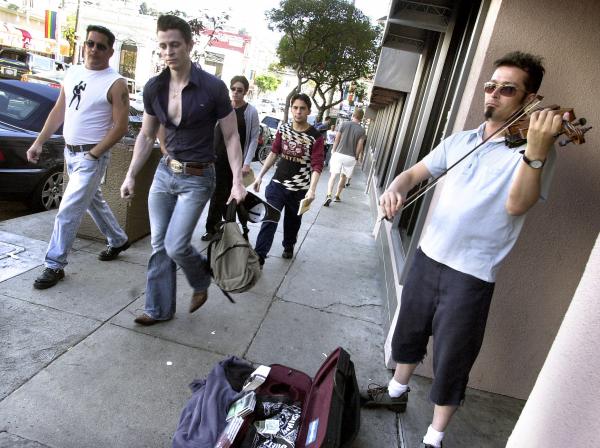
Bicyclists and motorists often clash in San Francisco, over space on the roadways and in conversations about each others’ behaviors, often in the most acrimonious fashion imaginable. My recent writing on bike issues has prompted lots of feedback and controversy – including lovely comments such as “Steve, keep riding your bike without a helmet, with any luck you’ll get in an accident and what little brains you have will spill out onto the street and we won’t have to read your smug condescending bullshit about bikes anymore.” – but I’m not the only one interested in trying to figure out how this gulf got so wide or how to bridge it.

The San Francisco Civil Grand Jury recently issued a report entitled “Sharing the Roadway: From Confrontation to Conversation,” that identifies strife between cyclists and drivers as a serious problem and seeks “to move towards everyone seeing him/her self as part of the community sharing the roadway.”

It’s an admirable goal that echoes that of the SF Bicycle Plan, and the 40-page report occasionally offers some insight into diagnosing why the problem exists, although it focuses mostly on the behaviors of bicyclists and the view by motorists that people who bike are arrogant, dangerous, irresponsible, erratic, inconvenient, vulnerable, and despised, all adjectives it gleaned for a 2002 study in Scotland, for some reason.

The report calls for more education and enforcement that targets all road users, but it seems most focused on criticizing bicyclists for running stop signs and other traffic violations, noting how cyclists are rarely given citations and saying that’s at least partly because cyclists have become politically powerful and are more likely to file complaints about cops who ticket them. In other words, we cyclists are the overentitled special interest that the angriest motorists say we are.

The report even discusses such radical ideas as requiring cyclists to get licenses, pay registration fees, and buy insurance, but it gives no mention to radical ideas on the other end of the spectrum, such as importing traffic laws from Idaho, where cyclists legally treat stop signs as yield signs and stop lights as stop signs, which conforms to current behaviors and the laws of momentum and doesn’t steal anyone’s right-of-way. Clearly, this was not a report written by cyclists.

“If San Francisco truly wants to increase responsible bicycle use, it will need to solve the issues of anger, misunderstanding, and mistrust between motorists and cyclists, and increase everyone’s view of shared responsibility on the roadway,” recommends the report.

I thought it was a bit vague and one-sided, but San Francisco Bicycle Coalition acting director Renee Rivera said it strongly supports the SFBC-backed Bike Plan, which was its target subject. “The report goes into a lot of anecdotal detail, but the recommendations are pretty good stuff,” she said, adding that SFBC’s members aren’t exclusively cyclists, “but people using different modes at different times for different reasons.”

On the other end of the spectrum are people like local bike messenger Adam Shapiro, who says he also wants to improve communication between cyclists and motorists, but he’s come up with a different kind of conversation starter, one he’s been handing out to fellow cyclists.

It’s a magnetized “Yellow Card” that cyclists can toss onto a car that reads, “This magnet was tossed onto your car by a cyclist who felt that you had been driving in a way that could endanger their life. They chose to toss this magnetic note because it can neither damage your automobile, nor will it disrupt your driving. It serves as our communication in a world buffered by steel, glass, and speed. With mutual respect, we can each adjust our behavior to allow all people to live in safety. This is a yellow card, your awareness can keep us out of the Red.”

Shapiro said he heard about the idea from East Coast cyclist Peter Miller, who he met and borrowed the concept from, changing the wording on his version. “This is starting a conversation between two human beings who can be more civil to each other than they have been,” Shapiro told me. Shapiro said he’s experienced the full range of emotional responses to threatening behavior by motorists, from fear to rage to “dreary acceptance,” but that lately, “I’ve shifted away from cycling as war.”

He still rides quite aggressively, in a fashion likely to anger many biker-haters, and he says that his Yellow Card is actually made more for good, respectful cyclists that want to communicate their fear and vulnerability to distracted or self-centered motorists, but who often feel powerless to do so in a highly buffered urban culture. “This subversion of that is unique in saying, ‘We can communicate in a way that’s non-violent,” he said.

And perhaps that’s true, although I tend to think that neither the yellow cards nor educational campaigns are likely to lessen the tension anytime soon. There’s still too much resentment on both sides, with motorists feeling judged for their wasteful and dangerous transportation choice and outraged that bicyclists flout traffic laws, and bicyclists feeling judged for riding in a way that makes sense (even to The Ethicist Randy Cohen) and doesn’t hurt anyone and outraged for being the target of such scorn for choosing such a widely beneficial way of getting around.

But Rivera said she thinks tensions will wane as traffic design improvements “lessen the places where friction develops on the streets,” and the growing number of cyclists forces everyone to get used to each other and figure out strategies for peaceful coexistence.

Benefits: May 19-May 25

0

Ways to have fun while giving back this week

Friday, May 21


Threatened, Endangered, Extinct

Celebrate 2010 Endangered Species Day at this lively discussion with experts currently creating strategies to protect biodiversity and convert consumers worldwide featuring cocktails, hors d’oeuvres, a silent auction including travel, restaurants, jewelry, limited edition signed wildlife prints, and more.
6 p.m., free
The University Club
800 Powell, SF
RSVP to sullivan@wildaid.org

Three-Minute Picture Show
Shake your booty to the music of Ron Silva and the Monarchs and enter to win raffle prizes from 3 Fish Studios, Books Inc., Gregory Cowley Photography, Interior Design Fair, Madrone Art Bar, and more at this benefit soiree featuring a screening of past Three-Minute Picture Show audience favorites.
7:30 p.m., $7
Make-Out Room
3225 22nd St., SF
www.threeminutepictureshow.com

Saturday, May 22

Bachelor Firefighter Auction
Bid on a smokin’ hot bachelor and enjoy raffle prizes, music, and other suprises at this fundraiser for the Alisa Ann Ruch Burn Foundation, a nonprofit dedicated to enhancing the lives of burn survivors and promoting burn prevention education.
8 p.m., $35
Sir Francis Drake Hotel
450 Powell, SF
http://buyfiremen.eventbrite.com

Harvey Milk Diversity Brunch
Celebrate the birthday and life of Harvey Milk, the first openly gay elected official. Enjoy well-known speakers from the LGBT community, food from Hott Box Catering, and more at this fundraiser for La Cocina, a small business support resource.
10:30 a.m., $65
The Arc of San Francisco
1500 Howard, SF
www.milkday.org

Public Glass Auction
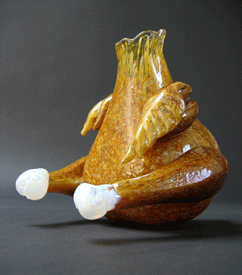
Attend this benefit auction featuring the work of more than 60 renowned glass artists, wine, and hors d’ oeuvres. Proceeds will go towards Public Glass’ education program that reaches 300 students a year.
4:30 p.m., $50
First Unitarian Universalist Church and Center
1187 Franklin, SF
www.publicglass.org

Reliquarium
Attend this auction of reliquary-like objects representing the artistic DNA of writers and artists, housed in an attractive container. Participating artists include Justin Timberlake, Lemony Snicket, Jonathan Lethem, Anne Waldman, and more. Proceeds to benefit Small Press Traffic, an organization that brings together independent readers, writers, and presses.
5:30 p.m., $20 includes refreshments
California College of the Arts
Graduate Writing Studio
195 De Haro, SF
www.sptraffic.org

Sunday, May 23

Backyard BBQ for Chile
Join the Art House Gallery at this backyard potluck BBQ to benefit the Chile Earthquake Relief Effort featuring live music by Rafael Manriquez, Esteban Bello, Clara Bellino, and more. Look for the balloons.
Noon, $5-$50
Edith between Cedar and Lincoln, Berk.
(510) 472-3170

Castro County Fair
Join AIDS Emergency Fund on Harvey Milk weekend for a one of a kind county fair and fundraiser, featuring a dog-owner look alike contest, carnival games, country western dancing, a pie baking contest, an orchid show, field day events, and more.
10 a.m., $25
The Armory
14th at Mission, SF
www.castrocountyfair.org


Chance for Change

Enjoy a night of food, music, an auction, and a tribute to the struggles of homeless women and children at this fundraiser for Berkeley Women’s Daytime Drop-In Center, a daytime program for homeless women and their children.
3 p.m., $50
St. Alban’s Episcopal Church
1501 Washington, Albany
(510) 548-2884
www.womensdropin.org

Hidden Gems Garden Tour
Take a look at ten inspiring private gardens and public spaces with gardeners on hand to answer questions at this fundraiser for the new Potrero Hill Library.
10 a.m.; $25, $40 for two
Christopher’s Books
1400 18th St., SF
(415) 255-8802
All States Best Foods
1607 20th St., SF
(415) 642-3230

San Francisco gaze

0

arts@sfbg.com

MUSIC On certain mornings in San Francisco, I step outside and feel as if I’m enveloped by clouds. Dew drops slide off of wiry branches, sparkling as they hit the cement sidewalk. Is it pretty or is it dark? It’s pretty and dark. Before I lived here, it wasn’t clear to me that this was even possible. As the day unravels, it reveals both sunny and stormy moments.

Much like a San Francisco day, the no-fi psych-rock of Young Prisms casts sunbeams and rain showers. Sitting with the group on the rooftop of Ruminator Audio, a studio space in the Mission, I ask about the moods it aims to create and receive. I hear the words "dream-state," "California," "tripped-out," "engaging," "engrossing," and, finally, guitarist-vocalist Matthew Allen’s breakdown: "It’s made so you can hear it two different ways. So each time you listen to it, whether at a show or on your headphones, you’ll discover totally different things."

Four-fifths of the group spent their childhoods in all-boy or all-girl schools on the Peninsula, where a strange amalgam of suburbia and house parties drove them to wage war against ennui by making music. Randomly — once — they performed as individual musicians at an improv show at Mills College before they found each other as a band. Bassist-vocalist Giovanni Betteo played a miked typewriter; Allen and guitarist-vocalist Jason Hendardy played guitar.

Eventually, in a desperate attempt to escape the suburban boredom that bubbled outward as they got older, the barely 20-year-olds moved into a house in San Francisco. Here they met Jordan Silbert, a Detroit native, who completed the prism as drummer. As Silbert jokes, "It’s been the worst two years of my life."

In the YP’s Mission house, the friends became a band. The energy of "a crammed, shitty apartment," as Betteo deems it, led to productivity and tomfoolery. "But at least we were able to practice there," Betteo notes. To which vocalist Stefanie Hodapp adds, "And play music how we wanted to."

"We had just started writing songs again for the first time in years, and also had just met Jordan. So things were really weird," Betteo elaborates. "We were trying to understand each other’s personal styles for a while and what we’re into. We would try different techniques, like jamming together or individually bringing in parts of songs."

"One day it all freely came out," he says. And the band’s self-titled EP for Mexican Summer was born. Its combination of shredded chords, dreary drumbeats, and nostalgic crooning is luminous and murky.

SXSW and an accompanying tour forced YP to abandon their San Francisco rental, and on returning, they’ve found themselves scattered across the city — in the closet spaces of their friends in the group Weekend and on borrowed couches. "We are certain there will be a new YP home," the band declares. "Sometime soon, we hope." The house had negative and positive aspects, they explain. Someone on their block was shot in the dick. There was blood on their porch for weeks.

Young Prisms’ upcoming show with Weekend celebrates a new split-single on Transparent. It is the first in a succession of releases from the prolific band: a split 7-inch with Mathemagic on Atelier Ciseaux, a live 12-inch on Under Water Peoples, and a full-length that might be released at the end of the summer.

According to Batteo, the track on the Weekend split, titled "I Don’t Get Much," is a precursor to the sound of the upcoming full-length. The album is being mixed by Monte Vallier beneath the roof where we sit. "It’s the last song we wrote in the apartment," Betteo says. "From there, the songs have become more cohesive. There is more focus and more of a mission."

"I Don’t Get Much" slowly flows in with shoegaze reverb, rises up, and then drags the listener down. The water levels eventually re-rise and plateau. There are echoes, heartbeats, and an apocalyptic romance, as male and female vocals repetitively discuss the end.

When I ask the band to explain the existentialist undercurrent that ripples throughout the song, Allen rhetorically asks: "If you don’t do anything, what does it really matter?" And vocalist-partner Hodapp notes, "It’s about how dying does not matter once you get in the ground."

Can a dark day be textured with the pretty? Or is the sunny sky filled with clouds? Young Prisms have the answers. *

YOUNG PRISMS

With Weekend, Grave Babies, and Swanifant

Sun/30, 9:30 p.m., 8 p.m., $8

Hemlock Tavern

1131 Polk St., S.F.

(415) 923-0923

www.youngprisms.com

Garcon!

0

paulr@sfbg.com

DINE When Garçon! succeeded Alma about four years ago, I thought: well, there goes the neighborhood. Alma had been a rather special place, a temple of nuevo Latino cooking, and it had a witty name that meant “soul” in Spanish while slyly referring to the owner-chef, Johnny Alamilla. “Garçon,” by contrast, is a word of near-abuse that gets shouted at servers in French restaurants in dumb movies — or, occasionally, in real life, at real servers by dumb people.

The word “garçon” should probably have an exclamation point appended to it as a matter of routine, and — huzzah! (or voilà?) — the signage at Garçon! includes the exclamation point! In the restaurant’s early days, the signage was dismal, a sharp falling-off from Alma’s, and I took this to be a bad sign: just cheap-looking banners rippling in the breeze, as if they were having a Labor Day clearance sale on washers and dryers.

The improved signage suggests that Garçon! has settled into its rather choice location. There is a certain amount of history to live up to. In addition to (and before) Alma, the nicely windowed corner space at the corner of 22nd and Valencia streets was home to the Rooster, which was interesting in a slightly odd way.

Garçon! isn’t odd, but it is a good, solid French restaurant in a neighborhood that has just about every other kind of restaurant other than. So maybe it’s a little eccentric after all, or maybe just unexpected. Certainly it’s good-looking; the Iberian-grotto look of Alma has been swept away in favor of metropolitan polish; Garçon! might be one of the most Parisian-looking restaurants in the city, with its vintage Dubonnet posters and individual lamps on each table (each fitted with a CFL, for greeniac cred). Their glow warms the dark wood of the tables.

Chef Arthur Wall’s food is of the hearty school. This is not a restaurant you will leave hungry. If you have any doubts about getting your fair share, you might be interested in the prix-fixe, $32 for three courses, which is a little high to provide true economy of scale but does ensure that you get three courses. It brought me, one evening, a substantial coq au vin, a dish I don’t see offered that much any more although, like its close relation boeuf bourguignon, is one of the staples of French country cooking. At Garçon! the coq turned out to be a whole leg (thigh plus drumstick) braised in red wine with bacon, carrots, and pearl onions — a fairly wintry dish to be offering in mild springtime, I thought, but the meat was tender and juicy, and a wonderfully thick sauce had gathered at the bottom of the earthenware crock.

The pork chop ($23) didn’t appear on the prix-fixe menu — maybe because it wouldn’t fit. It was a massive fist of meat, nicely cooked to a hint of rareness and laid atop a bed of symmetrically diced potatoes. A bit less overwhelming in scale, and more stylish, was duck-leg confit ($19 — not a bad price), stylishly presented with a potato mousseline, braised baby leeks, and sections of mandarin orange. Only the duck fiend would have had this after having had duck-liver paté ($9), a creamy, mild square like a thick slice of white cheese, along with toast points, arugula, apple slices, and a red wine syrup that could have passed for some kind of berry coulis.

As a Francophile, it does slightly grieve me to say that French handling of the hamburger can sometimes leave something to be desired. At Garçon! you can have your burger ($12) decorated with a slice of cheese ($2) of your choice — brie, say, to go with the brioche bun for what I thought of as the Frenchburger. The meat turned out to be okay if overcooked (I asked for medium-rare, got well-done), and the bun was fine if a bit puffy. But the cheese! Mon dieu! Brie does not belong on a cheeseburger; it resists melting and acquires an unappealing mustiness from the heat. The fries were decent but could have been more crisp and golden. If you need a rinse aid, you might be interested in the burger and beer ($15).

The dessert menu includes a glimpse of the sublime: a chocolate ganache tart ($9) accompanied by sour cherries, mint, and a puff of whipped cream that one time was made with goat cheese and another with plain sweet cream. The accompaniments are nice, but the tart, with its flaky-crisp pastry crust and voluptuous chocolate filling — like a cross between pudding and fudge — can stand on its own. I’m tempted to add an exclamation point but won’t. 

GARÇON!

Dinner: Tues.–Thurs., Sun. 5–10:30 p.m.; Fri.–Sat., 5:30–11 p.m.

1101 Valencia, SF

(415) 401-8959

www.garconsf.com

Full bar

AE/DC/MC/V

Somewhat noisy

Wheelchair accessible

BP still claiming exploded oil rig was safe and reliable

0

The corporate communications industry has gotten so ridiculous, so disconnected from reason and a sense of shame, or an obligation to provide some semblance of truth or credibility, that it’s amazing we still listen to these people at all anymore. And the best example of that right now is BP, the oil giant that is well on its way being responsible for the worst oil spill in history.

Beyond the sheer magnitude of this Gulf of Mexico spill, there have been well-sourced media reports that political appointees in the regulator agencies ignored the warnings of Minerals Management Services scientists that a devastating spill was a real possibility and that even BP employees warned that a spill could happen and that internal documents were a mess.

But rather than simply accepting responsibility and their newfound infamy and humbly trying to make amends, BP’s flaks have instead been sending out regular press releases attacking the media reports and making claims that this rig was safe, well-operated, and aggressively regulated – all evidence to the contrary.

“As CEO Tony Hayward constantly makes clear, safe and reliable operations are his number 1 priority for BP and the company has a very strong record of safe and reliable operations in the Gulf of Mexico,” the company wrote. “It is completely erroneous to suggest that the minor internal process issue we identified and immediately amended last year on the Atlantis platform suggests anything different.”

Sure, our rig blew up and created an oil gusher that we have no idea how to stop, but that doesn’t mean we aren’t “safe and reliable,” right? Um, actually it does, otherwise this wouldn’t have happened. BP even tries to claim credit for the fact that this spill didn’t happen even earlier.

“The Atlantis field has been in service since October 2007 and has safely produced many million barrels of oil. The platform was successfully maintained through the course of two major hurricanes in 2008. Its safety, operations and performance record is excellent,” they wrote.

Sure, right up until it was terrible. But even now, with the irreparable devastation this company has caused, they are also trying to sound like good guys for generously offering to pay for some of the ancillary damage they caused. Here’s what the company sent out under the cheery heading, “BP Announces Tourism Grants to Four Gulf States”:

“BP is today announcing grants to each of the states of Florida, Alabama, Mississippi and Louisiana to help their Governors promote tourism around the shores of the Gulf of Mexico over the coming months. This is part of our ongoing commitment to help mitigate the economic impact of the oil spill.

BP is providing $25 million to Florida and $15 million each to Alabama, Mississippi and Louisiana. “The Gulf Coast is our home too. We are doing everything we can to plug the leak, contain the spill offshore and protect the shoreline.  With the deployment of the riser insertion tool yesterday, we made important progress in containing the spill, and that will further strengthen our ability to keep oil off the shore,” said Tony Hayward, BP’s Group Chief Executive.

Sure, BP and their allies in the oil industry and the conservative movement put a cap of $75 million on how much the U.S. government can make oil companies pay to clean up their messes, but they’re happy to promote the area they marinaded in crude oil as a tourist destination. This is a weird world we live in.

Rep Clock

0

Schedules are for Wed/19–Tues/25 except where noted. Director and year are given when available. Double features are marked with a •. All times are p.m. unless otherwise specified.

ARTISTS’ TELEVISION ACCESS 992 Valencia, SF; www.atasite.org. $6-7. Bordello (Trouble), Fri, 8. With live burlesque before the film. “Other Cinema:” O’er the Land (Stratman, 2008), Sat, 8:30.

BERKELEY FELLOWSHIP OF UNITARIAN UNIVERSALISTS Fellowship Hall, 1924 Cedar, Berk; www.bfuu.org. Donations accepted. “Palestine: Occupied Lives, Non-Violence, and Steadfastness:” Slingshot Hip Hop (Salloum, 2008), Fri, 7.

CAFÉ OF THE DEAD 3208 Grand, Oakl; (510) 931-7945. Free. “Independent Filmmakers Screening Nite,” Wed, 6:30.

CASTRO 429 Castro, SF; (415) 621-6120, www.castrotheatre.com. $7.50-10. Iron Man 2 (Favreau, 2010), Wed-Thurs, 11am, 1:30, 4:30, 7:30, 10:15; call for Fri-Tues showtimes.

CHRISTOPHER B. SMITH RAFAEL FILM CENTER 1118 Fourth St, San Rafael; (415) 454-1222, www.cafilm.org. $6.50-10. Babies (Balmès, 2010), call for dates and times. The Girl With the Dragon Tattoo (Oplev, 2009), call for dates and times. OSS 117: Lost in Rio (Hazanavicius, 2009), call for dates and times. Touching Home (Miller and Miller, 2009), call for dates and times. Godspeed (Saitzyk, 2009), Wed, 7.

DECO LOUNGE 510 Larkin, SF; (415) 346-2025, www.decosf.com. Free. “Queer Cinema 101,” Mon, 10. Holly DeVille hosts a new weekly show highlighting films that have had an impact on queer culture.

FILM NIGHT IN THE PARK This week: Creek Park, 451 Sir Francis Drake, San Anselmo; (415) 272-2756, www.filmnight.org. Donations accepted. Sherlock Holmes (Ritchie, 2009), Fri, 8; The Princess and the Frog (Clements and Musker, 2009), Sat, 8.

HUMANIST HALL 390 27th St, Oakl; www.humanisthall.org. $5. Bab’Aziz: The Prince Who Contemplated His Soul (Khemir, 2005), Wed, 7:30.

MECHANICS’ INSTITUTE 57 Post, SF; (415) 393-0100, rsvp@milibrary.org. $10. “CinemaLit Film Series: Heroic Horizons: The View from Australia:” Muriel’s Wedding (Hogan, 1960), Fri, 6.

MUSEUM OF THE AFRICAN DIASPORA 685 Mission, SF; www.crepecoveredsidewalks.com. $15. Crepe Covered Sidewalks (Wilson, 2008), Thurs, 6.

ODDBALL FILMS 275 Capp, SF; (415) 558-8117, info@oddballfilm.com. $10 (RSVP required). •Popatopolis (Westervelt, 2009) and Chopping Mall (Wynorski, 1986), Fri, 8.

PACIFIC FILM ARCHIVE 2575 Bancroft, Berk; (510) 642-5249, www.bampfa.berkeley.edu. $5.50-9.50. Theater closed through May 28.

PIEDMONT 4186 Piedmont, Oakl; (510) 464-5980. $5-8. “Cult Classics Attack 5:” The Muppets Take Manhattan (Oz, 1984), Fri-Sat, midnight; Sun, 10am.

RED VIC 1727 Haight, SF; (415) 668-3994. $6-10. Fish Tank (Arnold, 2009), Wed, 2, 7, 9:20. The Crazies (Eisner, 2010), Thurs-Sat, 7:15, 9:30 (also Sat, 2, 4:15). Shoot the Piano Player (Truffaut, 1960), Sun-Mon, 7:15, 9:15 (also Sun-Mon, 2, 4). Fear and Loathing in Las Vegas (Gilliam, 1998), May 25-26, 7:30, 9:30 (also May 26, 2).

ROXIE 3117 and 3125 16th St, SF; (415) 863-1087, www.roxie.com. $5-9.75. “I Still Wake Up Dreaming! Noir is Dead/Long Live Noir:” •Sideshow (Yarbrough, 1950), Wed, 6:40, 9:50, and The Red House (Daves, 1947), Wed, 8; •Lighthouse (Wisbar, 1947), Thurs, 6:45, 9:15, and Voice of the Whistler (Castle, 1945), Thurs, 8; •Roses Are Red (Tinling, 1947), Fri, 6, 8:40, and Secret of the Whistler (Sherman, 1946), Fri, 7:20, 9:50; •Johnny Cool (Asher, 1963), Sat, 3:30, 7, and Cop Hater (Berke, 1958), Sat, 5:30, 9; •The Fearmakers (Tourneur, 1958), Sun, 1:30, 4:45, 8, and Stolen Identity (von Fristch, 1953), Sun, 3:15, 6:20, 9:40; •The Lady and the Monster (Sherman, 1944), Mon, 6:14, 9:45, and Dark Waters (De Toth, 1944), Mon, 8; •The Glass Alibi (Wilder, 1946), Tues, 6:45, 9:15, and Secrets of Monte Carlo (Blair, 1951), Tues, 8. October Country (Palmieri and Mosher, 2009), Wed-Thurs, 7:45. The Square (Edgerton, 2008), Wed-Thurs, 9:30.

VICTORIA THEATRE 2961 16th St, SF; (415) 568-5739, www.countercorp.org. $10. “CounterCorp: Fifth Annual Anti-Corporate Film Festival,” Thurs-Sat.

VINE CINEMA 1722 First Street, Livermore; www.thrillville.net. $10. “Thrillville’s Shatfest:” Impulse (Grefe, 1974), and White Comanche (Méndez, 1967), Thurs, 7:30.

YERBA BUENA CENTER FOR THE ARTS 701 Mission, SF; (415) 978-2787, www.ybca.org. $6-8. “Scandinavian Blue: Book Launch and Screening with Jack Stevenson,” Thurs, 7:30. With a screening of Venom (1966). “To the Limit: Pina Bausch on Film:” Two Performance Films: Walzer and Café Müller (1982 and 1978), Sun, 2.

Film listings

0

Film listings are edited by Cheryl Eddy. Reviewers are Kimberly Chun, Michelle Devereaux, Max Goldberg, Dennis Harvey, Johnny Ray Huston, Erik Morse, Louis Peitzman, Lynn Rapoport, Ben Richardson, and Matt Sussman. The film intern is Peter Galvin. For rep house showtimes, see Rep Clock. For first-run showtimes, see Movie Guide.

OPENING

The City of Your Final Destination In James Ivory’s latest literary adaptation, Omar (Omar Metwally), an Iranian American graduate student of Latin American literature, precipitously descends on a rural estate in Paraguay, hoping to petition the relatives of deceased writer Jules Gund for authorization to write his biography. Numbering among the somewhat complicated ménage are Gund’s widow, Caroline (Laura Linney), his mistress, Arden (Charlotte Gainsbourg), their child, Portia (Ambar Mallman), the author’s brother, Adam (Anthony Hopkins), and Adam’s lover, Pete (Hiroyuki Sanada), a household that the film depicts as caught in a sedative isolation obstructing any progress or flourishing or change. But where Gund’s violent suicide has failed to produce a cataclysmic shift, the somewhat hapless Omar manages to interrupt their idle routines and mobilize them, stirring up sentiment and ambition. The notion of redirected fate is telegraphed by the title, but what the film does best is show the calm before the storm (really more of a heavy downpour) — and showcase the fineness of Hopkins’s and Linney’s dramatic abilities. In the final act, we see the characters being moved about rather than moved, and the sound of screeching brakes applied as the film reaches its conclusion undoes much of the subtlety invested in their performances. (1:58) Embarcadero, Shattuck. (Rapoport)

*Dirty Hands The 1990s-ish iconoclastic, workaholic breed of Asian hipster is obsessively worked by David Choe in Dirty Hands. Exhaustively documenting the Los Angeles-born artist for eight years as he matures before our eyes, director Harry Kim charts the growth spurts: from mischievous tot to shoplifter and graf artist to porn illustrator to street-art superstar to spiritual penitent after a stint in a Tokyo jail. The filmmaker doesn’t seem to know quite when to stop, but then neither does his subject: an obviously intelligent, playful talent who specializes in compulsively analyzing himself and pushing himself to the limits of the law, his work, and his own (r)evolution as a human being. So driven in his pursuit of edge-skating experiences that he comes off as less hipster than haunted, Choe and his Bukowskian tendencies, Vice aesthetics, and "deep" thoughts rivet long after the bodily fluids and sensory overload murals congeal. (1:33) Roxie. (Chun)

Kites This Bollywood action-romance is "presented by" Brett Ratner (apparently, he helped re-edit this English version). (1:30)

MacGruber Will Forte’s bemulleted, MacGyver-biting Saturday Night Live character gets his own movie. (1:39)

Paper Man Though certainly offbeat enough to fall into the quirky indie category, Paper Man reminds us that weird is not always good. There’s very little original about the main conceit: plagued by writer’s block, Richard Dunn (Jeff Daniels) rents a house in Montauk where he befriends outcast Abby (Emma Stone), a teenage girl with a tragic past. The film’s unique addition is Richard’s imaginary friend Captain Excellent, played by Ryan Reynolds in full-on superhero attire. But Captain Excellent is so absurdly campy that he’s almost too much to take — which wouldn’t be such a problem if Paper Man weren’t asking us to take it seriously. The wacky superhero scenes are mostly out-of-place, and all the heavy drama moments fall flat. But even without the muddled tone, Paper Man is riddled with clichés. We’ve seen enough of the zany manchild learning valuable life lessons, and the troubled teen forming an unlikely bond. At this point, there’s nothing super about it. (1:50) Lumiere. (Peitzman)

Shrek Forever After 3D Mike Myers has sure gotten a lot of longevity out of his Scottish accent. (1:33) Four Star, Presidio.

ONGOING

Alice in Wonderland Tim Burton’s take on the classic children’s tale met my mediocre expectations exactly, given its months of pre-release hype (in the film world, fashion magazines, and even Sephora, for the love of brightly-colored eyeshadows). Most folks over a certain age will already know the story, and much of the dialogue, before the lights go down and the 3-D glasses go on; it’s up to Burton and his all-star cast (including numerous big-name actors providing voices for animated characters) to make the tale seem newly enthralling. The visuals are nearly as striking as the CG, with Helena Bonham Carter’s big-headed Red Queen a particularly marvelous human-computer creation. But Wonderland suffers from the style-over-substance dilemma that’s plagued Burton before; all that spooky-pretty whimsy can’t disguise the film’s fairly tepid script. Teenage Alice (Mia Wasikowska) displaying girl-power tendencies is a nice, if not surprising, touch, but Johnny Depp’s grating take on the Mad Hatter will please only those who were able to stomach his interpretation of Willy Wonka. (1:48) SF Center. (Eddy)

*Babies Thomas Balmes’ camera records the first year in the lives of four infants in vastly different circumstances. They’re respectively born to hip young couple in Tokyo’s high-tech clutter; familiar moderately alterna-types (the father is director Frazer Bradshaw of last year’s excellent indie drama Everything Strange and New) in S.F.’s Mission District; a yurt-dwelling family isolated in the vast Mongolian tundra; and a Namibian village so maternally focused that adult menfolk seem to have been banished. Yes, on one level this is the cutest li’l documentary you ever saw. But if you were planning to avoid thinking that is all (or most) of what Babies would be like, you will miss out bigtime. Void of explanatory titles, voice-over narration, or subtitle translations, this is a purely observatory piece that reveals just how fascinating the business of being a baby is. There’s very little predictable pooping, wailing, or coddling. Instead, Balmes’ wonderful eye captures absorbing moments of sussing things out, decision-making, and skill learning. While the First World tykes firstborns both — are hauled off to (way) pre-school classes, the much less day planned Third Worlders have more complex, unmediated dealings with community. Those range from fending off devilish older siblings to Mongol Bayarjargal’s startlingly casual consorting with large furry livestock. (Imagine the horror of parents you know were their baby found surrounded by massive cows — a situation that here causes no concern whatsoever for adults, children, or bovines.) So accustomed to the camera that it doesn’t influence their behavior, the subjects here are viewed with an intimacy that continually surprises. Babies is getting a wider-than-usual release for a documentary, one cannily timed to coincide with Mother’s Day. But don’t be fooled: this movie is actually very cool. (1:19) Albany, Empire, 1000 Van Ness, Piedmont, Smith Rafael, Sundance Kabuki. (Harvey)

The Back-Up Plan (1:40) SF Center.

*Casino Jack and the United States of Money Casino Jack is big-budget documentary filmmaking, glossy and prone to expensive music cues, but I suppose you get a license to be flashy when you’ve proven to be as good at it as Alex Gibney. The director of Enron: The Smartest Guys in the Room (2005) and Academy Award winner Taxi to the Dark Side (2007), Gibney sets his sights on Washington lobbyist Jack Abramoff with an abundantly in-depth exploration of government greed and fraud. Investigating Abramoff’s indiscretions, from his introduction as chairman of the College Republicans, to his illegal selling of House votes for sweatshops in the Mariana Islands and over-billing of numerous Indian casinos, Gibney solidly serves Abramoff his just desserts. The director is equally interested in questioning the kind of government America has fostered that turns a blind eye to this sort of behavior. (2:02) Opera Plaza, Shattuck. (Galvin)

*City Island The Rizzo family of City Island, N.Y. — a tiny atoll associated historically with fishing and jurisdictionally with the Bronx — have reached a state where their primary interactions consist of sniping, yelling, and storming out of rooms. These storm clouds operate as cover for the secrets they’re all busy keeping from one another. Correctional officer Vince (Andy Garcia) pretends he’s got frequent poker nights so he can skulk off to his true shameful indulgence: a Manhattan acting class. Perpetually fuming spouse Joyce (Julianna Margulies) assumes he’s having an affair. Daughter Vivian (Dominik García-Lorido) has dropped out of school to work at a strip joint, while the world class-sarcasms of teenager Vinnie (Ezra Miller) deflect attention from his own hidden life as an aspiring chubby chaser. All this (plus everyone’s sneaky cigarette habit) is nothing, however, compared to Vince’s really big secret: he conceived and abandoned a "love child" before marrying, and said guilty issue has just turned up as a 24-year-old car thief on his cell block. Writer-director Raymond De Felitta made a couple other features in the last 15 years, none widely seen; if this latest is typical, we need more of him, more often. Perfectly cast, City Island is farcical without being cartoonish, howl-inducing without lowering your brain-cell count. It’s arguably a better, less self-conscious slice of dysfunctional family absurdism than Little Miss Sunshine (2006) — complete with an Alan Arkin more inspired in his one big scene here than in all of that film’s Oscar-winning performance. (1:40) Lumiere, Shattuck. (Harvey)

Clash of the Titans The minds behind Clash of the Titans decided their movie should be 3D at the last possible moment before release. Consequently, the 3D is pretty janky. I don’t know what the rest of the film’s excuse is. Clash of the Titans retreads the 1981 cult classic with reasonable faithfulness, though Ray Harryhausen’s stop-motion effects have been (of course) replaced with CG renderings of all the expected monsters, magic, gods, etc. Liam Neeson and Ralph Fiennes — as other reviews have pointed out: Schindler’s List (1993) reunion! — glow and glower as Zeus and Hades, while Sam Worthington (2009’s Avatar) once again fills the role of bland hero, this time as a snooze-worthy Perseus. You might have fun in the moment with Clash of the Titans, but it’s hardly memorable, and certainly nowhere near epic. (1:58) SF Center. (Eddy)

Date Night By today’s comedy standards, Date Night is positively old-fashioned: a case of mistaken identity causes a struggling married couple (Steve Carell and Tina Fey) to be tangled in a ransom plot for a stolen flash drive that belongs to a local mob boss. Unfussy plots are par for the course for films belonging to the all-but-lost "madcap all-nighter" genre, and in this case the simplicity of the set-up becomes Date Night‘s greatest asset, allowing Carell and Fey free reign to joke and ad lib lines. Like it or loathe it, the pair’s trademark senses of humor are the movie, and they arrange some pretty gleefully entertaining bits on the fly. Toss in a bunch of cameos from the likes of Ray Liotta and Mark Wahlberg and you’ve got yourself a bona fide movie-film, but it’s difficult not to see what Date Night might have been with just a smidge more effort. (1:27) 1000 Van Ness, SF Center. (Galvin)

*Exit Through the Gift Shop Exit Through the Gift Shop is not a film about the elusive graffiti-cum-conceptual artist and merry prankster known as Banksy, even though he takes up a good chunk of this sly and by-no-means impartial documentary and is listed as its director. Rather, as he informs us — voice electronically altered, face hidden in shadow — in the film’s opening minutes, the film’s real subject is one Thierry Guetta, a French expat living in LA whose hangdog eyes, squat stature, and propensity for mutton chops and polyester could pass him off as Ron Jeremy’s long lost twin. Unlike Jeremy, Guetta is not blessed with any prodigious natural talent to propel him to stardom, save for a compulsion to videotape every waking minute of his life (roughly 80 percent of the footage in Exit is Guetta’s) and a knack for being in the right place at the right time. When Guetta is introduced by his tagger cousin to a pre-Obamatized Shepard Fairey in 2007, he realizes his true calling: to make a documentary about the street art scene that was then only starting to get mainstream attention. Enter Banksy, who, at first, is Guetta’s ultimate quarry. Eventually, the two become chummy, with Guetta acting as lookout and documenter for the artist just as the art market starts clambering for its piece of, "the Scarlet Pimpernel of street art," as one headline dubs him. When, at about three quarters of the way in, Guetta, following Banksy’s casual suggestion, drops his camcorder and tries his hand at making street art, Exit becomes a very different beast. Guetta’s flashy debut as Mr. Brainwash is as obscenely successful as his "art" is terribly unimaginative — much to the chagrin of his former documentary subjects. But Guetta is no Eve Harrington and Banksy, who has the last laugh here, gives him plenty of rope with which to truss himself. Is Mr. Brainwash really the ridiculous and inevitable terminus of street art’s runaway mainstream success (which, it must be said, Banksy has handsomely profited from)? That question begs another: with friends like Banksy, who needs enemies? (1:27) Embarcadero, Shattuck, Smith Rafael, Sundance Kabuki. (Sussman)

Furry Vengeance (1:32) SF Center.

*The Ghost Writer Roman Polanski’s never-ending legal woes have inspired endless debates on the interwebs and elsewhere; they also can’t help but add subtext to the 76-year-old’s new film, which is chock full o’ anti-American vibes anyway. It’s also a pretty nifty political thriller about a disgraced former British Prime Minister (Pierce Brosnan) who’s hanging out in his Martha’s Vineyard mansion with his whip-smart, bitter wife (Olivia Williams) and Joan Holloway-as-ice-queen assistant (Kim Cattrall), plus an eager young biographer (Ewan McGregor) recently hired to ghost-write his memoirs. But as the writer quickly discovers, the politician’s past contains the kinds of secrets that cause strange cars with tinted windows to appear in one’s rearview mirror when driving along deserted country roads. Polanski’s long been an expert when it comes to escalating tension onscreen; he’s also so good at adding offbeat moments that only seem tossed-off (as when the PM’s groundskeeper attempts to rake leaves amid relentless sea breezes) and making the utmost of his top-notch actors (Tom Wilkinson and Eli Wallach have small, memorable roles). Though I found The Ghost Writer‘s ZOMG! third-act revelation to be a bit corny, I still didn’t think it detracted from the finely crafted film that led up to it. (1:49) Opera Plaza, Presidio. (Eddy)

*The Girl With the Dragon Tattoo By the time the first of Stieg Larsson’s so-called "Millennium" books had been published anywhere, the series already had an unhappy ending: he died (in 2004). The following year, The Girl With the Dragon Tattoo became a Swedish, then eventually international sensation, its sequels following suit. The books are addicting, to say the least; despite their essential crime-mystery-thriller nature, they don’t require putting your ear for writing of some literary value on sleep mode. Now the first of three adaptive features shot back-to-back has reached U.S. screens. (Sorry to say, yes, a Hollywood remake is already in the works — but let’s hope that’s years away.) Even at two-and-a-half hours, this Girl With the Dragon Tattoo by necessity must do some major truncating to pack in the essentials of a very long, very plotty novel. Still, all but the nitpickingest fans will be fairly satisfied, while virgins will have the benefit of not knowing what’s going to happen and getting scared accordingly. Soon facing jail after losing a libel suit brought against him by a shady corporate tycoon, leftie journalist Mikael Blomkvist (Michael Nyqvist) gets a curious private offer to probe the disappearance 40 years earlier of a teenage girl. This entangles him with an eccentric wealthy family and their many closet skeletons (including Nazi sympathies) — as well as dragon-tattooed Lisbeth Salander (Noomi Rapace), androgynous loner, 24-year-old court ward, investigative researcher, and skillful hacker. Director Niels Arden Oplev and his scenarists do a workmanlike job — one more organizational than interpretive, a faithful transcription without much style or personality all its own. Nonetheless, Larsson’s narrative engine kicks in early and hauls you right along to the depot. (2:32) Bridge, Piedmont, Shattuck. (Harvey)

The Greatest Lofty title aside, there’s nothing particularly extraordinary about The Greatest. In many ways, it’s your standard grief porn, in that it focuses on a group of characters mourning a dead teenager for an hour and a half. On the other hand, the cast is tremendous — Susan Sarandon and Pierce Brosnan are solid as the parents of the broken Brewer family, but the young actors give the most memorable performances. Fresh off her Oscar nomination for An Education (2009), Carey Mulligan continues to mingle precociousness and naiveté. The Greatest also showcases the very talented Johnny Simmons, whose past films — Hotel for Dogs (2009) and Jennifer’s Body (2009) — haven’t exactly earned him exposure. For its genre, then, The Greatest is actually quite good. It has plenty of charm mixed with moments of genuine emotion, often marked by much welcome restraint. But even with a slight twist on the convention (Mulligan’s Rose is pregnant with the dead kid’s baby), it’s still just a well-made tearjerker. (1:36) Smith Rafael. (Peitzman)

Harry Brown Shades of Dirty Harry (1971) for the tea cozy and tweed set: elegantly rendered and very nicely played, Harry Brown might be the dark, late-in-the-day elder brother to 1971’s Get Carter, in the hands of eponymous lead Michael Caine. He’s a pensioner mourning the passing of his beloved wife, his mysterious life as a Marine stationed in Northern Ireland firmly behind him. Then his chess-playing pal Leonard (David Bradley) is terrorized and killed by the unsavory gang of heroin dealing hoodlums who lurk near their projects in a tunnel walkway like gun-toting, foul-mouthed, sociopathic trolls. Harry Brown is, er, forced to forsake a vow of peace and go commando on the culprits’ asses, triggering some moments of ultraviolence that are unsettling in their whole-hearted embrace of vigilante justice. Like predecessors similarly fixated on vengeance in their respective urban hells, a la Hardcore (1979) and Taxi Driver (1976) (Harry Brown echoes key moments in the latter, in particular — see, for instance, its keenly tense, eerily humorous gun shopping scene), Harry Brown is essentially an arch-conservative film, if good looking and even likable with Caine meting out the punishment. The overall denouement just might make some seniors feel very, very good about the coiled potential for hurt embedded in their aging frames. (1:42) Embarcadero, Shattuck, Sundance Kabuki. (Chun)

How to Train Your Dragon (1:38) 1000 Van Ness.

The Human Centipede (First Sequence) Director Tom Six had a vision, a glorious dream of surgically connecting three human beings via their gastro-intestinal systems, or as Kevin Smith would say — "ass to mouth." When two girlfriends on a road trip across Europe get a flat tire, they stumble upon the home of a mad doctor (Dieter Laser) with a similar dream, who drugs them and ties them up in his basement laboratory. The Human Centipede is an entry into the torture porn arena, but it feels especially icky because you just know that the girls have zero chance of escaping the "100 percent medically accurate!" surgery. Once hooked up, there’s nowhere for the film to go and two out of three actors can’t talk because they are sewn to someone else’s anus. Still, as one-note as The Human Centipede is, I think we’d do well to encourage more films to be as batshit insane as this one. (1:30) Bridge. (Galvin)

*Iron Man 2 Tony Stark (Robert Downey Jr.) returns, just as rich and self-involved as before, though his ego his inflated to unimaginable heights due to his superheroic fame. Pretty much, he’s put the whole "with great power comes great responsibility" thing on the back burner, exasperating everyone from Girl Friday Pepper Potts (Gwyneth Paltrow); to BFF military man Rhodey (Don Cheadle, replacing the first installment’s Terrence Howard); to certain mysterious Marvels played by Samuel L. Jackson and Scarlett Johansson; to a doofus-y rival defense contractor (Sam Rockwell); to a sanctimonius Senator (Garry Shandling). Frankly, the fact that a vengeful Russian scientist (Mickey Rourke) is plotting Tony’s imminent death is a secondary threat here — for much of the film, Tony’s biggest enemy is himself. Fortunately, this is conveyed with enjoyable action (props to director Jon Favreau, who also has a small role), a witty script (actor Justin Theroux — who knew? He also co-wrote 2008’s Tropic Thunder, by the way), and gusto-going performances by everyone, from Downey on down. Stay for the whole credits or miss out on the geek-gasm. (2:05) California, Castro, Empire, Four Star, Marina, 1000 Van Ness, Presidio, Sundance Kabuki. (Eddy)

Just Wright (1:51) 1000 Van Ness.

*Kick-Ass Based on a comic book series by Mark Millar, whose work was also the model for 2008’s Wanted, Kick Ass is a similarly over-the-top action flick that plays up its absurdity to even greater comedic effect. High school nerd Dave (Aaron Johnson) decides to become the world’s first real superhero. Donning a green wetsuit he bought on the internet and mustering some unlikely courage, he takes to the streets to avenge wrongdoing. Unsurprisingly, Dave is immediately beaten almost to death because he’s just a kid who has no idea what he’s doing, but Kick-Ass‘ greatest achievement is knowing exactly how to subvert audience expectations. Scenes that marry the film’s innocent story with enormously exaggerated violence enhance the otherwise Superbad-lite high-school comedy unfolding around them, and a parallel plot-line involving Nicolas Cage instructing his 12-year-old daughter to commit grievous murders will probably end up being the most gratifying aspect of the film. Though too much set-up and spinning gears mars the middle act, it’s hard to fault the film for competently setting up one of the most crowd-pleasing endings in recent memory. (1:58) 1000 Van Ness, SF Center. (Galvin)

Letters to Juliet If you can stomach the inevitable Barbara Cartland/Harlequin-romance-style clichés — and believe that Amanda Seyfried as a New Yorker fact-checker — then Letters to Juliet might be the ideal Tuscan-sunlit valentine for you. Seyfried’s Sophie is on a pre-honeymoon trip to Verona with her preoccupied chef-restaurateur intended, Victor (Gael Garcia Bernal), who’s more interested in sampling cheese and purchasing vino than taking in the romantic attractions of Verona with his fiancée. Luckily she finds the perfect diversion for a wannabe scribe: a small clutch of diehard romantics enlisted by the city of Verona to answer the letters to Juliet posted by lovelorn ladies. They’re Juliet’s secretaries — never mind that Juliet never managed to maintain a successful or long-term relationship herself. When Sophie finds a lost, unanswered letter from the ’50s, she sets off sequence of unlikely events, as the letter’s English writer, Claire (Vanessa Redgrave), returns to Verona with her grandson Charlie (Christopher Egan), in search of her missed-connection, Lorenzo. Alas, Lorenzo’s long gone, and the fact-checker decides to help the warm-hearted, hopeful Claire find her lost lover. Unfortunately Sophie’s chemistry with both her matches isn’t as powerful as Redgrave’s with real-life husband Franco Nero — after all he was Lancelot to her Guenevere in 1967’s Camelot and the father of her son. Still, Redgrave’s power as an actress — and her relationship with Nero — adds a resonance that takes this otherwise by-the-numbers romance to another level. (1:46) Marina, 1000 Van Ness, Piedmont, SF Center, Sundance Kabuki. (Chun)

The Little Traitor Lynn Roth’s film is set in 1947 Palestine, shortly before Israel became a state. Young Proffi Liebowitz (Ido Port) wasn’t yet born when his parents fled the Holocaust in Poland, but he’s politically tuned-in enough to form a mini-resistance group with his neighborhood pals, who plot against the occupying British forces (sample act of rebellion: "British Go Home" graffiti). Caught one night scampering home after the citywide curfew, Proffi meets Sergeant Dunlop (Alfred Molina), whose kindness makes the boy realize his black-and-white view of the enemy might have some room for color after all. Of course, Proffi’s friendship with the Brit, who teaches him to play snooker and pronounce complicated English words like "flatulence," is not received well by his community (see: film’s title). Despite its political undertones, this is a pretty standard coming-of-age tale (including the de rigueur "peeping on the sexy neighbor" subplot). Too bad the director decided to film so much of it in English — kid actor Port is far less cloying when he’s speaking his native Hebrew. (1:29) Opera Plaza. (Eddy)

*Mid-August Lunch Gianni Di Gregorio’s loose, engaging comedy is about an aging bachelor still living with his ancient mum in their Rome flat. When his landlord offers to forgive some debts in return for briefly taking in his own elderly ma, Gianni (played by the director himself) soon finds himself in cat-herding charge of no less than five old ladies who delight in one another’s company while running him ragged. Gomorrah (2008) screenwriter Di Gregorio used nonprofessionals to play those parts in this semi improvised miniature, which is as light and flavorful as a first course of prosciutto and mozzarella. It’s a solid addition to the canon of palate-pleasing culinary flicks such as Big Night (1996) and Babette’s Feast (1987), as opposed to the repulsive ones like Super Size Me (2004) or Monty Python’s The Meaning of Life (1983). (1:15) Opera Plaza, Shattuck. (Harvey)

La Mission A veteran S.F. vato turned responsible — if still muy macho — widower, father, and Muni driver, fortysomething Che (Benjamin Bratt) isn’t the type for mushy displays of sentiment. But it’s clear his pride and joy is son Jess (Jeremy Ray Valdez), a straight-A high school grad bound for UCLA. That filial bond, however, sustains some serious damage when Che discovers Jes has a secret life — with a boyfriend, in the Castro, just a few blocks away from their Mission walkup but might as well be light-years away as far as old-school dad is concerned. This Bratt family project (Benjamin’s brother Peter writes-directs, his wife Talisa Soto Bratt has a supporting role) has a bit of a predictable TV-movie feel, but its warm heart is very much in the right place. (1:57) Opera Plaza, Shattuck, SF Center. (Harvey)

Mother and Child Adoption advocates who railed against Orphan (2009) should turn their sights on Mother and Child, a ridiculous melodrama with a thoroughly vile message. I’d wager writer-director Rodrigo García didn’t set out to make an anti-adoption film: this is a movie about the relationship between mothers and daughters. But the undertones are impossible to miss. Annette Bening plays Karen, a miserable woman consumed by regret for putting her daughter up for adoption 37 years ago. That biological daughter is Elizabeth (Naomi Watts), who — despite having been adopted at birth — speaks dismissively of her "adoptive" parents as though they were never really hers. She’s cold and manipulative, sleeping with her boss and married neighbor because she can. Mother and Child offers no real explanation for why these women are so unpleasant, so we’re forced to conclude it’s the four decades-old adoption. Despite a stellar cast, which also includes Kerry Washington, Samuel L. Jackson, and S. Epatha Merkerson, the film’s misguided politics are too distracting to ignore. (2:06) Shattuck, Sundance Kabuki. (Peitzman)

A Nightmare on Elm Street I’ll say this about the remake of A Nightmare on Elm Street: it could have been worse. Yes, it’s pointless and unimaginative and producer Michael Bay should still be ashamed, but I didn’t hate every minute of it. Don’t get me wrong, the movie is not good. It’s not terrible, if only because it has a few decent scares — all of which are, of course, shamelessly lifted from the original. Mostly, however, A Nightmare on Elm Street is a waste of time, updating Freddy Krueger with an icky twist (which I won’t spoil here) and culling together more jump scares than should ever be shoved into one film. The cast is passable, with relative newbie Rooney Mara taking on Nancy — she’s fine but forgettable. Jackie Earle Haley does a solid job with Freddy, but he was doomed from the start, just by virtue of not being Robert Englund. This Freddy is more brutal, to be sure, but he’s also far less fun. One pun in the entire movie? He might as well be Jason Voorhees. (1:42) 1000 Van Ness. (Peitzman)

*October Country In taking on the subject of family in the documentary October Country, co-directors Michael Palmieri and Donal Mosher face some imposing specters, and I’m not just talking about the varied stories of the Mosher family. If there’s any micro-genre within documentary that has become embattled over the past decade, it’s the family portrait, thanks to controversial or contentious works such as Andrew Jarecki’s Capturing the Friedmans and Jonathan Caouette’s Tarnation (both from 2003), son-of-Grey Gardens freakouts which incited claims of exploitation and sensationalism on their paths to a larger public profile. Palmieri’s and Mosher’s movie is a quieter work, yet it isn’t folksy in a complacent Sundance manner, either. The list of the maladies plaguing the Mosher clan — physical abuse, drug abuse, war trauma, custody battles, and abortion, to name a handful — would provoke an ambulance-chasing impulse in some filmmakers, blood ties be damned. But Palmieri (who edited and did cinematography) and Mosher (a former San Francisco resident whose photo essays on his family were shown at Artists’ Television Access) realize these are common American problems, and their treatment of them is at once deeper and more ephemeral. They use the passage of a year from one Halloween to the next to reveal the changes wrought — or evident — on a person’s face, and when they can, a person’s life. (1:20) Roxie. (Huston)

*OSS 117: Lost in Rio The Cold War heated up a public appetite for spy adventures well before James Bond became a pop phenomenon. In fact, Ian Fleming hadn’t yet created 007 in 1949, when Jean Bruce commenced writing novels about Hubert Bonisseur de La Bath, a.k.a. Agent OSS 117. This French superspy was ready-made to join the ranks of umpteen 007 wannabes, appearing in somewhere between six and 11 films (it’s unclear whether all involved de La Bath, or were just Bruce-based) through 1970, played by at least four actors. The series remained well-known enough to get a new life in 2006 when director Michel Hazanavicius and top French comedy star Jean Dujardin sought to spoof 1960s espionage flicks a la Austin Powers: International Man of Mystery (1997). That was a big hit, so now we’ve got a sequel. OSS 117: Lost in Rio isn’t as fresh or funny as the preceding Cairo, Nest of Spies. But it’s still a whole lot fresher and funnier than Austin Powers Nos. two (1999) and three (2002). Dujardin’s de La Bath is the very model of jet-set masculinity, twisting the night away at a ski chalet with umpteen soon-to-be-machine gunned "Oriental" lovelies in the opening sequence. Of course such pleasure pursuits take place strictly between car chases, shootouts, and karate fights. Agreeably silly, Lost in Rio doesn’t go for Hollywood-style slapstick and grossout yuks. Instead, its biggest laughs are usually droll throwaways, as when 117 explains a shocking sudden costume change with the unlikely declaration "I sew," or during an LSD-dosed hippie orgy proves quite willing to go with the flow — even when that involves another guy’s groovy finger breaching security up the pride of French intelligence’s derriere. (1:37) Lumiere, Shattuck, Smith Rafael. (Harvey)

*Please Give Manhattan couple Kate (Catherine Keener) and Alex (Oliver Platt) are the proprietors of an up-market vintage furniture store — they troll the apartments of the recently deceased, redistributing the contents at an astonishing markup — and they’ve purchased the entire apartment of their elderly next-door neighbor (Ann Guilbert). As they wait for her to expire so they can knock down a wall, they try not to loom in anticipation in front of her granddaughters, the softly melancholic Rebecca (Rebecca Hall) and the brittle pragmatist Mary (Amanda Peet). Filmmaker Nicole Holofcener has entered this territory before, examining the interpersonal pressures that a sizable income gap can exert in 2006’s Friends with Money. Here she turns to the pangs and blunderings of the liberal existence burdened with the discomforts of being comfortable and the desire to do some good in the world. The film capably explores the unexamined impulses of liberal guilt, though the conclusion it reaches is unsatisfying. Like Holofcener’s other work, Please Give is constructed from the episodic material of mundane, intimate encounters between characters whose complexity forces us to take them seriously, whether or not we like them. Here, though, it offers these private connections as the best one can hope for, a sort of domestic grace accrued by doing right, authentically, instinctively, by the people in your immediate orbit, leaving the larger world to muddle along on its axis as best it can. (1:30) Clay, SF Center, Shattuck. (Rapoport)

Princess Kaiulani Well-meaning and controversial (the independent’s first title, Barbarian Princess, and the tragic events it depicts has distressed some native Hawaiians) in its own inoffensive way, Princess Kaiulani is unfortunately overshadowed by star Q’orianka Kilcher’s first film, 2005’s The New World, in which she portrayed Pocahontas. The Hawaii-raised Kilcher appears to be getting typecast as a tragic, romanticized native royal. Still, if you can get past director Marc Forby’s weak attempts to match New World director Terrence Malick’s searingly poetic montages and the clunky History Channel-by-the-numbers screenplay, you might give a little credit to the makers for bringing to the screen the tale of Hawaii’s last intelligent, beautiful, and accomplished princess — a young woman determined to fight an overthrow of the Hawaiian monarchy and battle its annexation against the white land owners and descendents of missionaries who tried to block the voting rights of native Hawaiians. Kilcher possesses some of the noble charisma claimed by the real Kaiulani, but the obligatory romance superimposed on the narrative and the neglect of some of genuinely promising threads, such as Kaiulani’s friendship with Robert Louis Stevenson, make Princess Kaiulani feel as faux as those who pretended to Hawaii’s rule. (2:10) Embarcadero. (Chun)

Robin Hood Like it or not, we live in the age of the origin story. Ridley Scott’s Robin Hood introduces us to the outlaw while he’s still in France, wending his way back to Albion in the service of King Richard III. The Lionheart soon takes an arrow in the neck in order to demonstrate the film’s historical bona fides, and yeoman archer Robin Longstride (Russell Crowe) — surrounded by a nascent band of merry men — accidentally embroils himself in a conspiracy to wrest control of England. The complications of this intrigue hie Robin to Nottingham, where he is thrown together with Maid Marion (Cate Blanchett), a plucky rural aristocrat who likes getting her hands dirty almost as much as she likes a bit of smoldering Crowe seduction. A lot of hollow medieval verisimilitude ensues, along with a good bit of slow-mo swordplay, but the cumulative effect is tepid and rote. (2:20) Empire, 1000 Van Ness, Presidio, Sundance Kabuki. (Richardson)

The Secret in Their Eyes (2:07) Albany, Embarcadero.

Touching Home Hometown boys (Logan and Noah Miller) make good in this based-on-a-true-story tale of identical twins who must divide their time at home between training for major league baseball and looking after their alcoholic father. The brothers, who also wrote and directed the film, aim for David Gordon Green by way of Marin, but fall short of mastering that director’s knack for natural dialogue. Ed Harris is, unsurprisingly, compelling as the alcoholic father, but the actors in the film who are not named Ed Harris tend to contribute to the script’s distracting histrionics. Touching Home has some amazing NorCal cinematography, and I could see how family audiences might enjoy its "feel bad, then feel good" style of melodrama. But while it’s awkward to say that someone’s real-life experiences come off as trite, there are moments here that feel as clichéd as a Lifetime movie. (1:48) Smith Rafael. (Galvin)

Vincere Given the talent involved, Vincere should be a better film that it is. Director Marco Bellocchio has a lengthy track record of successes, and star Giovanna Mezzogiorno is one of the biggest names in contemporary Italian cinema. The based-on-a-true-story plot is certainly worthy of being filmed: Mezzogiorno plays Ida Dalser, secret wife of Mussolini and mother of the dictator’s first-born son. When Ida begins to make trouble for Il Duce by publicly proclaiming their marriage, she is locked away in a mental hospital. But while Vincere‘s subject is compelling, the film as a whole falls flat. Moments of greatness are few and far between, and the rest of the movie gets by on mediocrity. It’s likely the fault lies with the script, which is too scattered and unfocused to maintain an audience’s focus. Why after almost two hours of watching Ida’s struggle are we suddenly left with her son’s descent into madness? How depressing that a film about a woman forgotten by history is, itself, mostly forgettable. (2:02) Smith Rafael. (Peitzman)

Music listings

0

Music listings are compiled by Paula Connelly and Cheryl Eddy. Since club life is unpredictable, it’s a good idea to call ahead to confirm bookings and hours. Prices are listed when provided to us. Submit items at listings@sfbg.com.

WEDNESDAY 19

ROCK/BLUES/HIP-HOP

Dead Souls, Winston Tong, Graves Bros. Deluxe, Carletta Sue Kay Elbo Room. 9pm, $8. Ian Curtis memorial show.

Francis and the Lights, Teen Inc. Great American Music Hall. 8pm, $16.

Frightened Rabbit Fillmore. 8pm, $22.50.

Gosta Berling, Matinees, Foreign Cinema El Rio. 8pm, $5.

Groundation, Orgone, DJ Jeremiah Independent. 9pm, $27.

Hounds and Harlots, Bomber, Poison Control, Mick Leonardi Thee Parkside. 8pm, $10.

Kacey Johansing, Honeycomb, Dovekins, Range of Light Wilderness Rickshaw Stop. 8pm, $10.

Jerry Joseph and the Jackmormons, Jeremy Messersmith Hotel Utah. 9pm, $12.

Khi Darag!, Charming Hostess, Mitch Marcus Quintet Bottom of the Hill. 9pm, $12.

Pebble Theory, Fleeting Trance, JJ Schultz, Wolf Larsen Café du Nord. 8pm, $10.

Planet Loop Madrone Art Bar. 9:30pm, free.

Chris Pureka, Ramaya Soskin, Fences Slim’s. 8pm, $16.

Todd Wolfe Biscuits and Blues. 8 and 10pm, $15.

FOLK/WORLD/COUNTRY

Michael Abraham Jazz Session, Gaucho Amnesia. 8pm, free.

Jim Page Plough and Stars. 9pm.

DANCE CLUBS

Booty Call Q-Bar, 456 Castro, SF; www.bootycallwednesdays.com. 9pm. Juanita Moore hosts this dance party, featuring DJ Robot Hustle.

Hands Down! Bar on Church. 9pm, free. With DJs Claksaarb, Mykill, and guests spinning indie, electro, house, and bangers.

Machine Sloane, 1525 Mission, SF; (415) 621-7007. 10pm, free. Warm beats for happy feet with DJs Sergio, Conor, and André Lucero.

Mary-Go-Round Lookout, 3600 16th St, SF; (415) 431-0306. 10pm, $5. A weekly drag show with hosts Cookie Dough, Pollo Del Mar, and Suppositori Spelling.

RedWine Social Dalva. 9pm-2am, free. DJ TophOne and guests spin outernational funk and get drunk.

Respect Wednesdays End Up. 10pm, $5. Rotating DJs Daddy Rolo, Young Fyah, Irie Dole, I-Vier, Sake One, Serg, and more spinning reggae, dancehall, roots, lovers rock, and mash ups.

Synchronize Il Pirata, 2007 16th St, SF; (415) 626-2626. 10pm, free. Psychedelic dance music with DJs Helios, Gatto Matto, Psy Lotus, Intergalactoid, and guests.

Yoruba Dance Sessions Bacano! Som., 2925 16th St, SF; (415) 558-8521. 9pm, free. With resident DJ Carlos Mena and guests spinning afro-deep-global-soulful-broken-techhouse.

THURSDAY 20

ROCK/BLUES/HIP-HOP

Danny Cohen, Jonah Kit, Powell St. John and the Aliens Hemlock Tavern. 9pm, $7.

Roky Erickson, Okkervil River Fillmore. 8pm, $29.50.

Funk Revival Orchestra, Stymie and the Pimp Jones Luv Orchestra, Loveseat Trio Red Devil Lounge. 9pm, $8.

*Sean Hayes, Laura Goldhamer and the Silvernail, DJ Harry D Independent. 8pm, $17.

In the Belly of the Falcon, Tiny Television, Sons of Eden Rickshaw Stop. 8pm, $10.

Izabella, Nat Keefe, Aaron Redner, and Erik Yates Café du Nord. 9pm, $12.

Kehoe Nation, HoneyDust, Polar Bears Bottom of the Hill. 9pm, $10.

John Németh Biscuits and Blues. 8 and 10pm, $18.

Tender Box, Deadbeat Darling, Margins Hotel Utah. 9pm, $7.

30db Great American Music Hall. 9pm, $20.

DANCE CLUBS

Afrolicious Elbo Room. 9:30pm, $10. DJs Pleasuremaker and Señor Oz with guest Black Dynamite Sound spin Afro-tropical, samba, and funk.

Caribbean Connection Little Baobab, 3388 19th St, SF; (415) 643-3558. 10pm, $3. DJ Stevie B and guests spin reggae, soca, zouk, reggaetón, and more.

Club Jammies Edinburgh Castle. 10pm, free. DJs EBERrad and White Mice spinning reggae, punk, dub, and post punk.

Drop the Pressure Underground SF. 6-10pm, free. Electro, house, and datafunk highlight this weekly happy hour.

Electric Feel Lookout, 3600 16th St, SF; (415) 431-0306. 9pm, $2. With DJs subOctave and Blondie K spinning indie music videos.

Good Foot Yoruba Dance Sessions Bacano! Som., 2925 16th St, SF; (415) 558-8521. 9pm, free. A James Brown tribute with resident DJs Haylow, A-Ron, and Prince Aries spinning R&B, Hip hop, funk, and soul.

Koko Puffs Koko Cocktails, 1060 Geary, SF; (415) 885-4788. 10pm, free. Dubby roots reggae and Jamaican funk from rotating DJs.

Mestiza Bollywood Café, 3376 19th St, SF; (415) 970-0362. 10pm, free. Showcasing progressive Latin and global beats with DJ Juan Data.

Nightvision Harlot, 46 Minna, SF; (415) 777-1077. 9:30pm, $10. DJs Danny Daze, Franky Boissy, and more spinning house, electro, hip hop, funk, and more.

Peaches Skylark, 10pm, free. With an all female DJ line up featuring Deeandroid, Lady Fingaz, That Girl, and Umami spinning hip hop.

Popscene 330 Rich. 10pm, $10. Rotating DJs spinning indie, Britpop, electro, new wave, and post-punk.

Rock Candy Stud. 9pm-2am, $5. Luscious Lucy Lipps hosts this electro-punk-pop party with music by ReXick.

Solid Thursdays Club Six. 9pm, free. With DJs Daddy Rolo and Tesfa spinning roots, reggae, dancehall, soca, and mashups.

FRIDAY 21

ROCK/BLUES/HIP-HOP

Bonerama Red Devil Lounge. 9pm, $15.

Broken Bells, Morning Benders Regency Ballroom. 9pm, $37.

Clem Snide, Whiskey and the Devil Chaplain, Heligoats Bottom of the Hill. 10pm, $12.

Dredg, Facing New York, Trophy Fire Great American Music Hall. 9pm, $20.

Dynamic Coda. 10pm, $10.

Nokie Edwards, Venturesmania, Deke Dickerson and the Ecco-Fonics, Pollo Del Mar Rickshaw Stop. 8pm, $20.

*Fresh and Onlys, Jacuzzi Boys, Sonny and the Sunsets, Art Museums Thee Parkside. 9pm, $8.

Katie Garibaldi Abbey Tavern, 4100 Geary, SF; www.abbeytavern-sf.com. 9:30pm, free.

Heticide, Sweet Nothing, Le Fleur El Rio. 9pm, $3-5.

Shooter Jennings and Hierophant, Lukas Nelson and Promise of the Real Independent. 9pm, $20.

Jetskiis, Repeater, Northern Key Hemlock Tavern. 9:30pm, $6.

Kaki King Fillmore. 9pm, $20.

Mata Leon, Silent Comedy, Mississippi Man, Steelwells Elbo Room. 9pm, $8-10.

Paper Suns, Scraping for Change, Attack Plan, Five Minutes to Freedom Café du Nord. 9pm, $10.

Jackie Payne and Steve Edmonson Band Biscuits and Blues. 8 and 10pm, $20.

Pillows, Noodles, Pop Chocolat, Monokuro Slim’s. 8pm, $28.

Soul Delights Rite Spot, 2099 Folsom, SF; www.myspace.com/ritespot. 9pm, free.

Temporary Rock Formation, Tsigoti Hotel Utah. 9pm, $7.

JAZZ/NEW MUSIC

Audium 9 1616 Bush, SF; (415) 771-1616. 8:30pm, $15.

Black Market Jazz Orchestra Top of the Mark. 9pm, $10.

Emily Anne’s Delights Revolution Café, 3248 22nd St, SF; (415) 642-0474. 8:45pm, free.

Eric Kurtzrock Trio Ana Mandara, Ghirardelli Square, 891 Beach, SF; (415) 771-6800. 8pm, free.

Eddie Palmieri and La Perfecta II Yoshi’s San Francisco. 8 and 10pm, $25-30.

FOLK/WORLD/COUNTRY

Bluegrass Revolution Plough and Stars. 9pm.

Johnny G and Hi Ukelele Socha Café, 3235 Mission, SF; (415) 643-6848. 8:30pm, free.

Rob Reich and Craig Ventresco Amnesia. 7pm, free.

DANCE CLUBS

Activate! Lookout, 3600 16th St, SF; (415) 431-0306. 9pm, $3. Face your demigods and demons at this Red Bull-fueled party.

Blow Up Rickshaw Stop. 10pm, $10. With rotating DJs.

Deep Fried Butter, 354 11th St, SF; (415) 863-5964. DJs jaybee, David Justin, and Dean Manning spinning indie, dance rock, electronica, funk, hip hop, and more.

Dirty Rotten Dance Party Madrone Art Bar. 9pm, $5. With DJs Morale, Kap10 Harris, and Shane King spinning electro, bootybass, crunk, swampy breaks, hyphy, rap, and party classics.

Exhale, Fridays Project One Gallery, 251 Rhode Island, SF; (415) 465-2129. 5pm, $5. Happy hour with art, fine food, and music with Vin Sol, King Most, DJ Centipede, and Shane King.

Farewell to Berlin Mezzanine. 9pm, free. With Claude, Justin Martin, Worthy and Christian Martin.

Fat Stack Fridays Koko Cocktails, 1060 Geary, SF; (415) 885-4788. 10pm, free. With rotating DJs Romanowski, B-Love, Tomas, Toph One, and Vinnie Esparza.

Gay Asian Paradise Club Eight, 1151 Folsom, SF; www.eightsf.com. 9pm, $8. Featuring two dance floors playing dance and hip hop, smoking patio, and 2 for 1 drinks before 10pm.

Good Life Fridays Apartment 24, 440 Broadway, SF; (415) 989-3434. 10pm, $10. With DJ Brian spinning hip hop, mashups, and top 40.

Hot Chocolate Milk. 9pm, $5. With DJs Big Fat Frog, Chardmo, DuseRock, and more spinning old and new school funk.

House of Voodoo Medici Lounge, 299 9th St., SF; (415) 501-9162. 9pm. With DJs voodoo and Purgatory spinning goth, industrial, deathrock, glam, darkwave, and eighties.

Hubba Hubba Revue DNA Lounge. 9pm, $10-15. With the Ogres and burlesque performances.

Lago Roots Blue Macaw, 2565 Mission, SF; (415) 920-0577. 9pm, $12. With DJs Kush Arora, Matt Haze and Manitous, and B-Haul spinning afrobeat.

Look Out Weekend Bambuddha Lounge. 4pm, free. Drink specials, food menu and resident DJs White Girl Lust, Swayzee, Philie Ocean, and more.

Loose Stud. 10pm-3am, $5. DJs Domino and Six spin electro and indie, with vintage porn visual projections to get you in the mood.

M4M Fridays Underground SF. 10pm-2am. Joshua J and Frankie Sharp host this man-tastic party.

*Oldies Night Knockout. 9pm, $2-4. Doo-wop, one-hit wonders, and soul with DJs Primo, Daniel, and Lost Cat.

Radioactivity 222 Hyde, SF; (415) 440-0222. 6pm. Followed by Warm Leatherette at Space Gallery, 1141 Polk, SF; (415) 377-3325. 9pm. A back to back traveling Cold Wave night with DJs spinning danceable post-punk and psychedelic.

Rockabilly Fridays Jay N Bee Club, 2736 20th St, SF; (415) 824-4190. 9pm, free. With DJs Rockin’ Raul, Oakie Oran, Sergio Iglesias, and Tanoa “Samoa Boy” spinning 50s and 60s Doo Wop, Rockabilly, Bop, Jive, and more.

SATURDAY 22

ROCK/BLUES/HIP-HOP

Seth Augustus Revolution Café, 3248 22nd St, SF; (415) 642-0474. 8:45pm, free.

Stacy Dee and Lil Jen, Jeson Welt, Mike McGuire, Roland Finn Hemlock Tavern. 5pm, $5.

Evelyn Evelyn, Sxip Shirley, Amanda Palmer, Jason Webley Great American Music Hall. 9pm, $26.

*Finches, Key Losers, Breezy Days Band Hemlock Tavern. 9:30pm, $8.

“Forever Young: Bob Dylan Birthday Tribute” Ireland’s 32. 9pm, $10. With Crooked Roads, Warehouse Eyes, Z-Trane Electric Band, and more.

Leatherface, Ninja Gun, Young Livers Bottom of the Hill. 9pm, $12.

Motherlode, Devil’s Own, Belltower, Brad Brooks Thee Parkside. 9pm, free.

Rod Piazza and the Mighty Flyers Biscuits and Blues. 8 and 10pm, $22.

Splinters, Superstitions, Larry and the Angriest Generation, Machete Pissed-Off Pete’s, 4528 Mission, SF; (415) 584-5122. 9pm.

State Radio, Kelley James Independent. 9pm, $20.

Sugar Spun, Sky Flakes, Lost Puppy Thee Parkside. 3pm, free.

This Charming Band, Love Vigilantes, Fascination Street Slim’s. 9pm, $15.

“Traffic: A Benefit for the Somaly Mam Foundation” Elbo Room. 10pm, $15-20. With Cold Shot.

We Be the Echo, Ventid, Form and Fate, Art in Heaven El Rio. 9pm, $7.

Y&T, Don Dokken Fillmore. 9pm, $36.50

JAZZ/NEW MUSIC

Audium 9 1616 Bush, SF; (415) 771-1616. 8:30pm, $15.

Eric Kurtzrock Trio Ana Mandara, Ghirardelli Square, 891 Beach, SF; (415) 771-6800. 8pm, free.

Eddie Palmieri and La Perfecta II Yoshi’s San Francisco. 8 and 10pm, $30.

Marlina Teich Quintet and Two Generations of Perkoff Savanna Jazz. 7:30pm.

Soulive, Will Blades OGD Palace of Fine Arts Theatre, 3301 Lyon, SF; www.sfjazz.org. 8pm, $25-45.

FOLK/WORLD/COUNTRY

Yacouba Diarra Red Poppy Art House. 8pm, $10-$15.

Frank Jordan and the Wrenboys Plough and Stars. 9pm.

Hallflowers Rite Spot, 2099 Folsom, SF; www.myspace.com/ritespot. 9pm, free.

Honky-Tonk Showdown Café Du Nord. 8pm, $13. With Whisky Richards, Misisipi Rider, Bootcuts, and Toshio Hirano.

Honoring St. Francis Mission Dolores Basilica, 3321 Dolores, SF; (415) 621-8203. 8pm, free.

Kafana Balkan, Brass Menazeri Rickshaw Stop. 9pm, $10.

Nay Virtuoso, Bassam Saba, and guests Yerba Buena Gardens, Mission between 3rd and 4th St., SF; www.arabculturalcenter.org. 1pm, free.

Royal Deuces, Old Death Whisper Amnesia. 9pm, $7-$10.

Socha All-Stars Socha Café, 3235 Mission, SF; (415) 643-6848. 8:30pm, free.

DANCE CLUBS

Bar on Church 9pm. Rotating DJs Foxxee, Joseph Lee, Zhaldee, Mark Andrus, and Niuxx.

Barracuda 111 Minna. 9pm, $5-10. Eclectic 80s music with Djs Damon, Phillie Ocean, and Javier, plus free 80s hair and make-up by professional stylists.

Bootie DNA Lounge. 9pm, $6-12. Prom-themed festivities and mash-ups with Adrian and Mysterious D.

Colombia y Panama Coda. 10pm, $5. With DJs Beto, Vinne Esparza, and Guillermo.

Dead After Dark Knockout. 6-9pm, free. With DJ Touchy Feely.

Debaser Knockout. 9pm, $5. The 90s dance party goes hip-hop this week with DJs Jamie Jams, EmDee, and Stab Master Arson.

DJ Kaskade Mezzanine. 9pm, $40.

EpiscoDisco Grace Cathedral, 1100 California, SF; (415) 869-7817. 7pm, free. A monthly event featuring art, installations, live music, drinks, and DJs.

Go Bang! Deco SF, 510 Larkin, SF; (415) 346-2025. 9pm, $5. Recreating the diversity and freedom of the 70’s/ 80’s disco nightlife with DJs Tres Lingerie, Steve Fabus, Nicky B., and more.

HYP Club Eight, 1151 Folsom, SF; www.eightsf.com. 10pm, free. Gay and lesbian hip hop party, featuring DJs spinning the newest in the top 40s hip hop and hyphy.

Junk Food Love Madrone Art Bar. 9pm, $5. With DJ A-Ron, Sneak-E Pete, and more spinning hip hop, soul, reggae, and electrofunk.

Reggae Gold Club Six. 9pm, $15. With DJs Daddy Rolo, Polo Mo’qz, Tesfa, Serg, and Fuze spinning dancehall and reggae.

Slide into Summer Mighty. 9pm, $20. With DJs Solar and Galen, Sammy D, Chris Smith and Rooz, and more.

Social Club Lookout, 3600 16th St, SF; (415) 431-0306. 9pm. Shake your money maker with DJs Lee Decker and Luke Fry.

Spirit Fingers Sessions 330 Ritch. 9pm, free. With DJ Morse Code and live guest performances.

SUNDAY 23

ROCK/BLUES/HIP-HOP

“Battle of the Bands” DNA Lounge. 5:30pm, $12. With Alrt, Sirly, Sherlock Tones, and more.

Caribou, Toro y Moi Independent. 8pm, $17.

Bone Cootes, Joe and Vicki Price Rite Spot, 2099 Folsom, SF; www.myspace.com/ritespot. 6pm, free.

Evelyn Evelyn, Sxip Shirley, Amanda Palmer, Jason Webley Great American Music Hall. 9pm, $26.

Horse Feathers, Dawn Landes, Garrett Pierce Bottom of the Hill. 9pm, $12.

Indian Valley Line, Drew Grow and the Pastors’ Wives, James Finch Jr. Hotel Utah. 9pm, $7.

Lecherous Gaze, Switchblade Riot, Butcher Cover, Bang Maiden Thee Parkside. 8pm, free.

Lucabrazzi Pissed-Off Pete’s, 4528 Mission, SF; (415) 584-5122. 9pm.

Raccoons, Slaves, Tunnels, Kevin Shields Hemlock Tavern. 9pm, $6.

Emily Jane White, Slow Motion Cowboys, Devotionals Café du Nord. 8pm, $12.

JAZZ/NEW MUSIC

Helladelics Red Poppy Art House. 7pm, $12-$15. Greek roots music.

Jamie Davis Quintet San Francisco Conservatory of Music Concert Hall, 50 Oak, SF; www.sfjazz.org. 7pm, $25.

Eddie Palmieri and La Perfecta II Yoshi’s San Francisco. 5 and 7pm, $5-30.

FOLK/WORLD/COUNTRY

Louie Romero y su Mazacote Coda. 8pm, $10.

John Sherry, Kyle Thayer and friends Plough and Stars. 9pm.

Starlene Thee Parkside. 4pm, free.

Vission Latina El Rio. 4pm, $8.

Zithers of East Asia Mercy High School, 3250 19th Ave., SF; (415) 668-8111. 3pm, $15-$20. Part of the 28th annual San Francisco Gu-Zheng Music Society Concert.

DANCE CLUBS

DiscoFunk Mashups Cat Club. 10pm, free. House and 70’s music.

Dub Mission Elbo Room. 9pm, $6. Dub, roots, and classic dancehall with Vinnie Esparza and Ludichris.

Gloss Sundays Trigger, 2344 Market, SF; (415) 551-CLUB. 7pm. With DJ Hawthorne spinning house, funk, soul, retro, and disco.

Honey Soundsystem Paradise Lounge. 8pm-2am. “Dance floor for dancers – sound system for lovers.” Got that?

Jock! Lookout, 3600 16th St, SF; (415) 431-0306. 3pm, $2. This high-energy party raises money for LGBT sports teams.

Kick It Bar on Church. 9pm. Hip-hop with DJ Zax.

Lowbrow Sunday Delirium. 1pm, free. DJ Roost Uno and guests spinning club hip hop, indie, and top 40s.

One Love Sundays Gravity Room, 3251 Scott, SF; (415) 776-1928. 9pm, $8. With DJs Senseless and Young Fyah spinning reggae, dancehall, and soca.

Religion Bar on Church. 3pm. With DJ Nikita.

Stag AsiaSF. 6pm, $5. Gay bachelor parties are the target demo of this weekly erotic tea dance.

MONDAY 24

ROCK/BLUES/HIP-HOP

Baths, Future Islands, Lower Dens El Rio. 7pm, $5.

Demon Hunter, Stick To Your Guns, War of Ages, Great Commission Slim’s. 7:30pm, $16.

“Felonious Presents Live City Revue” Coda. 9pm, $7.

Kina Grannis Café du Nord. 8pm, $14.

*Talib Kweli and Hi-Tek Fillmore. 8pm, $29.50.

Shalants, Bitter Honeys, Harry Merry, Dark Sun Sky Pilot Knockout. 9pm, $7.

Worm Ouroboros, Pussygutt, A Story of Rats, Prizehog Elbo Room. 9pm, $7.

X (Australia), A-Frames, Hank IV Hemlock Tavern. 7pm, $12.

FOLK/WORLD/COUNTRY

Earl Brothers Amnesia. 8:30pm, free.

DANCE CLUBS

Bacano! Som., 2925 16th St, SF; (415) 558-8521. 9pm, free. With resident DJs El Kool Kyle and Santero spinning Latin music.

Black Gold Koko Cocktails, 1060 Geary, SF; (415) 885-4788. 10pm-2am, free. Senator Soul spins Detroit soul, Motown, New Orleans R&B, and more — all on 45!

Death Guild DNA Lounge. 9:30pm, $3-5. Gothic, industrial, and synthpop with Decay, Joe Radio, and Melting Girl.

Krazy Mondays Beauty Bar. 10pm, free. With DJs Ant-1, $ir-Tipp, Ruby Red I, Lo, and Gelo spinning hip hop.

M.O.M. Madrone Art Bar. 6pm, free. With DJ Gordo Cabeza and guests playing all Motown every Monday.

Manic Mondays Bar on Church. 9pm. Drink 80-cent cosmos with Djs Mark Andrus and Dangerous Dan.

Monster Show Underground SF. 10pm, $5. Cookie Dough and DJ MC2 make Mondays worth dancing about, with a killer drag show at 11pm.

Network Mondays Azul Lounge, One Tillman Pl, SF; www.inhousetalent.com. 9pm, $5. Hip-hop, R&B, and spoken word open mic, plus featured performers.

Skylarking Skylark. 10pm, free. With resident DJs I & I Vibration, Beatnok, and Mr. Lucky and weekly guest DJs.

TUESDAY 25

ROCK/BLUES/HIP-HOP

Califa, Astral Force El Rio. 8pm, free.

Congress Elbo Room. 9:30pm, $8.

Crow, Talk Is Poison, Yakodai Knockout. 9pm, $10.

Massive Attack, Martina Topley-Bird, Anti Pop Consortium Regency Ballroom. 8pm, $47.50-52.50.

Maus Haus, Boomsnake, Hosannas Hemlock Tavern. 8pm, $8.

Olehole, Build Us Airplanes, Kairu Bottom of the Hill. 9pm, $8.

Landon Pigg, Madi Diaz Café du Nord. 8:30pm, $14.

Plants and Animals, Lost in the Trees Independent. 8pm, $14.

Spectrum, Wooden Shjips, DJ Britt Govea Great American Music Hall. 8pm, $20.

DANCE CLUBS

Alcoholocaust Presents Argus Lounge. 9pm, free. With DJ Ravi Rocka and DJ Big Nate.

Eclectic Company Skylark, 9pm, free. DJs Tones and Jaybee spin old school hip hop, bass, dub, glitch, and electro.

La Escuelita Pisco Lounge, 1817 Market, SF; (415) 874-9951. 7pm, free. DJ Juan Data spinning gay-friendly, Latino sing-alongs but no salsa or reggaeton.

Rock Out Karaoke! Amnesia. 7:30pm. With Glenny Kravitz.

Share the Love Trigger, 2344 Market, SF; (415) 551-CLUB. 5pm, free. With DJ Pam Hubbuck spinning house.

Womanizer Bar on Church. 9pm. With DJ Nuxx.

On the Cheap Listings

0

On the Cheap listings are compiled by Paula Connelly. Submit items for the listings at listings@sfbg.com.

THURSDAY 20

Open Show #13 Rayko, 428 3rd St., SF; (415) 495-3773. 7pm, free. Attend this interactive art salon and social mixer where five curated presenters will showcase a 20 image story or a 4-7 minute multimedia/video project. The audience is encouraged to engage presenters with questions and feedback.

FRIDAY 21

Bead and Design Show Hotel Whitcomb, 1231 Market, SF; (530) 274-2222. Fri.-Sun. 10am-6pm; $10, good for all three days. Visit more than 150 artists and artisan exhibitors displaying and selling precious stones, jewelry, vintage and contemporary beads, metalwork, cloisonné, ceramics, handmade clothing, and more. You can also check out workshops and demonstrations in techniques such as jewelry design, metal work, bead making, found object jewelry, and more.

Fourteen Hills San Francisco Motorcycle Club, 2194 Folsom, SF; http://14hills.net. 7pm, free. Get a taste of new work by emerging and established writers at this Spring 2010 release of Fourteen Hills, San Francisco State University’s international literary magazine featuring poetry, fiction, short plays, literary nonfiction, and art. The release party to feature readings, art, DJ music, food, and great raffle prizes.

BAY AREA

Skank Bloc Bologna Number Four Berkeley Art Museum, 2625 Bancroft, Berk.; (510) 642-0808. 7:30pm, $5. Attend the release party for Anne Colvin’s Skank Bloc Bologna, a looseleaf collection of works from an international cast of artists, writers, and poets, featuring a duet of music and verse with artist William Wiley playing the didgeridoo and poet Michael Hannon reciting.

SATURDAY 22

Harvey Milk Day Various locations throughout the Castro, SF; visit www.milkday.org for more info. 8am-2am, various prices. Celebrate the Castro neighborhood and its vibrant culture and history on the first ever Harvey Milk Day, a day of recognition for civil rights activist Harvey Milk, who was assassinated in 1978. Events and activities to include a milk and cookies street fair, a free screening of “Milk” at the Castro theater, a Tour de Castro Tricycle race, a dedication of a new Civil Rights mural, and much more.

Open Gardens Angle of Repose, 1625 Plymoth, SF; Boyd’s Passage to India, 2619 Baker, SF; Live Oak Garden, 106 Collins, SF; Playful Pines Street Gardens, 2418 Pine, SF; Sea Cliff, 4 Sea Cliff, SF; Urban Labyrinth Garden, 1620 Plymouth, SF; 1-888-842-2442. 10am-4pm, $5 per garden. Take a stroll through some of San Francisco’s private gardens and help support the Garden Conservancy’s work to preserve exceptional American gardens.

BAY AREA

Slicing the Budgetary Pie Berkeley Fellowship of Unitarian Universalists’ Hall, 1924 Cedar, Berk.; www.notmypriorities.org. 7pm; free, donations encouraged. Discuss the U.S.’s budget priorities and the militarism of our society with the group Not My Priorities while sharing some delicious pie. If you’d like to donate a pie, email office@bfuu.org.

SUNDAY 23

All You Can Dance Day Alonzo King LINES Dance Center, 5th floor, 26 7th St., SF; (415) 863-3040. 1pm, $5. Sample half hour dance classes geared towards adult dancers of all levels including hip hop, ballet, jazz, and more.

Capsule Design Festival Octavia between Fell and Grove, SF; http://uniondesignsf.com. 11am, free. Celebrate Bay Area fashion, accessory, and house wares designers at this all day outdoor street fair featuring 140 independent designers, music, food, and a special section of SF couture.

Sunday Streets Bayview 3rd St. and King to Terry Francois to Mariposa, 3rd St. from Mariposa to Carroll (Bayview Playground), SF; sundaystreetssf.com. 10am-5pm, free. Stroll, skate, cycle, people watch, or participate in activities and events spaced out along the car-free route at this Bayview Sunday Streets celebration coupled with the Bayview Festival. Meet up with the San Francisco Bike Coalition at Illinois and 3rd St. at 3pm for a tour of some of the newest bike lanes in town.

MONDAY 24

Make My Monday Fort Mason Center Firehouse, Laguna at Beach, SF; www.fortamson.org/mmm. 6:30pm, free. Support the local art community at this art-making party featuring music, cocktails, and freshly made art for sale for $5-$50. Watch at artist Rebecca Peters hand-colors linocuts and Robert Harris creates triptychs, while DJ Fingersnaps will set the mood.

Sheryl WuDunn Palace of Fine Arts Theater, 3301 Lyon, SF; (510) 786-2500, ext. 226. 6:30pm, free. Hear Pulitzer Prize- winning journalist and co-author of Half the Sky: Turning Oppression into Opportunity for Women Worldwide, Sheryl WuDunn, in conversation with Kavita Ramdas, president and CEO of the Global Fund for Women, as they discuss how to empower women worldwide with financial resources.

BAY AREA

Chill with the Union Night Bay Area IWW Office, 2022 Blake, Berk.; bayarea.iww.org. 7pm, free. Find out more about the Industrial Workers of the World Union (IWW), network, and socialize at this event featuring a talk about green-worker alliances with Judy Bari, Darryl Cherneym and Earth First.

TUESDAY 25

Bishop Christopher Sanyajo LGBT Community Center, 1800 Market, SF; www.clgs.org. 6pm, free. Attend this public forum featuring Bishop Christopher Sanyojo, a Ugandan voice for equality, in conversation with Rev. Roland Stringfellow.

For Lit, Talks, and Benefits listings, visit the Pixel Vision blog at www.sfbg.com/pixel_vision.

Alerts

0

alert@sfbg.com

WEDNESDAY, MAY 19

Solutions for Survival

Empower young people, support vivacious media, and support work on climate justice at this launch/fundraiser for this global youth media program that aims to uncover local, equitable solutions for climate change. Featuring guest speakers, food and wine, DJs, a silent art auction, and more.

7:30 p.m., free

Women’s Building

3543 18th St., SF

www.projectsurvivalmedia.org

THURSDAY, MAY 20

"Stand-In" for Safety


Protest the proposed "sit/lie" ordinance, which would make it illegal to sit or lie on SF sidewalks. The law would target sex workers, homeless people, youths, and immigrants, pushing them further underground and into more isolated, dangerous situations and areas.

Noon, free

Corner of Polk and Sutter, SF

www.allwomencount.net

FRIDAY, MAY 21

Rally for Peace


Say no to the war in Afghanistan, where deaths of U.S. troop Afghan civilians continue to rise. Demand that we bring our troops home now.

2 p.m., free

Corner of Acton and University, Berk.

(510) 841-4143

Berkeleygraypanthers.mysite.com

SATURDAY, MAY 22

Live in Peace March


Join KIPP Bayview Academy (KBA) students and community members for this peace march through the Bayview neighborhood to promote peaceful resolutions to social issues culminating in a scholarship ceremony. The Live in Peace March offers students and community members the opportunity to take a public stance against issues plaguing southeastern SF and attempts to ignite social change from within neighborhoods.

Noon, free

KIPP Bayview Academy

1060 Key, SF

www.kippbayarea.org

Walk to End Poverty


Help raise awareness about poverty at this walk around Lake Merritt followed by a multicultural family party featuring jazz, dance, kids activities, a community awards ceremony, and more.

10 a.m. walk, 11 a.m. party; free

Lake Merritt Bandstand

666 Bellevue, Oakl.

(510) 238-2362

SUNDAY, MAY 23

Beach cleanup


Celebrate World Turtle Day by removing plastic litter and garbage from Ocean Beach to help endangered leatherback sea turtles. The waters off San Francisco are popular with leatherbacks looking to feed on jellyfish, but ingesting plastic bags and other human garbage is known to kill leatherbacks worldwide.

10 a.m., free

Meet at north Ocean Beach

1000 Great Highway, SF

www.seaturtles.org

Rally against the pope


Join San Francisco and East Bay atheists in a call for a transparent investigation into the policies of the Catholic Church, which have perpetuated the sexual abuse of children all over the world. Demand the resignation of Pope Benedict XVI.

9:30 a.m., free

St. Mary’s of the Assumption Catholic Church

111 Gough, SF

www.atheists.meetup.com

Save the Whales


Show your opposition to the International Whaling Commission’s proposal to remove the ban on commercial whaling at this rally featuring SF Sup. Ross Mirkarimi and others.

Noon, free

Steps of San Francisco City Hall

1 Dr. Carlton B. Goodlett Place, SF

www.greenpeace.org 2

Mail items for Alerts to the Guardian Building, 135 Mississippi St., SF, CA 94107; fax to (415) 255-8762; or e-mail alert@sfbg.com. Please include a contact telephone number. Items must be received at least one week prior to the publication date.

Editor’s Notes

3

Tredmond@sfbg.com

The governor of California released his last official state budget proposal May 14, just a few weeks before Mayor Gavin Newsom releases what might be his last official city budget proposal. The guv’s is truly ugly, so bad it’s almost hard to imagine what would happen if it passes. The mayor’s may not be a whole lot different.

Here’s why Gov. Schwarzenegger’s budget is so hypocritical. In his message, Schwarzenegger said that "employment remains the biggest source of concern" as the state emerges from the Great Recession. Then he moved to guarantee more unemployment.

I remember when a Democratic Assembly Member from San Francisco first proposed the idea that would later become the philosophical basis for the CALWORKS program. Art Agnos, who went on to serve as mayor of this city, suggested that it wasn’t such a bad idea to make welfare recipients work — as long as the state offered education, training, and, most important, affordable child care. A lot of us complained about it, warning that it would never get fully funded; it costs a lot up front to provide the services that allow long-term unemployed to transition into the workforce. Ultimately, however, most states have now created some sort of welfare-to-work program.

Now Schwarzenegger wants that completely eliminated. Along with all state-subsidized child care. So how are low-income people with kids supposed to get a job?

They’re not. They’re supposed to become a permanent underclass in a rich state. That’s exactly what the governor is talking about — destroying opportunities for hundreds of thousands of people, keeping them from joining in the productivity boom we’re going to need to get the economy going again, forcing them to live a third-world existence, at a massive cost to the state’s future. All to avoid modest taxes on the rich. If that’s not class warfare, I don’t know what is.

So how are we going to respond in San Francisco? Will Newsom’s budget — the one he will have to answer for as he runs for lieutenant governor — be cuts only? Or does he have the courage to tell the truth — that the only way the state and the city are ever going to emerge from this recession is if the folks on top of the economic pyramid chip in a little more? Well, I asked his press person, Tony Winnicker, and here’s what he said: "The mayor’s budget will not rely on taxes to achieve balance."

Nice.

Hayes Valley Farm grows an urban farming community

3

Don Wiepert hasn’t always enjoyed the view out his bedroom window as much as he does now. An eight year resident of Oak Street, the senior citizen has a wonderful vantage point of the highway on-ramp covered in potted fruit trees and fava beans by Hayes Valley Farm, where he volunteers on a weekly basis. Before the community farming effort, he says, the parcel of land’s only crops were slightly less savory.

“This was a place for homeless living,” he tells me on my recent trip to see the fruits of the exciting new neighborhood project. “It was fenced off, ugly, inaccessible. Now it’s wonderful.”

His enthusiasm seems to be shared by everyone who enters into the Hayes Valley lot. On this windy Thursday afternoon, volunteers are collaborating on the various steps needed to make this exercise in urban farming a success. In one corner, a greenhouse is being erected. Over there, fellow volunteers plant the seedlings nutured in Wiepert’s own living room. Small hills that were once home to nothing but trees languishing under ivy covered, and oil soaked ground support rows of fava beans, and young lettuce.

Organizer Jay Rosenberg explains the process to me as we tour the fields he helped to envision. Back in 1964, neighborhood activists, including the Hayes Valley Neighborhood Association organized to stop the progress of the central freeway that would connect US-101 to the Golden Gate. The show of community force was impressive, but it stranded the planned highway on and off-ramps on a block of land between Octavia and Laguna Streets. “They left them here standing like ruins,” Rosenberg tells me. “This was a 2.2 acre forgotten space.”

The blocks, designated parcels “P” and “O” by the city, devolved into a gothic, ivy covered problem for the neighborhood. They were claimed by drug users and homeless tent communities — until Rosenberg, Christopher Burley, and David Cody, three young men with experience in sustainable entrepreneurship and permaculture, identified the land as yhe ideal spot to bring a self-sustaining food system into the neighborhood.

At first meeting weekly with community members at nearby Suppenkuche, the three formulated a plan to start an urban farming education and research center. On January 22nd, 2010, after months of permit-wrangling with the city and work with the Office of Economic and Workforce Development, they had the keys to the cyclone fences that surround the property.

Which really, was just the beginning. The trees on the lot were slowly being choked by the insidious ivy that had infiltrated the area, and the soil itself was highly toxic from years of brake dust, lead-based oils, and carbon monoxide emissions from cars. Even what crops to plant was at issue. Due to it’s heavy winds, chilly summer nights and minimal rainfall “San Francisco is a cool, Mediterranean-like, foggy desert,” says Rosenberg, making for unique agricultural conditions.

All sizable challenges, but they’re no match for the combined brain power of the Hayes Valley Farm team. The three, and an ever-growing army of neighborhood volunteers, got to work planting fava beans; natural nitrogen producers whose very shoots enrich the soil around them, as well as producing food. They’re adding the chopped down ivy to 80,000 pounds of donated cardboard, and mulch from the city’s regular landscaping program to turbo-fertilize their new farm.

They’ve also found ways to kickstart the harvest while the soil repairs itself. Rosenberg proudly walks me down the rows of what volunteers like to call “San Francisco’s largest patio garden,” over 150 sapling fruit trees and 1,500 plants that sit happily on Parcel P’s old freeway on-ramp. The “freeway food forest,” as Rosenberg calls it, is already helping to feed the 1,000 community members who have already put in 4,000 hours of volunteer time on the farm since January.

It’s merely the beginning for the farm. Although organizers have heard rumors that the city intends on building condos on their land in the next three to five years, Rosenberg says “We championed to be here in a temporary fashion.” An interactive classroom is in the works, one wall to be formed by a mural painted by students at the Chrissy Field Center. Although someday Rosenberg envisions produce and fruit tree sales, he hopes to continue offering the volunteers that help the farm flourish fruits and veggies to take home with them.

For Wiepert, though, the farm is more than just an outdoor larder. “I appreciate the opportunity to hang out with the younger people and their energy here,” the man tells me, moments before flinging a stick for one of the farm’s part-time dogs to chase after. “I think this place facilitates a feeling for a lot of people that they’re doing something meaningful,”

To welcome the farm into the neighborhood, organizers are planning a series of outdoor screenings of films that educate on soil depletion and other environmental topics. Popcorn and live entertainment included.

Hayes Valley Farm Film Night feat. Dirt! The Movie
Tues/18 Gates open at 7:30 p.m., films start at 8:15, $5-18
Hayes Valley Farm
450 Laguna, SF
www.hayesvalleyfarm.com

Streets of San Francisco: Benjamin Barnes

0

Benjamin Barnes is one of the street musicians interviewed within our “Streets of San Francisco” issue. He’s played with Mr. Bungle, DJ Disk, and a host of other musicians and bands, and he teaches music. His current group Swindlefish is playing a show on Sunday, May 16 at 2 p.m. at Caffeinated Comics Company. It’s the store’s first live music show, though they also have karaoke. Treat your eyes to some comics and your ears to some music.

Name Benjamin Barnes

What styles of music do you play? I play guitar and viola, but violin projects better than those and I know a lot of repertory. I’ve got maybe three hours of Bach memorized. It’s a meditative thing.

There’s six sonatas and and six cello suites and I play the cello suites on viola and violin. They’re nice profound pieces and sometimes people will stop and listen.
I was playing the Bach Chaconne and this guy stopped and listened to the whole piece and tipped me afterward. Several times when I play someone will stop and listen for a while. That’s why I do it.

Where are your favorite sites to play? The first place I played was Powell Street station. It was 1989. I remember I put my can down and basically practiced and made 15 dollars. I packed it all up and went home and threw the money on my bed and laughed. I was working at a coffee shop and putting myself through school and I realized I didn’t have to work at the coffee shop.
In college I had a string quartet [Rilke String Quartet]. We used to play at Montgomery and Embarcadero and people enjoyed it and would hire us out to gigs like weddings and street fairs. We called it practicing guerrilla warfare — we were guerrilla musicians. We’d set up and play for a few hours and sell a lot of CDs at the street fair.
I like to play at 24th Street station. The acoustics aren’t bad — you get a little reverb like you would in a hall sometimes. Now I’m not out there just trying to make a buck, it’s a personal thing.

How long have you been playing in the streets or underground? For several years I didn’t — I just recently started playing again. I also sometimes play with my brother, he plays guitar. We play jazz songs and Beatles songs and David Bowie songs.

What do you like about it, and why do you do it? I used to get stressed out if I didn’t make any money, because I was using it to pay my rent. Now I have students — sometimes they’ll stop by. I do a lot of teaching and I’m not tied to needing to make the money at the BART station. When I do make money it’s always nice, but I can’t be in the mindset where I have to make money — your playing suffers because you’re not playing from the heart.
The Pacbell Canon will bring in tips. The [Rilke] String Quartet would play it for a few hours at Embarcadero and Montgomery and we’d make a fair amount of money. What I’m doing now is a little more artistic. I’ve been working on memorizing all these pieces and finding new ways to interpret them as I play them. If people stop and listen I might get nervous and get some adrenaline going. These pieces are masterpieces for the violin, I have five of the six cello suites memorized.
There’s a few fiddle players [playing outside in SF] and sometimes it’s hard to get a spot. It’s first come, first served. In order to get the spot you have to have the right attitude. It’s good to have extra spending money because times are rough. This buys me coffee and allows me to take my girlfriend someplace nice. I try to put away about half the money I make and save it for special occasions.
I was just in New York and I saw people busking in Central Park and Greenwich Village, but not on the subway because people were rushing by. There’s a famous violinist, Joshua Bell, who played in the New York subway for a couple of hours, and no one recognized him, or that he was playing on a Stradivarius. Most people walked by, or gave him a dollar, and one kid played air violin. He made 26 dollars.

Do you have recordings and/or a website? If anyone’s interested I have a lot of songs and string quartet and solo viola stuff that I’ve written and played on the website. You can download it for free. There’s a spot where you can make a donation. I’ve gotten 26 dollars (laughs).
I think some people have become students because they liked the music, or gone to shows by my band. I’m playing a free show at Caffeinated Comics on the 16th. It’s a great place. We’re going to play an acoustic show, with songs I wrote, Bowie covers, Beatles covers, Led Zep and “Devil Went Down to Georgia.” We have an upright bass, two guitars, and an excellent singer who does lead and backup.

What are your best and worst experiences playing? I’ve had a lot of great experiences and bad ones. Lately I’ve been playing really well and there’s one guy that tips me a 20 every couple months. One time a junkie tried to brush me away from my spot and started yelling at me with a story of how long I’d been there. I get a little worried sometimes. You get some pretty rough-looking characters, but most will like what you’re doing. Mostly I’m out here because I have fun and I like people and I’ve spent my life on music. It’s nice to be appreciated and have people enjoy what your’re doing.

SWINDLEFISH

Sun/16, 2 p.m.

Caffeinated Comics Company

3188 Mission, SF

(415) 829-7530

www.caffcom.com

Live Shots: Diane Birch, The Independent, 5/13/2010

1

I’ve never been brought to tears listening to Haddaway’s “What is love,” but when Diane Birch sang it at the Independent this past Thursday, the waterworks erupted.

Diane Birch sings with such a high level of emotion and craft that she can mold any song into her own, even if it is a classic electro-pop dance song from the 90s. “Welcome to the Birch church,”  the singer said, letting us know that we were perhaps in for more than a usual concert event. The daughter of a preacher, Birch is making her debut tour with her first album Bible Belt, that incorporates blues, folk, gospel and lots of soul.

Each of her songs comes with a story. In “Don’t Wait Up,” Birch recalls her goth days and the awkwardness of coming home late at night, decked out in scary black make-up, to find her dad sitting in the living room reading his bible.

“Ariel” is about the frustration of not being able to communicate with her boyfriend who was travelling in China, despite the age of advanced technology we live in. Her voice is absolutely gorgeous and as the evening progressed the audience was experiencing high levels of euphoria as this was a true musical religious experience.

If you haven’t yet, check out her super-cute video for “Valentino”:

Director Travis Mathews makes gay porn intimate, cuddly, relatable

1

Travis Mathews is quickly making a name for himself in the San Francisco film scene. A short film culled from his In Their Room series earned him top honors at the Good Vibrations’ Independent Erotic Film Festival last year. Now he’s working on I Want Your Love, a full-length scripted feature. Although Mathews has only completed one demo scene, the project is already generating online buzz. I spoke to Mathews about his inspiration for I Want Your Love and how the short scene fits into the bigger picture.


San Francisco Bay Guardian: The last time I interviewed you, we were talking about In Their Room. What brings you back to erotic film?
Travis Mathews: I have always liked to see people be really candid, honest, raw, intimate, vulnerable. And I think there’s a lot of different ways that you can show that and reveal that in movies, and one of the ways you can do it is through sex. But strangely, I think that’s what’s missing in a lot of porn, is that all of those things that I just mentioned are missing from porn. Instead, it’s just the very carnal “money shot” where it seems often divorced from feeling, from interpersonal relationships, and then all those other things I mentioned, like intimacy, vulnerability, honesty. I consume porn like most people do, and I myself feel disconnected from it, and I don’t really feel engaged with it and I don’t expect much from it. And I hear a lot of other people complaining or echoing similar thoughts. It just seems crazy to me that there aren’t more depictions of real people—whatever real people means—but not chiseled, “I go to the gym four hours a day, six days a week” people, having sex in a believable scenario that doesn’t seem stagey or ridiculous.

Jesse in I Want Your Love

SFBG: The scenario you present in this scene from I Want Your Love is definitely relatable—two friends who haven’t had sex with each other but are thinking about giving it a try. It’s something that many gay men have experienced. What brought you to that scene?
TM: It’s a scene that’s been stretched for the demo for a feature that I wrote. So it’s one of among a lot of other things going on, a lot of scenes and a lot of other mini-dramas. It goes back to the original thing I told you: I want to write stuff and I want to show stuff that people can respond to that feels honest to them, even if they don’t totally relate to it. Like, maybe someone hasn’t had that same experience, but it is an experience that a lot of gay men have had. I think a lot of people can make that leap, that like, “I get that. I think that’s probably something that really happens.” I’m not interested in creating big dramas that overshadow the intimacy and the more nuanced stuff.
 

SFBG: One thing I really liked about the scene is how natural it felt. Was everything there scripted or was there improvisation as well?
TM: That was all scripted. The only thing that was improvised is when they’re having sex—there’s lines when they have sex that are scripted, but the only thing that’s improvised is, there’s a moment when they’re having sex when Jesse says, “Oh, this feels so good. Oh, I like it so much.” And then he checks in with Brenden, and says, “Are you OK? Do you want more?” And Brenden says, “Yeah.” Like, really soft, and I like that a lot. But everything else was scripted. So I gave them the script for the scene and they basically memorized it, and they knew about it, and we had talked about it. During our first rehearsal, it was more of a workshop. I told them from the beginning, “I’m not so married to this script that we can’t deviate from it. I want you guys to bring parts of your real self to it, and I also want you to give me feedback on whether this feels like something you or your character would say.” So we massaged it together as a team and it was definitely at that point a collaborative effort. It was very democratic at that point. Me, Jesse, and Brenden, and my DP/producer Keith sat together and went through the script and tried out lines that I had written to see how they worked.

Jesse from “In Their Room”

SFBG: It’s impressive to me that it’s scripted, because it does feel so real. You don’t really get the sense that they’re acting.
TM: That was at the top of my list of things that I really wanted to keep an eye on, is bad acting. I feel like there’s a lot of other things that you can massage or you can hide or you can choose not to include and insert something else. But if you’ve got bad acting, it’s really hard to recover from that, I think. Because as a viewer, when I see something that’s poorly acted, I lose interest and I just don’t believe it. And I feel disengaged from it, which goes back to the problem of so much porn that tries to be cinema or tries to be like a regular movie.

SFBG: So let’s talk about casting. I know you worked with Jesse on In Their Room, but how did you decide on these guys?
TM: The first time I met Jesse was when I basically knocked on his door and went to shoot him for In Their Room. And then, we had a mutual friend in common, and then we had other friends in common, and we became friends. And I also really liked the way Jesse looked on the camera. Not necessarily physically—although I think that he’s really a sexy, handsome guy—but how the camera would catch his eye, or I would be able to catch him doing something really small that seemed to say a lot more. He’s really good at just leaning into really quiet moments that we all engage with when we’re by ourselves. He’s a performance artist, so I think that’s part of it. I also think that there’s a comfort level that goes along with that. He does it in a way that’s so natural. He knew from the beginning—we talked very little about, with In Their Room, what my intention was, but he knew what I was getting very quickly. And with his own work, he deals with issues of masculinity and things like that, so it’s not like what I’m doing is divorced from the stuff he’s doing. So he got it right away, and that was really refreshing. So I knew I wanted to work with him again, and I was starting to write this feature toward the middle of last summer, and I definitely knew that I wanted him in it in some capacity. When we went forward to do the demo, I told him about the project, I told him I wanted him in it as this character, and he was enthusiastic about it and wanted to be involved.

So then it was a process of finding the person who was going to play opposite to him. We had a casting call on Butt Magazine’s blog, and I put the word out there among boys in San Francisco. We probably had less than a dozen serious contenders, and we auditioned a bunch of people. Brenden was actually the first person that we auditioned. I had seen Brenden out and told him I was interested in having him audition again, and he did. He and Jesse have really, really good chemistry together. They can be playful and sexy together, and that was key for me. A lot of these other guys would have been great, I’m sure, some of them, but it needed to feel like—because they were supposed to be old friends or best friends—it needed to feel like they were comfortable inhabiting each other’s space, and that it was a familiar thing for them to be doing that. So that’s what I was looking for. If it felt like these were two people who had just met each other yesterday, and now they’re pretending to be close friends, it wouldn’t have worked.

SFBG: So the movie extends past these two friends, then. Can you talk a little about what’s going on in the full feature?
TM: What’s potentially confusing, I think, to people is that, you don’t have any sense in just watching the demo, you don’t have any real sense of what this whole feature is about. Or I think people think they do. But the basic log line for it is, Jesse’s character has been living in San Francisco for a decade, and for reasons I’m going to leave a little bit vague, there’s money issues and he has to leave the city. He can’t afford to live here anymore, and he’s moving back to the Midwest to live with his dad. So it’s kind of an opposite Tales of the City story where he’s not coming bright-eyed and bushy-tailed into this Emerald City where everything’s new and he’s going to experience everything for the first time. It’s like he’s done it and the thing that he’s grappling with is how much he’s failed this experiment of moving to San Francisco, or how much the city’s failed him. And the movie takes place in the last 24 hours before he leaves San Francisco. There’s a party that happens the night before he leaves, so there’s all these opportunities for these friends that are interconnected and then with himself to have a lot of quiet moments and reflection and introspection and things about what it’s been like living here, and what it means to be leaving it. There’s also a lot of opportunities for playfulness and sexy times.

SFBG: There’s a thin line between “porn” and “erotic film,” if there is one. I wanted to ask you about your reaction to the term “porn,” and also some of the more recent variations, like “hipster porn” and “mumblecore,” which are kind of contentious.
TM: Honestly, I’m kind of entertained in hearing different people label it different things, and I’ve decided—before I even released this—to not get engaged with debates or arguments or getting in a place where I’m being defensive about what it is. I feel like, I’m going to hopefully get to make the movie that I want to make, and there’s going to be sex in it, and yes, it’s going to be produced by a porn company. If people want to stop there and just label it porn, they’re going to do that. I can’t control how people are going to respond to it, so I’ve kind of let go of that. Some of these terms, I think are funny. Like, “hipster porn,” I know that that has a—what did you say, “contentious”?

SBFG: Just because a lot of people immediately reject the term “hipster.”
TM: Sure. Yet at the same time, I think if you’re somebody who’s well-tuned with the word “hipster” and you heard “hipster porn,” I think your interest would be peaked and you would be like, “What is that? I want to see that.” Although, you know, you might have a knee-jerk reaction and be like, “Ugh, hipster porn.” So I don’t think it’s as simple as it being a pejorative thing. And “mumblecore,” I love Funny Ha Ha (2003). I think it’s amazing, and I actually think “mumblecore” is a funny term. I like it. I know the guys that are sort of spearheading that whole scene kind of hate that they’re reduced to that. I like the intention of mumblecore movies. I think that they’re often really poorly executed, but I think Humpday (2009) was a good movie. I think the dialog was fantastic and it seemed real. And I also think that about Funny Ha Ha. But I mean, you go further: sort of the grandfather of mumblecore movies is Cassavetes. He would shoot things in this cinema verite style and get people to bring their real selves to their performances.

SFBG: You said in another interview that you’d like I Want Your Love to feel very San Francisco, and I was hoping you could elaborate. Why is that important to you?
TM: I come from the country, Ohio—I’m a country boy from Ohio. I don’t mean that I’m a country bumpkin, but I still feel wide-eyed and really grateful for the fact that I live in San Francisco, and that I’m able to survive here. The city has its problems, but I love living here. For a long time now, I’ve wanted to do something that was, in some ways, a tribute to the city without being cheeseball or so obvious but more nuanced. But then, I also felt that there’s a particular brand—there’s a regional gay in San Francisco. I wanted to document the people that I know in San Francisco in a way that felt authentic to me. Not in a way to be like, “Look at us, we’re so cool!” But in a way to show these guys—and there will be women in the feature, too—in the most candid way that I can show. The more I do the In Their Room stuff, or after having done that, I realized how much the guys I shot for the most part and the spaces that they inhabit just ooze San Francisco, without me trying to do that. So that was part of the momentum as I was writing the feature. I was realizing that without really doing a lot of work or without really trying to do this explicitly, I was going to be able to showcase San Francisco in a very nuanced kind of way.

You can view the demo scene from I Want Your Love free of charge at Naked Sword. Perhaps needless to say, it’s NSFW. For more information about Travis Mathews, check out his Web site.

Live Shots: Fact/SF presents “The Consumption Series,” Mama Calizo’s Voice Factory, 5/6/2010

0

Intimacy and personal space play a large role in Charles Slender’s new dance-theater production entitled The Consumption Series from dance company Fact/SF. (The show continues through Sat/15.) As my girl date for the night, Suzy Q, put it: “I’ve never been that close to live dancers in my whole life!”

They were so close that you could see individual beads of sweat dripping down their faces and feel their bodies graze your legs as they scooted on their bellies under your seat. That’s pretty close and intimate. Running 75 minutes, this performance is chock-full of emotion, energy, laughter and evokes a little bit of Rihanna’s “disturbia” too. The show takes a penetrating look at the many apects of consumerism.

Sometimes the dancers are sexy, flirting with themselves in a huge floor length mirror. Sometimes they are vicious, devouring whole tangerines and spitting them out. Sometimes they are bizarre, dancing with buckets on their heads and cradling huge headless plastic dolls in their arms. You never know what’s coming next, but you know it’s going to be interesting and beautiful. The show runs ’til May 15th, so go treat yourself to a night of totally consuming entertainment.

THE CONSUMPTION SERIES
continues May 13-15
8pm, $20
Mama Calizo’s Voice Factory
1519 Mission, SF.
www.factsf.org


Streets of San Francisco: ICP goes for inner city phame

0

If you live in San Francisco and pay attention to public art, you might already be familiar with the work of longstanding Bay Area graffiti crew Inner City Phame (ICP). Their prolific murals – diverse in style and magnetic in form – grace walls across the city. There’s a tribute to Malcolm X on Third and Kirkwood in Bayview-Hunters Point, featuring intricately crafted aliases free floating among inspired quotes. On a vibrant wall on the corner of 19th and Mission, comic book characters from Ironman to Dr. Evil swing between stylized names forged in cracked stone. An Azteca-themed mural up the street on 25th has a jaguar warrior getting down with the gods. And ICP also curates the street level walls of the Defenestration building on 6th and Howard (that old tenement hotel with furniture flying out of the windows), making a dynamic open-air gallery out of abandoned space. Wait, who said graffiti wasn’t art?

The first graffiti I saw when I was a kid growing up in the Mission was the Chicano writing on our walls,” says Twick, ICP veteran and original member of the group of close-knit friends, founded by Il Charo (then named Jes 446) back in 1988. “We called it Cholo writing, because that’s what it was. The walls decorated the names of the gang members of the neighborhood.” Surprisingly little of San Francisco’s Cholo writing has been documented, although street art researches have traced the origins of its Los Angeles cousin back to eastside barrios in the 1930s. What we do know is that today’s hip-hop tradition of graffiti didn’t take off in the Bay until ’83, a year that marked the momentous PBS broadcast of Henry Chalfant’s and Tony Silver’s Style Wars. After watching the stunning documentary about New York’s burgeoning youth culture, thousands of kids around the world racked some aerosol cans and took to the streets. A thirteen-year-old Twick, who had already tried to his hand at Cholo graffiti, was one of them.

I fell in love with the art form right away and wanted to duplicate what the writers in New York were doing,” Twick recalls. Along the way Twick found a mentor in Antie 67, who introduced to him the values and elements of hip-hop culture – from the craft of lettering to break dancing and emceeing. It was an apprenticeship. Like many other kids, Twick felt pulled into an exciting and creative underground world, one that for the most part, kept him out of the real trouble. “I didn’t choose my destiny my destiny chose me,” he says.

Soon enough more and more crews popped up, a unique Bay Area style developed and an ever-evolving ICP made a name for itself on the walls across the city. “We dubbed the style we do Phunk,” Twick explains, “meaning, knowing the foundation of a letter and creating from that: stretching it here and there, adding connections – some arrows and a few bends in the right places with a shadow or a 3d.” Funkified calligraphy is readable, unlike widlstyle, which has helped ICP garner a large audience of appreciators and street notoriety.

In recent years San Francisco has taken an active role on trying to eliminate graffiti. City policies have enforced strict regulations on private property owners to buff vandalism and enacted tougher surveillance and punishments on the writers. Graffiti is known as a quality of life crime, but it seems easy enough make just the opposite case. “We don’t destroy neighborhoods and communities – we beautify them,” Twick says. While ICP now paints many legal murals and members sell canvases in galleries, Twick still highlights that the practice is fundamentally rooted in both an unsanctioned approach and the aesthetics of the tag. So, ICP maintains a balance between two worlds. “The most important thing we stand for is our family and our cultures, inspiring young minds through art – not violence – and blessing our community with colorful murals,” says Twick. “And we will continue to be one of the top crews in the Bay Area.”


Whistling in the dark: Noir returns to the Roxie

1

It’s hard to guess what fictive icons of popular culture will endure and which will evaporate from the collective memory. In the 1940s, probably few would have imagined kiddie heroes Batman or Superman retaining marquee value into the next century. Bigger bets would no doubt have been placed on the Shadow, the Saint, and the Whistler, long-running radio men of mystery with uncanny (but not exactly supernatural, or super-heroic) abilities to witness the moral misdeeds of mortal men, not to mention their inevitable comeuppance.

In fact, the S-men usually doled out that payback themselves. Even more evanescent than his compatriots, the Whistler was less hands-on, more a Greek chorus sardonically telling the tale of each episode’s protagonists, gloating over the impending arrival of their just desserts. He was never a participant — was even a He, or an otherworldly It? He was, simply, a gimmicked-up omniscient narrator, the storyteller’s own voice turned into a character slash-framing device.

As a result the Whistler probably didn’t seem natural movie material — what can you do with a character that isn’t seen and doesn’t interact with others? Yet the 13-year series’ popularity was such that Columbia Pictures took the plunge anyway. The result was eight films made between 1944 and 1948, six showing during the two weeks of “I Still Wake Up Dreaming!,” Elliot Lavine’s latest noir revival extravaganza at the Roxie — in restored 35mm prints struck for the occasion, yet. (The Whistlers will also play Berkeley’s Pacific Film Archive May 29-June 5.)

These “B” programmers were economical in budget and length. But on both levels they got a lot out of a little: benefiting fully from Columbia’s production gloss despite their humble status (destined for the lower half of double bills), often packing an almost epic narrative arc and tonal gamut into about 65 minutes. They weren’t great movies, but they were great examples of the solid craft and pulp entertainment value “golden era” Hollywood managed even (or even especially) when just churnin’ them out.

Each opens with a silhouette in trench coat and fedora floating along sidewalks and alley walls, uncredited actor Otto Forrest’s voice intoning “I am the Whistler … I know many strange tales, hidden in the hearts of men and women who have stepped into the shadows.” He then guides our attention to this particular case’s subject, who’s either planning something terrible or oblivious to the terrible something about to befall them.

If these central protagonists seemed oddly alike, that was because they were all played by one actor. Richard Dix was a big star of the 1920s and early 30s who was by then in his 50s, and looked it. He could credibly sport a tuxedo, bum’s rags, or murderous glare. Yet by and large he struck a placid, almost disinterested attitude throughout the series, despite his characters’ wildly varied circumstances. These included playing men who lose their identity (an amnesiac in 1945’s Power of the Whistler) or steal the wrong one (1944’s Mark of the Whistler); a terminally ill tycoon who marries a gold digger (1945’s Voice of the Whistler); or a gold digger sniffing inheritance dough (1946’s Secret of the Whistler, 1946’s The Mysterious Intruder).

The basic plot elements were interchangeable. But the particulars (often penned  by pulp masters like Cornell Woolrich) were complex — so many hitherto lawful characters turning homicidally venal on a dime — the support casts colorful, and execution snappy or moody as needed. (Directing four entries was William Castle, who’d turn to more garish thrills as the showman behind such gimmick-driven horror potboilers as 1964’s Strait-Jacket and 1965’s I Saw What You Did.)

There are a lot of other rarities in the Roxie fortnight, highlights including the entirely SF-shot 1949 cheapie Treasure of the Monte Cristo and Phil Karlson’s excellent 1953 99 River Street. Particularly fascinating are late entries showing in studio archive prints: 1958’s flop-sweaty NYC-set Cop Hater; 1963’s crazily cast (Mort Sahl! Sammy Davis Jr.! Pre-Bewitched Elizabeth Montgomery!), quite nasty mafioso meller Johnny Cool; and 1959’s The Fearmakers. The latter’s finger-waggling about “packaged politicians,” “well-heeled lobbyists,” and “phony front groups” muddying D.C. democracy played Red-scary then, but sure sound prescient in our post-Cold War now.
 
“I Still Wake Up Dreaming: Noir is Dead!/Long Live Noir!”
May 14-27, $5-9.75
Roxie, 3117 16th St, SF
(415) 863-1087, www.roxie.com 

Quick Lit: May 12-May 18

0

Literary readings, book tours, and talks this week

Norris Chruch Mailer, Daniel Clowes, real live magic, authors on immigration, the urban farming movement, and more.

Wednesday, May 12

Cakewalk
Hear author Kate Moses disuss her new memoir about being a self-taught baker whose appetite for sugar helped her to survive a tumultuous sixties-era childhood and the friendships she forged with famous authors while working in the editorial department of the North Point Press in Berkeley.
7:30 p.m., free
The Booksmith
1644 Haight, SF
(415) 863-8688
www.booksmith.com

Chronic
Hear D.A. Powell read from his new book of poetry.
6 p.m., free
University Press Books
2430 Bancroft, Berk.
www.universitypressbooks.com

“Urban Farming Movement”
Join leaders of the urban farming movement as they discuss their aspirations to shift our culture away from chain grocery stores in favor of local urban businesses. Featuring Jason Mark, manager of Alemany Farm and editor-in-chief of Earth Island Journal, Novella Carpenter, author of Farm City, and Christopher Burley, founder of Hayes Valley Farm.
6:30 p.m., $20
Commonwealth Club
595 Market, 2nd floor, SF
www.commonwealthclub.org

Thursday, May 13

Daniel Clowes

Enjoy a visual presentation and conversation with Oscar-nominated screenwriter and award-winning cartoonist, Daniel Clowes, about his new graphic novel, Wilson.
7:30 p.m., free
The Booksmith
1644 Haight, SF
(415) 863-8688
www.booksmith.com

Jamy Ian Swiss
Enjoy some live magic and conversation with slight-of-hand artist Jamy Ian Swiss, author of Shattering Illusions and The Art of Magic. In conversation with Adam Savage.
8 p.m., $20
Herbst Theater
401 Van Ness, SF
www.cityboxoffice.com

Saturday, May 15

Unbound: A true tale of war, love, and survival
Hear author Dean King discuss his new book about 30 women who participated in China’s Long March in 1934.
2:30 p.m., free
San Francisco Public Library
Chinatown Branch
1135 Powell, SF
www.shanghaicelebration.com


West Coast Live

Attend this live radio broadcast with host Sedge Thomson and guests Norris Church Mailer, author of A Ticket to the Circus, Eric Puchner, author of Model Home, Abraham Verghese, author of Cutting Stone, and more.
10 a.m., $18
Freight and Salvage
2020 Addison, Berk.
www.wcl.org

Monday, May 17

Authors on Immigration
Hear Peter Schrag, author of Not Fit for Society, discuss the modern immigration controversy within the context of three centuries of debate and Tyche Hendricks, author of The Wind Doesn’t Need a Passport, talk about her experience in the U.S.-Mexico borderlands and the ordinary Americans and Mexicans who live there.
7:30 p.m., free
The Booksmith
1644 Haight, SF
(415) 863-8688
www.booksmith.com

Counselor: Life at the Edge of History
Hear author Theodore Sorensen recount his experience as former Special Counsel and Advisor to President John F. Kennedy, including his significant input into JFK’s most important speeches.
6 p.m., $20
Commonwealth Club
595 Market, 2nd floor, SF
www.commonwealthclub.org

The Frugal Foodie Cookbook
Learn some tips on “Frugal Beauty” from author Lara Starr like how to make “sugar-free spa candy” and “wake up and smell the coffee scrub” as she discusses her new book, The Frugal Foodie Cokbook: Waste not recipes for the wise cook.
7:30 p.m., free
Pegasus Books Downtown
2349 Shattuck, Berk.
www.pegasusbookstore.com

Norris Church Mailer
Hear Norris Church Mailer discuss her new memoir, A Ticket to the Circus, that depicts the evolution of her marriage to Norman Mailer, as well as her early years in Little Rock Arkansas, where she was a young beauty queen who dated Bill Clinton.
8 p.m., $18-$20
Jewish Community Center of San Francisco
Kanbar Hall, 3200 California, SF
(415) 292-1233
www.jccsf.org/arts

Tuesday, May 18

Point Dume
Hear author Katie Arnoldi talk about her new novel set in Malibu where she takes on the death of surf culture, human trafficking, drug cartels, and the environmental devastation caused by illegal pot farms on public lands.
7:30 p.m., free
The Booksmith
1644 Haight, SF
(415) 863-8688
www.booksmith.com

Wordcatcher
Hear Phil Cousineau discuss his new book, Wordcatcher: An odyssey into the world of weird and wonderful words.
6 p.m., $12
Mechanics’ Institute
Room 406
57 Post, SF
www.milibrary.org

Benefits: May 12-May 18

0

Ways to have fun while giving back this week

Wednesday, May 12

Eat Drink Change
Enjoy some of the best Peruvian food in the Bay Area while helping to raise money for Small Schools for Equity (SSE), an organizing project that implements innovative education reform policies and programs to help diverse urban youth achieve their full scholastic potential and develop socially just communities. The June Jordan School for Equity, the pilot school for this project, boasts a 75% college acceptance rate for it’s graduates, ninety-nine percent of which are minorities. So raise a glass of sangria for social justice and 25% of the proceeds will benefit SSE and the leaders of tomorrow.
5:30 p.m., free admission
Mochica
937 Harrison, SF
(415) 278-0480
Piqueos
830 Cortland, SF
(415) 282-8812

www.jjse.org
www.smallschoolsforequity.org

Thursday, May 13

The Arc of San Francisco
Celebrate disability, diversity, and pride at this LGBTQQ community fundraiser for the Arc of San Francisco, a non-profit that serves adults with developmental disabilities. Featuring circus performers, cocktails, a drag show, and a special guest San Francisco Supervisor Bevan Dufty.
7 p.m., $100
Cirque de l’Arc
1500 Howard, SF
www.thearcsf.org/cirque

Bubbles and Bivalves
Learn more about native oysters while helping to support the Oysters on the Half Shell program and efforts to restore the critical underwater ecosystem of the San Francisco Bay. Featuring emcee Wendy Tokuda, CBS 5 news anchor, oysters, hors d’oeuvres, champagne, and libations from regional sustainable restaurants.
7 p.m., $50
The Aquarium of the Bay
Pier 39, SF
www.thewatershedproject.org

Rendezvous of Victory
Attend this benefit for the Middle East Children’s alliance featuring historian Norman Finkelstein, author of This Time We Went Too Far: Truth and Consequences of the Gaza Invasion, and a performance by Iraqi/UK hip hop artist Lowkey.
7:30 p.m., $15
Martin Luther King Jr. Middle School
1781 Rose, Berk.
(510) 548-0542
www.mecaforpeace.org

Friday, May 14

Inside/Out #20
Attend this issue release party and fundraiser for Hyphen, a volunteer-run non-profit magazine that focuses on the Asian American community, including cultural trends, art, and politics. Featuring DJs Franchise, Esquire, and Citizen Ten, a food cart appearance by Adobo Hobo, live art, and more.
9 p.m.; $10, $20 with subscription
Som. Bar
2925 16th St., SF
www.hyphenmagazine.com

Marin Services for Women Benefit Dinner
Attend this dinner themed “Celebrating Strong Women,” featuring Emmy Award winning actor Mariette Hartley, Jan Wahl, live music, a delicious meal, live and silent auctions, and more. Marin Services for Women is a non-profit that provides a full continuum of alcohol and drug treatment programs specifically designed for women, their children, and their families.
6:30 p.m., $150
Mill Valley Community Center
180 Camino Alto, Mill Valley
(415) 924-5995, ext. 128
www.marinservicesforwomen.org

Saturday, May 15

Beautiful Dreamers
Help keep art alive in Alameda at this benefit for Autobody Fine Art Inc., a non-profit that helps emerging and mid-career artists from the East Bay and surrounding areas, featuring a silent auction, a raffle of art related gifts, services, and local restaurants, cocktails and hors d’oeuvres, and live music.
5 p.m., $15
Autobody Fine Art
1517 Park Street, Alameda
(510) 865-2608
www.autobodyfineart.com

Paul “The Lobster” Wells’ Birthday Bash
Enjoy readings, a silent auction, rare rock n’ roll memorabilia, and live entertainment with David Denny, Barry “the Fish” Melton, Joli Valenti, Mitchell Holman, Carlos Reyes, Mindy Canter, Thrasher, Jamie Clark and the Players, and more. Proceeds to benefit the Leukemia and Lymphoma Society.
8:30 p.m., $30-$50
Broadway Studios
435 Broadway, SF
(415) 291-0333‎

Petchitecture 15
Attend this auction of dog houses and cat condos, created by San Francisco architects and designers, to benefit Pets Are Wonderful Support (PAWS), a non-profit that helps people with illnesses keep their pets. Featuring food, drinks, pups, and live and silent auctions of unique pet habitats. Fully licensed and vaccinated pups on leash are welcome.
6:30 p.m., $150
Palace Hotel
2 New Montgomery, SF
www.pawssf.org

Sunday, May 16

Lagunitas Beer Circus
Attend this fundraiser for the Petaluma Music Festival featuring carnival games, aerialists, contortionists, sideshow freaks, great food, beer from ten local breweries, live music, and more.
1 p.m., $35
Lagunitas Brewery
Parking lot and beer sanctuary
1280 N. McDowell, Petaluma
(707) 769-4495

Monday, May 17

Spelling “Bee-In”
Attend this spelling bee to benefit Small Press Distribution (SPD), a non-profit distributor of small press books, featuring local literati attempting to show off their spelling acumen.
7:30 p.m., $75
Crown Point Gallery
20 Hawthorne, SF
www.spdbooks.org/bee

Eyes of the city

0

arts@sfbg.com

STREETS OF SAN FRANCISCO Two packs of beer, five cameras, and a ridiculous amount of camera equipment are hauled up the narrow staircase and onto the Guardian’s sunny rooftop on Potrero Hill. The four members of Caliber, a talented group of Bay Area photographers, immediately strap on their cameras and secure their lenses.

Running to the edge of the roof, spinning in circles, pointing up, down, and side to side, they take snapshots. The sunset, the traffic, the sidewalk below — Caliber shows that it’s possible to find a beautiful angle in every direction.

“It’s like we’ve never taken a picture before,” says Caliber member Julie Michelle, smirking after a series of shots. A couple of minutes of later, beer lures the rest of the pack — Stuart Dixon, Travis Jensen, Troy Holden, and his visiting brother, Dylan — around the picnic table to talk about their love for street photography.

Photo by Julie Michelle

The group met through Flickr in October 2009, after admiring each other’s varied styles. They decided to collaborate in an independent fashion, putting up a Web site filled with genuine San Francisco moments only residents can experience. When they aren’t lurking with a camera in alleyways or roaming along sidewalks and through parking lots, Caliber’s male members work 9-to-5’s, while Michelle races around the city photographing for her own Web site. Caliber’s images are a sheer labor of love.

Dixon is all about using “weird gear” and putting a new spin on classic shots of the bridge, Bay landmarks, and traffic. The group describes Jensen as a legit street photographer who captures kick-flips, drug trades, and intimate portraits of wizened or withered people. Holden “defaults to high buildings,” abandoned warehouses, and construction zones. Michelle loves architectural details and stumbling upon “lonely” timeless moments.

Photo by Travis Jensen

“As a group, we’re not taking Hallmark postcard pictures. This is the San Francisco we live in. It’s not a sunset at Crissy Field or the Painted Ladies,” Michelle says.

“It’s the nitty-gritty city stuff,” Jensen clarifies.

Every day, the Caliber Web site features a minimum of four new photos, a click from each member caught in their digital nets while walking to work, riding the bus, or on a Sunday morning stroll. From intimate portraits to the beautiful cityscapes, Caliber’s photos capture the real San Francisco from the dirty ground up.

Photo by Troy Holden

“Getting the perfect shot is very mathematical. And this is me being nerdy, but it’s recognizing when every element is in its right place,” says Troy, noting that sometimes it takes a hundred snaps of a single scene to get it right.

“It’s like panning for gold, finding the nugget,” adds Michelle. “And all you need is one.”

www.calibersf.com

Street stars

3

rebeccab@sfbg.com

A few crafty, courageous souls have learned to live off of San Francisco’s streets, supporting themselves with tips from random strangers at high-traffic destinations.

Fisherman’s Wharf is such a popular spot that the Port of San Francisco has a map dividing the sidewalk turf into specified performance locations. Between Piers 39 to 41, crowds may encounter break-dancers, spray-paint artists, musicians, or balloon sculptors. Then there are strutters and statues, clad in head-to-toe silver or gold, dancing to tunes blasting out of boom boxes, or frozen still until a tip lands in their tin.

Across the city, a writer has carved out his own street niche. Lynn Gentry pecks away at his Olivetti Lettera 22 typewriter, peering through cat-eyed spectacles at the unevenly inked text. A young black poet sporting an inch or two of vertical hair, seated upon a fold-up wooden chair before a makeshift miniature desk, his gig is summed up in a hand-written sign: “Pick a subject and price then get a poem.”

Gentry isn’t the city’s only busker hocking poems off an old-fashioned typewriter, but he is a regular fixture at the famous corner of Haight and Ashbury. Rather than tailoring his work to a specific style, he spins out spontaneous, lightly punctuated poems and prose, emulating the Beats. Tourists stop often and tip generously, but the locals seem to like him too. One has dubbed him “Professor.” Another seemed excited to pick up a poem he previously ordered, about Libras.

“I chose the Haight because you’ve got a lot of different things going on right here,” Gentry explains. “The longer you sit here, the more you meet the people who live right here, and who were part of the neighborhood’s history.” When not writing, he offers tales and odd historic tidbits. He talks about the 1966 Trips Festival, acid tests, the CIA, and the Summer of Love.

A trio of skinny young women approach, dressed as if they have stepped directly out of that era, and request a poem about “Supercute.” Turns out, it’s their band name.

Gentry first encountered a busking poet when he saw Jacqueline Suskin at the Oregon Country Fair. The son of a poet, he’d written mostly song lyrics before. Now, he says, he’s making ends meet with the street gig. The toughest customer request yet? “Ode to a Menstrual Cycle,” he admits. “It’s the only one that’s taken me three tries.”

Meanwhile, back at Fisherman’s Wharf, a crowd gathers to watch the masked street performer clad in head-to-toe gold. Poised atop a gold milk crate, he shimmies forward, hips swinging, shoulders rolling, and the milk crate shimmies too. He turns a 360-degree spin, and the milk crate spins too. He pauses for a photo with two wide-eyed blond children. Vacationers pause to snap pictures and tip. They might never guess that the man behind the mask is 51 years old.

At Fisherman’s Wharf, everybody sitting on the benches nearby seems to know Shaba, a spry black man who introduces himself as Shabadaba the Gold Man. He wears a gold top hat and an enormous gold clock around his neck. He does his street strutting right across the way from the Bubba Gump Shrimp Co., and says he’s been entertaining at Fisherman’s Wharf since 1977.

“I even beat the Bush Man out here,” he says. (The Bush Man may have the most bizarre self-made gig of all. He conceals himself behind a cluster of bush-like boughs, and then shakes them around, hollering, to scare unsuspecting passersby. It works every time.)

Shaba wasn’t always gold. He used to be silver, but too many others followed suit, so he switched colors. There’s another Gold Man, too, who rolls his tip can up and down his arms, and a few silver performers. One, who calls himself Silver Man, paints his entire head silver — except for an off-center star, which traces across his eyes and down his cheeks — and dances to Michael Jackson tunes wearing star-print pants, a red shirt with wings painted down the back, and one white glove.

“I’m kinda like Father Time out here,” Shaba says. He notes that things have changed over time, and that some performers are now paying the city for permits to be guaranteed a slot, though it isn’t mandated. He springs up suddenly, mumbling something about being unable to sit still.

Back at Haight and Ashbury, Gentry plucks a poem from the typewriter, proofreads it carefully, and hands it over. Here’s an excerpt: “San Francisco keeps trying as I hear the accents of the old neighborhoods that left them behind years ago to start a new life as writers still praise them from afar and the locals hold dying history confused to where they are….”

Vandalism Manifesto

1

Editor’s note: An earlier edition of this manifesto was scrawled onto the walls of an abandoned underground Muni tunnel somewhere in the Sunset District.

STREETS ISSUE The magic of the word — VANDALISM — is terribly offensive. Vandalism offends all the right people and launches an offensive against all the wrong people. Wait, vandalism converts our doublemoralspeak to honesty. Vandalism affirms a number of precarious values: freedom, justice, the art of unmediated living, etc.

Vandalism is not just a word. It’s a gaseous engine powering subversion, all saturated in viscous honey. A lifestyle set on boundless hope. A toy monkey you can buy on Haight Street. A self-imagined adventure ride in your Disneyland theme city of choice. A movement determined to strategically undermine deceptive imagery in favor of immediate experience — the sort of primitive amoebic goo that inspires the gorgeous muck of truthfulness. Vandalism lives in dirt and filth — the only organic material left unadulterated.

Vandalism has a healthy diet: iIt devours the monopoly on spectacle and excretes into the vast wastelands of intergalactic oil spills. Vandalism likes thrills: It’s a hyperdérive on the brink of the familiar, gathering as much intensity as possible before fluxing the rules of the game into a vortex of momentous vision. Vandalism wants to hold your hand. Vandalism is so charged that you might already feel an electric rage surging forth while reading this. If you don’t, you will. Does it burn and singe and bend and twist into the antennae of your fingertips? Channel that rage into acts of vandalism.

Vandalism is an awfully new phenomenon. It takes up arms all over the world: in big cities like New York and London, and in not-so-famous towns like Bakersfield and Danville. Well, maybe not Danville. Just wait, Danville.

Vandalism is an awfully old phenomenon. You can see nature desecrated, I mean subliminally mysticized, in the caves of Lascaux. Since we no longer live in pure nature but in concrete labyrinths built on top of iron cage islands, we must bring the caves of Lascaux and beaches of Eden and tornados of Jupiter to bear on today’s jungle city. We must subliminally mysticize the streets. Cue air horn.

Vandalism is so important that there are white wall guardians who repress it with nervous glances and waving arms. Byzantine policies regulate it. Laws have been established to punish transgressors. Yet vandalism doesn’t go away. Too many dreams fuel it. Too many imaginations keep it vital. Word on the street is that Werner Herzog is making a movie about it.

Vandalism doesn’t insist on art. It doesn’t get involved in arguments about whether something is or isn’t art. That conversation is terribly boring. Have you been to a modern museum lately? Didn’t you get the joke? OK, I admit, that conversation is irresistible. Here’s a clarification: Vandalism is an art form even if the graffiti itself is not artistic — a shrouded word meaning ultimately, technically savvy, or educated and properly executed. To this, I summon the ghost of a severe-faced vandal, Norman Mailer: Art is not peace but war! And war ain’t always pretty, or concerned with legality, soljah.

Vandalism would prefer to mark its ephemeral existence on the city skin, gushing down the fermented joys of unsanctioned life, mummifying itself in the cold caverns of a culture mausoleum. It would prefer to make you smile and laugh and wonder mercilessly to what happens in galleries: first confusion, then self-consciousness, and finally, the lingering pain of feeling slightly cheated. (Confession: I kinda stole that from Banksy. VANDALIZED!) No, vandalism doesn’t demand legitimacy in order to die in a sea of sterilized artifacts — all rotten fish skins and busted gall bladders in excessive frames. Museums sanctify the past. Vandalism prophesies the present.

History lesson: Street kids baptized vandalism in the slums, reconfiguring our country’s criminal policies of benign neglect into an acrobatic dance. They spun windmills into the future and set their gaze on the heavens. Among buildings reduced to rubble — a bombed out third world — they flipped the script and defined vandalism as bombing. The kids crucified monotony and sacrificed the crushing industrial rhythm of authority. They called themselves writers and painted their neon-tinted altar egos onto the shining armor of the behemoth subway trains and all over the walls. The names projected a faith in identity among the noise of polluted prayers.

Writers became pseudonymous in an abysmal well of city hustlers trying to make a legacy for themselves — billboard important and newsworthy. Writers preferred this life, fleeting and necessary and beautiful in the quixotic eternity of the now. The indifferent had no choice but to reckon with the writers.

Over 40 years strong, the writers still scour the marrow of their bones to re-enchant the lifeblood of the city. They craft enigmas out of the geometric lines and curves of the alphabet, making ferocious animals out of huge letters, feral and gunning in the jungle. The animals promulgate like bacteria, spawning writers-turned-shamans who cast spells of cryptic iconography wherever they go. Mummies, giraffes, and spaceships populate the jungle. An aura of prophecy emerges in the streets.

Writers wage war against the ubiquitous icons of worship mounted across the empire: those branded images manufacturing a spectacle of insurmountable desire and Sisyphean frustration. The marketers might have the money to buy permission to assault your eyes and make you feel bad about yourself; writers have the courage to forgo bureaucratic approval, stake claim on what rightfully belongs to all of us and conjure up a moveable feast. We believe in innocent pleasures, impulsive and vibrant, in order to dismantle the tyranny of monotony! More air horn, please.

Vandalism is degenerate. It’s not here to promote cleanliness and genteel manners of etiquette. Vandalism will replace honorifics with its own stamp of affirmation: Vandal Basquiat, Vandal Futura 2000, Vandal Taki 183, Vandal Debord, Haring, Burrows and Proudhon. But more than any of that, all the lower-case vandals on Muni set to burn their names on your retina.

Vandalism doesn’t care about rights to property. Vandalism stands by this ancient principle: property is theft. Vandalism doesn’t care about copyright. Copyright smacks of self-indulgence and greed. Quote me on that. Vandalism is universal and limitless, unwieldy and unbalanced, completely unhinged and frighteningly beautiful. It’s dangerous but welcoming. Come on. Give vandalism a try. Vandalism is the new gentrification; everyone’s doing it. It’s pushing emptiness and dullness out of the city and raising the quality of life to unpredictable heights of magnanimity. Your neutral walls do violence to our integrity. Whatcha got against color?

How does one live well and good? By doing vandalism. How does one become anonymously famous? By doing vandalism. With a flick of the wrists and a swagger of the step. Til’ one can’t stop and certainly won’t stop. It’s a terrible habit, an awfully time-consuming obsession. How can one get rid of everything grotesque and in bad taste? Vandalism. How do we reassert ourselves in the midst of corporate homogeny and increasing pressure to normalize? Vandalism. By what means do we establish our will to communicate freely and openly in the public sphere? Vandalism.

Vandalism cannot be bought or sold in your local Walgreens (maybe in Giant Robot, though). No no, vandalism is a nebulous thing, an utterly cosmic thing, dirty and scurrilous and always operating in the shadows, always slipping away from sterilization and appropriation like a rat with rabies on the run. What a charming nuisance. What a credible way to live! Street credible. The streets is a mother, and good ol’ vanguard vandalism — the first lesson.

Vandalism once brought down the Roman empire. We have yet to rebuild the world in its depths. (Wooley Van Dahl)