Live

Yee plans to block Crane’s UC Regents confirmation

11

Citing UC Regent David Crane’s op-ed in the Chronicle, in which Crane questioned if public sector workers should have collective bargaining rights, Sen. Leland Yee says he wants to stop Crane’s UC Regents confirmation and protect the vital services provided in our communities by public employees.”

In his op-ed, Crane argues that “collective bargaining for public employees in California changed the balance of power and – most importantly – gave public employees power over their compensation and benefits.”

But Yee, who is running in the San Francisco mayor’s race this fall, counters that the only public employees at the UC that have any real power over their compensation are the top executives.

“The Regents consistently cater to the elite and ignore their unionized workers – nurses, janitors, technicians, bus drivers, teaching assistants, and others,” Yee stated. “Collective bargaining is vital in addressing this disparity and fighting the unconscionable acts of UC administrators.”

Crane, who identifies as a Democrat, was an adviser to Republican Gov. Arnold Schwarzenegger, who appointed him to the Board of Regents during his final days as governor. And Crane awaits final confirmation to the Board of Regents by the Senate.

But Sen. Yee and a bunch of community members and public employees hope to block Crane’s confirmation, starting with a noontime rally in San Francisco on Friday, March 4, at UC’s Medical Center at 513 Parnassus Avenue.

“UC Regent David Crane recently took his cue from Republican Wisconsin Governor Scott Walker and called for an end to collective bargaining rights for California’s teachers, nurses, firefighters, university employees, and other public sector workers,” Yee stated in a press release. “While the Regents approve million dollar contracts for their top administrators, David Crane wants to take away the rights of working class families. It is time for Regent Crane to put away his Wisconsin playbook and come down from his ivory tower.”
 
“While the Regents have approved million dollar contracts for their top administrators, they allow many UC workers and their families to live in poverty,” Yee continued. “Now, Regent Crane wants to take away their only avenue to earning a livable wage and a respectable retirement – their collective bargaining rights.”

Yee notes that UC service workers wages’ can be as low as $13 an hour. That 96 percent of these workers are income eligible for at least one of the following public assistance programs: food stamps, WIC (women, infants, and children), public housing subsidies, and reduced lunch. That many work two or three jobs to meet their families’ basic needs.  And that all this is happening against a backdrop in which the UC Board of Regents has consistently provided double-figure raises to their top administrators. 

Yee cites the “retention salary adjustment” for UCLA Medical Center CEO David Feinberg, whose salary was recently increased by an additional $160,300 per year to $900,000.  The Regents also voted to award Feinberg an additional $250,000 annual retention bonus. And if you add in his annual Medical Center incentive payment, Feinberg’s annual compensation is more than $1. 3 million. UC President Mark Yudof also pulls in over a million annually, when salary, housing, and benefits are factored in.


Hasan Elahi’s surveillance protest art

0

Hasan Elahi seems awfully jocular for a guy who is under constant surveillance. We’re standing in a room lined with 64 monitors, on which flash photos of his personal life from over the past seven years. “There’s gas stations, all the beds I’ve slept in,” the artist narrates as the slideshows progress. Rutgers, Brooklyn, Santa Fe, Philly, an unidentified toilet. “All the toilets I’ve ever done anything in,” he grins, checking to see if we get the joke.

Nowadays, Elahi is the one instigating his own surveillance. But the Bangladeshi American, an associate professor at the University of Maryland, was once detained at the Detroit airport by INS, who then turned him over to the FBI for six months of “interviews” regarding his international travel habits. His project of comprehensive self-documentation, now on display for an exhibition at the Intersection of the Arts (and opens today, Weds/2), grew out of this “terrifying” experience.

But the terror of the interrogation room seems far away at the moment as Elahi and I sit amidst gallery staff sawing wood and arranging wiring in preparation for the opening of “Hiding in Plain Sight.”

“After it was all over,” Elahi remembers of his detainment and subsequent investigation, as he lounges in a dark windbreaker, broken-in black pants, and neon green flip-flops “I asked the agents, can I get a memo saying I’m okay? But not ever having been formally charged, it’s a little bit of a problem to get formally exonerated. See, it’s all extra-judicial, there’s no law. But they did give me some numbers to call for when I was going to leave the country, and I called them! And pretty soon the phone calls got longer, you know, ‘there’s a really nice beach where I am right now, you should check it out.’ And then they turned into emails. I’m a very sharing guy.”

He smiles widely at his subversion of the process, shrugging his shoulders and raising his hands up like an overgrown Dennis the Menace. It’s hard to imagine anyone suspecting the man of terrorist activity.

“But it was such an unbalanced relationship! All I ever got back from the agent was ‘thank you, be safe.’ And I thought, why is he the only one who gets to know all this?”

So it started as a prank. Elahi wrote some “really clunky code” for his phone that tracked his geographical whereabouts, and started taking endless photos of the meals he ate, the view out of his condo window, the police van in his brother’s backyard, and posted them all to an “intentionally user-unfriendly” website – simultaneously pinging the FBI agent all the while. His website, Tracking Transience, now houses over 40,000 images, give or take.

Which seems like it helped him heal — he’s certainly stoked to talk about it now. In fact, so stoked I can barely get a word in edgewise over Professor Elahi’s lectures on the notion of camoflauge (“do you know why soldiers these days wear that pixelated camo? We don’t fight in nature anymore, it’s so that they appear to blend in with the machinery through night vision goggles!”) and externalized memory. 

So he’s gotta be doing something right.

Finally I interrupt. “But wasn’t it, you know, scary to be getting interrogated by the FBI? Does all this–” I swung my arm around at an image of a dinner from Elahi’s past at an East Bay hot plate restaurant. “Help to deal with that violation?”

Elahi pauses, but for just a moment. “It was truly terrifying. I knew who had the upper hand, the power – you know right away. You go into survival mode. In my case, that meant cooperate. Tell them every detail of everything.” He says he felt the proximity of incarceration, the planned ambivalence of interrogation questions intended to trip up incautious suspects. “The last thing on my mind was an art project.”

But being an artist, he eventually concocted a creative work to better understand what he went through. He says the deluge of information (you can’t, for example, use Elahi’s website to see where he was yesterday or right now, you have to sift through thousands of randomly-generated images at once) creates a role reversal, throwing the viewer into the role of intelligence officers grasping for clues of wrongdoing from a lifetime worth of information.

The irony is that in the endless self-documentation that qualified as bizarre in 2004 is now a part of everyday second life. That “clunky code,” Elahi tried to sell it to cell phone companies, but they laughed at him and asked who on earth would ever want to track their own every movement. But nowadays, I have a dozen friends who track themselves far more comprehensively for the world’s enjoyment than Elahi ever did. Not to mention New York artist Wafaa Bilal, who took surveillance protest art to a new level when he had a camera surgically implanted in his head last month. 

“Yeah, the project’s obsolete,” Elahi chuckles, back to the easy assurance of a man far removed from the dangers of the Patriot Act. He reminds me that the information share goes beyond, even, what we put in our status updates and foursquare check-ins. “Even times when you think you’re not being monitored — PG&E knows when you’re home when your utilities usage goes up.”

Which throws “Hiding in Plain Sight” into a different sort of light: from the prank on the FBI that it seems at first blush to that of a man accepting that he’s — that we’re all — being watched, and attempting to control what of the information is seen. After all, Elahi’s photos are taken from his perspective – his face and those of his companions never appear.

“The information that the FBI has on me has no value because you already have it,” he says. “I actually live a very anonymous life.”


Hasan Elahi: “Hiding in Plain Sight”

Through April 23

Opening reception: Weds/2 7-9 p.m., free

Intersection for the Arts

925 Mission, SF

(415) 626-2787

www.theintersection.org


5 Things: March 2, 2011

0

Each day, our staff picks five (or so) things that may interest you

>>1. FAREWELL, FUDDLED FERNER True local character Henry Africa, the inventor of the fern bar, has died. Long live the fern bar!

Barhopping locals of a certain vintage would know him from the legendary, fern-filled Henry Africa’s bar in the ’60s Polk area, yuppies would know him as the owner of one of the storied “Bermuda Triangle” bars in the Marina, Dartmouth Social Club, in the ’80s. And young bucks would recognize him as the guy in the easy chair with oxygen tubes in the window of hanging-motorcycle bar Eddie Rickenbacker’s near downtown. A life planted in bars, one might say…

>>2. OSCAR IN HER MOCKET Now that the mobs stoning James Franco (if he could be any more stoned) and perma-giddy Anne Hathaway have dispersed, let’s turn our attention to a bright spot in this year’s Academy Award ceremony. The Bay Area’s Audrey Marrs had an Oscar for Best Documentary Feature bequeathed to her by none other than the almighty force known as Oprah, and she was one of the evening’s best-dressed attendees and most well-spoken winners. Marrs (whose sister Stella pioneered indie crafts long before they became a commercial juggernaut) has frequently been written about by the Bay Guardian as a member of the rock groups Mocket and Bratmobile, and she struck Oscar gold with only her second venture as a feature producer. Congrats Audrey!

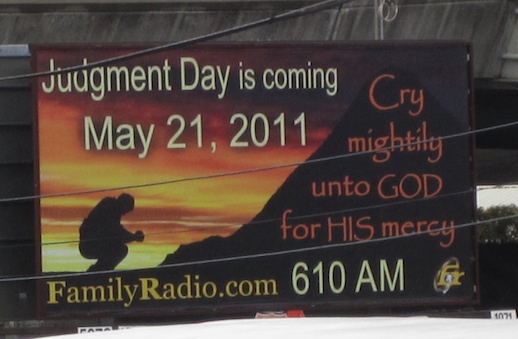
>>3. PEOPLE GET READY We were already getting all futsy about the looming 2012 presidential elections (Newt? Really?) when we caught sight of this new, impending apocalypse billboard from the windows of the heathen SFBG offices. No way, May 21st, 2011 is Judgement Day? This 4/20 we can cheef like there’s no tomorrow — and mean it! P.S., proceed with caution to the website indicated by billboard ‘o doom, unless you have a mind for a good old-fashioned San Francisco: Sodom screed. 

Oh, and for all you faux-Mayan maniacs (and disaster flick addicts) who though 2012 was our expiration date? Um, suck it

>>4. STRATEGIZE WITH ME Here’s a smooth new clip from up-and-coming local rapper DaVinci:

>>5. GUSTON IN THE WIND The publication of local poet and rascal Patrick James Dunagan’s first book There Are People Who Say That Writers Shouldn’t Talk: A GUSTONBOOK is proving to be timely. It can function as a discursive counterpoint to University of California Press’s expansive and just-issued Philip Guston: Collected Writings, Lectures, and Conversations. Also, on March 14, Dunagan is joining Guston’s friends and collaborators Bill Berkson and Clark Coolidge for “Philip Guston: A Life Lived + Discussed,” a program at the Balboa Theatre that includes discussion and a screening of Michael Blackwood’s 1981 documentary Philip Guston: A Life Lived, which is narrated by the artist himself. 

(Poetic trivia alert: the evening’s bookstore-record store sponsor,Bird & Beckett, has a little thing in common – namely, the initials BB – with 2008 Goldie winner Berkson.)

Editor’s Notes

3

tredmond@sfbg.com

I’ve been trying to think of a good metaphor for the public-employee pension story, a way to explain what’s going on without making it so complicated that it becomes a battle of political slogans. Here’s what I’ve come up with.

Imagine you and your friends all work at a resort hotel, and you’ve been there a while, and you approach the boss and say it’s expensive to live in the area and you want a raise. But your boss isn’t handing out any more cash — he wants to hire his girlfriend for a cush job, and he wants a promotion in the resort chain, so he has to keep the bottom line tight.

But he can’t afford to lose the group of you, so he offers a deal: no raise, but you and your coworkers can eat lunch free at the resort restaurant. It’s a painless offer for him; the restaurant is booming, so much cash coming in that nobody will notice a few free meals. Still, it’s a benefit you didn’t have, so you accept.

Then a year passes, and resort traffic drops off, and the price of lunch food goes way up, and the guy who handles the books at the restaurant has been skimming and pocketing a big chunk of the proceeds — and suddenly, the free meals aren’t so free for your boss. So he starts pointing fingers at you, telling all the other diners that it’s unfair you get to eat free. The cry goes out: “No free lunch!” He starts to demand that you pay “your fair share.”

Now: you realize like everyone else that the resort is in financial trouble, and you’ve already accepted unpaid overtime and fewer work days. You also realize that a couple of your greedier friends have been taking extra sandwiches home in their pockets and they need to knock it off.

But the huge chain that owns the resort is still doing fine; the percentage profits off the top never change. No cuts there. And your free lunch isn’t “free”; it’s part of your pay. And you suspect that at some point, the economy will pick up and the restaurant will be flush again — and if you give up your benefit now, you’ll wind up with no raise and no lunch either.

But somehow, it’s all your fault. You are the ones bleeding the resort dry.

Look at it that way, and the picture is a little different.

The American dream, for sale

14

news@sfbg.com

For Mao Huajun and Wen Lin, a trip to San Francisco is a chance to stock up on American retail. With at least five bags in each arm, the couple from China is all smiles. Through an interpreter, they point to the tags on their new clothes and cologne and explain: "Made in China."

Consumer products devised here and made there are too expensive or not available for Chinese shoppers, so Mao and Wen, who come from Wenzhou, where Mao made a fortune in wood products and real estate, are taking full advantage of their trip.

But don’t confuse them with typical tourists. The two are on a boutique pre-immigration tour of the Bay Area, tailored for rich people who want to move to this country — without the typical problem of getting documents.

An anti-immigration wave is sweeping across the country. The Obama administration has overseen the deportation of a record 390,000 people in the past year. College kids who came here as young children are finding they can’t stay and work. The much-anticipated DREAM Act, which would allow college graduates a chance at citizenship, is in a Republican-induced limbo. Poor and working-class immigrants are getting kicked out of the country every day.

But private companies are going overseas and recruiting investors with the promise of a little-known federal program: For half a million bucks, you can get yourself a green card.

If you’ve got the cash, the promoters say it’s easy. Invest that sum with a broker who’s doing some sort of development in a low-income area and you’re guaranteed the right to move to the United States, immediately, with your entire family. You can live anywhere you want (not just in the area where you invested). And you’re on track to become a U.S. citizen.

But the program, known by its federal moniker of EB-5, is riddled with loopholes and lack of oversight. It has a history of creating few or no jobs, and the projects it funds can harm low-income communities. The immigrant investors aren’t safe, either. They put their fate in the hands of brokers and immigration officials, and if everything doesn’t go according to plan (and sometimes they have no control over that plan), they lose their money and face deportation — sometimes years after settling into their new lives.

In truth, the real winners in this program are the private brokers who profit by connecting immigrant investors with projects that desperately need funding.

San Francisco has been late to enter the EB-5 game — but now long-time political figures, including former Redevelopment Commissioner Benny Yee, are getting in on the action. Oakland has several EB-5 centers looking for money.

THE RICH ARE DIFFERENT


The federal government has long offered employment-based visas that allow people with exceptional skills or who are otherwise valuable to the American economy to immigrate to the U.S. But EB-5, created in 1990, is different: it places value on immigrants based on their wallets, not on their brains.

When Congress debated the creation of EB-5, politicians and members of the public saw it as a bona fide way to create citizenship opportunities. The rationale: people who create jobs with their money deserve to live here.

Federal officials and EB-5 experts told us how it works, at least in theory. To gain initial residence visas for themselves and their families, would-be immigrants have to invest $1 million in a new business or an existing and struggling one. If the business is in a Targeted Employment Area — defined by law as "a rural area or an area that has experienced high unemployment of at least 150 percent of the national average" — the investment requirement drops to $500,000.

The EB-5 applicants can invest on their own or they through a broker, known as a regional center. Regional centers make the process easier for investors; they also pool investment to generate the capital necessary for big projects.

Each investor must create or preserve at least 10 full-time sustainable jobs within two years to stay in the country permanently.

Exact numbers aren’t available, but government data shows that the vast majority of investors opt for the $500,000 plan — and few invest on their own. Luz Irazabal, spokesperson for United States Citizenship and Immigration Services, the agency overseeing EB-5, estimates that 80 percent to 90 percent of visas are granted through the regional centers.

So in practice, the program allows private, unregulated brokers to take the money of wealthy people and invest it in projects that are supposed to create jobs in low-income areas. It’s not necessarily a bad idea, and there’s nothing wrong with opening the most possible paths to legal residency.

But it doesn’t always work out — for the immigrants or the community.

WIN-WIN-WIN-WIN?


The EB-5 program is booming. Only 11 regional centers existed in 2007. Today 133 businesses are designated as regional centers allowed to offer EB-5 visas to foreigners in exchange for their cash and 180 applications for the status are pending.

And while EB-5 started out slowly (only a few hundred green cards were issued in the first few years) and still isn’t a huge factor in immigration (1,886 permits were issued last year), most observers agree it’s on the rise.

"As domestic money has gotten tighter, project developers have discovered the EB-5 program as a possible way to obtain foreign capital," said Stephen Yale-Loehr, a professor at Cornell University Law School, veteran immigration lawyer, and self-described "guru" of EB-5."

Some are dubious. Henry Liebman, the Seattle-based CEO of one of the oldest and most successful regional centers, told us that "most of these [new] regional centers aren’t going to raise a nickel." He added that EB-5 is "not going to be the panacea that’s going to lift us out of the great depression."

And it’s something of a Wild West. The federal agency that runs the program doesn’t regulate the regional centers once they’re approved for business. And even though the centers make loans and invest money, the Securities and Exchange Commission doesn’t monitor them. Indeed, there’s no real regulation at all.

Yale-Loehr says the program helps everyone. "Project developers can win because they can get access to capital for their projects. U.S. workers win because the EB-5 money will create jobs. U.S. taxpayers win because EB-5 money stimulates the economy and creates jobs at no expense to taxpayers. And foreign investors win because they get a green card through their investments."

Not exactly. A Dec. 22, 2010 Reuters news service report notes that "thousands of immigrants have been burned by misrepresentations that EB-5 promoters make about the program, inside and outside the United States. Many have lost not only their money, but their chance at winning U.S. citizenship."

In fact, the news service found that in 2009 "four Koreans who invested in a South Dakota dairy farm through EB-5 lost their entire investment when the price of milk collapsed and the operators of the farm stopped paying the mortgage. When the four, who had invested a total of $2 million in the dairy, tried to step in and save the venture, they discovered their partner had left their names off the title. When they tried to sue in state court, the case went nowhere."

If a project falls apart and no jobs are created, the immigrants face deportation.

And there’s little guarantee that the projects these investors fund actually create any jobs for the communities where they’re located.

Regional centers have plenty of ways to win. According to center executives, they typically charge the investors a fee for facilitating the program they charge their clients. In some cases, the immigrant investors become part owners of a business enterprise; the investors and the regional center gets paid when the business turns a profit. But it’s far more common for the regional center to lend the money for projects and collect the interest. Usually immigrant investors get paid only around 1 percent in interest and the regional center picks up the rest.

It’s certainly worked for Liebman. He owns and runs 10 regional centers with offices throughout the United States and one in Tokyo. All his investments have gone into commercial real estate. "You don’t get to be Bill Gates through EB-5, but it certainly raises your game," he said.

Yale-Leohr did say the program must be "done correctly" and that it’s no piece of cake. "It is hard to set up a project that meets all immigration and securities-related requirements."

JOBS? WHERE?


Everyone agrees that the program exists primary because it’s supposed to create jobs. "There is a lot of scrutiny of job creation because that is the foundation of the program," Irazabal said.

But that scrutiny is actually limited.

It shouldn’t be hard to determine if an investment is creating jobs in the community; either there are people working in a local business or not. But EB-5 experts told us that most of the EB-5 investment doesn’t create direct jobs. Sharon Rummery, also a spokesperson for the Citizenship and Immigration Service, said she suspects most of the jobs are indirect. But after checking with agency staff, she told us there’s no data.

The difference is critical. Say, for example, some investors build an electric car factory in a neighborhood with high unemployment. They hire 10 people to build cars, and create 10 direct jobs.

But when the workers go out to lunch and the deli counter down the street hires more help, that’s indirect job-creation — and how one specific investment creates other jobs is essentially guesswork.

Of course, the electric car factory has to buy materials and parts — say, computer chips — that might be made halfway across the country (and possibly in an area that doesn’t have high unemployment). Those jobs count, too. According Irazabal, USCIS has "no requirement for the [indirect] jobs to be in the geographic area" that is struggling economically.

The geographic flexibility USCIS allows is interesting considering that, according USCIS rules, regional centers must have "plans to focus on a geographical region within the United States and must explain how the regional center will achieve economic growth within this regional area."

The most interesting question is whether any of the indirect jobs are ever really created. And the bottom line is, USCIS never checks.

Here’s the process, according to USCIS officials. Regional centers create business plans. Then they hire consulting firms to evaluate how many indirect jobs will be created if the business plan all goes as projected. USCIS signs off on the report and the E-5 visas are approved.

The government never does its own studies or reports, never tracks actual indirect job creation, and rarely questions what the private consultants say.

Economist Peter Donahue, who runs PBI Associates in San Francisco, told us the job creation promises under EB-5 amount to a "parable." Models used to track indirect jobs "give the appearance of the science but its probably someone’s best guess," he said. "I’m not persuaded this stuff adds up."

Assumptions inherent in the models are not commonly verified, he added, and often fail to calculate the net effect of an investment, like when a new firm crowds out existing firms.

Tom Henderson, who’s setting up an EB-5 center in Oakland, told us the indirect jobs model "is all smoke and mirrors — it’s bullshit" (see sidebar).

Still, Irazabal says, "numbers don’t lie." USCIS checks that business plan and the job creation strategy is "viable, can be reproduced, and is practical. We have people whose area of specialty is looking at this."

To make things more complicated, most EB-5 money isn’t going into creating goods or services. It’s going into real estate development. And unlike a factory, a new building by itself creates barely any direct jobs.

It may have the opposite effect. High-end office development often displaces existing businesses, particularly industrial ones. And those lost jobs aren’t taken into account.

THE AMERICAN DREAM


Mao said his No. 1 reason for seeking residency in the United States is the prospect of better education for his two sons, 5 and 17.

It’s ironic. Mao’s American Dream for his children is no different from the dreams of immigrants like Shing Ma "Steve" Li, a 20-year-old nursing student in San Francisco.

Li has lived in San Francisco since he was 12. speaks Cantonese, English, French and Spanish. He was arrested Sept. 15, 2010 by ICE agents, held in a detention center for two months, and threatened with deportation because his parents lacked the proper documentation.

Li, like tens of thousands of others, has talent and education and a lot to offer the United States. But he doesn’t have $500,000.

Immigration activists like Ali Noorani, executive director of the National Immigration Forum, aren’t against EB-5 just because its immigrants are privileged. "We don’t believe there are good immigrants or bad immigrants when it comes to folks who contribute to this nation," he said.

But, he added, "We are looking for equity in our immigration system."

Immigrant-rights activists properly support almost any program that helps open the doors, particularly at a time when the right-wing is exploiting anti-immigrant sentiment. But it seems unfair that one class of immigrants, the ones with large sums of extra money to invest, are getting recruited to come to the U.S. while a much larger group — including people who have lived here for years, worked hard, built businesses and contributed to the nation — is being shown the exit door.

Francisco Ugarte, an attorney with the San Francisco Immigrant Legal and Education Network, made the point: "We disagree with legal standards that make it easier for rich people to immigrate than poor people.

"Our legal system is designed to protect the rich and powerful," he added. "People who are coming out of necessity have a much harder time immigrating than wealthy people looking to move."

"It is," he added, indicative of a broken immigration system." *


EB-5 COMES TO SAN FRANCISCO

Tom Henderson’s clients call San Francisco jiou jin shan, meaning "old gold mountain" in Mandarin and referring to the Gold Rush era impression that San Francisco must be awash in opportunity.

His soon-to-be-unveiled San Francisco Regional center is still waiting on final government approval, but Henderson has already been lining up investors to participate in the program.

He spends a third of his year in China and has done business there for decades. Armed with an international network of business relationships and a quirky charisma, Henderson has won over people like Mao Huajun, low profile but extremely wealthy potential investors with sights on America.

Although more than 20 regional centers are certified to do work in Southern California, only a handful are operating in the Bay Area — although applications for more regional centers are in the pipeline.

Featured prominently on the website of the Synergy Regional Center are two prominent local figures: former Mayor Willie Brown and former Redevelopment Commission member Benny Yee.

The website has pictures of the Synergy management "meeting former San Francisco Mayor Willie Brown, to discuss about how EB-5 investment can stimulate the local economy."

Yee is listed as one of six principals at the firm. He didn’t return our phone calls seeking comment. Neither did Brown (who, to be fair, may have simply been part of a photo op since it appears the picture was taken at a fund-raising event for his institute).

According to Synergy CEO Simon Jung, Yee joined after initially "giving [Jung] advice on how to do business. He can help us bring deals in San Francisco we don’t have access to otherwise."

James Falaschi heads the Bay Area Regional Center in Oakland. His website that features three potential projects — all real estate developments in downtown and east Oakland.

Sunfield Development is the company building at the Fox Uptown and at Seminary and Ninth streets, two of the projects the Bay Area Regional center is working on. Sunfield CEO Sid Afshar said EB-5 is "a very good idea because it is a win-win for everyone."

The new player on the scene is Henderson, and he is unveiling an EB-5 vision with a lot of promise.

Mao was bombarded with options when he first heard of EB-5. As a savvy businessman, he was wary of jumping into something sketchy. Through an interpreter, he told us he went with Henderson because he "can see the way Tom is doing this business is transparent, so [he] know[s] the step by step."

Henderson has yet to reveal what his projects will be, but he says they are all businesses, not real estate projects. He said all the companies he is setting up will inhabit industries the city has identified as central to Oakland’s economic growth.
"I was born in Oakland. I work in Oakland. I live in Oakland," he said. "I won’t do projects that don’t create direct jobs."

Burn this culture

0

caitlin@sfbg.com

LIT “I didn’t want to write a love letter to Burning Man.” Those words may come as a surprise out of the mouth of Guardian City Editor Steven T. Jones, who has been covering the freaky desert art festival and its year-round scene for nearly seven years in these very pages. They’re also surprising given that news of the book has already spread across the country by the vast Burning Man network: listserves, counterculture word-of-mouth, and through an important nod by the festival itself, which included a mention of Jones’ in-depth exploration of 2004-10 burner culture, The Tribes of Burning Man (Consortium of Collective Consciousness, 312 pages, $17.95) in its Jack Rabbit Speaks newsletter, which lands in 70,000 inboxes across the country.

Although Jones critiques many aspects of playa life, the book seems to be resonating with people immersed in the DIY, creativity a-go-go, Black Rock City milieu. “Man,” a burner friend told me on a recent trip to Washington, D.C. “You just don’t see books about Burning Man around these parts!” Which is kind of the point — Jones wanted to highlight a culture he says is vastly underreported yet culturally significant (and have a good time in the process). The book may be the most researched history of the festival to date, and romps through some of the biggest parties and most innovative art experiments on the playa in first person. “I was lucky to be reporting on this event at this time,” Jones says. “It was really epic stuff.”

Love the burn? Find yourself in the book’s pages — and at Jones’ series of readings all over town, he’ll be holding to celebrate its release. Hate everything it stands for? Read it and you’ll never have to go. I sat down with Jones at the newly remodeled Zeitgeist last week to learn more about the Man.

SFBG Why did you write this book?

Steven T. Jones Burning Man has been largely misunderstood and marginalized. Even those who know something about the event assume that its moment has past, that it’s “gone corporate” or otherwise lost its essential energy and appeal. Those who aren’t familiar think of it as just a festival. But it still absolutely floors newcomers, giving them what many describe as a chance to rediscover some more authentic sense of self in this strange and challenging new world. In recent years, this culture has expanded outward all over the world, a development that has begun to be even more important than the event itself to many people. It’s spawned vast social networks of creative, engaged people pursuing really interesting projects, and I’m honored to be able to tell their stories.

SFBG What initially drew you to write about Burning Man? You’re the Guardian city editor and most of your pieces are about politics.

SJ I think it’s hard to separate political culture from the counterculture. This book is probably more about San Francisco than it is about Black Rock City. Burning Man is the most significant culture to come out of San Francisco in years, especially considering its longevity and reach. I mean, some of our progressive political views have spread, but there are groups of burners in every major American city.

SFBG Who are the burners?

SJ There’s a census taken every year, so we know exact demographics on this one. There’s a wide age range and a wide cultural range in terms of ethnicities and geographic regions, and a range of how people live. There are the super-conservatives …

SFBG Really?

SJ Yeah, there are plenty of libertarians there. That’s how it was founded — the gun nuts and the freaks. Then the hippies discovered it. There’s the old hippie-punk divide at Burning Man that we see play out in San Francisco politics all the time over the last 40 years.

SFBG Throughout much of the book, you’re struggling with Burning Man’s political significance. In 2008 you even took a break in the middle of the festival to attend the Democratic National Convention and Barack Obama’s nomination. What was your final conclusion — is Burning Man important, politically speaking?

SJ It’s a good question. I wanted it to be. Larry Harvey wanted it to be, given what was going on with the rest of the country at the time. Ultimately, it just is what it is. I think it’s at least as relevant as the Tea Party — it’s got a better thought-out ethos and value system, but it doesn’t get as much press. It is a city, and the example the city offers is very relevant to the rest of the country.

SFBG Let’s say I’ve never gone to Burning Man and I’m never going to go. What does this book have for me?

SJ Burners are my main target audience, but it was important to me to make this book interesting and accessible to those who don’t go to Burning Man. I firmly ground this book in an intriguing sociopolitical moment in 2004, when the country really lost its mind. Bush was being reelected president and things were about to turn really ugly with the Iraq War and Hurricane Katrina, events that would further divide an already fractured country. I don’t think it’s an accident that the country hit its nadir just as Burning Man hit its zenith. People were desperate for authenticity, creativity, and a life-affirming way to spend their time. The most innovative and impactful cultural developments often happen on the margins, so to ignore Burning Man is to be incurious about what is animating the counterculture in San Francisco and other cities — people who will help lead this country back from this cultural desert we’re in, if that is ever going to happen.

SFBG Are you going to continue to write about burner culture as extensively as you’ve been doing?

SJ No, I think I’ll back off on it. I’ve got a few ideas for the next project — I’m fascinated by bike culture. I think it’d be fascinating to explore the international bike movement in the fashion of this book.

STEVEN T. JONES READS FROM TRIBES OF BURNING MAN

“Burning Man and the Art of Urbanism”

Tues/8 6 p.m., free for SPUR members, $20 for nonmembers

SPUR

654 Mission, SF

(415) 781-8726

www.spur.org

“Tribes of Burning Man Reading and Powwow”

Fri/11 7:30-10 p.m., $5–$20

Westerfield House

1198 Fulton, SF

Facebook: Tribes of Burning Man Reading and Powwow

Leather forever

0

Every year since 1989, 25 movies are added to the National Film Registry, deemed worthy of preservation for being “culturally, historically, or aesthetically significant.” Their current number encompasses Eraserhead (1976) and Enter the Dragon (1973), the Zapruder and Hindenburg footage, The Muppet Movie (1979), “Let’s All Go to the Lobby,” Stan Brakhage and Kenneth Anger films, and This is Spinal Tap (1984) — as well as, you know, Citizen Kane (1941) and stuff. Which is to say, it is one of those ways in which democracy just kinda works.

However, even a list as diverse in age, genre, theme, and purpose as this one is capable of heinous omission, the kind that makes you question the whole system and wonder why somebody just doesn’t do something. You may not even want to continue here, because what you are about to read will infuriate you. It is this: there are 550 movies at present in the National Film Registry. And not one is Heavy Metal Parking Lot (1986).

You could argue it is not there because the Library of Congress does not want future generations to know a truth that ugly — but then, how to explain the presence of Hoosiers (1986)? Simply, it is an injustice that can only have been orchestrated by evildoers who hate freedom. They do not want you to rock.

Fortunately here in San Francisco we know how to rock out — yes, frequently with our cocks out — and will be doing so particularly when the Found Footage Festival returns to the Red Vic. This is good news enough, but it is made extra-special because in addition to their debonair live commentary on the latest batch of mind-boggling VHS clips culled from garage sales and thrift stores, FFF curators Nick Prueher and Joe Pickett will be presenting a 25th-anniversary screening of Heavy Metal Parking Lot.

In 1986, Jeff Krulik and John Heyn had the extremely good idea of taking their camcorder to the late Capital Centre stadium in Landover, Md., before a Judas Priest concert and letting the fans outside just … be. The resulting anthropological study went viral in an analog era, spurring countless homages and imitations, eventually getting a theatrical release (opening for Chris Smith’s longer 2001 documentary Home Movie — much as Dokken opened for the Priest!) and, once a few music rights issues were ironed out, a deluxe DVD. Not afraid to milk it, the filmmakers later explored further vistas of hot pavement in Neil Diamond Parking Lot, Yanni Parking Lot, Michael Jackson Arraignment Parking Lot, Pro Wrestling Sidewalk, Science Fiction Convention Lawn, and so forth. Proving there is, perhaps, endless variety between groups of people who are exactly like each other.

Which in Heavy Metal‘s case means shirtless, drunk, mullet or teased-haired, and absolutely certain everything either sux (like Dokken) or rüles (duh). What really sucks, of course, is everything not metal, like the musical and societal blight known as “that punk shit.” With inimitable logic, one young buck opines “Madonna can go to hell. She’s a dick.” But he’s unusually verbose — most of the kids here stick to sentiments short enough they’ll have no trouble heaving them onto the cement a couple hours later.

The titanium-strength cluelessness on display is enhanced by one’s knowledge that this sea of fist-pumping testosterone was shortly about to worship the rare metal lead singer who not only looked like he’d stepped out of the Folsom Street Fair, but probably actually had. (Denial is the most powerful weed: even I was shocked along with the rest of a 1978 Queen concert’s Kalamazoo, Mich., audience when Freddie Mercury acted kinda … you know. I mean, who’d have guessed?)

Heavy Metal will just be only one of the many amazing artifacts excavated and edited for your edification by the Found Footage Fest dudes, who have been doing this for seven years now and might actually make money at it. Their current program of video oddities from the golden age of VHS includes montages devoted to ventriloquism instruction (oddly creepier even than the sex-hypnosis segment), real-life Elmer Fudds’ hunting calls, things strange even by public-access-channel standards, horrifyingly dull seminar speakers, and the inevitable vintage exercise-video grotesquerie.

Other highlights include a bit from How to Spot Counterfeit Beanie Babies (what Pruehler calls “this adorable crime”), the lowest of all Linda Blair career lows, and something called “Rent-A-Friend,” which stares into an existential void more terrifying even than Heavy Metal Parking Lot.

FOUND FOOTAGE FESTIVAL

Fri/4–Sat/5, 7:15 and 9:15 p.m., $12

Red Vic

1727 Haight, SF

(415) 668-3994

www.redvicmoviehouse.com

Noise Pop Live Shots: robbinschilds at SF MOMA, 02/24/2011

0

The fact that there was a dance performance going on as part of the annual music festival Noise Pop, was unique in and of itself, but then it was happening at the SF MOMA, and I knew I had to go check it out.

The dance group robbinschilds is a pop-color-clad duo who mix video, dance, live music, and even a little sumo-wrestling, to create experimental performances that also use the specific space where they’re happening, in this case, the SF MOMA. So at one point, there were just videos up on three walls, then the dancers were passing a huge rainbow tassel between levels of galleries, and then they were right in front of us, stripping off their clothes and gyrating uncontrollably. They were backed by a live Seattle noise band called Kinski, that was well, very noisy.

There was a second dance show at the MOMA that was a presentation by Russian artist Anna Parkina, who is also having a collage show upstairs in the galleries. Her piece was a mixture of paper cutting and movement, using projections of the collages she has made and moving human sculptures to create a living art piece.

Both dance shows were completely unique, and I like that Noise Pop is venturing beyond music and collaborating with a variety of artists to bring us odd and wonderful shows, like these two.

Our Weekly Picks: March 2-8

0

WEDNESDAY 2

MUSIC

Holcombe Waller

Six years after releasing Troubled Times, Holcombe Waller reemerges from a chrysalis of artistic incubation with Into the Dark Unknown — the album-length culmination of an eponymous theater piece. The butterfly is an apt metaphor for this sylph-like spirit, whose androgynous, four-octave voice and slight build match a melancholy limned by sharp, poetic imagery. Excepting an occasional lyric like “you are the unicorn,” Waller’s male-Sarah-McLaughlin meets-Sufjan-Stevens style is still somehow just the right side of soppy: intimate and delicate, sweeping and epic, his songs are sometimes musically and thematically intense and focused, sometimes just gossamer strings of notes. Waller wrote the score for David Weissman’s We Were Here and has been funded by the Rockefeller Foundation and Doris Duke Charitable Trust — big, solid accomplishments that tether the ethereal artist to critical acclaim. (Emily Appelbaum)

8 p.m., $16

Swedish American Hall

2170 Market, SF

(415) 861-5016

www.cafedunord.com


THURSDAY 3

Dance

Merce Cunningham Dance Company

This is it: the last time to see the famed Merce Cunningham Dance Company in the Bay Area before it disbands this December. MCDC’s performances in Berkeley are part of “The Legacy Tour,” celebrating the work and life of the dance world giant. The work of the late Merce Cunningham, which includes collaborations with John Cage, Robert Rauschenberg, and other major artists, is a meaty slice of dance history. Don’t miss this chance to see the carriers of Cunningham’s genius perform historic remountings Pond Way and Antic Meet, along with Sounddance and the Bay Area premiere of Roaratorio. (Julie Potter)

Thurs/3–Sat/5, 8 p.m., $22–$48

Zellerbach Hall

Bancroft at Telegraph, UC Berkeley, Berk.

(510) 642-9988

www.calperfs.berkeley.edu


FILM

“The Lucky Monkey Bike Film Festival”

Bike enthusiasts everywhere, roll up your pant legs, put on your helmet, and ride to the inaugural day of this mini film festival inspired by Margret and H. A. Rey, the creators of Curious George, who escaped France on bikes during World War II. The fest kicks off with 1948 Italian neorealist classic The Bicycle Thief, with short films before and after. On the second day, watch 2003’s The Triplets of Belleville and 1979’s Breaking Away, plus more shorts. Free valet bike parking provided by the San Francisco Bike Coalition. (Jen Verzosa)

Thurs/3, 5 p.m.; Sun/6, 11 a.m., free with museum admission ($5–$10)

Contemporary Jewish Museum

736 Mission, SF

(415) 655-7800

www.thecjm.org


EVENT

“Natural Wonders: 59th Pacific Orchid Exposition”

Families can be quirky, crazy, and brutal. But nothing beats the Orchidaceae, the planet’s second-largest and most highly evolved plant fam. Some orchids mimic rotting flesh to attract carrion-eating flies that pollinate the flower as they breed on its thick, waxy petals. Another trickster species resembles a lady bee — complete with textures that stimulate male bee genitalia and emitting odors of horny females — on which real male bees futilely hump, getting the pollination job done once again. Other orchids have trap doors; some produce erotic oils for insects to perfume their own six-legged courtship; and one is the source of vanilla. See more than 150,000 of these sexy plants at the largest orchid show in the country. Bring a date! (Kat Renz)

Thurs/3, 6:30–10 p.m.; Fri/4, 10 a.m.–6 p.m.;

Sat/5, 9 a.m.–6 p.m.; Sun/6, 10 a.m.–5 p.m., $14–$40

Fort Mason Center

Marina at Laguna, SF

(415) 665-2468

www.orchidsanfrancisco.org


FRIDAY 4

DANCE

Stephen Petronio Company

The Stephen Petronio Company is one of the few modern dance ensembles (ODC is another) that still employs its dancers full time. But wow, does Petronio work them. He packs his choreography with high-velocity ideas that he then hurtles at us in dense, shifting combinations that can be exhausting to watch. Then again, that’s one of the reasons that Petronio’s choreography is so thrillingly alive. For his newest work, I Drink the Air Before Me — thank you Mr. Shakespeare — Petronio foregoes the mixed-program format for a single, full-evening piece. Music is by contemporary composer Nico Muhly; Petronio’s costume is by photographer Cindy Sherman. (Rita Felciano)

Fri/4–Sat/5, 8 p.m., $30–$50

Novellus Theater

Yerba Buena Center for the Arts

701 Mission, SF

(415) 978-ARTS

www.performances.org


MUSIC

Crystal Castles

Since 2005, producer and multiinstrumentalist Ethan Kath and vocalist Alice Glass — better known as the Canadian electro pop duo Crystal Castles — have stolen the hearts of hipsters everywhere. The band’s name is also the result of some good-natured theft: Kath took the name from She-Ra’s hideout in the He-Man and the Masters of the Universe cartoon spin-off. It’s also the name of an Atari video game, which is fitting given that part of its sound is generated by a keyboard modified with an Atari 5200 sound chip. Despite its copycat name, Crystal Castles’ low-res sound is a radically unique collision of experimental noise and pop. Renowned for its frenzied live shows, Crystal Castles’ 8-bit video game-like tunes will make you do the robot. (Verzosa)

With Suuns

9 p.m., $26–$28

Warfield

982 Market, SF

www.thewarfieldtheatre.com


MUSIC

Drive-By Truckers

Now with 15 years under its belt, country rock outfit Drive-By Truckers is enjoying the most notable stretch of its career. A changing lineup has seen members come and go — most recently with the departure of group veteran, Jason Isbell — but the Truckers’ consistency has never wavered. The Big To-Do (2010), an album full of the band’s trademark tales of blue-collar malaise and sly humor, was its highest-charting yet and helped spotlight a band whose fanbase is quickly evolving beyond its tightly-knit core. Drive-By Truckers is known to thrive in the live setting, turning its (relatively) more compact album tracks into sprawling, three guitar jams full of Skynyrd-esque Southern rock. (Landon Moblad)

Fri/4-Sat/5, 9 p.m., $25

Fillmore

1805 Geary, SF

(415) 346-6000

www.livenation.com


MUSIC

Free the Robots

The initial installment of the Low End Theory last month proved that the L.A. monthly beat showcase could work in SF, buoyed by residents Gaslamp Killer, Daddy Kev, Nobody, D-Styles, and Nocando. This time around, Flying Lotus is sure to draw a crowd — but also worth noticing is Free the Robots. Last year’s debut LP Ctrl Alt Delete was full of spaced-out jams, layered bass beats, and tight samples (check that sexy strut of Baris Manco’s “Lambaya Puf De” on “Turkish Voodoo.”) The groove on “Turbulance” will lift you, rock you back and forth, and make you play the air-Moog. (Ryan Prendiville)

With Matthewdavid, Dose One, and Shlohmo

10 p.m., $20

103 Harriet, SF

www.1015.com/onezerothree


DANCE

Devotion

In a return to the Bay Area, Sarah Michelson, who made her first work at ODC Theater 20 years ago as part of its long-running Pilot Program, brings Devotion, a collaboration with Richard Maxwell, artistic director of the New York City Players. Performed by Michelson’s dynamic dance company and Maxwell’s veteran actors, this narrative dance theater work entails extreme physical limits and experimental storytelling, and incorporates Philip Glass’ “Dance IX” — the same music Twyla Tharp used for her masterpiece In The Upper Room. Come see Michelson’s stark, simple, ironic work mix with Maxwell’s legendary voice. (Potter)

Fri/4–Sun/6, 8 p.m., $15–$18

ODC Theater

3153 17th St., SF

(415) 863-9834

www.odctheater.org


SATURDAY 5

MUSIC

Too $hort

Though he’s been dabbling in Dirty South styles and collaborating with crunk mainstay Lil Jon since his 1999 comeback, it’s pretty impossible to associate Too $hort with anything other than West Coast hip-hop. The king of dirty rap broke out in 1988 with the release of Life Is … Too Short, which helped put Oakland on the scene and has since worked its way up to double platinum standing. A chance to hear his laid-back flow amid the tight bass lines and funk grooves of his live band is not to be missed. (Moblad)

8 and 10 p.m., $28

Yoshi’s San Francisco

1330 Fillmore, SF

(415) 655-5600

www.yoshis.com/sanfrancisco


MONDAY 7

MUSIC

Diamond Rings

Canadian singer-songwriter John O’Regan (of the D’Urbervilles) reinvigorates a formula that’s classic, combining androgyny and pop music. Although Diamond Rings’ music borrows liberally from a range of influences (Do I hear strains of Technotronic’s “Pump Up the Jam” in “Show Me Your Stuff”?) with personal lyrics and an affecting baritone voice, O’Regan’s sound manages to be distinct and to break through YouTube novelty act territory. Diamond Rings headlines with the louder-than-life guitar and drums duo P.S. I Love You, which absolutely destroyed my eardrums at the Hemlock earlier in the year. (Prendiville)

With P.S. I Love You, A B and the Sea

8 p.m., $12

Rickshaw Stop

155 Fell, SF

(415) 861-2011

www.rickshawstop.com


TUESDAY 8

FILM

Truck Farm

Sure, you want well-grown veggies — but you’re a staunch city-dweller, organic produce doesn’t make the food stamp budget, and the landlady ix-nayed a rooftop garden. In New York City, filmmakers Curt Ellis and Ian Cheney (who cocreated and appeared in 2007’s acc documentary King Corn) had similar issues. Until they realized their 1986 Dodge pickup held the 40-square-foot answer. The truck-bed-cum-garden-bed not only brings the farm to the city, it provides weekly food boxes to 20 families. Get the dirt at this outdoor screening of Truck Farm, a 50-minute doc the pair made about their program, accompanied by a discussion on urban farming (proceeds benefit Green Planet Films’ screening series). And will someone please ask how to replicate this without getting a stack of parking tickets? (Renz)

7 p.m., $20–$45

Unwind on Union

1875 Union, SF

www.truck-farm.com


The Guardian listings deadline is two weeks prior to our Wednesday publication date. To submit an item for consideration, please include the title of the event, a brief description of the event, date and time, venue name, street address (listing cross streets only isn’t sufficient), city, telephone number readers can call for more information, telephone number for media, and admission costs. Send information to Listings, the Guardian Building, 135 Mississippi St., SF, CA 94107; fax to (415) 487-2506; or e-mail (paste press release into e-mail body — no text attachments, please) to listings@sfbg.com. Digital photos may be submitted in jpeg format; the image must be at least 240 dpi and four inches by six inches in size. We regret we cannot accept listings over the phone.

Film Listings

0

OPENING

The Adjustment Bureau In this drama adapted from a Philip K. Dick story, a congressman (Matt Damon) and a dancer (Emily Blunt) fall in love, much to the annoyance of the mysterious suits (portrayed by Mad Men‘s John Slattery, among others) tasked with controlling the politician’s destiny. (1:39) Marina, Piedmont, Shattuck.

Beastly Beauty (Vanessa Hudgens) meets beast (Alex Pettyfer) in this teen-oriented drama. Neil Patrick Harris is also involved, hopefully playing a singing tea kettle. (1:35)

Carmen in 3D Bizet’s popular opera hits the big screen, thanks to RealD and London’s Royal Opera House. (2:55)

I Am File in the dusty back drawer of An Inconvenient Truth (2006) wannabes. The cringe-inducing, pretentious title is a giveaway — though the good intentions are in full effect — in this documentary by and about director Tom Shadyac’s search for answers to life’s big questions. After a catastrophic bike accident, the filmmaker finds his lavish lifestyle as a successful Hollywood director of such opuses as Bruce Almighty (2003) somewhat wanting. Thinkers and spiritual leaders such as Desmond Tutu, Howard Zinn, UC Berkeley psychology professor Dacher Keltner, and scientist David Suzuki provide some thought-provoking answers, although Shadyac’s thinking behind seeking out this specific collection of academics, writers, and activists remains somewhat unclear. I Am‘s shambling structure and perpetual return to its true subject — Shadyac, who resembles a wide-eyed Weird Al Yankovic — doesn’t help matters, leaving a viewer with mixed feelings, less about whether one man can work out his quest for meaning on film, than whether Shadyac complements his subjects and their ideas by framing them in such a random, if well-meaning, manner. And sorry, this film doesn’t make up for Ace Ventura: Pet Detective (1994). (1:16) Lumiere, Shattuck, Smith Rafael. (Chun)

*Last Lions It’s hard being a single mom. Particularly when you are a lioness in the Botswana wetlands, your territory invaded and mate killed by an invading pride forced out of their own by encroaching humanity. Add buffalo herds (tasty yes, but with sharp horns they’re not afraid to use) and crocodiles (no upside there), and our heroine is hard-pressed to keep herself alive, let alone her three small cubs. Derek Joubert’s spectacular nature documentary, narrated by Jeremy Irons (in plummiest Lion King vocal form) manages a mind-boggling intimacy observing all these predators. Shot over several years, while seeming to depict just a few weeks or months’ events, it no doubt fudges facts a bit to achieve a stronger narrative, but you’ll be too gripped to care. Warning: those kitties sure are cute, but this sometimes harsh depiction of life (and death) in the wild is not suitable for younger children. (1:28) Embarcadero. (Harvey)

*Machotaildrop Every once in a while you see the Best Film Ever Made. Meaning, the movie that is indisputably the best film ever made at least for the length of time you’re watching it. Illustrative examples include Dr. Seuss musical The 5,000 Fingers of Dr. T (1953), Superstar (Todd Haynes’ 1987 Barbie biopic about Karen Carpenter), Nina Paley’s 2008 animation Sita Sings the Blues, several Buster Keaton vehicles, and Paul Robeson sightings — anything that delights unceasingly. Now there is Machotaildrop, which the Roxie had the excellent sense to book for an extended run after its local debut at SF IndieFest, a year and a half after its premiere at Toronto mystifyingly failed to set the entire world on fire. Corey Adams and Alex Craig’s debut takes place in a gently alternative universe where pro skateboarders play pro skateboarders who aspire to belonging in the media kingdom and island fiefdom of ex-tightrope-walking corporate titan the Baron (James Faulkner). Such is the lucky fate of gormless small-town lad Walter (Anthony Amedori), though naturally there proves to be something sinister going on here to kinda drive the kinda-plot along. When that disruption of skating paradise takes central focus after about an hour, what was hitherto something of pure joy — a genial, laid-back surrealist joke without identifiable cinematic precedent — becomes just a wee more conventional. But Machotaildrop still offers fun on a level so high it’s seldom legal. (1:31) Roxie. (Harvey)

Nora’s Will There’s certainly something to be said for the uniqueness of Nora’s Will: I can’t think of any other Mexican-Jewish movies that cover suicide, Passover, and cooking with equal attention. But while it sounds like the film is overloaded, Nora’s Will is actually too subtle for its own good. It meanders along, telling the story of the depressed Nora, her conflicted ex-husband, and the family she left behind. When the movie focuses on the clash between Judaism and Mexican culture, the results are dynamic, but more often that not, it simply crawls along. It’s not that Nora’s Will is boring: it’s just easily forgettable, which is surprising given its subject matter. Meanwhile, it walks that fine line between comedy and drama, never bringing the laughs or the emotional catharsis it wants to offer. The only real reaction it inspires is hunger, particularly if the idea of a Mexican-Jewish feast sounds appealing. Turns out “gefilte fish” is the same in every language. (1:32) Albany, Bridge, Smith Rafael. (Peitzman)

*Of Gods and Men It’s the mid-1990s, and we’re in Tibhirine, a small Algerian village based around a Trappist monastery. There, eight French-born monks pray and work alongside their Muslim neighbors, tending to the sick and tilling the land. An emboldened Islamist rebel movement threatens this delicate peace, and the monks must decide whether to risk the danger of becoming pawns in the Algerian Civil War. On paper, Of Gods and Men sounds like the sort of high-minded exploitation picture the Academy swoons over: based on a true story, with high marks for timeliness and authenticity. What a pleasant surprise then that Xavier Beauvois’s Cannes Grand Prix winner turns out to be such a tightly focused moral drama. Significantly, the film is more concerned with the power vacuum left by colonialism than a “clash of civilizations.” When Brother Christian (Lambert Wilson) turns away an Islamist commander by appealing to their overlapping scriptures, it’s at the cost of the Algerian army’s suspicion. Etienne Comar’s perceptive script does not rush to assign meaning to the monks’ decision to stay in Tibhirine, but rather works to imagine the foundation and struggle for their eventual consensus. Beauvois occasionally lapses into telegraphing the monks’ grave dilemma — there are far too many shots of Christian looking up to the heavens — but at other points he’s brilliant in staging the living complexity of Tibrihine’s collective structure of responsibility. The actors do a fine job too: it’s primarily thanks to them that by the end of the film each of the monks seems a sharply defined conscience. (2:00) Embarcadero. (Goldberg)

Rango Pirates of the Caribbean series director-star duo Gore Verbinski and Johnny Depp re-team for this animated comedy about a chameleon’s Wild West adventures. (1:47) Presidio.

Take Me Home Tonight Just because lame teen comedies existed in the ’80s doesn’t mean that they need to be updated for the ’10s. Nary an Eddie Money song disgraces the soundtrack of this unselfconscious puerile, pining sex farce — the type one assumes moviemakers have grown out of with the advent of smarty-pants a la Apatow and Farrell. Take Me Home Tonight would rather find its feeble kicks in major hair, big bags of coke, polo shirts with upturned collars, and “greed is good” affluenza. Matt (Topher Grace) is an MIT grad who’s refused to embrace the engineer within and is instead biding his time as a clerk at the local Suncoast video store when he stumbles on his old high school crush Tori (Teresa Palmer), a budding banker. In an effort to impress, he tells her he works for Goldman Sachs and trails after her to the rip-roaring last-hooray-before adulthood bash. Pal Barry (Dan Fogler) gets to play the Belushi-like buffoon when he swipes a Mercedes from the dealership he just got fired from, and ends up with a face full of powder in the arms of a kinky ex-supermodel (Angie Everhart). Despite cameos by comedians like Demetri Martin and a trailer and poster that make it all seem a bit cooler than it really is, Take Me Home Tonight doesn’t really touch the coattails of Jonathan Demme or even Cameron Crowe — in the hands of director Michael Dowse, it feels nowhere near as heartfelt, rock ‘n’ roll, or at the very least, cinematically competent. (1:37) California. (Chun)

*Uncle Boonmee Who Can Recall His Past Lives See “Something Wild.” (1:53) Sundance Kabuki.

When We Leave See “Choose or Lose.” (1:59) Opera Plaza, Shattuck.

ONGOING

*Another Year Mike Leigh’s latest represents a particularly affecting entry among his many improv-based, lives-of-everyday-Brits films. More loosely structured than 2008’s Happy-Go-Lucky, which featured a clear lead character with a well-defined storyline, the aptly-titled Another Year follows a year in the life of a group of friends and acquaintances, anchored by married couple Tom (Jim Broadbent) and Gerri (Ruth Sheen). Tom and Gerri are happily settled into middle-class middle age, with a grown son (Oliver Maltman) who adores them. So far, doesn’t really sound like there’ll be much Leigh-style heightened emotion spewing off the screen, traumatizing all in attendance, right? Well, you haven’t met the rest of the ensemble: there’s a sad-sack small-town widower, a sad-sack overweight drunk, a near-suicidal wife and mother (embodied in one perfect, bitter scene by Imelda Staunton), and Gerri’s work colleague Mary, played with a breathtaking lack of vanity by Lesley Manville. At first Mary seems to be a particularly shrill take on the clichéd unlucky-in-love fiftysomething woman — think an unglamorous Sex in the City gal, except with a few more years and far less disposable income. But Manville adds layers of depth to the pitiful, fragile, blundering Mary; she seems real, which makes her hard to watch at times. That said, anyone would be hard-pressed to look away from Manville’s wrenching performance. (2:09) Shattuck. (Eddy)

Barney’s Version The charm of this shambling take on Mordecai Richler’s 1997 novel lies almost completely in the hang-dog peepers of star Paul Giamatti. Where would Barney’s Version be without him and his warts-and-all portrayal of lovable, fallible striver Barney Panofsky — son of a cop (Dustin Hoffman), cheesy TV man, romantic prone to falling in love on his wedding day, curmudgeon given to tying on a few at a bar appropriately named Grumpy’s, and friend and benefactor to the hard-partying and pseudo-talented Boogie (Scott Speedman). So much depends on the many nuances of feeling flickering across Giamatti’s pale, moon-like visage. Otherwise Barney’s Version sprawls, carries on, and stumbles over the many cute characters we don’t give a damn about — from Minnie Driver’s borderline-offensive JAP of a Panofsky second wife to Bruce Greenwood’s romantic rival for Barney’s third wife Miriam (Rosamund Pike). A mini-who’s who of Canadian directors surface in cameos — including Denys Arcand, David Cronenberg, and Atom Egoyan — as a testament to the respect Richler commands. Too bad director Richard J. Lewis didn’t get a few tips on dramatic rigor from Cronenberg or intelligent editing from Egoyan — as hard as it tries, Barney’s Version never rises from a mawkish middle ground. (2:12) Opera Plaza. (Chun)

Big Mommas: Like Father, Like Son (1:47) 1000 Van Ness.

Biutiful Uxbal (Javier Bardem) has problems. To name but a few: he is raising two young children alone in a poor, crime-beset Barcelona hood. He is making occasional attempts to rope back in their bipolar, substance-abusive mother (Maricel Álvarez), a mission without much hope. He is trying to stay afloat by various not-quite legal means while hopefully doing the right thing by the illegals — African street drug dealers and Chinese sweatshop workers — he acts as middleman to, standing between them and much less sympathetically-inclined bossmen. He’s got a ne’er-do-well brother (Eduard Fernandez) to cope with. Needless to say, with all this going on (and more), he isn’t getting much rest. But when he wearily checks in with a doc, the proverbial last straw is stacked on his camelback: surprise, you have terminal cancer. With umpteen odds already stacked against him in everyday life, Uxbal must now put all affairs in order before he is no longer part of the equation. This is Alejandro González Iñárritu’s first feature since an acrimonious creative split with scenarist Guillermo Arriaga. Their films together (2006’s Babel, 2003’s 21 Grams, 2000’s Amores Perros) have been criticized for arbitrarily slamming together separate baleful storylines in an attempt at universal profundity. But they worked better than Biutiful, which takes the opposite tact of trying to fit several stand-alone stories’ worth of hardship into one continuous narrative — worse, onto the bowed shoulders of one character. Bardem is excellent as usual, but for all their assured craftsmanship and intense moments, these two and a half hours collapse from the weight of so much contrived suffering. Rather than making a universal statement about humanity in crisis, Iñárritu has made a high-end soap opera teetering on the verge of empathy porn. (2:18) California, SF Center, Sundance Kabuki. (Harvey)

*Black Swan “Lose yourself,” ballet company head Thomas (Vincent Cassel) whispers to his leading lady, Nina (Natalie Portman), moments before she takes the stage. But Nina is already consumed with trying to find herself, and rarely has a journey of self-discovery been so unsettling. Set in New York City’s catty, competitive ballet world, Black Swan samples from earlier dance films (notably 1948’s The Red Shoes, but also 1977’s Suspiria, with a smidgen of 1995’s Showgirls), though director Darren Aronofsky is nothing if not his own visionary. Black Swan resembles his 2008 The Wrestler somewhat thematically, with its focus on the anguish of an athlete under ten tons of pressure, but it’s a stylistic 180. Gone is the gritty, stripped-down aesthetic used to depict a sad-sack strongman. Like Dario Argento’s 1977 horror fantasy, the gory, elegantly choreographed Black Swan is set in a hyper-constructed world, with stabbingly obvious color palettes (literally, white = good; black = evil) and dozens of mirrors emphasizing (over and over again) the film’s doppelgänger obsession. As Nina, Portman gives her most dynamic performance to date. In addition to the thespian fireworks required while playing a goin’-batshit character, she also nails the role’s considerable athletic demands. (1:50) Shattuck, Sundance Kabuki. (Eddy)

*Blue Valentine Sometimes a performance stands out and grabs attention for embodying a particular personality type or emotional state that’s instantly familiar yet infrequently explored in much depth at the movies. What’s most striking about Derek Cianfrance’s Blue Valentine is the primary focus it lends Michelle Williams’ role as the more disgruntled half of a marriage that’s on its last legs whether the other half knows that or not. Ryan Gosling has the showier part — his Dean is mercurial, childish, more prone to both anger and delight, a babbler who tries to control situations by motor-mouthing or goofing through them. But Williams’ Cindy has reached the point where all his sound and fury can no longer pass as anything but static that must be tuned out as much as possible so that things get done. Things like parenting, going to work, getting the bills paid, and so forth. It’s taken a few years for Cindy to realize that she’s losing ground in her lifelong battle for self-improvement with every exasperating minute she continues to tolerate him. Williams’ bile-swallowing silences and the involuntary recoil that greets Dean’s attempts to touch Cindy are the film’s central emotional color: that state in which the loyalty, obligation, fear, pity, or whatever has kept you tied to a failing relationship is being whittled away by growing revulsion. Gosling’s excellent stab at an underwritten part is at a disadvantage compared to Williams, who just about burns a hole through the screen. (1:53) Four Star, SF Center, Shattuck, Sundance Kabuki. (Harvey)

*Cedar Rapids What if The 40 Year Old Virgin (2005) got so Parks and Rec‘d at The Office party that he ended up with a killer Hangover (2009)? Just maybe the morning-after baby would be Cedar Rapids. Director Miguel Arteta (2009’s Youth in Revolt) wrings sweet-natured chuckles from his banal, intensely beige wall-to-wall convention center biosphere, spurring such ponderings as, should John C. Reilly snatch comedy’s real-guy MVP tiara away from Seth Rogen? Consider Tim Lippe (Ed Helms of The Hangover), the polar opposite of George Clooney’s ultracompetent, complacent ax-wielder in Up in the Air (2009). He’s the naive manchild-cum-corporate wannabe who never quite graduated from Timmyville into adulthood. But it’s up to Lippe to hold onto his firm’s coveted two-star rating at an annual convention in Cedar Rapids. Life conspires against him, however, and despite his heartfelt belief in insurance as a heroic profession, Lippe immediately gets sucked into the oh-so-distracting drama, stirred up by the dangerously subversive “Deanzie” Ziegler (John C. Reilly), whom our naif is warned against as a no-good poacher. Temptations lie around every PowerPoint and potato skin; as Deanzie warns Lippe’s Candide, “I’ve got tiger scratches all over my back. If you want to survive in this business, you gotta daaance with the tiger.” How do you do that? Cue lewd, boozy undulations — a potbelly lightly bouncing in the air-conditioned breeze. “You’ve got to show him a little teat.” Fortunately Arteta shows us plenty of that, equipped with a script by Wisconsin native Phil Johnston, written for Helms — and the latter does not disappoint. (1:26) California, Empire, Piedmont, Sundance Kabuki. (Chun)

Drive Angry 3D It says something about the sad state of Nicolas Cage’s cinematic choices when the killer-B, grindhouse-ready Drive Angry 3D is the finest proud-piece-o-trash he’s carried since The Bad Lieutenant: Port of Call New Orleans (2009), which doesn’t say much — the guy works a lot. Here, in his quest to become the paycheck-happy late-Brando of comic book, sci-fi, and fantasy flicks, Cage gets to work that anguished hound-dog mien, while meting out the punishment against grotty Satanists, in this cross between Constantine (2005), bible comics, and Shoot ‘Em Up (2007). Out for blood and sprung from the deepest, darkest hole a bad boy can find himself in, vengeful grandpa Milton (Cage) — a sop for Paradise Lost readers — is determined to rescue his infant granddaughter. She’s in the hands of Jonah King (Billy Burke), a devil-worshipping cult leader with a detestable soul patch who killed Milton’s daughter and carries her femur around as a souvenir. Along for the ride is the hot-pants-clad hottie Piper (Amber Heard), who’s as handy with her fists as she is randy with the busboys (she drives home from work, singing along to Peaches’ “Fuck the Pain Away” — ‘nuf said), and trailing Milton is the mysterious Accountant (William Fichtner). Gore, boobs, fast cars, undead gunfighters, and cheese galore — it’s a fanboy’s fantasy land, as handed down via the tenets of our fathers Tarantino and Rodriguez — and though the 3D seems somewhat extraneous, it does come in, ahem, handy during the opening salvo. (1:44) 1000 Van Ness. (Chun)

The Eagle The mysterious fate of Rome’s Ninth Legion is all the rage lately — well, so sayeth the wee handful of people who caught Neil Marshall’s Centurion last year. For all who missed that flawed if worthy release, The Eagle arrives with a bigger budget and a bigger-name cast to puzzle out exactly what happened when thousands of Roman soldiers marched into what’s now Scotland, circa 120 AD, and never returned. The Eagle‘s Kevin Macdonald (2006’s The Last King of Scotland) bases his film on Rosemary Sutcliff’s popular children’s book, The Eagle of the Ninth, but the theory advanced here resembles Centurion‘s: the army was wiped out by hostile (and occasionally body-painted) natives. Much of The Eagle takes place decades after the disappearance, with the son of a Roman commander (Channing Tatum) scuttling past Hadrian’s Wall to seek truth, clear his family name, and reclaim a highly symbolic bronze eagle. Providing muscle and street smarts (or whatever the equivalent — backwoods smarts?) is slave Jamie Bell. The Eagle is handsomely shot, with some semi-thrilling PG-13 battle scenes, and any spin on Unsolved Mysteries: The Ninth Legion can’t really suck outright. But while Tatum has clearly clocked in the gym time to embody a Roman soldier, he doesn’t possess nearly enough depth (or any interesting qualities whatsoever) to play a character who supposedly has a lot of big emotions to work through. Bell does what he can with his sidekick role, short of performing CPR on his pulse-free costar, but it ain’t enough. Was Vin Diesel unavailable, or what? (1:54) 1000 Van Ness. (Eddy)

Even the Rain It feels wrong to criticize an “issues movie” — particularly when the issues addressed are long overdue for discussion. Even the Rain takes on the privatization of water in Bolivia, but it does so in such an obvious, artless way that the ultimate message is muddled. The film follows a crew shooting an on-location movie about Christopher Columbus. The film-within-a-film is a less-than-flattering portrait of the explorer: if you’ve guessed that the exploitation of the native people will play a role in both narratives, you’d be right. The problem here is that Even the Rain rests on our collective outrage, doing little to explain the situation or even develop the characters. Case in point: Sebastian (Gael García Bernal), who shifts allegiances at will throughout the film. There’s an interesting link to be made between the time of Columbus and current injustice, but it’s not properly drawn here, and in the end, the few poignant moments get lost in the shuffle. (1:44) Lumiere, Shattuck, Smith Rafael. (Peitzman)

The Fighter Once enough of a contenda to have fought Sugar Ray Leonard — and won, though there are lingering questions about that verdict’s justice — Dicky (Christian Bale) is now a washed-up, crack-addicted mess whose hopes for a comeback seem just another expression of empty braggadocio. Ergo it has fallen to the younger brother he’s supposedly “training,” Micky (Mark Wahlberg), to endure the “managerial” expertise of their smothering-bullying ma (Melissa Leo) and float their large girl gang family of trigger-tempered sisters. That’s made even worse by the fact that they’ve gotten him nothing but chump fights in which he’s matched someone above his weight and skill class in order to boost the other boxer’s ranking. When Micky meets Charlene (Amy Adams), an ambitious type despite her current job as a bartender, this hardboiled new girlfriend insists the only way he can really get ahead is by ditching bad influences — meaning mom and Dicky, who take this shutout as a declaration of war. The fact-based script and David O. Russell’s direction do a good job lending grit and humor to what’s essentially a 1930s Warner Brothers melodrama — the kind that might have had Pat O’Brien as the “good” brother and James Cagney as the ne’er-do-well one who redeems himself by fadeout. Even if things do get increasingly formulaic (less 1980’s Raging Bull and more 1976’s Rocky), the memorable performances by Bale (going skeletal once again), Wahlberg (a limited actor ideally cast) and Leo (excellent as usual in an atypically brassy role) make this more than worthwhile. As for Adams, she’s just fine — but by now it’s hard to forget the too many cutesy parts she’s been typecast in since 2005’s Junebug. (1:54) Four Star, 1000 Van Ness, SF Center, Sundance Kabuki. (Harvey)

Gnomeo and Juliet If you willingly see a movie titled Gnomeo and Juliet, you probably have a keen sense of what you’re in for. And as long as that’s the case, it’s hard not to get sucked into the film’s 3D gnome-infested world. Believe it or not, this is actually a serviceable adaptation of Shakespeare’s classic — minus the whole double-suicide downer ending. But at least the movie is conscious of its source material, throwing in several references to other Shakespeare plays and even having the Bard himself (or, OK, a bronze statue) comment on the proceedings. It helps that the cast is populated by actors who could hold their own in a more traditional Shakespearean context: James McAvoy, Emily Blunt, Maggie Smith, and Michael Caine. But Gnomeo and Juliet isn’t perfect — not because of its outlandish concept, but due to a serious overabundance of Elton John. The film’s songwriter and producer couldn’t resist inserting himself into every other scene. Aside from the final “Crocodile Rock” dance number, it’s actually pretty distracting. (1:24) 1000 Van Ness, Presidio, SF Center. (Peitzman)

*The Green Hornet I still don’t understand why this movie had to be in 3D, or what Cameron Diaz’s character has to do with anything, but I liked The Green Hornet in spite of myself. Only in Hollywood could artsy director Michel Gondry hook up with self-satisfied comedian Seth Rogen, who stars in and co-wrote this surprisingly amusing (if knowingly lightweight) superhero entry. After the death of his father (a megarich newspaper owner — how retro!), Rogen’s party boy Britt Reid decides, either out of boredom or misdirected rebellion, to become an anti-crime vigilante only pretending to be a criminal. (And that’s about as complicated as this movie gets.) Helping him, which is to say creating all of the cool cars and gadgets and single-handedly winning all of the fist fights, is Kato (Taiwanese actor Jay Chou, taking over the role Bruce Lee made famous). As himself, Reid is so obnoxious he pisses off newspaper editor Axford (Edward James Olmos); as the Hornet, he’s so obnoxious he pisses off actual crime boss Chudnofsky, played by movie highlight Christoph Waltz — more or less doing a Eurotrash twist on his Oscar-winning Inglourious Basterds (2009) Nazi. (1:29) SF Center. (Eddy)

Hall Pass There are some constants when it comes to a Farrelly Brothers movie: lewd humor, full-frontal male nudity, and at least one shot of explosive diarrhea. Hall Pass does not disappoint on the gross-out front, but it’s a letdown in almost every other way. Rick (Owen Wilson) and Fred (Jason Sudeikis) are married men obsessed with the idea of reliving their glory days. Lucky for them, wives Maggie (Jenna Fischer) and Grace (Christina Applegate) decide to give them a week-long “hall pass” from marriage. Of course, once Rick and Fred are able to go out and snag any women they want, they realize most women aren’t interested in being snagged by dopey fortysomethings. On paper, Hall Pass has the potential to be a sharp, anti-bro comedy. Instead, it wallows in recycled toilet humor that’s no longer edgy enough to make us squirm. At least there are still moments of misogyny to provide that familiar feeling of discomfort. (1:38) 1000 Van Ness, Presidio. (Peitzman)

How I Ended This Summer (2:04) Sundance Kabuki.

I Am Number Four Do you like Twilight? Do you think aliens are just as sexy — if not sexier! — than vampires? I Am Number Four isn’t a rip-off of Stephenie Meyer’s supernatural saga, but the YA novel turned film is similar enough to draw in that coveted tween audience. John (Alex Pettyfer) is a teenage alien with extraordinary powers who falls in love with a human girl Sarah (Dianna Agron). But they’re from two different worlds! To be fair, star-crossed romance isn’t the issue here: the real problem is I Am Number Four‘s “first in a series” status. Rather than working to establish itself as a film in its own right, the movie sets the stage for what’s to come next, a bold presumption for something this mediocre. It lazily drops some exposition, then launches into big, loud battles without pausing to catch its breath. I Am Number Four only really works if it gets a sequel, and we all know how well that turned out for The Golden Compass (2007). (1:44) 1000 Van Ness, Shattuck. (Peitzman)

*The Illusionist Now you see Jacques Tati and now you don’t. With The Illusionist, aficionados yearning for another gem from Tati will get a sweet, satisfying taste of the maestro’s sensibility, inextricably blended with the distinctively hand-drawn animation of Sylvain Chomet (2004’s The Triplets of Belleville). Tati wrote the script between 1956 and 1959 — a loving sendoff from a father to a daughter heading toward selfhood — and after reading it in 2003 Chomet decided to adapt it, bringing the essentially silent film to life with 2D animation that’s as old school as Tati’s ambivalent longing for bygone days. The title character should be familiar to fans of Monsieur Hulot: the illusionist is a bemused artifact of another age, soon to be phased out with the rise of rock ‘n’ rollers. He drags his ornery rabbit and worn bag of tricks from one ragged hall to another, each more far-flung than the last, until he meets a little cleaning girl on a remote Scottish island. Enthralled by his tricks and grateful for his kindness, she follows him to Edinburgh and keeps house while the magician works the local theater and takes on odd jobs in an attempt to keep her in pretty clothes, until she discovers life beyond their small circle of fading vaudevillians. Chomet hews closely to bittersweet tone of Tati’s films — and though some controversy has dogged the production (Tati’s illegitimate, estranged daughter Helga Marie-Jeanne Schiel claimed to be the true inspiration for The Illusionist, rather than daughter and cinematic collaborator Sophie Tatischeff) and Chomet neglects to fully detail a few plot turns, the dialogue-free script does add an intriguing ambiguity to the illusionist and his charge’s relationship — are they playing at being father and daughter or husband and wife? — and an otherwise straightforward, albeit poignant tale. (1:20) Clay, Shattuck, Smith Rafael. (Chun)

Inside Job Inside Job is director Charles Ferguson’s second investigative documentary after his 2007 analysis of the Iraq War, No End in Sight, but it feels more like the follow-up to Alex Gibney’s Enron: The Smartest Guys in the Room (2005). Keeping with the law of sequels, more shit blows up the second time around. As with No End in Sight, Ferguson adeptly packages a broad overview of complex events in two hours, respecting the audience’s intelligence while making sure to explain securities exchanges, derivatives, and leveraging laws in clear English (doubly important when so many Wall Street executives hide behind the intricacy of markets). The revolving door between banks, government, and academia is the key to Inside Job‘s account of financial deregulation. At times borrowing heist-film conventions (it is called Inside Job, after all), Ferguson keeps the primary players in view throughout his history so that the eventual meltdown seems anything but an accident. The filmmaker’s relentless focus on the insiders isn’t foolproof; tarring Ben Bernanke, Henry Paulson, and Timothy Geithner as “made” guys, for example, isn’t a substitute for evaluating their varied performances over the last two years. Inside Job makes it seem that the entire crisis was caused by the financial sector’s bad behavior, and this too is reductive. Furthermore, Ferguson does not come to terms with the politicized nature of the economic fallout. In Inside Job, there are only two kinds of people: those who get it and those who refuse to. The political reality is considerably more contentious. (2:00) Lumiere. (Goldberg)

Just Go With It Only within the hermetically sealed landscape of the Hollywood romantic comedy can a man’s sociopathic impulse (to lie about being unhappily married to every gullible young woman he sleeps with over the course of two action-filled decades) be smoothed over into a laughable character defect that the right woman will see through or look past and then cure him of. But here we are in Hollywood, or rather, in Beverly Hills, where, as depicted by Just Go With It, the moral continuum seems to range from plastic surgeons who perform good boob jobs to plastic surgeons who perform bad ones. Adam Sandler is one of the good-fake-boob kinds but also the liar liar, and Jennifer Aniston is the long-suffering office assistant and single mom who joins forces with him in the cause of smoothing out a wrinkle in his ersatz romantic life. This involves the construction of an improvisatory tissue of lies so vast that it envelops an entire fake blended family (including not one but two creepily precocious children) and necessitates a trip to Hawaii and nearly two hours of penile-implant, mammary-gland, and alimentary-canal humor to be untangled sufficiently for a happy ending. Sandler and Aniston have a decent comic rapport going, at least until the sappy, sick-making moment of truth, and this reviewer may have snickered at one or two moments, or even periodically throughout the film, but is deeply ashamed of it now. (1:56) 1000 Van Ness. (Rapoport)

Justin Bieber: Never Say Never 3D (1:45) 1000 Van Ness.

The King’s Speech Films like The King’s Speech have filled a certain notion of “prestige” cinema since the 1910s: historical themes, fully-clothed romance, high dramatics, star turns, a little political intrigue, sumptuous dress, and a vicarious taste of how the fabulously rich, famous, and powerful once lived. At its best, this so-called Masterpiece Theatre moviemaking can transcend formula — at its less-than-best, however, these movies sell complacency, in both style and content. In The King’s Speech, Colin Firth plays King George VI, forced onto the throne his favored older brother Edward abandoned. This was especially traumatic because George’s severe stammer made public address tortuous. Enter matey Australian émigré Lionel Logue (Geoffrey Rush, mercifully controlled), a speech therapist whose unconventional methods include insisting his royal client treat him as an equal. This ultimately frees not only the king’s tongue, but his heart — you see, he’s never had anyone before to confide in that daddy (Michael Gambon as George V) didn’t love him enough. Aww. David Seidler’s conventionally inspirational script and BBC miniseries veteran Tom Hooper’s direction deliver the expected goods — dignity on wry, wee orgasms of aesthetic tastefulness, much stiff-upper-lippage — at a stately promenade pace. Firth, so good in the uneven A Single Man last year, is perfect in this rock-steadier vehicle. Yet he never surprises us; role, actor, and movie are on a leash tight enough to limit airflow. (1:58) Albany, Embarcadero, Marina, 1000 Van Ness, Piedmont, Sundance Kabuki. (Harvey)

No Strings Attached The worst thing about No Strings Attached is its advertising campaign. An eyeroll-worthy tagline — “Can sex friends stay best friends?” distracts from the fact that this is a sharp and satisfying romantic comedy. Perhaps it’s not the most likely follow-up to Black Swan (2010), but Natalie Portman is predictably charming, and Ashton Kutcher proves he’s leading man material after all. They’re aided by an exceptional supporting cast, including indie darlings Greta Gerwig and Olivia Thirlby, and underrated comic actors Lake Bell and Mindy Kaling. No Strings Attached is a welcome return to form from director Ivan Reitman, who gave us classics like Ghostbusters (1984) before tainting his image with Six Days Seven Nights (1998) and My Super Ex-Girlfriend (2006). There are likely going to be many who will dismiss Reitman’s latest out of hand — and with those misleading trailers and posters, it’s hard to blame them. But I advise you to give No Strings Attached a chance: at the very least, it’ll counter the image of Portman tearing at a stubborn hangnail. (1:50) 1000 Van Ness. (Peitzman)

127 Hours After the large-scale, Oscar-draped triumph of 2008’s Slumdog Millionaire, 127 Hours might seem starkly minimalist — if director Danny Boyle weren’t allergic to such terms. Based on Aron Ralston’s memoir Between a Rock and a Hard Place, it’s a tale defined by tight quarters, minimal “action,” and maximum peril: man gets pinned by rock in the middle of nowhere, must somehow free himself or die. More precisely, in 2003 experienced trekker Ralston biked and hiked into Utah’s Blue John Canyon, falling into a crevasse when a boulder gave way under his feet. He landed unharmed … save a right arm pinioned by a rock too securely wedged, solid, and heavy to budge. He’d told no one where he’d gone for the weekend; dehydration death was far more likely than being found. For those few who haven’t heard how he escaped this predicament, suffice it to say the solution was uniquely unpleasant enough to make the national news (and launch a motivational-speaking career). Opinions vary about the book. It’s well written, an undeniably amazing story, but some folks just don’t like him. Still, subject and interpreter match up better than one might expect, mostly because there are lengthy periods when the film simply has to let James Franco, as Ralston, command our full attention. This actor, who has reached the verge of major stardom as a chameleon rather than a personality, has no trouble making Ralston’s plight sympathetic, alarming, poignant, and funny by turns. His protagonist is good-natured, self-deprecating, not tangibly deep but incredibly resourceful. Probably just like the real-life Ralston, only a tad more appealing, less legend-in-his-own-mind — a typical movie cheat to be grateful for here. (1:30) Opera Plaza. (Harvey)

*True Grit Jeff Bridges fans, resist the urge to see your Dude in computer-trippy 3D and make True Grit your holiday movie of choice. Directors Ethan and Joel Coen revisit (with characteristic oddball touches) the 1968 Charles Portis novel that already spawned a now-classic 1969 film, which earned John Wayne an Oscar for his turn as gruff U.S. Marshall Rooster Cogburn. (The all-star cast also included Dennis Hopper, Glen Campbell, Robert Duvall, and Strother Martin.) Into Wayne’s ten-gallon shoes steps an exceptionally crusty Bridges, whose banter with rival bounty hunter La Boeuf (a spot-on Matt Damon) and relationship with young Mattie Ross (poised newcomer Hailee Steinfeld) — who hires him to find the man who killed her father — likely won’t win the recently Oscar’d actor another statuette, but that doesn’t mean True Grit isn’t thoroughly entertaining. Josh Brolin and a barely-recognizable Barry Pepper round out a cast that’s fully committed to honoring two timeless American genres: Western and Coen. (1:50) Empire, SF Center, Shattuck, Sundance Kabuki. (Eddy)

“2011 Academy Award-Nominated Short Films, Live-Action and Animated” (Live-action, 1:50; animated, 1:25) Opera Plaza, Shattuck.

Unknown Everything is blue skies as Dr. Martin Harris (Liam Neeson) flies to Germany for a biotech conference, accompanied by lovely wife Elizabeth (January Jones in full Betty Draper mode). Landing in Berlin things quickly become grey, as he’s separated from his wife and ends up in a coma. Waking in a hospital room, Harris experiences memory loss, but like Harrison Ford he’s getting frantic with an urgent need to find his wife. Luckily she’s at the hotel. Unluckily, so is another man, who she and everyone else claims is the real Dr. Harris. What follows is a by-the-numbers thriller, with car chases and fist fights, that manages to entertain as long as the existential question is unanswered. Once it’s revealed to be a knock-off of a successful franchise, the details of Unknown‘s dated Cold War plot don’t quite make sense. On the heels of 2008’s Taken, Neeson again proves capable in action-star mode. Bruno Ganz amuses briefly as an ex-Stasi detective, but the vacant parsing by bad actress Jones, appropriate for her role on Mad Men, only frustrates here. (1:49) 1000 Van Ness, Presidio, SF Center. (Ryan Prendiville)

*We Were Here Reagan isn’t mentioned in David Weissman’s important and moving new documentary about San Francisco’s early response to the AIDS epidemic, We Were Here — although his communications director Pat Buchanan and Moral Majority leader Jerry Falwell get split-second references. We Were Here isn’t a political polemic about the lack of governmental support that greeted the onset of the disease. Nor is it a kind of cinematic And the Band Played On that exhaustively lays out all the historical and medical minutiae of HIV’s dawn. (See PBS Frontline’s engrossing 2006 The Age of AIDS for that.) And you’ll find virtually nothing about the infected world outside the United States. A satisfying 90-minute documentary couldn’t possibly cover all the aspects of AIDS, of course, even the local ones. Instead, Weissman’s film, codirected with Bill Weber, concentrates mostly on AIDS in the 1980s and tells a more personal and, in its way, more controversial story. What happened in San Francisco when gay people started mysteriously wasting away? And how did the epidemic change the people who lived through it? The tales are well told and expertly woven together, as in Weissman’s earlier doc The Cockettes. But where We Were Here really hits home is in its foregrounding of many unspoken or buried truths about AIDS. The film will affect viewers on a deep level, perhaps allowing many to weep openly about what happened for the first time. But it’s a testimony as well to the absolute craziness of life, and the strange places it can take you — if you survive it. (1:30) Castro. (Marke B.)

*The Woman Chaser First widely noted as Elaine’s emotionally deaf boyfriend on Seinfield, in recent years Patrick Warburton has starred in successful network sitcoms Rules of Engagement and Less than Perfect. They followed The Tick, a shortlived Fox superhero parody series everyone loved but the viewing public. He’s voiced various characters on Family Guy (a man’s gotta work), as well as endearing villain Kronk in The Emperor’s New Groove (2000). That latter reunited him with Eartha Kitt, also a co-star in his screen debut: 1987’s campsterpiece Mandingo (1975) rip-off Dragonard, which he played a race traitor Scottish hunk on an 18th century Caribbean slaving isle also populated by such punishing extroverts as boozy Oliver Reed, chesty Claudia Uddy, and creaky Pink Panther boss Herbert Lom. These days, Warburton is promoting a past project he’d rather remember: 1999’s The Woman Chaser, billed as his leading-role debut. It was definitely the first feature for Robinson Devor (2005’s Police Beat, 2007’s Zoo), one of the most stubbornly idiosyncratic and independent American directors to emerge in recent years. Derived from nihilist pulp master’s Charles Willeford 1960 novel, this perfect B&W retro-noir miniature sets Warburton’s antihero to swaggering across vintage L.A. cityscapes. Sloughing off an incestuously available mother and other bullet-bra’d she cats, his eye on one bizarre personal ambition, he’s a vintage man’s man bobbing obliviously in a sea of delicious, droll irony. (1:30) Roxie. (Harvey)


Film listings are edited by Cheryl Eddy. Reviewers are Kimberly Chun, Michelle Devereaux, Peter Galvin, Max Goldberg, Dennis Harvey, Johnny Ray Huston, Louis Peitzman, Lynn Rapoport, Ben Richardson, and Matt Sussman. For rep house showtimes, see Rep Clock. For first-run showtimes, see Movie Guide.


Rep Clock

0

ARTISTS’ TELEVISION ACCESS 992 Valencia, SF; www.atasite.org. $4-10. “The Touching of Hands,” solo and collaborative projects by Scott Treleaven, Genesis Breyer P-Orridge, and Terence Hannum. “Radical Light: Small Gauge Diaries and Portraits,” Thurs, 7:30. Presented by SF Cinematheque in conjunction with Pacific Film Archive. “Mission Eye and Ear: New Live Cinema Series,” Fri, 8. “Other Cinema:” “Goldwave + Wrongdisco + Katelus,” Sat, 8:30. “ATA Sunday Saloon,” with Rank/Xerox, Tenants, and Mothercountry Motherfuckers, Sun, 2. “The New Talkies,” modern films with new narration, Sun, 7:30.

CASTRO 429 Castro, SF; (415) 621-6120, www.castrotheatre.com. $7.50-15. We Were Here (Weissman, 2011), Wed-Thurs, 7, 9:15 (also Wed, 2:30, 4:45). Director David Weissman in person after 7 p.m. shows. “Sing-a-Long:” The Little Mermaid (Clements and Musker, 1989), March 5-9, 7:30 (also Sat-Sun, 1; Wed, 2).

CHRISTOPHER B. SMITH RAFAEL FILM CENTER 1118 Fourth St, San Rafael; (415) 454-1222, www.cafilm.org. $6.50-15. Even the Rain (Bollaín, 2010), call for dates and times. The Illusionist (Chomet, 2010), call for dates and times. Nora’s Will (Chenillo, 2009), call for dates and times. Absent (Hunt, 2010), Thurs, 7. With filmmaker Justin Hunt and musician James Hetfield. I Am (Shadyac, 2011), March 4-10, call for times.

“EAST BAY INTERNATIONAL JEWISH FILM FESTIVAL” Various East Bay venues; www.eastbayjewishfilm.org. Most shows $5-10. Over 50 films from around the world, March 3-13.

EMBARCADERO CENTER One Embarcadero, Promenade Level, SF; www.sfgreenfilmfest.org. $12.50. “San Francisco Green Film Festival,” environmental films, Thurs-Sun.

GOETHE-INSTITUT SAN FRANCISCO 530 Bush, SF; (415) 263-8760. $7. “From the Wild West to Outer Space: East German Films:” The Silent Star (Maetzig, 1960), Thurs, 7.

HUMANIST HALL 390 27th St, Oakl; www.humanisthall.org. $5. Collapse (Smith, 2009), Wed, 7:30.

LARK 549 Magnolia, Larkspur; (415) 924-5111, www.larktheater.com. $25-30. “Silent Surrealism,” with live accompaniment by Hot Club of San Francisco, Thurs, 8.

MECHANICS’ INSTITUTE 57 Post, SF; (415) 393-0100, rsvp@milibrary.org. $10. “CinemaLit Film Series: Heros and Misfits: The Films of Stephen Frears:” My Beautiful Launderette (1985), Fri, 6.

PACIFIC FILM ARCHIVE 2575 Bancroft, Berk; (510) 642-5249, www.bampfa.berkeley.edu. $5.50-9.50. “Film 50: History of Cinema:” The 5,000 Fingers of Dr. T (Rowland, 1953), Wed, 3:10. “Radical Light: Alternative Film and Video in the San Francisco Bay Area:” “Pieces of Eight: Fragments, Curiosities, and Hidden Realities,” Wed, 7:30; “The Video Collectives: Lord of the Universe, Media Burn, and Game of the Week,” Sun, 5:15. “Merce Cunningham Dance Company: The Legacy Tour Special Screening:” Craneway Event (Dean, 2009), Thurs, 7; Sat, 5. “Under the Skin: The Films of Claire Denis:” White Material (Denis, 2009), Fri, 7; Chocolat (Denis, 1988), Fri, 9; Paris, Texas (Wenders, 1984), Sat, 7:15; I Can’t Sleep (Denis, 1994), Sat, 3. Pelada (Boughen and Fergusson, 2010), Tues, 5:30, 7:45. This event, $15; proceeds benefit Albany and El Cerrito High School soccer teams.

PARAMOUNT 2025 Broadway, Oakl; 1-800-745-3000, www.ticketmaster.com. $5. The Birds (Hitchcock, 1963), Fri, 8.

RED VIC 1727 Haight, SF; (415) 668-3994; www.redvicmoviehouse.com. $6-10. Megamind (McGrath, 2010), Wed-Thurs, 7:15, 9:20 (also Wed, 2). “The Found Footage Festival,” Fri-Sat, 7:15, 9:15. This event, $12. Vision: From the Life of Hildegard von Bingen (von Trotta, 2009), Sun-Mon, 7, 9:15 (also Sun, 2, 4:15). I Love You Phillip Morris (Ficarra and Requa, 2009), March 8-9, 7:15, 9:25 (also March 9, 2).

ROXIE 3117 and 3125 16th St, SF; (415) 863-1087, www.roxie.com. $10. The Woman Chaser (Devor, 1999), Wed-Thurs, 7, 9:15. YERBA BUENA CENTER FOR THE ARTS 701 Mission, SF; (415) 978-2787, www.ybca.org. $6-8. “Volume 14: Middle East,” nine videos focusing on the Middle East compiled by ASPECT: The Chronicle of New Media Art, Jan 13-March 27 (gallery hours Thurs-Sat, noon-8; Sun, noon-6).


Schedules are for Wed/2–Tues/8 except where noted. Director and year are given when available. Double and triple features are marked with a •. All times are p.m. unless otherwise specified.

Music Listings

0

WEDNESDAY 2

ROCK/BLUES/HIP-HOP

As A People, Blue Rabbit, My Second Surprise Hemlock Tavern. 9pm, $6.

Boys IV Men, Honey, Bleak Ethnique Elbo Room. 9pm, $5.

Ghost Town Refugees, Wild Son, Manchowder, 31 Bottom of the Hill. 9pm, $8.

JJ Grey, Sunny War Independent. 8pm, $25.

Missing Persons Yoshi’s San Francisco. 8pm, $18.

Nodzzz, Personal and the Pizzas, Tim Cohen’s Magick Trick Knockout. 9pm, $8.

Rubbersidedown, Sistas in the Pit, Swig, Red Light Circuit Rickshaw Stop. 8pm, $10.

Versus the Nothing, Outshined Kimo’s. 9pm.

Holcombe Waller Café Du Nord. 8pm, $16.

JAZZ/NEW MUSIC

Cosmo Alleycats Le Colonial, 20 Cosmo, SF; www.lecolonialsf.com. 7pm.

Dink Dink Dink, Gaucho, Michael Abraham Amnesia. 7pm, free.

Ben Marcato and the Mondo Combo Top of the Mark. 7:30pm, $10.

Michael Parsons Trio Revolution Café, 3248 22nd St, SF; (415) 642-0474. 8:30pm, free.

Paula West and George Mesterhazy Quartet Rrazz Room. 8pm, $35.

FOLK/WORLD/COUNTRY

Dgiin Milk. 9pm, $6.

DANCE CLUBS

Booty Call Q-Bar, 456 Castro, SF; www.bootycallwednesdays.com. 9pm. Juanita Moore hosts this dance party, featuring DJ Robot Hustle.

Cannonball Beauty Bar. 10pm, free. Rock, indie, and nu-disco with DJ White Mike.

Hands Down! Bar on Church. 9pm, free. With DJs Claksaarb, Mykill, and guests spinning indie, electro, house, and bangers.

Jam Fresh Wednesdays Vessel, 85 Campton, SF; (415) 433-8585. 9:30pm, free. With DJs Slick D, Chris Clouse, Rich Era, Don Lynch, and more spinning top40, mashups, hip hop, and remixes.

Mary-Go-Round Lookout, 3600 16th St, SF; (415) 431-0306. 10pm, $5. A weekly drag show with hosts Cookie Dough, Pollo Del Mar, and Suppositori Spelling.

No Room For Squares Som., 2925 16th St, SF; (415) 558-8521. 6-10pm, free. DJ Afrodite Shake spins jazz for happy hour.

Qoöl Mammoth End Up. 5-10pm, $5 (free before 7pm). Happy hour with Spesh, JDubya, Gravity, Derek Hena, and Never Knows.

Respect Wednesdays End Up. 10pm, $5. Rotating DJs Daddy Rolo, Young Fyah, Irie Dole, I-Vier, Sake One, Serg, and more spinning reggae, dancehall, roots, lovers rock, and mash ups.

Synchronize Il Pirata, 2007 16th St, SF; (415) 626-2626. 10pm, free. Psychedelic dance music with DJs Helios, Gatto Matto, Psy Lotus, Intergalactoid, and guests.


THURSDAY 3

ROCK/BLUES/HIP-HOP

Ale Mania Hemlock Tavern. 9pm, $6.

Eskmo, Blackbird Blackbird, oOoOO, DJG Independent. 9pm, $15.

Future Twin, Dadfag, Waste Rig Knockout. 9:30pm, $5.

A Hawk and A Handsaw, Sioux City Kid Café Du Nord. 9pm, $14.

Alan Iglesias Biscuits and Blues. 8 and 10pm, $16. Stevie Ray Vaughan tribute.

Leilujh, Aloud, Yellow Dress El Rio. 8pm, $6.

Christine Shields, William Winant Percussion Group, Sunfoot, Ruby Howl Amnesia. 9pm, $5.

Spooky Flowers, Jhameel, Dear Indugu, Steinway Junkies Bottom of the Hill. 9pm, $8.

Robin Trower Fillmore. 8pm, $37.50.

Wet Illustrated, Downtown Struts, Brothers Gross, Burnt Ones Thee Parkside. 9pm, $6.

Wild Nothing, Abe Vigoda, DJ Nako Rickshaw Stop. 9pm, $12.

JAZZ/NEW MUSIC

Stompy Jones Top of the Mark. 7:30pm, $10.

Paula West and George Mesterhazy Quartet Rrazz Room. 8pm, $40.

FOLK/WORLD/COUNTRY

Kelly McFarling Revolution Café, 3248 22nd St, SF; (415) 642-0474. 8:30pm, free.

Shut-Ins Atlas Café. 8-10pm, free.

Soja, Mambo Sauce, Chris Boomer Slim’s. 9pm, $21.

DANCE CLUBS

Afrolicious Elbo Room. 9:30pm, $5. DJs Pleasuremaker and Señor Oz plus guest Honey Knuckles spin Afrobeat, tropicália, electro, samba, and funk.

Caribbean Connection Little Baobab, 3388 19th St, SF; (415) 643-3558. 10pm, $3. DJ Stevie B and guests spin reggae, soca, zouk, reggaetón, and more.

Club Jammies Edinburgh Castle. 10pm, free. DJs EBERrad and White Mice spinning reggae, punk, dub, and post punk.

Drop the Pressure Underground SF. 6-10pm, free. Electro, house, and datafunk highlight this weekly happy hour.

Electric Feel Lookout, 2600 16th St, SF; www.fringesf.com. 9pm, $2. Indie music video dance party with subOctave and Blondie K, plus guest DJ Starr.

Guilty Pleasures Gestalt, 3159 16th St, SF; (415) 560-0137. 9:30pm, free. DJ TophZilla, Rob Metal, DJ Stef, and Disco-D spin punk, metal, electro-funk, and 80s.

Funktastique Tunnel Top, 601 Bush, SF; (415) 986-8900. 10pm, free. Rare grooves, funk, and electro-swing with Dr. Musco.

Holy Thursday Underground SF. 10pm, $5. Bay Area electronic hip hop producers showcase their cutting edge styles monthly.

Jivin’ Dirty Disco Butter, 354 11th St., SF; (415) 863-5964. 8pm, free. With DJs spinning disco, funk, and classics.

Lacquer Beauty Bar. 10pm-2am, free. DJs Mario Muse and Miss Margo bring the electro.

Lords of Acid, Angelspit, Radical G DNA Lounge. 8pm, $23.

Mestiza Bollywood Café, 3376 19th St, SF; (415) 970-0362. 10pm, free. Showcasing progressive Latin and global beats with DJ Juan Data.

1984 Mighty. 9pm, $2. The long-running New Wave and 80s party has a new venue, featuring video DJs Mark Andrus, Don Lynch, and celebrity guests.

Peaches Skylark, 10pm, free. With an all female DJ line up featuring Deeandroid, Lady Fingaz, That Girl, and Umami spinning hip hop.

Thursday Special Tralala Revolution Café, 3248 22nd St, SF; (415) 642-0474. 5pm, free. Downtempo, hip-hop, and freestyle beats by Dr. Musco and Unbroken Circle MCs.


FRIDAY 4

ROCK/BLUES/HIP-HOP

Baths, Braids, Gobble Gobble Rickshaw Stop. 8:30pm, $12.

Crystal Castles, Suuns Warfield. 9pm, $28.

Dead Prez, Sellassie Yoshi’s San Francisco. 10:30pm, $25.

Drive-By Truckers, Heartless Bastards Fillmore. 9pm, $25.

“Funk Cancer” DNA Lounge. 8pm. Benefit for Leukemia and Lymphoma Society with Harry and the Hitmen, Sun Hop Fat, and more.

I the Mighty, A Night in Hollywood, Bruises Bottom of the Hill. 9:30pm, $12.

Kaki King, Zoe Keating Yoshi’s San Francisco. 8 and 10pm.

Lonely Wild, Tito Amnesia. 7pm, $5-10.

McCabe and Mrs. Miller, Tippy Canoe, Bye Bye Blackbirds Hemlock Tavern. 9:30pm, $8.

Nat Keefe Concert Carnival Independent. 9pm, $20-35.

Norma Jean, Stick To Your Guns, Impending Doom, Of Legends Slim’s. 7:30pm, $16.

Kevin Russell Biscuits and Blues. 8 and 10pm, $20.

Strangelove, Erasure-Esque, Sanity Assassins Café Du Nord. 9:30pm, $10.

Zero: A Chance in a Million Great American Music Hall. 9pm, $35. With Steve Kimock, Greg Anton, Judge Murphy, Chip Roland, Liam Hanrahan, and special guests.

JAZZ/NEW MUSIC

Black Market Jazz Orchestra Top of the Mark. 9pm, $10.

Boca Do Rio Red Poppy Art House. 8pm, $10-12.

Hugh Maskela Palace of Fine Arts Theatre, 3301 Lyon, SF; www.sfjazz.org. 8pm, $25-60.

Paula West and George Mesterhazy Quartet Rrazz Room. 8pm, $45.

FOLK/WORLD/COUNTRY

Shareef Ali and the Radical Folksonomy, Great Girls Blouse, Maria Quiles Brainwash, 1122 Folsom, SF; www.brainwash.com. 8pm, free.

Sioux City Kid and Revolutionary Ramblers Revolution Café, 3248 22nd St, SF; (415) 642-0474. 9pm, free.

Chuchito Valdez Peña Pachamama, 1630 Powell, SF; (415) 646-0018. 10pm.

DANCE CLUBS

Afro Bao Little Baobab, 3388 19th St, SF; (415) 643-3558. 10pm, $5. Afro and world music with rotating DJs including Stepwise, Steve, Claude, Santero, and Elembe.

Le Castle Vania, Fukkk Offf, Realboy, Fabian Campos, Robot Mafia, Mikeyydrops Mezzanine. 9pm, $20.

Deeper 222 Hyde, 222 Hyde, SF; (415) 345-8222. 9pm, $10. With rotating DJs spinning dubstep and techno.

Dirty Rotten Dance Party Madrone Art Bar. 9pm, $5. With DJs Morale, Kap10 Harris, and Shane King spinning electro, bootybass, crunk, swampy breaks, hyphy, rap, and party classics.

Exhale, Fridays Project One Gallery, 251 Rhode Island, SF; (415) 465-2129. 5pm, $5. Happy hour with art, fine food, and music with Vin Sol, King Most, DJ Centipede, and Shane King.

Fubar Fridays Butter, 354 11th St., SF; (415) 863-5964. 6pm, $5. With DJs spinning retro mashup remixes.

Good Life Fridays Apartment 24, 440 Broadway, SF; (415) 989-3434. 10pm, $10. With DJ Brian spinning hip hop, mashups, and top 40.

Hot Chocolate Milk. 9pm, $5. With DJs Big Fat Frog, Chardmo, DuseRock, and more spinning old and new school funk.

Oldies Night Knockout. 9pm, $2-4. Doo-wop, one-hit wonders, soul, and more with DJs Primo, Daniel, and Lost Cat.

120 Minutes Elbo Room. 10pm, $5-10. With DJs oOoOO, Whitch, Nako, and guests Tearist and Rezound.

Rockabilly Fridays Jay N Bee Club, 2736 20th St, SF; (415) 824-4190. 9pm, free. With DJs Rockin’ Raul, Oakie Oran, Sergio Iglesias, and Tanoa “Samoa Boy” spinning 50s and 60s Doo Wop, Rockabilly, Bop, Jive, and more.

Some Thing Stud. 10pm, $7. VivvyAnne Forevermore, Glamamore, and DJ Down-E give you fierce drag shows and afterhours dancing.

Strangelove Cat Club. 9:30pm, $6 (free before 10pm). Goth and industrial with DJs Tomas Diablo, Lowlife, Fact50, and DeathBoy.

Vintage Orson, 508 Fourth St, SF; (415) 777-1508. 5:30-11pm, free. DJ TophOne and guest spin jazzy beats for cocktalians.


SATURDAY 5

ROCK/BLUES/HIP-HOP

Broken Records, US Royalty, Pancho-san Rickshaw Stop. 8:30pm, $12.

Carlton Melton, White Manna, Outlaw, Moccretro Hemlock Tavern. 9:30pm, $8.

Drive-By Truckers Amoeba, 1855 Haight, SF; www.amoeba.com. 2pm, free.

Drive-By Truckers, Heartless Bastards Fillmore. 9pm, $25.

Escape the Fate, Alesana, Motionless in White, Get Scared, Drive A Regency Ballroom. 7:30pm, $20.

John Lee Hooker Jr. Biscuits and Blues. 8 and 10pm, $22.

Hot Lunch, Friggin Harderships Thee Parkside. 3pm, free.

Morcheeba, Mulers Warfield. 9pm, $30.

Stan Ridgway, We Is Shore Dedicated, Red River Amnesia. 9pm, $15.

Megan Slankard, Family Crest, Pwolf and Avi Bottom of the Hill. 8:45pm, $12.

Chris Sprauge and His 18 Wheelers, Mitch Polzak and 10-4, Kit Lopez and Glen Earl Brown Jr. Verdi Club, 2424 Mariposa, SF; www.oldtimey.net. 9pm, $10-12.

Too $hort Yoshi’s San Francisco. 8 and 10pm, $28.

Zero: A Chance in a Million Great American Music Hall. 9pm, $35. With Steve Kimock, Greg Anton, Judge Murphy, Chip Roland, Liam Hanrahan, and special guests.

JAZZ/NEW MUSIC

Carton 4 Tet Revolution Café, 3248 22nd St, SF; (415) 642-0474. 9pm, free.

Anna Estrada and Bill Kwan Savanna Jazz. 7:30pm, $10.

Kenny Werner Quintet Herbst Theatre, 401 Van Ness, SF; www.sfjazz.org. 8pm, $25-65.

Lisa Engelken Band Red Poppy Art House. 8pm, $12-20.

Paula West and George Mesterhazy Quartet Rrazz Room. 8pm, $45.

FOLK/WORLD/COUNTRY

Greensky Bluegrass, Huckle Slim’s. 9pm, $16.

Guntown, Daryl Shawn Brainwash, 1122 Folsom, SF; www.brainwash.com. 8pm, free.

Zigaboo Modeliste: King of the Funky Drums, Kofy Brown Café Du Nord. 9pm, $20.

Queen Makedah Pier 23 Café, Pier 23, SF; www.pier23cafe.com. 9pm, $10.

Chuchito Valdez Peña Pachamama, 1630 Powell, SF; (415) 646-0018. 10pm.

Craig Ventresco and Meredith Axelrod Atlas Café. 4pm, free.

DANCE CLUBS

Afro Bao Little Baobab, 3388 19th St, SF; (415) 643-3558. 10pm, $5. Afro and world music with rotating DJs including Stepwise, Steve, Claude, Santero, and Elembe.

Bar on Church 9pm. Rotating DJs Foxxee, Joseph Lee, Zhaldee, Mark Andrus, and Nuxx.

Debaser Knockout. 9pm, $5. DJ Jamie Jams and Emdee of Club Neon bust out 90s alternative jams.

Dirty Talk Dance Party Deco Lounge, 510 Larkin, SF; (415) 346-2025. 10pm, $5. Disco, house, funk, and more with guest Sergio (Go Bang!)

Everlasting Bass 330 Ritch. 10pm, $5-10. Bay Area Sistah Sound presents this party, with DJs

Zita and Pam the Funkstress spinning hip-hop, soul, funk, reggae, dancehall, and club classics.

For the Love Vessel, 85 Campton Pl., SF; www.vesselsf.com. 9pm. With Rony Seikaly, Pheeko Dubfunk, and Lexel.

Gemini Disco Underground SF. 10pm, $5. Disco with DJ Derrick Love and Nicky B. spinning deep disco.

Harvard Bass, Nadastrom Mighty. 9pm, $10. With Nisus and Sleazemore.

HYP Club Eight, 1151 Folsom, SF; www.eightsf.com. 10pm, free. Gay and lesbian hip-hop party, featuring DJs spinning the newest in the top 40s hip hop and hyphy.

Kontrol Endup. 10pm, $20. With resident DJs Alland Byallo, Craig Kuna, Sammy D, and Nikola Baytala spinning minimal techno and avant house.

Leisure Paradise Lounge. 10pm, $7. DJs Omar, Aaron, and Jet Set James spinning classic britpop, mod, 60s soul, and 90s indie.

New Wave City: Soundtrack Night DNA Lounge. 9pm, $7-12. Skip and Shindog spin hits from 80s movies.

Rock City Butter, 354 11th St., SF; (415) 863-5964. 6pm, $5 after 10pm. With DJs spinning party rock.

Saturday Night Soul Party Elbo Room. 10pm, $10. Sixties soul with DJs Lucky, Phengren Oswald, and Paul Paul.

Souf Club Six. 9pm, $7. With DJs Jeanine Da Feen, Motive, and Bozak spinning southern crunk, bounce, hip hop, and reggaeton.

Soundscape Vortex Room, 1082 Howard, SF; www.myspace.com/thevortexroom. With DJs C3PLOS, Brighton Russ, and Nick Waterhouse spinning Soul jazz, boogaloo, hammond grooves, and more.

Spirit Fingers Sessions 330 Ritch. 9pm, free. With DJ Morse Code and live guest performances.


SUNDAY 6

ROCK/BLUES/HIP-HOP

Belphegor, Blackguard, Neuraxis, Pathology Thee Parkside. 8pm, $16.

Crawler, Manifest, Sheens Café Du Nord. 8pm, $10.

Damon Fowler Biscuits and Blues. 8 and 10pm, $15.

Hosannas, Winnie Byrd Hemlock Tavern. 9pm, $6.

Laco$te, Religious Girls, Simo Soo Rickshaw Stop. 8pm, $10.

“Scarlett Fever” DNA Lounge. 1-9pm, $15. Rett Syndrome benefit with Big Sandy and His Fly-Rite Boys, Chop Tops, La Cholita, Stigma 13, and more.

JAZZ/NEW MUSIC

Gerard Clayton Trio Florence Gould Theatre, Legion of Honor, 100 Legion of Honor Dr., SF; www.sfjazz.org. 2pm, $25-40.

Kally Price Old Blues and Jazz Band, Emperor Norton’s Jazz Band Amnesia. 9pm, $5.

Celia Malheiros, Rich Kuhns, Buca Necak Bliss Bar, 4026 24th St., SF; www.blissbarsf.com. 4:30pm, $10.

Noertker’s Moxie Musicians’ Union Hall, 116 Ninth St, SF; www.noertker.com. 7:30pm, $10.

Tom Lander Duo Medjool, 2522 Mission, SF; www.medjoolsf.com. 6-9pm, free.

Paula West and George Mesterhazy Quartet Rrazz Room. 7pm, $40.

FOLK/WORLD/COUNTRY

Family Folk Explosion Revolution Café, 3248 22nd St, SF; (415) 642-0474. 8pm, free.

Ragged Jubilee Thee Parkside. 2pm, free.

Rock Soup Ramblers Café Royale, 800 Post, SF; (415) 641-6033. 8pm, free.

DANCE CLUBS

Afterglow Nickies, 466 Haight, SF; (415) 255-0300. An evening of mellow electronics with resident DJs Matt Wilder, Mike Perry, Greg Bird, and guests.

Call In Sick Skylark. 9pm, free. DJs Animal and I Will spin danceable hip-hop.

DiscoFunk Mashups Cat Club. 10pm, free. House and 70’s music.

Dub Mission Elbo Room. 9pm, $6. Dub, roots, and classic dancehall with DJ Sep, Maneesh the Twister, and guest Irie Dole.

Gloss Sundays Trigger, 2344 Market, SF; (415) 551-CLUB. 7pm. With DJ Hawthorne spinning house, funk, soul, retro, and disco.

Honey Soundsystem Paradise Lounge. 8pm-2am. “Dance floor for dancers – sound system for lovers.” Got that?

Kick It Bar on Church. 9pm. Hip-hop with DJ Zax.

La Pachanga Blue Macaw, 2565 Mission, SF; www.thebluemacawsf.com. 6pm, $10. Salsa dance party with live Afro-Cuban salsa bands.

Religion Bar on Church. 3pm. With DJ Nikita.

Swing Out Sundays Rock-It Room. 7pm, free (dance lessons $15). DJ BeBop Burnie spins 20s through 50s swing, jive, and more.


MONDAY 7

ROCK/BLUES/HIP-HOP

Civil Twilight, Daylights Independent. 8pm, $12.

DeVotchKa, White Buffalo Great American Music Hall. 8pm, $26.

Diamond Rings, P.S. I Love You, AB and the Sea Rickshaw Stop. 8pm, $12.

David Gray, Lisa O’Neill Davies Symphony Hall, 301 Van Ness, SF; www.ticketmaster.com. 8pm, $45-65.

Jon Cohen Experimental, Bang Girl Group Revue, Teenage Sweater Elbo Room. 9pm, $10.

Kataklysm, All Shall Perish, Decrepit Birth, Conducting from the Grave Slim’s. 8pm, $20.

Macklemore, Ryan Lewis, Blueprint Café Du Nord. 9:30pm, $15.

“Switchboard Music Festival” Hemlock Tavern. 6pm, $8. With Real Vocal String Quartet, Gojogo, and the Genie.

“Teena Marie Birthday Tribute” Yoshi’s San Francisco. 8pm, $25. With Biscuit.

DANCE CLUBS

Death Guild DNA Lounge. 9:30pm, $3-5. Gothic, industrial, and synthpop with Joe Radio, Decay, and Melting Girl.

Krazy Mondays Beauty Bar. 10pm, free. With DJs Ant-1, $ir-Tipp, Ruby Red I, Lo, and Gelo spinning hip hop.

M.O.M. Madrone Art Bar. 6pm, free. With DJ Gordo Cabeza and guests playing all Motown every Monday.

Manic Mondays Bar on Church. 9pm. Drink 80-cent cosmos with Djs Mark Andrus and Dangerous Dan. Network Mondays Azul Lounge, One Tillman Pl, SF; www.inhousetalent.com. 9pm, $5. Hip-hop, R&B, and spoken word open mic, plus featured performers. Sausage Party Rosamunde Sausage Grill, 2832 Mission, SF; (415) 970-9015. 6:30-9:30pm, free. DJ Dandy Dixon spins vintage rock, R&B, global beats, funk, and disco at this happy hour sausage-shack gig. Skylarking Skylark. 10pm, free. With resident DJs I & I Vibration, Beatnok, and Mr. Lucky and weekly guest DJs.


TUESDAY 8

ROCK/BLUES/HIP-HOP 

Asobi Seksu, Brahms, Dandelion War Bottom of the Hill. 9pm, $14. DeVotchKa, Priscilla Ann Great American Music Hall. 8pm, $26. Kisses Rickshaw Stop. 8pm, $10. Makepeace Brothers, Raining Jane Café Du Nord. 9pm, $12. “Savoy Brown 45th Anniversary” Biscuits and Blues. 8 and 10pm, $24. Shrapnelles, Topless Mongos, Spencey Dood and the Doodles, Primitive Hearts Hemlock Tavern. 9pm, $6. Starfucker, Unknown Mortal Orchestra Independent. 8pm, $15. Yann Tiersen, Breathe Owl Breath Regency Ballroom. 8pm, $25. John Wiese, Dimmer, Orhima, Plumes Amnesia. 9:30pm, $6.

JAZZ/NEW MUSIC 

Haggau Cohen Milo Revolution Café, 3248 22nd St, SF; (415) 642-0474. 8:30pm, free. Ricardo Scales Top of the Mark. 6:30pm, $5.

FOLK/WORLD/COUNTRY 

Dave Hanley, Albatross West, Travis Vick, Nick Shattell Club Waziema, 543 Divisadero, SF; www.citysessions.com. 8pm, free.

DANCE CLUBS 

Fat Tuesday Carnaval Party: Foga Na Roupa Elbo Room. 9pm, $10. With DJs Carioca and P-Shot. Eclectic Company Skylark, 9pm, free. DJs Tones and Jaybee spin old school hip hop, bass, dub, glitch, and electro. Extra Classic DJ Night Little Baobab, 3388 19th St, SF; www.bissapbaobab.com. 10pm. Dub, roots, rockers, and reggae from the 60s, 70s, and 80s. Share the Love Trigger, 2344 Market, SF; (415) 551-CLUB. 5pm, free. With DJ Pam Hubbuck spinning house.


Alerts

0

WEDNESDAY 2

Day of Action for public education

Protest Gov. Jerry Brown’s proposed budget cuts to public higher education with a picnic, musical performance, teach-in, and rally. Check the website for a complete schedule of events and to sign up if you would like to perform or teach a class.

12 p.m.–12 a.m., free

UC Berkeley Memorial Glade

ca.defendpubliceducation.org

Facebook: Day for action for public education


FRIDAY 4

Danny Glover on health and wealth

Actor and humanitarian Danny Glover comes to the Bayview to talk about community health and prosperity, discussing ways to bring about positive changes in the community. Glover will also discuss his collaboration with the Bayview Rotary Club to provide scholarships to benefit Bayview-Hunter’s Point college-bound youth.

5 p.m., $40–$50

San Francisco City College

Alex L. Pitcher Jr. Community Room

1800 Oakdale, SF

www.sfbayviewrotary.org


SATURDAY 5

International Women’s Day

Join the Reggae Gyals at a benefit for the Family Violence Law Center of Alameda County, featuring live performances by Queen Makedah , Sistah Beauty, Djs and dance crews, a spoken word competition, and much more.

10 p.m.–2 a.m., $10

Pier 23 Cafe

The Embarcadero, SF

www.reggaegyals.com


SUNDAY 6

Discussion with Tony Serra and Paulette Frankl

Join KPFA and author/illustrator Paulette Frankl for a discussion of her book Lust for Justice: The Radical Life and Law of Tony Serra. Frankl spent 12 years following Serra from courtroom to courtroom as he defended the likes of Black Panther Huey Newton, the Hell’s Angels, the Symbionese Liberation Army, and more to bring you this definitive account of an antiestablishment hero and legal legend.

7:30 p.m., $12–$15

Berkeley Hillside Club

2286 Cedar, Berk.

(800) 838-3006

www.kpfa.org/events

www.brownpapertickets.org


MONDAY 7

Russia’s foremost LGBT activist

To bring to light the violence and government oppression faced by the Russian LGBT community and to promote Moscow’s Pride Parade, Nikolai Alekseev will talk about the efforts of major Russian religious and political parties to quell the Pride Parade, the European Court ruling that the Russian government committed crimes to its LGBT community, and more.

5:30–7:30 p.m., free

San Francisco LGBT Center

1800 Market, SF

www.gayliberation.net


TUESDAY 8

Mothers march to end poverty

Mothers in cities will gathering all over the world today to demand the end of poverty, war, oversees occupations, the criminalization of communities of color, and other global issues. San Francisco’s march — inclusive to all — begins at the 16th Street BART Station and stops at major corporate banks along the way. See the website for updates on the route.

4:30 p.m., free

16th and Mission BART Station, SF

www.globalwomenstrike.net


Mail items for Alerts to the Guardian Building, 135 Mississippi St., SF, CA 94107; fax to (415) 437-3658; or e-mail alert@sfbg.com. Please include a contact telephone number. Items must be received at least one week prior to the publication date.

Bug artist under glass

1

Kevin Clarke is riffling through drawers, tossing around their various contents and muttering to himself, “I can’t believe I can’t find the lingerie.”

On every surface of his Richmond home, which doubles as his studio, the instruments of his trade are scattered: pins, needles, razorblades and film. But this isn’t some sort of dungeon, and Clarke’s job isn’t to indulge clients’ fetishistic fantasies. His trade is insect art, and the lingerie is for his beetles.

Clarke is a trained conservation biologist who now spends his days boiling butterflies and spreading insect wings, creating whimsical dioramas and gorgeous butterfly wing necklaces he bills as “museum quality insect art.” This year marks the first that his company, Bug Under Glass, has been his sole source of income, but Clarke’s fascination with all things creepy-crawly started long ago.

“I grew up in Massachusetts, where I was fortunate enough to have a huge tract of land behind my house,” he says. “I explored, played with dirt, and got to know insects really well.”

A generation later, Clarke – who is expecting a wee one of his own with wife, Jen – worries that children today won’t have access to anything like the natural world he experienced as a youngster. Urban and suburban areas in the United States are undergoing a process of fragmentation, he explains, that leaves mere pockets of green space too small to support native species. 

“Most people driving by don’t even realize it,” he says. Which is the reason he’s given up flirtations with dentistry and psychology – and a bona fide job in financial analysis – in order to educate through beautiful and humorous entomological displays.  

Though he draws the connection between finance and ecology – studying patterns in order to make predictions – Clarke simply wasn’t meant to wear a suit and sit behind a desk. In 2002, when a friend informed him that the California Academy of Sciences needed help preparing and cataloguing insects for a terrestrial arthropod inventory of Madagascar, Clarke began pinning bug parts for free.  Six months later, anticipating an opportunity to work in South Africa for famed ant scientist Brian Fisher, Clarke quit his finance job cold in order to train.

Clarke says he was a “geeky, eager kid who was always pestering (Fisher) for a job” – a description Fisher agrees with wholeheartedly, adding that “people studying insects tend to feel free to be more themselves.”

Indeed, it was after working for Fisher that Clarke returned to his hometown of Medfield, Mass., moving in with his parents at age 30 in order to pursue graduate studies in conservation biology. There, he saw his former backyard playground taken over by housing developments, his town “consumed by urbanization.” Suddenly, habitat preservation became a real, tangible issue.

 So how did the formally trained conservation biologist end up gluing farm-raised beetles to bicycles for a living? The seed was planted at the California Academy of Sciences, where Clarke worked in a room amidst 14 million specimens. 

“I was blown away by the diversity of insects, yet I was disappointed that these beautiful insects were in an area of the museum that people don’t ever see.”

Clarke’s art is his response to the growing alienation of people from their natural world. He is a purveyor of formally matted butterflies, artful displays of insects foiled by paper ephemera, and – to the delight of the young and young-at-heart – beetles humorously inserted into an array of human landscapes.

“It’s a great way to have a product that is educational, conservation-minded, and reminds people of a world they can’t necessarily always see,” Clarke says.

Clarke notes that the anthropomorphized insects – beetles playing the saxophone or sitting on the toilet reading a newspaper – are a particularly good way to draw in audiences with an insect aversion. “The same people who look at spiders in my traditional displays – the ones whose reactions are ‘ick, argh, eww’ – will get up real close,” he says. “It brings the natural world a little closer in a weird, distorted way.”

Clarke started building his displays as gifts for friends, but says “I’d always had this dream of making bugs my business.” Today that business supports his family, but also supports butterfly farmers – and conservation efforts – across the world. 

According to Kristin Natoli, a California Academy of Sciences biologist who supervises the importation of farmed butterfly chrysalises for the museum’s live exhibits, butterfly farming provides an important form of economic activity that doesn’t rely on destroying ecosystems, as agriculture or logging might. Instead, it ensures that rainforest areas from Costa Rica to Thialand, Indonesia to Africa are preserved, because butterfly farmers must collect wild larvae to breed, and plant native habitat on their property to raise their captive population. 

Clarke adds that butterfly farming is supported by the UN Wildlife Fund and The Nature Conservancy. “It’s a way to help impoverished people around rainforest areas that isn’t destructive,” he says.

Clarke has personally visited many of the farms from which he purchases his insects, and unlike butterfly observatories, Clarke’s shadowbox displays make use of animals that have lived out their full lifecycles and died naturally. They also provide a product that people can take home, sit on their shelf, and experience forever. 

For Clarke, who once worked as a stager for Pottery Barn making “life-size dioramas,” gluing arthropods onto park benches seemed like a natural next step. Fascinated by miniatures since childhood, he grew up with a huge train set in his basement and a family of hermit crabs who were treated to a constant stream of newly-renovated Lego architecture.

“It took me over a year to figure out how exactly to get them to stay on there,” he says, describing the day he finally conquered the difficulty of manipulating the bugs, which must be soaked, softened and pinned in place in a multi-step process. “I had just broken up with I girlfriend. I was drinking. It was euphoric.”

And the type of glue he uses?

“It’s a trade secret.  I can’t tell you,” he grins. “But I’ll give you a hint: I use three kinds.” 

Clarke hopes that his epiphany will ultimately help children relate to insects with less apprehension and more curiosity.  

“Fear of insects is a learned behavior,” he says. “When I see kids at my craft shows, they always want to come right up to the displays. Their parents are afraid.”

Clarke notes that insects account for 80 percent of all animals. Of nearly one million known insect species, less than one percent have been evaluated.  With some sources estimating that several thousand species go extinct each year, Clarke understands the importance of turning around our “nuisance” mentality toward insects.

“We’re stung by a bee or see ants in our kitchens, so our conception of insects is negative. We forget about the great things: ants spread 30 percent of all plant seeds and aerate more soil than earthworms … we learn things from insects, and they provide one in three free ecosystem services – things like pollination, that amount to billions, trillions of dollars annually.”

But “in general, scientists are horrible communicators,” Clarke says. He argues that showcasing insects in terms of their beauty, wonder, and – yes – humor can help bring the whole issue a little closer to home. 

“Because,” he says, paraphrasing author E.O. Wilson’s view on environmental destruction, “when it happens in your own backyard, you’ll care.”

You can shop Kevin’s creepy-crawlies online at www.bugunderglass.com

Noise Pop Live Review: Dominant Legs and How to Dress Well

4

Synth and bass, rock and roll, some combinations are easily matched, but when you put How to Dress Well on the roster, pairings aren’t as obvious. Dominant Legs‘ mangy pop was an odd precursor to Saturday night’s How to Dress Well performance at Cafe Du Nord, but then again, what flatters eerie falsetto and awkward emotions? 

San Francisco’s Dominant Legs played like summer in a bottle. Happy guitars, lots of cowbell and rad bass made the winter weather outside melt. The only thing missing was sunshine, or lights in general. Half the band was hidden from the crowd due to a lack of lighting– particularly the adorable Hannah Hunt. One disgruntled lady in the audience voiced her disapproval by shouting, “We can’t see the pretty girl in the blue dress,” to which Hunt meekly responded, “It’s green.” Case in point. 

The band of five played three brand new songs, two cute and sleepy and one with tropical breeze, but the hits were any that picked up the pace. The real gem was as suspected– “Young at Love and Life.”

There was a brief interlude by Shlohmo and his way cool collection of old school tracks, including my personal favorite, TLC’s “If I Was Your Girlfriend”– brought me right back to Mr. Burg’s fifth grade class.

Then the stage cleared. A lazy stream of fog seeped from a small machine in the corner as Tom Krell grabbed the mic. Immediately things felt awkwardly intimate as the man behind How to Dress Well told the crowd, “This week things have been kind of tough for me,” said Krell. “But I guess we’ll see how it goes.” And it went in all kinds of ways: uncomfortable, pretty, sexy and repulsive. It was Krell, naked (only figuratively), revealing every last detail of his diary in a high-pitched squeal of sorts, accompanied by super smooth, shattering bass, electronics and R&B stylings. 

At first it seemed like a bad dream. My ears hurt. I thought slitting my wrists sounded like a nice alternative to listening to songs entitled, “Suicide Dream 1” and “Suicide Dream 2.”  I did enjoy the projected visual art and it seemed to pair well with the horror escaping his lips. I couldn’t believe all these people had paid to see this guy. Was this a joke? I turned to the dude next to me (just as his friend offered up some Flamin’ Hot Cheetos) and asked him if he ‘really liked this?” He laughed. “Uh…no comment.” Then he thought about it for a second more. “Well, I don’t hate it.”

And surprisingly by the end of his one-man show I realized I also didn’t ‘hate it’ but couldn’t quite get to the ‘liking’ part either. I grew to respect the dude for what he brought to the table. Krell has balls. Really big balls. Who else would stand up there and tell everyone that this song is about how his life “feels closed,” instead of “feeling open, like when I was young.” It was hipster poetry hour and I needed a cigarette. That’s some depressing shit, man. If only I could’ve understood the actual lyrics. Were those real words?

How to Dress Well is what it is, folks but whether it counts as live music, a band or a quality performance is still up for debate. The transition from amazing recorded material to live act still has some kinks; or maybe that’s the intention and you’re cool and totally hip if you get it. I’ve never been one to understand ‘performance art.’ Instead it seems easier to categorize this fiasco as another talented bedroom musician lured from his comfort zone, into the outdoors and onto stages. We should stop being so pushy.


Cultura Madre

0
San Francisco Bay Guardian Presents
CULTURA MADRE
A Fiesta for the Olmec: Colossal Masterworks of Ancient Mexico 

Featuring Live Performances by
All Female Mariachi band:
Mariachi Femenil Orgullo Mexicano 6pm
And Los Cenzontles 7pm

Latin Soundscape by DJ Vanka (StellarTrax)

Taco Truck Industries will be providing live screen printing, BRING YOUR T-SHIRTS and other apparel to be printed on! 6pm- 8:30Pm

Bridge Walkers, an Interactive audio and video installation created San Francisco-based filmmaker and installation artist Catherine Herrera, a Cultural Encounters Commissions artist.

Mission Cultural Center presents a curated video collection from their DF<SF<TJ exhibition featuring:

“La Hora Nacional /The National Hour” (2010) by Carlos Amorales, a color film with sound that is a reflection on the pre-Hispanic collection and proposes a radical rupture from the institutional interpretation of Mexican history.

San Francisco-based video artist Sergio de La Torre will exhibit “New Dragon City” (2008) which features six Cantonese youths. Sergio’s videos address the new reality of the Cantonese community in Tijuana today.

FREE ALL AGES!
Friday, March 11th from 6-9PM @ de Young, 50 Hagiwara Tea Garden Drive

5 Things: February 28, 2011

0

Each day, our editors pick five (or so) things that might interest you

>>OSCAR AND ANN L.A. performance artist-sitcom regular Ann Magnuson is one of our favorite people ever (ask her about crashing in our tent at Burning Man). Sure she’s pretty famous, she ruled ’80s downtown New York, and she is, in fact, the Power of Pussy. But she’s funniest when she’s just straight-up laying down some home truths. Here’s her viral Oscar rant and here’s the film she should have won an Oscar for:

>>BUT STILL, MILA’S DRESS WASN’T ENOUGH TO SOOTHE OUR RANDY NEWMAN-INDUCED RAGE Return to a time when Hollywood rewarded more glamor, less non-threatening paunch — the Balboa Theatre is turning 81 this year, which means it was born the same year as Marilyn Monroe, Hugh Hefner, Harry Dean Stanton, and Cloris Leachman (to name just a few — 1926 was a very good year!) Of course, it was a tragic year too: silent-film hunk Rudolph Valentino died at the age of 31. This year’s Balboa birthday bash (March 6, 7 p.m., $10) pays tribute to the original Italian Stallion with a screening of his 1922 high-seas adventure Moran of the Lady Letty, which was filmed right here in San Francisco and Tiburon. Swoon! Frederick Hodges performs an original score to go with the film, plus there’ll be a magic lantern slides, short films, a live vaudeville show, talks by Valentino experts, and birthday cake for all. www.balboamovies.com.

>>GET YOUR CARNAVAL ON Controversial, yet totally back up-able stance: Carnaval blows most other SF parades outta the grandstand. Sequined spandex, dope Latin beats, and way less corporate involvement than say, the SOUTHWEST AIRLINES Chinese New Year Parade, plus it’s in the Mission – how funky can you really get surrounded by the evil towers of the Financial District? Mission Cultural Center’s putting out the call for dancers in its parade contingent this year, so for anyone who is looking for a little workout, and a whole lot more sabor in their lives, sign up for the bi-week rehearsals to strut the streets as part of the center’s Pre-Colombian-style festivating at the May 29th parade. Email carnaval@missionculturalcenter.org or call (415) 821-1155 to make it happen.

>>IT’S EARLY, BITCH Britney’s coming to the Castro for an a.m. appearance on “Good Morning America” at which throngs of sleep-deprived acolytes will vie to supply her with Hot Cookies and Seconals.

>>THERE’S NO PLACE LIKE SMALL HOME Frigid temps making your flat seem like barren, fossil fuel-sucking tundra? Heard. Would that we all had a small home, whose energy-efficient ways are ever-so-in-right-now – and beyond adorable. Look at them

Contibutors: Cheryl Eddy, Caitlin Donohue, and Marke B.


Live Review: Paula West brings the best things to the Rrazz Room

0

There’s a short list of outlets for female crooner aficionados these days. Sure, there are winning classic vocals from the likes of Madeleine Peyroux or Jane Monheit. But I’ve yet to witness the poignancy of Billie Holiday, the sass of Eartha Kitt, the sultriness of Julie London, or the sheer perfection of Ella Fitzgerald, in any current-day singer.

Though Paula West may not be a legend, she has become a leading international jazz vocalist and local treasure. Watching her perform every year for the past decade, I can vouch: she keeps getting better. She hasn’t recorded an album since 2002 and those she does have fail to fully capture the essence of live performance. Live, her impeccable breath control and diction shine, as does her soulful longing and contrasting wry humor.
What truly wows a jazz lover is West’s song selection. Each year she plays a multi-week run at Hotel Nikko’s Rrazz Room (how I miss her former setting, the now-shuttered Plush Room). West and composer/arranger, George Mesterhazy, convert songs to jazz in genres as wide-ranging as country or rock. Mesterhazy also leads West’s backing quartet (Mesterhazy on piano, Ed Cherry on guitar, Barak Mori on bass, and Jerome Jennings on drums). It’s not unusual to hear her sing the funky “Iko Iko” alongside the Scottish ballad “The Bonnie Banks o’ Loch Lomond.” Her love for Bob Dylan surfaces yearly in Dylan tunes arranged with jazz spirit — this year, it’s “Shelter from the Storm.”

This year, West keeps things upbeat with a bouncy rendition of Irving Berlin’s “The Best Things Happen While You’re Dancing,” “Come Runnin'” (made famous by Lena Horne), and the ever-delightful “At Long Last Love,” by Cole Porter, another songwriter she commonly performs. Hoagy Carmichael could never dream of his “Baltimore Oriole” being as sexy as it is with Mesterhazy’s sultry arrangement and Jerome Jennings’ exuberantly sensual drums. Easy listening rarely sounds as good as it does in West’s version of Glen Campbell’s “Wichita Lineman.”

West thanked us for coming out instead of staying home to watch reality TV, launching into what she dubs the “Reality Show Trilogy,” evoking laughter with Pearl Bailey’s “Tired”: “Washin’ and a-tubbin’/ Cleanin’ and a-scrubbin’/ Sure leaves my glamour with a scar…Tired of the tears I shed/ Tired of livin’ in the red/ Tired of my same old bed…’Cause I’m tired, yes I’m tired of you.”

The yearning is palpable in her gorgeous delivery of Irving Berlin’s “Supper Time,” which Ethel Waters sang in the film As Thousands Cheer. West’s rendition of “Miss Otis Regrets” is equally emotional, even chilling. West starts off in a steady, pleasing pace, mesmerizing as her show progresses with her impressive memorization of complex verse and controlled belting.

Sipping Rrazz Room’s mediocre, over-priced drinks becomes less obnoxious when you’re enveloped by West’s clear, dusky vocals and Mesterhazy’s skillful quartet. Her current run lasts until March 13, so there’s still time for a little “Baltimore Oriole.”

PAULA WEST
Through March 13, $35-45
The Rrazz Room
222 Mason Street
415-394-1189
www.therrazzroom.com
http://paulawestonline.com

Local hire victory party a political who’s who

2

The atmosphere at the local hiring victory party that Laborers Local 261 held at its Union Hall this week  was positively elated. Beer, wine and yummy pupusas flowed, commendations were made, and live drumming gave the event a playful edge. And it didn’t hurt that the place was crammed with political candidates, past, present and future, as San Francisco gears up for a a mayor, D.A. and sheriff’s race, this fall.

Sup. David Campos, who hasn’t thrown his hat in the mayor’s race, at least not yet, described the mood as “exciting.” “Who would have thought a year ago that we’d be having this victory,” Campos said, crediting fellow progressive Sup. John Avalos and the community for “great legislative work.”

Sup. John Avalos, who isn’t showing signs of running in the mayor’s race despite his legislative victories, saw implementation and resistant building trades as the biggest hurdles, moving forward. But he felt city departments will lead the way in showing how to implement the new law, when it kicks in March 25. “The San Francisco PUC has shown that local hire can be successful,” he said. “The new PUC building is at 48 percent local hire across all trades.”

Avalos hoped the building trades will come to see local hire in a more positive light. “They need to understand that it’s good for this city, their unions and union membership,” he said.

Avalos noted that he recently met with members of the San Mateo Board of Supervisors to address concerns that SF’s local hire would lead to job losses in San Mateo.Just before Christmas, the San Mateo supes voted unanimously to urge Newsom to veto Avalos’ local hire policy, but it turns out they had been misled around the law’s impacts. ”I met with [County Sups.] Carole Groom and Adrienne Tissier and said, ‘We have a huge misunderstanding,” Avalos said, noting that Jerry Hill’s recent grandstanding against local hire appears to be going nowhere.

Mayor Ed Lee, who insists he’s not planning to run for mayor in November, urged folks to focus on implementation of Avalos’ legislation.
“We are not just here to celebrate a legislative victory but the first jobs we create,” Lee said. “The world does not just turn by signing legislation.”

Board President David Chiu, who dropped by towards the end of the party with Sup. Jane Kim,Board President David Chiu, said he is “still thinking” about running for mayor, and acknowledged that the road to implementing local hire could be challenging. “But during this Great Recession, we have to do everything we can to make sure San Francisco residents get put to work, and local hire is an important part of that.”

Sup. Ross Mirkarimi, who has just announced that he is running for sheriff, linked high recidivism rates in San Francisco to the need to do a better job of hiring local residents. “We have a 70 percent repeat offender rate,” Mirkarimi said. “That’s 3 out of 4 folks.” Noting that there are 1800 parolees in San Francisco daily, Mirkarimi observed that if folks can’t get a job when they come out of the criminal justice system, they are way more likely to re-offend.

Bayview resident Deanna Rice, who got out of a federal penitentiary a year ago, and is still looking for work, said unemployment is another barrier in the way of her trying to regain custody of her kids, who are 9 and 10 years old.

Laborers Local 261 Business Manager Ramon Hernandez acknowledged that more work needs to be done to make local hire a go.
“We will try to do the best we can to get everyone on the same page,” he said

Local 261 Secretary-Treasurer David De La Torre said their membership is struggling and hurting, existing members and residents are not working
“Local hire is not about a sense of entitlement,” he said. “We gotta put people to work and build the local economy. It’s not about race. It’s about community, a disadvantaged community.”

Greg Doxey of the Osiris Coalition pointed to the economic benefits of local hire.
“If you hire local, people are going to shop two, three blocks from home, the economy will get stronger, they’ll be more tax revenue, and folks could even qualify to buy homes

CityBuild’s Guillermo Rodriguez praised the Board, department heads and Mayor Ed Lee “for getting together with labor” to pass Avalos local hire legislation.

But despite the happy vibes at the party, I left wondering if there is going to be adequate investment in workforce development side come budget time, if folks will try to game the system by using the address of locally-based subcontractors to establish local residency, and whether local efforts to sabotage the legislation are going to escalate now that the San Mateo Board no longer seems opposed to the law. But I also left knowing that folks like James Richards, President of Aboriginal Blacks United, have made it clear that if local hire doesn’t get  implemented, they’ll keep protesting until it does. So, stay tuned….


SATURDAY SATURDAY SATURDAY! Monster trucks, y’all!

0

For many of us that grew up in the 1970s and 80s, the recent slew of TV commercials for this weekend’s “Monster Jam” monster truck event in Oakland has been bringing back a flood of fond memories, with the overly-exaggerated and amped up announcer wildly informing us about the stampede of horsepower that is about to come thundering into town — though it’s Sat/26, not SUNDAY SUNDAY SUNDAY as it seemed most of the ads back then proclaimed.

Generations of kids have undoubtedly imagined being in the driver’s seat of Bigfoot, Grave Digger, or one of the other many colorful and burly monstrous machines over the years, going to live shows, watching them on TV, or playing with their Hot Wheels toys in the backyard.

One Bay Area native who has gone on to actually become a professional monster truck driver is Kelvin Ramer, who was born and raised in Corralitos, down in Santa Cruz County. Ramer’s retro cool custom creation is Time Flys, a monster truck based on the body of a 1934 Ford pick up, which he drives for his own family-run team, the appropriately named Living The Dream Racing.

Ramer can trace his racing and automotive roots back to high school, where he spent a lot of time in the auto shop, and got his first 4×4. He then attended UTI, worked as a mechanic for several years, opened his own shop, Auto Care Towing, and gradually became involved with the local auto racing and monster truck scene.

Finally, about 14 years ago, he bought the first part to start building his own monster truck — but it would be another 7 years before it was completed.

“I started buying parts and saving money and building, saving and building until it was done,” says Ramer, who now takes part in about 30 monster truck events each year, some part of the famous ‘Monster Jam’ series, others at smaller, independent events, fairs, and festivals.

Considering the humble beginnings of his truck and team, Ramer has come a long way, having travelled all throughout the western United States with Time Flys — and now he even has his own official Hot Wheels car — Mattel approached him last year about making a replica toy of Time Flys, and he excitedly approved.

“From where we started to where we are now is sort of surreal. They’ve actually made a Hot Wheels of Time Flys! It’s sort of unbelievable that something I designed is a Hot Wheel. It’s like, ‘I’ve really made it big — I’ve got a Hot Wheel!’”

This weekend’s show will be somewhat like a hometown event for Ramer, who with his family and team, does all the work on the 10,500 pound, 1500 horsepower truck at his shop in Watsonville. On Saturday he’s expecting that he’ll probably see many of the same fans that have come to meet him before, which thrills him — and he always enjoys meeting new ones as well, and likes to use the opportunity to help inspire people, in several different ways.

“I had a whole bunch of Boy Scouts come up at the last show I was at — they were about the right age for algebra and calculus — so I started talking about how my shocks work, and how the pressures change in the shocks from the accumulator from the nitrogen side to the liquid side. I started giving them the numbers, and they realized that there’s a lot of mathematics involved in monster trucks and understanding how to adjust these things and tune them — you can actually lay it all out on paper mathematically.”

He also makes side trips to meet with some of his fans, such as a young boy in Turlock, who has had to have multiple heart surgeries, and he sees him every time he’s in town. He’s gotten to know the family over the past couple of years, and recently the boy’s mom told Ramer that her son won’t wear a nice shirt to the first day of school, he’ll only wear his Time Flys shirt.

Ramer says that it’s things like this that are really what he appreciates about being in the position that he is, whether it’s helping out charities, visiting one on one with fans, or simply getting out there and smashing some cars and blowing off some steam in front of thousands of spectators.

“To me, it’s really cool that I have the ability to let people forget their troubles for a few hours, and bring a smile to their face.”

“Monster Jam 2011”
Sat/26, 3 p.m. pit party; 7 p.m. main event, $7.50–$30
Oakland Coliseum
7000 Coliseum Way, Oakl.
1-800-745-3000
www.monsterjam.com

Good Fortunes, Song Dong, and you

0

We’re throwing a party tonight at YBCA (2/25) to celebrate Chinese New Year — and the opening of the amazing Song Dong exhibit (if you’re a fan of “Hoarders” you will not weant to miss this). Jonas Reihardt rocks it, lions dance, sake and other liquor flows, and fortune cookies will fill your pockets. You know how crazy these YBCA parties get. Details after the jump

.The San Francisco Bay Guardian Presents
GOOD FORTUNES

Friday February 25th from 8PM – 11PM

Yerba Buena Center for the Arts
701 Mission at 3rd Street.
www.ybca.org/song-dong

A Chinese New Year Celebration/Opening Night Party
$12 Advance | $15 Door | $10 Tickets for Guardian Readers*
*Use promo code SFBGSD online or bring in a hard copy of the ad running in this week’s paper to the door.

Visit the opening of Dad and Mom, Don’t Worry About Us, We Are All Well
A solo exhibition by Chinese conceptual artist Song Dong, including the much-heralded large-scale installation Waste Not, comprised of over 10,000 items collected by the artist’s mother over the course of more than five decades.

Live Performance by JONAS REINHARDT
Inspired in equal measure by continental European experimental rock, electronic dance music, and the freewheeling aesthetic of punk.’

Lion Dance provided by Leung’s White Crane

San Francisco’s Chinese Cultural Center presents: Daily Lives
An interactive exhibition exploring everyday existence through a variety of sensory experiences. Bring your treasured objects, scraps of material and little mementos to be repurposed as part of the work, “Discarded Repairs.” Explore the powerful sense of smell by collaborating on a scent to be included in the piece, “Close to Home.”


Live Shots: Pearls over Shanghai at the Hypnodrome, 2/19/2011

1

Glitter, check. Feathers, check. Pearls, check. Add in some fabulous lyrics, a few wildly inappropriate lines, and you’ve got yourself a full blown production of “Pearls over Shanghai,” performed by the fantastic Thrillpeddlers.

To be honest, I really had no idea what I was getting myself into this weekend at the Hypnodrome, but I figured that any show that had been running for almost two years must have something to offer. And it surely did. If you only go see it for the beautiful costumes and vibrant make-up, you will be fully satisfied. But then there’s the singing, the piano playing, and the spanking and you’ll realize it’s one of those once-in-a-life-time events. The story revolves around a myriad of love stories, taking place in the skanky part of Shanghai in the 1930’s, revealing the innocent, the naughty, and the disturbing side of Shanghai’s infamous underworld.

This show is definitely not for the timid, because there is a bit of skin showing here and there, and a creep show in the dark that totally freaked me out — this was an original production by the legendary Cockettes after all —  but it a good way, where afterward I kept wondering how in the heck they actually made me feel like I was tripping on opium … and also made me never, ever, want to do opium.

“Pearls over Shanghai” will finish its run on April 9th, so don’t miss it. Go see it, maybe even twice.

Secret cajun kitchen discovered, evidence of gumbo

1

Those who enjoy strolling amidst a certain vibrant stretch of  24th Street in the Mission might be under a common misguided belief that the world is flat and ends east of Potrero Avenue. But just as Christopher Columbus proved the world was round by sailing west, I confirmed this is false by sailing east — one block east of Potrero, that is. What I found was Tasty’s Creole Cajun Kitchen, a new world filled with rare goods and spices. Among them, signature po’ boy sandwiches, southern brunch specialties, gumbo, red beans and rice, hush puppies, sweet tea, even French rolls flown in from Louisiana. What wonders the new world holds!

Although… perhaps Tasty’s seemed so exotic due to entirely different challenges to accessibility — it’s discretely tucked away inside a local bar, Jack’s. Jack’s Club has been operating on the corner of 24th and Utah for over 80 years. It is itself a relic from another time, its art deco interior, with stucco ceilings and wood paneling an homage to how little has changed inside of this building over time.

On a typical Tuesday afternoon Jack’s Club is dark and cave-like, acting as a refuge for a few regulars playing pool, drinking at the bar, and carrying on with bartender and current owner, Erma. Jack’s consists of a large front room that doubles as a dining room and a bar with counter seating, a pool room in the back, a pinball room in between, and a small kitchen alongside the bar. This kitchen, equipped with one stove and one deep fryer, is where all of Tasty’s cajun magic happens.

And it’s a lot of magic, for one stove. With over 10 kinds of po’ boy sandwiches, four authentic creole entrees, an assortment of bar appetizers and sides that range from oysters remoulade to sweet potato fries, and a Monday through Friday special of the day, it’s hard to imagine how this kitchen works. This is what I was pondering as I sat at a small table and read over the mouth-wateringly affordable menu. Most entrees are around 10 bucks, and all of the generously portioned sides are less than five. I finally decided on a fried oyster po’ boy with creole slaw on the side. 

Dive bar with a side of delicious. Photo by Hannah Tepper

It was promptly served on a modest tray. I took a bite of my first fried oyster with hesitation. Fried oysters are a tricky business—when they are good they are really good, and vice versa. But this time I was happy, and almost surprised to find that Tasty’s fried oysters were delicious, crispy, with a thin cornmeal crust on the outside, smooth and tender on the inside. How did this come out of that? I thought, looking back and forth between my oysters and the utterly modest kitchen with no door. My creole slaw was without a doubt one of the best coleslaw experiences of my life. Theirs is made in a sweet, mellow mustard-y dressing that you have to taste to truly understand, but take heed—this kind of slaw will leave a woman wanting more.

By the end of my meal I had questions and I wanted answers. Why here? Why so good? What is happening? Is life real? Luckily I found owner and bartender du jour, Erma, happily talking home-renovations with Tasty’s head chef, Cullen Quave. I interrupted them with a interrogative bombardment, and they kindly told me everything I wanted to know about Jack’s, Tasty’s, and the metaphysics of reality.

Erma, who would rather not disclose her last name, has owned Jack’s with her family for the last nine years. She is a self-identified “kid from the area,” and grew up only a few blocks away from Jack’s Club. It was her idea to run an authentic creole restaurant out of Jack’s small kitchen, but it took a few tries to get it right.

“The menu is all authentic and created by me. Before Tasty’s we had rented the kitchen to another party but I’ve always managed the restaurant,” she says. Then Erma met Quave, a like-minded home chef from New Orleans who wandered into Jack’s on his birthday looking for an authentic po’ boy sandwich to satisfy his creole cravings. “I was going to fly a po’ boy in from New Orleans,” Quave says, “but luckily my buddy told me about this place and so I came here and it was delicious.” The two got to talking and decided soon after to start Tasty’s with Quave as head cook and Erma providing her own recipes. I can attest that the result is delicious food, a big authentic menu, and a weird, cozy atmosphere. 

Five stars in my book, but Erma and Quave say that business on the Potrero side of 24th is slow at times. “This is a place where people just like to hang out. I enjoy the fact that there are a lot of locals and regulars that come in here. I enjoy seeing some of the people that I actually grew up with coming by,” Erma says. Meanwhile, newcomers—like myself—are always welcome to come by and eat some jambalaya. Some other great reasons to get over to Tasty’s Creole Cajun Kitchen at Jack’s Bar—live jazz every Friday night and a Mardi Gras shindig coming up on March 8th.  Their Mardi Gras celebration will be happening all afternoon, and will include a live jazz band, King Cake, Tasty’s serving up specialty dishes, and of course plenty of booze.

As I packed up my things to go, I had one last question for Quave—“How do you fry them oysters so good?” I asked. His answer: “You have to be a really good fryer.”


Tasty’s Creole Cajun Kitchen at Jack’s Bar

Mon. – Sun., 10:30 a.m. – 8 p.m.

Brunch: Sat.-Sun. 10:30 a.m.- 2 p.m.

2545 24th St., SF

(415) 641-5371

www.jacksclubsf.com

Full Bar

MC/V

Moderately Noisy

Wheelchair Accessible