Kids

Hot sexy events October 13-19

0

Support your local sex workers! We are lucky to live in a city where those salacious somebodies that will take their kits off in the name of our pleasure and payment don’t have to lay down and take it when the man gets all censorious and grabby – lucky to live in a city where St. James’ Infirmary exists, that is. The Lusty Ladies agree, and on Sat/16 they’re holding their annual Playday for St. J’s – 16 hours of girl-on-girl-on-call for justice.

For there was a time where if you got picked up providing sex to paying customers, you got stuck. We’re talking hypodermic needles – part of a policy that used to go down in SF that forced sex workers to give up blood samples in jail for mandatory STD testing. As you can imagine, this was not always done in the most respectful of manners. Enter St. James’, founded by sex worker advocacy group COYOTE (Call Off Your Old Tired Ethics). The center holds a health clinic, trainings and support groups, hormone therapy programming, peer counseling, and oh so much more. Why on earth not head down to the Lusty to make sure our ladies – and gentlemen – of the night continue to be treated as such?

Original Plumbing Bathhouse Reception

Celebrate the notion that a photo-heavy magazine of transmen is one of the most hot publication debuts to hit the racks in 2010 – Original Plumbing’s fourth issue is out! And it features a hunky lineup of working stiffs, all of whom will be at the wine and cheese reception, open to all genders and levels of ab definition.

Thu/14 7 p.m., free

Eros

2051 Market, SF

(415) 255-4921

www.originalplumbing.com


Spanking and Paddling

Don’t worry, consoles the description of this Edu Kink offering: “there will be plenty of spanking time.” That’s because even though this is technically a class on spanking – its possible childhood associations, how to deal with them should they arise, on technique, and enjoying the spank on the receiving end – Edu Kink’s Paideia workshop series has a focus on lecture leading to experience. So prepare you that booty, naughty kids.

Fri/15 7:30-10:30 p.m., $15-$25 sliding scales

SF Citadel

1277 Mission, SF

(415) 626-1746

www.edukink.org


Pink Blues Dance

What better way to amp up for Mission Control’s pansexual play party than this week’s warmup: a chance to swing those hips to the down ‘n’ out blues on the dance floor. Costumes not required, but membership to the club (and a smile) is. 

Fri/15 9 p.m.-2:30 a.m., $20-$30 members only

Mission Control 

2519 Mission, SF

www.missioncontrolsf.org 


Naked Girls Reading

What’s that chill that just ran down your spine? Are you frozen in fear by a classic ghost story, channeling the pre-Halloween vibe – or are you just naked? It could easily be both at this storytelling series that pairs the city’s sexologists and stage presences with a favorite book, a mic, and little else. Watch for the SF Ghost Society’s Elissa Fricano’s tales of personal encounters with the world beyond.

Sat/16 8 p.m., $15-$20

Center for Sex and Culture

1519 Mission, SF

(415) 225-1155

www.sexandculture.org


Peter Acworth’s Birthday Deviance

Everyone needs a little extra attention on their birthday. And on the founder of Kink.com’s 40th, you can only imagine what form that personal touch will take. Our town’s foremost world-class fetish porn palace opens its virtual doors to members who want to join in on the fun online. Visit www.theupperfloor.com on Saturday evening and watch live as hot doms and slaves create sexy mayhem during a celebratory dinner in Peter’s honor.

Sat/16 6:30-11 p.m., free for Kink.com members, $.25 cents per minute for nonmembers

www.theupperfloor.com


Lusty Lady Playday RXXX

That’s right, get your dirty, dirty prescription for a Saturday in the hospital – or rather, nurse’s office. The Lusties will be pulling on the rubber gloves for a day of sexual healing. Girl-on-girl action all day long, with a portion of the proceeds going to everyone’s favorite hustler health care provider, St. James’ Infirmary.

Sat/16 11 a.m.-3 a.m., $5 before 10 p.m., $10 after

The Lusty Lady

1033 Kearny, SF

(415) 391-3126

www.lustyladysf.com


How To Be a Top Presenter

Have you been there, done that when it comes to the sex education classes at Good Vibes and the host of other venues around our pervy city that like to teach on the tactics of titillation? Take your love of lovin’ to the next level with this little one-off. Dr. Charlie Glickman is sharing the secrets of his sexpert trade: how to plan and orchestrate sex ed for adults.

Tues/19 6-8 p.m., $20-$25

Good Vibrations

1620 Polk, SF

(415) 345-0500

www.goodvibes.com


Maxwell disappoints by endorsing Sweet

10

To be honest, I wasn’t surprised that termed-out Sup. Sophie Maxwell endorsed D10 candidate Lynette Sweet yesterday. Just disappointed. And it’s not just because Sweet refused to come into the Guardian this fall for an endorsement interview (a stance that suggests that Sweet would be depressingly inaccessible to reporters that haven’t drunk her Kool-Aid—a stance that, unfortunately, reminds me of Mayor Gavin Newsom’s attitude towards the media).

I’d been hearing rumors that Maxwell was going to endorse Sweet since February, when Sweet, who’d already racked up Mayor Gavin Newsom’s D10 blessing at that point, showed up alongside Maxwell at the city’s kickoff event for Black history month.

Then there was the fact that during an interview in February for the Guardian’s kickoff article about the D10 race, Sweet spouted phrases that sounded eerily similar to Maxwell’s words.
“D10 is a pretty diverse district, but there is only one common thread: the need for economic development,” Sweet told me.

But a few days earlier when I interviewed Maxwell about a third, and ultimately unsuccessful, attempt to recall her , Maxwell talked of common threads:

 “I’m waiting for people to have a better understanding of what this community is, what the common thread running through it is, and how to use rank choice voting,” Maxwell said, by way of explaining why she wasn’t willing to endorse anyone that early in the race.

Now, it’s understandable that Maxwell would be looking for a candidate to carry on her legacy. But it she was looking for a moderate black female candidate  then why not endorse Malia Cohen, who isn’t hampered by all of Sweet’s dirty laundry—and has raised the most money in the race, so far?

Could it be that Cohen wouldn’t be down for the kind of dirty deal making that was par for the course back in the days when Willie Brown was still mayor and Sweet was the swing vote that crowned Lennar as master developer at the shipyard/Candlestick Point?

Rumor has it that Maxwell is upset at all the corporate money that’s flooding into this race in support of Steve Moss—and that she asked the other candidates to hold a press conference in which they decry this practice. Rumor also has it that Sweet signaled her willingness to join Tony Kelly, Dewitt Lacy, Chris Jackson and Eric Smith–to name a few–in making such a statement. But it hasn’t happened, yet. And the corporate money keeps rolling in for Moss.

Meanwhile, with three weeks until the election, D10 forums are beginning to sound like a parody of a “Lost” episode featuring a 22-member cast that all claim to represent the city’s polluted and economically depressed southeast sector:

“One of us is a BART director, one of us worked at City Hall, one of us is a community advocate, one of us is a City College Board member, one of us is a civil rights attorney, one of us is an affordable housing development director, one of us is a bio-diesel advocate, one of us is a public safety advocate, one of us was raised in the Bayview, one of us served on the Navy’s Restoration Advisory Board,” and so on.

I’m not saying this is wrong. Hell, I love all this diversity of choices. but I am concerned that, come election night, the progressive vote will get split into a million pieces, while deep-pocketed conservative forces like the Chamber of Commerce and Golden Gate Restaurant line up behind one candidate in an attempt to crush candidates that would stand up to their powerful influence at City Hall and truly represent the D10 community

Yes, there is ranked choice voting, and it’s unlikely that one candidate will win a majority of the vote in the first round. But it’s critical at this venture that progressives develop a winning strategy. D10 candidate Ed Donaldson told me recently that if a candidate who doesn’t represent the community’s concerns gets elected, then the community would respond just as they did around Maxwell—and organize a recall.

But wouldn’t it be better if the community can come together behind three truly progressive candidates and help them win the November election?

One of the key challenges in this race will be to win votes in Visitacion Valley, as well as in the Bayview and/or Potrero Hill.

In his latest column in the Chron, former mayor and Sweet supporter Willie Brown alluded to the importance of this in a city with ranked-choice voting:”It’s not getting much attention, but someone has finally figured out how to get the Asian vote out,” Brown observed.”You do it by mail. You get ballots and ballot books into every household, then have the whole family sit down together. The kids help with the translation, everyone talks things over and everyone votes.”

Meanwhile, D10 candidate Tony Kelly told me that Marlene Tran, who is tri-lingual (English, Cantonese, Vietnamese) and has a good handle on community issues in Viz Valley, has confirmed that Kelly is her second-ranked choice (presuming that she votes for herself in first place. of course).

Not a bad strategy–and one that other progressives need to consider, given ranked choice voting–and the brutal reality that they are going to be massively outspent in the next three weeks.


Treasure Island Music Fest preview, take one

0

Cords. Pedals. Buttons. Plugs and pieces. What is electronic music but a soundtrack of electricity flowing from one plastic part to another; a collection of volts humming and vibrating in an ironically harmonious fashion that somehow manages to tantalize our organic bones and flesh? Treasure Island’s Saturday lineup is dedicated to the electronic elements of today’s sound waves, but the event’s artist grouping distorts the genre’s seemingly obvious definition to one that is tattered with new sound bytes and unlikely additions.

Out goes the assumption that “electronic music” equals tranquilized club kids, and in come the offshoots of chill wave, electro-pop, electro-rock, folktronica, dance rock, and all kinds of made-up names. From the dance-party infiltrators, LCD Soundsystem, to the “next level shit” of Die Antwoord, each of the 13 acts playing Saturday’s Island stage hold unique qualities. DeadMau5 and Kruder and Dorfmeister remain strictly digital; Little Dragon and Holy Fuck incorporate traditional instruments; French duo Jamaica bans synth completely, while Miike Snow and Wallpaper might consider their vintage plug-in pianos family members. When it comes to defining today’s electronic scene, DJs and professional remixers definitely count, but the full set of rules is still TBD.

Music is what frees us from our overloaded lives, cutting through our webbed-out existence with sounds that take us “away from it all,” yet electronic music seems to work as both an escape and a reminder. Aren’t we tired of hearing our computers bleep? How about those ridiculously catchy videogame noises and horrid ringtones that rot the brain? Electronically-inclined musicians are adding such sounds to their repertoire, disguising them with mustaches and wigs, tangling them with bass and dreamy melodies then handing them back in a totally rad new package.

It’s a streamlined recycling process, melting, molding, and converting junk sounds into something that injects new movement into our robot routines. No, not everything has been thought of before — here is one area where fresh sounds are being discovered.

In fact, things are so new and up in the air that some bands included in the electronic half of this weekend don’t even consider themselves part of the genre. Sarah Barthel, half of the newest blog sensation Phantogram, is one example, though she and bandmate Josh Carter use a fair amount of outlet-powered instruments like samplers, synths, beat machines, and loop machines. “Sound has so many options today. It’s mind boggling and amazing,” she says while riding in a tour van to Atlanta.

Phantogram’s mysterious electro-rock doesn’t necessarily call out “brand new” when it spins, mostly due to its throwbacks to ’90s trip-hop. But similar to a fair portion of Saturday’s bill, the duo is living somewhere off the classic genre map.

“People will ask, ‘Where’s your drummer? Why don’t you have one?” and I just tell them, ‘We don’t want one,'” Barthel says with a laugh, remembering that just moments prior she had expressed her excitement over Phantogram’s newest addition to the tour family— a real drummer to replace their box with buttons. “In general, we’re just trying to go for a different aesthetic. And typically, more traditional elements like a live drummer wouldn’t fit that. But right now, it’s totally working.”

Electronic music today is full of contradictions — as many loopholes as loops. Anything goes and nothing fits quite right, which is why Antoine Hilarie of Jamaica doesn’t even know how to answer the question, What is electronic music?

“I don’t have the slightest idea, to be honest,” he says, before taking it a philosophical step farther and questioning the point of my question altogether. “Genre-defining is a bit obsolete in my opinion. These days I only listen to bands I like, whether they’re rap, electronic music, rock, or folk.”

It’s a genre that can incorporate all genres, meaning it’s own definition is completely lost for words. But none of the bands on Saturday will be playing unplugged. And if the power does disconnect any of our electric artists, we’ll have a very quiet island. 

TREASURE ISLAND MUSIC FESTIVAL

Sat/16, noon–11 p.m.; Sun/17, noon–10:30 p.m.;

$67.50–$475

Treasure Island, SF

www.treasureislandfestival.com


Treasure Island Music Fest preview, take two

0

Don’t make Gollum come over here. Is 2010 the year that Treasure Island’s indie rock programming skews “precious, precious,” playing to our staider, more subdued selves, in search of sure things and still uncertain that we’ve recovered from that doozy of a Great Recession hangover?

How else would Ms. Indieface Snap-Judgement — always a tough critic — size up a day crowned by the excellent, seldom-seen, but never-too-outta-hand Belle and Sebastian? A day studded with such dutiful students of well-behaved melodicism as She and Him (whose “Home,” off Volume 2 [Merge], is either ironic or one of the most overly-sugared numbers this year) and the National, deep-throating dryly and eloquently about masculine banalities via Matt Berninger’s well-used baritone?

Down, girl — no blubbering, land-lubber. Listen to the still-raging, feisty Superchunk, navigating its own frothing white-water distortion. Behold a different breed of rock-out madness in the crowd-control maestros of Monotonix and the passionate school-band kids of Ra Ra Riot. You know there’s no way to dismiss Treasure Island’s rock seafarers as simply too-cute weak geeks and stubborn post-punk freaks.

Nay, matey, if anything unites the washed and unwashed swept ashore Sunday at Treasure Island fest, it’s the conceit that indie is completely fractured in 2010: a broken social scene, for sure, encapsulated by no one sound. This year’s rock labels skew toward the other coast — more Matador/4AD and Merge than Sub Pop — and the bands trend older rather than younger, tending toward the proven rather than the unknown. A few common themes thread through disparate bands’ songs in ways that might amuse followers of the collective unconscious — whether it’s the ghosts that float through Belle and Sebastian and the National’s latest discs, or the way Superchunk hollers, “I stopped swimming/ Learned to surf” on, of course, “Learned to Surf,” while Surfer Blood, natch, warbles, “If you move out west, you better learn how to surf” in “Floating Vibe.”

Catholic tastes, classical gases come out to play, although nothing is ever clear-cut. In fact, Belle and Sebastian appear to be making moves toward Saturday’s electronics with Write About Love (Matador), as subtle synthesizers shimmer along the surfaces of “I Didn’t See It Coming,” and guest vocalist Norah Jones slathers buttery soul over the mannered Dusty-goes-to-Memphis-Sunday-service of “Little Lou, Ugly Jack, Prophet John.” Picture B&S dragging itself — via Northern soul and brassy, oh-so-forward grooves — into, gulp, the 1970s and even ’80s. Not that Stuart Murdoch is going easily into middle age: tracks such as “Calculating Bimbo” hinge on barbed jabs. Are B&S feeling sinister and bitter to be woken from a twee dream, one that the Pains of Being Pure at Heart and the Crystal Stilts seemed to be taking for their own last year?

There’s no need to retreat to precious twee when bands like the National are brooding so prettily and anthemically. On High Violet (4AD), the blandly, grandiosely monikered combo sounds like ‘burb-bound Ian Curtises wandering betwixt the sadlands of Bruce Springsteen and the cushy enclaves of Coldplay. Ms. Snap wonders how the group can reproduce the recording’s plush, simultaneously warm and coolly detached production in concert. It’s as much a character as any of the dour, pathetic, and somewhat mean-spirited men populating High Violet.

Better still are groups like Broken Social Scene, which keep you guessing while lobbing one wobbly, janky curveball after another on Forgiveness Rock Record (Arts and Crafts), dipping toes into puddles of foghorn-like electronics (“World Sick”), toying with dynamic highs and lows while embracing the rock-out (“Meet Me in the Basement”) and the close-up (“Sentimental X’s”). You forgot that indie rock could still do it, but songs like “Forced to Love” and “Sweetest Kill” jolt you out of cozy complacency.

TREASURE ISLAND MUSIC FESTIVAL

Sat/16, noon–11 p.m.; Sun/17, noon–10:30 p.m.;

$67.50–$475

Treasure Island, SF

www.treasureislandfestival.com


Nan on Jean

0

arts@sfbg.com

WRITERS ISSUE So this is my very first book review ever (!) unless you count the book review I had to do in school on The Yearling, so bear with me because I’m a beginner. But anyway the title of the book is A Book of Jean’s Own (St. Martin’s Griffin, 288 pages, $14.99) and the author is Jean Teasdale who lives in an apartment somewhere with her husband Rick and her two cats, one was named Garfield which I’m guessing she took from the comic strip and I forget the name of her other cat. You’ll find out if you read her book!

Now I liked this book very much and someone told me it was supposed to be “satiric” but to me it just felt like meeting an old friend and sharing a little “wit and wisdom.” I must say I got quite a few chuckles from Jean’s stories and now that I’m writing this I remember from The Yearling that the hard part of writing a book review is that you’re not allowed to say exactly what’s in the book because that would spoil it for everyone else so I can’t actually tell you the stories here. Sorry!

I have to tell you one thing because I just can’t resist and it’s that Jean shaved off all her hair one day by accident even “down there” and I had to laugh out loud when I read that. Can you imagine?

Now I don’t know about the guys, but I suspect a lot of the gals that read this book might have a few pieces of advice for Jean.

For one thing, Jean has Type 2 diabetes and still eats rich chocolate desserts and I looked that up on the Internet and found out that it’s a very serious disease and that people who have that should not be eating sweets at all (which is what I thought before I even checked). For heaven’s sake Jean put a few recipes in her book and the “Oooey gooey choco-cocoa-mocha cupcakes with raspberry filling and coconut-cream-cheese-cola frosting” has tons of sugar! Jean even insists that you make the frosting with real cola instead of diet even though I think Coke Zero tastes just as good as Coke and I even like it better than Diet Coke and either one would be a fine substitute although I think Diet Pepsi has a nasty aftertaste and I wouldn’t use that.

And I also thought that Jean could be bit more strict with Rick because he seems to get drunk and stay out after work quite a bit and I gather from Jean that he’s not exactly the romantic type, but girls! You know we’ve got to work on our husbands now and then to get them to “shape up” and I know when Doug seems distracted I have a few tricks up my sleeve like a certain pout that isn’t obvious and it’s kind of hard to do but after 28 years I’ve “got it down” as the kids say and it works!

Anyway Jean’s a doll and I’m planning on reading her book all over again from Page One because sometimes I don’t “get” everything there is to “get” in a book the first time around and it’s helpful to read it twice. And there was one part where Jean was wondering if writing the book was worth it and if she really had anything important to say and my heart went out to her and I wanted to scream through the book into her ear and tell her that she was doing a great job and that you don’t have to have something “important” to say in order for it to be well worth saying! 

To tell the truth

0

cheryl@sfbg.com

FILM Have you heard the one about the hook-handed killer who stalks little kids deep in the woods? Filmmakers Barbara Brancaccio and Joshua Zeman met as adults, but they both grew up on Staten Island, hearing stories of a local boogeyman nicknamed Cropsey — campfire tales that took on more sinister shades when a girl with Down syndrome went missing in 1987. Turns out a lot of children vanished from Staten Island over the years. Was the urban legend real?

Brancaccio and Zeman’s fascinating documentary, Cropsey, is obsessed with answering this question. The film follows the recent trial of transient Andre Rand — convicted of that 1987 kidnapping and suspected by a fearful community of more terrible crimes. Was bringing Rand up on new charges the result of a witch hunt, or was justice finally being served? Cropsey, which considers layers of details (from circumstantial evidence to wild rumors), encourages the viewer to form his or her own opinion on the case. Along the way, there are visits to abandoned mental hospitals, discussions of Satanism, and glimpses of hidden histories stashed all over Staten Island.

As Brancaccio and Zeman worked on Cropsey, they became so involved with the material that they weren’t sure what to believe themselves. “We each had a viewpoint about whether [Rand] was guilty or innocent, and it switched during the middle of the filming,” Zeman recalls. “At times we didn’t know what to think. I think that’s something we wanted to convey to the audience. There was definitely enough doubt to go around.”

Unsurprisingly, given its subject matter, Cropsey is genuinely scary. (It’s attracted horror fans for that reason, including director Peter Jackson, who recently requested a copy.) “At times it’s part crime thriller, at times it plays like a narrative horror film,” Zeman says. “That was not an easy task — we really had to play with the tone [while editing] and figure out what kind of movie we wanted to make. Also, how do you make a documentary seem literally scary? Thing is, filming the movie, we were scared all the time. We weren’t creating an emotion that wasn’t there — we would come home from shooting and have nightmares.”

Rand, who communicated with the filmmakers from prison via a series of incoherent letters, hasn’t seen Cropsey — yet. In the meantime, fans of the doc can be assured the legend will live on: “We’re trying to work on a narrative remake of Cropsey,” Zeman says. “There was so much we couldn’t put in the doc, so rather than make Cropsey 2: Electric Boogaloo, we’re going to try and tell some other parts of the story in a narrative version.”


PARTY AT GROUND ZERO

Cropsey made its local debut at the 2009 San Francisco Documentary Film Festival; this year’s DocFest kicks off with Everyday Sunshine: The Story of Fishbone, codirected by San Franciscan Chris Metzler (2004’s Plagues and Pleasures on the Salton Sea). Sunshine, which Metzler made with Lev Anderson (Salton Sea co-helmer Jeff Springer served as Sunshine‘s cinematographer and editor), is a lively, revealing look at cult SoCal ska-punk rockers Fishbone.

Its formation — circa 1979, in a San Fernando Valley junior high newly filled with bussed-in South Central kids — is explored via animation, which is used periodically throughout the film. The film’s quirkier stylistic choices offer evidence that Sunshine was made by two guys who don’t like traditional music docs. It’s a label they resist because it could potentially limit the film’s audience.

“I find music documentaries kind of boring and formulaic,” admits Anderson, who worked on Taggart Siegel’s 2005 doc The Real Dirt on Farmer John. A lifelong music fan, his father took him to a Fishbone concert when he was 10 years old. “But I figured if you could make a music documentary that would be interesting, have good characters, have a good story, and be able to reflect on some larger cultural issues — I thought that would be the Fishbone story.”

Anderson, who met Metzler at a Salton Sea-era film festival party and pitched him the Fishbone idea on the spot, was confident the band would be an ideal subject. “I knew that we could interview just about anybody in popular music, from Ice-T to Mike Watt, Flea to George Clinton — I knew that those were all people who were aware of Fishbone in one way or another. The musical legacy they have is inspiring. If you’re going to do one music documentary, that’s the one, because you can talk to everybody.”

In addition to chatting with famous faces (and getting longtime Fishbone fan Laurence Fishburne to narrate), the filmmakers spent months on the road with the band, capturing the infectious energy of its live shows in addition to behind-the-scenes tension. Past members chime in, but the main protagonists are bassist-vocalist Norwood Fisher and lead vocalist-saxophone player Angelo Moore. Their intertwining stories offer a poignant portrait of creative soulmates who’ve weathered many storms (personality conflicts, legal and money troubles, an industry that didn’t know how to categorize them) without once giving up on their music.

Metzler sees Sunshine‘s appeal as extending beyond Fishbone fans, or even music fans. “We’re hoping that the people who come to see the film are the same sort of people who were attracted to the Salton Sea film,” he says. “People who want to watch an engaging, offbeat story about these eccentric personalities and their perseverance to do things their own way. The Fishbone story is an outsider tale about these guys who fit in everywhere — yet didn’t fit in anywhere, all at the same time.”

CROPSEY

Fri/15–Tues/19, $6–$10

Red Vic

1727 Haight, SF

www.redvicmoviehouse.com

SF DOCFEST

Oct. 15–28, $11

Roxie

3117 16th St., SF

www.sfindie.com


On the cheap listings

0

On the Cheap listings are compiled by Paula Connelly. Submit items for the listings at listings@sfbg.com.

WEDNESDAY 13

“How to Cook Like a Scientist” Bazaar Café, 5927 California, SF; (415) 831-5620. 7pm, free. Meet Jeff Potter, author of Cooking for Geeks, who combines cooking with Mythbusters to create a food-as-science, cooking experience for those who like to know how things work.

THURSDAY 14

Sparring with Beatnik Ghosts Beat Museum, 540 Broadway, SF; (415) 399-9626. 7pm, free. This ongoing multimedia poetry series returns to the Beat Museum with host Daniel Yaryan and featuring readings by David Meltzer, San Francisco Poet & Beat Icon, Ellyn Maybe & Her Band, Steve Arntson, Jerry Ferraz, Martin Hickle, Richard Loranger, Whitman McGowan, Ginger Murray, Julie Rogers, Margery Snyder, and Chris Vannoy.

FRIDAY 15

Mark I. Chester Benefit Mark I. Chester Studio, 1229 Folsom, SF; (415) 621-6294. 7pm; free, donations encouraged. Celebrate Mark I. Chester’s 60th birthday while helping to raise funds for a new book. View Chester’s current exhibit, “Doing Time on Folsom St: a 30 year retrospective of fine art gay radical sex photography” and enjoy readings and performances by Carol Queen, Tom Orr, Seth Eisen and Jesse Hewitt and more. Sponsored by the Center for Sex and Culture.

“Writing Our Word, Speaking Our Minds, Telling Out Stories” San Francisco Main Library, Latino/Hispanic Community Meeting Room, 100 Larkin, SF; (415) 557-4400. 6pm, free. Featuring readings by and about lesbians with disabilities with Elana Dykewomon, Barbara Ruth, Teya Schaffer, Dominika Bednarska, and the Mothertongue Feminist Theater Collective.

SATURDAY 16

“The Classics” 1:AM Gallery, 1000 Howard, SF; (415) 861-5089. 5:30pm, free. Attend the closing reception for this exhibit, curated by Nate1, that brings together original vintage work from the artists that put San Francisco on the graffiti map and defined Bay Area graffiti style. Guest speaker Spie will give an informative tour of the exhibit on Bay Area graffiti.

Halloween Bazaar Modern Eden Gallery, 403 Francisco, SF; (415) 420-2898. 7pm, free. End your day of touring open studios in North Beach, as part of SF Open Studios’ weekend two, at this spooky-themed trunk show featuring wares by local artists JuJu by Sarah, Marya Zoya Taxidermy Courture, Blackbird Bazaar, Squid Rose designs, and more plus pumpkin carving and painting, music, drinks, and treats. Costumes encouraged.

Potrero Hill Festival 20th street between Missouri and Wisconsin, SF; www.potrerofestival.com. 11am-4pm, free. Soak up the best of Potrero Hill at this street fair with a view featuring local merchants and residents selling their wares, arts, and crafts, two stages with live music, food from Potrero Hill restaurateurs, information booths, and kids activities including a bouncy house, petting zoo, pony rides, and performances.

Taste of Fillmore Fillmore between Post and Jackson, SF; www.tasteoffillmore.com. 1pm-6pm; free admission, $20 for wrist band. Buy a wrist band and enjoy food and wine tastings at boutiques and restaurants, or just walk around and check out some live jazz, walk through home décor scenes installed on the sidewalks, watch cooking demonstrations, fashion shows, and more.

Trolley Dances Meet at the Harvey Milk Center for Recreational Arts at Duboce Park, Scott at Duboce, SF; www.epiphanydance.org. 11am-2:45pm, tours leave every 45 min.; free with MUNI fare. Get out of the theater and into the streets with traveling performances by Epiphany Productions SDT, Joe Goode Performance Group, Sara Shelton Mann, and more as they take you from Duboce Park to the SF Botanical Garden in Golden Gate Park for several unique performance locations.

“The Wild Kitchen” Omnivore Books on Food, 3885a Cesar Chavez, SF; (415) 282-4712. 3pm, free. Hear authors Connie Green and Sara P. Scott discuss their book, The Wild Kitchen: Seasonal Foraged Foods and Recipes, and the increasing popularity of wild delicacies. Green sells her gathered goods across the country to Napa Valley’s finest chefs, so before you buy that expensive meal, consider the free buffet that is California.

Writers with Drinks Make Out Room, 3225 22nd St., SF; (415) 647-2888. 7:30pm, $5-$10 sliding scale. This installment of the monthly spoken word variety show features Marcia Clark, Ken Scholes, Jamie Freveletti, Stephen O’Connor, Kirya Traber and Daniel Allen Cox. Proceeds to benefit the Center for Sex and Culture.

Yerba Buena Fair Yerba Buena Gardens, Mission between 3rd and 4th St., SF; (415) 644-0728. 11am-3pm, free. Celebrate the Yerba Buena neighborhood at the fair featuring live music, dancing, acrobats, neighborhood food vendors, street food vendors, art and history walks, prizes and giveaways, kids activities, and more.

SUNDAY 17

Capsule Hayes Valley Park, Octavia at Hayes, SF; www.capsulesf.com. 11am-6pm, free. Enjoy this fashion design open air market and community party where you can browse locally made clothing, upcycled jewelry and accessories, steampunk-inspired wear, graphic tees, kids clothes, and designer housewares while listening to live music by members of the Jazz Mafia, Brent Bishop and the Part Poopers, and more.

Fiesta on the Hill Cortland between Bocana and Folsom, SF; (415) 206-2140. 10am-6pm, free. Join your friends and neighbors for the 22nd annual Fiesta to benefit the Bernal Heights Neighborhood center, an organization that works to maintain the ethnic, cultural, and economic diversity of Bernal Heights. This alcohol free family event to feature a petting zoo, pony rides, a pumpkin patch, non-profit booths, live music, food vendors and more.


I hope Greg Mankiw stops working

6

The eminent and distinguished N. Gregory Mankiw, a professor of economics at Harvard and former White House aide (under GW Bush) presented one of the most convoluted and misleading antitax arguments in the history of the dismal science Oct. 10. His New York Times piece argues that the effective tax rate on his marginal income is 90 percent, and because of that, if the Bush tax cuts on the rich expire, he isn’t likely to write any more articles.


That’s yet another wonderful reason to raise his taxes. The less of this crap the world has to deal with the better.


Kevin Drum has a nice takedown in Mojo, but the biggest problem with Mankiw isn’t that he compounds his tax liability over 30 years to make things look worse. It’s that he starts his article with the assumption that he should pay zero taxes — and so should corporations — and there should be no estate tax (which it’s highly unlikely Mankiw will have to pay anyway).


Yes: The difference between paying zero taxes and paying 39.5 percent is significant. The money the profressor would earn 30 years from now on a $1,000 investment if there were no corporate taxes would indeed be higher. But there would also be no streets for him to drive on, no police and fire departments to protect his house, no unemployment benefits to keep the people who aren’t as fortunate as him from breaking down his door to get food for their kids, no social security, no medical care for indigent sick people, no federal funding for the scientific research he and his colleagues do at Harvard … in other words, not much of a country. I don’t think even Mankiw wants to live there.


So what’s the difference in his life if his taxes go up — as proposed — from 35 percent to 39.6 percent? Well, on the $1,000 article, he’d pay an extra $46 in taxes. Big fucking whoop. He probably spends more than that on lunch at the Harvard Club. Even if he invested that $46 for 30 years — AND there were no corporate taxes, AND he got 8 percent a year in the stock market (which remained stable despite the massive social upheaval caused by a society with inadequate tax revenue to provide basic public services), we’re talking $462.88. That’s less than he’d get by putting $4 a year — yes, four dollars a year — into the same account.


In other words, he’d have to be pretty fucking stupid to decide not to write a $1,000 article entirely on the basis of a modest increase in taxes on someone with his level of income.


On the other hand, he clearly is pretty fucking stupid. Or else he’s smart and he’s intentionally skewing the facts to protect his own economic interest. Either way, the world will be a better place if he doesn’t write any more articles.  So let’s raise his taxes.

Hot sexy events Oct 6-12

0

It’s about that time, cats and kittens. Time to start fantasizing — Halloween is just around the corner. And though everyone and their mother is going to be Stephen Colbert’s Muslim vampire this year, many will seize the autumnal juncture as an opportunity to whore it up and out – in a good way! 

After all, who doesn’t love the sexy nurses, kitties, police officers, and Snookies that stalk the city bars each year on the 31st? Look, the point is that on this day of days society indulges those that follow their dreams. May as well make it a wet dream, no? Sexy Muslim vampire it is! Oh, and here are some sexy events that’ll wet your whistle this week, with an emphasis on finding that alluring inner equilibrium.

Bawdy Storytelling

Two events this week to get you hooked into what’s happening in Dixie De La Tour’s recurring sexcapade storytelling series: one, a best-of edition featuring writers and comedians from around town (Wed/6) and two, a back alley Lit Crawl edition of Bawdy that’ll have Clarion Alley echoing with the retelling of disastrous dates and tales of unconventional canoodling.  

Bawdy Storytelling: Graphic Confessions

Wed/6 8 p.m., $10

The Blue Macaw

2565 Mission, SF

www.bawdystorytelling.com


Bawdy in the Alley

Sat/9 8:30-9:30 p.m., free

Clarion Alley between 17th and 18th St., SF

www.bawdystorytelling.com


Declaring Our Erotic

Jen Cross knows that erotic writing isn’t just a pleasure to read – for some, the act of writing down passions can be a cathartic, even therapeutic event. That’s why she’s offering this eight-week class for survivors of LGBT sexual trauma. The syllabus promises a safe space to reconnect with your body’s desires and memories. And of course, a chance to write some hot, dirty smut. 

First class Thu/7 6:30-9 p.m., $225-250

email jennifer@writingourselveswhole.com for details


Urge

Put the Citadel’s 5,400 square feet of devious dungeon to use to use for the whipping, slapping, burning, and loving of young loins – hot young male whippersnappers will be the only ones invited to this get together of BDSM blowout. 

Fri/8 9 p.m.- 1:30 a.m., $25

SF Citadel

1277 Mission, SF

(415) 626-1746

www.sfcitadel.org


Steven Saylor

Love, sex, and intrigue in the palace! But this ain’t no corset-buster. No, Steven Saylor’s new book Empire is a males-only play space – the plotline follows Emperor Nero’s eunuch lover Sporus, who becomes the hottest piece of tranny ass on the Forum. Let Saylor woo you into a new love of history at this talk about his latest historical tome of carnal knowledge.

Mon/11 7:30 p.m., free

A Different Light Bookstore

489 Castro, SF

(415) 431 0891 

www.adl-books.blogspot.com


Grizzly’s Bullwhips by the Bay

Don’t worry baby, they got loaner whips. Put your lusted one’s mind at ease by polishing up your whipping skills at this bimonthly peer skill share class by the sea. It’s about safety, kids! After all, when the singletails start flying, you can’t always guarantee that Grizzly, the organizer of the get-togethers, will be there with spare protective goggles to guard those bedroom eyes.

Sun/10 11:30 a.m.- 1 p.m., free

Southeast of the Golden Gate Park Polo Fields, SF

www.laughingbear.org


Body Love for Better Sex

How would you spread your legs if you weren’t worried about chunky inner thighs? Body anxiety can be the nemesis of good sex –  but Virgie Tovar, fat positive sex educator, is here to help you titter about Miss Body Anxiety until she drops out of school due to social anxiety. Which is to say, help you feel as pretty as you are. Aww. No more naked nervousness, bam.

Mon/11 6-8 p.m., $20-25

Good Vibrations

1620 Polk, SF

(415) 345-0500

www.goodvibes.com


D8 debate: “Filling Harvey’s Shoes”

0

Editors note: I ran out of space for opinion pieces this week (endorsements just ran too long) so I’m posting this timely oped here.

By Jeff Sheehy

Harvey Milk Civil Rights Academy, a public elementary school in the heart of the Castro, is hosting a debate between the four candidates for District 8 Supervisor on Friday, October 8 at 7 pm.   The school, formerly Douglass Elementary, was named for Milk in 1996. 

The community that comprises the school has adopted an unique mission to honor Milk’s life: to empower student learning by teaching tolerance and non-violence, celebrating our diversity, achieving academic excellence, and fostering strong family-school-community connections.
 
The theme of the debate—“Filling Harvey’s Shoes”— centers on the values inspired by Harvey Milk’s life that have now been enshrined in the mission of the school named after him. Cynthia Laird, the editor of the Bay Area Reporter, and Christina Velasco, principal of Harvey Milk Civil Rights Academy, will moderate, asking questions themselves, taking questions from the audience and reading questions submitted by Harvey Milk students.

One of the candidates was quoted in this paper a couple of weeks ago saying about the race: “It’s a definitional fight about what the queer community is about in 2010.”  This debate offers the candidates the opportunity to directly address this “definitional” question.

In many ways, the LGBT community is at a crossroads. For those with good jobs and good incomes and the means to rent or own a house in District 8, much of the struggle for LGBT civil rights in San Francisco must feel more like history than a critically important issue for someone who seeks election in his former district.

However, I wonder if Harvey’s oft-referenced kid from Altoona hopping a bus to San Francisco in search of freedom would feel the same way. The kids arriving here are much more likely to be kids of color, transgender or undocumented. To what degree does District 8 or even San Francisco offer a place to live or real economic opportunity? Is Harvey’s legacy a gentrified Oz, great for those who can afford it, but little solace to those desperately seeking haven?

Plus, what is Harvey’s larger legacy?  Harvey Milk Civil Rights Academy defines one vision. Kids from under-resourced areas and under-represented communities are actively recruited to the school as part of its commitment to teaching tolerance and diversity. The LGBT experience is presented as one among the many struggles that communities of color, women, the undocumented and working people have fought in America to create a more just and tolerant society. Consciousness of shared struggle and the necessity of creating community amongst the disenfranchised and marginalized are crucial values inculcated at the school. The school’s pledge sums up this vision of Harvey’s legacy:  “I pledge allegiance to the world, to cherish every living thing, to care for earth and sea and air with peace and freedom everywhere.”

My husband and I thought deeply about community and values when we were deciding where to send our daughter to school. We felt that our daughter should begin to understand the world and how to act in it in the context of struggles for civil rights and social justice.  

I hope others in the LGBT community will take a moment and think about their values, hopefully attend the debate on Friday, and recognize that the election for this seat is about the future direction of the community.

Indeed, next May would have been Harvey’s 80th birthday and one wonders which candidate he would have endorsed and in what direction he would have advised the LGBT community to take had he lived.

Sheehy is the parent of a kindergartener at Harvey Milk Civil Rights Academy 

The debate will be held in the auditorium at Harvey Milk Civil Rights Academy at the corner of 19th and Collingwood, in the Castro.

Fantasy girl

2

It was one of those knockout weekends during which rabid electro kids and throbbing bluegrass fans, twirling gay flaggers and hot-pink breast cancer walkers all blurred into, well, a blur. Hell if I remember most of it. But it’s a dazzling blur, a blur you can really take a shine to, kind of Brazil-shaped with opalescent edges, undulating there in the partially cloudy air, a 4G jellyfish lingering on the event horizon.

I.e., a blackout. So anyway, what’s my favorite multi-gifted, ultra-busty local transsexual performer Cassandra Cass (www.cassandracass.com) doing lately? In case you hadn’t heard, her talents are blossoming every Thursday at midnight on the Showtime network, in an outrageously entertaining reality show called “Wild Things.”

“You mean my two biggest talents are blossoming,” Ms. Cass breathes into my ear — and I swear I hear her shake her boobs over the phone. Cassandra’s one of those beautiful SF nightlife unicorns you spot whisking through random parties on the arm of a handsome gentleman, or pay good money well-spent to see lip-synch lustily at Harry Denton’s packed Sunday’s A Drag brunch buffets (Sundays, noon and 2:30 p.m., $39.95. Starlight Room, 450 Powell, SF. www.harrydenton.com). She’s fantastical, and now she’s the world’s.

On “Wild Things,” Cass and two other trans bombshells, Maria Roman and Tiara Russell, hit the road in a Winnebago, traveling through the West working odd jobs to raise money for Maria’s brother’s kidney disease treatment. Hair-flipping bronco busting, slaughterhouse mishaps, sexy hotdog sales, half-naked car washes, cop-attracting catfights, flirty lube jobs, and more ensue.

Notably missing on their trips into backcountry? Rampant transphobia. “Sure, here we come, these transgender Amazons with impossible figures into your tiny town. But once people got to know us, they loved us, laughed along with us” Cassandra dished. “That’s why I think the show’s so important. We’re the only trans reality show that’s reaching the nation, our ratings are through the roof. And we’re real people. We’re not just standing on a corner looking bitter.”

Cassandra just auditioned for ABC’s “Wipeout”(!) and is currently working on a 2011 edition of her infamously smokin’ calendar. “Mama’s off the chain for that one — put me in a bikini and I’ll do anything,” she purrs. “My goal is to be someone that people look at and go crazy for. Men, women, gay, straight, whatever — I want them to see me and question why they put themselves in a niche, why they think they have to be just one thing.”


B.Y.O.F. CINEMA ORGY

A primo opportunity to check out new performance space Ark221 (www.ark221.com), this monthly “bring your own film” fest — nay, orgy — will open your eyes to great local video talent. Moderators J. Douglas Smith and Gregg Golding, a.k.a. transdimensional rapper Odynophagia, reel you in.

Wed/6, 8 p.m., $3. Ark221, 221 11th St., SF. www.cinemaorgy.com


MAURICE FULTON

Eccentric Baltimorean tunesmith has lately specialized in a Chicago-looking brand of burbling, red-lit, obsessively detailed house — so nice. He’ll be headlining the invaluable No Way Back monthly with DJs Conor and Solar.

Sat/9, 9:30, $10. 222 Hyde, SF. www.222hyde.com


GASLIGHT

Is SF ready for a lounge revival? It is if it’s this aurally sensuous and intellectually stimulating. DJs Delachaux and FACT.50 plumb the depths, from Angelo Badalamenti and Astor Piazzolla to Hooverphonic and Beirut.

Sat/9, 9:30 p.m., $5. Medici Lounge, 299 9th St., SF


EL RIO’S 32ND ANNIVERSARY SHINDIG

Hard to believe one of my favorite dives is twice as old as I am! Celebrate all evening with eats, treats, and beats from rockin’ bands Mighty Slim Pickens, The Ex Boyfriends, Bronze, and tons more.

Sat/9, 3 p.m., free. El Rio, 3158 Mission, SF. www.elriosf.com

Her band

0

arts@sfbg.com

MUSIC Mention the name Corin Tucker, and for many people, what comes to mind is a voice: the charged vibrato that was one of the signature elements of the sound of Sleater-Kinney. But before Tucker formed Sleater-Kinney, she’d sung differently in other bands, such as riot grrrl pioneers Heavens to Betsy, where her guitar was tuned lower in a manner that made it possible to tap into submerged feelings and experiences.

The new album by Corin Tucker Band, 1,000 Years (Kill Rock Stars), makes it clear that Tucker is more than just the tell-tale voice of Sleater-Kinney — she’s a songwriter who can add another wrinkle of emotion to a song with a change in tone, as on “It’s Always Summer,” where the annoyance that briefly grips her voice on the line “It’s always something” makes the hope in the chorus of the song that much sweeter. Working with producer-arranger-instrumentalist Seth Lorinczi and drummer Sara Lund, Tucker has fashioned a record that moves through different themes and sounds, evoking everything from Carole King piano ballads to acoustic Led Zep to Nuggets-worthy guitar riffage.

To a degree, the heart of 1,000 Years can be found just before the halfway mark with the one-two punch of “Handed Love” and “Doubt.” According to Tucker, the first song is the sort of just-divorced scenario Tracey Thorn explores in different ways on her recent solo album Love and Its Opposite (Merge). There’s something a little wilder and darker to Tucker’s approach to the subject, with the past’s failed pleasures as alluring as a drug, and a sense of menace in the spaces and silent moments around her voice’s quiet, minimalist dance with a keyboard. The same tension between restraint and abandon tells a different story in “Doubt,” a love song to rock ‘n’ roll that affirms that no worthy responsibility can fully kill off a love of the boogie and the beat. I recently talked with Tucker about the new album.

SFBG You’ve been based in Portland for around 15 years now. How has it changed?

CORIN TUCKER It’s so different. If you went down the street where I used to live, Alberta, it’s completely different. It’s unrecognizably built up. Sometime I wonder, how do people make their money here? The recession has been brutal in Portland and Oregon because we don’t make something concrete. The timber industry was our industry and that’s gone now. I guess we make Nike and Adidas.

But in terms of culture and film and arts, Portland is growing. The music scene has totally grown.

SFBG One thing the Sara Marcus book Girls to the Front (Harper Perennial, 384 pages, $14.99) re-reminded me of is the fact your lyrics with Heavens to Betsy had more of a storyline than a lot of riot grrrl recordings. While your new album doesn’t sound like Heavens to Betsy, it also feels rich in narrative.

CT That’s something I enjoyed about making this record. I relate to storytelling in songs and working on the lyrics to paint a little picture. That’s is sort of my natural songwriting style, and it’s something I return to easily.

SFBG Was it difficult to choose the sequencing of the songs? I wonder because the album moves through different terrain and different sounds, including your voice — you sing differently from song to song.

CT The record wound up having more variety than I expected when we began. I expected it to be quieter and acoustic — a straightforward solo album. But as Seth [Lorinczi] and I worked on it, we naturally drew on our different musical backgrounds.

SFBG In a way, the way the guitars were tuned in Sleater-Kinney seemed to place your voice in a certain elevated spot. On 1,000 Years you might have a wider ground to stand on as a singer.

CT I wanted to use different voices on the record. Not necessarily different characters, but different sides of my voice that I didn’t think people had heard before — or if they had, in Heavens to Betsy, that was so long ago. Part of the challenge and opportunity of making a solo record is figuring out how to give it enough variety so that you can take people through a journey.

SFBG One song I want to ask about is “Handed Love.” I like that it’s elliptical, and I get a dark feeling from it.

CT I think that might be one of my favorite songs. It has an interesting evolution. I started writing it on guitar and vocals, and it was pretty flat and straightforward. It was a mid-tempo rocker.

The song is sort of looking at relationships from the point of being a little bit older and being a female. I have a couple of friends who are newly divorced and I just kinda put myself in their shoes. It seemed like a difficult thing to navigate, when you have your heart broken and have to keep it together.

Seth had this idea [laughs], ‘What if we do this song with only ‘ooo’ vocals in the background?’ There’s this really beautiful choir part that comes in at the end, and that’s where we began recording it. He stripped away all the guitar and we had this vocal chorus and a drum machine. Then it kept evolving. Finally, he tried a Wurlitzer organ and I loved it.

SFBG That song and the follow-up track, “Doubt,” both have great moments where the sound is sort of stripped away. I get the sense that you had fun working with Seth.

CT It was a really enjoyable process. We just set it up as this project we were working on, and there was a lot of tinkering. The door was wide open in terms of what we could do and how we would look at things. He’s talented as a musician and as a producer and arranger.

SFBG Because it was a solo project and because you were working with him, was there a sense that songs could change as you worked on them?

CT Definitely. When I wrote “Half a World Away,” it was a ballad on guitar — very quiet and super slow. Seth had this idea that we should rock out. We started working on it, and he had this idea of taking the guitar parts and making them sparse and prickly and fast. Then when we started playing with Sara Lund, she brought a whole new dynamic to the song with the percussion. She brought in these African bells, because the song is about Lance [Bangs, Tucker’s husband] going away to Africa, and she had all these ideas about illustrating angst with percussion. That song became something I really love that is completely different from the original demo.

SFBG One other song I wanted to ask about is “Riley” because it has such a classic rock riff. Do you know a Riley?

CT No. He’s more of a fictional character.

SFBG I know a Riley.

CT You do? Is he down and out?

SFBG No, he’s a funny Filipino queen.

CT [Laughs] In 2007 and 2008, it just felt like such a dark time — so many friends had lost their jobs, or were getting divorced. Seth and I talked about Patti Smith literally every day while we were recording. Just Kids (Ecco, 320 pages, $16) came out while we were making the record, and she’s such a great inspiration. She’s one of those people who can write songs that are about friendship and helping your friends through something difficult. That song is really inspired by her and Lenny Kaye.

SFBG “Thrift Store Coats” starts out a lot like most people’s idea of what a solo recording would sound like — a voice and a pretty piano arrangement. But then suddenly it turns loud and powerful.

CT I have to give credit to Seth. He thought we could draw people into the story and the lyric and then have the whole band come to the stage and add power and a sense of protest.

SFBG I know your son is named Marshall in part because of Marshall Tucker Band — is Corin Tucker Band a nod to Marshall Tucker Band?

CT Yes, it is. The funny thing is that my daughter Glory thinks that every mom has her own band. At soccer practice the other day she started a band with her friend — who is one — called Glory Tucker Band.

CORIN TUCKER BAND

With the Golden Bears

Mon/11, 8 p.m., $17

859 O’Farrell, SF

(888) 233-0449

www.gamh.com

Endorsements 2010: San Francisco candidates

53

SUPERVISOR, DISTRICT 2


JANET REILLY


Frankly, we were a little surprised by the Janet Reilly who came in to give us her pitch as a District 2 supervisorial candidate. The last time we met with her, she was a strong progressive running for state Assembly as an advocate of single-payer health care. She was challenging Fiona Ma from the left, and easily won our endorsement.


Now she’s become a fiscal conservative — somewhat more in synch with her district, perhaps, but not an encouraging sign. Reilly seems to realize that there’s a $500 million budget deficit looming, but she won’t support any of the tax measures on the ballot. She’s against the hotel tax. She’s against the real estate transfer tax on high-end properties. She’s against the local car tax. She opposed Sup. David Chiu’s business tax plan that would have shifted the burden from small to larger businesses (even though it was clear from our interview that she didn’t understand it).


She talked about merging some of the nonprofits that get city money, about consolidating departments, and better management — solutions that might stem a tiny fraction of the red ink. But she wouldn’t even admit that the limited tax burden on the very rich was part of San Francisco’s budget problem.


Her main proposal for creating jobs is more tax credits for biotech, life sciences, and digital media and more public-private partnerships.


It’s too bad, because Reilly’s smart, and she’s far, far better than Mark Farrell, the candidate that the current incumbent, Michela Alioto-Pier, is backing. We wish she’d be realistic about the fiscal nightmare she would inherit as a supervisor.


On the positive side, she’s a strong supporter of public power and she has good connections to the progressive community. Unlike Alioto-Pier, she’d be accessible, open-minded, and willing to work with the progressive majority on the board. That would be a dramatic change, so we’ll give her the nod.


We were also impressed with Abraham Simmons, a federal prosecutor who has spent time researching city finance on the Civil Grand Jury. But he supports sit-lie, Prop. B and Prop. S, and opposes most new tax proposals and needs more political seasoning.


DISTRICT 4


NO ENDORSEMENT


We’ve always wanted to like Carmen Chu. She’s friendly, personable, intelligent, and well-spoken. But on the issues, she’s just awful. Indeed, we can’t think of a single significant vote on which she’s been anything but a call-up loyalist for Mayor Newsom. She even opposed the public power measure, Prop. H, that had the support of just about everyone in town except hardcore PG&E allies.


She’s running unopposed, and will be reelected. But we can’t endorse her.


DISTRICT 6


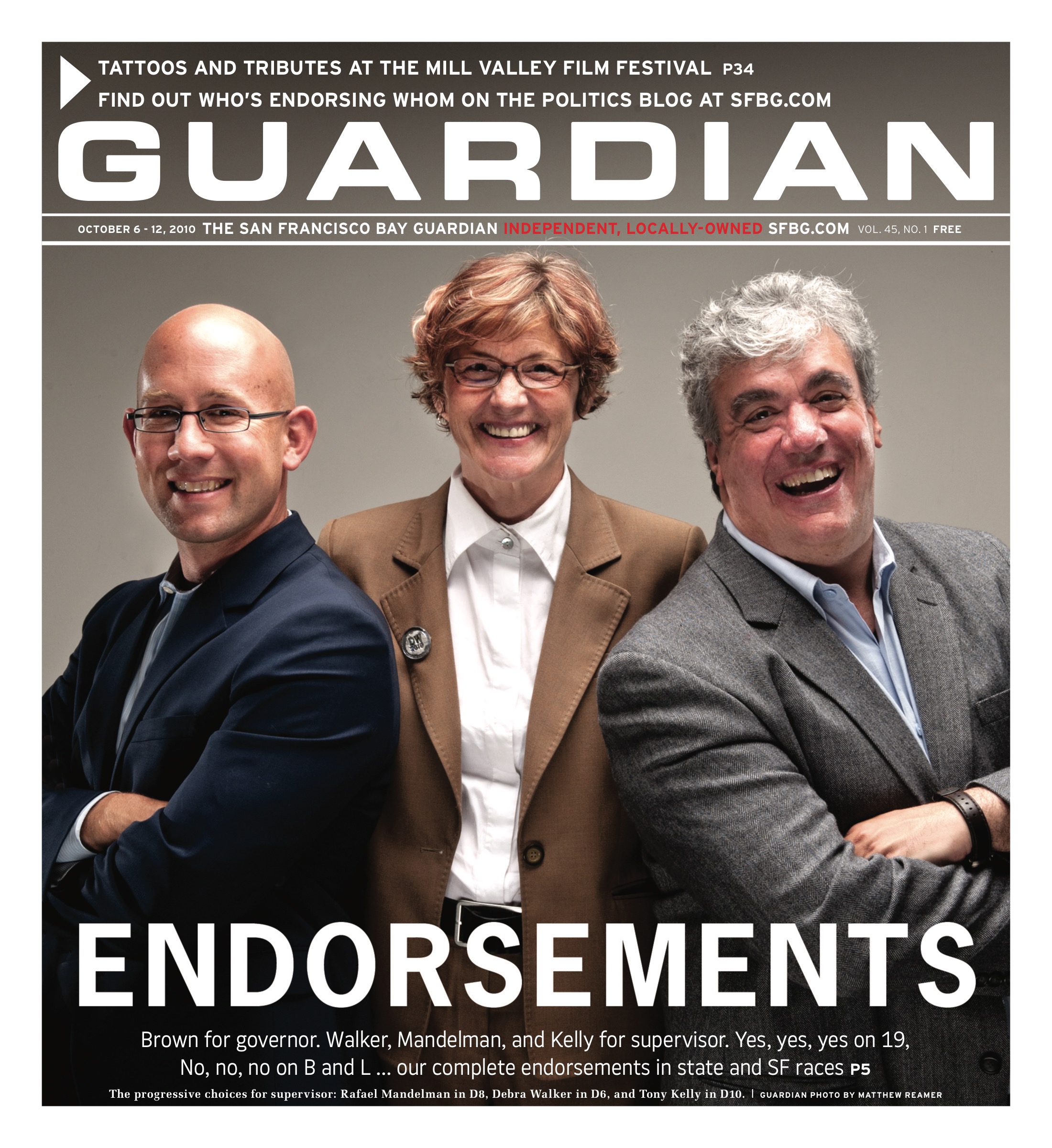
1. DEBRA WALKER


2. JANE KIM


3. GLENDON “ANNA CONDA” HYDE


CORRECTION: In our original version of this endorsement, we said that Jim Meko supports the sit-lie ordinance. That was an error, and it’s corrected below.


A year ago, this race was artist and activist Debra Walker’s to lose. Most of the progressive community was united behind her candidacy; she’d been working on district issues for a couple of decades, fighting the loft developers during the dot-com boom years and serving on the Building Inspection Commission. Then School Board member Jane Kim decided to enter the race, leaving the left divided, splitting resources that might have gone to other critical district races — and potentially helping to put the most pro-business downtown candidate, Theresa Sparks, in a better position to win.


Now we’ve got something of a mess — a fragmented and sometimes needlessly divisive progressive base in a district that’s key to holding progressive control of the board. And while neither of the two top progressive candidates is actively pursuing a credible ranked-choice voting strategy (Kim has, unbelievably, endorsed James Keys instead of Walker, and Walker has declined to endorse anyone else), we’re setting aside our concern over Kim’s ill-advised move and suggesting a strategy that is most likely to keep the seat Chris Daly has held for the past 10 years from falling to downtown control.


Walker is far and away our first choice. She understands land use and housing — the clear central issues in the district — and has well thought-out positions and proposals. She says that the current system of inclusionary housing — pressing market-rate developers to include a few units of below-market-rate housing with their high-end condos — simply doesn’t work. She supports an immediate affordable housing bond act and a long-term real estate transfer tax high enough to fund a steady supply of housing for the city’s workforce. She told us the city ought to be looking at planning issues from the perspective of what San Francisco needs, not what developers want to build. She’s in favor of progressive taxes and a push for local hiring. We’re happy to give her our first-place ranking.


Jane Kim has been a great SF School Board member and has always been part of the progressive community. But she only moved into District 6 a year and a half ago — about when she started talking about running for supervisor (and she told us in her endorsement interview that “D6 is a district you can run in without having lived there a long time.”) She still hasn’t been able to explain why she parachuted in to challenge an experienced progressive leader she has no substantive policy disagreements with.


That said, on the issues, Kim is consistently good. She is in favor of indexing affordable housing to market-rate housing and halting new condo development if the mix gets out of line. She’s for an affordable housing bond. She supports all the tax measures on this ballot. She’s a little softer on congestion pricing and extending parking-meter hours, but she’s open to the ideas. She supports police foot patrols not just as a law-enforcement strategy, but to encourage small businesses. She’d be a fine vote on the board. And while we’re sympathetic to the Walker supporters who would prefer that we not give Kim the credibility and exposure of an endorsement, the reality is that she’s one of two leading progressives and would be better on the board than the remaining candidates.


Hyde, a dynamic young drag queen performer, isn’t going to win. But he’s offered some great ideas and injected some fun and energy into the race. Hyde talks about creating safe injection sites for IV drug users to reduce the risk of overdoses and the spread of disease. He points out that a lot of young people age out of the foster-care system and wind up on the streets, and he’s for continuum housing that would let these young people transition to jobs or higher education. He talks about starting a co-op grocery in the Tenderloin. He proposes bus-only lanes throughout the district and wants to charge large vehicles a fee to come into the city. He’s a big advocate of nightlife and the arts. He lacks experience and needs more political seasoning, but we’re giving him the third-place nod to encourage his future involvement.


Progressives are concerned about Theresa Sparks, a transgender activist and former business executive who now runs the city’s Human Rights Commission. She did a (mostly) good job on the Police Commission. She’s experienced in city government and has good financial sense. But she’s just too conservative for what remains a very progressive district. Sparks isn’t a big fan of seeking new revenue for the city telling us that “I disagree that we’ve made all the cuts that we can” — even after four years of brutal, bloody, all-cuts budgets. She doesn’t support the hotel tax and said she couldn’t support Sup. David Chiu’s progressive business tax because it would lead to “replacing private sector jobs with public sector jobs” — even though the city’s own economic analysis shows that’s just not true. She supports Newsom’s sit-lie law.


Sparks is the candidate of the mayor and downtown, and would substantially shift the balance of power on the board. She’s also going to have huge amounts of money behind her. It’s important she be defeated.


Jim Meko, a longtime neighborhood and community activist, has good credentials and some solid ideas. He was a key player in the western SoMa planning project and helped come up with a truly progressive land-use program for the neighborhood. But he supports Prop. B and is awfully cranky about local bars and nightlife.


James Keys, who has the support of Sup. Chris Daly and was an intern in Daly’s office, has some intriguing (if not terribly practical) ideas, like combining the Sheriff’s Department and the Police Department and making Muni free). But in his interview, he demonstrated a lack of understanding of the issues facing the district and the city.


So we’re going with a ranked-choice strategy: Walker first, Kim second, Hyde third. And we hope Kim’s supporters ignore their candidate’s endorsement of Keys, put Walker as their second choice, and ensure that they don’t help elect Sparks.


DISTRICT 8


RAFAEL MANDELMAN


This is by far the clearest and most obvious choice on the local ballot. And it’s a critical one, a chance for progressives to reclaim the seat that once belonged to Harvey Milk and Harry Britt.


Mandelman, a former president of the Milk Club, is running as more than a queer candidate. He’s a supporter of tenants rights, immigrants’ rights, and economic and social justice. He also told us he believes “local government matters” — and that there are a lot of problems San Francisco can (and has to) solve on its own, without simply ducking and blaming Sacramento and Washington.


Mandelman argues that the public sector has been starved for years and needs more money. He agrees that there’s still a fair amount of bloat in the city budget — particularly management positions — but that even after cleaning out the waste, the city will still be far short of the money it needs to continue providing pubic services. He’s calling for a top-to-bottom review of how the city gets revenue, with the idea of creating a more progressive tax structure.


He’s an opponent of sit-lie and a supporter of the sanctuary city ordinance. He supports tenants rights and eviction protection. He’s had considerable experience (as a member of the Building Inspection Commission and Board of Appeals and as a lawyer who advises local government agencies) and would make an excellent supervisor.


Neither of the other two contenders make our endorsement cut. Rebecca Prozan is a deputy city attorney who told us she would be able to bring the warring factions on the board together. She has some interesting ideas — she’d like to see the city take over foreclosed properties and turn them into housing for teachers, cops, and firefighters — and she’s opposed to sit-lie. But she’s weak on tenant issues (she told us there’s nothing anyone can do to stop the conversion of rental housing into tenancies-in-common), doesn’t seem to grasp the need for substantial new revenues to prevent service cuts, and doesn’t support splitting the appointments to key commissions between the mayor and the supervisors.


Scott Wiener, a deputy city attorney, is a personable guy who always takes our phone calls and is honest and responsive. He’s done a lot of good work in the district. But he’s on the wrong side of many issues, and on some things would be to the right of the incumbent, Sup. Bevan Dufty.


He doesn’t support public power (which Dufty does). He says that a lot of the city’s budget problems can’t be solved until the state gets its own house in order (“we can’t tax our way out of this”) and favors a budget balanced largely by further cuts. In direct contrast to Mandelman, Wiener said San Franciscans “need to lower our expectations for government.” He wants broad-based reductions in almost all city agencies except Muni, “core” public health services, and public safety. He doesn’t support any further restrictions on condo conversions or TICs. And he has the support of the Small Property Owners Association — perhaps the most virulently anti-tenant and anti-rent control group in town.


This district once gave rise to queer political leaders who saw themselves and their struggles as part of a larger progressive movement. That’s drifted away of late — and with Mandelman, there’s a chance to bring it back.


DISTRICT 10


1. TONY KELLY


2. DEWITT LACY


3. CHRIS JACKSON


District 10 is the epicenter of new development in San Francisco, the place where city planners want to site as many as 40,000 new housing units, most of them high-end condos, at a cost of thousands of blue-collar jobs. The developers are salivating at the land-rush opportunities here — and the next supervisor not only needs to be an expert in land-use and development politics, but someone with the background and experience to thwart the bad ideas and direct and encourage the good ones.


There’s no shortage of candidates — 22 people are on the ballot, and at least half a dozen are serious contenders. Two — Steve Moss and Lynette Sweet — are very bad news. And one of the key priorities for progressives is defeating the big-money effort that downtown, the police, and the forces behind the Van Ness Avenue megahospital proposal are dumping into the district to elect Moss.


Our first choice is Tony Kelly, who operates Thick Description Theater and who for more than a decade has been directly involved in all the major neighborhood issues. He has a deep understanding of what the district is facing: 4,100 of the 5,300 acres in D10 have been rezoned or put under the Redevelopment Agency in the past 10 years. Planners envision as many as 100,000 new residents in the next 10 years. And the fees paid by developers will not even begin to cover the cost of the infrastructure and services needed to handle that growth.


And Kelly has solutions: The public sector will have to play a huge role in affordable housing and infrastructure, and that money should come from higher development fees — and from places like the University of California, which has a huge operation in the district and pays no property taxes. Kelly wants to set up a trigger so that if goals for affordable housing aren’t met by a set date, the market-rate development stops. He supports the revenue measures on the ballot but thinks we should go further. He opposes the pension-reform measure, Prop. B, but notes that 75 percent of the city’s pension problems come from police, fire, and management employees. He wants the supervisors to take over the Redevelopment Agency. He’s calling for a major expansion of open space and parkland in the district. And he thinks the city should direct some of the $3 billion in short-term accounts (now all with the Bank of America) to local credit unions or new municipal bank that could invest in affordable housing and small business. He’s a perfect fit for the job.


DeWitt Lacy is a civil-rights lawyer and a relative newcomer to neighborhood politics. He speaks passionately about the need for D10 to get its fair share of the city’s services and about a commitment to working-class people.


Lacy is calling for an immediate pilot program with police foot patrols in the high-crime areas of the district. He’s for increasing the requirements for developers to build affordable housing and wants to cut the payroll tax for local businesses that hire district residents.


Lacy’s vision for the future includes development that has mixed-use commuter hubs with shopping and grocery stores as well as housing. He supports the tax measures on the ballot and would be willing to extend parking meter hours — but not parking fines, which he calls an undue burden on low-income people.


He’s an outspoken foe of sit-lie and of gang injunctions, and with his background handling police abuse lawsuits, he would have a clear understanding of how to approach better law-enforcement without intimidating the community. He lacks Kelly’s history, experience, and knowledge in neighborhood issues, but he’s eminently qualified and would make a fine supervisor.


Chris Jackson, who worked at the San Francisco Labor Council and serves on the Community College Board, is our third choice. While it’s a bit unfortunate that Jackson is running for higher office only two years after getting elected to the college board, he’s got a track record and good positions on the issues. He talks of making sure that blue-collar jobs don’t get pushed out by housing, and suggested that the shipyard be used for ship repair. He wants to see the city mandate that landlords rent to people with Section 8 housing vouchers. He supports the tax measures on the ballot, but also argues that the city has 60 percent more managers than it had in 2000 and wants to bring that number down. He thinks the supervisors should take over Redevelopment, which should become “just a financing agency for affordable housing.” He wants to relocate the stinky sewage treatment plant near Third Street and Evans Avenue onto one of the piers and use the area for a transit hub. He’s still relatively unseasoned, but he has a bright political future.


Eric Smith, a biodiesel activist, is an impressive candidate too. But while his environmental credentials are good, he lacks the breadth of knowledge that our top three choices offer. But we’re glad he’s in the race and hope he stays active in community politics.


Malia Cohen has raised a lot of money and (to our astonishment) was endorsed No. 2 by the Democratic Party, but she’s by no means a progressive, particularly on tenant issues — she told us that limiting condo conversions is an infringement of property rights. And she’s way too vague on other issues.


Moss is the candidate of the big developers and the landlords, and the Chamber of Commerce is dumping tens of thousands of dollars into getting him elected. He’s got some good environmental and energy ideas — he argues that all major new developments should have their own energy distribution systems — but on the major issues, he’s either on the wrong side or (more often) can’t seem to take a stand. He said he is “still mulling over” his stand on sit-lie. He supports Sanctuary City in theory, but not the actual measure Sup. David Campos was pushing to make the policy work. He’s not sure if he likes gang injunctions or not. He only moved back to the district when he decided to run for supervisor. He’s way too conservative for the district and would be terrible on the board.


Lynette Sweet, a BART Board member, has tax problems (and problems explaining them) and wouldn’t even come to our office for an endorsement interview. The last thing D10 needs is a supervisor who’s not accountable and unwilling to talk to constituents and the press.


So we’re going with Kelly, Lacy, and Jackson as the best hope to keep D10 from becoming a district represented by a downtown landlord candidate.


SAN FRANCISCO BOARD OF EDUCATION


MARGARET BRODKIN


KIM-SHREE MAUFAS


HYDRA MENDOZA


Three seats are up on the School Board, and three people will get elected. And it’s a contested race, and in situations like that, we always try to endorse a full slate.


This fall, it was, to put it mildly, a challenge.


It’s disturbing that we don’t have three strong progressive candidates with experience and qualifications to oversee the San Francisco Unified School District. But it seems to be increasingly difficult to find people who want to — and can afford to — devote the time to what’s really a 40-hour-a-week position that pays $500 a month. The part-time school board is an anachronism, a creature of a very different economic and social era. With the future of the next generation of San Franciscans at stake, it’s time to make the School Board a full-time job and pay the members a decent salary so that more parents and progressive education advocates can get involved in one of the most important political jobs in the city.


That said, we’ve chosen the best of the available candidates. It’s a mixed group, made up of people who don’t support each other and aren’t part of anyone’s slate. But on balance, they offer the best choices for the job.


This is not a time when the board needs radical change. Under Superintendent Carlos Garcia, the local public schools are making huge strides. Test scores are up, enrollment is increasing, and San Francisco is, by any rational measure, the best big-city public school district in California. We give considerable credit for that to the progressives on the board who got rid of the irascible, secretive, and hostile former Superintendent Arlene Ackerman and replaced her with Garcia. He’s brought stability and improvement to the district, and is implementing a long-term plan to bring all the schools up to the highest levels and go after the stubborn achievement gap.


Yet any superintendent and any public agency needs effective oversight. One of the problems with the district under Ackerman was the blind support she got from school board members who hired her; it was almost as if her allies on the board were unable to see the damage she was doing and unable to hold her accountable.


Our choices reflect the need for stability — and independence. We are under no illusions — none of our candidates are perfect. But as a group, we believe they can work to preserve what the district is doing right and improve on policies that aren’t working.


Kim-Shree Maufas has been a staunch progressive on the board. She got into a little trouble last year when the San Francisco Chronicle reported that she’d been using a school district credit card for personal expenses. That’s not a great move, but she never actually took public money since she paid back the district. Maufas said she thought she could use the card as long as she reimbursed the district for her own expenses; the rules are now clear and she’s had no problems since. We don’t consider this a significant enough failure in judgment to prevent her from continuing to do what she’s been doing: serving as an advocate on the board for low-income kids and teachers.


Maufas is a big supporter of restorative justice and is working for ways to reduce suspensions and expulsions. She wants to make sure advanced placement and honors classes are open to anyone who can handle the coursework. She supports the new school assignment process (as do all the major candidates), although she acknowledges that there are some potential problems. She told us she thinks the district should go back to the voters for a parcel tax to supplement existing funding for the schools.


Margaret Brodkin is a lightening rod. In fact, much of the discussion around this election seems to focus on Brodkin. Since she entered the race, she’s eclipsed all the other issues, and there’s been a nasty whisper campaign designed to keep her off the board.


We’ve had our issues with Brodkin. When she worked for Mayor Newsom, she was part of a project that brought private nonprofits into city recreation centers to provide services — at a time when unionized public employees of the Recreation and Parks Department were losing their jobs. It struck us as a clear privatization effort by the Newsom administration, and it raised a flag that’s going to become increasingly important in the school district: there’s a coming clash between people who think private nonprofits can provide more services to the schools and union leaders who fear that low-paid nonprofit workers will wind up doing jobs now performed by unionized district staff. And Brodkin’s role in the Newsom administration — and her background in the nonprofit world — is certainly ground for some concern.


But Brodkin is also by far the most qualified person to run for San Francisco school board in years, maybe decades. She’s a political legend in the city, the person who is most responsible for making issues of children and youth a centerpiece of the progressive agenda. In her years as director of Coleman Advocates for Children and Youth, she tirelessly worked to make sure children weren’t overlooked in the budget process and was one of the authors of the initiative that created the Children’s Fund. She’s run a nonprofit, run a city department, and is now working on education issues.


She’s a feisty person who can be brusque and isn’t always conciliatory — but those characteristics aren’t always bad. Sup. Chris Daly used his anger and passion to push for social justice on the Board of Supervisors and, despite some drawbacks, he’s been an effective public official.


And Brodkin is full of good ideas. She talks about framing what a 21st century education looks like, about creating community schools, about aligning after-school and summer programs with the academic curriculum. She wants the next school bond act to include a central kitchen, so local kids can get locally produced meals (the current lunch fare is shipped in frozen from out of state).


Brodkin needs to remember that there’s a difference between being a bare-knuckles advocate and a member of a functioning school board. But given her skills, experience, and lifetime in progressive causes, we’re willing to give her a chance.


We also struggled over endorsing Hydra Mendoza. She works for Mayor Newsom as an education advisor — and that’s an out-front conflict of interest. She’s a fan of Obama’s Education Secretary, Arne Duncan, whose policies are regressive and dangerous.


On the other hand, she cares deeply about kids and public education. She’s not a big supporter of charter schools (“I’ve yet to see a charter school that offers anything we can’t do ourselves,” she told us) and while she was on the wrong side of a lot of issues (like JROTC) early in her tenure, over the past two years she’s been a good School Board member.


There are several other candidates worth mentioning. Bill Barnes, an aide to Michela Alioto-Pier, is a good guy, a decent progressive — but has no experience in or direct connection to the public schools. Natasha Hoehn is in the education nonprofit world and speaks with all the jargon of the educrat, but her proposals and her stands on issues are vague. Emily Murase is a strong parent advocate with some good ideas, but she struck us as a bit too conservative (particularly on JROTC and charter schools.) Jamie Wolfe teaches at a private school but lacks any real constituency or experience in local politics and the education community.


So given a weak field with limited alternatives, we’re going with Maufas, Brodkin and Mendoza.


SAN FRANCISCO COMMUNITY COLLEGE BOARD


JOHN RIZZO


The San Francisco Community College District has been a mess for years, and it’s only now starting to get back on track. That’s the result of the election of a few progressive reformers — Milton Marks, Chris Jackson, and John Rizzo, who now have enough clout on the seven-member board to drag along a fourth vote when they need it.


But the litany of disasters they’ve had to clean up is almost endless. A chancellor (who other incumbent board members supported until the end) is now under indictment. Public money that was supposed to go to the district wound up in a political campaign. An out-of-control semiprivate college foundation has been hiding its finances from the public. The college shifted bond money earmarked for an arts center into a gigantic, expensive gym with a pool that the college can’t even pay to operate, so it’s leased out to a private high school across the street.


And the tragedy is that all three incumbents — two of whom should have stepped down years ago — are running unopposed.


With all the attention on the School Board and district elections, not one progressive — in fact, not one candidate of any sort — has stepped forward to challenge Anita Grier and Lawrence Wong. So they’ll get another term, and the reformers will have to continue to struggle.


We’re endorsing only Rizzo, a Sierra Club staffer who has been in the lead in the reform bloc. He needs to end up as the top vote-getter, which would put him in position to be the board president. Rizzo has worked to get the district’s finances and foundation under control and he richly deserves reelection.


BART BOARD OF DIRECTORS, DISTRICT 8


BERT HILL


It’s about time somebody mounted a serious challenge to James Fang, the only elected Republican in San Francisco and a member of one of the most dysfunctional public agencies in California. The BART Board is a mess, spending a fortune on lines that are hardly ever used and unable to work effectively with other transit agencies or control a police force that has a history of brutality and senseless killing.


Fang supports the suburban extensions and Oakland Airport connector, which make no fiscal or transportation sense. He’s ignored problems with the BART Police for 20 years. It’s time for him to leave office.


Bert Hill is a strong challenger. A professional cost-management executive, he understands that BART is operating on an old paradigm of carrying people from the suburbs into the city. “Before we go on building any more extensions,” he told us, “we should take care of San Francisco.” He wants the agency to work closely with Muni and agrees there’s a need for a BART sunshine policy to make the notoriously secretive agency more open to public scrutiny. We strongly endorse him.


ASSESSOR-RECORDER


PHIL TING


San Francisco needs an aggressive assessor who looks for every last penny that big corporations are trying to duck paying — but this is also a job that presents an opportunity for challenging the current property tax laws. Phil Ting’s doing pretty well with the first part — and unlike past assessors, is actually stepping up to the plate on the second. He’s been pushing a statewide coalition to reform Prop. 13 — and while it’s an uphill battle, it’s good to see a tax assessor taking it on. Ting has little opposition and will be reelected easily.


PUBLIC DEFENDER


JEFF ADACHI


Adachi’s done a great job of running the office that represents indigent criminal defendants. He’s been outspoken on criminal justice issues. Until this year, he was often mentioned as a potential progressive candidate for mayor.


That’s over now. Because Adachi decided (for reasons we still can’t comprehend) to join the national attack on public employees and put Prop. B on the ballot, he’s lost any hope of getting support for higher office from the left. And since the moderate and conservative forces will never be comfortable with a public defender moving up in the political world, Adachi’s not going anywhere anytime soon.


Which is fine. He’s doing well at his day job. We wish he’d stuck to it and not taken on a divisive, expensive, and ill-conceived crusade to cut health care benefits for city employees.


SAN FRANCISCO SUPERIOR COURT


SEAT 15


MICHAEL NAVA


To hear some of the brahmins of the local bench and bar tell it, the stakes in this election are immense — the independence of the judiciary hangs in the balance. If a sitting judge who is considered eminently qualified for the job and has committed no ethical or legal breaches can be challenged by an outsider who is seeking more diversity on the bench, it will open the floodgates to partisan hacks taking on good judges — and force judicial candidates to raise money from lawyers and special interests, thus undermining the credibility of the judiciary.


We are well aware of the problems of judicial elections around the country. In some states, big corporations that want to influence judges raise and spend vast sums on trial and appellate court races — and typically get their way. In Iowa, three judges who were willing to stand on principle and Constitutional law and declare same-sex marriage legal are facing what amounts to a well-funded recall effort. California is not immune — in more conservative counties, liberal judges face getting knocked off the bench by law-and-order types.


It’s a serious issue. It’s worth a series of hearings in the state Legislature, and it might be worth Constitutional change. Maybe trial-court elections should be eliminated. Maybe all judicial elections should have public campaign financing. But right now, it’s an elected office — at least in theory.


In practice, the vast majority of the judicial slots in California are filled by appointment. Judges serve for four-year terms but tend to retire or step down in midterm, allowing the governor to fill the vacancy. Unless someone files specifically to challenge an incumbent, typically appointed judge, that race never even appears on the ballot.


The electoral process is messy and political, and raising money is unseemly for a judicial officer. But the appointment process is hardly pure, either — and governors in California have, over the past 30 years, appointed the vast majority of the judges from the ranks of big corporate law firms and district attorney’s offices.


There are, of course, exceptions, and Gov. Arnold Schwarzenegger has been better than his predecessor, Democrat Gray Davis. But overall, public interest lawyers, public defenders, and people with small community practices (and, of course, people who have no political strings to pull in Sacramento) have been frustrated. And it’s no surprise that some have sought to run against incumbents.


That’s what’s happening here. Michael Nava, a gay Latino who has been working as a research attorney for California Supreme Court Justice Carlos Moreno, was going to run for a rare open seat this year, but the field quickly got crowded. So Nava challenged Richard Ulmer, a corporate lawyer appointed by Schwarzenegger who has been on the bench a little more than a year.


We will stipulate, as the lawyers say: Ulmer has done nothing wrong. From all accounts, he’s a fine judge (and before taking the bench, he did some stellar pro bono work fighting for reforms in the juvenile detention system). So there are two questions here: Should Nava have even filed to run against Ulmer? And since he did, who is the better candidate?


It’s important to understand this isn’t a case of special interests and that big money wanting to oust a judge because of his politics or rulings. Nava isn’t backed by any wealthy interest. There’s no clear parallel to the situations in other areas and other states where the judiciary is being compromised by electoral politics. Nava had every right to run — and has mounted an honest campaign that discusses the need for diversity on the bench.


Ulmer’s supporters note — correctly — that the San Francisco courts have more ethnic and gender diversity than any county in the state. And we’re not going to try to come to a conclusion here about how much diversity is enough.


But we will say that life experience matters, and judges bring to the bench what they’ve lived. Nava, who is the grandson of Mexican immigrants and the first person in his family to go to college, may have a different perspective on how low-income people of color are treated in the courts than a former Republican who spent his professional career in big law firms.


We were impressed by Nava’s background and knowledge — and by his interest in opening up the courts. He supports cameras in the courtrooms and allowing reporters to record court proceedings. He told us the meetings judges hold on court administration should be open to the public.


We’re willing to discuss whether judicial elections make sense. Meanwhile, judges who don’t like the idea of challenges should encourage their colleagues not to retire in midterm. If all the judges left at the end of a four-year term, there would be plenty of open seats and fewer challenges. But for now, there’s nothing in this particular election that makes us fear for the independence of the courts. Vote for Nava.


>>BACK TO ENDORSEMENTS 2010

Endorsements 2010: State races

24

GOVERNOR

EDMUND G. BROWN

We have issues with Jerry Brown. The one-time environmental leader who left an admirable progressive legacy his first time in the governor’s office (including the Agricultural Labor Relations Board, the California Conservation Corps, and the liberal Rose Bird Supreme Court) and who is willing to stand up and oppose the Diablo Canyon nuclear power plant has become a centrist, tough-on-crime, no-new-taxes candidate. And his only solution to the state budget problems is to bring all the players together early and start talking.

But at least since he’s started to debate Republican Meg Whitman face to face, he’s showing some signs of life — and flashes of the old Jerry. He’s strongly denouncing Whitman’s proposal to wipe out capital gains taxes, reminding voters of the huge hole that would blow in the state budget — and the $5 billion windfall it would give to the rich. He’s talking about suing Wall Street financial firms that cheated Californians. He’s promoting green jobs and standing firm in support of the state’s greenhouse-gas emissions limits.

For all his drawbacks (his insistence, for example, that the Legislature shouldn’t raise any taxes without a statewide vote of the people), Brown is at least part of the reality-based community. He understands that further tax cuts for the rich won’t solve California’s problems. He knows that climate change is real. He’s not great on immigration issues, but at least he’s cognizant that 2 million undocumented immigrants live in California — and the state can’t just arrest and deport them all.

Whitman is more than a conservative Republican. She’s scary. The centerpiece of her economic platform calls for laying off 40,000 state employees — thereby greatly increasing the state’s unemployment rate. Her tax plan would increase the state’s deficit by another $5 billion just so that a tiny number of the richest taxpayers (including her) can keep more of their money. She’s part of the nativist movement that wants to close the borders.

She’s also one of the growing number of candidates who think personal wealth and private-sector business success translate to an ability to run a complex state government. That’s a dangerous trend — Whitman has no political experience or background (until recently she didn’t even vote) and will be overcome by the lobbyists in Sacramento.

This is a critically important election for California. Vote for Jerry Brown.


LIEUTENANT GOVERNOR


GAVIN NEWSOM

Why is the mayor of San Francisco running for a job he once dismissed as worthless? Simple: he couldn’t get elected governor, and he wants a place to perch for a while until he figures out what higher office he can seek. It’s almost embarrassing in its cold political calculus, but that’s something we’ve come to expect from Newsom.

We endorsed Newsom’s opponent, Janice Hahn, in the Democratic primary. It was hard to make a case for advancing the political career of someone who has taken what amounts to a Republican approach to running the city’s finances — he’s addressed every budget problem entirely with cuts, pushed a “no-new-taxes” line, and given the wealthy everything they wanted. His immigration policies have broken up families and promoted deporting kids. He’s done Pacific Gas and Electric Co. a nice favor by doing nothing to help the community choice aggregation program move forward.

Nevertheless, we’re endorsing Newsom over his Republican opponent, Abel Maldonado, because there really isn’t any choice. Maldonado is a big supporter of the death penalty (which Newsom opposes). He’s pledged never to raise taxes (and Newsom is at least open to discussion on the issue). He used budget blackmail to force the awful open-primaries law onto the ballot. He’s a supporter of big water projects like the peripheral canal. In the Legislature, he earned a 100 percent rating from the California Chamber of Commerce.

Newsom’s a supporter of more funding for higher education (and the lieutenant governor sits on the University of California Board of Regents). He’d be at least a moderate environmentalist on the state Lands Commission. And he, like Brown, is devoting a lot of attention to improving the state’s economy with green jobs.

We could do much worse than Newsom in the lieutenant governor’s office. We could have Maldonado. Vote for Newsom.


SECRETARY OF STATE


DEBRA BOWEN

California has had some problems with the office that runs elections and keeps corporate filings. Kevin Shelley had to resign from the job in 2005 in the face of allegations that a state grant of $125,000 was illegally diverted into his campaign account. But Bowen, by all accounts, has run a clean office. Her Republican opponent, Damon Dunn, a former professional football player and real estate agent, doesn’t even have much support within his own party and is calling for mandatory ID checks at the ballot. This one’s easy; vote for Bowen.


CONTROLLER


JOHN CHIANG

Chiang’s been a perfectly decent controller, and at times has shown some political courage: When Gov. Arnold Schwarzenegger tried to cut the pay of state employees to minimum-wage level, Chiang refused to go along — and forced the governor to back down. His opponent, state Sen. Tony Strickland (R-Los Angeles), wants to use to office to promote cuts in government spending. Vote for Chiang.


TREASURER


BILL LOCKYER

Lockyer’s almost certain to win reelection as treasurer against a weak Republican, Mimi Walters. He’s done an adequate job and pushed a few progressive things like using state bonds to promote alternative energy. Mostly, though, he seems to be waiting for his chance to run for governor — and if Jerry Brown loses, or wins and decides not to seek a second term, look for Lockyer to step up.


ATTORNEY GENERAL


KAMALA HARRIS

This is going to be close, and it’s another clear choice. We’ve had our differences with Harris — she’s trying too hard to be a tough-on-crime type, pushing some really dumb bills in Sacramento (like a measure that would bar sex offenders from ever using social networking sites on the Internet). And while she shouldn’t take all the blame for the problems in the San Francisco crime lab, she should have known about the situation earlier and made more of a fuss. She’s also been slow to respond to serious problem of prosecutors and the cops hiding information about police misconduct from defense lawyers that could be relevant to a case.

But her opponent, Los Angeles D.A. Steve Cooley, is bad news. He’s a big proponent of the death penalty, and the ACLU last year described L.A. as the leading “killer county in the country.” Cooley has proudly sent 50 people to death row since he became district attorney in 2001, and he vows to make it easier and more efficient for the state to kill people.

He’s also a friend of big business who has vowed, even as attorney general, to make the state more friendly to employers — presumably by slowing prosecutions of corporate wrongdoing.

Harris, to her credit, has refused to seek the death penalty in San Francisco, and would bring the perspective of a woman of color to the AG’s office. For all her flaws, she would be far better in the AG’s office than Cooley. Vote for Harris.


INSURANCE COMMISSIONER


DAVE JONES

Jones, currently a state Assemblymember from Sacramento, won a contested primary against his Los Angeles colleague Hector de la Torre and is now fighting Republican Mike Villines of Fresno, also a member of the Assembly. Jones is widely known as a consumer advocate and was a foe of Prop. 17, the insurance industry scam on the June ballot. A former Legal Aid lawyer, he has extensive experience in health-care reform, supports single-payer health coverage, and would make an excellent insurance commissioner.

Villines pretty much follows right-wing orthodoxy down the line. He wants to replace employer-based insurance with health savings accounts. He argues that the solution to the cost of health insurance is to limit malpractice lawsuits. He wants to limit workers compensation claims. And he supports “alternatives to litigation,” which means eliminating the rights of consumers to sue insurance companies.

Not much question here. Vote for Jones.


BOARD OF EQUALIZATION, DISTRICT 1


BETTY YEE

The Board of Equalization isn’t well known, but it plays a sizable role in setting and enforcing California tax policy. Yee’s a strong progressive who has done well in the office, supporting progressive financial measures. She’s spoken out — as a top tax official — in favor of legalizing and taxing marijuana. We’re happy to endorse her for another term.


SUPERINTENDENT OF PUBLIC INSTRUCTION


TOM TORLAKSON

We fully expected a November runoff between Torlakson and state Sen. Gloria Romero. Both Democrats had strong fundraising and political bases — and very different philosophies. Romero’s a big charter school and privatization fan; Torlakson has the support of the teachers unions. But to the surprise of nearly everyone, a wild-card candidate, retired Los Angeles educator Larry Aceves, came in first, with Torlakson second and Romero third. Now Aceves and Torlakson are in the runoff for this nonpartisan post.

Aceves is an interesting candidate, a former principal and school superintendent who has the endorsement of the San Francisco Chronicle and the San Francisco Green Party. But he’s too quick to take the easy line that the teachers’ unions are the biggest problem in public education, and he wants the unilateral right to suspend labor contracts.

Torlakson wants more charter-school accountability and more funding for primary education. He’s the far better candidate.


STATE SENATE


DISTRICT 8

Leland Yee

Yee’s got no opposition to speak of, and will easily be re-elected. So why is he spending money on a series of slick television ads that have been airing all over San Francisco, talking about education and sending people to his website? It’s pretty obvious: The Yee for state Senate campaign is the opening act of the Yee for San Francisco mayor campaign, which should kick into high gear sometime next spring. In other words, if Yee has his way, he’ll serve only a year of his next four-year term.

Yee infuriates his colleagues at times, particularly when he refuses to vote for a budget that nobody likes but everyone knows is necessary to keep the state afloat. He’s done some ridiculous things, like pushing to sell the Cow Palace as surplus state property and turn the land over to private real estate developers. But he’s always good on open-government issues, is pushing for greater accountability for companies that take tax breaks and then send jobs out of state, has pushed for accountability at the University of California, and made great progress in opening the records at semiprivate university foundations when he busted Stanislaus State University for its secret speaking-fees deal with Sarah Palin.

With a few strong reservations, we’ll endorse Yee for another term.


STATE ASSEMBLY, DISTRICT 12


FIONA MA

A clear hold-your-nose endorsement. Ma has done some truly bad things in Sacramento, like pushing a bill that would force the San Francisco Unified School District to allow military recruiters in the high schools and fronting for landlords on a bill to limit rent control in trailer parks. But she’s good on public power and highly critical of PG&E, and she has no opposition to speak of.


STATE ASSEMBLY, DISTRICT 13


TOM AMMIANO

Ammiano’s a part of San Francisco history, and without his leadership as a supervisor, we might not have a progressive majority on the Board of Supervisors. Ammiano was one of the architects of the return to district elections, and his 1999 mayoral campaign (against Willie Brown) marked a turning point in the organization, sophistication, and ultimate success of the city’s left. He was the author of the rainy day fund (which has kept the public schools from massive layoffs over the past couple of years) and the Healthy San Francisco plan.

In Sacramento, he’s been a leader in the effort to legalize (and tax) marijuana and to demand accountability for the BART Police. He’s taken on the unpleasant but critical task of chairing the Public Safety Committee and killing the worst of the right-wing crime bills before they get to the floor. He has four more years in Sacramento, and we expect to see a lot more solid progressive legislation coming out of his office. We enthusiastically endorse him for reelection.


STATE ASSEMBLY, DISTRICT 14


NANCY SKINNER

Skinner’s a good progressive, a good ally for Ammiano on the Public Safety Committee, and a friend of small business and fair taxation. Her efforts to make out-of-state companies that sell products in California pay state sales tax would not only bring millions into the state coffers but protect local merchants from the likes of Amazon. We don’t get why she’s joined with Berkeley Mayor Tom Bates to try to get rid of Kriss Worthington, the most progressive member of the Berkeley City Council, but we’ll endorse her for re-election.


STATE ASSEMBLY, DISTRICT 16


SANDRE SWANSON

Swanson’s a good vote most of the time in Sacramento, but he’s not yet the leader he could be — particularly on police accountability. The BART Police murdered Oscar Grant in Swanson’s district, yet it fell to a San Franciscan, Tom Ammiano, to introduce strong state legislation to force BART to have civilian oversight of the transit cops. Still, he’s done some positive things (like protecting state workers who blow the whistle on fraud) and deserves another term.


>>BACK TO ENDORSEMENTS 2010

The pummeling of SF Labor

18

Click to read sidebar, Brown or Whitman? No contest

With five supervisorial seats open and only one incumbent running, the Labor Council has had a tough time picking the right pro-labor candidates. The easy choices were incumbent Carmen Chu in District 4, with no opposition, and Raphael Mandelman, an exceptionally promising newcomer in District 8. But Janet Reilly in District 2 opposes the Labor Council’s revenue measures. In District 6, where long-time activist Deborah Walker has been endorsed, and in District 8, where Malia Cohen and Chris Jackson are #1 and #2, there are a multitude of candidates, many of them labor friendly.

It’s not an easy year.

Prop. B on San Francisco’s November election ballot confronts the city’s working people and their unions with an unprecedented challenge. The measure, sponsored by Public Defender Jeff Adachi, would severely weaken public employee unions and undoubtedly lead to other serious attacks on workers and unions in private as well as public employment nationwide.

The proposition is by no means the only dangerously anti-labor measure on the ballot, but it ‘s the worst from labor’s point of view, as it very well should be. It’s a prime example of the public-employee bashing that’s become a favorite theme in election campaigns everywhere and, if passed, would set a clear national precedent.

Actually, Prop. B might better be described as a pummeling rather than bashing – and one coming, furthermore, just a few months after city employees took a voluntary $250 million pay cut. Prop. B would steeply raise the employees’ contributions to their pensions unilaterally and prohibit bargaining on the issue in the future as well.

It would arbitrarily lower city contributions to the employees’ health plans, especially dependent care. What employees pay for health care coverage for children and other dependents would be as much as doubled.

The steep rise in the employees’ share of their health care coverage could quite possibly force families to drop city coverage and try to get cheaper coverage on their own. That, of course, is a primary goal of the corporate anti-labor forces and others who seek to balance the budgets of public entities on the backs of their employees.

So what if workers can’t afford to take the kids to the doctor.  Cutting taxes and balancing budgets is a lot more important. Besides, there’s always the emergency room and charity.

But wait! There are yet more major Prop. B flaws. For example: If city health care coverage is changed by increasing the premiums paid by employees, as the proposition requires, the city Health Service system (HSS) would have to forfeit new $23 million-a-year federal grants intended to reduce premiums for employees and retirees covered by the HSS. The system includes, not just city employees, but also school and community college district and SF court system employees and retirees.

There’s even more, much more than enough to energize labor’s troops. They are angry. Very angry. Unions citywide have at least temporarily set aside their sometimes considerable differences and feuding over tactics, jurisdictions and other matters. They’ve come together tightly along with a substantial number of labor’s Democratic Party allies to oppose Prop. B.

And watch out for Prop. G. It’s another favorite of the anti-union, anti-public employee crowd, led in this case by Sean Elsbernd, a very politically ambitious member of the SF Board of Supervisors.

Elsbernd and friends claim their intent is to “fix the Muni,” one of the nation’s most complex transit systems. The Municipal Railway, overseen by the Metropolitan Transit Authority (MTA), is indeed badly in need of fixing. But the principal blame for that does not rest with Muni’s bus and streetcar operators – most of them people of color – as proponents of Prop. G claim. Most of the blame rests with Muni’s overpaid managers, headed by $336,000-a-year executive director and CEO Nathaniel Ford.

As President Irwin Lum of the Muni operator’s union said in a Guardian interview,  “Muni needs to be changed from the top to the bottom.” He sees Muni’s problem as mainly a lack of resources and the political will to pursue them.  Muni officials might also avoid lots of problems if they’d deign to consult regularly with community groups and their leaders on their transit needs.

The public rightly complains of buses not arriving on time, of being passed up while waiting at bus stops, of grumpy drivers and of other certainly legitimate matters.  Naturally, they blame the drivers. But drivers do not make schedules. Under pressure to keep to the schedules made by others, they sometimes speed by waiting passengers. Sometimes they’re slowed by heavy traffic, sometimes by problems with faulty, broken-down down buses or slowed by having to deal with violent passengers. Sometimes, managers making out the schedules don’t properly anticipate such probable delays.

Oh, yes, those grumpy drivers.

Wouldn’t you be grumpy if you had to work a full shift without going to the bathroom? If you had to listen to loud complaints from unruly passengers who sometimes got rough with you and each other?  If you had to weave through heavy traffic for hours at a time? If you had to time your work to unrealistic schedules you had nothing to do with making?

It’s not the drivers who are in charge of replacing badly worn buses and streetcar tracks and equipment, not the drivers who are in charge of negotiating with Muni suppliers for a reduction in ever-escalating fuel prices and other costs. In short, it’s not the drivers who run Muni – though Muni, of course, could not run without them.

So, what do Elsbernd and his anti-labor cohorts want to do to the Muni’s invaluable workers? Here’s the deal:

The City Charter now requires that Muni operators be paid at least as much as the average salary of operators at the two highest paying similar transit systems in the country.  And if benefits granted Muni operators are worth less than those of operators at similar transit systems, the difference is paid to the operators from a trust fund established for that purpose.

Under Prop. G, operators’ pay and benefits would be set by bargaining between union and MTA representatives. If they couldn’t agree, the dispute would be submitted to an arbitrator, whose decision would be binding.

The arbitrator would be required to consider the possible impact of disputed proposals on Muni fares and services. But though all other city unions are also subject to arbitration, there’s no requirement that the arbitrator consider how their proposals would affect the services provided by the union’s members – an unusual requirement that’s virtually unheard of elsewhere.

Prop. G backers presumably see the proposition as a step toward their goal of being able to set, change or eliminate Muni work rules without bothering to consult workers or their unions. They are, you might say, “unilateralists.”

 Taking on Muni operators is only part of Supervisor Elsbernd’s anti-labor romp. He’s also sponsoring Prop.  F, a deceptively simple charter amendment that would seriously impact the 105,000 members of the Health Service System. It’s a stealth proposition, difficult to understand and explain, and thus often brushed aside as a minor ballot measure of no particular consequence.

But Prop. F is capable of doing major long-term damage to HSS members by weakening their position in negotiating with powerful health insurers such as Blue Shield on the size of the premiums HSS members have to pay for coverage and the benefits they receive.

All politicians stretch the truth. It’s part of their game. You needn’t look further than Elsbernd for evidence of that.  He actually claims he put Prop. F on the ballot strictly to save the Health Service System money by eliminating two of the four elections in which HSS members vote for representatives on the HSS Board. This seemingly small change would eliminate the overlapping terms that provide the continuity essential to successful negotiations with health insurers.

The savings would average a mere $30,000 a year, and would not even be available until 2016. Nor is there a guarantee that any of the money would go to the HSS. $30,000? What’s the real motive here?

As for the rest of San Francisco’s ballot measures and candidates, union supporters could hardly do better than to follow the recommendations of the AFL-CIO’s local Labor Council, which almost invariably backs the propositions most likely to be labor-friendly and opposes those that are not. This time, the Labor Council is saying “no” to those decidedly unfriendly Propositions B, G and F.

And don’t forget Props. J, K and N. Hotel workers and others are supporting Prop. J, which is meant to stop the travel industry practice of using online hotel booking to avoid paying SF’s hotel tax. Prop. J also would increase the city’s hotel tax for the first time in 14 years in order to raise some most welcome revenue for the city’s general fund.

However, Prop. K – introduced by Mayor Newsom – could stand in the way. Since Prop. K makes no change in the hotel tax rate, apparently it’s intended to confuse and distract the voters so they won’t approve Prop. J.

The other major revenue measure strongly supported by labor – Proposition N – would increase the city’s transfer tax rate on the sale of property worth more than $5 million from 1.5 percent now to a range of 2 to 2 ½ percent for a property worth $10 million or more. This would also generate millions for the city’s general fund.

Rarely has so much been at stake for San Francisco’s working people and their unions.

Dick Meister, former Labor Editor of the SF Chronicle and KQED-TV, has covered labor and politics for a half-century, Contact him through his website, www.dickmeister.com, which includes more than 250 of his columns.

Oscar-winning director Davis Guggenheim talks “Waiting for ‘Superman'”

2

Where do you go from global warming?

Director Davis Guggenheim won an Academy Award for 2006’s An Inconvenient Truth. His latest film, Waiting for “Superman”, takes on the United States’ failing public education system. In some ways, the documentary represents a return to Guggenheim’s first subject. “The very first documentary I made followed first-year teachers, because I believed that teachers were the answer to our schools,” he says. “And I still believe that. Now I wanted to talk about the kids and their families, and what’s at stake for them.”

The kids and families in question are the subjects of Waiting for “Superman”, which follows five young people in search of a better education. While the scope of the film is large — covering the history and bureaucracy that has created this national epidemic — Guggenheim is careful never to stray far from the victims of the crisis.

“The really hard part about it is how complicated this issue is, and it’s hard to simplify it,” he explains. “And I wanted it to be understandable to everybody. Whenever I got lost, I would always bring it back to the kids. It’s a very simple story: five kids, all they want is to go to a great school.”

In the film, Guggenheim looks at the complex situation from several different angles. Some of his targets are predictable — budget cuts and lack of accountability. But he also focuses on areas that might be less familiar to audiences, such as the detrimental effect teacher’s unions can have on schools. While Guggenheim asserts that he is a pro-union liberal, he suggests that teacher’s unions create contracts that make it difficult to deal with many of the problems public schools face today.

“I’m a member of the Directors Guild of America,” he says. “They make sure I get paid properly. They make sure my rights are taken care of. But they don’t tell Hollywood how to make movies, and they don’t protect bad directors.” Guggenheim’s analogy is apt. These unions push for tenure, which most teachers receive automatically after two years. Once they have tenure, it’s very hard for them to be let go — even if they are performing poorly at their jobs.

“I think teachers should get even stronger and demand more pay,” Guggenheim continues. “But they should not have these contracts that keep reform from happening.” Some of the fixes Guggenheim proposes seem like no-brainers. As he points out, the drive behind Waiting for “Superman” is one most people can relate to, whether they’re parents of students directly affected by the situation, or simply compassionate people.

“What’s amazing about public education is that everyone wants great schools,” Guggenheim notes. “It’s not like you’re going to argue that. With global warming, maybe you could argue about whether it’s real or not. But in America, everyone believes in great schools.” On the other hand, we’ve become cynical. We see president after president enter the White House with the promise of education reform. And yet, as Waiting for “Superman” documents, for the most part we’re no better off than we were before. In some areas, we’re worse.

“The problem is, people over time, they give up, because they feel like it’s too complicated, or it’s impossible to fix,” Guggenheim reflects. “And I tried to make a movie to get people to start to care again, and to believe that it’s possible, and to fight so that every kid can get a great education.” Guggenheim sincerely believes in his cause — he sees the documentary as just a jumping-off point for a larger movement. And while it’s easy to feel daunted by the magnitude of the problems our nation faces, he’s confident that things can get better, provided we have the motivation.

“Change can happen really fast,” Guggenheim says. “Before World War II, we could only make a couple planes a year. When we all got excited and committed, we made a thousand planes a year.”  He hopes that Waiting for “Superman” will inspire that desire for change. Guggenheim believes that it’s something we all feel, and that education may simply be something we’ve ignored for too long.

“We’ve been not wanting to deal with our schools,” he says, “and I think we could jump right in. The solutions are there.” But he’s also clear about what it takes: “We’re not gonna fix our schools unless everyone is outraged, and everyone demands that all of our schools work.”

Waiting for “Superman” opens Fri/1 in Bay Area theaters.

Our queer children are killing themselves: You can help UPDATED

35

Update: According to LGBTpov.com, Gov. Schwarzenegger yesterday “signed the Mental Health Services for At-Risk Youth Act (SB 543), which will expand access to essential mental health services for youth ages 12-17. The bill, authored by openly gay State Sen. Mark Leno and sponsored by Equality California, allows teens to obtain counseling without parental consent.” Unfortunately,  “Friday morning, Charles Robbins, Executive Director of The Trevor Project reported a fifth suicide — Raymond Chase, 19, a sophomore at Johnson and Wales University in Rhode Island took his own life on Wednesday.” Hopefully kids in California will at least have expanded access to mental health counseling services. Original post is below.

For the fourth time this month, a kid who was harassed by anti-gay bullies has taken his own life. Seth Walsh, an out gay 13-year-old in Tehachapi, in central California, had been transferred from middle school to an independent study program, reportedly because he had been teased relentlessly about his orientation. Ten days ago he was found unconscious at the base of a tree in his backyard, apparently after he had attempted to hang himself. His parents took him off life support yesterday in Bakersfield.   

Even though other kids admitted to harassing Seth — police reported that some of them “broke down in tears” because “they had never seen this outcome,” and wished they hadn’t participated in the bullying — no charges will be pressed against them: their actions do not constitute a crime

Horribly, this was no isolated incident.  

According to lgbtqnation.com:

 “On September 9, 15-year-old Billy Lucas of Greensburg, IN, hanged himself at his grandmother’s home. Friends of Lucas said that he had been tormented for years based on his perceived sexual orientation.

On September 23, 13-year old Asher Brown, a gay teen in Houston, TX, came home from school while his parents were at work. He shot himself in the head after enduring what his mother and stepfather say was constant harassment and bullying.

(Also, teen freshman Tyler Clementi at Rutgers University leaped off the George Washington bridge last Wednesday, after his roommate used a web cam to secretly and maliciously stream him “sharing a gay embrace.”) 

This month, as well, saw the acclaimed launch of queer advice columnist and activist Dan Savage’s “It Gets Better” campaign (in direct response to Billy Lucas’ death, as a commenter below points out). It invites LGBTQ people to record videos addressed to queer young ‘uns that tell their stories of surviving school bullies and leading full lives after they graduated. I’m not sure I agree that people need to just wait to get out of school in order to survive — many don’t exactly find gay adult life a catered picnic, either, and why can’t we elders make an effort to help change the world for children in school now? — but I definitely agree that reaching out to isolated young people and letting them know there’s an entire community on their side is absolutely essential. 

It’s infuriatingly sad that these instances seem to be on the rise, right when the country is making progress on most gay activists’ bigtime agendas: repealing DADT and legalizing same-sex marriage. Who cares about those things when our young people are in so much pain that they’re taking their own lives? Yes, ending all discrimination will help people envision a brighter future — let’s just not put all our eggs in one or two baskets, and forget entire segments of our community. 

And while making an “It Gets Better” video is great, there are many fantastic community organizations in San Francisco serving the immediate counseling and housing needs of queer kids, many of whom have run away to avoid anti-gay bullying. Ignoring them only perpetuates the suffering. In a time of reduced aid, these organizations could really use your donations or time. Here are a few standouts:

Larkin Street Youth Services

Lavender Youth Recreation and Information Center (LYRIC)

San Francisco LGBT Community Center 

Tenderloin Health

And if you know a queer or questioning young person who is dealing with depression, or seeks counseling, direct them (and donate!) to the great Trevor Project suicide prevention hotline: 1-866-488-7386

California is one of a handful of states that specifically protects kids against anti-gay harassment, but cases are still hard to prove — if you see someone being harassed or know of someone who is being bullied, encourage them to report it to their parents, school counselor, or other professional so that it will be documented. 

*ANOTHER DEATH: Commenter Aaron Baldwin below points to the recent suicide of 15-year-old Justin Aaberg in Minnesota, who was apparently a victim of anti-gay bullying, although I haven’t been able to find out much more than what’s in this Queerty story.

**ANOTHER RESOURCE: Commenter Liz below reminds me about SMAAC, serving queer and questioning youth in Oakland and the East Bay. Her comment raises several great points as well about helping youth now. 

High on arrival

0

arts@sfbg.com

MUSIC If hip-hop is jazz, then Curren$y can be described as a traditionalist. His debut album, Pilot Talk (DD172/Def Jam), is pure braggadocio, with rhymes about fancy cars and free-flowing liquor and free-loving women. The music, lovingly produced and arranged by Ski Beatz, sounds like an update of Dr. Dre’s The Chronic, all the way down to the New York session musicians recruited to crank out mellow grooves. It’s as if Curren$y has reinterpreted the Sugar Hill Gang’s “Rapper’s Delight” for the new millennium.

In the world of jazz, the traditionalists famously waged war against the free jazz nuts who wanted to strip the form of tonality, and then against the fusionists who sought to infect it with slovenly rock and roll. With help from Dixieland revivalists and Ken Burns’s Jazz documentary, they succeeded. In contrast, rap nerds have always viewed avant-garde experimentation with suspicion at best, and complete ignorance at worst. The furthest we’ll go, it seems, is the high-tech funk of Big Boi’s Sir Lucious Left Foot: Son of Chico Dusty, or Madlib’s Medicine Show of gutbucket blues and crusty soul-jazz loops.

If fitted with John Coltrane’s sheets of sound or Ornette Coleman’s harmolodics, Pilot Talk would be a strangely awesome experience. As is, it’s soothing yet enlightening, like an animated chop session after smoking a joint or two with a friend. Curren$y clearly made it on blunted terms: the album artwork depicts a lone airplane flying over a landscape of lush green marijuana foliage.

So Pilot Talk is like weed talk, with several narratives hidden underneath the stoner blather. On “Example,” Curren$y claims “reimbursement for paid dues,” then states, “I am an example of what can happen when you quit being afraid to gamble.” On “Seat Change,” he mocks a girl who wants to “ride with a G,” concluding that “somewhere along the line she fucked up and realized she lost her seat.” His lines are pimp slick but thankfully shorn of delusion. When he flips a bevy of yeyo metaphors for “Audio Dope,” he clearly does it in service of the concept, not to build a farcical image of himself as a drug kingpin. The image is of a neighborhood (or, more accurately, Internet) baller.

Curren$y’s persistence comes from years spent toiling for various rap crews, hip-hop’s version of the mailroom. As a young scrapper from New Orleans’s Uptown neighborhood, he rolled with C-Murder’s TRU family before C-Murder infamously caught a life bid for murder, then transferred to Master P’s No Limit label. Then he landed at Lil Wayne’s fledgling Young Money Entertainment, dropping burner verses for Weezy’s The Carter II and Dedication mixtapes, before landing under the aegis of reformed hip-hop mandarin Damon Dash, whose DD172 label released Pilot Talk in July. It’s ironic that since Curren$y’s departure, Weezy has decided to transform Young Money into an overpublicized pop star boot camp for teen idols like Nicki Minaj and Drake. Then again, the fact that even Curren$y sounds alternative when posited against mainstream rap’s scions demonstrates how rigid the culture has truly become.

However, Curren$y also benefits from marketing, albeit of a viral nature. Pilot Talk boasts the cream of the blog rap crop, including Mikey Rocks from the Cool Kids, Big K.R.I.T., and Jay Electronica (who sharply compares Flavor Flav’s signature bow tie to the Nation of Islam’s attire). Even much-beloved weed rapper Devin the Dude drops a verse for “Chilled Coughphee.” A writer friend of mine, Christopher Weingarten, remarked to me that when Devin the Dude jumps in with sly wit like “I can fuck a bum up quick / But that’s some tenth grade shit,” it only underscores Curren$y’s relative lack of vocal presence.

Other critics have theorized that Pilot Talk‘s artistic triumph is largely due to Ski Beatz’s memorable accompaniment. An NY vet whose catalog ranges from membership in early-’90s woulda-beens Original Flavor to credits on Jay-Z’s 1996 classic Reasonable Doubt and Camp Lo’s “Luchini AKA (This Is It),” Ski Beatz initially produced Pilot Talk‘s tracks himself and then hired talented unknowns like bassist Brady Watt to transform them into instrumental gems. True, any rapper would sound incredible against the majestic sunshine funk of “Address.” But give Curren$y credit for lodging its hook in your brain — “Still nothing changed but the address.”

CURREN$Y

With C-Plus and NPire Da Great, J-Billion and P-Funk, DJ ANT-1

Wed/29, 9 p.m., $16–$20

330 Ritch

330 Ritch, SF

(415) 541-9574

www.330ritch.com


When you’re having more than one

1

tiredmond@sfbg.com

BEER I saw a great T-shirt in upstate New York this summer, and it’s become my official motto: “You can’t drink all day if you don’t start in the morning.”

Well, maybe that’s a bit of an exaggeration — I’m not as young as I used to be, and the days of morning (or even afternoon) drinking are becoming rarer. But I’m still the guy Schaefer Beer was thinking about when they wrote that slogan in the 1960s about the “one beer to have when you’re having more than one.” Frankly, I’d rather down three or for (or five) cheap light beers than sit around all evening nursing one fine IPA.

So I’ve taken quite an interest in session beers — craft brews with an ABV (alcohol by volume) level of less than 4.5 percent. You can drink a session beer at lunch and still go back to work. You can drink a couple-three after work and not be too blotto to make dinner and put the kids to bed. Or, as one of our tasters put it: “If I hit a happy hour, I’m usually done for the night. But after these beers, I was still ready for an evening of drinking.”

The term “session beer” is usually traced back to England in the World War II era, where the pubs were only open for a short “session” during the lunch hour so the workers could get back to the munitions plants. They’ve become pretty popular on the East Coast, where session beer festivals abound, and they’re making their way west.

It’s still not easy to find good session beer — we live in the land of high-craft, high-alcohol brews, and a lot of the smaller breweries (scared, perhaps, of the evil “light beer” rep) stay away from the weaker, or at least less alcoholic, stuff. But if you shop around a bit, you can find some excellent local choices.

Our willing lab rats sampled six local brews — well, one, Stone Levitation Ale, comes from San Diego, but you can buy it locally — with Bud Light thrown in as a ringer. The tasting was blind, the labels on the bottles well disguised; I was the only one who knew which beer was which.

What we found: There are some truly excellent session beers out there. But not every craft session beer is created equal; our panel liked some a lot better than others. “None of them will grab a beer snob,” one taster noted. “But there were some good ones.”

(A note: Some of these brews — particularly the ones from Haight Street’s Magnolia Pub and Brewery — are available only from the brewhouse. Others can be found in bottles anywhere that carries a wide assortment of craft beers.)

The two samples from Magnolia were the clear winners. Our tasters uniformly liked the Dark Star Mild, calling it “dark and rich tasting, with a light finish and soft aftertaste.” One noted: “I could see sitting on a roof on a hot day and drinking this with my lunch.” Even one of our skeptics, who wasn’t thrilled with any of the offerings, noted “I could drink this one.”

Magnolia’s Sarah’s Ruby, a dark, thick brew, was a close second. One panelist noted: “It has a lot of flavor going on, something I would be happy to order in a bar.” Another liked the “nice taste of toasted barley and hops” while another called it “very robust, not at all like a light beer.”

Anchor Brewing Company’s Small Beer was a close third. The beer, which comes in at just 3.3 ABV, has an interesting history. Anchor brews a barleywine ale, Old Foghorn, that’s almost 10 percent ABV. The brewers then take the once-used mix of malt mash and brew from it a second time, getting a much lighter result. But it doesn’t taste like a rerun at all; one of us said it was “a nice beer that I’d like to keep at home and drink a lot of.” Another called it “musty and earthy” and noted that it would “go well with a cheeseburger or pizza.” And even the critics said, in the words of one, “this is pretty damn okay.”

Ale Industries’ Bliss got points for being “very drinkable.” Our panelist noted a nice malty taste and called it “woodsy and smooth,” although some described it as a bit watery. Stone Brewery’s Stone Levitation Ale came off as “strong, with a bit of licorice flavor,” although one drinker said its strength was also a weakness: “A bit to hoppy to drink a lot of it.”

The Bud Light, I fear, didn’t fare so well. We threw this in for fun (I, for one, remain a Bud Light fan) and for comparison. Although not technically defined as a session beer, it does clock in at 4.5 ABV, 20 percent lower than a standard Bud. Our tasters were not impressed: “This tastes like the 3.2 beer I had to drink during basic training in Fort Carson,” our resident former infantryman wrote. Or, as another put it, “Has the metallic finish that makes for great keg parties and awful hangovers.” Still the Bud Light got points for sessionability; “For sure the best choice for beer pong. You could probably consume mass quantities and still be OK in the morning.”

Ale Industries Orange Shush came in last, probably because its flavor is unique and quite different from the other samples. The critics called its flavor too fruity. The people who liked it, though, said that it was a “good light beer that I could drink all night.”

Which is, after all, the point.

The test of the Tenderloin

16

caitlin@sfbg.com

This is a story about love and money. Or a story about love, money, and location. — Rebecca Solnit, Hollow City (Verso 2000)

It’s a sunny day in the most maligned neighborhood in San Francisco. I’m walking down a busy sidewalk with an excited Randy Shaw, long-time housing advocate. He’s giving me a tour of his Tenderloin.

“There’s history everywhere you look here,” he notes as we rush about the dingy blocks of one of the city’s most densely populated, economically bereft communities. In a half-untucked navy button-down and square-frame glasses, Shaw reels off evidence of this legacy faster than I can write it down and still maintain our walking pace.

To our left, Hyde Street Studios, where the Grateful Dead recorded its 1970 album American Beauty. Across the street, a ramshackle building that once housed Guido Caccienti’s Black Hawk nightclub, where the sounds of jam-fests by the likes of Billie Holiday and John Coltrane would echo out onto the streets during its heyday in the 1950s. Throughout its history, the Tenderloin has been renowned for its nightlife: music, theater, sex work — and the social space that occurs between them.

Shaw came to the Tenderloin 30 years ago as a young law student and founded and built the Tenderloin Housing Clinic, a nonprofit agency that is now one of the largest property owners in the neighborhood and employs more than 250 full-time workers. Shaw has spent the last few decades fighting to improve conditions in the single-room occupancy hotels, or SROs, once notorious for malfunctioning heating systems and mail rooms that would dump the letters for their hundreds of low-income residents into a pile on the floor rather than fit them into personal lock boxes (which now line the walls of THC’s lobbies).

But that activism isn’t the reason for this tour. No, today Shaw is showing me why tourism can work in the Tenderloin. The heavy iron gate of an SRO is quickly buzzed open as the doorman recognizes him. Inside, working-class seniors mill about aided by walkers — this particular property is an old folks’ home — but over our heads, affixed to a majestically high ceiling, looms a triple-tiered glass and metal chandelier, evidence of the area’s architecturally important past.

“When I show people this,” Shaw smiles at my amazement at this bling in a nonprofit apartment building, “they’re amazed at the quality of the housing.” Further down the road, we peep in at a vividly Moorish geometric vaulted ceiling and a lobby that once housed a boxing gym where Miles Davis and Muhammad Ali liked to spar. Both are now home to the inner city’s poorest residents.

Of course, it’s not just tours that we’re talking when it comes to Shaw’s plans for the future. Shaw has acquired a 6,400-square-foot storefront in the Cadillac Hotel on the corner of Eddy and Leavenworth streets, where he plans to open the Uptown Tenderloin Museum in 2012. He says it will showcase the hood’s historical legacy as well as house a nighttime music venue in the basement. The increased foot traffic, he says, will do good things for public safety (a problem that has been identified as a high priority by the resident-run Tenderloin Neighborhood Association) and bring business to the neighborhood’s impressive collection of small ethnic restaurants.

An increased focus on the Tenderloin’s heritage and public image, Shaw says, will translate to more jobs and a better quality of life for the people who live here. “My goal is to have this be the first area in an American city where low income people have a high quality of life,” he says.

If Shaw is correct, it will indeed be a first. Many cities have attempted to transform low income areas with arts districts — and the end result has typically been the displacement of the poorer residents. Coalition on Homelessness director Jennifer Friedenbach described the process: “Gentrification follows a very specific path. First come police sweeps, then the arts, then the displacement. That’s the path that we’re seeing. Hopefully we’ll be able to avoid the displacement part,” she says.

It’d be great if the Tenderloin took the road less traveled — but will it?

Shaw’s best-case scenario seems unlikely, according to Chester Hartman, a renowned urban planning scholar and author of the numerous studies of San Francisco history and the activist handbook Displacement: How to Fight It (National Housing Law Project 1982). Hartman doubts the Tenderloin will remain a housing option for the city’s poor, given its central location and market trends. “The question is, what proportion will move and what will stay?” he said in a phone interview.

Earlier this summer, the National Endowment of the Arts awarded the SF Arts Commission $250,000 toward an arts-based “revitalization of the mid-Market neighborhood.” The area, which is adjacent to the Tenderloin, is considered by many to be the more outwardly visible face of the TL. In truth, the two neighborhoods share many of the same issues and public characteristics, including high density living and prominent issues with drugs.

Amy Cohen, Mayor Gavin Newsom’s director of neighborhood business development, said the Newsom administration is using the money “to implement arts programming that would have an immediate impact on the street. These activities would then build momentum for the longer-term projects.” At this point, plans for that “immediate impact” have started with the installation of lights on Market Street between Sixth and Eighth streets. Two other projects are also in effect: a city-sponsored weekly arts market on United Nations Plaza and an al fresco public concert series.

It’s hard to distinguish these moves from a general trend toward rebranding the image of the Tenderloin. These streets have already seen Newsom announce a historic preservation initiative that put $15,000 worth of commemorative plaques on buildings; it was also announced they would be added to the National Register of Historic Places, a move that allows property owners deep tax cuts for building renovations.

Cohen said her office has spent time trying to attract a supermarket (something the neighborhood, although flush with corner stores, currently lacks), but efforts seem to be faltering. “Grocery store operators and other retailers perceive that the area is unsafe and have expressed concerns about the safety of their employees and customers,” Cohen said. “The arts strategy makes sense because it builds on the assets that are there. Cultivating the performing and visual arts uses that are already succeeding will ultimately enhance the neighborhood’s ability to attract restaurants, retail, and needed services like grocery stores.”

These days, many of the small businesses in the area have window signs hyping “Uptown Tenderloin: Walk, Dine, Enjoy” over graphics of jazzy, people-free high-rises. Looking skyward, one observes the recent deployment of tidy street banners funded by the North of Market/Tenderloin Community Benefit District that pay homage to the number of untouched historic buildings in the neighborhood. The banners read “409 historic buildings in 33 blocks. Yeah, we’re proud.”

Figuring out who benefits from these new bells and whistles can seem baffling at times. Even the museum plan, which Shaw says will draw inspiration in part from New York’s Tenement Museum, has drawn criticism. A July San Francisco Magazine blog post was subtitled “An indecent proposal that puzzled even the San Francisco Visitors Bureau” and likened Shaw’s attempts to the “reality tourism movement” that takes travelers through gang zones in L.A. and poverty-stricken townships in South Africa.

This seems to be a misconstruction of what he’s attempting. “You know what no one ever calls out? The Mission mural tours, the Chinatown tours,” Shaw says.

And Shaw scoffs when I bring up that PR bane of the urban renewer: gentrification. He takes me through a brief rundown of the strict zoning laws in the Tenderloin, adding that many people don’t believe that poor people have the right to live in a high-quality neighborhood: “I haven’t been down here for 30 years to create a neighborhood no one wants to live in.”

Indeed, thanks to the efforts of Shaw and others, it would be hard for even the most determined developers to get rid of the SRO housing in the Tenderloin.

In the 1980s, community activists struggled to change the zoning designation of the neighborhood, which lacked even a name on many city maps. The area was zoned for high-rise buildings and was being encroached on by the more expensive building projects of tourist-filled Union Square, Civic Center, and the wealthier Nob Hill neighborhood. Their success came in the form of 1990s Residential Hotel Anti-Conversion Ordinance, which placed strict limits on landlords flipping their SROs into more expensive housing.

Hartman remains unconvinced of the efficacy of the protective measures activists have won in years past; indeed, even SRO rental prices have soared. According to the Central City SRO Collaborative, in the decade after the Anti-Conversion Ordinance, rental prices increased by 150 percent, not only pricing residents out of the Tenderloin but out of the city. “Where do they move?” Hartman asked. “It’s probably the last bastion of low-income housing in the city. That changes the class composition of the city.”

“The neighborhood has been changing slowly but steadily,” says District Six Sup. Chris Daly when reached by e-mail for comment on the Tenderloin’s future. He writes that rents in the neighborhood have been consistently rising and that several condo development proposals have crossed his desk. Daly has been involved in negotiating “community benefits” and quotas for low income housing in past mid-Market housing projects, but has been disappointed by subsequent affordable housing levels in projects like Trinity Plaza on the corner of Sixth and Market streets. In terms of the Tenderloin, he said, “it is untrue to say that the neighborhood is immune from gentrifying forces. It is shielded, but not immune.”

But some see the influx of art-based attention to the area as a possible boon to residents. Debra Walker, a San Franciscan artist who is running for the District 6 supervisor post, said she believes arts can be used “organically to resolve some of the chronic problems in the Tenderloin, street safety being the primary one in my mind.”

Though most of her fellow candidates expressed similar views when contacted for this story, western SoMa neighborhood activist Jim Meko said he thinks artists in the area are being used to line the pockets of the real estate industry. “The idea of creating an arts district is an amenity that the real estate dealers want to see because it makes the neighborhood less scary for their upper class audience” he says.

The area clearly has a rich legacy of nightlife, arts, and theater. The Warfield is here, as is American Conservatory Theater, the Orpheum, and the Golden Gate. So is the unofficial center of SF’s “off-off Broadway district,” which includes Cutting Ball Theater and Exit Theater. The Exit has been located in the TL since its first performance in 1983, held in the lobby of the Cadillac Hotel, and sponsors the neighborhood’s yearly Fringe Festival. There are art galleries and soup kitchens, youth and age, and more shouted greetings on the streets than you’ll hear anywhere else in the city.

No one is more aware of this diversity of character than Machiko Saito, program director of Roaddawgz, a TL creative drop-in center and resource referral service for homeless youth. I met Saito in the Roaddawgz studio, which occupies a basement below Hospitality House, a homeless community center that also houses a drop-in self-help center, an employment program, men’s shelter and art studio for adults in transition.

Despite its being empty in the morning before the open hours that bring waves of youth to its stacks of paints and silk-screens, Roaddawgz is in a glorious state of bohemian dishevelment that implies a well-loved space. It could be a messy group studio if not for the load-bearing post in the center of the room covered with flyers for homelessness resource centers and a “missing” poster signed “your Mom loves you.”

We talk about how important it is that the kids Saito works with have a place like this, a spot where they can create “when all you want to do is your art and if you can’t you’ll die.” A career artist herself, she cuts a dramatic figure in black, safety pins, and deep red lipstick painted into a striking cupid’s bow. Her long fingernails tap the cluttered desk in front of her as she tells me stories from the high-risk lives that Roaddawgz youth come to escape: eviction, cop harassment, theft, rape.

The conversation moves to some of the recent developments in the area. Saito and I recently attended an arts advisory meeting convened by the Tenderloin Economic Development Corporation’s executive director, Elvin Padilla, who has received praise from many of the TL types I spoke with regarding his efforts to connect different factions of the community. Attendees ranged from a polished representative from ACT, which is considering building another theater, for students, in a space on Market and Mason streets, to heralded neighborhood newbies Grey Area Foundation, to Saito and longtime community art hub Luggage Store’s cofounder Darryl Smith. Talk centered on sweeping projects that could develop a more cohesive “identity” for the neighborhood.

I ask Saito how it felt for her to be involved with a group whose vision of the neighborhood might be focused on slightly different happenings than what she lives through Roaddawgz. She says she’s been to gatherings in the past where negative things about the Tenderloin were highlighted. Of Padilla’s arts advisory meeting, she says, “I think that one of the reasons I wanted to go was that it’s important [for attendees] to remember that there’s a community out there. Things can get really complicated. It’s hard to come up with decisions that affect everyone positively. If we’re going to say, ‘The homeless are bad; the drug addicts are bad; the business owners that don’t beautify their storefronts…” She trails off for a moment. “I don’t want to lose the heart of the Tenderloin.”

In yet another Tenderloin basement — this one housing the North of Market-Tenderloin CBD, an organization that is known for its work employing ex-addicts and adults in transition — Rick Darnell has created the Tenderloin Art Lending Library. The library accepts donated works from painters and makes them available for use by Tenderloin residents, many of whom have recently moved into their SRO housing and are in need of a homey touch.

Darnell is rightfully ecstatic at the inclusive nature of his library, but has been hurt over its reception at an arts advisory meeting he attended to publicize its creation. “Someone whispered under their breath ‘I would never lend anything to anyone in the Tenderloin,’ ” he tells me. The exclusion that Saito and Darnell sometimes feel highlights the reality that the definition of the Tenderloin might well vary, even among those who are set on making it “a better place.” The arts community appears to suffer from fractures that appear along the lines of where people live, their organizational affiliation, their housing status, and how they think art should play a role in community building.

Sammy Soun is one Tenderloin resident who would welcome an increased focus on art in the Tenderloin. Soun was born in a Thailand refugee camp to Cambodian parents fleeing the civil wars in their country. He grew up in the Tenderloin, where his family lived packed into small studios and apartments.

But he was part of a community, with plenty of support, and lives in the neighborhood to this day, as do one of his four siblings and his daughter. Soun paints, does graffiti, draws — he’s considering transferring from City College to the San Francisco Art Institute. He has worked at the Tenderloin Boys and Girls Club for nine years, giving back to the kids he says “are the future. They’re going to be the ones that promote this place or keep it going — if they want to.” His sister, cousins, and uncles still live in the neighborhood. You might say he has a vested interest in the area’s future.

He finds the incoming resources for the Tenderloin arts scene to be a mixed bag. Soun has never been to the Luggage Store, although it’s one of the longtime community art hubs in the area. He can’t relate to the kinds of art done at the neighborhood’s recent digital arts center, Grey Area Foundation for the Arts, though he says the space has contacted him and friends to visit. His disconnect from the arts scene implies that future arts projects need to work harder on their community outreach — or even better, planning — with artists who call the Tenderloin home.

But Soun loves the new Mona Caron mural the CBD sponsored on the corner of Jones Street and Golden Gate Avenue. Well-known for her panoramic bike path mural behind the Church Street Safeway, Caron painted “Windows into the Tenderloin” after dozens of interviews and tours of the neighborhood with community members. Its “before and after” panels are a dummies’ guide for anyone seeking input on ways to strengthen the Tenderloin community — though the “after” does show structural changes like roads converted into greenways and roof gardens sending tendrils down the sides of buildings, the focal point is the visibility of families. Where children were ushered through empty parking lots single-file in the “before” section, the second panel shows families strolling, children running, a space that belongs to them.

Our interview is probably the first time somebody has asked Soun where he thinks arts funding in the Tenderloin should go. “For projects by the kids in the community,he said.

Truth be told, more art of any kind can only make the Tenderloin a better place — but if you’re trying to improve quality life, focus needs to be on plans that positively affect residents of all ages — art can be a vital part of that, but it should be one part of a plan that ensures rent control, safe conditions, and access to services. After all, if you’re going to rebrand the Tenderloin, you might want to look at the painting on the wall.