In the wake of its artistic and community-building success building the Temple of Flux at Burning Man last year, which I profiled in “Burners in Flux” following a five-month immersion journalism project, the nonprofit Flux Foundation has been selected as finalists to address TED2012: Full Spectrum. TED, which stands for Technology, Entertainment and Design, has become the country’s premier cutting edge speakers forum.
Principal artists Rebecca Anders, Jessica Hobbs, Catie Magee, and Peter Kimelman will travel to New York City to do a live presentation with three other Flux crew members to the TED selection panel on May 24. The opportunity was opened up by a great video the team produced, which accentuated the transcendent nature of this collaborative art project, closing with the line, “We built community through art and we’d like to show you how.”
That idea – big art as a catalyst to creating community – was a major theme in my article, as well as the conclusion of my book, The Tribes of Burning Man: How an Experimental City in the Desert is Shaping the New American Counterculture, which focused the Temple of Flux. And it’s something the Flux crew is continuing to do out in its American Steel workspace in West Oakland, where they are working on another ambitious new installation art piece.
Brollyflock, “a renegade flock of umbrellas,” was commissioned by event producer Insomniac for the Electric Daisy Carnival in Las Vegas and Noctural in San Bernardino, and which the crew hopes to display at TED2012. But to realize its ambitious goals, Flux Foundation has started a Kickstarter campaign with a $2,000 goal, so kick in if you want to see this homegrown success story continue to ascend.
There’s a huge debate in journalism and open goverment circles about the wisdom of releasing the photos of the dead Bin Laden with bullets in his head. A lot of people who normally push open-government issues say this one’s dangerous; if the photos get circulated, it could incite violence around the world. On the other hand, they were taken by U.S. troops using U.S. tax dollars; we paid for this stuff, grisly as it is, and the public ought to be able to look at it.
But it’s complicated. And the topic of today’s poll. Check it out after the jump.
For those tracking pension reform, here’s a handy way to follow the money in Wisconsin, which arguably birthed a heated nationwide discussion about public workers’ collective bargaining rights: MapLight.org, a nonpartisan organization that tracks the influence of money in politics, has launched a new website that provides what it calls “transparency tools that show a simple dashboard view of money’s role in the Wisconsin State Legislature.”
“The goal of our Wisconsin site is to provide quick and easy access to information about campaign contributions, the interests of the groups that make them, and how the lawmakers that receive them vote, drawing back the curtain on how money influences legislation around the issues that people care most about,” said Daniel Newman, MapLight.org’s executive director.
This isn’t the first time that MapLight has tracked the money in key issues, but it is the first occasion that its engineers have combined three crucial databases—campaign contributions, legislative votes, and interest group support and opposition—to reveal the intersection between money and votes in the Wisconsin State Legislature.
“By centralizing data on contributions and votes, and combining that information with research on interest group bill support and opposition, MapLight.org will provide Wisconsin’s watchdogs with insights critical to the functioning of our democracy, in a fraction of the time it would take to otherwise assemble these facts from disparate sources,” said Andy Hall, executive director of the Wisconsin Center for Investigative Journalism.
Under an agreement with MapLight.org, the Wisconsin Center For Investigative Journalism will investigate money and politics issues and serve as a resource to news organizations in Wisconsin, supported with a grant from the Open Society Institute, which philanthropist George Soros founded in 1984.
MapLight.org’s data partner for campaign contributions is the Wisconsin Democracy Campaign. Mike McCabe, WDC’s executive director, said “This collaboration creates new opportunities for investigative journalism and citizen exploration of the impact of special interest money in Wisconsin politics”
One of the new website’s legislative data tools shows detailed records of bills, votes, legislators and interest group support and opposition. And the first example it provides is an analysis of, you guessed it, JR1AB 11—“an act relating to state finances, collective bargaining for public employees, compensation and fringe benefits of public employees, the state civil service system, the medical assistance program, etc. : And so far, the analysis reveals that opponents of the bill, which include major unions, have spent $280,000, or 6.7 times as much as supporters, who spent $42,000 and include residential construction, general business advocates, Conservative/Republican groups and Chambers of Commerce.
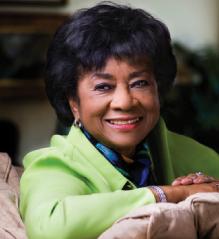
Outstanding piece on Calbuzz about the new Belva Davis book, “Never in My Wildest Dreams: A Black Woman’s Life in Journalism.” The Calbuzzers recount the vicious racist attacks Davis endured during the 1964 Republican convention in San Francisco, when the Goldwater forces were in control:
As we began our descent down the ramps of the Cow Palace, a self-appointed posse dangled over the railings, taunting. “Niggers!” “Get out of here, boy!” “You too, nigger bitch!” “Go on, get out!” “I’m gonna kill your ass!”
I stared straight ahead, putting one foot in front of the other like a soldier who would not be deterred from a mission. The throng began tossing garbage at us: wadded up convention programs, mustard-soaked hot dogs, half-eaten Snickers bars. My goal was to appear deceptively serene, mastering the mask of dispassion I had perfected since childhood to steel myself against any insults the outside world hurled my way.
Then a glass soda bottle whizzed within inches of my skull. I heard it whack against the concrete and shatter. I didn’t look back, but I glanced sideways at Louis and felt my lower lip began to quiver. He was determined we would give our tormentors no satisfaction.
“If you start to cry,” he muttered, “I’ll break your leg.”
Davis, of course, survived and when on to a storied career locally. The scary thing: There are a lot of parallels between the 1964 Goldwaterites and the tea partiers of today. Calbuzz:
Nearly 50 years later [the Goldwater platform] might serve as a manifesto for today’s Tea Party Republicans.
Attacking Democrats as “Federal extremists,” who have “enslaved” and “seek to master” ordinary Americans, the platform vowed , among other things, that Republicans would make deficit reduction their highest economic priority, oppose the “compulsory Democratic scheme” of Medicare and roll back actions of the Kennedy-Johnson Administration that “violently thrust Federal power into the free market.”
And race is still very much a part of what’s going on:
As evidence of the role that race still plays in conservative politics, Davis cited the Tea Party’s embrace of “birthers,” the slurs and spittle hurled by activists at Representatives and civil rights leaders John Lewis and James Clyburn at health care bill protests, and the recent email depicting Obama as a chimpanzee that was sent out by Tea Partier and Orange County Republican Central Committee member Marilyn Davenport.
Beginners (Mike Mills, U.S., 2010) There is nothing conventional about Beginners, a film that starts off with the funeral arrangements for one of its central characters. That man is Hal (Christopher Plummer), who came out to his son Oliver (Ewan McGregor) at the ripe age of 75. Through flashbacks, we see the relationship play out — Oliver’s inability to commit tempered by his father’s tremendous late-stage passion for life. Hal himself is a rare character: an elderly gay man, secure in his sexuality and, by his own admission, horny. He even has a much younger boyfriend, played by the handsome Goran Visnjic. While the father-son bond is the heart of Beginners, we also see the charming development of a relationship between Oliver and French actor Anna (Melanie Laurent). It all comes together beautifully in a film that is bittersweet but ultimately satisfying. Beginners deserves praise not only for telling a story too often left untold, but for doing so with grace and a refreshing sense of whimsy. Thurs/21, 7 p.m., Castro.(Louis Peitzman)
FRI/22
The Good Life (Eva Mulvad, Denmark, 2010) Portraits of the formerly wealthy are often guilty of peddling secondhand nostalgia for some ancien regime while simultaneously stoking schadenfreude toward the now-deposed (just ask Vanity Fair). Eva Mulvad’s melancholy character study of 50-something Annemette Beckmann and her aged mother, Mette, avoids both traps even as her subjects — formerly wealthy Danish expats living on the dole in a cramped apartment in a coastal Portuguese town — offer few inroads for sympathy. Narcissistic and petulant, Annemette blames the loss of her family’s wealth on the 1974 nationalization of Portugal’s then-Communist government, and claims that her cosseted upbringing has made it hard to find a job (“Work doesn’t become me,” she gratingly protests at one point). Mette, who is more likeable, is a resigned realist whose sole comfort, aside from the pet dog, seems to be her knowledge that she is not long for this world. Comparisons to Grey Gardens (1975) are inevitable here, but the Beckmanns simply aren’t as interesting or possessed by as idiosyncratic a joie de vivre as the Beales, making The Good Life a tough slog. Fri/22, 3:45 p.m.; April 28, 6:45 p.m.; and May 1, 9:30 p.m., Kabuki.(Matt Sussman)
Hahaha (Hong Sang-soo, South Korea, 2010) Do you remember a time you behaved badly (not horribly, but bad enough that you felt ashamed) but you didn’t really think about it until long after the fact, say, when getting drinks with an old friend? If you can’t, than the latest from South Korean director Hong Sang-soo will probably jog your memory. As with many of Hong’s films, Hahaha’s premise is similar to the above scenario: two 30-something buds get together and reminisce about their recent trips to the same seaside town. Shown in episodic flashbacks, we start to realize that the incidents and players in their separate accounts overlap into one story filled with terrible poetry, domineering mothers, stalker-ish behavior, and poorly made choices. Hong’s films are primers in how not to treat your fellow human beings (straight dudes are usually the culprits), so take notes. Fri/22, 9:15 p.m.; Mon/25, 9 p.m.; and Tues/26, 3:30 p.m., Kabuki. (Sussman)
I’m Glad My Mother is Alive (Claude Miller and Nathan Miller, France, 2009) Codirected with his son Nathan, this latest by veteran French director Claude Miller is an about-face from his acclaimed 2007 period epic A Secret. Viscerally up-to-the-moment in content and handheld-camera style, it’s a small story that builds toward an enormous punch. Thomas (played by Maxime Renard as a child, then Vincent Rottiers) is a lifelong malcontent whose troubles are rooted in his abandonment at age five by an irresponsible mother (Sophie Cattani). Neither the attentions of well-meaning adoptive parents or the influence of his better-adjusted younger brother can quell Thomas’ mix of furious resentment and curiosity toward his mere, whom he finally develops a relationship with as a young adult. As usual, Miller doesn’t “explain” his characters or let them explain themselves, yet everything feels emotionally true — right up to a narrative destination both that feels both shocking and inevitable. Fri/22, 6:45 p.m., and Mon/25, 9:30 p.m., Kabuki. (Dennis Harvey)
Meek’s Cutoff (Kelly Reichardt, U.S., 2010) After three broke down road movies (1994’s River of Grass, 2006’s Old Joy, 2008’s Wendy and Lucy), Kelly Reichardt’s new frontier story tilts decisively toward socially-minded existentialism. It’s 1845 on the choked plains of Oregon, miles from the fertile valley where a wagon train of three families is headed. They’ve hired the rogue guide Meek to show them the way, but he’s got them lost and low on water. When the group captures a Cayeuse Indian, Solomon proposes they keep him on as a compass; Meek thinks it better to hang him and be done with it. The periodic shots of the men deliberating are filmed from a distance — the earshot range of the three women (Michelle Williams, Zoe Kazan, and Shirley Henderson) who set up camp each night. It’s through subtle moves like these that Meek’s Cutoff gives a vivid taste of being subject to fate and, worse still, the likes of Meek. Reichardt winnows away the close-ups, small talk, and music that provided the simple gifts of her earlier work, and the overall effect is suitably austere. Fri/22, 9 p.m., and Mon/25, 4:30 p.m., Kabuki. (Max Goldberg)
Stake Land (Jim Mickle, U.S., 2010) Not gonna lie — the reason I wanted to review this one was because of the film still in the SFIFF catalog. Rotten-faced vampire with a stake through its neck? Yes, please! But while Jim Mickle’s apocalyptic road movie does offer plenty of gore, it’s more introspective than one might expect, following an orphaned teenage boy, Martin (Connor Paolo, Serena’s little bro on Gossip Girl), and his gruff mentor, Mister (Snake Plissken-ish Nick Damici), on their travels through a ravaged America. As books, films, and comics have taught us, whenever a big chunk of the human race is wiped out (thanks to zombies, vampires, an unknown cataclysm, etc.), the remaining population will either be good (heroic, like Mister and Martin, or helpless, like the stragglers they rescue, including a nun played by Kelly McGillis), or evil — cannibals, rapists, religious nuts, militant survivalists, etc. Stake Land doesn’t throw many curveballs into its end-times narrative, but it’s beautifully shot and doesn’t hold back on the brutality. Larry Fessenden (director of 2006’s The Last Winter) produced and has a brief cameo as a helpful bartender. Fri/22, 11:30 p.m., and Mon/25, 9:45 p.m., Kabuki. (Cheryl Eddy)
SAT/23
The Autobiography of Nicolae Ceausescu (Andrei Ujica, Romania, 2010) Andrei Ujica’s three-hour documentary uses decades of propagandic footage to let the late Romanian dictator — who was overthrown by popular revolt and executed in 1989 — hang himself with his own grandiose image-making. While the populace suffered (off-screen, you might want to bone up on the facts before seeing this ironical, commentary-free portrait), the “great leader” and his wife Elena were constantly seen holding state dances, playing volleyball, hunting bear, and vacationing hither and yon. (We even see them on the Universal Studios tour.) There’s no surprise in seeing them greeted with enormous pageantry in China; but it’s a little shocking to see this tyrant welcome Nixon (in the first-ever U.S. presidential visit to a Communist nation), lauded by Jimmy Cartner, and hobnobbing with Queen Elizabeth. This grotesque parade of self-glorifying public moments has a happy ending, however. Sat/23, 12:45 p.m., Kabuki; Sun/24, 5:15 p.m., New People; May 1, 1:30 p.m., PFA. (Harvey)
Life, Above All (Oliver Schmitz, South Africa/Germany, 2010) It’s tough enough to simply grow up, let alone care for a parent with AIDS and deal with the suspicions and fears of the no-nothing adults all around you. Rising above easy preaching and hand-wringing didacticism, Life, Above All takes as its blueprint the 2004 best-seller by Allan Stratton, Chandra’s Secrets, and makes compelling work of the story of 12-year-old Chandra (Khomotso Manyaka) and her unfortunate family, unable to get effective help amid the thicket of ignorance regarding AIDS in Africa. After her newborn sister dies, Chandra finds her loyalty torn between her bright-eyed best friend Esther (Keaobaka Makanyane), who’s rumored to hooking among the truck drivers in their dusty, sun-scorched rural South African hometown, and her mother (Lerato Mvelase), who listens far too closely to her bourgie friend Mrs. Tafa (an OTT Harriet Manamela), for her own good. Cape Town native director Oliver Schmitz sticks close to the action playing across his actors’ faces, and he’s rewarded, particularly by the graceful Manyaka, in this life-affirmer about little girls forced to shoulder heart-breaking responsibility far too soon. Sat/23, 4 p.m., and April 28, 6 p.m., Kabuki.(Kimberly Chun)
The Mill and the Cross (Lech Majewski, Poland/Sweden, 2010) One of the clichés often told about art is that it is supposed to speak to us. Polish director Lech Majewski’s gorgeous experiment in bringing Flemish Renaissance painter Peter Bruegel’s sprawling 1564 canvas The Procession to Calvary to life attempts to do just that. Majeswki both re-stages Bruegel’s painting — which draws parallels between its depiction of Christ en route to his crucifixion and the persecution of Flemish citizens by the Spanish inquisition’s militia — in stunning tableaux vivant that combine bluescreen technology and stage backdrops, and gives back stories to a dozen or so of its 500 figures. Periodically, Bruegel himself (Rutger Hauer) addresses the camera mid-sketch to dolefully explain the allegorical nature of his work, but these pedantic asides speak less forcefully than Majeswki’s beautifully lighted vignettes of the small joys and many hardships that comprised everyday life in the 16th century. Beguiling yet wholly absorbing, this portrait of a portrait is like nothing else at the festival. Sat/23, 12:30 p.m., SFMOMA, and April 27, 9 p.m., Kabuki.(Sussman)
Mind the Gap Experimental film fans: come for the big names, but don’t miss out on the newcomers. Locals Jay Rosenblatt (melancholy found-footage bio The D Train), Kerry Laitala (psychedelic 3-D brain-dazzler Chromatastic), and Skye Thorstenson (mannequin-horror music video freak out Tourist Trap, featuring the acting and singing stylings of the Guardian’s Johnny Ray Huston) offer strong entries in an overall excellent program. International bigwigs Peter Tscherkassky (the 25-minute Coming Attractions, a layered study of airplanes, Hollywood, and Hollywood airplanes — not for the crash-phobic) and Jonathan Caouette (“Lynchian” has been used to describe the Chloë Sevigny-starring All Flowers In Time, though it contains a scary-faces contest that’d spook even Frank Booth) are also notable. New names for me were Zachary Drucker, whose Lost Lake introduces a transsexual, pervert-huntin’ vigilante for the ages, and my top pick: Kelly Sears’ Once it started it could not end otherwise, a deliciously sinister hidden-history lesson imagined via 1970s high-school yearbooks. Sat/23, 4:45 p.m., and May 1, 9:45 p.m., Kabuki. (Eddy)
The Troll Hunter (André Ovredal, Norway, 2010) Yes, The Troll Hunter riffs off The Blair Witch Project (1999) with both whimsy and, um, rabidity. Yes, you may gawk at its humongoid, anatomically correct, three-headed trolls, never to be mistaken for grotesquely cute rubber dolls, Orcs, or garden gnomes again. Yes, you may not believe, but you will find this lampoon of reality TV-style journalism, and an affectionate jab at Norway’s favorite mythical creature, very entertaining. Told that a series of strange attacks could be chalked up to marauding bears, three college students (Glenn Erland Tosterud, Tomas Alf Larsen, and Johanna Morck) strap on their gumshoes and choose instead to pursue a mysterious poacher Hans (Otto Jespersen) who repeatedly rebuffs their interview attempts. Little did the young folk realize that their late-night excursions following the hunter into the woods would lead at least one of them to rue his or her christening day. Ornamenting his yarn with beauty shots of majestic mountains, fjords, and waterfalls, Norwegian director-writer André Ovredal takes the viewer beyond horror-fantasy — handheld camera at the ready — and into a semi-goofy wilderness of dark comedy, populated by rock-eating, fart-blowing trolls and overshadowed by a Scandinavian government cover-up sorta-worthy of The Girl with the Dragon Tattoo (2009). Sat/23, 11:30 p.m., Kabuki; Mon/25, 6:15 p.m., New People. (Chun)
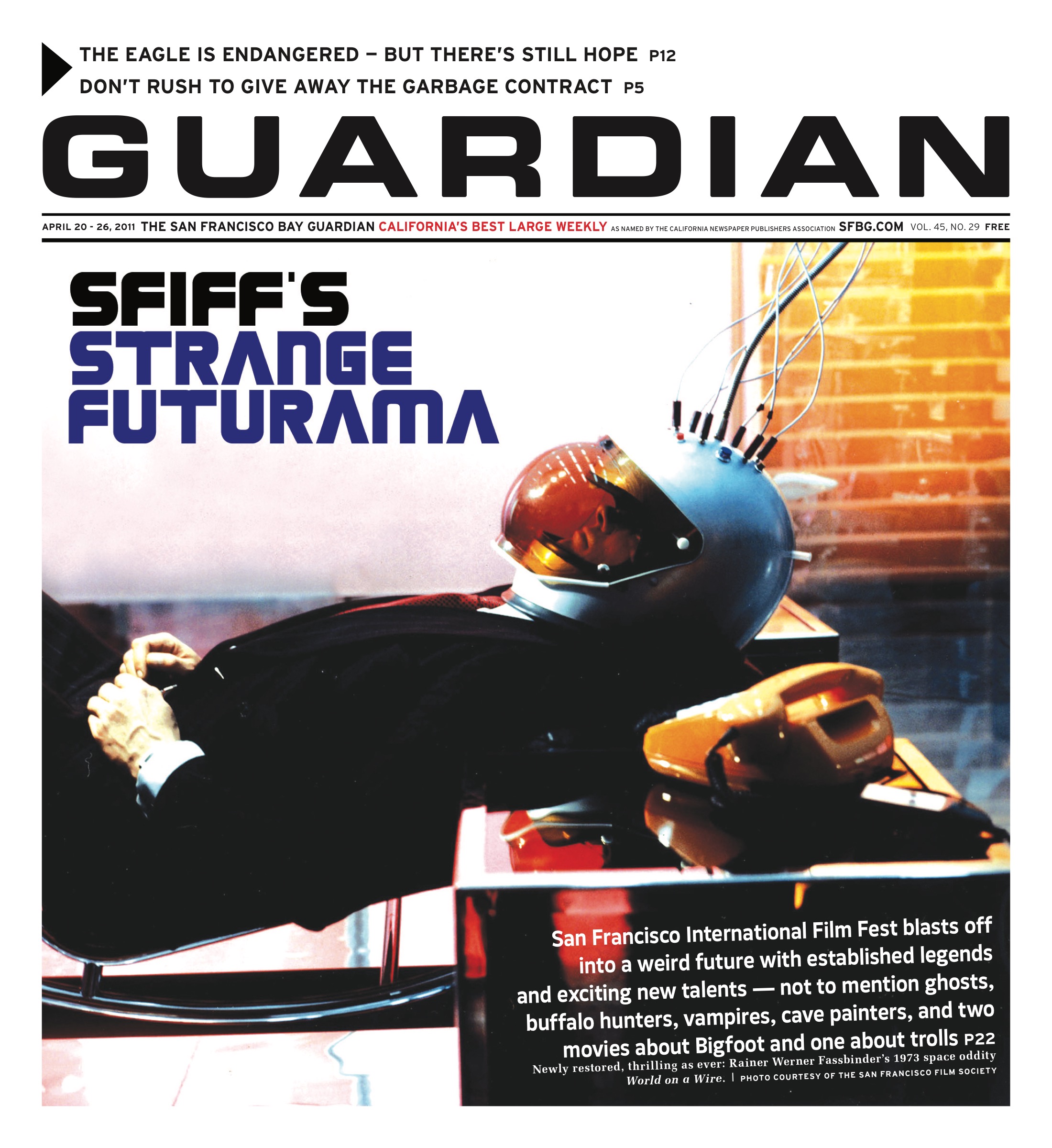
World on a Wire (Rainer Werner Fassbinder, Germany, 1973) The words “Rainer Werner Fassbinder” and “science fiction film” are enough to get certain film buffs salivating, but the Euro-trashy interior décor is almost reason enough to see this restored print of the New German Cinema master’s cyber thriller. Originally a two-part TV miniseries, World on a Wire is set in an alternate present (then 1973) in which everything seems to be made of concrete, mirror, Lucite, or orange plastic. When the inventor of a supercomputer responsible for generating an artificial world mysteriously disappears, his handsome predecessor must fight against his corporate bosses to find out what really happened, and in the process, stumbles upon a far more shattering secret about the nature of reality itself. Riffing off the understated cool of Godard’s Alphaville (1965) while beating 1999’s The Matrix to the punch by some 25 years, World on a Wire is a stylistically singular entry in Fassbinder’s prolific filmography. Sat/23, 8:45 p.m., Kabuki, and April 30, 2 p.m., PFA.(Sussman) SUN/24
A Cat in Paris (Alain Gagnol and Jean-Loup Felicioli, France/Belgium/Netherlands/Switzerland, 2010) Save your pocket poodles, please: Paris, as cities go, is most decidedly feline. From 1917’s silent serial Les Vampires to its uber-cool 1990s update Irma Vep, cat burglars and the Parisian skyline have gone together like café and au lait. Add actual cats and jazz to the mix for good measure (even Disney saw fit to set its jazzy 1970 Aristocats in the City of Light). At just over an hour long, the animated A Cat in Paris is an enjoyable little amuse-bouche that employs all the standards of the cats-in-Paris meme: Billie Holiday warbling on the soundtrack, a dashingly heroic antihero who scales the rooftops as if he studied parkour under Spider-Man, and the titular untamable black cat who serves as his partner in crime. Complete with a climatic Hitchcockian set piece on the rooftops of Notre Dame Cathedral, A Cat in Paris has a refreshingly angular and graphic, almost cubist, feel. Directors Alain Gagnol and Jean-Loup Felicioli’s work certainly doesn’t rank among that of countryman Sylvain Chomet (2010’s The Illusionist), but this family film is worth checking out if kitties up to no good in Purr-ree simply make you want to le squee. Sun/24, 12:30 p.m., Kabuki, and May 1, 12:30 p.m., New People. (Michelle Devereaux)
MON/25
Cave of Forgotten Dreams (Werner Herzog, U.S., 2010) The latest documentary from Werner Herzog once again goes where no filmmaker — or many human beings, for that matter — has gone before: the Chauvet-Pont-d’Arc Cave, a heavily-guarded cavern in Southern France containing the oldest prehistoric artwork on record. Access is highly restricted, but Herzog’s 3D study is surely the next best thing to an in-person visit. The eerie beauty of the works leads to a typically Herzog-ian quest to learn more about the primitive culture that produced the paintings; as usual, Herzog’s experts have their own quirks (like a circus performer-turned-scientist), and the director’s own wry narration is peppered with random pop culture references and existential ponderings. It’s all interwoven with footage of crude yet beautiful renderings of horses and rhinos, calcified cave-bear skulls, and other time-capsule peeks at life tens of thousands of years ago. The end result is awe-inspiring. Mon/25, 7 p.m., and Tues/26, 9:30 p.m., Kabuki.(Eddy)
TUES/26
Nostalgia for the Light (Patricio Guzmán, France/Chile/Germany, 2010) Chile’s Atacama Desert, the setting for Patricio Guzmán’s lyrically haunting and meditative documentary, is supposedly the driest place on earth. As a result, it’s also the most ideal place to study the stars. Here, in this most Mars-like of earthly landscapes, astronomers look to the heavens in an attempt to decode the origins of the universe. Guzmán superimposes images from the world’s most powerful telescopes — effluent, gaseous nebulas, clusters of constellations rendered in 3-D brilliance — over the night sky of Atacama for an even more otherworldly effect, but it’s the film’s terrestrial preoccupations that resonate most. For decades, a small, ever dwindling group of women have scoured the cracked clay of Atacama searching for loved ones who disappeared early in Augusto Pinochet’s regime. They take their tiny, toy-like spades and sift through the dirt, finding a partial jawbone here, an entire mummified corpse there. Guzmán’s attempt through voice-over to make these “architects of memory,” both astronomers and excavators alike, a metaphor for Chile’s reluctance to deal with its past atrocities is only marginally successful. Here, it’s the images that do all the talking — if “memory has a gravitational force,” their emotional weight is as inescapable as a black hole. Tues/26, 6:30 p.m., Kabuki, and April 28, 6:15 p.m., PFA. (Devereaux)
The Sleeping Beauty (Catherine Breillat, France, 2010) Fairytales are endemically Freudian; perhaps it has something to with their use of subconscious fantasy to mourn — and breathlessly anticipate — the looming loss of childhood. French provocateuse Catherine Breillat’s feminist re-imagining of The Sleeping Beauty carries her hyper-sexualized signature, but now she also has free reign to throw in bizarre and beastly metaphors for feminine and masculine desire in the form of boil-covered, dungeon-dwelling ogres, albino teenage princes, and icy-beautiful snow queens. The story follows Anastasia, a poor little aristocrat, who longs to be a boy (she calls herself “Sir Vladimir”). When her hand is pricked with a yew spindle (more of a phallic impalement, really), Anastasia falls into a 100-year adventurous slumber, eventually awakening as a sexually ripe 16-year-old. It all plays like an anchorless, Brothers Grimm version of Sally Potter’s 1992 Orlando. And while it’s definitely not for the kiddies, it’s hard to believe that many adults would find its overt symbolism and plodding narrative any more than a sporadically entertaining exercise in preciousness. Your own dreams will undoubtedly be more interesting — perhaps you can catch a few zzz’s in a theater screening this movie. Tues/26, 6:15 p.m., and April 27, 6:30 p.m., Kabuki.(Devereaux)
THE 54TH ANNUAL SAN FRANCISCO INTERNATIONAL FILM FESTIVAL runs April 21–May 5. Venues are the Sundance Kabuki, 1881 Post, SF; Castro, 429 Castro, SF; New People, 1746 Post, SF; San Francisco Museum of Modern Art, 151 Third, SF; and Pacific Film Archive, 2575 Bancroft, SF. For tickets (most shows $13) and complete schedule visit www.sffs.org>.
Since March 21, reporters representing the cream of American journalism have been camped out in the Bay Area covering two high-profile trials.
In an Oakland courtroom, two men are accused of being involved in three murders, including that of Chauncey Bailey, a journalist who was writing a story about Your Black Muslim Bakery. In San Francisco, baseball home run king Barry Bonds is accused of telling a federal grand jury that he never knowingly took steroids.
Apart from the fact that both trials are taking place simultaneously and all the defendants are African American, there is a disparity in how these cases are being treated by the media, both local and national.
The Bailey trial is being covered by fewer than a dozen reporters from mostly local media: the Oakland Tribune, the San Francisco Chronicle, KTVU, American Urban Radio Networks, CBS Radio, NPR, the Guardian, the Associated Press, ABC 7 News, several websites, and bloggers. Some are there every day, others are not. To be fair, there was more media coverage for the first few days of the trial.
According to KCBS reporter Doug Sovern, who is covering the Bonds trial, the press list includes “KCBS, KGO Radio (some of the time), KQED (occasionally), Westwood One, Channels 2 (KTVU), 4, 5, 7, 11, Comcast Sports Net, ESPN, CNN, Bloomberg, the Associated Press, Agency France Presse, the Chronicle (a reporter and a columnist every day; sometimes two columnists,) the New York Times, the Wall Street Journal, the Bay Area News Group (including the San Jose Mercury News), Reuters, the Los Angeles Times, Sports Illustrated, a few other bloggers, stringers, and people I don’t recognize,” writes Sovern in an e-mail. “I would say that adds up to about 30, plus still photographers. Probably close to 40 in all, plus THREE sketch artists!”
Media experts say the Bailey trial is far more significant when you look at how both cases affect society.
“Obviously Barry Bonds is one of the greatest baseball players of all time,” said Louis Freedberg, senior reporter for California Watch, one of the units at the Center for Investigative Reporting in Berkeley. “You add to that the celebrity factor in a society that is completely obsessed with celebrities, regardless if they do good or bad, I can see how it’s easy to define this (Bailey) as a local story and shunt it aside.”
But the problem is that society depends on journalists to provide truth and information and to hold those in power accountable. There are many countries where journalists are arrested and/or killed for writing stories that someone doesn’t like.
An independent press was a top priority for America’s founding fathers, right behind establishing the military.
“Establishing a free press was viewed as fundamental,” said Freedberg. “I don’t think they talked about baseball players at that time, so when you have a journalist being assassinated, that strikes at the core of what this society stands for — or should stand for.”
That belief was so strong after Bailey was killed that journalists, including the author, came together to form the Chauncey Bailey Project to finish Bailey’s work and make sure that everyone who was involved in the assassination was brought to justice.
“Some media are covering this deeply — the ones that covered it here — so I don’t want to make a blanket condemnation. But, yeah, I think the Bailey trial has much broader symbolism and importance to the United States than the trial of Barry Bonds,” said Robert Rosenthal, executive director of the Center for Investigative Reporting and executive editor of the Chauncey Bailey Project.
Another issue that has caused concern in the African American community is how boys and men of color are portrayed in the news media. “Usually when you see this demographic in the press, they are accused of crime, victims of crime, or playing sports,” said Dori Maynard, president of the Maynard Institute for Journalism Education.
In the Bonds case, the media are hitting two out of three — a great average for baseball, but a Bonds conviction will have virtually no impact on American democracy.
The media should cover the Bonds trial, but it should not forget about the Bailey trial, which will still be going when the Bonds trial ends.
If those who are on trial for killing Bailey are indeed guilty but are allowed to go free, it will send a message that journalists — the people who keep society informed and hold those in power accountable — are fair game. (Bob Butler)
This story first appeared at www.maynardije.org, the website of the Maynard Institute, a member of the Chauncey Bailey Project, of which the Guardian is also a member.
LATEST TRIAL NEWS: JUDGE DENIES DEFENSE MOTION AFTER REPORTER RECEIVES DEATH THREAT
On April 11, a defense attorney in the Chauncey Bailey murder trial asked the judge to ban jurors from reading newspapers or using the Internet for the duration of the trial after the Bay Area News Group and the Chauncey Bailey Project reported that a journalist had received a death threat while reporting a story related to the now defunct Your Black Muslim Bakery.
Gary Sirbu, who is representing codefendant Antoine Mackey, made the request as the trial resumed Monday, April 11. Articles about the threat were published Saturday, April 9 on the front page of Bay Area News Group publications, including the Oakland Tribune.
Judge Thomas Reardon asked jurors if they had read any news stories over the weekend about the telephone threat made to reporter Josh Richman. By a show of hands, jurors indicated they had not read the articles.
Reardon denied Sirbu’s request, saying he did not want to make such an order. But the judge again cautioned jurors to avoid any news coverage about the case or anything related to Your Black Muslim Bakery. (Thomas Peele)
Following the murder of Oakland journalist Chauncey Bailey in 2007, allegedly to prevent him from exposing the financial dealings of Your Black Muslim Bakery, the Guardian joined with other Bay Area media outlets in an award-winning investigative project known as the Chauncey Bailey Project. The murder trial of two men accused of ordering the killing by admitted shooter Devaughndre Broussard began March 21, and we’ve been running coverage from the project on the SFBG Politics blog. Here are some excerpts, written by Thomas Peele, an investigative reporter with the project who works at the Contra Costa Times (with reporter Josh Richman contributing to some reports).
BROUSSARD BURST INTO LAUGHTER DESCRIBING 2007 SLAYING — MARCH 28
Devaughndre Broussard burst into laughter before jurors as he described how he shot and killed the relative of the man who had killed Yusuf Bey IV’s brother.
Broussard described how the man, Odell Roberson, started to run when he saw Broussard come at him with a shotgun in summer 2007.
“I said, ‘Stop or I’m going to fire!’ ” Broussard said, before bursting into laughter, then turning his head and stifling his laughs into his arm.
He said he fired eight to 10 assault rifle rounds into Roberson’s chest. “I think I shot him face forward,” Broussard testified. “He hit the ground. I think he fell backward.”
Broussard is on the witness stand for the second day in the triple-murder trial of Your Black Muslim Bakery leader Yusuf Bey IV and bakery member Antoine Mackey. Broussard said he killed Roberson and a second man, journalist Chauncey Bailey, at Bey IV’s order. Mackey is charged with helping in both those killings and with the murder of a third man, Michael Wills. Bey IV and Mackey, both 25, have pleaded not guilty.
Broussard is the prosecution’s star witness in the case. He has pleaded guilty to killing Roberson and Bailey and will receive a 25-year sentence in exchange for his testimony.
CONFESSED GUNMAN BROUSSARD TAKES THE STAND — MARCH 24
Broussard first entered Judge Thomas Reardon’s crowded courtroom at 11:39 a.m. wearing shackles and a red jail jumpsuit. He passed in front of the defense table where Bey IV and codefendant Antoine Mackey sat staring at him intently; he didn’t meet their eyes. Bey IV wore a tan suit and a bow tie — the symbol of the Black Muslim movement that Broussard said he joined in 2006.
During afternoon testimony, Broussard described participating in a 2006 shooting of an unoccupied car with other members of Your Black Muslim Bakery. Prosecutor Melissa Krum contends that shooting illustrates the bakery’s command structure: Bey IV issued orders to others to commit crimes on his behalf.
Broussard described being in a room at the bakery when Bey IV’s half-brother, Yusuf Bey V, came to him, gave him a pistol-grip shotgun, and told him Bey IV wanted a car shot to bits. The car belonged to a man with whom the Bey brothers had a dispute.
“I fired it until it was empty five or six times,” Broussard said of the shotgun. He would later use it, Broussard told a grand jury in 2009, to kill Bailey, also on Bey IV’s order.
LOADED SHOTGUNS TAKEN FROM BAKERY COMPOUND, OFFICER SAYS — MARCH 23
A police officer is testifying in the murder trial of journalist Chauncey Bailey that he seized two loaded, sawed-off shotguns from the bedrooms of key players in the case.
One, a 12-gauge Remington, was under a bed in defendant Antoine Mackey’s bedroom, Officer Bruce Christensen of the Oakland Police Department, told jurors.
The other, a 12-gauge Mossberg, was found outside a bedroom window. Bailey’s confessed killer, Devaughndre Broussard, told a grand jury that was the Bailey murder weapon. It was loaded with five rounds, Christensen said.
MURAL FOR SLAIN JOURNALIST UNVEILED AT HIS ALMA MATER — FEB. 26
As a teenager with a stutter, Bailey spent a lot of time in the library at Hayward High School immersing himself in books so he wouldn’t have to talk to people.
The stutter went away, but Bailey’s love of the written word did not. He spent nearly 40 years in journalism before being gunned down as he walked to his job as editor of the Oakland Post on Aug. 2, 2007.
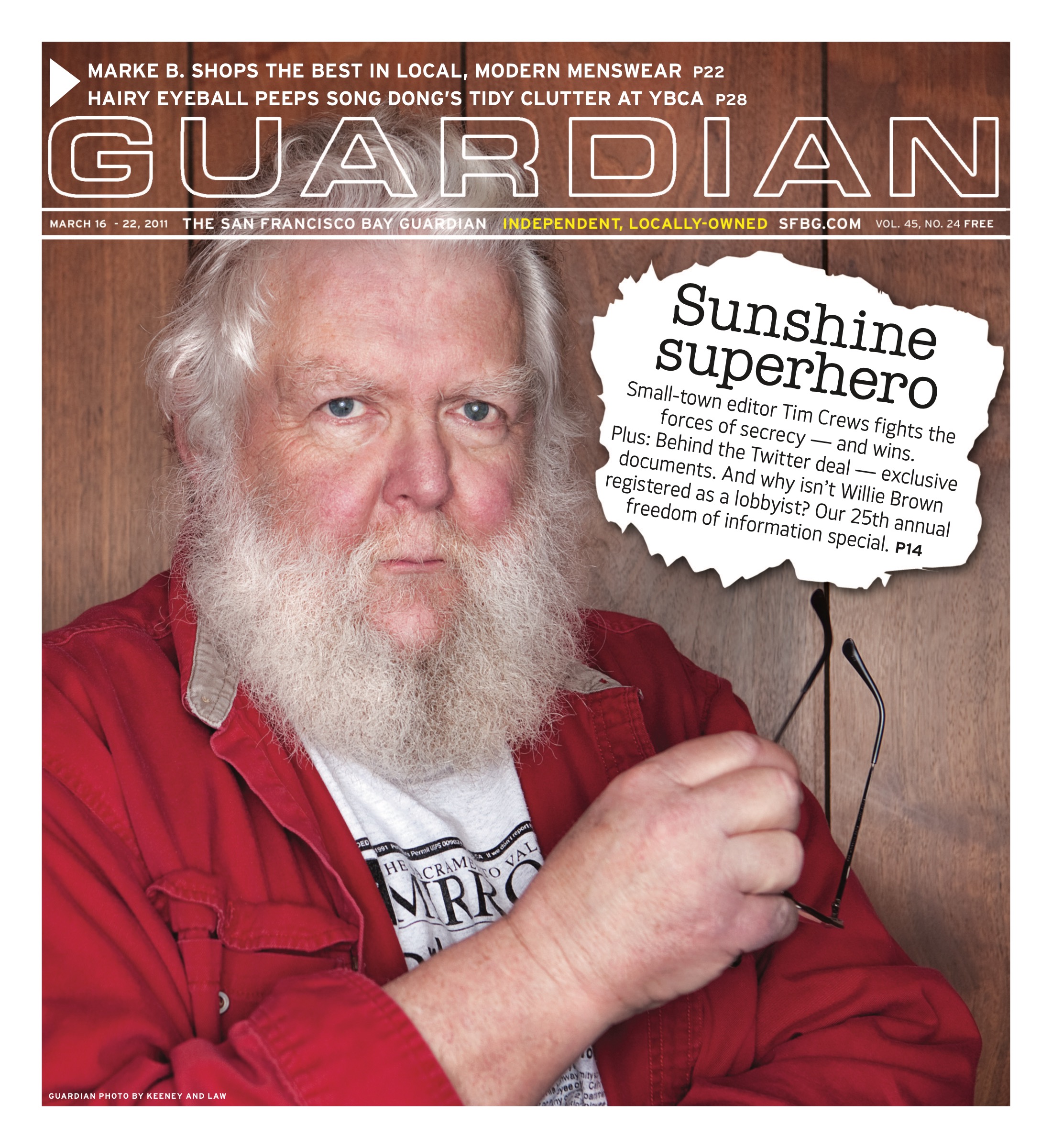
One midsummer day in 2007, Sacramento Valley Mirror editor and publisher Tim Crews noticed smoke billowing into the air several miles away. A duck hunters cabin on an expansive Glenn County farm compound was ablaze. By the time the fire engine sirens had sounded, Crews was on his way there to find out what was happening.
The twice-weekly Sacramento Valley Mirror, which has a circulation of 3,000, is run by a small staff on a shoestring budget — but Crews’ tenacity in the wake of the cabin fire has shown that it doesn’t take a multimillion dollar budget to practice hard-hitting, investigative journalism that has an impact. If it hadn’t been for Crews’ comprehensive series, “Who Killed Bud?,” Ivan “Bud” Foglesong’s death in that fire might never have come under the microscope.
Following a yearlong investigation, the coroner’s office ruled the death a suicide. “One of the lieutenants told the widow, ‘We think Bud just went in there and poured a can of gas on his head and set himself on fire.’ ” Crews said. But he didn’t buy it. “I said to them, why would he do that? “
With some digging, Crews learned that the man who perished in the fire had been a commercial pilot. Prior to that, “he’d been a military attaché, trusted with the nation’s highest secrets,” Crews said. “No drug or alcohol problems, physicals all the time. Not your typical unstable guy.”
Using public records as well as information gathered through his own research and interviews, Crews published bits of information in the Valley Mirror that local law enforcement had apparently missed. There was ongoing strife between Foglesong and the district attorney’s son, which had flared into violence directed at Foglesong at least once. The D.A. was Foglesong’s brother-in-law and a neighbor on the family compound where the cabin burned. Crews talked to the nurses who gave Foglesong emergency medical care just before he died — telling them there had been an explosion. Crews spotlighted inconsistencies within the investigative reports, key evidence that went missing, and the demolition of the burnt cabin without a permit.
Faced with the dilemma that the evidence didn’t add up, the sheriff coroner issued a new death certificate, characterizing it as an accident instead of a suicide. The Valley Mirror stories kept coming.
“Finally, the sheriff coroner, after two years, convenes a coroner’s inquest,” Crews recounted. That hadn’t happened in Glenn County in 40 or 50 years. “The coroner’s jury came back in an hour, 9-6 for death at the hands of another.” The investigation is now at the state level.
The “Who Killed Bud?” series is just one example of Crews’ journalistic grand slams. A different D.A. lost his bid for reelection, largely due to Valley Mirror coverage: “[He] said at a domestic violence meeting about a domestic violence victim, ‘Lying bitch deserved to be beaten.’ So we ran it in 40 point, top story,” Crews said, “because it tells you very drastically what the establishment’s attitudes are toward women. That just cannot be.”
Other stories have landed him in hot water. Crews once spent five days in jail for refusing to give up a confidential source who told him that the new assistant sheriff had stolen a low-quality firearm. Crews has won numerous journalism awards and will be honored with the Norwin Yoffie Award for Career Achievement at the James Madison Awards ceremony. But his raw reportage has made enemies, too — including some within the local legal system. With his propensity to sue government agencies when they violate the California Public Records Act (CPRA) by withholding public records instead of honoring his sunshine requests, this dynamic has spelled trouble.
“His entire philosophy is to exploit the relatively strong public records laws in this state in order to provide his readers with the real deal on local government behavior,” said Tom Newton, general counsel of the California Newspaper Publishers Association. “He doesn’t take no for an answer.”
Indeed, Crews prides himself on standing up to the powers-that-be. “Young reporters say, ‘What’s the most important word for journalists?’ And I say, ‘After compassion, defiance.’ “
Yet the Valley Mirror now faces $100,000 in legal fees because a local judge — once the subject of a Valley Mirror exposé — ruled that Crews’ lawsuit against the Glenn County Board of Education for violating the CPRA was “frivolous.” The steep price tag reflects the price of attorneys hired by local government to take on Crews in court.
“This newspaper can no more afford to pay a $100,000 judgment than a fly,” Crews said. “It’s ruinous.” The case is on appeal, but he views the ruling as “a very well orchestrated attempt to crush a paper that uses the CPRA aggressively. Because in fact, most of the conservative members of the community, including some in Democratic ranks, regard open government as just unwieldy and not good. Just not good for people to know all these things.”
The case is on appeal. But if the ruling holds, it could set a very bad precedent, said Terry Francke of the watchdog group CalAware. “It puts any newspaper in a small county in a very perilous state,” he said.
Outside of court, Crews still enjoys a great deal of support and admiration — including from Foglesong’s widow. “Because of Tim, this thing is going to get solved,” said Jan Foglesong, who has since moved to Mississippi, where her husband was buried. “Because of him, we’re getting a little justice for Bud.” (Rebecca Bowe)
Legal Counsel
DUFFY CAROLAN
Duffy Carolan is a lawyer who understands how newspapers work. A journalism major at California Polytechnic State University, she started her career selling ads at the Fremont Argus and writing columns for the Alameda Times-Star. So when she graduated from the University of San Francisco Law School, it’s no surprise that she wound up doing media law.
Her first law job was at the Oakland firm Crosby, Heafey, Roach & May, where she worked with previous FOI Award winners Tom Burke and John Carne. In 1998 she moved to Davis, Wright, Tremaine, where she specializes in libel, privacy, and communications law, representing many of the major news media outlets in the Bay Area (including the Guardian).
But Carolan is proudest of the work she’s done — pro bono — for the Chauncey Bailey Project, which brought together reporters and editors from numerous newspapers and TV stations to help investigate the murder of the former editor of the Oakland Post. She helped the group get access to key documents and fought a gag order that would have limited the ability of the news media to obtain information.
She’s handled a lot of big cases, but it’s the little stuff that keeps her going. “What I enjoy most,” she said, ” is my daily interaction with reporters and the really small things that make their jobs a little bit easier.” (Tim Redmond)
Journalist
PETER BYRNE
Investigative reporter Peter Byrne says his award-winning, multipart series “Investor’s Club: How the Regents of the University of California Spin Public Funds into Private Profit” wouldn’t have been possible without the California Public Records Act.
“It’s the backbone of investigative journalism,” he said of legislation that allowed him to obtain 12,000 pages of records and databases from UC, the California Public Employees Retirement System, the U.S. Securities and Exchange Commission, and the California Fair Political Practices Commission.
Byrne’s research determined that UC invested billions of dollars into risky private equity funds and companies in which the regents in charge of making investment policy held significant financial interests. The story led UC Regent Richard Blum, who is married to Sen. Dianne Feinstein, to step down from the investment committee. It got the state Senate ordering an audit of the regents’ financial practices and the regents promising to appoint a union member to sit on the investment advisory committee that oversees UC’s $60 billion-plus portfolio.
Byrne said he stumbled on the idea to do this series while giving a presentation at the UC Berkeley School of Journalism about an investigation of Feinstein’s 2001-05 conflict of interest, which was due to Blum’s stake in two major war contractors.
“I talked to the students about research techniques and public records,” Byrne said, recalling how protests against UC raising fees were going on at UC Berkeley at the time. “And a few students said, ‘Why don’t you look into Mr. Blum in his capacity as a regent?’ “
As Byrne dug into his research, he began to realize that UC had invested hundreds of millions of dollars in business deals that Blum Capital Partners was also investing in.
Byrne admits he reads thousands of pages of financial data that would make most people go crazy. “I’m like an idiot-savant. I enjoy reading them and finding the tidbits and putting them altogether.” (Sarah Phelan)
Citizens
ALICIA LEWIS AND ASHLI BRIGGS
Alicia Lewis and Ashli Briggs, recipients of the Citizens Award, had no idea that recovering documents from a Dumpster on the California State University, Stanislaus campus would land them at the center of a media spectacle.
When the university announced that GOP icon Sarah Palin had been selected to speak at the campus’ 50th anniversary celebration, Lewis and Briggs raised objections on Facebook while sunshine advocates filed requests under the California Public Records Act for a copy of Palin’s speaking contract.
Instead of honoring the information requests, CSU denied the existence of any such documents.
But Briggs and Lewis discovered portions of the elusive contract after getting word that something fishy was going on. The campus was shut down for a furlough day yet there was clearly activity inside one building — and people were pitching things into a Dumpster, an anonymous tipster told them. “We both kind of looked at each other and said, ‘Let’s go down there,’ ” Briggs recalled.
Lewis said she never expected to find anything in the trash bin, but had to satisfy her curiosity. “We decided to pop open that lid,” she recalled. “It was overwhelming that there was actually important stuff in there.” Amid bags of shredded documents were pages four through nine of Palin’s contract, still intact.
State Sen. Leland Yee, who was among those seeking information, held a press conference with the two, and ultimately, the lucrative details of Palin’s contract were revealed.
“Anytime you put truth or information out there to be judged, you allow people to make their own assessments,” Lewis said. “And they can’t do that if the information isn’t out there.” (Rebecca Bowe)
Organization
LLOYD CHAPMAN AND THE AMERICAN SMALL BUSINESS LEAGUE
Small businesses make up 98 percent of all companies in the United States, employing the bulk of the population. But for decades, big, wealthy operations have been the recipients of federal money designed to go to small businesses.
For 20 years, Lloyd Chapman, president of the American Small Business League, has relentlessly worked to wrench from the government documents that reveal the diversion of billions of dollars a year in federal small business contracts to Fortune 500 companies and other large businesses.
Chapman said he entered this line of work “out of necessity,” frustrated after watching behemoth defense corporation Lockheed Martin win a small business contract over a legitimate small operation.
Using the Freedom of Information Act, Chapman learned that 600 large businesses were listed in the federal government’s small businesses database. He succeeded in prompting a series of investigations and the exposure of billions of dollars in fraud and abuse in federal small business contacting programs. His work has spurred more than 500 news stories.
Chapman says the solution is simple: stop awarding small business contracts to large corporations.
“It’s deficit neutral,” he says. “No new taxes. Just stop giving contracts to Fortune 500 companies.” (Heather Mack)
Journalist
AMY STANDEN
Last summer, KQED reporter Amy Standen was fishing for a story when she started to uncover some startling information on methyl iodide, a pesticide that was recently approved by California regulators for agricultural use. Standen spoke with an advisory panel of eight scientists about the health risks of methyl iodide and the discrepancy between the exposure levels the state and the scientists believed were safe.
The scientists’ anger at the Department of Pesticide Regulation’s decision to green light its use prompted Standen to start combing the highly technical documents used in the deliberation process.
“All I was ever doing was to understand, how did this happen?” Standen said.
The DPR, a part of the California Environmental Protection Agency, resisted releasing documents, but Standen kept pushing. “The deliberative process exemption to the California Public Records Act was a particular obstacle,” she said. “It was used to exclude exactly the sorts of documents that would have answered the central question: how were those exposure levels reached?”
She eventually was able to review the documents, noting that the opposition to it made “what we did get all the more valuable.”
Thanks to the evidence Standen uncovered, showing potential safety risk of exposure to methyl iodide and how the agency rejected the advice of its own scientists, environmental groups have filed a lawsuit challenging the approval. (Carly Nairn)
News Media
ASSOCIATE PRESS SACRAMENTO BUREAU
November was an especially demanding election season for the four reporters at the Sacramento bureau of the Associated Press. In addition to the reporting on day-to-day activities in the state Capitol, they were charged with making sense of a variety of statewide campaigns. And at the same time, Judy Lin, Don Thompson, Juliet Williams, and Samantha Young worked as team to release a series of remarkable stories on the secretive practices of the state Legislature.
“We made the open records issue and sunshine issues a top priority and [this recognition] is the result of that,” Williams said. “Open records and freedom of information are a tenet of journalism and something we strive for all the time.”
When the Legislature passed the Public Records Act, it exempted itself. So the four reporters pressed public officials over the secret records and their tendency to hold closed meetings. Lin and Williams attempted to gain entry to a private lunch called by Gov. Arnold Schwarzenegger for all 120 lawmakers to discuss solutions for the state’s profound challenges. The fallout of the refusal led to the governor’s pledge to keep future meetings open. Other stories by Young highlighted the murky compliance with public records requests. Thompson probed the excessive use of public funds by lawmakers on themselves.
Sacramento bureau editor Tom Verdin told us: “The credit goes to the reporters. I am fortunate to have a really strong and dedicated crew.” (Asaf Shalev)
Beverly Kees Educator Award
STEVE O’DONOGHUE
It’s not an easy job to train the next generation of journalists. Media professionals have seen the number of available jobs slashed in the last decade, along with salary levels. School newspapers have been shuttered by budget cuts and censored by overreaching administrators.
But a few notable educators have persevered, infusing thousands of young people with the desire to keep the populace informed. Steve O’Donoghue has devoted his life to that task, teaching for 33 years in Oakland, mostly at Fremont High School, where he founded the Media Academy and was the advisor to the student yearbook, newspaper, and magazine programs, as well as teaching media courses.
“I had seen scholastic journalism programs shrink in the schools and traditional organizations that had supported advisers and students shrivel up,” O’Donoghue told the Columbia Scholastic Press Association in 2008, when he received an award for his lifetime of work.
He added: “The world of scholastic journalism that had embraced me when I was a new teacher, assigned to a subject I had no training or preparation in, was gone. At the same time, I knew there was a greater awareness of the struggles of journalism in the schools on the part of the profession, and more resources to train and assist advisers than ever before.”
After retiring from classroom teaching in 2004, O’Donoghue worked at the Center for the Integration and Improvement of Journalism at San Francisco State University, his alma mater. He also served on the Journalism Education Association’s board in Northern California for many years and helped create JEA’s national curriculum for mentoring journalism students. (Steven T. Jones)
Electronic Access
HOWARD MINTZ AND JULIA PRODIS
San Jose Mercury News legal affairs reporter Howard Mintz and crime reporter Julia Prodis won this award for their use of blogs and Twitter in court — an area where public access has been reduced thanks to the Supreme Court’s decision to limit cameras in courthouse hallways and inside courtrooms.
“There’s an advantage when there are no cameras — there’s that much more craving for information,” Prodis said, noting that Mintz kick-started the Mercury News’ new media effort when he launched a blog in 2010 providing daily coverage of the federal challenge to the controversial Proposition 8, which banned same-sex marriage in California.
“Howard’s blog got us started, and mine took us to a more sensational level,” Prodis said. At one point, Prodis wrote 70 blog posts in one day after she got permission from a judge to cover a love-triangle/murder-for hire case that lasted two months and eventually found Los Gatos businessman Paul Garcia, gunman Lucio Estrada, and Miguel Chaidez guilty of murdering restaurateur Mark Achilli.
“The judge approved, but only if we caused no distraction to the jury,” Prodis recalled, adding that she was concerned that a laptop keyboard would make keyboard sounds. “So it was really great that one of our managers went to Fry’s, bought an iPad, and handed it to me.”
The D.A.’s office followed her blog, as did the family of the accused. “A community of people who never spoke to each other in the courtroom became fully engaged on the blog,” she said.
“People want immediacy,” she added. “Especially in the courts — they want something right now.” (Sarah Phelan)
SPJ Awards dinnerIt’s not too late to purchase tickets for the March 16 James Madison Freedom of Information Awards banquet in San Francisco. For more information, visit spjnorcal.org/blog and scroll to “26th Annual James Madison Freedom of Information Awards.”
David Cay Johnston, the Pulitzer-Prize-winning former New York Times reporter, has a brilliant piece on his blog about public-employee pensions. His basic point: the mainstream media, including his own former paper, have utterly missed the point about how pensions work:
[Wisconsin] Gov. Scott Walker says he wants state workers covered by collective bargaining agreements to “contribute more” to their pension and health insurance plans.
Accepting Gov. Walker’ s assertions as fact, and failing to check, created the impression that somehow the workers are getting something extra, a gift from taxpayers. They are not.
Out of every dollar that funds Wisconsin’ s pension and health insurance plans for state workers, 100 cents comes from the state workers.
How can that be? Because the “contributions” consist of money that employees chose to take as deferred wages – as pensions when they retire – rather than take immediately in cash. The same is true with the health care plan. If this were not so a serious crime would be taking place, the gift of public funds rather than payment for services.
Public employees (like the few employees in the private sector who still get pensions) bargain collectively for compensation packages. Some of that compensation comes in the form of deferred pay, which the employer puts aside into a pension fund. In San Francisco, some city employees several years ago, through negotiations, agreed to forego a pay raise and instead accept more deferred compensation; that is, the money they would have received in wages now goes into their pension fund.
When you say that those employees “contribute nothing” to their pensions, you’re not telling the truth:
The fact is that all of the money going into these plans belongs to the workers because it is part of the compensation of the state workers. The fact is that the state workers negotiate their total compensation, which they then divvy up between cash wages, paid vacations, health insurance and, yes, pensions. Since the Wisconsin government workers collectively bargained for their compensation, all of the compensation they have bargained for is part of their pay and thus only the workers contribute to the pension plan. This is an indisputable fact.
More:
Thus, state workers are not being asked to simply “contribute more” to Wisconsin’ s retirement system (or as the argument goes, “pay their fair share” of retirement costs as do employees in Wisconsin’ s private sector who still have pensions and health insurance). They are being asked to accept a cut in their salaries so that the state of Wisconsin can use the money to fill the hole left by tax cuts and reduced audits of corporations in Wisconsin.
At the time that San Francisco officials agreed to use deferred compensation as a way to avoid pay raises, it was a politically easy decision: The stock market was booming, and the pension fund was making so much money from its investments that the city could in effect keep that money (the pay raises that would have gone to the employees) and use it to avoid tax increases or cuts somewhere else. Unless they were fools, the city officials who signed off on this deal knew, or should have known, that at some point the stock market would come back to Earth, and the city would have to pay the deferred compensation out of the General Fund.
Now: You can argue that those contracts were overly generous and should be renegotiated. You can argue that the city can’t afford to pay its workers as well as it once did and that they should take further pay cuts (beyond the half-billion or so they’ve already given back). I don’t entirely agree, but at least that’s an honest argument.
But to say that city workers aren’t contributing to their pension fund, or need to contribute more, is dishonest. For the newspapers to report that as fact is bad journalism.
Shane Bauer and Josh Fattal have been held captive in Evin Prison in Tehran for more than 540 days, and their friends and supporters in the Bay Area have been mounting an extraordinary campaign pushing for their release.
On July 31, 2009, Bauer and Fattal were hiking with Sarah Shourd, who is Bauer’s fiancée, through green mountains in Iraqi Kurdistan. The three UC Berkeley graduates had traveled from Damascus for a recreational visit. They were wandering nearby Ahmed Awa, a popular tourist destination where hundreds of people had flocked to camp, to visit a waterfall and enjoy the peace and quiet of the mountains.
They say they didn’t realize how close they were to Iran, which has no diplomatic ties to the United States.
Shourd told the Guardian she’s not sure whether they accidentally traversed the Iranian border, because it was unmarked. “We had no intention of being anywhere near Iran,” she said. “And if we were, we’re very sorry.”
Iranian officials surrounded them, speaking in Farsi, which they couldn’t understand. They were arrested on suspicion of spying and taken into custody. Before being taken to prison, one phoned a friend, Shon MeckFessel — who had been traveling with them but opted not to go on the hike because he wasn’t feeling well — to alert him that something had gone wrong. That would be the last communication any of them would have with close friends or family members for months.
Shourd was finally released on bail Sept. 14, 2010 on humanitarian grounds after spending 410 days in solitary confinement. She was reunited with family and friends — but Bauer and Fattal have remained in detainment ever since.
Since returning to the United States, Shourd has thrown her energy into advocating for their release — and she’s not alone. “Everyone in the family has been working tirelessly for all 18 months,” she said, “which is far, far longer than we ever imagined in our worst nightmares.”
FIGHTING FOR FREEDOM
While Shourd was still in prison, her mother, Nora, gave up her home and job to move in with Bauer’s mother, Cindy Hickey, and work for their release full-time. Fattal’s older brother, Alex, suspended his graduate studies at Harvard to dedicate himself to the campaign. His mother, Laura Fattal, stopped working to devote herself to the campaign.
“That’s just family alone,” Shourd noted. “If you start to look to how many people have contributed to our campaign and how many ways, it just blows your mind.” Soon after her release, Shourd put out a call for people to hang banners proclaiming the innocence of Bauer and Fattal and calling for their release. In response, nearly 60 banners were unfurled in 25 different countries.
Shourd has made countless media appearances since her release, and even put out an MP3 of a song she composed while in solitary confinement, which can be downloaded as a way to support the Free the Hikers campaign. Their story has drawn the interest of prominent figures. On Jan. 19, Noam Chomsky released a video offering to testify on their behalf if a trial is held, saying Bauer and Fattal “have dedicated themselves to advocating for social and environmental justice in Africa and elsewhere, and they truly embody the spirit of humanitarianism.”
Others who have publicly defended the trio include President Barack Obama, who issued a statement in July saying none of the hikers ever worked for the U.S. government, addressing Iranian accusations that they were there to commit espionage. United Nations Secretary General Ban Ki-Moon and the Archbishop Desmond Tutu have called for their release. A documentary has been produced about their plight, and a second one is in the works.
In San Francisco, artists and musicians have responded in droves to a call for support. An art auction that will benefit the campaign is planned for Jan. 29, featuring the work of more than 80 artists, plus live musical performances. As a nod toward Bauer’s work in photojournalism, the event will emphasize photography, and notables such as Mimi Chakrova, Taj Forer, Roberto Bear Guerra, Ken Light, the LUCEO Photo Collective, Susan Meiselas, Lianne Milton, Mark Murrmann, Alec Soth, and others have donated work. Among the artists who donated pieces are Marianne Bland, Mark Brecke, Teresa Camozzi, Andreina Davila, Eric Drooker, and former Board of Supervisors President Matt Gonzalez.
In early February, a music benefit will be held at the Bottom of the Hill to benefit the campaign. Titled “They Sing These Songs In Prison,” the event will feature performances of The Nightwatchman — that’s Tom Morello of Rage Against the Machine — plus Jolie Holland, accordionist Jason Webley, and Ryan Harvey & Lia Rose.
“The funding is to support the campaign to free Shane and Josh, and it goes to a wide array of needs that we have, like translation into Farsi, travel for media, and meeting with some various embassies and governments that are involved in advocating for Shane and Josh’s release,” Shourd explained. “Also, some of the money will probably go toward legal fees, and website fees, and materials for the campaign from flyers to business cards to t-shirts.”
WHO ARE THE HIKERS?
The campaign to advocate for their release has been tagged Free the Hikers, but the identities of the three young people (Bauer and Fattal are both 28, Shourd is 32) go much deeper than that. They’re social-justice advocates, antiwar activists, writers, environmentalists, travelers, and creative thinkers with deep ties to the Bay Area.
Shourd, who lives in Oakland, was teaching English to Iraqi refugees when she was in Syria, as well as practicing some journalism. Fattal, who taught at Aprovecho — an education center in Oregon focused on sustainability and permaculture — had been traveling to India, South Africa, and other places through the International Honors Program to lead workshops on health and sustainable technology before visiting his friends in Syria.
“Josh is an environmentalist, he’s a teacher, he’s an incredible, incredible, generous and selfless man,” Shourd said. “As soon as you meet him, you feel what an extraordinary and unique human being he is. I was friends with him for years before he came to visit us in Damascus, and he decided to travel with us to Northern Iraq to Iraqi Kurdistan to learn about Kurdish culture, to see another diverse aspect of the Middle East.”
Bauer wrote for publications such as The Nation, Mother Jones, and the Christian Science Monitor. A photojournalist who has won multiple awards and had his work published internationally, Bauer has documented everything from tenant conditions in San Francisco SROs to conflict-ridden regions in Africa and the Middle East. Bauer also wrote an article for the Guardian about an Oakland residence that is famous among East Bay anarchists (See “Hellarity burns,” May 27, 2008).
“Shane has an incredible passion for pursuing truth and complicating our ideas about other parts of the world, about conflicts around the world and at home,” Shourd noted. She added that many of his stories serve to highlight “some of the very specific ways that the U.S. presence in Iraq has taken a toll on innocent people.”
Before their ill-fated excursion, Shourd said she’d heard from multiple westerners and her Arabic tutor that Iraqi Kurdistan was a safe and enjoyable place to visit. “It’s often referred to as ‘the other Iraq’ because it’s a semiautonomous region designated as a no-fly zone by the U.S. government,” she explained. “It’s actually a part of the Middle East that has a very positive fingerprint from the U.S. government because they helped protect the Kurdish people from Saddam Hussein. So Northern Iraq is not a dangerous place for Americans or westerners to go, and no American has ever been killed in Northern Iraq, which is just phenomenal after a decade of war and occupation.”
She said Bauer, Fattal, and MeckFessel were all enthusiastic about the trip, and after researching it online, the four felt they had enough information to travel there. “We ordered a special Lonely Planet guide of Northern Iraq, and a friend of ours who went a month before we did borrowed it and lost it, so we didn’t have the Lonely Planet guide,” she noted. “But we still felt we had enough information about it to travel there and really believed we had nothing to fear.”
SOLITARY
Shourd credits her fiancé and her friend with helping her through “every minute of prison,” even though she was alone in her cell for 23 hours a day. At first she wasn’t allowed to see them at all, but after some time had passed, guards allowed her to visit with them in an outdoor courtyard for 30 minutes a day. Later, that brief time together was increased to an hour.
“There’s no way I could have maintained hope and maintained my own sanity and the strength that it took to get through every day of isolation and depravity and uncertainty and fear,” she said. “The emotional strength that that took, and the discipline that it took, really Shane and Josh and I all created together in the little time that we had, through the unconditional support and love we had for each other.”
Since they didn’t speak Farsi and the guards spoke very little English, it was difficult to communicate basic needs, and Shourd described the experience as being surrounded by hostility.
“Whenever I just started to slip away mentally, Shane and Josh would bring me back, and the knowledge that they were going to be there for me was the only thing that got me through 410 days of solitary confinement,” she said. The three thought up activities to give themselves something to look forward to, like marking time with small courtyard celebrations and special food they saved to share together or discussing topics in an organized format. “We had almost like a curriculum that we followed of study, and sort of intellectual exploration,” she explained.
They were only allowed to have pens for one month — that was the easiest month, Shourd said. But the rest of the time, even though they weren’t permitted to write things down, they were allowed to read. “Books were our lifeline. We read the same books in concert, we took turns reading books and passed them back and forth when we saw each other in the courtyard. And we would memorize dates and memorize poetry and recite poetry to each other and test each other on dates,” Shourd said.
“Josh would give me math problems to do in my head because he knew I was trying to get better with algebra. We had a dictionary that we passed back and forth, and we would make stories from words in the dictionary and tell each other these really intricate fantastical stories that we came up with. Anything to keep your mind busy.”
Beginning in her second month in prison, Shourd also passed the time by composing songs. A month went by before she was able to share the first one with Bauer and Fattal, but when she did finally sing it for them, they learned the words and sang it with her. “When we were together in the outdoor courtyard, they would just tell me to sing louder,” Shourd said. “I know they’re singing those songs now.”
The intellectual drills, storytelling, math problems, and singing weren’t merely a remedy for boredom. “You have to really keep your mind strong and busy so that you don’t get sort of swallowed up by the abyss of fear and loneliness that encroaches on you day by day in that kind of situation,” she said.
LOOKING AHEAD
Despite the time, energy, and effort spent on the campaign to free all three, no one can say for sure just when Bauer and Fattal will finally be reunited with family and friends. In November, Iranian authorities said that a trial previously scheduled for that month had been postponed, but the Free the Hikers campaign is calling for them to be released without a trial.
“They don’t deserve to be there one minute longer than I was, and they never deserved to be there in the first place,” Shourd said. “They should be shown the same kind of humanitarianism that they have put into action in their lives, through their work.”
Amnesty International is among many of the groups that have called for the Iranian government to release the two young men. “One year after their arrest, the Iranian authorities’ failure to charge them with illegal entry into Iran or more serious charges, such as espionage, has fueled speculation that the Iranian authorities are holding them as a bargaining chip,” notes a statement released July 2010 by Amnesty International, an international human rights organization.
Meanwhile, Shourd has been contemplating what her experience would have been like if the U.S. and Iran actually maintained diplomatic ties, and she published an opinion piece on CNN International calling for greater communication between the governments.
“I think it’s their responsibility to their people to do that, and I think it’s a tragedy that there’s been 30 years of practically no relationship between Iran and the U.S.,” Shourd said. “It’s a tragedy for countless Iranian Americans in this country who have a hard time visiting their relatives in Iran, sending them money, even just getting information about them or visiting their homeland.”
She began her opinion piece by recounting the time that a prison guard brought her freshly picked roses, an uncommon gesture of kindness during her incarceration. “In the worst of circumstances, the most extraordinary acts of human kindness emerge,” she told the Guardian. “They were rare. The vast majority of my experience was empty and desolate. But the times that the guards were kind to me … will stay with me for the rest of my life.” *
ART AUCTION TO FREE ALL THREE
Saturday, Jan. 29, 7 p.m.
SomArts Cultural Center
934 Brannan, SF
Musical performances by The Ferocious Few, Devon McClive and Sons, Grant Hazard and Lorin Station
SUPER EGO “Do you think that rats … think that bats … are angels?” cracked tall, curly-haired Brendan Lynch, nicknamed Skeletor for kicks, at the opening night of Big Al’s Big Ass Comedy Jam at John Colins on Jan. 19. I’m breaking one of the cardinal rules of comedy journalism (“ha”) by giving away a punch line, but Lynch lobbed and landed so many Moebius-like thought-twisters — think Steven Wright minus Valium — I’m sure he won’t pummel me too much. Yes, I’m flirting.
The other comics peopling the raucous, as in both hysterical and L-O-U-D, new weekly jam (Wednesdays, 9 p.m.-10:30 p.m. with dancing afterward to DJ Whooligan, $5. John Colins, 138 Minna, SF. www.johncolins.com) were pretty damn good, too, although the night could have used a woman’s perspective to help vary the mainly bro-to-bro subject matter. Paging Ali Wong and Marga Gomez! There’s a Big Ass calling your names!
Affable, and yes slightly king-sized, producer Big Al is pretty much an underground comedy legend ’round these parts — his weekly Monday comedy throwdowns at live jazz spot Club Deluxe have been going strong for the past seven years. (Mondays, 9 p.m., $5. Club Deluxe, 1511 Haight, SF. www.sfclubdeluxe.com). There, he usually brings in more established yuksters. But if you’re looking to have your ears scalded by a wildly diverse group of youngsters, get your big ass down to John Colins, order one of their awesome “sidecars de Nicaraguan,” and settle in.
NICK CURLY
Sophisticated party techno is in danger of becoming too homogenous, no matter how perfect it is for people with brains who like to scramble them with killer beats. Yes, Nick Curly is another German dude with a residency at Space in Ibiza, a couple labels, and immediate access to all tomorrow’s hit tracks. But his spin is intriguingly different — he helped delineate the percussive, wide-swinging “Mannheim sound” that’s become de rigueur the past two years, and his attention to texture never tips into fussiness. Oh yeah, and he’s not too hard to look at either.
Thu/27, 9:30 p.m., $20. Vessel, 85 Campton Place, SF. www.vesselsf.com
BUZZED OUT ELECTRO BALL
French hardcore electro DJ Toxic Avenger is the headliner here — if you want to see how much the sound has become pop fodder, look no further than his Facebook-cheeky vid with rapper Orelsan, “N’Importe Commente.” But true banger bangers may want to check out Canadian duo Autoerotique, who claim allegiance to both Dutch house and Norwegian black metal.
The heady Glaswegian dubstep originator has a degree in philosophy — maybe that’s why his business is melting faces off, so he can better examine our minds? In any case, his Hyperdub label and style are anything but predictable, except for the impeccable low-end fulfillment, and he can stake some claim to helping the grime revival and future bass scenes along, too. He helps celebrate the monthly Icee Hot party’s first anniversary.
Regular readers know I gladly suckle at the wicked-soulful teat of Wolf + Lamb Records, the label run by duo Gadi Mizrahi and Zev Eisenberg. Plundering signifiers from Motown to R. Kelly, Burning Man to Brooklyn, they’ve helped bring sexy back to underground dance floors. Gadi on his own is an aural ladies man: smooth, sensuous, and full of devilish sonic winks.
Sat/29, 9:30 p.m.–3:30 p.m. $15. Public Works, 161 Erie, SF. www.publicsf.com
BONJAY
I’ve been totally grooving on this Toronto duo’s charmingly kick-ass meld of reggae and experimental electronics. Santigold comparisons abound, not a bad thing, and somewhere Diplo, or at least Poirier, is probably waiting to pounce. But singer Alanna Stuart and DJ Pho have an energy, and emotive electronic future-tropics sound, all their own. With Ghosts on Tape and Casy & Brian.
FILM/CULTURE There is the Detroit of mythology, and then there is the reality — half-abandoned, yet rife with some greater potential — beneath the myths. Local archivist Rick Prelinger sets his sights on both in Lost Landscapes of Detroit, an assemblage of private and commercially-produced films spanning from the peak of the Model T to the era of the gas guzzler. As arranged by Prelinger, Lost Landscapes is a provocative counterpoint to the urban portraiture of his Lost Landscapes of San Francisco series. Gazing from both sides of the automobile window, it reveals Hollywood’s relationship with the Motor City during the golden age of the movie theater, and the potential and the limits of other obsolescent industries: film and print media. Immersed in a mammoth project involving home movies (he says he’s “only” watched 1,200 of the ones he’s assembled for it), Prelinger recently discussed Lost Landscapes of Detroit, on the eve of its first West Coast screening.
SFBG One thing I like about your Lost Landscapes programs is their dynamic and open-ended shifts between industrial and home movies, black-and-white and color, silence and sound.
RICK PRELINGER These are assemblies, but also quickie films. I like the form. One thing I’m interested in is elevating unedited material — raw footage — to the same level that something dramatized or contrived might enjoy.
I like to think of home movies as homemade crafts, and you establish that through difference. When you show something industrial, with all the weird tropes we all now know — even if we didn’t grow up with them, we see them on The Simpsons — it’s a way of building a stronger sense of what is particular to home movies.
SFBG How did Lost Landscapes of Detroit come about?
RP I started traveling to Detroit in 1982 to talk to retirees from production companies there, the biggest of which was Jam Handy. Jam Handy Organization made something like 7,000 motion pictures and tens of thousands of film strips, and no one knows this. They used to say — and it might be apocryphal — that more film was exposed in Detroit than in New York and Hollywood combined. Detroit was within 400 miles of most of the industrial production and most of the population of America. It was a strategic place.
In ’82, Detroit was already stressing, there was a recession. For the first time, I saw fast food outlets and banks and suburban malls that were derelict — now we’ve gotten kind of used to that. I loved the city. I must have gone back 20 times since.
SFBG What was the response like when you screened Lost Landscapes of Detroit in Detroit?
RP We set out 150 chairs, and when it was time for the show, there were 425 people. It was an amazing audience — racially mixed, union people, people from Ann Arbor, people who had moved to Oakland and Macomb County, people coming for the white flight nostalgia thing.
Afterward, there was almost an hour of discussion. One comment that was so great came from the woman who runs the Black Theater program at Wayne State [University]. She said it was a perfect blend of nostalgia and provocation.
I’ve always been really anti-nostalgic, but you have to acknowledge that nostalgia is a major subjective and social force. It’s deeply wired. To inflect that with the idea of provocation worked for me. I don’t want [to put together] another America apocalypse movie. Detroit really isn’t about all that — there’s still 300 or 400,000 people in the city who are going to work 9-to-5.
The other thing about Lost Landscapes of Detroit is that there’s nothing about Hudson’s in the film. Everybody goes on in a senile way about Hudson’s and how wonderful it was — let’s get over it, you know? We have two things we have to get over if we’re going to move forward, May ’68 and Hudson’s.
SFBG Lost Landscapes contains a film about a newspaper coverage of an antiwar protest that is interesting because it doesn’t look to quote the protest figures who are usually lionized, and because it foregrounds another 20th-century industry in trouble: newspapers and print media. Same with the movie of the Detroit News’ June Brown talking with an ex-daily News reader who does her hair. It’s an off-the-cuff but perfectly precise discussion of racial bias in journalism.
RP It’s kind of like looking to the periphery for the inside truth. I’ve always found that to be true, and it relates to the kind of film I collect and the material I foreground. There it is, in some industrial film — intelligent, critical city residents demanding a certain level of media accountability.
SFBG There’s a show-not-tell tactic to your placement of archival footage. Lost Landscapes begins with a black-and-white industrial newsreel trumpeting that “any picture of America without automobiles is hopelessly out of date.” It ends with a silent color home movie in which the city’s name is spelled out in greenery.
RP I hate the course that recent documentaries have taken, in which they have characters undergoing crises that are resolved in Act 3. It’s like Mad Libs. Dramatically, most documentaries today are almost identical.
I’ve been working on a long-form film about travel, mobility, and tourism in America, largely comprised of home movie footage. It’s based on the idea that there’s nothing more attractive and seductive and fascinating than traveling, especially by car. We’ve come to see it not just as an entitlement, but as a right. But how can we think about this in a period where you can’t afford gas at $4 a gallon, or there may not be any fuel anymore? It’s thinking toward a time when mobility isn’t a given.
YEAR IN FILM Making a mistake on the playing field can haunt an athlete for the rest of his or her career. For Colombian soccer star Andrés Escobar, a particularly heartbreaking blunder — an own goal during the 1994 World Cup — proved fatal. Just two weeks after Colombia’s first-round defeat in the tournament they’d been favored to win, team captain Escobar was shot after leaving a nightclub in his hometown of Medellín. There were rumors the killer yelled “Goal!” as he unloaded.
Presented merely as a sports-history anecdote, Escobar’s demise is sad and senseless. But his murder wasn’t an isolated incident, just a particularly high-profile one; it was part of an unimaginable tide of violence that swept Colombia in the 1980s and ’90s. If you watched the 2010 World Cup on ESPN, you probably saw commercials for The Two Escobars, presented as part of the channel’s “30 for 30” documentary series. Participants included genre pioneer Albert Maysles, whose film was about Muhammed Ali; Ice Cube, who used his own South Central childhood to reflect on the Raiders’ 1982 move from Oakland to Los Angeles; and brothers Jeff and Michael Zimbalist, whose longer entry The Two Escobars sifted through years of Colombian history to trace the corresponding lives of Andrés “The Gentleman of Football” Escobar and drug kingpin Pablo Escobar.
At 32, Jeff, who lives in San Francisco, is the older brother by 17 months. In 2005, he codirected the award-winning Brazilian music doc Favela Rising. Michael, an actor and writer who ran a theater company in Mexico for several years, lives in New York City. Though they’re Americans, the Zimbalists feel a strong connection to Colombian culture. They were researching another film in the country (previous endeavors included a project with Colombian superstar Shakira) when ESPN asked them to pitch an idea for “30 for 30.” Though the shared last name of the unrelated Andrés and Pablo makes for a memorable title, the brothers didn’t use the coincidence as a starting point.
“We didn’t choose the title until really late, actually, because it felt like it was more of a portrait of a time period. It was about the hopes and dreams of the Colombian people as told through the vehicle of these two characters,” Jeff says. “The choice to use the two characters came about more organically than that, too. Initially we had the assignment to go find story ideas for the ESPN series that were about the impact of sports on society, and vice versa.”
After learning more about Andrés, they knew they’d found a captivating subject. They also realized that they would need to contextualize his story in order to tell it properly.
“We didn’t want to make a whodunnit about who pulled the trigger,” Jeff says. “It was a lot more interesting to ask the question of how an athlete gets killed for making a mistake. But in order to understand that, you need to understand what narco-soccer is. We quickly realized that hadn’t been covered before. And that meant that people were very reluctant to talk about it for a number of reasons: out of fear, shame, or they didn’t want to revisit a traumatic time period.”
The idea of “narco-soccer” led the filmmakers directly to their other subject. “You can’t really explain the whole context of narco without understanding Pablo Escobar. And it also felt unwieldy to not tie the societal story to a subject, or to a personal narrative,” Jeff explains. “So using Pablo as the tool through which we could explain society, and Andres as the tool through which we could understand sports, the next challenge was finding their overlaps. They only literally overlap a number of times in their lives. So how does the story justifies the use of these two characters? It has to be thematic — and there was tons of great, thematic overlap, and parallel and contrast, between the two Escobars.”
If you weren’t among the millions who watched The Two Escobars‘ repeat showings on ESPN (or caught it at the Sundance Kabuki as part of the San Francisco Film Society’s “SFFS Screen” programming), here’s a crash course in narco-soccer, as explained by the movie: during the ’80s and ’90s, Colombian drug lords invested in soccer teams as a way to launder their ill-gotten gains. As teams’ coffers grew, so did their ability to hire top-notch players. Sides flush with dirty cash racked up victories and corruption behind the scenes grew to outlandish proportions. Referees could easily be bought — or eliminated. A huge soccer fan who’d risen from poverty, then used his wealth to build fields in the slums, Pablo was one of these investors. Andrés, of course, was one of the league’s stars.
Using no narrator, The Two Escobars instead weaves its account with contemporary interviews (the exhaustive list of talking heads includes soccer legends, jailed gangsters, coaches, cops, and the sisters of both Escobars) and expertly edited archival footage that enables the viewer to witness just about everything discussed: the might of Colombia’s national team in the run-up to the 1994 World Cup; the sight of Pablo enjoying soccer on both his palatial estate and, incredibly, while incarcerated; the horrific violence that became an everyday occurrence during Pablo’s war on Colombia’s government.
Obtaining these hours of interviews and footage — only a fraction of which made it into the final cut — posed various challenges. “[Subjects] were reluctant to talk for many reasons: it’s taboo; it’s often felt to be dangerous still,” Jeff says. “So there is fear. And also, it is traumatic to go back and visit those emotions. A lot of people would rather bottle that up. I’m not one to judge because I didn’t live during the reign of Pablo Escobar and [anti-Escobar vigilante group] Los Pepes in Colombia. But I do believe that expressing that stuff and getting it out can be cathartic.”
Culling the archival footage used in The Two Escobars took months of plowing through broadcast vaults, the private archives of both Escobars, and films shot by military police and amateur videographers. “We knew it wasn’t gonna be as powerful a film, as accessible a film, if we just rooted it in present-day talking head interviews,” Jeff says. “We needed to transport the viewer back into that time period. A lot of our decision to tell both the narratives of Pablo and Andrés, and make it bigger than just the ESPN assignment, to make it a theatrical movie, was hanging on whether or not we were able to find enough compelling visuals to create real scenes. We had myself, my brother, and a team of people just going through tapes.”
Editing was a monumental task, proving both labor-intensive and emotionally trying. “It was very difficult to whittle down the story,” Michael says. “At one point, we had a film that was sort of focused on being the first exposé of this secret world of narco-soccer. We had hours of anecdotes that really blew our minds. We ended up reducing that whole part of the story to what you could call act one of the movie, and that was certainly difficult. You’re just sorry to see things go.”
Though The Two Escobars screened worldwide, not just on ESPN but at the Tribeca and Cannes film festivals, one place it hasn’t been seen is, ironically, Colombia. Due to the sensitive subject matter, and objections to the final product by Andrés Escobar’s family — who didn’t appreciate being associated with Pablo Escobar — “it’s been completely censored,” Jeff says, noting that he and his brother did not intend to mislead anyone during the filming.
“We always knew it was going to be extremely controversial,” Michael says. “I was nervous in terms of what the reactions from Colombians would be, because obviously it’s very delicate, very loaded subject matter. There’s so much visceral emotion for any Colombian who went through that period of time. Virtually everyone who lived there in the ’80s and ’90s was touched by that violence.”
Though the brothers are disappointed the film hasn’t been shown in Colombia, that doesn’t mean no Colombians have seen it.
“Everywhere we’ve shown the film and done a Q&A, there have been Colombians present,” Michael says. “That’s been a really rewarding experience.”
“For Colombians, it’s not an easy 100 minutes to sit through,” adds Jeff. “But by the end, [the Colombians we’ve met] do feel that it’s an accurate portrayal, that it’s balanced journalism, and that the message is an important one about Colombia moving forward. It presents a lot of hope through Andrés’ family. That was our goal, to create a portrayal of Andrés that was heroic. We made sure the voice of his family is the takeaway from the movie. I think it couldn’t be more clear once you see the film how opposite Pablo and Andrés are in terms of who they are and what they stand for. I hope that Colombians get a chance to see the film because they’ll realize that.”
– Farmers Market (Thursdays, Bartlett between 21st and 22nd streets). Finally, a farmers market in my neighborhood, and it opens just in time for breakfast! – Dishammer, Under the Sign of the D-beat Mark. For some reason this record made me very happy in 2010 – Healthy San Francisco. I got your public option RIGHT HERE – Matt Taibbi. Reminding everyone what real journalism is like. His reporting for Rolling Stone this year is essential, as is his book Griftopia. – Deathspell Omega, Paracletus. In fact, Deathspell Omega period – Ocrilim. If Sunn0))) was actually cool and interesting, it would be Ocrilim. The best album is Annwn. – Dispirit. A local band – Metal blogs have arrived. Invisible Oranges, Metal Sucks, Lurkers Path, That’s How Kids Die and others are doing a great job of filling a void in the music press. – Quitting Facebook. I quit Facebook this year — highly recommended. – San Francisco Federal Credit Union. Screw the megabanks, go local.
“Once, when I was seven, I fell asleep in Michoacán and woke in Boyle Heights. No joke. Now I am a bewildered 26-year-old undocumented college student, whose life may become a slightly less surreal dream if the DREAM Act ever passes, but only slightly less so,” Huerta writes.
Huerta describes the depression he underwent when he graduated high school in 2002.
“I was horribly depressed because all I had to look forward to in life was selling hot dogs, fruit and shaved ice in a cart my dad owned. Not to mention that a decade of internalized oppression and instilled fear of La Migra traumatized me,” Huerta recalls.
His situation improved somewhat with the passage of state Assembly Bill 540, which allows folks in his situation to pay in-state tuition at college if they are California high school graduates. And inspired by a young woman named Tam Tram, the first undocumented student he ever saw speaking out openly and unafraid, Huerta stopped feeling bad for himself and started to try and make the best of his situation.
This mental shift included finding undocumented students organizing for the DREAM Act. “I share my story regularly with high school kids because I know my words will resonate with others who are undocumented and afraid,” Huerta concludes. “I let them know they’re not alone and that things will get better if they continue their education. Despite lack of legal status, no one can take away our education.”
Huerta’s words probably won’t stop the haters from leaving offensive comments on the blogs. But as more undocumented youth step forward, tell their stories and put faces on their otherwise shadowy figurres, it’s going to get harder to scapegoat them.
A recent report by the Center for Investigative Reporting suggests the Obama administration has been trying to look tough on immigration enforcement in the past two years, in an effort to appease Republican factions that have been hell-bent on blocking immigration reform. It’s unclear whether personal stories by undocumented students will be able to transcend partisan politics and give undocumented youth a pathway to citizenship. But if they did, it would be the best gift the nation could give itself this holiday season.
KPFA has always been part radical-left radio station and part radical-left soap opera. It’s a collection of talented shit disturbers supervised at times by wildly incompetent managers who report to a highly political elected board that is so packed with agendas it’s hard to imagine how anything ever gets done.
Every time KPFA and its parent Pacifica Foundation have money problems — and like most progressive organizations, money problems are a fact of life — there are layoff talks and discussions of cutbacks that lead to protests, counterprotests, and full-blown rehtorical wars.
And yet, every morning, I tune my radio to the Morning Show, and somehow, what comes over the airwaves is solid progressive journalism. Hosts Brian Edwards-Tiekert and Aimee Allison, with the support of news director Aileen Alfandary, always put on a good show (full dislosure: I’ve been a guest on it a few times).
So I was startled Nov. 10th to hear a show piped in from Los Angeles — and to learn that the entire Morning Show crew, including both Edwards-Tiekert and Allison, had been summarily fired.
The way Pacifica Executive Director Arlene Englehardt has described it, the move was made entirely for budgetary reasons. No question: KPFA’s budget is in the red, and that station had to borrow money to make payroll recently. And since the KPFA staff is unionized, layoffs are supposed to be made by seniority, which Englehardt also said tied her hands. But actually, Edwards-Tiekert has more seniority than other people who weren’t alid off — and I have to say, this looks a lot more like a programming decision than a simple layoff.
It’s also a kind of crazy move: KPFA lives on listener support, and the Morning Show is the most lucrative program on the station when it comes to pledge drives. KPFA listeners want local content; in fact, since the Morning Show staff was laid off, listenership has plummetted. Figures I’ve obtained on web listenership (which is easy to track, and at KPFA ultimately tends to be similar to the overall listenership tends) show that the peak audience dropped more than 60 percent after the station started piping in outside content.
I can’t get Englehardt on the phone (possibly because of the Veterans Day holiday) but she made her case on KQED’s Forum Nov. 10th. You have to listen to this show; it’s only half an hour. Elglehardt is on with Larry Bensky, a former KPFA staffer, Polk Award winner, and one of the most respected progressive media voices in the country. And frankly, Bensky tears her arguments apart (in his brilliant, logical way) pointing out the insanity and inconsistency of what she’s done here.
I guess they’re going to try to do a new Morning Show, but I don’t know who is going to host it; according to Edwards-Tiekert, the unionized staff have agreed not to take each other’s jobs. And it’s hard to find people with the kind of experience and skill it takes to do something as complicated as hosting the Morning Show on KPFA.
I’ve tried in the past year to stay out of the drama at KPFA — I’m a KPFA member, a longtime supporter and a fan of what the station does, and I don’t think contant media scrutiny and leftist harping about every single cut and personnel decision in tough financial times does any good for the progressive cause. But this one seems to be a big mistake, and I don’t see how Englehardt is going to fix it.
You can listen to the last Morning Show talking about all of this and read the staff’s comments, and the details of how this went down, at the KPFA staff blog here.
(For a review of Slough Feg’s latest, The Animal Spirits, go here. Read on for an interview with the band’s guitarist-singer, Mike Scalzi.)
San Francisco Bay Guardian: I noticed a clear theological theme running through the album. Was that – the Reformation – an area of historical interest to you? I’m interested in that choice, of a less exciting historical topic than maybe a more violent event…
Mike Scalzi: It’s not as metal, certainly. But in another way, Martin Luther was very metal, in that he was dedicated. Though he was Christian, in his dedication and his rebellion, he was metal. I was reading about all that stuff in an anthology of Western cultures. It was very general – I had to teach it. I’m a teacher. I started teaching Philosophy of Religion a year ago for the first time, and I’m not really that into teaching it, because its not my area of expertise, but I kinda had to.
[Writing music] helps me, actually. If I can write a song about it, it becomes more ingrained in my everyday thought. It becomes more second nature to say “oh, the 95 Theses!” It’s not just as a teaching aid, though. When it comes to Renaissance Christian theologians, he’s the most metal one. He’s out in the world. He’s out doing stuff, being a revolutionary. And a lot of his views are funny, a lot of the things he said were really funny and really extreme.
SFBG: Less metal for being ultimately successful, though. A lot of those so-called heretics were metal in the sense that they died for their principles, or were burnt at the stake or what have you.
MS: But he was the most badass one! Obviously, I don’t agree with him – he was a fundamentalist and all that, and he brought on fundamentalism in a way, I guess. But at least he said that trying to believe that the Bible is literal fact by reason alone is preposterous. That’s why he thought you had to exercise faith – because it’s preposterous. Everything in the Old Testament is preposterous, but you have to believe in it, purely to test your faith.
After seven records, you have to think of new things. I don’t want to repeat myself.
SFBG: What was the rubric for the lyrics that were included in the liner notes?
MS: Oh, those are the lyrics to “Trick the Vicar”
SFBG: Oh, so it’s just the one song?
MS: That was my decision. I’m sick of like…I’ve done that on every record and…
SFBG: People parse your lyrics?
MS: Oh, I don’t care about that. They come up with all sorts of weird interpretations, as if I really care that much. “Oh this means this and that means that. This is the deep meaning in this.” There’s no deep meaning in this shit! At least not that I know about! But at this point, trying to find things to say is a challenge.
With “Trick the Vicar,” I thought the lyrics to that would be important because it’s all one big pun. There’s obviously no deeper meaning, other than just being entertaining. It’s like something from a Benny Hill skit or something. So on the inside of the CD, I had all the puns – I came up with all those puns in the same month. They’re really silly, obviously.
SFBG: Well I did mean to confirm whether or not “boister” was a word.
MS: Good, good! No, its not. But when I say “There’s a boister that goes on in the cloister”…
SFBG: …from context it’s pretty clear.
MS: Yeah. It’s just a bunch of silliness, but it works for the song. I like silliness, and that’s one of the things that’s missing from a lot of metal: a good sense of humor. Metal used to have a sense of humor, in the 70s and 80s.
SFBG: That’s something that I was meaning to ask you about, if there’s a way to account for that sudden lack of humor. You have this form of music that has this potential to be taken seriously, but also the potential to be looked at with a sense of humor, or with an understanding of its many tongue-in-cheek aspects. It seems like a lot of its biggest fans, a lot of the people with the kind of familiarity with it that would enable them to see the humor, are the people least able to see it.
MS: Well, there are a lot of stupid people. You go to a metal show and you run into a lot of morons. Around here, you don’t have as many.
SFBG: I think it’s sort of like a dumbbell shaped-graph. On the one end, it attracts a lot of stupid people, but on the other end, it attracts a lot of people who are discerning and smart.
MS: I think, basically, they’re going to laugh at you one way or another. Being a metal guy, especially when you’re old, or older, or from the last generation of metal, they’re going to laugh at you. You make the choice of whether they’re going to laugh at you or with you. And I choose to laugh with them!
Also, metal, or indeed all rock and roll, is inherently funny. It is! People used to know that!
SFBG: Or inherently fun. That’s what a lot of people seem to lose sight of.
MS: Metal is inherently funny. No matter what! It’s funny. That’s one of the best things about it! It’s ridiculous, and it’s great because it’s ridiculous. People realized that way back. Black Sabbath, maybe not Led Zeppelin — they never had much of a sense of humor – Deep Purple, Judas Priest. The New Wave of British Heavy Metal. Early glam metal – Twisted Sister, Quiet Riot – they all had a sense of humor. Van Halen! Give me a break…that band was all humor until Sammy Hagar came, and it lost its sense of humor, and it started to suck.
The way that these things incorporated humor resembled vaudeville. That was David Lee Roth’s whole thing. Humor is part of entertainment. The most serious, heavy band, Black Sabbath, was also the most funny, because they realized – they were a British band with a British sense of humor.
SFBG: It’s interesting that you mention that. Do you think the trans-Atlantic shift had anything to do with that loss of humor?
MS: No, because Van Halen is the funniest. Maybe they’re not metal. Manowar! I don’t know if you want to open that can of worms. There’s a lot of evidence that they started out as a joke. They started out tongue-in-cheek and got serious as they went along. They know they’re funny; they may not want to acknowledge it, but they are.
SFBG: And the humor is bound up in the fact that everyone knows there is a joke, but no one will actually admit it. You can listen to it and pretend that you’re taking it seriously.
MS: It’s true of hardcore too. It used to be funny, now its all [imitates hardcore singing]. It’s lost its humor – some of it hasn’t, but most of it has. That’s one of my problems with a lot of the metal in this country, or in Germany too – people take it too seriously.
It’s the same thing with entertainment. I’m accused of being too traditionalist and narrow, but I’m bored by anything else. The way that entertainment used to be, in my opinion, was better. Period. It just used to be better. And now, it lacks.
I guess the question you’re asking is “why?” I don’t know why. I think it’s something about the world and the way people see entertainment. It has a much wider scope than it used to. People are much more involved in it as fans, and take it seriously as a statement, which is great, but maybe some of the actual enjoyment of it – from the performance standpoint and the artists’ standpoint – has been diminished by the fact that people hold it too close to their heart. The fragility of their egos and their identity are wrapped up in it in a way that causes problems.
SFBG: Like many discussions about the evolution and history of metal, I blame Nirvana. They taught people, or people took away from them this idea that if a band was trying to entertain you, that was somehow false.
MS: Well, that happened way before Nirvana, but that’s when it hit mainstream.
SFBG: There’s that line in Smells Like Teen Spirit: “Here we are now/Entertain us.”
MS: I don’t know if I have much to say about that. At the time, I didn’t like it. I heard their first album, before they were really popular, and I didn’t like it then. I was playing shows in San Francisco at the time, and I knew that I was not down with what was happening as a result of them. “Don’t try.” “Don’t give a shit.” “Nevermind.” “Be a loser.” I mean, sure, I thought that when I was a teenager. That’s the 14-year-old mentality: “everything sucks, so fuck it, man.” By the time you’re in your twenties you’ve grown out of that, you try to do something, unless you end up like Kurt Cobain, and you just fade off into negative, negative, everything sucks, and then die. [Sarcastically.] That’s great! That’s my hero! [Chuckles ruefully.] What the fuck is that?
SFBG: So, part and parcel of the conversation we’ve been having is the fact that you’re a very opinionated guy…
MS: So you’ve read my blog posts. There’s a new one today! I was just reading the comments.
SFBG: I did read them. I can only imagine what kind of comments you’re going to get on the most recent one. I was wondering if there’s something you can identify about metal that helps it attract opinionated people. Or, to reverse the chicken and the egg, if there’s something about being into metal that makes people opinionated?
MS: Well, I don’t think people get into metal for some other reason, and then get opinionated once they’re into metal. Unless you want to get into the fact that most metal is so bad now that you can get into it and say “oh god I’m so opinionated because there’s so much garbage out there. That’s true of a lot of kinds of music though.
It attracts opinionated people because it is extreme music. It attracts people who are into a certain kind of mentality. It happens from such an early age! I can’t analyze it. I got into metal, like a lot of people, when I was pretty young, and that was a long time ago! I don’t remember exactly. I don’t have immediate access to that feeling first being attracted to it. To me, its something that happened so far back that its like…
SFBG: …it’s like asking “why do you like mac ‘n’ cheese?”
MS: Exactly. And I have more access to what’s happened since then. But I don’t feel like I’m actively opinionated. People take things in, and they call them like they hear them. To me, things assault my sense, not the other way around. Nobody remembers being born into the world of music or food or anything and going “Hmm, I’m going to investigate this thing!” It’s more you hear something and you’re passed into this impression that you have. And some things, you get an impression and you go “Argh, that sucks! That really bothers me!” So my opinions, like those of most people who are opinionated, come from being stimulated by something in a positive or negative way. I would say I call it like I hear it.
I never thought of myself as opinionated until I moved here. People said that if I moved to San Francisco there would be all this great music. They said, “People out there are very enlightened.” And then I got here – 20 years ago – and I thought, “Everybody here’s not really that enlightened. There’s a lot of stupid bullshit going on out here.”
SFBG: Switching tacks completely, I’m curious about your master’s degree in philosophy. I read a little bit in another interview about what you teach, but I’m curious about what you focused on in your studies.
MS: I ended up studying Descartes for my thesis. I was interested in Descartes as a graduate student because his method was very simple and intuitive, and the whole point of it was a do-it-yourself type thing, rather than getting involved in this long academic tradition. Obviously, like anyone else, he comes from an academic tradition, but his point in Meditations [on First Philosophy] was to say “let’s erase everything that happened beforehand in philosophy and science and start on your own, with what you can know by yourself.”
I just found Descartes pretty easy to understand. I was able to maneuver in that ontology. I started taking seminars on Descartes, and I subsequently got interested in German idealism, like Kant and Schopenhauer, and like every metalhead, I was interested in Nietzsche.
In a master’s degree, you end up focusing on major guys because they have these comprehensive exams that test your knowledge of Plato, Descartes, Hume, etc. I stuck to a lot of that, because I knew I would have to take an exam on it.
SFBG: That Kantian or Cartesian originalist thinking – wiping the slate clean, starting with the Categorical Imperative, or something like that…
MS: …well, Kant is much more in the tradition, he’s not trying to wipe the slate clean. He’s just trying to be revolutionary.
SFBG: I’ll admit I’m only tenuously familiar with Kant, but I remember his ethics being founded on a sort “first principle” that ignores cultural baggage and so forth.
MS: Well, that’s what people say, but his point is to come up with something that is not dependent on circumstance in any way at all. Something that’s not empirical, that’s totally dependent on reason. Just like Descartes’ “I think, therefore I am,” in a way.
It’s something that you try to universalize by saying “what if everybody did this?” [Motions toward cookie on the table.] What if I were to steal this cookie? What if everybody did that? If it produces a contradiction – if its unreasonable for everybody to do something – you have to decide if it would be possible. Not if it would be right or wrong.
In order to establish a standard of right and wrong, you have to decide if it’s reasonable – could everyone do it. Suppose I don’t keep a promise – I say I’m going to show up here at 11, and I don’t. If I don’t do that, and I don’t keep my promise, what happens? It undermines the principle of the promise in the first place. If I don’t keep a promise, whatever, no big deal. What if nobody keeps promises. Could everybody do what I did? If no one keeps promises, there wouldn’t be promises in the first place.
SFBG: There’d be no point.
MS: You couldn’t make promises, because there’d be no such thing.
SFBG: Like if everyone stole, there would be no point in having property.
MS: If there were no property, you couldn’t steal. If there were no taking anybody’s word for anything, you couldn’t make a promise. It undermines its own possibility. It’s a contradiction that makes the act itself impossible. If its irrational to that extent, to the point where it makes the act itself a contradiction, then, according to Kant, its not morally permissible. That’s a little bit of a long answer.
SFBG: I’m going to attempt a sort of interviewer Triple Lutz here. Is Descartes’ idea of discarding what has come before, or Kant’s idea of ignoring circumstance to come up with principle…
MS: …Rational principle…
SFBG: …purely rational principle. Can that be applied to your creative process? In the sense that…
MS: No. [Laughs.] I wish I could say that it could. That’d be a brilliant piece of journalism. But as much as I’d love to be able to say that there’s some heavy metal calculus that I use in order to write by sheer principles of reason…no. At least, not for me. It’d be cool if there was some guy, some alchemist songwriter guy who was trying to find the principle of guitar or whatever.
SFBG: You could sort of take a stab at the categorical imperative of metal though, being like Maiden, Priest, and Sabbath, and not being affected by sort of the whims of circumstance.
MS: That’s the problem I’m encountering though. I don’t want to say that everything’s all based on the past. I don’t want to be a heavy metal anachronism. That’s what I’m getting in a lot of these responses to my Invisible Oranges articles. Again, to be philosophical about it, I get this confusion of cause and consequence. A lot of people say to me: “you don’t like death metal because you haven’t explored it.”
I try to keep the analysis somewhat objective, about why I don’t like the cookie monster vocals, the guitar sounds that are very brittle, and the drums that are triggered – clickety, clackety, clickety doesn’t sound “brutal.” It sounds like some bullshit to me.
People say, “You haven’t explored it enough. You haven’t heard the good stuff. You haven’t gone to the lengths that it takes to appreciate it.”
SFBG: If it’s good, it shouldn’t take any “lengths.”
MS: It’s confusing the cause with the consequence. It’s not that I don’t like extreme metal because I haven’t listened to enough of it. I haven’t listened to enough of it because I don’t like it. People think that I’ve come up with some sort of rigid heavy metal calculus and say “I like Priest, I like Maiden, I like Sabbath, Saint Vitus, whatever, some underground stuff too. These are the criteria of what I will listen to.”
It’s not like that! I grew up with the evolution of the whole thing, listening to it happen, and I heard things, and I said “I don’t like that! That’s crap! That sounds like someone who doesn’t care about what they’re doing.” It just sounds like shit to me, for whatever reason. And I heard more and more of it, and I chose not to investigate it.
SFBG: Getting back to philosophy just briefly, I saw in another interview that you described your music as having a Machiavellian aspect. I understand a Nietzschian aspect, but how does Machiavelli come into it?
MS: I was probably joking! I’m not sure. I was just being macho, talking about taking over the world. It’s a very vague characterization of Machiavelli, who I don’t really know shit about anyway.
SFBG: I was struck by the William Blake references in one of your old songs, “Tiger! Tiger!” Blake has always struck me as very metal.
MS: The reason that I put that stuff in there is not because of William Blake. It’s because of Alfred Bester, who quoted him.
SFBG: I noticed that you mentioned that author a lot in other interviews.
MS: A lot of sci-fi fans haven’t read him! This is insane to me. When people read The Stars My Destination – the original title of which was Tiger! Tiger! – they say “that’s the greatest fiction book I’ve ever read.” I was not a sci-fi or fantasy reader until I was 26, and someone got me that book. It was completely a fluke. I got it and I was like, “Ehh, I don’t really like science fiction books,” and then I finished it and said, “This is the best book I’ve ever read in my life.” Only on the basis of that did I get into science fiction.
SFBG: It’s tempting to ask you questions about Slough Feg’s distinctive sound, but seeing where my fellow interviewers have gone before, I was wary. It seems like we journalists want to get you to say “Oh, I choose to write songs with major chords because of this reason which is easy to print,” and your response is to say, “Look, this just my creative process; it’s how it sounds good to me.”
MS: Well, something that sounds good to me vocally sounds good because it’s catchy. If I remember it. I don’t always tape everything that I do. So, why do I remember it? That’s a whole question. Maybe I remember it because it sounds a little bit unique, maybe for some other reason.
SFBG: I think the music stands out to people, whether on record or live, because it makes melodic choices that almost seem like a deliberate subversion of the conventions of metal, like all those major chords. But I’m assuming that wasn’t a choice to subvert. That there wasn’t a point at which you were like, “Heavy metal is in minor keys – I’m going to do it a different way.”
MS: Well maybe there was! Again, it wasn’t a conscious choice. I don’t write Slough Feg songs according to music theory. I don’t say, “Now we’re going to do a song like this; now we’re going to do a song with these chords, or with this type of vocals.” If you do that, it ends up sounding overly stiff and deliberate.
But having said that, that’s not to say that there isn’t some kind of overall approach. When I do write stuff, what do I edit out? What do I keep? Stuff that reaches a certain criteria after the fact. Not when I come up with riffs, or vocals – that just happens. But what do I choose to keep? I don’t think about it consciously – it’s second nature to me now, so its hard to say – but basically, at one point, I wanted to write things that imitated Maiden, Sabbath, Thin Lizzy, Alice Cooper, Saint Vitus, Black Flag, and all that.
It became second nature to say “I want to pick up where Maiden left off,” but not to use major chords. The first “Irish-sounding” song I ever did was called “The Red Branch,” and I was sitting around in my living room, in a place I lived in years and years ago, I was sitting in my living room with an acoustic guitar, just joking around, singing to somebody as a joke, and I thought, “That’s a cool chord change!”
I keep a lot of things that other people would throw away, that they’d be scared to put on a record because it’s too silly-sounding. I say to myself “this is actually something that someone else wouldn’t do, and have the nerve to take seriously.” I think a lot of people are embarrassed to play Slough Feg-type songs. They were 20 years ago, at least. And now we’ve developed the sound to the point that it’s sort of obnoxious. People are like “what the hell man! This guy is willing to do this?!”
That’s what happened in San Francisco in the mid-nineties, playing this music. People would be like “God, you’re willing to get up onstage and play that? That sounds like nursery-rhyme music with metal instruments. It’s major. You’re singing like you’re in a 50s musical!”
Those are the kind of influences that I incorporate, maybe because it was something people weren’t willing to do, and so it sounded fresh to people.
SFBG: That sort of discomfort you describe is interesting, because you have this whole other offshoot of metal that’s built on discomfort. Black metal is based around saying “which chords can I play that will make people uncomfortable, that are the most dissonant.” You’ve come up with an incredibly unique way to do the same thing. You challenge people’s expectations, you make them uncomfortable, you take them out of their comfort zone, but instead of being really really heavy, or really fast, or really dissonant, or really down-tuned, you just have your own personal approach: to write chord changes that are, you know, silly.
MS: Or just really, really, traditional. Not that I intended that. But this is good, I think we hit the nail on the head in sense. When I started developing the sound, in the early nineties, a lot of it was a reaction. I didn’t write these looney tunes in 1989. I wrote them when I got here, and I started playing some shows, and I noticed that all the bands were drab, and all the bands played sort of one-dimensional speed metal. And I was totally nonplussed by it.
What I was writing was a reaction. I was saying “what can be done at this point?” Punk rock and speed metal and grindcore are just an extension of the same dirge – being obnoxious by being a dirge.
SFBG: And it’s an arms race, right? You can only go so fast. And then the next band that comes along has to go faster than that.
MS: And also it’s the attitude that’s so passe after a while. Spitting blood and whatever. I wanted touch on what people inevitably heard – kid’s music, or what your parents were playing – and pose the question: “are you willing to admit that this is enjoyable to you?” Slough Feg songs that do sound like they’re from a 50’s musical. Are you able to admit that this is catchy to you? That’s the punk rock maneuver, that I was able to think of it in those terms. And that’s what set us apart. But in a totally different way, in a way that goes back to like, “This is inherently enjoyable. Are you willing to partake in it, or are you too cool for it?”
SFBG: And it’s diametrically opposed to black metal. Black metal is “I will alienate you by doing something that is not enjoyable.” Your approach is “I will alienate you by doing something that is too enjoyable.”
MS: After the fact, that’s how we can analyze it. I think that’s a proper way to look at it. My songs do assault the listener, and people say “I can’t get it out of my head!” Because it’s written in very simple way – they’re really not that hard to write, but it’s a kind of songwriting that people aren’t willing to do.
Someone said to me in the 80’s, when I liked Venom a lot – they’re a very silly, vaudevillian form of Satanic metal – “Why do you like this? Anybody can do that. Anybody can play Venom songs.” And I said “yeah, that’s true. But nobody is willing to. That’s what makes it special.”
Iran’s authoritarian regime still gets away with locking up artists and intellectuals for their opinions. (The renowned Iranian filmmaker Jafar Panahi spent three months in prison this year for speaking his mind in public.) The contours of this system of political persecution come to the fore in the most personal and riveting of terms as longtime Iranian dissident, journalist, and author Houshang Asadi talks about (and reads from) his new memoir, Letters to My Torturer: Love, Revolution, and Imprisonment in Iran, in conversation with journalist and author Jonathan Curiel (Al’ America: Travels Through America’s Arab and Islamic Roots) at Berkeley Arts and Letters. The event is co-sponsored by the National Iranian American Council, Amnesty International, the Center for Middle Eastern Studies, and the Graduate School of Journalism at UC Berkeley.
Asadi, who as a committed journalist had faced arrest and repression under the Shah, was arrested in 1983 under the then-new Islamic Republic in a wave of repression against opposing political parties and speech. He spent a harrowing and deeply scarring six years in prison, two of those in solitary confinement. His eye-opening and moving memoir, detailing conditions inside Iran’s penal and justice systems for himself and other political prisoners, chronicles a crucial period in recent Iranian history with inescapable relevance for today. Told in epistolary form, the memoir highlights the perverse relationship with Asadi’s torturer while in prison, “Brother Hamid,” now an ambassador for Iran.
Asadi, who among much else was for a time the editor of leading Iranian film magazine Gozaresh-e-Film (Film Report), has lived in exile in France since 2003. You can find more information about the new book at his website.
I read BeyondChron every day, and Randy Shaw, who operates the site, and Paul Hogarth, his managing editor, often have interesting commentary. But I’m constantly annoyed by people who run what by any stretch is a journalistic operation, but don’t follow the basic rules of (even alternative, activist) journalism: When you’re going to say something nasty about somebody, you call that person for comment.
Randy never called me, or Steve Jones, or Bruce Brugmann, before he launched an attack on the Guardian as part of a political machine. If he had — or if he’d done any reporting work and called around town — he might have learned something.
Randy’s argument is that the “machine” — including the Bay Guardian — is trying to block Jane Kim’s election as D6 supervisor. Let’s examine that for a minute.
There are plenty of people in San Francisco who would love to have a political machine. But it’s just not happening. The very fact that Jane Kim has the support of so many progressives — including the Board president, David Chiu, and Supervisors Eric Mar and John Avalos (all part of what Shaw calls the “machine”) suggests that nobody has to clout — not even me — to tell a candidate whether she can run for office, to control (or cut off) campaign contributions, or to wire an election.
In the days when Willie Brown ran San Francisco, the machine really did keep people from running for office. It really did close off avenues to political advancement. And if the machine was against you, it was really hard to raise money. If Brown were still the boss, and he didn’t want Kim to run, she would have been frozen out of much of the support and money she has today. Instead, Brown was at her campaign kickoff — and nobody’s manged to intimidate her many supporters and campaign contributors.
And guess what? The Guardian — the axis of the machine evil trying to freeze out Kim — endorsed her as our second choice.
I stand by what I said months ago — there’s nobody in San Francisco today — and no cadre or group — with the clout to operate as a political machine.
Nobody can line up six automatic votes on the Board of Supervisors. Even the progressives on the Democratic County Central Committee can’t always seem to get it together (note that Aaron Peskin, the chair and supposed machine honco, supported Tony Kelly for supervisor, and the DCCC didn’t put Kelly on its slate).
Right now, power in this city is fairly diffuse. That’s both a good and a bad thing. Good because machines are exclusionary, bad because it means the progressives can’t always function on a level that gets the right candidates elected and the right legislation through. Good because the left in this city is aggressively, almost happily disorganized and politically diverse, full of characters, voices, interest groups, candidates and elected officials who don’t always agree with each other and take orders from nobody. Bad because when we’re disorganized, we tend to lose.
Jane Kim didn’t get the DCCC endorsement. Nobody talked to me about that; I’m not on the panel and none of the members called to ask my advice. I would have said what the Guardian said in our endorsement package: There are exactly two progressive candidates who are qualified to be the next D6 supervisor, and their names are Debra Walker and Jane Kim. I still don’t understand why Kim entered the race against an established candidate with whom she has no substantial policy disagreements; I think that, before Kim moved to the district and entered the race, Walker was the clear consensus candidate of progressives, and as a matter of strategy, since Kim and Walker are both on the same side on the key issues, it might have made more sense for the left to unite behind one candidate.
But that’s not the issue anymore; Kim had every right to run, and now any cogent, honest ranked-choice voting strategy includes both her and Walker.
That statement alone makes clear that the Guardian’s not exactly in synch with the DCCC or any of Shaw’s other “machine” operations. The DCCC decided that the top candidate in D10 should be DeWitt Lacy, and left Tony Kelly off the slate entirely. We endorsed Tony Kelly as our first choice. The labor activists on the DCCC (and in the “machine”) are dead set against Margaret Brodkin winning a seat on the Board of Education; we endorsed her.
I would have explained our positions to Randy Shaw if he’d called or emailed me; I’m really easy to reach. And slapping people around without talking to them is bad journalism and bad progressive politics. Randy and I have disagreements, but I don’t consider him the enemy; we’re both part of a larger progressive community, and while I love (and thrive on) disputes in that community, we ought to be civil about it.
(I always contact Randy before I write about him. I did that yesterday, and asked him a series of questions, including why he never called me for comment. His non-response: “I write 3-4 articles a week and have published three books. You are free to quote from anything I have written without asking me about it.”)
Herb Caen used to say (somewhat in jest) that if you “check an item, you lose it.” In other words, once you start talking to everyone involved in an issue, you sometimes find out that the story isn’t at all the way you heard it.
That’s what should have happened with Shaw’s completely inaccurate claim about Steve Jones.
BeyondChron says that Jones was trying to get Kim to challenge Carmen Chu in D4 because they’re both Asian-American, ” in effect saying that as an Asian-American Jane should run among ‘her people,’ implying that demographics prevailed over issues and political stands.”
I talked to Steve about it; he did, indeed, talk to Jane Kim when Kim was shopping around for a district to run in. What he told her — and would have told Randy Shaw — was that it would be great for Kim, a school board member with citywide name recognition, to knock off Carmen Chu and expand the progressive majority rather than going after a strong progressive candidate in a solidly progressive seat. Race had nothing to do with it.
In fact, just about everything we’ve written about Kim comes down to the same argument: Sometimes, you have to think about the larger progressive movement, not just about yourself.
I sometimes wish the all the people who say the Bay Guardian is part of a powerful Peskin Machine were right: I’d love to pass a city income tax, hit the wealthy up for about half a billion dollars a year, eliminate the budget deficit without cutting services, municipalize PG&E (and have municipal cable TV and broadband), ban cars on a lot of streets, create 25,000 units of affordable housing … I’ve got a great agenda. And the Guardian’s so powerful that none of it ever happens.
Randy Shaw and I were both around for the tail end of the Burton Machine, and I think he gives the brothers Phil and John Burton too much credit. They were great on national issues, progressive champions in Congress. But they weren’t progressive leaders on local issues.
The Burton Machine was nowhere on the fights against overdevelopment and downtown power. Phil Burton rarely used his clout to support progressive causes and candidates at home. The machine got Harvey Milk fired from a commission appointment when he announced he was going to run for state Assembly against Art Agnos. The machine came together to make sure that Nancy Pelosi, an unknown who had never held office, got elected to Congress instead of Harry Britt, the most progressive elected official in the city at the time. The machine never helped out on public power, the numerous anti-highrise initiatives, rent control, or much of anything else that challenged the real estate interests like Walter Shorenstein, who gave vast sums of money to the Democratic Party.
Yes, George Moscone, a Burton ally, supported district elections, but once he got elected he stopped challenging downtown power.
And, of course, when Willie Brown emerged as heir to the machine throne, he was a disaster for progressives. He also at one point controlled an unshakable majority on the Board of Supervisors; he could call up votes whenever he needed.
The progressives in San Francisco today share an ideology on local issues — tough local issues that involve powerful economic forces at home.
Schedules are for Wed/6–Tues/12 except where noted. Director and year are given when available. Double and triple features are marked with a •. All times are p.m. unless otherwise specified.
ARTISTS’ TELEVISION ACCESS 992 Valencia, SF; www.atasite.org. $6. San Francisco Cinematheque presents: "Recent Documentary (Light Captured/Divisions Recorded)," Wed, 7:30. "Other Cinema:" So Wrong They’re Right (Forster and Sutherland), Sat, 8:30.
CASTRO 429 Castro, SF; (415) 621-6120, www.castrotheatre.com. $7.50-10. •Psycho (Hitchcock, 1960), Wed, 2:45, 7, and Dressed to Kill (De Palma, 1980), Wed, 4:50, 9:05. Inception (Nolan, 2010), Thurs, 2, 5, 8. •Let the Right One In (Alfredson, 2008), Fri, 7, and Antichrist (von Trier, 2009), Fri, 9:15. "Out Loud Comedy and Arts Festival," Sat. Visit www.outloudcomedy.com for information and tickets ($25-45). "Scary Cow Indie Film Co-Op’s 12th Film Festival," Sun, 3. Program information at www.scarycow.com.
CHRISTOPHER B. SMITH RAFAEL FILM CENTER 1118 Fourth St, San Rafael; (415) 454-1222, www.cafilm.org. $6.50-10.25. Fresh (Joanes, 2010), Wed-Thurs, call for times. Film Portraits By Christopher Felver: Cecil Taylor (Felver, 2006), Wed, 7. "Mill Valley Film Festival," Oct 7-17. Program information at www.mvff.com.
EMBARCADERO One Embarcadero Center, promenade level, SF; www.sffs.org. $12.50. Earth Made of Glass (Scranton, 2010), Thurs, 7. Screening followed by a panel discussion about documentary film as a form of investigative journalism.
EXPLORATORIUM McBean Theatre, 3601 Lyon, SF; www.sfcinema.org. Free with admission ($12-15). "Charles and Ray Eames: A Selection of Short Films," Sat, 2. "Charles and Ray Eames: A Powers of Ten Cinema Celebration," Sun, 10am and 4pm.
HUMANIST HALL 390 27th St, Oakl; www.humanisthall.org. $5. The End of the Line, Wed, 7:30.
MECHANICS’ INSTITUTE 57 Post, SF; (415) 393-0100 (reservations required). $10. "CinemaLit: Apocalypse Noir:" The Day the Earth Caught Fire (Guest, 1962), Fri, 6.
ODDBALL FILMS 275 Capp, SF; (415) 558-8117, info@oddballfilm.com. $10 (RSVP required as seating is limited). "The Sensitive 70s: Empathetic Self-Help and Social-Problem Films from the Disco Decade," Sat, 8:30.
PACIFIC FILM ARCHIVE 2575 Bancroft, Berk; (510) 642-5249, www.bampfa.berkeley.edu. $5.50-9.50. "Radical Light: Alternative Film and Video in the San Francisco Bay Area:" "1953-60," short films, Wed, 7:30. "Elegant Perversions: The Cinema of João César Monteiro:" Hovering over Water (1986), Thurs, 7; God’s Wedding (1999), Sat, 8:10; Snow White (2000), Sun, 6:10. "Days of Glory: Revisiting Italian Neorealism:" Shoeshine (De Sica, 1946), Fri, 7; Days of Glory (Various directors, 1945), Fri, 8:50; Under the Sun of Rome (Castellani, 1947), Sun, 4. "Shakespeare on Screen:" Throne of Blood (Kurosawa, 1957), Sat, 6.
ROXIE 3117 and 3125 16th St, SF; (415) 863-1087, www.roxie.com. $5-9.75. Exit Through the Gift Shop (Banksy, 2010), Wed-Thurs, 9:15. Who Is Harry Nilsson (And Why Is Everybody Talkin’ About Him?) (Scheinfeld, 2010), Wed-Thurs, 7, call for times. "Art Institute of California-SF Student Film Festival," Thurs, 6. Grant Morrison: Talking With Gods (Meaney, 2010), Oct 8-14, call for times.
SAN FRANCISCO BUDDHIST CENTER 37 Bartlett, SF; www.sfbuddhistcenter.org. $5. Aparajito (Ray, 1955), Fri, 8:30.
SAN FRANCISCO MUSEUM OF MODERN ART 151 Third St, SF; www.sfmoma.org. Free. "City Symphonies," Tues, noon.
SAN FRANCISCO PUBLIC LIBRARY Koret Auditorium, 100 Larkin, SF; www.sfpl.org. Free. "Bioneers Moving Image Festival," Sat, 11am-5pm. VIZ CINEMA New People, 1746 Post, SF; www.vizcinema.com. $10. Redline (Koike, 2010), Oct 8-14, check website for times. YERBA BUENA CENTER FOR THE ARTS 701 Mission, SF; (415) 978-2787, www.ybca.org. $6-8. "San Francisco Jewish Film Festival Presents: Tough Guys: Images of Jewish Gangsters in Film:" Murder, Inc. (Balaban and Rosenberg, 1960), Sun, 2. Solaris (Tarkovsky, 1972), Sun, 4:30.
Schedules are for Wed/29–Tues/5 except where noted. Director and year are given when available. Double and triple features are marked with a •. All times are p.m. unless otherwise specified.
ARTISTS’ TELEVISION ACCESS 992 Valencia, SF; www.atasite.org. $6. Out of Our Minds (Stone and Auf der Mar, 2009), Sat, 4:30. “Other Cinema:” Mellodrama: The Mellotron Movie (Dilworth, 2010), Sat, 8:30.
CASTRO 429 Castro, SF; (415) 621-6120, www.castrotheatre.com. $7.50-10. Metropolis: The Complete Restoration (Lang, 1927), Wed, 2, 5, 8. “Grace Kelly: Grace and Style:” •To Catch a Thief (Hitchcock, 1955), Thurs, 2:40, 7, and High Society (Walters, 1956), Thurs, 4:40, 9; •Rear Window (Hitchcock, 1954), Fri, 2:45, 7, and Dial M For Murder (Hitchcock, 1954), Fri, 4:50, 9:15.
CHRISTOPHER B. SMITH RAFAEL FILM CENTER 1118 Fourth St, San Rafael; (415) 454-1222, www.cafilm.org. $6.50-10.25. Howl (Epstein and Friedman, 2010), call for dates and times. Capturing Reality: The Art of Documentary (Ferrari, 2009), Thurs, 7. Fresh (Joanes, 2010), Oct 1-6, call for times. Film Portraits By Christopher Felver: Ferlinghetti (Felver, 2009), Sun, 6:30.
EMBARCADERO One Embarcadero Center, promenade level, SF; www.sffs.org. $12.50. Earth Made of Glass (Scranton, 2010), Thurs, 7. Screening followed by a panel discussion about documentary film as a form of investigative journalism.
HERBST THEATRE 401 Van Ness, SF; (415) 392-4400, www.lunafest.org. $10-75. “Lunafest,” short films by, for, and about women, Thurs, 7:30. Benefits the Breast Cancer Fund.
MECHANICS’ INSTITUTE 57 Post, SF; (415) 393-0100 (reservations required). $10. “CinemaLit: Apocalypse Noir:” The Innocents (Clayton, 1961), Fri, 6.
ODDBALL FILMS 275 Capp, SF; (415) 558-8117, info@oddballfilm.com. $10 (RSVP required as seating is limited). “The Lit Show: Rare Cinema + Live Literary Song,” with Suzy Williams and Brad Kay, Sun, 8.
PACIFIC FILM ARCHIVE 2575 Bancroft, Berk; (510) 642-5249, www.bampfa.berkeley.edu. $5.50-9.50. “Radical Light: Alternative Film and Video in the San Francisco Bay Area:” “1946-53,” short films, Wed, 7:30. “Shakespeare on Screen:” Angelic Conversations (Jarman, 1985), Thurs, 7. “Days of Glory: Revisiting Italian Neorealism:” La Terra Trema (Visconti, 1948), Fri, 7; Teresa Venerdi (De Sica, 1941), Sat, 6:30; Paisan (Rossellini, 1946), Sun, 4.”Drawn From Life: Comic Books and Graphic Novels Adapted:” American Splendor (Berman and Pulcini, 2003), Sat, 8:30. “Elegant Perversions: The Cinema of João César Monteiro:” The Last Dive (1992), Sun, 6:30.
PRESIDIO Moraga at Arguello, SF; www.sffs.org. Free. “Film in the Fog:” The Incredible Shrinking Man (Arnold, 1957) with “The Skeleton Dance” (Disney, 1929), Sat, 5.
RED VIC 1727 Haight, SF; (415) 668-3994. $6-10. I Am Love (Guadagnino, 2009), Wed, 2, 7, 9:30. Sweethearts of the Prison Rodeo (Beesley, 2010), Thurs, 7:15, 9:30. Fresh (Joanes, 2010), Oct 1-7, 7:15, 9:15 (also Sat-Sun, 2, 4; Wed, 2).
ROXIE 3117 and 3125 16th St, SF; (415) 863-1087, www.roxie.com. $5-9.75. The Agony and the Ecstasy of Phil Spector (Jayanti, 2008), Wed-Thurs, 7. Exit Through the Gift Shop (Banksy, 2010), Wed-Thurs, 9. “McSweeney’s Presents:” “Wholphin Issue 12 Release Party,” Wed, 7; “I’m Here,” short films by Spike Jonze and more, Thurs, 7:30. Who Is Harry Nilsson (And Why Is Everybody Talkin’ About Him?) (Scheinfeld, 2010), Oct 1-7, call for times.
SAN FRANCISCO MUSEUM OF MODERN ART 151 Third St, SF; www.sfmoma.org. $5. “Paul Clipson presents the Elements,” films by Clipson with music by Jefre Cantu-Ledesma and Portraits, Thurs, 7.
SAN FRANCISCO PUBLIC LIBRARY Koret Auditorium, 100 Larkin, SF; www.sfpl.org. Free. “Amandla! South Africa During and After Apartheid:” District 9 (Blomkamp, 2009), Thurs, noon.
VIZ CINEMA New People, 1746 Post, SF; www.vizcinema.com. $10-15. Sayonara Itsuka — Goodbye, Someday (Lee, 2010), Oct 1-7, check website for times.
YERBA BUENA CENTER FOR THE ARTS 701 Mission, SF; (415) 978-2787, www.ybca.org. $6-8. “Others/Ourselves: The Cinema of Robert Gardner:” Forest of Bliss (1986), Thurs, 7:30. “Sesame Street: A Celebration:” “Sesame Street at 40: Milestones on the Street,” best-of compilation, Fri, 7:30; Sat, 2. “San Francisco Jewish Film Festival Presents: Tough Guys: Images of Jewish Gangsters in Film:” Eight Men Out (Sayles, 1988), Sun, 2.
Temple San Francisco is kicking off Fair Trade Month with a party to raise awareness and funds to support the Fair Trade movement. Taste appetizers made with Fair Trade certified ingredients, get a sneak peak at Fair Trade certified clothing, try cocktails made with FAIR vodka, a Fair Trade spirit made with quinoa, and mingle with other ethical consumers.
Attend this screening of director Deborah Scranton’s documentary about the wounds that remain after the 1994 Rwandan genocide. The films chronicles the continuing struggles of an ordinary citizen and head of state as they try to uncover the past and face the future. The film will be followed by a panel discussion on the functions, roles, and processes of documentary film as a form of investigative journalism featuring Deborah Scranton; Robert Rosenthal, executive director of the Center for Investigative Reporting; Mathilde Mukantabana, president of Friends of Rwanda; and moderator Phil Bronstein, editor-at-large for the San Francisco Chronicle.
7 p.m., $12.50
Embarcadero Center Cinema
1 Embarcadero Center, SF
(415) 561-5000
FRIDAY, OCT. 1
"Emerging Autonomous Movements in Cuba"
Learn about some of the challenges facing Cubans today as they try to form new movements using horizontal organizing models that seek alternatives to a bureaucratic centralized state and include autonomy and creative and political freedom. The panel, videos, and discussion include a history of Cuban anarchism. Come early at 6 p.m. for a vegan Cuban dinner. Proceeds support autonomous and antiauthoritarian collectives in Cuba.
7 p.m., $20–$100 donation
Modern Times Bookstore
888 Valencia, SF
(415) 282-9246
SATURDAY, OCT. 2
Bunny Art Show
Browse and buy bunny art, inspired by rescued bunnies, to benefit East Bay rabbit rescue shelters. All art was created by well-known and young Bay Area artists. You can also meet and adopt a bunny from East Bay Rabbit Rescue, Harvest Home Animal Sanctuary, House Rabbit Society, and more local shelters and rescues. Bring your bunny for bunny speed-dating or for a free nail trim.
Kids 8 to 16 and their families are invited to participate in this day of free mountain biking activities in McLaren Park. The event offers skill instruction, guided short and long loop rides, bike maintenance, helmet fitting, information about urban bike routes, a raffle, photo booth, free Clif Bar snacks, and more. Bring your own bikes. Sponsored by SPUR, Specialized Bicycles, Clif Bar, IMBA, and the YMCA.
Mail items for Alerts to the Guardian Building, 135 Mississippi St., SF, CA 94107; fax to (415) 437-3658; or e-mail alert@sfbg.com. Please include a contact telephone number. Items must be received at least one week prior to the publication date.
The world was a different place in 1976 when Carl Jensen, a professor of communications at Sonoma State University, founded Project Censored to highlight important national news stories that were underreported or outright ignored by the mainstream press.
Back then, there were few good alternatives to television networks or major newspapers and magazines, and stories omitted from those channels usually escaped public notice. There was no such thing as Google News, no one had ever heard of a blog, and the word “twitter” was associated with birds or gossip. So it was up to Project Censored to provide a fuller and more accurate picture of the news by delivering an annual rundown of the top 25 most significant articles that hadn’t been widely distributed.
But even if the corporate media was censoring important information back then, today’s highly fragmented media world has opened the floodgates to endless news and propaganda of every possible variety, leaving citizens awash in more information than they can possibly process.
The shared American narrative and agenda disappeared as the Internet boomed and newspapers shrank. While major media outlets have been consolidated into the hands of fewer corporations and the once stable media industry has been in flux, the general public has splintered into factions that seem to reside in disparate realities.
Extremism and the promotion of narrow corporate interests have gained footholds. Even on national television networks, personalities such as Glenn Beck are gaining traction by painting President Barack Obama as a dangerous radical, a Big Brother figure, or worse. Once-accepted imperatives like addressing global warming are undermined by seemingly legitimate news stories.
Yet the public is playing a bigger role than ever. Blogs abound, and nearly anyone can spark a public outcry by capturing egregious behavior on film with his or her cell phone. Thanks to a team of hackers who know a thing or two about encryption technology, WikiLeaks has emerged as a wild card of the new media landscape by cutting loose thousands of classified government documents and airing military footage never intended for a mass audience.
It’s a brave new world of media consumption, but Project Censored’s mission hasn’t really changed. More than ever, people need help sifting through this cacophony to figure out what they truly need to know.
For 35 years, the project has distributed its Censored list nationwide to shed light on the top stories not brought to you by the mainstream press. These days, stories are submitted, researched by students, filtered through LexisNexis to determine which outlets have covered them, and then voted on by a team of judges. An international network of 30 colleges and universities contributes to the project, and volunteers from around the world submit stories for consideration. At the end of each project cycle, the work is released in a compendium.
Past judges have included luminaries such as Noam Chomsky and the late Howard Zinn, to whom Censored 2011 (Seven Stories Press, 2010) is dedicated. Even journalist Walter Cronkite publicly stated, “Project Censored is one of the organizations that we should listen to, to be assured that our newspapers and our broadcasting outlets are practicing thorough and ethical journalism.”
Project Censored Director Mickey Huff, a history professor at Diablo Valley College who sports a long ponytail and a pointy beard and talks at an excited pace, uses air quotes when saying the phrase “news decisions” because his concern is censorship. But how does he define censorship?
“There are many factors afoot that prevent stories from getting reported,” he says. “What we’re saying is that anything that interferes with a free flow of information is censorship. It’s not the blacking out of a story, it’s the framing of a story. It’s the angle. It’s what views are being left out. In old school ‘objective journalism'<0x2009>” — air quotes — “you’re supposed to get both sides of the story. Yeah, well, sometimes there are six sides.”
The preface to Censored 2011 offers a harsh critique of mainstream news. “In America, unsubstantiated opinions, rumors, and gossip surrounding important issues masquerade as real news,” it states. “We live in a propaganda culture where factual information is routinely censored by degree.”
To be sure, public relations outfits and staged press events routinely influence the content of the daily news, and media watchdog groups often spotlight the fiction or egregious bias that finds its way onto the airwaves. Yet in a culture where truth is so often mangled and information so scattered — and the state of politics and the economy so frightening — both sides of the political spectrum have moved toward the fringes. And thumbing through Censored 2011, one wonders if Project Censored itself has wandered into uncharted territory.
Huff and former Project Censored director Peter Phillips recently coauthored an op-ed exploring the concept of State Crimes Against Democracy (SCADs), hoping to publish it through the Institute for Policy Studies (IPS), a progressive think tank based in Washington, D.C. To their dismay, IPS rejected it. Huff found the decision cruelly ironic — he felt he’d been censored.
Chapters 6 and 7 of Censored 2011 also delve into SCADs — a construct that seeks to buck the “conspiracy theory” label in favor of a more sophisticated framework. They are defined as “concerted actions or inactions by government insiders intended to manipulate democratic processes.” The introduction to the book alludes to those chapters as “beyond urgent,” and Kristina Borjesson equates a lack of mainstream media coverage of questions surrounding 9/11 — perhaps the mother of all SCADs, from the 9/11 Truth Movement’s perspective — as censorship.
Huff and Phillips noted that they are not part of the so-called 9/11 Truth Movement, arguing that urging mainstream coverage of that particular set of questions is just a small piece of their wider body of work. There are signs, however, that returning to that particular topic over the past several years has harmed some people’s perceptions of the project.
One person familiar with Project Censored noted that at least two former judges had parted ways over “the 9/11 fixation … a really weak link in the entire operation. It rearranges atomized factoids into theories.” Yet the project should still be viewed as valuable and relevant, this person added.
“There is absolutely no question that they’ve done extremely important work over the years,” noted Reese Erlich, a prominent journalist who has covered the Iraq war and won awards from Project Censored for his work in the past. “The mainstream media in this country are failing to report all kinds of issues.” Yet Erlich turns a critical eye onto the so-called 9/11 Truth narrative. “My biggest gripe is that by complaining there is a conspiracy … you take away from the ability of people to make positive change,” he noted. “It gives them all the power, and the people have none of the power.”
It’s clear that Project Censored is sensitive to the “conspiracy theorist” label, and as champions of free speech, the directors aren’t shy about addressing it head-on. The first item on the Investigative Research section of its website, for example, is a nearly 10,000-word article titled “Analysis of Project Censored: Are We A Left-Leaning, Conspiracy-Oriented Organization?”
Its self-analysis concludes that the organization is neither, but admits to a certain bias. “The bias of Project Censored seems to be quite simple,” it notes. “We promote protection of First Amendment rights in support of a truly free press, one that holds those in power, elected by the people or appointed, accountable.”
THE TOP 10 CENSORED STORIES OF 2009-2010
1. Buh-bye U.S. dollar as the global reserve currency?
Since the financial meltdown of 2008 sent a jarring ripple effect throughout the global economy, Russian President Dmitry Medvedev has been talking up the idea of an international market that doesn’t use the U.S. dollar as a global reserve currency. The dollar now holds the status of the predominant anchor currency held in foreign exchange reserves, securing the U.S.’s strategic economic position.
In July 2009 at the Group of Eight Summit in Italy, Medvedev underscored his call for a newly conceived “united future world currency” when he pulled a sample coin from his pocket and showed it off to heads of state, the Bloomberg news service reported. At a conference in the Russian city of Yekaterinburg in June 2009, world leaders from Brazil, India, and China listened as Medvedev made his case for a new global currency system anchored on something other than the dollar, according to an article in the Christian Science Monitor.
Additionally, the United Nations Conference on Trade and Development (UNCTAD) suggested in a report that the present system of using the dollar as the world’s reserve currency should be subject to a wholesale reconsideration, according to an article in the Telegraph, a British newspaper.
Michael Hudson, an author and professor of economics at the University of Missouri, links discussions about an alternative global reserve currency with U.S. military spending. Referencing Medvedev’s calls for a “multipolar world order,” Hudson offers this translation: “What this means in plain English is, we have reached our limit in subsidizing the United States’ military encirclement of Eurasia while also allowing the U.S. to appropriate our exports, companies, stocks, and real estate in exchange for paper money of questionable worth.”
2. Environmental enemy No. 1: U.S. Department of Defense
The U.S. military burns through 320,000 barrels of oil a day, Sara Flounders of the International Action Center reports, but that tally doesn’t factor in fuel consumed by contractors or the energy and resources used to produce bombs, grenades, missiles, or other weapons employed by the Department of Defense.
By every measure, the Pentagon is the largest institutional user of petroleum products — yet it has a blanket exemption in commitments made by the U.S. to curb greenhouse gas emissions. Despite its status as top polluter, the Department of Defense received little attention in December of 2009 during talks at the United Nations Climate Change Conference in Copenhagen.
Meanwhile, human health is threatened by the long-term environmental impacts of military operations throughout the globe. Depleted uranium contamination from the Iraq conflict has been linked to widespread health problems, Jalal Ghazi reports for New America Media. The Chamoru people of Guam, meanwhile, experience an alarmingly high rate of cancer, which is suspected to be linked to a nearby 1950s U.S. nuclear weapons testing site that left a legacy of radioactive contamination.
“The greatest single assault on the environment comes from one agency: the Armed Forces of the United States,” author Barry Sanders writes in The Green Zone: The Environmental Costs of Militarism.
3. Internet privacy and personal access at risk
Project Censored cites 13 sources, including articles published in Wired and Mother Jones, for this story, and a Google search for the phrase “Internet kill switch” yields 539,000 results generated by more recent reporting.
The Cybersecurity Act was proposed in June 2009, giving the president the power to “declare a cybersecurity emergency” and do whatever is necessary to diffuse a cyber attack. The Senate Homeland Security Committee approved a comprehensive cybersecurity bill this past June, which has drawn sharp criticism for including a provision that would allow the president to shut down networks in the event of an emergency.
Reporting in Wired, Noah Schachtman broke the story that the CIA was investing in Visible Technologies, a software firm that can collect, rank, and analyze millions of posts on blogs, online forums, Flickr, YouTube, Twitter, and other social media sites. Wired also reported that the Obama administration had followed the lead of George W. Bush by urging a federal judge to set aside a ruling in a spy case weighing whether a U.S. president can bypass Congress and establish a program of eavesdropping on Americans without warrants.
4. ICE’s secret detention centers
The federal office of Immigration and Customs Enforcement (ICE) is confining people in 186 unlisted and unmarked subfield offices, many in suburban office parks or commercial spaces that reveal no information about their ICE tenants. Reporting in The Nation, Jaqueline Stevens describes ICE’s jail network and the agency’s penchant for secrecy when it comes to withholding public information about the facilities. “The absence of a real-time database tracking people in ICE custody means ICE has created a network of secret jails,” Stevens writes. “Subfield offices enter the time and date of custody after the fact, a situation ripe for errors … as well as cover-ups.” As a result, detainees can literally be “lost” by attorneys or family members for days or weeks at a time after being transferred.
5. Blackwater in Pakistan
The notorious private military contractor Blackwater has changed its name to Xe Services, but it hasn’t escaped scrutiny. According to a story that ran in The Nation in December 2009, the contractor is at the center of a covert program in Pakistan run by the U.S. Joint Special Operations Command (JSOC) in Karachi. Xe is involved in planning targeted assassinations of suspected Taliban and Al Qaeda operatives, and helps direct a U.S. military drone bombing campaign that runs parallel to the well-documented CIA predator strikes, according to a well-placed source within the U.S. military intelligence apparatus who spoke with the Nation. The Pentagon has disputed the claim, stating: “There are no U.S. military strike operations being conducted in Pakistan.” More recently, The New York Times reported that Xe had created a web of more than 30 shell companies to win defense contracts, and specifically mentioned that the company employees had loaded bombs and missiles onto predator drones in Pakistan.
6. Cause of death: lack of health care
As the health care debate raged on and Americans heard over and over again about supposed “death panels,” “Obamacare,” and the government’s infringement on personal freedom, at least one important study was largely drowned out. Research led by the Johns Hopkins Children’s Center revealed that lack of health insurance may have figured into 17,000 childhood deaths among hospitalized children in the United States in the span of less than two decades.
The results of a study published in the Journal of Public Health compared more than 23 million hospital records from 37 states between 1988 and 2005, and found that uninsured children in the study were 60 percent more likely to die in the hospital than those with insurance.
“Can we say with absolute certainty that 17,000 children would have been saved if they had health insurance? Of course not,” notes a co-investigator. “From a scientific perspective, we are confident in our finding that thousands of children likely died because they lacked insurance or because of factors directly related to a lack of insurance.”
7. The African land grab
A “land grab,” according to this Project Censored story, is the purchase of vast tracts of land by wealthier nations from mostly poor, developing countries in order to produce crops for export. Throughout the African continent, an estimated 50 million hectares of land either have been acquired or are in the process of being negotiated for purchase over the last several years, with international agribusinesses, investment banks, hedge funds, and commodity traders leading the rush for cheap, undeveloped, arable land.
Ethiopia has approved at least 815 foreign-financed agriculture projects since 2007, but the food produced there will be exported rather than used to feed the 13 million people in need of food aid in that country. “Rich countries are eyeing Africa not just for a healthy return on capital, but also as an insurance policy,” notes researcher Devlin Kuyek. “Food shortages and riots in 28 countries in 2008, declining water supplies, climate change, and huge population growth together have made land attractive. Africa has the most land and, compared with other continents, is cheap.”
8. Massacre in Peruvian Amazon over Free Trade Agreement
While the story highlighted by Project Censored is titled, “Massacre in the Amazon,” a later installment by Laura Carlsen, the translator, appeared in the Huffington Post titled “Victory in the Amazon.” The story centers on a movement standing its ground even with tragic loss of life as the consequence: On June 5, 2009, 50 or more Peruvian Amazon Indians were massacred after a 57-day protest against the implementation of decrees under the Free Trade Agreement (FTA) with the United States. Decrees that would have opened vast swaths of indigenous land in the Peruvian Amazon to private investment by gas, mining, and oil companies prompted Amazon peoples to block highways and gas and oil pipelines. But the conflict escalated when armed Peruvian government agents attacked the protesters with rifles and, according to eye witnesses, burned bodies and threw them into a river. According to Carlsen’s account, Peru’s Congress voted 82 to 12 in the aftermath to repeal two of the decrees that the indigenous groups had been standing against. Daysi Zapata, a representative of the association of indigenous groups, celebrated the triumph: “Today is a historic day. We are thankful because the will of the indigenous peoples has been taken into account, and we just hope that in the future, the governments attend and listen to the people, that they don’t legislate behind our backs.”
9. Human rights abuses continue in Palestine
While there is a great deal of news coverage about the Israeli-Palestinian conflict, Project Censored highlights human rights abuses as a little-discussed aspect. After a 15-month study conducted by an international team of scholars, the Human Sciences Research Council of South Africa concluded that Israel is, from the perspective of international law, an occupying power in Palestinian territories and that it has become a colonial enterprise that implements a system of apartheid. An Amnesty International report charges that Israel is denying Palestinians the right to access adequate water by maintaining total control over the shared water resources and pursuing discriminatory policies. And articles that appeared in Electronic Intifada detailed how Israel had begun barring movement between Israel and the West Bank for those holding a foreign passport, including humanitarian aid workers and thousands of Palestinian residents. Project Censored’s introduction touches on the topic: “Rare mainstream media glimpses of Israel’s apartheid system, like the CBS 60 Minutes segment ‘Is Peace Out of Reach?’ in January 2009, air and then fade away after drawing vitriolic, selectively focused criticism.”
10. U.S. funds and supports the Taliban
While this story appeared on the front pages of The New York Times and Washington Post, Project Censored claims they omitted some key facts. The Nation broke the story, and at the time Project Censored was researching it, there was nary a mention in the mainstream media of how American tax dollars wind up in the hands of the Taliban. In some cases, money goes to Afghan companies run by former Taliban members like President Hamid Karzai’s cousin, Ahmad Rate Popal, who was charged in the 1980s with conspiring to import heroin into the United States. U.S. military contractors in Afghanistan also pay suspected insurgents to protect supply routes. “It is an accepted fact of the military logistics operation in Afghanistan that the U.S. government funds the very forces American troops are fighting,” according to The Nation story, written by Aram Roston. The Nation article also highlighted a link omitted by the other publications: NCL holdings, a licensed security company in Afghanistan, is run by the son of the Afghan defense minister and has an influential former CIA officer, Milton Bearden, on its advisory board. NCL secured a highly lucrative trucking contract — despite having no apparent trucking experience.
Project Censored celebrates the release of Censored 2011 at City Lights Bookstore in San Francisco on Thursday, Sept, 16 at 7:00 p.m. To learn more, visit www.projectcensored.org.
FALL ARTS/MUSIC When I last looked at the state of all-female bands in 2006, Sleater-Kinney, Destiny’s Child, and Le Tigre had hung up their guitars, mics, and samplers. Since then, the Bay Area has produced a motherlode of female-dominated rock outfits — including Grass Widow, the Splinters, Brilliant Colors, the Twinks, the Sandwitches, the Sarees, the Glassines, and Shannon and the Clams — while frontperson Dee Dee (née Kristin Gundred) of the Dum Dum Girls has moved back to SF, where she grew up.
Is there a girl band revolution on the horizon? Mainstream charts don’t reflect a change, despite the rising national profiles of the Dum Dum Girls, Vivian Girls, Frankie Rose and the Outs, and the all-female band backing Beyonce during her last tour. Yet since 2007, waves of all-female bands have been breaking locally — outfits often informed by girl groups, as well as garage rock and generations of punk. Jess Scott of Brilliant Colors told me she recently broached this subject with riot grrrl vet Layla Gibbon, editor of Maximum Rocknroll: “I think people are writing about the music itself, which is exciting. I’m always for new music, and I’m doubly for girls in music.”
But just because girl bands are becoming more of a norm doesn’t mean that sexism has evaporated, much like the election of Barack Obama hasn’t dispelled racism. “When we go on tour in the South or Midwest or anywhere else, you realize how different it is,” says Lillian Maring of Grass Widow. “You’re loading into the venue and hearing, ‘Where’s the band?’ ‘Heh-heh, it’s us — we’re the band.’ ‘You’re traveling by yourselves?'” She looks flabbergasted. “Are you fucking kidding me?”
Intriguingly, the very idea of foregrounding gender, above music, chafes against some musicians. “There’s definitely a history of women being objectified in all kinds of visual culture,” says Grass Widow’s Hannah Lew. “We’re thoughtful people who work hard at writing songs and are trying to challenge that whole system of objectification, so it would kind of be an oxymoron if we were to capitalize on the idea of being a girl group. Our gender is an element of what we do, but the first thing is our thoughts and our music.”
Still, others see gender as an inextricable part of writing music, often collaboratively, about their own experiences. “I think it’s a powerful thing to be a troupe of women together writing music,” says the Splinters’ Lauren Stern. “The lyrics are totally different, and there are certain things that a woman writer conveys differently.” Her bandmate Caroline Partamian believes the popularity of all-female combos like the Vivian Girls may be “subconsciously giving girl bands more power to keep writing songs and keep playing shows.”
The Girlschool class of 2010, would probably agree that a new paradigm is in order. Scott, for instance, confesses she’d rather align herself with politically like-minded labels like Make a Mess than simply other all-female bands that “want the same old things tons of guy bands have wanted.” The same old won’t get you a passing grade.
MEAT THE BAND: GRASS WIDOW
The dilemma of so many women’s bands — to be on the CD or LP cover, or not to be — is beside the point when it comes to SF’s Grass Widow, hunkering down over burgers and shakes in the belly of a former meatpacking building at 16th and Mission streets, in a onetime-meat locker-now-practice space jammed with drum kits, amps, and gear.
“I think it’s annoying to try and sensationalize girl groups, but at the same token maybe it’s cool because it might normalize, a bit, the idea of gender,” says bassist-vocalist Hannah Lew. “But it’s definitely the thing we don’t like to talk about first. I almost don’t want to use our image in anything. People are automatically, ‘They’re hot! Omigod, that one is hot!'”
The cover of Grass Widow’s second, newly released album, Past Time (Kill Rock Stars), appears to sidestep the issue, until you look closely and notice Lew, guitarist-vocalist Raven Mahon, and drummer-vocalist Lillian Maring poking their heads out a car window in the background. “We’re very blurry, but we could be really hot!” Lew jokes. “We probably are really hot!”
Some consider Grass Widow hot for altogether different reasons: the band is often brought up by other all-female local bands as a favorite, and Past Time stands to find a place beside such influential groups as the Raincoats for its blend of sweetness and dissonance, spare instrumentation and sing-out confidence, and interwoven vocals. In some ways, Grass Widow sounds as if it’s starting from scratch in a post-punk universe and going forward from there, violating rockist convention.
Are they, as their name might suggest, mourning an indie rock that might or might not be dead? Well, when Lew, Mahon, and Maring started playing together in 2007 under the moniker Shit Storm (“It was a self-fulfilling prophecy, like the facial tattoo of band names!” says Lew), they probably couldn’t predict how sadly apropos Grass Widow — a centuries-old phrase referring to a woman whose husband is away at sea or war or on duty — would become. Last year, among other events, Lew’s father, noted SF Rabbi Alan Lew, passed away. “We took a six-month break during this intense grieving period, and it was strange to come out of it and think, we’re in a band called Grass Widow,” Lew says now. “And we were grass widows to each other! Then playing again, it felt right to be in a band like that — it took on this other meaning.”
In a similar way, the group regularly works together to transform their experiences, thoughts, and dreams through allegory into song lyrics — and for its release party, it plans to incorporate a string section and a 35-lady choir. “We’re not a girl group mourning the loss of our boyfriends and waiting for them to return,” muses Mahon. “It’s more like we’re working together to create and we’re functioning just fine that way.”
BRIGHT STARS: BRILLIANT COLORS
“We’re associated with a lot of bands that came along a few years later, but when I started writing songs three or four years ago, it was a wasteland,” says Jess Scott, Brilliant Colors’ vocalist, guitarist, and songwriter. “It was really hard to find people who wanted to play pop, not hardcore. It seems like a given now, but it was hard to find people who were into Aislers Set.”
Scott’s tenacity and focus comes through — loud, clear, and as vivid as the brightest hues in your paint set, and the most resonant melodies of Aislers Set — on Brilliant Colors’ 2009 debut, Introducing (Slumberland). Her breathy vocals and rhythm guitar — a crisp combination of post-punk spunk and drone — bound off drummer Diane Anastacio’s frisky, skipping beats and bassist Michelle Hill’s simple, straight-to-the-gut bass lines like the most natural thing in the world, recalling punk classics by early Buzzcocks and Wire as well as later successors Delta 5 and LiliPUT and riot grrrl-era kin Heavens to Betsy and Huggy Bear.
Scott has been writing songs since she was 15, which, full disclosure, was around the time I first met her, the daughter of two moms, one of whom I worked with. At the time, her sound was softer, more melodic, and at times weirder than the punk outfits that frequented 924 Gilman Street Project, her pals’ preferred hangout. Nevertheless, Brilliant Colors has gone on to somehow fuse Gilman’s political-punk commitment with Scott’s obsession with perfecting pop songcraft.
“We get offers to do cheesy things and we don’t do it. We’re extremely liberal punk kids, y’know,” explains Scott, who sees all of her band’s numbers as love songs, with a few intriguing angles: “Motherland,” say, is “an overtly feminist song about solidarity between women,” while “Absolutely Anything” concerns vaginal imagery in art.
Call Brilliant Colors’ inspired tunes a true reflection of its music-obsessed maker: Scott studied political science and economics as an undergraduate at Mills College, and arts journalism as a fellow at University of Southern California, and she regularly writes for Maximum Rocknroll. She also runs a cassette label, Tape It to the Limit.
“You could say we’re conscious of who we play with and where we play and what we say,” says. That means saying “no way” to playing at chain clothing stores such as Top Shop, though she humbly adds, “I don’t want to seem ungrateful or rude about it, but we want to stick to shows that are all ages and cheap.”
Snackable: The Sandwitches
Give naivete a good, hard twist and you get something close to the rock ‘n’ roll-primitive originality of the Sandwitches. Little wonder that two of the winsome ‘Witches, vocalist-guitarists Grace Cooper and Heidi Alexander, were once backup vocalists for the Fresh and Onlys — the Sandwitches’ music rings out with the ear-cleansing clarity of smart girls who understand the importance of preserving the best, raw parts of their innocence, even amid the pleasures and perils of age, wisdom, snarking hipsters, and intimidating record collections.
One of the SF trio’s recent tunes, “Beatle Screams,” embodies that fresh, crunchy, approach: its lo-fi echo; lumbering, click-clack drums; and sad carnival-organ sounds are topped off with the comic pathos of girlish, ghoulish shrieks from the depths of groupie hell.
Live, the Sandwitches come across as offhand, upbeat, and surprisingly passionate, playing music that harks to lonely teardrops, mom ‘n’ pop low-watt radio stations, the Everlys and Gene Pitney, with a twinge of country and a dose of dissonance. The trio’s recordings have a nuanced view of love and lust. They assume the perspective of infatuated naifs on “Idiot Savant,” and warble “Fire … I fill the room, I fill the womb,” on “Fire” from the 2009 debut album, How to Make Ambient Sad Cake (Turn Up). Produced by the Fresh and Onlys’ Wymond Miles, the new Sandwitches EP, Duck, Duck, Goose! (Empty Cellar/Secret Seven) plunges even deeper into the shadows, tackling “Baby Mine,” Fresh and Onlys’ honcho Tim Cohen’s “Rock of Gibraltar,” and other eerie lullabies with confidence and tangible vision.
The Sandwitches materialized two years ago when Alexander and drummer Roxy Brodeur began playing together. “She said she really liked the way I drummed and we should play music sometime,” recalls Brodeur, who has also drummed in Brilliant Colors and Pillars of Silence. Alexander had also been playing with Cooper, and it seemed only natural for the three to join forces.
Brodeur was adept at following along: “I play to the vocals a lot, and it depends on the song because Grace and Heidi write in pretty different styles — with Grace it’s lighter and jazzier and with Heidi it’s a little heavier and thumpy.”
GRASS WIDOW
Sept. 10, 7 p.m., all ages
Cyclone Warehouse
Illinois and Cesar Chavez, SF
www.myspace.com/grasswidowmusic
POSITIVELY TEMESCAL: THE SPLINTERS
What do Canadian tuxes, temporary tats, TLC, and touring by pickup truck have in common? They’re all pleasures, guilty or not, for the Splinters. The soon-to-be-bicoastal Bay Area all-girl combo is all about fun and friendship, gauging the laughter levels as guitarist Caroline Partamian and vocalist-tambourine player Lauren Stern sip PBRs by the hideaway fireplace in the back of Oakland’s Avenue Bar. Some other choice subjects: seedy green rooms, messy Texas shows, honey-dripping Southern accents, and bandmates that make their own thongs.
“Sometimes being girls has gotten us out of trouble,” says Stern, chuckling. Like that time at an Austin house party when the Splinters got grossed out by the bathroom and decided to go pee next to their truck instead. “We had baby wipes,” Partamian explains. “And we had the truck doors open.”
“So we’re all squatting in a row, and this guy walks out with his dog and his friend,” continues Stern, “and he’s like, ‘You guys are peeing in front of our house!'” Girlish oohing and aahing over his pooch saved the day, and the aggrieved dog walker ended up replacing the truck’s brake pads at a drastic discount.
Likewise, positivity and camaraderie infuse the Splinters’ all-fun debut, Kick (Double Negative), though “Sea Salt Skin” injects melancholy into the garage-rocking shenanigans and “Oranges” levels its gaze at girl-on-girl violence with a withering Black Sabbath-style riff. “Cool” and “Dark Shades” flip the dance-party ethos on its side, playfully critiquing the hip crowd like wiseacre modern-day Shangri-Las. No surprise, then, that these women were friends and fellow students at UC Berkeley before they started playing together in late 2007, inspired by Partamian’s four-track birthday gift. The first show was an Obama house-party fundraiser. “It was $5 for a 40 and a corn dog,” Stern remembers.
The ensemble has turned out to be much more than an end-of-school lark. A New York City move is next for Stern and Partamian — the latter will be starting the museum studies graduate program at NYU. But the Splinters will stay together, in part for four female superfans who sing along to all the Splinters’ songs, and for a Bristol, U.K. father and son who have bonded over their affection for the group.
“I don’t know, we just love playing music together,” says Partamian.
“It’s so much fun,” Stern adds. “Almost in an addictive way.”
YOUNG AND FUN: THE TWINKS
Whether you see the term as sweet talk or a slam, the Twinks’ name couldn’t be more appropriate. After all, as drummer Erica Eller says with a laugh, “We’re cute and we like boys!”
True to form, they’re young — the foursome’s first show took place last month — and fun. The Twinks are all-girl, rather than a band of adorable and hairless young gay men. Their sugar-sweet, hip-shaking rockin’ pop unabashedly finds inspiration in the first wave of girl groups — vessels of femininity and Tin Pan Alley aspiration such as the Crystals, the Shirelles, the Dixie Cups, and the Shangri-Las. But in the Twinks’ case, girls, not the producers, are calling the shots. Tunes like “Let’s Go” and “There He Was” are tracked by the group on a portable recorder and overdubbed with Garage Band. It’s a rough but effective setup, capturing keyboardist and primary songwriter Kelly Gabaldon, guitarist Melissa Wolfe, and bassist Rita Sapunor as they take turns on lead vocals and harmonize with abandon.
The band came to life amid an explosion of creativity, when Gabaldon, who also plays in the all-girl Glassines with Eller, wrote a slew of songs last winter. “All of a sudden I had a burst of inspiration,” Gabaldon marvels. “I’d email them a new song every day.” The numbers seemed less suited to the “moodier, singer-songwriter” Glassines, so Gabaldon got her friend Wolfe and finally Sapunor into the act.
Says Gabaldon: “I started listening to a lot more oldies music than I had been before.”
“We also went to a bunch of shows in the past year,” adds Eller as the group sits around the kitchen table at her Mission District warehouse space. “Shannon and the Clams, Hunx and His Punx, a lot of local bands, for sure.”
“I got influenced by Girls,” interjects Gabaldon.
Eller: “All these concerts going on — Nobunny — “
“We went to a lot of shows in the past year!” says Gabaldon. “It was like, ‘We want to do that!'<0x2009>”
Now the Twinks are just trying to play out as much as they can and record their songs. They work ties and other menswear delights into their stage getups, and drink shots of Chartreuse before each show. “I think we all have similar ambitions,” says Sapunor, “but there’s a sense of lightness and playfulness and fun, so it doesn’t seem like work. I think that’s how female culture plays into the overall experience for us, and hopefully for audience members, too.”